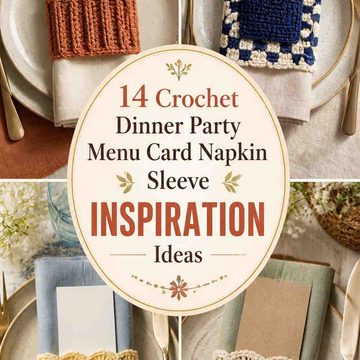
A crochet backseat charging cable guide can add handmade color to an existing car organizer while helping keep charging cords in a more predictable position. These 14 inspiration ideas explore compact guide panels, dual-cable channels, removable tabs, decorative granny squares, and small floral accents. Colors range from terracotta, mustard, and coral to cobalt blue, lavender, olive, and burgundy, offering different looks for a tidy vehicle interior.
Car cable organization needs more care than organizing cords at home. Charging cables must remain accessible, undamaged, and clear of seat belts, airbags, child restraints, and moving seat components. These concepts show crochet used as decoration around separate open cable guides, never as a tight wrap around an operating cable. The designs are best treated as ideas for vehicle-compatible accessories rather than universal attachments suitable for every car.
These are AI-generated crochet design visualizations for inspiration, not photographs of tested handmade products or step-by-step patterns. The illustrated vehicle attachments have not been tested or approved for road use.
Quick Design Selection Guide
- For a small decorative guide: Crochet Terracotta Seatback Pocket-Rim Cable Guide has a compact single-cable arrangement.
- For two separate charging cords: Crochet Cobalt Dual-Channel Backseat Guide uses independent open clips.
- For a narrow organizer: Crochet Mustard Side-Entry Chevron Cable Tab and Crochet Olive Snap-Off Cable Guide Panel offer different compact shapes.
- For repositionable guide points: Crochet Coral Three-Point Modular Cable Guides uses three independent modules.
- For an easy-to-see cable route: Crochet Rust Open-Window Cord Route Panel leaves a large central opening.
- For decorative crochet details: Crochet Mint Granny-Square Cable Dock Accent and Crochet Butter-Yellow Daisy Cable Guide feature familiar handmade motifs.
- For disconnected spare-cable storage: Crochet Chocolate Pocket-Edge Cable Landing keeps the unplugged cord near a separate organizer pocket.
1. Crochet Terracotta Seatback Pocket-Rim Cable Guide
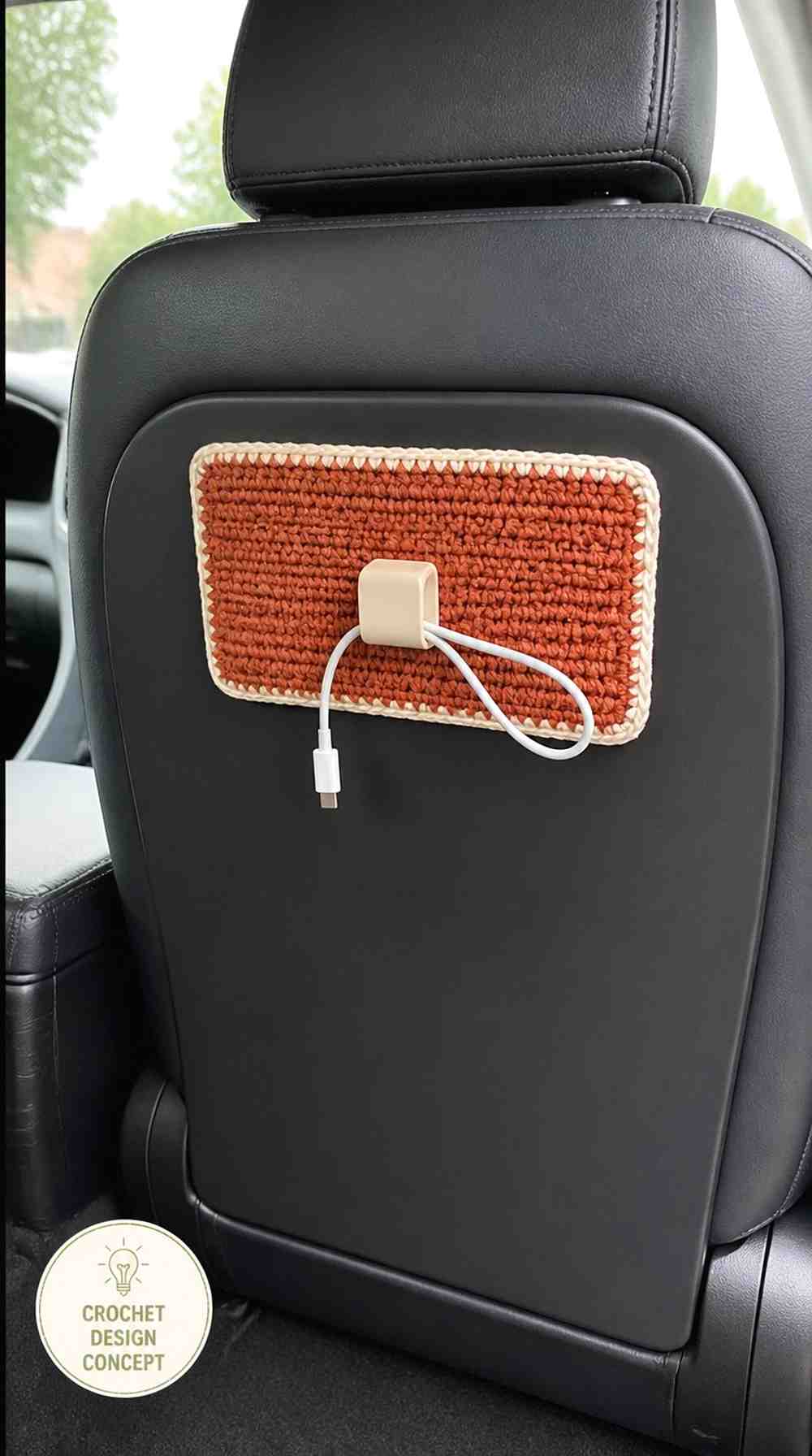
Warm terracotta crochet forms a compact rectangular panel with dense horizontal rows and a narrow ivory border. An open-sided rigid cable clip sits at its center, holding a white USB-C cable loosely against an independent rear-facing organizer board.
The small design adds color without requiring a large fabric panel across the back of the seat. Its most useful feature is the open clip, which keeps the cable visible and removable rather than enclosing it in crochet.
- Guide Position: Choose only a location approved for accessories, away from the seat’s airbag areas, safety equipment, and adjustment points.
- Open Cable Clip: Keep the cable loosely supported, with no pinching or pressure on its outer sheath.
- Decorative Backing: Use dense crochet stitches for the visual panel while allowing a separate rigid component to support the guide.
- Removal Access: Make sure the cord can be lifted out immediately without untying yarn or disconnecting the organizer.
2. Crochet Cobalt Dual-Channel Backseat Guide
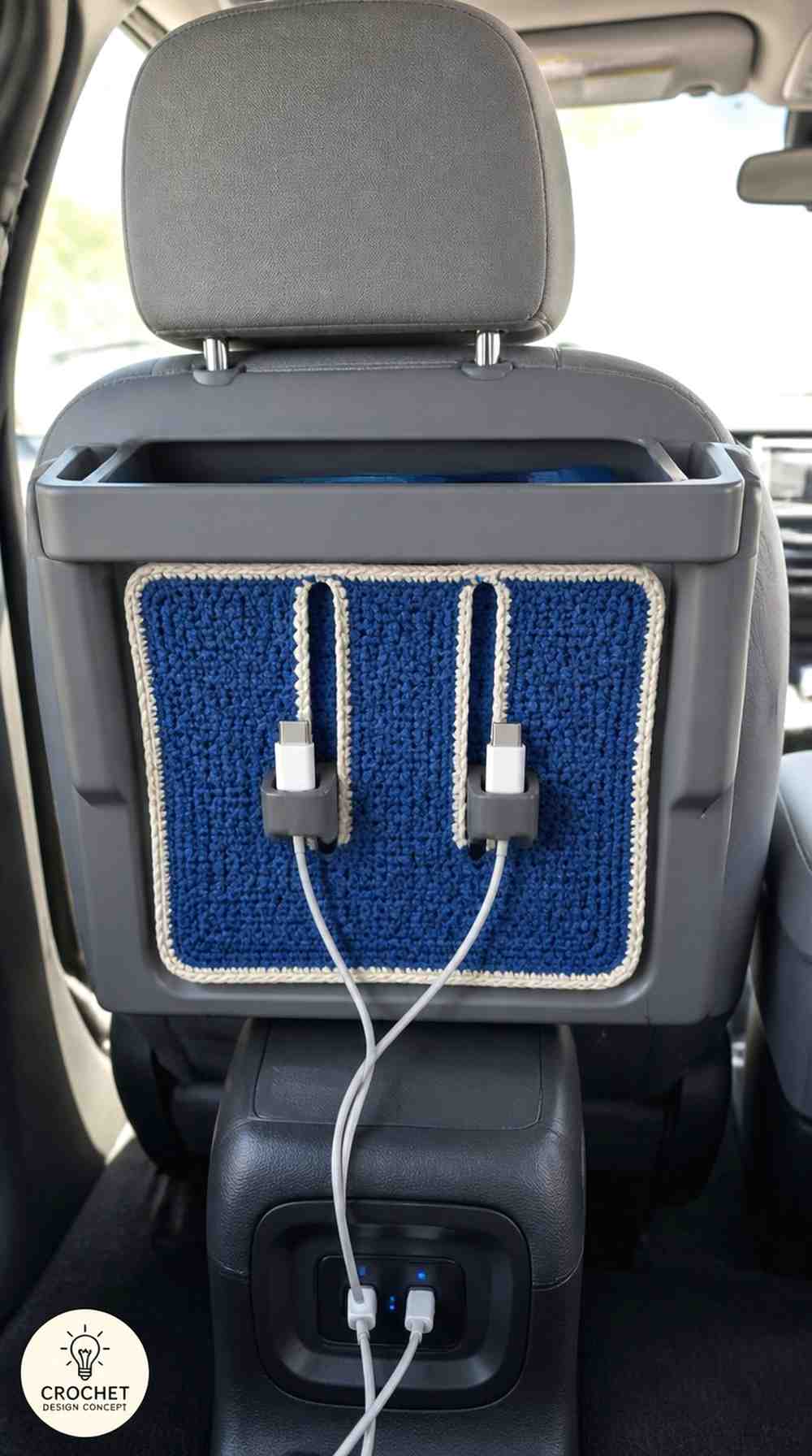
Cobalt-blue crochet creates a rectangular organizer panel with moss-style stitches and cream edging. Two distinct vertical guide sections hold separate USB-C cables in open clips, with their loose paths visible against the removable rigid backing.
The divided arrangement is designed to distinguish two charging cords without tying them together. It may be useful for a rear charging station with multiple outputs, provided the actual cable routes are permitted and remain away from passenger restraints.
- Two-Cable Separation: Give each cable its own open guide so the cords are not compressed into a shared crochet sleeve.
- Panel Width: Allow enough space for the clips and connectors without pushing one cable into the path of the other.
- Cable Routing: Avoid crossings, tight bends, and dangling loops that passengers could become caught in.
- Vehicle Compatibility: Check whether the rear-facing accessory panel is permitted by the specific vehicle manufacturer before fitting anything.
3. Crochet Mustard Side-Entry Chevron Cable Tab
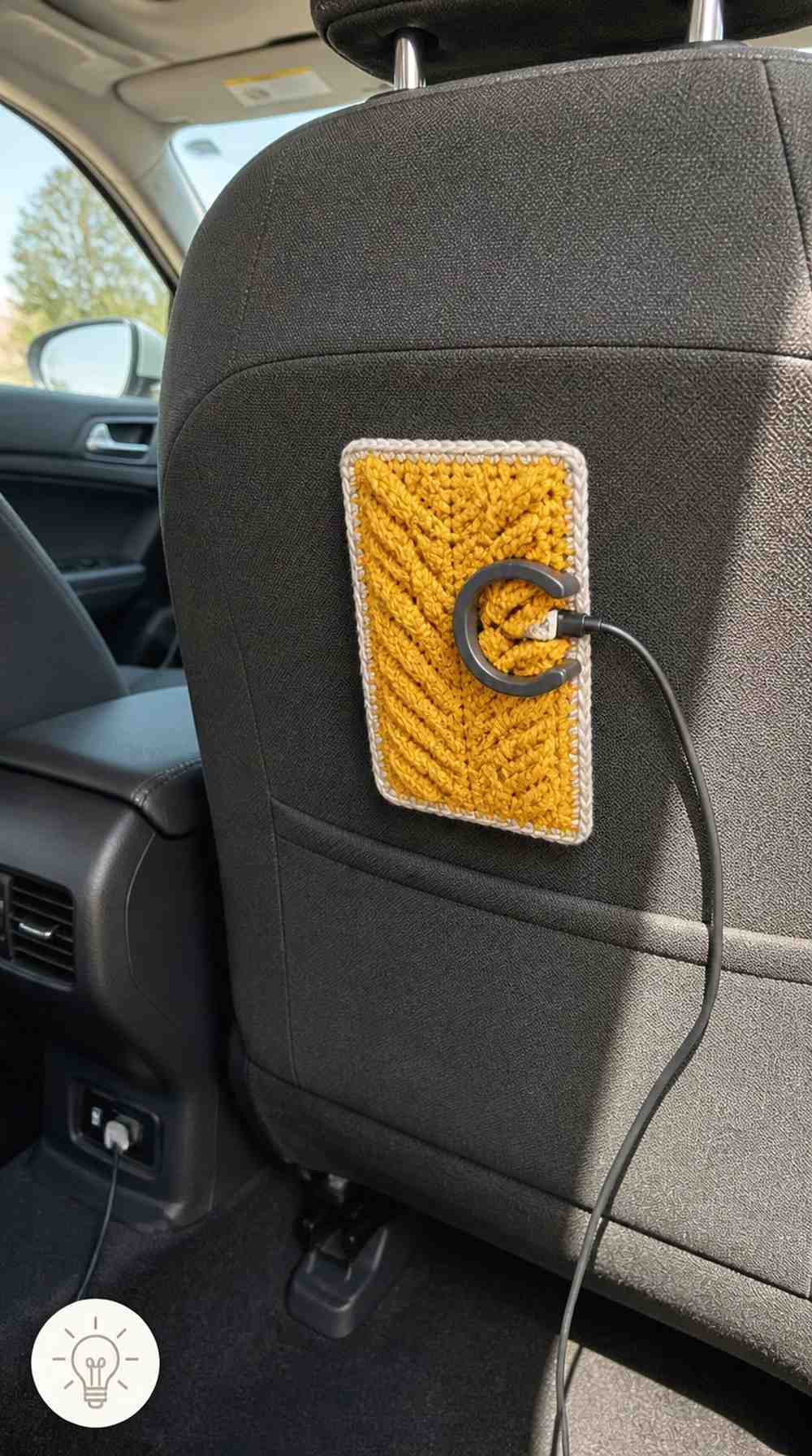
Mustard-yellow crochet forms a narrow rectangular tab with raised chevron stitches and an oatmeal-colored border. A smooth C-shaped cable guide opens at one side, allowing a black charging cord to rest loosely inside.
The side-entry design provides a simple way to place or remove the cable without threading its connector through a fabric opening. Its small size also makes it visually different from broad multi-cable organizer panels.
- Side-Entry Opening: Keep the opening easy to access without requiring the cable to be bent sharply or pulled through tight yarn.
- Chevron Texture: Use the raised crochet pattern on the decorative backing, leaving the actual cable-contact surface smooth.
- Low-Profile Placement: Keep the guide away from areas where passengers, bags, or moving seats might strike it.
4. Crochet Blush Scalloped Cable Landing Pad
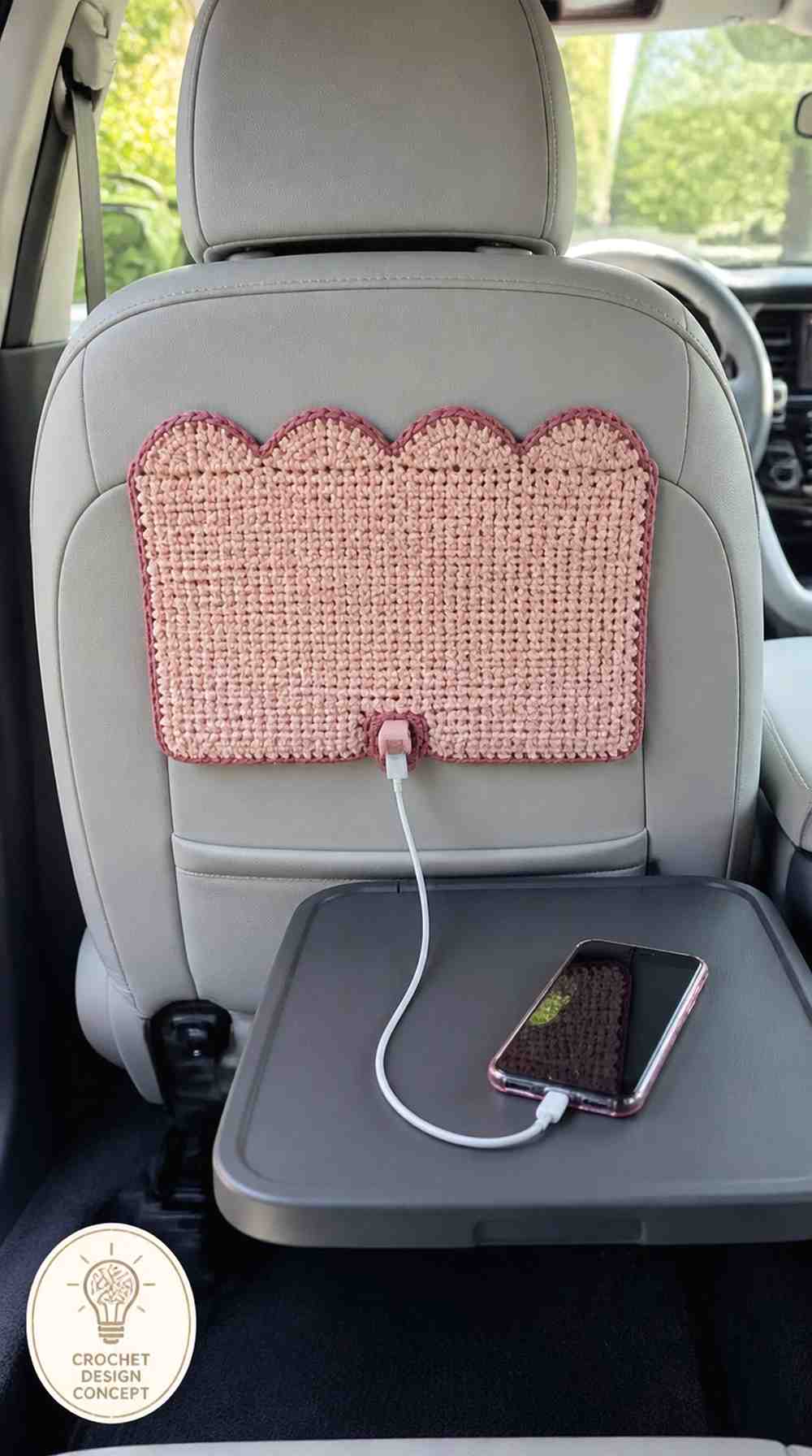
Blush-pink crochet forms a compact rectangular landing pad with dusty-rose edging and four small scallops along its upper border. A separate rigid cable rest sits below the decorative edge, holding a pale-gray charging cord.
The gentle scallops create a softer appearance than the straight-edged guides. The design is pictured with a phone on a separate rear passenger accessory tray, showing the guide as one small part of a wider charging arrangement.
- Scalloped Detail: Keep all four decorative loops flat and securely joined so they cannot catch on clothing or nearby objects.
- Cable Contact: Place the charging cord in the smooth open clip, not between the decorative crochet scallops.
- Phone Support: The charging guide does not support the phone; any device tray needs its own appropriate mounting and safe placement.
- Passenger Clearance: Keep the arrangement out of the space required for seat belts, child restraints, and normal movement.
5. Crochet Olive Snap-Off Cable Guide Panel
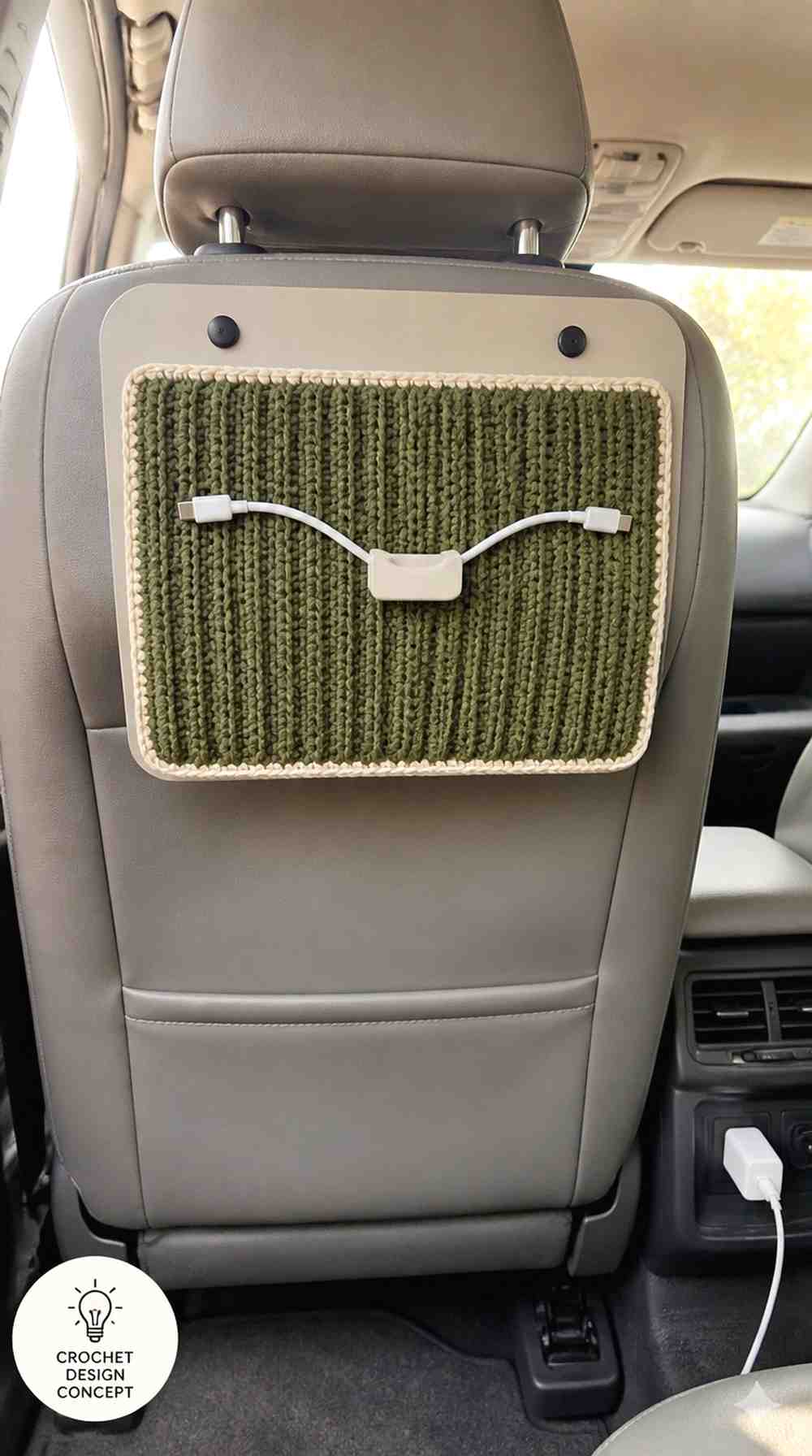
Olive-green crochet creates a small vertical-ribbed panel with cream edging and a fabric-backed mounting plate. Two matte-black snaps connect it to an independent organizer, while one open cable clip holds a white USB-C cord.
The removable backing is the main feature of this concept. It allows the decorative panel to be separated from the organizer without wrapping or cutting anything around the cable.
- Snap Attachment: Position the snaps on reinforced backing material rather than relying on loose crochet rows.
- Cable Release: The charging cord should lift out of the open clip before the panel is detached.
- Maintenance: Remove the crochet panel for cleaning or inspection, and check the snaps for looseness or damage.
- Small Hardware: Avoid this design where children could access detachable snaps or other small components.
6. Crochet Lavender Wide-Curve Cable Guide
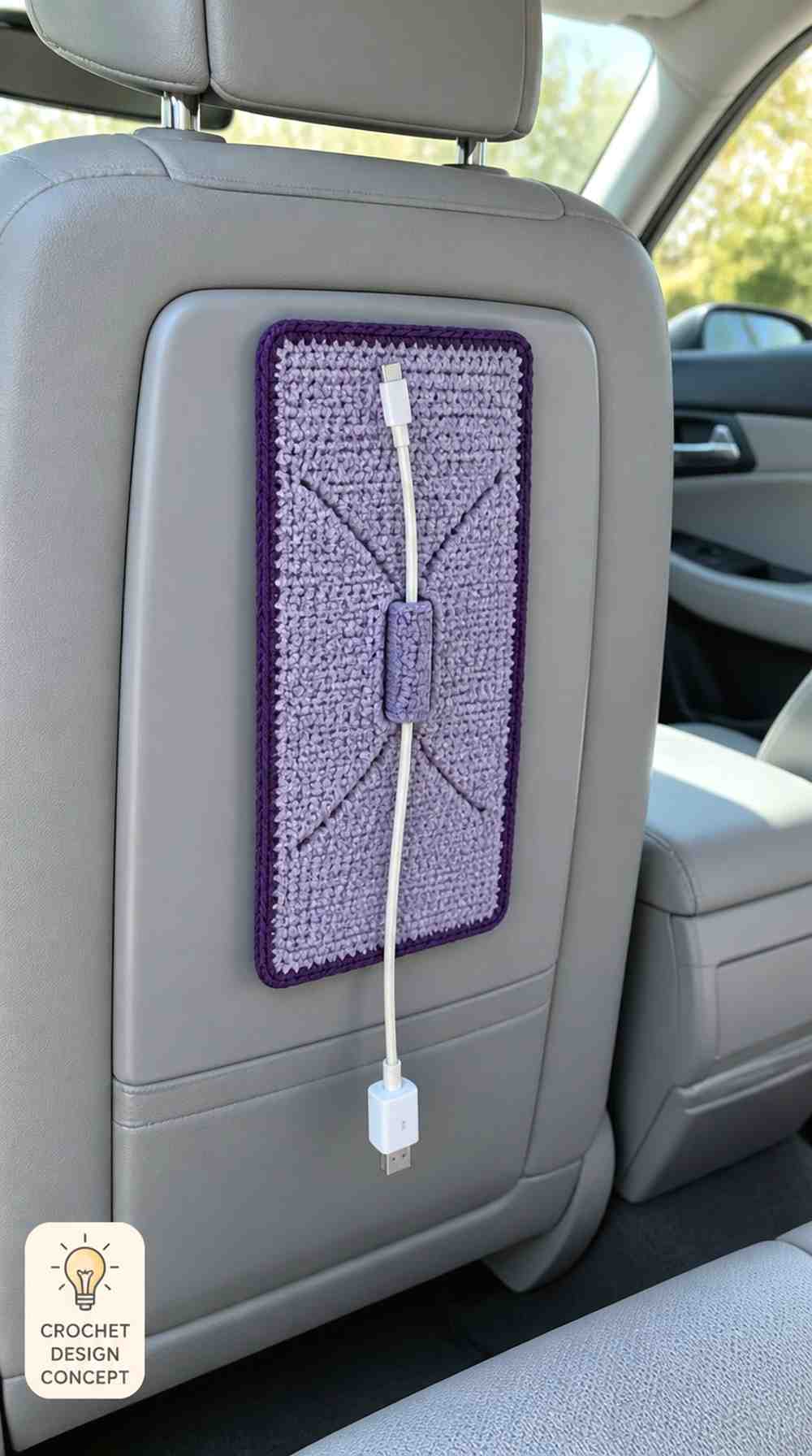
Lavender crochet forms a slim rectangular panel with shallow curved stitch bands and deeper-purple edging. A wide open guide clip supports a cream USB-C cable that follows a relaxed curve across the removable organizer board.
The curved crochet texture echoes the cable’s shape without physically wrapping around it. This design emphasizes leaving enough room for a natural cord path rather than forcing a sharp turn through a narrow guide.
- Relaxed Cable Shape: Avoid sharp bends, especially close to a plug or connector housing.
- Open Guide Width: The clip should allow the cable to rest loosely, without squeezing or deforming its sheath.
- Decorative Curves: Keep the lavender crochet bands flat on the backing rather than using raised loops to hold the charging cord.
7. Crochet Coral Three-Point Modular Cable Guides
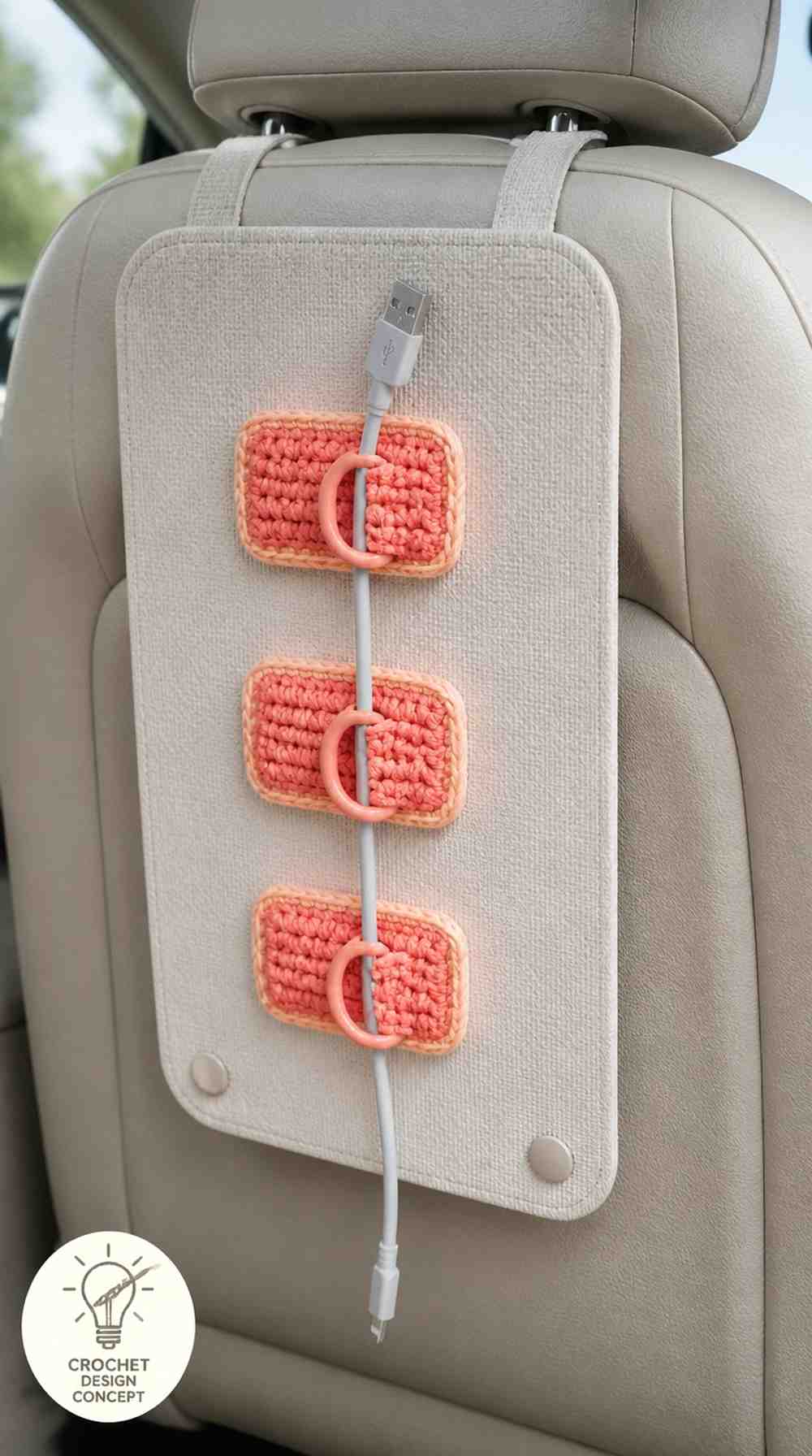
Three small coral-pink crochet panels form a short vertical line, each with peach edging and its own open-sided cable clip. A single pale-gray USB cable passes loosely through the separate guides while remaining completely exposed.
The modular layout makes this concept different from a continuous cable sleeve. Individual guide positions could be adjusted on a compatible removable accessory board without threading the cable through fabric tunnels.
- Guide Spacing: Leave enough room between the three open clips to maintain a relaxed cable path.
- Modular Construction: Give each crochet panel an independent supported attachment instead of relying on one continuous strip of yarn.
- Easy Release: The cable should be removable from every guide without pulling or forcing its connector through a narrow opening.
- Passenger Safety: Avoid any arrangement that places a cord near a child’s neck, hands, or restraint system.
8. Crochet Oatmeal Basketweave Cable Saddle
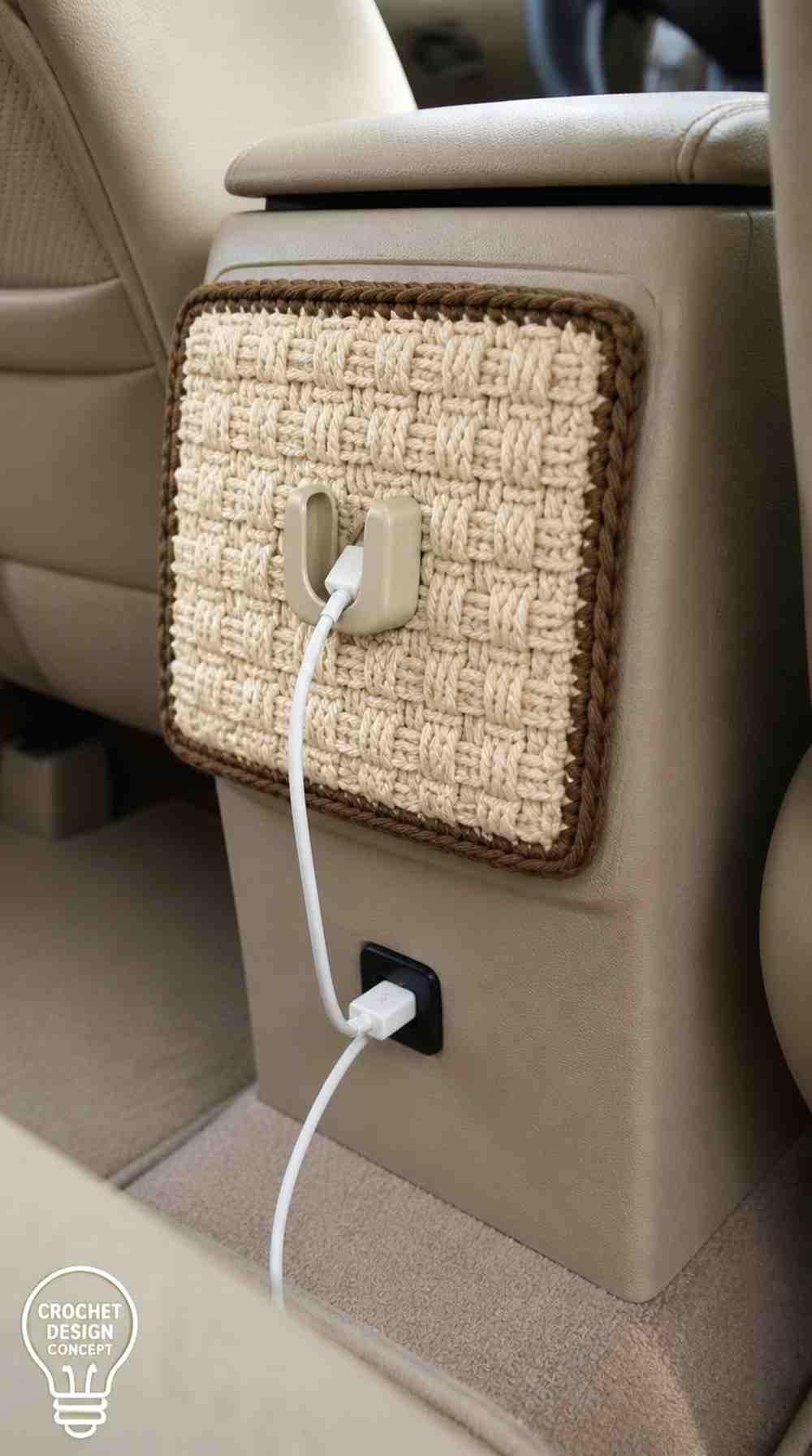
Oatmeal-colored crochet creates a small horizontal panel with raised basketweave-style blocks and cocoa edging. A separate rigid U-shaped saddle sits in the center, loosely supporting one white charging cable.
The broad open saddle gives this concept a different appearance from narrow C-shaped clips. It is shown on a removable rear-center console organizer, with the charger connection exposed below and the crochet kept away from the socket.
- Saddle Opening: Keep the cable resting naturally inside the guide rather than pressing tightly against its sides.
- Basketweave Texture: Use the raised crochet blocks only on the decorative panel, away from connectors and charging hardware.
- Charging-Port Clearance: Do not place yarn over the port, adapter, or connector housing.
9. Crochet Rust Open-Window Cord Route Panel
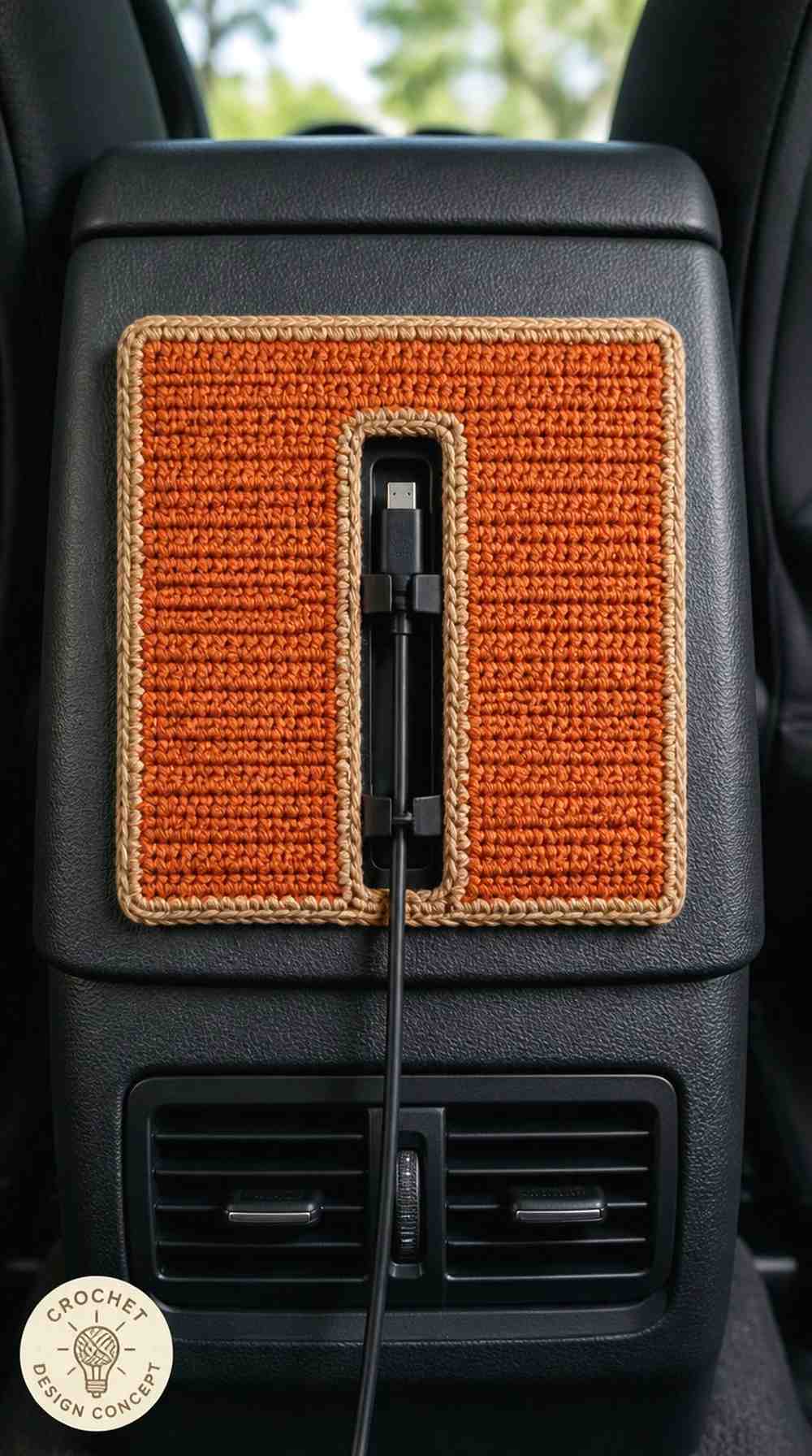
Rust-orange crochet forms a rectangular panel with a large central cutout and sand-colored edging. The open window exposes a separate rigid guide and the black USB cable resting inside it.
This design makes the cable route particularly easy to inspect. Instead of concealing the cord beneath fabric, the crochet creates a decorative border around the space where the guide is positioned.
- Central Opening: Leave enough room to view the cable and lift it out without disturbing the crochet backing.
- Window Edging: Finish the inner crochet border neatly so loose yarn ends cannot reach the cable.
- Inspection Access: The open design makes it easier to notice obvious cable damage, though it does not replace regular inspection.
10. Crochet Mint Granny-Square Cable Dock Accent
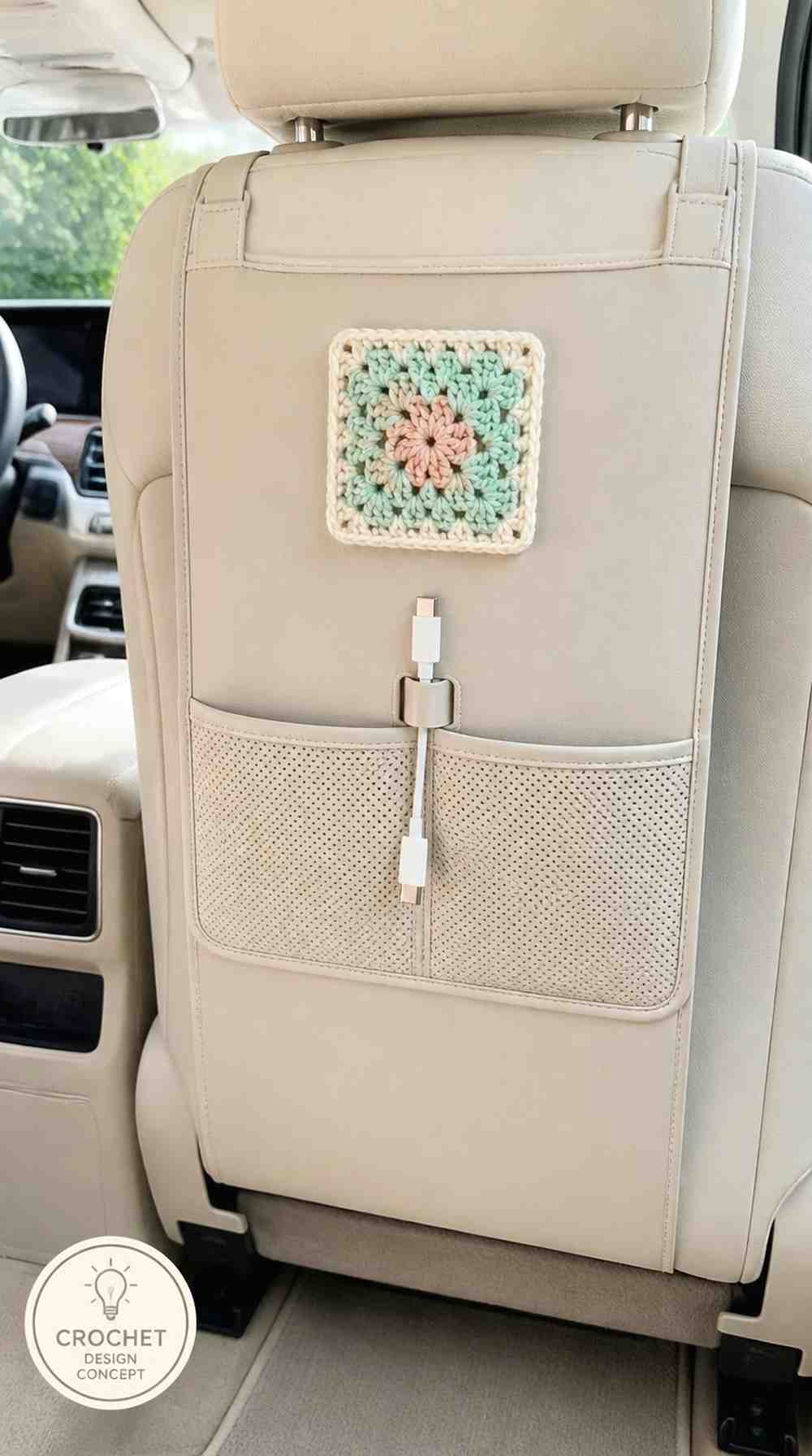
Mint-green crochet forms a small granny square with ivory edging and a dusty-peach center. The motif sits flat against a removable rigid accessory backing, while a separate open-sided cable clip is positioned just below it.
The granny square gives the guide a recognizable handmade appearance without using crochet stitches to grip the cord. The charging cable remains visible and easy to remove from the small plastic guide.
- Granny-Square Joining: Keep the corner clusters securely connected so the motif lies flat against its backing.
- Decorative Placement: Position the square above the cable guide rather than allowing open crochet loops to touch the operating cord.
- Compact Scale: Avoid oversized motifs that might extend beyond the permitted accessory area or catch on passenger belongings.
11. Crochet Navy Triple-Cable Exit Guide
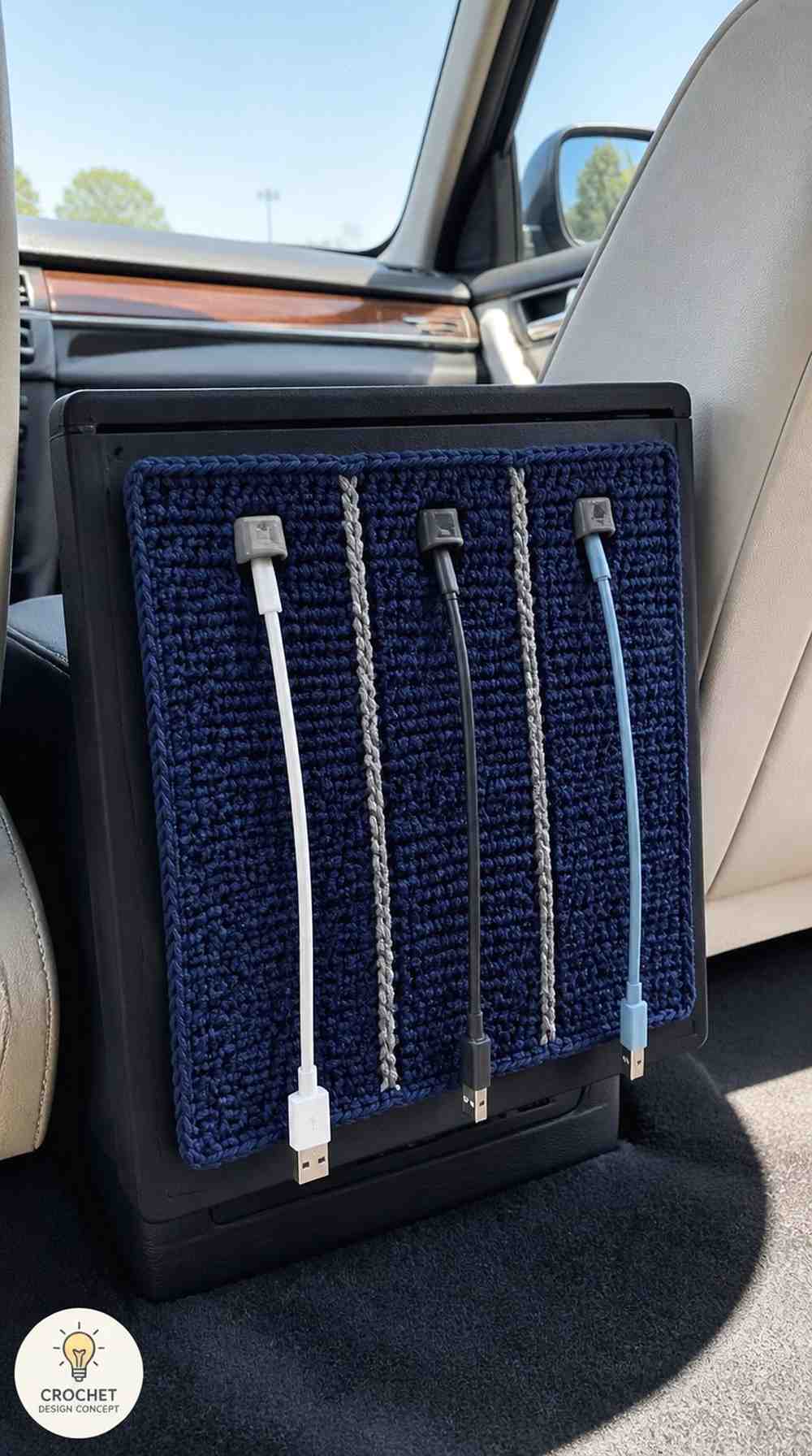
Navy-blue crochet creates a wide rectangular panel with three separate cable positions and thin silver-gray dividers. Each channel has a low-profile open plastic clip, holding a different USB cord in white, dark gray, or pale blue.
The three-channel layout offers a coordinated way to distinguish several charging cords. However, more cables also mean more opportunities for tangling or passenger interference, so the arrangement needs particular attention to placement.
- Three Independent Routes: Avoid bundling the cables together or forcing them through one tight fabric opening.
- Connector Accessibility: Keep the charging ends visible and easy to disconnect without pulling on the organizer.
- Cable Quantity: Use only the cables actually needed, and remove unnecessary cords rather than leaving long loops in the passenger area.
- Safety Clearance: Check that none of the three routes crosses seat belts, child-restraint components, moving mechanisms, or airbag deployment areas.
12. Crochet Butter-Yellow Daisy Cable Guide
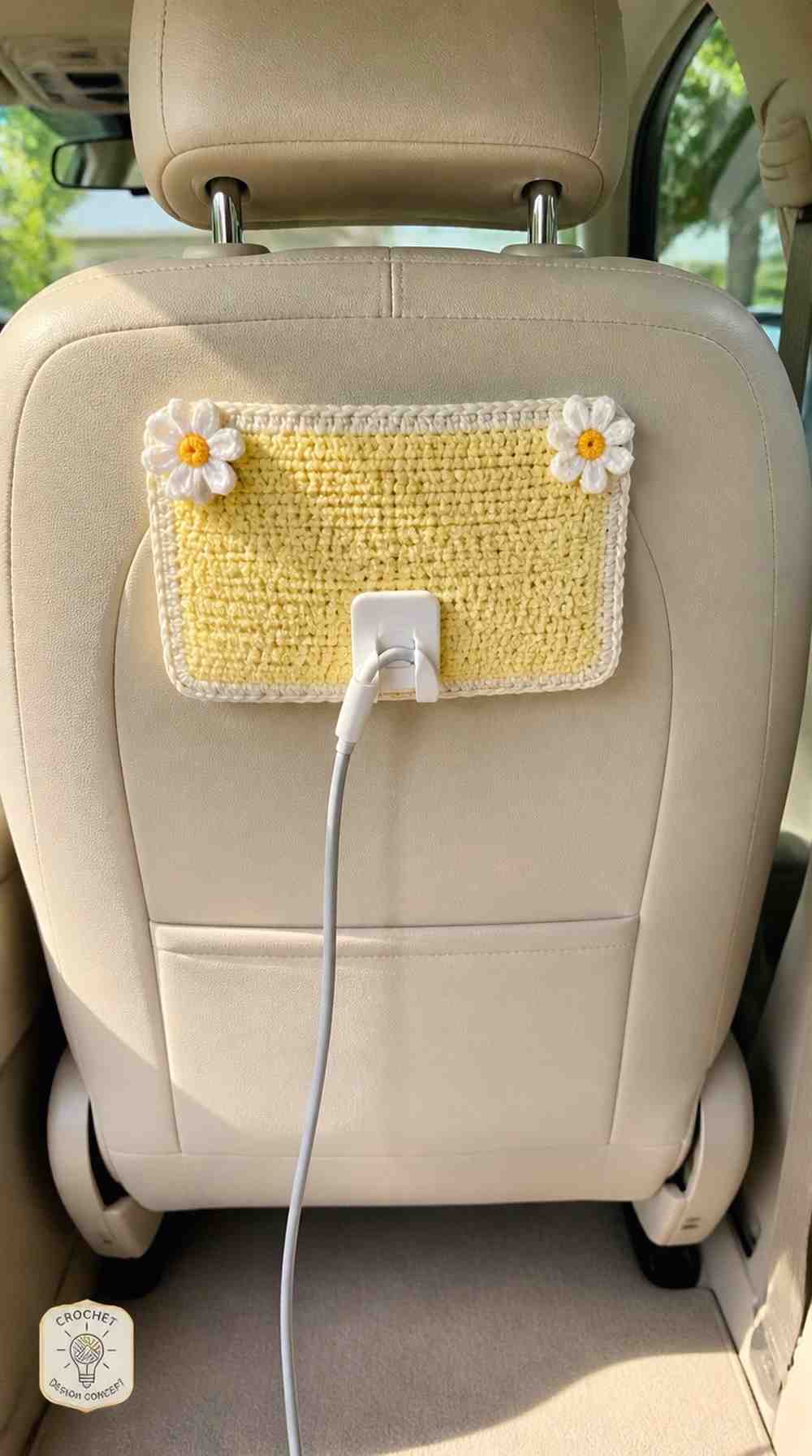
Butter-yellow crochet forms a compact rectangular panel with ivory edging and two small white daisies at the upper corners. A separate open plastic cable clip sits below the flowers, loosely supporting a pale-gray charging cord.
The floral details make this one of the more playful concepts in the collection. Their flat construction keeps the decorative elements away from the cable’s path, although the motifs should not be accessible to children who might pull at them.
- Daisy Placement: Keep the two flowers above and away from the open cable guide.
- Secure Motifs: Use firmly attached crochet petals rather than beads, dangling ornaments, or detachable flower centers.
- Child Access: Decorative flowers and exposed cables are not suitable within reach of young children, especially where pulling or entanglement is possible.
13. Crochet Chocolate Pocket-Edge Cable Landing
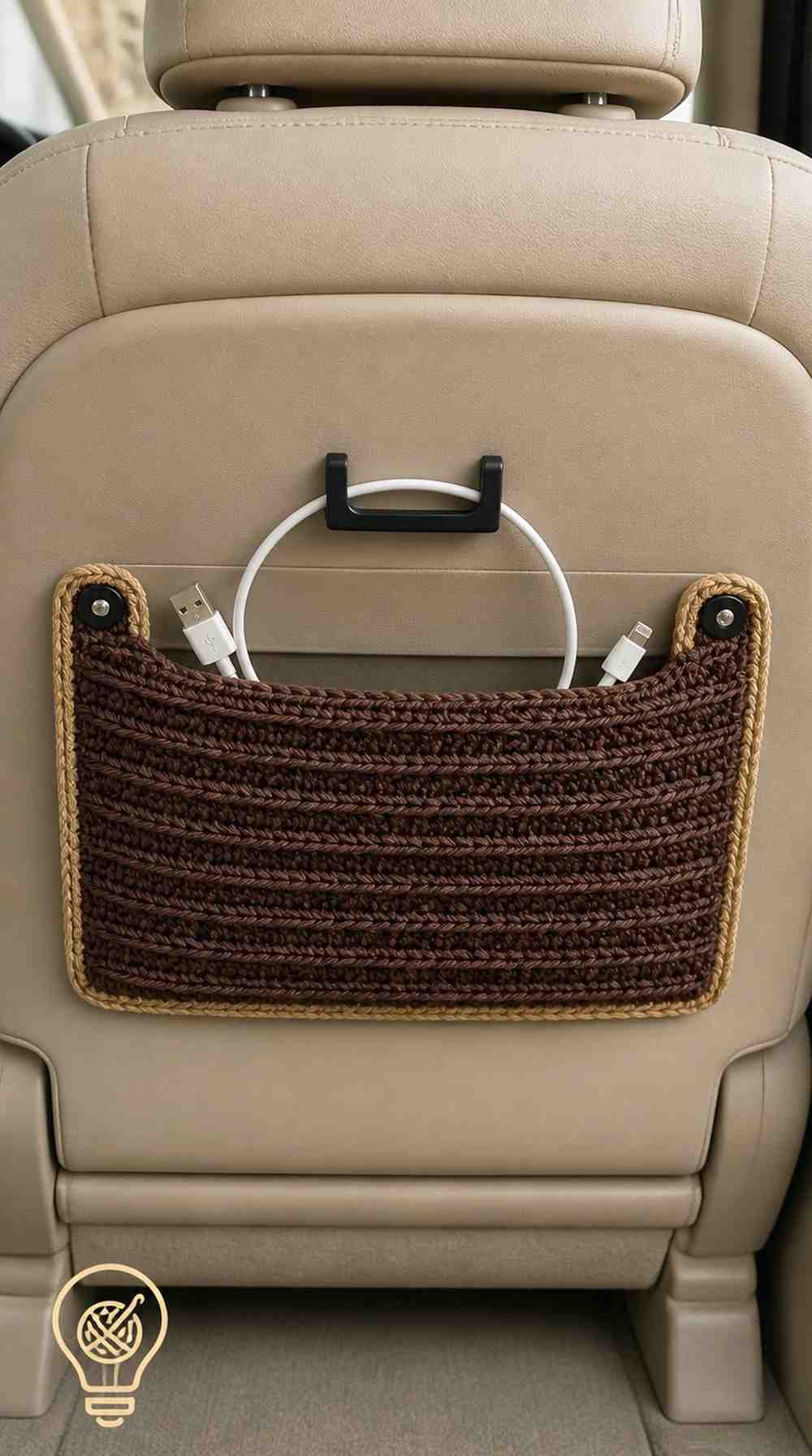
Chocolate-brown crochet forms a narrow trim panel along the exterior rim of a removable rigid seatback organizer pocket. Raised basket-style rows and tan edging give it a warm appearance, while a separate open U-shaped guide sits above the pocket.
The pictured cable is a disconnected spare. Its middle section rests loosely in the guide, while both unplugged connectors remain inside the pocket. This makes the concept more about ready-to-use storage than routing an active charging cable.
- Disconnected Storage: Keep the cable unplugged while it is resting in the organizer pocket.
- Pocket Access: Leave enough room to remove the spare cord without tugging on the crochet trim.
- Connector Protection: Avoid pressing plugs beneath heavy objects or bending the cable sharply where it enters the pocket.
- Seatback Fit: Use only a compatible independent organizer, not an attachment to the seat’s safety-critical structure.
14. Crochet Burgundy Foldaway Cable Guide Strip
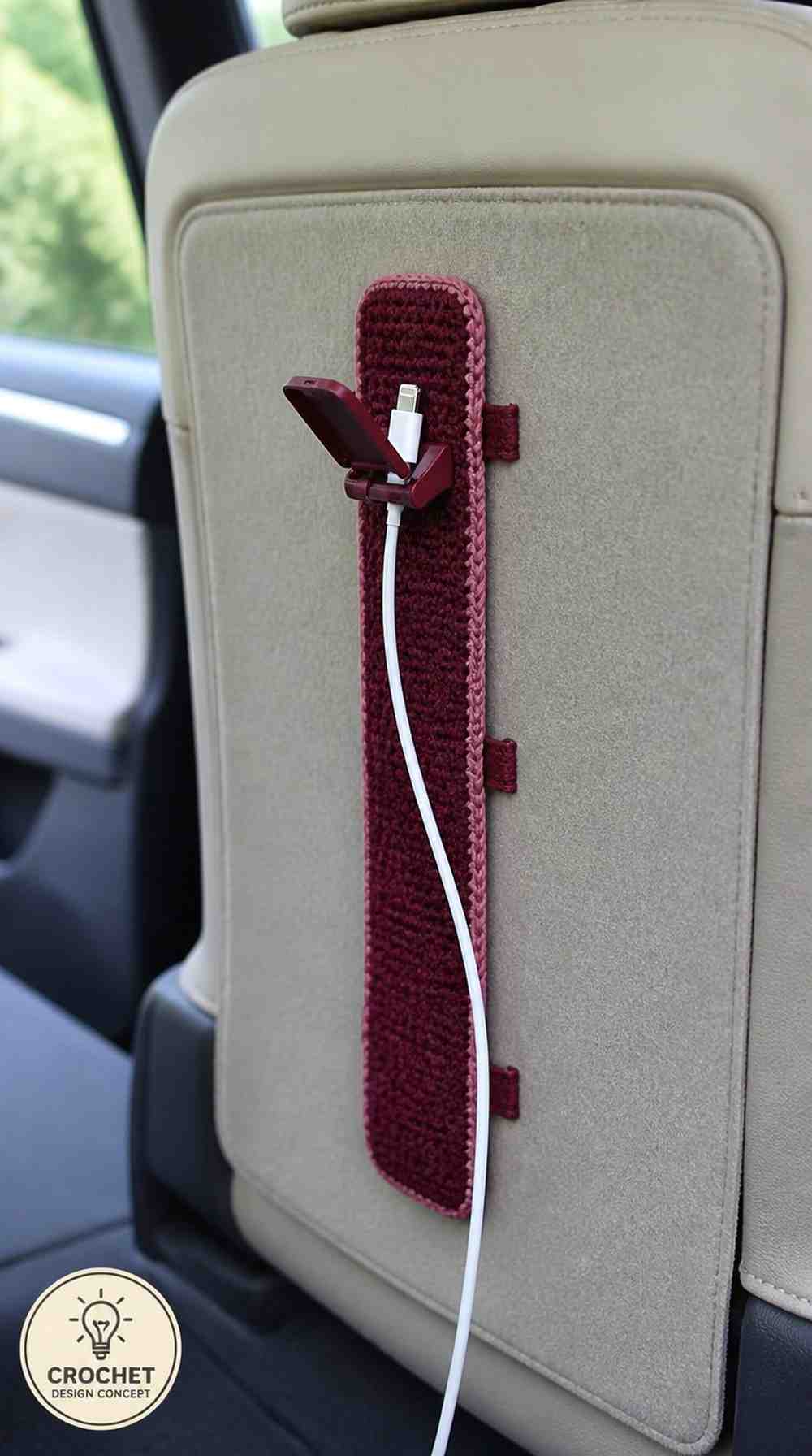
Burgundy crochet creates a short vertical strip with moss-style stitches and rose edging. Three low-profile rear fastening tabs connect it to a rigid accessory panel, while a small hinged open cable clip projects from the upper front.
The foldaway guide is the distinguishing feature. Its hinged clip can be opened for cable access while the rest of the crochet strip remains flat against the backing. Any real version would need a hinge that cannot become a snagging or impact hazard.
- Hinged Clip: Choose a smooth, low-profile mechanism without exposed sharp edges or easily detached parts.
- Cable Release: The cord should lift out without pulling against the hinge or folding the cable into a tight bend.
- Storage Position: When not needed, the clip should remain secured rather than swinging freely into the passenger space.
Practical Guide to Crochet Backseat Charging Cable Guides
A crochet cable guide inside a car needs to account for both electrical safety and passenger safety. An attractive design is not enough to establish that an accessory is suitable for vehicle use.
1. Check the vehicle manual first. Seatbacks may contain airbags, wiring, moving components, or other safety-critical features. Accessory placement varies by vehicle, and some manufacturers specifically restrict attachments near seatback airbags. Never assume that an available-looking surface is suitable for mounting a guide.
NHTSA+1
2. Keep cables away from safety equipment. Do not route charging cords across seat belts, child-restraint attachments, headrest mechanisms, seat tracks, or areas where airbags may deploy. If a route cannot avoid these areas, do not install it.
3. Avoid accessible loops around children. Loose charging cords can create entanglement hazards. Keep them out of the reach of infants and young children, and do not position cable guides near child car seats or restraints.
4. Do not wrap operating cables in crochet. These concepts use separate open guides rather than enclosing an active charging cable in yarn. Keep power adapters, connectors, and charging sockets uncovered. Apple warns against using damaged charging cables or charging equipment in unsafe conditions.
Apple Support
5. Do not force the cable into a tight path. A guide should allow the cord to sit naturally without sharp bends, pinching, or tension at the connector. Never use a crochet panel to pull a cable across a moving seat joint.
6. Consider cabin heat. Parked vehicles can become extremely hot. Avoid leaving charging electronics exposed to excessive heat or direct sun; Apple specifically warns that charging performance and device safety can be affected by hot environments.
Apple Support
7. Keep the crochet removable. Smooth cotton crochet may be considered for a decorative panel, but it is not electrical insulation or a vehicle safety material. A removable design makes cleaning and inspection easier.
8. Limit loose objects. Guides, clips, and mounting boards need appropriate support. Any accessory that detaches during braking or a collision can become a hazard. Do not install an untested homemade assembly in a position where it could strike occupants.
9. Inspect the complete setup. Check the charging cable, accessory board, guide clips, and crochet before use. Remove the accessory if it shifts, rubs against the seat, obstructs movement, or becomes damaged.
10. Use the simplest safe arrangement. Sometimes a shorter compatible charging cable, used according to the vehicle and device instructions, is preferable to adding any organizer. A cable guide should only be considered if it solves a real routing problem without introducing another hazard.
For a related project focused on disconnected cable storage, explore 17 Crochet Reusable Charging Cable Tie Inspiration Ideas on Yarn Nest Studio. That collection covers securing loose cable coils when they are not connected to charging equipment.
Want to Make Something Similar?
These verified resources explain related crochet cord-organizer techniques. They are not exact patterns for the 14 vehicle concepts, and they do not establish that a handmade accessory is safe to install in a car.
- CyCrochet — Crochet Cord Keeper: A free tutorial covering a compact single-crochet panel, folded pocket, seams, and a button closure. It is intended for disconnected cable storage, not for guiding a cable during charging. CyCrochet
- CyCrochet — Woven Cable Keeper: A free pattern for a textured cord organizer with a flap and pocket. It may help readers understand firm crochet panels and edge construction, but it is not a car-installation guide. CyCrochet
For more charging-cable safety information, see Apple’s important charging and device safety guidance.
Which Crochet Backseat Charging Cable Guide Should You Choose?
| Organization need | Design to consider | Main consideration |
|---|---|---|
| Compact single-cable guide | Terracotta Seatback Pocket-Rim | Small mounting area |
| Two separate charging cords | Cobalt Dual-Channel | Independent cable routes |
| Small open-sided guide | Mustard Chevron Tab | Easy cable removal |
| Soft decorative edging | Blush Scalloped Landing Pad | Flat, snag-free trim |
| Removable panel | Olive Snap-Off Guide | Secure small hardware |
| Gently curved cable route | Lavender Wide-Curve | No sharp bends |
| Several separate guide positions | Coral Three-Point Modular | Consistent spacing |
| Broad open cable support | Oatmeal Basketweave Saddle | Loose cable fit |
| Fully visible cable route | Rust Open-Window Panel | Open central access |
| Granny-square decoration | Mint Cable Dock Accent | Motif kept off cable |
| Three individual cables | Navy Triple-Cable Exit | More complex routing |
| Floral decoration | Butter-Yellow Daisy Guide | Child-access concerns |
| Disconnected spare-cable storage | Chocolate Pocket-Edge Landing | Pocket and connector clearance |
| Foldaway guide mechanism | Burgundy Foldaway Strip | Hinged-clip security |
For a small permitted accessory panel, the Terracotta Seatback Pocket-Rim Guide or Mustard Side-Entry Chevron Tab offers a compact concept. Both place a single open clip on a relatively small crochet backing.
The Cobalt Dual-Channel and Navy Triple-Cable designs offer arrangements for multiple cords, although their more complicated routing may make them unsuitable for a particular vehicle or passenger layout.
If easy removal is the priority, the Olive Snap-Off and Coral Three-Point Modular concepts emphasize separate components. For a disconnected spare cable, the Chocolate Pocket-Edge Landing is the most directly relevant choice.
Whichever style looks best, do not choose it until the mounting position and cable route have been checked against the actual vehicle and its safety requirements.
Conclusion
A crochet backseat charging cable guide can bring a small handmade accent to a vehicle accessory organizer. From simple terracotta panels to modular coral guides and decorative granny-square accents, these 14 concepts show different ways to combine crochet with separate open cable clips.
The safest-looking design is not necessarily the safest one to install. Vehicle compatibility, cable condition, passenger clearance, and proper charging practices matter more than the crochet finish. If a guide would interfere with seat belts, child restraints, airbags, or moving parts, leave it out and use a simpler approved charging arrangement.
Which of these 14 crochet backseat charging cable guide designs do you like most? Would you choose the terracotta single guide, cobalt dual-channel panel, or mint granny-square accent? Share your favorite style in the comments.
Frequently Asked Questions
1. Can crochet be used to organize charging cables in a car?
Crochet can decorate a separate removable organizer, but it should not replace the cable’s insulation, an approved mounting component, or the vehicle’s charging hardware. A cable guide must remain clear of safety equipment and allow easy cable release. These concepts are untested visual ideas, not approved automotive accessories.
2. Is it safe to wrap an active charging cable in crochet?
Avoid enclosing an operating charging cable or covering its connectors and adapters with crochet. Fabric is not electrical protection, and tight wrapping may hide damage or interfere with normal cable handling. Use charging equipment according to its manufacturer’s instructions.
Apple Support
3. Can I attach a crochet cable guide directly to a car seatback?
Not without checking the vehicle manufacturer’s instructions. Front seatbacks may contain side airbags or other important components, and attachments can interfere with their operation. Do not mount anything to an airbag seam, safety restraint, headrest mechanism, or moving seat part.
NHTSA+1
4. What if children sit in the back seat?
Keep charging cables, loose loops, detachable clips, and decorative accessories out of children’s reach. Do not route cables around child restraints or seat belts. If the only practical cable route passes through a child’s seating area, use a different charging arrangement rather than adding a crochet guide.
5. Are these 14 crochet backseat charging cable guide ideas complete patterns?
No. These are original crochet design visualizations showing different decorative panels, colors, open guide positions, and removable arrangements. The linked crochet tutorials explain related cord-organizing techniques but do not reproduce the exact concepts. A real vehicle accessory would require separate construction planning, product compatibility checks, and appropriate safety assessment.