Crochet cottagecore hanging plant holders combine the charm of handmade yarn textures with the natural beauty of indoor greenery. From delicate lace sleeves and scalloped plant slings to granny-square baskets, daisy decorations and soft gingham finishes, these 19 inspiration ideas explore different ways to display potted plants. The collection includes neutral farmhouse designs, romantic floral details, cheerful colors and more structured crochet baskets for a range of cozy interiors.
Choosing a hanging plant holder involves more than finding a pretty stitch or matching yarn color. The shape of the pot, depth of the cradle, attachment of the straps and available hanging space all affect how a real piece would work. This collection helps you compare open and closed crochet structures, decorative trims, different suspension styles and practical considerations before planning a plant holder for your home.
Quick Design Selection Guide
- For soft, romantic cottage decor: Consider Crochet Blush Daisy Chain Plant Holder, Crochet Dusty Rose Ruffle Pot Hanger, or Crochet Sweet Pea Trellis Plant Hanger for floral details and gentle colors.
- For vintage-inspired rooms: Crochet Vintage Lace Bell Plant Hanger and Crochet Victorian Picot Lace Plant Pocket emphasize decorative openwork, although lace should not replace reliable structural support.
- For a stronger basket appearance: Choose Crochet Sage Granny Square Plant Basket, Crochet Farmhouse Ridge Plant Hanger, or Crochet Butter Yellow Basketweave Plant Holder.
- For open, airy plant displays: Crochet Ecru Scalloped Plant Sling and Crochet Cottage Windowpane Lattice Sling show more of the actual planter.
- For playful botanical details: Try Crochet Strawberry Vine Hanging Basket, Crochet Sunflower Medallion Plant Sling, or Crochet Mushroom Meadow Plant Holder.
- For displaying two plants vertically: Crochet Twin Tier Cottage Plant Hanger provides an interesting arrangement, but requires especially careful weight and mounting checks.
1. Crochet Ecru Scalloped Plant Sling
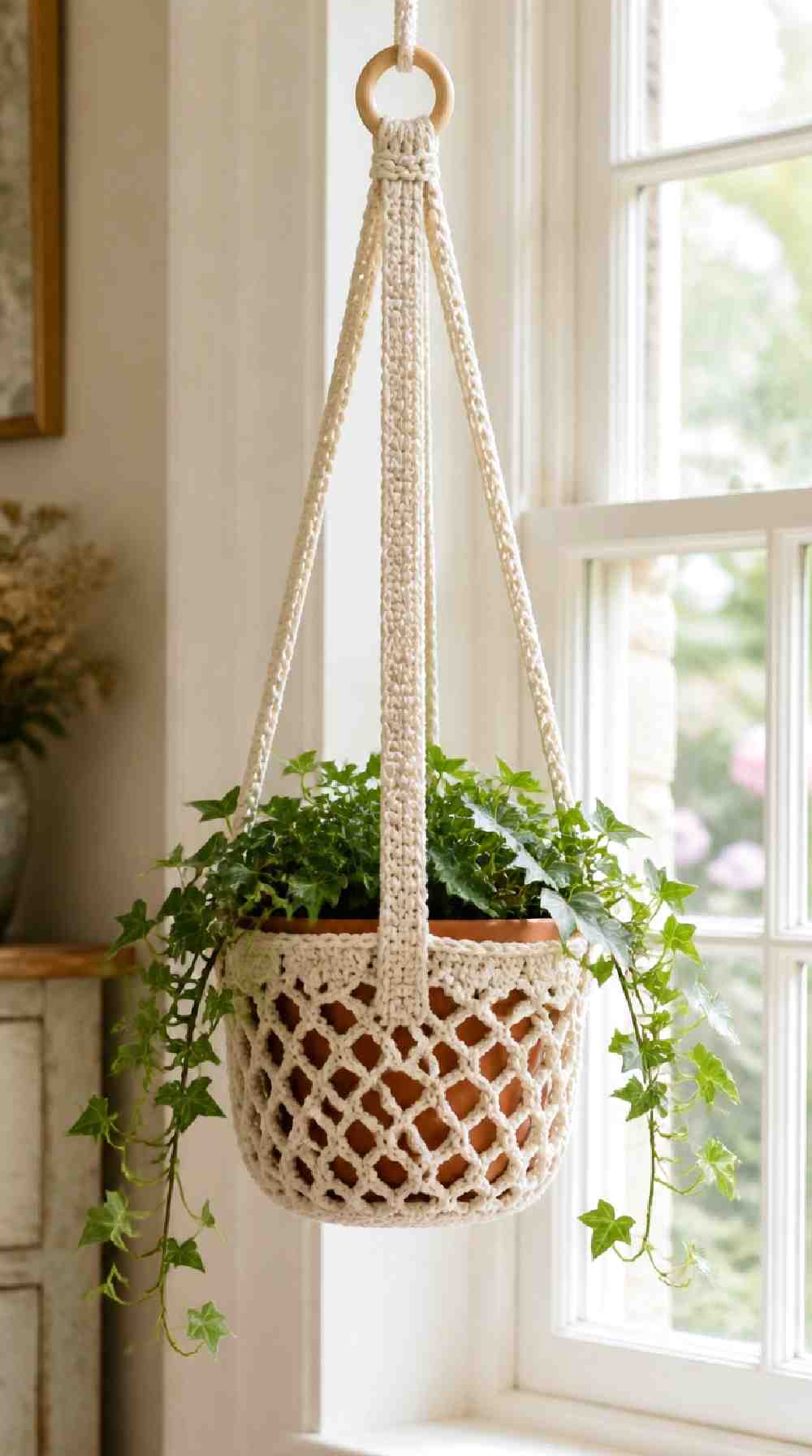
An ecru crochet cradle surrounds the lower portion of a terracotta pot, leaving its warm clay surface visible through an open diamond-mesh structure. A delicate scalloped band runs just below the rim, while three evenly spaced crochet straps rise to a small natural oak ring. Trailing ivy softens the overall outline without concealing the holder.
The solid round base gives the concept a clear supporting area, contrasting with the lighter open sides. This could suit a sunny cottage corner, provided a real version fits the pot securely and uses appropriate hanging support.
- Open-Mesh Fit: The diamond openings reveal the terracotta pot, but the supporting base and upper structure must prevent the planter from slipping or tipping.
- Scalloped Border Placement: Keep the decorative scallops below the pot rim. Positioning them too high may make the top edge awkward when removing the planter.
- Three-Strap Balance: Evenly spaced suspension straps help the visual balance. Their real-world length, joining points and tension need checking with the intended pot.
- Ecru and Terracotta: The neutral yarn lets the warm clay remain visible. This combination suits wooden furniture and other natural cottage materials.
2. Crochet Sage Granny Square Plant Basket
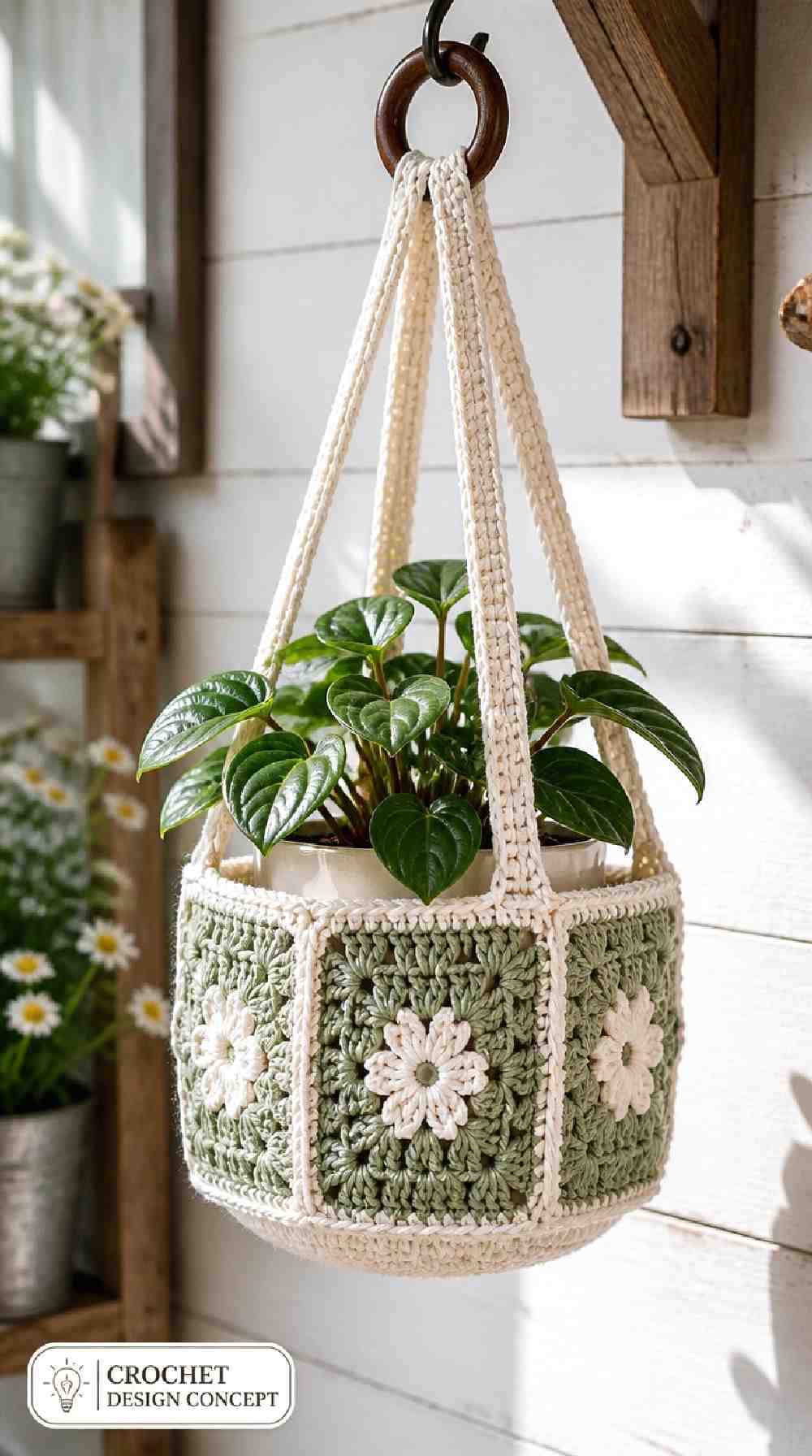
Four sage-green granny squares, each featuring a small ivory flower center and oatmeal border, form the decorative sides of this hanging plant basket. A closely stitched circular base supports the cream ceramic planter, while four cream crochet straps meet at a dark wooden ring above the basket.
Unlike open plant slings, this concept gives the pot a more enclosed appearance. The separate square motifs introduce traditional cottage crochet character. Anyone adapting the design would need to consider how the square panels join the round bottom without creating gaps or uneven tension.
- Square Arrangement: Keep the four granny squares consistent in size and orientation. Uneven panel heights could distort the basket’s upper edge.
- Joined Corners: The points where square panels meet need careful joining, especially near suspension attachments where tension may concentrate.
- Round Base Transition: Joining square sides to a circular bottom requires planning. Check whether the completed shape accommodates the actual planter without forcing its corners.
- Color Harmony: Sage, oatmeal and ivory work well with a cream planter, allowing the crocheted flower centers to remain visible without bright contrast.
3. Crochet Blush Daisy Chain Plant Holder
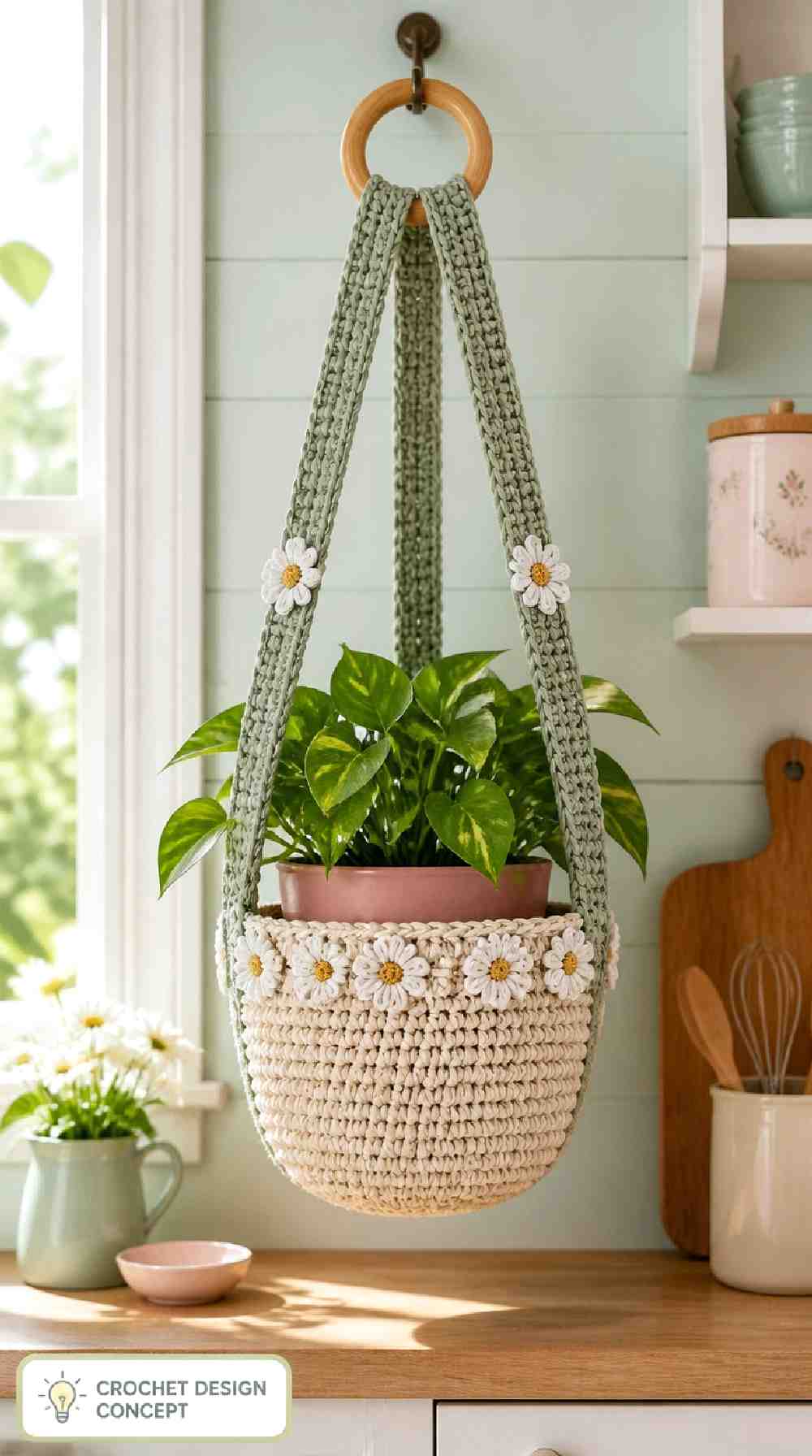
Tiny white daisies with golden centers encircle the upper portion of a cream crochet plant holder, giving the design a cheerful cottage-garden appearance. A dusty-pink clay pot sits inside the rounded cup, supported by three sage-green crochet straps. Each strap carries one additional small daisy near its lower attachment.
The decorative flowers are the main attraction, but the holder keeps a simple structural shape beneath them. This makes the crochet cup easier to understand visually. For a handmade adaptation, the daisies should remain separate embellishments rather than interfering with the supporting straps.
- Daisy Band Spacing: Place the small flowers around the upper exterior with enough room between them for individual petals and yellow centers to remain recognizable.
- Strap Decorations: The three little daisies near the strap bases should be attached without weakening or obscuring the underlying structural joins.
- Pot Access: Check that the cream cup allows the dusty-pink planter to be lifted out for watering and inspection without catching on decorative flowers.
- Pastel Styling: Dusty pink, sage and cream create a softer palette than bright garden colors, making the design suitable for romantic cottage interiors.
4. Crochet Vintage Lace Bell Plant Hanger
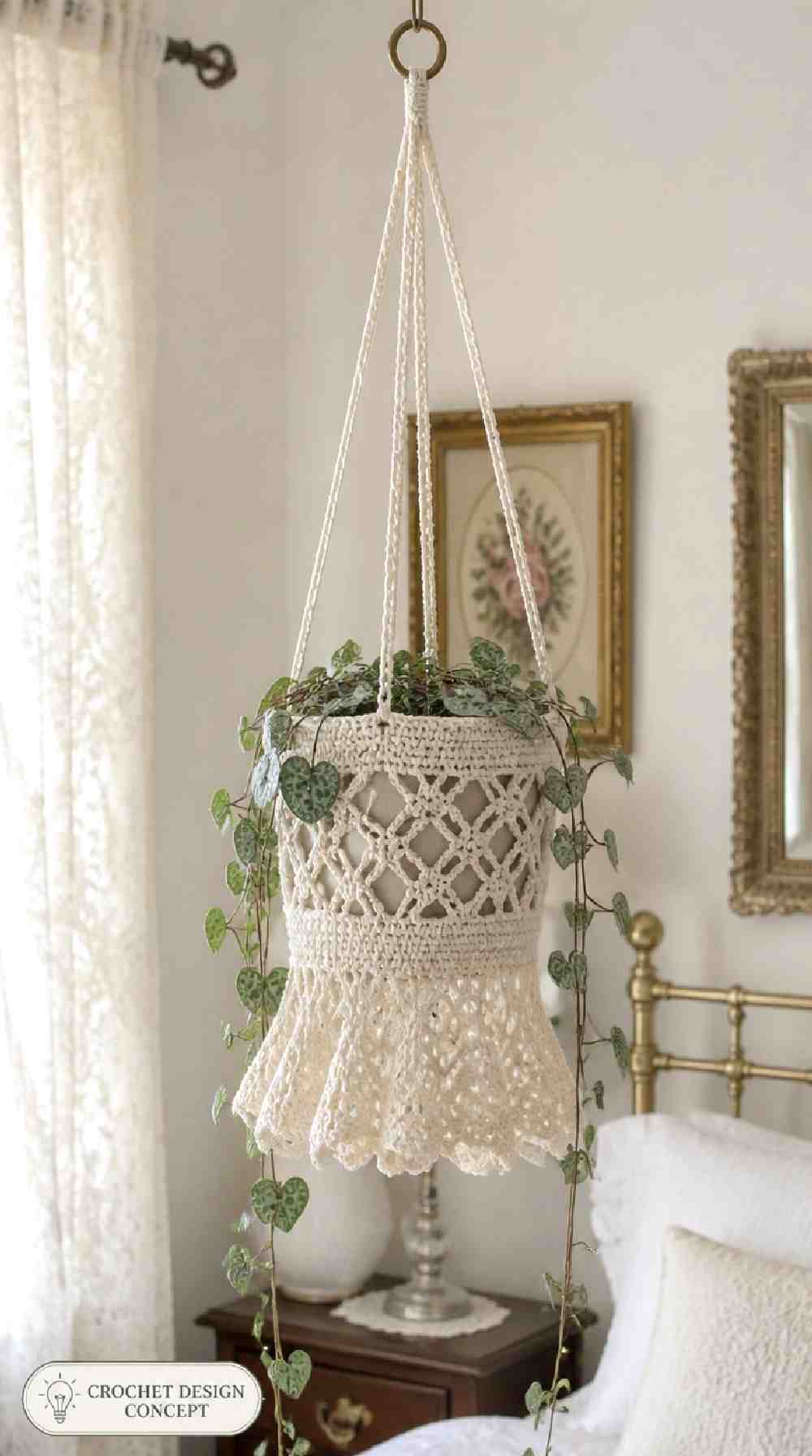
Fine ivory crochet lace surrounds a pale-clay planter in this vintage-inspired hanging design. The lower section flares into a gentle bell-shaped skirt, while diamond-shaped openings create an airy texture around the planter. Three closely worked ivory suspension cords connect the supporting body to an antique-brass ring.
The lace skirt makes this concept particularly decorative, especially with the delicate string-of-hearts foliage trailing from the pot. However, a real plant holder needs structural support beneath its attractive openwork. The lace should be considered a decorative feature rather than proof that the hanger can safely carry a planted pot.
- Hidden Supporting Base: A solid crochet base beneath the planter is essential to the intended design; the flared lace skirt alone is not a dependable cradle.
- Lace Opening Size: Large diamond openings display the pot, while smaller openings may create a more traditional vintage texture. Either approach needs suitable support beneath.
- Bell-Skirt Clearance: The skirt extends below the planter, adding overall length. Allow extra vertical clearance so the lace does not brush furniture.
- Ivory Yarn Care: Pale crochet can show dust and water stains more readily. A removable planter arrangement can make practical maintenance easier.
5. Crochet Blue Gingham Hanging Planter
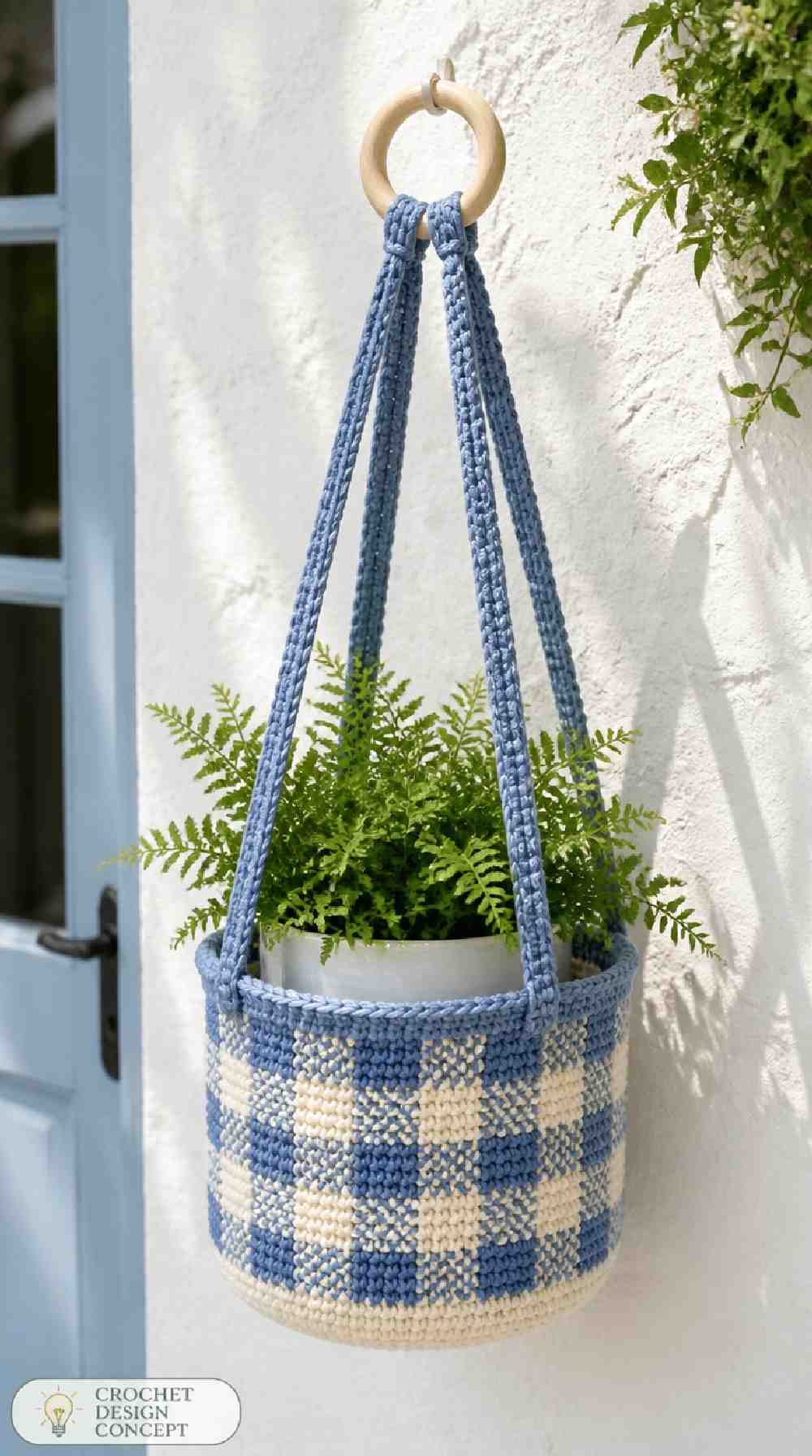
Dusty-blue and cream crochet squares form a gingham-inspired pattern across this compact cylindrical plant basket. The evenly repeated checks are framed by a folded cream rim and a dense circular base. Four dusty-blue straps extend upward to a pale oak ring, holding a round white planter with small fern fronds.
Gingham gives the holder a different cottage character from floral appliqués or lace. Its interest comes from consistent colorwork rather than separate embellishments. To recreate a similar look, the repeated squares would need to remain reasonably aligned as the crochet fabric curves around the pot.
- Checkered Colorwork: Plan the blue-and-cream repeats around the basket circumference. A poorly aligned final repeat can interrupt the gingham appearance.
- Compact Basket Shape: The straight-sided silhouette suits a rounded pot, but the base and rim dimensions need matching to the actual container.
- Four-Point Suspension: Four straps create a symmetrical appearance. Their lengths must remain consistent so the filled planter hangs level.
- Cottage Color Pairing: Dusty blue works especially well with white pottery and pale timber. A stronger navy could change the delicate farmhouse character.
6. Crochet Sunflower Medallion Plant Sling
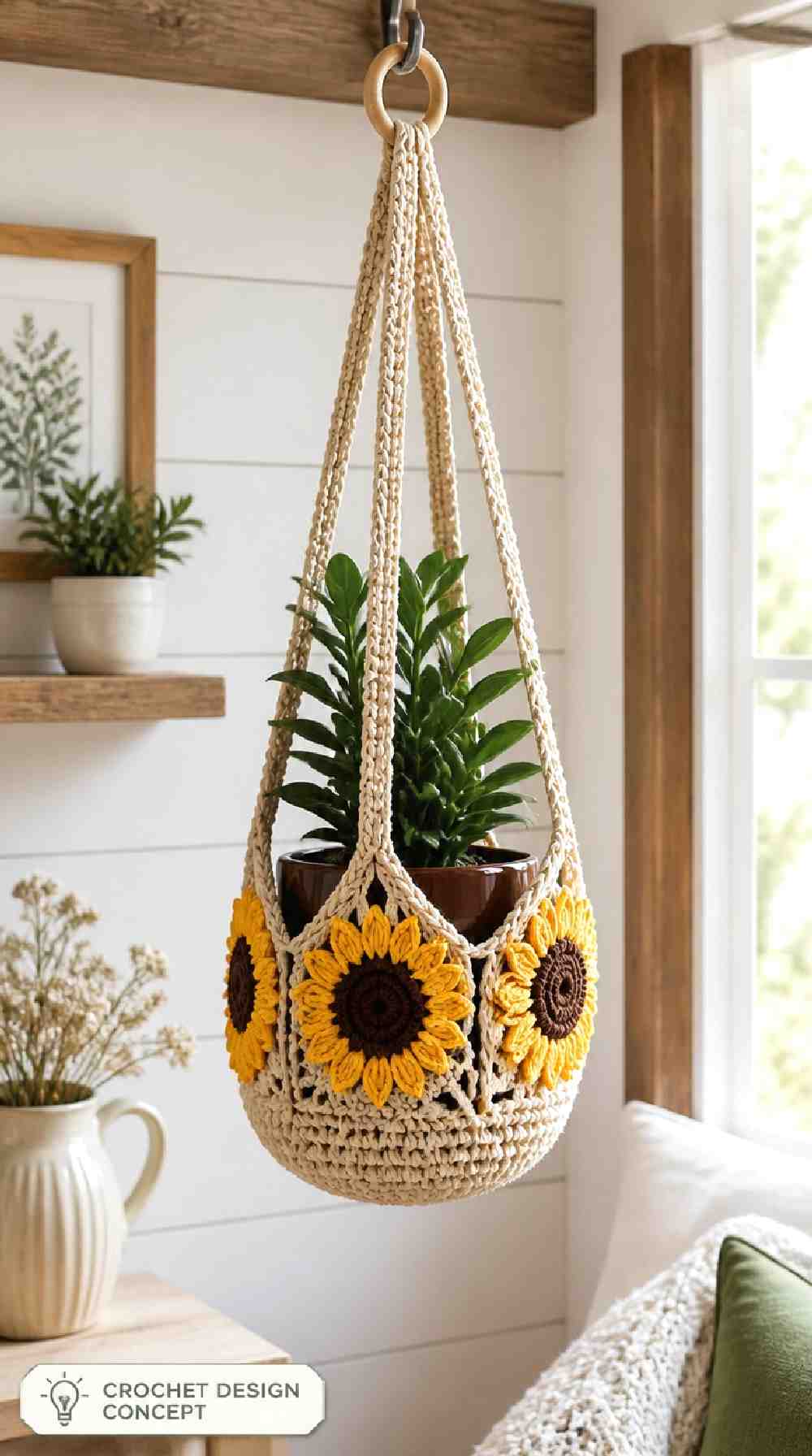
Three golden-yellow crochet sunflower medallions decorate the open exterior of a beige plant sling. Their raised brown centers and layered petals form a colorful band around a small chocolate-brown ceramic pot. A solid crochet base and four neutral suspension straps complete the supporting structure.
The sunflower motifs add a stronger seasonal and rustic accent than the gentler daisies. Their size also makes them an important part of the holder’s silhouette. In a real project, they would need to be attached without pulling the connecting sling sections out of shape or obstructing the pot.
- Medallion Positioning: Space the three sunflowers evenly around the pot so the decorative panels do not pull unevenly on the surrounding crochet.
- Petal Texture: Raised petals and textured brown centers provide depth. Avoid excessive bulk where the medallions connect to the supporting sling.
- Structural Separation: The beige cradle and suspension straps must support the planter independently of any decorative sunflower petals.
- Rustic Display: Golden flowers and brown pottery make a noticeable accent against cream walls. The combination can work beyond autumn in a farmhouse setting.
7. Crochet Strawberry Vine Hanging Basket
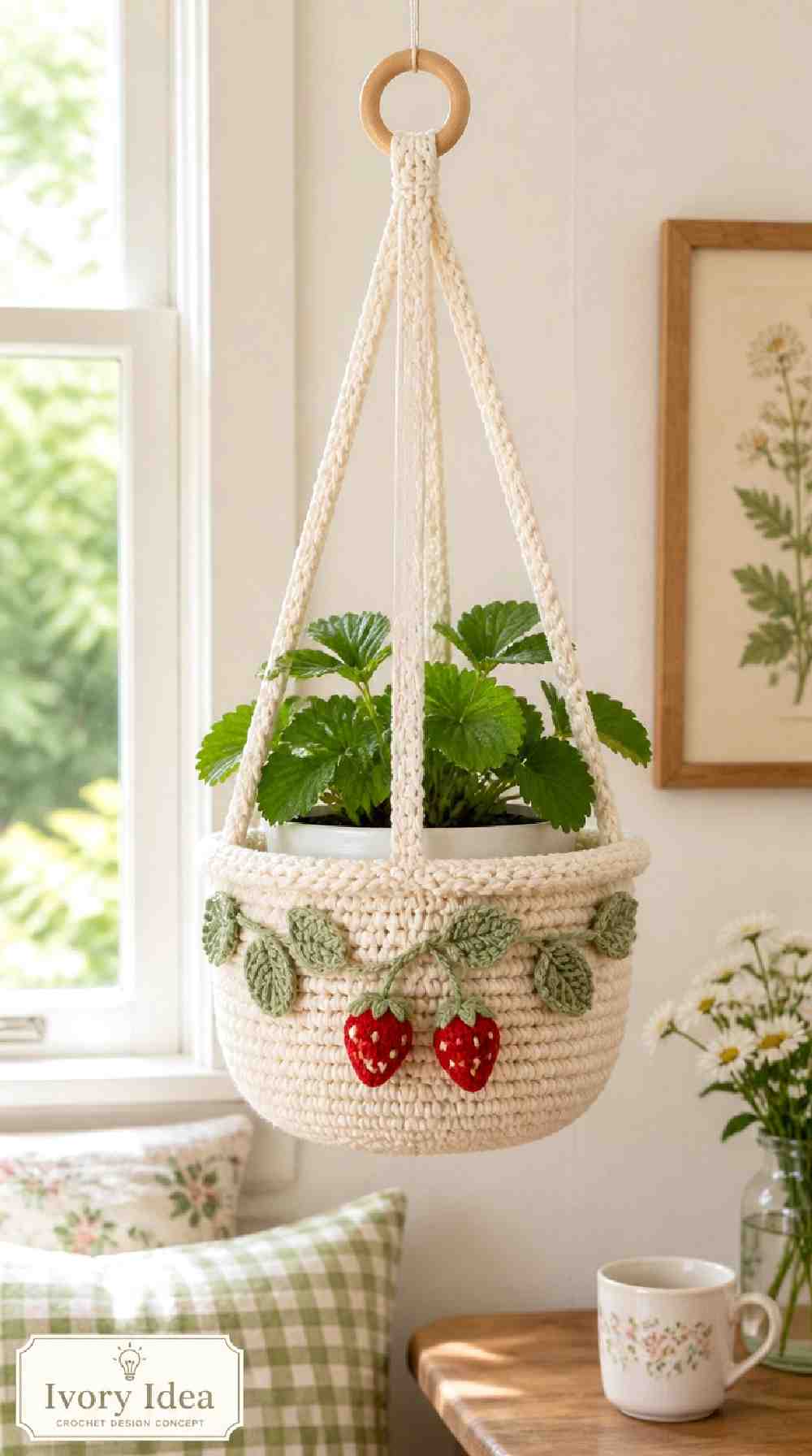
A rounded cream crochet basket carries two tiny red strawberries along its upper front edge. Ivory seed stitches, curling sage-green leaves and a narrow vine introduce the playful botanical detail, while the basket itself remains closely stitched with a rolled rim and dense base. Three cream straps lead to a wooden ring.
This design works best when the strawberries remain small accents rather than becoming oversized decorations. The curved basket body still needs to fit its planter securely. Keeping the botanical embellishments near the rim also makes them easier to see without covering the supporting crochet fabric.
- Strawberry Scale: The small red berries should remain secondary to the basket. Oversized fruit motifs may catch on nearby objects or overwhelm the rim.
- Decorative Vine Placement: Secure the curling leaves and vine to the front exterior, leaving the rear of the holder relatively clear.
- Rolled Rim: A firm, neat rim can create a finished appearance, but it should not become so tight that removing the inner pot is difficult.
- Moisture Protection: Decorative berries and leaf joins may be inconvenient to clean if frequently soaked. Remove the planter for watering where practical.
8. Crochet Farmhouse Ridge Plant Hanger
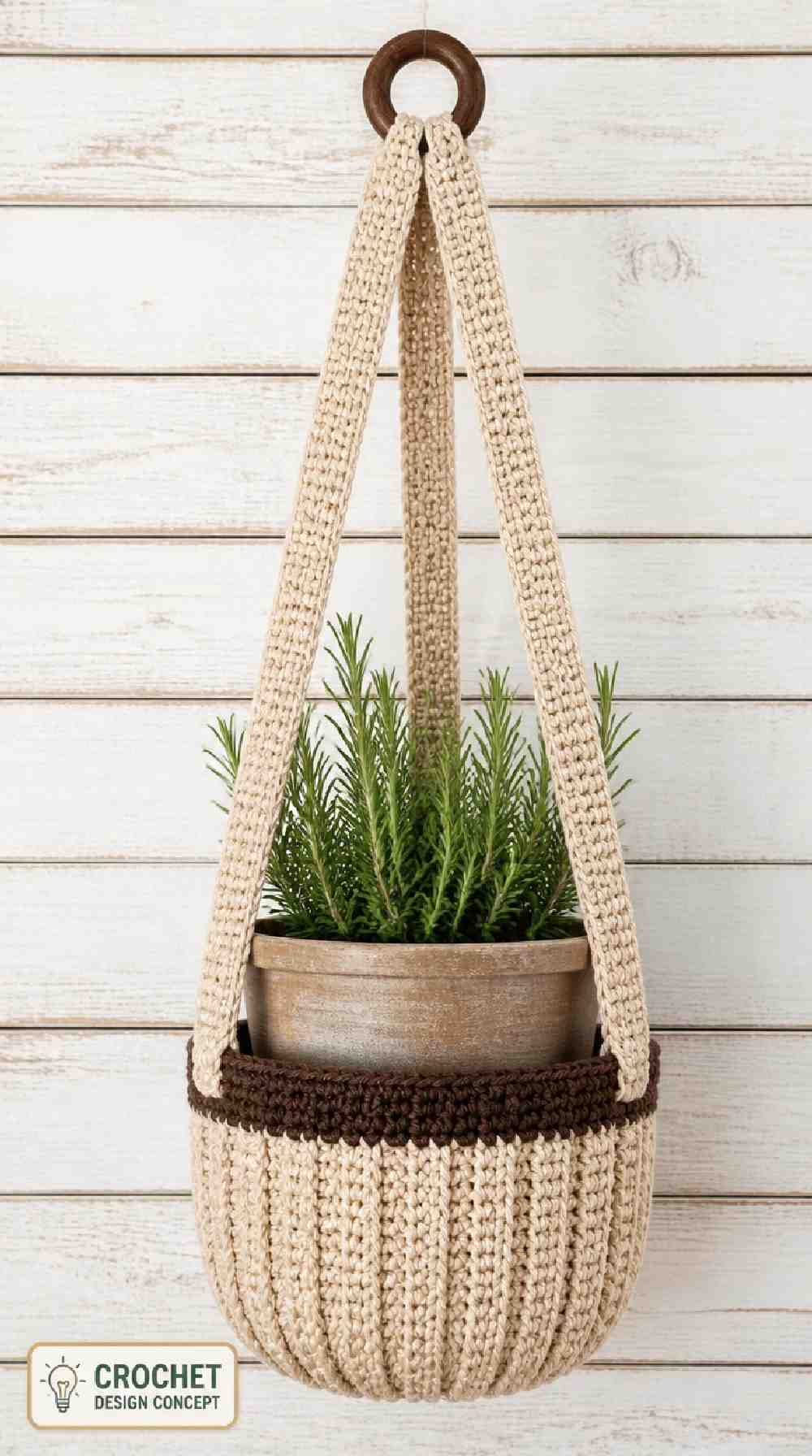
Raised vertical crochet ridges run along this oatmeal-colored plant cradle, finished with a thick chocolate-brown band around the top. The rounded supporting base and three broad suspension straps give the holder a more substantial appearance than delicate lace designs. A natural-clay planter holding upright rosemary completes the farmhouse arrangement.
The visual appeal comes from deep stitch texture and understated earth tones rather than separate flowers or ornaments. This could be a good starting point for someone who prefers functional-looking crochet. Nevertheless, the apparently thick fabric should not be taken as evidence of tested strength.
- Vertical Rib Definition: Keep the ridges evenly spaced so the texture reads clearly around the rounded pot. Irregular spacing may distort the intended pattern.
- Broad Strap Connections: Wide straps require carefully planned joins to distribute the intended load. Their appearance alone does not establish safe carrying capacity.
- Yarn Texture: Firm cotton or another suitable low-stretch material may help maintain the ribbed silhouette; actual yarn behavior should be checked first.
- Farmhouse Palette: Oatmeal and chocolate brown coordinate naturally with clay pots, dark timber and creamy walls without adding competing floral colors.
9. Crochet Lavender Puff Stitch Plant Cradle
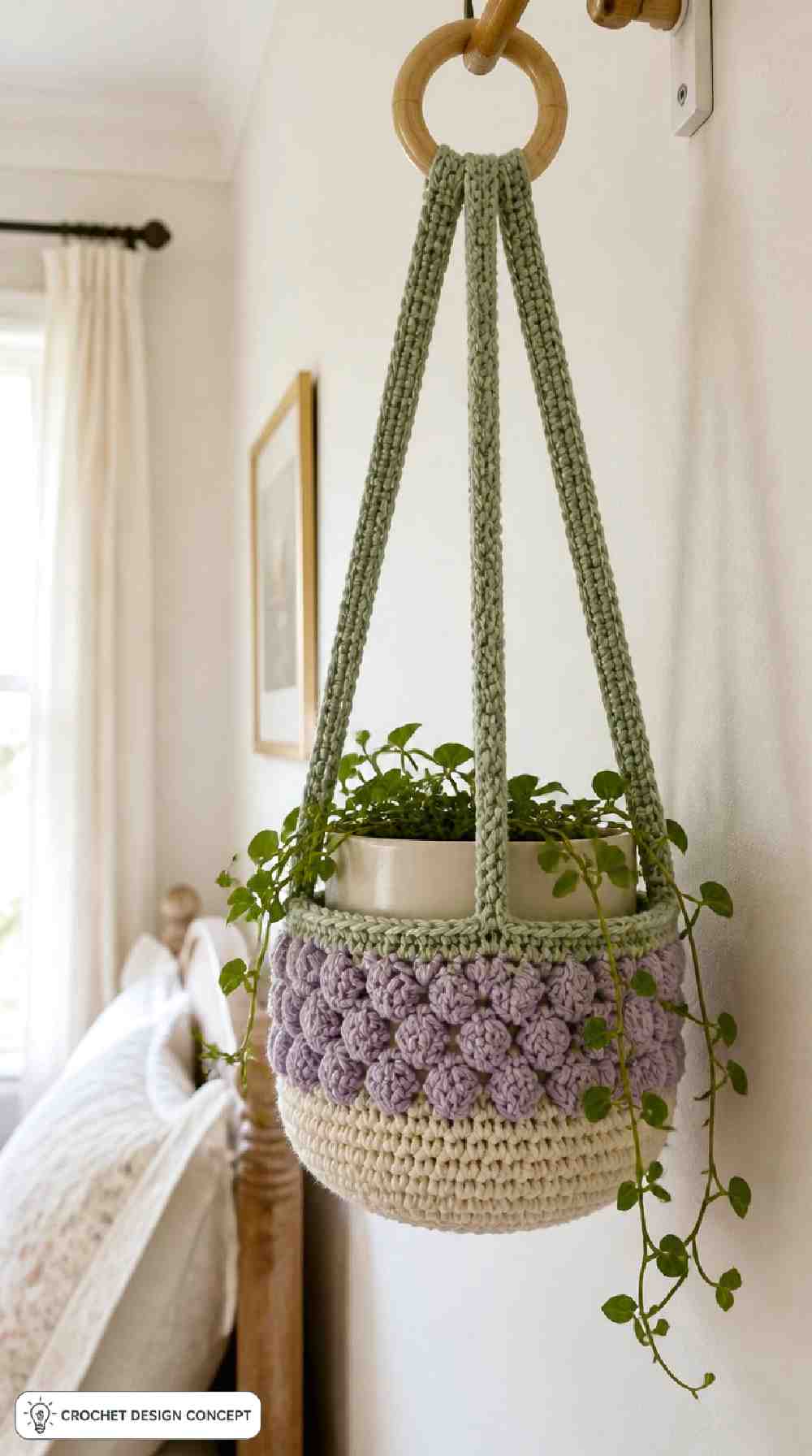
A broad band of dusty-lavender puff stitches wraps around the middle of this ecru crochet plant cradle. Its rounded bottom is worked more closely, while three muted-sage suspension straps rise to a pale bamboo ring. A matte ivory planter sits inside, with soft trailing greenery adding movement around the crochet holder.
The raised puff stitches make the fabric visually fuller without introducing separate flowers. Their consistent placement creates a tidy decorative band. In a handmade piece, stitch bulk would affect the cradle’s circumference, so the pot should be checked against the actual fabric rather than estimated from the illustration.
- Puff-Stitch Consistency: Keep the raised stitches similar in size and spacing. Uneven puffs could make the decorative middle band appear irregular.
- Pot Fit: Bulky stitch textures can alter the outside profile while leaving the interior relatively tight. Fit should be measured where the planter actually sits.
- Plain Supporting Section: Preserve the closely stitched lower cradle so the decorative puff band is not the only fabric supporting the pot.
- Color Restraint: Dusty lavender, ecru and muted sage create a calm combination, allowing the puff texture to remain the strongest visual detail.
10. Crochet Dusty Rose Ruffle Pot Hanger
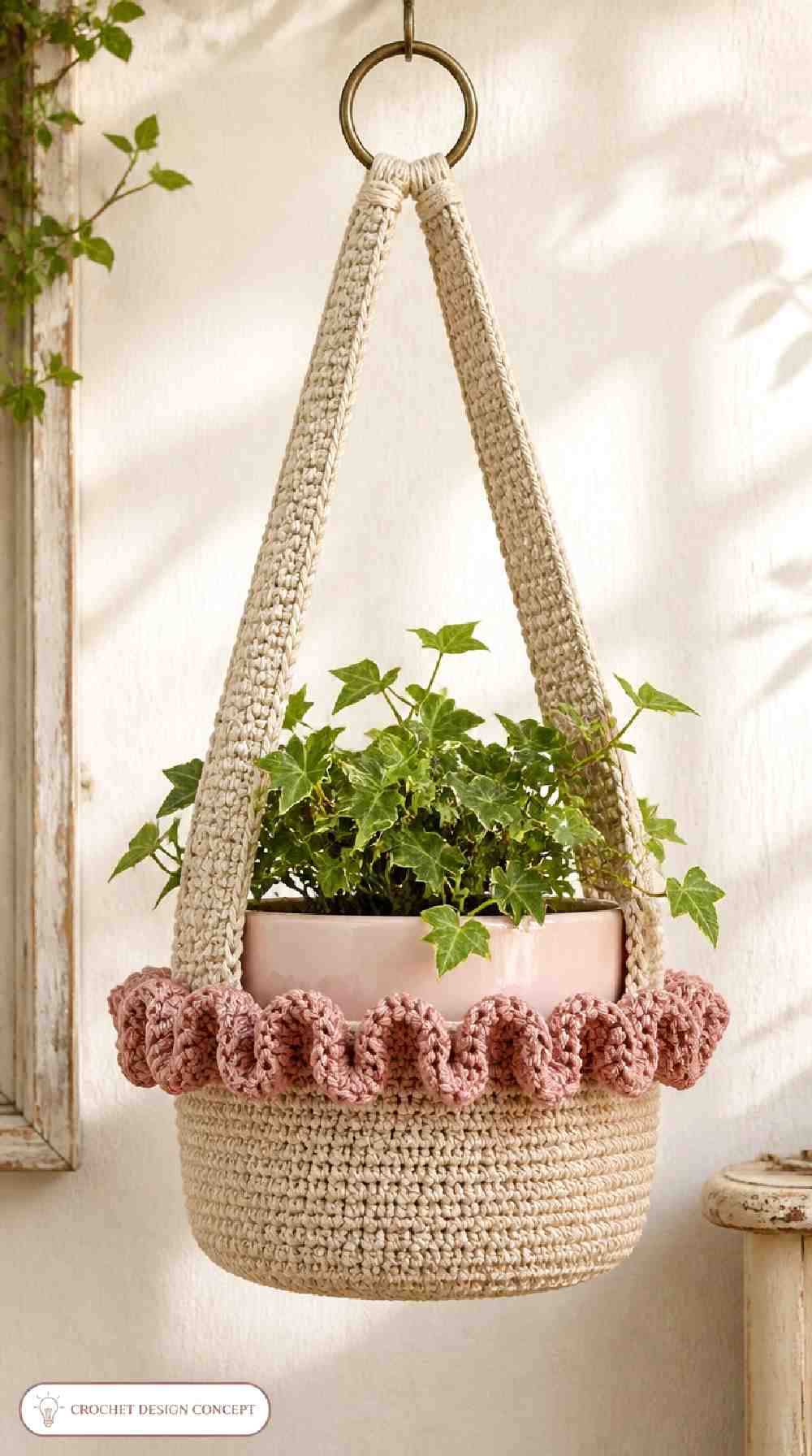
A wide dusty-rose crochet ruffle circles the rim of an oatmeal hanging planter basket. The body beneath it has a closely worked texture and flat round base, while two broad oatmeal straps rise from opposite sides to an antique-brass ring. A pale-pink planter sits inside the cradle.
The ruffled edge brings a romantic vintage feel without changing the simple basket structure. Unlike three- or four-strap holders, this concept uses a paired suspension arrangement. That would need especially careful attention to stability, attachment placement and how the planter sits when lifted.
- Ruffle Fullness: A generous but controlled ruffle creates soft folds. Too much extra fabric could cover the planter or interfere with removing it.
- Two-Strap Balance: Opposing straps must be arranged so the pot cannot tip or roll sideways. Verify the arrangement under the actual intended load.
- Border Contrast: Dusty rose against oatmeal defines the rim without making the entire basket pink, keeping the design versatile in neutral rooms.
- Cleaning Detail: Ruffled edges may collect dust and hold moisture in folds. Consider how easily the planter and decorative border can be accessed for care.
11. Crochet Mushroom Meadow Plant Holder
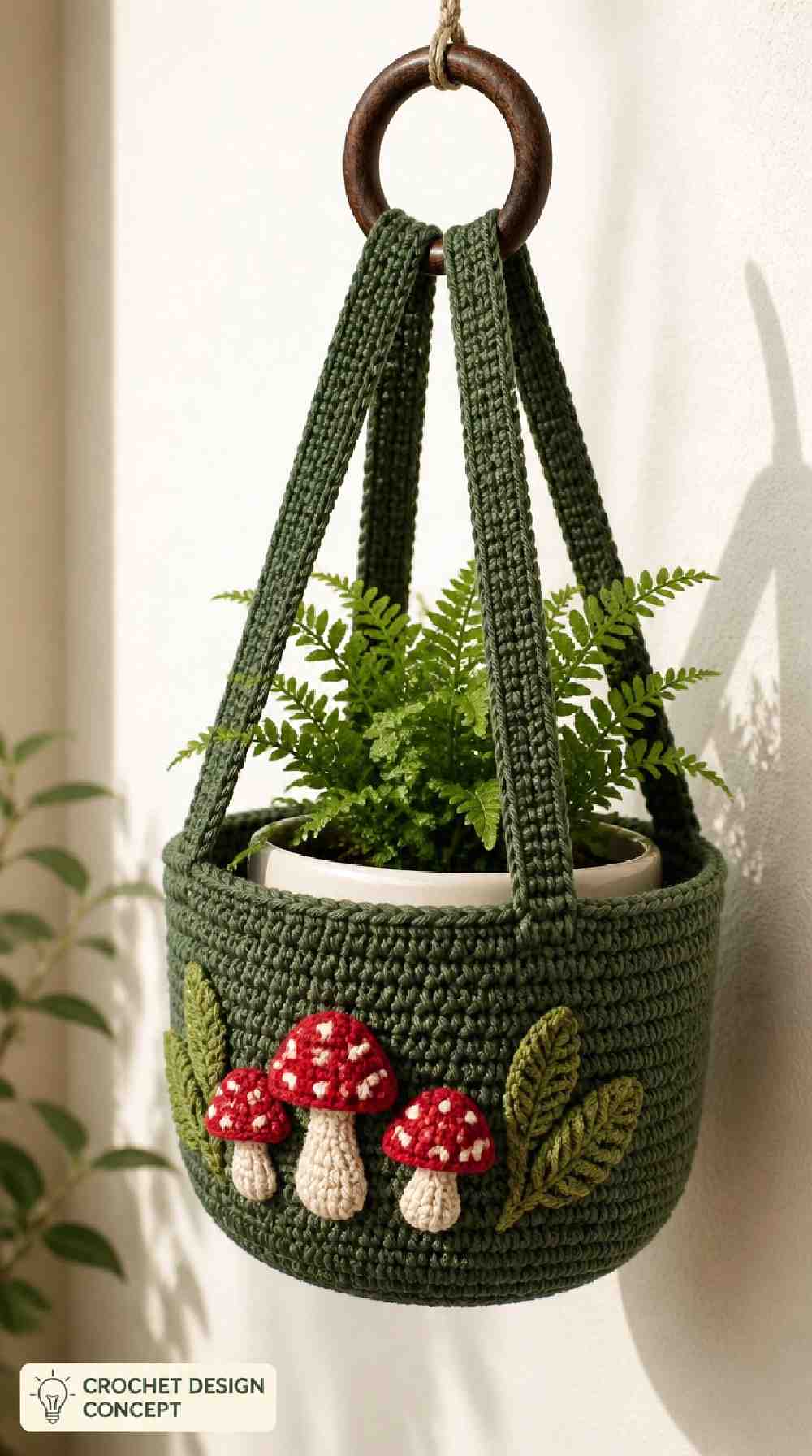
Three miniature woodland mushrooms decorate the front of this dark-sage crochet plant holder, with brick-red caps, tiny ivory spots and short oatmeal stems. Narrow moss-green leaf appliqués sit between them. The rounded cup has a dense base, plain reinforced rim and three olive-green crochet straps meeting at a dark wooden ring.
The mushroom details give the holder a woodland cottagecore character without changing its simple supporting shape. The small appliqués are concentrated near the rim where they remain visible. For a real version, their attachment points need to be secure and should not interrupt the structural crochet.
- Mushroom Placement: Group the three mushrooms near the front rim, leaving enough space between their caps to keep each shape distinct.
- Appliqué Attachment: Secure the mushroom stems and leaf motifs to the cup without relying on the decorative elements to support the planter.
- Dark-Sage Background: The deeper green crochet helps the red caps and pale mushroom stems stand out, especially against light-colored walls.
- Woodland Styling: This compact shape works nicely with natural wood and botanical decor. Keep surrounding decorations simple so the small mushrooms remain noticeable.
12. Crochet Cottage Windowpane Lattice Sling
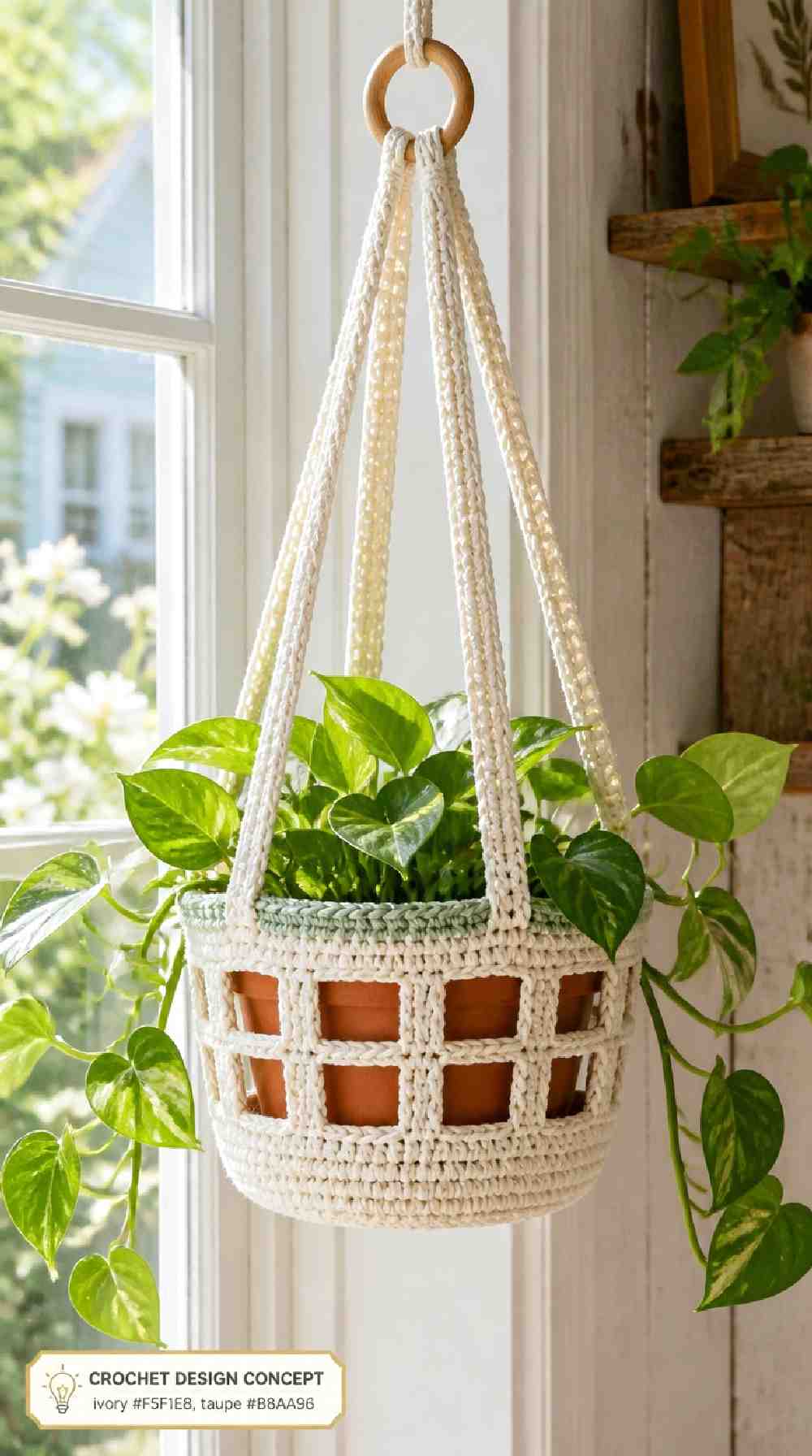
Wide ivory crocheted bands form rectangular windowpane openings around a terracotta pot, allowing its warm clay surface to show through. A closely stitched circular base provides the supporting area, while a muted-sage border defines the upper circumference. Four ivory suspension straps connect the lattice cradle to a wooden ring.
The open rectangular design feels more structured than a loose diamond-mesh hanger. It offers a clear view of the actual planter, making pot color an important decorating choice. When making something similar, the spacing between lattice bands would need to suit the pot’s shape and prevent it from slipping through.
- Rectangular Openings: Keep the lattice bands consistently spaced so the openings resemble clear windowpanes rather than irregular netting.
- Base Support: The solid bottom provides an essential part of the cradle. The open sides alone should not be expected to retain a heavy planter.
- Pot Visibility: Because much of the terracotta remains exposed, select a planter whose color and finish suit the ivory and sage crochet.
- Stretch Consideration: Open crochet bands may lengthen or spread under weight. Check the finished cradle with the intended pot before hanging it overhead.
13. Crochet Bluebell Petal Hanging Holder
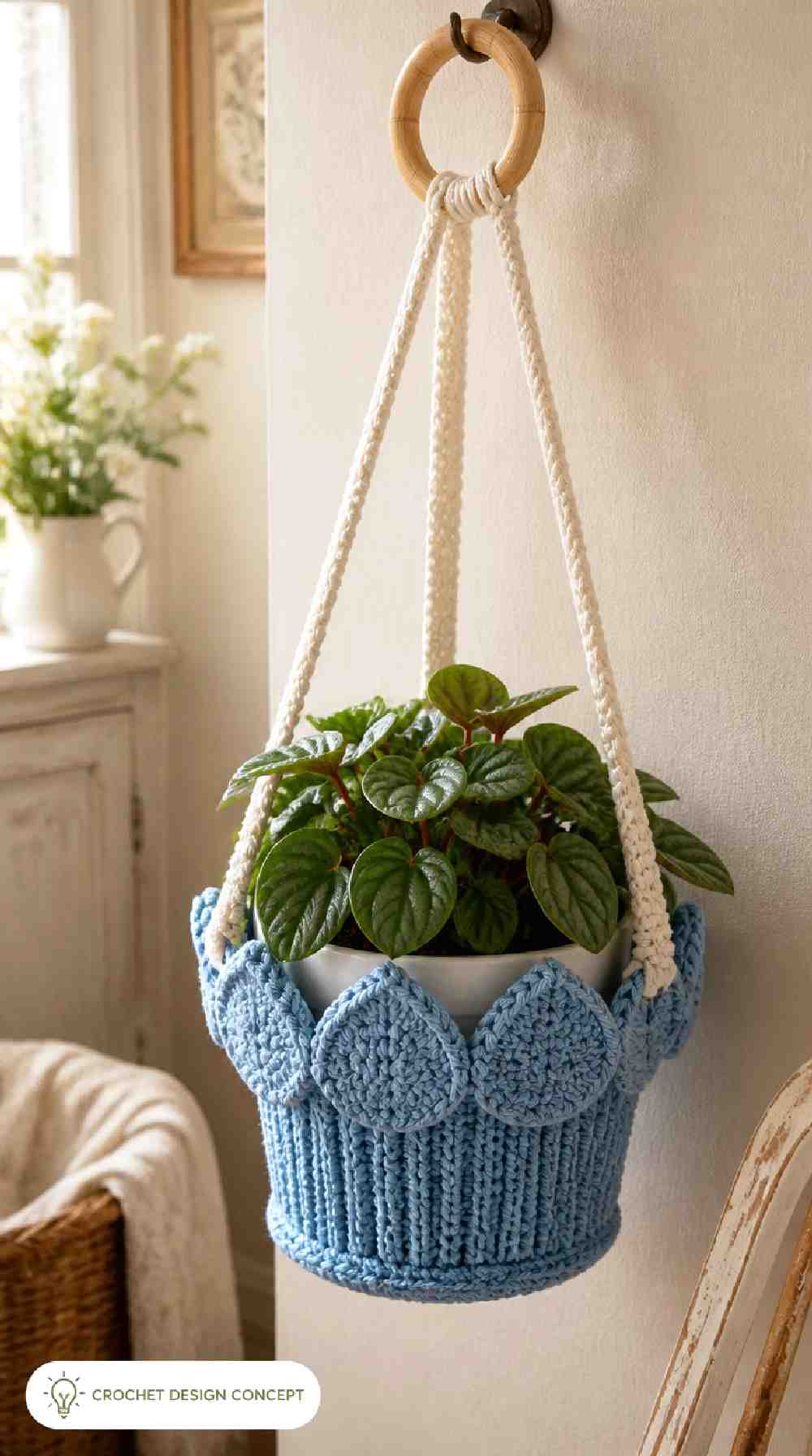
Powder-blue crochet gives this plant holder a gentle floral character, with narrow vertical ribbing around its rounded body and a flared border of overlapping bluebell-shaped petal points. Three thick cream suspension cords connect below the decorative rim and rise to a bamboo hanging ring. A white ceramic pot rests inside.
The shaped upper border is the distinguishing feature, giving an otherwise simple holder a flower-inspired silhouette. Keeping the support connections below the petals allows their outlines to remain visible. The rim would need careful shaping so it does not fold into the planter.
- Petal Border: Keep the upper points distinct and evenly distributed. Very soft fabric may cause the petals to fold inward instead of maintaining the flared shape.
- Strap Attachment Height: Connect supporting cords to the structural section beneath the petals rather than relying on the decorative rim.
- Ribbed Body: Vertical crochet ridges give the cup definition without competing with the bluebell border. Consistent stitch tension helps maintain the rounded shape.
- Color Coordination: Powder blue, cream and white pottery create a soft palette that suits light cottage interiors without requiring separate floral appliqués.
14. Crochet Sweet Pea Trellis Plant Hanger
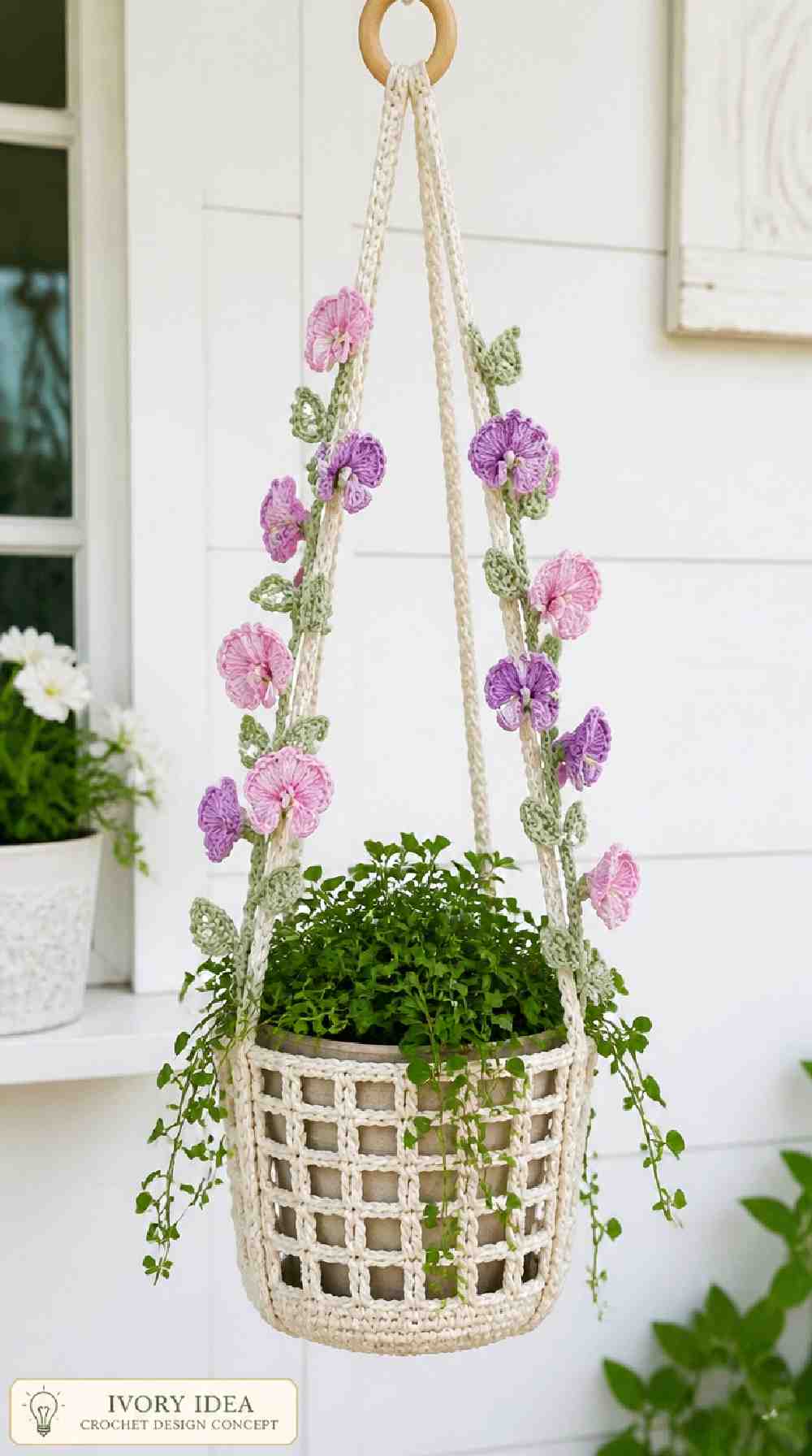
Little mauve and faded-pink sweet-pea blossoms climb along two suspension straps of this ivory crochet hanger. Delicate sage-green leaves and attached vines connect the softly folded petals, while the main pot cradle features an airy vertical trellis mesh and solid circular base.
This design brings the floral detail upward rather than concentrating decoration around the pot itself. The climbing arrangement could look especially attractive against a plain light wall. For a real adaptation, the small flowers should remain decorative additions and must not compromise the strength or movement of the straps.
- Climbing Flower Arrangement: Position the sweet-pea blossoms along two front-facing straps, leaving the third strap comparatively plain for visual balance.
- Delicate Vine Connections: Attach the thin crochet vines securely to the supporting straps without cutting, splitting or weakening the structural stitches.
- Open Trellis Fit: The vertical mesh should reveal the pale-clay planter while retaining enough coverage and support to keep it securely positioned.
- Flower Size: Small folded petals preserve the climbing-plant appearance. Large blossoms could weigh down the narrow vines and obscure the suspension straps.
15. Crochet Butter Yellow Basketweave Plant Holder
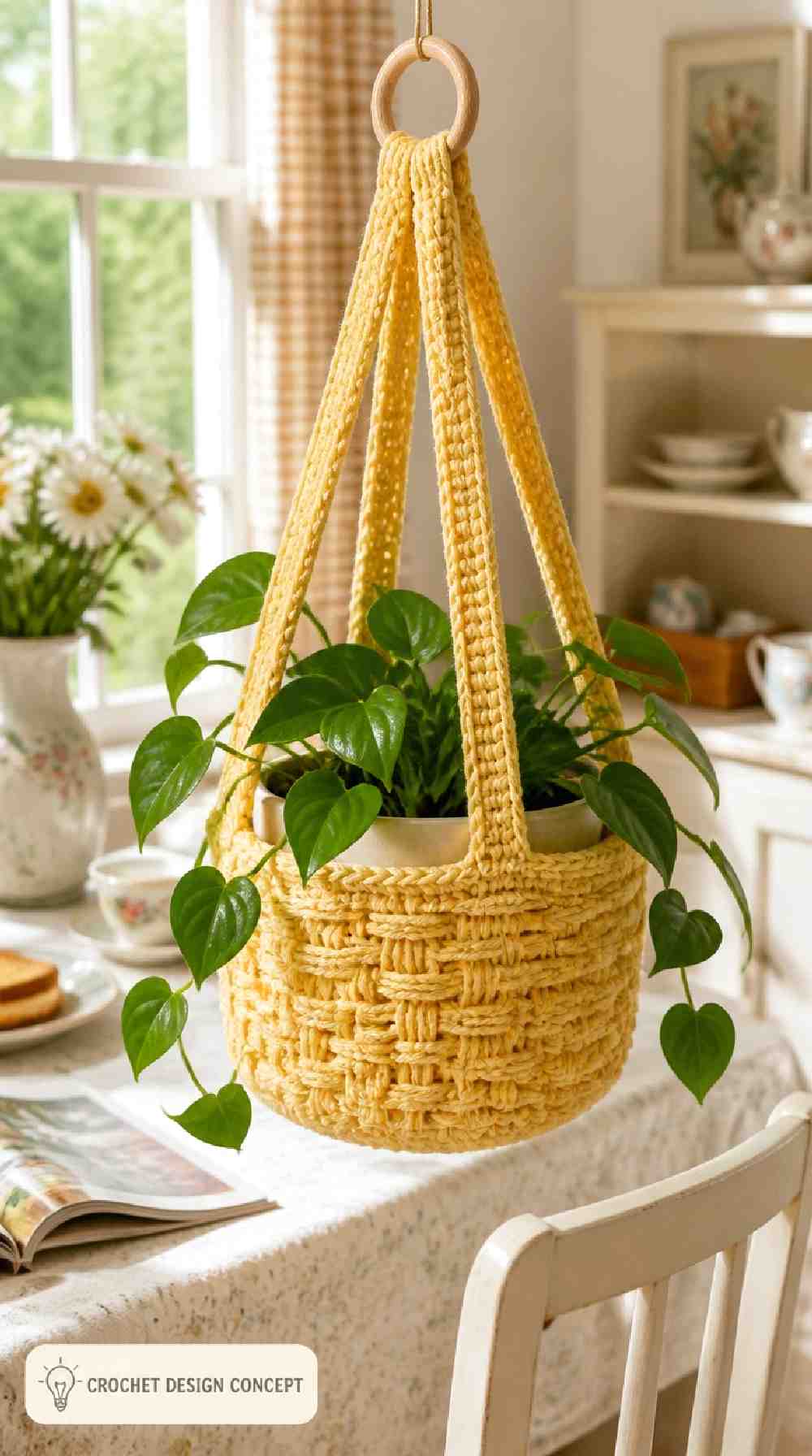
Butter-yellow crochet forms a compact hanging basket with deeply textured interlocking stitch blocks. The rounded body has a broad supporting base, plain reinforced upper rim and four wide suspension straps leading to a pale wooden ring. A cream ceramic pot with trailing heartleaf philodendron rests inside.
The basketweave-style fabric gives this design more visual depth than an open mesh plant holder. Its appeal comes from the repeating raised texture rather than separate decorative motifs. A real version would need proper fit checks because dense textured crochet can behave differently from the lighter-looking fabric in the illustration.
- Basketweave Definition: Keep the raised crochet blocks uniform across the basket exterior. Irregular repeats can interrupt the woven-looking surface.
- Dense Fabric Trade-Off: Closely worked crochet may cover more of the pot and add fabric weight compared with a lightweight openwork sling.
- Four-Strap Arrangement: The wide straps should attach at evenly spaced structural points, with their real-world joins checked for the intended planter load.
- Yellow Cottage Palette: Butter yellow creates a cheerful accent against cream pottery and pale wood without requiring additional flower decorations.
16. Crochet Victorian Picot Lace Plant Pocket
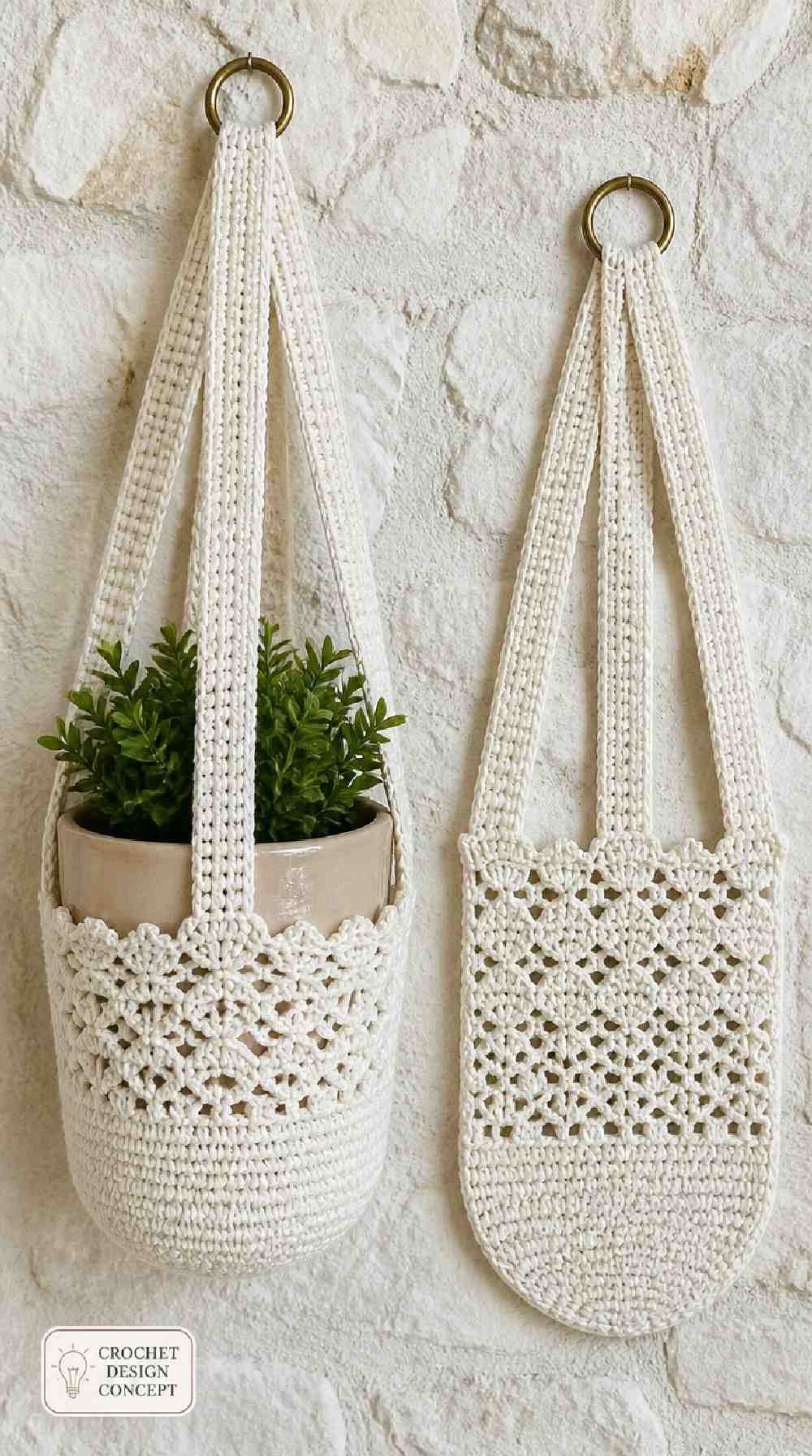
Fine ecru crochet surrounds a blush-beige planter in this vintage-inspired hanging pocket. A structured rounded lower cup supports the pot, while a decorative filet-style lace panel with tiny diamond openings adds texture near the upper edge. Small picot points finish the rim, and three plain ecru straps connect the cradle to an antique-brass ring.
The design has a more delicate appearance than dense farmhouse baskets, but its solid lower section remains important. The fine decorative crochet should not be mistaken for a complete supporting structure. This concept works particularly well where you want vintage detail without adding large floral shapes.
- Picot Edge: Small, consistently spaced picots create a fine vintage finish. Excessively large points may fold over the pot rim or catch during removal.
- Fillet-Lace Contrast: The small diamond openings provide texture against the close-stitch lower pocket, giving the two sections visibly different purposes.
- Structural Strap Joins: Connect the three supporting straps to the firm pocket body rather than to the delicate upper lace.
- Vintage Display: Ecru and antique brass complement blush-beige pottery. The understated colors also let fine stitch detail remain the main attraction.
17. Crochet Twin Tier Cottage Plant Hanger
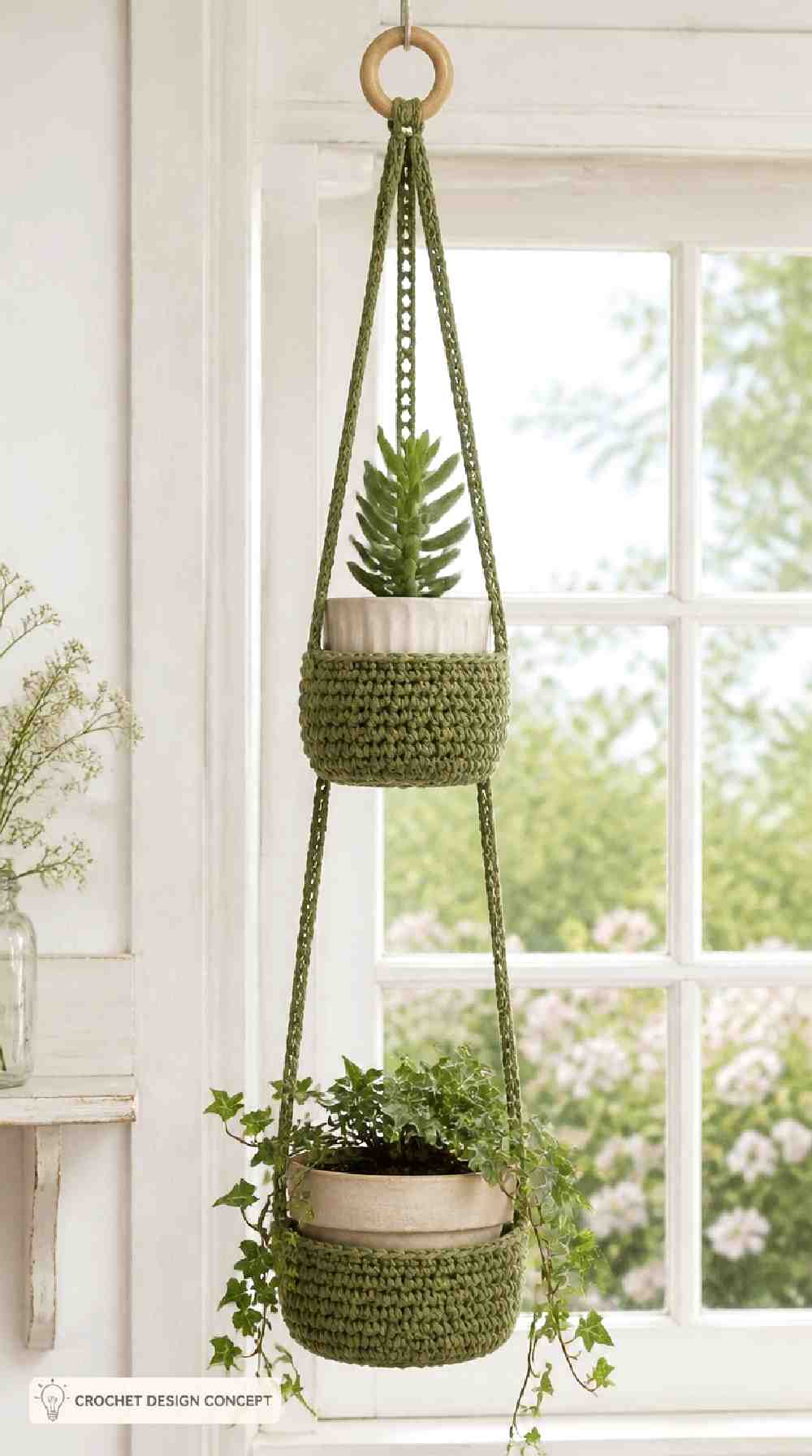
Two moss-green crochet cradles hang vertically from a shared suspension structure, with a smaller ivory planter holding upright succulent foliage above and a wider pale-clay planter containing trailing ivy below. Both cradles have closely stitched sides and solid circular bases, while dark-sage straps connect the tiers to an oak hanging ring.
This arrangement makes use of vertical space instead of displaying only one plant. The matching green crochet ties the two planters together visually. A real two-tier hanger needs much more careful planning than a single holder because the mounting point, straps and connections must accommodate the combined weight.
- Combined Load: Account for both pots, plants, growing media and water. The hook, anchor, supporting straps and tier connections must all be suitable for that load.
- Spacing Between Tiers: Leave enough room to remove and water the upper pot without damaging the foliage or disturbing the lower planter.
- Separate Pot Cradles: Each cradle should retain its own planter securely. Do not rely on one decorative connector to carry the lower tier.
- Visual Balance: Keeping both cradles moss green creates continuity, while different planter sizes provide variety without adding extra decorative motifs.
18. Crochet Fern Appliqué Hanging Planter
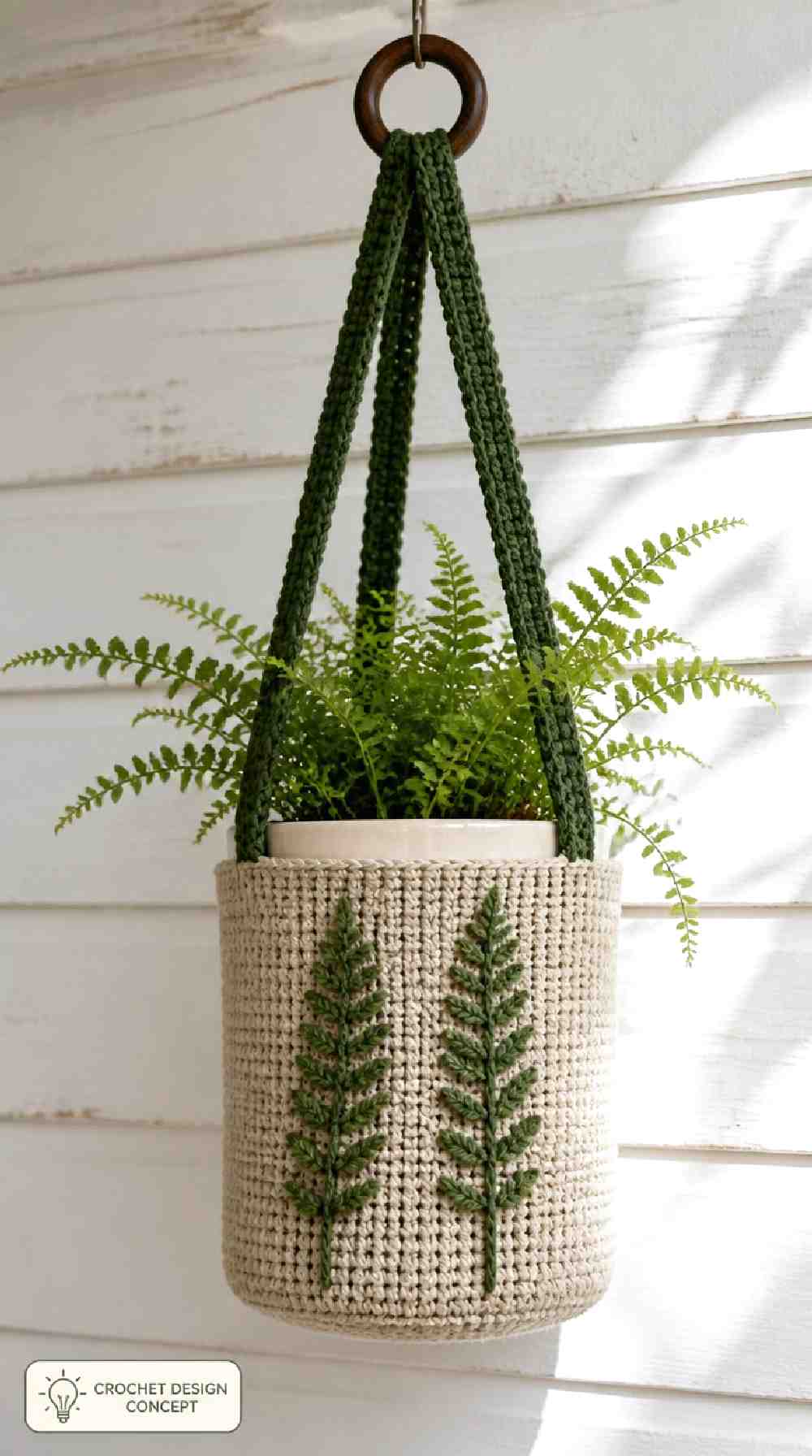
Two dark-moss crochet fern fronds decorate the front of an oatmeal-colored hanging pot holder. Their narrow leaflets and fine center stems stand out against the compact vertical ribbing of the cylindrical cup. Three broad forest-green suspension straps meet at a walnut ring, with a cream ceramic planter nested inside.
The fern motifs make this design botanical without requiring dimensional flowers or a highly open supporting structure. The contrast between ribbed fabric and flat leaf appliqués gives the crochet plenty of detail. For a handmade adaptation, the fern shapes should be positioned before final assembly so their full outlines remain visible.
- Fern Placement: Arrange the two fronds vertically across the front without overlapping them heavily. Their narrow leaflets should remain recognizable.
- Appliqué Definition: Use clear stitch shaping and secure the stems discreetly so the fern motifs sit neatly against the ribbed background.
- Ribbing and Motifs: Avoid excessively bulky background ridges that could obscure the attached fern leaves or make them sit unevenly.
- Woodland Palette: Oatmeal, moss green and walnut create a natural combination that suits botanical rooms without making the hanger visually crowded.
19. Crochet Blush Heart Trellis Plant Cradle
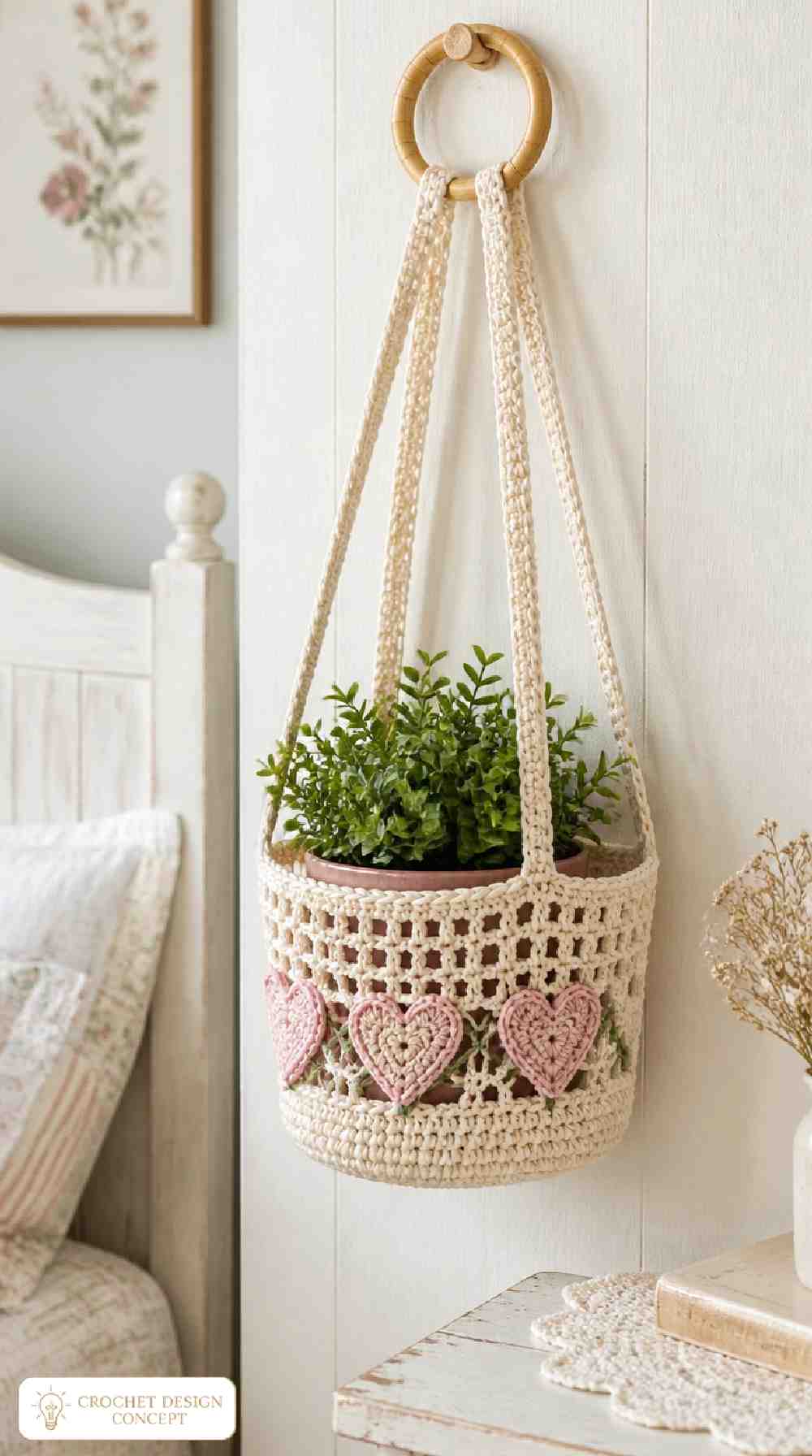
Three blush-pink crochet hearts sit across the front band of this warm-ivory hanging planter, connected by narrow sage-green trellis lines. The compact cradle has a solid round base, close-mesh upper sides and four reinforced cream suspension straps meeting at a bamboo ring. A dusty-rose ceramic planter completes the soft cottagecore color scheme.
The hearts provide a gentle decorative feature without covering the whole holder. Their alignment gives the rounded crochet cup a neat, organized appearance. When planning a real version, the heart band should be placed where it does not interfere with the supporting straps or the pot’s removal.
- Heart Arrangement: Keep the three hearts similar in scale and evenly spaced along the front band for a balanced decorative effect.
- Trellis Connections: The sage-green connecting lines should remain decorative; the surrounding structural crochet must support the planter independently.
- Pot Removal: Allow sufficient space at the rim so the dusty-rose planter can be lifted out without pulling on the heart motifs.
- Soft Color Balance: Blush, sage and warm ivory create a coordinated look. A plain background helps the small hearts remain visible.
Practical Guide to Crochet Hanging Plant Holders
A hanging plant holder needs to do two things: look attractive and hold its intended planter securely. The designs above are visual concepts, so their appearance should be treated as a starting point rather than proof that a particular construction is safe.
1. Measure the actual plant pot
Check the pot’s widest diameter, base diameter, height and shape before choosing a crochet design. A tapered terracotta pot may fit a cradle differently from a straight-sided ceramic planter.
Make sure the pot can sit securely inside the supporting section without slipping sideways. Don’t depend on the scale of an AI image when planning a real holder.
2. Choose suitable yarn and stitch structure
Firm cotton or an appropriately selected low-stretch blend can be worth considering for plant hangers. Open crochet mesh creates a lighter appearance, while closely stitched baskets offer greater visual coverage.
Neither appearance guarantees strength. Crochet stretches differently depending on fiber, stitch, tension and moisture exposure. Use a reliable pattern with suitable construction guidance, and check the complete piece before hanging a planter.
3. Check the full hanging system
The finished load includes the pot, plant, soil or other growing medium, retained water and the holder itself.
Use mounting hardware appropriate for the wall or ceiling material and the total load. Check the hook, anchor, ring, straps and all connections. Decorative hooks, curtain rods, adhesive hooks and unsupported ceiling fixtures should not be assumed suitable for a heavy planted pot.
Keep hanging planters away from children’s and pets’ reach, walking paths and locations where falling objects could cause injury.
4. Plan for watering and drainage
A crochet holder is not waterproof. Soil moisture and drainage water can stain yarn, damage nearby finishes and affect the holder’s condition.
A removable inner pot with a suitable saucer or outer container can make watering more manageable. Remove the planter when necessary and allow wet components to dry. Never let drainage water collect in a yarn basket.
5. Choose a location that suits the plant
Cottagecore styling is only part of the decision. Living plants still need appropriate light, temperature, airflow and care for their particular species.
Before placing a hanger near a window, consider whether the plant tolerates that light level and whether the suspended planter will obstruct the window or nearby furniture.
For a related approach to vertical plant displays, explore the 12 Crochet Three-Tier Plant Hanger Ideas collection. It focuses on stacked planter arrangements, while this collection explores individual cottagecore-inspired holder styles and one twin-tier concept.
Want to Make Something Similar?
If you want to move from inspiration to a real crochet project, these verified resources offer useful construction starting points:
- Free Crochet Plant Hanger Pattern — Sarah Maker: Sarah Stearns explains a cotton plant hanger with a round base and suspension cords, including sizing and assembly guidance. Sarah Maker
- Free Patons Crochet Plant Hanger — Yarnspirations: A design by Tamara Kelly of Moogly, using a hemp-and-cotton yarn blend with a structured base and long hanging straps. Yarnspirations
- Modern Home Decor: Crochet Hanging Plant Holder — The Crochet Crowd: A video tutorial demonstrating a granny-square-based hanging planter, including how the motifs and straps come together. YouTube
These resources teach related construction techniques. They are not exact patterns for the 19 AI-generated concepts here. Check the original instructions, intended pot sizes, materials and hanging requirements before adapting a design.
Which Crochet Cottagecore Hanging Plant Holder Should You Choose?
| Design | Main attraction | Practical consideration |
|---|---|---|
| Ecru Scalloped Plant Sling | Airy lace-like outline | Open sides need secure pot retention |
| Sage Granny Square Plant Basket | Traditional patchwork texture | Panel joins and base shaping |
| Blush Daisy Chain Plant Holder | Small floral decorations | Keep appliqués clear of support points |
| Vintage Lace Bell Plant Hanger | Decorative flared lace | Support must come from the actual cradle |
| Blue Gingham Hanging Planter | Checkered cottage colorwork | Aligning repeats around a curved basket |
| Sunflower Medallion Plant Sling | Dimensional floral motifs | Decorative weight and attachment |
| Strawberry Vine Hanging Basket | Playful cottage-garden detail | Cleaning and embellishment snags |
| Farmhouse Ridge Plant Hanger | Strong ribbed appearance | Yarn stretch and strap connections |
| Lavender Puff Stitch Plant Cradle | Soft raised stitch texture | Extra bulk affects pot fit |
| Dusty Rose Ruffle Pot Hanger | Romantic ruffled rim | Two-strap stability |
| Mushroom Meadow Plant Holder | Woodland appliqués | Secure small decorative pieces |
| Cottage Windowpane Lattice Sling | Visible pot and open structure | Lattice spacing and stretching |
| Bluebell Petal Hanging Holder | Flower-shaped upper edge | Decorative rim support |
| Sweet Pea Trellis Plant Hanger | Climbing crochet flowers | Avoid weakening hanging straps |
| Butter Yellow Basketweave Plant Holder | Dense basket texture | Fabric bulk and final fit |
| Victorian Picot Lace Plant Pocket | Delicate vintage crochet | Lace must not carry the load |
| Twin Tier Cottage Plant Hanger | Two vertically displayed pots | Combined weight and mounting |
| Fern Appliqué Hanging Planter | Botanical fern detailing | Flat motif placement |
| Blush Heart Trellis Plant Cradle | Soft heart decorations | Decorative band clearance |
For a quieter interior, the Ecru Scalloped Plant Sling or Farmhouse Ridge Plant Hanger offers an understated look. Both emphasize crochet structure rather than large decorative motifs.
If the room already has floral wallpaper or patterned curtains, the Blue Gingham Hanging Planter or Butter Yellow Basketweave Plant Holder could provide a simpler repeated texture. If you want the hanging holder itself to be the focal point, the Sunflower Medallion Plant Sling or Sweet Pea Trellis Plant Hanger brings more noticeable botanical detail.
Conclusion
Crochet cottagecore hanging plant holders offer plenty of ways to combine potted greenery with handmade texture. A simple ecru sling can feel light and understated, while granny squares, decorative flowers, gingham colorwork or vintage lace can create a more distinctive country-inspired display.
Whichever style you prefer, start with the planter you intend to use, then think about its fit, weight, drainage and hanging support. Those practical details matter as much as the finished appearance. The most successful design will complement the room while keeping the planter easy to access and securely supported.
Which of these 19 plant holders would you choose for your home? Would you go for the Strawberry Vine Hanging Basket, the Vintage Lace Bell Plant Hanger or the Sage Granny Square Plant Basket? Share your favorite style and the type of plant you would display in it.
Frequently Asked Questions
1. What yarn is best for a crochet hanging plant holder?
Firm cotton or a suitably chosen low-stretch yarn can be a useful starting point because these materials may help maintain clear stitches and the intended shape. However, actual strength depends on the complete construction, including stitch tension, strap attachment and hanging hardware. Follow a reliable pattern intended for plant holders rather than assuming a thick yarn is automatically safe.
2. Can a crochet hanging plant holder support a heavy ceramic pot?
A crochet hanger may be able to support a planted ceramic pot if its construction and entire mounting system are suitable for the load. However, the designs shown here have not been load-tested. Account for the pot, plant, wet growing medium and holder weight. Use appropriate hardware and follow the specifications of a proven pattern before suspending anything heavy.
3. Can I use a crochet plant holder for real plants instead of artificial greenery?
Yes, provided the actual holder is suitably constructed and the plant’s needs are met. Real plants introduce additional considerations such as water, drainage, weight changes and light exposure. A removable inner planter can help with watering and cleaning. Artificial plants may be a simpler decorative option where moisture or weight would be a concern, though the holder must still be secure.
4. How do I stop a crochet plant hanger from stretching or losing its shape?
Choose yarn and stitches suited to the intended load, use a properly constructed supporting base and secure the straps according to a reliable pattern. Test the holder’s fit with the actual pot before use and inspect it regularly for changes in shape, loose joins or wear. If it stretches significantly or appears unstable, remove the planter and do not continue using the hanger until the problem has been addressed.
5. Are these 19 cottagecore plant holders available as exact crochet patterns?
No. The designs in this collection are AI-generated inspiration concepts, not photographs of finished tested plant holders or complete crochet patterns. The external tutorials linked above can help you learn related techniques, but they do not reproduce these exact designs. For a real project, use verified construction guidance and adapt decorative details only after the supporting structure has been properly planned.