Crochet botanical hoop wall hangings offer a lovely way to bring the shapes of leaves, flowers and climbing vines into home decor without needing a large wall tapestry. A simple circular frame can hold delicate eucalyptus branches, dimensional daisies, woodland ferns or trailing greenery. These 15 inspiration ideas explore different floral arrangements, crochet textures, hoop finishes and color combinations, from quiet neutral pieces to bold botanical displays.
The right design depends on more than which flower catches your eye. An open hoop can suit a narrow hallway, while layered blossoms might work better as a focal point above a dresser or reading corner. This collection helps you compare motif sizes, visual balance, hanging arrangements and realistic crochet construction considerations so you can choose a style that suits your wall and your decorating plans.
These are AI-generated crochet design visualizations for inspiration, not photographs of tested handmade pieces or step-by-step patterns.
Quick Design Selection Guide
- For calm, minimalist interiors: Start with Crochet Sage Eucalyptus Crescent Hoop or Crochet Minimal Olive Branch Hoop. Both leave generous open space inside the ring.
- For romantic cottage decorating: Choose Crochet Lavender Meadow Hoop, Crochet Chamomile Daisy Hoop, or Crochet Ivory Magnolia Hoop Hanging for softer floral details.
- For a stronger focal point: Compare Crochet Monstera Leaf Hoop Art, Crochet Golden Sunflower Hoop Hanging, and Crochet Scarlet Poppy Hoop Art. Their larger motifs carry more visual weight.
- For greenery without a traditional flower wreath: Crochet Woodland Fern Hoop Hanging and Crochet Trailing Pothos Hoop Hanging bring different foliage shapes and arrangements.
- For something more unusual: Try Crochet Vintage Botanical Herbarium Hoop or Crochet Botanical Specimen Sampler Hoop. Both present individual plant forms as a small decorative collection.
1. Crochet Sage Eucalyptus Crescent Hoop
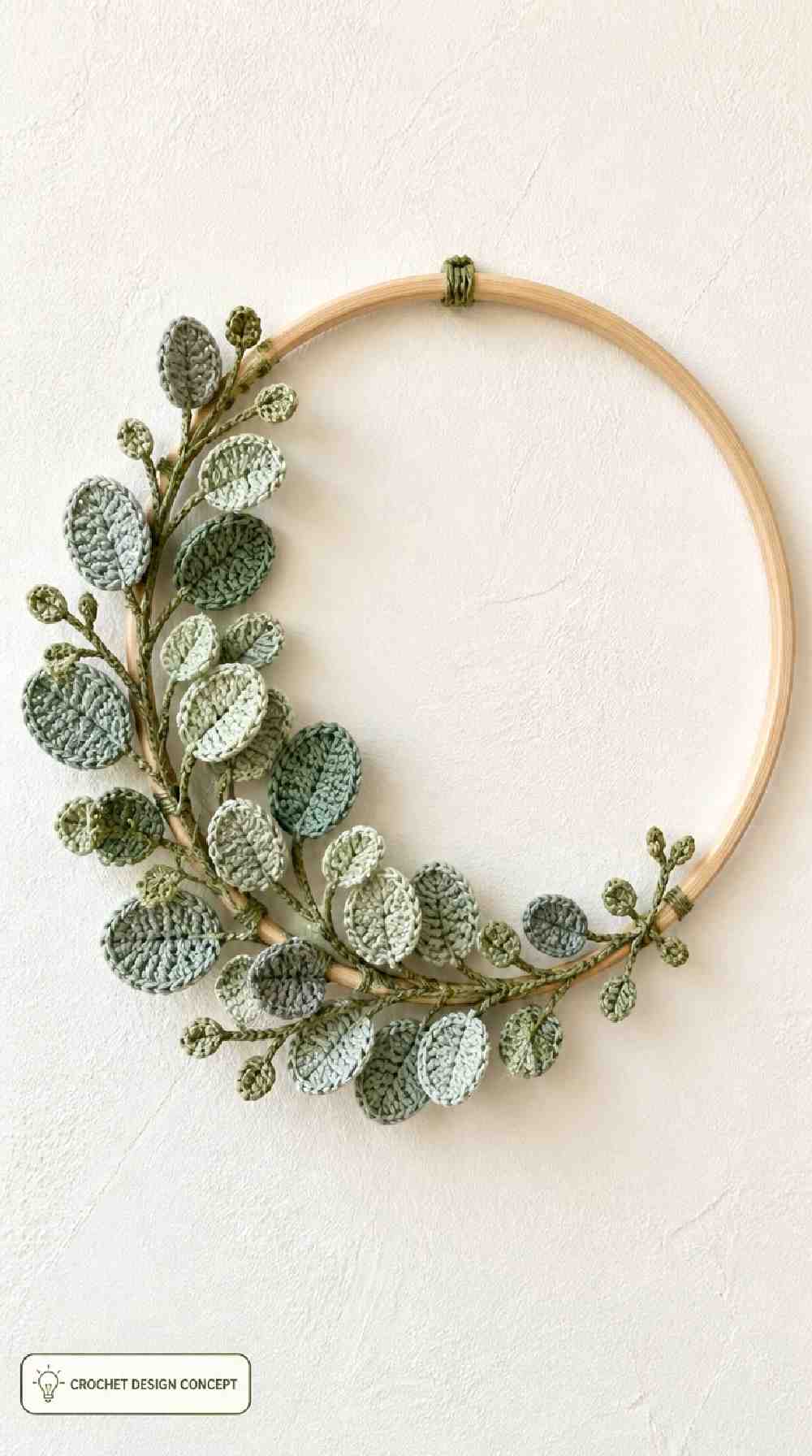
Soft silver-green eucalyptus leaves curve across the lower-left edge of this pale wooden hoop, creating a botanical arrangement that feels light rather than crowded. The crocheted oval leaves alternate along fine olive-green stems, while the open upper-right section lets the circular frame remain part of the design.
That asymmetrical crescent is especially useful when a room already contains plenty of patterned textiles. The crochet adds texture without filling the entire wall space. For a real version, the stems would need discreet attachment points to maintain the intended curve.
- Crescent Placement: Keep most foliage concentrated along the lower-left curve. Spreading leaves evenly around the ring would change the airy, asymmetrical character.
- Leaf Structure: Choose a crochet technique that creates defined oval shapes without excessively thick edges. Heavy leaves may pull delicate connecting stems downward.
- Wall Contrast: Silver-green motifs can lose definition against similarly colored paint. A warmer cream, ivory or muted terracotta background could give the leaves clearer outlines.
- Hoop Support: The lower-left arrangement creates uneven weight. Check the completed piece’s balance and hanging point before fixing it permanently to the wall.
2. Crochet Lavender Meadow Hoop
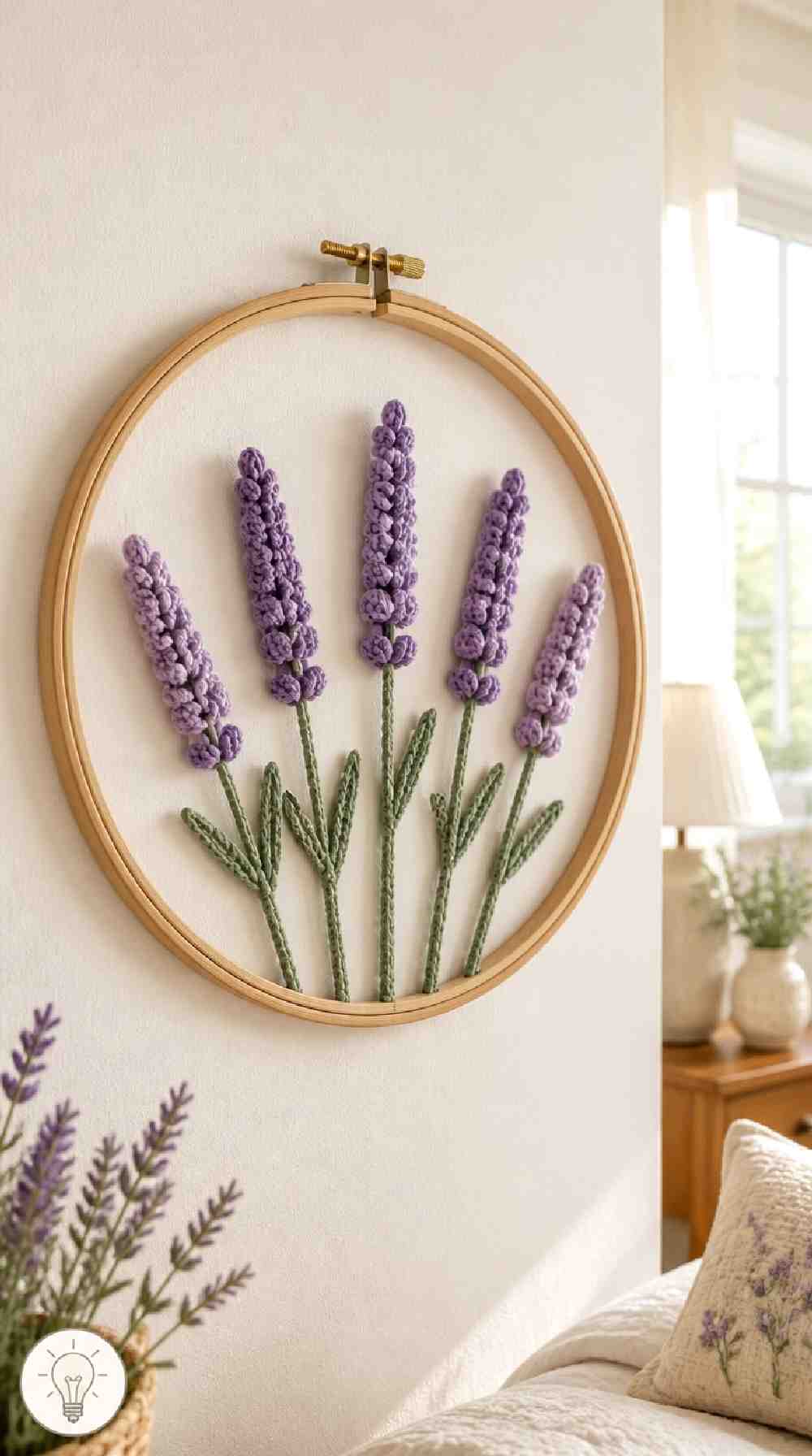
Five delicate lavender stalks rise from the lower rim of this natural bamboo hoop, each carrying an elongated cluster of dusty-purple and lilac crochet stitches. Narrow sage-green leaves line the stems, giving the flowers a recognizable upright shape without adding unnecessary volume.
Unlike a circular floral wreath, this design draws the eye vertically through the hoop. It could suit a narrow space beside a bedroom mirror or small shelf. The long stems are the main practical consideration, as they need enough structure to remain upright rather than folding forward.
- Flower Spacing: Leave visible gaps between the five lavender stalks. Crowding them together could turn the separate floral shapes into one indistinct purple mass.
- Stalk Stability: Consider discreet internal support or a suitable firm crochet construction when making a real version. Soft yarn alone may not hold tall stems upright.
- Purple Color Balance: Combining dusty lavender with slightly deeper lilac helps the small puff-stitch flowers stand apart without becoming too bright for neutral decor.
- Best Wall Shape: The upright composition works particularly well in a narrow vertical area where a wide, heavily decorated wreath might feel oversized.
3. Crochet Cottage Wildflower Wreath Hoop
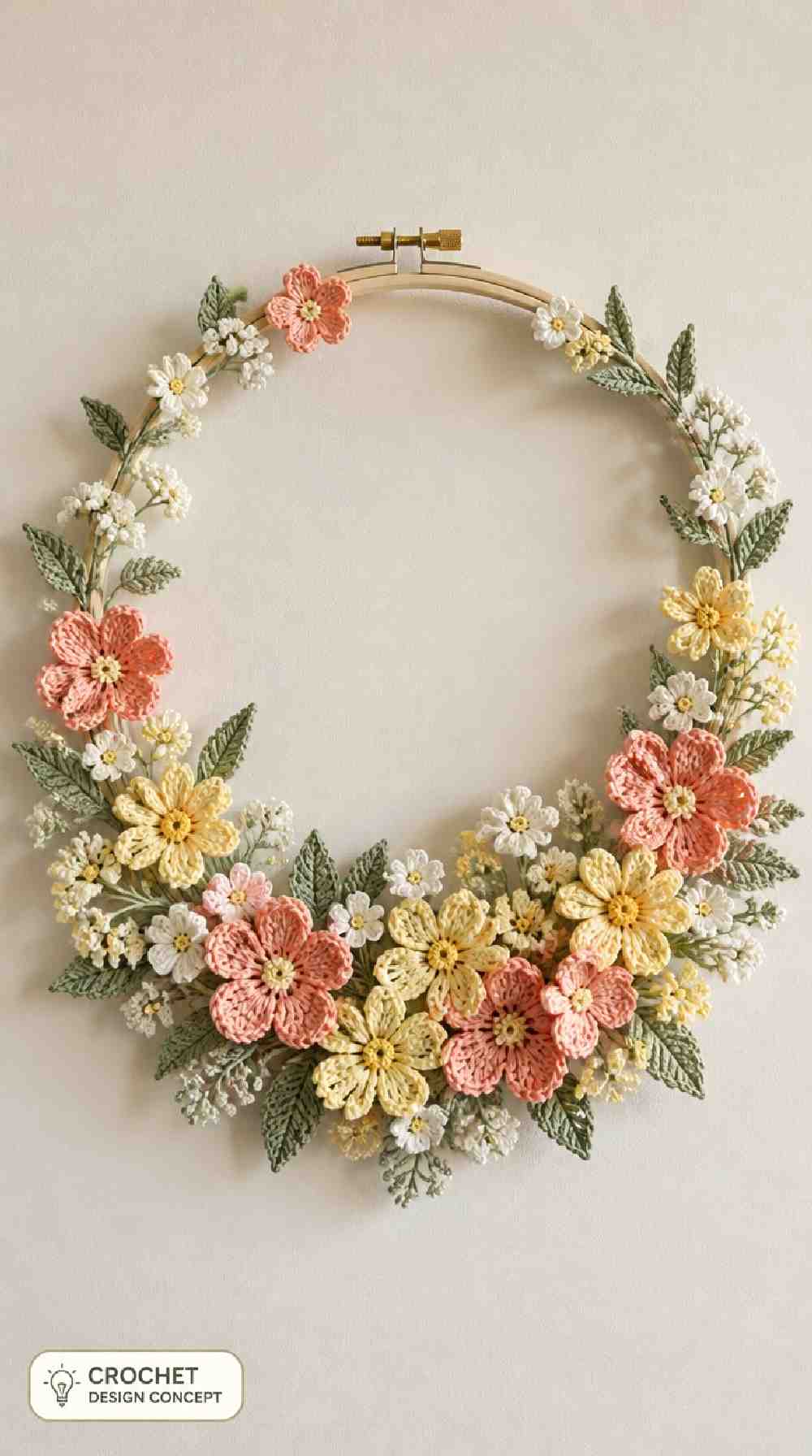
Coral blossoms, butter-yellow daisies and little ivory flowers gather around a light wooden hoop in an uneven garden-inspired wreath. Sage-green pointed leaves separate the blooms, while the lower portion carries more detail than the lightly decorated upper curve.
The mixture of flower sizes gives this crochet arrangement a relaxed cottage look instead of a rigidly repeated pattern. It works as a more colorful alternative to a foliage-only hoop. When planning a handmade version, keeping the flower colors coordinated is important because the different petal shapes already provide plenty of visual variety.
- Flower Hierarchy: Let the coral blossoms carry most of the visual weight, with yellow daisies and smaller ivory flowers filling the spaces between them.
- Attaching Separate Motifs: Sew or otherwise secure each crocheted flower appropriately to the supporting structure. Avoid relying on loosely trapped petals to stay in place.
- Petal Definition: Dimensional flowers need enough spacing to show their individual shapes. Overlapping every petal can make the wreath appear visually dense.
- Color Customization: A softer variation could replace coral with faded peach while retaining the same flower arrangement and yellow-and-ivory accents.
4. Crochet Monstera Leaf Hoop Art
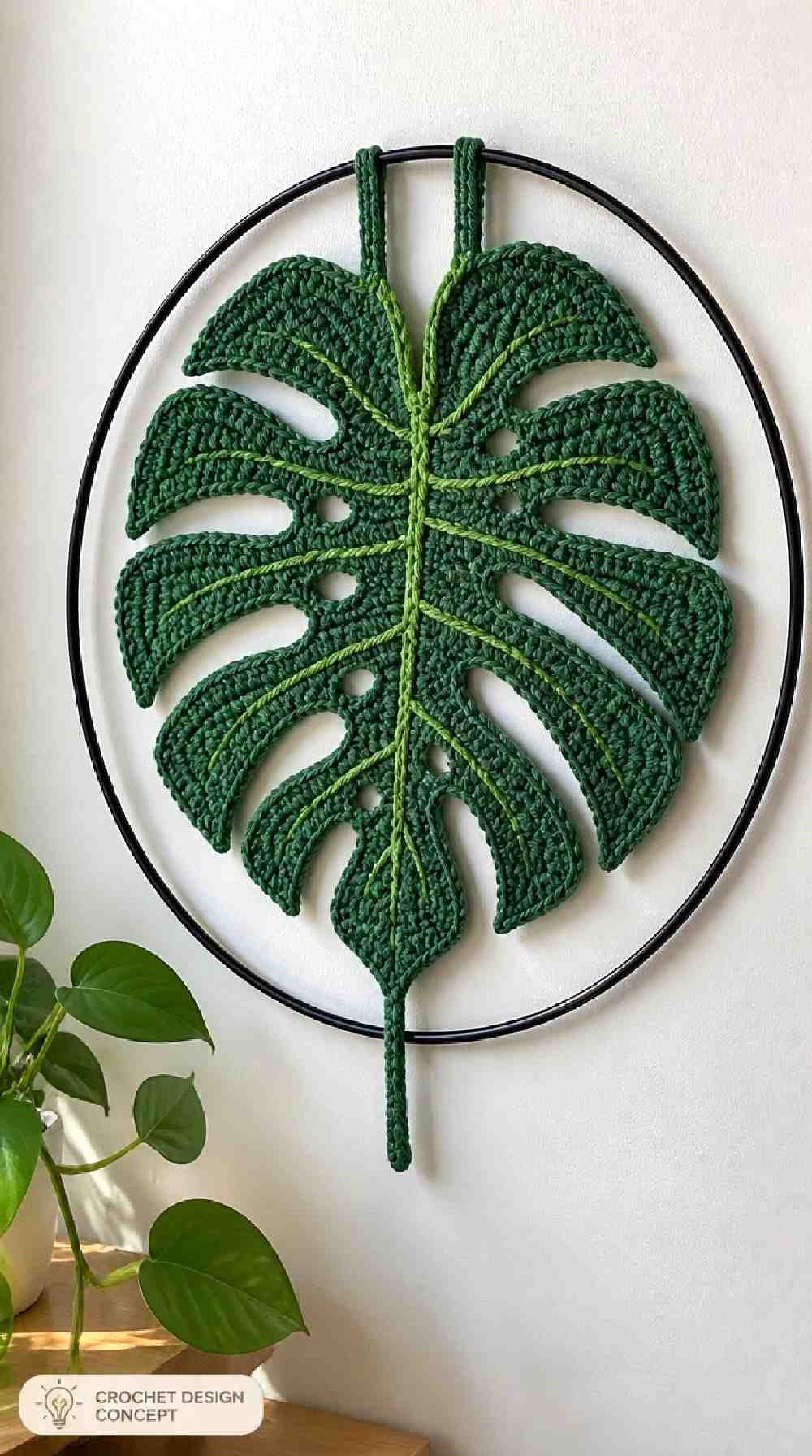
One striking emerald-green monstera leaf occupies the center of a slender black metal hoop. Its large split lobes, open sections and brighter jade-colored rib details create a recognizable tropical silhouette, while short upper attachment loops hold the crocheted leaf within the circular frame.
This design uses a single bold plant shape rather than several little flowers. That makes the crochet leaf the clear focal point, particularly against a plain light wall. The greatest challenge in a real adaptation would be preserving the leaf’s broad outline without letting its shaped edges curl or sag.
- Recognizable Leaf Shape: The characteristic splits and openings matter more than adding extra decorative stitches. Check that they remain visible after the fabric is supported.
- Contrast With the Frame: Emerald crochet against a matte-black hoop creates a strong outline, especially on pale walls. Dark wall paint may reduce that separation.
- Center Suspension: The upper attachment points must distribute the leaf’s weight adequately. A single unsupported center connection could distort its broad shape.
- Yarn Selection: A yarn with useful stitch definition may help the lobes appear more deliberate. Test the intended yarn before committing to a large motif.
5. Crochet Woodland Fern Hoop Hanging
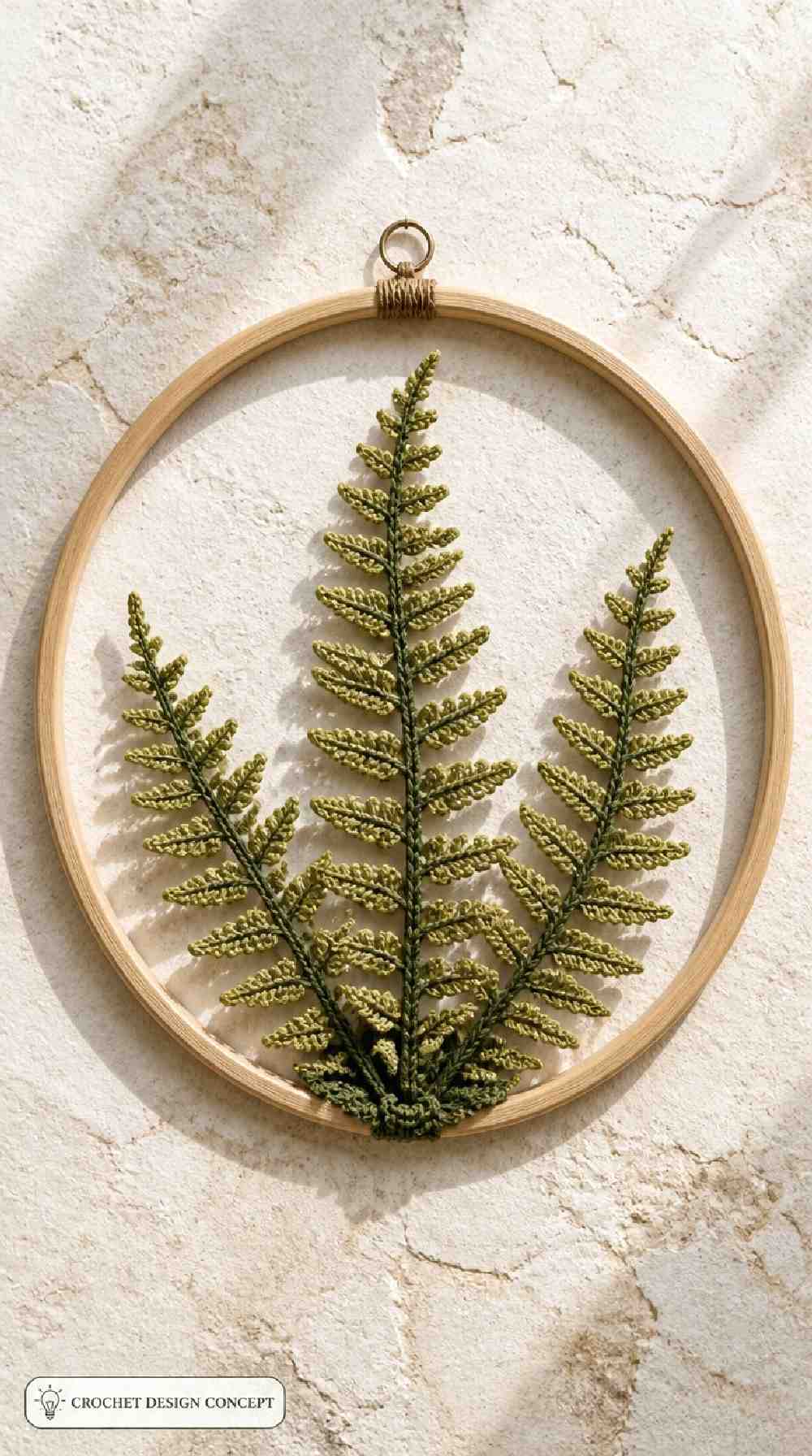
Three crocheted fern fronds spread upward from the bottom of this ash-wood hoop, with slender center stems and narrow leaflets in forest green, moss and muted olive. The different frond lengths create a layered woodland arrangement without covering the open spaces between them.
Fern shapes offer a quieter botanical theme than large dimensional flowers. Their fine repeating leaflets can add interesting crochet detail to a reading corner or nature-inspired gallery wall. Because these fronds are relatively narrow, careful construction matters if their branches are expected to keep their graceful curves.
- Frond Variety: Use different frond lengths and angles rather than making three identical shapes. This creates the loose, natural fan arrangement shown in the concept.
- Fine Leaflets: Small crochet leaflets should remain clearly separated. Very bulky yarn could hide their shape and make the fern look less delicate.
- Keeping the Fan Open: Support may be needed near the lower connection where the fronds meet. Otherwise, their weight could pull them into a narrow cluster.
- Woodland Styling: Muted green yarn against pale wood works well with natural materials. The relatively open silhouette also suits smaller walls where heavy decor would dominate.
6. Crochet Chamomile Daisy Hoop
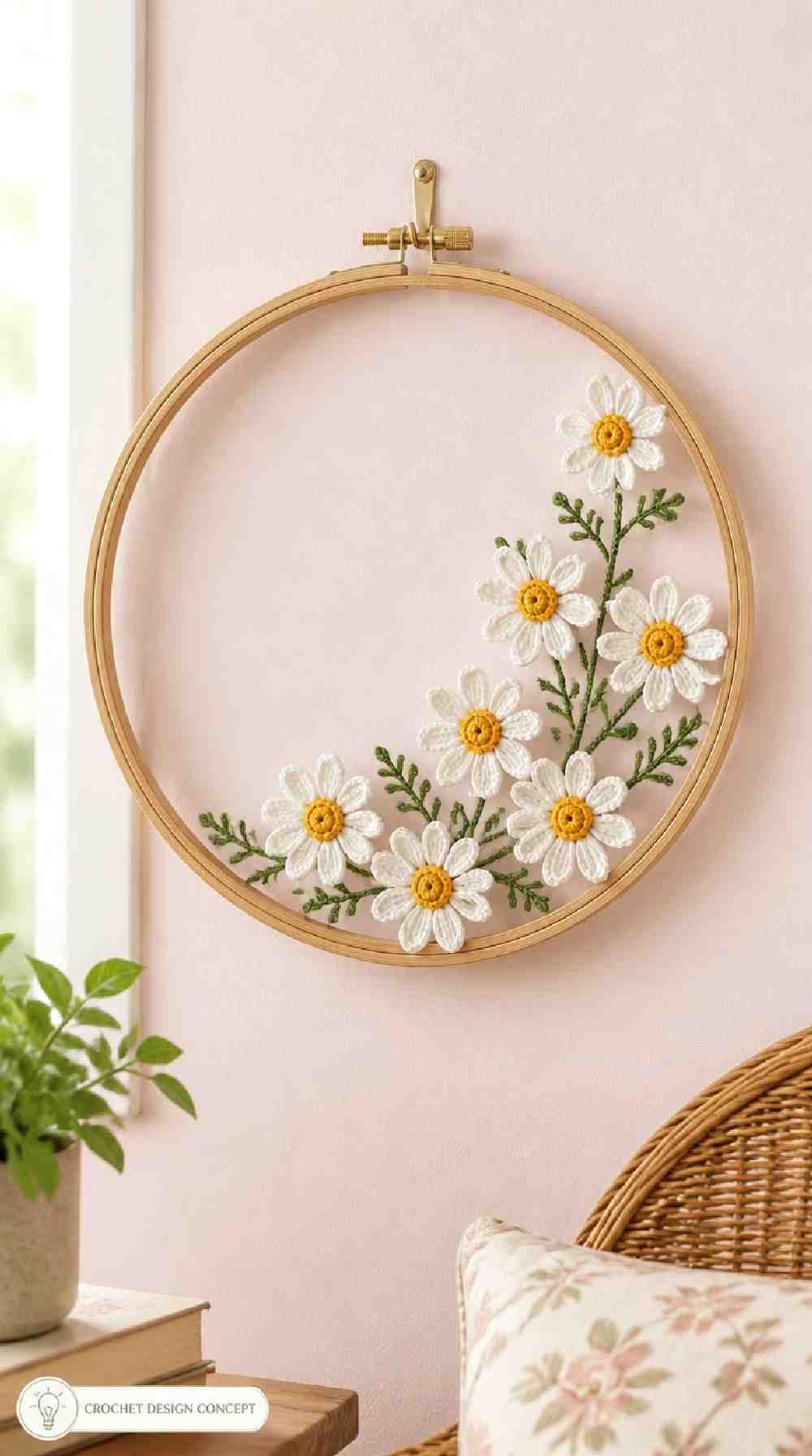
Seven small chamomile-inspired daisies sweep diagonally across the lower-right interior of this honey-colored hoop. Their narrow ivory crochet petals surround textured golden-yellow centers, while fine green stems and slender foliage connect the flowers into one delicate spray.
The small blossoms give this design a lighter, more detailed appearance than the oversized sunflower concept later in the collection. It would be a natural choice for a soft cottage bedroom or a small gallery wall. The petals need sufficient separation to keep each flower readable from a normal viewing distance.
- Daisy Proportions: Keep the ivory petals narrow enough to suggest chamomile rather than oversized decorative daisies. The raised yellow centers provide essential contrast.
- Diagonal Movement: Position the flowers along one loose diagonal spray. Arranging them evenly around the hoop would create a different, more traditional wreath.
- Small-Motif Attachment: Secure the centers and stems carefully while keeping the petals free enough to show their shapes. Unsupported connecting strands may droop.
- Wall Background: A pale blush wall gently separates the ivory flowers from the setting; on a white wall, slightly warmer ivory yarn could improve visibility.
7. Crochet Terracotta Blossom Vine Hoop
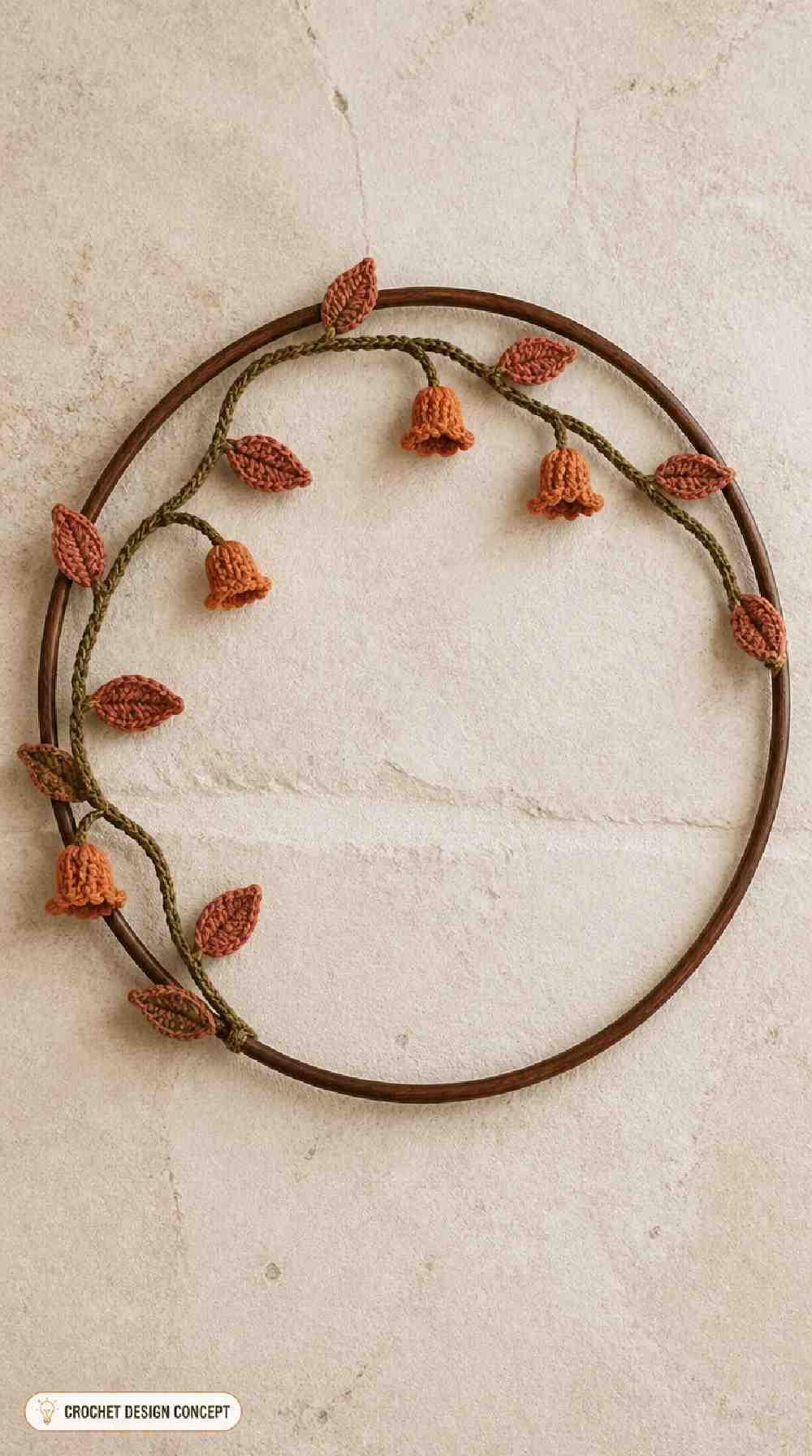
Tiny terracotta-orange bell flowers hang from an olive-brown crocheted vine that winds around a walnut-colored hoop. Small rust-colored leaves interrupt the curved stems, creating a loose climbing arrangement that travels from the lower-left edge across the upper arc.
Rather than filling the circle with flowers, this design lets the winding crochet vine define the movement. The warm colors suit earthy interior palettes, especially those with wood and natural textures. A real version would need the vine secured at several points so the decorative curve follows the ring instead of slipping downward.
- Vine Direction: Follow the hoop’s curve across the upper arc while leaving the center open. This preserves the climbing-plant effect.
- Bell-Shaped Flowers: Small downward-facing crochet bells need enough depth to look dimensional. Flattening them completely would make their distinctive silhouette less obvious.
- Warm Palette: Terracotta flowers, muted-rust leaves and walnut wood produce a coordinated earthy look without requiring bright seasonal colors.
- Attachment Intervals: Plan multiple discreet connections along the winding vine. One attachment at either end may not control its position around a smooth hoop.
8. Crochet Vintage Botanical Herbarium Hoop
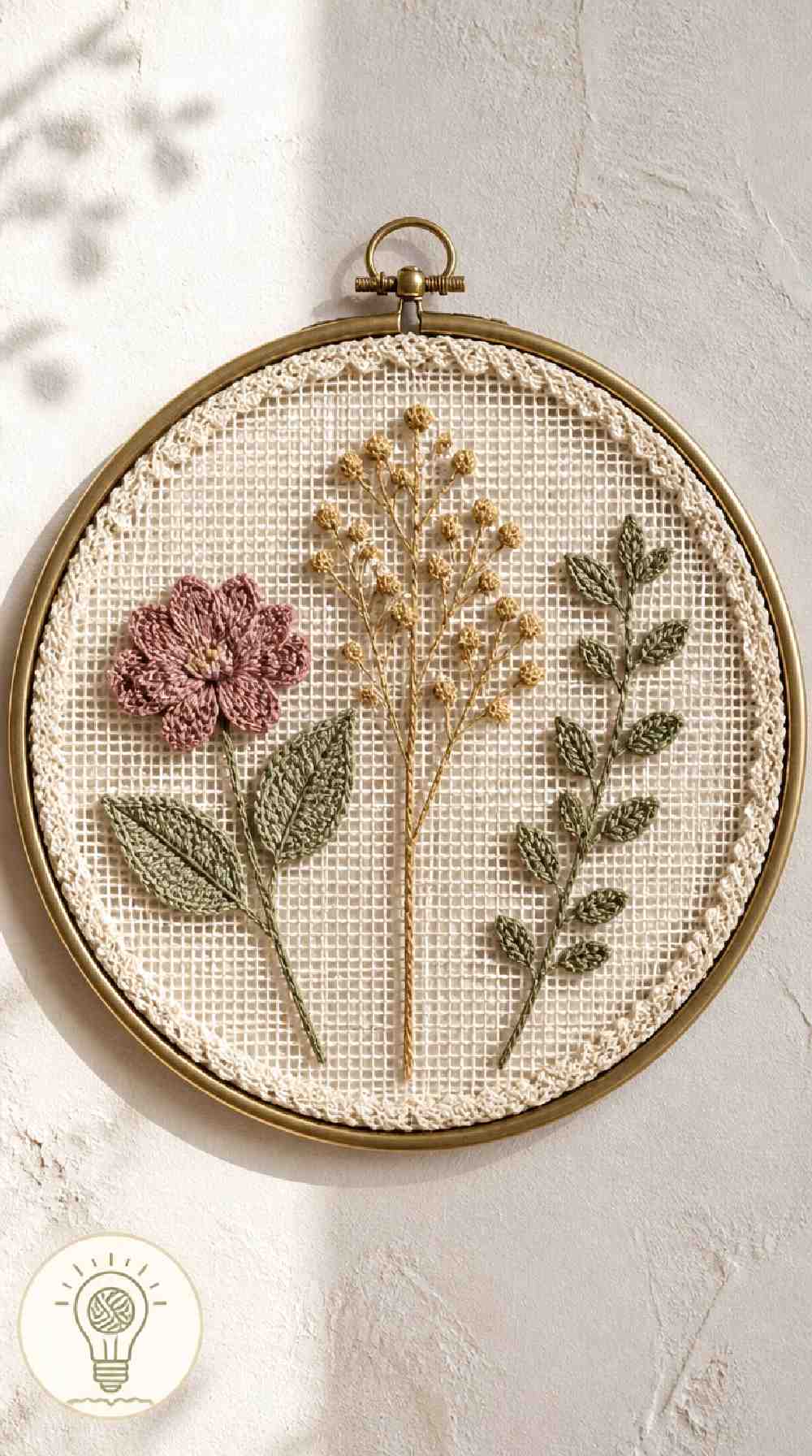
An antique-brass hoop frames a fine ivory crochet mesh displaying three separate botanical specimens. A dusty-rose blossom, a golden-beige seed head and a muted-green leafy twig sit on the openwork background like a carefully arranged collection of pressed plants. Ecru crochet edging finishes the circular border.
The mesh gives this hoop a different structure from designs where flowers attach directly to a bare ring. It also creates a more traditional, collected-botanical appearance. Keeping the crochet netting evenly tensioned would be important, particularly if the separate motifs add weight in different places.
- Mesh Visibility: Choose fine, consistent crochet openings that remain visible around the specimens. A dense backing would change the light botanical-display character.
- Specimen Separation: Leave enough space between the rose, seed head and leafy twig so each can be recognized as an individual botanical form.
- Even Tension: Check the backing around the entire hoop before attaching motifs. Uneven tension may distort the circular mesh or pull it toward heavier decorations.
- Vintage Color Choice: Dusty rose, beige, muted green and ecru create an aged-botanical look. Brighter shades would give the same arrangement a more contemporary feel.
9. Crochet Minimal Olive Branch Hoop
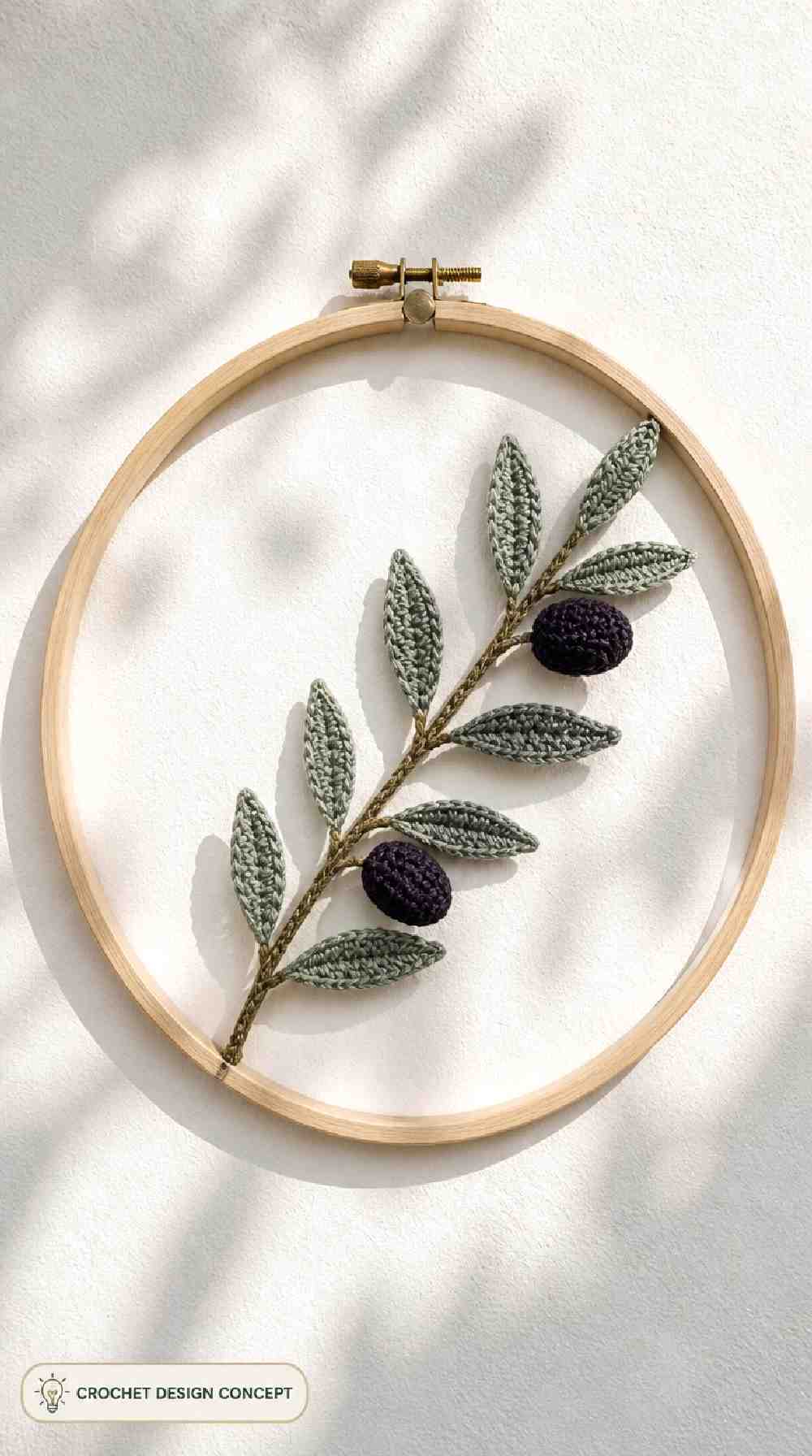
One slender olive branch crosses a pale wooden hoop diagonally, carrying alternating grey-green crochet leaves and two small deep-purple crocheted olives. Its curved stem creates a clean botanical silhouette with plenty of open space around the foliage.
This restrained arrangement is suited to interiors where a large floral wreath would feel too busy. The olives provide just enough contrast to make the branch distinctive. When translating the concept into crochet, the main challenge is maintaining the diagonal line while supporting the small dimensional fruit shapes.
- Branch Silhouette: Keep the crocheted leaves slim and arranged in alternating pairs. Oversized leaves could hide the central stem and change the olive-branch appearance.
- Fruit Proportions: The two purple olives should remain small compared with the foliage. Larger rounded pieces might make the branch look unbalanced.
- Diagonal Support: Attach the branch securely at suitable points along the hoop or use an appropriate internal support to preserve its upward curve.
- Minimal Room Styling: The pale wooden ring and muted greenery suit simple walls. A darker background could also emphasize the open outline of the leaves.
10. Crochet Blue Forget-Me-Not Hoop
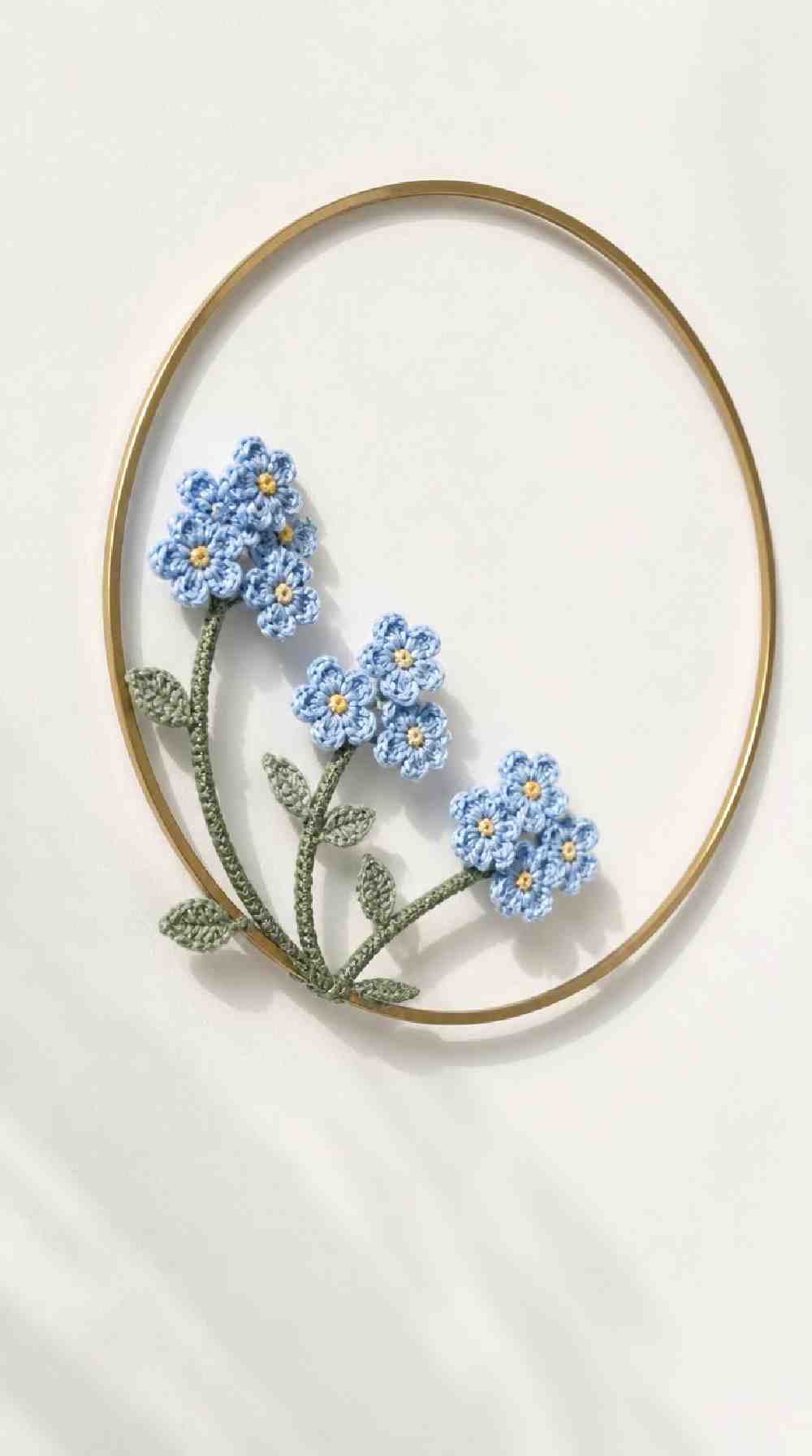
Small clusters of sky-blue forget-me-not flowers rise from the lower-left section of a brushed-brass hoop. Each five-petal crochet blossom has a tiny yellow center, with fine sage-green stems and miniature pointed leaves connecting the flowers into three gently curved branches.
The little blue blooms create a delicate alternative to larger floral hoop arrangements. Their small scale gives the design an almost illustrated quality, particularly when displayed against a plain ivory wall. A real crochet version would benefit from consistent flower sizing so the clusters look intentional rather than uneven.
- Flower Recognition: Five distinct blue petals around a yellow center are important to the forget-me-not appearance. Keep the stitches proportionate to the tiny flower size.
- Cluster Distribution: Arrange flowers in three separate curved clusters rather than one solid mass. The visible gaps make the delicate stems part of the composition.
- Fine-Yarn Consideration: Smaller yarn or thread may help the blossoms retain detail, although the finished size and handling requirements will change with the material.
- Hoop Finish: Brushed brass introduces a warm contrast to cool blue petals. If substituting another frame, compare how its finish affects the overall color balance.
11. Crochet Golden Sunflower Hoop Hanging
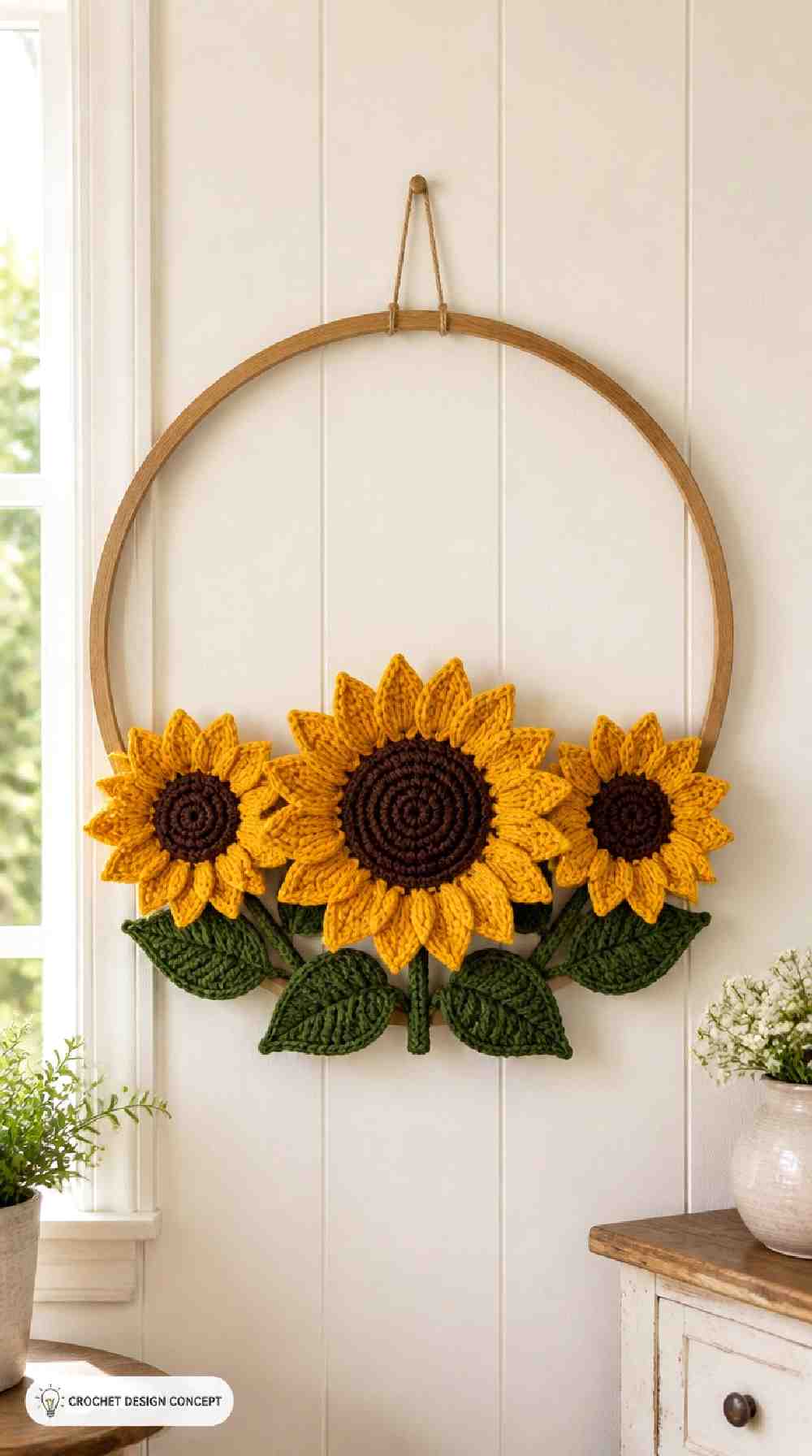
Three golden sunflowers fill the lower third of a sturdy oak hoop, with one large central bloom surrounded by two smaller flowers. Their antique-gold crochet petals surround raised chocolate-brown centers, while broad forest-green leaves and short stems finish the arrangement.
The sunflower heads give this hoop a stronger presence than small wildflower designs. Their rounded shapes and textured centers can become an attractive feature above a rustic console or dresser. For a handmade adaptation, the weight of the layered petals and raised centers would need to be considered when deciding how to attach the flowers.
- Central Flower Scale: Make the middle sunflower noticeably larger than the surrounding two. Equal-sized flowers would create a flatter, more repetitive arrangement.
- Textured Centers: Raised brown crochet stitches give the flowers depth. Keep the surface neat so the centers remain visually separate from the surrounding petals.
- Weight Distribution: Three dimensional flowers concentrated at the bottom may require several secure attachment points and a hoop strong enough for the completed arrangement.
- Seasonal Flexibility: Antique gold and forest green can suit rustic decor beyond autumn. Their usefulness depends more on the room’s colors than on a specific holiday.
12. Crochet Trailing Pothos Hoop Hanging
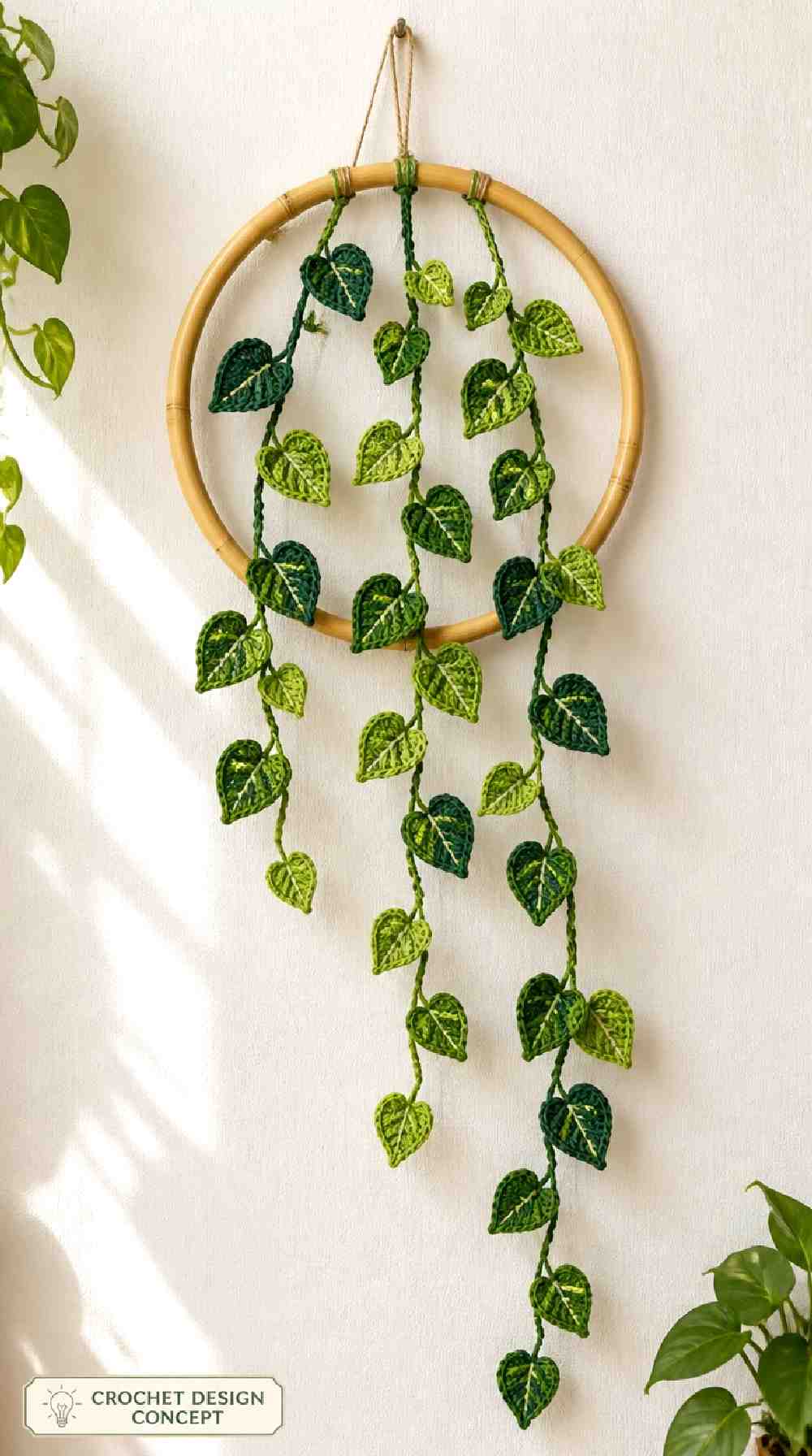
Three crocheted pothos vines fall through a natural bamboo hoop, with heart-shaped leaves in jade, lime and deeper green. The slender stems start along the upper inner curve and cascade to different lengths, extending below the lower rim while leaving parts of the ring visible.
This is one of the most vertical designs in the collection. Instead of arranging foliage around the hoop’s perimeter, the crochet leaves create movement beneath it. The dangling structure would need careful planning, particularly if the piece is displayed near furniture or anywhere loose strands might catch.
- Leaf Silhouette: Rounded heart-shaped crochet leaves distinguish this concept from the narrow fern and olive-branch designs. Keep their center veins subtle but visible.
- Cascading Lengths: Vary the three vine lengths to avoid a straight, heavy-looking lower edge. Check the available wall clearance before planning a real hanging.
- Stem Connections: Longer crochet vines may stretch or twist under the weight of leaves. Consider secure joins and suitable yarn for the intended display.
- Placement Caution: Avoid placing dangling leaves near frequently opened cupboards, walking paths or areas where children or pets could pull the hanging.
13. Crochet Scarlet Poppy Hoop Art
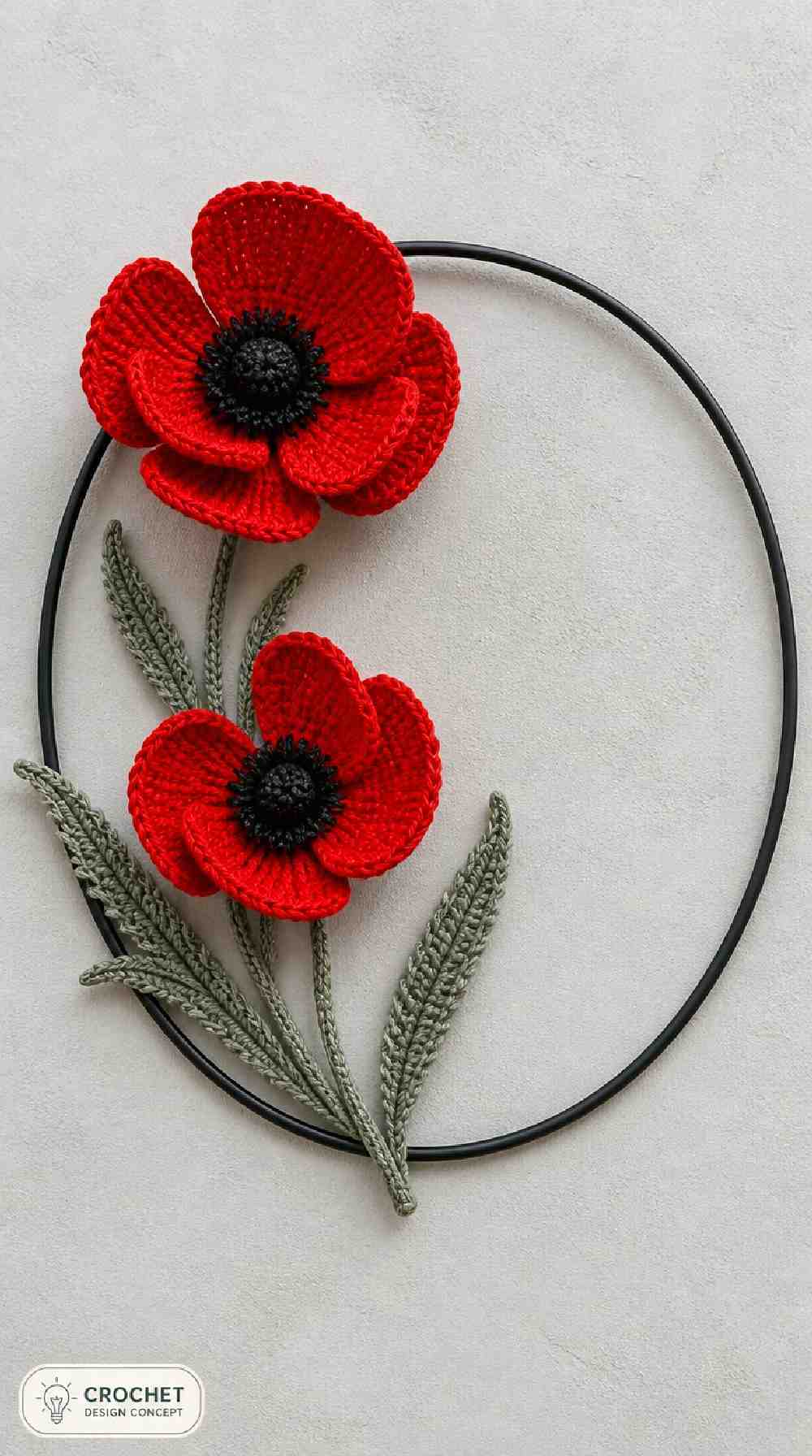
Two large scarlet poppies sit along the left interior of a matte-black hoop, with one flower higher than the other. Their broad, gently curved crochet petals surround charcoal-black textured centers, while narrow grey-green leaves and slender stems reach toward the lower section.
The bold flower shapes make this design noticeably different from the softer pastel arrangements. It can act as a strong visual accent on a light wall without needing many extra motifs. When planning the crochet construction, maintaining petal curvature and supporting the larger blooms are more important than adding additional decorative flowers.
- Petal Shape: Keep four broad petals clearly visible around each flower center. Additional overlapping layers could make the poppies look more like roses.
- High-Contrast Palette: Scarlet red against a black hoop and charcoal centers gives the flowers definition. The light wall helps prevent the whole composition from looking too dark.
- Uneven Flower Placement: The higher and lower poppies create asymmetry. Repositioning them into a straight pair could make the arrangement feel more rigid.
- Dimensional Support: Large petals may need careful shaping and suitable attachments. Check how the selected yarn behaves before expecting the flowers to hold a curved form.
14. Crochet Ivory Magnolia Hoop Hanging
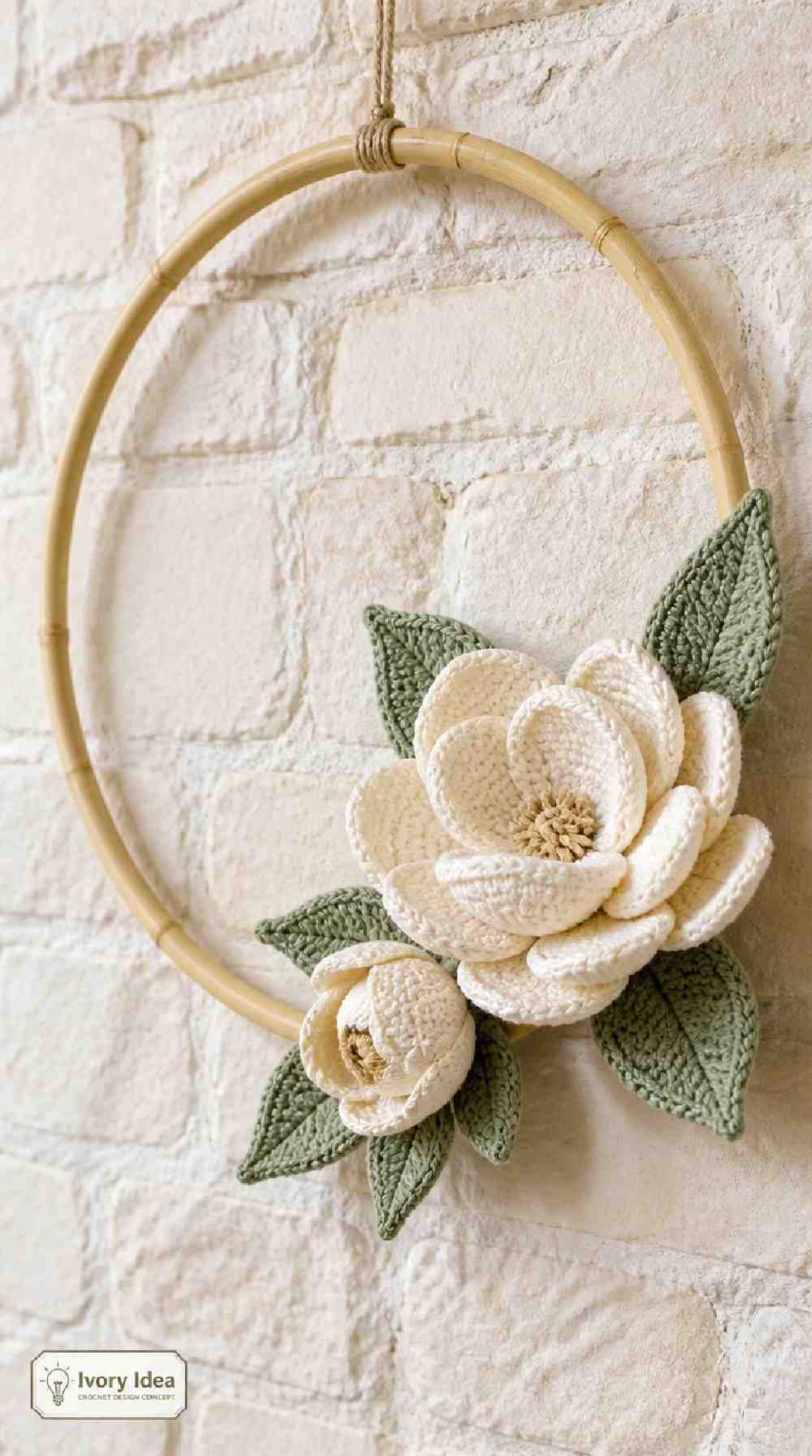
Two dimensional magnolia blossoms gather along the lower-right curve of a pale bamboo hoop. Their warm ivory crochet petals have delicate blush-beige shading near the bases, with small pale-gold centers and three elongated dusty-sage leaves surrounding the flowers.
The arrangement combines large layered petals with a relatively open circular frame. It could bring a gentle floral accent to a vintage-inspired bedroom or dressing area. Magnolia shapes depend heavily on their broad petals, so a handmade version would need careful attention to thickness, shaping and how the blossoms are supported.
- Petal Layering: Keep the larger magnolia partly open and the smaller one more closed. The difference adds depth without introducing extra flower types.
- Subtle Color Shading: Warm ivory with blush-beige petal bases gives definition to the layers. Completely white petals against a pale wall might lose some detail.
- Blossom Placement: Concentrate both flowers at the lower-right curve and preserve the open upper section. This helps the bamboo ring remain visible.
- Material Trade-Off: Very soft yarn may produce relaxed petals, while firmer crochet fabric may hold their shape more clearly. The final effect requires sampling.
15. Crochet Botanical Specimen Sampler Hoop
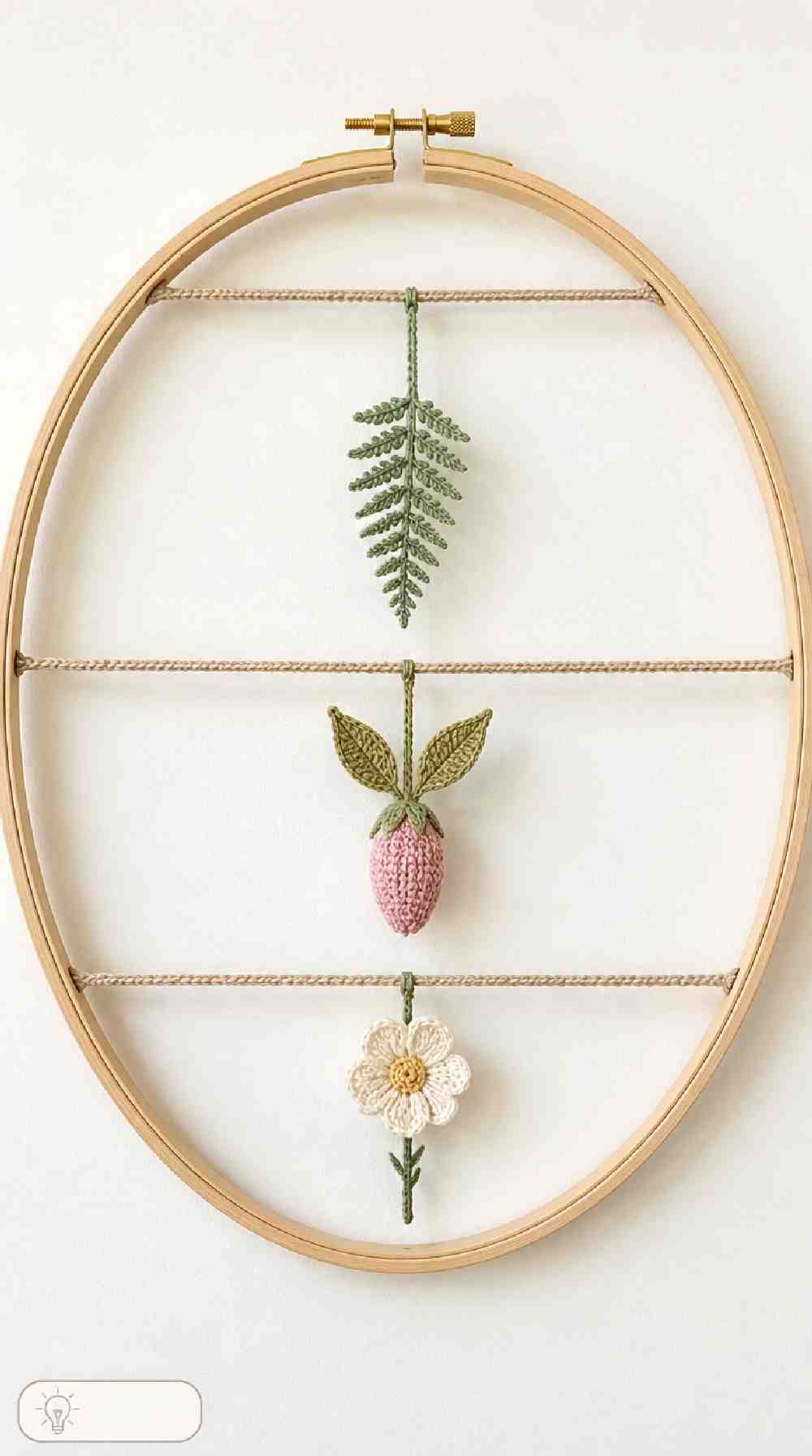
Three slim horizontal crochet lines divide the interior of a maple hoop into a simple botanical display. A tiny sage fern hangs from the upper line, a muted-pink bud with two olive leaves hangs from the middle, and a cream wildflower with a pale-gold center hangs from the lower line.
This sampler presents three different plant forms without combining them into a conventional bouquet. The straight display lines create a more structured look than the flowing vines and flower sprays elsewhere in the collection. For a real adaptation, maintaining consistent line tension would help keep the specimens neatly separated.
- Three-Level Layout: Keep the three display lines evenly spaced. Uneven gaps could make the specimens appear accidentally placed rather than arranged as a deliberate botanical collection.
- Motif Variety: The fern, pink bud and cream wildflower should remain clearly different in shape. Repeating similar flowers would weaken the specimen-sampler idea.
- Line Tension: Thin crochet display lines may sag when motifs are attached. Plan their support and attachment carefully rather than relying on stretched yarn alone.
- Gallery-Wall Potential: The structured arrangement could sit beside framed botanical prints or simple line drawings without competing with larger, fuller decorations.
Practical Guide to Crochet Botanical Hoop Wall Hangings
Botanical hoop art may look simple, but a convincing finished piece depends on how the crochet motifs are supported, balanced and displayed. These considerations can help when planning a real project inspired by the concepts.
Choosing the Hoop and Yarn
Wooden embroidery hoops suit cottage, vintage and natural interiors, while metal rings create a cleaner, more contemporary outline. Choose the hoop according to the finished motif arrangement and the weight it needs to carry.
Cotton yarn is worth considering for clearly defined petals and leaves, while suitable blends may produce softer shapes. Fine thread can make delicate specimens possible, but it also changes the scale and handling of the work.
Planning the Display Size
Before choosing a hoop, measure the wall space where it will hang. Check the overall width and height, including any leaves or vines that extend beyond the ring.
A small hoop can suit a narrow wall section, while larger motifs may require more open space. Don’t assume the scale shown in an AI visualization corresponds to standard real-world dimensions.
Attaching Botanical Motifs
Different arrangements need different approaches:
- Flowers around a ring may be sewn securely to an appropriate wrapped or crocheted attachment area.
- Freestanding stems may need discreet support to retain their intended position.
- Open crochet mesh should be evenly tensioned before heavier embellishments are attached.
- Trailing vines need carefully secured upper connections and enough space below the hoop.
Whatever attachment method you choose, check that the finished piece can hang evenly without its weight distorting the shape.
Caring for the Finished Wall Art
Keep crochet botanical wall hangings away from open flames, direct heat, persistent dampness and locations where they may be pulled or snagged.
Dust gently according to the materials used. If washing becomes necessary, consider whether the crochet can be removed from the hoop and follow the yarn manufacturer’s care guidance. Wooden and metal components may require separate treatment.
For a related decorating approach, see the Crochet Wall Hanging With Tassels Ideas collection, which explores other hanging shapes and decorative finishes.
Want to Make Something Similar?
These inspiration designs are original visual concepts rather than published patterns. However, the following existing tutorials offer useful starting points for creating botanical crochet motifs and understanding hoop arrangements.
- Simple Rosettes and Leaves by Tamara Kelly at Moogly — a free written pattern for small crochet roses and leaves that can help with separate botanical embellishments. moogly
- Crochet Rose Wall Hanging Tutorial by Knitting by Wajida — a video showing crochet flowers, leaves, a connecting vine and assembly on a metal hoop. YouTube
- Crochet Embroidery Hoop by Elizabeth Olson — a crochet edging technique for decorating an embroidery hoop itself. ravelry.com
These resources teach related techniques. They are not exact patterns for the 15 designs pictured here, so the motif arrangements, sizes and construction details may need separate planning.
Which Crochet Botanical Hoop Design Should You Choose?
The best choice depends on how much visual space you want the crochet to occupy and whether you prefer a relaxed arrangement or a more structured botanical display.
| Decorating goal | Suggested design | Important trade-off |
|---|---|---|
| Small, minimalist wall accent | Sage Eucalyptus Crescent Hoop | Subtle foliage needs enough background contrast |
| Narrow vertical wall space | Lavender Meadow Hoop | Upright stems may require support |
| Cottage-style flower display | Cottage Wildflower Wreath Hoop | Multiple motifs require careful attachment |
| Bold modern greenery | Monstera Leaf Hoop Art | Large leaf needs suitable shaping |
| Vintage botanical atmosphere | Vintage Botanical Herbarium Hoop | Mesh tension needs attention |
| Bright rustic focal point | Golden Sunflower Hoop Hanging | Layered blooms may add weight |
| Flowing greenery | Trailing Pothos Hoop Hanging | Longer vines need clearance |
| Delicate, organized wall art | Botanical Specimen Sampler Hoop | Thin horizontal lines may sag |
For rooms with many existing patterns, the Olive Branch or Eucalyptus Crescent designs are sensible starting points because much of each hoop remains open.
If you want a stronger statement, the Scarlet Poppy, Sunflower and Monstera concepts give the crochet motif more prominence. For a vintage interior, the Herbarium and Ivory Magnolia designs offer two different approaches: one fine and structured, the other soft and dimensional.
Conclusion
Crochet botanical hoop wall hangings can bring the shapes of a garden indoors while leaving plenty of room for personal interpretation. A single olive branch, a cluster of sunflowers or a collection of miniature specimens can create very different results from the same basic circular frame.
Start by choosing the silhouette that suits your wall, then think about how the yarn, motif size and attachment method would work in a real handmade piece. The strongest design is not necessarily the fullest one; sometimes a few carefully arranged crochet leaves make the most pleasing display.
Which botanical design would you choose for your own home? Would you prefer the airy eucalyptus crescent, colorful cottage wildflowers or cascading pothos vines? Share your favorite arrangement and where you would hang it.
Frequently Asked Questions
1. What type of yarn is suitable for crochet botanical hoop wall hangings?
Cotton is a useful option when you want defined crochet leaves, petals and edges. Other yarns and blends may suit softer or more dimensional arrangements, depending on their thickness and structure. The right choice depends on the motif’s intended appearance, weight and support needs. Test a small leaf or flower first before buying materials for a larger display.
2. Can I attach crochet flowers directly to an embroidery hoop?
Yes, but the attachment needs to suit the hoop material and flower construction. A wrapped or crocheted section can provide an area for sewing motifs in place. Some arrangements also benefit from a mesh backing or discreet connecting stems. Check the finished weight and make sure the crochet elements stay secure when the hoop hangs vertically.
3. How can I stop crochet leaves and flowers from drooping?
Start by checking the yarn’s stiffness, stitch density and the size of each motif. Some pieces may need careful shaping or an appropriate internal support. Larger flowers can require several attachment points rather than one central connection. Blocking may help certain fibers hold a flatter shape, but the correct method depends on the yarn and does not replace structural support.
4. Are crochet botanical hoop wall hangings suitable for bathrooms or kitchens?
They may work in locations that remain reasonably dry and are away from heat, grease and frequent splashes. Persistent moisture can affect yarn and some hoop materials, while cooking residue can make the crochet difficult to clean. A dry bedroom, living room or hallway is generally a simpler place to display delicate botanical work.
5. Are the 15 crochet botanical hoop designs available as exact patterns?
No. These images are AI-generated design concepts intended to help readers explore different botanical shapes, colors and arrangements. They are not photographs of tested finished projects, and exact stitch instructions have not been established for them. If you want to make something similar, use reliable crochet flower and leaf tutorials as a starting point, then plan the hoop composition and supports separately.