Cherry tomato crochet garlands bring the cheerful colors of a summer vegetable garden into the kitchen without needing fresh produce. Bright tomato-red yarn, sage-green vines, golden ripening fruits and vintage cream lace can turn a simple hanging strand into a playful decorative feature. These 19 inspiration ideas explore stuffed tomato clusters, flat appliqués, botanical vines, miniature baskets, pennants and other creative ways to arrange crochet tomatoes around a kitchen.
A good kitchen garland is about more than cute little vegetables. Its hanging location, motif weight, connecting cord, leaf arrangement and cleaning needs all affect how practical it will be. Some designs suit a narrow open shelf, while others work better across a wide wall or stationary window frame. This collection helps you compare those differences while finding a tomato-themed crochet decoration that suits your kitchen.
These are AI-generated crochet design visualizations for inspiration, not photographs of tested handmade pieces or step-by-step patterns.
Quick Design Selection Guide
- For classic cottage kitchens: Crochet Ruby Tomato Cluster Garland and Crochet Rustic Tomato Trio Garland use recognizable red tomatoes and leafy stems in two different arrangements.
- For lightweight shelf decorations: Crochet Ruby Sage Leaf Garland, Crochet Tomato Gingham Tile Garland and Crochet Tomato Pennant Kitchen Garland rely mainly on flat crochet shapes.
- For bright retro colors: Crochet Golden Harvest Tomato Garland and Crochet Ripening Tomato Gradient Garland feature different combinations of ripe and ripening tomato shades.
- For botanical styling: Crochet Trailing Tomato Vine Garland, Crochet Tomato Blossom Kitchen Garland and Crochet Tomato Basil Leaf Garland place tomatoes among leaves, stems or blossoms.
- For vintage details: Crochet Tomato Lace Medallion Garland, Crochet Mini Tomato Market Basket Garland and Crochet Tomato Seed Packet Garland combine kitchen-garden motifs with decorative frames.
- For unusual hanging arrangements: Crochet Tomato Cabinet Drop Garland, Crochet Tomato Wooden Ring Garland and Crochet Tomato Tassel Vine Garland offer three different ways to suspend tomato motifs.
The most important first choice is between flat tomato appliqués and stuffed crochet fruits. Flat motifs usually stay closer to a wall or shelf, while stuffed tomatoes introduce more weight and may need stronger attachment points.
1. Crochet Ruby Tomato Cluster Garland
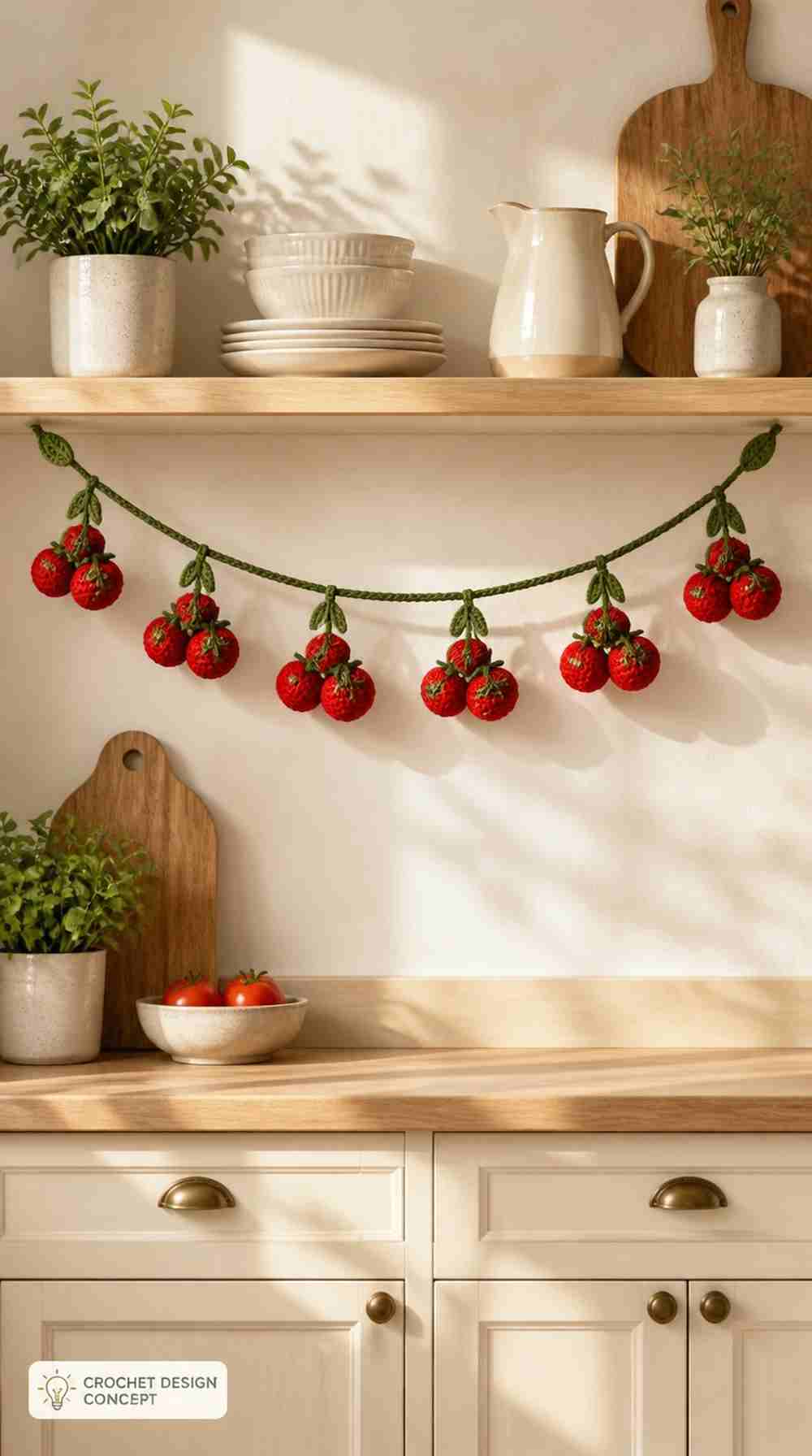
Three tiny ruby-red crochet cherry tomatoes hang together in each of six repeating clusters along a braided olive-green vine. Every round tomato has a dark-green star-shaped top, while little sage leaves soften the connecting points. The slightly stuffed fruits give the garland a full, garden-fresh appearance.
This classic arrangement suits a kitchen shelf where the individual clusters have room to hang freely. Its main practical consideration is weight: several stuffed tomatoes can pull on a decorative cord, so the vine and hanging points need appropriate support.
- Three-Tomato Clusters: Keep the fruits grouped closely without hiding their individual shapes. Consistent cluster spacing creates a balanced garland.
- Braided Vine Strength: Choose a connecting cord that can support the combined weight of the stuffed tomatoes without stretching excessively.
- Leaf Attachment: Position the small sage leaves around the cluster joins so their shapes remain visible rather than disappearing behind the red fruits.
- Shelf Display: A stationary open shelf can provide a suitable display area when the strand is securely mounted and kept away from heat.
2. Crochet Ruby Sage Leaf Garland
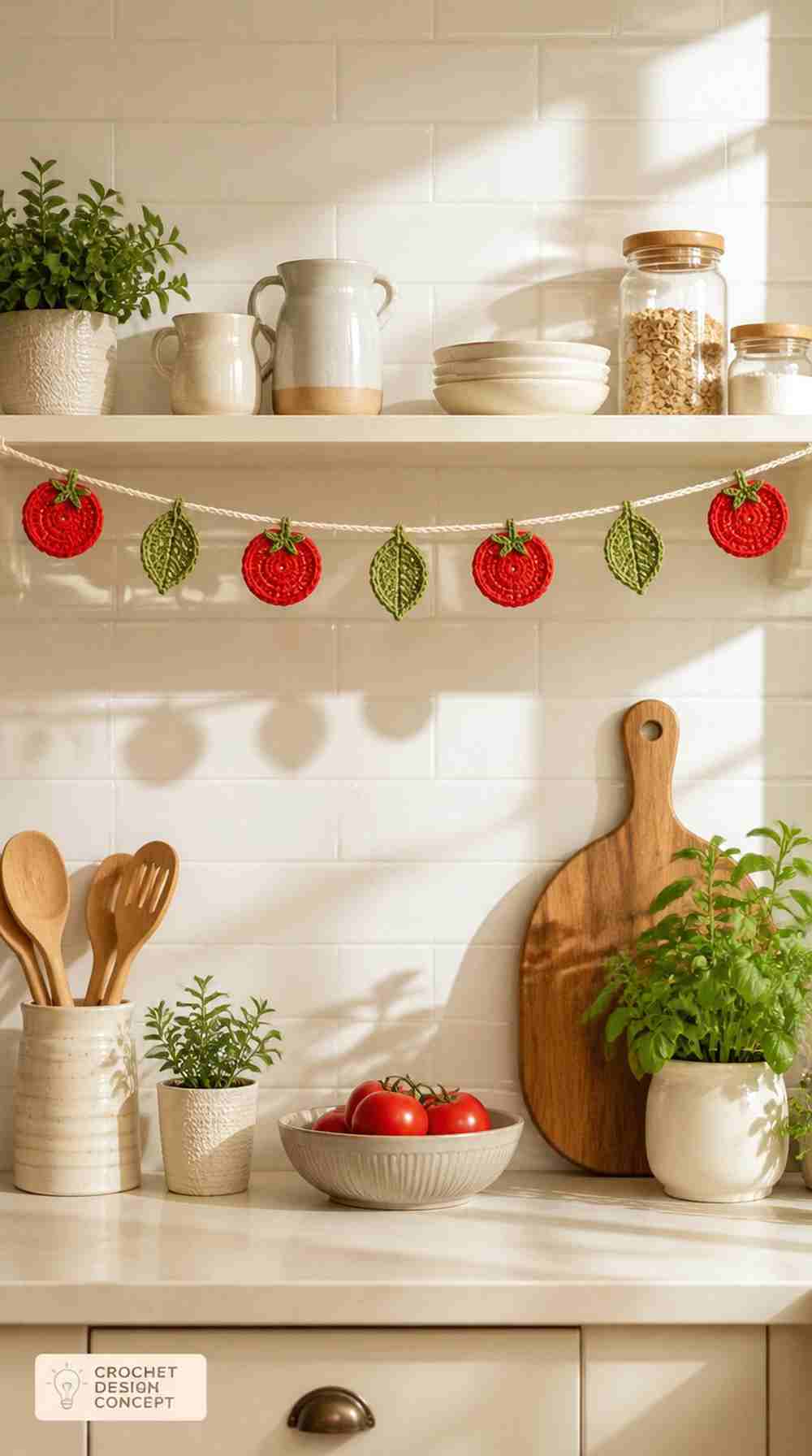
Flat cherry-red crochet tomatoes alternate with elongated dusty-sage leaves along a slender ivory cord. Each tomato has a rounded shape, concentric crochet stitches and a small olive-green star calyx. The leaves introduce gentle ribbed texture without adding noticeable bulk.
The open arrangement gives this garland a light, botanical appearance. Unlike stuffed tomato decorations, the flat motifs can sit relatively close to a shelf or wall. That makes the design worth considering when the available hanging space is narrow.
- Flat Tomato Motifs: Work the red circles with suitable increases so the shapes stay flat rather than becoming shallow cups.
- Alternating Leaves: Space the long sage leaves evenly between the tomatoes to maintain a clear repeating botanical pattern.
- Ivory Connecting Cord: A neutral crochet strand keeps the red tomatoes visually prominent without introducing another strong color.
- Display Direction: Check which side of each appliqué faces outward before securing it to the cord.
3. Crochet Golden Harvest Tomato Garland
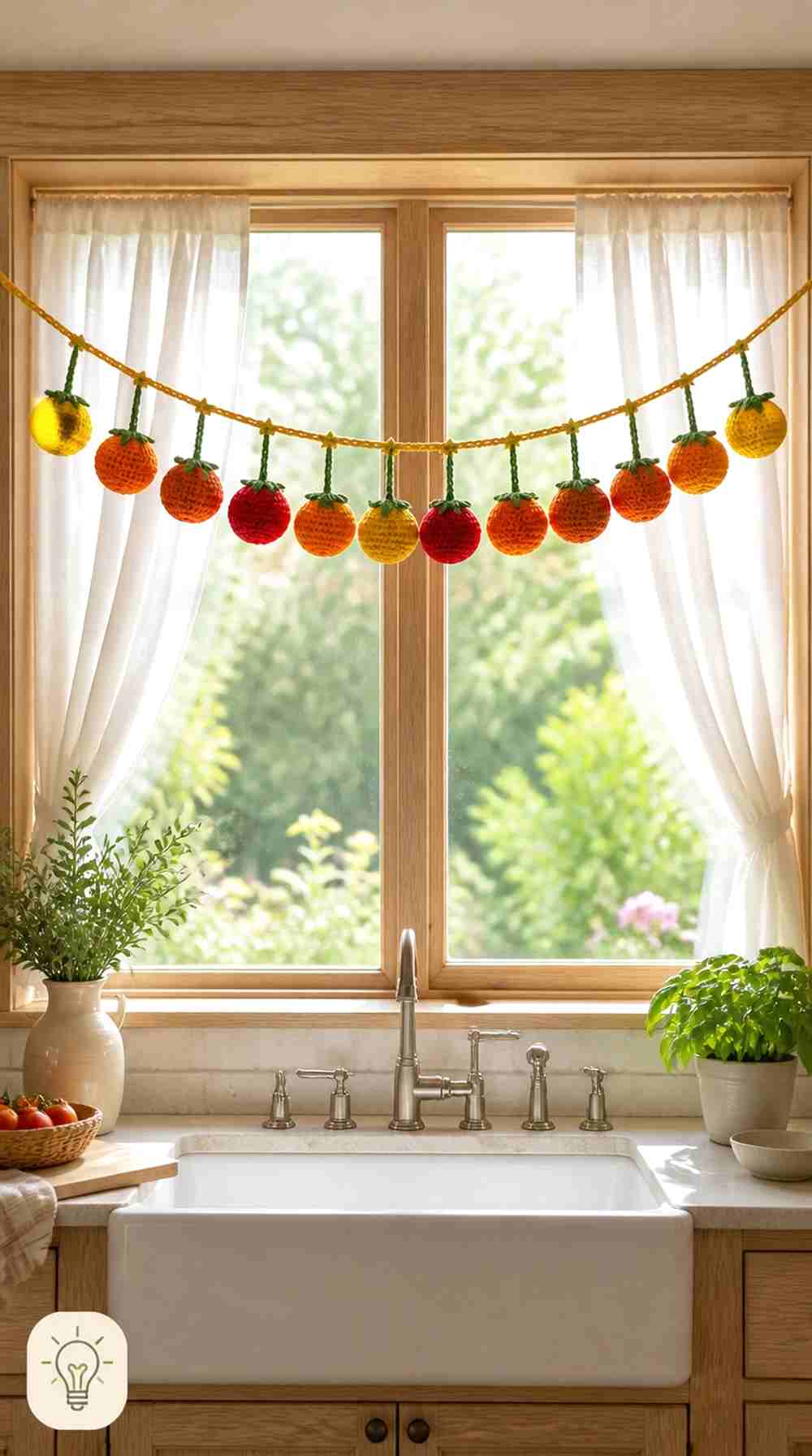
Golden-yellow, warm-tangerine and ripe-red crochet cherry tomatoes repeat along this cheerful kitchen garland. Twelve small stuffed fruits hang individually from an ochre-colored crochet chain, each finished with a dark-olive star calyx and a short green stem.
The three-color sequence gives the garland the appearance of tomatoes at different stages of ripening. It offers more color variety than a traditional all-red arrangement while preserving recognizable fruit shapes. The individual hanging stems also allow more movement, so attachment and spacing deserve attention.
- Color Progression: Repeat the yellow, orange and red sequence consistently to maintain an intentional harvest-inspired arrangement.
- Individual Hanging Stems: Make each short green connection secure enough to hold its tomato without pulling out of the main ochre chain.
- Fruit Shape: Light, even stuffing can help preserve rounded tomato forms without making the small fruits overly firm.
- Window Placement: Check the space above the window and keep the garland clear of latches, moving panels and other operating hardware.
4. Crochet Tomato Gingham Tile Garland
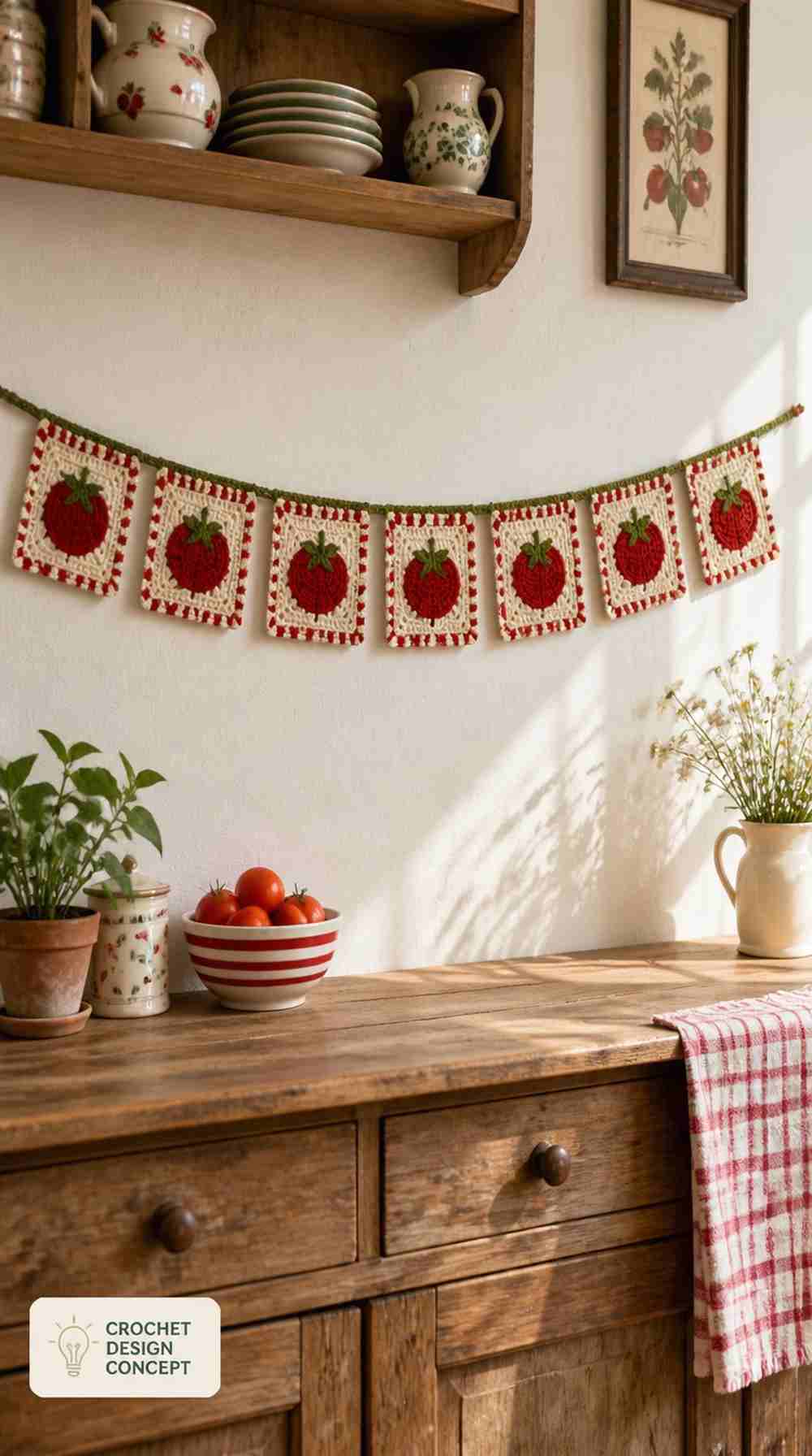
Seven cream crochet squares form this vintage-inspired tomato garland. A muted-red tomato appliqué appears at the center of each square, complete with a small sage-green calyx. Red-and-ivory checkerboard borders give the flat tiles a gingham-inspired finish, while an olive crochet cord connects them.
The square format makes this design feel like a row of miniature kitchen textiles. It also offers a different approach to floral or fruit garlands because the tomato shapes are displayed within structured frames rather than hanging individually.
- Checkerboard Borders: Keep the red-and-ivory stitch blocks consistent around all four sides of each square.
- Square Alignment: Check that the seven tiles have similar finished dimensions before attaching them to the connecting cord.
- Centered Tomato Motifs: Position each appliqué carefully so the red tomato remains clearly separated from the surrounding checkerboard border.
- Flat Hanging: Attach the squares at balanced upper points to reduce twisting and help the decorative fronts face outward.
5. Crochet Trailing Tomato Vine Garland
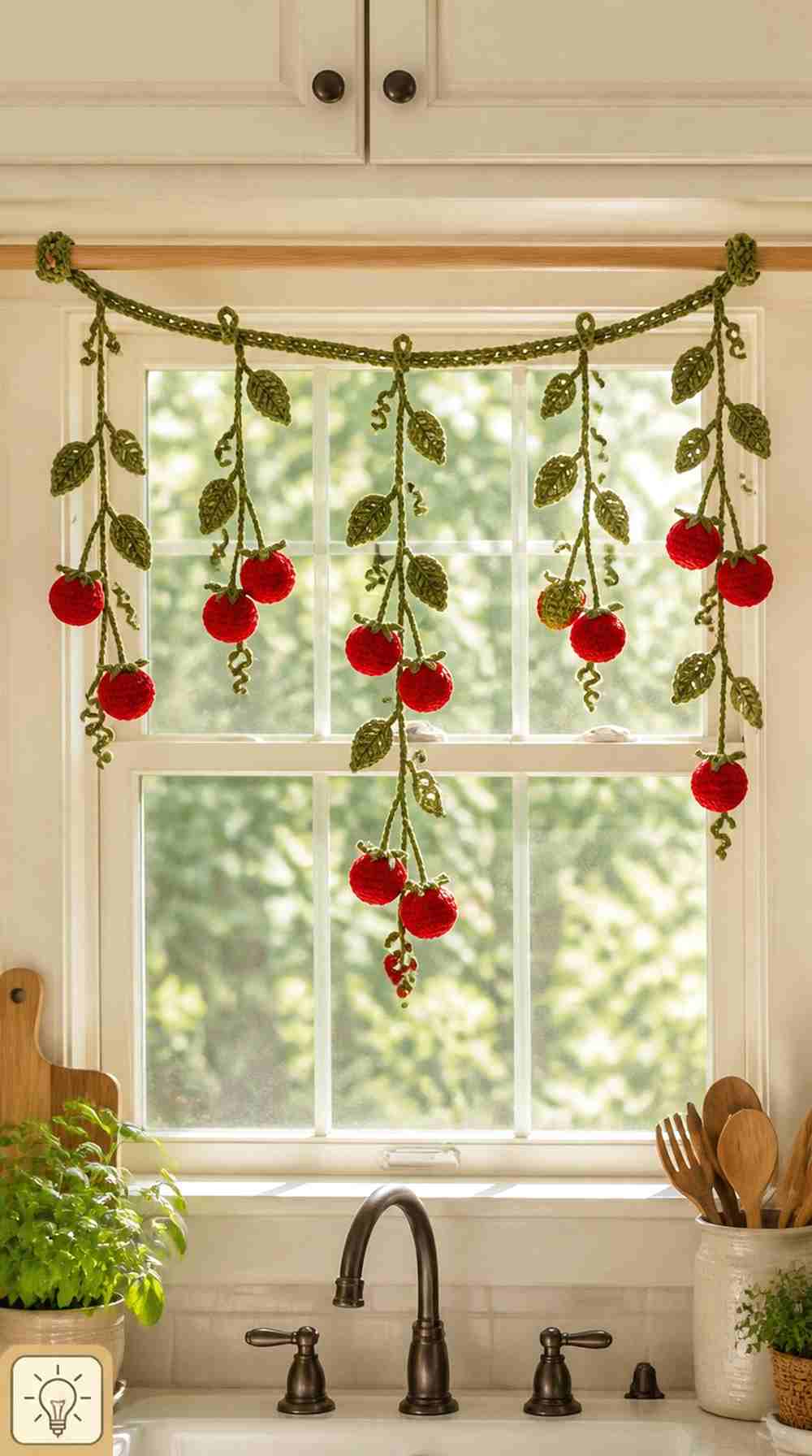
Five downward-hanging crochet branches extend from a long deep-sage vine, carrying little clusters of bright-red cherry tomatoes. Each trailing branch contains two or three stuffed fruits, accompanied by pointed green leaves, small star calyxes and curling crochet tendrils.
The cascading structure makes this garland resemble a growing tomato plant rather than a simple decorative chain. Its different branch lengths add movement and fullness. A physical version would need careful planning so the hanging branches remain balanced and do not pull the main vine unevenly.
- Branch Length Variation: Arrange the five trailing sections at different lengths while maintaining an overall balanced composition.
- Tomato Cluster Weight: Distribute the stuffed fruits along the vine instead of concentrating the heaviest groups at one attachment point.
- Curled Tendrils: Use delicate crochet curls as decorative accents, keeping them separate from the main load-bearing connections.
- Hanging Clearance: Leave enough space beneath the longest branches so they do not interfere with shelves, window operation or frequently handled objects.
6. Crochet Tomato Lace Medallion Garland
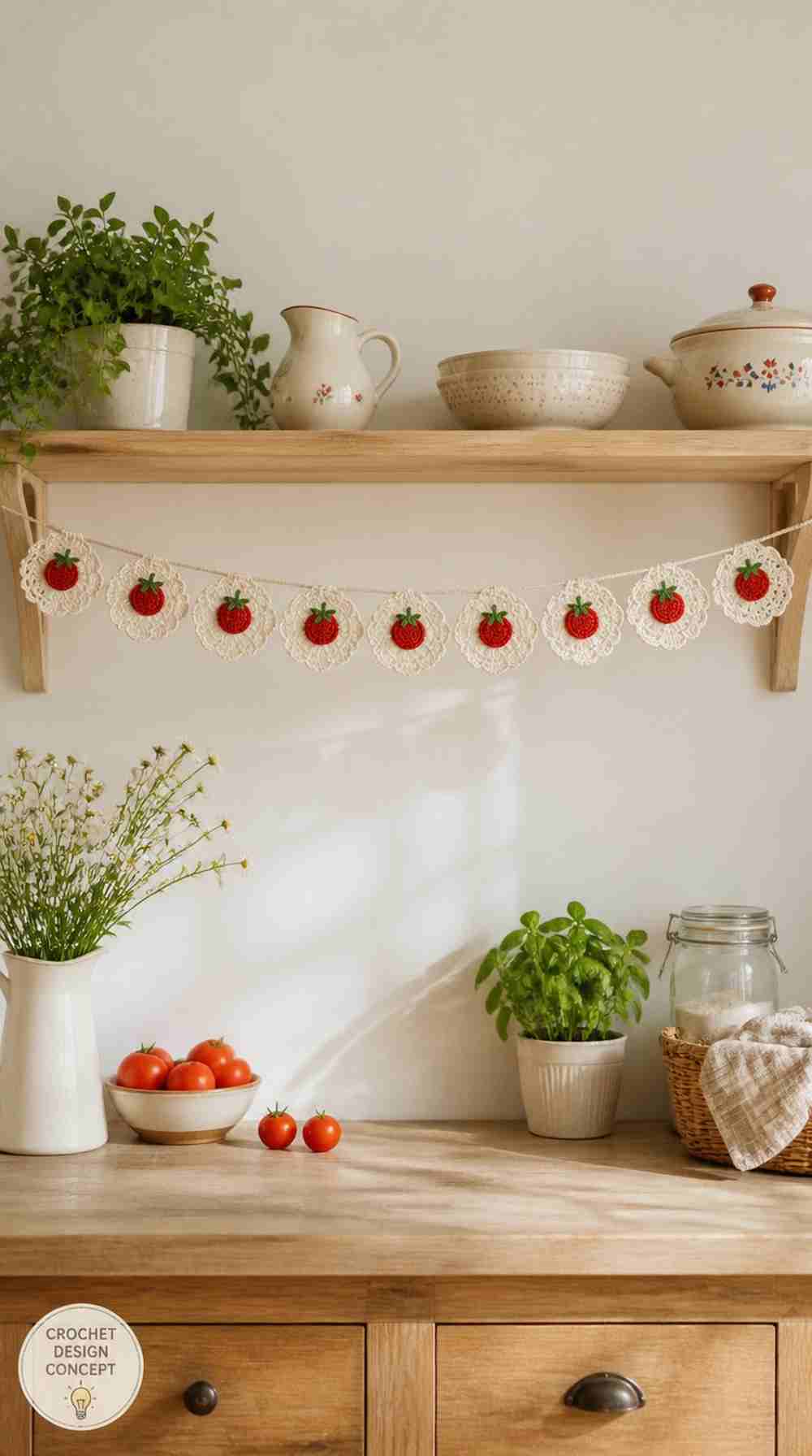
Nine small tomato-red crochet motifs sit inside circular antique-ivory lace frames, creating a delicate kitchen garland. Each flat tomato has a sage-green leafy top, while the surrounding crochet medallion contains six scalloped lace openings. A slender cream lace-like cord joins the repeated circles.
This arrangement gives the familiar cherry tomato shape a softer vintage appearance. The ivory openwork makes each red motif stand out without requiring stuffed construction. Because the lace is relatively delicate, the design is better suited to a protected decorative location than an area where it will be handled frequently.
- Lace Opening Consistency: Keep the six openwork sections around each medallion evenly spaced so the repeated circles look coordinated.
- Tomato Positioning: Center the flat red motif within the ivory frame, leaving enough lace visible to preserve the decorative ring.
- Delicate Cord: Avoid excessive tension when hanging the lace-style connecting strand, particularly around the medallion attachment points.
- Cleaning Consideration: Open lace can catch dust and snag during handling, so check yarn care instructions and choose a suitable protected location.
7. Crochet Rustic Tomato Trio Garland
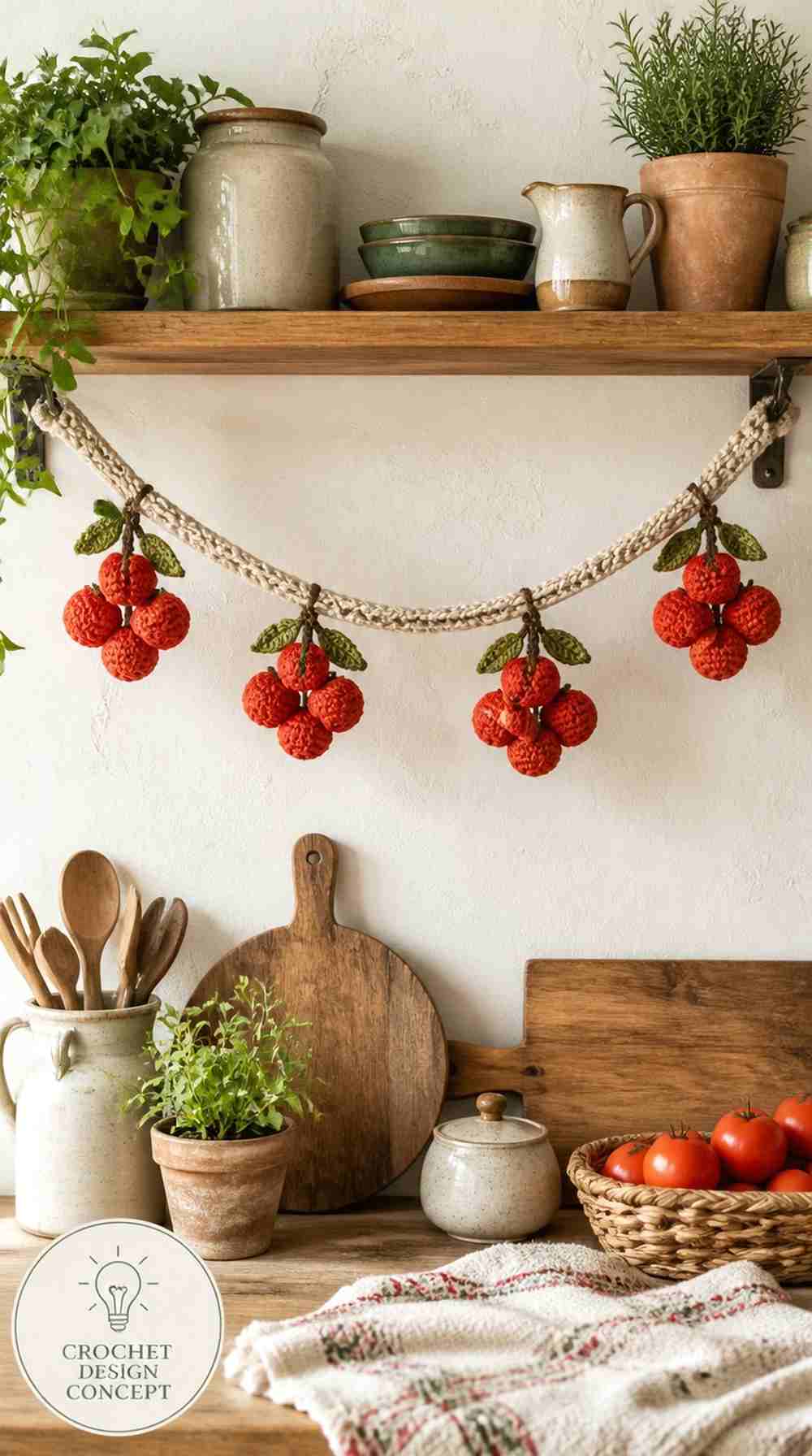
Four bunches of coral-red crochet cherry tomatoes hang from a thick oatmeal-beige braided cord. Each bunch contains three softly rounded fruits with slightly flattened tops, dark-green star calyxes and small olive leaves. Cinnamon-brown curling stems add an earthy finishing detail.
The neutral cord gives the red tomato clusters a farmhouse character. Compared with a fine lace garland, this design looks more substantial and textured. Its thick connecting strand may provide useful structure, but the finished weight still depends on the yarn, stuffing and attachments.
- Oatmeal Braided Cord: The thicker crochet foundation should be planned around the actual weight of all four tomato bunches.
- Flattened Tomato Tops: Use appropriate shaping to create a subtle indentation beneath each star calyx without distorting the fruit body.
- Brown Stem Details: The cinnamon-colored curls add rustic contrast, but they should not be relied upon as the only structural attachment.
- Cluster Separation: Leave enough oatmeal cord visible between the bunches so the individual tomato trios remain easy to recognize.
8. Crochet Cherry Tomato Scallop Garland
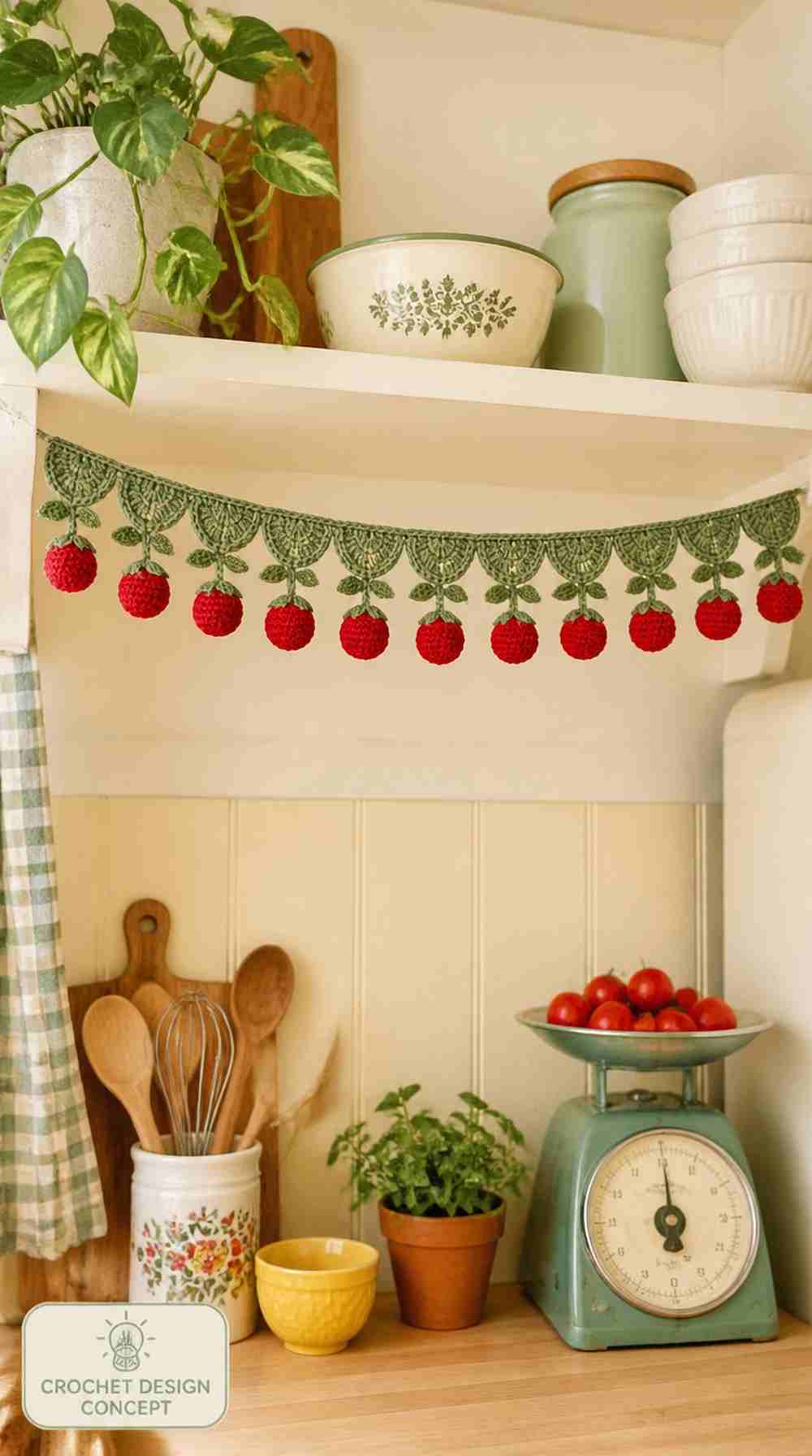
Eleven tiny ruby-red crochet tomatoes hang beneath a continuous row of rounded sage-green scallops. Each small fruit has a little five-point leafy top, while olive-leaf details fill the spaces between the scalloped sections. The result is a compact decorative border with a repeated tomato rhythm.
This design sits closer to the shelf edge than a long trailing vine garland. The green scallops create a continuous upper line, while the red tomatoes provide short hanging accents. Keeping the fruit sizes and scallop spacing consistent would be important for a neat finished appearance.
- Scalloped Foundation: Each green scallop should have a similar curve and depth so the upper decorative border appears continuous.
- Tiny Tomato Proportions: Keep the stuffed fruits compact enough to hang distinctly beneath the scallops without covering the green edging.
- Leaf Spacing: Place the small olive leaves between the tomatoes rather than directly in front of their red surfaces.
- Shelf Clearance: Check that the hanging fruits do not catch on items being moved from the shelf.
9. Crochet Blush Tomato Cottage Garland
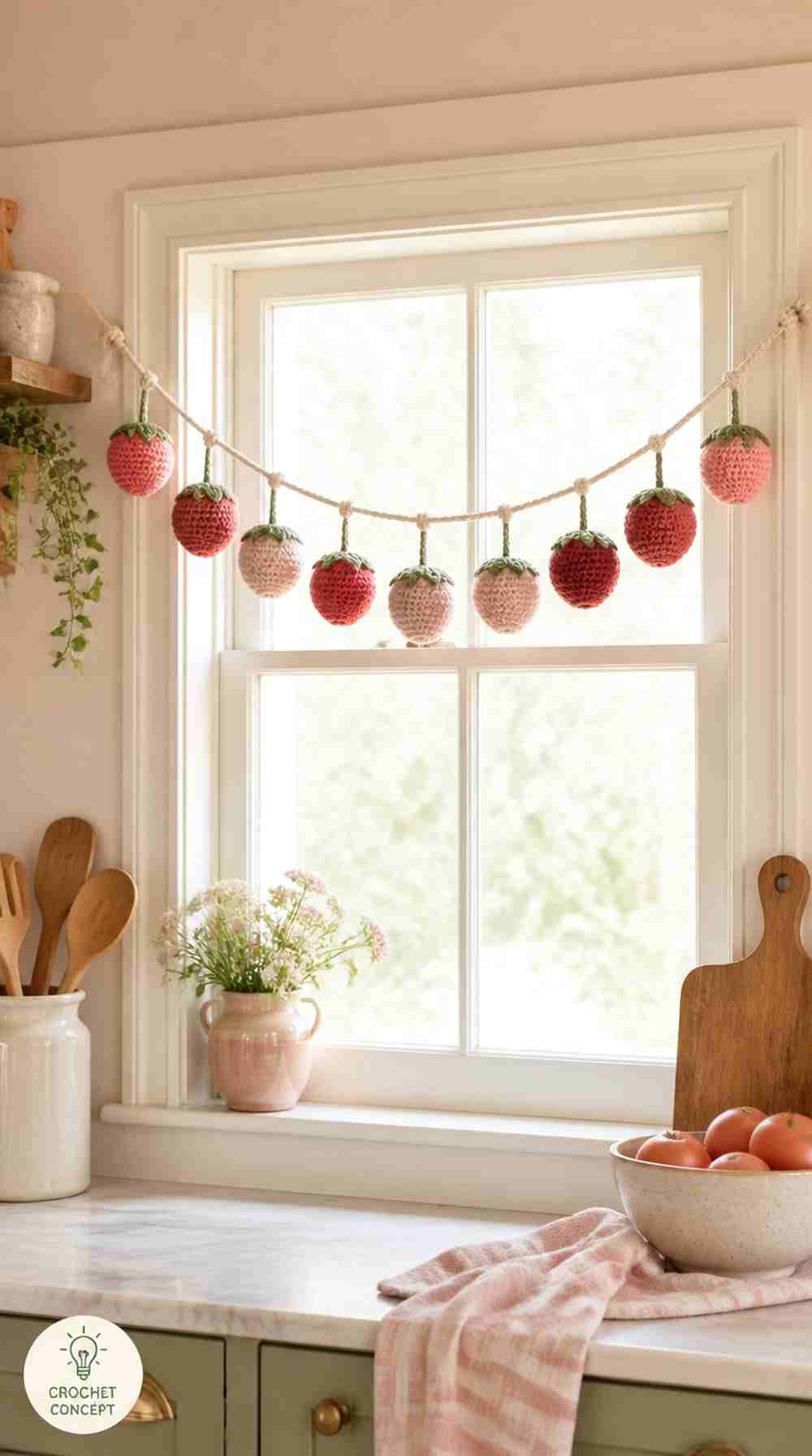
Dusty-rose, pale-blush and deep-cranberry crochet tomatoes create a soft romantic variation on the classic kitchen fruit garland. Nine little stuffed tomatoes hang from an ivory crochet cord with subtle knot-like stitch bumps, each finished with a muted-sage calyx.
The gentle pink palette makes this arrangement feel less traditional than bright tomato red. Its individual fruits remain clearly recognizable through their rounded shapes and leafy tops. This would be an interesting choice for a pastel cottage kitchen, although light-colored yarn may require additional attention during cleaning.
- Three-Shade Rhythm: Repeat dusty rose, blush and cranberry in a consistent order so the delicate color changes appear deliberate.
- Knot-Like Cord Texture: Keep the small crochet bumps decorative and separate from the points carrying the tomato weight.
- Muted-Sage Calyxes: The green tops help identify the pink motifs as tomatoes rather than ordinary rounded beads.
- Pale Yarn Care: Light blush yarn can show dust and kitchen marks more readily, so consider washing requirements before choosing the material.
10. Crochet Tomato Blossom Kitchen Garland
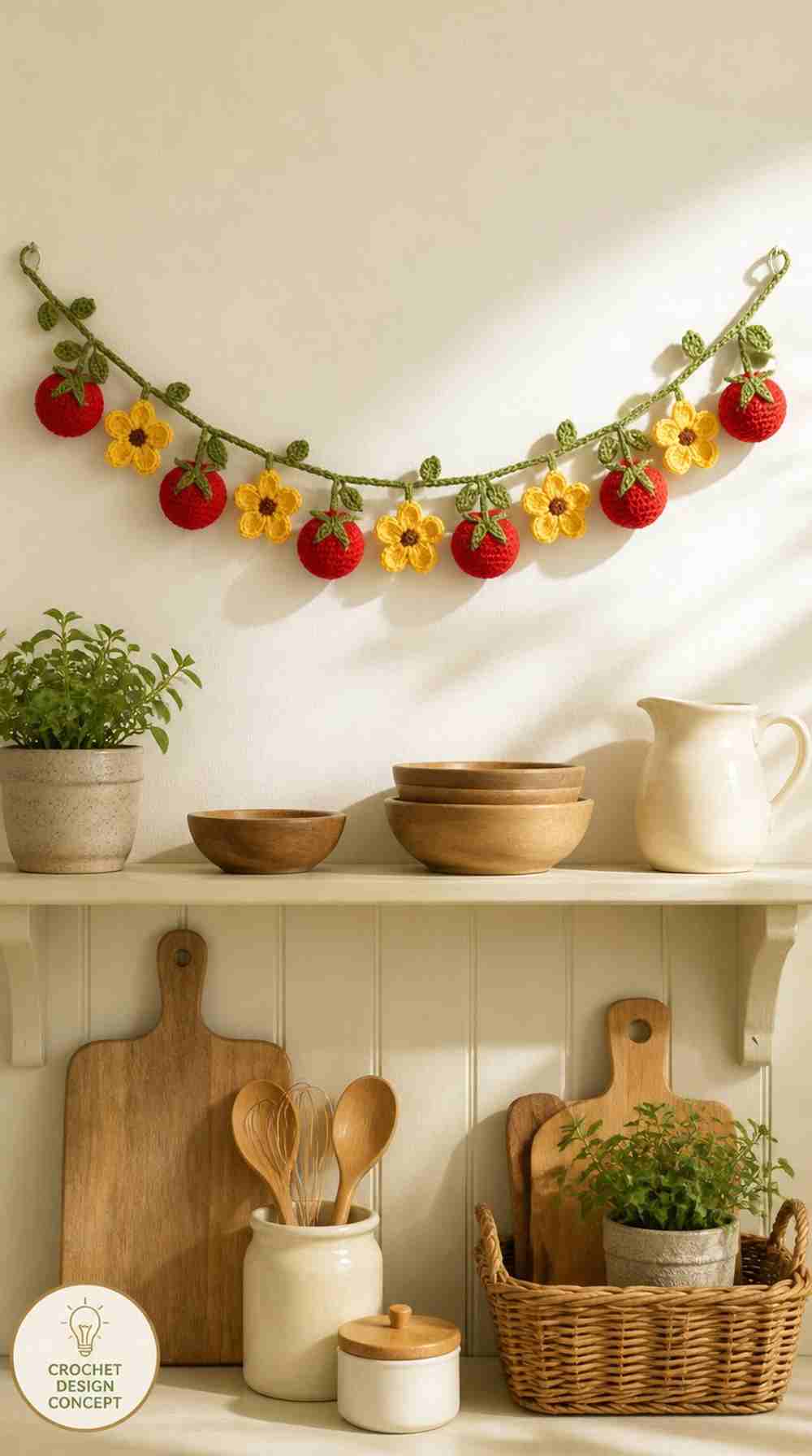
Seven ripe-red crochet tomatoes alternate with six golden-yellow five-petal flowers along a muted-olive vine. Each stuffed tomato has a dark-sage star calyx, while the flatter blossoms have small ochre centers. Little pointed leaves connect the arrangement into one botanical strand.
The mixture of tomatoes and flowers makes this garland resemble different stages of a flowering tomato plant. It creates visual variety without introducing unrelated fruit or decorative shapes. The contrast between dimensional tomatoes and flat blossoms is especially useful when planning the overall weight of the garland.
- Fruit-and-Flower Alternation: Keep the seven tomatoes and six blossoms in a repeated sequence so the botanical arrangement looks balanced.
- Five-Petal Blossoms: Shape the golden-yellow petals consistently around their ochre centers, preserving a recognizable small flower silhouette.
- Mixed Motif Weight: The stuffed tomatoes will generally place more load on the vine than flat blossoms, so plan attachment points accordingly.
- Leaf Placement: Small pointed leaves can connect the flower and fruit sections without hiding their individual shapes.
11. Crochet Burgundy Cherry Tomato Garland
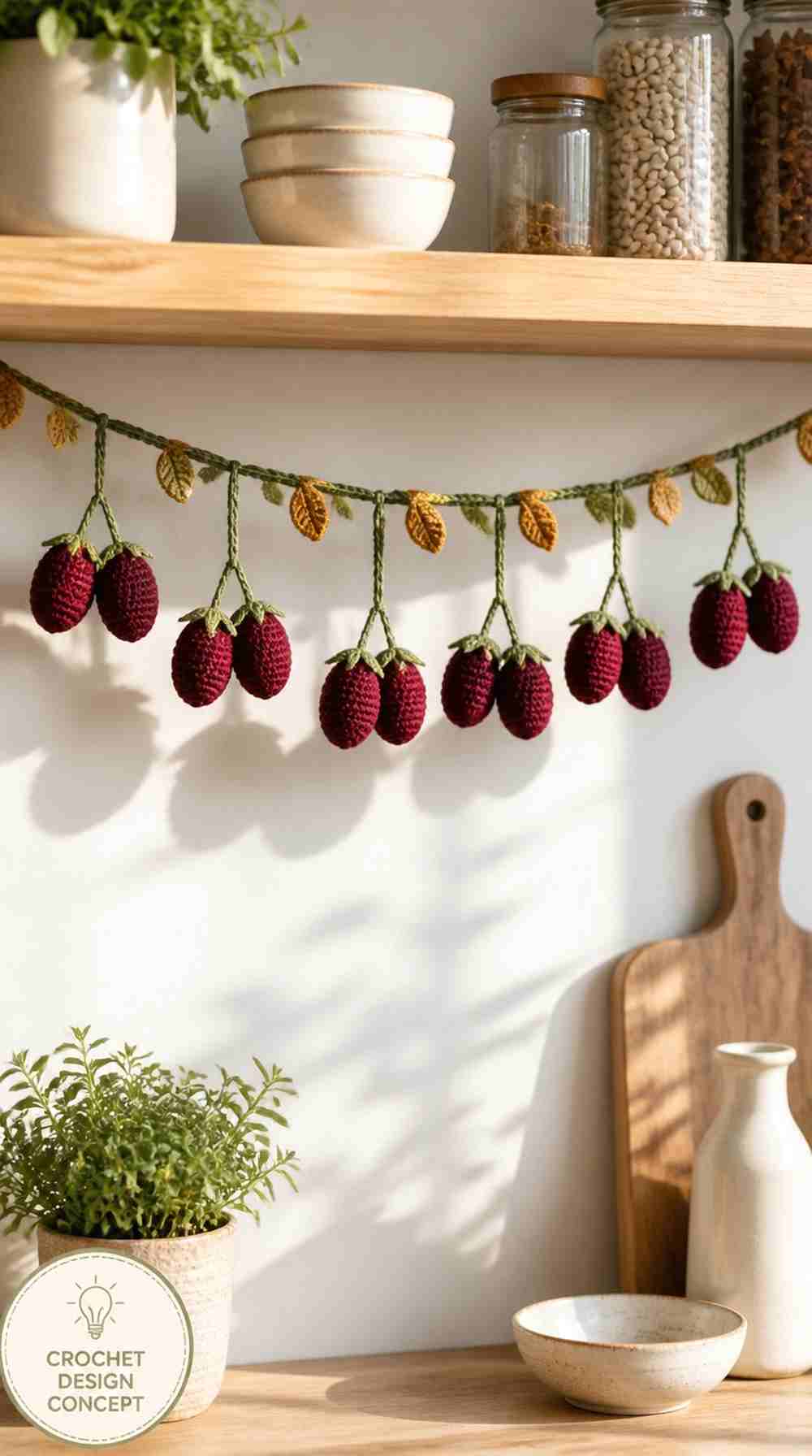
Ten oval burgundy crochet cherry tomatoes hang in five pairs from a narrow dark-sage vine. Their deep wine-colored bodies have tightly worked spiral stitches and antique-olive star calyxes, while small bronze-ochre leaves separate the paired fruits.
This darker version offers a more understated alternative to bright tomato-red garlands. Its oval tomatoes give the hanging pairs a different silhouette from round cherry tomato clusters. The dark yarn also makes stitch definition especially important, since closely related burgundy and green shades can become difficult to distinguish in dim rooms.
- Oval Tomato Shaping: Use gradual increases and decreases to create a slightly elongated fruit rather than a perfectly round ball.
- Paired Arrangement: Attach the ten tomatoes in five balanced pairs while leaving enough room for each leafy top to remain visible.
- Dark Yarn Definition: Choose materials that show stitch texture clearly, particularly if the finished garland will hang away from direct daylight.
- Bronze Leaf Accents: Small ochre-toned leaves provide warmth between the darker fruits without changing the main burgundy-and-sage palette.
12. Crochet Ripening Tomato Gradient Garland
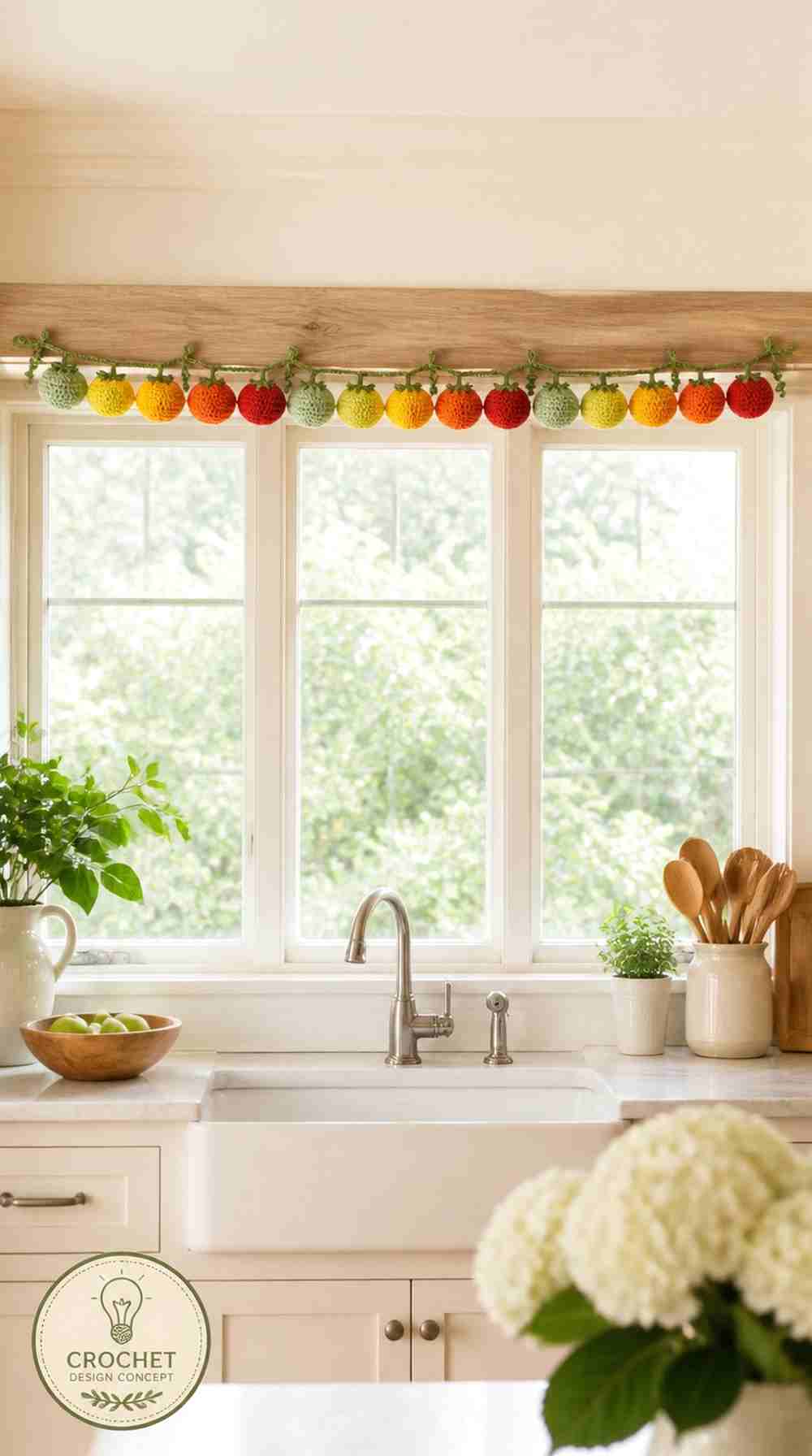
Four repeating groups of small crochet tomatoes create a colorful progression from garden green to golden yellow, tangerine orange and ripe red. Sixteen stuffed fruits hang from an olive-green vine, each with a dark-sage star calyx. Tiny curled crochet tendrils separate the color sequences.
The changing colors give this garland a cheerful garden-harvest appearance. Unlike a random multicolored strand, the repeated ripening sequence gives the arrangement a recognizable order. When planning a real version, keeping the fruit sizes consistent would help the color changes remain the main feature.
- Four-Color Sequence: Repeat green, yellow, orange and red in the same order across all four groups.
- Consistent Fruit Size: Keep the sixteen rounded tomatoes similar in proportion so the color gradient does not become visually uneven.
- Tendril Placement: Use small olive-green curls between the color groups to mark the transitions without making the main vine too busy.
- Color Coordination: Choose a pale green that remains distinguishable from the darker sage calyxes and connecting vine.
13. Crochet Mini Tomato Market Basket Garland
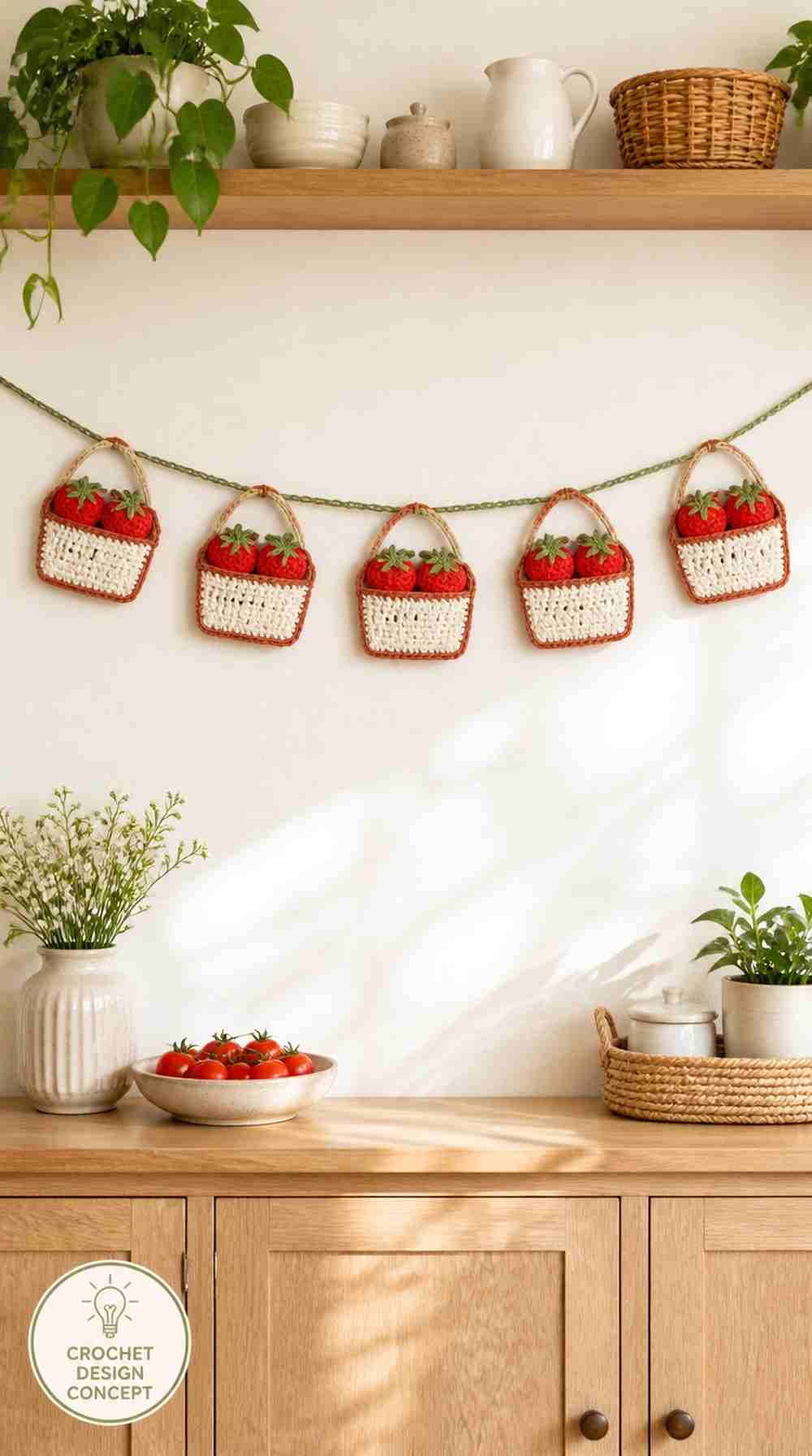
Five tiny flat cream crochet baskets hang along a light-olive connecting chain. Each basket contains three cherry-red tomato appliqués peeking above its upper rim, with small sage-green leafy tops. Terracotta crochet edging outlines the rectangular basket bodies and their gently curved handles.
This miniature market-basket arrangement gives the cherry tomatoes a more playful vintage setting. Rather than hanging as individual fruits, the tomatoes become part of a repeated basket motif. Keeping the baskets flat makes this design especially interesting for a kitchen wall, where dimensional decorations might project too far outward.
- Basket Silhouette: Make the five rectangular bodies and curved handles consistent so the repeated motifs clearly resemble little market baskets.
- Three-Tomato Arrangement: Position each set of red appliqués just above the basket rim, allowing the green calyxes to remain visible.
- Terracotta Edging: A narrow warm border can define the cream basket shapes without making the decorative panels overly thick.
- Hanging Balance: Attach the basket motifs at suitable upper points so they face forward instead of tipping under the weight of the tomato appliqués.
14. Crochet Tomato Cabinet Drop Garland
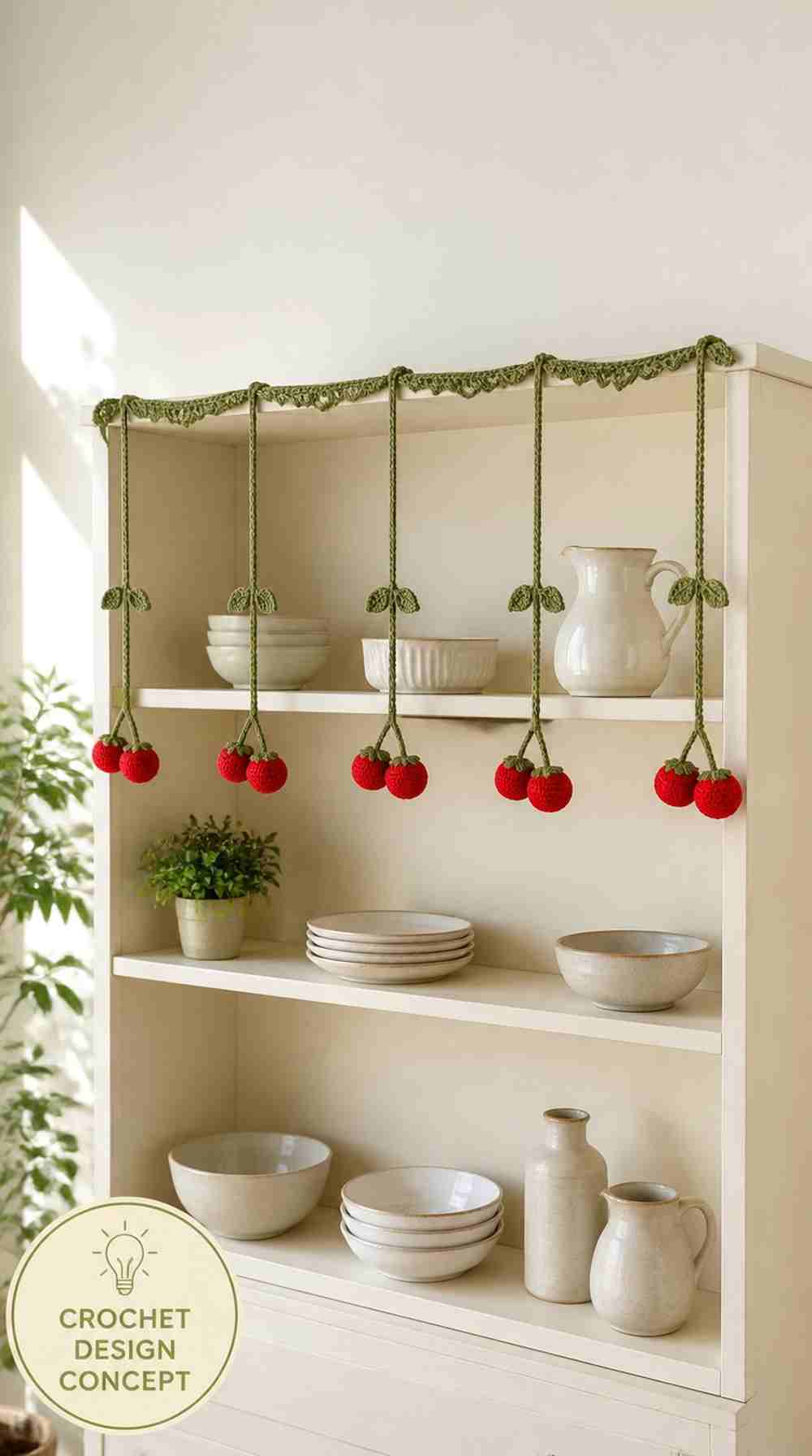
Five long crochet strands descend from a narrow scalloped olive-green foundation, each ending in a pair of bright-red stuffed cherry tomatoes. Small sage leaves decorate the vertical stems, while dark-green star calyxes finish the fruits.
The long hanging sections create a more dramatic appearance than a conventional horizontal garland. Each tomato pair becomes a small pendant beneath the scalloped upper strand. Although the design is decorative, its extended drops require extra care around cabinetry, since they can catch on moving doors or objects beneath them.
- Five Drop Lengths: Keep the hanging strands evenly spaced along the horizontal foundation to preserve a coordinated appearance.
- Tomato Pair Attachment: The two stuffed tomatoes at each end need secure joining points that can support their combined weight.
- Scalloped Upper Edge: The narrow crochet scallops should remain relatively flat so the decorative foundation does not twist.
- Cabinet Clearance: Use a stationary display area rather than hanging the strands where opening doors, drawers or handles could catch them.
15. Crochet Tomato Pennant Kitchen Garland
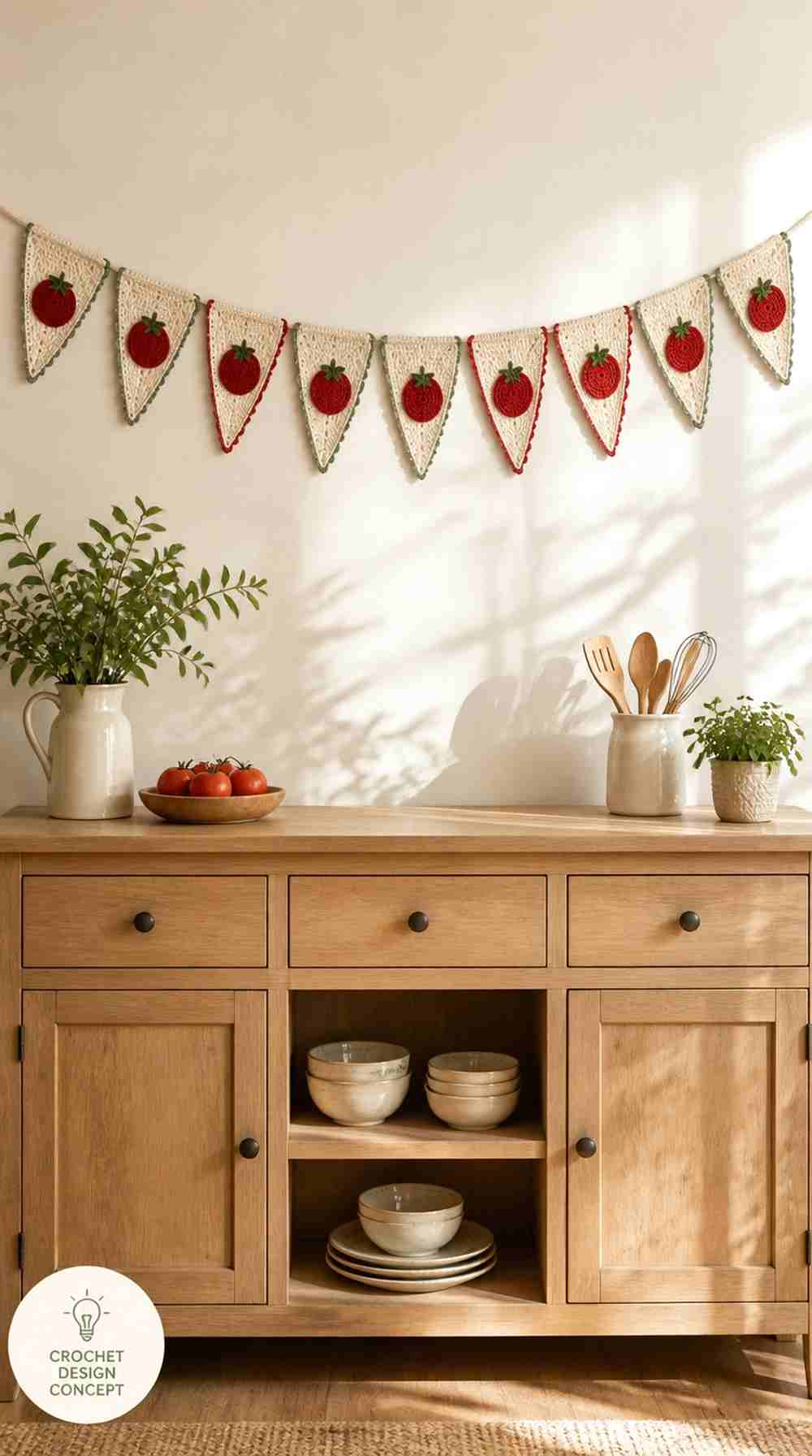
Nine ivory crochet triangles form this charming tomato-themed kitchen bunting. Each narrow pennant carries one flat cherry-red tomato with a little forest-green calyx. Tomato-red and dusty-sage borders alternate around the triangles, while a slim cream crochet cord connects the complete arrangement.
The triangular format gives the design a familiar bunting appearance, with tomatoes replacing ordinary printed decorations. Because the motifs are relatively flat, the finished strand could suit a narrow wall above a sideboard. The main construction challenge is keeping the triangular edges and tomato appliqués consistent across all nine sections.
- Triangle Shaping: Maintain similar widths and pointed lower corners so the pennants form a tidy repeated arrangement.
- Centered Tomato Appliqués: Place each red tomato far enough above the triangle tip to leave a visible ivory border around it.
- Alternating Edge Colors: Repeat the red-and-sage border sequence consistently while keeping the cream pennant backgrounds unchanged.
- Connecting Cord: Secure the upper edges evenly so the triangles do not overlap excessively or rotate when suspended.
16. Crochet Tomato Wooden Ring Garland
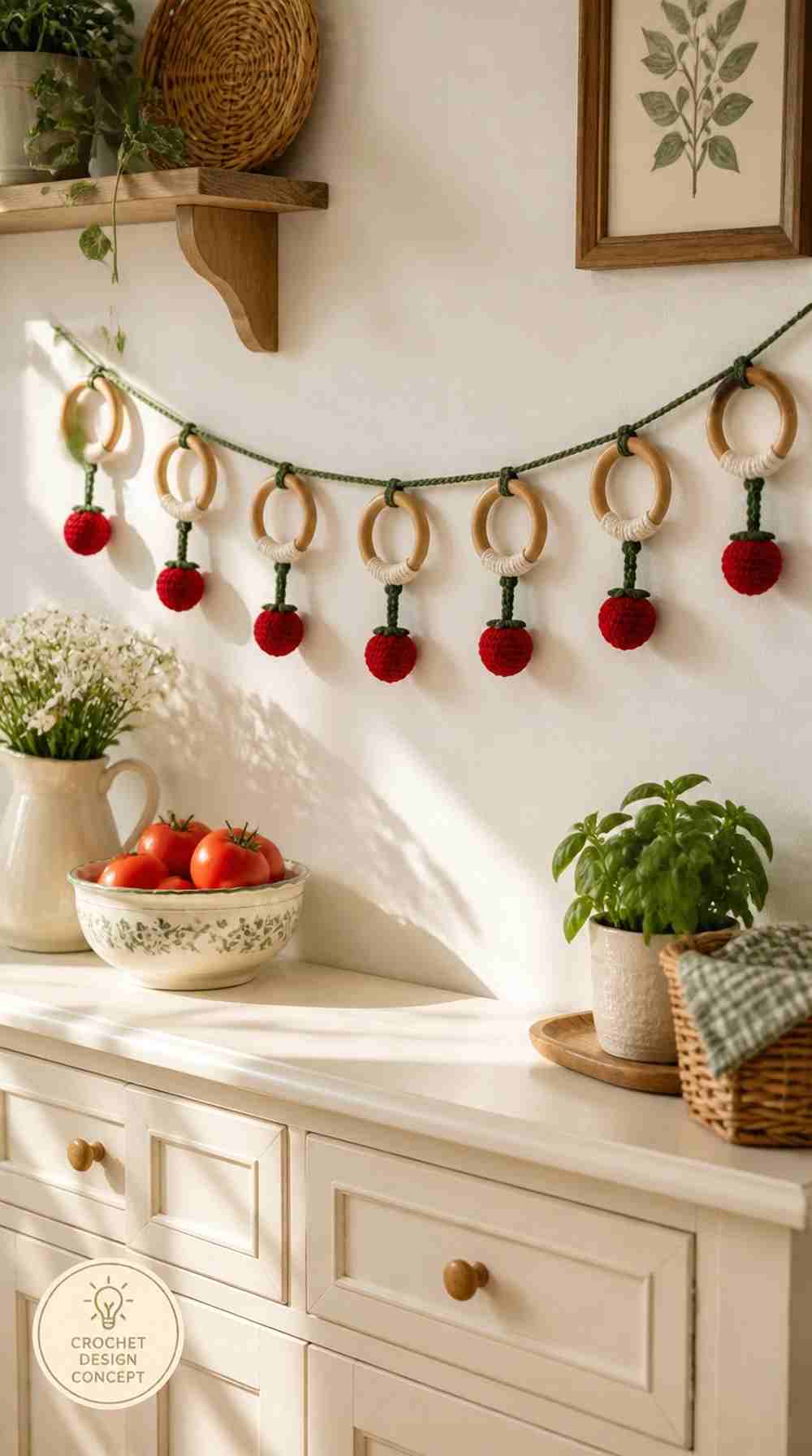
Seven smooth natural wooden rings hang along a sage-green crochet cord, each holding one little stuffed ruby-red tomato. Short olive crochet stems connect the tomatoes beneath the rings, while small sections of cream crochet wrap around the wooden circles.
The combination of wood and crochet gives this garland a distinctive farmhouse appearance. The rings provide a visible framework, while the red tomatoes remain the main decorative elements. Since this version introduces a non-yarn component, the attachment between each wooden ring and crochet strand deserves particular attention.
- Wooden Ring Selection: Choose smooth, appropriately finished rings without splinters or rough edges that could damage the yarn.
- Cream Crochet Wrapping: Cover only a small part of each ring, leaving most of the natural wood visible as shown in the concept.
- Tomato Suspension: Attach each fruit through a secure crochet connection rather than relying on a loosely wrapped decorative stem.
- Ring Movement: Test how the rings hang before arranging the full strand, since individually suspended circles may rotate.
17. Crochet Tomato Basil Leaf Garland
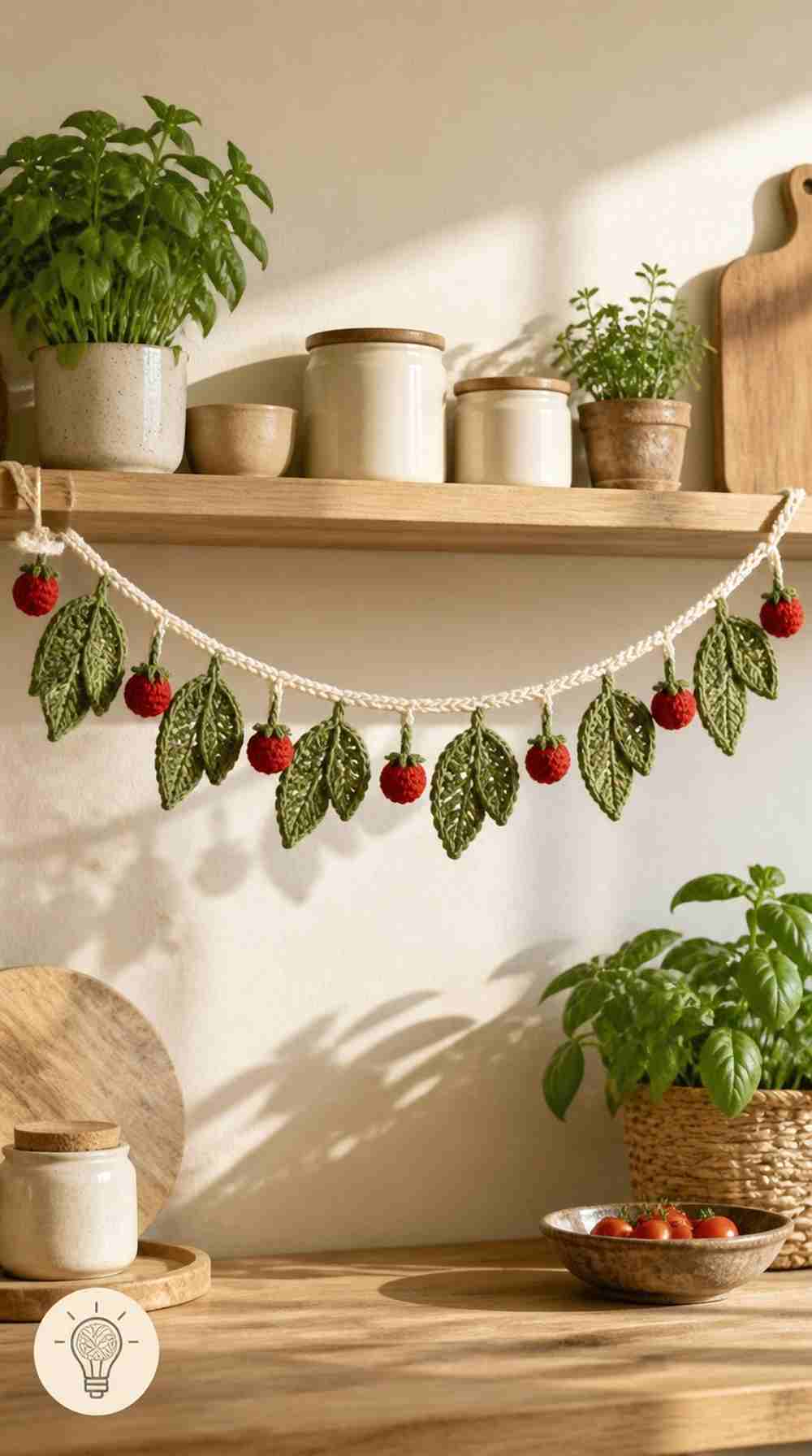
Eight tiny ripe-red crochet tomatoes alternate with six pairs of broad basil-green crochet leaves along a twisted cream cord. The tomatoes have small olive star calyxes, while the leaves feature pointed oval silhouettes and visible stitched center veins.
This herb-garden-inspired arrangement adds a softer botanical element to the familiar red tomato theme. The larger green leaves create a different rhythm from tiny star-shaped calyxes, while the cream connecting cord gives the arrangement an airy appearance. For a real version, the leaves should be shaped carefully enough to remain recognizable when hanging.
- Basil Leaf Texture: Use visible central stitch ridges to define the broad green leaves without making them excessively stiff.
- Leaf Pairing: Keep the six pairs arranged consistently, with each leaf visible instead of lying directly behind its partner.
- Tomato Contrast: The bright-red fruits should remain distinct from both the basil-green leaves and the darker olive calyxes.
- Twisted Cord: Check whether the cream double-strand cord holds its shape and supports the hanging motifs without stretching.
18. Crochet Tomato Seed Packet Garland
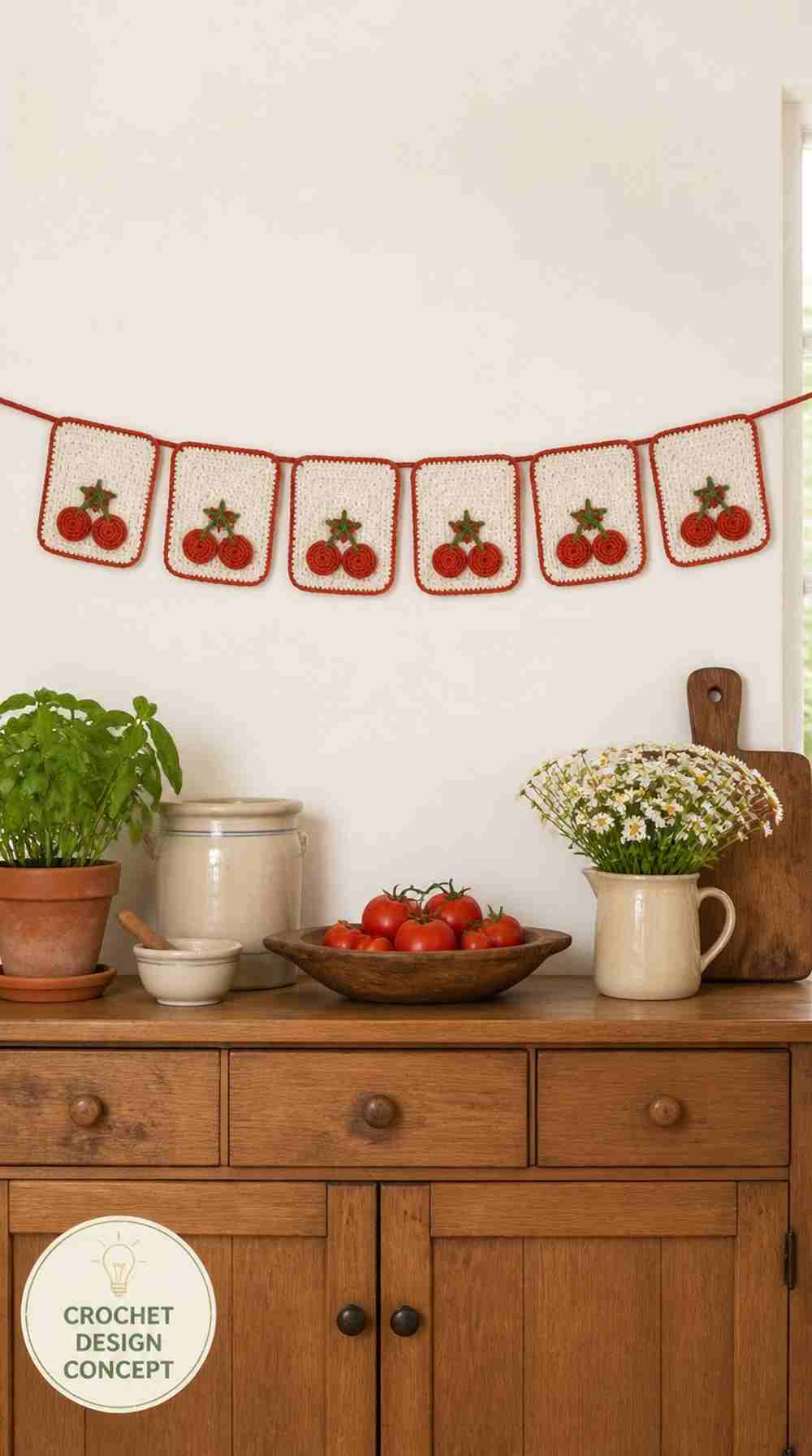
Six rectangular cream crochet plaques resemble miniature vintage seed packets, each containing a central arrangement of three flat cherry-red tomatoes. Tiny forest-green stems and leaves complete the tomato clusters, while narrow terracotta borders frame the plaques. A deep wine-red crochet cord connects the repeated pieces.
The seed-packet-inspired shapes give this garland a nostalgic garden-market character without relying on printed labels or words. The flat rectangular plaques make the crochet tomato designs easy to display against a wall. Keeping the frames consistent would be important, since the arrangement depends on repeated shapes rather than dimensional fruit.
- Rectangular Plaques: Maintain similar panel widths, heights and softly rounded upper corners so the six seed-packet shapes appear coordinated.
- Tomato Cluster Placement: Position the three red fruits in the middle of each plaque, leaving a narrow plain ivory area above them.
- Terracotta Frames: Keep the edging even around all four sides to emphasize the vintage packet shape.
- Wall Display: A flat garland may be practical on an open kitchen wall, provided the cord and plaques are securely mounted away from heat.
19. Crochet Tomato Tassel Vine Garland
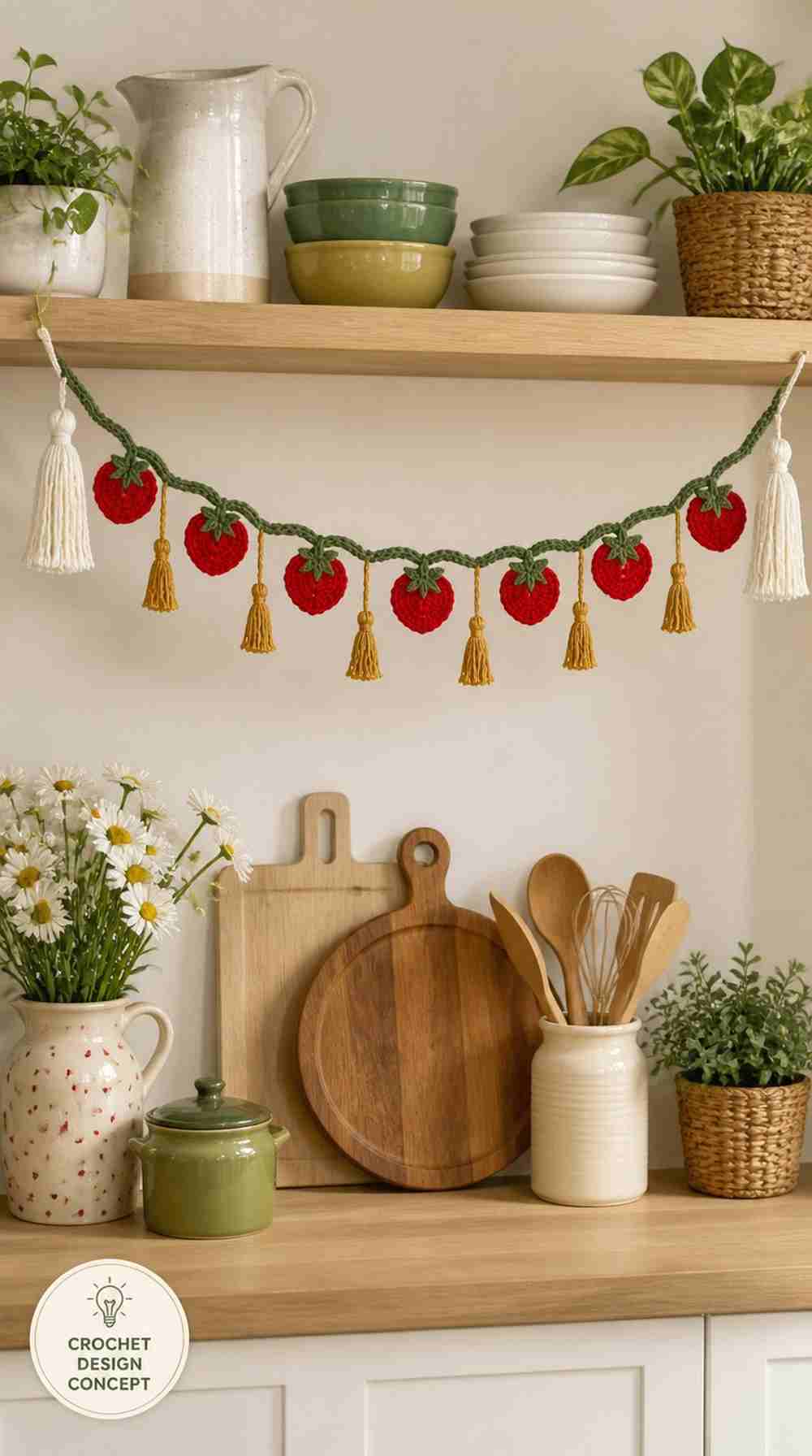
Seven flat cherry-red crochet tomatoes decorate a gently scalloped olive-green vine. Small dark-sage calyxes sit above each fruit, while four golden-ochre tassels hang between selected tomato motifs. Two longer cream tassels finish the opposite ends of the garland.
The combination of flat crochet tomatoes and dangling tassels creates a playful retro arrangement. Unlike a stuffed tomato strand, the main fruit shapes remain close to the connecting vine, while the tassels introduce movement beneath it. Their lengths and placement should be carefully planned to prevent tangling.
- Scalloped Vine: Keep the olive-green curves consistent and attach the tomato motifs where their rounded shapes remain clearly visible.
- Ochre Tassel Spacing: Position the four short tassels between tomatoes rather than directly beneath the red fruits.
- Cream End Tassels: Use the longer cream tassels as balanced finishing details at both ends of the hanging strand.
- Tangle Prevention: Avoid placing the tassels where they will brush frequently against cabinet handles, utensils or other kitchen objects.
Practical Guide to Crochet Cherry Tomato Kitchen Garlands
A crochet kitchen garland can be made from simple flat motifs or small stuffed fruit decorations. Before selecting a design, think about where it will hang, how heavy it might become and how the chosen materials will handle normal kitchen conditions.
Choosing between flat and stuffed tomatoes
| Feature | Flat tomato appliqués | Stuffed crochet tomatoes |
|---|---|---|
| Appearance | Neat, graphic fruit shapes | Rounded, dimensional fruits |
| Hanging weight | Usually lighter | Often heavier |
| Wall clearance | Generally needs less space | Projects outward more |
| Construction | Flat rounds and shaping | Shaped rounds, stuffing and closure |
| Maintenance | Easier to store flat | Needs room to avoid crushing |
| Best display approach | Wall bunting and shelf edging | Cluster garlands and hanging vines |
Choosing suitable yarn
Smooth cotton or cotton-blend yarn can help show the small stitch details of tomatoes, leaves and calyxes. Acrylic may also be an option depending on the project and manufacturer’s care advice.
Avoid assuming any yarn is heat-resistant or suitable for repeated exposure to cooking grease, steam or moisture. Crochet garlands are decorative textiles, not kitchen tools.
Planning the garland length
Measure the actual intended display area and decide whether the strand will hang straight or form a shallow swag.
Lay out the completed sample motifs before joining them. Consider the spaces between tomatoes, the length of trailing stems and the room needed for tassels or larger clusters.
Supporting dimensional fruit
Stuffed tomatoes can make a garland heavier than expected. Check the combined weight, attachment points and strength of the connecting cord before hanging it.
Use suitable mounting hardware for the wall or shelf material. A decorative crochet chain should not be assumed to support unlimited weight.
Kitchen placement and care
Keep yarn, stuffing and other combustible decorations well away from stovetops, ovens, heaters, flames and hot surfaces. Also avoid places exposed to frequent splashes, grease or heavy steam.
Make sure garlands do not interfere with cabinet doors, appliance controls, ventilation, food preparation or walkways. Keep loose strands and small detachable parts out of children’s and pets’ reach.
Follow the yarn’s care instructions, and make sure dimensional tomatoes can dry thoroughly after any permitted washing.
Want to Make Something Similar?
These 19 garlands are original inspiration concepts, not exact published patterns. However, a few real crochet resources can help with making small tomatoes, leafy tops and hanging vines.
- Free Crochet Tomato Pattern — My Amigurumi Farm: A written tomato amigurumi pattern covering a small stuffed tomato and its green leafy top. The original finished tomato is approximately 4.5 cm tall; your own yarn and gauge can change the result. My Amigurumi Farm
- Vine of Tomatoes — Emu’s Yarn Barn: A free intermediate Ribblr pattern featuring tomatoes that can be made individually or added to a vine. It offers a useful real-world vine-construction reference, although the 19 designs above use different visual arrangements. Ribblr
- How to Crochet Cherry Tomatoes — ChunkyHook: A video demonstrating small cherry tomatoes, green leaves, connecting stems and vine assembly. It can help explain how separate fruit motifs relate to one another on a vine. YouTube
For another type of fruit-themed decoration, explore Yarn Nest Studio’s 19 Crochet Vintage Fruit Garland Ideas for Cozy Winter Mantels. That collection features a wider range of fruit shapes and provides additional ideas for comparing flat appliqués with dimensional decorations.
Use the linked creator resources for their actual patterns and techniques. They should not be presented as exact instructions for reproducing the AI-generated designs pictured in this collection.
Which Crochet Cherry Tomato Garland Should You Choose?
| Garland design | Main decorative feature | What to consider |
|---|---|---|
| Ruby Tomato Cluster | Six stuffed tomato trios | Weight of grouped fruit |
| Ruby Sage Leaf | Flat red tomatoes and sage leaves | Keeping motifs facing forward |
| Golden Harvest Tomato | Yellow, orange and red fruits | Consistent color sequence |
| Tomato Gingham Tile | Seven square checkerboard tiles | Even square dimensions |
| Trailing Tomato Vine | Five hanging botanical branches | Balancing branch weights |
| Tomato Lace Medallion | Ivory openwork tomato frames | Delicate lace handling |
| Rustic Tomato Trio | Thick oatmeal cord and coral fruits | Cord strength and bulk |
| Cherry Tomato Scallop | Eleven tiny tomatoes beneath green scallops | Shelf clearance |
| Blush Tomato Cottage | Pink-toned stuffed tomatoes | Pale yarn maintenance |
| Tomato Blossom | Yellow flowers alternating with fruits | Mixed motif weights |
| Burgundy Cherry Tomato | Dark oval tomato pairs | Stitch definition |
| Ripening Tomato Gradient | Four-color repeated progression | Equal fruit sizing |
| Mini Tomato Market Basket | Five miniature basket motifs | Neat flat construction |
| Tomato Cabinet Drop | Five long tomato-pair pendants | Door and handle clearance |
| Tomato Pennant Kitchen | Nine ivory triangular flags | Triangle consistency |
| Tomato Wooden Ring | Seven wooden rings with red tomatoes | Secure ring attachments |
| Tomato Basil Leaf | Broad basil leaves and small tomatoes | Leaf shape retention |
| Tomato Seed Packet | Six vintage-style rectangular plaques | Consistent framed motifs |
| Tomato Tassel Vine | Red appliqués with ochre and cream tassels | Tassel tangling |
For a relatively lightweight wall decoration, the Crochet Ruby Sage Leaf Garland, Crochet Tomato Pennant Kitchen Garland and Crochet Tomato Gingham Tile Garland are useful directions to explore.
If you want a fuller, more botanical effect, consider the Crochet Ruby Tomato Cluster Garland, Crochet Trailing Tomato Vine Garland or Crochet Tomato Blossom Kitchen Garland.
For an unusual vintage kitchen accent, the Crochet Mini Tomato Market Basket Garland and Crochet Tomato Seed Packet Garland offer more structured designs.
Conclusion
Cherry tomato crochet garlands are a playful way to bring garden-inspired colors and shapes into the kitchen. A simple strand of red tomatoes can feel cheerful and traditional, while golden ripening fruits, cream lace, little market baskets and trailing vines create more decorative variations.
The best design is one that suits the available space as well as the look of the room. Before making a real garland, consider whether flat or stuffed motifs are more appropriate, plan the hanging weight and check that the display location is clear of heat, moisture and moving cabinet doors.
Which of these 19 crochet cherry tomato garlands would you choose for your kitchen? Would you prefer classic red clusters, a trailing tomato vine or a vintage cream-and-red bunting design?
Frequently Asked Questions
1. What yarn is suitable for a crochet cherry tomato garland?
Smooth cotton, suitable cotton blends and some acrylic yarns can work for decorative crochet fruit. The choice depends on the stitch definition, preferred texture, care requirements and final weight. Check the yarn manufacturer’s guidance, particularly for decorations displayed in kitchens where dust, grease and moisture may be concerns.
2. How can I make crochet cherry tomatoes look more realistic?
Focus on recognizable rounded or gently oval fruit shapes, appropriate red or ripening-color yarn and small green star-shaped calyxes. Closely worked crochet stitches can help stuffed tomatoes hold a rounded shape. The amount of stuffing and the shaping method affect the final appearance, so begin with a sample before making several identical fruits.
3. Can I hang a crochet tomato garland above a stove?
No. It is better to keep crochet garlands away from stovetops, ovens, heaters, flames and other hot surfaces. Yarn, stuffing and similar decorative materials can be combustible, and cooking grease can collect on fabric. Choose a suitable stationary shelf, distant kitchen wall or other location safely separated from cooking activity.
4. Are flat crochet tomatoes better than stuffed tomatoes for garlands?
Neither is universally better. Flat tomato appliqués are generally lighter and need less depth, making them useful for wall bunting and shelf edging. Stuffed tomatoes create stronger three-dimensional fruit shapes but add weight and may rotate. The appropriate choice depends on the display area, joining method and support available.
5. Are these 19 crochet cherry tomato garlands available as patterns?
No. These are AI-generated crochet inspiration concepts rather than tested patterns for the exact designs shown. They demonstrate possible tomato shapes, colors, arrangements and hanging styles. The linked tutorials provide real construction examples, but an exact version of any pictured concept would require appropriate planning, adaptation and testing.