A crochet dust cover can add a colorful handmade look to a vintage record-player corner. Burnt orange, avocado green, mustard yellow, warm ivory and chocolate brown bring back the playful character of mid-century interiors, while crochet chevrons, checkerboards, granny squares and geometric motifs give a simple rectangular cover a distinctive appearance. These 17 inspiration ideas explore different retro color combinations, textures, floral details and panel arrangements for record-player covers.
There is an important practical difference between a decorative crochet cover and the turntable’s original protective lid. The ideas here show removable textiles displayed over closed, rigid dust lids or closed portable cases when the equipment is not in use. They are not replacements for manufacturer-approved protection, and they should never interfere with playback, vents, hinges, the tonearm or other moving parts. The collection helps you compare designs while considering fit, stitch density, fabric weight and safe removal.
These are AI-generated crochet design visualizations for inspiration, not photographs of tested handmade covers, guaranteed dust barriers or complete crochet patterns.
Quick Design Selection Guide
- For classic seventies color: Crochet Burnt Orange Retro Chevron Dust Cover, Crochet Mustard Checkerboard Record Player Cover and Crochet Terracotta Granny Stripe Dust Cover use bold familiar retro patterns.
- For softer cottage styling: Crochet Sage Floral Granny Record Player Cover, Crochet Cherry Red Daisy Record Player Cover and Crochet Sage Tulip Corner Dust Cover add botanical details.
- For geometric mid-century interiors: Crochet Cranberry Atomic Starburst Dust Cover, Crochet Avocado Argyle Turntable Dust Cover and Crochet Espresso Atomic Arch Dust Cover feature distinctive repeating motifs.
- For striking color contrast: Crochet Plum Noir Windowpane Dust Cover, Crochet Cobalt Ivory Mod Chevron Dust Cover and Crochet Burgundy Copper Art Deco Fan Cover create stronger graphic effects.
- For softer decorative texture: Crochet Turquoise Retro Wave Dust Cover, Crochet Antique Ivory Lace Record Player Cover and Crochet Mint Lilac Shell Stitch Dust Cover use waves, lace or shell stitches.
- For music-inspired styling: Crochet Butterscotch Vinyl Motif Dust Cover features a decorative crochet record, while Crochet Cream Caramel Suitcase Record Player Cover explores a compact portable-case silhouette.
The decorative examples assume the actual player’s original hard lid or carrying case is closed. Before trying any cover, check the manufacturer’s manual and measure the equipment. Turntable lid instructions differ between models, so the safest approach is to follow the guidance for the specific player.
device.report+1
1. Crochet Burnt Orange Retro Chevron Dust Cover
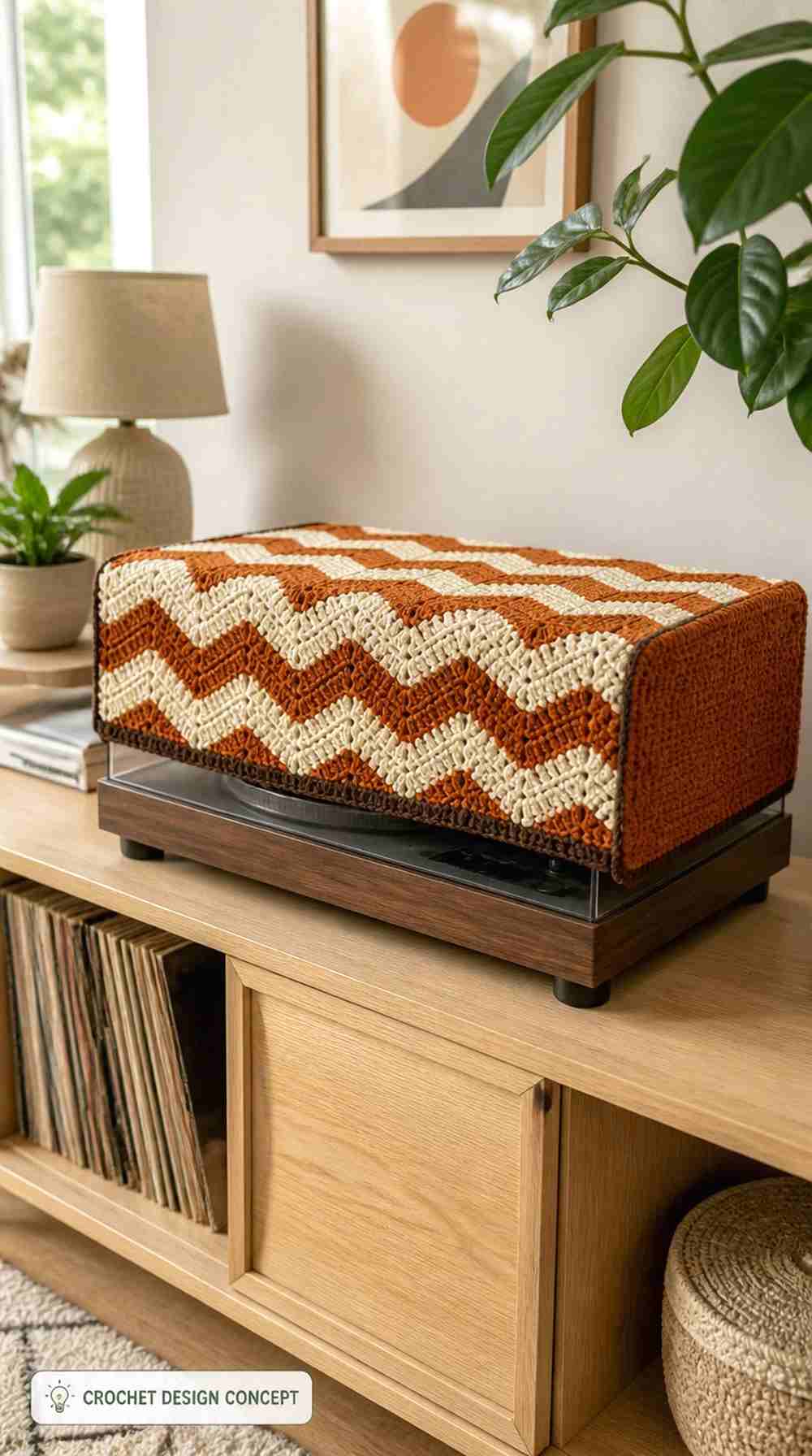
Broad burnt-orange and warm-ivory crochet chevrons travel across the top and down the front of this rectangular record-player cover. Softly pointed zigzags create a recognizable retro pattern, while a narrow chocolate-brown lower border defines the hem. The side panels remain solid burnt orange, keeping the overall design balanced.
This combination suits a bright mid-century-inspired music corner with natural wood furniture. Because the chevrons continue over the top-front edge, their alignment is especially important. A physical version would need careful measuring and construction around the closed equipment lid.
- Continuous Chevron Pattern: Plan the orange-and-ivory repeats so the zigzags align neatly where the top panel meets the front.
- Solid Side Panels: Plain burnt-orange sides reduce visual clutter and may simplify the shaping compared with carrying the entire chevron repeat around the corners.
- Chocolate Lower Border: Keep the brown edging narrow and even to define the hem without creating a bulky ridge.
- Cover Removal: The textile should be completely removable before the turntable is operated or its lid is opened.
2. Crochet Mustard Checkerboard Record Player Cover
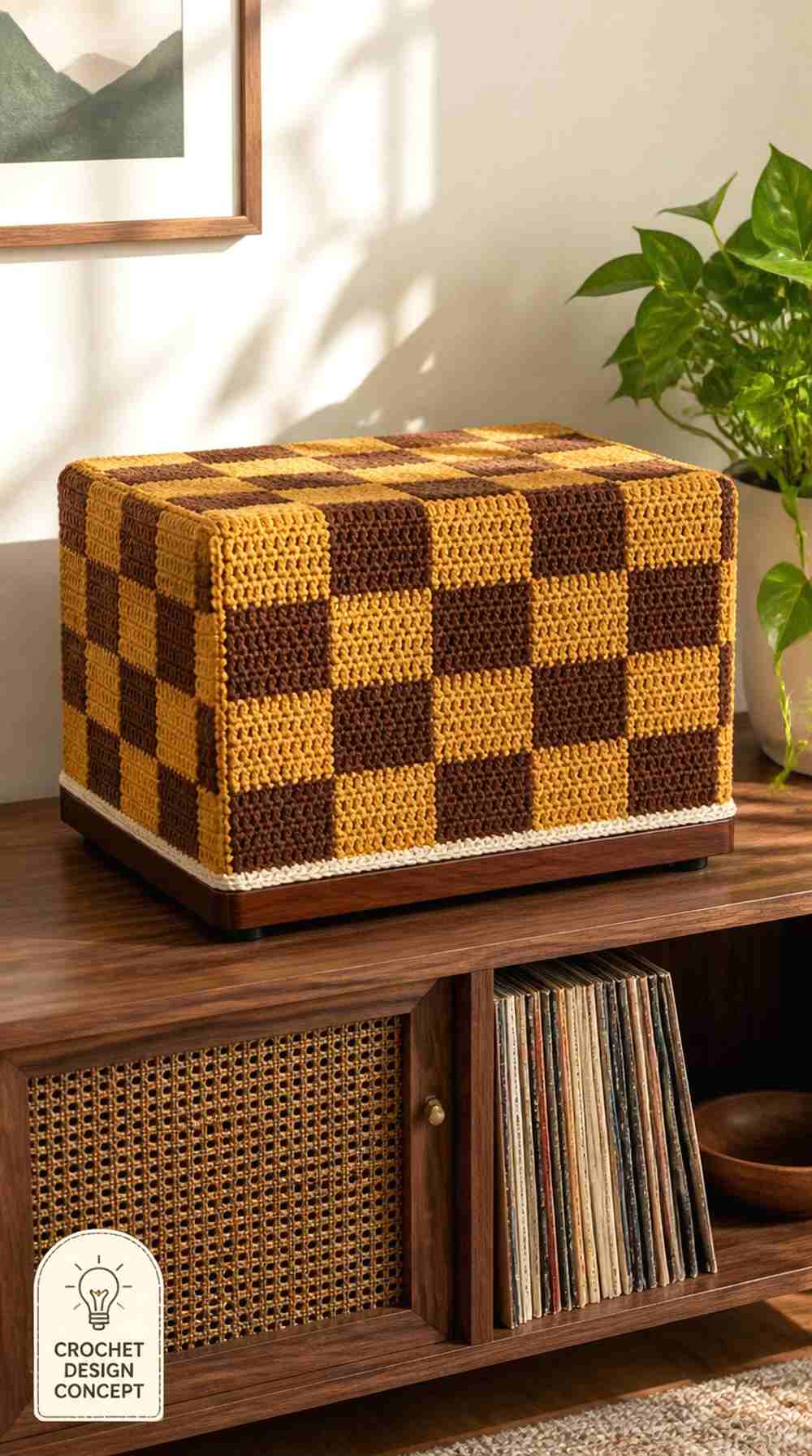
Mustard-yellow and espresso-brown crochet squares form a bold checkerboard across this box-shaped dust cover. The pattern continues from the top to the front and side panels, with flat joining seams and a narrow cream lower edge. Softly rounded upper corners help the fabric follow the rectangular lid.
The repeating blocks bring a familiar retro look without additional decorative pieces. Unlike a striped cover, the checkerboard depends on consistent square proportions and neat alignment. The joined fabric should remain flexible enough to lift away without catching on the equipment.
- Checkerboard Layout: Arrange the mustard and espresso blocks before joining so the alternating pattern remains consistent across each panel.
- Square Sizing: Small differences in motif dimensions can distort the front grid, so check the finished squares against one another.
- Flat Joining Seams: Choose a joining method that avoids thick ridges where the cover bends over the upper corners.
- Cream Hem: The pale lower edge offers a clean finish without introducing another large color section.
3. Crochet Sage Floral Granny Record Player Cover
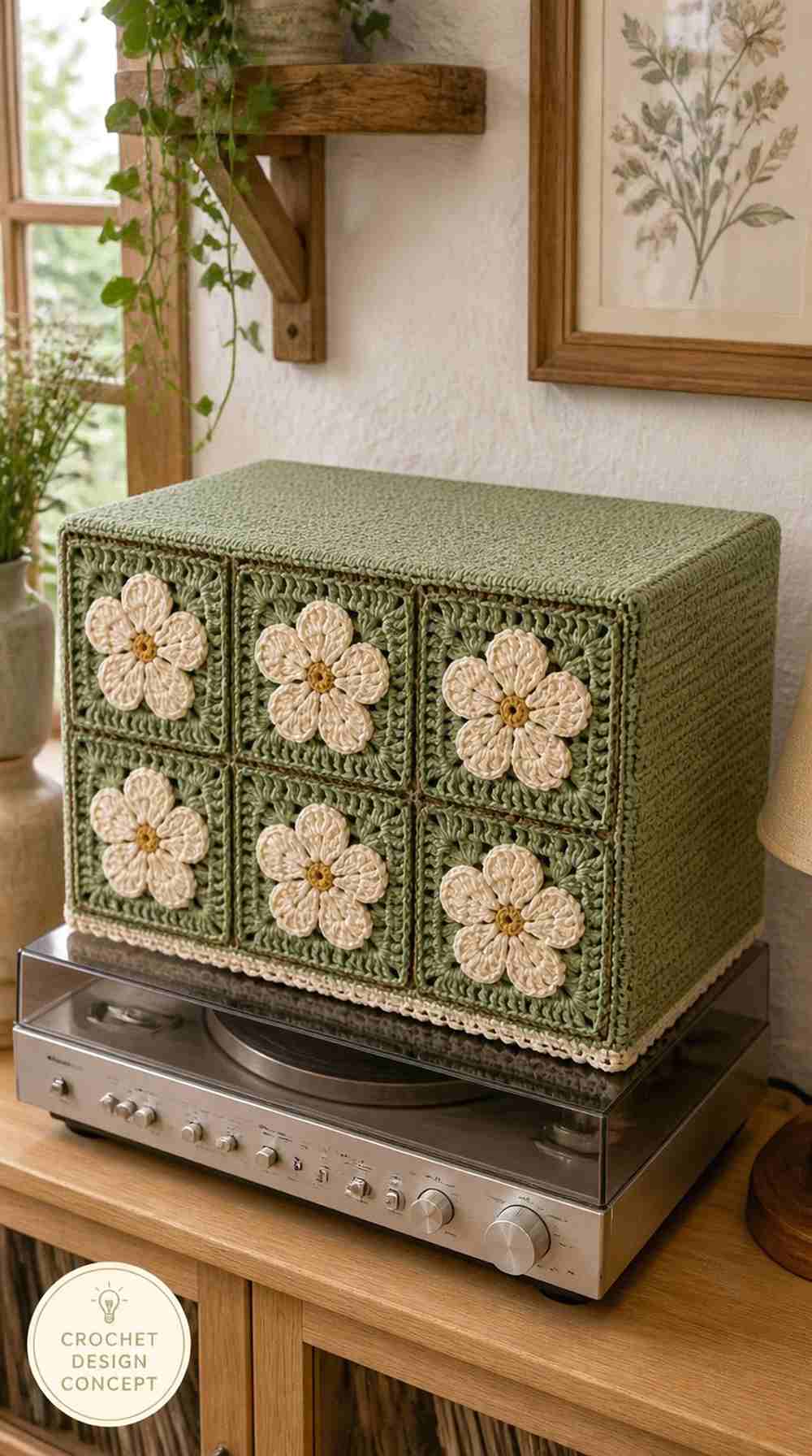
Six floral granny squares decorate the front of this sage-green crochet dust cover. Each square contains a five-petal dusty-cream flower with a tiny mustard center, surrounded by muted-sage rounds. Fine olive joining seams connect the squares in two rows of three, while the top and sides remain solid sage.
The floral panel gives the cover a softer cottage-retro appearance than geometric checkerboards. Combining granny squares with plain crochet panels also creates an interesting construction choice. The square front arrangement needs careful measuring so it fits the overall cover rather than becoming stretched across the corners.
- Six-Square Front: Keep the two rows of three granny squares equal in size, including the olive joining seams.
- Cream Flower Centers: The small mustard details should remain visible without making the five-petal motifs excessively raised.
- Solid Sage Top: A plain upper panel helps distinguish the decorative front and reduces the number of individual motifs needed.
- Panel Joining: Check the total front width and height before connecting the granny-square section to the remaining cover panels.
4. Crochet Cranberry Atomic Starburst Dust Cover
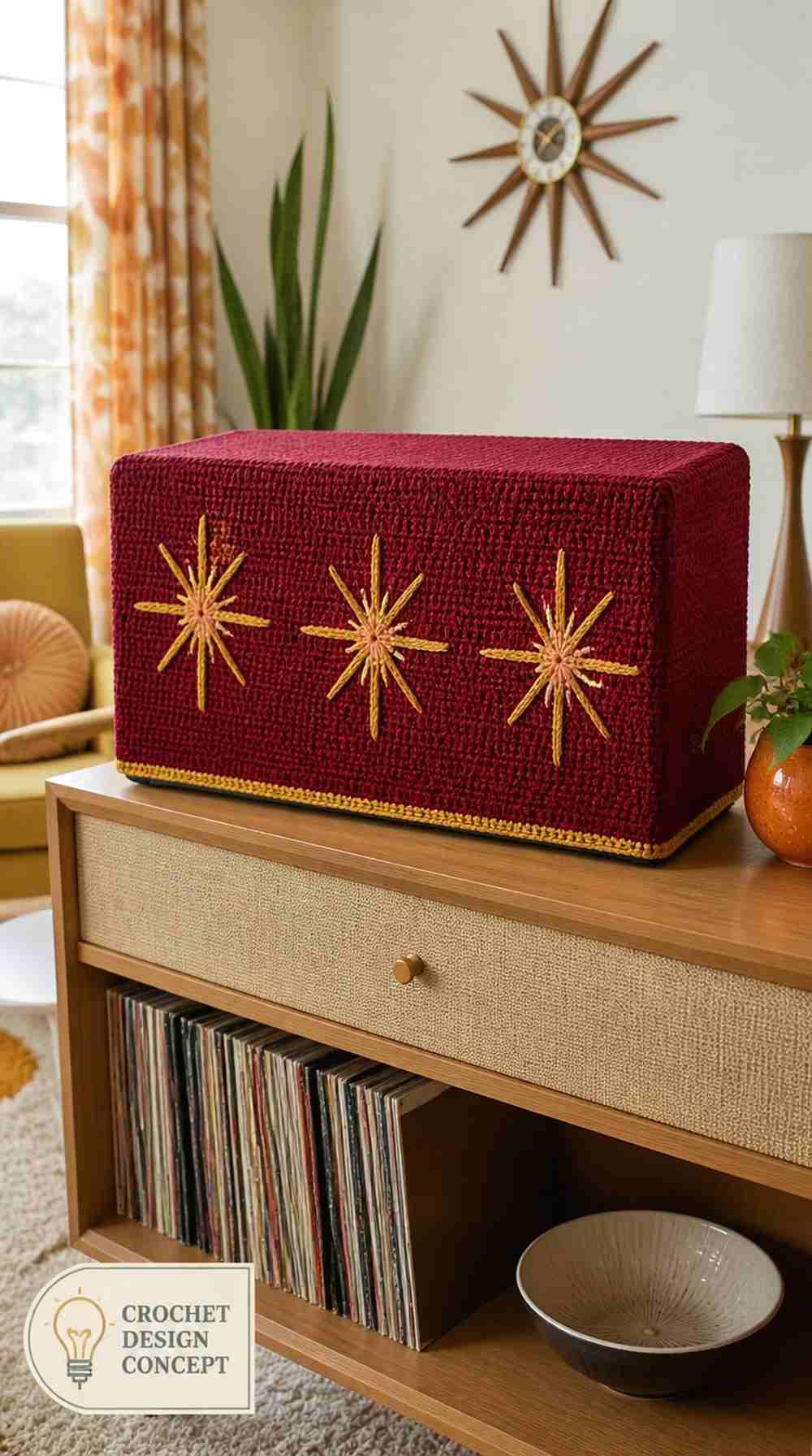
Three mustard-yellow atomic starbursts create a diagonal arrangement across the deep-cranberry front of this retro crochet cover. Every starburst contains eight long tapered rays surrounding a warm-peach center. The broad top remains plain cranberry, while antique-gold edging adds a restrained finish to the side panels.
The diagonal composition gives this design a distinct mid-century character without covering the entire fabric in patterns. Flat colorwork keeps the starbursts visually integrated into the front. Its main challenge is positioning the three motifs consistently while retaining their individual shapes.
- Three-Starburst Layout: Place the motifs diagonally with enough cranberry space between them to preserve the graphic arrangement.
- Eight Tapered Rays: Plan the long points carefully so the atomic shapes remain recognizable when translated into crochet stitches.
- Flat Colorwork: A low-profile technique may avoid loose star points that could catch during cover removal.
- Plain Upper Surface: The solid cranberry top keeps the visual focus on the front-panel decoration.
5. Crochet Turquoise Retro Wave Dust Cover
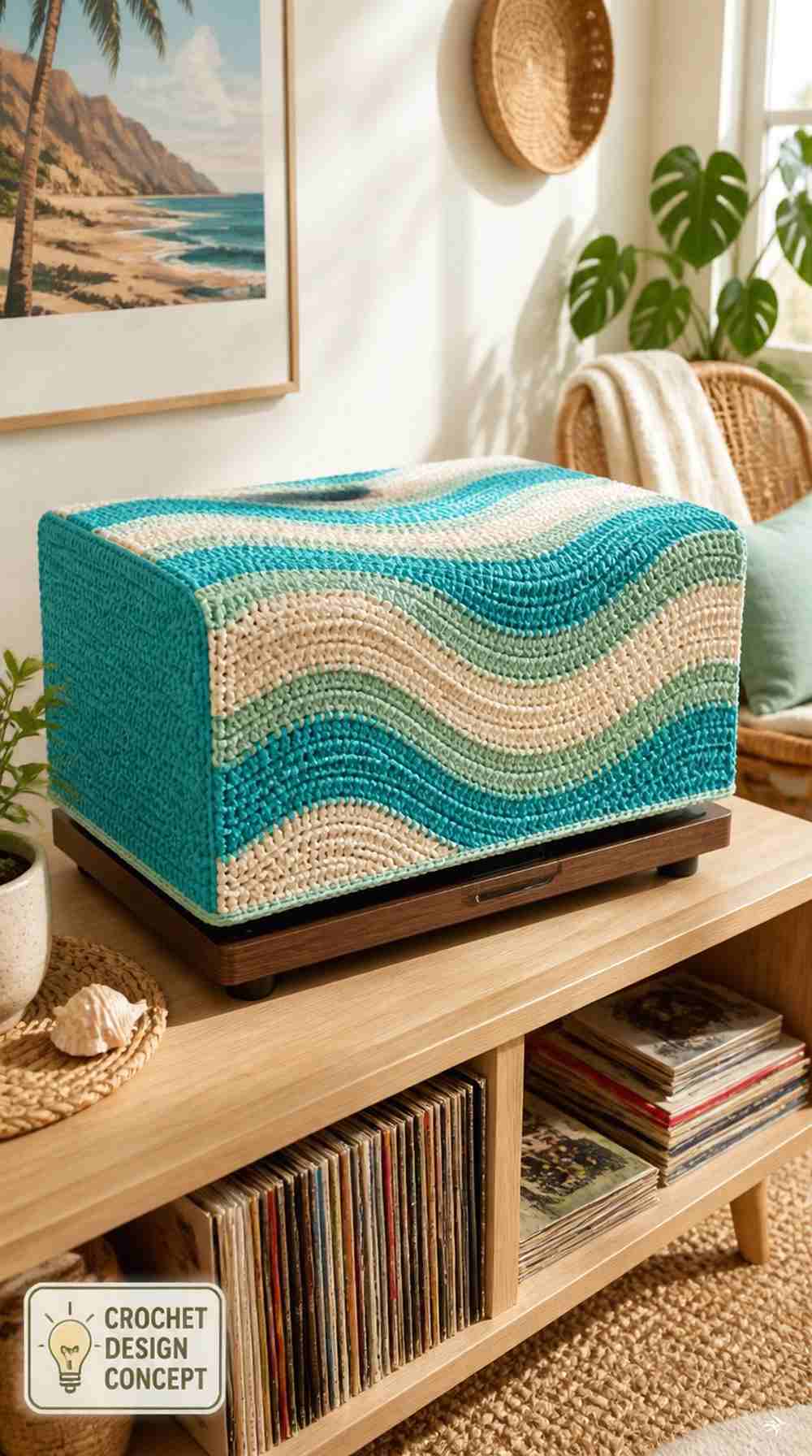
Sweeping turquoise, seafoam and warm-cream crochet waves travel across the top and down the front of this rectangular dust cover. The flowing stripes are broad and rounded rather than sharply pointed, while the side panels remain solid turquoise. A narrow seafoam line finishes the straight lower hem.
The cool colors give the design a playful coastal-retro appearance. Compared with an angular chevron, the wave pattern creates softer visual movement. A real version would need careful transitions between the curved stripe design and the rectangular cover’s straight side seams.
- Broad Wave Alignment: Keep the stripe curves continuous across the top-front edge rather than allowing the pattern to break abruptly.
- Seafoam Accent Width: Use the green-blue sections as distinct bands, preserving enough turquoise to remain the dominant color.
- Straight Side Seams: Join the patterned front to the plain turquoise sides without pulling the curved rows out of alignment.
- No Loose Fringe: The clean hem avoids dangling strands that could snag when the cover is lifted away.
6. Crochet Antique Ivory Lace Record Player Cover
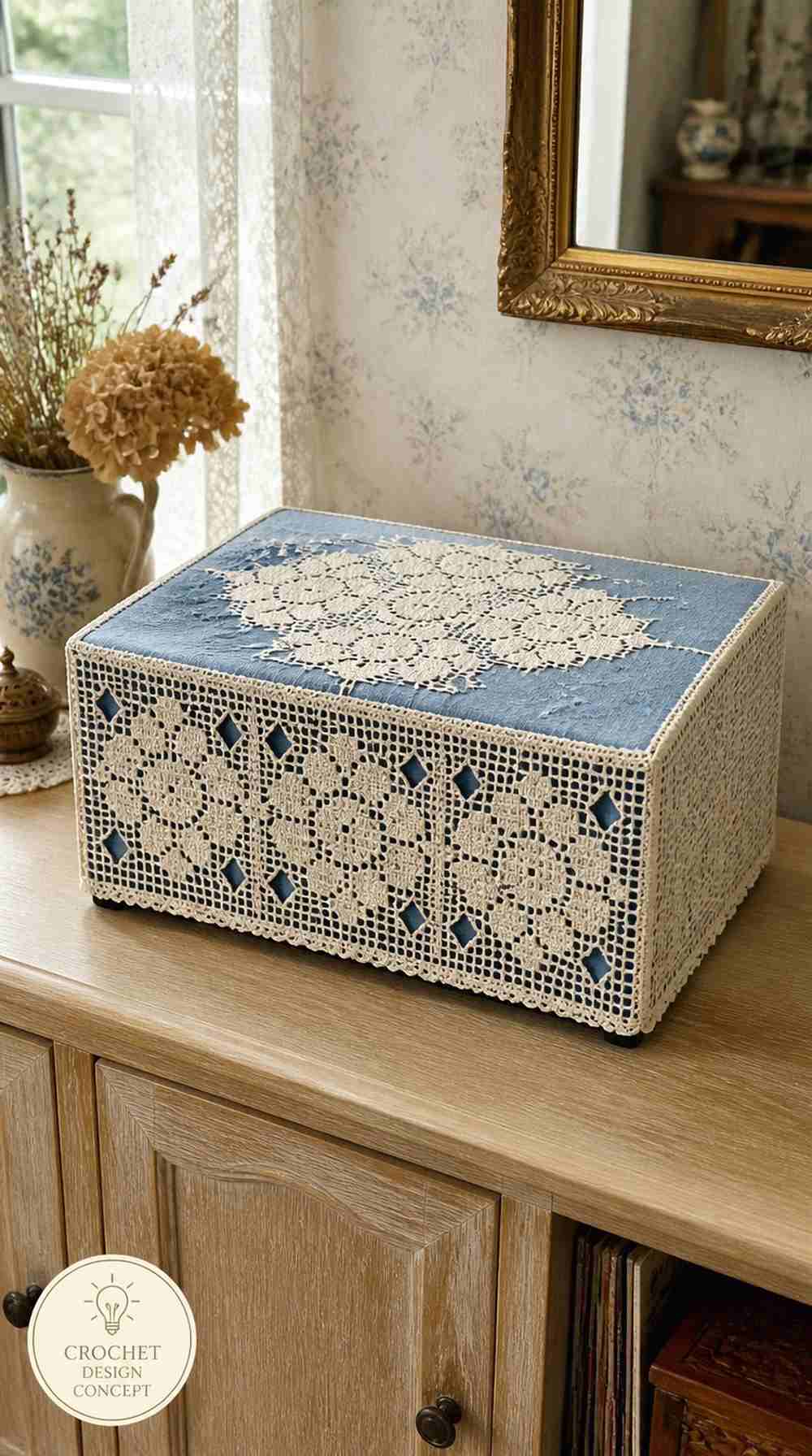
Delicate antique-ivory filet lace covers the top and front of this vintage-inspired record-player slipcover. Small diamond openings and floral medallions reveal an opaque dusty-blue fabric lining beneath, while a larger ivory rosette decorates the center of the top. Tiny ivory scallops finish the lower edge.
The combination of lace and blue backing gives the cover a softer heirloom appearance. Unlike dense crochet panels, openwork alone cannot be relied on to block dust. The lining adds visual contrast, but its actual suitability would depend on fabric choice, attachment and the manufacturer’s guidance.
- Floral Filet Lace: Keep the medallions and diamond openings consistent so the delicate pattern remains readable over the blue lining.
- Opaque Backing: A fitted fabric lining could reduce exposed openings, but it does not guarantee safe or effective equipment protection.
- Central Top Rosette: Keep the larger lace motif relatively flat to avoid unnecessary bulk across the cover’s upper surface.
- Scalloped Hem: Finish the small ivory scallops evenly, without creating long loops that might catch during removal.
For additional floral openwork inspiration, Yarn Nest Studio’s vintage lace doily wall-art collection explores lace motifs, scalloped edges and ways of supporting delicate crochet. Those are decorative references, not instructions for covering electronic equipment.
7. Crochet Avocado Argyle Turntable Dust Cover
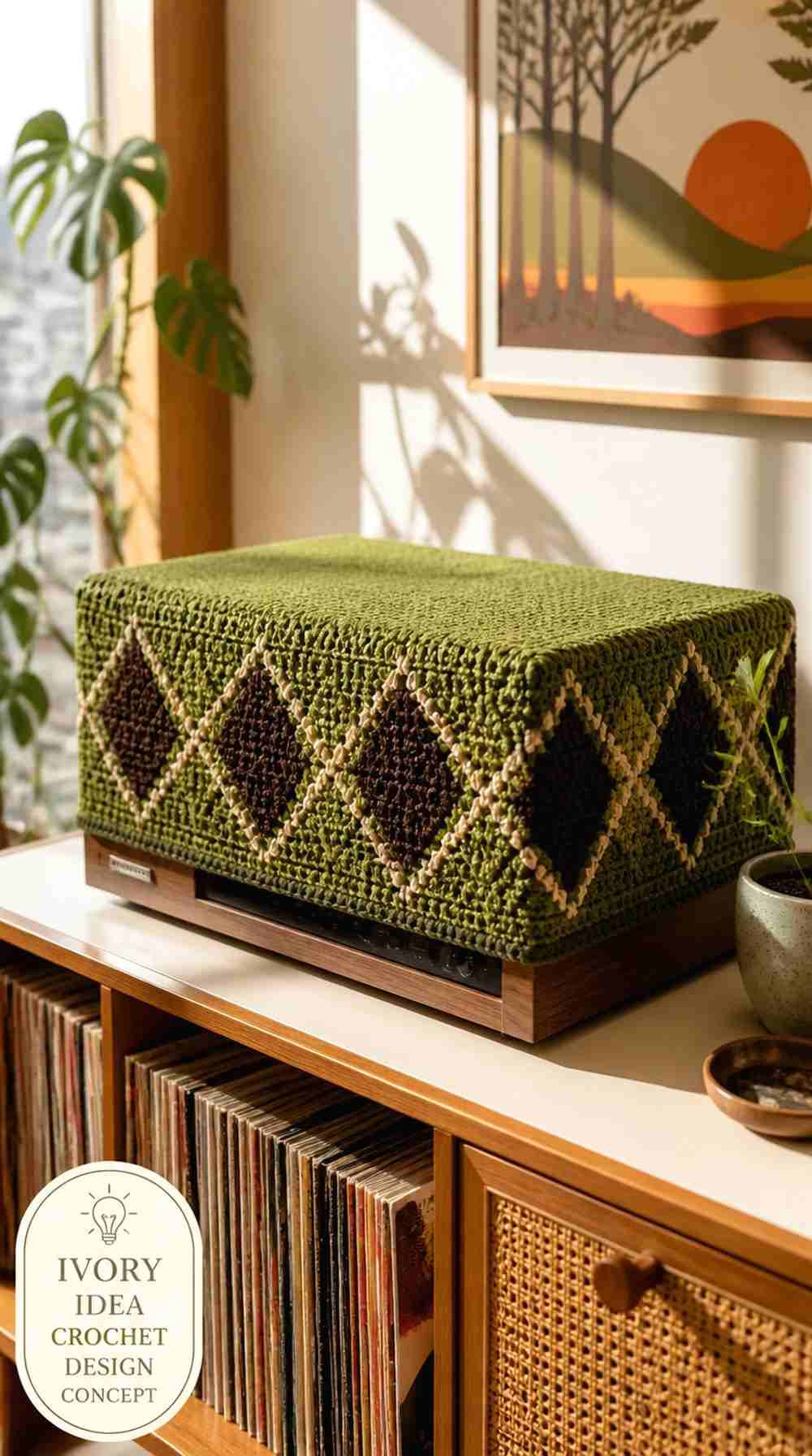
Warm avocado-green crochet creates the background for large chocolate-brown argyle diamonds across this record-player cover’s front and sides. Fine buttercream diagonal lines cross the diamonds, giving the pattern its familiar geometric appearance. The upper panel remains plain avocado, with a narrow olive lower hem.
The three-color combination makes the cover feel distinctly vintage without using bright rainbow stripes. Its diamond pattern is more detailed than a simple checkerboard, so the alignment of the diagonal lines deserves particular care. Dense tapestry-style crochet could provide one approach to creating the motif.
- Argyle Diamond Spacing: Position the chocolate diamonds consistently so their pointed corners form a recognizable repeated pattern.
- Buttercream Cross Lines: The thin diagonal accents should cross the brown shapes cleanly rather than becoming uneven decorative stripes.
- Plain Avocado Top: Keeping the upper surface solid gives the detailed side and front panels more room to stand out.
- Colorwork Tension: Test the three-color stitch pattern before making large panels, since tightly carried yarn can cause puckering.
8. Crochet Cherry Red Daisy Record Player Cover
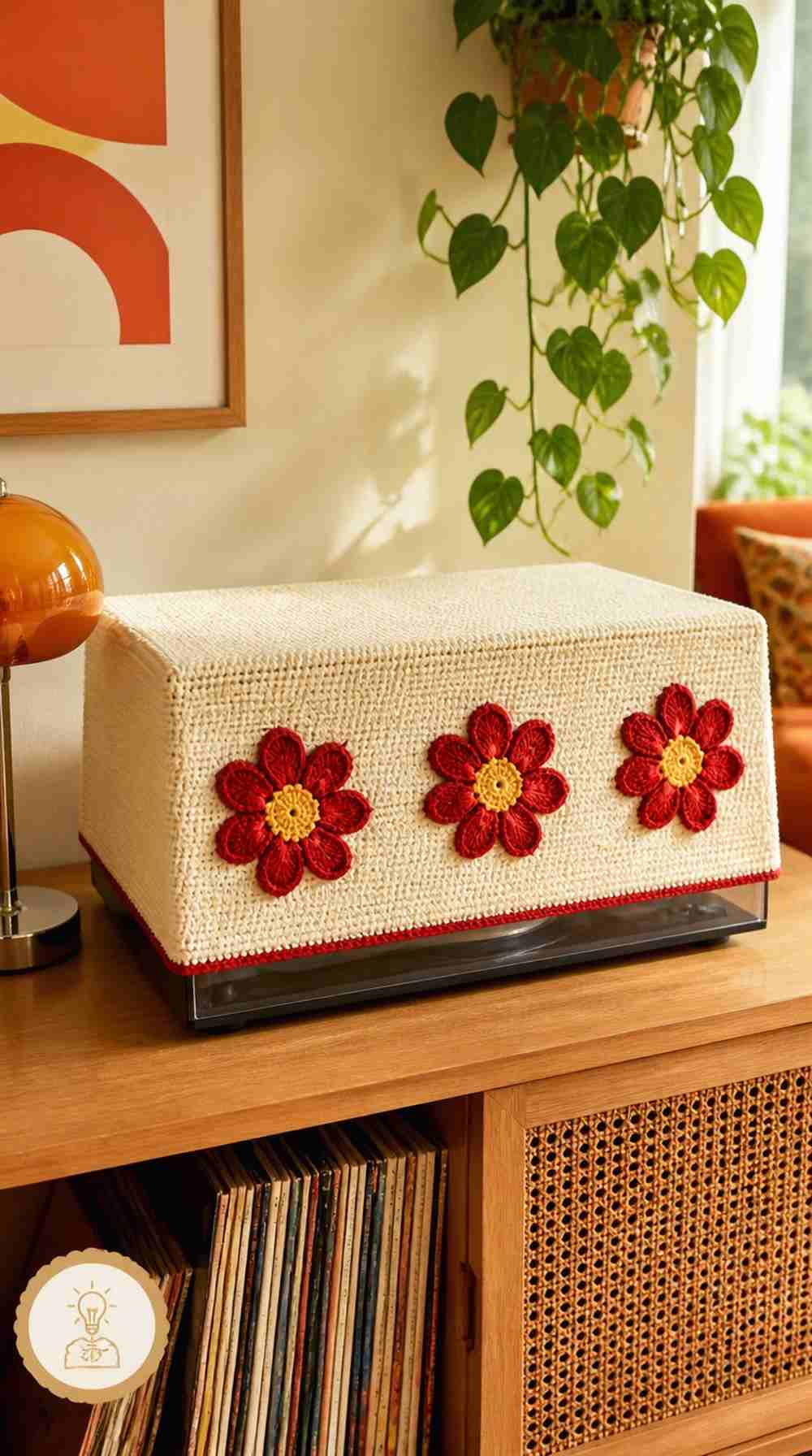
Three flat cherry-red crochet daisies sit across the cream front of this charming dust cover. Each flower has eight rounded red petals and a little butter-yellow center. The rectangular top and side panels remain plain cream, with a fine cherry-red border finishing the lower edge.
The design gives an ordinary box-shaped cover a cheerful seventies-floral character. Leaving the upper surface plain makes the flowers the clear focal point. Unlike all-over granny-square construction, the separate daisies require careful attachment to a solid base panel.
- Three-Daisy Placement: Space the flowers evenly across the front, leaving enough cream fabric around each eight-petal silhouette.
- Flat Petal Construction: Use low-profile flowers rather than bulky layered appliqués that could catch during handling.
- Butter-Yellow Centers: Keep the small centers neatly secured and proportionate to the surrounding red petals.
- Removable Cover Fit: The floral details should remain clear of the lower hem so they do not interfere when the textile is lifted off.
9. Crochet Butterscotch Vinyl Motif Dust Cover
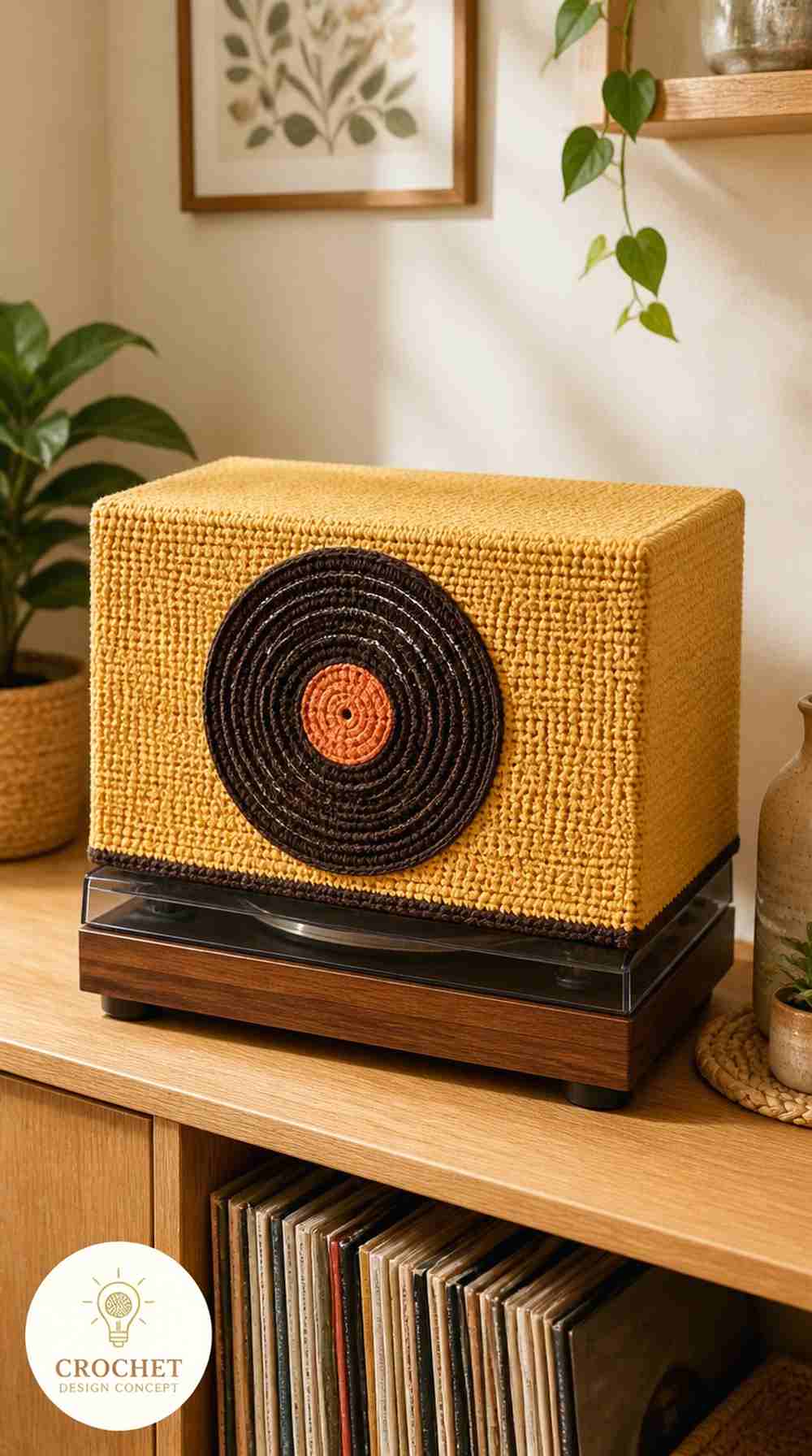
One large stylized crochet vinyl record decorates the front of this butterscotch-yellow dust cover. The flat coffee-brown disc has delicate concentric groove lines and a small burnt-orange center, while the top and side panels stay plain butterscotch. Fine espresso edging outlines the lower hem.
The record motif creates a direct connection with the music equipment beneath the cover. Its circular shape contrasts with the rectangular fabric, producing a recognizable retro design. The motif is purely decorative and should never be confused with an actual vinyl disc or turntable component.
- Circular Record Motif: Maintain smooth, balanced crochet rounds so the brown disc remains recognizably circular against the yellow front.
- Concentric Groove Detail: Keep the three narrow rings subtle enough to suggest vinyl grooves without making the appliqué bulky.
- Orange Record Center: The small burnt-orange circle provides contrast without requiring printed labels or lettering.
- Front-Only Placement: Keeping the record motif on the front avoids adding an unnecessarily raised circle to the top surface.
10. Crochet Plum Noir Windowpane Dust Cover
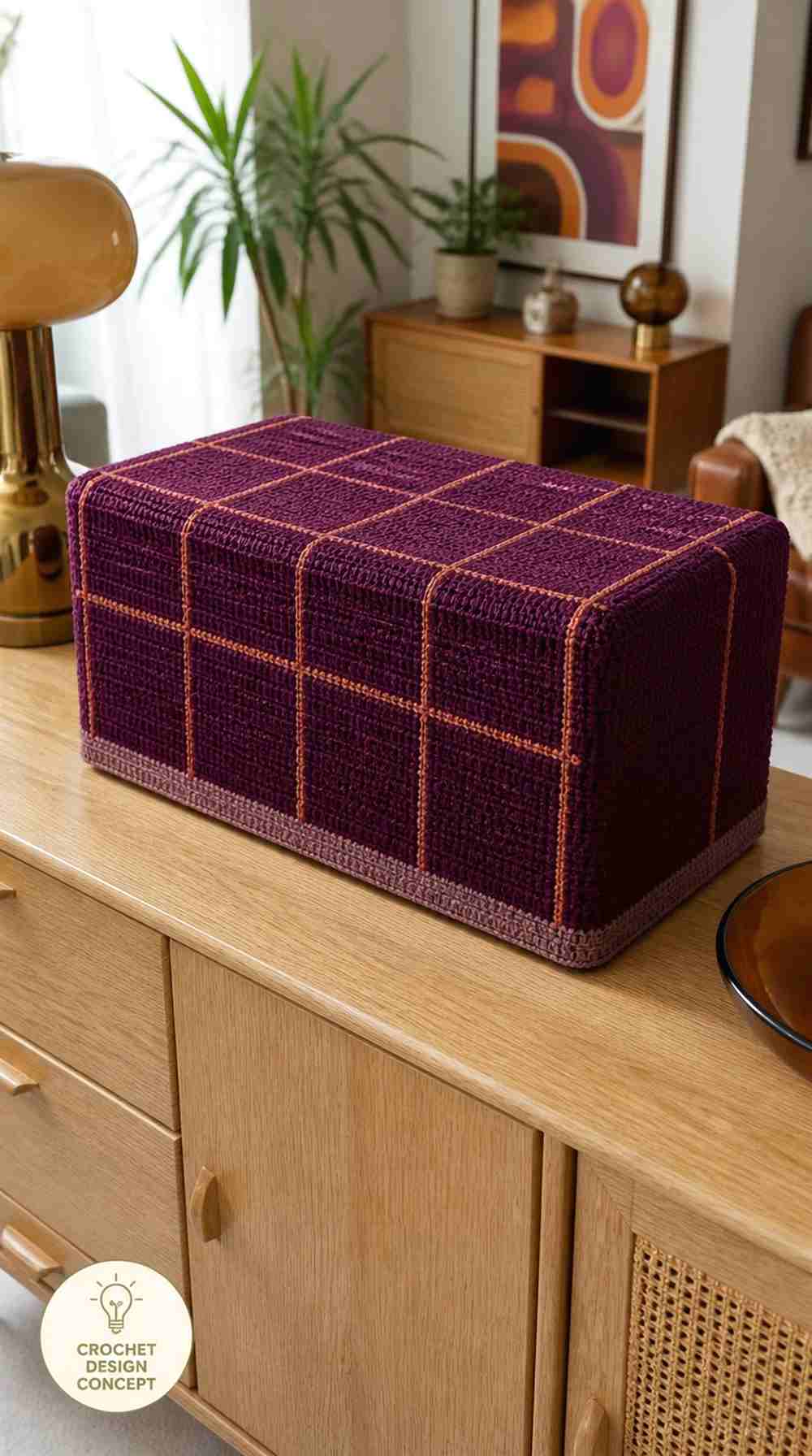
Thin dusty-copper crochet lines form a large windowpane grid over the rich plum-purple top and front of this rectangular cover. The side panels have restrained copper lines near their corners, while a muted-mauve lower hem softens the darker fabric.
The grid gives the design a tailored retro appearance without individual flowers, squares or appliqués. Its main visual feature is the uninterrupted alignment of the copper lines. Working the pattern evenly across the top-front transition would be important for a convincing finished result.
- Windowpane Grid: Keep the horizontal and vertical copper lines evenly spaced to create balanced rectangular panels.
- Top-Front Continuity: Check that the grid lines meet cleanly where the upper surface folds over the front edge.
- Plum Stitch Visibility: Choose yarn that shows individual stitches clearly, especially when using a dark purple main color.
- Minimal Side Accents: The single copper lines near the side corners provide continuity without making the entire cover overly busy.
11. Crochet Terracotta Granny Stripe Dust Cover
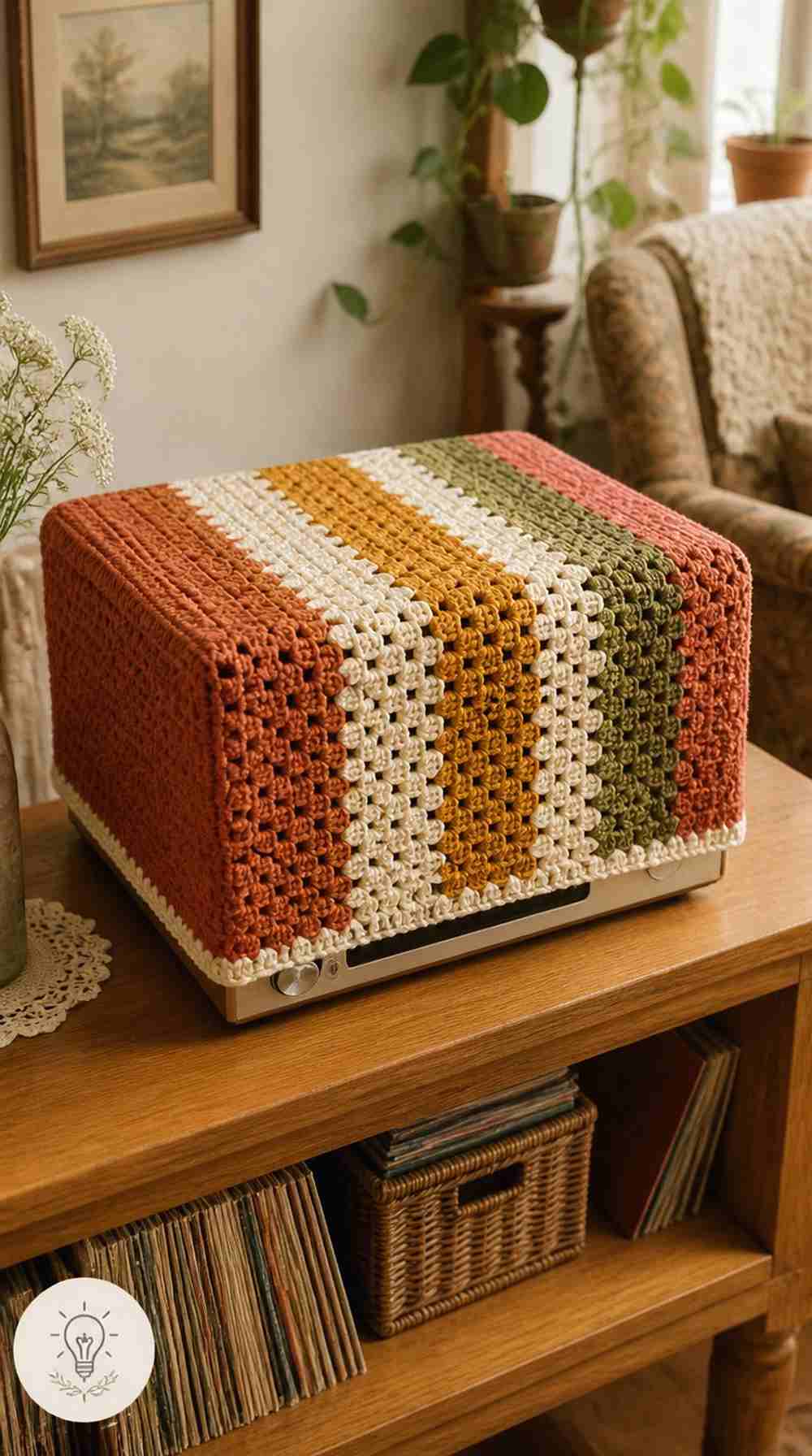
Broad terracotta, antique-cream, golden-ochre and muted-olive granny-stripe panels travel vertically over this crochet record-player cover. The grouped stitches form continuous columns across the front and top, while solid terracotta side panels and narrow cream edging complete the rectangular shape.
Unlike checkerboard motifs, the granny stripes create texture through repeated clusters rather than separate square blocks. The vertical arrangement gives the cover a relaxed vintage character. Its stitch openings may need special consideration if the textile is intended to do more than provide decorative styling.
- Vertical Granny Columns: Keep the color panels aligned through the top-front fold to maintain a continuous stripe arrangement.
- Cluster-Stitch Texture: Check the openness and flexibility of the granny stitches before deciding whether a separate backing is appropriate.
- Terracotta Side Panels: Plain sides simplify the pattern transition and provide a visual break from the multicolored columns.
- Flat Joining: Avoid thick seams between columns, which could prevent the cover from following the lid’s corners neatly.
12. Crochet Mint Lilac Shell Stitch Dust Cover
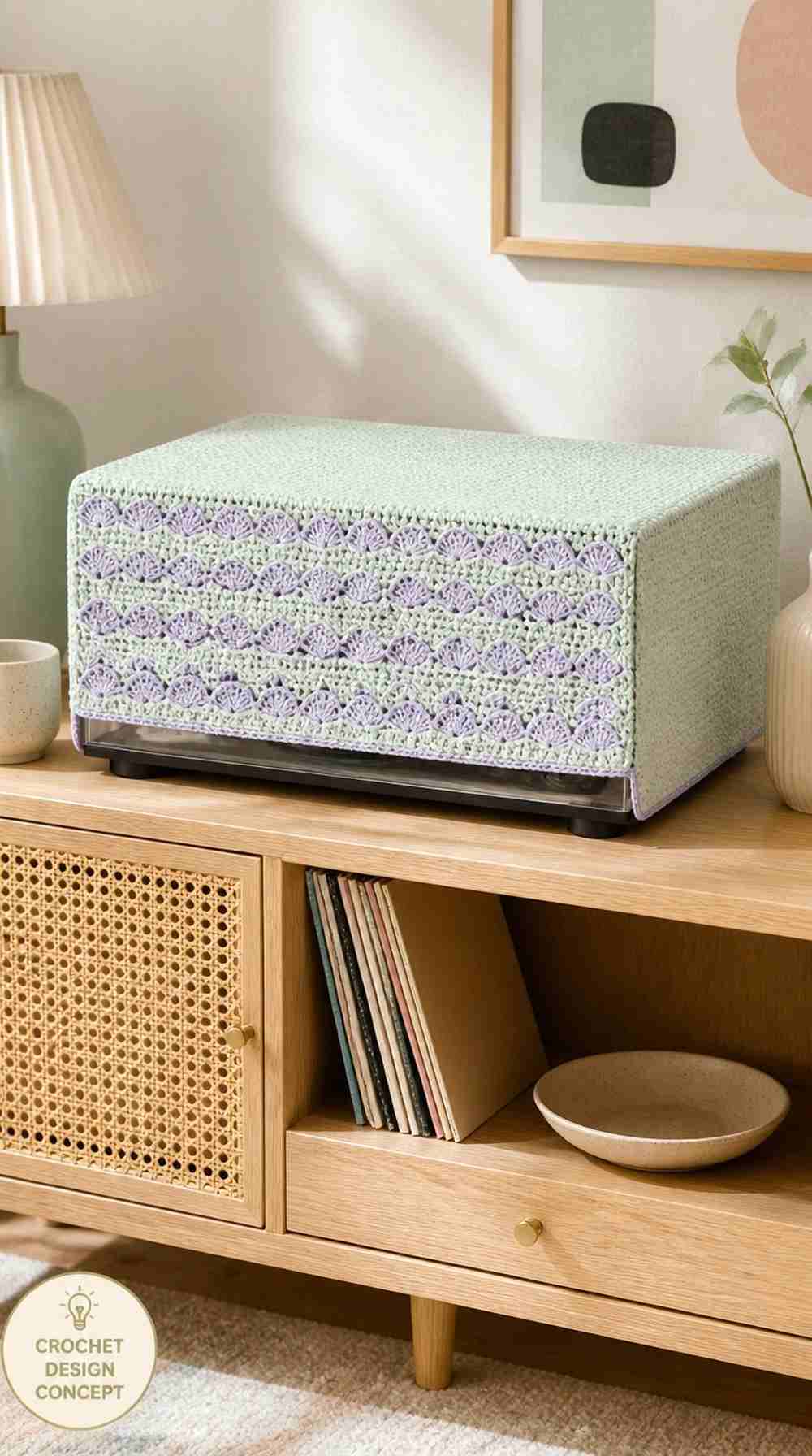
Soft lavender shell-stitch rows decorate the pale-mint front of this delicate crochet dust cover. Each small fan-shaped cluster contains five clearly defined stitch sections, arranged into gentle repeated arches. The top and sides remain mint, with a slim lilac border along the bottom.
The shell pattern gives the design a romantic retro texture without separate embellishments. Compared with a plain crochet cover, the repeated fan rows create more surface detail. Their stitch spacing and height would need careful planning to keep the front panel even.
- Five-Stitch Shell Groups: Repeat the lavender fan clusters consistently so the arches remain distinct across the mint background.
- Close-Stitch Top: The plain mint upper panel balances the more textured front without adding another decorative pattern.
- Lilac Lower Border: A narrow straight edging provides a clean finish beneath the scalloped-looking shell rows.
- Fabric Flexibility: Test the shell-stitch section to check whether its raised texture changes the cover’s drape or finished dimensions.
13. Crochet Espresso Atomic Arch Dust Cover
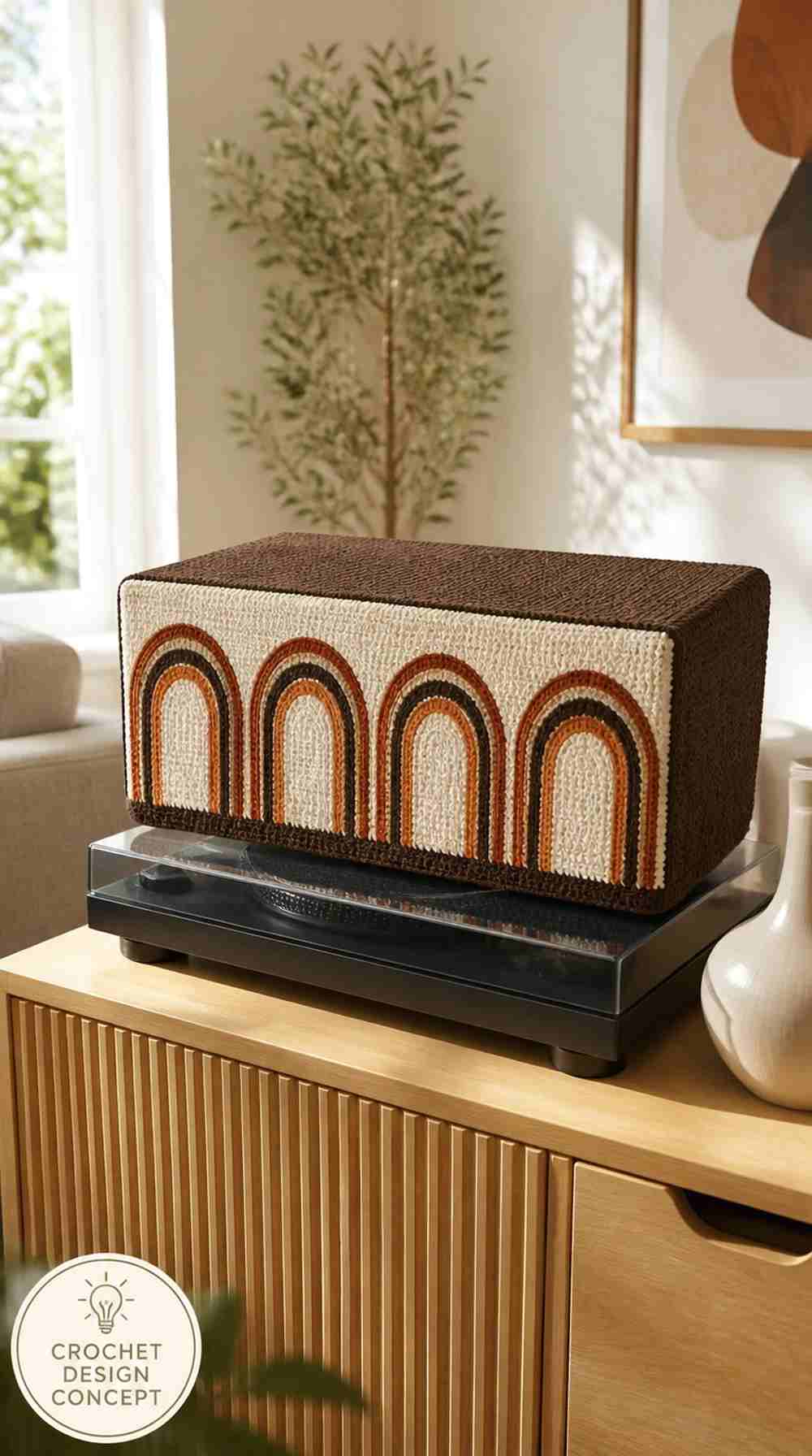
Four large copper-orange semicircular arches line the oatmeal-cream front of this mid-century-inspired crochet cover. Each arch uses concentric copper and espresso bands around a cream center, while the top and side panels remain deep espresso brown. Fine espresso edging frames the open lower hem.
The architectural arch pattern makes this concept feel different from traditional crochet stripes. Its symmetrical front creates a more structured appearance, particularly against light wooden furniture. The colorwork would need precise placement so the four arches remain equal and clearly separated.
- Four-Arch Composition: Space the semicircular motifs evenly across the front, preserving consistent widths and curved outlines.
- Concentric Colorwork: Keep the copper and espresso bands clearly defined around each cream center.
- Espresso Top Panel: The solid dark surface helps anchor the brighter arches without introducing additional decorative motifs.
- Front-Panel Accuracy: Work a sample of the curved color changes before attempting the full cover, since small stitch differences can affect symmetry.
14. Crochet Sage Tulip Corner Dust Cover
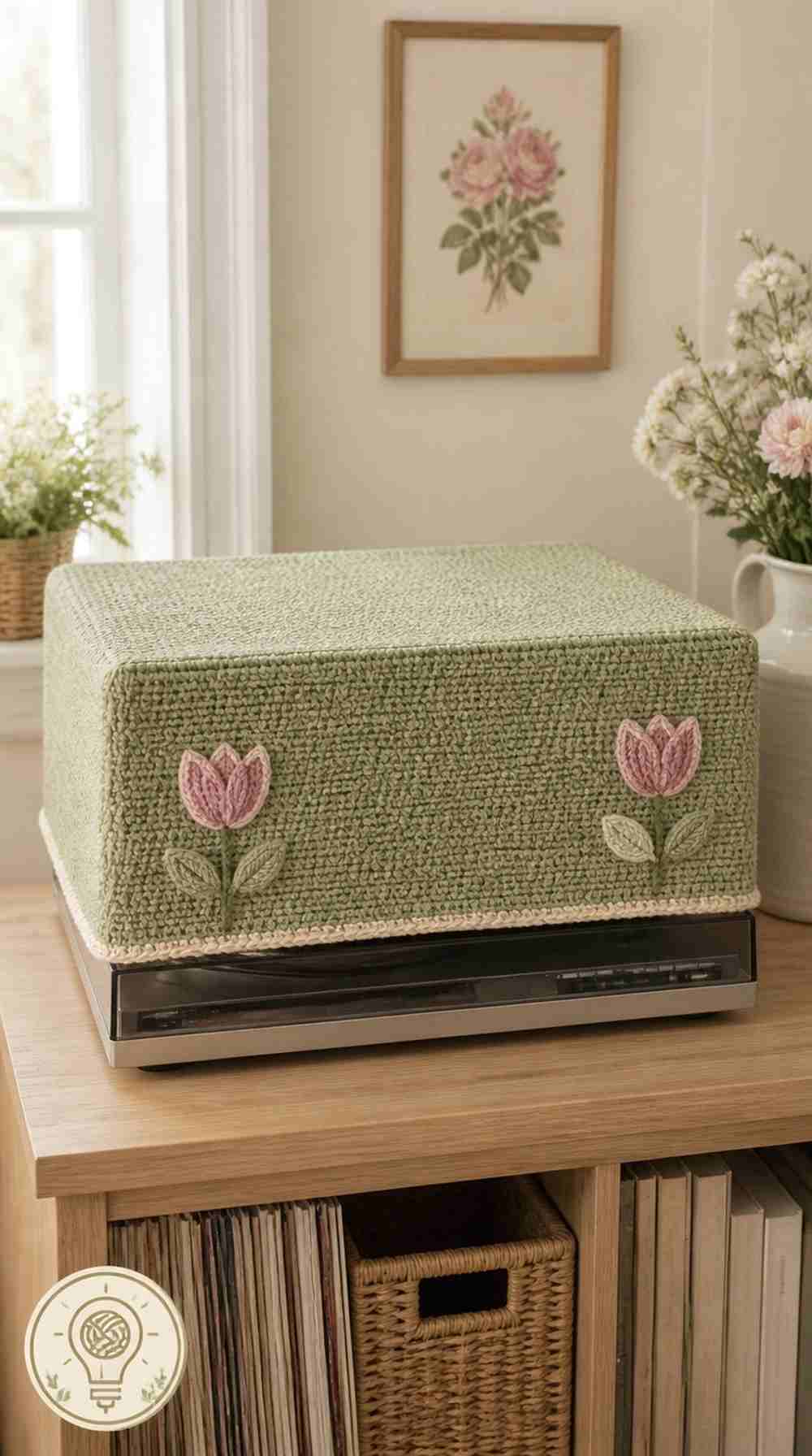
Two small dusty-rose tulips decorate the lower corners of this sage-green crochet cover. Each flower has three shaped petals, a slender olive stem and two sage-grey leaves. The rest of the front and top remains plain sage, with an oatmeal border finishing the lower edge.
The restrained floral placement makes this design quieter than the daisy or granny-square covers. Its uncluttered center gives the two tulips room to stand out. Their low-profile appliqués would need careful attachment so they do not loosen with repeated lifting and storage.
- Corner Tulip Placement: Position one flower near each lower front corner, leaving the central sage panel open.
- Three-Petal Shape: Keep the rose-colored petals distinguishable without using heavily layered flowers.
- Stem Attachment: Secure the narrow olive stems and sage-grey leaves along their lengths to reduce loose edges.
- Plain Sage Structure: A simple background makes panel measurement and joining more straightforward than an all-over floral repeat.
15. Crochet Cobalt Ivory Mod Chevron Dust Cover
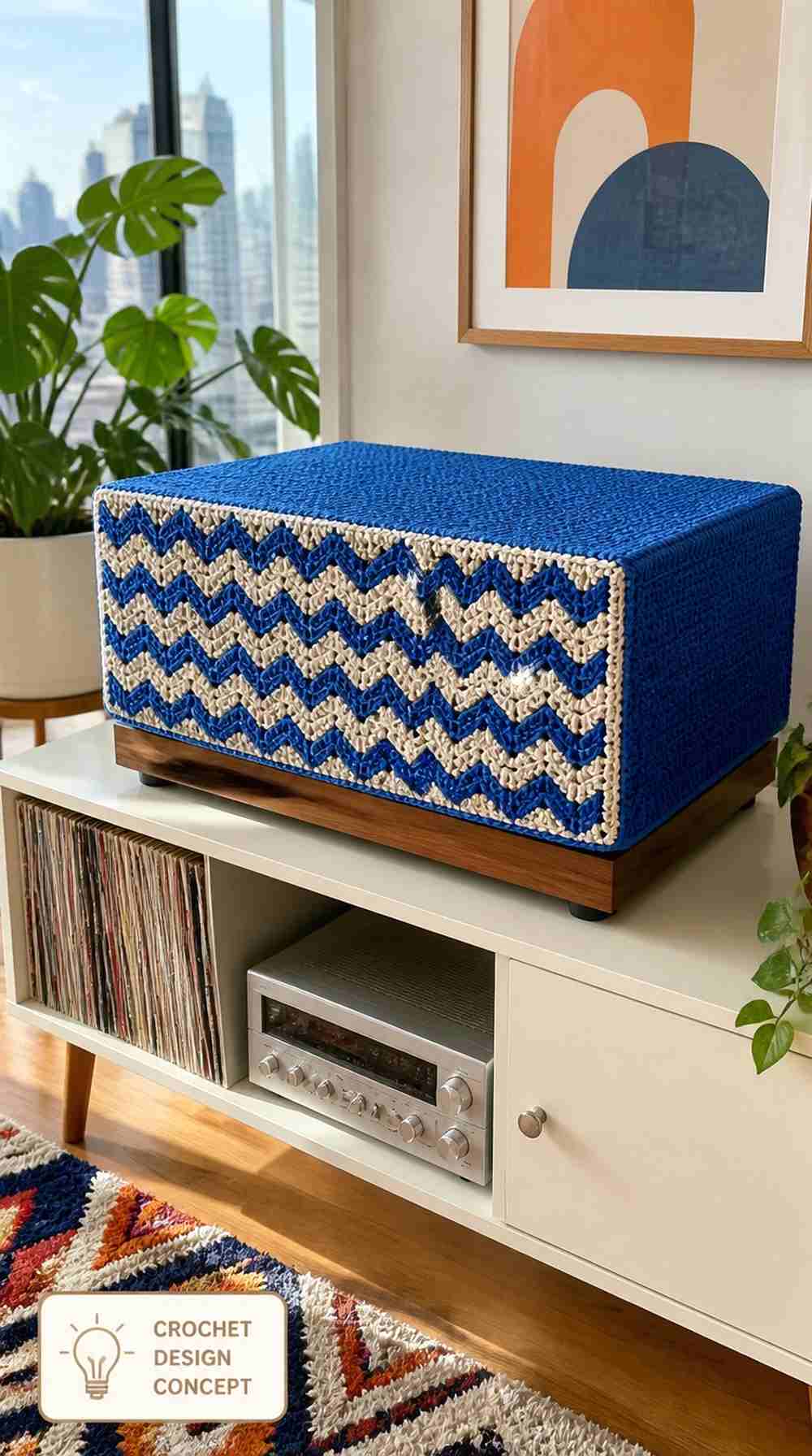
Narrow ivory chevrons repeat across the cobalt-blue front panel of this graphic crochet dust cover. The top and sides remain solid cobalt, while a fine pale-grey line frames the patterned front. Crisp V-shaped points give the textile a striking retro appearance.
The blue-and-white combination feels bolder and cleaner than the earthy seventies palettes elsewhere in the collection. Because the chevrons are closely spaced, stitch-count accuracy is particularly important. Even small irregularities may become noticeable where the ivory points meet the blue background.
- Narrow Chevron Repeats: Maintain consistent increases and decreases so the pointed rows follow the same pattern across the front.
- Solid Cobalt Top: Keeping the upper panel plain makes the front’s small zigzags easier to appreciate.
- Pale-Grey Frame: The fine outline separates the patterned front from the blue side panels without introducing a third dominant color.
- Panel Width: Check the chevron repeat against the measured front width before starting so the design finishes cleanly at both sides.
16. Crochet Burgundy Copper Art Deco Fan Cover
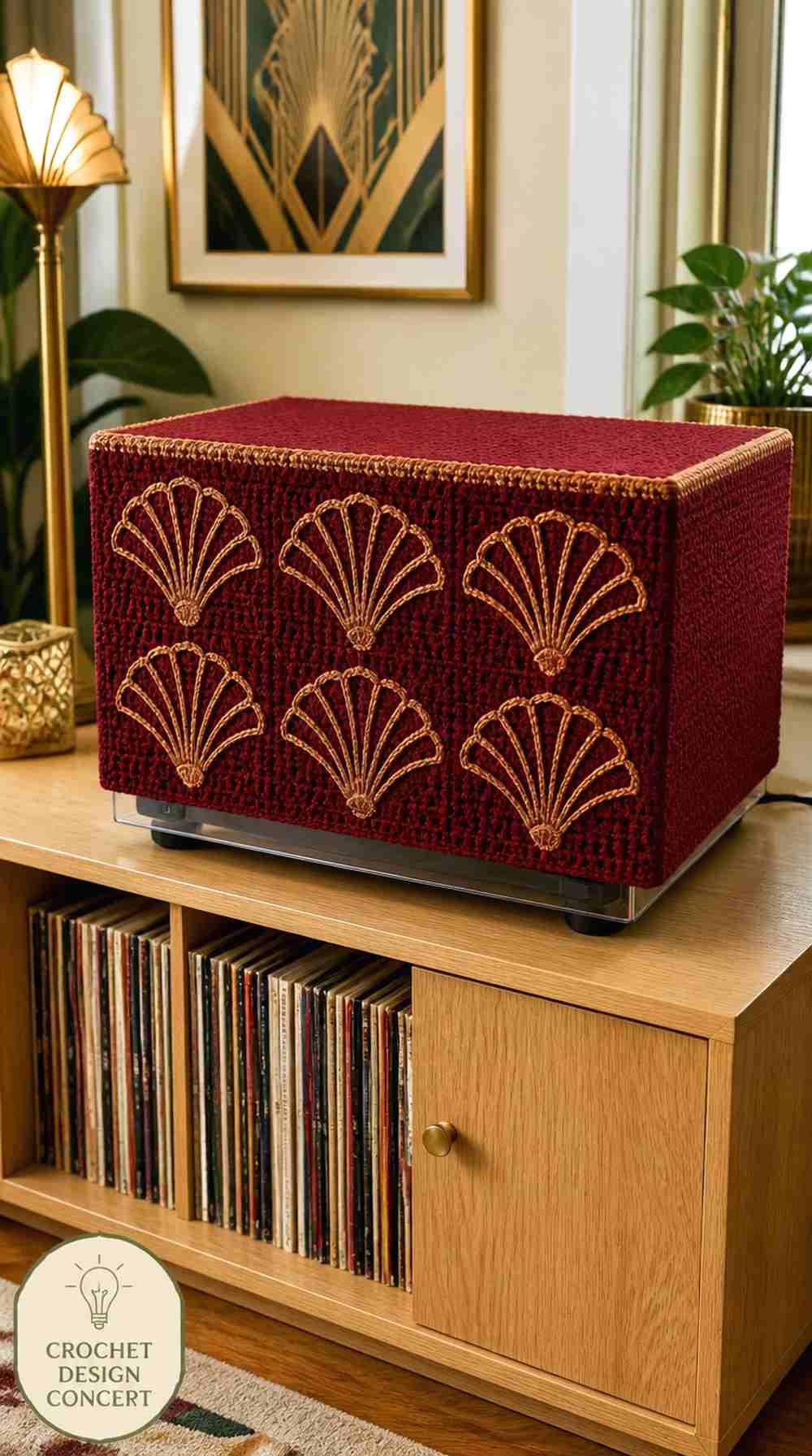
Six antique-copper fan motifs decorate the burgundy front of this elegant crochet cover. Arranged in two rows of three, the fans contain five fine radiating copper arcs each. A narrow copper border outlines the broad burgundy top, while the sides remain plain.
The repeating fan shapes create an art-deco-inspired appearance rather than a conventional floral pattern. Their curved lines contrast with the cover’s rectangular form. Because the motifs are worked as colorwork instead of hanging decorations, their visual impact comes from stitch placement and color contrast.
- Six-Fan Arrangement: Keep the two rows of three motifs aligned so the front panel appears balanced.
- Five Radiating Arcs: Plan each fan’s copper lines carefully to preserve the expanding semicircular shape.
- Burgundy Background: The deep red tone provides contrast while maintaining a warm vintage palette.
- Copper Top Border: A single fine line can connect the front decoration to the otherwise plain upper panel.
17. Crochet Cream Caramel Suitcase Record Player Cover
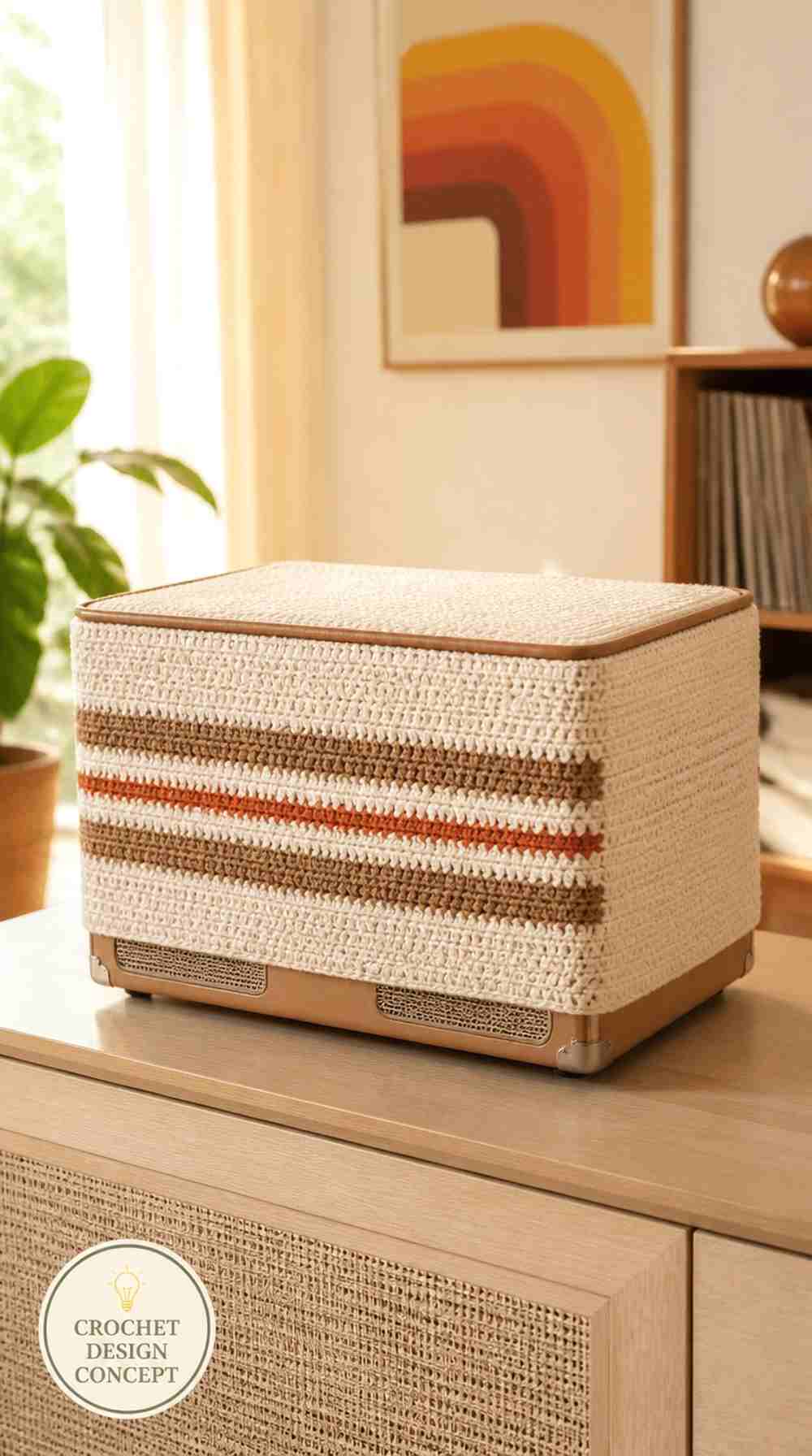
Warm oatmeal-cream crochet forms a compact cover for a closed, portable suitcase-style record player. Two broad caramel-brown stripes run horizontally across the front, separated by a narrow burnt-orange line. The top has matching caramel edging, while the sides remain plain cream.
Its smaller box-shaped silhouette distinguishes this idea from covers designed around full-size tabletop turntables. The stripe arrangement is simple, but the measurements still need to suit the actual closed case. A decorative textile should not interfere with the handle, hinges or fastening hardware.
- Portable-Case Measurements: Measure the closed suitcase player rather than copying dimensions from a larger tabletop turntable.
- Caramel Stripe Placement: Keep the two brown bands even, with the narrow orange stripe clearly visible between them.
- Straight Lower Hem: A simple open lower edge allows the textile to be lifted away without loose ties or fringe.
- Case Hardware: Remove the cover completely before opening, carrying or operating the record player; never rely on it as protective carrying equipment.
Practical Guide to Crochet Record Player Dust Covers
A crochet cover may look attractive over a vintage turntable, but electronic equipment requires different care from ordinary furniture. The manufacturer’s instructions should always come before a decorative textile idea.
Choose the correct cover arrangement
| Design approach | Main advantage | Important limitation |
|---|---|---|
| Dense crochet panels | Defined texture and fewer openings | Can still shed fibers or collect dust |
| Granny-square cover | Colorful, modular construction | Seams and open stitches require attention |
| Open lace with lining | Decorative vintage appearance | Lining and airflow must be assessed |
| Flat tapestry colorwork | Smooth graphic motifs | May become stiff with tight tension |
| Low-profile appliqués | Adds floral detail | Attached edges can catch |
| Portable suitcase cover | Tailored look for a closed case | Must clear hardware and be removed before use |
Measure the actual equipment
For a rectangular cover, measure the closed unit’s width, depth and height. Decide which exterior surfaces the crochet would cover, allowing for seams, yarn stretch and easy removal.
Do not guess the fit from an online photograph. Check the player’s manual for restrictions on covering the housing or original lid.
Keep the mechanism protected
Never drape yarn directly over an exposed record, platter, tonearm or stylus. A flexible crochet textile can shed lint, snag on delicate components or shift unexpectedly.
Use a decorative textile only when the player is switched off, not in use, and the manufacturer’s instructions permit it. Remove the entire crochet piece before handling or operating the turntable.
Some models also warn against placing objects on their dust covers. Follow those restrictions rather than assuming a lightweight crochet cover is acceptable.
Manuals++1
Consider ventilation, fibers and cleaning
Do not block ventilation openings or enclose equipment that needs to dissipate heat. Avoid loose fringe, long ties, buttons and dangling appliqués.
Use yarn appropriate for a removable household textile, and check its tendency to shed lint. Dense crochet may be preferable to open lace for some decorative applications, but crochet is not automatically an effective dust barrier.
Clean the textile separately according to the yarn’s instructions. Do not place a damp cover on electronic equipment.
Want to Make Something Similar?
These 17 designs are AI-generated concepts, not tested record-player dust-cover patterns. The following resources teach related construction techniques, but none should be treated as proof that a crochet cover is safe for a particular turntable.
- Sewing Machine Dust Cover Tutorial — WeAllSew: Erika Mulvenna demonstrates measuring and constructing a removable cover for a rectangular machine. The general measuring ideas may help with planning a textile cover, although a turntable has different operating restrictions. WeAllSew
- How to Sew a Fabric Lining for a Crochet Bag — Alyssia Creates: This guide explains how to measure, sew and attach a fabric lining to crochet. The technique may help with planning a separate lining for a decorative cover, but it does not establish suitability for electronic equipment. Alyssia Creates
- Crochet This Retro Record Player Coaster — Atelier Delilah: Delilah Crochet’s free pattern creates a miniature record-player coaster project with rectangular crochet pieces and record motifs. It is relevant to the retro shapes and colorwork, not an actual full-size dust-cover pattern. Atelier Delilah
Before making any cover, consult the manual for the exact record-player model. Original protective lids and approved maintenance procedures remain the appropriate reference for equipment care.
Which Retro Record Player Dust Cover Should You Choose?
| Design | Main decorative feature | Construction consideration |
|---|---|---|
| Burnt Orange Retro Chevron | Wide orange-and-cream zigzags | Top-front pattern alignment |
| Mustard Checkerboard | Mustard and espresso squares | Consistent checker dimensions |
| Sage Floral Granny | Six cream floral squares | Granny-square joining |
| Cranberry Atomic Starburst | Three mustard atomic motifs | Diagonal colorwork placement |
| Turquoise Retro Wave | Flowing blue-green stripes | Curved rows across panels |
| Antique Ivory Lace | Floral filet lace and blue lining | Openwork and backing |
| Avocado Argyle | Brown diamonds and cream cross lines | Tapestry tension |
| Cherry Red Daisy | Three red flowers on cream | Low-profile appliqué attachment |
| Butterscotch Vinyl Motif | Large stylized record on front | Circular motif shaping |
| Plum Noir Windowpane | Copper grid over deep plum | Straight grid alignment |
| Terracotta Granny Stripe | Multicolored vertical clusters | Open stitch texture and joins |
| Mint Lilac Shell Stitch | Lavender fan-stitch rows | Shell spacing |
| Espresso Atomic Arch | Four copper semicircular arches | Curved colorwork symmetry |
| Sage Tulip Corner | Two dusty-rose tulips | Small appliqué edges |
| Cobalt Ivory Mod Chevron | Fine blue-and-white V-shapes | Precise stitch counts |
| Burgundy Copper Art Deco | Six repeating copper fans | Radiating motif definition |
| Cream Caramel Suitcase | Simple stripes on compact case | Closed-case fit and hardware |
For a straightforward retro appearance, the Crochet Burnt Orange Retro Chevron Dust Cover, Crochet Mustard Checkerboard Record Player Cover and Crochet Cream Caramel Suitcase Record Player Cover are useful visual starting points.
If you prefer detailed stitchwork and decorative motifs, consider the Crochet Sage Floral Granny Record Player Cover, Crochet Antique Ivory Lace Record Player Cover or Crochet Mint Lilac Shell Stitch Dust Cover.
For a stronger mid-century statement, the Crochet Cranberry Atomic Starburst Dust Cover, Crochet Espresso Atomic Arch Dust Cover and Crochet Burgundy Copper Art Deco Fan Cover make geometric motifs the main feature.
Conclusion
Retro crochet record-player dust covers can bring color and texture to a music corner, from burnt-orange chevrons and mustard checkerboards to soft floral squares and geometric art-deco motifs. The rectangular form provides plenty of possibilities for experimenting with crochet patterns while maintaining a vintage-inspired appearance.
The most important decision is whether a decorative textile is appropriate for the particular equipment. Check the manufacturer’s guidance, measure the closed unit and consider the risks of lint, snagging, blocked ventilation and unwanted contact. A handmade cover should never replace safe record-player handling or interfere with the original protective lid.
Which of these 17 crochet retro record-player cover ideas would you choose for your music corner? Would you prefer bold seventies chevrons, sage floral granny squares or a simple vintage cream-and-caramel design?
Frequently Asked Questions
1. Can I put a crochet dust cover directly over a record player?
Do not place crochet directly over exposed turntable components. A textile could catch on the tonearm, stylus or other delicate parts. Even over a closed hard lid, a decorative cover may be unsuitable if the manufacturer prohibits placing objects on the equipment or if it obstructs ventilation. Check the specific model’s manual first.
2. Will a crochet cover keep dust out of a turntable?
Not reliably. Crochet stitches can contain openings, and yarn can collect or shed dust and lint. A dense, lined textile might reduce some exposure in certain conditions, but it is not a tested replacement for the original dust cover. Use the manufacturer’s approved protection and cleaning methods.
3. Should I remove a crochet cover before playing records?
Yes. Remove any decorative crochet textile completely before operating the record player. The position of the original rigid dust lid during playback depends on the particular model. For example, some Audio-Technica instructions specify removing its lid during play, while certain TEAC models instruct users to keep the lid closed. Follow the manual for your exact turntable.
device.report+1
4. What yarn works best for a decorative crochet record-player cover?
A smooth, low-shedding yarn with clearly defined stitches may be worth considering if the manufacturer permits a removable outer textile. Cotton and some blends can provide decorative structure, but fiber choice alone does not make a cover safe for electronics. Avoid loose, fuzzy, heavily fringed or shedding materials near delicate equipment.
5. Are these 17 crochet record-player dust covers available as patterns?
No. These are AI-generated inspiration concepts rather than tested patterns for actual record-player models. The linked resources offer related textile construction and crochet motif techniques, but not complete instructions for these exact covers. A real project would require custom measurements, suitable construction and confirmation that the equipment manufacturer permits the intended use.