Leaf-shaped crochet floor poufs bring the soft shapes of a woodland garden into cozy indoor spaces. Instead of ordinary round or square floor cushions, these designs explore oak leaves, fern fronds, ginkgo fans, maple leaves and other recognizable botanical silhouettes. Sage, moss, olive, cream and warm autumn colors give the collection a cottagecore feeling, while raised crochet veins, textured stitches and softly padded edges add detail.
These 15 ideas are designed to help you compare leaf shapes, surface textures and different levels of padding before planning your own floor decor. Some have broad central areas that could inspire a floor-seating cushion, while others are better viewed as decorative accents or soft lounging pillows. The shape alone does not establish whether a pouf is supportive enough to sit on; the inner construction and filling matter just as much.
These are AI-generated crochet design visualizations for inspiration, not photographs of tested handmade pieces or step-by-step patterns.
Quick Design Selection Guide
- For classic woodland cottagecore: Crochet Sage Oak Leaf Floor Pouf, Crochet Moss Fern Frond Floor Pouf and Crochet Forest Ivy Leaf Floor Pouf use recognizable forest greenery.
- For a bold botanical silhouette: Crochet Chartreuse Ginkgo Fan Pouf and Crochet Dusty Sage Maple Leaf Pouf feature distinctive fan-shaped or pointed outlines.
- For softer, simpler shapes: Crochet Eucalyptus Oval Leaf Pouf and Crochet Sage Magnolia Leaf Pouf offer gently tapered forms with restrained vein details.
- For autumn-inspired spaces: Crochet Autumn Rust Beech Leaf Pouf and Crochet Golden Chestnut Leaf Pouf introduce warm rust, ochre and brown tones.
- For light cottage bedrooms: Crochet Mint Scalloped Leaf Floor Pouf and Crochet Ivory Birch Leaf Floor Pouf combine delicate leaf edging with pale colors.
- For unusual statement pieces: Crochet Variegated Hosta Leaf Floor Pouf, Crochet Blackberry Three-Lobed Leaf Pouf and Crochet Olive Water Lily Leaf Pouf explore distinctive botanical shapes.
For comparison with more conventional floor seating, Yarn Nest Studio’s reading nook floor cushion collection covers round poufs, structured cushions and other styles, with useful discussion of inserts and filling.
1. Crochet Sage Oak Leaf Floor Pouf
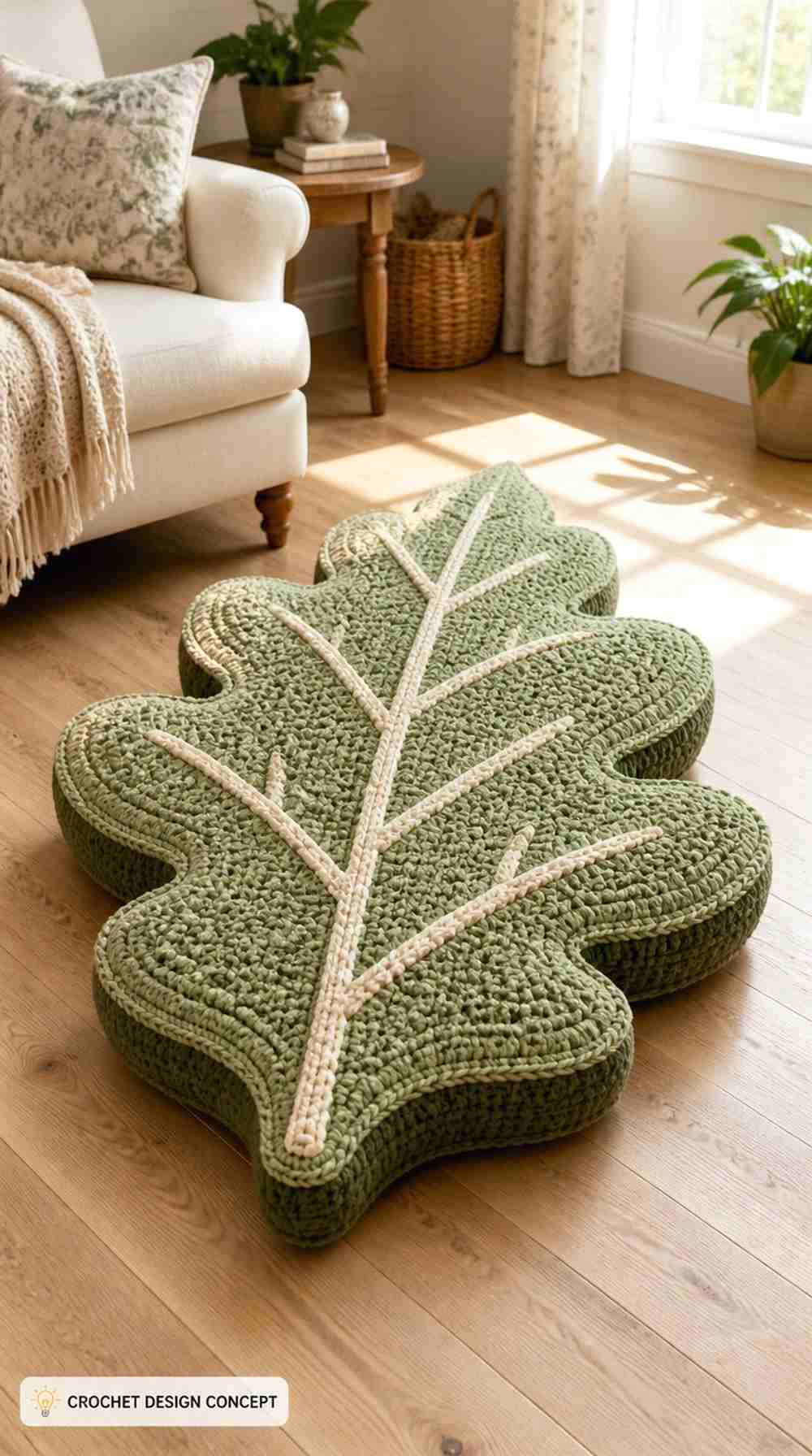
Six softly rounded lobes give this sage-green crochet floor pouf its familiar oak-leaf silhouette. A raised ivory central vein branches across the moss-stitch surface, while a narrow olive-green side band creates visible padding depth. The tapered tip finishes the woodland-inspired shape without adding a separate stem.
The broad middle gives the design a more substantial appearance than a narrow leaf cushion. For a real version, the padded lobes would need careful shaping so the edges remain defined without leaving unsupported or lumpy sections.
- Oak-Lobe Shaping: Keep the six side lobes softly rounded and balanced, allowing the central portion to remain broad enough for the intended insert.
- Branching Veins: The raised ivory details should follow the leaf’s natural direction without creating excessively thick ridges across the central surface.
- Olive Side Gusset: A continuous side band can provide depth, but it must follow the curved lobes without puckering at their junctions.
- Intended Use: This broad shape could inspire a floor-lounging cushion; actual seating support would depend on a properly constructed and tested interior.
2. Crochet Moss Fern Frond Floor Pouf
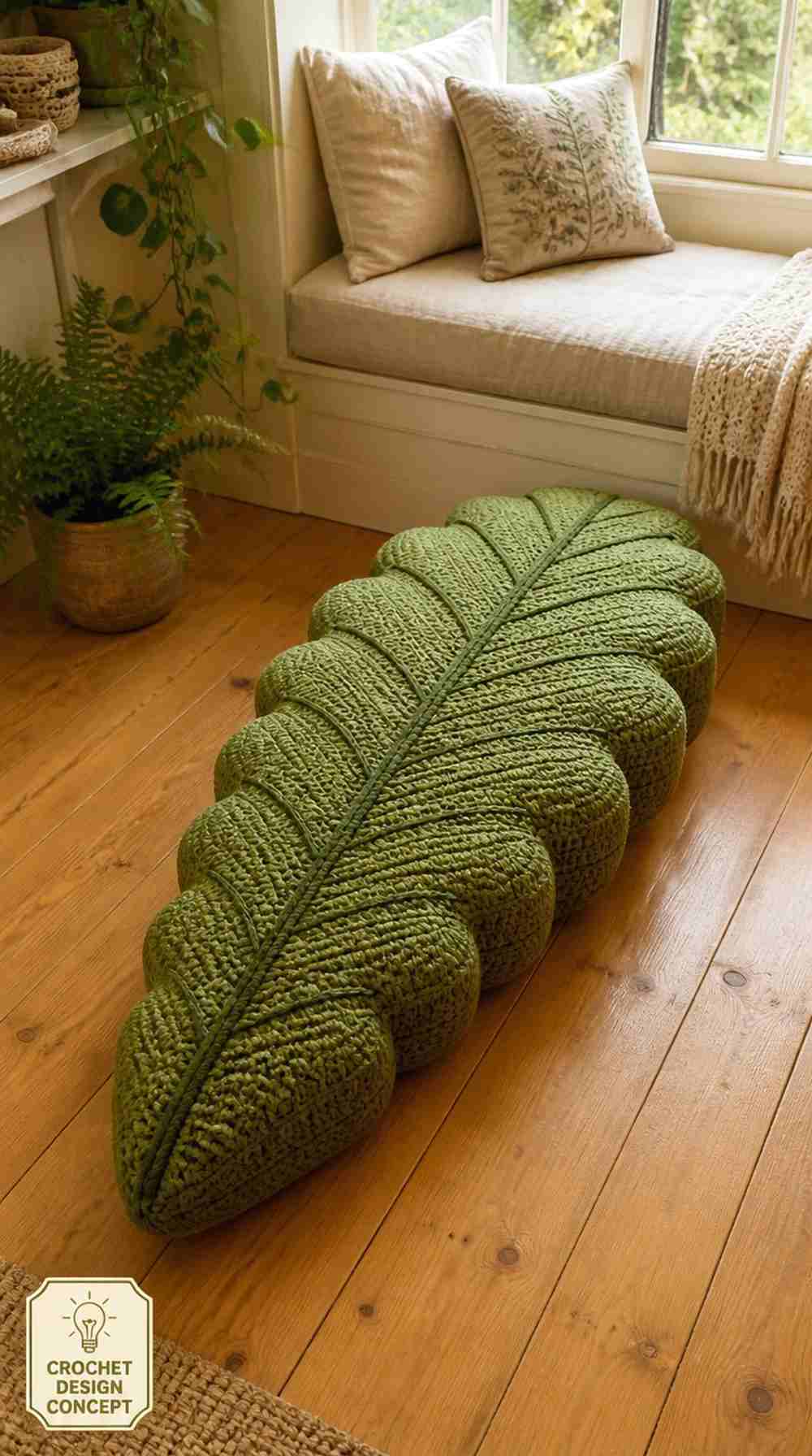
Deep moss-green crochet forms an elongated fern-inspired cushion with tapered ends and shallow rounded notches along its edges. A darker olive rib runs through the center, accompanied by short diagonal veins that suggest paired fern leaflets. The side gusset gives the unified shape a padded profile.
Rather than using separate dangling fronds, this concept keeps the leaflets within one continuous cushion outline. That makes the silhouette more practical to explore as a soft floor accent. The narrow ends still require attention to prevent uneven stuffing or twisting.
- Fern-Edge Notches: Use shallow rounded indentations to suggest fern leaflets without creating fragile projections that could fold or snag.
- Central Rib Texture: The long olive vein provides a visual guide through the elongated form and should remain aligned with the cushion’s center.
- Tapered Filling: Plan the inner cushion to support both ends without overstuffing the narrow areas.
- Floor Position: The long silhouette may suit an open reading corner better than a busy passage where the tapered tips could become a trip hazard.
3. Crochet Chartreuse Ginkgo Fan Pouf
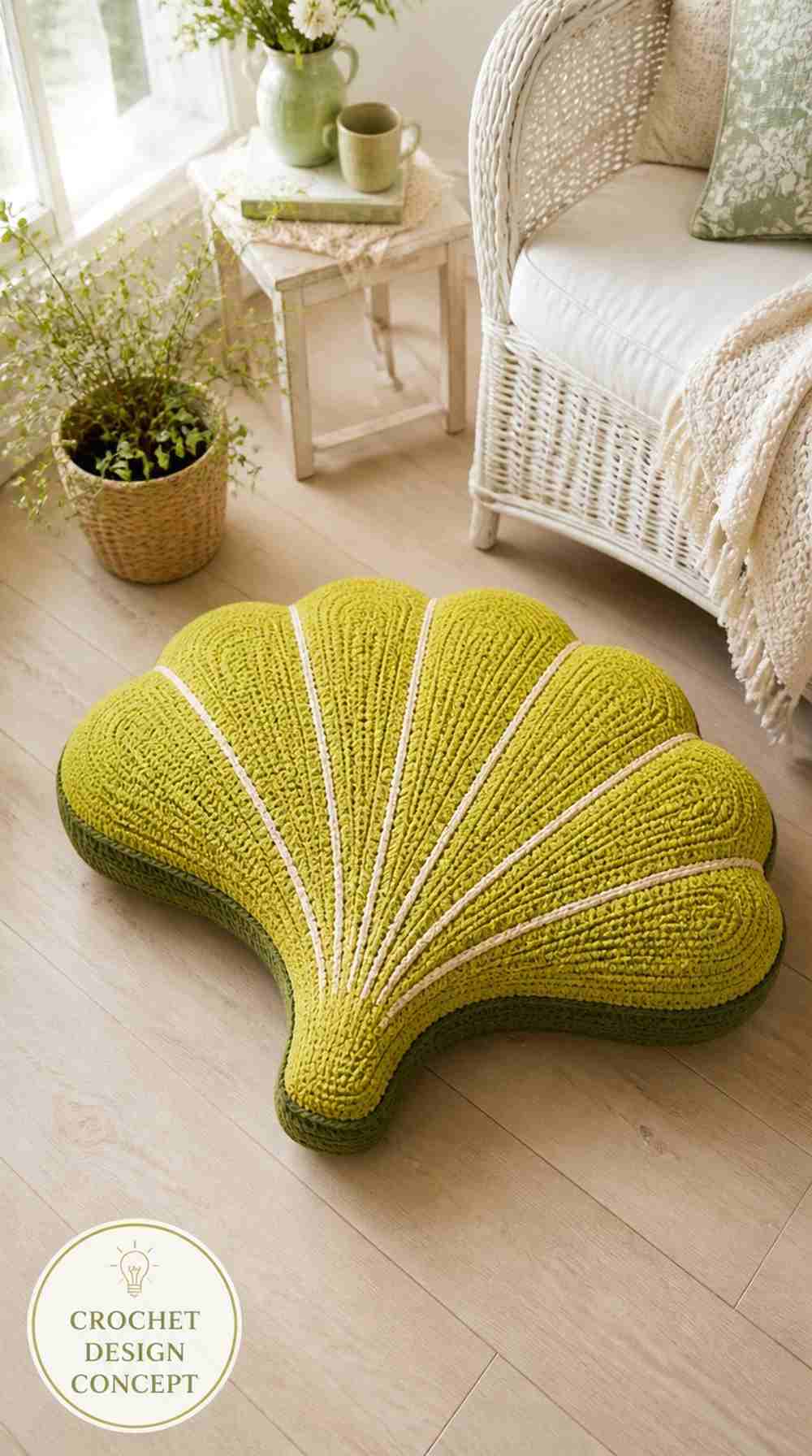
Warm chartreuse crochet spreads into a broad ginkgo-inspired fan with seven gently scalloped upper sections. Pale-cream raised ribs extend outward from the short tapered base, giving the surface a radiating pattern. A deep-sage side gusset supports the softly padded shape.
The fan silhouette is the defining feature, offering a wider upper section than an oval leaf pouf. Its curved segments give the cushion a decorative edge without requiring separate petals. When developing a real construction, the transition between the narrow base and the broad fan would need careful planning.
- Fan Expansion: Shape the upper section gradually so all seven scalloped segments spread evenly without pulling the lower base out of proportion.
- Radial Ribs: Keep the cream ridges centered within their fan sections, with similar spacing between the decorative lines.
- Side-Band Transition: The sage gusset must accommodate the broad curved edge and narrower base without bunching at the corners.
- Decorative Versus Seating Use: The wide fan may look inviting, but its tapered base does not automatically provide stable support for a seated person.
4. Crochet Dusty Sage Maple Leaf Pouf
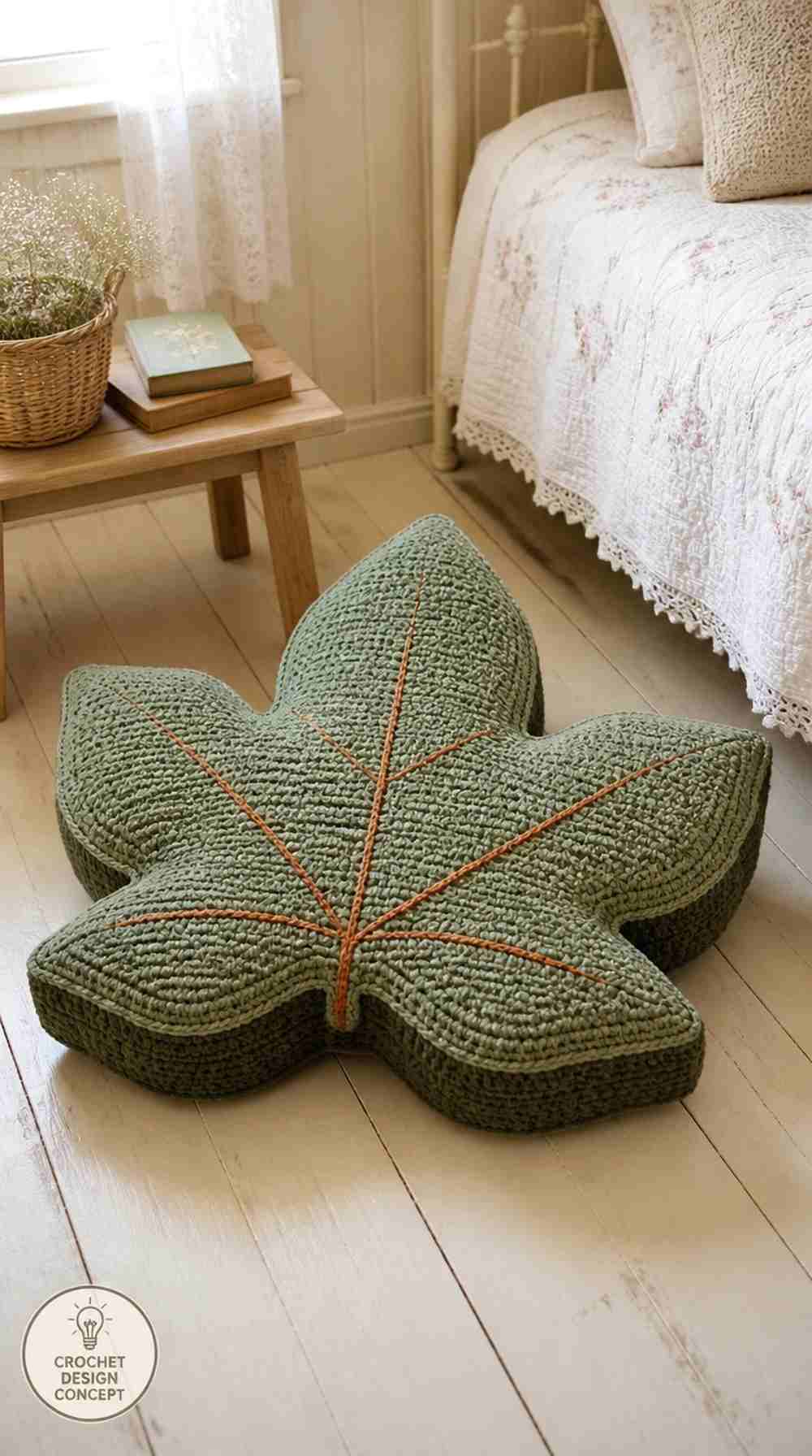
Five broad lobes create the pointed outline of this dusty-sage crochet maple-leaf pouf. Fine terracotta-copper veins radiate across the dense top surface, while a narrow dark-olive side band gives the cushion noticeable thickness. The tips are softly rounded rather than rigid or sharp.
The combination of muted green and copper adds an autumnal touch without making the whole design brown or orange. Its five-lobed silhouette is visually dramatic, although the indentations between the lobes could make both panel shaping and inner filling more complicated.
- Five-Lobe Balance: Keep the central point longest, with proportionate side lobes and smaller lower sections to maintain the recognizable maple shape.
- Copper Vein Placement: Position the fine surface-crochet lines so they follow each lobe rather than crossing the indentations awkwardly.
- Inset Corners: Check the tight curves between lobes when joining the gusset, since excess fabric can collect at these points.
- Shape Preservation: A closely fitted inner cushion may help retain the pointed outline better than loosely distributed filling, but this needs testing.
5. Crochet Eucalyptus Oval Leaf Pouf
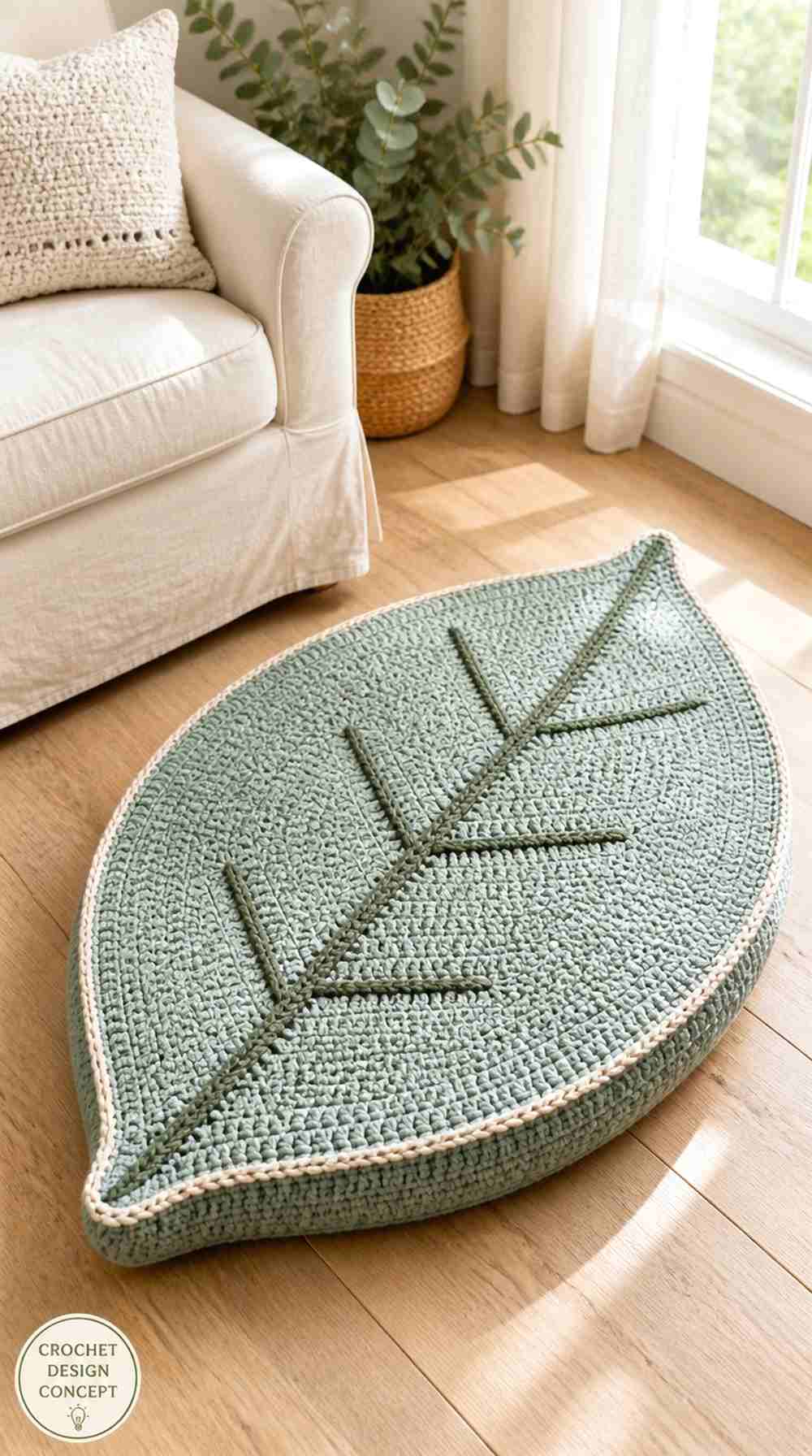
Soft blue-sage crochet gives this low-profile floor pouf a calm eucalyptus-inspired appearance. Its elongated oval shape finishes in gently pointed ends, with a raised dark-sage central vein and four subtle branching lines. Warm-ivory piping follows the outer edge, while a matching eucalyptus-green side band adds depth.
The smooth, closely textured surface feels visually simpler than heavily lobed leaf designs. That makes the form useful for exploring a soft floor cushion with fewer complex outer curves. The pointed ends still need appropriate filling and careful finishing.
- Oval Leaf Symmetry: Keep both sides of the long central vein balanced so the cushion does not look wider on one side.
- Ivory Piping: The narrow light border should follow the leaf edge without tightening the fabric around the two tips.
- Low-Profile Construction: A shallow form can work as a decorative floor cushion, but softness and support depend on the actual insert.
- Blue-Sage Palette: The subdued eucalyptus color pairs naturally with pale wood and cream, while the darker veins provide enough contrast to reveal the leaf structure.
6. Crochet Forest Ivy Leaf Floor Pouf
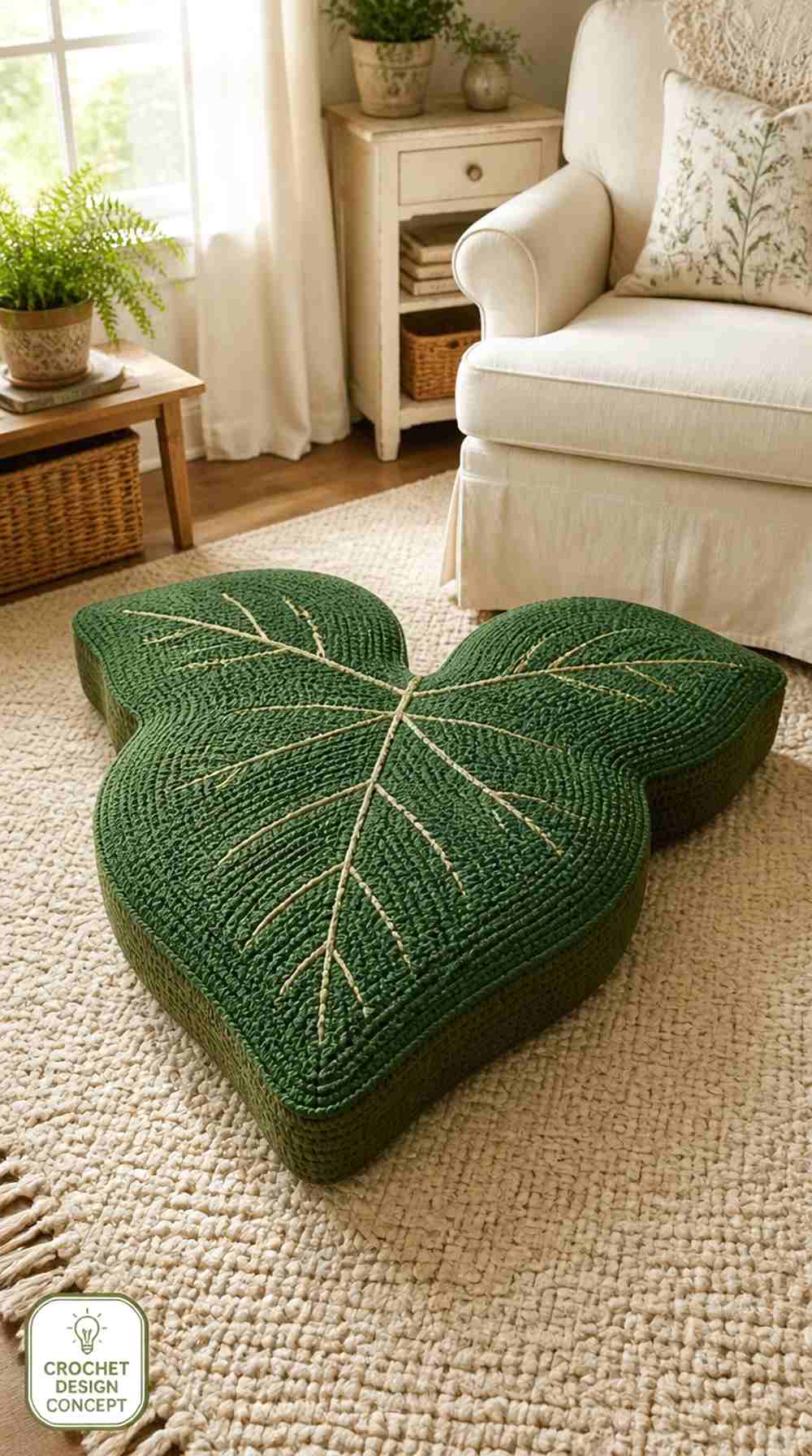
Rich forest-green crochet forms an ivy-inspired leaf with three softly pointed lobes, a shallow heart-shaped upper notch and a tapered lower tip. Fine antique-cream veins branch toward the lobes, standing out against the dense dark-green surface. The deep-olive side gusset creates a gently stuffed profile.
The darker color gives this design a more traditional woodland feeling. Unlike the long willow or oval eucalyptus shapes, its appeal comes from the bold outer contour. A real pouf would need careful attention to the inner notch and the three lobes, where shaping errors could become noticeable.
- Ivy Silhouette: Preserve the three outward lobes and upper heart-shaped indentation without making the edges excessively narrow or fragile.
- Cream Vein Contrast: The pale lines should branch naturally toward each lobe while remaining fine enough not to dominate the green surface.
- Notched Edge Joining: The upper indentation needs neat stitching so the side band follows the inward curve without folding.
- Dark Yarn Definition: Choose yarn with visible stitch structure; extremely fuzzy dark yarn could obscure both the crochet texture and the cream veins.
7. Crochet Willow Slender Leaf Floor Pouf
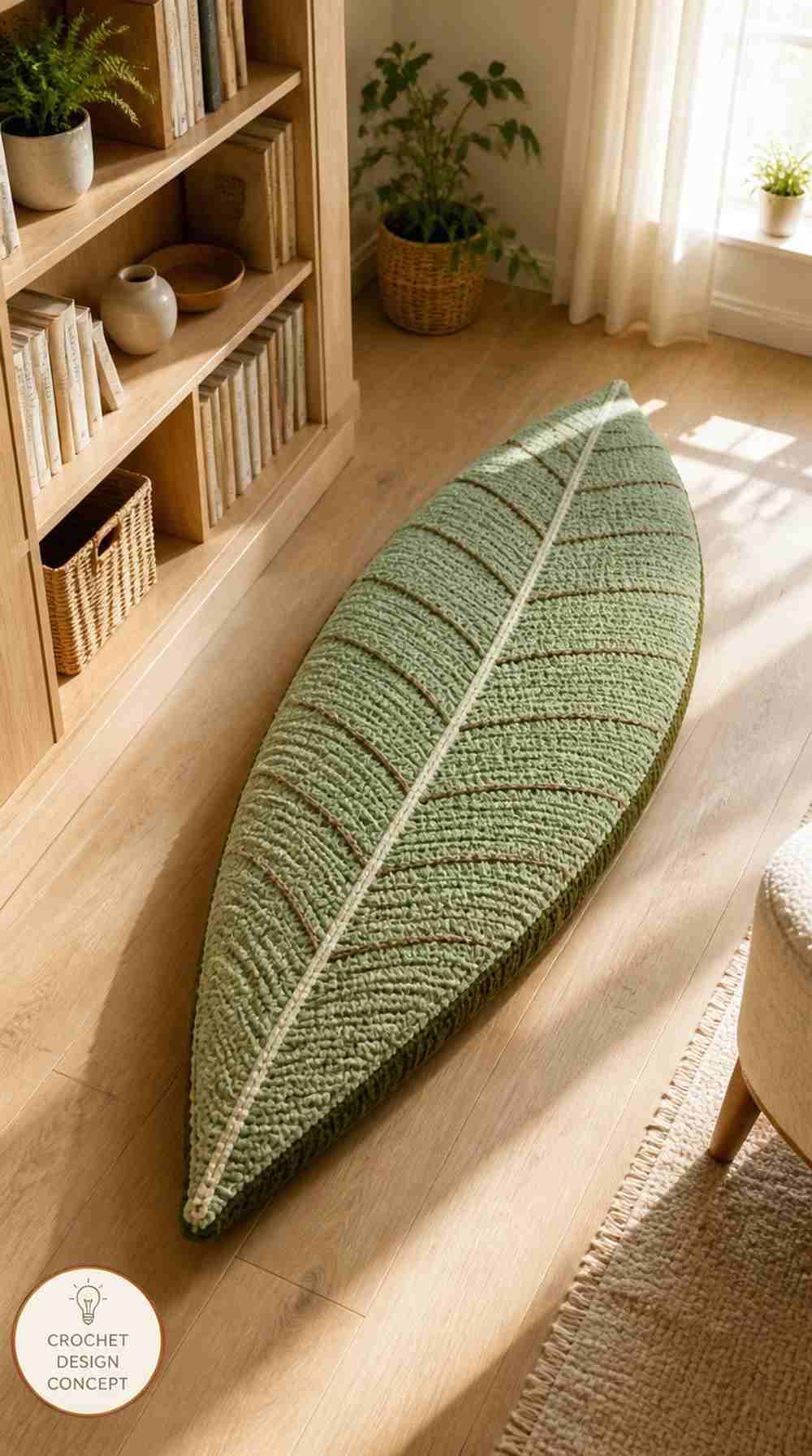
An extra-long sage-green shape gives this willow-inspired crochet floor cushion a relaxed botanical appearance. A narrow cream central stripe travels from one tapered end to the other, accompanied by muted-taupe diagonal veins. Soft ribbed crochet stitches and a low moss-green side band complete the elongated form.
Its proportions make it look more like a soft floor-lounging accent than a conventional upright pouf. The broad middle offers visual fullness, but the narrow ends would not be suitable places to concentrate weight. Careful insert planning is important to keep the full length evenly shaped.
- Lengthwise Proportions: Maintain a wider middle with smooth tapering toward both ends rather than creating a narrow rectangular cushion.
- Central Cream Stripe: The long decorative vein must remain straight through the middle, with the smaller taupe veins angled consistently outward.
- Filling Distribution: Pay attention to the tapered ends; loose filling may migrate toward the broader center after repeated handling.
- Floor Clearance: This extended silhouette takes up more length than a compact pouf, so measure the intended reading-nook area before making it.
8. Crochet Autumn Rust Beech Leaf Pouf
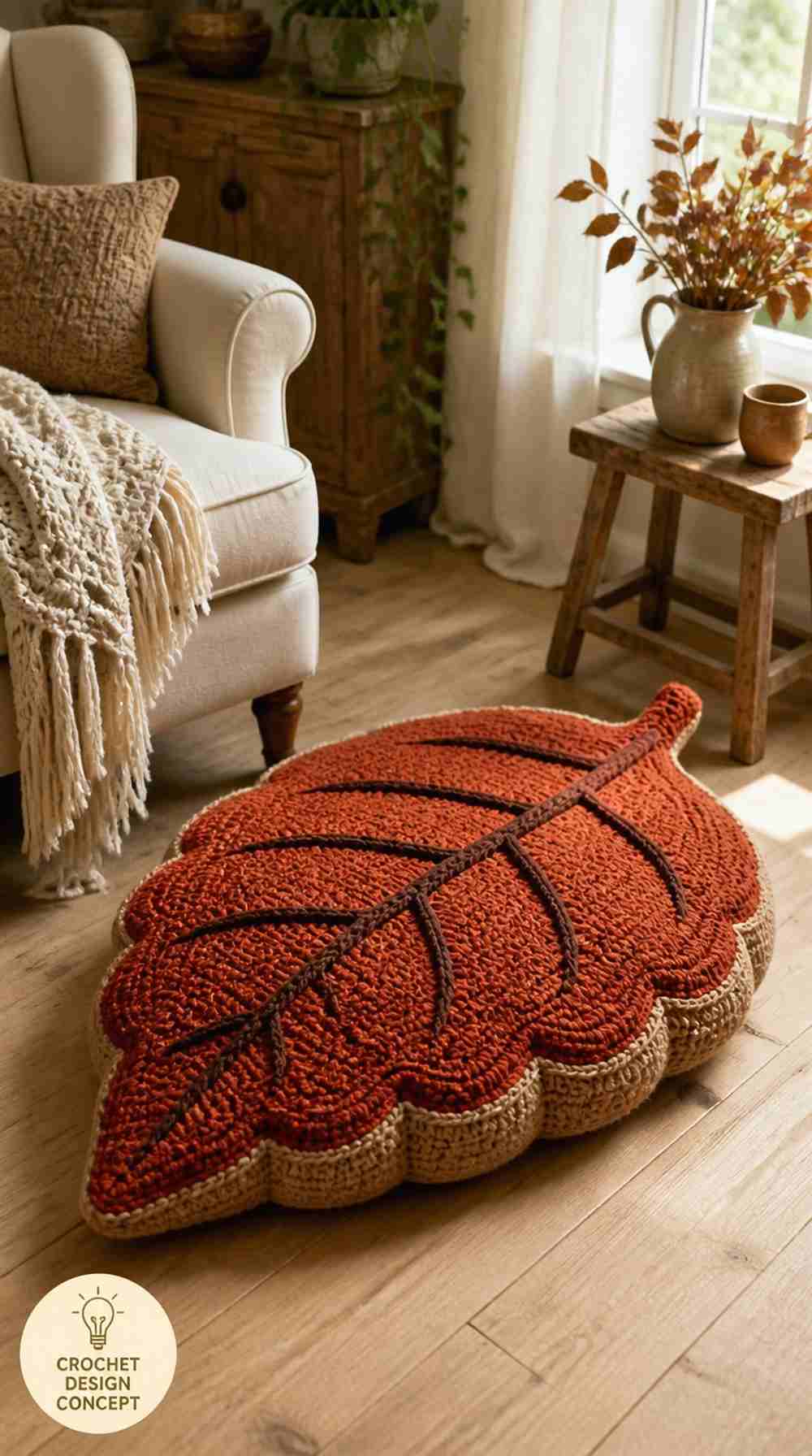
Burnt-rust terracotta crochet gives this beech-leaf pouf a warm autumn appearance. The broad elongated top has a pointed tip and small tooth-like curves around its sides, with a cinnamon-brown central vein and six branching lines. A clay-colored gusset creates the padded floor-cushion profile.
The tiny edge details distinguish this design from a simple oval leaf. Its earthy palette also suits rooms with natural wood, cream upholstery and warm woven textures. The delicate outer shaping may be better suited to decorative lounging than frequent floor seating, depending on the finished construction.
- Subtle Serrations: Keep the tooth-like edge curves shallow enough to preserve a continuous cushion body rather than creating loose pointed extensions.
- Cinnamon Veins: The dark raised lines help define the autumn leaf, especially against the closely textured burnt-rust crochet surface.
- Clay Side Band: Plan the gusset around the gently serrated perimeter without adding excessive fabric between small edge curves.
- Warm Yarn Care: Check the care requirements of the rust, cinnamon and clay shades before choosing yarns from different collections.
9. Crochet Variegated Hosta Leaf Floor Pouf
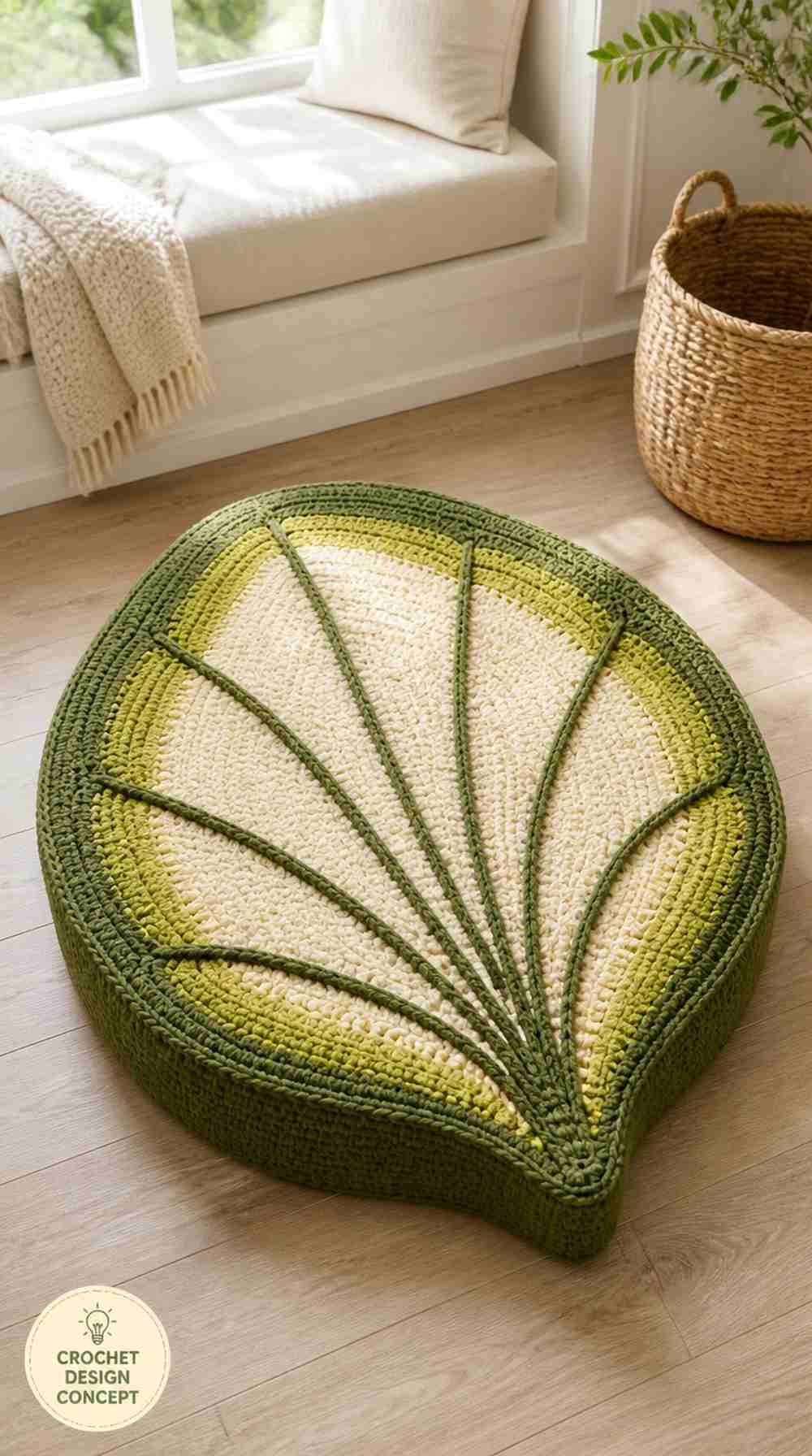
A broad hosta-leaf silhouette gives this crochet floor pouf a striking botanical shape. A buttery-cream central section is surrounded by wide wasabi-and-olive-green margins, while six raised moss-green ribs spread outward from the tapered base. The gently wavy edges and deep-olive side band emphasize its padded form.
The color arrangement makes this one of the most distinctive designs in the collection. Unlike a single-color leaf cushion, the pale center highlights the broad surface area. When adapting the concept, the color transitions and raised ribs would need careful coordination.
- Variegated Colorwork: Keep the cream center clearly framed by the green margins rather than letting the lighter shade break irregularly across the leaf.
- Radiating Ribs: Align the six moss-green raised lines with the leaf’s broad surface so they appear to spread naturally from the base.
- Wavy Outer Edge: Use restrained shaping to create gentle hosta-like curves without turning the perimeter into deep ruffles.
- Light Center Maintenance: The cream section may show dust or handling marks more readily than the darker green margins.
10. Crochet Golden Chestnut Leaf Pouf
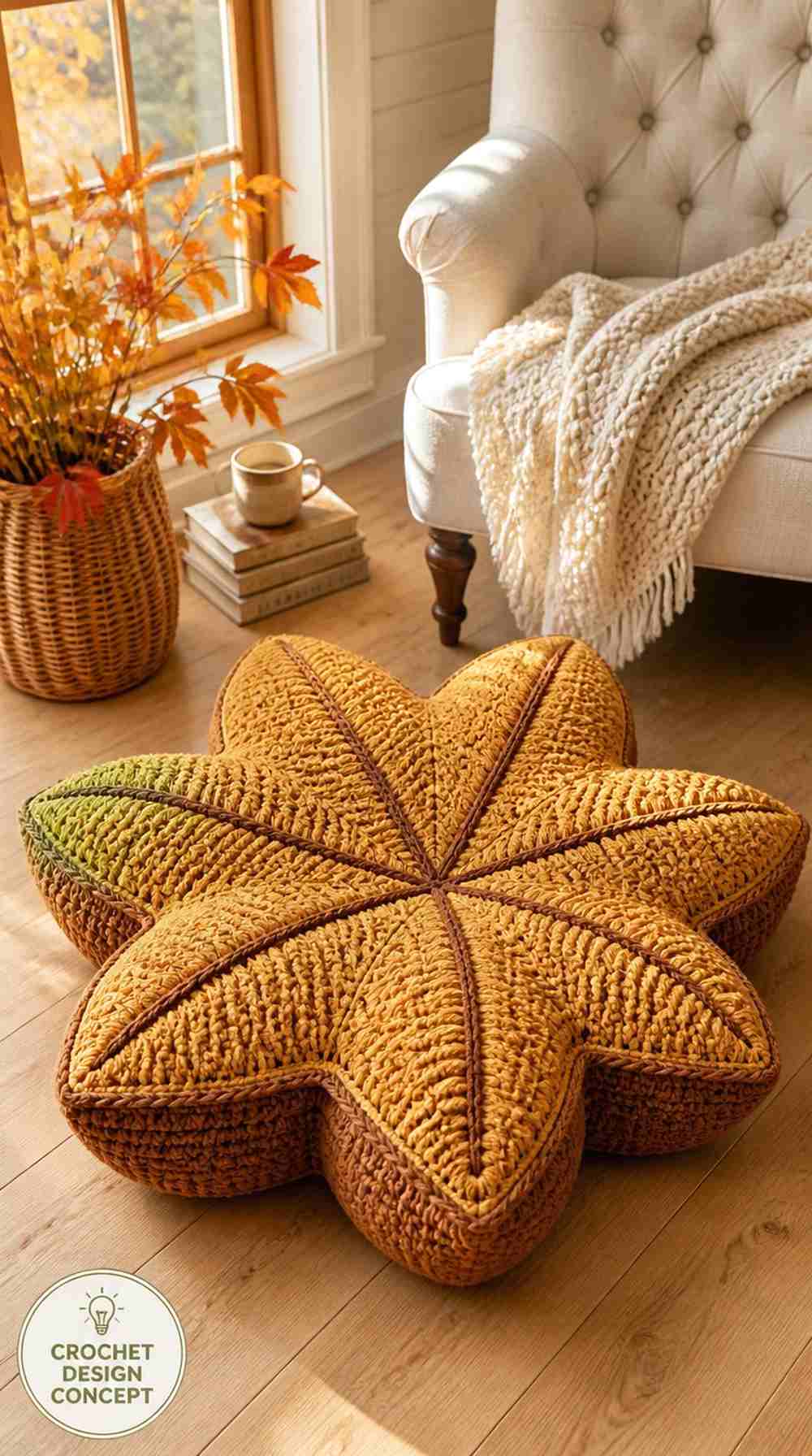
Seven broad tapered lobes spread from a common base in this golden-ochre crochet chestnut-leaf pouf. Each lobe contains a raised cocoa-brown vein, while a warm caramel edge and honey-brown side gusset bring depth to the unified padded shape.
The radiating leaf arrangement makes this design more dramatic than an oval or pointed single leaf. Its golden autumn colors create a warm cottagecore look. Although the lobes resemble separate leaflets, the concept keeps them connected into one cushion body; that distinction matters when planning structural support.
- Seven-Lobe Construction: Keep the pointed sections united through a broad central area instead of relying on narrow connections between separate stuffed pieces.
- Cocoa Vein Alignment: Position each raised line along its respective lobe, following the outward direction of the chestnut-leaf arrangement.
- Caramel Edge: The warm border should define the seven tips without becoming bulky around the spaces between lobes.
- Support Limitation: A complicated outer outline may be more suitable for decorative floor use unless a tested insert provides stable central support.
11. Crochet Mint Scalloped Leaf Floor Pouf
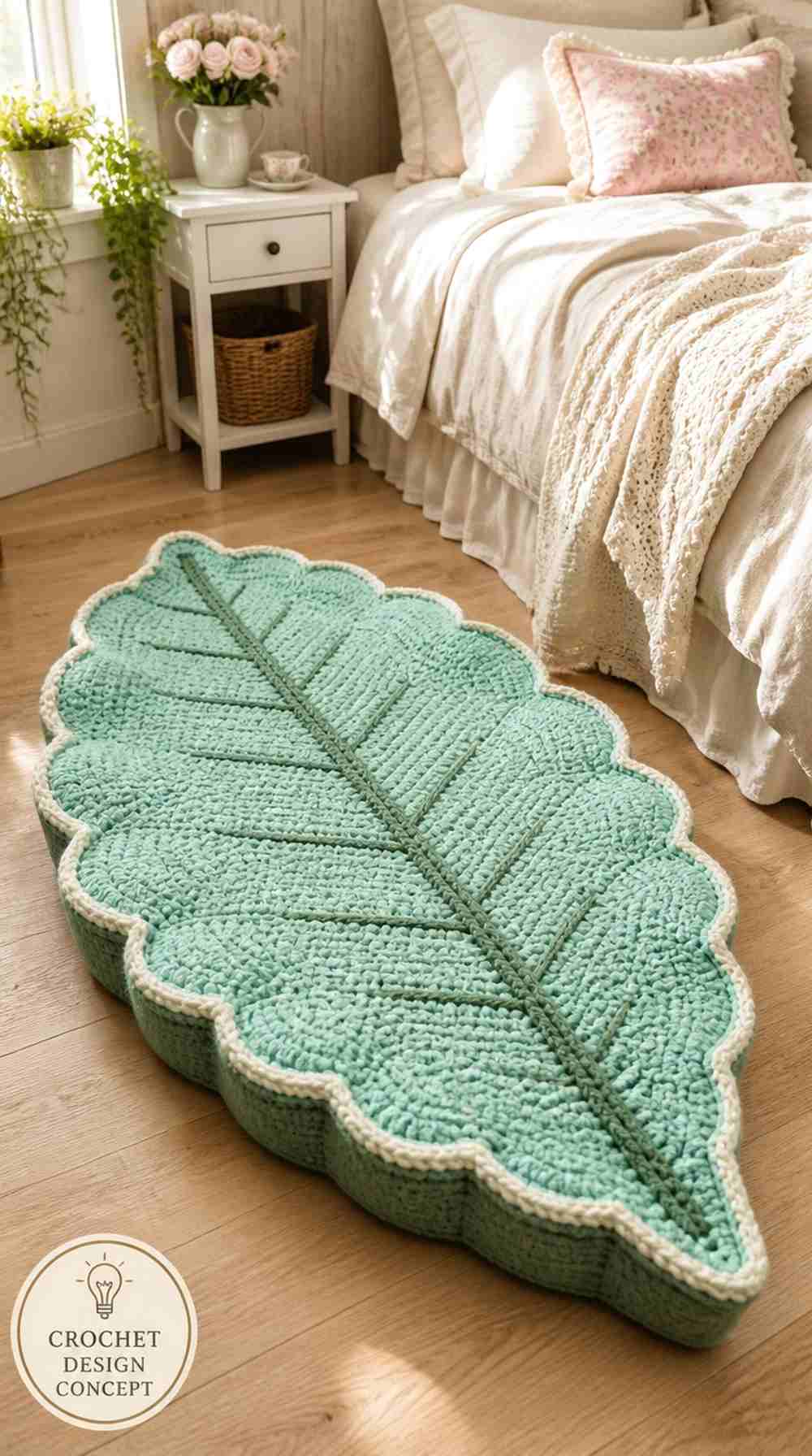
Fresh mint-green crochet creates a broad leaf-shaped floor cushion with a gently pointed tip and many shallow rounded serrations. A deep-sage central vein runs through the surface, with small diagonal ridges branching toward the sides. Fine cream edging follows the scalloped outline, and a sage-green gusset gives the cushion visible depth.
The combination of soft green and cream makes this design especially suitable for a light cottage bedroom. Its scalloped edge gives it more character than an ordinary oval cushion, although the repeated curves will require consistent shaping.
- Scalloped Edge Consistency: Keep the small rounded serrations evenly spaced so the leaf outline remains gentle rather than irregular.
- Cream Border Tension: The delicate edging should follow each curve without tightening the perimeter or pulling the cushion inward.
- Mint and Sage Contrast: The darker veins help distinguish the leaf’s internal structure without making the fresh mint palette feel heavy.
- Repeated Edge Shaping: Test a small section containing several scallops before attempting the entire perimeter, especially when joining the side gusset.
12. Crochet Blackberry Three-Lobed Leaf Pouf
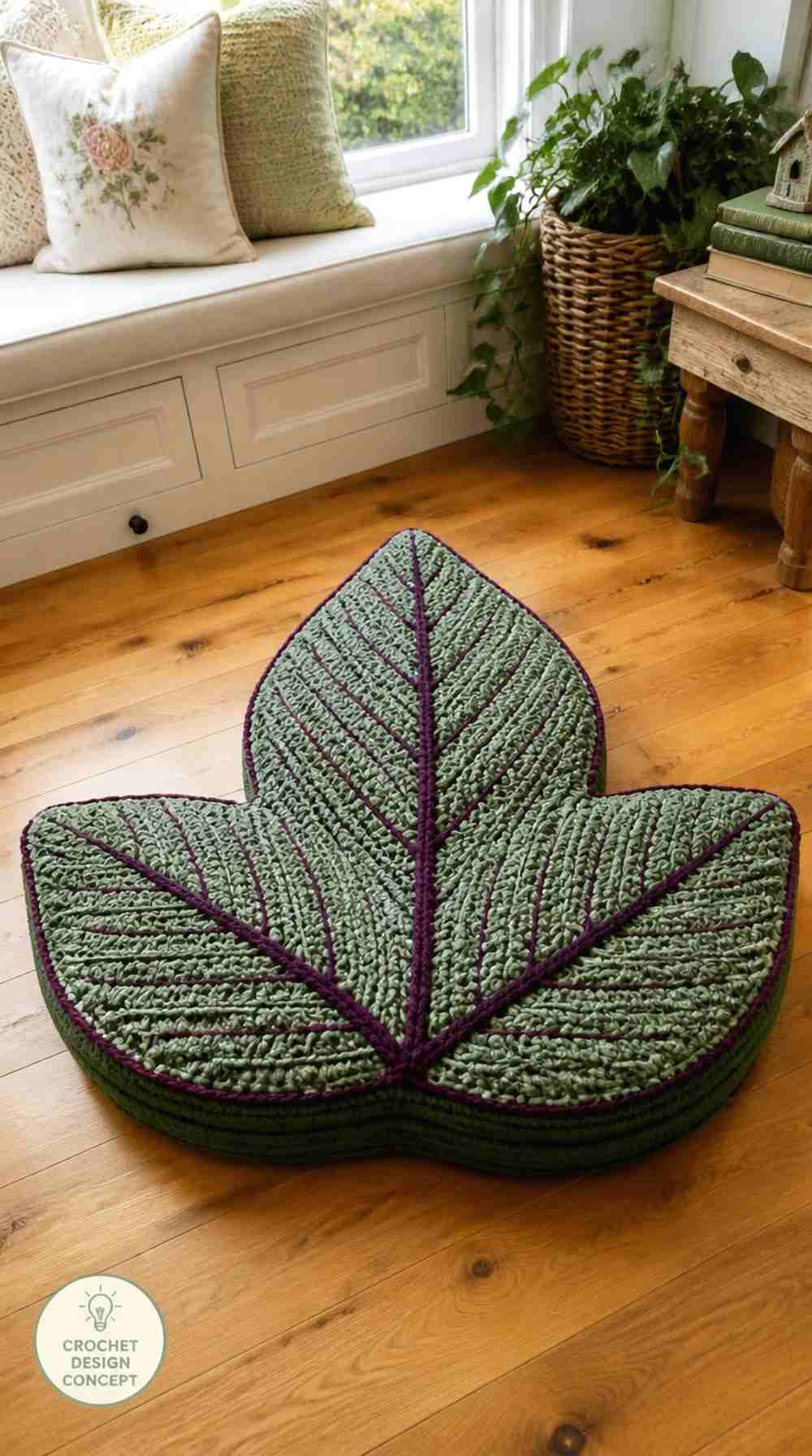
Three broad sage-green lobes form this blackberry-leaf-inspired crochet floor pouf. The central lobe extends farther than the two angled side lobes, while deep-plum raised veins travel through each section. A subtle burgundy line marks the shared base, and the dark-sage side gusset gives the unified shape a softly padded profile.
The contrast between sage and deep plum makes this design more unusual than traditional all-green botanical cushions. Its three-lobed outline also creates an interesting arrangement without the complexity of seven or more pointed sections.
- Unified Three-Lobe Shape: Keep the three sections joined through a substantial central body instead of creating separate narrow attachments.
- Plum Vein Detail: Use restrained raised lines to define each lobe without making the top surface excessively uneven.
- Burgundy Base Accent: The narrow burgundy line helps mark where the lobes come together without introducing another large color section.
- Side-Lobe Support: Check the filling around the angled outer lobes, since unsupported corners may flatten or fold after repeated movement.
13. Crochet Ivory Birch Leaf Floor Pouf
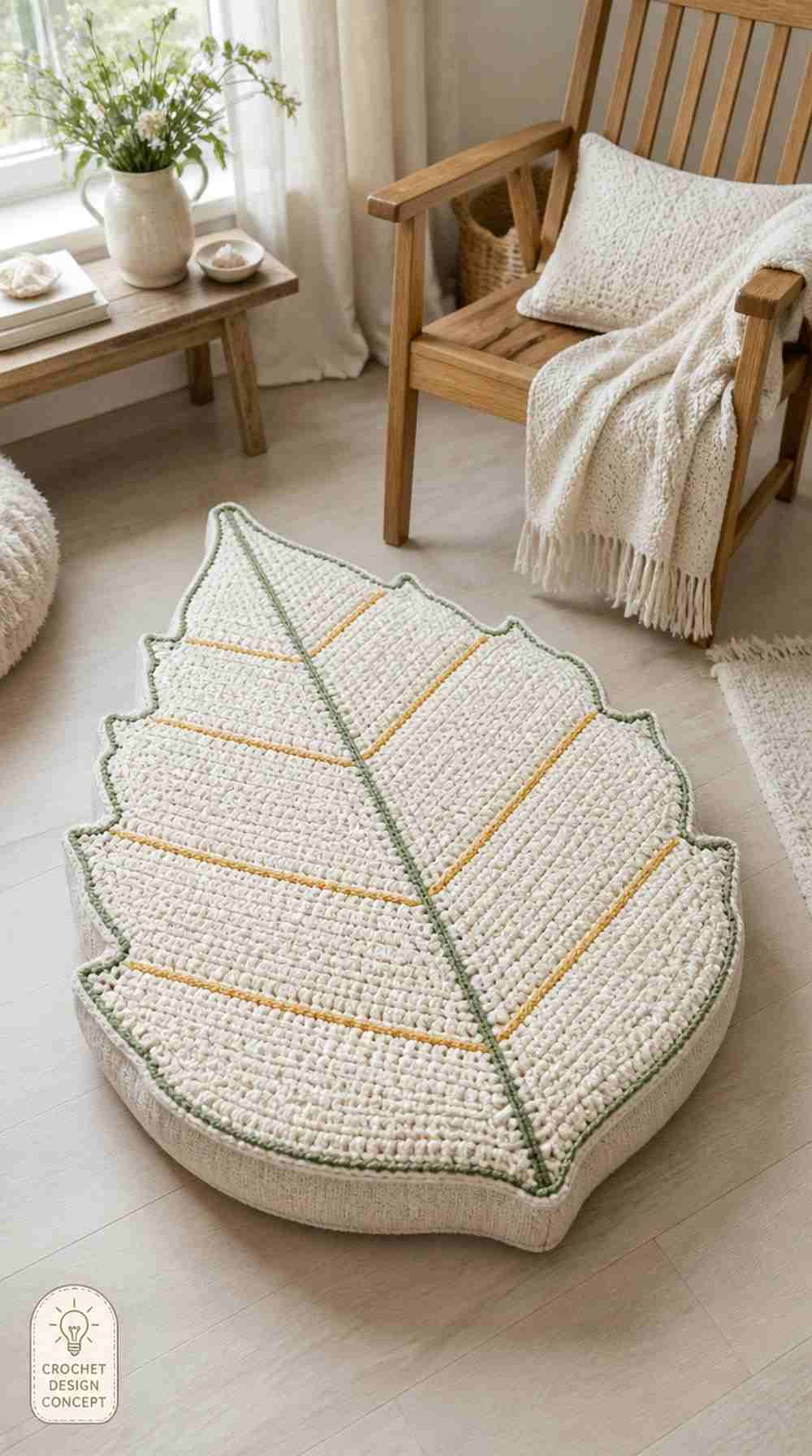
Antique-ivory crochet gives this birch-leaf floor pouf a delicate vintage appearance. Its outline has a rounded lower section, pointed upper tip and shallow serrations along both sides. A fine sage-green central vein and six honey-yellow branching veins introduce color, while muted-olive edging and an oatmeal side gusset define the padded silhouette.
This pale design offers a quieter alternative to the strong green and autumn-colored poufs. The visible leaf veins make the ivory surface more interesting without requiring dimensional appliqués. Its lighter yarn, however, deserves practical consideration if the cushion will frequently touch the floor.
- Birch Leaf Outline: Maintain the pointed tip and fine serrations while keeping the central area broad enough for a suitable inner cushion.
- Honey-Yellow Veins: Position the six diagonal lines consistently along the sage central vein so the botanical details remain delicate.
- Oatmeal Side Gusset: The neutral side band should provide visible depth without drawing attention away from the ivory upper panel.
- Floor Contact: Pale crochet can collect visible dust and dirt, making removable construction and suitable cleaning methods especially useful.
14. Crochet Sage Magnolia Leaf Pouf
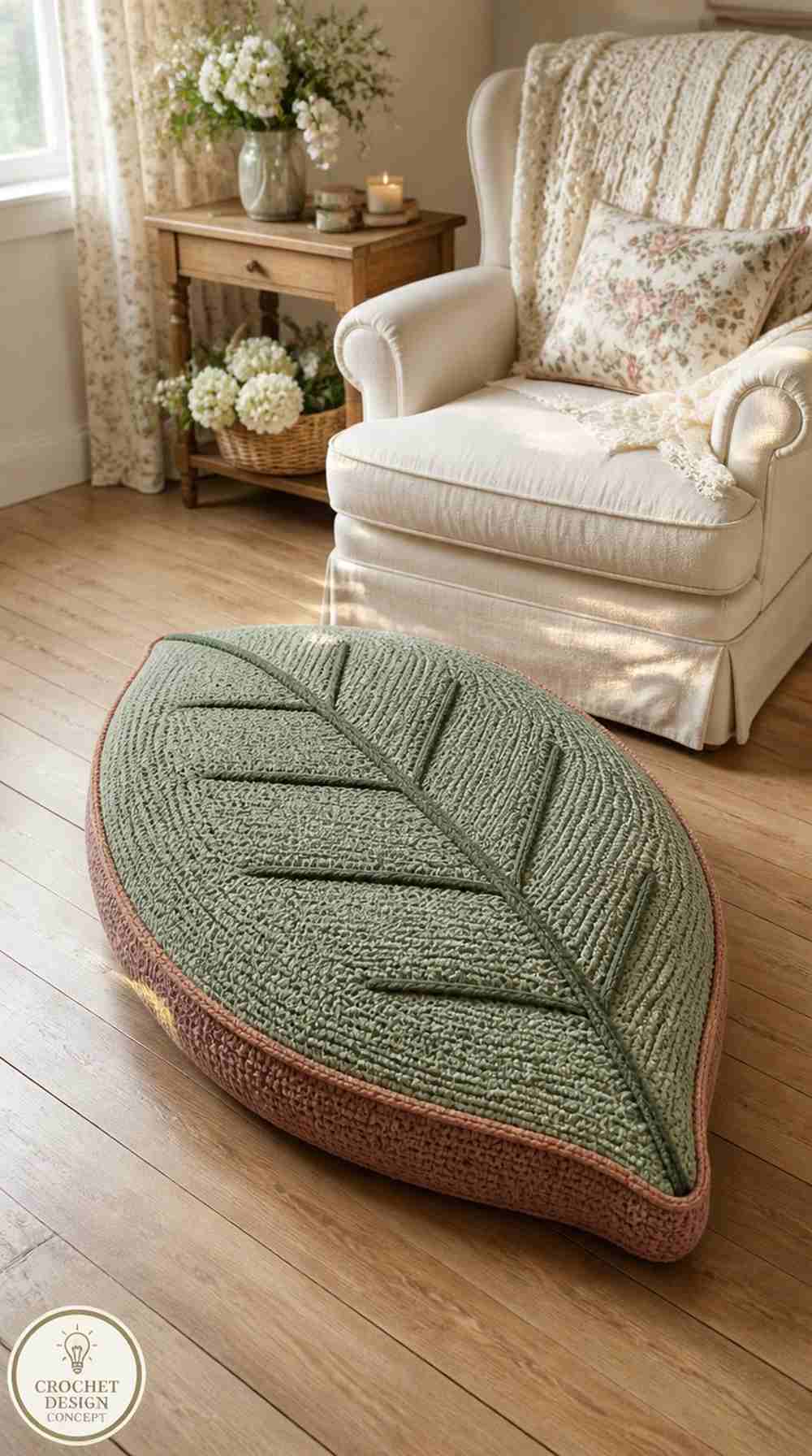
Soft grey-sage crochet forms a broad elliptical magnolia-leaf cushion with a gently tapered tip. A dark-sage raised central vein and four short branches on each side decorate the smooth surface. Dusty-copper edging outlines the upper panel, while a warm rose-brown gusset gives the leaf its distinctive two-tone profile.
The restrained shaping makes this design appear softer and more substantial than the highly lobed options. Its rose-brown side is inspired by the warmer underside of a magnolia leaf. The broad form may also be easier to adapt to a conventional shaped insert than a deeply notched botanical silhouette.
- Elliptical Leaf Balance: Keep the shoulders rounded and the tip gently tapered, avoiding sharp corners that could distort after filling.
- Copper Edge Detail: A fine warm-colored seam separates the grey-sage top from the rose-brown side without adding a bulky raised border.
- Two-Tone Construction: Plan where the top panel meets the colored gusset so the warm underside-inspired shade remains consistently visible.
- Surface Comfort: The relatively smooth crochet top could be preferable to heavily textured designs, although actual support depends on the interior.
15. Crochet Olive Water Lily Leaf Pouf
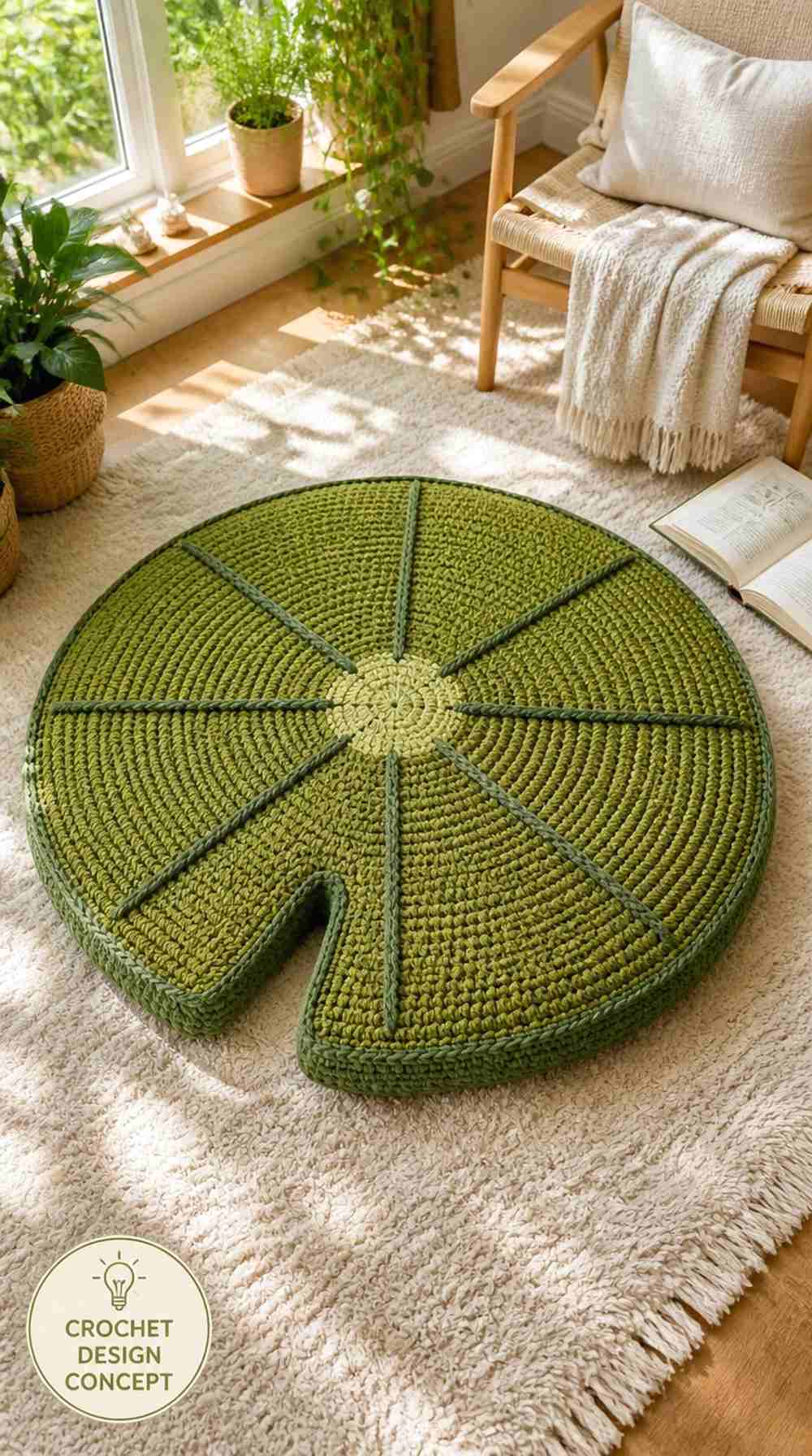
A wide, nearly circular olive-green cushion takes inspiration from a water-lily leaf. One triangular notch interrupts the rounded perimeter, while eight dark-sage raised veins radiate from a pale-moss center. Gentle concentric crochet stitches fill the sections between the veins, and a forest-olive border defines the outer shape.
The broad circular area gives this concept a different silhouette from pointed leaves and elongated botanical cushions. Its distinctive notch adds character but also introduces a construction challenge. The inner cushion and gusset would need to follow the indentation accurately without creating a weak or awkwardly folded section.
- Circular Leaf Shape: Maintain a broad rounded body while keeping the notch clearly visible as part of the intended water-lily silhouette.
- Eight Radial Veins: Distribute the dark-sage raised lines consistently around the pale-moss center to create a balanced botanical pattern.
- Notched Gusset: The inward corner requires careful shaping and reinforcement appropriate to the chosen construction.
- Broad Floor Profile: The rounded footprint may offer a useful starting shape for a floor cushion, but seating stability still requires separate testing.
Practical Guide to Crochet Leaf-Shaped Floor Poufs
Leaf-shaped floor poufs need more planning than ordinary decorative pillows because they combine unusual outer contours with padding, floor contact and potentially repeated pressure.
Decide whether the pouf is decorative or meant for sitting
A soft leaf-shaped cushion may look substantial without being suitable for regular seating. For an actual seat, the filling, base, seams and overall structure must provide stable support under the intended user’s weight. No visual design alone can establish a safe load capacity.
Decorative floor cushions can prioritize elaborate leaf outlines, but a pouf intended for sitting benefits from a stable footprint, even padding and a dependable inner structure.
Choose the inner construction first
For a leaf silhouette, a shaped fabric liner or appropriately constructed foam insert may help maintain the intended outline. Loose fiberfill can work for soft decorative accents, but may compress or migrate, particularly around pointed tips and lobes.
Keep loose filling inside a secure liner. A removable crochet cover can make cleaning easier when designed with a suitable closure.
Compare leaf shapes before starting
| Shape | Main construction challenge |
|---|---|
| Broad oval | Keeping both sides symmetrical |
| Pointed leaf | Supporting the narrow tips |
| Lobed oak or maple | Shaping inward curves |
| Fan-shaped ginkgo | Joining broad and narrow sections |
| Serrated birch or mint | Maintaining small repeated edge details |
| Notched water lily | Finishing the inward notch |
Choose yarn with floor use in mind
A close, durable crochet fabric is generally more suitable for a pouf cover than loose decorative lace. Consider fiber care, abrasion, stitch density and how easily the yarn collects lint or dust.
Before committing to the full pouf, work a sample and evaluate its thickness, stretch and handling. Keep finished floor cushions away from heaters and flames, and consider trip hazards, slipping and access for cleaning.
Want to Make Something Similar?
These 15 botanical poufs are AI-generated design concepts, not exact published patterns. The following resources explain real crochet techniques that could help when planning a related project.
- Free Crochet Floor Pouf Tutorial — MJ’s Off The Hook Designs: Michelle Moore explains a textured round floor pouf, including an inner liner, filling and different closing methods. The construction is useful for learning about pouf interiors, although it does not produce the leaf shapes shown here. MJ’s off the Hook Designs
- Leaf Pillow Pattern — Yarnspirations Design Studio: This free crochet pillow design uses shaped leaf panels and surface-crochet details. It provides a reference for leaf shaping, but its original pillow dimensions and construction should not be assumed suitable for floor seating. Ravelry
- Crochet Leaf Cushion Tutorial — Amigurmi Creations: This decorative leaf cushion pattern demonstrates shaping curved leaf sections and joining two panels before stuffing. It is a pillow-making reference, not a tested floor-pouf seat pattern. amigurmicreations
To understand the difference between decorative cushions and larger floor-seating pieces, you can also browse Yarn Nest Studio’s 17 Crochet Reading Nook Floor Cushion Ideas collection.
Which Cottagecore Leaf Pouf Should You Choose?
| Design | Main visual feature | Important consideration |
|---|---|---|
| Sage Oak Leaf | Six rounded lobes and ivory veins | Curved gusset shaping |
| Moss Fern Frond | Long fern-inspired outline | Supporting tapered ends |
| Chartreuse Ginkgo Fan | Seven-part fan silhouette | Broad-to-narrow transition |
| Dusty Sage Maple Leaf | Five pointed lobes | Inward corners and filling |
| Eucalyptus Oval Leaf | Smooth blue-sage oval | Balanced pointed ends |
| Forest Ivy Leaf | Three lobes and cream veins | Upper notch construction |
| Willow Slender Leaf | Extra-long ribbed leaf | Length and floor space |
| Autumn Rust Beech Leaf | Rust surface with small serrations | Repeated edge shaping |
| Variegated Hosta Leaf | Cream center and green margins | Colorwork and ribs |
| Golden Chestnut Leaf | Seven radiating lobes | Unified central structure |
| Mint Scalloped Leaf | Soft mint and cream edging | Consistent scalloped outline |
| Blackberry Three-Lobed Leaf | Sage with deep-plum veins | Supporting side lobes |
| Ivory Birch Leaf | Light ivory with honey veins | Cleaning and delicate edges |
| Sage Magnolia Leaf | Smooth sage and rose-brown side | Two-tone panel alignment |
| Olive Water Lily Leaf | Broad circle with one notch | Notched side construction |
For a calm botanical reading corner, the Crochet Eucalyptus Oval Leaf Pouf and Crochet Sage Magnolia Leaf Pouf offer relatively simple outlines and restrained colors.
For stronger woodland character, the Crochet Sage Oak Leaf Floor Pouf, Crochet Forest Ivy Leaf Floor Pouf and Crochet Moss Fern Frond Floor Pouf use recognizable leaf shapes and darker greens.
If you want a more dramatic decorative accent, the Crochet Chartreuse Ginkgo Fan Pouf, Crochet Golden Chestnut Leaf Pouf and Crochet Variegated Hosta Leaf Floor Pouf provide distinctive forms and surface details.
Conclusion
Cottagecore leaf-shaped crochet floor poufs can bring woodland colors and unusual botanical shapes into a reading nook, bedroom or cozy living room. From soft sage oak leaves to golden chestnut shapes and delicate ivory birch designs, the collection offers many ways to explore crochet texture and natural forms.
The best choice depends on the leaf silhouette, available floor space and how the finished piece will actually be used. If you want to make a real pouf, plan the insert and filling before beginning the outer crochet cover, and treat seating support as a separate construction requirement rather than something guaranteed by appearance.
Which of these 15 leaf-shaped crochet poufs would you choose for your cottagecore room? Would you prefer a broad oak leaf, a soft eucalyptus shape or a dramatic ginkgo fan?
Frequently Asked Questions
1. What yarn is suitable for a crochet leaf-shaped floor pouf?
A durable, closely worked crochet fabric is useful for an outer pouf cover. Cotton blends, suitable acrylics and other sturdy yarns may be options depending on the desired texture and care requirements. Check how the chosen yarn handles abrasion, stretching and cleaning, and make a sample before starting the full project.
2. How do you keep a crochet leaf pouf from losing its shape?
The inner construction is especially important. A properly fitted liner or shaped insert can help support the outer silhouette, while loose filling may shift toward broader areas. The crochet panels, seams and gusset must also be proportioned correctly. Test the finished construction and adjust the filling if needed rather than relying on the crochet cover alone.
3. Can a leaf-shaped crochet pouf be used as a seat?
Possibly, but only if it is specifically constructed and evaluated for that purpose. A decorative leaf pillow enlarged to floor size does not automatically become a supportive seat. Stable filling, a suitable base, secure seams and the intended weight all matter. Irregular lobes and pointed extensions may be less practical than a broad, even seating surface.
4. What is the difference between a floor pouf and a floor cushion?
The terms are sometimes used interchangeably. Generally, a floor pouf is more three-dimensional and may be intended as a soft seat or footrest, while a floor cushion can be flatter and primarily intended for lounging or decoration. The exact function depends on construction, not simply what the item is called.
5. Are these 15 crochet leaf-shaped floor poufs available as patterns?
No. These are AI-generated crochet design concepts, not tested patterns or verified seating products. The linked resources demonstrate related leaf-shaping and pouf-construction techniques, but they do not reproduce the pictured designs exactly. Creating a practical version would require choosing an appropriate construction, adjusting it for the intended shape and size, and checking the finished piece before use.