Butter yellow brings a soft, sunny feeling to crochet kitchen decor, especially when paired with creamy daisy petals, gentle green accents and textured cotton stitches. These 14 crochet butter yellow daisy trivet inspiration ideas explore everything from classic round flowers and cottage-style squares to elongated serving mats, granny-square arrangements and playful petal-shaped pieces. Each design gives the familiar daisy a slightly different look.
If you love cheerful kitchen accessories but want something more interesting than a plain circular hot pad, this collection offers plenty to compare. You’ll find flatter motifs for simple tabletop styling, decorative raised petals, interesting outer shapes and floral arrangements that suit different spaces. Along with the visual ideas, we’ll cover practical considerations such as choosing yarn, planning thickness, keeping a trivet level and deciding which details are better left for decoration.
These are AI-generated crochet design visualizations for inspiration, not photographs of tested handmade pieces or step-by-step patterns.
Quick Design Selection Guide
- For a familiar cottage-kitchen look: Start with the Crochet Butter Yellow Classic Daisy Trivet. Its round shape and six cream petals give it an immediately recognizable flower silhouette.
- For a flatter tabletop design: Consider the Crochet Butter Yellow Diamond Daisy Trivet or Crochet Butter Yellow Gingham Daisy Trivet. Their decorative details are worked visually into the surface rather than piled above it.
- For longer serving dishes: Compare the Crochet Butter Yellow Daisy Chain Oval Trivet with the Crochet Butter Yellow Border Daisy Trivet. Both offer elongated shapes but arrange their flowers differently.
- For granny-square lovers: The Crochet Butter Yellow Daisy Granny Square Trivet offers four separate motifs joined into one larger textile.
- For decorative floral displays: Look at the Crochet Butter Yellow Puff Daisy Trivet and Crochet Butter Yellow Daisy Wreath Trivet. Their raised or open details make more sense as ornaments than dependable hot-pan supports.
1. Crochet Butter Yellow Classic Daisy Trivet
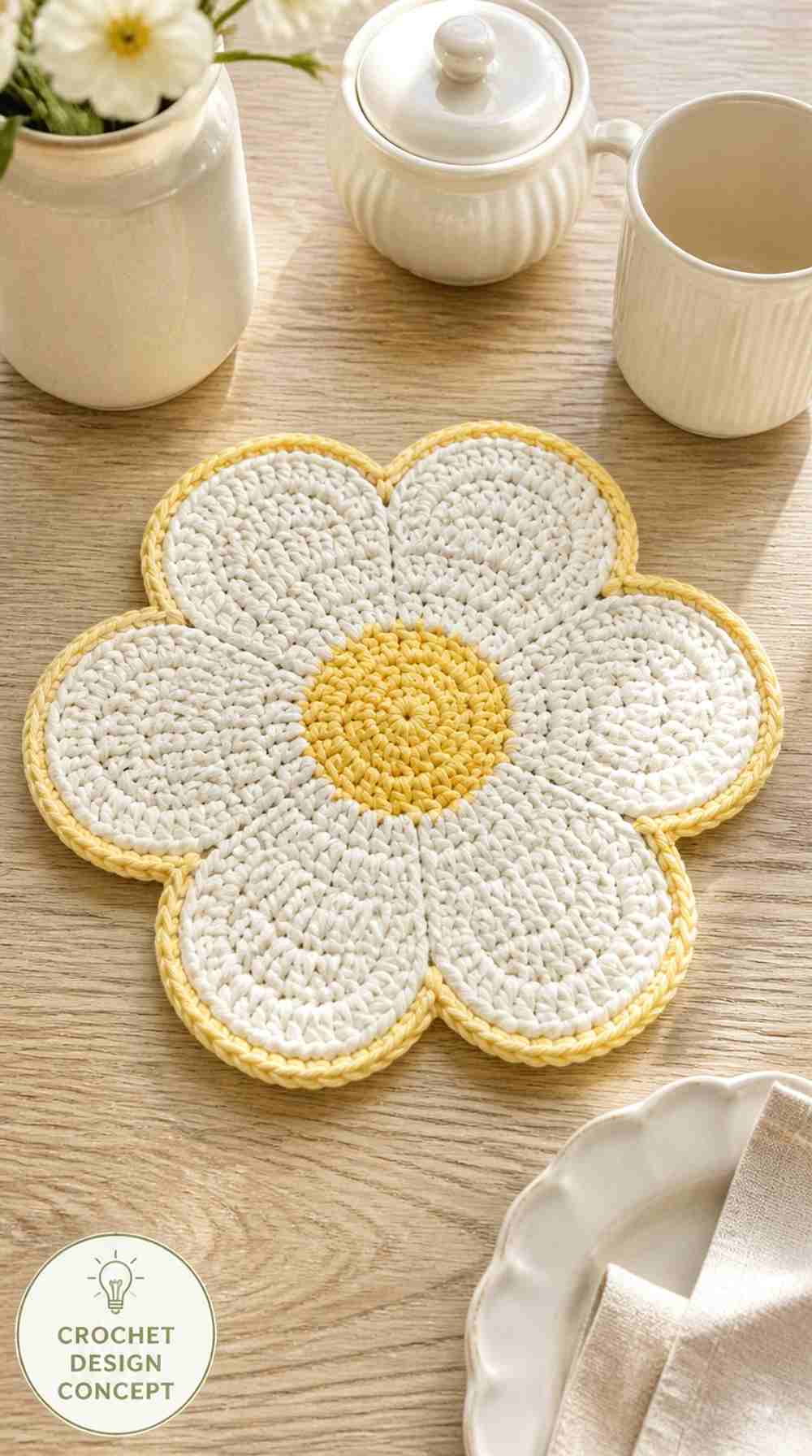
A round butter-yellow center gives this crochet trivet its warm, cheerful character, while six broad creamy-white petals create the familiar daisy outline. The thin yellow edging follows each petal and helps the whole flower feel neatly finished without adding too much visual detail.
Its simple circular arrangement works especially well in kitchens with pale wood, cream dishes or soft cottage colors. The important consideration is keeping those broad petal sections flat and evenly supported if adapting the design into a practical tabletop piece.
- Six-Petal Balance: Six broad petals create a clean silhouette with fewer narrow gaps than a many-petal daisy, making the outer shape easier to assess.
- Central Support: The butter-yellow middle should be planned around the base of the actual dish, rather than assuming the decorative petals provide equal support.
- Outer Edge: A narrow contrasting round can define the petal tips, but overly tight edging may pull a large flower into a cupped shape.
- Color Adjustment: For a gentler vintage variation, choose oatmeal petals instead of bright white while retaining the butter-yellow center and outline.
2. Crochet Butter Yellow Raised Daisy Square Trivet
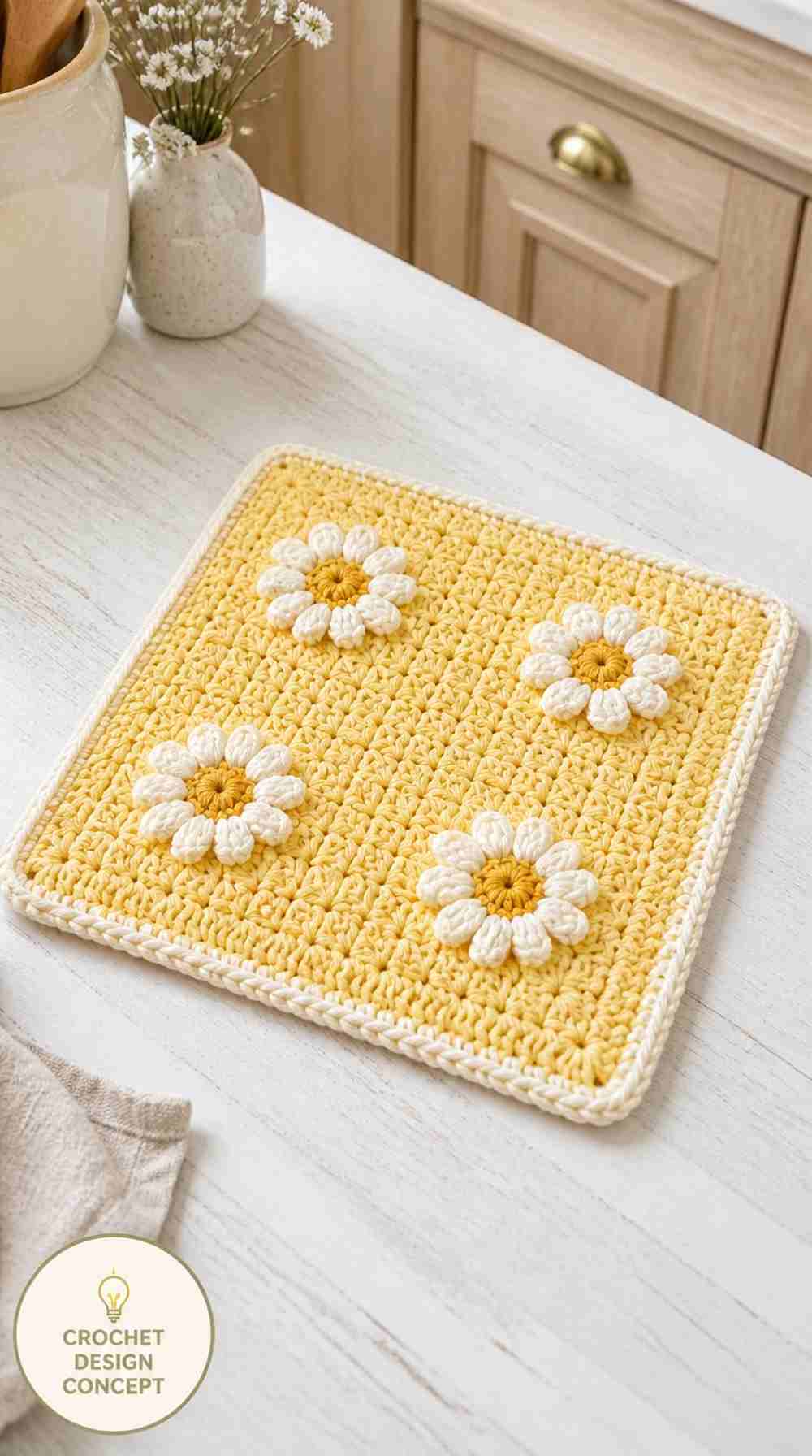
Four small cream daisies sit evenly across a butter-yellow square in this more structured crochet design. Their muted golden centers add warmth, while the subtly raised flowers stand out against a compact stitch background. A narrow ivory border keeps the four straight sides visually tidy.
Unlike a single oversized daisy, this arrangement spreads the floral details across the textile. It would look lovely as a small decorative kitchen mat, although the raised motifs need careful consideration before placing anything heavy or hot on top.
- Raised Flower Placement: The four daisies create several elevated points. For a functional trivet, consider replacing the raised details with flatter colorwork.
- Straight Edge Planning: Square corners can stretch unevenly when border tension changes. Check that the finished corners remain flat before using the piece beneath dishes.
- Motif Spacing: Leave enough plain yellow fabric between the four flowers so the daisy shapes remain recognizable instead of visually merging.
- Surface Contact: A ceramic base may rest unevenly on raised floral details; keep this illustrated version decorative unless a suitable flat construction is developed.
3. Crochet Butter Yellow Daisy Chain Oval Trivet
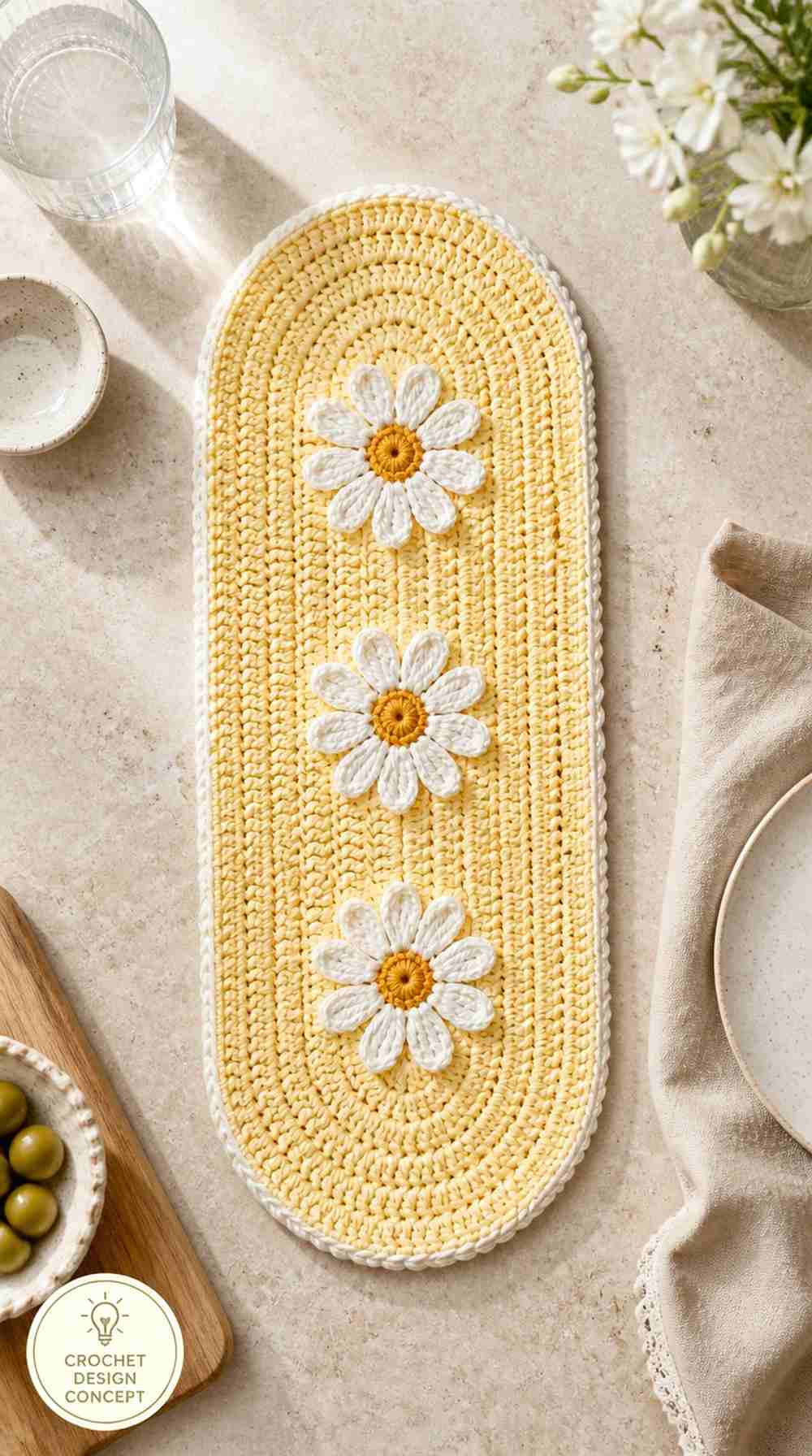
Three flat ivory daisies run down the center of an elongated butter-yellow crochet trivet. Their little golden centers break up the yellow background without overwhelming it, and the closely worked rows give the oval an orderly, cohesive appearance. A fine cream border follows the rounded ends.
This design feels especially suited to an elongated serving area. The flowers are arranged lengthwise rather than scattered around the edges, although a real serving dish may cover much of the central decoration.
- Oval Proportions: Measure the actual serving dish before planning the crochet shape, leaving enough room for its base without relying on the decorative border.
- Flower Alignment: Keeping all three daisies on the same centerline creates a calmer look than letting the motifs drift toward opposite edges.
- Stitch Direction: Closely spaced rows may help the oval look smooth, but the ends need shaping to avoid pointed or rippled transitions.
- Decoration Visibility: If the serving dish will hide the three flowers, an optional version could move the motifs closer to the outer edge.
4. Crochet Butter Yellow Hexagon Daisy Trivet
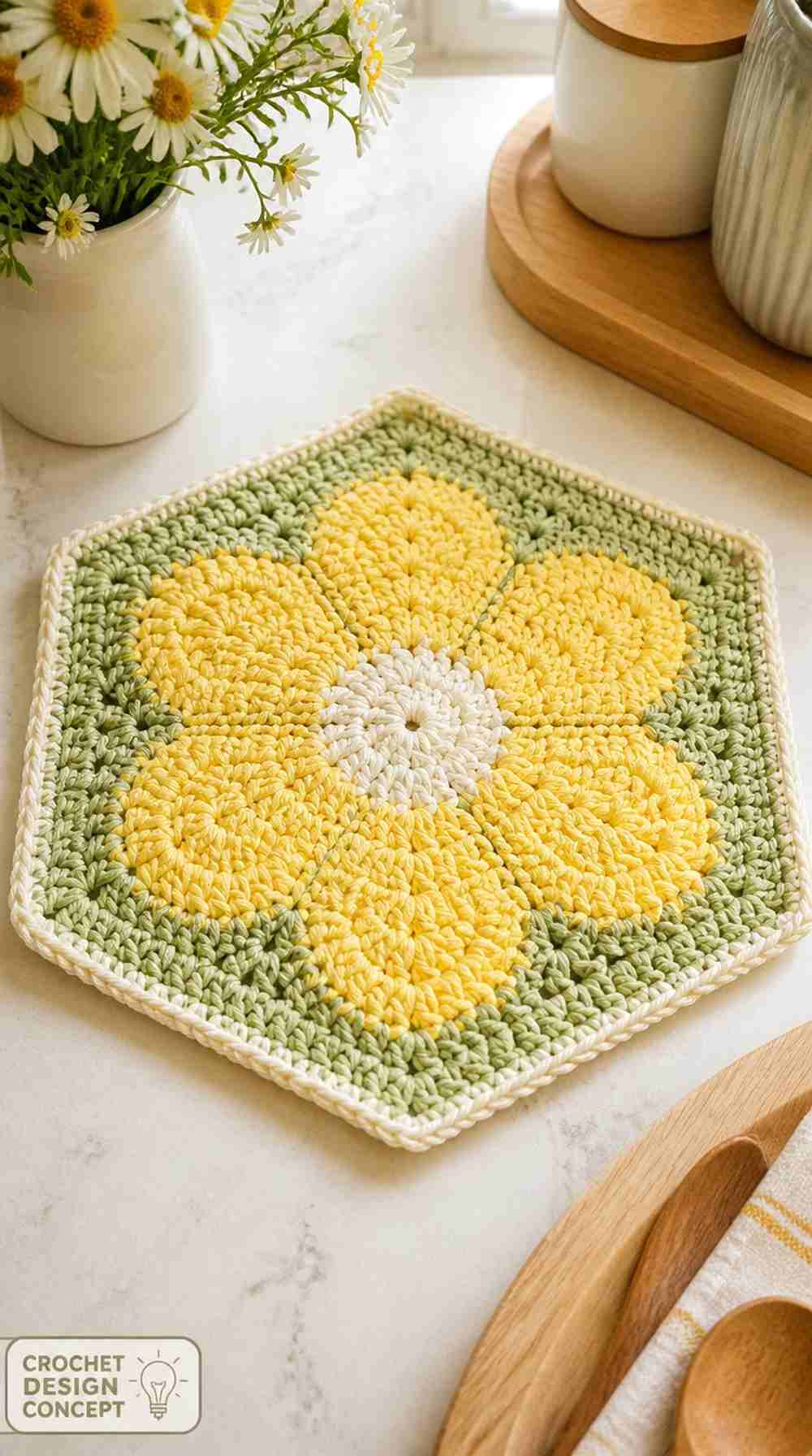
Six butter-yellow petal sections radiate from an ivory center, forming a flower within a pale-sage hexagonal frame. The six defined corners give this crochet trivet a geometric appearance, while the cream finishing round softens the contrast between the floral middle and green outer edge.
Rather than following a completely round daisy outline, this concept places the flower inside a structured six-sided shape. It offers a useful way to introduce sage green into a butter-yellow kitchen palette without letting the green take over.
- Hexagonal Corners: The six points need consistent stitch increases so the border stays level instead of forming small upward folds.
- Center Coverage: The petal motif occupies much of the hexagon, so a real version needs enough continuous fabric behind the decorative design.
- Sage Border Width: A narrow sage frame adds definition; widening it too much could make the hexagon look more like a plain green mat.
- Matching Sets: A hexagon can sit neatly beside another hexagon for a coordinated display, provided the actual edges and dimensions are matched.
5. Crochet Butter Yellow Daisy Granny Square Trivet
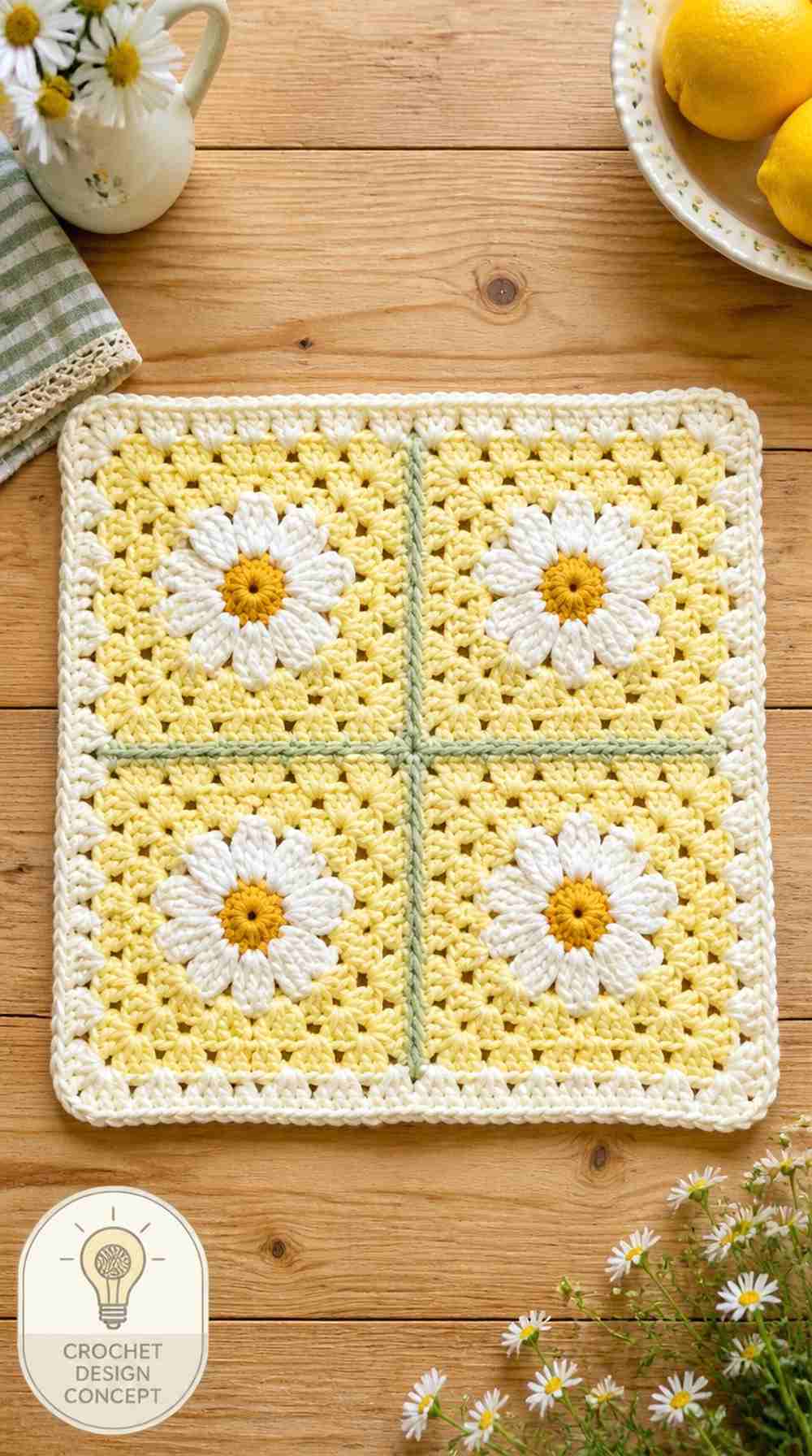
Four butter-yellow granny squares come together in this bright crochet trivet, each carrying a flat cream daisy with a small golden center. The pale-sage joining lines form a subtle cross between the motifs, while an ivory border ties the larger square together.
The repeated flower layout is appealing because each daisy has its own little space. Open granny-square clusters also bring more visible texture than tightly worked rows, so this version is best treated as a decorative concept until a suitable dense construction is planned.
- Joining Consistency: Equal-sized squares help the center seams lie straight. Differences in stitch tension can twist the four-part arrangement.
- Open-Stitch Limitation: Traditional granny-square gaps can expose the surface underneath, making an unmodified openwork version unsuitable for direct contact with hot dishes.
- Motif Placement: Keeping the cream daisies centered within each yellow square prevents the sage joining lines from interrupting the flower shapes.
- Optional Backing: A separate densely crocheted cotton layer could be considered during construction, but its thickness and suitability would still need assessment.
6. Crochet Butter Yellow Radiating Daisy Trivet
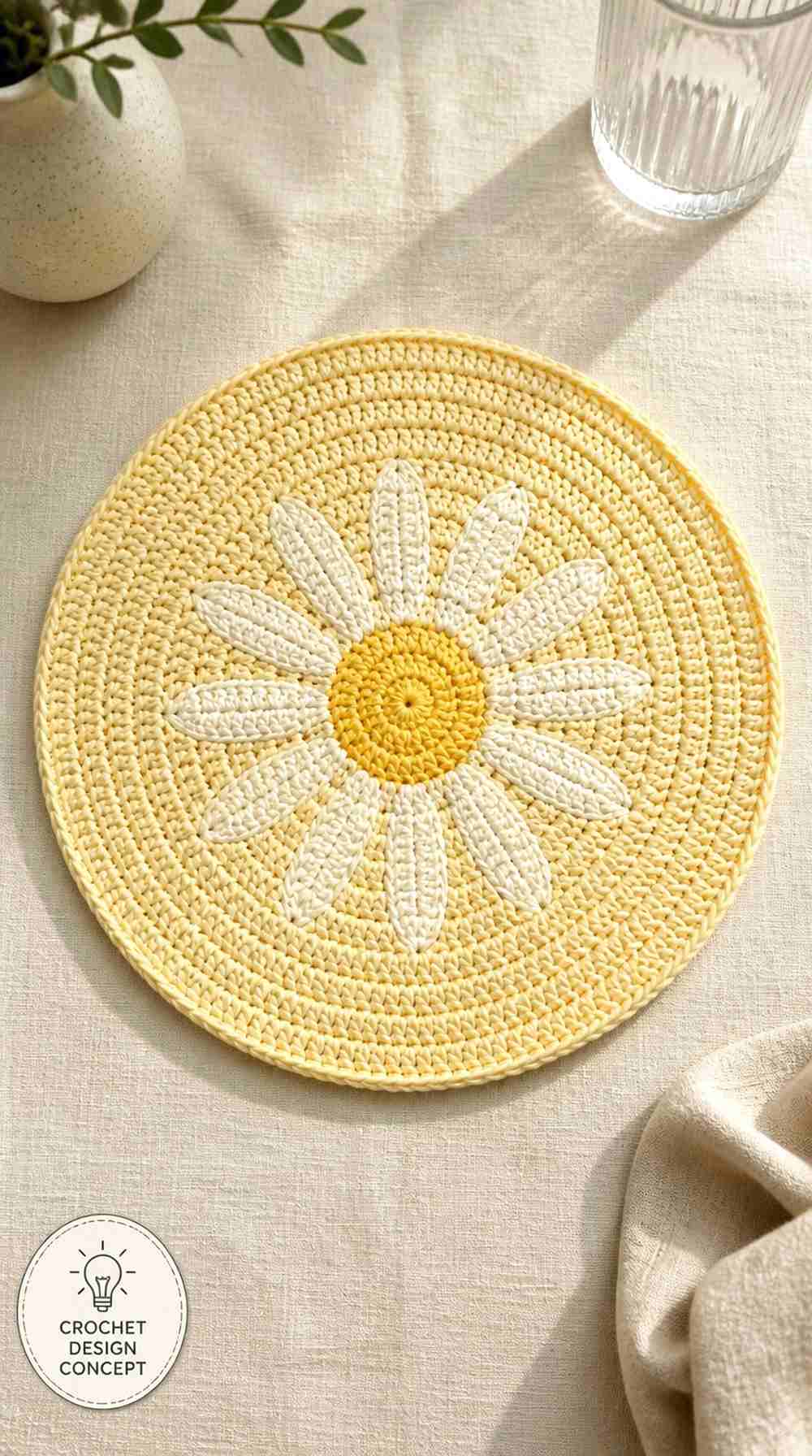
A ring of twelve slender ivory petals spreads across the butter-yellow surface of this circular crochet trivet. The golden center and wide outer yellow band create a gentle sunburst effect, while concentric stitch ridges add texture without changing the rounded outline.
Compared with the classic six-petal version, this daisy has a finer, more detailed appearance. The flower remains part of a broad circular textile rather than creating separate outer petals, making the shape visually straightforward for a tabletop arrangement.
- Petal Definition: Twelve narrow petals need clear contrast against the butter-yellow base. If the cream yarn is too close in tone, the radiating pattern may disappear.
- Flat Motif Choice: A surface-level floral arrangement avoids the larger bumps associated with separately attached dimensional petals.
- Outer Band Width: The broad yellow ring gives the design breathing room, but excessive increases could make the outer edge ripple.
- Round Placement: Check the base diameter of the intended dish against the finished flat area rather than the complete decorative diameter alone.
7. Crochet Butter Yellow Gingham Daisy Trivet

Butter-yellow and ivory checks create a fresh gingham-style background for this rectangular crochet trivet. One small cream daisy with a golden center sits close to the lower-right corner, adding just enough floral character without interrupting the larger checked pattern. A yellow outer border finishes the piece.
The combination feels playful but still relatively simple. Its standout feature is the off-center daisy, which leaves most of the rectangle visually open. A flat colorwork approach would be worth considering for a practical version.
- Check Alignment: Keep the yellow and ivory blocks consistent in width so the gingham pattern reads clearly across the rectangle.
- Corner Daisy: The small lower-right motif works as an accent rather than a central feature, allowing the checked fabric to remain dominant.
- Border Control: A continuous yellow border can visually unify the different checks, but corner stitch counts need attention to avoid pulling.
- Flat Alternative: If an attached flower makes the corner uneven, work the same daisy through flat color changes or surface embroidery instead.
8. Crochet Butter Yellow Petal Shaped Daisy Trivet
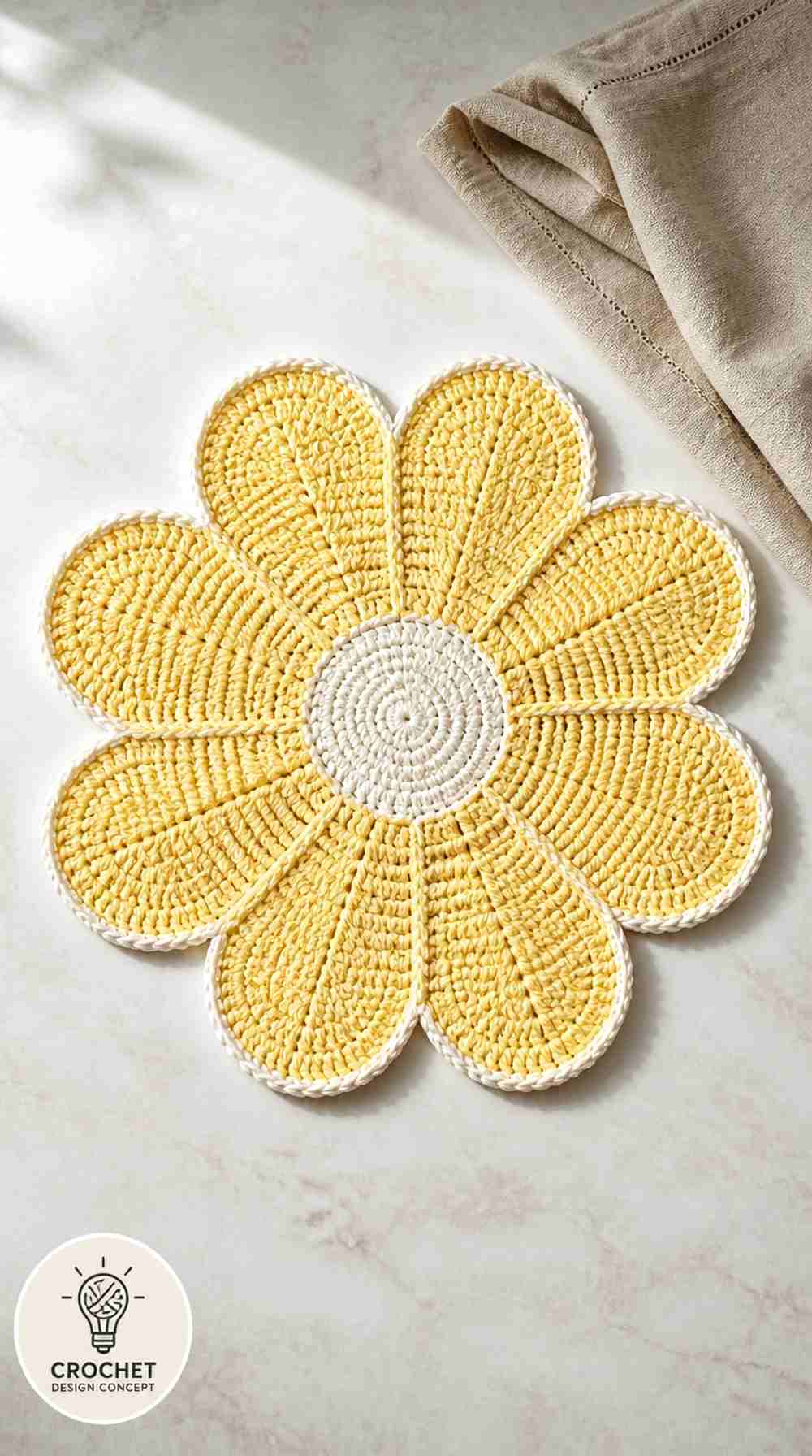
Eight rounded butter-yellow petals surround an ivory circular center, turning this crochet trivet into one large flower silhouette. Fine cream outlines follow the petal edges, while subtle radial stitches give each yellow section a sense of direction and texture.
Unlike the familiar white-petal daisy, the colors are gently reversed. The butter-yellow petals make the entire outline feel warmer and more cheerful, especially against cream kitchen surfaces. The individually shaped petal edges are the main feature to plan carefully if making a real textile.
- Petal Symmetry: Eight petals should be proportioned evenly around the ivory center so one side does not appear noticeably heavier.
- Curved Perimeter: Rounded petal edges create more finishing work than a simple circle, particularly where neighboring petals dip inward.
- Central Dish Area: Keep the ivory center and adjoining sections reasonably flat; petal tips alone should not be relied upon for supporting cookware.
- Decorative Display: The full flower outline is most visible when uncovered, making it especially appealing as a kitchen shelf or tabletop accent.
9. Crochet Butter Yellow Daisy Wreath Trivet
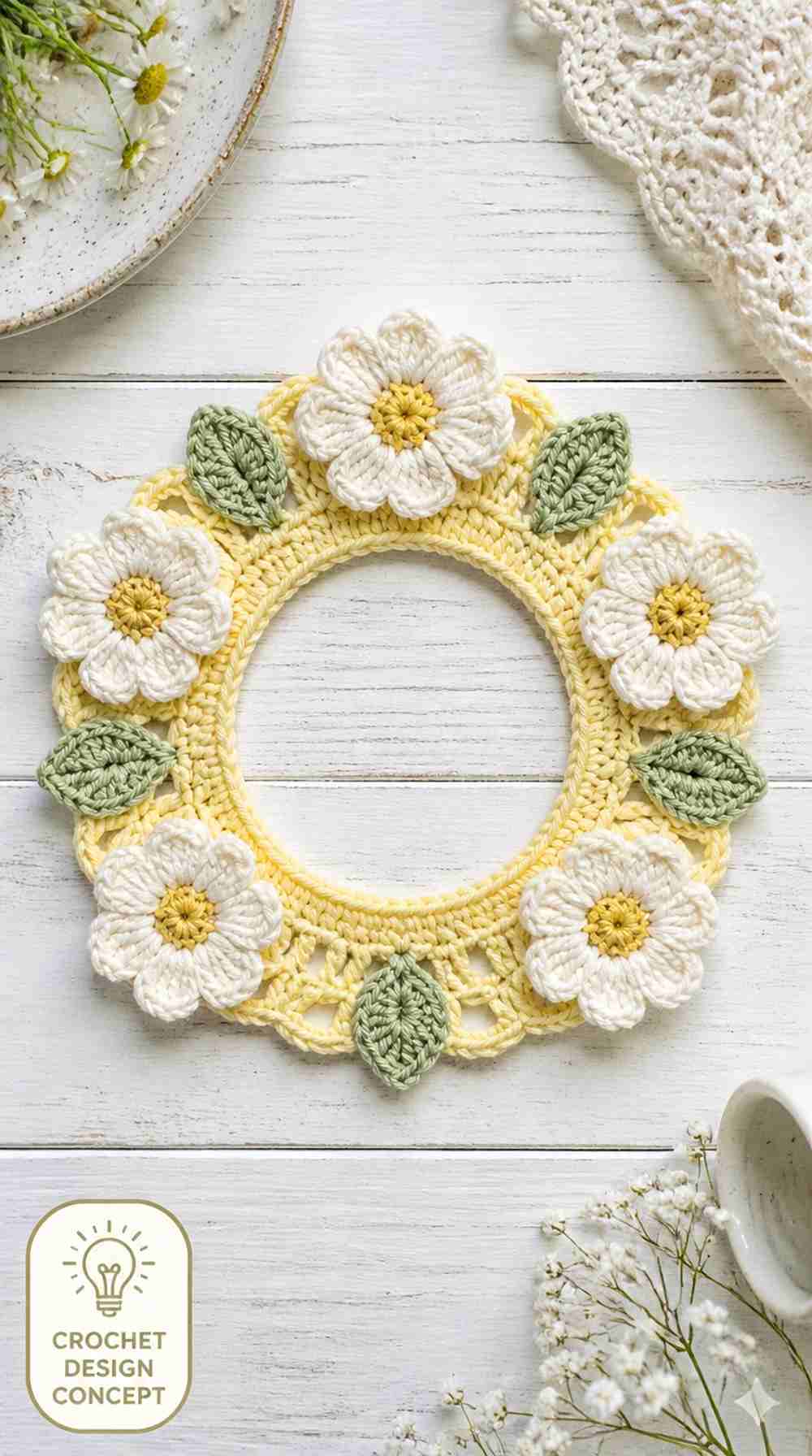
Six creamy-white daisies circle a butter-yellow crochet ring, with tiny sage-green leaves separating their warm golden centers. The middle remains visibly open, giving the entire arrangement a light floral-wreath appearance rather than the solid surface of a conventional hot pad.
This is the most decorative concept in the collection. The open center and small connecting motifs make it lovely for a cottage-style tabletop display, but they also limit its practical use. It should not be treated as a protective trivet beneath hot cookware.
- Open-Center Limitation: The central opening leaves the underlying table exposed. Use this concept as decoration, not as heat protection.
- Flower Spacing: Six evenly distributed daisies help the wreath retain its circular form without gathering heavily on one side.
- Leaf Connections: Small sage leaves add contrast, but their attachments should remain secure enough to withstand ordinary handling and storage.
- Display Styling: The open center could frame a separate decorative object, provided the object is stable, cool and suitable for the surface.
10. Crochet Butter Yellow Border Daisy Trivet
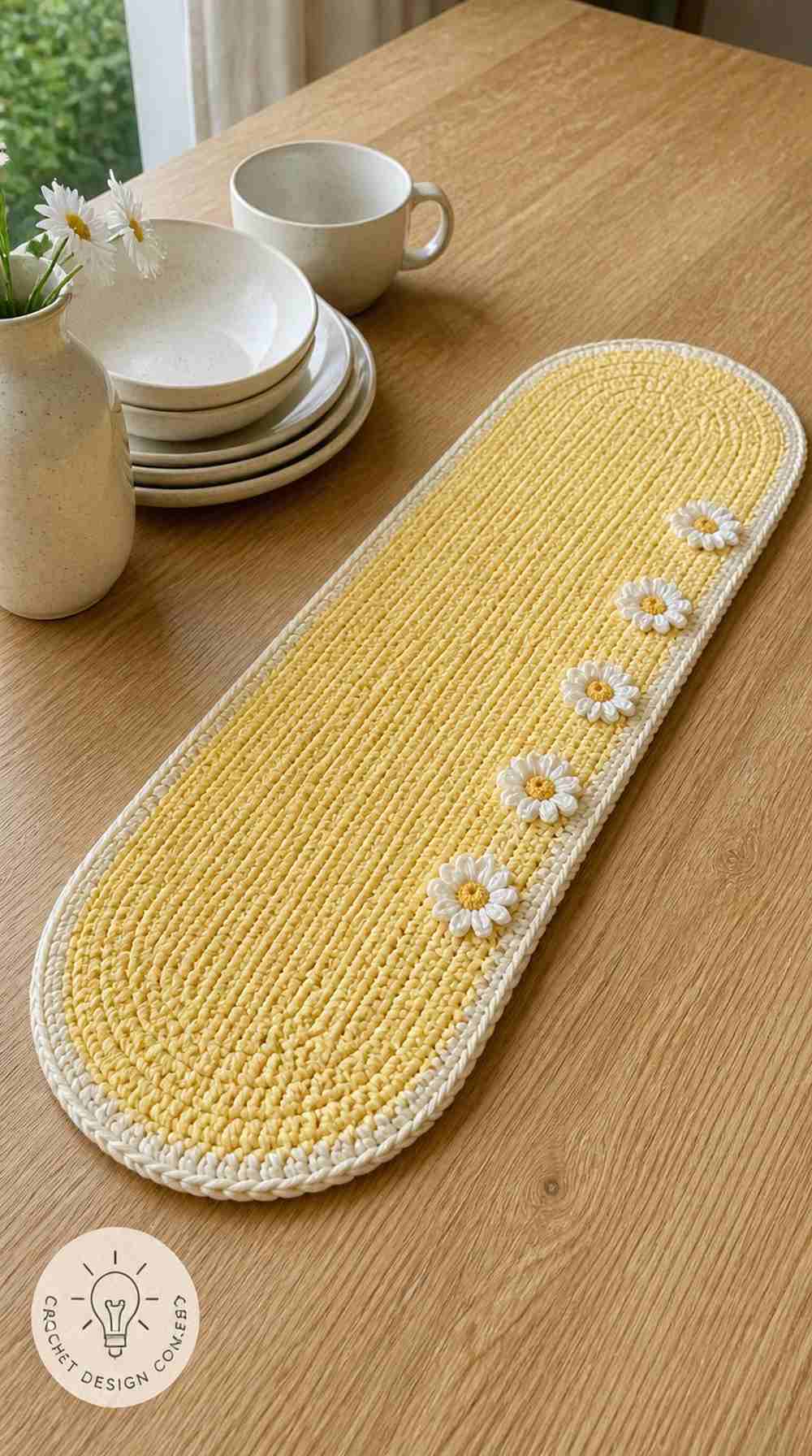
Five tiny ivory daisies line one long edge of this slim butter-yellow crochet trivet. The small golden centers add delicate points of interest, while the main body remains a broad, uninterrupted yellow panel. Rounded ends and a fine cream border give the piece a soft racetrack-shaped outline.
The unusual detail here is the border placement. Instead of putting flowers beneath the middle of a serving dish, the daisy row sits toward one side, where it may remain visible. That makes this an interesting idea for a narrow dining table.
- Usable Center: Measure the broad yellow area separately from the decorative daisy edge when considering where a serving dish could sit.
- Edge Decoration: Small floral motifs near the border should remain flat and firmly attached, especially where dishes or hands might catch them.
- Long-Edge Shaping: Matching the two long sides matters more than adding extra flowers if the goal is a straight, balanced serving mat.
- Table Placement: This slender shape may suit a narrow serving space better than a wide oval, but actual dish footprint and stability come first.
11. Crochet Butter Yellow Puff Daisy Trivet
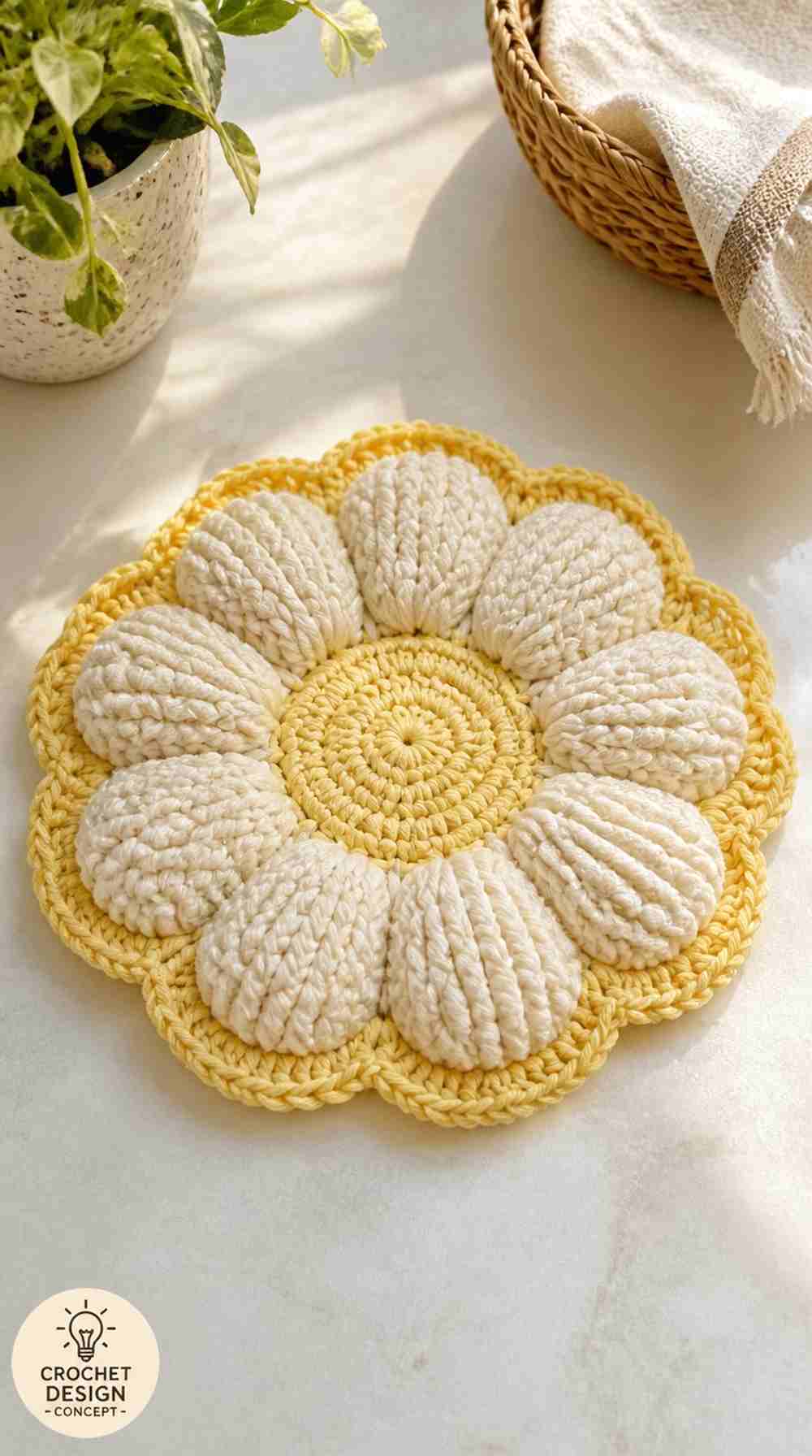
Cream puff-stitch petals surround a dense butter-yellow center in this textured crochet trivet. Eight dimensional petals create soft shadows across the flower ring, while a golden-yellow scalloped border continues the rounded floral theme around the outside.
The raised stitches make this design feel particularly cozy and tactile. They also change how objects would sit on the textile. For that reason, the pictured concept makes more sense as a decorative kitchen accent than a dependable support for hot cookware unless substantially adapted.
- Puff Height: Raised crochet puffs can create an uneven contact surface. A functional version would need flatter construction where cookware rests.
- Flower Ring: Eight plump cream petals produce a fuller look than slender stitched petals, making stitch spacing especially important.
- Scalloped Finish: The golden outer scallops can emphasize the round silhouette, but excessively loose scallops may flare away from the center.
- Cleaning Consideration: Dimensional stitches may trap crumbs and take longer to dry than a flatter fabric, so check the chosen yarn’s care instructions.
12. Crochet Butter Yellow Diamond Daisy Trivet
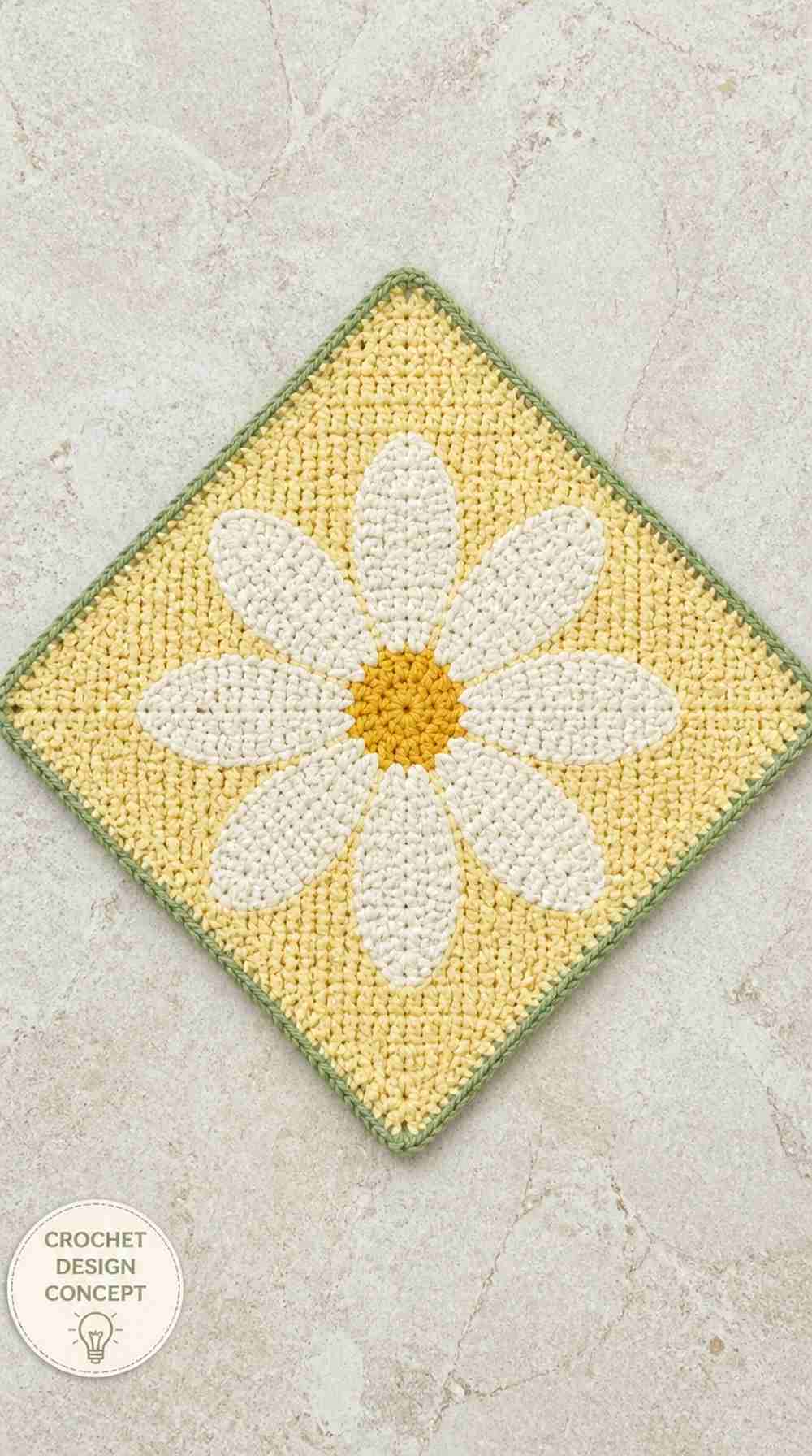
One large cream daisy fills the middle of a butter-yellow square turned on its point. The eight broad petals are formed as flat colorwork, with a small golden center and a pale-sage outline around the four straight sides.
The diamond orientation gives this crochet trivet a different visual character without requiring a complicated outer silhouette. Its flatter floral surface also makes it an interesting starting point for someone who prefers integrated motifs over sewn-on decorations.
- Colorwork Clarity: Broad cream petals need consistent stitch placement against the yellow background to keep their outlines recognizable.
- Diamond Presentation: The square is simply displayed on one corner; a real version should still have four balanced sides and corners.
- Surface Level: Integrated colorwork can avoid separate flower bumps, although carried strands and yarn ends must still be managed neatly.
- Border Tension: The narrow sage edge should follow the square without tightening its corners or making the diamond curl upward.
13. Crochet Butter Yellow Twin Daisy Oval Trivet
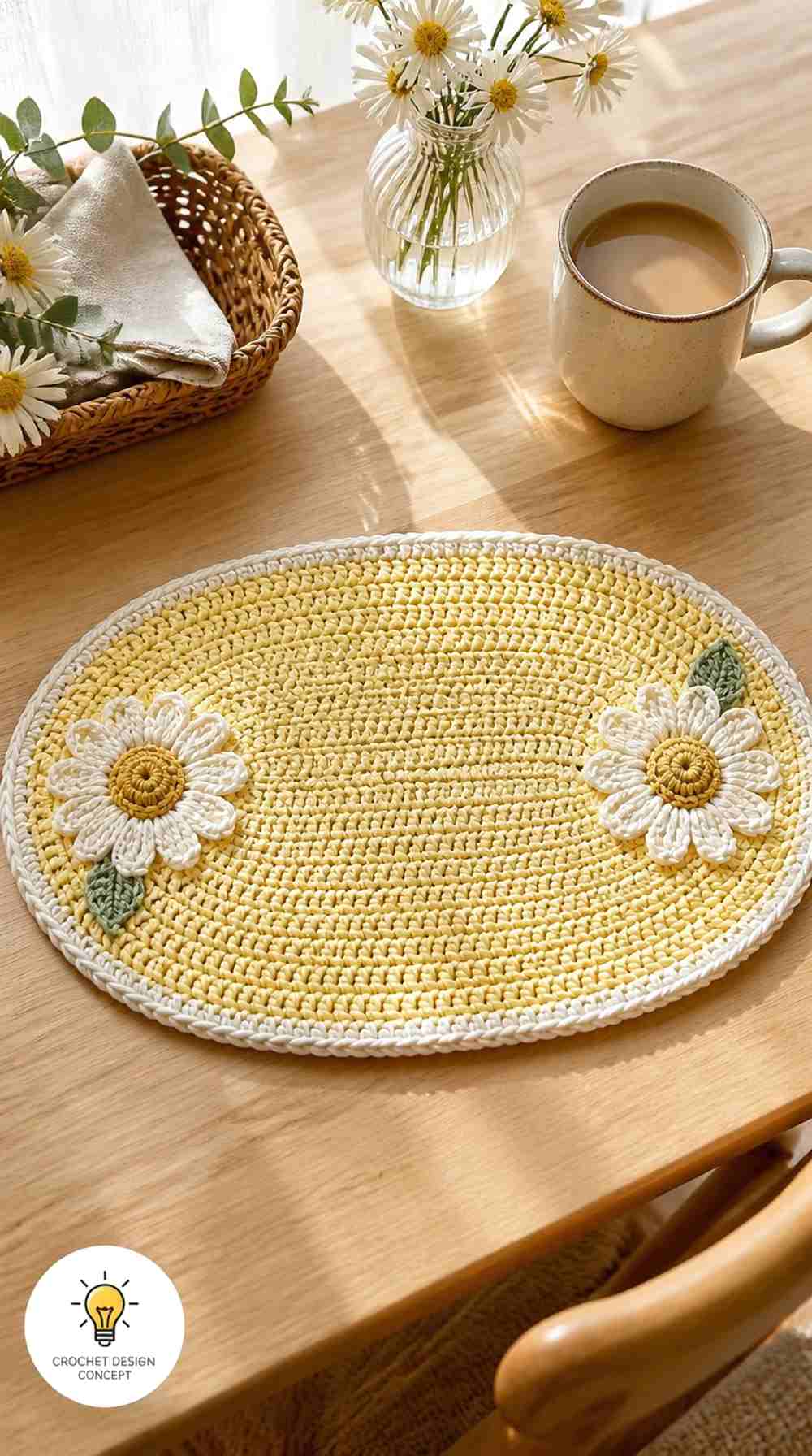
Two flat cream daisies sit at opposite ends of this wide butter-yellow oval crochet trivet. Each has a small golden center and a delicate sage-green leaf beside it, while narrow ivory edging follows the complete outline.
The broad yellow space between the flowers is what makes the arrangement useful from a design perspective. It creates a calmer central area and lets the two floral clusters remain visible around the edges. The actual supporting surface would still depend on how the trivet is constructed.
- Opposite-End Motifs: Placing the two daisies at the oval’s ends creates visual balance without filling the middle with decoration.
- Central Space: Plan the plain yellow section around the size of the intended serving piece, particularly if both flowers should remain visible.
- Leaf Details: The small sage leaves should be kept flat and securely finished so they do not curl above the ivory flowers.
- Rounded Edge: A continuous ivory border can help define the oval, but changing tension around its curves may distort the shape.
14. Crochet Butter Yellow Vintage Daisy Frame Trivet
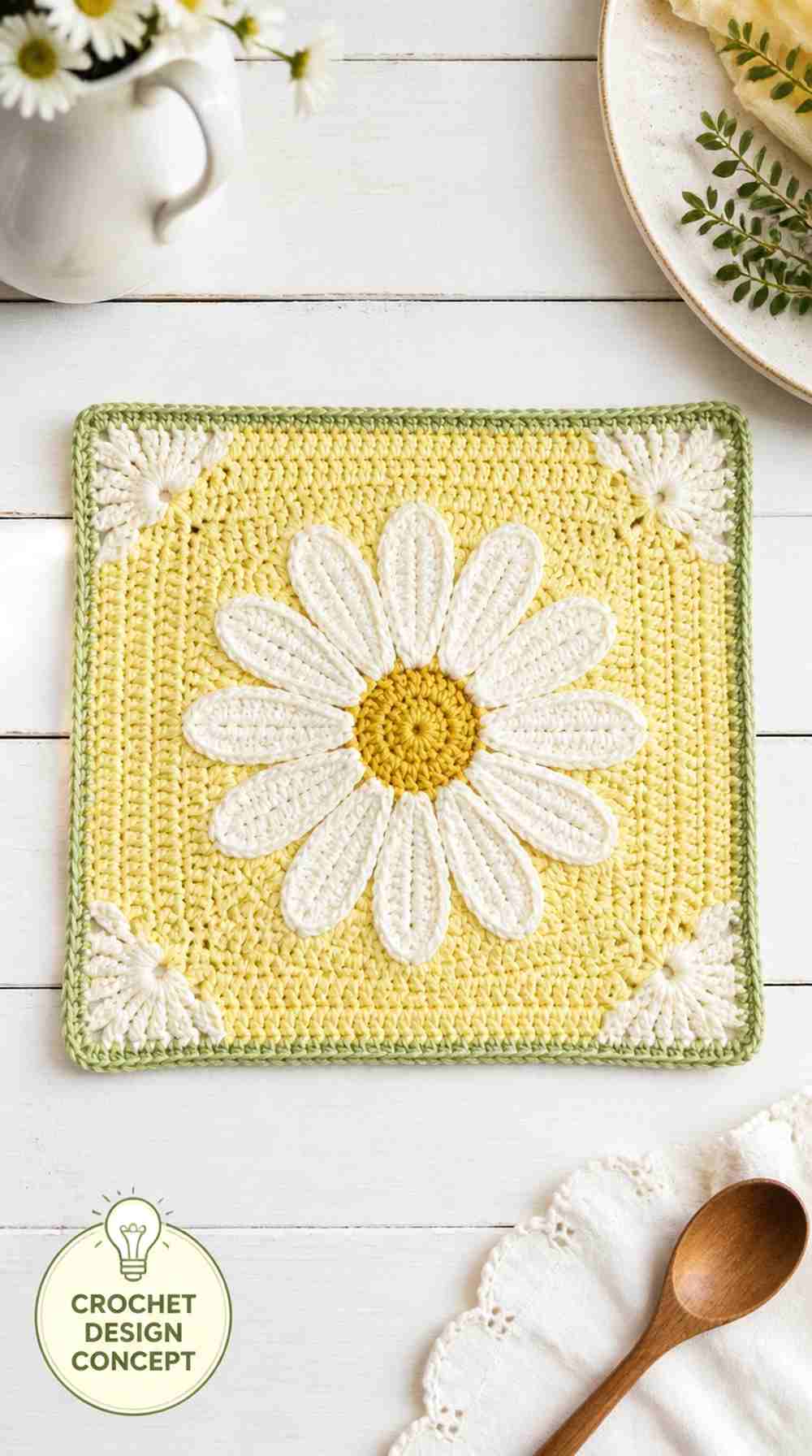
A large ivory daisy sits across the center of this butter-yellow crochet square, surrounded by small cream fan-stitch accents in all four corners. A muted golden center keeps the flower warm, while a restrained sage-green border creates a gentle vintage frame.
The corner fans are what distinguish this design from a plain floral square. They make the outer area feel thoughtfully finished without competing too strongly with the central flower. For a practical adaptation, the corners and flower details would need to remain level.
- Corner Fan Placement: Four matching cream fan accents give the frame symmetry; each corner should spread evenly rather than pulling diagonally.
- Central Flower Scale: The ivory daisy is deliberately larger than the corner accents, so avoid adding extra competing motifs inside the square.
- Vintage Color Balance: Butter yellow, ivory, muted gold and sage create a soft palette that can work alongside warm wood and traditional kitchen finishes.
- Flatness Check: Corner fans can become wavy when their stitch increases are excessive. Shape and inspect the completed fabric before planning tabletop use.
Practical Guide to Crochet Daisy Trivets
A daisy trivet can be a beautiful kitchen decoration, but not every floral crochet design should be used underneath a hot dish. The distinction matters because petals, open stitches and raised flowers may affect both stability and heat transfer.
Choose suitable yarn. For any crochet project intended for contact with warm cookware, start by looking at tightly spun 100% cotton yarn and the guidance supplied with that yarn. Avoid acrylic, polyester and unknown synthetic blends for hot-pad applications because they can soften or melt under heat. Cotton itself does not make an untested design heat-safe.
Think about thickness and stitch density. A single openwork layer may let heat pass through. Dense, properly constructed double-layer designs are generally a more sensible starting point than decorative lace or raised flowers, but the finished item still needs careful assessment.
Check the contact area. The flat part of the trivet should accommodate the actual base of the dish. Large petal outlines may make a piece appear bigger without increasing its reliable supporting area.
Keep the design level. Bobbles, puffs, thick appliqués and raised seams can make dishes wobble. Save these details for decorative-only pieces or move them outside the intended contact area.
Plan for care and storage. Follow the yarn manufacturer’s washing instructions, allow the textile to dry thoroughly and store it without crushing delicate edges. Keep all crochet away from burners, open flames and heating elements. Never assume it can safely hold cookware directly from an oven or stovetop.
For more ways to bring crochet into the kitchen, explore these village kitchen decor inspiration ideas, which include trivets and other coordinating accents.
Want to Make Something Similar?
The designs above are original visual concepts rather than published patterns. If you’d like to make a real crochet trivet, these existing resources offer useful starting points:
- Darling Daisy Hot Pad by Angie Dooley — a daisy-shaped cotton hot-pad pattern that teaches petal construction and working with two strands of yarn. The linked Ravelry page includes a paid PDF option and points to the designer’s free blog version. Ravelry
- Country Crochet Hot Pad by Jessica Underwood — a free double-thick crochet hot-pad pattern using dense spider-stitch fabric. It’s useful for learning a more practical base construction before considering floral decoration. Stitching Together
Neither source is the exact pattern for any AI design shown in this collection. Follow the original creator’s instructions and material guidance rather than trying to reproduce an image stitch for stitch.
Which Crochet Daisy Trivet Should You Choose?
| Your priority | Design worth considering | Main trade-off |
|---|---|---|
| Classic daisy appearance | Classic Daisy Trivet | Outer petals need careful flat shaping |
| Small repeated flowers | Raised Daisy Square Trivet | Raised motifs create uneven areas |
| Elongated serving space | Daisy Chain Oval Trivet | Central flowers may be covered |
| Colorful geometric layout | Hexagon Daisy Trivet | Six corners require even shaping |
| Granny-square texture | Daisy Granny Square Trivet | Open spaces limit hot-pad usefulness |
| Flatter floral detail | Diamond Daisy Trivet | Colorwork needs careful planning |
| Decorative kitchen display | Daisy Wreath Trivet | Open center cannot protect a surface |
| Soft vintage styling | Vintage Daisy Frame Trivet | Corner fans can ripple |
If your main concern is practicality, the Diamond Daisy Trivet and Gingham Daisy Trivet offer worthwhile visual starting points because their flowers can be interpreted as flat colorwork. For a purely decorative feature, the Puff Daisy and Daisy Wreath are more expressive.
Conclusion
Butter-yellow daisy crochet brings a cheerful, gentle color story into the kitchen without requiring every design to look alike. A classic round flower feels familiar, a granny-square arrangement adds repeated texture, and an elongated oval offers another way to work floral details into a tabletop setting.
The best choice depends on what you want the piece to do. For decoration, enjoy the playful petals and dimensional flowers. For a working trivet, concentrate on appropriate materials, dense construction, a flat supporting area and realistic heat limitations before deciding how much floral detail to add.
Which would you choose for your kitchen: the classic six-petal daisy, the butter-yellow gingham square or the vintage daisy frame? Share your favorite design and the colors you’d pair with it.
Frequently Asked Questions
1. What yarn is best for a butter-yellow crochet daisy trivet?
For a project intended to support warm serving dishes, 100% cotton is a sensible material to investigate because it does not melt like acrylic yarn. Choose an appropriate tightly spun cotton and follow the yarn and pattern guidance. Even cotton pieces need suitable thickness, construction and use; none of these pictured concepts has been heat-tested.
2. Can a crochet daisy trivet really protect a wooden table from hot pans?
Not automatically. A safe supporting surface depends on the yarn, thickness, gaps, construction, dish temperature and the table’s finish. Decorative petals and single-layer lace should not be trusted for heat protection. Use a purpose-made, appropriately rated heat-resistant trivet whenever the temperature or textile’s performance is uncertain.
3. Should daisy flowers be flat or raised on a crochet trivet?
Flat motifs are generally the better starting point when you want dishes to sit level. Raised puff stitches and appliqué flowers can make the contact area uneven. Dimensional flowers are lovely for decorative mats, but a functional trivet should prioritize stability and a continuous, suitable support surface.
4. How do I stop a crochet flower trivet from curling around the petals?
Curling can result from unsuitable stitch increases, uneven tension, overly tight edging or differences between yarns. Use an appropriate pattern, check shaping as you work and adjust only after understanding the cause. Gentle blocking may improve the appearance of suitable fibers, but it will not correct every construction problem or make an unsafe textile heat-resistant.
5. Are these 14 crochet daisy trivets available as free patterns?
No. The 14 designs in this article are AI-generated visual inspiration concepts, not published or tested patterns. Some linked resources teach related daisy motifs or hot-pad construction, but they won’t reproduce the pictures exactly. For an actual project, use a trustworthy pattern with clear materials, construction instructions and appropriate safety guidance.