A crochet retro color block tissue holder can turn an ordinary tissue box into a cheerful piece of home decor. Warm mustard, burnt orange, earthy olive, dusty pink, and soft pastel shades bring a nostalgic look to something we use every day. This collection explores 17 different designs, from checkerboard tissue covers and geometric patterns to granny stripes, curved arches, and compact hanging tissue holders.
The best crochet tissue holder is not just about choosing attractive colors. The shape of the tissue box, the placement of the dispensing opening, the density of the stitches, and the way the cover fits all affect how practical it will be. These inspiration ideas help you compare cube and rectangular covers, decorative finishes, color arrangements, and a few less conventional styles while keeping everyday usability in mind.
These are AI-generated crochet design visualizations for inspiration, not photographs of tested handmade products or step-by-step patterns.
Quick Design Selection Guide
- For classic retro colors: Choose Crochet Mustard Rust Retro Cube Tissue Holder, Crochet Dusty Blue Ochre Stripe Tissue Holder, or Crochet Cream Tangerine Scallop Tissue Holder.
- For geometric patterns: Compare Crochet Sage Blush Checkerboard Tissue Holder, Crochet Black Cherry Apricot Diamond Tissue Holder, and Crochet Olive Orange Diagonal Cube Tissue Holder.
- For seventies-inspired decorating: Explore Crochet Burnt Orange Deco Arch Tissue Holder, Crochet Olive Terracotta Rainbow Arch Tissue Holder, or Crochet Teal Butter Yellow Mod Circle Tissue Holder.
- For colorful crochet textures: Try Crochet Coral Mint Zigzag Tissue Holder, Crochet Lavender Lemon Granny Square Tissue Holder, and Crochet Terracotta Lilac Granny Stripe Tissue Holder.
- For smaller spaces: Consider Crochet Mustard Pistachio Hanging Tissue Holder, which uses a hanging pouch instead of a tabletop box cover.
1. Crochet Mustard Rust Retro Cube Tissue Holder
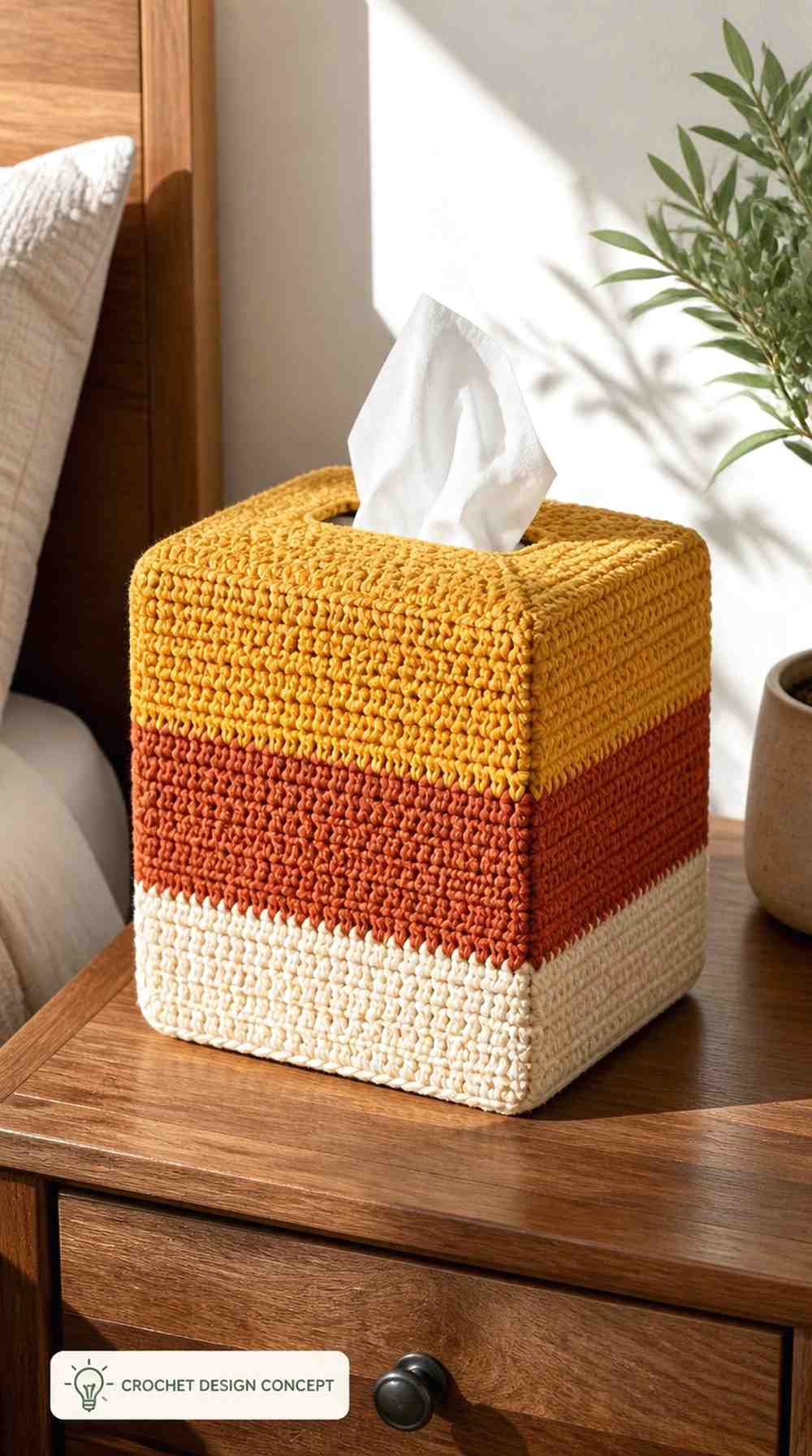
Mustard yellow, burnt rust, and warm cream create a classic retro palette in this cube-shaped crochet tissue holder. Three broad horizontal color blocks wrap around the compact body, while a flat mustard top features a neatly finished oval opening. One white tissue rises from the center.
The closely worked crochet gives the design a tidy appearance without additional decoration. Its strong horizontal stripes make it an attractive option for a bedside table or small shelf. A handmade version would need to match the tissue box’s height and width to preserve those clean lines.
- Cube Proportions: Measure the actual square tissue box before planning the cover. An overly loose fit may soften the corners and distort the horizontal bands.
- Oval Tissue Opening: Position the opening directly above the box dispenser so tissues can be pulled without dragging against a thick crochet edge.
- Three-Color Balance: The mustard top, rust center, and cream base create distinct sections; keeping their heights consistent helps preserve the retro look.
- Removable Lower Edge: A simple open-bottom sleeve can make replacing the tissue box easier than a permanently enclosed cover.
2. Crochet Sage Blush Checkerboard Tissue Holder
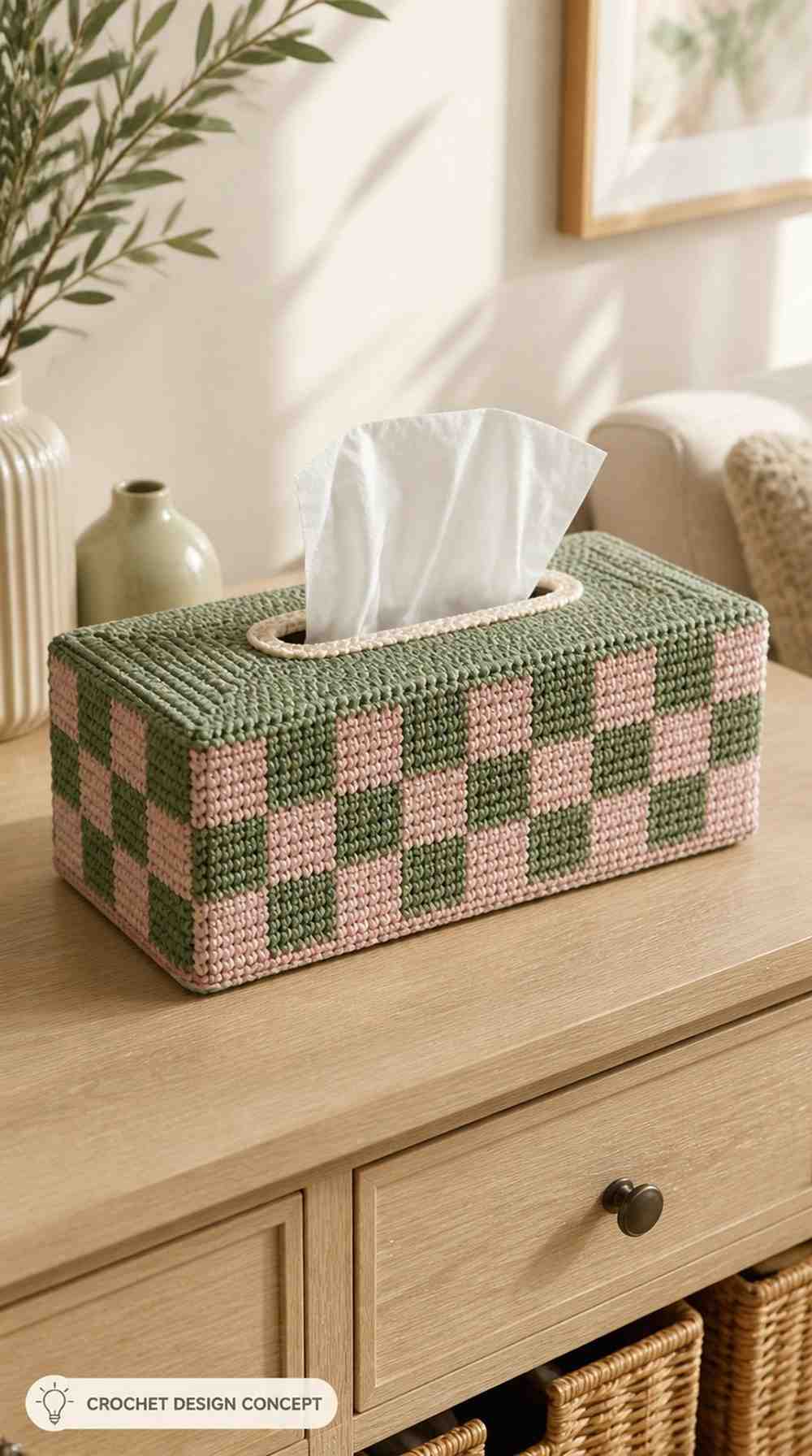
Muted sage and dusty blush create a soft checkerboard pattern across this rectangular crochet tissue holder. Alternating square blocks cover the long sides, while a solid sage top contains a narrow cream-edged dispensing slit. A slim blush border finishes the lower edge.
Unlike plain striped covers, this design draws attention to the repeated square pattern. The close crochet texture keeps the color boundaries visible, while the simple top prevents the overall look from becoming too busy. Consistent square dimensions would be particularly important when making a real version.
- Checkerboard Alignment: Keep neighboring squares equal in width and height so the pattern continues neatly around the box corners.
- Rectangular Fit: Measure the box length, depth, and height separately; the cover should not depend on excessive stretching to fit.
- Sage Top Panel: A solid top provides a quieter area around the tissue opening, preventing the dispenser from visually interrupting the checks.
- Color-Change Joins: Secure yarn changes neatly to avoid bulky seams or visible loose ends along the checker boundaries.
3. Crochet Burnt Orange Deco Arch Tissue Holder
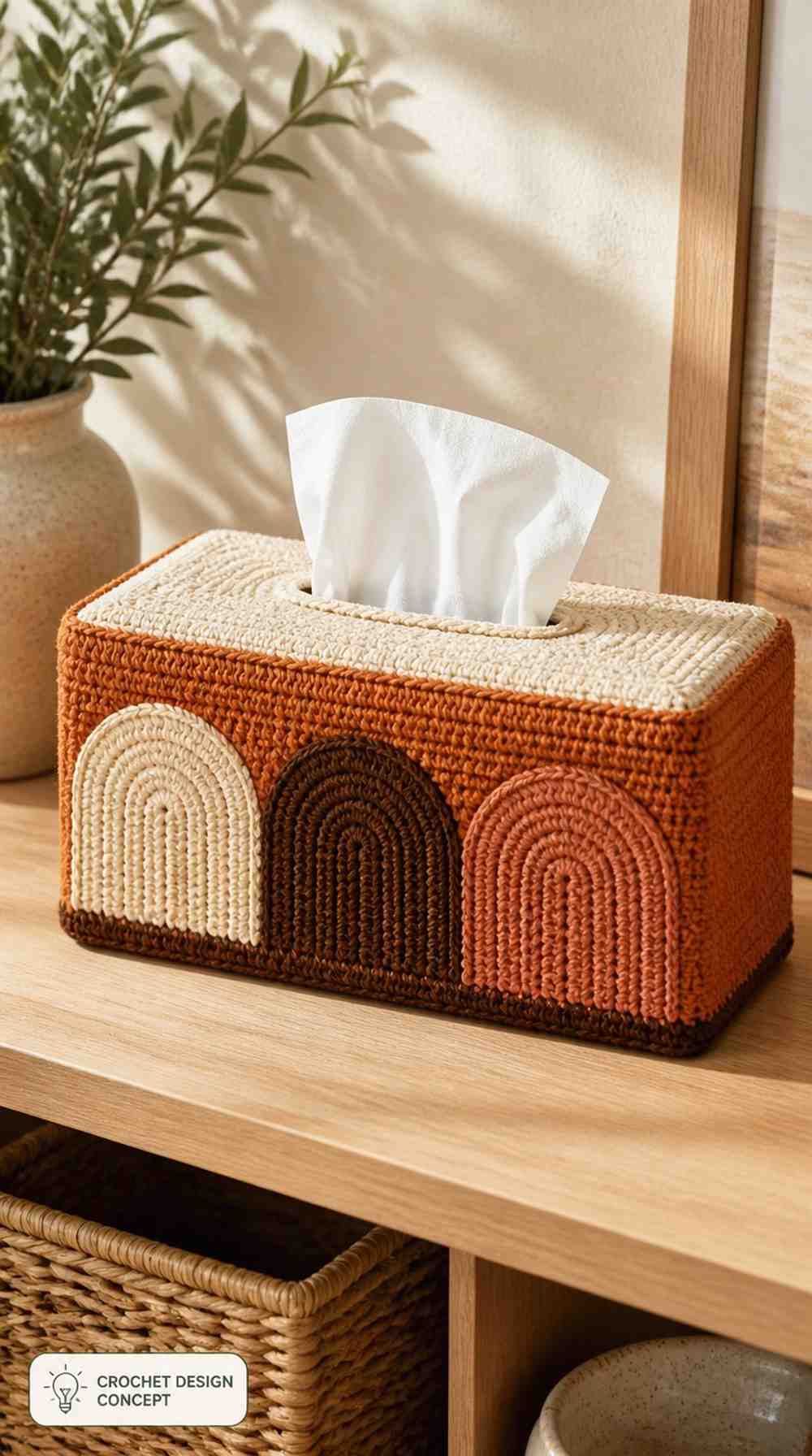
Burnt orange crochet gives this rectangular tissue holder a warm vintage appearance. Three large arch panels decorate the front in pale cream, dark chocolate, and terracotta. The connected curved sections contrast with the solid orange sides, while a cream top and narrow chocolate base complete the design.
The oversized arches make this piece particularly distinctive. Rather than relying on simple straight color blocks, the crochet pattern follows rounded architectural shapes. Recreating those curves would require more careful planning than ordinary stripes, especially where the different colored arches meet.
- Curved Colorwork: Plan the rounded arch shapes before crocheting so the curves remain smooth rather than becoming uneven stepped lines.
- Front-Facing Display: The main decoration sits on the long front panel, making placement important if the holder will stand against a wall.
- Cream Top Opening: Keep the elongated tissue slot clear of the curved decorative areas so the top remains easy to use.
- Chocolate Base Band: A narrow dark border helps define the bottom without overpowering the orange body.
4. Crochet Dusty Blue Ochre Stripe Tissue Holder
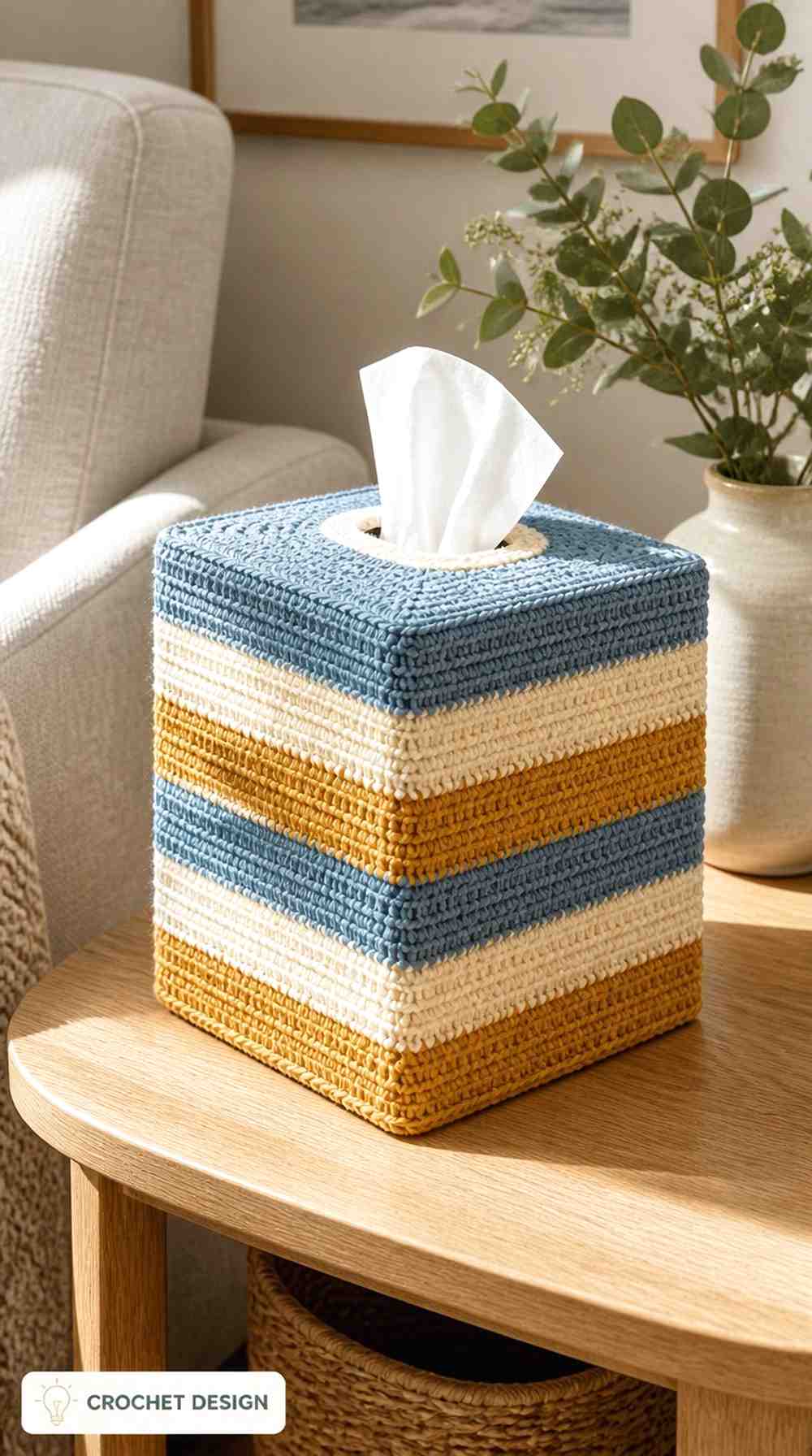
Dusty blue, muted ochre, and soft cream form wide horizontal stripes around this tall cube tissue holder. Slightly raised crochet rows add texture to the colored sections, while a solid dusty-blue top contains a cream-edged opening. A narrow ochre band completes the lower edge.
The taller silhouette makes the broad stripes feel different from those on a low rectangular cover. Its simple repeated rows are visually straightforward, leaving color and stitch texture to provide interest. For an actual crochet piece, maintaining straight edges would be especially noticeable on the vertical corners.
- Tall Cube Stability: The cover needs enough structure around the vertical sides to avoid sagging as the tissue box becomes lighter.
- Stripe Repetition: Keep the blue, ochre, and cream bands aligned across all four sides for a continuous appearance.
- Raised Crochet Texture: Subtle horizontal ridges can add detail, but thick raised rows may change the cover’s final dimensions.
- Base Edge: A narrow ochre finish should sit neatly at the bottom without curling upward or tightening the side panels.
5. Crochet Coral Mint Zigzag Tissue Holder
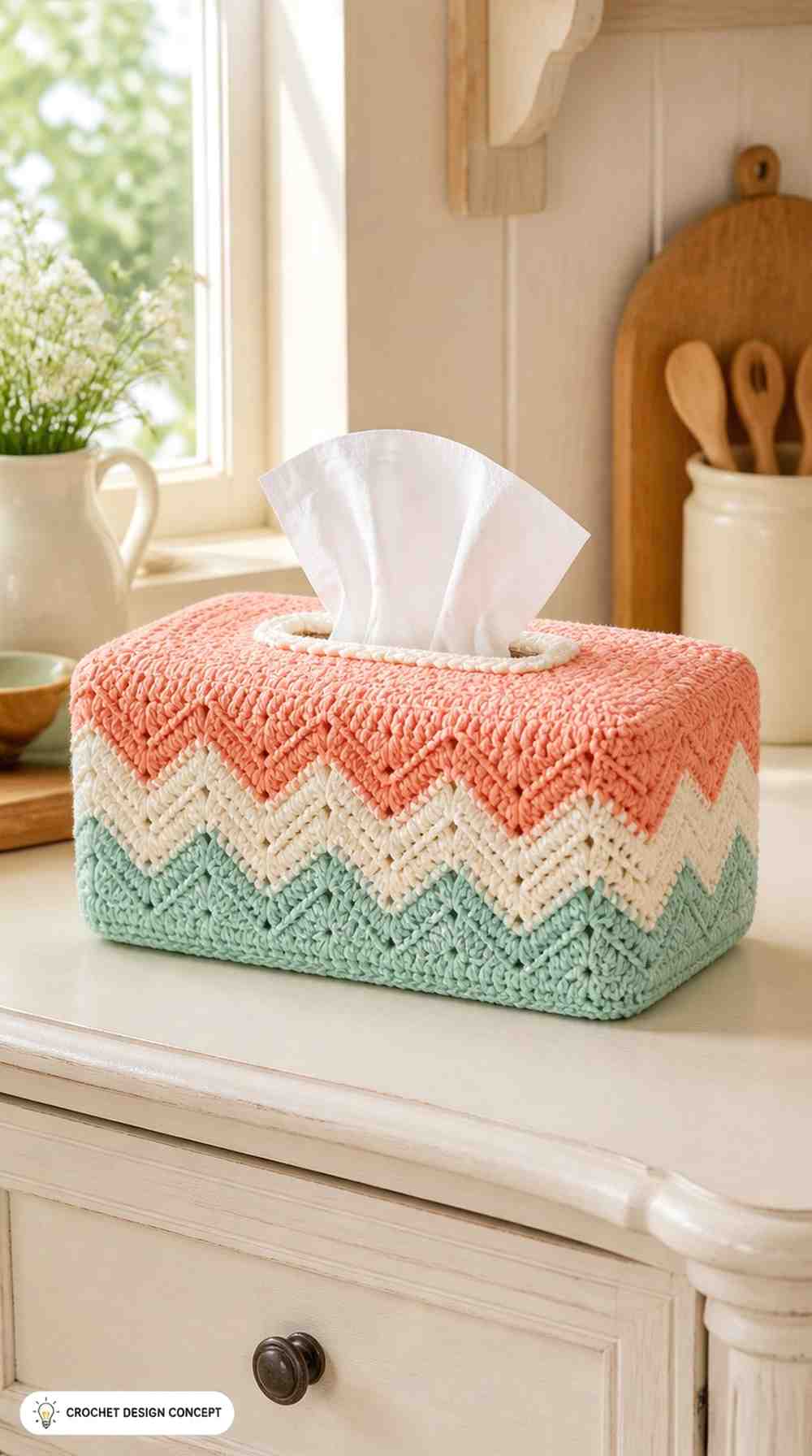
Soft coral, pastel mint, and creamy ivory create bold zigzag bands across this rectangular crochet tissue holder. The ripple pattern travels horizontally around the sides, while a flat coral top contains a narrow ivory-edged tissue opening. A simple mint border gives the bottom a straight finish.
The changing angles make this design more energetic than ordinary striped covers. Its bright pastel palette brings a playful retro feeling without needing additional flowers or appliqués. A similar handmade version would depend on consistent stitch increases and decreases to maintain a balanced ripple pattern.
- Zigzag Repeat: Keep the peaks and valleys evenly spaced so the color bands remain recognizable across the complete rectangular cover.
- Corner Alignment: Decide how the ripple pattern will meet at each corner before joining the side panels.
- Tissue Slot Position: The flat coral top should support a centered opening without distorting the surrounding stitches.
- Straight Lower Border: The mint finishing band helps create a tidy base beneath the angular pattern.
6. Crochet Lavender Lemon Granny Square Tissue Holder
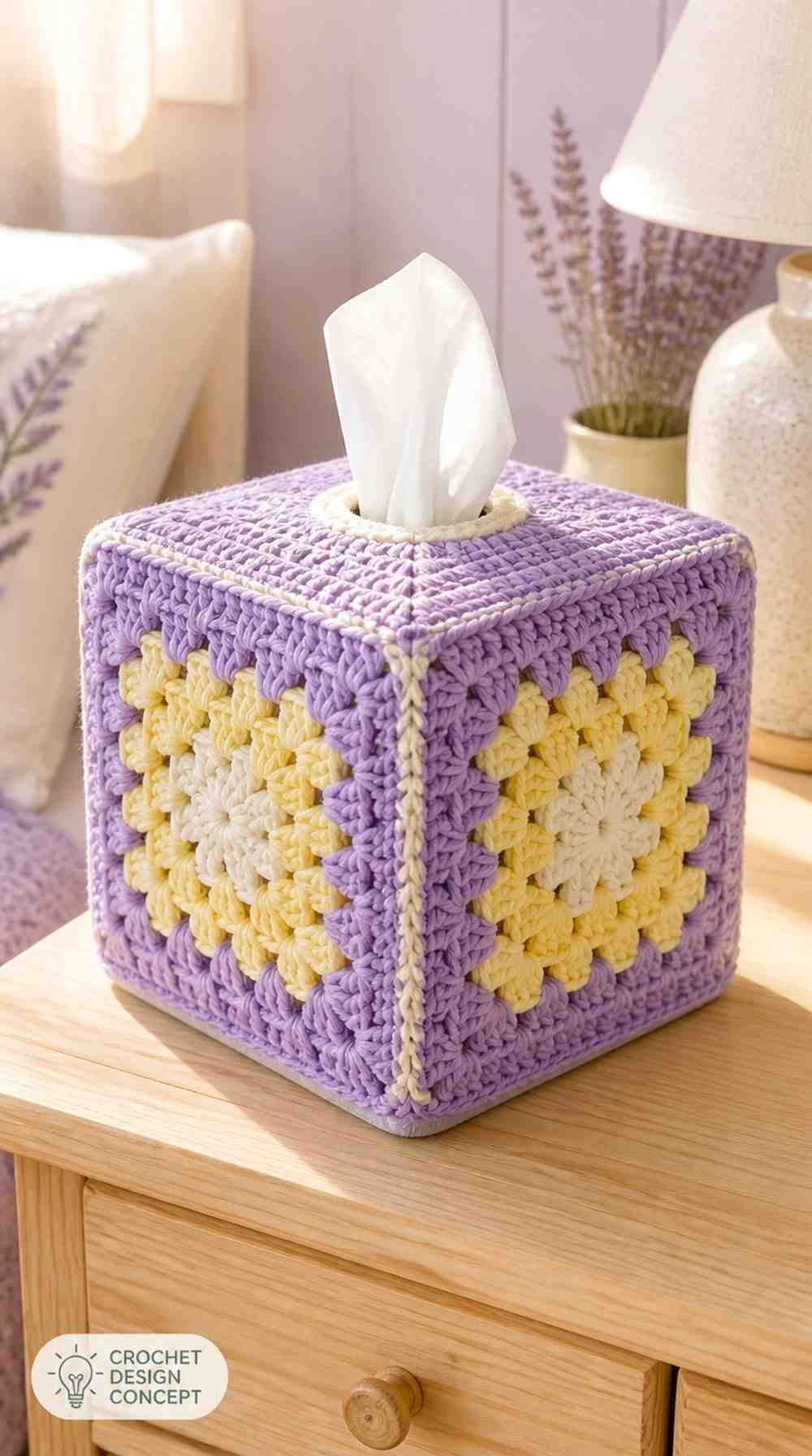
Lavender, butter yellow, and cream granny squares create a cheerful cube-shaped tissue cover. Each side features one square with a small cream center, yellow middle round, and lavender outer round. Neat joins connect the four side panels, while a solid lavender top features a small cream-edged tissue opening.
The familiar granny-cluster texture gives this design a different character from dense color-blocked covers. Small openings between the clusters make the construction visibly handmade. A real version would need careful sizing so the individual squares form a stable cube rather than stretching unevenly.
- Square Dimensions: Make the four side motifs compatible in size before joining; mismatched squares may create uneven corners.
- Granny-Cluster Openness: Open spaces reveal portions of the box underneath, so consider how the original packaging colors will affect the appearance.
- Solid Top Panel: A denser lavender lid can give the dispensing opening a firmer edge than the open granny-stitch sides.
- Corner Joining: Keep the seams flexible but secure, avoiding bulky joins that make the cube sit awkwardly.
For a different approach to decorative tissue box covers, explore 8 Crochet Mushroom Cottage Tissue Box Cover Ideas on Yarn Nest Studio. That collection focuses on whimsical cottage shapes, while these retro concepts emphasize geometric colorwork.
7. Crochet Olive Terracotta Rainbow Arch Tissue Holder
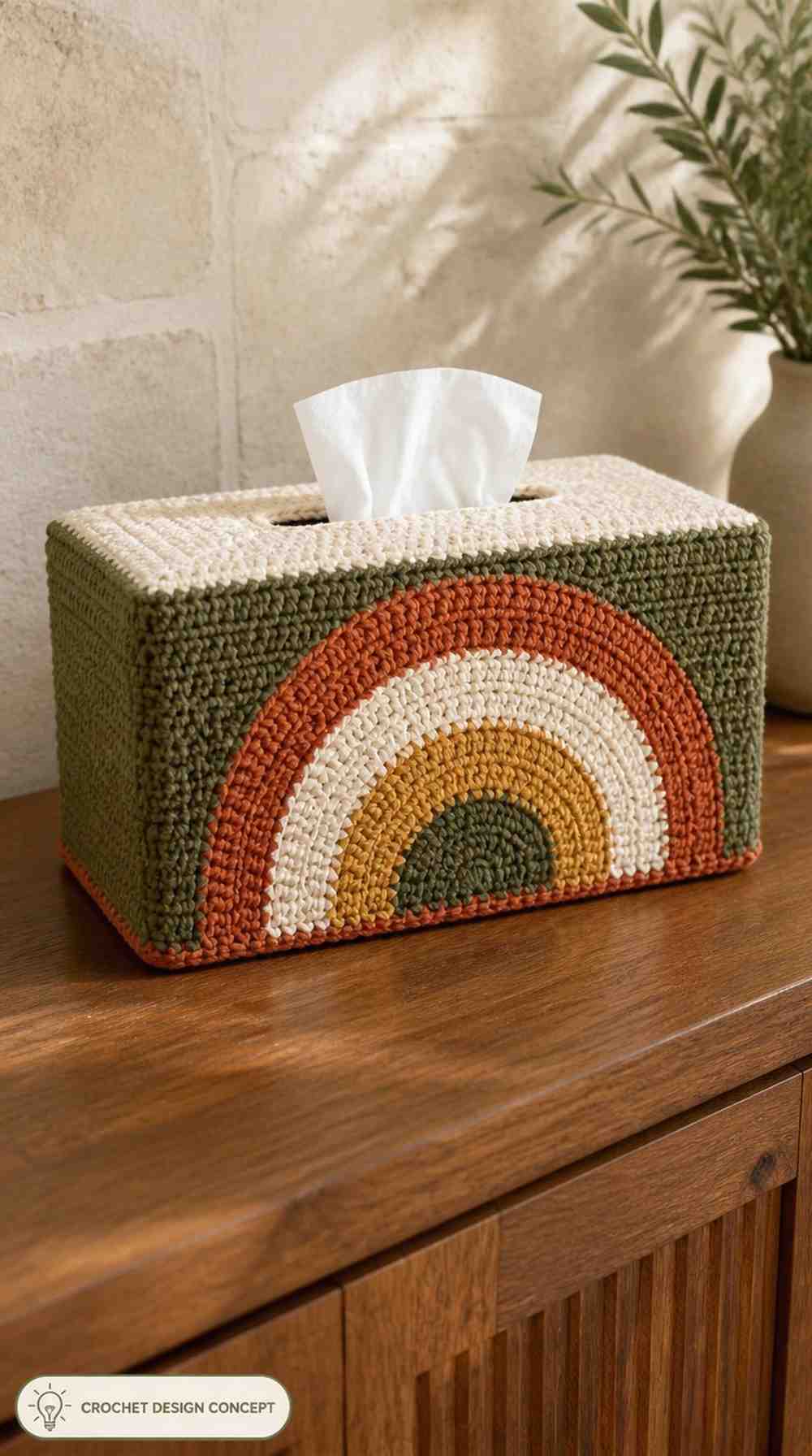
Muted olive crochet forms the background of this retro rectangular tissue holder. A large layered rainbow arch rises from the lower front, combining terracotta, buttercream, and ochre curved bands. Solid olive side panels and a cream top keep the decoration focused on the front.
The sweeping arch gives this design a clear seventies-inspired character. It is especially attractive when displayed with the decorated front facing outward. Unlike a small appliqué, the arch becomes part of the surface pattern, so its color boundaries need to remain smooth and carefully arranged.
- Layered Arch Shape: Plan the different curved bands together so their widths remain balanced from the lower edge to the highest point.
- Front Display Direction: The arch is most visible from the front, making it suitable for a console or shelf where one side faces the room.
- Olive Background: Solid surrounding color gives the terracotta and ochre bands enough contrast without adding more competing motifs.
- Top Construction: The cream panel should fit the rectangular body accurately and leave the tissue opening unobstructed.
8. Crochet Peach Pink Daisy Color Block Tissue Holder
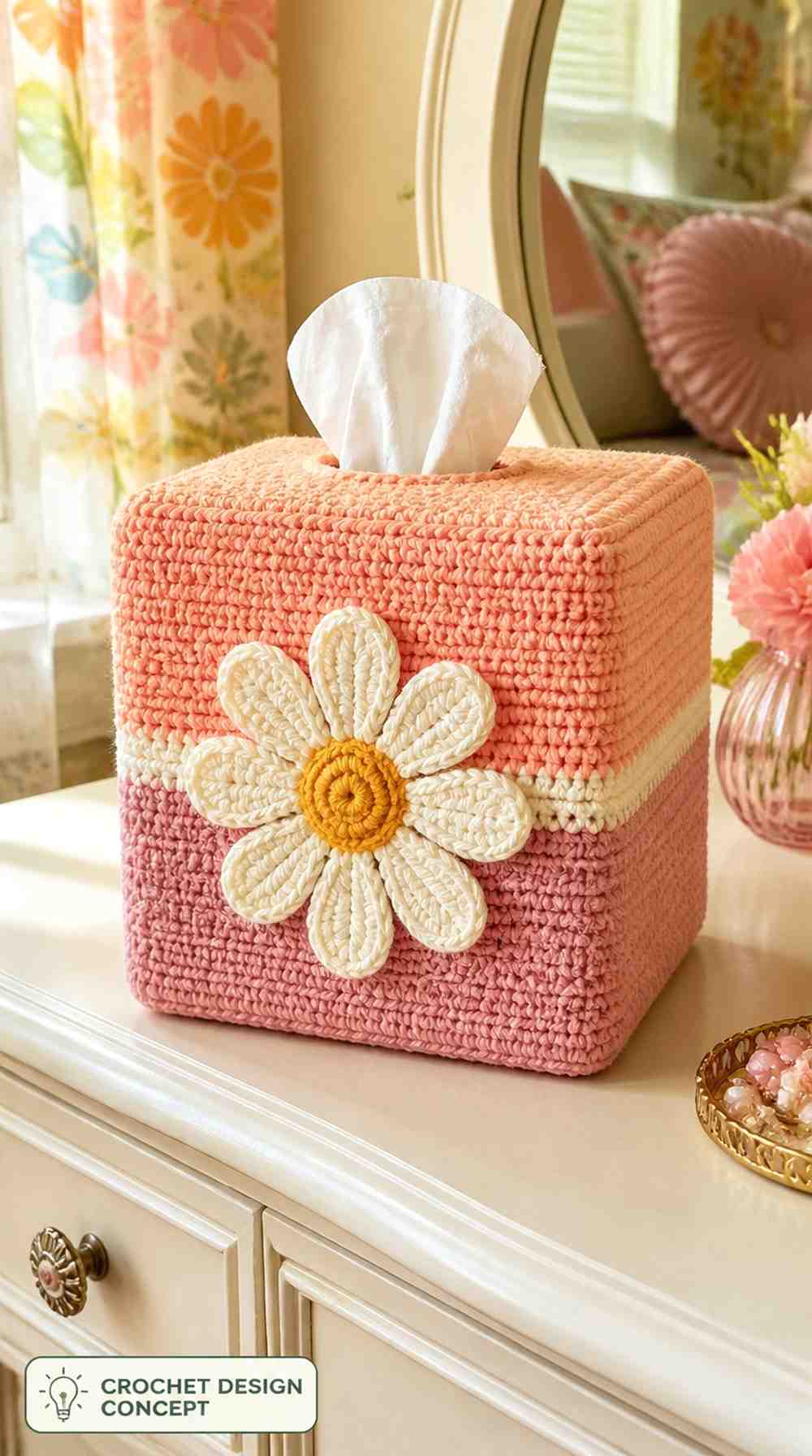
Soft peach and dusty pink create a two-tone cube tissue holder with a cheerful flower-power detail. A narrow cream band separates the upper and lower color blocks, while one dimensional ivory crochet daisy sits at the center front. Its eight rounded petals surround a raised mustard-yellow middle.
The daisy becomes the main feature without covering the entire holder. A solid peach top with a round dispensing opening keeps the functional area simple. The raised flower adds texture, although its attachment would need to remain secure during regular handling and box replacement.
- Daisy Attachment: Secure the flower evenly across the front so the petals do not lift or snag when the cover is handled.
- Two-Tone Division: The cream separating band provides a clean visual boundary between peach and dusty pink.
- Raised Flower Center: Keep the mustard center compact enough to add texture without making the front panel excessively bulky.
- Cleaning Consideration: Raised petals may collect dust more readily than flat colorwork, so choose a yarn that suits gentle cleaning.
9. Crochet Teal Butter Yellow Mod Circle Tissue Holder
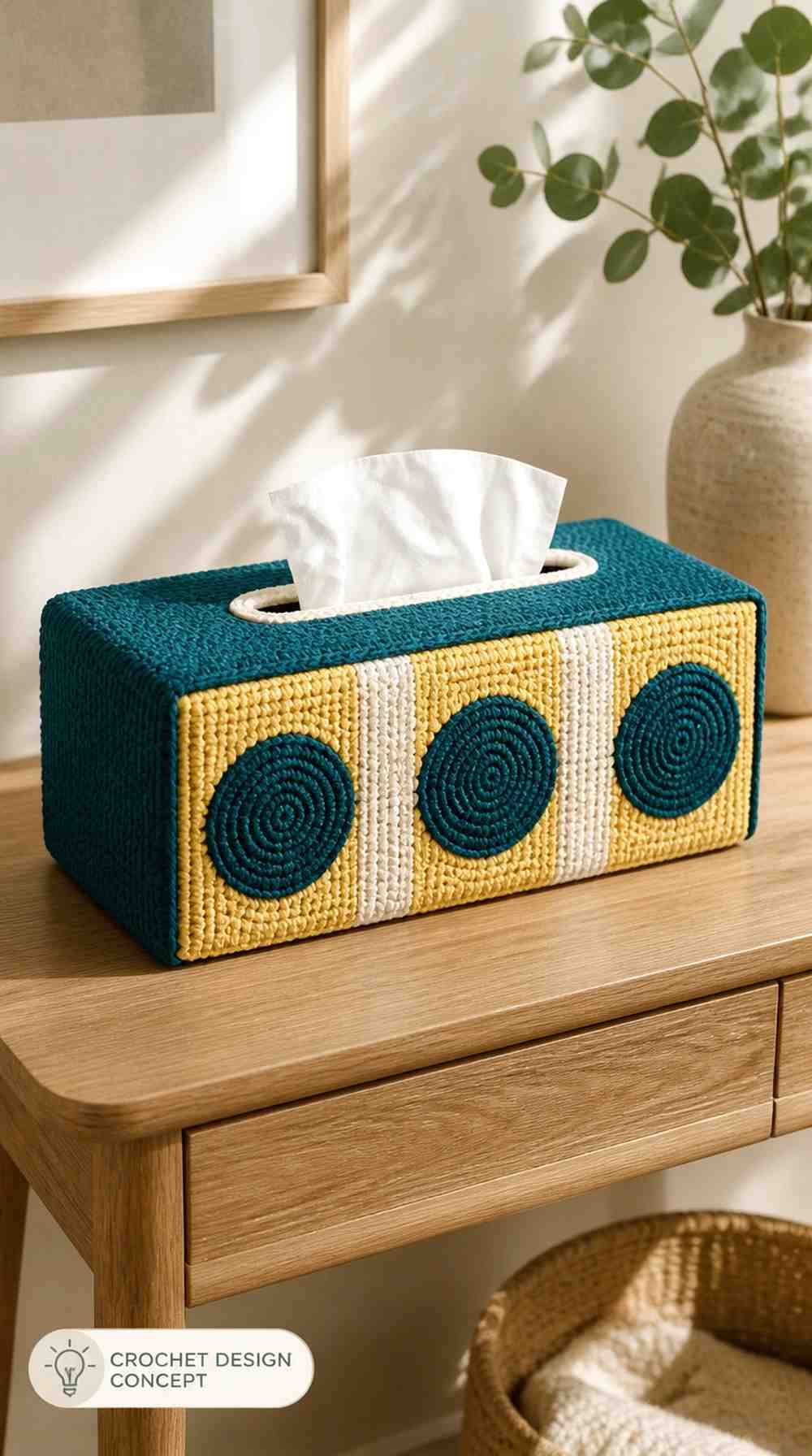
Dark teal circles stand out against broad butter-yellow and ivory blocks in this rectangular crochet tissue holder. Three flat circular motifs travel across the long front panel, each made from concentric crochet rounds. Solid teal short sides and a matching top provide a strong contrast.
The oversized circles give this design a bold midcentury-inspired look. Unlike small decorative dots, the motifs are large enough to become the main pattern. Keeping them flat against the body would be important if the holder is intended for frequent use.
- Circle Placement: Arrange the three teal motifs at consistent heights and intervals so the long front panel feels balanced.
- Flat Motif Attachment: Secure the circles without pulling their edges into raised waves or distorting the yellow blocks underneath.
- Teal Top Panel: A dark solid lid keeps the dispensing opening visually separate from the decorative circles.
- Rectangular Scale: Check that the circle size suits the actual box length; oversized motifs may crowd the corners.
10. Crochet Cream Tangerine Scallop Tissue Holder
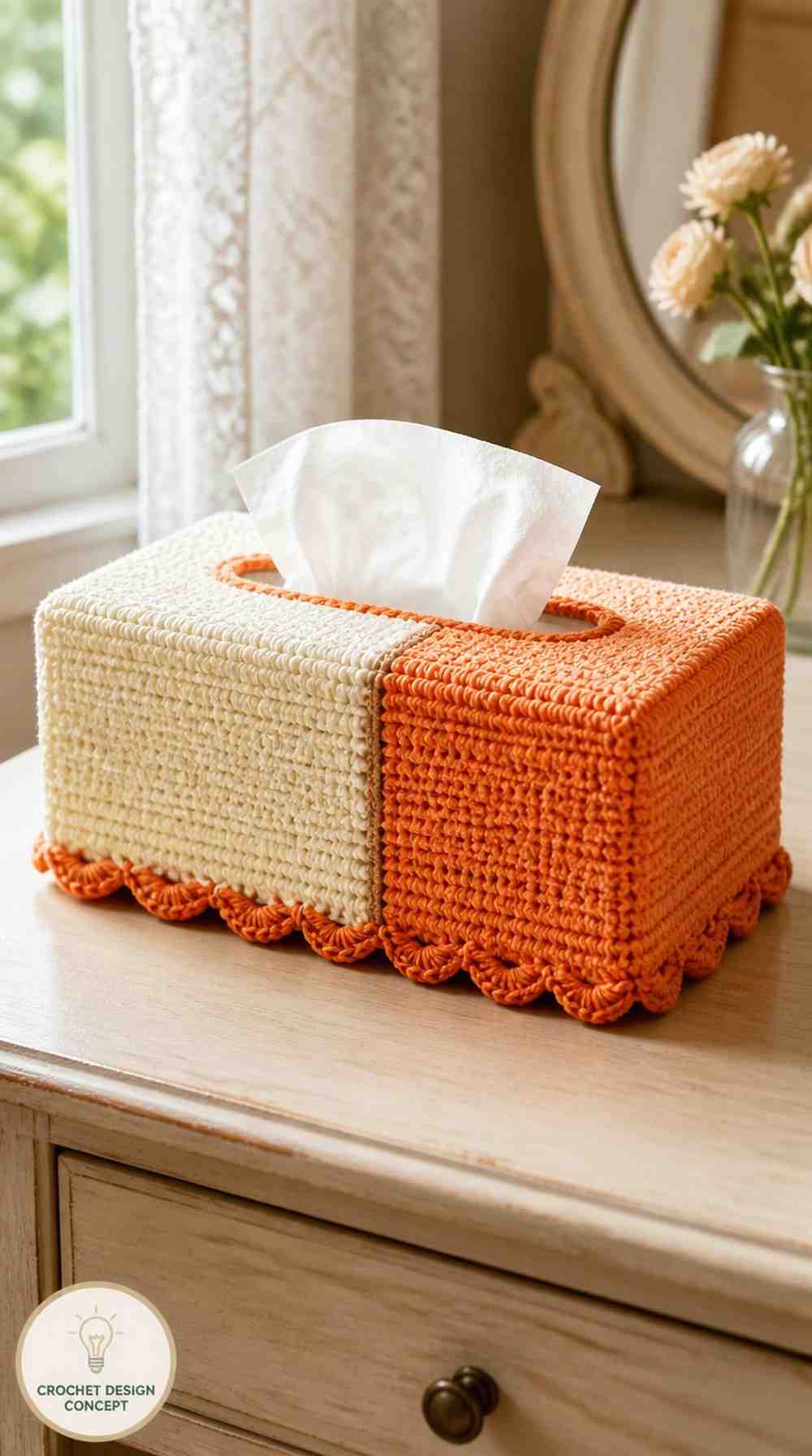
Warm cream and bright tangerine form two bold vertical blocks across this retro tissue holder. A fine cinnamon crochet line separates the colors, while small tangerine scallops decorate the lower edge. The flat cream top features a narrow orange-edged dispensing slit.
The broad color division gives this design a simpler appearance than checkerboards or repeated geometric patterns. Its small scalloped border introduces a softer vintage finish without overwhelming the straight rectangular body. A similar piece would need evenly worked scallops to keep the bottom looking neat.
- Vertical Block Alignment: Keep the cream and tangerine sections straight from the top edge to the lower border.
- Cinnamon Divider: A narrow contrasting line defines the color transition without creating a bulky raised seam.
- Scallop Distribution: Work the small lower scallops at consistent intervals so they do not distort the straight box shape.
- Top Opening: The orange-edged slit needs enough clearance for tissues to pass without catching on the decorative border.
11. Crochet Black Cherry Apricot Diamond Tissue Holder
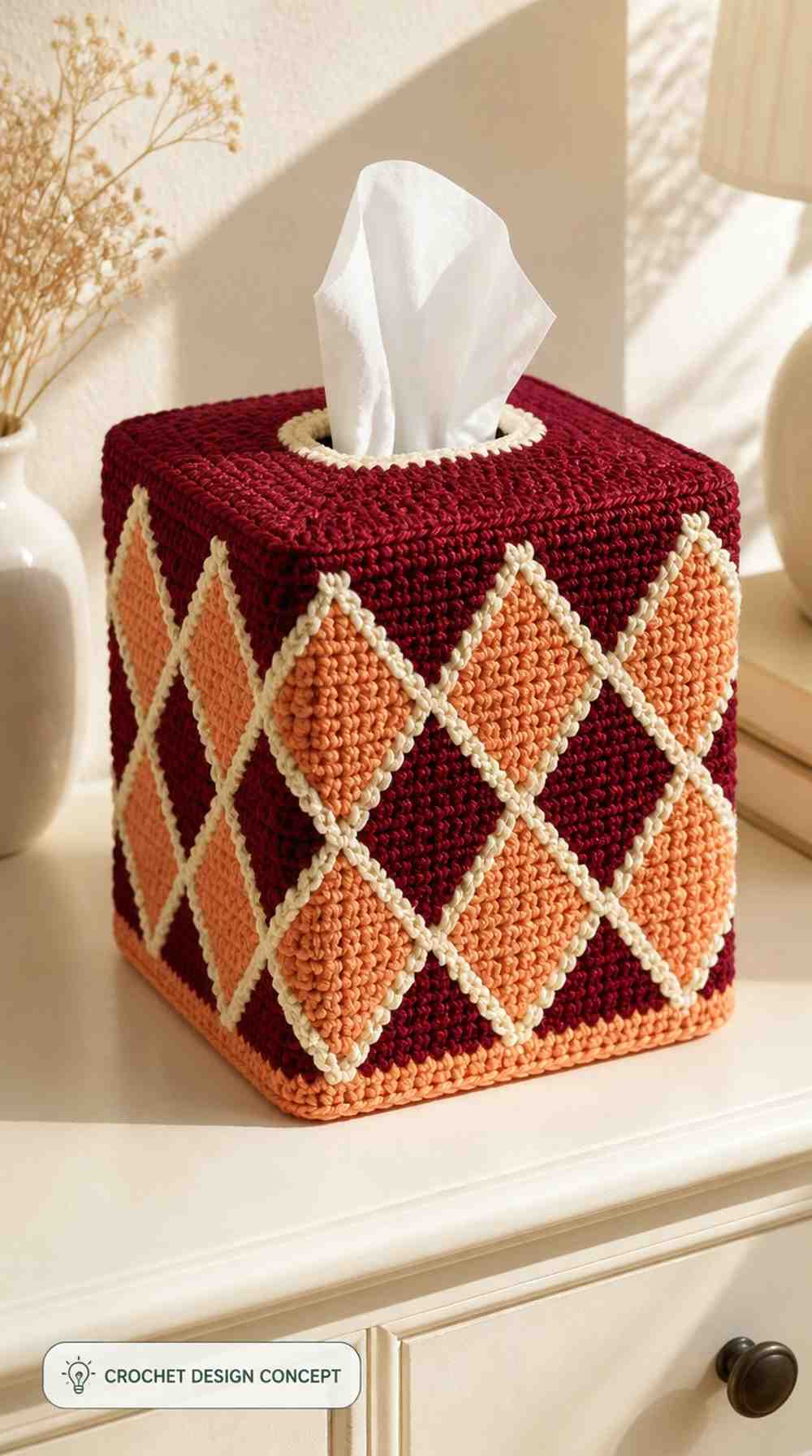
Deep black cherry and muted apricot create a dramatic diamond pattern across this cube tissue holder. Fine ivory diagonal lines separate the colored tiles, giving the sides a carefully organized geometric appearance. A solid black-cherry top contains a small oval opening, while a narrow apricot band finishes the bottom.
The darker palette makes this design more striking than the pastel alternatives. Its diagonal colorwork also creates a different visual direction from ordinary checker squares. A real version would require consistent stitch counts and planned color changes to maintain the diamond shapes around the cube.
- Diamond Geometry: Plan the sloping color boundaries carefully so the tiles retain comparable proportions across the front and side panels.
- Ivory Separators: Fine pale lines help distinguish black cherry from apricot without adding another large color block.
- Dark Yarn Visibility: Examine the stitch definition under natural light; very dark shades can hide small crochet details.
- Corner Continuity: Decide whether the diamonds should meet or end at the cube corners before joining the panels.
12. Crochet Sky Blue Cherry Wave Tissue Holder
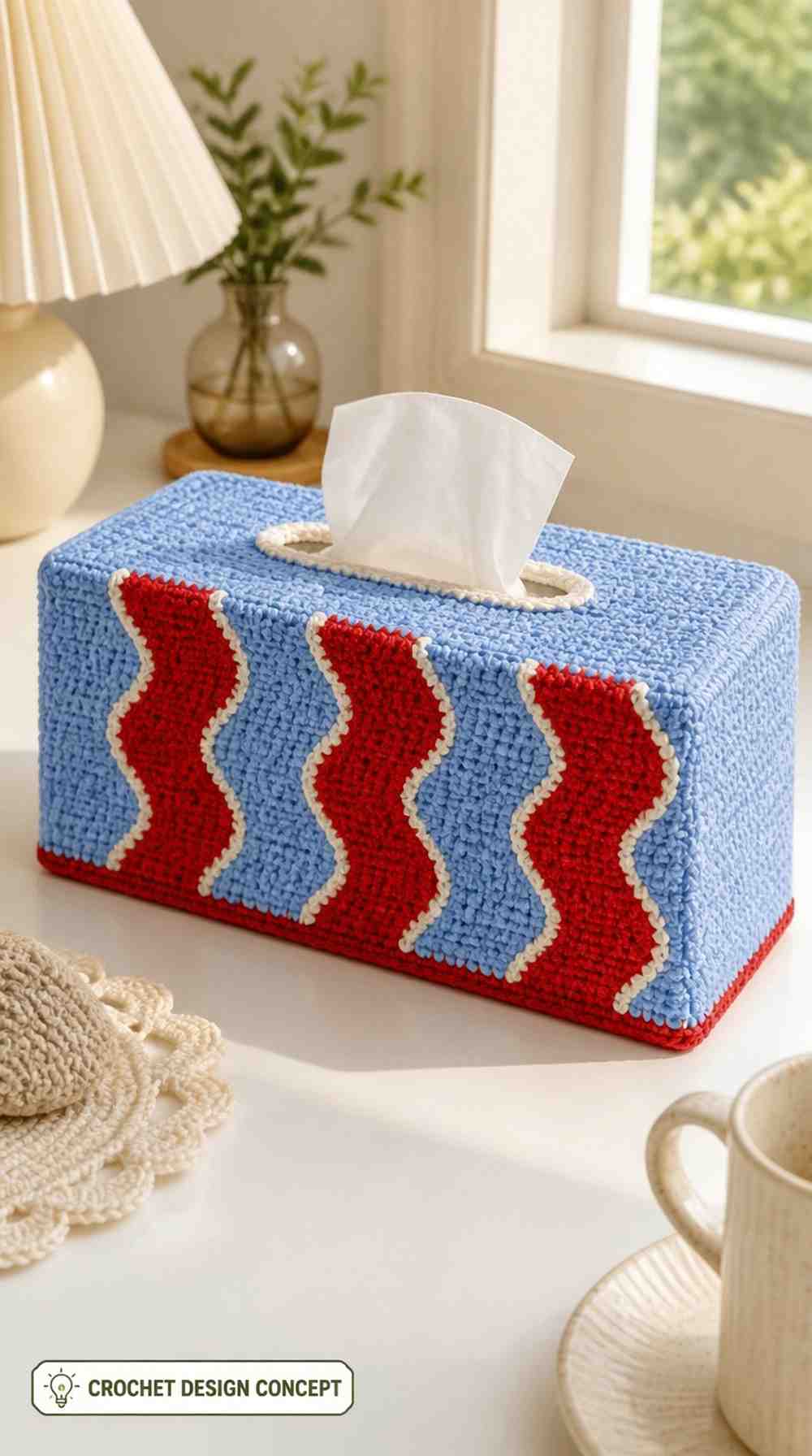
Powder-blue crochet provides a fresh background for three broad cherry-red waves in this rectangular tissue holder. The vertical S-shaped panels travel across the long front, each outlined by a narrow ivory crochet line. Solid blue sides and a matching top keep the main decoration concentrated on one surface.
The flowing curves make this design feel different from zigzags and straight stripes. Its cherry-red bands create a stronger contrast against the soft blue body. Maintaining smooth curves would be the main visual challenge in an actual crochet version.
- Wave Shaping: Plan consistent S-curves so all three vertical panels follow a coordinated rhythm rather than becoming irregular zigzags.
- Ivory Wave Borders: Narrow outlines help distinguish the red shapes from the blue background without creating excessive thickness.
- Front-Facing Pattern: Position the holder so the three wave panels remain visible when displayed on a shelf or desk.
- Top Stability: The solid blue lid should retain a neat elongated opening without pulling the wavy front panel upward.
13. Crochet Mocha Mint Stepped Block Tissue Holder
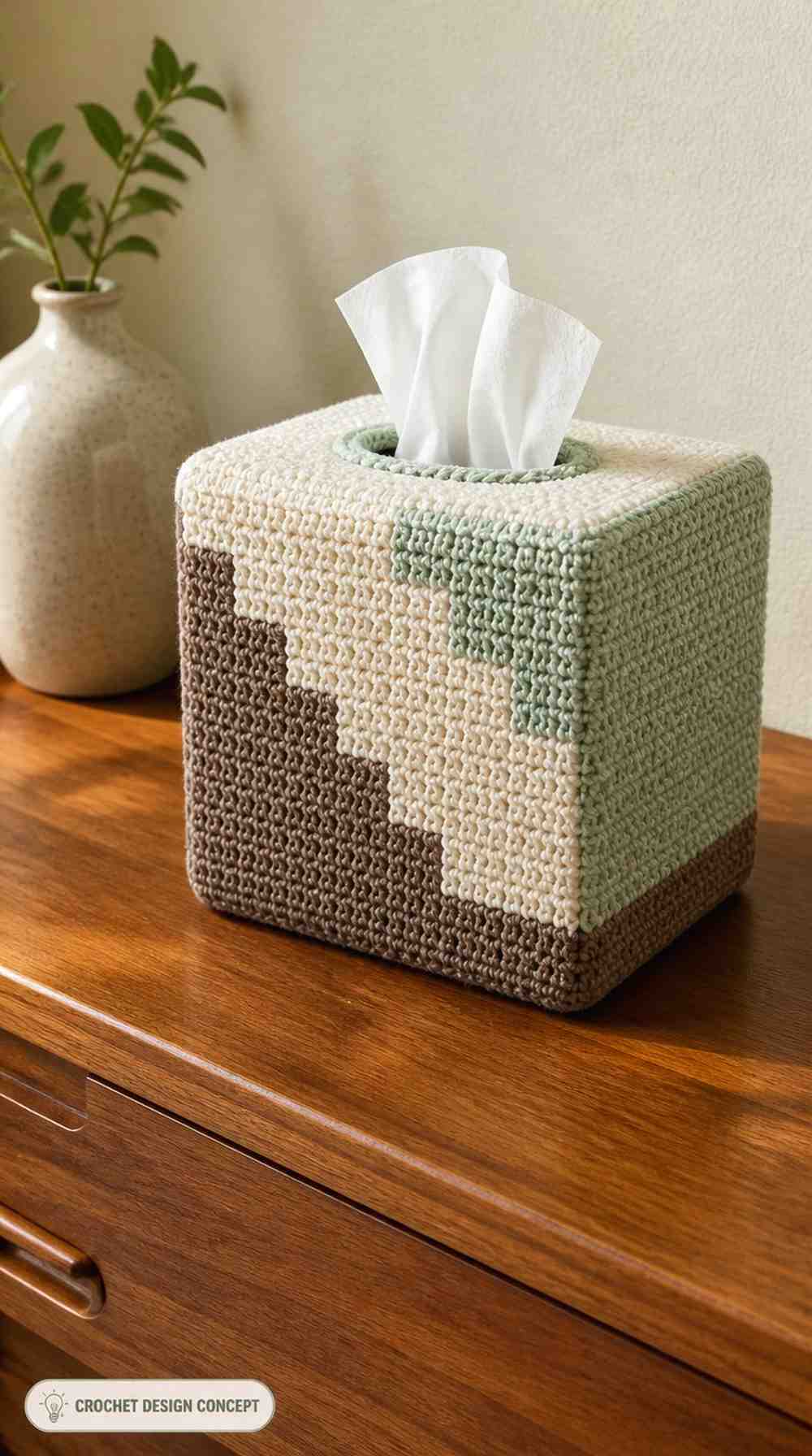
Cocoa brown, soft mint, and warm oatmeal create an unusual stepped pattern across this cube-shaped tissue holder. Rectangular color blocks rise and fall in a stair-step arrangement around the sides, while a dense moss-stitch-like crochet texture provides subtle surface detail. A flat oatmeal top completes the design.
The stepped blocks make the color transitions the main attraction. Unlike diagonal or curved patterns, the geometry relies on clearly defined horizontal and vertical edges. Consistent stitchwork would help keep the little steps recognizable without making the corners look uneven.
- Stair-Step Planning: Map the block arrangement before crocheting so the mint, cocoa, and oatmeal sections connect in a deliberate sequence.
- Moss-Stitch Texture: A compact textured stitch can add depth, but its gauge needs checking against the intended cube dimensions.
- Top Color Choice: The neutral oatmeal lid prevents the stepped side pattern from becoming visually crowded.
- Square Corners: Keep corner seams tidy so the stepped color changes remain visible instead of being distorted by bulky joins.
14. Crochet Mustard Pistachio Hanging Tissue Holder
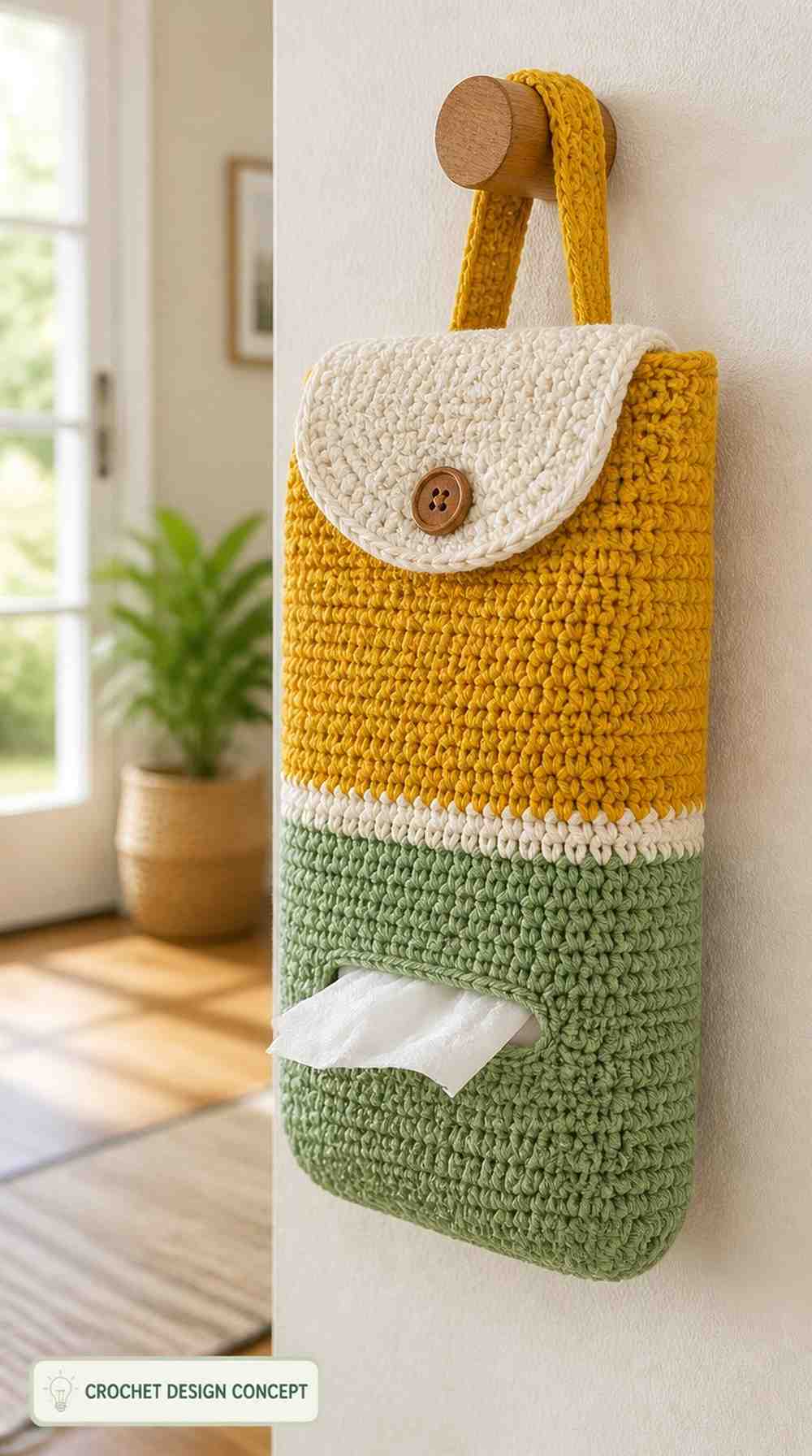
Mustard yellow and pistachio green create a cheerful two-tone hanging tissue holder. Unlike the tabletop covers, this design uses a compact rectangular crochet pouch suspended from a reinforced loop on a wooden wall peg. A cream dividing band separates the colors, while a closed top flap and lower front dispensing slit provide access to the tissues.
The wall-hanging format offers a different way to display soft tissue refills without a rigid cardboard box. Its smaller shape can suit a narrow indoor space, provided the hanging point is suitable. A real version would need stable support and a practical refill opening.
- Hanging Support: Check that the wall peg and reinforced crochet loop are appropriate for the filled holder’s weight.
- Lower Dispensing Slit: The opening should allow a tissue to be pulled without stretching or tearing the surrounding crochet stitches.
- Refill Access: A buttoned top flap provides a separate loading area; confirm it opens widely enough for the intended tissue refill.
- Placement Limits: Avoid hanging the pouch near wet surfaces, heating appliances, or areas where the loop may be caught or pulled.
15. Crochet Terracotta Lilac Granny Stripe Tissue Holder
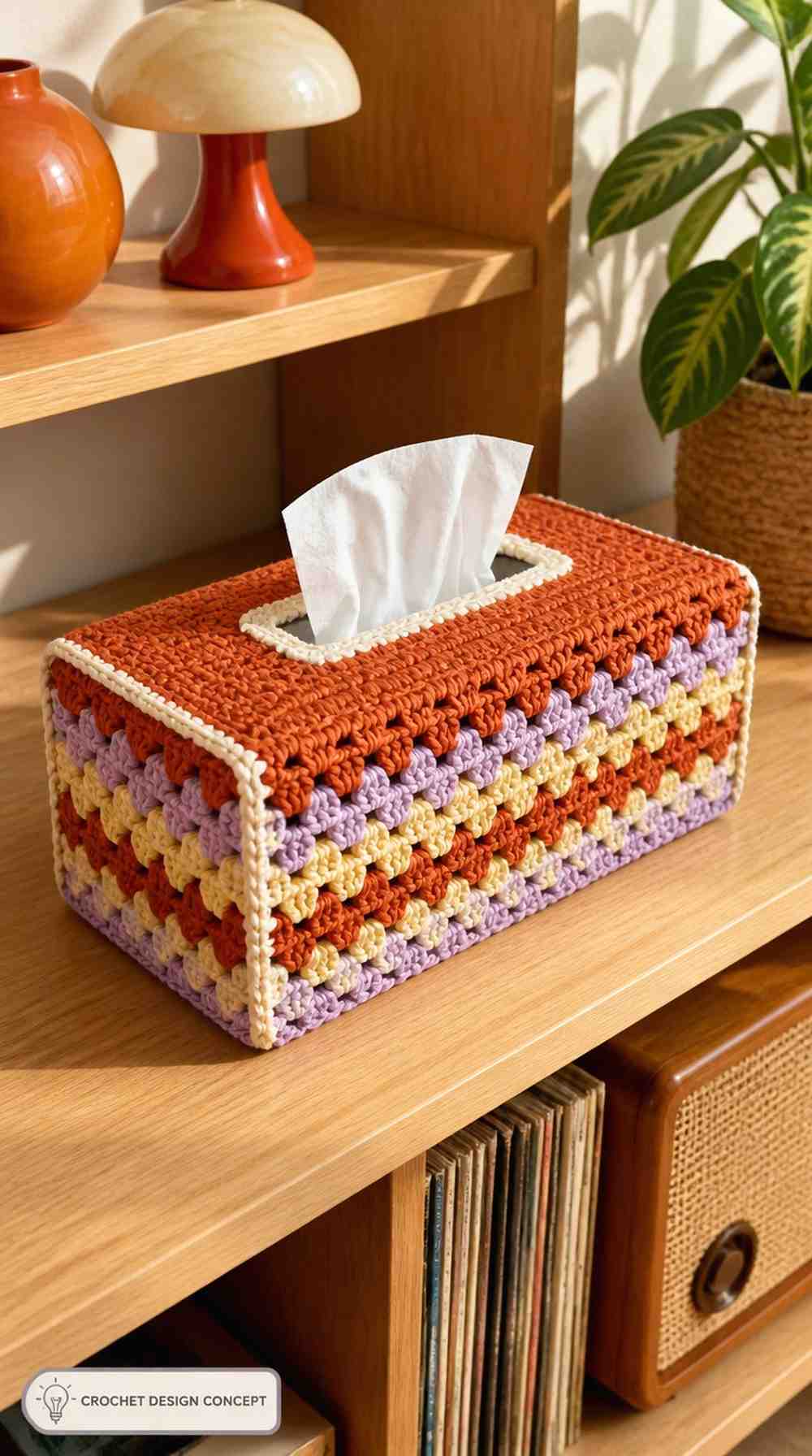
Warm terracotta, pale lilac, and buttery cream granny stripes create a colorful seventies-inspired tissue holder. The open crochet clusters form bold horizontal bands around a low rectangular body. A solid terracotta top contains a long cream-edged dispensing opening, while braided-looking cream crochet trim highlights the corners.
The combination of open granny stitches and strong vertical corner borders gives this design a distinctive handmade appearance. A lilac lower band completes the colorful arrangement. For a real version, the joins and stitch openness would matter because the original tissue box may remain visible beneath the clusters.
- Granny-Stripe Spacing: Keep the cluster groups evenly arranged so the terracotta, lilac, and cream bands maintain consistent heights.
- Corner Trim: Narrow braided-looking crochet edging can define the rectangular shape, but thick corner seams may create unwanted bulk.
- Packaging Visibility: Open granny clusters may reveal the cardboard box underneath; consider how its printed colors will affect the finished look.
- Solid Top Panel: A denser terracotta lid provides a more stable tissue opening than an unsupported granny-stitch edge.
16. Crochet Olive Orange Diagonal Cube Tissue Holder
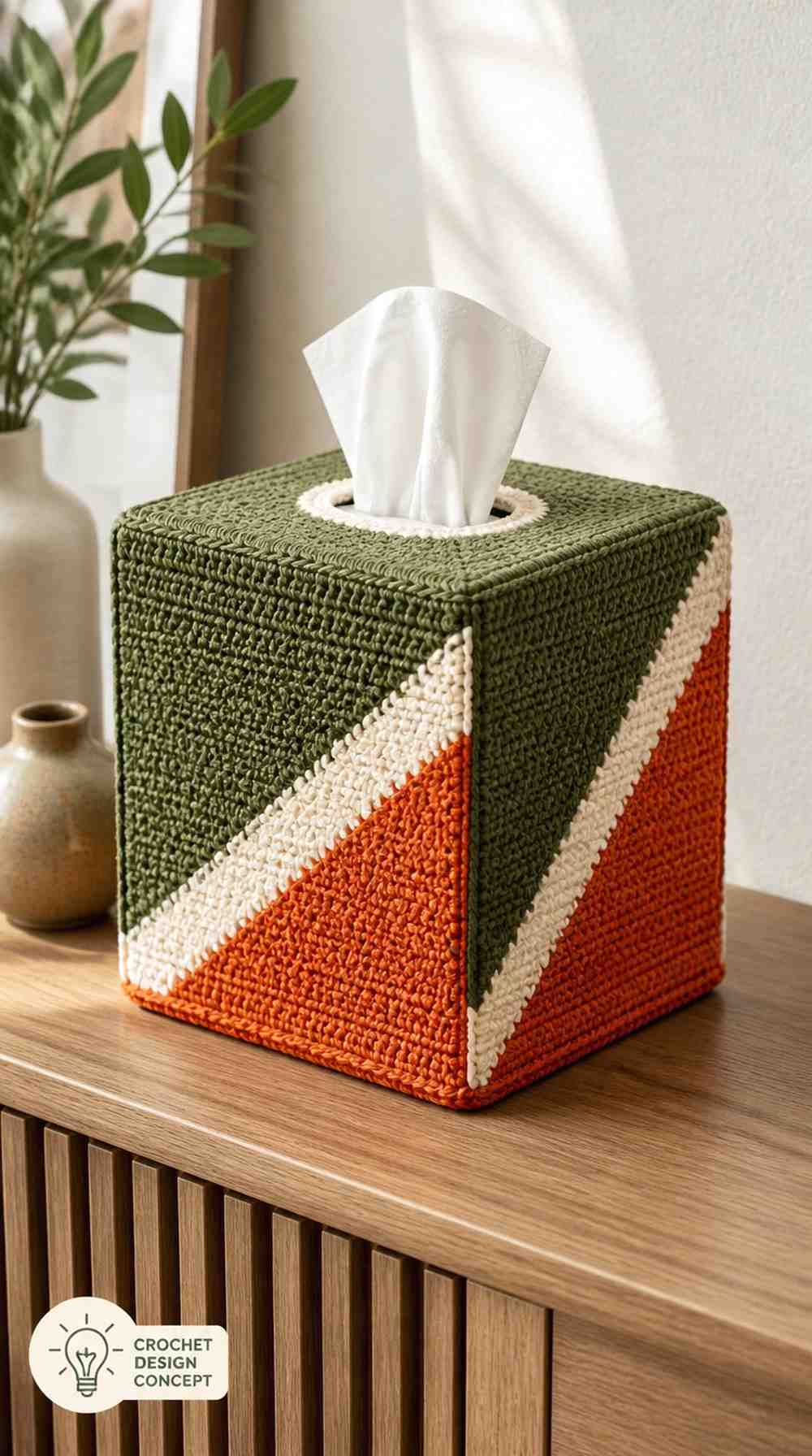
Muted olive and burnt orange divide this cube-shaped crochet tissue holder into bold diagonal sections. Cream bands separate the triangular color blocks, with the pattern continuing around the adjacent sides. A solid olive top and narrow orange lower border provide simple finishing details.
The diagonal color arrangement makes this design stand out from ordinary stripes or checkerboards. Its sharp geometry creates a modern interpretation of retro color blocking. Keeping the pattern aligned around the cube corners would be one of the most important decisions when adapting the concept into actual crochet.
- Diagonal Colorwork: Check the stitch increases or color changes needed to maintain straight-looking diagonal boundaries.
- Cream Separator Width: Keep the pale dividing bands narrow and consistent so they emphasize the contrasting triangles.
- Adjacent Side Alignment: Plan how the diagonal blocks continue around corners to avoid abrupt or mismatched color transitions.
- Cube Fit: A relatively dense crochet fabric may support the geometric appearance, but accurate box measurements are still essential.
17. Crochet Pastel Four Tile Tissue Holder
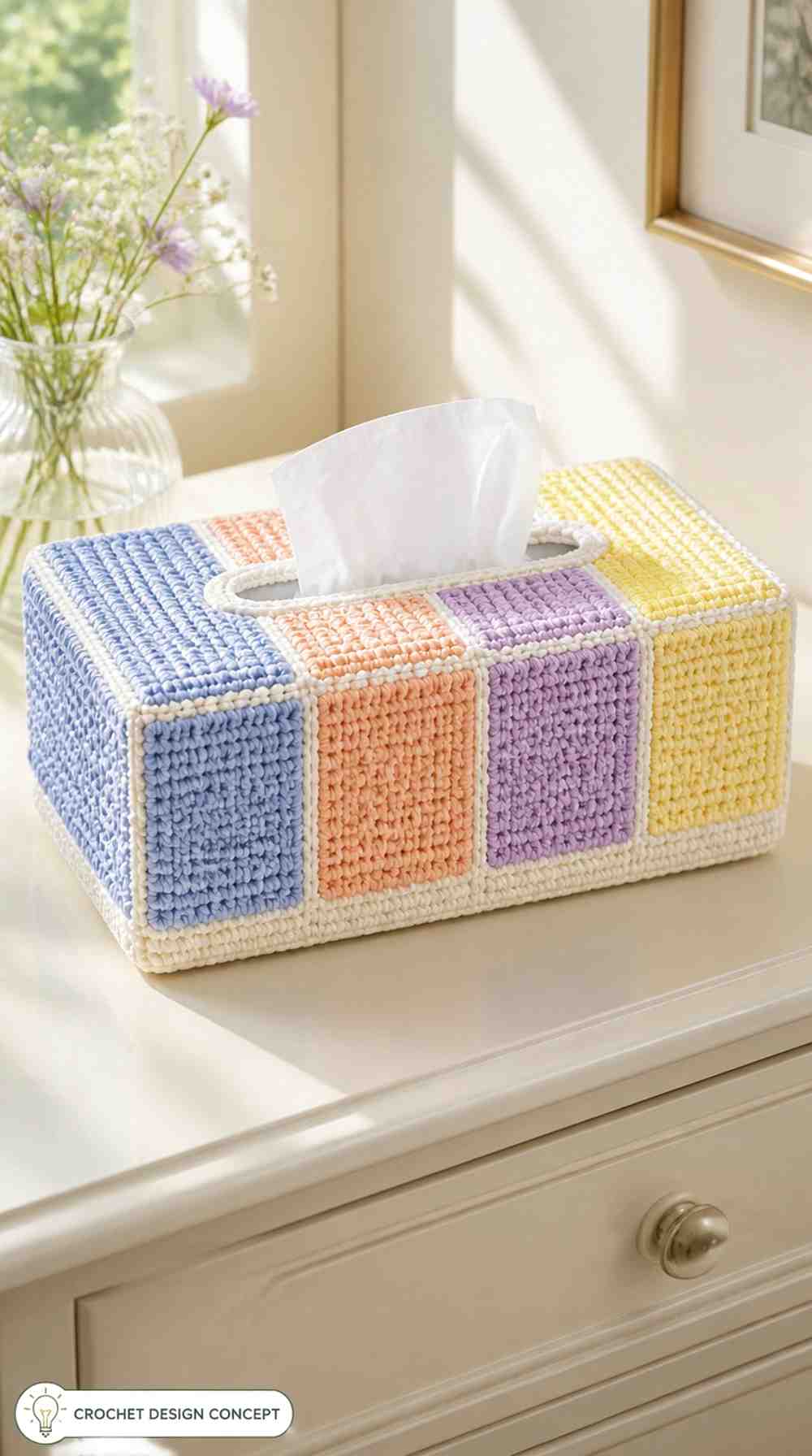
Baby blue, warm peach, pale lavender, and buttercream yellow create four broad color blocks across this rectangular crochet tissue holder. Narrow ivory seams separate the vertical sections, while the top repeats the same colors around a central dispensing slot. A simple ivory lower band completes the shape.
The four-tile layout makes this one of the cleanest designs in the collection. Instead of relying on motifs or decorative edges, it lets the colors provide the interest. Its straight blocks are visually simple, although matching the top pattern to the sides would still require careful planning.
- Four-Color Arrangement: Choose the order of blue, peach, lavender, and yellow before starting so the overall palette feels balanced.
- Top Panel Matching: Align the upper color sections with the side blocks where practical, particularly around the central tissue opening.
- Ivory Joining Lines: Narrow pale seams keep the separate tiles distinct without introducing an additional strong accent color.
- Simple Lower Edge: An uncomplicated ivory border allows the four main colors to remain the focus.
Practical Guide to Crochet Tissue Holders
A crochet tissue holder should fit the intended tissue packaging and allow tissues to be removed comfortably. Before planning a real piece, focus on the size, opening, stitch structure, and location where it will be used.
Measure the actual tissue box. Tissue boxes come in different shapes and dimensions. Record the length, width, height, and size of the dispensing opening. A cube cover and a low rectangular cover are not interchangeable simply because both hold tissues.
Check the tissue opening before finishing. The crochet opening should line up with the dispenser beneath it. Test a few pulls to see whether tissues catch on the edge or make the cover move.
Choose a suitable stitch density. Close crochet stitches may help hide printed tissue packaging and maintain a clean color-block pattern. Open granny stitches create more texture but may reveal the box underneath.
Think about shape retention. A loose cover can sag or slide, while an overly tight cover may distort the cardboard box. Making a gauge swatch and checking the actual dimensions helps with both problems.
Keep the cover removable. An open-bottom sleeve or other easily accessible construction makes it easier to replace an empty tissue box and clean the crochet separately.
Consider moisture and cleaning. Tissue holders are often used in bathrooms, bedrooms, and kitchens. Avoid regular splashing and prolonged dampness, and follow the yarn’s care instructions. Keep crochet away from open flames and heating elements.
For hanging tissue holders, check the support. A wall pouch needs a secure hanging point, a suitable refill opening, and a stable dispensing slit. Do not assume the same construction used for a tabletop tissue box will support a hanging refill.
Want to Make Something Similar?
These are real crochet patterns and tutorials that can help with tissue box sizing, top openings, and cover construction. They are not exact patterns for the AI-generated retro designs above.
- Easy Crochet Tissue Box Cover by Jo to the World Creations — A free written pattern with diagrams and a video tutorial. Useful for learning rectangular tissue box cover construction and working a dispensing opening. Jo to the World Creations
- Lily Sugar’n Cream Checkered Tissue Box Covers by Yarnspirations — A free pattern available in different sizing options, particularly relevant if you want to explore checkerboard colorwork. Yarnspirations
- Rectangular Gift Tissue Box Cover by Nicki’s Homemade Crafts — Includes written instructions and three video tutorials, demonstrating a decorative cover with a separate top and body. Nicki’s Homemade Crafts
Follow the measurements, stitch counts, materials, and construction instructions provided by the original creator. Changing the color-block layout or box proportions may require additional adjustments.
Which Crochet Retro Color Block Tissue Holder Should You Choose?
| Design | Main feature | Shape | Main consideration |
|---|---|---|---|
| Mustard Rust Retro | Three broad horizontal bands | Cube | Stripe proportions |
| Sage Blush Checkerboard | Alternating pastel checks | Rectangle | Square alignment |
| Burnt Orange Deco Arch | Three large curved arches | Rectangle | Curved colorwork |
| Dusty Blue Ochre Stripe | Textured horizontal stripes | Tall cube | Side stability |
| Coral Mint Zigzag | Multicolor ripple bands | Rectangle | Zigzag shaping |
| Lavender Lemon Granny Square | Four granny-square sides | Cube | Joining and openness |
| Olive Terracotta Rainbow Arch | Large layered retro arch | Rectangle | Front motif alignment |
| Peach Pink Daisy Color Block | Two-tone body and raised daisy | Cube | Flower attachment |
| Teal Butter Yellow Mod Circle | Large teal circular motifs | Rectangle | Flat appliqué placement |
| Cream Tangerine Scallop | Vertical blocks and scallops | Rectangle | Lower-edge tension |
| Black Cherry Apricot Diamond | Diagonal diamond tiles | Cube | Colorwork accuracy |
| Sky Blue Cherry Wave | Three vertical curved panels | Rectangle | Wave consistency |
| Mocha Mint Stepped Block | Stair-step color geometry | Cube | Block transitions |
| Mustard Pistachio Hanging | Two-tone wall dispenser | Hanging pouch | Support and refill access |
| Terracotta Lilac Granny Stripe | Open granny-cluster bands | Rectangle | Packaging visibility |
| Olive Orange Diagonal Cube | Large diagonal triangles | Cube | Corner alignment |
| Pastel Four Tile | Four clean vertical sections | Rectangle | Matching top and sides |
For a simple retro statement, the Mustard Rust Retro Cube, Dusty Blue Ochre Stripe, and Pastel Four Tile concepts offer strong color combinations without elaborate decorative motifs.
If you enjoy geometric crochet, the Sage Blush Checkerboard, Black Cherry Apricot Diamond, and Olive Orange Diagonal Cube designs provide more structured patterns, although their stitch counts and color placement require careful planning.
For a distinctive seventies-inspired accent, the Burnt Orange Deco Arch, Olive Terracotta Rainbow Arch, and Teal Butter Yellow Mod Circle designs make the decorative front panel the main attraction.
For a different type of tissue storage, the Mustard Pistachio Hanging Tissue Holder uses a soft wall-mounted pouch rather than a rigid box cover. Its attachment and dispensing arrangement need separate consideration.
Conclusion
Crochet retro color block tissue holders show how a practical household object can become part of your room’s decor. Bold mustard and rust stripes, checkerboard panels, playful arches, pastel tiles, and vintage-inspired shapes all offer different ways to use color and crochet texture.
The strongest choice is one that fits your actual tissue box, keeps the dispensing opening accessible, and suits the surrounding space. A simple cover with clean edges can be just as attractive as a more elaborate geometric design.
Which of these 17 retro tissue holder ideas would you choose? Would you decorate your home with the sage-and-blush checkerboard, the burnt-orange arches, or the colorful pastel four-tile design? Share your favorite color combination in the comments.
Frequently Asked Questions
1. What is the difference between a crochet tissue holder and a crochet tissue box cover?
The terms are often used interchangeably, but a tissue box cover usually fits over an existing cardboard box. A tissue holder can also refer to a separate pouch or dispenser that holds tissues without a rigid box. The design, opening, and support should suit the type of tissue packaging being used.
2. What yarn is best for a crochet tissue box cover?
Smooth cotton or suitable cotton-blend yarns are worth considering because they can provide clear stitch definition and a relatively structured fabric. Other fibers may also work depending on the design. Make a sample to check stitch density, stretch, and shape retention, and follow the yarn’s cleaning instructions.
3. How do I make a crochet tissue holder fit properly?
Measure the actual tissue box’s length, width, and height, along with the location of its top opening. Check the pattern’s gauge and finished dimensions before beginning. The cover should slide on and off without excessive stretching, while staying close enough to the box to avoid sagging.
4. Can beginners make a retro color block tissue holder?
Beginners familiar with basic stitches may find a simple striped rectangular or cube cover approachable. Checkerboards, curved arches, diagonal colorwork, and shaped openings can require more planning. Start with a tested tissue box cover pattern, then experiment with colors once you understand its construction.
5. Can a crochet tissue holder be used in a bathroom?
It may be suitable for a dry, well-ventilated bathroom area, depending on the yarn and construction. Avoid placing crochet where it will be regularly splashed or remain damp. Keep the tissue opening clear, allow the cover to dry completely if it becomes wet, and follow the material’s care instructions.