Crochet kitchen towel toppers can solve the practical problem of towels sliding from oven bars and cabinet handles while also adding a small handmade detail to a cottage kitchen. The construction matters as much as the decorative style. Some toppers are crocheted directly onto a folded towel, while others use hidden rings, wooden rings, elastic loops, corner attachments, or removable buttoned pieces that let you change the towel independently.
This collection includes restrained everyday designs as well as flowers, ruffles, plaid, pumpkin texture, Christmas trees, gingerbread, and other character accents. Before choosing one, consider where the towel will hang, how often it will be washed, and whether you want the crochet permanently attached. Printed towels also need planning: the folding and attachment method can determine whether the main illustration remains visible. Use each creator’s original tutorial for exact sizing, materials, and construction rather than assuming one topper method can be substituted directly for another.
Quick List
- Crochet Textured Built-In Towel Topper
- Crochet Classic Button-Tab Towel Topper
- Crochet Polished Single-Crochet Towel Topper
- Crochet Simple Single-Crochet Hanging Topper
- Crochet Traditional Buttonhole Towel Topper
- Crochet Ruffled Button-Loop Towel Topper
- Crochet Removable Striped Towel Topper
- Crochet Farmhouse Tapered Towel Topper
- Crochet Layered Flower Ring Towel Topper
- Crochet Tassel-Trim Hidden-Ring Topper
- Crochet Poinsettia Cottage Towel Topper
- Crochet Puff-Stitch Corner Towel Topper
- Crochet Wooden-Ring Cottage Towel Holder
- Crochet Scalloped Ring Towel Holder
- Crochet Ruffled Elastic-Ring Towel Holder
- Crochet Recycled-Ring Kitchen Towel Topper
- Crochet Two-Way Dish Towel Topper
- Crochet Pansy Kitchen Towel Topper
- Crochet Gingerbread Cottage Towel Topper
- Crochet Plaid Farmhouse Towel Topper
- Crochet Pumpkin-Cluster Towel Topper
- Crochet Christmas Tree Ring Towel Topper
- Crochet Witch Cottage Towel Holder
- Crochet Owl-Inspired Kitchen Towel Topper
Choose Between Attached and Removable Towel Toppers
The first decision is whether the crochet should stay attached to the towel. Traditional toppers are usually worked into, stitched onto, or otherwise permanently connected to the fabric. That gives the finished piece an integrated look, but the crochet and towel must then be laundered together. Check that the yarn, button, embellishments, and towel have compatible care requirements before making a set for regular kitchen use.
Ring-style holders work differently. The crochet remains on the oven or cabinet handle while the towel slides through a concealed or visible ring. This makes it easier to replace a damp towel without removing the decorative holder. Wooden, plastic, metal, and elastic rings can behave differently around moisture and repeated washing, so follow the original tutorial’s material recommendations rather than substituting hardware automatically.
Corner-sewn holders offer another option. They leave most of the towel unchanged and can preserve more of a large printed design.
Match the Topper to the Towel
Printed tea towels need more planning than solid ones. Before attaching anything, fold the towel the way the tutorial requires and confirm that its artwork, lettering, border, or directional motif faces the correct way. A topper attached across the center fold can hide more of the design than a small corner attachment.
Thickness matters too. A dense terry towel may be harder to pierce cleanly than a lightweight tea towel, while a very thin towel can bunch where heavy crochet is attached. If a tutorial specifies punching holes, adding embroidery stitches, sewing a foundation, or crocheting through fabric, use that preparation method rather than forcing a large hook through the towel.
Color can do practical work as well as decorative work. Neutral yarn allows an illustrated towel to remain the focal point, while a simple towel gives plaid, flowers, tassels, or character toppers more visual space.
Plan Closures and Kitchen Placement Before Crocheting
Measure the bar, knob, or handle where the finished topper will hang. A buttoned strap designed for an oven handle may not fit a thick refrigerator handle, while a holder intended for a cabinet knob may need a completely different loop arrangement.
Buttons should pass securely through the intended opening without straining the crochet. A button that is too small may slip out under handling; one that is too large can distort the buttonhole. Ring holders should also allow the towel to slide through without forcing a thick folded section.
Keep decorative toppers away from direct flame, burners, and other high-heat areas. A towel hanging from an oven door is not the same as an oven mitt or hot pad. Fiber choice does not turn a decorative topper into heat-protective equipment, so use it only for the towel-hanging purpose shown by the original designer.
1. Crochet Textured Built-In Towel Topper
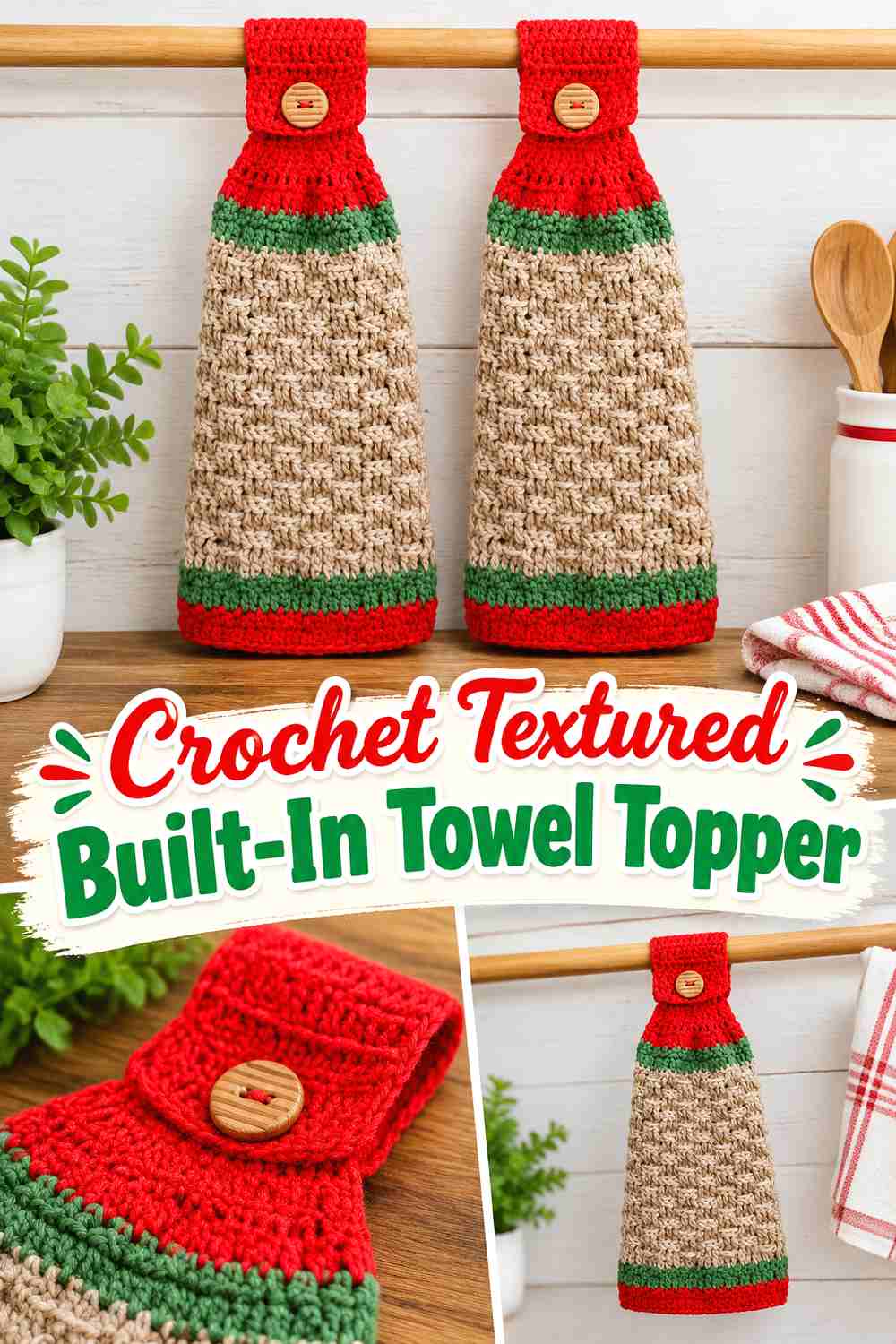
Naztazia takes a different approach from fabric-towel toppers by crocheting the towel itself and integrating the hanging section into the same project. The design is worked upward, using textured sections before narrowing into the topper, so there is no separate fabric edge to pierce or sew. Front- and back-post stitches contribute much of the visible texture, while the hanging end closes with a button.
This idea suits a cottage kitchen where you want the towel and topper to look intentionally coordinated rather than like two separate materials. Because the towel is crocheted as part of the project, however, its absorbency, drape, drying behavior, and overall weight depend directly on the chosen yarn.
Consider Full-Towel Weight
A fully crocheted towel contains far more yarn than a small topper added to commercial fabric. When wet, that additional material can make the hanging section carry more weight.
Use the yarn and gauge information supplied by the designer as your starting point. A heavier substitute may alter both the towel’s drying time and the amount of strain placed on the narrow topper section.
Keep Texture Practical
Raised post stitches give the towel strong cottage texture, but deep texture can trap more moisture and take longer to dry than a very flat fabric.
Think about where the towel will be used. A frequently used hand-drying towel needs good airflow, so avoid packing several damp towels tightly together on the same appliance handle.
Check the Button Before Finishing
The integrated topper depends on its button and buttonhole working together. If you substitute a different button, test it through the opening before securing it permanently.
The closure should hold the towel without requiring excessive stretching, especially because repeated pulling can gradually alter a crocheted buttonhole.
Creator Credit: Naztazia
2. Crochet Classic Button-Tab Towel Topper
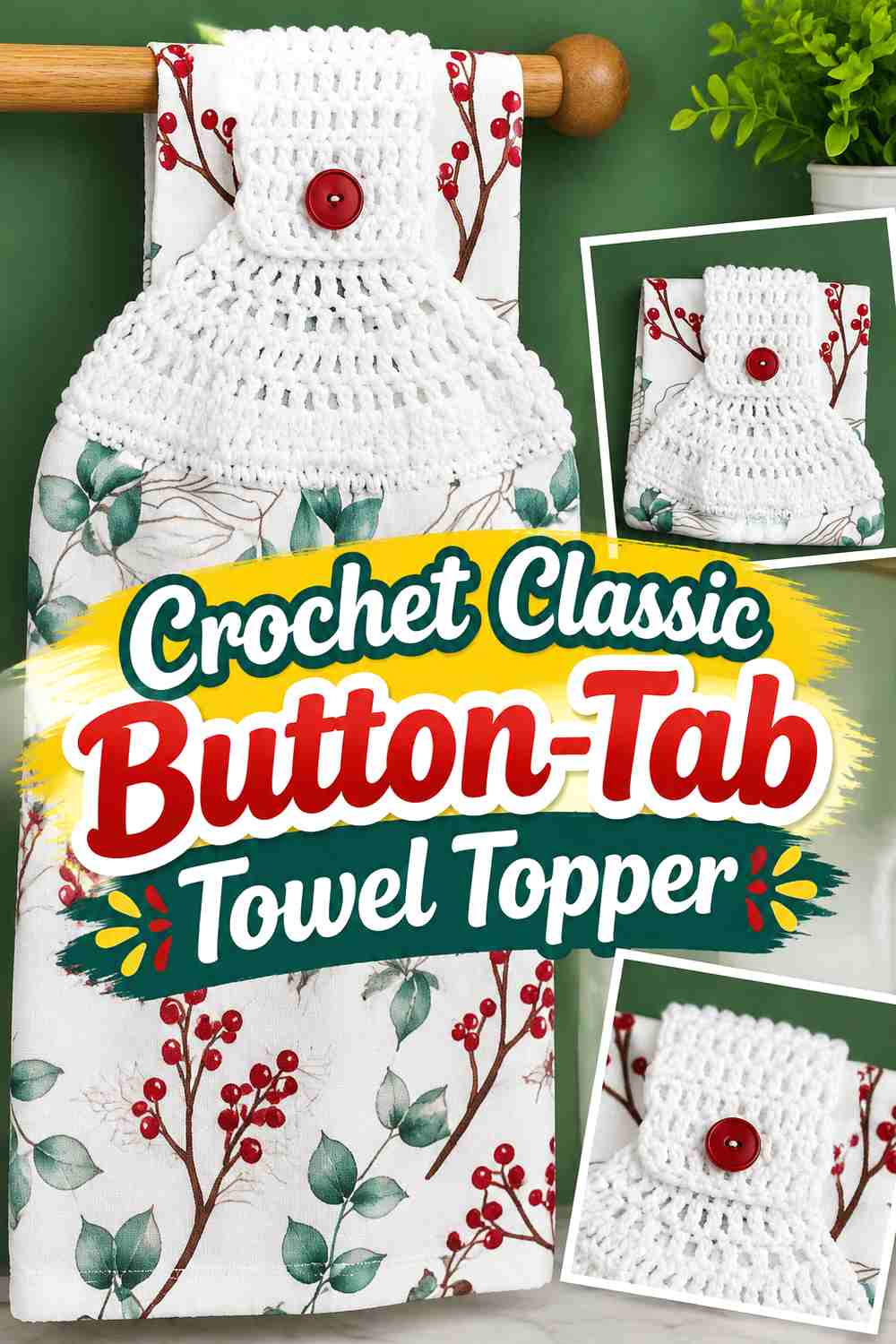
MC Knitting Adventures demonstrates a conventional topper added to a tea towel so the finished piece can hang from an oven or refrigerator handle. The project keeps the familiar cottage-kitchen silhouette: a fabric towel below, a narrowed crocheted section above, and a closure that wraps around the handle.
This is a useful choice when the towel itself is the main decorative feature. A floral, checked, striped, or illustrated tea towel can provide most of the color while the crochet remains simple and functional. Before starting, decide how the towel must fold to display its print properly once hanging.
Test the Fold Before Attaching Yarn
Fold the towel exactly as it will appear in the finished piece and temporarily place it over the intended handle. Directional prints can easily end up partly hidden or upside down.
Making this check before forming the crochet foundation prevents a frustrating situation where the topper works correctly but the towel design faces the wrong direction.
Match the Strap to the Handle
Oven bars, refrigerator handles, and cabinet pulls can have very different circumferences. A strap that closes neatly around one may be too short or overly loose around another.
Use the tutorial’s dimensions as designed unless you understand how altering strap length affects button placement and the finished proportions.
Keep the Crochet-Towel Join Even
The top of the towel carries the entire crocheted section, so a crooked or irregular foundation will remain visible after the topper is complete.
Marking the center and keeping the fabric evenly gathered can help prevent one side from pulling higher than the other.
Creator Credit: MC Knitting Adventures
3. Crochet Polished Single-Crochet Towel Topper
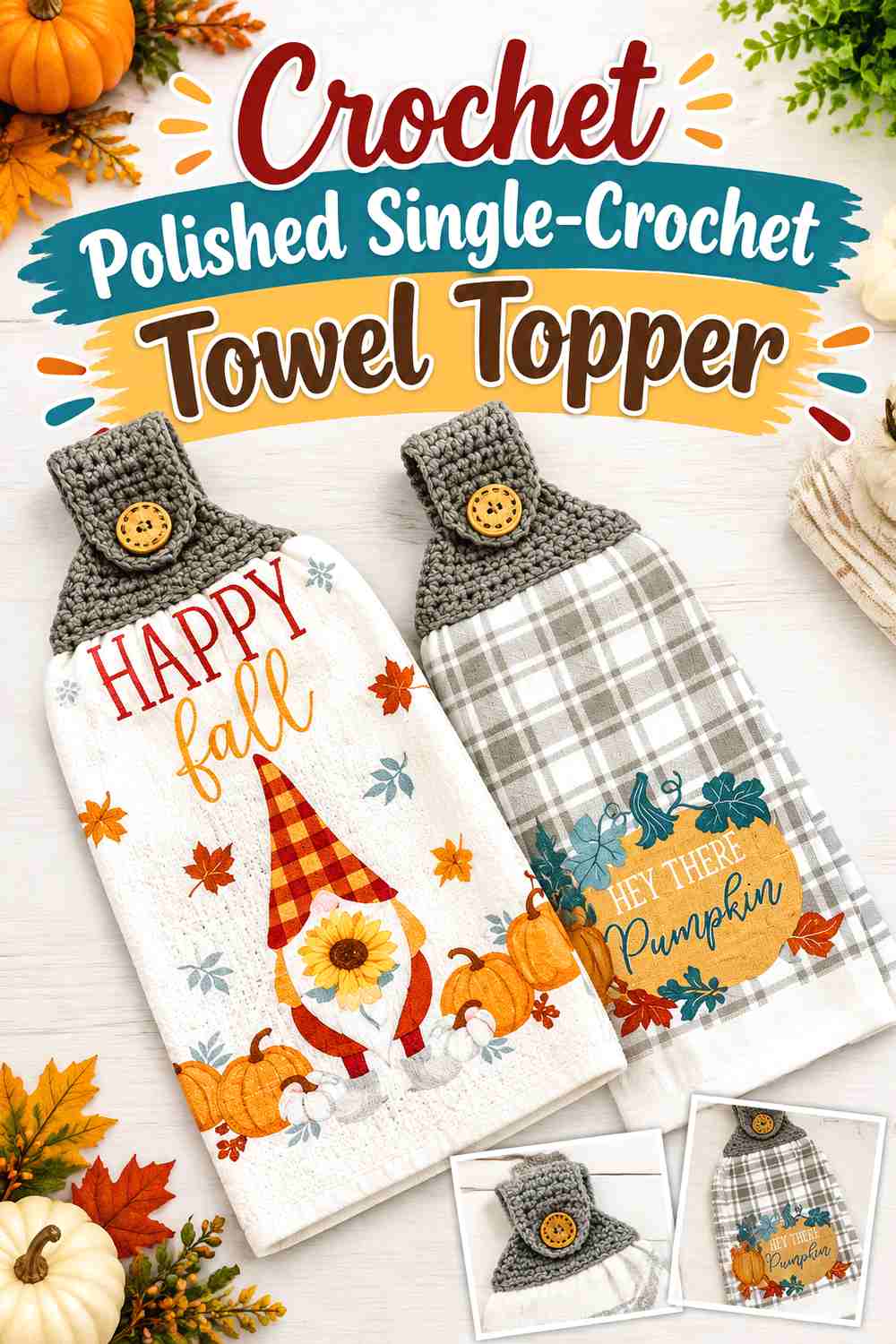
Day’s Crochet designed this towel topper around a compact single-crochet fabric intended to give the upper section a clean appearance while allowing decorative towel artwork to remain visible. The tutorial uses a conventional kitchen towel and a buttoned hanging section rather than replacing the towel itself.
A denser single-crochet topper can work particularly well with cottage towels carrying large printed motifs because the crochet does not need a complicated stitch pattern to compete for attention. It also gives the upper section more visual solidity than a looser double-crochet fabric.
Center Important Towel Artwork
If the towel has a large illustration, lettering, or border, position that feature before permanently folding or attaching the topper.
Use pins to preview the final arrangement. A few minutes spent adjusting the folds can make the difference between showing the complete motif and hiding its most recognizable section.
Dense Fabric Can Feel Firmer
Single crochet generally creates a compact fabric, especially when worked at a firm gauge. That can help a narrow topper retain its shape around a handle.
The trade-off is reduced flexibility. If you substitute yarn, make sure the strap can still bend comfortably without becoming bulky where it folds over the appliance bar.
Choose Wash-Compatible Materials
The topper remains attached to the towel during laundering, so yarn and towel care cannot be considered independently.
Check both labels and any care information supplied in the tutorial. A beautiful fiber that needs delicate treatment may be inconvenient on a kitchen towel that is normally washed frequently.
Creator Credit: Day’s Crochet – Modern Crochet Patterns
4. Crochet Simple Single-Crochet Hanging Topper
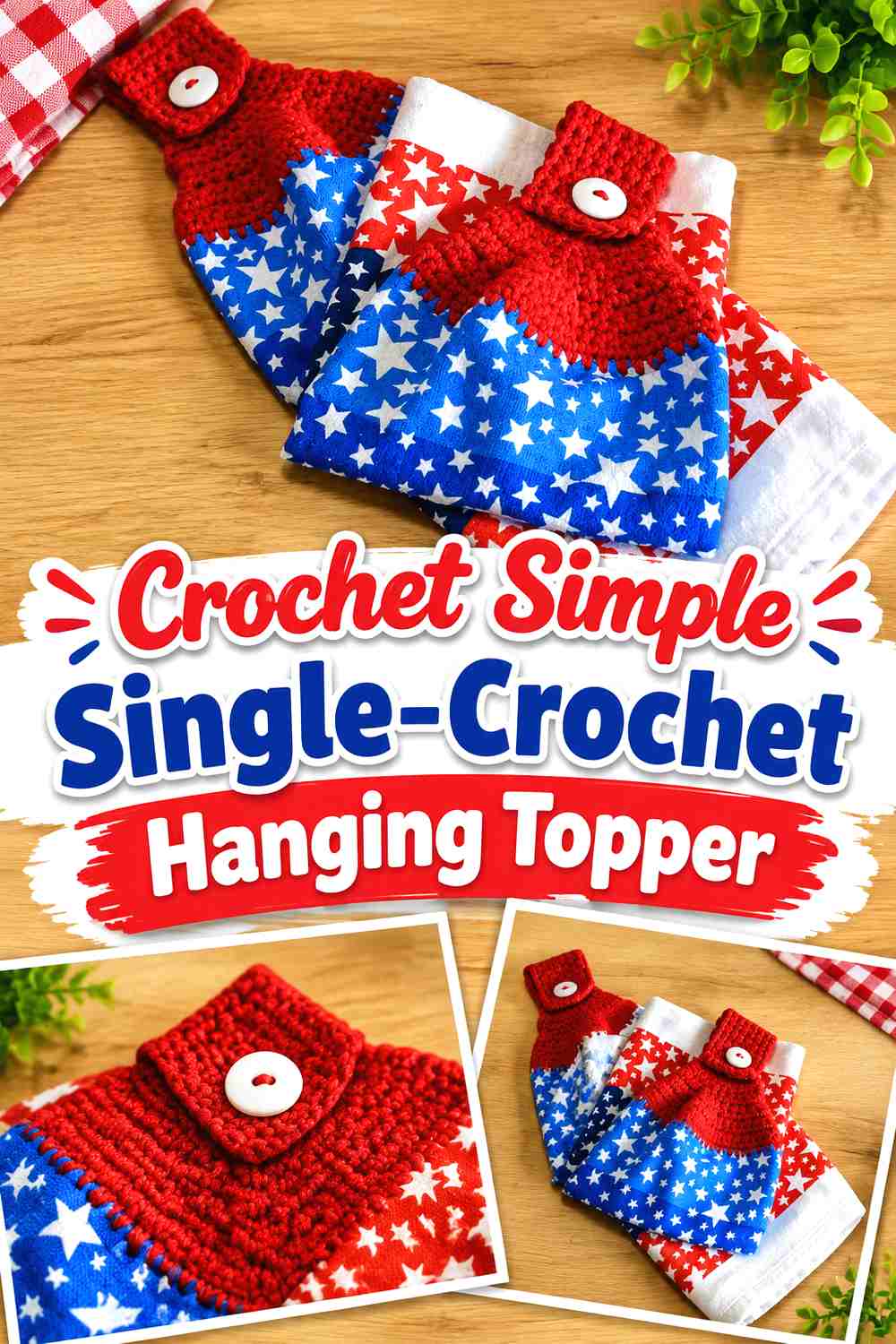
Alaska Crafty Gal Victoria demonstrates a towel topper that uses single crochet rather than relying on the double-crochet construction common in many traditional versions. The tutorial shows the topper being worked onto the towel and finished for hanging with a button.
The relatively straightforward surface is useful if your cottage style comes from the towel print itself—gingham, fruit motifs, florals, or vintage illustrations—rather than from elaborate crochet texture. A simple stitch pattern also makes contrasting trim or an interesting button more noticeable without turning the topper into the dominant feature.
Decide How to Pierce the Fabric
The source demonstrates a method for preparing the towel edge before crochet is established. Whatever tool you use, the goal is evenly spaced openings without tearing the woven fabric.
Avoid forcing a thick crochet hook repeatedly through a resistant towel. Ragged holes can grow under laundering and weaken the attachment line.
Use Simplicity for Busy Prints
A densely patterned towel does not always benefit from a highly textured topper. Plain single crochet can act as a visual frame and keep the composition from becoming crowded.
Pull one quieter color from the towel print for the yarn if you want the crochet and fabric to feel connected without matching exactly.
Inspect the Attachment After Washing
The transition between textile and crochet experiences repeated movement in the washer and during handling.
Check occasionally for stretched fabric holes, loose yarn ends, or a shifting button. Small maintenance is easier than repairing the join after it has opened significantly.
Creator Credit: Alaska Crafty Gal Victoria
5. Crochet Traditional Buttonhole Towel Topper
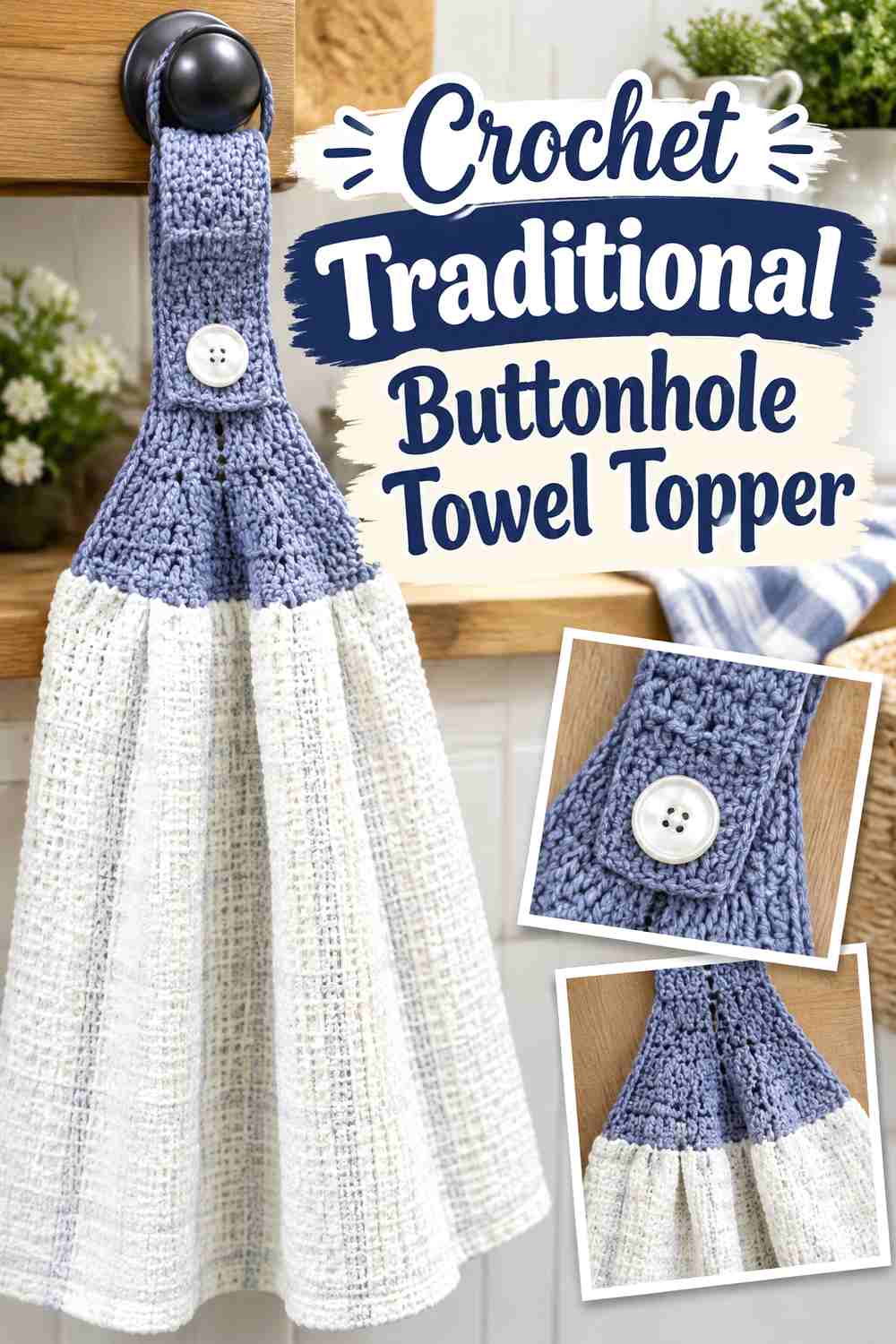
Maggie’s Crochet offers a classic towel-topper construction that begins with a standard kitchen towel, narrows the crocheted fabric through shaping, and finishes with a buttonhole and button. The tutorial represents the recognizable vintage form many cottage kitchens use: a wider lower section tapering into a slim tab.
This traditional silhouette pairs naturally with embroidered, checked, floral, or holiday towels. It also makes the topper easy to identify at a glance as a functional hanging piece rather than a separate ornament or ring holder.
Treat the Cut Edge Carefully
This style uses a prepared towel edge before crochet is added. A raw woven edge needs to be secured properly because loose threads can work free with repeated washing.
Follow the source preparation instead of trimming a towel and immediately crocheting into an unfinished cut. The quality of the fabric preparation influences the durability of the entire project.
Check Shaping Symmetry
A tapered topper looks most balanced when decreases occur evenly enough for the upper tab to remain centered over the towel.
Lay the work flat occasionally. If one side angles more sharply, find the discrepancy before continuing through the long strap section.
Let the Button Fit the Cottage Style
Because a traditional topper has relatively little ornamentation, the button can become a noticeable design detail.
Wood, shell-look, or simple matte buttons can reinforce a cottage palette, but function comes first. Make sure the button fits the designed hole securely before choosing it purely for appearance.
Creator Credit: Maggie’s Crochet
6. Crochet Ruffled Button-Loop Towel Topper
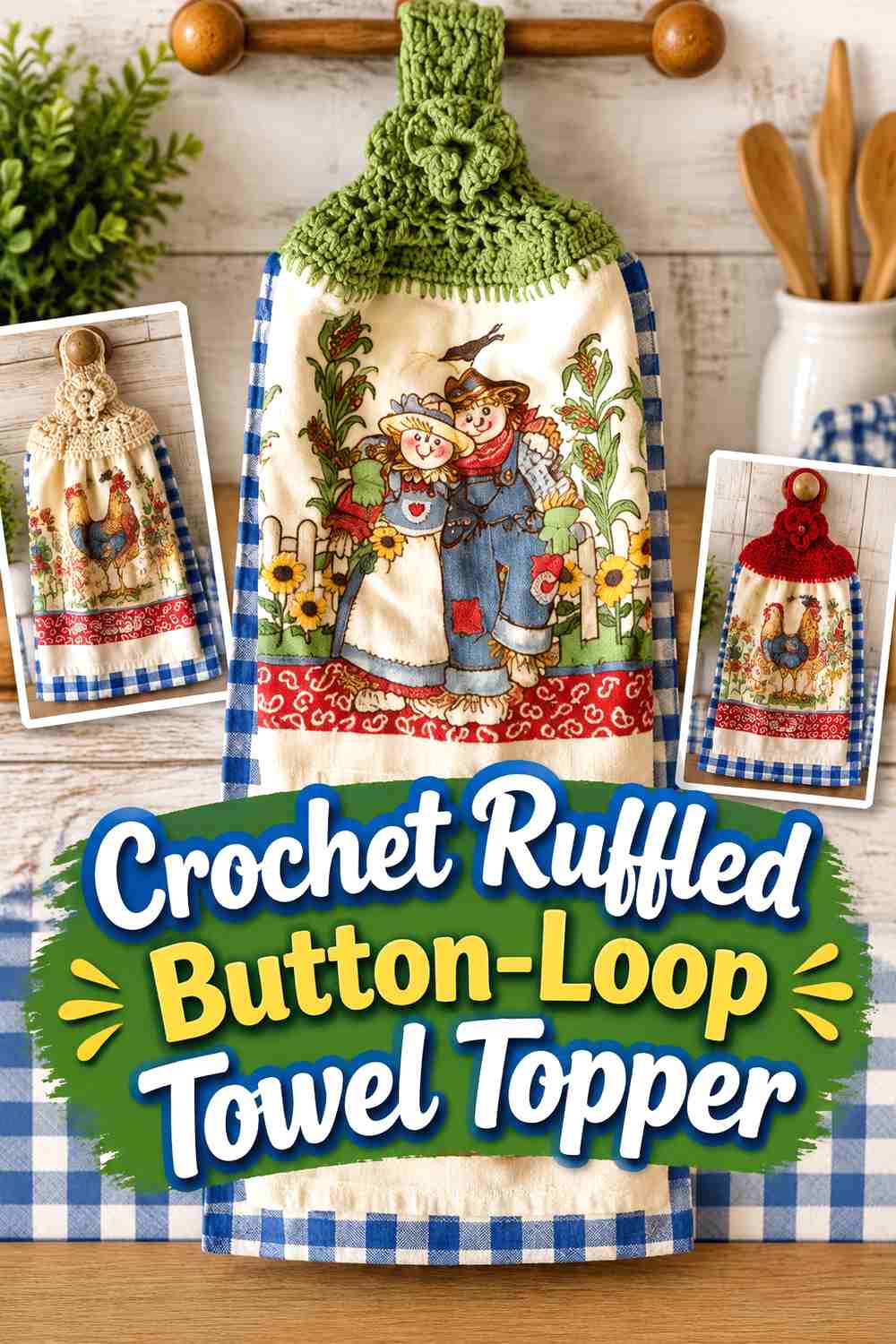
Bev’s Country Cottage uses a classic towel attachment but finishes the hanging end with a crocheted arc that develops into a ruffled loop rather than a plain rectangular buttonhole tab. The towel is cut, hemmed, and crocheted across before the upper section narrows.
That curved finishing detail gives this project a slightly more vintage character than a basic straight strap. It can work well with small florals, embroidered towels, or fabrics inspired by older farmhouse linens.
Preserve the Hem Before Crocheting
Since this method begins with a cut towel, securing the cut edge is part of the structure, not merely cosmetic finishing.
A neat hem provides a stable line for the foundation stitches and reduces loose threads around the crochet attachment. If your towel fabric frays aggressively, handle the cut edge as little as possible before it is secured.
Keep the Ruffle From Becoming Bulky
The button loop is intentionally fuller than the narrow section below it. Using substantially heavier yarn could exaggerate that thickness and make the closure cumbersome.
If substituting, compare the developing loop with the intended button and handle before completing all the finishing.
Use the Vintage Shape Deliberately
This topper already has an old-fashioned silhouette, so it pairs easily with classic cottage towels without additional appliqués.
For a calmer everyday version, use one solid yarn color and let the ruffled button loop supply the decorative detail.
Creator Credit: Bev’s Country Cottage
7. Crochet Removable Striped Towel Topper
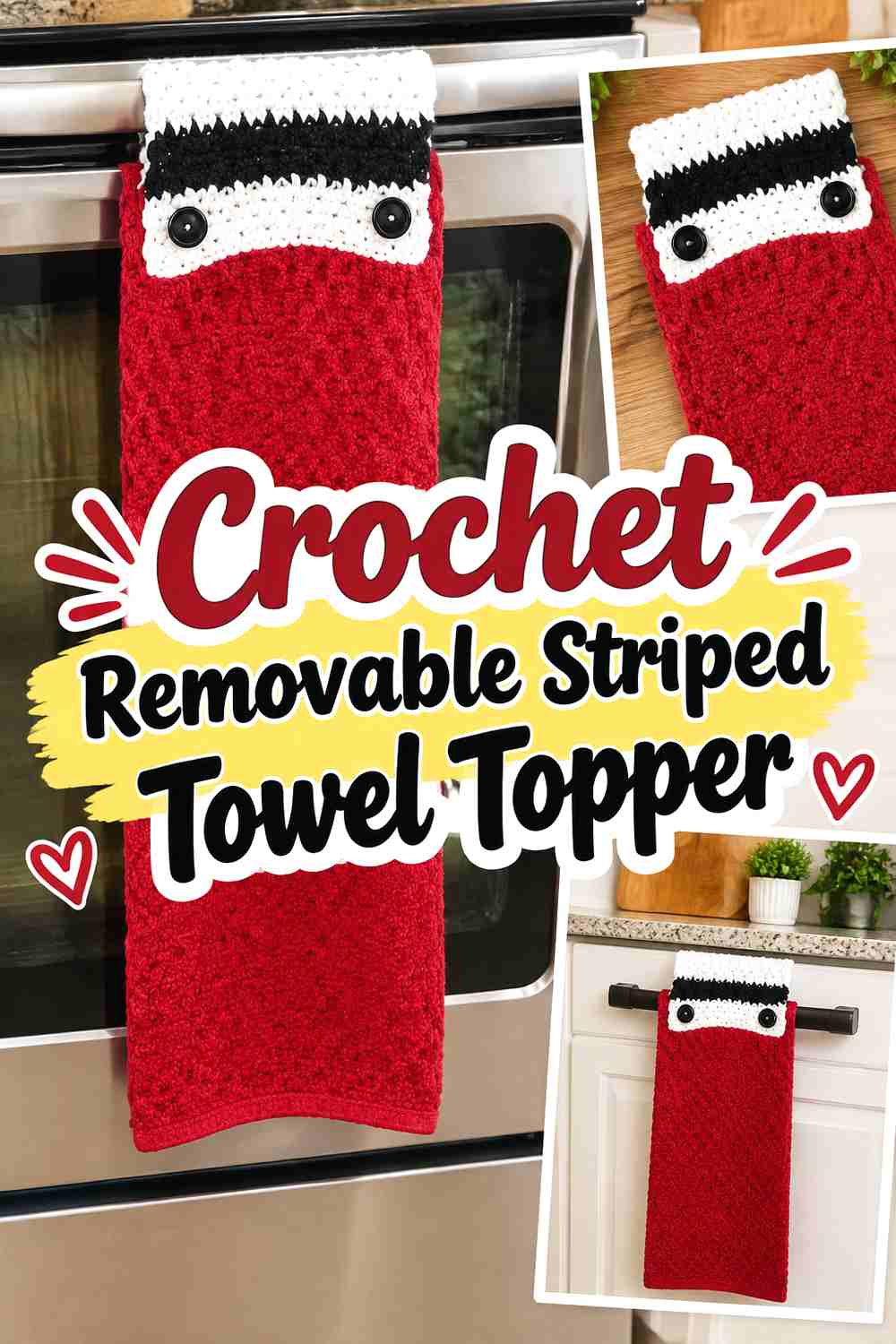
ChristaCoDesign’s topper differs from many traditional versions because the rectangular crochet piece can button onto the towel rather than becoming a permanently crocheted extension. The design uses griddle-stitch texture, contrasting stripes, and two buttons, giving the topper a crisp horizontal emphasis instead of a long tapered silhouette.
A removable topper is useful when you want to launder or change the towel independently. It can also let one crocheted piece coordinate with several towels of similar construction, provided their attachment arrangement is compatible.
Removability Changes Care
Separating the topper and towel can protect decorative crochet from unnecessary washing when only the towel needs cleaning.
That advantage disappears if the closure becomes awkward to use, so test both buttons several times before considering the project finished. They should hold securely without making routine towel changes frustrating.
Stripes Need Clean Color Changes
A rectangular design makes uneven stripe transitions particularly visible because the eye naturally follows the horizontal lines.
Keep unused yarn tails secure and follow the designer’s color-change method. Loose ends around the attachment area can be exposed to more handling than they would be on a decorative pillow or wall piece.
Rectangular Toppers Suit Graphic Towels
Because this topper remains broad rather than narrowing dramatically, it creates a strong block of color above the towel.
Pair it with simpler fabric if you want the stripes to dominate, or use closely related colors when the towel itself already contains a busy pattern.
Creator Credit: ChristaCoDesign
8. Crochet Farmhouse Tapered Towel Topper
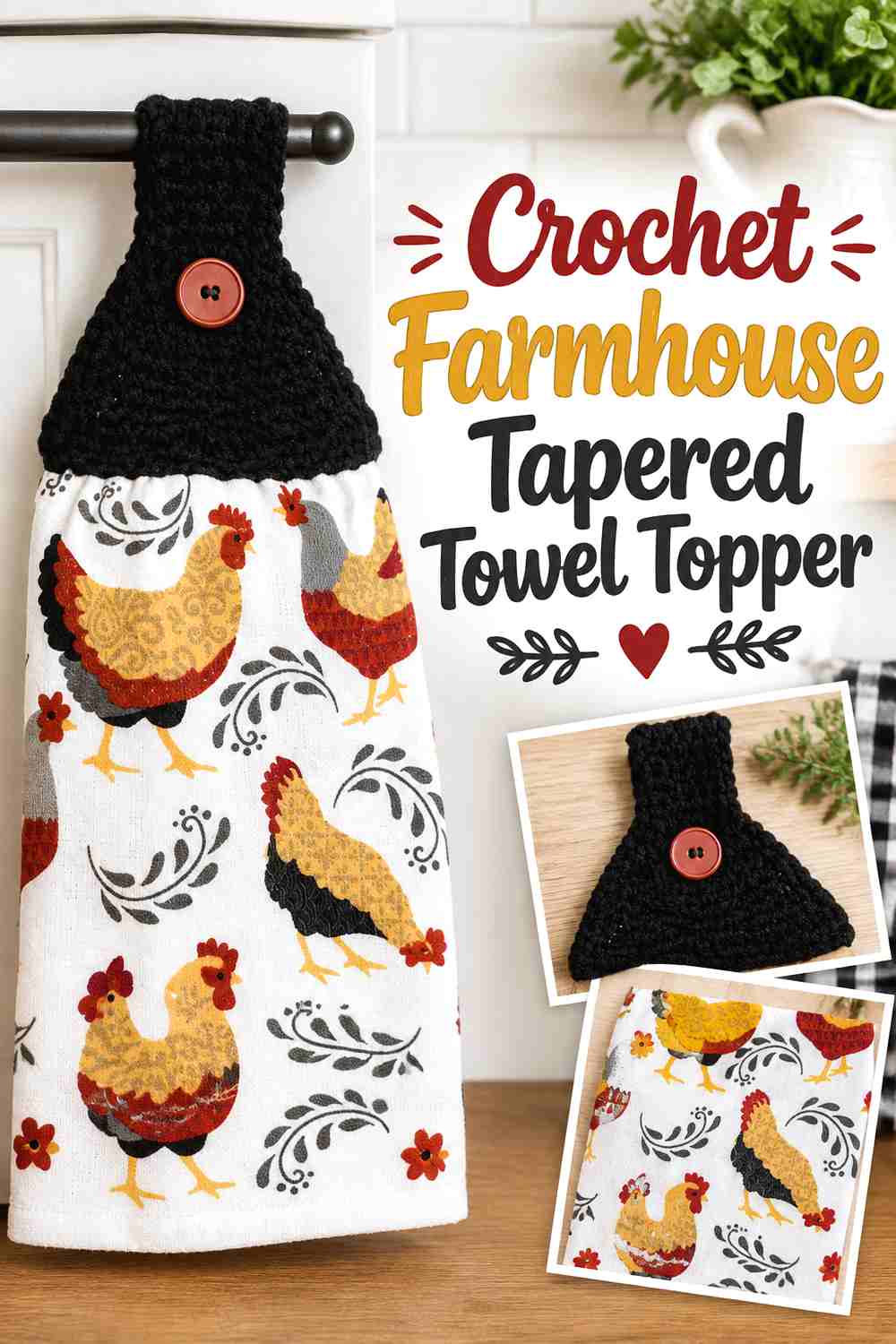
Simple Creative Farmhouse builds the crochet directly from a prepared folded towel and shapes the fabric gradually into a narrow buttoned strap. The tutorial also emphasizes arranging the towel before the crochet begins, which matters when a printed design needs to remain centered.
The finished silhouette is restrained enough for everyday farmhouse or cottage kitchens. Rather than relying on a decorative motif, it gets its character from the folded towel, simple crochet, and button closure.
Fold the Towel Before Marking
The source begins by arranging the towel into the desired presentation before establishing the crochet attachment. This is especially valuable for directional prints.
Do the same even if your towel seems symmetrical at first glance. Decorative borders or small text can shift visibly when the towel is folded into thirds.
Gradual Shaping Controls the Silhouette
The transition from the wider towel edge to the narrow hanging tab determines whether the topper looks balanced.
Do not improvise decreases simply to make the strap narrower faster. Uneven shaping can twist the tab away from the towel center and cause the finished piece to hang at an angle.
Add Edging Only if It Helps
The tutorial allows the upper crochet to remain simple or receive an additional finishing edge.
If your towel already has strong printed detail, the simpler finish may suit it better. Decorative edging is useful when it contributes definition, not merely because there is space to add it.
Creator Credit: Simple Creative Farmhouse
9. Crochet Layered Flower Ring Towel Topper
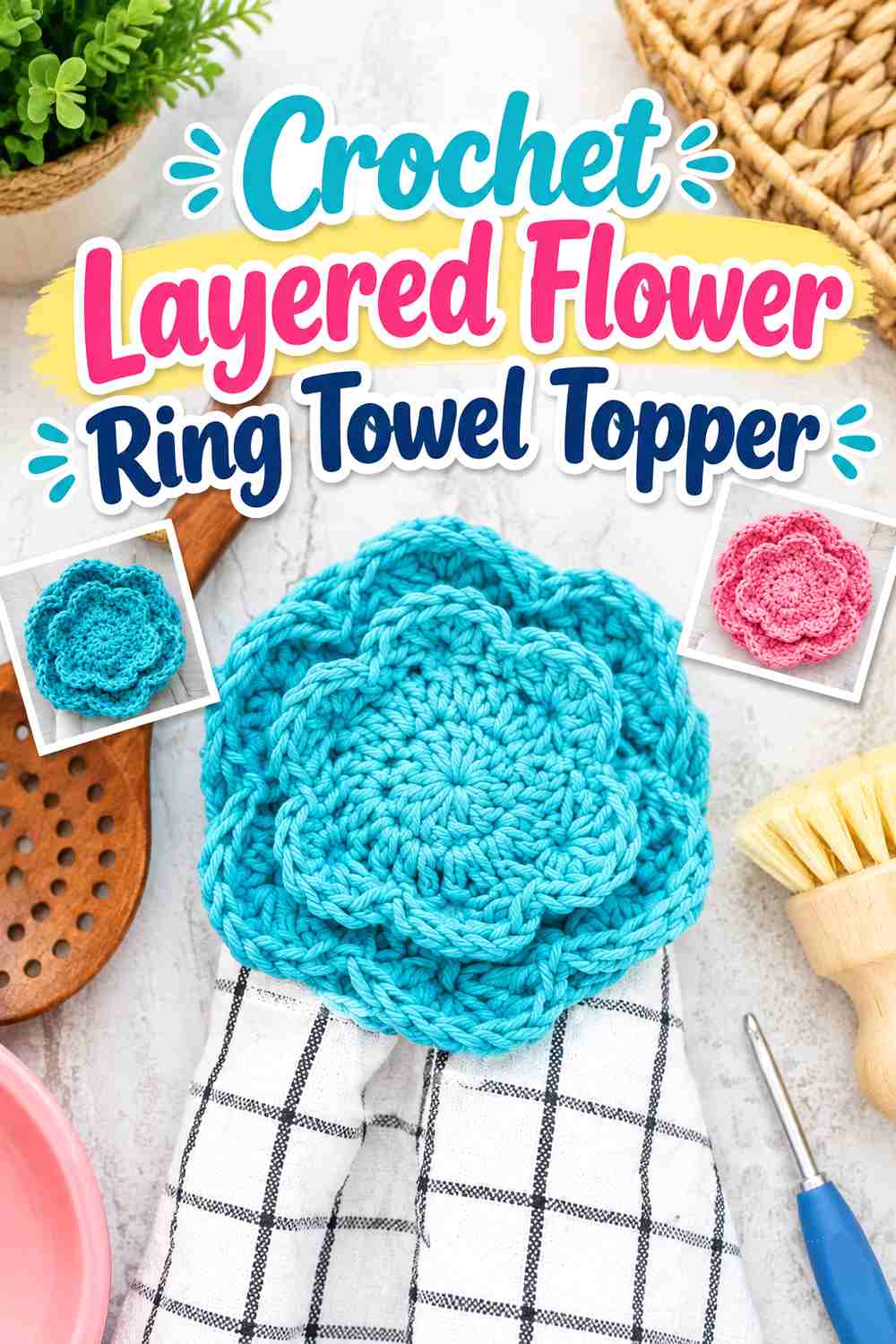
You Should Craft turns the holder itself into a flower, using crocheted front and back sections with a plastic ring incorporated behind the decorative face. The pattern provides more than one flower-front option, and the towel remains removable because it feeds through the ring instead of being sewn permanently to the crochet.
This is a strong cottage choice when floral details are already part of the room. Unlike an appliqué placed on a basic tab, the flower determines the entire visible silhouette of the topper.
Let Petal Layers Stay Clear
Dimensional petals need enough stitch definition to remain visibly separate. Very fuzzy yarn can blur the boundaries between layers and make the flower appear heavier.
If changing yarn, test a small portion of the floral section first. The color may be appealing while the texture still proves unsuitable for defined petals.
A Hidden Ring Simplifies Towel Changes
The ring allows the towel to slide out independently from the decorative holder. This is useful when hand towels are changed frequently.
Choose towels that pass through the ring comfortably. Very bulky fabric folded several times may be difficult to insert and could distort the crocheted flower.
Coordinate Rather Than Match Exactly
A flower topper does not need to duplicate the towel color. Pulling one accent shade from a floral or striped towel can produce a more layered cottage look.
For a plain cream towel, a muted botanical shade can make the flower the main decorative feature without changing the towel’s everyday practicality.
Creator Credit: You Should Craft
10. Crochet Tassel-Trim Hidden-Ring Topper
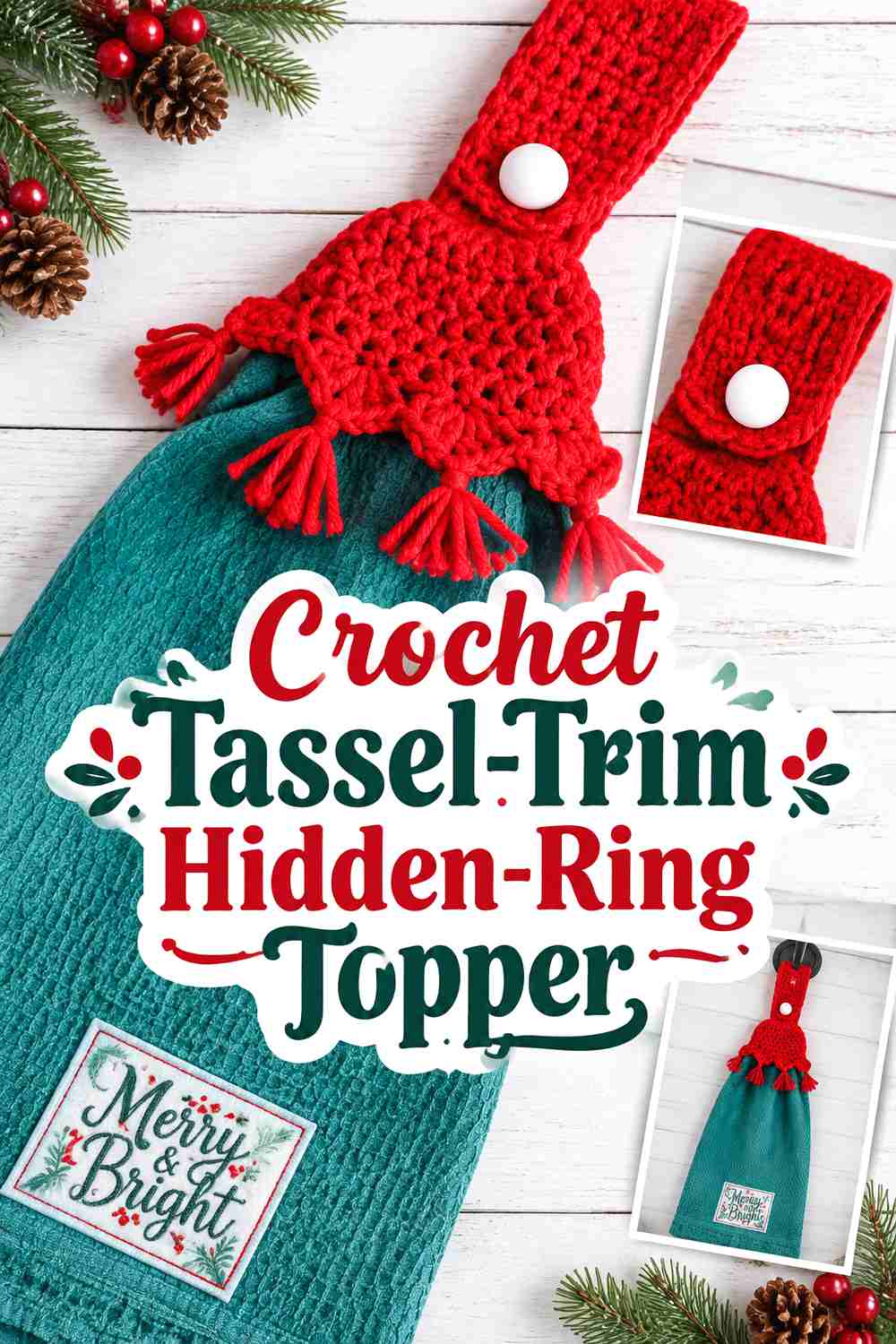
Nana’s Crafty Home combines a concealed towel ring with a separate skirt and hanging tab, then finishes the lower edge with tassels. The towel can be removed from the hidden ring for washing, while the crocheted holder stays attached to the appliance handle.
The tassels give this version more movement than a conventional flat topper and can introduce a relaxed cottage-boho accent. They are optional, so the same underlying construction can also be used for a cleaner farmhouse look.
Tassels Increase Maintenance
Loose fringe can twist, flatten, or collect lint more readily than a plain crocheted edge.
If your kitchen towels are changed several times a day, consider whether tassels will be handled constantly. Leaving them off preserves the hidden-ring function while reducing decorative maintenance.
Keep the Ring Accessible
The towel needs to pass through the concealed ring without fighting the surrounding skirt.
Before finishing every decorative detail, test the holder with the type of towel you actually plan to use. A thin flour-sack towel and a plush terry towel can behave very differently.
Use the Skirt for Seasonal Color
Because the towel itself remains removable, this holder can stay on display while different towels rotate through the kitchen.
Choose a neutral main color for year-round use, or use the skirt and tassels to establish a specific seasonal palette without permanently altering the towel.
Creator Credit: Nana’s Crafty Home
11. Crochet Poinsettia Cottage Towel Topper
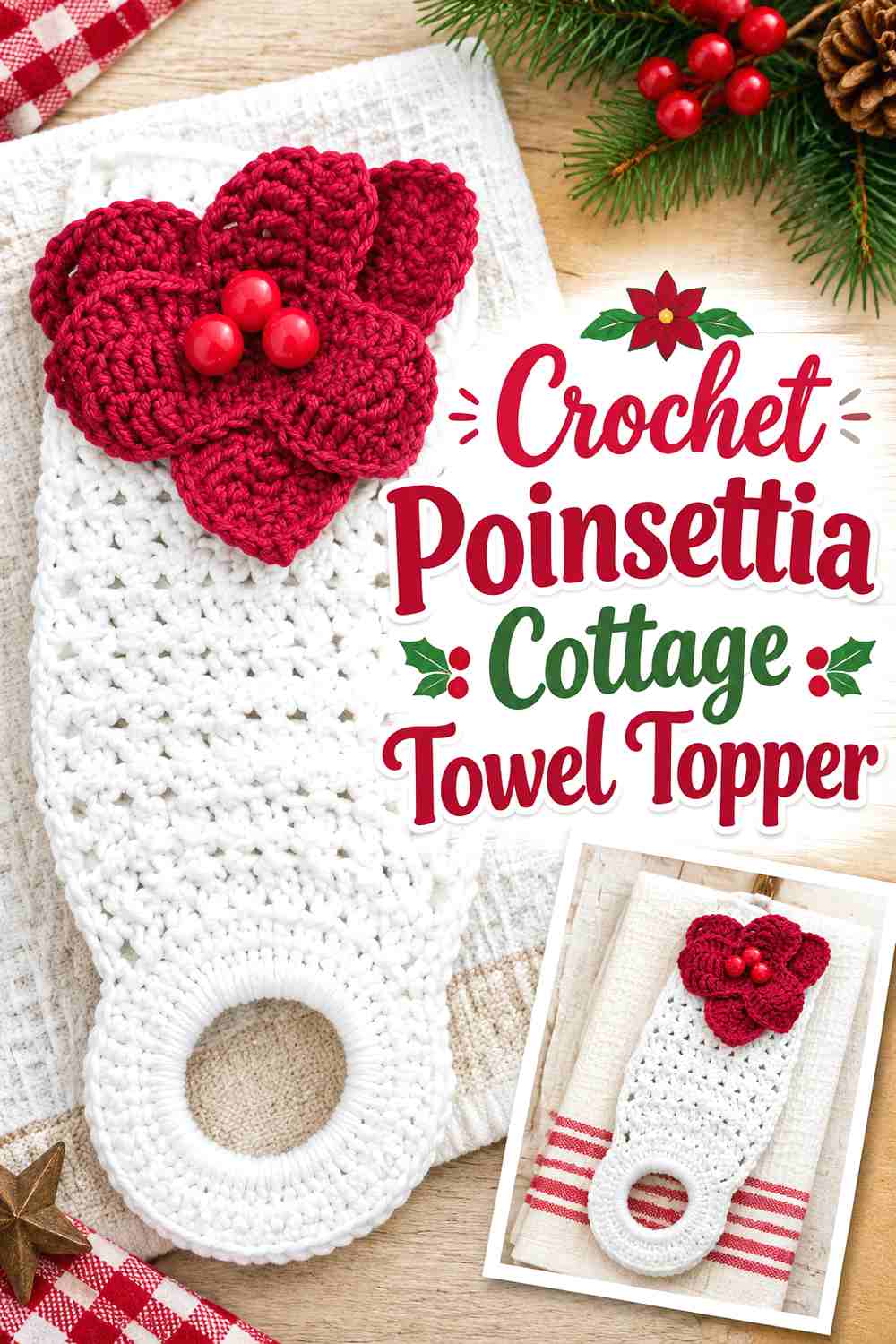
Fosbas Designs adds a poinsettia motif to a towel-topper construction that uses an elastic hair tie and button. The flower provides the seasonal focal point while the hanging mechanism remains comparatively compact.
This design belongs in a cottage kitchen where seasonal details are concentrated in small accessories rather than spread across every surface. A floral topper can make a plain towel feel festive without requiring a strongly printed holiday fabric.
Treat Berries as Decorative Components
The source includes decorative berry elements with the flower. Any added ornament creates additional attachment points that may receive friction during handling.
Secure embellishments carefully and inspect them before washing or gifting. If you prefer a lower-maintenance kitchen accessory, the flower’s color contrast can provide enough decoration without extra hard pieces.
Elastic Behaves Differently From a Fixed Ring
An elastic hair tie can flex in ways a wooden or plastic ring cannot. That flexibility may make towel insertion convenient, but elastic also ages with repeated stretching and exposure to moisture.
Check the loop periodically and replace the holder if the elastic loses resilience or becomes damaged.
Keep Seasonal Flowers Away From Heat
A poinsettia topper is decorative kitchen textile work, not heat protection.
Hang it on a suitable handle away from burners, open flame, or hot cookware. Do not use the crocheted flower as a substitute for a potholder.
Creator Credit: Fosbas Designs
12. Crochet Puff-Stitch Corner Towel Topper
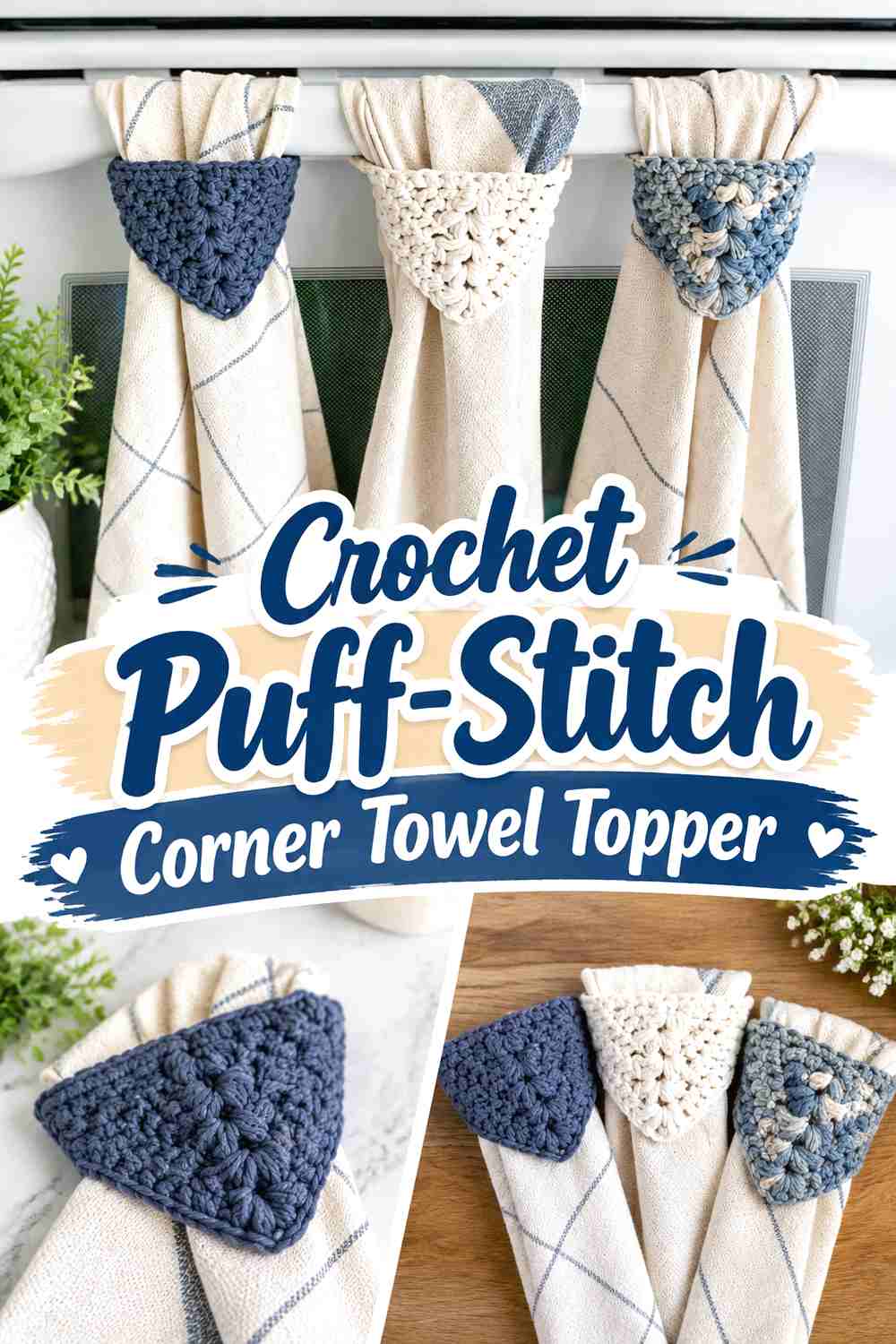
Stitching Together rethinks the conventional topper by crocheting a triangular puff-stitch piece and sewing only part of it to a towel corner. The towel then passes through the triangle after wrapping around the bar, so no button is required.
This construction preserves much more of the original towel than a topper that permanently gathers its entire upper edge. That can be especially useful for cottage towels featuring woven stripes, decorative borders, botanical prints, or large illustrations.
Corner Placement Preserves Function
Because most of the towel remains unrestricted, the fabric can still open out more naturally when removed from the handle.
That makes this design worth considering if you dislike permanently folded towels. The trade-off is that the sewn corner needs to remain strong enough to withstand the repeated pulling used to hang and remove the towel.
Puff Stitches Add Local Texture
The crochet area is small, so raised puff stitches provide noticeable detail without covering much fabric.
A smooth yarn will show those puffs clearly. With very soft or fuzzy yarn, the triangle can lose some of the definition that makes the compact topper visually interesting.
Sew Before Assuming the Fit
Different towels have different corner thicknesses and hems. Pin the topper in place and test the threading action before making the attachment permanent.
The towel should pass through smoothly without requiring enough force to pull at the sewing stitches.
Creator Credit: Stitching Together
13. Crochet Wooden-Ring Cottage Towel Holder
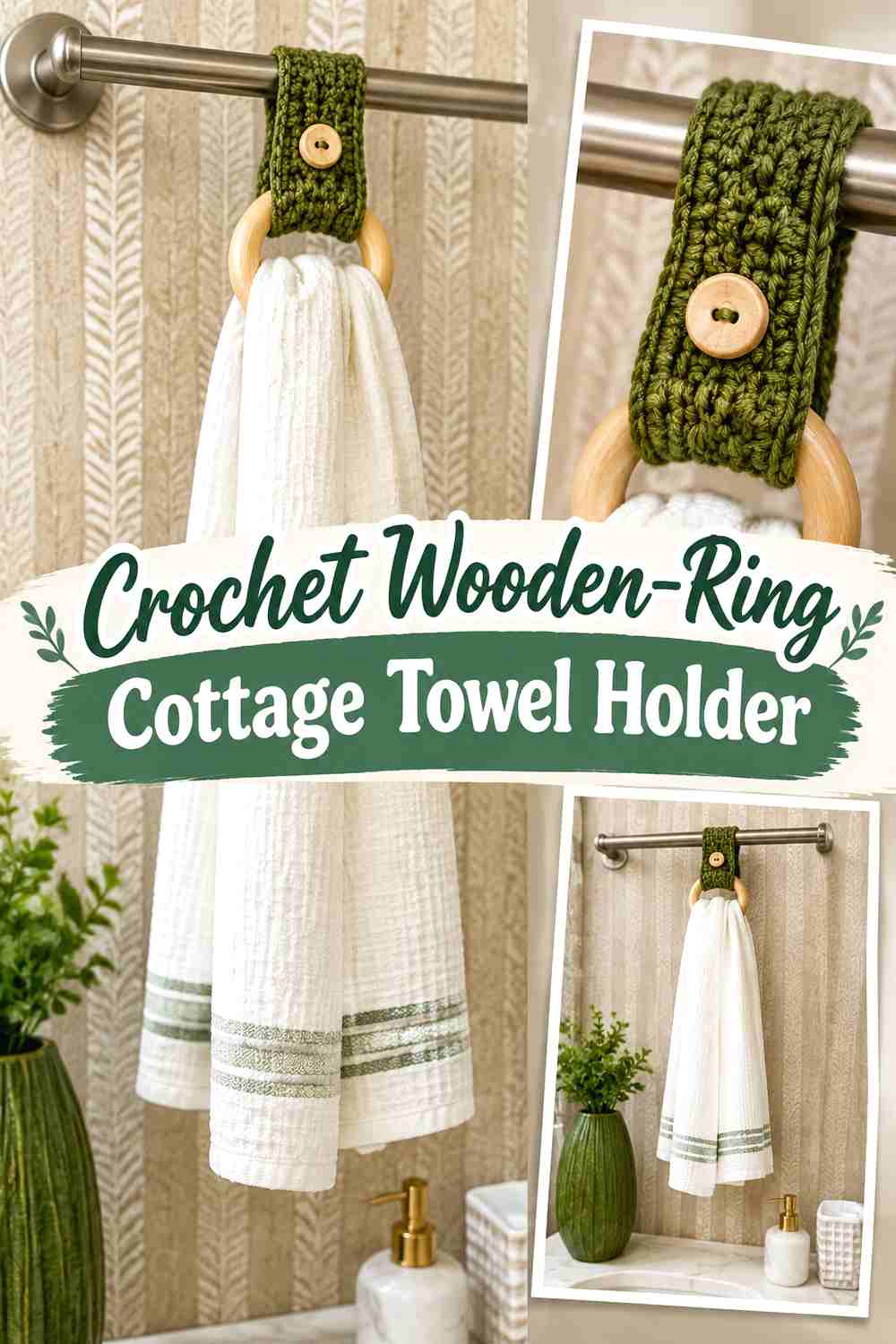
Live Chill Life crochets directly around a large wooden ring and extends the work into a buttoned strap that can wrap around a kitchen or bathroom handle. The towel itself slides through the exposed ring, making it completely independent from the crochet holder.
Wood introduces a warm natural material that suits cottage cabinetry especially well. It also gives the holder a more structured circular opening than an elastic ring.
Check the Wooden Ring’s Finish
Kitchen moisture can affect unfinished natural materials. Use the type of ring recommended by the designer and inspect its surface before wrapping it in crochet.
Rough spots can snag a towel as it moves through the opening. Do not assume every decorative wooden craft ring is equally suitable for repeated kitchen handling.
Measure the Handle Circumference
The upper strap has to wrap around the support point before closing. A refrigerator handle may require more clearance than a narrow cabinet bar.
Test the developing strap on the intended location when the tutorial allows. Making it unnecessarily long can leave the ring hanging lower than expected.
Use a Ring With the Right Towel
A structured ring works best when the towel can be pulled through without excessive bunching.
If your favorite cottage towels are thick terry cloth, verify that the ring opening provides enough space. Lightweight tea towels generally need much less clearance.
Creator Credit: Live Chill Life
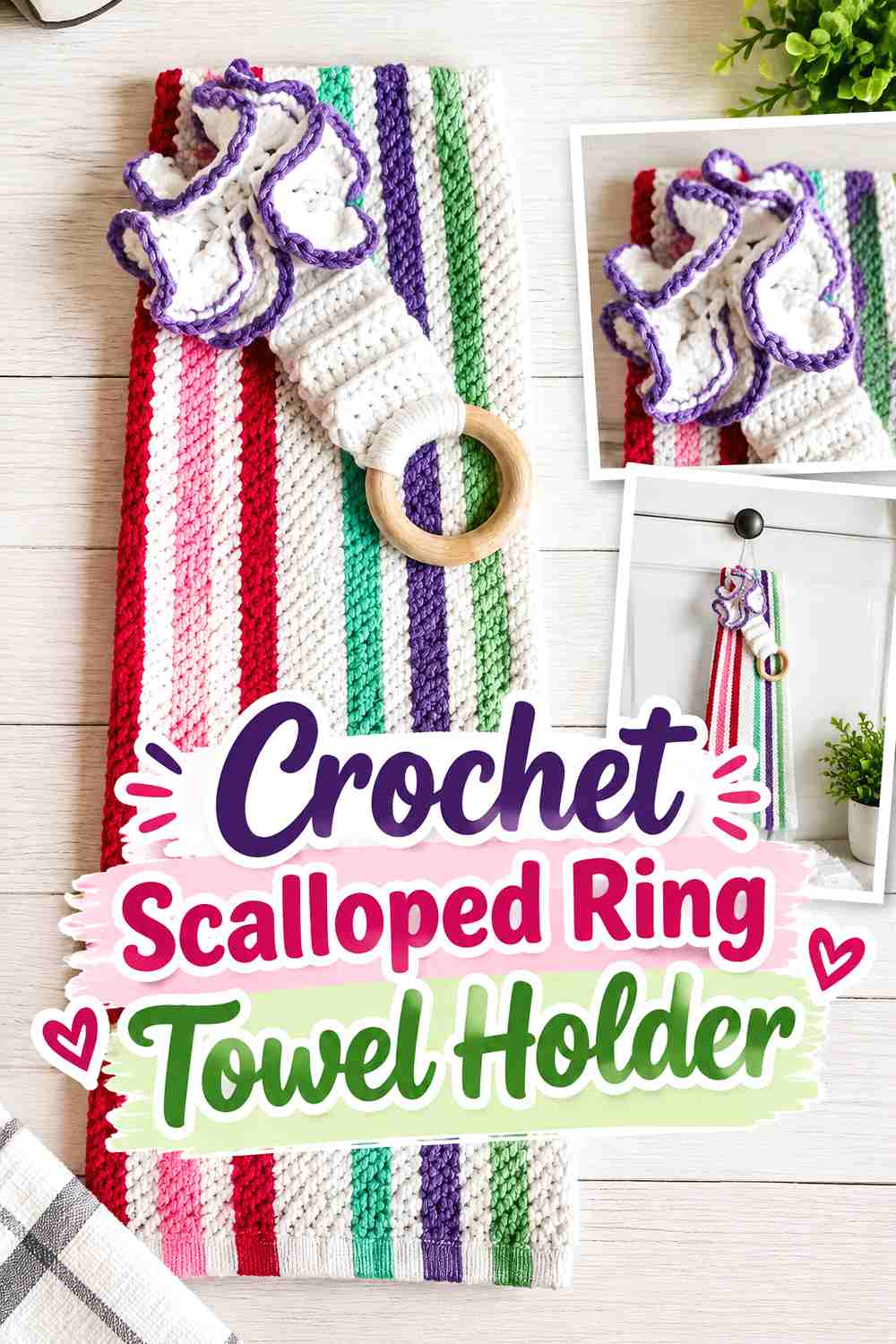
14. Crochet Scalloped Ring Towel Holder
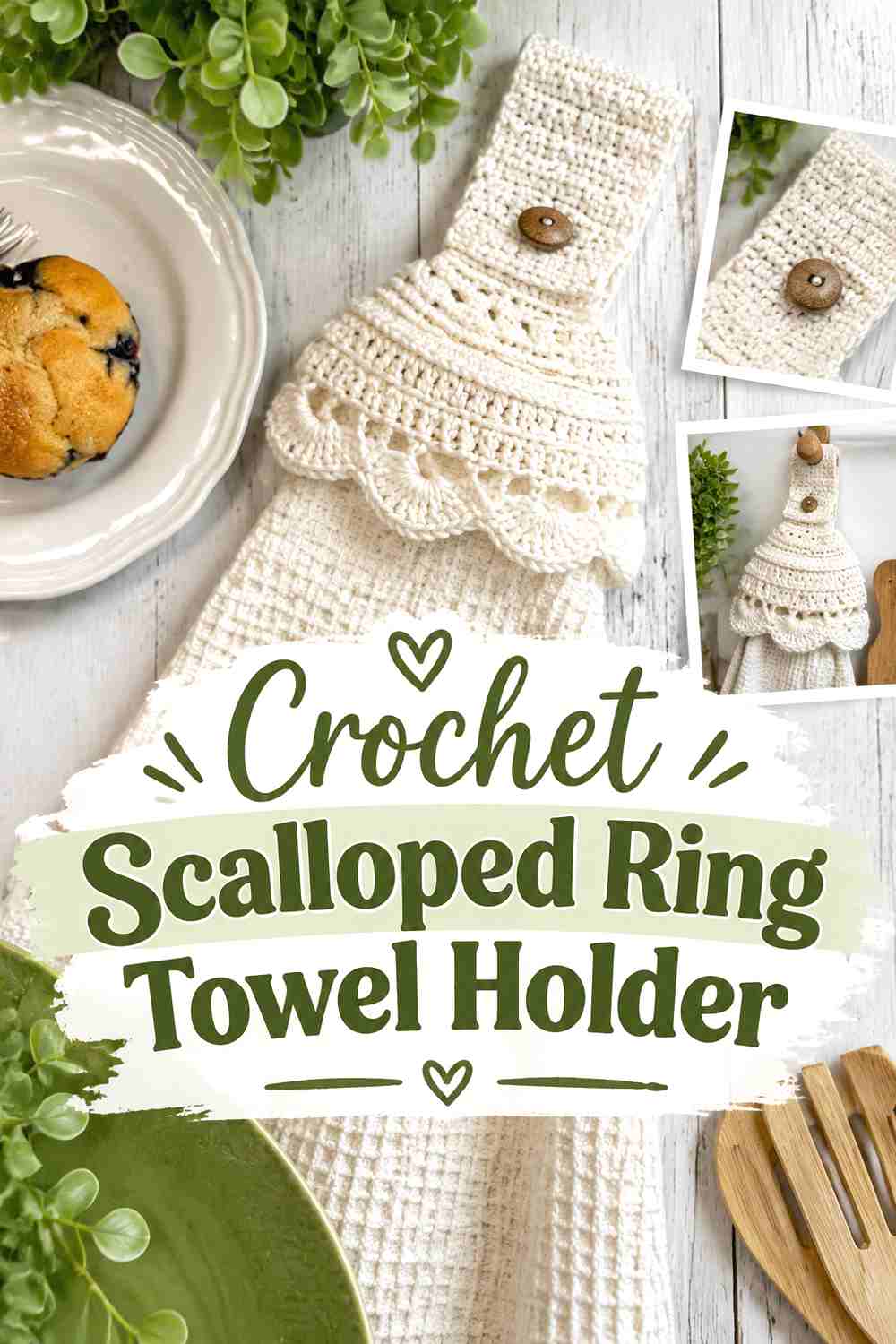
Craft Cozy Designs builds the lower portion around a metal ring and adds a decorative crocheted body with an open scalloped or picot-style lower edge before extending upward into a buttoned strap. The towel passes through the ring instead of being permanently attached.
The shaped edging gives this holder a dressier cottage appearance than a plain crocheted ring cover. It works well when the towel is relatively simple and the crochet is intended to provide the decorative interest.
Metal Rings Add Firm Structure
Unlike elastic, a metal ring holds its diameter under tension. That can keep the opening predictable when towels are repeatedly inserted and removed.
The ring can also add weight, so make sure the upper strap and button remain secure. Follow the designer’s ring size rather than choosing a much heavier piece of hardware only for appearance.
Keep Open Edging Clear of Snags
Decorative chain spaces and picots create a lighter edge but also introduce small openings.
Position the holder where drawer corners, jewelry, or rough cabinet hardware are unlikely to catch the lace-like section during normal kitchen activity.
Balance the Holder With the Towel
A detailed scalloped holder already attracts attention. Pairing it with a restrained towel lets the edge treatment remain readable.
If the towel has a large multicolor print, consider working the holder in one quiet shade taken from the background rather than adding another competing palette.
Creator Credit: Craft Cozy Designs
15. Crochet Ruffled Elastic-Ring Towel Holder
Simply Hooked by Janet uses a hair elastic as the towel ring and builds a textured strap and ruffled finishing section above it. The towel is therefore removable, and the holder does not need to be washed every time the towel is changed.
This version is particularly useful when you like the flexible grip of elastic but still want a more decorative crocheted profile around the attachment. The ruffle creates a soft edge that feels at home beside gathered curtains, checked linens, and other cottage textiles.
Elastic Keeps the Opening Flexible
The flexible ring can accommodate towels differently from rigid hardware. That can help when switching between moderately different towel thicknesses.
Do not overstretch it simply because it has some give. Repeatedly forcing bulky folds through a small elastic ring can shorten the useful life of the holder.
Ruffles Need Space to Sit Flat
A decorative flare can be compressed if the button or appliance handle sits too close to the ring.
Try the finished holder in its intended position before making several matching pieces. A design that hangs freely from one oven may look crowded on a shorter cabinet handle.
Separate Washing Is a Practical Benefit
Since the towel slides out, the crocheted holder can be removed from everyday laundering unless it actually needs cleaning.
That can help preserve the ruffled shape and reduce wear on the elastic, particularly in kitchens where hand towels are changed frequently.
Creator Credit: Simply Hooked by Janet
16. Crochet Recycled-Ring Kitchen Towel Topper
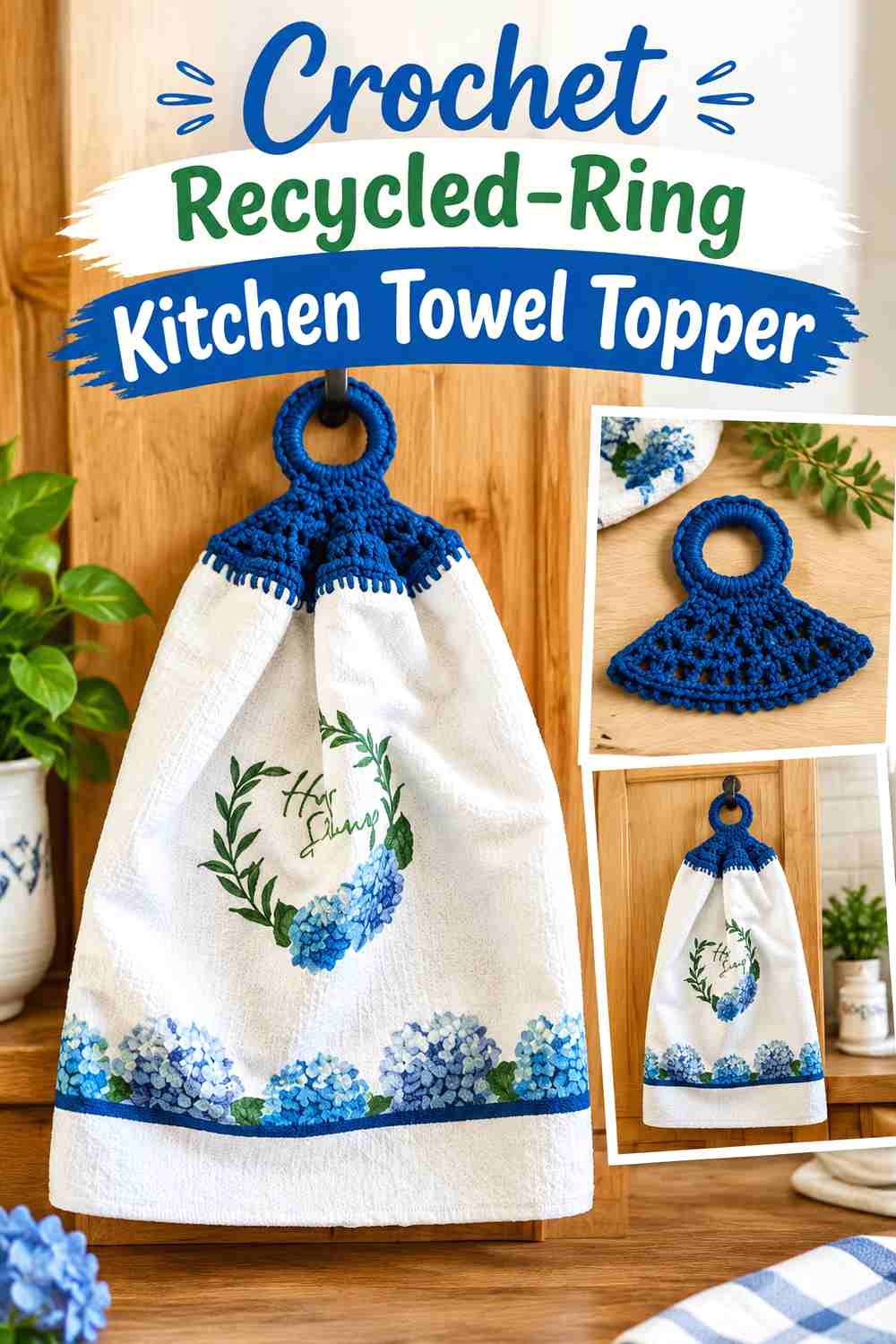
My Recycled Bags modifies a traditional double-layer towel-topper concept by incorporating a recycled plastic ring into the hanging end. The crochet is attached to the towel itself, while the ring provides the point used to hang the finished piece from a hook.
This differs from hidden-ring designs where the towel slides through the ring. Here, the ring belongs to the hanging mechanism rather than acting as a removable towel holder, making it useful for kitchens that rely on hooks instead of long appliance bars.
Understand Which Part the Ring Holds
Ring-based designs are not interchangeable. In this project, the ring supports the finished towel rather than serving as the opening through which a loose towel is fed.
Look carefully at the source photographs before adapting another ring material. Changing its placement can fundamentally change how the topper functions.
Recycled Hardware Needs Inspection
If reusing a plastic ring, make sure it is clean, intact, and free from sharp seams or cracks.
A weakened ring can fail under repeated pulling even if the crochet surrounding it remains sound. Replace questionable recycled hardware rather than building the project around it.
Hooks Need Enough Clearance
This topper works naturally with a hook, including refrigerator-side storage or wall-mounted kitchen hooks.
Check both the ring opening and the hook size before committing to multiples. A ring that looks proportional to the crochet still needs to fit over the intended hardware easily.
Creator Credit: My Recycled Bags
17. Crochet Two-Way Dish Towel Topper
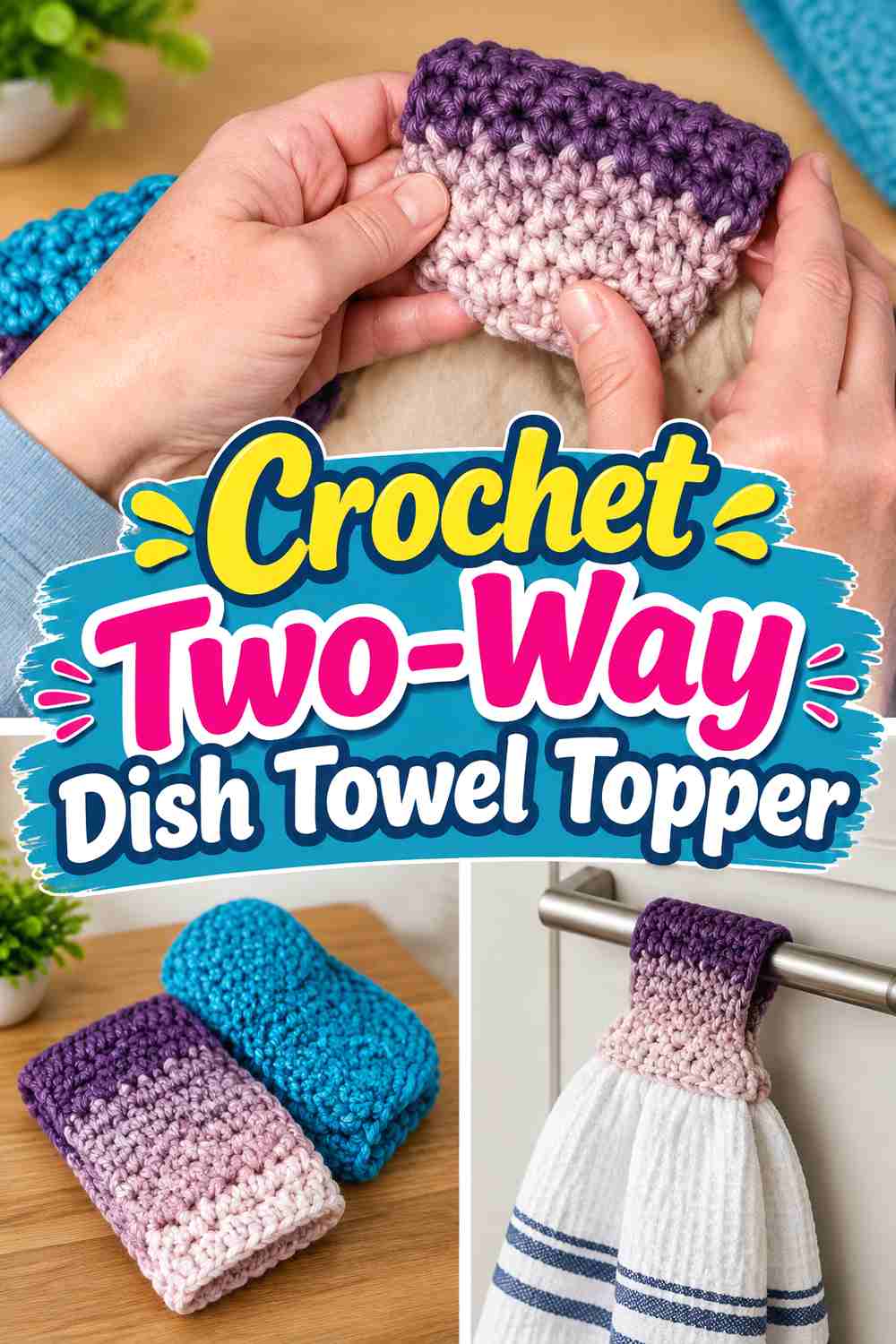
Posh Pooch Designs provides two hanging finishes within the same general topper concept: one closes with a button, while another forms a loop. The tutorial works with basic dish towels and cotton yarn and establishes the crochet along the towel edge.
That choice makes the project particularly useful when different kitchens have different hardware. A loop may suit one handle arrangement while a buttoned strap can offer more deliberate closure on another.
Choose the Closure Before Starting a Set
Although the two versions share most of their construction, their upper ends function differently.
Decide where each towel will hang before choosing the finish. Making every topper identical can be inconvenient if some kitchen handles are enclosed bars while others have accessible ends.
Let Color Changes Define the Topper
The source uses multiple colors, which can emphasize the narrowing shape without needing an applied motif.
For a cottage palette, try pulling shades from the towel itself rather than selecting three unrelated colors. Repetition helps a small multicolor project feel coordinated instead of patchy.
Check the Foundation on Every Towel
Commercial dish towels can vary in width even when sold as a set. Do not assume every piece has identical folded dimensions.
Prepare and measure each towel before attaching the crochet so that the topper sits centrally and the finished set hangs consistently.
Creator Credit: Posh Pooch Designs
18. Crochet Pansy Kitchen Towel Topper
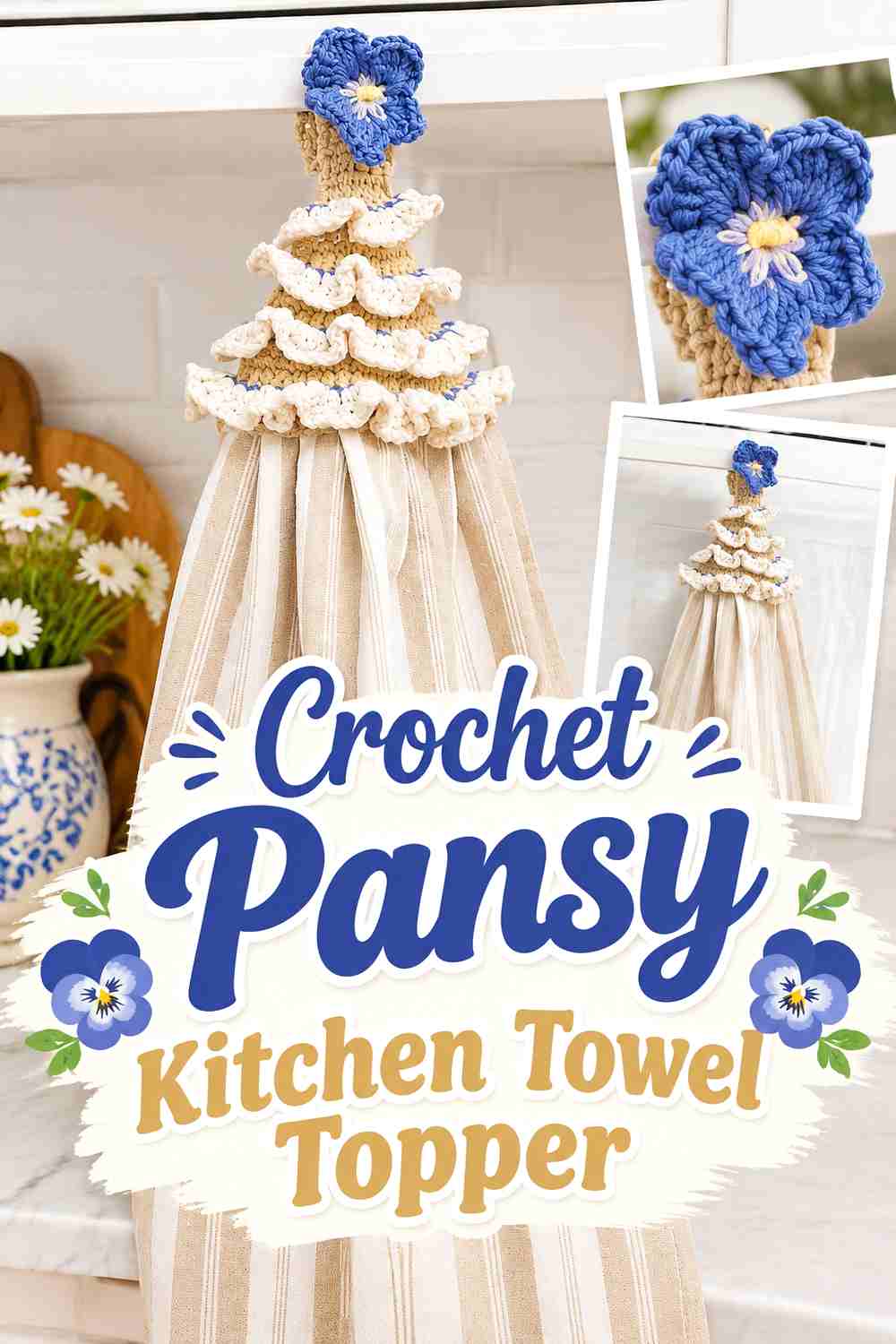
Yarnspirations offers a floral towel topper built around a pansy motif, using cotton yarn to give the hanging piece a distinctly botanical appearance. The flower treatment makes this much more decorative than a plain tapering tab and works naturally with spring, garden, and cottage kitchen themes.
A floral topper deserves visual room. Pair it with a towel that complements the flower rather than covering the same area with another very large motif.
Use Color to Clarify the Flower
Pansies often depend on contrast between sections of the flower to make the petal shape recognizable.
If you simplify the palette, maintain enough tonal difference for the motif structure to remain visible. Two colors that look different in a skein can blend together at kitchen-viewing distance.
Cotton Still Requires Care Matching
The source specifies a cotton yarn, but the finished topper also includes the towel and any closure components.
Follow the care guidance for the complete project rather than assuming all cotton pieces can be washed at any temperature or dried in any way.
Reserve Floral Detail for the Visible Side
A pansy topper is most effective when the flower faces outward and is not crushed between the towel and cabinet.
Check how your chosen appliance handle positions the crochet. Some handles cause a short topper to rotate more than others.
Creator Credit: Yarnspirations
19. Crochet Gingerbread Cottage Towel Topper
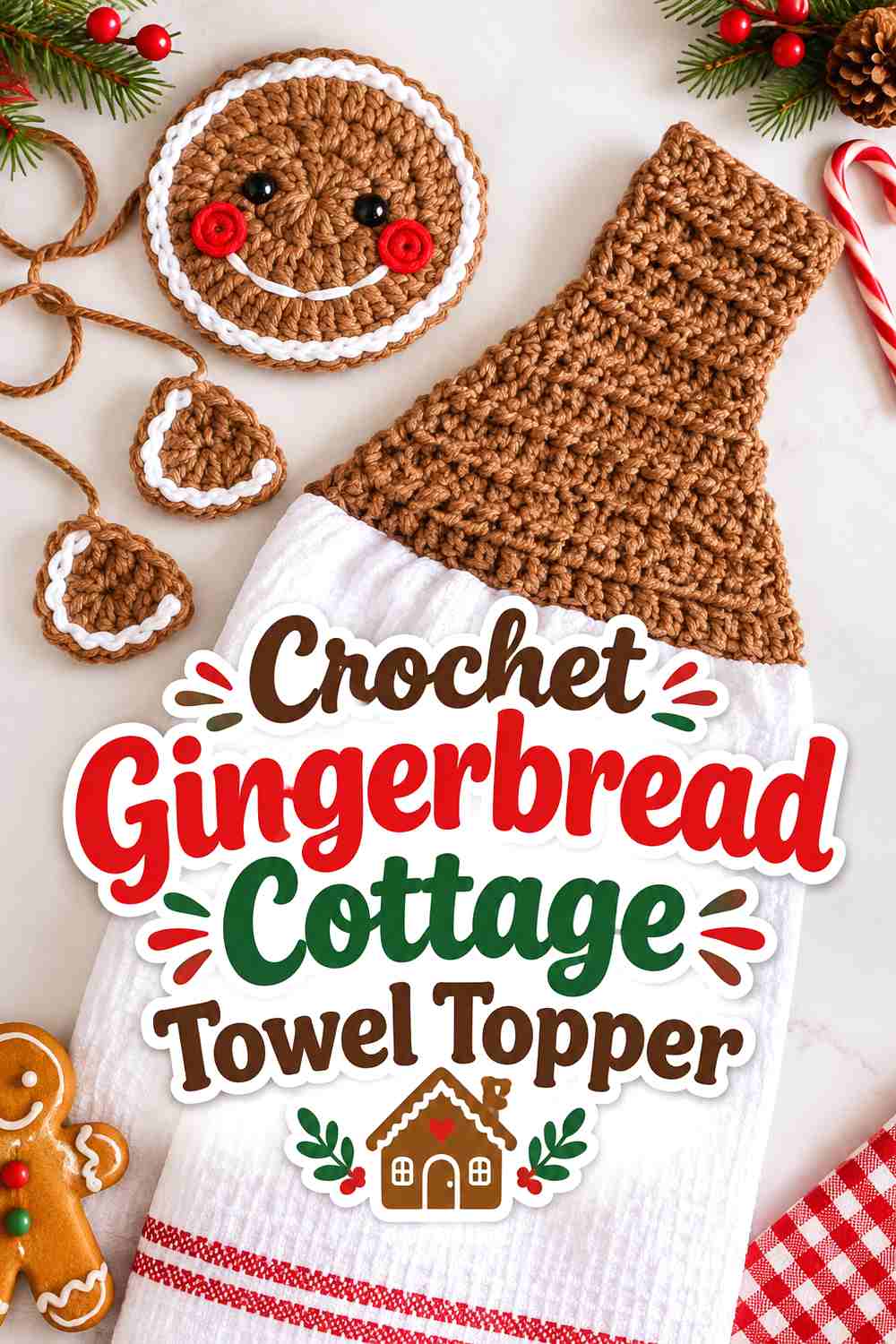
Repeat Crafter Me transforms a standard towel topper into a gingerbread character by adding a crocheted head, hands, facial details, and decorative accents to the hanging section. The underlying topper still functions with a button around the oven handle, but the character becomes the main visual element.
This approach suits a Christmas cottage kitchen where a few playful pieces are more appealing than changing every towel. Because the character includes multiple added components, however, finishing and care require more attention than they do on a single-piece topper.
Check Every Applied Piece
Hands, facial features, buttons, and other embellishments experience friction when the towel is handled.
Secure them carefully and inspect the topper periodically. For homes with very young children, consider whether small detachable components are appropriate for the placement and intended use.
Give the Gingerbread Face Space
The topper already provides a large character motif, so a heavily illustrated towel can compete with it.
A simple striped, checked, or mostly solid towel often lets the gingerbread silhouette read more clearly from across the kitchen.
Separate Decoration From Heat Protection
The gingerbread character may visually resemble a holiday kitchen accessory, but it is still a decorative towel topper.
Keep it away from open flames and hot surfaces, and never use the crocheted character as a potholder or oven mitt.
Creator Credit: Repeat Crafter Me
20. Crochet Plaid Farmhouse Towel Topper
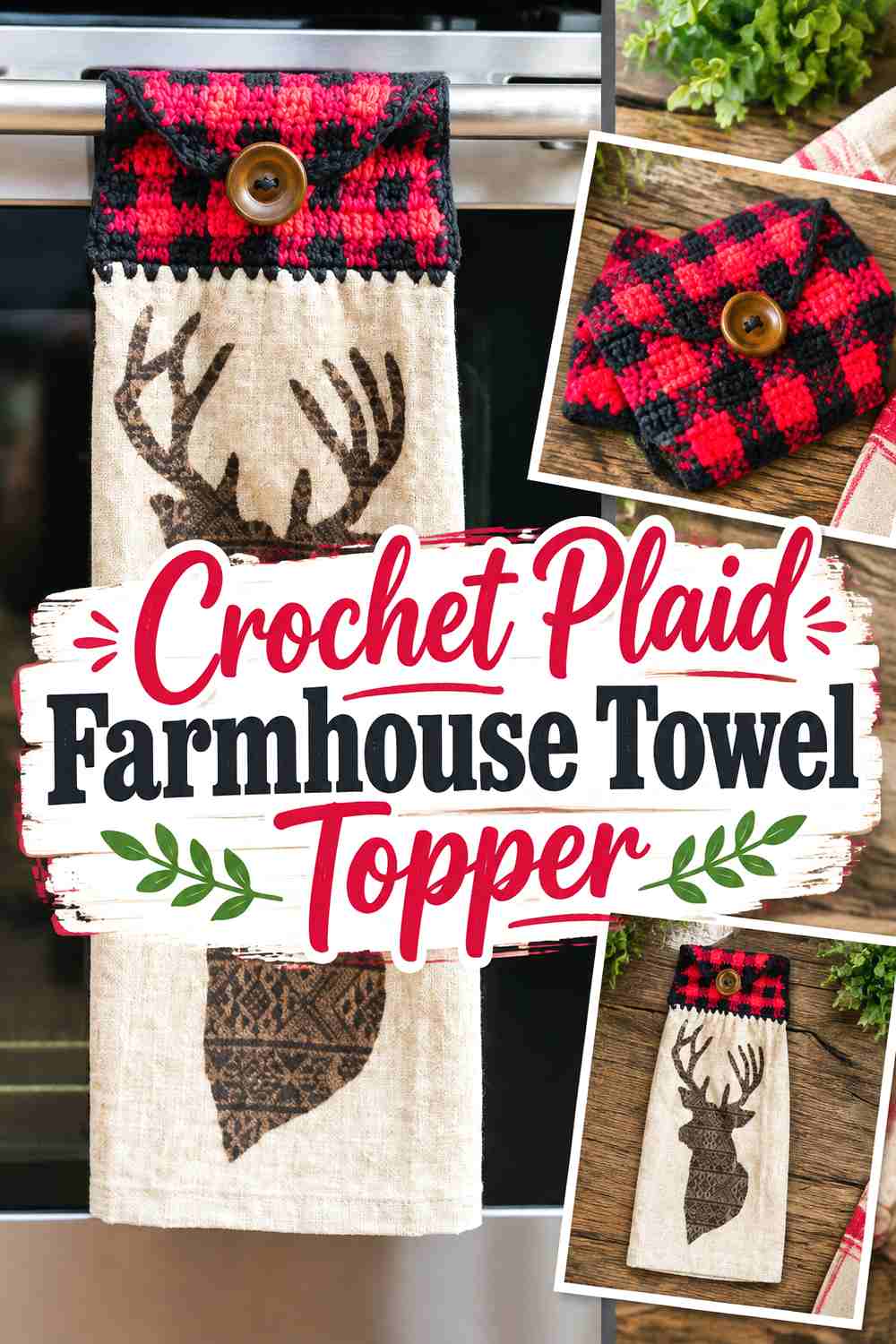
Whistle and Ivy brings plaid colorwork to a towel-topper format, creating a rustic pattern across the crochet rather than relying on an applied character. The design is attached to a cotton towel and uses a more modern shape than many narrow vintage toppers.
Plaid is especially compatible with cottage kitchens because it can echo checked curtains, woven runners, or farmhouse table linens. It is also adaptable beyond winter when the traditional red-and-green palette is replaced with softer neutrals or muted botanical colors.
Plaid Needs Consistent Color Placement
Colorwork becomes uneven quickly if strand changes wander or one shade begins a stitch too early.
Follow the source chart or written color sequence closely. This is not the project to improvise stripe widths halfway through unless you are prepared to redesign the entire plaid repeat.
Avoid Letting the Towel Compete
A multicolor plaid topper already provides a strong geometric pattern.
Pairing it with another large check can work if scales differ deliberately, but a solid, striped, or understated towel is easier to coordinate without producing visual clutter.
Cotton and Fabric Should Launder Together
The crochet is attached to the towel, so both materials share a wash cycle.
Before using substitute yarn, check whether its care requirements suit the towel. Colorfastness is especially worth considering when dark plaid shades sit directly against light fabric.
Creator Credit: Whistle and Ivy
21. Crochet Pumpkin-Cluster Towel Topper
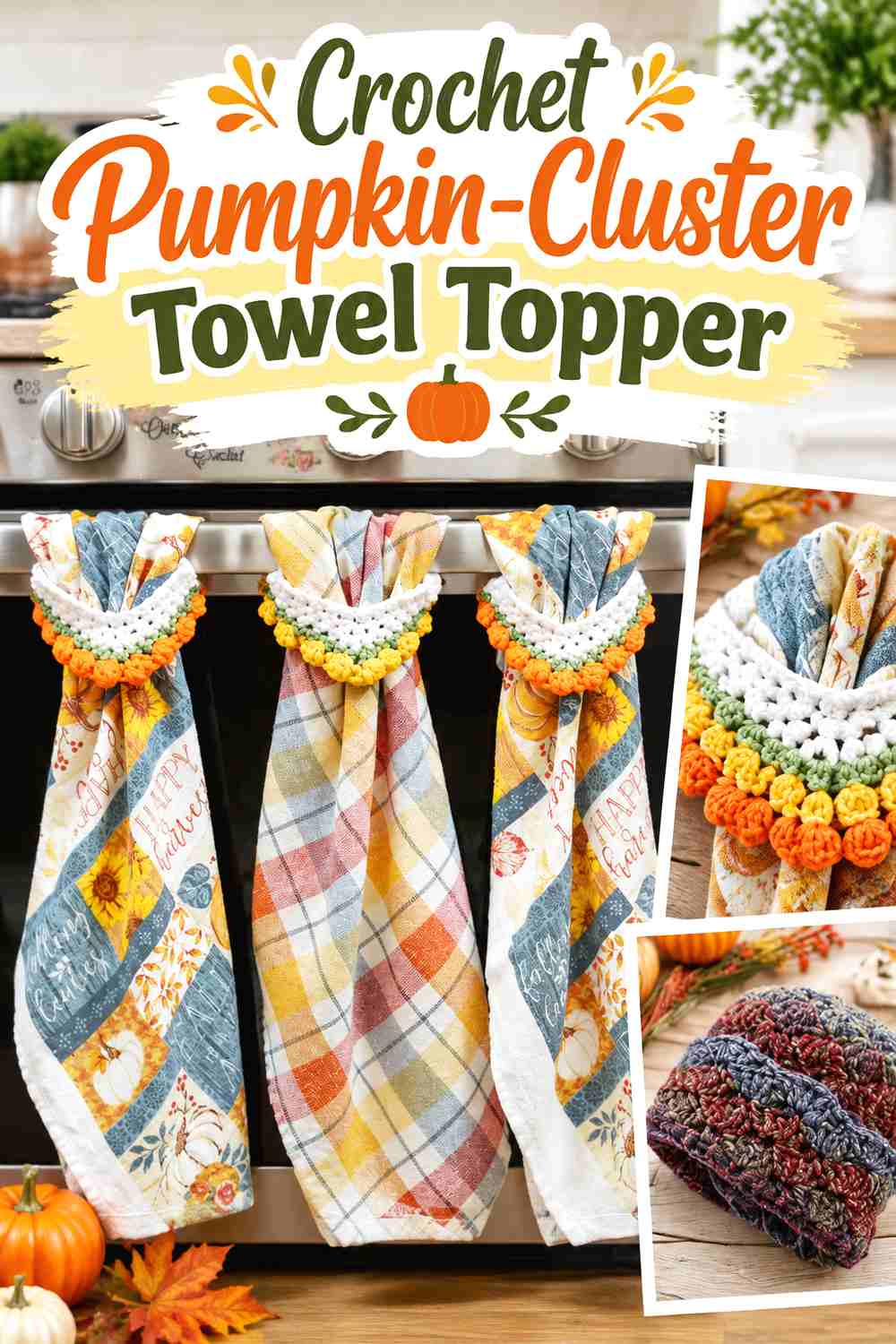
Krissy’s Over The Mountain Crochet uses a row of dimensional pumpkin-like clusters and offers a towel attachment that can create an angled, bias-style drape or accommodate a towel with prominent front artwork. The topper is therefore different both in stitch texture and in how it interacts with the fabric below.
This is a useful autumn cottage option when you want seasonal detail without building a large character face. The pumpkin clusters provide a recognizable harvest reference while the rest of the towel can remain comparatively restrained.
Bias Hanging Changes the Presentation
Attaching the topper toward a corner allows the towel to hang differently from a conventional centered fold.
Before sewing, test the full arrangement on the intended oven handle. A directional printed towel may need a different orientation to keep its artwork facing correctly.
Dimensional Clusters Need Definition
The small pumpkin forms depend on raised texture. A very fuzzy yarn can soften their shape, while very stiff yarn may make the row feel bulky.
If substituting, make a sample of the cluster stitch before committing to the full topper. Color alone will not compensate for poor stitch definition.
Seasonal Colors Are Optional
The underlying structure does not have to remain exclusively autumnal. Changing the cluster color can shift the effect toward flowers or another decorative interpretation.
If you adapt the palette, keep the source construction unchanged unless you understand how the dimensional stitches affect width.
Creator Credit: Krissy’s Over The Mountain Crochet
22. Crochet Christmas Tree Ring Towel Topper
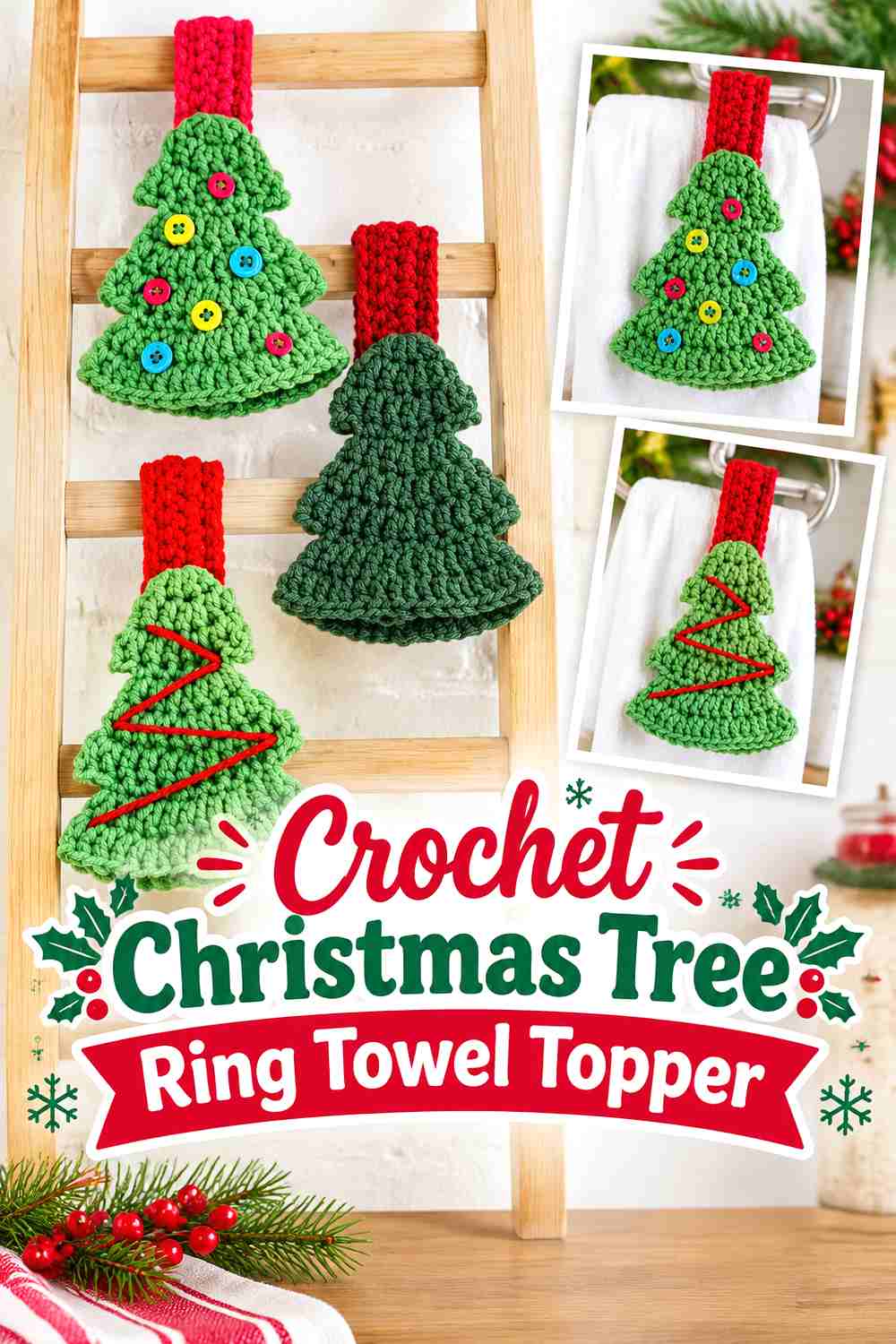
Winding Road Crochet shapes the visible holder into a Christmas tree and incorporates a towel-holding loop within the crocheted tree itself. A separate strap allows the completed tree to hang from a kitchen handle, while the towel threads through the internal opening.
This construction keeps the holiday motif independent from the towel, which means the towel can be removed while the tree remains in place. Optional small decorations can push the design toward a highly festive look, while leaving the tree plain creates a simpler winter accent.
Keep Tree Decorations Lightweight
Buttons and embroidery can suggest ornaments without adding much bulk. Heavier decorations may pull on the tree fabric or cause the holder to hang unevenly.
If you add anything beyond the source examples, make sure it cannot snag the towel as it moves through the internal ring.
Check the Internal Towel Opening
The towel passes through a crocheted loop rather than a hard ring.
That makes yarn tension relevant to function. If you crochet much tighter than the source gauge, the opening may become difficult to use with a thick towel.
Plain Trees Have Longer Seasonal Use
A green tree covered in bright ornaments reads immediately as Christmas decor. A neutral or undecorated evergreen can remain appropriate deeper into winter.
Choose the level of embellishment according to how often you want to change kitchen accessories after the holidays.
Creator Credit: Winding Road Crochet
23. Crochet Witch Cottage Towel Holder
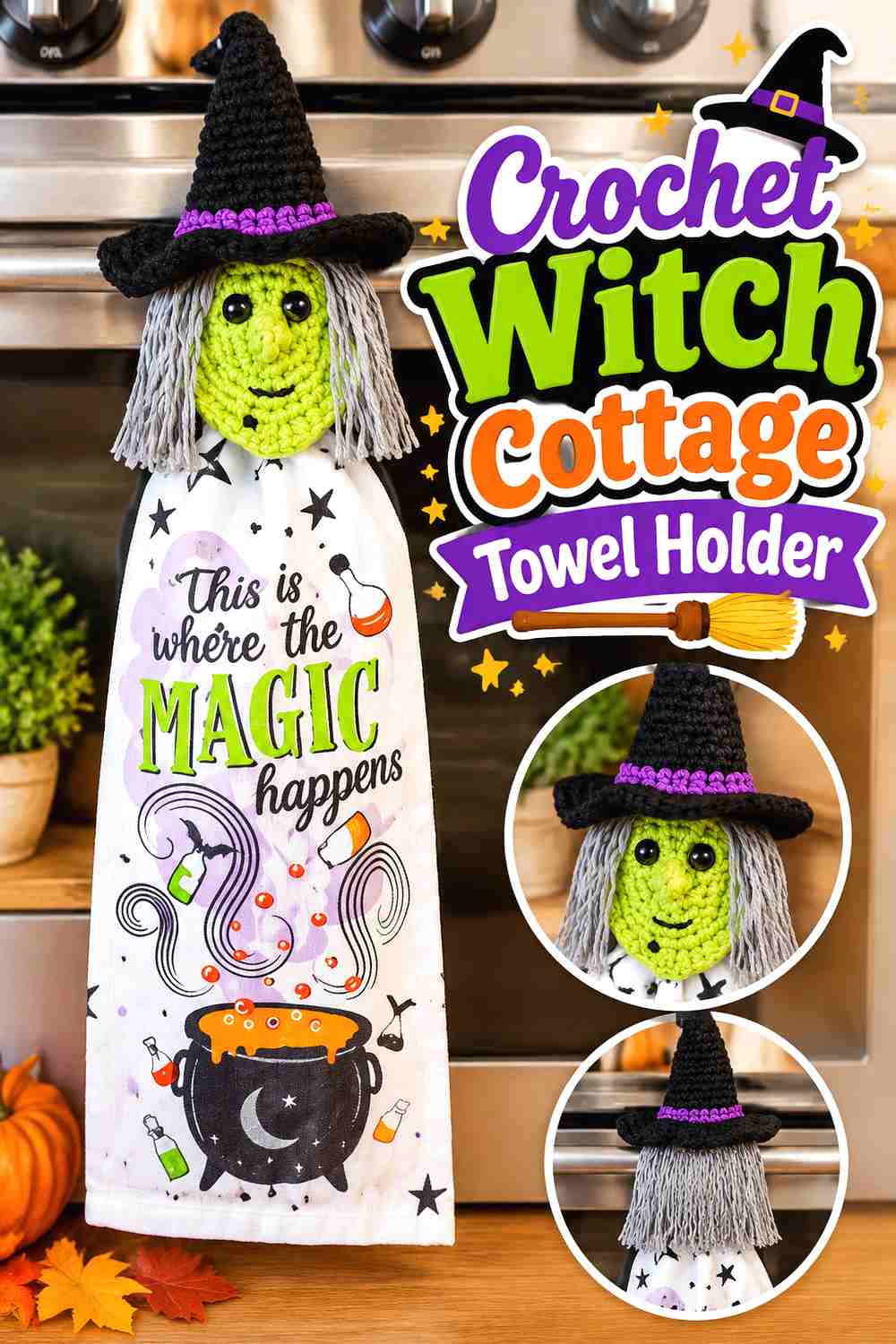
A Crocheted Simplicity turns the hanging-towel concept into a witch-themed holder for Halloween kitchens. The project is designed specifically to keep a towel secured while also functioning as seasonal decor rather than merely adding a small motif to a conventional topper.
Character holders are useful when you want one concentrated seasonal focal point. They can hang beside otherwise neutral towels and farmhouse accessories without requiring an entire kitchen color change.
Character Shaping Needs Careful Finishing
Recognizable seasonal designs depend on small shape and placement details more than plain geometric toppers do.
Before joining or attaching decorative pieces permanently, compare the arrangement with the source photographs. A small placement shift can change the finished expression or silhouette noticeably.
Choose the Towel After the Holder
When the crochet is the main design feature, it can be easier to make the holder first and select a towel afterward.
A towel with limited pattern near its hanging end prevents the fabric from visually competing with the witch motif.
Store Seasonal Pieces Carefully
Dimensional or shaped toppers can crease when packed under heavier decorations for most of the year.
Clean the piece according to its materials, allow it to dry completely, and store it without severe compression so the shaping requires less correction next season.
Creator Credit: A Crocheted Simplicity
24. Crochet Owl-Inspired Kitchen Towel Topper
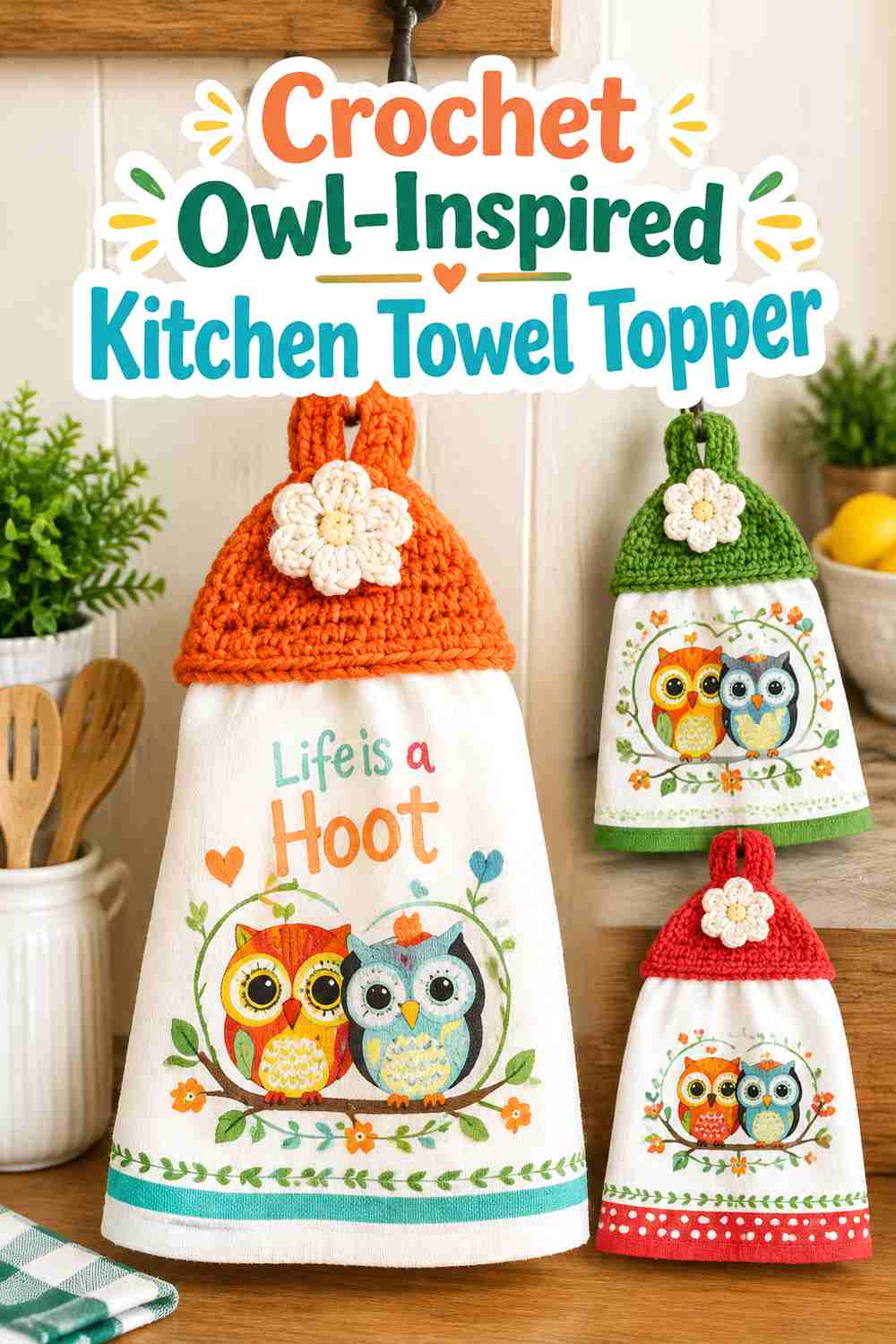
HelenMay Crochet’s “Life is a Hoot” approach uses a whole kitchen towel rather than requiring the towel to be cut in half. The creator discusses different towel choices and provides step-by-step tutorial support for the topper, making the printed towel itself an important part of the finished design.
This is especially suitable for cottage kitchens filled with illustrated tea towels—owls, roosters, recipes, bees, florals, or seasonal prints—because the topper can frame the towel without making the crochet the only decorative element.
Keeping the Whole Towel Changes the Bulk
A full towel folded into the topper creates more fabric thickness than a project made from half a towel.
Consider both appearance and drying. Several layers pressed tightly together can hold moisture longer, so spread the towel out whenever possible after heavy use.
Pick the Towel Before the Yarn
The creator’s approach emphasizes the towel as part of the overall design. That makes yarn selection easier after the fabric is chosen.
Pulling a secondary color from the towel rather than its dominant shade can produce a more interesting cottage palette while still keeping the two materials visually connected.
Use Decorative Extras Selectively
Owl-inspired or floral details can add personality, but every additional element changes cleaning and handling.
If the towel will be used constantly rather than displayed seasonally, favor securely attached, washable embellishment and leave delicate decorative pieces for lighter-use versions.
Creator Credit: HelenMay Crochet
Comparing Crochet Kitchen Towel Topper Styles
For a traditional cottage look, attached button toppers from Maggie’s Crochet, Bev’s Country Cottage, Simple Creative Farmhouse, and the classic video tutorials keep the familiar tapered silhouette. They work especially well when the towel itself carries the main pattern.
Choose a removable ring design when frequent towel changes matter more than having crochet permanently attached. Flower, tassel, wooden-ring, elastic-ring, and metal-ring holders let the decorative piece remain in place while the fabric towel is removed.
Corner-mounted toppers from Stitching Together and Krissy’s Over The Mountain Crochet preserve more of the towel’s full surface and are useful with large prints. Seasonal motifs—gingerbread, poinsettias, trees, witches, and pumpkin clusters—provide stronger visual impact but involve more finishing. Plaid, stripes, ruffles, and simple textured tabs are easier to keep in a year-round cottage rotation.
Conclusion
The most useful crochet kitchen towel topper is the one whose hanging method fits the actual kitchen. A buttoned tab works well on many oven and refrigerator handles, while ring holders make frequent towel replacement simpler. Corner attachments preserve decorative fabric, and built-in crochet towels create a coordinated textile from top to bottom.
For a quiet cottage kitchen, start with simple single crochet, stripes, or a traditional tapered tab. Choose flowers, plaid, tassels, pumpkin clusters, or character motifs when the topper itself should become part of the room’s decoration. Before making multiples, finish one and test it on the intended handle with the actual towel. Check closure security, towel orientation, ring clearance, and washing needs, then use the original creator’s tutorial for exact construction and material information.
Frequently Asked Questions
What yarn is most practical for a crochet kitchen towel topper?
That depends on the tutorial and whether the crochet is permanently attached to the towel. Washable cotton is commonly used because it suits many kitchen projects, but some designers specify or demonstrate other fibers. If the topper and towel must be washed together, choose a yarn whose care requirements are compatible with the towel. Ring holders that stay separate from the fabric give you more flexibility because they do not necessarily enter every wash cycle.
Is a removable ring towel holder better than an attached topper?
Neither construction is universally better. A ring holder is convenient if you change towels often because the crochet can remain on the handle. An attached topper keeps the towel and crochet together as one finished item and can feel more traditional. Attached versions also eliminate a separate ring that can be misplaced. Choose according to washing habits, the intended handle, and whether you want to rotate different towels through the same crocheted holder.
Can I use any kitchen towel with a crochet topper?
Not always without adjustment. Towels vary in width, thickness, weave, hem construction, and print direction. A thick terry towel may be difficult to pierce or feed through a small ring, while a thin tea towel may gather more easily. Directional prints also need to be folded carefully before attachment. Check the tutorial’s towel preparation and finished arrangement before buying several matching towels for a set.
How do I keep a printed towel design facing forward?
Fold and temporarily pin the towel exactly as the tutorial requires before adding crochet. Then hang the mock-up from the intended oven or cabinet handle. This reveals whether illustrations, words, or decorative borders are centered and upright. Corner-attachment designs can be especially useful for towels with large front artwork because they leave more fabric visible, while heavily gathered traditional toppers may conceal part of the print.
Are crochet towel toppers safe near an oven?
A hanging towel topper is not heat-protective equipment. Keep the towel and crochet away from burners, open flames, hot cookware, and any location where fabric could contact a heating element. Hanging from an oven-door handle may be appropriate in many kitchens, but the exact appliance layout matters. Never use a decorative topper as a potholder or oven mitt simply because the yarn is cotton or another natural fiber.
How should crochet towel toppers be washed?
Follow the care instructions for every material in the finished item, including the yarn, commercial towel, buttons, wooden or metal components, elastic, and embellishments. A permanently attached topper has to be cared for as one combined textile. Removable ring holders can often be separated before the towel is washed. Do not assume a flower, tassel, wooden ring, or character embellishment can tolerate the same wash and dry cycle as a plain cotton towel.
What should I check before making several matching towel toppers?
Finish and use one first. Make sure the strap fits the intended handle, the button stays closed, the towel hangs at the correct height, and any ring is large enough for the towel thickness. Wash the towel as recommended and see how the attachment behaves afterward. Once those details are confirmed, repeating the design is much safer than discovering a sizing or care problem after completing an entire coordinated kitchen set.