Garden twine is one of those small supplies that’s easy to misplace when you’re tying up climbing plants, organizing seedlings or working around the potting bench. These 17 crochet garden twine dispenser bag inspiration ideas explore practical-looking ways to keep a ball or small roll of twine contained while leaving its loose end ready to pull. From ribbed hanging pouches and granny-square bags to portable belt holders, lined mesh slings and two-compartment dispensers, the collection offers several different approaches to a familiar gardening task.
Whether you prefer to keep twine on a shed wall, carry a small supply around the garden or leave a dispenser on the workbench, the right design depends on the size and shape of your twine. Some ideas use reinforced feed holes, while others focus on refill access, separate compartments or removable linings. Each design is presented as a crochet inspiration concept rather than a tested tool, with practical considerations for yarn, hanging hardware, dispensing, cleaning and storage.
These are AI-generated crochet design visualizations for inspiration, not photographs of tested handmade dispensers or complete crochet patterns.
Quick Design Selection Guide
| Your gardening need | Design to explore | Main advantage |
|---|---|---|
| A simple hanging twine bag | Crochet Terracotta Ribbed Hanging Twine Pouch | Drawstring top and lower-front dispensing eyelet |
| Colorful cottage-style storage | Crochet Indigo Checkerboard Twine Box Bag | Granny-square front with button flap |
| A cheerful garden accessory | Crochet Butter Yellow Bee Garden Twine Bag | Bee appliqué and rounded drawstring shape |
| Open mesh with an inner lining | Crochet Olive Mesh Lined Garden Twine Sling | Lattice body with separate feed opening |
| Two types of garden string | Crochet Plum Twin Roll Twine Dispenser | Two compartments and two outlets |
| Twine while moving around the garden | Crochet Teal Crossbody Garden Twine Carrier | Shoulder strap and front dispensing port |
| A flat twine winding | Crochet Coral Foldover Flat Twine Spool Pocket | Slim envelope shape |
| Standing on a potting bench | Crochet Oatmeal Bamboo Base Standing Twine Bucket | Stable bamboo base and side outlet |
| A compact belt-mounted accessory | Crochet Charcoal Belt Clip Twine Bag | Clip attachment and drawstring opening |
| A refillable zippered pouch | Crochet Apricot Zipper Refill Twine Bag | Wide upper access |
| Active and spare twine storage | Crochet Cinnamon Two Tier Twine Station | Separate upper reserve and lower dispenser |
1. Crochet Terracotta Ribbed Hanging Twine Pouch
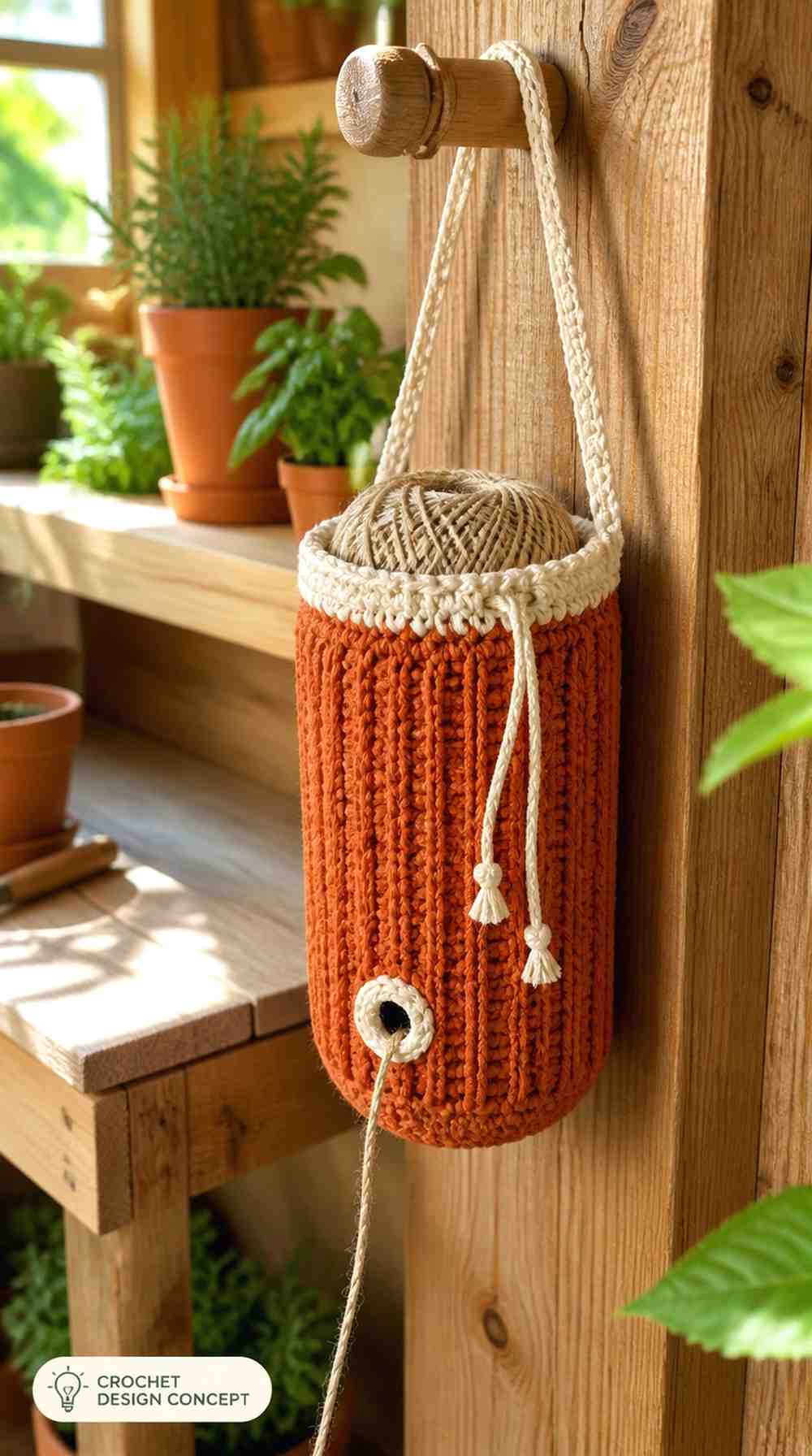
Warm terracotta crochet gives this cylindrical garden twine bag a relaxed farmhouse appearance. Raised vertical ribs cover its rounded body, while an ivory upper border and narrow cream drawstring finish the opening. A ball of natural beige jute twine sits inside, with one strand feeding through a small reinforced ivory eyelet near the lower front.
Hanging from an oak peg in a sunny potting shed, the pouch keeps the twine off the workbench. Its straightforward design is appealing for a single frequently used roll, although the outlet needs careful shaping to avoid snagging.
- Lower-Front Outlet: Position the reinforced eyelet so the strand can feed without dragging against a rough seam or sharply bent edge.
- Drawstring Access: The cream cord should open wide enough to replace the twine ball without stretching the upper crochet rows.
- Hanging Support: Check the reinforced loop and wall peg against the actual filled pouch’s weight rather than relying on the illustrated arrangement.
2. Crochet Indigo Checkerboard Twine Box Bag
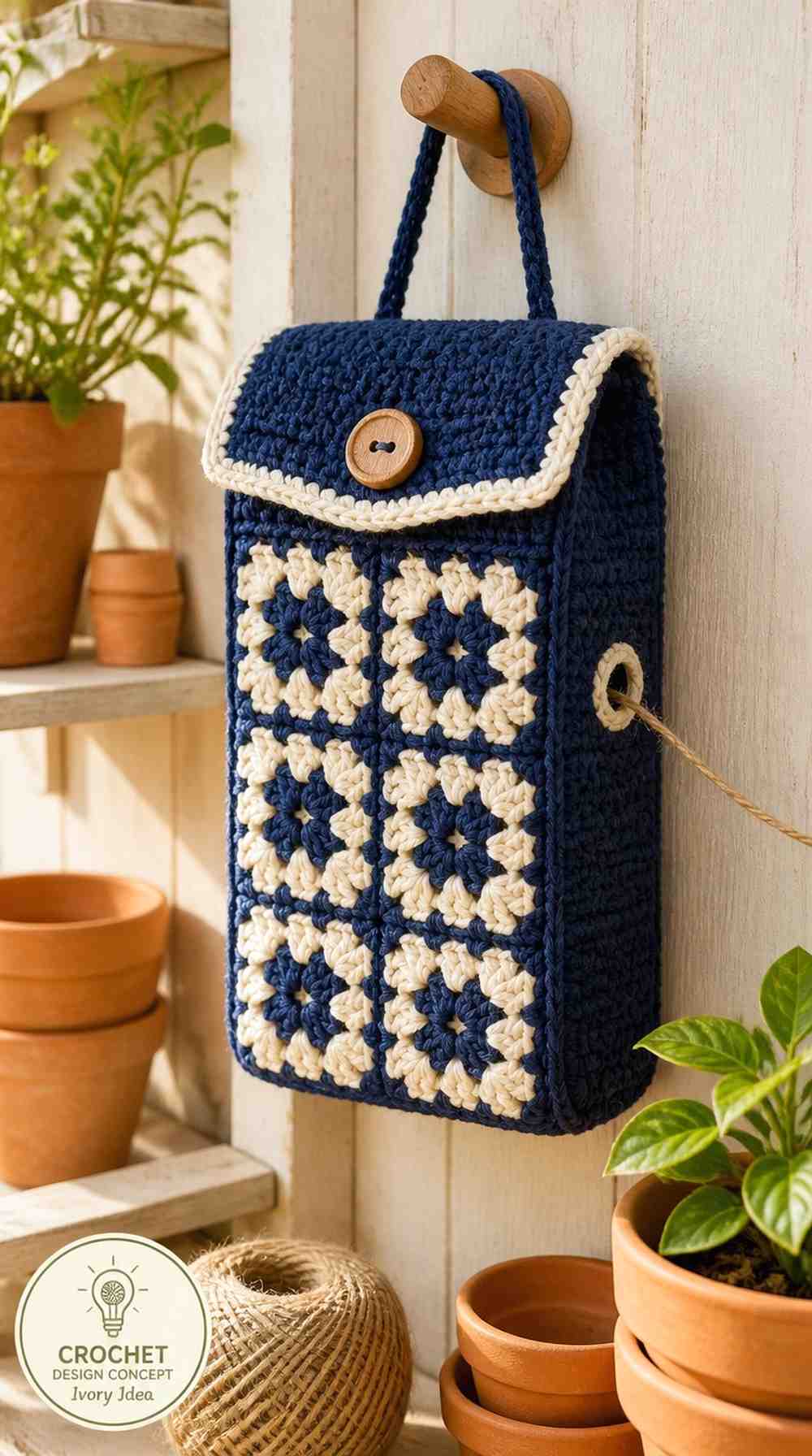
Indigo-blue and warm-cream granny squares create a striking front panel on this box-shaped garden twine dispenser. Six small motifs form two columns and three rows, surrounded by solid indigo gussets and a cream-edged flap. A natural wooden button fastens the top, while a strand of beige twine exits through a reinforced opening on the right side.
The squared shape offers a different look from the rounded pouches. Its separate side panels may suit a compact twine ball, provided the internal space allows the ball to unwind rather than becoming wedged.
- Granny Square Seams: Keep the six front motifs evenly joined so the checkerboard remains flat and does not distort the box-shaped sides.
- Side Feed Opening: The right-hand outlet needs a smooth reinforced edge, especially if the jute twine has a relatively coarse surface.
- Buttoned Refill Flap: Check that the top opens sufficiently for the wound ball without pulling heavily on the wooden button or crochet buttonhole.
3. Crochet Butter Yellow Bee Garden Twine Bag
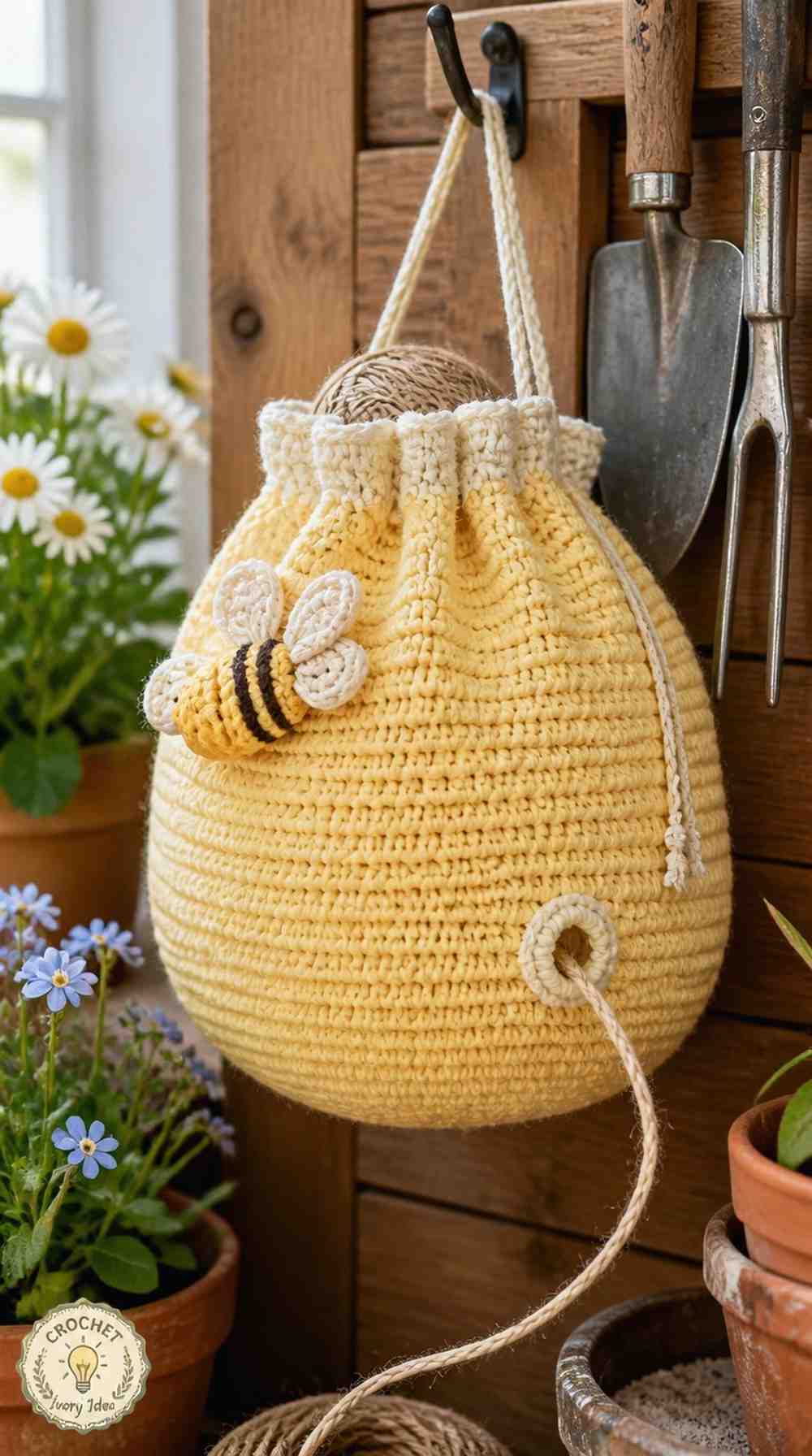
Butter-yellow crochet makes this rounded dispenser especially cheerful. A tiny flat bee appliqué sits near the upper-left front, complete with golden-yellow body, charcoal stripes and neatly joined ivory wings. The warm-cream upper rim gathers with an ivory drawcord, while one beige twine strand exits a separate reinforced opening below the bee.
The pouch hangs from a garden-tool rack, where its small decoration adds character without taking over the design. Keeping the bee and dispensing hole separate is particularly useful because the twine should move freely without catching on the appliqué.
- Bee Appliqué: Secure the striped body and two wings flat against the pouch, avoiding loose decorative strands near the dispensing path.
- Separate Eyelet: Place the lower-right outlet clear of the bee so pulling garden twine cannot snag the raised stitches.
- Rounded Capacity: The ball should fit inside the gently gathered bag without making the upper opening difficult to close or reopen.
4. Crochet Olive Mesh Lined Garden Twine Sling
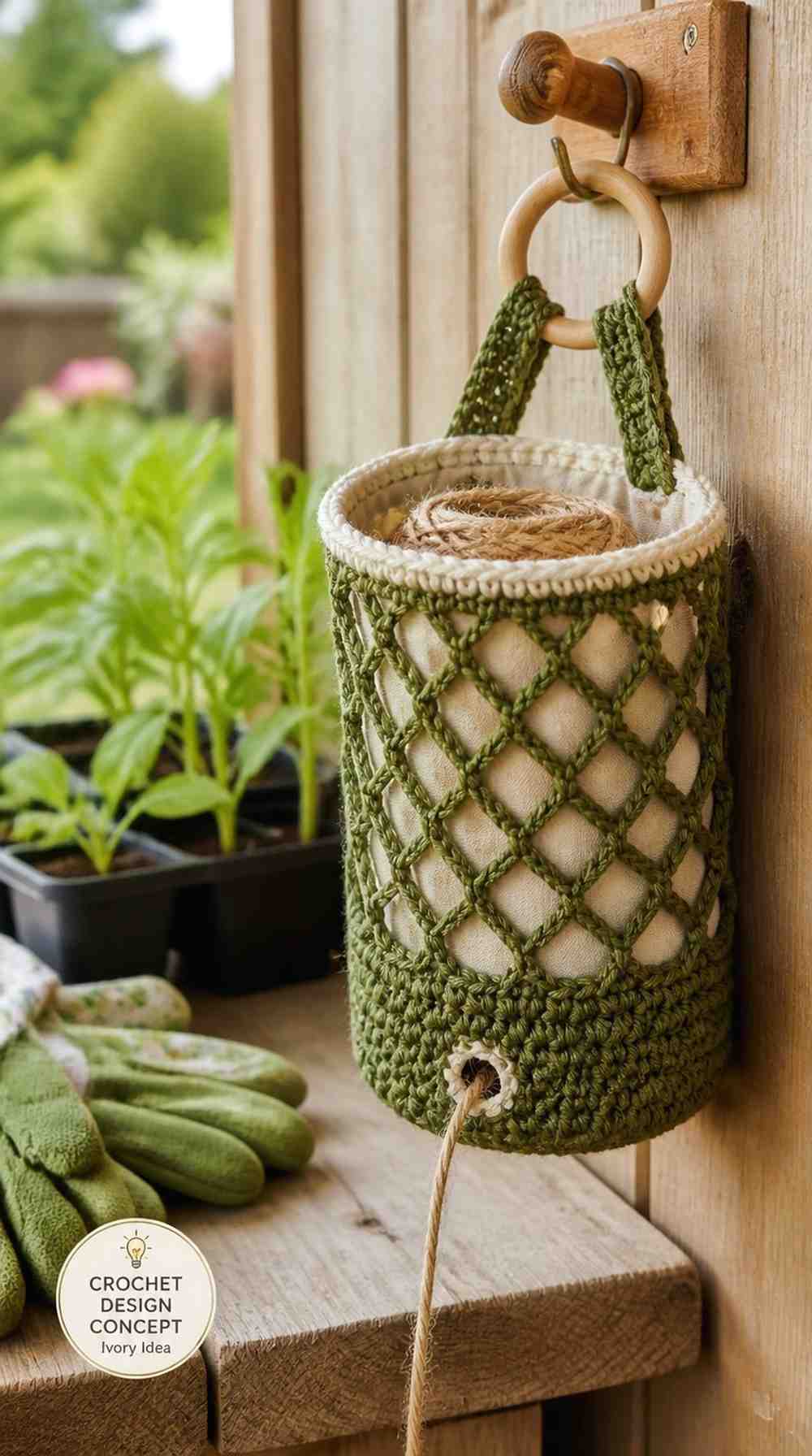
Olive-green crochet diamond mesh creates an airy outer layer around this hanging twine sling. A warm-cream cotton lining sits behind the openwork, while a solid dark-green lower band and narrow ivory rim frame the cylinder. Two reinforced olive loops connect the pouch to a wooden hanging ring.
Inside, the lining contains a natural jute twine ball. Its loose strand exits through aligned reinforced openings in the lining and lower crochet front, making the dispensing point separate from the decorative mesh.
- Aligned Feed Hole: The lining and outer crochet openings must meet cleanly so the twine does not catch between the two fabric layers.
- Diamond Mesh: Keep the chain spaces consistent, with properly connected rows that do not stretch unevenly around the filled lining.
- Wooden Ring Attachment: Both upper loops should distribute the pouch’s weight evenly and be checked for loosening during repeated use.
5. Crochet Plum Twin Roll Twine Dispenser
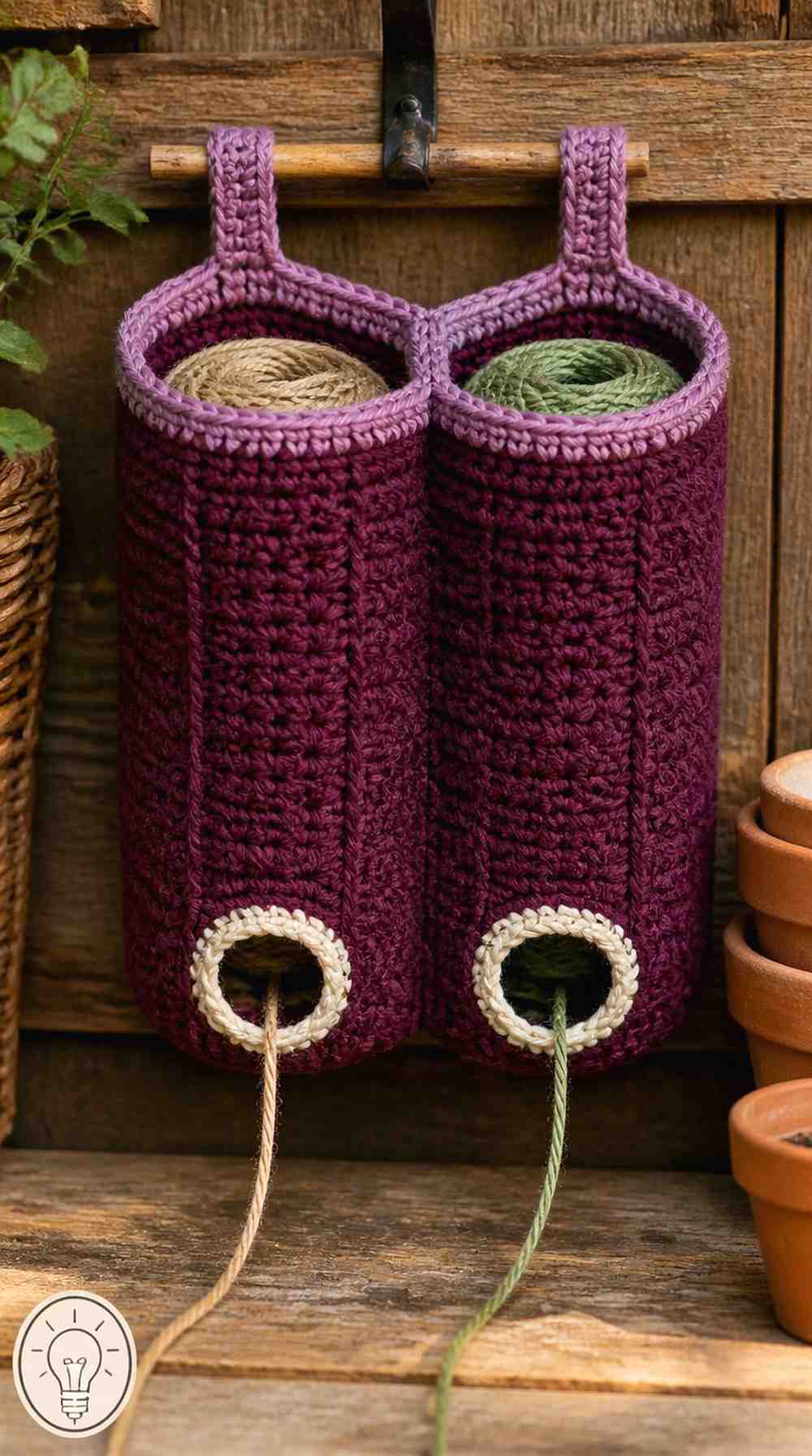
Deep-plum crochet creates a practical-looking organizer with two separate vertical compartments. The left side contains natural beige jute twine, while the right holds muted-green garden string. Individual cream-edged dispensing holes near the lower fronts allow one strand from each compartment to remain accessible.
Two reinforced loops suspend the rectangular organizer from a wooden dowel above a potting bench. The separate compartments are its defining feature, making this concept useful for gardeners who prefer different string materials for different tasks without mixing the balls together.
- Two Independent Outlets: Keep each feed hole connected to its own compartment so the beige and green strands cannot tangle inside the pouch.
- Compartment Width: Measure both twine rolls independently, since wound jute and cotton string may have different diameters.
- Dowel Balance: Place the hanging loops evenly and avoid loading one side much more heavily than the other.
6. Crochet Teal Crossbody Garden Twine Carrier
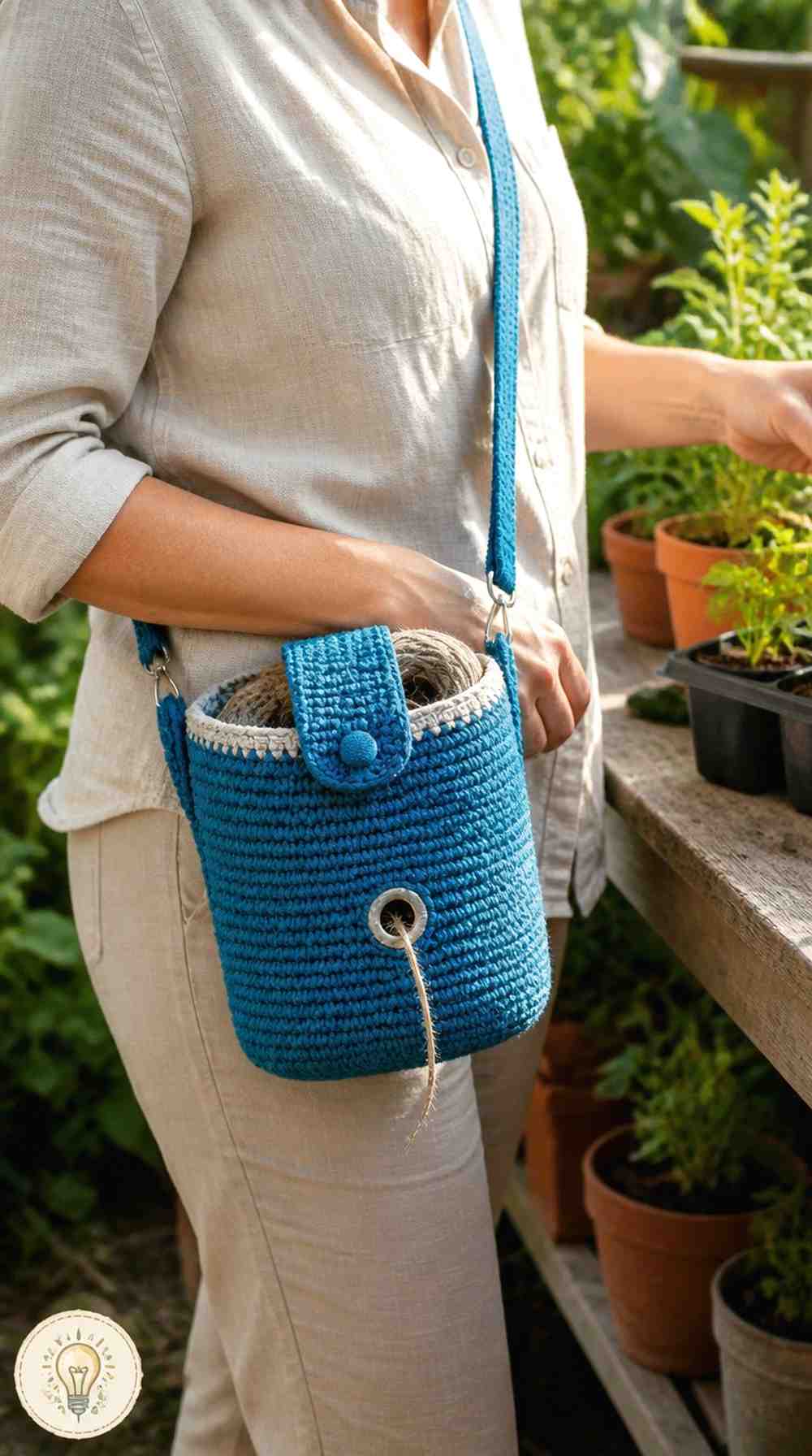
Teal-blue crochet turns a small garden twine dispenser into a portable crossbody accessory. Its rounded rectangular body has closely worked horizontal rows, an ivory upper edge and a short flap with a flat fastening. A reinforced front opening feeds a short beige twine strand, while a fabric-backed teal strap allows the pouch to hang at the gardener’s hip.
The hands-free layout may appeal to someone moving between raised beds and climbing plants. Its practicality depends on the pouch remaining stable and the strap staying away from tools, branches and moving equipment.
- Hip-Level Placement: Keep the carrier positioned where the twine can be reached comfortably without the bag swinging into the gardener’s work.
- Shoulder Strap: A reinforced, fabric-backed strap may help support a small twine ball, but its construction and attachment need proper assessment.
- Snag Prevention: Keep the free twine end short and check that the crossbody strap cannot catch on plants, stakes or garden machinery.
7. Crochet Coral Foldover Flat Twine Spool Pocket
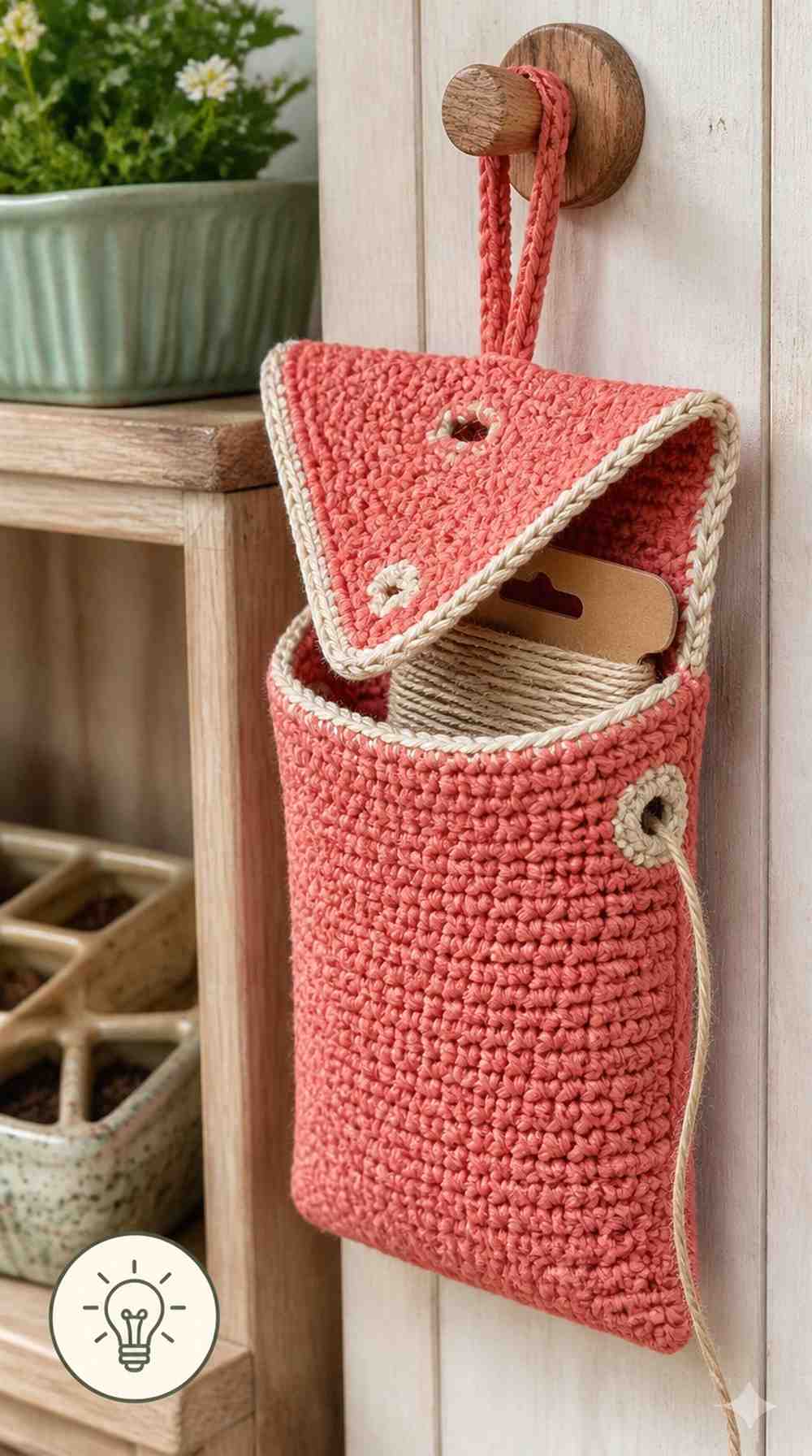
Coral-pink crochet forms a slim envelope designed around a rectangular cardboard winding of garden twine rather than a round ball. Dense stitches create the body, while ivory edging and a triangular foldover flap give the pocket a neat finish. A natural wooden button closes the front, and one twine strand exits a reinforced side opening.
This design suits a compact flat winding stored on a potting-shed hook. Its narrow profile saves visual space, although the shape of the cardboard winding may affect how freely the twine feeds.
- Flat Winding Fit: Plan the pocket around the cardboard winding’s width and thickness rather than the dimensions of a round twine ball.
- Side Outlet: Place the feed hole where the string can leave the winding without scraping repeatedly against the cardboard edge.
- Flap Clearance: The triangular closure should open far enough to replace the winding without bending or damaging its cardboard support.
8. Crochet Oatmeal Bamboo Base Standing Twine Bucket
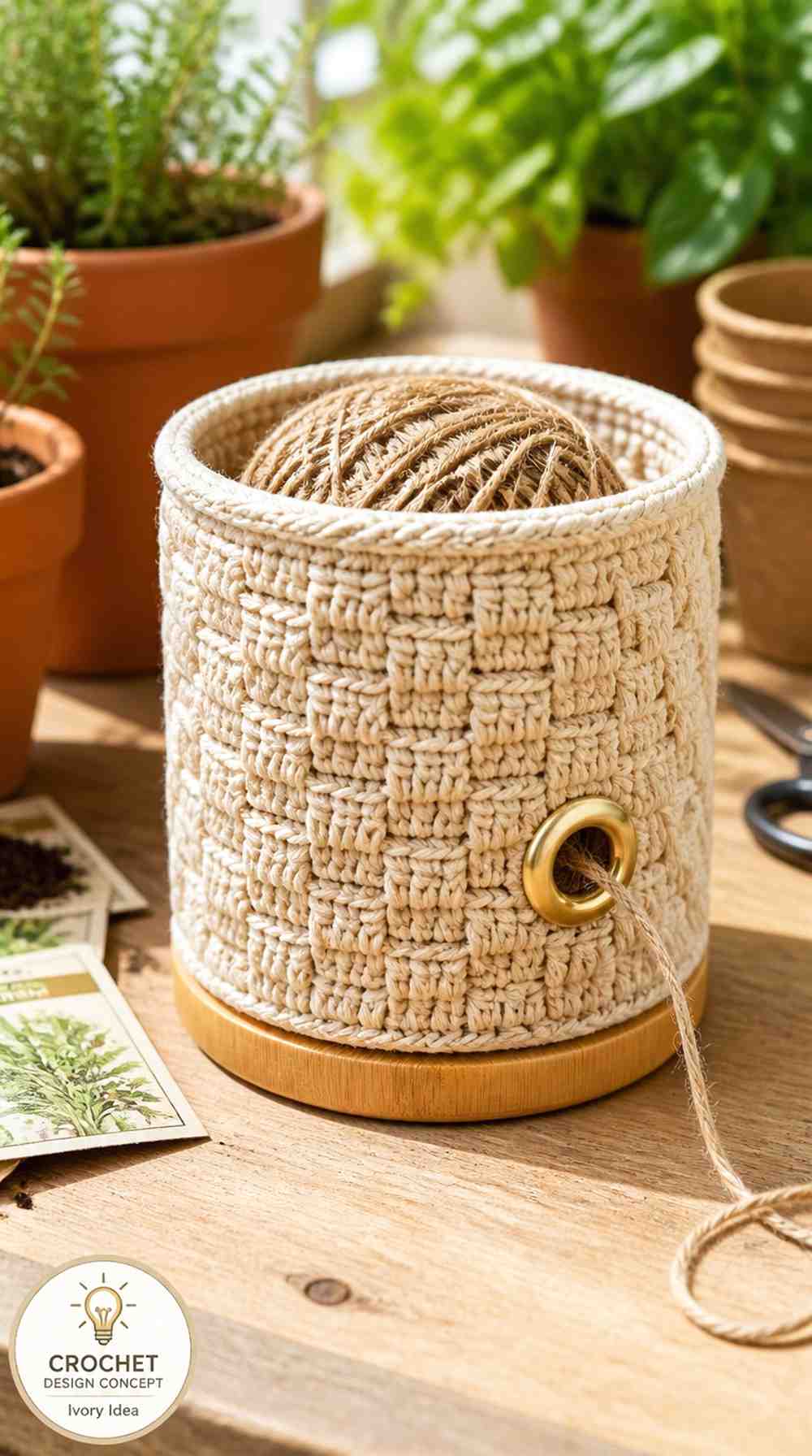
Oatmeal-colored crochet gives this tabletop dispenser a soft, natural appearance. Raised basketweave-style stitches cover its cylindrical sides, while a round bamboo base supports the bucket on the potting bench. A slim cream rim finishes the open top, revealing a beige jute ball inside. One loose strand exits through a smooth brass-colored eyelet on the right-front side.
Unlike the hanging designs, this concept stays on the work surface. It could be useful for gardeners who prefer a stationary dispenser near seed trays and small tools, provided its base remains stable.
- Bamboo Base: A rigid circular bottom can support the crochet body, but it should remain level when twine is pulled from the side.
- Brass-Colored Outlet: The reinforced opening needs a smooth interior surface so it does not fray the jute strand during repeated use.
- Open-Top Access: The ball is easy to replace, but the exposed opening offers less protection from dust and garden debris.
9. Crochet Charcoal Belt Clip Twine Bag
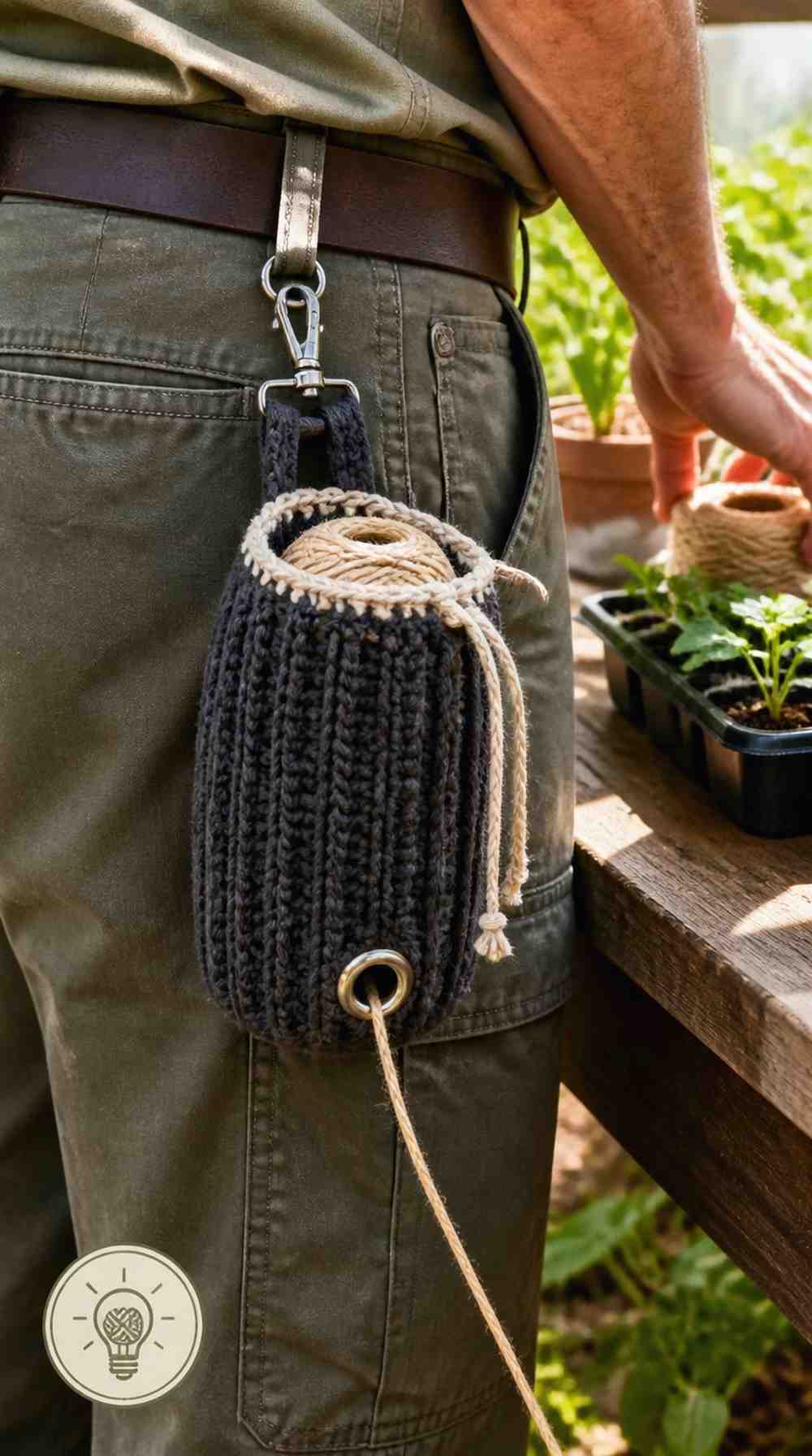
Charcoal-grey crochet creates a compact cylindrical dispenser for a gardener’s trouser belt. Neat vertical ribs form the pouch, with a warm-cream upper border and a lightly gathered drawstring opening. A reinforced front eyelet feeds one beige twine strand, while a securely closed metal clip connects a fabric-backed loop to the wearer’s belt.
The belt-mounted arrangement keeps a small supply close at hand without requiring a shoulder strap. It is best considered for lightweight twine and suitable clothing, with particular attention to the clip and any loose strand.
- Belt Clip: The clip should close properly around a suitable belt attachment point and remain separate from the crochet’s dispensing opening.
- Pouch Weight: Keep the twine supply small enough that the holder does not pull the belt awkwardly or move excessively while walking.
- Gardening Safety: Avoid dangling loops and remove the accessory around moving machinery or areas where the twine could become entangled.
10. Crochet Blush Daisy Drawstring Twine Pouch
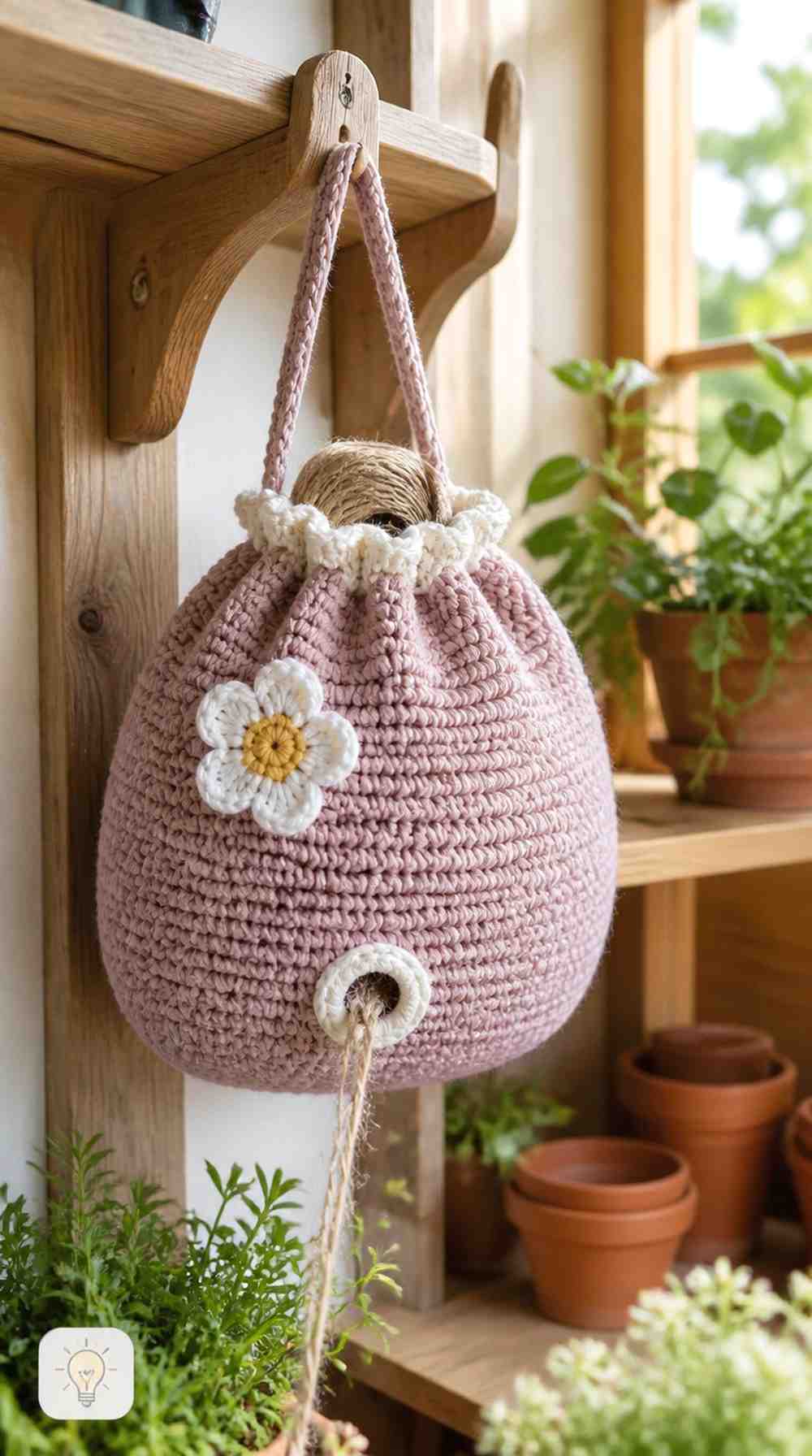
Dusty-blush crochet creates a softly rounded garden twine dispenser with a flat circular base. An ivory drawstring gathers the upper opening, while a small white five-petal daisy with a golden-yellow center decorates the upper-left front. Below the flower, a separate cream-edged eyelet feeds one visible strand of beige jute twine.
The pouch hangs from a wooden hook inside a bright potting shed. Its floral detail gives it a softer cottage-garden appearance than the plain cylindrical designs, but the appliqué should remain securely attached and clear of the working twine.
- Daisy Attachment: Sew the petals and yellow center firmly, keeping the flower flat so it cannot lift or snag on the dispenser’s loose strand.
- Eyelet Placement: The dispensing opening sits below the decoration, providing a separate path that does not cross the raised flower.
- Drawstring Closure: The gathered rim should be easy to loosen for refilling without allowing the twine ball to push through the top.
11. Crochet Mustard Bottom Feed Garden Twine Sleeve
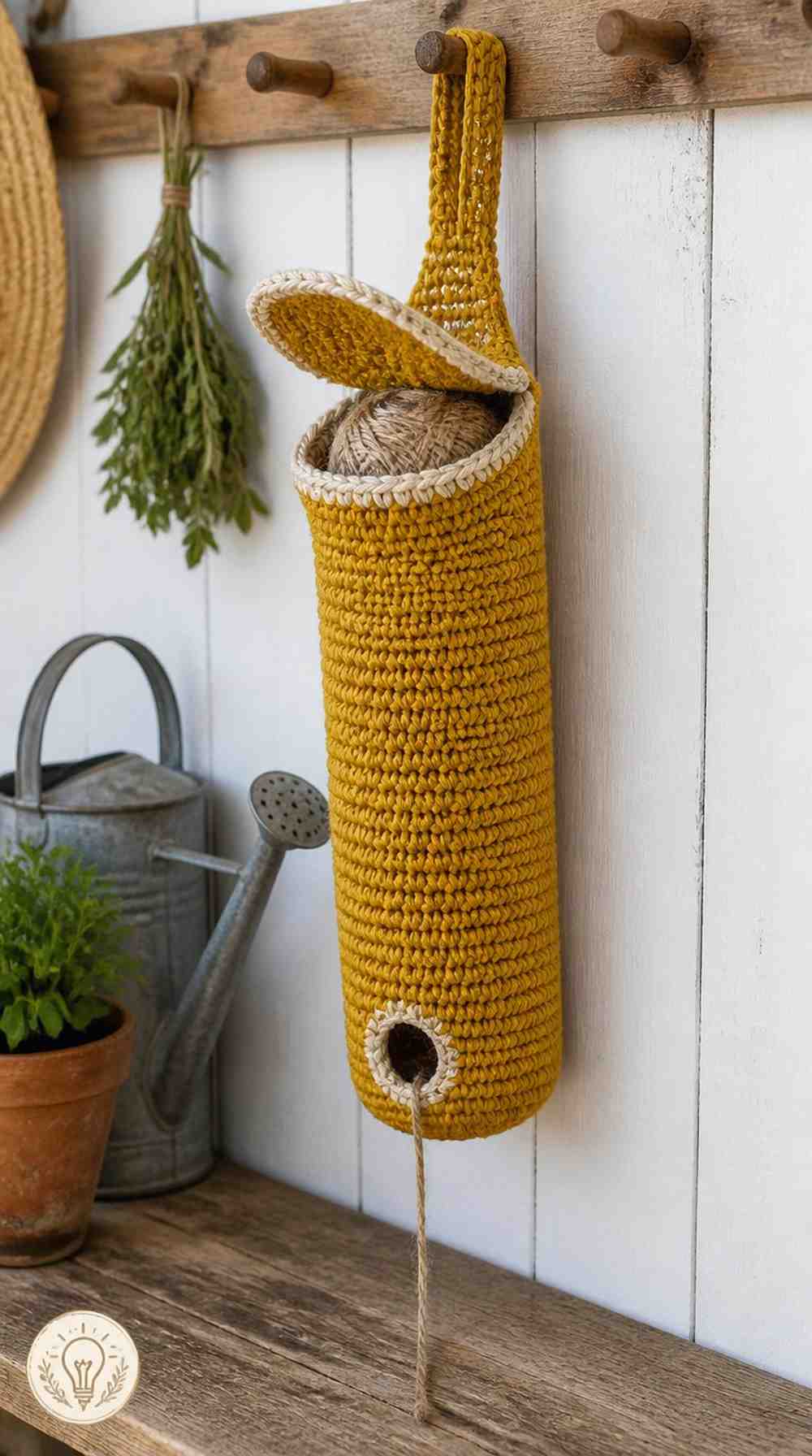
Mustard-yellow crochet forms a tall, narrow dispenser that hangs vertically from a wooden peg rail. Closely worked vertical rows give the cylindrical body a neat surface, while a cream upper rim and short foldover flap finish the refill opening. A compact beige twine roll sits inside.
The defining feature is the reinforced oval port centered in the lower base. One strand hangs straight beneath the pouch, creating a different dispensing direction from the side-feed and front-feed designs.
- Bottom Outlet: Keep the oval opening smooth and proportionate to the twine thickness so the strand can pass without pulling the base inward.
- Vertical Hanging: Position the bag high enough that the free strand does not drag on a workbench or become tangled with stored tools.
- Refill Flap: A separate upper opening allows the roll to be replaced without pulling the entire remaining strand back through the base.
12. Crochet Powder Blue Striped Window Twine Bag
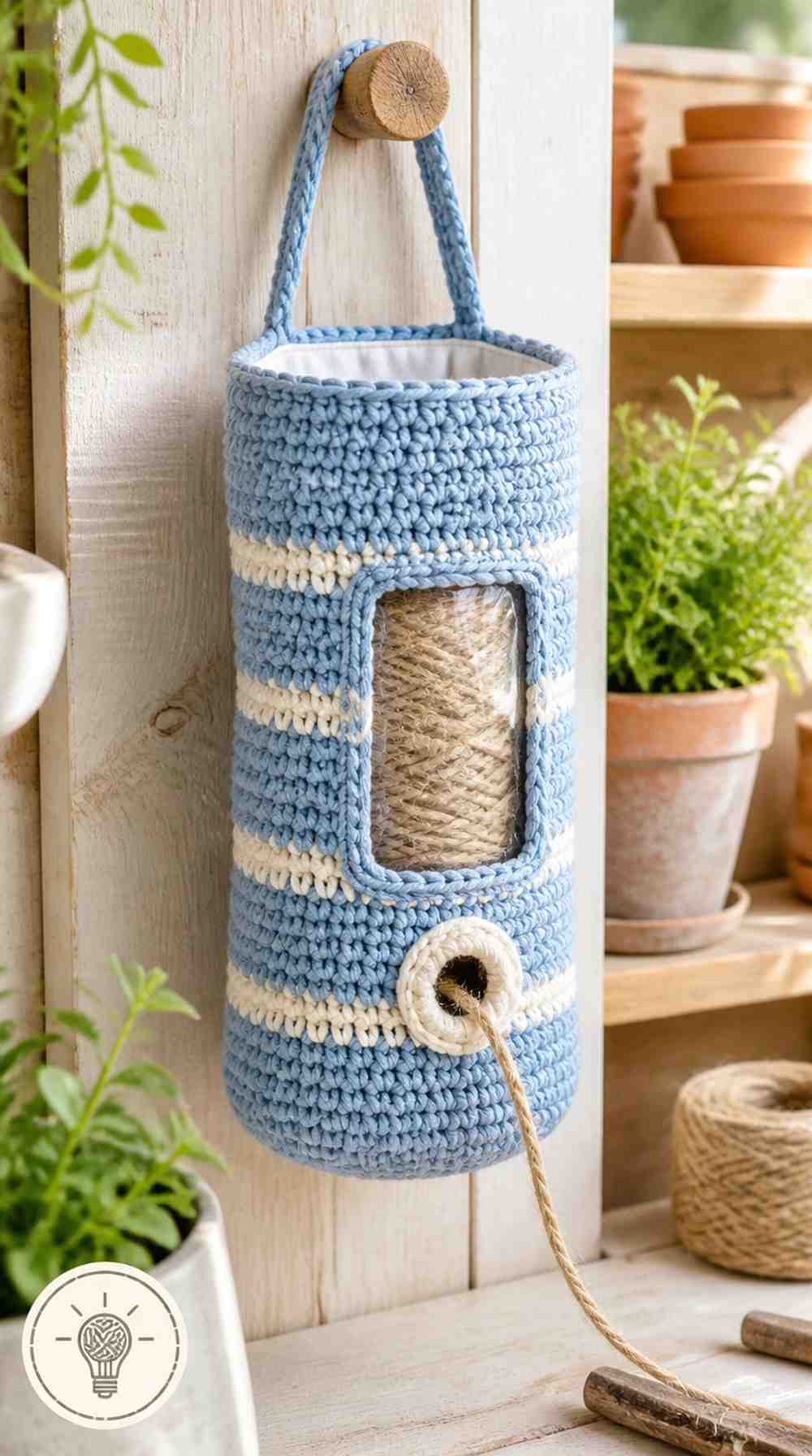
Powder-blue crochet gives this cylindrical garden twine bag a fresh appearance, with three narrow warm-white stripes running around its body. A small transparent window on the front reveals part of the natural jute ball inside, while a separate cream-edged opening below it allows one strand to feed outward.
The viewing panel is what distinguishes this idea from a conventional pouch. It may be useful for checking how much twine remains without opening the top, although the window material and its stitched edges require careful maintenance.
- Clear Window: A smooth transparent insert may make the remaining twine visible, but its edges need secure attachment to the blue crochet frame.
- Separate Dispensing Hole: Keep the feed opening beneath the window rather than pulling twine across the transparent panel.
- Stripe Alignment: Consistent white color changes help the three narrow stripes remain level around the cylindrical bag.
13. Crochet Lavender Lattice Hanging Twine Bag
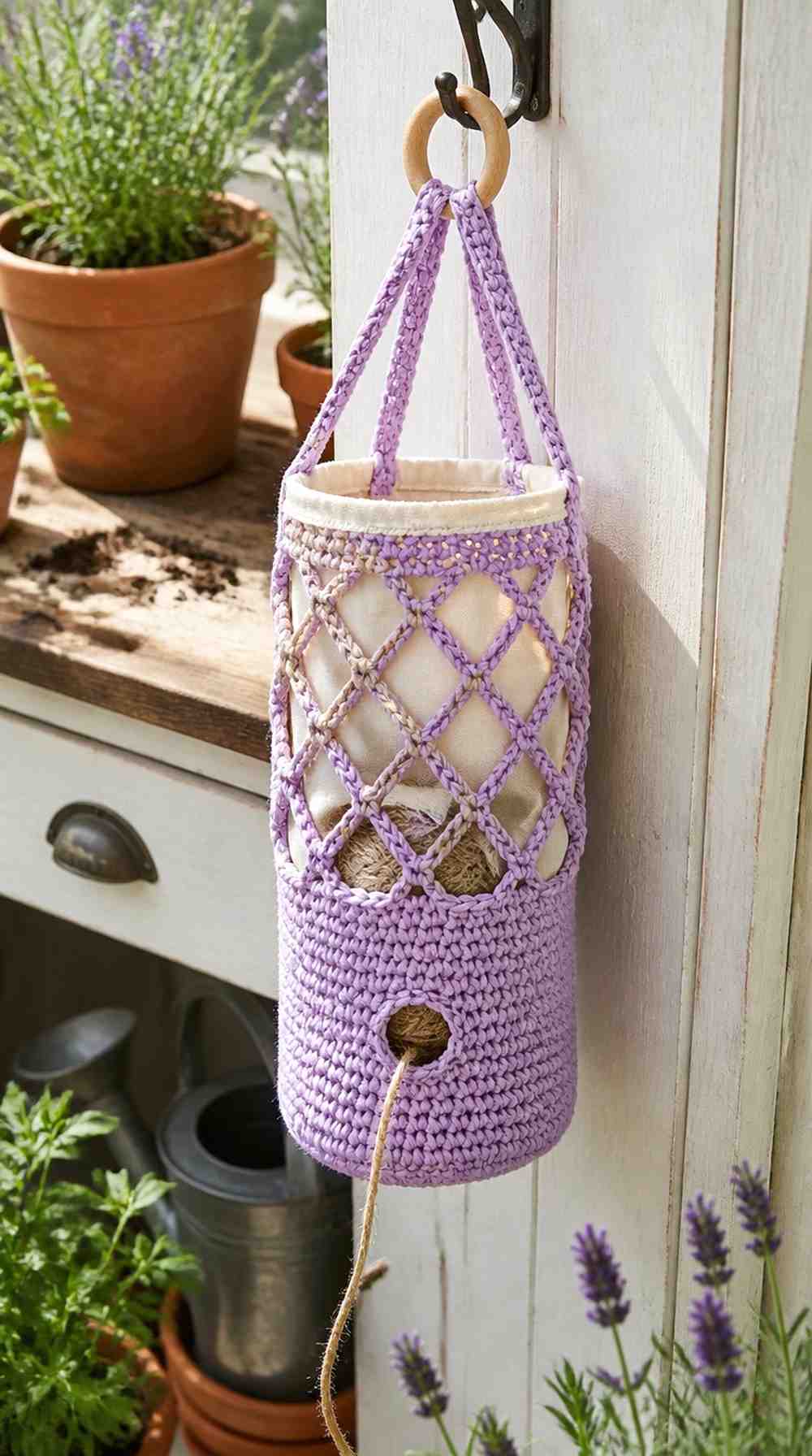
Pale-lavender crochet forms an airy hanging dispenser with orderly diamond-lattice openings above a closely worked solid lower section. A removable cream cotton lining holds the beige garden twine ball behind the mesh, while two reinforced lavender loops connect the bag to a smooth wooden hanging ring.
A single strand exits through matching reinforced openings in the lower lining and outer crochet. The layered construction brings visual depth to the pouch, but the lining must remain properly positioned so the twine cannot catch between the layers.
- Lattice Shape: The diamond openings should remain evenly joined to the solid lower band so the bag does not sag unpredictably when filled.
- Removable Lining: Keep the cream insert accessible for washing and ensure its feed opening stays aligned with the outer crochet hole.
- Wooden Ring: Both lavender loops should share the load, with secure joins around the ring and sufficient clearance for refilling.
14. Crochet Apricot Zipper Refill Twine Bag
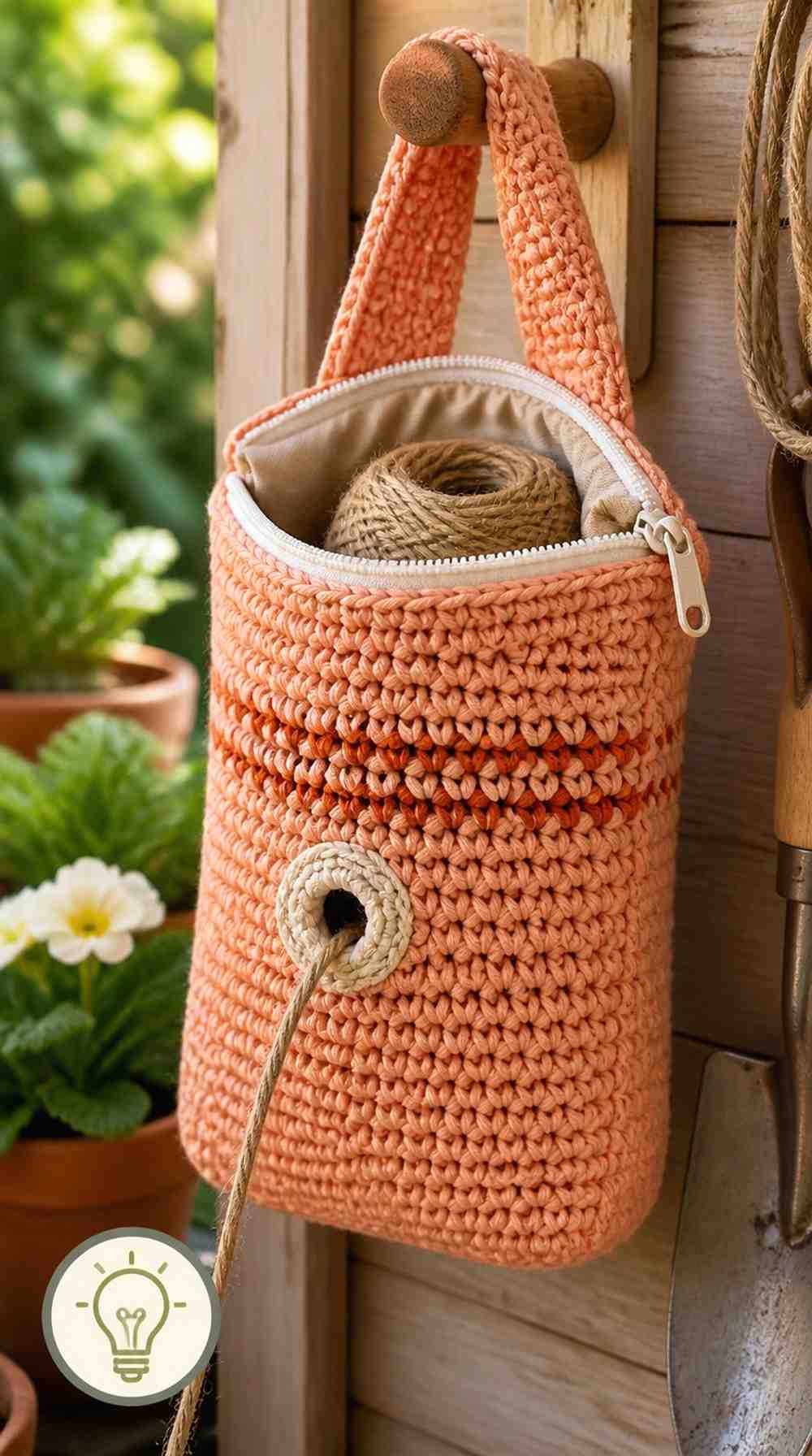
Apricot-orange crochet creates a compact rectangular twine pouch with a flat reinforced base, rounded lower corners and a short cream zipper across the top. Thin terracotta rows decorate the front, while an ivory-edged dispensing opening feeds a single beige jute strand.
The zippered construction makes this design different from drawstring and button-flap bags. Its wide upper opening may make refilling straightforward, provided the zipper stays separate from the twine path and the removable lining does not bunch inside.
- Zipper Access: Choose an opening wide enough for the intended twine ball without forcing it through the closed corners.
- Front Eyelet: Position the dispensing hole below the accent rows and away from the zipper pull so the string has a clear path.
- Lining Care: A removable beige lining could make cleaning easier after the pouch collects garden dust, but both layers should dry fully before reuse.
15. Crochet Navy Roll Top Garden Twine Bag
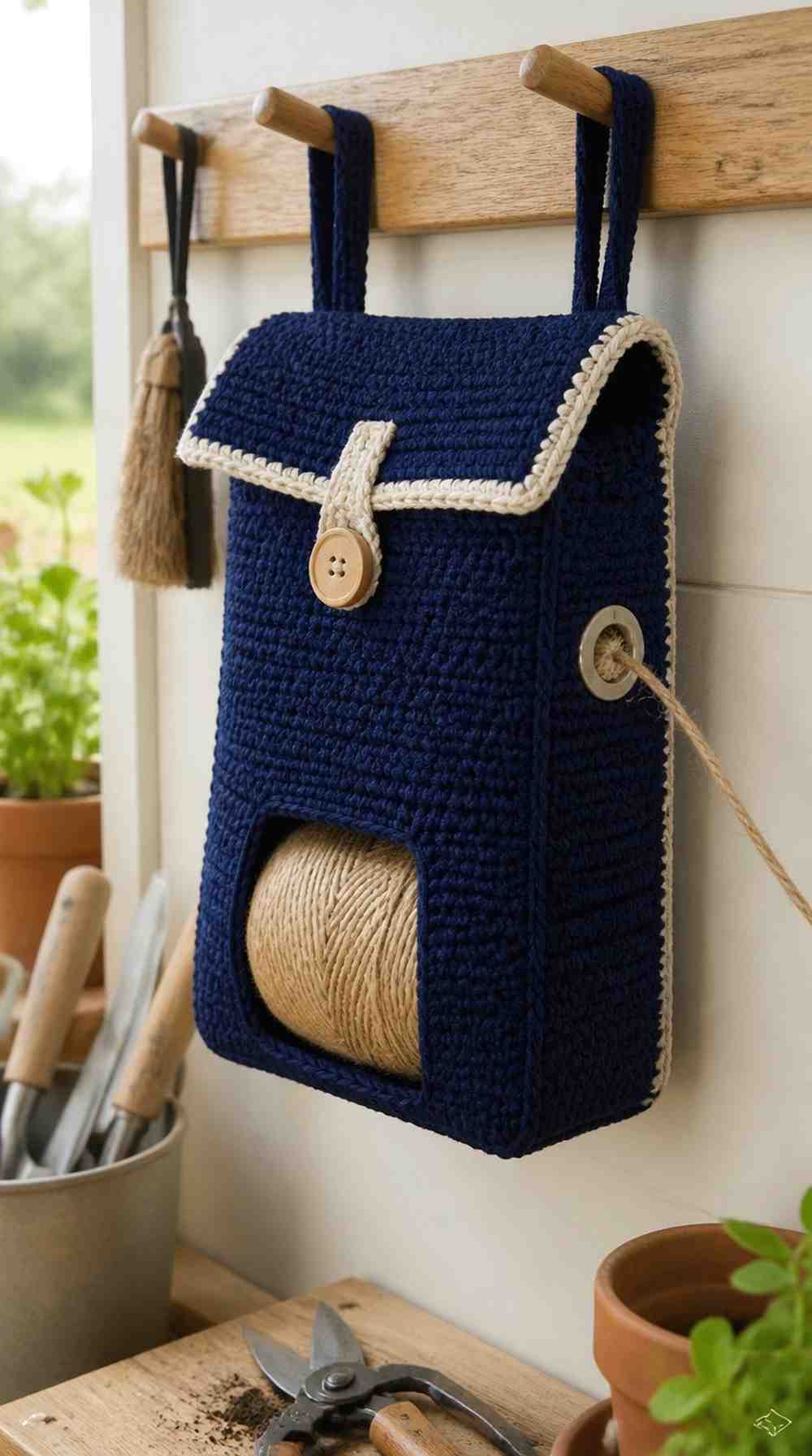
Deep-navy crochet creates a compact hanging dispenser with a folded roll-top closure and a dusty oatmeal border. A small wooden button secures the upper strap, while narrow side gussets and a flat lower base give the rectangular pouch some depth. One beige jute strand leaves through a reinforced opening on the right side.
The rolled upper edge makes this design feel more enclosed than an ordinary open pouch. It could suit a tidy shed storage area where twine is used occasionally rather than continuously.
- Roll-Top Closure: Leave enough fabric for the upper section to fold without squeezing the twine ball or distorting the side panels.
- Side Dispensing: The right-hand eyelet should remain clear of the rolled fabric and button strap.
- Gusset Shape: Keep both side sections symmetrical so the bag hangs straight when suspended from its two upper loops.
16. Crochet Forest Green Leaf Flap Twine Holder
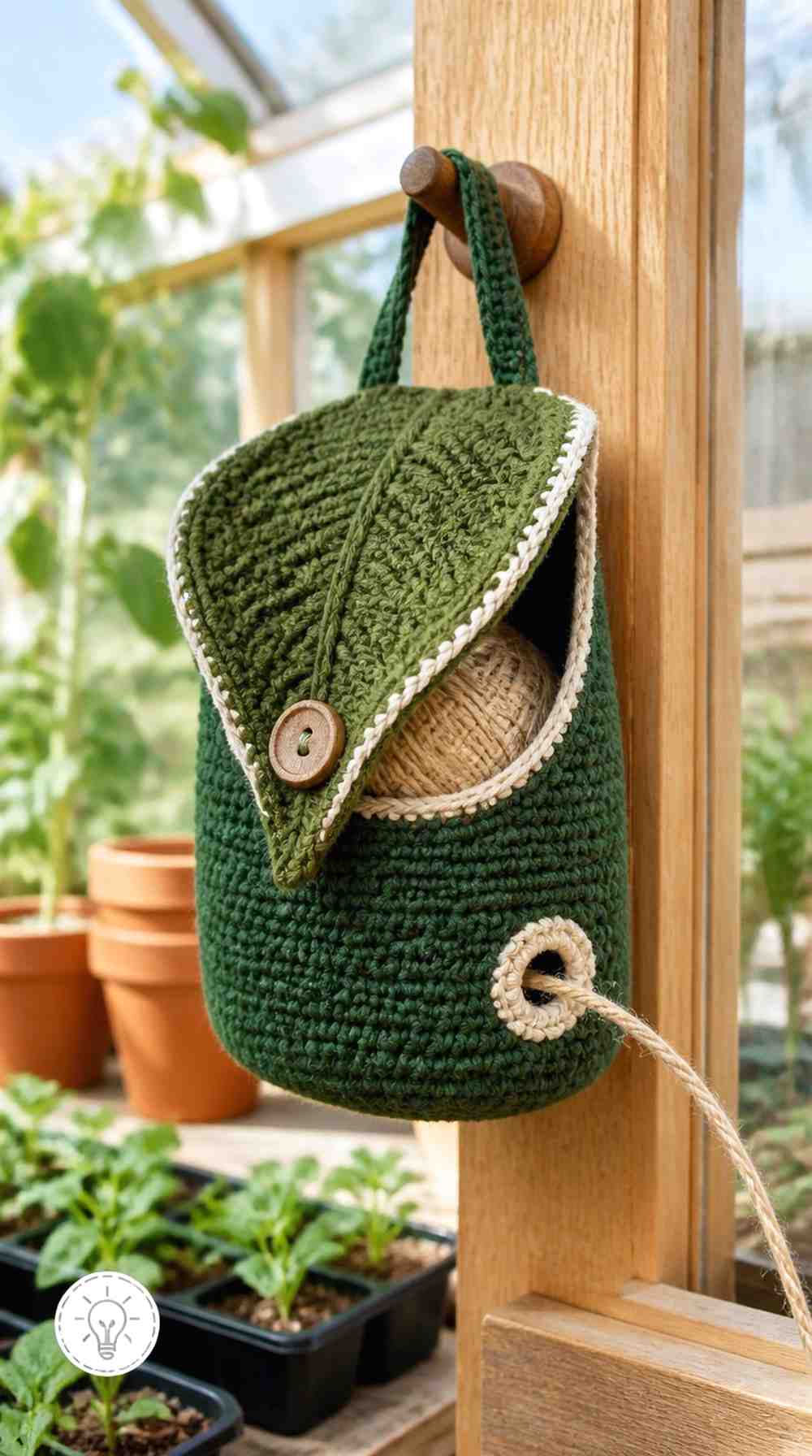
Forest-green crochet gives this compact hanging pouch a natural woodland appearance. Its rounded rectangular body is finished with a cream border, while a dark-olive leaf-shaped flap folds over the top. A raised center vein and pointed tip give the leaf its distinctive shape, with a small wooden button holding it closed.
The pouch contains one beige garden twine ball, with a strand exiting through a separate cream-edged opening on the lower-right side. Its botanical decoration adds character without requiring loose tassels or hanging embellishments.
- Leaf Flap: Keep the pointed leaf shape flat and securely connected to the main body so its tip cannot curl into the twine opening.
- Side Eyelet: The reinforced outlet should allow the strand to leave the pouch independently of the decorative flap.
- Button Fit: Position the wooden button so the leaf closes comfortably over the filled pouch without pulling the green crochet out of shape.
17. Crochet Cinnamon Two Tier Twine Station
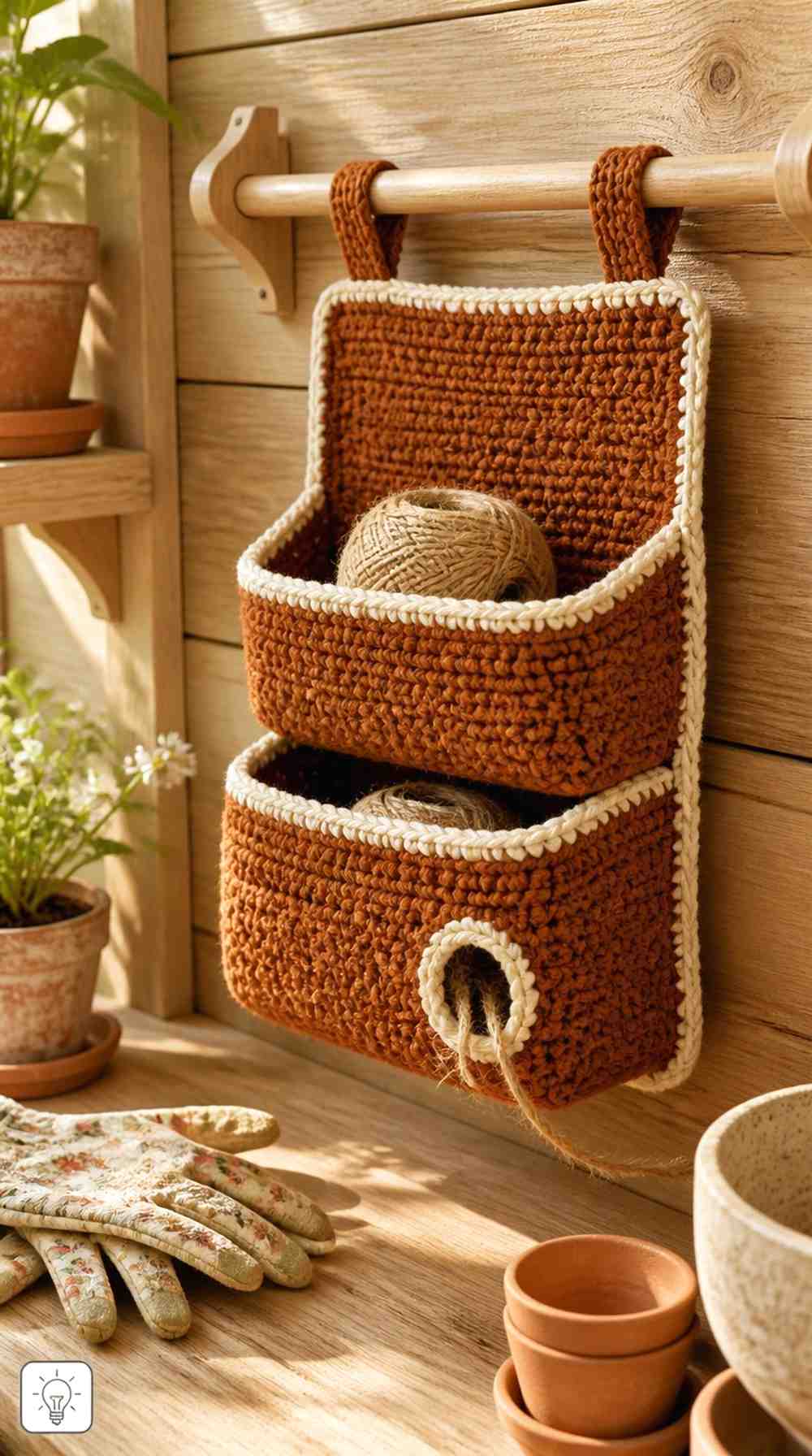
Cinnamon-brown crochet creates a rectangular garden twine organizer with two vertically stacked sections. The shallow upper pocket holds a spare beige jute ball, while the deeper lower dispenser contains a separate active ball. A cream-edged opening on the lower-right front feeds the working strand outward.
Two reinforced cinnamon loops suspend the organizer from a wooden dowel attached to a potting-shed wall. The two-tier arrangement separates the reserve supply from the twine being used, making this concept especially interesting for gardeners who regularly need to refill a dispenser.
- Reserve Storage: Keep the spare ball in the upper pocket without threading it through the active lower dispensing port.
- Lower Compartment: The deeper working section should support its twine ball and leave the feed opening accessible beneath the reserve pocket.
- Wall Mounting: The dowel, brackets and reinforced hanging loops must suit the combined weight of both twine balls.
Practical Guide to Crochet Garden Twine Dispenser Bags
A crochet garden twine dispenser should keep a ball or roll of string contained while allowing its loose end to be pulled without excessive friction. Before choosing a design, think about where you’ll use it, how your twine is wound and how the pouch will be refilled.
Check the twine ball first. Measure its width, height and shape. A round jute ball, a center-pull roll and a flat cardboard winding may need different internal spaces and dispensing arrangements.
Choose the right feed opening. Front, side and bottom outlets can all work in principle, but a real dispenser should be checked for snagging. A reinforced crochet eyelet or smooth suitable fitting may help protect the opening from repeated rubbing.
Consider how the twine unwinds. Some balls release string from the center, while others unwind from the outside. Match the dispensing path to the actual product rather than assuming every ball will feed the same way.
Select practical yarn. Smooth cotton or a suitable cotton blend is worth considering for clearly defined crochet stitches. Ordinary crochet is not waterproof, and fabric exposed to garden soil or rain will need cleaning and thorough drying.
Use secure hanging hardware. Wall pegs, rings, dowels, belt clips and carrying straps have different load and attachment requirements. Keep hanging dispensers clear of moving machinery, walking routes and places where loose twine might snag.
Keep cutting tools separate. Use appropriate scissors or garden snips independently. Avoid adding exposed blades to a soft crochet pouch, especially where the bag may swing or be carried.
Store twine properly. Keep the wound supply reasonably dry and protected from soil. Examine natural-fiber string for deterioration before using it to support plants, and avoid ties that can tighten around growing stems.
For closely related gardening organization, see Yarn Nest Studio’s 19 Crochet Plant Label Storage Book Inspiration Ideas. It explores keeping plant markers sorted and accessible, making it a useful companion to a garden twine dispenser.
For hanging dispenser shapes and refill arrangements, the 17 Crochet Refillable Cotton Ball Storage Bag Inspiration Ideas collection offers additional visual references. Those are bathroom-storage concepts, not garden twine patterns.
Want to Make Something Similar?
These two verified resources cover related dispensing ideas and crochet pouch construction. They are not exact patterns for the 17 garden twine dispenser bags above.
- Make Your Own Floral Twine String Dispenser — Reading My Tea Leaves — A garden twine dispenser tutorial by Rose Pearlman that uses a loom-style weaving method rather than crochet. It demonstrates the general principle of keeping a twine ball in a hanging basket with its end feeding through a lower opening. Slow, simple, sustainable living.
- Plastic Bag Holder and Dispenser — Heart Hook Home — A free crochet pattern demonstrating a hanging cylindrical holder with reinforced openings and separate loading and dispensing areas. It is designed for plastic bags, so the openings and structure would need to be adapted for a twine ball. Heart Hook Home
A handmade twine dispenser needs its own measurements, suitable feed-hole placement, secure construction and checks using the actual twine intended for storage.
Which Crochet Garden Twine Dispenser Bag Should You Choose?
| Design | Main feature | Practical consideration |
|---|---|---|
| Terracotta Ribbed | Classic drawstring hanging bag | Lower-front outlet and hanging loop |
| Indigo Checkerboard | Box-shaped granny-square design | Side seams and flap access |
| Butter Yellow Bee | Rounded floral-garden styling | Keeping motif clear of the twine |
| Olive Mesh Lined | Diamond mesh with inner lining | Alignment of both feed openings |
| Plum Twin Roll | Two separate twine compartments | Independent strands and dowel balance |
| Teal Crossbody | Portable shoulder-carried dispenser | Snagging and strap stability |
| Coral Foldover | Compact flat-winding holder | Cardboard spool fit |
| Oatmeal Bamboo Base | Standing tabletop bucket | Stable base and side outlet |
| Charcoal Belt Clip | Small hands-free belt accessory | Secure clip and loose strand |
| Blush Daisy | Rounded hanging floral pouch | Secure appliqué and drawstring |
| Mustard Bottom Feed | Vertical sleeve with lower outlet | Unobstructed hanging strand |
| Powder Blue Window | Visible twine through clear panel | Window attachment and cleaning |
| Lavender Lattice | Open crochet over a lining | Mesh strength and aligned outlet |
| Apricot Zipper Refill | Zippered rectangular pouch | Refill opening and lining |
| Navy Roll Top | Folded upper closure | Flap clearance and gussets |
| Forest Green Leaf | Botanical buttoned flap | Leaf attachment and side feed |
| Cinnamon Two Tier | Spare ball plus active dispenser | Weight distribution and mounting |
For a simple hanging dispenser, the Crochet Terracotta Ribbed Hanging Twine Pouch offers a straightforward shape with one refill opening and one dispensing eyelet.
If you regularly use two different kinds of string, the Crochet Plum Twin Roll Twine Dispenser is worth exploring. Its separate compartments and outlets are designed to keep the two supplies apart.
For a potting bench, the Crochet Oatmeal Bamboo Base Standing Twine Bucket provides a different approach because it remains on the work surface instead of hanging from a hook.
If you’re moving between planting areas, the Crochet Teal Crossbody Garden Twine Carrier and Crochet Charcoal Belt Clip Twine Bag offer portable concepts, although any wearable version needs careful attention to secure attachment and entanglement risks.
Conclusion
Crochet garden twine dispenser bags offer a decorative way to organize one of the most frequently used small gardening supplies. These 17 inspiration ideas explore hanging cylinders, granny-square holders, lined mesh bags, portable pouches, standing dispensers and two-compartment storage stations.
The most suitable design depends on how the twine is wound, where it will be used and how easily the strand can feed through the chosen opening. A simple, appropriately sized pouch with a smooth outlet may be more practical than a heavily decorated design.
Which design would you choose for your gardening space? Would you prefer the terracotta hanging pouch, the olive mesh sling or the plum twin-roll dispenser? Share your favorite and whether you usually use jute twine or softer garden string.
Frequently Asked Questions
1. Can a crochet bag work as a garden twine dispenser?
A suitably constructed crochet bag may hold a twine ball while allowing the loose end to pass through a reinforced opening. However, the result depends on the twine’s thickness, how the ball unwinds, the size of the opening and the bag’s construction. These concepts have not been physically tested.
2. Should the twine come out through the bottom or side of the bag?
Either arrangement may be suitable depending on the twine ball and how the dispenser is positioned. A hanging bag can use a lower opening, while a tabletop or portable pouch may benefit from a side or front outlet. The key is a smooth feed path that does not create repeated snagging.
3. What kind of yarn should I use for a garden twine dispenser bag?
Smooth cotton or an appropriate cotton blend is worth considering because it can give small pouches neat, visible stitches. However, different yarns vary in strength, stretch and care requirements. Ordinary cotton crochet should not be assumed weatherproof or suitable for permanent outdoor exposure.
4. Can I use a crochet dispenser with jute, cotton or synthetic garden twine?
Potentially, but different twines behave differently. Coarse jute may rub against an opening, while smoother or thinner strings may slip through more easily. The dispenser should be assessed with the actual twine roll, and the string itself should be chosen for the intended gardening task and plant.
5. Are these 17 crochet garden twine dispenser bag ideas complete patterns?
No. These are original design visualizations for inspiration, not tested crochet patterns or step-by-step instructions. The linked resources demonstrate related hanging and dispensing techniques, but they do not reproduce these exact bags. A real version would require sizing, stitch planning, suitable attachment hardware and practical testing with the intended twine.
Before publishing generated images, check the crochet stitch accuracy, number of compartments, twine feed paths, hanging attachments and spelling of the featured-image title. Image generation cannot guarantee exact text or physically correct construction.