Plant labels are easy to scatter around the potting bench, especially when you reuse them between seed-starting sessions, repotting jobs and seasonal gardening projects. These 19 crochet plant label storage book inspiration ideas explore different ways to keep clean, reusable garden markers together in one organized place. From sage-green clear-pocket albums and ivory buttoned portfolios to terracotta bamboo-stake holders, lilac accordion books and peach granny-square covers, each design brings handmade crochet texture to practical gardening storage.
The collection includes compact books for short plastic markers, longer portfolios for bamboo stakes, protective sleeves for metal tags and albums with removable pages or grouped envelopes. Some are best for everyday labeling supplies, while others suit plant collections that change with the seasons. As you compare the concepts, think about the length and shape of your markers, how easily you can identify them, and whether their pointed ends could damage the storage pages. A good organizer should keep reusable labels clean, accessible and safely separated.
These are AI-generated crochet design visualizations for inspiration, not photographs of tested handmade organizers or complete crochet patterns. Dimensions, construction and protective performance have not been physically verified.
Quick Design Selection Guide
- For a large collection of short markers: Crochet Sage Twelve-Pocket Plant Label Storage Book provides twelve separate clear compartments.
- For simple wooden markers: Crochet Ivory Button-Flap Plant Marker Book holds four plant labels in lined sleeves.
- For long bamboo or metal stakes: Crochet Terracotta Long-Stake Plant Label Portfolio and Crochet Rust Long-Marker Foldover Storage Book use elongated protective channels.
- For changing the number of pages: Crochet Dusty-Blue Ring-Bound Plant Label Album and Crochet Mint Removable-Page Plant Label Book offer binder-style construction.
- For short T-shaped markers: Crochet Mustard Elastic-Loop Plant Tag Book keeps ten labels in individual loops.
- For grouped markers: Crochet Blush Six-Envelope Plant Label Keeper and Crochet Mocha Reversible Plant Tag Envelope Book use enclosed compartments.
- For seasonal organization: Crochet Olive Seasonal Plant Tag Archive Book and Crochet Plum Botanical Plant Label Archive have removable or indexed pages.
- For unusual folding layouts: Crochet Lilac Accordion Plant Marker Book and Crochet Butter-Yellow Tri-Fold Plant Label Keeper introduce expandable panels.
- For metal plant markers: Crochet Charcoal Metal Plant Label Protector Book uses individual smooth protective pockets.
- For keeping gardening notes together: Crochet Oatmeal Label-and-Plant-Notes Storage Book combines plant markers with a small notebook.
1. Crochet Sage Twelve-Pocket Plant Label Storage Book
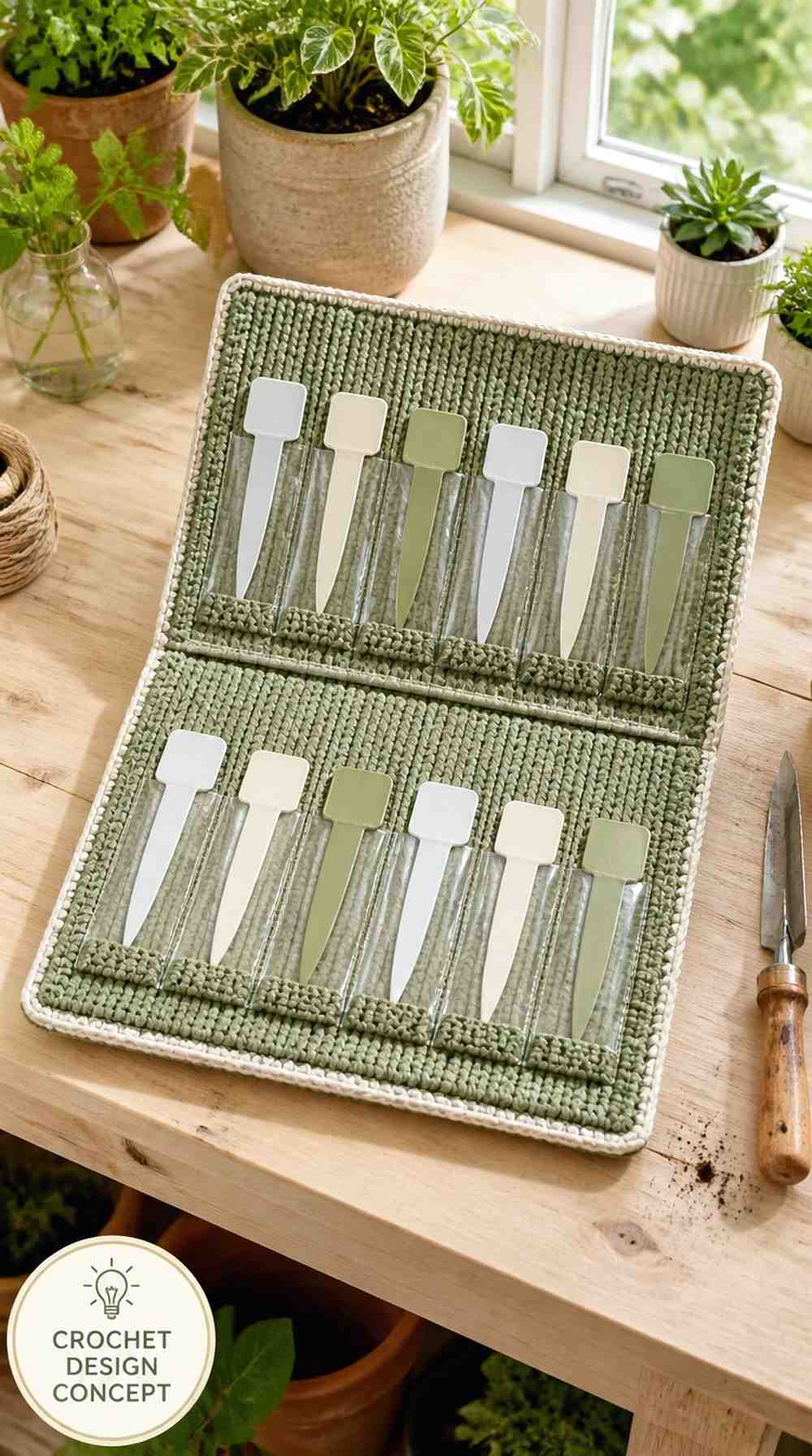
Sage-green crochet gives this rectangular plant label book a natural, organized appearance. Raised vertical ribs cover the outside, with ivory piping around the edges. Inside, twelve clear pockets arranged across two reinforced pages hold individual reusable plastic plant markers in soft white, cream and sage colors.
The transparent compartments make the markers easy to see without pulling them all out. Each narrow stake rests inside its own protective pocket, while the rounded label head remains visible through the clear front.
- Pocket sizing: Measure the full marker length, including the pointed planting end, before choosing the pocket depth.
- Transparent fronts: Smooth, clear material helps identify stored labels without repeatedly handling every marker.
- Point protection: Use reinforced pocket bottoms so tapered plastic ends cannot work through the lining.
- Book thickness: Twelve pockets can create bulk if the labels overlap, so allow enough room for the pages to close comfortably.
2. Crochet Ivory Button-Flap Plant Marker Book
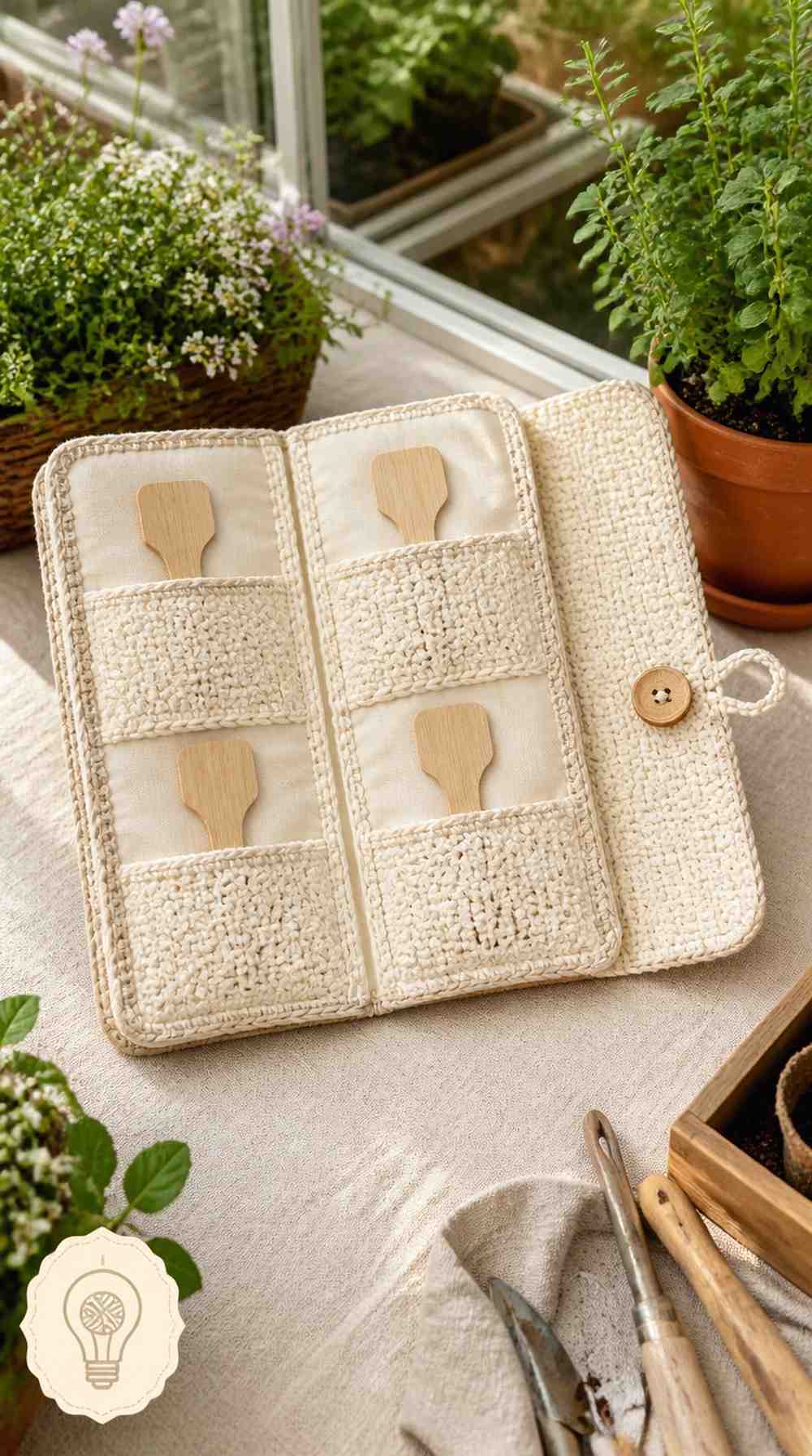
Warm ivory crochet creates a neat fold-open plant marker book with raised diagonal stitches and oatmeal edging. Four broad fabric-lined sleeves hold clean wooden labels with rounded tops and gently tapered planting ends. A foldover flap and smooth wooden-button closure complete the simple design.
The roomy compartments suit thicker wooden markers better than very narrow plastic-label pockets. The smooth lining is particularly helpful around natural wood, where unfinished edges could otherwise catch on the crochet stitches.
- Wooden marker width: Measure the broad label heads and allow enough room for comfortable removal.
- Smooth contact: Keep the wooden stakes clean and free from rough splinters before placing them inside the sleeves.
- Button position: The flat closure should fasten without pressing directly against the stored labels.
- Dry storage: Wooden markers should be completely dry before being enclosed in a fabric-lined crochet book.
3. Crochet Terracotta Long-Stake Plant Label Portfolio
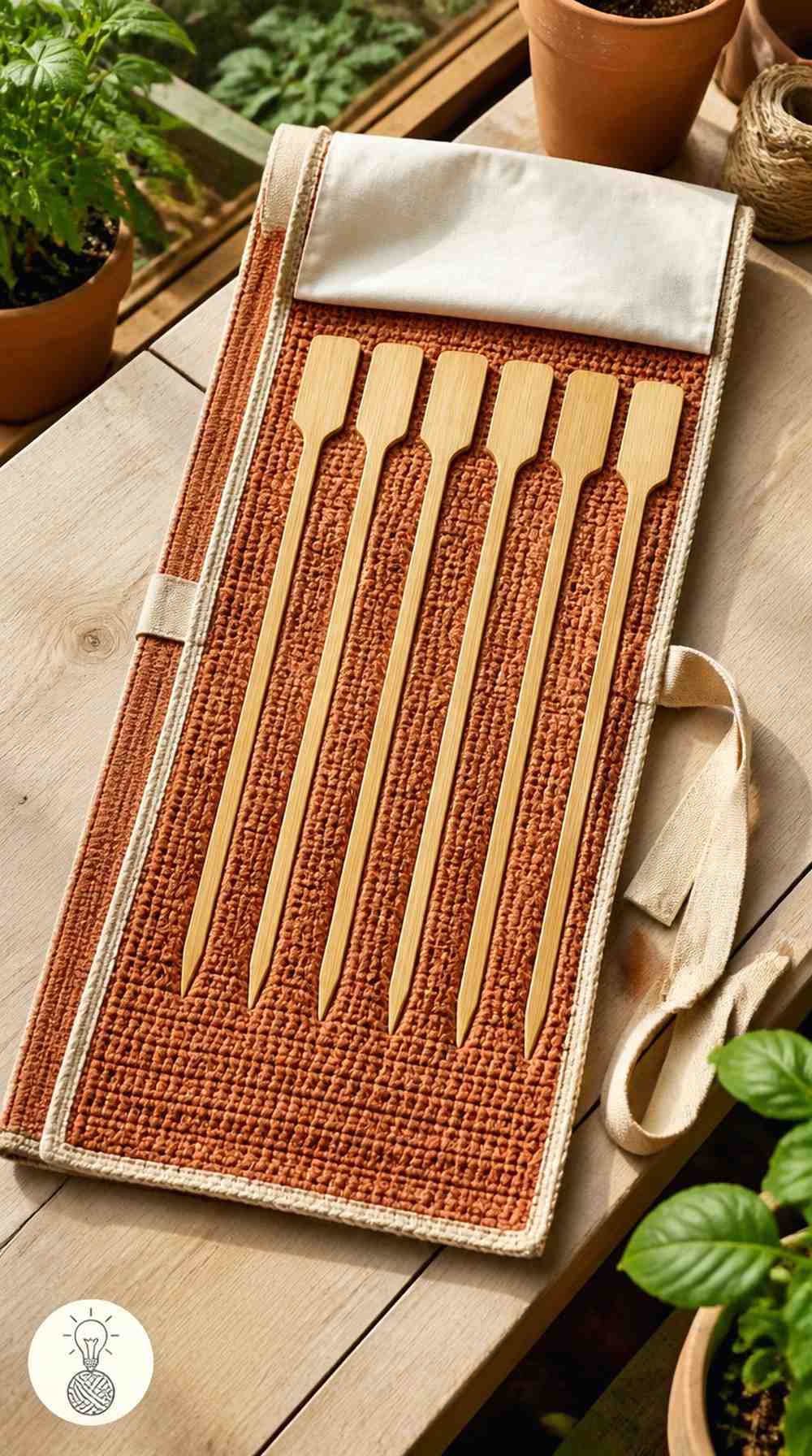
Terracotta crochet gives this tall storage portfolio a warm garden-room character. Dense horizontal ribs cover the exterior, while sandy-beige piping defines the edges. Six long bamboo plant labels sit vertically inside narrow reinforced channels, with their paddle-shaped heads visible above the protected planting ends.
The elongated shape is designed for markers that would be awkward inside an ordinary notebook-sized case. A broad protective flap covers the labels before the portfolio is folded closed.
- Full stake length: Measure from the bamboo label head to the tapered point, not just the writable section.
- Channel spacing: Keep the six stakes apart so the wooden edges do not rub or snag against neighboring labels.
- Protective flap: Use a smooth canvas layer to separate stake ends from the crochet exterior.
- Storage limitations: This design needs a longer portfolio and more shelf space than a compact plastic-label album.
4. Crochet Dusty-Blue Ring-Bound Plant Label Album
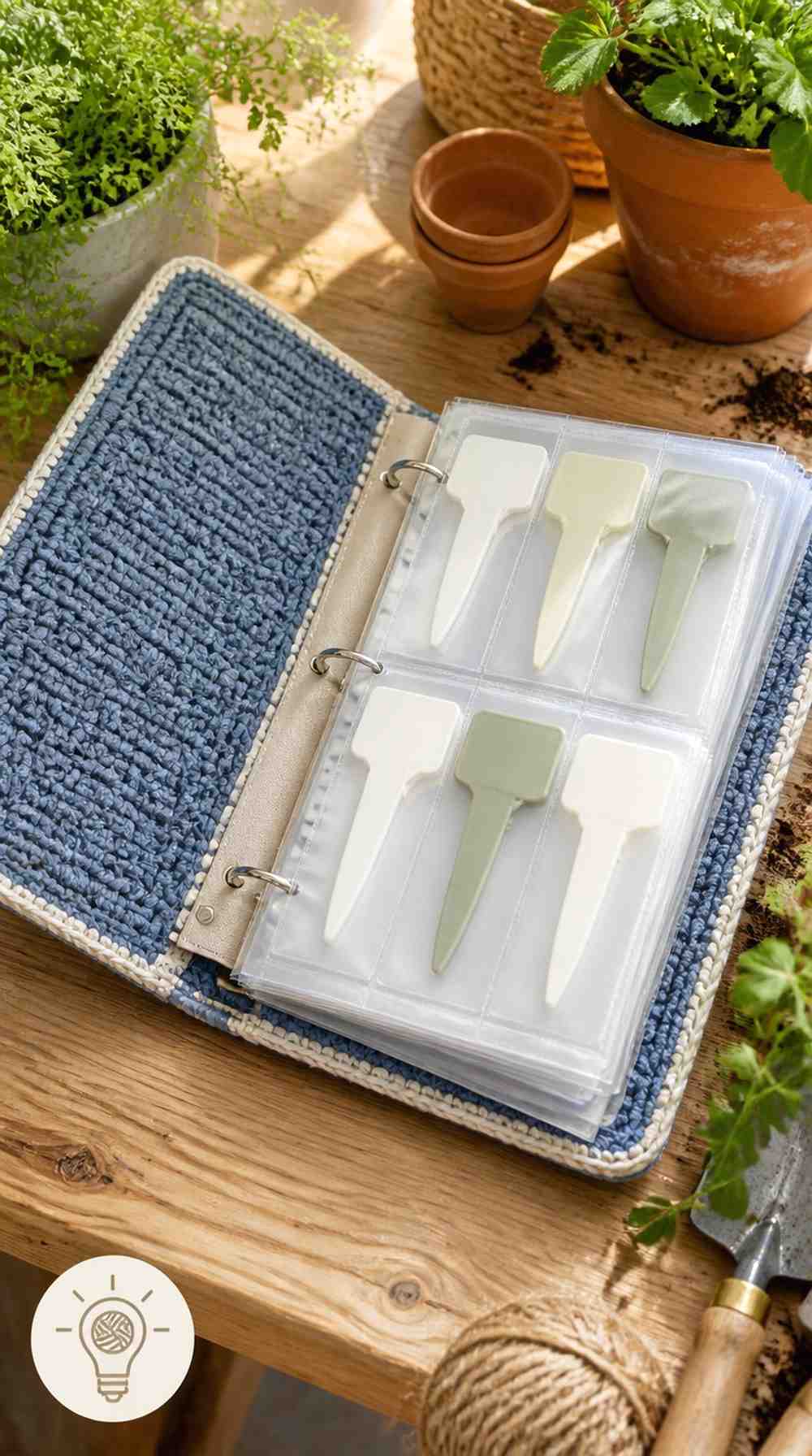
Dusty-blue crochet gives this compact binder a modern, coordinated look. Fine moss stitches cover the rigid outer panels, while cream piping finishes the corners. Three metal rings hold transparent removable pages, with eight plant markers visible across two open sheets.
The ring-bound construction allows pages to be reorganized without rebuilding the outer cover. It may be useful for gardeners whose label collections grow over time, although the rings and pocket edges need to remain smooth.
- Binder rings: Choose a mechanism that opens and closes cleanly without catching on the clear pocket sheets.
- Page reinforcement: Support the ring holes so repeated turning does not tear the storage pages.
- Pocket dimensions: Use spaces suited to the rounded heads and tapered lower ends of the stored plastic markers.
- Expansion room: Leave enough spine capacity for additional pages without forcing the binder to close tightly.
5. Crochet Mustard Elastic-Loop Plant Tag Book
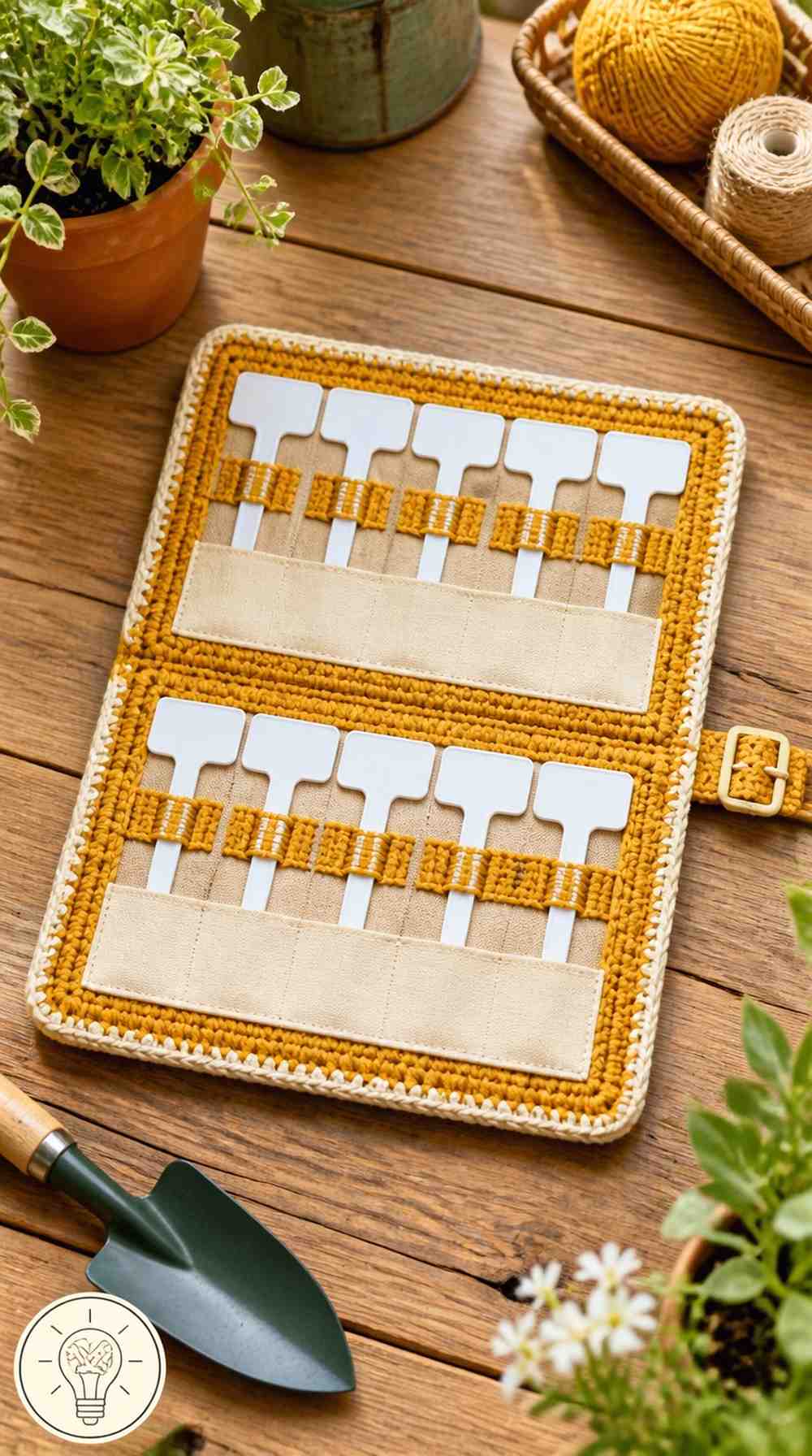
Mustard-yellow crochet creates a cheerful storage book with raised waffle-like stitches and cream edging. Ten short T-shaped plastic plant labels sit across two fabric-backed interior panels, held in place by reinforced elastic-backed loops around their narrow stakes. A protective lower band covers the planting tips.
The individual loops keep every marker in its own position without enclosing the whole label inside a transparent pocket. This arrangement could be convenient for a collection of frequently reused short markers.
- Loop tension: Use enough grip to hold the plastic stakes without bending or squeezing them.
- T-shaped heads: Leave the wide upper sections uncovered so each label can be grasped easily.
- Lower protection: Keep the pointed ends inside a reinforced fabric band rather than against the crochet cover.
- Elastic wear: Check whether the retaining loops loosen after repeated use, especially if markers vary in thickness.
6. Crochet Blush Six-Envelope Plant Label Keeper
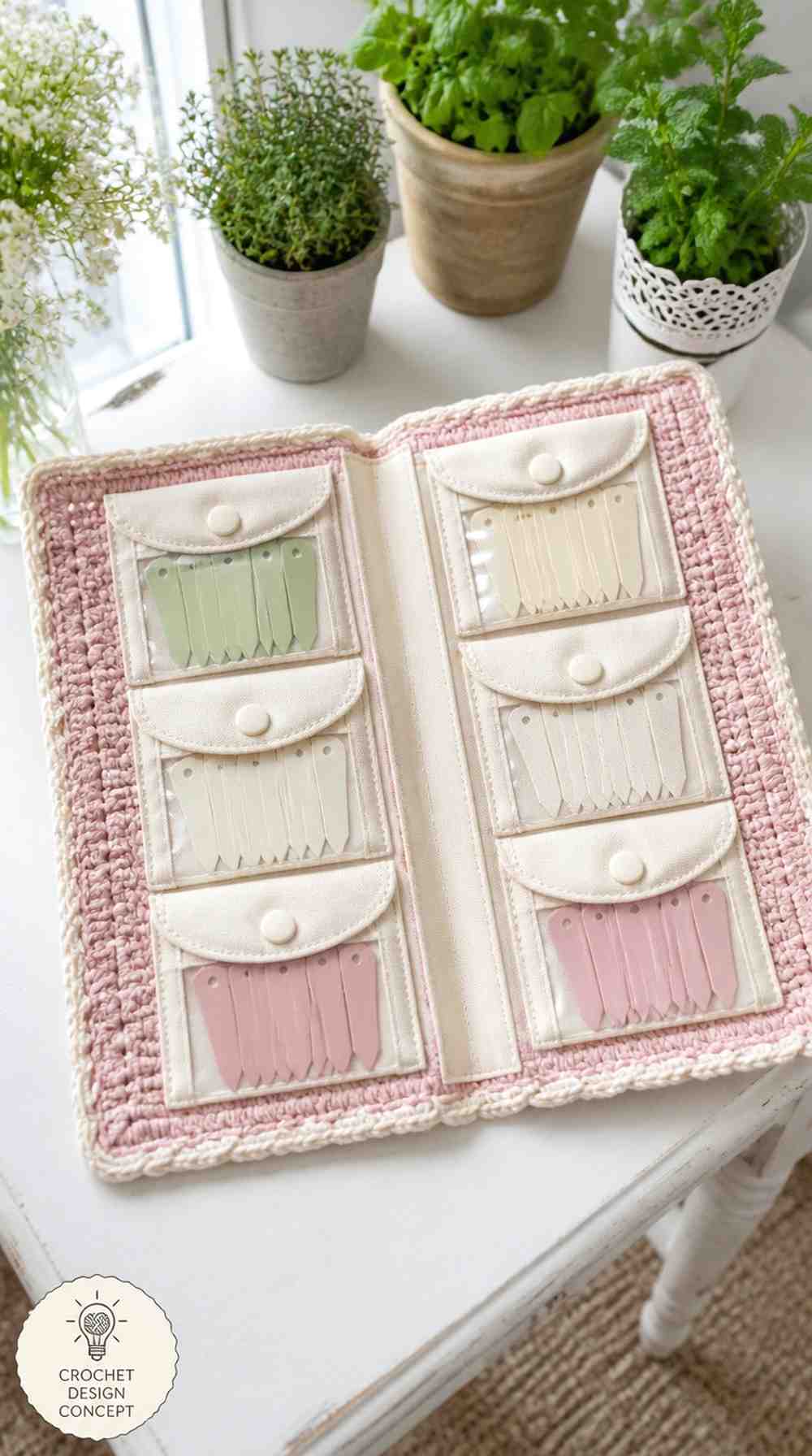
Blush-pink crochet gives this storage booklet a soft cottage-garden appearance. Delicate shell-like stitches decorate the exterior, while ivory scallops finish its edges. Six small cream fabric envelopes are arranged across the open pages, each with a transparent front window and snap-fastened flap.
The envelopes hold groups of short plastic plant markers in different pale colors. Unlike individual label pockets, this design keeps several matching markers together, making it useful when spare labels are sorted by size or intended project.
- Envelope capacity: Limit each group to a quantity that fits without stretching the fabric or forcing the snap closed.
- Clear windows: Keep the front panels smooth so marker shapes and colors are easy to recognize.
- Secure flaps: Use flat closures that prevent labels from slipping out when the book is carried.
- Shell-stitch exterior: Keep the raised decorative texture away from the plastic planting tips.
7. Crochet Olive Seasonal Plant Tag Archive Book
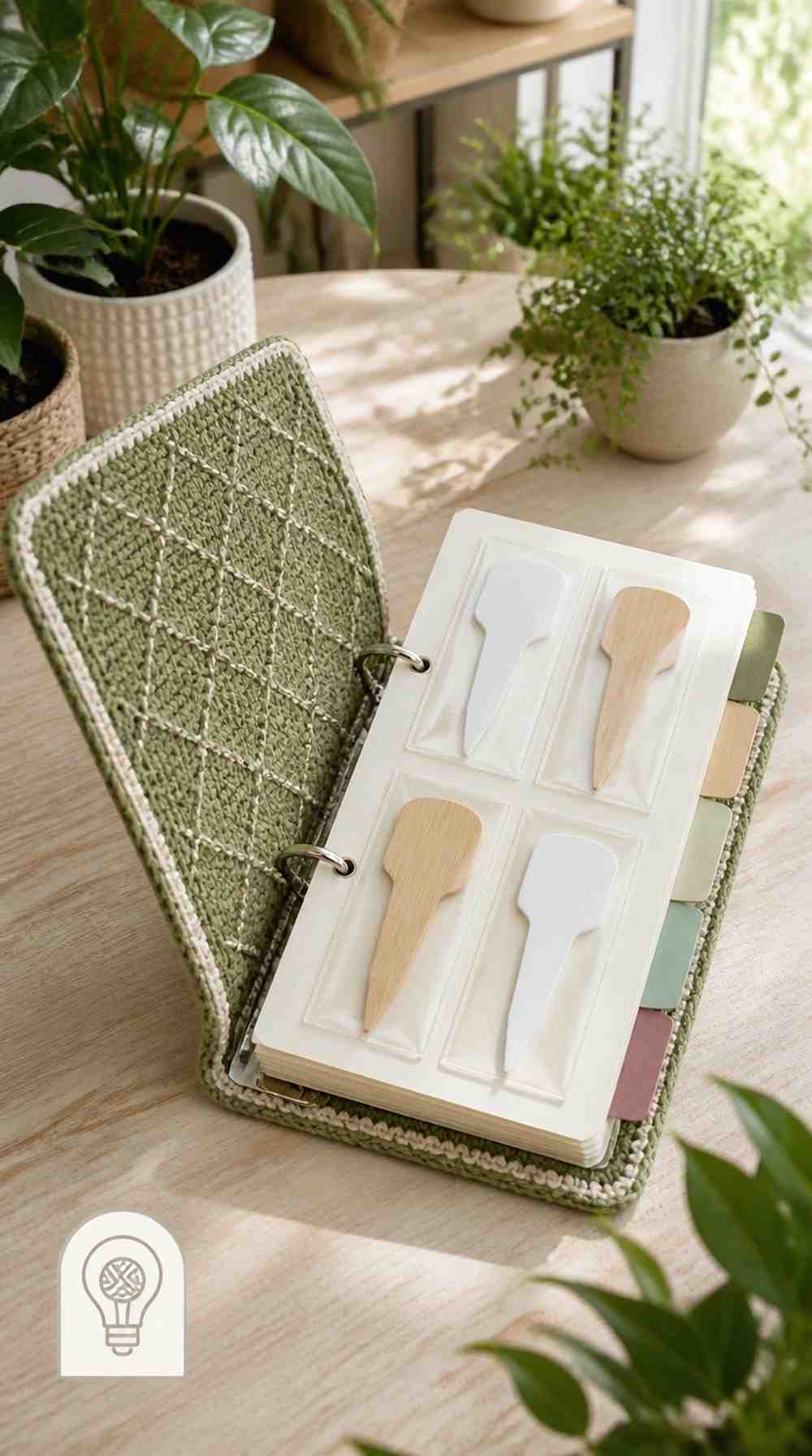
Olive-green crochet creates a structured archive binder with diagonal crosshatch texture and ivory edging. Removable cream cards sit on two metal rings, with transparent sleeves holding clean bamboo and plastic plant markers. Small blank fabric tabs in muted colors extend from the page edges.
The tabbed arrangement offers a way to separate labels by gardening season or type of planting. It would suit someone who maintains several changing groups of reusable markers rather than keeping all labels together in one pocket.
- Seasonal sorting: Assign different pages to seed-starting, summer containers or other gardening groups without needing permanent labels on the organizer.
- Mixed materials: Allow separate pocket widths for thicker bamboo markers and slimmer plastic stakes.
- Index tabs: Keep the fabric tabs short and reinforced so they do not tear when turning the cards.
- Ring support: Use suitably firm archive cards with protected holes rather than attaching the metal rings directly through loose crochet.
8. Crochet Lilac Accordion Plant Marker Book
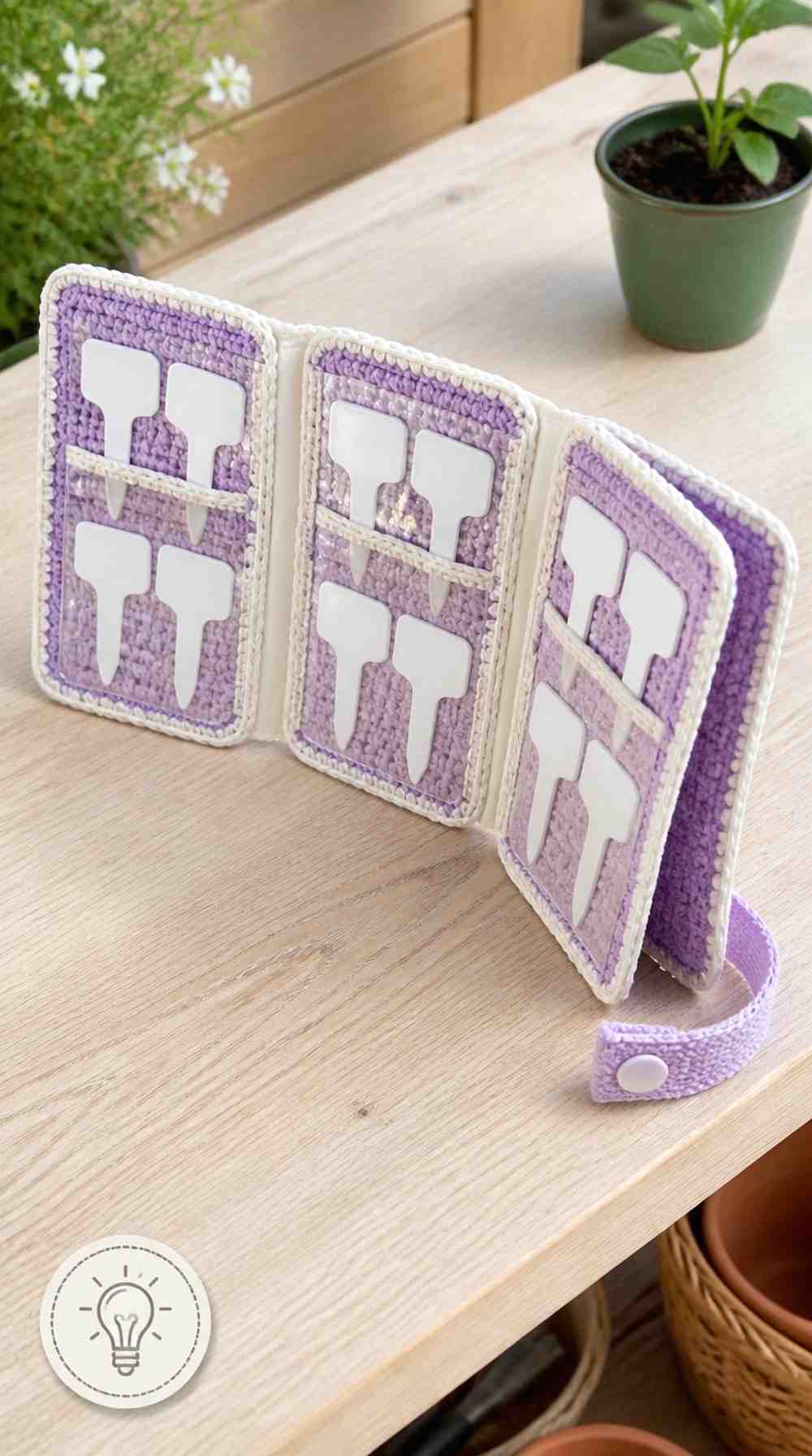
Lilac crochet gives this expandable book a graceful handmade finish. Three connected panels open into a gentle accordion shape, with small vertical ribs and ivory piping defining the edges. Each panel has two clear-front pockets containing clean white plant markers, for six markers altogether.
The accordion construction spreads the labels across several visible sections without requiring a ring binder. It can fold into a compact booklet, although the hinges and marker placement must allow the panels to close naturally.
- Panel clearance: Keep each marker inside its pocket so the accordion folds do not catch its planting tip.
- Fabric hinges: Reinforced cloth connections help the panels move without pulling against the decorative crochet.
- Pocket placement: Arrange the six pockets so the labels do not overlap when the panels are folded together.
- Open display: A partly extended accordion can make the stored markers easy to compare on a potting table.
9. Crochet Charcoal Metal Plant Label Protector Book
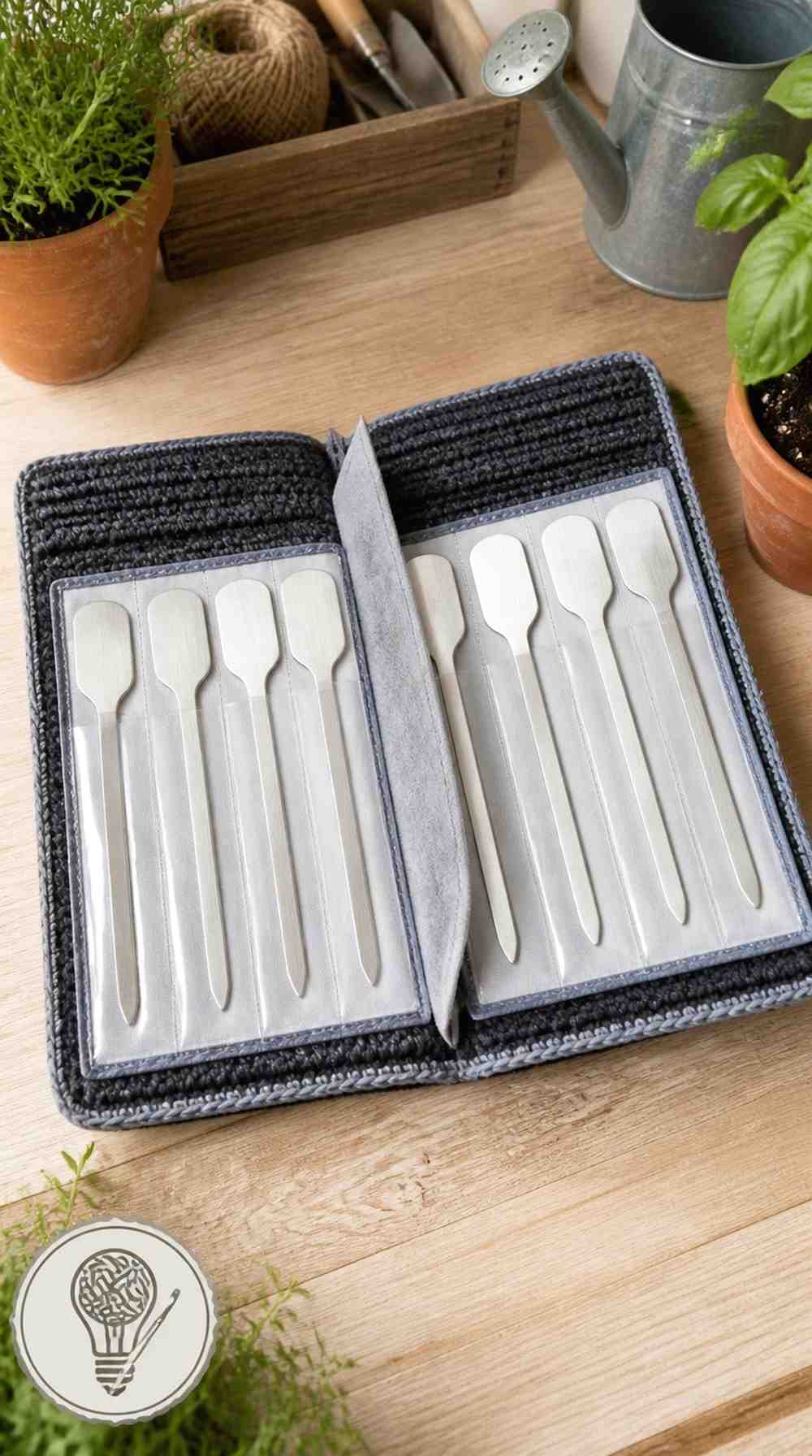
Charcoal-gray crochet gives this rigid storage booklet a clean, modern appearance. Dense horizontal ribs and silver-gray piping frame two felt-backed interior pages. Eight slender brushed-aluminum plant tags sit individually inside smooth clear pockets, with a fabric separator between the pages.
The protective lining is particularly useful around metal labels, whose edges may be harder than those of ordinary plastic garden markers. The charcoal cover adds texture while keeping the stored tags away from exposed crochet loops.
- Metal edges: Inspect each tag for rough corners or burrs before inserting it into the protective sleeve.
- Individual pockets: Keep the eight metal markers separate to reduce rubbing between their surfaces.
- Soft separator: A fabric page between the two storage panels offers another layer of protection when the book is closed.
- Material compatibility: This arrangement is intended for relatively flat metal labels, not large wire-supported plant signs.
10. Crochet Coral Color-Sorted Plant Label Journal
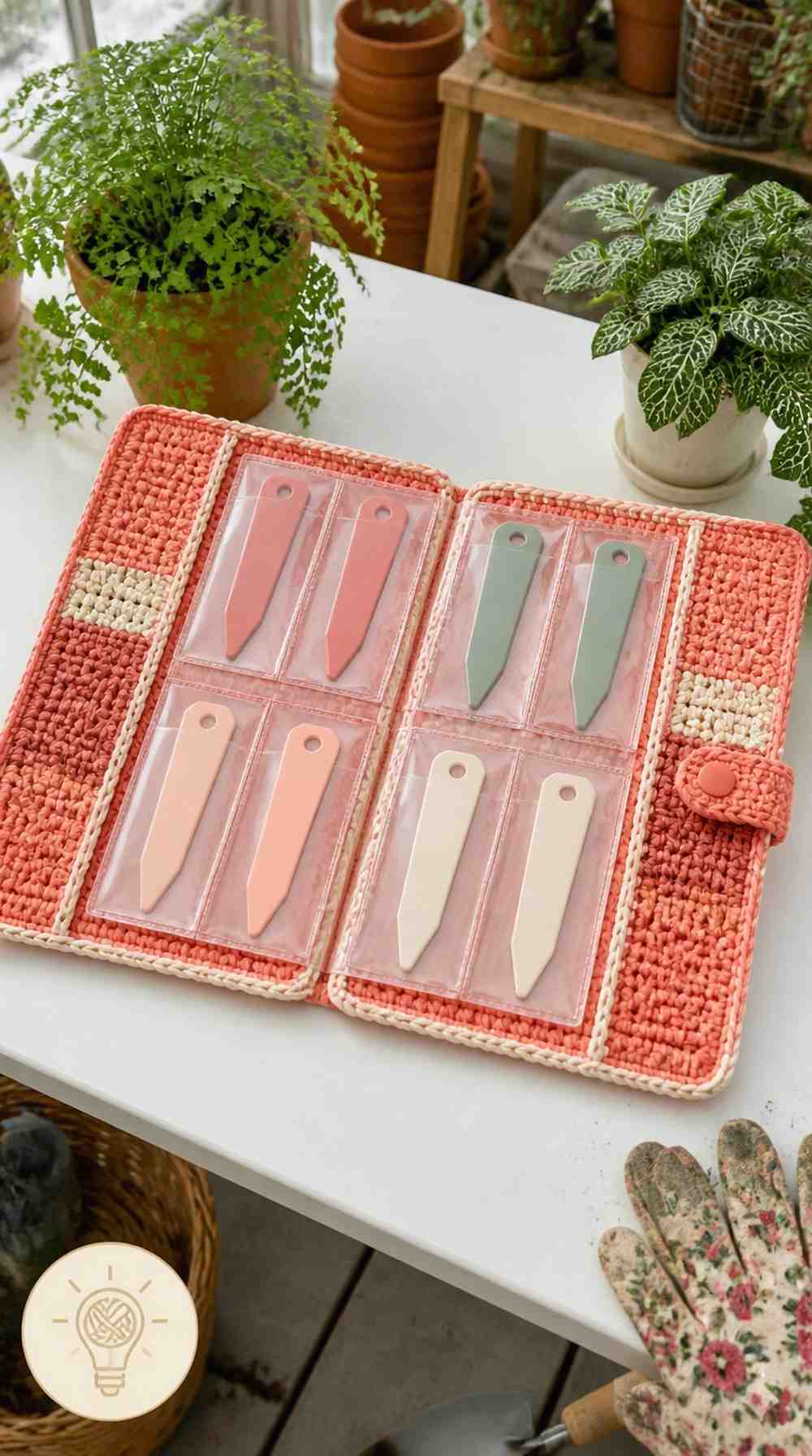
Coral-pink crochet creates a lively storage journal with warm-ivory and terracotta color-block edges. Eight transparent pockets sit across the reinforced interior pages, holding reusable plastic plant labels in coordinated shades. Coral and peach markers occupy one group, while sage and cream markers fill the other.
The color-sorted layout makes this design visually appealing without adding complicated hardware. It provides a simple way to separate marker sets, especially when different colors are used for different areas of the garden.
- Color grouping: Keep markers of similar colors together if that suits your gardening system.
- Flat color joins: Use smooth crochet seams between the coral, ivory and terracotta sections to prevent unnecessary bulk.
- Pocket visibility: Transparent compartments allow the labels to remain identifiable without pulling them from the journal.
- Ink care: If the markers have been written on, let the lettering dry fully before storage and check whether the ink is suitable for reuse.
11. Crochet Teal Zippered Plant Tag Pocket Book
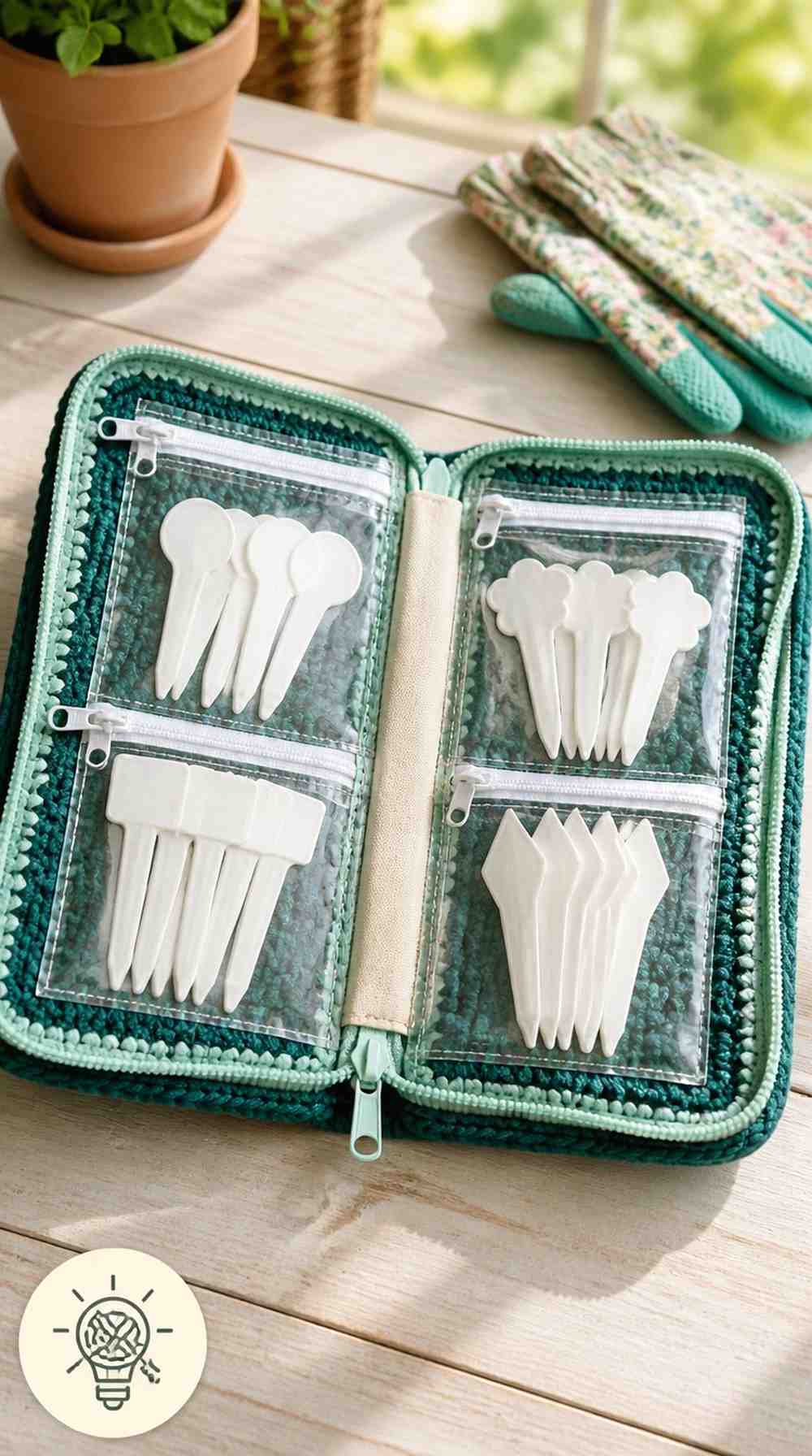
Teal-green crochet gives this compact storage book a tidy finish with moss-stitch texture and mint piping. A wide zipper travels around three outer edges, enclosing four transparent pocket pages inside a reinforced fabric spine. The open pages show groups of short plant markers safely held behind individual zippers.
The zipped construction gives this design a more enclosed storage arrangement than an open booklet. It could be useful for transporting clean, reusable labels between indoor storage and a potting area.
- Page zippers: Keep the small internal fastenings smooth so they do not scratch or catch the stored labels.
- Outer closure: Leave enough space for the book to zip shut without forcing the marker tips against the spine.
- Clear compartments: Group labels of similar shape or length in each pocket for easier sorting.
- Cleaning access: Transparent pages should be removable or accessible enough to clear away dust and trapped soil particles.
12. Crochet Navy Fold-Flat Bamboo Label Book
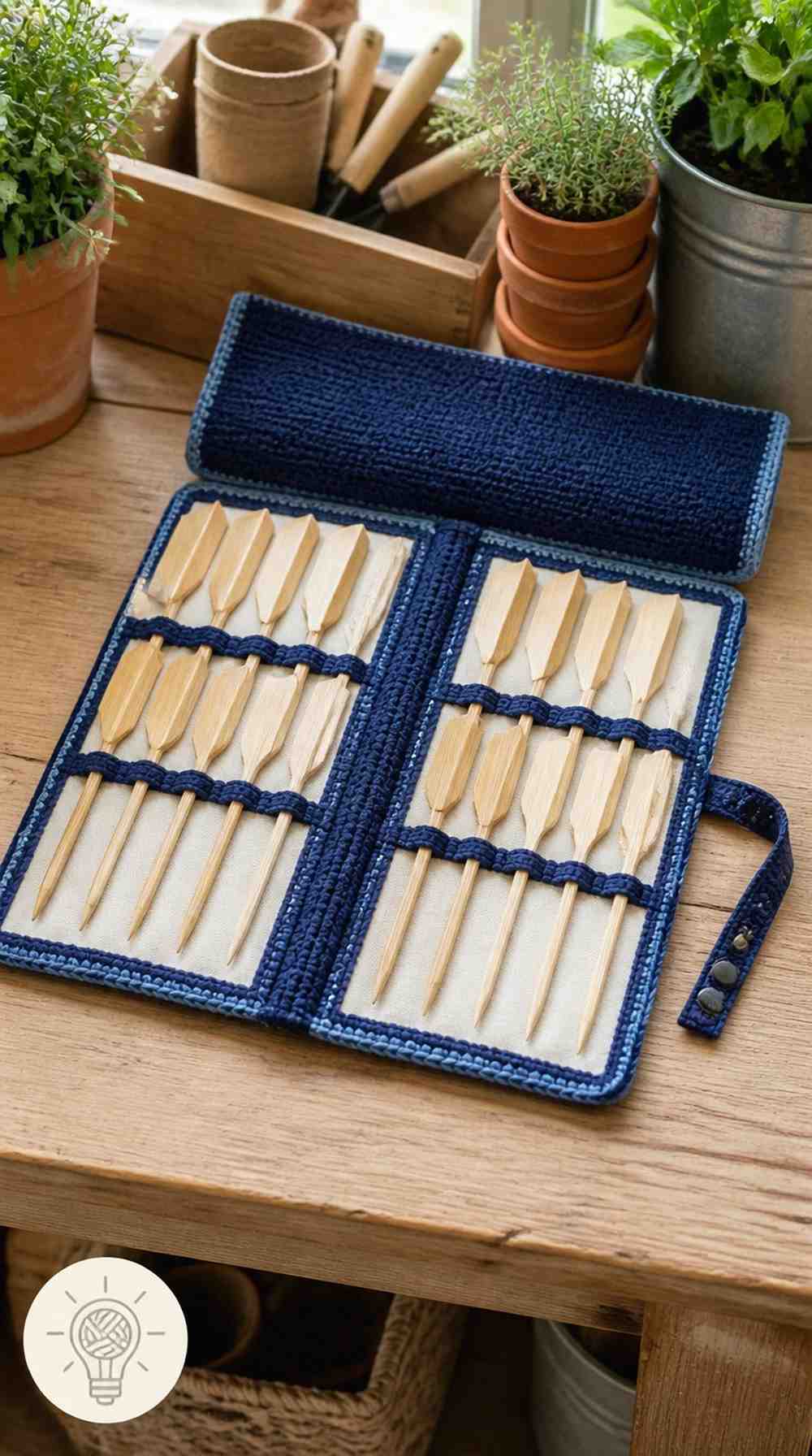
Deep navy crochet creates a structured fold-flat book with raised ribs and powder-blue edging. Twelve slender bamboo plant stakes rest horizontally inside reinforced fabric channels, with six markers on each page. Their paddle-shaped heads alternate directions to keep the arrangement compact.
The fold-flat design is especially suited to narrow wooden labels that need to remain separated. A broad fabric flap covers the markers before the book is closed, reducing direct contact between the bamboo and the outer crochet.
- Alternating directions: Positioning the broader heads at opposite ends can reduce crowding inside the two panels.
- Bamboo condition: Clean and completely dry the stakes before putting them into the fabric channels.
- Channel width: Keep the horizontal holders snug without forcing wooden markers against sharp seams.
- Flat closure: Avoid stacking extra labels above the twelve channels, which could distort the closed book.
13. Crochet Peach Granny-Square Plant Label Album
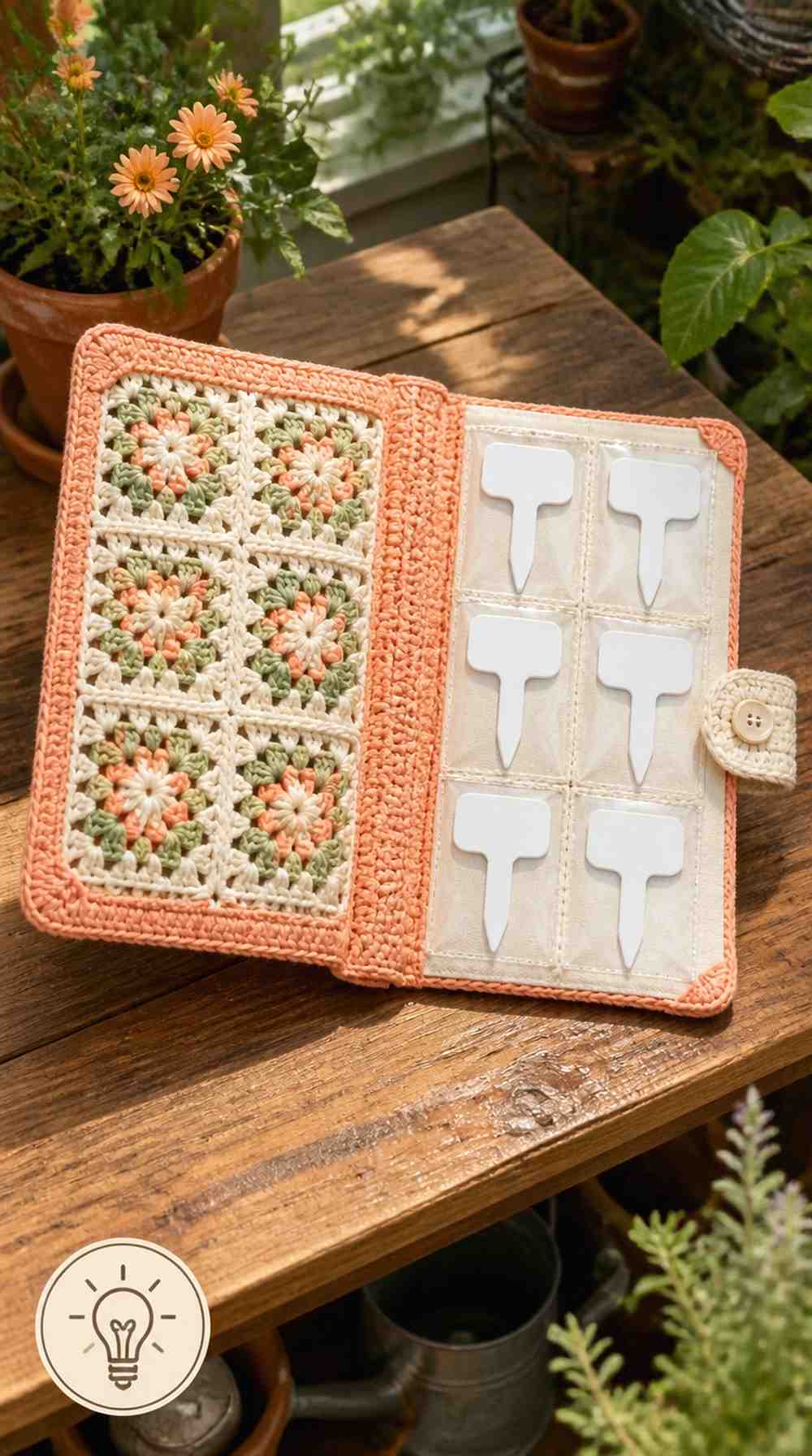
Peach crochet brings a cheerful handmade finish to this gardening album. Six miniature granny squares in peach, ivory and sage decorate its outer cover, joined with fine cream stitching. The solid-peach spine and reinforced corners frame a smooth interior page with six transparent pockets for reusable white plant markers.
The granny-square motifs stay on the decorative exterior rather than behind the labels. This keeps the small crochet openings away from pointed planting ends while allowing the cover to have a traditional handmade appearance.
- Miniature motifs: Keep the six squares evenly sized so the cover lies flat when the album is open.
- Secure joins: Finish the cream connecting stitches neatly to prevent loose yarn ends catching on nearby tools.
- Pocket backing: Use smooth reinforced fabric behind the clear sleeves to protect the crochet from planting tips.
- Decorative balance: The granny squares provide the visual detail, so the inside can remain simple and easy to clean.
14. Crochet Rust Long-Marker Foldover Storage Book
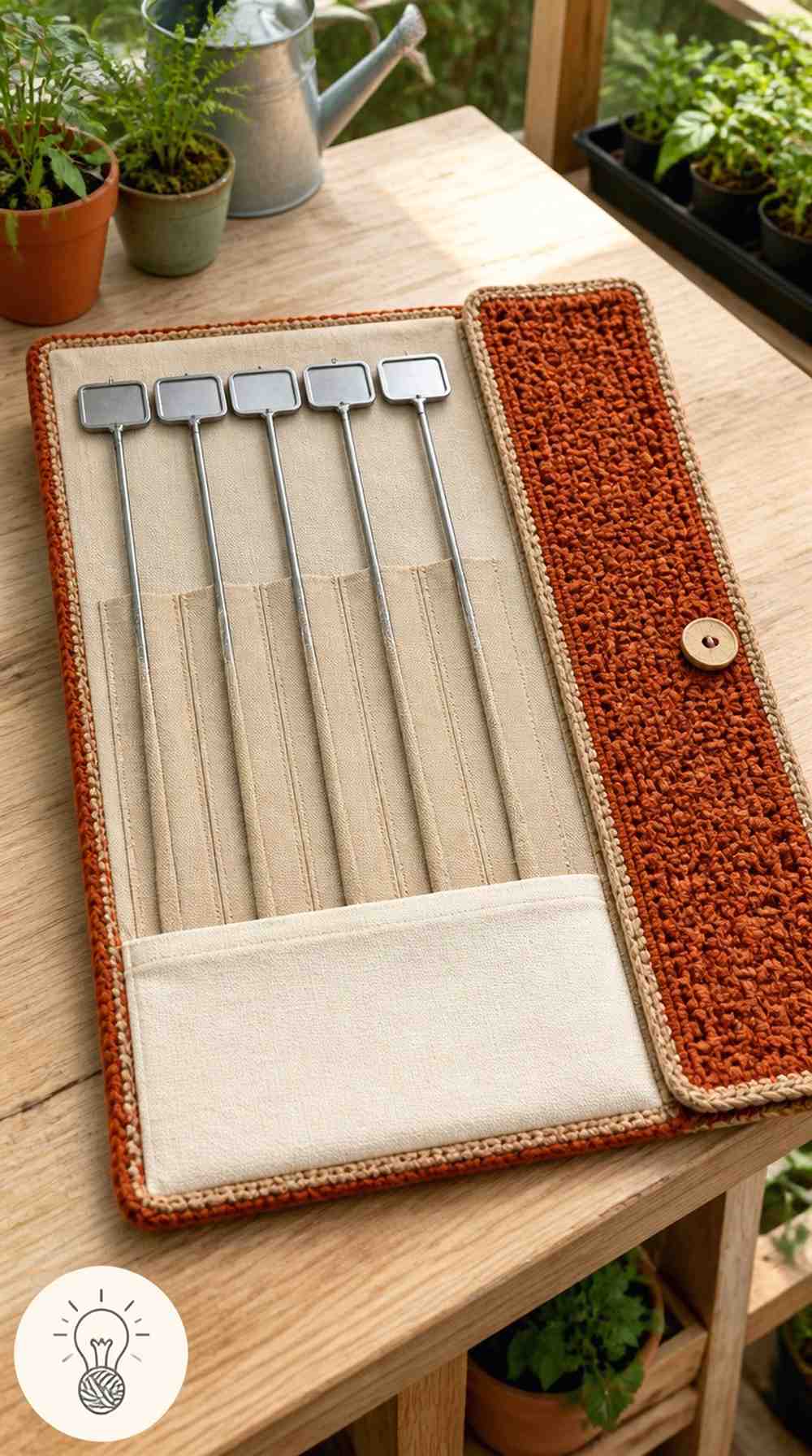
Rust-orange crochet creates a tall storage portfolio with compact diagonal stitches and sandy-beige piping. Five long metal plant markers rest in individual lined channels, with their rounded label plates visible above a protective lower flap. A broad foldover cover and flat wooden-button closure complete the design.
The elongated compartments suit markers that would not fit comfortably inside a small notebook. The protective lower flap is particularly important because metal planting ends should not press directly against an outer crochet cover.
- Marker dimensions: Measure both the broad upper plate and the full stake length when planning the five channels.
- Tip protection: Use sufficiently protective reinforced material beneath the stake ends.
- Foldover fit: Allow the cover to close without bending the metal markers or squeezing the button loop.
- Rigid backing: A firm insert can help the tall portfolio retain its shape when lifted from the potting bench.
15. Crochet Mint Removable-Page Plant Label Book
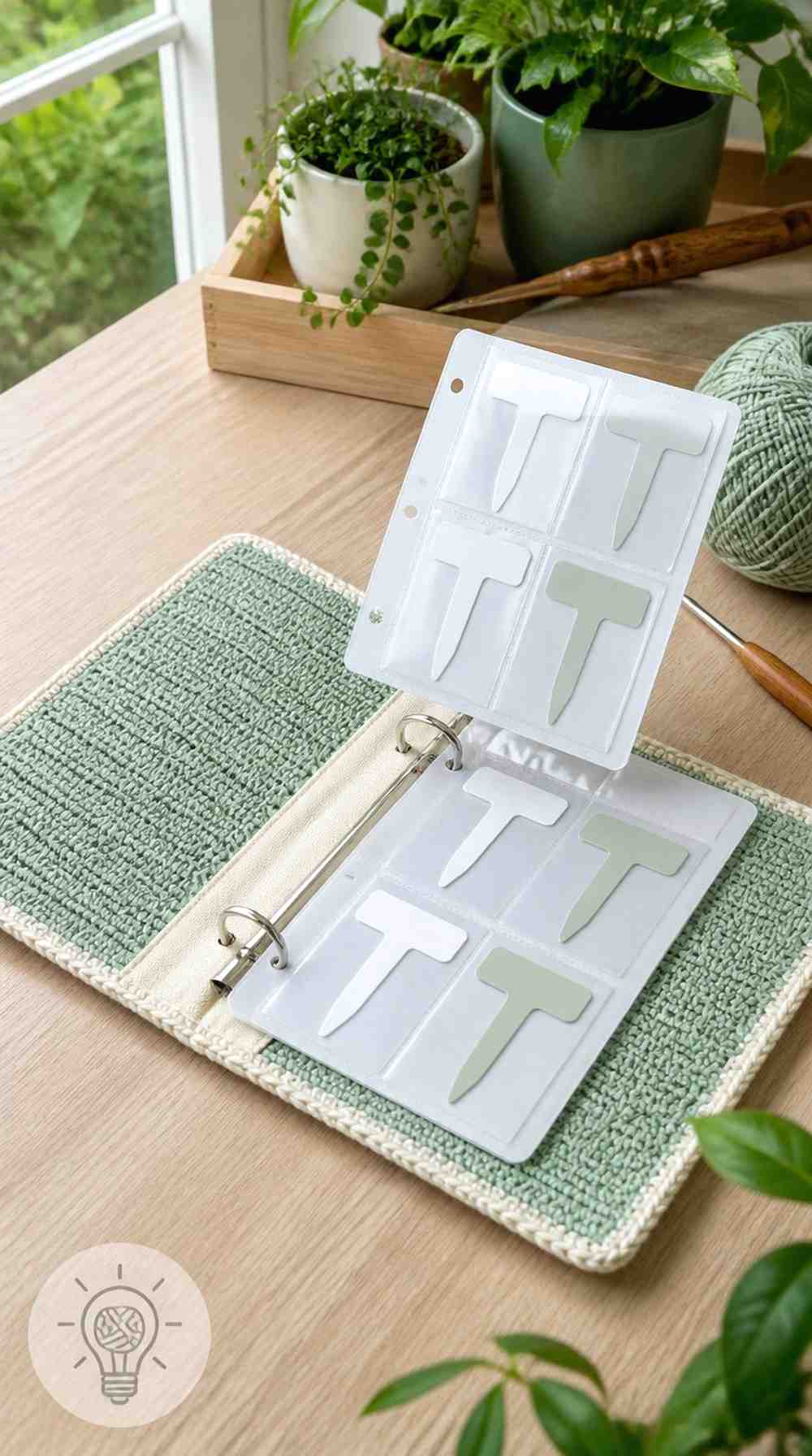
Mint-green crochet gives this ring-bound album a fresh, simple finish. Fine horizontal ribs and ivory edging cover the exterior, while a strong cream spine holds two small binder rings. Three clear-pocket pages are fitted inside, with one page lifted to reveal its reinforced ring holes.
Each page offers four individual compartments for short plastic plant labels. The removable arrangement makes it possible to reorganize the collection or change how many pages are carried.
- Removable pages: Choose sheets with strong reinforced holes so repeated removal does not tear the clear material.
- Ring alignment: The binder rings must match the page holes and close securely without catching them.
- Marker capacity: Four labels per page works for this concept, but actual capacity depends on the marker thickness.
- Flexible organization: Extra pages can be stored separately when a smaller everyday plant-label kit is preferred.
16. Crochet Butter-Yellow Tri-Fold Plant Label Keeper
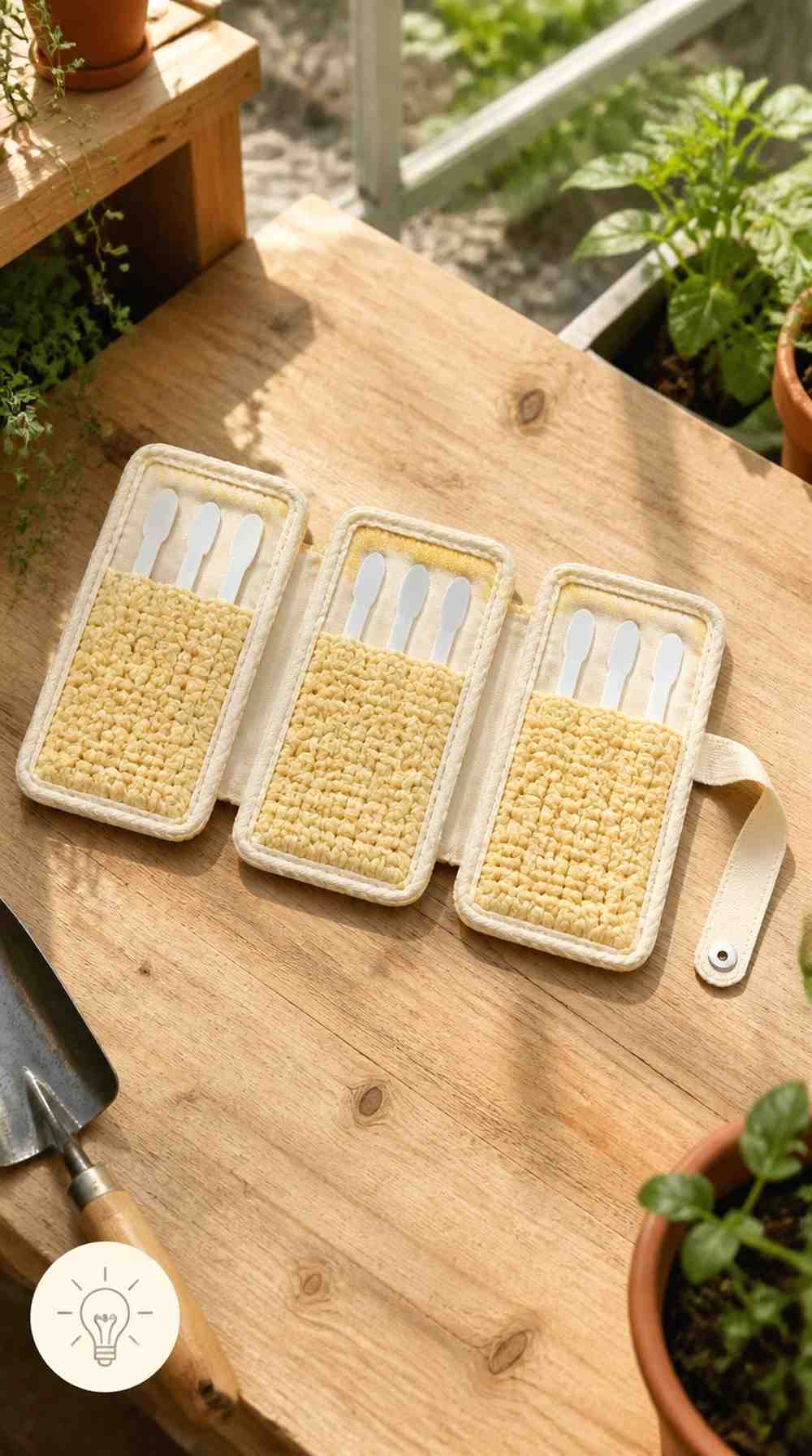
Butter-yellow crochet brings a sunny finish to this three-panel gardening organizer. Compact lemon-peel stitches and cream piping decorate the outside, while reinforced fabric hinges connect the panels. Nine short reusable plant markers sit in separate vertical pockets, three on each section.
The tri-fold layout opens into one broad storage surface before closing into a compact book. Its straightforward fabric pockets keep the markers visible and separated without requiring transparent zipper pages or a metal binder.
- Three-panel spacing: Check that the labels do not overlap when the panels fold inward.
- Fabric hinge width: Leave enough movement at both joins to accommodate the filled pocket thickness.
- Stake-tip coverage: Reinforce the lower ends of all nine compartments against pointed plastic markers.
- Snap closure: The outer fastening should hold the folded keeper without squeezing the markers tightly together.
17. Crochet Mocha Reversible Plant Tag Envelope Book
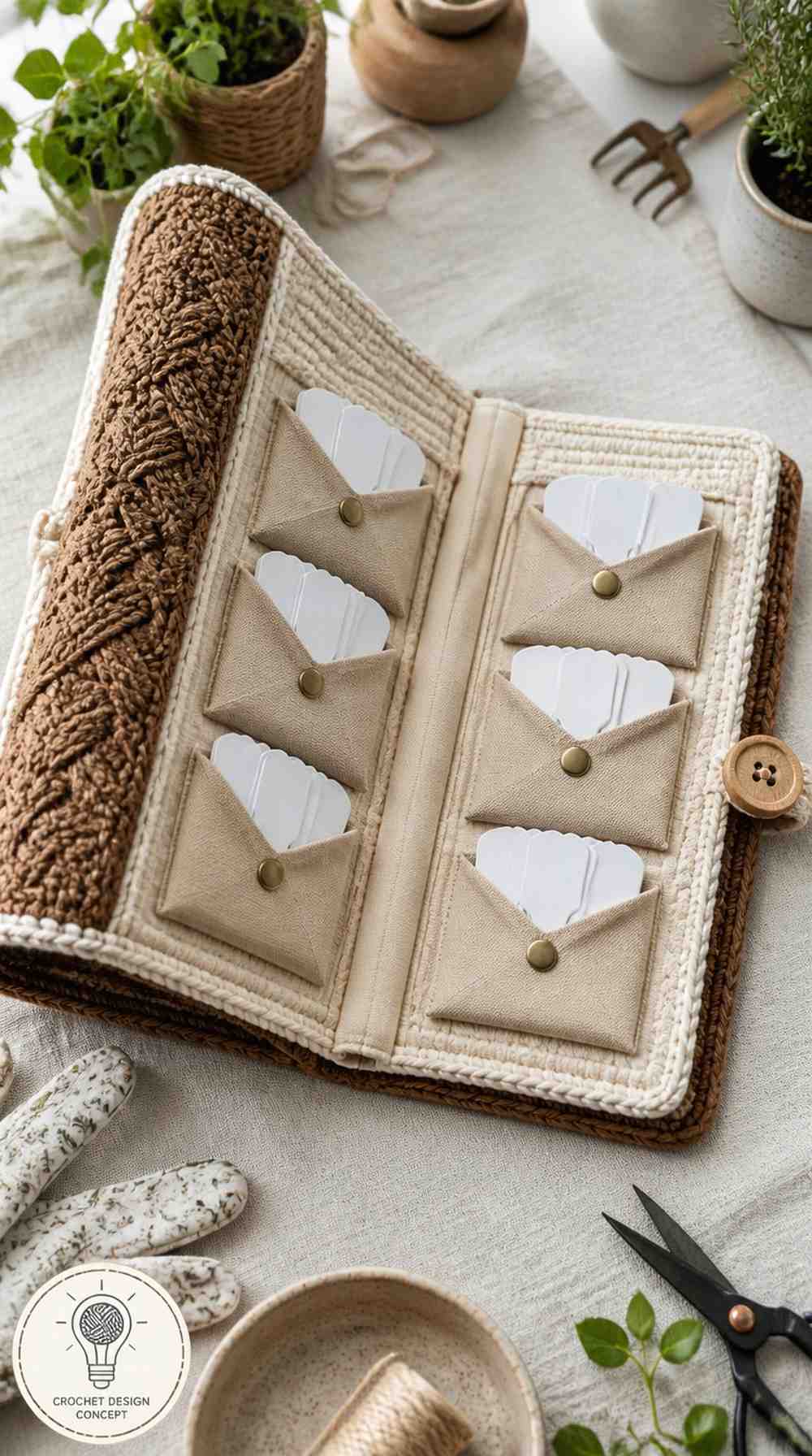
Mocha-brown crochet creates a refined storage book with raised basketweave stitches and an ivory ribbed reverse surface. A folded-back section of the cover reveals both crochet textures. Inside, six small cream envelopes sit across two fabric-backed pages, with each pocket holding a group of short reusable plant markers.
The reversible outer finish offers two coordinated appearances while the inner envelopes remain practical and enclosed. A wooden-button closure keeps the book together once the labels have been sorted.
- Envelope sorting: Separate groups by marker size, shape or intended planting area rather than mixing every label together.
- Reversible seams: Both crochet faces need tidy joins so the cover looks finished in either orientation.
- Pocket closures: Flat snaps can keep the six envelope flaps secured without bulky knots.
- Stored marker points: Ensure the labels cannot pierce the cream envelope fabric when the book is folded shut.
18. Crochet Plum Botanical Plant Label Archive
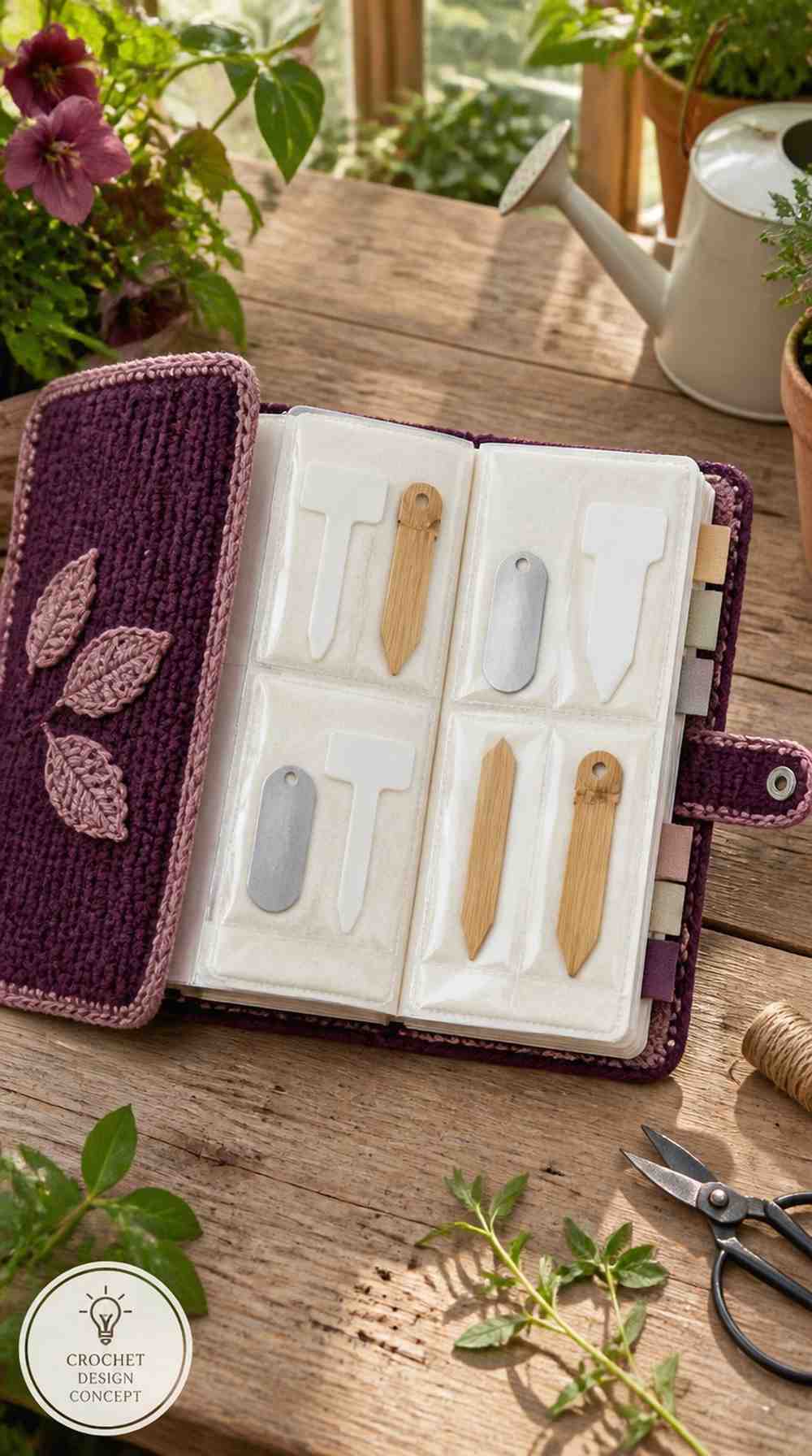
Deep plum crochet gives this garden-label archive a rich, botanical appearance. Fine vertical ribs, dusty-rose edging and small flat crochet leaves decorate its exterior. Two felt-backed pages contain eight clear protective sleeves holding a mixture of clean plastic, bamboo and metal plant markers.
The blank fabric index tabs help distinguish different page groups without permanently marking the outer cover. This makes the archive concept appealing for a gardener who keeps reusable labels from several kinds of planting projects.
- Mixed marker materials: Separate metal and bamboo labels where appropriate to prevent hard edges rubbing against softer materials.
- Flat leaf details: Keep the decorative crochet leaves small so they do not snag when the archive is stored on a shelf.
- Index tabs: Use reinforced fabric tabs that can be handled without pulling the felt-backed pages out of shape.
- Page protection: Smooth clear sleeves reduce direct contact between the planting tips and the decorative yarn.
19. Crochet Oatmeal Label-and-Plant-Notes Storage Book
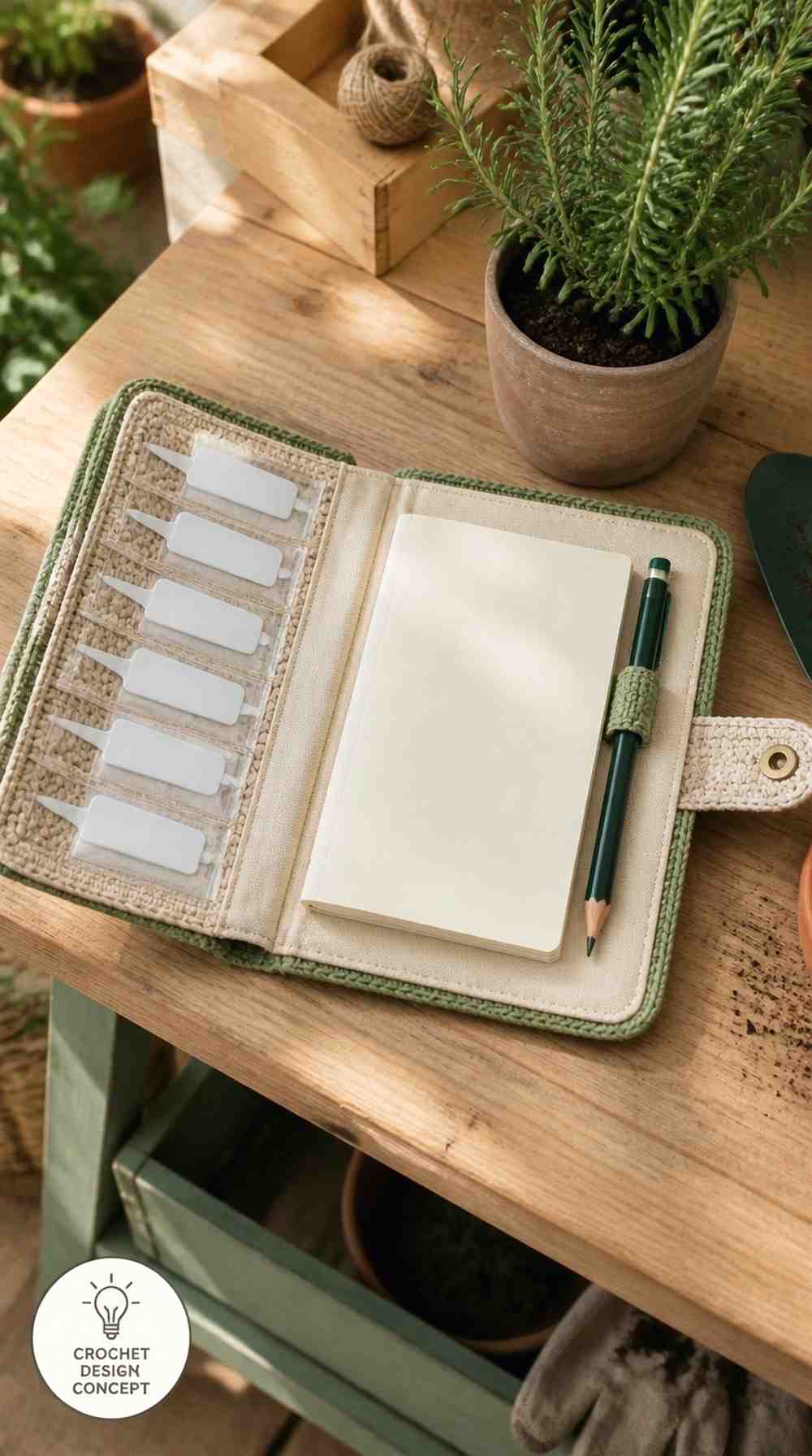
Oatmeal crochet gives this gardening record book a warm, practical finish. Dense basket-textured stitches cover the exterior, with sage-green piping and a reinforced fabric spine. Six clean reusable plant markers sit in individual clear pockets on the left page, while a slim blank notes booklet occupies a broad sleeve on the right.
A capped dark-green pencil rests in a small fabric loop beside the notes. The two-purpose layout keeps labels and basic plant-record materials together without requiring a separate storage pouch.
- Notebook size: Choose a thin paper booklet that fits comfortably beside the marker page without bending the outer cover.
- Pencil loop: Keep the fabric holder snug enough to retain the pencil while keeping its point protected.
- Label compartment: Reinforce the bottoms of the six clear pockets so planting tips cannot damage the notes page.
- Moisture awareness: Paper notes and crochet should remain dry; this book is better kept in indoor garden storage than beside wet potting soil.
Practical Guide to Crochet Plant Label Storage Books
A plant label storage book works best when it suits the actual markers used in your garden. Short plastic seedling labels, broad wooden stakes and long metal markers need different pocket shapes, backing materials and protective details.
Measure the labels before planning a book. Check the full length, width of the label head and thickness of the planting stake. Do not measure only the writable section. Long bamboo markers may need a tall portfolio, while short plastic tags can fit inside a compact ring-bound album.
Protect the pointed ends. Plant stakes often have tapered tips that may damage ordinary crochet or thin lining fabric. Use reinforced pocket bottoms, suitable protective sleeves or fabric flaps to keep the points away from the outer cover.
Clean and dry used labels. Remove soil and plant debris before returning labels to storage. Clean according to their materials and the gardening conditions involved, particularly if the markers were used around unhealthy plants. Allow all parts to dry completely before enclosing them in a crochet book.
Separate different materials. Plastic markers, bamboo stakes and metal labels may have different storage needs. Smooth transparent sleeves work well for identifying flat labels, while thicker wooden markers may need fabric channels. Metal edges should be covered to prevent rubbing or snagging.
Choose an easy-to-maintain crochet fabric. Smooth cotton or cotton-blend yarn may be suitable for a removable decorative cover because many varieties provide clear stitch definition and can be cleaned according to their care instructions. A supported fabric or rigid insert can help a book retain its shape.
Decide how to organize the markers. Seasonal pages may suit gardeners who reuse labels at different times of year. Grouped envelopes can hold spare markers of the same style, while individual clear pockets are useful when each label needs to remain visible.
Keep written information readable. Check that any writing or markings are dry before storage. If you plan to reuse labels, choose a marking method appropriate to the label material and outdoor exposure. Do not assume that every pen or paint marker will survive sunlight, watering and repeated cleaning.
Protect paper records. If the storage book includes a notebook, keep it away from damp soil and watering areas. A crochet cover is not waterproof, and paper records may be damaged if wet markers are stored beside them.
For related small-item organization ideas, explore 14 Crochet Craft Night Yarn Organizer Ideas for 2026 and 20 Crochet Hanging Wall Pocket Organizer Ideas on Yarn Nest Studio. These collections offer examples of compartment storage and pocket construction, although the plant label books in this article require shapes specifically designed for gardening markers.
Want to Make Something Similar?
These verified crochet resources demonstrate related booklets, pockets and structured case construction. They are not exact patterns for the 19 plant label storage books above.
- Free Crochet Notions Pouch by Nicki’s Homemade Crafts — A free written pattern with video guidance for a small booklet-shaped crochet organizer featuring internal pockets and a button-and-loop closure. It is particularly relevant to the ivory and mocha concepts, although the original pattern is for crochet tools and notions. Nicki’s Homemade Crafts
- Make Your Own Crochet Hook Case by Nicki’s Homemade Crafts — A free tutorial covering a zippered fabric-backed crochet case with multiple pockets and structural support. The methods may inspire the teal zippered book and dusty-blue album, but any plant label version needs different pocket dimensions and reinforced tips. Nicki’s Homemade Crafts
- Free C2C Crochet Book Cover with Pockets by Nicki’s Homemade Crafts — A free book-cover project with pocket construction that may help when exploring a combined book-and-note-storage format such as the oatmeal concept. Nicki’s Homemade Crafts
Follow each creator’s instructions for their actual project. These 19 plant label storage concepts would need their own measurements, suitable protective materials and practical fitting checks.
Comparison: Which Crochet Plant Label Storage Book Should You Choose?
| Gardening storage need | Design to consider | Main trade-off |
|---|---|---|
| Twelve individual reusable labels | Sage Twelve-Pocket Storage Book | Fixed pocket sizes |
| Four broad wooden markers | Ivory Button-Flap Marker Book | Limited capacity |
| Long bamboo plant stakes | Terracotta Long-Stake Portfolio | Taller book required |
| Removable clear pages | Dusty-Blue Ring-Bound Album | Ring and page maintenance |
| Ten short T-shaped labels | Mustard Elastic-Loop Book | Loops may stretch |
| Grouped spare plastic markers | Blush Six-Envelope Keeper | Several markers share one envelope |
| Seasonal marker collections | Olive Seasonal Archive Book | Index and card organization needed |
| Fold-out storage sections | Lilac Accordion Marker Book | Multiple fabric hinges |
| Slender metal labels | Charcoal Metal Label Protector | Needs soft protective pockets |
| Color-sorted marker collection | Coral Color-Sorted Journal | Depends on a useful color system |
| Enclosed zippered pages | Teal Zippered Pocket Book | Added zipper bulk |
| Twelve slender bamboo stakes | Navy Fold-Flat Bamboo Book | Limited to narrow marker shapes |
| Granny-square decoration | Peach Granny-Square Album | Motif joins require care |
| Five long metal plant markers | Rust Long-Marker Portfolio | Protective tip construction essential |
| Changing page quantity | Mint Removable-Page Book | Binder holes may wear |
| Three folding panels | Butter-Yellow Tri-Fold Keeper | Needs adequate folding clearance |
| Grouped labels with reversible cover | Mocha Reversible Envelope Book | Two-sided finishing adds complexity |
| Mixed-material botanical keepsakes | Plum Botanical Archive | Different label sizes need fitting |
| Plant markers and gardening notes | Oatmeal Label-and-Notes Book | Paper must stay dry |
For a small collection of short plastic markers, the sage clear-pocket book is an approachable option. Gardeners who use longer wooden or metal labels may prefer the terracotta or rust portfolio designs. If labels are reused across several planting seasons, the olive archive or mint removable-page book could provide more flexible organization.
Conclusion
Crochet plant label storage books offer a creative way to keep reusable gardening markers organized between planting sessions. From sage-green transparent pockets and terracotta bamboo-stake holders to peach granny-square albums, mint removable pages and oatmeal gardening notebooks, these 19 concepts show how different book structures can suit different kinds of labels.
The best organizer starts with the size and material of the markers. Give every stake enough space, protect pointed ends and keep the labels clean and dry before storing them. Once those practical details are covered, crochet texture, color and decorative stitching can make the storage book a pleasant part of your gardening routine.
Which design would you choose for your gardening supplies? Would you prefer the sage twelve-pocket book, the peach granny-square album or the oatmeal label-and-notes organizer? Share your favorite and whether you mainly use plastic, bamboo or metal plant markers.
Frequently Asked Questions
Can I store used plant labels directly inside a crochet book?
It is better to clean and dry them first. Used markers may carry soil, moisture and plant debris that can collect inside fabric pockets. Pointed ends can also catch on crochet stitches. Use suitable protective sleeves or reinforced fabric compartments rather than placing dirty stakes directly against the yarn.
What yarn is suitable for a crochet plant label storage book?
Smooth cotton or cotton-blend yarn may be a useful choice because many varieties provide defined stitches and washable construction. Avoid highly fluffy yarn or loose openwork around pointed markers. A fabric-backed or rigid-supported book may be more practical than unsupported crochet alone.
How should I store long wooden or bamboo plant markers?
Use an elongated organizer with separate channels that fit the full stake length. Keep the markers clean and completely dry, and protect their tapered ends. A tall foldover portfolio may provide a more suitable shape than a compact booklet intended for short plastic tags.
Can I keep different types of plant labels in one organizer?
Yes, provided the pockets or compartments suit the individual materials. Plastic markers may fit narrow clear sleeves, while bamboo labels may need broader channels and metal tags may benefit from smooth protective backing. Removable pages or separate envelopes can make mixed collections easier to organize.
Are these 19 crochet plant label storage books available as exact patterns?
No. These are AI-generated crochet inspiration concepts, not tested handmade products or complete patterns. The linked tutorials demonstrate related booklet, pocket and case construction techniques, but they do not reproduce these specific gardening organizers. Any working version would need appropriate measurements, reinforced pockets, suitable protective materials and practical testing before use.