A pet-food scoop is one of those everyday feeding tools that deserves a clean, convenient place between uses. Crochet pet food scoop storage pockets can add handmade color and texture to a pet-feeding station while keeping the scoop separate from other household utensils. These 18 inspiration ideas explore everything from sage-green ribbed wall pockets and terracotta bin-side holders to decorative sunflower hoops, granny-square caddies and compact storage pouches.
The most useful design depends on your scoop’s bowl shape, handle length and where you keep your pet’s food. Some concepts hang beside a storage container, while others attach to a cabinet, basket, pegboard or freestanding holder. Each design uses a separate removable, smooth, washable inner insert to keep the scoop’s food-contact bowl away from the crochet fabric. That distinction matters because pet-food utensils need proper cleaning, drying and hygienic storage.
These are AI-generated crochet design visualizations for inspiration, not photographs of tested handmade products, food-safe certified holders or step-by-step patterns.
Quick Design Selection Guide
For straightforward wall storage, Crochet Sage Ribbed Wall Scoop Pocket, Crochet Ivory Granny-Square Scoop Caddy and Crochet Seafoam Pegboard Scoop Storage Pocket keep a scoop close to a dry feeding area.
If you want the scoop beside its food bin, consider Crochet Terracotta Bin-Side Scoop Pocket or Crochet Rust Snap-Strap Bin-Rail Scoop Pocket. Both keep attachments separate from the storage container’s lid.
For smaller feeding areas, Crochet Navy Narrow-Handle Scoop Sleeve, Crochet Blush Scalloped Shelf-Edge Scoop Pocket and Crochet Olive Leaf-Trim Cabinet Scoop Pocket provide compact arrangements.
If you use scoops of different sizes, Crochet Teal Two-Size Scoop Wall Pockets and Crochet Cream and Sage Dual-Measure Scoop Caddy offer individual compartments.
For decorative styling, Crochet Mustard Sunflower Hoop Scoop Pocket, Crochet Charcoal Mesh-Front Scoop Holder and Crochet Indigo Checkerboard Over-Door Scoop Sleeve introduce distinctive shapes and textures.
If you prefer a holder that does not require wall mounting, Crochet Oatmeal Freestanding Scoop Pocket Stand provides a supported tabletop option.
1. Crochet Sage Ribbed Wall Scoop Pocket
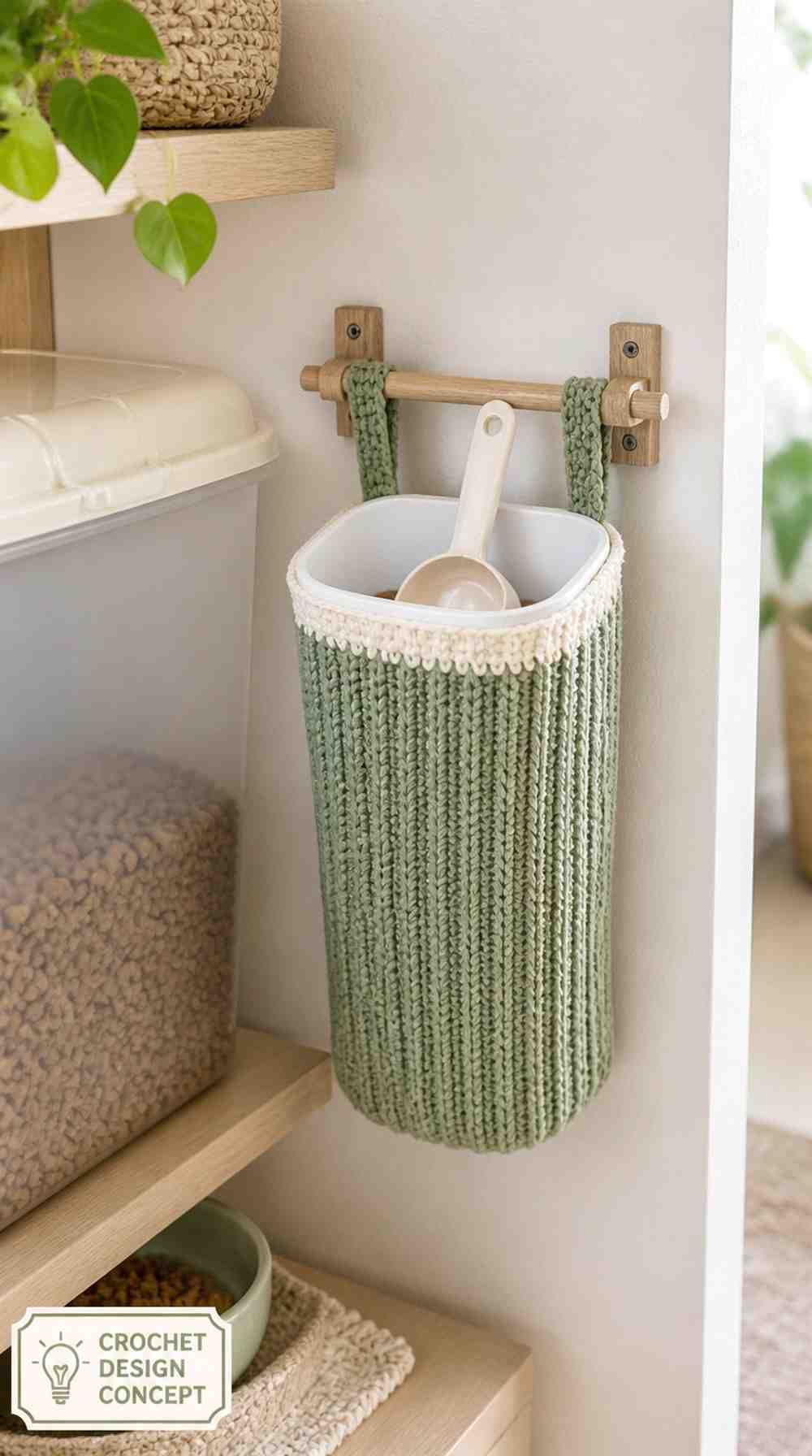
Sage-green crochet creates a compact hanging pocket with dense vertical ribbing and a narrow cream border. A smooth removable white plastic cup insert sits inside the crochet, holding a clean beige pet-food scoop with its handle upright. A pale-oak dowel supports the pouch beside a closed pet-food container.
The simple design keeps the scoop easy to reach without occupying the preparation counter. Its rigid inner cup is an important part of the concept because the scoop bowl should rest against a cleanable surface rather than directly against yarn.
- Vertical Ribbing: Raised sage stitches add texture while a firm pocket shape helps the removable insert stay upright.
- Individual Scoop Storage: One dedicated compartment helps prevent the pet-food utensil from becoming mixed with household measuring cups.
- Wooden Dowel Support: Reinforced loops and secure wall brackets are important for keeping the holder level during repeated use.
- Removable Inner Cup: Choose a smooth, suitably durable insert that can be washed and completely dried independently of the crochet cover.
2. Crochet Terracotta Bin-Side Scoop Pocket
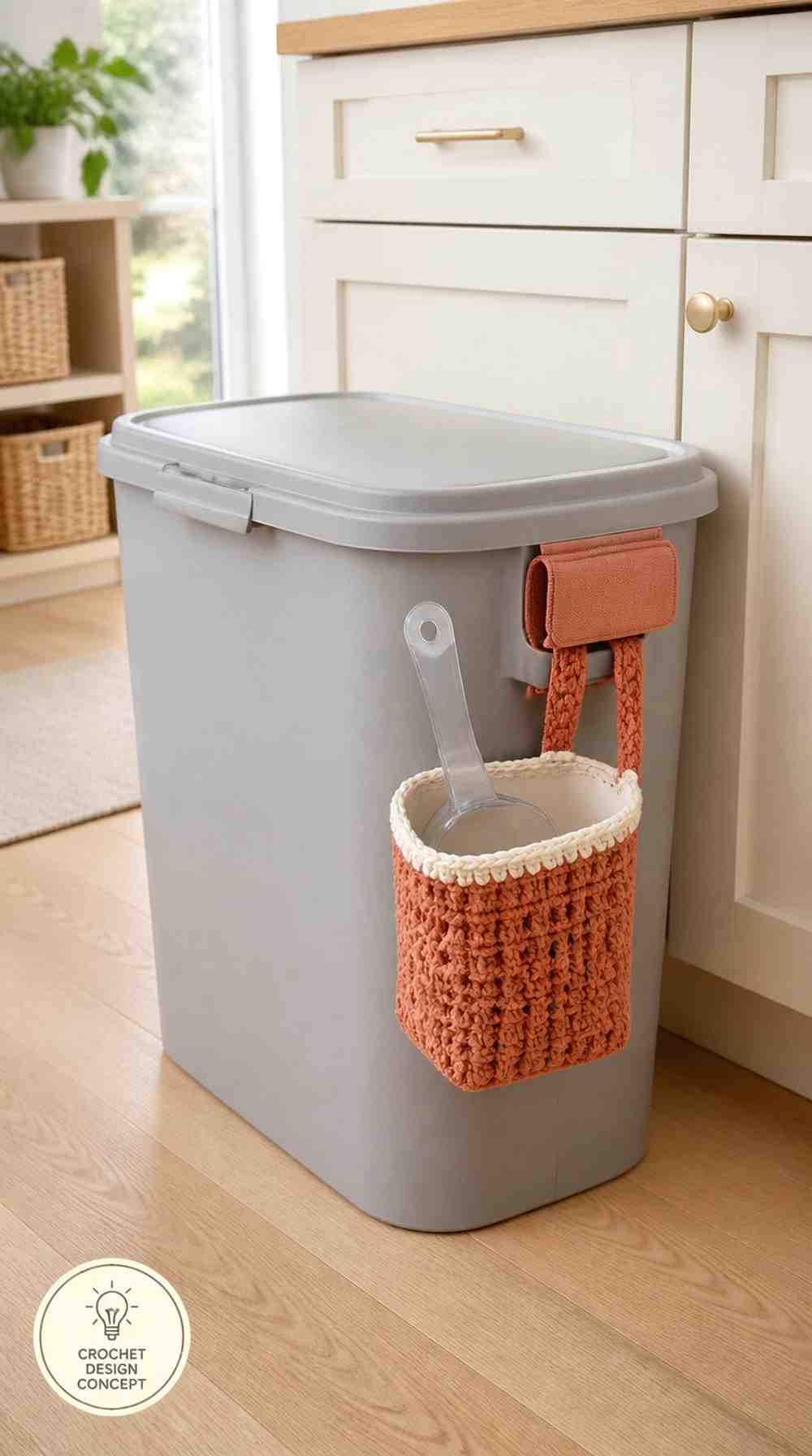
Warm terracotta crochet forms a compact pouch with raised waffle-style stitches and ivory edging. Two short reinforced straps connect it to a padded clamp on the outside handle of a closed pet-food storage bin. A removable cream insert holds a clean translucent-gray scoop, with the handle visible above the opening.
This concept places the utensil directly beside the food container without opening the lid. The clamp is separate from the lid seal, which matters for maintaining the container’s normal operation.
- Bin-Side Position: Keeping the scoop beside the container makes it easy to locate without storing it directly inside the food.
- Padded Clamp: The mounting hardware should suit the bin handle and must not interfere with its lid, seal or stability.
- Waffle Crochet Texture: Raised terracotta blocks create a handmade finish while the rigid insert supports the scoop bowl.
- Container Balance: Check that the attached holder does not pull on the handle or make the food bin awkward to move.
3. Crochet Navy Narrow-Handle Scoop Sleeve
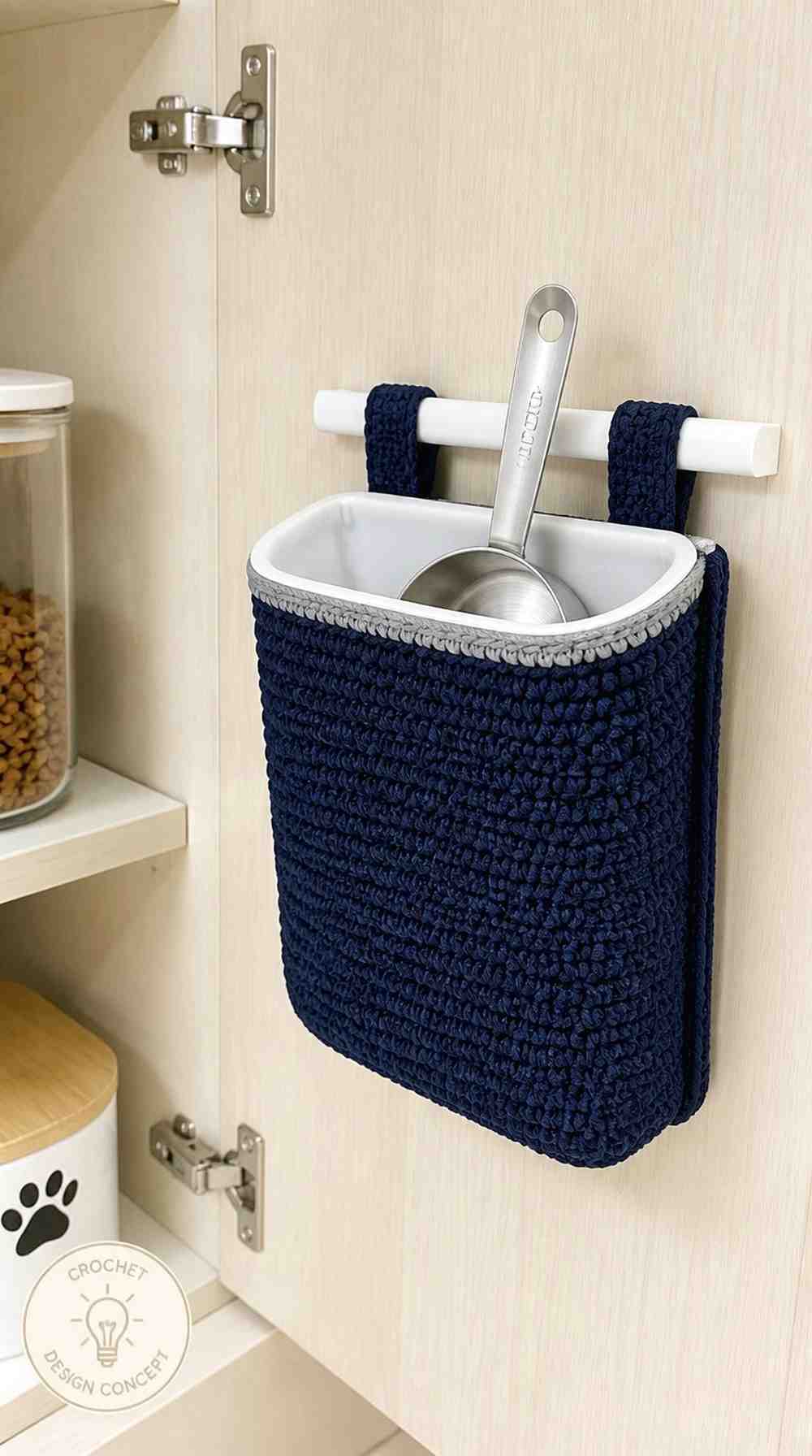
Deep-navy crochet creates a slim vertical sleeve with horizontal stitch ridges and a silver-gray border. Inside sits a narrow white washable insert holding a petite stainless-steel measuring scoop. Its slender handle extends above the rim, while two reinforced tabs attach the pouch to a cabinet rail.
The compact proportions make this concept suitable for a smaller scoop rather than a broad kibble cup. Its narrow storage area saves space within a feeding cabinet, although the scoop must fit without scraping against the opening.
- Slim Sleeve Shape: Measure the actual scoop bowl before choosing the opening, since narrow designs can be unsuitable for wide measuring cups.
- Metal Scoop Storage: A smooth rigid liner separates the stainless-steel bowl from crochet ridges and internal joins.
- Cabinet-Rail Mounting: The attachment should remain clear of hinges, shelves and the cabinet’s closing path.
- Handle Access: Leave enough of the short scoop handle exposed for comfortable removal without pulling on the crochet rim.
4. Crochet Ivory Granny-Square Scoop Caddy
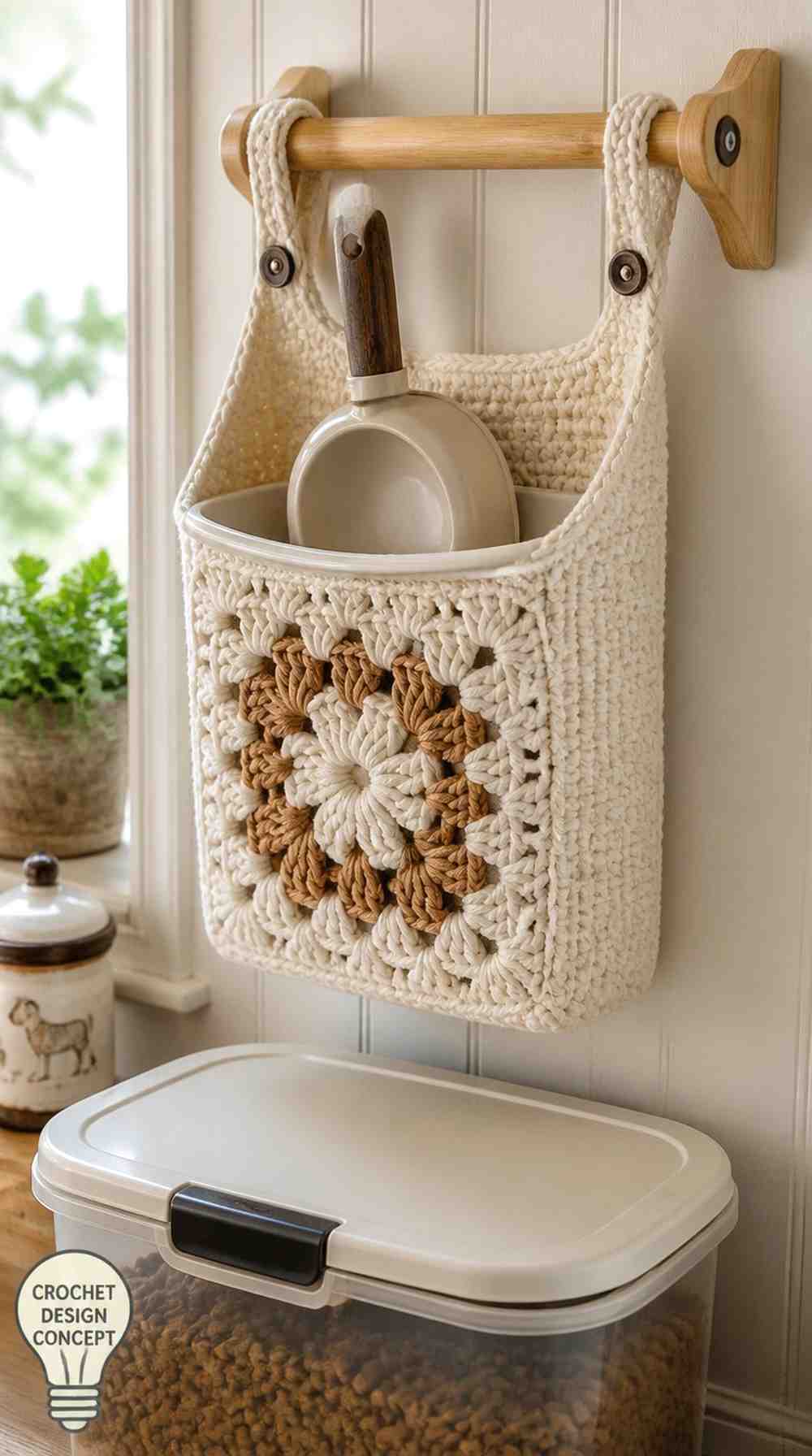
Cream-and-caramel crochet gives this small wall caddy a traditional handmade appearance. A large granny-square motif decorates the front, with recognizable corner clusters and ivory joining stitches. A solid cream backing supports a removable plastic cup that holds a dry beige scoop with a dark-oak-colored handle.
The decorative granny square remains outside the washable storage insert. This allows the familiar open crochet motif to be used without making the food-contact surface part of the yarn structure.
- Granny-Square Front: Traditional openwork provides decoration, but the inner cup should contain the scoop independently.
- Solid Backing: Closely worked crochet gives the pocket a more consistent shape behind the decorative motif.
- Bamboo Dowel Attachment: Two reinforced upper loops help keep the caddy level beside the closed food bin.
- Cleaning Separation: The plastic insert should be removable so food residue never needs to be washed out of the granny-square stitches.
5. Crochet Mustard Sunflower Hoop Scoop Pocket
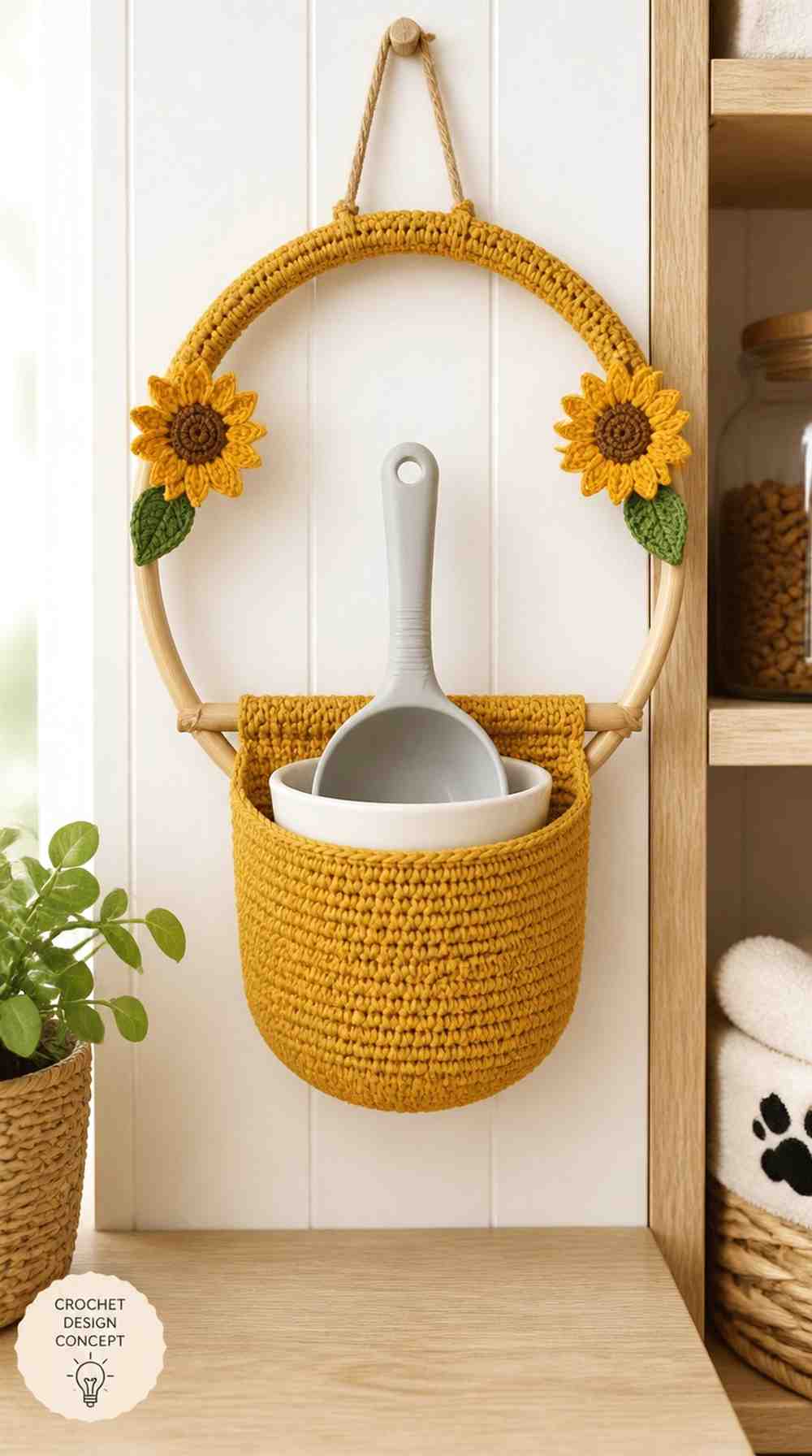
Mustard-yellow crochet decorates the upper curve of a bamboo hoop, with two flat sunflower motifs adding golden petals and olive-green leaves. A small mustard pocket hangs from a supported wooden crossbar in the hoop’s lower half. Inside, a white washable cup holds a gray scoop with its handle upright.
This design treats scoop storage as a decorative wall feature. The bamboo frame and crossbar provide the structure, while the crochet flowers remain separate from the working pocket.
- Sunflower Hoop Shape: The rigid circular frame creates the display outline without requiring yarn to support its own curved shape.
- Supported Lower Pocket: The wooden crossbar must carry the holder and inner cup, not the decorative sunflower motifs.
- Handle Clearance: Position the scoop so its handle stays within the open hoop and does not catch against the bamboo edge.
- Flat Floral Decoration: Securely sewn petals and leaves provide character without loose parts near the scoop opening.
6. Crochet Blush Scalloped Shelf-Edge Scoop Pocket
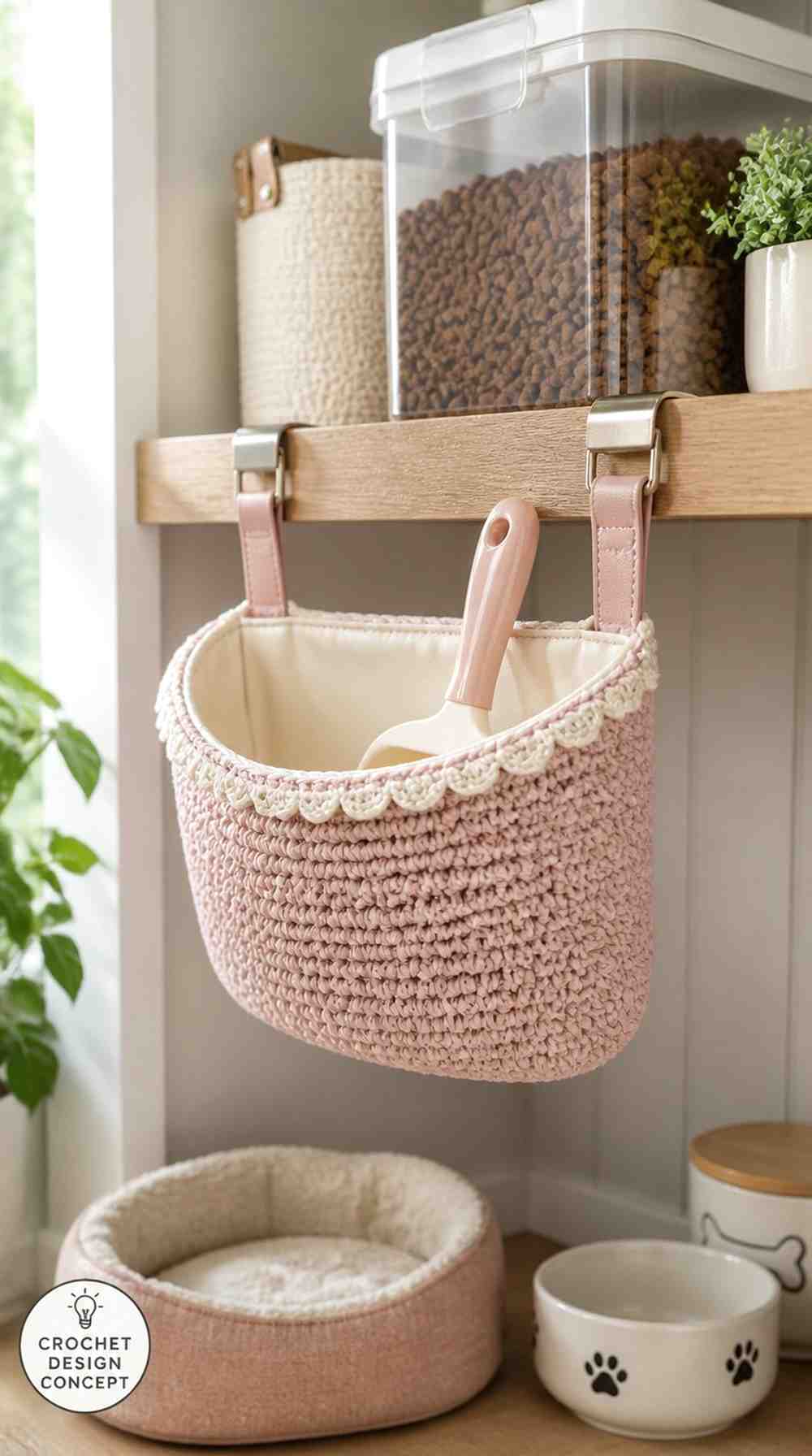
Dusty-blush crochet forms a small storage pouch with compact moss stitches and delicate ivory scallops around the upper rim. Two padded metal clamps attach the pouch to the outside edge of a wooden pantry shelf. A removable cream liner contains a clean white scoop with a pale-pink handle.
The shelf-edge arrangement avoids installing permanent wall hooks. Its soft pastel appearance suits a tidy indoor feeding nook, but the shelf and clamp combination must support the holder without slipping.
- Removable Shelf Clamps: Check the shelf thickness and finish, since even padded clamps may leave pressure marks.
- Ivory Scalloped Rim: Small decorative shells soften the opening but should not obstruct the scoop’s handle.
- Compact Pocket: This design is best considered for a small scoop, not a large deep kibble cup.
- Shelf Clearance: Keep the holder away from containers that might spill water, food or cleaning products into the crochet.
7. Crochet Teal Two-Size Scoop Wall Pockets
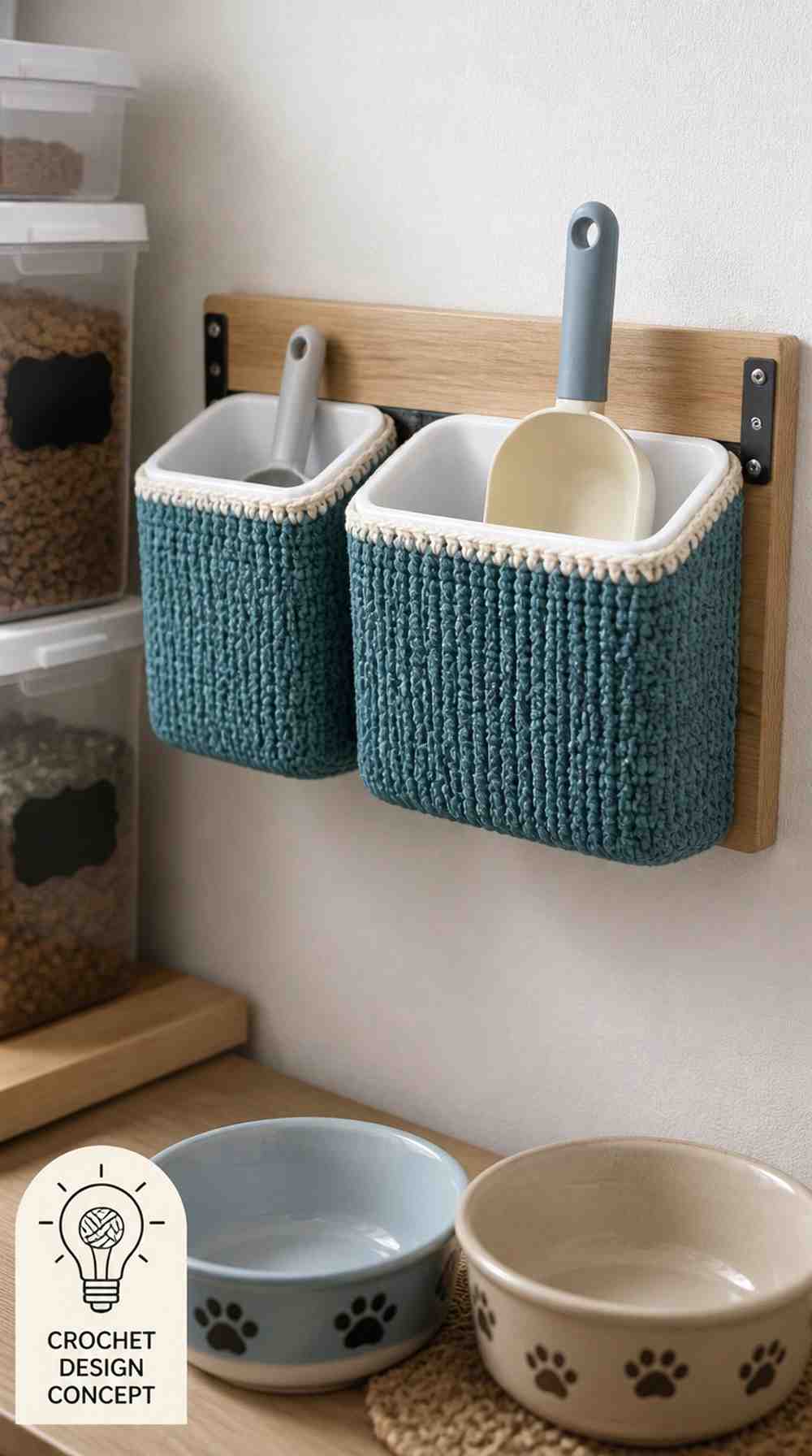
Teal crochet creates two separate rectangular storage pockets on a light-oak backing board. The smaller left compartment holds a narrow gray measuring scoop, while the larger right pocket contains a broad ivory scoop with a longer handle. Both bowls rest in individual removable white washable inserts.
The unequal pocket widths make this design useful for a feeding station that needs two different measuring utensils. Each scoop has its own place, reducing the need to fit both into one oversized holder.
- Two Different Pocket Widths: Separate openings accommodate a narrow scoop and a broad scoop without forcing them into identical compartments.
- Individual Hard Liners: Each washable insert can be removed for cleaning without disturbing the other utensil.
- Teal Ribbed Stitching: Close vertical crochet rows create a coordinated appearance across both differently sized pockets.
- Rigid Wooden Backing: A strong support board helps maintain the pocket arrangement when only one scoop is removed.
8. Crochet Charcoal Mesh-Front Scoop Holder
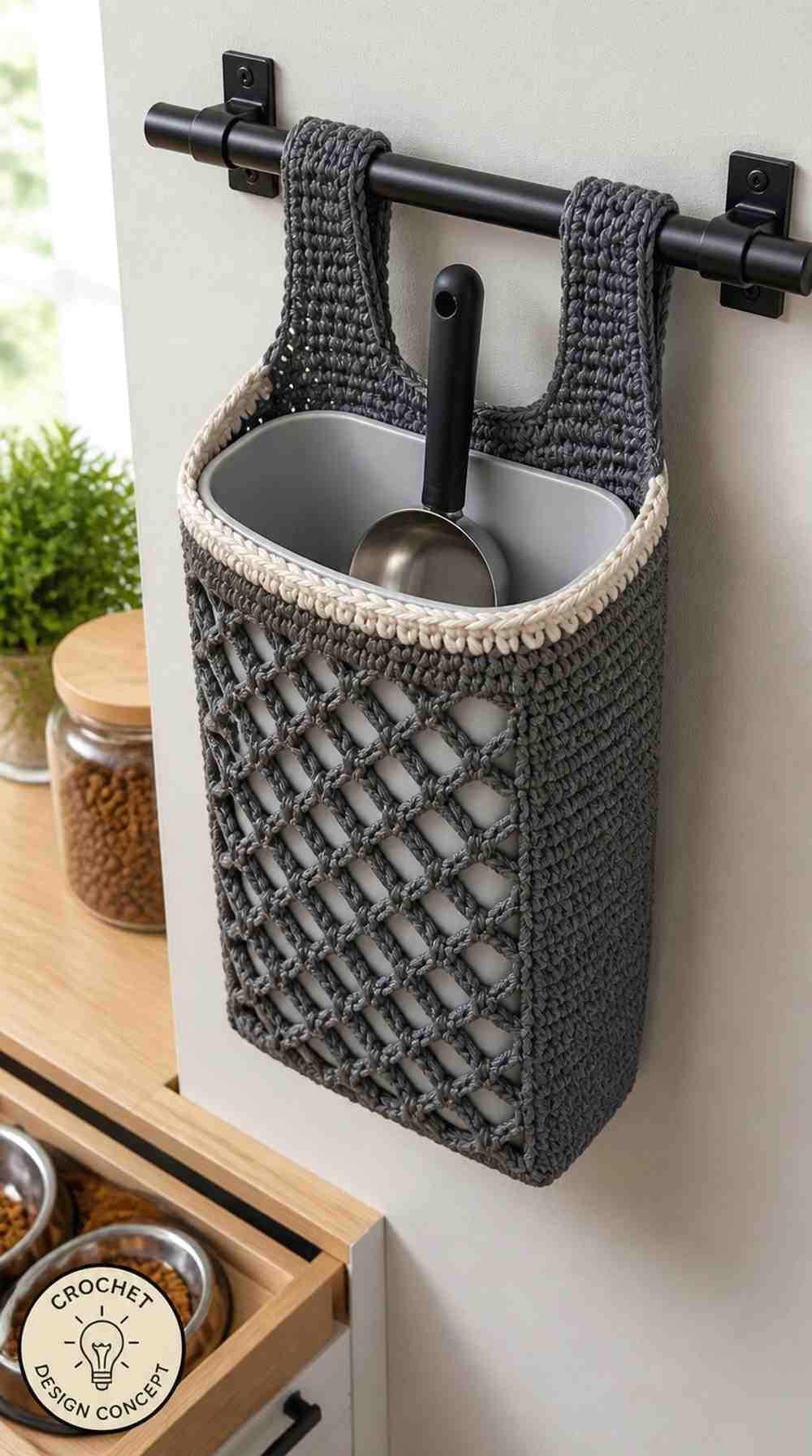
Charcoal-gray crochet gives this tall storage pocket a modern appearance. Diamond-shaped openwork forms the front, while solid side walls and an ivory border define the shape. A rigid light-gray washable insert sits behind the mesh, holding a stainless-steel scoop with a black handle.
The openwork makes the holder look lighter than solid crochet pouches. The washable inner cup remains essential because the metal scoop bowl must not press against the decorative yarn openings.
- Diamond-Mesh Front: Open crochet creates visual texture while leaving the rigid inner insert visible.
- Solid Side Seams: Tightly worked borders provide stronger attachment areas than relying on open mesh stitches.
- Metal Scoop Clearance: The stainless-steel bowl should rest fully inside the smooth washable cup, not against the crochet front.
- Wall-Rail Support: Reinforced tabs need suitable rigid hardware so the holder stays level above the preparation counter.
9. Crochet Olive Leaf-Trim Cabinet Scoop Pocket
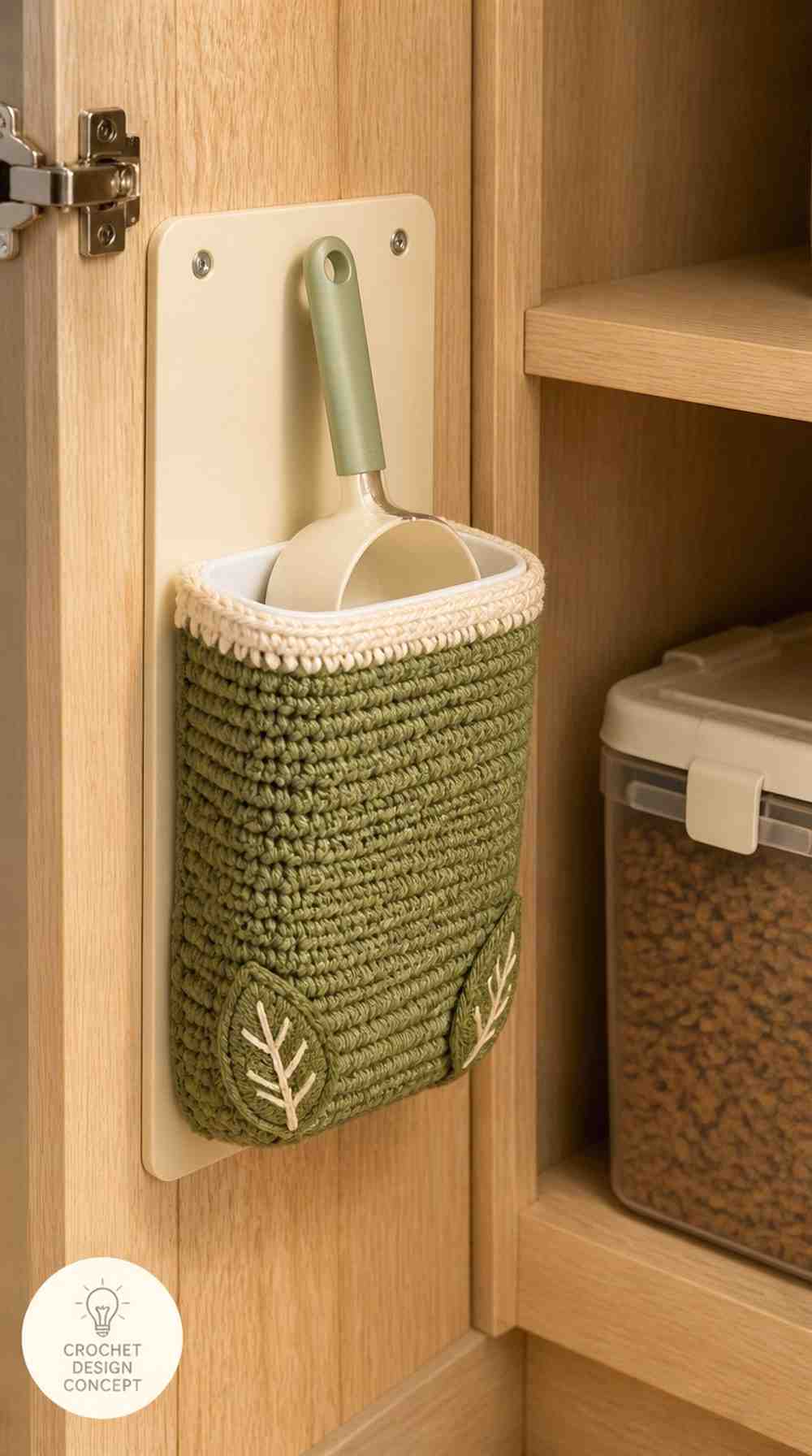
Olive-green crochet forms a narrow storage pocket with dense horizontal rows and an oatmeal upper border. Two flat leaf motifs decorate its lower corners, each with a cream embroidered vein. A rigid cream-backed support panel mounts inside the feeding cabinet, while a removable washable insert holds a cream scoop with a sage handle.
The botanical detail adds character to a concealed storage space. Because the holder sits inside a cabinet, its overall depth matters as much as its appearance. The scoop should remain easy to reach without contacting shelving or the door.
- Leaf-Corner Motifs: Flat leaves create a gentle decorative finish without extending into the scoop’s opening.
- Cabinet Interior Fit: Measure shelf depth and door clearance before planning the mounted holder.
- Rigid Back Panel: A firm mounting surface helps prevent the narrow crochet pocket from folding around its washable insert.
- Separate Food Storage: Keep the scoop holder away from exposed kibble, damp cleaning supplies and other cabinet contents.
10. Crochet Lavender Button-Flap Scoop Pouch
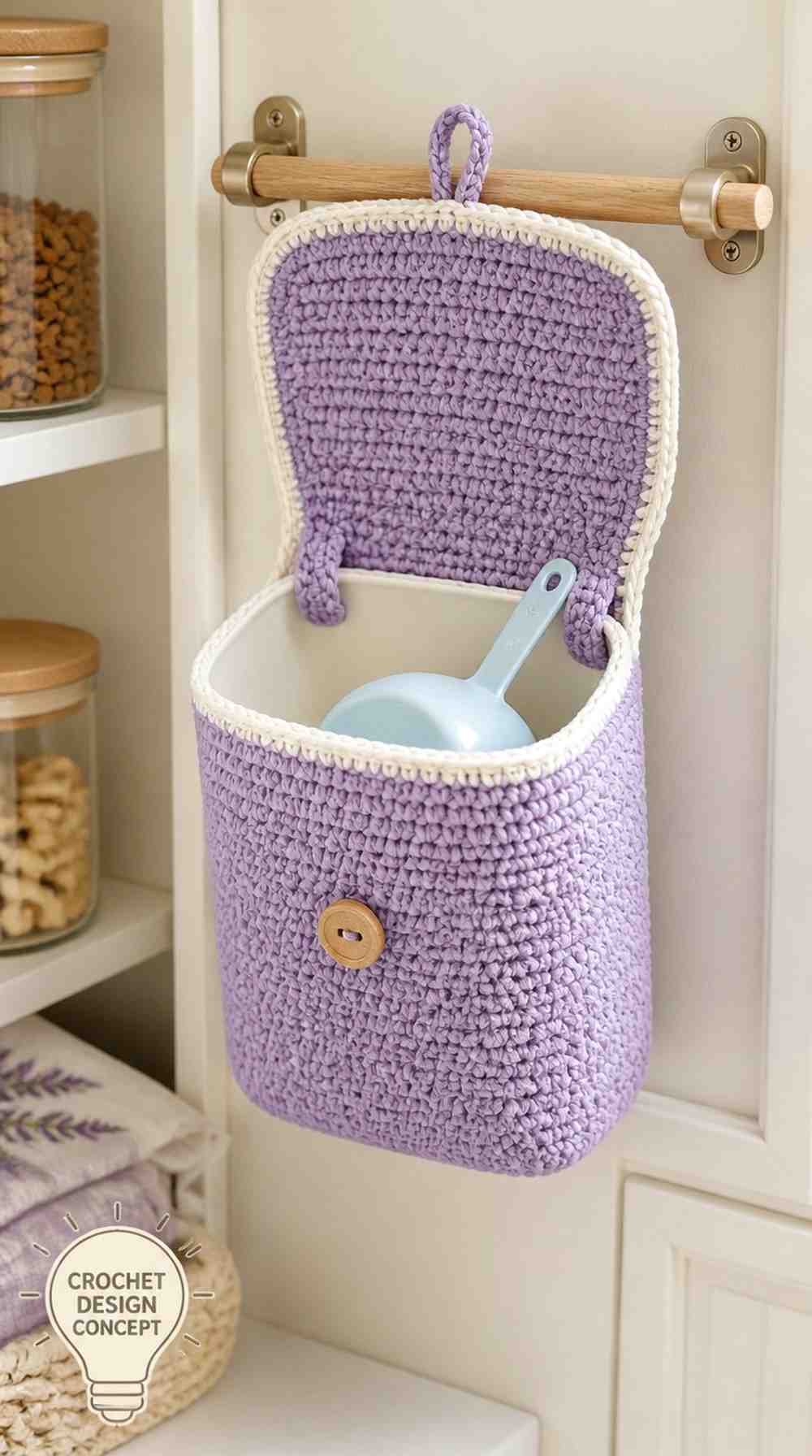
Soft lavender crochet creates a compact wall pouch with dense moss stitches and an ivory-edged foldover flap. A small wooden button closes the front, while two reinforced loops attach the pouch to a pale-oak dowel. The flap is shown open, revealing a clean pale-blue scoop inside a removable cream washable cup.
The covered opening gives this design a tidier appearance than an ordinary open pocket. It also adds a fastening step, making the arrangement better suited to a scoop that is stored between occasional uses rather than frequently removed.
- Rounded Foldover Flap: The upper crochet section should close without pressing heavily against the scoop handle.
- Wooden Button: The fastening needs a secure attachment and a loop that can be opened without stretching the pocket out of shape.
- Removable Inner Cup: The hard washable insert keeps the scoop bowl separated from the moss-textured crochet.
- Flap Clearance: Allow enough room to lift the cover fully without knocking the scoop or nearby containers.
11. Crochet Coral Roll-Top Pet Scoop Pouch
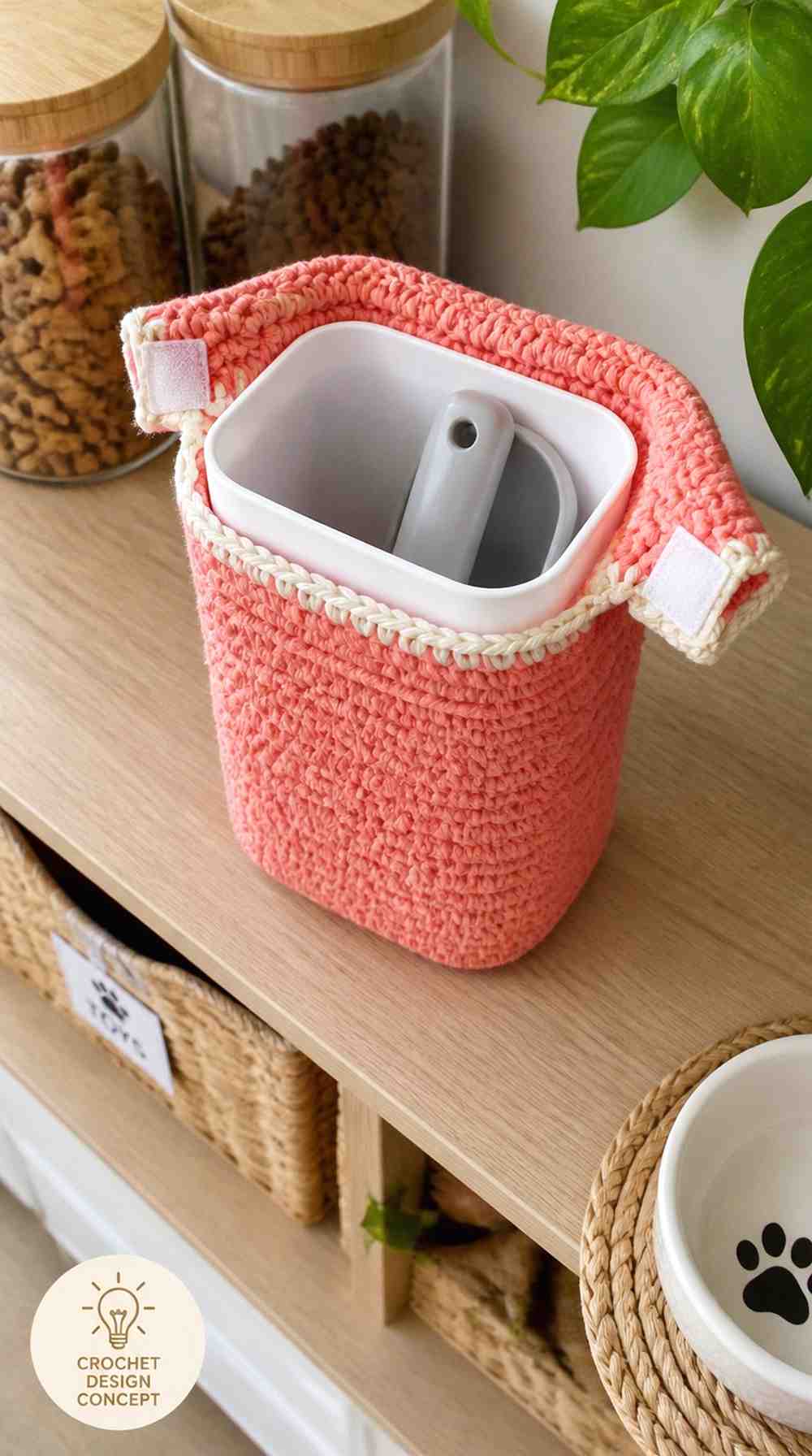
Coral crochet forms a small roll-top pouch with horizontal rows and a narrow ivory border. Two short cream fastening straps sit at the upper sides. Inside, a removable white hard liner contains a compact clean gray scoop, with its short handle visible while the fabric top is partly unrolled.
The roll-top arrangement offers a more enclosed storage option than a basic hanging pocket. Its compact shape makes it suitable for a shelf or cupboard, although the scoop must be washed and fully dried before the pouch is closed.
- Roll-Down Opening: The flexible coral upper section should fold without forcing the scoop against its rigid inner case.
- Short Closure Straps: Flat hook-and-loop fasteners avoid the need for long dangling cords.
- Hard Inner Case: A separate removable liner makes it easier to clean the surface that holds the scoop bowl.
- Closed Storage: Do not seal a damp utensil inside the pouch, since fabric can retain moisture.
12. Crochet Oatmeal Freestanding Scoop Pocket Stand
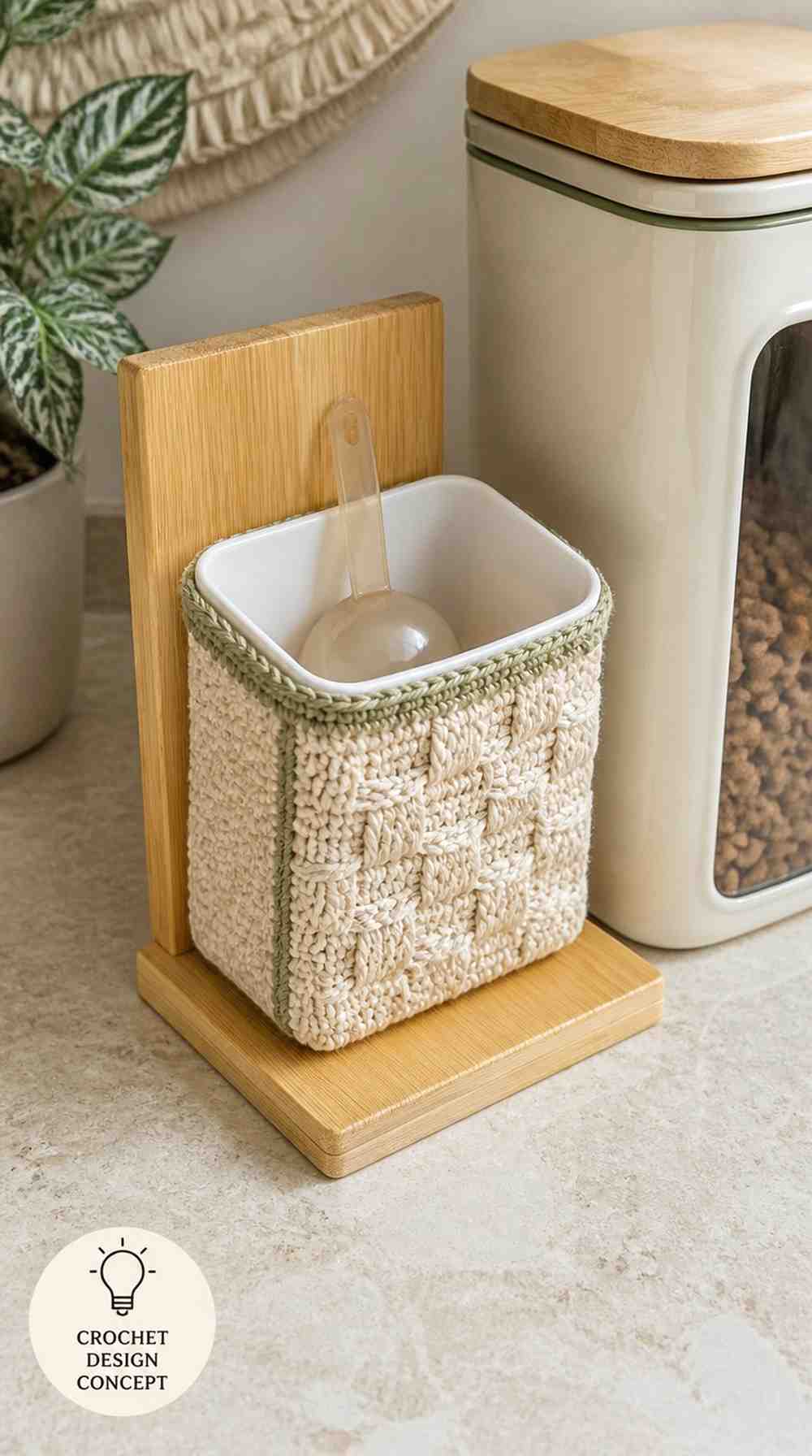
Oatmeal crochet creates a basketweave-textured storage pocket attached to a small pale-bamboo tabletop stand. A sage-green border finishes the opening, while a rigid backboard and broad rectangular base provide support. A removable white washable plastic insert holds a dry beige measuring scoop with its handle upright.
This concept works differently from a hanging wall pocket because the whole holder stands independently. It may suit a dry feeding counter where wall installation is inconvenient, provided the base remains stable when the scoop is removed.
- Freestanding Base: A wide rigid bottom helps prevent the stand from tipping as the scoop is lifted.
- Basketweave Texture: Raised oatmeal stitches create a warm decorative surface without replacing the smooth inner insert.
- Sage Upper Edge: A contrasting rim makes the pocket opening easy to identify.
- Countertop Position: Keep the stand away from food spills, water bowls and areas where pets could knock it over.
13. Crochet Rust Snap-Strap Bin-Rail Scoop Pocket
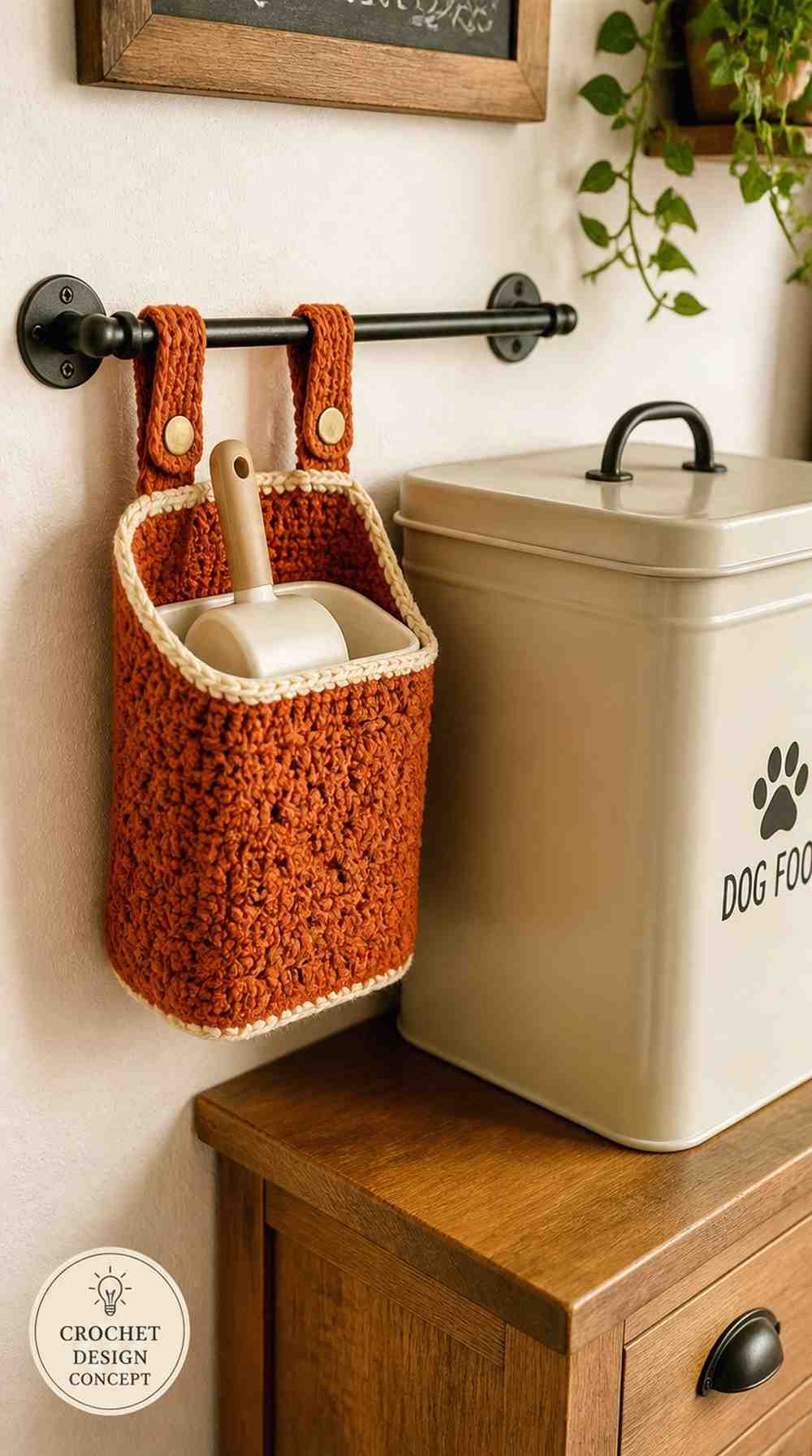
Rust-orange crochet creates a rectangular pocket with raised basketweave stitches and cream edging. Two short fabric-backed straps use matte-brass snaps to attach the pouch to a separate steel wall rail beside a closed pet-food container. A clean ivory scoop rests inside a smooth removable cream liner, with its tan handle visible.
The snap-strap arrangement provides a different mounting option from clamps or wooden dowels. Importantly, the rail is separate from the storage bin, so the holder does not interfere with the container’s lid or seal.
- Separate Wall Rail: The holder stays beside the food bin without attaching hardware to the container’s airtight lid.
- Two Snap Fasteners: Reinforced straps need secure backing so repeated opening does not pull through the crochet.
- Rust Basketweave Exterior: Dense textured stitches add visual interest while the smooth cup supports the scoop bowl.
- Removable Accessory: Check that the pouch can be detached easily for cleaning or when the feeding area is rearranged.
14. Crochet Seafoam Pegboard Scoop Storage Pocket
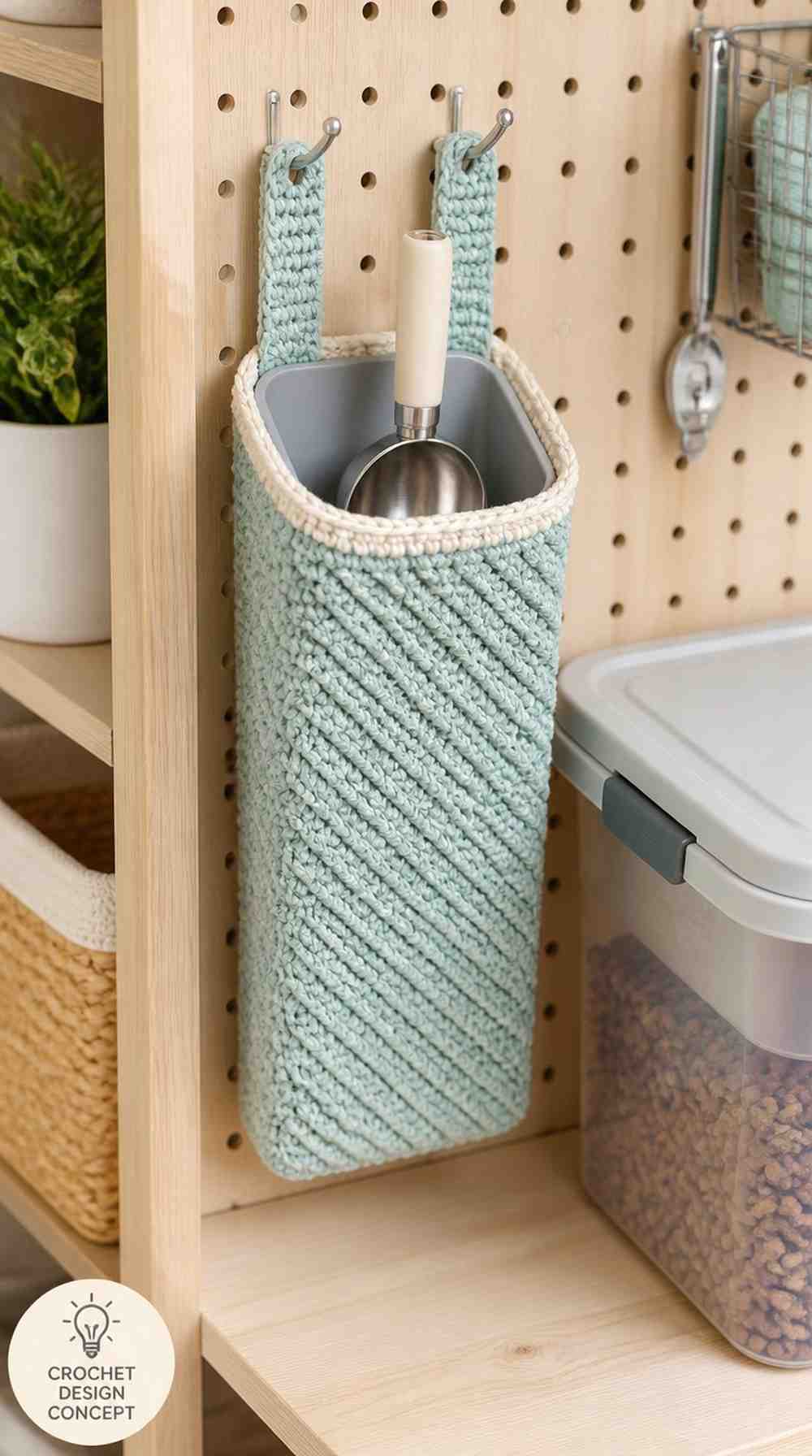
Seafoam-green crochet forms a tall narrow pocket with diagonal ridges and an ivory upper rim. Two reinforced tabs connect the holder to blunt metal hooks on a wooden pegboard. A removable gray washable insert contains a clean stainless-steel scoop, its cream handle extending above the opening.
The pegboard arrangement offers flexible placement beside other household storage accessories. Its main benefit is the ability to reposition the pocket without changing the crochet itself, although the wall board and hooks must be suitable for the holder.
- Pegboard Mounting: Choose hooks that fit the board securely and remain in position when the scoop is removed.
- Diagonal Crochet Ridges: Raised seafoam stitches provide a distinct surface without creating openings in the actual scoop compartment.
- Smooth Gray Insert: The washable cup separates the metal food-contact bowl from the yarn.
- Compact Vertical Design: A tall narrow pocket occupies relatively little horizontal storage space while keeping the handle accessible.
15. Crochet Indigo Checkerboard Over-Door Scoop Sleeve
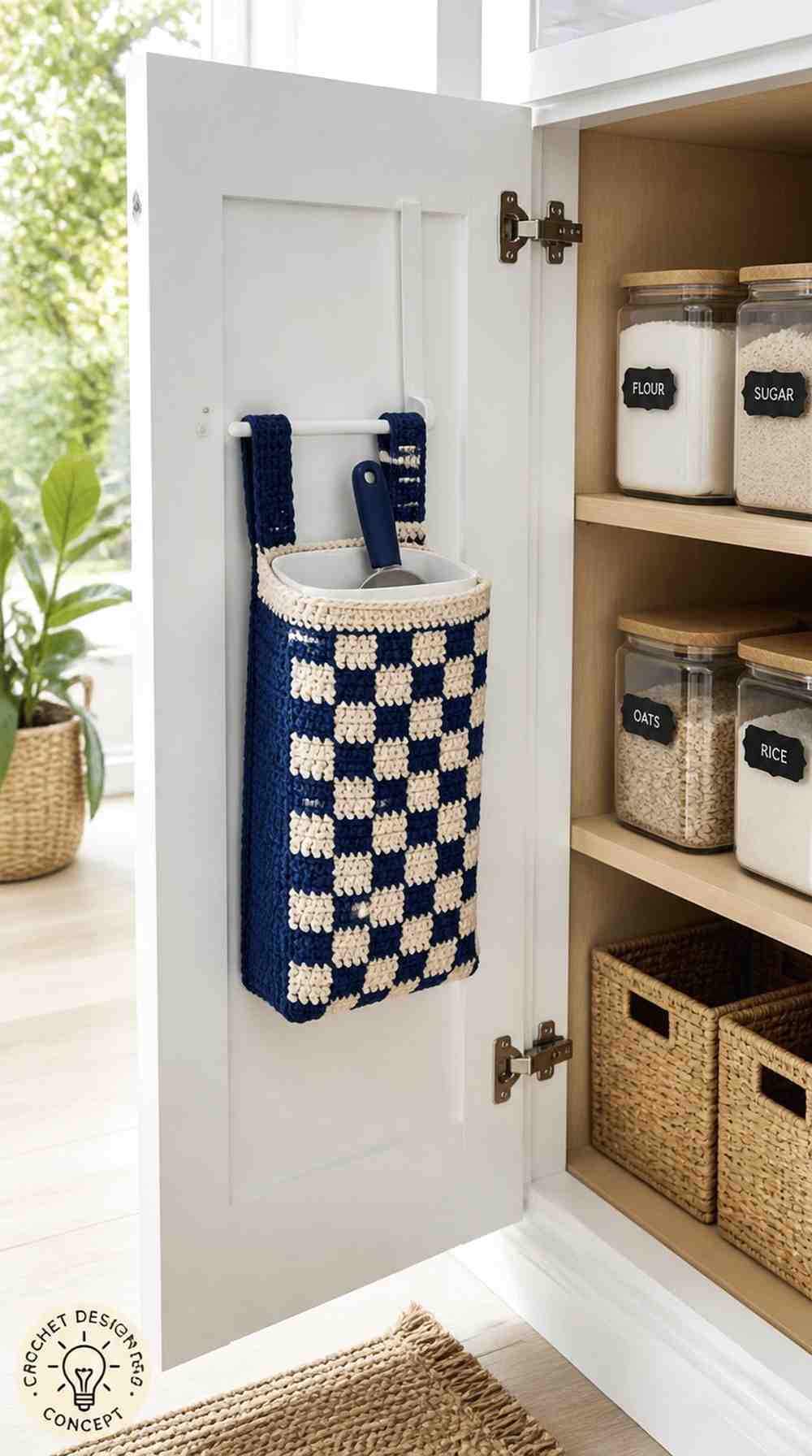
Indigo-and-ivory crochet squares form a compact scoop sleeve hanging inside a pantry cabinet door. A rigid white over-door bracket supports the panel, while two reinforced indigo tabs connect to a short horizontal bar. A smooth washable white inner cup contains a gray scoop with a dark-blue handle.
The checkerboard pattern makes this a decorative alternative to a plain door-mounted holder. Its success depends on the cabinet’s available space, because the scoop and pocket must remain clear of shelves when the door closes.
- Checkerboard Crochet: Small indigo and ivory squares create a graphic exterior, while solid side seams maintain the pocket’s shape.
- Over-Door Bracket: Check the door thickness and top clearance before choosing the mounting hardware.
- Cabinet Closing Space: Ensure the handle and pocket do not strike the interior shelves or interfere with hinges.
- Individual Washable Cup: The scoop bowl rests in a separate removable insert rather than against the colored crochet squares.
16. Crochet Plum Fold-Flat Scoop Pocket Panel
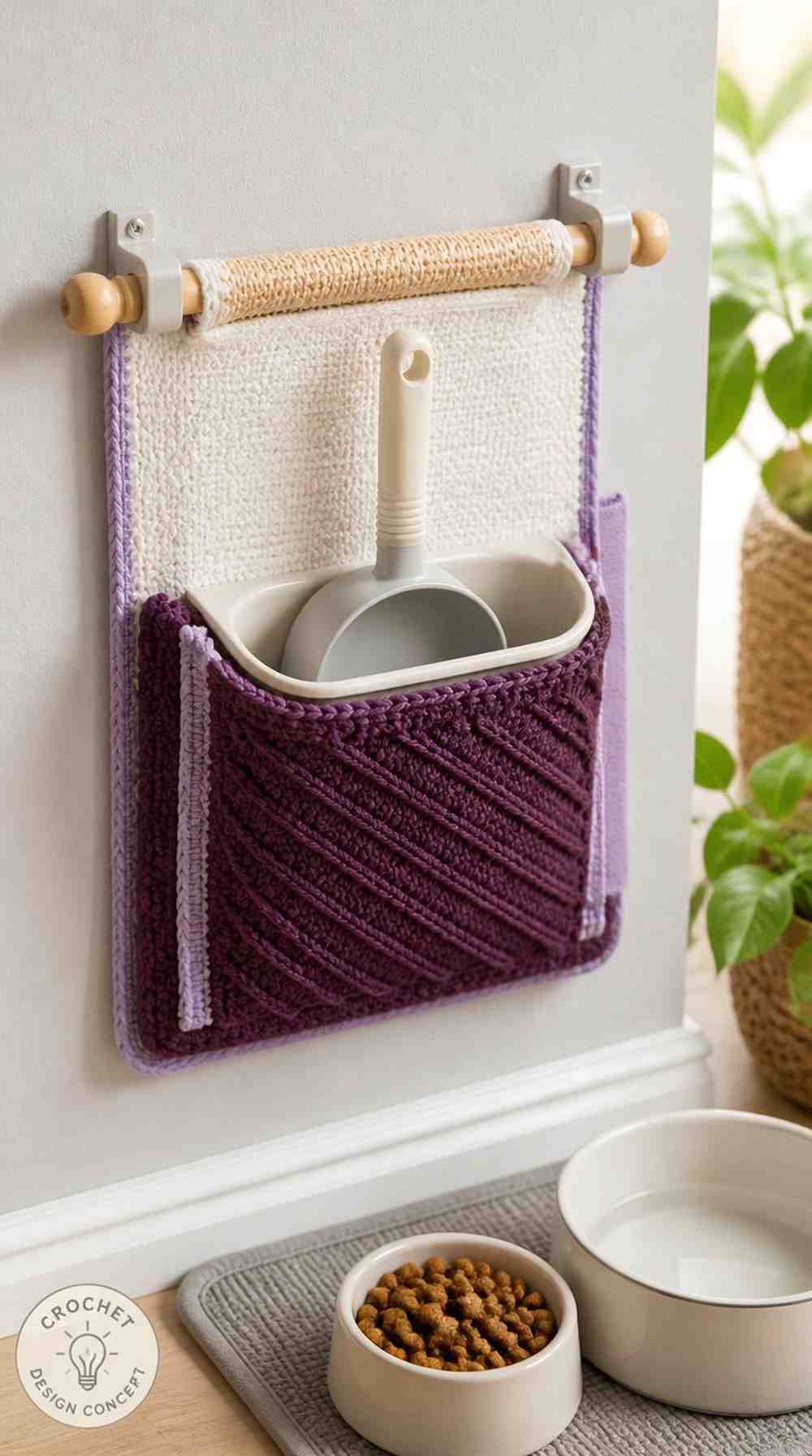
Deep-plum crochet creates a shallow pocket with diagonal raised ridges, lilac edging and two flexible side gussets. A cream-backed panel hangs from a short oak bar on wall brackets. A removable ivory washable cup keeps a clean gray scoop upright, while a flat lilac tab sits along one side.
This concept explores a storage pocket that could collapse when empty. Removing the rigid insert allows the side gussets to fold inward, reducing the space occupied by the decorative panel. It would need to remain fully open and supported whenever the scoop is stored.
- Fold-Flat Side Gussets: Flexible side panels allow the empty pocket to collapse without relying on stretched crochet.
- Removable Rigid Insert: Take out the washable cup before folding the decorative holder flat.
- Lilac Retaining Tab: The short side closure is intended to secure the empty collapsed pocket, not squeeze the scoop.
- Open Storage Position: The pocket needs a stable shape when loaded so the scoop remains accessible and upright.
17. Crochet Sky-Blue Basket-Rim Scoop Pocket
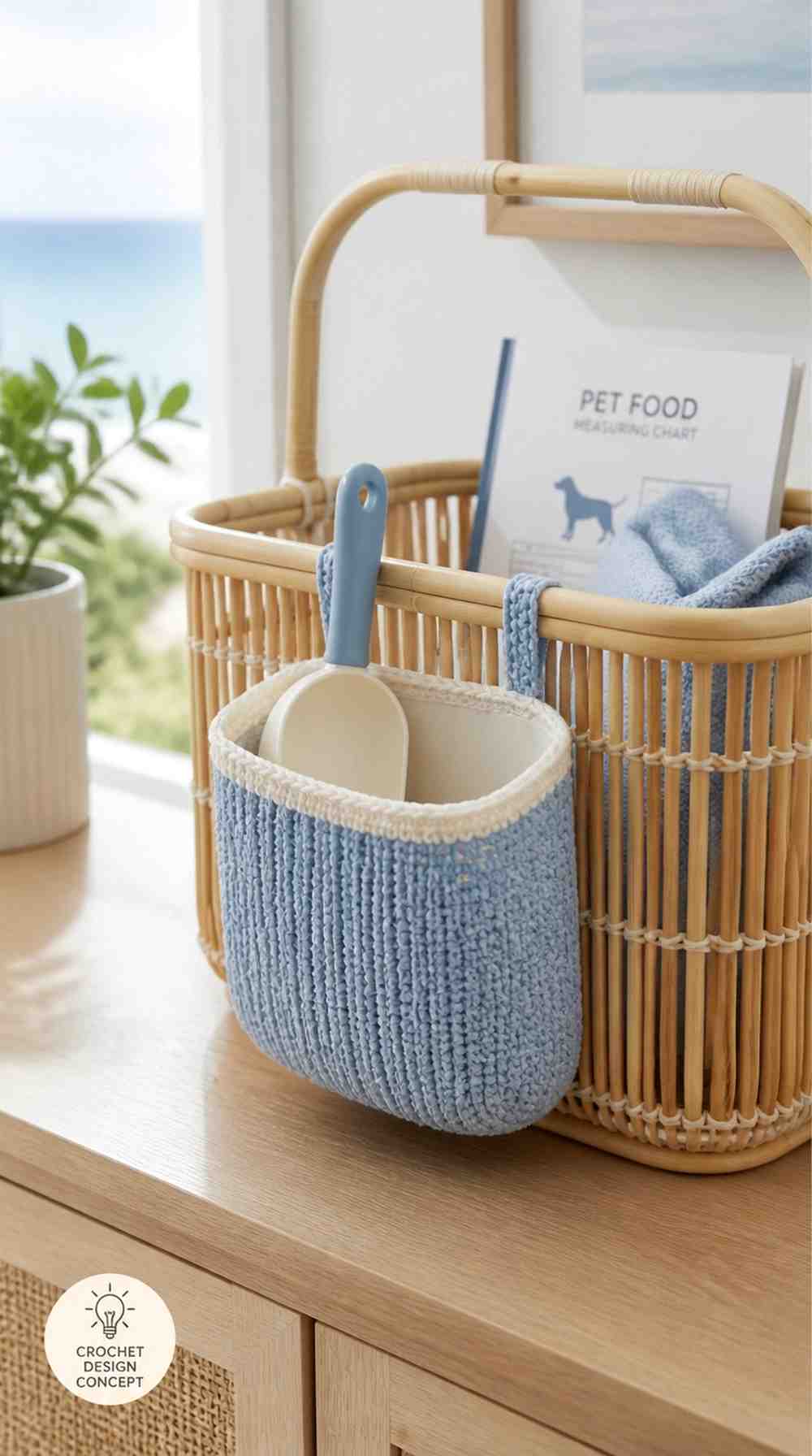
Sky-blue crochet creates a compact rectangular scoop pouch with vertical ribbing, a cream upper border and rounded lower corners. Two short reinforced straps attach it to the solid outside rim of a bamboo pet-feeding supply basket. A smooth ivory washable insert supports a clean cream scoop with a light-blue handle.
The basket-rim placement keeps the utensil beside other feeding supplies without putting it directly inside the basket. The scoop remains separate from the folded cloth and closed booklet stored in the main compartment.
- Outside Basket Storage: A dedicated outer pocket keeps the scoop easy to identify without mixing it into the basket’s main contents.
- Rigid Rim Attachment: Fasten the pouch around a solid basket frame rather than fragile decorative weaving.
- Unobstructed Handle: Keep both mounting straps clear of the basket’s original carrying grip.
- Washable Insert: Remove and clean the hard inner cup independently, especially if dry-food residue collects inside.
18. Crochet Cream and Sage Dual-Measure Scoop Caddy
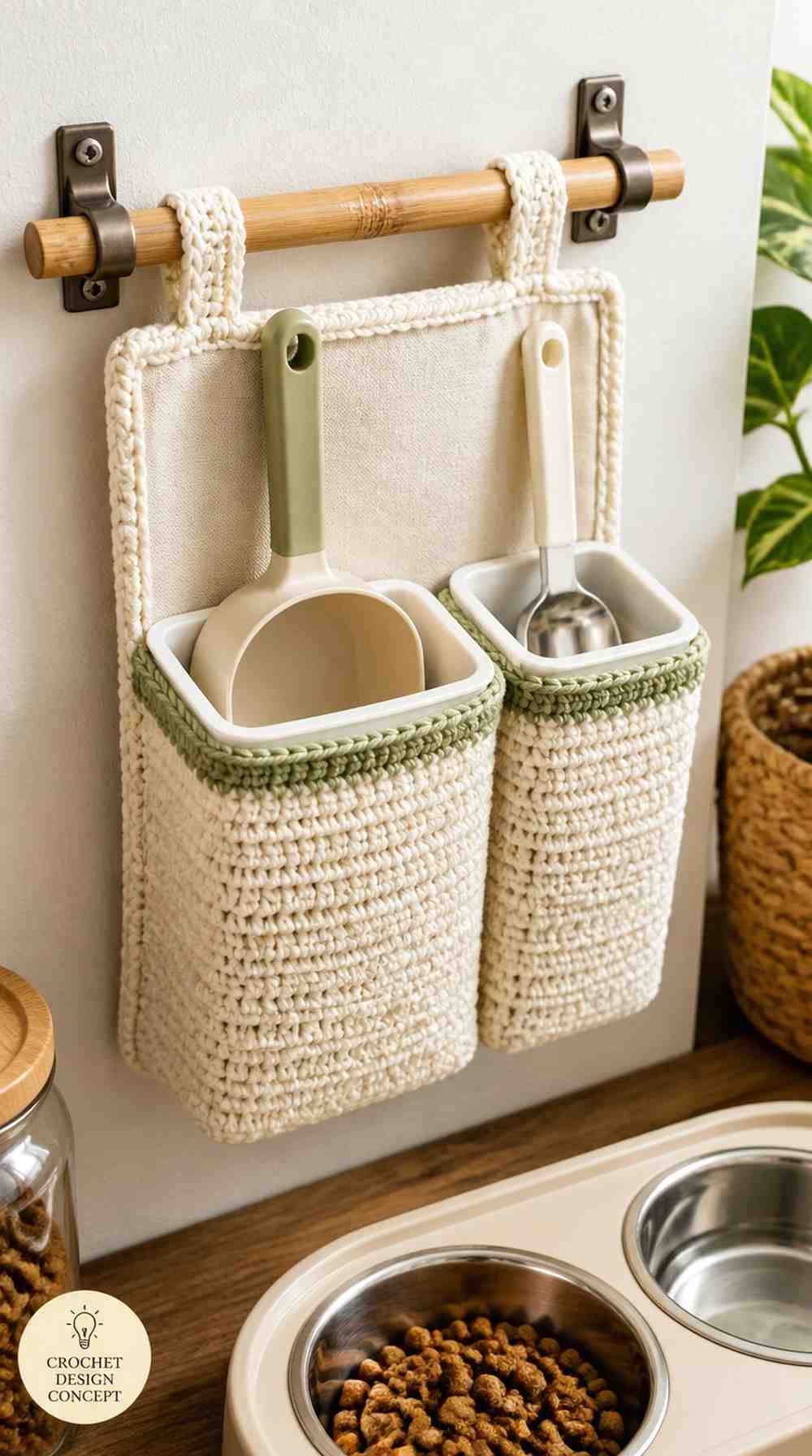
Cream crochet creates a compact wall organizer with two unequal pockets and sage-green upper borders. The wider left compartment contains a beige pet-food scoop, while the narrow right pocket holds a stainless-steel measuring spoon. Both utensils rest bowl-down inside separate removable white washable inserts.
This design is especially useful when feeding requires two different measuring utensils. The separate pocket widths keep the larger scoop and smaller spoon organized without allowing their food-contact bowls to rub against the crochet or each other.
- Two Unequal Compartments: The larger left pocket fits the broad scoop while the narrower right side holds the measuring spoon.
- Independent Liners: Each utensil has its own removable washable insert, making cleaning easier without disturbing the other compartment.
- Sage-Green Borders: Contrasting upper rims make both storage openings visible against the cream crochet body.
- Dowel Support: Reinforced loops and secure brackets must carry both utensils without allowing the caddy to tilt.
Practical Guide to Crochet Pet Food Scoop Storage Pockets
A useful pet-food scoop pocket should keep the utensil easy to reach while supporting a clean feeding routine. The most important choice is separating the decorative crochet from the surface that touches pet food.
Measure the scoop first. Check the width and depth of the bowl, the handle length and the overall shape. A broad plastic scoop needs a different pocket from a slim metal measuring spoon. Leave enough of the handle visible for easy removal without pulling against the crochet rim.
Use a removable washable insert. A smooth, nonporous cup or holder that is suitable for the intended use is more practical than placing the scoop bowl directly into yarn. The insert should be easy to remove, wash and dry. The illustrated plastic liners are design concepts, not verified food-safe products.
Clean scoops after use. The U.S. Food and Drug Administration recommends washing pet-food bowls and scooping or measuring utensils with soap and hot water after each use. Scoops should also be dried and used only for pet food.
FDA+1
Choose the mounting spot carefully. Place the holder in a dry, easy-to-clean area near the food container but away from wet bowls, splashes and cleaning chemicals. Make sure attached pockets do not interfere with food-container lids or seals.
Keep food storage separate. A decorative scoop holder is not an airtight food container. The FDA advises keeping dry pet food in its original packaging where possible and storing it in a cool, dry, secure location.
FDA
Check stability and maintenance. Crochet pockets may stretch under repeated use, so firm backing and reinforced attachments are worth considering. Clean the removable cup regularly, inspect the fabric for residue or dampness and keep any small decorative pieces securely attached.
For other ways to organize household accessories, see 20 Crochet Hanging Wall Pocket Organizer Ideas on Yarn Nest Studio. It explores general hanging pockets and supports that could inspire a coordinated storage area.
Want to Make Something Similar?
These 18 concepts are AI-generated crochet inspiration ideas, not tested scoop holders or complete patterns. The following resources teach relevant hanging-pocket construction, but they do not establish hygienic suitability for pet-food utensils.
The Free Crochet Wall Organizer Pattern — Happy Heartsy by Lenka demonstrates how to make three hanging pockets, attach wooden dowels and join the compartments. Its construction techniques are relevant to the Sage Ribbed Wall Scoop Pocket and Teal Two-Size Scoop Wall Pockets.
Easy 3 Pocket Hanging Storage
The Crochet Wall Pocket Organizer — CyCrochet provides a free pattern with a flat backing, folded pocket and simple hanging loop. It offers a useful starting point for understanding a compact pouch shape, but does not reproduce any of the illustrated scoop holders.
CyCrochet
For actual hygiene and storage recommendations, see the FDA’s Tips for Safe Handling of Pet Food and Treats and its guidance on cleaning feeding utensils, avoiding cross-contamination and keeping dry pet food properly stored.
FDA
Comparison: Which Pet Food Scoop Storage Pocket Should You Choose?
| Design | Main feature | Practical consideration |
|---|---|---|
| Sage Ribbed Wall Scoop Pocket | Simple dowel-hung pouch | Secure wall support |
| Terracotta Bin-Side Pocket | Clamped beside food bin | Lid and handle clearance |
| Navy Narrow-Handle Sleeve | Slim cabinet storage | Scoop bowl width |
| Ivory Granny-Square Caddy | Traditional crochet motif | Solid backing and liner |
| Mustard Sunflower Hoop Pocket | Decorative circular display | Rigid hoop crossbar |
| Blush Scalloped Shelf Pocket | Removable shelf clamps | Shelf finish and stability |
| Teal Two-Size Wall Pockets | Two unequal scoop spaces | Individual insert fit |
| Charcoal Mesh-Front Holder | Decorative diamond openwork | Hard inner cup |
| Olive Leaf-Trim Cabinet Pocket | Botanical interior storage | Cabinet depth |
| Lavender Button-Flap Pouch | Covered opening | Handle and flap clearance |
| Coral Roll-Top Pouch | Enclosed compact storage | Dry utensil before closing |
| Oatmeal Freestanding Stand | Tabletop rigid support | Base stability |
| Rust Snap-Strap Bin-Rail Pocket | Snap-fastened wall-rail attachment | Secure strap hardware |
| Seafoam Pegboard Pocket | Removable pegboard placement | Hook compatibility |
| Indigo Checkerboard Over-Door | Cabinet-door mounted sleeve | Door closing clearance |
| Plum Fold-Flat Pocket | Collapsible empty holder | Remove rigid insert before folding |
| Sky-Blue Basket-Rim Pocket | Basket-mounted accessory | Carry-handle clearance |
| Cream and Sage Dual-Measure Caddy | Scoop and separate measuring spoon | Two removable liners |
For one everyday scoop, the Sage Ribbed Wall Scoop Pocket and Oatmeal Freestanding Stand provide relatively straightforward arrangements. The first uses a wall support, while the second sits on a stable counter.
If you want storage beside a food bin, the Terracotta Bin-Side and Rust Snap-Strap designs provide two different attachment approaches without requiring the crochet to become part of the food container.
For a feeding routine that uses two utensils, the Teal Two-Size Wall Pockets and Cream and Sage Dual-Measure Caddy offer separate spaces. The Charcoal Mesh-Front and Mustard Sunflower Hoop designs provide more decorative alternatives when visual styling matters.
Conclusion
Crochet pet food scoop storage pockets can bring a handmade touch to a practical feeding area. From sage-green ribbed wall holders and terracotta bin-side pockets to granny-square caddies, sunflower hoops and double-compartment organizers, these 18 designs offer different ways to keep a dedicated scoop close at hand.
The best choice starts with the actual scoop dimensions and a clean, washable inner holder. Once the utensil has a suitable place to rest, the surrounding crochet can provide color, texture and character without becoming the surface that contacts pet food.
Which design would you choose for your pet-feeding station? Would you prefer the Sage Ribbed Wall Scoop Pocket, the Mustard Sunflower Hoop or the Cream and Sage Dual-Measure Caddy? Share your favorite and whether you use a large kibble scoop or a smaller measuring spoon.
Frequently Asked Questions
1. Can crochet be used to make a pet food scoop storage pocket?
Yes. Crochet can form the decorative outer pocket for a pet-food scoop holder. However, a separate smooth, removable washable insert is a more practical surface for the scoop bowl than direct contact with yarn. The complete holder still needs appropriate mounting and cleaning.
2. Is it hygienic to put a pet food scoop directly into crochet?
Direct contact with crochet is not the preferred arrangement because yarn can retain food particles and moisture and can be harder to clean thoroughly. Use a suitable washable insert, and wash and dry the dedicated pet-food scoop after use as recommended by the FDA.
FDA
3. What yarn is suitable for a crochet scoop storage pouch?
A smooth washable cotton or appropriate cotton-blend yarn may work for the decorative outer pocket. Dense stitches can help it retain its shape, while a firm backing may support larger holders. The yarn should not be treated as a food-safe material or replace a cleanable inner cup.
4. Can I attach the scoop holder directly to a pet food storage container?
Some container shapes may accommodate an external accessory, but an attachment should not interfere with the lid, airtight seal, handle or stability. A separate nearby wall rail or countertop holder may be easier to manage. Follow the container manufacturer’s instructions and preserve normal food-storage conditions.
5. Are these 18 crochet pet food scoop storage pockets complete patterns?
No. These are original AI-generated crochet design concepts, not tested patterns or certified hygienic storage products. The linked tutorials demonstrate related pocket construction but do not reproduce the pictured holders exactly. Before making one, check the scoop dimensions, removable liner, mounting strength, cleaning routine and compatibility with the pet-feeding area.