Keeping canned foods organized can make a crowded pantry much easier to use, especially when different sizes and types end up mixed together. These 16 crochet canned food shelf divider inspiration ideas explore practical storage arrangements with a softer handmade appearance. From sage-green wooden partitions and terracotta can lanes to adjustable mint dividers, lilac two-tier shelves and compact cream grids, each concept uses crochet texture and color to give ordinary pantry organizers a distinctive finish.
The collection includes designs for deep shelves, narrow cupboards, wire shelving and wider pantry spaces. Some dividers separate cans by type, while others create individual compartments or adjustable lanes for different can sizes. As you compare the ideas, pay attention to the supporting frame, can stability, shelf clearance and access to items stored at the back. Full cans are heavy, so the most sensible designs use rigid supports beneath their crocheted coverings.
These are AI-generated crochet design visualizations for inspiration, not photographs of tested handmade pieces or step-by-step patterns.
Quick Design Selection Guide
- For simple everyday sorting: Crochet Sage Parallel Shelf Divider and Crochet Mustard Shelf-End Partition Rack create straightforward groups of upright cans.
- For wire pantry shelving: Crochet Ivory Clip-On Wire Divider uses panels designed around a wire shelf structure.
- For horizontal can storage: Crochet Terracotta Angled Can-Lane Divider introduces supported sloping lanes with a rigid front stop.
- For changing can sizes: Crochet Dusty-Blue Adjustable Shelf Dividers and Crochet Mint Sliding-Track Pantry Dividers use movable partitions.
- For compact spaces: Crochet Plum Narrow-Shelf Divider Rack and Crochet Cream Cross-Grid Mini Can Organizer focus on smaller storage areas.
- For larger collections: Crochet Lilac Two-Tier Shelf Divider and Crochet Rust Front-to-Back Can Divider offer two different ways to organize more cans.
- For color and decorative flexibility: Crochet Peach Mixed-Width Shelf Divider and Crochet Mocha Reversible Shelf Dividers provide different compartment arrangements and finishes.
1. Crochet Sage Parallel Shelf Divider
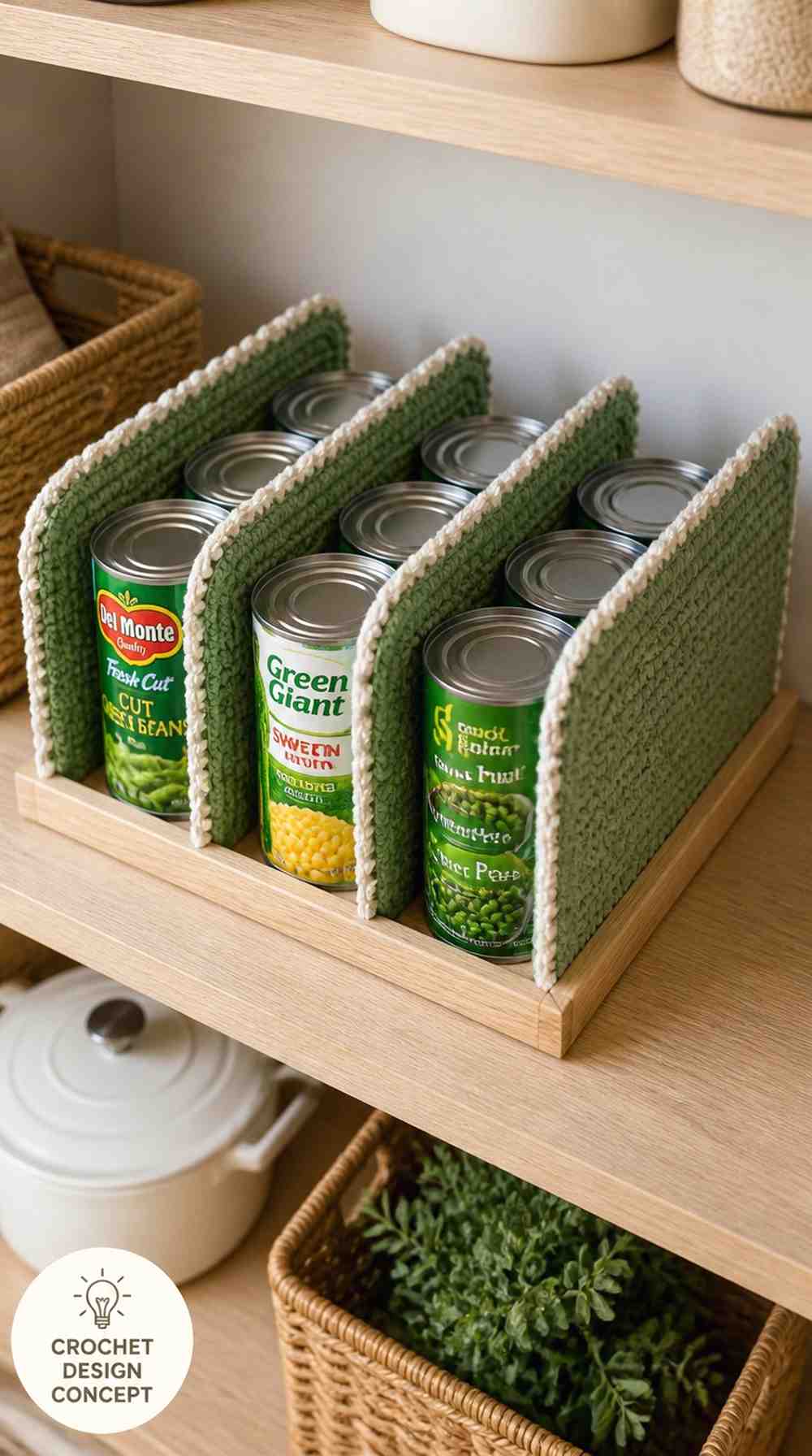
Sage-green crochet gives this rectangular wooden shelf organizer a calm, coordinated appearance. Four upright divider panels have neatly fitted crochet sleeves with raised texture and small ivory scallops along their upper edges. Three rows of unopened canned vegetables stand separately between the panels on a pale oak shelf.
The straight partition arrangement works well for dividing cans into familiar everyday categories. Because the wooden panels and base provide the structure, the crochet coverings can remain decorative rather than having to resist pressure from heavy cans.
- Lane spacing: Measure the widest cans in each group before placing the dividers. Leave enough room to lift a can without scraping against the crochet sleeves.
- Scalloped edges: Keep the ivory edging small and above the main can contact area so repeated removal does not pull at the decorative stitches.
- Shelf depth: Check how many cans can sit in each row without hiding older items behind newer ones or making the rear cans difficult to reach.
- Wooden support: Use a properly secured rigid base and panels; crochet fabric alone should not be expected to keep heavy canned foods separated.
2. Crochet Ivory Clip-On Wire Divider
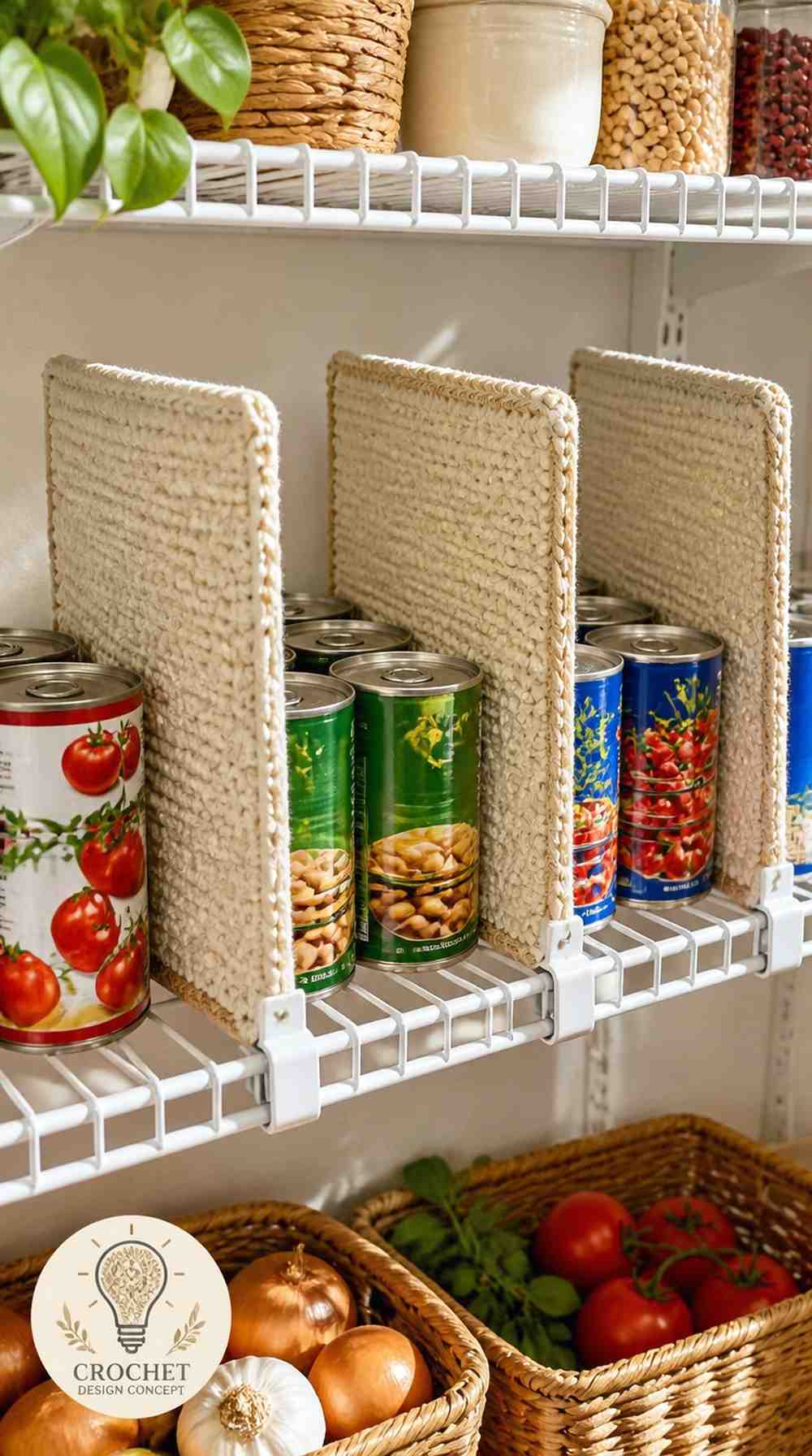
Warm ivory crochet softens three rectangular metal divider panels attached to a white wire pantry shelf. Raised diagonal stitching runs across the fitted covers, while oatmeal-colored edging gives each panel a neat finish. Canned tomatoes and beans stand upright in separate groups between the partitions.
The metal clips are an important part of this concept because wire shelves offer fewer continuous surfaces for securing dividers. The crocheted panels bring a gentle cottage style to the otherwise practical metal framework.
- Wire compatibility: Measure the spacing and shape of your shelf wires before choosing clips, since not all wire shelving systems share the same dimensions.
- Panel attachment: Secure each rigid divider at suitable points so it cannot slide or tilt when neighboring cans are moved.
- Shelf load: Confirm the wire shelf’s permitted load and avoid assuming that the divider system increases its carrying capacity.
- Crochet maintenance: A removable ivory covering may be easier to clean than one permanently attached around clips and metal joints.
3. Crochet Terracotta Angled Can-Lane Divider
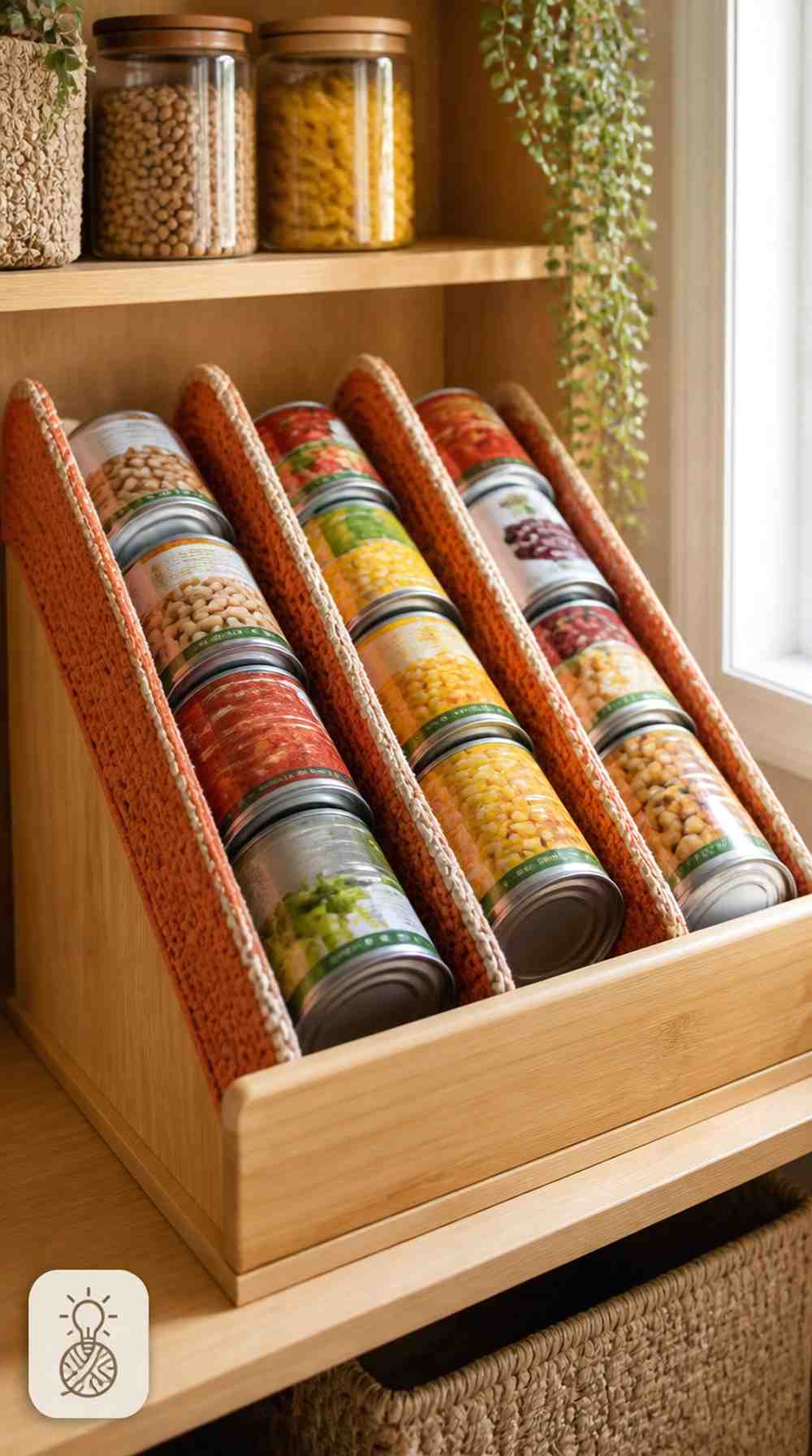
Terracotta crochet wraps the wooden side rails of this compact bamboo shelf organizer. Three gently sloping lanes hold unopened food cans horizontally, with sandy-beige crocheted edging running along the rigid separators. A raised wooden front stop prevents the cans from rolling directly off the shelf.
The horizontal arrangement creates a different storage option from traditional upright rows. It makes sense only when the slope, channel width and front retaining structure are carefully planned to control movement and keep the cans securely inside their lanes.
- Front retaining stop: The rigid wooden barrier must be high and strong enough to prevent the front can from rolling out unintentionally.
- Channel width: Allow room for the widest can diameter and any raised rims, without making the lane so broad that cans turn sideways.
- Controlled slope: A gentle incline still needs secure support. Test a prototype without relying on crochet friction to stop moving cans.
- Crochet placement: Keep terracotta coverings along the fixed rails rather than inside the rolling path, where repeated abrasion could damage the yarn.
4. Crochet Dusty-Blue Adjustable Shelf Dividers
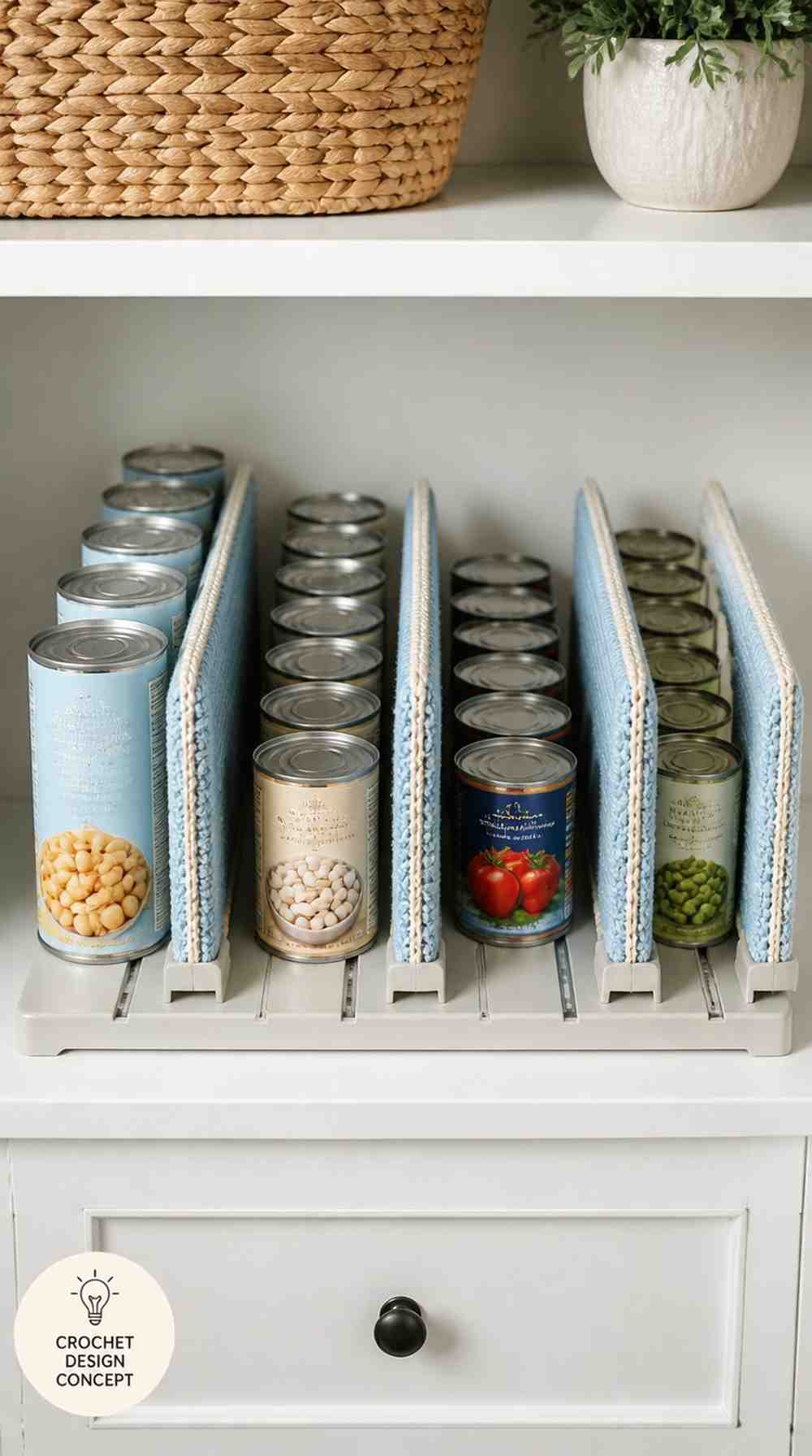
Dusty-blue crochet covers four sliding upright brackets within this white rectangular pantry organizer. Compact horizontal ridges and thin cream edging give the dividers a tidy appearance. Different-sized unopened canned foods stand in three lanes, with visible adjustment tracks running through the rigid base.
The movable partitions make this concept appealing for pantries that contain several can diameters. Unlike fixed wooden dividers, the spaces can be changed as storage needs shift, provided the brackets lock securely and the underlying organizer remains stable.
- Track adjustment: Choose a locking mechanism that holds each divider firmly in position after the gap has been changed.
- Mixed can sizes: Set the compartments according to the largest can in each group, including its lid and bottom rim.
- Crochet clearance: Keep the sleeve edges away from moving joints and tracks so yarn does not bunch or become trapped during adjustment.
- Base stability: The rigid platform should remain level and fully supported by the shelf even when the partitions are moved toward one side.
5. Crochet Mustard Shelf-End Partition Rack
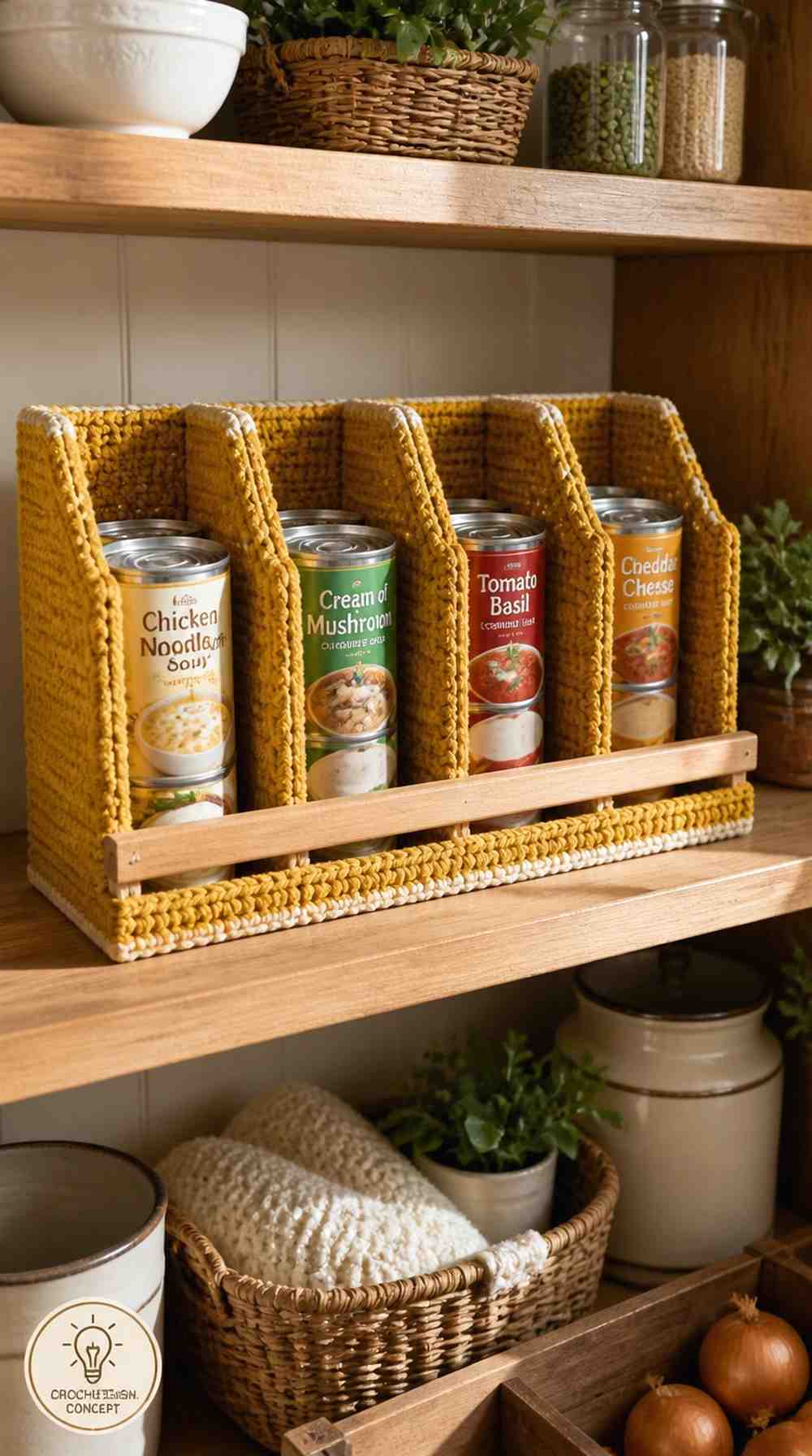
Mustard-yellow crochet brings warmth to this rectangular shelf organizer with three upright partitions. The dense basketweave-style texture covers rigid wooden panels, while small cream finishing bands soften their edges. Four groups of unopened soup cans stand upright behind a low wooden front retaining rail.
This arrangement gives a pantry shelf clearly defined sections without using a separate basket for each group. The front bar adds a physical boundary, while the partitions make it easier to keep cans from different categories mixed together.
- Front retaining bar: Keep the rail low enough for comfortable can removal but high enough to provide a useful boundary along the shelf’s front edge.
- Basketweave texture: Raised crochet stitches add warmth and depth, although thick sleeves reduce the space available between the rigid partitions.
- Compartment planning: Consider dividing cans by meal type or frequency of use rather than assigning equal space to groups you rarely access.
- Frame reinforcement: A secure wooden frame matters particularly when the organizer sits near the front edge of a pantry shelf.
6. Crochet Blush Accordion Can Separators
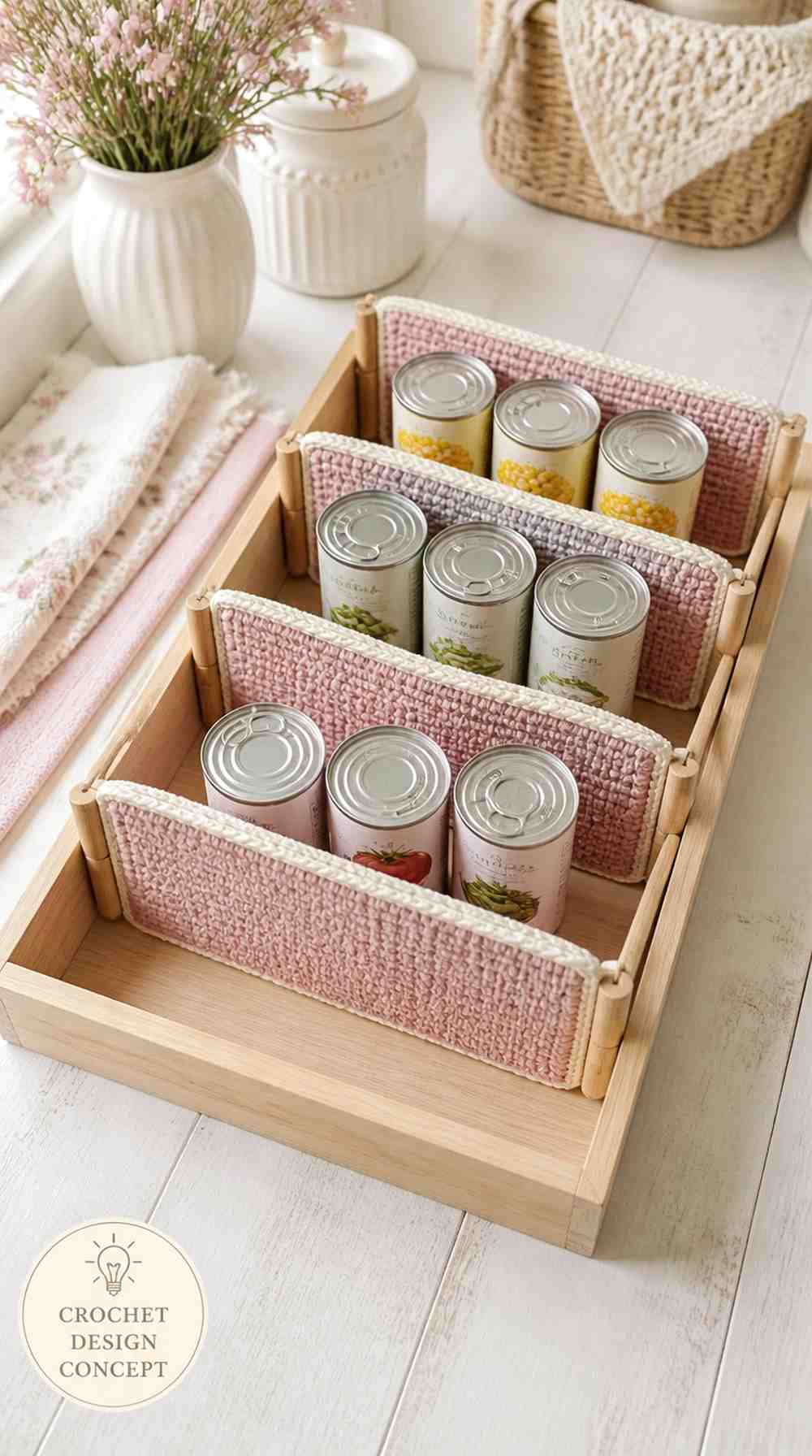
Dusty blush crochet covers four folding zigzag divider panels inside a shallow wooden pantry tray. Narrow ivory borders outline the panels, while the close stitches give each one a soft, textured surface. Three groups of small canned foods stand upright between the partially extended accordion sections.
The folding structure provides a more unusual approach to canned-food organization. It could offer storage flexibility when empty, although the divider panels must remain firmly positioned while cans are stored between them.
- Folding joints: Leave the hinge areas clear of crochet so the fabric cannot become pinched, stretched or caught during movement.
- Open-position security: A real accordion organizer needs a dependable way to hold the partitions open under normal use.
- Small-can suitability: The compact compartments may fit shorter or narrower cans better than tall, wide tins.
- Storage flexibility: Fold the dividers only after removing the cans; moving the mechanism around heavy stored items could create instability.
7. Crochet Olive L-Shaped Shelf Separators
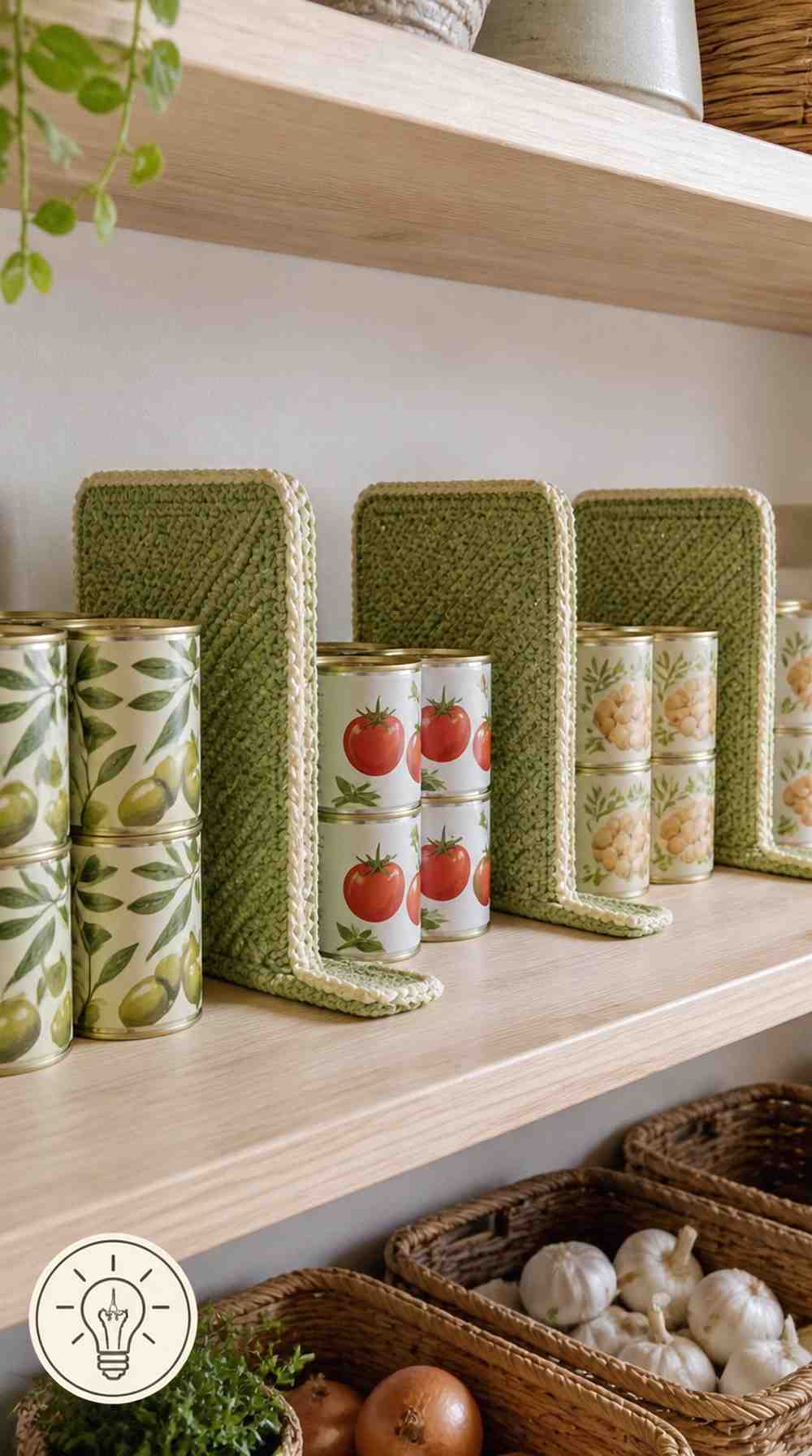
Olive-green crochet gives these three independent L-shaped shelf dividers a neat, earthy finish. Each rigid metal support has an upright crochet-covered panel with diagonal stitch rows and a narrow cream border. Short horizontal base feet rest beneath the adjacent cans, helping the panels maintain their intended position.
The individual separators can create sections without requiring a large enclosed organizer. Their simple form may suit shelves where the number of cans changes, provided the rigid feet are sufficiently supported and cannot slide unexpectedly.
- Base-foot position: Check that each horizontal foot lies flat and does not make nearby cans wobble or lean.
- Divider movement: Independent supports may shift more easily than a permanently attached frame, especially when cans are removed from one side.
- Height selection: Keep panels tall enough to form visible boundaries without blocking access to the upper portions of the cans.
- Crochet coverage: Snug olive sleeves help preserve the L-shaped silhouette while the rigid metal structure carries the mechanical forces.
8. Crochet Lilac Two-Tier Shelf Divider
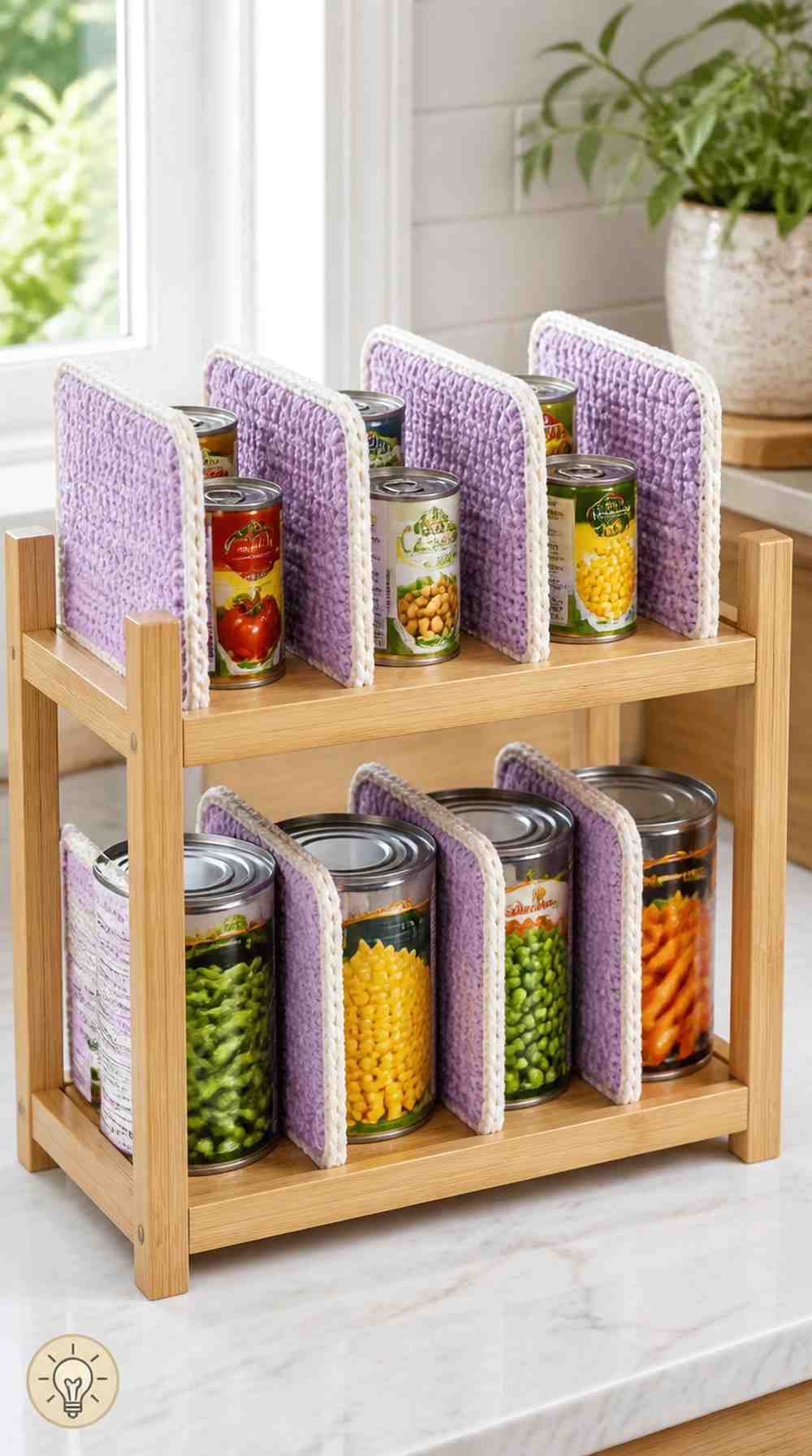
Soft lilac crochet covers the partitions on this compact two-level bamboo pantry organizer. Both tiers have three rigid dividers, creating separate spaces for canned foods. Larger cans occupy the lower shelf, while smaller tins stand upright above them. Narrow ivory edges highlight the vertical ribbed crochet texture.
The two-tier layout adds storage levels rather than simply dividing one flat surface. It may be useful on a tall pantry shelf, but the supporting frame, shelf clearances and load distribution require careful consideration because canned foods are relatively heavy.
- Vertical clearance: Measure the tallest cans on both levels and leave enough room above them for easy removal.
- Load distribution: Keep heavier cans on the lower level and choose a rigid tiered frame rated for the intended weight.
- Bamboo supports: All four corner supports should sit securely on the main pantry shelf without rocking or leaning.
- Crochet partition fit: Keep lilac sleeves firmly positioned so they do not slide down or interfere with cans moving in and out.
9. Crochet Charcoal Grid-Panel Can Divider
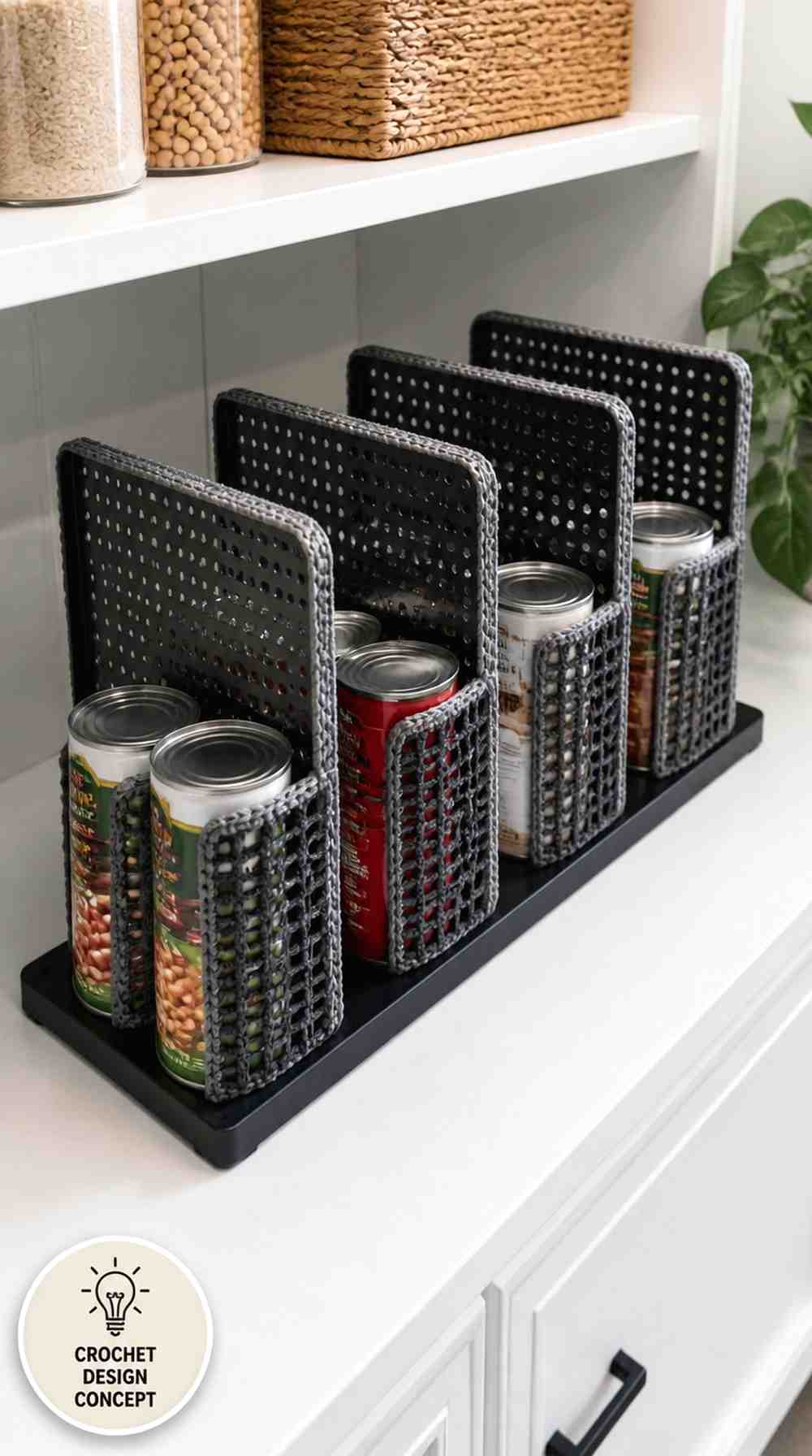
Charcoal-gray crochet creates a modern finish across three rigid metal grid partitions. Close square-mesh stitches cover parts of the perforated panels, while pale-gray borders define their edges. Four groups of canned foods sit upright inside a sturdy black rectangular shelf insert.
The partially open panels retain the look of industrial wire storage while introducing handmade texture. Unlike solid crochet partitions, the metal framework remains visible and provides the structural separation needed between heavy tins.
- Grid openings: Keep crochet loops securely attached to the metal framework without leaving long strands that could snag on can rims.
- Dark-color visibility: Bright pantry lighting helps distinguish charcoal yarn texture and makes the stored can groups easier to recognize.
- Metal edges: Smooth or appropriately protected grid edges are important because sharp corners could damage yarn during repeated use.
- Cleaning access: Removable crochet panels or sleeves may simplify cleaning dust from the metal grid and the surrounding shelf.
10. Crochet Sky-Blue Circular Can-Bay Dividers
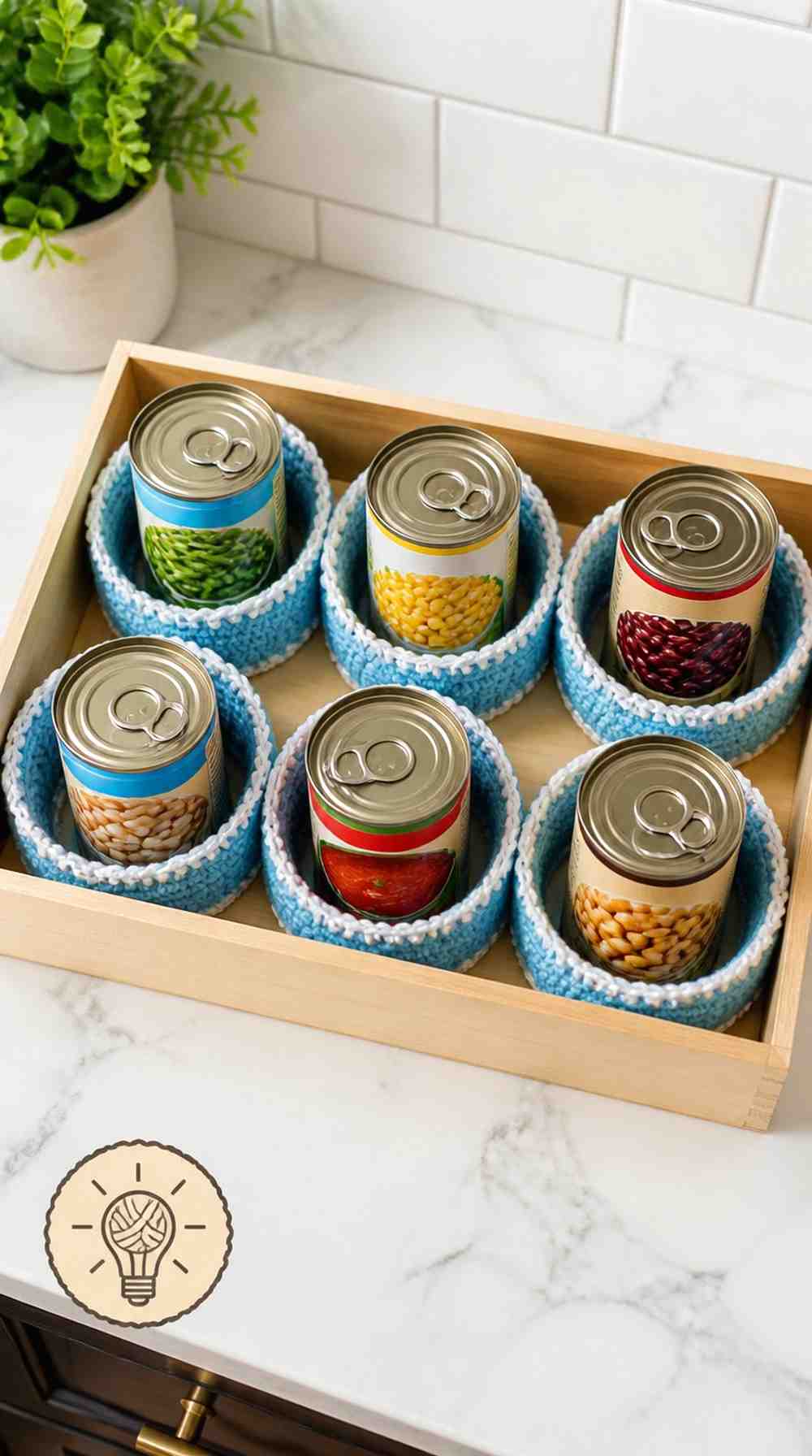
Sky-blue crochet outlines six circular compartments arranged inside a shallow birchwood tray. Each rigid ring has a neat stitched covering with small white edge loops, and one unopened food can stands upright within each individual space. The rings form two tidy rows of three.
The circular layout offers a different visual approach from straight shelves or rectangular compartments. Each can gets a defined position, making the organizer especially appealing for a small, consistent collection rather than a large assortment of different can sizes.
- Ring diameter: Measure the can’s widest rim before choosing an opening, since the body and the rolled metal edges may differ slightly in width.
- Individual access: Leave enough distance between neighboring rings for fingers to grip and lift each can comfortably.
- Capacity limitation: Six fixed circular spaces may waste room when the collection contains many different can diameters.
- Rigid ring construction: The circular supports should remain stable on the wooden base; crochet coverings are decorative and do not establish structural strength.
11. Crochet Rust Front-to-Back Can Divider
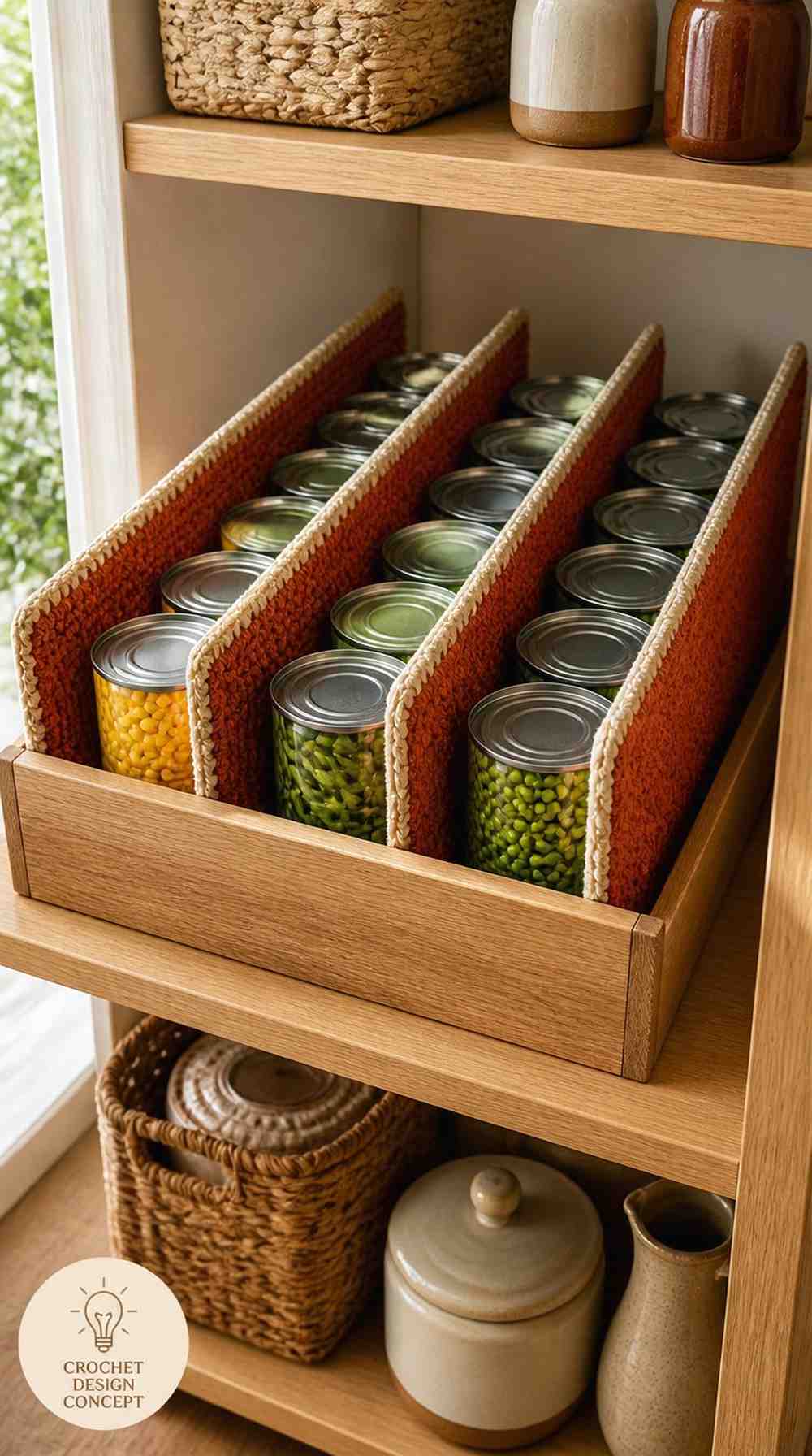
Rust-orange crochet runs along four long wooden partitions inside this deep oak shelf tray. Raised vertical stitches give the divider sleeves texture, while beige edging follows the tops of the rails. Unopened canned vegetables stand in three straight rows extending from the front toward the back of the organizer.
This design makes better use of shelf depth than a shallow arrangement of individual compartments. However, cans stored at the rear may be harder to reach or identify, so the grouping method and shelf position matter.
- Front-to-back grouping: Give each lane one can type or a clearly related group to avoid searching through unrelated products at the rear.
- Older-can access: Rotate stock intentionally by checking dates and moving earlier-use cans toward the front when restocking.
- Retaining lip: The low wooden front edge defines the lanes, but it should not make removing the first can awkward.
- Deep-shelf reach: Place the organizer where rear cans remain accessible without needing to reach dangerously far or pull against an overloaded shelf.
12. Crochet Cream Cross-Grid Mini Can Organizer
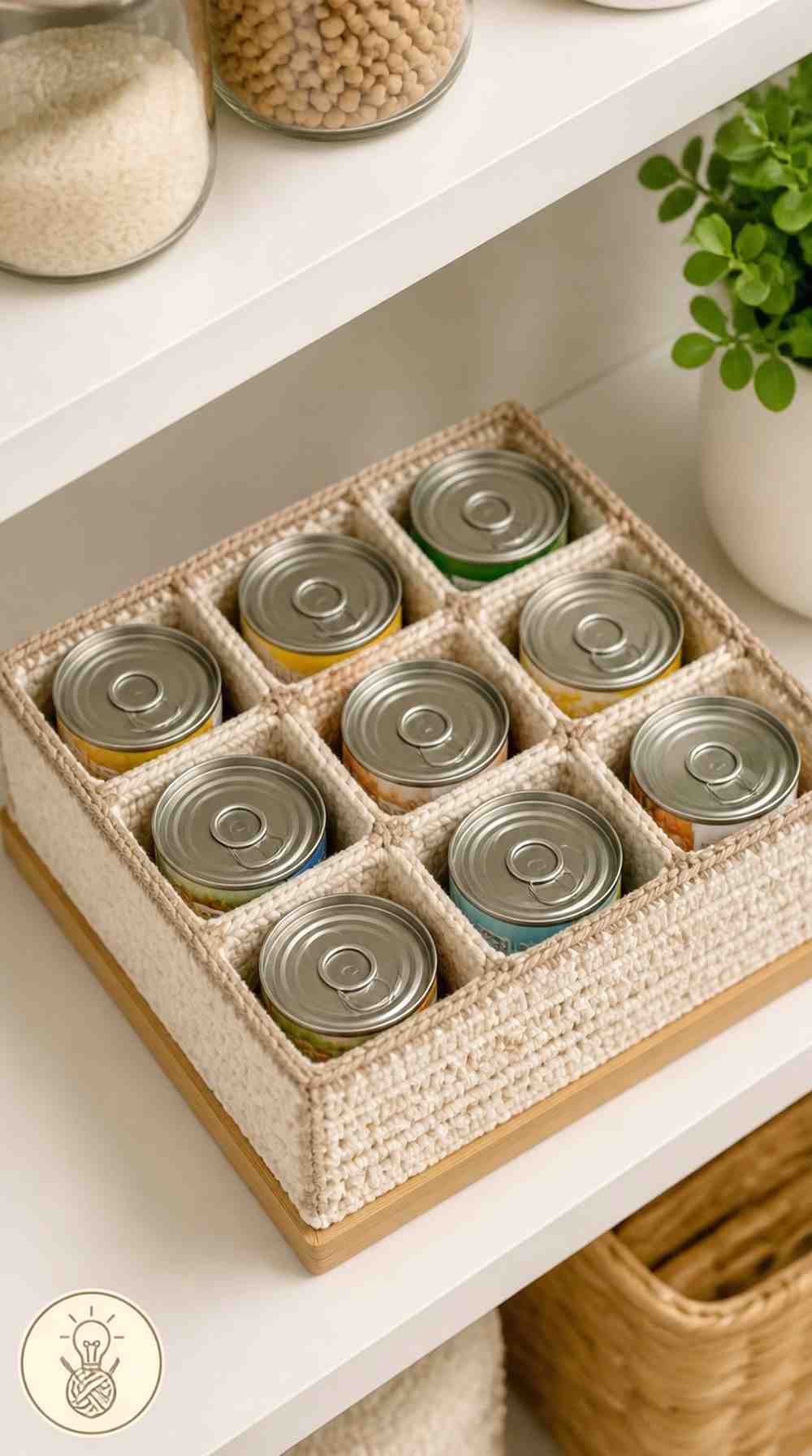
Warm-cream crochet covers a rigid cross-grid of low wooden dividers, creating nine small square compartments. Subtle waffle-like stitches give the panels a softly textured surface, while thin taupe edging keeps the design understated. Nine small food tins stand individually upright, one in each section.
The grid arrangement is particularly suited to separating smaller canned foods that could otherwise become hidden behind larger tins. Every compartment has its own boundary, which makes the layout orderly but also limits flexibility for unusually shaped products.
- Mini-can sizing: Check the widest tin in the collection before choosing the square compartment dimensions.
- Low divider height: Short partitions keep the can tops visible and accessible while maintaining a clear boundary between compartments.
- Waffle-textured covers: The raised cream stitches add detail, but excessive bulk can make small compartments unnecessarily tight.
- Fixed capacity: A nine-space grid is less adaptable when can sizes change, so it suits a fairly consistent collection best.
13. Crochet Mint Sliding-Track Pantry Dividers
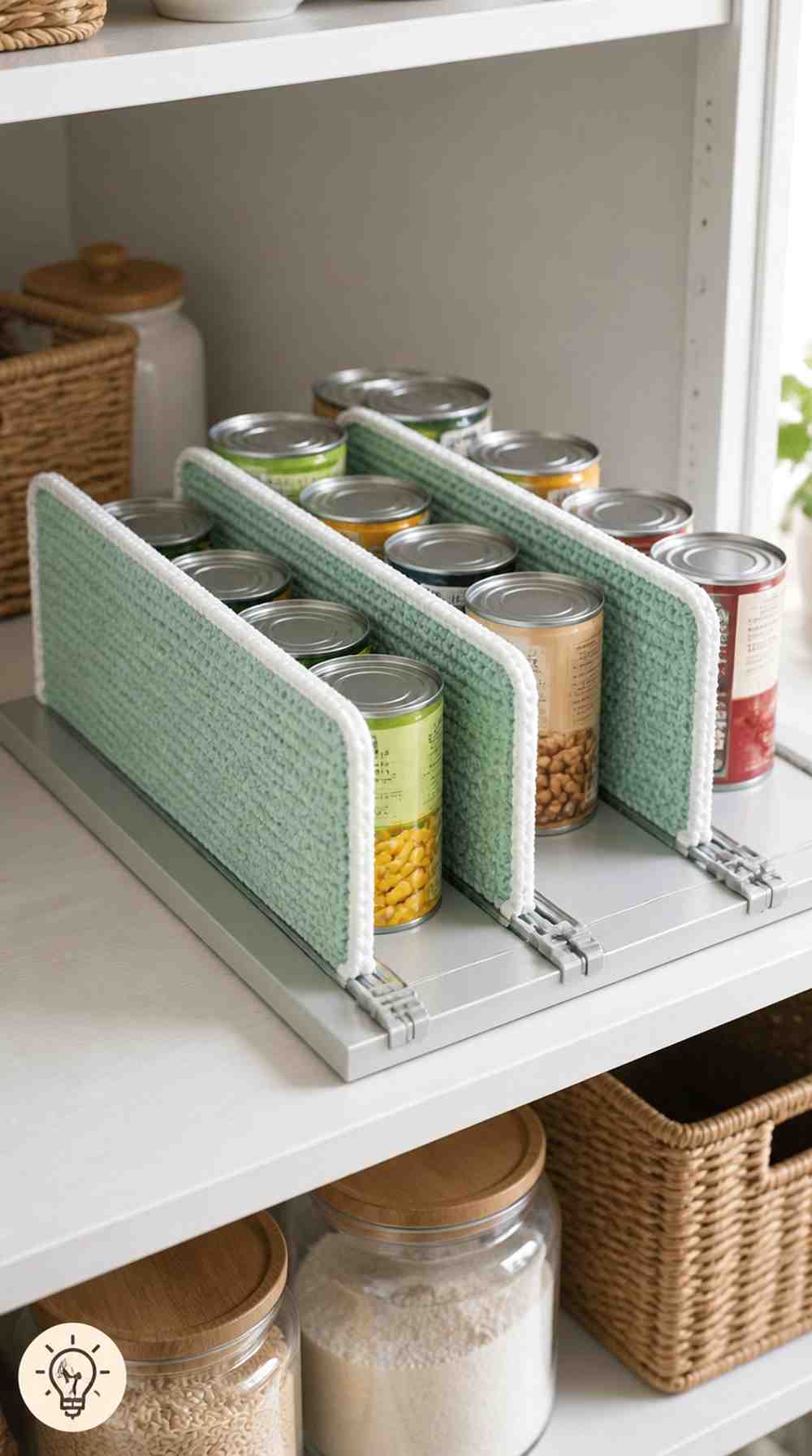
Fresh mint-green crochet covers three movable metal divider panels inside a pale-gray pantry tray. Dense horizontal ridges and narrow white piping outline the partitions, while two recessed metal tracks allow their positions to change. Upright canned foods of different diameters fill the four adjustable compartments.
The design offers flexible spacing without changing the overall organizer base. It may be useful for households that regularly buy different sizes of canned ingredients, provided the movable panels can be locked securely after adjustment.
- Sliding mechanism: A positive locking system is preferable to dividers that depend only on friction, particularly when cans press against the panels.
- Can-diameter changes: Adjust each compartment around the actual rim width, leaving a little clearance for lifting the can out.
- Track cleaning: Recessed metal channels can collect crumbs and dust, so the layout should allow access for routine cleaning.
- Mint crochet sleeves: Keep the white-edged covers away from locking tabs and sliding surfaces to avoid interference during adjustment.
14. Crochet Plum Narrow-Shelf Divider Rack
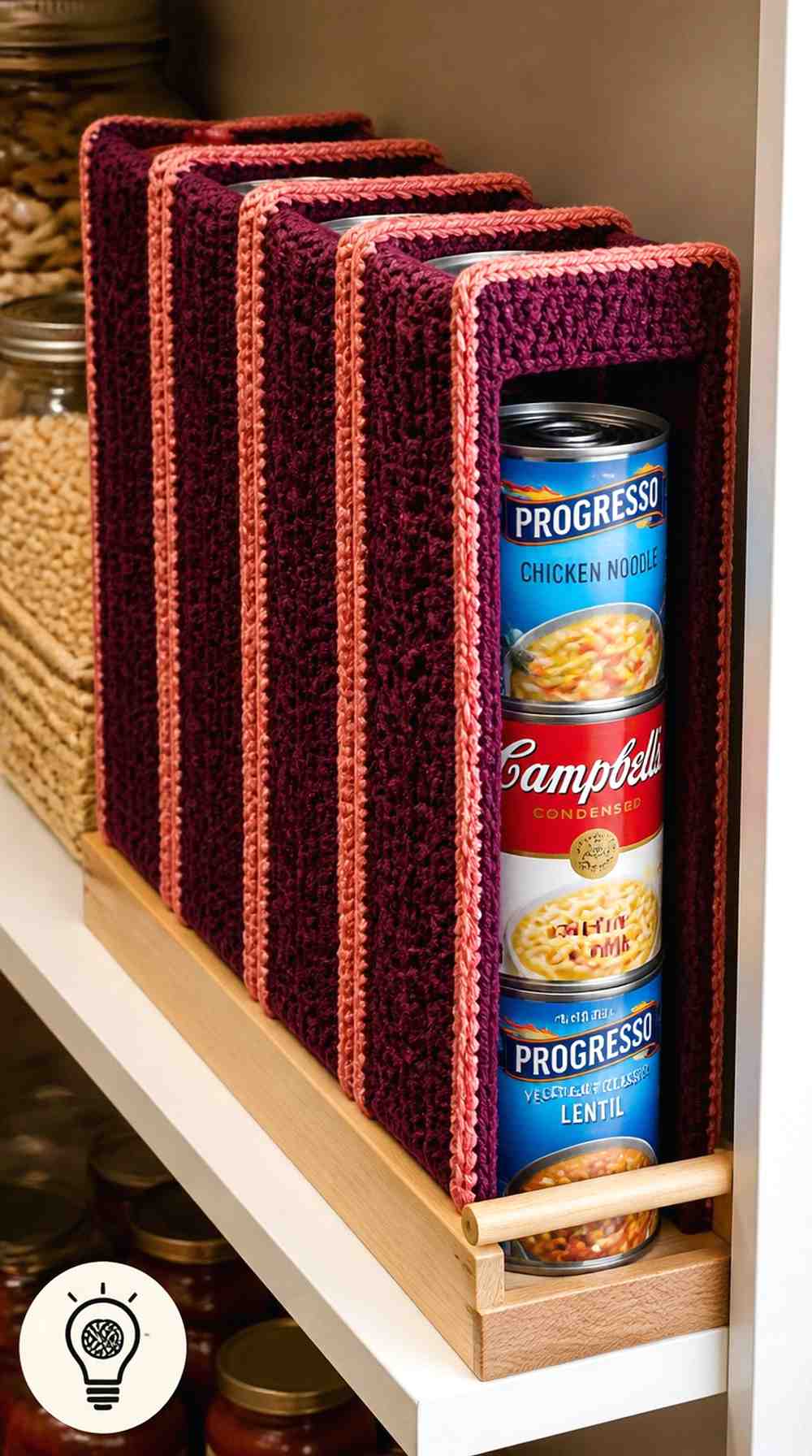
Deep plum crochet brings a rich decorative finish to this slim wooden shelf organizer. Four tall partitions have raised cable-like stitch textures and narrow dusty-rose edging. Three single-file rows of smaller soup cans sit upright between the rigid dividers, with a shallow wooden retaining rail across the front.
The narrow shape makes this design interesting for smaller pantry spaces where a wide organizer would not fit. Its limited width encourages simple, clearly separated rows, although it may not accommodate larger cans or containers with unusual shapes.
- Narrow shelf fit: Measure the available shelf width, depth and door clearance before choosing a divider arrangement with closely spaced panels.
- Single-file storage: Keep each row devoted to a recognizable product type so cans hidden farther back remain easier to locate.
- Raised crochet ridges: The cable-like texture gives the plum covering character, but thicker stitches reduce the usable width between panels.
- Front rail clearance: Leave enough room to remove the first can without dragging it against the wooden retaining edge.
15. Crochet Peach Mixed-Width Shelf Divider
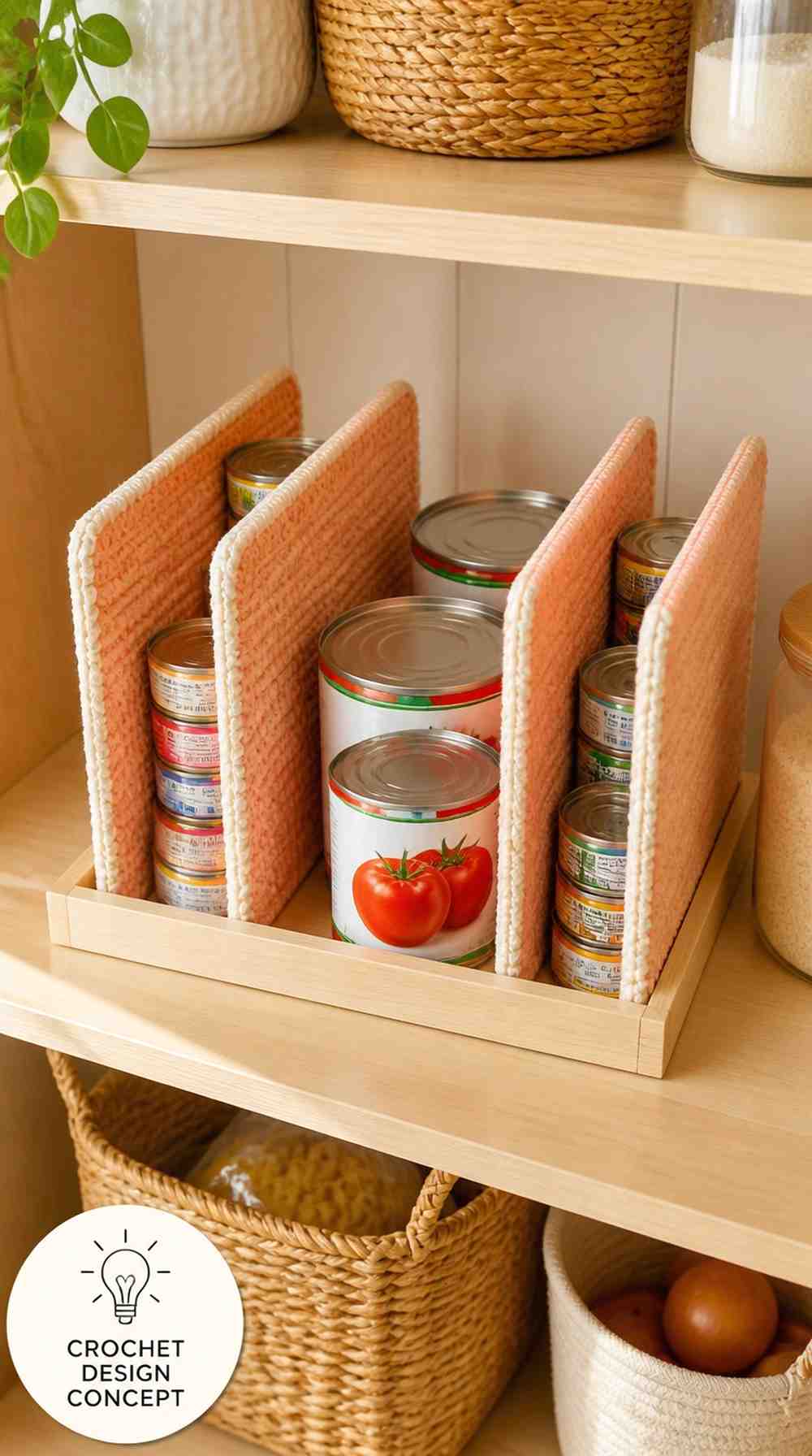
Soft peach crochet gives this birchwood organizer a light, welcoming appearance. Four upright partitions have alternating raised ridges and narrow ivory edges. Their unequal spacing creates two slim lanes for small food tins and one wider compartment for larger standard cans.
Instead of treating every can as the same size, the design uses different compartment widths within one rigid frame. This could be useful for pantries containing both small specialty tins and larger everyday ingredients.
- Mixed-width planning: Group cans by actual diameter and allow the widest products enough clearance rather than dividing the shelf into equal sections.
- Fixed divider slots: Rigid slots can hold panels in position, but their spacing must be planned before the organizer is assembled.
- Small-can lanes: Avoid making narrow compartments so deep that the cans at the back become difficult to reach.
- Peach crochet finish: Ivory edging keeps the different dividers visually coordinated while emphasizing the clean lines of the rigid framework.
16. Crochet Mocha Reversible Shelf Dividers
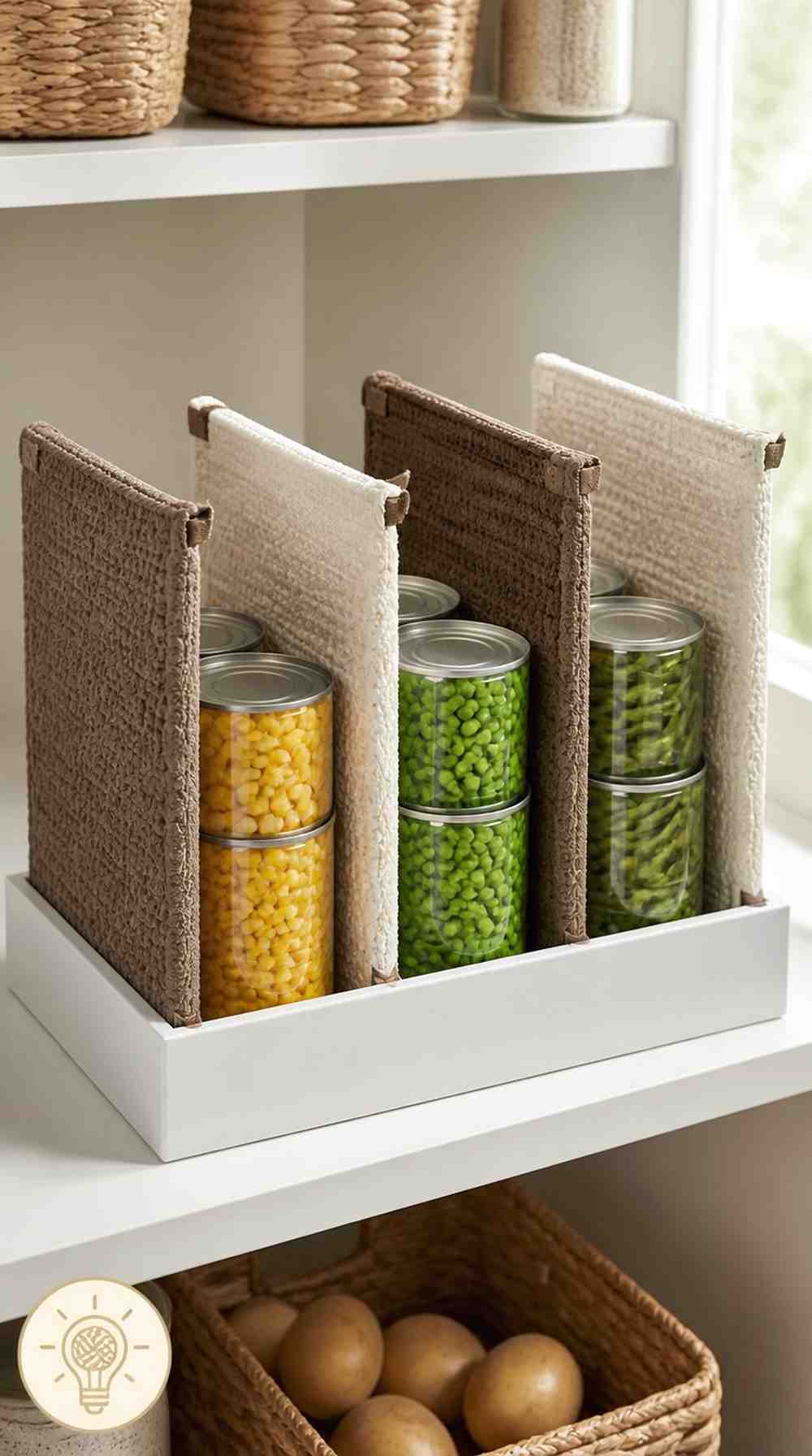
Mocha-brown and warm-ivory crochet create two different looks across four removable pantry dividers. Two panels display their mocha ribbed surfaces, while the remaining panels show their ivory textured faces. Small folded tabs sit at the upper corners, and the rigid dividers fit into slots inside a shallow white tray.
Three groups of unopened canned vegetables stand between the panels. The reversible sleeves offer a decorative choice without changing the basic organizer, while the removable panels may make cleaning and rearranging easier.
- Reversible covers: Both sides of each sleeve should fit neatly around the rigid divider without leaving bulky seams against the cans.
- Removal tabs: Keep the small folded tabs accessible, but avoid loose loops that could catch when cans are lifted.
- Divider slots: The panels need secure slots or another dependable attachment so removing a can does not pull a partition out of place.
- Cleaning flexibility: Removable crochet covers allow separate washing, provided the materials and construction are suitable for the intended care method.
Practical Guide to Crochet Canned Food Shelf Dividers
Canned-food organizers need a stronger supporting structure than many decorative crochet projects. Even a modest collection of unopened cans can place considerable weight on a shelf, and flexible crochet fabric is not a substitute for an appropriately designed rigid divider system.
Measure your shelf and cans first. Record the usable shelf width, depth and height. Measure the can diameters, including their raised rims, and leave room to lift products without scraping against neighboring dividers. Check cabinet-door clearance before choosing an organizer that projects forward.
Use stable structural materials. Wood, suitable metal panels and properly designed rigid organizers can provide the underlying support. Crochet sleeves can decorate these components, but thick yarn should not be expected to hold heavy cans upright by itself. Plastic canvas may be helpful for shaping some textile compartments, but it should not automatically be treated as suitable structural reinforcement for canned-food storage.
Check the shelf’s load limit. Follow the manufacturer’s guidance for shelving systems and mounting hardware. Keep heavier products on lower shelves where practical, and never assume that adding an organizer increases the shelf’s rated capacity.
Make stock rotation easy. Group similar foods together and check package dates when restocking. Keep earlier-use products accessible instead of allowing them to become permanently hidden behind newer cans.
Plan for cleaning. Pantry shelves can collect dust, crumbs and occasional spills. Removable crochet coverings may be easier to maintain than panels with permanently attached fabric. Keep cans dry, check them for damage or leakage, and follow the yarn’s care instructions before washing.
For more home-storage inspiration, browse 12 Crochet Storage Basket Ideas and 16 Crochet Vintage Kitchen Wall Pocket Ideas on Yarn Nest Studio. These collections explore related crochet storage structures, although they are not designed specifically to divide heavy canned foods.
Want to Make Something Similar?
These resources explain useful crochet divider and reinforcement techniques. They are not exact patterns for the 16 canned-food shelf organizer concepts.
- Free Organizer Basket with Removable Dividers by Nicki’s Homemade Crafts — A free crochet pattern with a video tutorial covering a cotton organizer basket and removable dividers. Useful for exploring compartment construction, although the finished basket is not designed or tested for heavy canned foods. Nicki’s Homemade Crafts
- Mosaic Basket by Yarn + Chai — Explains how plastic canvas can be placed inside crochet basket walls to help maintain their shape. This is relevant to decorative divider sleeves but does not establish sufficient strength for supporting cans. Yarn + Chai
For a real canned-food shelf organizer, build or select an appropriately rated rigid structure first. The crochet techniques can then help you explore removable covers and decorative finishes.
Comparison: Which Crochet Canned Food Shelf Divider Should You Choose?
| Storage need | Design to consider | Important trade-off |
|---|---|---|
| Straightforward can grouping | Sage Parallel Shelf Divider | Fixed partition spacing |
| Wire shelving | Ivory Clip-On Wire Divider | Clips must fit the shelf |
| Horizontal can lanes | Terracotta Angled Can-Lane Divider | Requires secure front stops |
| Changing can diameters | Dusty-Blue Adjustable Dividers | Sliding brackets need locks |
| Small fixed groups | Mustard Shelf-End Partition Rack | Less flexible compartment widths |
| Folding organizer | Blush Accordion Can Separators | Hinges must remain stable |
| Independent partitions | Olive L-Shaped Shelf Separators | Supports may shift |
| Two storage levels | Lilac Two-Tier Shelf Divider | Requires sufficient load capacity |
| Modern metal framework | Charcoal Grid-Panel Divider | Grid edges and joins need care |
| Individual can positions | Sky-Blue Circular Can-Bay Dividers | Limited fixed capacity |
| Deep pantry shelves | Rust Front-to-Back Can Divider | Rear cans less accessible |
| Small specialty tins | Cream Cross-Grid Mini Can Organizer | Fixed square compartments |
| Flexible lane widths | Mint Sliding-Track Pantry Dividers | Tracks require maintenance |
| Narrow cupboards | Plum Narrow-Shelf Divider Rack | Limited can-width compatibility |
| Different can sizes | Peach Mixed-Width Shelf Divider | Slots need advance planning |
| Removable decorative covers | Mocha Reversible Shelf Dividers | Covers and panels need secure fit |
For an everyday pantry, a straightforward rigid divider with removable crochet sleeves may be easier to maintain than a complicated adjustable system. If your can sizes frequently change, movable partitions can be more flexible, provided their locking mechanism is dependable.
Conclusion
Crochet canned food shelf dividers offer a way to bring handmade color and texture into practical pantry organization. From sage-green wooden partitions and terracotta can lanes to mint adjustable dividers and mocha reversible sleeves, these 16 ideas show how differently the same storage problem can be approached.
The best design begins with the cans you actually own and the space available on your shelves. A stable structure, sensible compartment widths and easy access will make the biggest difference in daily use. Once those needs are addressed, crochet coverings can give an ordinary pantry organizer a softer, more personal finish.
Which design would be most useful in your pantry? Would you choose the simple sage divider, the terracotta angled can lanes or the flexible mint sliding-track organizer? Share your favorite idea and the canned foods you would organize with it.
Frequently Asked Questions
Can crochet dividers support heavy canned foods on their own?
Crochet fabric is flexible, so it should not be relied upon as the main structural support for heavy food cans. A rigid base, properly secured panels or another suitable organizer should provide the actual separation and stability. Crochet works better as a decorative covering over those components.
What yarn is suitable for crochet canned food shelf divider covers?
Cotton or cotton-blend yarn can be worth considering because many varieties provide firm stitch definition and may be washable. However, care requirements vary by product. Choose a yarn that fits neatly around the rigid panel, check its washing instructions and consider whether the covering can be removed for cleaning.
How should I arrange different-sized cans inside a shelf divider?
Measure can diameters and heights, then group similar sizes together. Narrow lanes may suit small tins, while wider spaces are necessary for standard or oversized cans. Leave enough clearance for fingers to reach each item, and avoid making compartments so deep that older products become difficult to access.
Are angled can dispensers better than upright shelf dividers?
Neither is automatically better. Upright dividers are simpler and make it easier to group cans by category. Angled horizontal lanes may provide a different way to access cans, but they require secure rigid channels, controlled movement and reliable retaining stops. The right arrangement depends on the shelf dimensions and products stored.
Are these 16 crochet canned food shelf divider designs available as exact patterns?
No. They are AI-generated inspiration concepts rather than tested crochet patterns or construction instructions. The linked resources explain related crochet basket and divider techniques, but they do not reproduce these exact shelf organizers. Any functional canned-food storage system needs suitable structural materials, secure connections and verification of its weight limits.