A jigsaw puzzle becomes much easier to manage when its pieces have somewhere to go between sorting and assembly. Crochet jigsaw puzzle piece sorting mats bring a handmade touch to that process, using shallow compartments, gentle borders and colorful yarn to organize loose pieces across a table. These 15 inspiration ideas range from simple sage-green four-section mats and terracotta edge-piece channels to honeycomb compartments, granny-square organizers and circular sorting wheels.
The most useful design depends on how many puzzle pieces you work with, the amount of table space available and whether you prefer sorting by picture color, edge shape or recognizable patterns. Some mats provide several compartments for small groups, while others create larger sorting lanes or removable shallow trays. A smooth, stable surface is particularly important because puzzle pieces can catch against raised crochet stitches and become difficult to slide or inspect.
These are AI-generated crochet design visualizations for inspiration, not photographs of tested handmade organizers or step-by-step patterns.
Quick Design Selection Guide
For sorting a puzzle into a few broad groups, Crochet Sage Four-Section Puzzle Sorting Mat, Crochet Navy Three-Color Puzzle Sorting Mat and Crochet Cream and Olive Two-Stage Puzzle Sorting Mat offer clear divisions without excessive compartments.
If you enjoy organizing small groups by color or picture detail, Crochet Mustard Honeycomb Puzzle Sorting Mat, Crochet Blush Scalloped Puzzle Cluster Mat and Crochet Lavender Wheel Puzzle Sorting Mat provide more individual spaces.
For larger collections of small groups, Crochet Rust Nine-Grid Puzzle Sorting Mat offers nine compartments, while Crochet Indigo Stackable Puzzle Sorting Mats provides two separate matching trays.
For changing your setup between puzzle sessions, Crochet Coral Snap-Corner Puzzle Sorting Mat, Crochet Charcoal Book-Fold Puzzle Sorting Mat and Crochet Teal Roll-Up Puzzle Sorting Mat explore different forms of collapsible storage. Loose pieces would need to be removed or separately secured before these organizers are folded.
For moving sorted groups short distances on a stable surface, Crochet Seafoam Sliding-Base Puzzle Sorting Mat combines a flat crochet organizer with a rigid bamboo tray beneath it.
1. Crochet Sage Four-Section Puzzle Sorting Mat
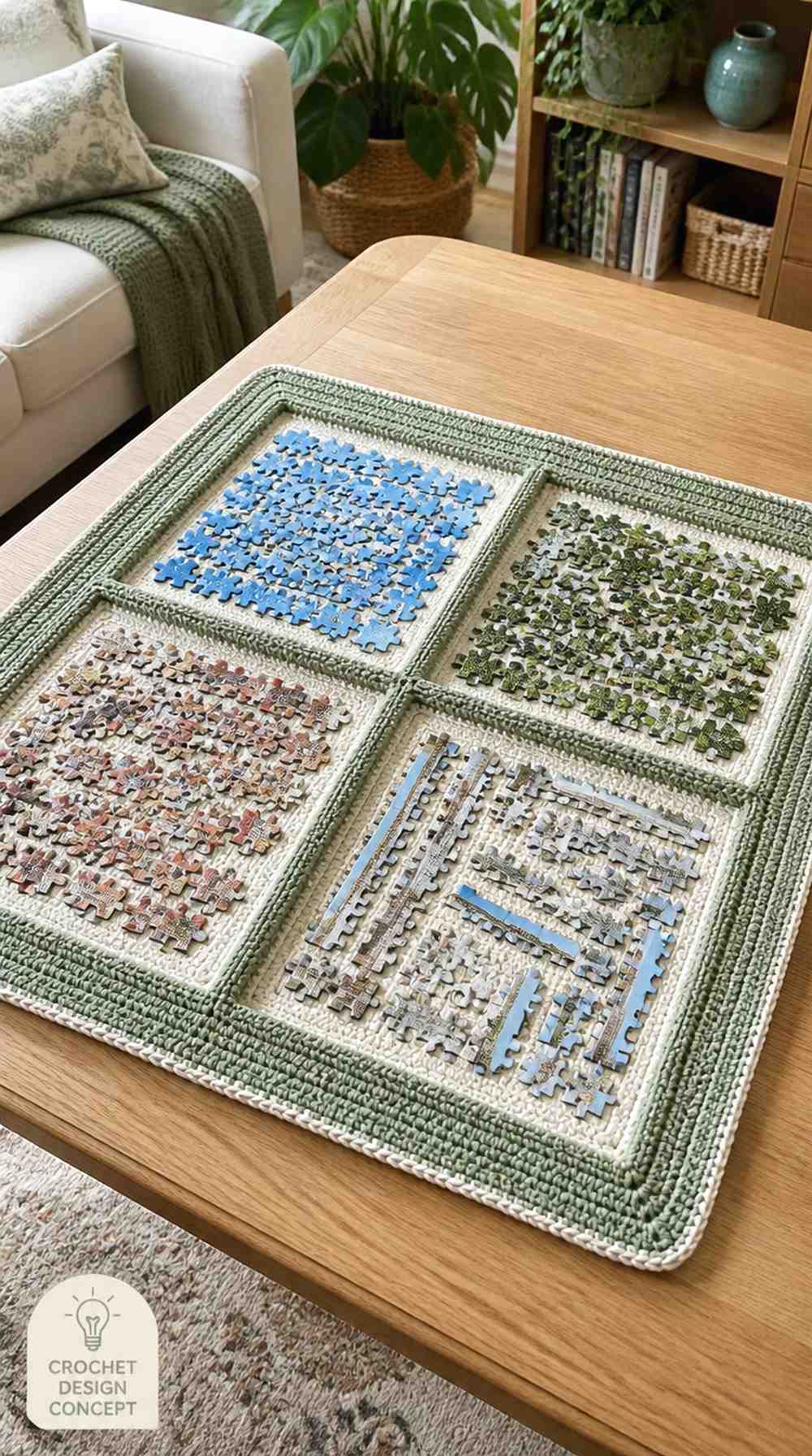
Soft sage-green crochet creates a broad rectangular mat with four equal sorting sections. Two low reinforced dividers cross at the center, while an ivory perimeter frames the entire surface. Smooth cream fabric lining covers each compartment, separating the cardboard puzzle pieces from the textured crochet beneath.
The pictured groups include blue sky, green foliage, terracotta buildings and straight-edge pieces. This straightforward arrangement helps a puzzler establish broad categories without needing many tiny storage areas. Its success depends on keeping the compartments flat and the dividers low.
- Four Equal Sections: A simple two-by-two layout provides a clear starting arrangement for color groups and edge pieces without creating excessive sorting decisions.
- Crossed Dividers: Reinforce the central meeting point so the two low crochet strips maintain their position without bunching beneath nearby pieces.
- Smooth Fabric Floors: The cream lining prevents cardboard tabs from catching directly in dense crochet stitches and makes individual pieces easier to inspect.
- Flexible Sorting Categories: The four sections can be reassigned as the puzzle progresses instead of permanently representing the illustrated color groups.
2. Crochet Terracotta Border-Piece Sorting Mat
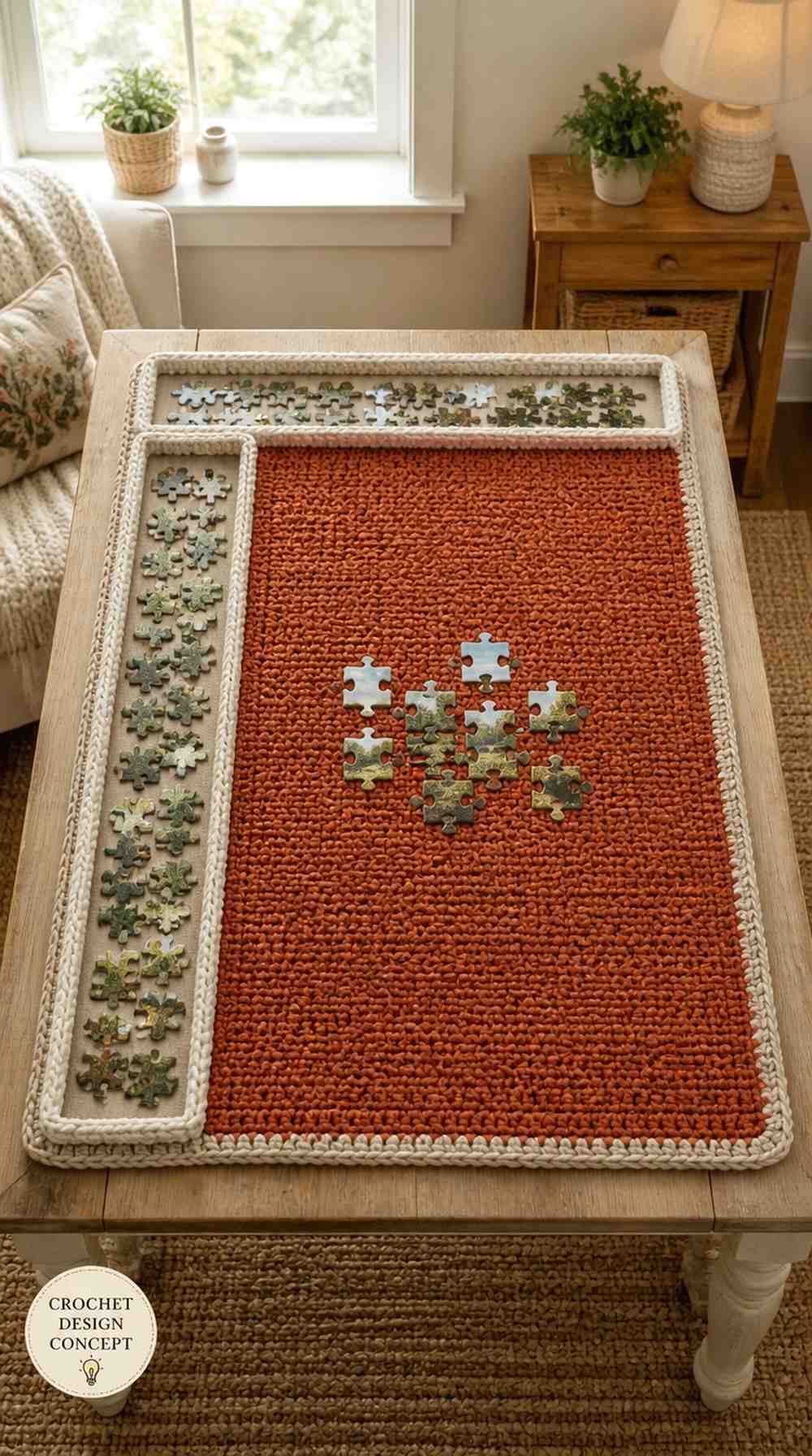
Warm terracotta crochet covers this wide rectangular mat, with moss-textured stitches and an oatmeal outer border. Two shallow ivory channels follow its upper and left edges, holding separate groups of straight-edged puzzle pieces. A broad central area remains available for loose green and brown landscape pieces.
The design gives edge pieces dedicated positions without using separate bowls or trays. Its unusual L-shaped channel arrangement leaves most of the mat open. That can be useful when border pieces have already been identified but the main puzzle image still needs sorting.
- Two Edge Channels: Narrow upper and left compartments help separate straight-edged pieces from the central picture groups without occupying the entire surface.
- Open Central Area: The broad terracotta section provides room for loose landscape pieces that have not yet been divided into smaller categories.
- Shallow Channel Walls: Keep the ivory borders low enough to lift pieces easily rather than trapping cardboard tabs against a tall edge.
- Corner Connection: The two channels should remain clearly separated at their meeting point so pieces do not migrate between compartments unintentionally.
3. Crochet Navy Three-Color Puzzle Sorting Mat
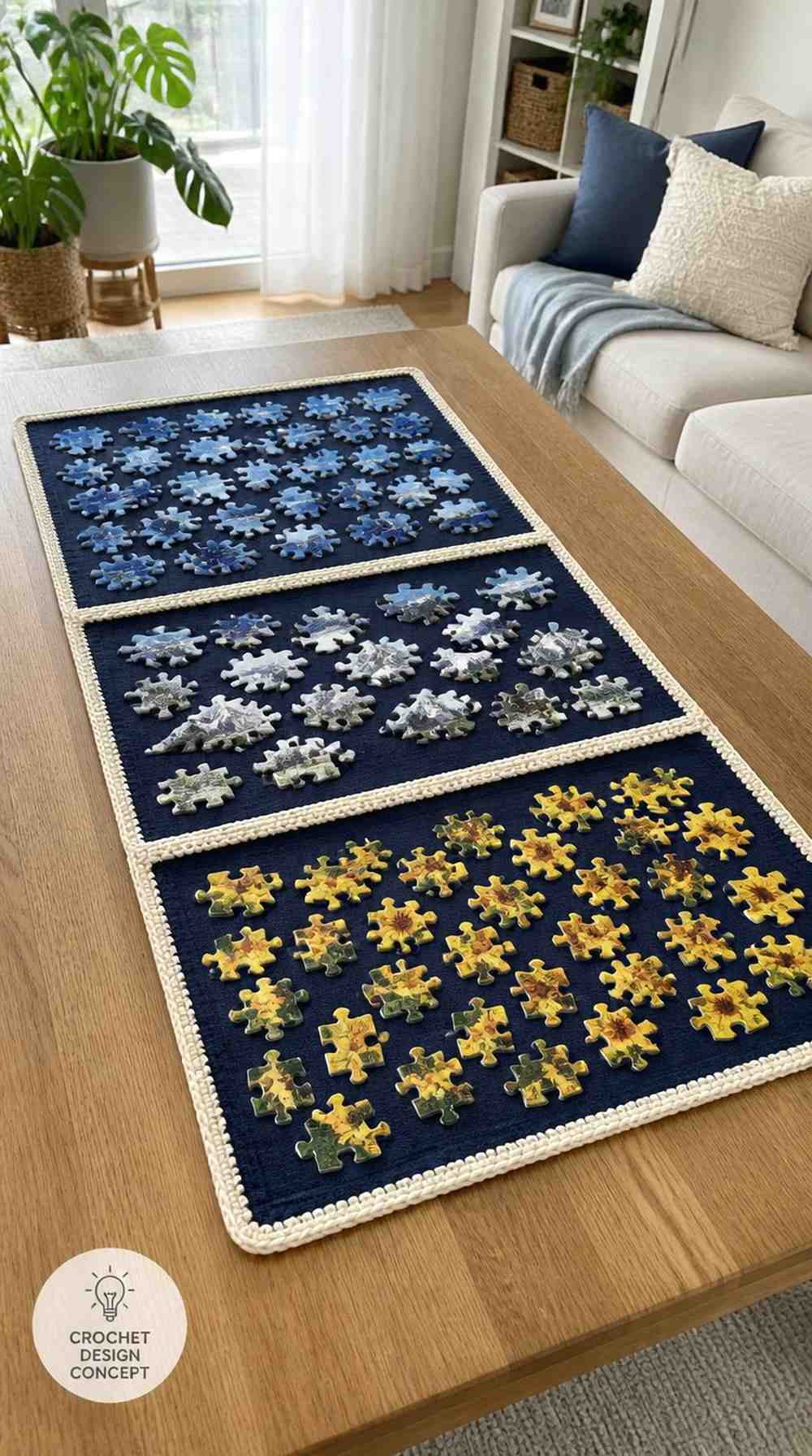
Deep navy crochet forms a long rectangular mat divided into three horizontal lanes. Two narrow ivory crochet cords create the dividing lines, while smooth dark-navy backing supports the puzzle pieces. The three groups show blue ocean imagery, pale-gray mountains and golden-yellow flowers.
This design suits puzzles with a few clearly recognizable color regions. The dark background gives the lighter pieces contrast, although very dark puzzle artwork may be less visible. Its broad lanes allow pieces to remain spread out rather than stacked in piles.
- Three Sorting Lanes: Broad horizontal areas work well for separating major image regions before deciding whether more detailed grouping is necessary.
- Low Ivory Dividers: Raised cords provide visible boundaries without forming high walls that make pieces difficult to move.
- Dark Background: Navy can highlight yellow or pale pieces, but black and dark-blue artwork may benefit from a lighter lining.
- Single-Layer Sorting: Spreading pieces face-up with limited overlap makes their printed patterns easier to compare than stacking them in deep compartments.
4. Crochet Blush Scalloped Puzzle Cluster Mat
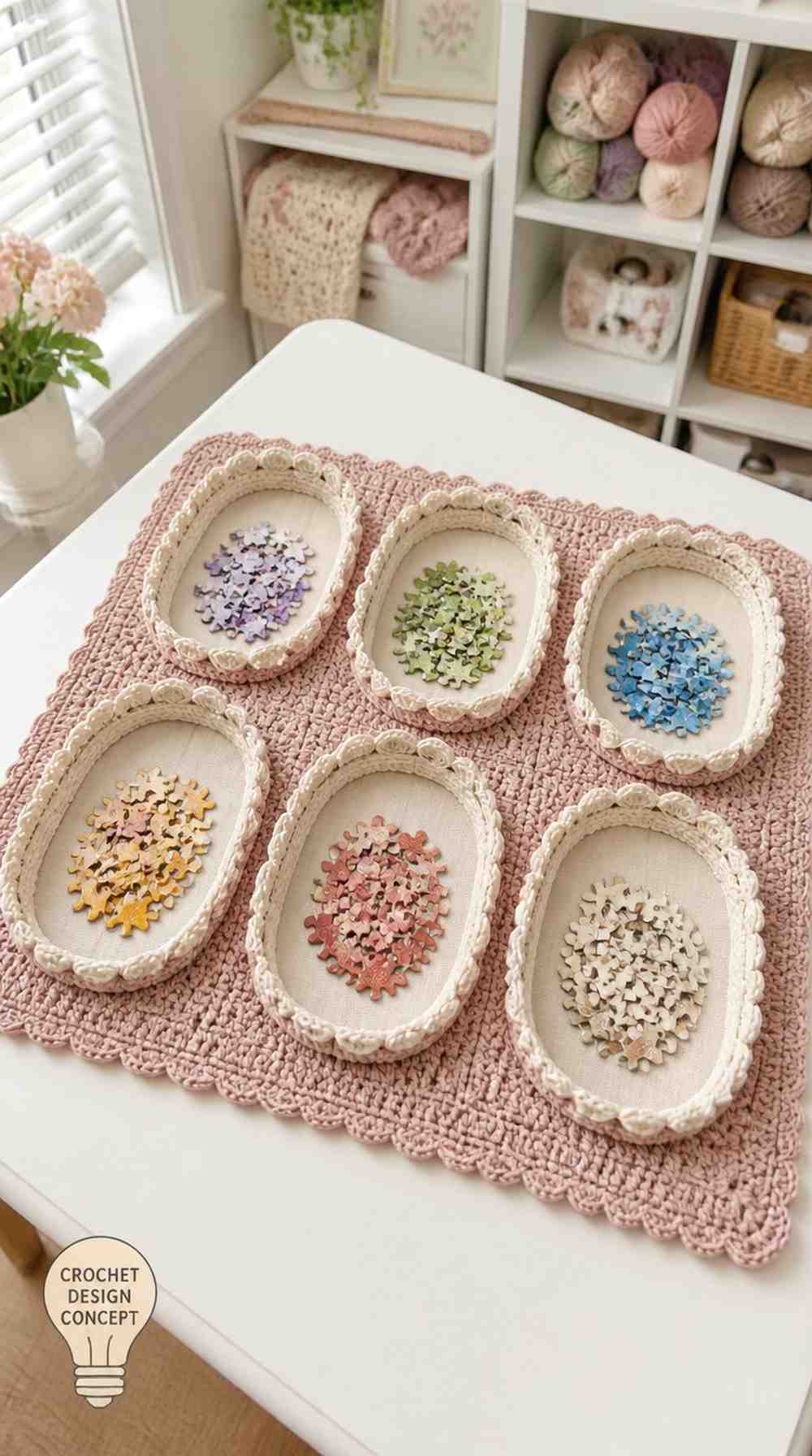
Dusty-blush crochet creates six shallow oval sorting nests arranged in two tidy rows. Each compartment has a smooth cream lining, a low ivory scalloped border and a connected blush backing. Small groups of lavender, sage, blue, amber, terracotta and cream puzzle pieces sit separately inside.
The oval compartments give this organizer a softer appearance than a conventional square grid. They are intended for smaller collections of pieces rather than large unfinished puzzle sections. The low scallops add decoration while leaving the cardboard shapes clearly visible.
- Six Oval Compartments: Separate nests can keep small picture details apart, especially when several colors appear throughout the same puzzle.
- Scalloped Rims: Compact ivory shells help define each oval without creating tall edges that obstruct access.
- Smooth Inner Lining: Flat cream surfaces reduce direct contact between cardboard tabs and raised decorative crochet.
- Compartment Capacity: Narrow oval sections may become crowded with larger pieces, so actual piece dimensions should guide the finished size.
5. Crochet Mustard Honeycomb Puzzle Sorting Mat
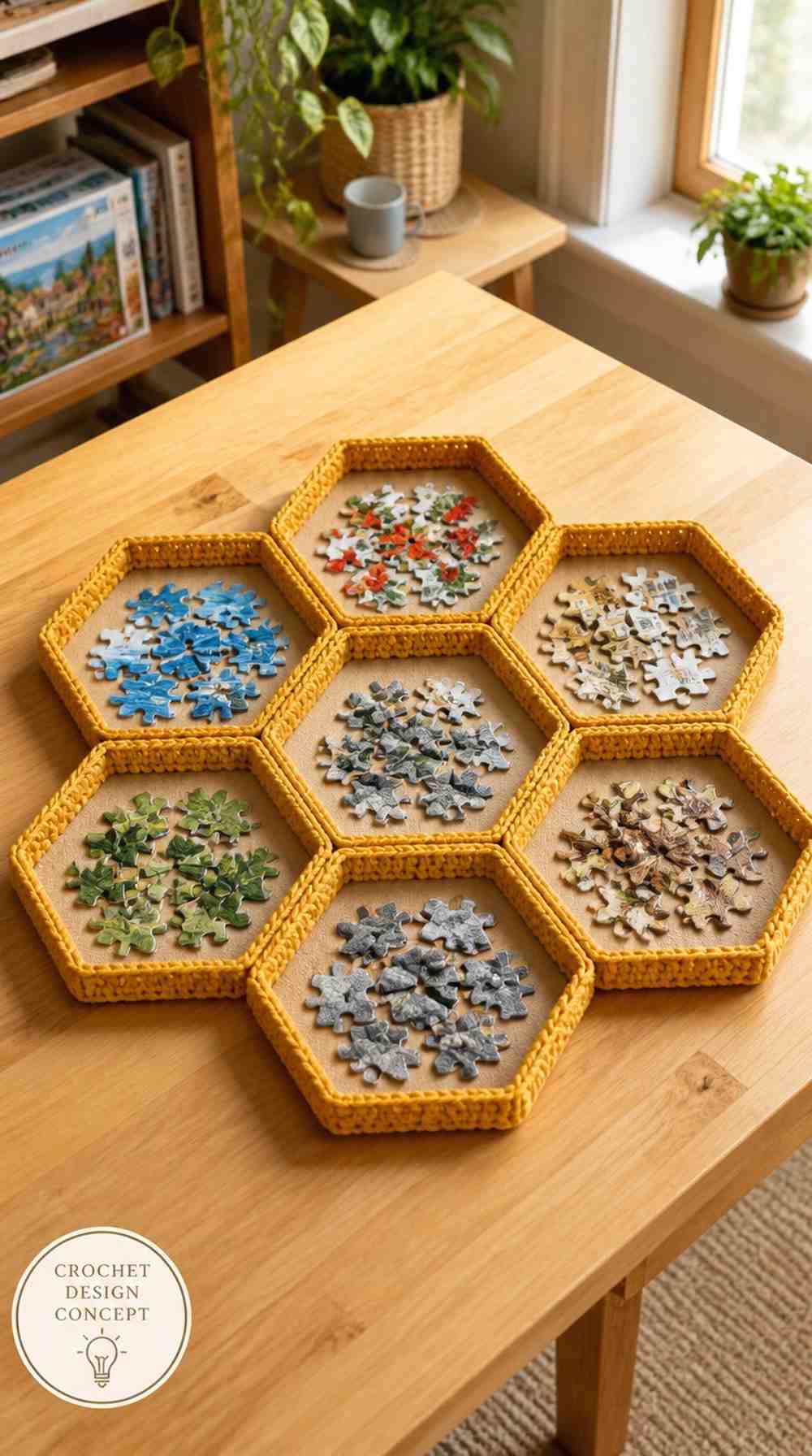
Six mustard-yellow crochet hexagons join together to form a distinctive honeycomb sorting mat. Each shallow compartment has a cream fabric-backed floor, firm low crochet walls and an ochre border. The six sections hold separate groups of blue water, green leaves, red flowers, cream buildings, brown branches and gray stones.
The honeycomb layout offers an attractive alternative to rectangular trays. Its connected hexagons create distinct picture categories while keeping the entire organizer in one piece. The joins between compartments are important because each hexagon shares edges with neighboring sections.
- Six Hexagonal Cells: The repeating honeycomb shape organizes small color groups while giving the mat a recognizable geometric appearance.
- Shared Crochet Walls: Reinforce adjoining edges so the hexagons do not pull apart or distort when individual compartments are handled.
- Cream Fabric Bases: Smooth inner floors help prevent paper tabs from catching on open crochet and provide a neutral background for recognizing printed colors.
- Honeycomb Footprint: The clustered shape needs a broad table area, so measure the available surface before choosing the size of each hexagon.
6. Crochet Ivory Granny-Square Puzzle Sorting Mat
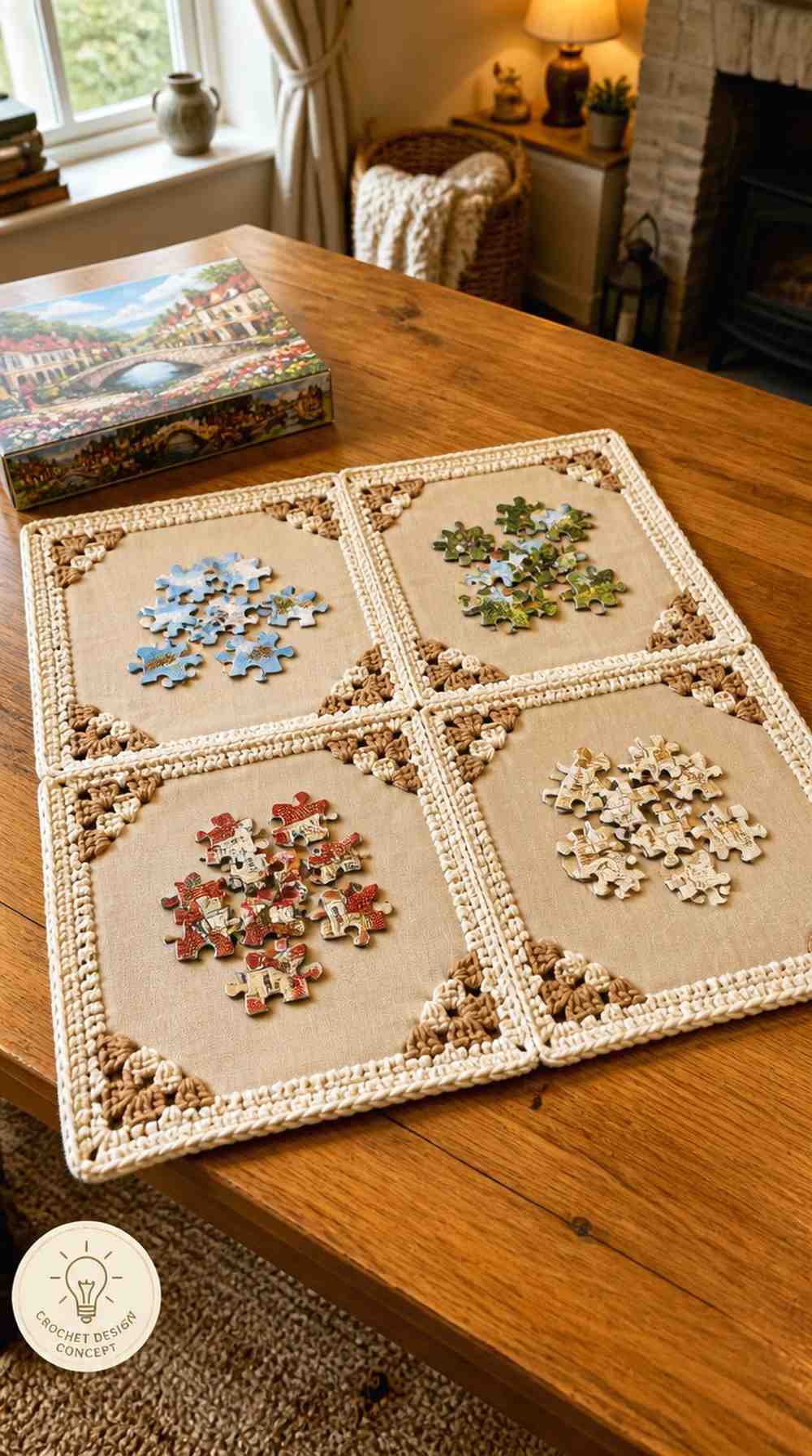
Four large cream-and-caramel granny squares form the framework of this square puzzle mat. Traditional corner clusters and ivory joins define a two-by-two arrangement, with flat beige fabric-backed sorting areas inside each crochet frame. Sky, foliage, rooftop and pale-stone pieces are separated into the four sections.
The granny-square design brings a traditional handmade character to a practical puzzle accessory. Instead of leaving puzzle pieces directly on decorative openwork, the smooth inserts create usable sorting surfaces. The joined motifs form the decorative boundaries between groups.
- Four Granny-Square Frames: A two-by-two layout keeps the familiar crochet motifs visible while offering separate areas for common picture categories.
- Flat Fabric Inserts: Solid backing beneath the open centers prevents small cardboard tabs from becoming caught between granny-square clusters.
- Ivory Joining Seams: Neat joins help maintain a square overall shape instead of allowing the four motifs to pull unevenly.
- Traditional Styling: Cream and caramel crochet pairs naturally with oak puzzle tables and cozy living-room furnishings.
7. Crochet Teal Roll-Up Puzzle Sorting Mat
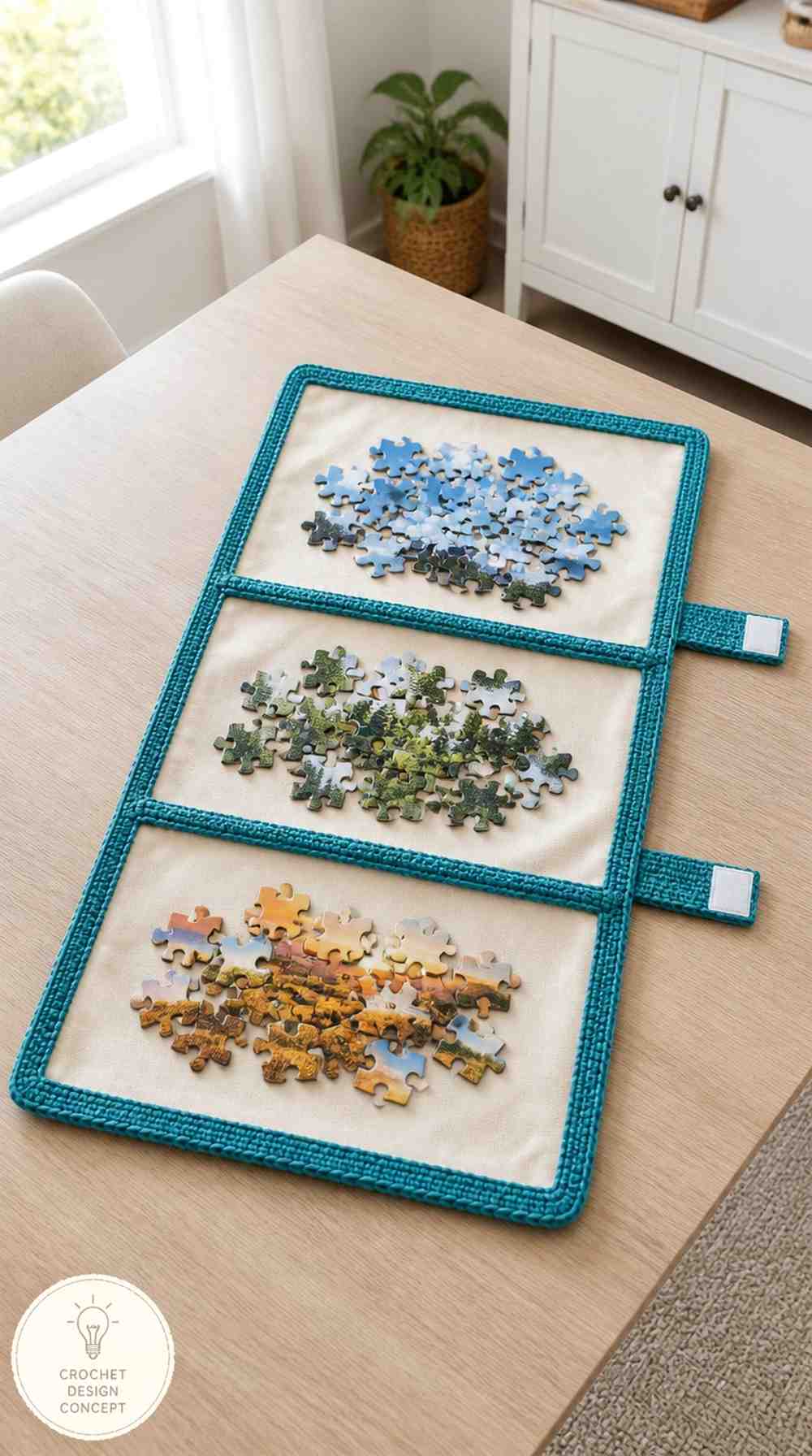
Teal crochet forms a wide flexible sorting mat with three horizontal compartments and a smooth cream lining. Low reinforced dividers separate the sections, each containing a small group of face-up landscape pieces. Two short flat fastening straps extend from one edge, allowing the organizer to be rolled when empty.
Its portable-looking construction is the distinguishing feature. The mat can be laid flat for sorting and potentially rolled for compact storage afterward. However, rolling it with loose pieces inside would risk shifting, bending or losing them unless a separate tested retention method were used.
- Three Broad Compartments: Separate horizontal sections provide enough space for color groups while keeping the mat relatively simple.
- Flexible Backing: The fabric can be rolled for storage, but thick rigid inserts would interfere with that intended folding behavior.
- Short Closing Straps: Compact hook-and-loop fasteners reduce loose cords and help secure the organizer when it is empty.
- Piece Retention Limit: This concept is not a secure puzzle transporter; loose pieces should be removed before rolling unless an effective retention system has been established.
8. Crochet Charcoal Book-Fold Puzzle Sorting Mat
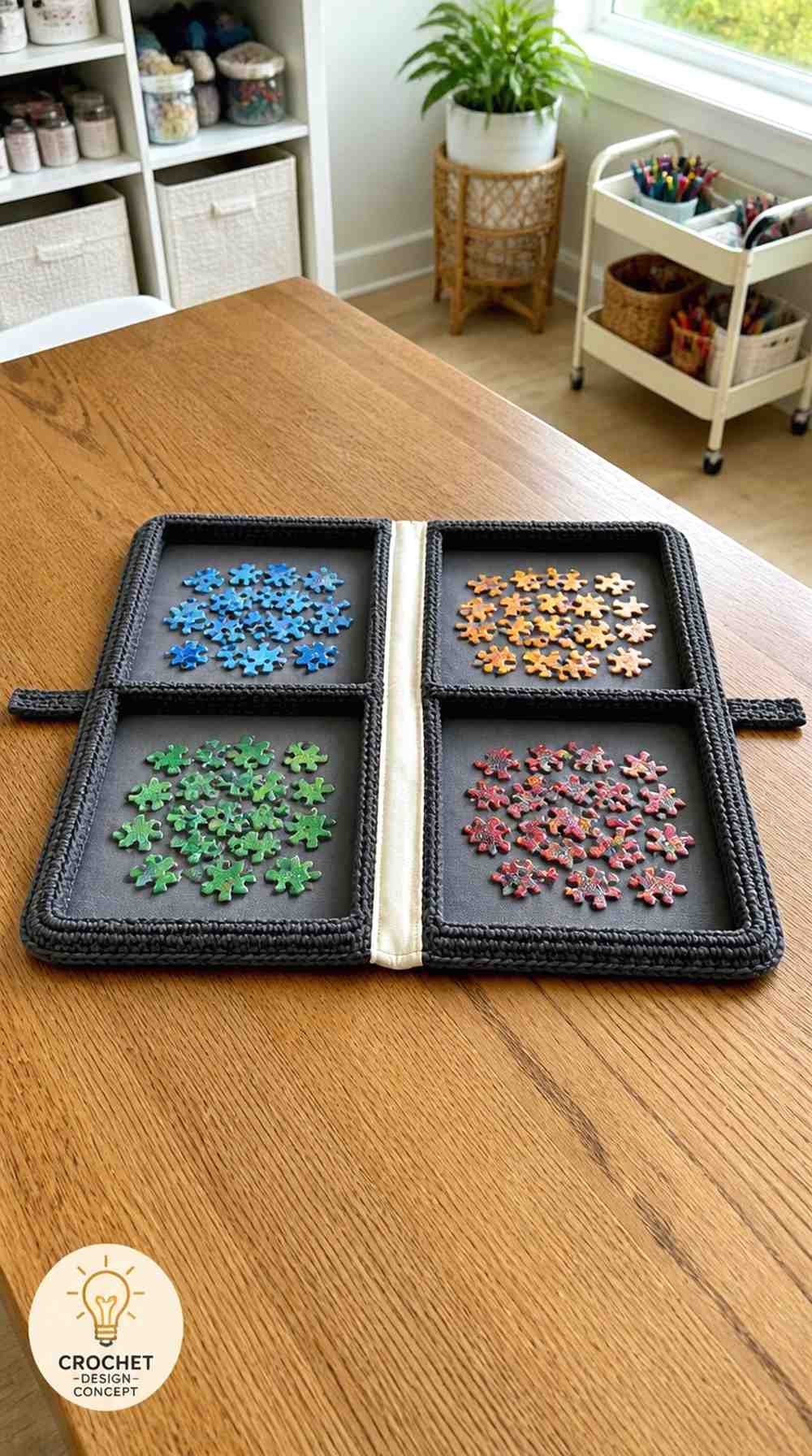
Charcoal-gray crochet creates two equal sorting panels joined by an ivory fabric hinge. Each half contains two shallow sections, giving the open organizer four compartments in total. Blue and green jigsaw pieces occupy the left side, while amber and red-patterned pieces sit in the right-hand compartments.
The book-fold structure offers a different approach to storing an empty sorting mat. Its central flexible join allows the two panels to fold toward each other, while the four lined sections remain separate when opened. The design is not intended to trap loose puzzle pieces between the panels during folding.
- Two-Panel Construction: Separate halves allow the organizer to fold without requiring the entire crochet surface to bend across multiple compartment walls.
- Ivory Center Hinge: A strong fabric join helps keep both sides aligned while allowing the empty mat to open flat.
- Four Sorting Areas: Two compartments per panel provide a manageable layout for distinguishing picture colors or patterns.
- Folding Limitation: Remove the loose puzzle pieces before closing the panels unless a separately designed retention method has been tested.
9. Crochet Lavender Wheel Puzzle Sorting Mat
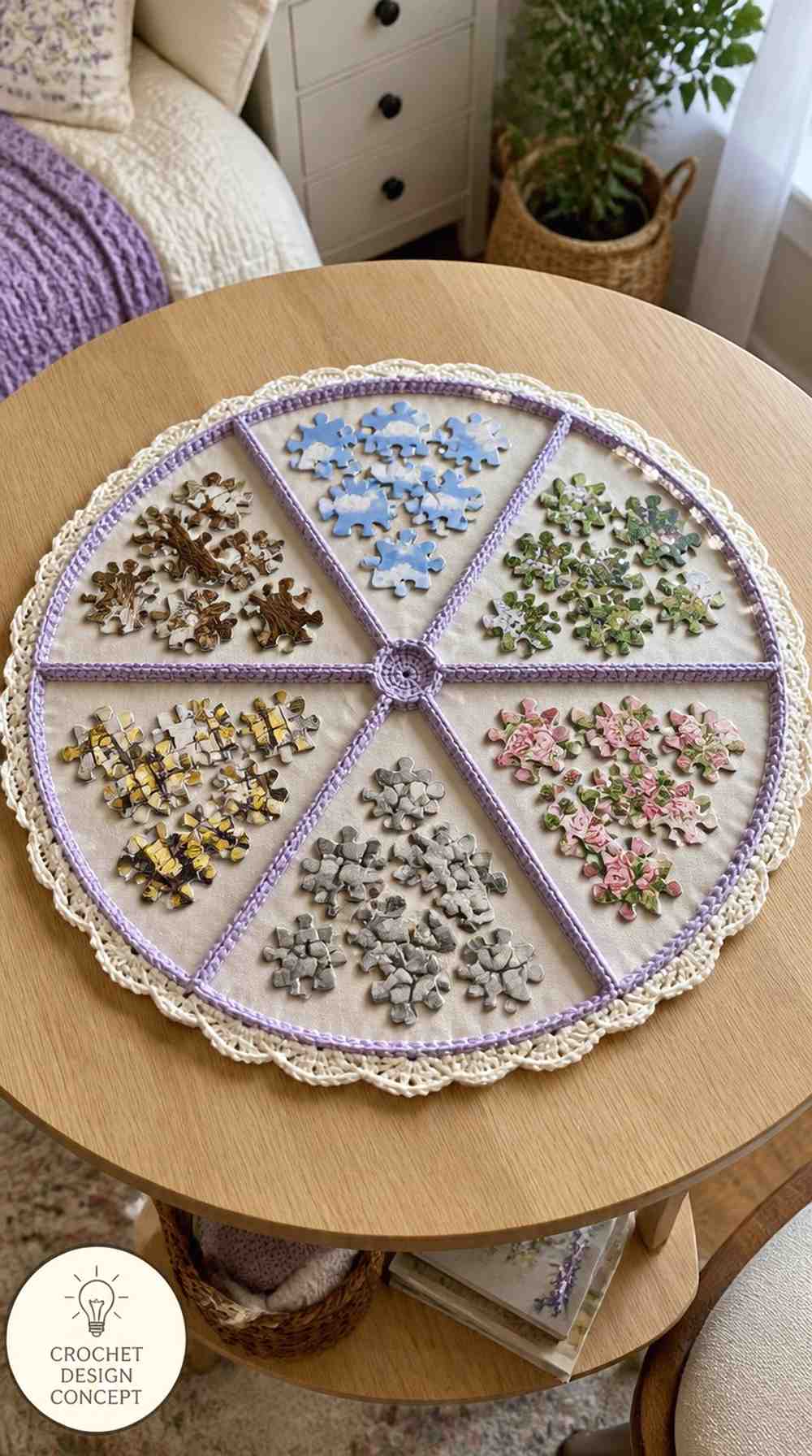
Lavender crochet forms a broad circular sorting mat divided into six wedge-shaped sections. Low radial crochet strips extend from a central joined circle toward an ivory scalloped outer border. Each section contains a separate group of pieces showing sky, garden foliage, flowers, paving, windows or tree trunks.
The circular wheel creates an unusual alternative to a standard rectangular sorting tray. Its six wedges can help organize several visual regions at once, with all groups arranged around a shared center. The shape requires enough tabletop room to keep the outer sections accessible.
- Six Radial Dividers: Evenly spaced strips create clear wedge-shaped sections without requiring six separate removable trays.
- Shared Center Join: Reinforce the small central circle so the dividers stay aligned rather than pulling unevenly toward individual compartments.
- Scalloped Outer Border: The ivory edging softens the circular outline while keeping the decorative rim away from the pieces.
- Tabletop Access: A large round layout may require more reaching than a narrow rectangular mat, especially on a deep table.
10. Crochet Rust Nine-Grid Puzzle Sorting Mat
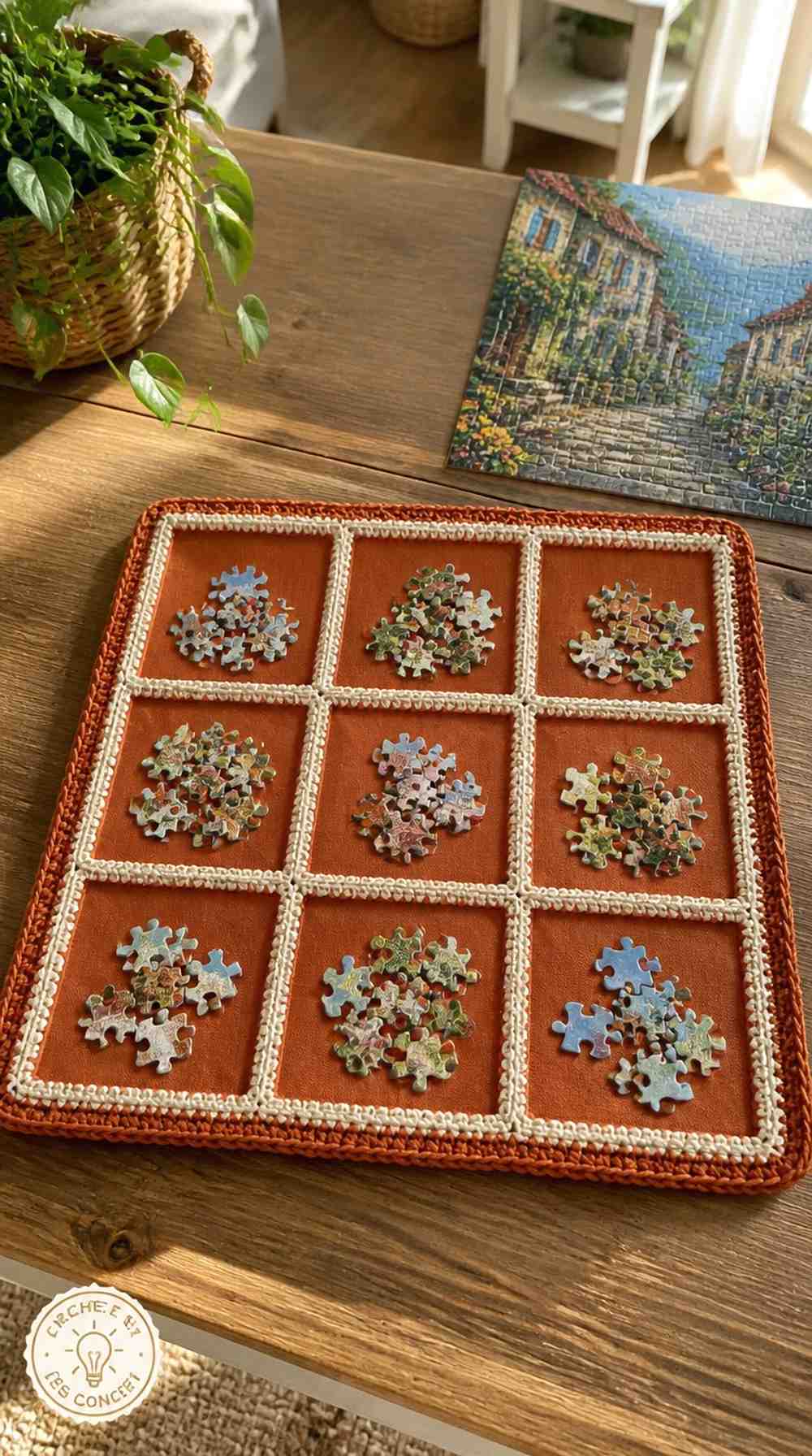
Rust-orange crochet creates a wide square sorting mat divided into nine shallow sections. Cream dividers form a clear three-by-three grid over a smooth terracotta fabric-backed surface, while a darker rust border defines the outside. Each compartment holds a small group of picture pieces from a colorful village scene.
The nine-grid arrangement is intended for puzzlers who enjoy detailed sorting. Rather than creating only broad color groups, it provides more places for identifying smaller picture elements. Its many dividers also make careful sizing and stable backing especially important.
- Nine Equal Compartments: A three-by-three layout offers more categories for separate image details without needing individual loose containers.
- Low Cream Grid Walls: Narrow dividers distinguish the sections while allowing each piece to be lifted easily.
- Flat Supporting Board: A removable rigid insert beneath the mat helps keep the broad grid level when pieces are spread across it.
- Avoiding Over-Sorting: Nine sections may be unnecessary for a simple puzzle, so use the compartments only when the printed image has enough distinct groups.
11. Crochet Cream and Olive Two-Stage Puzzle Sorting Mat
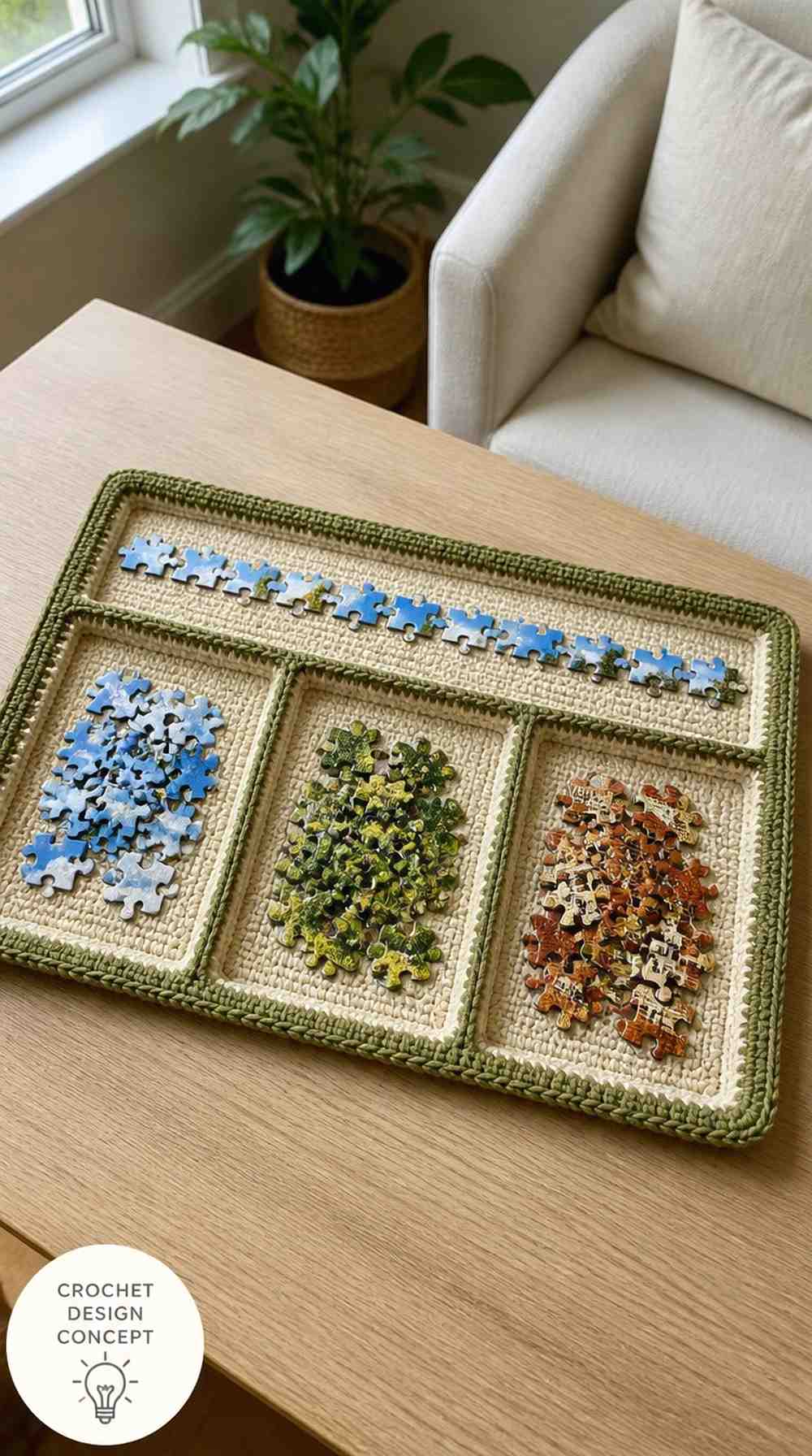
Cream crochet provides a light background for this practical two-stage sorting layout. A narrow olive-green upper channel holds loose straight-edged puzzle pieces, while three larger compartments beneath contain blue sky, green foliage and terracotta building pieces. Low olive borders separate the sections.
The design combines two common ways of sorting a jigsaw: identifying edge pieces and grouping interior pieces by picture color. Because the edge lane is narrow, the majority of the mat remains available for broader visual categories.
- Dedicated Edge Lane: Straight-edged pieces remain separate from the three main groups without requiring an additional container.
- Three Larger Color Areas: Broad lower compartments allow pieces to spread out for visual inspection instead of accumulating in deep piles.
- Olive Dividers: Contrasting crochet borders make the four sorting areas easy to recognize against the cream background.
- Flexible Workflow: Once the border is assembled, the narrow upper lane can be reassigned to another useful category rather than left empty.
12. Crochet Coral Snap-Corner Puzzle Sorting Mat
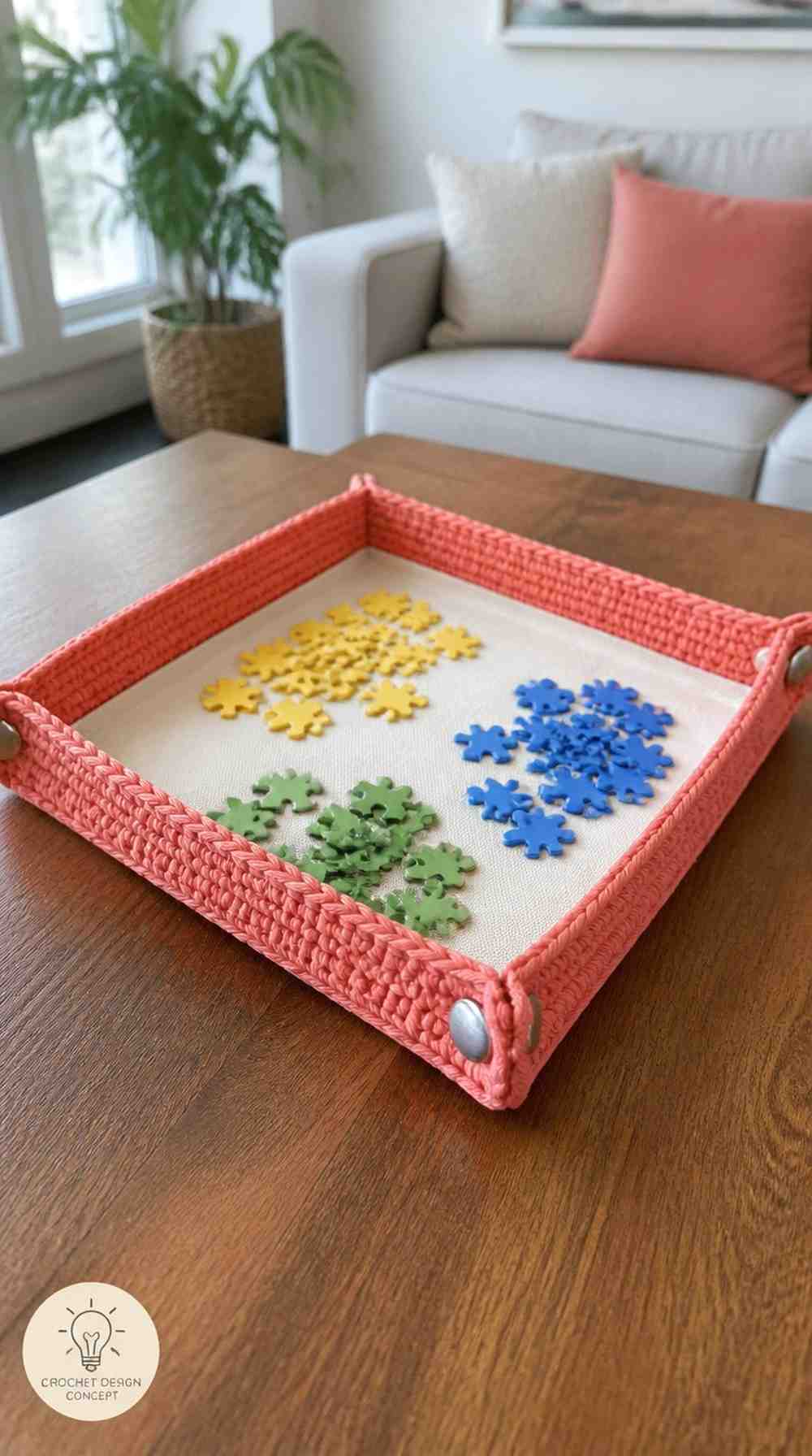
Coral-pink crochet forms a square mat with four corners folded upward to create a shallow tray. Small silver snaps secure the outer corner seams, while an ivory fabric liner provides a smooth interior. Loose yellow, blue and green puzzle pieces rest in separate small clusters without permanent dividers.
The snap-corner construction creates a flexible alternative to a fixed tray. When opened, the crochet can lie flat; with its corners secured, a low perimeter helps define the sorting area. Its usefulness depends on whether the corners remain stable and the liner stays smooth.
- Snap-Up Corners: Four small fasteners create a shallow rim while allowing the empty organizer to return to a flat shape.
- One Open Sorting Area: Without internal dividers, pieces need to be grouped manually in separate clusters.
- Fastener Placement: Keep the metal snaps outside the inner sorting surface to reduce contact with cardboard pieces.
- Moving the Tray: The shallow crochet rim is not a guarantee against spills, so loose pieces should not be transported without suitable rigid support.
13. Crochet Indigo Stackable Puzzle Sorting Mats
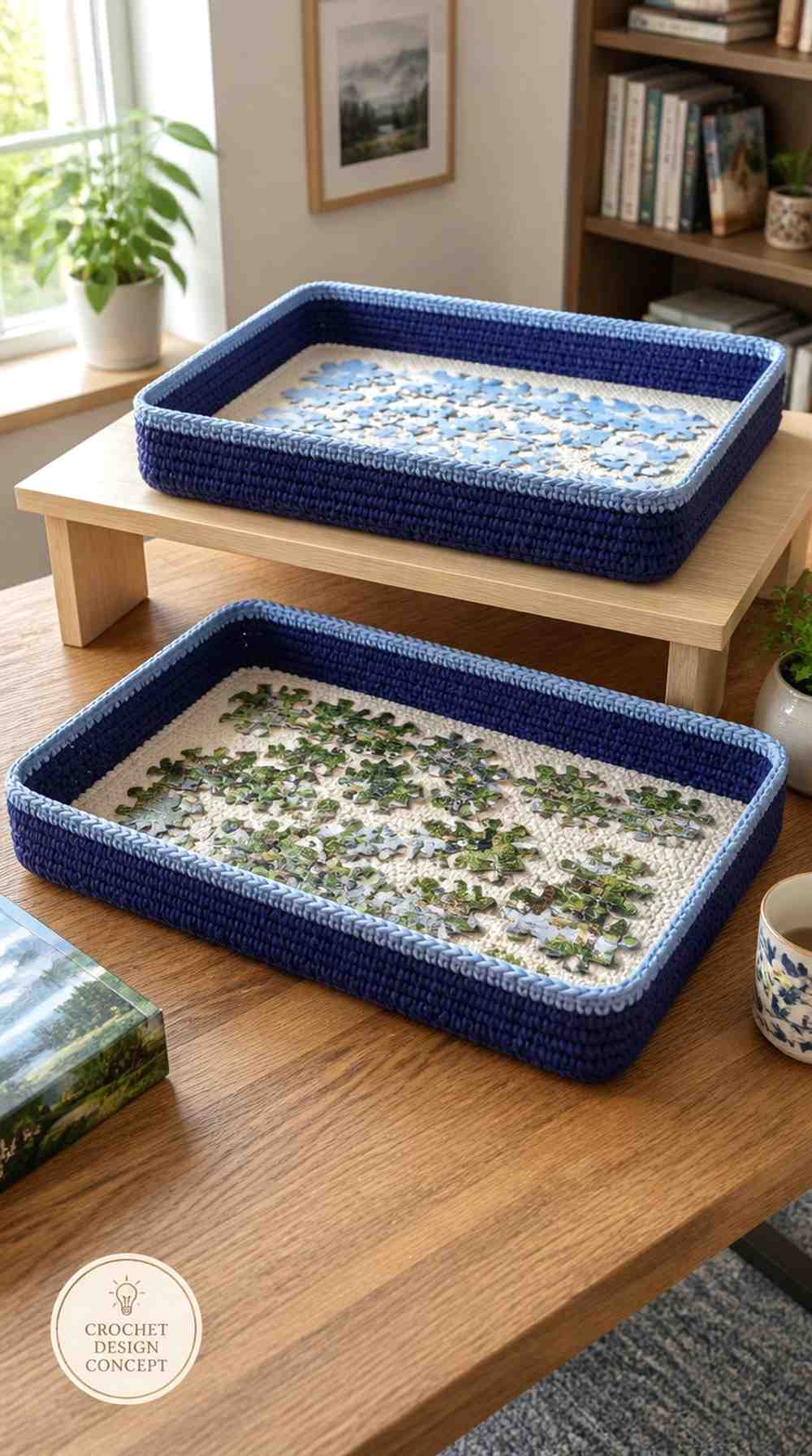
Deep indigo crochet creates a coordinated pair of shallow rectangular sorting trays. Each has a smooth cream fabric floor, a rigid flat insert and powder-blue edging. One tray contains green landscape pieces on the tabletop, while the other rests on a small wooden riser behind it with blue sky pieces.
This concept is about creating matching sorting surfaces rather than one divided mat. The two trays are intended to nest or stack when empty, helping reduce storage space between puzzle sessions. During sorting, the separate levels keep the groups visible.
- Two Matching Trays: Separate sorting surfaces can be moved or positioned independently, unlike one large connected organizer.
- Rigid Base Inserts: Flat supports help the indigo crochet sides retain their shape and prevent the piece-holding surfaces from bending.
- Raised Rear Position: A small tabletop riser keeps the rear tray visible without placing it directly on loose pieces in the lower tray.
- Empty Stacking: Stack the trays only when their contents have been removed or safely stored elsewhere, avoiding pressure on cardboard pieces.
14. Crochet Seafoam Sliding-Base Puzzle Sorting Mat
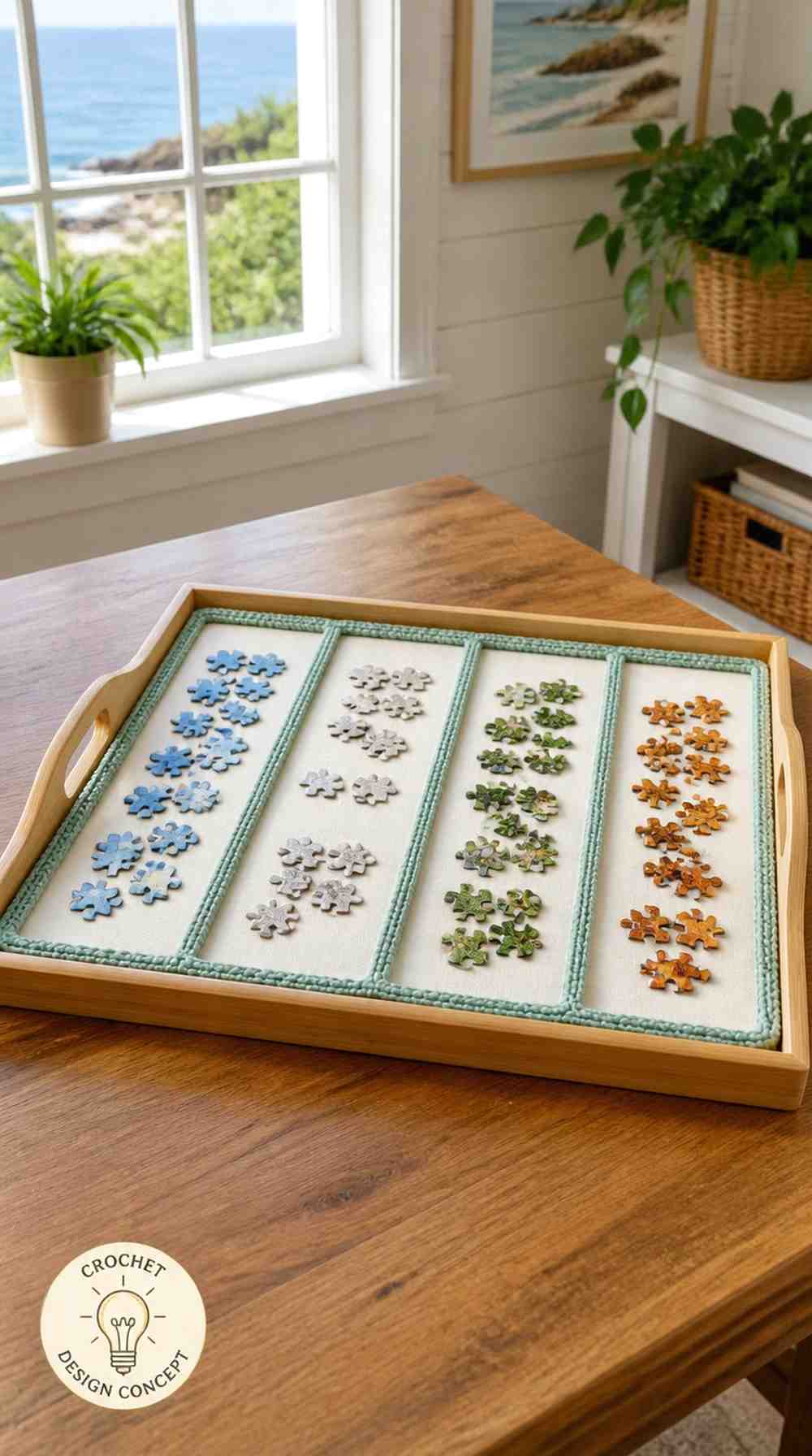
Seafoam-green crochet forms a rectangular mat fitted inside a shallow pale-bamboo tray. A cream fabric lining covers the sorting floor, while three low dividers create four long parallel lanes. Blue, pale-stone, green and amber puzzle pieces rest face-up in separate groups.
The rigid bamboo tray distinguishes this design from a flexible standalone mat. It provides a supported base beneath the crochet and two short handles for repositioning the organizer. The actual ability to move loaded pieces safely would depend on tray stability and the height of its sides.
- Bamboo Base: A rigid tray supports the complete mat, helping prevent broad crochet sections from sagging when repositioned.
- Four Parallel Lanes: Long compartments suit picture regions that contain many similarly colored pieces.
- Short Side Handles: The wooden grips provide defined lifting points, but the loaded tray should still be kept level and handled carefully.
- Removable Crochet Layer: A separate mat could be lifted out for cleaning, provided it does not snag against the bamboo edges.
15. Crochet Plum Pattern-Group Puzzle Sorting Mat
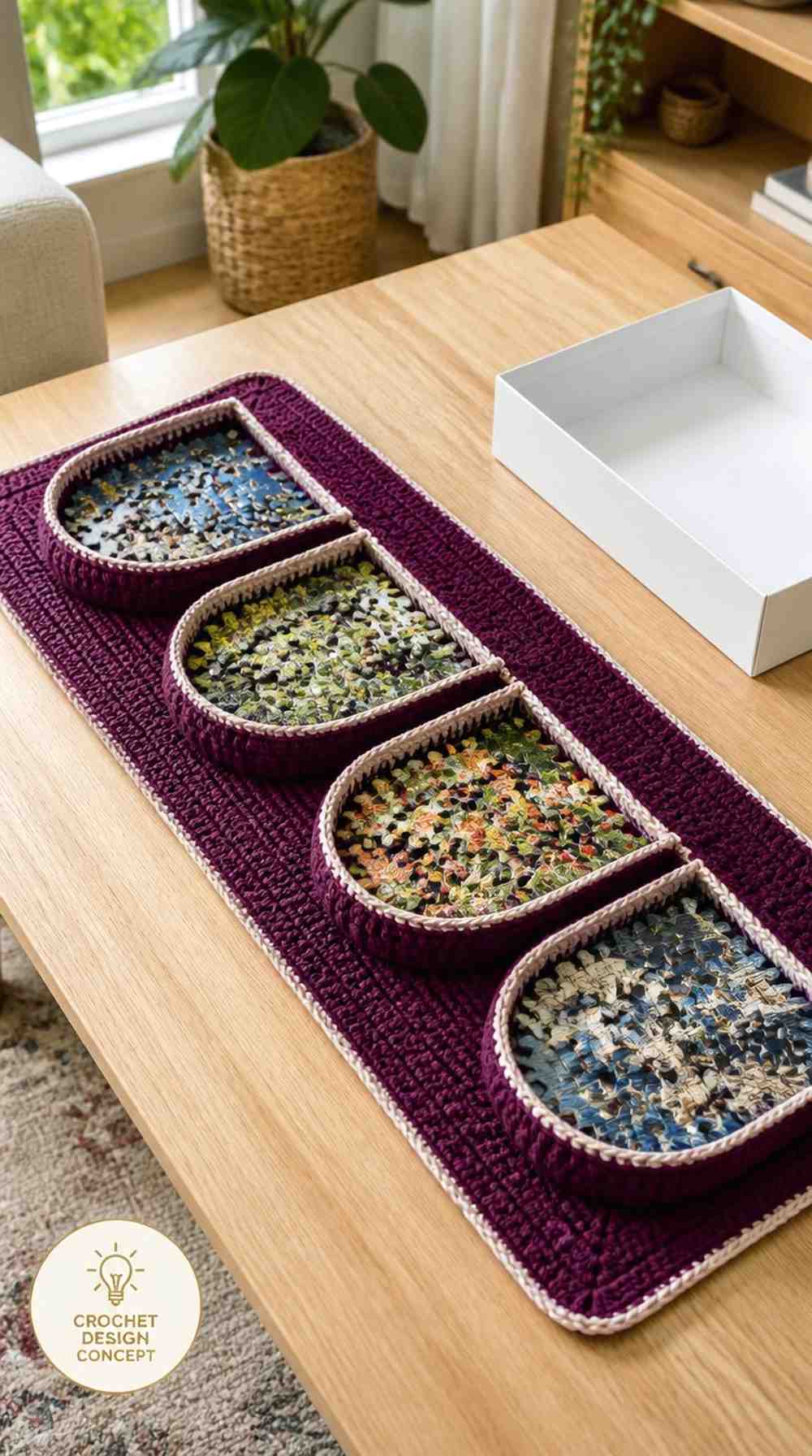
Deep-plum crochet creates a broad rectangular sorting mat with four shallow semicircular pockets arranged in one horizontal row. Each half-moon compartment has a curved lower rim, a straight upper opening and an ivory border. The pale-lilac fabric backing remains visible between the compartments.
Blue water, orange flowers, cream buildings and green tree pieces occupy the separate curved sections. The layout gives the mat a more decorative appearance than a standard grid while retaining clear categories for recognizable image details.
- Four Half-Moon Compartments: Curved sorting pockets create distinct groups without the boxy appearance of rectangular trays.
- Straight Upper Openings: Each compartment remains accessible from above, allowing loose pieces to be lifted without reaching through a narrow neck.
- Pale-Lilac Backing: A smooth light surface provides contrast with the plum crochet and helps make darker puzzle pieces easier to identify.
- Pattern-Based Groups: The four pockets work well for identifiable picture features, but may be less useful when the puzzle contains one large uniform area.
Practical Guide to Crochet Jigsaw Puzzle Piece Sorting Mats
A good puzzle sorting mat should make individual pieces easier to see, pick up and compare. Crochet adds attractive texture, but the piece-holding surface needs to remain flat enough that cardboard tabs do not catch between stitches.
Measure your puzzle pieces and table. Piece dimensions vary between puzzle brands, cuts and difficulty levels. Before making a mat, spread a sample group face-up and estimate the space needed to view them without significant overlap. A design with many small compartments is not automatically better than one with a few broad sections.
Use a smooth surface beneath the pieces. Dense crochet stitches can form a decorative mat, but raised seams and openwork may snag cardboard tabs. Smooth removable fabric linings are useful for compartment floors. Consider a rigid insert if the finished mat needs to stay level or be repositioned.
Keep dividers low. Short reinforced crochet walls, flat separator cords and carefully joined edging can define sorting groups without blocking access. Very tall sides may make it harder to pick up pieces or scan their printed details.
Organize pieces in a useful sequence. A common approach is to identify straight-edge and corner pieces first, then group interior pieces by color, subject or repeated image patterns. Sorting by piece shape can be more helpful later, especially in large areas of similar color.
PuzzlePal+1
Choose a color that helps you see the puzzle. A cream lining can make dark cardboard artwork easier to inspect, while navy or charcoal may offer better contrast for pale pieces. Strongly patterned crochet is usually better kept along borders rather than directly beneath the artwork.
Plan for storage and cleaning. Crochet is not a secure transport surface for loose puzzle pieces. Rolling, folding or stacking an occupied mat may scatter pieces or damage delicate tabs. Remove or separately secure the pieces before collapsing a flexible organizer. Keep the mat clean, dry and free from loose yarn fibers, following the yarn’s care instructions.
For a coordinated puzzle corner, 10 Crochet Desk Pen Cup Ideas on Yarn Nest Studio explores small tabletop containers that could hold pencils and other stationery away from the sorting surface.
Want to Make Something Similar?
These 15 designs are original AI-generated crochet concepts, not tested puzzle-sorting mats or exact construction patterns. The resources below cover closely related tray construction and foldable edges.
- Tri Color Trays — Hobbii is a free rectangular crochet tray pattern designed by TL Yarn Crafts. Its tray shaping may help with low-sided sorting compartments, although the pattern is not specifically for jigsaw puzzles. Hobbii
- Free Valet Tray Crochet Pattern — Green Fox Farms Designs provides different sizes of shallow catchall trays, with instructions for shaping and joining the corners. It is a useful construction reference for the Sage Four-Section and Indigo Stackable concepts, but those designs add separate features. Green Fox Farms Designs
- Crochet Button Tray — Ronique includes a free foldable crochet tray project with buttoned corners and written guidance. Its construction is related to the Coral Snap-Corner concept, although the illustrated design uses snap fasteners rather than the exact original button arrangement. Free Crochet Patterns & Video Tutorials
These tutorials teach crochet tray-making techniques. To adapt one for puzzle sorting, consider a smooth insert or lining, suitable compartment dimensions and an appropriate resting surface.
Comparison: Which Puzzle Sorting Mat Should You Choose?
| Design | Main feature | Practical consideration |
|---|---|---|
| Sage Four-Section Mat | Four equal compartments | Divider and lining stability |
| Terracotta Border-Piece Mat | Two dedicated edge-piece channels | Narrow channel access |
| Navy Three-Color Mat | Three broad horizontal lanes | Piece contrast against dark fabric |
| Blush Scalloped Cluster Mat | Six shallow oval nests | Capacity of individual compartments |
| Mustard Honeycomb Mat | Six connected hexagons | Overall table footprint |
| Ivory Granny-Square Mat | Four traditional motif frames | Smooth floor inserts |
| Teal Roll-Up Mat | Flexible three-section design | Empty before rolling |
| Charcoal Book-Fold Mat | Two hinged sorting panels | Empty before folding |
| Lavender Wheel Mat | Six radial compartments | Circular working space |
| Rust Nine-Grid Mat | Nine small sorting areas | Avoiding unnecessary over-sorting |
| Cream and Olive Two-Stage Mat | Edge lane plus three color areas | Reassigning categories |
| Coral Snap-Corner Mat | Convertible shallow tray | Fastener and rim stability |
| Indigo Stackable Mats | Two separate matching trays | Safe empty stacking |
| Seafoam Sliding-Base Mat | Four lanes inside a rigid tray | Level lifting and support |
| Plum Pattern-Group Mat | Four half-moon pockets | Shape-specific sorting capacity |
For an everyday puzzle with a few recognizable picture regions, the Sage Four-Section, Navy Three-Color and Cream and Olive Two-Stage mats offer approachable layouts.
If you enjoy detailed organization, the Mustard Honeycomb, Lavender Wheel and Rust Nine-Grid designs provide more sections for smaller categories. The Rust Nine-Grid is especially compartment-heavy, so it makes more sense when the puzzle has numerous distinct visual elements.
For compact empty storage, consider the Teal Roll-Up, Charcoal Book-Fold or Coral Snap-Corner concepts. If you prefer a more rigid surface, the Indigo Stackable and Seafoam Sliding-Base designs provide separate supported alternatives.
Conclusion
Crochet jigsaw puzzle piece sorting mats offer a creative way to combine handmade style with a familiar puzzle-solving routine. From simple four-section mats and traditional granny squares to honeycomb compartments, circular wheels and foldable trays, these 15 concepts explore different ways to keep loose pieces organized.
The best design is one that suits your puzzle size, provides a flat surface beneath the pieces and keeps each group easy to see. Choose the sorting layout first, then add crochet textures, colors and decorative borders that make your puzzle table more inviting.
Which design would you choose for your puzzle table? Would you prefer the Sage Four-Section Mat, the Mustard Honeycomb Mat or the Lavender Wheel? Share your favorite and whether you normally sort puzzle pieces by color, edge shape or picture details.
Frequently Asked Questions
1. Can crochet be used to make a jigsaw puzzle piece sorting mat?
Yes. Crochet can form decorative sorting mats, shallow compartments, tray edges and flexible organizer panels. However, cardboard puzzle pieces may catch on open stitches or raised seams. A smooth lining or backing can make the surface more suitable for sorting than uncovered textured crochet alone.
2. What yarn is suitable for a crochet puzzle sorting mat?
Smooth, washable cotton or an appropriate cotton-blend yarn may work for a decorative mat with firm edges. Tightly worked stitches can reduce large gaps, although they may still create an uneven surface. Consider smooth fabric lining for the piece-holding areas, and avoid yarns that shed heavily or form loose fibers.
3. How many compartments should a puzzle sorting mat have?
The useful number depends on the puzzle artwork and how you like to work. Three or four sections may be enough for broad color groups and edge pieces. Six or nine sections may help when the image contains many distinct subjects. Too many compartments can also make sorting unnecessarily complicated.
4. Can I roll up a crochet puzzle sorting mat with pieces inside?
A basic crochet mat should not be assumed capable of safely holding loose pieces when rolled. Rolling can shift the pieces, bend cardboard tabs or cause some pieces to fall out. Unless a specific system has been designed and tested to retain the contents, remove or separately secure the pieces before rolling or folding the mat.
5. Are these 15 crochet jigsaw puzzle sorting mats complete patterns?
No. These are original AI-generated crochet design concepts for inspiration, not tested patterns or finished products. The linked tutorials demonstrate related shallow tray and folding techniques but do not reproduce the pictured organizers exactly. Anyone making a similar mat should check the puzzle-piece size, lining, divider height, surface stability and suitability for everyday handling.