A crochet pet leash handle soft grip can add handmade color and texture to an everyday walking accessory. These 18 inspiration ideas explore ribbed palm wraps, reversible sleeves, basketweave cushioning, scalloped edges, contoured covers, and decorative floral details. From warm terracotta and mustard yellow to indigo, lavender, olive, and charcoal, the collection offers different styles for people who enjoy coordinating their pet-walking accessories.
The important thing is keeping the original leash secure and comfortable to hold. These concepts decorate the hand-contact section of an existing loop handle rather than replace its structural webbing or stitching. Different leashes have different handle widths, materials, and shapes, so the right cover needs a suitable fit without slipping, bunching, or changing how the leash is controlled. Compare the textures, linings, seams, closures, and practical limitations before choosing a design.
These are AI-generated crochet design visualizations for inspiration, not photographs of tested handmade products or step-by-step patterns.
Quick Design Selection Guide
- For a simple everyday appearance: Crochet Terracotta Ribbed Leash Palm Wrap offers a compact textured cover.
- For a two-sided design: Crochet Indigo Reversible Leash Grip Sleeve combines indigo and oatmeal-colored crochet.
- For more pronounced texture: Crochet Mustard Basketweave Handle Cushion and Crochet Rust Center-Ridge Leash Wrap introduce raised stitch details.
- For decorative styling: Crochet Blush Scalloped Leash Handle Cover and Crochet Coral Daisy-Accent Palm Cover add flat embellishments.
- For a wider palm area: Crochet Olive Contoured Wide-Palm Grip and Crochet Chocolate Broad-Loop Grip Sleeve have broader central sections.
- For removable fastening: Crochet Oatmeal Side-Fastened Grip Cuff uses a low-profile fabric closure.
- For a round rope handle: Crochet Plum Rounded-Rope Loop Wrap follows a curved rope-loop shape.
1. Crochet Terracotta Ribbed Leash Palm Wrap
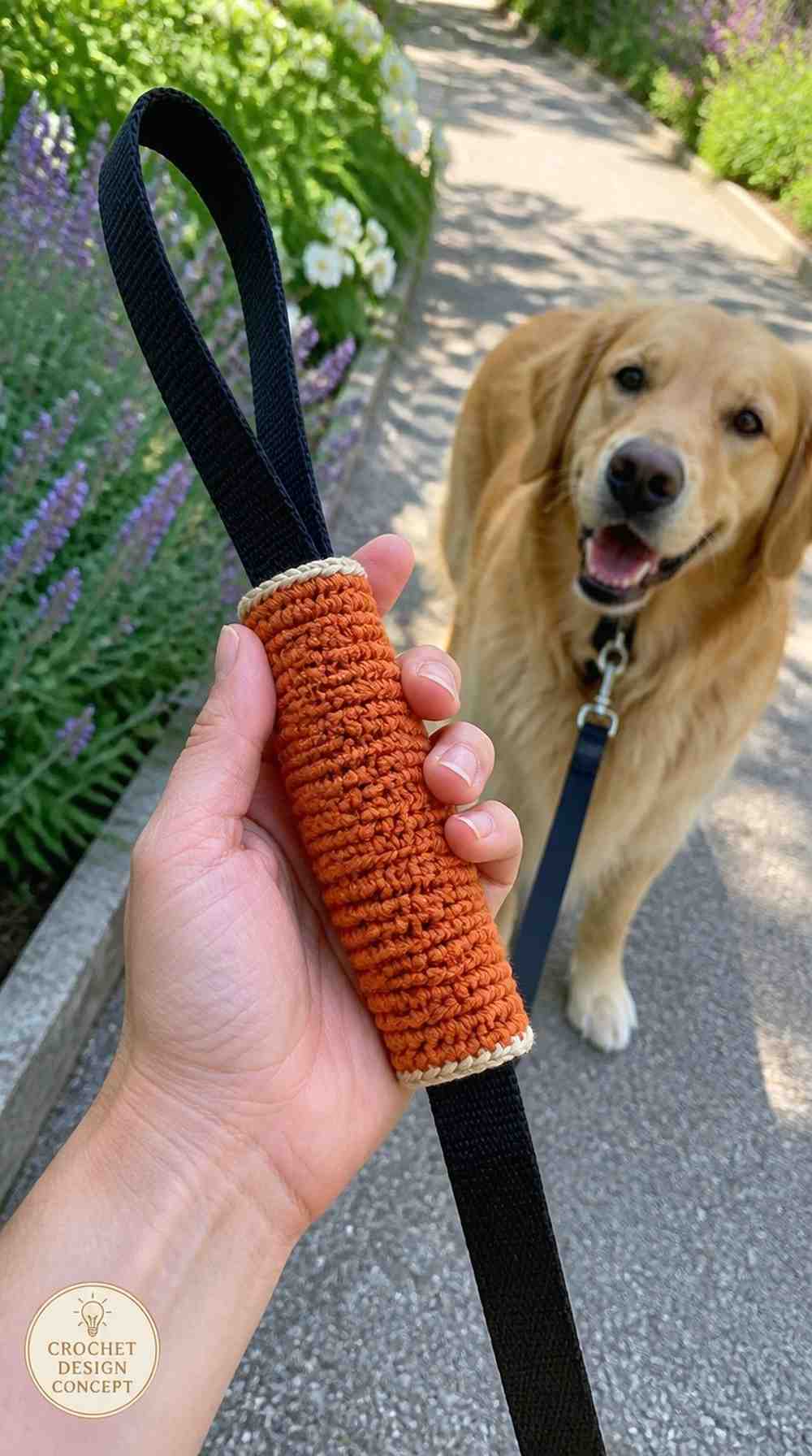
Warm terracotta crochet covers the lower hand-contact section of a black nylon leash loop. Fine horizontal ribs create a neatly textured surface, while cream edging finishes both ends. The original black webbing continues beyond the sleeve, making the difference between the decorative cover and the actual leash clearly visible.
This straightforward design suits someone who prefers understated handmade details. The short wrap adds texture without covering the entire handle loop, although its fit needs checking to make sure it stays positioned where the hand naturally rests.
- Palm Coverage: Measure the part of the existing loop normally held in the palm, rather than extending the sleeve across the entire handle.
- Rib Orientation: Keep the raised horizontal rows modest so they create texture without feeling overly bulky or uneven when gripped.
- Original Webbing: Leave the leash’s structural handle stitching visible and accessible for regular inspection.
2. Crochet Indigo Reversible Leash Grip Sleeve
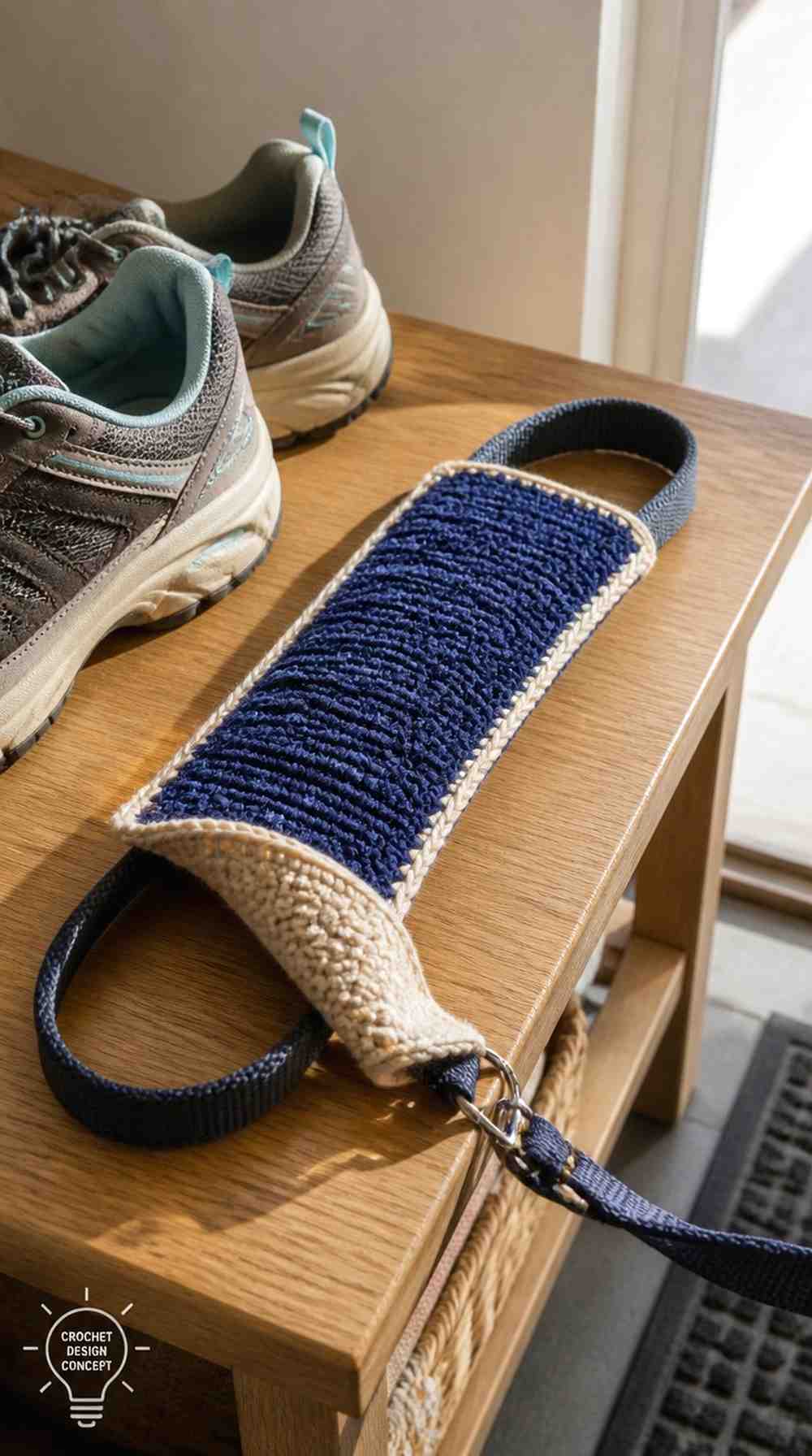
Deep-indigo crochet creates a compact sleeve with a smooth oatmeal-colored reverse side and narrow ivory edging. One turned-back end reveals the second color, while a flat outer seam keeps the wrap neatly fitted around the charcoal nylon handle.
The reversible appearance offers more variety than a single-color cover. Both sides would need to be comfortable against the palm, especially if the sleeve is intended to be turned inside out rather than simply display a contrasting inner layer.
- Two-Sided Finish: Keep both crochet faces smooth enough for hand contact, with no exposed rough joins when the sleeve is reversed.
- Seam Placement: Position the joining seam along the outside of the leash handle instead of directly beneath the palm.
- Reversible Fit: Check that turning the sleeve does not make it too loose or cause the original leash to twist inside.
3. Crochet Mustard Basketweave Handle Cushion
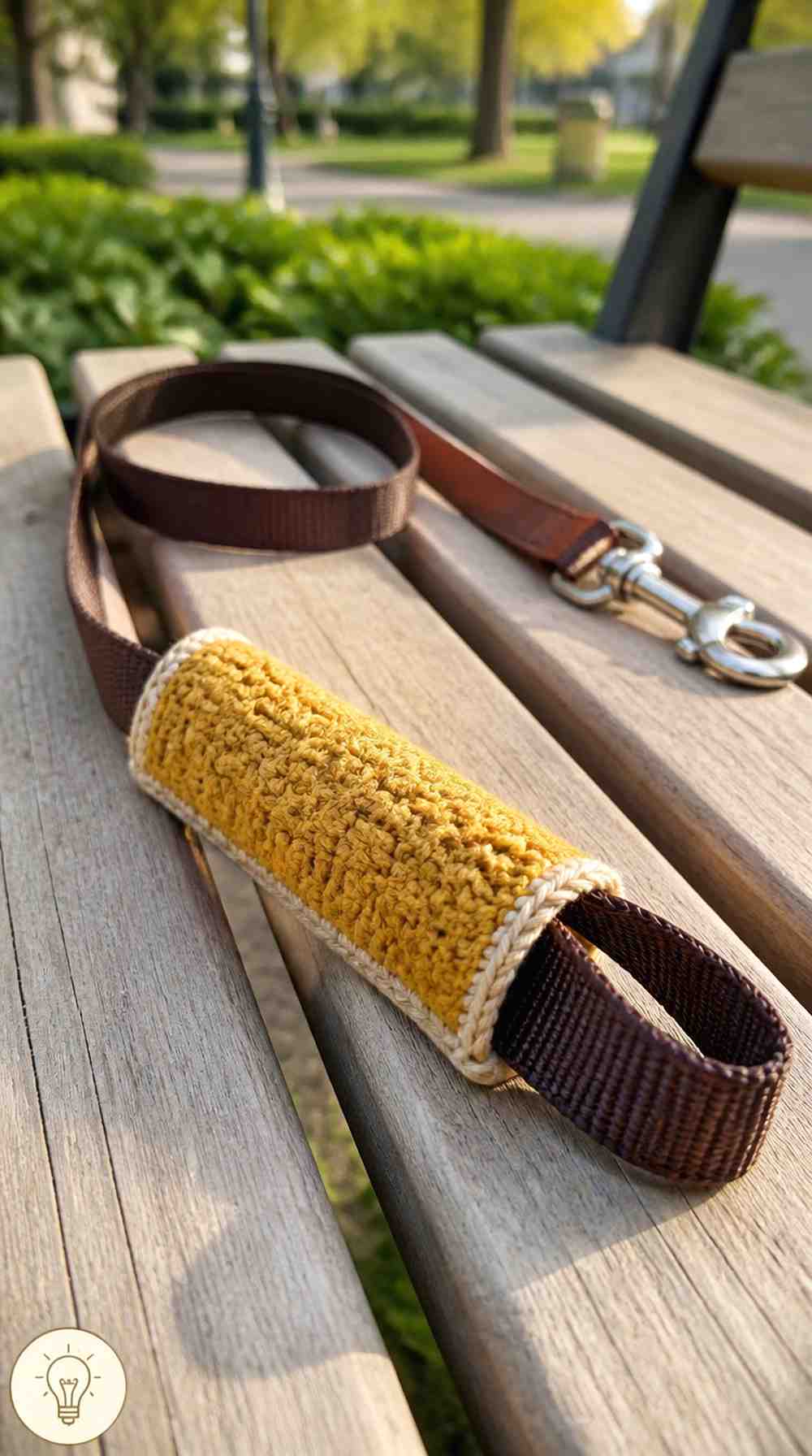
Mustard-yellow crochet creates a padded rectangular sleeve with evenly spaced basketweave-style blocks. Warm-cream edging defines the ends, while a thin smooth fabric backing separates the raised crochet exterior from the dark-brown webbing underneath.
The textured surface gives this idea a more substantial appearance than a plain single-crochet wrap. Its raised blocks may appeal to people who prefer a noticeable handmade texture, but actual comfort and secure handling would need to be checked with the finished accessory.
- Basketweave Texture: Keep the raised blocks consistent and relatively low so the surface does not create uncomfortable pressure points.
- Backing Layer: A smooth thin lining can separate the textured crochet from the leash, but excessive padding could increase handle bulk.
- Grip Assessment: Test the sleeve’s stability and feel without a dog attached before considering whether it is suitable for actual walking.
4. Crochet Blush Scalloped Leash Handle Cover
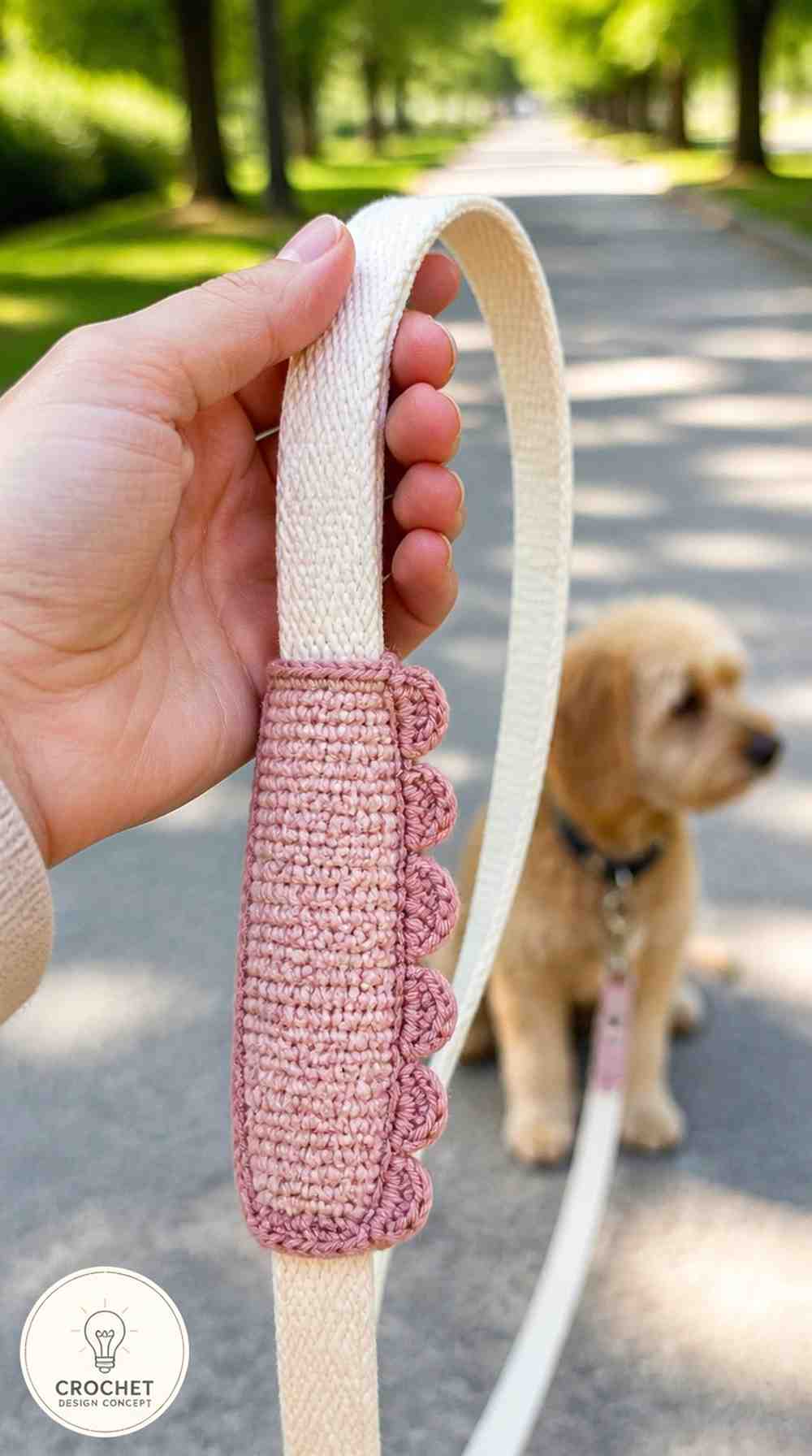
Blush-pink crochet creates a soft-looking sleeve with dusty-rose edging and five small scallops along its outward-facing edge. The dense main panel surrounds the lower portion of an intact cream nylon handle loop, while the inner gripping space remains open.
The flat scallops make this design decorative without relying on dangling ornaments. Its gentle pink palette also works well for a coordinated walking-accessory collection, provided the extra edging stays away from the fingers and cannot catch on the leash.
- Scallop Placement: Keep all five decorative loops on the outside edge, where they are less likely to interfere with holding the leash.
- Flat Construction: Make the scallops firmly connected to the main panel so they do not curl outward or form loose snagging points.
- Hand Clearance: Leave the original loop opening large enough for the handler’s preferred safe grip.
5. Crochet Olive Contoured Wide-Palm Grip
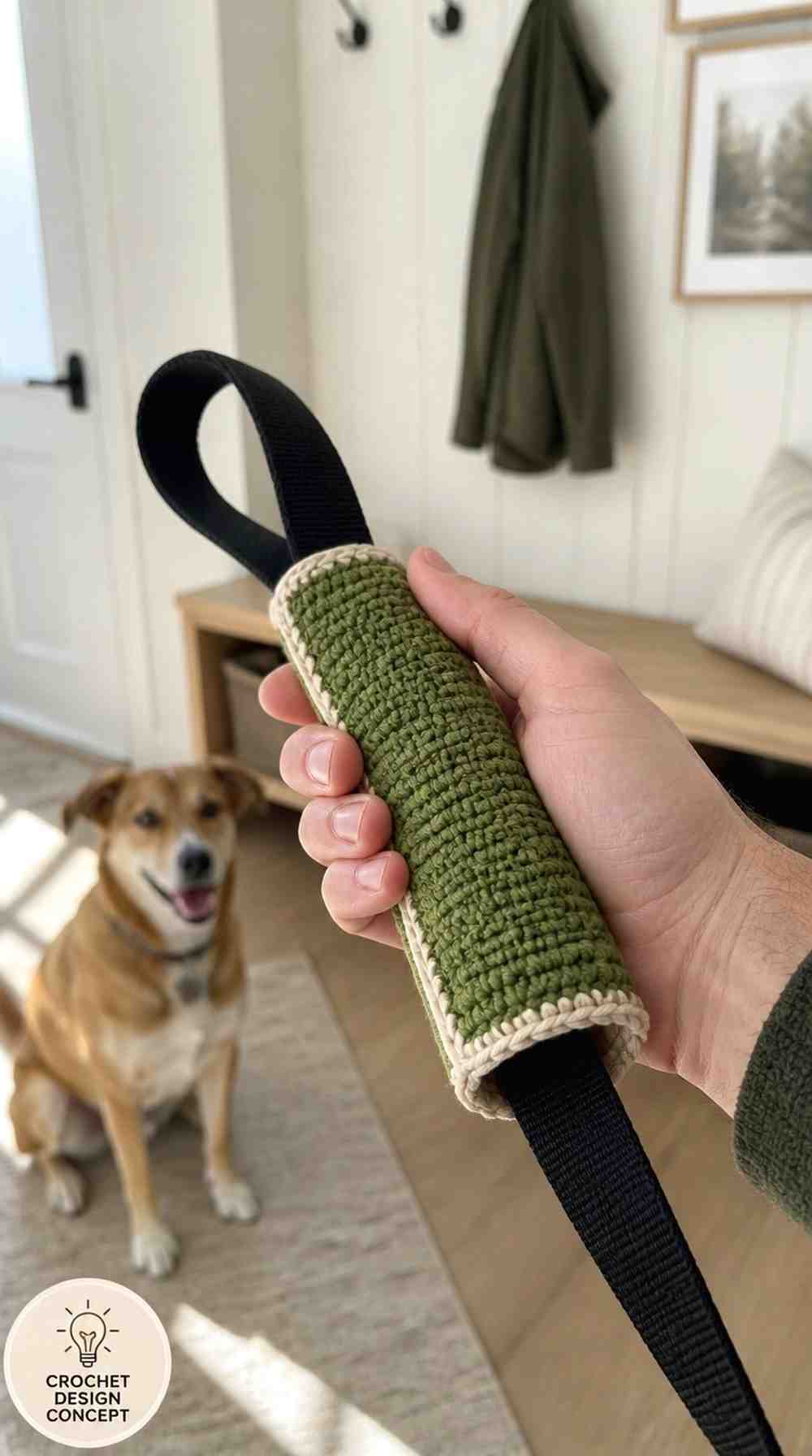
Olive-green crochet forms a gently contoured sleeve with a wider central section and narrower ends. Close-textured rows follow the shape, with oatmeal edging and a smooth inner fabric layer. The black nylon loop remains clearly visible beyond the covered area.
This concept focuses on adapting the cover’s shape to the section normally held in the palm. The wider middle creates a different feel from a uniformly narrow sleeve, although it must not make the leash harder to grasp securely.
- Central Width: Compare the broader section against the handler’s actual hand size, avoiding unnecessary thickness that could weaken their hold.
- Tapered Ends: Gradual shaping can reduce abrupt fabric transitions, but the sleeve still needs to stay securely positioned.
- Handle Access: Keep the original loop opening and structural stitching unobstructed so the handler can use and inspect the leash normally.
6. Crochet Aqua Mesh-Layer Leash Grip
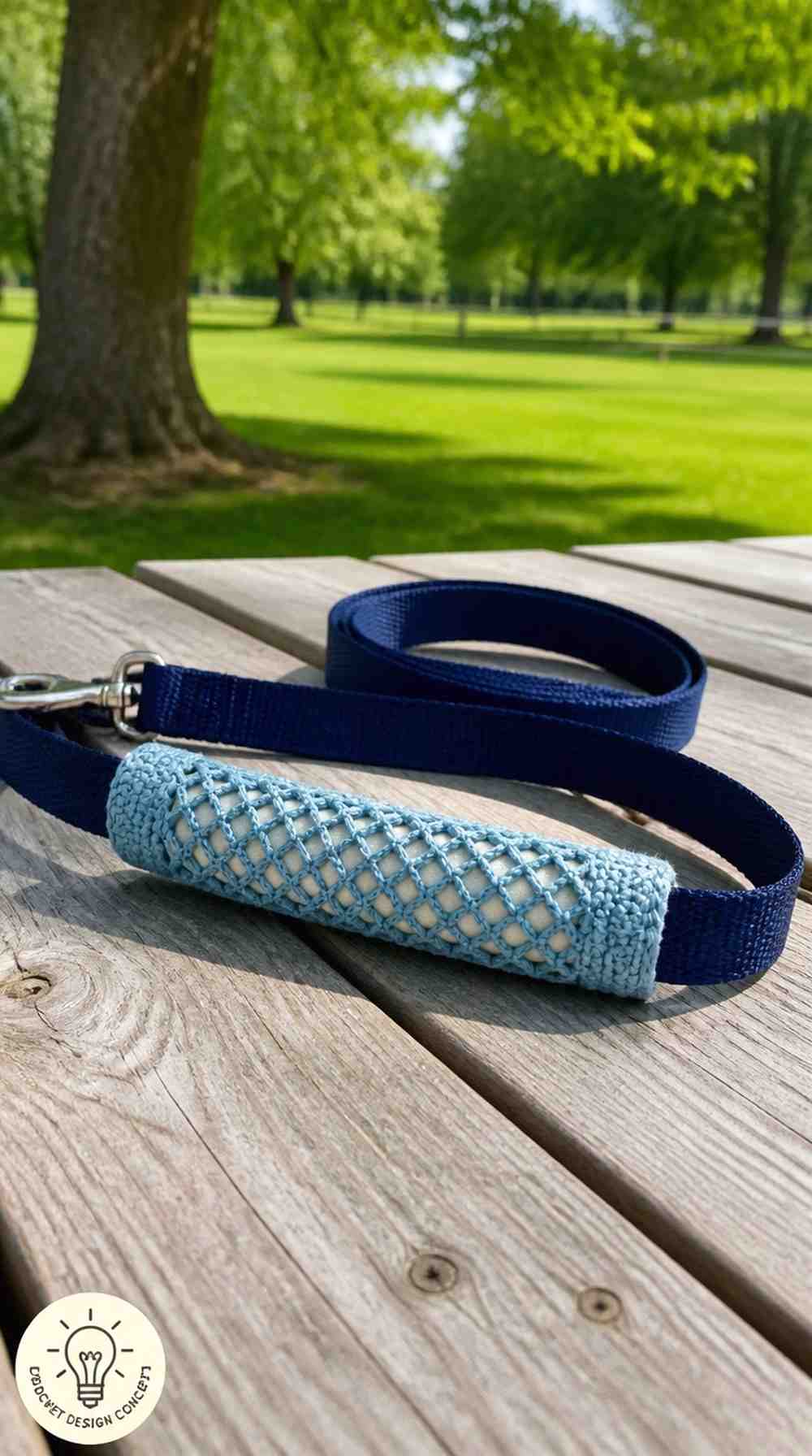
Aqua-blue crochet creates an open diamond-mesh outer layer over a smooth cream fabric lining. Dense aqua borders finish the short ends, while a flat exterior seam holds the cover around a navy leash handle.
The lined mesh gives this grip a lighter visual appearance than dense crochet. The inner fabric is important because it prevents the original webbing from pressing directly against the openwork and reduces the chance of fingers catching in large decorative loops.
- Mesh Openings: Keep the diamonds evenly connected and relatively small, especially near the edges where repeated handling could stretch them.
- Complete Lining: The smooth backing should separate the openwork from the leash’s hand-contact surface without making the grip bulky.
- Snagging Check: Inspect the mesh for loose yarn loops before use, since decorative openings can catch on fingers, nails, or nearby objects.
7. Crochet Rust Center-Ridge Leash Wrap
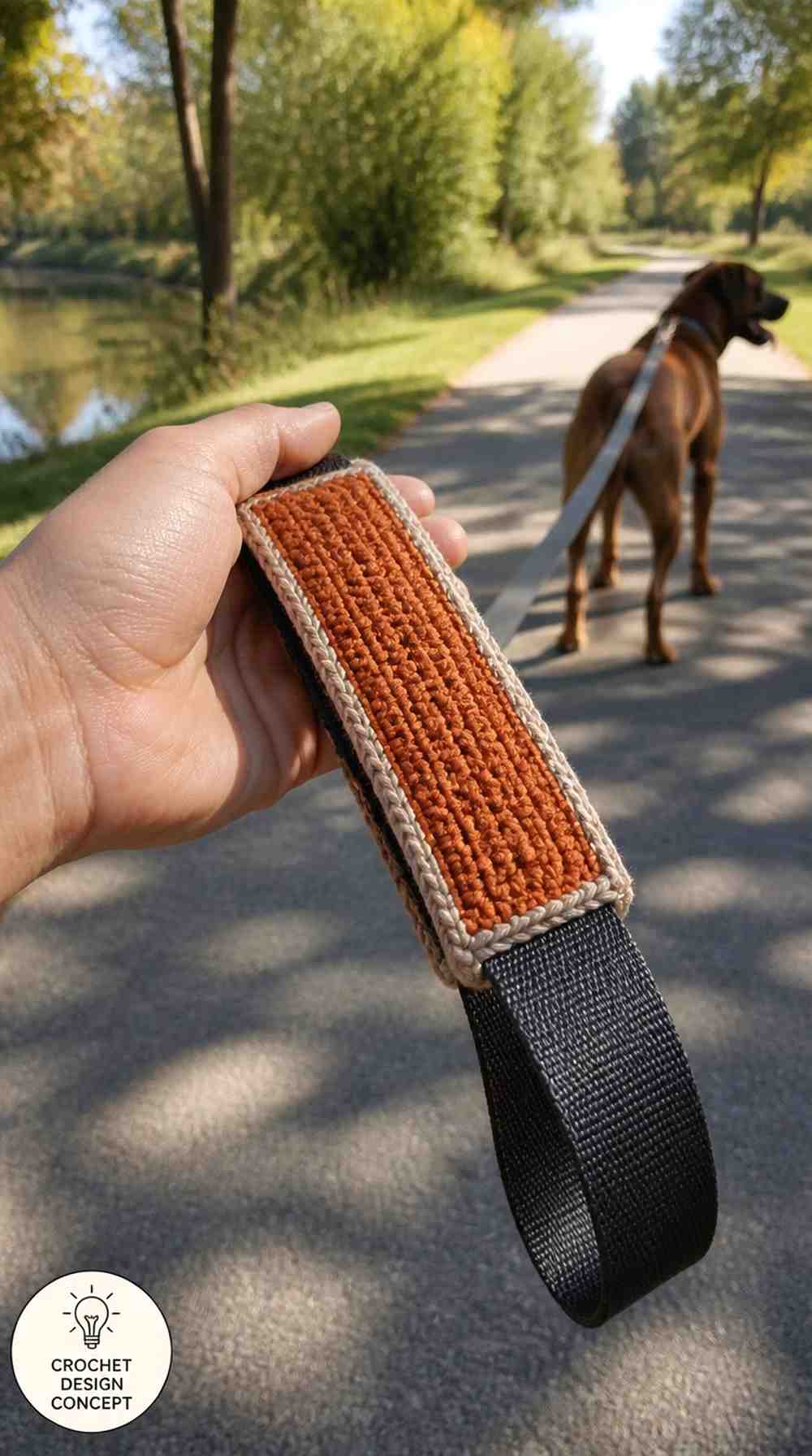
Rust-orange crochet forms a compact wrap with one low raised ridge running through its center. Smooth stitch rows sit on either side, while sand-colored edging and a thin concealed padding layer complete the design.
The central ridge distinguishes this concept from flat ribbed sleeves. It introduces a gentle change in surface texture without using large knots or decorative cords, but the shape should still feel comfortable when the original leash loop is held firmly.
- Ridge Height: Keep the central raised row low and rounded rather than creating a prominent hard line against the palm.
- Padding Thickness: Use only enough padding to suit the intended shape; excessive bulk may reduce the handler’s ability to close their fingers securely.
- Seam Orientation: Place the wrap’s outer join away from the main palm-contact area to reduce rubbing during ordinary handling.
8. Crochet Oatmeal Side-Fastened Grip Cuff
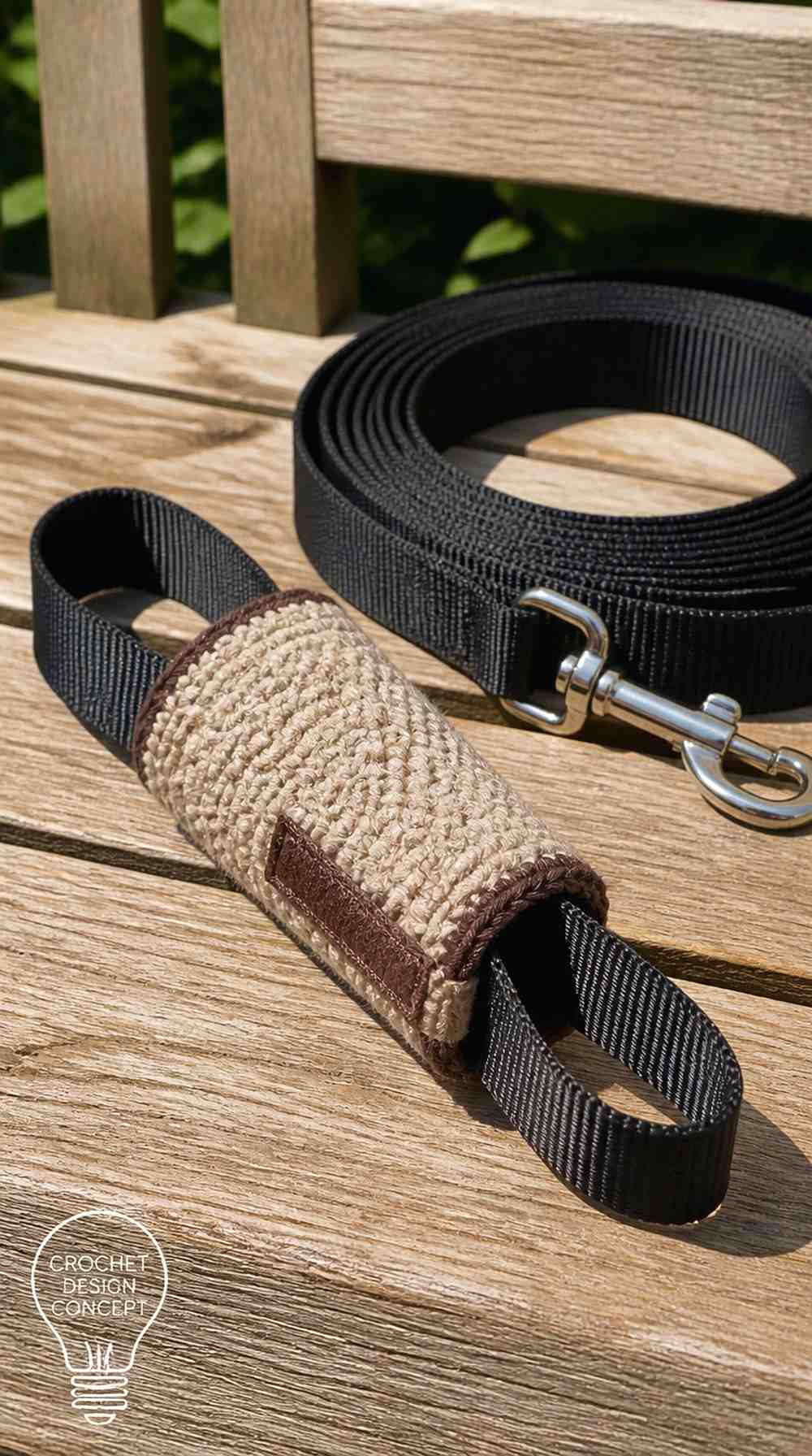
Oatmeal-colored crochet creates a broad rectangular cuff with neat moss-stitch texture and cocoa edging. A low-profile sewn hook-and-loop strip secures the overlapping outer side of the wrap around a black nylon leash handle.
The adjustable opening makes this concept different from a permanently sewn tubular sleeve. The fastening allows the cover to be removed without modifying the leash, although the closure needs to remain securely shut and should not rub against the hand.
- Closure Location: Keep the hook-and-loop strip on the outer face of the handle, away from the fingers and the dog’s access.
- Overlap Fit: Allow enough overlap for the fabric to close flat without creating a raised ridge that presses into the palm.
- Routine Inspection: Check the fastening before every use and remove the cover if it begins to loosen or rotate around the webbing.
9. Crochet Lavender Chevron Leash Grip Cover
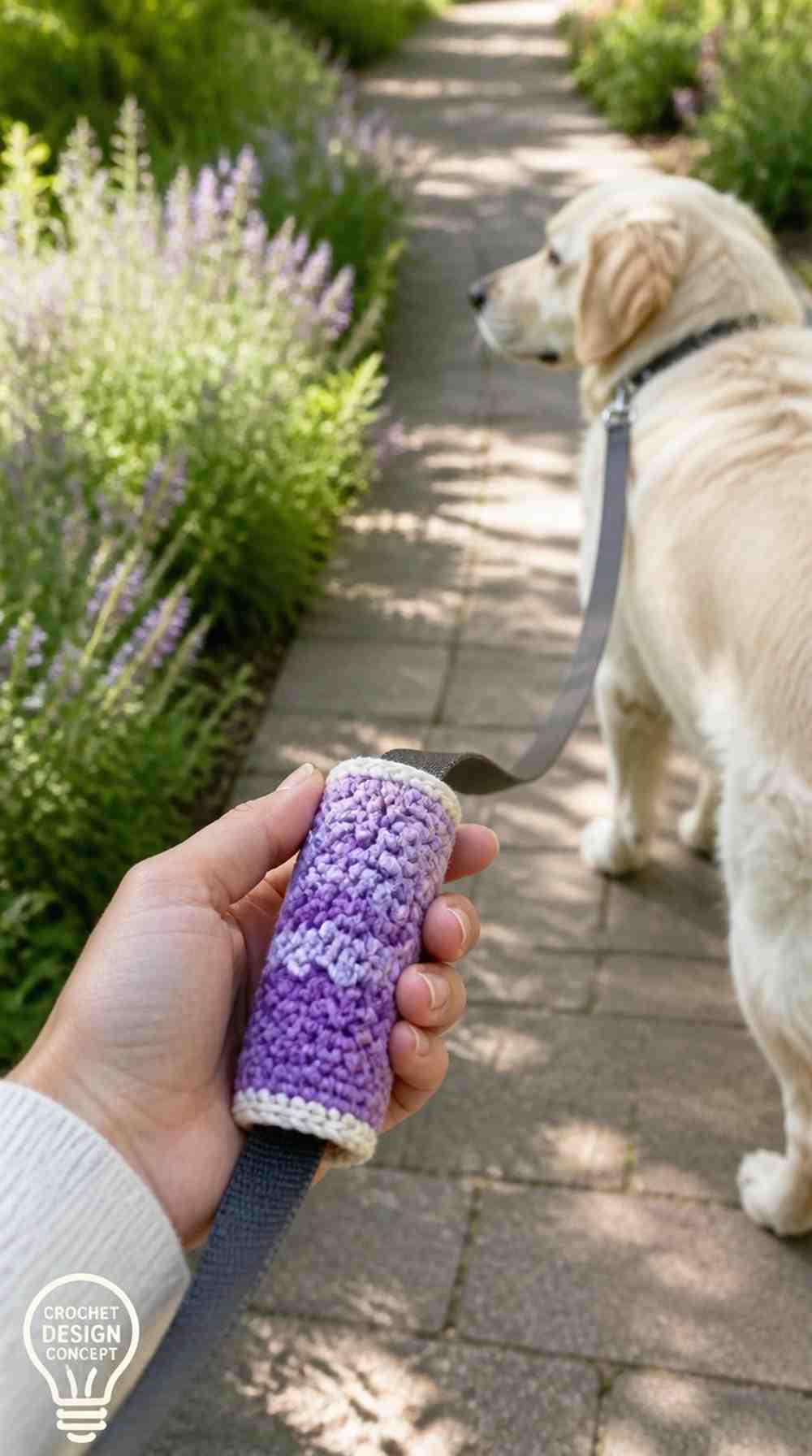
Lavender crochet brings a softer appearance to this curved handle sleeve. Three fine chevron bands in lavender and deeper plum follow the lower arc of the dark-gray nylon loop, while ivory edging defines the short ends.
The chevron texture provides a decorative direction without requiring external attachments. It is especially suitable as a visual concept for someone who likes patterned accessories but wants the surface to remain relatively flat.
- Chevron Shaping: Keep the increases and decreases consistent so the three patterned bands follow the curved handle naturally.
- Low-Profile Texture: Avoid exaggerated raised points that could become uncomfortable when the handler closes their hand around the loop.
- Curved Fit: Check that the finished cover follows the leash’s existing arc without twisting the original nylon webbing.
10. Crochet Burgundy Double-Stripe Loop Sleeve
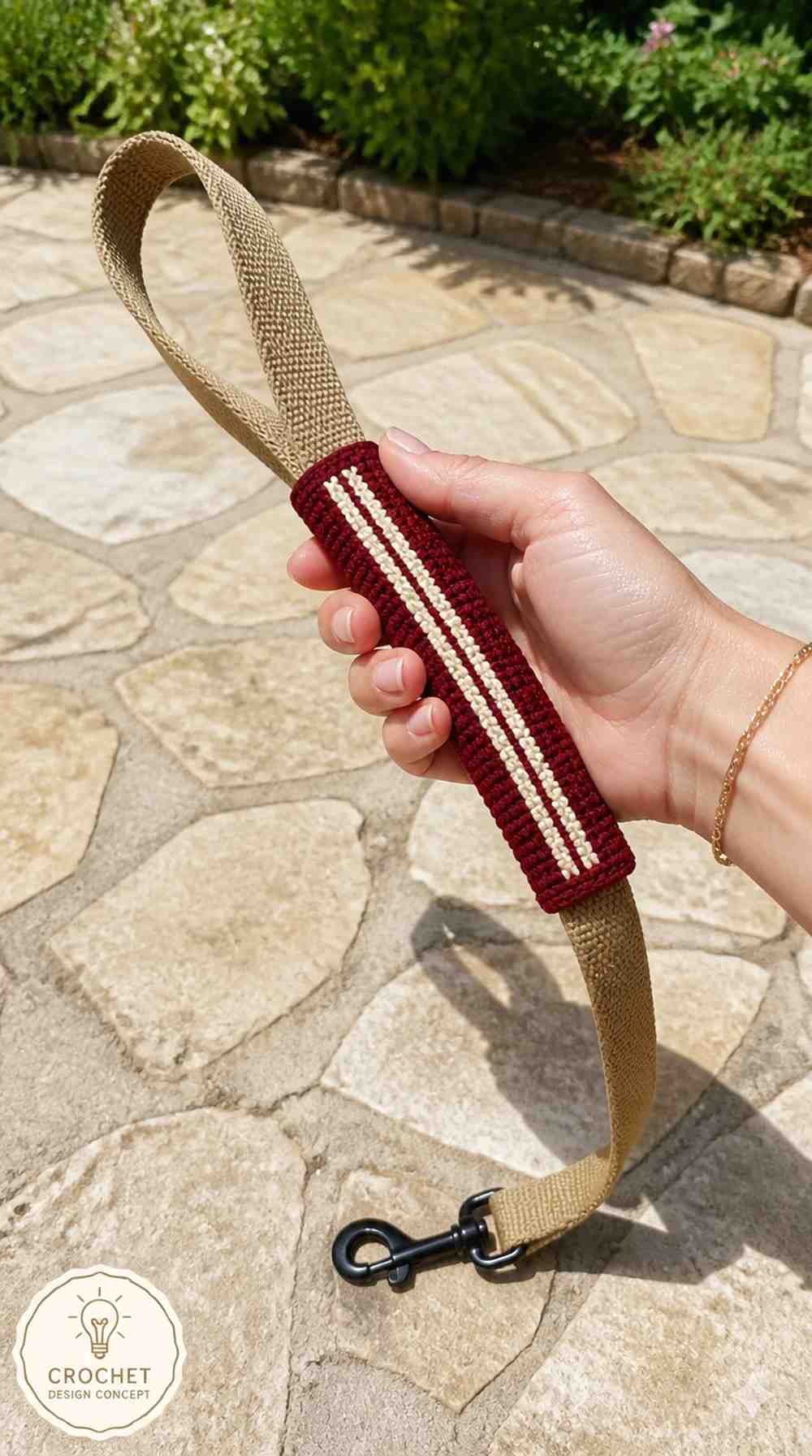
Burgundy crochet creates a compact tubular cover with two narrow ivory stripes running along its length. Dense, even rows follow the lower curve of a tan woven leash handle, while rounded end borders give the sleeve a tidy finish.
The two parallel stripes make this design easy to recognize without adding bulky embellishments. The burgundy-and-ivory combination suits a traditional walking-accessory style, while the original tan webbing remains exposed outside the decorative section.
- Stripe Alignment: Keep both ivory lines parallel through the curved section so the design does not appear twisted.
- Rounded Edges: Finish the short ends smoothly to avoid firm ridges where the covered and uncovered webbing meet.
- Tubular Fit: The sleeve should remain in position without stretching the original leash loop or making it more difficult to inspect.
11. Crochet Coral Daisy-Accent Palm Cover
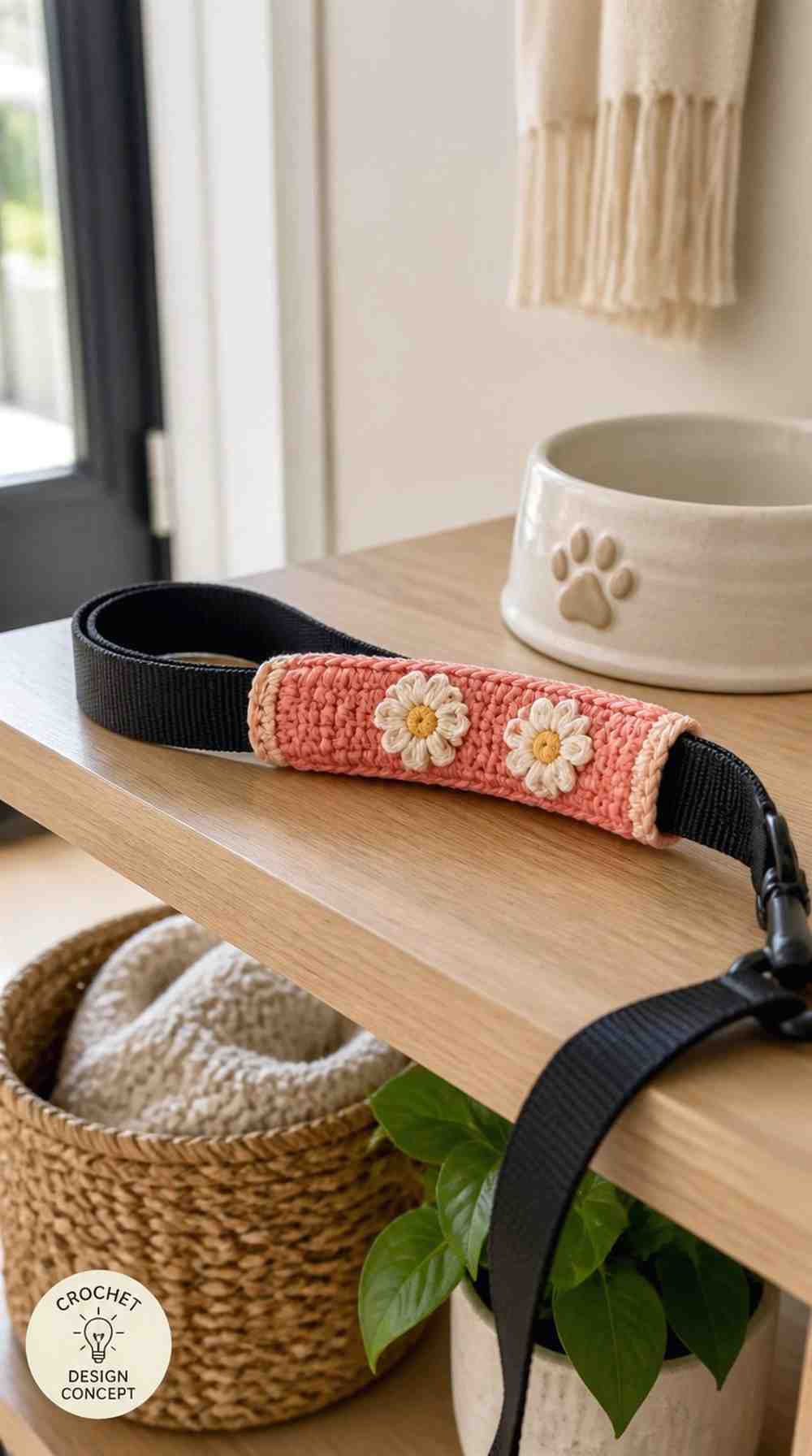
Coral-pink crochet forms a narrow handle wrap with peach edging and two small ivory daisies. Each flower has a pale-golden center and sits flat against the outward-facing surface, leaving the inner palm area smooth.
The floral details turn a plain black leash into a cheerful accessory without replacing any of its structural parts. This concept is particularly decorative, so the flower attachments and their position deserve more attention than additional cushioning.
- Daisy Attachment: Stitch both flowers securely to the outer wrap, avoiding raised detachable centers, beads, or loosely connected petals.
- Inner Grip: Keep the palm-facing surface plain so the floral motifs do not press against fingers during handling.
- Pet Access: Remove the accessory if the dog begins chewing or tugging at the decorations, as damaged yarn could create additional hazards.
12. Crochet Charcoal Contrast-Banded Leash Grip
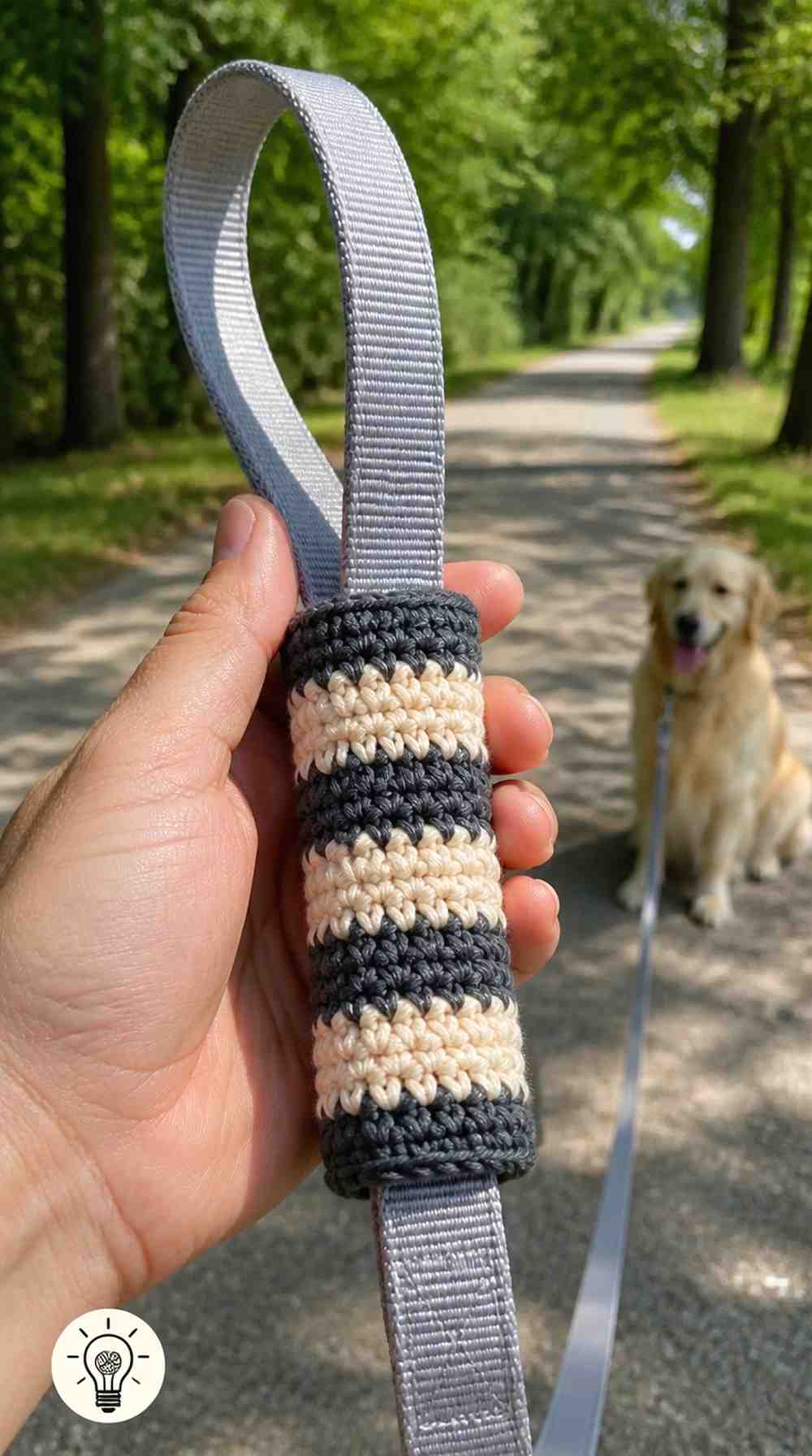
Charcoal-gray crochet creates a practical-looking sleeve with four alternating cream and charcoal bands. Compact stitches form a uniform surface around the lower section of a pale-gray nylon handle loop, with narrow dark edging at each end.
The repeated contrasting bands give this design a clean, sporty appearance. The ordinary matte yarn provides decorative color contrast, but it should not be mistaken for certified reflective or high-visibility safety equipment.
- Color Changes: Keep the yarn joins tidy so the alternating bands remain flat and do not leave loose strands inside the sleeve.
- Surface Thickness: Maintain an even stitch thickness through both colors to avoid uncomfortable ridges between the stripes.
- Visibility Limitation: Contrasting yarn colors do not replace reflective walking gear, suitable lighting, or other precautions for low-light walks.
13. Crochet Ivory Fan-Lace Handle Overlay
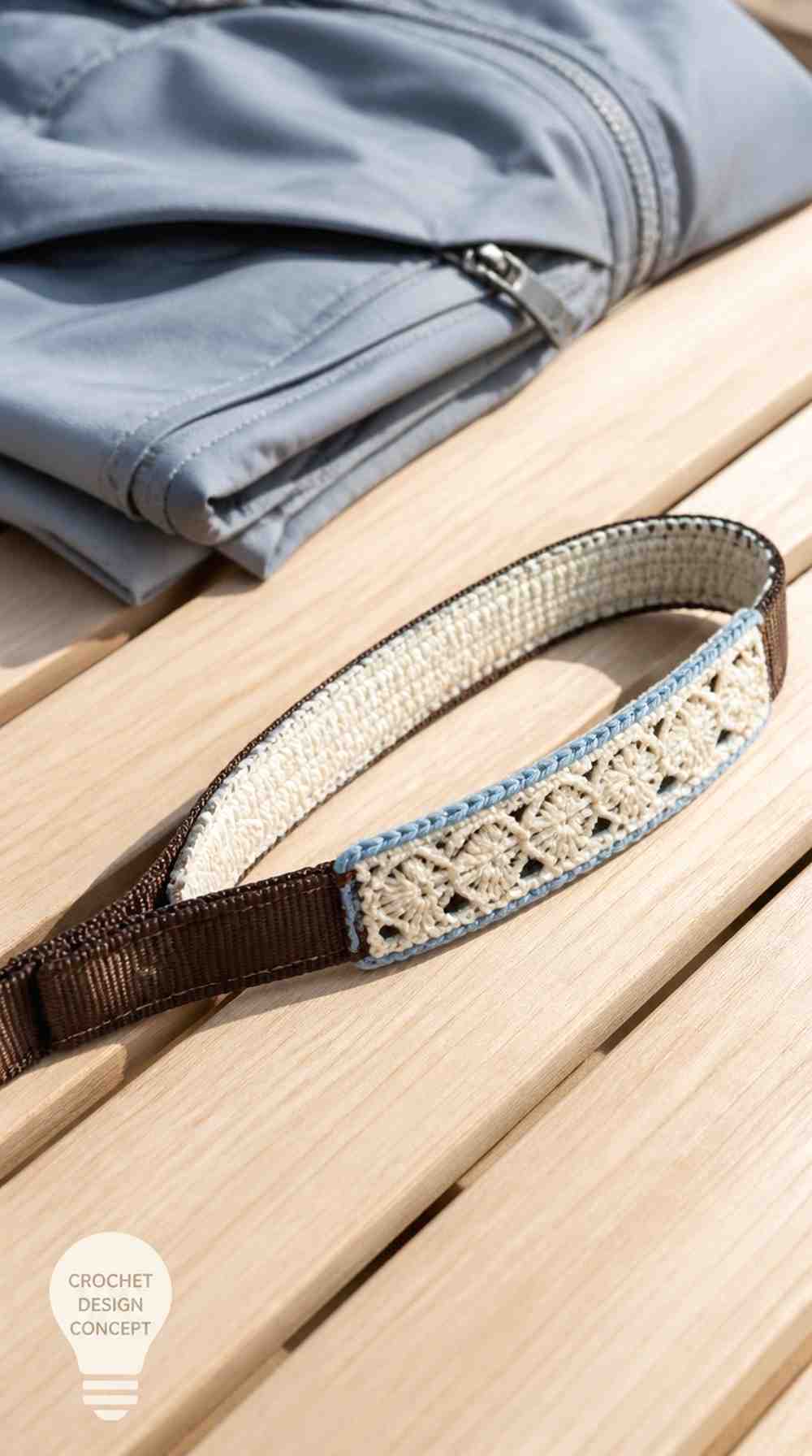
Ivory crochet creates a delicate decorative sleeve with a solid inner grip layer and a narrow fan-lace strip along the outside. Dusty-blue edging finishes the lace, while the original dark-brown leash webbing remains visible at both ends.
This design separates decorative openwork from the actual hand-contact surface. The solid inner layer allows the fan motifs to remain an exterior accent, making the sleeve visually different from a fully open lace covering.
- Solid Base: Keep the inner crochet panel densely worked so fingers do not press through decorative lace openings.
- Fan-Lace Position: Place the delicate motifs on the outward-facing section, away from the handler’s main gripping area.
- Snagging Risk: Avoid long open loops, loose lace ends, or raised joins that could catch on clothing or nearby objects.
14. Crochet Teal Diagonal-Panel Leash Wrap
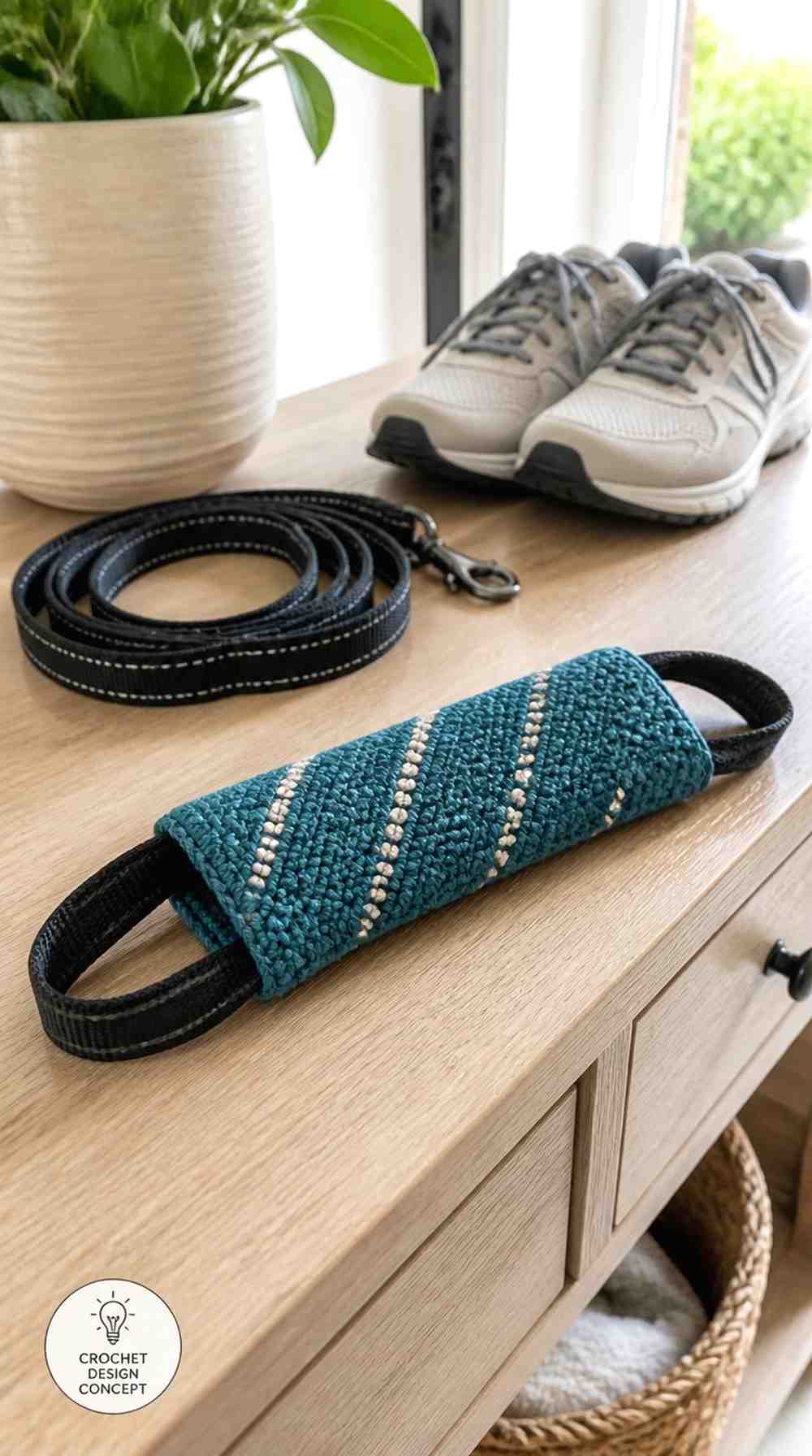
Teal crochet forms a neat rectangular wrap with three low diagonal textured panels separated by cream stitch lines. The underside remains smooth, while a discreet outer seam keeps the cover fitted around black nylon webbing.
The diagonal arrangement gives the handle a contemporary appearance without adding separate straps or hanging decorations. Its integrated texture makes it a useful concept for people who prefer simple geometric crochet patterns.
- Diagonal Stitch Rows: Keep the raised sections low and evenly joined so their direction does not create uneven pressure against the hand.
- Outer Seam: Position the joining line on the side opposite the main gripping surface.
- Fabric Movement: Check that the wrap cannot rotate around the leash webbing when the handle is held, released, and gripped again.
15. Crochet Peach Three-Zone Palm Sleeve
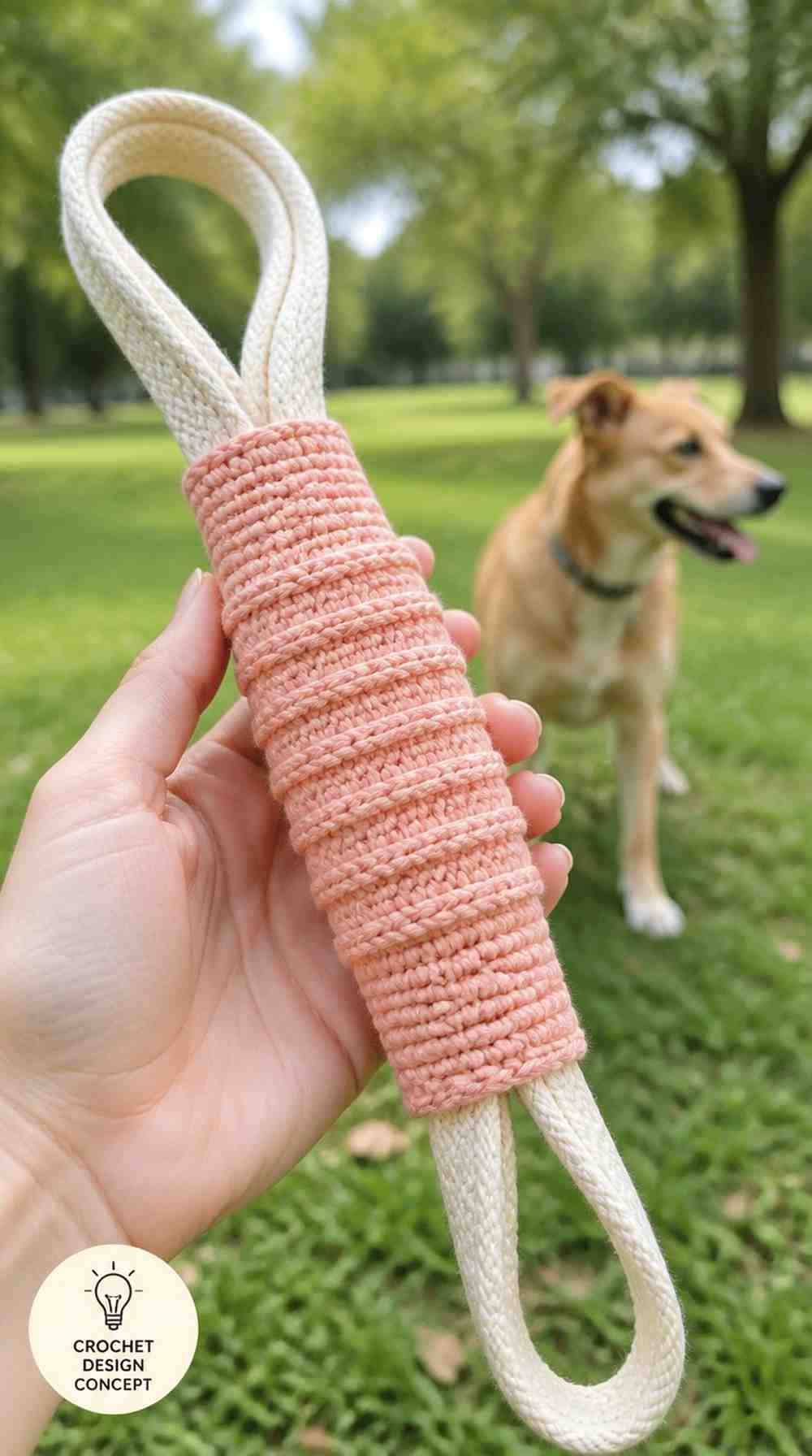
Pale-peach crochet creates a three-part grip cover with two narrow apricot end bands and a broader center section. Slightly raised horizontal rows provide texture across the middle, while a smooth cotton lining sits between the crochet and cream nylon handle.
The design gives the central palm area more visual emphasis than the ends. It could suit someone who prefers a clearly defined hand-contact section, provided the added thickness does not interfere with their normal secure grip.
- Three-Zone Layout: Keep the two apricot end bands narrow and consistent so the broad peach center remains the main feature.
- Central Thickness: Avoid excessive padding that could make the handle difficult to close a hand around comfortably.
- Lining Fit: Check that the cotton lining remains flat inside the sleeve and does not bunch when the leash loop bends.
16. Crochet Cobalt Folded-Edge Handle Wrap
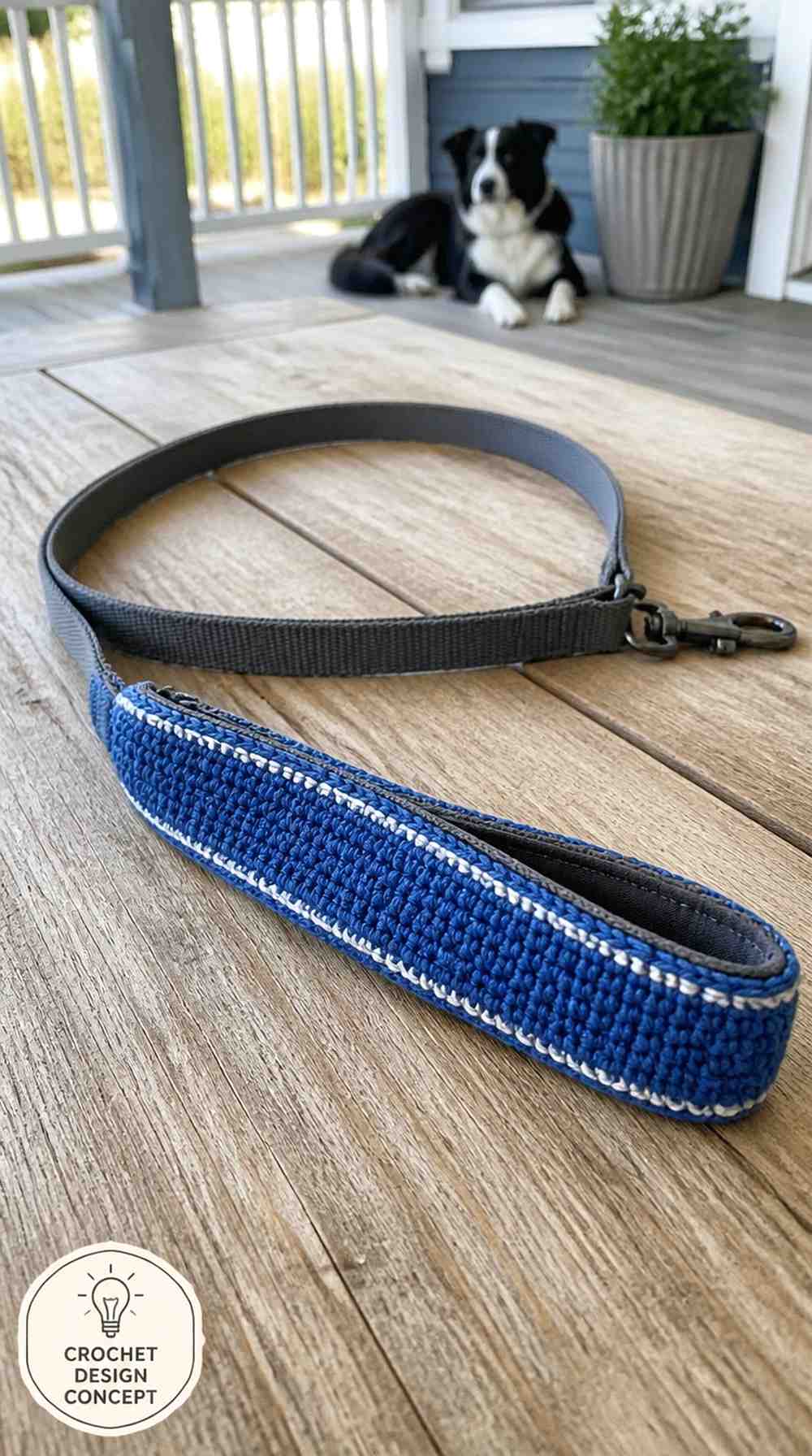
Rich cobalt-blue crochet creates a compact grip wrap with neat horizontal rows and two softly folded outer edges. Cream stitches outline the double-thickness borders, while a smooth inner fabric layer separates the crochet from the dark-gray leash webbing.
The folded edging makes this concept different from the simple flat sleeves. Its main visual appeal comes from the rounded borders, which should remain securely attached rather than forming loose flaps around the handle.
- Folded Borders: Secure both long edges neatly so they cannot unfold or snag during repeated handling.
- Edge Thickness: Keep the double-layered borders modest, particularly where the handler’s fingers curve around the leash.
- Inner Layer: Use a flat lining that follows the original webbing without creating wrinkles or changing the shape of the handle loop.
17. Crochet Chocolate Broad-Loop Grip Sleeve
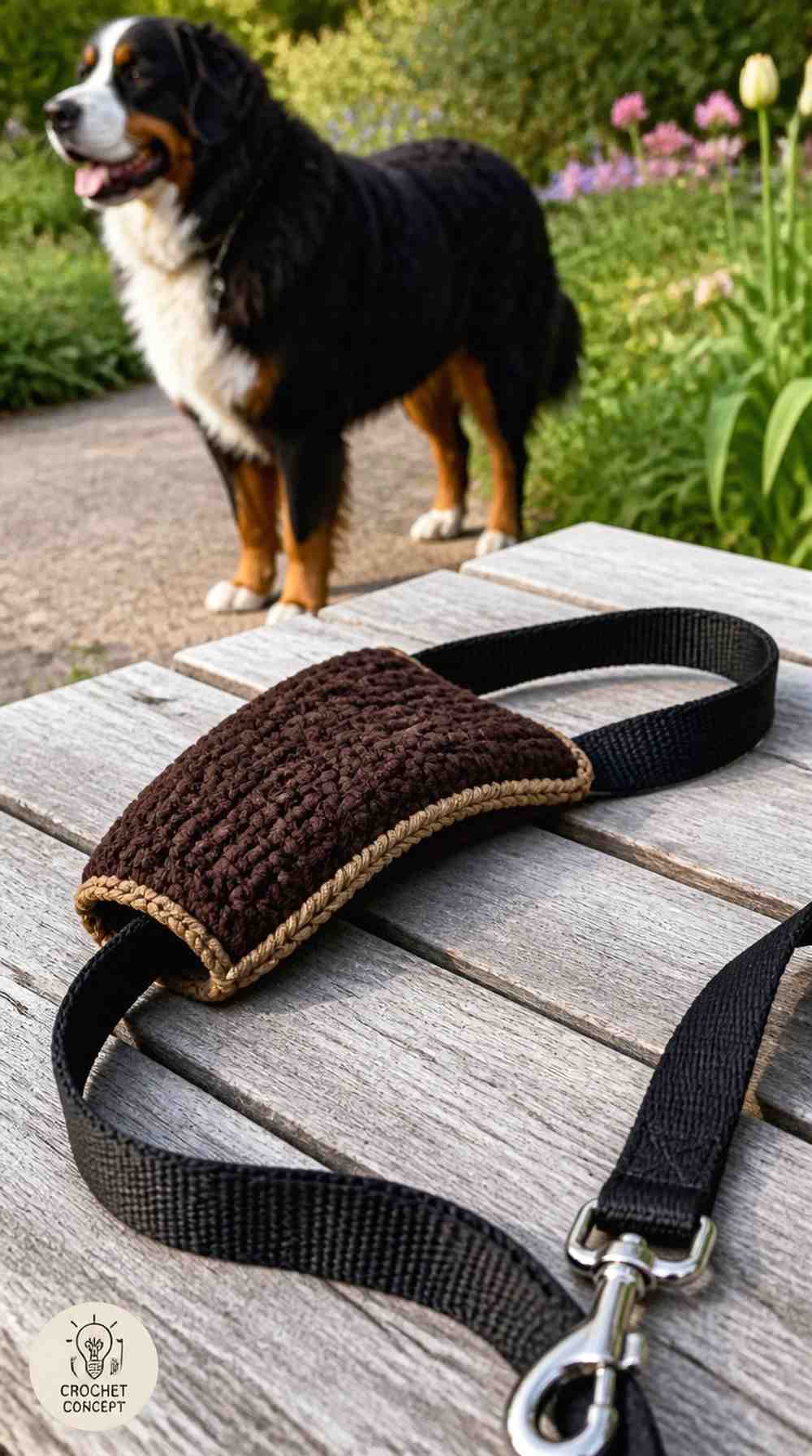
Chocolate-brown crochet forms a wider sleeve around the broad lower section of a padded black nylon leash handle. Compact basket-rib rows create texture, while tan edging and a smooth lining give the cover a finished appearance.
This concept is designed around a wider existing handle rather than a narrow flat strap. The broad crochet surface may look substantial, but it is still decorative and should not conceal damaged padding or structural leash stitching.
- Wide-Handle Measurements: Measure the actual padded loop, including its thickness, instead of using dimensions intended for narrow nylon webbing.
- Existing Padding: Avoid adding unnecessary bulk to a handle that already has a cushioning layer.
- Inspection Access: Make the sleeve removable so the underlying webbing, seams, and padding can be checked for wear.
18. Crochet Plum Rounded-Rope Loop Wrap
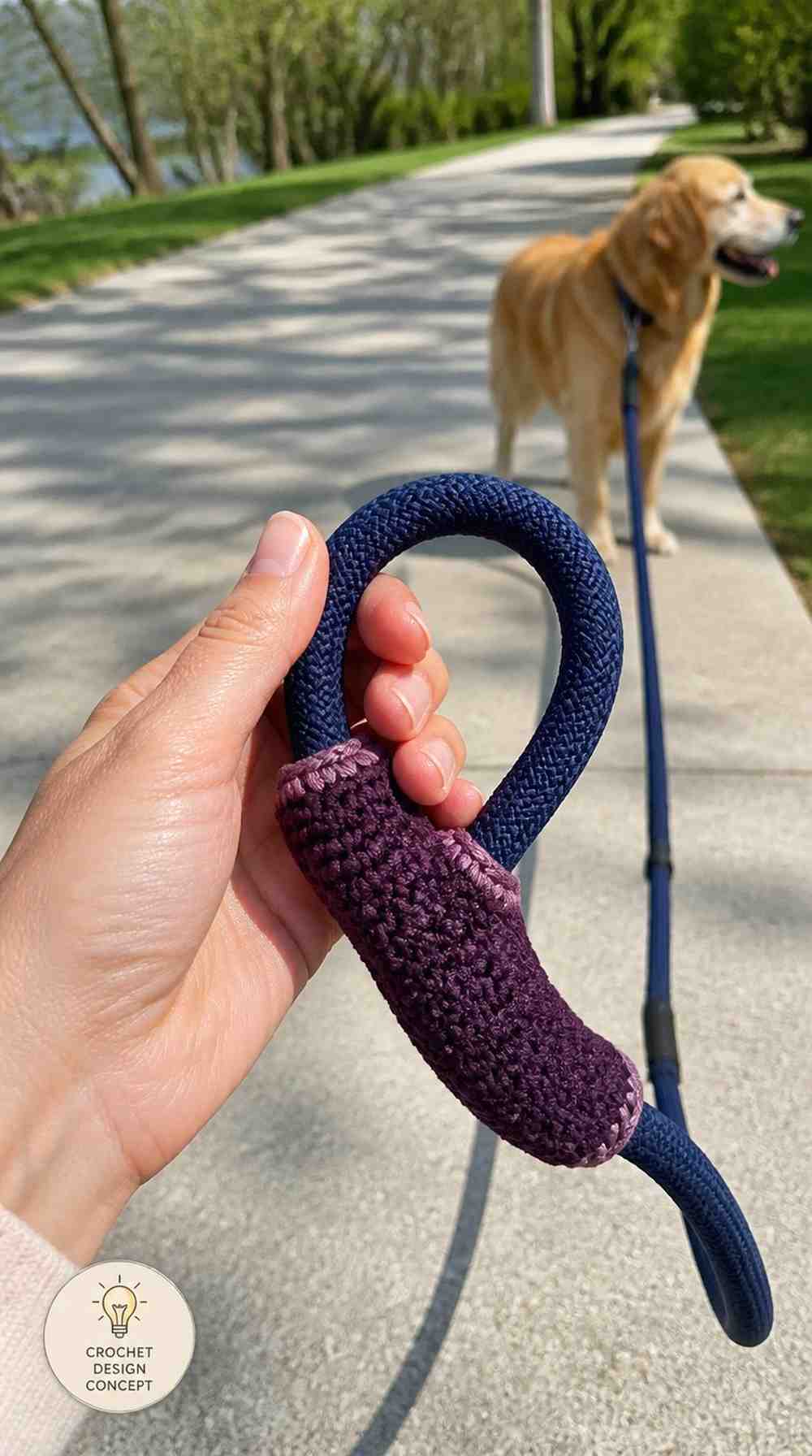
Plum-purple crochet follows the lower curved section of a dark-navy rope leash handle. Small connected circular rounds form a slim tube, while mauve edging finishes both ends and a smooth inner lining separates the cover from the rope.
The rounded shape makes this idea different from flat-webbing sleeves. A rope handle has a different circumference and bending behavior, so the crochet needs to follow its original shape without compressing or twisting the rope.
- Rope Circumference: Measure the actual round handle instead of adapting a flat-webbing cover without changing its shape.
- Curved Construction: Keep the crochet rounds consistent so the sleeve follows the handle’s natural curve.
- Original Connection: Leave the rope’s joined handle section exposed, allowing regular inspection of the original leash construction.
- Grip Security: Stop using the cover if it rotates, slips, bunches, or otherwise changes how securely the leash can be held.
Practical Guide to Crochet Pet Leash Handle Soft Grips
A crochet leash handle cover should be treated as a removable decorative accessory, not as a replacement for the original leash handle. Safe leash control depends on the leash’s construction, the handler’s grip, and the animal’s behavior.
1. Start with a reliable leash. Inspect the original webbing, rope, structural stitching, and clip before adding anything. The Edmonton Humane Society recommends sturdy walking equipment that can be gripped safely and advises replacing worn or frayed leashes.
Edmonton Humane Society+1
2. Measure the hand-contact area. Check the existing handle width, thickness, curve, and available finger space. A grip cover should not make the loop difficult to hold or prevent the hand from moving naturally.
3. Choose appropriate crochet materials. Smooth, closely worked cotton yarn or a suitable washable blend may be worth considering. However, softness does not guarantee better grip. Some yarn surfaces become slippery when wet, while textured stitches can snag.
4. Keep the crochet separate from the structural leash. Never cut, loosen, or replace the original handle stitching to fit a cover. The underlying leash must remain fully functional without the decorative crochet.
5. Check the sleeve before every walk. Make sure it does not slide, rotate, bunch, or change the normal handling of the leash. Test the fit without an animal attached first. If it affects control, remove it rather than continuing to use it.
6. Use proper leash-handling techniques. The SPCA of Texas advises maintaining a firm grip on a loop-style handle and avoiding wrapping the leash around fingers or wrists. The ASPCA also provides guidance on maintaining a secure hold during dog walks.
SPCA of Texas+1
7. Keep it clean and dry. Remove the crochet for washing according to the yarn’s care instructions. Check for frayed yarn, loose seams, or damaged fasteners before putting it back.
8. Consider your dog’s walking behavior. An added grip cover may not be appropriate for a dog that pulls suddenly, chews its leash, or requires especially dependable handling. Prioritize a properly fitted, reliable leash and suitable professional training guidance over decorative accessories.
For other handle-cover approaches, explore 16 Crochet Mattress Handle Soft Grip Inspiration Ideas on Yarn Nest Studio. Those concepts involve different loads and are not leash-safety instructions, but their wrap shapes may provide visual inspiration.
Want to Make Something Similar?
These verified resources offer related crochet techniques. They are not exact patterns for the 18 illustrated leash handle grips.
- CyCrochet — Crochet Luggage Handle Wrap: A free crochet pattern showing how a small rectangular cover can wrap around an existing handle. Its techniques may help with sleeve shaping, but a leash handle needs separate safety considerations. CyCrochet
- Crocket Crochet — Bag Handle Cover: A free pattern listed on Ravelry, with a video tutorial, for a decorative handle covering. It provides another reference for fitted crochet construction. Ravelry
- Yarnspirations — Red Heart Reflective Dog Leash Cover: A free crochet pattern for decorating the length of a dog leash. It is not a palm-grip pattern, and the original reflective yarn is discontinued, but it illustrates crochet sleeve construction around existing leash material. Yarnspirations
For another pet-accessory storage collection, see 13 Crochet Pet Grooming Tool Roll Inspiration Ideas on Yarn Nest Studio.
Which Crochet Pet Leash Handle Soft Grip Should You Choose?
| Style or preference | Design to consider | Main consideration |
|---|---|---|
| Simple ribbed texture | Terracotta Ribbed Palm Wrap | Secure short-sleeve fit |
| Reversible colors | Indigo Reversible Grip | Flat seams on both sides |
| Basketweave texture | Mustard Basketweave Cushion | Raised-stitch thickness |
| Decorative scallops | Blush Scalloped Cover | Snag-free outer edging |
| Broad central shape | Olive Contoured Grip | Comfortable hand clearance |
| Openwork appearance | Aqua Mesh-Layer Grip | Fully lined mesh |
| Single raised center ridge | Rust Center-Ridge Wrap | Avoiding pressure points |
| Removable side closure | Oatmeal Side-Fastened Cuff | Fastener security |
| Chevron decoration | Lavender Chevron Grip | Smooth curved fit |
| Two-color stripes | Burgundy Double-Stripe Sleeve | Even stitch thickness |
| Flat floral decoration | Coral Daisy-Accent Cover | Secure motif attachment |
| High-contrast color bands | Charcoal Contrast-Banded Grip | Not reflective safety gear |
| Decorative lace | Ivory Fan-Lace Overlay | Solid hand-contact layer |
| Geometric texture | Teal Diagonal-Panel Wrap | Low-profile stitching |
| Three-part grip styling | Peach Three-Zone Sleeve | Central bulk |
| Rounded folded borders | Cobalt Folded-Edge Wrap | Secure edge construction |
| Broad padded handle | Chocolate Broad-Loop Sleeve | Original handle inspection |
| Rounded rope leash handle | Plum Rounded-Rope Wrap | No rotation or slipping |
For a straightforward decorative cover, the Terracotta Ribbed Palm Wrap or Teal Diagonal-Panel Wrap is a useful concept to consider. Both use comparatively simple shapes without separate ornaments.
The Olive Contoured Grip, Peach Three-Zone Sleeve, and Chocolate Broad-Loop Grip offer wider-looking hand-contact sections, but they should not be assumed to provide better control or reduce strain without real testing.
If visual decoration is the priority, the Blush Scalloped Cover, Coral Daisy-Accent Cover, and Ivory Fan-Lace Overlay provide more distinctive details. Their trim should remain flat and firmly attached.
For a round rope handle, the Plum Rounded-Rope Loop Wrap is the most directly relevant shape in this collection.
Conclusion
A crochet pet leash handle soft grip can bring handmade character to an everyday walking accessory. Whether you prefer simple ribs, soft colors, textured panels, or small floral details, these 18 designs offer different ways to decorate the hand-contact section of an existing leash.
The most important considerations are fit, stability, and the condition of the original leash. A decorative cover should never hide damage, loosen the handle, or make the leash harder to control. Choose an uncomplicated design, keep it removable, and prioritize safe handling over appearance.
Which of these 18 crochet leash handle grip ideas would you choose? Would you prefer the terracotta ribbed wrap, indigo reversible sleeve, or coral daisy design? Share your favorite style in the comments.
Frequently Asked Questions
1. Can crochet be used to make a soft cover for a pet leash handle?
Yes, crochet can form a removable decorative cover around an existing leash handle. However, the original leash must remain responsible for holding the animal securely. The finished cover must not slip, rotate, hide damage, or interfere with the handler’s grip. These design concepts have not been physically tested.
2. Does a crochet leash handle grip help prevent rope burns or hand discomfort?
A softer covering might change how a leash feels, but it does not guarantee protection from friction, sudden pulling, or hand injuries. Added fabric can also increase bulk or become slippery. The safest approach is to use a suitable leash with a comfortable, secure handle and address pulling behavior through appropriate training.
3. Which yarn is suitable for a crochet leash handle cover?
Smooth cotton yarn or an appropriate washable blend may be worth considering for a compact decorative sleeve. However, yarn fibers, stitch textures, and moisture can affect friction and grip. Test the finished cover without a pet attached, inspect it for slipping, and remove it if handling becomes less secure.
4. Is a crochet grip cover suitable for a dog that pulls strongly?
It may be unsuitable, particularly if the cover changes how firmly the leash can be held. Dogs that pull suddenly need dependable walking equipment and appropriate handling. The SPCA of Texas recommends selecting leash and harness equipment according to a dog’s behavior, and the underlying leash must remain secure.
SPCA of Texas
5. Are these 18 crochet pet leash handle soft grip ideas complete patterns?
No. These are original crochet design visualizations intended to show different colors, textures, sleeve shapes, and decorative finishes. The linked tutorials demonstrate related crochet handle-cover techniques but do not reproduce these exact designs. A real cover would need individual measurements, careful construction, and safety checks before use.