Cutting boards are everyday kitchen essentials, but finding a tidy place to keep them can be surprisingly difficult, especially in smaller kitchens. Crochet cutting board storage sleeves offer an interesting way to explore handmade organization, combining fitted pockets, textured panels, decorative edging, and colorful accents. These 18 ideas range from compact lower-board covers to longer envelopes, open mesh designs, and sleeves made for different board shapes.
Whether you prefer warm cottage colors, modern kitchen accessories, or simple storage details, this collection provides several approaches to compare. Some sleeves are intended to sit inside existing countertop racks, while others explore narrow openings, decorative closures, and shaped crochet panels. The important considerations are board size, reliable independent support, cleanliness, airflow, and choosing a design that can be removed for washing.
These are AI-generated crochet design visualizations for inspiration, not photographs of tested handmade pieces or step-by-step patterns.
Quick Design Selection Guide
| Your storage preference | Design to explore |
|---|---|
| Simple upright board storage | Crochet Cinnamon Lower Cradle Sleeve |
| Narrow paddle-shaped boards | Crochet Oatmeal Tapered Paddle Sleeve |
| Horizontal shelf organization | Crochet Cornflower Side Entry Board Sleeve |
| Open and airy crochet texture | Crochet Midnight Ventilated Mesh Sleeve |
| Two small boards together | Crochet Mustard Double Board Pocket Sleeve |
| Decorative cottage kitchen | Crochet Sage Granny Patch Board Sleeve |
| Minimal coverage | Crochet Charcoal Corner Guard Board Sleeve |
| Modern color contrast | Crochet Cobalt Color Tab Board Sleeve |
1. Crochet Cinnamon Lower Cradle Sleeve
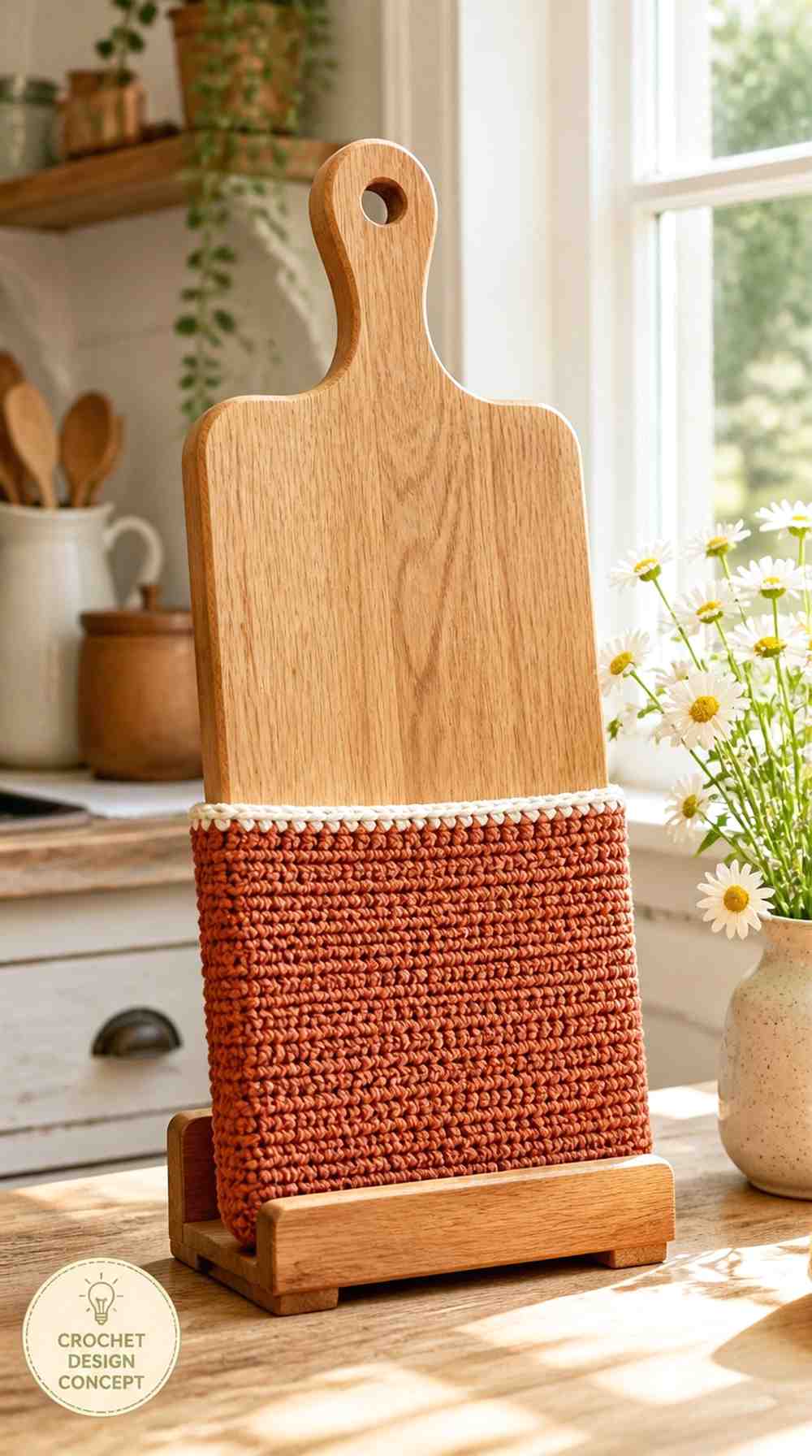
Warm cinnamon-colored crochet covers the bottom third of a small oak cutting board in this simple storage concept. Closely worked horizontal rows give the lower pocket a tidy appearance, while a thin cream border separates the fabric from the exposed wooden surface above it.
The shallow shape makes this idea different from a full-length board cover. Two side seams and a closed lower base define the sleeve, while the original board handle remains visible. A separate rigid rack supports the board, keeping the crochet from carrying its weight.
- Lower-Third Coverage: The compact pocket covers only the base of the board, making it suitable to explore where a full envelope would feel unnecessarily bulky.
- Closed Crochet Base: A flat bottom creates a recognizable sleeve shape, but it should not be relied on to support a board without a suitable rigid stand.
- Cream Border Detail: The slim contrasting edge creates a clear finish. Keep the rim even so it does not curl against the wooden surface.
2. Crochet Oatmeal Tapered Paddle Sleeve
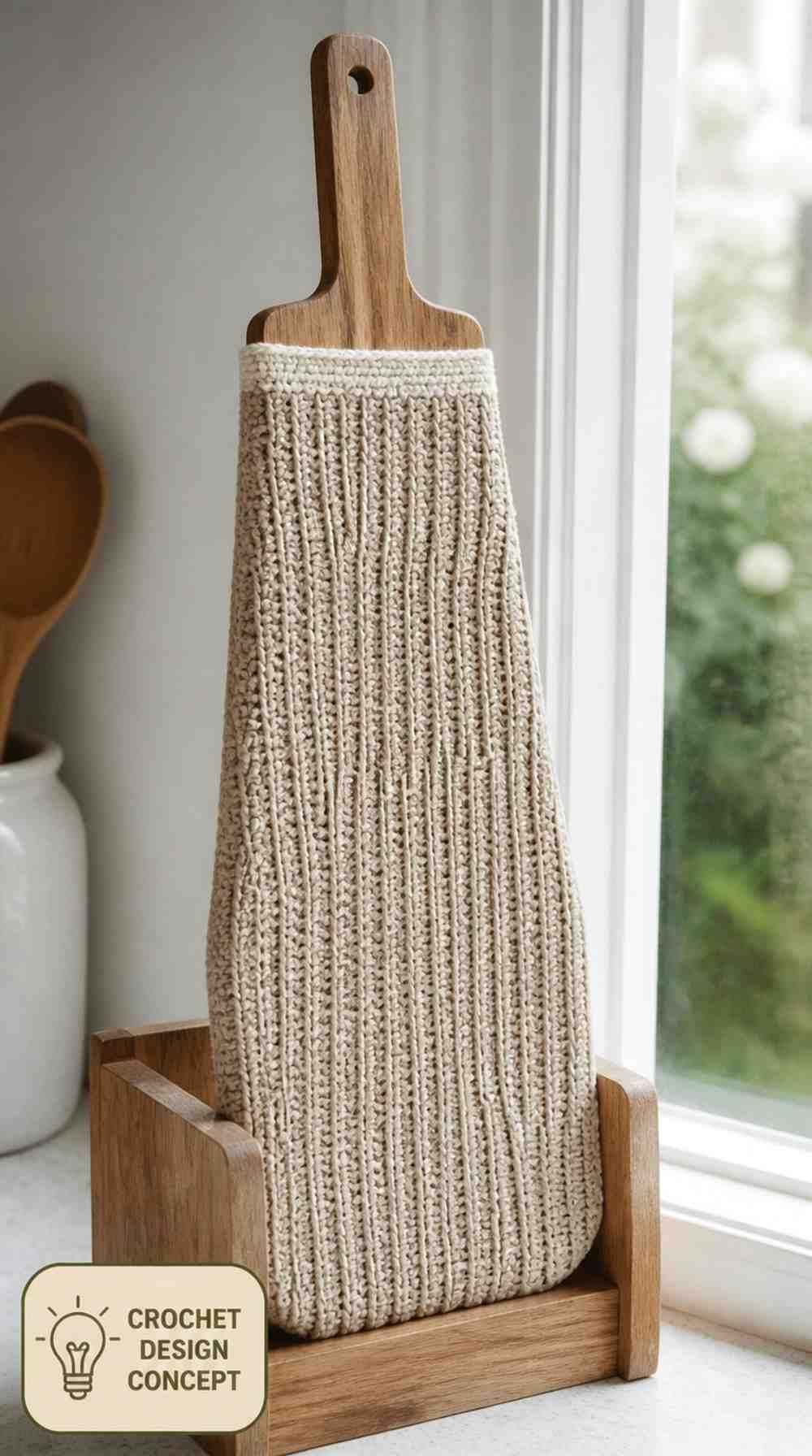
Oatmeal crochet gives this elongated paddle-board sleeve a soft, natural appearance. Fine vertical ribs run along the fabric, and its tapered shape follows the narrowing outline of the wooden board. An ivory band finishes the upper opening.
Unlike a rectangular pocket, this design considers how a paddle board changes width along its body. The uncovered wooden handle remains easy to identify, while the lower portion sits inside the shaped sleeve. It is an interesting option for comparing close-fitting crochet shapes with simpler straight-sided covers.
- Tapered Silhouette: Measure the paddle at several points before planning a real sleeve. A straight pocket may bunch around a board with noticeably changing proportions.
- Vertical Ribbing: Fine ribs emphasize the length of the board, although excessive stitch stretch could affect how closely the fabric follows its shape.
- Side Joining Seam: Keep the join flat and consistent along the tapered edge. Uneven seaming can make the sleeve twist or lose its intended outline.
3. Crochet Cornflower Side Entry Board Sleeve
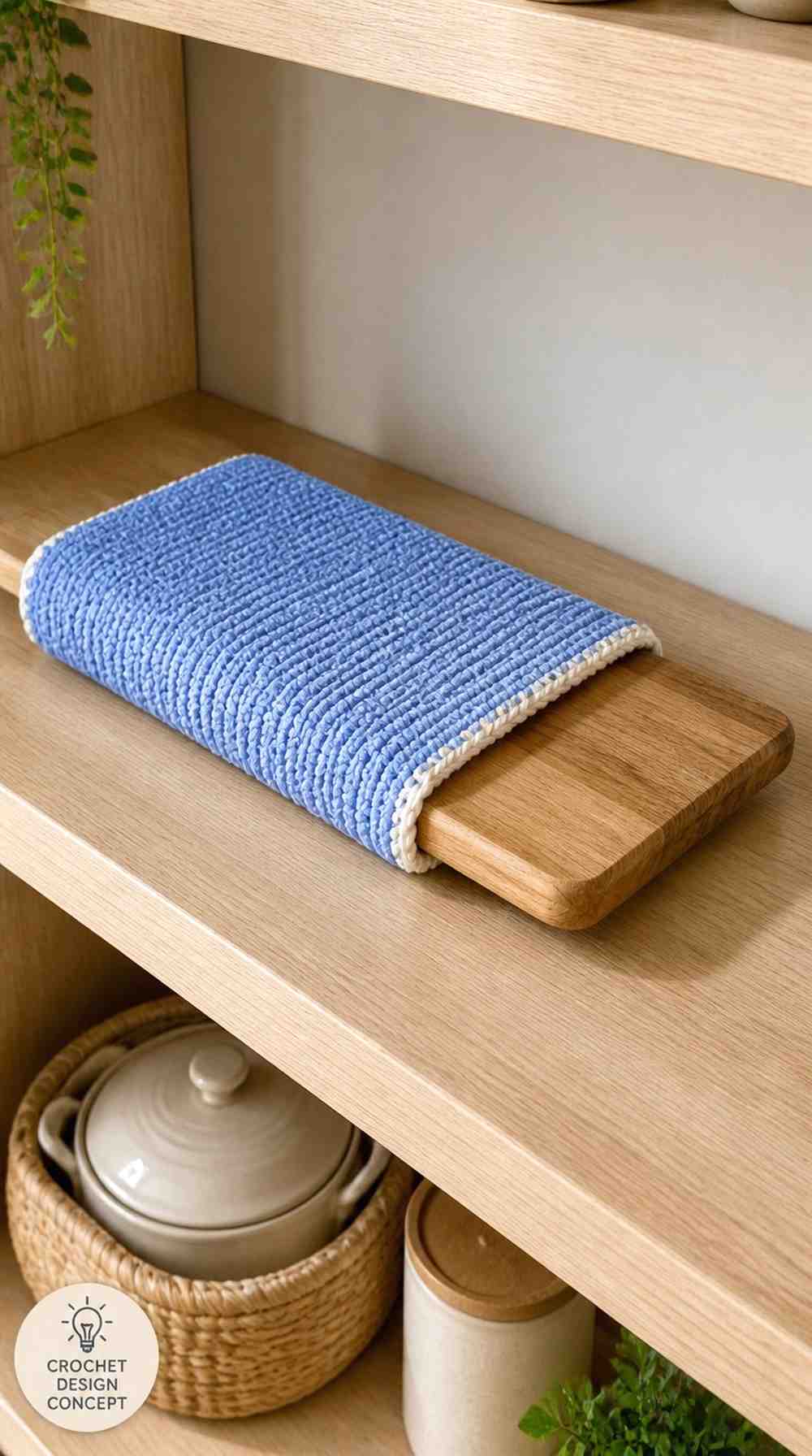
A cornflower-blue crochet sleeve gives this cutting board organizer a clean, modern appearance. The rectangular design has a closed left end, an open right side, fine linen-stitch rows, and an ivory border framing the side opening.
Instead of sliding the board downward into an upright pouch, this concept allows a small wooden board to enter horizontally from the side. Part of the board remains uncovered, creating a practical-looking arrangement for a dry pantry shelf. The open side also gives the design a different silhouette from traditional bottom-entry storage pockets.
- Horizontal Storage: Consider the available shelf depth and width before choosing this format. The board needs its own stable shelf surface underneath.
- Side Opening: A generous opening may make removal easier, but a loose sleeve could slide off the board when handled.
- Linen-Stitch Texture: Closely worked interlocking stitches create a neat surface. Check the finished fabric’s stretch before expecting it to remain rectangular.
4. Crochet Midnight Ventilated Mesh Sleeve
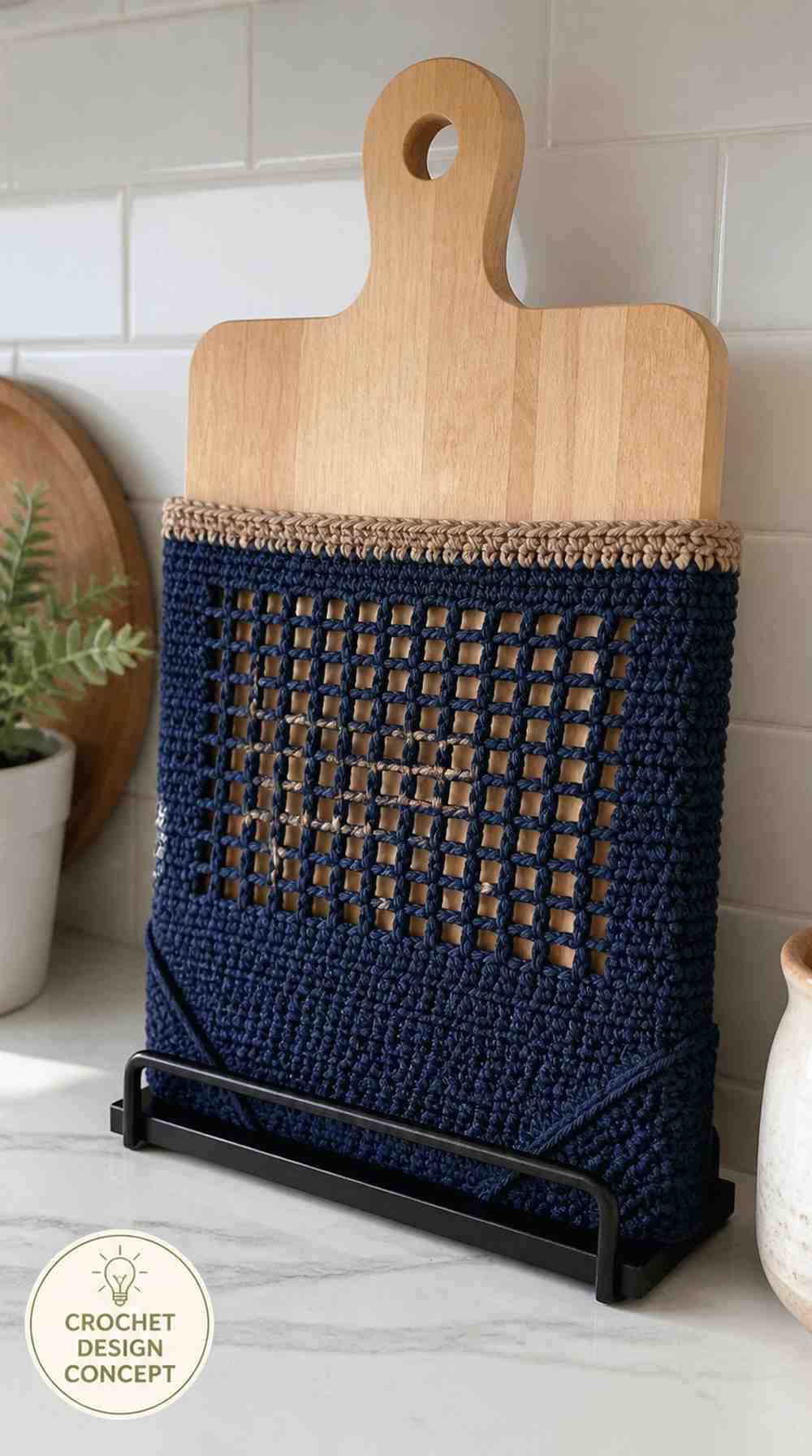
Midnight-navy crochet creates a striking storage sleeve with a more open appearance. Dense lower stitches and solid corner panels frame a central mesh window, while a warm-tan border finishes the upper opening.
The maple cutting board remains partly visible through the orderly crochet openings. This makes the design feel lighter than a completely closed fabric envelope. Although the openwork may allow more air around the exposed areas, it does not replace thorough drying of the board or regular cleaning of the sleeve.
- Mesh Opening Size: Use connected, orderly mesh spaces rather than oversized holes that could catch the board’s corners during removal.
- Solid Lower Section: The denser base defines the sleeve shape and contrasts with the open front, but the independent rack must support the board.
- Airflow Consideration: Open crochet is not a drying system. Wash, sanitize as appropriate, and fully dry the cutting board before putting it into any textile cover.
5. Crochet Mustard Double Board Pocket Sleeve
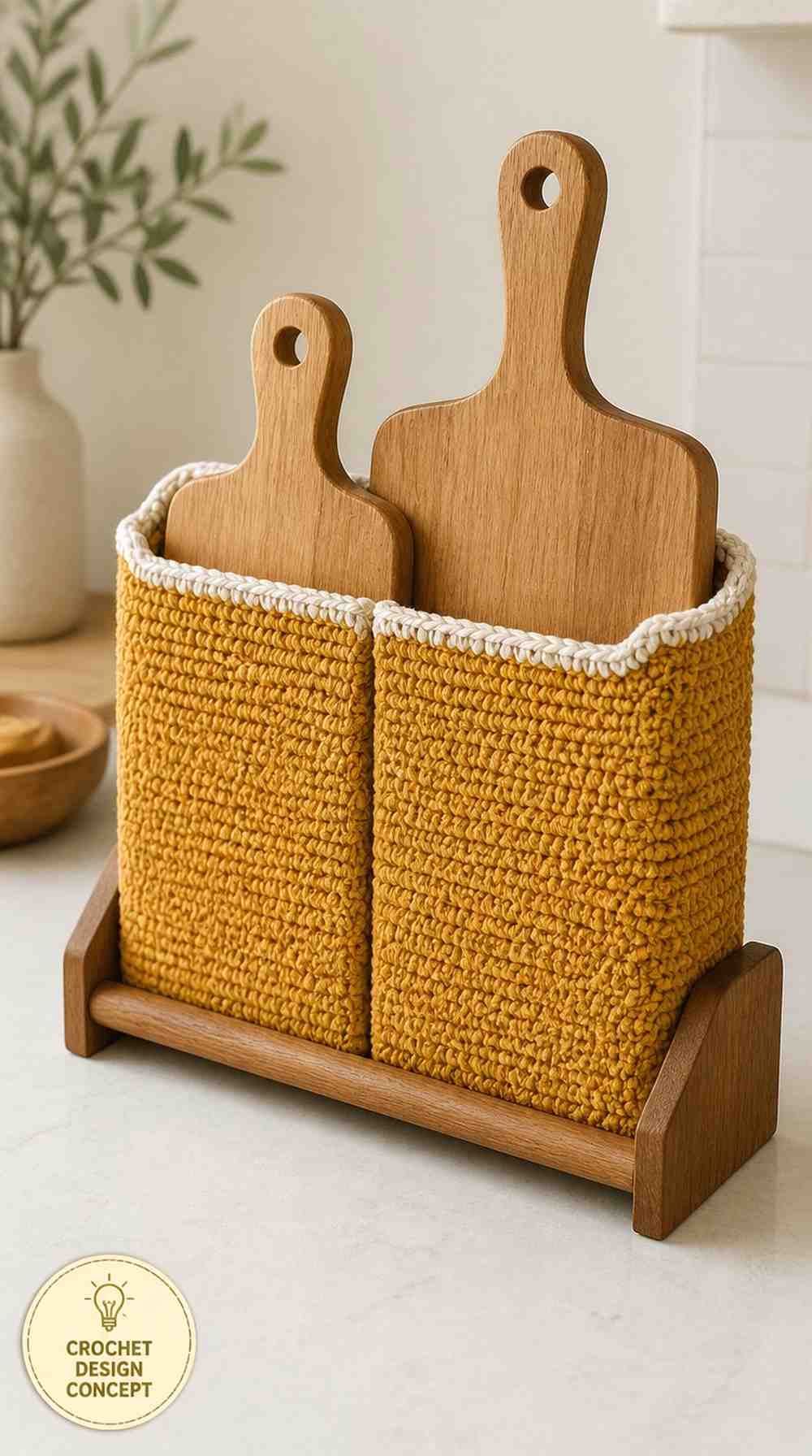
Two separate storage compartments make this muted-mustard crochet design particularly interesting. A wide back panel connects the pockets, while a central vertical seam divides the space for two small wooden breakfast boards. Thin ivory edging adds a tidy finish.
The different visible handle heights help distinguish the two boards without extra tags or decorative motifs. Because two boards add weight and thickness, the concept places the entire crochet organizer inside a substantial freestanding wooden stand rather than suspending the boards from yarn.
- Separate Compartments: Dividing the storage area can prevent the two boards from resting directly against each other inside one large pocket.
- Central Divider: The dividing seam needs to remain reasonably straight. Excessive stretch could allow the compartments to collapse toward each other.
- Independent Support: A rigid stand is essential for the illustrated arrangement. Do not assume crocheted pocket seams can safely carry two wooden boards.
6. Crochet Espresso Checkerboard Board Sleeve
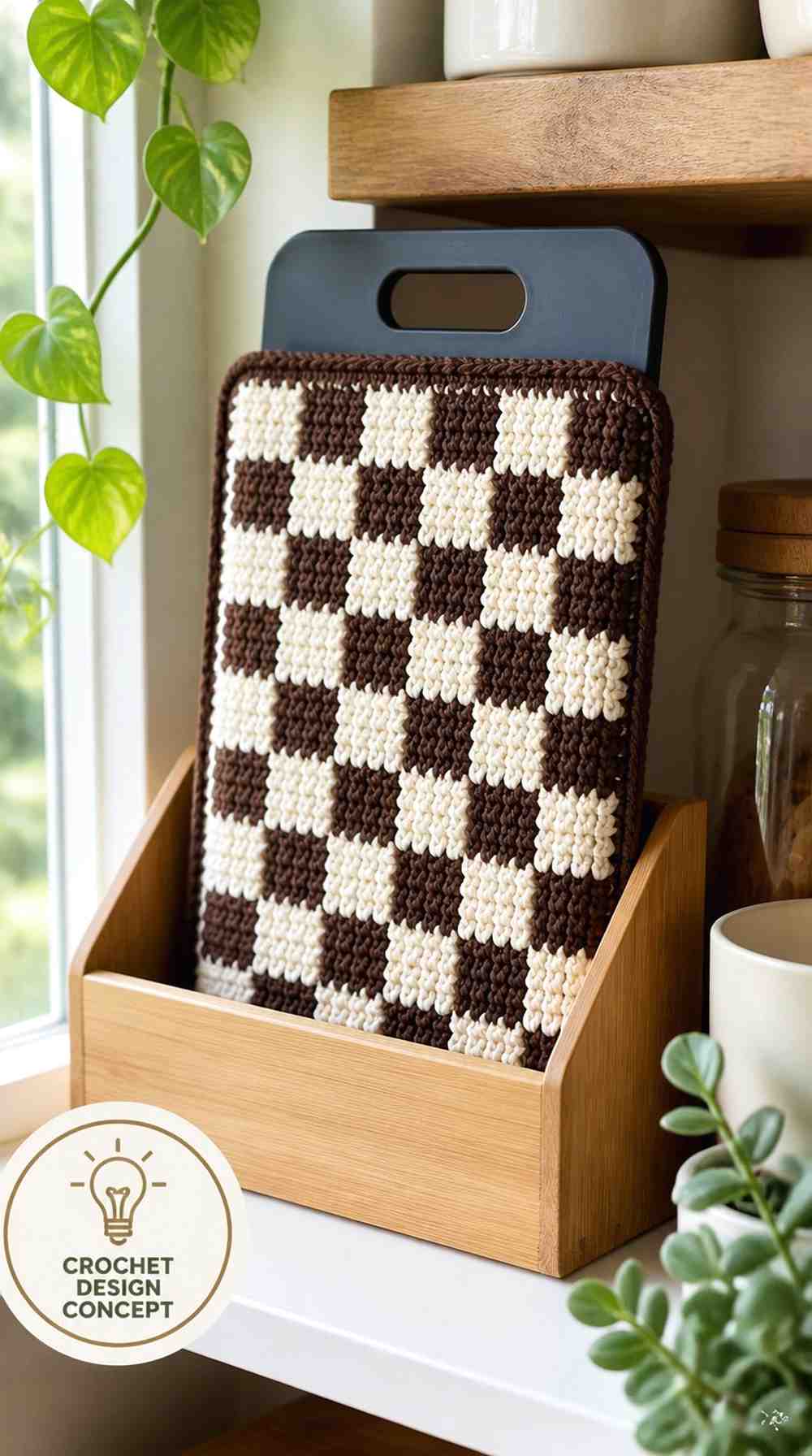
Tiny espresso-brown and vanilla-cream squares form the front of this compact crochet storage envelope. The miniature checkerboard is created as a continuous tapestry-style panel rather than separate joined squares, with dark-mocha edging outlining the pocket.
A charcoal-grey plastic cutting board sits inside, leaving its upper edge and oval handhold visible. The contrast between the patterned crochet and the plain plastic board makes this idea visually distinctive. It is especially suited to readers who enjoy graphic kitchen accessories but prefer a fairly simple rectangular storage shape.
- Small Colorwork Squares: Keep the checks proportionate to the board. Large blocks may disappear around the sides of a narrow sleeve.
- Solid Back Panel: The cream backing gives the envelope a continuous appearance behind the patterned front and avoids adding another bulky motif layer.
- Visible Handhold: Leave the board’s original opening exposed so the sleeve does not prevent ordinary handling after it has been removed.
7. Crochet Stone U Notch Board Sleeve
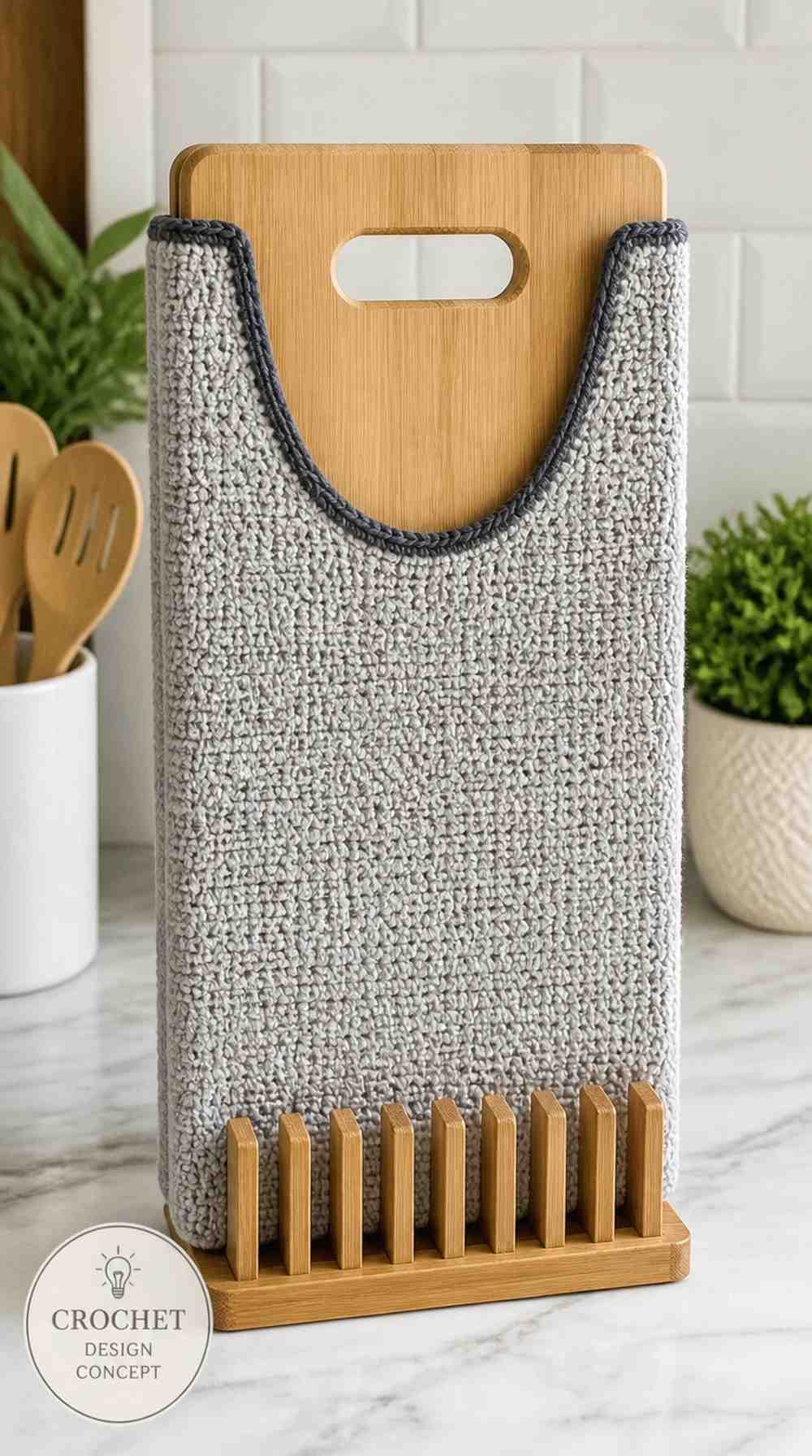
Stone-grey crochet covers most of this narrow cutting board, creating a fuller envelope than the earlier lower-cradle designs. A deep U-shaped notch interrupts the front upper edge, revealing the board’s oval handhold. Dark-charcoal edging follows the curved opening.
The notch is the defining feature. Instead of simply leaving the entire board top uncovered, the design uses a shaped opening to highlight one useful part of the board. Its smooth vertical sides and closely stitched body keep the overall appearance understated.
- U-Shaped Opening: Match the curved cutout to the actual board’s handhold position. An incorrectly placed notch could cover part of the opening.
- Curved Border: The charcoal edge needs controlled tension so the U shape stays smooth rather than pulling inward or curling.
- Fuller Coverage: A tall sleeve encloses more surface area and is less suitable for damp storage. Make removal and separate cleaning straightforward.
8. Crochet Burgundy Button Flap Board Sleeve
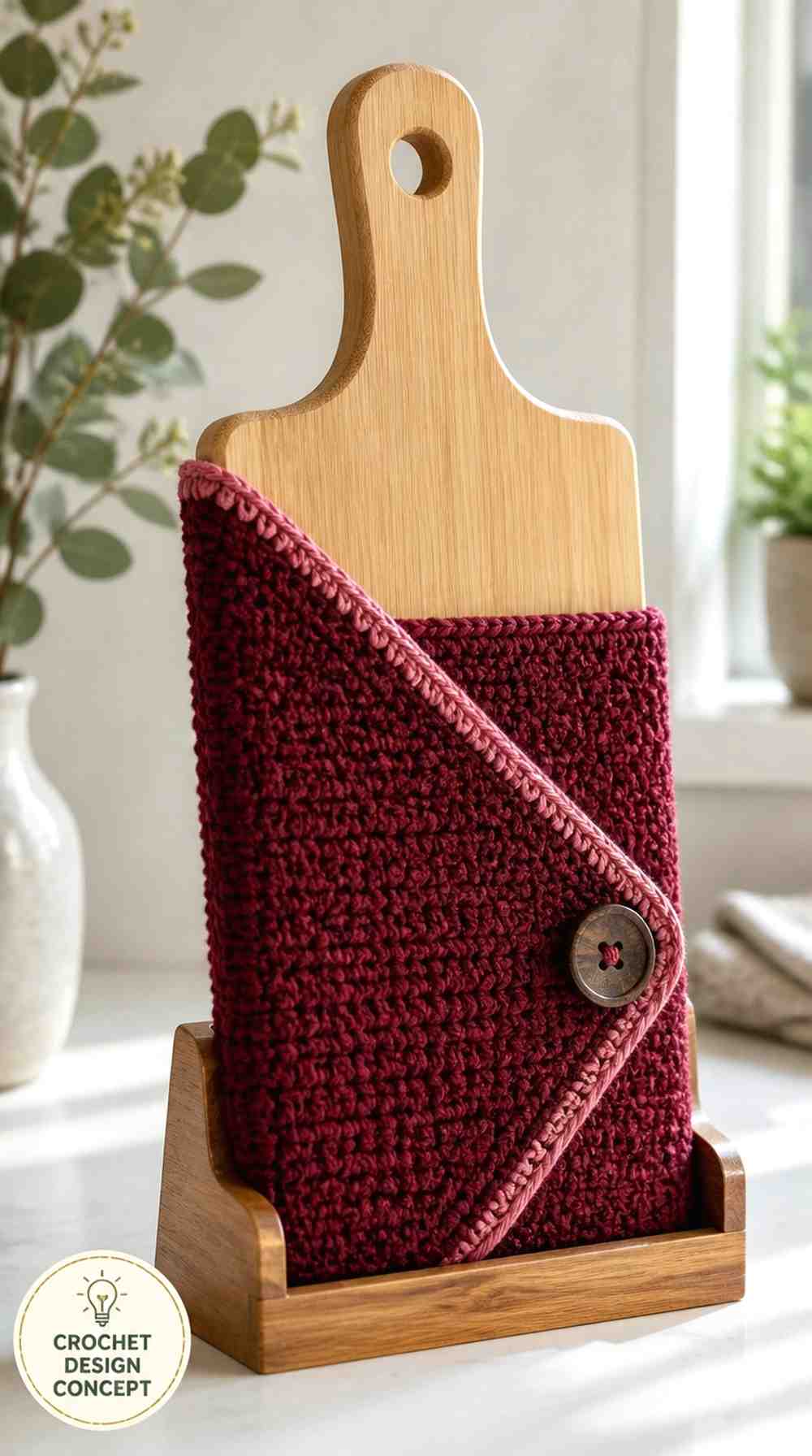
Deep burgundy crochet and a diagonal front flap give this board sleeve a more tailored appearance. A dusty-rose border follows the sloping edge, while a single small dark wooden button provides a visible decorative fastening detail.
The sleeve covers the lower half of a bamboo cutting board, leaving its handle and upper surface uncovered. Compared with the plain envelopes, this concept draws attention to the way the front panel overlaps. The buttoned appearance adds interest, but any actual closure would need to be secure, washable, and easy to release.
- Diagonal Flap: The overlapping shape creates visual interest without covering the entire board. Check how much additional fabric it introduces across the front.
- Button Placement: Position any real button where it will not scratch nearby objects or snag during removal from the rack.
- Easy Opening: A fastening should not make cleaning difficult. Decorative closures are less useful if they trap crumbs or prevent the fabric from drying.
9. Crochet Sage Granny Patch Board Sleeve
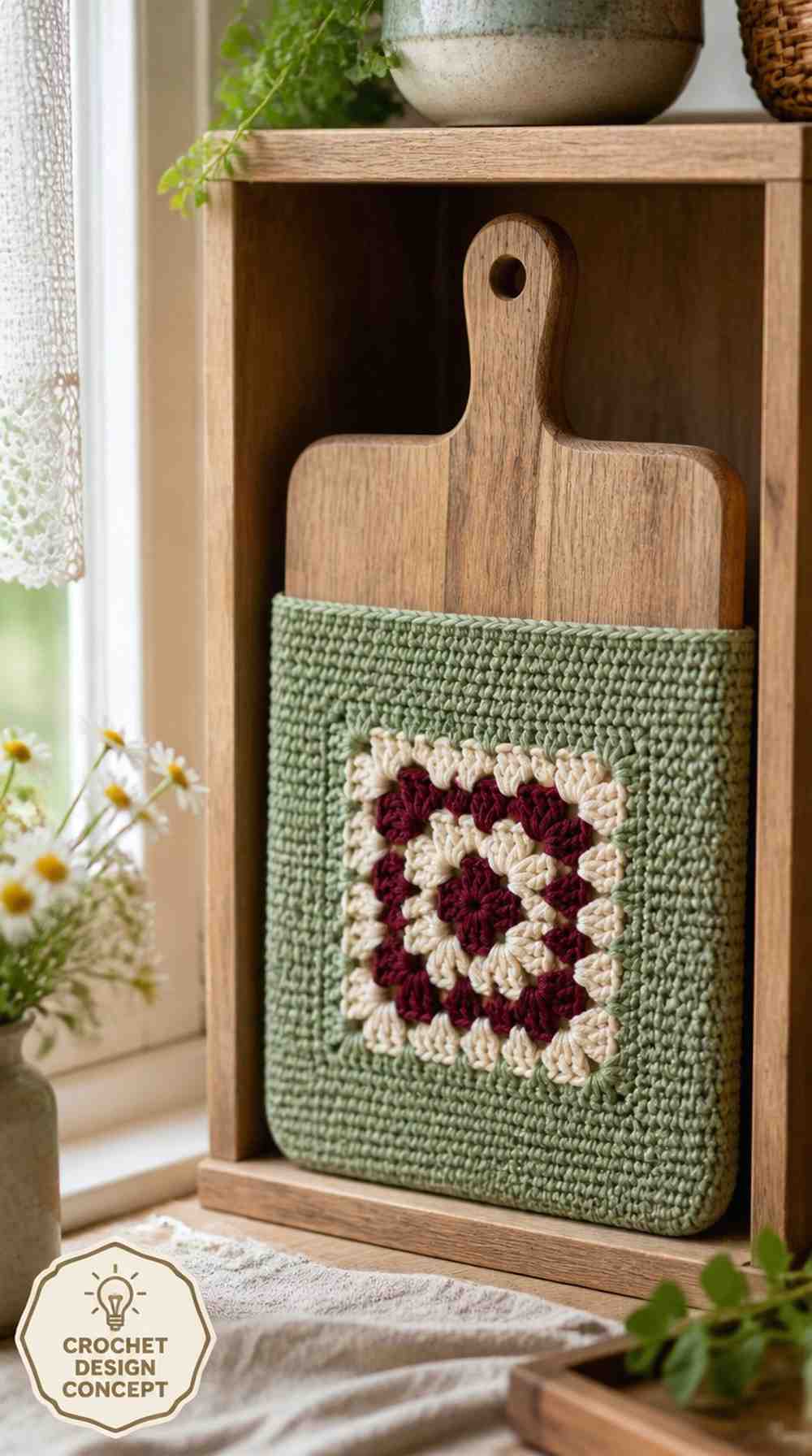
Muted sage-green crochet provides the background for one centered cream-and-burgundy granny-square motif. The square is attached to a closely stitched front panel, while the backing remains solid and the sleeve covers the lower half of a wooden bread board.
The single granny patch adds cottage character without turning the entire sleeve into an openwork accessory. Its connected clusters introduce texture and color, but the surrounding solid crochet gives the design a cleaner outline. The visible board handle keeps the finished arrangement easy to recognize as cutting board storage.
- Motif Placement: Center the decorative square on the outward-facing panel. A motif wrapped around a side seam would lose its balanced appearance.
- Solid Backing: The dense underlying panel prevents the granny openings from becoming large gaps through the main sleeve structure.
- Layered Crochet: The attached motif adds another fabric layer. Allow for cleaning and drying around its edges rather than assuming the decorative stitches remain clean automatically.
10. Crochet Blush Scalloped Crescent Board Sleeve
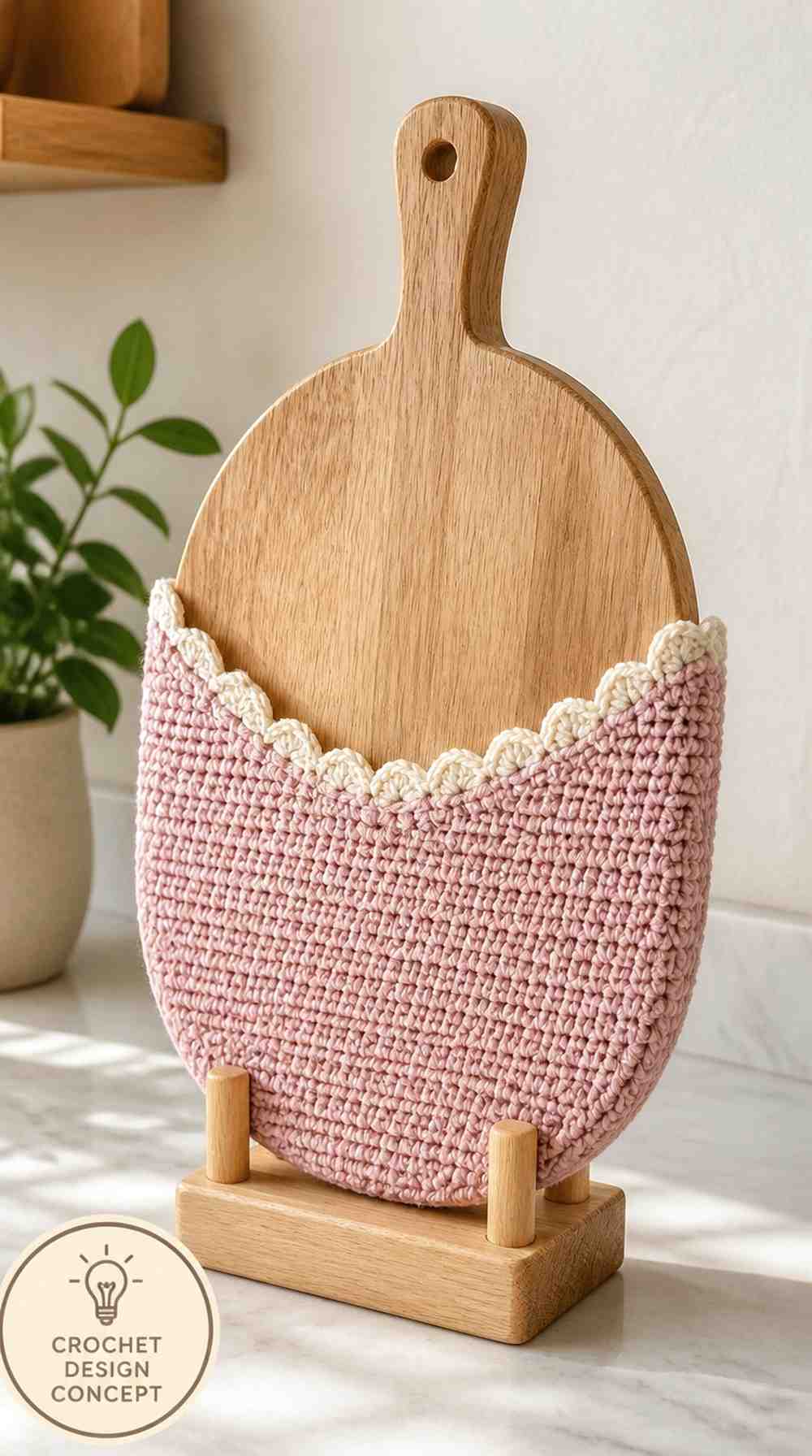
A gently curved opening gives this dusty-blush crochet sleeve a softer shape. Tiny ivory scallops follow the crescent-style upper edge, while closely worked horizontal rows form the rounded lower pocket.
The design follows the bottom outline of a small oval cutting board rather than using square corners. This makes the crochet silhouette feel deliberately matched to the board. The exposed wooden upper portion and handle keep the decorative edging visible, giving the concept a distinctly cottage-inspired character.
- Crescent Opening: Plan the curve around the actual board width. An exaggerated scoop may reduce the amount of fabric available along the sides.
- Miniature Scallops: Small, flat crochet shells suit this narrow border better than large loops that might catch during storage.
- Rounded Lower Base: Curved boards need carefully shaped lower panels. Simply folding a square pouch may produce unwanted corners and bunching.
11. Crochet Charcoal Corner Guard Board Sleeve
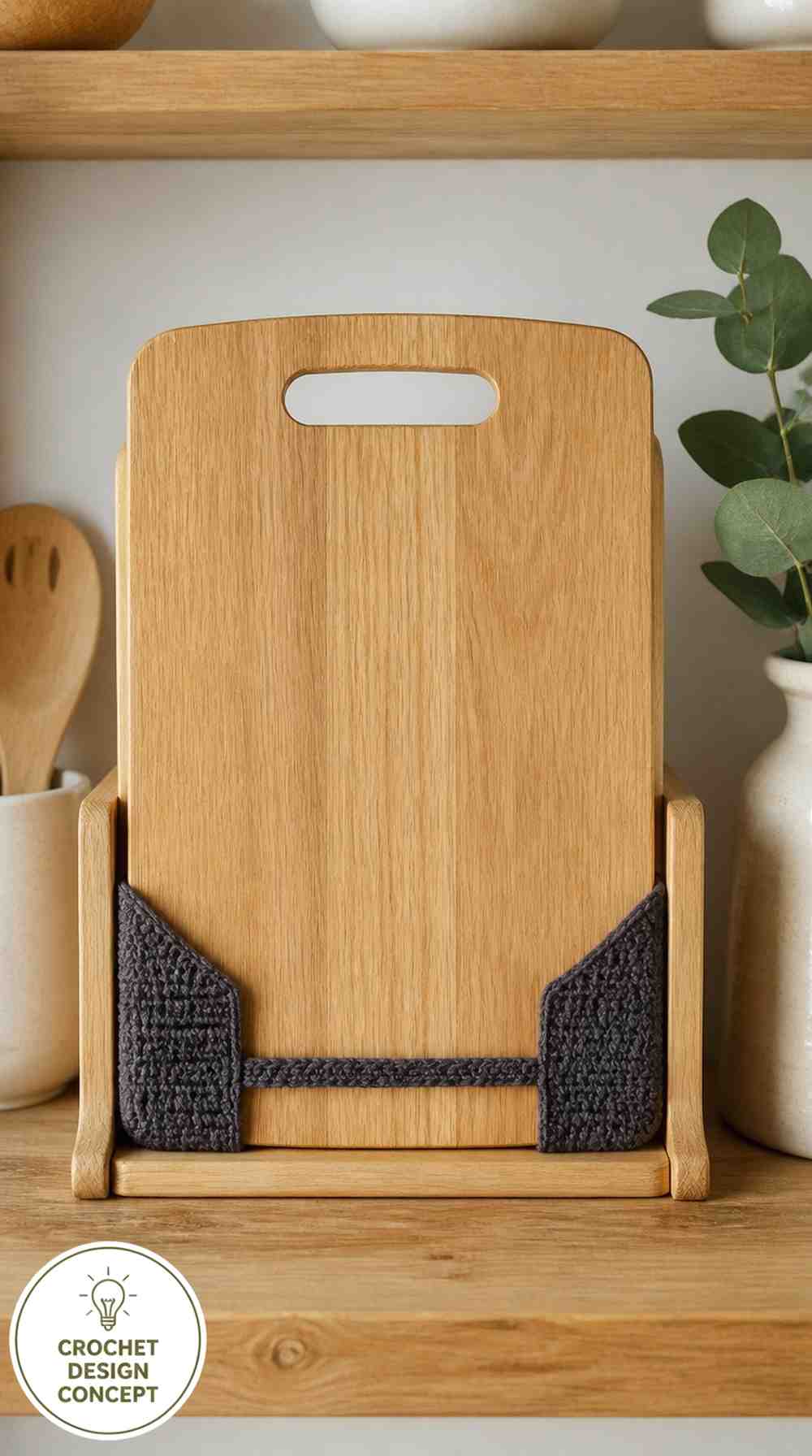
Instead of enclosing a broad section of the cutting board, this charcoal crochet design uses two small ribbed corner pockets connected by a narrow horizontal band. The wooden center remains exposed, giving the accessory a minimal, almost frame-like appearance.
Both lower corners are covered, and the joining band runs along the bottom front area. The design depends on accurate placement more than overall fabric coverage. It is particularly interesting for readers who want to explore small decorative crochet details without covering the natural wood grain.
- Corner Pocket Fit: The two pockets must match the board’s lower corner shapes. Rounded and sharply squared boards will need different shaping.
- Connecting Band: Keep the narrow strip reasonably flat. Excessive tension could pull the corner sections inward or distort their shape.
- Minimal Coverage: This concept offers very little enclosure and is primarily decorative. It is not intended to protect a board during transport.
12. Crochet Olive Vertical Rail Board Sleeve
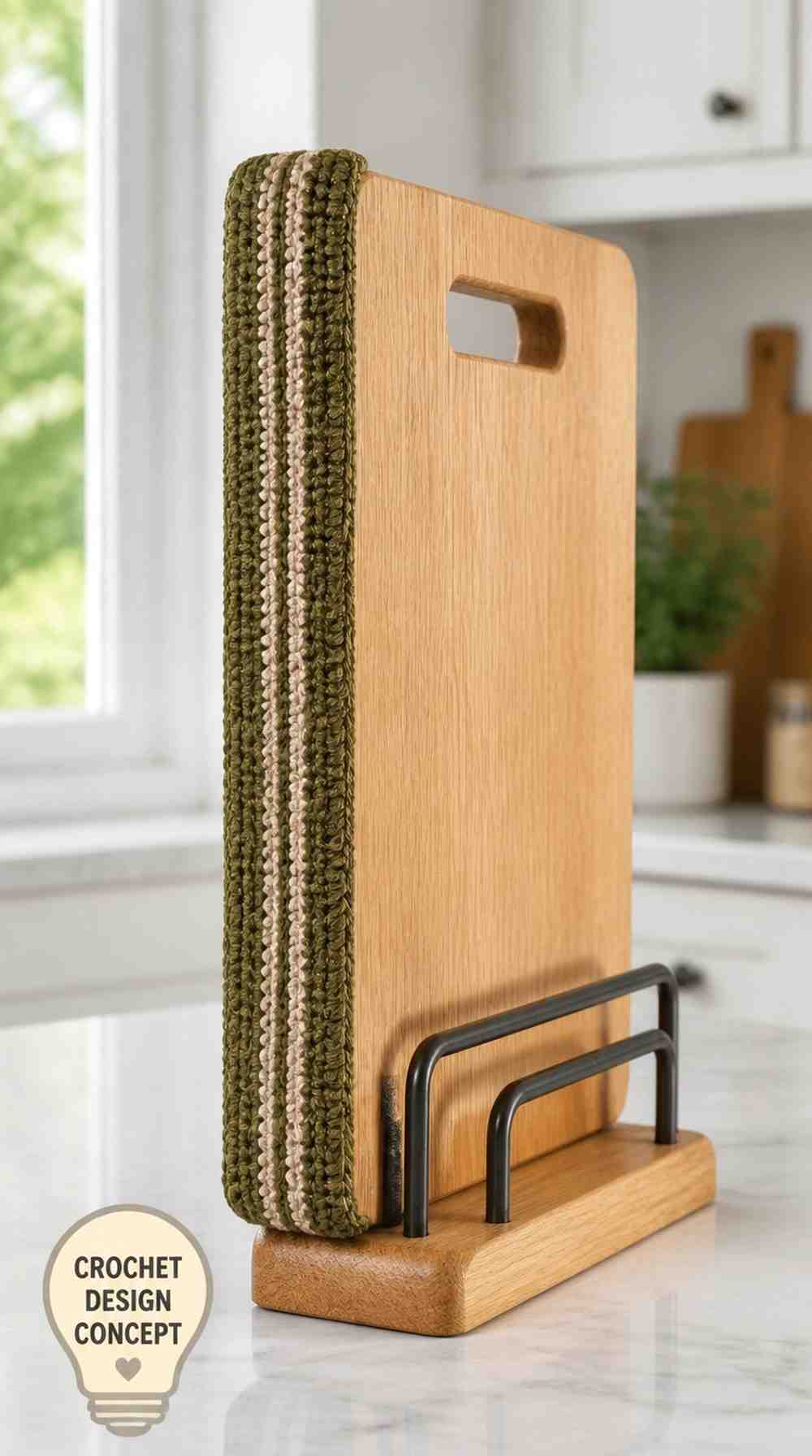
An olive-green crochet channel follows one outer side of this rectangular oak cutting board. Two narrow sand-colored stripes run vertically near the exposed edge, while the rest of the wooden board remains uncovered.
This is one of the most unusual shapes in the collection because the crochet sits along a side rather than across the board’s bottom. Its slim profile is best understood as a decorative edge sleeve for an independently supported board. The tall vertical construction also offers a different way to show crochet stitches in a small kitchen accessory.
- Side Channel Width: Match the opening to the board thickness so the sleeve does not twist or protrude excessively from the edge.
- Vertical Stripe Placement: Keep both sand-colored stripes parallel to the channel edge. Uneven colorwork may become particularly noticeable on a long, narrow piece.
- Rack Clearance: Side coverings increase the board’s effective width. Check that it still fits comfortably in the existing rigid storage rack.
13. Crochet Coral Open Lattice Board Sleeve
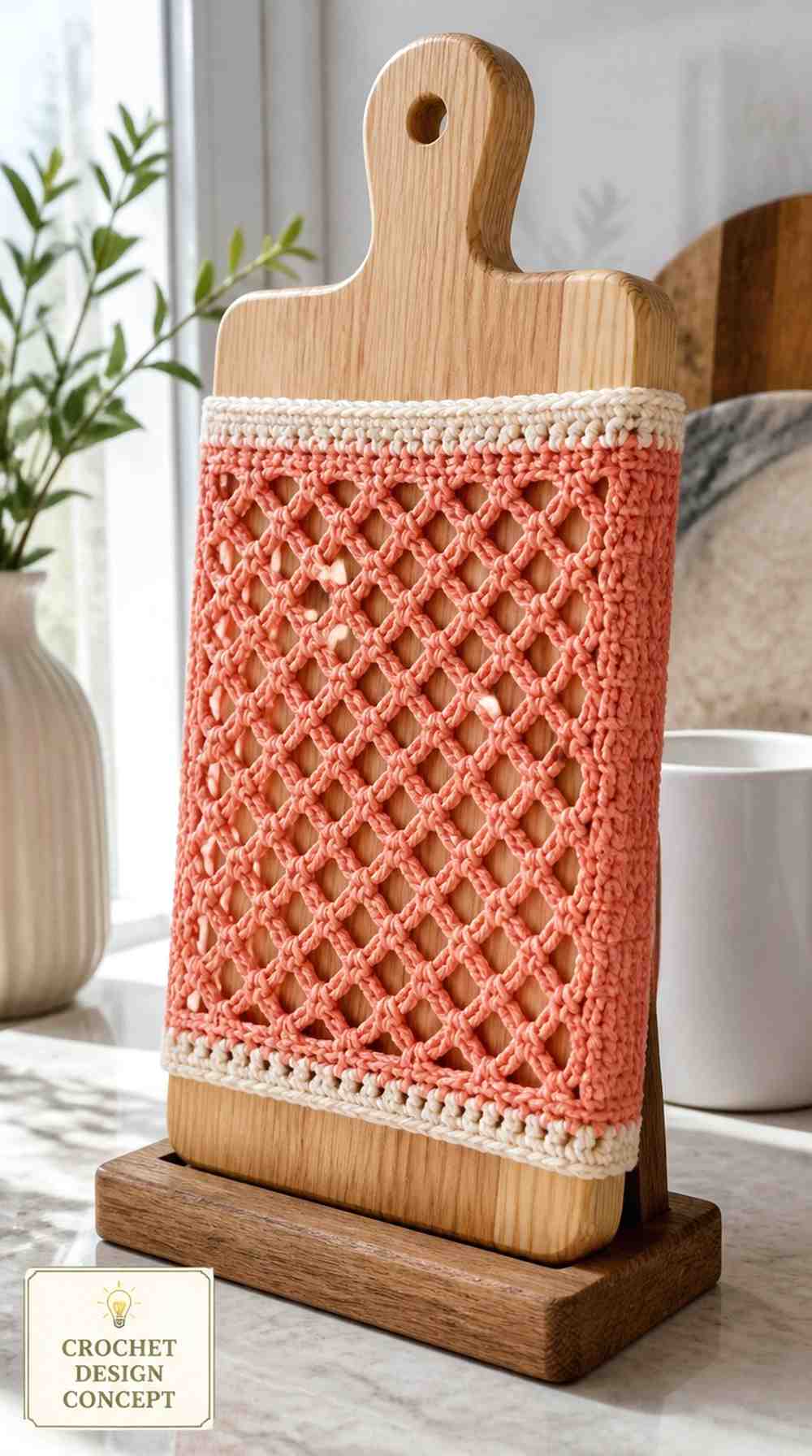
Coral-colored crochet forms an airy lattice around the middle of a rectangular pine cutting board. Its diamond-shaped openings are framed by closely stitched side seams and narrow ivory upper and lower borders, while the back panel remains solid.
Both ends of the board remain uncovered, making this a band-like sleeve rather than a traditional closed pouch. The open center allows the pale wood to show through the coral crochet. It is an attractive option for someone who prefers visible stitch architecture and a lighter decorative finish.
- Diamond Lattice: Keep each open space connected through believable crochet stitches. Oversized openings may snag on board corners during removal.
- Open Upper and Lower Edges: The two openings reduce the enclosed area but do not make the accessory suitable for storing a wet cutting board.
- Solid Reverse: A close-textured back gives the band a more continuous shape and prevents the entire sleeve from becoming a loose mesh tube.
14. Crochet Plum Diagonal Envelope Board Sleeve
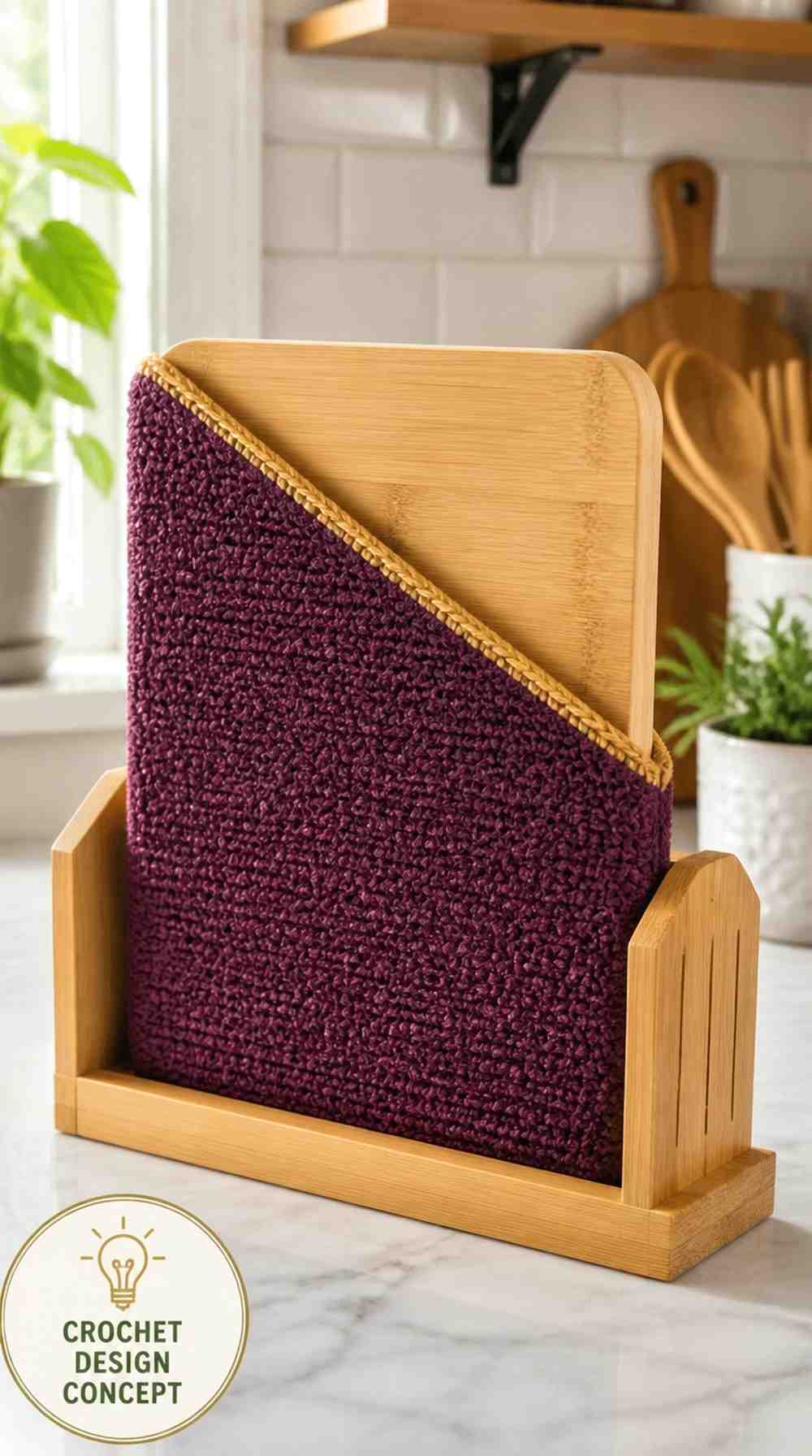
Rich plum crochet gives this storage envelope a bold, contemporary look. Its front panel rises higher on the left before sloping downward toward the right, with a thin muted-mustard border following the diagonal opening.
A bamboo cutting board remains visible above the angled front, while the closed bottom and solid back provide the envelope silhouette. The contrasting border draws attention to the asymmetry without adding buttons, flowers, or bulky raised stitches. This concept offers a different visual approach to a familiar rectangular sleeve.
- Asymmetrical Front: Plan the diagonal height carefully so enough board remains visible while the lower section stays visually balanced.
- Mustard Edge Trim: The narrow border emphasizes the sloping opening. Keep it flat so the angle does not become distorted by tight stitches.
- Solid Back Panel: The rear panel maintains a straight-sided outline behind the diagonal front, allowing the board to remain upright in its separate rack.
15. Crochet Sand Basketweave Board Pocket
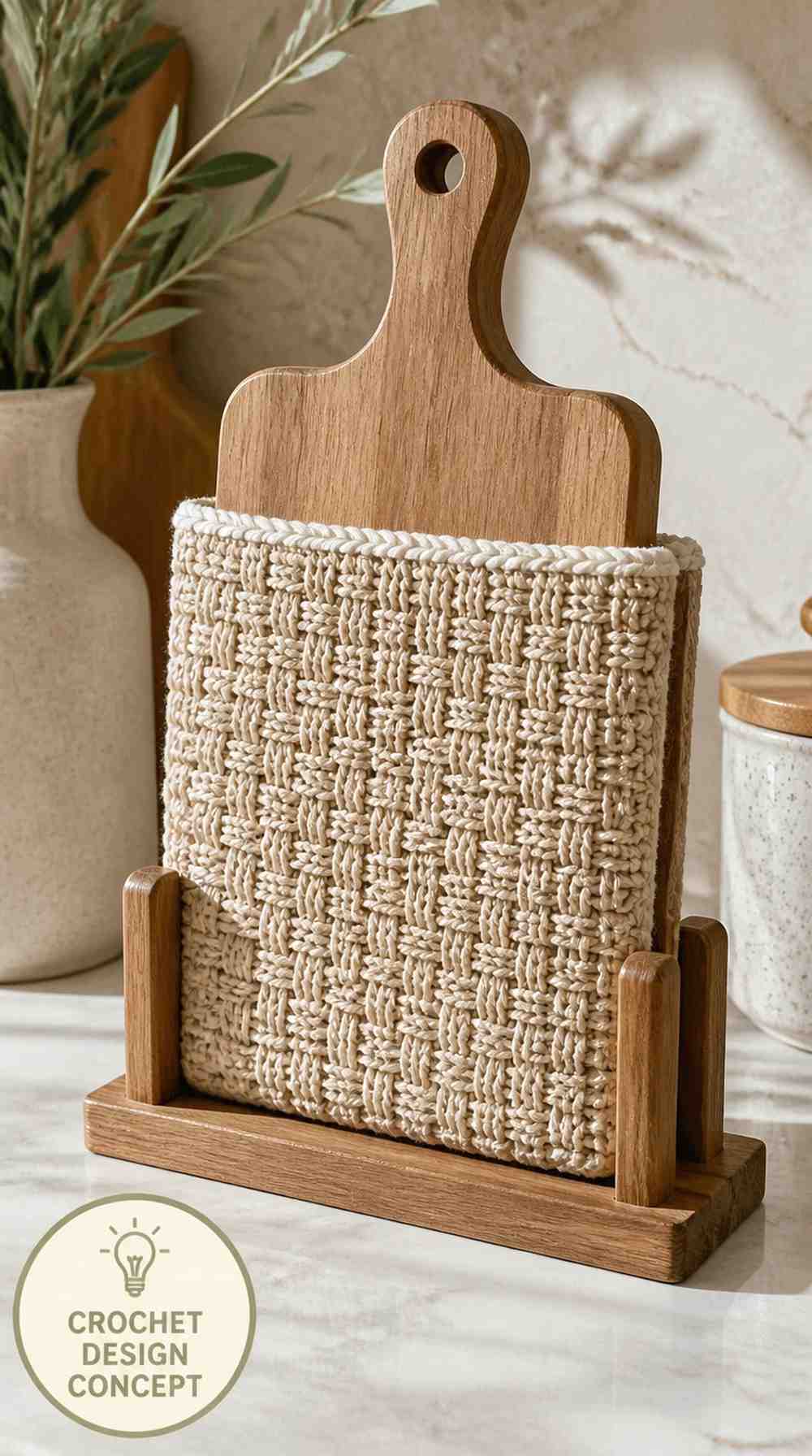
Raised basketweave crochet gives this warm sand-colored storage sleeve a substantial handmade appearance. Alternating textured blocks cover the lower half of a small wooden bread board, with an ivory upper rim and neat vertical side seams.
The pattern is more prominent than the linen-stitch and plain-rib designs. Its repeated relief makes the crochet itself the main visual detail, without additional motifs or contrasting panels. Because basketweave stitches can increase fabric thickness, the concept is especially useful for considering how texture affects storage clearance.
- Basketweave Stitch Relief: Raised post stitches create a deeper surface. Check that the chosen texture does not make the sleeve too bulky for its intended rack.
- Ivory Upper Rim: The contrasting border defines the pocket opening and helps separate the basketweave texture from the exposed wooden board.
- Storage Thickness: Consider both board thickness and crochet thickness when planning a compartment. An overly tight rack may compress or scrape the fabric.
16. Crochet Seafoam Offset Panel Board Sleeve
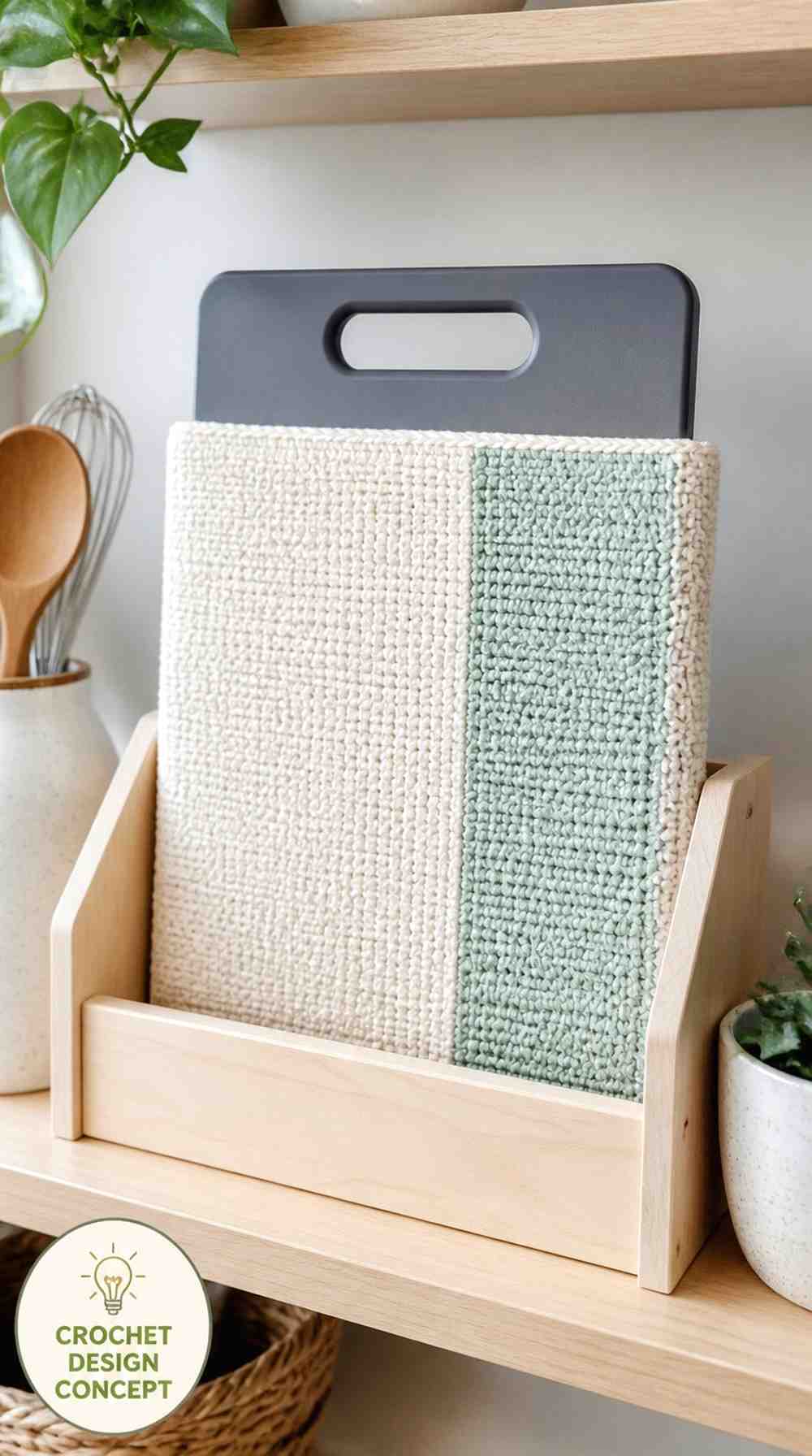
Pale cream crochet forms the main body of this compact cutting board sleeve, while a seafoam-blue ribbed panel covers the right third of the front. The offset arrangement creates a clear contrast between smooth stitches and narrow vertical ribs.
A slate-grey plastic cutting board sits inside the envelope, leaving its handhold visible above the opening. Unlike a symmetrical two-color design, the seafoam section is deliberately placed to one side. Its layered construction offers an interesting way to introduce texture without changing the overall rectangular sleeve shape.
- Offset Panel Position: The contrasting section needs enough width to remain recognizable. A very narrow strip may look like ordinary edging instead.
- Layer Thickness: An attached panel increases fabric depth across one side. Consider how this affects rack clearance and evenness.
- Joining Edges: Keep the seafoam panel securely joined along its perimeter so loose edges do not catch when the board is removed.
17. Crochet Cobalt Color Tab Board Sleeve
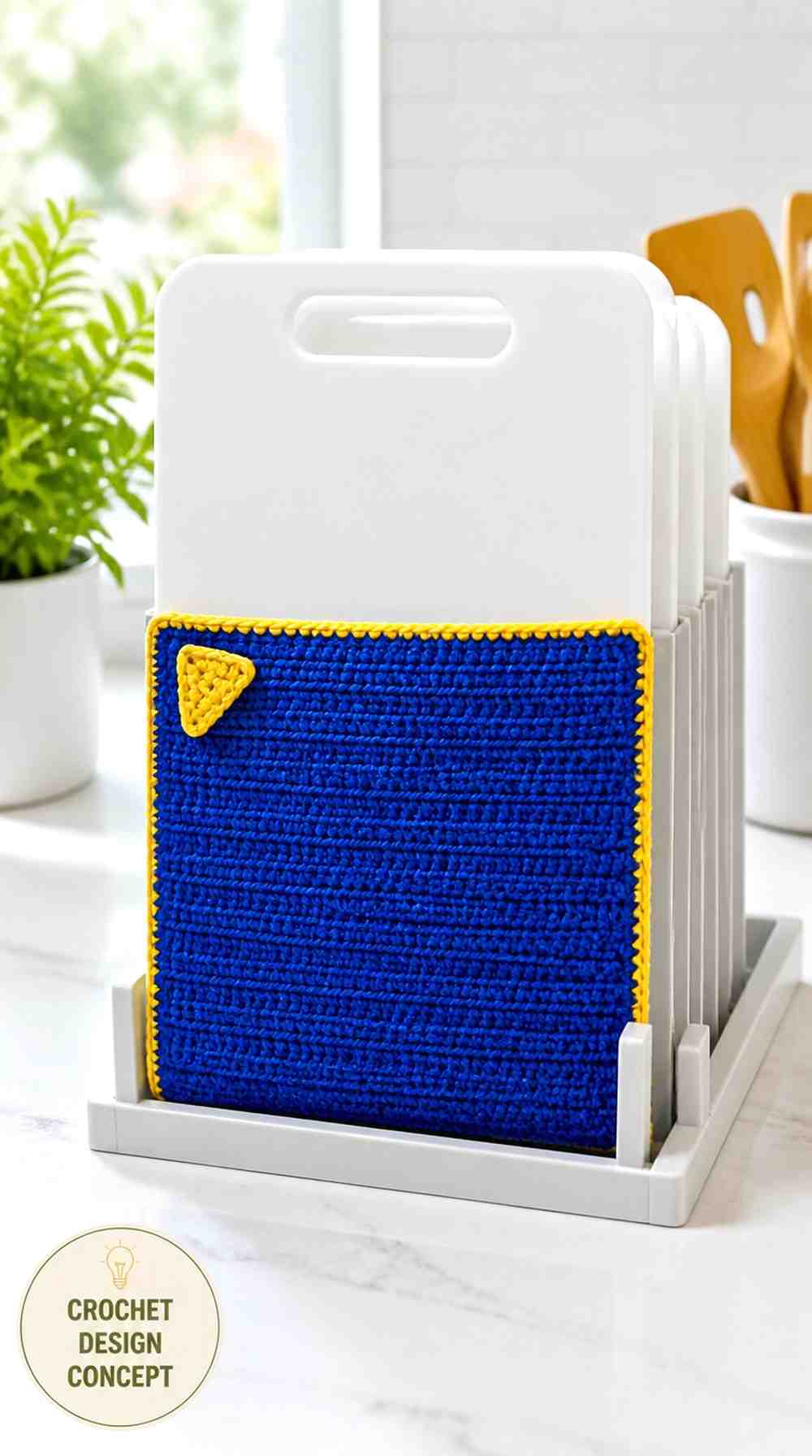
Bright cobalt-blue crochet gives this storage pocket a bold modern appearance. A thin canary-yellow border outlines the sleeve, while a small flat triangular yellow marker sits at the upper left corner of the crochet.
The white plastic cutting board remains exposed above the pocket, creating strong contrast with the saturated blue yarn. The little triangle introduces a potential visual identification detail without adding written labels. It is a useful concept for households that keep several boards, although color accents cannot replace proper food-safety practices.
- Small Corner Marker: Keep the triangular motif flat and securely attached. It is decorative and should never be treated as a lifting handle.
- Color Identification: A colored sleeve might help distinguish stored boards visually, but separate boards and proper cleaning are still necessary to prevent cross-contamination.
- Bright Edge Contrast: Canary-yellow edging keeps the simple rectangle interesting without introducing an extra textured layer across the main body.
18. Crochet Cocoa Reversible Cuff Board Sleeve
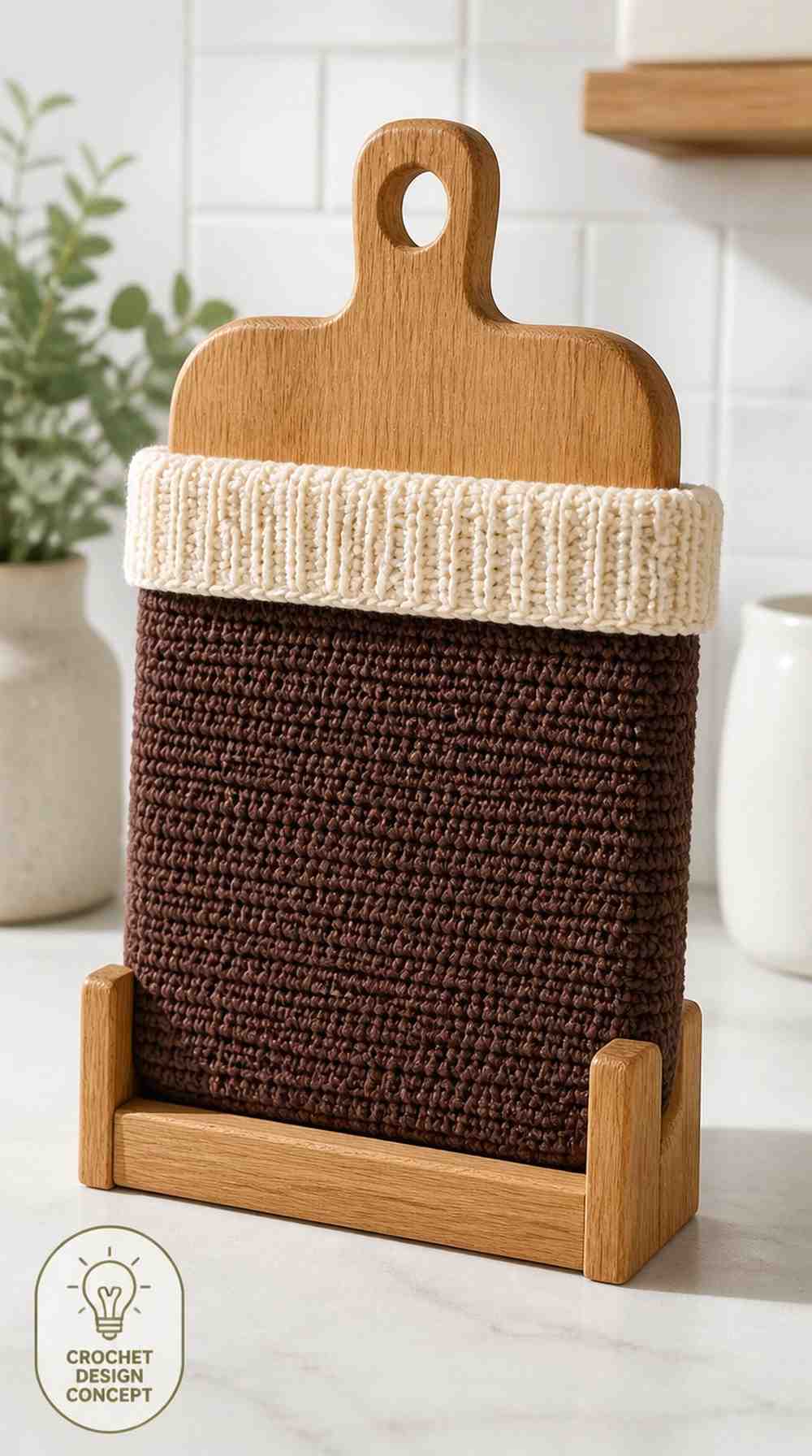
A cocoa-brown crochet envelope finishes this collection with a warm, understated appearance. Closely worked horizontal rows cover the main sleeve, while its upper edge folds outward to reveal a contrasting cream reverse with fine ribbed crochet.
The folded cuff creates the impression of a two-sided accessory without needing external buttons or decorative motifs. A wooden cutting board remains upright inside the sleeve, with its handle fully exposed. The design focuses on the relationship between the dark outer fabric and the lighter visible interior.
- Folded Cuff Detail: A turned-over upper edge adds thickness. Keep the fold smooth rather than allowing it to bunch against the board.
- Two-Sided Fabric: A contrasting reverse provides visual interest when folded outward. Consider how both surfaces will be cleaned and dried.
- Plain Closed Base: The simple lower envelope keeps attention on the cuff while requiring the same independent board support as the other pocket-style designs.
Practical Guide to Crochet Cutting Board Storage Sleeves
Start with a clean, completely dry board. Cutting boards need proper washing and sanitizing before storage. North Carolina State Extension recommends drying cutting boards completely and notes that air drying on a suitable rack helps reduce bacterial growth. A crochet sleeve should not cover a freshly washed, damp, or contaminated board.
Food Safety+1
Keep the board independently supported. Wooden boards can be heavy, especially thick ones. Do not rely on crochet pockets, loose hanging loops, small buttons, or flexible seams to suspend their weight. A stable rigid countertop rack, shelf, or suitable organizer should carry the board.
Measure before planning the sleeve. Check the board’s width, height, thickness, corner shape, and handle position. Compare those measurements with the space available in the storage rack. Crochet stretch, stitch depth, borders, and decorative layers can all change the finished fit.
Think about hygiene and material choice. Smooth, washable yarn may be easier to maintain than heavily textured or fuzzy yarn. However, no ordinary crochet material should be assumed food-safe, antimicrobial, or suitable for contact with an unclean cutting surface. Remove the sleeve before food preparation, and keep the crochet out of direct contact with food.
Choose removable designs. A detachable sleeve is easier to wash and dry separately. Avoid permanently enclosing the board, especially with thick fabric layers that could trap moisture. Follow the yarn manufacturer’s washing instructions, and allow both the board and crochet accessory to dry fully.
For related design inspiration, see Crochet Vintage Kitchen Wall Pocket Ideas and Crochet Dish Rack Side Organizer Ideas on Yarn Nest Studio. These collections explore other approaches to kitchen storage, hanging panels, and removable crochet organizers.
Want to Make Something Similar?
These 18 designs are visual concepts rather than tested patterns. However, the following resources can help with related crochet construction techniques.
- Crochet Wall Pocket Organizer — CyCrochet provides a free pattern using flat crochet panels, joining, and a folded pocket. It is designed for light, dry items, not for supporting cutting board weight. CyCrochet
- Macrochet Pocket Wall Hanging — YouTube demonstrates a larger hanging pocket construction, useful for understanding how crochet fabric can form a storage compartment. Its dimensions and support arrangement should not be transferred directly to cutting board storage.
These lessons can help with stitches and general pocket construction, but a cutting board sleeve requires separate planning for sizing, hygiene, weight, and storage support.
Comparison: Which Crochet Cutting Board Storage Sleeve Should You Choose?
| Design | Main advantage | Important consideration |
|---|---|---|
| Cinnamon Lower Cradle | Simple, shallow coverage | Needs stable bottom support |
| Oatmeal Tapered Paddle | Follows a shaped board | Requires careful sizing |
| Cornflower Side Entry | Horizontal shelf access | Sleeve may shift during removal |
| Midnight Ventilated Mesh | Decorative openwork | Does not replace full drying |
| Mustard Double Pocket | Organizes two small boards | Needs a sturdy supporting stand |
| Espresso Checkerboard | Bold, compact colorwork | Light stitches may show stains |
| Stone U Notch | Exposes the original handhold | Notch must align correctly |
| Burgundy Button Flap | Decorative diagonal closure | Button may snag |
| Sage Granny Patch | Cottage-style focal motif | Extra decorative layer |
| Blush Scalloped Crescent | Suits curved board shapes | Edge shaping needs care |
| Charcoal Corner Guard | Minimal board coverage | Primarily decorative |
| Olive Vertical Rail | Slim side-edge accent | Changes overall board width |
| Coral Open Lattice | Shows the board through crochet | Openwork can catch edges |
| Plum Diagonal Envelope | Strong asymmetrical design | Requires balanced shaping |
| Sand Basketweave | Prominent raised texture | Adds thickness |
| Seafoam Offset Panel | Modern two-texture contrast | Uneven fabric layering |
| Cobalt Color Tab | Easy visual distinction | Marker is not a safety label |
| Cocoa Reversible Cuff | Attractive folded contrast | Cuff adds fabric bulk |
For a smaller kitchen, the Crochet Cinnamon Lower Cradle Sleeve or Crochet Charcoal Corner Guard Board Sleeve may be appealing because they use relatively little fabric. If you prefer the look of a more complete cover, the Crochet Stone U Notch Board Sleeve and Crochet Cocoa Reversible Cuff Board Sleeve provide fuller coverage.
For decorative openwork, consider the Crochet Midnight Ventilated Mesh Sleeve or Crochet Coral Open Lattice Board Sleeve. For a strongly textured appearance, the Crochet Sand Basketweave Board Pocket stands out.
The best concept is ultimately the one that fits the board without compromising the original storage rack, keeping the board clean, accessible, and fully dry.
Conclusion
Crochet cutting board storage sleeves can bring handmade character to ordinary kitchen organization. From small corner guards and tapered covers to full envelopes, textured panels, and colorful borders, these 18 concepts show several ways to explore the same everyday object without repeating one basic design.
A useful approach starts with the board and its existing storage arrangement, then considers the crochet decoration. Choose a shape that can be removed easily, avoid unnecessary layers around damp surfaces, and rely on a stable rack rather than the crocheted fabric for support.
Which design would you choose for your kitchen? Would you prefer the cinnamon lower cradle, open navy mesh, sage granny patch, or bright cobalt sleeve? Share the style you like most and whether you would use it for a wooden or plastic cutting board.
Frequently Asked Questions
1. Can a crochet sleeve be used to store a wooden cutting board?
A removable crochet sleeve can be considered as a decorative storage accessory for a completely clean, dry wooden board, provided a separate rigid rack supports the weight. It should not trap moisture against the wood or interfere with proper storage. Remove the sleeve before using or washing the cutting board.
2. Which yarn is best for crochet cutting board storage sleeves?
A smooth cotton yarn or a suitable washable cotton blend may be worth considering because clearly defined stitches and regular cleaning are important. However, check the specific yarn’s care instructions. No yarn choice by itself guarantees food safety, resistance to moisture buildup, or reliable support for a heavy board.
3. Are mesh crochet sleeves better for airflow?
Open mesh allows parts of the board to remain exposed, but it should not be treated as a drying system. Even an open crochet sleeve can hold moisture where fabric touches the board. Clean and fully dry the board before storing it, and wash and dry the sleeve separately when needed.
4. Can one crochet organizer hold several cutting boards?
The double-pocket concept shows how two small boards might be arranged in separate crocheted compartments. A rigid rack must support their combined weight, and the compartments need enough room for the boards to fit without rubbing or slipping. The crochet itself should not be relied on as a load-bearing hanging system.
5. Are these crochet cutting board sleeves actual patterns?
No. All 18 designs are inspiration concepts, not finished, tested patterns. Their image prompts describe possible appearances, and the article explains practical considerations. Anyone making a similar item would need to develop or adapt appropriate crochet construction, measure the actual board, and verify cleaning, drying, fit, and storage support before use.