A funnel neck gives a crochet sweater more visual weight around the face and shoulders than a standard crew neck, so color placement matters. A dark collar can anchor the garment, a lighter supporting shade can separate textured stitches, and repeating an accent at the cuffs or hem can keep the neckline from looking disconnected from the rest of the sweater.
The supporting tutorials below cover closely related high-neck sweater constructions. Depending on the creator, the neckline may be described as a turtleneck, roll neck, mock neck, or cowl neck. The tutorials support the construction concept; the Fall 2026 palettes are independent color adaptations rather than claims about the colors used by each creator.
Quick List
- Burnt Orange And Cream Crochet Funnel Neck Sweater
- Olive Green And Oatmeal Crochet Funnel Neck Sweater
- Burgundy And Dusty Rose Crochet Funnel Neck Sweater
- Mustard And Chocolate Brown Crochet Funnel Neck Sweater
- Terracotta And Sage Crochet Funnel Neck Sweater
- Charcoal And Camel Crochet Funnel Neck Sweater
- Rust And Deep Teal Crochet Funnel Neck Sweater
- Forest Green And Mushroom Crochet Funnel Neck Sweater
- Navy And Copper Crochet Funnel Neck Sweater
- Plum And Mauve Crochet Funnel Neck Sweater
- Espresso And Ivory Crochet Funnel Neck Sweater
- Moss Warm Taupe And Cream Crochet Funnel Neck Sweater
- Aubergine And Sand Crochet Funnel Neck Sweater
- Slate Blue And Oatmeal Crochet Funnel Neck Sweater
- Cranberry And Soft Gray Crochet Funnel Neck Sweater
- Ochre Black And Cream Crochet Funnel Neck Sweater
- Deep Teal And Tobacco Crochet Funnel Neck Sweater
- Brick Red And Denim Blue Crochet Funnel Neck Sweater
- Chocolate Brown And Blush Crochet Funnel Neck Sweater
- Pine Green Burgundy And Cream Crochet Funnel Neck Sweater
- Black Caramel And Bone Crochet Funnel Neck Sweater
Give the Funnel Neck a Clear Color Role
The collar occupies a noticeable block of color close to the face, so decide whether it should continue the main body color or act as a deliberate contrast. Keeping the collar and torso the same shade creates an uninterrupted column of color. Changing the collar works better when that contrast appears somewhere else, such as the cuffs, hem, sleeve stripes, or panel edges.
For a multicolor sweater, avoid assigning every shade equal space automatically. One dominant shade across the body, one supporting color, and a smaller accent usually gives you more control over how the funnel neck relates to the sleeves and torso.
Use Light and Dark Values to Protect Crochet Texture
Two yarn colors can look clearly different in the skein yet have similar lightness once crocheted. That can make ribbing, cables, bobbles, or panel transitions less distinct.
Place the yarns side by side and, if needed, look at them in grayscale. If a small textured detail disappears, increasing the light/dark separation may help. This is especially useful around funnel-neck ribbing, cuffs, borders, and raised stitches, where the construction deserves to remain visible.
Repeat Accent Colors Beyond the Funnel Neck
A contrasting funnel neck can look isolated if its color appears nowhere else. Repeating that shade at both cuffs, along the hem, in a narrow sleeve detail, or around panel edges ties the neckline back into the complete sweater.
The repeat does not need to occupy the same amount of space. A large cream collar, for example, can be balanced by much narrower cream cuffs. The goal is visual connection rather than mathematical equality.
1. Burnt Orange And Cream Crochet Funnel Neck Sweater
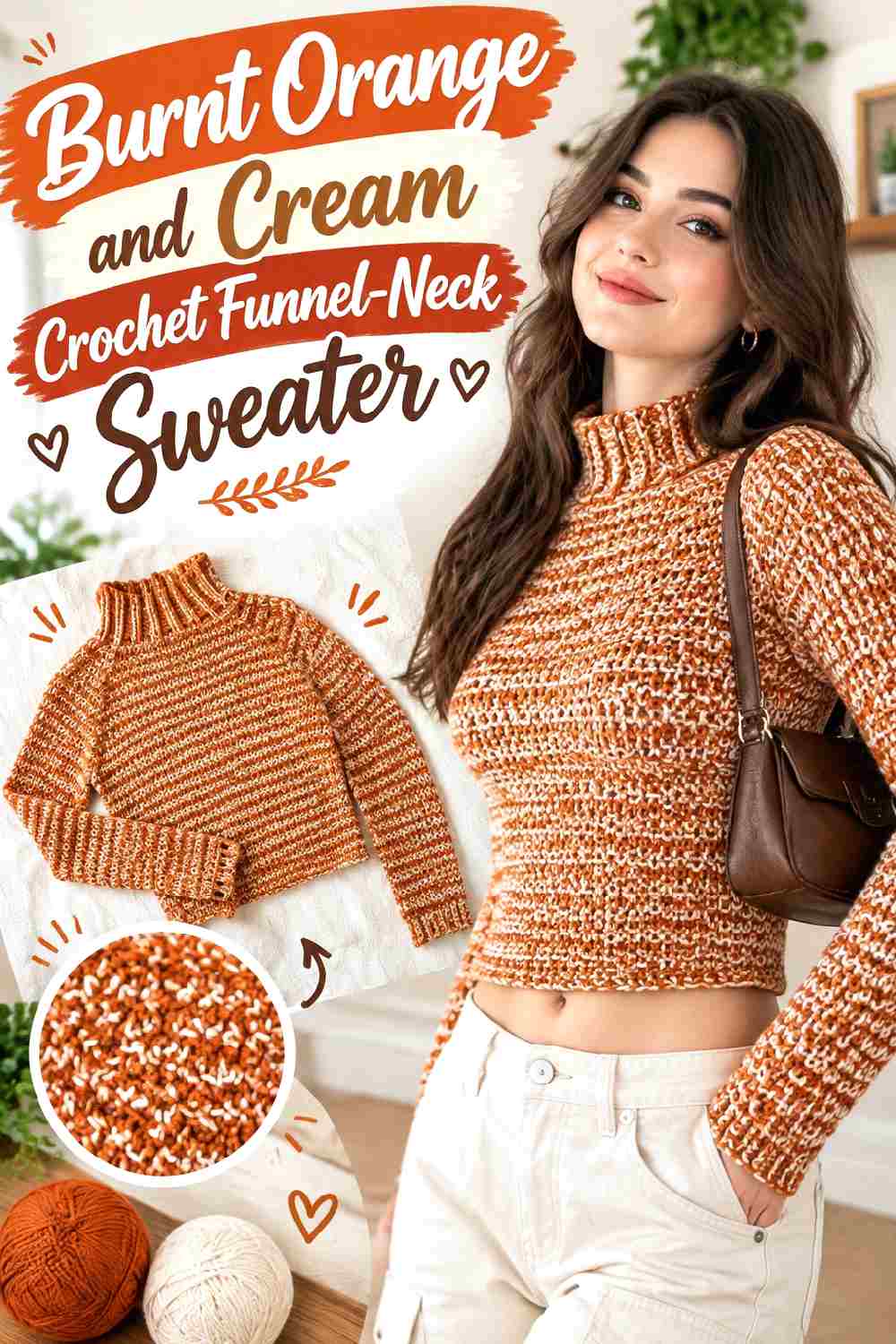
Burnt orange can cover most of the sweater and immediately establish a warm fall direction, while cream gives the high neckline and smaller finishing areas more separation. On a crochet sweater, that lighter break is particularly useful around ribbing because it prevents the collar, body, and cuffs from reading as one uninterrupted block.
Let Burnt Orange Carry the Funnel Neck and Main Sweater Panels
Use burnt orange across the torso and sleeves when you want the sweater to feel strongly color-led rather than contrast-led. Keeping the funnel neck burnt orange as well creates a continuous vertical field from hem to collar. If the sweater has raised texture, check that your chosen orange is not so dark that smaller stitch shadows disappear.
Use Cream to Break Up Burnt Orange at the Cuffs and Hem
Cream works well in smaller areas when burnt orange already covers the major panels. Narrow cream cuffs and a cream lower edge can give the sweater definition without dividing the torso into large color blocks. If you also use cream around the collar, repeat it somewhere lower on the garment so the neckline feels connected rather than added afterward.
Creator Credit: ABoC Studio
2. Olive Green And Oatmeal Crochet Funnel Neck Sweater
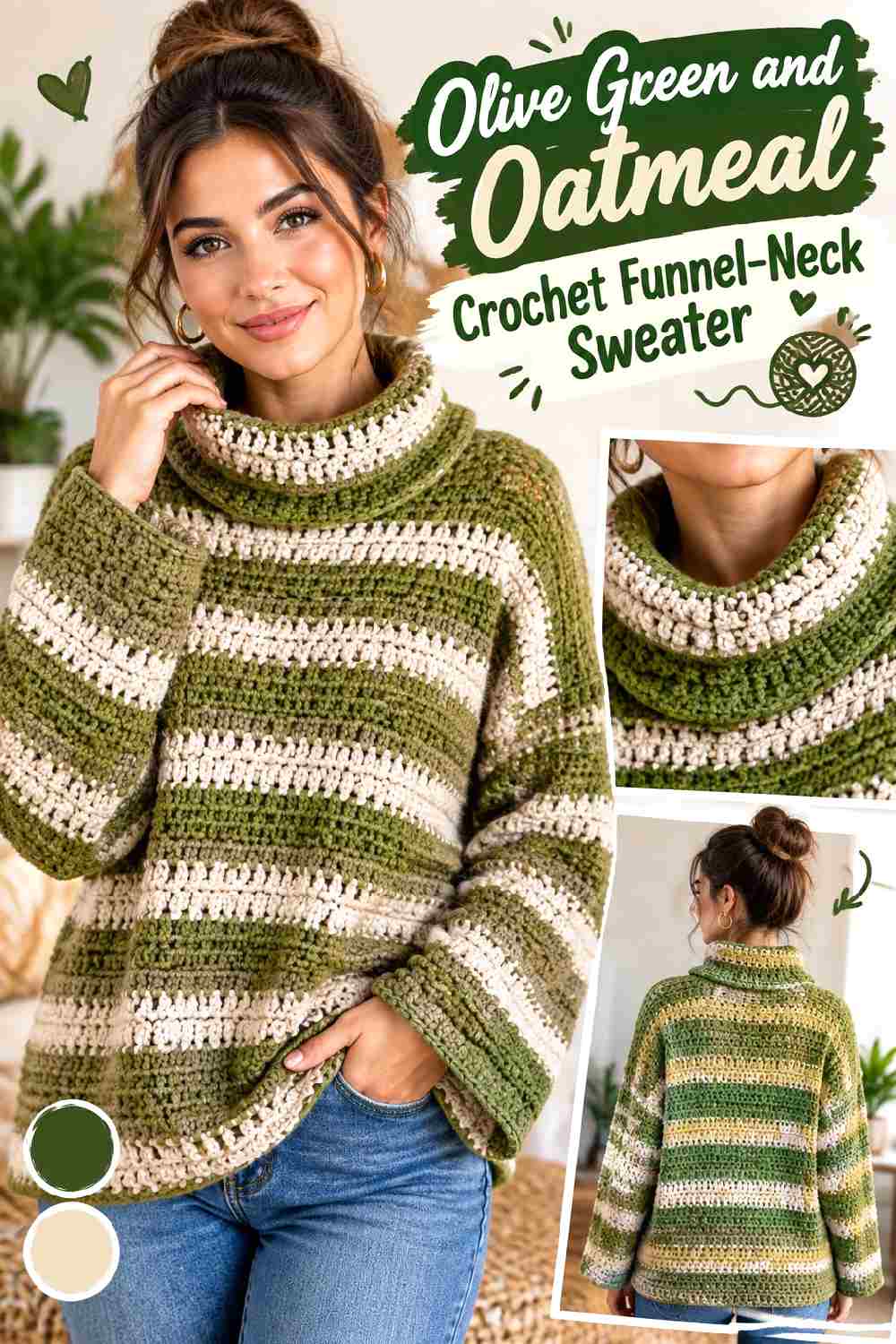
Olive green gives a funnel-neck sweater a muted earthy base, while oatmeal introduces a lighter neutral without the sharp jump that bright white would create. This combination works particularly well when the sweater has visible ribbing or panel transitions because oatmeal can be reserved for areas that need definition.
Keep Olive Green Dominant Across the Crochet Sweater Panels
Let olive cover most of the front, back, and sleeves rather than scattering it in small sections. A broad olive field keeps the sweater visually grounded and gives textured crochet enough continuity to remain readable. If your olive is especially dark, compare it with the stitch shadows before deciding to use it on intricate raised details.
Let Oatmeal Define Olive Green Ribbing at the Funnel Neck
An oatmeal funnel neck creates a softer light/dark break against olive than a very bright neutral. Repeat oatmeal at the cuffs or hem so the collar is not the sweater’s only pale area. If you prefer the neck to blend into the torso, reverse the placement and use oatmeal only as narrow trim.
Creator Credit: Lucky Platypus Crochet
3. Burgundy And Dusty Rose Crochet Funnel Neck Sweater
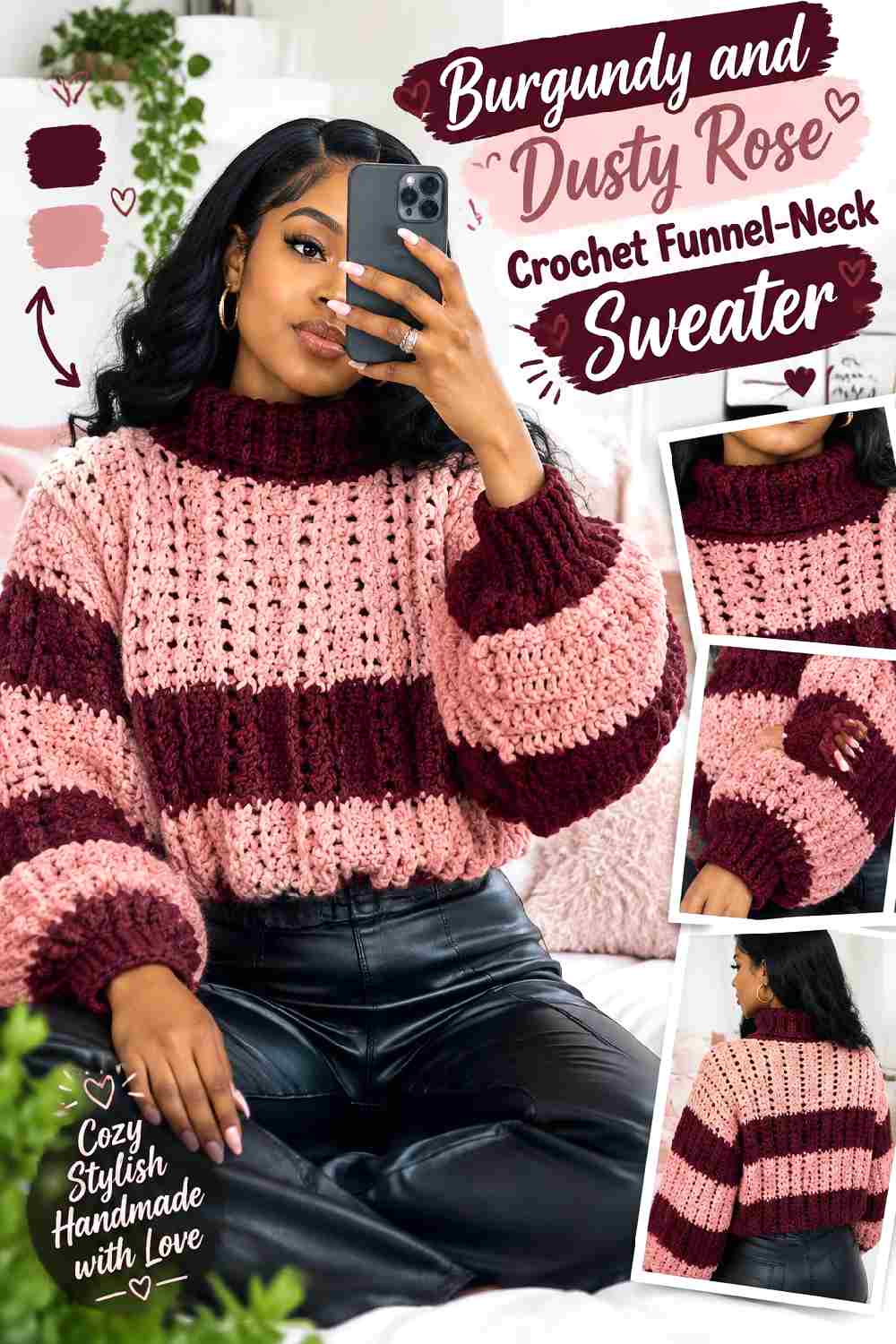
Burgundy supplies the darker visual anchor, while dusty rose gives the sweater a muted transition rather than a hard high-contrast split. The combination is especially useful for sleeves or textured sections where you want color variation without losing the richer fall character of the main shade.
Burgundy Gives the Crochet Funnel Neck Its Strongest Frame
A burgundy collar naturally carries more visual weight than dusty rose. Use it when you want the funnel neck to remain clearly defined above a softer body or sleeve section. Repeating burgundy at the hem helps establish a top-and-bottom frame around the lighter areas of the sweater.
Dusty Rose Softens Burgundy Across the Crochet Sleeves
Dusty rose can take over the sleeves, cuffs, or a broad middle panel without competing with burgundy for dominance. Keep enough value difference between the two shades that sleeve transitions remain visible. If your dusty rose is nearly as dark as the burgundy, consider a lighter muted pink rather than relying on hue difference alone.
Creator Credit: AC Crochets
4. Mustard And Chocolate Brown Crochet Funnel Neck Sweater
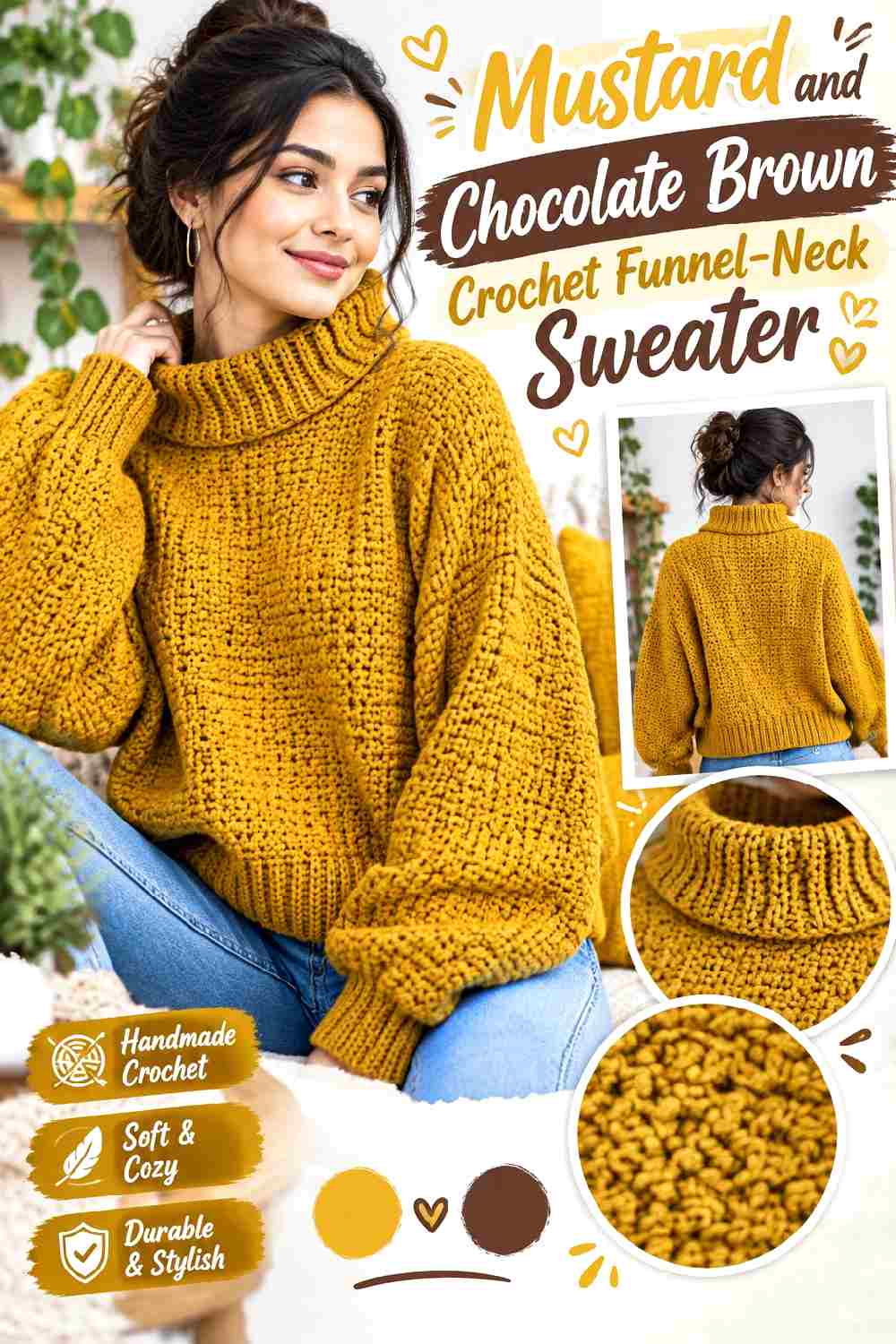
Mustard brings warmth to the main sweater surface, while chocolate brown can control that brightness around structural areas. This is a useful palette for a sweater where cuffs, hem ribbing, and the funnel neck deserve clear definition.
Mustard Works Better When Chocolate Brown Frames the Crochet Sweater
Let mustard cover the broad torso and sleeve areas, then use chocolate around the collar, cuffs, and lower edge. Those darker boundaries keep mustard from occupying every part of the garment equally. On a textured sweater, the brown can also direct attention toward ribbing without adding another bright accent.
Chocolate Brown Can Keep Mustard Crochet Texture Clear
If the sweater includes cables or raised stitches, compare the two colors in the actual texture before deciding where the transition should sit. Chocolate around a highly detailed edge can produce a stronger shadow effect, while mustard may show the same detail more softly. Use whichever shade gives the texture the visibility you want.
Creator Credit: Fully Crochet
5. Terracotta And Sage Crochet Funnel Neck Sweater
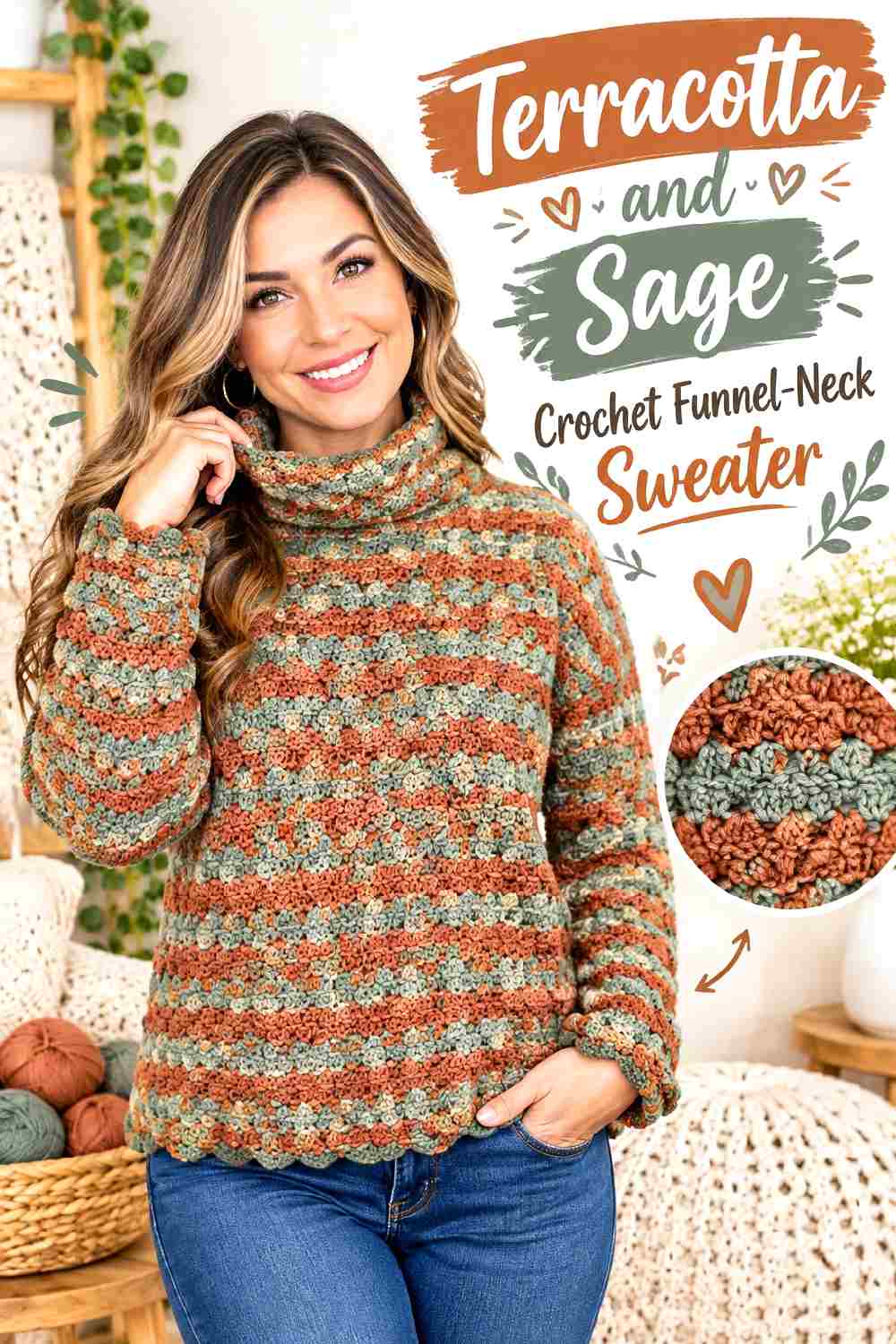
Terracotta and sage create a warmer-and-cooler earthy combination without needing a neutral between them. Terracotta should usually occupy the larger visual area if you want a stronger fall direction, while sage works well as a measured contrast at the neckline or finishing details.
Let Terracotta Lead the Crochet Funnel-Neck Sweater Body
Use terracotta across the torso and most of the sleeves so the sweater has one obvious dominant shade. Sage becomes more effective when it appears deliberately rather than being alternated constantly with terracotta. Large terracotta panels also give crochet surface texture room to read without frequent color interruption.
Sage Gives Terracotta a Quieter Crochet Collar Contrast
A sage funnel neck can separate clearly from terracotta without creating the starkness of cream or black. Repeat sage at the cuffs or use a narrow sage hem so the collar belongs to an intentional palette. If the two yarns are similar in value, test them side by side before using sage for small details that need clear visibility.
Creator Credit: Crochet Maniak
6. Charcoal And Camel Crochet Funnel Neck Sweater
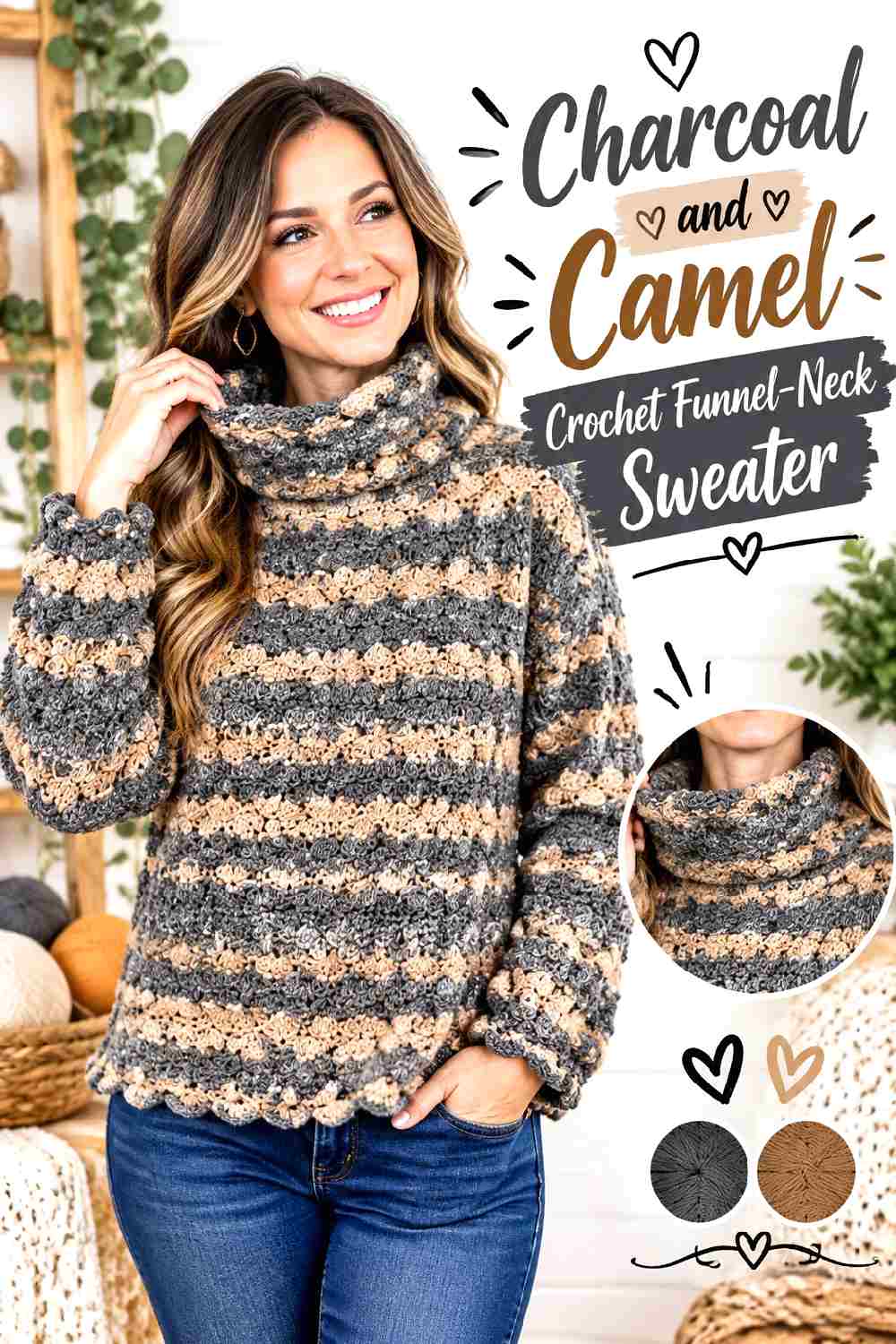
Charcoal gives the sweater a dark neutral foundation, while camel introduces warmth in a way that remains easy to coordinate with simple fall layers. This palette works especially well when the funnel neck or ribbed borders are visually important.
Charcoal Makes a Strong Crochet Funnel-Neck Anchor
Use charcoal on the funnel neck when you want the neckline to act as the darkest point of the sweater. Continuing charcoal through the main torso creates a restrained overall field that lets ribbing and silhouette carry more of the design. Make sure textured stitches remain visible in your chosen charcoal rather than disappearing into one dark mass.
Camel Warms Charcoal at the Crochet Cuffs and Hem
Camel is effective in controlled bands because it interrupts the charcoal without turning the sweater into a half-and-half color block. A camel hem and matching cuffs give the eye repeated warm points away from the neckline. For more camel presence, extend it through part of the sleeves rather than adding unrelated extra colors.
Creator Credit: Loopy Mountain Crochet
7. Rust And Deep Teal Crochet Funnel Neck Sweater
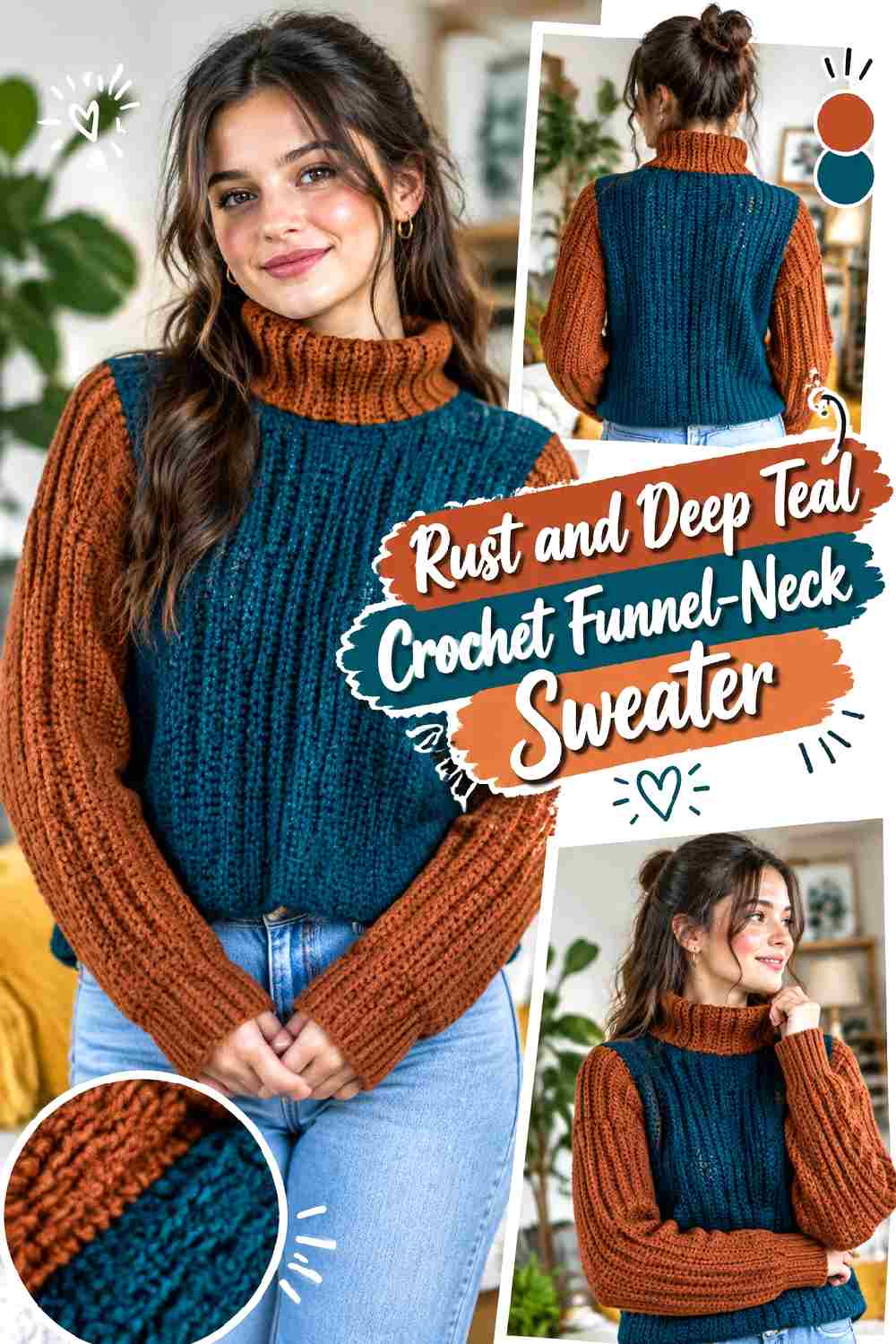
Rust and deep teal create stronger hue contrast than many earthy fall palettes, so color area needs more control. Giving rust the majority of the sweater and using teal strategically keeps both shades distinct without forcing them to compete across every panel.
Rust Should Control Most of the Crochet Sweater Surface
Use rust through the torso and upper sleeves to establish a clear visual lead. Because deep teal is strong enough to draw attention even in smaller quantities, it does not need equal coverage. This balance is particularly useful on an oversized sweater, where two equally large saturated blocks can become visually heavy.
Deep Teal Can Define Rust at the Funnel Neck and Cuffs
Place teal around the funnel neck and repeat it at the wrists for a deliberate frame. If the sweater has strong ribbing, the darker teal can make those linear details more pronounced. Check the two yarns in grayscale as well as in color; depending on the shades chosen, they may be closer in value than expected.
Creator Credit: Alona crochets
8. Forest Green And Mushroom Crochet Funnel Neck Sweater
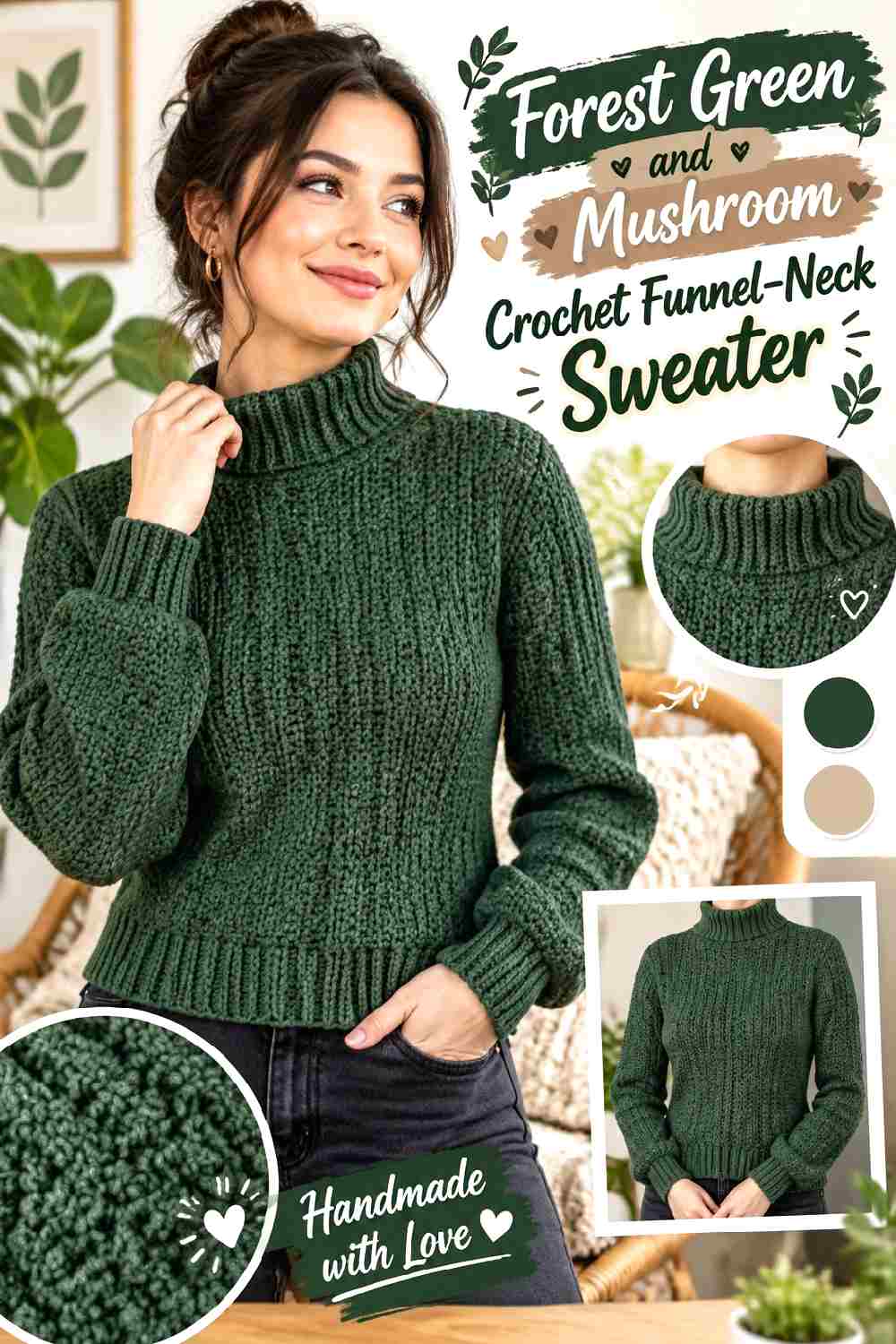
Forest green provides the dark woodland base, while mushroom offers a softened neutral that is less stark than white or pale cream. The lighter shade can be used to expose ribbing, seams, or panel edges that might disappear in an all-green sweater.
Forest Green Gives the Crochet Funnel Neck a Deep Fall Base
A forest green funnel neck connected to a matching torso creates a long continuous color field. That approach is effective when the sweater’s texture is already busy and does not need extra color blocking. Before committing to forest green for every section, confirm that your stitch detail still reads clearly in the darker yarn.
Mushroom Makes Forest Green Crochet Edges Easier to Read
Use mushroom on cuffs, hem ribbing, or narrow sleeve bands when you need lighter separation. Its softer value transition keeps the palette muted while still outlining the garment’s finishing areas. If mushroom is used at the neckline instead, repeat it below the shoulders to keep the pale collar from becoming visually isolated.
Creator Credit: TCDDIY
9. Navy And Copper Crochet Funnel Neck Sweater
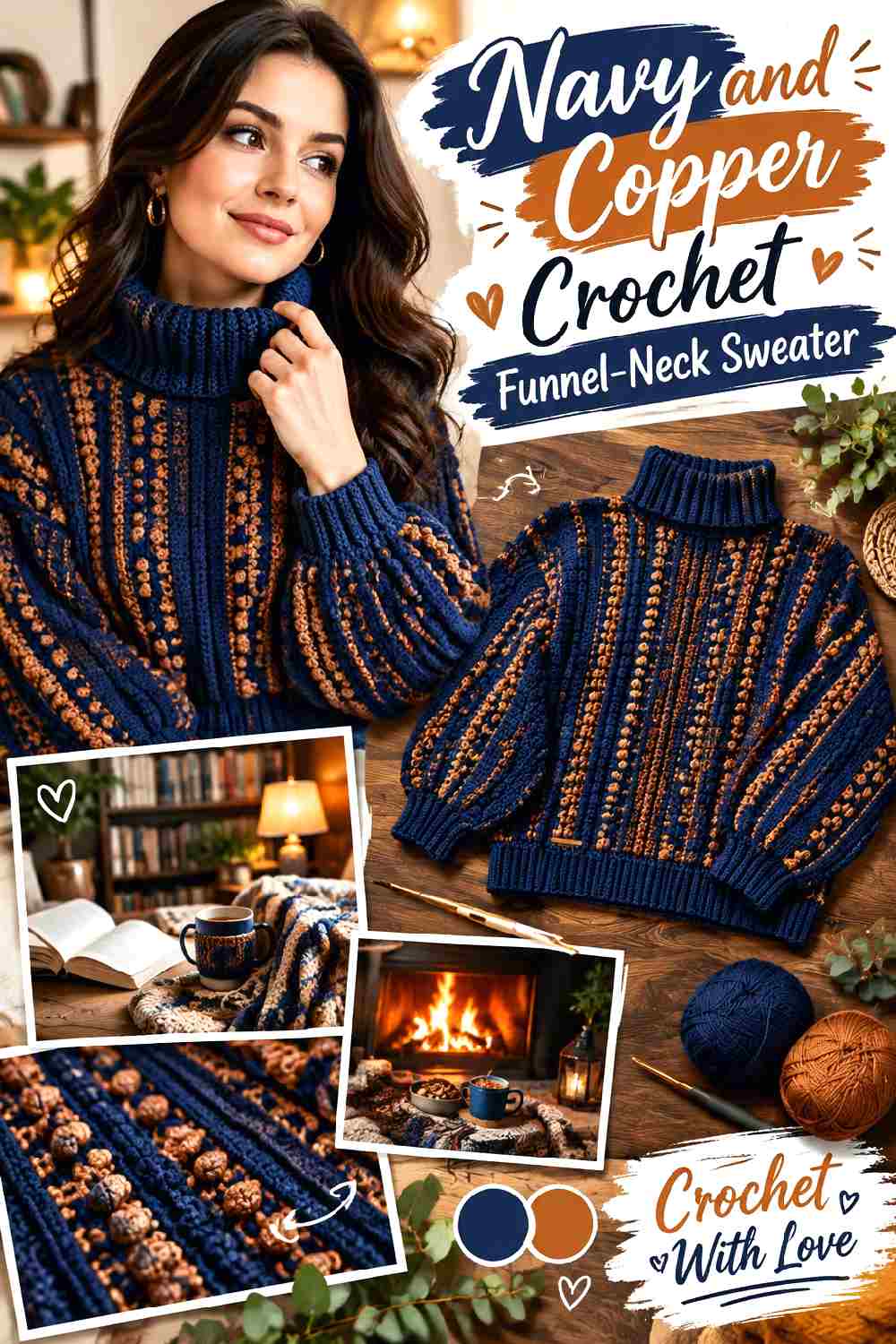
Navy acts as a stable dark background, allowing copper to function as a concentrated warm accent. This scheme is useful for textured crochet because navy can cover the uncomplicated areas while copper directs attention toward specific bands or raised details.
Navy Keeps the Crochet Funnel-Neck Sweater Visually Grounded
Use navy for the body and most of the sleeves when you want copper to remain a true accent. A navy funnel neck continues that darker field upward and puts the focus on silhouette rather than color blocking. If the stitch texture is important, test whether the navy is light enough for shadows and ridges to remain visible.
Copper Works Better as a Controlled Crochet Accent Against Navy
Place copper at cuffs, lower ribbing, or selected textural rows instead of distributing it evenly throughout the sweater. This gives the warm color clear jobs and avoids turning a restrained two-color scheme into constant striping. If you want a copper collar, bring a smaller amount of copper back at the hem for balance.
Creator Credit: Cathérine Crochet
10. Plum And Mauve Crochet Funnel Neck Sweater
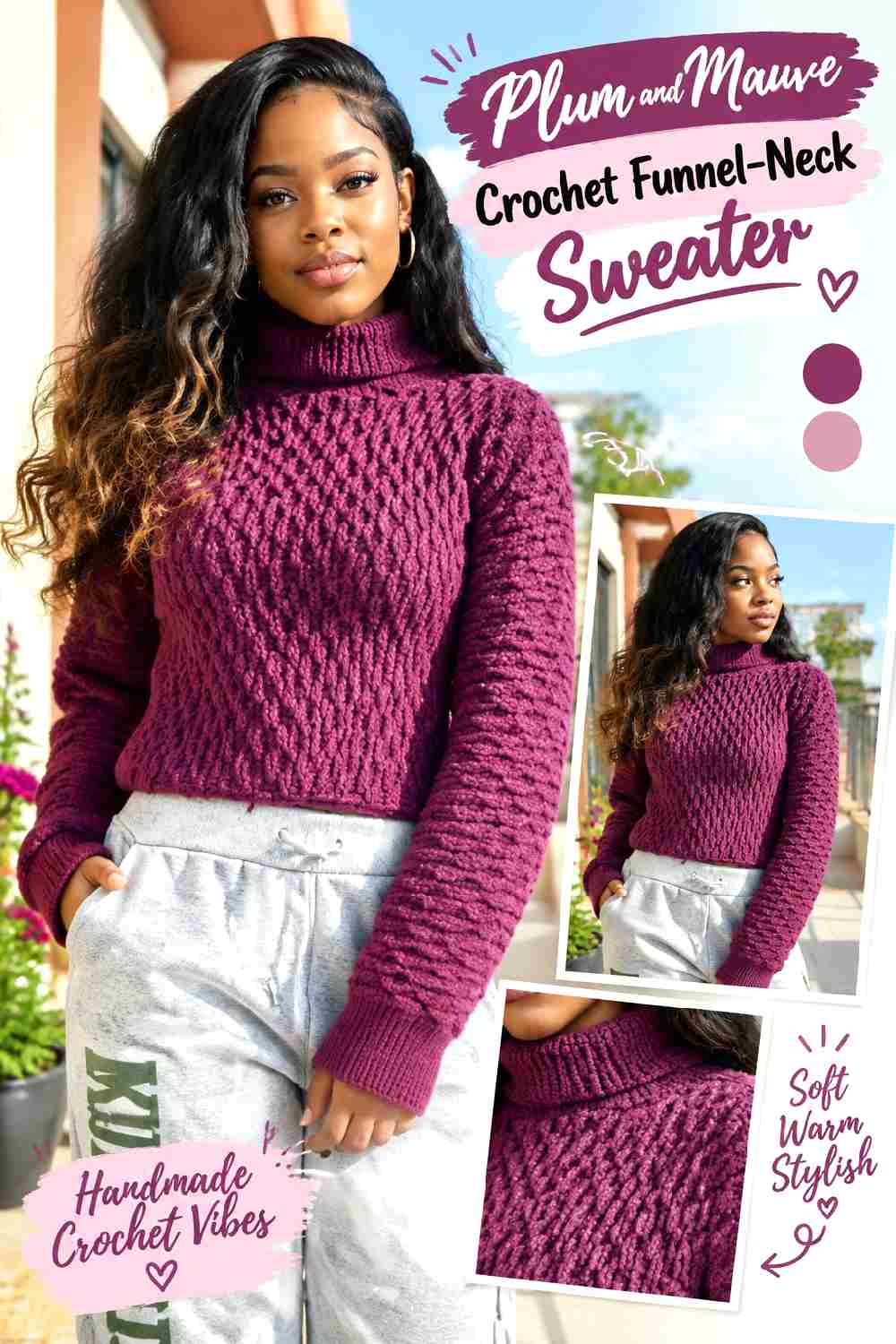
Plum and mauve create a tonal family with enough depth difference to separate major sweater sections. The result can be softer than a neutral-and-color combination, but the success depends on choosing a mauve that remains visibly lighter than the plum.
Plum Gives Textured Crochet Panels More Visual Weight
Use plum across the central body or funnel neck if you want the darkest color to emphasize structure. On a heavily textured sweater, plum can deepen shadows, so check a sample before assigning it to every detailed area. If texture begins disappearing, move mauve into the most intricate sections.
Mauve Keeps the Plum Crochet Sweater From Becoming One Dark Block
Mauve works well on sleeves, cuffs, or selected horizontal areas where the sweater needs relief from plum. Maintain enough value separation for the two shades to remain recognizable at a distance. If your available mauve is too close to plum, choose a softer and lighter purple-pink instead of adding a third color unnecessarily.
Creator Credit: Mary K’s Designs
11. Espresso And Ivory Crochet Funnel Neck Sweater
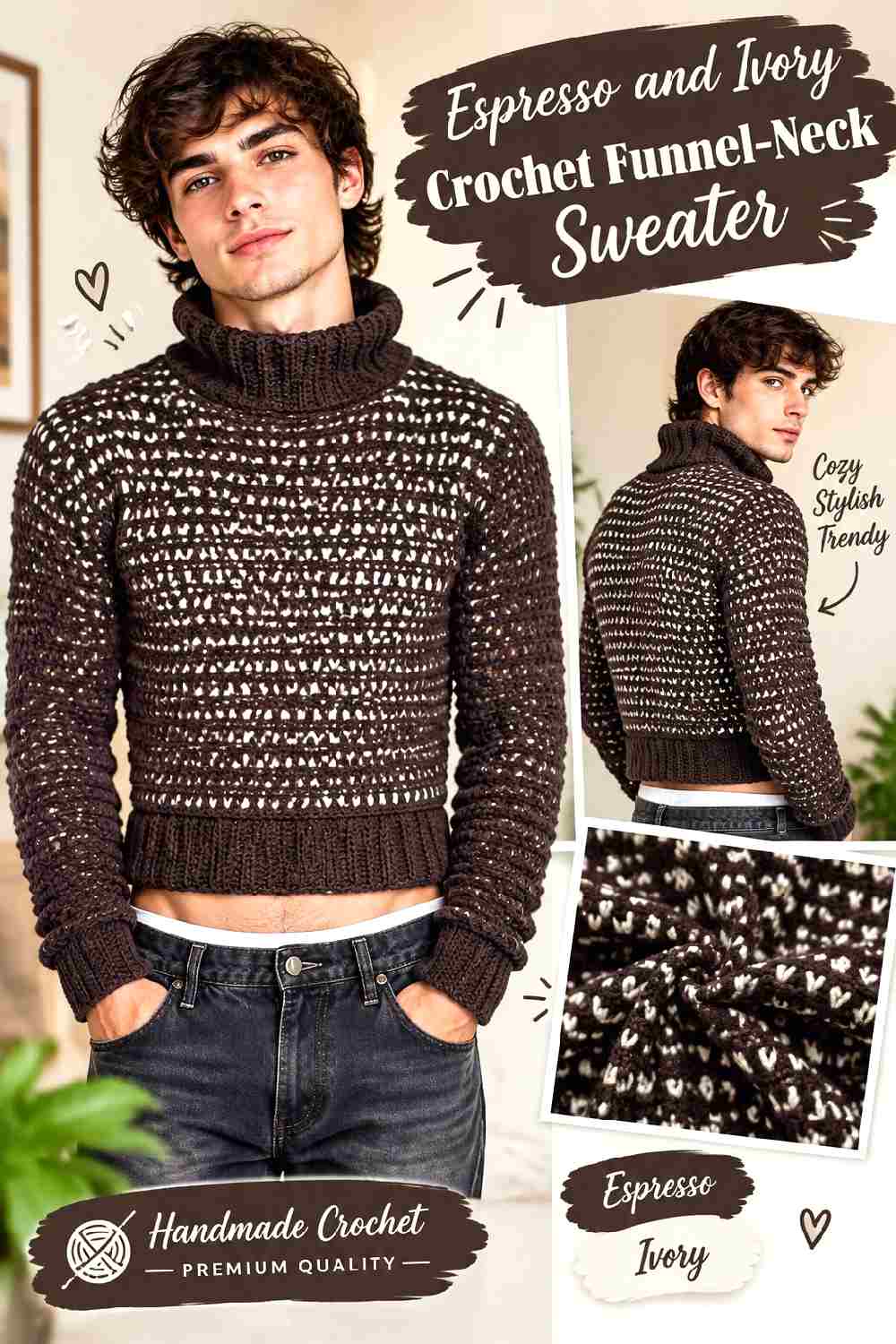
Espresso and ivory create one of the stronger light/dark relationships in this collection. That makes the combination especially useful when you want the funnel neck, ribbing, raglan lines, or sleeve finishes to remain clearly defined.
Espresso Can Anchor the Crochet Funnel Neck and Torso
Use espresso through the body and neckline for a deep neutral base. Because it carries substantial visual weight, lighter ivory details will attract attention quickly, so decide in advance which sweater features deserve that contrast. Keeping the torso mostly espresso prevents the palette from becoming too fragmented.
Ivory Should Highlight Espresso Crochet Details Selectively
Ivory cuffs and a narrow hem create enough repetition to connect with an ivory collar or shoulder detail. Avoid placing ivory around every seam simply because the contrast is available; too many pale outlines can divide the sweater into small visual pieces. Use the contrast where it clarifies construction or texture.
Creator Credit: divyne crochet
12. Moss Warm Taupe And Cream Crochet Funnel Neck Sweater
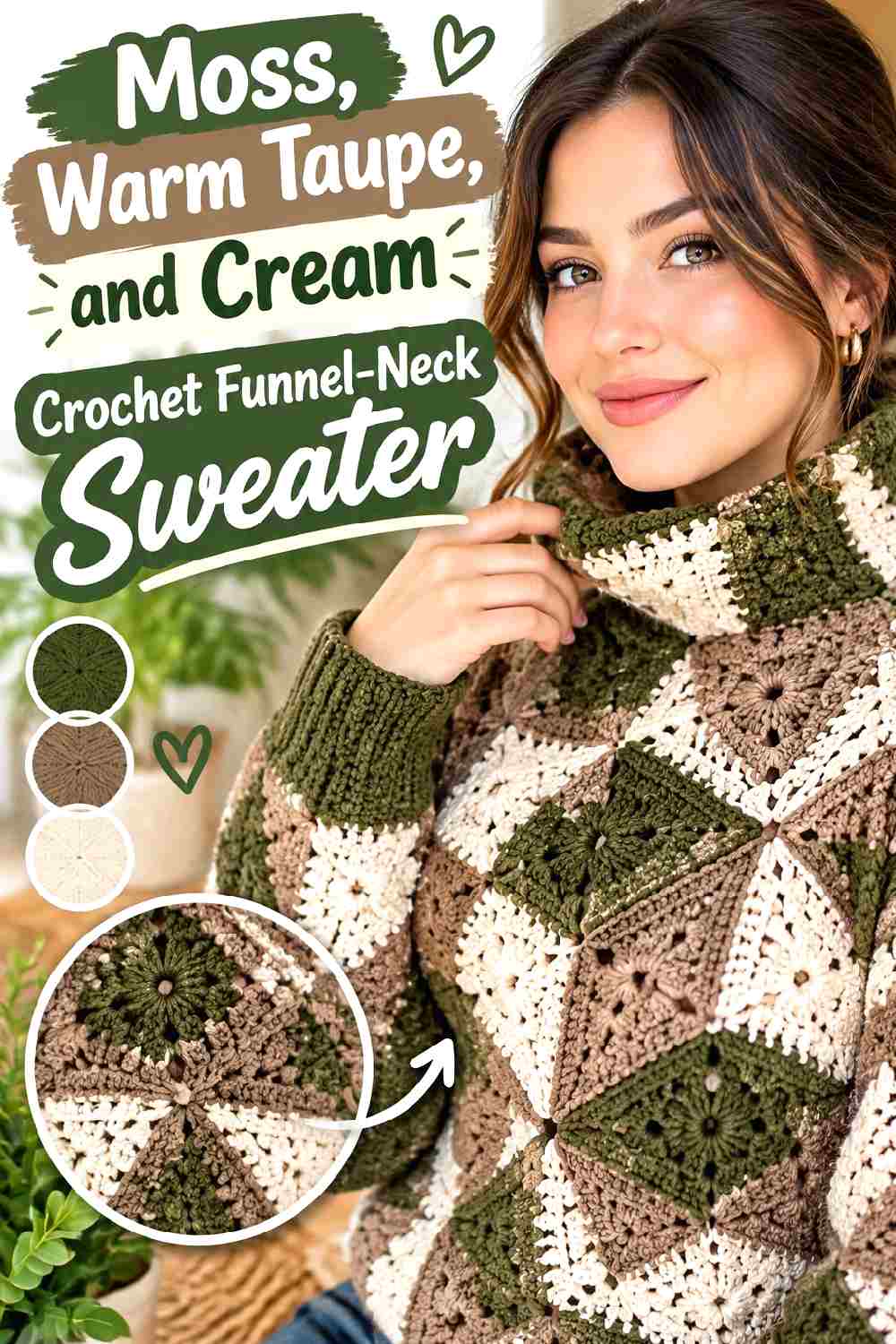
This three-color palette stays muted by giving each shade a distinct role. Moss can lead, warm taupe can bridge the main color and neutral, and cream can be reserved for the smallest areas requiring clear separation.
Moss Should Remain the Main Crochet Sweater Color
Use moss across most of the body or the majority of repeated motifs. That gives a potentially busy three-color sweater one clear visual anchor. Warm taupe can then appear in secondary sections instead of competing with moss at equal scale.
Warm Taupe Can Connect Moss and Cream Crochet Sections
Taupe is useful between the darker moss and lighter cream because it reduces abrupt transitions. Consider it for sleeves, joining areas, or broader secondary blocks. This is particularly helpful if the sweater uses repeated motifs, where direct moss-to-cream changes in every square could become visually busy.
Cream Should Be the Smallest Accent in the Moss Crochet Palette
Reserve cream for motif centers, cuff lines, edging, or the top edge of the funnel neck. The lighter shade will attract attention even when used sparingly. Repeating it consistently is more important than using a large amount.
Creator Credit: Beautiful Crochet Stuff
13. Aubergine And Sand Crochet Funnel Neck Sweater
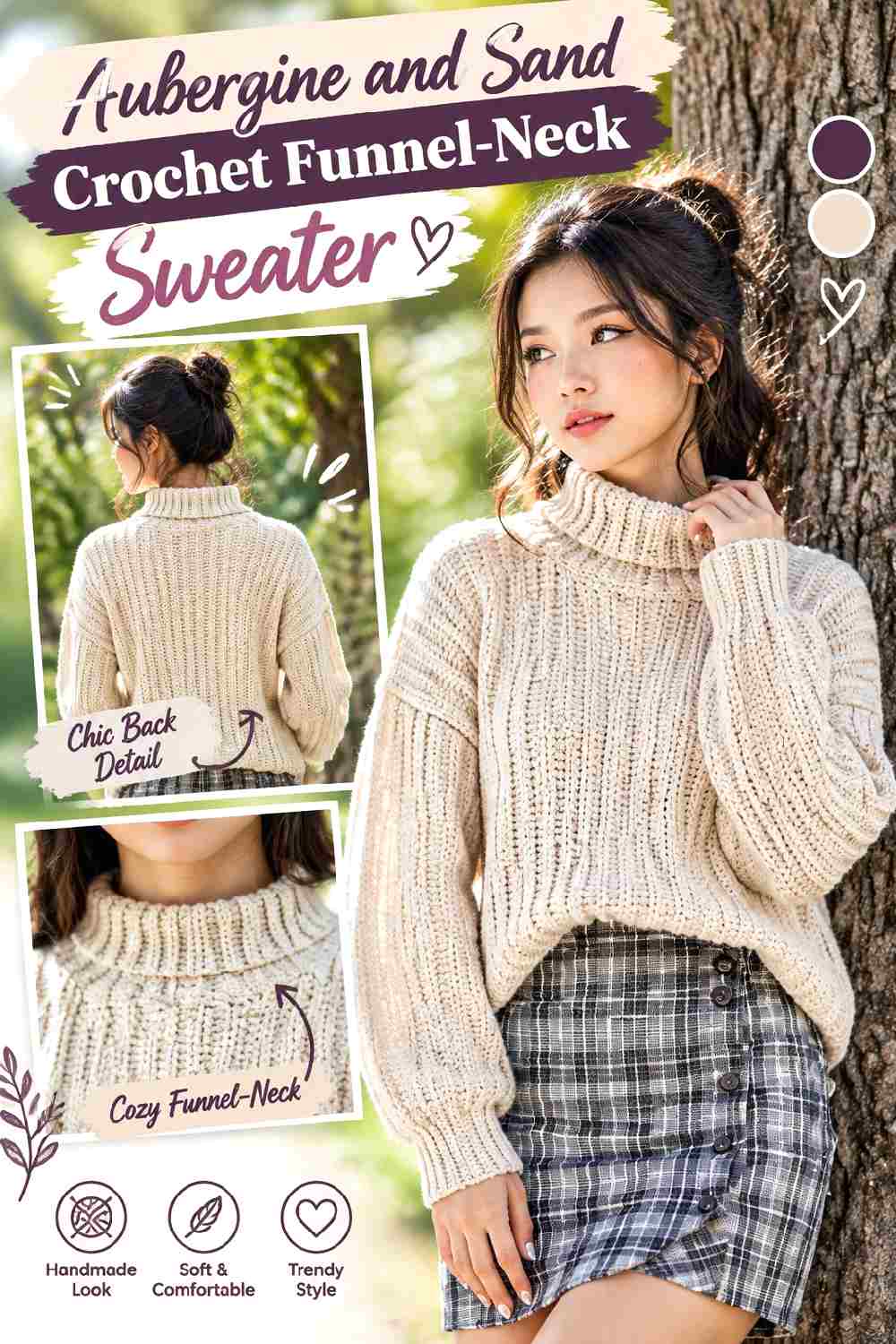
Aubergine provides a dark purple base while sand introduces a warm pale neutral. The relationship is dramatic enough to show ribbing clearly but softer than using bright white against the deep main color.
Aubergine Makes Crochet Ribbing Feel More Defined
Use aubergine for the main body and vertically textured sections when you want a rich dark field. Ribbing can develop pronounced shadows in this color, so make a texture sample if stitch definition is central to the project. If the ridges disappear, shift the most detailed portion to sand.
Sand Gives Aubergine a Clear Crochet Funnel-Neck Break
A sand funnel neck creates a strong change close to the face and shoulders. To make that color choice feel intentional, echo sand at the cuffs or lower ribbing. If you prefer a darker neckline, reverse the scheme and let sand occupy the torso while aubergine frames collar, wrists, and hem.
Creator Credit: Chenda DIY
14. Slate Blue And Oatmeal Crochet Funnel Neck Sweater
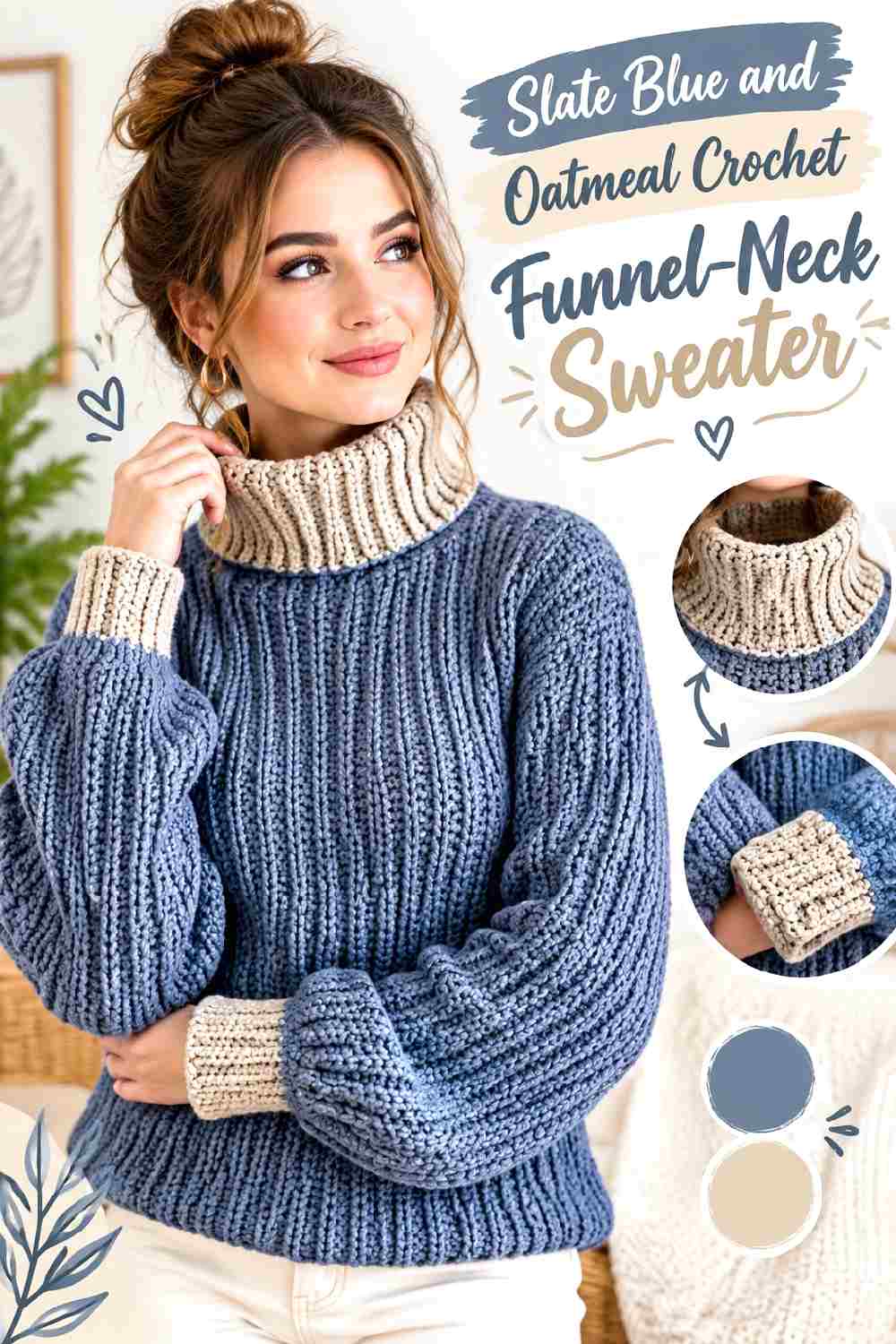
Slate blue offers a cooler fall direction than rust, burgundy, or mustard, while oatmeal keeps the sweater from feeling overly cold. The pairing suits an oversized high-neck sweater because the neutral can give large blue areas some visual structure.
Slate Blue Works Well Across an Oversized Crochet Sweater Body
Let slate blue cover the broad front, back, and sleeve surfaces so the roomy silhouette still reads as one garment rather than several blocks. A muted blue also gives crochet texture some breathing room compared with a highly saturated shade.
Oatmeal Can Control the Edges of a Slate Blue Crochet Sweater
Use oatmeal at the collar, cuffs, or hem to give the large slate-blue field a clear boundary. If all three areas use oatmeal, keep the bands proportionate to the sweater rather than allowing a very deep hem to compete with the torso. Smaller repeats usually provide enough connection.
Creator Credit: Yarn Cakes, LLC
15. Cranberry And Soft Gray Crochet Funnel Neck Sweater
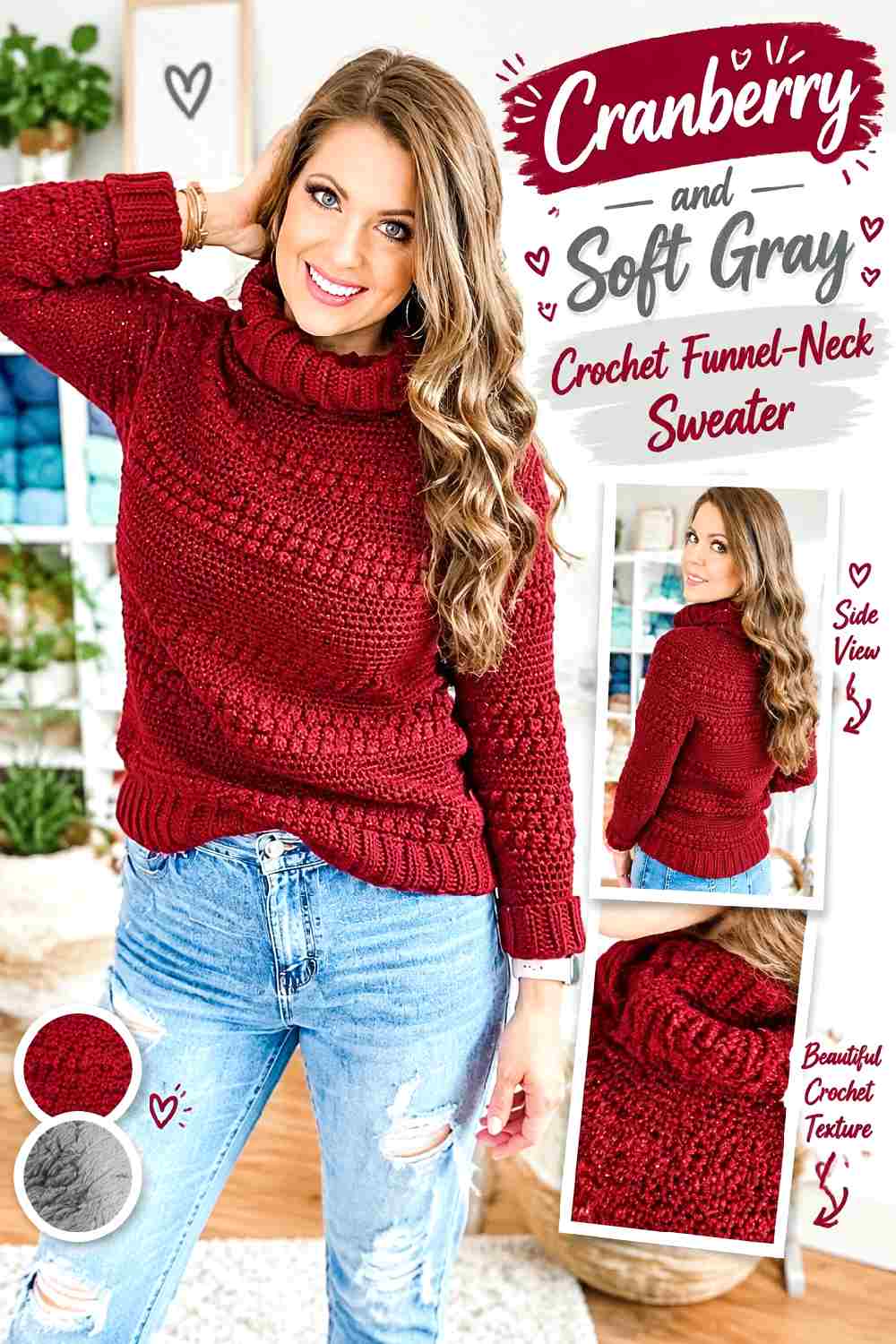
Cranberry gives a bobbled or textured sweater a strong seasonal color, while soft gray can calm the areas surrounding raised details. Because bobbles and other relief stitches already create extra visual information, the palette does not need complicated color blocking.
Cranberry Lets Raised Crochet Texture Stay Central
Use cranberry across the main yoke or body if you want the stitch pattern rather than contrast bands to lead the design. Before committing, check how clearly raised details appear in your selected shade. A very dark cranberry may hide more shadow than a medium version.
Soft Gray Can Separate Cranberry at the Crochet Funnel Neck
A soft gray collar creates a quieter break than bright white and leaves cranberry as the obvious main color. Repeat gray at the cuffs or a narrow hem edge. If the sweater already has many textured sections, avoid introducing additional accent colors that compete with those details.
Creator Credit: MJ’s Off The Hook Designs
16. Ochre Black And Cream Crochet Funnel Neck Sweater
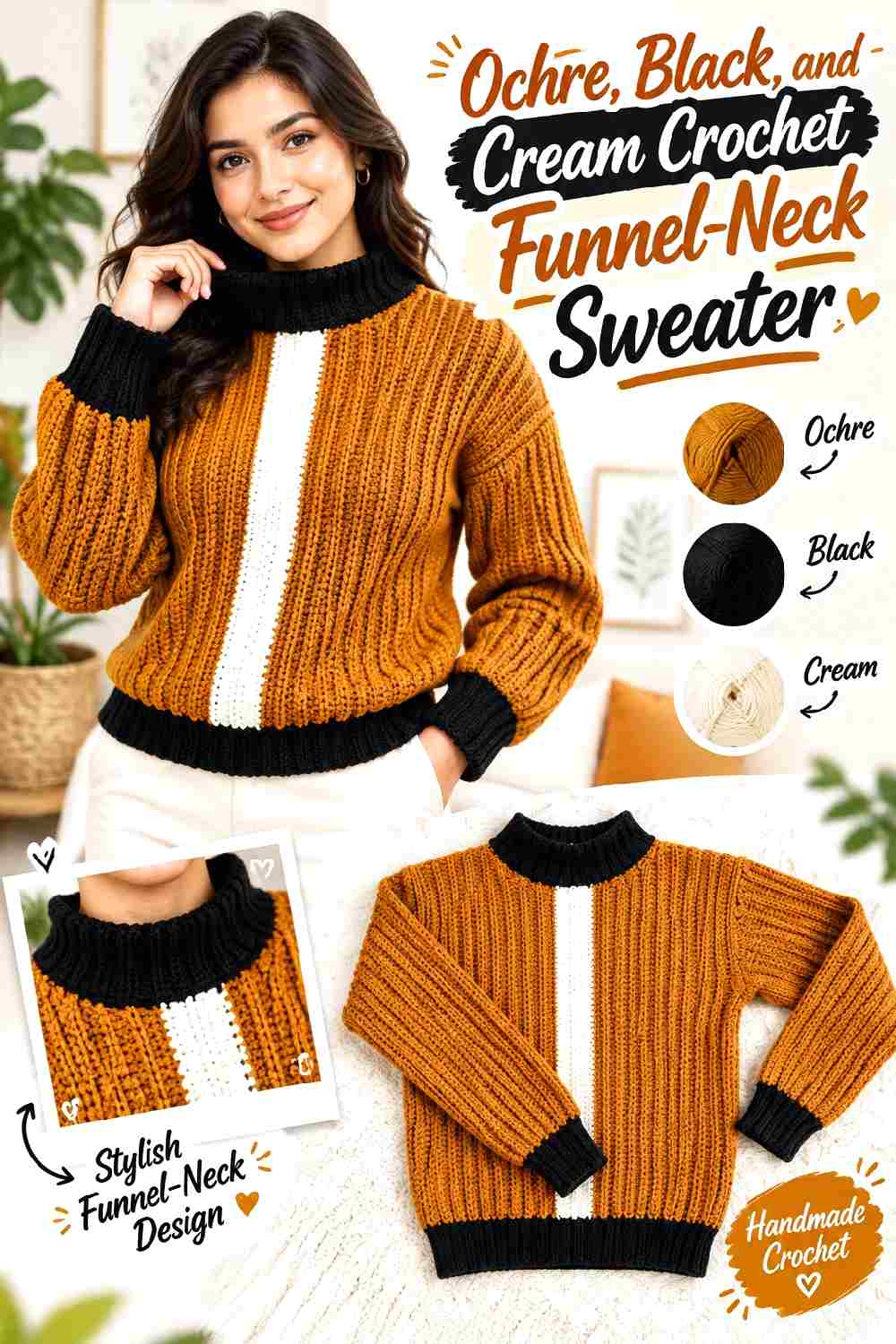
Ochre, black, and cream create one of the most graphic palettes in the list. The easiest way to control it is to let ochre lead, black define the strongest boundaries, and cream provide smaller moments of lightness.
Ochre Should Cover the Largest Crochet Sweater Areas
Use ochre across the body and much of the sleeves so the palette still has a recognizable primary color. If black and cream receive equal large blocks, the sweater can become more about graphic segmentation than the funnel-neck silhouette.
Black Can Frame Ochre at the Crochet Funnel Neck
Black works well on a funnel neck, narrow hem, or cuffs because it provides strong definition with relatively little yarn coverage. Check whether black hides any ribbing you particularly want to display; if so, place cream in the most detailed area instead.
Cream Keeps Black and Ochre Crochet Sections From Feeling Too Heavy
Use cream in narrow stripes, sleeve details, or small neckline accents rather than another broad panel. Its lighter value can separate ochre from black where the two darker colors would otherwise dominate the whole garment.
Creator Credit: Ascarcrochets
17. Deep Teal And Tobacco Crochet Funnel Neck Sweater
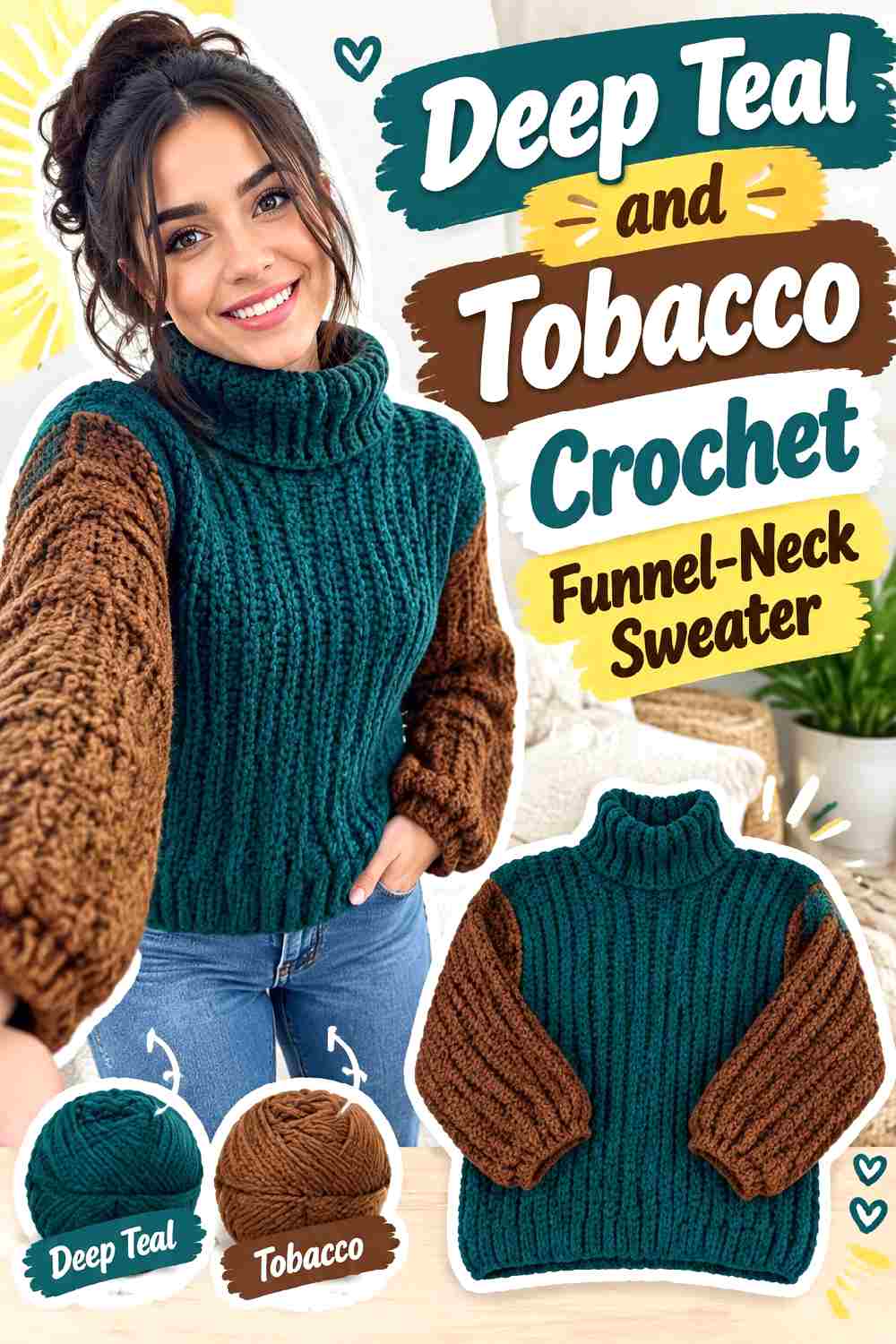
Deep teal and tobacco create a dark cool-and-warm pairing with enough color difference to remain distinctive without relying on a pale neutral. Tobacco works particularly well as a supporting shade around finishing areas.
Deep Teal Gives the Crochet Funnel Neck a Strong Dark Base
Use deep teal from the funnel neck through the torso for a continuous main field. If the sweater has a simple surface, the color can do much of the visual work. If the fabric is heavily textured, confirm that the dark teal still shows stitch relief clearly.
Tobacco Adds Warm Definition to Deep Teal Crochet Cuffs
Tobacco cuffs and hem ribbing introduce warmth at the edges without interrupting the torso. Repeating tobacco on a small collar detail is another way to connect the top and bottom of the sweater. Avoid turning every seam into a tobacco outline unless a more graphic result is intentional.
Creator Credit: Daniela Sanchez
18. Brick Red And Denim Blue Crochet Funnel Neck Sweater
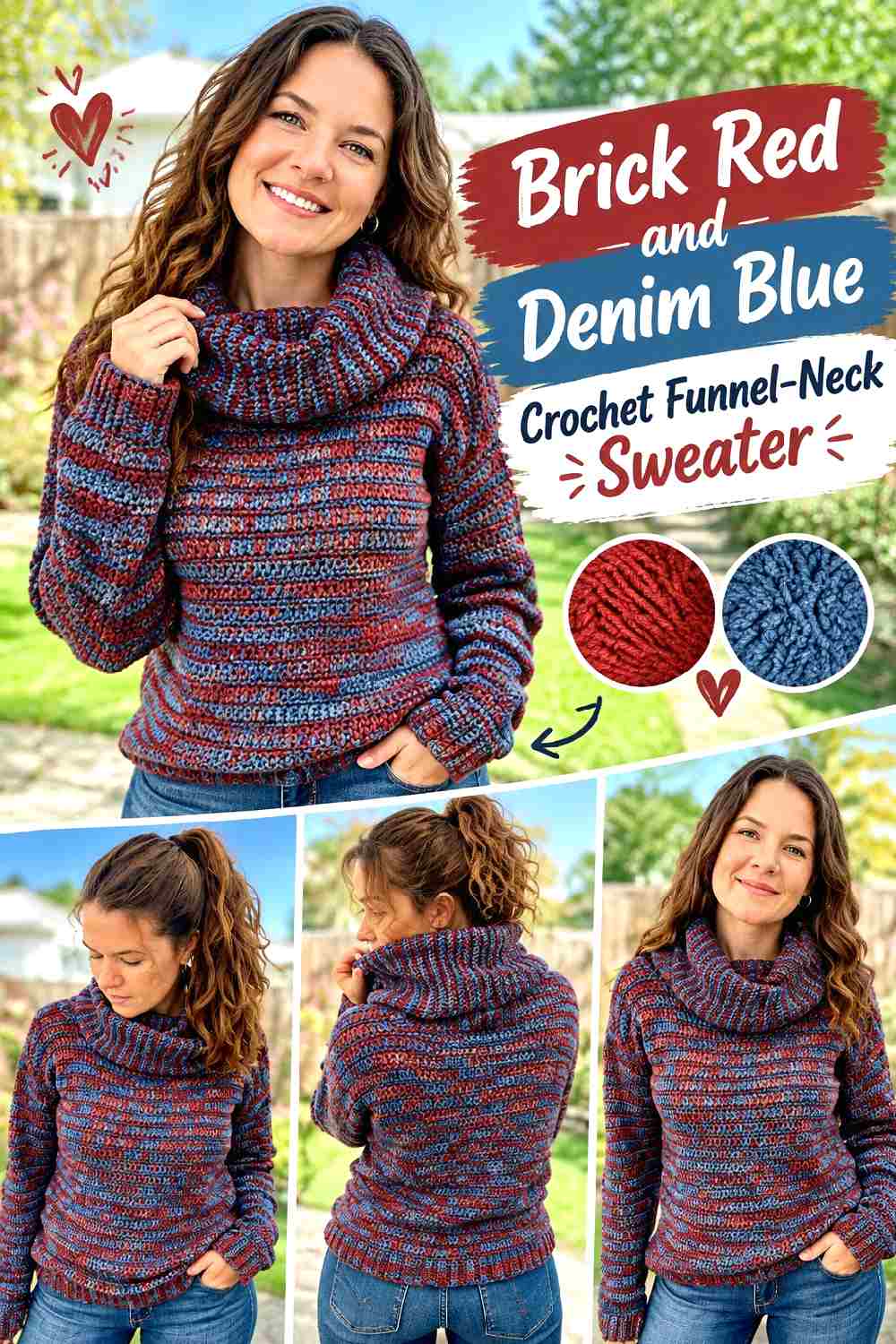
Brick red and denim blue give a relaxed fall palette that does not depend on conventional brown or beige neutrals. Brick red carries the warmth, while muted denim blue can soften broad sleeves or a generous cowl-style funnel neck.
Brick Red Should Lead the Crochet Sweater Body
Keep the torso predominantly brick red so the palette does not become an equal two-color split. The muted red can support substantial crochet texture without the intensity of a bright primary red.
Denim Blue Can Soften a Brick Red Crochet Funnel Neck
Using denim blue on the neckline creates visible contrast without a dramatic light/dark jump. Repeat blue at the cuffs or use a controlled sleeve block to tie the collar into the rest of the sweater. Choose a denim blue muted enough to sit comfortably beside the earthy red rather than a highly saturated bright blue.
Creator Credit: Off the Beaten Hook
19. Chocolate Brown And Blush Crochet Funnel Neck Sweater
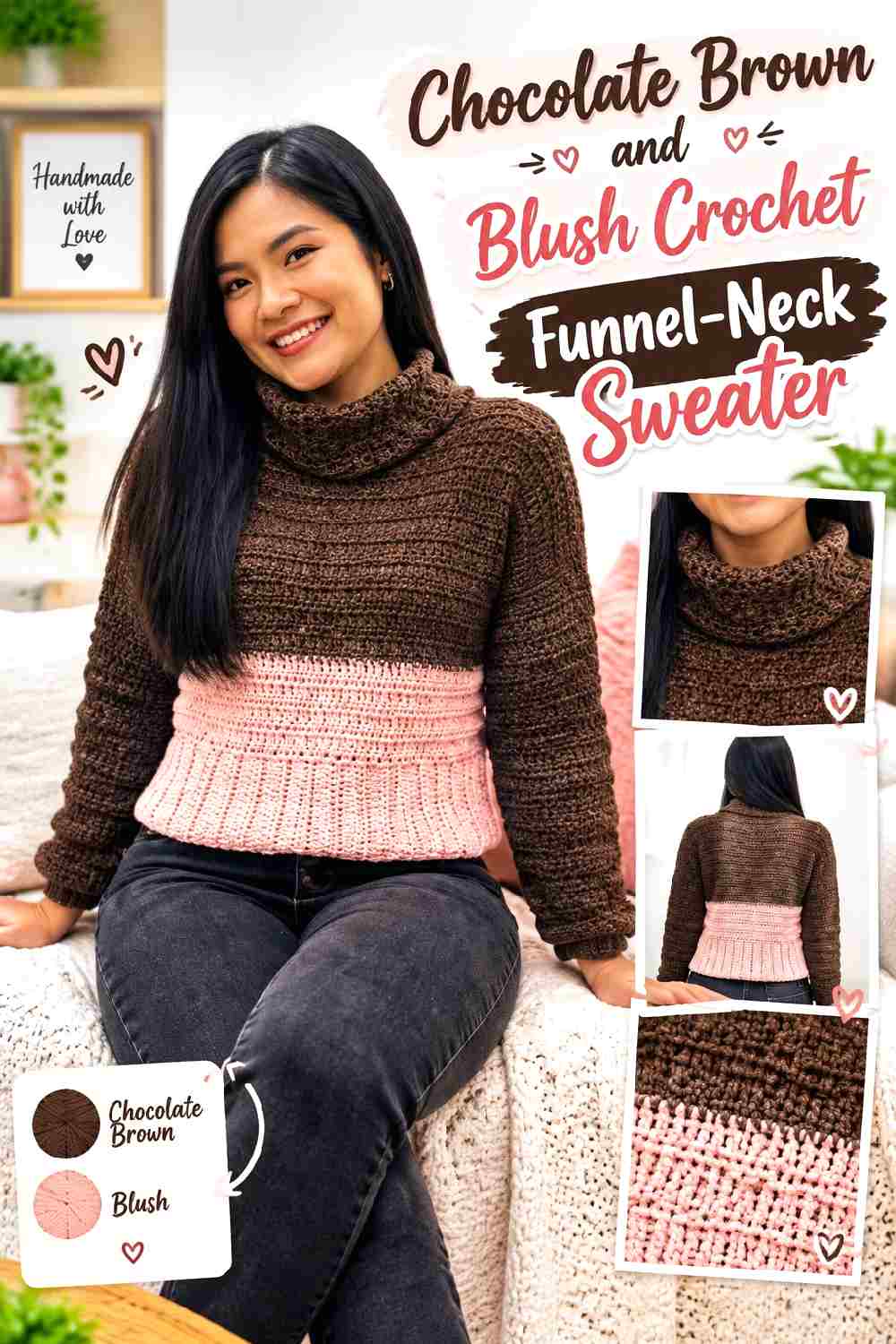
Chocolate brown provides a deep neutral foundation, while blush lightens the palette without pushing it toward stark monochrome. The pairing is especially effective for intentional color blocking because the values are easy to distinguish.
Chocolate Brown Can Carry Most of the Crochet Sweater
Use chocolate through the body and upper sleeves if you want a grounded silhouette. Because it is dark, test textured stitches before using the same shade everywhere. Blush can take over smaller detailed sections when extra visibility is needed.
Blush Gives Chocolate Brown Crochet Ribbing More Separation
A blush funnel neck makes the collar an immediate focal point. Echo blush at the cuffs or lower edge to prevent the pale neckline from looking unrelated to the darker torso. If a full blush collar feels too prominent, keep the neck chocolate and use blush as narrower bands instead.
Creator Credit: KnitcroAddict
20. Pine Green Burgundy And Cream Crochet Funnel Neck Sweater
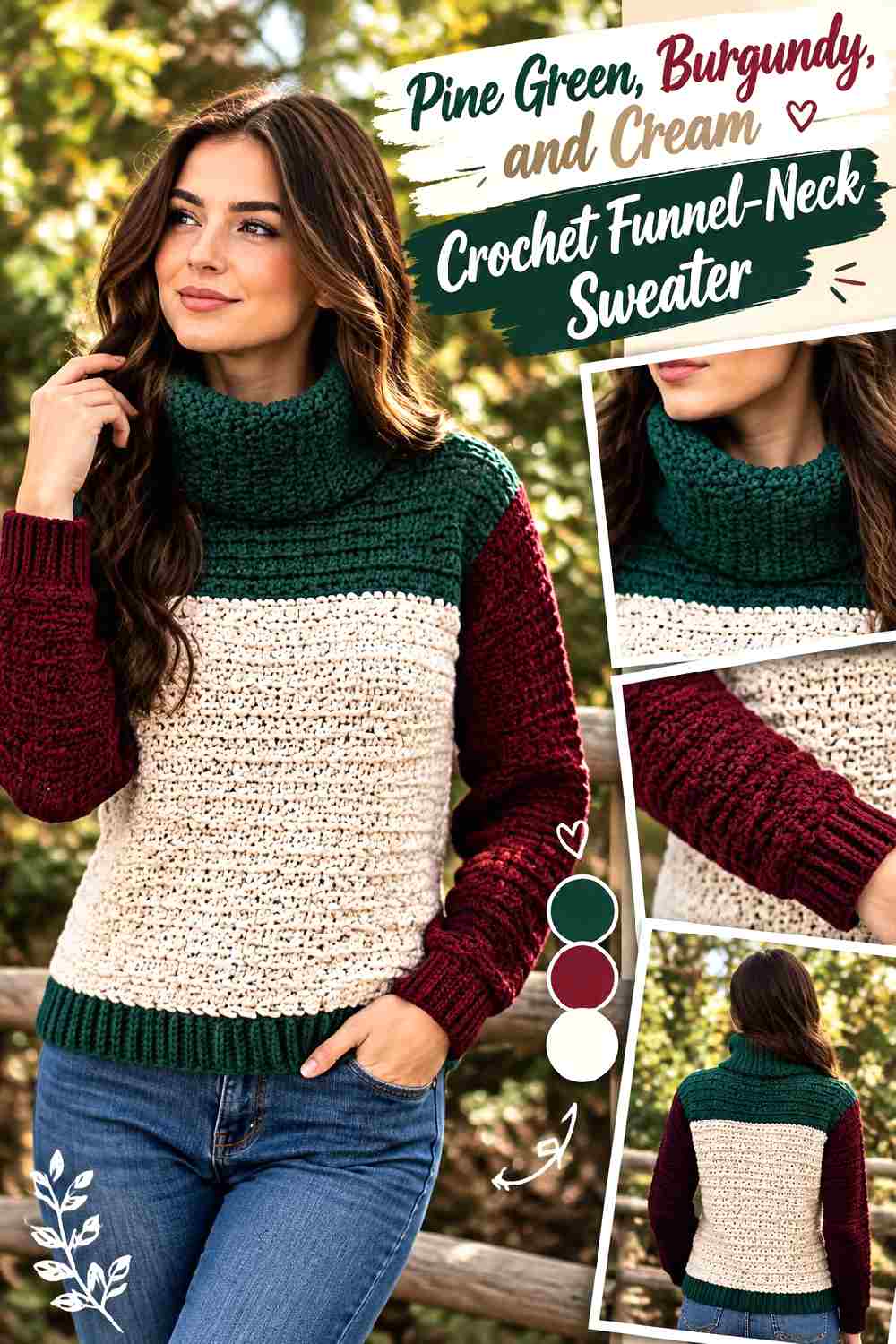
Pine and burgundy create two dark fall colors, so cream has an important job: keeping the palette from visually merging. Rather than dividing all three equally, use one dark shade as the main body, the other as a secondary block, and cream as controlled separation.
Pine Green Should Lead the Crochet Funnel-Neck Sweater
Let pine cover the body and perhaps the funnel neck so the garment has one obvious base color. Burgundy can then occupy sleeves or a broad lower section without competing across every row.
Burgundy Needs Cream Separation Against Pine Green Crochet
Pine and burgundy may differ strongly in hue while remaining surprisingly close in value. A narrow cream band between them can make a color-block transition much clearer. This is especially useful around cuffs, shoulder details, or the boundary between a dark body and dark sleeve section.
Cream Should Stay Controlled in the Pine and Burgundy Crochet Palette
Cream attracts the eye quickly, so use it as an accent rather than a third dominant field. Repeated narrow cream details generally connect the palette more effectively than one very large cream panel.
Creator Credit: Crochet With Carrie
21. Black Caramel And Bone Crochet Funnel Neck Sweater
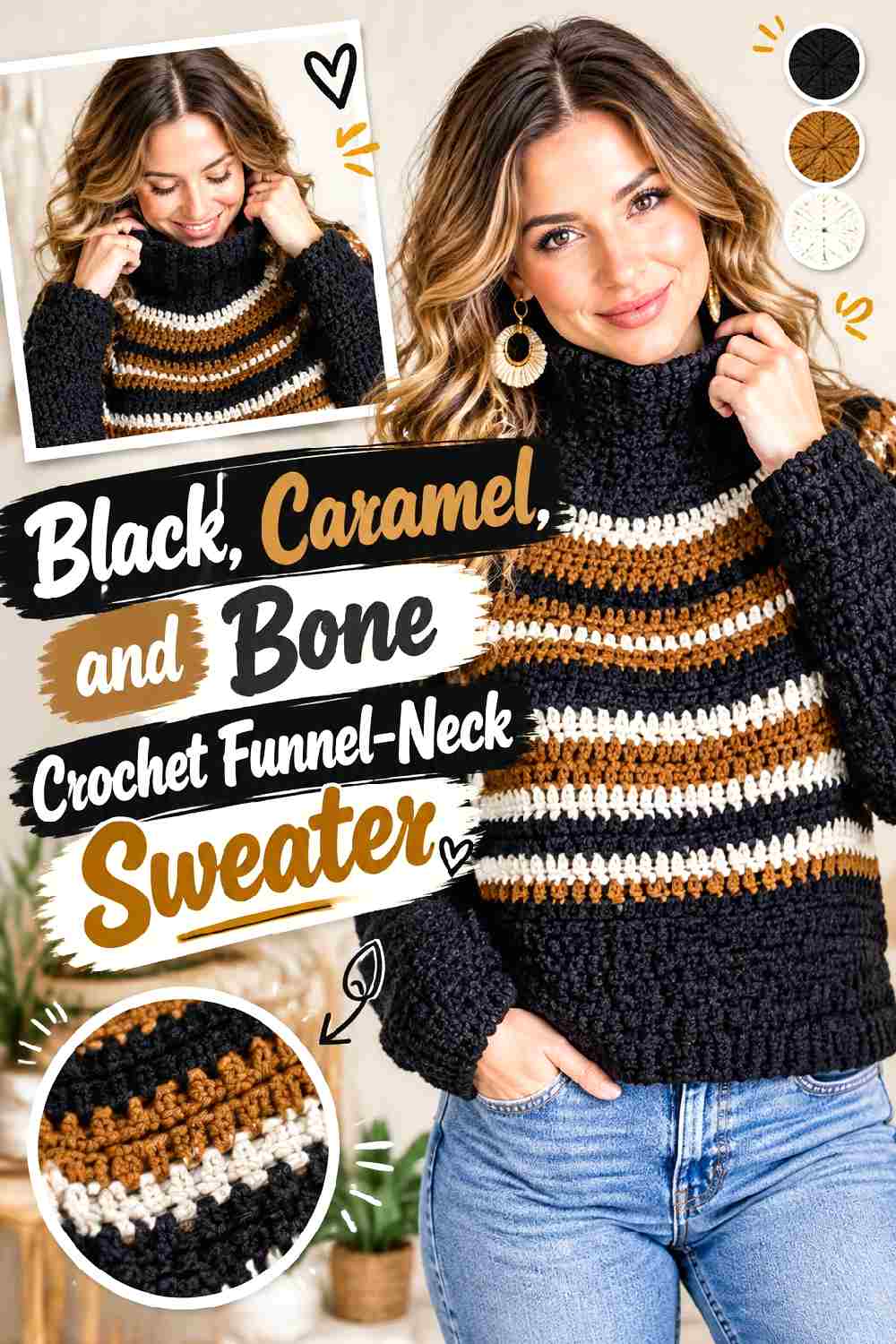
Black, caramel, and bone create a high-contrast neutral palette with clear dominant, supporting, and accent possibilities. Caramel can prevent the sweater from becoming a simple black-and-white graphic piece, while bone supplies enough lightness to reveal smaller details.
Black Gives the Crochet Funnel Neck the Strongest Visual Boundary
Use black for the funnel neck when you want the top of the sweater clearly framed. Carrying black through the torso makes the garment more dramatic, while using it only at the collar, cuffs, and hem creates a defined outline around lighter central sections.
Caramel Keeps Black Crochet Panels From Feeling Too Severe
Caramel works well as the main body color or a substantial sleeve block because it bridges the darkest and lightest shades. If the funnel neck is black, caramel across the torso prevents bone from creating too abrupt a transition.
Bone Should Highlight Caramel and Black Crochet Details
Reserve bone for narrow stripes, ribbing, or small textural areas that benefit from maximum visibility. Because the shade is much lighter than black, a small amount can have considerable visual influence. Repeat it in at least two areas rather than concentrating all of the lightest color in one isolated section.
Creator Credit: Make & Do Crew
How to Narrow Down the 21 Fall Color Schemes
For a strongly autumnal direction, compare burnt orange and cream, mustard and chocolate, rust and deep teal, or terracotta and sage. If you prefer darker styling, charcoal and camel, espresso and ivory, deep teal and tobacco, or black, caramel, and bone put more visual weight into the sweater.
For softer contrast, olive and oatmeal, slate blue and oatmeal, plum and mauve, or forest green and mushroom keep the transitions restrained. If texture visibility is the priority, choose a palette with a dependable value difference, such as espresso and ivory or chocolate brown and blush.
Three-color options need the clearest hierarchy. Moss, taupe, and cream work when the colors stay muted, while ochre, black, and cream produce a more graphic result. Pine, burgundy, and cream are useful when you want two dark fall colors but need a pale separator to stop them from merging.
Conclusion
A funnel-neck sweater already concentrates visual attention around the collar, so the strongest color schemes give that neckline an intentional relationship with the rest of the garment. You can keep the main color running uninterrupted from hem to neck, or contrast the collar and repeat its shade at the cuffs and lower edge.
Choose burnt orange, rust, mustard, or terracotta when warm fall color should lead. Olive, moss, pine, and forest green create a more botanical direction, while navy, slate blue, teal, and plum offer cooler alternatives. Dark neutrals such as charcoal, espresso, chocolate, and black work particularly well when lighter accents are needed to expose crochet texture.
Before committing to sweater quantities of yarn, compare the actual colors together and test them in the texture you plan to use. The original tutorials should remain your source for construction, sizing, and project-specific instructions; the palettes here are intended to help you plan how color can change the finished funnel-neck sweater.
Frequently Asked Questions
What colors work well for a crochet funnel-neck sweater in fall?
Earthy orange, rust, olive, forest green, burgundy, mustard, plum, brown, teal, and muted blue can all support a fall direction. The more important decision is how the shades relate in value and how much area each receives. One dominant shade with a smaller supporting color is usually easier to control than several equally strong colors.
Should the funnel neck be the same color as the crochet sweater body?
It can be. A matching funnel neck creates an uninterrupted color field and keeps attention on texture and silhouette. A contrasting collar creates more emphasis around the neckline. When using a contrasting color, repeat it at the cuffs, hem, or another small area so the collar feels integrated.
How can I tell whether two colors have enough contrast for crochet texture?
Compare the yarns side by side and then look at a small crocheted sample. If necessary, photograph the swatch and view it in grayscale. Different hues can still have similar lightness, which may cause borders, motifs, or raised stitches to blend together.
Should the darkest color go on the crochet funnel neck?
Not automatically. A dark funnel neck gives the sweater a strong visual anchor, but a lighter collar can highlight ribbing and create a more obvious neckline contrast. Choose based on whether you want the collar to blend into the torso or become a focal point.
How do I replace one color without changing the whole funnel-neck sweater palette?
Preserve its role rather than looking for an exact named shade. If you are replacing a light supporting color, choose another shade with similar lightness. If you are replacing a dark anchor, maintain enough contrast with the other yarns. Also consider whether the replacement is similarly muted, warm, cool, or saturated.
How can I make a three-color crochet funnel-neck sweater look less busy?
Give the three colors different jobs. One can dominate the torso, another can support sleeves or larger secondary sections, and the third can appear in narrower collar, cuff, border, or stripe details. Repeating the smallest accent in a few controlled places usually creates more cohesion than distributing all three colors evenly.
Why can the same yarn colors look different once crocheted into a sweater?
Crochet changes how much shadow, texture, and neighboring color is visible. Ribbing and raised stitches create deeper light-and-shadow variation than a flatter fabric, while narrow stripes make colors interact differently than large panels. Test the actual stitch texture and color placement before judging a palette only from the skeins.