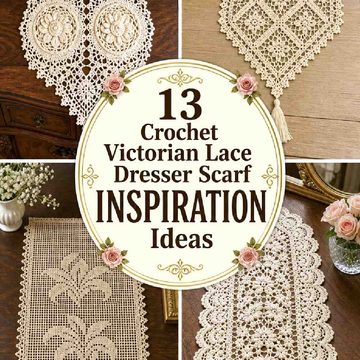
Vintage crochet lace has a special charm that can make an ordinary table feel more personal and beautifully decorated. A doily-inspired table runner brings together the delicate look of traditional lace with the longer shape needed for dining tables, dressers, and consoles. This collection explores 17 different designs, including romantic floral medallions, classic pineapple lace, Victorian rosettes, botanical filet work, and richly colored ornamental crochet.
Some of these ideas use individual doilies joined into a runner, while others feature continuous panels with decorative lace borders. You’ll find soft ivory and champagne tones alongside dusty rose, sage green, antique gold, and deep teal. Whether you love cottagecore decorating, vintage-inspired interiors, or understated table styling, these ideas will help you compare different shapes, textures, edging details, and practical considerations before choosing a crochet project.
These are AI-generated crochet design visualizations for inspiration, not photographs of tested handmade pieces or step-by-step patterns.
Quick Design Selection Guide
- For traditional vintage elegance: Choose Crochet Victorian Ivory Rosette Runner or Crochet Ecru Pineapple Lace Runner for delicate repeating lace and classic ornamental shapes.
- For romantic cottage decor: Crochet Dusty Rose Daisy Medallion Runner and Crochet Lavender Pansy Oval Runner offer joined flowers with softer decorative outlines.
- For a narrow everyday surface: Crochet Sage Fern Filet Lace Runner and Crochet Cranberry Diamond Trellis Runner provide more regular rectangular silhouettes.
- For distinctive decorative ends: Crochet Oatmeal Half-Moon Lace Runner creates a straight central panel with broad semicircular lace finishes.
- For a dramatic focal point: Crochet Terracotta Cathedral Arch Runner and Crochet Deep Teal Baroque Lace Runner make the lace structure more noticeable through repeated architectural or scrolling forms.
For more styles beyond these doily-inspired concepts, explore Crochet Lace Table Runner Ideas for Cozy Winter Gatherings. That published collection covers other lace-runner structures and construction approaches.
1. Crochet Victorian Ivory Rosette Runner
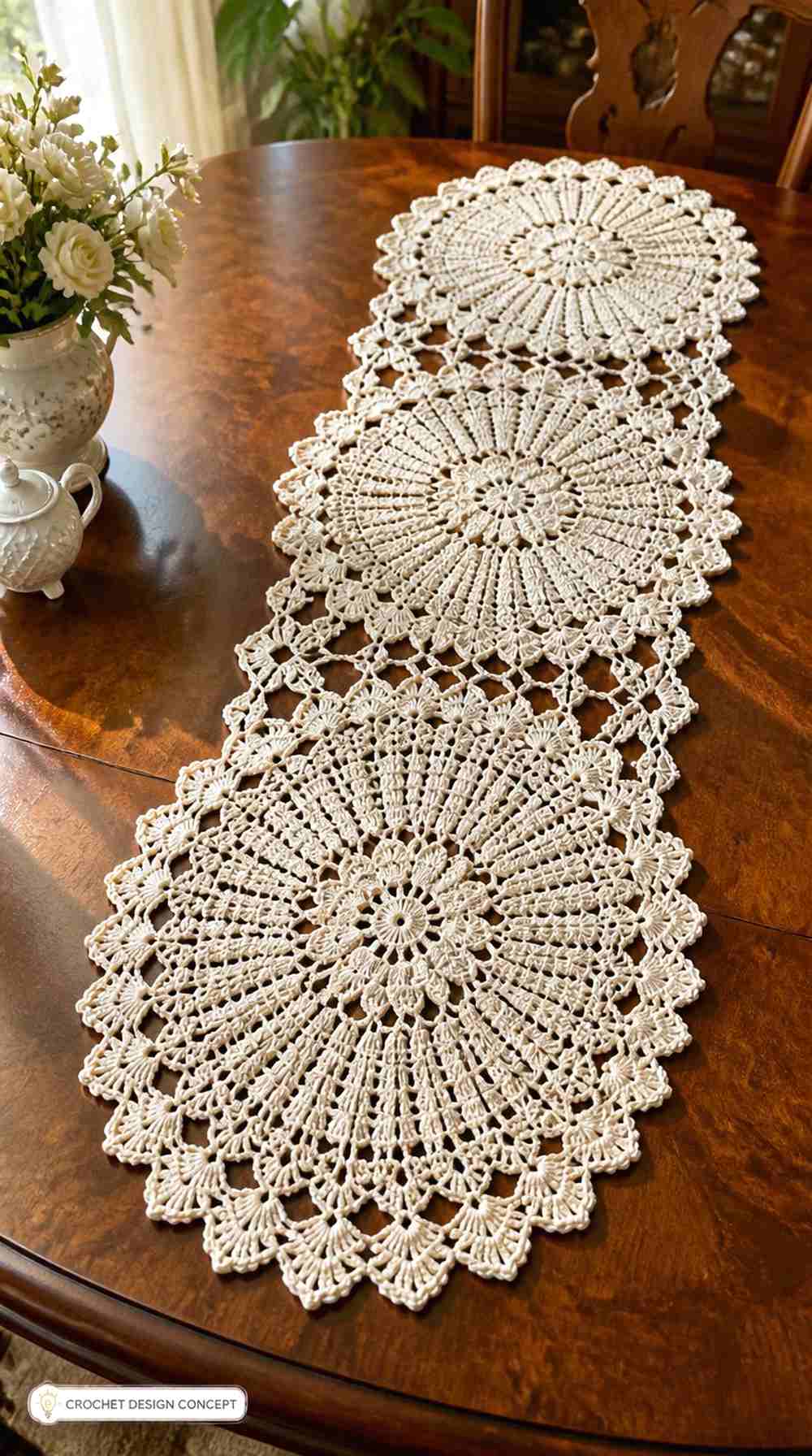
Antique-ivory crochet gives this elongated table runner its beautiful heirloom appearance. Three large oval rosette doilies sit in a straight line, each featuring a tightly patterned flower center, radiating openwork fans, and tiny picot scallops. Delicate chain-lace bridges connect the separate motifs into one graceful composition.
The oval construction adds visual movement without overwhelming the table. Its scalloped edges and connecting sections are particularly attractive on a walnut surface, where the lighter cotton-thread loops become easy to distinguish.
- Rosette Construction: Each oval motif has its own center and surrounding lace. Consistent motif sizing would be important when planning a physical joined runner.
- Connecting Bridges: The narrow chain-lace joins create delicate gaps between the three ovals. These areas need suitable attachment and tension to avoid uneven stretching.
- Tabletop Contrast: Antique ivory works beautifully against deeper wood tones. A pale tablecloth may make the fine openwork less noticeable.
- Edge Finishing: Small picot scallops give the runner a refined outline. Gentle blocking may help shape them evenly without stretching the oval motifs excessively.
2. Crochet Ecru Pineapple Lace Runner
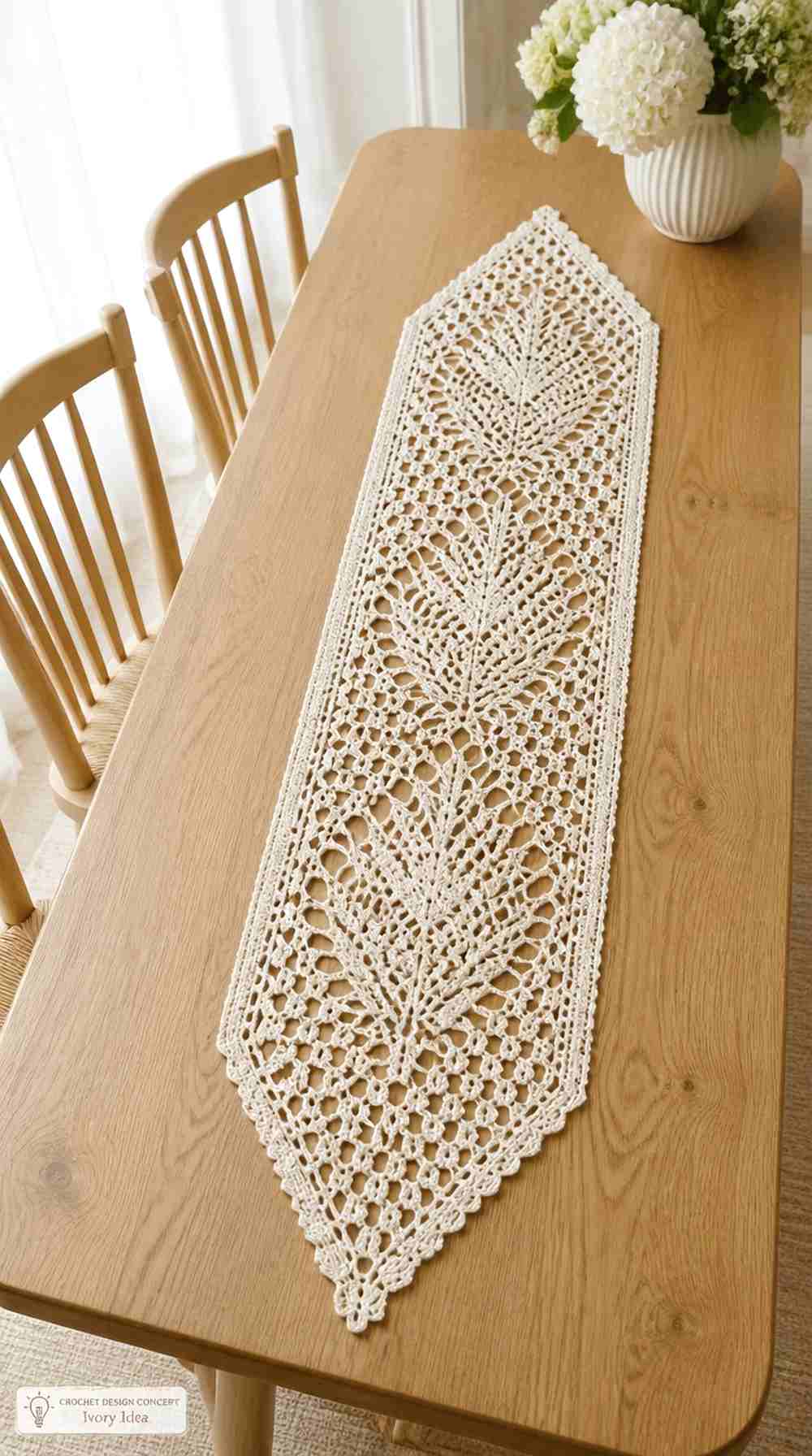
A continuous procession of three pineapple-lace sections gives this ecru crochet runner a distinctly traditional appearance. The decorative central motifs expand and narrow through graduated openings, while slim chain-mesh rails keep both sides visually connected. Matching pointed ends finish the slender silhouette.
Unlike a runner assembled from large separate circles, this design reads as one continuous lace composition. Its narrow form leaves more exposed tabletop on either side, making the repeated pineapple shapes and delicate open stitches the main decorative feature.
- Pineapple Motif Detail: The graduated openings are central to the look. A suitable established pineapple-lace pattern is important for maintaining clear, balanced shapes.
- Narrow Table Placement: The slim profile could suit a smaller dining table or console, provided the finished width leaves enough usable surface.
- Pointed Ends: Both ends taper into decorative points. Consider the entire tip-to-tip length when deciding where the runner should sit.
- Cotton Thread Choice: Smooth crochet cotton can reveal detailed lace structure. A substantially heavier yarn may make the small openings appear crowded.
3. Crochet Dusty Rose Daisy Medallion Runner
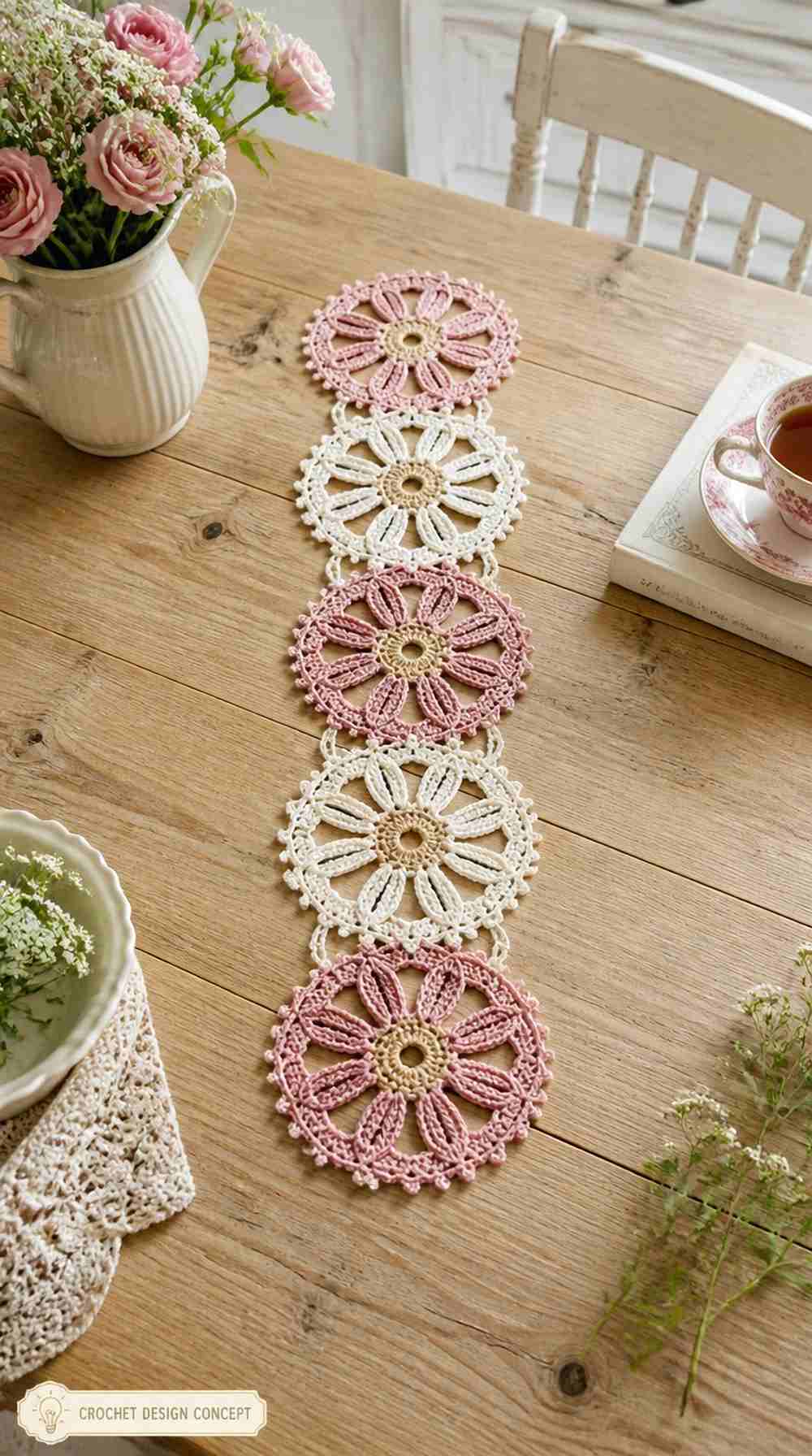
Five round daisy doilies bring a romantic cottage feeling to this crochet table runner. Alternating dusty-rose and warm-ivory petals surround small golden-beige centers, while eight openwork petals and tiny picot edges give each circle a clearly defined floral shape. Short cream chain bridges connect the flowers.
The result has a softly scalloped outline rather than straight sides. The alternating colors help separate the individual medallions, making this an appealing choice when the floral crochet itself is intended to be the main decoration.
- Alternating Flower Colors: Planning the rose and ivory sequence before joining the motifs helps maintain a balanced arrangement across the finished runner.
- Daisy Petal Shape: Eight openwork petals define each flower. Consistent stitch tension and careful finishing would help the repeated silhouettes appear coordinated.
- Open Spaces Between Motifs: The small connecting bridges leave visible tabletop gaps, so this concept works better as decorative lace than as full surface coverage.
- Length Customization: A similar modular design could potentially use more or fewer flowers, provided the chosen pattern supports suitable joins and proportions.
4. Crochet Sage Fern Filet Lace Runner
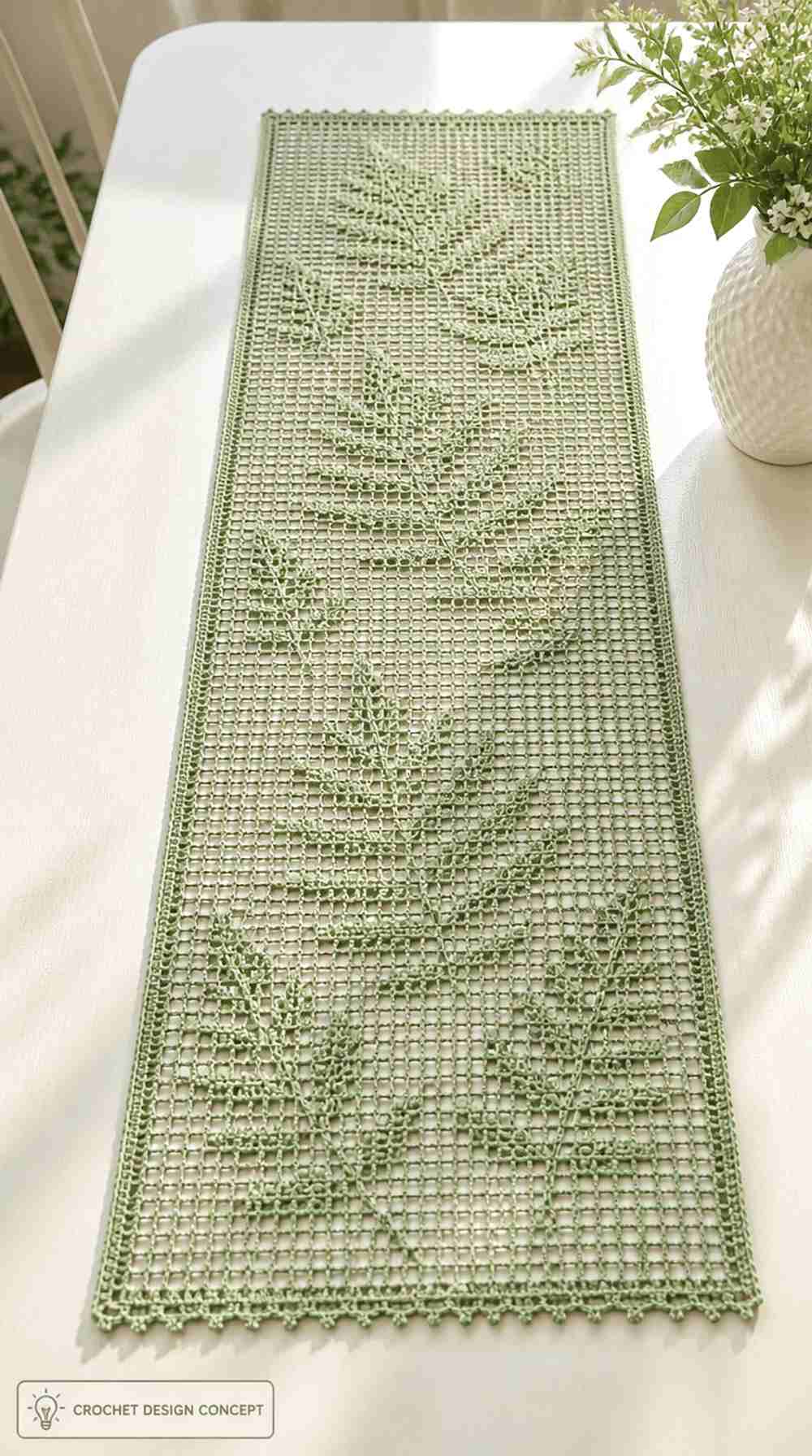
Soft sage-green crochet creates a fresh botanical interpretation of vintage filet lace. This rectangular table runner has a regular grid of small mesh squares, with alternating fern-frond silhouettes formed from denser filled cells. Narrow straight side borders and tiny picots at both short ends keep the overall finish restrained.
Its botanical pattern becomes visible through the contrast between open and filled sections. The rectangular outline offers a quieter alternative to highly scalloped doily runners, especially when you want a coordinated textile for a light-colored table.
- Filet Pattern Clarity: Fern shapes depend on the relationship between filled and open mesh cells. Even stitch proportions matter when interpreting a real filet chart.
- Straight Edge Advantage: The narrow side borders give the design a more regular outline, which may be easier to align with rectangular furniture.
- Sage Color Pairing: Muted green complements cream, pale oak and natural wood. Test the thread against the actual table to ensure the fern motifs remain visible.
- End Picot Detail: Small picots provide a gentle decorative finish without changing the straight-sided character of the main panel.
5. Crochet Champagne Hexagon Doily Runner
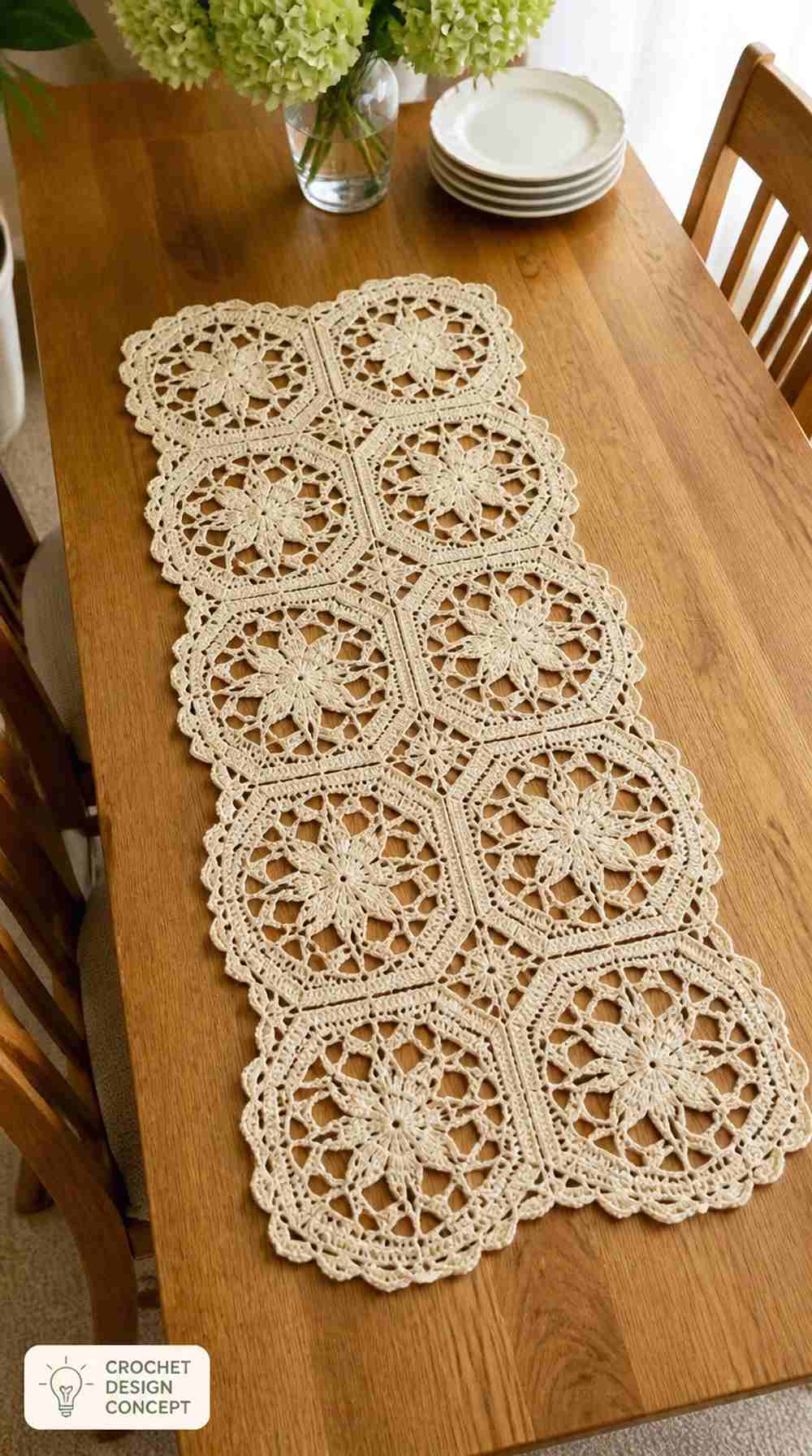
Ten champagne-cream crochet hexagons form this geometric vintage-style table runner. Arranged in two rows of five, the lace motifs feature small six-petal starflower centers, open spokes, and clearly defined six-sided borders. Clean joining lines create a continuous surface, while a delicate scalloped finish softens its perimeter.
The double-row layout gives this design more visual width than a single chain of doilies. Its repeating hexagon structure offers a lovely balance between traditional floral lace and a more orderly geometric arrangement.
- Hexagon Alignment: The six-sided motifs need consistent outer dimensions. Different motif sizes could cause the joined runner to pull unevenly.
- Wider Surface Coverage: Two rows of five create a broader textile, which may suit a spacious dining table better than a narrow console.
- Joining Placement: Connections follow matching hexagon edges. Use a suitable joining method rather than assuming decorative chain loops alone provide enough support.
- Champagne Thread: Warm cream tones emphasize the vintage mood. Keep the stitch texture smooth enough for the starflower centers to remain distinct.
6. Crochet Lavender Pansy Oval Runner
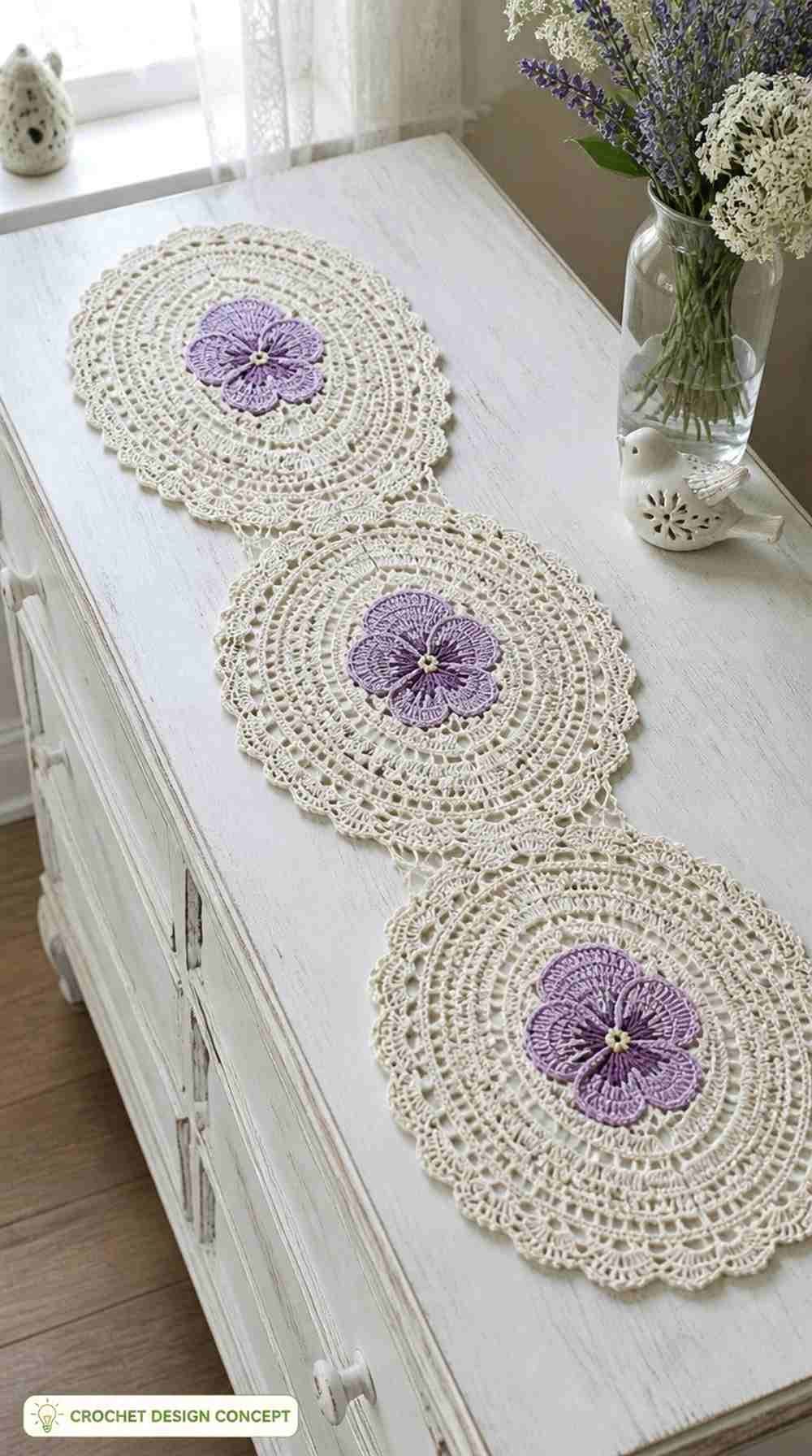
Lavender flowers introduce a gentle romantic touch to this elongated crochet lace runner. Three oval doilies are joined end to end, with each one featuring a five-petal pansy motif accented by a small muted-plum center. Antique-ivory chain arches surround the flowers, ending in softly rounded scalloped borders.
The narrow ivory bridges leave a little breathing space between the decorative ovals. With its delicate floral centers and softly curved outline, this concept could be especially attractive on a vintage dresser or smaller decorative table.
- Pansy Center Detail: The shallow flower petals should remain distinct from the surrounding lace. Avoid excessively thick yarn that could blur their individual outlines.
- Oval Joining: Connecting three elongated motifs requires careful alignment so their long axes remain straight and the runner does not twist.
- Two-Tone Contrast: Lavender and plum provide detail within the flowers, while ivory separates the floral motifs from the outer lace.
- Dresser Placement: Check the dresser depth before choosing the width. Decorative scallops should not extend into areas where drawers or accessories regularly catch the thread.
7. Crochet Powder Blue Teardrop Fan Runner
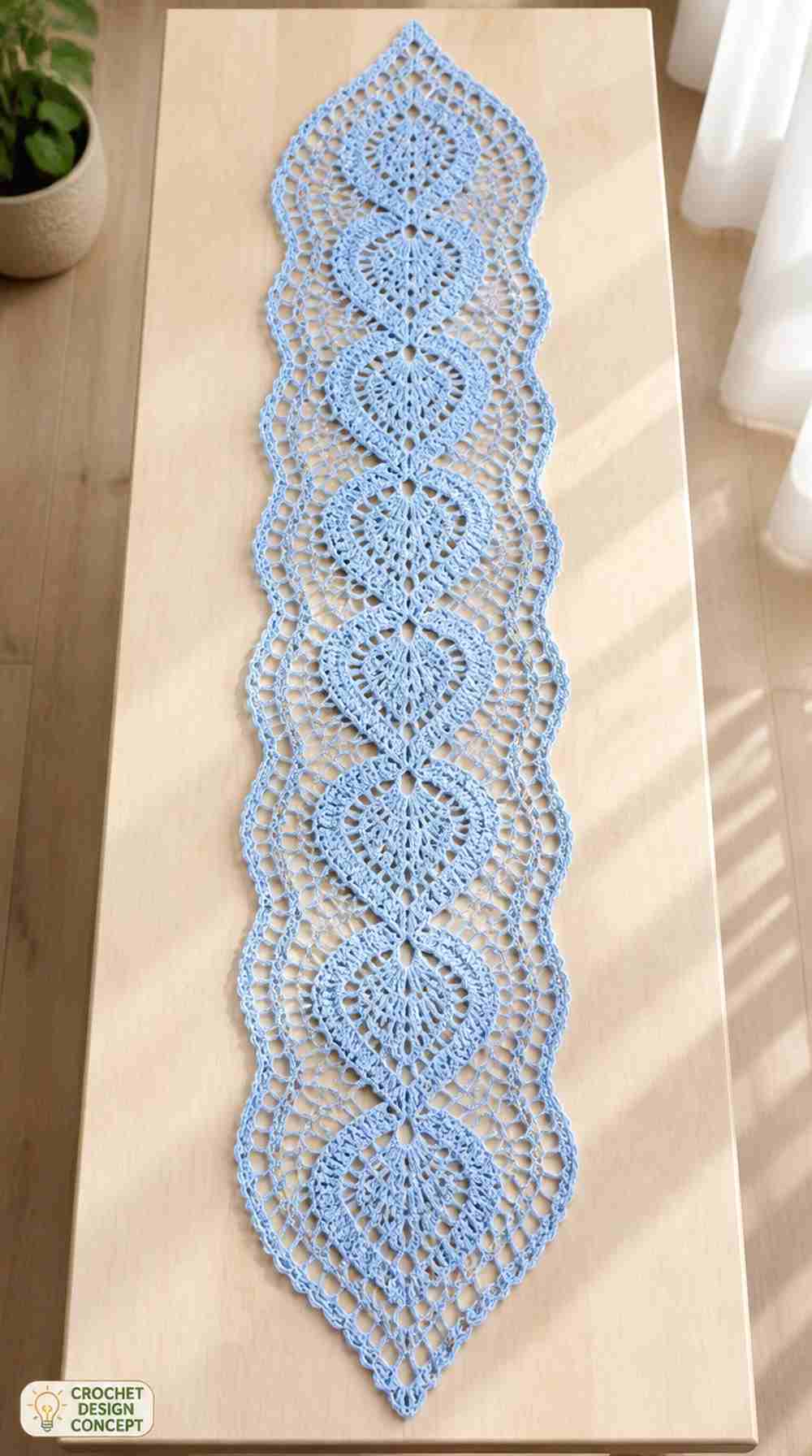
Seven elongated teardrop fans create a flowing pattern across this powder-blue crochet runner. Each motif gradually widens into rounded shell stitches before tapering toward the next section, while fine chain arches connect the shapes. Both long sides form gentle waves, and the ends finish in neat points.
The repeated fan structure creates a graceful sense of movement along the table. Its open silhouette is particularly suitable for decorative displays where the delicacy of the crochet is more important than covering the tabletop.
- Fan Proportions: The widening shell sections need a consistent shape. Uneven tension can interrupt the pattern’s flowing appearance.
- Decorative Openwork: Large spaces between fans expose the table beneath. Use a suitable stable surface for small decorations rather than relying on open lace for support.
- Blue Thread Selection: A soft powder-blue shade keeps the lace light and delicate. Smooth thread helps the shells remain clearly defined.
- Pointed End Shape: Plan the full length with both tips included. A real finished runner may need appropriate blocking to keep the points symmetrical.
8. Crochet Antique Gold Sunburst Runner
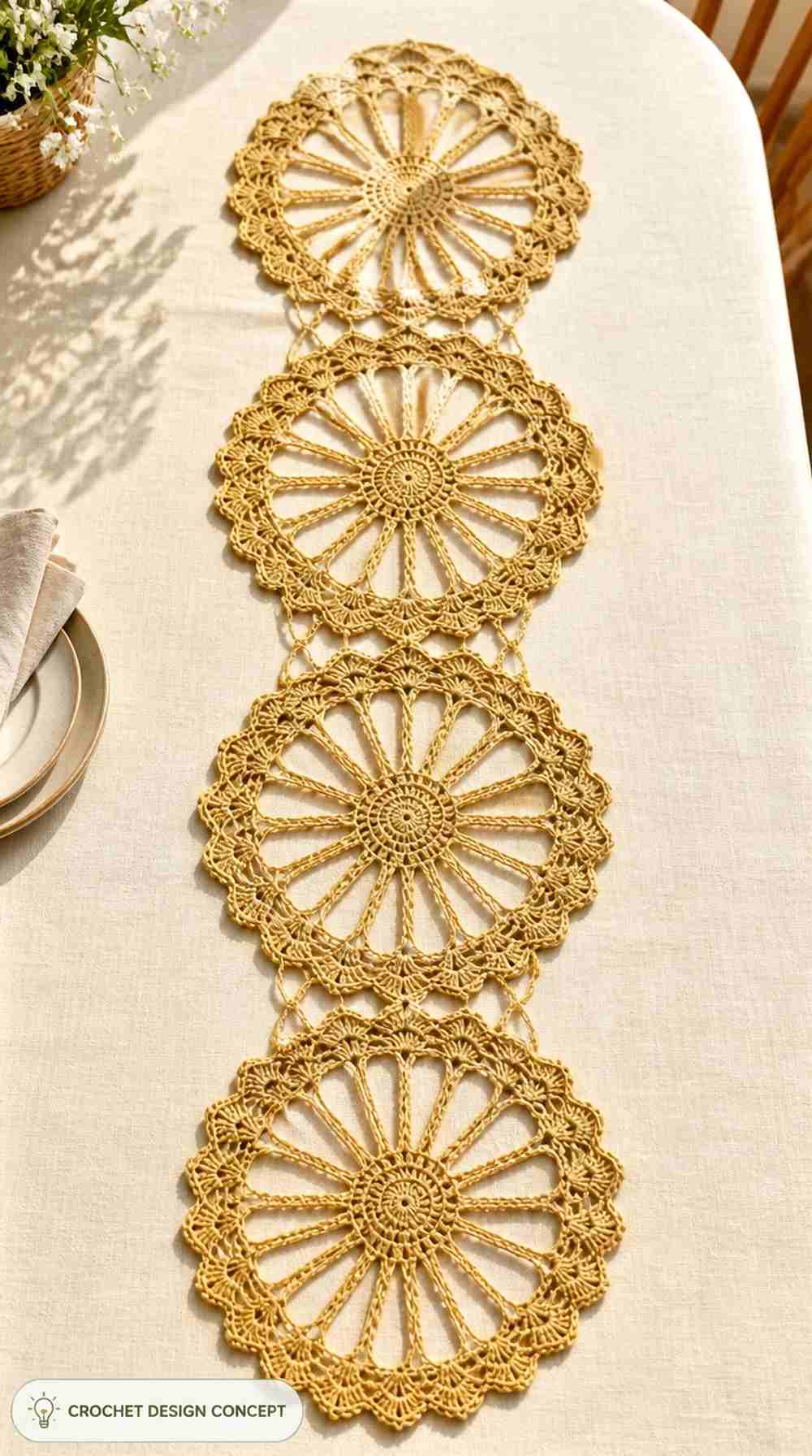
Muted antique-gold crochet brings warmth to four circular sunburst doilies arranged in a straight line. Each medallion has a compact spiral center, twelve open spokes, and small fan-shaped segments around its outer edge. Fine chain bridges link the circles while preserving their individual outlines.
The repeated radial design gives the runner a decorative vintage look without relying on flowers. Against cream linen, the golden thread becomes the focal point, while the surrounding openwork keeps the overall appearance light rather than heavy.
- Radial Stitch Balance: Twelve spokes create each sunburst. A consistent repeat is necessary when following a real circular lace pattern.
- Circular Connections: The bridges between the four medallions should join at suitable stable points, not just at fragile decorative tips.
- Antique-Gold Color: Muted gold brings warmth without requiring metallic fibers. Ordinary smooth cotton could provide a similar appearance with clearer stitch definition.
- Decorative Surface: The repeated circular openings make this better suited to visual table styling than supporting narrow-based objects across its entire length.
9. Crochet Peach Rosebud Filet Runner
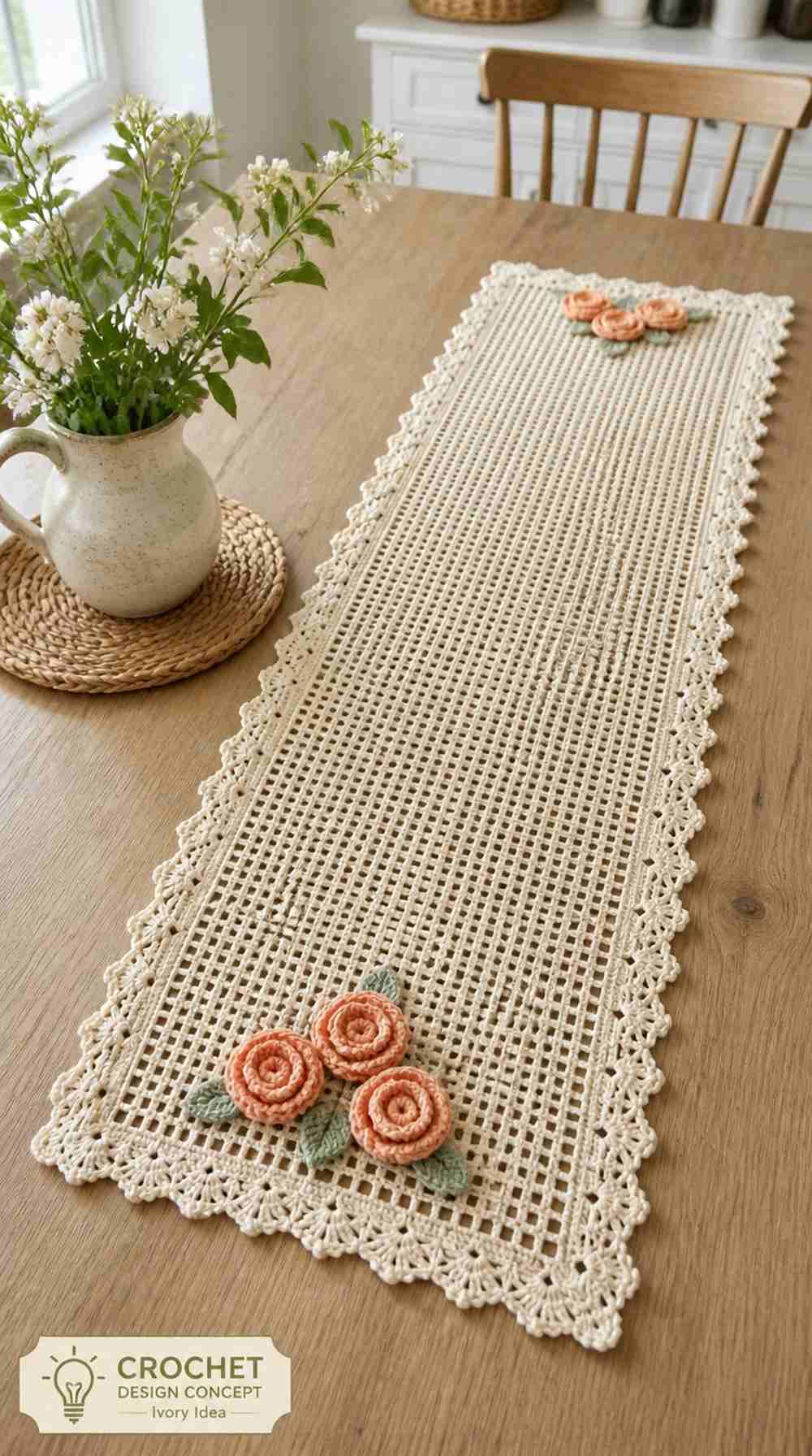
A warm-ivory filet crochet panel gives this romantic table runner a delicate, orderly foundation. The rectangular mesh is decorated with three small raised peach rosebuds near each short end, each accompanied by tiny sage-green leaves. A narrow ivory shell border finishes the complete rectangle.
The raised flowers add another layer of texture without covering the central filet pattern. Keeping the rosebuds near the ends allows the middle to remain visually quieter, while the combination of peach, ivory, and sage gives the design a soft vintage-garden character.
- Rosebud Placement: Three flowers appear near each short end. In a real project, their attachment points should avoid distorting the underlying filet mesh.
- Raised Petal Texture: The dimensional rosebuds may catch on objects placed directly over them, so their position matters for practical tabletop use.
- Filet Center: Small square openings create the main rectangular panel. A stable, evenly tensioned mesh helps maintain its straight outline.
- Shell Border: A narrow shell finish frames the panel without competing with the flowers. Consider its extra width when planning the finished runner.
10. Crochet Cranberry Diamond Trellis Runner
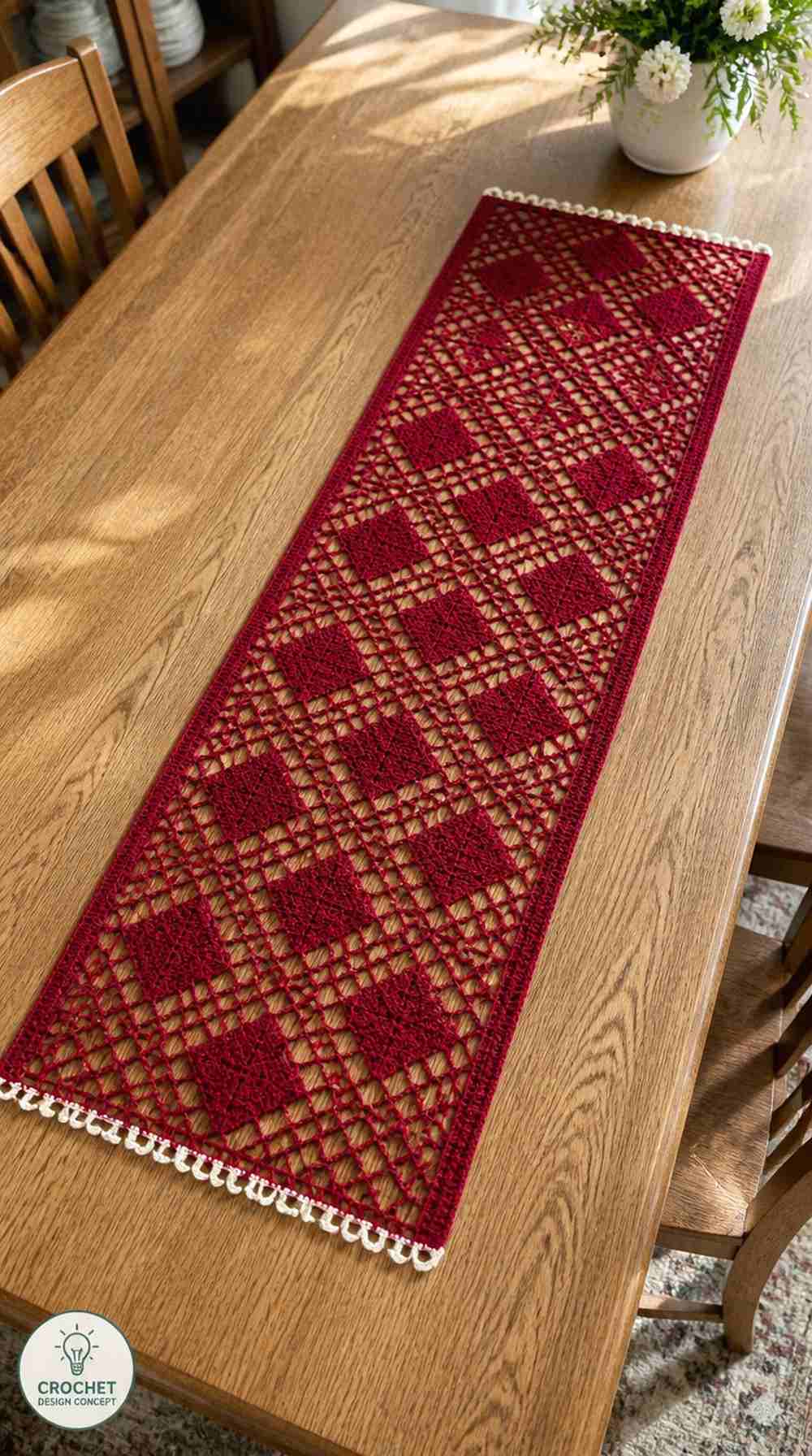
Deep cranberry crochet creates a bold interpretation of vintage diamond-trellis lace. The narrow rectangular runner features an orderly lattice of open diamond shapes, with compact solid-crochet diamonds placed at intervals inside the pattern. Straight side bands provide structure, while tiny ivory picots soften both short ends.
Its appeal comes from the contrast between open latticework and denser geometric accents. The strong cranberry color makes the stitch pattern noticeable on natural wood, giving this design a more graphic presence than traditional pale doily lace.
- Diamond Pattern Consistency: The lattice depends on regularly repeated openings. A suitable chart or established stitch repeat would help preserve its geometry.
- Solid Diamond Accents: Denser sections add visual rhythm, but their stitch tension should remain compatible with the surrounding openwork.
- Cranberry Contrast: Rich red can look particularly striking on pale wood. Compare the color in daylight before choosing thread.
- Ivory End Picots: The contrasting picots are intentionally limited to the short ends. Keep them delicate so the straight rectangular silhouette remains dominant.
11. Crochet Ivory Butterfly Doily Runner
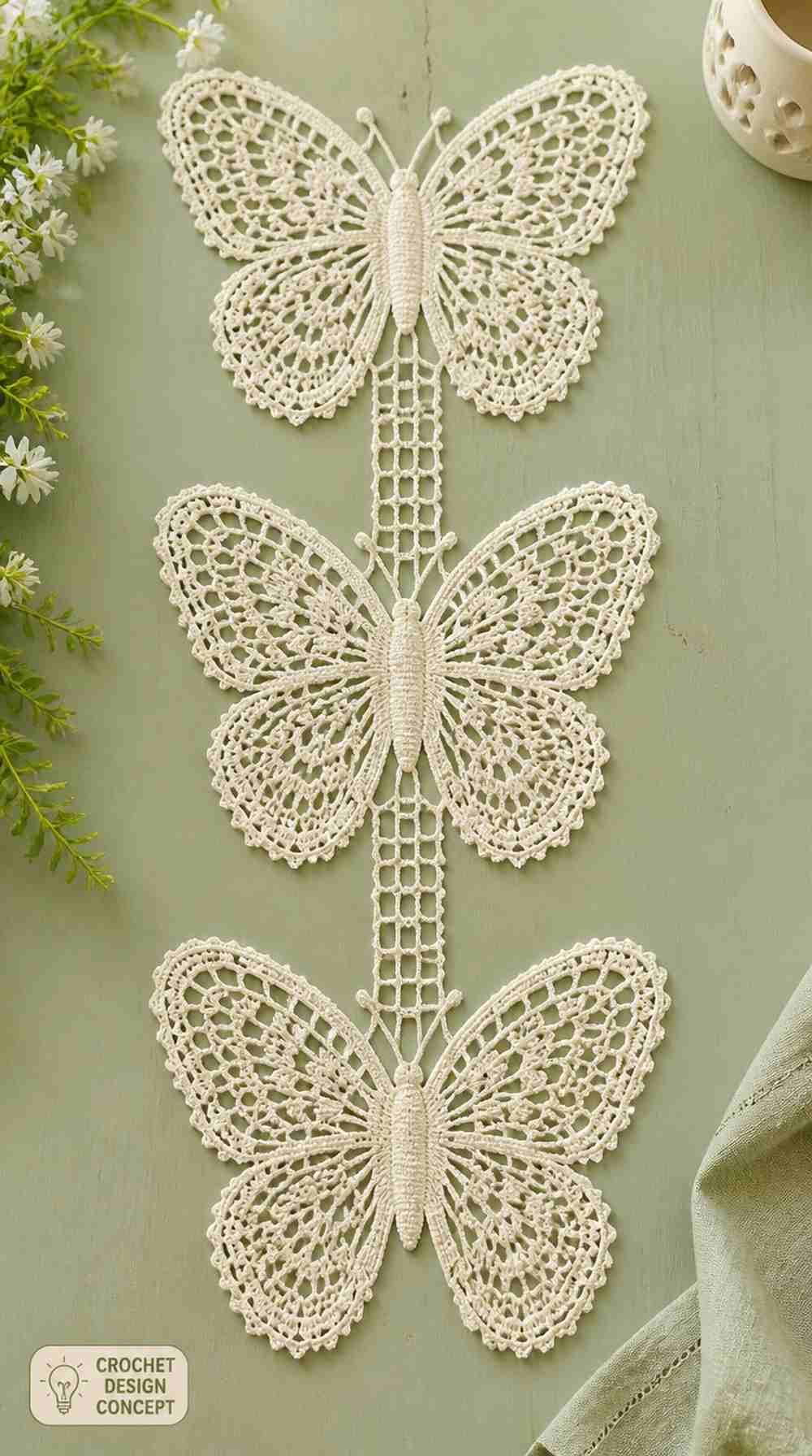
Three delicate butterfly-shaped doilies transform this antique-ivory crochet runner into a charming decorative centerpiece. Each butterfly features broad openwork upper wings, smaller rounded lower wings, a compact central body, and tiny picots following the wing edges. A slim central mesh spine connects the butterflies into an elongated arrangement.
The symmetrical wings create an interesting alternative to circular or floral doilies. Because the shape is so open and detailed, it benefits from a plain tabletop that allows each butterfly silhouette to remain clearly visible.
- Butterfly Symmetry: Each motif needs balanced left and right wings. Small differences become more noticeable in repeated symmetrical shapes.
- Central Mesh Spine: The narrow connecting section keeps the motifs aligned. It should provide suitable support without pulling the wings out of shape.
- Delicate Wing Edges: Picot details may snag more easily than solid borders, making careful handling and storage especially important.
- Display Suitability: The highly open construction favors decorative placement rather than a busy dining surface with frequent movement of dishes.
12. Crochet Frosted Star Doily Runner
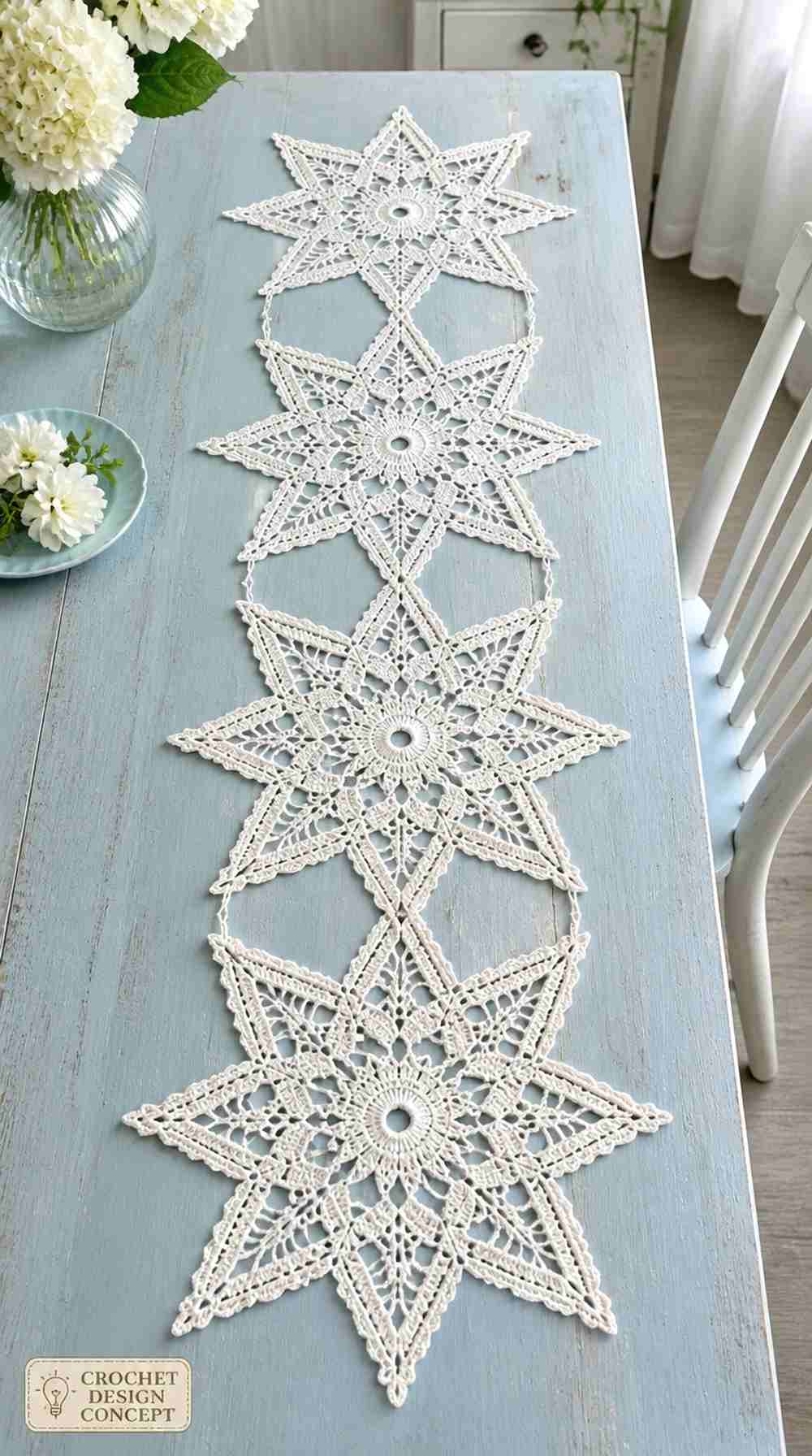
Four pearl-white crochet stars create an elegant elongated lace runner with a delicate winter-inspired appearance. Each eight-pointed doily contains a small circular center, branching chain-lace details, and clearly defined outer tips. Short crochet bridges connect the stars while keeping their pointed silhouettes visible.
The repeating geometry produces a more dramatic outline than a traditional rectangular runner. Although its bright white thread feels especially suited to cooler seasonal decor, the simple lace design could also complement a traditional room throughout the year.
- Eight-Point Structure: The symmetry depends on consistent spacing between points. Choose a reliable star-doily pattern if attempting a physical version.
- Bridge Connections: Short joins need to connect suitable structural sections, rather than depending on delicate pointed tips for all their support.
- Point Definition: Appropriate blocking may help reveal the eight-point silhouette, depending on the actual cotton thread and its care requirements.
- Dusty-Blue Contrast: A softly colored surface makes the pearl-white openwork easier to see than a similarly white tablecloth.
13. Crochet Oatmeal Half-Moon Lace Runner
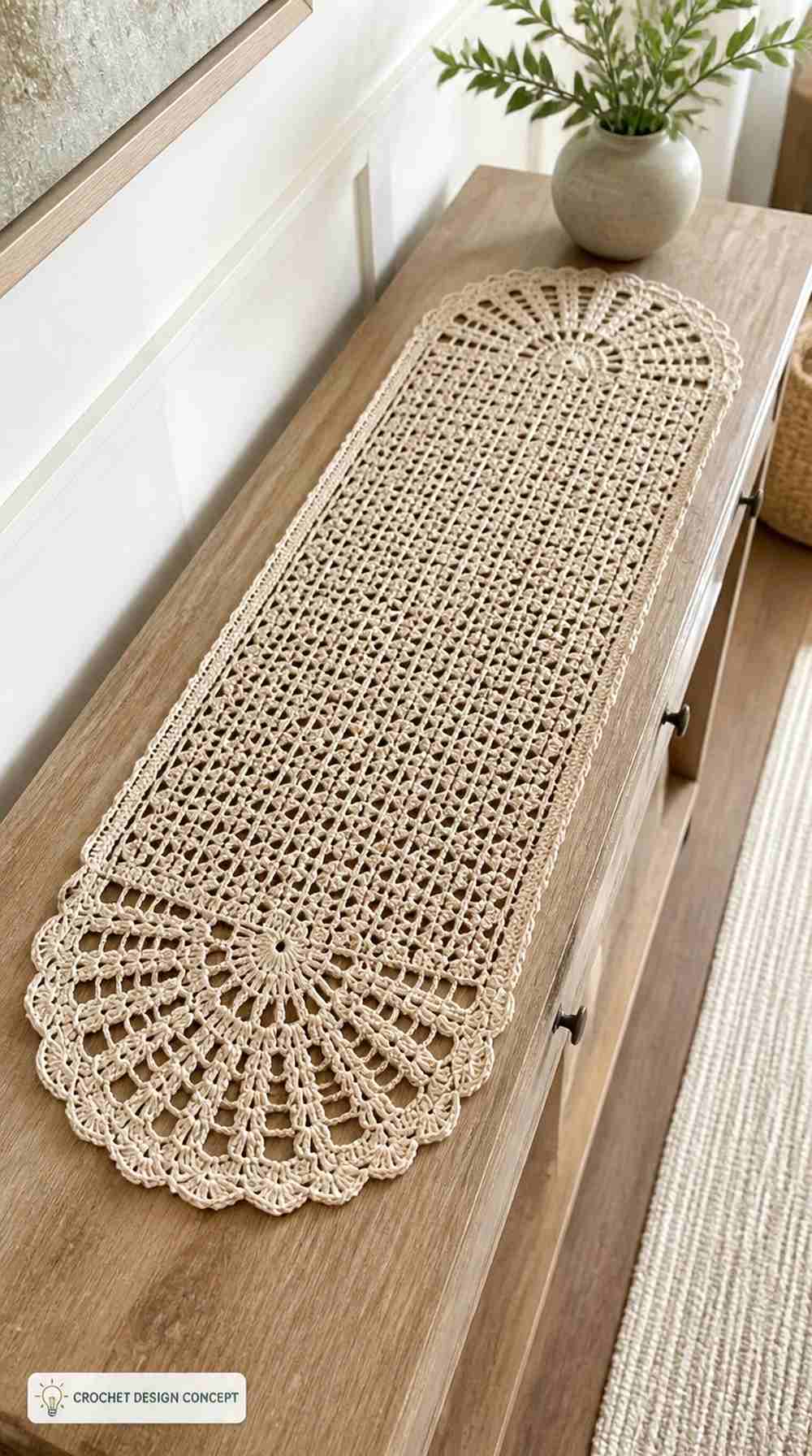
An oatmeal-beige crochet center panel gives this runner a calm, traditional foundation, while generous semicircular lace fans form its decorative ends. The slender rectangular middle uses small repeating mesh-and-shell stitches, creating a different texture from the broad radial openings in the half-moon sections.
The contrast between straight sides and rounded ends gives the design its character. Its soft neutral color pairs naturally with wood furniture, making it an appealing option for a console or dresser where the ornate end sections can remain visible.
- Semicircular End Panels: The two broad fans should mirror each other. Consistent shaping is important when attaching them to the rectangular center.
- Straight Middle Section: The mesh-and-shell panel provides the main length. Adjusting it would require checking the stitch repeat and end-panel alignment.
- Oatmeal Color: This neutral shade can soften the appearance of highly detailed lace without making the pattern disappear completely.
- End Clearance: The rounded fans occupy more visual width than the center. Measure the available surface where the semicircles will lie.
14. Crochet Pistachio Lily Motif Runner
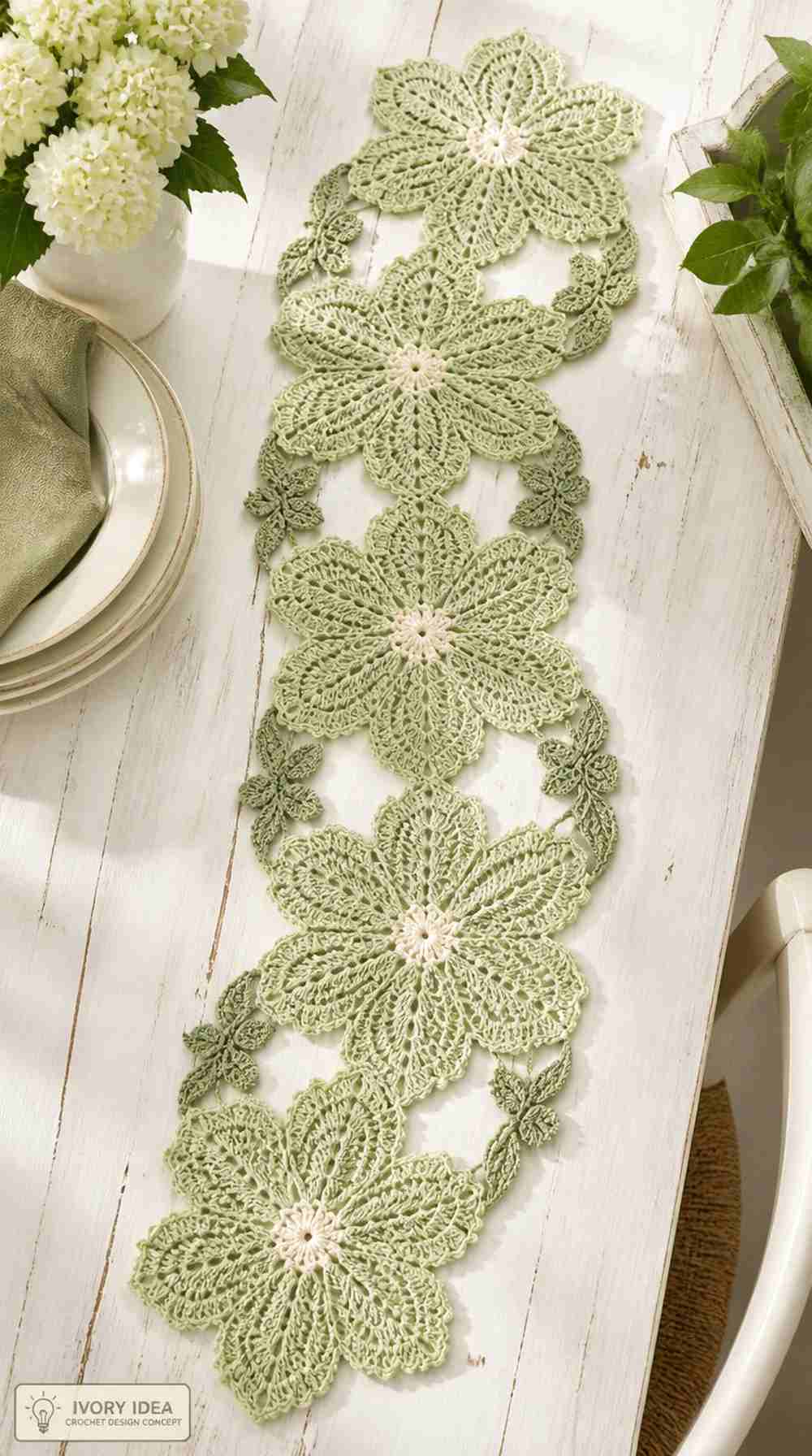
Five lily-inspired crochet flowers form a gently winding botanical table runner in soft pistachio and sage tones. Each flower has six openwork petals surrounding a small warm-cream center. Narrow crocheted leaves sit along the connecting chain bridges, creating a flowing arrangement rather than a straight rectangular panel.
The open spaces between the flowers help preserve their individual shapes. Its soft green palette makes this design especially attractive for cottage-style decorating, where the crochet motifs can provide botanical detail without relying on real flowers.
- Six-Petal Flower Shape: Every motif should follow a consistent petal arrangement. Irregular spacing could make the joined runner feel unbalanced.
- Leaf Connections: The sage leaves form part of the connecting sections, so their construction needs appropriate support and attachment.
- Organic Outline: The winding silhouette has no straight side borders. Test the planned layout on the table before deciding the number of flowers.
- Soft Green Palette: Pistachio petals and darker sage leaves provide separation. A cream center adds detail without competing with the botanical shape.
15. Crochet Terracotta Cathedral Arch Runner
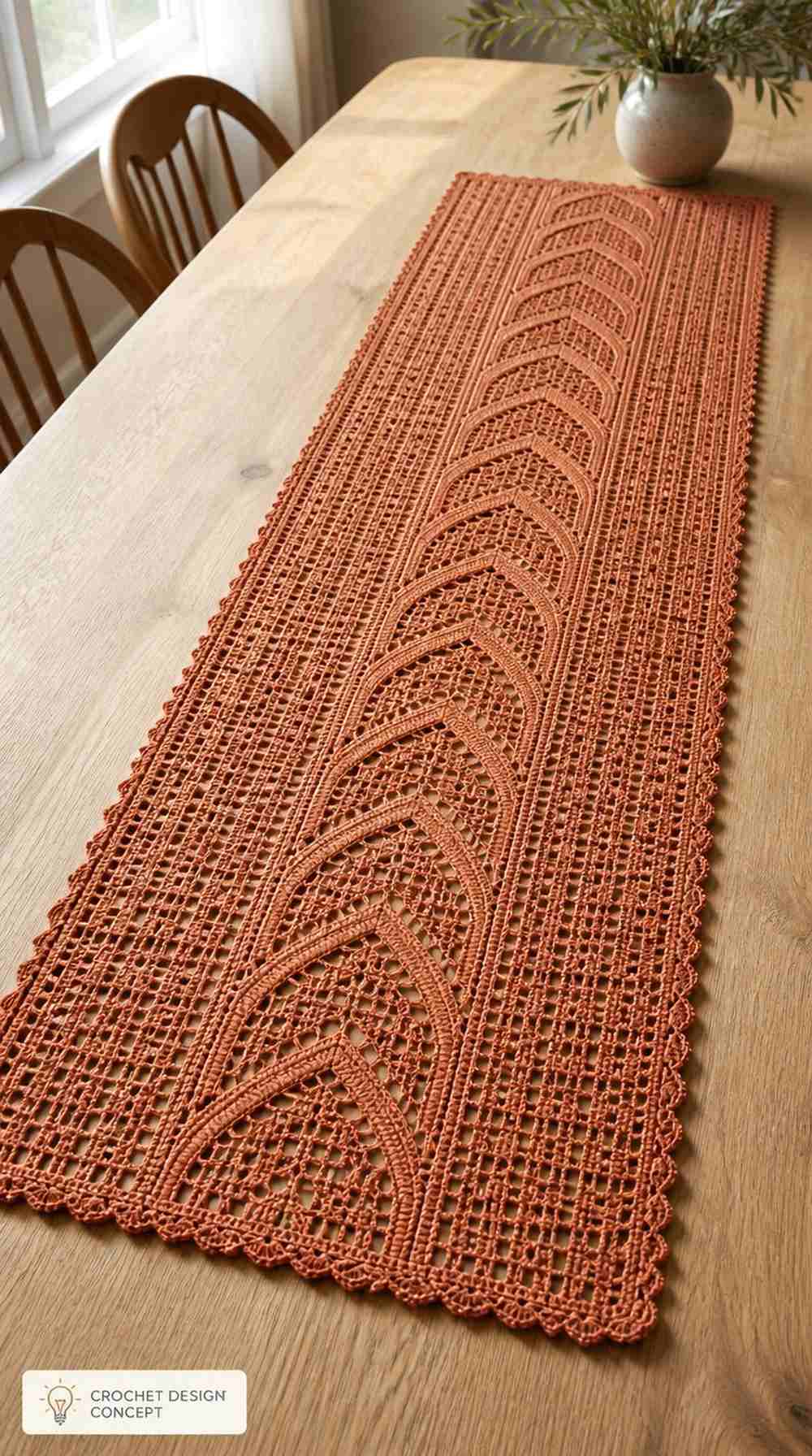
Terracotta crochet gives this vintage-style runner a warm, architectural appearance. Repeating pointed cathedral-window arches run through the center, built from open chain-lace columns and tighter stitch outlines. Narrow rectangular mesh sections fill both sides, while a continuous terracotta scalloped border finishes the entire perimeter.
Its repeating arches bring a different decorative character from floral and circular doily patterns. The long rectangular silhouette makes the design easier to coordinate with straight-edged furniture, while the patterned center remains the most noticeable part of the crochet.
- Cathedral Arch Structure: Pointed arches rely on clear differences between open spaces and denser outlines. A suitable stitch chart is essential for accurate repeats.
- Side Mesh Balance: The narrow mesh panels frame the arches. Their width should remain consistent so the main pattern stays centered.
- Terracotta Styling: Warm earthy cotton thread complements pale oak and cream surfaces, where the architectural openings can remain visible.
- Scalloped Perimeter: The border softens the rectangular outline. Avoid making the scallops disproportionately large compared with the central arches.
16. Crochet Pearl White Bow Lace Runner
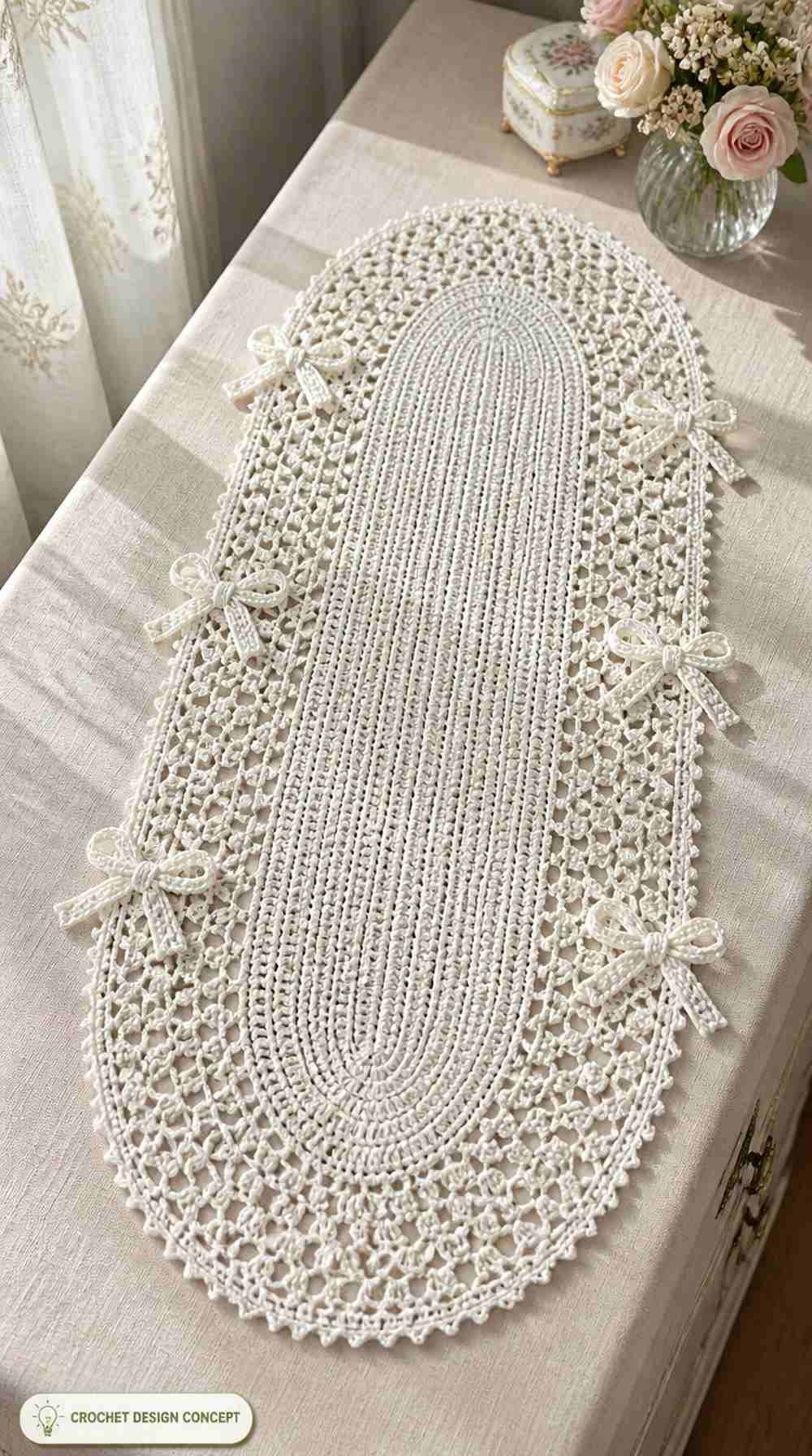
Pearl-white cotton crochet gives this elongated oval runner a delicate, romantic appearance. A closely patterned oval center is surrounded by an airy chain-lace band, with six small flat ribbon-bow motifs arranged symmetrically along the two long sides. Each bow has two loops and short tapered tails.
The tiny crocheted bows add charming dimensional detail without changing the runner’s graceful oval silhouette. A narrow picot border completes the design, making it a lovely decorative option for a dresser or a carefully arranged vintage-style tabletop.
- Bow Symmetry: Three bows on each side create visual balance. Their placement should match across the oval rather than crowding one end.
- Ribbon-Bow Attachment: The flat crochet bows need suitable joining points along the lace band to maintain their orientation during use.
- Oval Center Texture: The closely patterned middle contrasts with the surrounding openwork. This difference helps the small decorative bows stand out.
- Picot Perimeter: A narrow picot edge maintains the delicate appearance. Gentle finishing can help clarify the oval without stretching the bows.
17. Crochet Deep Teal Baroque Lace Runner
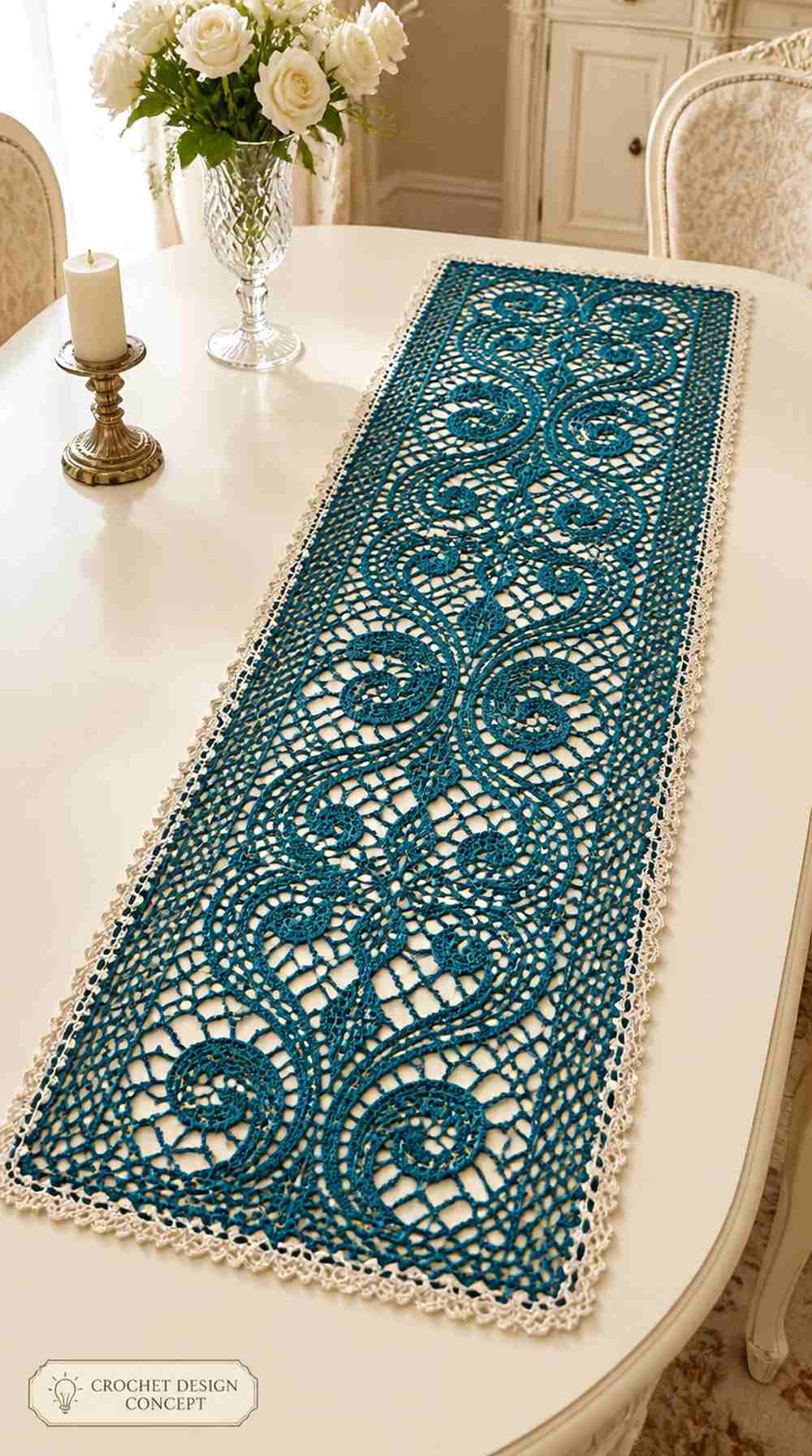
Rich deep-teal crochet creates a striking vintage-inspired table runner with ornate scrolling details. Three mirrored baroque-style openwork arrangements repeat along the rectangular center, surrounded by finer mesh sections. A thin antique-ivory crochet edging provides a delicate contrast around all four sides.
The scrolling motifs give the runner a more formal decorative feel than simple floral lace. On a cream tabletop, the darker stitches and open spaces become especially noticeable, making this concept appealing when you want the runner itself to be the central design feature.
- Mirrored Scroll Pattern: The central motifs need balanced left and right curves. Following a suitable established chart would help preserve the intended symmetry.
- Deep-Teal Thread: Smooth, richly colored cotton may highlight the scrolling structure. Adequate daylight is important for seeing detail in darker crochet.
- Ivory Edge Contrast: The thin border frames the teal surface without overpowering the ornamental center. Keep its width restrained.
- Formal Table Styling: A simple cream background reveals the openwork more clearly than a busy patterned cloth. Leave enough of the scrolling motifs uncovered.
Practical Guide to Vintage Crochet Doily Table Runners
A beautiful crochet runner should complement the surface where it will be displayed. Before choosing a vintage lace design, think about the table dimensions, the amount of visible openwork, and whether the finished piece will be decorative or used beneath everyday objects.
Measure the actual surface. Check the usable tabletop length and width. For an overhanging runner, account for the ends, including scallops, picots and pointed motifs. Joined circular doilies can create an irregular outline that occupies more space than expected.
Choose suitable crochet thread. Smooth cotton thread is commonly used for detailed doilies because it can show fine stitch structures clearly. Thread thickness, hook choice and tension will all affect the final appearance. Always test unfamiliar combinations.
Understand blocking. Lace often benefits from suitable finishing to open the stitchwork and define decorative points. Follow the fiber manufacturer’s care guidance and avoid applying unsuitable heat or excessive tension.
Consider cleaning and storage. Fine crochet can catch on rough objects. Store delicate runners clean and dry, with minimal pressure on raised decorations, and follow the chosen material’s washing instructions.
Protect the table. Decorative crochet lace is not heat protection. Use appropriate heat-safe mats beneath hot cookware, and do not rely on an openwork runner to protect wood from spills, moisture or scratches.
Want to Make Something Similar?
These original concepts are intended to inspire your choice of colors, motifs, shapes and finishing details. They are not exact patterns, but the following established resources may help you learn related techniques.
- Olga Poltava — Crochet Daisy Motif Table Runner: How to Join Motifs demonstrates joining daisy motifs as you crochet, a useful technique to explore for modular floral runners. YouTube
- TLH Patterns — Lace Table Runner provides a published free hexagon-motif crochet pattern with joining guidance, useful for understanding geometric lace construction. Ravelry
- Crochet Swan — Floral Motif Lace Table Runner Tutorial demonstrates floral motif construction, joining and decorative edging for a table runner or tablecloth. YouTube
These resources teach related crochet methods; none has been verified as an exact pattern for the AI concepts pictured in this collection.
For more individual doily shapes and stitch styles, you can also explore 35 Crochet Lace Doily Ideas for Fall 2026 on Yarn Nest Studio.
Which Vintage Lace Doily Table Runner Should You Choose?
The most useful choice depends on where you want the runner to sit and how much decorative detail you enjoy.
| Design | Main attraction | Important consideration |
|---|---|---|
| Victorian Ivory Rosette | Three classic floral ovals | Delicate connecting bridges |
| Ecru Pineapple Lace | Traditional continuous lace | Narrow profile and pointed ends |
| Dusty Rose Daisy Medallion | Romantic joined flowers | Open gaps between motifs |
| Sage Fern Filet Lace | Botanical rectangular panel | Filet pattern clarity |
| Champagne Hexagon | Wider geometric motif arrangement | Consistent joining and alignment |
| Lavender Pansy Oval | Decorative floral centers | Oval proportions and raised flower details |
| Cranberry Diamond Trellis | Bold geometric lattice | Openwork and denser accent balance |
| Ivory Butterfly Doily | Distinct butterfly silhouettes | Fragile wing edges |
| Oatmeal Half-Moon | Ornate semicircular ends | Extra width at both ends |
| Deep Teal Baroque Lace | Rich scrolling ornament | Strong surface contrast |
If you want a subtle vintage accent, the Victorian Ivory Rosette or Sage Fern Filet Lace designs are good starting points. For more decorative detail, consider the Lavender Pansy Oval or Pearl White Bow Lace Runner.
For a statement piece, Deep Teal Baroque Lace, Cranberry Diamond Trellis and Terracotta Cathedral Arch offer stronger colors and more noticeable geometric structures.
Conclusion
Vintage lace doily table runners offer many more possibilities than a simple white rectangular textile. Joined floral motifs create softness, geometric lace gives a more orderly appearance, and decorative edges can transform the outline of an otherwise simple table runner.
The best choice is one that suits the actual surface and how you plan to use it. Consider the crochet motif size, stitch openness, thread texture, color contrast and amount of decorative detail before selecting a real pattern. Even a small change in the lace structure can create a completely different vintage-inspired look.
Which design would you choose for your home? Do you prefer the traditional ivory rosettes, romantic daisy medallions, or the richer deep-teal baroque lace? Share your favorite style in the comments.
Frequently Asked Questions
1. What is the difference between a crochet doily and a crochet doily table runner?
A traditional crochet doily is often a single decorative piece, commonly circular, oval or another shaped motif. A doily-inspired table runner is elongated to suit a larger surface. It may be made from several connected doilies or created as one continuous lace panel with traditional doily-style details.
2. What type of thread is best for vintage lace crochet table runners?
Smooth cotton crochet thread is a common choice for detailed lace because it helps small stitches and openwork motifs remain defined. The appropriate size depends on the pattern and desired appearance. Finer thread generally creates a more delicate look, while heavier yarn can produce larger, more substantial motifs.
3. Can vintage crochet lace table runners be used on dining tables?
Yes, provided the finished piece suits the intended use. Very open lace and raised motifs are generally better as decoration than as stable support for dishes. Use suitable protection beneath hot or wet serving items, and consider where the runner sits during meals.
4. How can I keep a crochet lace table runner looking neat?
Appropriate blocking may help define its shape, scallops and open stitches. Handle delicate edges carefully, follow the fiber’s washing instructions, and store the runner clean and dry. Avoid excessive pulling on joined motifs or decorative picots, especially when moving items across the table.
5. Are these 17 vintage lace doily table runner designs available as crochet patterns?
These 17 designs are AI-generated inspiration concepts rather than tested crochet patterns. They show possible combinations of colors, shapes, motifs and decorative finishes. To create a physical version, use an established pattern or tutorial for the relevant techniques and adjust the design only where your crochet skills and the pattern construction allow.