A crochet floral parandi brings colorful handmade flowers, delicate yarn cords, and flowing tassels to one of Punjab’s most recognizable traditional hair accessories. Instead of using plain braided threads alone, these designs explore crocheted marigolds, jasmine, roses, daisies, sunflowers, and other beautiful floral shapes. The result is a collection of 16 different parandi inspiration ideas, from understated everyday braid decorations to more elaborate festive and bridal styles.
The details matter as much as the flowers themselves. A floral parandi needs to work with the natural braid, with crochet cords that sit comfortably and decorations that remain visible without becoming too heavy. Some ideas feature small flowers spaced along the entire braid, while others place larger blooms near the lower end. This collection helps you compare flower size, attachment position, colors, tassel arrangements, and the balance between decoration and comfort.
These are AI-generated crochet design visualizations for inspiration, not photographs of tested handmade accessories or step-by-step patterns.
Quick Design Selection Guide
- For traditional festive styling: Start with Crochet Golden Marigold Vine Parandi, Crochet Mini Sunflower Chain Parandi, or Crochet Cherry Red Poppy Parandi for cheerful, prominent floral details.
- For delicate everyday braids: Choose Crochet Ivory Jasmine Bud Parandi, Crochet Lavender Daisy Ladder Parandi, or Crochet Powder Blue Forget Me Not Parandi, which use smaller flowers.
- For romantic hairstyles: Compare Crochet Dusty Rose Cluster Parandi, Crochet Peach Coral Blossom Parandi, and Crochet Blush Sakura Branch Parandi.
- For unusual floral shapes: Consider Crochet Teal Lotus Bloom Parandi, Crochet Violet Orchid Spiral Parandi, or Crochet Sage Hydrangea Cluster Parandi.
- For special-occasion finishing: Explore Crochet Burgundy Spiral Rose Parandi, Crochet Terracotta Zinnia Fringe Parandi, and Crochet Champagne Magnolia Bridal Parandi.
A traditional Punjabi parandi is generally incorporated into a three-strand hair braid and finished with decorative tassels. These crochet designs adapt that familiar structure with floral motifs rather than claiming to reproduce specific traditional pieces.
Encyclopedia of Intangible Cultural Heritage+1
1. Crochet Golden Marigold Vine Parandi
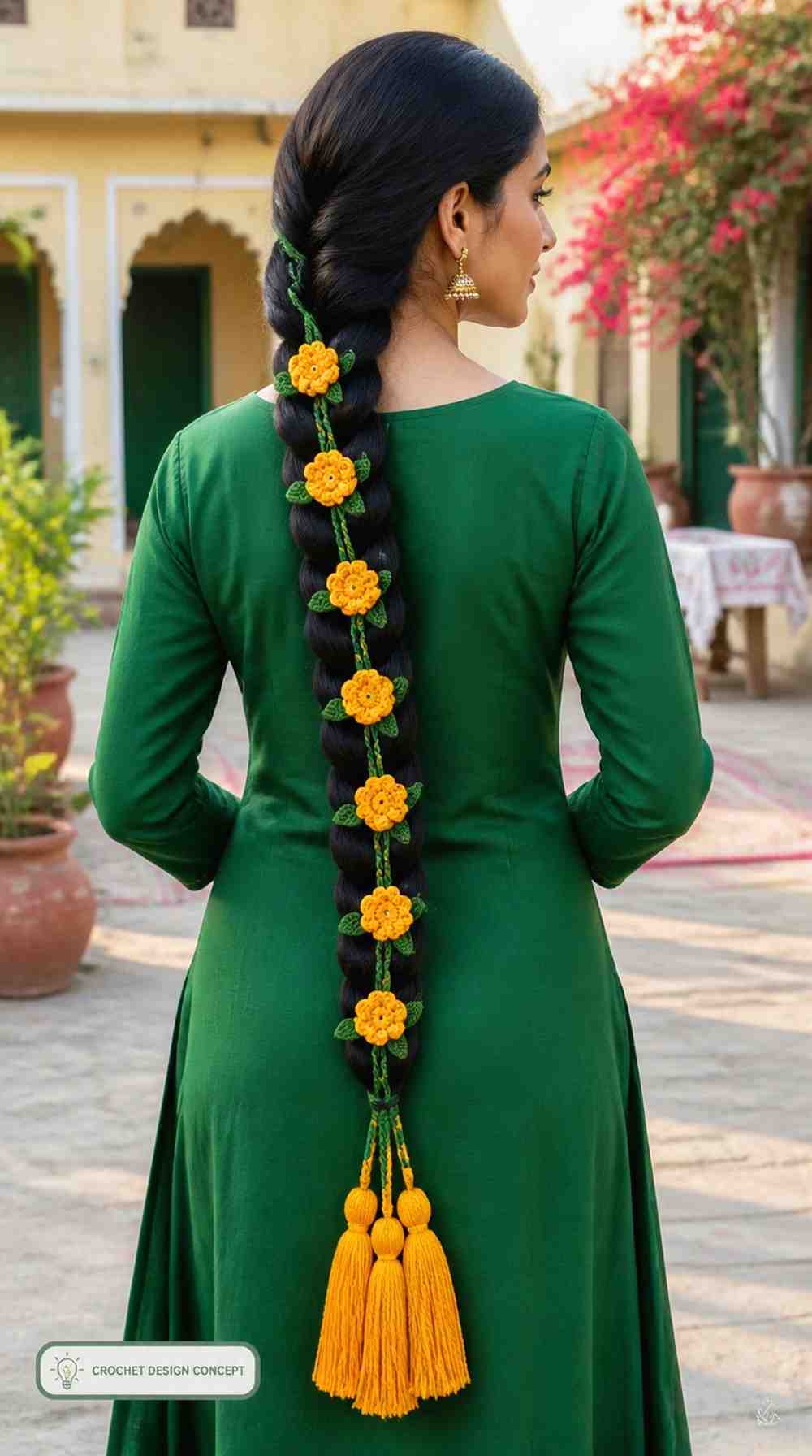
Golden-yellow crochet marigolds create a cheerful floral arrangement along this traditional-inspired parandi. Seven small layered flowers are spaced along olive-green crochet cords woven into a dark braid, with tiny green leaves connecting the blossoms. Three full saffron-yellow tassels finish the extension below the natural hair.
The flower placement creates a continuous botanical look without completely covering the braid. Its combination of yellow and green makes the crochet detail especially visible against darker hair. For a wearable version, the important decisions would be keeping the marigolds lightweight and securing each flower without bulky knots.
- Layered Marigold Petals: Keep the rounded crochet petals compact enough to maintain a recognizable floral shape without creating excessive weight along the braid.
- Green Vine Placement: Position the connecting vine on the exposed outer side of the hair so the seven flowers remain visible.
- Saffron Tassel Balance: Three full tassels provide a traditional-inspired lower finish. Compare their combined weight with the braid before wearing.
- Festive Styling: Golden marigolds work beautifully with emerald green, ivory, and warm yellow outfits, especially when the hairstyle is the main decorative feature.
2. Crochet Ivory Jasmine Bud Parandi
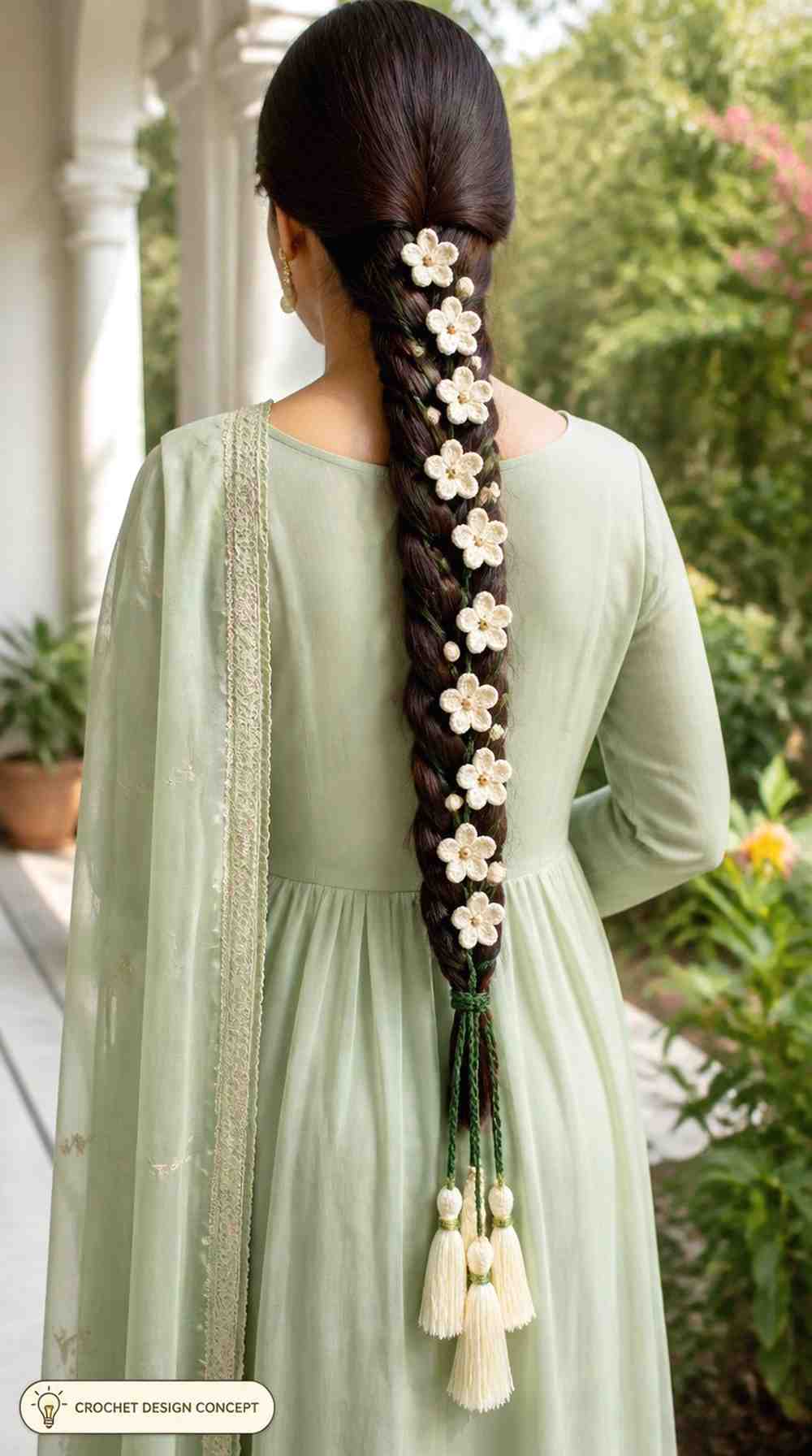
Tiny ivory crochet blossoms give this parandi a soft, understated appearance. Nine five-petal jasmine-inspired flowers follow a narrow forest-green vine along the dark-brown braid, with small unopened ivory buds placed between selected blooms. Three fine ivory tassels complete the lower extension.
The combination of miniature flowers and slender cords keeps the decoration delicate. Rather than creating one heavy floral cluster, the small blossoms form a gentle line down the hair. This concept is worth considering when you want the braid itself to remain visible alongside the crochet.
- Jasmine Flower Scale: Keep each five-petal blossom small and consistent so the repeated flowers do not overwhelm the narrow connecting vine.
- Bud Arrangement: Alternate selected flowers with compact crochet buds, leaving enough space for each shape to remain distinct.
- Fine Cord Thickness: Slender cords may blend into the braid more naturally, but they still need securely finished ends and suitable attachment points.
- Ivory Yarn Care: Pale crochet flowers can show dirt and color transfer. Follow the chosen yarn’s care instructions and store the accessory separately.
3. Crochet Dusty Rose Cluster Parandi
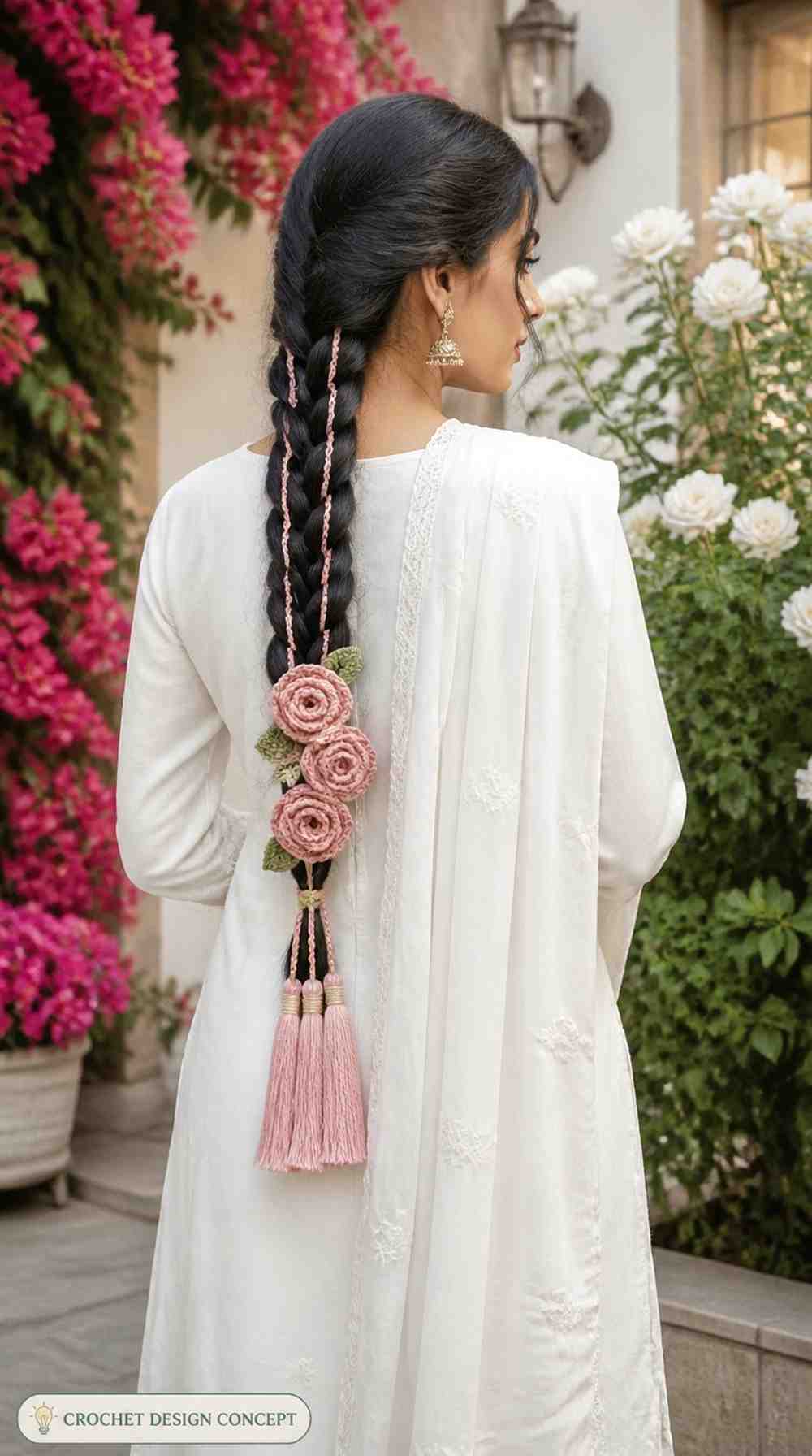
Three dimensional dusty-pink crochet roses decorate the lower section of this romantic parandi. The flowers have layered, curled petals and small muted-sage leaves, while three slim dusty-rose cords continue beneath the dark braid into matching blush tassels with wrapped tops.
Leaving the upper braid undecorated makes the concentrated rose cluster especially noticeable. The dimensional flowers give this design a fuller appearance than flat appliqués. Their positioning near the lower braid also means attachment strength and the combined weight of the cluster deserve particular attention.
- Rose Petal Structure: Layered crochet petals create depth, but the flowers should remain proportionate to the width of the natural braid.
- Lower-Braid Placement: Concentrating three roses in one area creates a strong focal point while leaving the upper hairstyle relatively simple.
- Sage Leaf Contrast: Small muted-green leaves separate the pink roses without introducing a second competing floral pattern.
- Attachment Comfort: Check the backs of the roses for thick knots, rough joins, or loose yarn ends that could catch in hair.
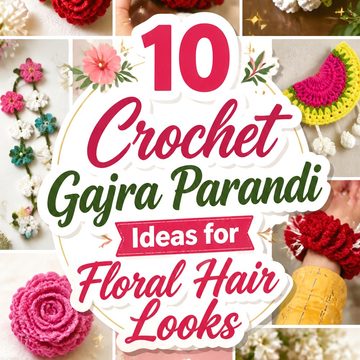
For more flower-focused braid inspiration, explore 10 Crochet Gajra Parandi Ideas for Floral Hair Looks, which features related floral hair decoration approaches.
4. Crochet Lavender Daisy Ladder Parandi
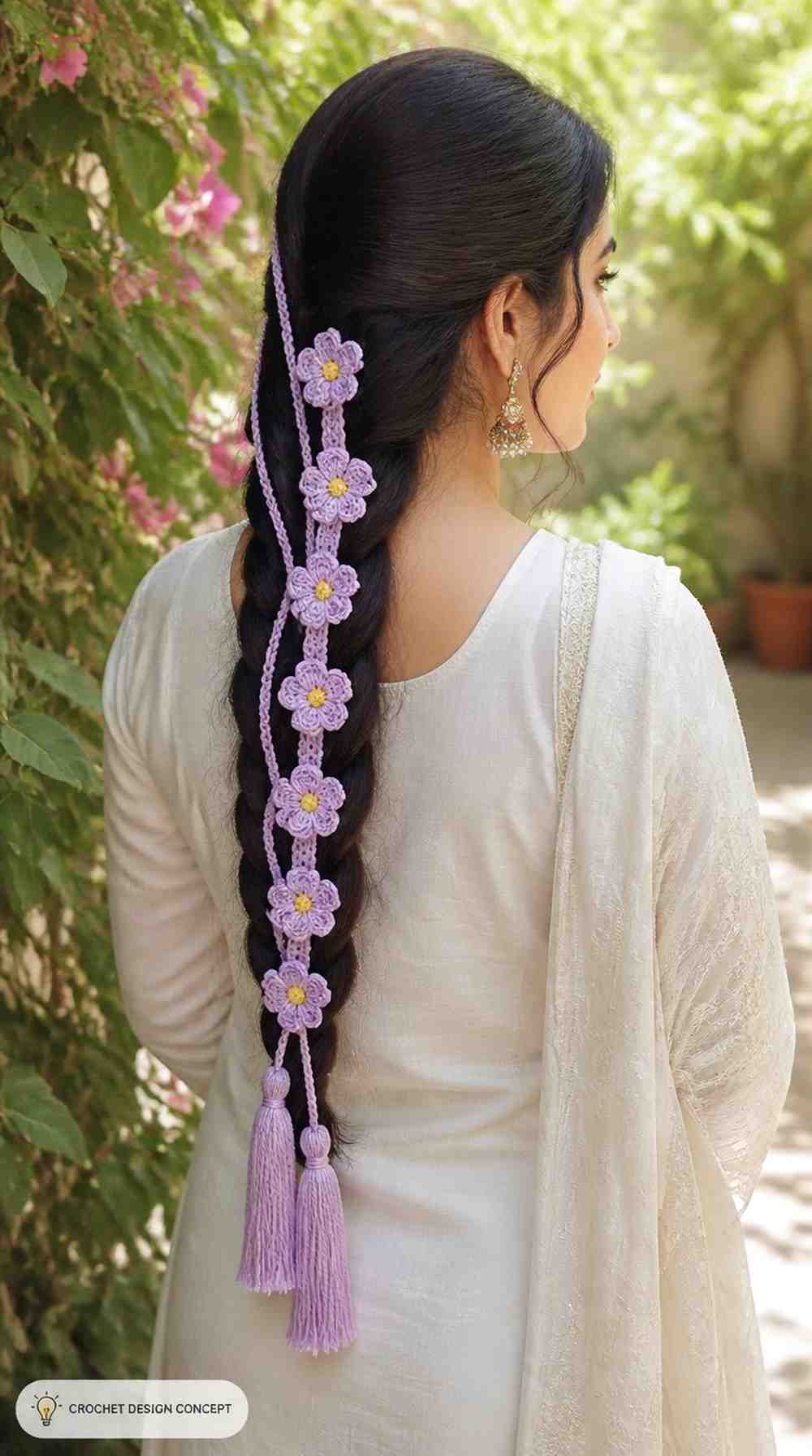
Six lavender crochet daisies create a neat descending pattern along this floral parandi. Each small flower has five separate petals surrounding a butter-yellow center. A slender lilac ladder-style crochet strip connects the flowers beside the braid, while three slim matching tassels hang below.
The narrow ladder construction makes this idea different from floral vines and larger attached clusters. Its small open sections allow the dark hair to remain visible between the flowers. Those openings would need careful finishing, however, because loose strands can catch on raised crochet edges.
- Daisy Petal Definition: Keep five clearly separated petals around each yellow center so the flowers remain recognizable at a small scale.
- Ladder Construction: Narrow crochet links should maintain their spacing without stretching excessively when the accessory hangs vertically.
- Flower Alignment: Arrange the six daisies along the visible side of the braid rather than allowing alternate flowers to disappear behind the hair.
- Snagging Awareness: Inspect the ladder openings and petal edges before wearing, particularly where loose hair might pass through the stitches.
5. Crochet Burgundy Spiral Rose Parandi
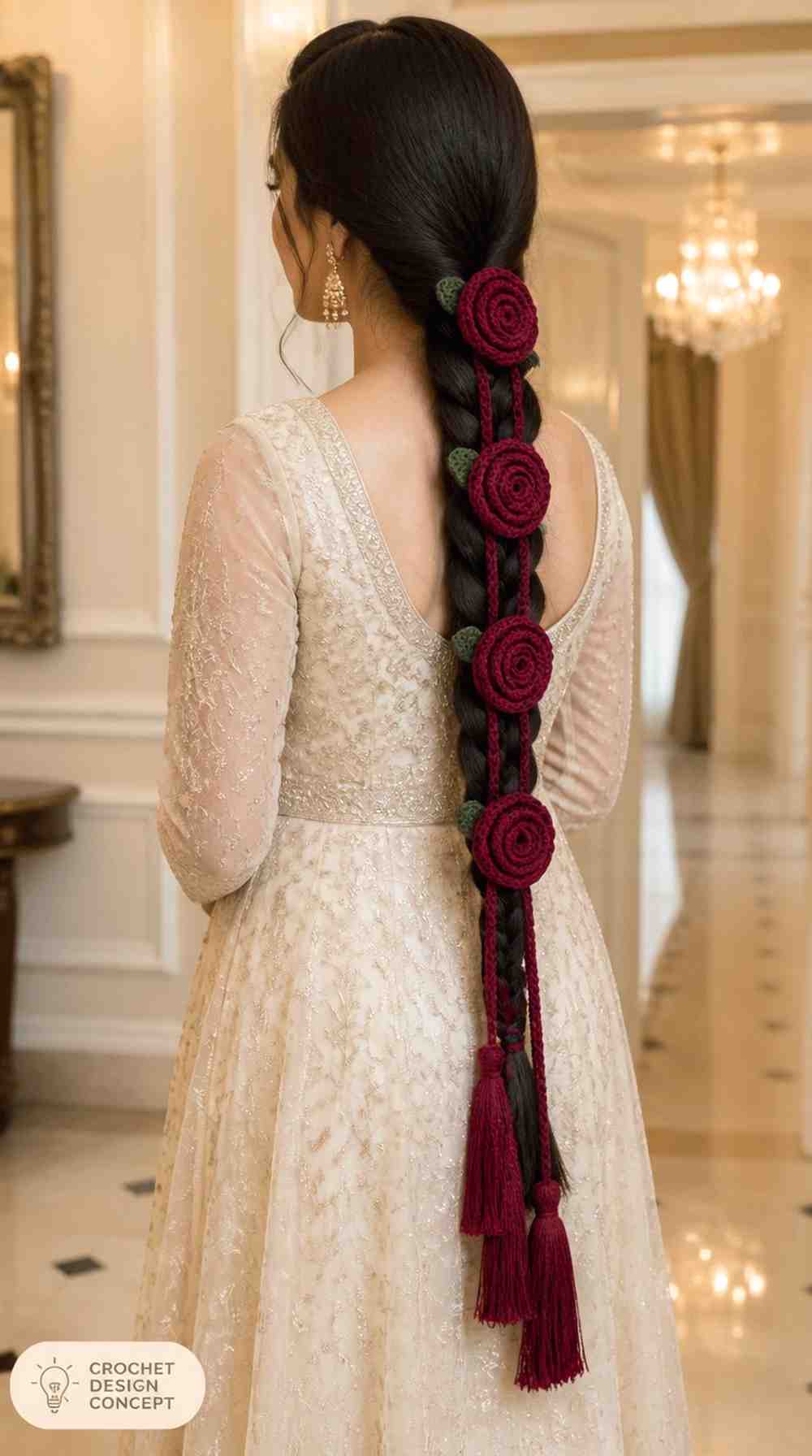
Deep burgundy crochet roses give this parandi a rich, elegant character. Four flattened spiral roses descend along black-cherry extension cords, with small deep-green leaves beside the flowers. The cords continue beyond the dark braid into straight wine-colored fringe tassels finished with wrapped collars.
Unlike the raised rose cluster design, these flowers have a flatter concentric spiral appearance. Their wider spacing keeps each rose separate and visible. The combination of dark red crochet and matching fringe creates a coordinated finish without adding beads, metallic embellishments, or extra colors.
- Spiral Rose Shape: Maintain neat concentric petal layers so the flowers read as roses without becoming bulky at their centers.
- Burgundy Contrast: Deep-red yarn may blend into dark hair under low lighting. Compare shades in natural light before choosing the final palette.
- Four-Flower Spacing: Give each rose enough room along the outer braid to prevent overlapping petals and uneven decoration.
- Wrapped Tassel Collars: Short, neatly finished collars can organize the fringe strands, provided they do not create stiff or uncomfortable attachments.
6. Crochet Peach Coral Blossom Parandi
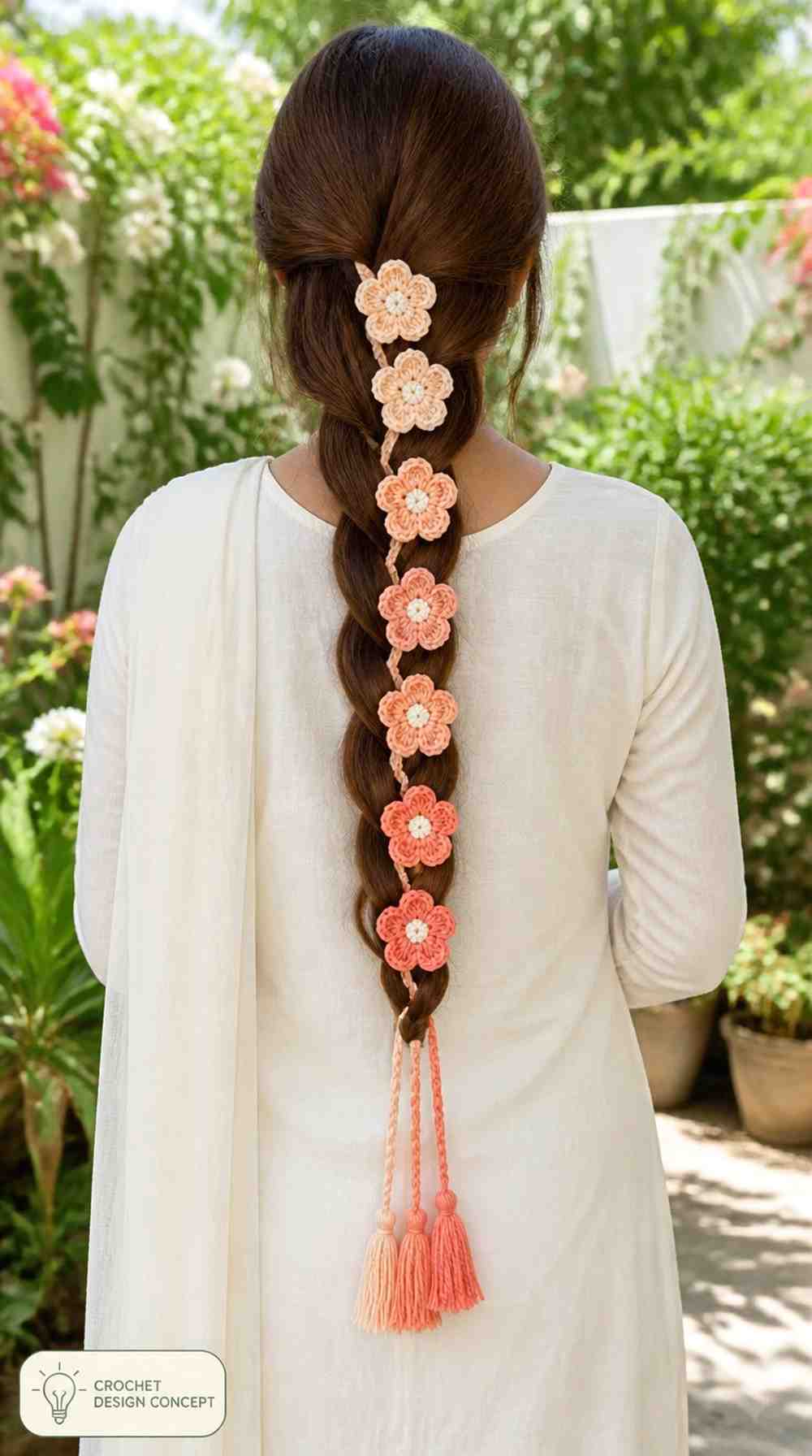
A gentle color progression makes this crochet parandi particularly charming. Seven small five-petal flowers move from pale apricot near the top of the braid through warm peach to soft coral toward the bottom. Each flower has an ivory center, while three matching tassels repeat the apricot, peach, and coral shades.
The flowers remain simple, allowing the changing colors to create the main effect. Without added leaves or heavy trim, the design keeps a relatively clean silhouette. Its success would depend on arranging the shades carefully and maintaining similar flower dimensions throughout the accessory.
- Ombre Flower Sequence: Arrange apricot, peach, and coral flowers in a gradual order rather than placing the strongest and lightest shades randomly.
- Ivory Flower Centers: Small pale centers help define the five petals without interrupting the soft color progression.
- Seven-Motif Consistency: Keep the flowers similar in size and thickness so the color changes remain more noticeable than variations in shape.
- Three-Color Tassels: Matching the lower tassels to the floral palette brings the accessory together without adding another decorative element.
7. Crochet Mini Sunflower Chain Parandi
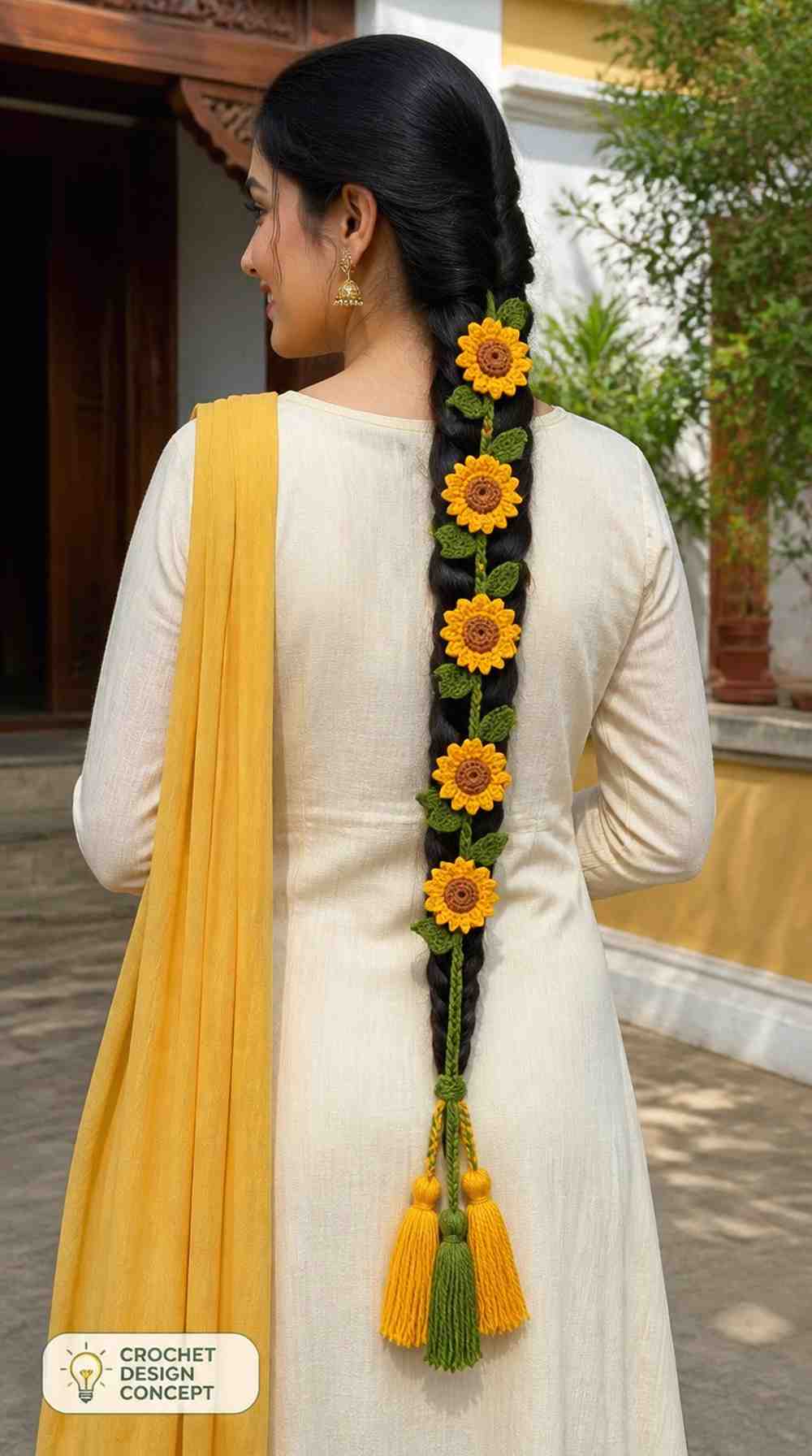
Five miniature crochet sunflowers create a bright botanical line down this parandi. Each flower has a raised dark-cocoa center surrounded by eight golden-yellow petals. Small sage leaves connect the motifs along olive-green crochet cords, which finish in two golden tassels and one smaller green tassel.
The contrast between the dark centers and yellow petals makes the sunflowers stand out clearly against black hair. Their miniature size keeps the arrangement more manageable than a chain of oversized flowers. A real version should still account for the thickness of the raised centers and the attachment points between motifs.
- Sunflower Center Texture: A slightly raised cocoa center creates depth, but avoid excessive thickness where the flower rests against the braid.
- Eight-Petal Arrangement: Keep the petals evenly distributed so each sunflower retains a balanced circular outline.
- Small Sage Leaves: Narrow leaves add botanical detail without covering the connecting olive cord.
- Mixed Tassel Finish: Two golden tassels and one smaller olive tassel provide a subtle variation while staying within the sunflower color palette.
8. Crochet Teal Lotus Bloom Parandi
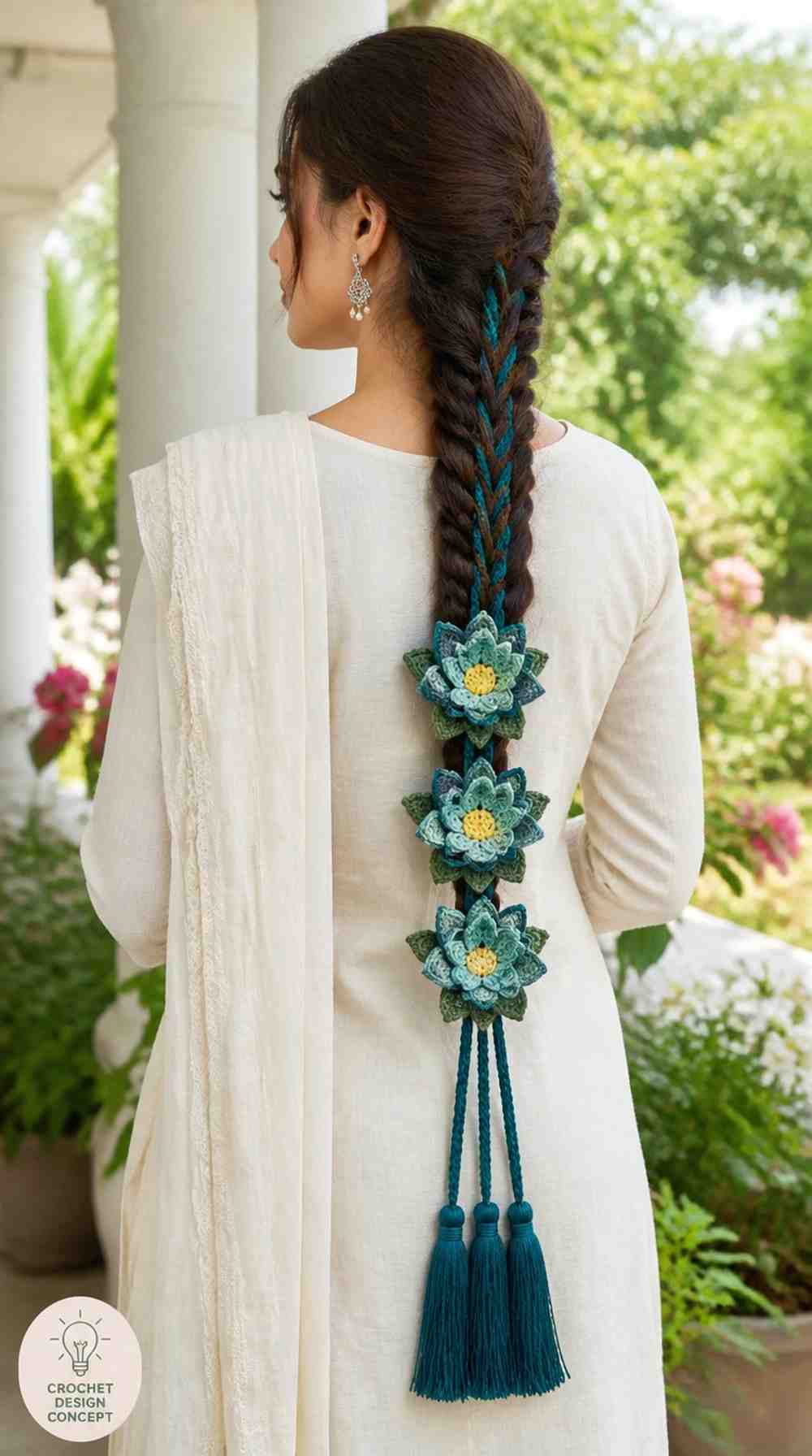
Three lotus-inspired crochet flowers give this teal parandi a distinctive floral silhouette. The blooms have layered pointed petals in muted aqua and deep teal, with small soft-yellow centers and seafoam-green bases. They sit together near the lower section of the braid, above three dark-teal tassels.
The upper hair remains mostly undecorated, allowing the layered lotus shapes to become the clear focal point. Their pointed petals create a different outline from rounded daisies or roses. A similar piece would require careful petal shaping so the flowers remain recognizable without becoming too stiff.
- Lotus Petal Layers: Pointed crochet petals should overlap neatly while remaining flexible enough to sit comfortably beside the braid.
- Lower Floral Group: Keeping the three flowers together creates a concentrated decoration rather than a full-length vine.
- Teal Color Contrast: Aqua and deep teal can distinguish the inner and outer petals while maintaining one coordinated palette.
- Smooth Tassel Finish: Plain dark-teal tassels balance the layered flowers without introducing unnecessary additional decoration near the ends.
9. Crochet Cherry Red Poppy Parandi
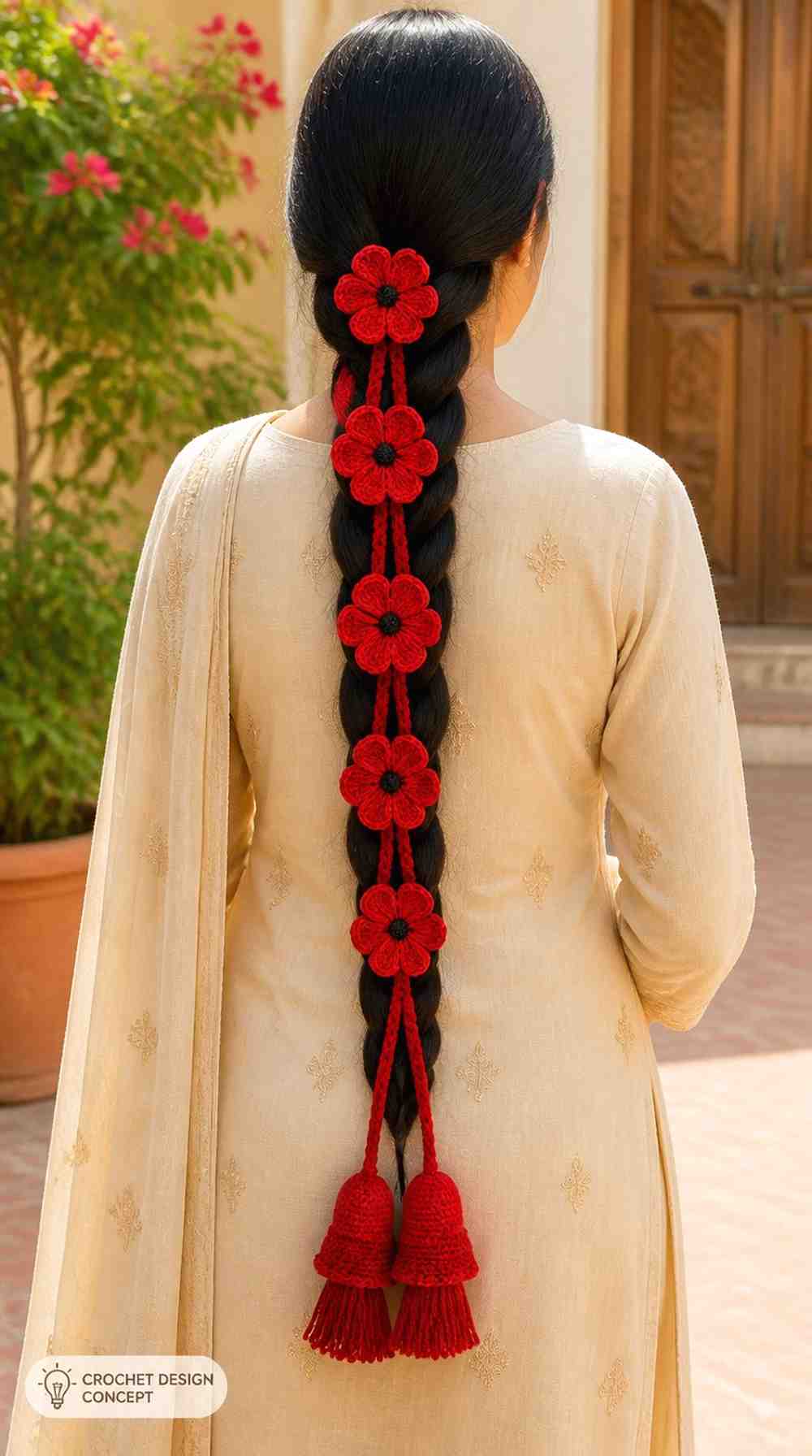
Five vivid cherry-red crochet poppies create a striking line along this parandi. Each flower has four broad flat petals surrounding a small charcoal-black center. The narrow red extension cords blend into the natural braid before continuing into three crochet bell-shaped tassel caps with short matching fringe.
The broad poppy petals give the accessory a graphic floral appearance without layered roses or leaves. Its capped tassels also create a more structured lower finish than ordinary loose yarn strands. Because the red flowers are visually prominent, their scale should remain balanced against the thickness of the braid.
- Four-Petal Poppy Shape: Keep the broad petals flat enough to reveal the charcoal center without overlapping one another excessively.
- Red Flower Placement: Five evenly spaced flowers create a clear descending arrangement while leaving sections of the natural braid visible.
- Bell-Shaped Tassel Caps: The crochet caps need stable construction so they maintain their curved shape without adding unnecessary weight.
- Bold Color Styling: Cherry red contrasts strongly with dark hair and suits outfits where the braid accessory is intended to be a prominent feature.
10. Crochet Powder Blue Forget Me Not Parandi
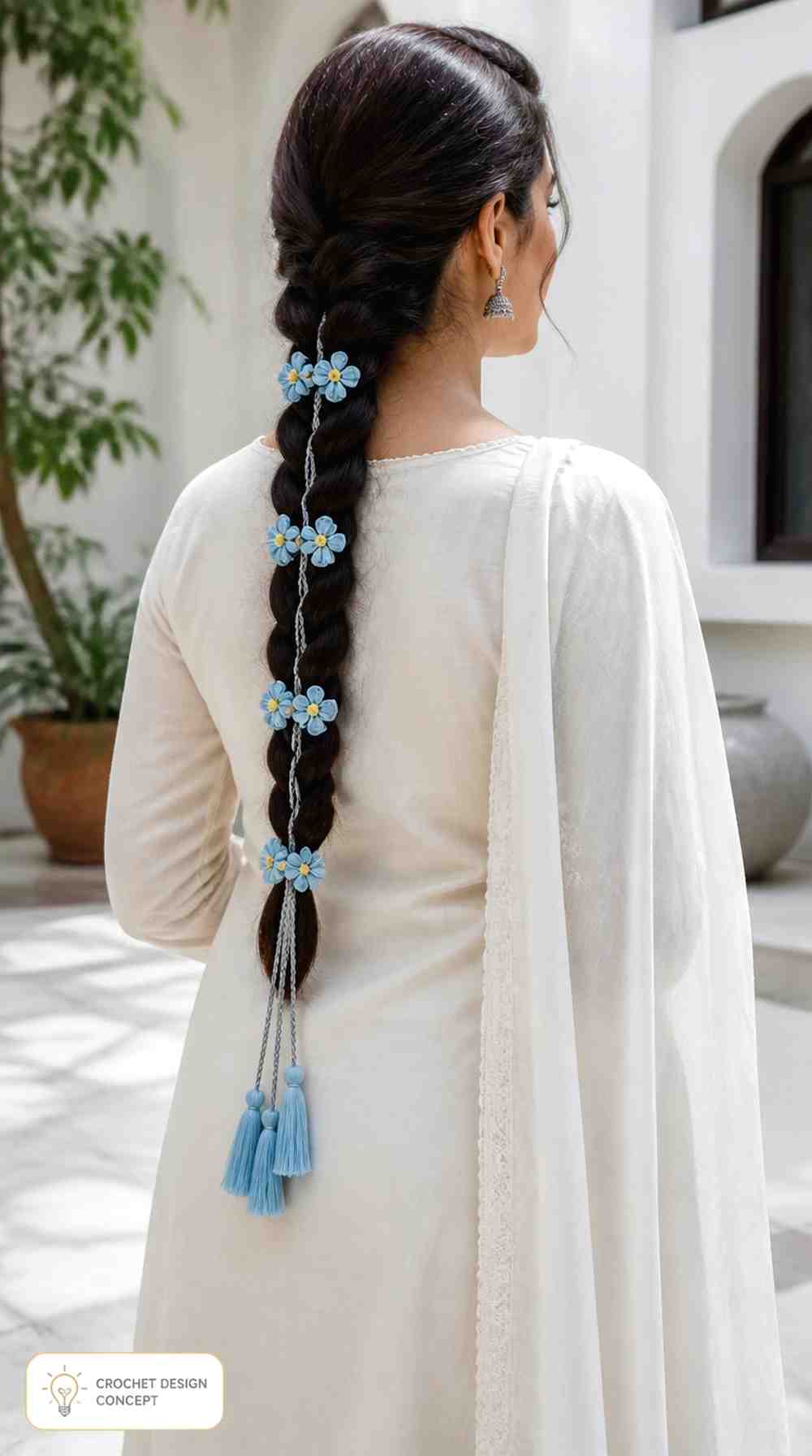
Tiny powder-blue crochet flowers give this parandi a delicate, almost scattered floral appearance. Twelve small five-petal blooms are organized into four groups of three, with pale-yellow centers and fine silver-gray crochet connections. Three compact icy-blue tassels finish the lower strands.
The grouped arrangement creates a different effect from single flowers placed at regular intervals. By leaving visible hair between each group, the design feels light and carefully spaced. The small scale also makes neat finishing especially important because loose yarn ends could interfere with the braid.
- Three-Flower Clusters: Grouping the blossoms in sets of three creates stronger visual detail than distributing every tiny flower separately.
- Silver-Gray Connections: Fine gray cords provide a quieter supporting color while allowing the powder-blue flowers to remain the focus.
- Miniature Stitch Definition: Use a yarn and hook combination that forms recognizable petals without creating loose, uneven loops.
- Compact Tassels: Short icy-blue tassels suit the petite floral scale and reduce the amount of fringe hanging below the hair.
11. Crochet Blush Sakura Branch Parandi
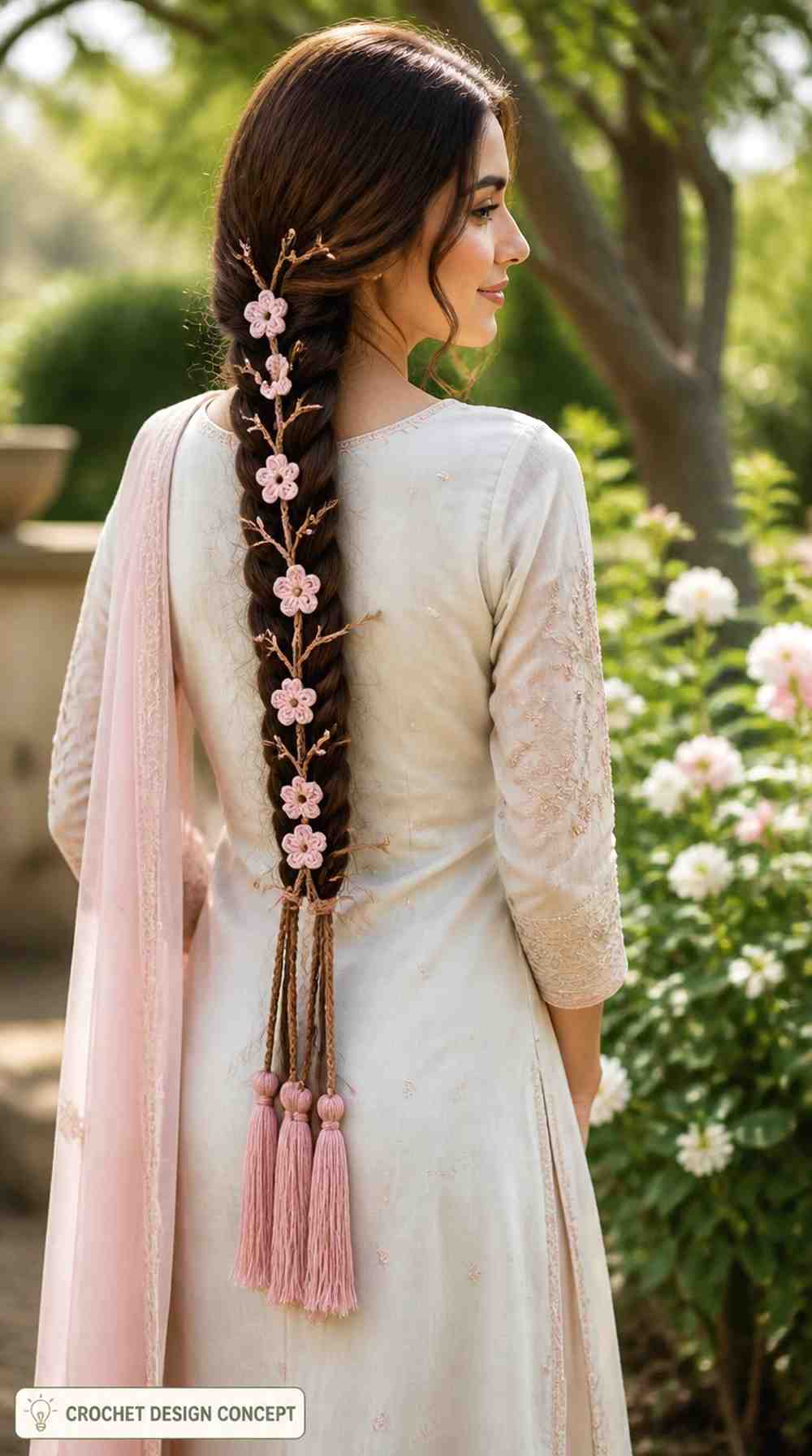
Pale-blush crochet flowers follow a delicate branch-inspired arrangement along this parandi. Seven small cherry-blossom-inspired motifs have five slightly pointed petals and tiny rose-pink centers, while slender warm-brown crochet cords form the connecting vine and two subtle twig offshoots.
The absence of green leaves gives this design a softer, more minimal botanical appearance. Three fine pink tassels finish the extension beneath the braid. The thin branching details make it important to keep the crochet joins smooth, particularly where the offshoots meet the main supporting cord.
- Pointed Petal Shape: Slightly pointed petals distinguish the blossom-inspired motifs from rounded daisies without requiring extra decorative layers.
- Branching Cord Placement: The two small twig offshoots should follow the exposed braid rather than projecting outward where they may catch.
- Brown and Pink Contrast: Warm-brown crochet cords create a natural branch-like effect while keeping the pale flowers visually prominent.
- Fine Tassel Length: Light pink tassels extend the delicate look, but their lower ends should remain manageable when walking or removing the accessory.
12. Crochet Cream Chamomile Tassel Parandi
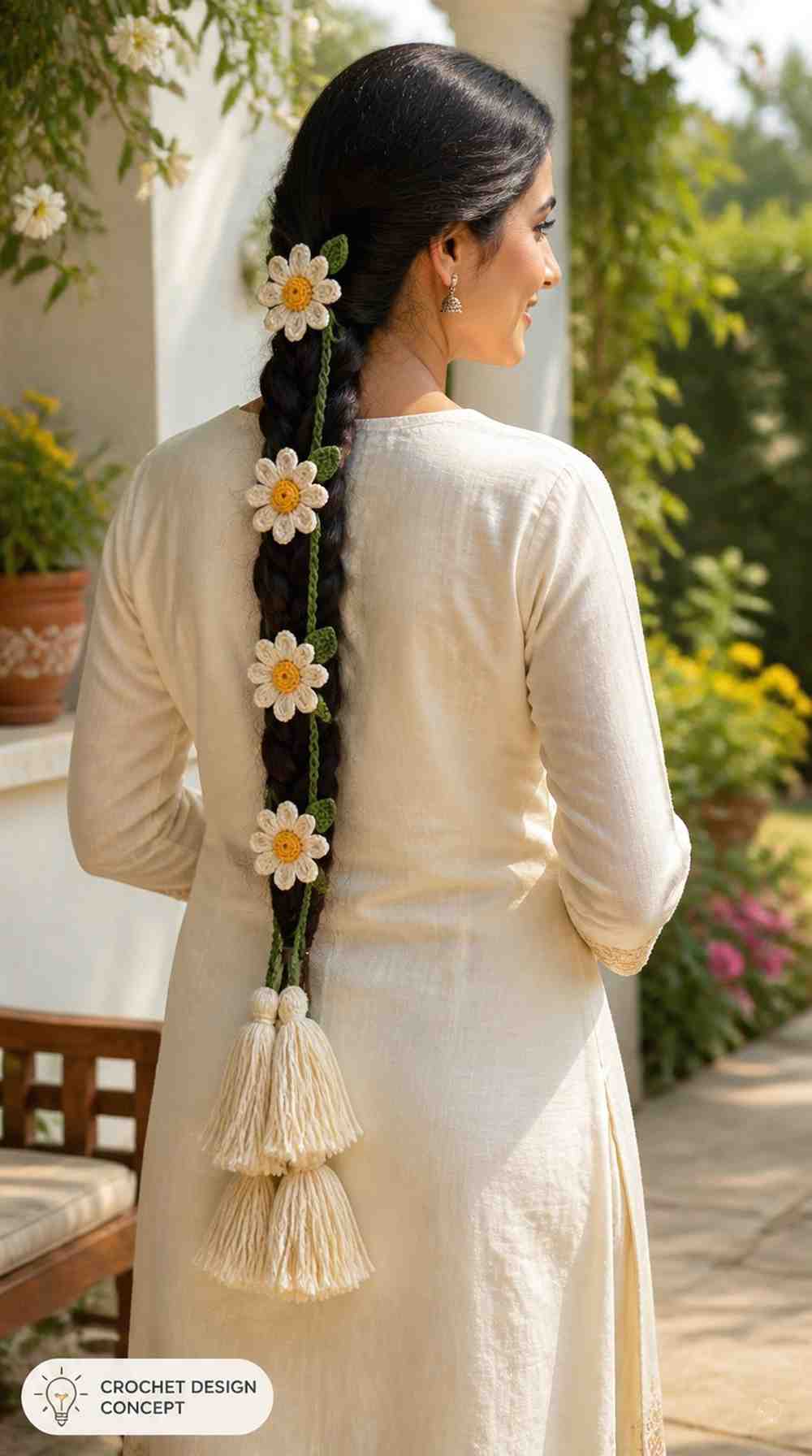
Four cream-white chamomile-inspired crochet flowers bring a gentle garden character to this parandi. Each bloom has eight narrow petals around a golden-yellow center, with tiny olive leaves beside the flowers. Three slim green cords support the design, ending in two visible levels of cream fringe.
The double-tier tassel finish makes this concept particularly distinctive. The shorter upper fringe sits above a longer lower tier, creating decorative movement below the braid. A handmade version would need to balance both fringe levels so they hang separately without becoming tangled or overly heavy.
- Chamomile Petal Scale: Eight narrow petals create a recognizable flower, but their tips need secure finishing to prevent curling or snagging.
- Four-Flower Spacing: Wider gaps between the blossoms help keep the arrangement light and emphasize the connecting olive cords.
- Double-Tier Tassels: Separate the shorter and longer fringe layers clearly so the lower finish retains its planned shape.
- Cream Yarn Maintenance: Pale fringe can become visibly dusty or tangled. Store it loosely and follow the yarn’s appropriate cleaning instructions.
13. Crochet Violet Orchid Spiral Parandi
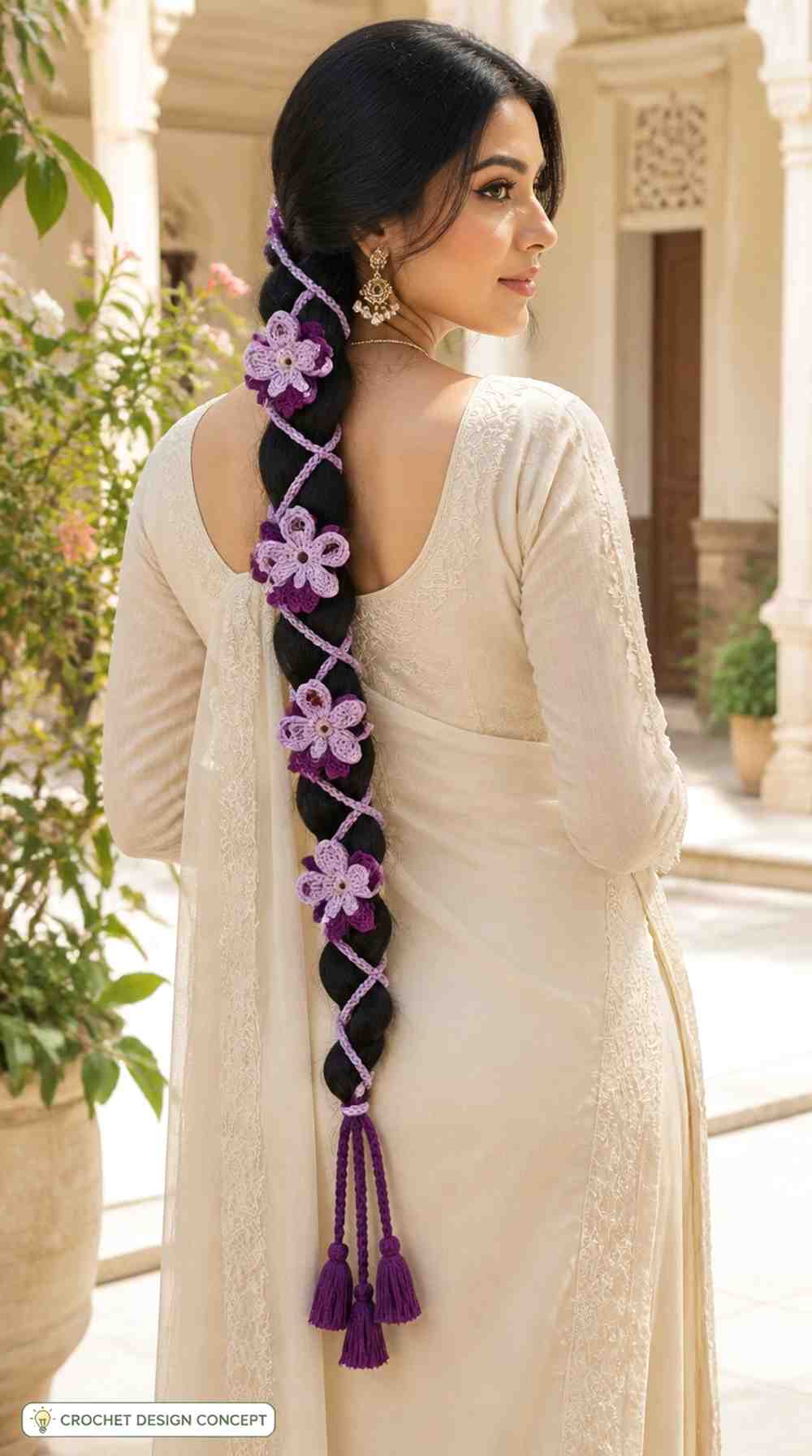
Four orchid-inspired crochet flowers give this violet parandi an unusual, elegant appearance. Each bloom combines three broad lilac upper petals, two smaller deep-violet lower petals, and a plum-colored center. A thin lavender crochet spiral follows the outside of the braid between the flowers.
The asymmetric flower placement makes the decoration more expressive than a simple straight floral chain. Three short violet tassels complete the lower extension. The spiral cord adds another level of detail, although its turns should remain loose enough to avoid pulling against the hair.
- Orchid-Inspired Petals: Different upper and lower petal sizes create the distinctive floral shape; keep their positions consistent across all four flowers.
- Spiral Cord Spacing: Allow the lavender spiral to travel along the outer braid without wrapping tightly around the natural hair.
- Asymmetric Arrangement: Position the flowers on the exposed side of the braid so their irregular shape remains visible.
- Violet Tassel Balance: Short plain tassels provide a restrained finish beneath the more detailed orchid motifs.
14. Crochet Sage Hydrangea Cluster Parandi
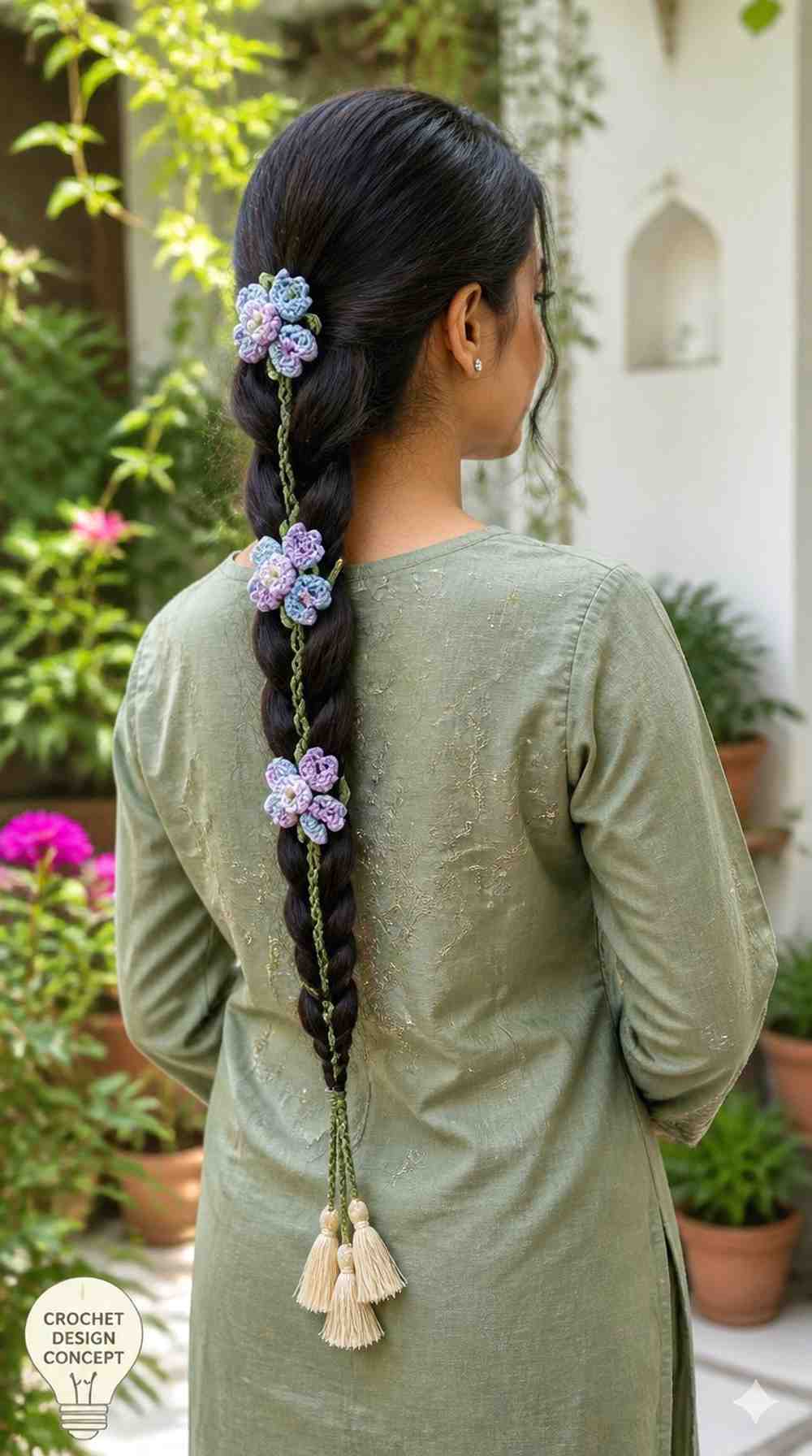
Small pastel crochet flowers create three rounded hydrangea-inspired clusters along this sage-green parandi. Each cluster contains four miniature four-petal flowers in pale lilac and powder blue, joined by short sage crochet stems. Generous sections of dark hair remain visible between the floral groups.
The clustered blossoms give the accessory a soft, rounded appearance without relying on one large flower. Three warm-cream tassels finish the green extension cords. Because each cluster contains several small elements, keeping the joins neat and the combined weight controlled would be especially important.
- Four-Petal Mini Flowers: Each blossom should remain recognizable within the larger group, with clear separation between neighboring petals.
- Three-Cluster Layout: Leave deliberate spaces between the rounded floral groups so the dark braid remains visible.
- Sage Stem Connections: Short connecting stems can hold the miniature motifs together, but they should not become thick or uncomfortable against hair.
- Pastel Color Balance: Alternate lilac and powder-blue blossoms within each cluster to distribute the colors rather than separating them into blocks.
15. Crochet Terracotta Zinnia Fringe Parandi
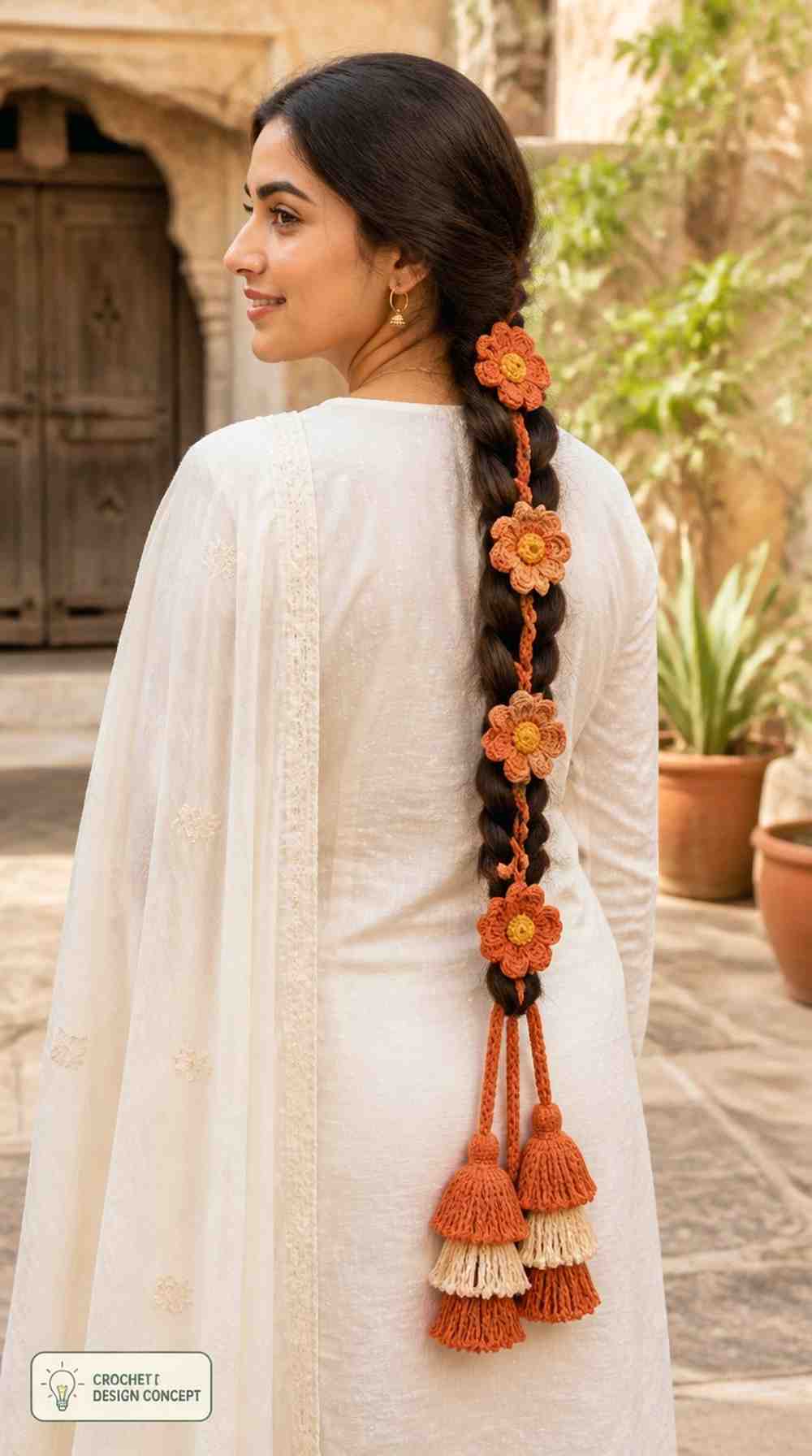
Warm terracotta, rust, and apricot create a rich floral palette in this crochet parandi. Four zinnia-inspired flowers descend along cinnamon-colored extension cords, each featuring two neat layers of short petals surrounding a small ochre center. The design finishes with terracotta tassels featuring two levels of copper and cream fringe.
The layered petals give the flowers a fuller appearance than simple flat daisies. At the lower end, the tiered fringe repeats the warm color combination while adding extra movement. This design would work best when the flower size and tassel weight remain proportionate to the braid.
- Layered Zinnia Petals: Two rounds of short crochet petals create texture without requiring the large raised forms used in some rose designs.
- Four-Flower Distribution: Space the flowers evenly along the visible braid so the dimensional motifs do not overlap or twist around the hair.
- Tiered Fringe Construction: Separate the copper and cream fringe levels clearly and keep the longest strands from extending excessively below the braid.
- Warm Yarn Palette: Rust, apricot, and ochre provide close tonal variation, making the shapes stand out without strong contrasting colors.
16. Crochet Champagne Magnolia Bridal Parandi
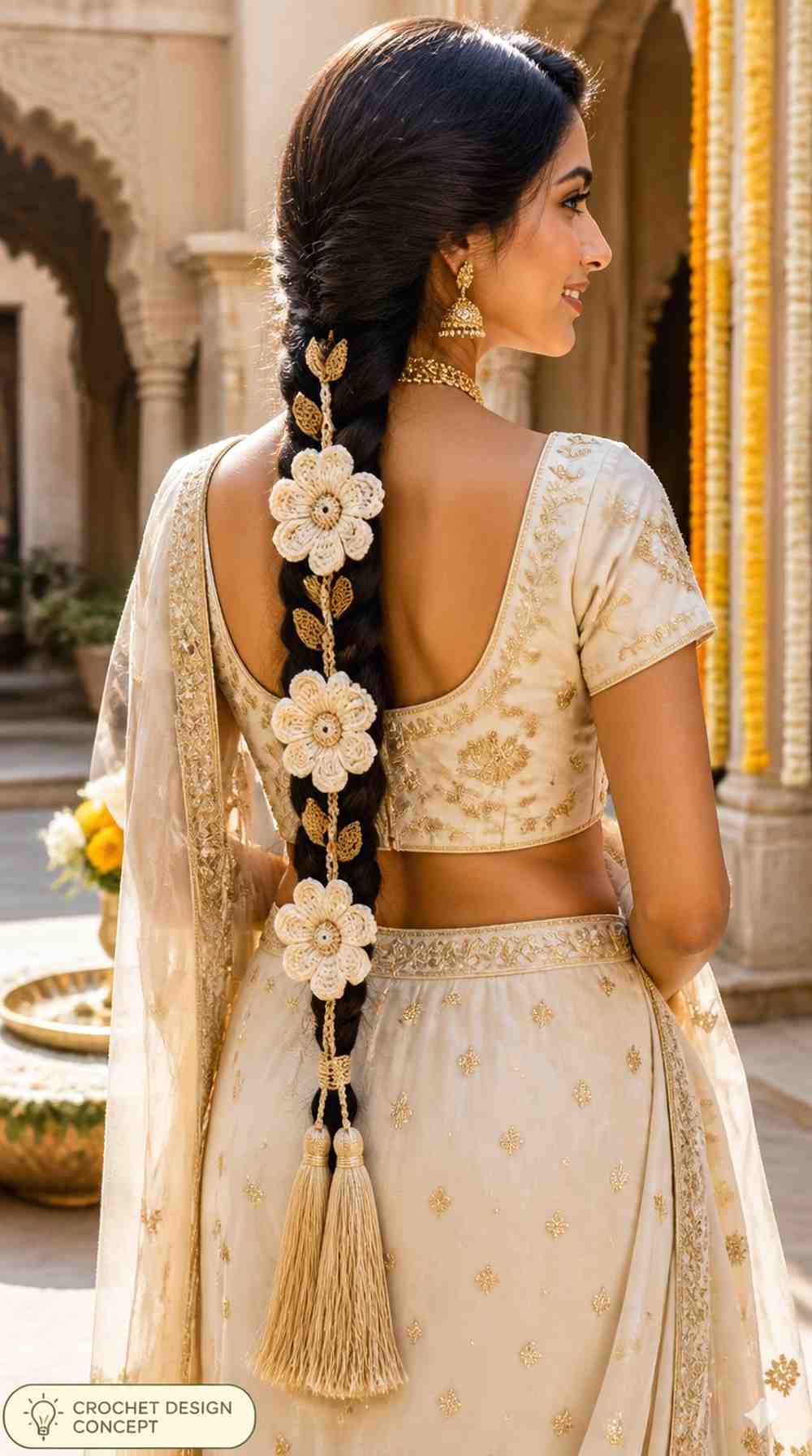
Three ivory magnolia-inspired crochet flowers create an elegant focal point along this champagne-colored parandi. Each bloom has five broad petals with gently curved edges and a pale-gold yarn center. Two small antique-gold crochet leaf accents appear between the flowers, while three smooth champagne tassels finish the extension.
The restrained floral arrangement gives the design a bridal-inspired appearance without heavy metallic chains or beads. Its ivory flowers stand out clearly against dark hair, while the beige cords provide a softer transition. A wearable version should focus on comfortable attachment, secure petals, and keeping the lower tassels light.
- Magnolia Petal Shape: Broad curved crochet petals should hold a recognizable outline without becoming excessively stiff or heavy.
- Champagne Cord Color: Warm beige cords provide a soft connection between the dark braid and the pale ivory flowers.
- Gold Yarn Accents: Small crochet leaf details offer subtle contrast without relying on hard embellishments that could catch in hair.
- Bridal Hair Comfort: Check the accessory’s weight, attachment, and movement before a long event, particularly if additional hair jewelry will be worn.
Practical Guide to Crochet Floral Parandi Hair Extensions
A crochet floral parandi is primarily a decorative braid accessory. The cords can extend beyond the natural hair to give the braid a longer appearance, but they do not add real hair length or permanently change the hairstyle.
Understand the braid arrangement. A traditional parandi typically incorporates three decorative strands into a natural three-strand braid. The cords travel alongside the hair and can continue below its ends. D’source provides a useful explanation of this traditional construction.
Choose lightweight crochet materials. Smooth yarn can help floral stitches remain visible while reducing unnecessary fuzz and loose fibers. The finished cords should bend comfortably and should not pull heavily on the hair.
Plan the flower placement before attaching motifs. Lay the accessory beside a braid or practice braid to see which sections remain visible. Flowers placed on the hidden side may disappear when the hair hangs naturally.
Keep attachments smooth. Finish yarn tails carefully and inspect the backs of flowers, leaves, and connecting cords. Avoid rough knots, sharp decorations, protruding wires, or exposed adhesive where they could catch in hair.
Avoid excessive tension. The parandi should be secured without pulling painfully at the scalp. If the hairstyle causes discomfort or traction, loosen or remove it.
Think about tassel length. Long tassels create dramatic movement, but they can catch on clothing, jewelry, or bag straps. Check the full accessory length while sitting and walking.
Store the flowers carefully. Place the parandi loosely in a clean pouch or box without crushing dimensional petals. Follow fiber-specific washing instructions, and let it dry completely before storing.
Want to Make Something Similar?
These video tutorials demonstrate crochet parandi construction and floral attachment. They are related resources, not exact patterns for the AI-generated designs above.
- Crochet Floral Parandi Tutorial by Sara’s Art Diary — Demonstrates a green connecting strand, crochet flowers, assembly, and tassel finishing. Useful for understanding how a floral cord-based parandi can be put together. YouTube
- Crochet Parandi with White Flowers by Radhe Radhe Divine Threads — Covers a parandi base, small crochet flowers, attaching the decoration, and finishing. Particularly relevant to the Ivory Jasmine Bud and Cream Chamomile concepts. YouTube
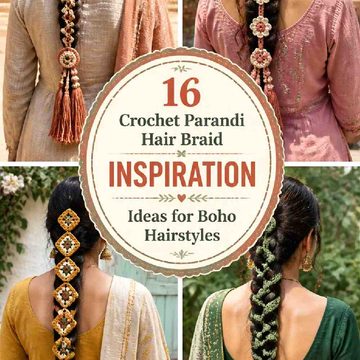
For a wider range of braid accessories, visit Yarn Nest Studio’s 16 Crochet Parandi Hair Braid Inspiration Ideas for Boho Hairstyles. That collection includes non-floral cord, fringe, and geometric concepts, whereas this article focuses on different flower shapes and arrangements.
Which Crochet Floral Parandi Should You Choose?
| Floral parandi | Main decorative feature | Styling direction | Key consideration |
|---|---|---|---|
| Golden Marigold Vine | Seven golden marigolds | Festive traditional | Flower weight |
| Ivory Jasmine Bud | Tiny blossoms and buds | Delicate everyday | Fine cord finishing |
| Dusty Rose Cluster | Three raised roses | Romantic occasion | Cluster attachment |
| Lavender Daisy Ladder | Six daisies on lace links | Soft pastel | Openwork snagging |
| Burgundy Spiral Rose | Four flattened spiral roses | Elegant evening | Dark color visibility |
| Peach Coral Blossom | Graduated peach flowers | Romantic pastel | Color sequence |
| Mini Sunflower Chain | Five small sunflowers | Cheerful festive | Raised flower centers |
| Teal Lotus Bloom | Three pointed lotus blooms | Artistic floral | Petal structure |
| Cherry Red Poppy | Bold flat poppies | Traditional statement | Tassel caps |
| Powder Blue Forget Me Not | Four tiny flower groups | Delicate minimalist | Small motif joins |
| Blush Sakura Branch | Seven blossoms on branches | Romantic botanical | Twig-shaped cords |
| Cream Chamomile Tassel | Four chamomile flowers | Natural garden | Double-tier fringe |
| Violet Orchid Spiral | Asymmetric orchids | Decorative evening | Spiral cord tension |
| Sage Hydrangea Cluster | Three mini-flower clusters | Soft botanical | Multiple attachments |
| Terracotta Zinnia Fringe | Layered rust flowers | Earthy festive | Tiered fringe weight |
| Champagne Magnolia Bridal | Three ivory magnolias | Bridal-inspired | Comfort during long wear |
For a subtle hairstyle, the Ivory Jasmine Bud Parandi or Powder Blue Forget Me Not Parandi would be attractive directions to explore. Their small motifs allow much of the natural braid to remain visible, although delicate joining work requires care.
For stronger floral decoration, consider the Golden Marigold Vine Parandi, Cherry Red Poppy Parandi, or Terracotta Zinnia Fringe Parandi. Their brighter flowers and distinctive tassels create a more noticeable accessory.
For formal styling, the Dusty Rose Cluster Parandi, Burgundy Spiral Rose Parandi, and Champagne Magnolia Bridal Parandi offer larger, more concentrated floral details. Check the combined accessory weight and how the flowers interact with the intended hairstyle.
Conclusion
Crochet floral parandi accessories offer a creative way to combine traditional Punjabi braid styling with handmade floral details. From miniature jasmine blossoms and delicate daisies to layered roses, sunflowers, and bridal-inspired magnolias, each design creates a different impression through flower placement, yarn color, and tassel finishing.
The best design is one that complements the braid rather than hiding it. Choose flower proportions that suit the hair, keep the supporting cords comfortable, and pay attention to the full length of the extension. Even a few carefully placed crochet flowers can make a braid look beautifully distinctive.
Which of these 16 floral parandi designs would you wear? Would you choose the golden marigold vine, the dusty-pink rose cluster, or the elegant ivory magnolias? Share your favorite flower and color combination in the comments.
Frequently Asked Questions
1. What is a crochet floral parandi hair extension?
A crochet floral parandi is a decorative hair accessory inspired by the traditional Punjabi parandi. It uses yarn cords that can be incorporated into a braid, often continuing below the natural hair to create a longer decorative finish. Crochet flowers, leaves, and tassels provide the visible ornamentation. It is not a permanent hair extension.
2. Can a crochet parandi make short hair look longer?
It can create the appearance of a longer braid because the decorative cords may continue beyond the natural hair. However, the result depends on having a suitable braid and a secure, comfortable attachment. Shorter hairstyles may require a different arrangement or a shorter accessory. Avoid pulling tightly on the hair to create extra length.
3. Which yarn is best for crochet parandi flowers?
Smooth, lightweight yarn or crochet thread can help small petals and leaves retain clear stitch definition. Cotton and suitable blends are worth considering, depending on softness, flexibility, and the finished accessory’s weight. Test a sample flower and cord together before making a full parandi, and avoid rough materials that catch on hair.
4. How can I stop crochet flowers from getting tangled in a braid?
Use smooth, neatly finished flower backs and securely fastened yarn ends. Keep open loops and protruding decorative parts to a minimum. Place flowers along the exposed side of the braid rather than burying their petals between hair strands. When removing the accessory, undo the braid gently instead of pulling the parandi out.
5. Are these floral parandi ideas suitable for weddings and festive events?
Many of the concepts could inspire special-occasion hairstyles, particularly the marigold, rose, zinnia, and magnolia designs. Comfort matters as much as appearance. Check the finished weight, attachment points, tassel length, and compatibility with any other hair jewelry. These are visual concepts, so their actual wearability has not been tested.