A crochet coffee table remote storage tray can give everyday living-room essentials a proper home without relying on ordinary plastic organizers. These 16 inspiration ideas explore low oval baskets, divided remote holders, textured rectangular trays, shallow scoop-front designs, and decorative finishes that look natural beside a sofa. From oatmeal and sage to teal, terracotta, navy, and blush, each concept combines a different crochet structure with an attractive coffee-table style.
Choosing a useful crochet tray means looking beyond its color. The compartments need to fit your remotes, the base should rest evenly on the table, and the walls must be firm enough to keep items contained without hiding their buttons. This collection helps you compare single-remote cradles, multi-slot organizers, portable trays, decorative outlines, and flexible designs before choosing an arrangement for your own living space.
These are AI-generated crochet design visualizations for inspiration, not photographs of tested handmade trays or step-by-step patterns. The pictured structures have not been physically tested for stability, strength, or protection of electronic devices.
Quick Design Selection Guide
- For two everyday remotes: The Crochet Oatmeal Twin Channel Remote Tray and Crochet Cream Rope Coil Remote Tray provide separate approaches to keeping a pair of remotes together.
- For several remote controls: Try the Crochet Sage Three Slot Remote Tray or Crochet Plum Three Bay Remote Organizer Tray when you want defined compartments.
- For easy access: The Crochet Terracotta Front Scoop Remote Tray offers a lowered front, while the Crochet Navy Ribbed Remote Cradle keeps one remote in a narrow resting channel.
- For decorative coffee tables: Compare the Crochet Ivory Scalloped Remote Valet Tray, Crochet Blush Petal Rim Remote Tray, and Crochet Rust Checkerboard Remote Valet Tray.
- For limited table space: The Crochet Charcoal Corner Remote Tray has a compact wedge shape, and the Crochet Mustard Hexagon Remote Tray gives a slim remote a more geometric resting place.
- For flexible arrangements: The Crochet Butter Yellow Foldflat Remote Tray and Crochet Teal Nesting Remote Tray Duo offer alternatives to permanent compartment layouts.
1. Crochet Oatmeal Twin Channel Remote Tray
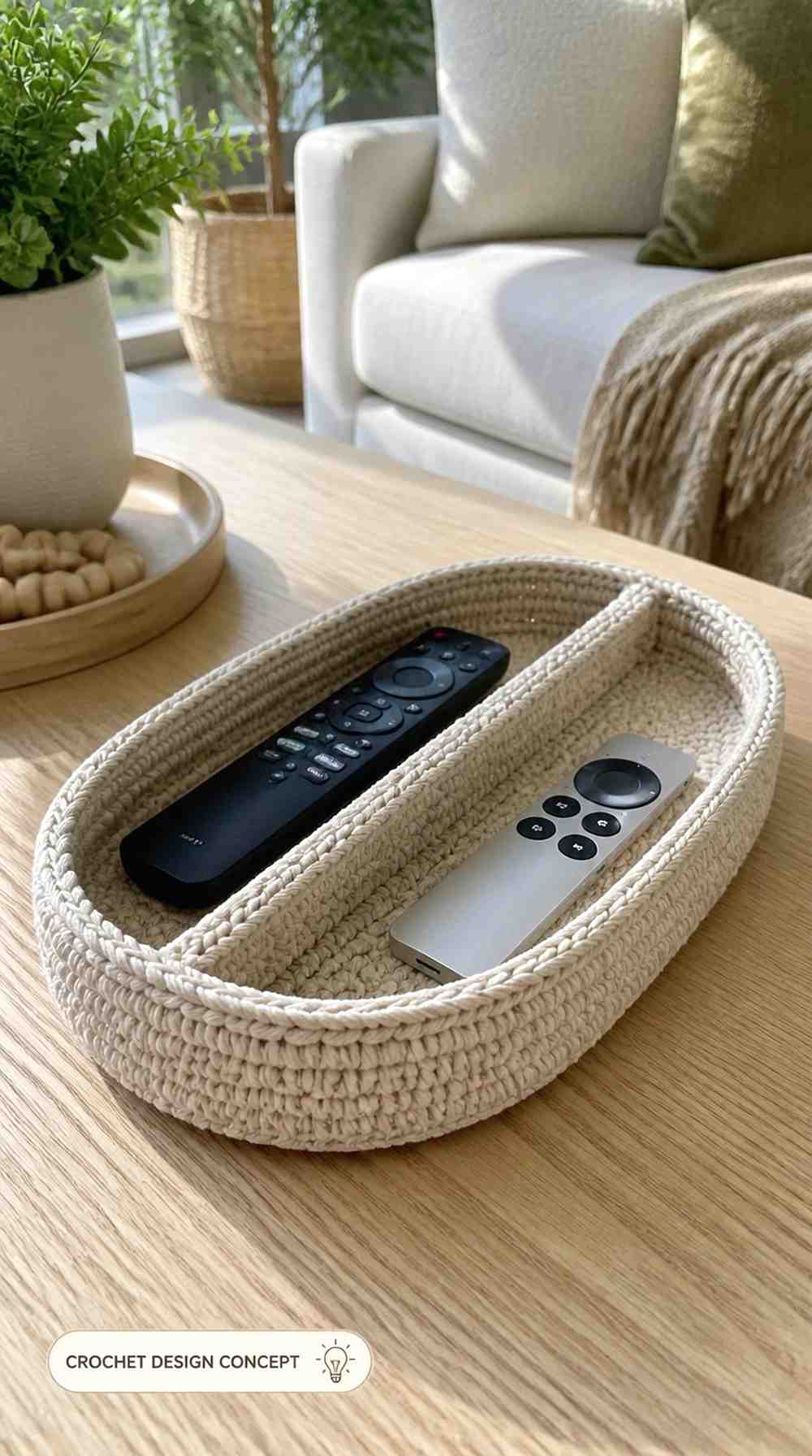
Soft oatmeal crochet gives this low oval tray a calm, natural appearance. A dense flat base supports two lengthwise compartments separated by one firm central divider, while the smoothly rolled rim defines its rounded shape. One black television remote and one slimmer silver remote rest separately inside.
The two-channel arrangement is particularly useful when different remotes are regularly used together. It keeps both visible without requiring tall pockets, although the divider should be positioned according to their actual widths rather than simply splitting the tray into equal halves.
- Central Divider: Adjust the two channel widths to suit your remotes, leaving enough room to lift them without pulling against the crochet.
- Rolled Upper Rim: A rounded edge gives the oval a neat finish, but it should not draw the tray walls inward.
- Flat Oval Foundation: Keep the base firm and level so both remotes rest securely without rocking or twisting the basket.
2. Crochet Sage Three Slot Remote Tray
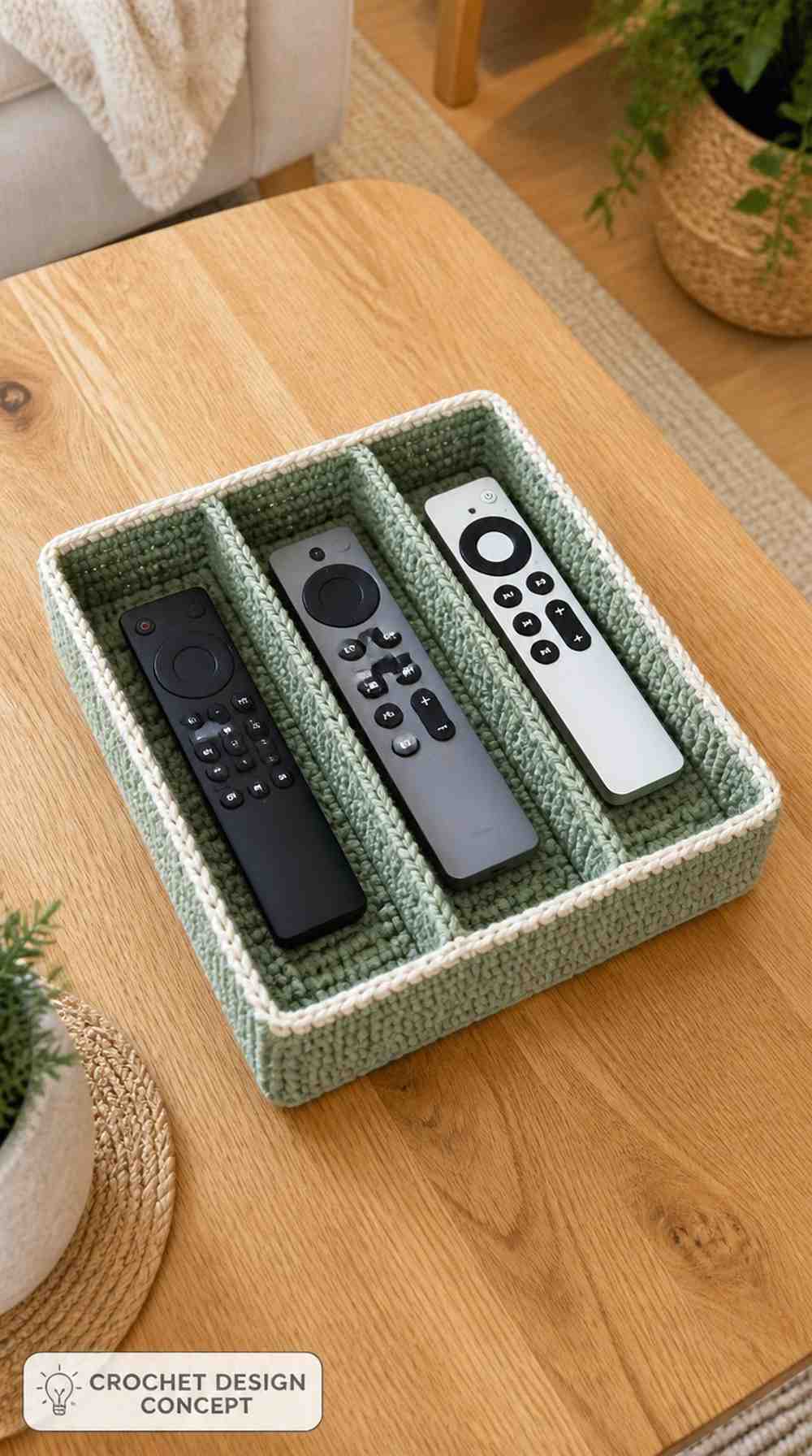
Sage-green crochet gives this rectangular tray a fresh, understated look. Two parallel dividers create three long compartments, each holding a separate black, grey, or white remote. Dense moss-style stitches cover the base and walls, while a narrow ivory border finishes the upper rim.
This design is useful for households with several devices controlled from the same seating area. Individual channels make each remote easier to identify and retrieve, but the tray needs enough overall width to accommodate three compartments without feeling crowded.
- Three Separate Slots: Measure each remote individually, since television, streaming, and audio remotes often have different widths and button arrangements.
- Parallel Dividers: Keep both dividers straight and securely joined to the base so the compartments don’t collapse into one another.
- Ivory Finishing Edge: The contrasting border clearly defines the tray opening while keeping the sage-green main structure visually simple.
3. Crochet Terracotta Front Scoop Remote Tray
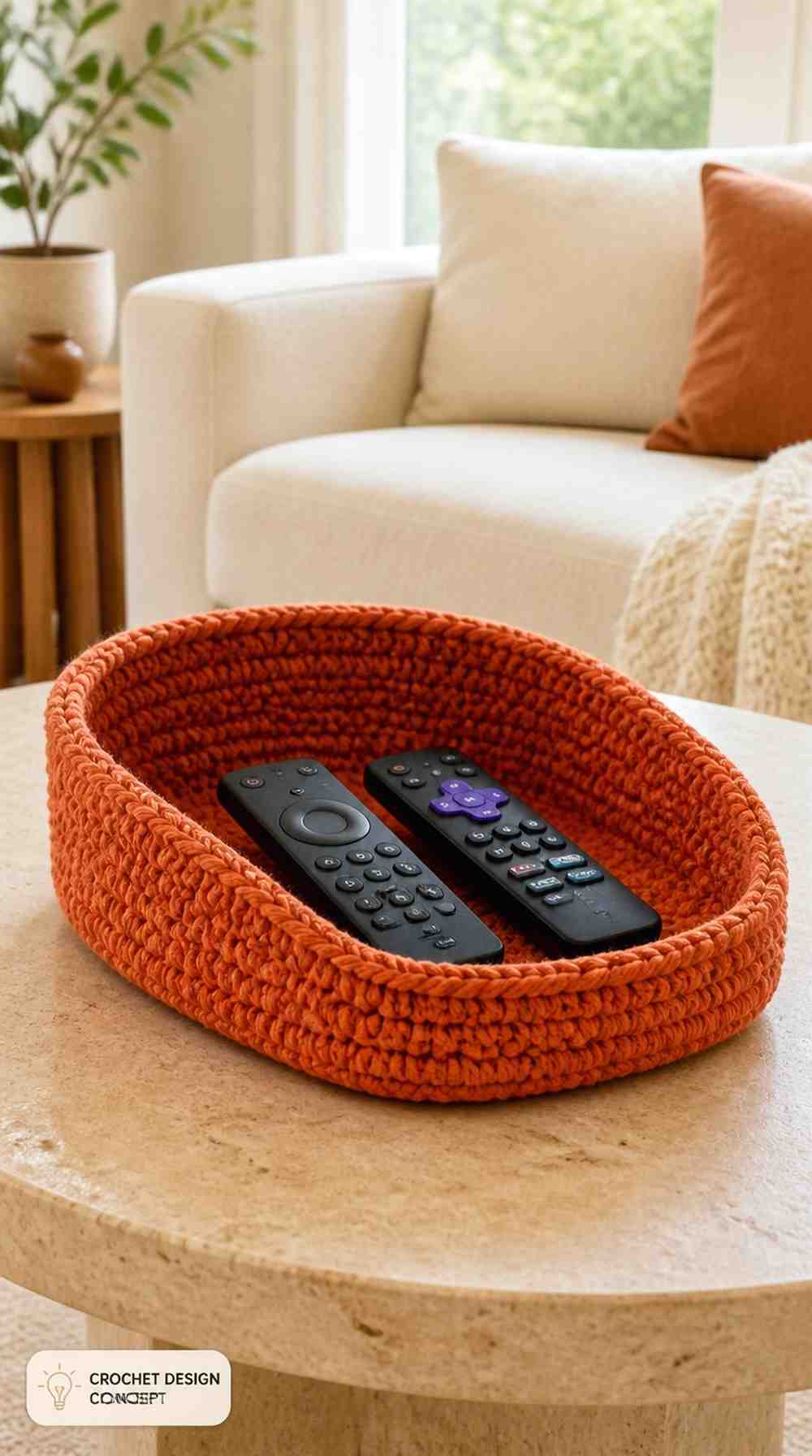
Warm terracotta crochet creates a broad oval tray with a noticeably lower front edge and a taller curved back wall. Two black television remotes lie parallel across the flat center, clearly visible above the shallow front opening. Smoothly sloping sides connect the different wall heights.
The scoop-front structure is intended to make everyday retrieval easier. Instead of reaching over a high rim, you can approach the remotes from the open front. However, the lower edge also offers less containment if the tray is moved or tilted.
- Lowered Front Opening: Keep the front edge low enough for easy access but high enough that remotes don’t slide forward during ordinary handling.
- Taller Back Wall: The raised rear section provides a visual boundary and can help keep the items within the intended storage area.
- Table Placement: Set this tray on a level surface rather than near the coffee table’s edge, where its low front would offer less security.
4. Crochet Navy Ribbed Remote Cradle
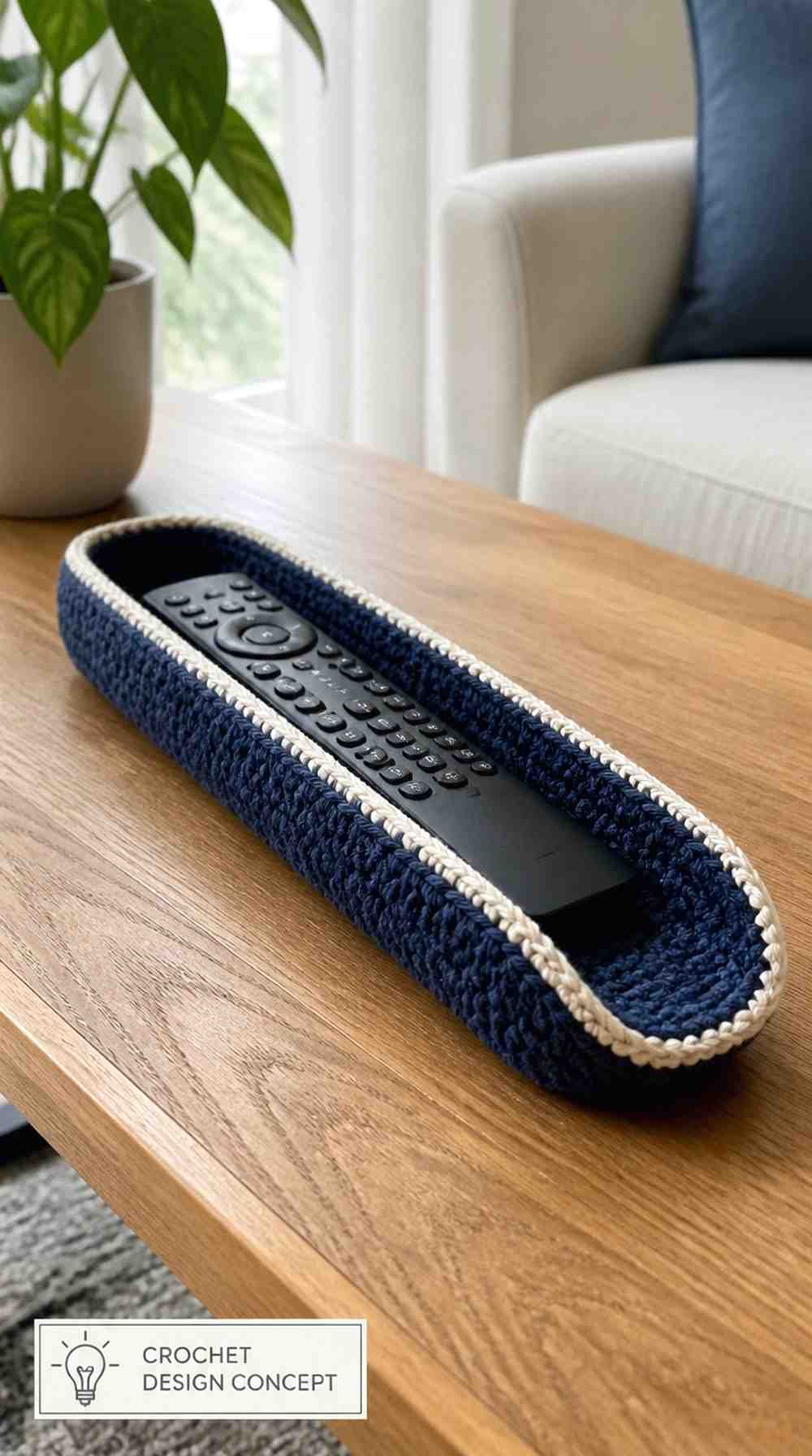
Deep navy crochet gives this single-remote holder a slim, modern appearance. Its long trough-shaped body has a flat center, low parallel side walls, softly rounded ends, and narrow ivory edging. Small horizontal ribs add texture along the exterior, while a black remote rests lengthwise inside.
The cradle is a good concept when only one remote needs a dedicated place. Its narrow shape takes up less table space than a multi-compartment tray, but the dimensions should fit the remote comfortably without squeezing its side buttons.
- Long Central Channel: Allow clearance around the remote so it can be removed easily without dragging against the side walls.
- Low Ribbed Walls: Keep the exterior ridges shallow and evenly worked so the holder doesn’t become bulky or irregular.
- Rounded Ends: Gentle shaping suits the elongated silhouette, while the finished interior still needs enough length for the remote.
5. Crochet Ivory Scalloped Remote Valet Tray
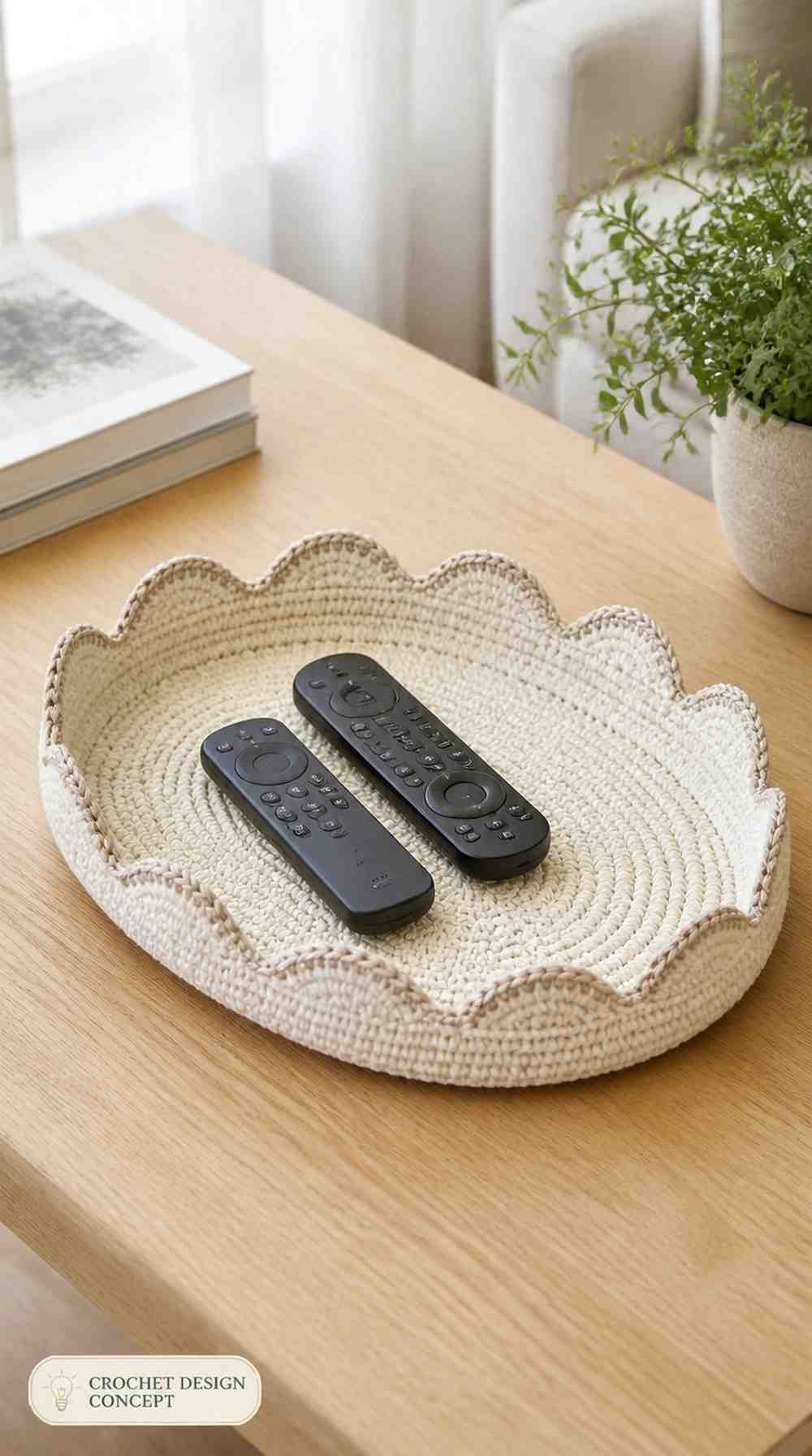
Warm ivory crochet gives this broad oval valet tray a soft traditional appearance. Eight rounded scallops decorate its low upper perimeter, each outlined with fine oatmeal stitches. Two charcoal-grey remotes sit side by side on the tightly worked central base.
The scalloped border brings a decorative finish to an otherwise simple organizer. Its main practical advantage is the generous flat center, where the remotes can remain fully visible. The outer curves should be kept low and properly shaped so they don’t curl inward.
- Eight Scalloped Sections: Space the scallops evenly around the perimeter, keeping the curves outside the main remote-resting area.
- Broad Oval Center: Compare the tray’s usable interior width with both remotes placed side by side before planning the decorative edge.
- Ivory Yarn Care: Pale crochet shows dust and spills more readily, so choose yarn with cleaning instructions suitable for a frequently used coffee table.
6. Crochet Mustard Hexagon Remote Tray
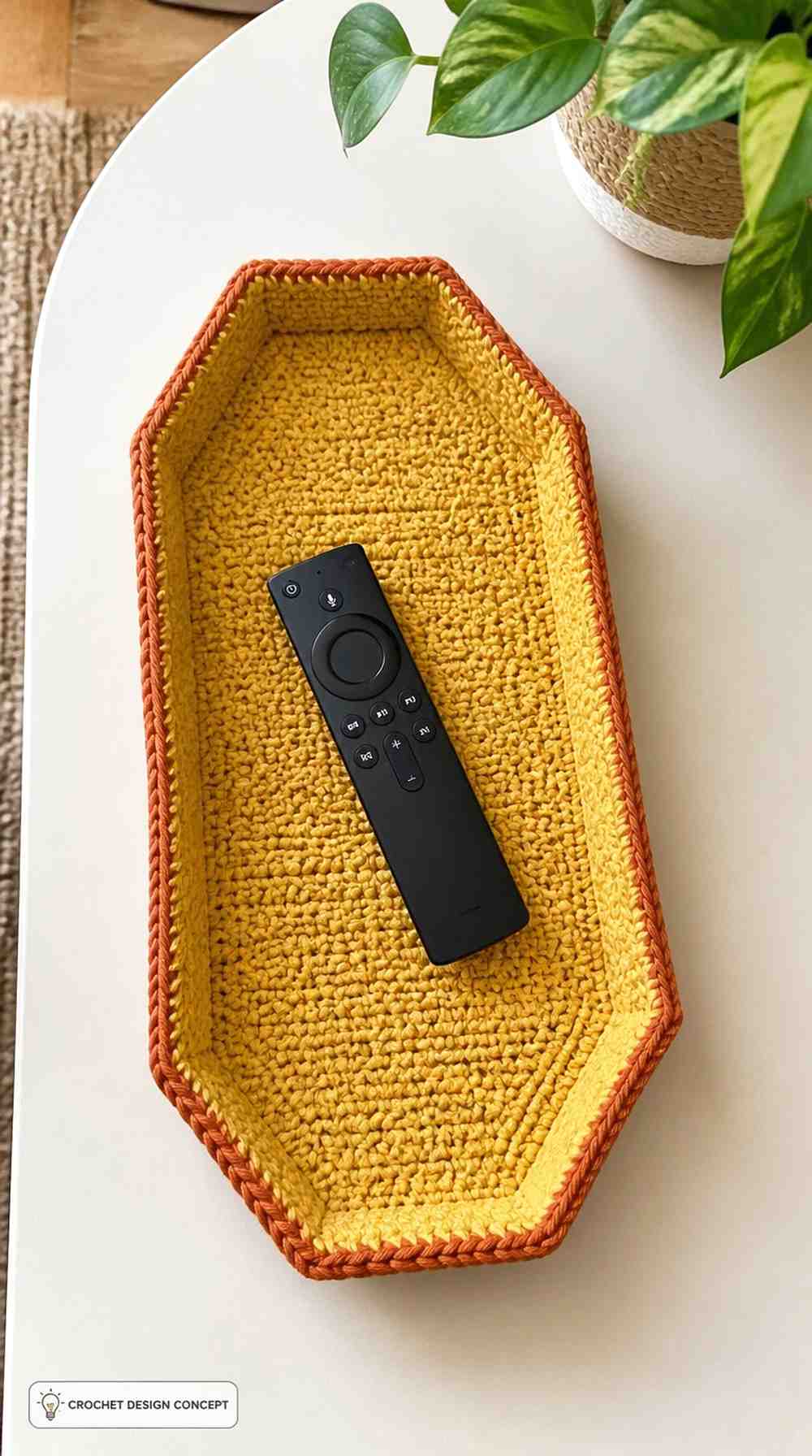
Mustard-yellow crochet forms an elongated six-sided tray with two long parallel edges and four shorter angled ends. Dense waistcoat-style stitches create shallow upright walls, and a slim burnt-orange border emphasizes the geometric outline. One black streaming remote rests diagonally across the flat center.
This design offers a more structured look than a conventional oval tray. Its six-sided shape works best when the remote fits comfortably inside without touching the corners, leaving enough room for easy lifting.
- Elongated Hexagon: Plan the long central section around the remote’s actual length instead of making a symmetrical hexagon with insufficient interior space.
- Angled Corners: Consistent increases and joins are important to prevent the six-sided outline from becoming distorted.
- Burnt-Orange Edge: A narrow contrasting rim highlights the geometry without adding bulky ornamentation along the storage opening.
7. Crochet Dusty Blue Split Remote Valet Tray
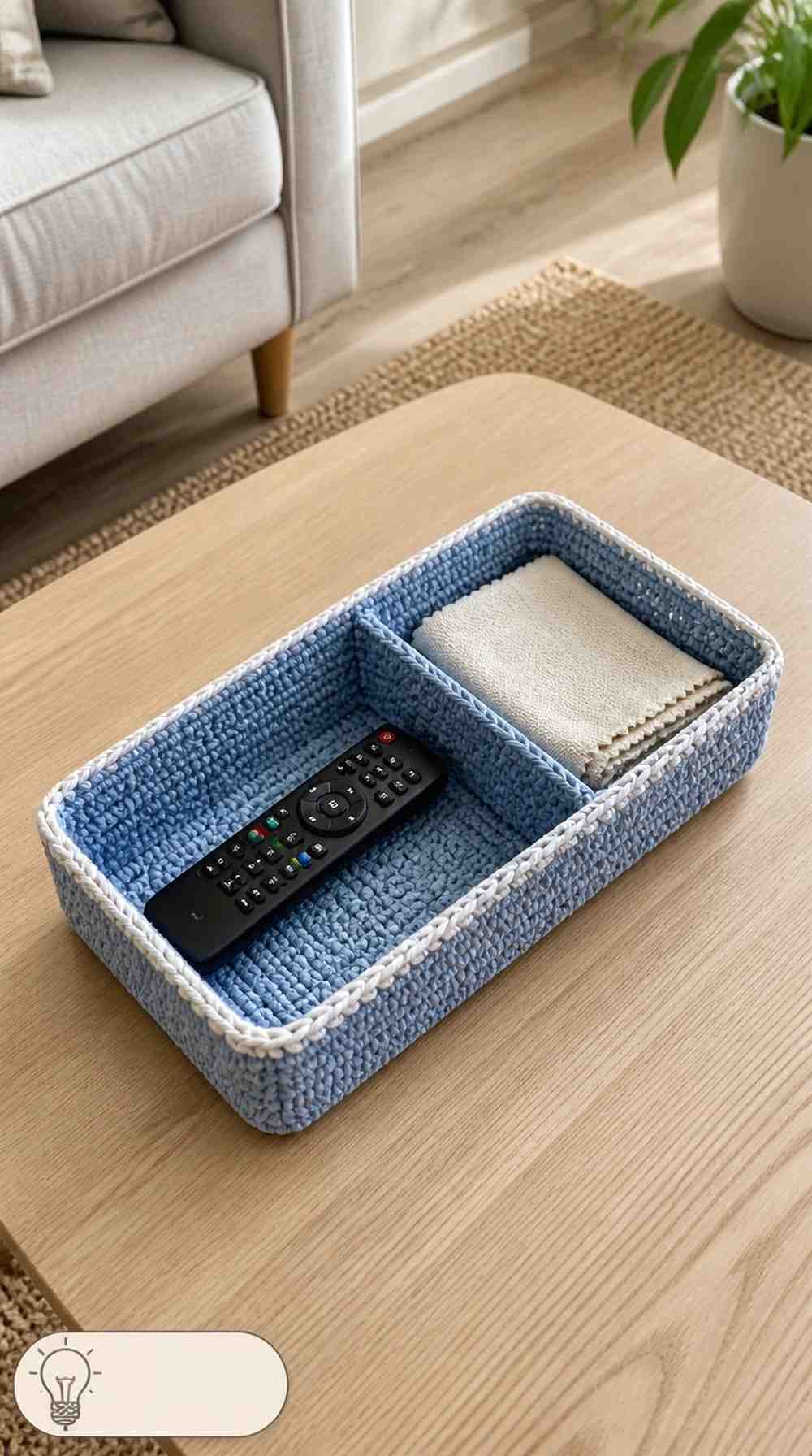
Dusty-blue crochet gives this rectangular organizer a clean, practical appearance. A transverse divider separates the long remote compartment from a smaller square section. A black television remote lies in the larger area, while an ivory microfiber cleaning cloth rests neatly folded in the other.
The split layout provides space for a remote and a small related accessory without mixing them together. It could suit a coffee table where a cleaning cloth is kept handy for screens or glasses, provided the cloth stays dry.
- Unequal Compartments: Give the remote the longer section and size the smaller compartment around the folded cloth rather than dividing the tray equally.
- Transverse Divider: A securely joined crosswise wall keeps both storage areas defined without requiring a full set of narrow slots.
- White Upper Border: The simple contrasting finish outlines the rectangular tray while maintaining its understated living-room appearance.
8. Crochet Olive Angled Remote Display Tray
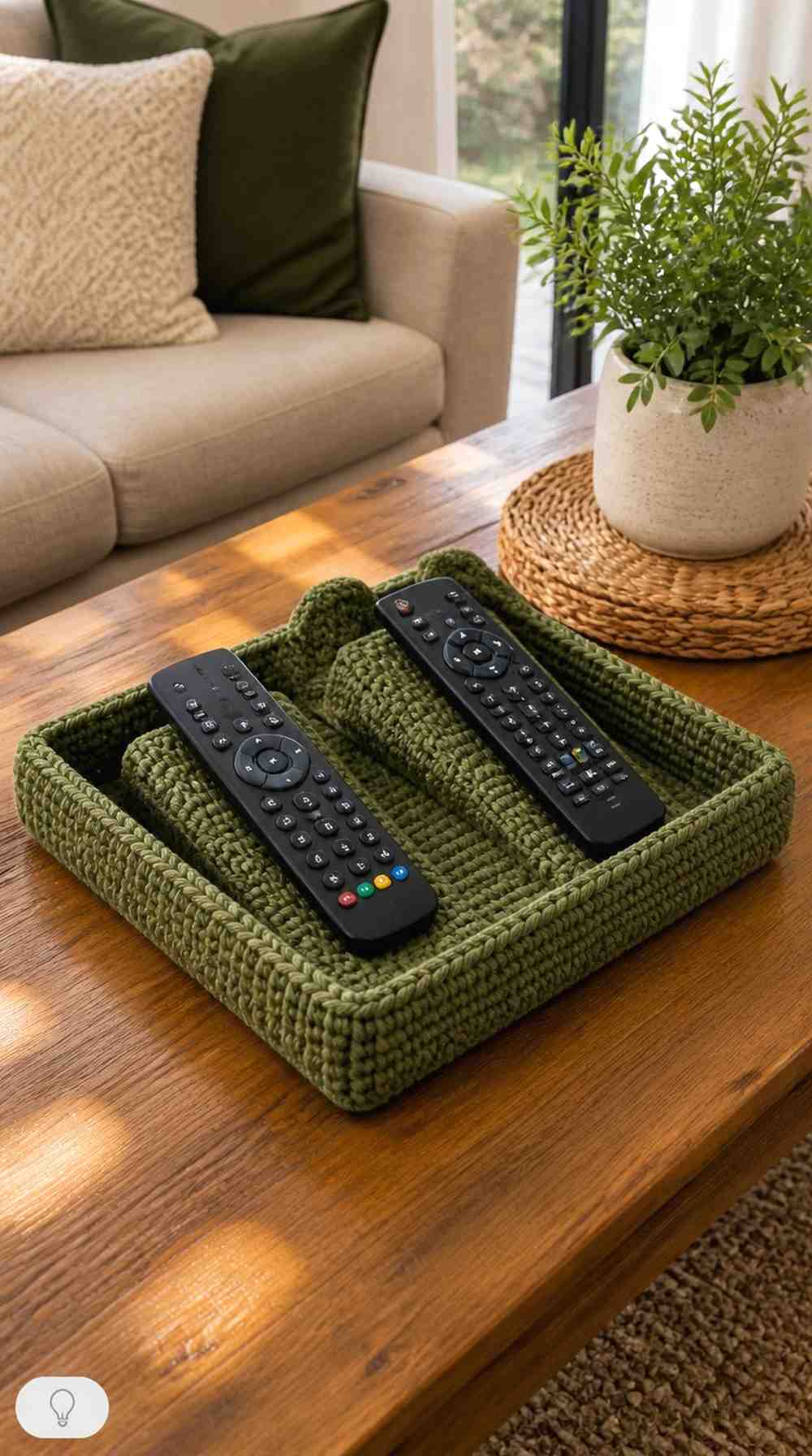
Olive-green crochet creates a structured rectangular organizer with two separate, gently inclined resting channels. Each contains a low padded support wedge, allowing a black remote to sit at a modest angle with its buttons visible. The tray has a flat base and low exterior walls.
The angled arrangement is intended to make the remotes easy to identify without stacking them. Its construction would require more planning than an ordinary flat tray, because the wedges must support the devices evenly without encouraging them to slide.
- Shallow Support Wedges: Keep the incline modest and stable, and test the actual remotes before relying on the angled position.
- Two Display Channels: Allow enough separation that one remote can be lifted without disturbing the other.
- Flat Lower Foundation: The outer tray should remain level on the table even though the internal resting surfaces are inclined.
9. Crochet Blush Petal Rim Remote Tray
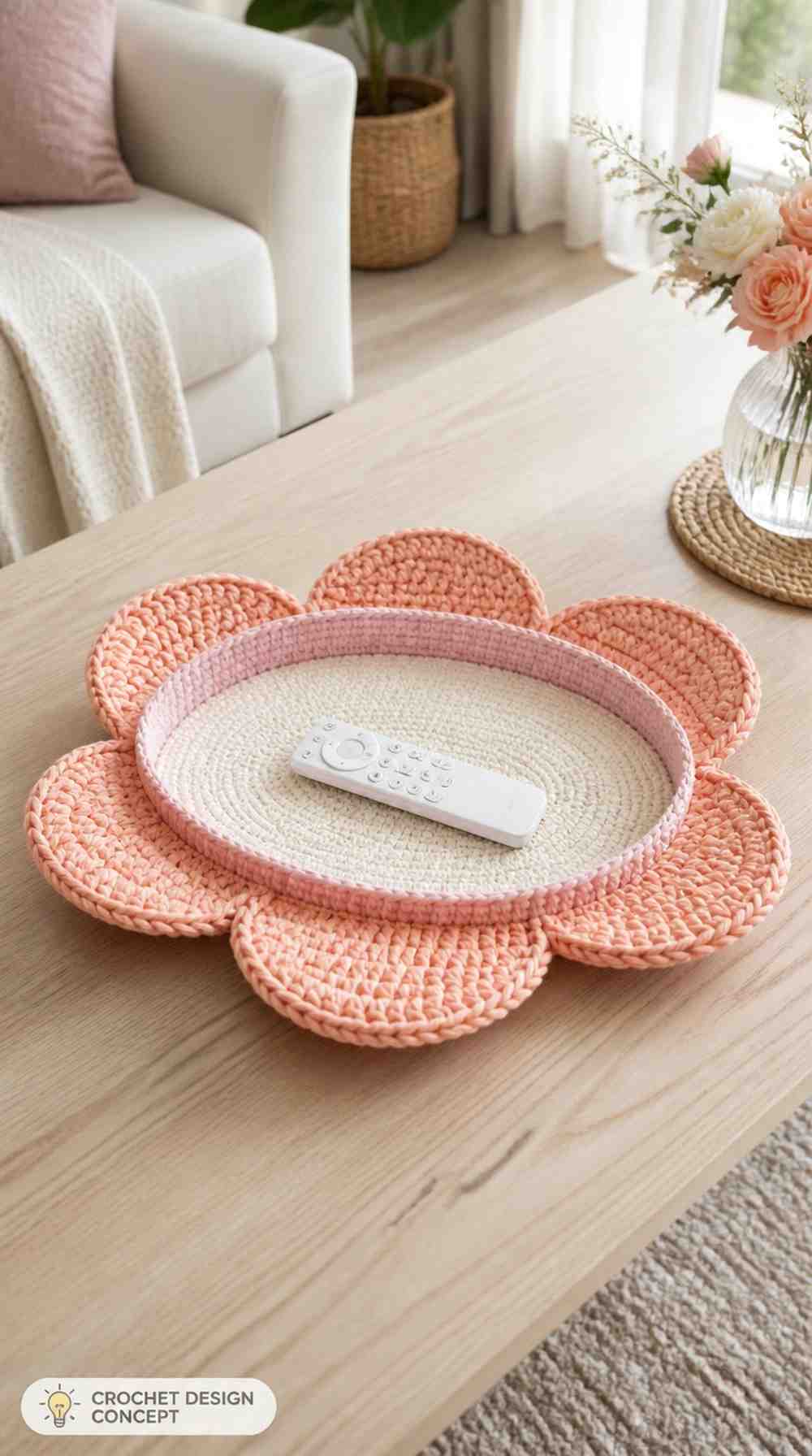
Soft blush and peach crochet give this oval tray a flower-inspired look. Six broad peach-pink petals surround a warm-cream central base, with a low continuous blush inner wall keeping one white television remote in place. The petals extend outward as a decorative rim.
This design is more expressive than a plain rectangular organizer. The main storage area is simple, but the full flower outline takes up extra table space. It is best considered for a visible coffee table where the decorative border can be appreciated.
- Six Joined Petals: Connect the panels securely to the inner structure while keeping their rounded edges flat against the table.
- Cream Storage Center: Size the central oval around the remote, not the overall width of the decorative petals.
- Extra Table Footprint: Leave enough surrounding space for the outer petals so they don’t extend beneath cups or other frequently moved objects.
10. Crochet Charcoal Corner Remote Tray
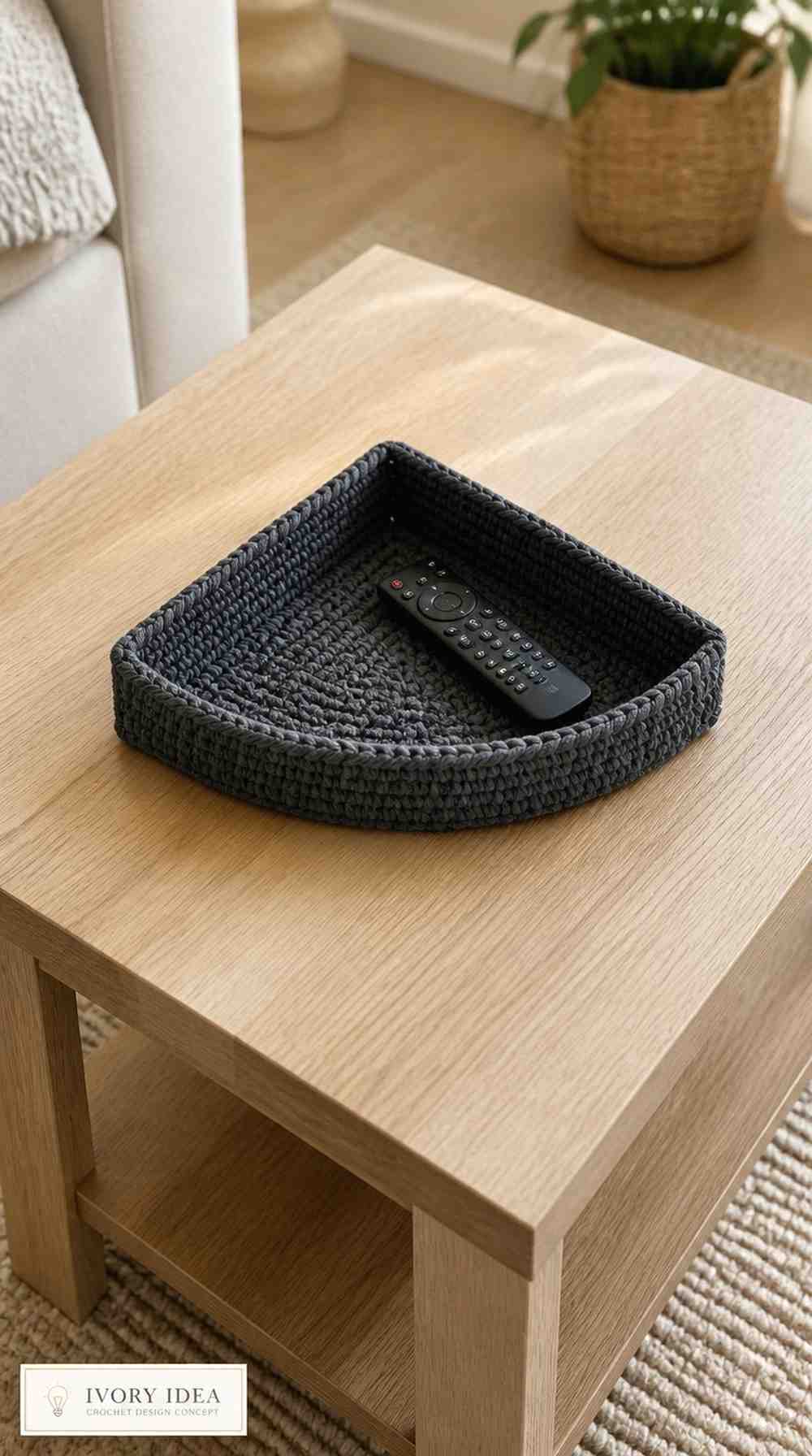
Charcoal-grey crochet creates a compact wedge-shaped tray with a triangular base and a defined right-angle rear corner. Two straight back walls meet behind a softly curved front opening, while dense waistcoat-style stitches keep the low sides visually structured. One black remote rests diagonally inside.
The triangular shape makes this concept interesting for a quiet corner of a rectangular coffee table. It still needs enough diagonal space for the remote, and the basket should sit fully on the tabletop rather than overhanging an edge.
- Right-Angle Corner: Match the rear sides to the intended placement while maintaining a flat triangular foundation.
- Curved Front Edge: The softened front opening offers easier access than a sharp triangular point facing the seating area.
- Diagonal Remote Fit: Check the longest usable interior dimension before deciding whether the triangular tray suits your particular remote.
11. Crochet Cream Rope Coil Remote Tray
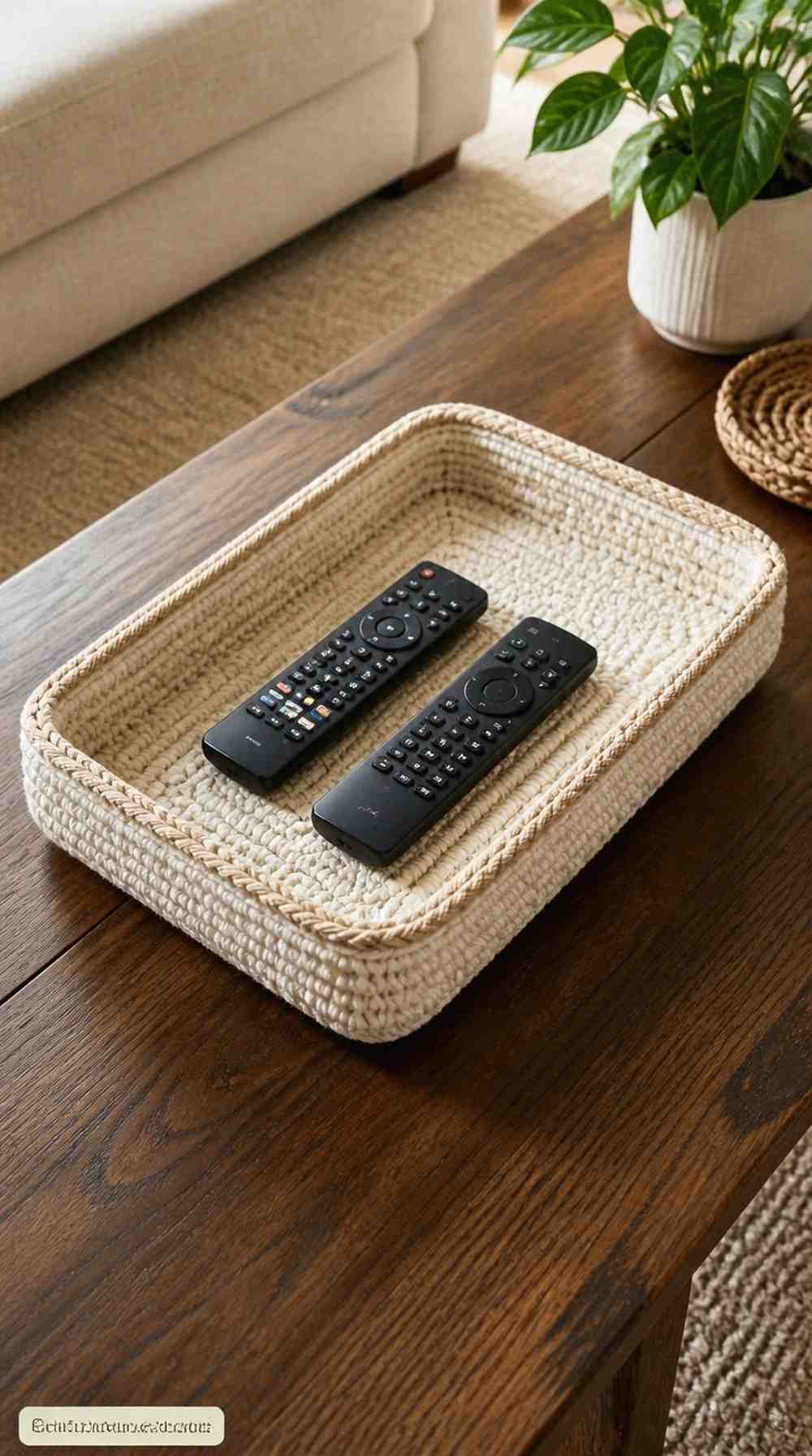
Warm-cream crochet forms a low rectangular storage tray with thick rope-like horizontal stitch rows, gently rounded corners, and a narrow sand-beige upper edge. Two black remotes rest side by side on the broad, densely worked base.
The textured side walls give this concept a substantial handmade appearance without relying on decorative motifs. Because the walls are relatively thick, the finished tray needs a generous interior area. Overly bulky stitches could reduce usable space or make the shape harder to maintain.
- Rope-Like Crochet Rows: Dense horizontal texture can give the sides visual structure, but actual firmness depends on yarn and tension.
- Rounded Rectangle: Softly shaped corners keep the tray from appearing too boxy while preserving a broad central compartment.
- Interior Width: Account for thick wall fabric when planning a tray intended to hold two remote controls side by side.
12. Crochet Seafoam Cutout Handle Remote Tray
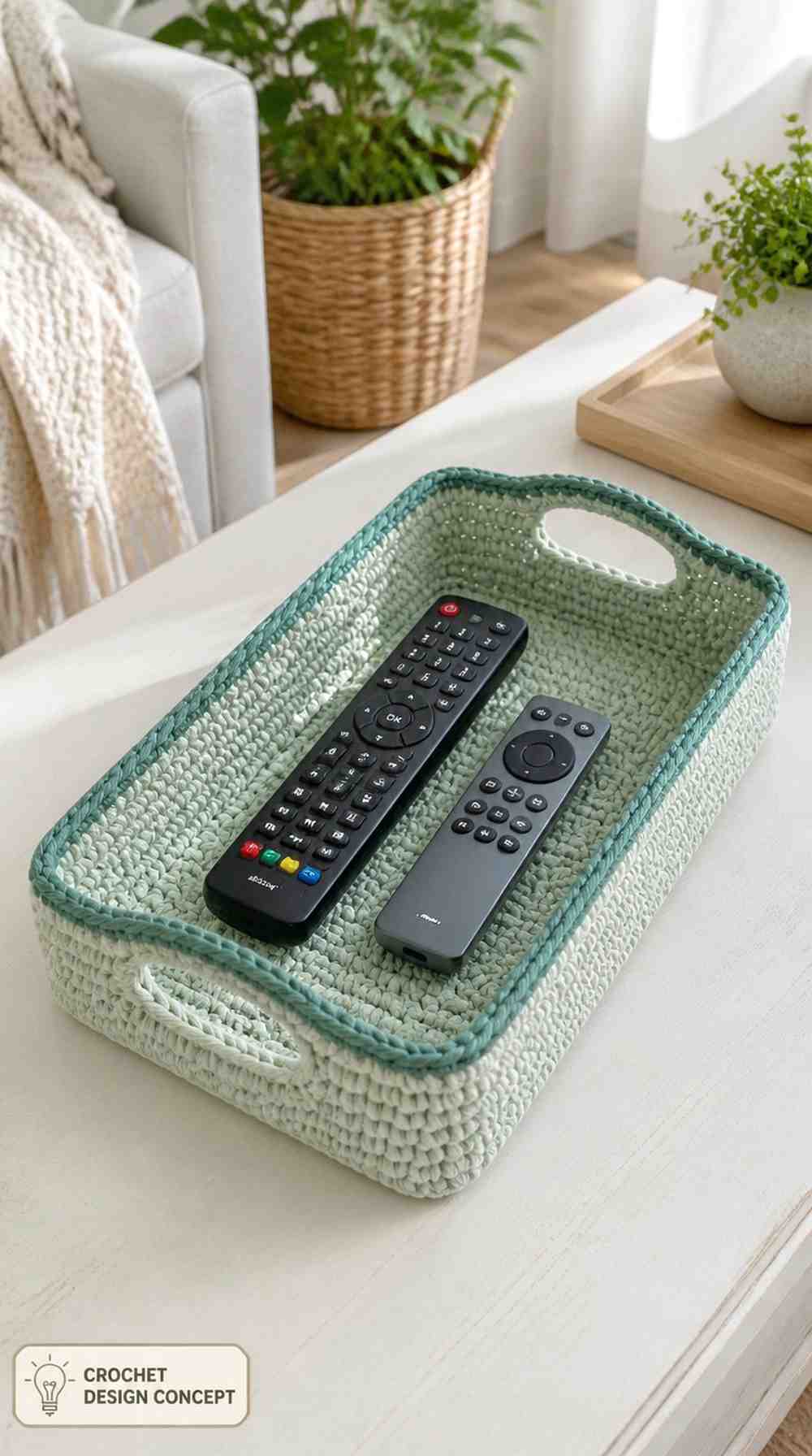
Fresh seafoam-green crochet gives this rectangular tray a light coastal appearance. Straight low walls rise from a closely stitched base, while oval cutout handles sit at the shorter ends. A narrow teal border finishes the opening, and two remotes—one black and one grey—rest parallel inside.
The integrated handles make this concept different from trays designed to remain in one position. They could be convenient when moving the organizer between a coffee table and a nearby shelf, provided their openings and surrounding stitches are securely constructed.
- Oval Cutout Handles: Reinforce the openings and keep them large enough for fingers without weakening the short end walls.
- Parallel Remote Placement: Arrange the remotes so neither blocks access to the handles.
- Teal Finishing Rim: A firm border can help the upper edge retain its rectangular outline despite the two handle cutouts.
13. Crochet Rust Checkerboard Remote Valet Tray
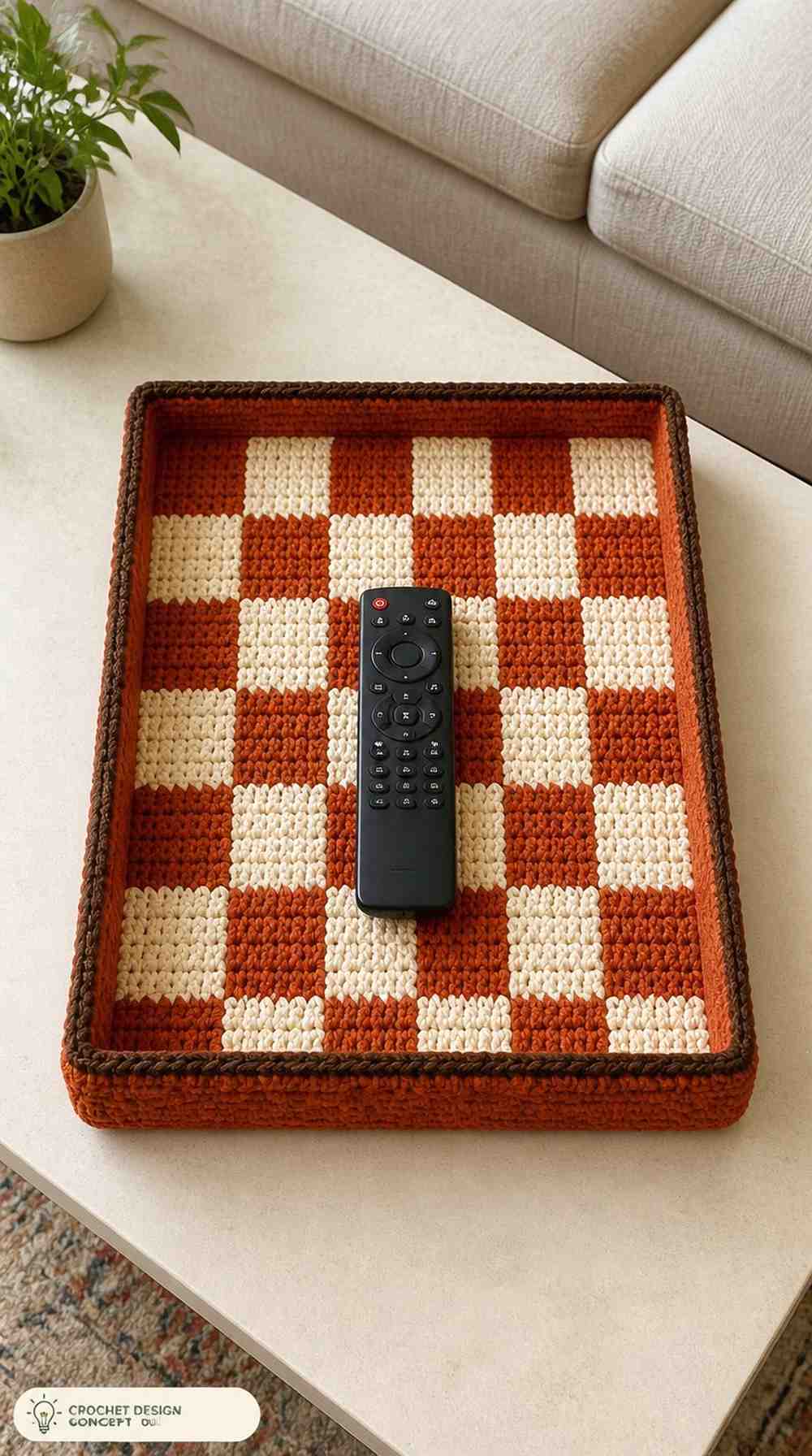
Alternating rust-orange and warm-cream squares give this crochet tray a lively checkerboard base. The four-by-six colorwork pattern sits inside short rust-colored side walls, with a narrow chocolate-brown rim completing the rectangular structure. One black remote lies lengthwise across the center.
The patterned foundation provides decoration without adding separate embellishments that might catch beneath the remote. Flat joins are especially important for this design, since raised seams could make the device rest unevenly.
- Four-by-Six Colorwork: Keep the individual crochet blocks even so the checkerboard remains rectangular rather than pulling toward one side.
- Flat Joining Seams: Avoid bulky knots beneath the remote, where uneven fabric could affect stability.
- Dark-Brown Rim: The border gives the warm checkerboard a defined edge without interrupting the flat central storage surface.
14. Crochet Plum Three Bay Remote Organizer Tray
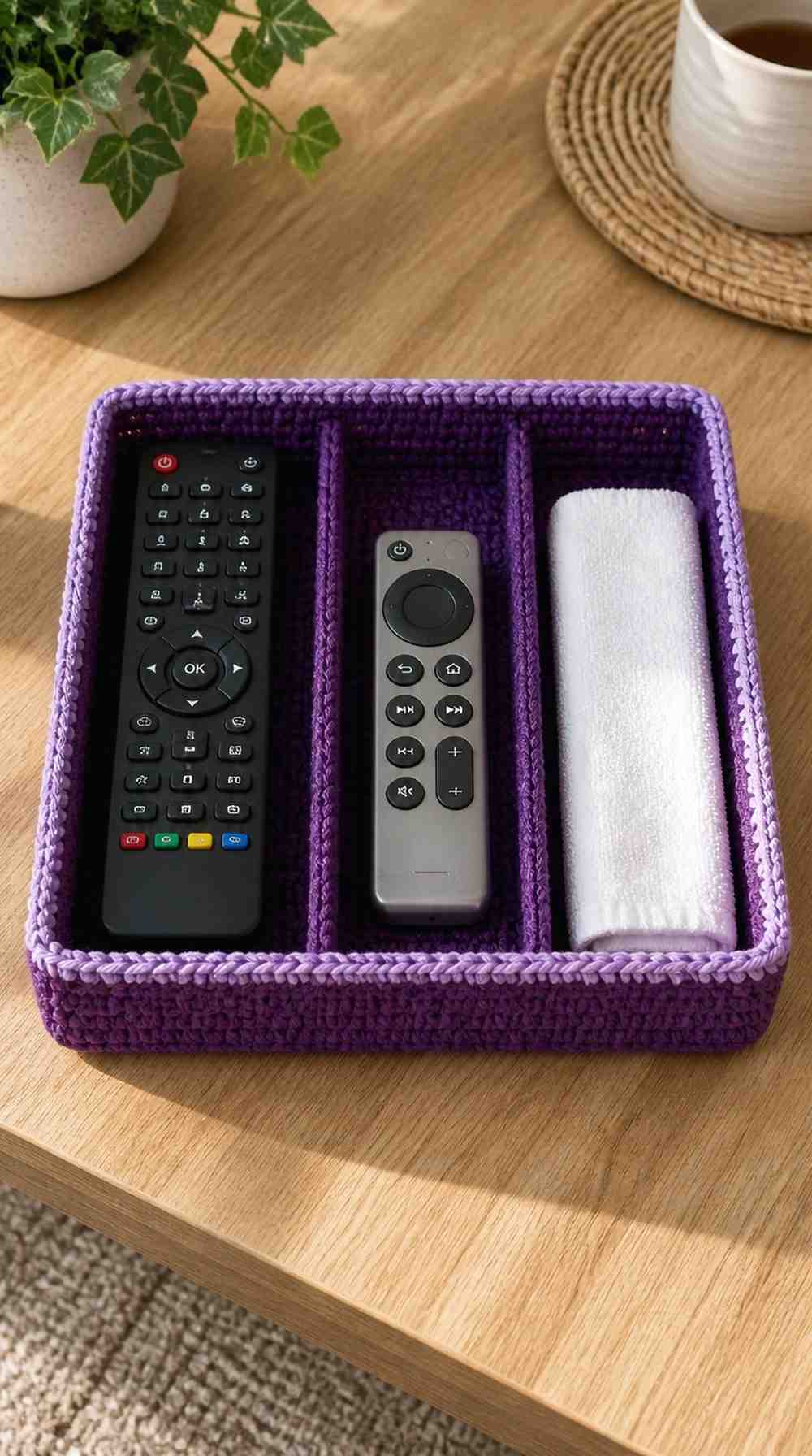
Rich plum-purple crochet gives this wide rectangular organizer a more tailored appearance. Two internal dividers create three compartments of different widths. A long black television remote occupies the widest section, a grey streaming remote sits in the middle, and a folded white microfiber cloth rests in the narrowest section.
This design brings several small entertainment essentials into one organized space. The unequal compartments are especially useful when accessories have different dimensions, although the dividers should remain low enough to allow easy retrieval.
- Different Bay Widths: Plan each compartment around its intended contents instead of repeating equal-sized slots that may leave wasted space.
- Two Internal Dividers: Secure both partitions to the base and outer walls to help them stay upright.
- Pale-Lavender Border: The contrasting upper finish makes the plum compartments easier to distinguish without adding bulky decoration.
15. Crochet Butter Yellow Foldflat Remote Tray
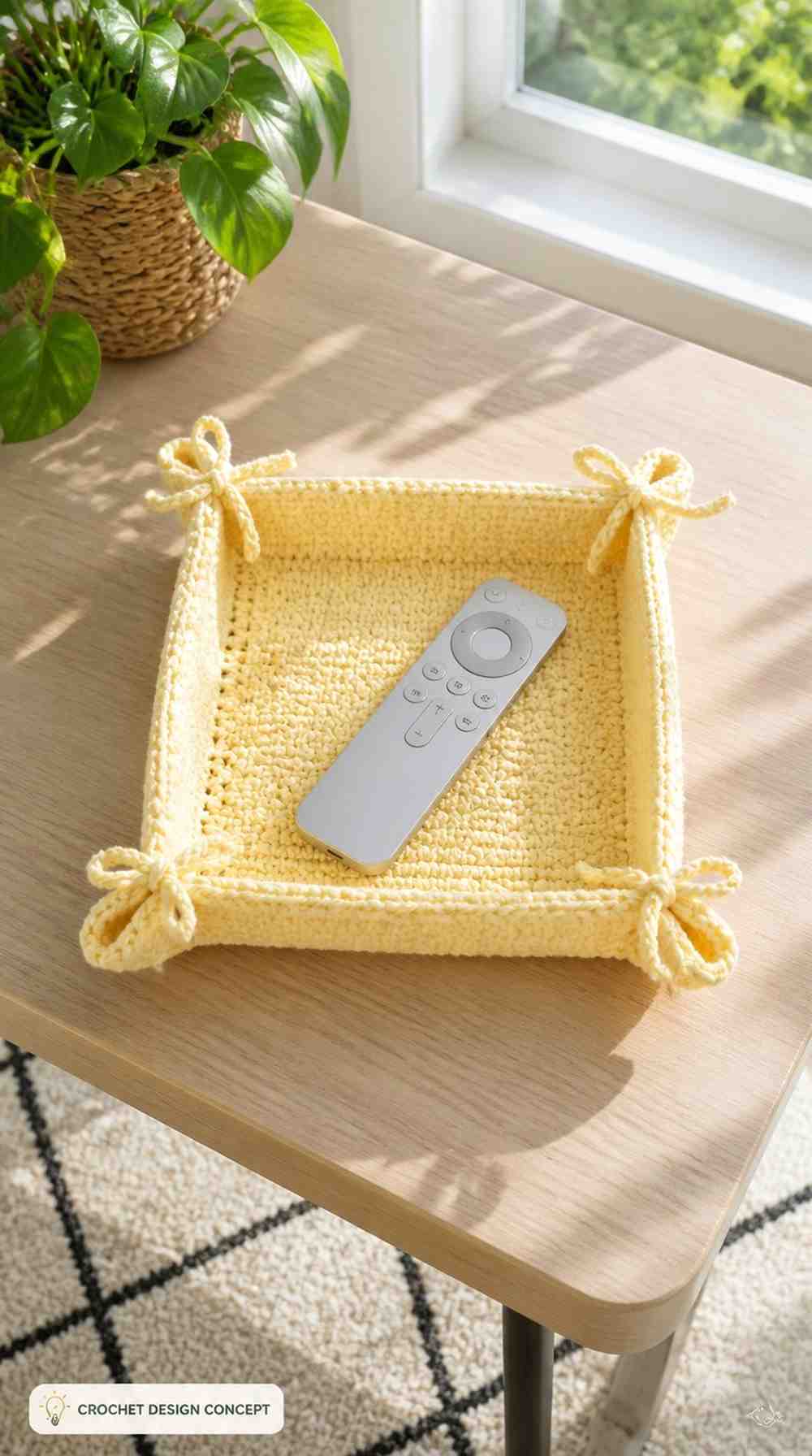
Butter-yellow crochet gives this square tray a cheerful, flexible appearance. Its shape comes from a single dense crochet panel with four corners folded upward and secured by short matching yarn ties. The resulting shallow walls slope gently around one light-grey remote resting diagonally at the center.
This design is appealing because the ties could allow the tray to return to a flatter shape when not in use. However, its corners are less structured than those of a densely worked basket, so the finished piece may require more frequent reshaping.
- Tied Corner Construction: Use secure but removable ties if you want to flatten the tray for occasional storage.
- Soft Sloping Walls: The folded corners provide shallow containment without creating the stiff profile of a conventional basket.
- Diagonal Placement: Check that the center remains large enough for the remote even after all four corners are raised.
16. Crochet Teal Nesting Remote Tray Duo
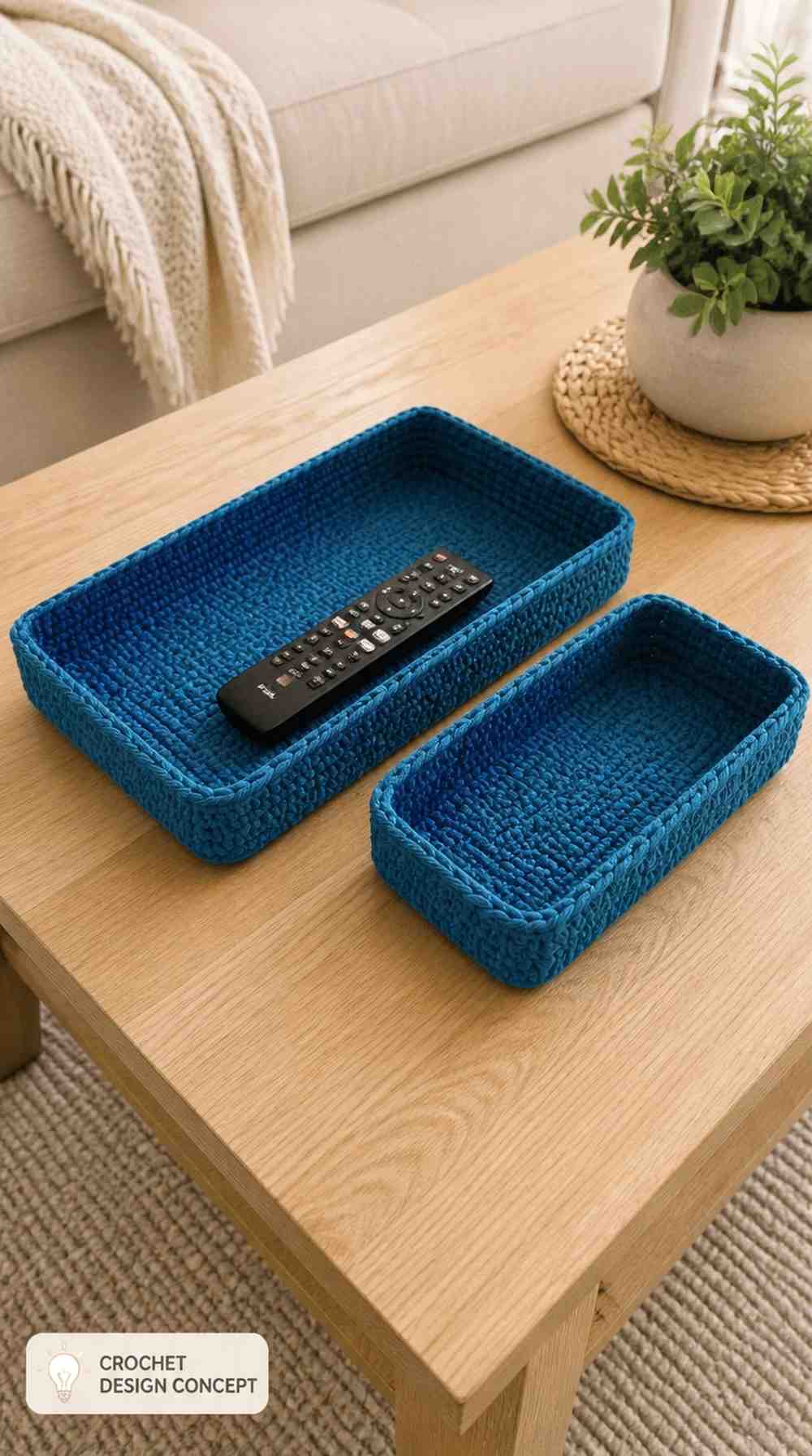
Two coordinated teal-blue crochet trays complete this collection. The larger rectangular tray holds one black television remote, while the smaller matching tray sits empty beside it. Both have dense waistcoat-style stitches, low gently tapered sides, flat bases, and clean upper edges.
The graduated sizes create a flexible arrangement for a living room where different accessories may be needed at different times. When both trays are empty, the smaller one could nest inside the larger, provided their finished dimensions and wall thickness allow it.
- Graduated Tray Sizes: Plan the smaller base and outer dimensions to fit comfortably within the larger tray’s opening.
- Tapered Side Walls: Slight outward shaping can make nesting easier without relying on completely flexible sides.
- Separate Everyday Uses: Keep the larger tray for the television remote and use the smaller tray for another lightweight, dry accessory when needed.
Practical Guide to Crochet Coffee Table Remote Storage Trays
Measure Your Remotes Before Choosing a Design
Remote controls vary in length, width, and thickness. Measure the devices you actually use, then allow a little clearance around each one so you can pick it up without pulling against the crochet.
For divided trays, plan the compartments around the longest and widest remotes. A tray that looks perfectly symmetrical may not be the most practical arrangement.
Choose a Base That Stays Flat
A useful remote tray needs a level, stable foundation. Firm cotton cord or another suitable structured yarn may help the walls hold their shape, but yarn thickness and crochet tension both affect the finished result.
Keep the base as smooth as possible. Thick seams, large bobbles, or uneven joining knots can make remote controls sit awkwardly.
Compare Different Tray Styles
| Tray feature | Practical benefit | What to check |
|---|---|---|
| Low oval tray | Easy everyday access | Enough room for each remote |
| Divided compartments | Keeps devices separated | Divider height and width |
| Scoop-front opening | Convenient retrieval | Reduced front containment |
| Thick rope-style walls | More structured appearance | Interior space lost to thick sides |
| Integrated handles | Easier repositioning | Strength of handle openings |
| Decorative petal rim | Adds visual interest | Extra coffee-table space |
| Foldflat corners | Flexible storage | Secure ties and shape retention |
Protect the Coffee Table and Remotes
Crochet fabric isn’t automatically non-slip or waterproof. Check the tray’s underside for rough knots, stiff seams, or attachments that could mark furniture.
Keep the organizer away from drinks, candles, heating sources, and table edges. If you’re considering a non-slip liner, test its compatibility with the table finish before regular use.
Avoid trapping moisture around electronics, and remove remote controls before washing the tray.
Cleaning and Maintenance
Follow the selected yarn’s washing instructions. If the tray has structural inserts or special backing, check whether they can be removed or cleaned separately.
Allow the crochet to dry completely, then reshape the base and sides before returning the remotes.
Want to Make Something Similar?
These crochet tutorials provide useful construction techniques, although they aren’t exact patterns for the AI-generated designs in this collection.
- Elendipity — Free Oval Crochet Basket Pattern explains how to create an oval base and build up basket walls. It is especially useful for the Oatmeal Twin Channel and Terracotta Front Scoop concepts.
- Jo to the World Creations — Free Crochet Remote Holder Pattern teaches a remote organizer with stitched pockets. Its construction differs from a tabletop tray, but it provides practical guidance on sizing remote compartments.
- Moogly — Cozy Couch and Bedside Organizer Caddy Tutorial by Tamara Kelly includes video demonstrations of a pocket organizer. It is another helpful reference for shaping and dividing crochet storage spaces.
These resources teach genuine crochet techniques, but the specific trays pictured here would require separate design adjustments and testing.
Elendipity+2
For another approach to handmade home organization, explore Yarn Nest Studio’s 12 Crochet Storage Basket Ideas collection. It covers larger storage solutions for different household needs.
Which Crochet Coffee Table Remote Storage Tray Should You Choose?
| Your priority | Designs to consider | Main trade-off |
|---|---|---|
| Two everyday remotes | Oatmeal Twin Channel, Cream Rope Coil | Divider space versus open storage |
| Three separate sections | Sage Three Slot, Plum Three Bay | More dividers and careful sizing |
| Easy remote access | Terracotta Front Scoop, Navy Ribbed Cradle | Lower walls offer less containment |
| Modern geometric decor | Mustard Hexagon, Charcoal Corner | Interior dimensions must suit the remote |
| Decorative coffee table styling | Ivory Scalloped, Blush Petal Rim | Extra room for the decorative edges |
| Carrying between surfaces | Seafoam Cutout Handle | Secure handle construction |
| Flexible storage | Butter Yellow Foldflat, Teal Nesting Duo | Less rigid walls or extra pieces |
| Small additional accessory | Dusty Blue Split Valet | Different compartment dimensions |
For a typical living room with two remote controls, the Crochet Oatmeal Twin Channel Remote Tray is a practical starting concept. Its divided layout gives each device a familiar resting place without requiring a tall organizer.
If you have several entertainment devices, the Crochet Sage Three Slot Remote Tray offers more individual spaces. The Crochet Plum Three Bay Remote Organizer Tray may be better when you want to include a small folded cleaning cloth alongside the remotes.
For a coffee table where appearance matters just as much as organization, the Crochet Ivory Scalloped Remote Valet Tray and Crochet Blush Petal Rim Remote Tray provide decorative alternatives.
Conclusion
A crochet coffee table remote storage tray can help keep everyday controls together while bringing handmade texture into the living room. Some designs focus on simple organization, with flat bases and separate compartments, while others use scalloped edges, geometric shapes, or colorful stitches to make the tray part of the decor.
Choose a design that fits your actual remotes and available table space. Prioritize a level base, accessible compartments, and a finish that won’t damage the furniture. These 16 concepts offer plenty of ways to make a practical organizer feel more personal.
Which design would you choose for your coffee table: the sage three-slot organizer, the oatmeal twin-channel tray, or the terracotta scoop-front tray? Share your favorite and how many remotes you normally keep in your living room.
Frequently Asked Questions
1. What yarn is best for a crochet remote storage tray?
Firm cotton cord or another suitable washable yarn can be a useful choice for structured crochet trays. Dense stitches may help the walls hold their shape, but the result depends on yarn thickness, tension, and construction. For a flexible foldflat tray, a softer yarn may be more appropriate.
2. How do I stop a crochet remote tray from collapsing?
Start with a flat, closely worked base and consistent wall stitches. A firm upper rim can also help maintain the shape. If the design requires additional support, choose materials suitable for the intended use and cleaning method. Test the finished tray with your actual remotes before relying on it.
3. Can a crochet remote tray scratch my coffee table?
Soft crochet fabric is unlikely to behave like a hard plastic container, but rough seams, stiff inserts, trapped dirt, or attached decorations may still mark delicate surfaces. Inspect the underside and follow your furniture manufacturer’s care recommendations before placing the tray on polished wood or lacquer.
4. Is a divided crochet tray better than a single-compartment tray?
It depends on how many remotes you use. Dividers help keep different controls in separate positions, which can make them easier to find. An open tray offers more flexibility for different device sizes and can be simpler to construct. Choose based on your actual storage needs.
5. Are these 16 crochet remote storage tray ideas actual patterns?
No. These are original AI-generated design concepts intended for inspiration. They have not been physically tested for size, stability, durability, or furniture protection. Use them to explore possible shapes and finishes, then follow a reliable crochet pattern or carefully develop and test your own construction before everyday use.