A crochet hanging sink sponge caddy can bring useful storage and a softer handmade look to an everyday kitchen. Instead of leaving a sponge on a wet countertop, these designs explore hanging pockets, airy mesh holders, compact baskets, decorative leaf shapes and clever divided organizers. From sage green and oatmeal cotton textures to cheerful daisy squares and citrus-inspired details, each idea offers a different way to style the space around a kitchen sink.
This collection brings together 16 crochet sponge caddy inspiration ideas for small kitchens, farmhouse sinks, cottage-style spaces and modern cooking areas. You’ll find designs that hang from faucet necks, hooks, rails and cabinet handles, along with practical details to consider before making a similar piece. The goal is to help you compare storage access, drainage openings, hanging support, cleaning needs and decorative finishes rather than simply choose the prettiest color.
These are AI-generated crochet design visualizations for inspiration, not photographs of tested handmade pieces or step-by-step patterns.
Quick Design Selection Guide
- For very limited sink space: Start with Crochet Sage Mesh Faucet Caddy or Crochet Teal Drawstring Sponge Net. Both have compact hanging shapes, though the proposed attachment must suit your actual sink.
- For a cottage kitchen: Crochet Daisy Granny Square Sink Organizer and Crochet Powder Blue Scalloped Sponge Basket offer decorative crochet details without requiring a large wall organizer.
- For more open airflow: Compare Crochet Terracotta Corner Sponge Sling, Crochet Lemon Yellow Ventilated Caddy and Crochet Navy Rope Edge Sponge Hammock.
- For organizing two cleaning items: Crochet Apricot Sponge and Brush Caddy separates a sponge from a small brush, while the daisy organizer provides two short pockets.
- For a minimal modern finish: Crochet Charcoal Ring Hanging Caddy and Crochet Oatmeal Button Tab Sponge Pocket keep their decoration simple.
- For playful kitchen styling: Crochet Olive Leaf Sponge Pocket and Crochet Mint Citrus Slice Sponge Holder turn familiar botanical shapes into compact hanging storage.
1. Crochet Sage Mesh Faucet Caddy
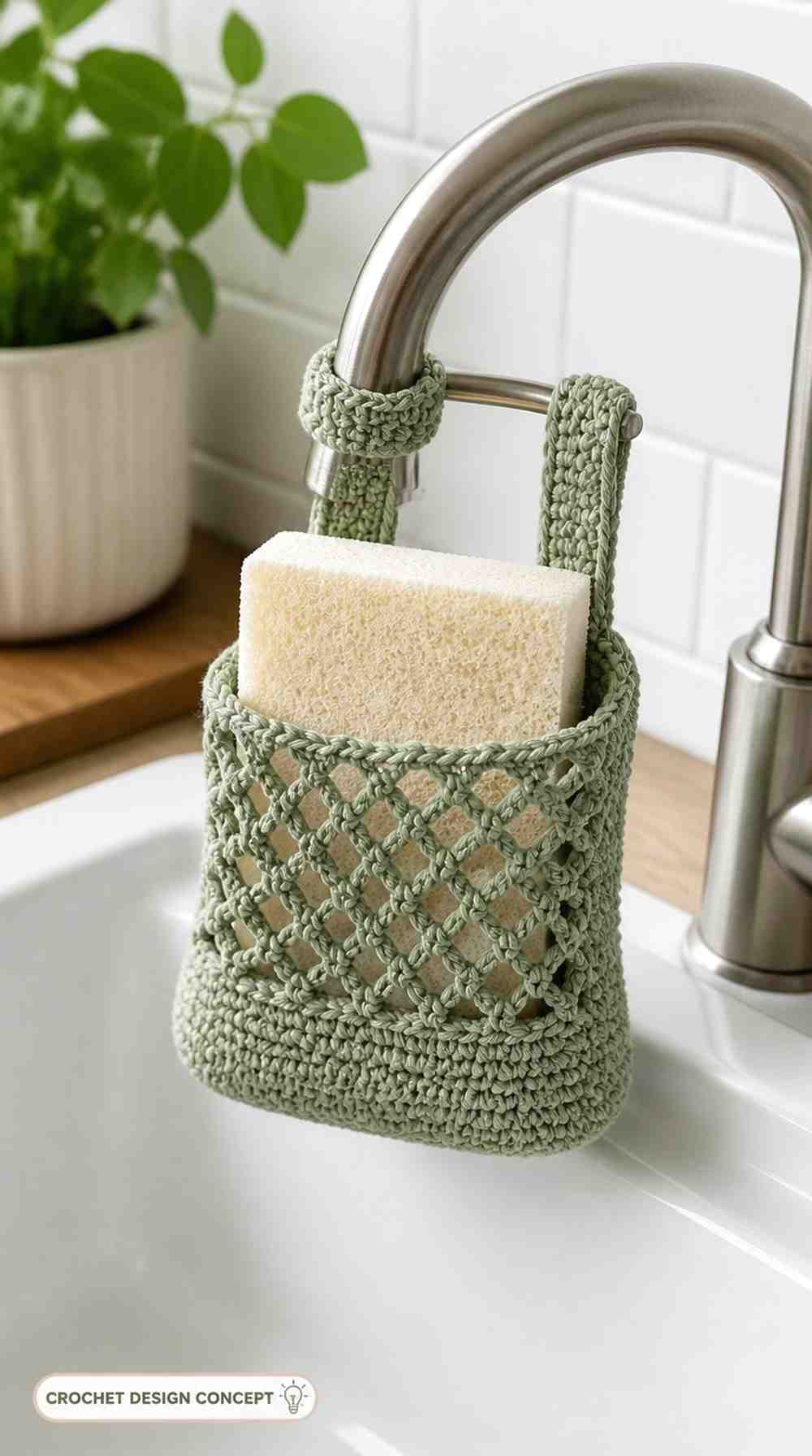
Soft sage-green crochet forms a compact rectangular pocket with an airy diamond-mesh front, a firm lower rim and two short hanging loops. The pale cream sponge sits upright inside, its upper portion visible above the open pocket. The green yarn gives the practical organizer a fresh, understated look.
Its faucet-mounted design is particularly interesting where wall hooks and cabinet rails are unavailable. However, a real version would need careful fitting around the faucet neck without interfering with the handle, moving spout or regular cleaning.
- Faucet compatibility: Check that the loops can sit on a stable part of the fixture without sliding, trapping moisture around joints or restricting faucet movement.
- Diamond-mesh openings: The open front provides visible ventilation, but the openings must be small enough to stop the actual sponge from slipping through.
- Lower-edge support: A closely worked bottom rim may help maintain the pocket shape. Consider how its seams behave when the sponge is damp and heavier.
2. Crochet Oatmeal Button Tab Sponge Pocket
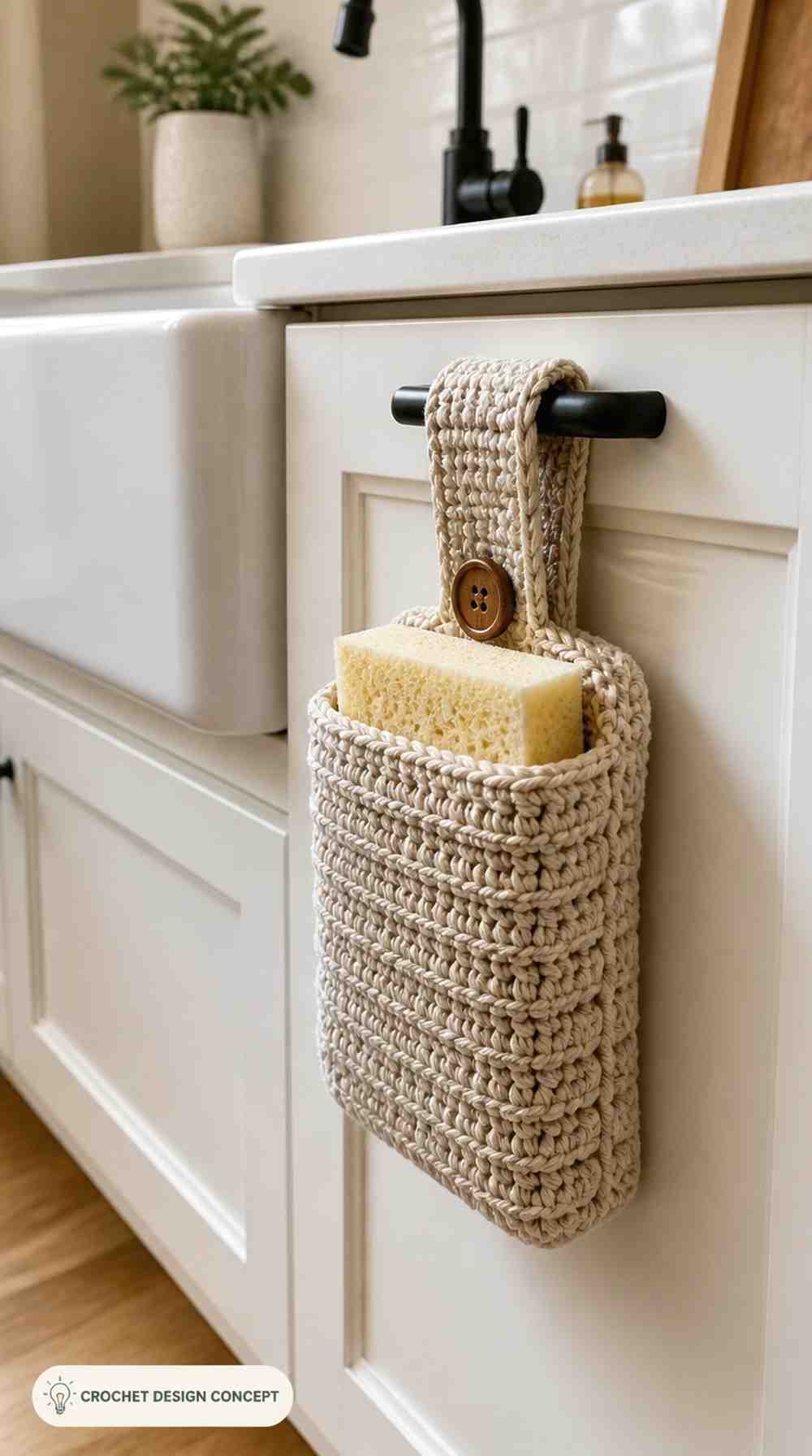
Oatmeal-beige yarn brings a warm, neutral finish to this rectangular crochet sponge pocket. Thick horizontal ribs, a flat base and a wide folded hanging strap give the design its structured appearance. One walnut-brown button fastens the strap around a black cabinet handle, while a pale yellow sponge rests inside.
The buttoned hanging arrangement gives this idea a different purpose from hook-mounted designs. It suits a nearby cabinet handle that can support the pocket without leaving the damp sponge against a vulnerable wooden door.
- Buttoned attachment: Measure the handle’s shape and circumference before planning the folded strap. Its button needs secure stitching and enough clearance for easy removal.
- Ribbed front texture: Raised crochet rows create a substantial appearance, although denser fabric may hold moisture longer than an open mesh.
- Cabinet protection: Position the pocket where drips cannot repeatedly wet cabinetry, and avoid leaving a damp sponge pressed against painted or wooden surfaces.
3. Crochet Terracotta Corner Sponge Sling
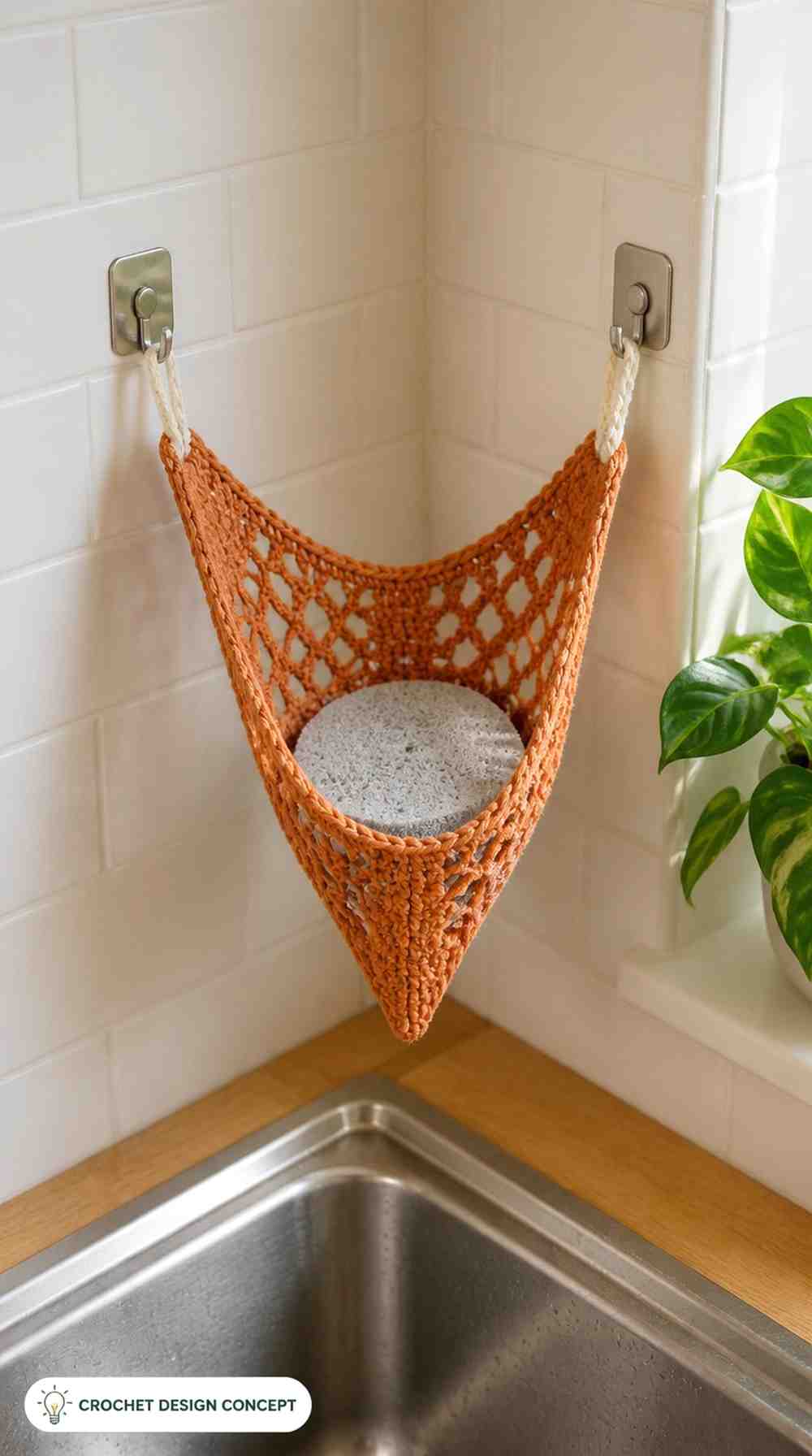
Rather than using a traditional pocket, this terracotta-orange crochet design creates a shallow triangular hammock. Cream loops at its upper corners attach to separate hooks on adjoining tiled walls, while the open chain-mesh center supports a small grey sponge.
The suspended shape is appealing for a kitchen sink corner because it keeps the holder away from the countertop. Its practical success would depend on properly positioned hooks, a sufficiently supported lower point and openings that prevent the sponge from falling through.
- Two-point suspension: Both hooks must suit the wall surface and carry the sling without allowing one side to sag unexpectedly.
- Triangular fit: Compare the available corner space with your sponge’s length and width; a shallow triangular cradle may not hold a bulky sponge well.
- Open mesh: Wider chain spaces reduce the amount of yarn around the sponge, but they also require closer attention to stretch and sagging.
4. Crochet Daisy Granny Square Sink Organizer
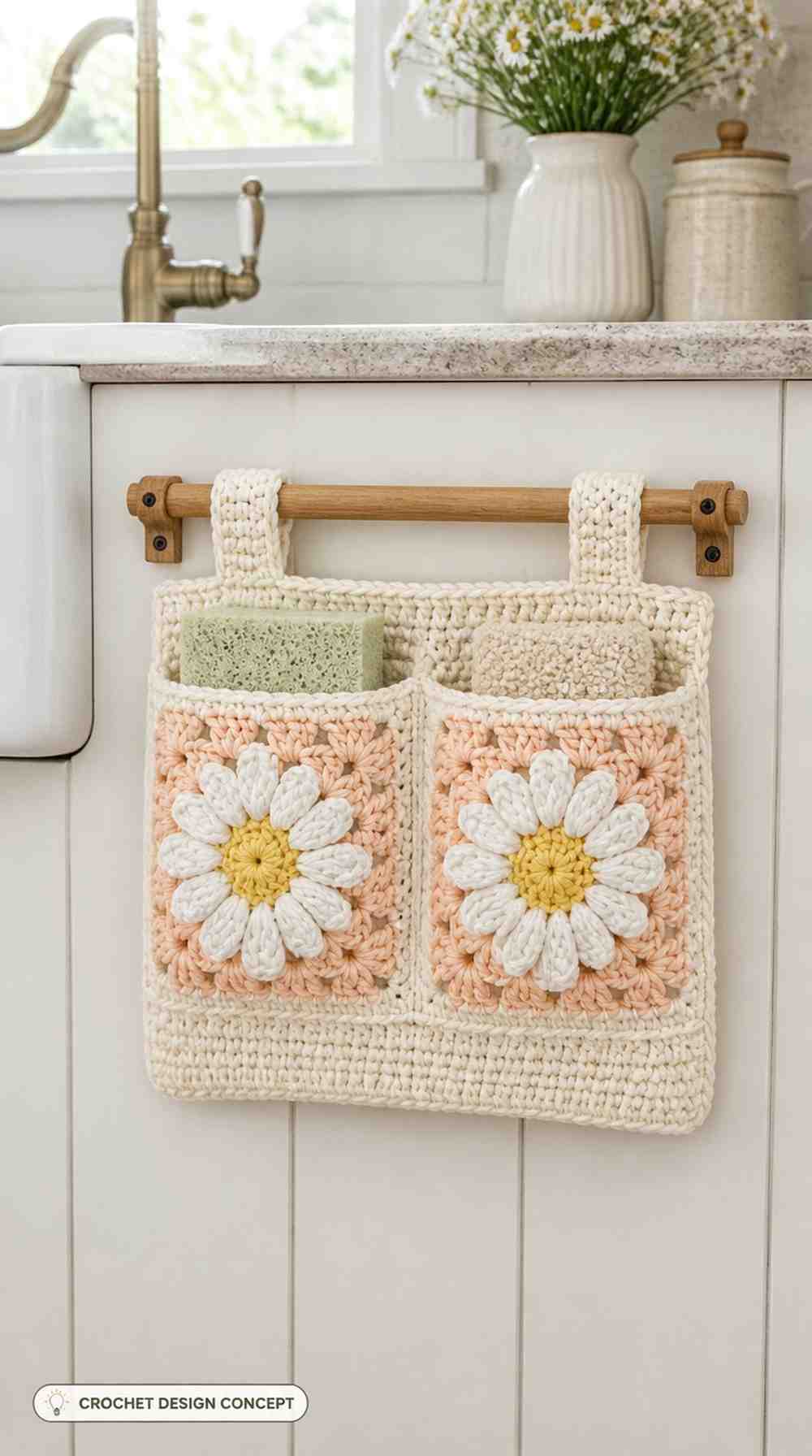
Two pale-peach granny-square pockets create the front of this cheerful hanging organizer. Each square features a raised white crochet daisy with a butter-yellow center. Cream borders connect the two pockets, with a continuous bottom band and matching hanging tabs.
The separate compartments give the design a useful purpose beyond decoration. One holds a soft green sponge and the other a small cream scrub pad, making the arrangement appealing for kitchens where two frequently used cleaning items need their own places.
- Separate pocket sizes: Plan each compartment around its intended sponge or scrub pad rather than assuming two identical openings will fit everything.
- Granny-square construction: Raised daisy centers add texture, so consider how easily the pocket fronts can be rinsed and cleaned around the petals.
- Rail support: The two hanging tabs should be spaced to keep the organizer level, particularly when the compartments contain items of different weights.
5. Crochet Teal Drawstring Sponge Net
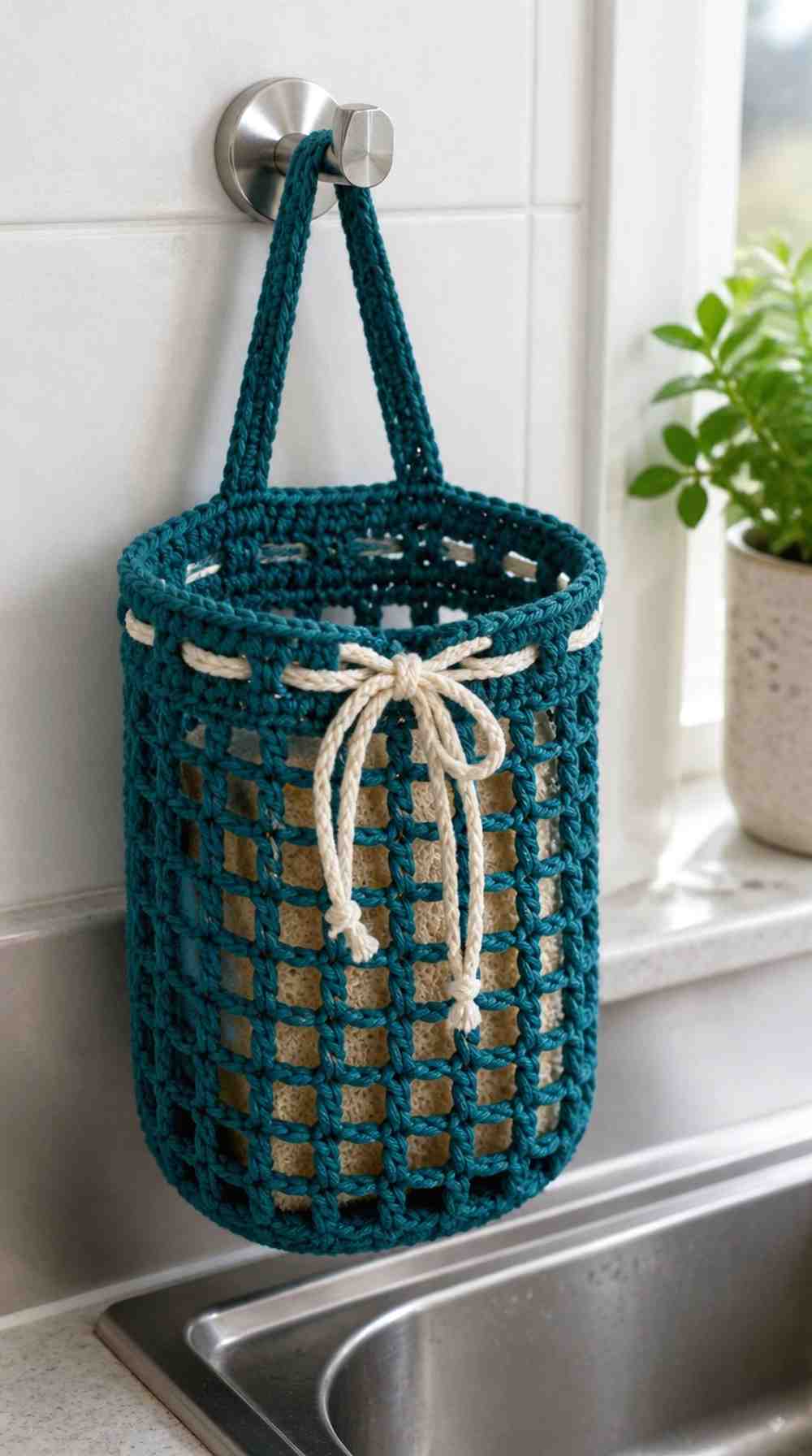
Deep teal yarn gives this cylindrical crochet net a striking color while keeping the overall design compact. The pouch features spaced vertical mesh openings, a narrow cream drawstring and a separate reinforced hanging loop. A beige sponge remains visible through the open stitches.
The loosely tied drawstring provides a way to adjust the upper opening without completely closing it. This concept works best as a breathable hanging pouch rather than a tightly packed bag, allowing the sponge to be removed and the holder cleaned regularly.
- Drawstring opening: Keep the mouth wide enough for easy sponge removal. Tightening it excessively could limit ventilation and make the damp sponge harder to retrieve.
- Cylindrical depth: A deeper pouch may hide more of the sponge, so compare the proposed height with the item you actually use.
- Mesh maintenance: Open netting can collect residue at stitch intersections. A simple removable design is preferable when regular washing is needed.
6. Crochet Charcoal Ring Hanging Caddy
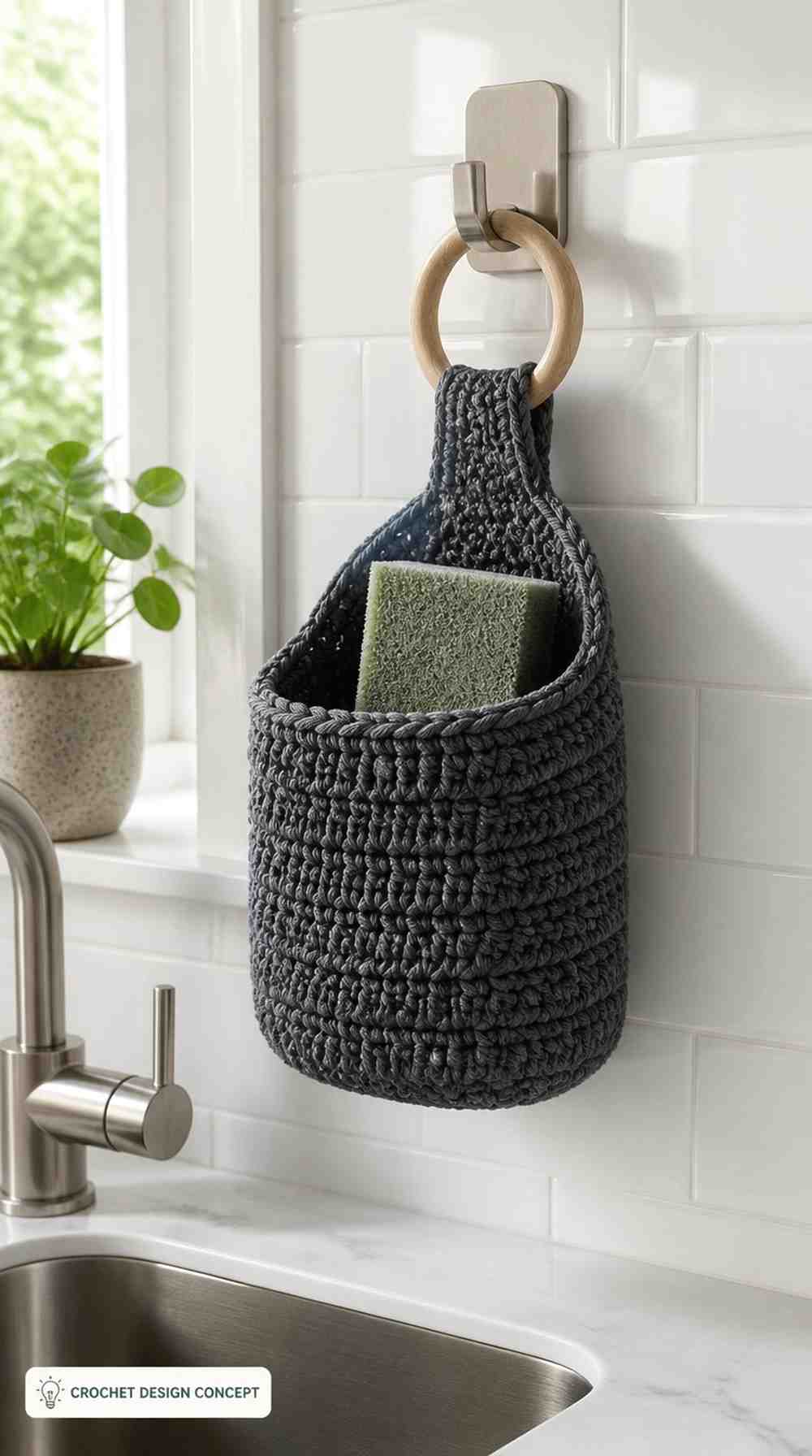
Charcoal-grey crochet brings a clean, contemporary look to this rounded rectangular hanging basket. Its lower half uses closely packed raised stitch rows, while the open rim leaves the sage-green sponge easy to reach. A broad charcoal strap connects the basket to a circular wooden ring.
The ring creates a distinct hanging point that works visually with a simple wall hook. Because the crochet fabric is relatively dense, this design may require more frequent attention to moisture than the widely vented mesh options.
- Wooden ring: Choose a ring suitable for the intended damp environment, and check that moisture does not remain trapped where the crochet strap wraps around it.
- Basket structure: The dense lower body needs a shape that supports the sponge without stretching the hanging strap excessively.
- Dark yarn maintenance: Charcoal hides some discoloration visually, but the pocket still needs cleaning and drying; color cannot be used to judge cleanliness.
7. Crochet Lemon Yellow Ventilated Caddy
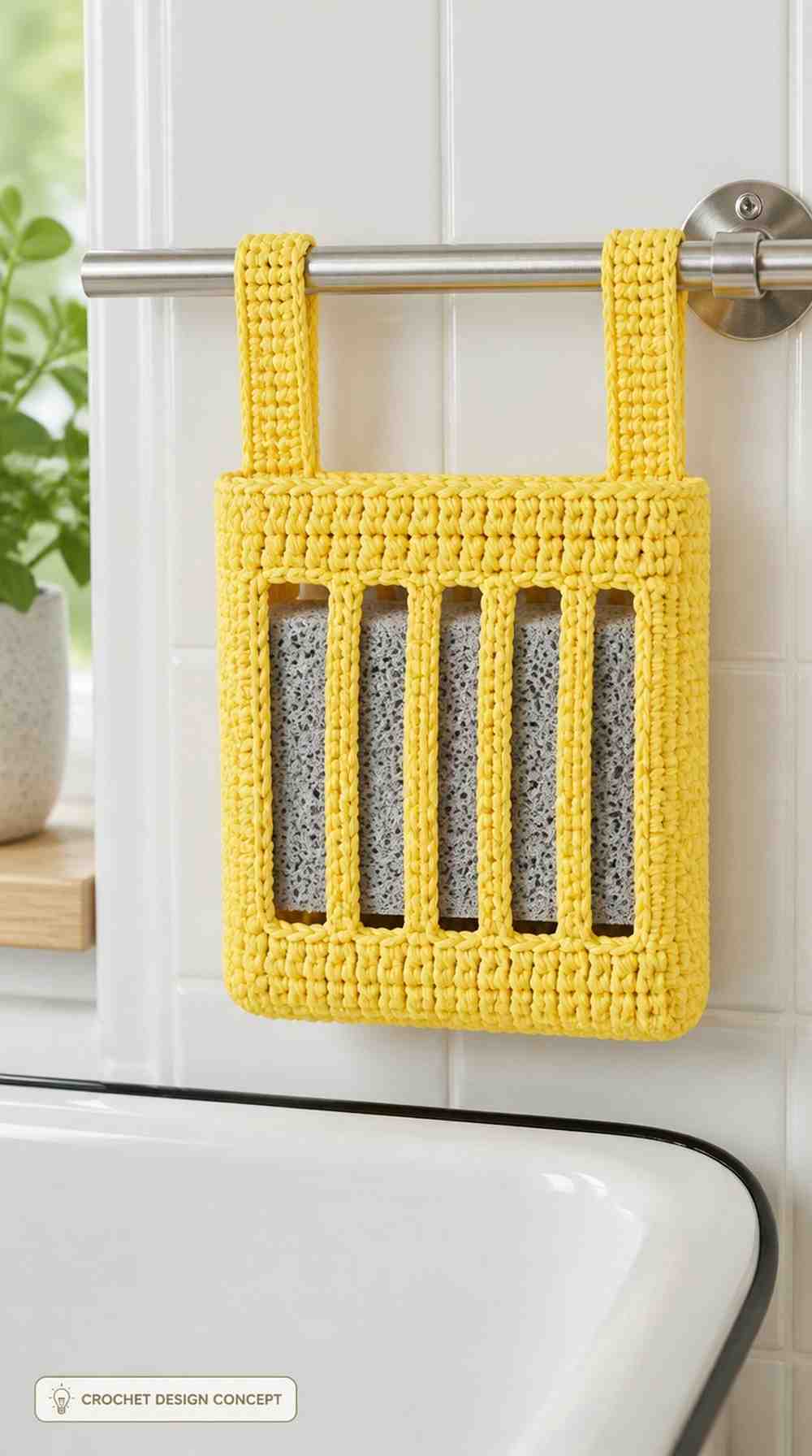
Five tall open mesh columns give this lemon-yellow crochet caddy its distinctive front. Closely worked side edges and a narrow lower band frame the rectangular holder, while two flat hanging straps suspend it from a slim kitchen rail. A grey sponge remains visible behind the vertical openings.
The design combines a simple outline with more deliberate ventilation spaces. Its bright color feels cheerful without requiring flowers, tassels or other embellishments that could get in the way of daily kitchen cleaning.
- Vertical ventilation: The columns should be narrow enough to retain the sponge while allowing the surface to remain exposed to air.
- Rail fit: Make sure the two straps sit apart properly on the rail and cannot slide together, causing the caddy to twist.
- Stitch tension: Tall openings may lengthen under the weight of a wet sponge. Test a representative crochet swatch before choosing the final proportions.
8. Crochet Powder Blue Scalloped Sponge Basket
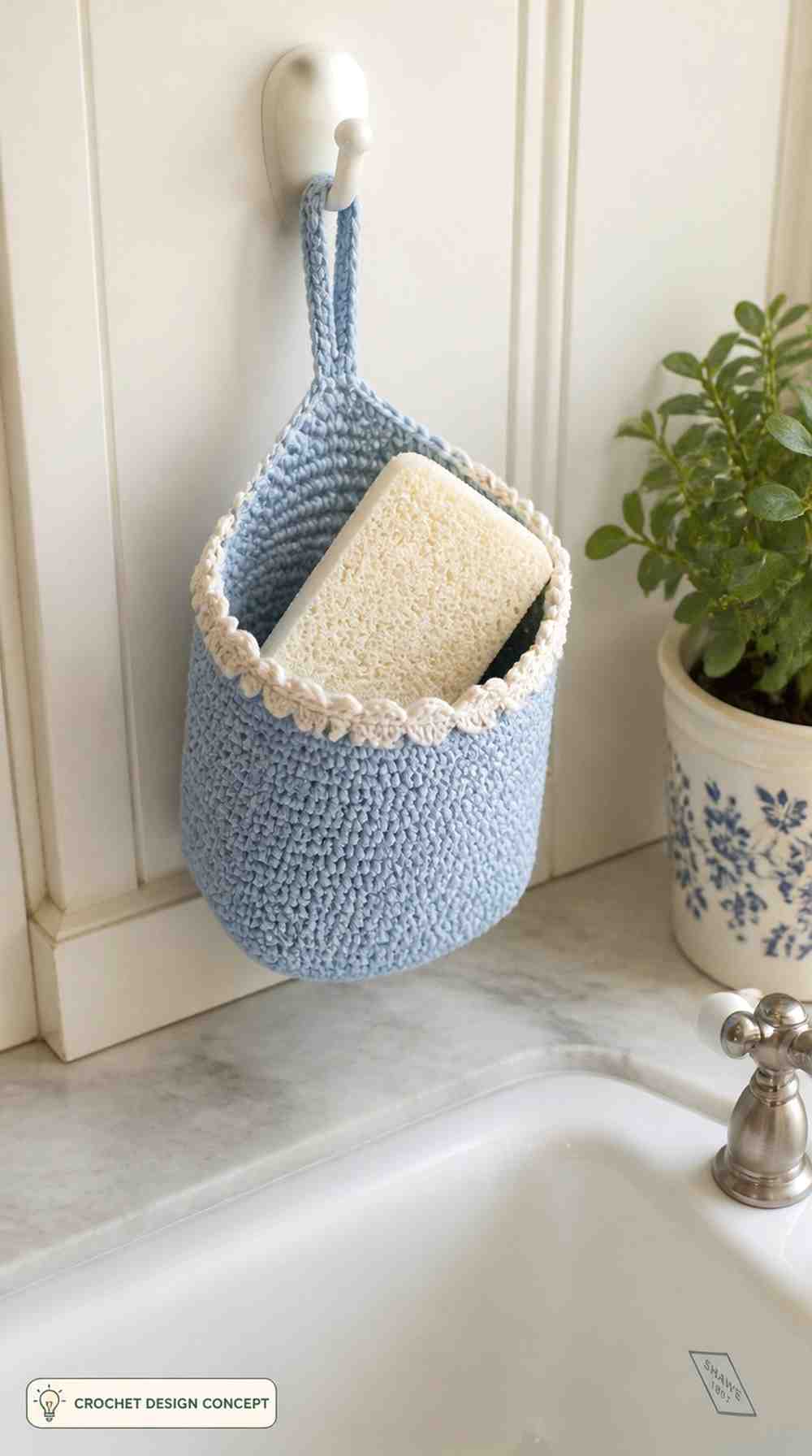
Powder-blue crochet forms a softly rounded basket with an oval top opening and closely worked base. A fine cream scalloped border follows the upper rim, adding a delicate finish without changing the basket’s simple shape. One broad blue hanging loop supports the holder, while a cream sponge rests diagonally inside.
The oval opening gives this idea a different silhouette from the flat rectangular pockets. Its curved base and gentle border fit a cottage-style kitchen, although a compact basket still needs to be easy to empty and clean.
- Oval opening: Allow enough width for the sponge to be inserted without catching on the decorative scallops.
- Curved base: A rounded bottom may change how the sponge rests inside, so check the actual item before deciding the basket depth.
- Scalloped edging: A narrow decorative border is easier to manage near an active sink than an oversized ruffle that frequently becomes wet.
9. Crochet Burgundy Checkerboard Rail Caddy
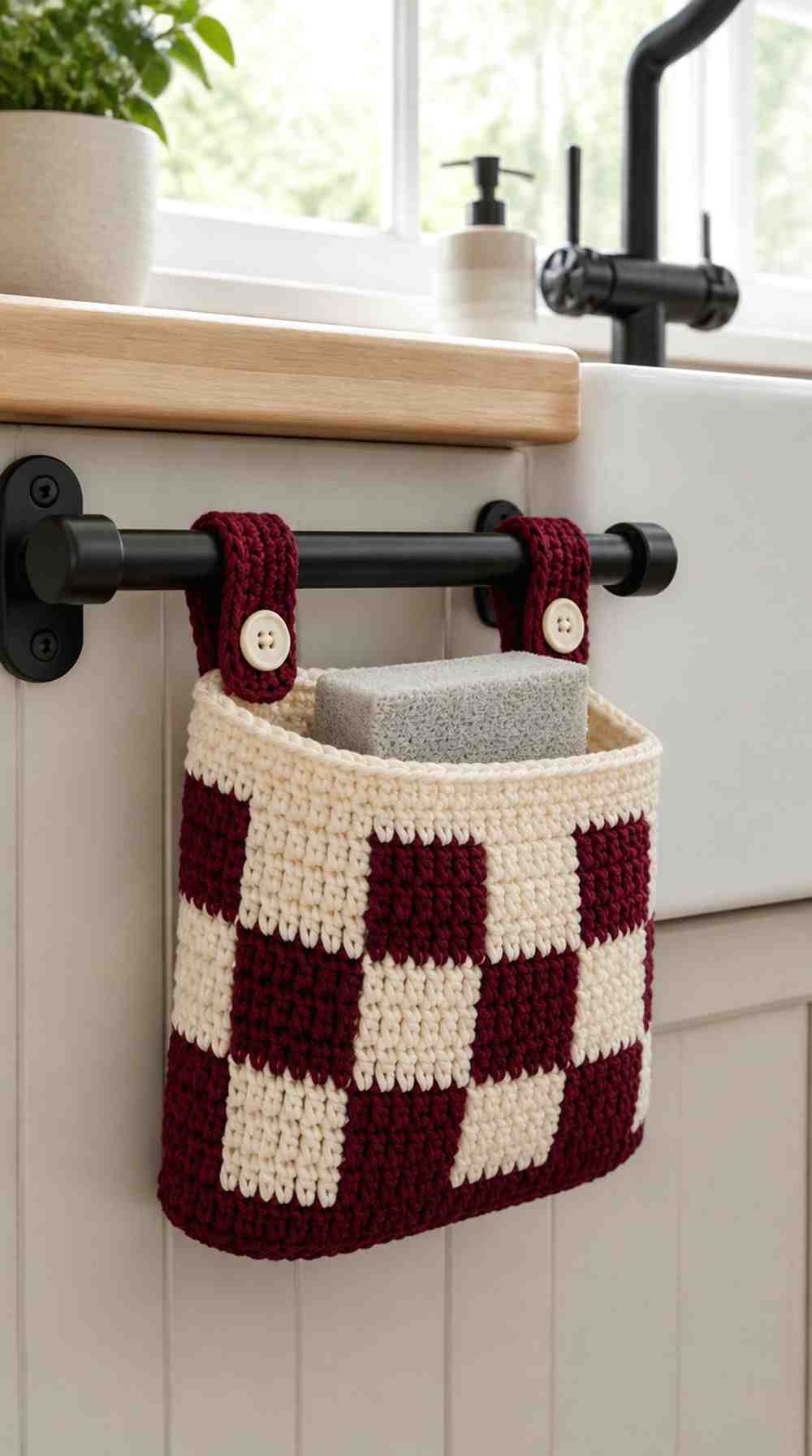
Burgundy and cream crochet squares alternate across the front of this rectangular sink caddy, creating a bold checkerboard effect. Two burgundy button-tab straps attach the holder to a black rail, while a folded cream upper band and a tightly stitched burgundy lower edge frame the pocket.
A pale grey sponge peeks above the opening, keeping the functional purpose clear. The checkerboard fabric adds a retro kitchen accent, but the closed colorwork sections make ventilation and routine cleaning important considerations.
- Checkerboard alignment: Consistent square proportions help the design look balanced. Plan color changes carefully if adapting this visual concept into real crochet.
- Dual button tabs: Both tabs need equally secure fastenings so the caddy hangs level and can be removed without difficulty.
- Dense front fabric: Compare the checkerboard’s coverage with your drying needs. Optional small openings in the lower construction could improve airflow without changing the front motif.
10. Crochet Olive Leaf Sponge Pocket
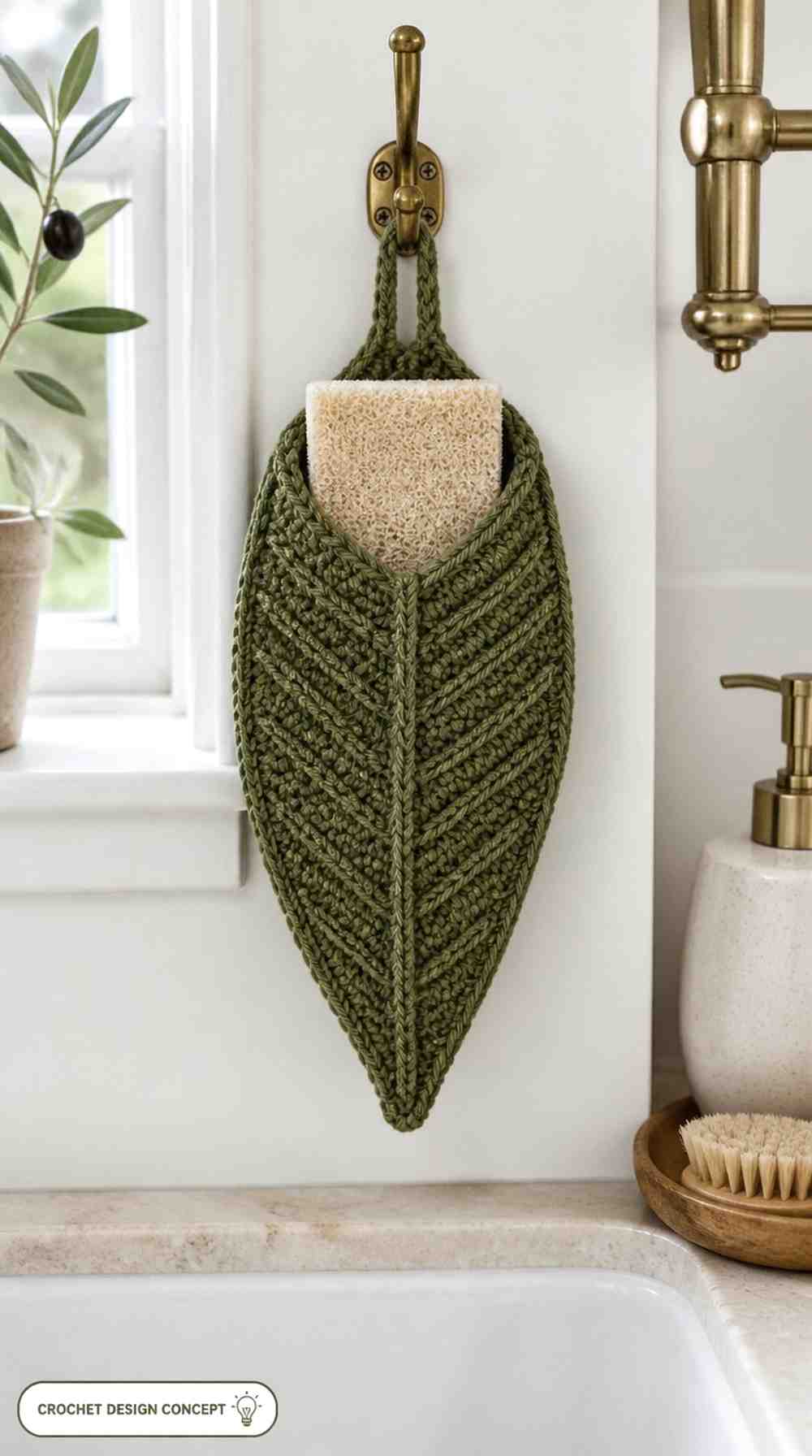
An olive-green crochet leaf becomes a slender hanging sponge pocket in this botanical concept. The tapered lower point, rounded opening and raised central vein give the front its recognizable shape. Subtle diagonal crochet veins spread outward, while a small upper loop attaches the piece to a brass hook.
The slim beige sponge sits upright inside, keeping the leaf silhouette visible. This design works as both decorative storage and a small botanical accent, provided the tapered pocket is wide enough for the sponge.
- Leaf-shaped capacity: The narrow lower point limits storage compared with a full rectangular pocket. It is better suited to a slim sponge than several cleaning accessories.
- Raised vein details: Crochet surface texture makes the leaf recognizable, but prominent raised lines may catch debris and require more careful washing.
- Single hanging loop: The narrow attachment must support the pocket without pulling the leaf shape sideways or distorting its upper opening.
11. Crochet Dusty Rose Waffle Pocket
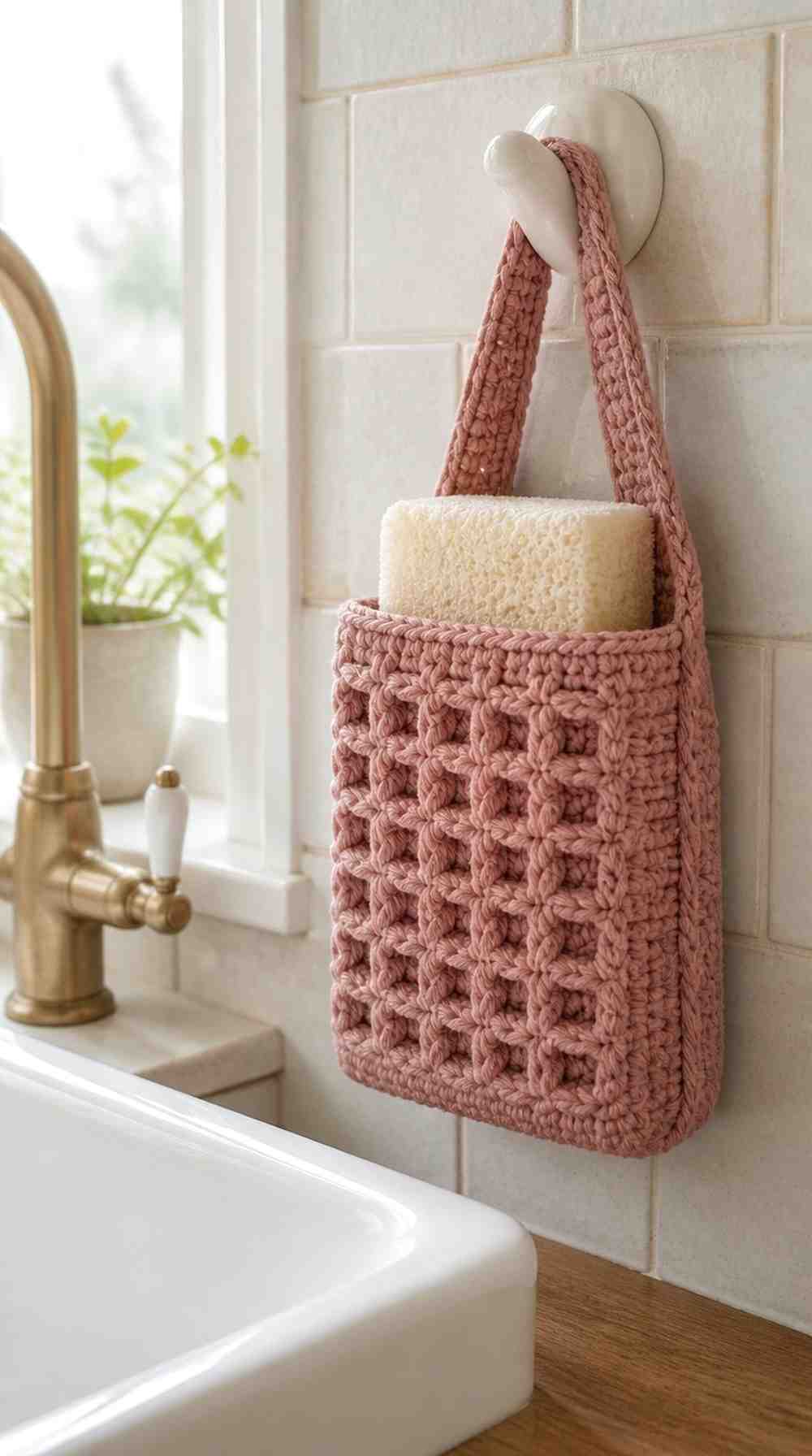
Raised waffle-like crochet squares bring dimension to this dusty-rose sponge pocket. Slim side gussets create depth, while a flat base and straight upper rim maintain its practical rectangular outline. A broad matching loop hangs the organizer from a ceramic hook, with an ivory sponge visible above the opening.
The warm rose color and textured stitches give the holder a soft, homey appearance. Compared with an open mesh design, the waffle surface offers more fabric coverage but also more raised areas to rinse and dry.
- Side gussets: These narrow side panels can make the opening roomier without increasing the visible front width too much.
- Waffle texture: Raised stitches create depth, but the recesses can hold residue. Consider whether this texture suits the amount of cleaning the holder will receive.
- Flat bottom: A firm lower edge may help the pocket retain its outline, though it should not be assumed to drain as effectively as an open base.
12. Crochet Navy Rope Edge Sponge Hammock
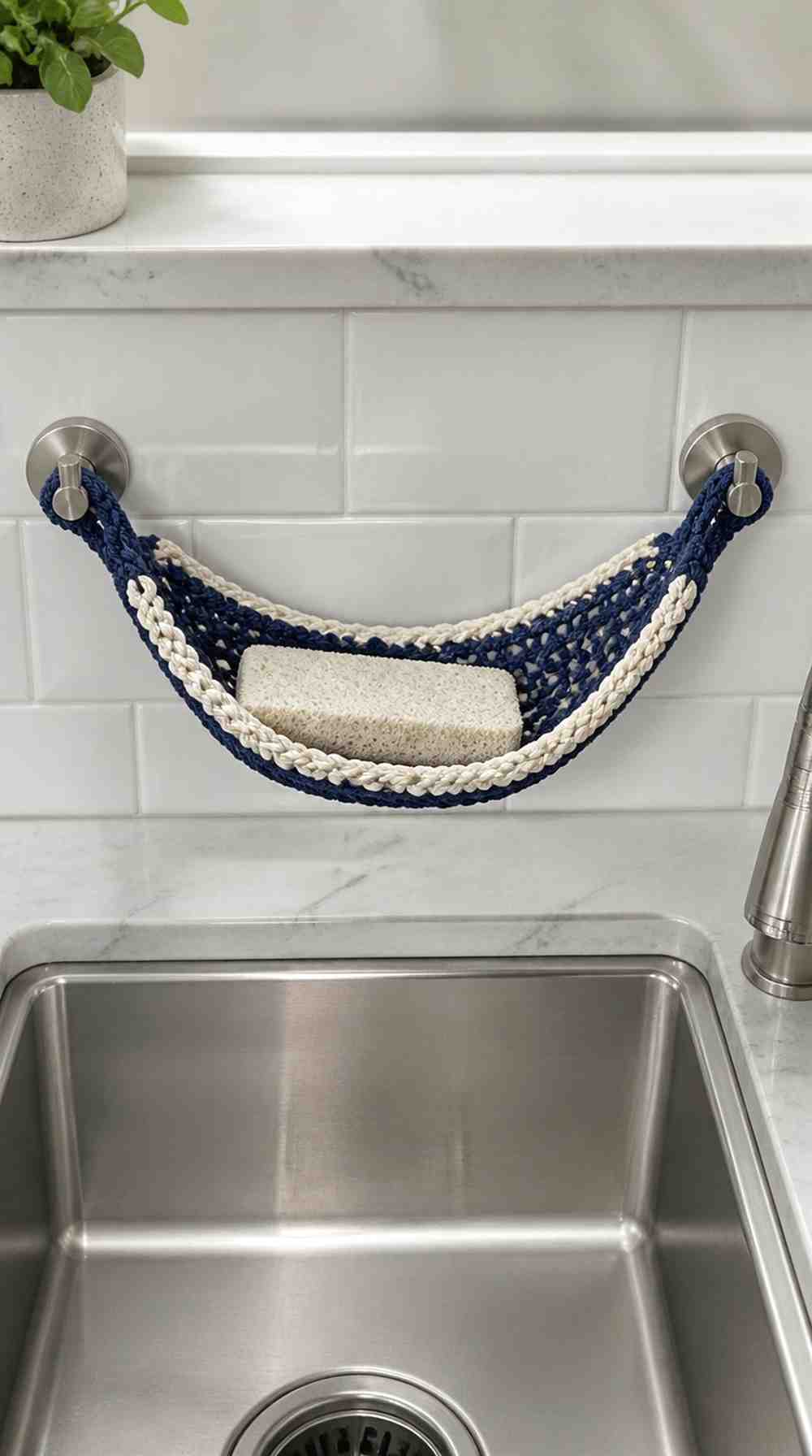
A horizontal navy-blue crochet hammock stretches between two wall hooks above the sink. Open mesh forms its shallow rectangular cradle, while thick cream rope-like crochet borders strengthen the visual outline. Navy hanging loops connect both ends to the hooks, supporting a cream sponge placed lengthwise.
Its broad, open shape is quite different from a deep pocket. The sponge remains visible and relatively exposed, but both hook positions need to be chosen carefully to avoid excessive sagging or slipping.
- Horizontal clearance: Measure the available space between suitable attachment points before choosing the hammock length.
- Border support: A substantial crocheted border can help define the edges, but it does not automatically prevent a flexible mesh center from stretching.
- Shallow cradle: Keep enough depth to hold the sponge without creating a large hanging dip that interferes with washing dishes.
13. Crochet Apricot Sponge and Brush Caddy
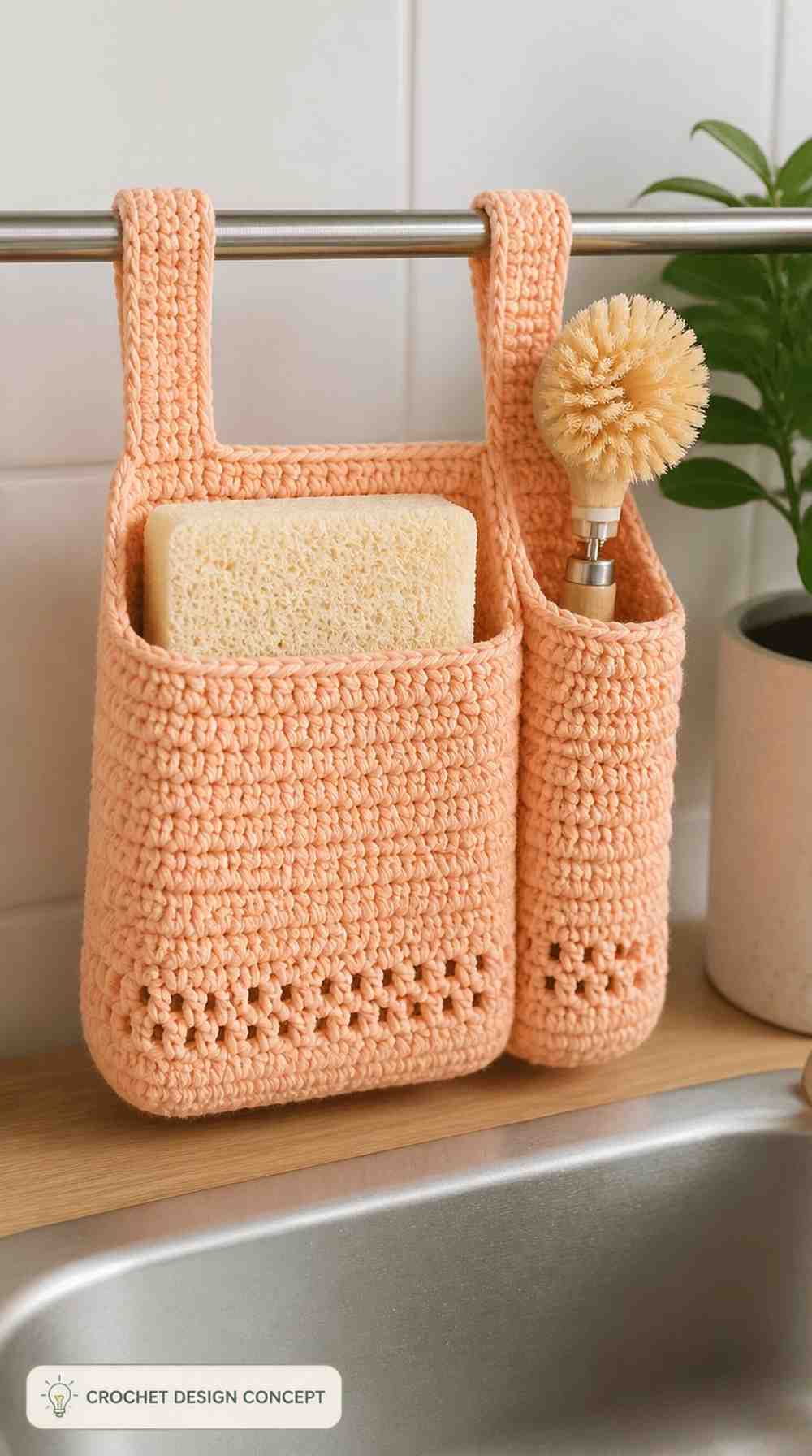
Two unequal compartments make this soft-apricot crochet organizer especially useful for keeping different cleaning tools together. The wider left pocket holds a cream sponge, while a narrow tall sleeve on the right accommodates a small brush with its wooden handle upright and bristles facing upward.
A solid crochet divider separates the compartments, with narrow vented rows near their lower edges. Two matching hanging loops support the organizer from a rail, giving the design a practical and orderly appearance.
- Brush clearance: The taller sleeve must allow the brush to be removed without catching its bristles or handle on the rail.
- Unequal compartments: Plan the sponge section and brush section individually; making both the same size would reduce the advantage of this design.
- Weight distribution: The two loops should support the organizer evenly when one compartment contains a heavier or wetter item.
14. Crochet Cream and Rust Dowel Caddy
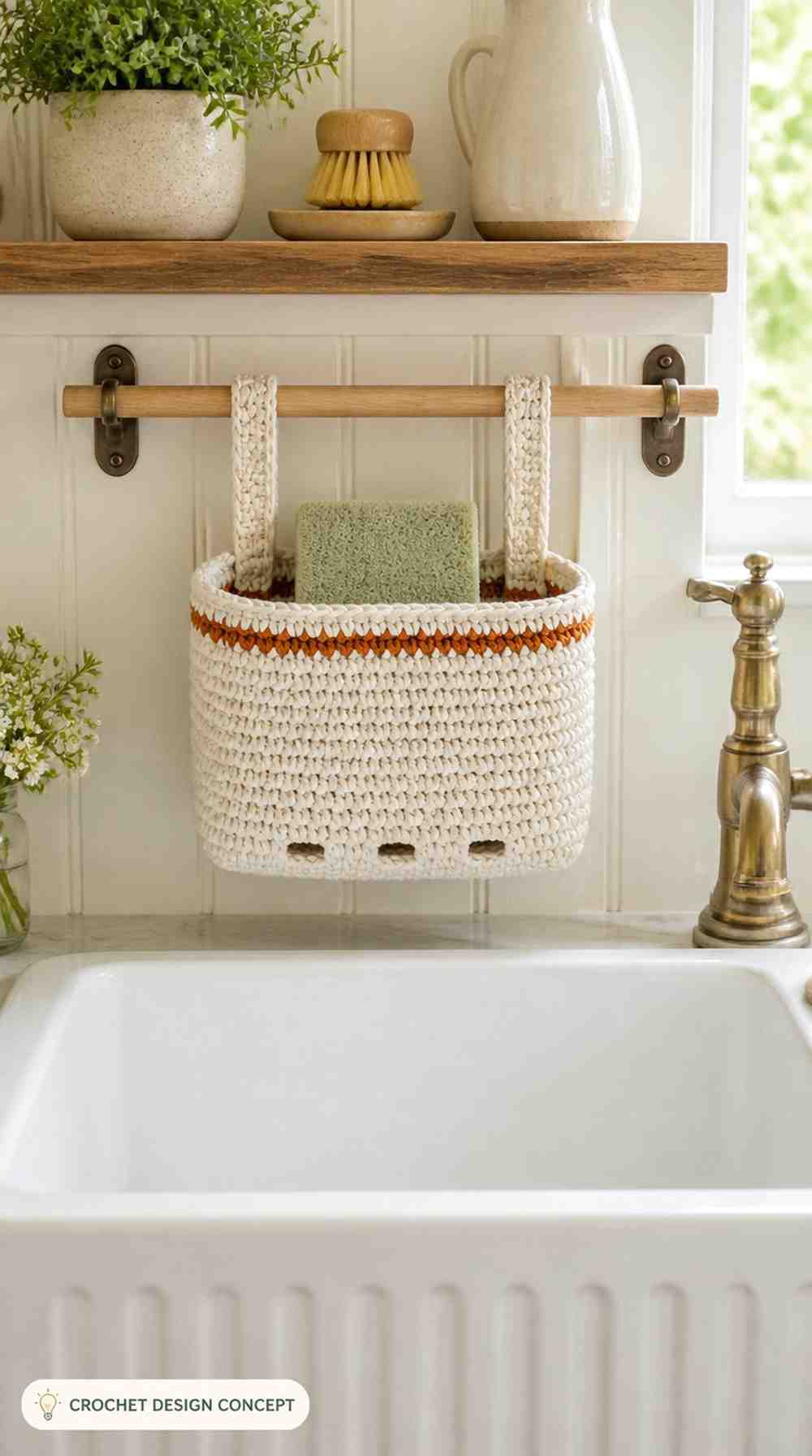
A broad cream crochet basket hangs beneath a slim wooden dowel, bringing a simple farmhouse character to the kitchen sink. Its dense, linen-like stitch texture is finished with a narrow rust-orange stripe around the upper rim. Three short horizontal openings near the lower front add a subtle ventilated detail.
Two flat cream straps suspend the basket from the dowel, while a sage sponge stands inside. The design offers more visual width than a single-hook pouch, making its hanging hardware an important part of the overall concept.
- Dowel mounting: Both wall brackets need suitable fixing, and the wooden support should be protected from repeated wetting.
- Wide basket proportions: A broader opening can simplify sponge access, but the basket should not extend into a frequently used work area.
- Lower ventilation slots: Three small openings provide some exposure without making the entire front mesh. Their real spacing should suit the sponge’s size.
15. Crochet Mint Citrus Slice Sponge Holder
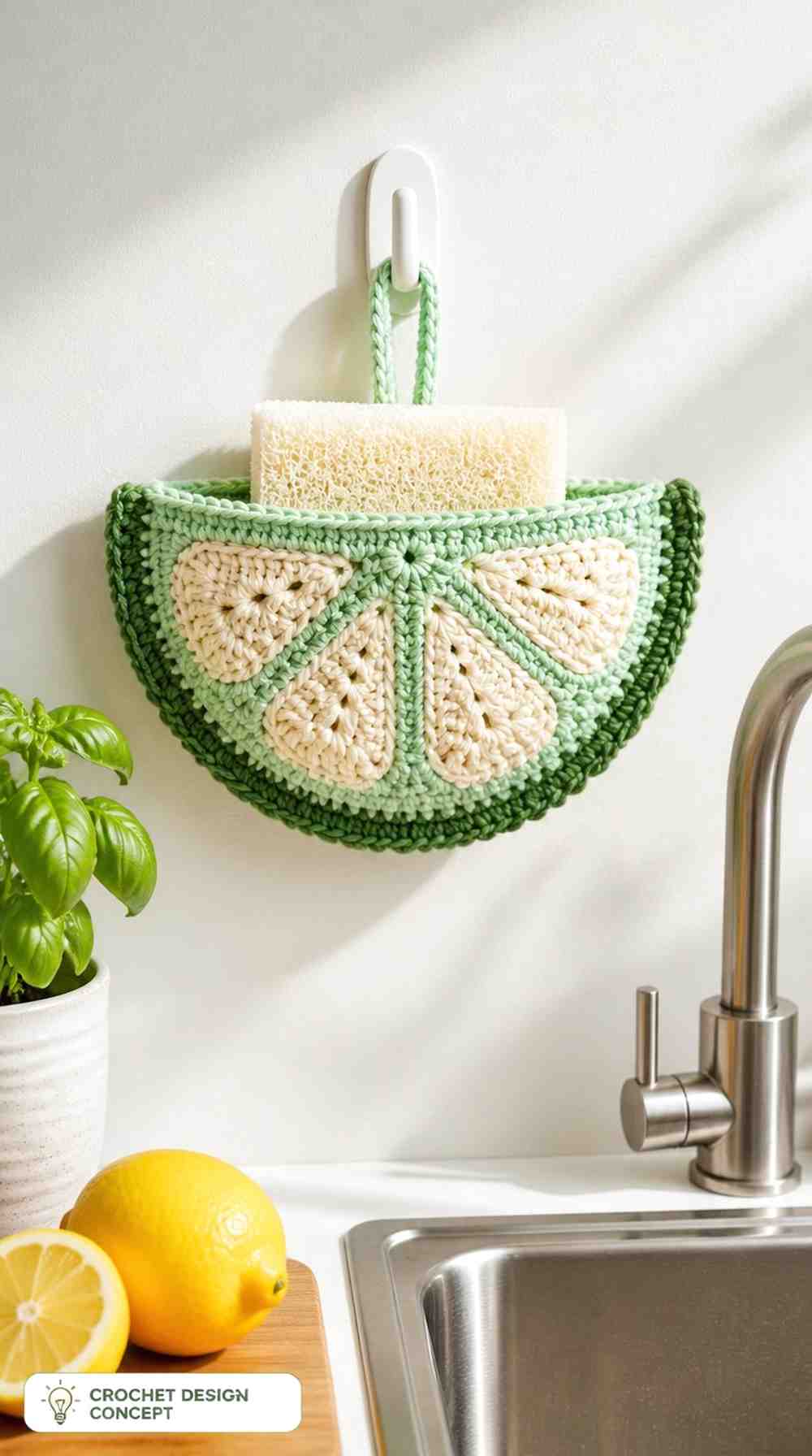
Mint-green crochet forms a semicircular sponge pocket inspired by a fresh citrus slice. Six pale-ivory wedge sections decorate its curved front, surrounded by a deeper green outer border. The straight upper opening reveals a cream sponge, while a small mint hanging loop supports the complete shape.
This playful fruit-inspired design keeps the decoration within the pocket itself rather than adding loose hanging ornaments. The rounded lower edge gives it a distinctive silhouette, although its narrow opening may suit smaller sponges better than oversized cleaning pads.
- Wedge-shaped sections: Keep the six decorative crochet segments well joined so the semicircular front remains smooth rather than pulling unevenly.
- Straight upper rim: A simple open top provides access while letting the citrus motif remain the main visual feature.
- Rounded storage space: Compare the sponge’s rectangular shape with the curved pocket to avoid a fit that pushes excessively against the sides.
16. Crochet Lavender Envelope Sponge Caddy
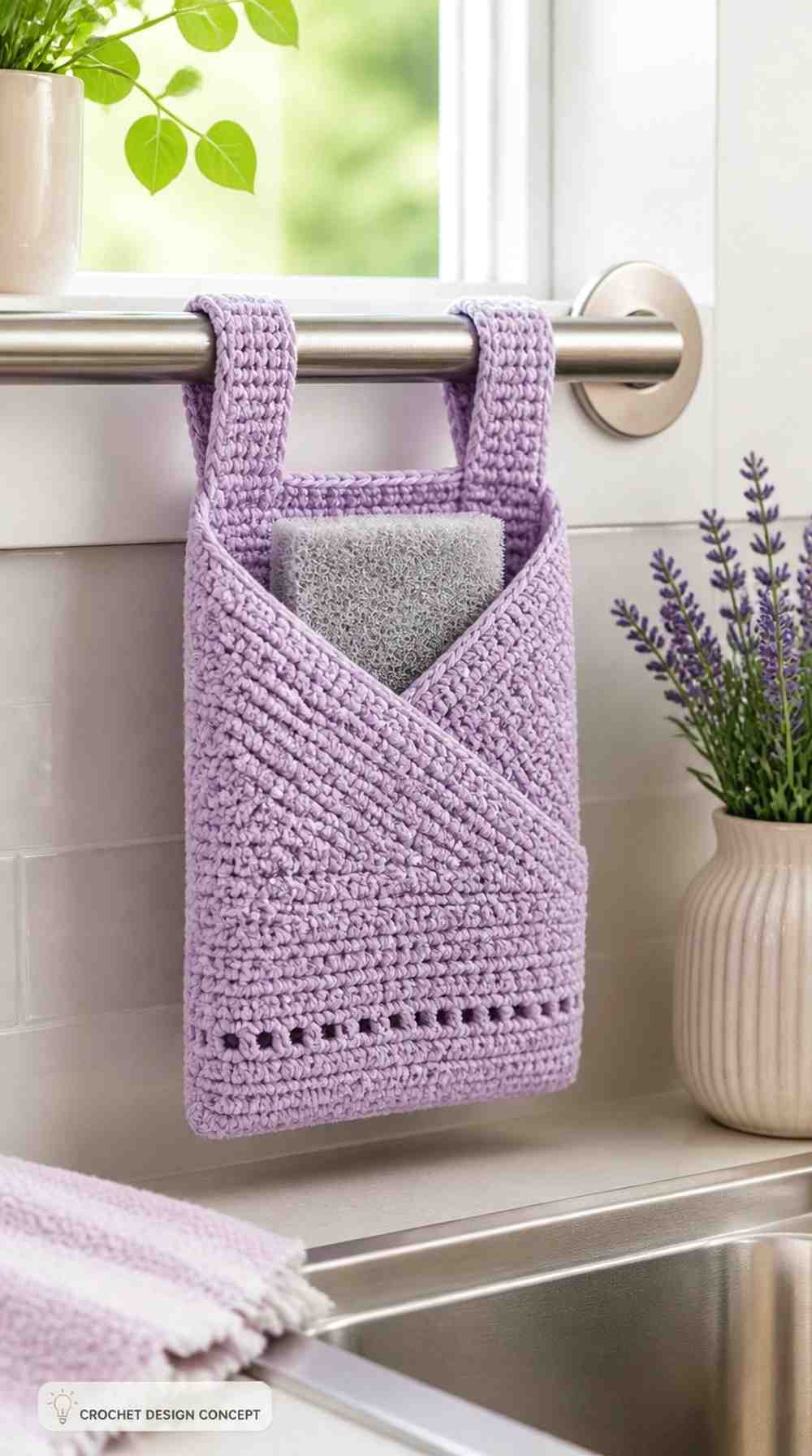
Soft lavender yarn gives this rectangular hanging organizer a gentle pastel look. Two overlapping diagonal crochet panels meet in a shallow V-shaped opening, while the lower portion forms a closely worked envelope point. A narrow row of open stitches near the base adds a small ventilated detail.
Two broad lavender loops suspend the caddy from a slim metal rail. A pale-grey sponge is visible above the diagonal panels, making this an attractive alternative to a standard straight-front pocket.
- Overlapping panels: The diagonal edges need enough overlap to support the sponge without leaving a large gap through which it could slip.
- Envelope point: The closely crocheted lower section creates a distinctive shape, but it may hold more moisture than the open mesh alternatives.
- Dual hanging loops: Keep both loops aligned so the V-shaped front remains centered and the pocket does not tilt when loaded.
Practical Guide to Crochet Hanging Sink Sponge Caddies
A sink sponge caddy needs more than an attractive shape. Its usefulness depends on how it hangs, whether the sponge fits and how easily both the sponge and the holder can dry.
Choose a suitable location. Faucet loops, rails, wall hooks and cabinet handles all offer different possibilities. Check that the proposed support is stable and does not interfere with taps, cabinet doors or dishwashing. Avoid placing damp crochet directly against unprotected wood or other moisture-sensitive surfaces.
Think carefully about yarn. Cotton is a common choice for kitchen crochet because it can be relatively absorbent and is available in many practical yarn weights. However, the exact yarn’s washing instructions, drying behavior and suitability for repeated wetting still matter. An absorbent fiber does not make a damp holder hygienic on its own.
Plan around the actual sponge. Measure the sponge’s width, thickness and length, then allow enough space for easy removal. A holder that becomes tight when the sponge swells with water is less convenient than one with a comfortable opening.
Give moisture somewhere to go. Open mesh, ventilation slots and shallow pocket shapes may help expose damp surfaces, but no crochet caddy guarantees fast drying or prevents microbial growth. Remove the sponge and caddy regularly for appropriate cleaning, allow both to dry thoroughly, and follow the sponge manufacturer’s replacement guidance.
Check hanging strength and maintenance. Straps, buttons, loops, rings and seams need to suit the intended use. Wet items can be heavier than dry ones. Check how the holder stretches in use and ensure the whole piece can be removed for cleaning.
For more nearby kitchen storage inspiration, explore Crochet Vintage Kitchen Wall Pocket Ideas and Crochet Kitchen Towel Topper Ideas on Yarn Nest Studio. Both explore different hanging kitchen accessories and placement considerations.
Want to Make Something Similar?
These are design concepts rather than finished patterns, but a couple of existing crochet resources may help with related construction ideas.
- Pocketed Over the Sink Dishcloth by Sharon E. Santorum — a paid Ravelry crochet pattern that combines a dishcloth with a pocket for holding a sponge or scrubby. It is relevant to the pocket-storage concept, not an exact pattern for any design pictured here. Ravelry
- Double-Sided Crochet Dish Scrubber Tutorial by Red-Handled Scissors — demonstrates a separate hanging crochet cleaning item with a loop. It may help readers understand related kitchen crochet techniques, but it does not construct these caddies. Red-Handled Scissors
When adapting either technique, work from the actual instructions rather than assuming that an AI illustration provides accurate stitch counts, shaping or dimensions.
Which Crochet Sponge Caddy Should You Choose?
The best choice depends less on the color than on the available hanging point and how you use your sink.
| Kitchen need | Designs worth comparing | Main trade-off |
|---|---|---|
| Maximum visible ventilation | Terracotta Corner Sling, Navy Rope Edge Hammock | Open mesh requires careful sponge fit and hanging support |
| Very compact hanging storage | Sage Mesh Faucet Caddy, Olive Leaf Pocket | Limited capacity and location-specific mounting |
| Two separate cleaning items | Daisy Granny Square Organizer, Apricot Sponge and Brush Caddy | More compartments mean additional joins and cleaning areas |
| Simple neutral styling | Oatmeal Button Tab Pocket, Charcoal Ring Caddy | Denser crochet can remain damp longer |
| Decorative cottage finish | Powder Blue Scalloped Basket, Dusty Rose Waffle Pocket | Raised textures and borders need extra cleaning attention |
| Easy-to-see sponge access | Lemon Yellow Ventilated Caddy, Lavender Envelope Caddy | Openings must still retain the sponge securely |
| Playful color and shape | Mint Citrus Slice Holder, Burgundy Checkerboard Caddy | More shaping or colorwork may require extra planning |
| Broader farmhouse storage | Cream and Rust Dowel Caddy | Needs a suitable dowel and securely mounted brackets |
If drying access is the biggest concern, begin by examining the Crochet Lemon Yellow Ventilated Caddy or Crochet Navy Rope Edge Sponge Hammock. If a narrow space and minimal appearance matter more, the Crochet Olive Leaf Sponge Pocket offers a compact alternative.
For a kitchen where a sponge and brush are regularly used together, the Crochet Apricot Sponge and Brush Caddy is the clearest organization-focused concept. Just make sure the proposed mounting point and compartment dimensions suit the real items.
Conclusion
A crochet hanging sink sponge caddy can be both a small kitchen organizer and a thoughtful handmade design detail. The most appealing ideas balance texture and color with accessible openings, suitable hanging points and realistic cleaning needs.
The 16 designs here show how much variety is possible, from simple ribbed pockets and open mesh hammocks to floral squares, botanical shapes and divided holders. Before making one, choose a location, measure your sponge and consider how the finished crochet will handle repeated moisture.
Which would you choose for your own kitchen sink? Would you prefer the open navy hammock, the daisy granny-square organizer or the compact sage faucet caddy? Share the design you find most useful and what kind of hanging space your kitchen has.
Frequently Asked Questions
1. What yarn is suitable for a crochet sink sponge caddy?
Cotton yarn is commonly considered for kitchen crochet because it is widely available, absorbent and comes in many colors and weights. However, different cotton yarns can behave differently when wet. Check the specific yarn’s care instructions and consider whether the finished holder can be washed and dried regularly. Avoid assuming any yarn is automatically resistant to mildew.
2. Should a hanging sponge caddy have drainage holes?
Openings may help water escape and expose more of the sponge to air, but they are not a complete hygiene solution. Their size matters: very large openings can let smaller sponges fall through, while dense pockets may retain more moisture. The holder and sponge should both be cleaned and allowed to dry appropriately.
3. Can a crochet sponge holder hang directly from a faucet?
Some concepts use loops around part of a faucet, but compatibility depends on the actual fixture. A holder should not interfere with the tap handle, moving spout or connections. It should also be easy to remove so the faucet and surrounding surfaces can be cleaned. A separate nearby hook may be more practical in some kitchens.
4. Can I wash a crochet sponge caddy in a washing machine?
That depends on the yarn, dyes, stitches and any attached components such as buttons or wooden rings. Follow the material care information rather than assuming machine washing is suitable. Inspect seams and straps after washing, and allow the holder to dry fully before returning it to the sink area.
5. Are these 16 crochet sponge caddy designs available as exact patterns?
No. These are original AI-visualized inspiration concepts, not tested patterns or complete construction instructions. The outside resources linked above teach related crochet techniques or offer different patterns. If you want to make one of the pictured designs, its shape, dimensions, attachments and stitch structure will need to be worked out and checked before use.