Meal prep containers can quickly take over a kitchen shelf, fridge, or countertop, especially when several boxes are stacked together. Crochet meal prep container stack straps offer a creative way to organize these everyday essentials while adding a handmade touch to kitchen storage. From broad crossed bands and adjustable buckle straps to soft scalloped ribbons and rounded container harnesses, these 15 inspiration ideas explore different shapes, colors, and practical arrangements.
Some concepts are designed for rectangular meal-prep boxes, while others suit small bento containers or round food-storage stacks. The collection includes terracotta-coral, cornflower blue, oatmeal, plum, lavender, and forest-green designs, each with its own fastening arrangement. As you explore them, think about container measurements, strap stretch, lid clearance, and how easily the straps can be removed for cleaning. These ideas focus on organizing stacks, not carrying loaded food containers.
These are AI-generated crochet design visualizations for inspiration, not photographs of tested handmade products or step-by-step patterns.
Quick Design Selection Guide
| Your main priority | Design to explore |
|---|---|
| A decorative crossed arrangement | Crochet Coral Crossed-Lid Container Harness |
| Two adjustable parallel straps | Crochet Cornflower Double-Slider Stack Straps |
| A simple band around stored containers | Crochet Oatmeal Side-Buckle Stack Band |
| A holder with four corner supports | Crochet Marigold Four-Corner Lacing Harness |
| A soft decorative strap for small containers | Crochet Blush Scalloped Bento Stack Ribbon |
| An arrangement for round containers | Crochet Forest Green Round Container Harness |
1. Crochet Coral Crossed-Lid Container Harness
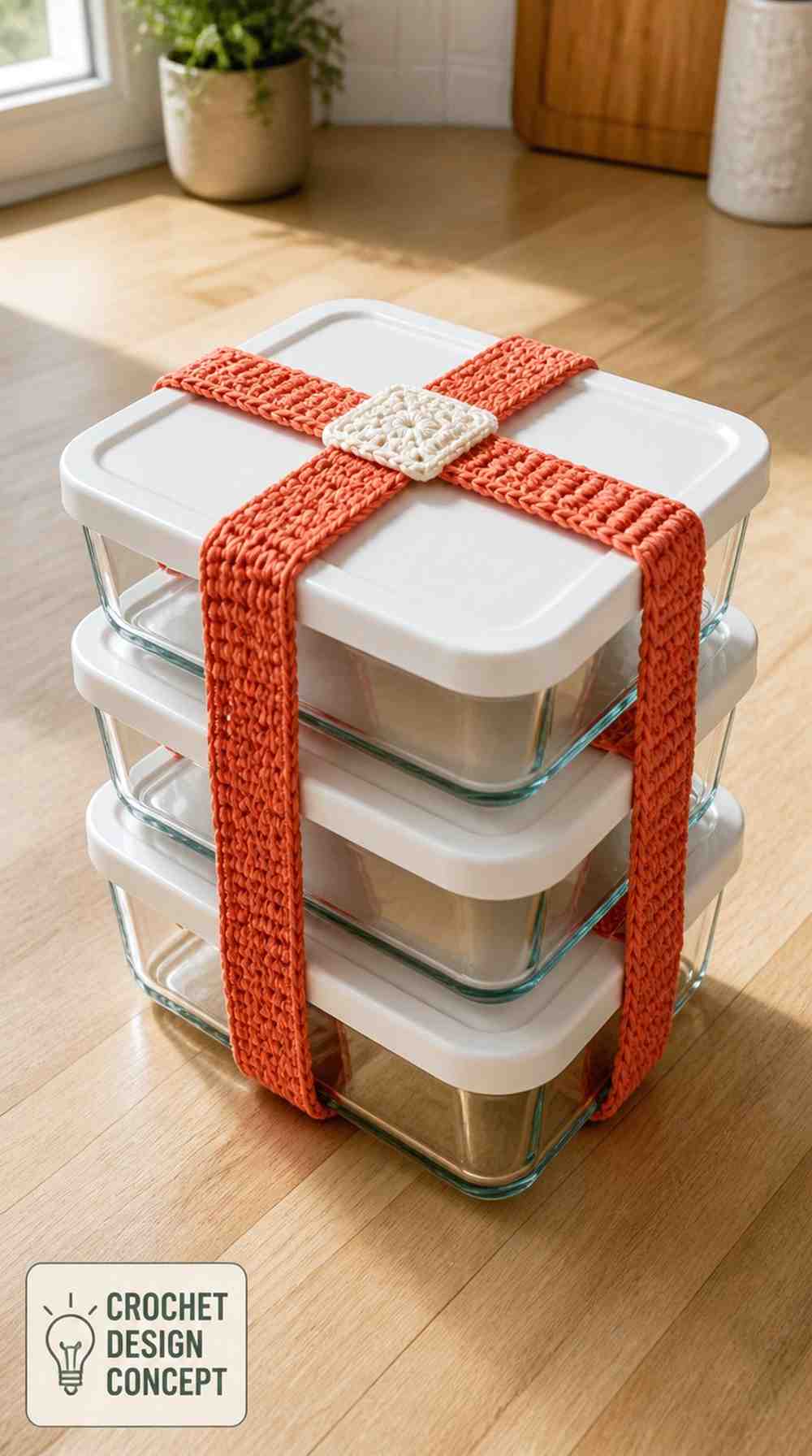
Burnt-coral crochet creates a bold crossed-band design around three stacked rectangular glass meal-prep containers. Two broad straps travel diagonally across the top lid, meeting at a small ivory crochet square before continuing down the sides and beneath the base. The dense stitch texture gives the harness a neat, structured appearance.
The crossed arrangement offers an interesting way to organize a matching stack without hiding the individual container lids. Because diagonal bands can shift along smooth surfaces, the actual fit would need careful adjustment around the container corners and lower base.
- Crossed-band positioning: Keep the two diagonal straps centered over the upper lid, with their ivory intersection resting flat rather than pulling unevenly.
- Corner contact: Smooth glass surfaces may allow crochet bands to move, so check how securely the straps sit around the actual container corners.
- Base coverage: Both bands should pass completely beneath the lowest container without creating thick folds that make the stack unstable.
- Best use: This crossed arrangement is best considered for stationary organization; it has not been tested as a carrying harness.
2. Crochet Cornflower Double-Slider Stack Straps
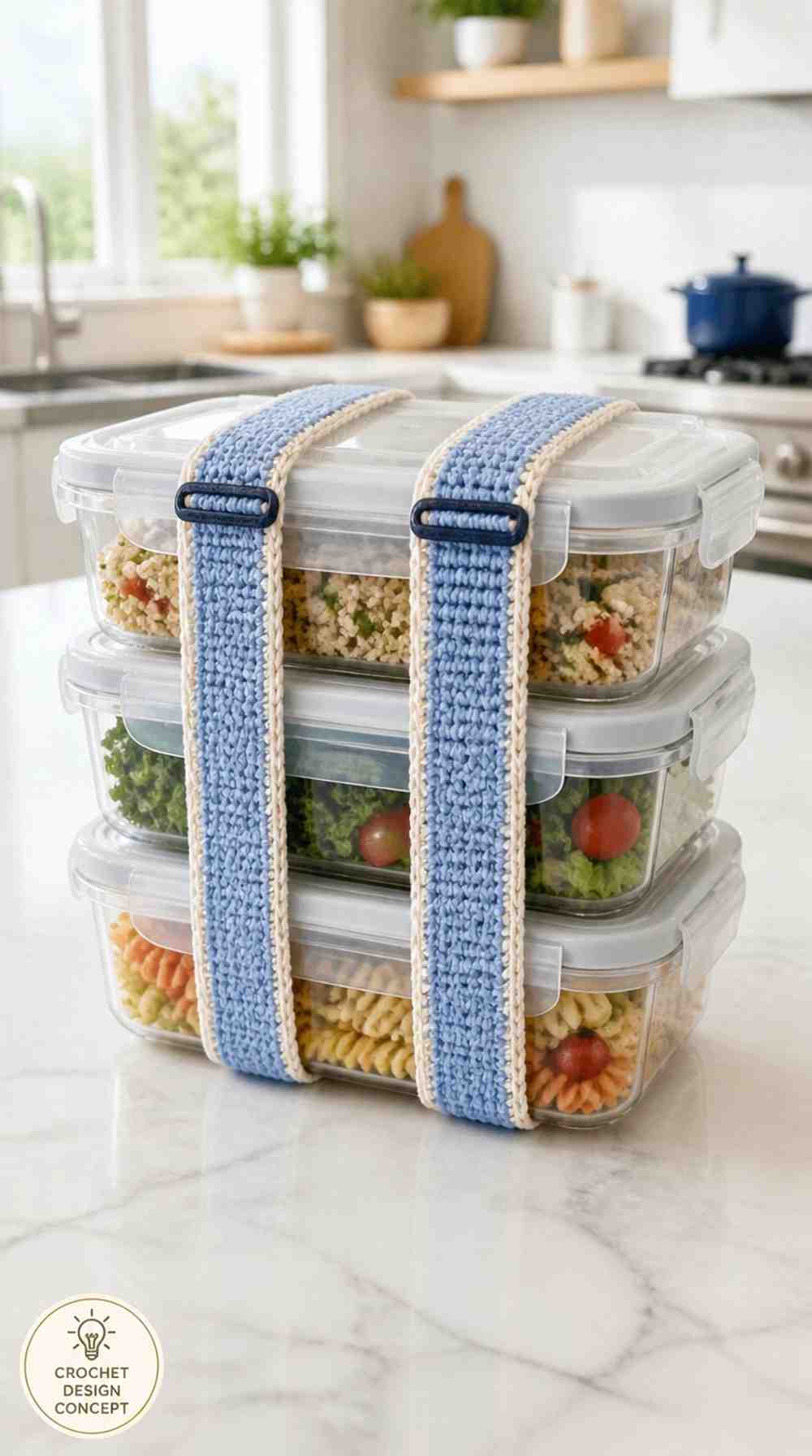
Two parallel cornflower-blue crochet straps run around three rectangular meal-prep containers in this practical-looking concept. Each band passes beneath the bottom container, rises along the sides, and crosses the upper lid. Small navy sliders provide individual adjustment, while thin ivory borders add definition.
The double-band arrangement may appeal to anyone who likes a symmetrical, uncluttered look. Separate adjustment points offer a way to accommodate minor changes in stack height, provided both straps remain evenly positioned and the closures are suitable for the finished material.
- Parallel alignment: Keep both straps evenly spaced so one does not slide toward the edge while the other remains centered.
- Slider compatibility: Check the slider opening against the actual thickness of the crocheted fabric, including its ivory edging.
- Independent adjustment: Two separate sliders allow individual fitting, but each band should maintain similar tension around the containers.
- Cleaning access: Removable parallel straps can be washed separately from the containers when their chosen yarn and hardware allow it.
3. Crochet Oatmeal Side-Buckle Stack Band
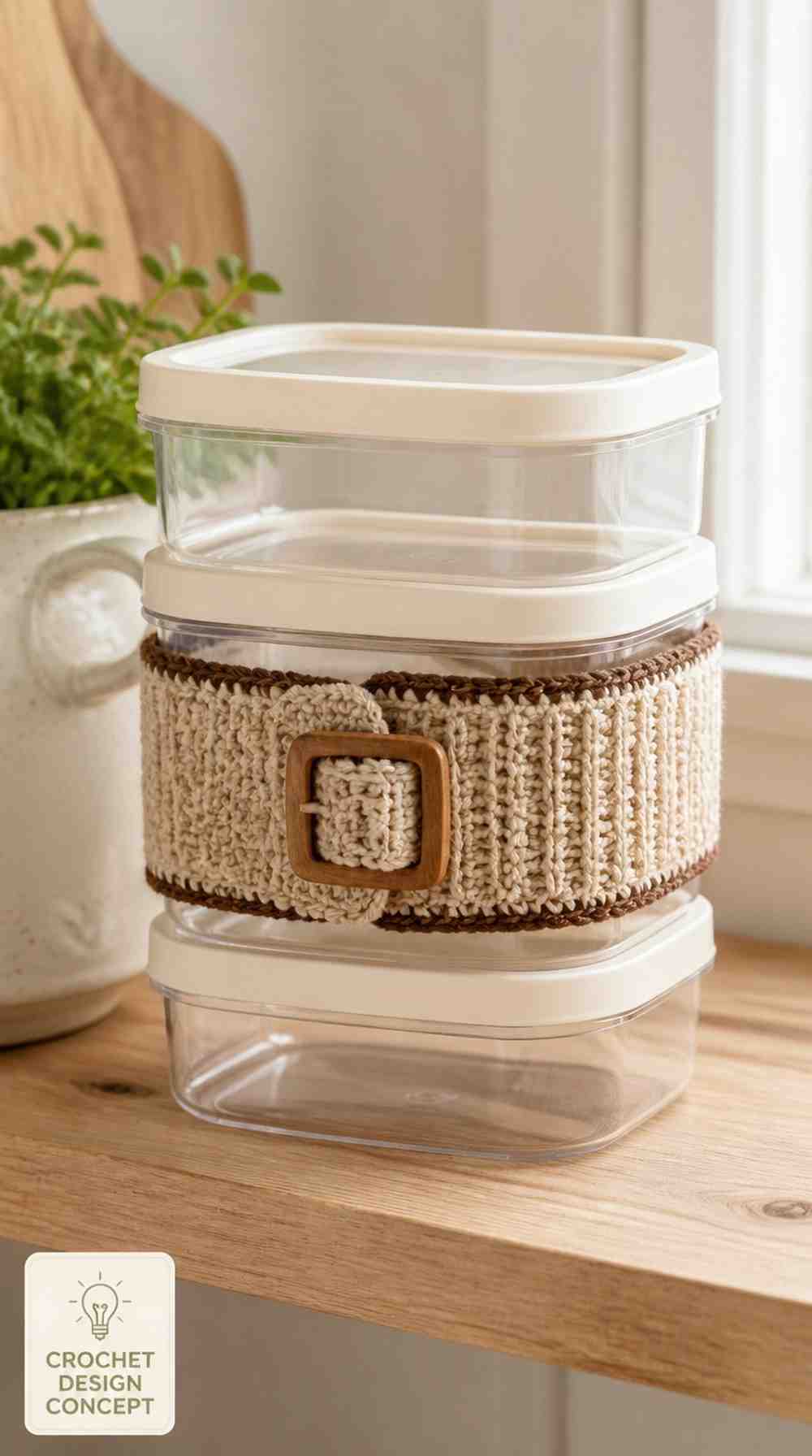
Oatmeal-colored crochet forms a single broad band around the middle of three square food-storage containers. Raised vertical ribs give the band a softly structured texture, while cocoa-brown edging frames both sides. A small wooden buckle secures the overlapping ends at the front.
Unlike a strap that passes over the top and underneath the base, this design wraps horizontally around the stack’s sides. Its main purpose is visual grouping and shelf organization. The band should not be relied upon to hold containers together vertically or keep their lids closed.
- Horizontal placement: Position the band where it can sit evenly without pressing against lid clips or raised container rims.
- Buckle fitting: Allow enough overlapping crochet fabric for the wooden buckle to close without pulling the ribbed texture out of shape.
- Ribbed surface: Raised rows add definition, but excessive stretch may cause the band to loosen after repeated removal.
- Important limitation: A side band alone cannot reliably stop the upper containers from lifting or sliding off the stack.
4. Crochet Plum D-Ring Lengthwise Stack Wrap
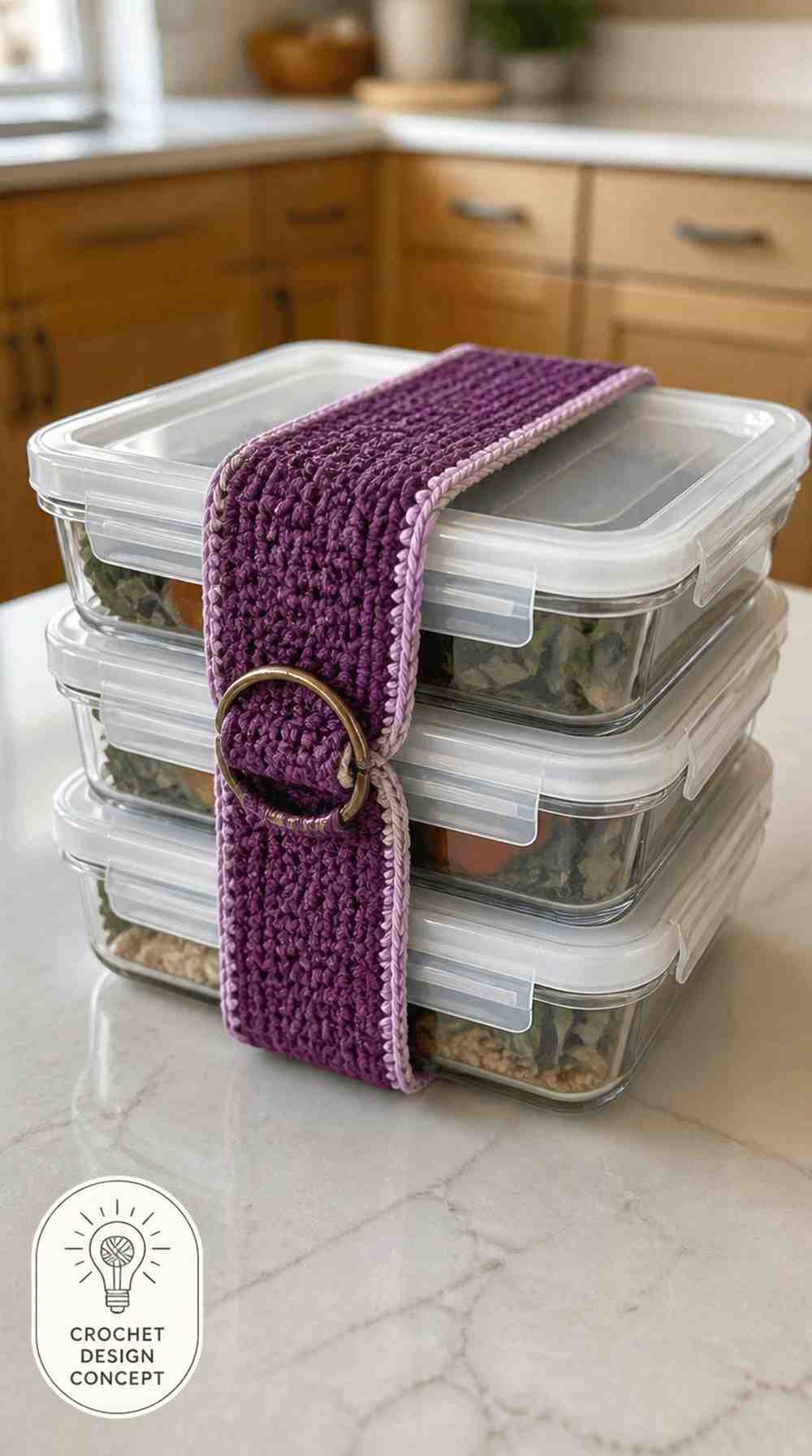
Deep plum-purple crochet creates a single broad strap running lengthwise around three shallow meal-prep containers. The band passes beneath the bottom box and across the center of the upper lid, with two antique-brass D-rings securing the overlap. A narrow dusty-lilac border softens the edges.
This design puts the adjustment hardware in one visible position rather than distributing several fastenings around the stack. It may suit a matching set of shallow containers where a single band can remain centered. The metal rings should not press against delicate plastic lids.
- Lengthwise fit: Measure the full route beneath, around, and over the containers, rather than estimating strap length from stack height alone.
- D-ring position: Keep the brass hardware on a flat outer area where it will not catch a lid latch or scratch the container.
- Band width: A wider strip distributes contact over more surface area but may obstruct access to side closures.
- Tension check: The strap should sit neatly without bending the lid or applying pressure that affects its seal.
5. Crochet Marigold Four-Corner Lacing Harness
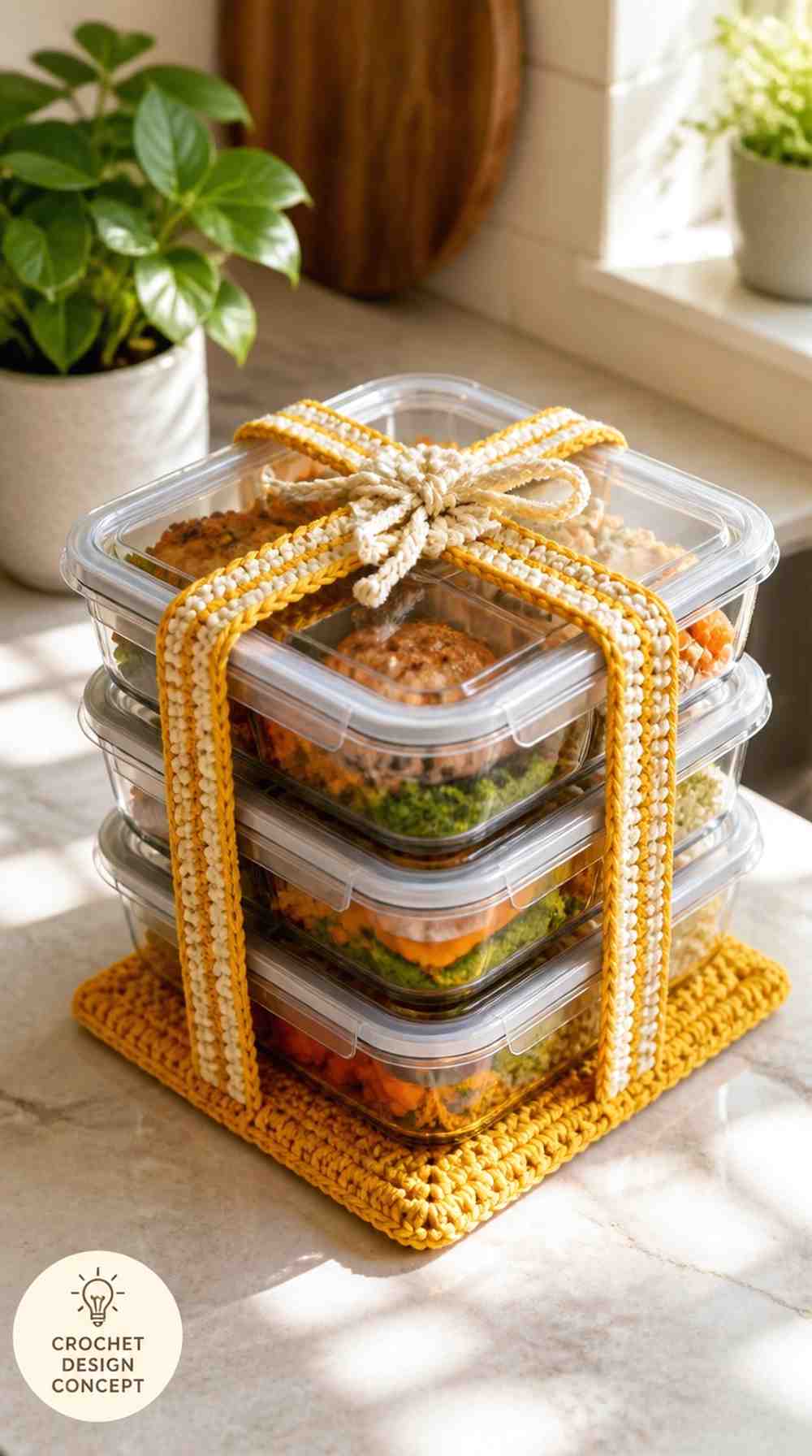
Marigold-yellow crochet gives this container harness a cheerful, organized appearance. A flat square base supports the lowest container, while four narrow mustard-and-cream bands rise from the corners. The straps meet above the top lid, where a small cream lacing arrangement finishes in a tidy bow.
The four-corner design creates a different silhouette from a conventional single belt. Its lower base and separate corner straps make the arrangement visually balanced, although the connections would need careful planning to prevent uneven pulling around the stack.
- Base dimensions: Match the square crochet panel to the lowest container so its corners line up with the four rising straps.
- Corner connections: Reinforce each attachment area and check that the bands remain aligned when the stack height changes.
- Top lacing: Keep the cream bow compact enough to avoid loose ends and allow the fastening to be opened without excessive pulling.
- Access considerations: All four top straps must be released before removing the upper container, making this a more involved storage arrangement.
6. Crochet Sea Glass Corner-Cap Stack Harness
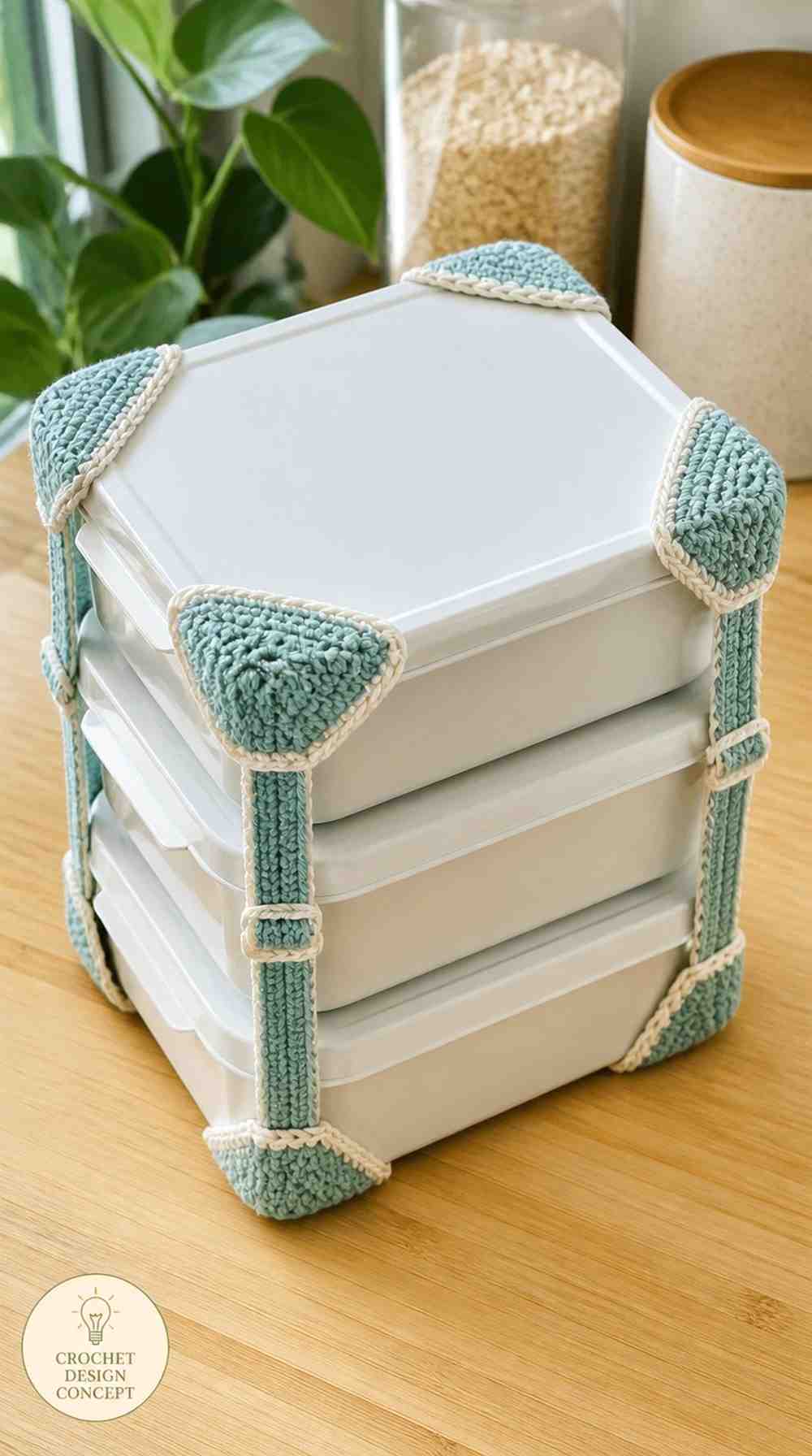
Sea-glass-teal crochet forms four small triangular caps over the upper corners of a rectangular container stack. Matching lower corner cradles sit beneath the bottom container, connected by narrow vertical straps. Cream edging traces the triangular shapes and helps define the individual pieces.
The corner-cap arrangement leaves most of the top lid uncovered. That makes the design visually lighter than a wide continuous band, while the separate side connections give it a distinctive framework. Proper fitting would be essential because the caps could slip off rounded container corners.
- Corner geometry: Check whether the containers have sharp, rounded, or projecting corners before planning the triangular caps.
- Lower cradles: The bottom supports should sit flat against the lowest container without bunching underneath and making the stack rock.
- Side adjustment: Short adjustable tabs may help with fit, provided their fastenings remain secure and do not interfere with lid closures.
- Design limitation: Smooth or heavily rounded containers may not provide suitable contact points for this type of corner harness.
7. Crochet Cinnamon Ladder-Tie Stack Wrap
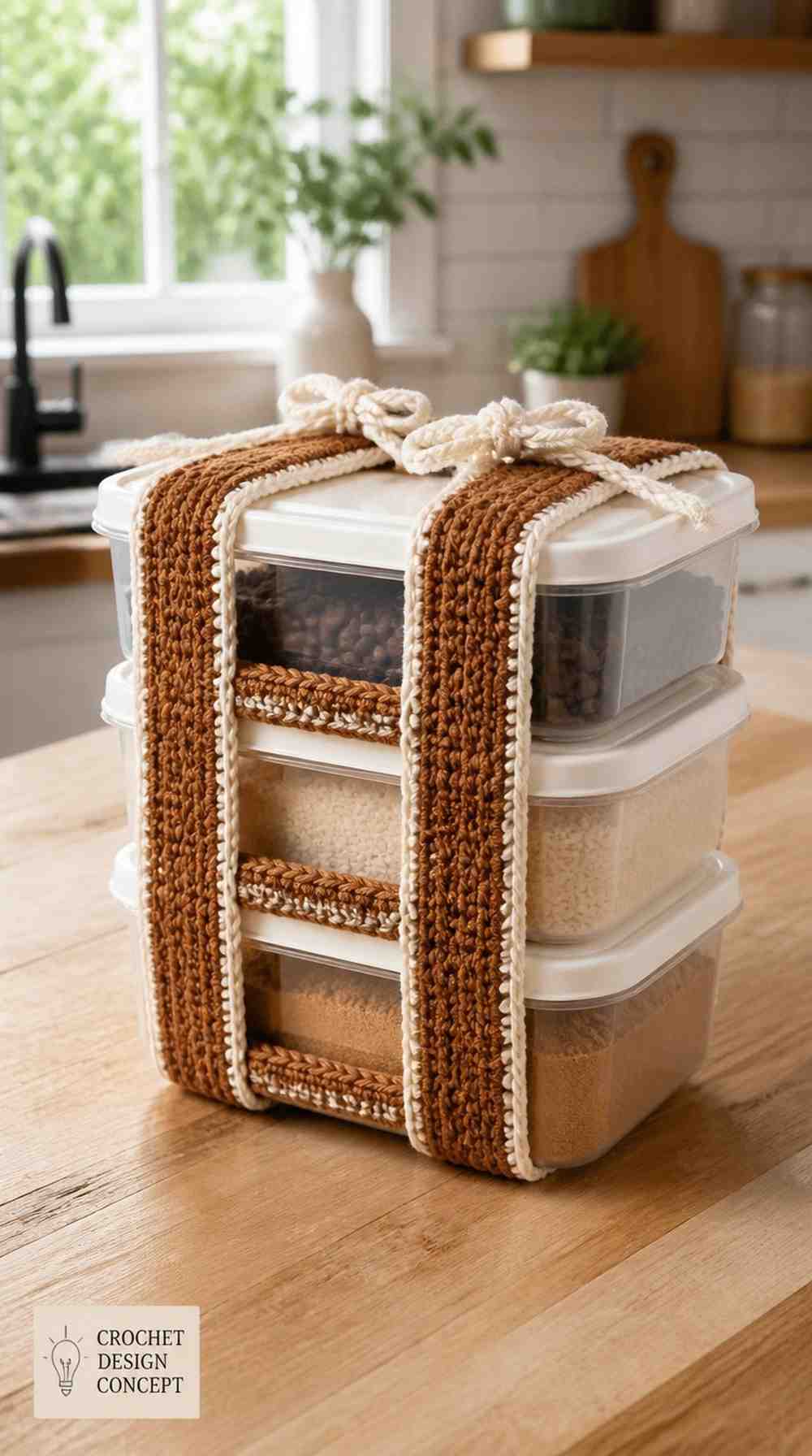
Cinnamon-brown crochet creates a ladder-like arrangement around three rectangular containers. Two main straps pass beneath the stack and rise along its sides, while three short horizontal bars connect the visible sections. Cream borders and matching upper ties give the organizer a warm farmhouse appearance.
The ladder detail brings texture to the sides without completely covering the containers. Its usefulness depends on how firmly the horizontal bars remain connected to the main straps. The decorative bars should not be mistaken for independent supports capable of holding the containers’ weight.
- Ladder spacing: Position the horizontal bars where they do not catch on individual lid rims or snap closures.
- Main strap strength: The two continuous bands provide the primary wrap structure; the short connecting bars are not substitutes for them.
- Top ties: Keep both cream closures evenly tensioned so the ladder section does not pull sideways.
- Visual accessibility: The open spaces between bars leave container sides visible, making it easier to see the stack’s overall arrangement.
8. Crochet Ivory Mesh-Window Container Wrap
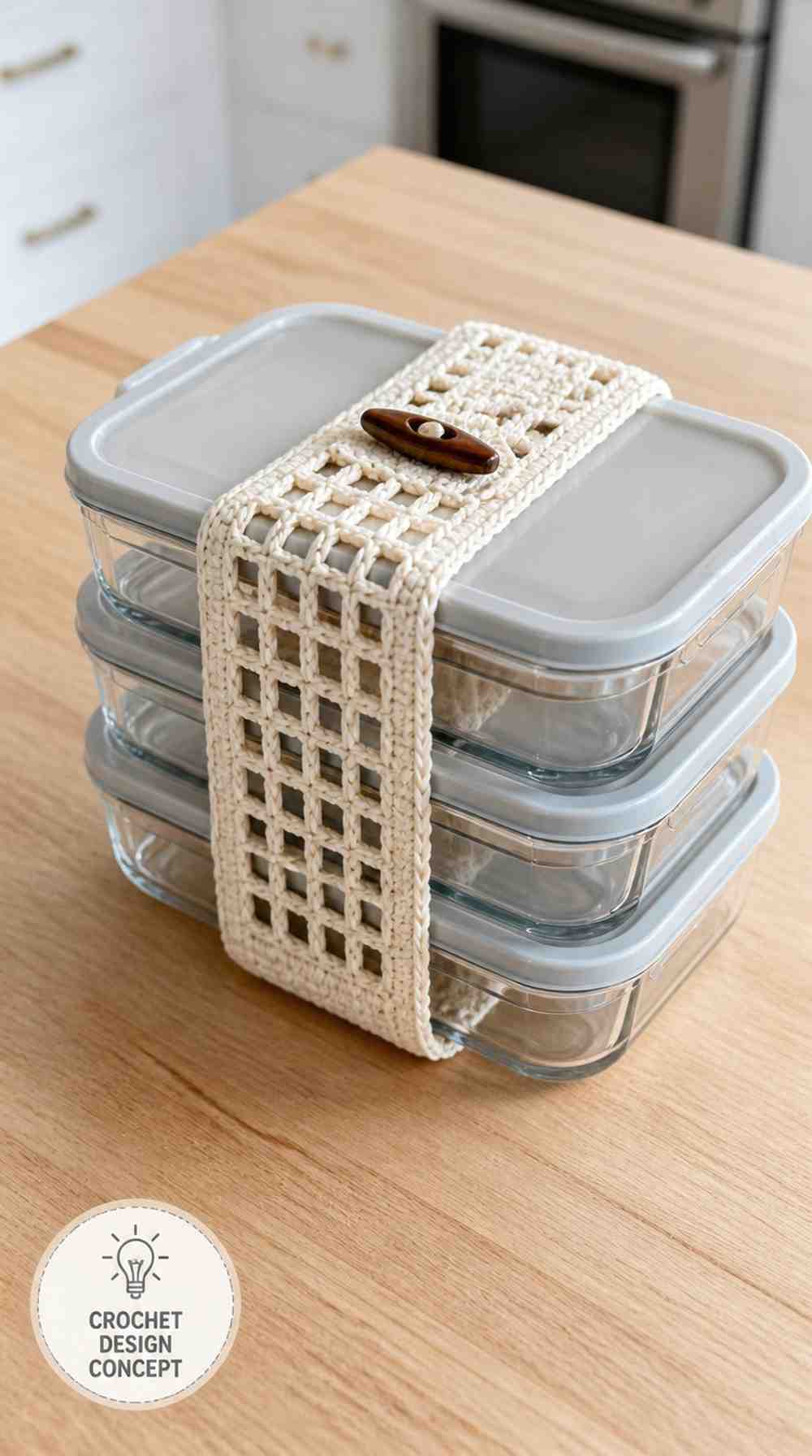
Warm ivory crochet forms a broad wrap with square openwork panels running along its length. Dense outer borders support the mesh, while a small walnut-colored toggle fastens the strap near the upper edge. The open crochet pattern allows portions of the transparent meal-prep containers to remain visible.
This design combines decorative mesh with more closely worked fastening areas. It may suit a kitchen where a lighter, less solid crochet appearance is preferred. The open sections require careful joins because loosely connected mesh can stretch considerably under tension.
- Mesh stability: Use coherent, evenly joined crochet chains, and assess how much the openwork changes shape when the strap is fitted.
- Solid fastening area: Keep the walnut toggle attached to a dense reinforced section rather than directly to delicate open squares.
- Visibility: The open windows expose parts of the container sides while the continuous outer borders define the strap’s shape.
- Stretch limitation: Mesh sections may behave differently from solid crochet, so a finished strap needs fitting checks before regular use.
9. Crochet Lavender Braided Side-Loop Harness
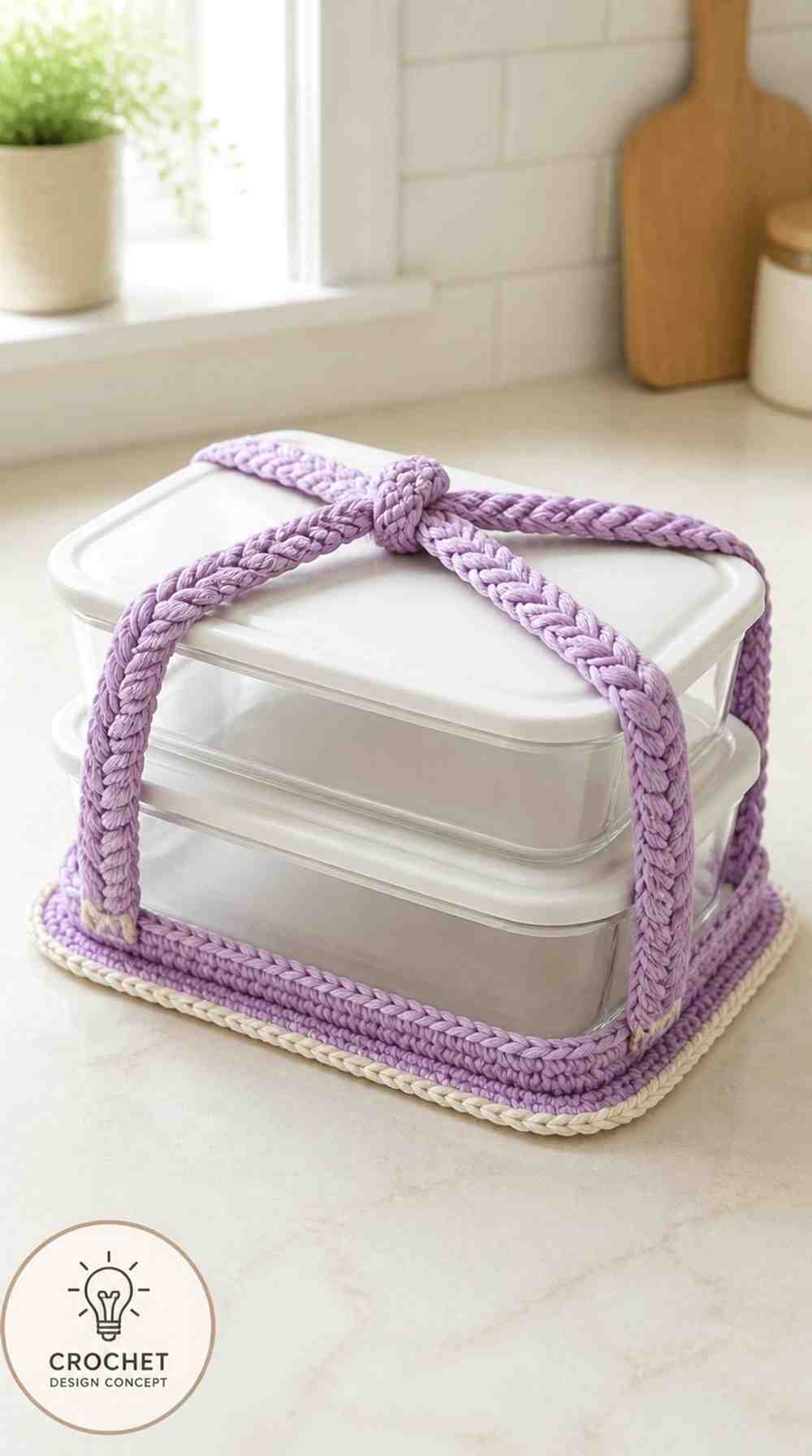
Soft lavender crochet gives this two-container harness a graceful appearance. A flat cradle supports the bottom container, while two thick braided cords rise along opposite sides. The cords cross over the upper lid and meet in a compact central knot, with a narrow cream border defining the base.
The braided cords are the design’s main feature. Their rounded shape looks different from the flat bands used elsewhere in the collection. However, cords can roll or shift against smooth plastic surfaces, so the attachment positions and final fit would require particular attention.
- Braided-cord placement: Keep both cords in consistent positions along the container sides so the crossed upper section remains centered.
- Base attachment: Check the joins where the thick cords meet the flat lavender cradle, as these areas experience concentrated tension.
- Knot accessibility: The central knot should be easy to untie without forcing fingers beneath a tightly stretched cord.
- Surface contact: Rounded braids touch less of the container than broad flat straps, which may make them more likely to slide.
10. Crochet Mocha Hook-and-Loop Stack Belt
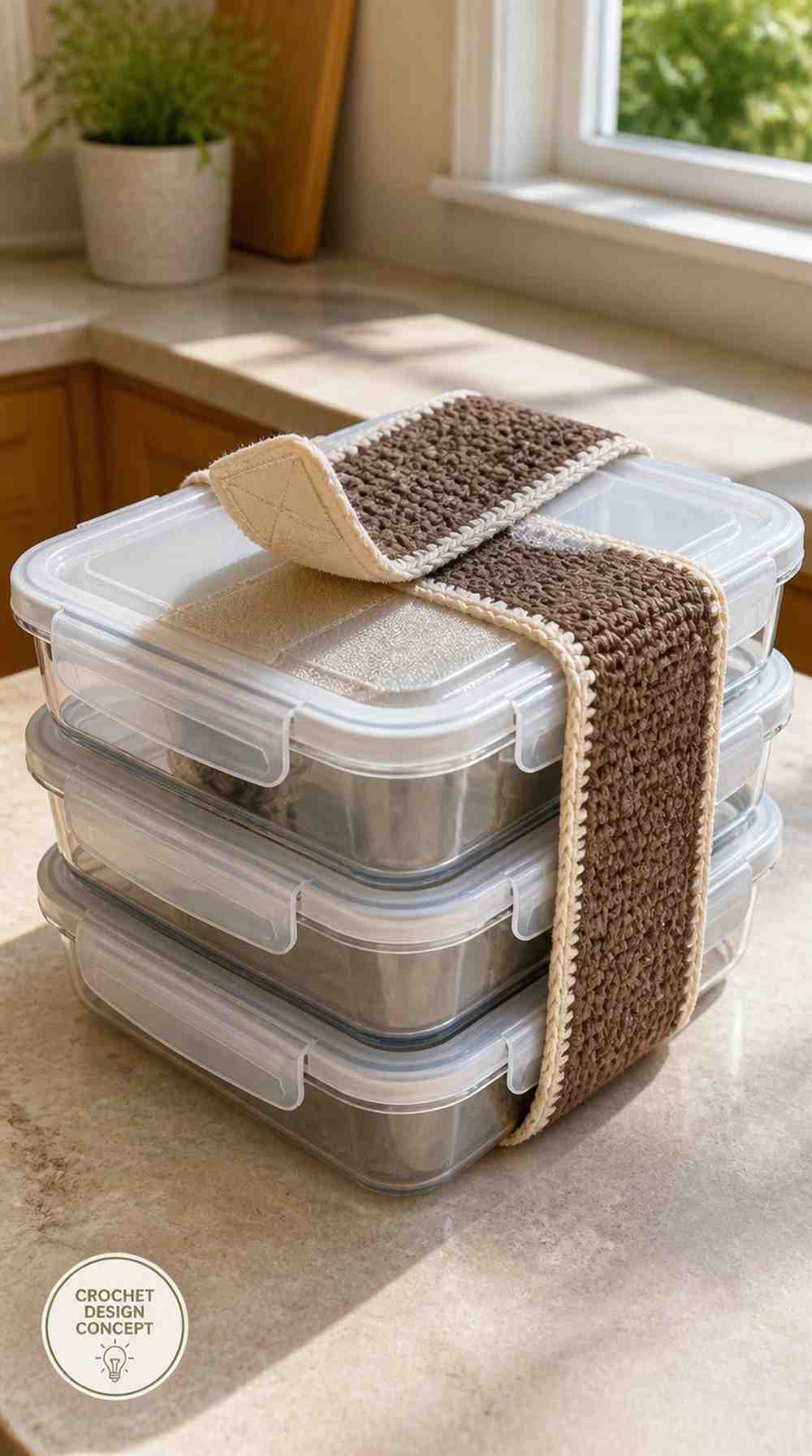
Mocha-brown crochet creates a wide, flat strap around three stacked rectangular meal-prep boxes. An oatmeal border frames the dense horizontal rows, while a beige hook-and-loop patch secures the overlapping ends across the top lid. The short fastening end can be lifted to open the belt.
The broad strap provides a simple fastening layout without decorative knots or bulky buckles. A hook-and-loop closure may make the concept convenient to open and adjust, but the chosen patch must be attached to suitable reinforced material and kept clear of areas where loose yarn can snag.
- Closure position: Place the beige fastening patch on the upper flat section, away from the container’s lid clips.
- Crochet reinforcement: Secure the hook-and-loop material to a firm section so repeated opening does not pull loose individual stitches.
- Adjustable overlap: Leave enough contact area for a proper closure without making the spare strap end unnecessarily long.
- Maintenance: Hook-and-loop fasteners can collect lint and yarn fibers, so inspect them regularly and follow the component’s care instructions.
11. Crochet Charcoal Cross-Tab Container Belt
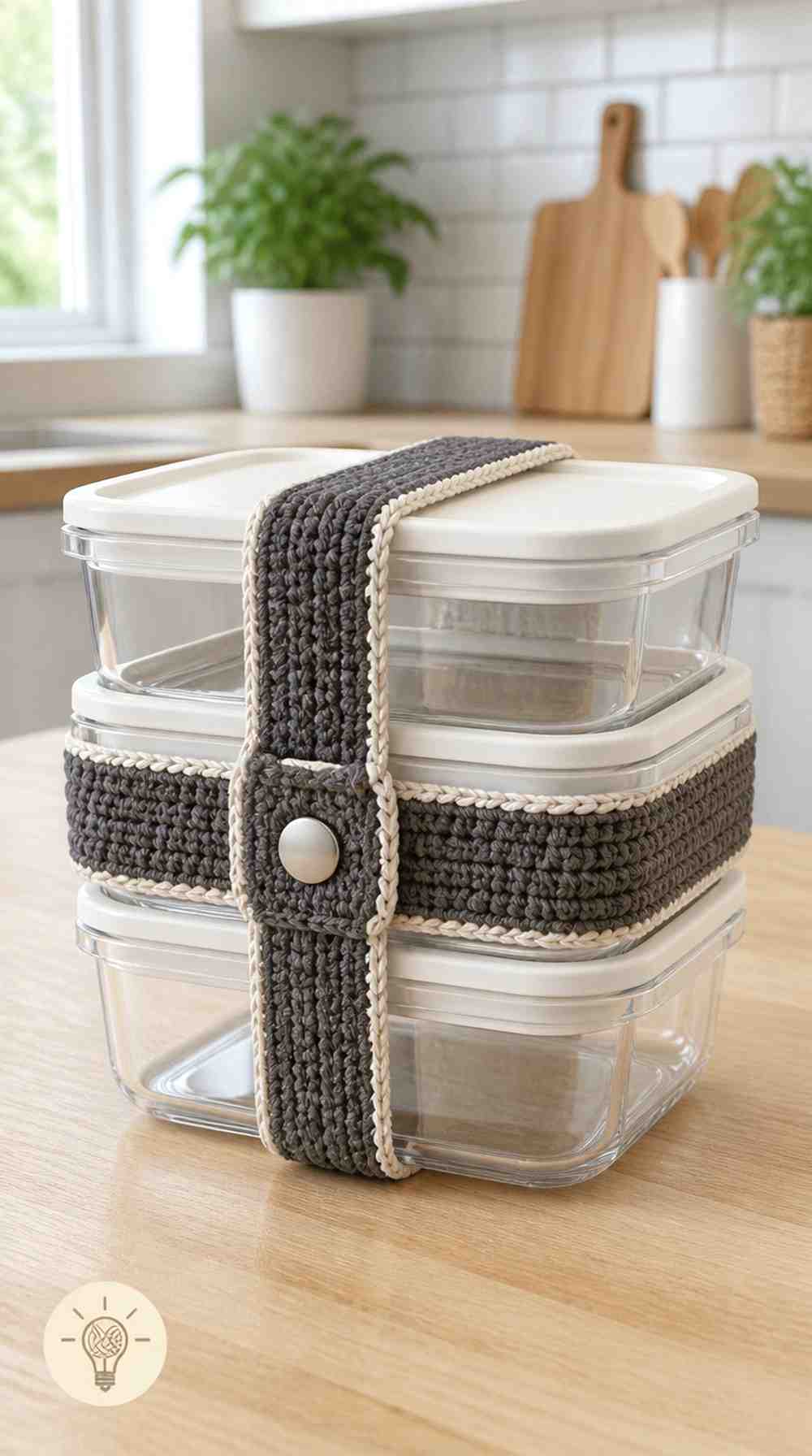
Charcoal-grey crochet forms two connected bands around a stack of three square containers. One belt wraps horizontally around the middle, while a narrower keeper strap passes beneath the base and over the top lid. A small matte-silver snap fastens the intersection at the front, and ivory borders finish the straps.
The two-direction arrangement is useful as a design concept because it combines a side band with a separate over-the-top keeper. Unlike a horizontal belt alone, the vertical section crosses the upper and lower faces, although the construction still requires fitting and stability checks.
- Band intersection: Keep the horizontal and vertical sections properly aligned so the front snap does not twist the crochet fabric.
- Snap reinforcement: Attach the hardware to appropriately strengthened areas rather than relying on a single unsupported stitch.
- Lid clearance: Check that neither band covers release clips or bends the plastic lid edges.
- Two-axis layout: The arrangement provides contact in two directions, but it is not proof that the stack can safely be lifted by the straps.
12. Crochet Blush Scalloped Bento Stack Ribbon
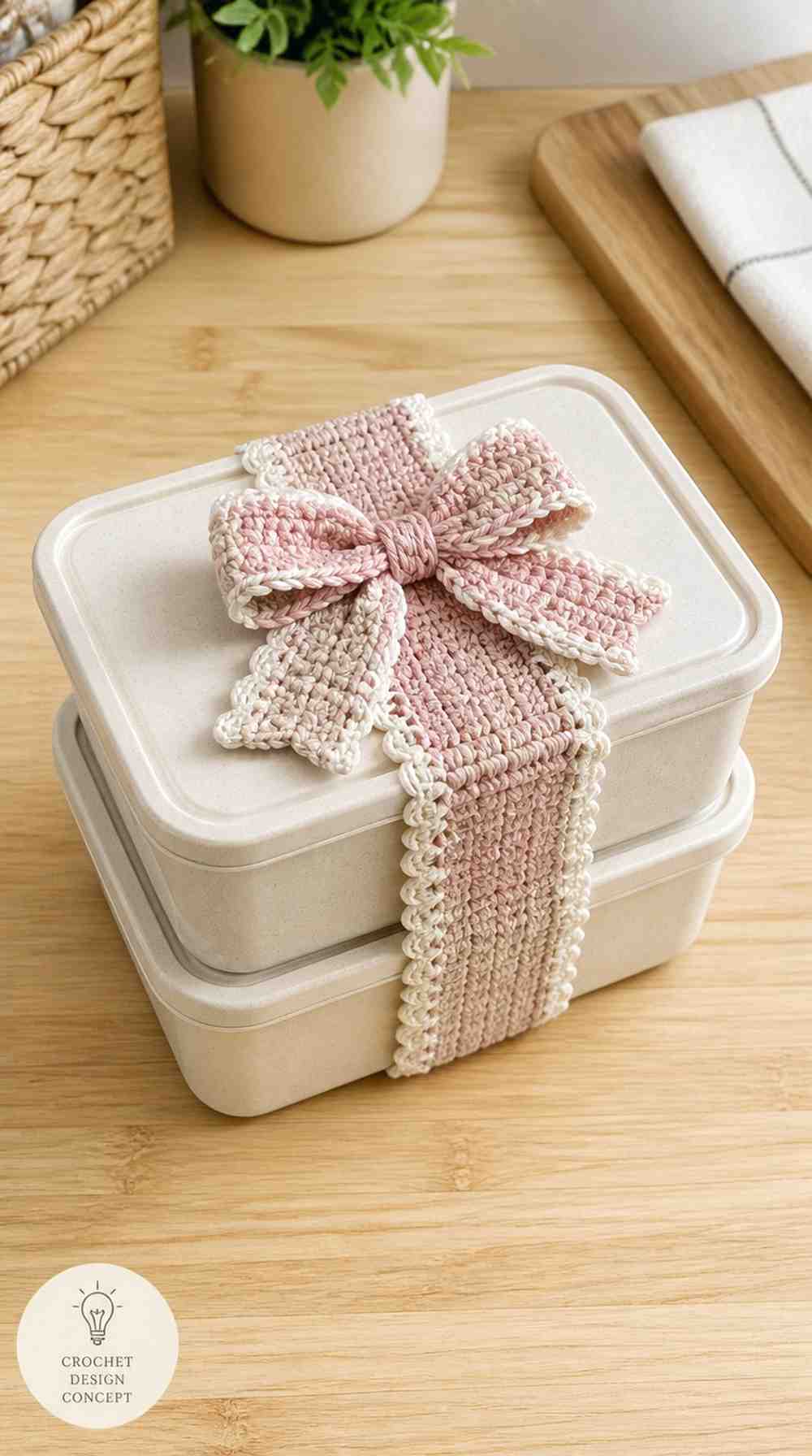
Blush-pink crochet gives this small bento-container stack a soft decorative finish. One broad ribbon wraps beneath two rectangular containers and over the upper lid, where its ends form a flat bow. Tiny cream scallops follow the ribbon’s long edges, adding a delicate border without concealing the main strap.
This design is particularly suited to a small, matching two-container stack as a visual concept. The bow makes the fastening easy to recognize, while the scalloped edging adds a decorative detail. It should be fitted gently to avoid pulling on the container lids.
- Bento proportions: A shorter two-container stack may suit the ribbon better than several tall boxes that require much longer fabric.
- Scalloped edging: Keep the cream loops small enough that they do not catch on lid tabs or nearby items.
- Bow positioning: A flat upper bow creates less bulk than a large raised knot and may be easier to untie.
- Decorative limitation: The ribbon is not a carrying handle and should not be used to lift a filled container stack.
13. Crochet Ochre Multi-Button Adjustable Stack Strap
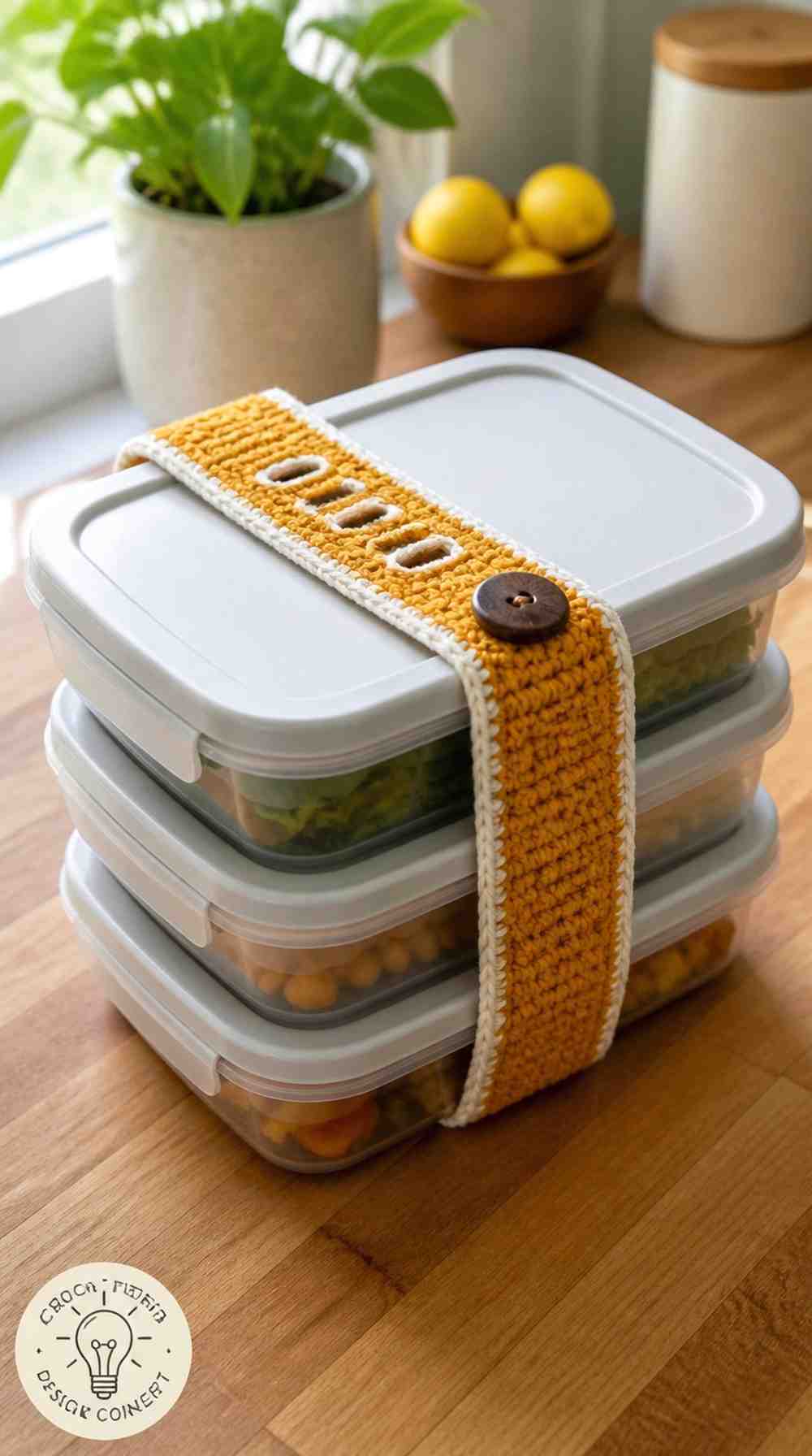
Ochre-gold crochet forms a narrow adjustable strap around three rectangular containers. Three reinforced buttonholes appear along one end, while a single dark wooden button fastens the overlapping section. Cream edging frames the firm crochet rows and gives the band a tidy finish.
The multiple buttonholes allow the fastening position to change without requiring a sliding buckle. This concept could suit someone who stores different numbers of matching containers, although the actual adjustment range depends on the buttonhole spacing, yarn stretch, and overall strap length.
- Buttonhole spacing: Position the three openings so each provides a meaningful adjustment rather than several almost identical settings.
- Wooden button: Secure the button firmly and check that it passes through the chosen opening without damaging the surrounding stitches.
- Changing stack height: Adjusting the strap does not guarantee a secure fit around containers of different shapes or lid profiles.
- Opening convenience: A button closure avoids loose ties, but its position should remain accessible without turning the entire stack upside down.
14. Crochet Powder Blue Laced Mesh Stack Wrap
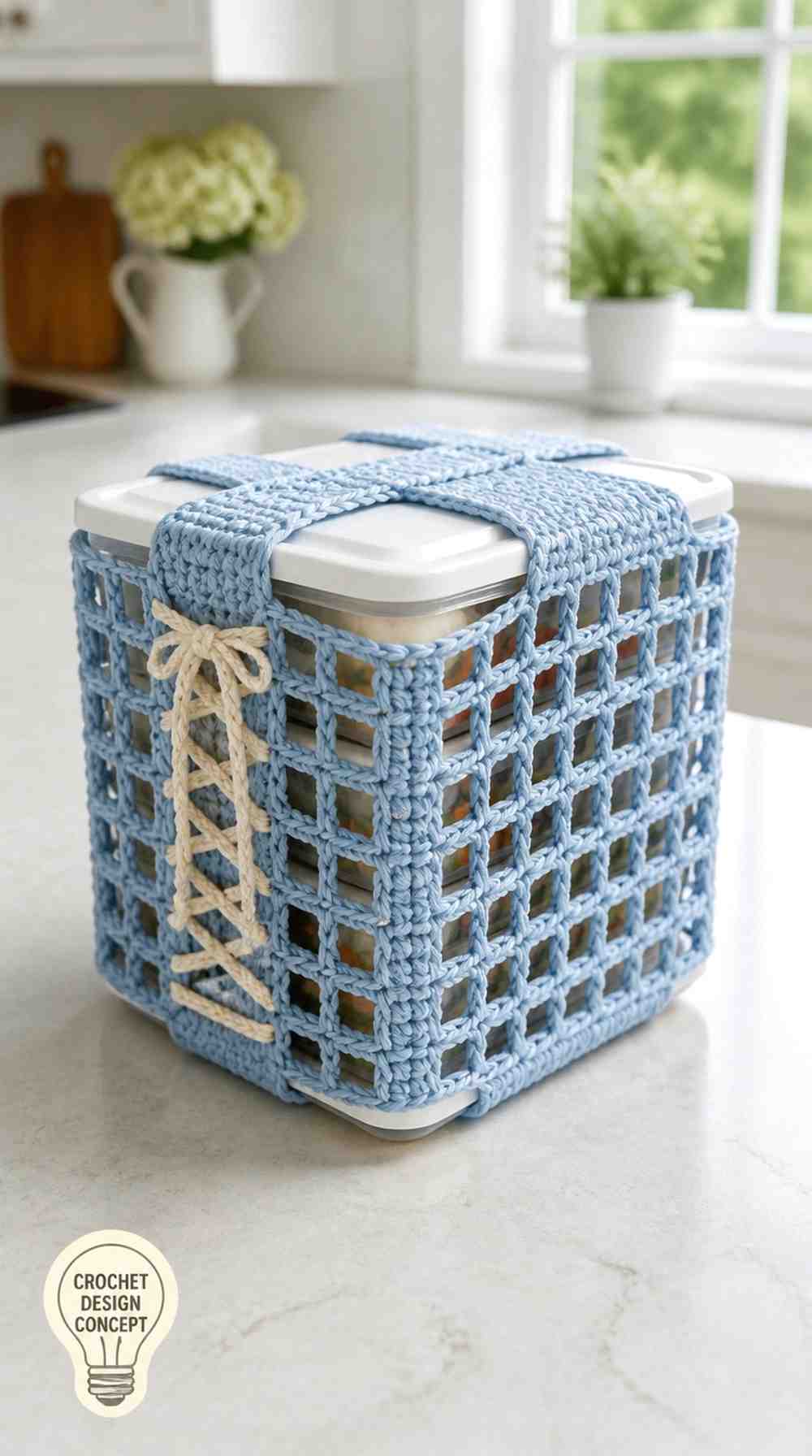
Powder-blue crochet mesh covers the long sides of this three-container stack. Dense bands travel beneath the bottom box and over the top lid, while a series of cream crochet laces joins the panels along the front short side. Square openings and reinforced outer edges create a balanced geometric appearance.
The front lacing gives the organizer an adjustable visual structure without using metal hardware. However, changing the tension of several lace crossings can take longer than opening a single buckle. The mesh and solid bands also need to work together without pulling the side panels out of shape.
- Front lacing: Keep the cream cord ends tidy and avoid long loose loops that could snag during storage.
- Side-panel fit: The powder-blue mesh should lie flat against the container sides without stretching over projecting lid clips.
- Reinforced edges: Dense border rows help define the openwork panels and provide more suitable attachment points for the lacing.
- Removal time: Multiple lace crossings make this design more involved to open than a simple single-band arrangement.
15. Crochet Forest Green Round Container Harness
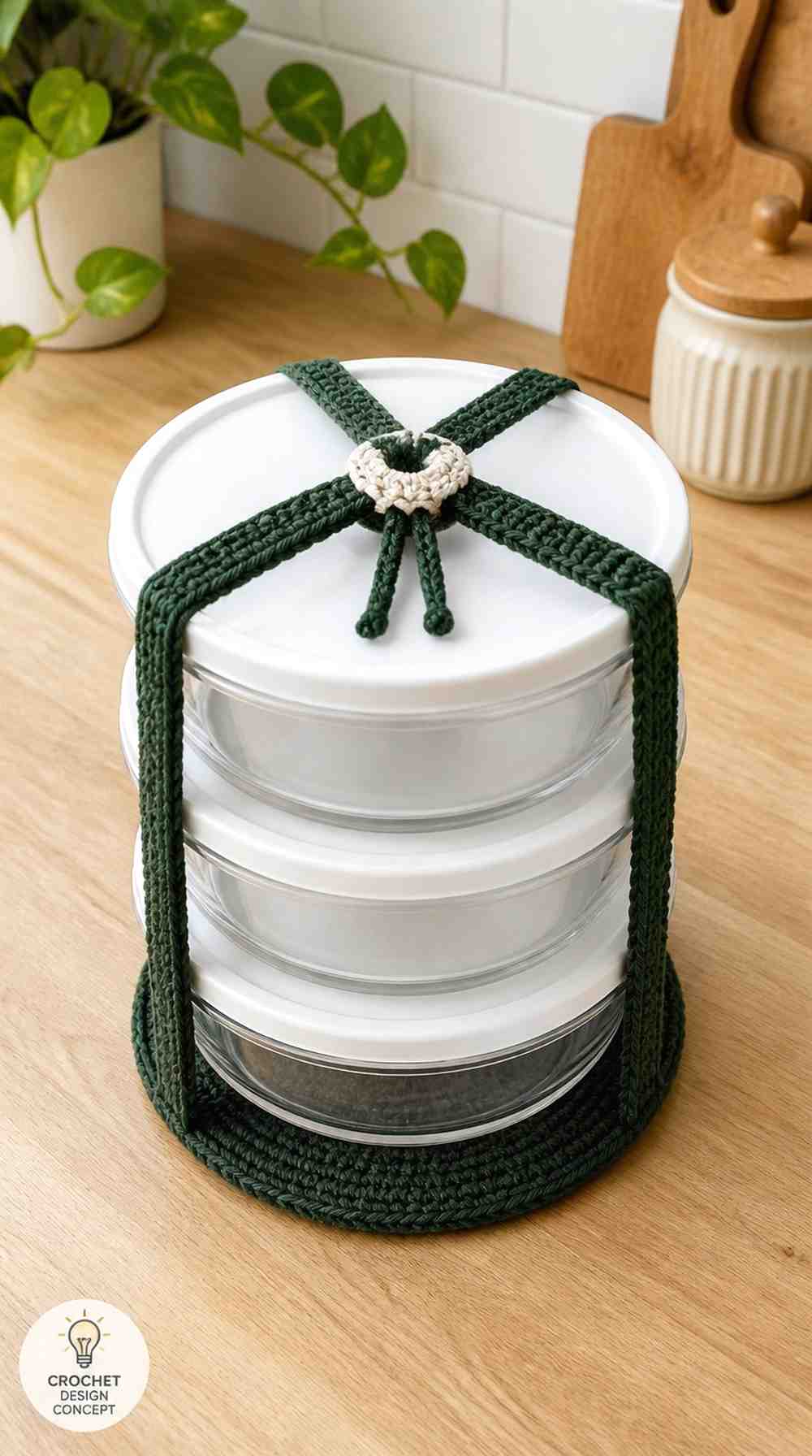
Forest-green crochet gives this round-container harness a clean, natural appearance. A flat circular base supports three stacked round meal-prep containers, while three narrow straps rise evenly around the curved sides. Their ends meet at a cream crochet ring above the upper lid, finished with three small adjustable ties.
The circular base distinguishes this concept from the rectangular designs in the collection. Its radial arrangement follows the shape of round storage containers without forcing flat corner straps around a curved surface. Evenly spaced connections are important for keeping the harness centered.
- Circular base fitting: Compare the crochet cradle diameter with the bottom container so its edge does not curl underneath the stack.
- Three-point spacing: Keep the green straps evenly positioned around the circumference to avoid pulling the top ring off-center.
- Central ring: The cream ring should provide a tidy gathering point without becoming a lifting handle.
- Round-container stability: Test whether the assembled stack remains level on its storage surface, particularly when the containers have tapered sides.
Practical Guide to Crochet Meal Prep Container Stack Straps
Crochet straps for food-storage containers need careful planning because the containers themselves vary in size, weight, lid design, and surface finish.
Start with matching containers. Measure the width, depth, height, and total stacked height of the actual boxes. Include the space taken up by raised rims, snap clips, and lid handles. A strap that looks correctly sized around a smooth box may interfere with a container that has projecting closures.
Keep the food sealed independently. Every container must have its own properly closed lid. A decorative crochet strap is not a replacement for a working gasket, latch, or food-safe seal.
Consider strap stretch. Cotton yarn and closely worked crochet can be useful choices for structured straps, but stitch type and yarn construction affect how much they stretch. Test any finished strap before relying on it for regular organization.
Treat straps as storage accessories. None of these visualized designs has a verified weight capacity. Do not lift or transport a loaded stack by crochet straps alone. Use a suitable bag or carrier designed for the actual load.
Plan for food safety. Keep crochet away from direct food contact, hot surfaces, and steam outlets. If containers hold perishable meals, follow appropriate refrigeration and food-storage guidance. A strap does not preserve food temperature or make a leaking container safe.
Make cleaning easy. Removable straps are useful because spills and condensation can reach the yarn. Follow the material’s washing instructions and dry the crochet completely before reusing it.
For a related kitchen organization idea, explore 19 Crochet Food Container Lid Sorting Rack Inspiration Ideas, which focuses on arranging separate lids rather than bundling containers.
Want to Make Something Similar?
A firm crochet band is a useful starting point when exploring these stack-strap concepts.
Maggie at Zamiguz shares a thermal-stitch crochet strap tutorial that demonstrates how to create a dense strap with reduced stretching. The technique may be helpful when exploring the basic fabric structure of designs such as the Cornflower Double-Slider Stack Straps or Mocha Hook-and-Loop Stack Belt.
For a broader comparison of strap construction, Sandra Regev’s three crochet bag strap techniques cover different approaches to creating more structured straps.
These are general crochet strap tutorials, not exact patterns for the meal-prep container harnesses pictured here. Making a real version requires separate measurements, suitable fasteners, and testing for its intended storage use.
Comparison: Which Container Stack Strap Should You Choose?
The most suitable design depends on the containers you own and how often you need to separate them.
| Design | Main advantage | Practical trade-off |
|---|---|---|
| Crochet Coral Crossed-Lid Container Harness | Decorative diagonal arrangement | Needs careful corner positioning |
| Crochet Cornflower Double-Slider Stack Straps | Two adjustable bands | Requires compatible slider hardware |
| Crochet Oatmeal Side-Buckle Stack Band | Simple side wrapping | Does not restrain vertical separation |
| Crochet Marigold Four-Corner Lacing Harness | Four-corner arrangement | More time needed to open |
| Crochet Mocha Hook-and-Loop Stack Belt | Convenient overlapping closure | Fastener can collect lint |
| Crochet Ochre Multi-Button Adjustable Stack Strap | Several fastening positions | Limited by buttonhole spacing |
| Crochet Forest Green Round Container Harness | Designed around round containers | Needs evenly spaced side straps |
If you want something simple for stationary shelf organization, the Crochet Oatmeal Side-Buckle Stack Band offers a straightforward appearance without covering the upper lid.
For a more structured arrangement, the Crochet Cornflower Double-Slider Stack Straps and Crochet Charcoal Cross-Tab Container Belt provide different ways of combining flat bands and closures.
If your containers are small and you mainly want a decorative finish, the Crochet Blush Scalloped Bento Stack Ribbon may be the most appealing. Round food boxes are better matched to the Crochet Forest Green Round Container Harness.
Whichever design you prefer, prioritize the actual container fit, unobstructed lid closures, and easy removal over appearance alone.
Conclusion
Crochet meal prep container stack straps offer a creative way to bring handmade details into everyday kitchen organization. From broad crossed bands and adjustable buckles to delicate bento ribbons and three-point round-container harnesses, these 15 inspiration ideas show how one simple storage concept can take many different forms.
The best design begins with the containers themselves. Choose a strap arrangement that suits their shape, allows normal lid operation, and is easy to remove and clean. Keep crochet straps separate from food sealing and load-bearing responsibilities, and enjoy the added color and texture they can bring to a neatly arranged kitchen shelf.
Which design would you choose for your own meal-prep containers? Would you prefer the coral crossed harness, the simple oatmeal buckle band, or the forest-green round holder? Share your favorite and whether you normally use square, rectangular, or round containers.
Frequently Asked Questions
1. Can crochet straps keep stacked meal-prep containers together?
A properly fitted crochet strap may help group containers for stationary storage, but its effectiveness depends on yarn stretch, closure design, and the shape of the boxes. These concepts have not been physically tested. The straps should not replace individual lid fastenings or be relied upon as safe carrying equipment.
2. What yarn should I consider for a crochet meal-prep container strap?
A smooth cotton yarn or suitable cotton blend is worth considering for its stitch definition and relatively firm feel. However, different yarns stretch, absorb moisture, and respond to washing differently. Choose material based on the intended use, test the fabric, and follow its specific care instructions.
3. Can I use the same strap for different container sizes?
Some designs, such as adjustable slider straps, buttonhole bands, and laced wraps, may offer limited size adjustment. However, changing the stack width or lid shape can affect how the strap sits. Measure each container arrangement and check the fit rather than assuming one strap will work for every set.
4. Can I carry meal-prep containers using only a crochet stack strap?
These designs should not be treated as tested carrying harnesses. Crochet can stretch, fasteners may loosen, and a stack of filled containers can be unexpectedly heavy. For carrying meals, use a suitable bag or carrier designed to support the load, with each container independently and properly sealed.
5. Are these 15 crochet container stack straps real patterns?
No. They are design visualizations intended to inspire shapes, colors, strap arrangements, and closure ideas. They are not tested products or complete crochet patterns. Anyone making a similar accessory should adapt it to the exact containers, select suitable materials and fasteners, and assess the finished piece before regular use.