A crochet broom handle hanging loop can add a small handmade detail to a laundry room, cleaning cupboard or utility wall. These 13 inspiration ideas explore ribbed hanging straps, braided cords, fabric-backed loops, decorative tabs and wooden-ring arrangements. From sage and oatmeal to terracotta, denim and rosewood, each concept offers a different way to decorate the top of a broom handle while keeping the tool accessible.
The collection focuses on brooms with an existing hanging hole or an appropriate separate handle attachment. You’ll find simple flat loops for wooden pegs, compact I-cords for wall hooks and decorative designs with scallops, granny squares and small flowers. Because crochet can stretch and attachment points can fail, the complete hanging arrangement needs to be suitable for the broom’s weight rather than relying on appearance alone.
These are AI-generated crochet design visualizations for inspiration, not photographs of tested broom-hanging accessories or complete patterns. None of the illustrated loops has a verified carrying capacity.
Quick Design Selection Guide
| Your storage preference | Design to explore | Distinctive feature |
|---|---|---|
| Simple crochet loop | Crochet Sage Ribbed Broom Handle Hanging Loop | Flat ribbed strap and fabric reinforcement |
| Removable buttoned style | Crochet Oatmeal Buttoned Broom Hanging Tab | Wooden button and overlapping tab |
| Narrow rounded cord | Crochet Terracotta Braided I-Cord Broom Hanging Loop | Tubular braided-looking crochet |
| Fabric-backed construction | Crochet Navy Cotton-Backed Flat Broom Hanging Loop | Cream woven reinforcement |
| Delicate decorative edging | Crochet Ivory Scalloped Broom Handle Hanging Loop | Six small scallops |
| Traditional crochet motif | Crochet Denim Granny-Square Broom Hanging Tab | One miniature granny square |
| Handle without a hanging hole | Crochet Dusty Blue Clamp-Eye Broom Hanging Loop | Separate purpose-made collar |
| Wooden-ring design | Crochet Mustard Wooden-Ring Broom Hanging Loop | Smooth circular ring |
| Decorative flower detail | Crochet Coral Daisy Broom Hanging Loop Tab | Flat five-petal daisy |
| Defined hook opening | Crochet Charcoal Metal-Eyelet Broom Hanging Loop | Reinforced metal eyelet |
For a simple broom with a factory-made hole, a compact loop may be worth exploring. Where the handle has no hanging hole, use a properly fitted broom holder or a purpose-made attachment rather than drilling into or tying a loose strap around an unsuitable handle.
1. Crochet Sage Ribbed Broom Handle Hanging Loop
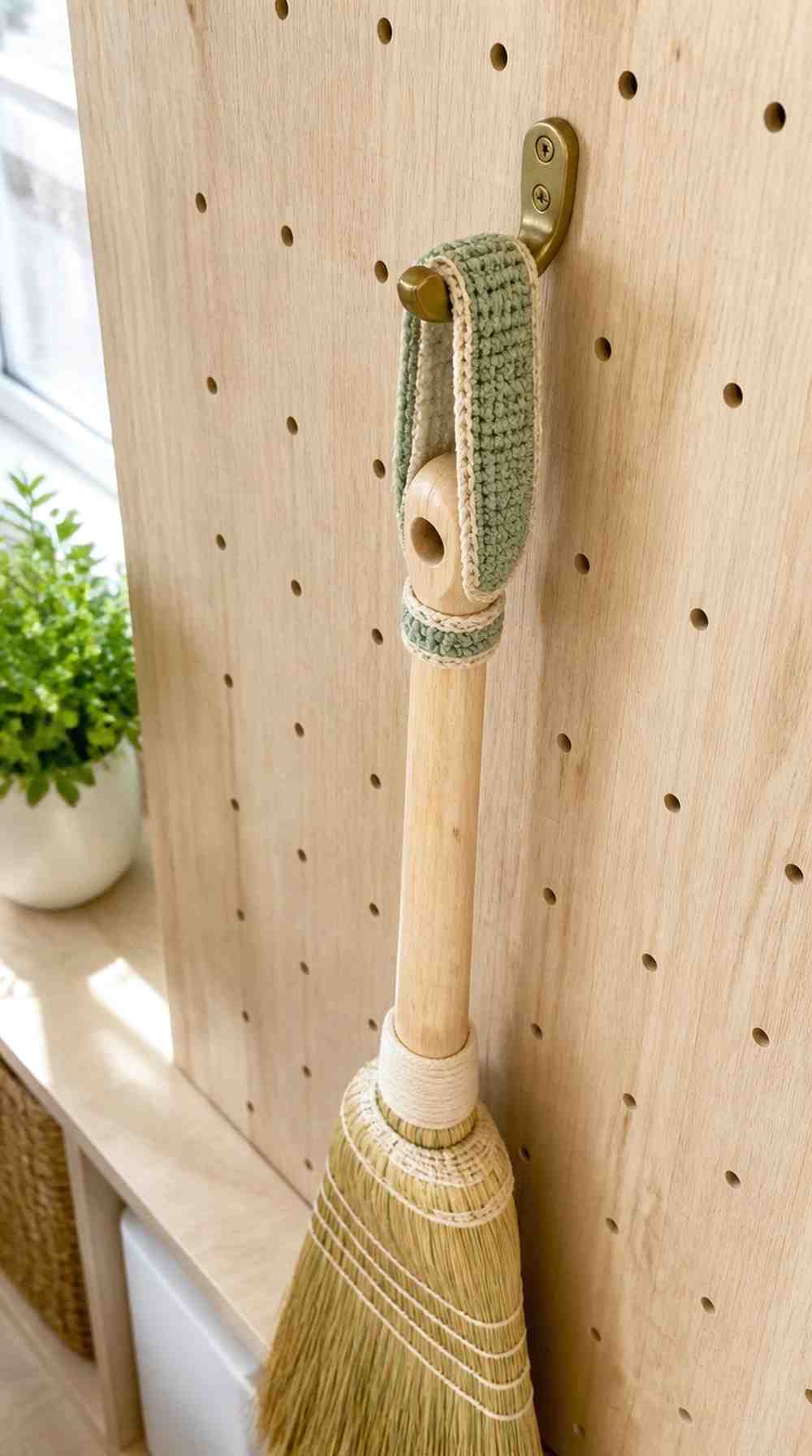
Sage-green crochet forms a short, flat hanging loop with raised vertical ribs and narrow oatmeal edging. A smooth cream reinforcement sits inside the folded strap, whose lower end passes through the factory-made hole of a natural-wood broom handle. The loop rests on a sturdy brass hook above a pale-oak utility-room pegboard.
The simple ribbing makes this one of the most understated designs in the collection. Its short length keeps the broom close to the wall, while the flat loop provides a clearly visible hanging point.
- Vertical Ribbing: Back-loop stitches give the sage strap texture, but the fabric should be checked for stretching under the broom’s weight.
- Cream Reinforcement: The separate inner strip provides a different construction layer without proving a safe load rating.
- Factory Handle Hole: The lower attachment uses an existing opening, avoiding unnecessary drilling or changes to the wooden handle.
- Hook Clearance: Choose a smooth hook that fits the loop comfortably without forcing or sharply folding its upper edge.
2. Crochet Oatmeal Buttoned Broom Hanging Tab
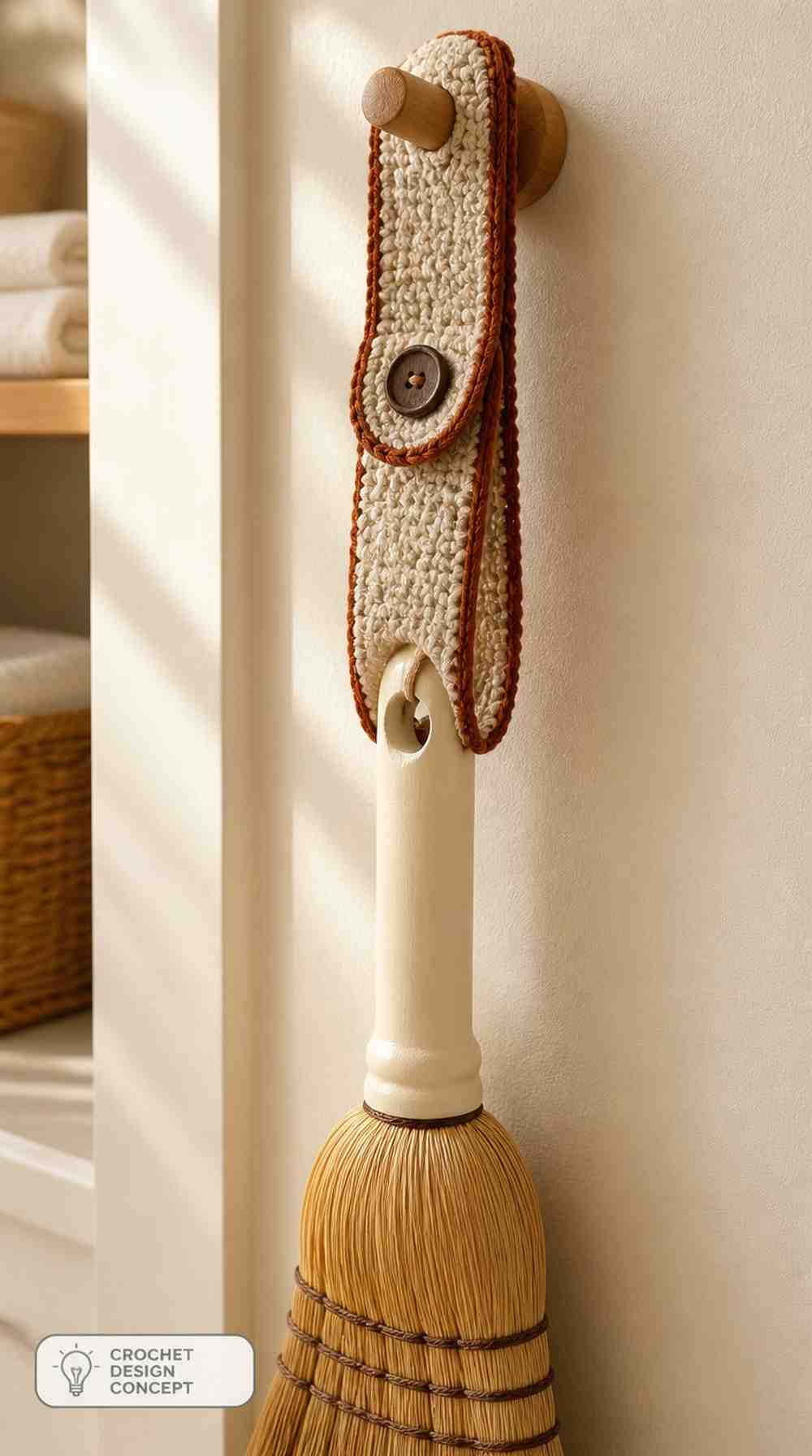
Warm oatmeal crochet creates a broad hanging tab with dense linen-like stitches and thin terracotta edging. One dark wooden button closes an overlapping section beneath the upper loop. A woven cotton strip lines the crochet, while the lower folded end passes through the existing hole in a cream-painted broom handle.
This design has a traditional handmade appearance that suits a neutral laundry room. Its button fastening is the main difference from a permanently joined loop, although the closure would need particular attention before carrying any tool weight.
- Wooden Button Closure: A decorative button can loosen or slip from its loop, so it should not be assumed reliable as a load-bearing fastening.
- Flat Oatmeal Strap: Dense stitching creates a tidy band that can sit against a wall peg without bulky raised decoration.
- Terracotta Edging: The contrasting border defines the strap and buttoned tab without adding tassels or loose cords.
- Painted Handle: Keep the attachment away from damaged paint or sharp edges that could rub against the crochet.
3. Crochet Terracotta Braided I-Cord Broom Hanging Loop
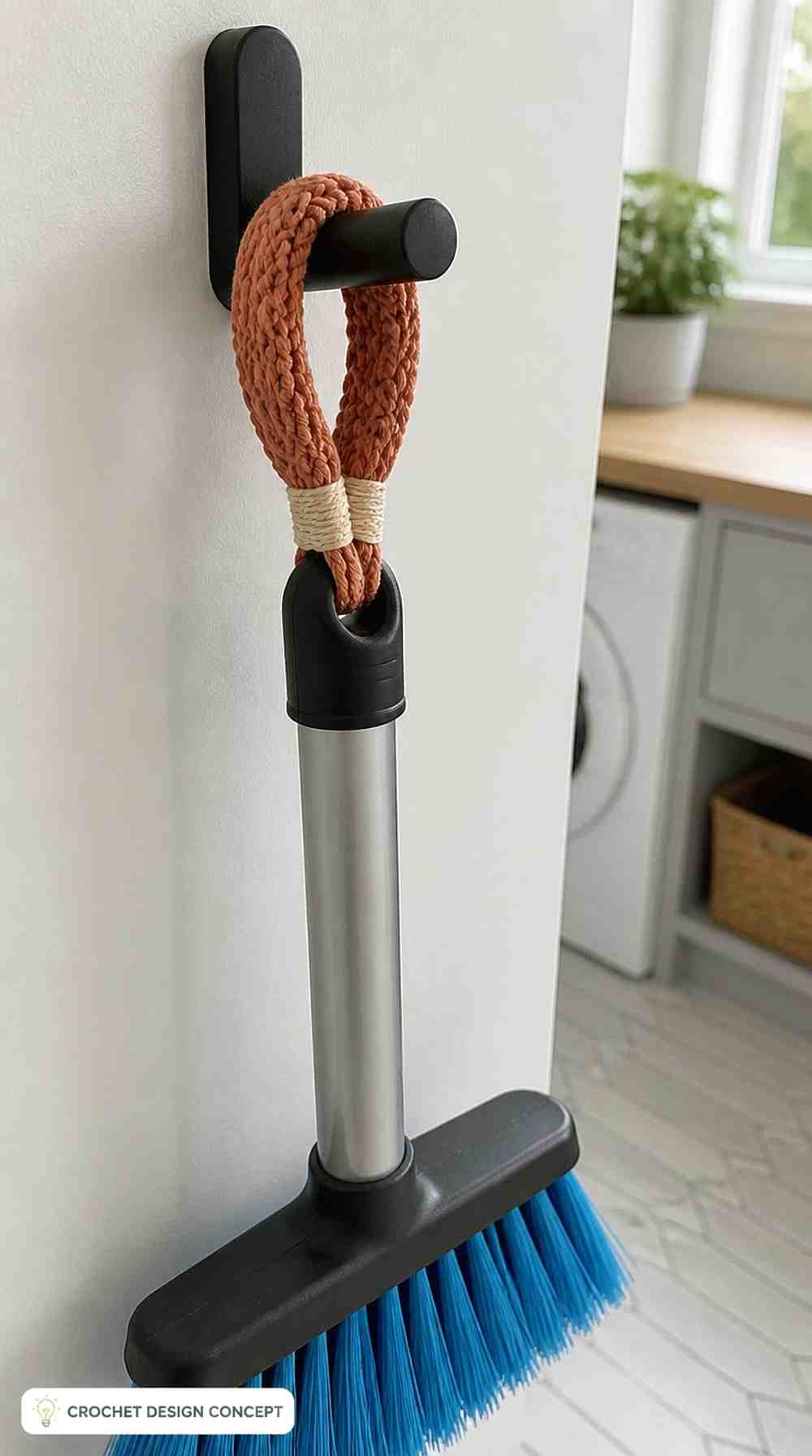
Terracotta crochet forms a compact oval loop with braided-looking tubular I-cord stitches. Tiny cream finishing wraps secure the lower ends, which thread through an existing round hole in the black end cap of a silver broom handle. The loop hangs from a matte-black wall hook, keeping the clean blue bristles above the floor.
The rounded cord gives this concept a different shape from flat crochet straps. Its small profile can suit a broom with a narrow factory hanging hole, although thin cords may concentrate pressure where they contact the hook.
- Tubular I-Cord: The rounded crochet structure may fit smaller handle openings, but actual yarn stretch and strength require evaluation.
- Cream End Wraps: Short finishing details keep the attachment neat without leaving dangling decorative tails.
- Molded End-Cap Hole: Confirm the original handle opening is designed for hanging rather than assuming every hole can support the broom.
- Hook Contact: A smooth rounded hook can help avoid sharp contact with the narrow cord, though it does not guarantee durability.
4. Crochet Navy Cotton-Backed Flat Broom Hanging Loop
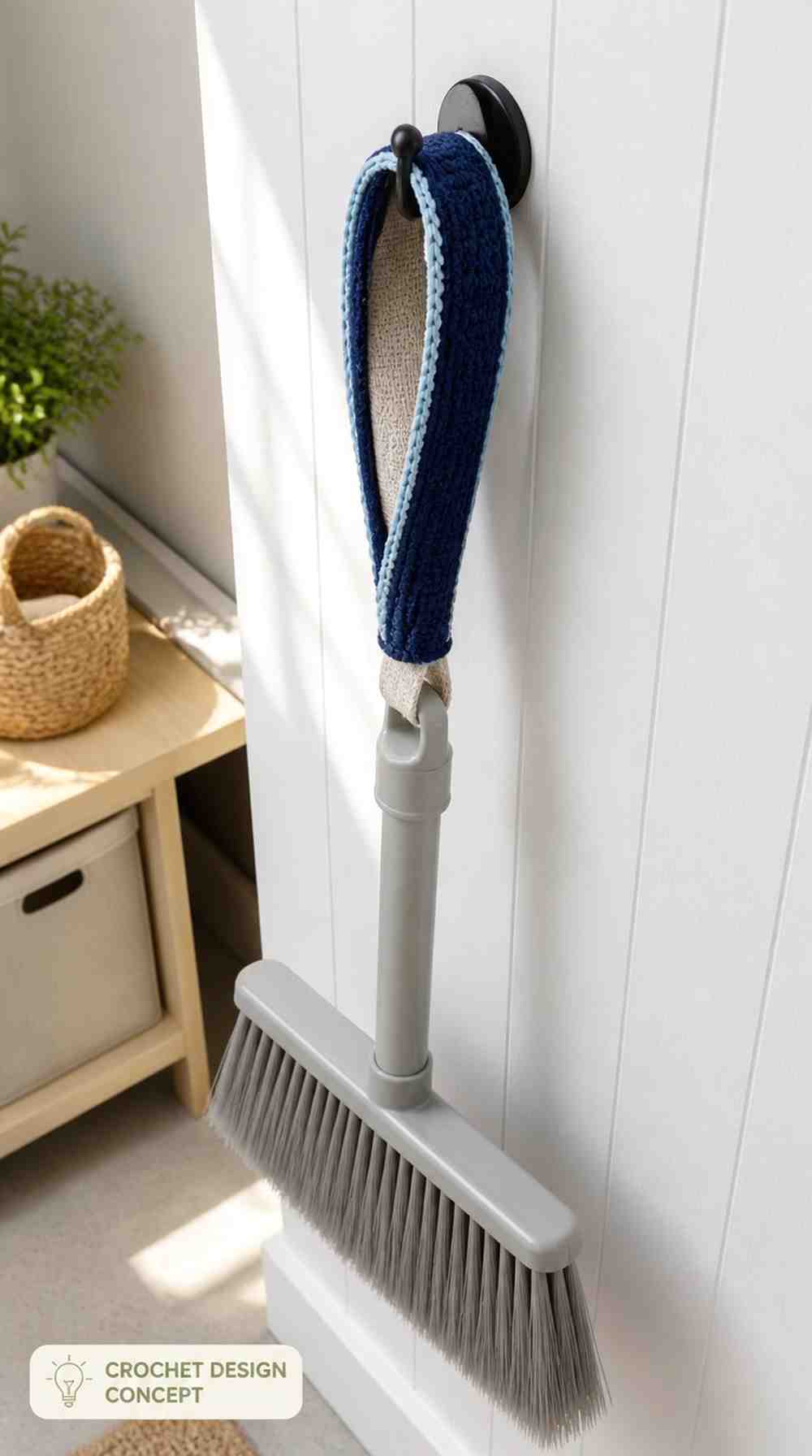
Deep navy crochet forms a wide oval hanging loop with compact horizontal stitches and pale-blue edging. A smooth cream woven strip lines its inner surface, clearly visible along the upper curve. The lower end connects through the molded hanging eye of a pale-gray broom handle.
The layered construction is the defining feature. Unlike a narrow crochet-only cord, this design separates the decorative outer fabric from a woven internal layer. It offers an interesting construction direction, but all joins and supporting components still need suitable strength.
- Wide Flat Shape: The broader loop can rest against a wall peg without twisting as easily as a very narrow cord.
- Cream Woven Backing: The inner reinforcement should remain smooth and firmly attached along the entire strap.
- Pale-Blue Border: Fine edging highlights the upper oval without adding bulky loops around the hanging point.
- Reinforcement Limits: Fabric backing does not automatically establish a safe load capacity; the materials and joints must be assessed together.
5. Crochet Ivory Scalloped Broom Handle Hanging Loop
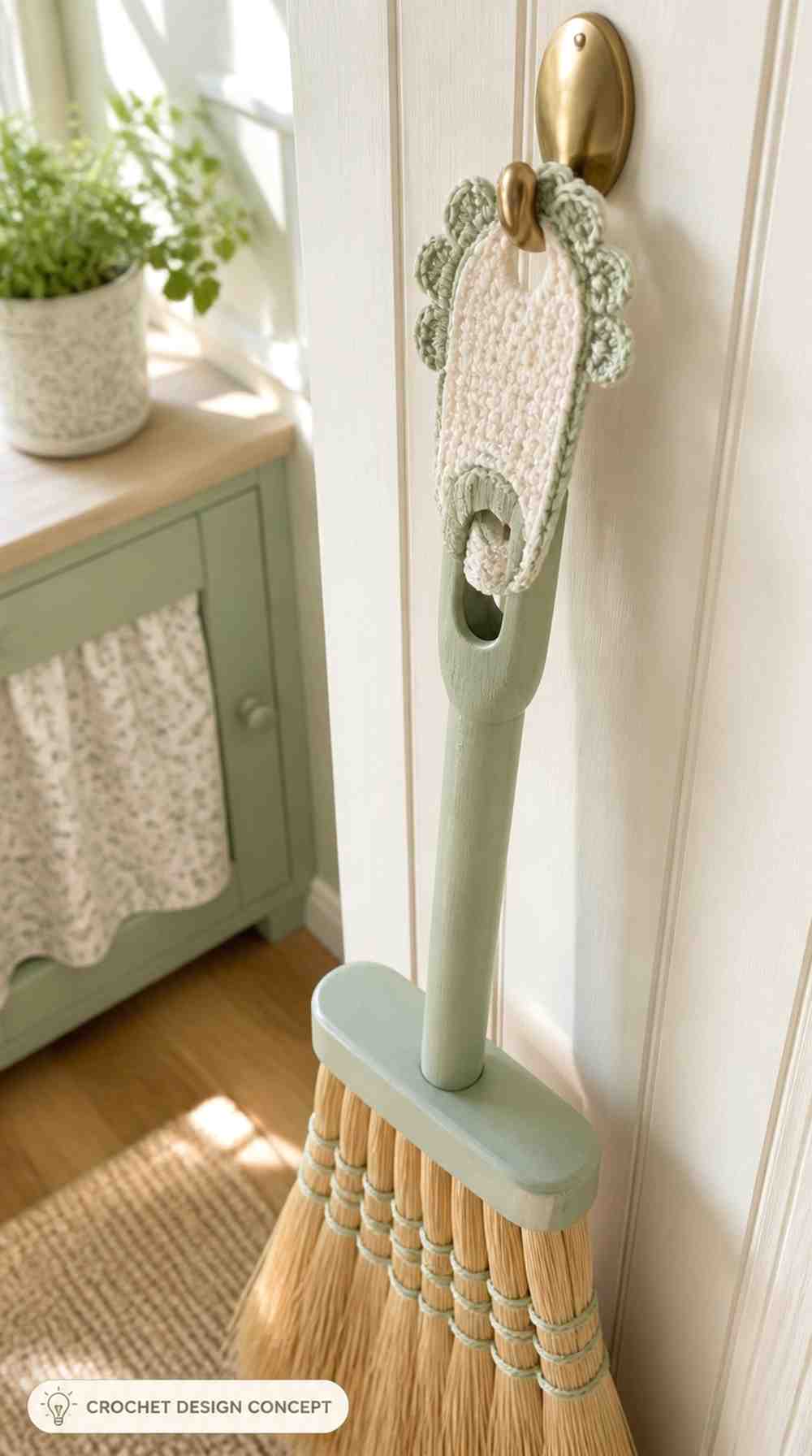
Ivory crochet creates a short solid hanging loop with six tiny dusty-sage-edged scallops along its outer upper curve. The lower strap passes through the factory-made oval slot of a sage-painted wooden broom handle, while its reinforced opening hangs from a brass utility hook.
The scalloped edge brings a soft cottage-inspired appearance to a small cleaning accessory. Because the curved details sit outside the working hook-contact area, the center remains relatively simple. The decorative stitches still need careful finishing to avoid catching.
- Six Small Scallops: Keep the curves flat and securely stitched so they do not snag on the hook or surrounding cleaning tools.
- Solid Central Strap: The middle band should remain continuous rather than relying on the decorative scallop loops to support the broom.
- Ivory Yarn Care: Light-colored yarn may show marks from dusty handles or utility-room surfaces.
- Painted Wooden Handle: Inspect the factory hanging slot for rough edges that could wear the lower attachment.
6. Crochet Denim Granny-Square Broom Hanging Tab
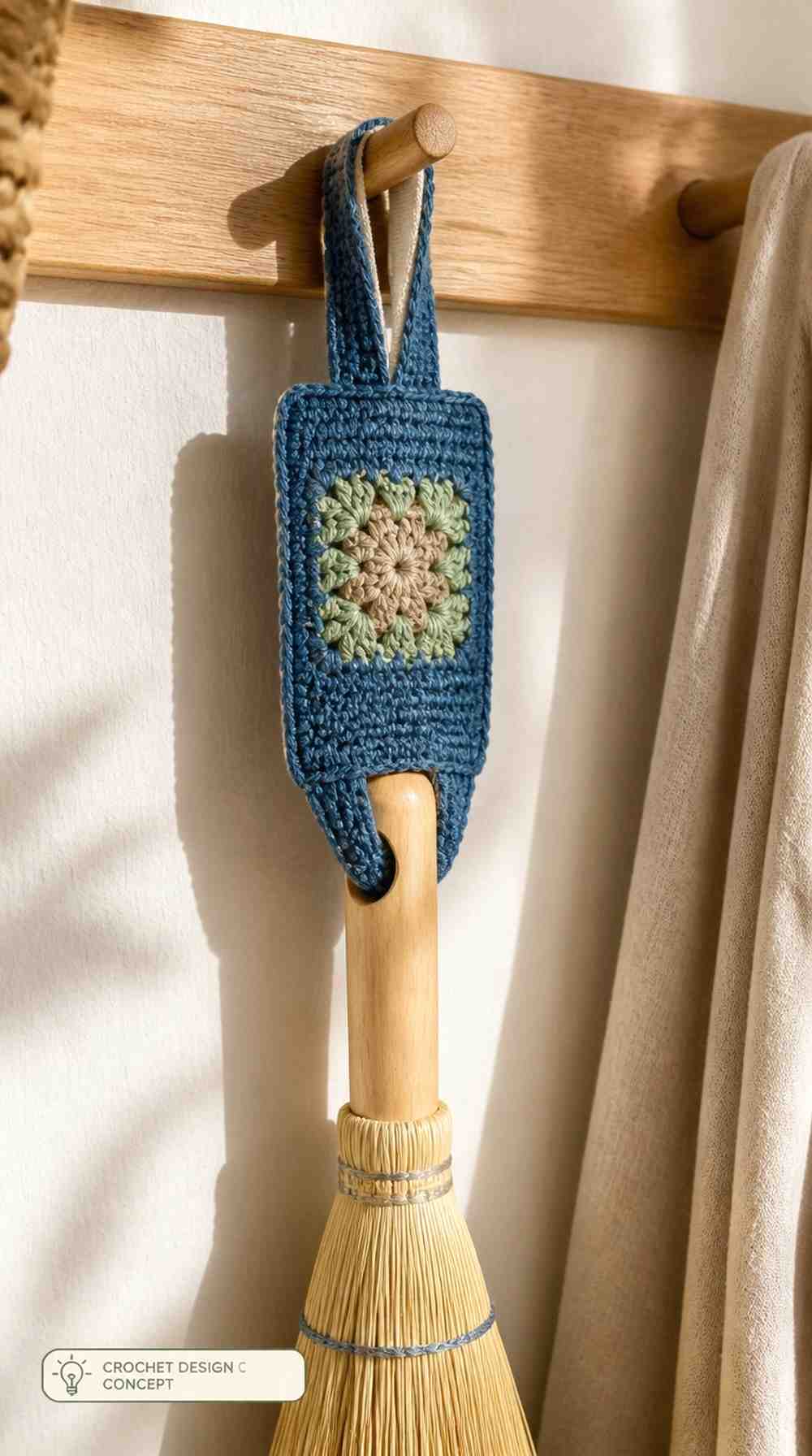
Denim-blue crochet forms a flat hanging tab decorated with one miniature granny square. The motif has an oatmeal center, muted-sage middle row and denim outer border. A solid denim upper loop with cream woven backing connects the tab to a wall peg, while the reinforced lower section passes through the broom’s existing hanging hole.
The small granny square gives this design a traditional handmade look without covering the whole broom handle. Its placement beneath the upper loop keeps the open decorative stitches away from the hook-contact point.
- Mini Granny Square: Keep the motif small and flat so its open center does not catch on nearby hooks or tools.
- Solid Upper Strap: The hanging loop should be structurally separate from the granny-square openings.
- Cream Reinforcement: The woven backing offers a smoother inner surface, although all attachments still require testing.
- Decorative Placement: Position the granny square below the hook so its yarn joins are not repeatedly rubbed during hanging.
7. Crochet Dusty Blue Clamp-Eye Broom Hanging Loop
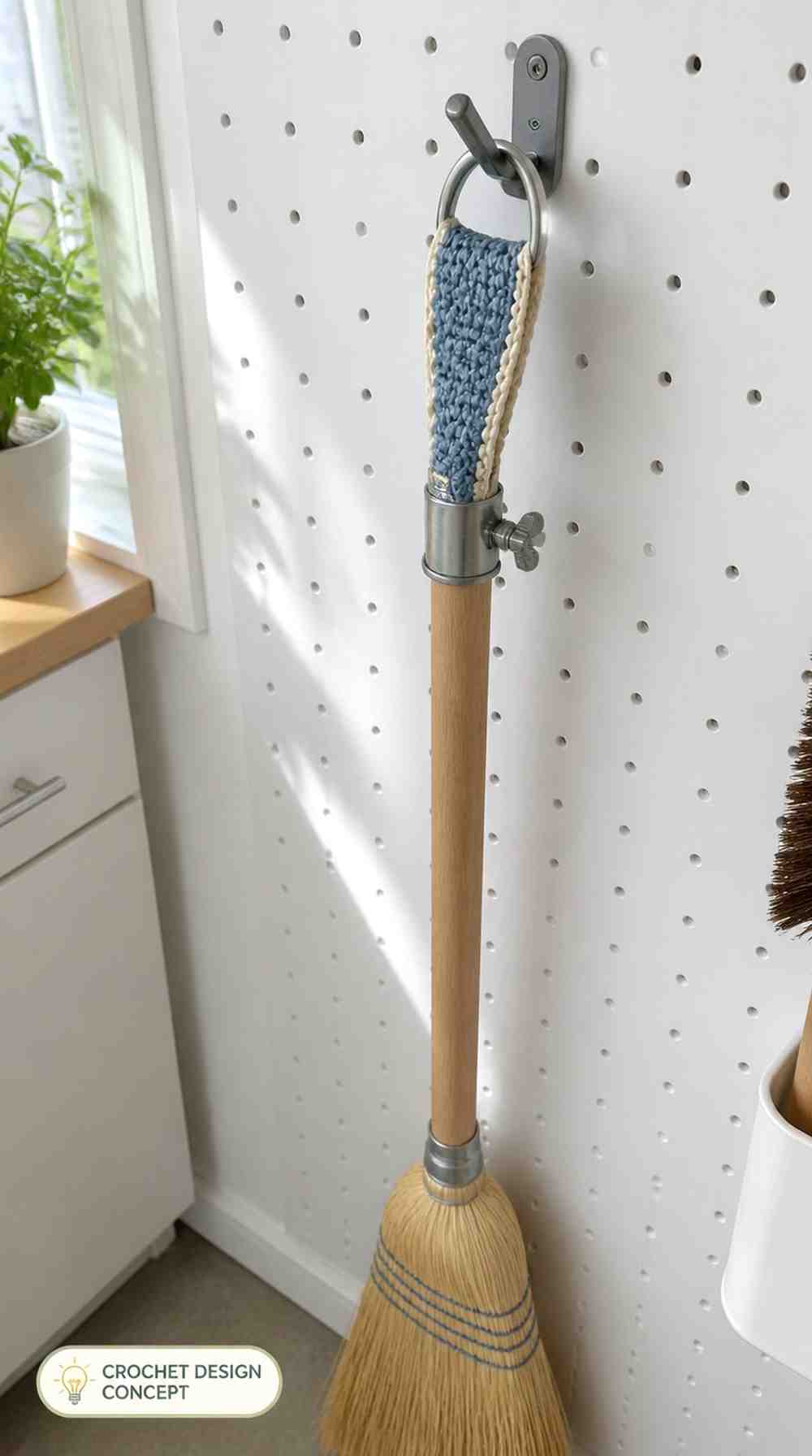
Dusty-blue crochet forms a short oval hanging loop with dense moss-like stitches and ivory edging. Instead of passing through a hole in the handle, the loop connects to the smooth metal eye of a separate purpose-made collar fitted near the top of a natural-wood broom handle.
The collar is the most important feature of this design. It explores an option for a broom without a manufacturer-provided hanging hole. The crochet remains visible above the attachment, while the collar’s locking parts stay uncovered.
- Separate Handle Collar: Choose a purpose-made attachment compatible with the handle diameter and intended hanging load.
- Smooth Metal Eye: The loop should pass through a finished opening without sharp edges that could cut or abrade the yarn.
- Accessible Locking Hardware: Keep the crochet away from the collar’s adjustment mechanism so its condition can be inspected.
- No Drilling Required: This concept avoids altering the wooden handle, provided the separate collar is appropriate and securely fitted.
8. Crochet Forest Adjustable-Length Broom Hanging Strap
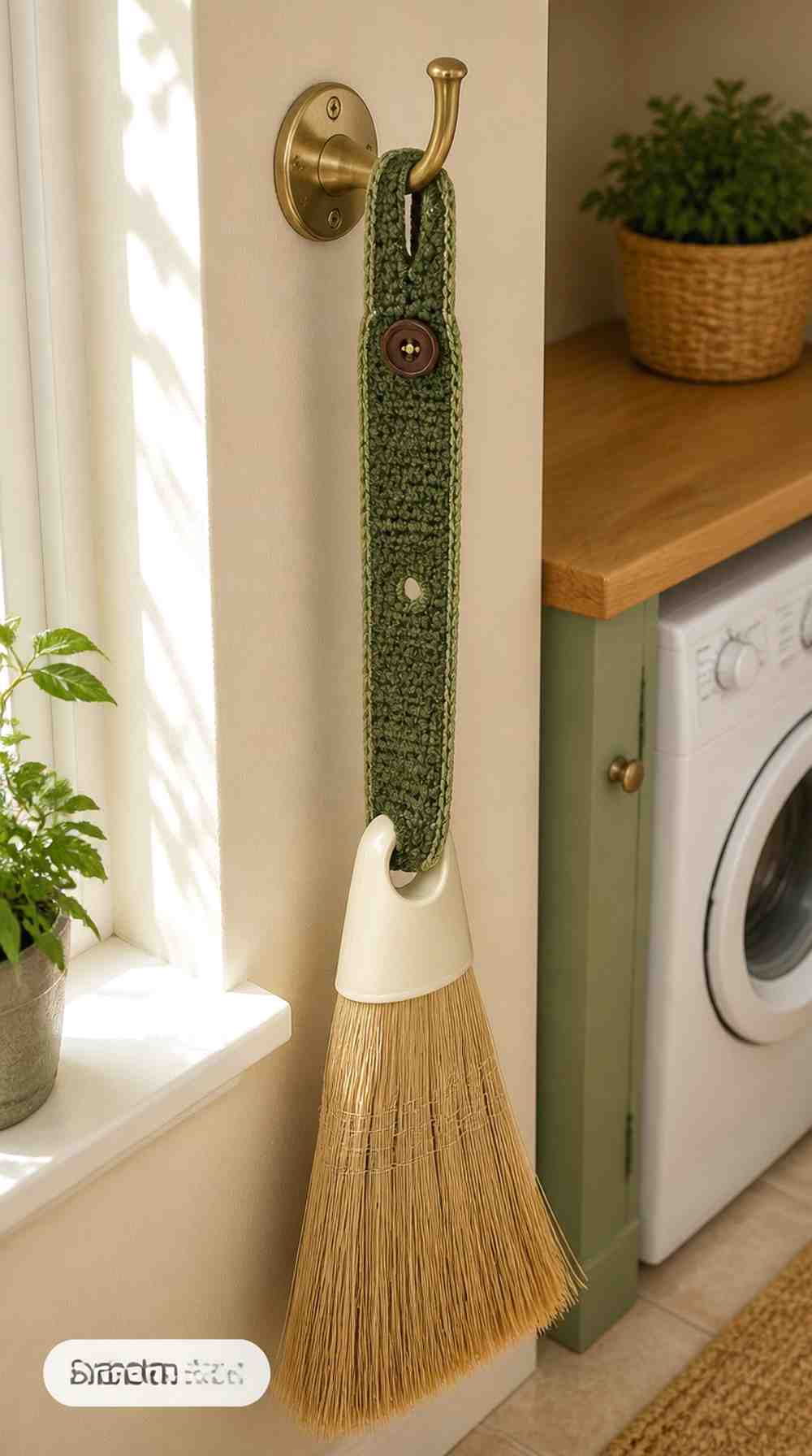
Forest-green crochet creates a flat hanging strap with olive edging and two small adjustment holes along its upper section. One walnut-brown button secures the loop through the upper hole, while the second hole remains unused. A smooth cream reinforcement runs inside the strap, and its lower end connects to the broom’s original hanging hole.
The two adjustment positions distinguish this design from a fixed-length loop. They suggest different hanging heights, although the fastening must be evaluated carefully because the button would be part of the supporting arrangement.
- Two Adjustment Holes: The alternative positions provide a visual way to explore different loop lengths without changing the entire strap.
- Single Wooden Button: A buttoned loop may release accidentally, so it should not be used to support a heavy broom without a separately verified retention system.
- Cream Inner Reinforcement: The woven strip helps define the layered strap but does not guarantee that the buttonholes will resist tearing.
- Hanging Height: Keep the loop short enough that the broom remains clear of the floor without projecting into a walkway.
9. Crochet Mustard Wooden-Ring Broom Hanging Loop
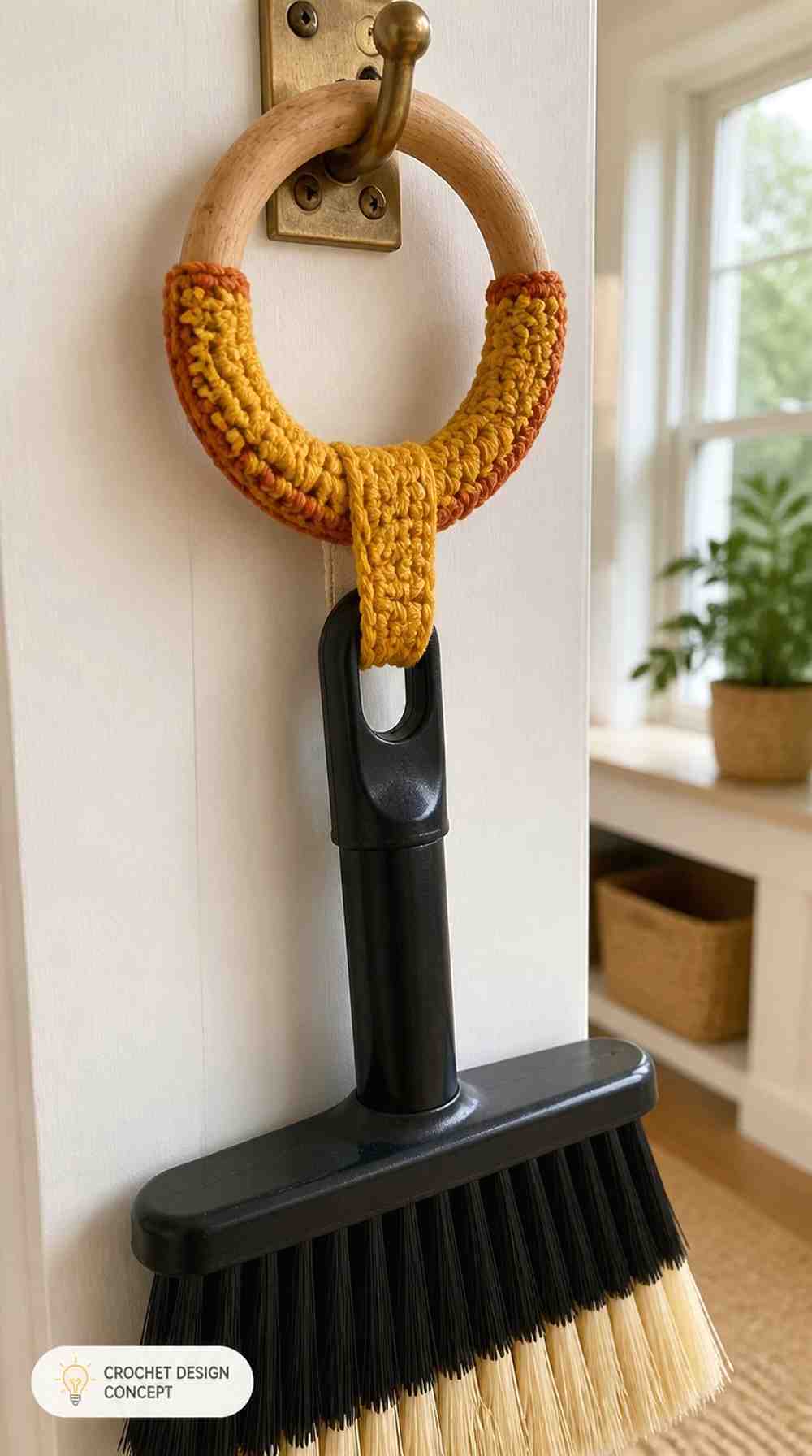
Mustard-gold crochet decorates the lower half of a small circular wooden hanging ring. Rust-orange rows finish the covered section, while a short cream-backed crochet connector joins the ring to the existing hole in a black broom-handle end cap. The uncovered upper wooden arc rests on a brass wall hook.
The circular ring gives this design a different silhouette from an all-crochet oval loop. Its smooth upper section also separates the hook-contact surface from the yarn, although the ring and lower connector need their own strength checks.
- Circular Wooden Ring: Choose a smooth ring with suitable dimensions and no cracks, rough edges or weak joints.
- Partial Crochet Covering: The mustard stitches decorate the lower half while leaving the upper hook-contact surface exposed.
- Fabric-Backed Connector: The short joining strap should sit flat between the original handle hole and the wooden ring.
- Ring Strength: Decorative craft rings are not automatically suitable for supporting a broom; material and load compatibility must be verified.
10. Crochet Lilac Tapered Peg-Hanging Broom Loop
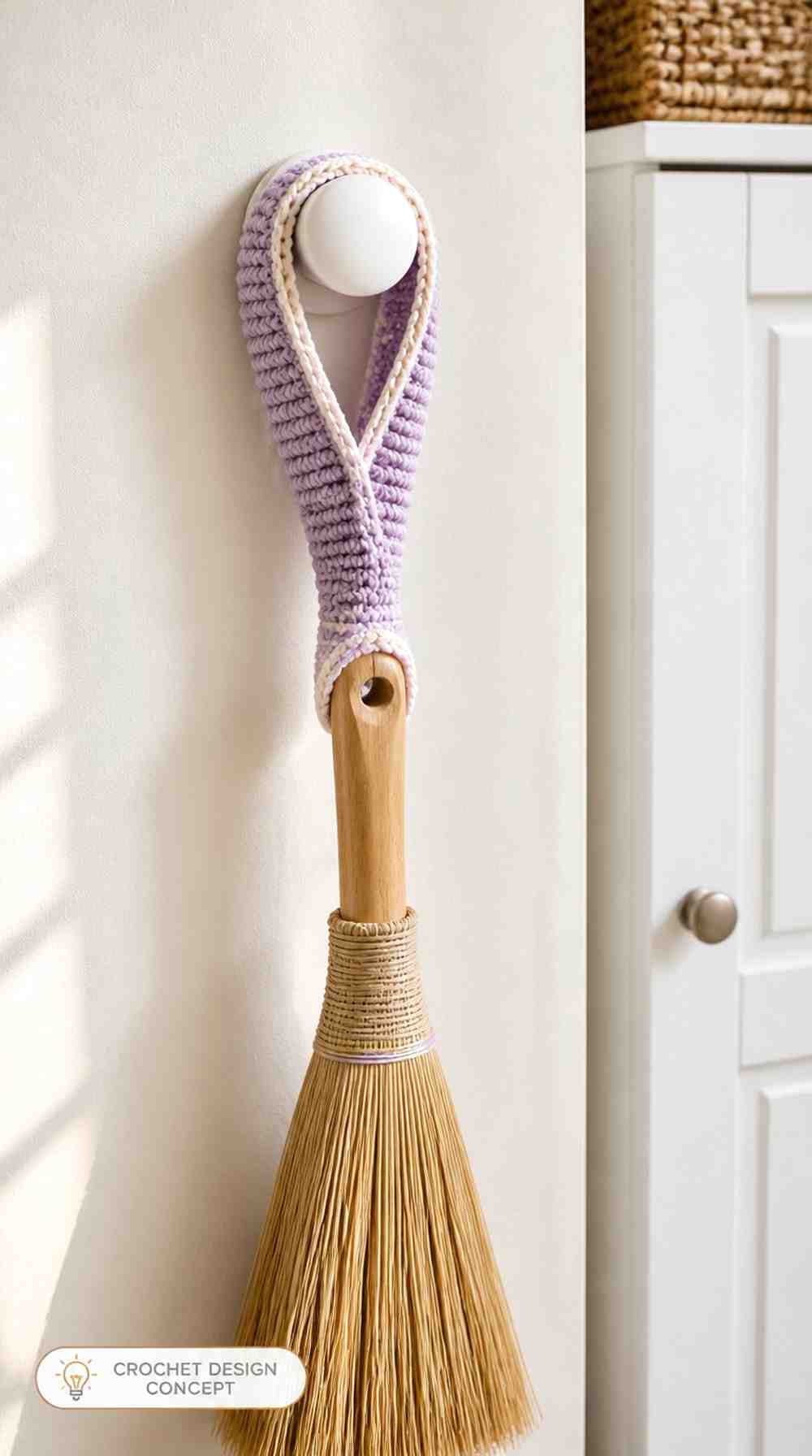
Lilac crochet forms a broad teardrop-shaped hanging loop that narrows into a short reinforced neck at the bottom. Fine horizontal ribs run along the sides, while ivory edging outlines the wide upper opening. The lower section passes through the existing hole at the finished top of a wooden broom handle.
The tapered shape is the defining detail. Its wide upper curve creates an opening for a rounded white wall peg, while the narrow lower neck keeps the attachment compact against the broom handle.
- Teardrop Silhouette: The upper opening should fit the intended wall peg without sliding off or needing to stretch excessively.
- Narrow Reinforced Neck: The lower section needs to pass through the existing handle hole without bunching or rubbing against sharp edges.
- Fine Horizontal Ribs: Compact raised rows create texture without thickening the narrow attachment point.
- Wall Peg Position: Use a securely mounted peg with enough projection to retain the loop while keeping the broom clear of nearby furniture.
11. Crochet Coral Daisy Broom Hanging Loop Tab
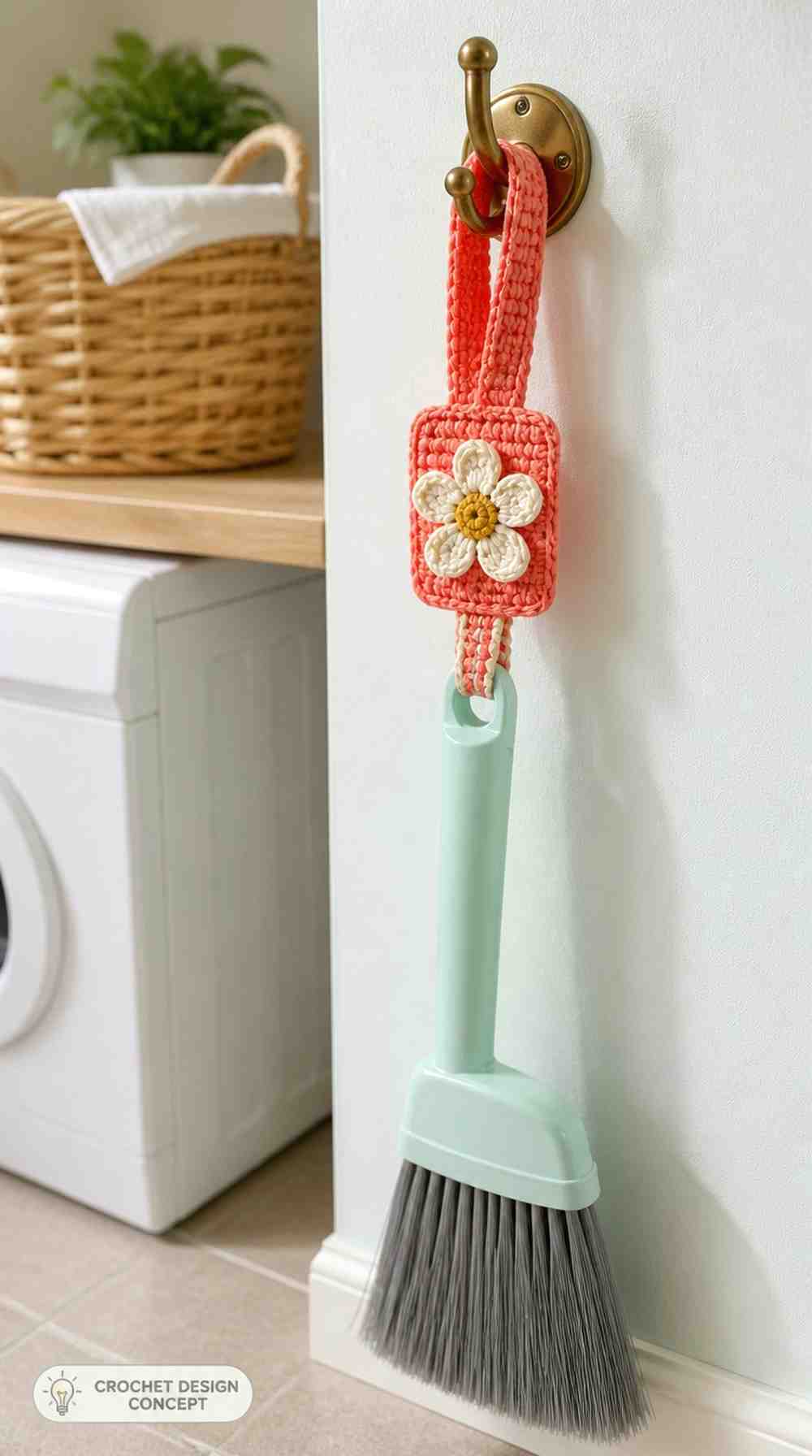
Coral-pink crochet forms a compact flat hanging loop with a small square tab beneath it. One permanently stitched ivory daisy decorates the square, with five petals and a mustard-yellow center. A short cream-backed connector passes through the hanging hole of a pale-mint broom-handle end cap.
The flower adds a cheerful cottage-style detail to a simple laundry-room accessory. Its position below the hanging loop keeps the decorative petals away from the wall hook, where repeated movement could cause snagging.
- Five-Petal Daisy: Keep the flower flat and stitched securely to the square tab without adding beads or separate buttons.
- Solid Hanging Loop: The upper section should remain continuous and independent of the decorative flower stitches.
- Short Lower Connector: A compact attachment keeps the flower near the handle instead of allowing it to swing on a long cord.
- Cleaning and Inspection: Check the petals and stitched joins regularly for loose yarn, especially in a frequently used cleaning cupboard.
12. Crochet Charcoal Metal-Eyelet Broom Hanging Loop
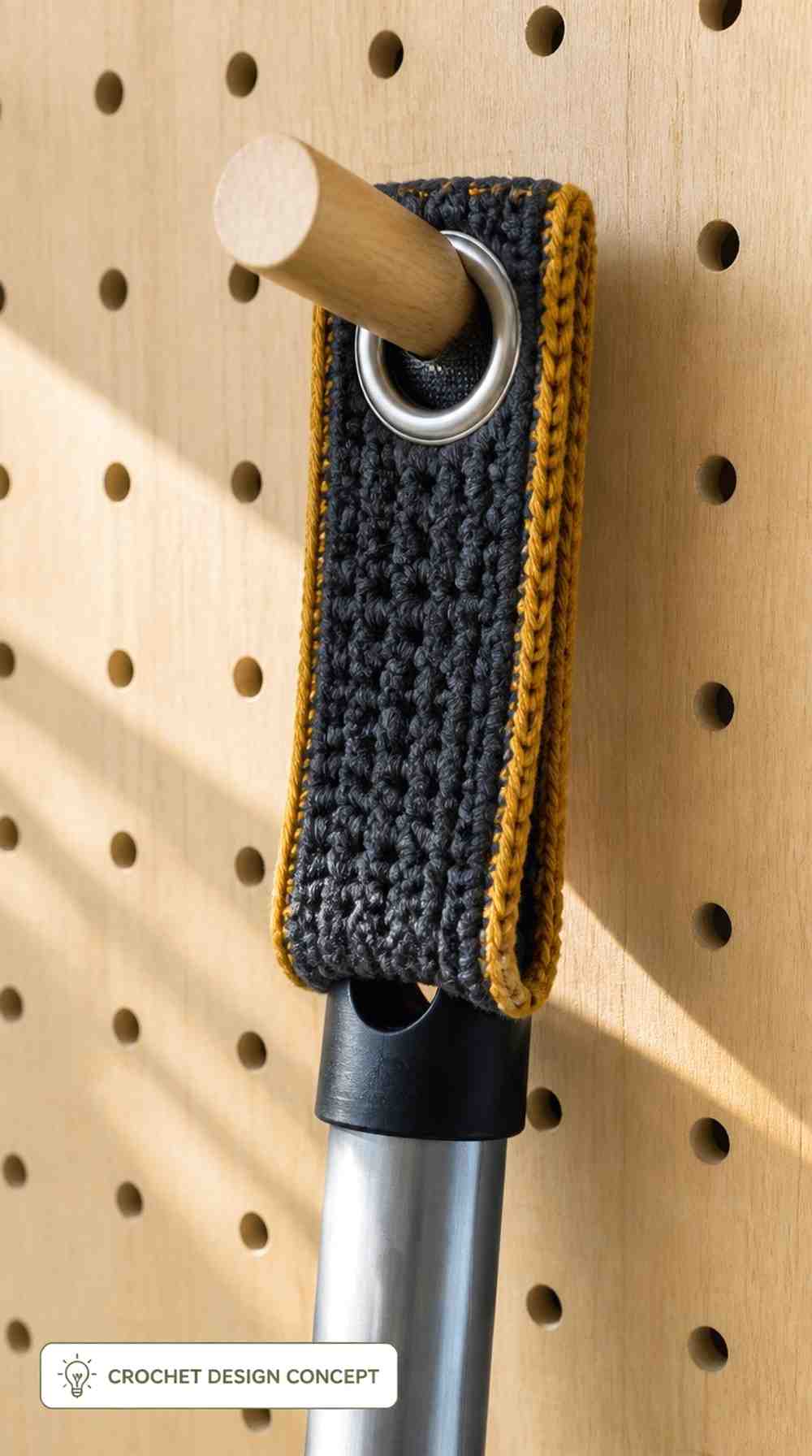
Charcoal-gray crochet forms a short, wide hanging tab with waffle-like texture and a mustard outer border. A brushed-steel grommet reinforces the upper hole through a separate woven fabric core. The lower folded end attaches through the factory-made hanging opening in a silver-gray broom handle’s black end cap.
The metal eyelet creates a clearly defined hook opening, making this design different from soft loops that fold directly over a wall peg. Its construction also introduces hardware that needs careful installation.
- Metal Eyelet Opening: A smooth properly fitted grommet can protect the fabric around the hook opening, but must not cut into the backing.
- Woven Inner Core: The separate reinforcing layer should extend through the attachment area rather than stopping beneath the decorative crochet.
- Waffle Texture: Raised squares create a distinct charcoal surface, while the mustard edging defines the tab’s outline.
- Hardware Inspection: Loose eyelets, sharp metal edges or damaged fabric are reasons to stop using the hanger until it is repaired or replaced.
13. Crochet Rosewood Triangular-Ring Broom Hanging Loop
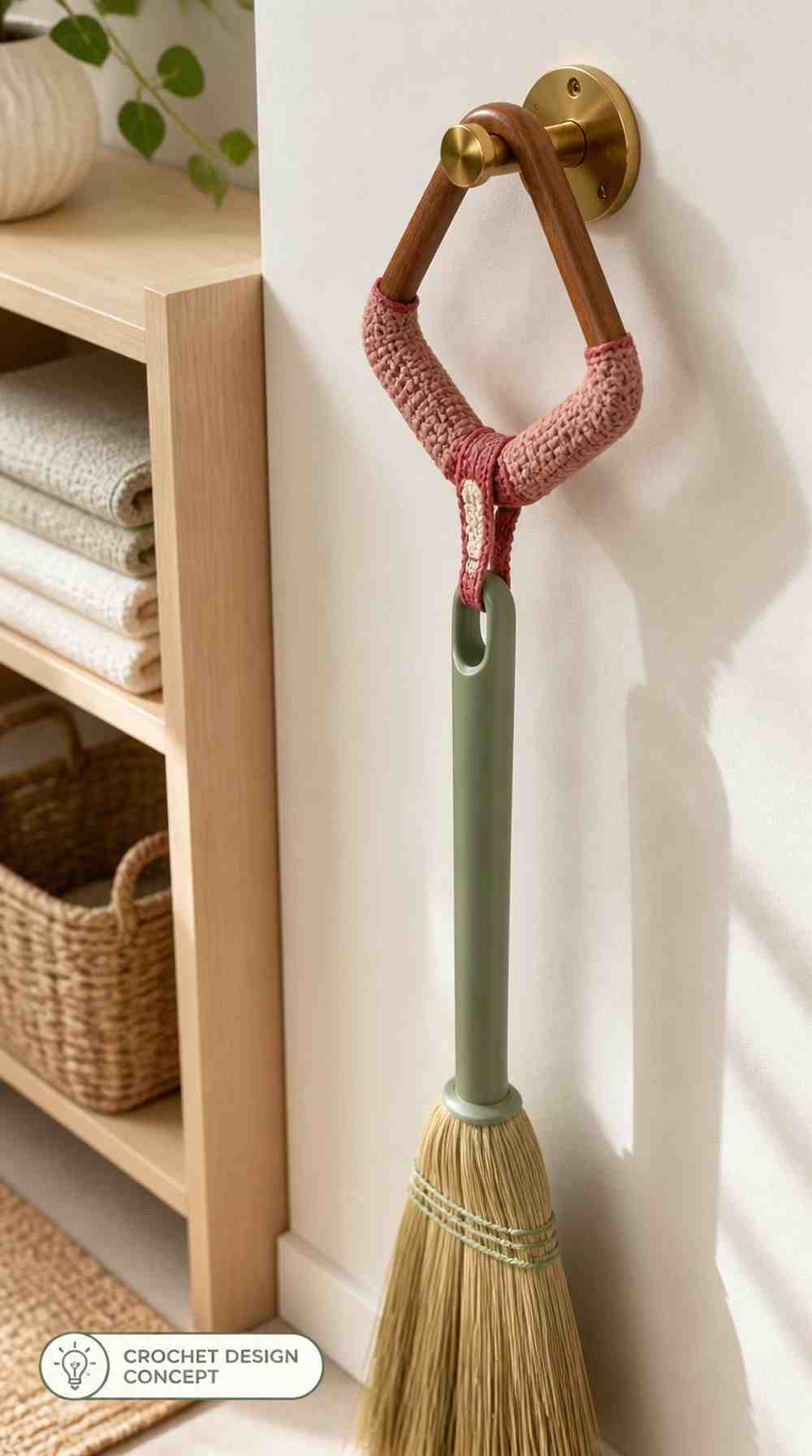
Rosewood-pink crochet decorates the lower sides of a smooth triangular wooden hanging ring. Dusty-rose edging follows the yarn-covered sections, while a short rosewood connector with a cream woven core attaches to the original hole of a sage-green broom handle. The ring’s upper wooden side rests on a matte-brass hook.
The triangular shape gives this concept a more architectural appearance than a circular ring or flat strap. Because the connector meets the lower point, the attachment needs to remain centered to prevent the broom from hanging at an awkward angle.
- Triangular Wooden Ring: Use a smooth, sound ring with rounded corners and appropriate strength for its intended purpose.
- Two Decorated Sides: Rosewood crochet covers the lower edges while the upper wooden surface remains available for the wall hook.
- Centered Connector: Align the lower attachment beneath the triangle’s upper side so the broom hangs vertically.
- No Loose Decorations: The compact design avoids tassels or dangling pieces that might catch on adjacent cleaning tools.
Practical Guide to Crochet Broom Handle Hanging Loops
A broom handle hanging loop needs to work with the broom’s existing attachment points, the wall hook and the tool’s weight. Decorative crochet can add texture, but it should not be assumed strong enough to support every broom.
Inspect the handle first. Some brooms have a factory-made hole or molded end-cap eye for hanging. Others have no opening at all. Do not drill into a broom handle without suitable manufacturer guidance, because doing so can weaken or damage it.
Choose a suitable attachment. A handle with an existing hanging eye may accommodate an appropriate loop. Otherwise, a purpose-made wall-mounted broom gripper can provide an alternative without relying on a homemade strap. Commercial holders commonly use mechanical grips to retain handles.
CPC UK
Check the broom’s weight. Small indoor brooms and heavier outdoor sweeping brushes can have very different weights. Crochet stretches, and the weakest section may be the fastening, fabric join, handle opening or wall hook.
Keep loops compact. A short hanging loop can help keep the broom near the wall. Avoid long cords that might become tangled with other cleaning equipment or create a snagging hazard.
Consider yarn wear. Smooth cotton or an appropriate blend can give a neat appearance, but yarn can fray where it rubs against metal hooks or rough handle holes. Fabric backing, smooth rings and properly fitted hardware may reduce some contact problems without guaranteeing strength.
Inspect the complete storage arrangement. Check the loop, handle cap, hook and wall fixing regularly. Do not continue using the hanger if the fabric stretches excessively, the connection loosens or the broom starts slipping.
Store the broom appropriately. Follow the broom manufacturer’s recommendations for hanging and drying. Keep the broom clear of walkways, doors and areas where children or pets might pull it down.
For other crochet storage inspiration, explore 20 Crochet Hanging Wall Pocket Organizer Ideas on Yarn Nest Studio. The collection includes wall-mounted storage designs with different hanging methods and decorative finishes, although these are not substitutes for a suitable broom holder.
Want to Make Something Similar?
These verified resources demonstrate crochet cords and hanging-loop techniques. They are not exact patterns for these 13 broom-handle concepts, and none establishes a safe weight rating for hanging a broom.
- Crochet I-Cord Stitch Tutorial and Video — Fiber Flux — A written and video tutorial explaining how to make a narrow tubular crochet cord, useful background for the Terracotta Braided I-Cord design. fiberfluxblog.com
- Tutorial: Crocheted Cord — Pattern Paradise — Demonstrates a braided-looking crochet cord with step-by-step photographs and video guidance. It offers related texture inspiration for small hanging loops. Pattern Paradise
- The Romantic Towel Hanging Loop — Milla Billa — A free crochet hanging-loop pattern with decorative curved edges, relevant to the Ivory Scalloped concept. It is intended for towels, not broom storage. Milla Billa
The tutorials can help with crochet shapes and finishing methods. Any real broom hanger still needs an appropriate attachment, secure wall hardware and verification that it can support the tool.
Which Crochet Broom Handle Hanging Loop Should You Choose?
| Your main priority | Designs worth comparing | Important consideration |
|---|---|---|
| Simple compact hanging | Sage Ribbed, Lilac Tapered | Loop size and original handle hole |
| Decorative removable closure | Oatmeal Buttoned, Forest Adjustable | Button reliability under load |
| Rounded crochet cord | Terracotta Braided I-Cord | Cord stretch and hook abrasion |
| Fabric-backed loop | Navy Cotton-Backed | Reinforcement and attachment strength |
| Scalloped decoration | Ivory Scalloped | Snagging and finishing |
| Traditional crochet motif | Denim Granny-Square | Separate decorative and supporting stitches |
| Handle without a hanging eye | Dusty Blue Clamp-Eye | Collar compatibility and retention |
| Smooth wooden hook contact | Mustard Wooden-Ring | Ring strength and joining strap |
| Floral cottage style | Coral Daisy | Flat, securely sewn decoration |
| Metal-reinforced hook opening | Charcoal Eyelet | Grommet installation and sharp edges |
| Geometric wooden hanger | Rosewood Triangular-Ring | Balanced attachment and ring strength |
If you prefer simple crochet styling, the Crochet Sage Ribbed Broom Handle Hanging Loop provides a straightforward flat-strap concept.
For a narrow round cord, the Crochet Terracotta Braided I-Cord Broom Hanging Loop offers a different stitch texture and compact appearance.
If the broom handle lacks a hanging hole, the Crochet Dusty Blue Clamp-Eye Broom Hanging Loop is worth exploring only with a properly compatible purpose-made collar. A conventional wall-mounted broom holder may be more suitable.
For decorative designs, the Crochet Coral Daisy Broom Hanging Loop Tab and Crochet Denim Granny-Square Broom Hanging Tab add handmade motifs while keeping them separate from the main hook-contact area.
Conclusion
These 13 crochet broom handle hanging loop inspiration ideas explore how a small cleaning accessory can combine different crochet textures, colors, loop shapes and decorative details. Flat ribbed straps, braided I-cords, wooden rings, reinforced openings and small floral motifs each offer a different visual direction.
The most useful arrangement will depend on the broom’s existing handle design, weight and storage location. Reliable attachment and secure wall mounting are more important than decorative features. Any handmade loop needs careful evaluation before it is trusted to support a broom.
Which design would you choose for your cleaning cupboard: the Sage Ribbed Loop, the Terracotta Braided I-Cord, the Mustard Wooden-Ring Hanger or the Coral Daisy Tab? Share whether your broom has an existing hanging hole or a plain handle.
Frequently Asked Questions
1. Can crochet safely hold the weight of a broom?
Not automatically. Crochet can stretch or wear, especially where it meets a hook or handle opening. A finished hanging loop needs an appropriate load-bearing construction, strong joins and compatible mounting hardware. These inspiration concepts have not been weight-tested, so they should not be assumed suitable for supporting a broom.
2. What yarn is best for a crochet broom handle hanging loop?
A smooth, firmly worked cotton yarn or suitable blend may be worth exploring for decorative loops. However, yarn choice alone does not establish strength. Consider abrasion, moisture, stretching and the actual handle attachment. A separate compatible fabric reinforcement or purpose-made hanger may be more appropriate.
3. How can I hang a broom that has no hole in its handle?
A wall-mounted broom gripper is often a practical option because it holds the handle without requiring a drilled opening or homemade loop. A compatible purpose-made handle collar may also be considered if it is specifically designed for hanging the tool. Do not rely on a loose crochet wrap around a smooth broom pole.
4. Is a wooden ring better than a flat crochet hanging loop?
A smooth wooden ring can provide a defined contact surface for a wall hook, while a flat crochet strap offers a softer textile appearance. Neither is inherently safer without knowing the materials, attachment method and broom weight. A decorative wooden craft ring should not automatically be treated as load-rated hardware.
5. Are these 13 crochet broom handle hanging loop ideas complete patterns?
No. These are original AI-generated inspiration concepts showing possible crochet stitches, hanging-loop shapes, fabric reinforcement, decorative motifs and attachment arrangements. They do not include tested stitch counts, exact dimensions, yarn quantities, verified load capacities or installation instructions. The linked resources explain related crochet techniques rather than reproducing these specific designs.