A picnic blanket is one of those things that’s easy to pack for a day out but awkward to carry once it’s rolled up. It can slip under your arm, take up space in a tote or start unrolling before you reach the park. A crochet shoulder carry wrap offers a handmade way to keep the blanket bundled while giving it a dedicated carrying strap. These 16 crochet picnic blanket shoulder carry wrap inspiration ideas explore adjustable bands, padded straps, mesh cradles, granny-square details, buckled carriers and detachable shoulder slings.
The most useful design depends on the blanket’s rolled size, fabric weight and how far you need to carry it. Some concepts use two bands around the ends of a roll, while others provide a wider central wrap or a supporting cradle underneath. This collection compares their fastenings, shoulder comfort, crochet construction and practical limitations to help you find a style that suits your picnic routine.
These are AI-generated crochet design visualizations for inspiration, not photographs of tested handmade carriers or complete crochet patterns. Their load capacity, strap strength and stability have not been tested.
Quick Design Selection Guide
- For a familiar two-band carrier: Crochet Terracotta Double-Buckle Picnic Blanket Wrap and Crochet Navy Sliding-Ring Picnic Blanket Carrier offer adjustable retaining bands.
- For a simple continuous strap: Crochet Mustard Continuous-Loop Blanket Shoulder Sling uses two support loops connected by one long carrying section.
- For a broader supported design: Crochet Sage Mesh-Cradle Picnic Blanket Sling, Crochet Lavender Center-Girdle Blanket Carrier and Crochet Sand Wide-Wrap Shoulder Sling cover more of the rolled blanket.
- For decorative handmade detail: Crochet Raspberry Granny-Panel Blanket Shoulder Wrap and Crochet Olive Basketweave Twin-Band Blanket Wrap highlight different crochet textures.
- For greater shoulder comfort: Crochet Cocoa Padded-Shoulder Blanket Carrier features a wider padded section.
- For different fastening needs: Crochet Ivory D-Ring Adjustable Blanket Sling, Crochet Blush Button-Tab Picnic Blanket Wrap and Crochet Plum Detachable-Shoulder Blanket Carrier explore adjustable or removable components.
1. Crochet Terracotta Double-Buckle Picnic Blanket Wrap
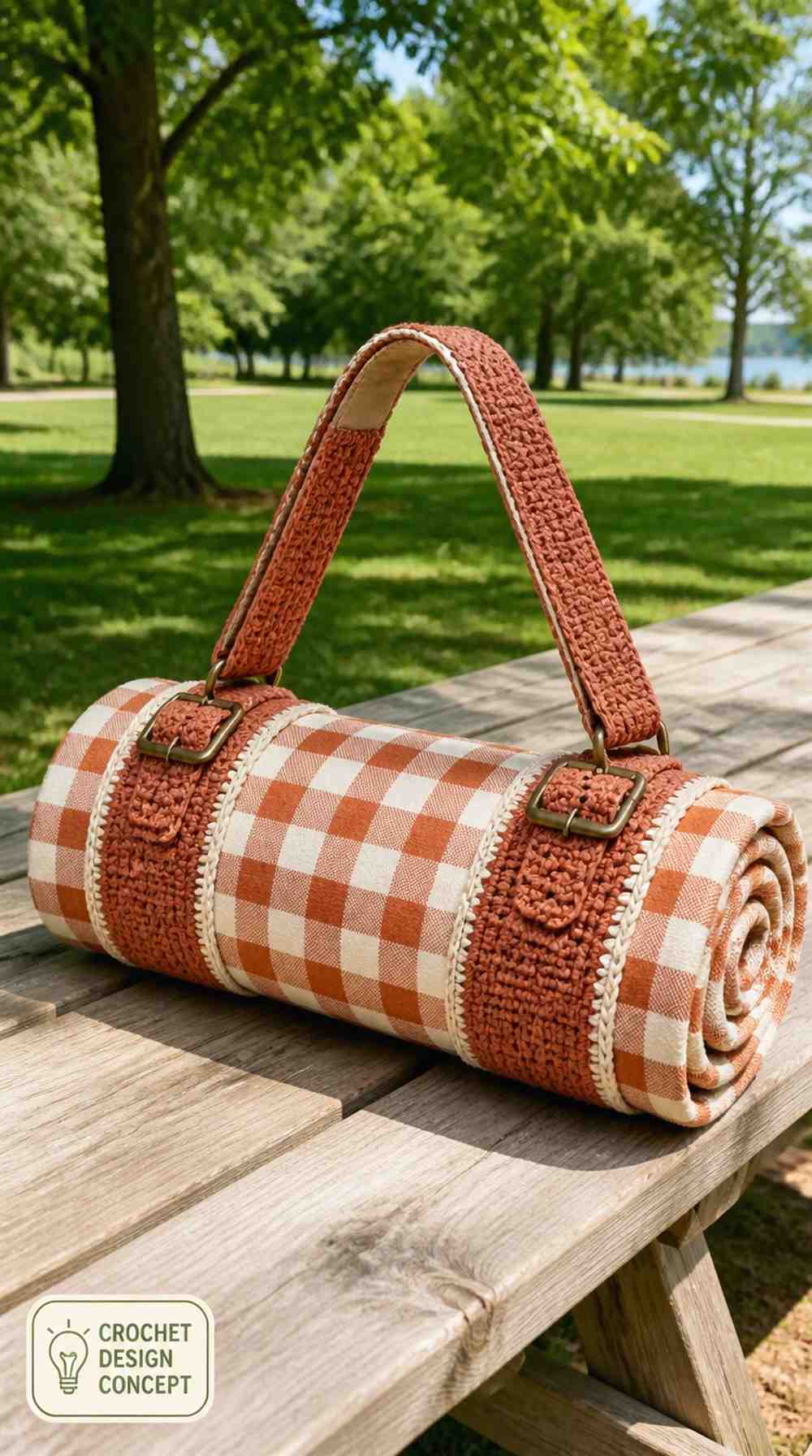
Warm terracotta crochet forms two wide retaining bands around a cream-and-rust rolled picnic blanket. Narrow ivory borders give the bands a neat finish, while antique-brass buckles allow their circumference to be adjusted. A broad matching shoulder strap connects the bands through reinforced attachment points.
This design offers a straightforward way to organize a rolled blanket before carrying it. The important feature is the relationship between the two bands and the shoulder strap. Both ends need secure support rather than relying only on the friction of crochet against the blanket.
- Two-band spacing: Position the retaining bands toward opposite ends of the roll so it stays balanced instead of sagging from the center.
- Buckled adjustment: Thread both buckles correctly and check that the wrapped bands remain secure without compressing the blanket excessively.
- Carrying support: Use a suitable low-stretch reinforcement and properly sewn strap attachments, since decorative crochet stitches alone may elongate under load.
2. Crochet Mustard Continuous-Loop Blanket Shoulder Sling
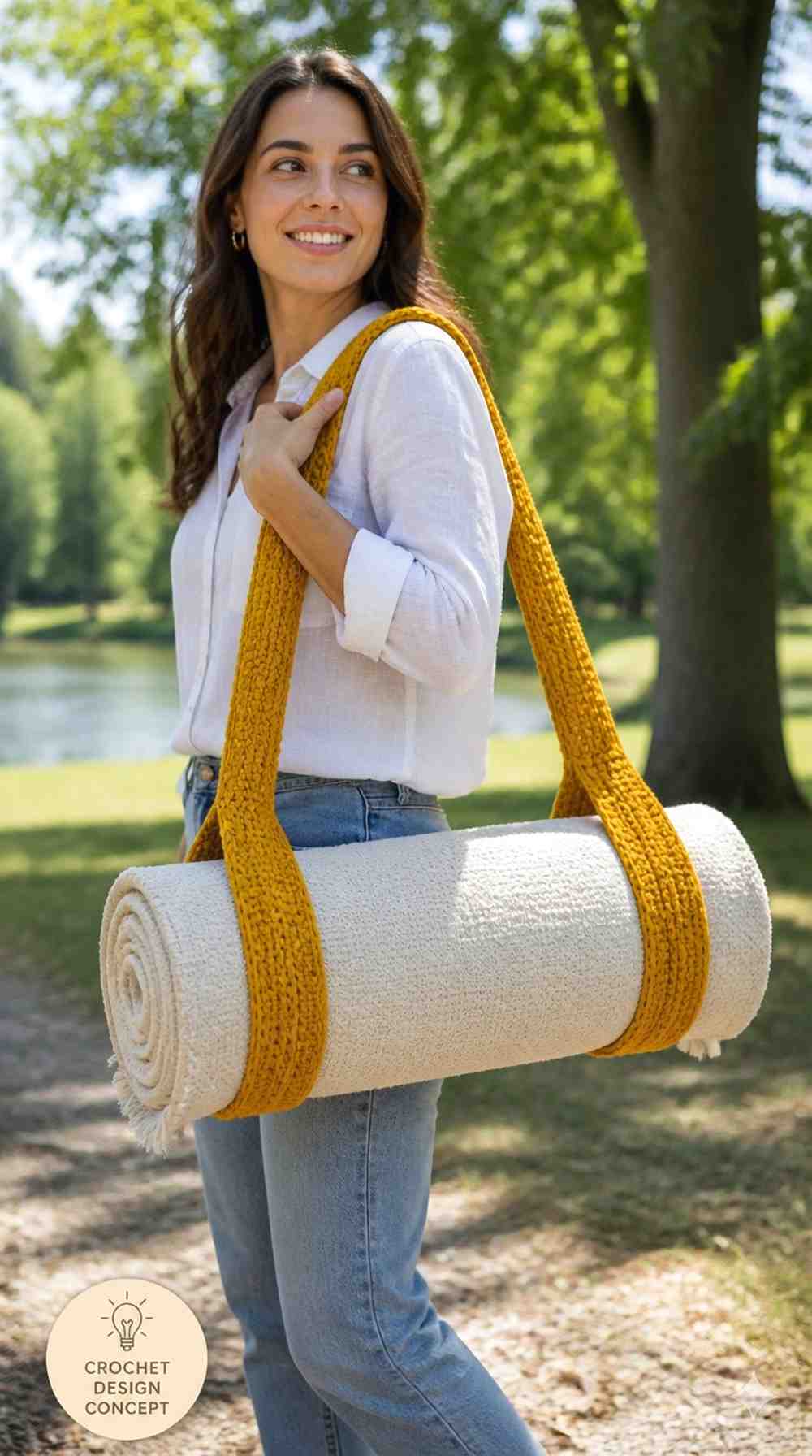
Golden-mustard crochet creates one continuous carrying arrangement, with two loops supporting the rolled blanket and a long section connecting them over the shoulder. The closely worked strap has a concealed woven reinforcement and no separate buckles or buttons.
Its clean, uninterrupted outline is the main appeal. The two loops need to be positioned accurately for the particular blanket diameter, since there is less obvious adjustment than in a carrier with independent buckle closures.
- Continuous strap path: Make sure both supporting loops are connected to the reinforced carrying section without weak or unsupported joins.
- Loop fit: Test the carrier around the complete rolled blanket, not an empty cylinder, because fabric thickness changes the usable circumference.
- Shoulder length: Check the suspended height beside the body so the blanket does not drag against the ground or swing into the legs.
3. Crochet Navy Sliding-Ring Picnic Blanket Carrier
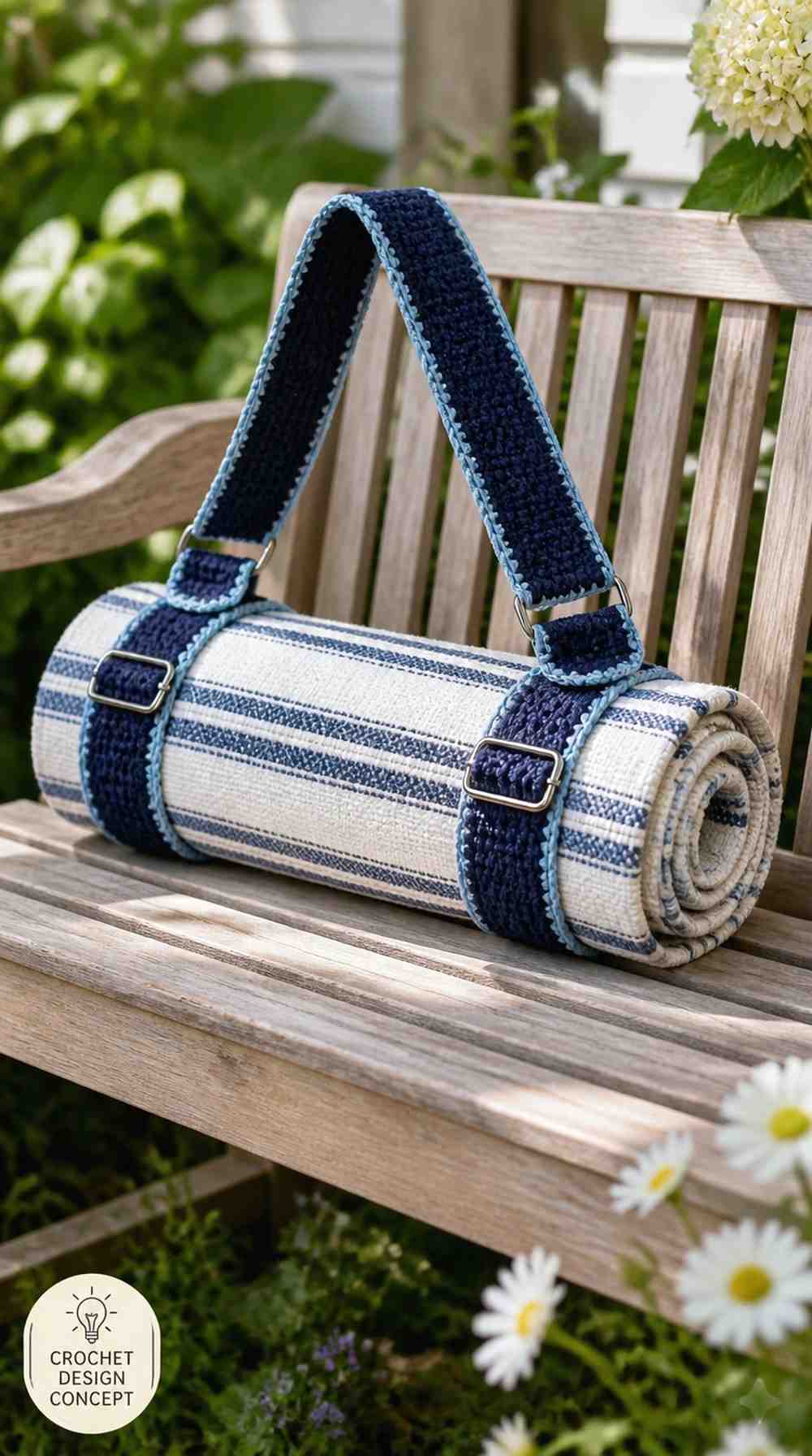
Deep-navy crochet creates two narrow retaining bands with pale-blue edging. Each band adjusts through a matte-silver sliding ring, while a broad matching shoulder strap connects the reinforced upper attachments.
Compared with a buckle carrier, the sliding-ring arrangement has a simpler-looking fastening. Its performance depends on the ring shape, the thickness of the crochet strap and whether the adjustment remains secure when the weight shifts.
- Sliding-ring compatibility: Choose hardware sized for the actual strap thickness, rather than assuming any decorative ring will grip crocheted fabric.
- Flat adjustment tails: Keep the loose ends short and secured against the bands so they do not dangle during walking.
- Equal band tension: Adjust both retaining loops consistently to prevent one end of the rolled blanket from slipping lower than the other.
4. Crochet Sage Mesh-Cradle Picnic Blanket Sling
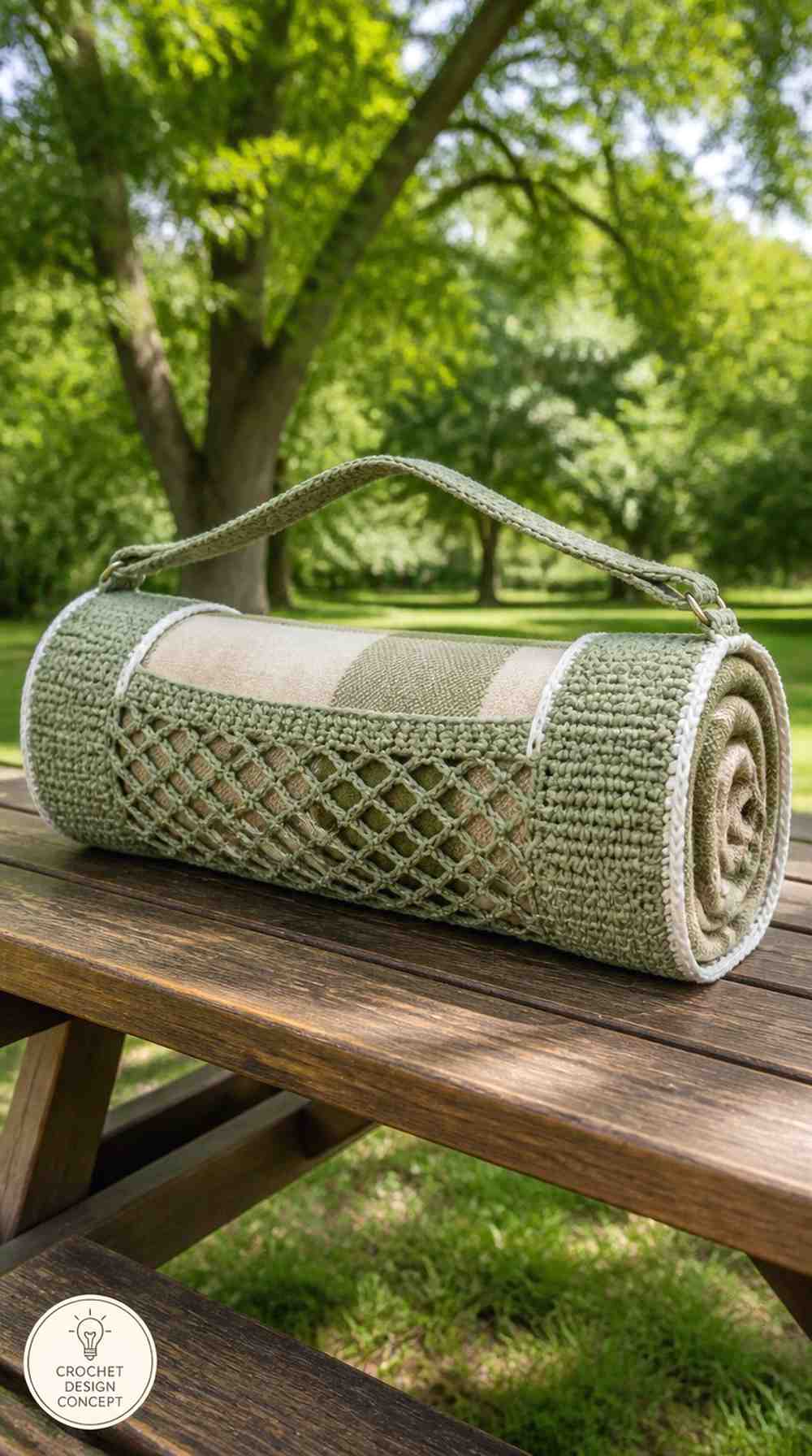
Muted-sage crochet forms a broad open-diamond mesh cradle beneath the rolled blanket. Two solid sage bands support its ends, while an attached reinforced shoulder strap carries the roll from above. Ivory edging defines the closed sections without adding loose fringe.
The mesh gives this carrier a lighter, more open appearance than a fully covered sleeve. It also means the decorative section should not be treated as the sole load-bearing structure. The solid bands and support connections matter more than the openwork.
- Cradle placement: Position the mesh beneath the lower curve of the roll, leaving its surface supported without covering the entire blanket.
- Solid load-bearing bands: Attach the shoulder strap to reinforced closed-stitch bands rather than to the narrow chains of the diamond mesh.
- Openwork limitation: Large openings can catch loose blanket tassels or textured fabric, so check compatibility before using this design.
5. Crochet Raspberry Granny-Panel Blanket Shoulder Wrap
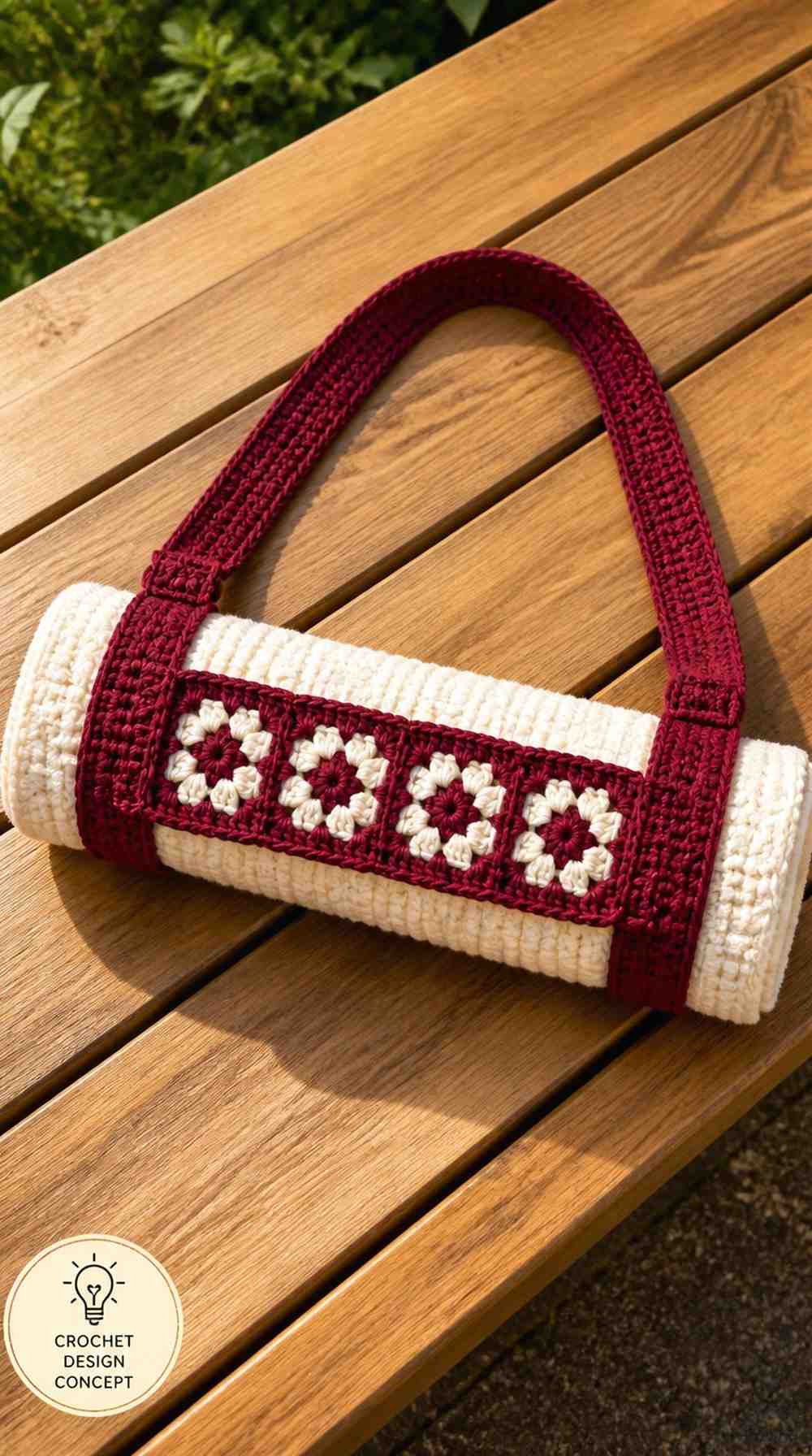
Raspberry and burgundy granny squares create a decorative strip between two solid retaining bands. Each small square has a raspberry center, ivory middle round and burgundy border. A broad matching shoulder strap connects the reinforced bands above the rolled blanket.
The four-square strip adds traditional crochet detail without covering the entire carrier in motifs. Its solid backing helps give the decorative section a more continuous surface, while the actual carrying support remains with the bands and shoulder strap.
- Four-square joins: Keep the granny motifs flat and neatly connected so their corners do not pull unevenly around the curved blanket roll.
- Solid backing: A continuous panel underneath the squares provides a smoother layer against the blanket than exposed openwork alone.
- Separate carrying function: Treat the granny-square strip as decoration; the reinforced bands and shoulder strap must provide the actual support.
6. Crochet Cocoa Padded-Shoulder Blanket Carrier
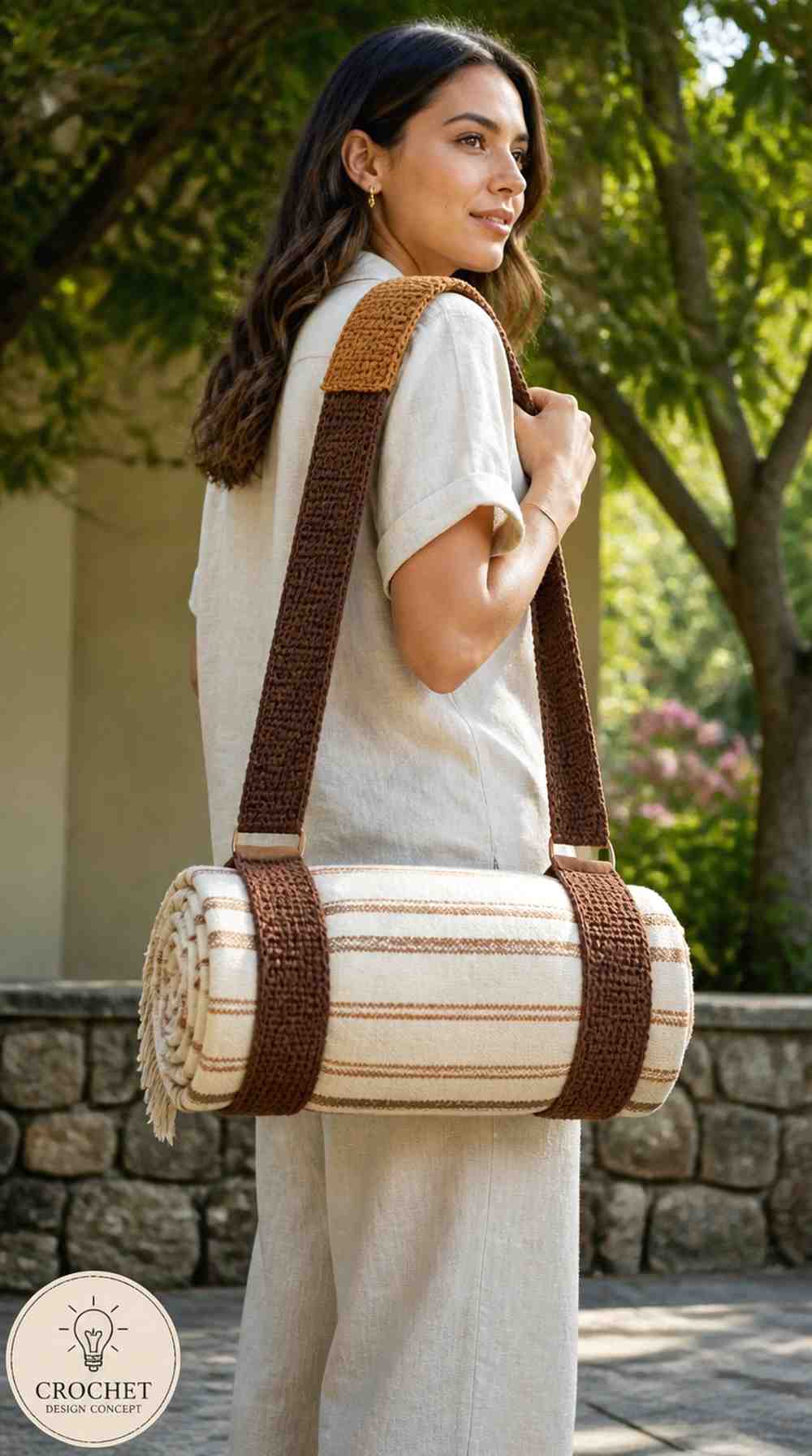
Rich cocoa crochet creates two broad retaining bands around a cream blanket with caramel stripes. A long matching shoulder strap has a wider caramel-colored padded section positioned where it crosses the shoulder.
The padded area is what distinguishes this design. It may spread contact over a broader part of the shoulder, though the actual comfort depends on the filled blanket’s weight, strap width, lining and the way the carrier sits on the body.
- Padded shoulder zone: Position the caramel section where the strap normally rests rather than placing the extra thickness near the blanket attachment.
- Reinforced connections: Join the shoulder strap to strong fabric-backed tabs so repeated lifting does not concentrate all the strain in a few crochet loops.
- Comfort check: Try the finished carrier with the real blanket for a short, controlled walk and adjust the length if it rubs or pulls uncomfortably.
7. Crochet Blush Button-Tab Picnic Blanket Wrap
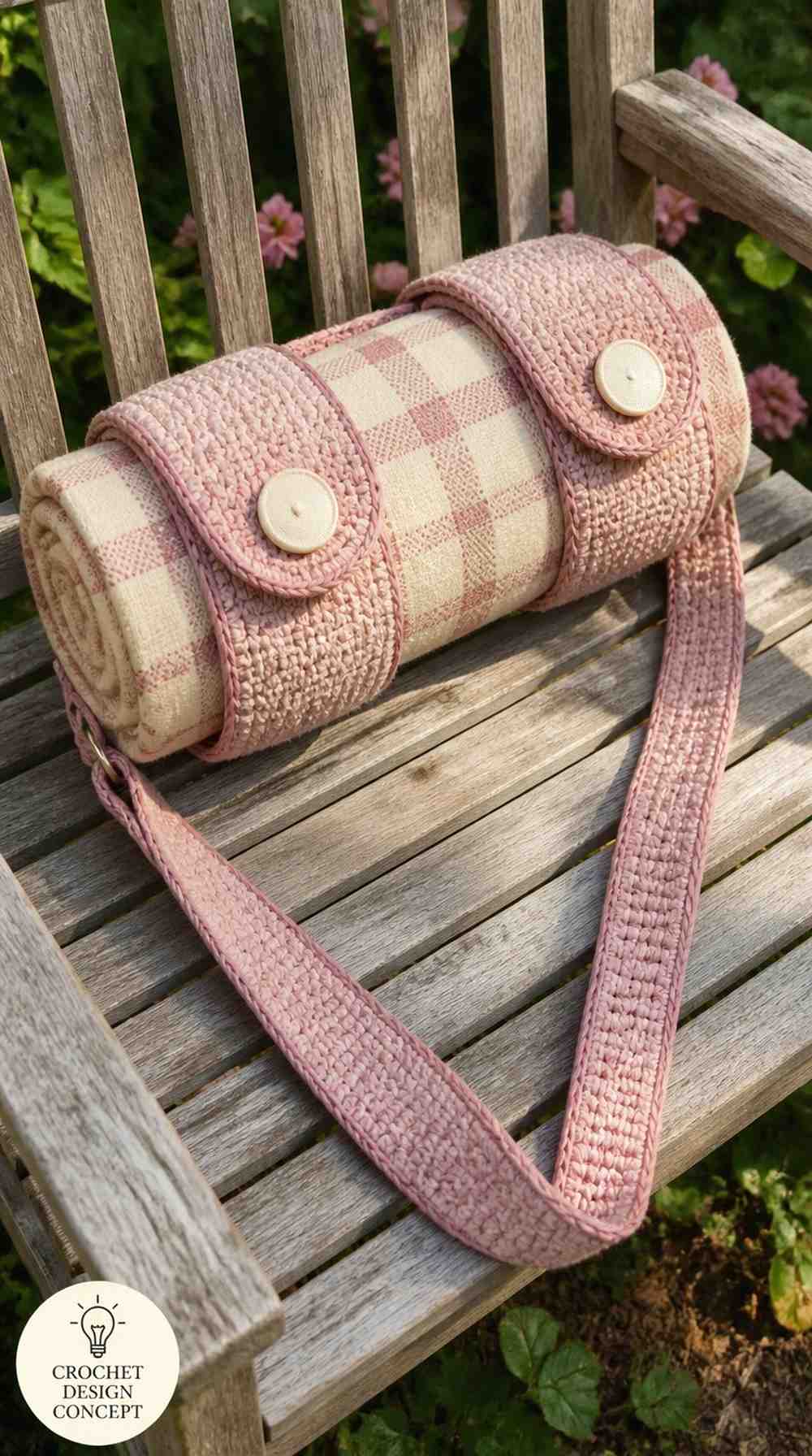
Dusty-blush crochet creates two broad bands finished with rounded overlapping tabs. Raspberry edging outlines each tab, while large flat ivory fabric-covered buttons provide a decorative closure. Hidden woven supports reinforce the carrying loops beneath them.
The button detail softens the appearance of the carrier compared with metal hardware. However, buttons alone should not be expected to hold the full weight of a blanket during shoulder carrying, especially if the roll shifts while walking.
- Button-tab position: Place the rounded closures where they remain visible but do not dig into the blanket or the wearer’s body.
- Supporting structure: Keep the continuous reinforced straps responsible for carrying the weight rather than relying on decorative buttonholes.
- Closure inspection: Check buttons and loops for looseness before each outing, particularly when the carrier is handled repeatedly.
8. Crochet Teal Diagonal-Cross Blanket Shoulder Wrap
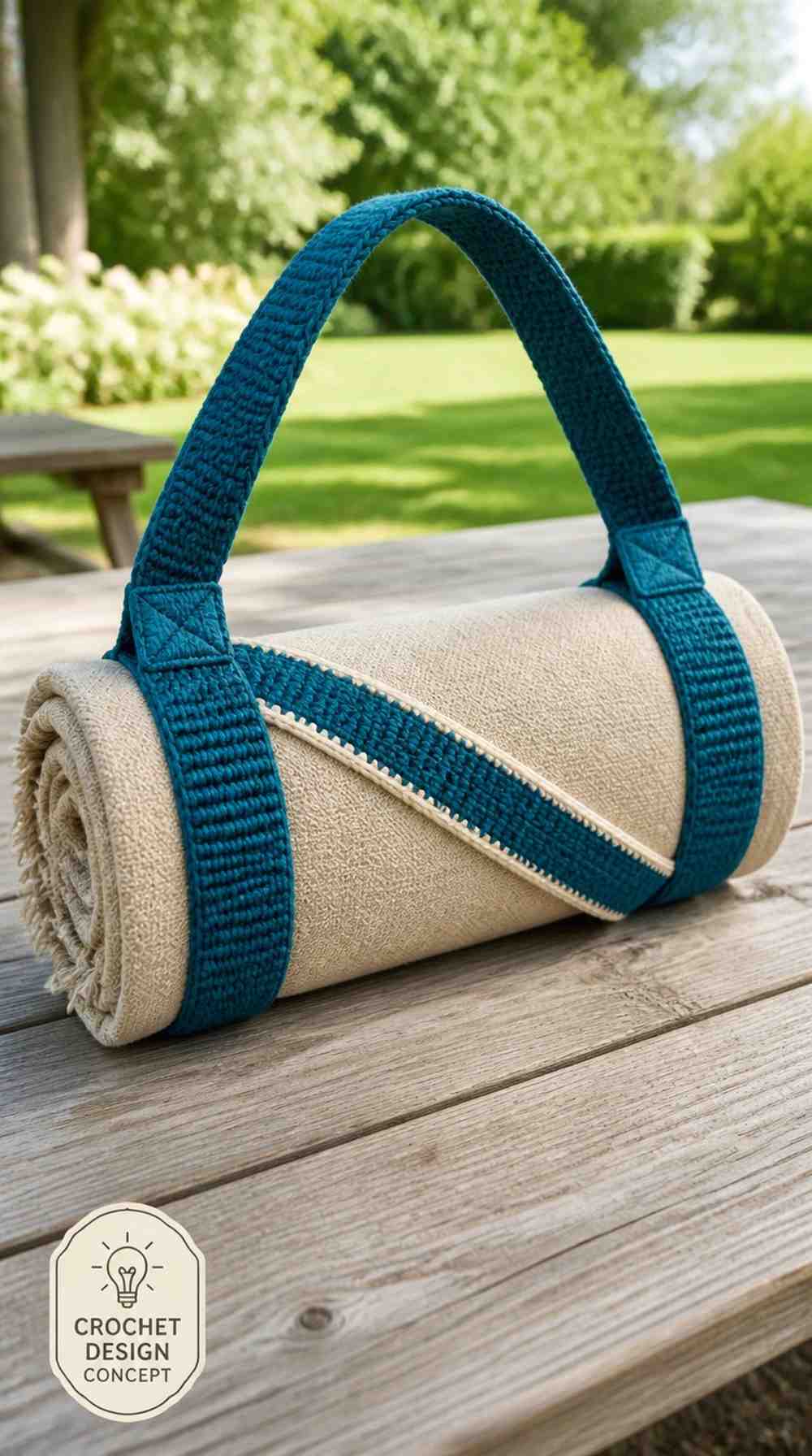
Deep-teal crochet creates two solid retaining bands connected by a narrow diagonal strip across the visible front of the rolled blanket. Ivory edging follows the strip, giving the carrier a distinctive crossed appearance. A broad reinforced shoulder strap connects the two main bands.
The diagonal detail adds visual interest and may help maintain the relative position of the bands. Its direction should be planned carefully so the decorative strip lies flat instead of twisting around the blanket.
- Diagonal strip routing: Keep the connecting section smooth across the roll without pulling either retaining band out of its intended position.
- Primary attachments: Join the carrying strap to the solid support bands rather than expecting the narrow diagonal strip to carry the blanket.
- Blanket texture: Check for loose fringe or fabric loops that might catch against the diagonal crochet edge.
9. Crochet Ivory D-Ring Adjustable Blanket Sling
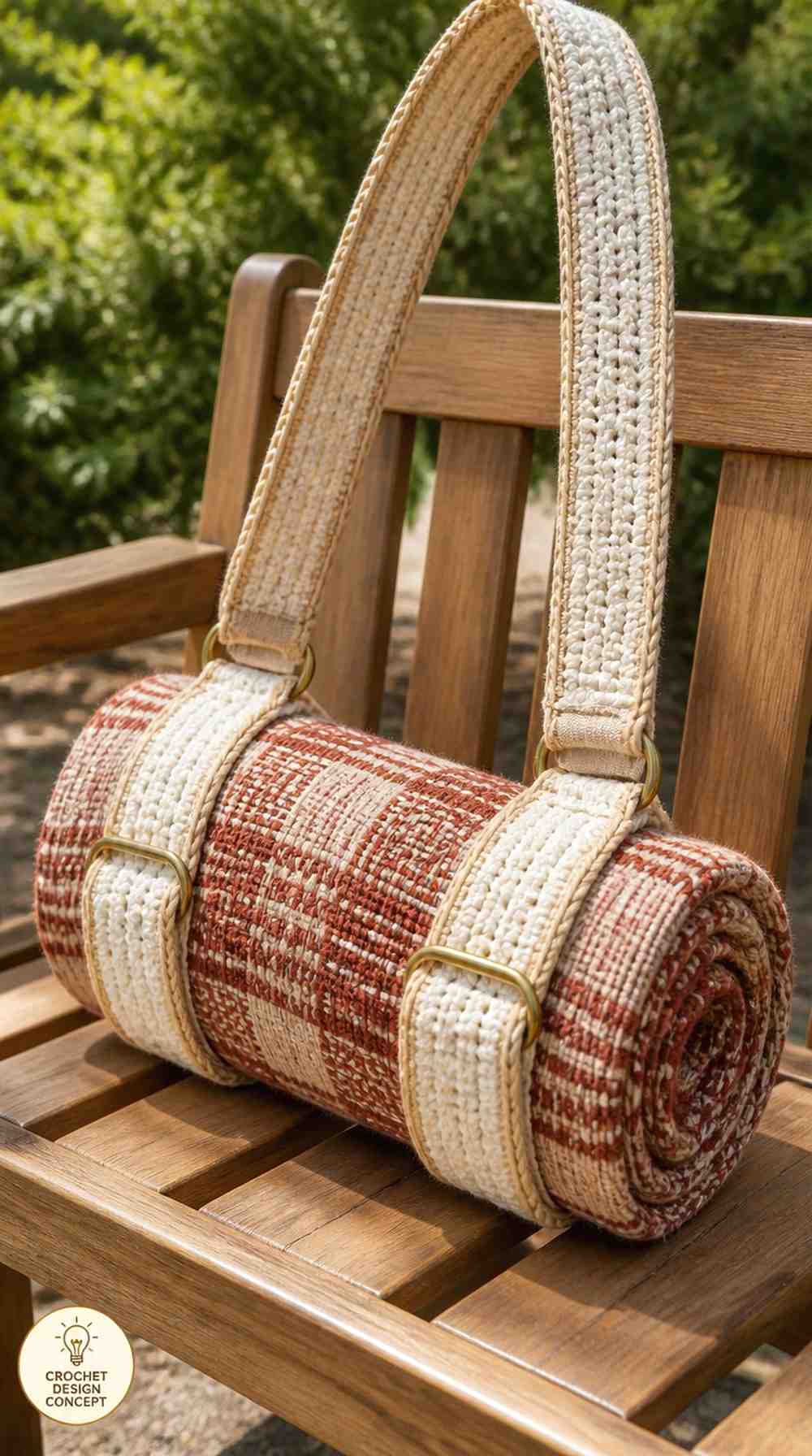
Warm-ivory crochet forms two broad retaining bands with narrow sand-colored edging. Pairs of small matte-brass D-rings provide adjustment, and a matching fabric-reinforced shoulder strap joins the two carrying points above the rolled rust-and-cream blanket.
This design has a clean, neutral appearance and visible metal fastenings. It may suit someone who prefers adjustable bands over buttons, provided the D-rings and strap material work together without slipping under load.
- D-ring threading: Follow the hardware’s intended adjustment path and test it on the rolled blanket before carrying.
- Even loop adjustment: Tighten both bands only enough to retain the roll without distorting its fabric layers.
- Hardware contact: Position the brass rings away from delicate blanket edges where rubbing might create pulls or marks.
10. Crochet Lavender Center-Girdle Blanket Carrier
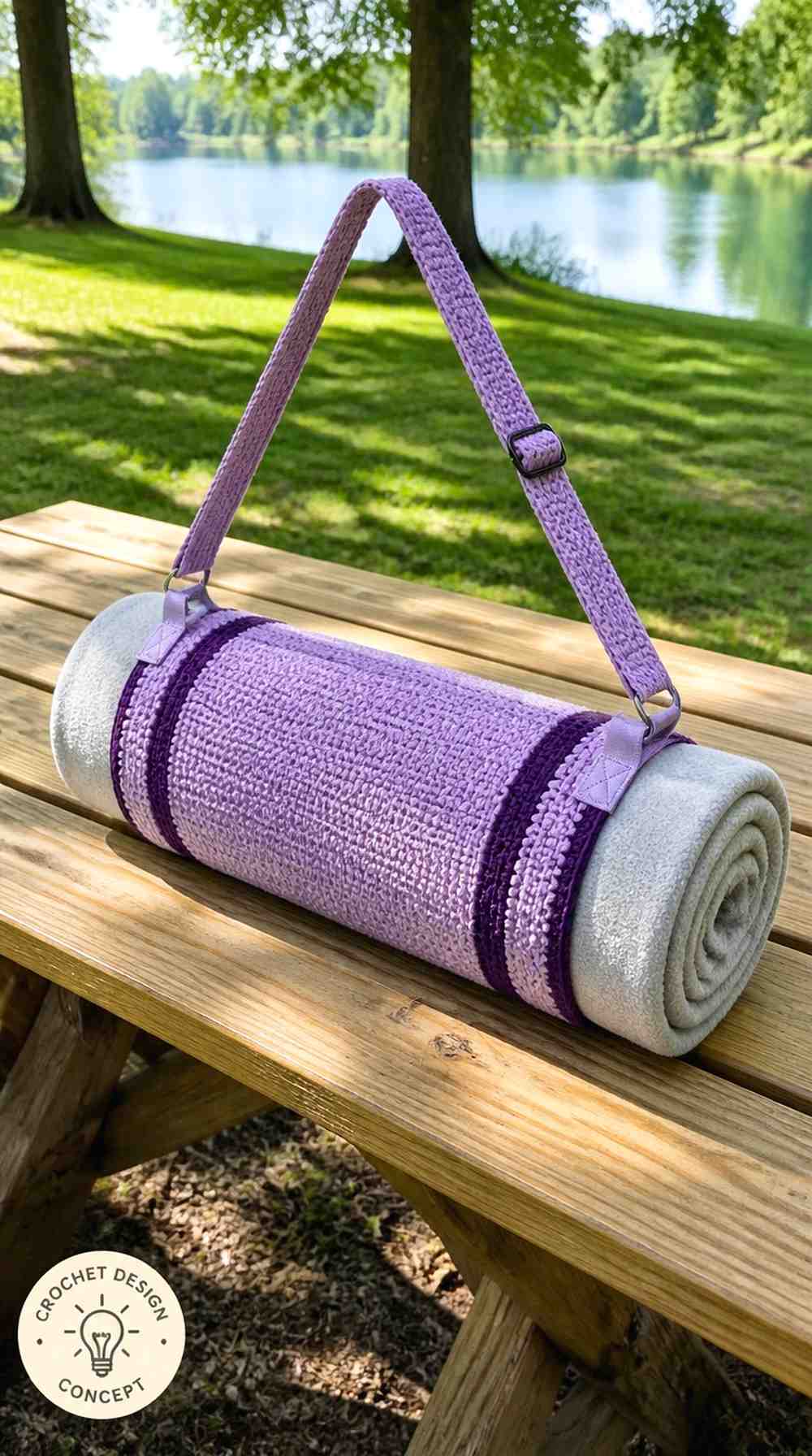
Muted-lavender crochet forms a broad panel around the central portion of the rolled blanket. Two deep-plum vertical stripes decorate the main wrap, while shorter supporting side straps and a long adjustable shoulder strap complete the carrying arrangement.
The wide central panel gives this design a more enclosed appearance than a simple pair of narrow bands. Its lined construction needs to remain flexible enough to fit the curve of the roll without creating bulky folds.
- Central wrap width: Measure the section of the blanket that the broad panel will cover, leaving both roll ends accessible for handling.
- Support underneath: Use correctly positioned fabric-backed straps rather than depending only on the decorative central panel to suspend the roll.
- Panel bulk: Avoid making the wide wrap excessively thick, since several layers of yarn and lining can increase the weight being carried.
11. Crochet Olive Basketweave Twin-Band Blanket Wrap
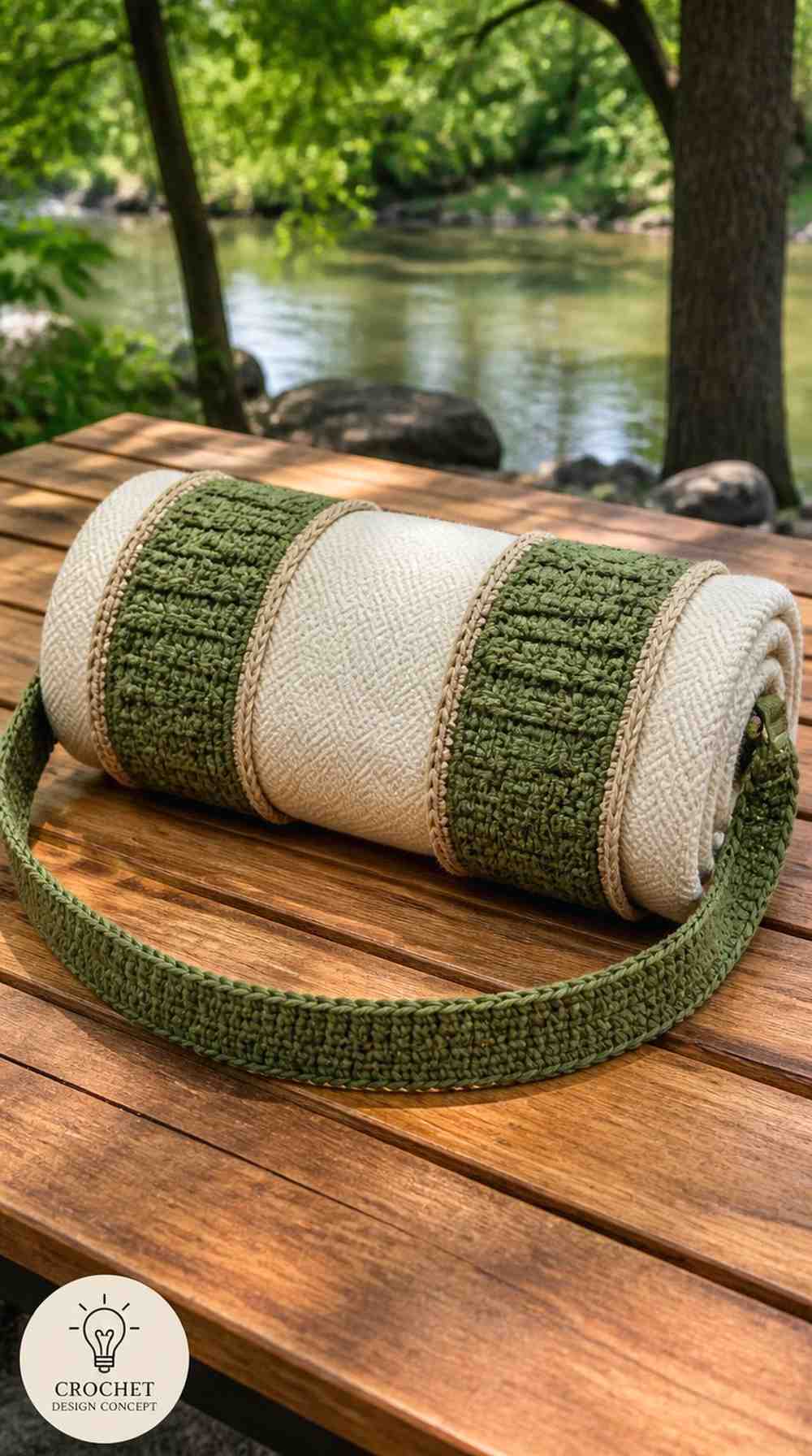
Muted-olive crochet forms two wide retaining bands featuring low basketweave-style stitch groups. Oatmeal edging frames their outer edges, while a long reinforced shoulder strap connects the support points above the blanket.
The raised basketweave texture gives the carrier a more substantial handmade appearance. However, the texture is mainly decorative; the load-bearing ability comes from the complete strap construction and secure attachments.
- Basketweave relief: Keep the raised post stitches controlled so the bands wrap smoothly without forming oversized lumps against the blanket.
- Twin-band balance: Position both bands evenly to reduce the tendency of the rolled blanket to swing or slip to one side.
- Reinforced shoulder strap: Use a suitably supported long strap to limit stretching during repeated carrying.
12. Crochet Charcoal End-Cradle Blanket Shoulder Carrier
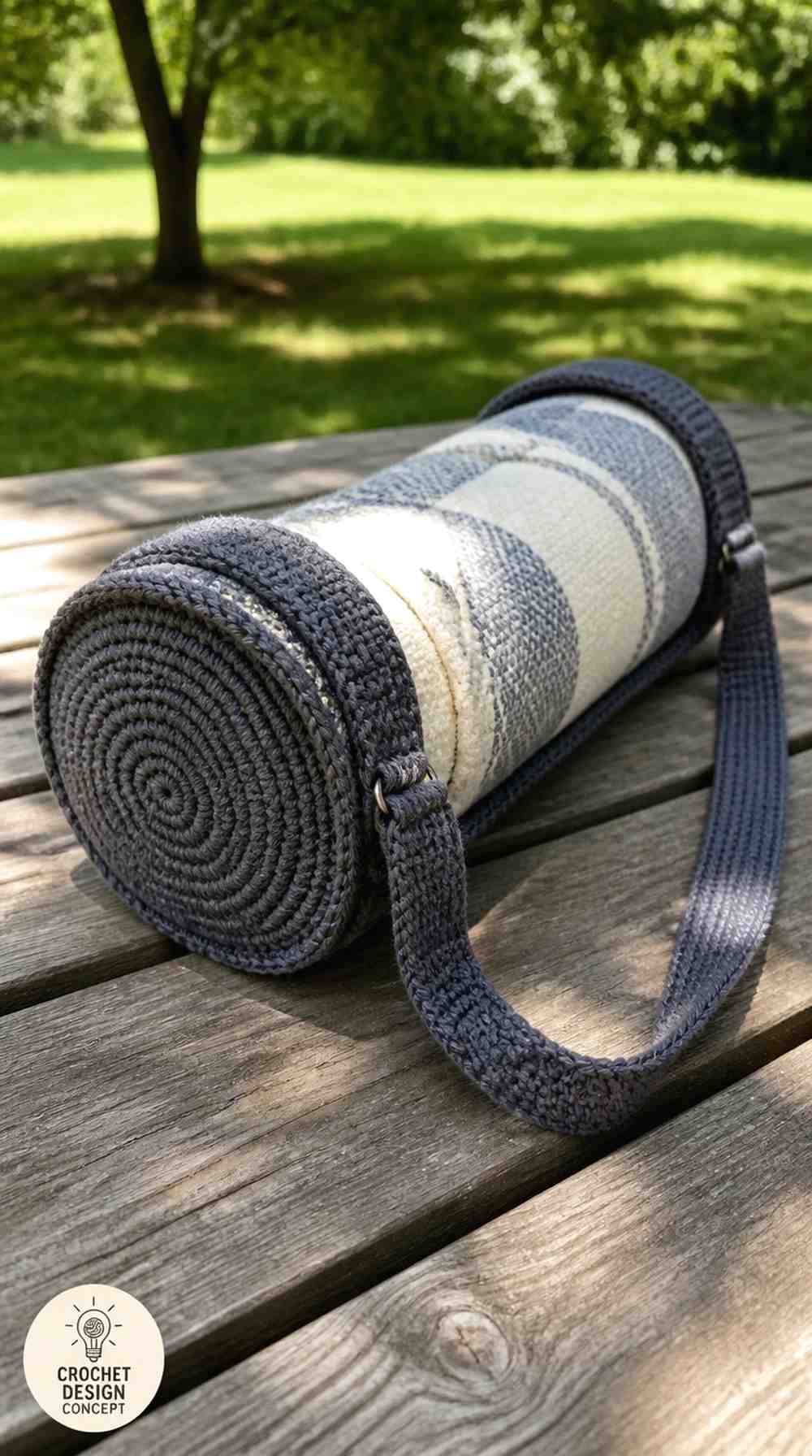
Charcoal crochet forms two shallow circular end cradles connected by a supporting strap beneath the rolled blanket. Each cradle has a dense crochet disk and a short curved sidewall that fits around part of the roll end. A broad matching shoulder strap connects the outer supports.
Unlike bands that circle the middle of a blanket roll, this design focuses on supporting the exposed ends. Its fit depends heavily on the actual roll diameter and on a secure under-blanket connection.
- End-cradle shaping: Size both circular pieces around the rolled blanket ends without forcing the soft fabric into an overly tight cavity.
- Under-roll support: Connect the cradles through a suitable reinforced strap running beneath the blanket rather than relying only on their crochet sidewalls.
- Roll security: Check that the blanket cannot slide out of either cradle when the carrier is lifted or tilted.
13. Crochet Coral Zipper-Pocket Picnic Blanket Wrap
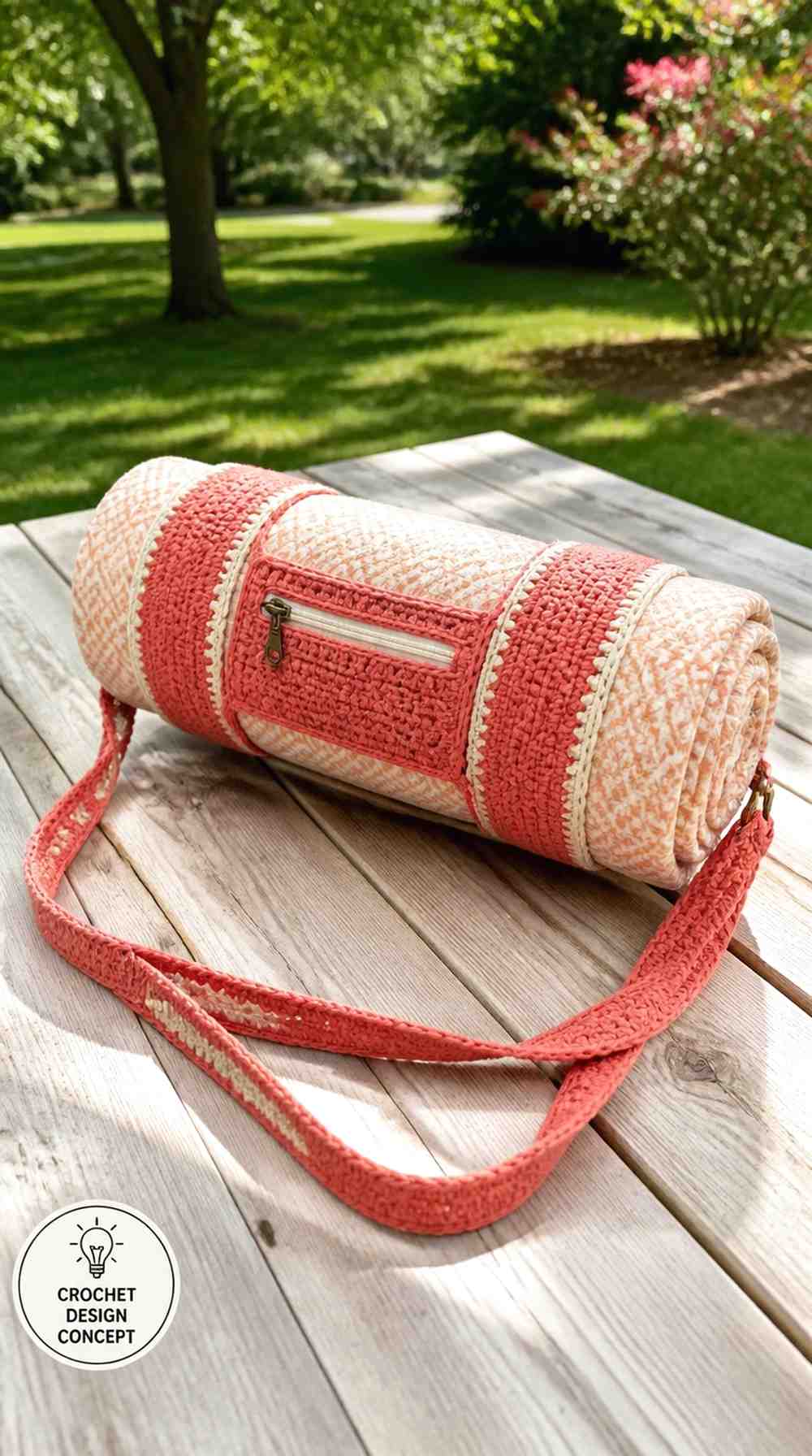
Warm-coral crochet forms two wide retaining bands connected by a narrow front panel. A small flat pocket sits on the panel with a cream zipper, while a reinforced shoulder strap joins the supporting bands above the rolled pale-peach blanket.
The extra pocket gives this carrier a small storage feature without turning it into a full picnic bag. It could hold a lightweight folded note or tissue, but the pocket is not intended for valuable or heavy items.
- Flat pocket contents: Keep the zippered compartment for light, slim items that will not pull the connecting panel out of shape.
- Zipper placement: Position the pull away from the blanket surface to reduce snagging during carrying.
- Separate load support: Attach the carrying strap directly to the reinforced retaining bands rather than to the small storage pocket.
14. Crochet Sand Wide-Wrap Shoulder Sling
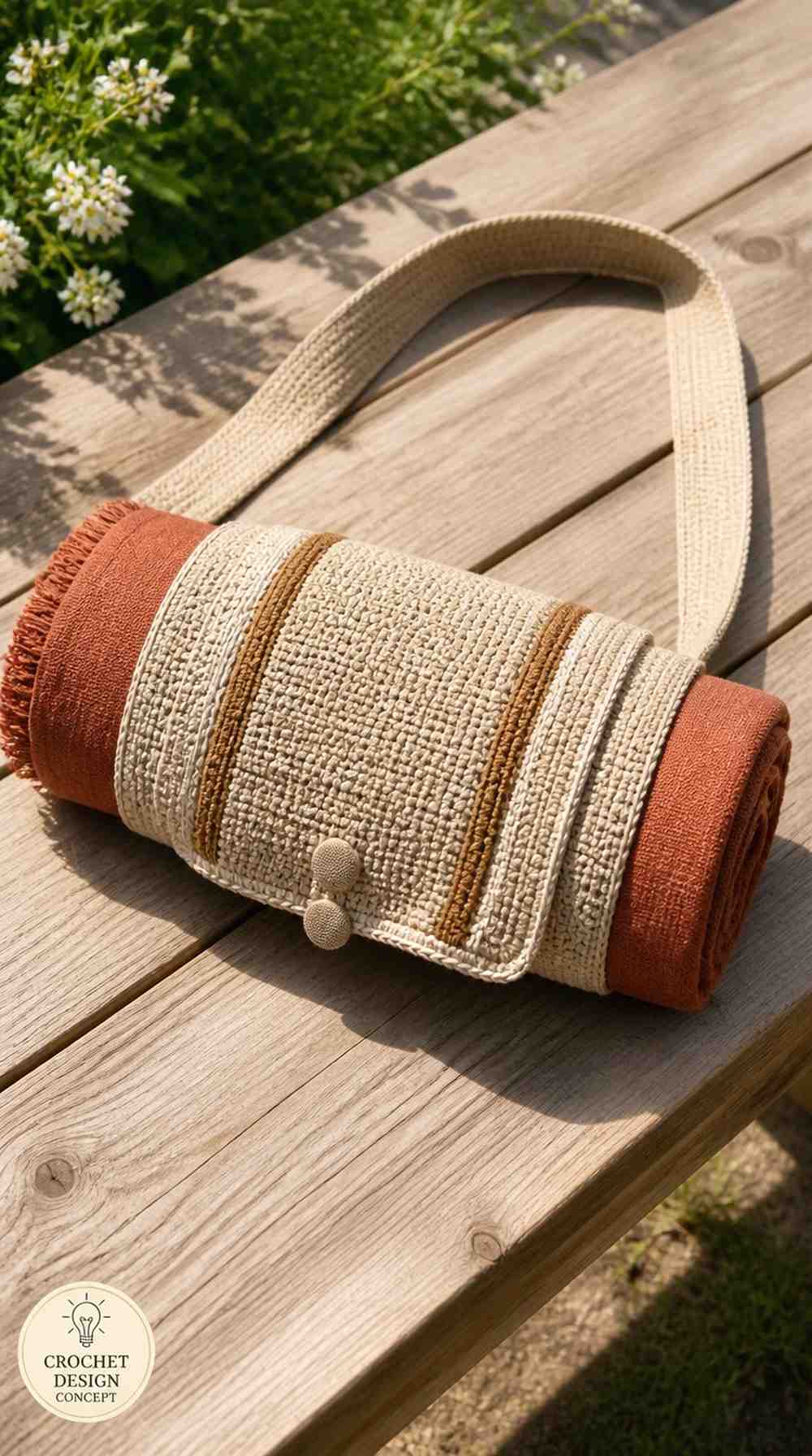
Warm-sand crochet creates a broad central wrap with ivory edging and two caramel-colored reinforcing strips. Two fabric-backed supporting bands extend around the blanket on either side of the wrap, while a wide shoulder strap connects above.
The design has a simple, almost belt-like appearance. Its broad contact area may help position the rolled blanket, but the extra fabric and buttoned overlap mean the finished carrier needs careful sizing to avoid unnecessary weight and bulk.
- Wide wrap fit: Measure the rolled blanket circumference and test the overlap so the panel lies flat without pulling into deep folds.
- Reinforcing strips: Keep the two caramel sections aligned with the actual supporting structure rather than treating them as decoration alone.
- Buttoned overlap: Use the covered buttons to close the visible panel while the reinforced carrying bands handle the blanket’s weight.
15. Crochet Plum Detachable-Shoulder Blanket Carrier
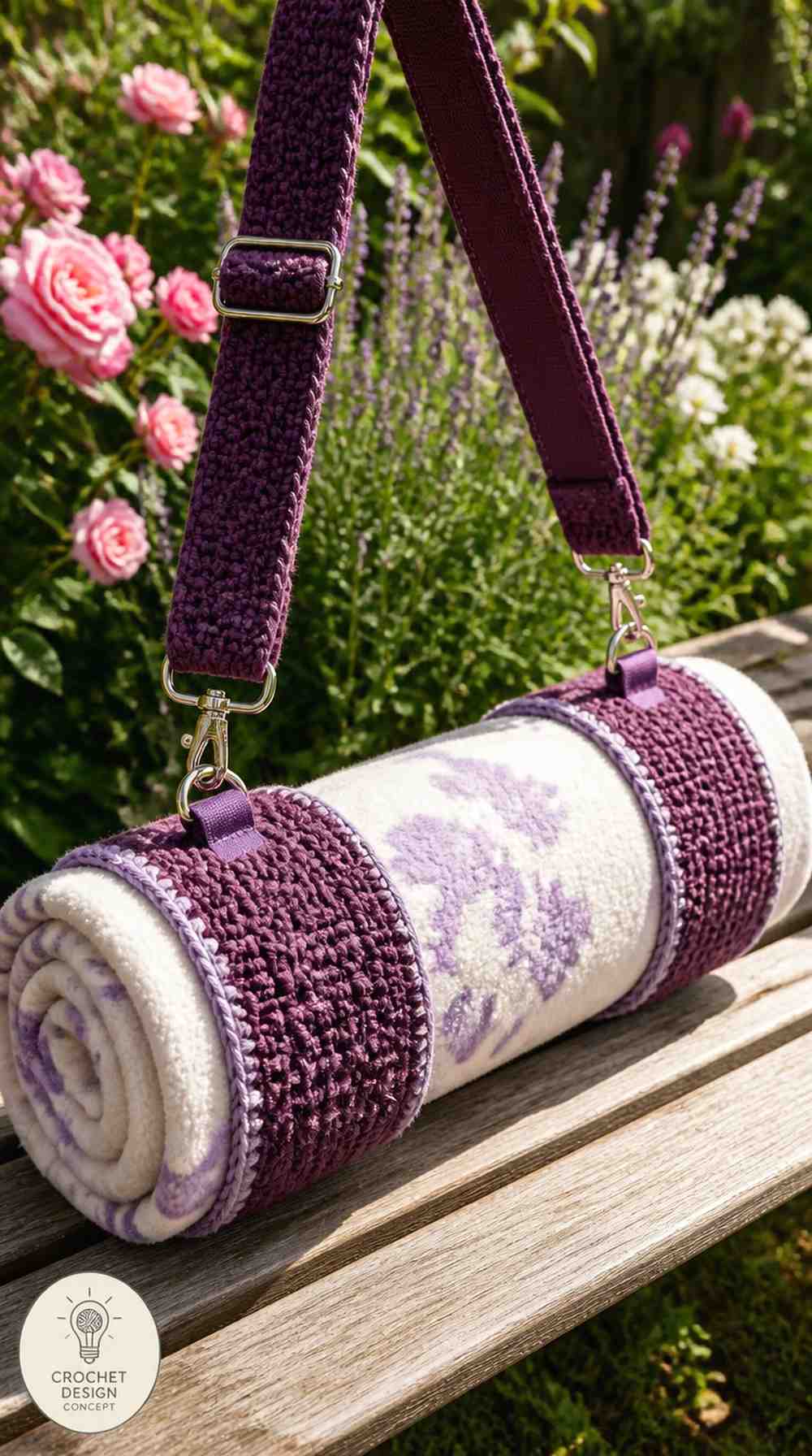
Deep-plum crochet forms two broad retaining bands with lavender edging. Matte-silver D-rings and swivel clips connect a removable adjustable shoulder strap to reinforced attachment tabs above the rolled cream-and-lavender blanket.
The detachable carrying strap is the defining feature. It could make storage easier when the blanket is not being transported, although the hardware must be suitable for the load and securely attached to the supporting bands.
- Detachable clips: Choose compatible swivel clips and inspect their closures before carrying, since a released clip would disconnect the shoulder strap.
- Reinforced ring tabs: Stitch the D-ring connections to properly supported fabric-backed sections rather than a few exposed crochet loops.
- Storage flexibility: Remove the shoulder strap when the carrier is stored if that helps prevent tangling or unnecessary twisting.
16. Crochet Sky-Blue Lattice-Panel Blanket Sling
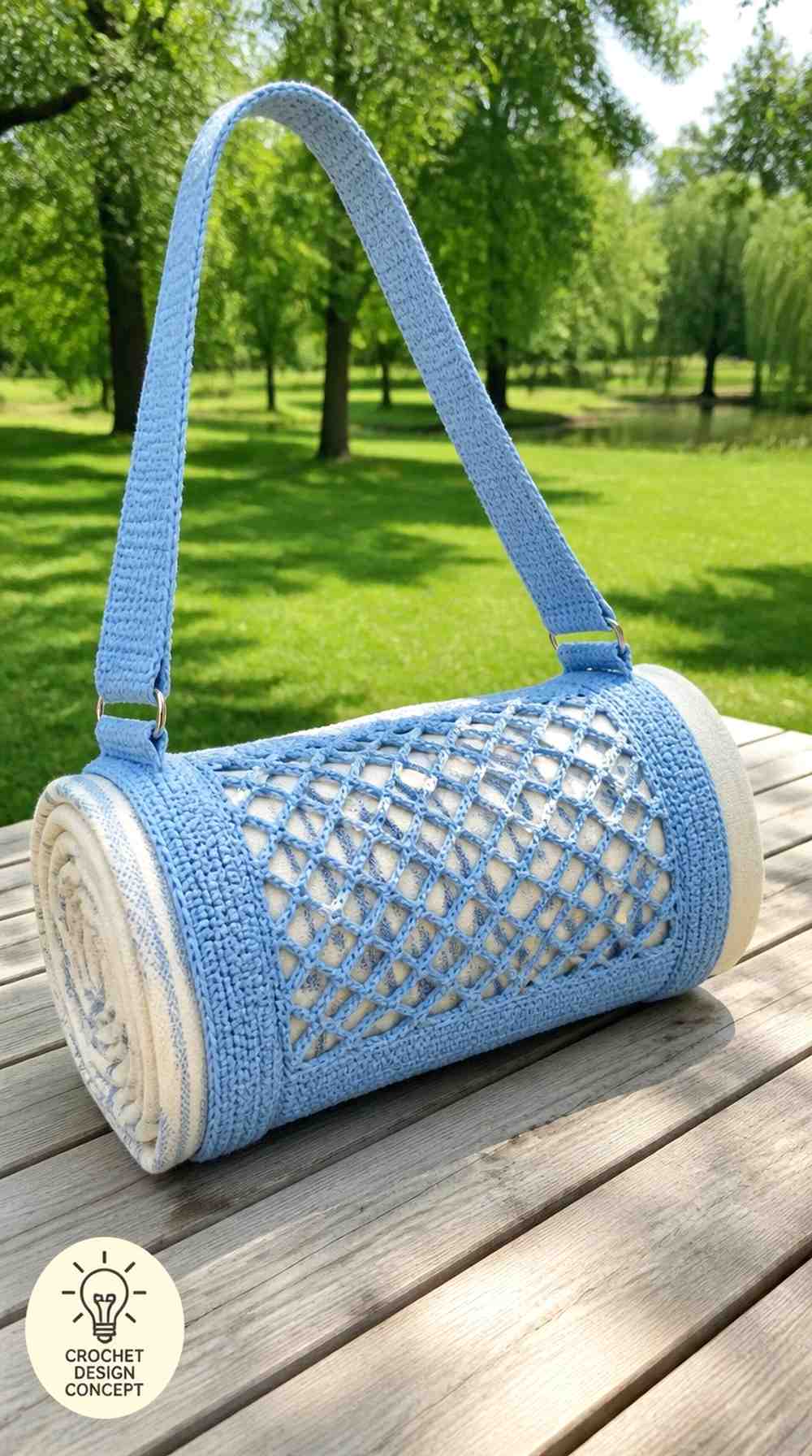
Sky-blue crochet forms two solid bands around the ends of an ivory picnic blanket with pale-blue stripes. A decorative diamond-lattice panel spans the front of the roll, while a wide reinforced shoulder strap joins the two main supporting bands.
The open lattice keeps part of the blanket visible and gives the carrier a lighter decorative appearance. Unlike the sage cradle design, this mesh sits across the visible front rather than supporting the underside, making its role primarily visual.
- Diamond-mesh construction: Keep the open loops evenly connected so the panel retains a clear pattern without pulling toward one side.
- Solid support bands: The broad closed-stitch bands must retain the rolled blanket independently of the decorative front lattice.
- Snagging risk: Avoid using openwork against blankets with long fringes or loose yarn loops that could catch during removal.
Practical Guide to Crochet Picnic Blanket Shoulder Carry Wraps
Measure the rolled blanket, not the unfolded blanket. Fold and roll your picnic blanket as you normally would, then measure its circumference, full roll length and approximate weight. Waterproof-backed picnic rugs, thick throws and lightweight woven blankets may produce very different bundles. Follow the blanket manufacturer’s folding or rolling guidance.
Make the support system secure. A useful shoulder carrier needs more than a decorative strap. Two appropriately spaced retaining bands, a continuous support arrangement or a suitable cradle should hold the rolled blanket without allowing it to slip out. Test the complete construction carefully before carrying it outdoors.
Consider strap stretching. Crochet can lengthen under weight, especially with open or loosely worked stitches. Dense techniques such as thermal stitch, alongside suitable fabric reinforcement, may reduce stretch. The actual result depends on the yarn, construction, stitching and load.
Choose a comfortable shoulder width. A very narrow strap may dig into the shoulder when carrying a heavy or damp blanket. A broader flat strap or padded shoulder section may feel more comfortable, though it should not be assumed to suit every person or blanket weight. Check length and positioning while wearing the fully loaded carrier.
Pay attention to connections and hardware. Buckles, D-rings, buttons, clips and sewn tabs should be appropriate for the chosen construction and the actual blanket weight. Decorative buttons or loose crochet loops should not be treated as tested load-bearing attachments.
Check walking clearance. A rolled picnic blanket should hang high enough not to strike the ground or swing into the legs during walking. Test movement slowly and adjust the carrier before taking it on a longer outing.
Clean and dry before storage. Picnic blankets can collect grass, soil, sand and moisture. Clean the blanket according to its care label and allow it to dry completely before rolling it for storage. Wash the crochet carrier according to the yarn and hardware care instructions, and inspect it for wear.
Do not overload the carrier. These concepts are intended for a rolled blanket, not for suspending additional bags, food containers or heavy picnic equipment. None has been physically tested or assigned a safe weight capacity.
Want to Make Something Similar?
The following verified resources teach related crochet strap and carrying techniques. They are not exact patterns for the 16 illustrated picnic blanket wraps, and a real blanket carrier would need its own sizing and strength checks.
- Free Crochet Yoga Mat Strap Pattern — Made by Gootie — Agat Rottman’s photo and video tutorial shows a continuous crochet carrying strap with two supporting loops. It offers a useful starting point for understanding the Mustard Continuous-Loop design, although blanket size and weight may differ significantly.
- Free Crochet Yoga Mat Strap Pattern — Just Be Crafty — Brittany’s tutorial explains another adjustable strap construction for carrying a rolled mat. Its approach may help with loop placement and fitting but should not be treated as a tested picnic blanket carrier.
- How to Make a Low-Stretch Crochet Bag Strap With Thermal Stitch — Zamiguz — Maggie’s tutorial demonstrates a dense thermal-stitch strap. It is relevant to the shoulder sections of these designs, where excessive stretching could affect comfort and carrying height.
For related outdoor crochet ideas, see 15 Crochet Picnic Set Ideas on Yarn Nest Studio. The collection covers picnic blankets, carriers and accessories that can be coordinated for outdoor outings.
You can also explore Simple Crochet Picnic Mat Pattern for Sunny Days to compare the size and construction of a picnic mat before deciding what kind of carrying wrap it may need.
Which Crochet Picnic Blanket Shoulder Wrap Should You Choose?
| Main priority | Designs to consider | Important trade-off |
|---|---|---|
| Familiar adjustable bands | Terracotta Double-Buckle, Navy Sliding-Ring | Hardware and strap compatibility need testing |
| Simple continuous sling | Mustard Continuous-Loop | Less independent adjustment |
| Support beneath the roll | Sage Mesh-Cradle, Charcoal End-Cradle | More involved construction and fit |
| Traditional crochet decoration | Raspberry Granny-Panel | Decorative motifs need solid supporting bands |
| Wider shoulder contact | Cocoa Padded-Shoulder | Additional fabric and bulk |
| Buttoned decorative finish | Blush Button-Tab, Sand Wide-Wrap | Buttons should not carry the main load |
| Openwork appearance | Sage Mesh-Cradle, Sky-Blue Lattice-Panel | Mesh may catch loose blanket fibers |
| Broad central coverage | Lavender Center-Girdle, Sand Wide-Wrap | More material around the roll |
| Raised crochet texture | Olive Basketweave | More stitch detail and possible bulk |
| Adjustable metal rings | Ivory D-Ring | Hardware must hold the chosen strap |
| Lightweight accessory pocket | Coral Zipper-Pocket | Limited pocket capacity |
| Removable shoulder strap | Plum Detachable-Shoulder | Clips and attachment points need inspection |
| Angled decorative panel | Teal Diagonal-Cross | Extra joins and routing |
For a straightforward carrier, the Terracotta Double-Buckle or Navy Sliding-Ring design is worth considering because both provide separate adjustments around the roll.
If you prefer a simpler continuous construction, the Mustard Continuous-Loop design offers a different approach. For a heavy or bulky blanket, the Sage Mesh-Cradle or Charcoal End-Cradle concepts may be worth exploring because they introduce support beneath or around more of the roll—although that does not establish greater load capacity without testing.
For a more decorative finish, the Raspberry Granny-Panel and Olive Basketweave designs place crochet texture over a supporting structure. The Cocoa Padded-Shoulder design is the clearest option to consider if shoulder contact is a particular concern.
Conclusion
Crochet picnic blanket shoulder carry wraps combine handmade style with a practical way to organize a rolled blanket for outdoor trips. From terracotta buckle straps and mustard continuous loops to granny-square panels, padded shoulder sections, lattice details and detachable slings, these 16 concepts explore different ways to keep a blanket together while carrying it. The most useful design is one that fits the actual rolled blanket, uses dependable support and feels manageable on the shoulder. Thoughtful sizing, secure attachments and careful testing matter more than decorative details when turning an inspiration concept into a real carrier.
Which wrap would suit your picnic blanket best? Would you choose an adjustable terracotta buckle carrier, the simple mustard sling, the cocoa padded-shoulder design or the plum version with detachable clips? Share your favorite and whether you usually pack a lightweight blanket, a thick outdoor throw or a waterproof-backed picnic rug.
Frequently Asked Questions
1. Can crochet be used to make a shoulder carrier for a picnic blanket?
Yes, crochet can form the visible bands, panels and shoulder strap of a blanket carrier. However, the actual carrying strength depends on the yarn, stitch structure, reinforcement, joining method and hardware. A heavy picnic rug may require a more substantial supporting system than a lightweight throw. These illustrated designs have not been load-tested.
2. What yarn is suitable for a crochet picnic blanket carry wrap?
Smooth cotton or an appropriate cotton blend is one option because it can produce defined, closely worked straps. However, fiber choice alone does not prevent stretching. The finished carrier may benefit from dense stitches and correctly attached woven support. Choose materials that suit the blanket’s weight and the intended care routine.
3. How can I stop a crochet shoulder strap from stretching too much?
Dense crochet techniques, such as thermal stitch, may help reduce stretch compared with looser or openwork stitches. A suitable non-stretch woven reinforcement may also be useful. The attachment points must be securely constructed, and the completed strap should be tested with the actual blanket before carrying it outdoors.
4. Will these crochet carriers fit any rolled picnic blanket?
No. Rolled blanket circumference, length, thickness and weight vary. Some designs have adjustable buckles or rings, while others use fixed loops or cradles that need closer sizing. Measure your own blanket after folding and rolling it, and check any special storage instructions for waterproof or laminated backing materials.
5. Are these 16 crochet picnic blanket shoulder carry wraps available as patterns?
No. These are original crochet design visualizations exploring different shoulder straps, retaining bands, fastenings, colors and decorative finishes. They are not tested finished carriers or complete patterns. The linked tutorials explain related strap techniques, but they do not reproduce these exact designs or guarantee safe carrying performance.