A webcam privacy flap is a small accessory, but it offers an interesting opportunity to experiment with crochet texture, color, and miniature fabric shapes. These 14 crochet webcam privacy flap inspiration ideas explore everything from simple rectangular covers and side-swing panels to rounded flaps, decorative borders, and colorful stitch combinations. Each design brings a different handmade look to a home-office setup.
The collection focuses mainly on removable flap concepts for separate external webcams mounted above desktop monitors. Some designs cover the lens from above, while others open sideways or use overlapping fabric sections. As you explore them, remember that small crochet details can interfere with camera hardware, and a homemade flap needs proper testing before it can be trusted to block the camera’s view.
These are AI-generated crochet design visualizations for inspiration, not photographs of tested handmade accessories or step-by-step patterns.
Quick Design Selection Guide
| What you prefer | Design to explore |
|---|---|
| A simple rectangular cover | Crochet Terracotta Flip-Down Webcam Flap |
| A raised flap when using the camera | Crochet Oatmeal Flip-Up Camera Cover |
| A sideways opening | Crochet Indigo Side-Swing Privacy Flap |
| A softly rounded shape | Crochet Mustard Half-Moon Webcam Flap |
| Decorative checkerboard colorwork | Crochet Espresso Checkerboard Camera Flap |
| Two overlapping covers | Crochet Sage Twin-Leaf Privacy Flap |
| A sliding rather than folding panel | Crochet Charcoal Side-Slide Camera Flap |
| A small opening tab | Crochet Cobalt Yellow-Tab Webcam Flap |
1. Crochet Terracotta Flip-Down Webcam Flap
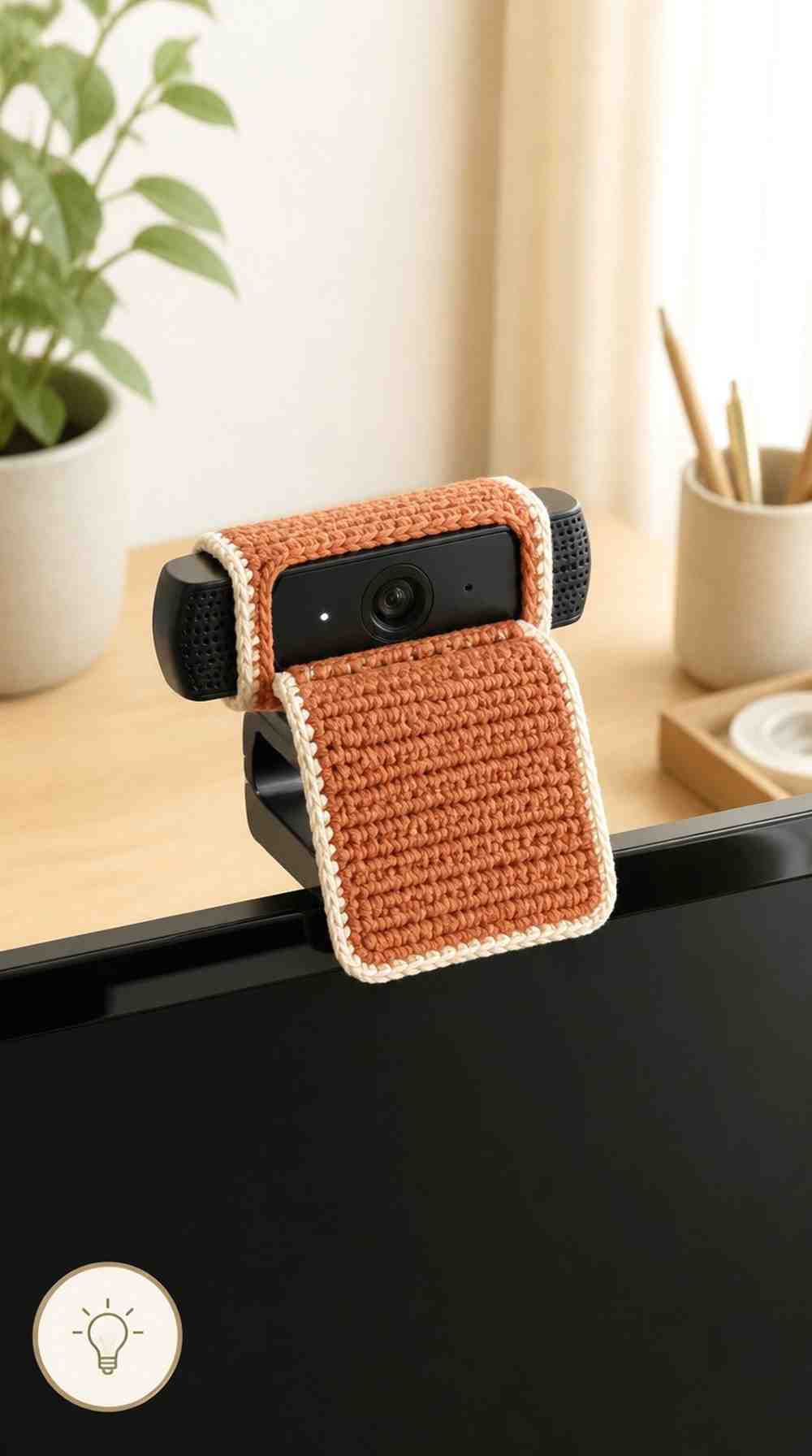
Warm terracotta crochet forms a miniature rectangular flap over the center of a black external webcam. Closely worked horizontal stitches create a neat surface, while a thin ivory border defines its squared corners. A short flexible hinge connects the flap to a removable fabric collar around the camera housing.
The design keeps its shape simple, making the flap itself the main feature. Its downward position illustrates how a small crochet panel might cover the camera lens when the webcam is not being used. The arrangement would require careful fitting to remain properly aligned.
- Rectangular Lens Coverage: The closed panel should extend beyond the lens opening without covering unrelated sensors, indicator lights, or microphone holes.
- Flexible Upper Hinge: A short stitched connection allows the flap to change position, although its ability to stay open or closed would need testing.
- Removable Housing Collar: The surrounding band should fit without squeezing the camera body or interfering with its mounting hardware.
2. Crochet Oatmeal Flip-Up Camera Cover
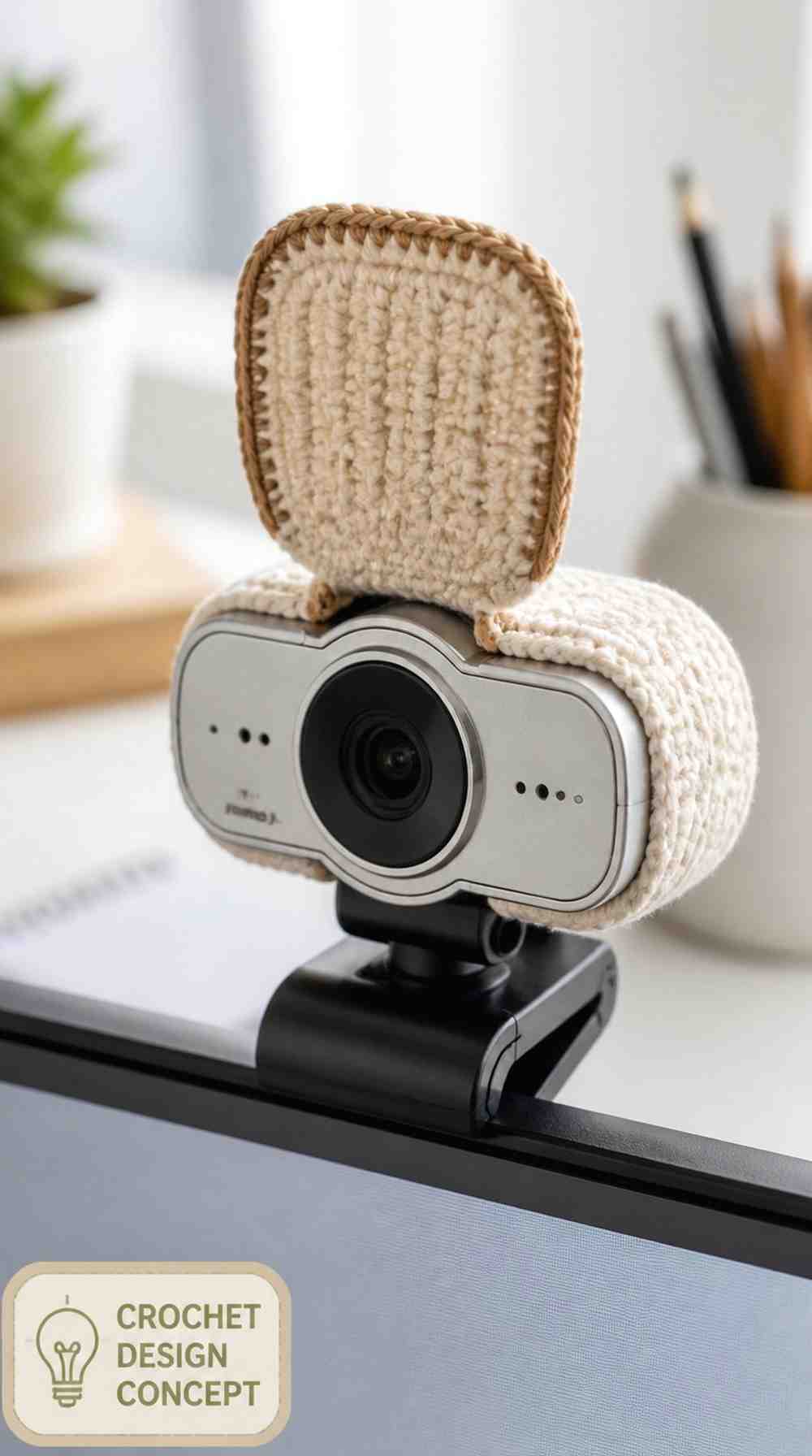
A small oatmeal-beige crochet flap sits raised above the exposed lens of a silver external webcam. Fine vertical ribbing gives the rounded rectangular panel texture, while a cinnamon-colored border adds a warm finishing detail.
Unlike the closed terracotta design, this concept shows the flap in its open position. The narrow crochet collar remains around the upper camera housing, with the lens unobstructed. It is particularly useful for exploring how a cover could look when the webcam is actively needed for video meetings.
- Raised Flap Position: The lifted fabric needs to remain clear of the camera’s field of view rather than falling back over the lens.
- Vertical Ribbing: Narrow crochet ribs create visual detail without requiring additional ornaments or thicker layered panels.
- Upper Housing Clearance: The collar should leave the original webcam controls and mounting mechanism accessible.
3. Crochet Indigo Side-Swing Privacy Flap
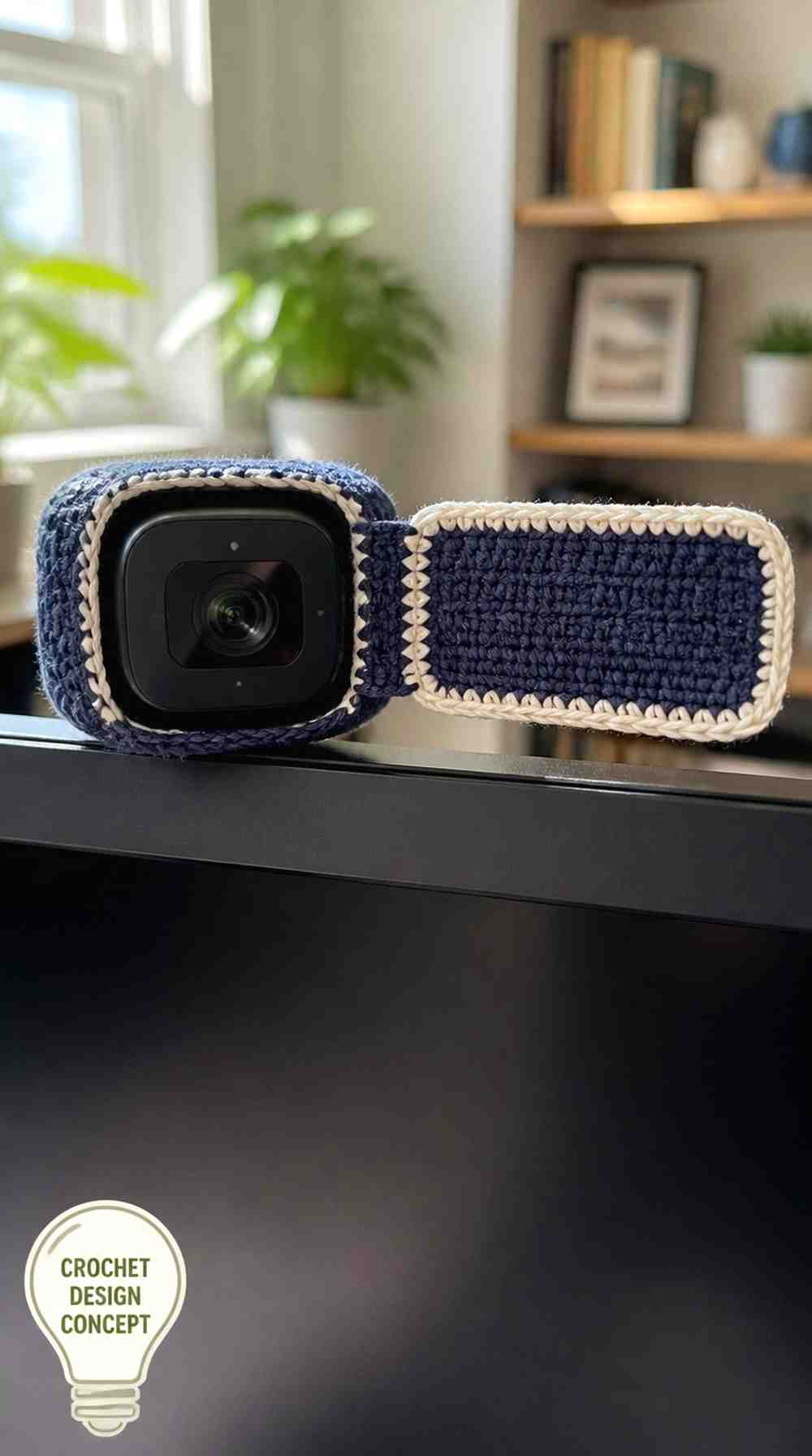
Deep indigo crochet gives this miniature privacy flap a clean, modern appearance. The slim rectangular panel opens sideways, with fine linen-stitch rows, an ivory border, and a short vertical joining strip along its left edge.
The photographed flap rests beside the webcam lens rather than above it. This makes the design different from conventional flip-down covers. Its sideways movement is an interesting concept for an external camera with enough clear space around the lens, although the flexible crochet hinge would need to hold its position reliably.
- Side-Swing Movement: Check whether the camera housing offers sufficient room for the panel to move sideways without covering other features.
- Linen-Stitch Texture: Closely connected stitches give the narrow flap a relatively smooth appearance, but stretch must be considered.
- Open-Position Stability: A soft fabric hinge may allow the flap to swing back. Any real construction would need reliable positioning.
4. Crochet Mustard Half-Moon Webcam Flap
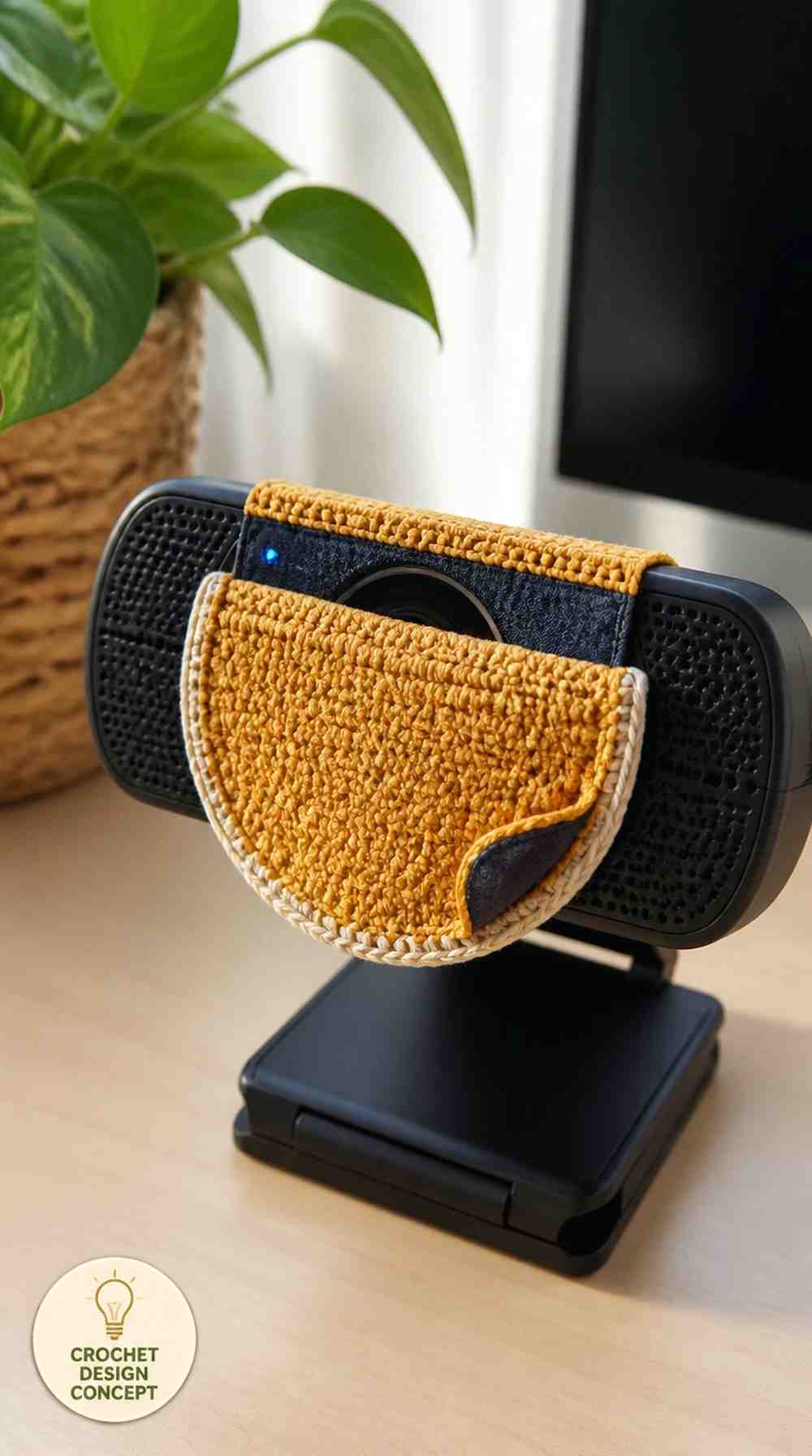
Muted-mustard crochet creates a small half-moon privacy flap with a smooth rounded top and straight lower edge. Closely connected stitches form the main panel, while a narrow cream border follows its outline. A small lifted corner reveals an opaque charcoal fabric lining.
The curved shape makes this design more decorative than a plain rectangle. Its dark inner layer is an important visual detail because ordinary crochet stitches may contain gaps. The concept explores a rounded cover that could conceal a circular webcam lens without requiring a large fabric panel.
- Half-Moon Shape: The curved panel needs sufficient coverage around the entire lens, not simply across its center.
- Opaque Inner Lining: A suitable light-blocking layer would need independent testing. Crochet fabric alone should not be assumed to provide complete privacy.
- Curved Edge Finish: Keep the cream border smooth so it does not curl toward the lens or increase the flap’s thickness unnecessarily.
5. Crochet Espresso Checkerboard Camera Flap
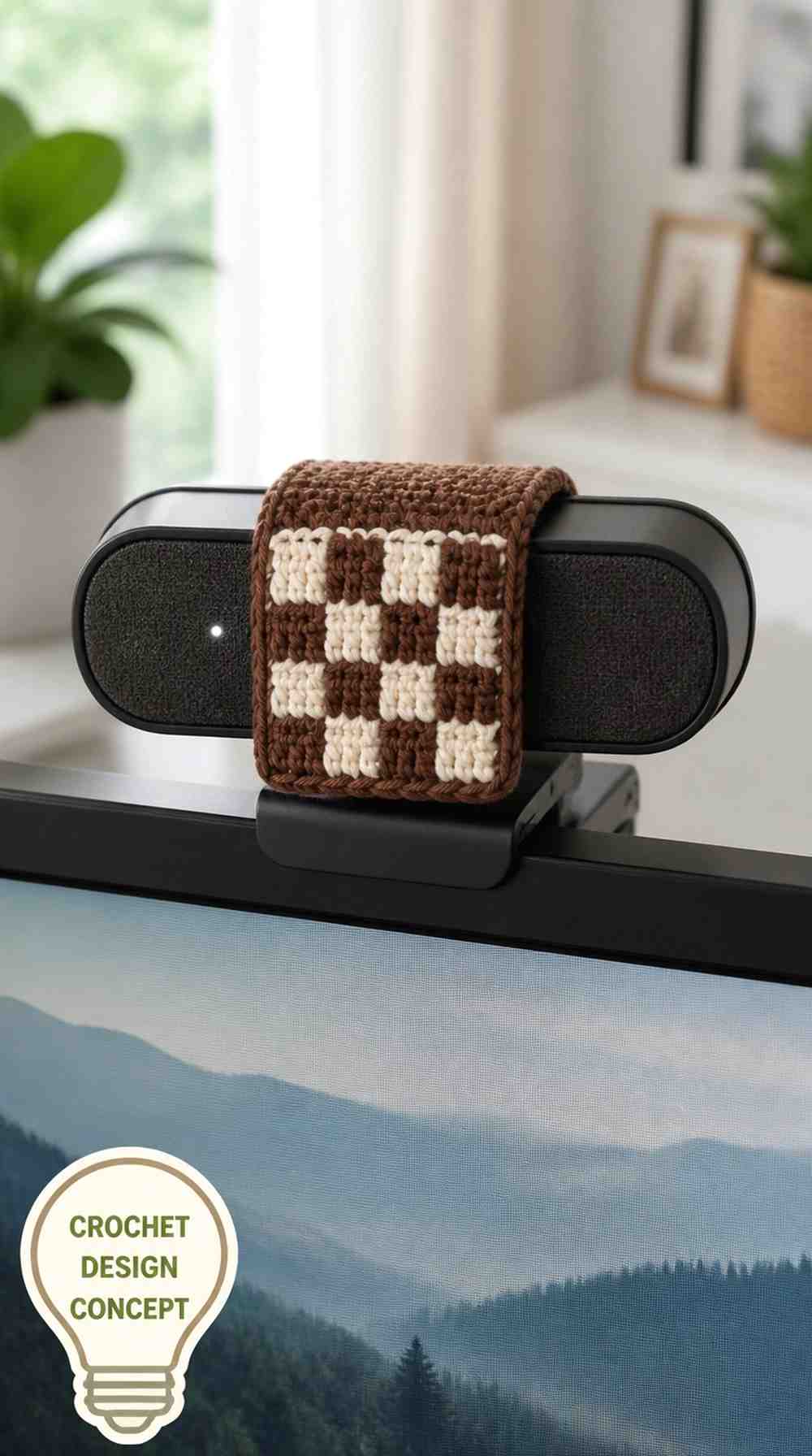
Miniature espresso-brown and vanilla-cream squares form this compact crochet webcam flap. Dark-mocha edging frames the small rectangular panel, while a soft upper hinge connects it to a removable camera-housing collar.
The checkerboard gives the accessory a recognizable handmade appearance without additional flowers, buttons, or raised decorations. Its close colorwork is particularly suited to a simple rectangular surface. However, a decorative stitch pattern does not automatically guarantee that the covered lens receives no light.
- Small Checkerboard Pattern: Use tightly connected colorwork rather than separately joined squares, which would add seams and thickness.
- Mocha Outer Border: The dark edging defines the flap and helps keep the miniature pattern visually contained.
- Coverage Check: Color changes and stitch gaps may let light through, so the cover’s ability to obstruct the lens must be verified separately.
6. Crochet Burgundy Button-Tab Privacy Flap
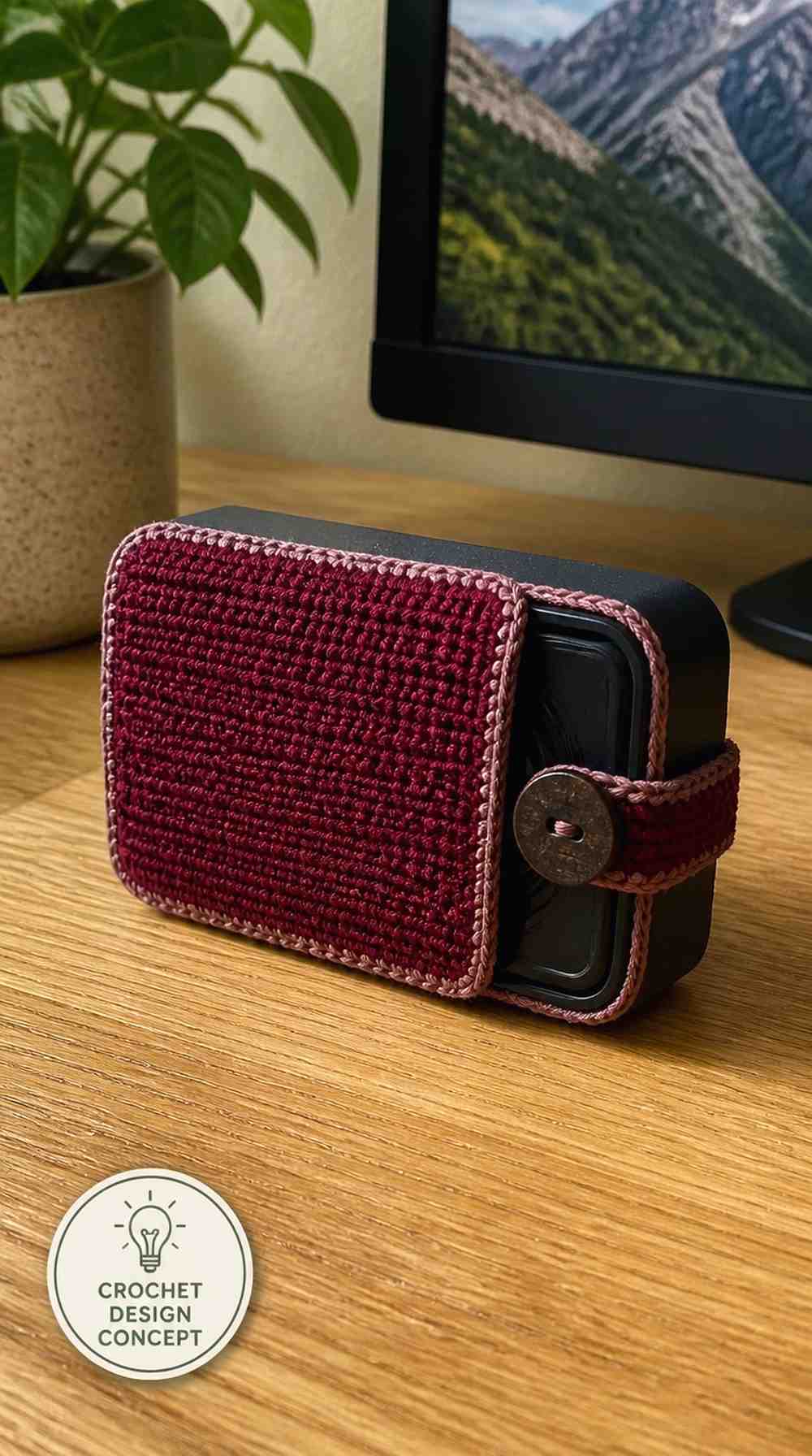
Deep-burgundy crochet forms a rectangular flap with dense horizontal stitches and a thin dusty-rose border. A short side tab holds a small dark wooden button, creating a decorative fastening detail outside the lens area.
The button makes this design stand apart from plain hinged covers. Its folded-down position suggests a flap that could be secured when closed, provided the fastening is properly aligned. Because the accessory sits near sensitive electronic components, the button must not press against the lens or interfere with camera operation.
- Side Button Position: Keep the wooden button outside the optical area and clear of all microphone, sensor, and indicator openings.
- Short Buttonhole Tab: The fastening should remain compact rather than forming a long loop that might catch on the monitor.
- Added Hardware Thickness: Even a small button can increase bulk, so this concept is best considered for a separate desktop webcam with adequate clearance.
7. Crochet Sage Twin-Leaf Privacy Flap
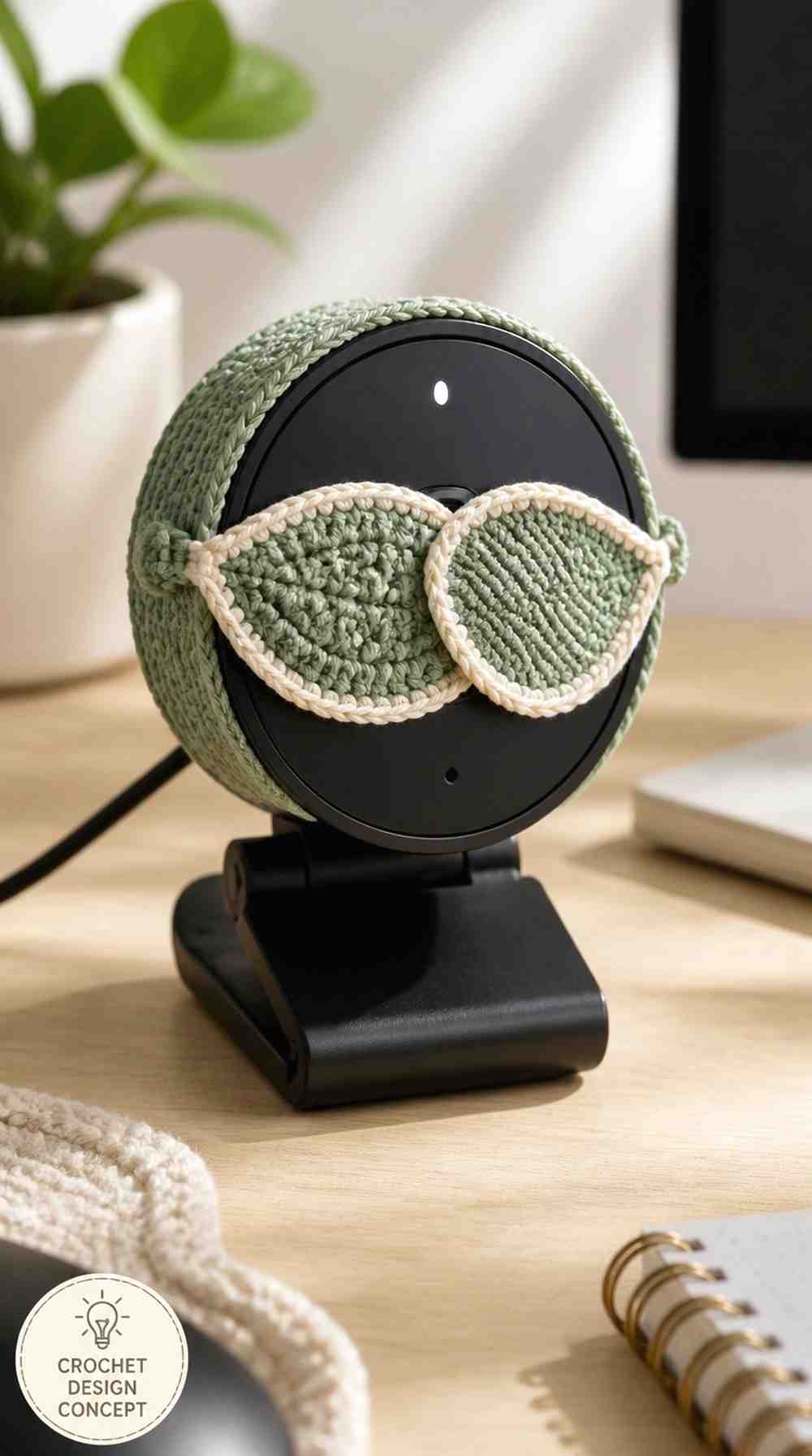
Two sage-green crochet leaves overlap at the center of this round webcam, forming a decorative cover over its lens. One leaf uses moss stitch, while the other has fine single-crochet rows. Thin ivory borders define their pointed outer shapes.
The paired leaves open from opposite sides rather than relying on one rectangular flap. Their overlapping arrangement creates a softer, nature-inspired appearance, with the lens hidden behind the central fabric. This concept is visually distinctive but would require careful construction to prevent small gaps where the two sides meet.
- Overlapping Leaf Panels: Both leaves need enough central overlap to conceal the lens when closed without relying on an open seam.
- Two Separate Hinges: The leaves move independently, so their positions must remain aligned rather than drifting away from the center.
- Different Stitch Textures: Moss stitch and single crochet may stretch differently, making consistent sizing important for a balanced pair.
8. Crochet Coral Scalloped Oval Webcam Flap
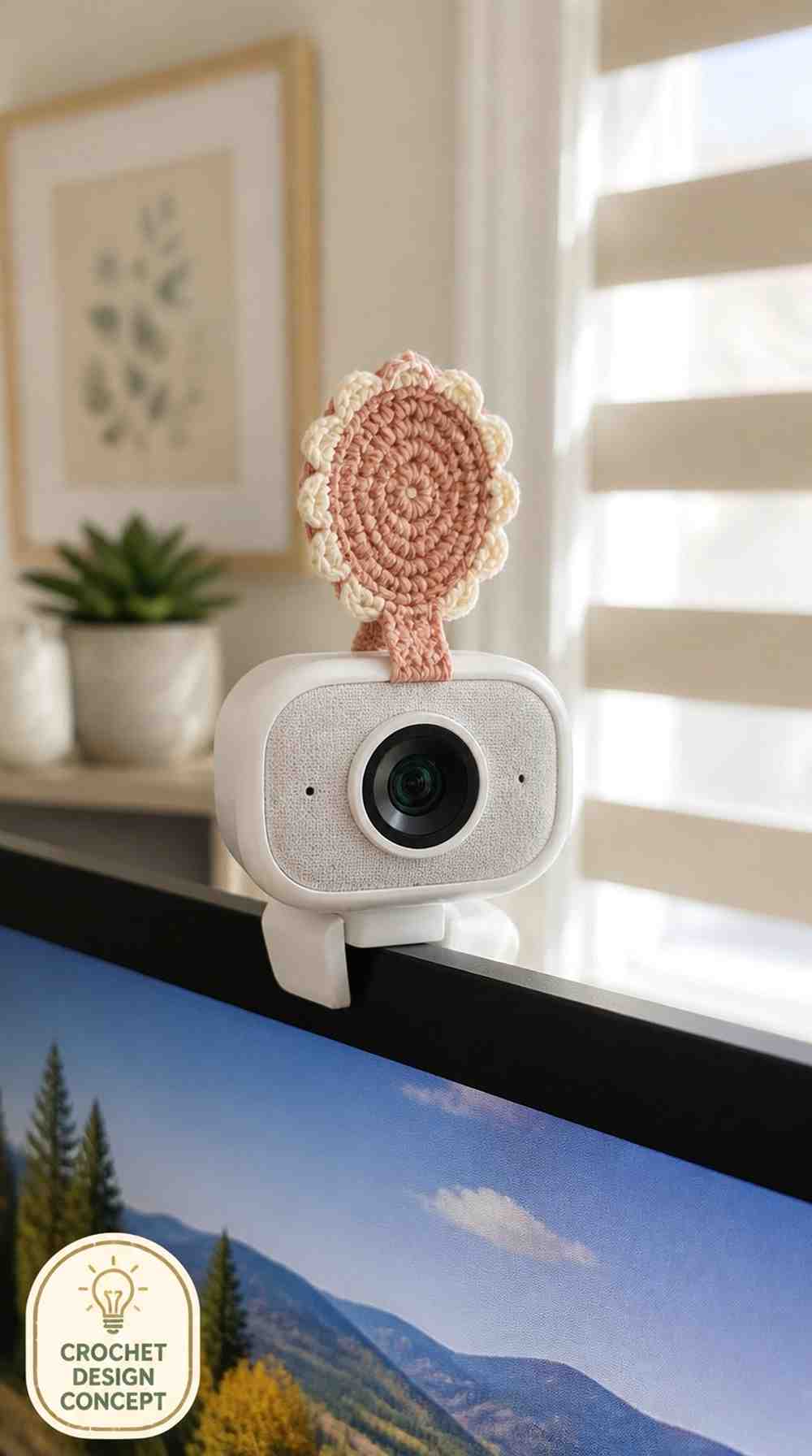
Dusty-coral crochet forms a miniature oval flap with a dense center and tiny ivory scallops around its outer edge. The small shell stitches create a delicate border without turning the accessory into a bulky lace decoration.
The flap is shown raised above a white external webcam, leaving the camera lens visible. Its oval shape provides a softer alternative to straight-edged covers. The little scallops are the main decorative feature, while the short flexible hinge allows the design to suggest a folding cover.
- Oval Panel Shape: The flap should be wide enough for the intended lens but not so large that it covers nearby camera hardware.
- Miniature Scallops: Keep the shell stitches small and flat so they do not catch on the webcam housing.
- Raised Position: A real flap needs to remain safely out of the camera’s view when opened, rather than hanging partly across the lens.
9. Crochet Charcoal Side-Slide Camera Flap
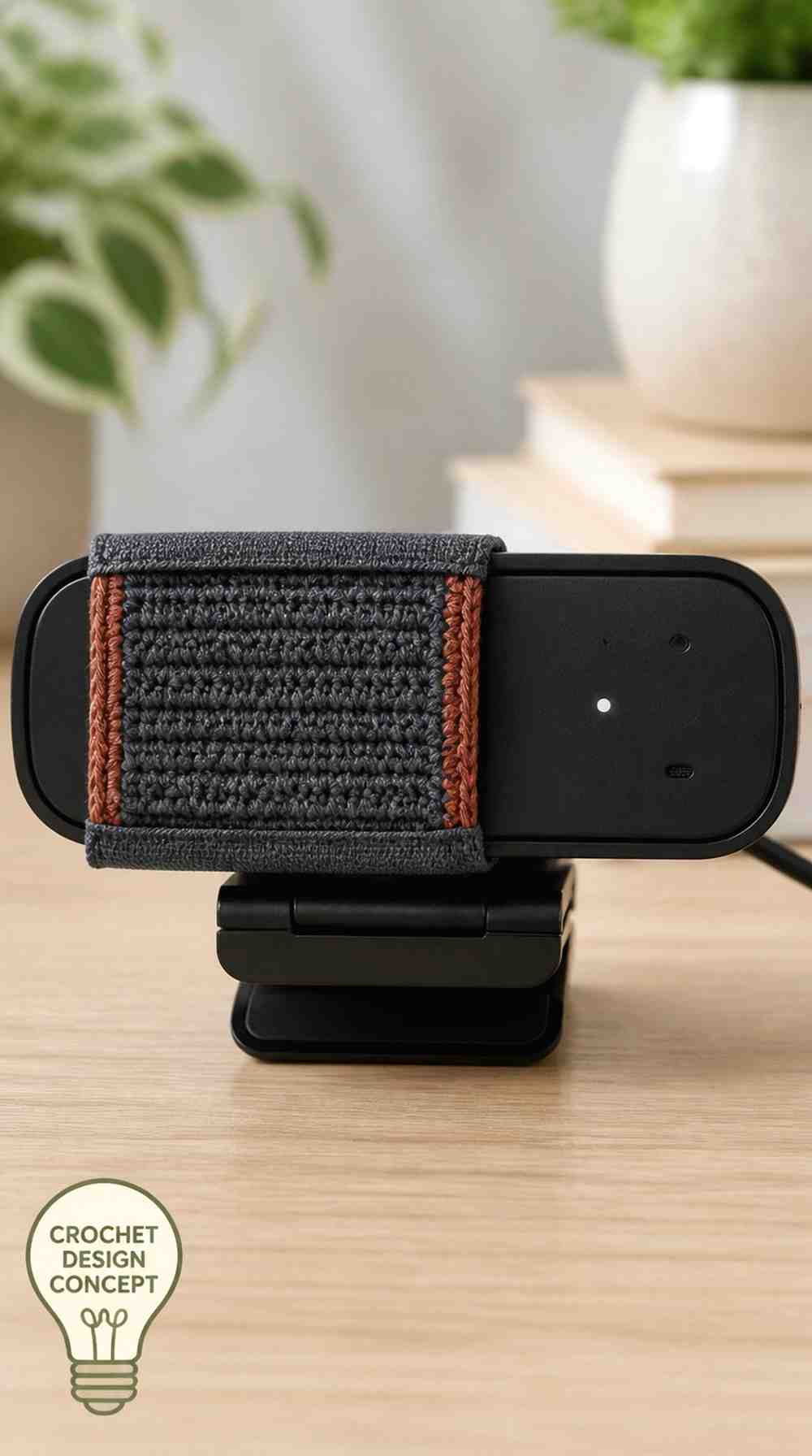
Charcoal-grey crochet creates a small rectangular panel positioned between narrow upper and lower fabric channels. Rust-colored edging adds contrast, while the panel is shown slid across the webcam lens.
This design explores a different kind of movement from the hinged flaps. Instead of folding upward or sideways, the crochet panel travels horizontally within its surrounding channels. The approach is visually neat, although soft crochet rails may stretch, snag, or become difficult to operate on a real webcam.
- Sliding Channel Fit: Both fabric channels must remain aligned. Loose rails could let the panel fall out, while tight ones could prevent movement.
- Flat Sliding Surface: Keep the crochet panel thin and smooth so raised stitches do not catch against the channels.
- Camera-Housing Compatibility: This arrangement needs sufficient space around the lens and should not rely on adhesive applied to the optical surface.
10. Crochet Pearl Spiral Lens Flap
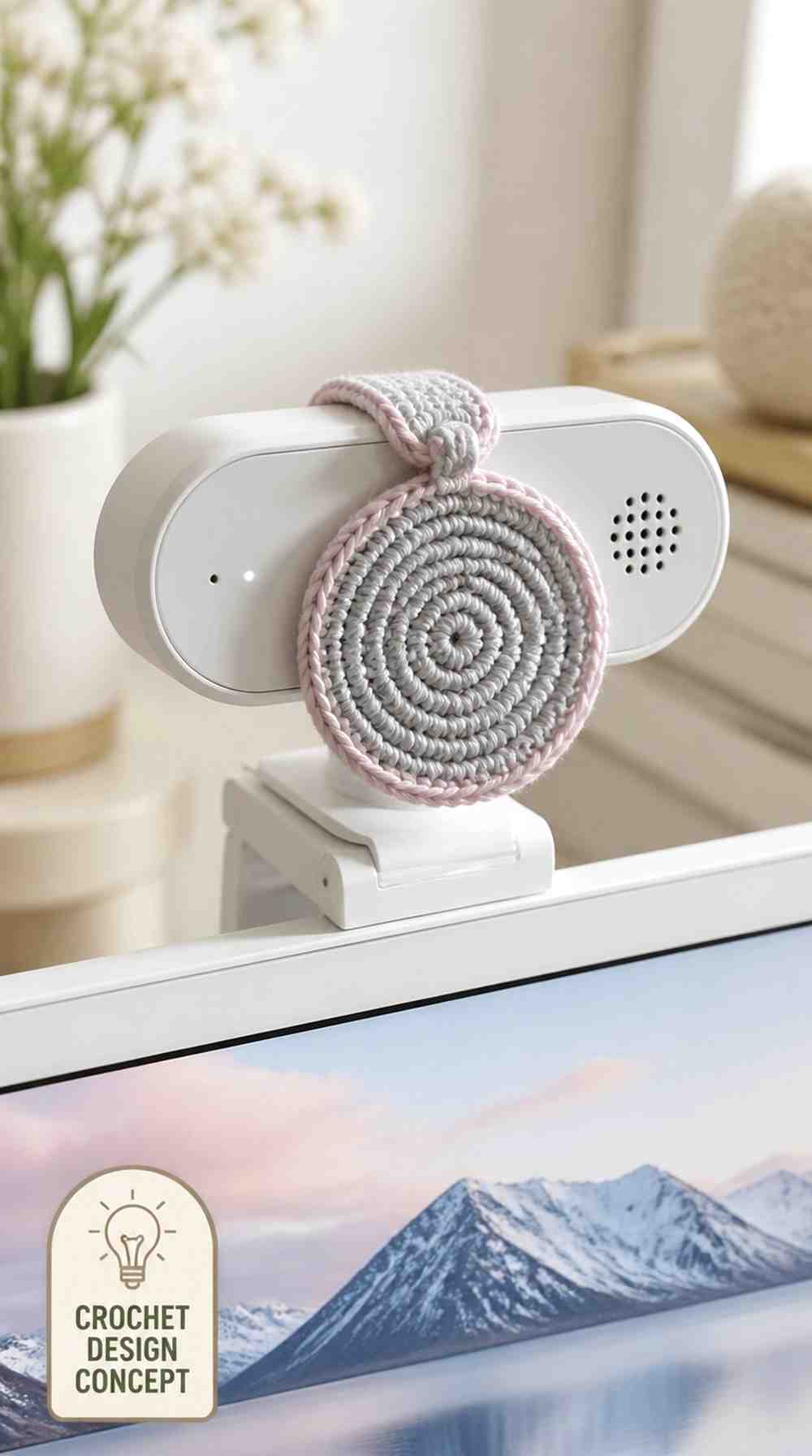
Pearl-grey crochet forms a small circular privacy disc with a spiral of closely connected stitches. A thin blush-pink border finishes the perimeter, while a short upper hinge joins the disc to a removable collar on a white external webcam.
The circular shape follows the appearance of a traditional camera lens more closely than a rectangular flap. Its softly defined spiral gives the cover a delicate handmade finish without adding separate motifs. The design is shown closed, with the lens behind its solid center.
- Circular Crochet Rounds: Even stitch increases help the disc remain flat rather than becoming pointed or uneven.
- Lens-Centered Placement: The round panel needs to cover the entire lens opening, not merely match the visible glass circle.
- Spiral Stitch Density: Closely worked crochet can reduce visible openings, but complete optical coverage still requires verification.
11. Crochet Dusty Blue Diagonal Fold Flap
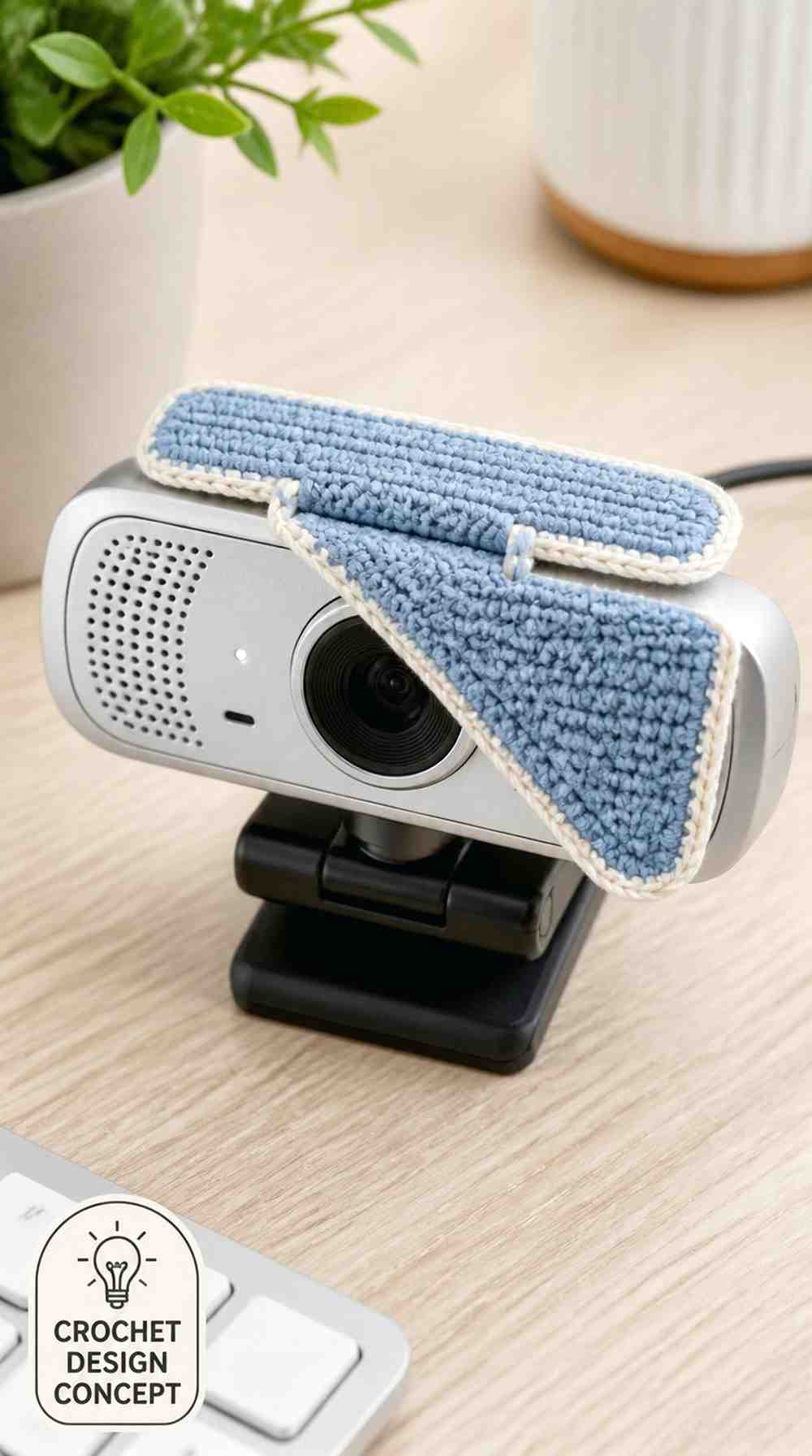
Dusty-blue crochet creates a small rectangular webcam cover with a distinctive overlapping triangular fold at one upper corner. A thin cream border frames the panel, while the diagonal seam adds visual interest to its otherwise simple surface.
The flap rests over a silver external webcam lens, attached by a short flexible upper hinge. Unlike the checkerboard or spiral designs, its decoration comes from the way the fabric is folded and joined. This makes it an interesting concept for exploring miniature layered crochet construction.
- Diagonal Fold: Keep the overlapping corner shallow so the extra fabric does not create unnecessary bulk.
- Cream Perimeter: The narrow contrasting border helps define the rectangular outline without introducing extra decorations.
- Layered Panel Fit: A folded corner may change how flat the cover sits, making careful alignment important for a real lens-cover design.
12. Crochet Forest Mesh-Border Privacy Flap
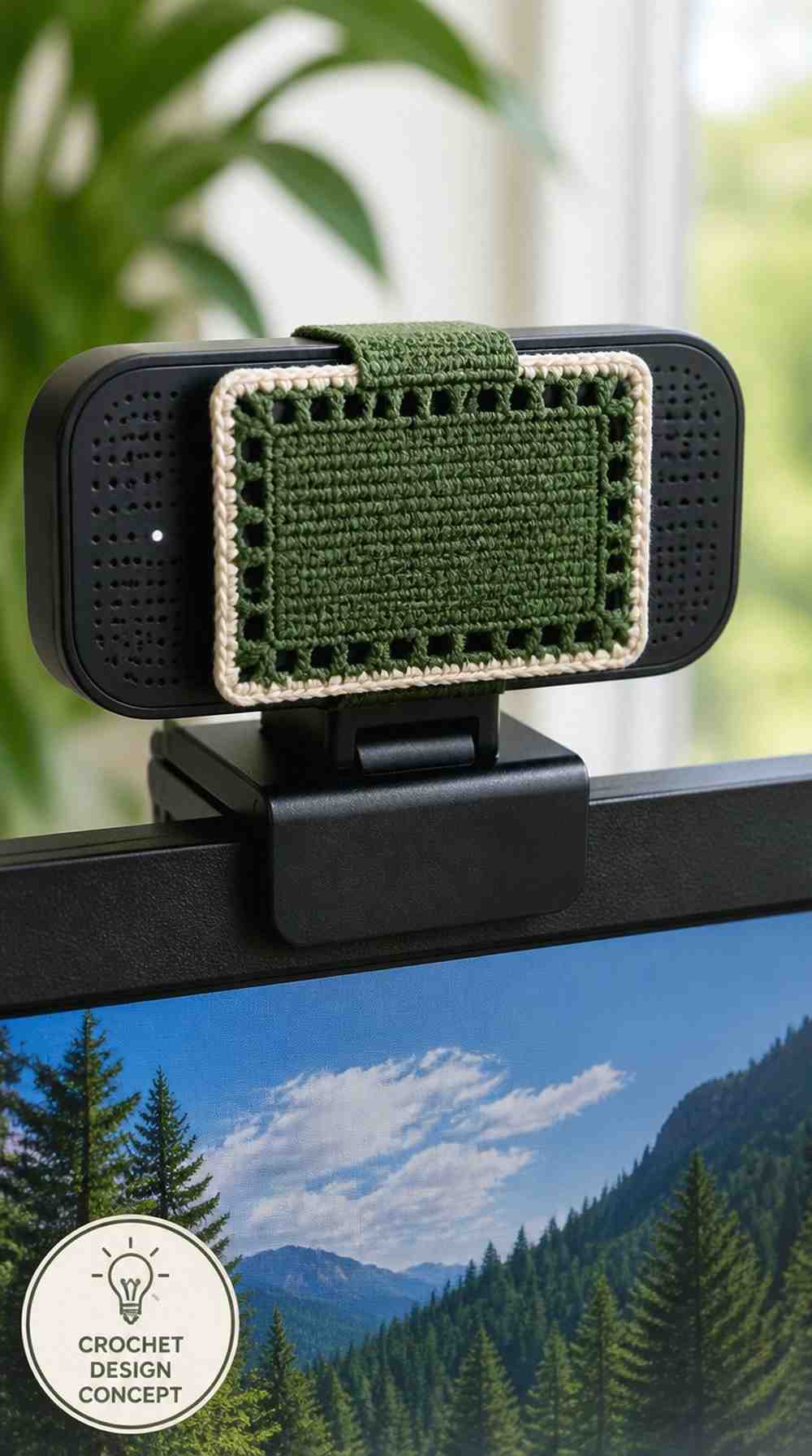
Forest-green crochet forms a compact rectangular flap with a solid central panel and a narrow decorative mesh border. Small, orderly openings surround the outer area, while a cream edge finishes the shape.
The dense center is the defining functional-looking feature because the decorative mesh remains outside the intended lens-covering area. This arrangement allows an openwork crochet detail without placing large holes directly over the camera lens. The cover is shown folded down over a matte-black external webcam.
- Solid Center Panel: The area covering the lens should not contain decorative openings, although the actual light-blocking ability still needs checking.
- Mesh Perimeter: Keep the small openings connected and away from the lens’s viewing area.
- Outer Cream Border: A thin finish can frame the mesh without making the flap excessively wide or difficult to move.
13. Crochet Cobalt Yellow-Tab Webcam Flap
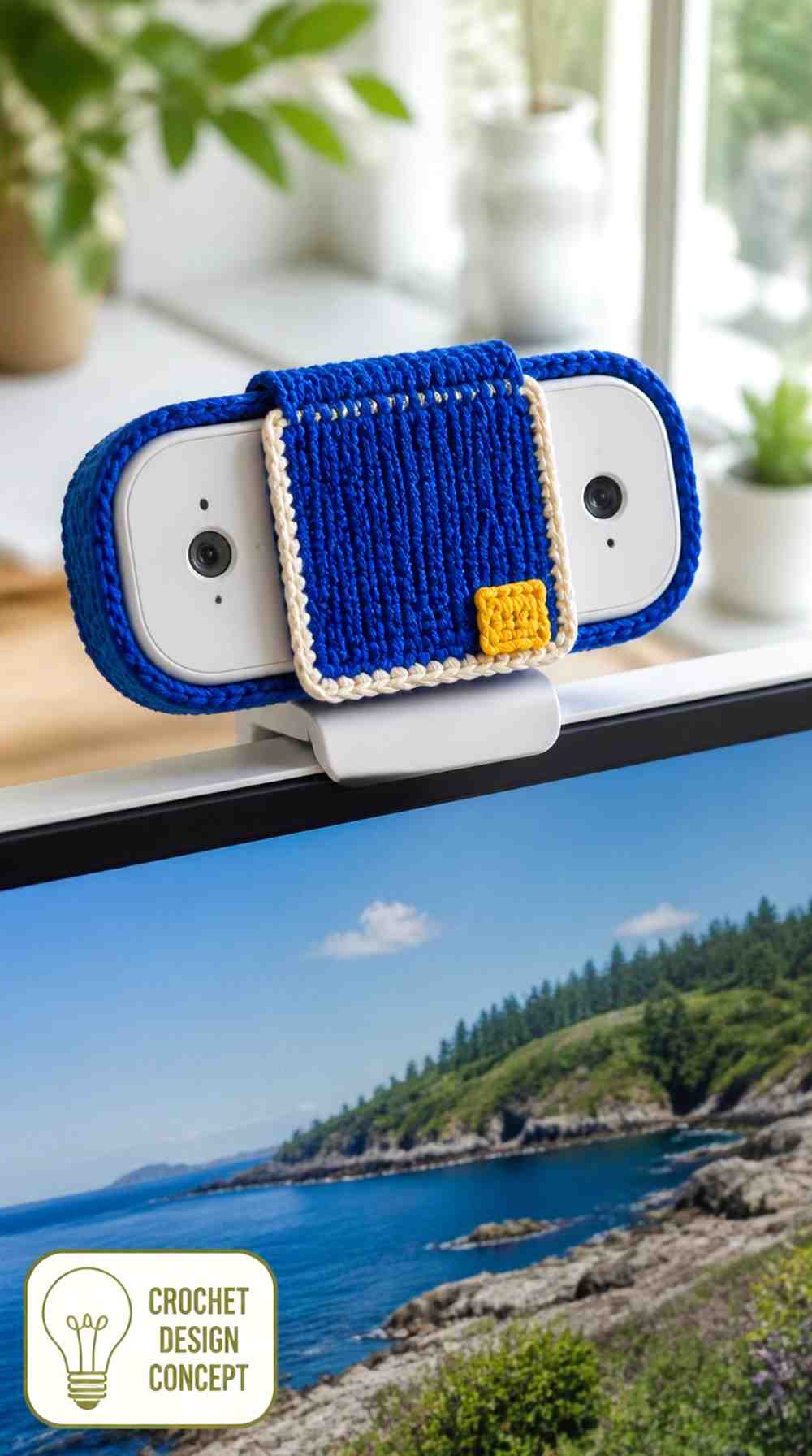
Bright cobalt-blue crochet forms a slim rectangular cover with fine vertical ribbing and a narrow cream border. A tiny canary-yellow tab sits at the lower right corner, adding one strong contrasting detail.
The flap is shown covering the lens of a white external webcam. Its small tab suggests a place to grasp the panel when lifting it, while the flexible upper hinge provides the folding arrangement. Compared with buttoned or layered concepts, this design keeps the main fabric relatively simple.
- Small Pull Tab: The yellow extension should lie flat and remain securely attached rather than forming a loose dangling loop.
- Vertical Ribbing: Fine ribs create visual interest across the narrow panel without needing additional layers.
- Gentle Operation: The tab should not be used to pull against the webcam’s mounting collar or disturb the camera’s position.
14. Crochet Mocha Gradient Webcam Flap
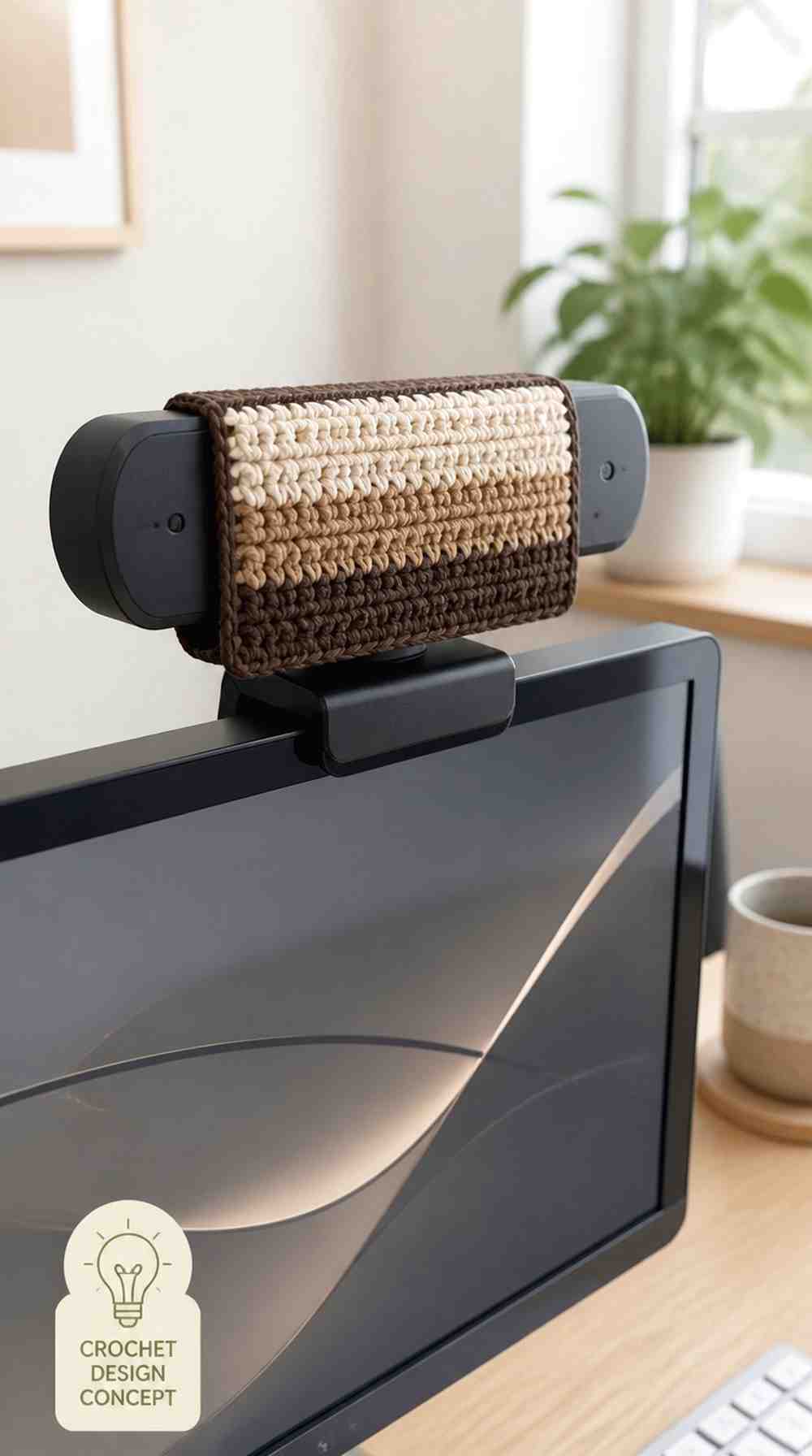
Warm cream, caramel, and deep mocha form three horizontal color sections across this rectangular privacy flap. Closely worked single-crochet stitches connect the colors, while narrow mocha edging finishes the sides.
The flap covers the center lens of a dark-grey external webcam, with a soft upper hinge joining it to a removable housing collar. Its design relies on color rather than raised decorations, making the small panel feel simple and coordinated. The three shades also create a warm contrast against the dark electronic housing.
- Three Color Sections: Keep each band proportionate to the miniature flap so the cream, caramel, and mocha remain clearly visible.
- Close Single-Crochet Rows: Even stitches help maintain the rectangular shape, although a separate opaque layer may still be necessary for reliable lens blocking.
- Smooth Outer Edges: A compact finish keeps the colored panel neat without interfering with the surrounding webcam controls.
Practical Guide to Crochet Webcam Privacy Flaps
Choose the device before planning the flap. External webcams differ in lens size, housing shape, microphone placement, indicator lights, and mounting hardware. Measure the actual camera and identify every opening before considering a removable crochet cover.
Be especially careful with laptop webcams. Apple warns that closing a MacBook with a camera cover attached can damage the display because the clearance between the screen and keyboard is extremely small. A cover can also interfere with sensors.
Apple Support
Keep the crochet away from sensitive components. Avoid adhesive on the lens, pressure against the screen, or fabric covering microphones, indicator lights, infrared sensors, ventilation openings, and camera controls. A detachable external webcam housing is a more realistic place to explore these designs than a tightly closing laptop lid.
Use an opaque covering for actual privacy. Crochet stitches can leave tiny gaps, and a decorative flap may shift out of place. If experimenting with a physical lens cover, test whether the camera can still capture an image while the flap is closed. Never assume that a beautiful crochet panel provides complete privacy.
Use built-in privacy controls too. Windows offers settings for controlling camera access through Settings, Privacy & security, Camera. Many devices also have built-in physical shutters or dedicated camera controls.
Microsoft Support+1
For related handmade technology-accessory inspiration, see 17 Crochet TV Remote Protective Jacket Inspiration Ideas on Yarn Nest Studio. That collection explores removable covers, fold-open sections, and keeping device controls accessible.
Want to Make Something Similar?
These 14 designs are original visual concepts, not tested webcam privacy accessories. The following resources explain related crochet flap construction and closure techniques.
- Single Crochet Phone Pocket with Flap Closure — My Crochet Studio provides a free beginner-friendly pattern involving a flat crochet pocket, foldover flap, and button closure. Its finished size and construction are intended for a phone, not a webcam. My Crochet Studio
- Simple Pouch with Flap — Crochet for Beginners demonstrates general crochet flap and button-closure construction. These techniques could inspire a miniature fabric design, but the finished pouch is not a camera privacy cover.
Neither resource establishes optical privacy, webcam compatibility, or laptop-lid safety. The designs shown in this collection would need separate development and careful testing.
Comparison: Which Crochet Webcam Privacy Flap Should You Choose?
| Design | Main feature | Important consideration |
|---|---|---|
| Terracotta Flip-Down | Simple rectangular hinged cover | Must stay aligned with lens |
| Oatmeal Flip-Up | Raised ribbed flap | Needs stable open position |
| Indigo Side-Swing | Horizontal opening | Requires side clearance |
| Mustard Half-Moon | Curved panel with dark lining | Needs full optical coverage |
| Espresso Checkerboard | Miniature tapestry colorwork | Stitch gaps may admit light |
| Burgundy Button-Tab | Decorative side fastening | Added hardware bulk |
| Sage Twin-Leaf | Two overlapping leaf flaps | Center overlap must remain closed |
| Coral Scalloped Oval | Decorative oval shell border | Scallops may catch |
| Charcoal Side-Slide | Moving panel in fabric channels | Soft tracks may snag |
| Pearl Spiral | Circular crochet disc | Needs accurate lens alignment |
| Dusty Blue Diagonal Fold | Layered corner detail | Extra thickness |
| Forest Mesh-Border | Dense center with openwork edge | Mesh must stay outside lens area |
| Cobalt Yellow-Tab | Compact cover with opening tab | Tab should not pull on camera |
| Mocha Gradient | Three coordinated colors | Requires even stitch tension |
For a simple visual concept, the Crochet Terracotta Flip-Down Webcam Flap and Crochet Mocha Gradient Webcam Flap use straightforward rectangular panels.
If you prefer different opening directions, compare the Crochet Oatmeal Flip-Up Camera Cover, Crochet Indigo Side-Swing Privacy Flap, and Crochet Charcoal Side-Slide Camera Flap. Each introduces a different movement, although none has been tested for reliable operation.
For softer decorative styling, the Crochet Sage Twin-Leaf Privacy Flap, Crochet Coral Scalloped Oval Webcam Flap, and Crochet Pearl Spiral Lens Flap offer distinctive shapes.
If minimizing potential gaps is the main concern, the Crochet Mustard Half-Moon Webcam Flap is interesting because it includes a visible opaque fabric lining. However, even this design would need testing on the actual camera before being trusted for privacy.
Conclusion
Crochet webcam privacy flaps offer an unusual way to explore small handmade accessories for a home office. From simple rectangular panels and colorful checkerboards to decorative leaves, tiny scallops, and circular spiral covers, these 14 concepts show how much variety can fit into a miniature crochet project.
The most important consideration is the device itself. A privacy cover must not damage the webcam, interfere with nearby components, or prevent a laptop from closing safely. For everyday privacy, built-in camera shutters and operating-system controls are generally more dependable starting points than an untested handmade cover.
Which design would you choose for your workspace? Would you prefer the terracotta flip-down flap, indigo side-swing cover, sage twin-leaf design, or mocha gradient panel? Share your favorite and whether you use a separate desktop webcam or a built-in laptop camera.
Frequently Asked Questions
1. Can a crochet flap completely block a webcam?
Not necessarily. Crochet may contain small openings that allow light through, and a soft flap can shift away from the lens. A design intended for actual privacy would need reliable opaque coverage and testing with the camera. Built-in hardware shutters and supported privacy controls are preferable when available.
2. Is a crochet webcam flap safe for a laptop?
Do not assume so. Many laptops have very little clearance between the display and keyboard when closed. An added crochet flap, seam, button, or attachment may create pressure and damage the screen. Follow your laptop manufacturer’s instructions, and never close a device over an accessory that could interfere with its design.
3. What yarn would be suitable for a miniature webcam flap?
A smooth, fine cotton yarn or another suitable low-shedding fiber may be worth considering for decorative crochet. However, yarn choice does not guarantee privacy or compatibility. Avoid bulky stitches, loose fibers, metal decorations, and any design that could rub against sensitive camera surfaces.
4. Should a webcam flap cover the camera indicator light?
No. A homemade cover should not deliberately obscure the webcam’s indicator light, microphone, sensors, or other controls. The indicator can provide useful information about camera activity. A suitable privacy arrangement should block the intended camera view without hiding other important device functions.
5. Are these 14 crochet webcam privacy flap ideas available as patterns?
No. These are original crochet inspiration concepts rather than finished, tested webcam covers or complete patterns. The linked tutorials explain related flap-making methods, but they are not exact patterns for the pictured accessories. Any real version would require sizing, fitting, light-blocking tests, and device-compatibility checks before use.