Cold air around a window can make an otherwise comfortable room feel less inviting, especially during winter mornings and evenings. Crochet window sill draft seal covers offer an interesting way to bring handmade texture and color to this part of the home. From cinnamon ribbed bolsters and oatmeal rectangular sleeves to decorative lattice panels, scalloped trims, and soft mocha color combinations, these 15 inspiration ideas explore different window-side styles.
The collection focuses on removable crochet covers fitted around separate draft-stopper inserts, rather than treating crochet fabric as a proven air seal. Some designs have slim rectangular shapes, while others feature rounded tubes, double rolls, textured ridges, or decorative panels. As you compare them, consider the available sill space, the window’s opening mechanism, moisture exposure, cleaning, and how each cover complements the surrounding room.
These are AI-generated crochet design visualizations for inspiration, not photographs of tested handmade pieces or step-by-step patterns.
Quick Design Selection Guide
| What you're looking for | Design to explore |
|---|---|
| A classic rounded draft-stopper cover | Crochet Cinnamon Ribbed Sill Bolster Cover |
| A narrow, flat window-sill accessory | Crochet Oatmeal Box-Edge Draft Cover |
| Two coordinated slim rolls | Crochet Indigo Twin-Roll Window Sill Cover |
| Decorative openwork | Crochet Mustard Lattice Window Sleeve |
| A removable-looking decorative flap | Crochet Burgundy Button-Flap Sill Cover |
| A cover with shaped ends | Crochet Slate Tapered-End Sill Cover |
| A low half-round profile | Crochet Plum Half-Moon Draft Cover |
| Warm neutral color blocking | Crochet Mocha Ombre Sill Cover |
1. Crochet Cinnamon Ribbed Sill Bolster Cover
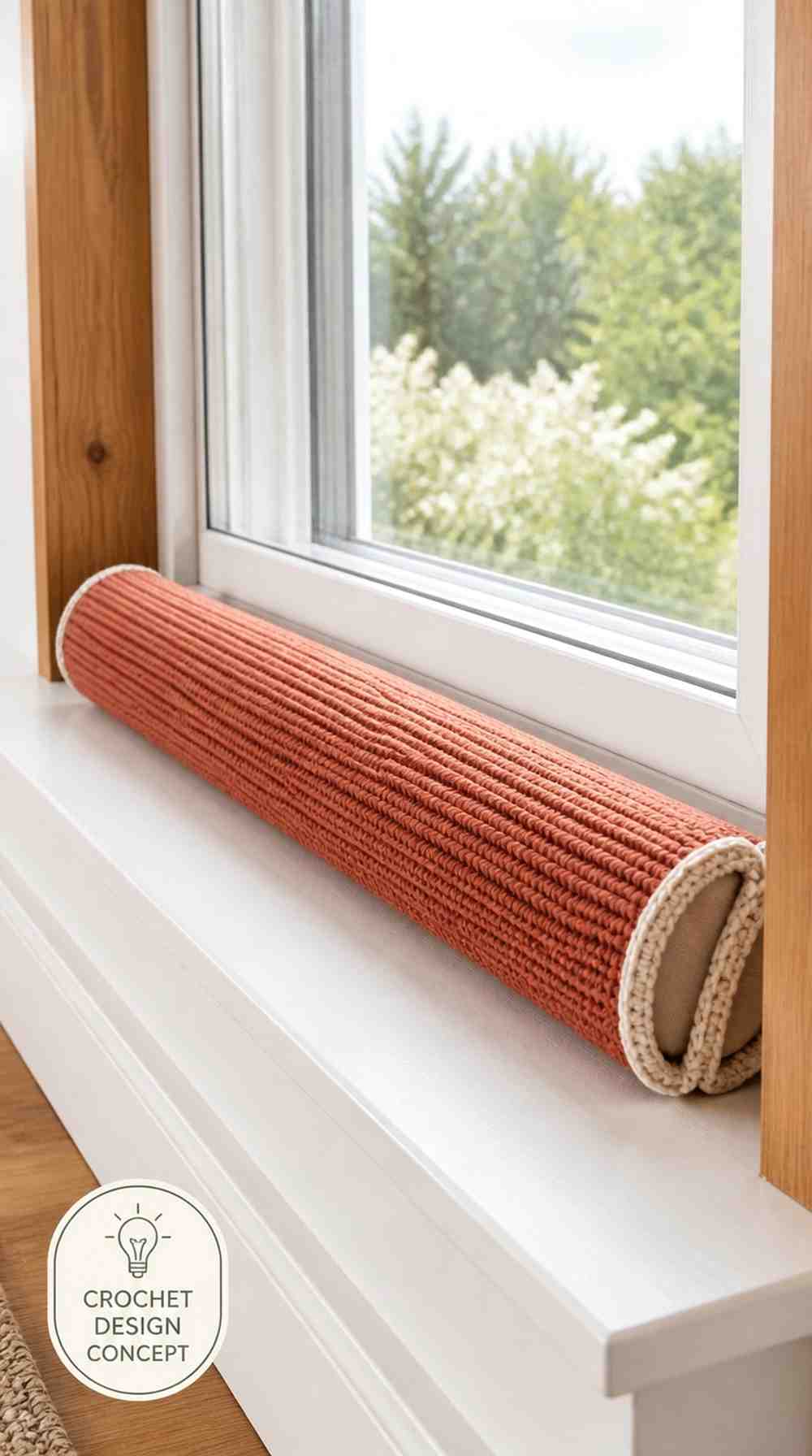
Warm cinnamon-terracotta crochet gives this long cylindrical window-sill cover a comfortable cottage appearance. Fine lengthwise ribs run along its rounded surface, while narrow ivory bands finish both ends. A small overlapping opening at the right end suggests access to the separate fabric insert inside.
The slim bolster rests along the interior window sill rather than being attached to the window frame. Its relatively simple structure makes the ribbing the main feature. The design is particularly appealing for someone who likes warm colors and understated crochet texture.
- Lengthwise Ribbing: Fine raised rows create a neat surface without needing separate motifs. Check how the stitch pattern stretches around the intended insert.
- Removable End Opening: The overlapping right end suggests a way to remove the inner fabric stopper for separate cleaning, although the closure would need careful construction.
- Rounded Profile: A cylindrical shape needs sufficient sill depth to rest securely without rolling toward the floor or interfering with the window.
2. Crochet Oatmeal Box-Edge Draft Cover
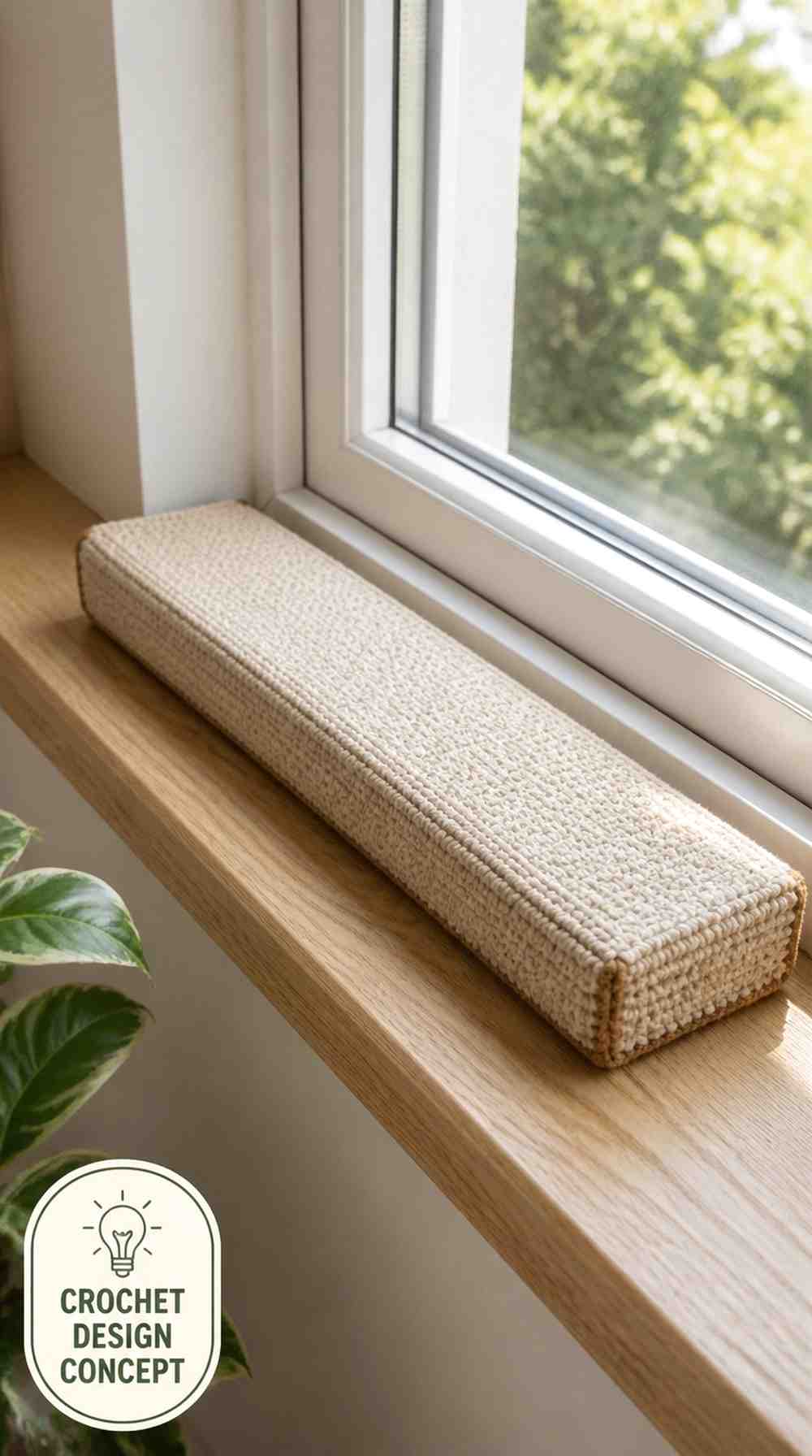
Oatmeal crochet creates a low rectangular cover with straight edges, neat squared ends, and fine linen-stitch texture across the broad upper surface. A narrow caramel border defines the sides, while the underside has a flat joining seam.
Unlike the rounded cinnamon bolster, this concept uses a box-like silhouette that sits close to the sill. Its simple proportions give the crochet a more tailored appearance. The smooth upper face is especially interesting for narrow interior sills where a thick cylindrical accessory could occupy too much room.
- Low Rectangular Shape: A flat-bottomed cover may sit more neatly on a narrow sill than a round tube, provided it fits the underlying insert.
- Linen-Stitch Surface: Closely worked stitches create an even-looking texture, but stitch density alone does not make the fabric airtight.
- Caramel Side Border: Thin contrasting edging emphasizes the rectangular outline without adding unnecessary bulk along the lower window frame.
3. Crochet Indigo Twin-Roll Window Sill Cover
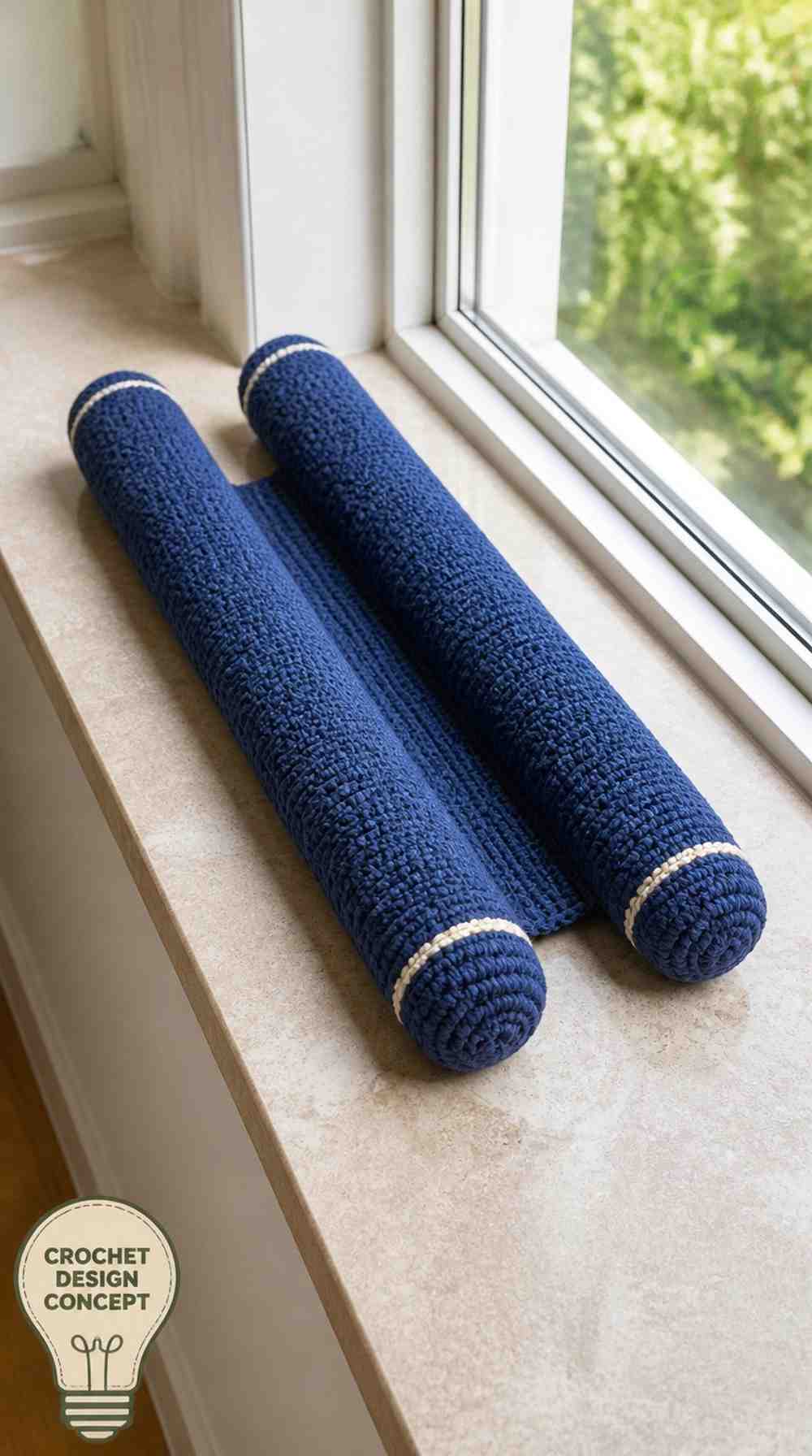
Two slender indigo crochet tubes sit side by side on a wide window sill, connected by a narrow flat crochet bridge. Each roll has closely worked horizontal stitches, neat rounded ends, and thin cream bands.
This paired design gives the sill a layered appearance rather than using one large bolster. The matching tubes create visual symmetry, while the connecting bridge keeps them looking like one coordinated accessory. Because the arrangement occupies more depth than a single sleeve, it is best explored where the interior sill has generous space.
- Double-Roll Arrangement: The two tubes need separate, properly sized inserts. Do not assume that two rolls will block more air than one suitable draft stopper.
- Connecting Bridge: A flat crochet strip visually joins the rolls, but should not force them into an awkward position or create thick folds.
- Wide Sill Requirement: Check available depth carefully and keep both tubes away from window tracks, drainage outlets, and operating hardware.
4. Crochet Mustard Lattice Window Sleeve
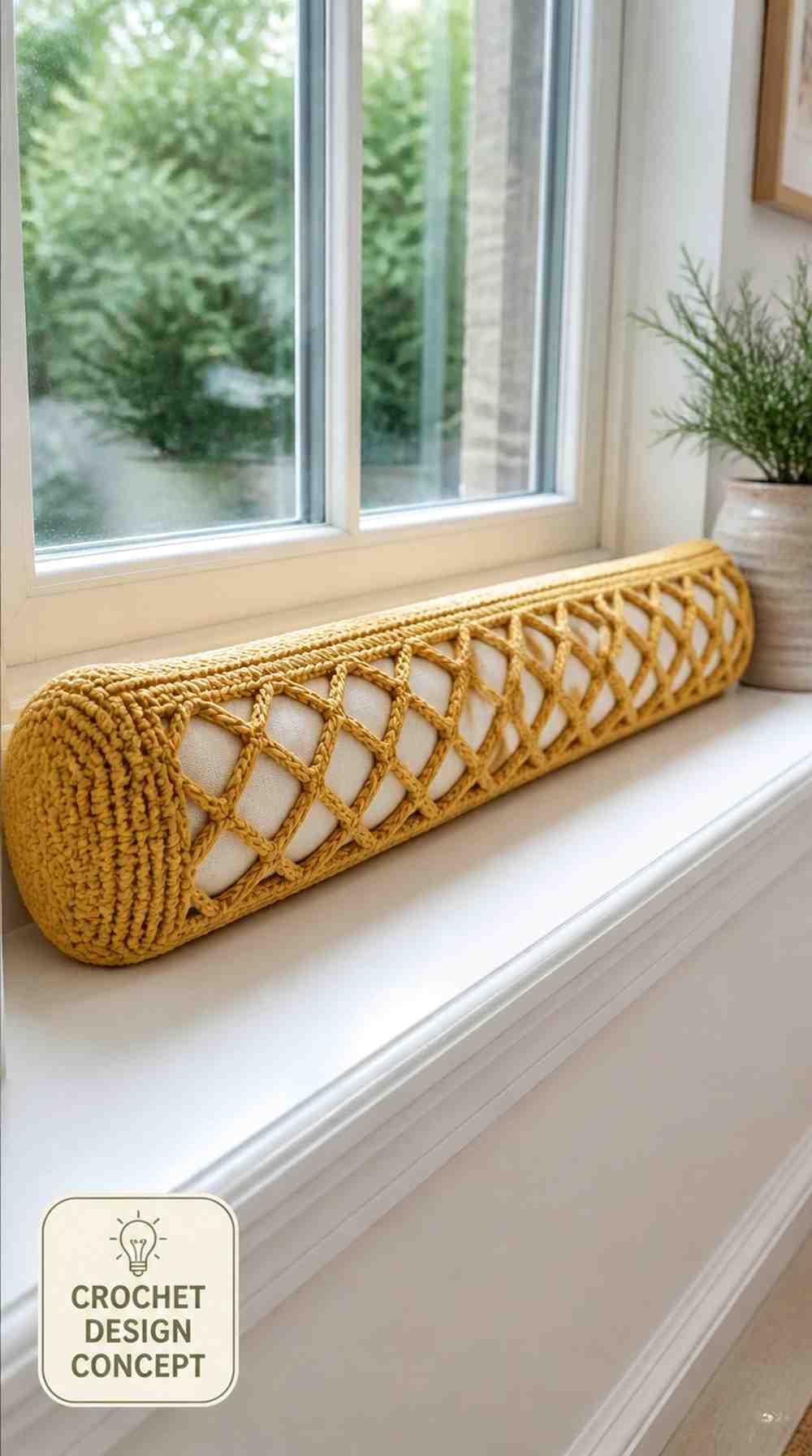
Muted-mustard crochet surrounds an opaque cream fabric insert in this openwork design. An orderly diamond-lattice panel stretches across the room-facing front, framed by dense mustard bands and solid rounded ends.
The cream fabric remains visible through the connected crochet openings, creating contrast between open mesh and a smooth underlying surface. This concept uses crochet mainly as a decorative outer layer. Its lattice provides visual lightness, but the mesh itself is not a reliable air barrier.
- Diamond-Lattice Detail: Keep the openings evenly connected so the front panel maintains its intended shape without excessive stretching.
- Opaque Inner Insert: The separate cream fabric surface provides the background visible through the mesh. Its actual draft-blocking suitability would need independent verification.
- Solid End Sections: Dense crochet at both ends gives the openwork a defined finish and may make the sleeve easier to shape around its insert.
5. Crochet Cocoa Checkerboard Sill Cover
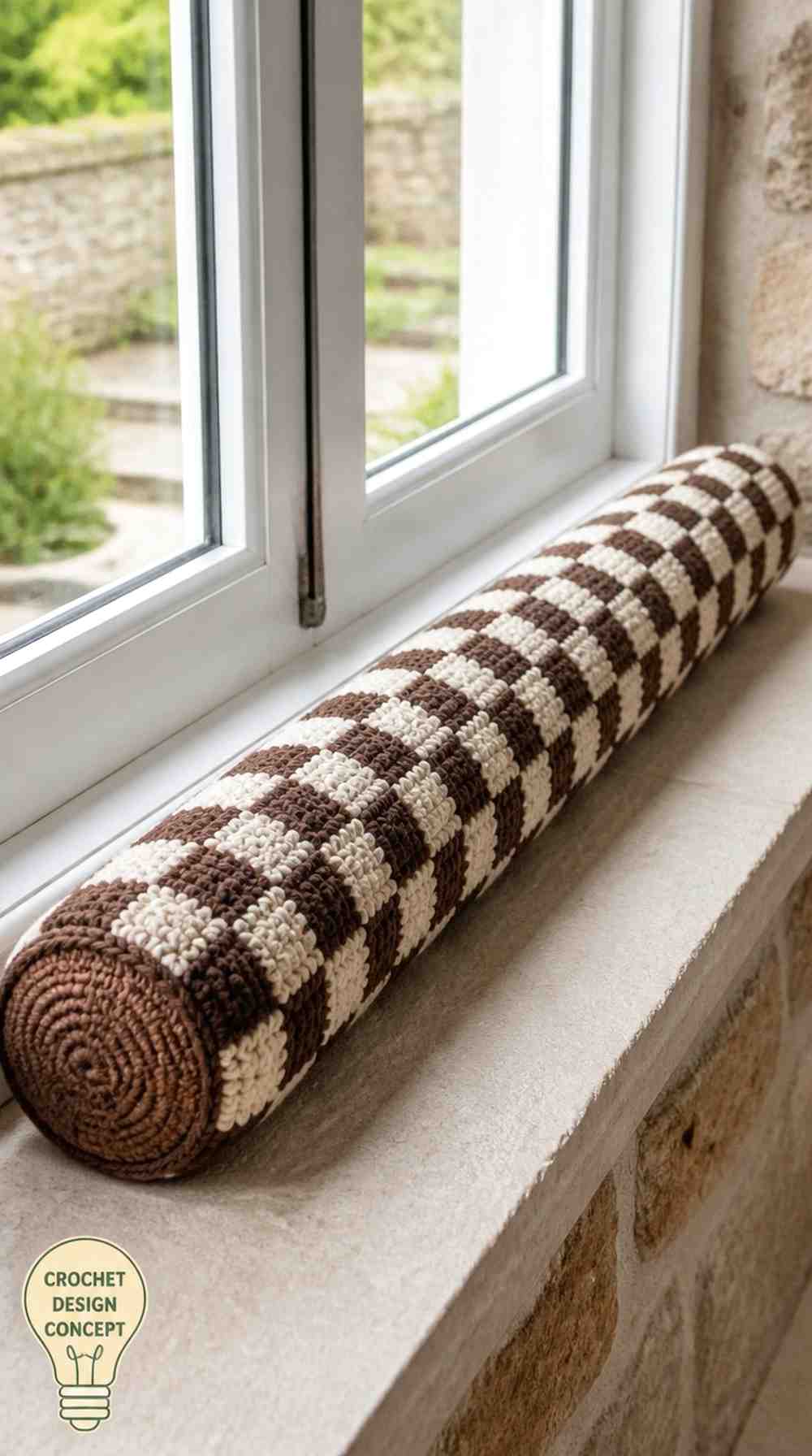
Miniature espresso-brown and vanilla-cream squares form a continuous checkerboard across this rounded draft-stopper cover. Solid mocha end panels complete the cylindrical shape, while a flat underside seam keeps the patterned front uninterrupted.
The design brings a graphic coffeehouse appearance to a simple window-side accessory. Its small colorwork repeats are more decorative than the plain ribbed and linen-stitch options. Against a pale stone sill, the dark squares create strong visual contrast without additional buttons or raised embellishments.
- Miniature Colorwork: Tapestry crochet can create small checks without joining individual squares, reducing extra seams along the narrow cover.
- Mocha End Panels: Solid circular ends define the tube’s rounded shape and keep the checkerboard concentrated on its main surface.
- Color-Change Finishing: Keep yarn ends secure and the underside seam flat so loose strands do not catch when removing the insert.
6. Crochet Burgundy Button-Flap Sill Cover
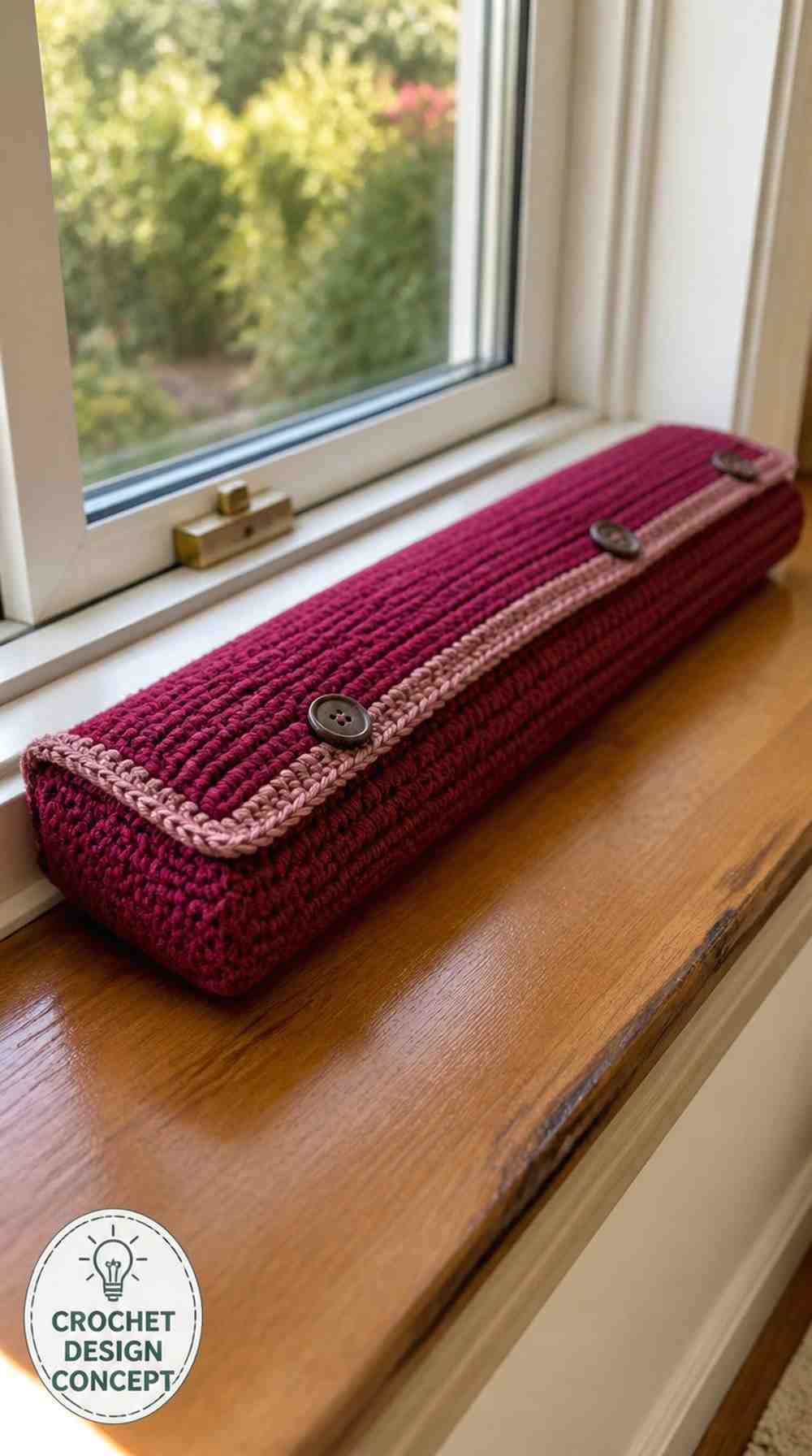
Deep-burgundy crochet creates a long rectangular sleeve with a dusty-rose border and two small dark wooden buttons on a short overlapping flap. Dense horizontal crochet rows form the main fabric, while the folded upper section provides a tailored detail.
The flat profile gives this concept a structured appearance that differs from the rounded bolsters. The buttons are the primary decorative feature, but their usefulness depends on how the removable opening is constructed. The design is best treated as a washable-looking cover concept rather than a tested fastening system.
- Two-Button Detail: Keep the buttons flat and securely attached. They should not press against the window or scratch nearby painted surfaces.
- Overlapping Flap: The fold offers a possible access point for the insert, but excessive overlap can create unnecessary thickness.
- Burgundy Color: The deeper shade can complement pale window trim while still allowing the dusty-rose border to remain visible.
7. Crochet Slate Tapered-End Sill Cover
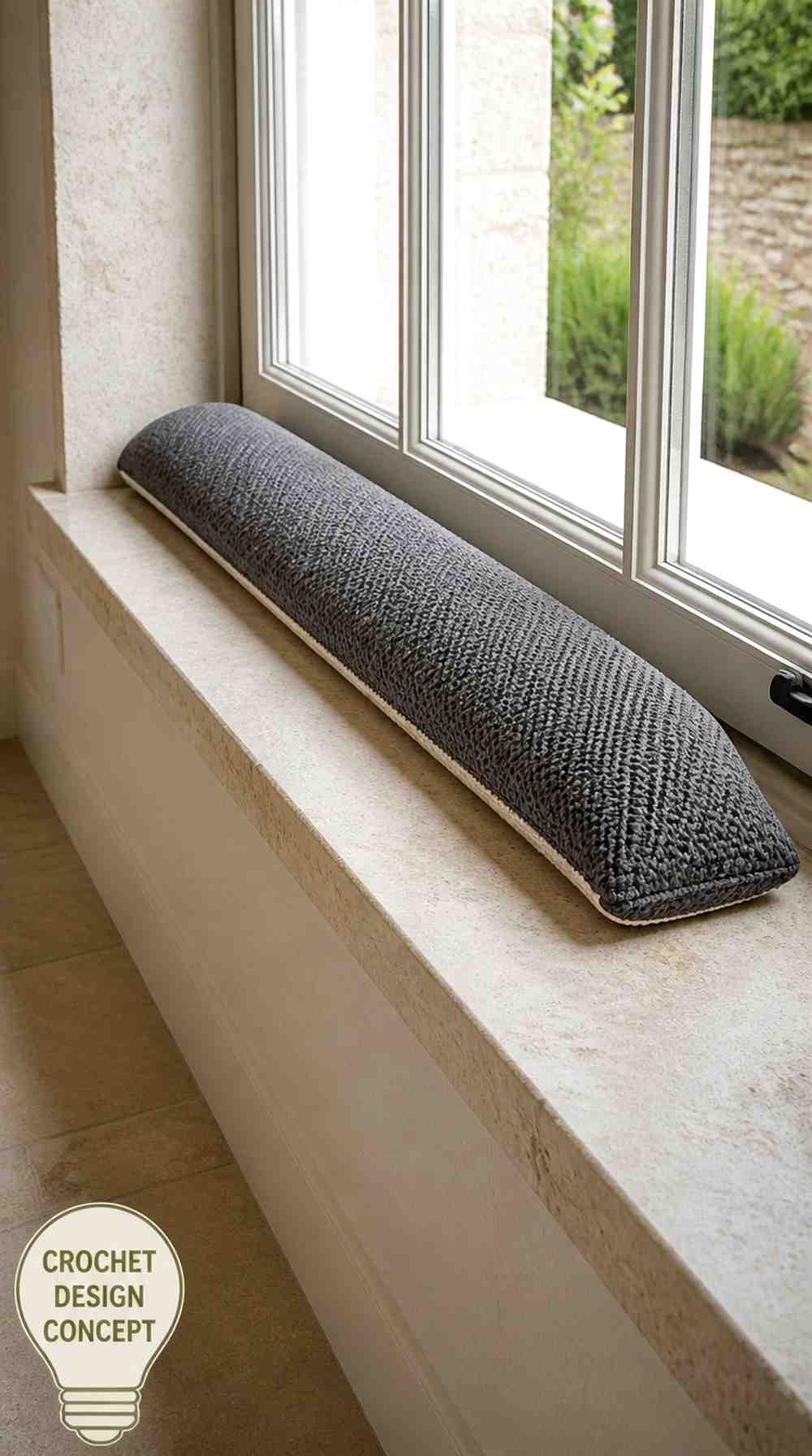
Slate-grey crochet gives this window-sill cover a clean, modern appearance. Its long rectangular middle gradually narrows toward two wedge-shaped ends, with fine diagonal herringbone-like stitches and a slim ivory line along the lower front edge.
The tapered silhouette is its defining feature. Instead of finishing in broad square corners, the cover narrows before reaching the side window trim. This creates a more shaped appearance while keeping the central section comparatively straight. A matching removable insert would be needed to preserve the intended outline.
- Tapered Ends: The narrowing sections should match the insert rather than simply squeezing a rectangular cushion into pointed corners.
- Diagonal Crochet Texture: Herringbone-like stitches add subtle direction without requiring separate raised cords or decorative appliqués.
- Side-Trim Clearance: The shaped ends should stop before window tracks, drainage areas, and any fittings needed for normal operation.
8. Crochet Sage Split-Texture Sill Sleeve
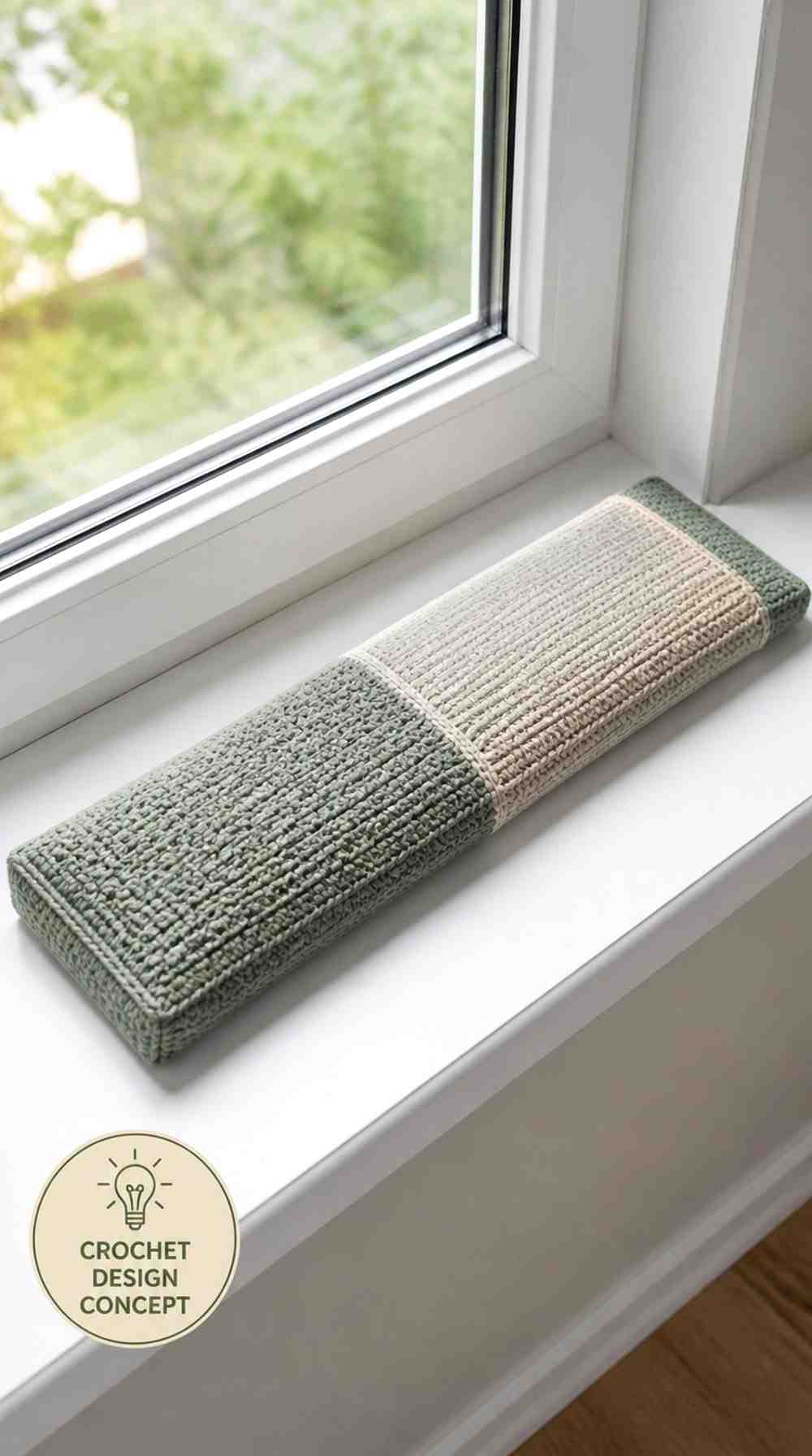
Muted-sage moss stitch covers one half of this rectangular window-sill sleeve, while oatmeal ribbing fills the other. A straight cream seam divides the two panels, and narrow sage borders complete the squared ends.
The design stands apart through texture as well as color. Its two surfaces create a calm, balanced appearance without needing decorative buttons or motifs. Because moss stitch and ribbing can behave differently, the visual contrast also introduces an interesting consideration for anyone adapting the concept into a removable cover.
- Two Stitch Textures: Moss stitch and ribbing may have different stretch characteristics, so compare their tension before joining the panels.
- Central Cream Seam: Keep the joining line straight and low-profile to prevent the two halves from pulling unevenly.
- Rectangular Insert Fit: A firm, appropriately shaped inner insert would help the visualized cover retain its clean outline without assuming any tested sealing performance.
9. Crochet Coral Scalloped Sill Cover
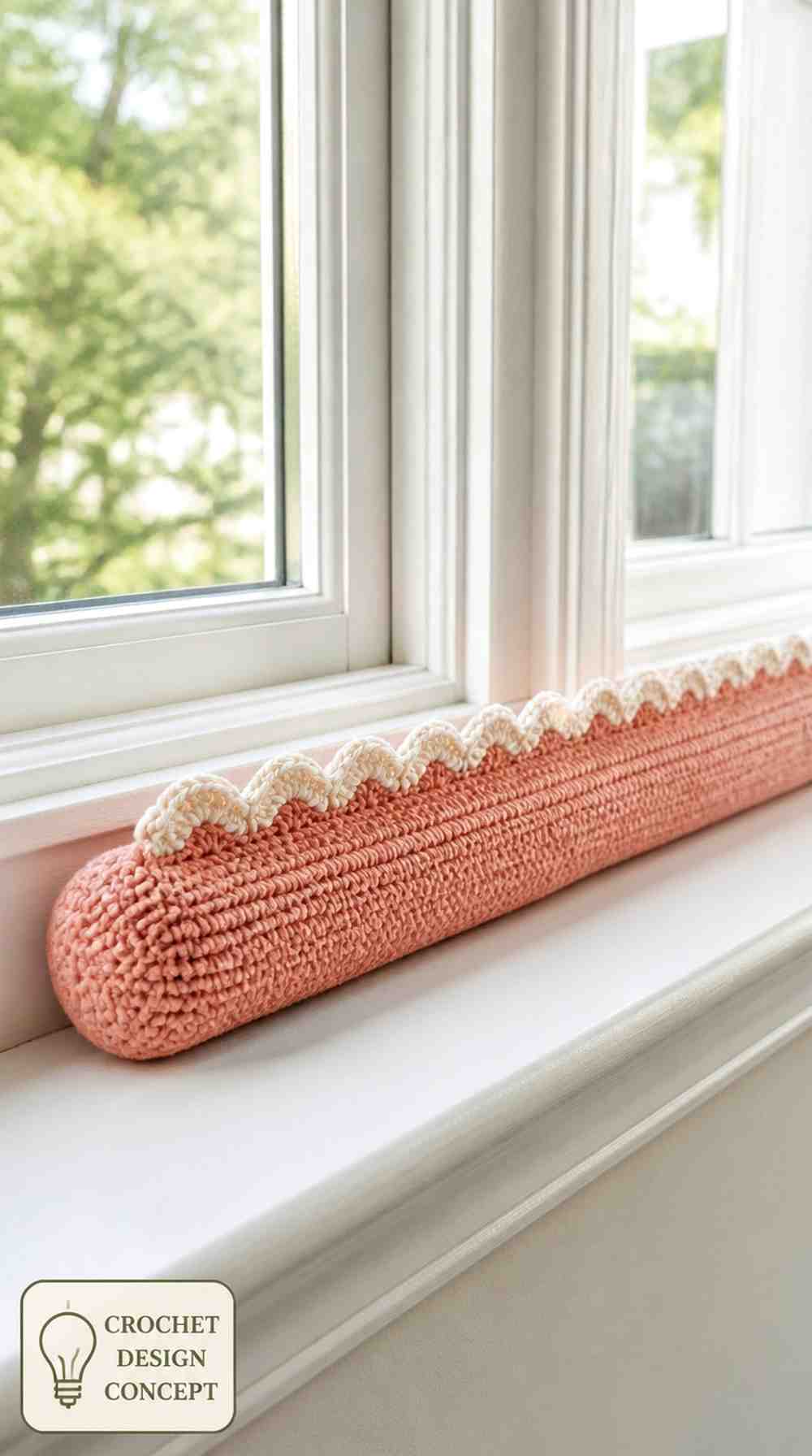
Dusty-coral crochet creates a long, narrow tubular sleeve with softly rounded ends. Fine horizontal rows cover the body, while tiny cream scallops run along the room-facing upper edge.
The small shell border gives this design a delicate cottage appearance. Unlike larger lace embellishments, the scallops remain flat and closely attached, allowing the main tube to keep its simple shape. This concept shows how one decorative edge can change the character of an otherwise understated crochet draft-stopper cover.
- Miniature Scallops: Small shells are preferable to long dangling loops where fabric may catch against nearby objects or window hardware.
- Simple Tube Construction: The closely worked body keeps attention on the cream edging rather than introducing several competing textures.
- Window Clearance: Position the decorative edge toward the room, away from moving window parts and moisture-prone track channels.
10. Crochet Olive Twin-Cable Sill Cover
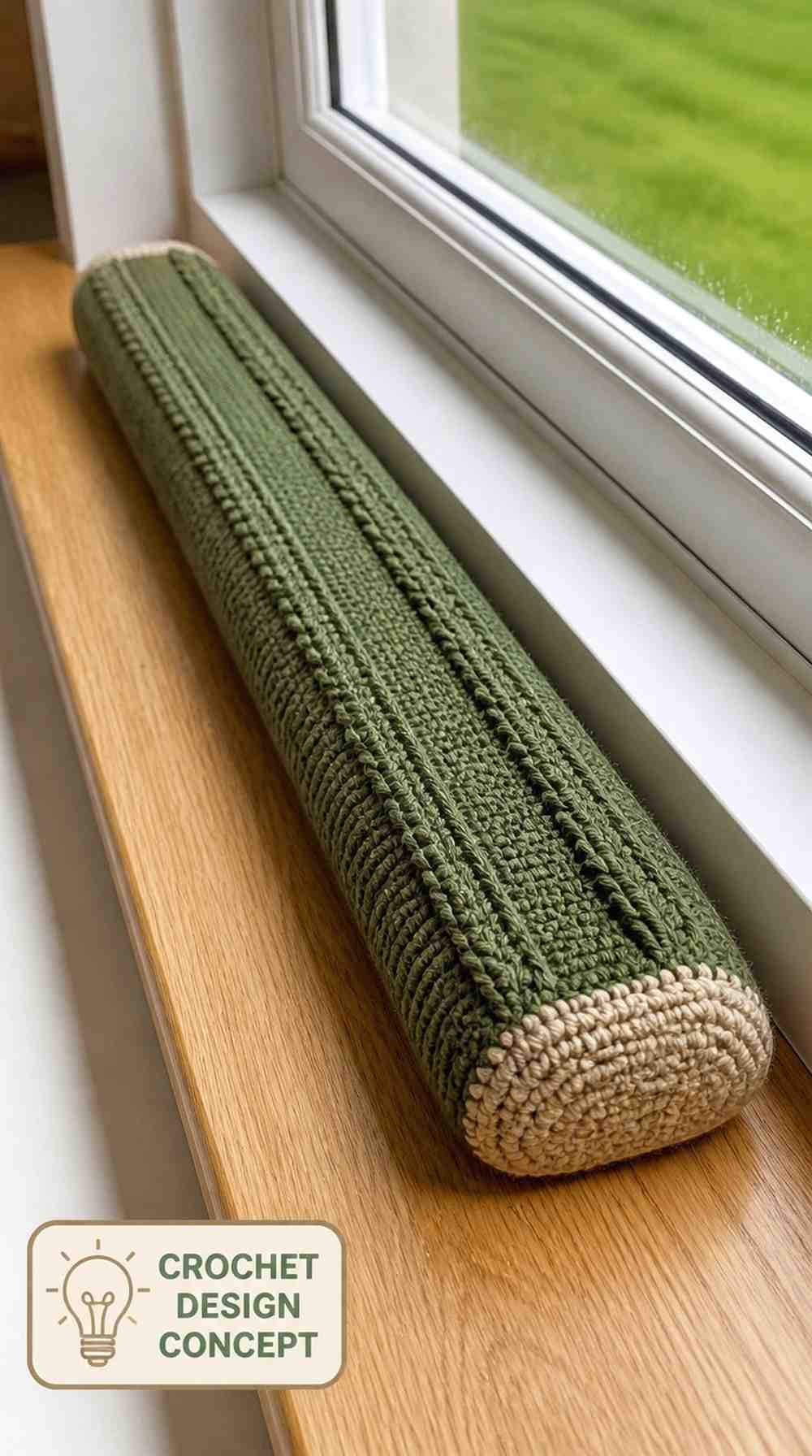
Two narrow raised crochet ridges extend along the top of this olive-green window-sill cover. A smooth center channel separates them, while thin sand-colored bands finish the ends of its rounded rectangular body.
The cable-inspired texture gives the design a more structured appearance than plain horizontal stitches. Because the ridges run lengthwise, they emphasize the long shape without introducing large separate motifs. The olive-and-sand palette also works naturally with oak window sills and light-painted frames.
- Raised Post-Stitch Ridges: Keep both lines shallow and connected to the base fabric. Excessive height may make the cover unnecessarily bulky.
- Smooth Center Channel: The flatter section between the ridges helps distinguish the two raised lines visually.
- Rounded Rectangular Insert: The inner stopper should follow the same broad shape so the crochet does not collapse between its textured sections.
11. Crochet Plum Half-Moon Draft Cover
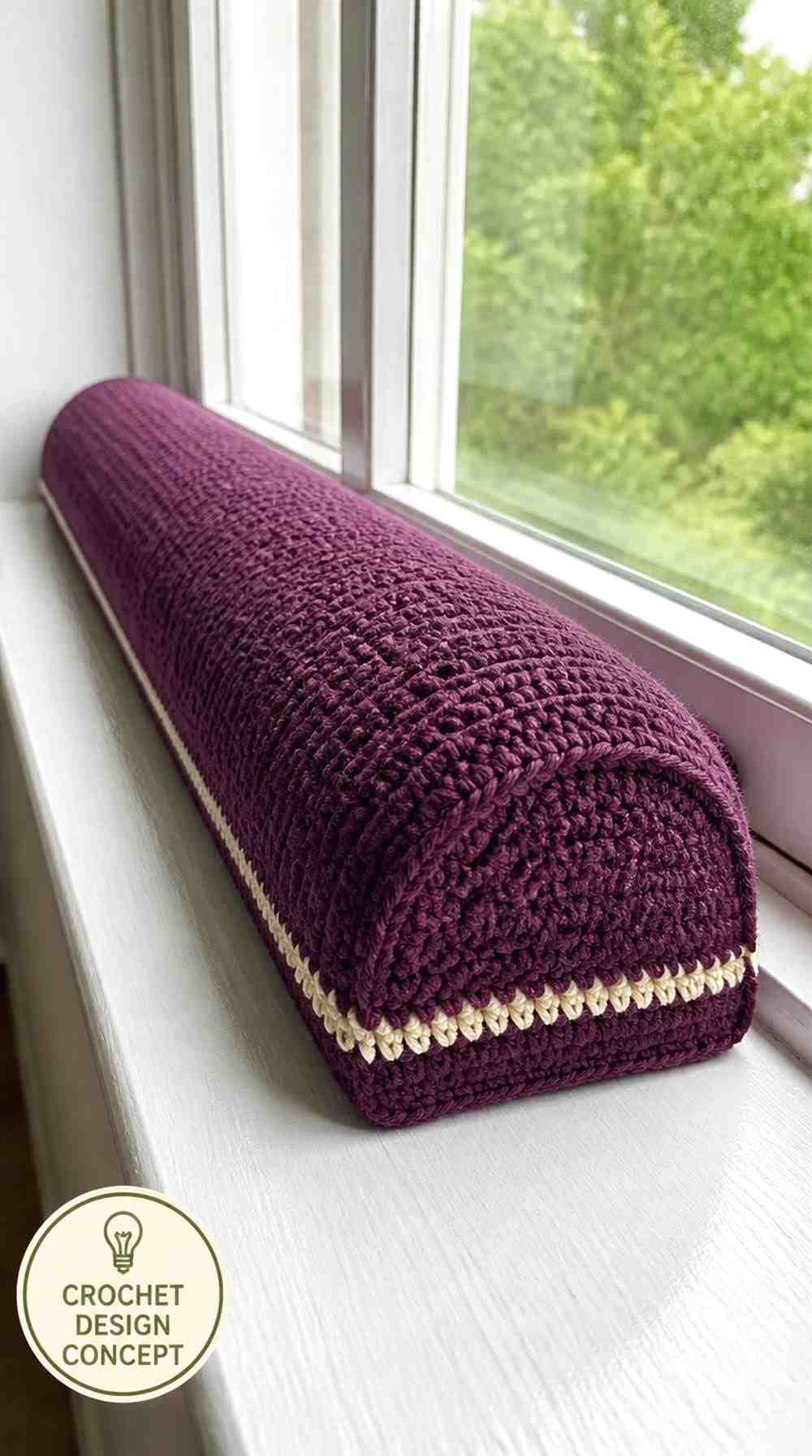
Deep-plum crochet forms a low half-round shape with a flat underside and gently domed top. Curved crochet rows follow the upper surface, while a thin warm-cream line marks the front lower edge.
Its semicircular profile makes this concept different from both a full cylinder and a straight rectangular cushion. The flat base provides a more defined resting surface, while the curved top gives the accessory a soft finish. The shape would require a similarly formed removable insert rather than a loosely stuffed rectangular pouch.
- Half-Round Profile: A flat underside may help the cover rest in one orientation, but its stability still depends on the actual sill and insert.
- Semicircular End Panels: Neatly shaped ends are important for preserving the low domed silhouette.
- Cream Lower Edge: The thin contrasting line emphasizes where the curved front meets the flat base without adding a bulky trim.
12. Crochet Cobalt Pull-Tab Sill Cover
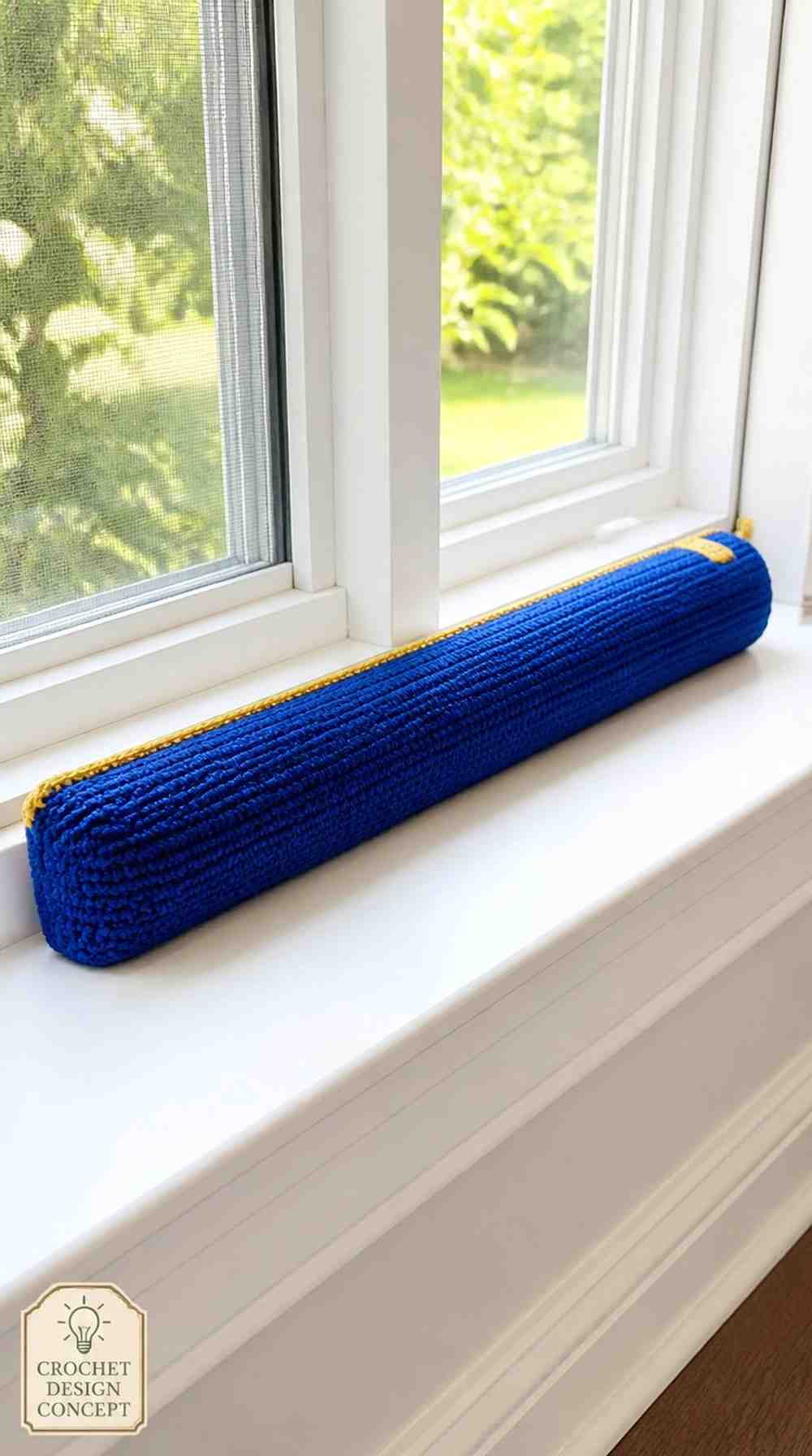
Bright cobalt crochet gives this narrow rectangular cover a bold, modern appearance. Fine horizontal stitches create the main surface, while a canary-yellow border follows the top edge. One tiny matching yellow pull tab sits near the right end.
The contrasting tab adds a small detail that distinguishes the design from ordinary slipcovers. It suggests a convenient place to grasp the empty cover during removal, although it should not be used to lift a heavy or tightly fitted insert. The overall silhouette remains simple and compact.
- Small Yellow Tab: Keep the extension flat and securely attached so it does not form a loose loop near the window.
- Straight Rectangular Shape: This style is easiest to visualize with a matching slim insert rather than a thick rounded bolster.
- Bright Color Contrast: Cobalt and canary yellow create a strong accent against white window trim without requiring elaborate stitchwork.
13. Crochet Ivory Granny-Diamond Sill Cover
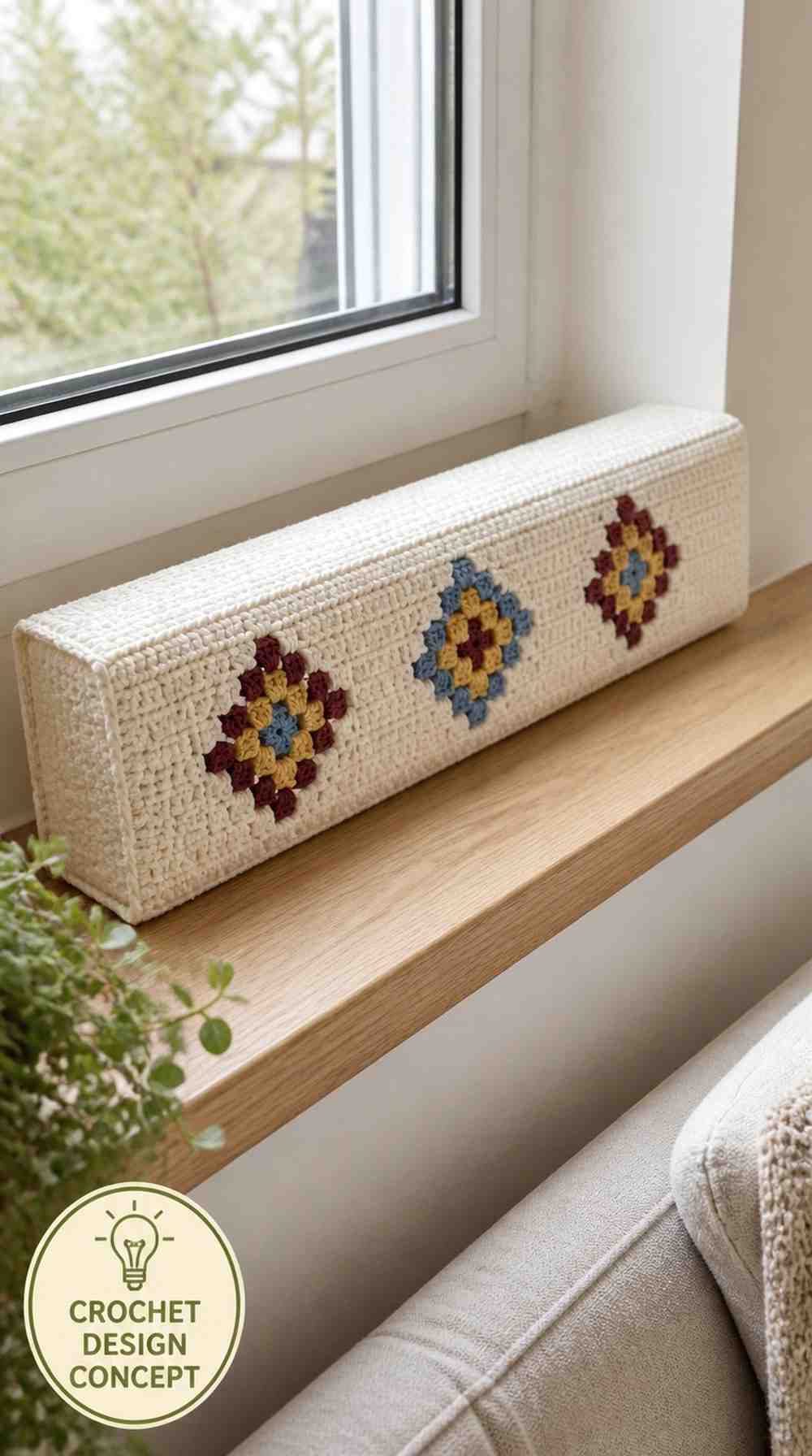
Warm-ivory crochet forms a long rectangular sleeve decorated with three small granny-style diamond motifs across its room-facing front. Burgundy, muted mustard, and dusty-blue clusters give each motif its own color, while dense ivory stitches join them into the main panel.
The design brings a traditional patchwork detail to a narrow window accessory without covering the entire surface in joined squares. The plain upper section keeps the silhouette simple, allowing the three evenly spaced diamonds to stand out. Its combination of neutral backing and small colorful motifs gives it a gentle cottage character.
- Three Motif Placement: Space the diamonds evenly so none disappear into the end seams or wrap awkwardly around the lower edge.
- Dense Ivory Backing: The solid underlying panel gives the granny clusters a clear background and helps maintain the rectangular cover shape.
- Attached Motif Care: Extra joins and raised cluster stitches may collect dust, so consider how the cover can be removed and cleaned.
14. Crochet Dusty Blue Reversible-Cuff Cover
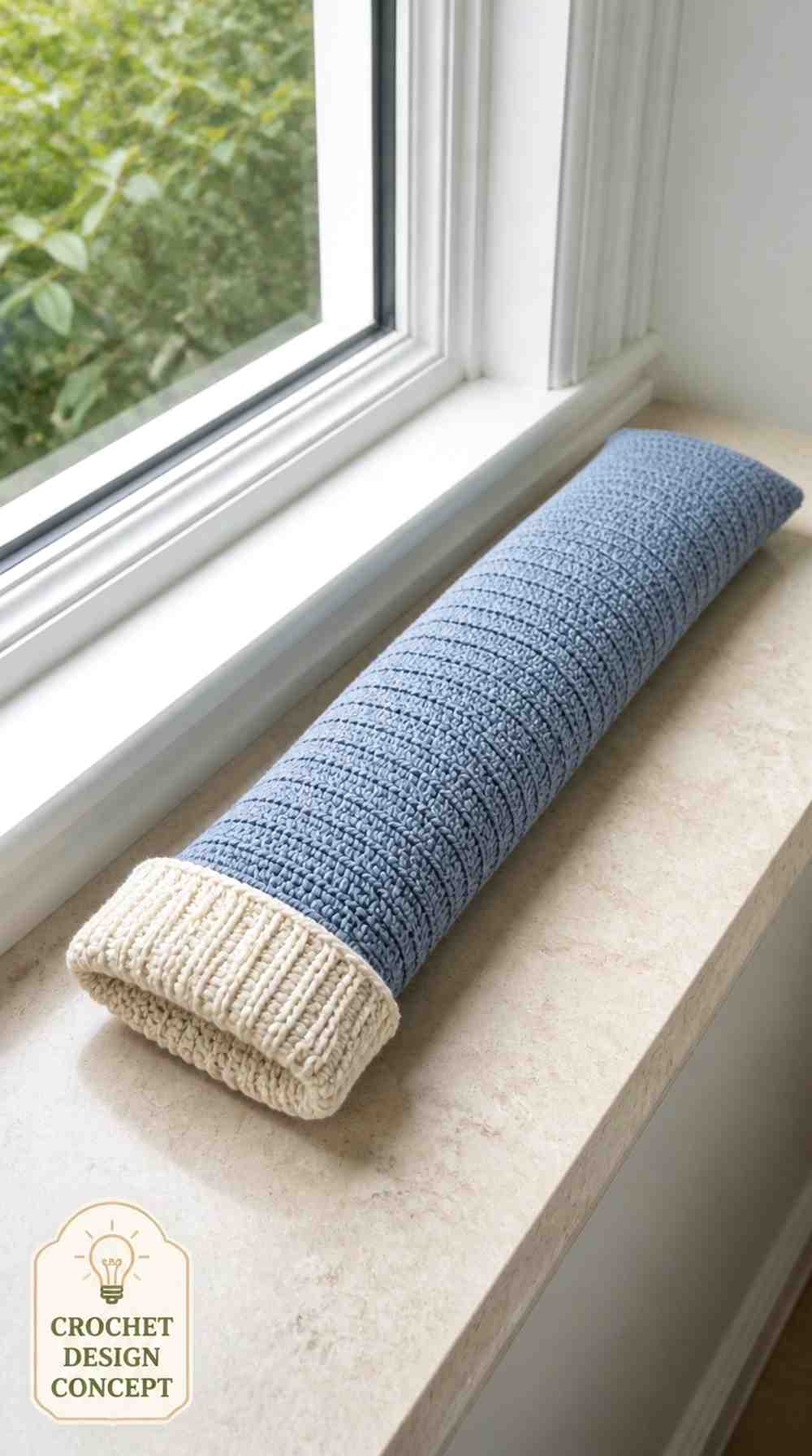
Dusty-blue crochet creates a slim rectangular sleeve with closely worked linen-stitch rows. At one end, a short folded cuff reveals a warm-cream reverse surface with fine horizontal ribbing.
The contrast between the smooth blue exterior and ribbed cream interior makes the folded end the main feature. Unlike the button-flap design, this cover uses a simple turned-over section without extra hardware. Its soft neutral palette and straightforward silhouette give it a calm appearance suitable for a light, uncluttered window area.
- Folded End Cuff: Keep the turn-back section short and even so it does not create an oversized fabric lump.
- Contrasting Reverse Texture: The cream ribbing adds interest when exposed, but the two stitch surfaces need compatible stretch.
- Removable Insert: A practical version should allow the inner stopper to be taken out without damaging the folded edge or stretching the sleeve.
15. Crochet Mocha Ombre Sill Cover
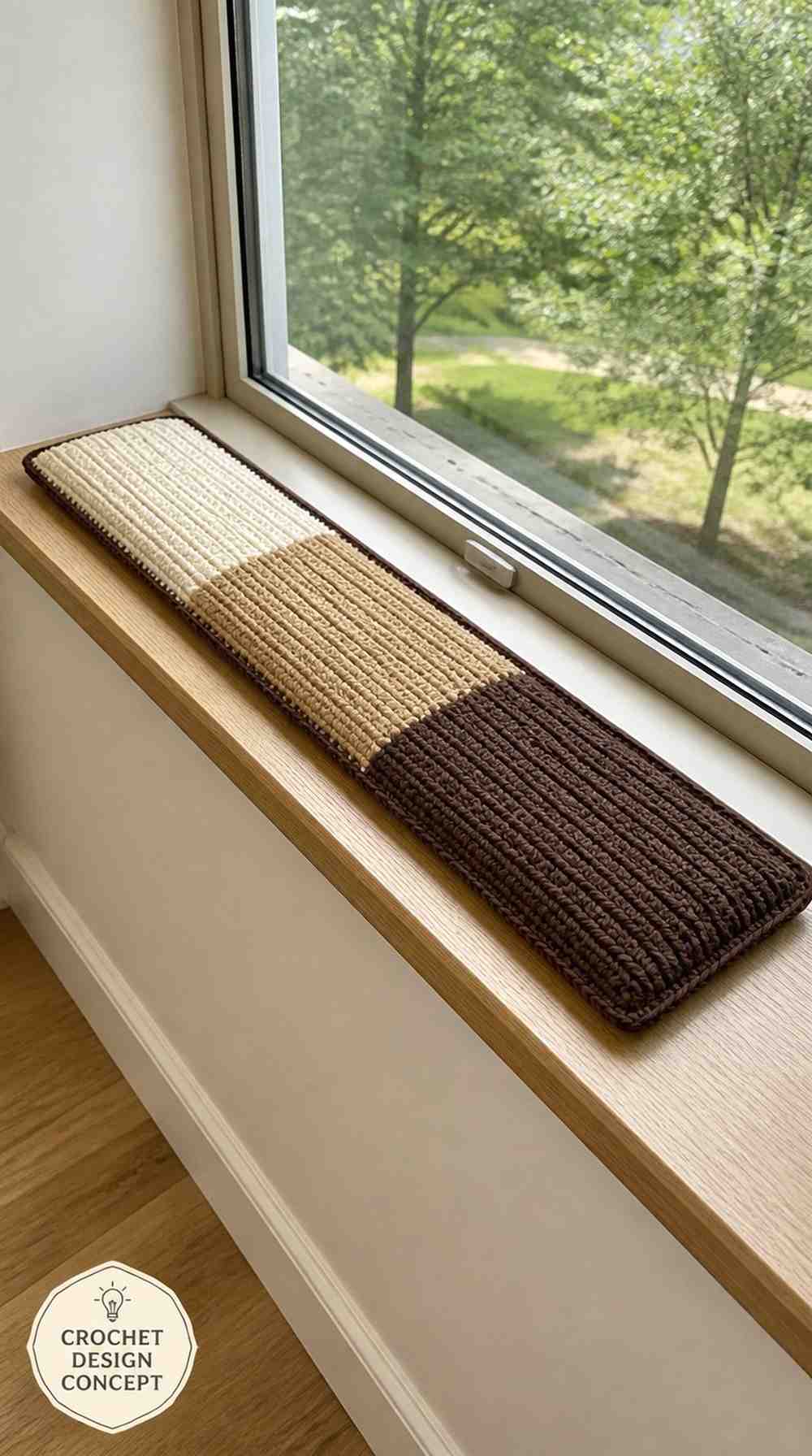
Warm cream, caramel, and deep mocha create three broad color blocks along this rectangular window-sill cover. The colors progress from light to dark across its length, with narrow mocha edging and two subtle joining lines separating the sections.
The crochet uses closely connected single-crochet rows rather than raised motifs, allowing the color arrangement to become the main feature. Its clean rectangular outline feels modern while retaining a warm, handmade appearance. Against natural oak and a white-painted window frame, the three shades create a coordinated neutral finish.
- Three Lengthwise Color Blocks: Keep the cream, caramel, and mocha sections proportionate so the progression remains visible across the entire cover.
- Straight Joining Lines: Smooth transitions between color sections help preserve the rectangular silhouette.
- Simple Stitch Surface: Close single-crochet rows emphasize the color changes without adding unnecessary texture or extra decorative layers.
Practical Guide to Crochet Window Sill Draft Seal Covers
Find the actual draft first. Cold air may enter around a window sash, damaged weatherstripping, or gaps between the frame and surrounding trim. A decorative sill cover is not a substitute for properly repairing those leaks. The U.S. Department of Energy’s window and door guidance recommends suitable caulking and weatherstripping for reducing air leakage.
Department of Energy
Measure the sill and the separate insert. Check the available sill length, usable depth, insert height, and clearance around the window. A rounded bolster needs different proportions from a flat rectangular stopper. Avoid placing fabric inside the operating sash channel.
Keep window drainage and movement clear. Never cover weep holes, drainage slots, locking mechanisms, tracks, or emergency-exit window openings. A removable draft-stopper accessory should be moved away whenever the window needs to open.
Watch carefully for condensation. Window sills can become damp even when they look clean. The U.S. Environmental Protection Agency’s moisture guide recommends addressing condensation promptly and keeping surfaces dry to reduce mold risks.
US EPA
Choose an easy-care construction. Smooth, washable yarn may be worth considering for a removable decorative outer cover. Check the actual yarn’s washing instructions, and keep the inner draft-stopper insert separate when its construction permits.
Use suitable draft-blocking materials independently. Open crochet, decorative lace, and ordinary yarn cannot be assumed airtight or insulating. If your goal is effective weather sealing, use an appropriate product or professional repair method designed for the window.
For related inspiration, see 17 Crochet Burrowcore Door Draft Stopper Ideas for Cozy Winter Homes on Yarn Nest Studio. It explores longer decorative draft-stopper shapes and removable-cover approaches, although door-sized designs need substantial adjustment for a window sill.
Want to Make Something Similar?
These 15 window-sill covers are original design concepts rather than exact tested crochet patterns. The following resources offer related construction guidance.
- Learn How to Crochet a Textured Draught Excluder — Bella Coco Crochet explains the construction of a long textured draft excluder, including separate panels and an inner fabric insert. Its original dimensions and construction are intended for a different setting, so they should not be copied directly onto a window sill. Bella Coco Crochet
- Crochet Draft Excluder — Cosy Rosie Crochet provides a free tubular draft-excluder pattern with textured rows and a cushion insert. It offers useful stitch and assembly inspiration, but it is not a tested window weather-sealing product. Cosy Rosie Crochet
Both tutorials belong to their original creators. Use them to learn related crochet techniques rather than presenting them as instructions for reproducing the exact visualized designs.
Comparison: Which Crochet Window Sill Draft Seal Cover Should You Choose?
| Design | Main feature | Important consideration |
|---|---|---|
| Cinnamon Ribbed Bolster | Long cylindrical ribbed cover | Needs enough sill depth |
| Oatmeal Box-Edge | Low rectangular sleeve | Insert needs matching shape |
| Indigo Twin-Roll | Two parallel connected tubes | Occupies more sill space |
| Mustard Lattice | Openwork over cream fabric | Mesh is not airtight |
| Cocoa Checkerboard | Miniature patterned cylinder | More color changes |
| Burgundy Button-Flap | Decorative removable-style overlap | Buttons may add bulk |
| Slate Tapered-End | Narrow wedge-shaped ends | Requires shaped insert |
| Sage Split-Texture | Moss stitch and ribbing | Different fabric stretch |
| Coral Scalloped | Small shell-stitch edging | Scallops may snag |
| Olive Twin-Cable | Two raised lengthwise ridges | Adds surface thickness |
| Plum Half-Moon | Flat base and curved top | Requires half-round insert |
| Cobalt Pull-Tab | Small contrasting removal tab | Tab is not load-bearing |
| Ivory Granny-Diamond | Three colorful motifs | Extra joins to clean |
| Dusty Blue Reversible-Cuff | Contrasting folded end | Added cuff thickness |
| Mocha Ombre | Three lengthwise color sections | Needs neat transitions |
For a narrow interior window sill, the Crochet Oatmeal Box-Edge Draft Cover, Crochet Slate Tapered-End Sill Cover, and Crochet Mocha Ombre Sill Cover offer relatively low rectangular profiles.
If you prefer a classic draft-stopper appearance, compare the Crochet Cinnamon Ribbed Sill Bolster Cover, Crochet Cocoa Checkerboard Sill Cover, and Crochet Plum Half-Moon Draft Cover. Their rounded shapes give the accessories a softer appearance, although the sill needs enough space.
For decorative crochet texture, the Crochet Mustard Lattice Window Sleeve, Crochet Coral Scalloped Sill Cover, and Crochet Ivory Granny-Diamond Sill Cover add recognizable handmade details.
If a removable-cover appearance is your priority, the Crochet Burgundy Button-Flap Sill Cover, Crochet Cobalt Pull-Tab Sill Cover, and Crochet Dusty Blue Reversible-Cuff Cover introduce different opening and handling details.
Whatever design you prefer, proper window sealing, dry surfaces, and safe window operation should determine whether a decorative accessory is suitable for the location.
Conclusion
Crochet window sill draft seal covers bring a handmade design opportunity to a small but noticeable area of the home. From low rectangular sleeves and ribbed bolsters to scalloped borders, granny motifs, and warm color-blocked panels, these 15 concepts offer different ways to style a removable window-side accessory.
The most useful choice begins with the actual window. Check where drafts originate, keep the sill dry, preserve drainage and opening clearance, and rely on suitable weather-sealing materials rather than crochet for proven air-leak reduction.
Which design would you choose for your window? Would you prefer the cinnamon ribbed bolster, oatmeal box-edge cover, mustard lattice sleeve, or mocha ombre design? Share your favorite style and whether your window sill is narrow, wide, wooden, or stone.
Frequently Asked Questions
1. Can a crochet window sill cover stop cold drafts?
Crochet alone should not be considered a reliable draft seal because stitches can contain openings and yarn is not designed as an airtight weather barrier. A decorative crochet sleeve may surround a separate draft stopper, but its effectiveness depends on the underlying product and placement. Proper weatherstripping or caulking is generally the more suitable solution for actual window leaks.
2. What yarn is suitable for a window sill draft-stopper cover?
Smooth, washable cotton or another suitable easy-care yarn may be worth exploring for a removable decorative sleeve. However, yarn choice does not establish moisture resistance, insulation performance, or airtightness. Choose materials based on their actual care requirements and avoid leaving any crochet accessory against a damp window sill.
3. Should the crochet cover touch the window frame?
A removable cover may rest near the lower window frame, but it should not obstruct moving parts, drainage holes, tracks, latches, or emergency-exit operation. Check the specific window design and manufacturer instructions. If the accessory must be forced into a narrow moving gap, it is not an appropriate placement.
4. Are rounded or rectangular draft covers better for window sills?
A flat rectangular cover may suit a shallow sill, while a rounded bolster creates a softer decorative appearance where more space is available. Neither shape automatically provides better draft blocking. The underlying insert, actual air-leak location, window clearance, and moisture conditions are more important than the exterior crochet shape.
5. Are these 15 crochet window sill draft seal cover ideas available as patterns?
No. These are original visual inspiration concepts, not tested window-sealing products or complete crochet patterns. The linked tutorials explain related draft-excluder construction techniques, but their dimensions and intended uses differ. Anyone adapting an idea would need to plan the cover size, insert compatibility, removable construction, and safe window placement independently.