Folded T-shirts can quickly turn into uneven piles when several colors, sizes and styles share the same wardrobe shelf. These 17 crochet folded T-shirt shelf separator inspiration ideas explore practical ways to create more defined spaces while adding handmade texture to everyday closet organization. From sage-green freestanding dividers and ivory clip-on panels to adjustable dusty-blue separators, lilac tiered shelving and mint-edged transparent panels, each concept offers a different approach to keeping folded shirts neatly separated.
The collection includes ideas for deep wardrobes, narrow shelves, pull-out storage and adjustable compartments. Some dividers support a single stack from the side, while others divide an entire shelf into several sections. As you explore the designs, compare the height and width of your folded T-shirts, the available shelf clearance, the stability of the supporting structure and how easily you can reach individual shirts. Crochet adds color and texture, but the rigid support underneath makes these concepts more practical.
These are AI-generated crochet design visualizations intended for inspiration. They are not photographs of tested organizers or complete crochet patterns.
Quick Design Selection Guide
- For a simple two-stack separator: Crochet Sage Freestanding T-Shirt Shelf Divider and Crochet Mustard Double-Sided T-Shirt Stack Support offer two different freestanding structures.
- For fixed shelf attachments: Crochet Ivory Clip-On T-Shirt Shelf Separator and Crochet Peach Clamp-On Shelf Edge Divider use secure mounting points.
- For adjustable compartments: Crochet Dusty-Blue Adjustable Sliding T-Shirt Dividers makes it possible to change divider positions.
- For a single neat T-shirt pile: Crochet Blush Scalloped T-Shirt Bookend Pair supports one folded stack from both sides.
- For deep shelves: Crochet Olive Full-Depth Wardrobe Shelf Partitions extends the separation farther toward the wardrobe’s back.
- For additional storage levels: Crochet Lilac Two-Level T-Shirt Shelf Dividers creates compartments on two separate tiers.
- For hidden wardrobe storage: Crochet Navy Pull-Out T-Shirt Divider Tray makes folded shirts easier to reach on a deep pull-out shelf.
- For a clear view of clothing: Crochet Mint Clear-Panel Shirt Shelf Separators keeps the central divider panels transparent.
- For flexible decorative finishes: Crochet Mocha Reversible T-Shirt Shelf Dividers offers two different crochet surfaces.
1. Crochet Sage Freestanding T-Shirt Shelf Divider
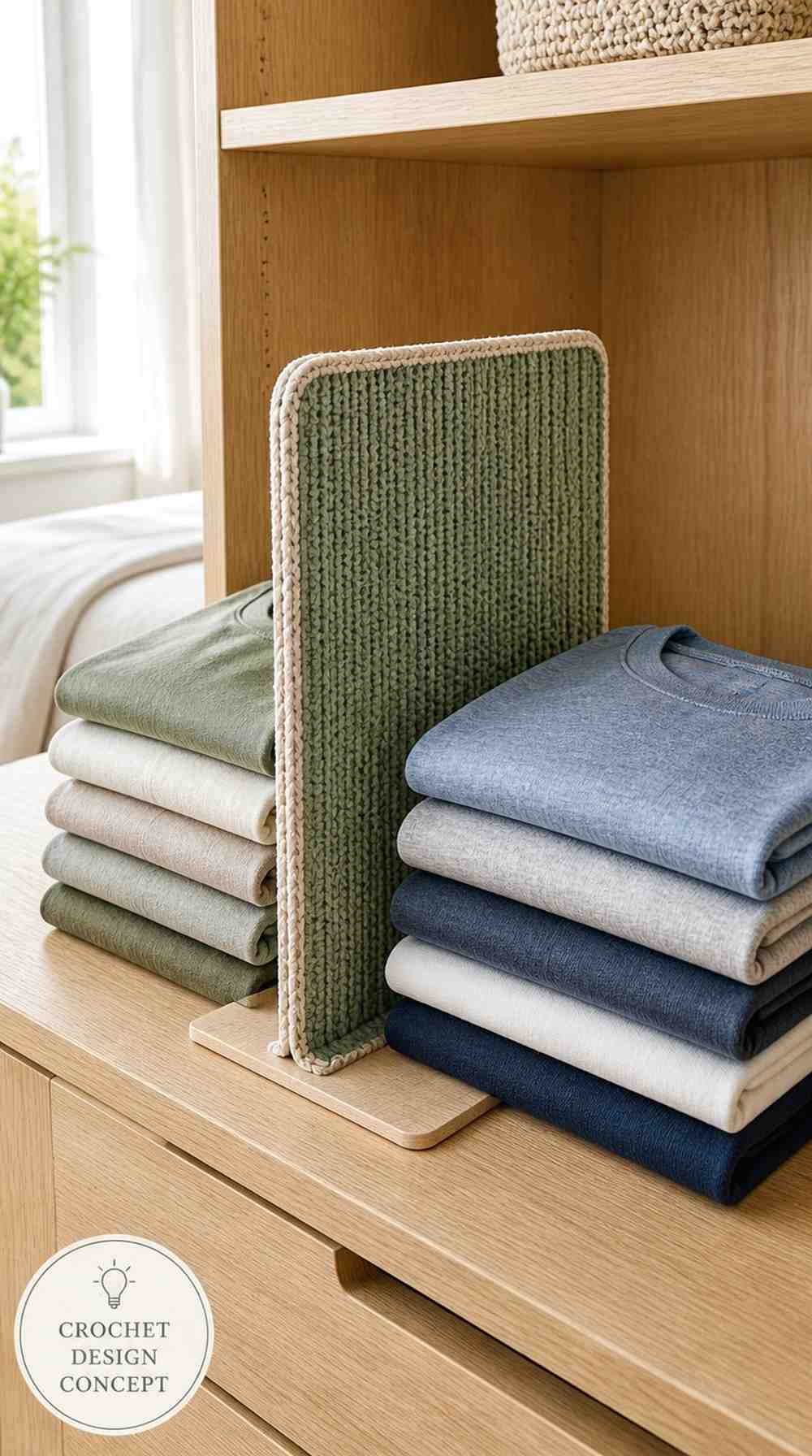
Sage-green crochet gives this simple L-shaped shelf separator a soft, organized appearance. Dense raised ribs cover the upright rectangular panel, while ivory piping finishes the edges. Two stacks of folded cotton T-shirts rest on either side, with a flat wooden support foot extending beneath one of the piles.
The design focuses on creating one clear boundary without requiring an entire storage tray. Its freestanding arrangement may suit a wardrobe where the available shelf space changes frequently, provided the support foot stays stable as shirts are removed.
- L-shaped support: A suitable rigid base foot is important because crochet fabric cannot keep a tall divider standing upright by itself.
- Stack height: Choose a panel height that supports the usual folded shirt pile without extending unnecessarily close to the shelf above.
- Base positioning: Place the support foot where the stack’s weight helps stabilize the divider without creating an uneven surface beneath the clothing.
- Ribbed covering: Keep the sage crochet tightly fitted so its raised texture does not bunch against the folded shirt edges.
2. Crochet Ivory Clip-On T-Shirt Shelf Separator
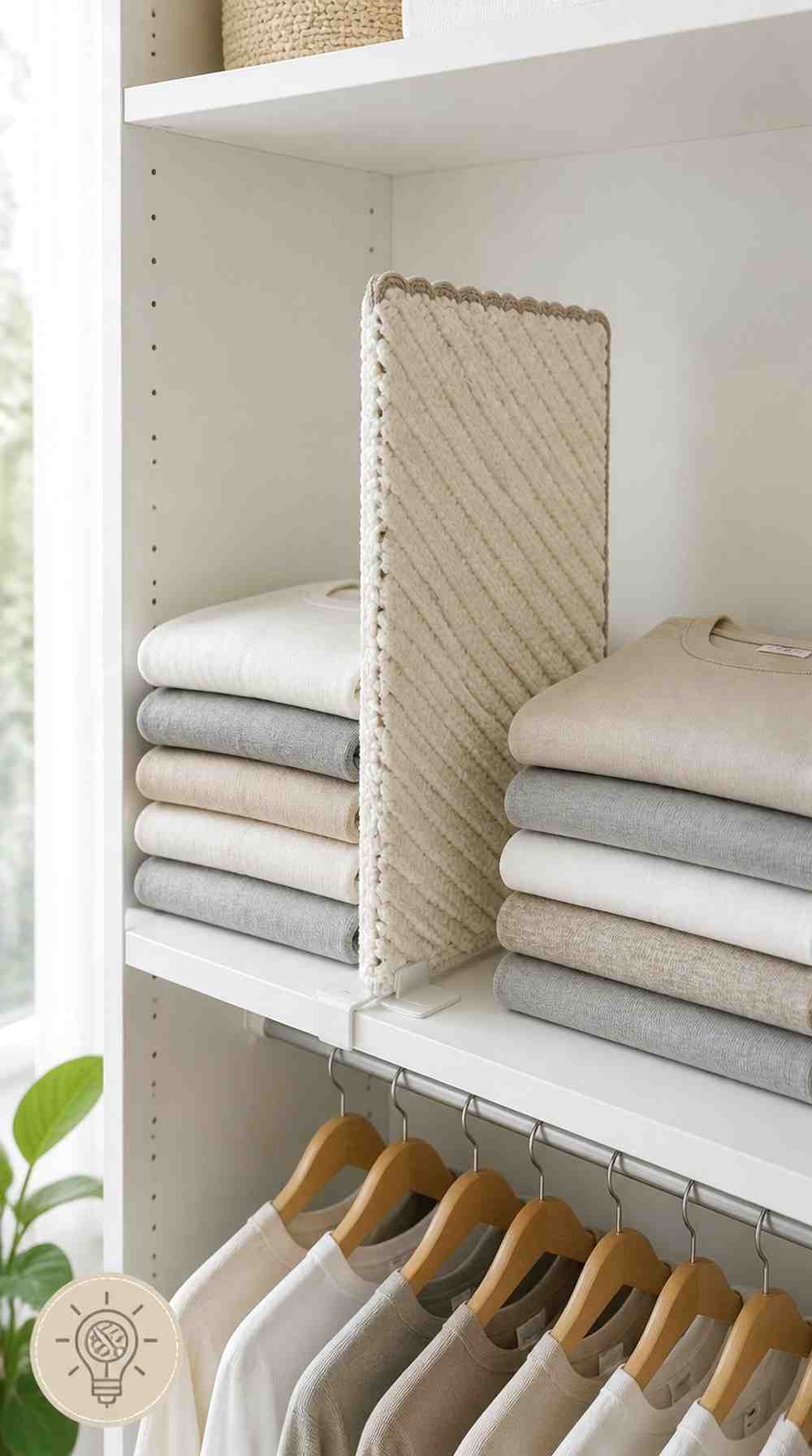
Warm ivory crochet covers a slim metal separator secured to a white wardrobe shelf. Raised diagonal stitches create subtle texture, while oatmeal scallops decorate the top edge. Two folded T-shirt stacks remain neatly separated on either side of the tall upright panel.
The front and rear clips make this design different from a freestanding bookend. Instead of depending on the weight of the clothing, the rigid separator attaches directly to the shelf, provided the clips fit the shelf material and thickness.
- Shelf compatibility: Measure the shelf’s thickness and edge shape before selecting clips, since different furniture panels may require different attachments.
- Clip security: Front and rear attachment points help keep the panel upright while shirts are added or removed.
- Scalloped top: Keep the decorative edging small enough that it cannot catch on clothing or obstruct access to the shelf above.
- Removable crochet: A fitted sleeve may be easier to wash separately than a covering permanently attached around the clips.
3. Crochet Terracotta Interlocking Shelf Divider Set
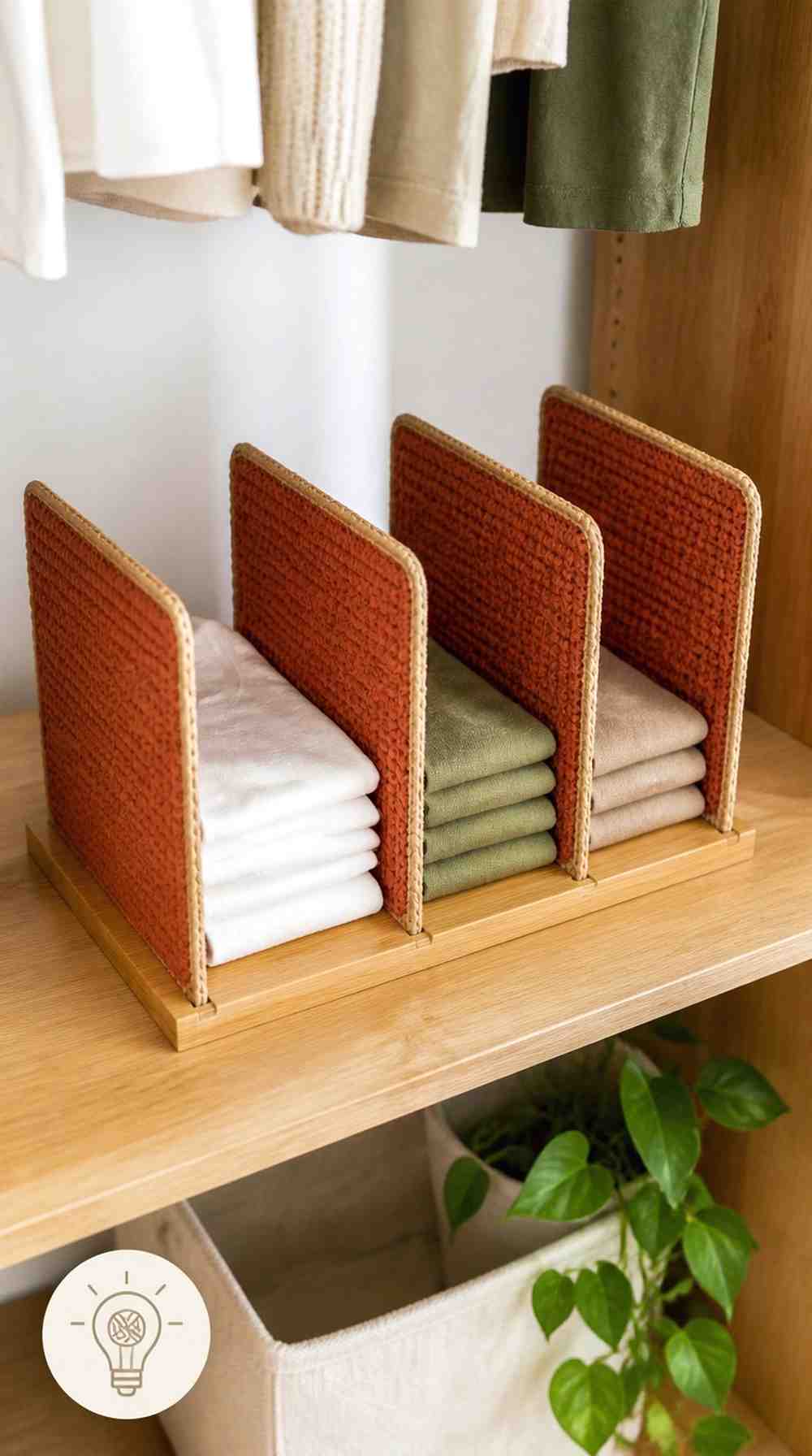
Terracotta crochet creates a warm, structured look across four slim divider panels fitted into a rectangular bamboo base. Sandy-beige edging follows the panels, while horizontal raised stitches give them a handmade texture. Three neatly folded T-shirt stacks occupy separate compartments in white, olive and beige tones.
The slot-based structure makes the dividers feel more like a modular organizer than individual bookends. It could suit someone who prefers fixed, clearly defined sections with a stable shared base.
- Slot alignment: The rigid panels must fit securely into the bamboo base so they cannot wobble when a stack is removed.
- Compartment width: Measure the folded shirt size rather than assuming all T-shirts create stacks of the same width.
- Crochet sleeve clearance: Leave the lower slots and connection points unobstructed so the terracotta covering does not interfere with assembly.
- Shared base: A full rectangular platform can help keep the divider arrangement aligned, but it takes up some vertical shelf clearance.
4. Crochet Dusty-Blue Adjustable Sliding T-Shirt Dividers
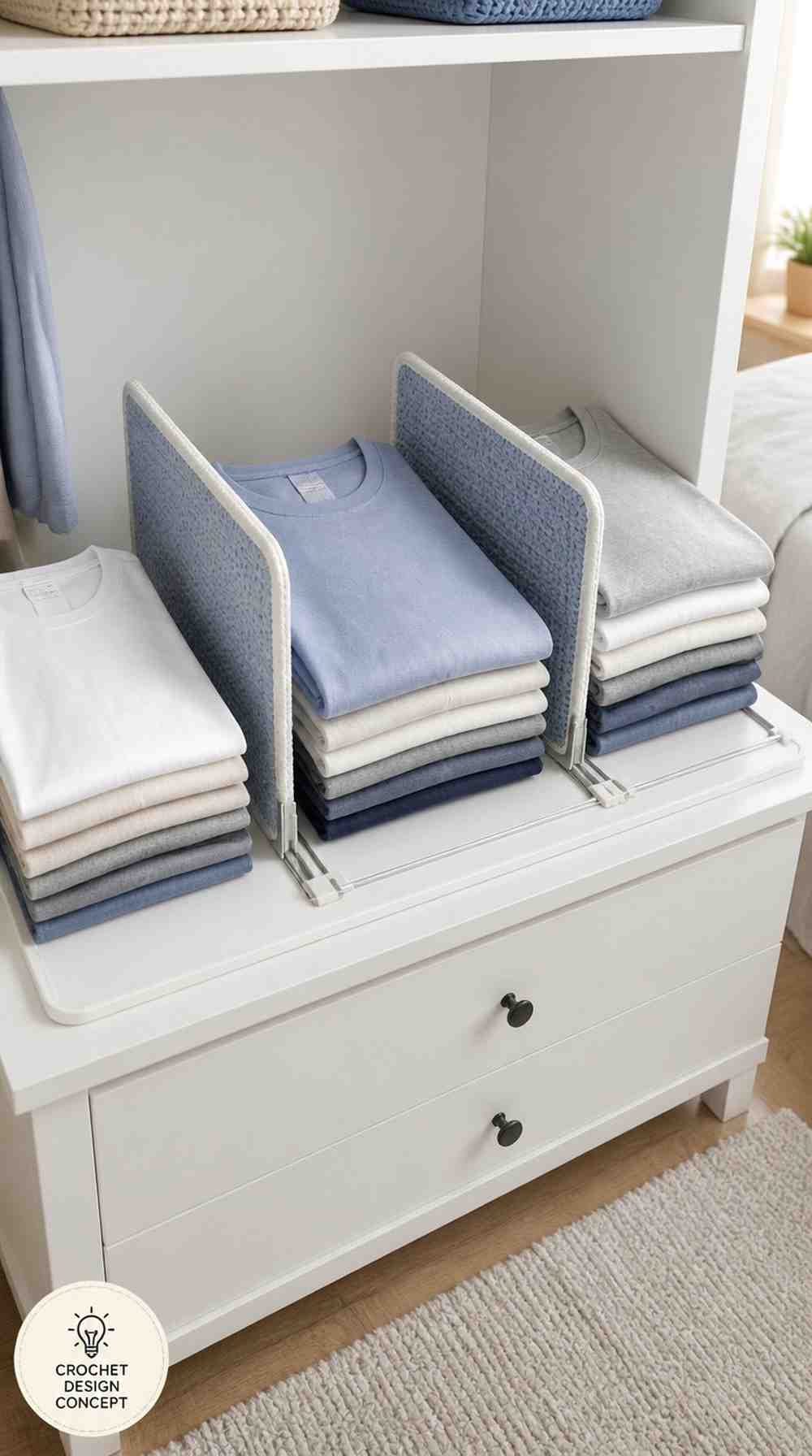
Dusty-blue crochet adds color to three movable metal divider panels inside a white wardrobe organizer. Fine vertical ribbing and ivory edging define each upright section, while recessed sliding tracks and visible locking tabs provide adjustable spacing. Three stacks of folded T-shirts sit inside the compartments.
The central stack is slightly wider than the outer piles, showing how this concept could accommodate different folded shirt sizes. It offers more flexibility than fixed dividers but requires stable sliding mechanisms.
- Adjustable spacing: Move the panels according to the actual shirt width, leaving enough room to lift out an individual folded T-shirt.
- Locking tabs: Sliding dividers need reliable stops so they do not shift whenever clothes press against them.
- Track maintenance: Recessed runners can collect lint and dust, so the base should allow routine cleaning.
- Crochet placement: Keep the dusty-blue sleeves away from moving parts to prevent the yarn from catching inside the tracks.
5. Crochet Mustard Double-Sided T-Shirt Stack Support
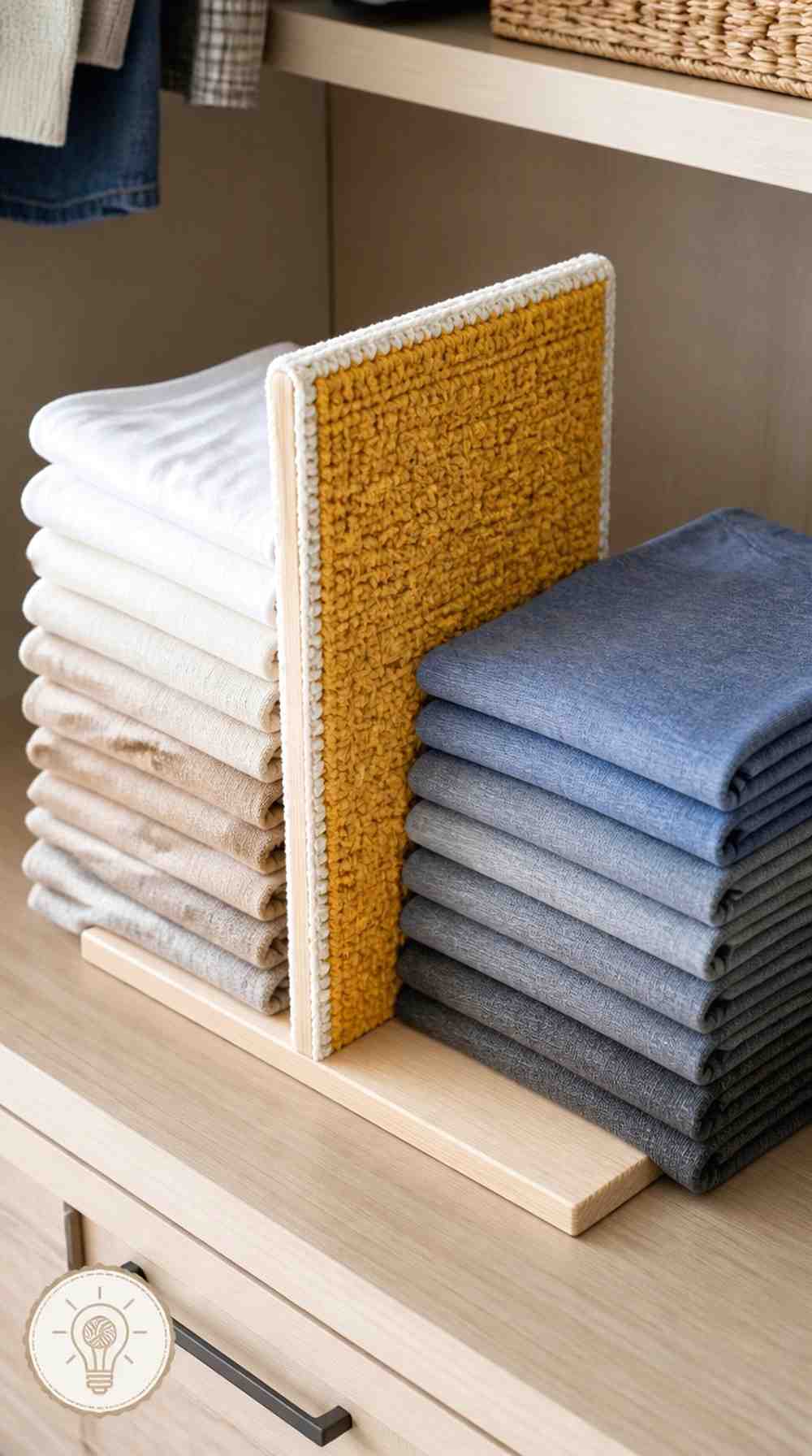
Mustard-yellow crochet wraps a tall central divider with raised basketweave stitches and narrow cream piping. The rigid T-shaped wooden support extends beneath both sides of the panel, while two even stacks of folded T-shirts sit against opposite faces.
Unlike a one-sided bookend, this design provides a central boundary for two adjacent shirt piles. Its broad base makes the structure visually balanced, although the support must remain stable when one of the stacks is removed.
- Double-sided base: The rigid foot should extend far enough beneath both piles to keep the upright panel from tilting.
- Even stack heights: Matching pile heights create a tidy display, but the divider must also remain stable when the quantities differ.
- Basketweave thickness: Raised mustard stitches add texture while reducing the space available beside the central panel.
- Panel placement: This design works best in the middle of a shelf where both sides can be accessed comfortably.
6. Crochet Blush Scalloped T-Shirt Bookend Pair
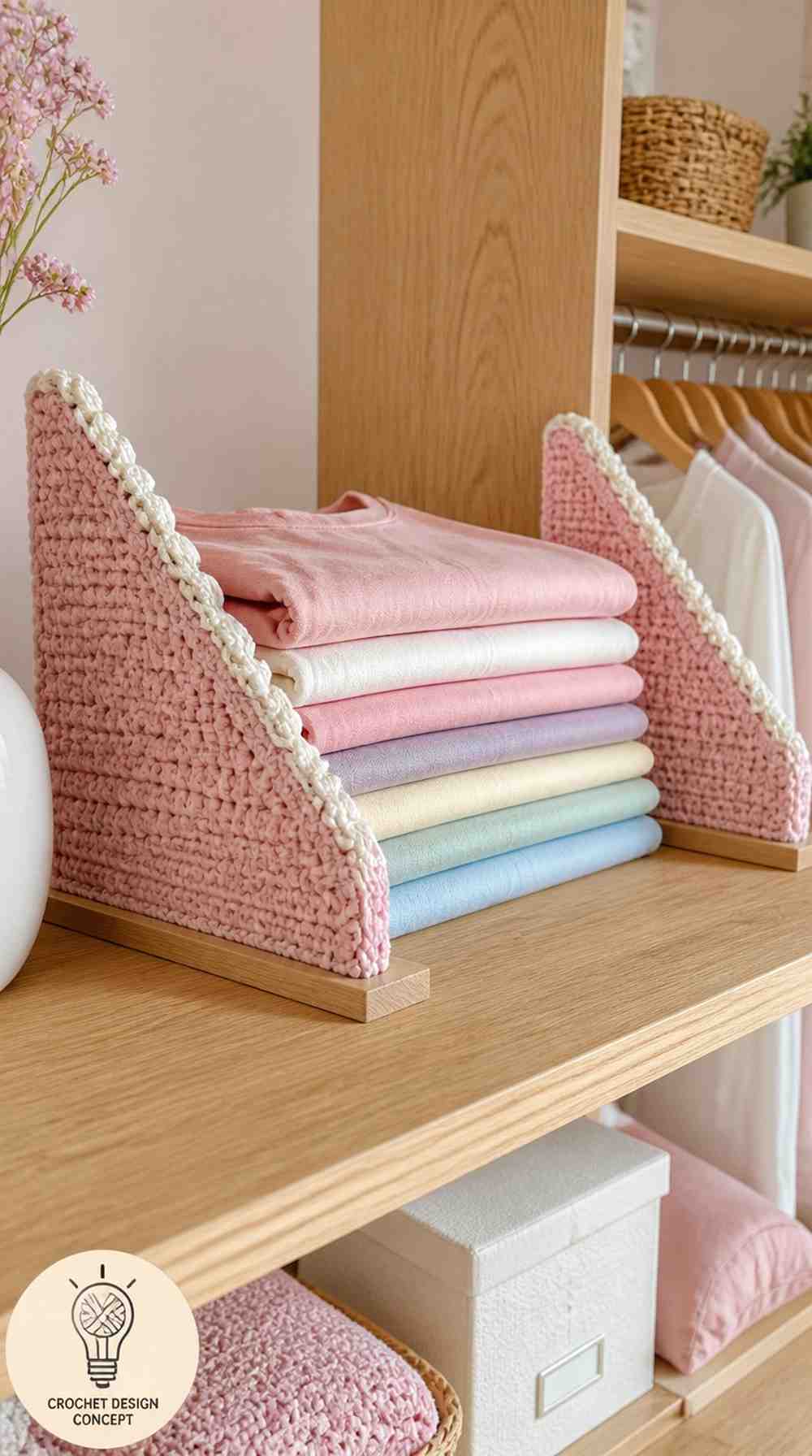
Blush-pink crochet adds a delicate finish to two triangular bookend-style supports. Close shell-like stitches cover the upright panels, while cream scallops follow their sloping upper edges. A neat stack of folded pastel T-shirts rests between the two rigid wooden supports.
The paired arrangement concentrates on one shirt pile rather than dividing a wide shelf into several compartments. It may suit a small collection of favorite T-shirts, with both sides supported independently.
- Bookend spacing: Position the supports around the folded shirts without compressing their edges or making removal difficult.
- Triangular stability: Rigid triangular panels and flat base feet help maintain the upright shape beneath the crochet covering.
- Scalloped edging: Keep the decorative borders compact so they do not catch on sleeves or printed T-shirt surfaces.
- Stack changes: When the pile becomes smaller, the separate supports can be repositioned if their bases remain stable.
7. Crochet Olive Full-Depth Wardrobe Shelf Partitions
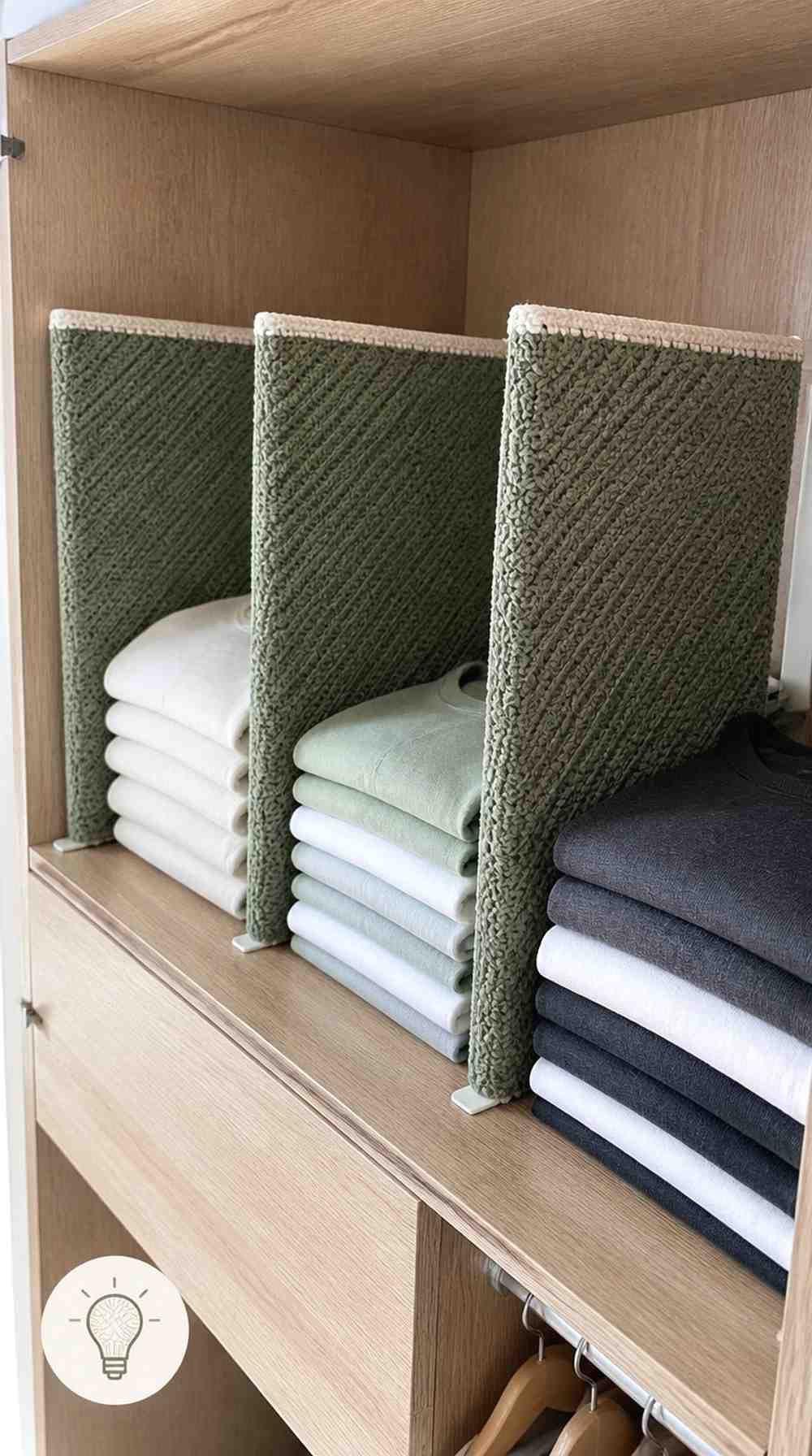
Olive-green crochet gives two long rectangular shelf partitions a natural, understated appearance. Raised diagonal stitches cover the rigid wooden panels, while ivory edging follows their upper borders. Three stacks of folded T-shirts sit separately in cream, sage and charcoal tones.
The full-depth arrangement creates divisions that continue almost to the wardrobe’s back wall. This provides more separation than a short front-facing bookend, which may help keep deeper stacks from spreading into neighboring sections.
- Shelf depth: Measure the usable depth before choosing partitions that extend toward the back wall.
- Rear access: Avoid creating compartments so deep that T-shirts stored farther back become difficult to retrieve.
- Supporting tracks: The panels should fit firmly into suitable rigid mounts rather than depending on crochet fabric to maintain alignment.
- Tall partitions: Choose a height that helps contain shirt stacks without interfering with the shelf directly above.
8. Crochet Lilac Two-Level T-Shirt Shelf Dividers
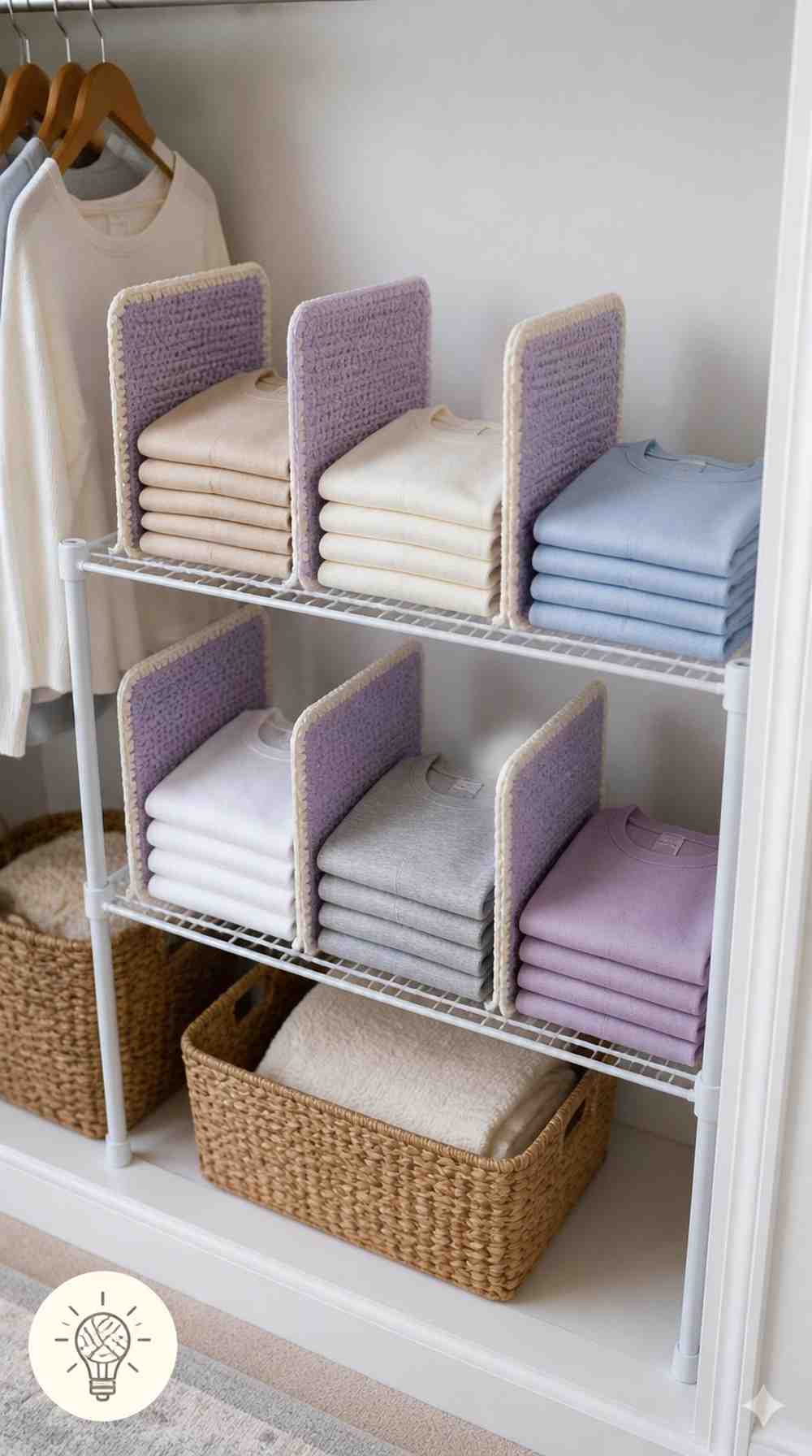
Soft lilac crochet covers four divider panels arranged across a two-tier white metal wardrobe rack. Each level has three compartments, with short stacks of neatly folded T-shirts in neutral and pastel colors. Small waffle-textured stitches and cream piping create a coordinated finish.
The rigid rack adds a second storage surface, making this idea different from dividers placed on a single existing shelf. Its usefulness depends on having enough wardrobe height for both levels and suitable support for the combined clothing.
- Two-tier clearance: Measure the space between the rack levels so folded T-shirts can be lifted out without brushing against the upper shelf.
- Rack stability: The metal frame should safely support both tiers without rocking or bending.
- Divider placement: Each level needs appropriately secured panels so removing one stack does not disturb another.
- Waffle-stitch covering: Raised lilac stitches can make the panels attractive, but the sleeves should remain slim enough for practical storage.
9. Crochet Charcoal Perforated Shelf Divider
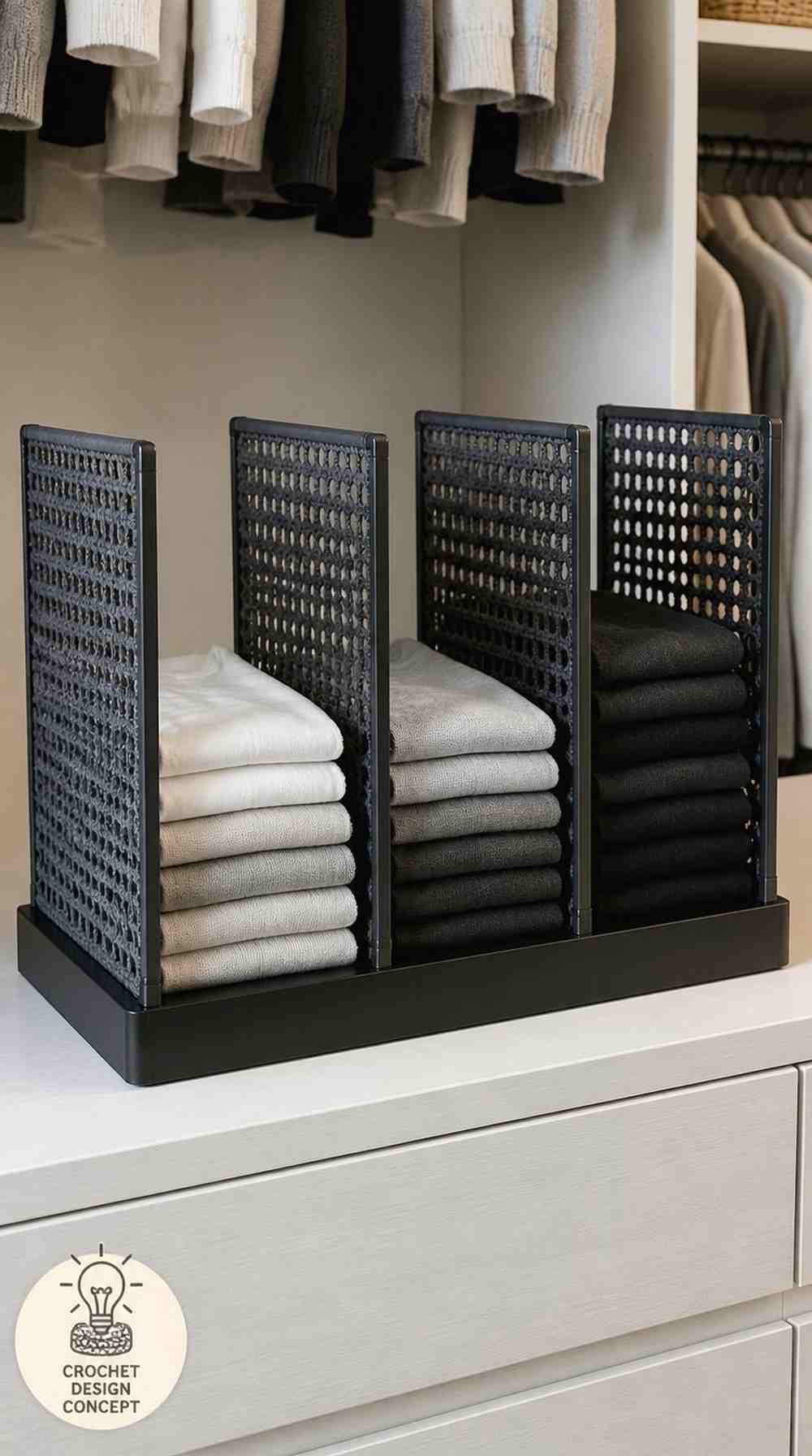
Charcoal crochet softens three perforated metal partitions inside a black rectangular wardrobe organizer. Close square mesh stitches cover parts of the panels, with silver-gray edging defining the borders. Four stacks of monochrome folded T-shirts sit neatly between the rigid dividers.
The partially open construction gives this design a lighter appearance than fully covered wooden panels. The metal structure remains visible beneath the crochet, making the separation between decorative texture and structural support easy to understand.
- Perforated panels: Smooth metal edges are important because rough openings could catch the crochet covering or snag clothing.
- Mesh attachments: Secure the charcoal loops neatly without leaving long loose threads between the metal holes.
- Removable covers: Detachable crochet panels could simplify cleaning and allow the metal organizer to be wiped separately.
- Dark styling: Silver-gray edging makes the dividers easier to distinguish in a dark wardrobe while keeping the color scheme restrained.
10. Crochet Teal Under-Shelf Hanging T-Shirt Separator
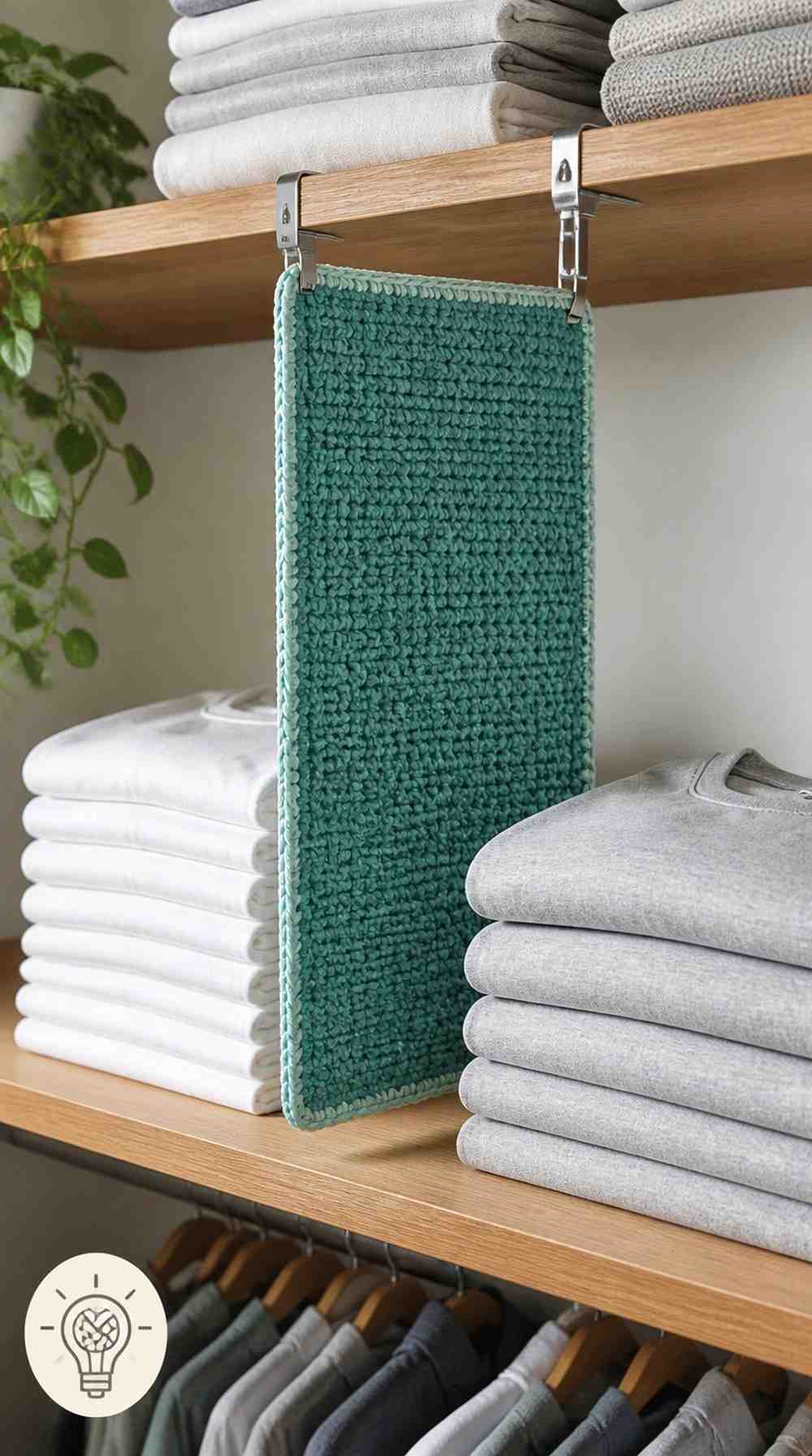
Teal crochet covers one slim rigid partition suspended vertically between two wooden wardrobe shelves. Two metal clamps secure the panel beneath the upper shelf, while its lower edge stops just above the shelf holding the clothes. White and pale-gray T-shirt stacks occupy the spaces on either side.
This design separates shirts from above rather than using a base beneath them. It could be useful where a solid lower divider platform would take up unwanted space, provided the upper shelf can safely support the attachment.
- Upper-shelf clamps: Choose mounting hardware compatible with the shelf material and thickness, without damaging the furniture.
- Panel length: The divider should extend close enough to the lower shelf to separate the shirt stacks without pressing against its surface.
- Clothing clearance: Keep the lower edge smooth so shirts can slide in and out without catching.
- Teal crochet fit: Dense moss-stitch covering gives texture, but it should not interfere with either upper clamp.
11. Crochet Coral Folding Accordion T-Shirt Separator
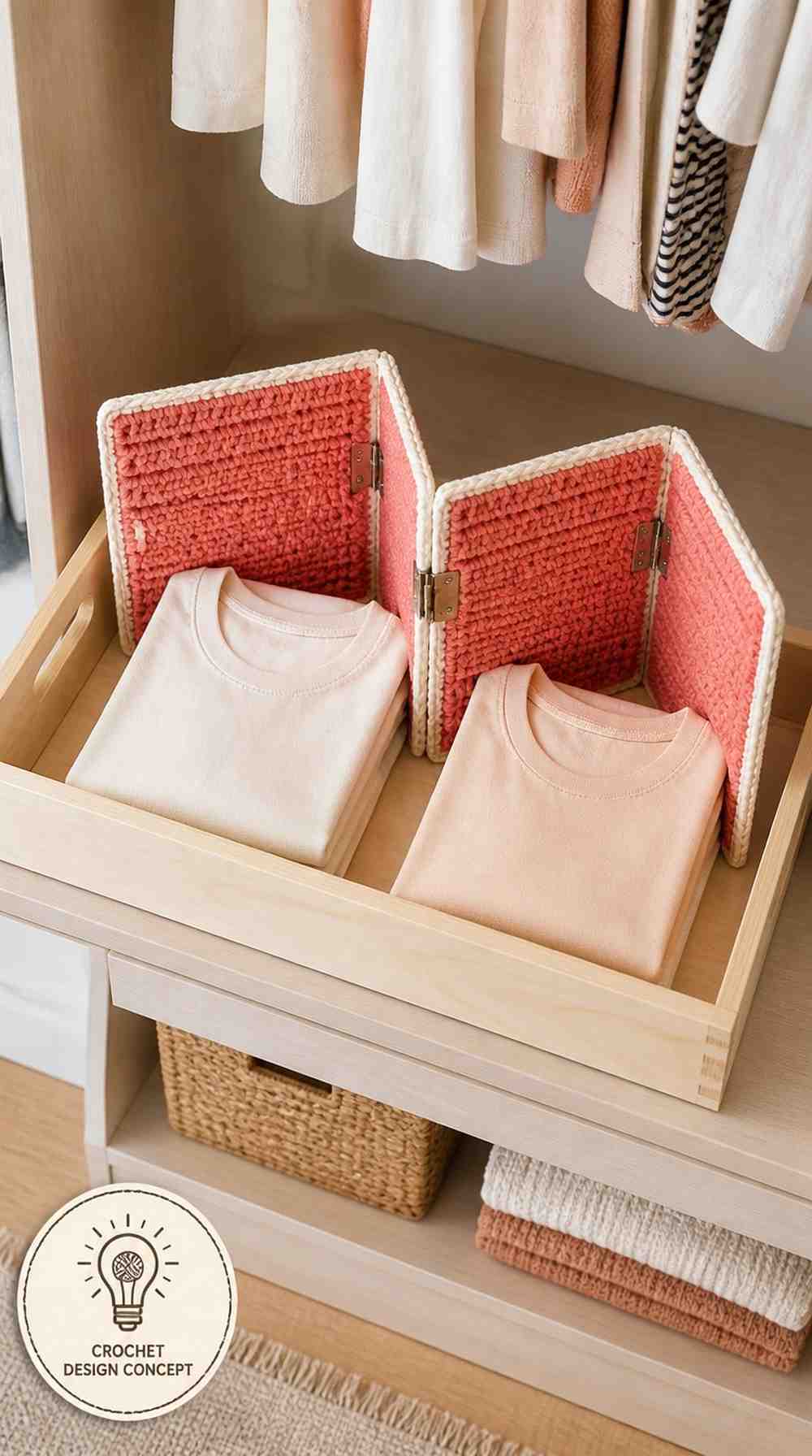
Coral-pink crochet gives three upright hinged panels a cheerful handmade finish. Compact horizontal ridges cover their surfaces, with ivory piping along the edges. The folding panels form two compartments inside a shallow birchwood tray, each holding one neat stack of folded T-shirts.
The accordion arrangement allows the panels to change position when the organizer is empty. However, the hinges and locking supports are essential for keeping the partitions stable while clothing is stored.
- Hinge clearance: Leave exposed space around each metal joint so crochet fabric cannot become caught when the panels fold.
- Open-position security: The upright partitions need suitable stops or locks rather than relying on the weight of folded shirts.
- Compartment size: Both sections should be wide enough for normal T-shirt folds without forcing the fabric against the panels.
- Folding storage: Adjust the accordion mechanism only after removing the clothing to avoid disturbing the stacks.
12. Crochet Navy Pull-Out T-Shirt Divider Tray
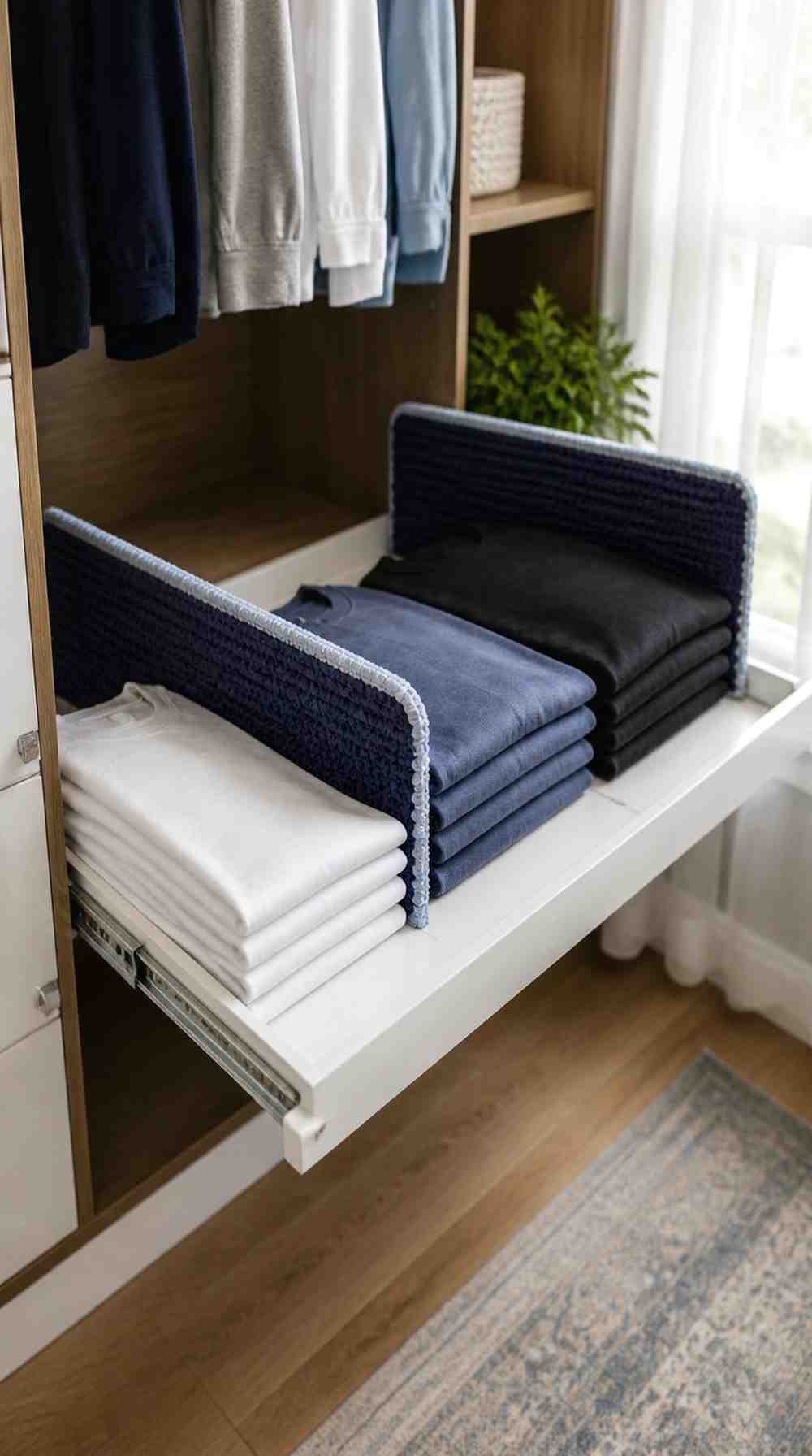
Navy-blue crochet covers two low upright partitions inside a white pull-out wardrobe tray. Powder-blue edging defines the divider tops, while close horizontal ribs add texture. Three stacks of folded T-shirts sit side by side in white, gray-blue and charcoal, with the sliding metal runners visible beneath the tray.
The pull-out arrangement makes it easier to access shirts stored inside a deep wardrobe. Its rigid tray carries the clothing, while the crochet-covered dividers create orderly sections without requiring tall fixed walls.
- Sliding hardware: Choose suitable rails and stops so the tray remains supported when extended.
- Stack height: Leave enough vertical clearance for the tallest pile to move in and out without touching the shelf above.
- Divider height: Low navy partitions may be easier to reach over but offer less support for unusually tall shirt stacks.
- Cleaning access: Removable divider sleeves can make it easier to clear lint from the tray and runner areas.
13. Crochet Peach Clamp-On Shelf Edge Divider
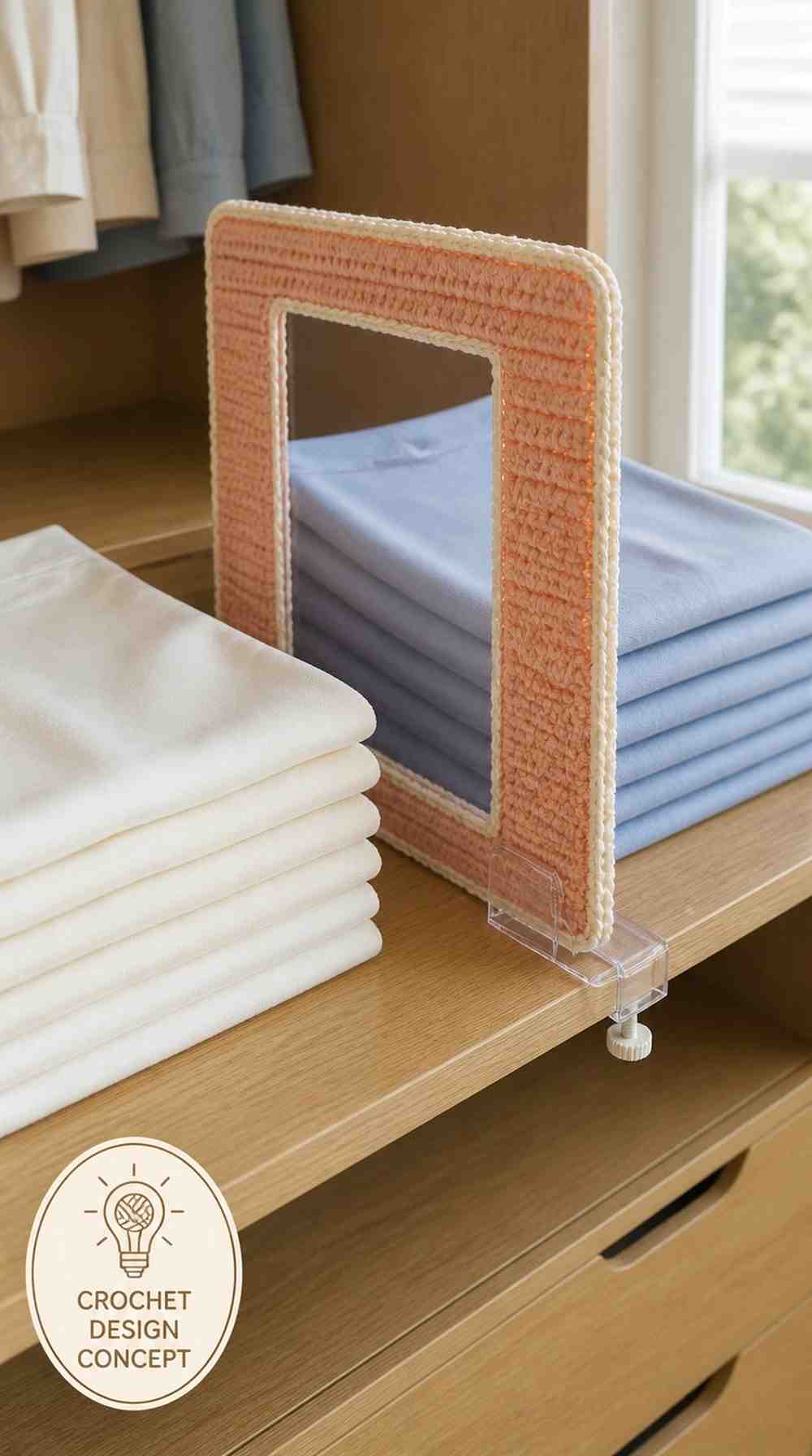
Peach crochet frames a transparent acrylic panel standing between two folded T-shirt stacks on an oak wardrobe shelf. Fine ivory piping follows the crochet border, while raised stitches add a soft outline. Two adjustable clamps secure the rigid panel at its front and rear lower edges.
The transparent center keeps the clothes visible through the divider. This can be especially appealing in a wardrobe with several similar T-shirt stacks, where solid panels might make the shelf feel more crowded.
- Clamp fit: Check the shelf thickness and select hardware that grips securely without damaging the wood finish.
- Clear central panel: Keep the transparent acrylic free of thick decorative stitching so the divided shirt stacks remain visible.
- Edge finishing: The peach crochet border should cover rough contact points without interfering with the clamps.
- Panel height: Choose a divider tall enough for normal folded stacks but short enough to preserve access to the shelf above.
14. Crochet Rust Stepped-Height T-Shirt Divider Set
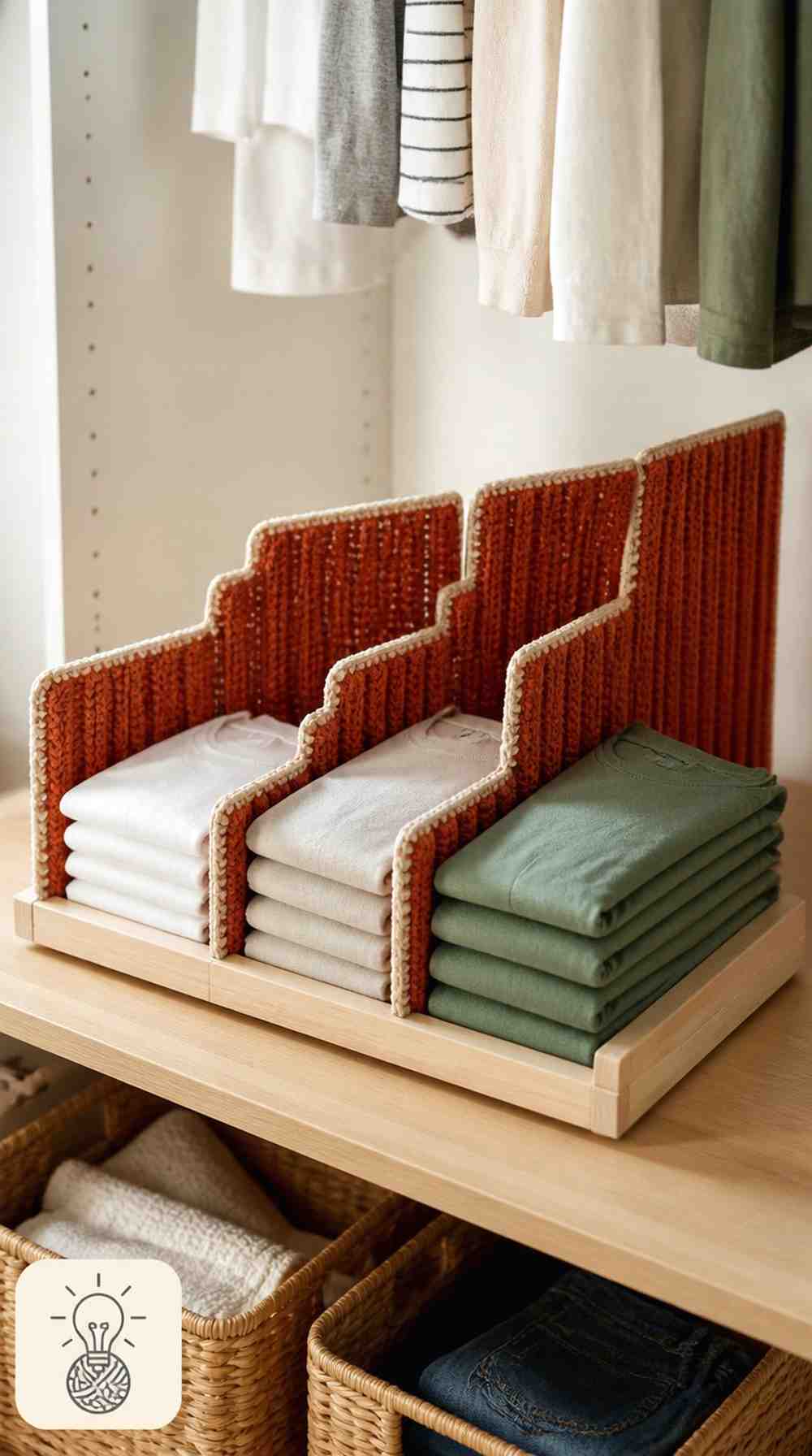
Rust-orange crochet covers two rigid partitions with a distinctive stepped upper profile. The panels are lower at the front and gradually rise toward the back of a pale wooden shelf insert. Raised vertical stitches and sand-beige piping define their edges, while three T-shirt stacks sit separately in white, oatmeal and olive tones.
The stepped shape offers a practical visual advantage. The low front makes it easier to reach folded shirts, while the taller rear section provides more separation deeper inside the shelf.
- Low front access: Keep the front edge below the top of the usual T-shirt stack so clothing can be lifted comfortably.
- Rear support: Taller rear sections may help separate deeper piles, but they should not block access to clothing behind them.
- Stepped crochet shaping: Follow the rigid panel outline closely to avoid loose fabric around the height changes.
- Base reinforcement: Both partitions need secure lower connections so their uneven upper profile does not make them wobble.
15. Crochet Mint Clear-Panel Shirt Shelf Separators
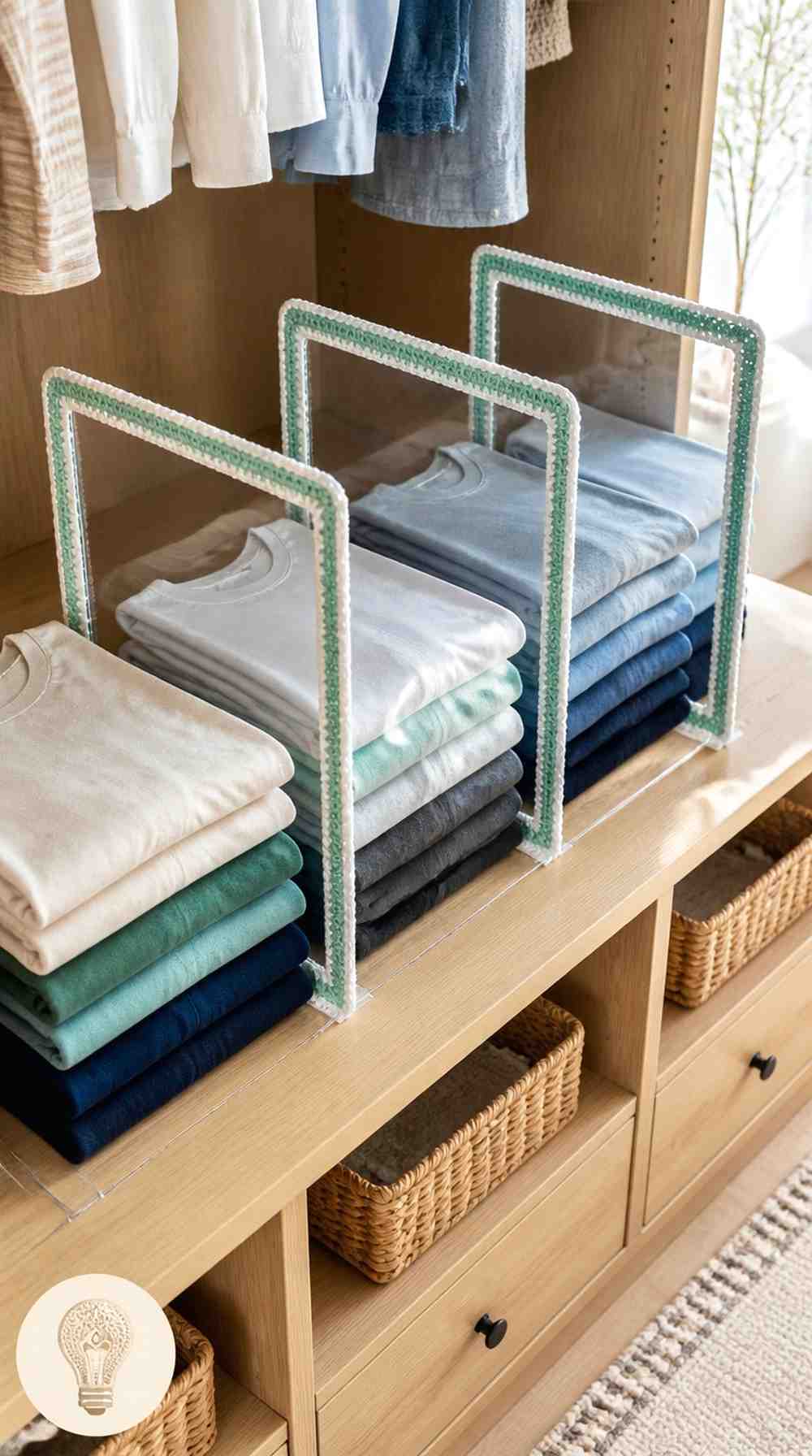
Mint-green crochet frames three transparent acrylic divider panels on a pale-oak wardrobe shelf. Closely worked moss-like stitches and fine white piping follow the edges, leaving each panel’s center clear. Four tidy stacks of cotton T-shirts remain visible through the partitions.
The transparent design combines the decorative appeal of crochet with the openness of acrylic. It may suit a wardrobe where keeping shirt colors visible matters more than completely concealing one compartment from another.
- Clear panel visibility: Leave most of each acrylic surface uncovered so the transparent design remains useful.
- Stable base slots: All three partitions should fit securely into rigid supports rather than relying on their crochet borders for balance.
- Smooth edges: Any acrylic corners or edges need appropriate finishing before the crochet covers are fitted.
- Cleaning combination: Removable mint borders may make it easier to clean the transparent panels without wetting or damaging the yarn.
16. Crochet Butter-Yellow Fold-Flat T-Shirt Supports
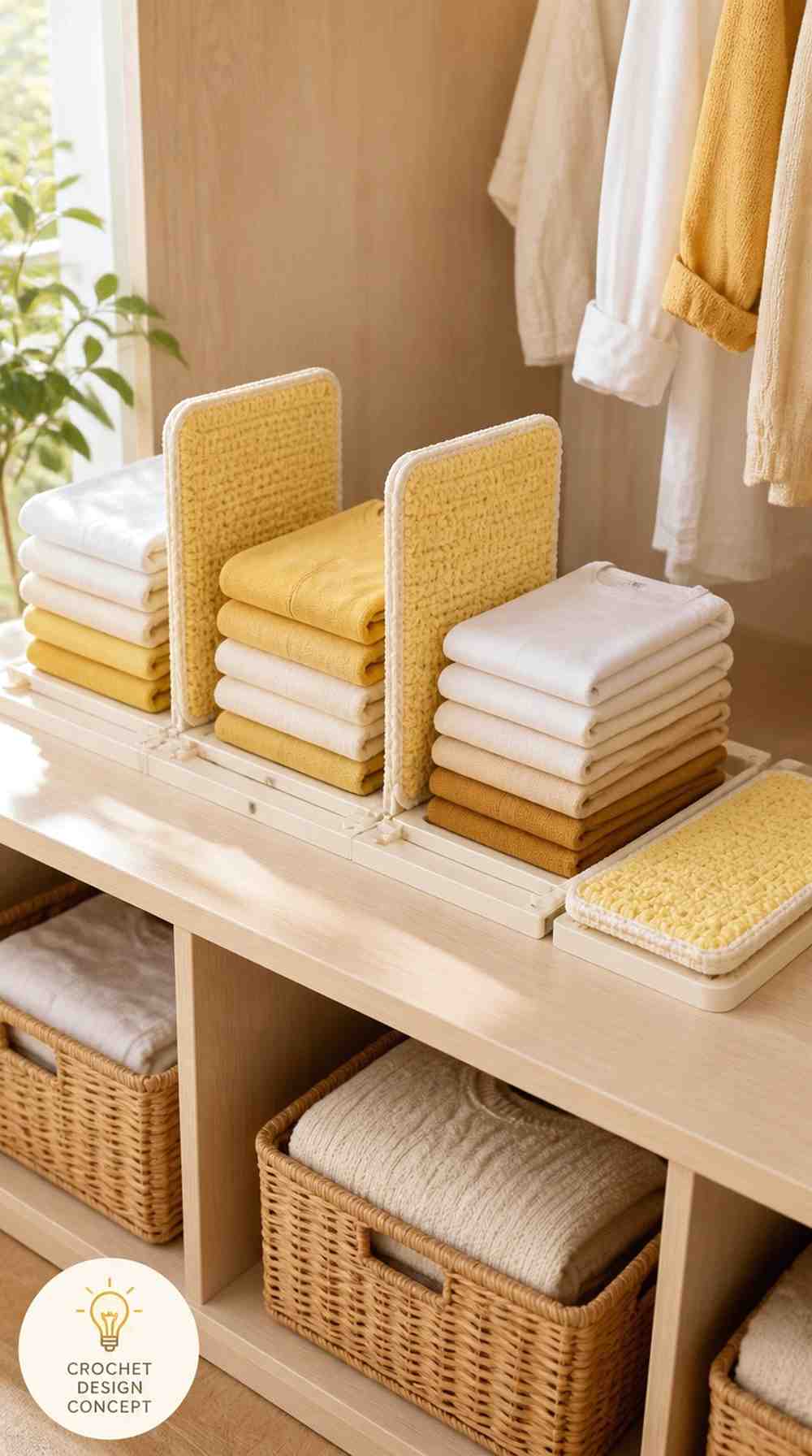
Butter-yellow crochet brightens three folding bookend-style panels mounted on a long wooden organizer base. Two panels stand upright between three folded T-shirt stacks, while a spare third panel lies flat at one end. Fine lemon-peel stitches and cream ribbed edging give every panel a matching finish.
This design focuses on changing the number of active partitions. An unused panel can fold flat without requiring the entire organizer to be removed, although the hinges need appropriate supports and clear movement.
- Folding mechanism: Use secure hinges and suitable stops to keep the active panels upright while clothing rests beside them.
- Spare divider: The flat panel should sit outside the clothing area instead of creating an uneven surface beneath a stack.
- Changing compartments: Reposition the dividers only after moving nearby shirts out of the way.
- Crochet around hinges: Keep the butter-yellow fabric clear of moving joints to prevent pinching and unnecessary wear.
17. Crochet Mocha Reversible T-Shirt Shelf Dividers
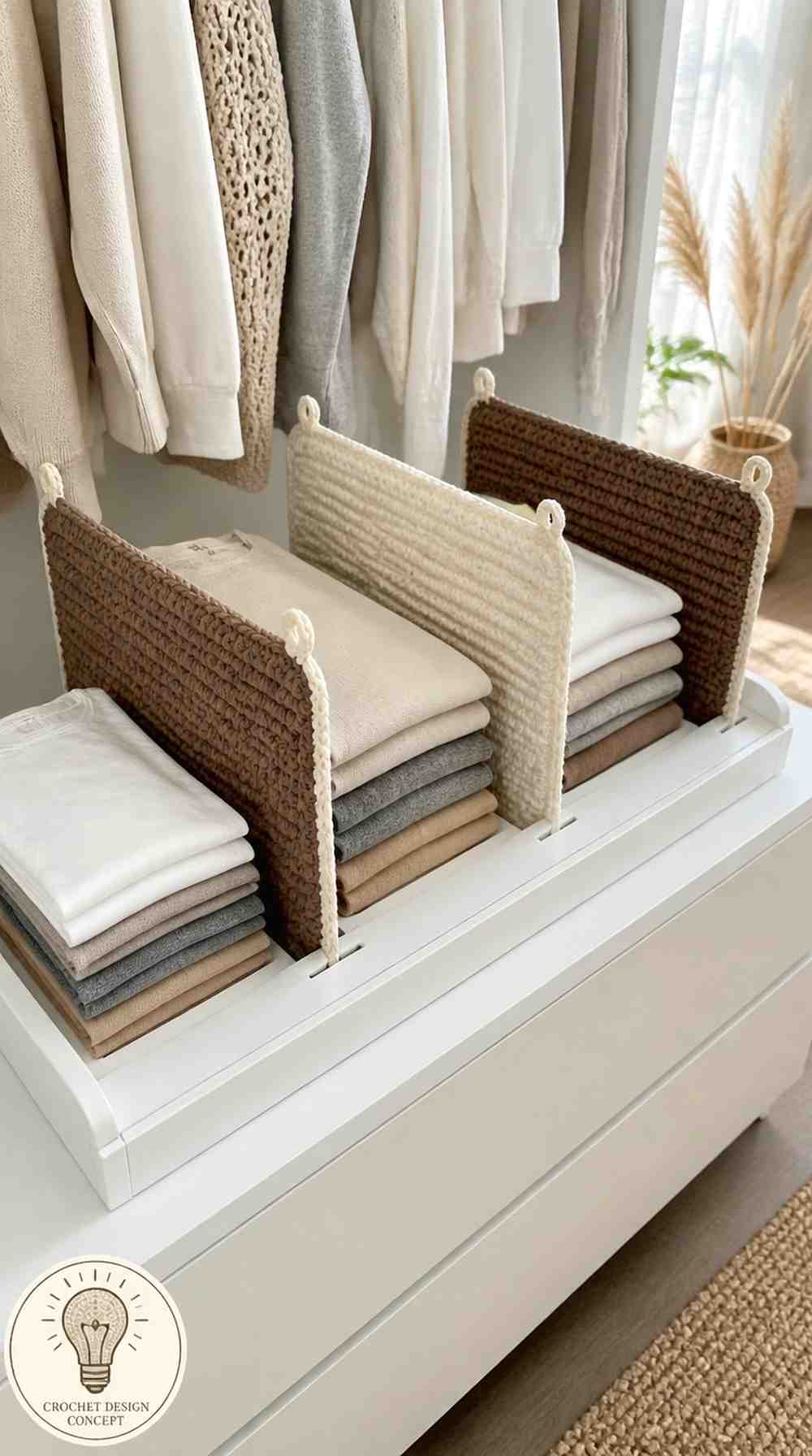
Mocha-brown and ivory crochet create a refined finish across three removable wardrobe partitions. The left and right panels display mocha basket-textured surfaces, while the middle panel shows a warm-ivory ribbed reverse face. Small removal tabs and cream piping complete the fitted sleeves.
Four stacks of neutral T-shirts occupy the sections between the rigid panels inside a white shelf tray. The two-sided crochet coverings introduce decorative flexibility without requiring a different organizer structure each time the wardrobe colors change.
- Reversible sleeves: Both sides of each covering should have neatly finished seams and comparable thickness.
- Removal tabs: Keep the small upper tabs accessible but flat enough that they do not catch on folded clothing.
- Secure panel slots: The rigid partitions must remain upright when shirts are pulled from adjacent compartments.
- Neutral color choices: Mocha and ivory work as coordinated alternatives while keeping the dividers visually separate from the clothing.
Practical Guide to Crochet Folded T-Shirt Shelf Separators
Folded T-shirt separators work best when they match the actual wardrobe space and the way you fold your clothes. Decorative crochet can make a closet feel more personal, but stability and access are what make a divider useful.
Measure your folded T-shirts first. Fold a few shirts as you normally would, then measure their width, depth and usual stack height. Allow a little extra room around each pile so clothes can be removed without pulling neighboring stacks apart.
Choose the right separator style. A freestanding bookend may suit one or two piles. Long rigid partitions are more appropriate when dividing the full depth of a wide shelf. Adjustable dividers can be useful if shirt sizes or quantities change regularly.
Use rigid structural supports. Crochet fabric stretches and bends, particularly when pressure is applied from the side. Wood, suitable acrylic or metal panels can provide the main separation, with crochet used as removable decorative coverings.
Avoid unnecessary bulk. Thick textured crochet may look attractive, but every covered partition reduces the available shelf width. Closely worked stitches, smooth seams and compact edging are usually easier to fit around folded cotton clothing.
Protect your T-shirts. Keep edges smooth, avoid rough fasteners and position decorative scallops away from areas that frequently rub against the fabric. Openwork and raised embellishments may catch on delicate materials or printed designs.
Make cleaning easy. Wardrobe shelves collect dust and lint. Consider removable crochet sleeves and accessible base supports so the dividers can be cleaned without dismantling the entire closet.
For more related home-storage inspiration, explore 12 Crochet Storage Basket Ideas on Yarn Nest Studio. The collection includes structured rectangular storage concepts, though they are different from individual T-shirt shelf separators.
Want to Make Something Similar?
These verified resources explain crochet dividers and structured storage techniques. They are not exact patterns for the 17 AI design concepts above.
- Free Organizer Basket Crochet Pattern with Removable Dividers by Nicki’s Homemade Crafts — A free written pattern with a video tutorial that explains a cotton basket with removable partitions, useful for exploring the divided compartments in the terracotta and mocha concepts. Nicki’s Homemade Crafts
- Free Spike Stitch Crochet Basket Pattern with Removable Divider by Nicki’s Homemade Crafts — Another genuine organizer pattern, featuring a removable divider and a textured crochet finish that can inspire the decorative surfaces in this collection. Nicki’s Homemade Crafts
- 30 Free Crochet Basket Patterns by Make & Do Crew — A collection that discusses different ways to give crochet baskets structure, including suitable inserts and bases. These ideas are relevant to planning supportive decorative panels. Make & Do Crew
These patterns are for their own storage projects. A folded T-shirt shelf separator needs separate measurements, appropriate supports and a construction method suited to the actual wardrobe.
Comparison: Which Crochet T-Shirt Shelf Separator Should You Choose?
| Wardrobe need | Design to consider | Main trade-off |
|---|---|---|
| Simple division of two stacks | Sage Freestanding Divider | Base foot needs stability |
| Fixed shelf attachment | Ivory Clip-On Separator | Clips must fit shelf edges |
| Three fixed compartments | Terracotta Interlocking Set | Slot positions are fixed |
| Adjustable shirt widths | Dusty-Blue Sliding Dividers | Tracks and locks add complexity |
| Central support for two stacks | Mustard Double-Sided Support | Broad base occupies space |
| Support around one shirt pile | Blush Scalloped Bookend Pair | Two independent supports |
| Deep wardrobe separation | Olive Full-Depth Partitions | Takes more shelf depth |
| Two storage levels | Lilac Two-Level Dividers | Requires extra vertical clearance |
| Modern metal construction | Charcoal Perforated Divider | Metal edges need finishing |
| No base under clothing | Teal Under-Shelf Separator | Needs suitable overhead attachment |
| Folding compartments | Coral Accordion Separator | Hinges must lock securely |
| Pull-out wardrobe access | Navy Divider Tray | Requires reliable runners |
| Transparent panel with clips | Peach Clamp-On Divider | Must suit shelf thickness |
| Easier front access | Rust Stepped-Height Set | Uneven panel profile |
| Visible clothes through dividers | Mint Clear-Panel Separators | Acrylic requires cleaning |
| Fold-away spare partitions | Butter-Yellow Fold-Flat Supports | Moving parts need maintenance |
| Reversible decorative finishes | Mocha Reversible Dividers | Extra sleeve construction |
A simple freestanding separator may be enough for two folded T-shirt stacks. For a larger wardrobe with several groups of clothing, rigid compartment dividers can give a tidier arrangement. If your storage needs change frequently, adjustable or removable partitions may be the better option.
Conclusion
Crochet folded T-shirt shelf separators offer a creative way to bring handmade detail into everyday wardrobe organization. From sage-green freestanding supports and terracotta dividers to lilac two-tier shelving and mint transparent panels, these 17 ideas show how different structures can keep clothing piles more clearly defined.
The best separator will fit your shelf, support the usual stack height and allow you to remove shirts without disturbing the rest. Start with a suitable rigid structure, then use crochet texture, color and edging to personalize it.
Which design would work best in your wardrobe? Would you choose the sage freestanding divider, the dusty-blue adjustable panels or the mocha reversible set? Share your favorite and whether you prefer separating T-shirts by color, style or everyday use.
Frequently Asked Questions
Can crochet shelf dividers keep folded T-shirts upright on their own?
Crochet fabric is flexible, so it may bend or stretch when clothing presses against it. A rigid internal panel, supported base or suitable mounting system is a more dependable way to keep T-shirt stacks separated. Crochet is better used as a decorative covering.
What yarn should I use for crochet T-shirt shelf separator covers?
Smooth cotton or cotton-blend yarn may be worth considering because many varieties give clear stitch definition and can be washed according to their care instructions. Avoid overly fuzzy yarn or loose decorations that may shed fibers or catch on clothing. Choose a thickness that suits the available shelf space.
How tall should a folded T-shirt shelf divider be?
The height depends on the number of shirts you usually stack and the clearance beneath the shelf above. Measure your normal folded pile and select a divider that supports it without making removal awkward. There is no single height suitable for every wardrobe.
Are adjustable shelf dividers better than fixed dividers?
Adjustable panels can be useful when the width of your folded T-shirt stacks changes frequently. Fixed dividers are often simpler and have fewer moving parts. Both can work well when their supporting structures are stable and the compartments provide enough access to the clothing.
Are these 17 crochet folded T-shirt shelf separators available as exact patterns?
No. These are AI-generated design visualizations intended for inspiration, not tested finished products or complete crochet patterns. The linked tutorials explain related basket and divider construction techniques, but they do not reproduce the exact designs pictured here. Any working version would need suitable measurements, materials, secure supports and practical testing. Review the generated images for accurate crochet details and believable divider attachments before publishing.