A crochet espresso tamper rest mat can bring a little handmade character to an everyday coffee station while giving the tamper a designated place between uses. These 17 inspiration ideas explore compact circles, rounded rectangles, decorative arches, checkered squares, and double-tool resting surfaces. The collection includes warm terracotta, classic oatmeal, deep navy, cheerful butter yellow, vintage blue, and rich burgundy, with different crochet textures and borders.
Whether you have a small espresso corner or a dedicated home coffee bar, the right resting mat concept depends on counter space, tamper size, cleaning needs, and how much decoration you prefer. Some designs keep the surface simple and flat, while others use floral outlines, granny-square motifs, or softly raised frames. Use these ideas to compare shapes, colors, and finishing details before planning your own version.
These are AI-generated crochet design visualizations for inspiration, not photographs of tested handmade pieces or step-by-step patterns. They are decorative tamper rests, not substitutes for stable, purpose-made tamping mats.
Quick Design Selection Guide
- For a small coffee corner: The Crochet Oatmeal Circular Tamper Mat and Crochet Ivory Corner Tamper Mat offer compact shapes without long decorative extensions.
- For a shared accessory area: The Crochet Charcoal Double Rest Mat separates two small coffee tools, while the Crochet Espresso Brown Long Tool Rest gives a tamper and cleaning brush their own places.
- For simple everyday styling: The Crochet Terracotta Barista Rest Mat and Crochet Cocoa Diagonal Stripe Rest use relatively straightforward outlines and closely worked crochet surfaces.
- For decorative coffee stations: The Crochet Dusty Rose Floral Tamper Mat, Crochet Lavender Lace-Edge Tamper Mat, and Crochet Burgundy Art Deco Tamper Mat make the borders part of the display.
- For easy storage between uses: The Crochet Peach Hanging-Loop Tamper Mat has a corner loop that could be adapted for hanging when the mat is empty.
1. Crochet Terracotta Barista Rest Mat
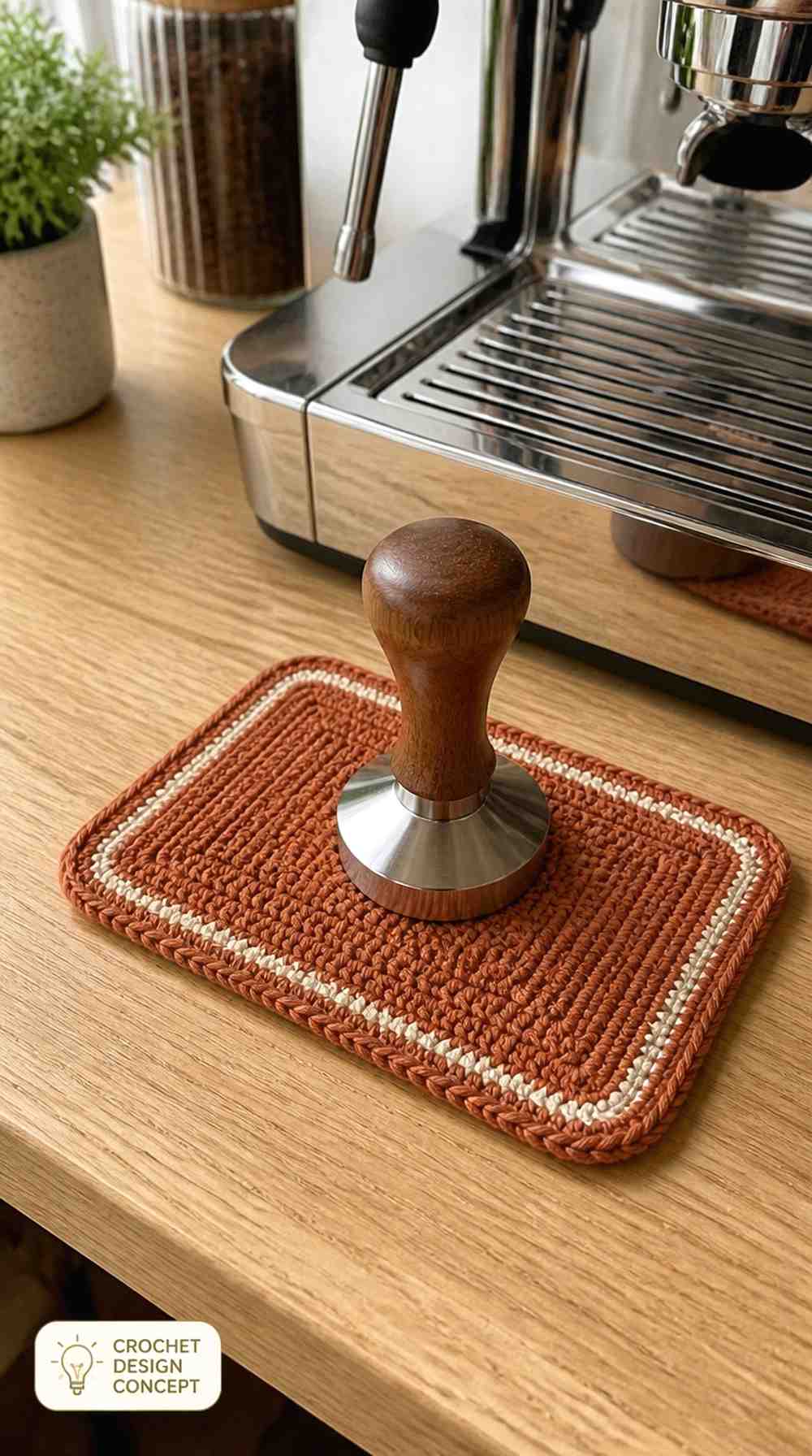
Warm terracotta crochet gives this small rectangular rest mat a welcoming coffee-shop character. Its tightly worked horizontal rows create a simple, even-looking surface, while the slim cream inset border draws attention to the softly rounded corners. A stainless-steel tamper with a walnut handle stands at the center, making the mat’s everyday purpose immediately clear.
The low rectangular shape suits an uncluttered espresso counter. Since the crochet sits beneath the tamper’s metal base, keeping the middle relatively smooth matters more than adding raised decoration.
- Close-Worked Center: Choose a stitch arrangement that produces a reasonably even resting area. Large gaps and raised clusters could make the tamper less steady.
- Cream Border Placement: Keep the lighter inset trim narrow and away from the tamper’s main contact area so the center remains visually simple.
- Countertop Fit: Compare the mat’s intended length and width with your tamper base and available countertop space before choosing proportions.
2. Crochet Oatmeal Circular Tamper Mat
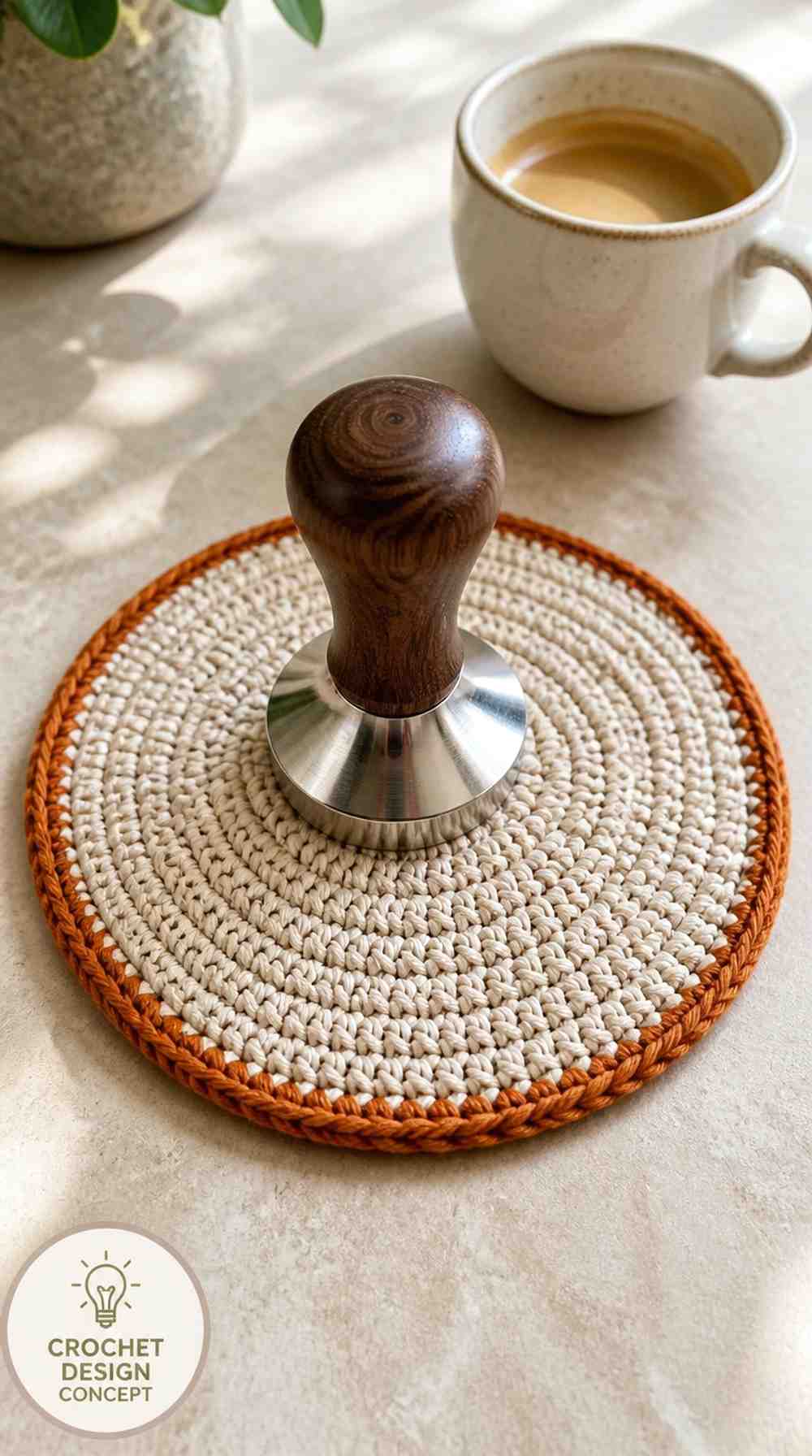
Soft oatmeal cotton crochet forms a tidy circular rest with clearly defined concentric rounds. A narrow burnt-orange outer ring adds warmth without interrupting the flat central area. The silver espresso tamper and its short dark wooden handle create a pleasing contrast against the pale yarn.
This is one of the simpler shapes in the collection, making it worth considering for a small home espresso setup. Its rounded outline takes up little visual space, although the real resting surface would still need careful flattening.
- Circular Increase Balance: Evenly distributed increases help a crocheted circle lie flat. Check for cupping or rippling before treating it as a tamper rest.
- Outer Color Ring: The burnt-orange ring provides a clear finishing detail without requiring a thick, raised border around the metal base.
- Small-Space Planning: Leave enough exposed fabric around the tamper base to make it easy to place and lift without catching the outer stitches.
3. Crochet Navy Checkered Tamper Mat
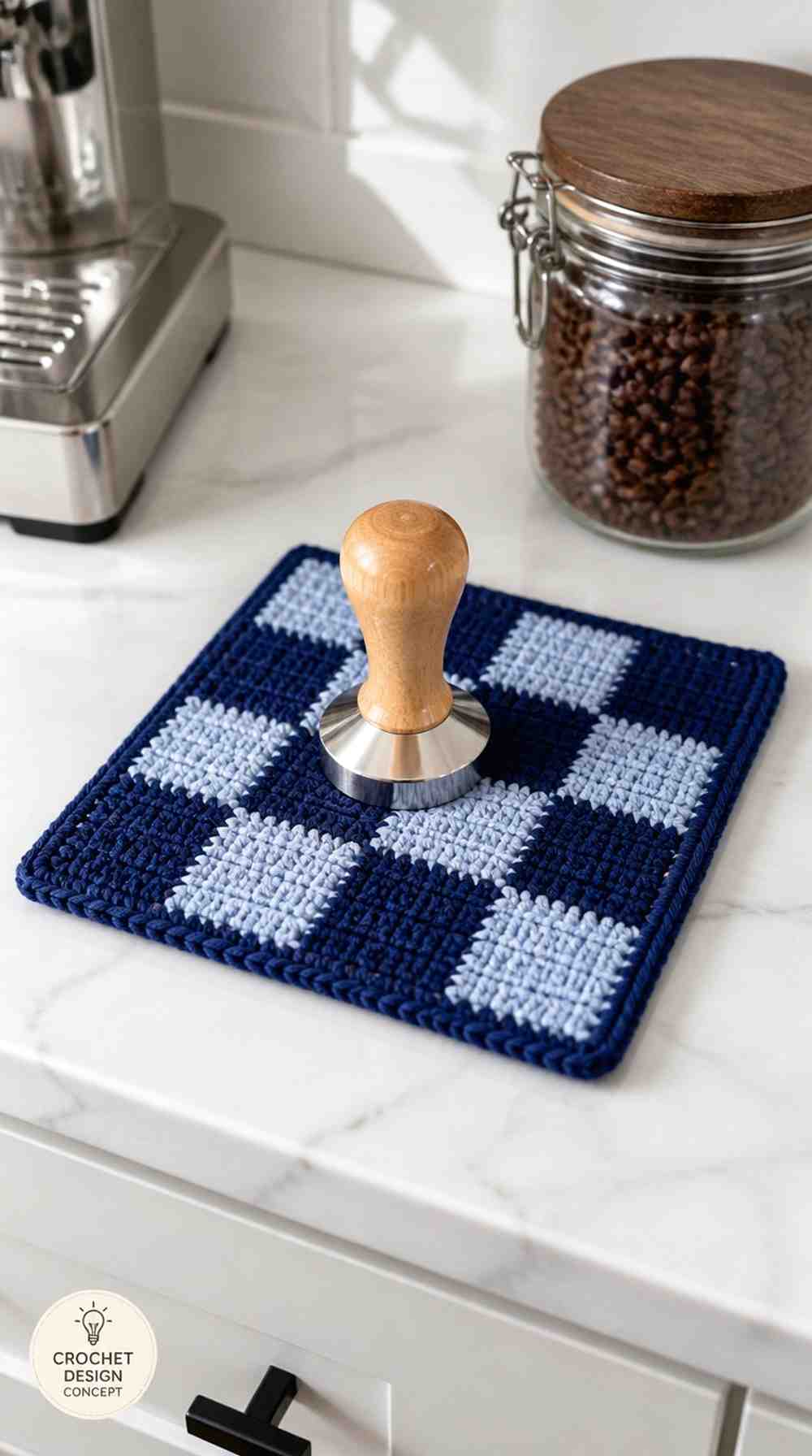
Navy and powder-blue crochet squares create a neat checkerboard mat with a modern, slightly playful appearance. The square design features visibly joined sections, a narrow navy border, and a stainless-steel tamper with a natural maple handle positioned over one blue central section.
Unlike a single-piece circular mat, this design relies on the relationship between its individual squares. The contrast makes those joins part of the visual appeal, but their thickness deserves attention if you want a practical resting surface.
- Joined-Square Flatness: Keep the joins as unobtrusive as possible, especially beneath the tamper’s intended position. Raised seams may affect how its base rests.
- Checkerboard Proportions: Test the scale of each square against the actual tamper. Very large motifs could overwhelm a compact coffee accessory.
- Color Maintenance: The contrasting blue sections may show loose coffee grounds differently, so choose yarn and care methods suitable for frequent cleaning.
4. Crochet Caramel Oval Tamper Rest
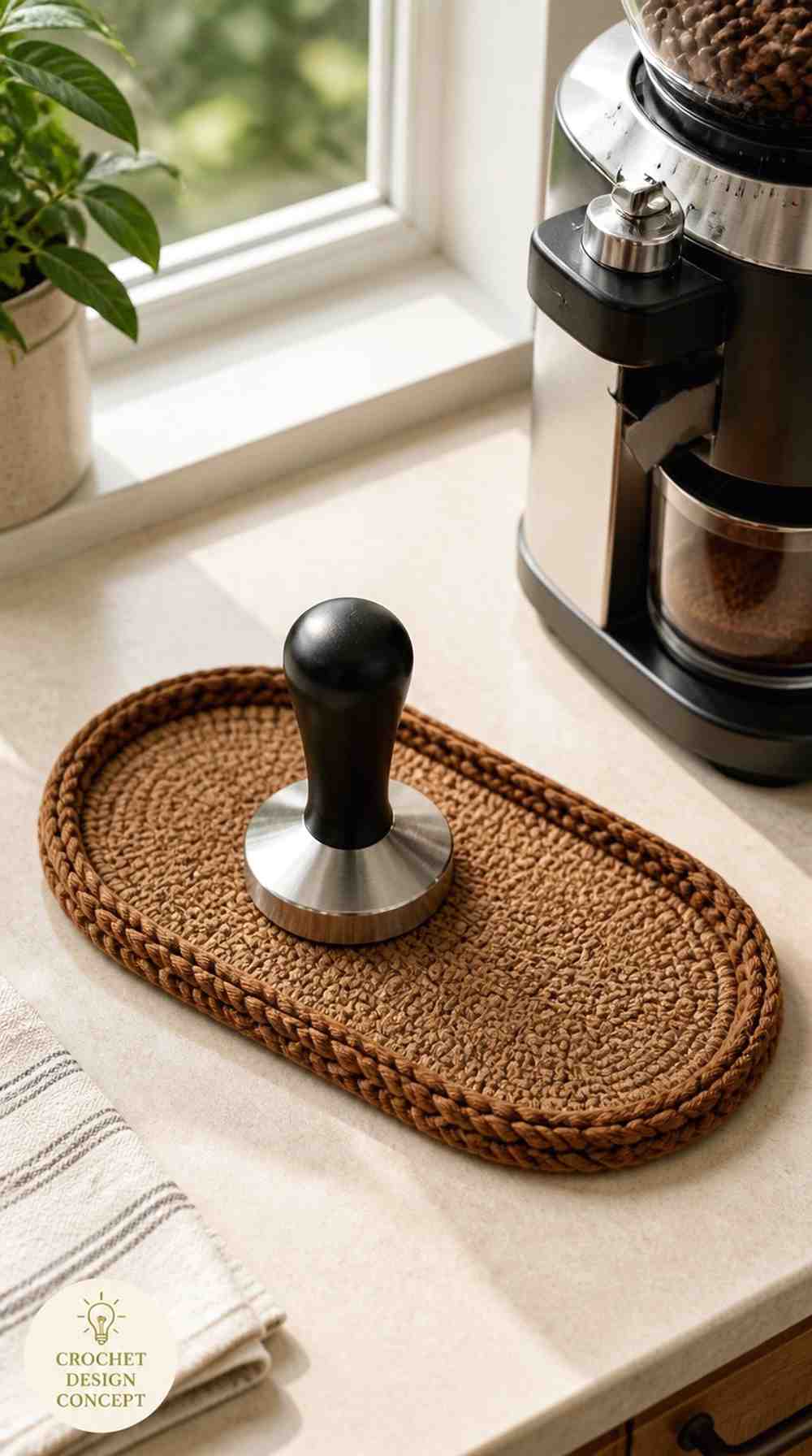
Caramel-colored crochet gives this elongated oval mat a warm, natural finish. The broad, densely worked center provides a visually calm resting area, while a darker toffee perimeter introduces a braided-looking crochet texture. A brushed-steel tamper with a black handle stands comfortably inside the oval outline.
The oval shape offers a softer alternative to a rectangle without using an ornate decorative motif. Its most important design distinction is the contrast between the flatter center and the gently raised outer crochet edge.
- Perimeter Height: Keep the toffee edging outside the tamper’s footprint. An overly raised inner rim may reduce the useful central area.
- Oval Shaping: Check that both rounded ends remain symmetrical and the middle does not pull inward as stitch tension changes.
- Material Choice: Consider a smooth, reasonably firm cotton yarn that makes the oval stitches easy to distinguish without creating unnecessary bulk.
5. Crochet Ivory Corner Tamper Mat
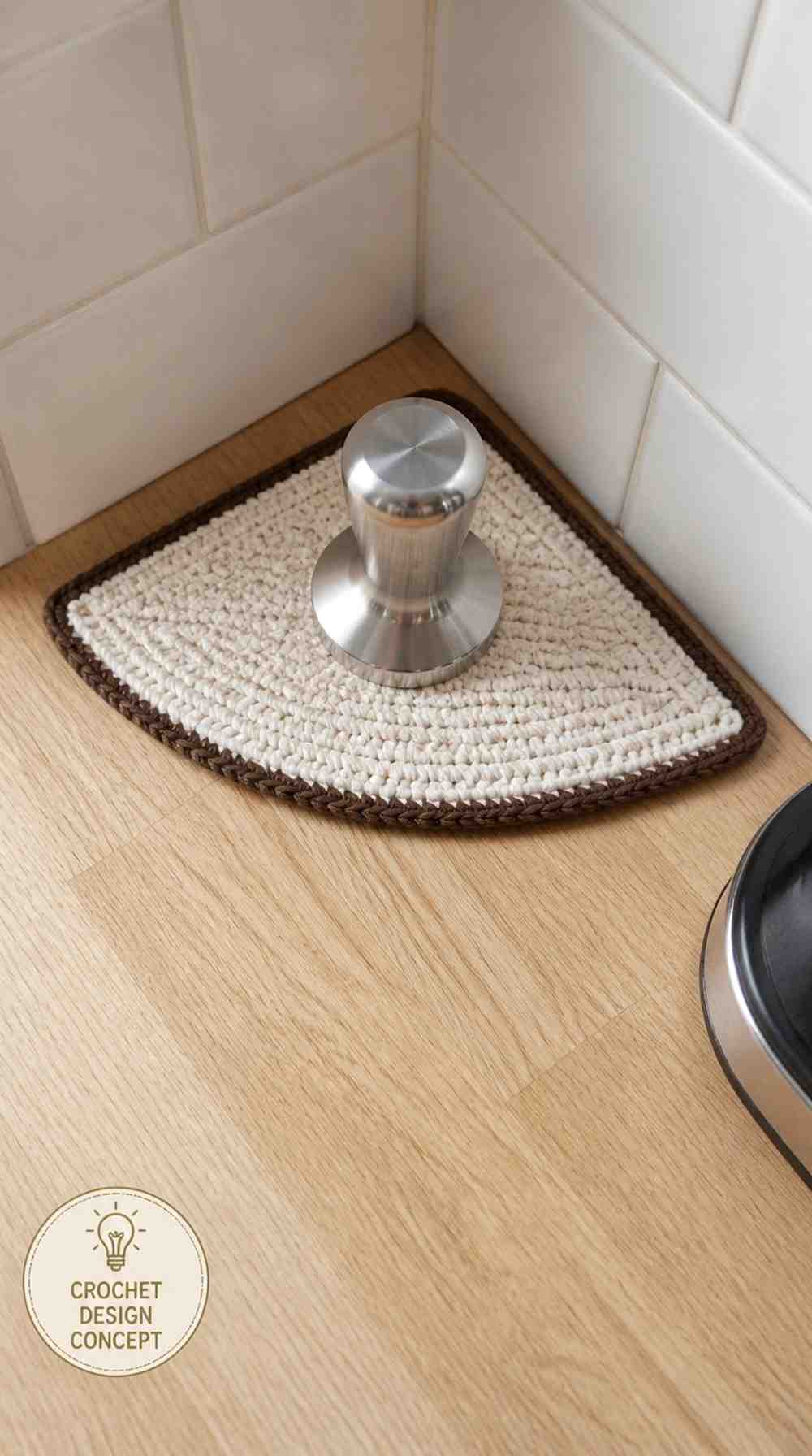
A compact triangular crochet shape gives this ivory rest mat its distinctive corner-friendly look. Two straight sides meet at a right angle, while the gently curved front edge has a slim chocolate-brown finish. The closely stitched center supports the visual arrangement of a stainless-steel tamper standing upright.
The design looks particularly appealing near a tiled backsplash, where its straight edges can follow the lines of the countertop. It should still rest entirely on a firm surface rather than hanging over a counter edge.
- Corner Shape: Check the available countertop depth and the distance from the backsplash before choosing the triangular proportions.
- Curved Front Edge: The rounded front softens the outline, but the chocolate trim should remain outside the tamper’s flat resting area.
- Useful Center Width: A triangular mat narrows toward its rear point. Make sure the tamper has enough uninterrupted fabric beneath its entire base.
6. Crochet Charcoal Double Rest Mat
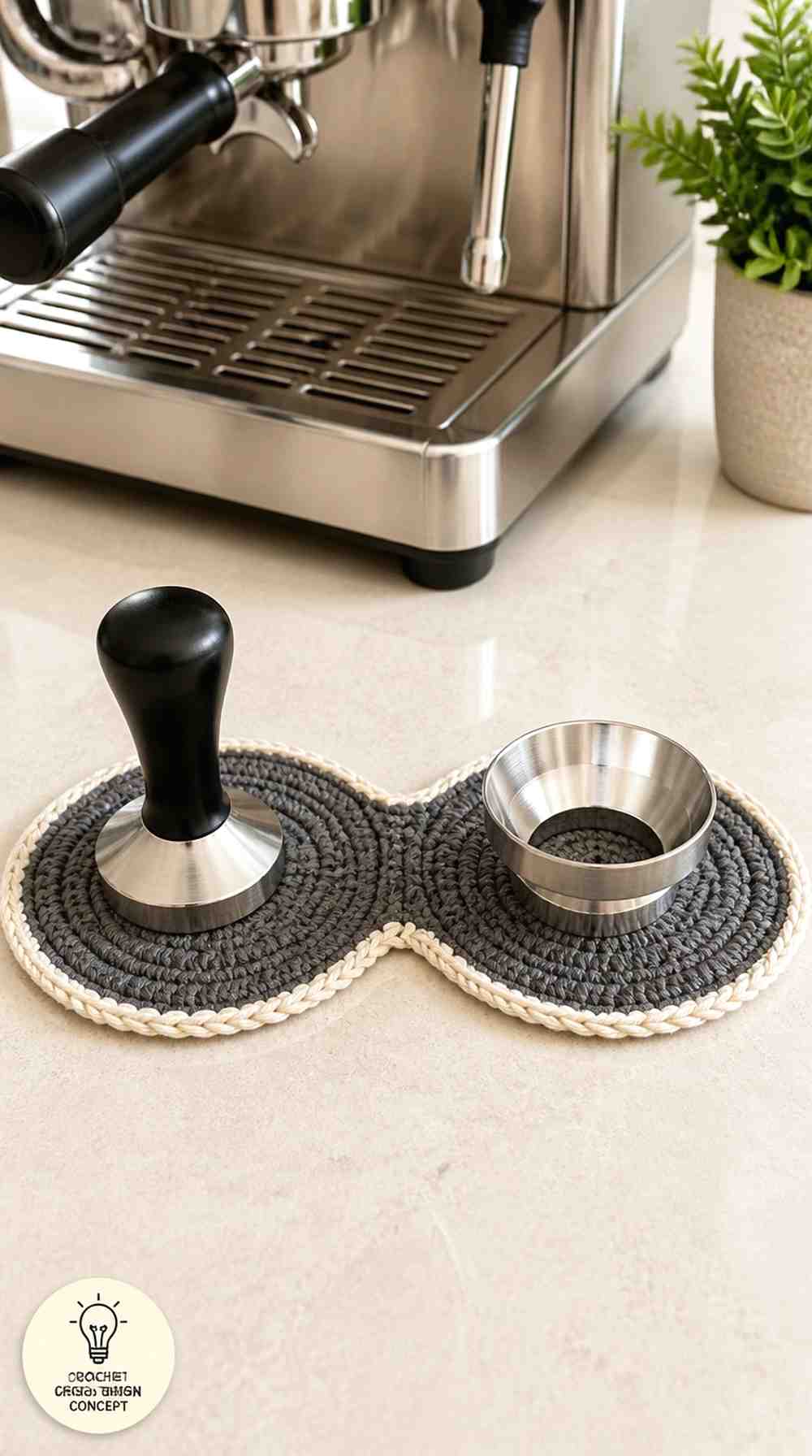
Two charcoal-grey crochet circles joined by a short connecting bridge create an unusual figure-eight accessory rest. Fine cream rings finish both circular sections. The left side holds a steel tamper with a black handle, while a separate stainless-steel dosing funnel occupies the right.
The linked-circle arrangement gives two small espresso tools visually separate parking areas without making a deep organizer. It may suit a coffee setup where those accessories are usually kept together, provided the joining section does not distort the flat pads.
- Two Separate Resting Zones: Compare the tamper base and dosing funnel footprint individually rather than assuming both accessories need identical circles.
- Connecting Bridge: The short crochet bridge should keep the pads together without pulling their edges upward or bunching between them.
- Tool Clearance: Allow enough distance between the circles so that lifting one metal accessory does not knock against the other.
7. Crochet Dusty Rose Floral Tamper Mat
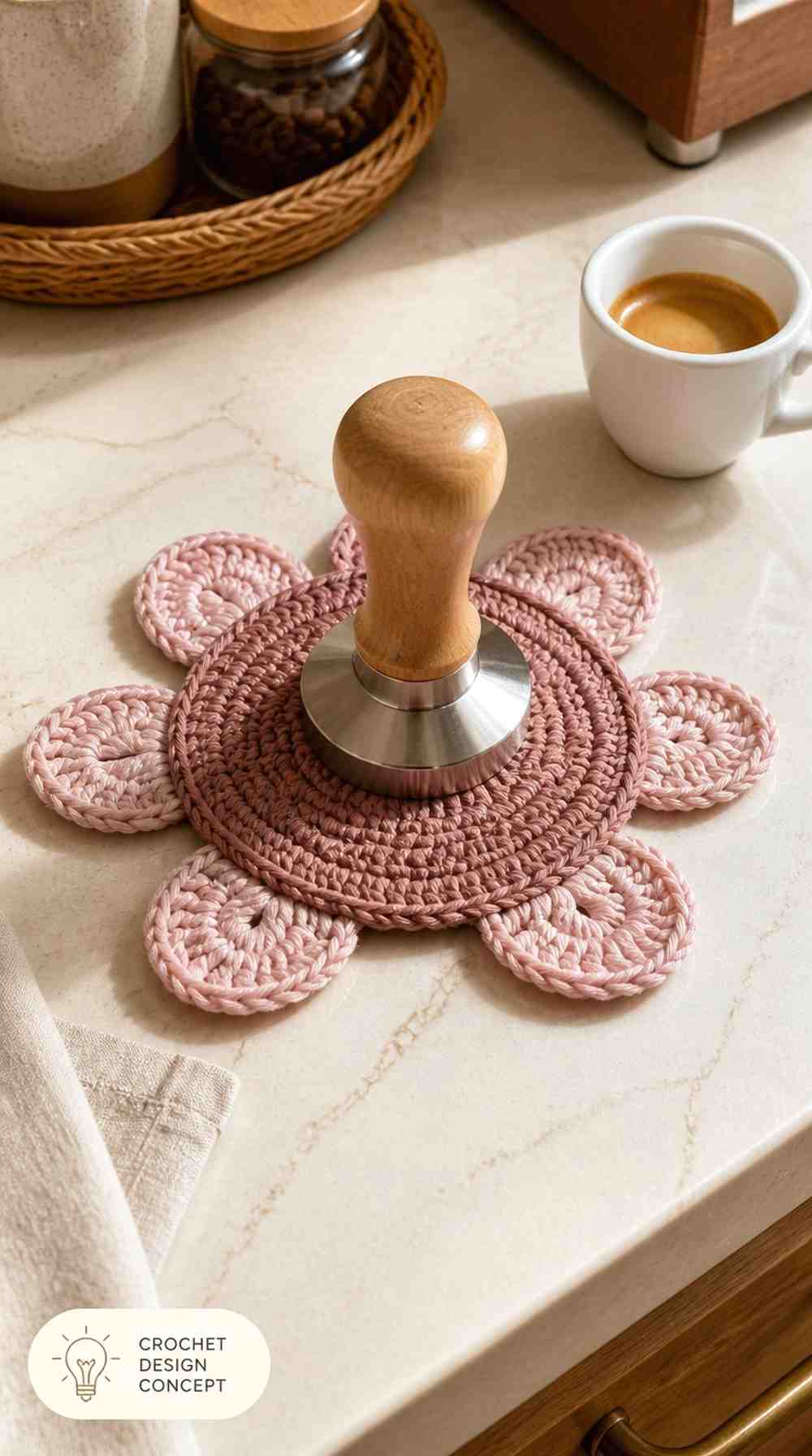
Dusty-rose crochet forms a flat circular center surrounded by six small pale-pink petal shapes. The petals sit outside the main resting area, giving the mat a soft floral outline without placing raised decoration directly beneath the silver tamper. The light wooden handle adds another gentle color to the arrangement.
For a coffee station that already uses cream ceramics or delicate pink accents, this concept offers a more decorative direction. The petals provide the character, while the plain central round remains the practical focus.
- Petal Positioning: Keep all six crocheted petals outside the tamper’s contact zone, with secure connections to the central round.
- Floral Scale: Small petals preserve a compact footprint. Oversized petals could make the mat difficult to fit beside other espresso accessories.
- Cleaning Consideration: Decorative joins and petal gaps can catch coffee grounds, so consider whether the finished piece would be easy to rinse and dry.
8. Crochet Olive Framed Tamper Mat
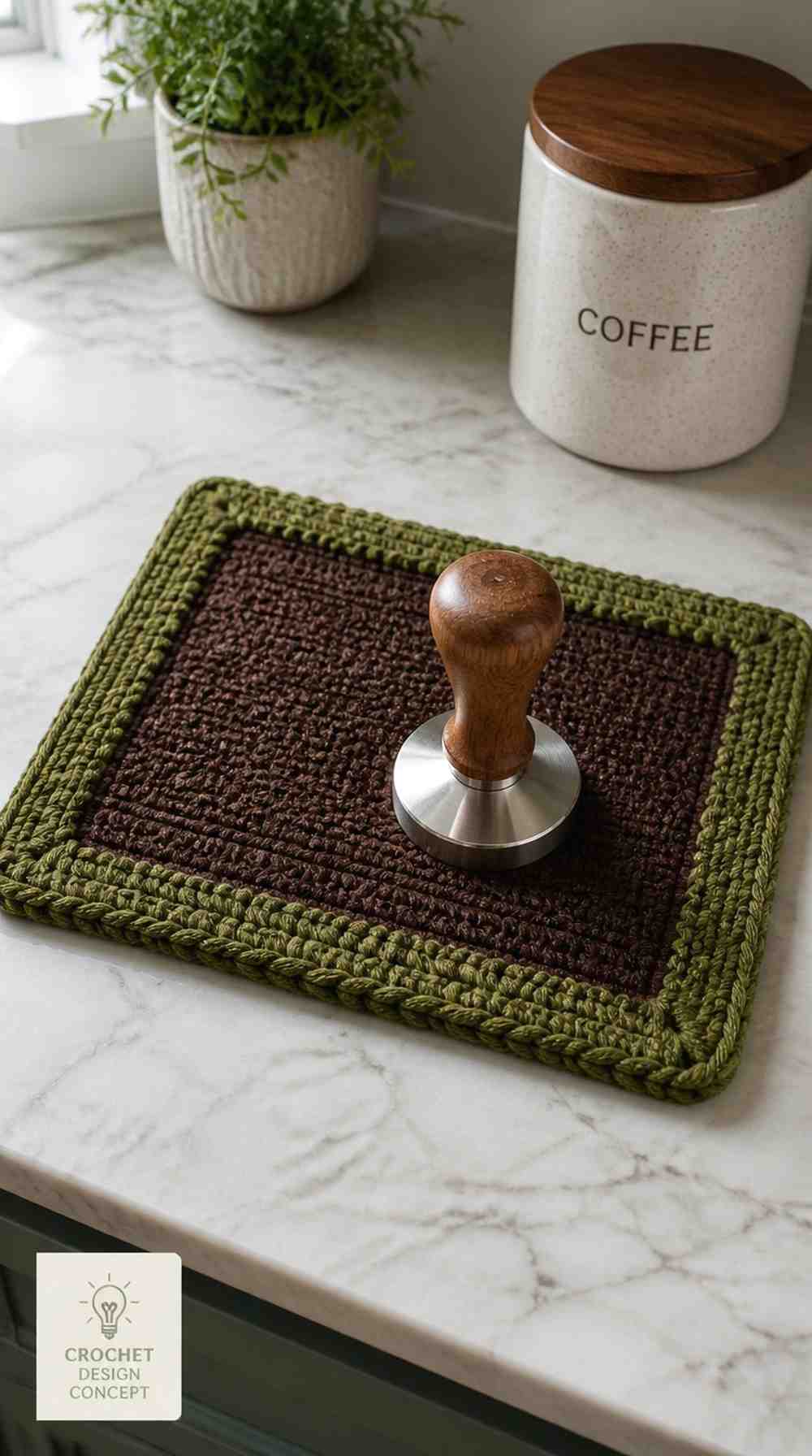
A deep coffee-brown crochet center sits inside a tidy olive-green rectangular frame. The surrounding border rises slightly above the flat inner section, creating a clear separation between the practical resting area and the decorative finishing stitches. A brushed metal tamper with a walnut handle completes the coffee-inspired palette.
This framed design has a more structured appearance than the soft oval or circular alternatives. It could work well on a pale countertop, where the darker central crochet makes the lighter espresso equipment stand out.
- Inner Resting Area: Keep the brown center broad enough for the whole tamper base without letting it lean against the olive border.
- Frame Thickness: A pronounced border changes the usable area. Check the internal dimensions rather than relying on the rectangle’s full outer width.
- Stitch Consistency: Choose an even central crochet texture so the decorative raised frame does not disguise an uneven resting surface.
9. Crochet Butter Yellow Half-Moon Rest
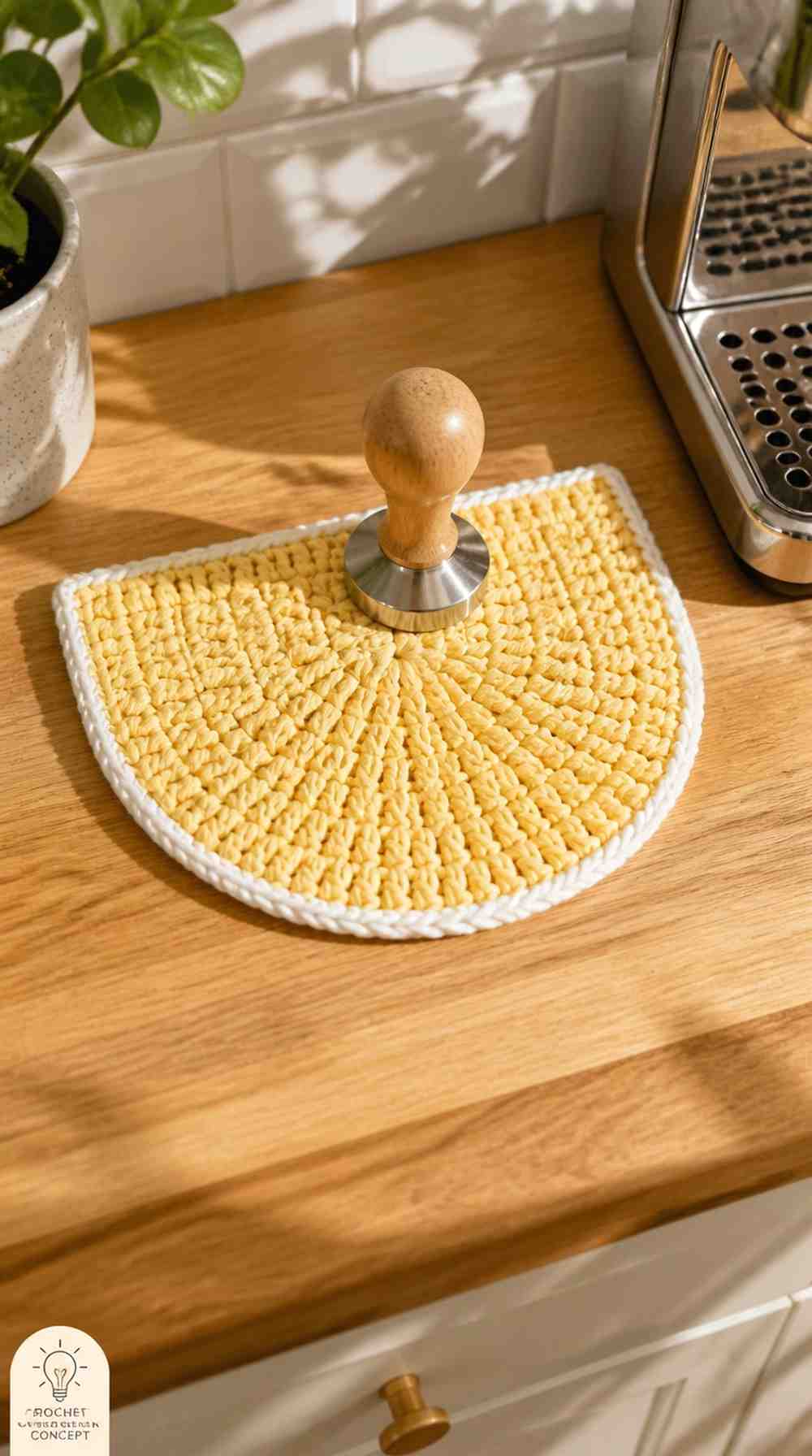
Butter-yellow cotton crochet creates a cheerful semicircular mat with a straight back and a rounded fan-shaped front. Closely worked radial segments give the curved edge its character, while a thin warm-white border completes the shape. A steel tamper with a pale beechwood handle stands on the broader central portion.
The straight rear edge makes this concept visually suitable for a coffee station arranged against a backsplash. Its fan-like outline provides decoration without extra attached motifs, although the radial stitches would need to remain reasonably level in a real version.
- Straight-Edge Placement: Position the straight side near the backsplash while leaving enough clearance to grip the tamper handle comfortably.
- Radial Stitch Control: Pay attention to increases and stitch height so the yellow fan segments do not form ridges beneath the tamper.
- Border Simplicity: The fine white edge gives the semicircle definition without requiring the thicker scallops found in more ornate crochet mats.
10. Crochet Cocoa Diagonal Stripe Rest
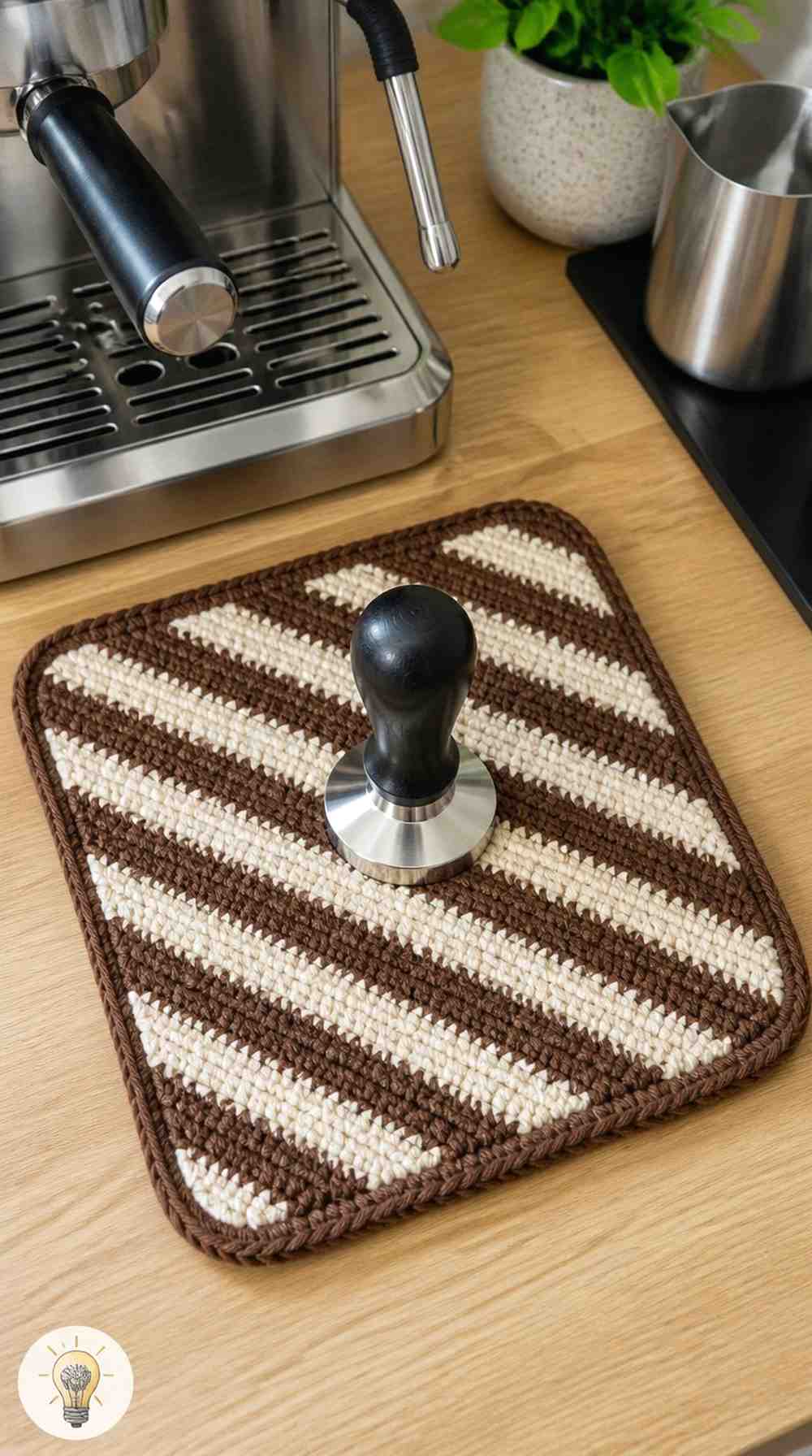
Cocoa-brown and creamy-white crochet stripes run diagonally across this rounded rectangular rest mat. The stripes meet neatly beneath a plain cocoa border, creating a graphic pattern without changing the simple overall shape. A polished silver tamper with a short black wooden handle stands near the center.
This concept suits a coffee bar where neutral colors and clean lines matter more than elaborate edging. The diagonal color arrangement carries most of the visual interest, so an even stitch surface would be particularly useful.
- Stripe Transitions: Keep the color changes tidy and the yarn ends properly secured so diagonal joins do not create unwanted lumps.
- Border Color: The solid cocoa perimeter visually contains the lighter stripes and could disguise minor handling marks better than an all-cream edge.
- Surface Evenness: Avoid using raised decorative stitches to create the stripes; color alone can provide the diagonal effect while preserving a flatter center.
11. Crochet Vintage Blue Octagon Rest
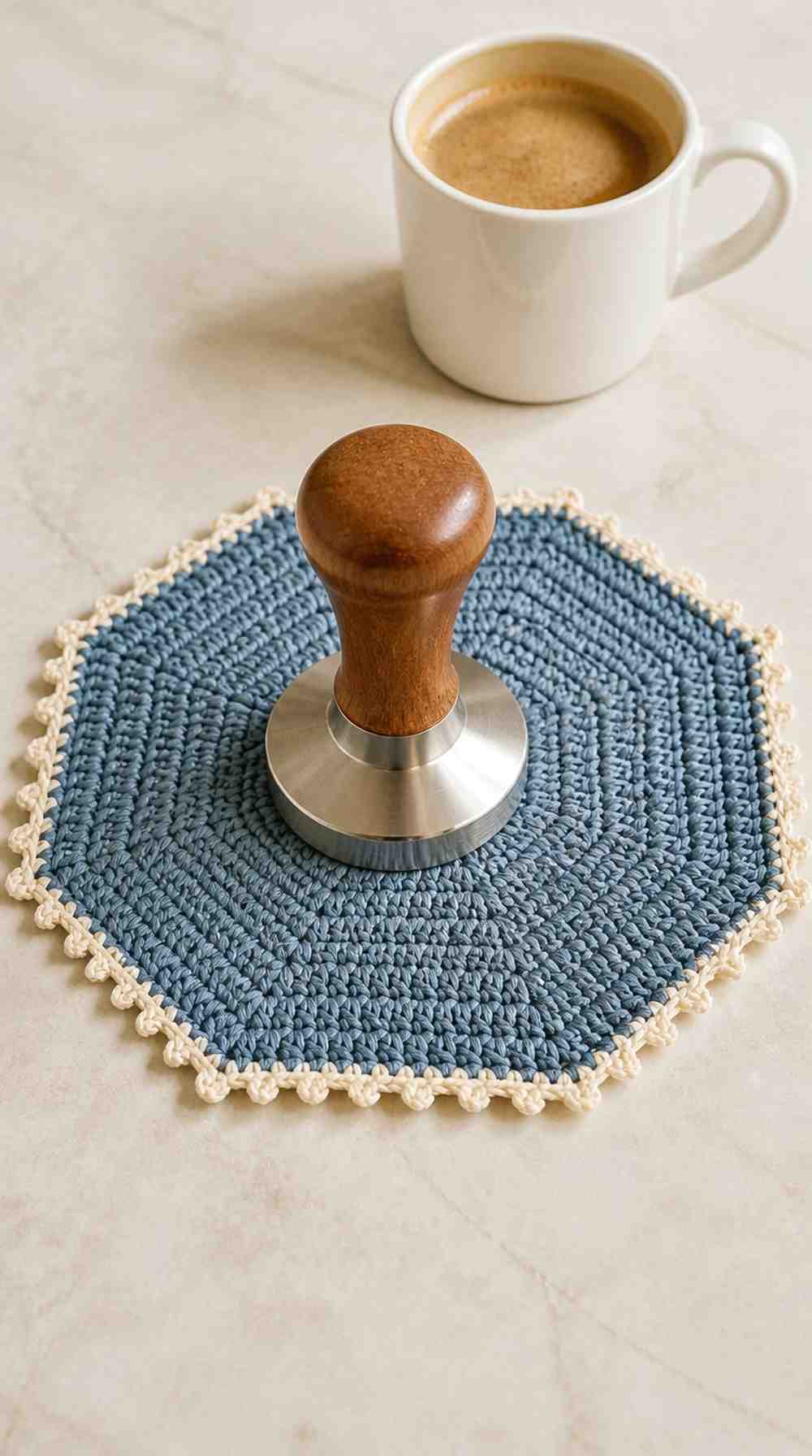
Muted vintage-blue crochet gives this mat an eight-sided geometric outline. A closely worked central octagon is surrounded by narrow ivory picot edging, with the small decorative points positioned beyond the tamper’s resting area. The silver tamper and its medium-brown wooden handle stand clearly against the blue center.
The octagonal shape falls between a traditional circle and a square, offering a distinctive outline without demanding a large countertop footprint. Its pointed edging adds vintage character, though those points require careful finishing.
- Eight-Sided Balance: Keep the corner shaping even so the octagon remains symmetrical and the main center does not become distorted.
- Picot Edge Placement: The ivory points are decorative, not load-bearing. Keep them outside the tamper’s contact area to avoid unnecessary lifting.
- Vintage Color Pairing: The muted blue and ivory combination works well with pale counters, wooden espresso accessories, and simple cream ceramics.
12. Crochet Rust Granny Square Rest
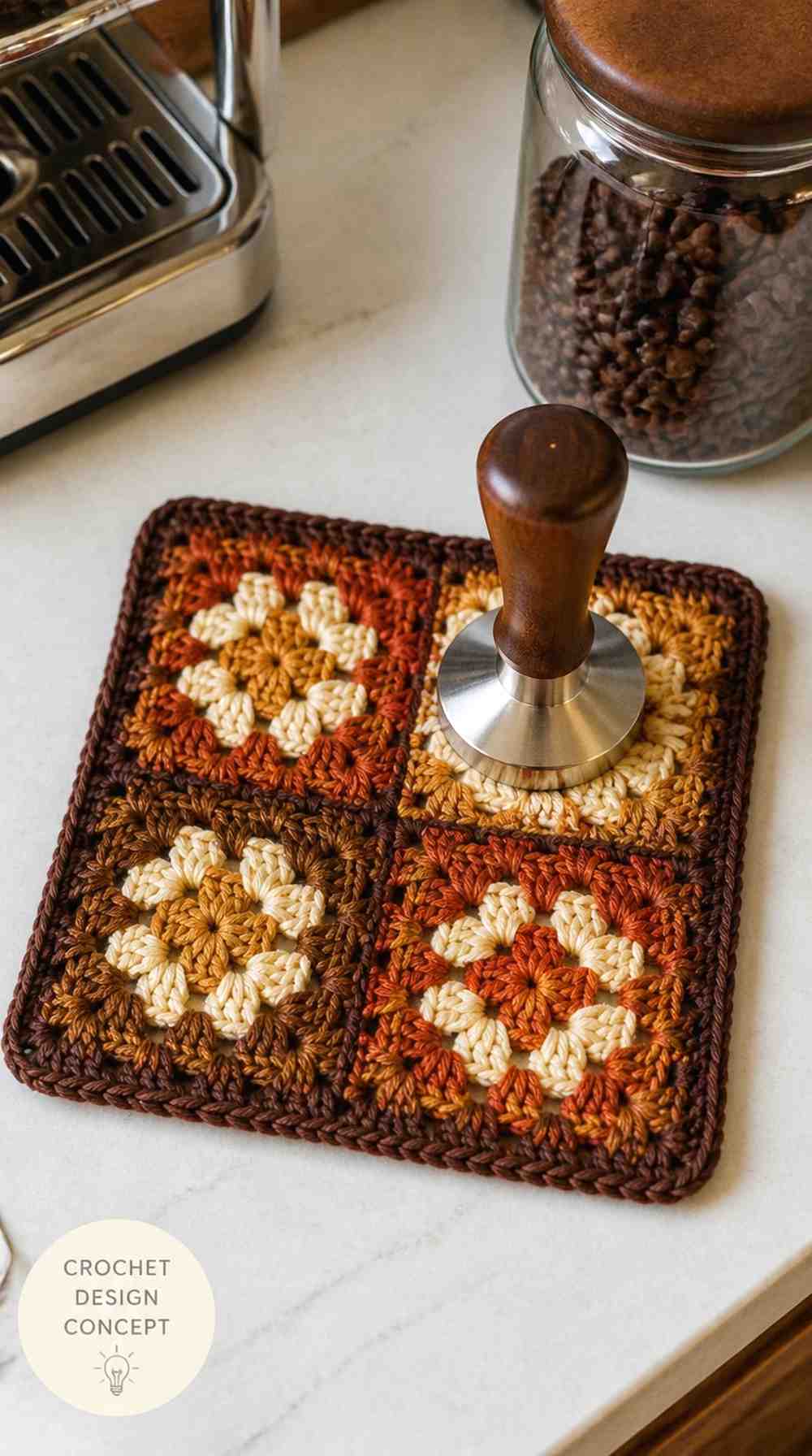
Four small crochet granny squares combine to create a colorful espresso accessory rest. Rust, mustard, cream, and cinnamon-brown motifs are joined into a neat two-by-two arrangement with a chocolate-brown outer border. Small openings within the crochet clusters preserve the familiar granny-square appearance.
The tamper stands over one motif rather than directly on the central joining seams. This design is especially interesting as a decorative concept, but the gaps and raised joins make it less straightforward for a frequently handled metal accessory.
- Motif Joining: Examine the thickness of the square joins. A visibly raised central seam may prevent a tamper from sitting evenly.
- Open Stitch Limitations: Traditional granny-square openings can trap loose coffee grounds and expose the underlying counter, making cleaning more involved.
- Alternative Construction: For practical use, consider adapting the color-blocked look into a denser, more continuous crochet surface rather than copying the open clusters exactly.
13. Crochet Lavender Lace-Edge Tamper Mat
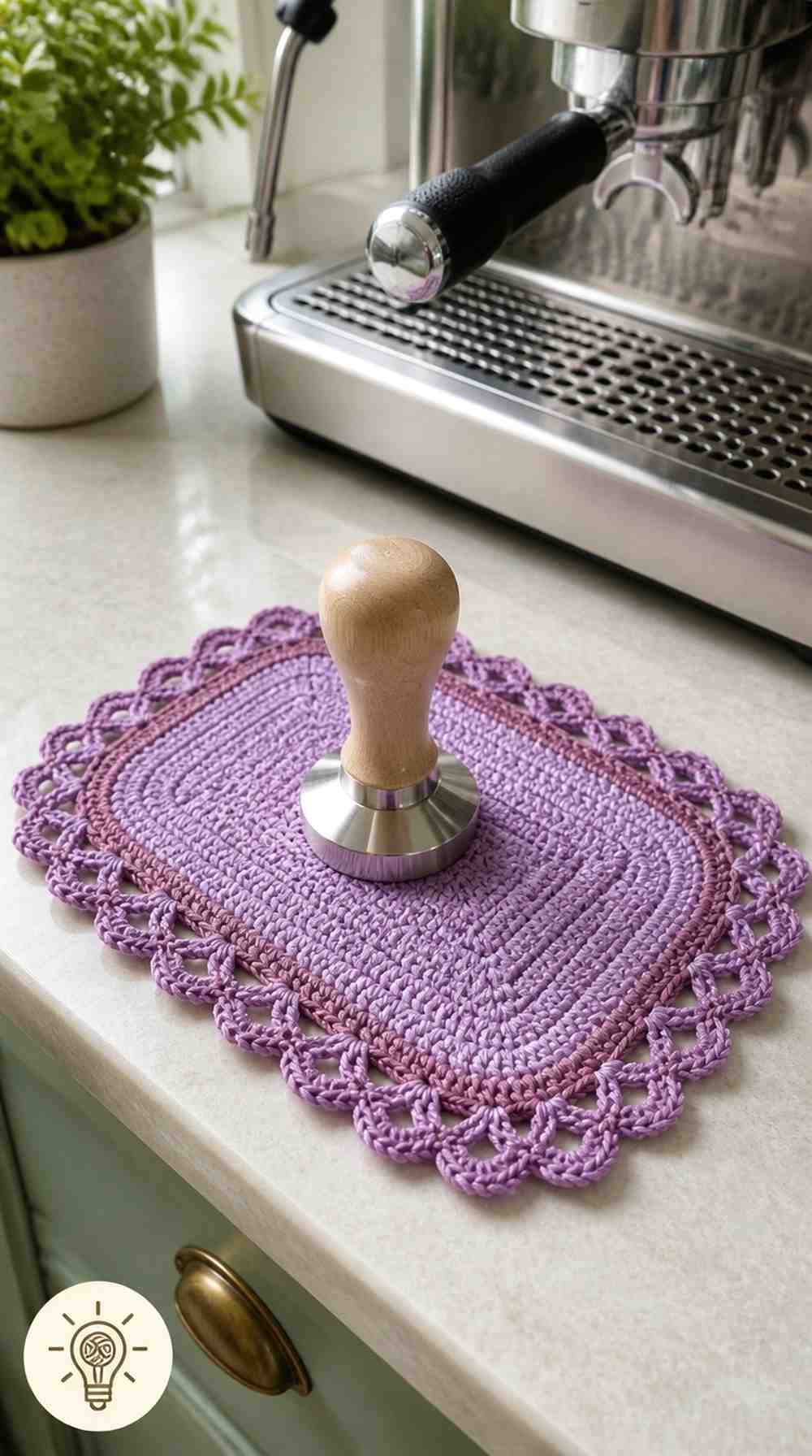
Pale-lavender crochet forms a solid rounded rectangular center, surrounded by a narrow dusty-mauve border and an airy lattice edge. The stainless-steel tamper with its pale wooden handle stands on the uninterrupted middle section, leaving the delicate openwork visible around the outside.
The decorative contrast between solid crochet and open lace makes this design suitable for a softly styled home coffee station. It is more elaborate than a plain rectangular rest, but the lace is a finishing detail rather than the surface carrying the tamper.
- Solid Center First: Keep enough closely connected stitches beneath the tamper before adding the airy lattice around the outside.
- Lace Opening Size: Large open spaces may catch on nearby tools. Smaller, evenly spaced openings could be easier to manage in a compact coffee area.
- Shape Retention: Check how the mauve border affects the rounded corners, especially if the lace pulls outward or makes the mat ripple.
14. Crochet Espresso Brown Long Tool Rest
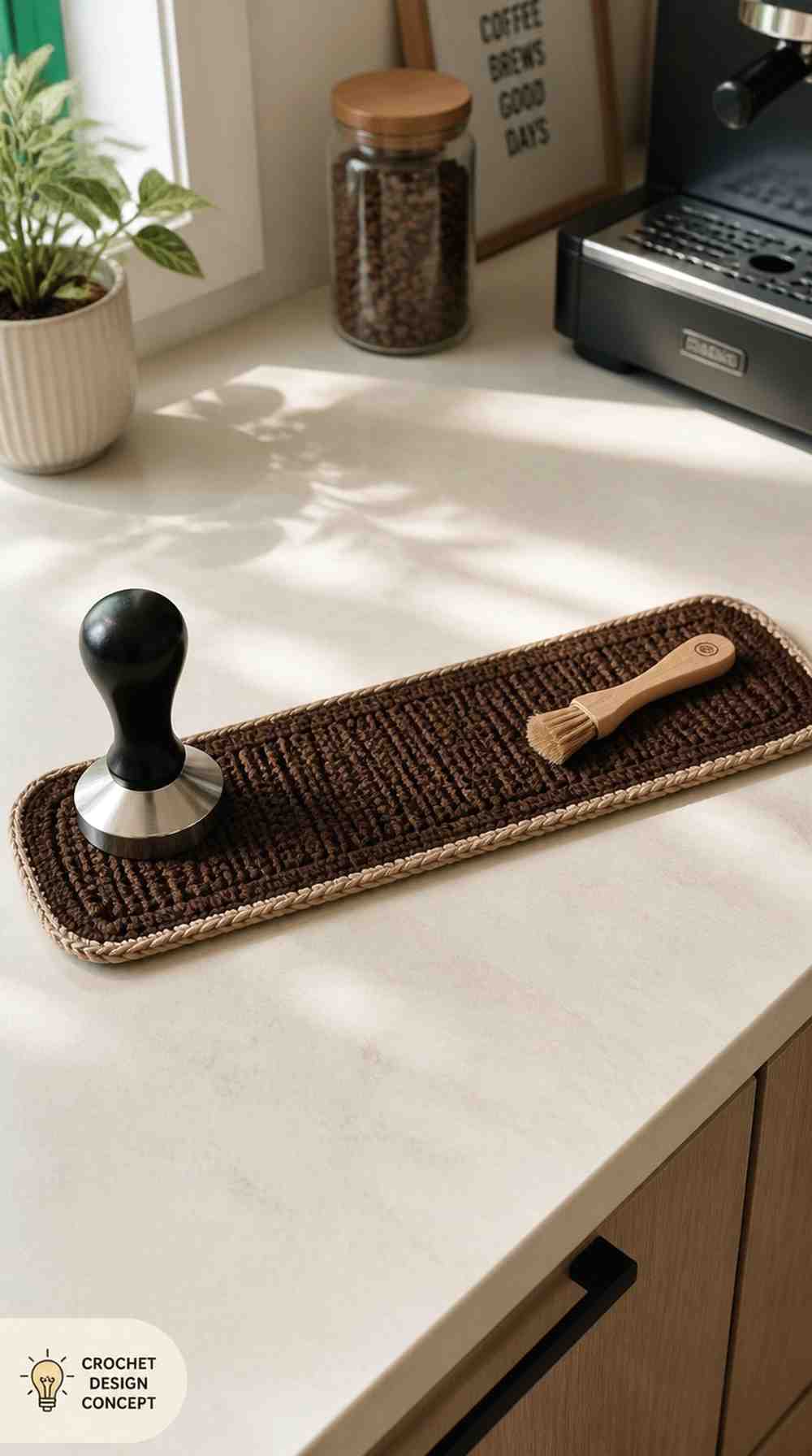
Rich espresso-brown crochet creates a long, narrow tool-resting mat with rounded ends and a sand-beige perimeter. Its dense vertical stitch columns give the surface a simple handmade texture. A steel tamper with a black wooden handle stands at one end, while a small wooden grounds brush lies lengthwise at the other.
This design makes better use of horizontal counter space than a single circular rest when two accessories need a shared location. Its usefulness depends on leaving enough separation between the tools.
- Length Planning: Arrange your actual tamper and cleaning brush side by side before deciding how long the crochet mat should be.
- Brush Resting Area: Keep the brush bristles clear of loose crochet loops where possible, since fine bristles can snag or retain grounds.
- Easy Lifting: The narrow shape is useful only when both tools can be picked up independently without shifting or dragging the mat.
15. Crochet Aqua Wave Tamper Rest
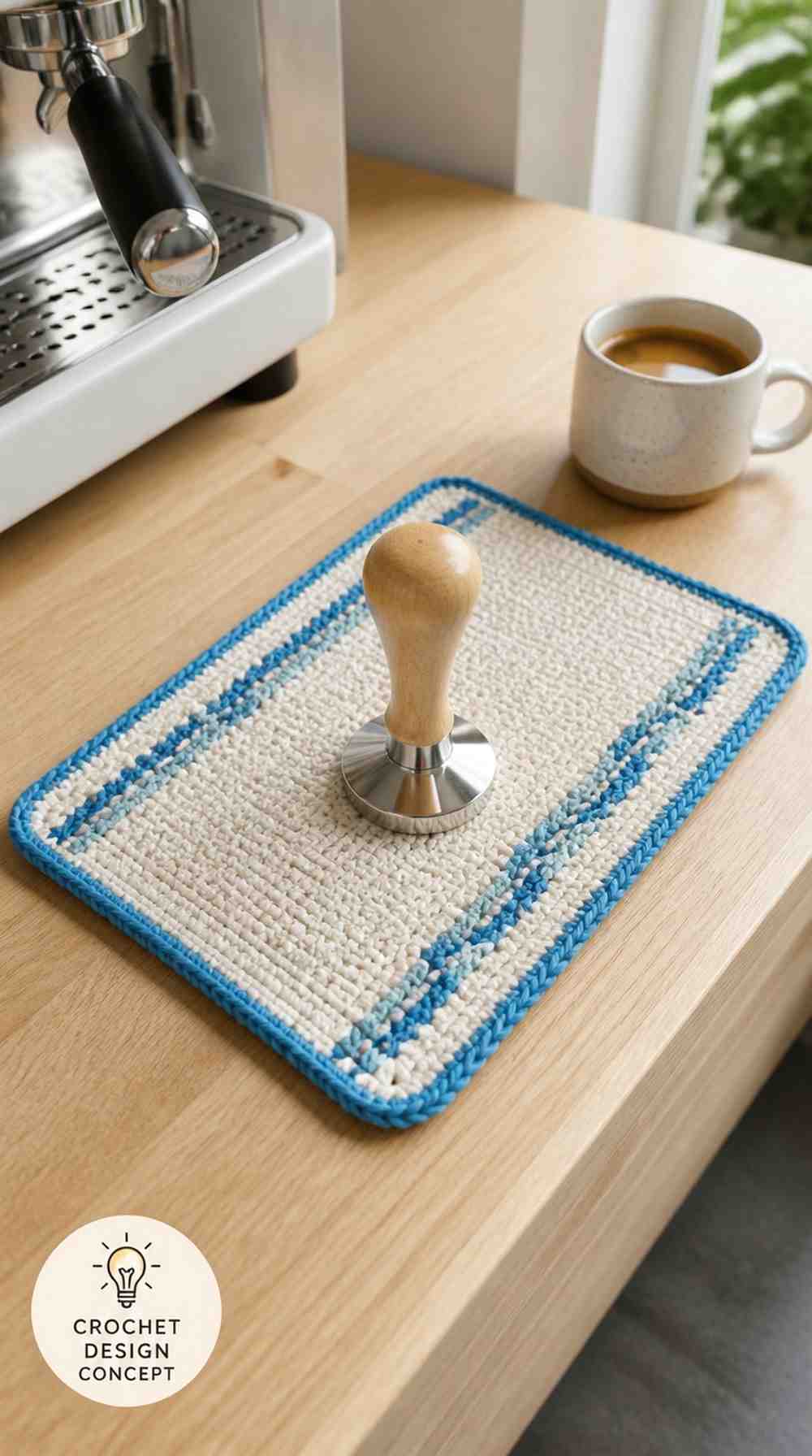
A warm-white crochet center is bordered by two gentle aqua-blue wave lines running near the long edges. A thin sea-blue perimeter finishes the rectangular mat, while the central resting zone remains closely stitched and plain. The silver tamper and maple handle keep the finished arrangement light and coastal.
Rather than using a sculpted or raised wave, this design creates movement through contrasting crochet color lines. That makes the decorative idea easier to adapt to a low-profile resting surface.
- Flat Wave Effect: Form the aqua lines through controlled color placement instead of large raised ridges that might interfere with the tamper base.
- White Center Care: Light yarn can show coffee residue quickly, so consider how easily the chosen fiber can be cleaned and dried.
- Edge Definition: The thin sea-blue outline visually frames the whole rectangle without increasing the bulk around its working area.
16. Crochet Peach Hanging-Loop Tamper Mat
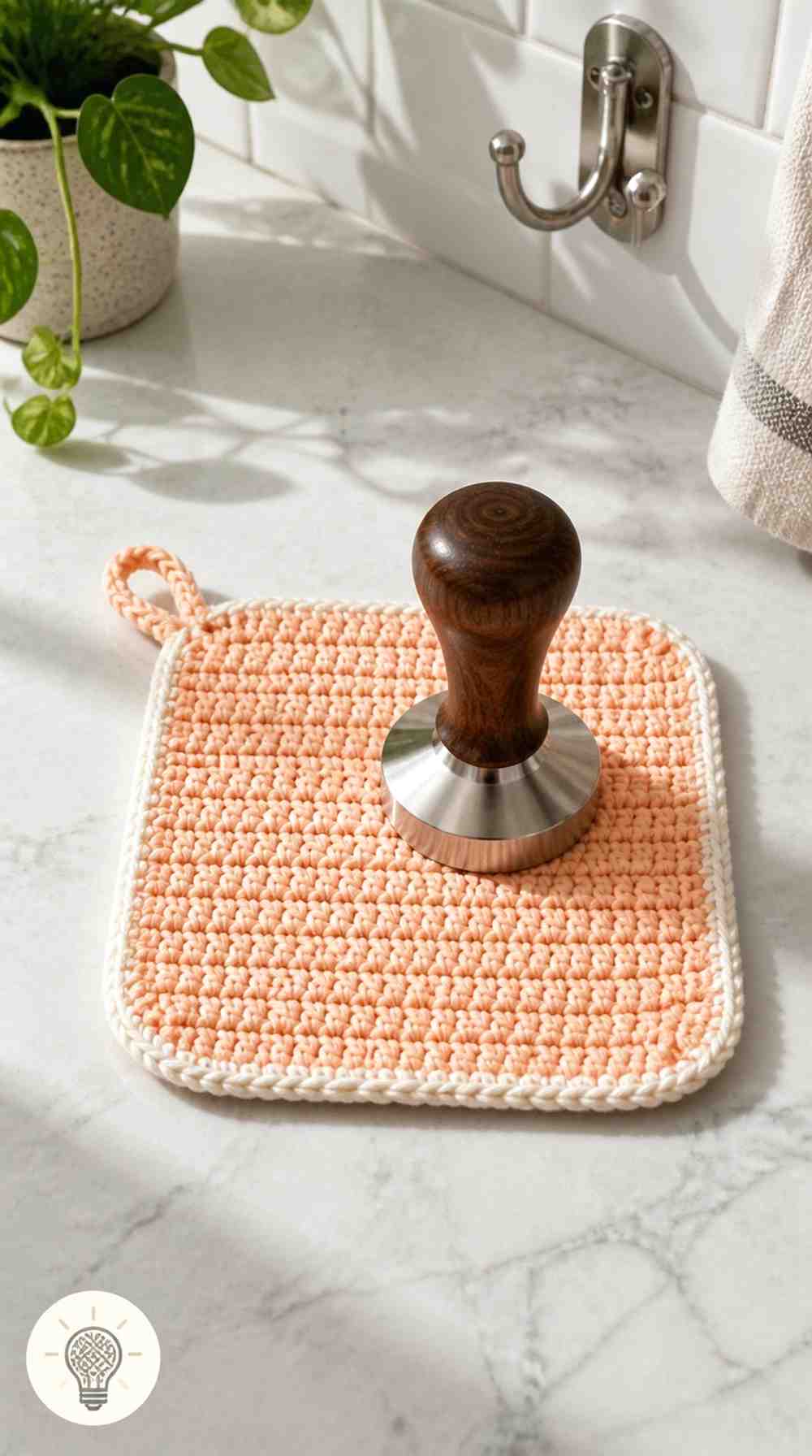
Soft apricot-peach crochet gives this rounded-square rest mat a warm, understated finish. The center uses closely worked rows, a narrow cream edging defines the outline, and a small matching peach loop is attached to the upper-left corner. A steel tamper with a dark wood handle stands away from the loop.
The corner attachment makes this concept different from mats intended to stay permanently on a countertop. It offers the possibility of hanging the empty crochet piece between uses, provided the loop is properly secured.
- Loop Reinforcement: Secure the small corner loop through a suitable section of the crochet edge and check it before hanging the empty mat.
- Storage Position: Keep the loop outside the tamper’s resting zone and away from hot machine parts or moving accessories.
- Drying Consideration: Hanging a damp mat may help expose it to air, but actual drying depends on fiber thickness, airflow, and washing conditions.
17. Crochet Burgundy Art Deco Tamper Mat
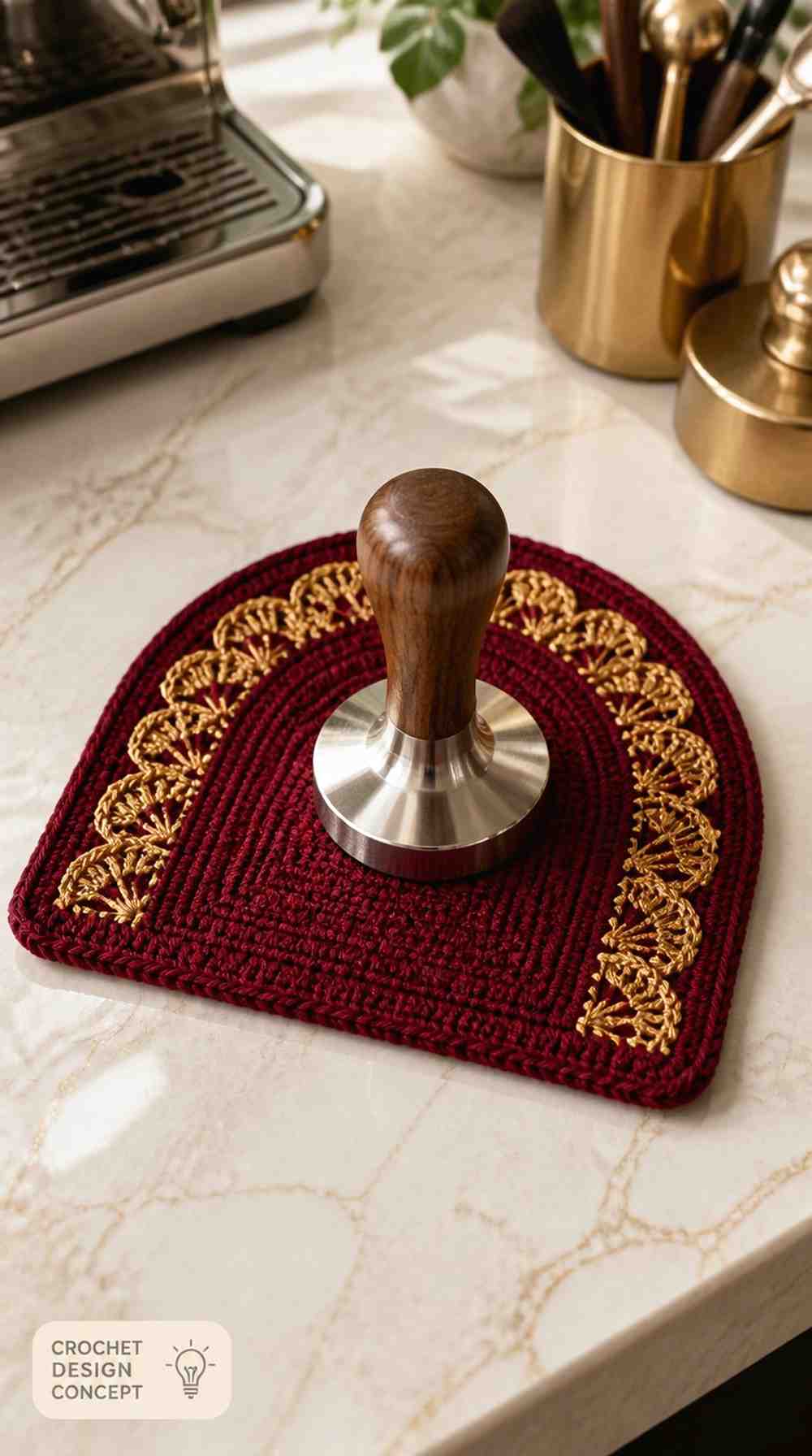
Deep burgundy crochet forms a compact arch-shaped mat with a straight lower edge and a gently rounded crown. Muted-gold fan-shaped stitch accents follow the outer arch, while the central burgundy section remains closely worked and relatively flat. The polished metal tamper and dark walnut handle complete the rich color combination.
This is the most formal-looking concept in the collection. Its decorative fan border gives the espresso station an Art Deco-inspired touch without relying on hard beads or separate metal ornaments.
- Arch Proportions: Keep the rounded upper section wide enough that the tamper can stand comfortably within the plain central burgundy area.
- Fan Detail Placement: The muted-gold crochet accents should remain around the outer arch rather than creating raised bumps beneath the metal base.
- Decorative Versus Daily Use: The shaped border makes a stronger visual statement, but a simpler flat center is preferable for frequent handling and cleaning.
Practical Guide to Crochet Espresso Tamper Rest Mats
Use a crochet rest for parking, not tamping
A decorative crochet rest mat is best treated as a place to put a tamper between uses. Espresso tamping itself requires a firm, stable working surface. Purpose-made silicone tamping mats are designed to help protect the countertop and support the portafilter during pressing. Soft crochet alone should not be assumed to provide the same stability or grip.
Fellow+1
Check your tamper before planning the shape
Measure the actual metal base and compare it with the usable flat area of your chosen concept. Include some room around the base so you can lower and lift the tamper without catching an edging, petal, or border.
The outer dimensions of a decorative mat are not necessarily its usable resting dimensions.
Choose a suitable yarn
Smooth cotton yarn may be worth considering because it gives clear stitch definition and can be relatively straightforward to clean. Check the specific yarn label before choosing a washing method.
Very loose crochet, thick raised motifs, and overly soft padding can make the resting surface uneven. If desired, a separate appropriately sized non-slip underlay may be considered, but its grip and compatibility with the countertop must be checked rather than assumed.
Keep the coffee area clean
Loose grounds, damp metal, and coffee residue can collect in yarn loops. Shake or brush away dry grounds, clean the crochet according to its fiber instructions, and allow it to dry completely before reuse.
Keep these accessories away from steam outlets, hot equipment, open flames, and regularly wet countertop areas.
Inspect the finished design
For any real version, test whether the empty mat lies flat, then cautiously check how the tamper sits on it. Do not rely on an untested crochet concept to prevent slipping, tipping, scratching, or moisture damage.
For more small handmade kitchen accessories, see the related crochet coasters and mug cozy collection on Yarn Nest Studio.
Want to Make Something Similar?
These are original design concepts rather than published patterns for the exact pictured mats. However, a few real crochet lessons can help with the basic shapes and techniques.
- Yarnspirations beginner crochet coaster tutorial teaches circular coaster construction, basic stitches, joins, and working in rounds. Yarnspirations
- Crochet and Tea’s flat circle coaster tutorial provides related help with making a flat crochet circle, useful when exploring the oatmeal or floral-center concepts.
These resources teach related crochet skills, not the exact construction of the 17 visualized tamper rests.
Which Crochet Espresso Tamper Rest Mat Should You Choose?
| Your priority | Designs to compare | Important trade-off |
|---|---|---|
| Smallest-looking footprint | Oatmeal Circular, Ivory Corner | Simple outlines still need a sufficiently broad, level resting area |
| Two-tool organization | Charcoal Double Rest, Espresso Brown Long Tool Rest | More organized, but requires extra counter space |
| Strong color contrast | Navy Checkered, Cocoa Diagonal Stripe | Color changes and joins need tidy finishing |
| Decorative edges | Dusty Rose Floral, Lavender Lace-Edge | Petals and open trim can collect debris |
| Minimal-looking surface | Terracotta Barista, Aqua Wave | Low-profile styling offers fewer elaborate decorative features |
| Vintage character | Vintage Blue Octagon, Burgundy Art Deco | Shaped edging requires careful planning around the flat center |
| Storage flexibility | Peach Hanging-Loop | Hanging hardware and loop strength need checking |
For an everyday espresso station, a simple flat rectangle or circle is a sensible starting point. More decorative designs may suit display-focused areas where the tamper is handled less frequently.
Conclusion
Crochet espresso tamper rest mat ideas show how a small coffee accessory can take on very different looks through shape, color, stitch texture, and edging. A warm terracotta rectangle feels simple and classic, while a dusty-rose floral border or burgundy arch brings a stronger decorative touch. The linked-circle and long-strip concepts offer ways to organize multiple accessories.
Whichever design appeals to you, keep the practical limitations in mind. A flat, clean, appropriately sized resting area matters more than decoration, and actual espresso tamping should still take place on suitable equipment.
Which would you choose for your own coffee corner: the simple oatmeal circle, the charcoal double-tool rest, or the burgundy Art Deco arch? Share your favorite design and the colors you would use.
Frequently Asked Questions
1. Can I use a crochet tamper rest mat for actual espresso tamping?
A crochet rest is intended here for parking the tamper between uses, not for pressing coffee grounds in a portafilter. Crochet can compress, move, or have uneven stitches. For tamping, use a stable work surface and equipment intended for the task, such as a suitable silicone tamping mat.
Fellow
2. What yarn should I consider for a crochet espresso tamper rest?
Smooth cotton is one possibility because it can create defined stitches and may be easier to maintain than some delicate decorative fibers. However, suitability depends on the specific yarn, stitch density, and construction. Follow the manufacturer’s washing instructions and avoid placing crochet where it will be exposed to high heat or regular splashes.
3. How can I make a crochet tamper mat lie flat?
Consistent tension, balanced shaping, suitable yarn weight, and careful finishing all matter. Circular designs need appropriate increases, while rectangular designs benefit from even rows and corners. If the finished surface curls or develops raised seams, correct those issues before using it to hold a metal tamper.
4. How should I clean a crochet espresso tamper rest?
Remove loose coffee grounds before washing, then follow the care instructions for the chosen yarn. Gently reshape the piece as appropriate and allow it to dry completely. Pay extra attention to decorative petals, lace openings, and granny-square joins, where residue may become trapped.
5. Are these 17 designs available as exact crochet patterns?
No. These are visual inspiration concepts, not tested patterns, and their illustrated construction may not translate directly into working crochet instructions. The related lessons above can help with basic shapes and stitches, but making a practical version requires your own sizing, material choices, and checks for stability and safe use.