A crochet olive oil bottle drip collar is a small kitchen accessory that adds handmade detail around the neck of an everyday oil bottle. These 16 inspiration ideas explore close-fitting ribbed bands, removable wraps, flat shoulder rings, floral scallops, and layered decorative collars. The collection includes warm terracotta, natural oatmeal, olive green, rich burgundy, deep teal, and other colors that complement glass bottles and wooden kitchen accessories.
A collar may help catch an occasional drop of oil running down the outside of a bottle, but crochet is not a leakproof solution or a replacement for a well-designed pourer. Bottle-neck measurements, removable construction, oil exposure, and cleaning are important considerations. Whether you prefer a very simple cotton band or a more decorative floral design, these ideas will help you compare practical limits alongside appearance.
These are AI-generated crochet design visualizations for inspiration, not photographs of tested handmade pieces or step-by-step patterns.
Quick Design Selection Guide
- For a simple, compact collar: Choose the Crochet Burnt Orange Ribbed Drip Collar or Crochet Dusty Blue Raised-Ridge Collar. Both keep their decorative texture within a short cylindrical band.
- For removable or adjustable styling: Compare the Crochet Cobalt Buttoned Drip Collar, Crochet Rust Tie-Front Bottle Collar, and Crochet Teal Braided-Edge Collar.
- For wider shoulder coverage: Look at the Crochet Oatmeal Shoulder Ring Collar or Crochet Mustard Front Bib Drip Collar, depending on your bottle’s shape.
- For botanical detail: The Crochet Olive Leaf Scallop Collar, Crochet Terracotta Petal Drip Collar, and Crochet Lavender Daisy Accent Collar introduce different handmade floral features.
- For rich decorative texture: The Crochet Burgundy Double-Tier Drip Collar and Crochet Espresso Brown Basketweave Collar offer more pronounced stitch relief.
1. Crochet Burnt Orange Ribbed Drip Collar
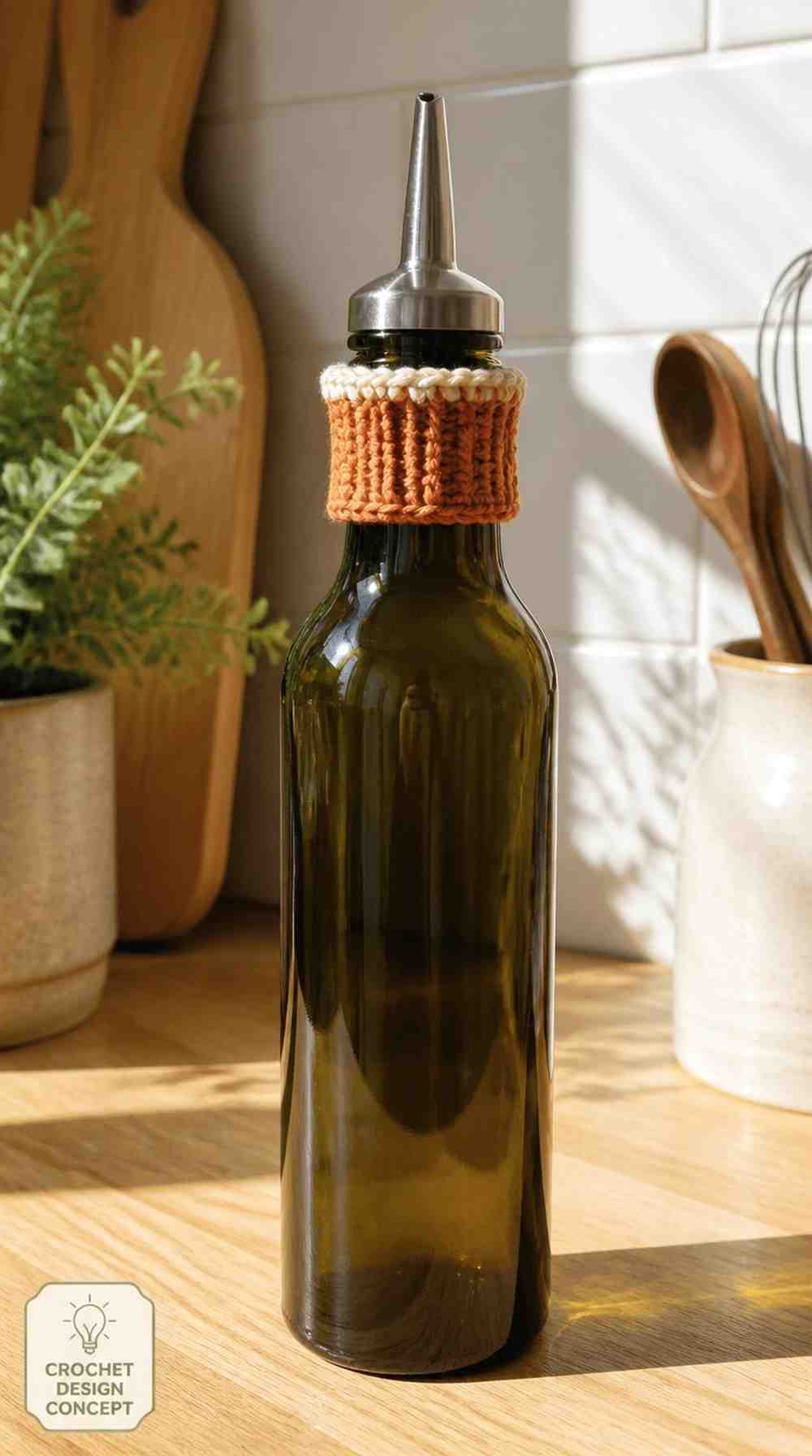
Burnt-orange crochet forms a short, tidy cylinder around the neck of a dark-green glass olive oil bottle. The vertical ribs give the collar a pleasantly textured appearance, while a thin cream edge provides a clean finish. Its narrow silhouette leaves the metal pouring spout completely exposed.
This concept works well when you prefer a little handmade color without covering much of the bottle. Its close-fitting shape may also make it easier to remove and replace than a collar with elaborate attached motifs, provided the sizing allows it.
- Ribbed Surface: The vertical crochet columns add texture while preserving a compact outline. Avoid overly bulky ribs that could make the band sit unevenly.
- Neck Fit: Compare the collar’s inside circumference with the actual bottle neck, including any wider lip it must slide over.
- Cleaning: Choose a removable construction because an oil-soaked collar should not remain around the bottle indefinitely.
2. Crochet Oatmeal Shoulder Ring Collar
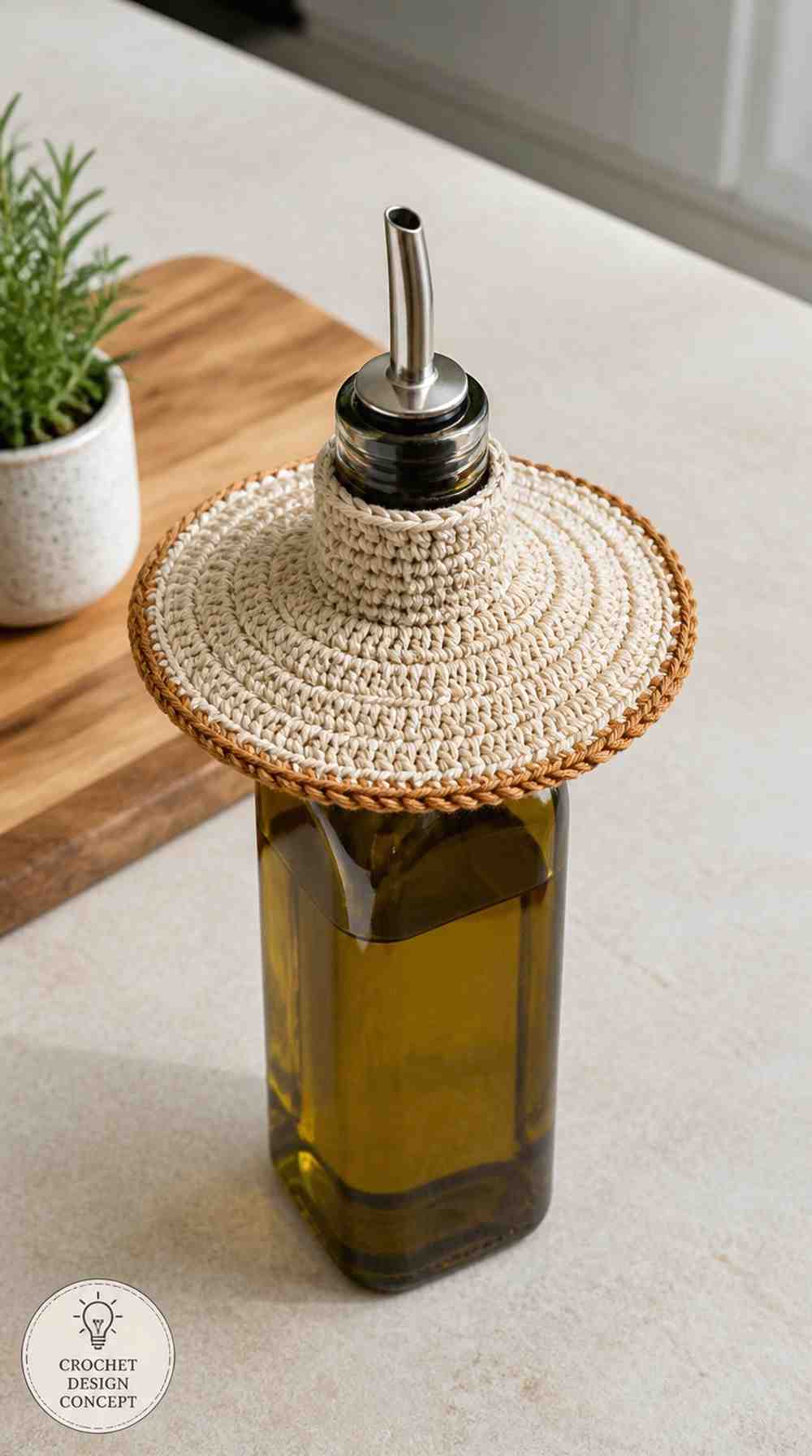
Soft oatmeal crochet creates a broad circular ring that sits around the neck and spreads outward over the upper shoulder of an amber olive oil bottle. Concentric stitch rounds give the design a clear handmade structure, while a narrow caramel border finishes the outer edge.
This shape offers more fabric surface than a simple neck band. It may intercept some oil running down the outside of the neck, but its wider area could also become stained or oily more easily and would need regular attention.
- Shoulder Proportions: The flat outer ring needs to match the bottle’s shoulder slope without lifting, curling, or hanging awkwardly.
- Even Crochet Rounds: Balanced increases help create a flat circular extension. Uneven stitch shaping may cause ripples around the bottle.
- Oil Exposure: The larger fabric area could hold more residue, so plan for straightforward removal and thorough cleaning.
3. Crochet Cobalt Buttoned Drip Collar
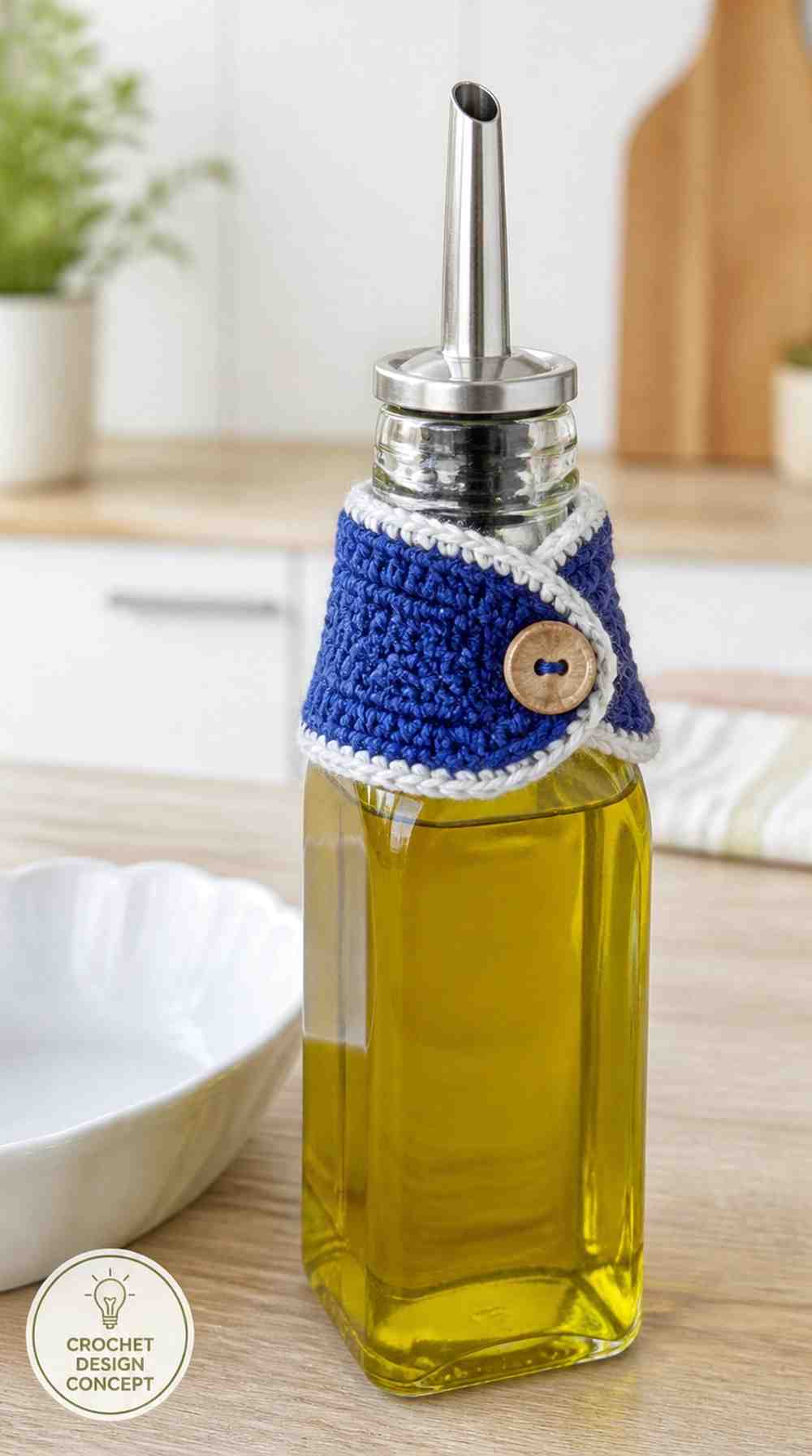
A bold cobalt-blue crochet band brings bright contrast to this transparent olive oil bottle. The closely stitched wrap has a slim white border and two slightly overlapping ends, secured by a small wooden button positioned toward the front-right side.
The open-wrap construction is the main feature. Unlike a continuous ring, this collar could be fitted around the bottle neck without necessarily sliding over a wider pouring attachment. The button would need to be securely attached and positioned clear of the spout.
- Button Placement: Position the small wooden button where it can be reached comfortably without interfering with the bottle’s grip or pouring action.
- Overlap Allowance: Check the amount of fabric overlap before choosing button placement so the band does not bunch around the neck.
- Secure Fastening: A real version needs a suitably reinforced button attachment and a properly sized buttonhole or loop.
4. Crochet Olive Leaf Scallop Collar
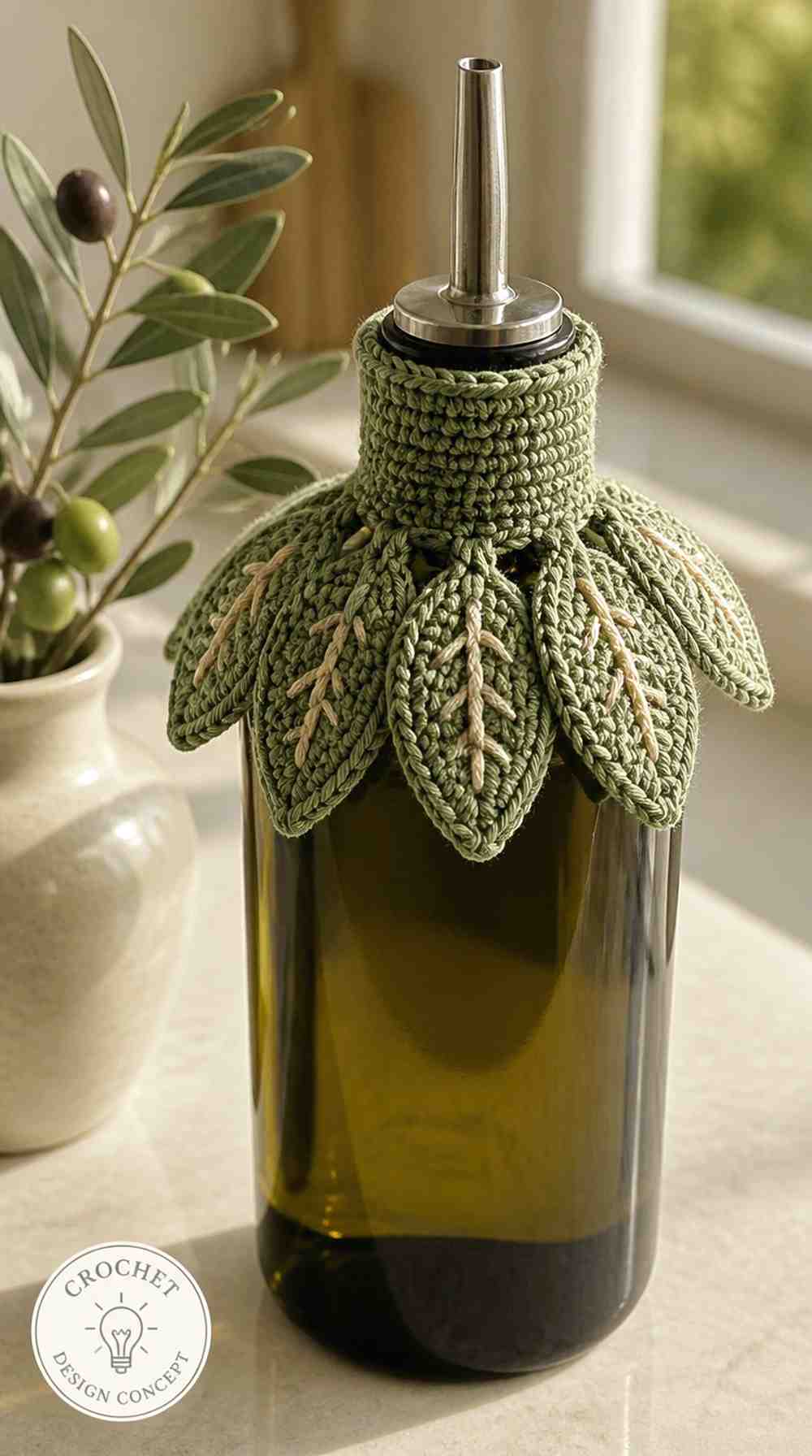
Muted olive-green crochet creates a botanical collar with six small leaf-shaped scallops extending downward from a closely worked neck band. Fine cream stitch accents outline the leaves, making their individual shapes visible against the dark amber bottle.
The leaf arrangement gives this idea a natural Mediterranean feel without adding separate hanging charms. Because the scallops spread over the upper shoulder, their attachment points and finished shape matter as much as the inner collar’s fit.
- Leaf Positioning: Keep the six leaf-shaped crochet scallops evenly distributed and attached below the band rather than near the pouring opening.
- Natural Shape: Small, relatively flat leaf motifs are less likely to catch on nearby kitchen items than long, loosely hanging decorations.
- Maintenance: Decorative leaf joins create additional places for oil residue to collect, so consider how easily they can be washed.
5. Crochet Navy Checkerboard Bottle Collar
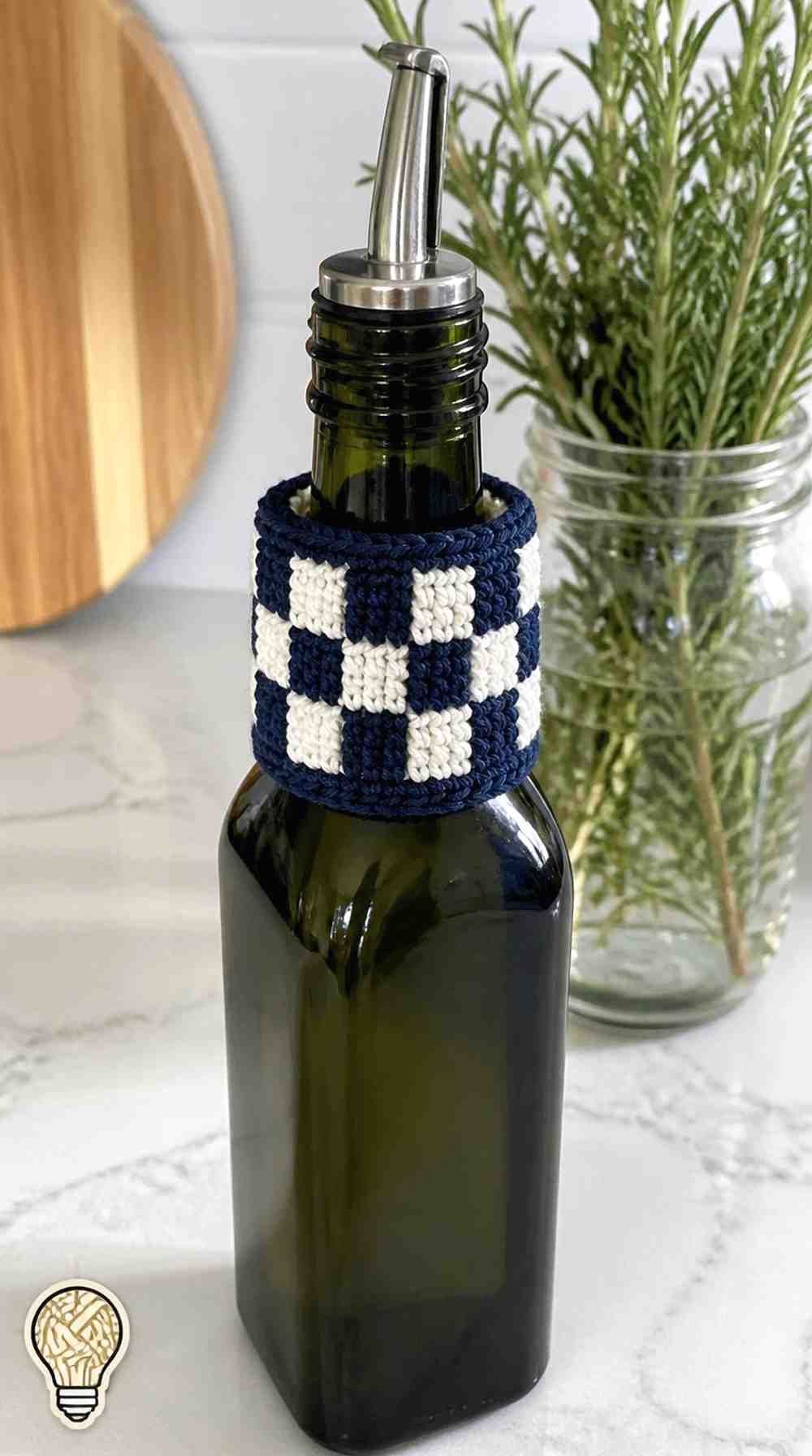
Alternating navy and ivory crochet blocks give this short cylindrical collar a crisp checkerboard appearance. Plain navy borders frame the little color sections above and below, creating a clean pattern around the dark-green glass bottle.
The design looks modern without relying on buttons, bows, or floral pieces. Its main construction challenge would be maintaining consistent stitch size through the color changes so the finished band remains comfortable around the bottle’s neck.
- Color-Block Accuracy: Keep the small checker sections aligned and the yarn transitions tidy to avoid an uneven-looking finished cylinder.
- Plain Edge Bands: The navy upper and lower borders give the patterned section definition without requiring raised ornamental trimming.
- Residue Visibility: Ivory sections may show yellow oil stains more readily, making easy removal especially important.
6. Crochet Linen Folded Cuff Collar
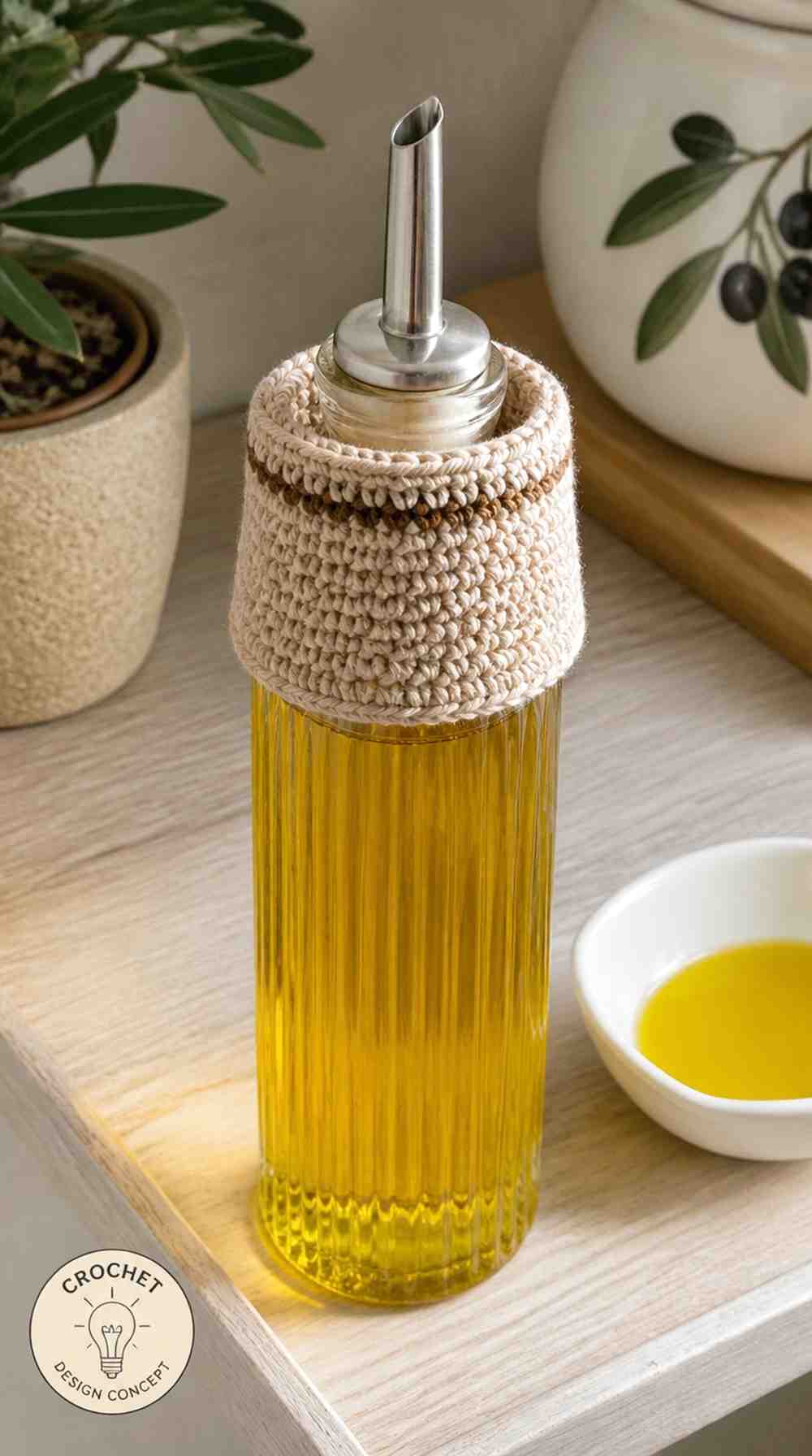
Natural beige crochet creates a taller neck band with a small outward-folded upper cuff. An espresso-brown line finishes the folded edge, giving the collar a simple tailored appearance. Its neutral yarn complements the transparent ribbed-glass bottle without competing with the golden olive oil inside.
The folded construction provides more visual thickness than a single-layer band. That additional fabric could hold unwanted oil residue, so a real version would need particular care around the fold and its drying.
- Folded Edge: The cuff should remain below the bottle’s pouring attachment and must not roll upward toward the spout.
- Double-Layer Thickness: A folded section adds bulk, which should be checked against the space available around the narrow bottle neck.
- Drying: The fold may retain moisture after cleaning, so open it as appropriate and ensure the entire piece dries thoroughly.
7. Crochet Mustard Front Bib Drip Collar
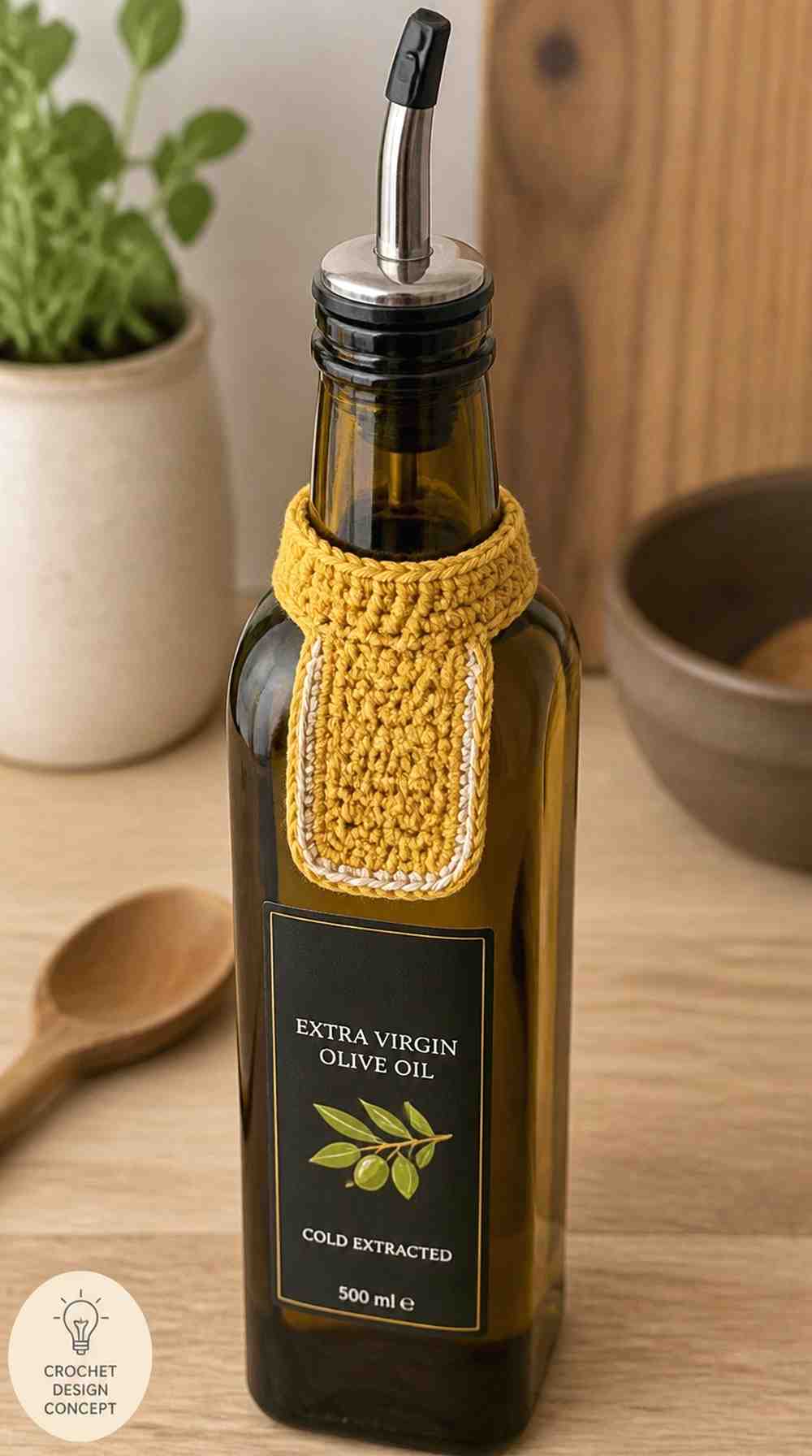
A mustard-yellow crochet band circles the neck of this amber-glass olive oil bottle, with a small rounded rectangular tab extending down the front. The attached tab has a cream border and lies against the bottle’s shoulder, creating a miniature bib-like shape.
This front-focused layout is different from a full circular flange. It may appeal to someone who wants a little more fabric beneath the pouring side without wrapping the entire bottle shoulder in crochet. However, the tab must be positioned correctly and kept clean.
- Front Alignment: Place the downward tab beneath the usual pouring direction if the intention is to intercept drips along the bottle exterior.
- Tab Proportion: Keep the rounded rectangle short enough that it does not cover the bottle’s main label or obstruct the hand’s grip.
- Attachment Point: The join between the neck band and front tab needs to remain flat rather than forming a thick lump.
8. Crochet Terracotta Petal Drip Collar
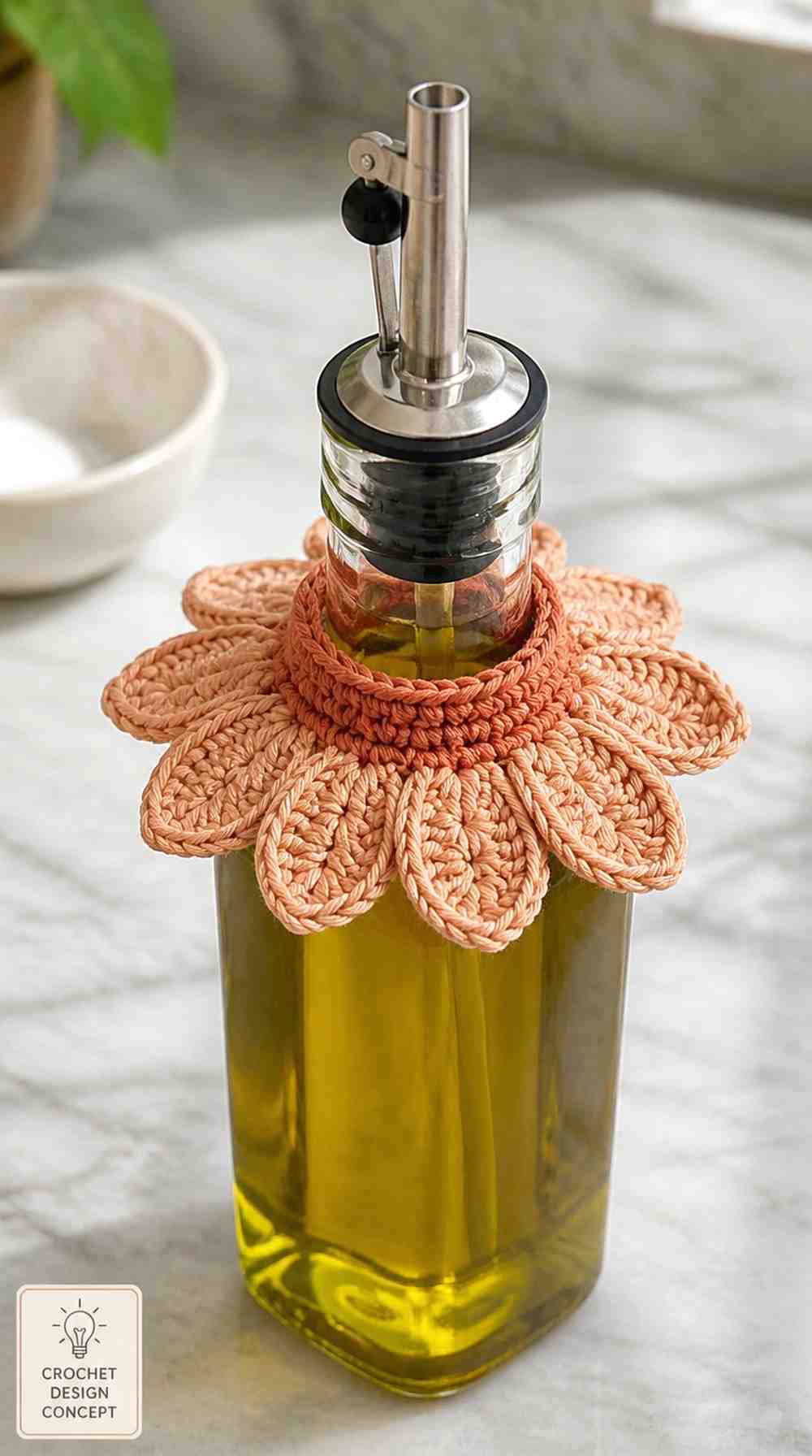
Warm terracotta crochet forms a short neck band with eight small peach-colored petals arranged around its lower edge. The petals spread gently outward over the shoulder of a transparent oil bottle, creating the appearance of a compact flower.
The repeating petal outline makes the bottle feel more decorative while keeping the metal pouring spout uncovered. This is an idea for a display-conscious kitchen where the fabric can be removed often, since the numerous small connections need more cleaning attention than a plain ring.
- Petal Connections: Each of the eight petals should have a firm attachment to the central band, with clearly connected crochet loops.
- Compact Floral Shape: Keep the petals short enough that they do not obscure much of the bottle or brush against neighboring containers.
- Residue Collection: Oil can lodge between decorative petals, making frequent inspection and washing important.
9. Crochet Dusty Blue Raised-Ridge Collar
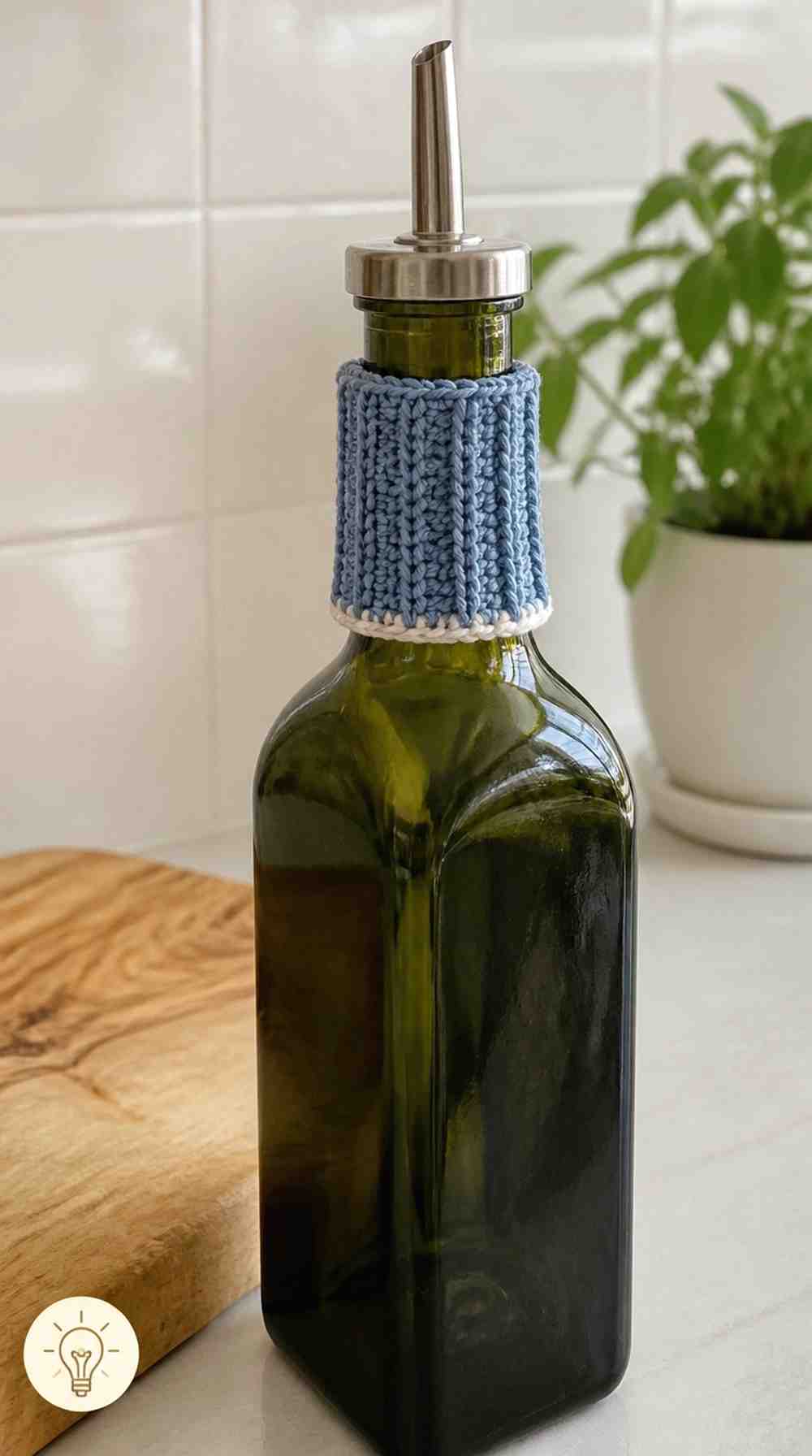
Dusty-blue crochet wraps the narrow neck of a dark-green olive oil bottle in a short band of alternating raised and flat stitch columns. A fine ivory border finishes the lower edge, adding a little contrast without changing the compact cylindrical silhouette.
The raised texture is the main feature rather than extra attachments. It offers a quieter alternative to the floral concepts, although the small grooves between the crochet columns could collect residue if oil regularly reaches the band.
- Ridge Definition: Choose a crochet technique that creates modest, regular relief without making the collar unnecessarily thick or stiff.
- Cylindrical Fit: The band should follow the bottle neck without large gaps, excessive stretching, or upward pressure toward the spout.
- Groove Cleaning: Check the spaces between raised columns during washing because oil residue may not be obvious from a quick glance.
10. Crochet Burgundy Double-Tier Drip Collar
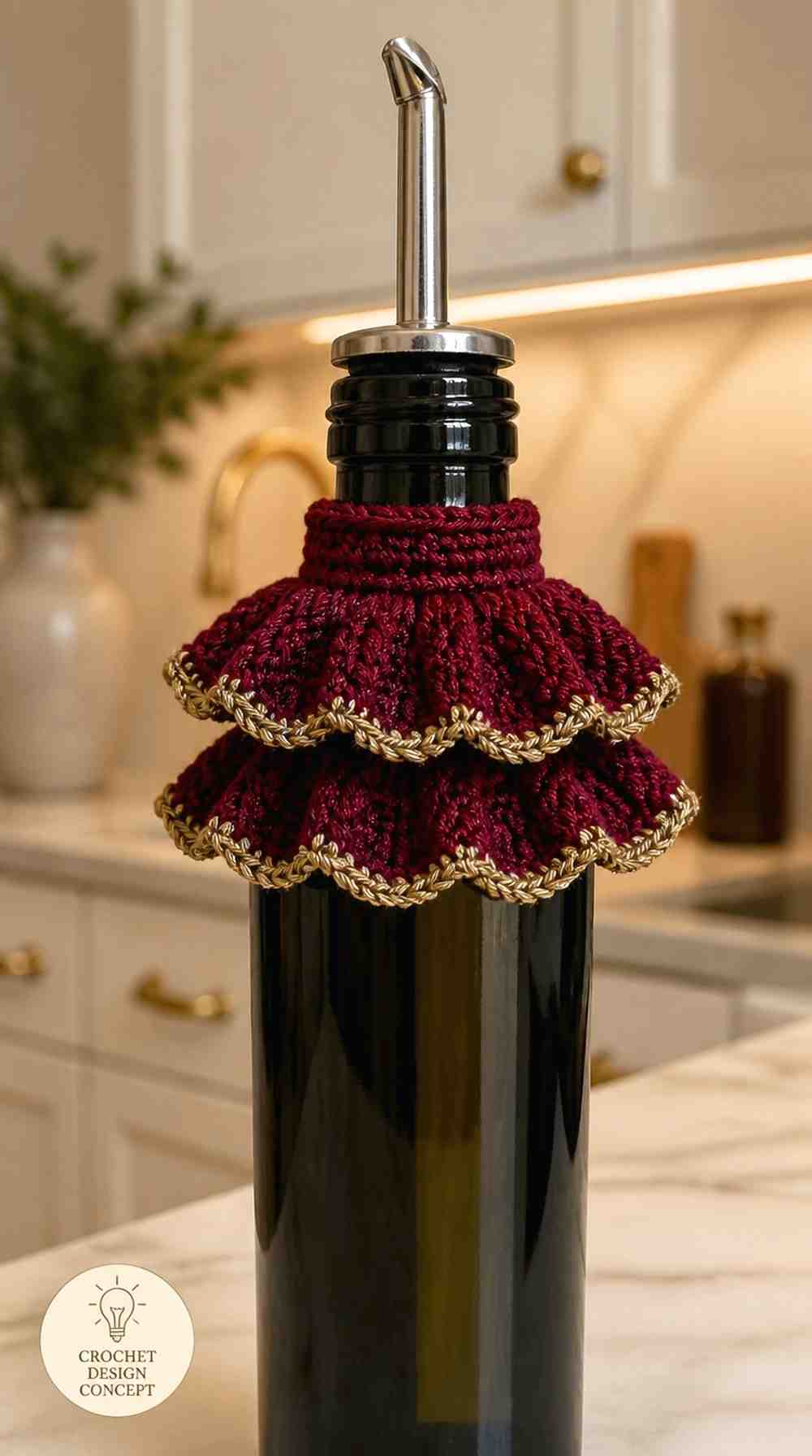
Deep burgundy crochet gives this short bottle collar a rich, classic appearance. A closely stitched neck band supports two small tiers of curved scallops, each finished with a muted-gold edge. The tiers descend over the dark bottle’s shoulder without covering its pouring spout.
The layered construction makes this one of the more elaborate decorative concepts. It creates additional folds and overlapping crochet areas, which are attractive visually but less convenient if the bottle often develops oily drips.
- Tier Spacing: Keep the two scalloped rows distinct without stacking so much fabric that the collar becomes bulky around the bottle neck.
- Decorative Borders: The muted-gold edging should follow the scallops consistently and remain outside the pouring mechanism.
- Cleaning Between Layers: Overlapping crochet tiers need extra attention because oil may become trapped where one row lies against another.
11. Crochet Rust Tie-Front Bottle Collar
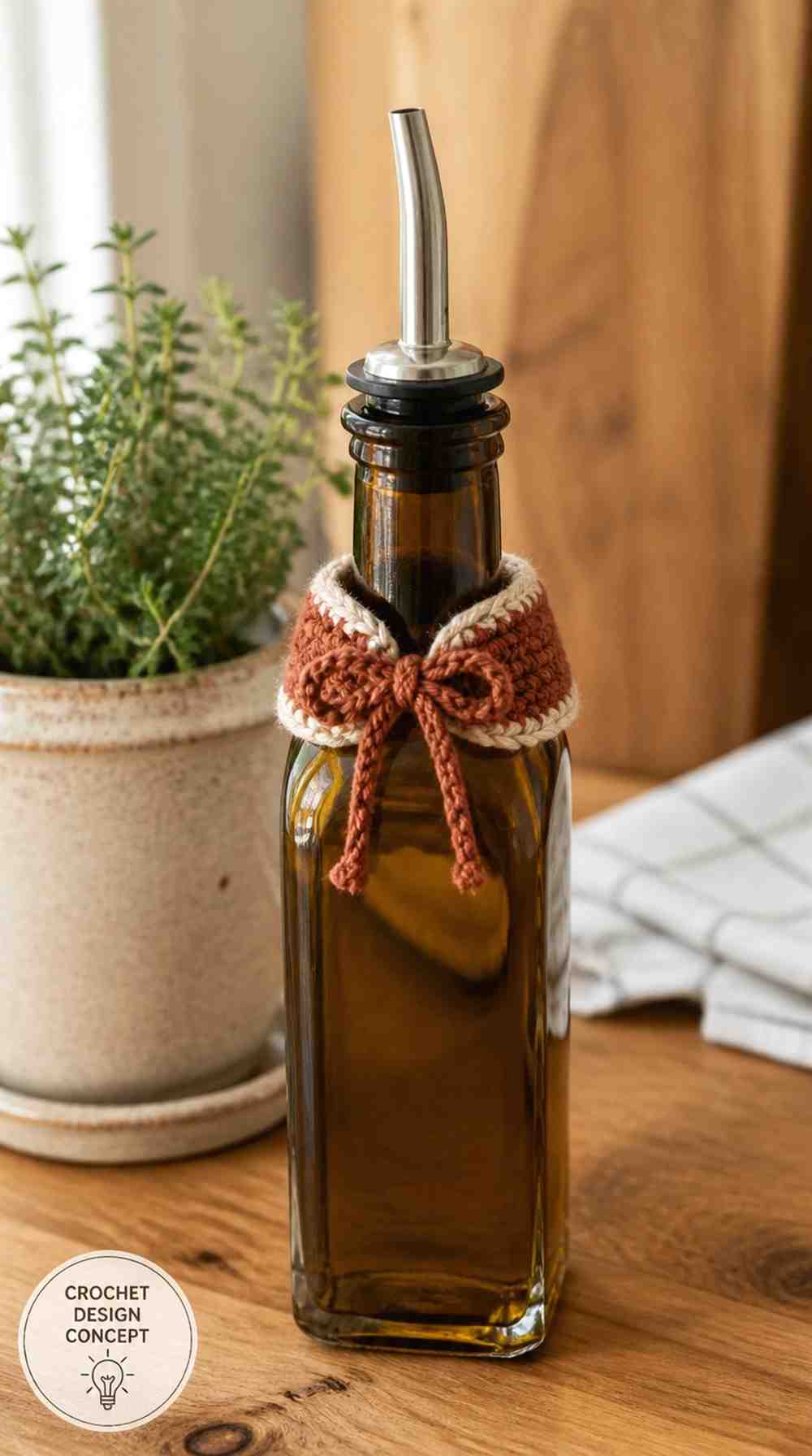
A warm rust-colored crochet strip wraps around the amber bottle neck and finishes with two short matching ties. The ties meet in a small front bow, while a narrow oatmeal border gives the main band a tidy outline.
The tie-front design offers a different fitting approach from buttons or continuous crochet rings. Its size can be adjusted to some extent, although a real version should avoid long dangling cords and excessive tightening around the glass.
- Short Tie Ends: Keep the bow compact and positioned below the exposed spout so loose cords do not approach the pouring opening.
- Adjustable Fit: The wrap can accommodate modest neck-size differences, but it should not require pulling hard against the bottle to stay in place.
- Removal Routine: Undo the bow for cleaning rather than trying to force the tied collar over the pouring attachment.
12. Crochet Lavender Daisy Accent Collar
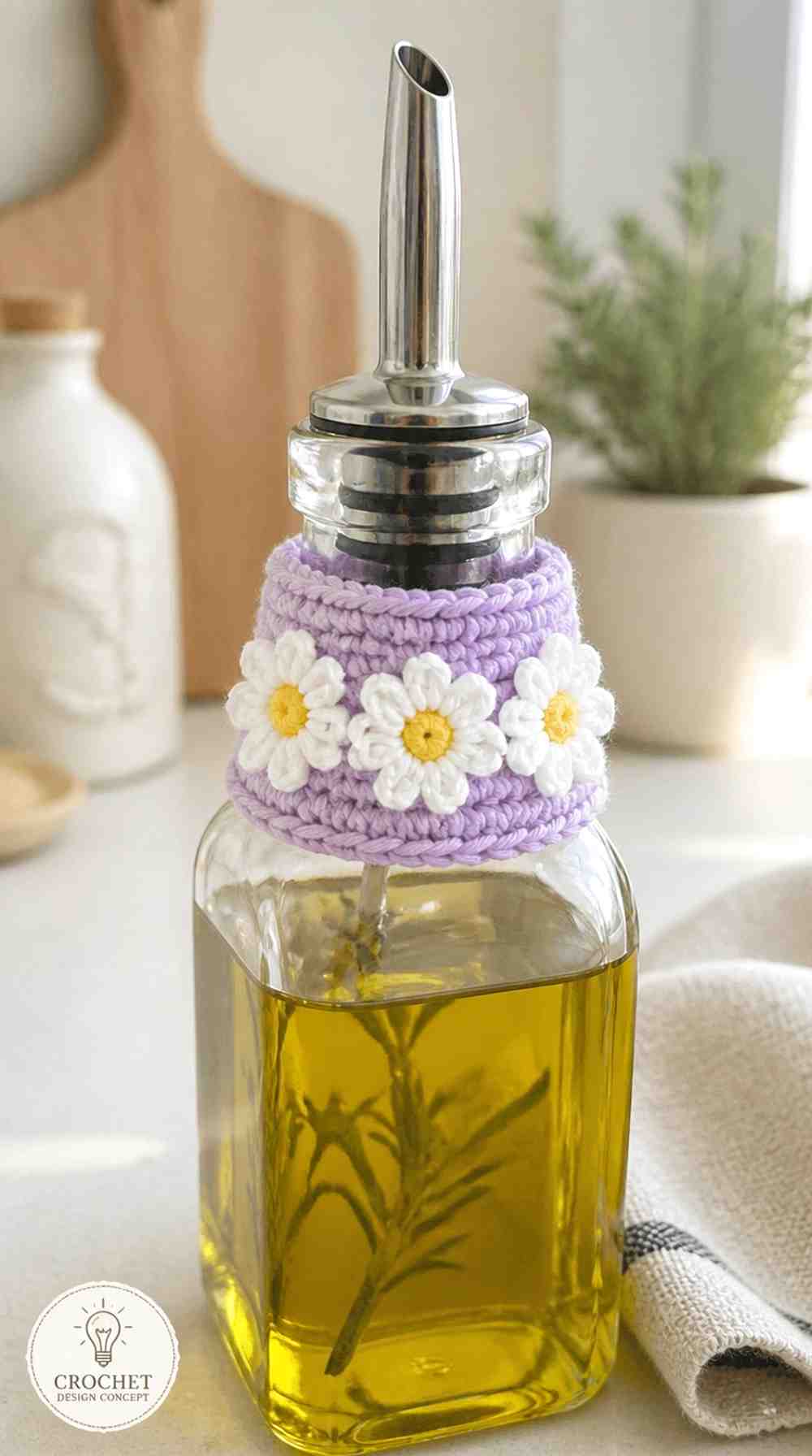
Pale-lavender crochet forms a simple neck band decorated with three small white daisies across the front. Each flower has a butter-yellow stitched center and clearly defined petals, creating a soft contrast against the transparent glass bottle.
The narrow base band keeps the bottle’s overall shape visible, while the flowers offer a small focal detail. Compared with the terracotta petal collar, this design concentrates its decoration at the front rather than spreading it around the entire circumference.
- Three-Flower Layout: Space the daisy motifs across the visible front area without overlapping the bottle’s pouring attachment.
- Motif Attachment: Keep the small white petals firmly joined to the lavender band rather than relying on loose decorative stitching.
- Front-Facing Care: The flower centers and layered petals may trap residue, so they should be inspected carefully after use.
13. Crochet Teal Braided-Edge Collar
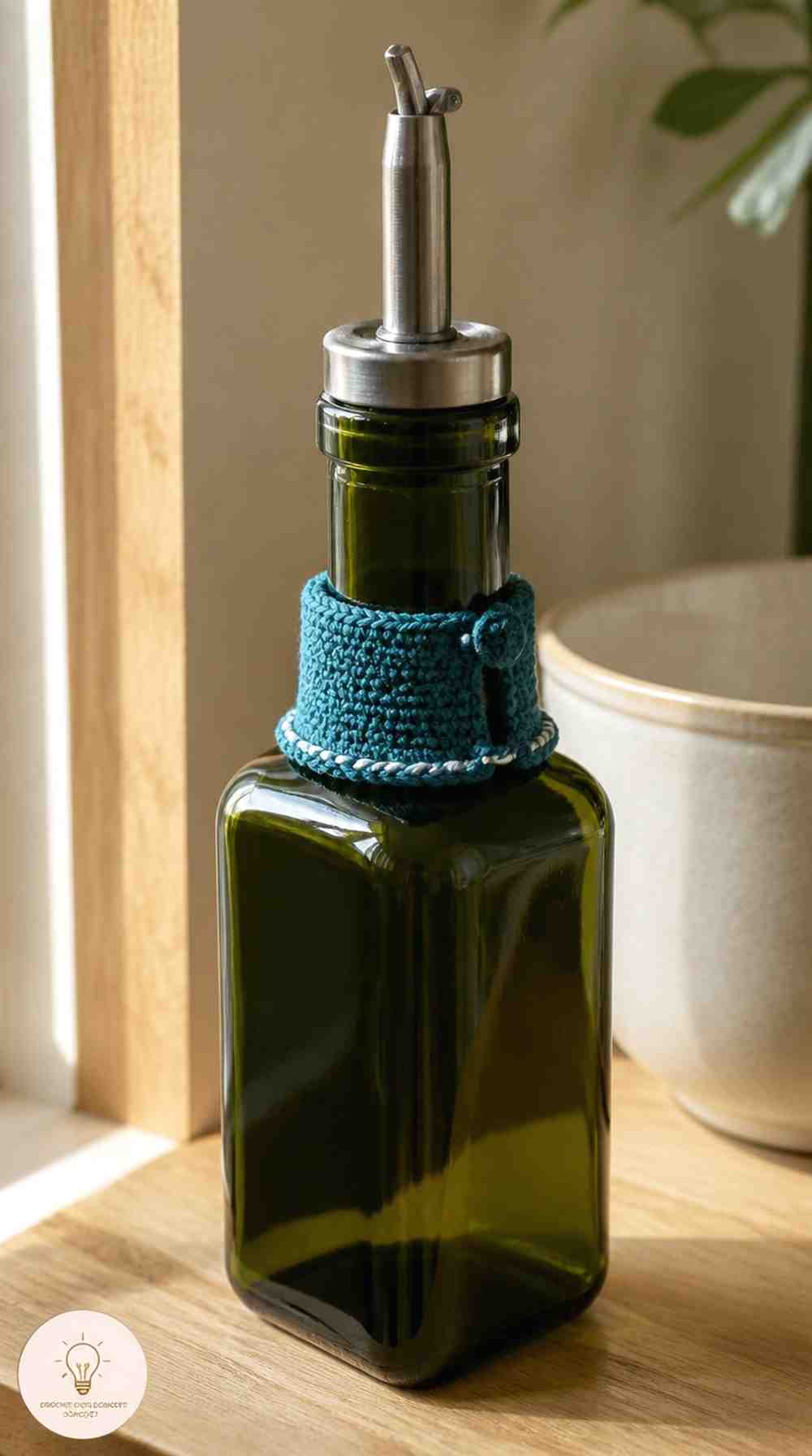
Deep-teal crochet gives this bottle collar a clean, modern appearance. Its flat central band has a twisted-looking lower crochet border, while overlapping ends close at the back with a tiny matching crochet button and loop.
Unlike the cobalt version, the fastening is deliberately placed behind the bottle neck. This keeps the front visually uninterrupted and lets the lower textured edge become the main decorative feature.
- Rear Closure: Position the loop and crochet button where they can be accessed without reaching around a hot appliance or blocking the spout.
- Border Bulk: Keep the cord-like lower edge reasonably slim so it does not push the collar away from the glass.
- Fastener Strength: Small crochet buttons can stretch or loosen; a practical version needs a closure that remains secure during normal handling.
14. Crochet Mocha Hexagon Motif Collar
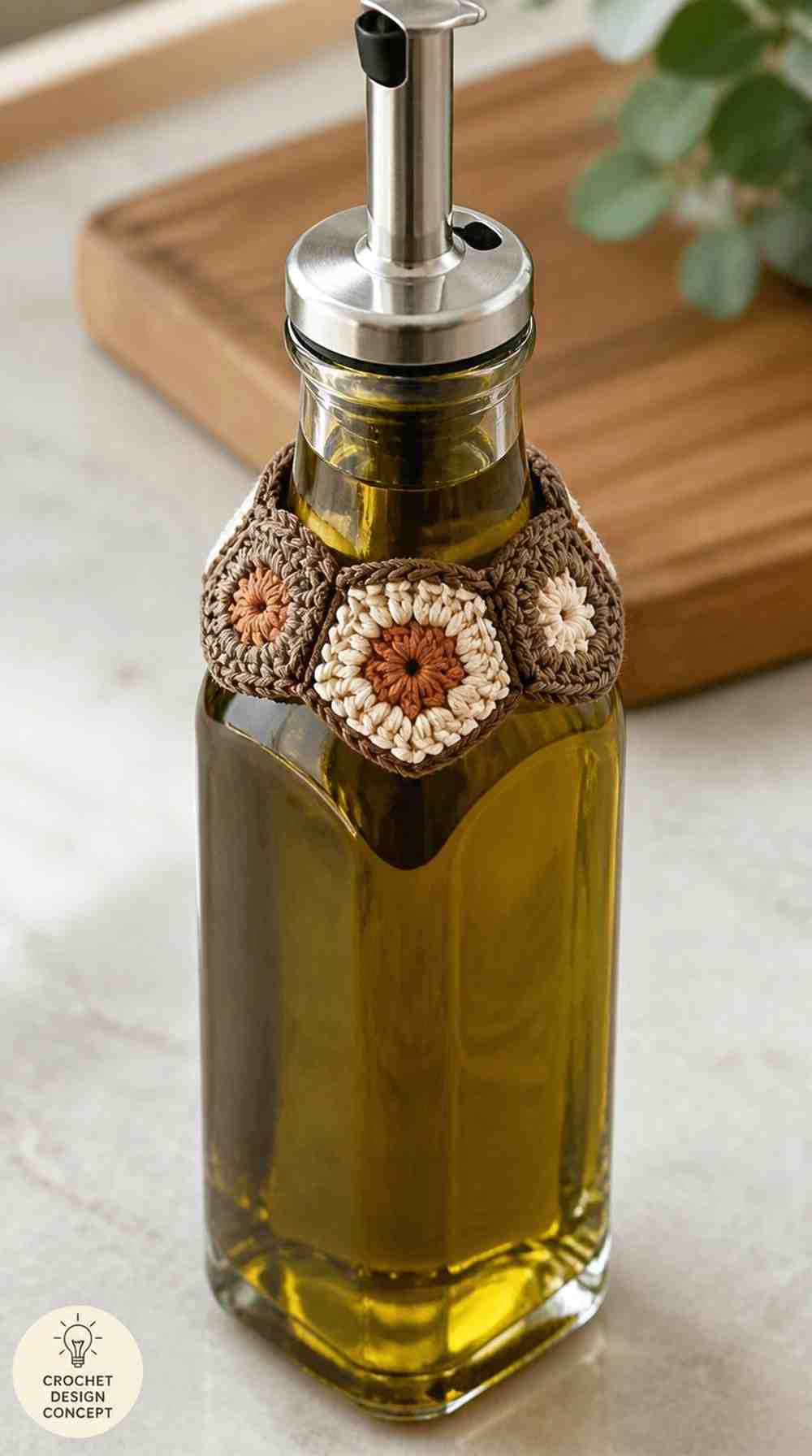
Mocha, cream, and muted-copper crochet hexagons create the front detail of this compact bottle collar. Three small motifs join onto a continuous mocha foundation band around the neck of an amber-glass olive oil bottle.
The geometric arrangement borrows the visual character of familiar crochet motifs without creating a full bottle cover. Small openings and joined edges provide texture, although they also make the collar more complex to clean than a single continuous band.
- Motif Scale: Keep the three hexagons small enough to follow the curved neck area without overlapping excessively.
- Foundation Band: The continuous mocha band provides a consistent fitting structure beneath the joined decorative motifs.
- Open-Stitch Limitations: Spaces between motif clusters can hold oil and debris, so consider denser motifs for a more frequently used bottle.
15. Crochet Coral Layered Scallop Collar
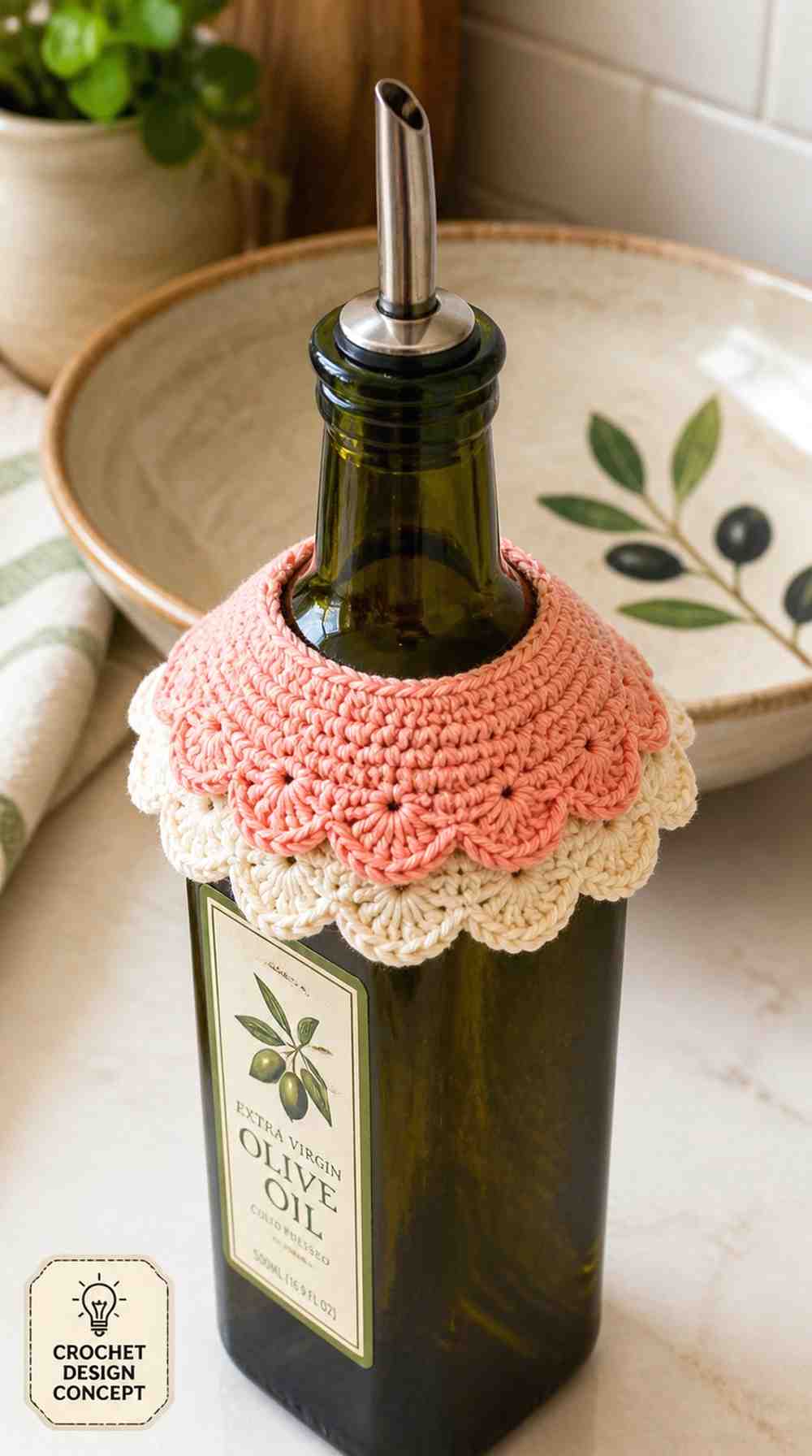
Soft coral crochet circles the bottle neck in a narrow band with two offset rows of rounded scallops. Pale-coral shapes sit above warm-ivory shapes, producing a gently layered lower edge against the dark-green glass.
This version feels lighter and more playful than the burgundy double-tier concept because the scallops are flatter and less pronounced. The contrasting colors also make the separate rows easier to see, particularly against a darker bottle.
- Offset Scallops: Arrange the coral and ivory rows so both remain visible, without adding excessive thickness beneath the neck band.
- Color Balance: Keep the warm-ivory lower row narrow enough to complement the coral rather than dominate the small accessory.
- Fabric Overlap: Check where the two scallop rows meet, as those overlaps may require additional cleaning after oil drips.
16. Crochet Espresso Brown Basketweave Collar
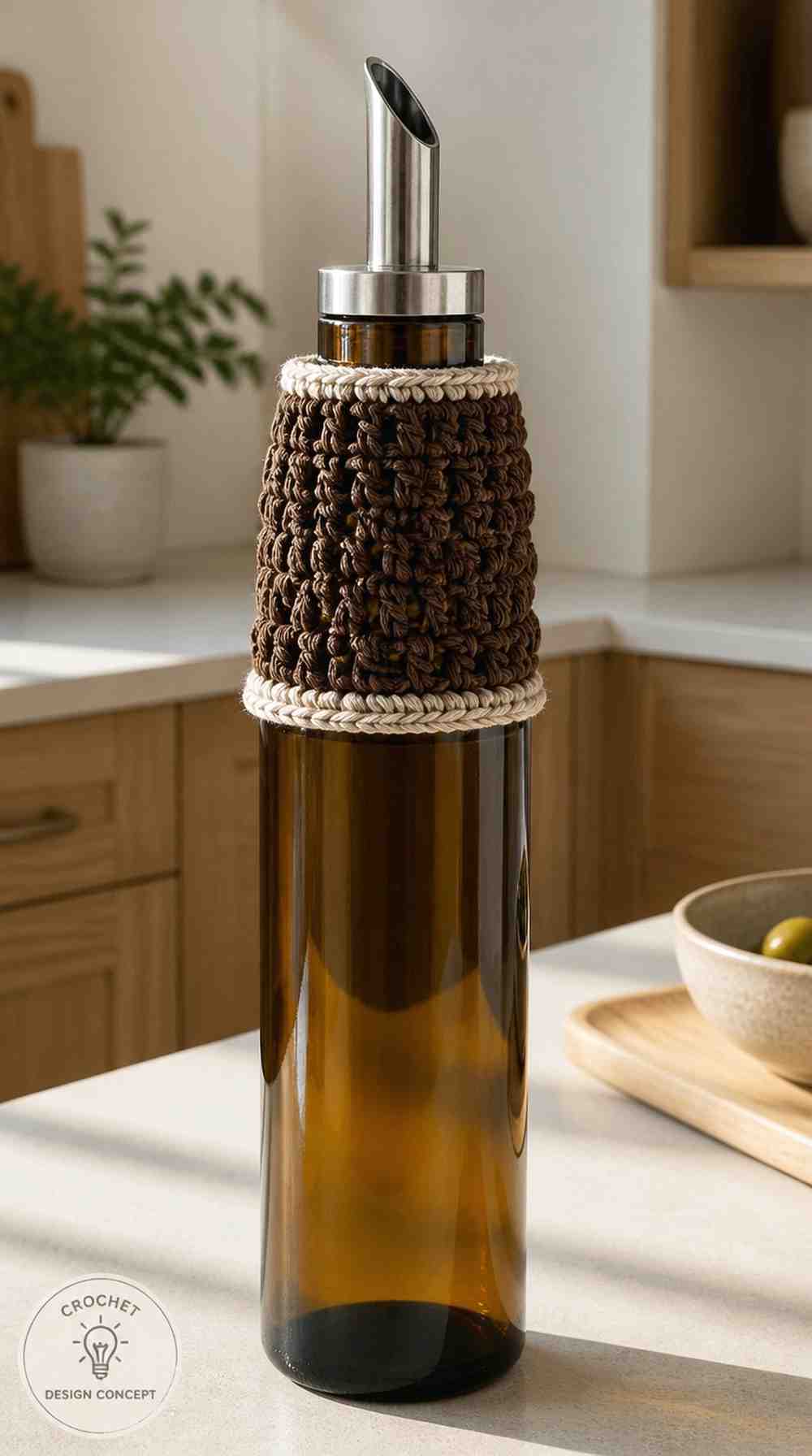
Espresso-brown cotton crochet forms a compact collar with small basketweave-like raised stitch blocks. Narrow warm-ecru bands finish the upper and lower edges, giving the textured middle a neat frame against the amber bottle.
The design uses stitch relief rather than additional motifs, ties, or fasteners. Its rich neutral palette fits naturally into a kitchen with wooden shelves and warm stone surfaces. The raised blocks look substantial, but they should remain small enough to preserve a comfortable neck fit.
- Basketweave Relief: Keep the textured blocks consistent so the finished crochet maintains a regular circumference around the bottle.
- Ecru Finishing Bands: The light upper and lower edges define the collar while leaving the espresso-brown center as its main feature.
- Cleaning Raised Texture: Inspect the small stitch recesses after washing because oily residue can remain between textured crochet blocks.
Practical Guide to Crochet Olive Oil Bottle Drip Collars
Measure the neck and pouring attachment
Olive oil bottles vary in neck diameter, shoulder slope, and pouring-spout design. Measure the bottle where the collar will sit, then check whether a continuous ring can pass over the bottle’s lip or installed pourer.
A buttoned or tied wrap may be easier to remove from bottles with wider pouring attachments. Any collar should remain below the spout and outside the path of the oil being poured.
Understand what the collar can and cannot do
A fabric collar may absorb a small amount of oil running down the outside of the neck, but it cannot correct a leaking pourer. Oil can soak into yarn, spread through the stitches, and eventually reach the bottle or countertop.
If a bottle drips frequently, a properly fitting pourer or purpose-made drip ring is a better place to start than adding more crochet fabric. Commercial solutions use different methods of controlling or collecting drips.
Reusable Silicone – SeaTurtle Sports+1
Choose materials carefully
Smooth cotton may be worth considering for a removable decorative collar, especially when clear stitches and washing convenience matter. Always check the specific yarn’s care instructions.
Avoid assuming that yarn is oil-resistant, food-safe, or suitable for prolonged contact with cooking oil. Keep the crochet outside the bottle opening, away from the pouring stream, and clear of any area where oil could wick toward food-contact surfaces.
Keep it away from heat
A crochet oil collar should not be left on a bottle beside an active burner, hot plate, open flame, or another heat source. Oil-soaked fabric presents an additional fire concern. Remove and clean any collar that becomes saturated, and keep it away from heat while drying.
Plan for removal and washing
Decorative collars are more practical when they can be taken off without disturbing the bottle’s closure. Check for oil residue regularly and wash according to the fiber’s instructions.
Do not leave oily crochet on the bottle as a permanent absorbent layer. If the bottle continues to leak, fix the pouring arrangement rather than relying on the collar.
For another approach to bottle-shaped crochet projects, the crochet potion bottle holder collection on Yarn Nest Studio discusses fitting crochet to bottle necks and shoulders. Those holders have different purposes, but the sizing considerations can still be useful.
Want to Make Something Similar?
These 16 collars are original visual concepts, and the following patterns are related crochet learning resources rather than exact instructions for the pictured designs.
- Lion Brand’s beginner crochet napkin ring pattern provides a simple introduction to making a small circular crochet accessory. Its construction can help explain the idea of a compact band, although it must be resized for a bottle. Lion Brand Yarn
- Lion Brand’s crochet placemat, coaster and napkin ring set includes a ring-shaped accessory and is useful for exploring neat finishing and fabric proportions. Lion Brand Yarn
- Yarnspirations’ Autumn Acorns Napkin Rings offers a decorative ring project that can provide inspiration for motif placement and shaping. Yarnspirations
None of these patterns is specifically designed as an olive oil drip collar. Any adaptation would need separate fit, cleaning, and safety checks.
Which Crochet Olive Oil Bottle Drip Collar Should You Choose?
| Your priority | Designs to consider | Main trade-off |
|---|---|---|
| Compact everyday styling | Burnt Orange Ribbed, Dusty Blue Raised-Ridge | Less fabric coverage, simpler appearance |
| Broader shoulder coverage | Oatmeal Shoulder Ring, Mustard Front Bib | More surface to collect oil and require washing |
| Adjustable or removable closure | Cobalt Buttoned, Rust Tie-Front, Teal Braided-Edge | Buttons, loops, and ties need careful fitting |
| Botanical decoration | Olive Leaf Scallop, Terracotta Petal, Lavender Daisy | Motifs add cleaning work |
| Graphic pattern | Navy Checkerboard, Mocha Hexagon | Multiple color changes and joins |
| Textured appearance | Linen Folded Cuff, Espresso Brown Basketweave | Extra layers or raised stitches may retain residue |
| Decorative layered edging | Burgundy Double-Tier, Coral Layered Scallop | Overlapping rows can be harder to maintain |
For a bottle used many times a day, a simple removable band is generally a more manageable concept than a heavily layered floral collar. If decoration is the main goal, the leaf, daisy, and scallop designs provide more visual detail.
Conclusion
Crochet olive oil bottle drip collars offer a creative way to bring small handmade touches into the kitchen. From a burnt-orange ribbed ring to a broad oatmeal shoulder collar or a burgundy layered design, the possibilities go beyond changing yarn color.
The best choice depends on the bottle’s shape, how easily the collar comes off, and whether you are prepared to clean fabric that may collect cooking oil. Decorative crochet can complement a good pourer, but it should never be treated as a guaranteed drip-control or heat-safe accessory.
Which design would suit your kitchen best: a simple ribbed band, an olive-leaf collar, or a removable buttoned wrap? Share your favorite color and bottle style in the comments.
Frequently Asked Questions
1. Can a crochet collar really stop olive oil from dripping?
A crochet collar may catch or absorb a small amount of oil running down the outside of a bottle, but it cannot guarantee a drip-free pour. Oil can travel through the yarn and reach other surfaces. If dripping is persistent, look at the bottle’s pouring spout and closure first, rather than relying on fabric to contain the leak.
2. What yarn is suitable for a crochet olive oil bottle collar?
Smooth cotton may be considered for a decorative, removable collar because it offers clear stitch definition and may be washable according to the yarn’s care label. However, no ordinary crochet yarn should automatically be considered food-safe, oil-resistant, or flame-resistant. Keep the collar away from the bottle opening and hot cooking equipment.
3. How do I size a crochet collar for an olive oil bottle?
Measure the circumference of the bottle neck at the exact point where the collar will sit. Also check the bottle lip, shoulder, and pouring attachment. For a continuous ring, consider whether it can be slipped into position. For a buttoned or tied design, allow enough overlap to fasten the collar without excessive tension.
4. How often should a crochet olive oil bottle collar be washed?
There is no single suitable schedule for every collar. Inspect it whenever the bottle is used, especially if the pourer often leaves residue. Remove and clean it when oil reaches the yarn, following the fiber’s washing instructions. Make sure it dries completely before reuse, and do not leave heavily oil-soaked fabric near heat.
5. Are these 16 crochet olive oil bottle collars available as exact patterns?
No. The designs are inspiration concepts rather than tested crochet patterns. The linked ring tutorials demonstrate related techniques, but they do not reproduce the pictured collars. Anyone making a real version would need to adapt the shape, fit, stitching, and removable features to their particular bottle while considering cleaning and safety.