October evenings are a natural time to reach for handmade slippers, and mosaic-inspired colorwork gives an ordinary pair much more visual character. Geometric blocks, contrasting bands, modular motifs, raised grids, and repeated color patterns can all bring a mosaic feeling to footwear without requiring every slipper to use the same construction.
One tutorial in this collection is specifically categorized as a mosaic crochet slipper project. The others offer slipper shapes that can support mosaic-inspired color planning, motif arrangements, or carefully placed colorwork. That distinction matters: a toe-up house slipper, a granny-square shoe, a lined moccasin, and a boot with a separate cuff should not all be adapted in exactly the same way.
The most successful choice will balance appearance with fit. Slippers bend around the foot, carry body weight, and contact the floor, so a beautiful geometric pattern still needs sensible placement. Keep thicker decorative work away from areas where it could make the sole uncomfortable, and check the original tutorial whenever an adaptation could change sizing or structure.
Quick List
- Crochet Geometric Mosaic House Slippers
- Crochet Raised-Grid Mosaic Slippers
- Crochet Granny-Patch Mosaic Slippers
- Crochet Hexagon Mosaic Cuff Slippers
- Crochet Toe-Up Mosaic Band Slippers
- Crochet T-Shirt Yarn Mosaic Slipper Socks
- Crochet Double-Sole Mosaic Cottage Slippers
- Crochet Mosaic Paw House Slippers
- Crochet Rectangle Mosaic Lounge Slippers
- Crochet Button-Strap Mosaic Slippers
- Crochet Lined Mosaic Moccasin Slippers
- Crochet Mosaic-Cuff Slipper Boots
- Crochet Buttoned Mosaic Slipper Boots
- Crochet Tall Mosaic Stripe Slipper Socks
- Crochet Rubber-Sole Mosaic Slippers
Put Mosaic Detail Where It Will Not Distort the Fit
Slippers give you less freedom for bulky decoration than a tote or blanket. The toe has to bend, the heel needs to stay in place, and the opening has to stretch enough for the foot to enter comfortably. That makes the upper, ankle band, cuff, and flat side panels more forgiving locations for decorative colorwork than the underside of the foot.
If you are adapting a plain slipper tutorial, preserve its basic shaping first. A narrow geometric band around the ankle or a graphic panel across an otherwise stable upper is usually easier to evaluate than replacing every section with a denser mosaic fabric.
Pay particular attention to colorwork tension. A section that pulls inward can make two slippers made from the same instructions fit differently. Compare the pair frequently instead of completing one entire slipper before checking the second.
Choose Yarn for Fit and Definition, Not Just Autumn Color
Rust, cream, brown, mustard, burgundy, forest green, charcoal, and muted blue can all create an October palette, but color is only one part of the decision. Mosaic-style designs depend on visible contrast, so two medium-dark shades that look attractive in separate skeins may blur together once crocheted.
Fiber behavior matters too. If you substitute yarn, compare the new fabric with the tutorial’s intended density and stretch rather than assuming the same hook will produce the same fit. Slippers are especially sensitive to small changes because their finished size is closely related to the wearer’s foot.
For geometric work, make a small test section before committing to a whole pair. Check whether the pattern remains visible from standing distance and whether the color changes make the fabric noticeably firmer.
Treat the Sole as a Functional Part of the Project
The sole deserves separate attention from the decorative upper. Crochet fabric can be slippery on smooth flooring, and several slipper designers specifically discuss grip or additional sole treatments in their tutorials and written guidance. Naztazia, Rich Textures Crochet, and Make & Do Crew all address sole behavior in different ways.
Do not assume that one grip method is suitable for every yarn, floor, or wearer. Test finished slippers cautiously on the surface where they will actually be used. If mobility or fall risk is a concern, prioritize secure commercial footwear rather than relying on a decorative crochet adaptation.
1. Crochet Geometric Mosaic House Slippers
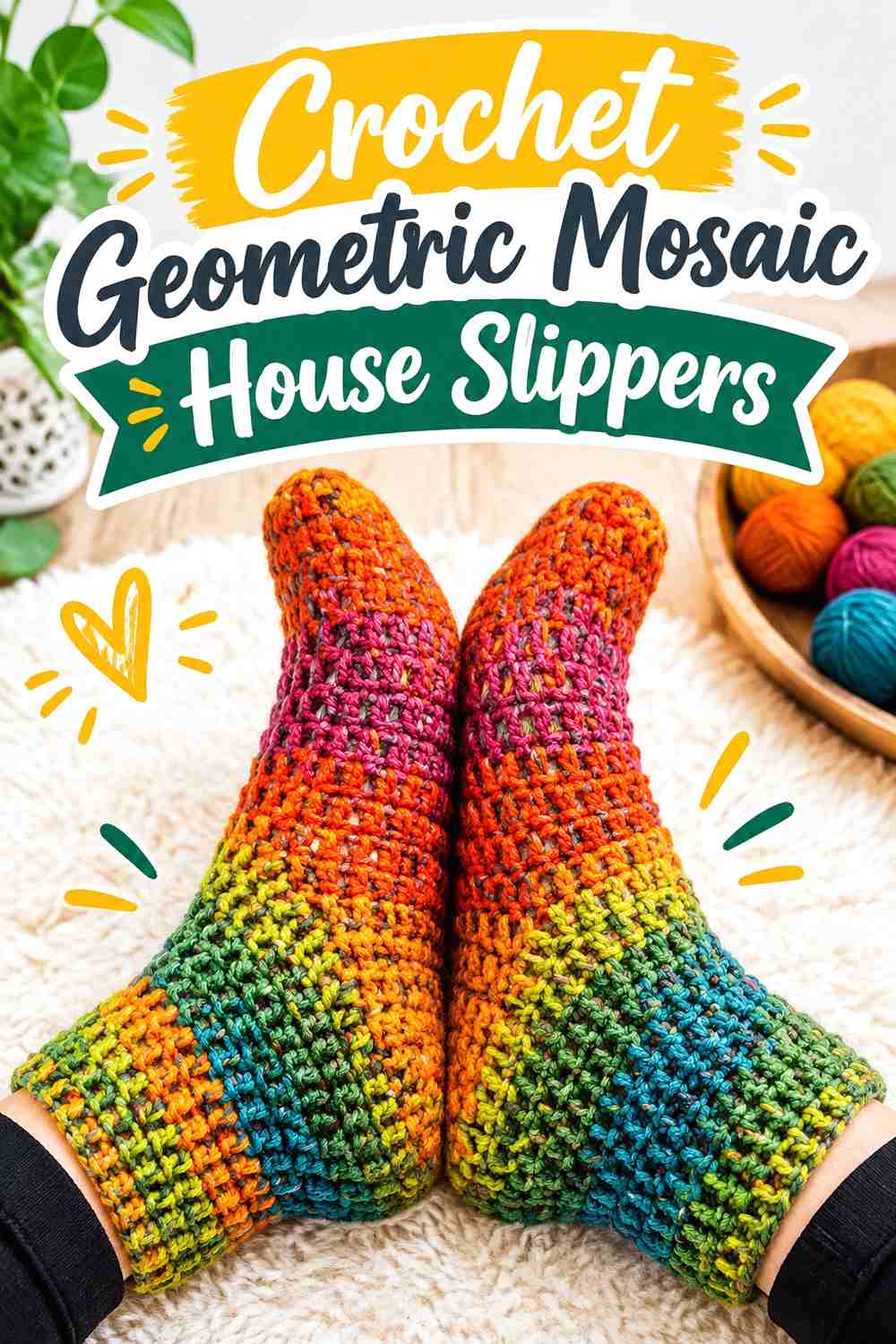
This is the closest source match to the article theme. Souma Crochet’s slipper project is explicitly categorized as mosaic and uses a fitted, one-piece approach rather than separate granny motifs or an added boot cuff. That makes it a useful starting point when the mosaic technique itself matters more than simply achieving a multicolor appearance.
The compact silhouette also shows an important design lesson: a mosaic slipper does not need a huge number of colors. A controlled contrast can let the repeated geometry provide most of the visual interest.
Let the Mosaic Pattern Support the Foot Shape
A slipper narrows and curves in places where a flat mosaic swatch does not. Watch how the geometric design behaves as the fabric changes direction instead of judging the pattern only from a flat section.
If you change the color arrangement, preserve enough contrast for the repeated forms to remain recognizable around the curved toe and sides.
Check Both Slippers at the Same Stages
Colorwork tension can drift as you become more comfortable with a technique. Work the pair in parallel when practical, comparing length, width, and stretch after equivalent sections.
That approach can expose a tension change before two apparently identical slippers end up fitting differently.
Keep the Sole Area Comfortable
A graphic effect on the visible upper is very different from raised or uneven texture directly under the foot. Before extending decorative techniques into the sole, consider whether they will create ridges that can be felt while standing.
Creator Credit: Souma Crochet
2. Crochet Raised-Grid Mosaic Slippers
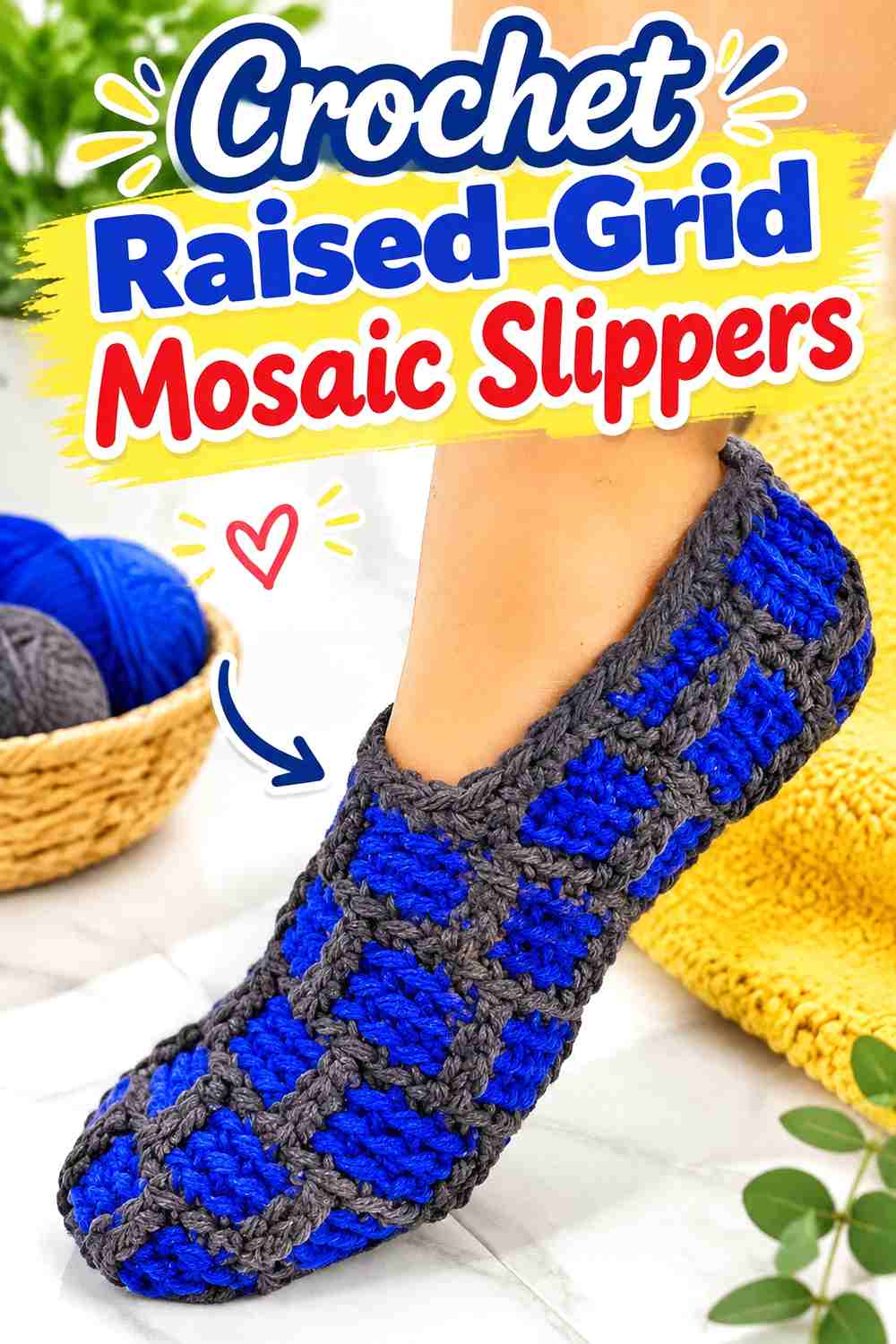
Littlejohn’s Yarn offers a two-color slipper with a raised square-grid effect. The source works from the toe toward the heel and uses a specialty connected stitch to create the contrasting grid, giving this idea a strongly geometric surface without relying on separate motifs.
For an October version, a dark ground with rust, cream, gold, or muted green grid lines could emphasize the architecture of the fabric.
Raised Lines Make Tension Easier to Notice
A repeated grid acts almost like graph paper across the slipper. Any area that suddenly narrows, stretches, or shifts becomes visually obvious.
Lay the work flat periodically and check whether the squares remain balanced before continuing farther down the foot.
Use the Grid as the Main Design Element
This surface already contains significant texture. Extra appliqués or several additional stitch effects can compete with the clean geometry.
If you want more seasonal character, changing the two-color palette is likely to preserve the strongest feature better than adding unrelated decoration.
Test the Interior Surface Before Finishing the Pair
A stitch that looks attractive from the outside may create a different texture on the inside. Feel the fabric against the foot area before repeating the full second slipper, especially if you are sensitive to ridges.
Creator Credit: Littlejohn’s Yarn
3. Crochet Granny-Patch Mosaic Slippers
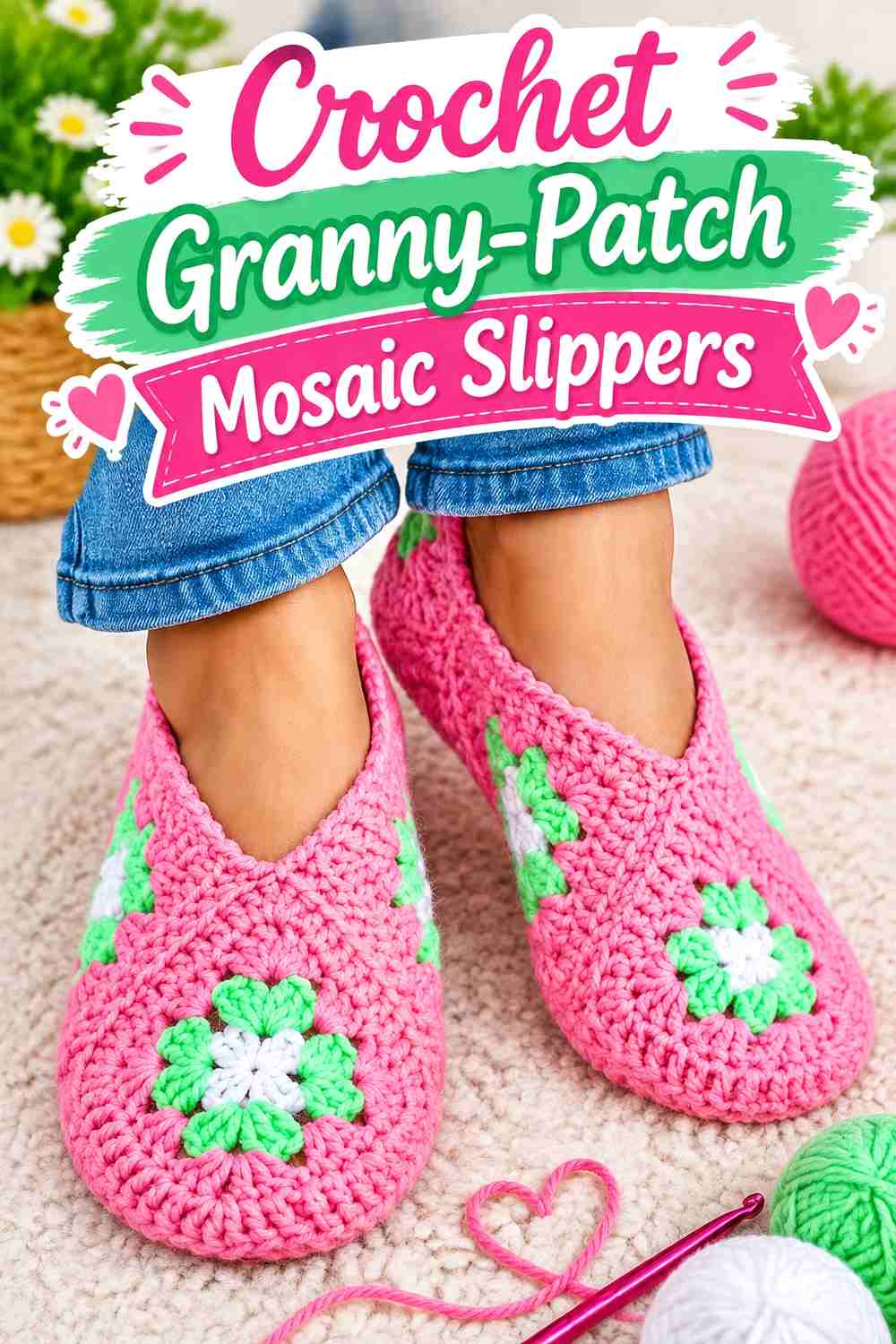
Naztazia builds adult bedroom slippers from multiple granny squares, making this one of the most modular constructions in the collection. The tutorial uses six squares per shoe, so the slipper shape emerges through motif placement and joining rather than continuous toe-to-heel shaping.
That format is ideal for a patchwork interpretation of the mosaic theme. Instead of treating every square identically, you can plan a restrained set of coordinated autumn color arrangements while keeping compatible motif dimensions.
Match Blocked Motif Size Before Assembly
A slipper assembled from multiple squares is unforgiving when one motif is noticeably larger than another. Compare dimensions after the pieces have settled into their finished shape rather than relying only on round counts.
If you substitute a denser mosaic-style square, confirm that it matches the original construction closely enough before making the complete set.
Plan the Color Map Before Making Every Square
The same collection of colors can look random or deliberate depending on placement. Sketch where the darkest and lightest squares will sit around the toe, side, and heel before joining.
This is particularly useful with autumn palettes, where several medium-value colors can otherwise blend together.
Do Not Ignore the Joins
The seams form part of the visible design. A matching join can make the squares flow together, while a contrasting join emphasizes the patchwork structure.
Choose deliberately instead of treating the joining yarn as leftover material.
Creator Credit: naztazia
4. Crochet Hexagon Mosaic Cuff Slippers
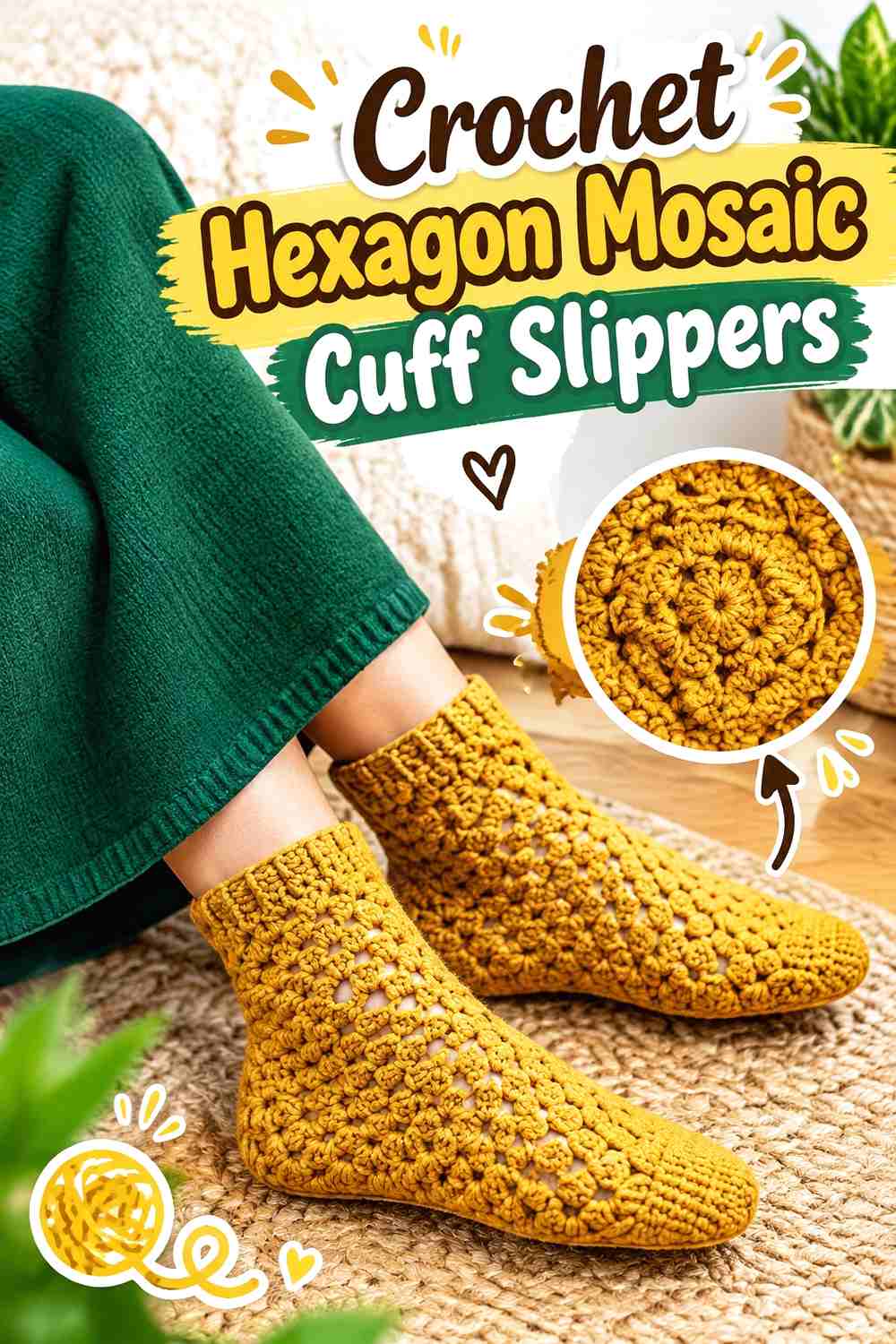
Simple Crochet demonstrates slippers built around six-sided motifs and finishes the shape with toe work and a ribbed cuff. That combination creates a different mosaic opportunity from square-based patchwork because the angled motif edges naturally produce a more faceted appearance.
A few coordinated hexagon color schemes can create a tiled look even without adding a complicated overlay mosaic pattern.
Hexagons Shift the Direction of the Design
Unlike square grids, hexagons send visual lines in several directions. Think about which part of the motif will face upward once the slipper is assembled.
A color placement that looks balanced on the table can appear unexpectedly diagonal on the foot.
Keep the Cuff Visually Quieter When the Motifs Are Busy
The ribbed ankle gives you a useful finishing area, but it does not need to compete with multicolor hexagons. A single cuff color can frame a more complex lower section.
Alternatively, use a small two-color repeat in the cuff only if the motifs below are comparatively restrained.
Confirm the Motif Scale Before Multiplying It
Changing yarn or hook size changes more than the appearance of one hexagon; it affects the dimensions of the entire assembled shoe. Make one complete test motif and compare it with the tutorial’s sizing guidance before producing the remainder.
Creator Credit: Simple Crochet
5. Crochet Toe-Up Mosaic Band Slippers
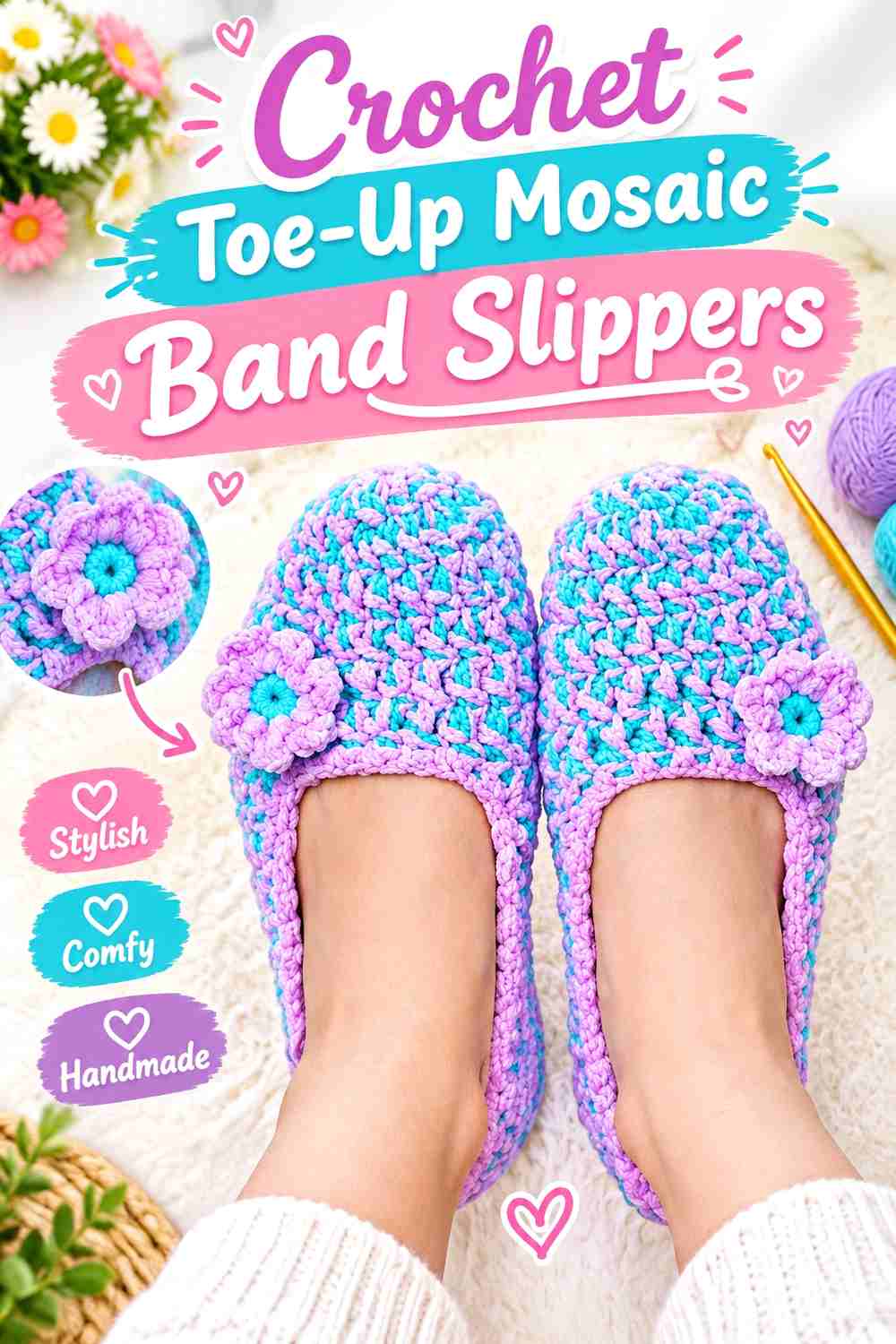
Secret Yarnery’s slipper construction begins at the toe and continues toward the heel, creating a straightforward base that can be personalized for fit. The source uses doubled yarn and demonstrates how the length can be checked during construction.
Rather than trying to convert the entire slipper into dense mosaic crochet, use this shape as an adaptation base for a carefully positioned geometric ankle band or contrasting upper section.
Finish the Main Fit Before Adding Complexity
A simple toe-up structure is useful because you can understand where the slipper naturally expands, straightens, and closes. Preserve those fit landmarks before introducing a decorative colorwork section.
If the mosaic band pulls inward, the opening may become less comfortable even when the lower foot still fits.
A Narrow Band Can Have More Impact Than Full Coverage
One crisp band above a plain body gives the eye a clear focal point. For October, consider two strongly contrasting colors rather than several similar autumn shades.
This also limits the amount of tension-sensitive colorwork in a fitted project.
Compare Opening Stretch Before and After the Band
The ankle opening is a functional measurement, not just a decorative edge. Stretch the unfinished slipper gently before the colorwork begins and compare it again afterward.
If the decorative section noticeably reduces flexibility, revise the adaptation before repeating it on the second slipper.
Creator Credit: Secret Yarnery
6. Crochet T-Shirt Yarn Mosaic Slipper Socks
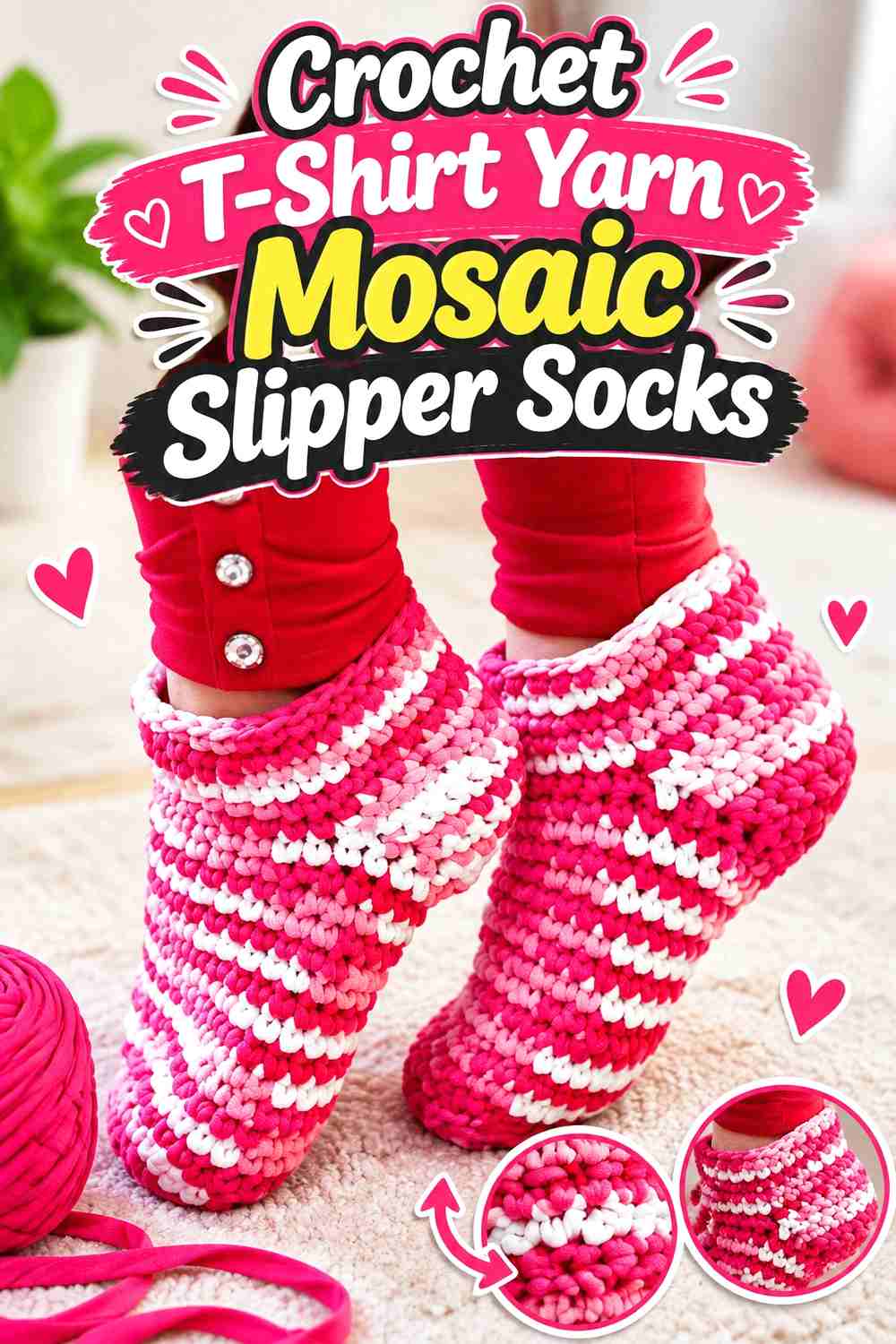
Jayda InStitches demonstrates slipper socks using T-shirt yarn, creating a heavier, more substantial fabric than many standard-yarn house slippers. The source emphasizes customizable sizing and a sock-like construction.
That makes this an interesting choice for bold, large-scale mosaic-inspired stripes or blocks. A very tiny motif could get lost in thick material, while broader geometric sections are easier to read.
Scale the Graphic Pattern to the Yarn
Thicker yarn produces larger stitches, so a motif chart designed for finer yarn may become oversized quickly. Choose simple geometry that can remain recognizable with relatively few color changes.
Diamonds, broad checks, stair-step lines, and wide bands are easier to balance than miniature details.
Watch the Weight of the Finished Upper
T-shirt yarn can produce a substantial fabric. If you add multiple layers, carried strands, or dense embellishment, check whether the upper begins to feel heavy compared with the original construction.
More visual texture is not always better for footwear.
Keep the Heel Closure Flat
Where the slipper is joined or closed, extra bulk can be noticeable against the foot. Avoid placing your most complicated color transitions directly where a seam already adds thickness.
Creator Credit: Jayda InStitches
7. Crochet Double-Sole Mosaic Cottage Slippers
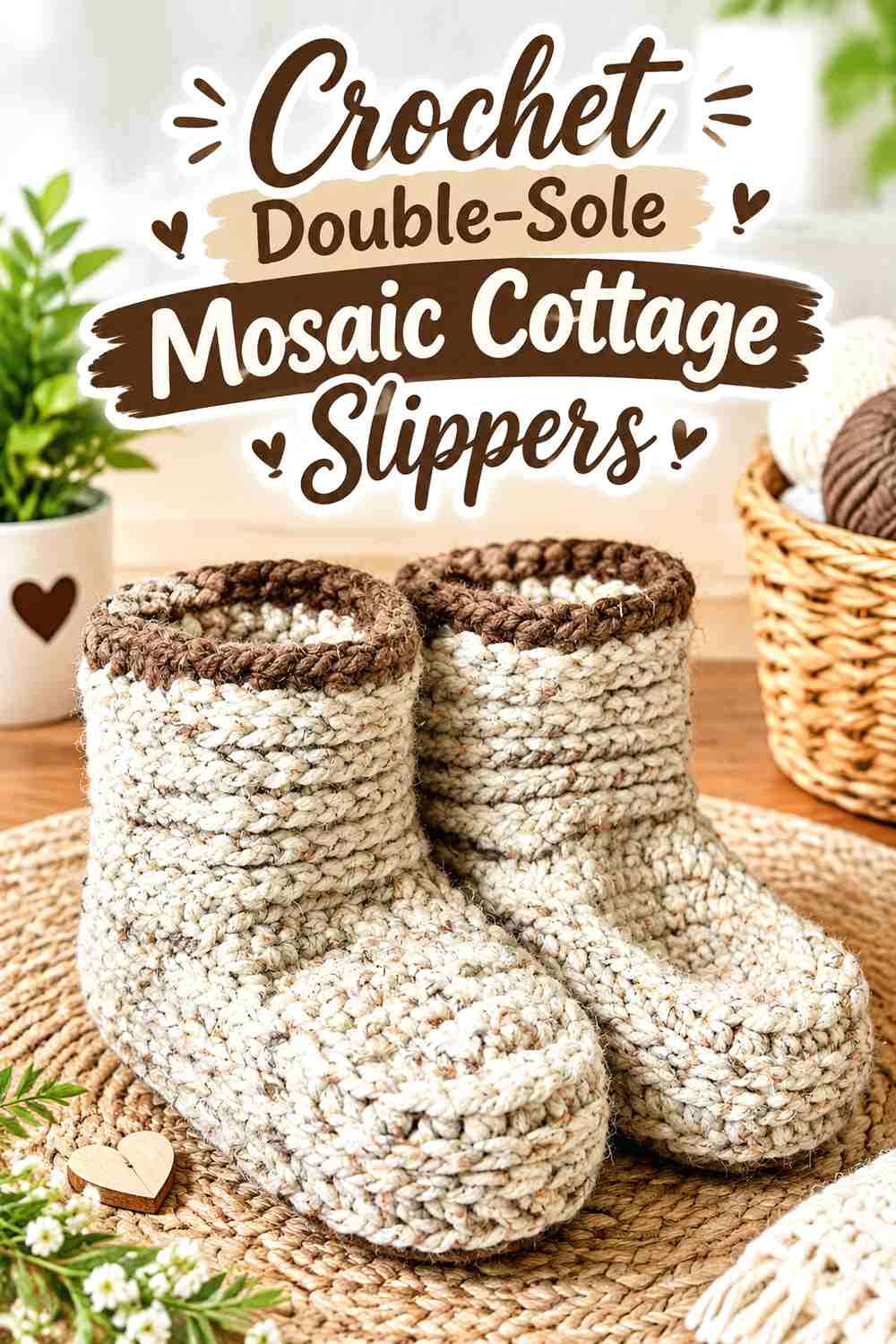
Rich Textures Crochet’s Cottage Slippers use a double-thick sole and a boot-style profile, giving this project more structure beneath the foot and more vertical space around the ankle than a low-cut slipper.
That taller upper makes the cuff a natural place for an October mosaic band while allowing the sole and lower foot to remain close to the original design.
Keep the Double Sole Separate From the Decorative Experiment
The source’s layered sole is a structural feature. If you are adapting the look, leave that part alone until you understand how the slipper fits.
A mosaic effect on the upper can change appearance dramatically without interfering with the basic foundation underfoot.
Use the Cuff as a Framed Colorwork Zone
A boot-style opening gives you a clear beginning and end for a decorative repeat. This makes it easier to keep both slippers visually consistent.
Mark the center front or center back before planning the motif so the repeat does not end awkwardly at a prominent point.
Check Cuff Flexibility Before Finishing
A dense decorative band can reduce stretch. Make sure the opening still passes comfortably over the heel and sits where intended before weaving in every end.
Creator Credit: Rich Textures Crochet
8. Crochet Mosaic Paw House Slippers
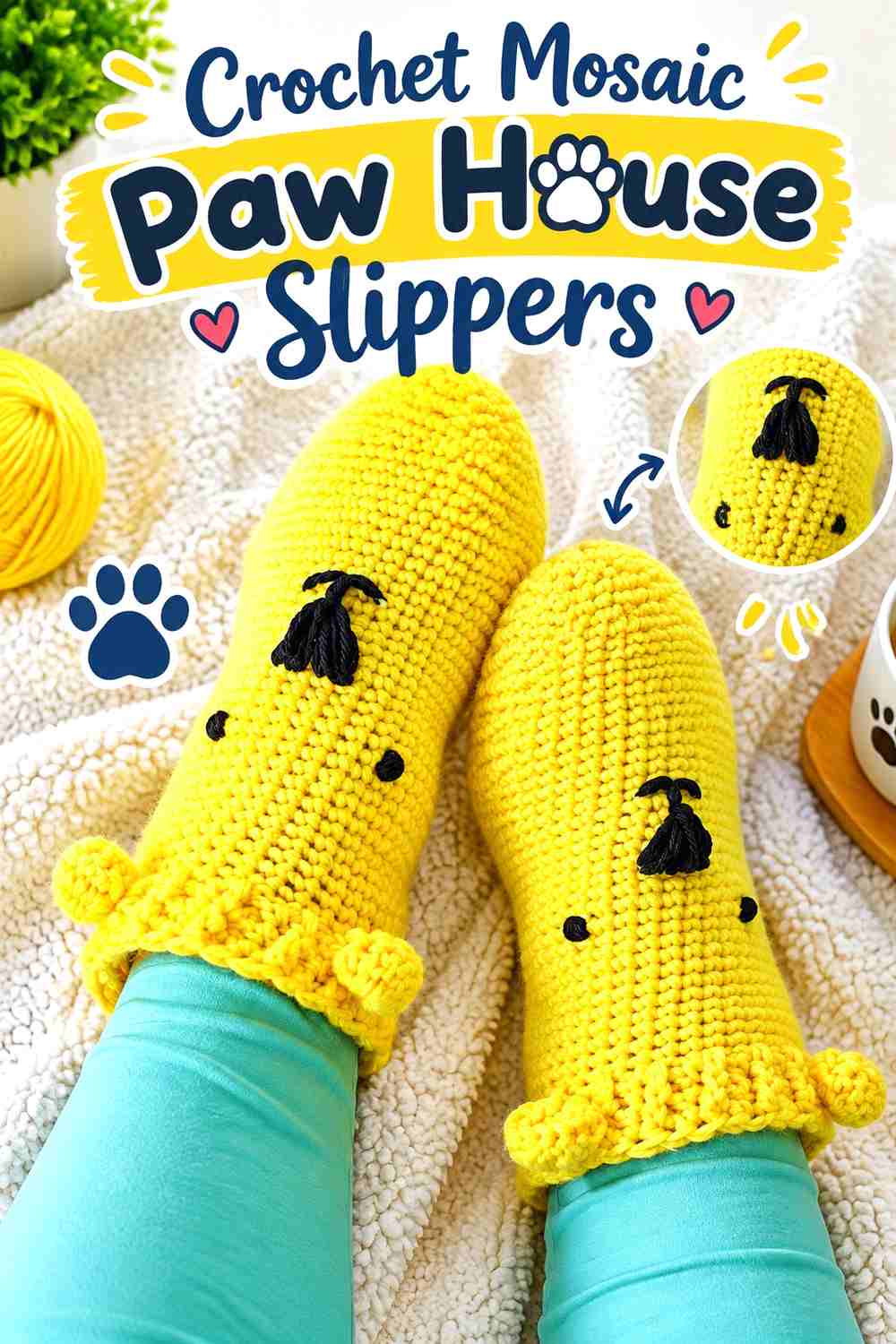
B.Hooked Crochet demonstrates a pair of animal-inspired slippers based on Yarnspirations’ bear-foot design. The finished result uses the whole toe area as a character feature, giving this option a very different visual direction from conventional geometric slippers.
For a mosaic interpretation, think of the paw as a simplified graphic: contrasting toe shapes, a blocky central pad, or a two-tone tiled upper can reference mosaic design without obscuring the animal silhouette.
Decide Whether the Paw or Mosaic Is the Focal Point
Trying to make both equally complex can muddy the design. If the paw shapes are prominent, keep the surrounding color pattern simple.
If the geometric fabric is the main feature, reduce the paw detail to a few strong contrasting elements.
Keep Toe Decorations Away From Walking Surfaces
Dimensional details belong on the visible upper, not underneath the sole. Anything placed beneath the foot can affect stability or become uncomfortable with repeated wear.
Make Both Faces as a Pair
Animal slippers quickly look mismatched if facial or paw elements are positioned independently. Place corresponding details on both unfinished slippers side by side before securing them.
Creator Credit: B.Hooked Crochet
9. Crochet Rectangle Mosaic Lounge Slippers
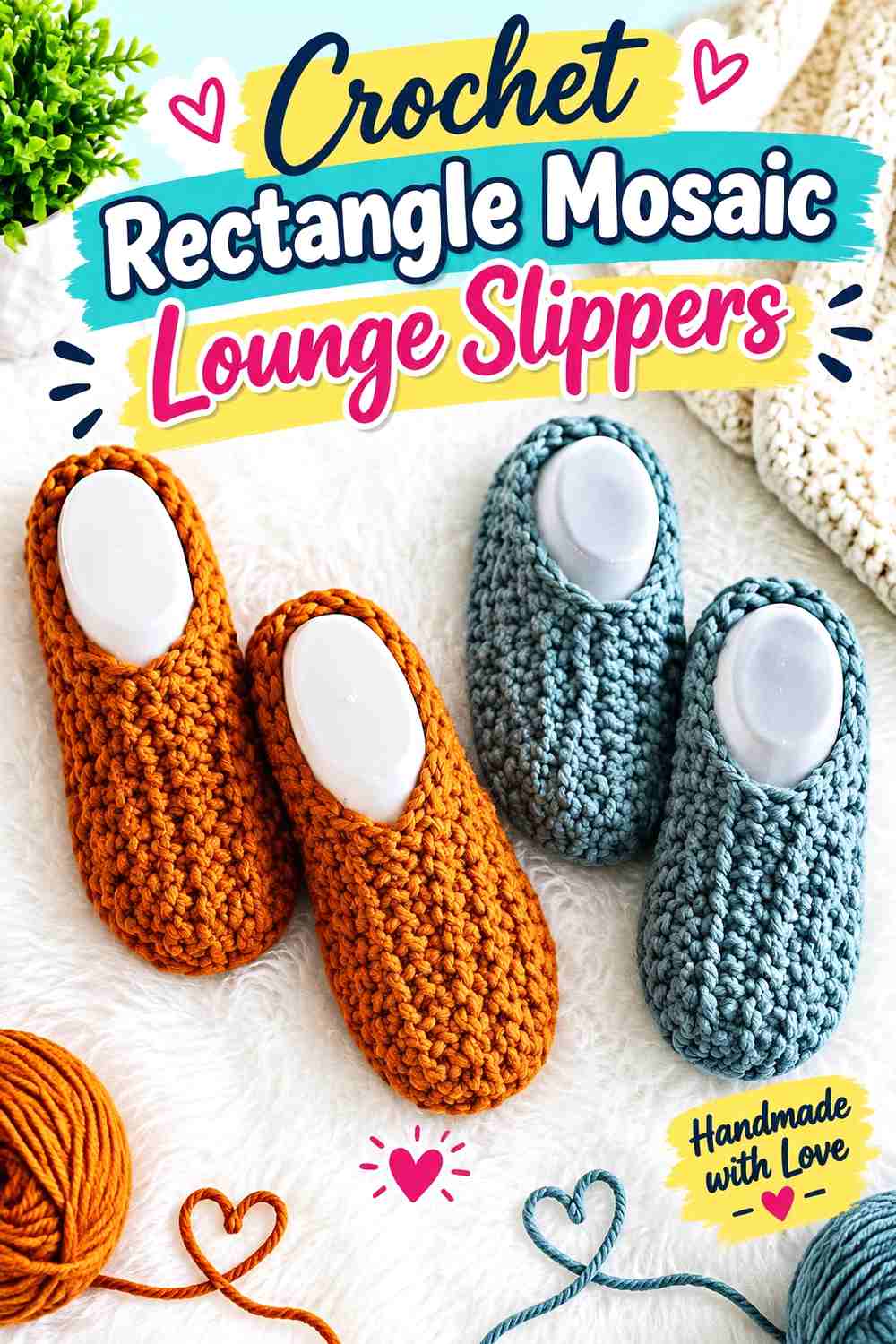
crochetdreamz uses a flat rectangle as the basis of an adult slipper, creating a knit-look surface that is transformed through folding and assembly. The tutorial is designed around a simple rectangular construction rather than extensive shaped rounds.
A flat rectangle is one of the easiest slipper forms to visualize as a colorwork canvas because you can assess the geometric layout before the shoe takes shape.
Map the Mosaic Before the Rectangle Is Folded
The part that appears centered on the flat fabric may move toward the side, toe, or heel after assembly. Identify which area will become the visible upper before placing a statement motif.
A paper sketch can prevent a carefully crocheted design from ending up mostly hidden.
Keep the Fold Lines Flexible
Dense colorwork exactly where the rectangle bends can create a noticeably firmer ridge. If possible, place simpler fabric along critical fold or seam zones and reserve the strongest geometry for flatter visible areas.
Measure After the Colorwork Section
If your decorative technique changes row height or width, the finished rectangle may no longer match the dimensions you expected. Recheck the piece before final assembly rather than assuming the original row count still guarantees fit.
Creator Credit: crochetdreamz
10. Crochet Button-Strap Mosaic Slippers
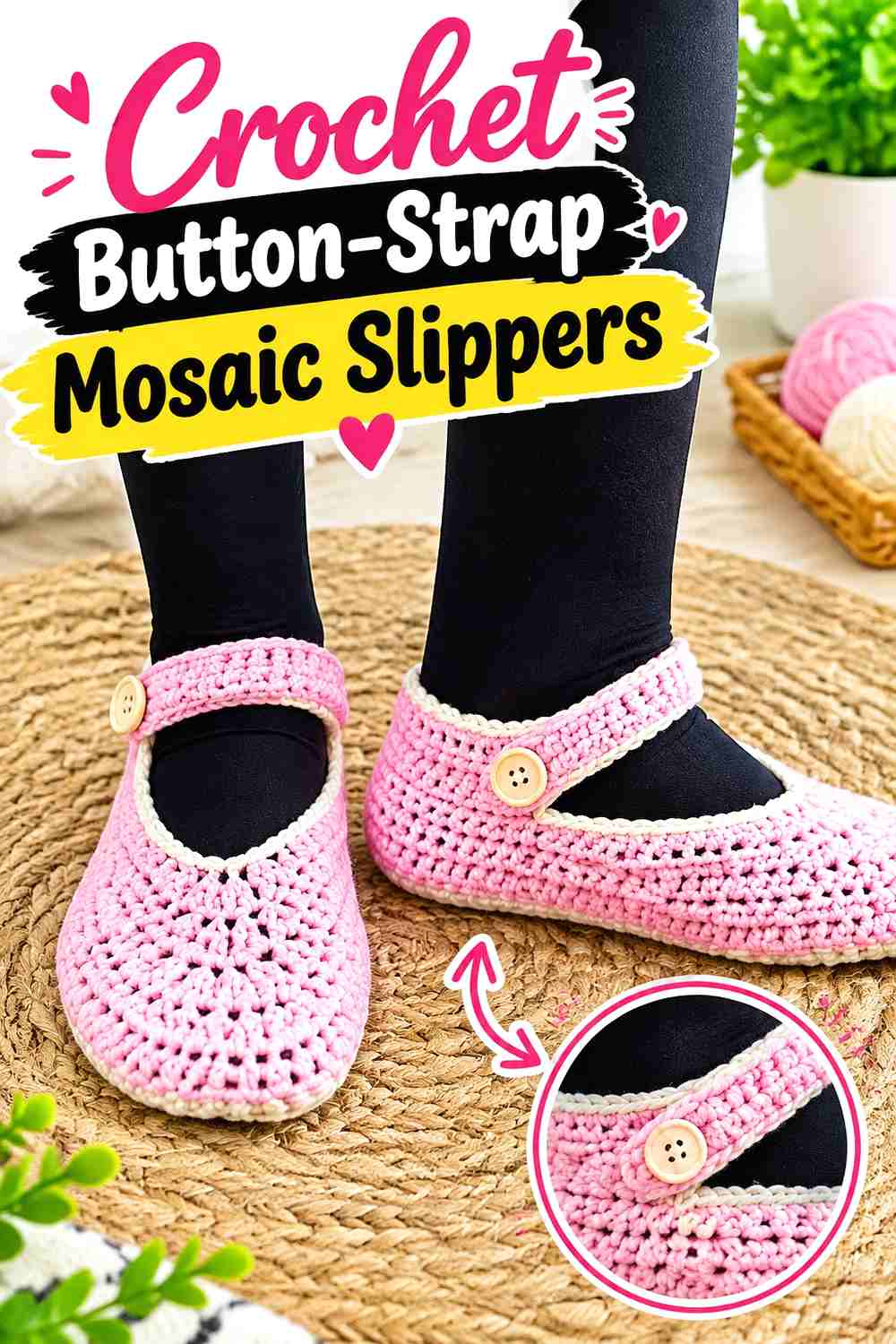
Toyslab Creations uses a flat-worked adult slipper with a strap and button, producing a Mary Jane-like profile that is distinctly different from closed slipper socks and boots. The source also uses two colors in the demonstrated design, making it a natural candidate for more intentional geometric contrast.
The strap provides a particularly useful location for a small mosaic repeat because it is visually separate from the main body.
Treat the Strap as an Accent Panel
A compact geometric repeat on the strap can add detail without changing the whole shoe. Keep the motif simple enough that its design remains visible across the narrow width.
You can then repeat one of the strap colors in the edging or upper for cohesion.
Set Button Placement With the Slipper on the Foot
A button is part of the fit, not just decoration. Check where the strap rests comfortably before making its final placement permanent.
A decorative band that reduces strap flexibility may also change where the button needs to sit.
Mirror the Right and Left Shoes Deliberately
Because the straps sit on opposite sides, decide whether the colorwork should mirror or repeat in the same direction. Either can work, but planning it prevents the pair from looking accidentally mismatched.
Creator Credit: Toyslab Creations
11. Crochet Lined Mosaic Moccasin Slippers
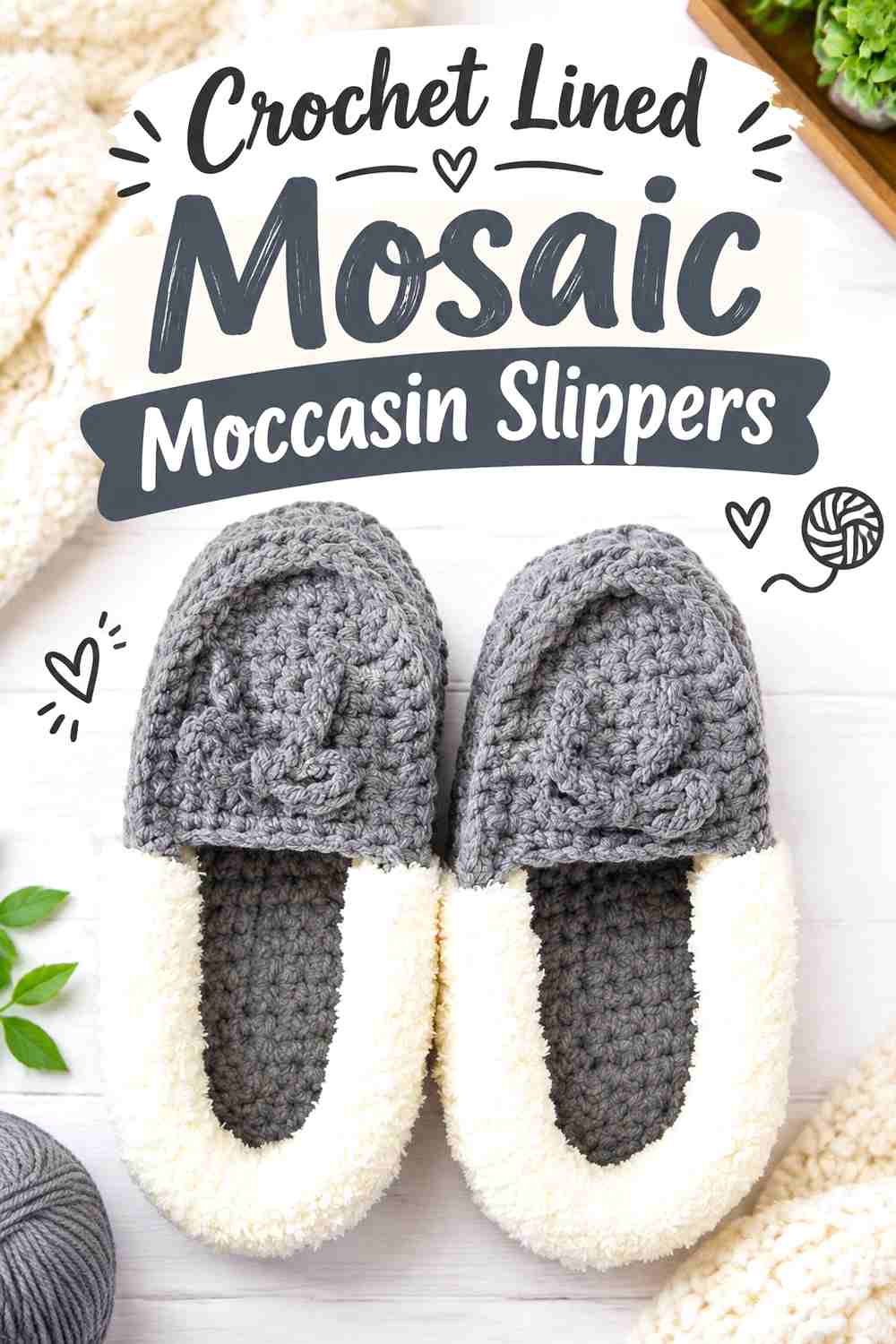
Yarnspirations’ moccasin tutorial offers a substantially different slipper structure and includes a plush lining in the source project. That makes it a useful option when you want a softer interior while keeping decorative crochet visible on the outside.
A moccasin-style upper also provides a recognizable front section where a small diamond, arrow, or stepped mosaic motif could sit without covering the entire shoe.
Plan Colorwork Around the Moccasin Shape
The visual strength of a moccasin comes from the relationship between the sole, upper, and opening. Keep any decorative motif aligned with those structural lines rather than dropping a square design into the middle without considering the shape.
Remember That Lining Changes the Interior
If you substitute yarn or add denser colorwork, the outer shell may become firmer while the lining also occupies space inside. Check the intended fit before adding additional thickness.
Do not assume that enlarging one section independently will preserve the original proportions.
Keep Decorative Ends Away From the Interior
Many color changes create more yarn tails. Secure them so they do not remain loose against the lining or interfere with assembly.
Creator Credit: Yarnspirations
12. Crochet Mosaic-Cuff Slipper Boots
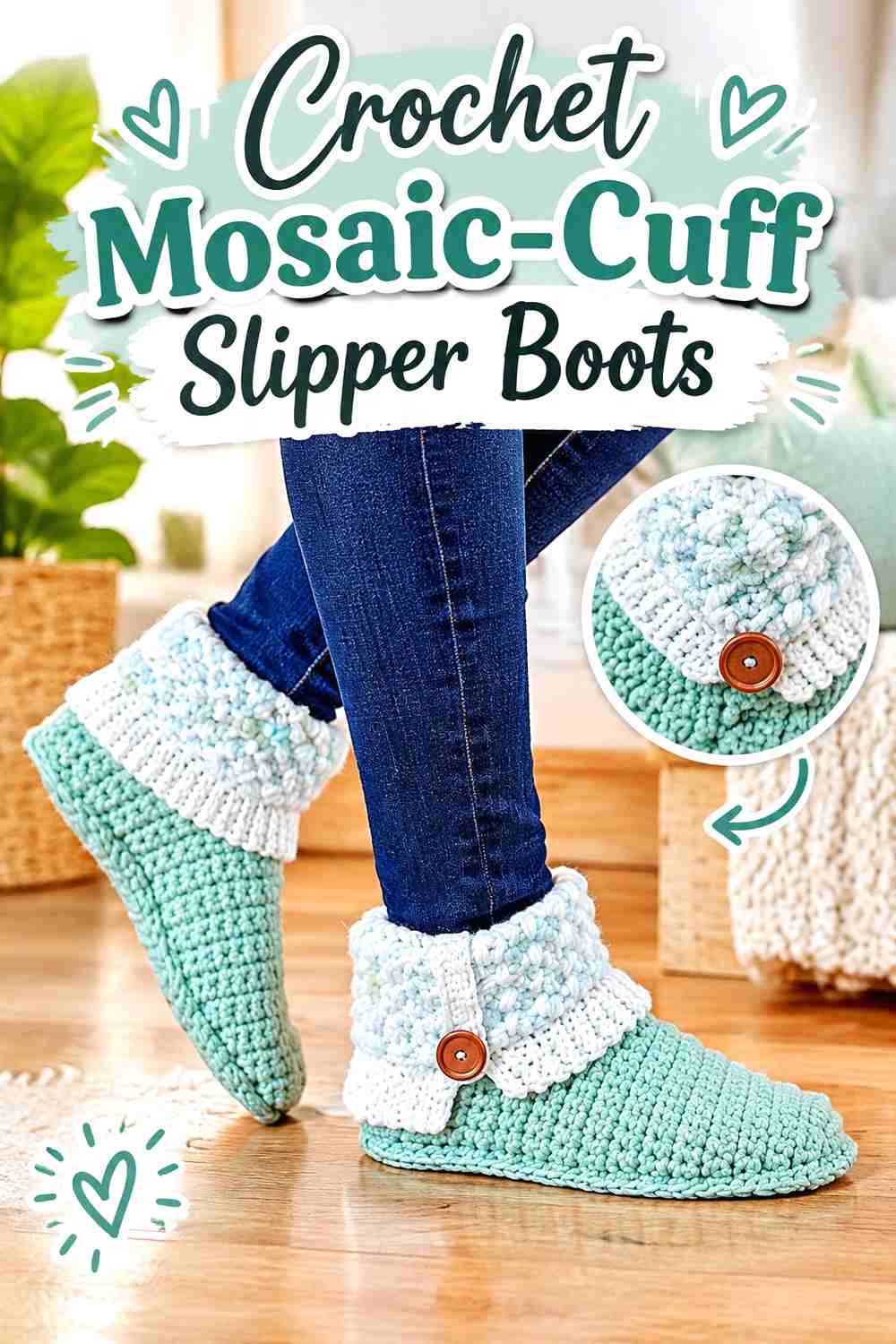
A Crocheted Simplicity’s Hibernation Slipper Boots are made from separate sole and upper sections, followed by an ankle and textured cuff. The source clearly divides the project into structural zones, which makes the cuff a logical place for a mosaic-inspired adaptation.
Because the lower shoe can remain unchanged, this route suits readers who want visible autumn colorwork without redesigning the fitted portion around the foot.
Separate Fit Decisions From Cuff Decisions
Complete or understand the lower slipper before changing the upper decoration. The sole, toe, and heel determine basic foot fit; the cuff controls a different part of the silhouette.
Keeping those decisions separate makes troubleshooting much easier.
A Boot Cuff Can Support a Larger Motif
Compared with a narrow slipper opening, the taller cuff gives you more vertical space. That allows a simple repeating diamond or stepped design to breathe instead of compressing it into only a few rows.
Check Where the Cuff Meets the Ankle
A visually strong color change can emphasize an uneven join. Before adding the final decorative section, make sure the base of the cuff sits consistently around the slipper.
Creator Credit: A Crocheted Simplicity – Jennifer Renaud
13. Crochet Buttoned Mosaic Slipper Boots
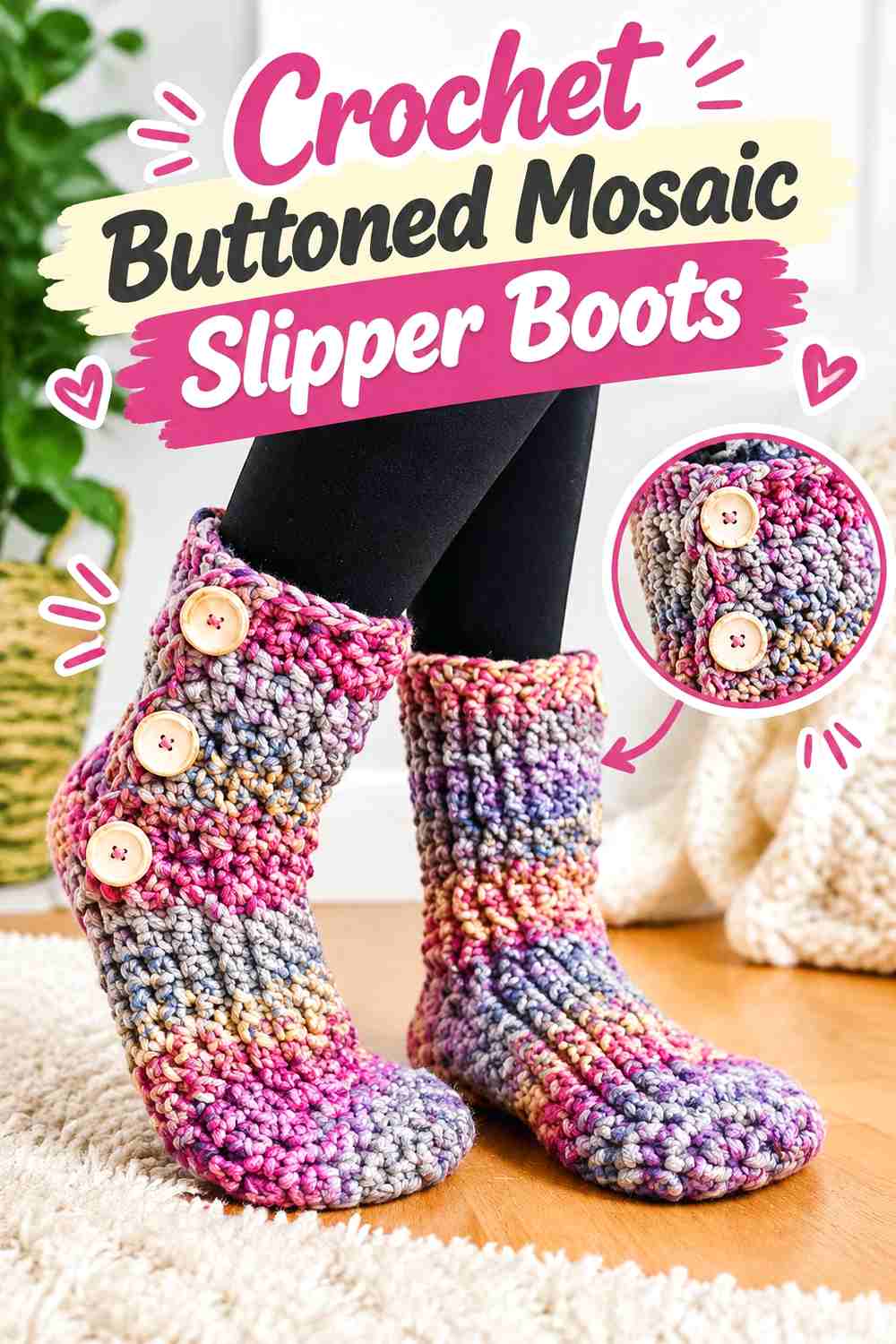
MJ’s Off The Hook Designs offers a slipper boot with a higher ankle, button details, and separate sole treatment. The source provides a very different silhouette from low house slippers and uses the side of the boot as an important visual area.
For a mosaic adaptation, that side panel can carry geometric colorwork while the buttons remain a secondary accent.
Coordinate the Buttons With the Mosaic Palette
Buttons already add repeated points of contrast. If the colorwork contains several shades, neutral or matching buttons may keep the side from becoming overloaded.
If the crochet stays restrained, contrasting buttons can become part of the October color story.
Keep the Decorative Pattern Clear of Structural Edges
The places where sole, upper, and boot sections meet already contain visible construction lines. Center mosaic elements inside a defined panel rather than allowing half motifs to disappear awkwardly into seams.
Evaluate Bulk Around the Ankle
Slipper boots can accommodate more visual texture than ballet-style slippers, but that does not mean every section needs to become thicker. Check whether additional strands or raised stitches make the boot feel stiff where the ankle bends.
Creator Credit: MJ’s Off The Hook Designs
14. Crochet Tall Mosaic Stripe Slipper Socks
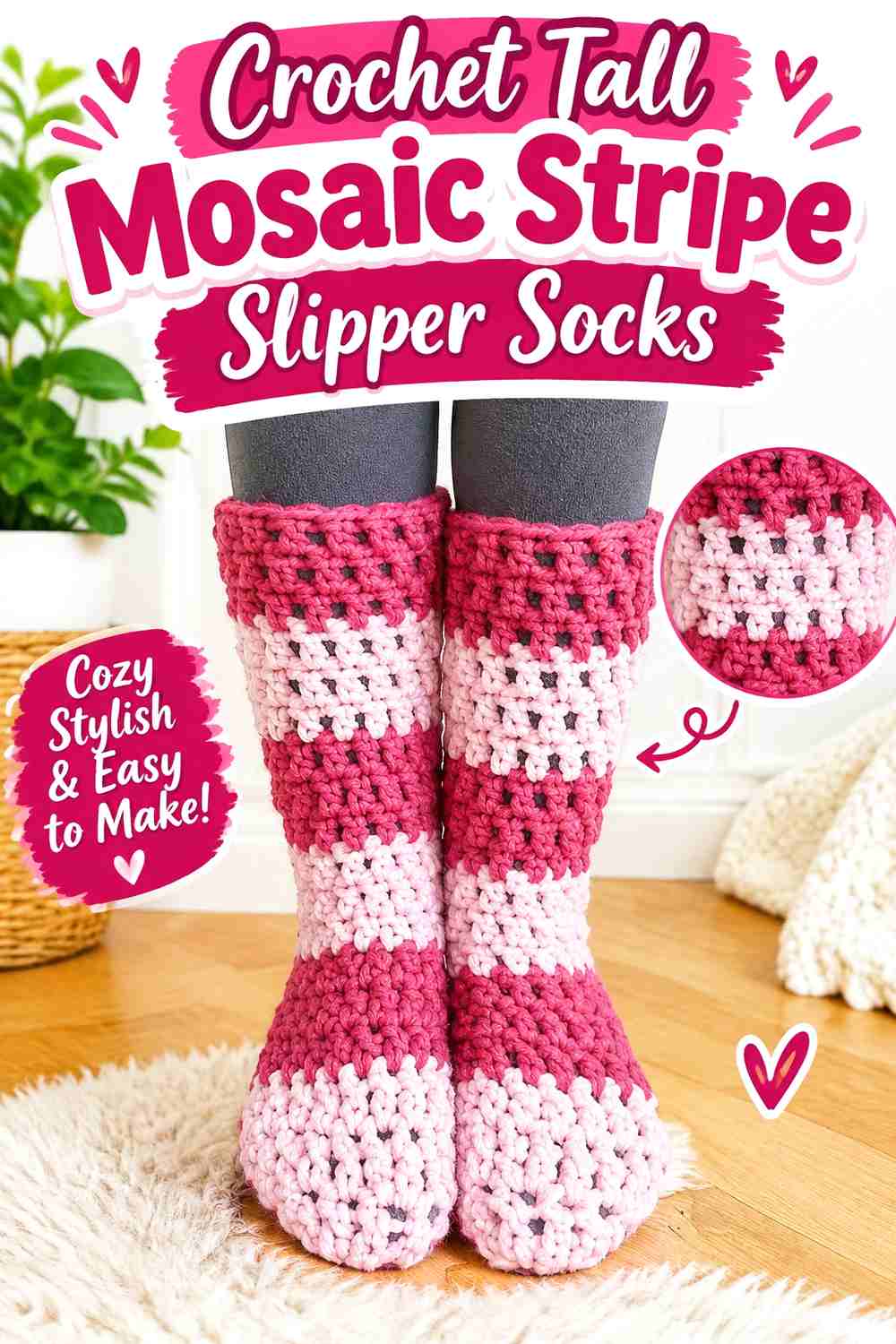
Fiber Flux’s slipper socks use a long tube-like shape with bold striping and optional drawstring finishing. The elongated leg gives this project far more vertical design space than most low slippers.
That space is ideal for a mosaic-inspired band sequence: one main motif near the ankle, a simpler repeat higher up, or alternating geometric stripes in autumn colors.
Use Height to Space the Pattern
A tall slipper sock does not need uninterrupted colorwork from toe to top. Plain sections can separate decorative bands and give the motifs more visual impact.
This also reduces the amount of dense fabric around areas where flexibility matters.
Keep the Drawstring Area Functional
If you retain the optional tie, leave enough flexibility around its path for the opening to gather normally. A thick raised motif directly through that zone can interfere with how the upper closes.
Repeat the Color Order Consistently
Tall stripes make even a small sequence change noticeable. Decide the order before beginning the second slipper, especially if using several leftover colors with similar values.
Creator Credit: Fiber Flux
15. Crochet Rubber-Sole Mosaic Slippers
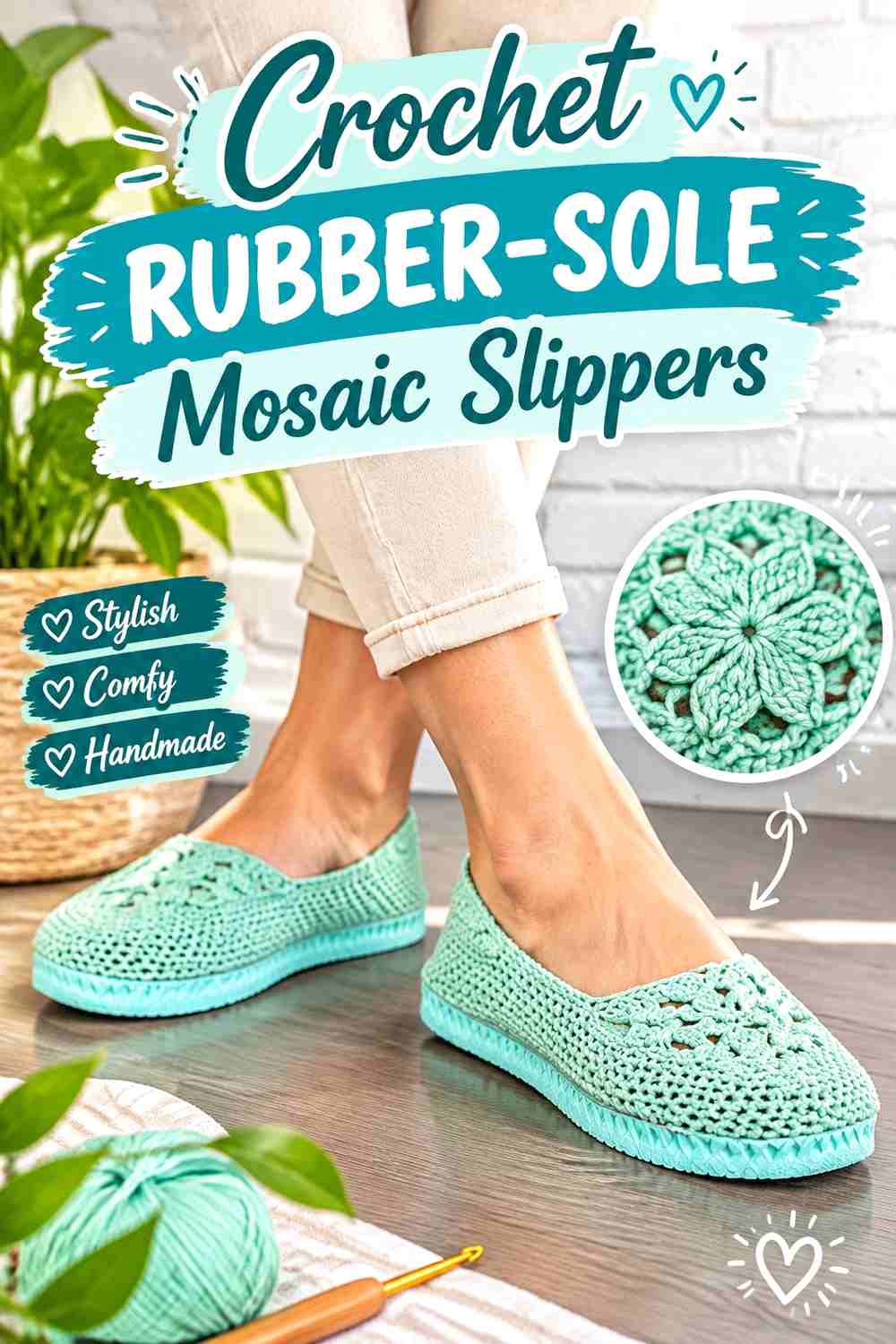
Make & Do Crew’s lightweight slippers are crocheted directly onto prepared flip-flop soles, giving this final idea a rubber foundation rather than an all-yarn bottom. The tutorial combines an open crochet upper with a ready-made sole, so it offers a substantially different starting point from every other project here.
For an October adaptation, use the rubber sole as the stable base and keep the mosaic idea confined to an upper band or compact geometric section.
Do Not Let Colorwork Change the Sole Connection
The attachment between crochet and rubber is structural. Follow the creator’s construction guidance for that area instead of trying to insert a new mosaic sequence into the foundation.
Decorative experimentation is safer once you reach an upper section that no longer determines how the crochet connects to the sole.
Open Fabric Needs a Different Mosaic Strategy
A very airy upper will not behave like dense overlay mosaic crochet. Rather than forcing a heavy technique into the whole design, consider broad color blocking, a small denser panel, or a geometric border that works with the existing openness.
Recheck the Upper After Every Major Color Section
Rubber does not stretch in the same way as crochet fabric. If a colorwork band changes the circumference of the upper, the sole will not compensate for that difference.
Compare the slipper with the foot and its matching pair before adding the next design section.
Creator Credit: Make & Do Crew
Which Crochet Mosaic Slipper Style Should You Choose?
| If you want… | Consider… | Main checkpoint |
|---|---|---|
| A true mosaic-focused slipper | Geometric Mosaic House Slippers | Colorwork tension |
| Strong texture with only two colors | Raised-Grid Mosaic Slippers | Interior feel |
| Modular construction | Granny-Patch or Hexagon Mosaic Slippers | Motif dimensions |
| A simple base for one decorative band | Toe-Up Mosaic Band Slippers | Opening stretch |
| Bold chunky geometry | T-Shirt Yarn Slipper Socks | Motif scale |
| More structure underfoot | Double-Sole Cottage Slippers | Keep sole construction intact |
| A playful design | Mosaic Paw House Slippers | Keep decoration off the sole |
| A flat colorwork canvas | Rectangle Mosaic Lounge Slippers | Motif placement after folding |
| An adjustable-looking upper | Button-Strap Mosaic Slippers | Strap and button fit |
| A soft interior | Lined Mosaic Moccasins | Added thickness |
| More vertical design space | Mosaic-Cuff Slipper Boots | Ankle flexibility |
| Decorative hardware | Buttoned Mosaic Slipper Boots | Side-panel balance |
| Tall colorwork bands | Mosaic Stripe Slipper Socks | Consistent stripe order |
| A non-yarn base | Rubber-Sole Mosaic Slippers | Upper-to-sole connection |
Conclusion
The most useful way to choose among these 15 crochet mosaic slipper ideas is to start with construction rather than color. If you specifically want to practice mosaic crochet, Souma Crochet’s fitted slipper is the closest direct match. If modular work appeals to you, the granny-square and hexagon versions give you clear individual pieces to plan before assembly.
For a simpler adaptation, toe-up slippers, rectangle slippers, and button-strap shoes provide defined areas where you can introduce one geometric band without rebuilding the entire pattern. Slipper boots and tall slipper socks offer even more room around the ankle for decorative motifs, while the lined moccasin and rubber-sole option prioritize very different structural needs.
Whichever route you choose, protect the original fit first. Use the creator’s tutorial for exact construction, sizing, and assembly, then treat mosaic colorwork as an adaptation that must earn its place without making the slipper too tight, bulky, stiff, or uncomfortable.
Frequently Asked Questions
Do all 15 tutorials actually use mosaic crochet?
No. Souma Crochet’s source is specifically categorized as mosaic. Several others use grids, motifs, striping, two-color construction, or plain slipper forms that can serve as compatible bases for a mosaic-inspired adaptation. The distinction is important because substituting a dense mosaic technique can change fit.
Where is the safest place to add mosaic detail to a crochet slipper?
The visible upper, ankle band, side panel, or cuff is usually a more practical place to experiment than the bottom of the foot. Decorative texture under the sole can be felt during wear and may affect how the slipper contacts the floor.
Can I replace a granny square with any mosaic crochet square?
Not automatically. Compare the finished, settled dimensions of both motifs first. A denser mosaic square may also stretch differently, so equal width does not always mean identical behavior once the slipper is assembled.
Why did my second mosaic slipper turn out tighter?
Colorwork tension is a common variable. You may crochet more tightly once the pattern becomes familiar, or one color may behave differently from another. Comparing both slippers at equivalent stages can help you catch the difference before finishing.
What colors work well for October mosaic slippers?
Warm rust, cream, brown, mustard, burgundy, charcoal, muted green, and deep blue can create an autumn look, but contrast matters more than the seasonal name of a shade. Test the colors together in crochet because two yarns that look different in skeins can merge visually once stitched.
Should crochet slippers have non-slip soles?
That depends on the construction, flooring, and wearer, but plain yarn soles can be slippery on smooth surfaces. Some tutorial creators discuss grip treatments or use a separate rubber sole. Test finished footwear cautiously and do not assume a handmade grip modification provides the same performance as purpose-designed footwear.