A crochet hanging mail organizer can turn a cluttered entryway into a more welcoming space while keeping everyday letters within reach. These 18 inspiration ideas explore stacked pockets, side-by-side compartments, envelope-shaped holders, accordion files, modular sections, and decorative granny-square designs. From sage and oatmeal to terracotta, navy, lavender-toned plum, and soft blush, each concept gives ordinary household mail a different handmade storage arrangement.
Choosing a useful mail sorter involves more than matching yarn to your wall color. Pocket width, opening depth, backing structure, and mounting strength all matter, especially when envelopes, receipts, and larger paper items need separate spaces. This collection helps you compare practical sorting layouts, think about how crochet stretches under weight, and choose a hanging design that fits your available wall space and daily mail routine.
These are AI-generated crochet design visualizations for inspiration, not photographs of tested handmade organizers or step-by-step patterns. Any physical organizer should be measured and tested for support, paper fit, and safe mounting before use.
Quick Design Selection Guide
- For simple incoming and outgoing mail: Start with the Crochet Sage Two Pocket Mail Sorter or Crochet Navy Side by Side Mail Organizer. Both offer two clear storage areas in different layouts.
- For several sorting stages: The Crochet Terracotta Cascading Mail Pockets, Crochet Mustard Arched Mail Pockets, and Crochet Teal Accordion Mail File provide three separate openings.
- For envelopes and small receipts: The Crochet Olive Letter Receipt Wall Caddy has two differently sized side-by-side compartments.
- For compact decorative storage: Compare the Crochet Oatmeal Envelope Front Mail Holder, Crochet Cream Granny Square Mail Caddy, and Crochet Blush Floral Edge Mail Sorter.
- For family or shared-home sorting: Consider the Crochet Mint Four Cubby Mail Organizer, Crochet Plum Center Divide Mail Holder, or Crochet Cream Modular Mail Pocket Trio.
- For unusually shaped spaces or mixed paper: The Crochet Coral Corner Mail Organizer fits a corner arrangement, while the Crochet Indigo Magazine Letter Wall Sorter has a deeper section for a slim magazine.
1. Crochet Sage Two Pocket Mail Sorter
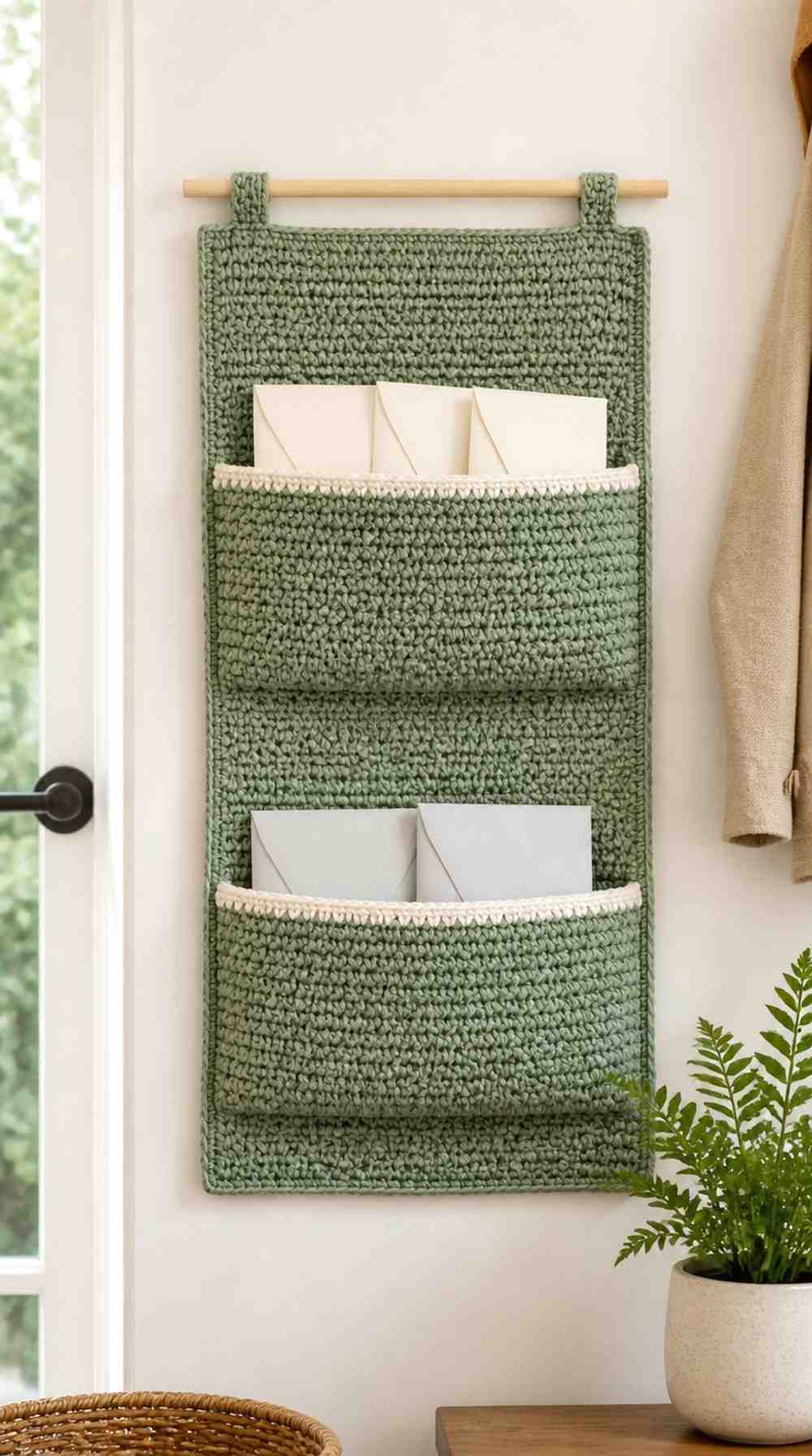
Sage-green crochet gives this rectangular mail sorter a calm, organized appearance. Its dense moss-stitch backing supports two broad horizontal pockets with narrow ivory borders. Two short sage loops attach the panel to a natural wooden dowel, while cream and pale-grey envelopes remain visible above the separate pocket openings.
The stacked arrangement makes it easy to establish two mail categories without requiring a wide wall. One pocket could hold incoming letters while the other is reserved for items ready to send, provided the compartments remain sufficiently firm when filled.
- Two Horizontal Sections: Position the upper and lower pockets with enough space between their openings to reach letters without disturbing the other compartment.
- Moss-Stitch Backing: Dense crochet may provide a firmer foundation than open mesh, but the panel should still be checked for stretching under paper weight.
- Dowel Suspension: Two evenly positioned hanging loops can help distribute the load across the upper edge rather than concentrating it at one point.
2. Crochet Terracotta Cascading Mail Pockets
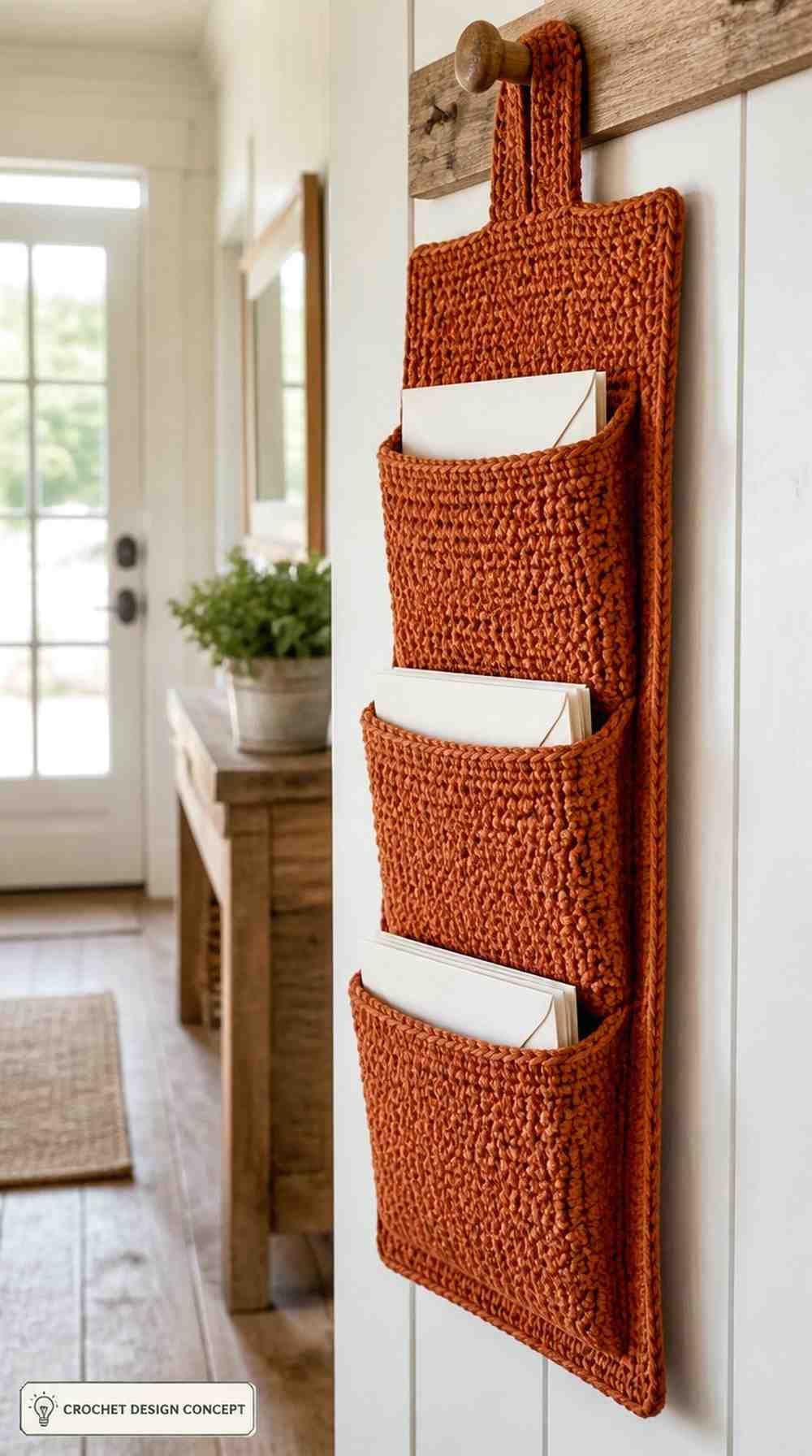
Three terracotta crochet pockets descend in overlapping steps across a long rectangular backing. Rust-colored edging defines each shallow opening, while a broad reinforced tab supports the organizer from a wooden wall peg. Plain ivory envelopes sit at three visible levels.
This cascading arrangement is particularly useful for a mail routine with several stages. The upper pocket might hold new arrivals, the middle one papers requiring attention, and the lower one completed correspondence. Each opening should remain visible even when the pockets contain several envelopes.
- Overlapping Pocket Layout: Keep the openings far enough apart that envelopes in a lower pocket aren’t hidden by the pocket above.
- Single Hanging Tab: A central attachment can look tidy, but the backing must resist twisting when the compartments are filled unevenly.
- Long Vertical Profile: Check available wall height before making this design, including the space required for comfortable access to the lowest pocket.
3. Crochet Navy Side by Side Mail Organizer
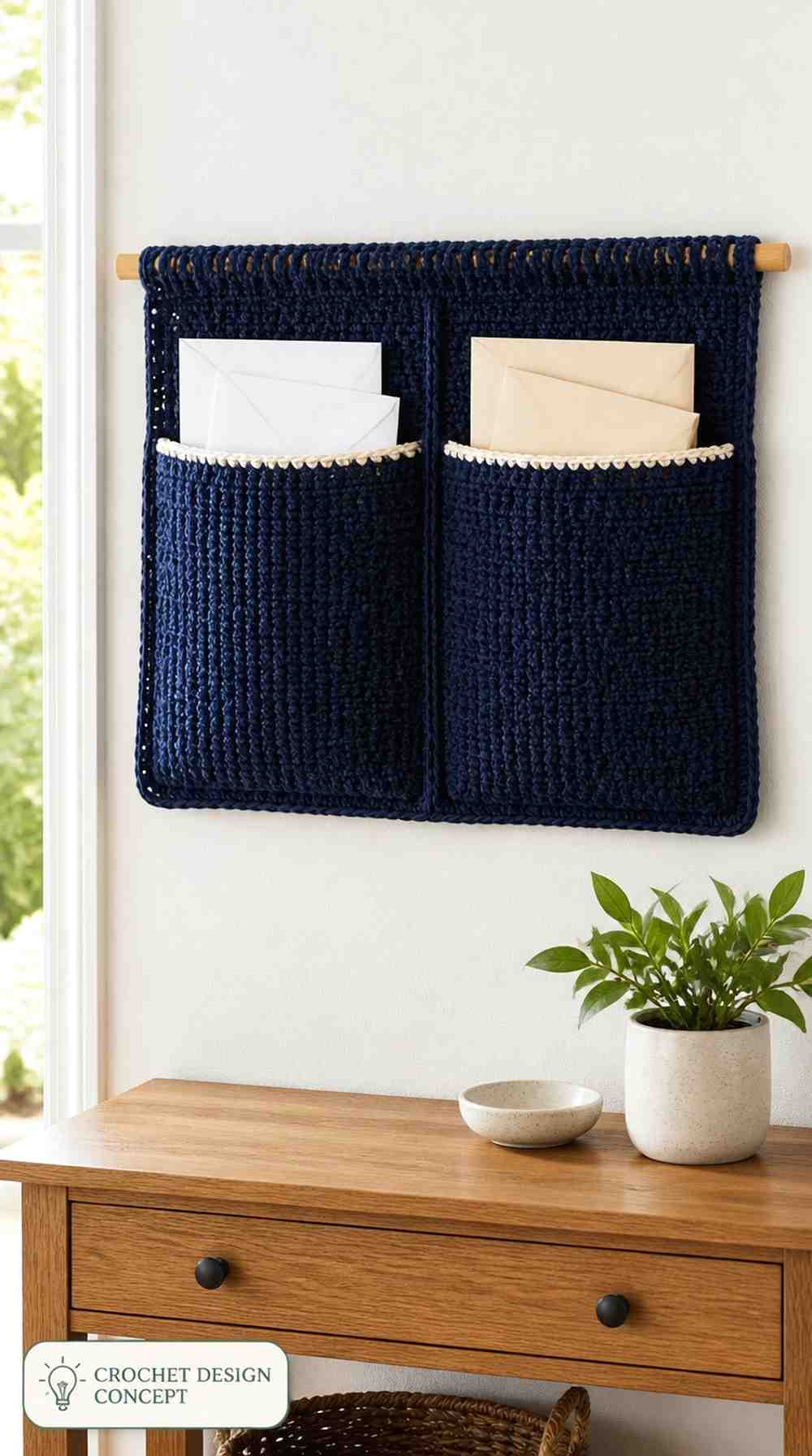
Deep navy-blue crochet creates a broad rectangular organizer divided into two equal vertical pockets. Ivory edging highlights the separate openings, while a continuous central seam keeps the storage sections apart. A rod channel at the top supports the panel from a slim wooden dowel.
The symmetrical arrangement gives both sections similar visibility and access. It could suit two household members or two regular mail categories without making either compartment more prominent. The main trade-off is width: side-by-side pockets need more horizontal wall space than stacked designs.
- Equal Pocket Widths: Measure the largest envelopes you plan to store before deciding on the divider position and finished panel width.
- Continuous Center Seam: A firm vertical join keeps the two pockets distinct and helps prevent letters from slipping across the middle.
- Rod Channel: A full-width channel distributes the panel along the dowel, although secure wall mounting is still essential.
4. Crochet Oatmeal Envelope Front Mail Holder
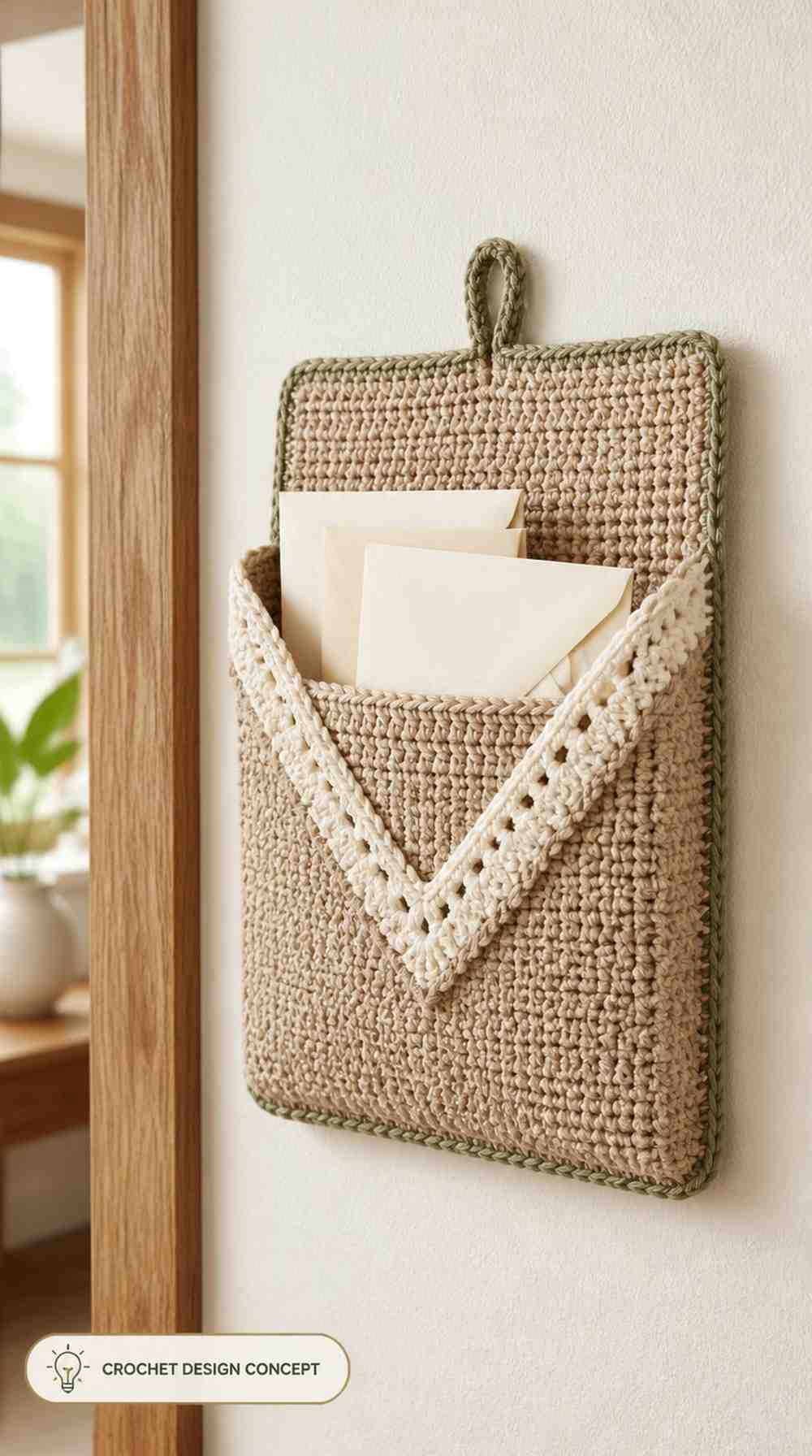
Warm oatmeal crochet gives this compact wall pocket the appearance of an oversized envelope. A broad front compartment sits against a rectangular backing, with a decorative downward-pointing cream V overlay across its face. A muted-sage border and short upper hanging loop complete the design.
The envelope styling makes this idea appealing for a small entryway where practical storage can also serve as wall decoration. Its upper pocket remains open for everyday letters; the pointed overlay is decorative rather than a closure, so it shouldn’t obstruct access.
- Open Upper Edge: Keep the main pocket opening unobstructed by the decorative V-shaped panel so letters can be inserted easily.
- Envelope-Inspired Front: The cream overlay adds recognizable shaping without requiring a bulky folded flap.
- Compact Wall Footprint: This single-pocket design suits a small number of letters better than a household with several sorting categories.
5. Crochet Dusty Rose Diagonal Mail Sorter
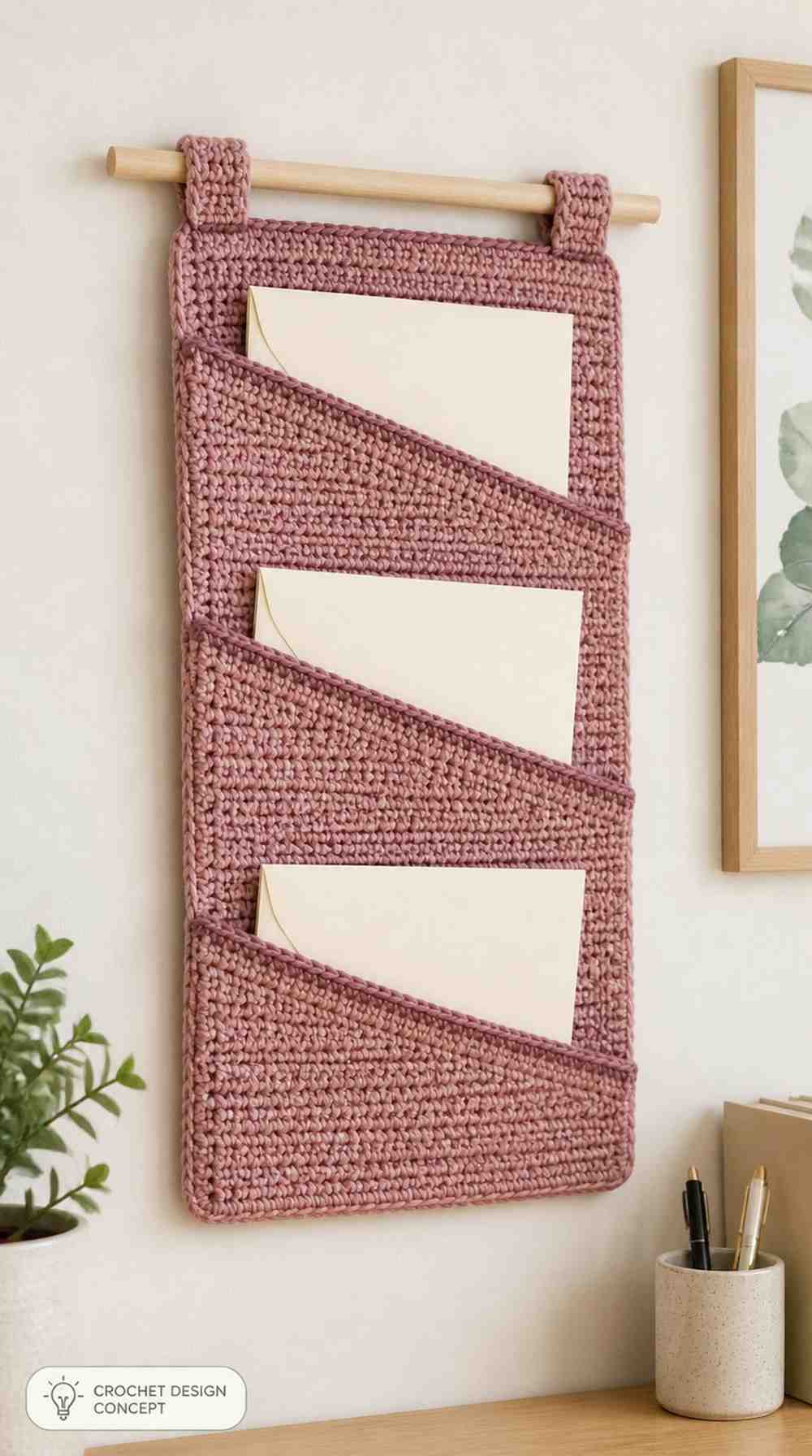
Dusty-rose crochet gives this vertical wall organizer a soft, contemporary look. Three staggered diagonal openings descend across a dense rectangular backing, each outlined with darker mauve stitches. One cream envelope sits in each pocket, and two rose crochet tabs suspend the piece from a wooden dowel.
The diagonal layout creates an unusual way to display separate mail groups. It also introduces an important practical concern: the openings need enough depth and reinforced side seams to prevent letters sliding toward the lower ends.
- Diagonal Openings: Keep the sloping pocket edges moderately angled so envelopes remain supported rather than slipping toward one corner.
- Staggered Placement: Leave enough exposed opening at each level for readers to identify and remove a letter without reaching behind another pocket.
- Mauve Edging: The darker border makes the separate pockets easier to distinguish while strengthening their visible upper edges.
6. Crochet Cream Granny Square Mail Caddy
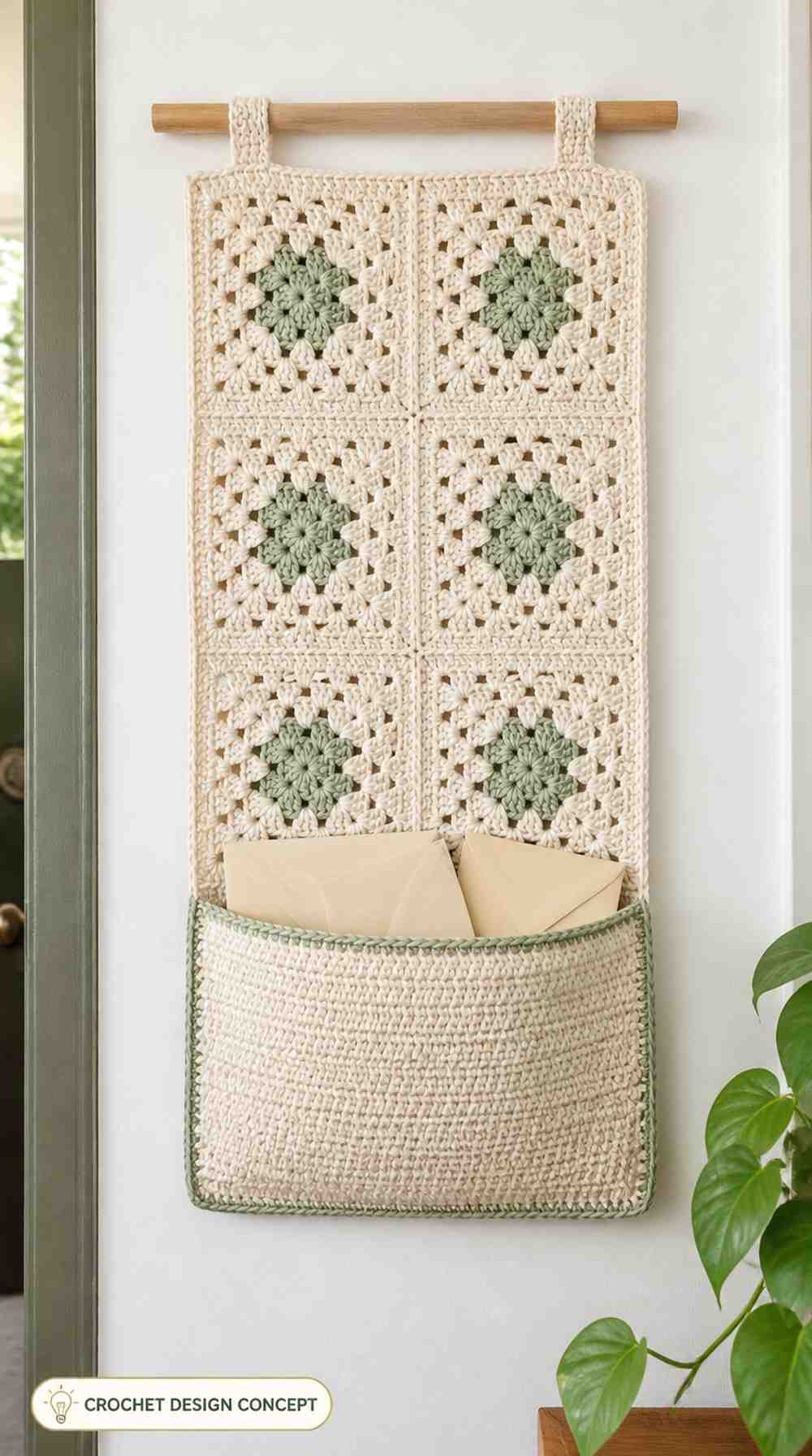
Six cream granny squares with small sage-green centers form the decorative backing of this hanging organizer. The squares are joined in two columns and three rows, and one broad cream crochet pocket stretches across the lower portion. A sage border outlines the pocket opening, with two cream straps connecting the panel to a wooden dowel.
The granny-square arrangement brings a traditional handmade texture to a simple mail holder. Its open motif spaces are decorative, while the lower solid pocket provides the main storage area. Check the joined backing carefully if the organizer is intended to hold more than a few lightweight letters.
- Six Joined Motifs: Keep the granny squares consistent in size so the rectangular backing hangs straight without uneven corners.
- Solid Lower Pocket: Closely worked crochet is more suitable for holding small paper edges than leaving large granny-square gaps across the storage compartment.
- Motif Seam Strength: Reinforce joins near the hanging straps, where the weight of the lower pocket could pull on the decorative backing.
For other wall-storage approaches, explore Yarn Nest Studio’s 20 Crochet Hanging Wall Pocket Organizer Ideas collection. It includes broader household wall-pocket concepts beyond mail sorting.
7. Crochet Olive Letter Receipt Wall Caddy
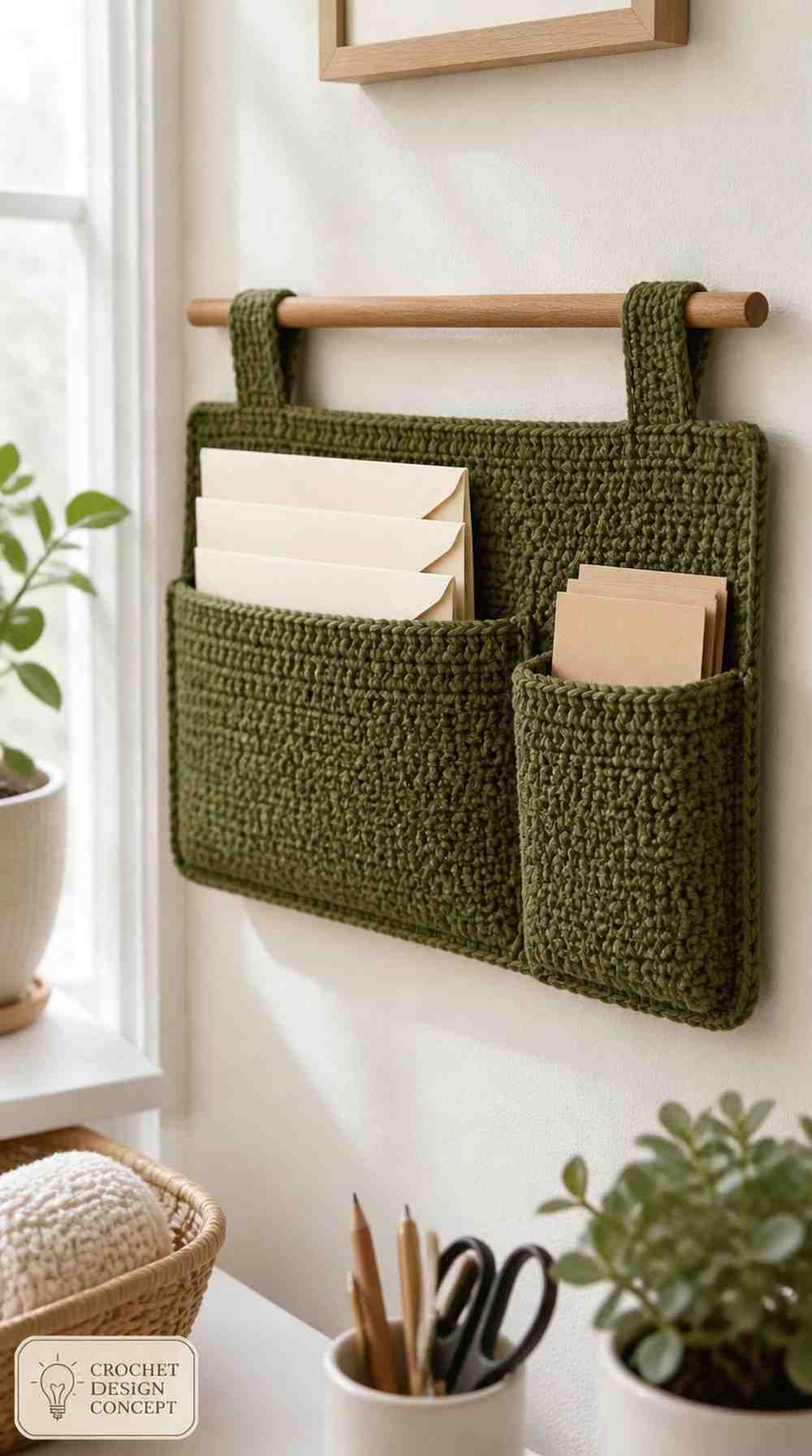
Olive-green crochet creates a practical organizer with two unequal compartments. A broad shallow left pocket holds cream envelopes, while a narrower, deeper section on the right contains small beige receipts. Dark-olive joining seams and a straight upper rim give the rectangular backing a tidy appearance.
The different pocket widths make this concept useful when small slips of paper usually disappear behind larger mail. Separating receipts from envelopes can make both easier to retrieve, provided the narrow pocket isn’t so deep that tiny papers become difficult to reach.
- Unequal Pocket Sizes: Plan the broad section around envelopes and the smaller one around receipts instead of giving both equal storage space.
- Deep Receipt Pocket: A narrow compartment helps group small papers, but the depth should still leave enough of each receipt visible for removal.
- Dark Olive Seams: Clearly worked joins distinguish the sections without introducing additional decorative pieces that could snag paper corners.
8. Crochet Mustard Arched Mail Pockets
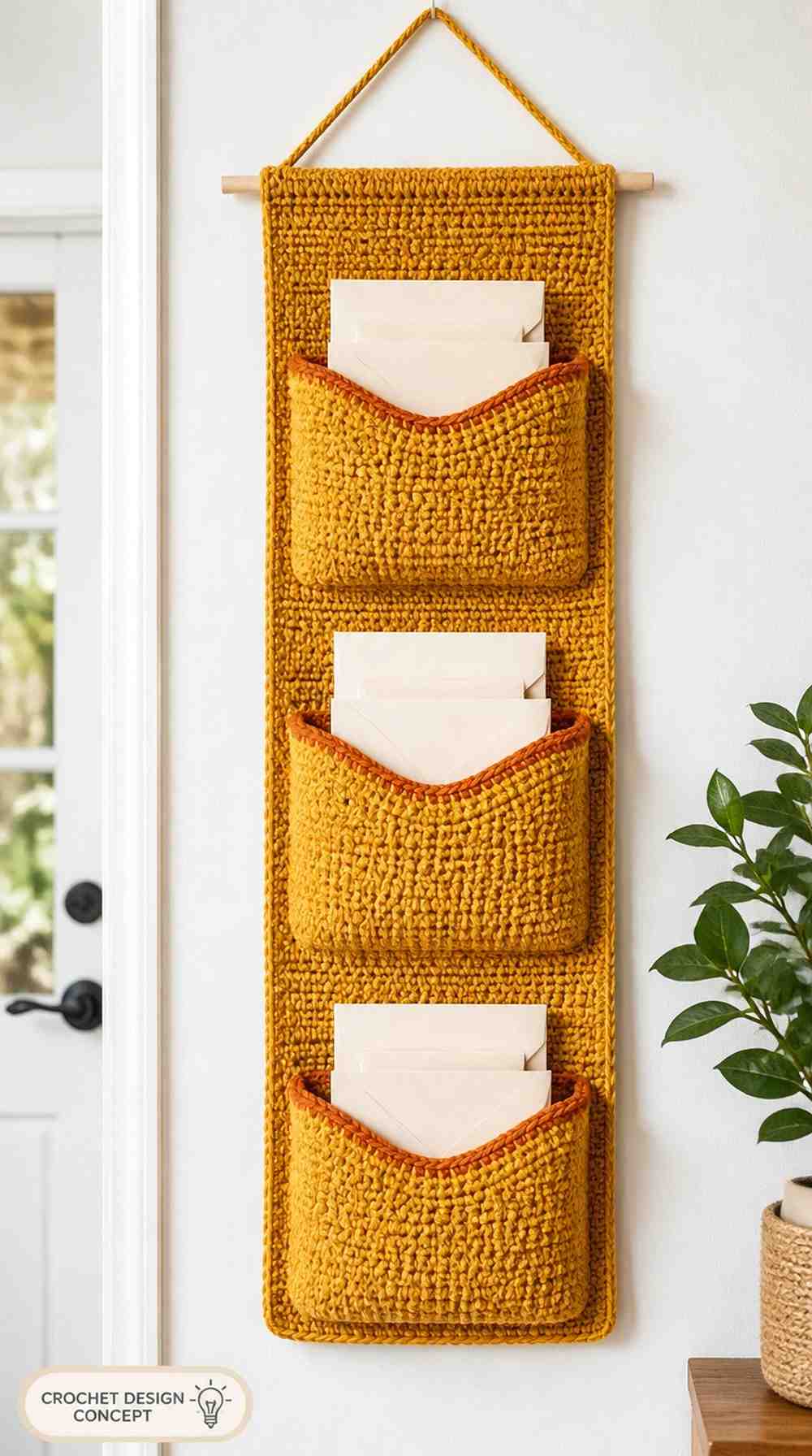
Mustard-yellow crochet forms a tall rectangular hanging panel with three separate arched pocket openings. Thin burnt-orange edging follows each curved rim, while a reinforced top channel supports the organizer from a pale wooden dowel. Cream envelopes sit visibly inside every level.
The repeated arches add warmth and character to a familiar stacked-pocket arrangement. Because each opening curves downward at the center, the sides need sufficient depth to keep letters contained when the panel is hanging against the wall.
- Three Curved Openings: Shape the arches consistently so the middle of each pocket remains accessible without reducing support at the sides.
- Burnt-Orange Trim: A narrow contrasting edge emphasizes the curves and may help the pockets keep a defined opening.
- Stacked Mail Categories: Three levels can separate new mail, papers needing attention, and outgoing letters without relying on written labels.
9. Crochet Teal Accordion Mail File
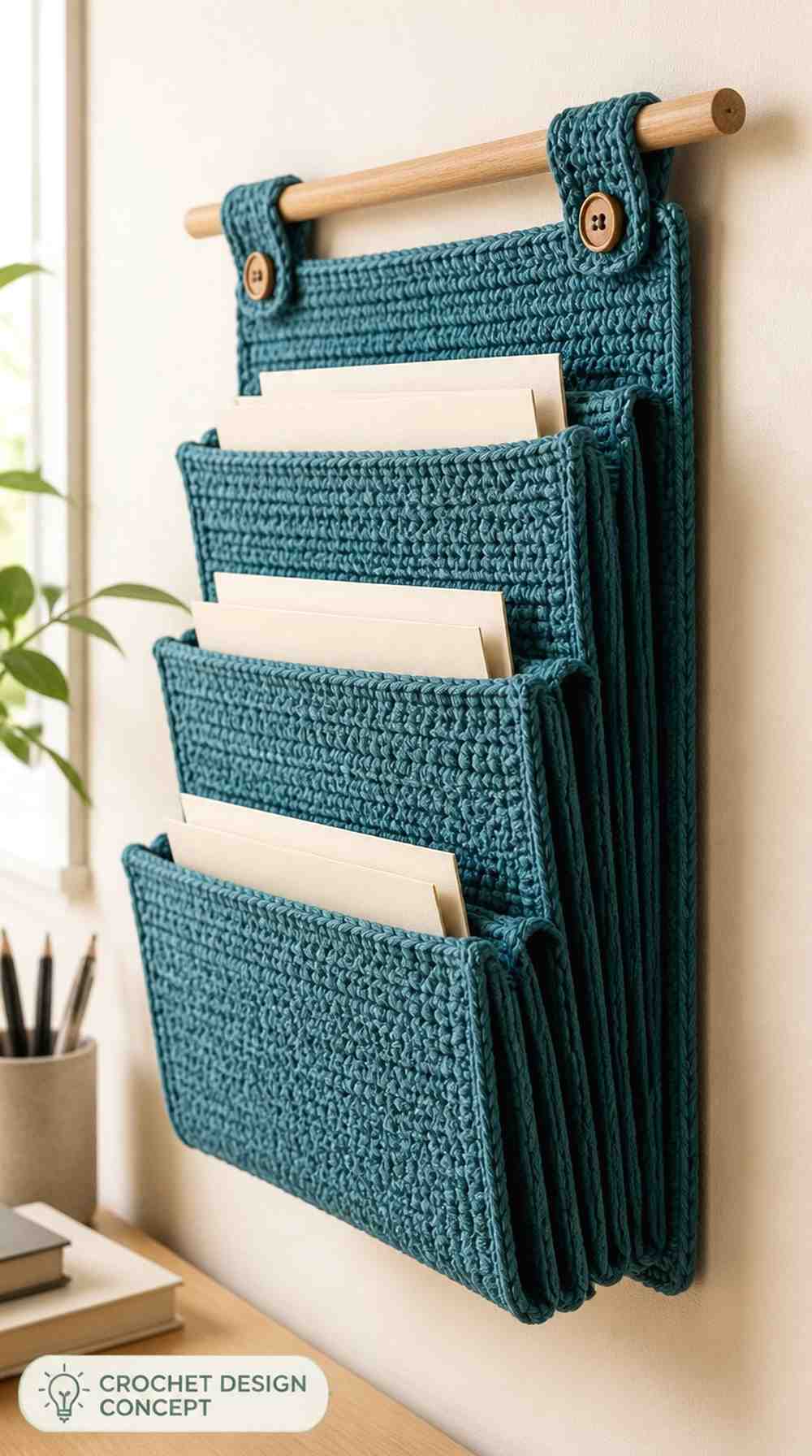
Teal-blue crochet creates a wall-mounted letter file with three open compartments arranged front to back. Flat crochet panels are joined by visible pleated side gussets, creating an expandable accordion profile. A solid rectangular back panel and two upper tabs connect the file to a natural wooden dowel.
The accordion structure offers a different approach from flat patch pockets. It could provide extra space for groups of envelopes while keeping their openings aligned. However, deeper pleats can place more strain on the sides when filled, so the yarn and joins need careful consideration.
- Pleated Side Gussets: Even folds allow the compartments to expand slightly, but overly flexible crochet may cause the file to sag forward.
- Three Front-to-Back Sections: Separate layers can organize mail by priority while occupying less wall width than three side-by-side pockets.
- Wall Clearance: Check how far the filled file projects into the room, particularly if it will hang near a doorway or narrow passage.
10. Crochet Coral Corner Mail Organizer
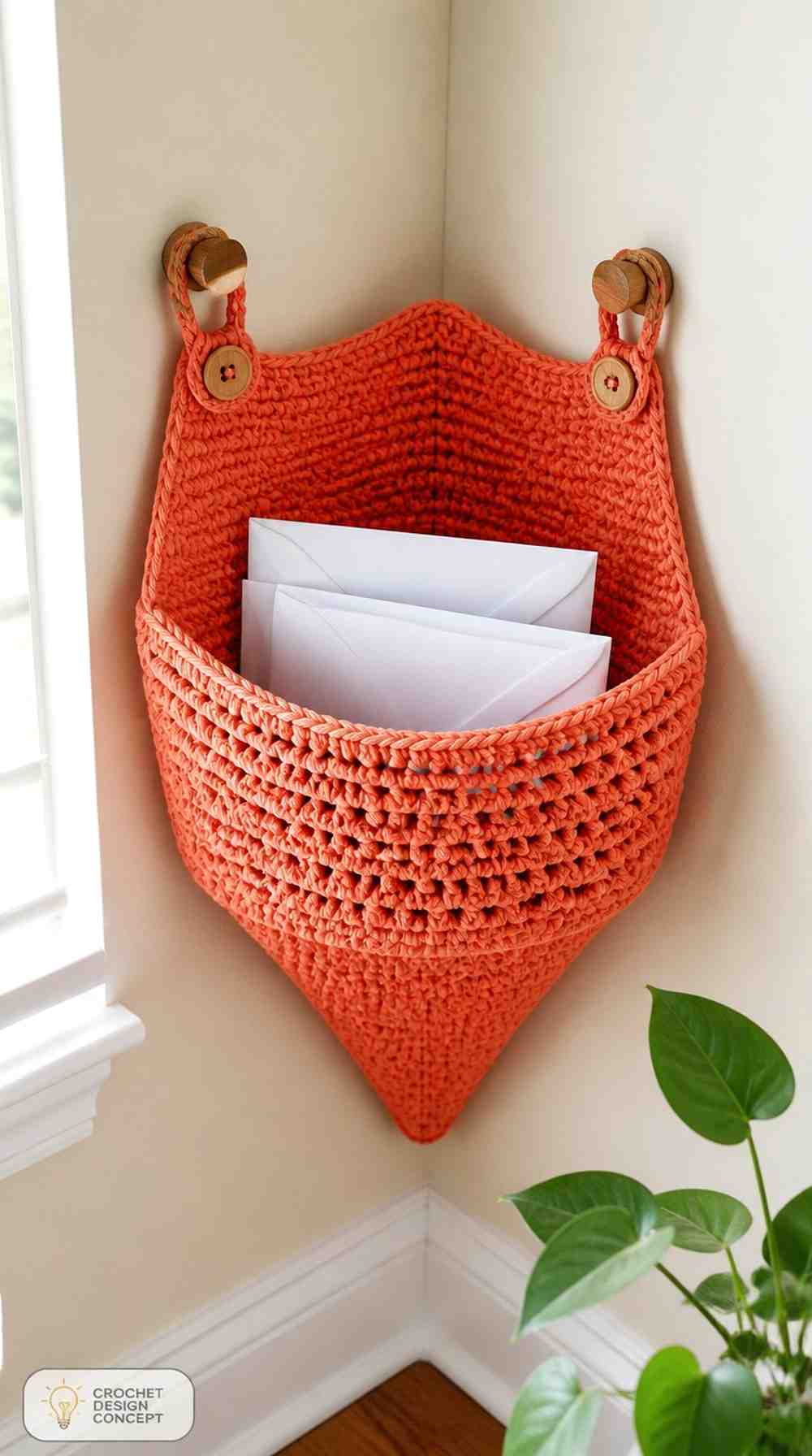
Coral-orange crochet creates a compact organizer designed to sit across the junction of two walls. Its triangular back panel supports a curved front pocket, with a dense lower foundation and two reinforced upper eyelets attached to separate wall hooks. Three white envelopes stand inside the open compartment.
The corner arrangement is useful when a conventional flat wall pocket would interfere with furniture or other decorations. Its triangular construction needs particular attention because both sides must remain supported without pulling the organizer unevenly toward one wall.
- Triangular Back Panel: Measure the available corner space carefully, since the organizer’s depth changes as the two sides meet.
- Two Wall Attachments: Both eyelets need suitable secure mounting to prevent the pocket from twisting or pulling away from the corner.
- Curved Front Pocket: The rounded opening creates easy access, but it should remain high enough to contain standard envelopes securely.
11. Crochet Charcoal Foldover Mail Pocket
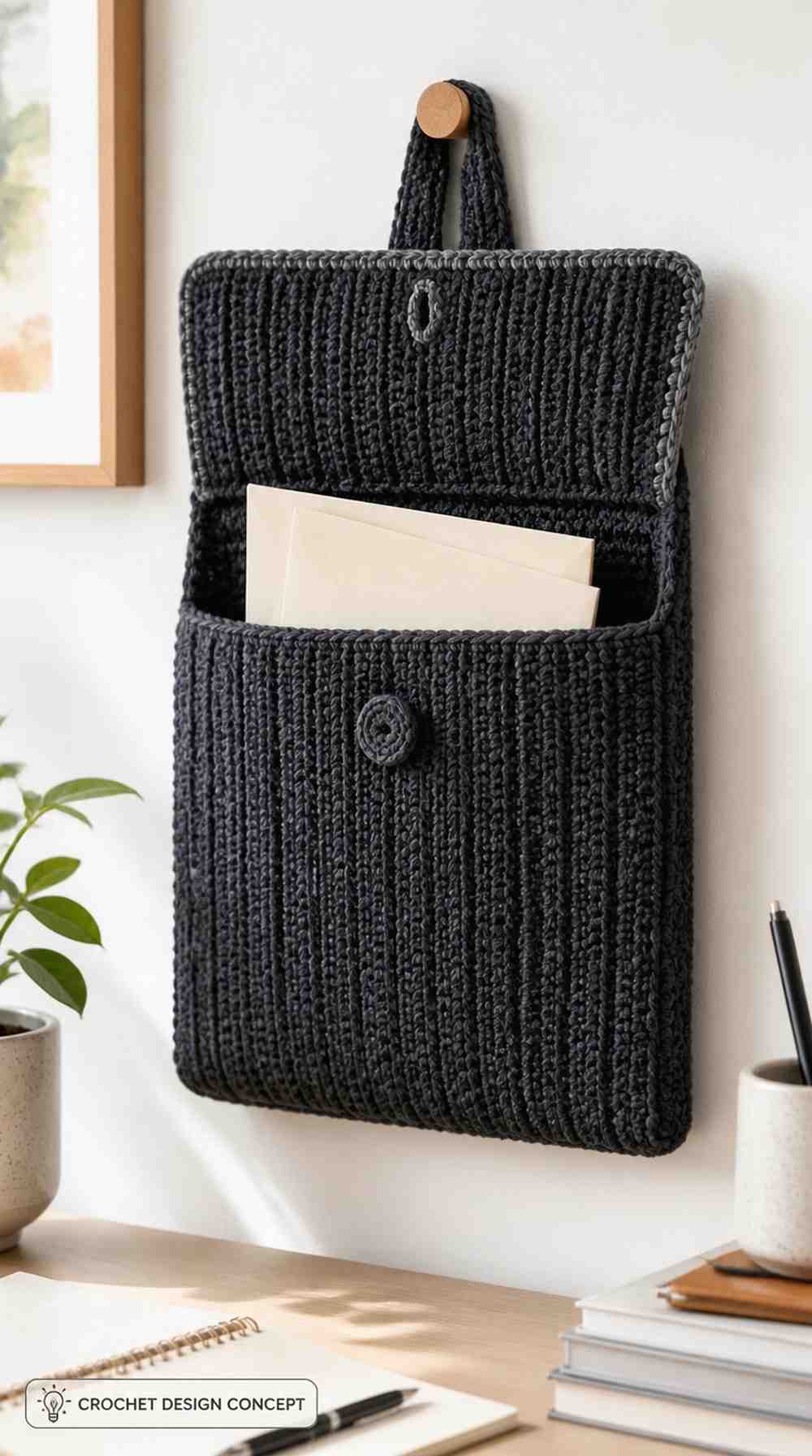
Charcoal-grey crochet gives this single mail holder a simple, modern appearance. Dense vertical ribs cover its rectangular body, while a broad matching foldover flap is shown resting behind the open pocket. A small charcoal crochet button and buttonhole loop provide a possible closure when the pouch is not being accessed.
The flap makes this design more enclosed than an ordinary open mail pocket. It may suit a small home office where selected letters need to remain together, although a soft crochet flap shouldn’t be treated as secure storage for confidential documents.
- Foldover Flap: Make the flap long enough to cover the opening without pushing down on the papers inside.
- Vertical Ribbing: Close-textured ribs give the body visual structure while maintaining a relatively smooth interior for envelopes.
- Buttoned Closure: A low crochet button avoids hard decorative hardware, but the closure offers organization rather than privacy or security.
12. Crochet Sky Blue Lattice Mail Sorter
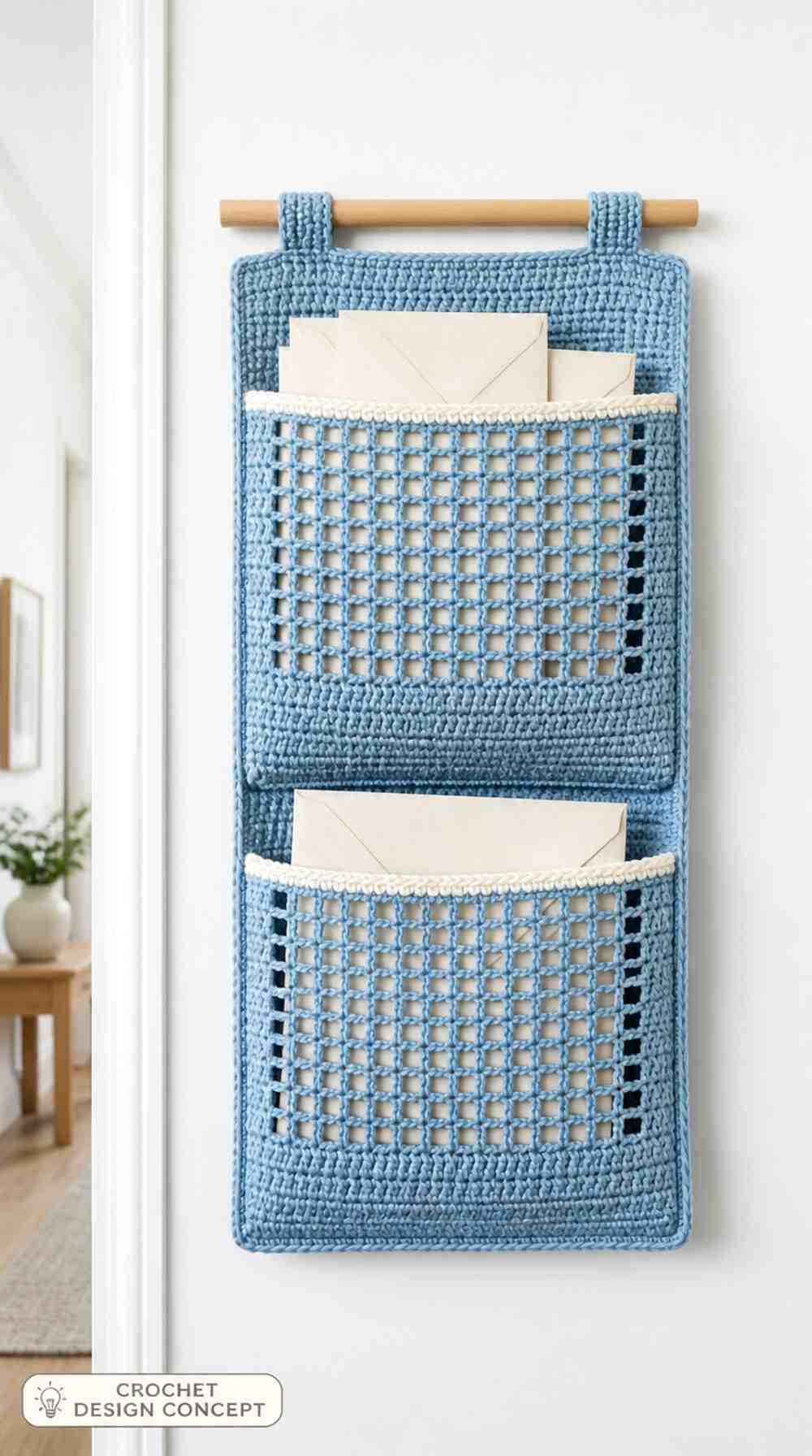
Sky-blue crochet gives this two-pocket organizer a light, airy appearance. Small square-lattice openings cover the two front pocket panels, while solid lower bands and ivory upper borders frame the storage areas. A dense backing supports both pockets beneath two hanging loops and a wooden dowel.
The open lattice makes the letters partly visible without removing them. However, the mesh needs to remain small enough that paper corners cannot protrude or become caught in the openings. A structured backing is particularly helpful when the front panels are more flexible.
- Small Square Lattice: Keep the openings modest so thin envelopes and paper corners are less likely to catch or slip through.
- Solid Lower Bands: Closely stitched bottom sections provide more continuous support for letters than fully open mesh would.
- Ivory Pocket Borders: Contrasting edges make both openings easy to see and help distinguish the storage sections.
13. Crochet Plum Center Divide Mail Holder
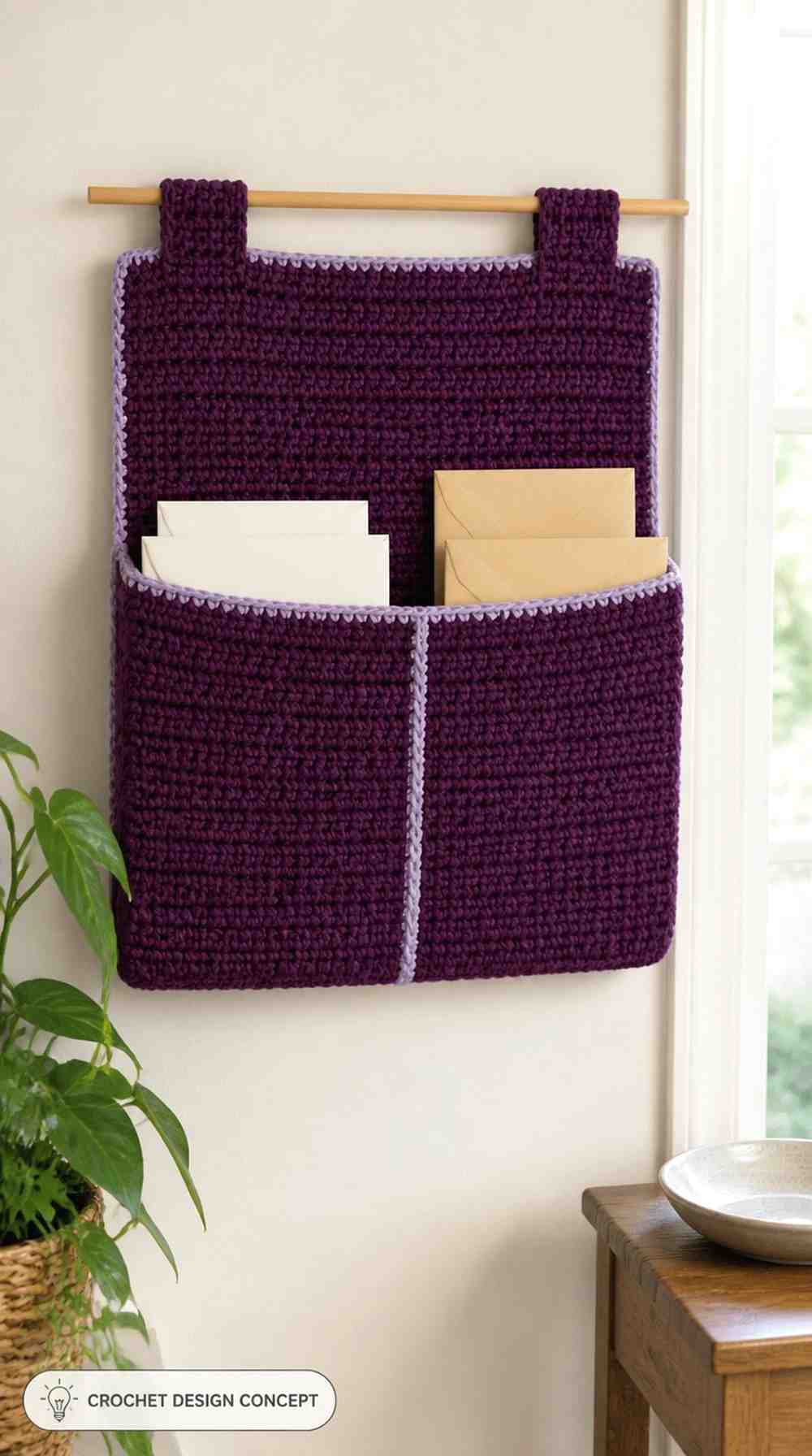
Rich plum-purple crochet forms a broad wall organizer with one lower pocket divided into two separate compartments. A strong lavender center seam connects the pocket front to the dense backing, and narrow lavender edging outlines both openings. Two wide hanging loops support the panel from a wooden dowel.
The split pocket is a practical choice for sorting two similar categories of mail without adding several stacked layers. Its main advantage is visibility: both compartments sit at the same height, so neither becomes hidden behind another pocket.
- Central Lavender Divider: Reinforce the vertical seam along its full working length to help prevent the sections from pulling toward each other.
- Equal Access Height: Both openings remain easy to reach, making the design suitable for two users or two regularly checked mail categories.
- Broad Backing Panel: Allow enough width for envelopes to sit comfortably in both sections without bending at the center seam.
14. Crochet Rust Striped Mail Pocket Panel
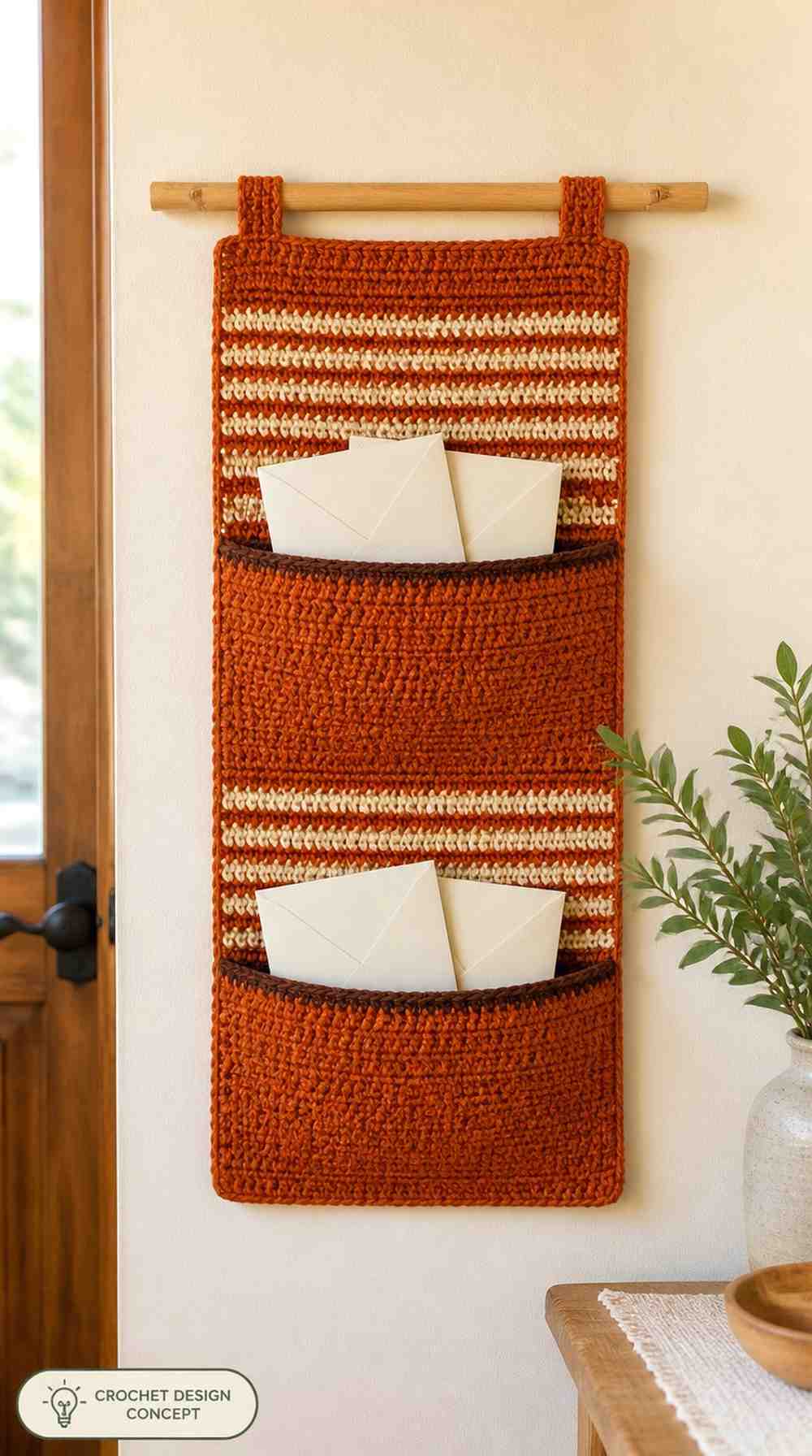
Rust-orange and cream crochet stripes give this tall organizer a warm, vintage-inspired appearance. Two plain rust pockets sit across the middle and lower sections, each finished with a thin dark-brown upper edge. Two matching tabs hang the panel from a natural oak dowel, and ivory envelopes remain visible above both openings.
The striped backing supplies decoration without adding bulky motifs to the working pockets. This keeps the storage areas relatively simple while making the panel more noticeable against a plain hallway wall.
- Striped Backing: Keep color changes and yarn ends neatly finished so they don’t create uneven ridges behind the attached pockets.
- Two Plain Rust Pockets: Solid pocket fronts contain letters without exposing paper corners through decorative openings.
- Vertical Proportions: A tall backing needs suitable wall clearance even though the actual storage pockets occupy only its middle and lower sections.
15. Crochet Mint Four Cubby Mail Organizer
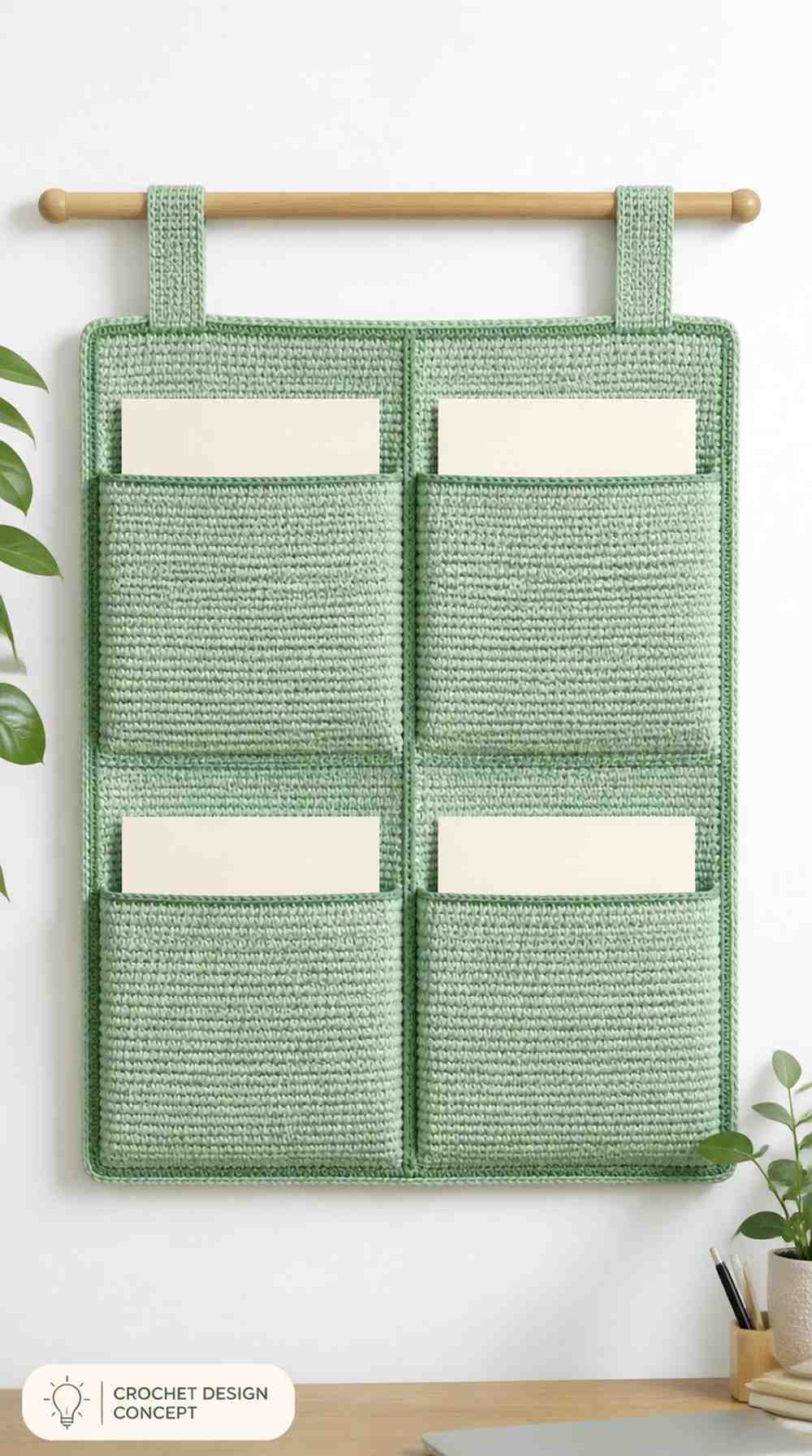
Mint-green crochet creates a large wall panel with four separate mail pockets arranged in a balanced two-by-two grid. Each pocket has dense stitches, darker-mint edging, and reinforced joining seams. A natural wooden dowel supports the backing through two sturdy upper straps, while cream envelopes sit upright in all four compartments.
This layout could suit a shared household where mail needs to be divided among several people or categories. It uses more wall space than a small organizer, but separate cubbies may reduce the need to search through one crowded pocket.
- Four Independent Compartments: Each cubby should be wide enough for the intended envelopes rather than simply dividing the backing into visually equal squares.
- Grid Joining Seams: Reinforce both the horizontal and vertical joins to prevent the pocket fronts from pulling away when filled.
- Shared-Household Sorting: The four compartments could represent different people or tasks; any identification labels should be optional and removable.
16. Crochet Blush Floral Edge Mail Sorter
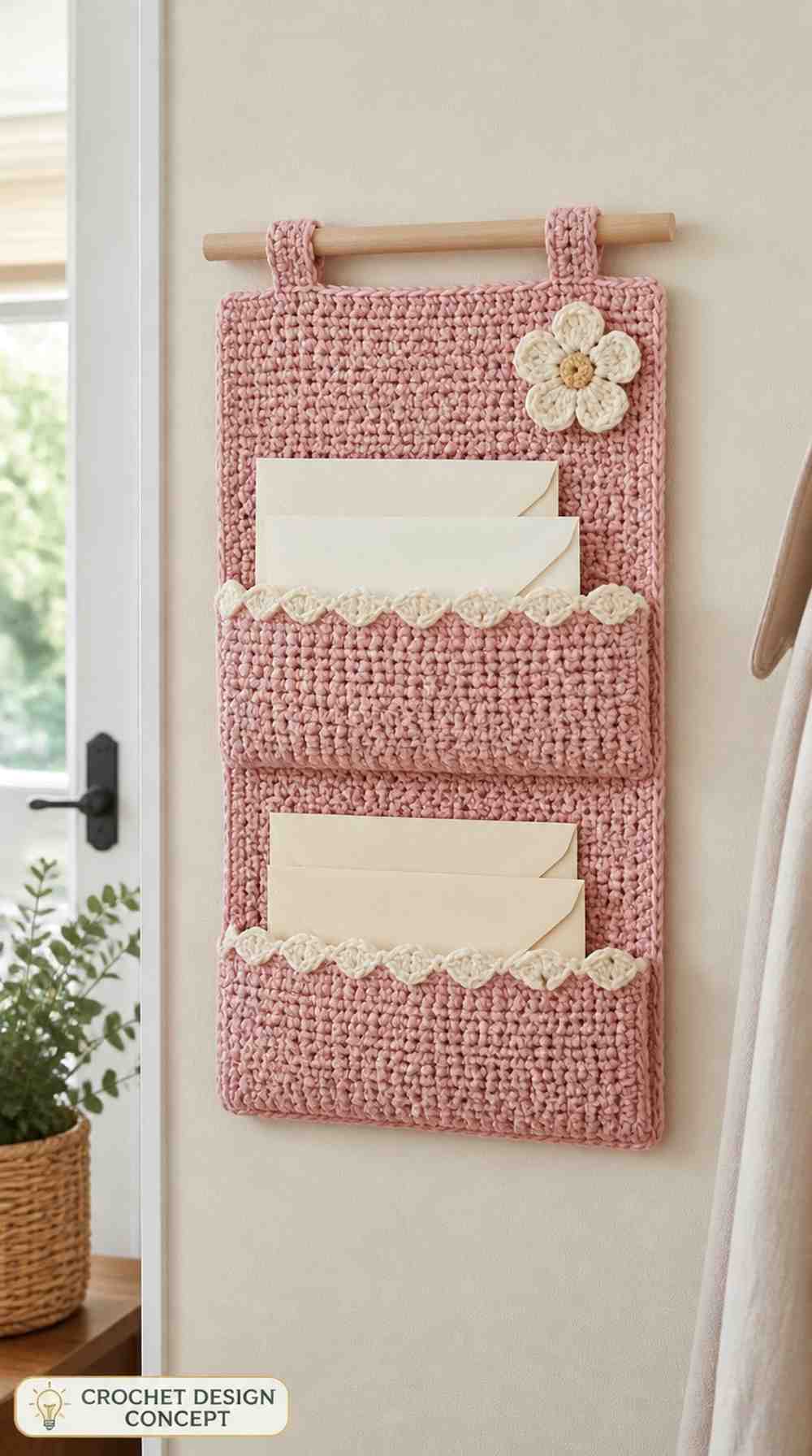
Blush-pink crochet gives this two-pocket hanging organizer a gentle, cottage-inspired look. Ivory scalloped edging follows the upper edge of each horizontal pocket, while a small five-petal ivory flower with a muted-yellow center decorates the backing’s upper-right corner. Two blush tabs support the tall moss-stitch panel from a light wooden dowel.
The floral details give the organizer a decorative finish without covering its storage openings. The scallops should remain relatively flat, however, since raised or loosely attached edges can catch paper corners during everyday use.
- Scalloped Pocket Edging: Keep each scallop small and securely worked so letters can slide into the compartments without snagging.
- Single Floral Accent: Placing the flower at the upper corner keeps the motif away from the pocket openings.
- Two Stacked Sections: The arrangement provides simple separation while leaving enough exposed space to recognize the contents of both pockets.
17. Crochet Cream Modular Mail Pocket Trio
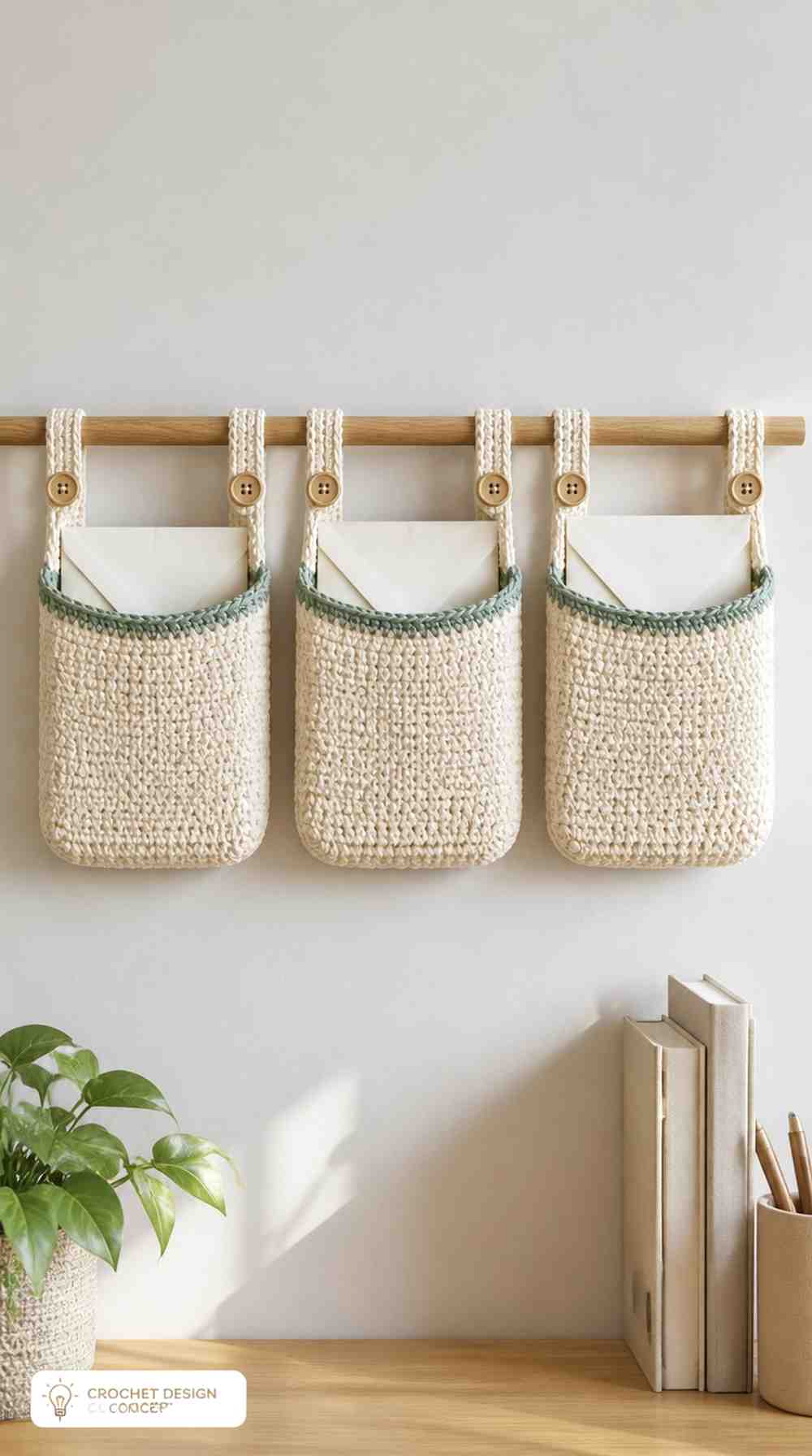
Three separate cream crochet mail pockets hang side by side from one natural oak dowel. Each rectangular pouch has a soft square bottom, sage edging, an open upper rim, and two short button-loop straps secured around the dowel with small wooden buttons. Plain ivory envelopes fill the three independent compartments.
Unlike a single-panel organizer, this modular concept allows individual pockets to be removed or repositioned. That flexibility may be useful when a household changes its sorting routine, although the attachment buttons and suspension loops need careful construction.
- Removable Pocket Modules: Separate pouches can be repositioned along the dowel, provided the support remains balanced and secure.
- Button-Loop Suspension: Each pocket relies on two buttoned straps, so inspect the buttons and joining stitches before loading it.
- Three Side-by-Side Openings: The arrangement makes contents easy to compare, but requires a wider wall than vertically stacked designs.
18. Crochet Indigo Magazine Letter Wall Sorter
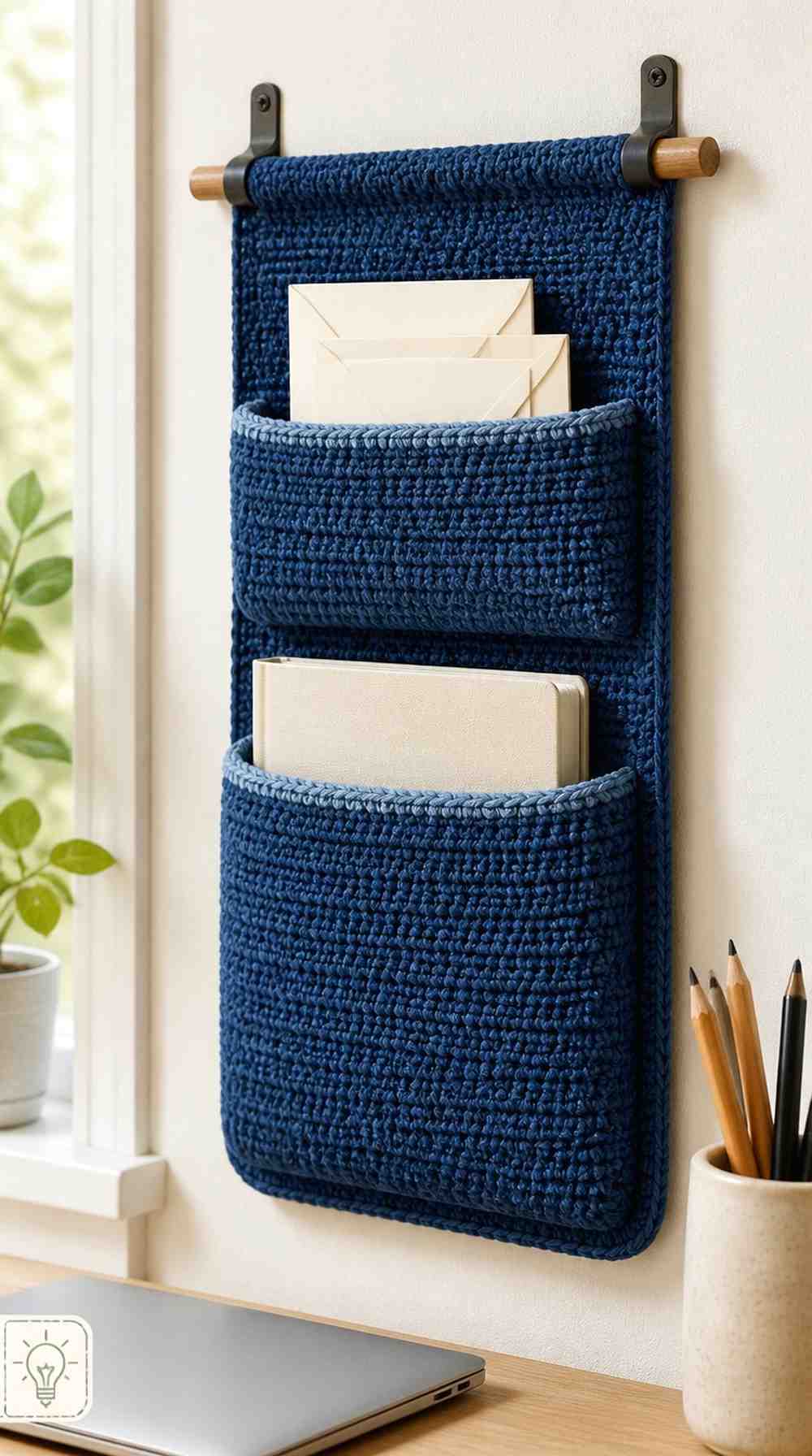
Deep indigo crochet creates a tall rectangular organizer with two different pocket depths. A broad shallow upper section holds cream envelopes, while the larger lower pocket contains a slim cream-covered magazine. Light-blue edging defines both openings, and a reinforced top channel supports the backing from a wooden dowel.
This design is useful when occasional magazines or larger paper items arrive alongside ordinary letters. The deeper lower section provides additional coverage, but heavier publications may cause the soft crochet backing to stretch or lean away from the wall.
- Shallow Upper Pocket: Keep everyday letters visible and accessible without making the upper section unnecessarily deep.
- Deeper Magazine Compartment: Measure the publication’s width and height before planning the lower opening; a large magazine may need firmer support.
- Weight Distribution: Store only a modest amount of paper and check the backing, dowel, and mounting hardware for sagging.
Practical Guide to Crochet Hanging Mail Sorting Organizers
Choose Pocket Sizes for Your Actual Mail
Start by measuring the largest envelopes and papers you regularly receive. Leave room around the edges so letters slide in without bending, and make the pockets deep enough to support paper while keeping the upper edges accessible.
If you receive larger documents, consider a design with a wider or deeper compartment instead of forcing them into a small letter pocket.
Compare Different Sorting Layouts
| Organizer layout | Useful for | Main consideration |
|---|---|---|
| Two stacked pockets | Incoming and outgoing mail | Clear access to both openings |
| Side-by-side compartments | Two people or two categories | Wider wall space |
| Three cascading pockets | Several sorting stages | Pocket overlap and visibility |
| Accordion file | Multiple envelope groups | Gusset strength and projection |
| Four-cubby grid | Shared households | Larger backing and secure support |
| Single decorative pocket | Occasional letters | Limited sorting capacity |
| Mixed-size compartments | Letters, receipts, magazines | Different pocket dimensions |
Choose Materials for Structure
Firm cotton yarn or another suitable washable yarn can be useful for a crochet wall organizer. Dense stitches may help the backing and pockets maintain their shape, although crochet will still stretch under weight.
A wooden dowel can help distribute support across the upper edge. For larger organizers, consider appropriate removable backing support or reinforcement, provided it is safely enclosed and compatible with cleaning.
Install the Organizer Securely
Use wall hardware suitable for the actual wall material and the combined weight of the organizer and its contents. Reinforce hanging tabs, loops, and eyelets rather than depending on a single loose stitch.
Keep the organizer away from damp walls, heat sources, and narrow walkways where it might be knocked or caught.
Make Mail Sorting a Regular Habit
Give each compartment a clear purpose, such as new mail, papers requiring action, and outgoing correspondence. Review the pockets regularly so the organizer doesn’t become another place where forgotten letters accumulate.
Keep sensitive correspondence away from public entryways when privacy matters. A crochet pocket is convenient storage, not a lockable document holder.
Want to Make Something Similar?
These verified resources offer useful crochet techniques for hanging pockets and wall organizers. They are related construction references, not exact patterns for the AI-generated designs above.
- Yarnspirations — Free Red Heart Pocket Wall Hanging Pattern provides a downloadable crochet wall-pocket pattern. It’s a useful starting point for understanding how a backing and attached storage pockets work together.
- Ravelry — The Seamless Hanging Organizer by Reney Trelenberg explores a multi-pocket crochet organizer with different hanging arrangements. The listing includes pattern details and mentions accompanying video instruction.
- Moogly — Everyday Drop Hanging Basket by Tamara Kelly teaches a hanging crochet basket with a soft teardrop form. It is relevant to smaller hook-mounted organizers, although its construction differs from a flat mail sorter.
These sources can help with stitch choices, pocket shaping, and hanging methods, but adapting a pattern for paper mail requires checking envelope dimensions and support strength separately.
For another related article on the same website, see 16 Crochet Vintage Kitchen Wall Pocket Ideas for Cozy Cottage Homes. It explores decorative wall-pocket construction in a different household setting.
Which Crochet Hanging Mail Organizer Should You Choose?
| Your main priority | Designs to consider | Important trade-off |
|---|---|---|
| Simple daily sorting | Sage Two Pocket, Navy Side by Side | Vertical versus horizontal space |
| Three mail categories | Terracotta Cascading, Mustard Arched | Greater wall height |
| Several expanding compartments | Teal Accordion Mail File | Gusset stretch and projecting depth |
| Compact decorative storage | Oatmeal Envelope Front, Cream Granny Square | Fewer storage compartments |
| Letters and receipts | Olive Letter Receipt Wall Caddy | Different pocket depths |
| Shared household sorting | Mint Four Cubby, Cream Modular Trio | Larger width and more attachments |
| Corner wall placement | Coral Corner Mail Organizer | More complex mounting |
| Decorative cottage style | Blush Floral Edge, Rust Striped | Decorative details need careful finishing |
| Letters and magazines | Indigo Magazine Letter Wall Sorter | Greater paper weight |
| Discreet covered storage | Charcoal Foldover Mail Pocket | Slower access and no security protection |
For a straightforward everyday mail routine, the Crochet Sage Two Pocket Mail Sorter is a sensible starting concept. Its two open compartments make it easy to separate new letters from items ready to send.
If you prefer several sorting stages, the Crochet Terracotta Cascading Mail Pockets gives three clearly visible areas without requiring a particularly wide panel.
For a shared household, the Crochet Mint Four Cubby Mail Organizer or Crochet Cream Modular Mail Pocket Trio provides additional compartments. The modular design also offers the possibility of moving individual pockets when storage needs change.
When appearance is important, the Crochet Oatmeal Envelope Front Mail Holder and Crochet Blush Floral Edge Mail Sorter combine recognizable decorative details with simple storage.
Conclusion
A crochet hanging mail organizer can help keep letters and small papers off busy tables while adding handmade texture to an entryway or home office. Some designs focus on simple two-pocket sorting, while others offer separate receipt sections, removable modules, or additional room for larger documents.
The most useful choice is one that fits your mail, stays securely mounted, and makes each compartment easy to reach. Choose a suitable yarn, reinforce the hanging points, and keep the organizer from becoming overloaded. These 18 concepts offer plenty of inspiration for making everyday paperwork a little easier to manage.
Which design would you choose for your home: the sage two-pocket sorter, terracotta cascading pockets, or cream modular trio? Share your favorite and how many mail compartments you would actually use.
Frequently Asked Questions
1. What yarn is best for a crochet hanging mail organizer?
Firm cotton yarn or another suitable washable yarn can work well for a wall organizer. Dense crochet stitches may provide more structure than very open lace, but the result depends on the yarn, stitch tension, and pocket dimensions. Choose a material that can support the intended lightweight contents without excessive stretching.
2. How do I stop crochet mail pockets from sagging?
Start with a firm backing, secure pocket seams, and reinforced hanging points. A suitable dowel can help distribute the weight across the top. Avoid overloading the compartments, and consider an appropriate removable backing support if the design requires additional structure. Test the finished organizer with a small amount of mail before regular use.
3. Can a crochet mail organizer hold magazines or documents?
Some designs may be adapted for larger paper items, but magazines and document stacks can be heavier than ordinary letters. Measure the paper size, provide a sufficiently wide pocket, and check the organizer’s support and mounting strength. A shallow decorative pocket isn’t automatically suitable for heavier publications.
4. Is it better to use stacked or side-by-side mail pockets?
Stacked pockets are useful when wall width is limited, while side-by-side compartments make it easier to compare two categories at the same height. The best arrangement depends on your available space, how many people use the organizer, and whether all pockets can be reached comfortably.
5. Are these 18 crochet hanging mail organizer ideas actual patterns?
No. These are original AI-generated crochet design concepts intended for visual inspiration. They have not been physically tested for measurements, strength, pocket capacity, or mounting safety. Use the designs to explore possible layouts and finishes, then follow a reliable crochet pattern or carefully develop and test your own construction before everyday use.