A door handle tapping against the wall can leave small dents, scuffs or chipped paint over time. A crochet wall protector offers a creative way to decorate the contact area with soft handmade texture. These 15 inspiration ideas explore round cushions, elongated lever-handle pads, geometric wall guards, padded flowers, botanical shapes and removable crochet covers in colors ranging from oatmeal and sage to terracotta, blush and charcoal.
The right wall protector needs more than an attractive crochet surface. Where the door opens, where the handle approaches the wall, how the protector is mounted and whether a proper door stop is already installed all matter. A crochet pad is not a tested replacement for hardware designed to stop a moving door. This collection focuses on decorative soft-cover ideas and practical ways to plan their shape, positioning, backing and care.
These are AI-generated crochet design visualizations, not photographs of tested protective products or step-by-step patterns. The pictured designs have not been tested for impact resistance, mounting strength, wall-finish compatibility or door-stopping performance.
Quick Design Selection Guide
- For a simple round doorknob area: The Crochet Oatmeal Round Wall Cushion, Crochet Mustard Sunray Wall Bumper Pad and Crochet Teal Concentric Removable Wall Cushion offer circular designs with different finishes.
- For a lever-style handle: The Crochet Sage Oval Lever Handle Wall Pad, Crochet Navy Ribbed Rectangle Wall Guard and Crochet Olive Botanical Leaf Wall Protector have longer horizontal shapes.
- For modern geometric styling: Compare the Crochet Terracotta Hexagon Wall Protector, Crochet Charcoal Waffle Square Wall Pad and Crochet Rust Diamond Padded Wall Guard.
- For soft decorative details: The Crochet Blush Daisy Wall Cushion, Crochet Lavender Heart Wall Protector and Crochet Dusty Blue Scalloped Square Wall Guard offer different shaped edges.
- For an unusual wall position: The Crochet Coral Corner Wrap Wall Protector explores an L-shaped corner covering.
- For a removable decorative cover: The Crochet Teal Concentric Removable Wall Cushion and Crochet Sand Pebble Wall Cushion include access to their inner backing.
- For classic crochet character: The Crochet Cream Granny Square Wall Protector combines decorative clusters with a denser lined contact area.
1. Crochet Oatmeal Round Wall Cushion
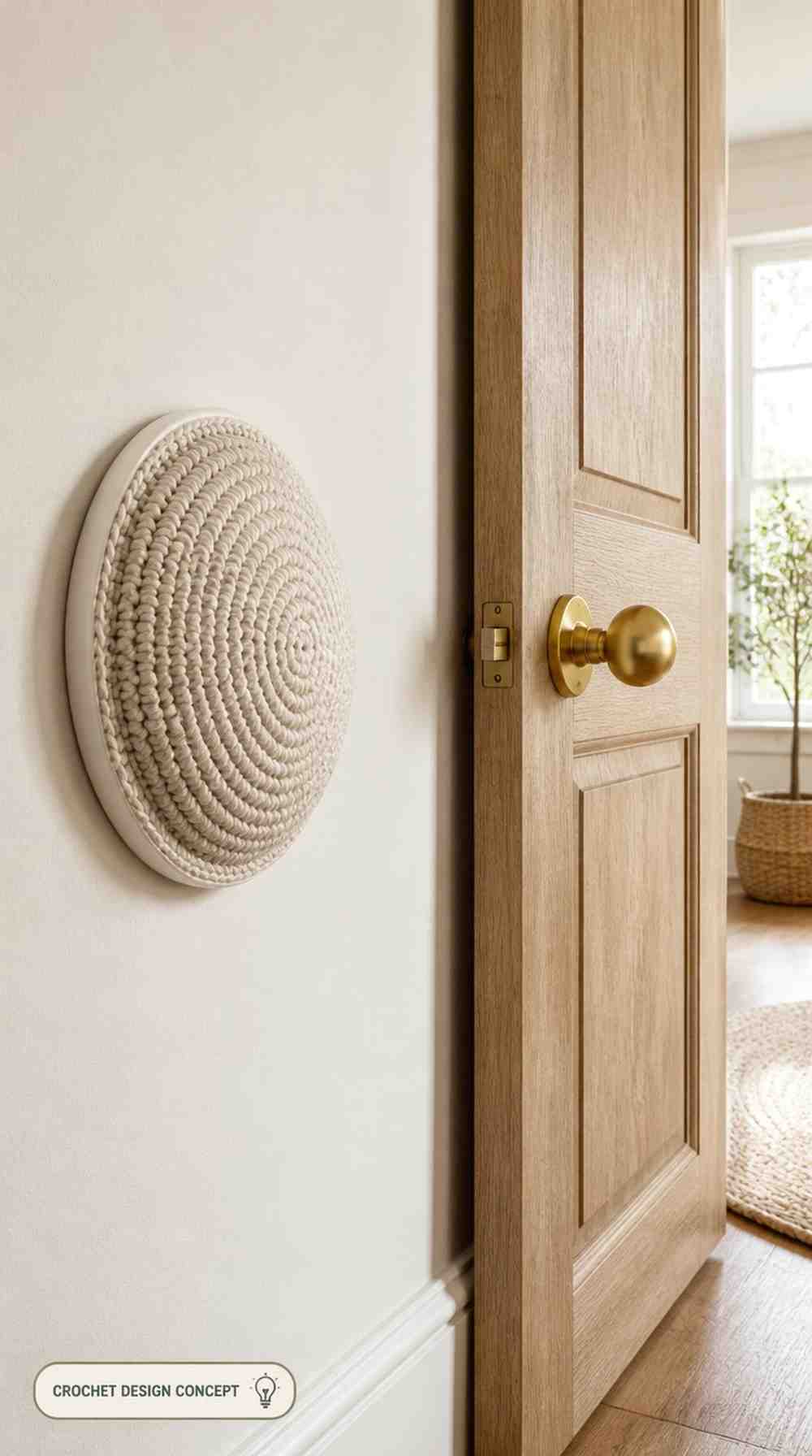
Warm oatmeal crochet creates a simple circular wall pad with a softly raised center and a smooth cream border. Dense spiral stitches cover its surface, while a discreet fabric-backed mounting piece holds the circle against a cream hallway wall. The nearby satin-brass round doorknob shows the intended positioning.
This uncomplicated shape could suit a small decorative covering around a known handle-contact area. Its circular outline is easy to plan, but the padding must remain centered and the backing properly secured.
- Circular Centering: Identify the actual contact point before choosing the diameter; a beautifully shaped pad is ineffective if placed outside the handle’s path.
- Dense Spiral Stitches: Closely worked rounds provide a continuous outer surface, unlike large openwork stitches that expose more of the underlying material.
- Softly Domed Padding: Keep the middle modestly raised and the perimeter flat, so the cover doesn’t curl away from its backing.
- Cream Outer Border: An even finishing round helps preserve the circular outline without creating a bulky rim.
2. Crochet Sage Oval Lever Handle Wall Pad
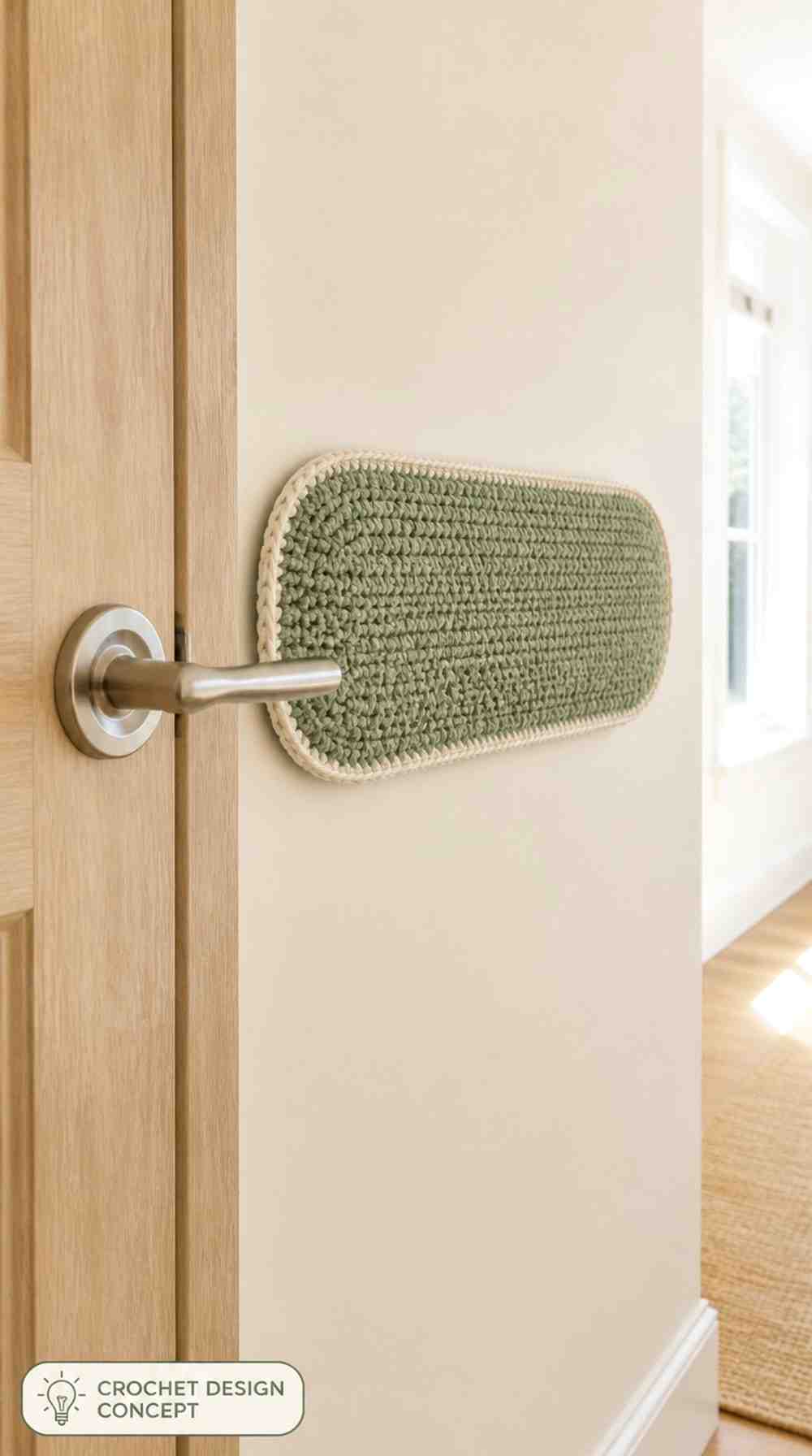
An elongated sage-green crochet pad gives a lever-handle contact area a clean, understated appearance. Its horizontal oval form uses dense moss stitches and narrow ivory edging, with a slim removable padding insert inside. The pad sits flat on a cream wall behind a brushed-nickel lever handle.
The longer shape distinguishes this concept from a small round doorknob cushion. It provides more horizontal coverage, although the actual position and dimensions should be determined by checking the lever’s movement rather than simply making the pad wider.
- Horizontal Oval Shape: Check where the lever’s end approaches the wall and whether a longer contact area is actually needed.
- Removable Padding Insert: A separate insert may make fabric care easier, but it must stay securely positioned within the outer crochet cover.
- Moss-Stitch Texture: Low, closely spaced stitches offer a more even surface than pronounced bobbles or loose decorative lace.
- Ivory Finishing Edge: Keep the contrasting oval border flat to avoid rolling or bunching along the wall.
3. Crochet Terracotta Hexagon Wall Protector
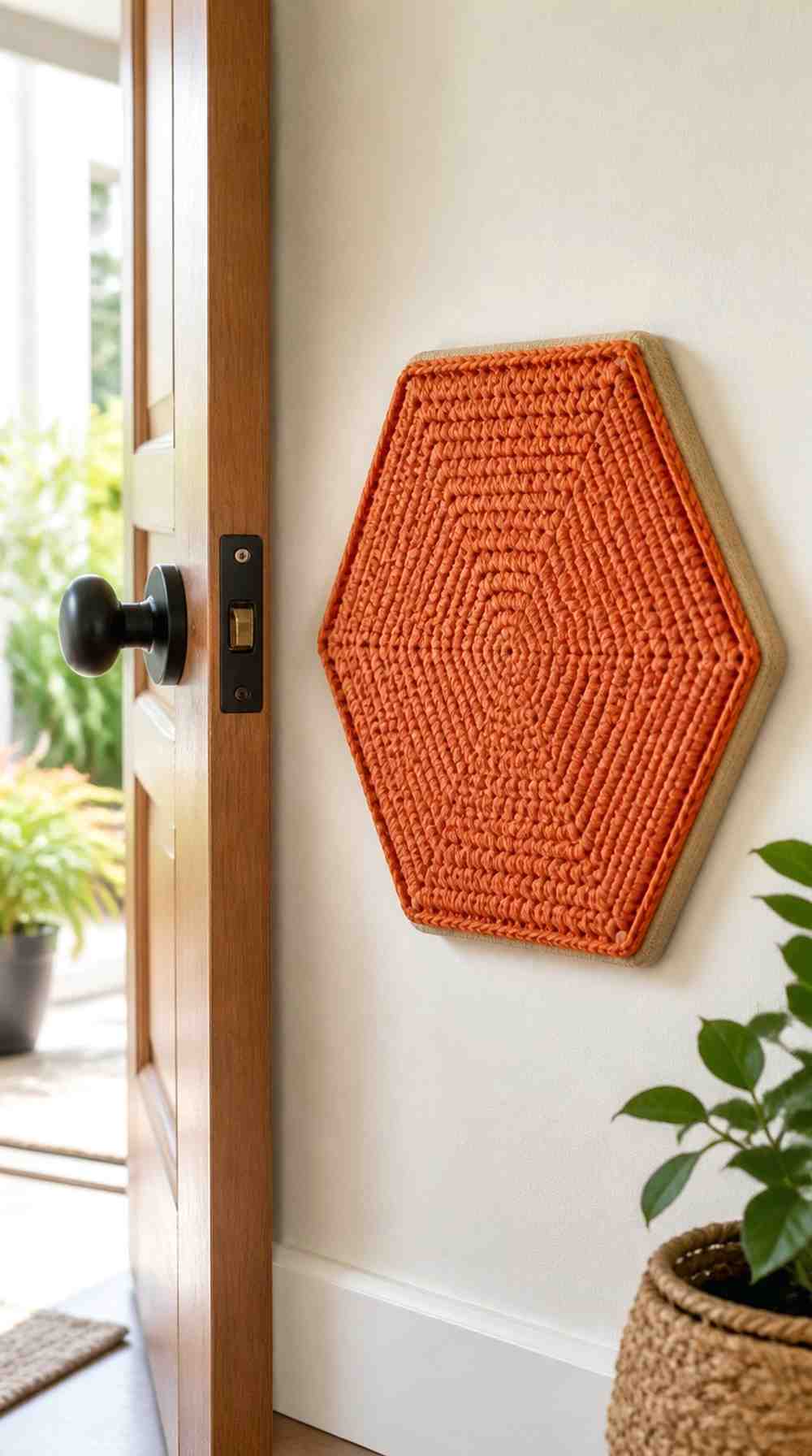
Terracotta-orange crochet brings a strong geometric look to this six-sided wall cushion. Its compact central face is tightly stitched, while a rust-colored border defines the corners. A shallow padded insert and a fitted backing complete the hexagonal construction near a matte-black round doorknob.
The hexagon makes an attractive decorative alternative to an ordinary circular pad. However, its corners are not the main working area. The center should align with the expected handle contact, leaving the angled edges primarily as visual details.
- Six Defined Corners: Work the increases consistently so the hexagon remains balanced rather than developing uneven or stretched points.
- Central Contact Area: Plan the padded middle around the actual handle position instead of counting the six decorative corners as usable coverage.
- Rust Outer Edge: A firm finishing round can help the geometric shape remain defined around the backing.
- Backing Fit: Keep the support slightly inside the crochet outline so no exposed edges protrude or catch.
4. Crochet Blush Daisy Wall Cushion
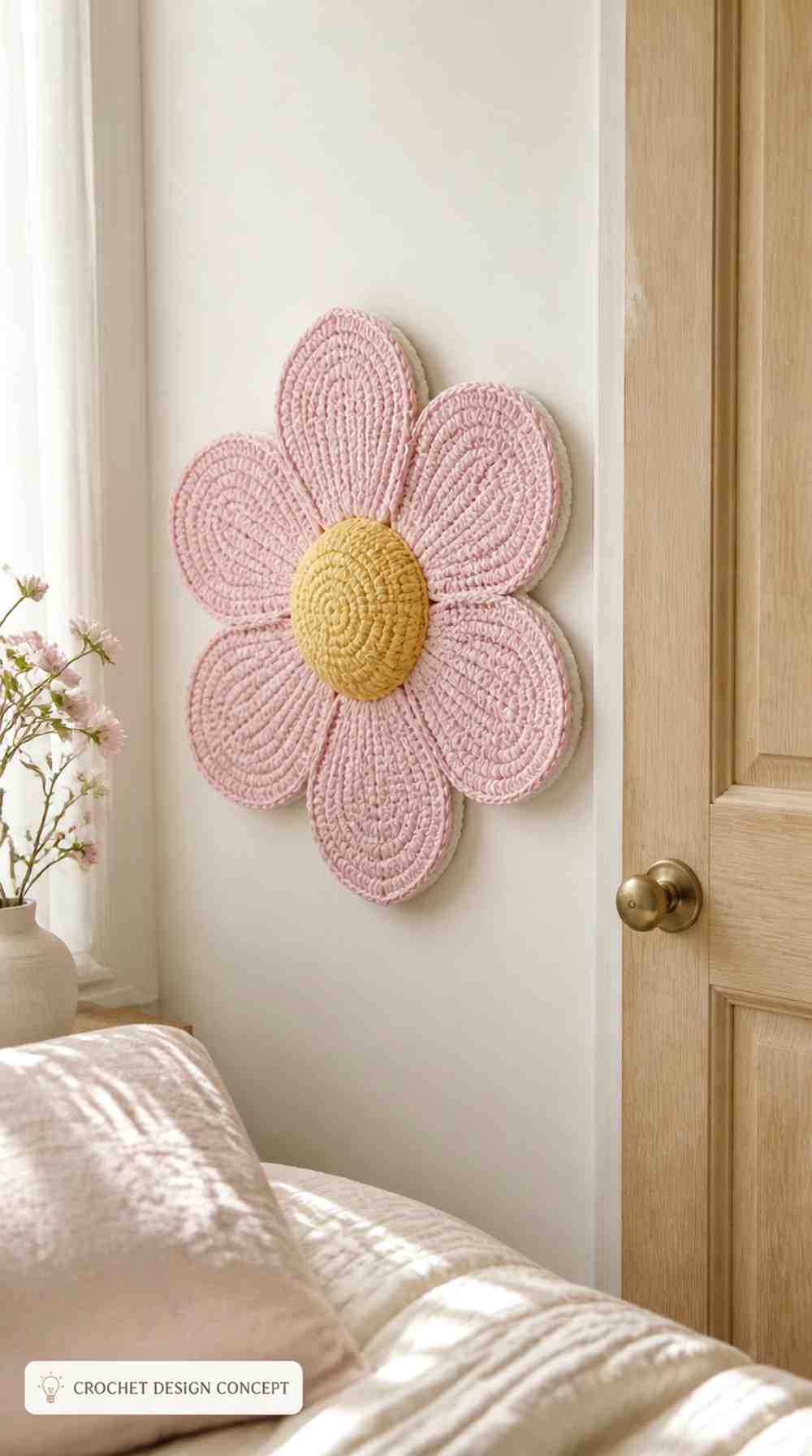
Six broad blush-pink petals surround a warm-yellow padded center in this flower-shaped crochet wall cushion. The petals are flat, joined to a continuous cream backing disk and arranged neatly around the middle. A satin-brass round doorknob sits nearby, showing the intended wall position.
The daisy design could add a gentle decorative touch to a bedroom doorway. Its central disk is the important part of the shape; the petals are mainly ornamental and should not be treated as reliable cushioning surfaces.
- Six Joined Petals: Keep each petal firmly attached and flat, avoiding loose edges that could be snagged by moving hardware.
- Padded Yellow Center: Position the main cushioning area behind the potential contact point rather than relying on the thin outer petals.
- Continuous Backing Disk: A single backing shape can support the petals without requiring separate mounting points for every lobe.
- Small-Parts Consideration: Avoid adding detachable beads or hard flower-center buttons, particularly in areas accessible to young children.
5. Crochet Navy Ribbed Rectangle Wall Guard
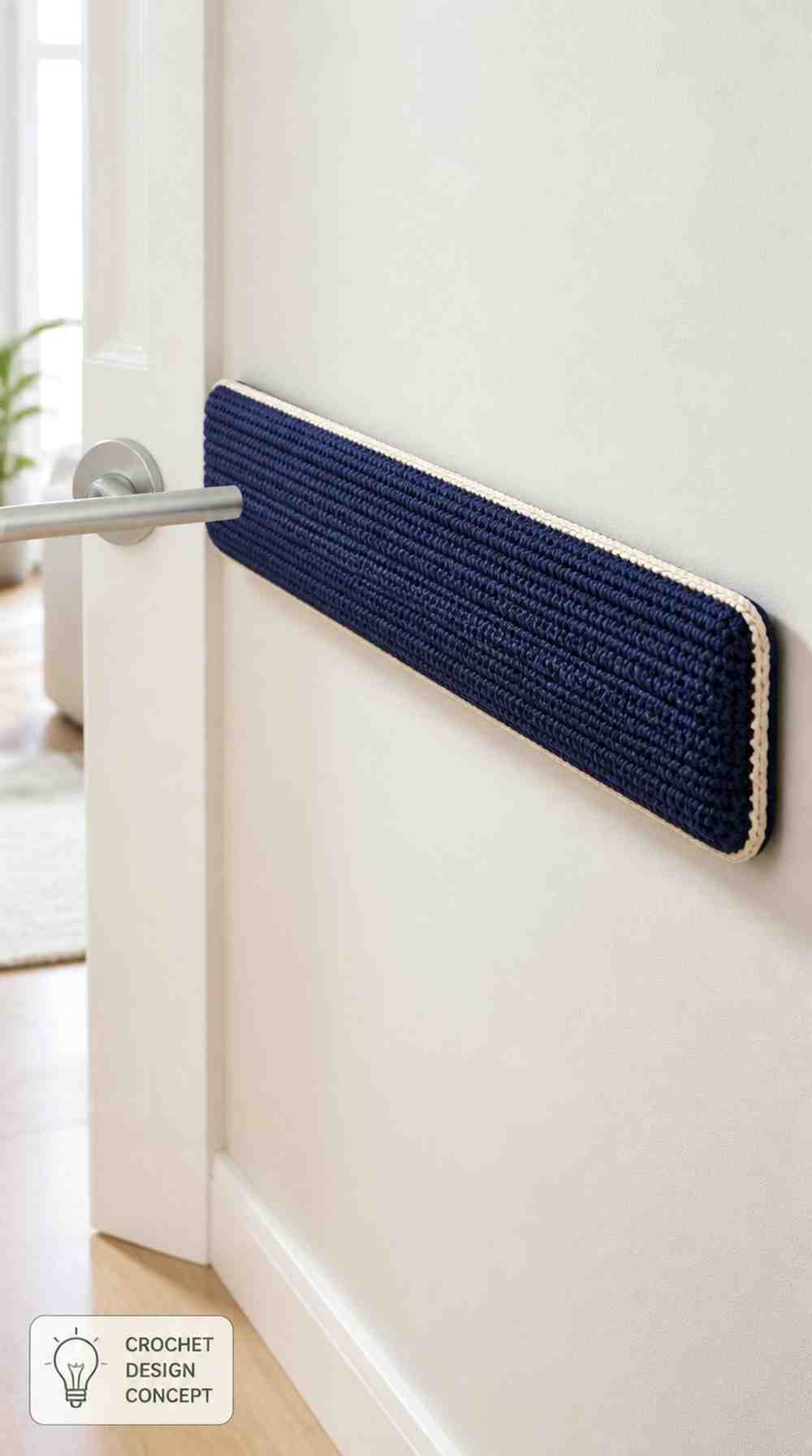
Deep navy crochet gives this long, narrow wall pad a modern appearance. Low horizontal ribs cover the rectangular face, while a smooth central section and thin ivory edging keep the profile structured. The protector sits horizontally on a cream wall behind a satin-silver lever handle.
Its rectangular outline is intended for a wider area where a lever may approach the wall. The shape should remain low-profile, with enough padding to create a soft textile layer but without assuming it can absorb repeated door impacts.
- Long Rectangular Coverage: Measure the relevant lever-handle contact area and check whether the entire horizontal length is needed.
- Low Ribbed Texture: Shallow ribs add visual detail without creating large, uneven protrusions toward the moving handle.
- Rounded Corners: Softly shaped ends reduce sharp-looking edges while keeping the long rectangular silhouette recognizable.
- Navy Yarn: Dark crochet can suit contemporary interiors, but lint may be noticeable on the textured surface and require occasional cleaning.
6. Crochet Lavender Heart Wall Protector
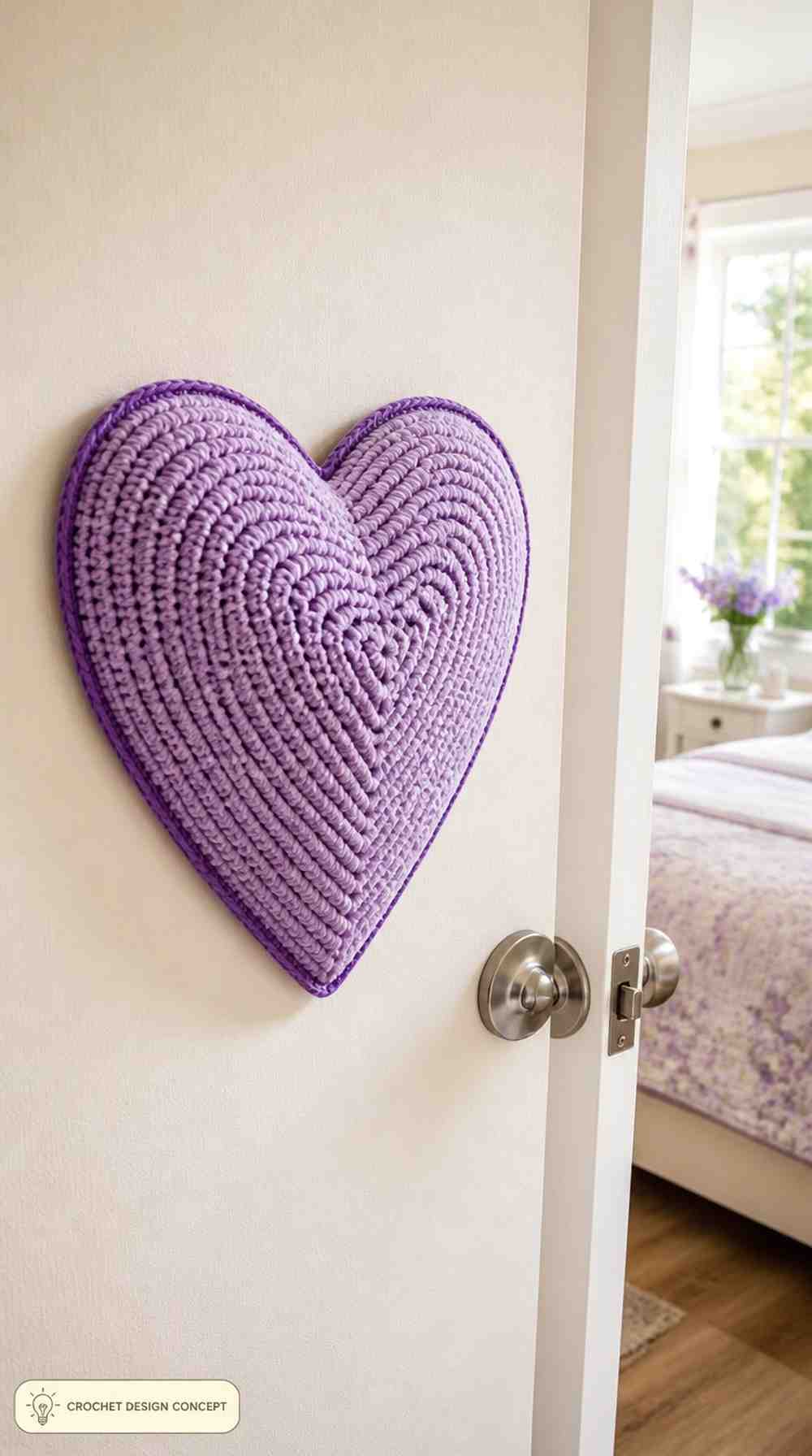
Lavender crochet gives this small wall cushion a romantic heart shape. The upper lobes are broad and rounded, with a gently pointed lower end and a deeper-purple finishing border. A modest central padded area sits behind the closely worked fabric, supported by a fitted flat backing.
The heart silhouette could work as a decorative accent near a bedroom door. Its widest central portion should align with the handle’s possible contact point, while the lower tip remains decorative rather than a primary supporting section.
- Heart Proportions: Keep the rounded upper lobes balanced and the lower point soft enough to remain flat against the wall.
- Central Padding: Focus any cushioning material beneath the broad middle, where the knob would be expected to approach.
- Purple Finishing Border: An even edge helps prevent the curved lobes from drawing inward and changing the shape.
- Wall-Finish Compatibility: Check the backing material and fixing method against the actual paint or wallpaper before installation.
7. Crochet Charcoal Waffle Square Wall Pad
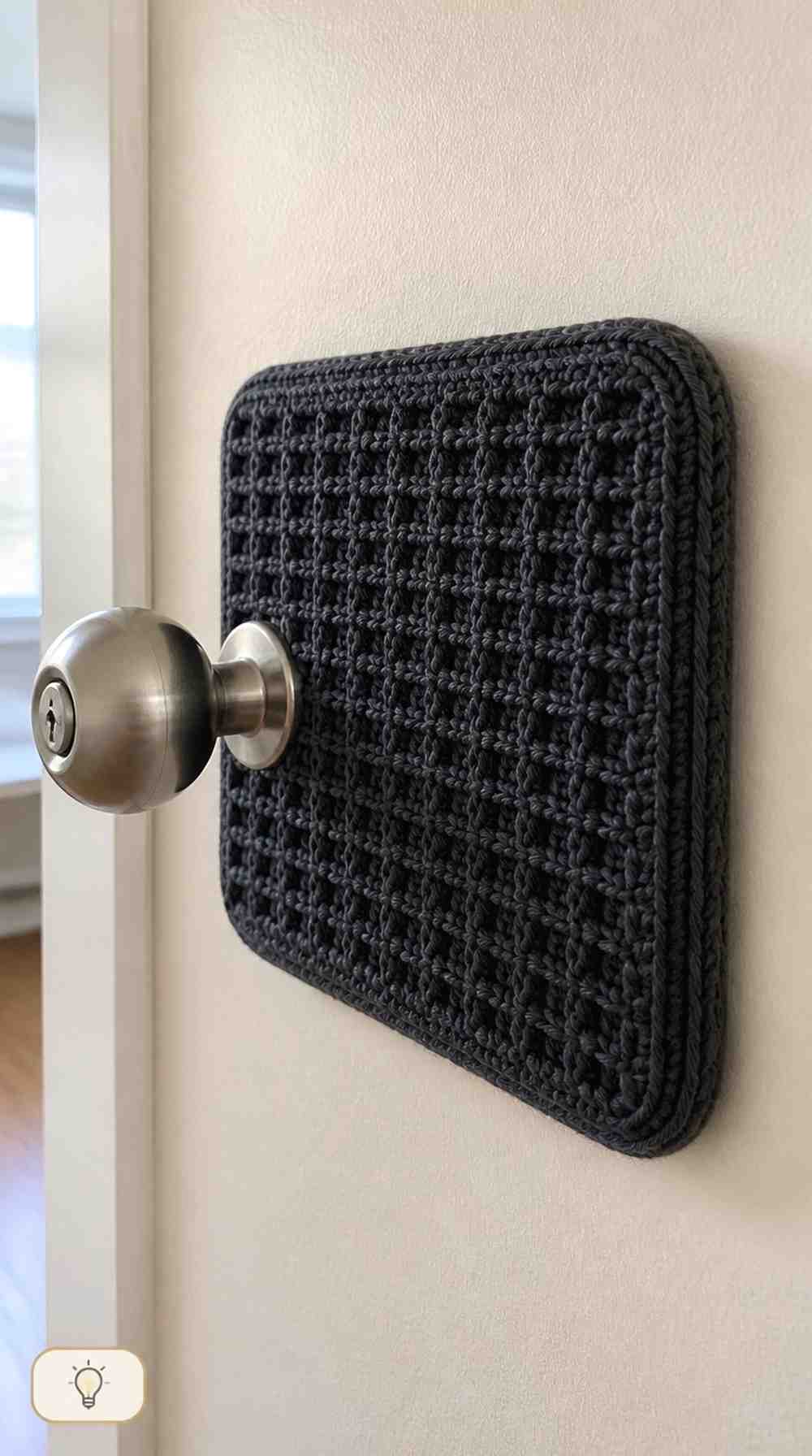
Charcoal-grey crochet creates a compact square wall cushion with four softly rounded corners. Shallow waffle-stitch squares cover its front, surrounded by a dense flat border. A thin padded layer and fitted neutral backing give the wall-mounted piece a low, tidy profile beside a brushed-metal round doorknob.
The textured surface brings visual interest without requiring separate decorative elements. Its square outline may suit a contemporary hallway, although the raised stitch bars need to stay low and evenly worked so the central surface remains consistent.
- Waffle-Stitch Height: Keep the raised bars shallow rather than using deep bobbles that could create uneven contact points.
- Four Rounded Corners: Gentle shaping helps the backing follow the square without exposed, stiff corners.
- Dark Crochet Surface: Choose yarn that can be cleaned of dust and lint, which may collect in the recessed waffle sections.
- Square Alignment: Check that the center of the pad, not simply one outer corner, matches the intended contact location.
8. Crochet Mustard Sunray Wall Bumper Pad
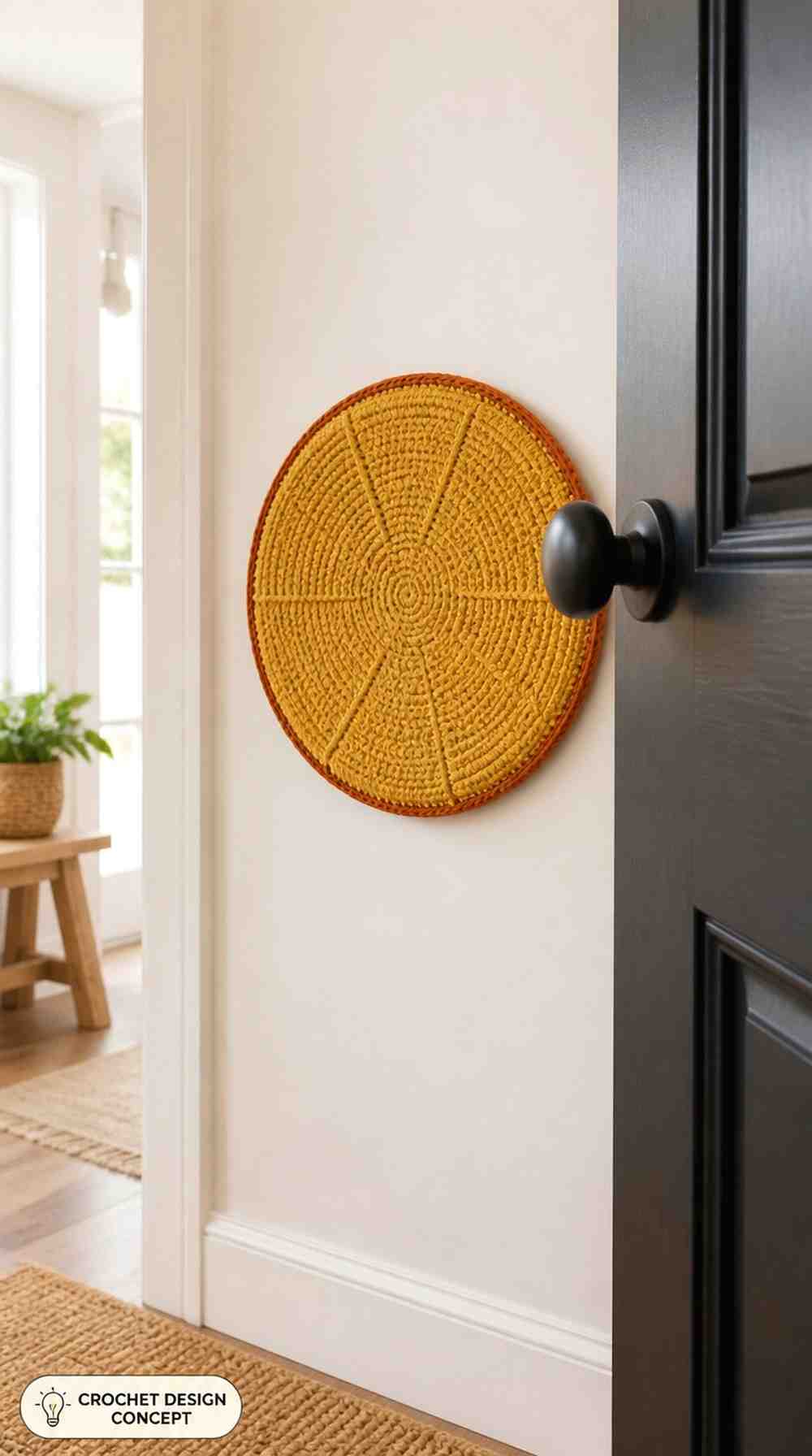
Mustard-yellow crochet gives this circular pad a cheerful sun-inspired finish. Eight low stitch ridges spread outward from a dense center, while a burnt-orange border defines the complete round shape. A thin padded interior sits beneath the crocheted face near a black doorknob.
The sunray design adds texture through the stitching itself rather than separate appliqués. That keeps the center comparatively simple. For a functional installation, the decorative cushion would need to be evaluated alongside an appropriate door stop rather than used as the only barrier to a forcefully opening door.
- Eight Radiating Ridges: Work the rays evenly so the round fabric stays balanced instead of puckering between raised stitch lines.
- Compact Padded Center: Keep the main central area smooth enough to sit evenly over its supporting insert.
- Burnt-Orange Border: A narrow contrasting finish gives the circular outline definition without requiring a thick projecting rim.
- Decorative Limitation: The stitched sunray texture does not establish impact resistance or replace rated stopping hardware.
9. Crochet Olive Botanical Leaf Wall Protector
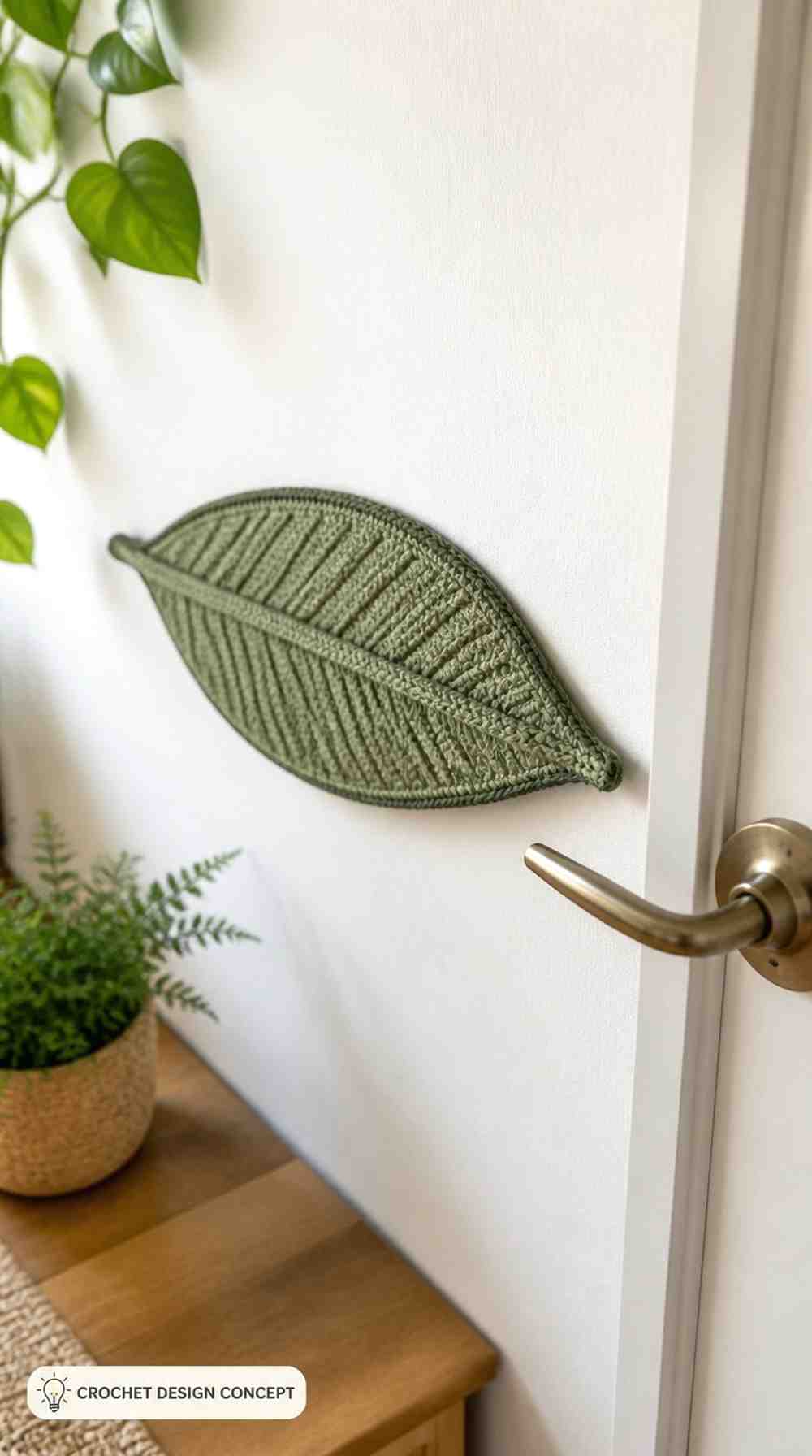
Olive-green crochet creates a leaf-shaped wall pad with a broad central area, softly pointed ends and a low stitched vein. Shallow diagonal ridges branch across the fabric, while a darker-olive border outlines its botanical shape. A fitted padding insert sits beneath the middle, supported by a thin backing.
The horizontal leaf shape could complement natural wood doors and earthy interiors. Its pointed tips contribute to the decorative outline, but they are not a substitute for properly positioned central padding behind the expected lever-handle contact area.
- Broad Leaf Center: Use the widest middle section for the main padded area rather than extending support only into the narrow tips.
- Low Stitched Vein: Keep the raised central detail subtle so the front surface doesn’t become uneven.
- Curved Leaf Edges: Balanced shaping helps both pointed ends remain flat against the fitted backing.
- Horizontal Placement: Compare the complete leaf length with the lever’s approach path before choosing its wall position.
10. Crochet Dusty Blue Scalloped Square Wall Guard
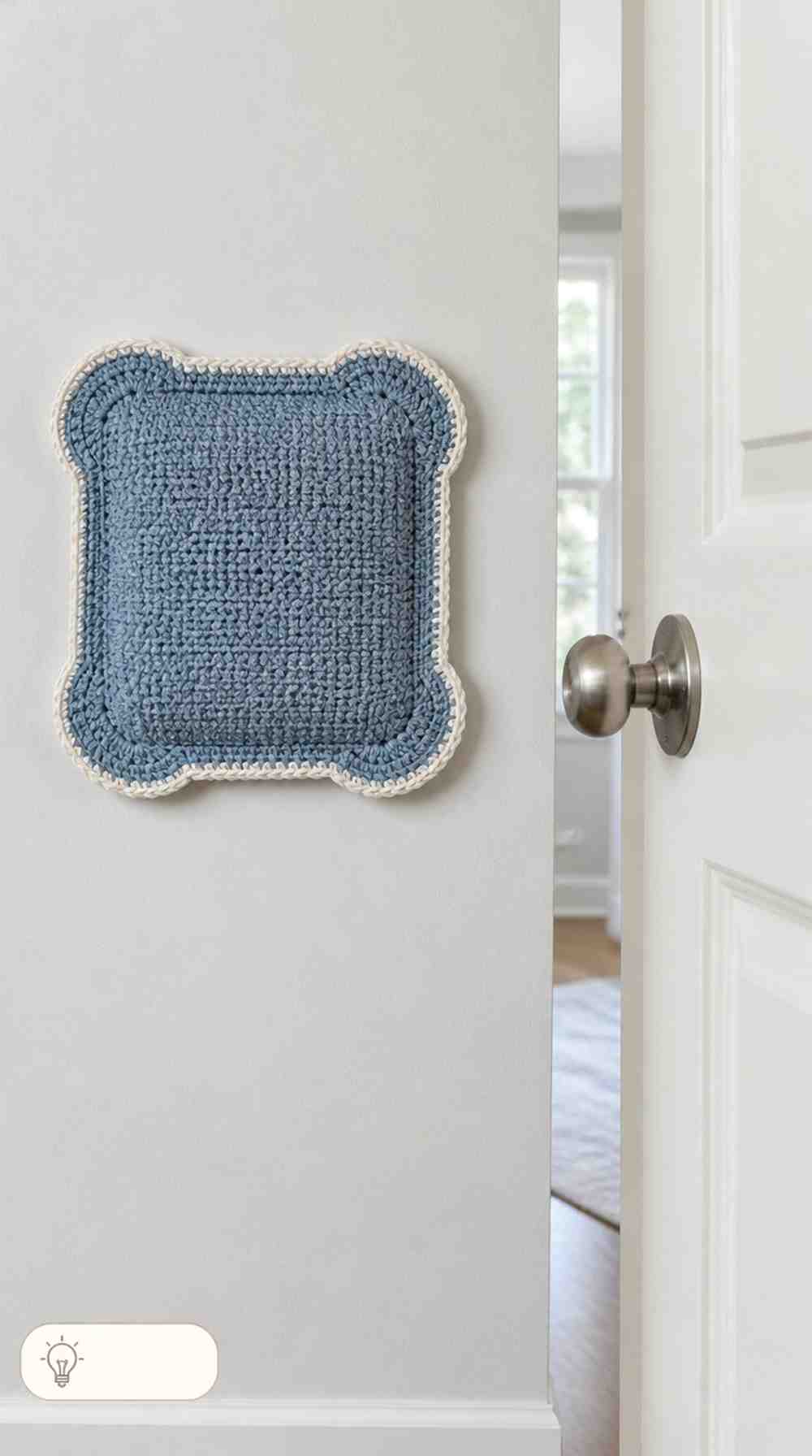
Dusty-blue crochet gives this square wall cushion a soft, decorative appearance. Four rounded corner scallops break up the straight outline, while ivory edging traces the complete shape. The dense central square contains a modest padding layer beneath its closely worked stitches.
This concept combines the tidy appearance of a square pad with more traditional crochet edging. The decorative corners should remain low and firmly supported, particularly when the protector is placed near a frequently opened doorway.
- Four Rounded Corners: Keep the scalloped sections shallow and supported so they cannot easily fold or catch.
- Solid Central Square: A dense middle provides a more continuous front surface than relying on decorative corner loops.
- Ivory Outer Finish: Work the border with even tension to avoid pulling the corner scallops out of alignment.
- Backing Shape: The support should follow the main square closely without leaving loose corners or exposed padding.
11. Crochet Teal Concentric Removable Wall Cushion
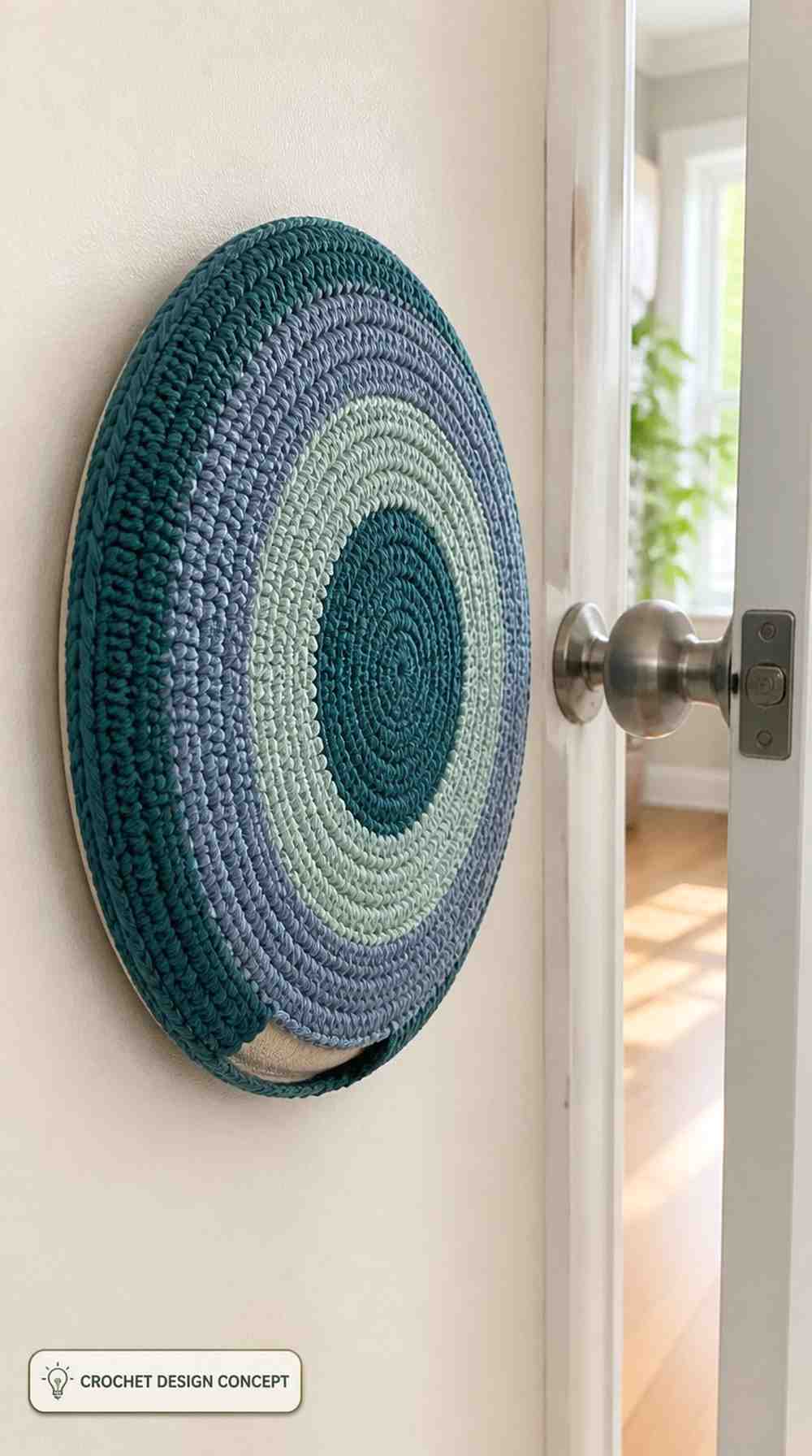
Deep teal crochet gives this circular wall cushion a bold, modern appearance. Three concentric rings in teal, seafoam and muted blue frame the densely stitched center. A thin padded insert sits within a removable outer cover, with a small envelope-style overlap opening discreetly positioned near the lower back.
The removable cover is the main feature of this design. It could make cleaning easier than with a permanently enclosed cushion, provided the backing and mounting arrangement allow removal without damaging the wall.
- Three Concentric Rings: Keep the color changes level so the circular cover doesn’t develop uneven ripples.
- Rear Overlap Opening: Position the access flap away from the visible front and keep it secure during ordinary use.
- Removable Padding: Choose an inner form that fits the cover without leaving empty spaces or distorting the outer circle.
- Cleaning Access: Confirm that the cover can be removed independently of any properly installed door-stop hardware.
12. Crochet Coral Corner Wrap Wall Protector
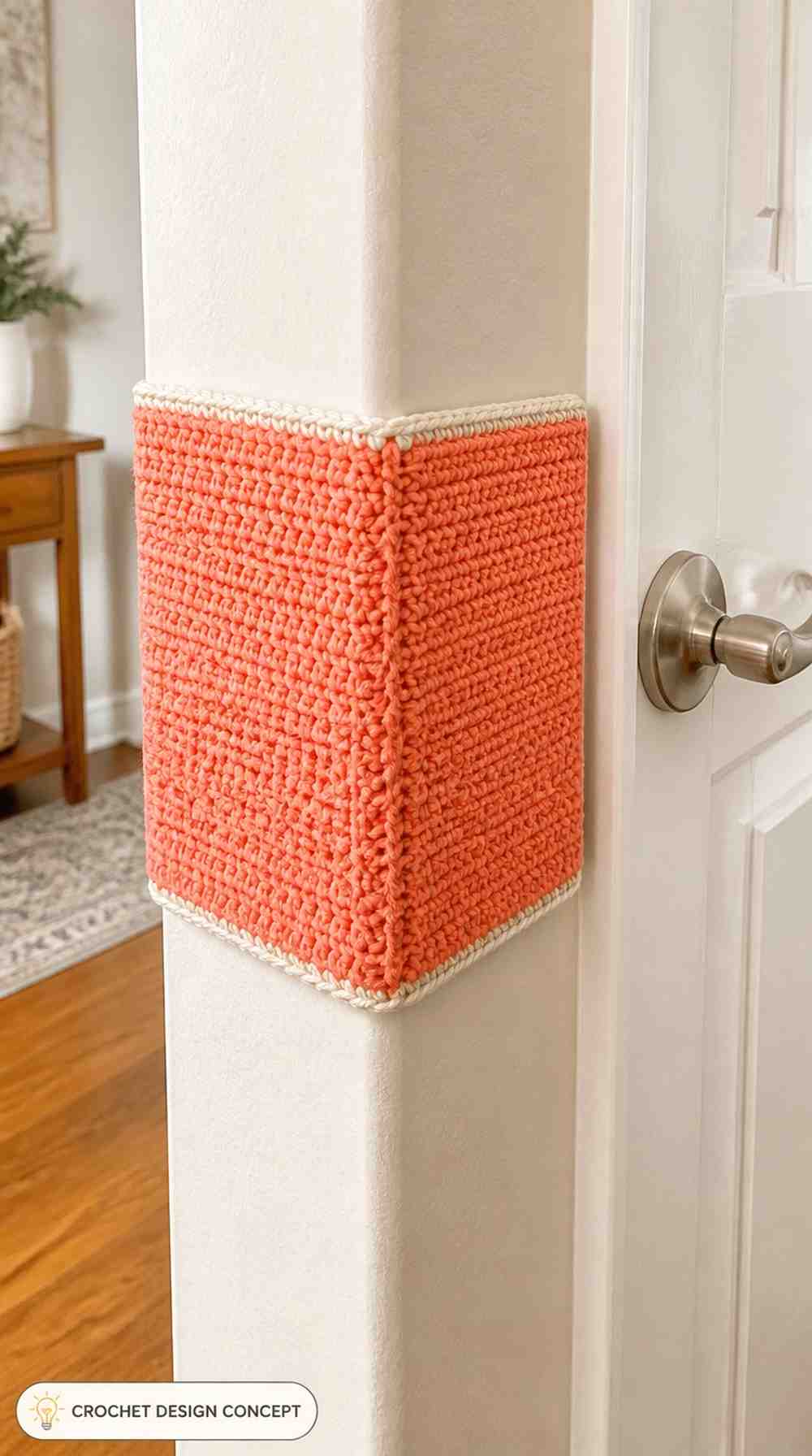
Coral-orange crochet forms an L-shaped pad fitted around an outside hallway corner. Two short rectangular padded faces meet along a neat vertical seam, with narrow ivory edging defining both outer sides. A concealed backing support follows the adjoining wall surfaces.
The corner-wrapping shape is different from ordinary flat wall pads. It may suit an unusual door swing where a handle approaches a projecting wall corner, but the corner geometry and mounting method require particular care.
- L-Shaped Construction: Measure both wall faces and the angle between them so the crochet doesn’t pull away from the corner.
- Vertical Joining Seam: Keep the seam flat and secure, avoiding a thick projecting ridge at the outside corner.
- Two Padded Faces: Only the relevant contact-facing section should be relied upon for positioning; decorative coverage on the other side doesn’t add tested protection.
- Corner Mounting: Use suitable backing and fixings rather than assuming ordinary craft adhesive will hold against repeated contact.
13. Crochet Cream Granny Square Wall Protector
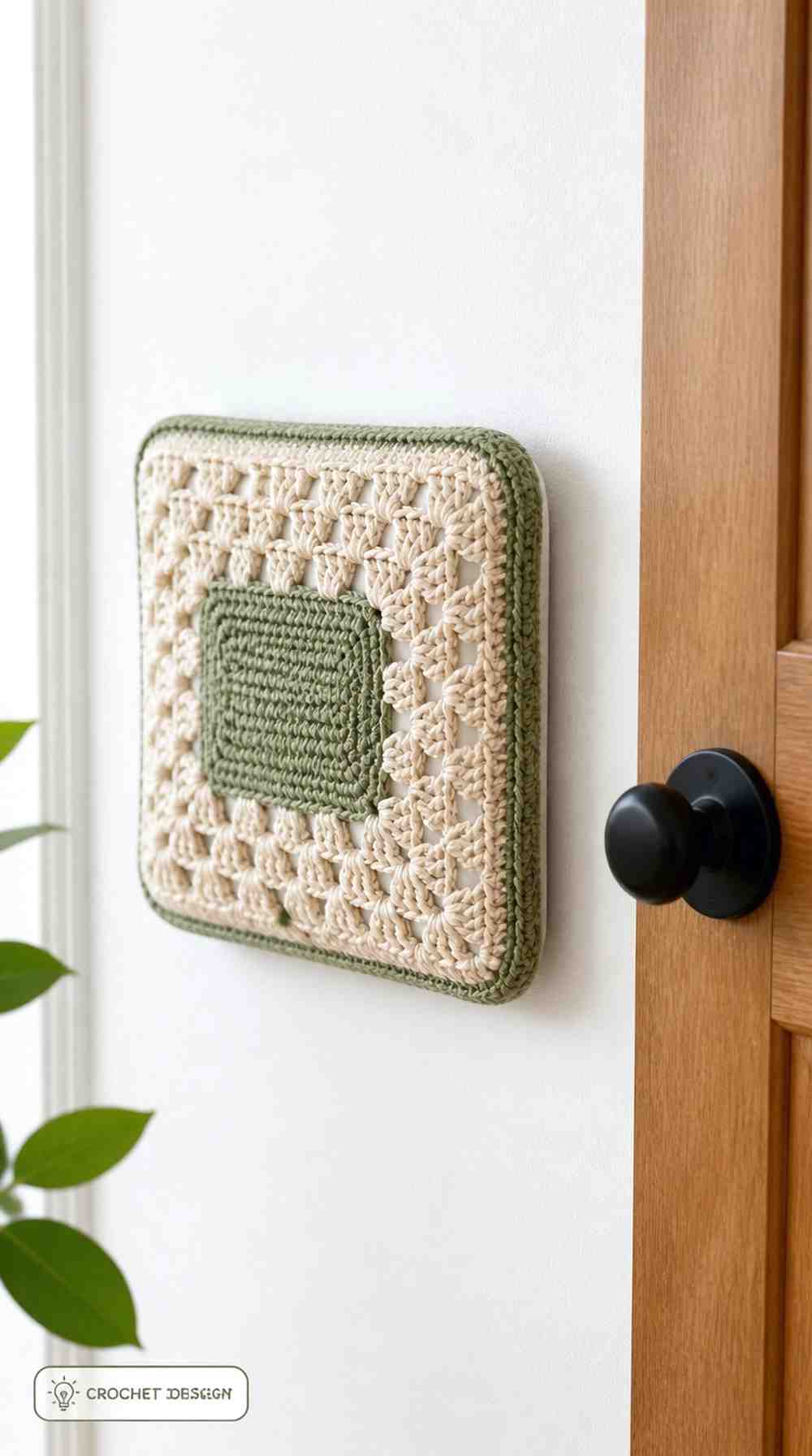
Warm-cream crochet gives this square wall pad a familiar granny-square appearance. A small solid sage-green center is surrounded by cream crochet clusters, with a dense ivory lining behind the decorative openings. Shallow padding sits beneath the central area, while a sage finishing border defines the perimeter.
The granny-square construction adds traditional texture to a small hallway accessory. Because the decorative cluster openings are not a continuous contact surface, a fitted lining is especially important for keeping the inner materials covered.
- Solid Sage Center: A closely stitched middle provides a more continuous working area than an open granny-square center.
- Decorative Cluster Border: Keep the openwork toward the outside rather than across the main potential impact area.
- Dense Ivory Lining: A continuous inner layer helps separate the decorative crochet openings from the padding beneath.
- Flat Square Finish: Secure the outer edges so the pad doesn’t curl away from the wall around its corners.
14. Crochet Rust Diamond Padded Wall Guard
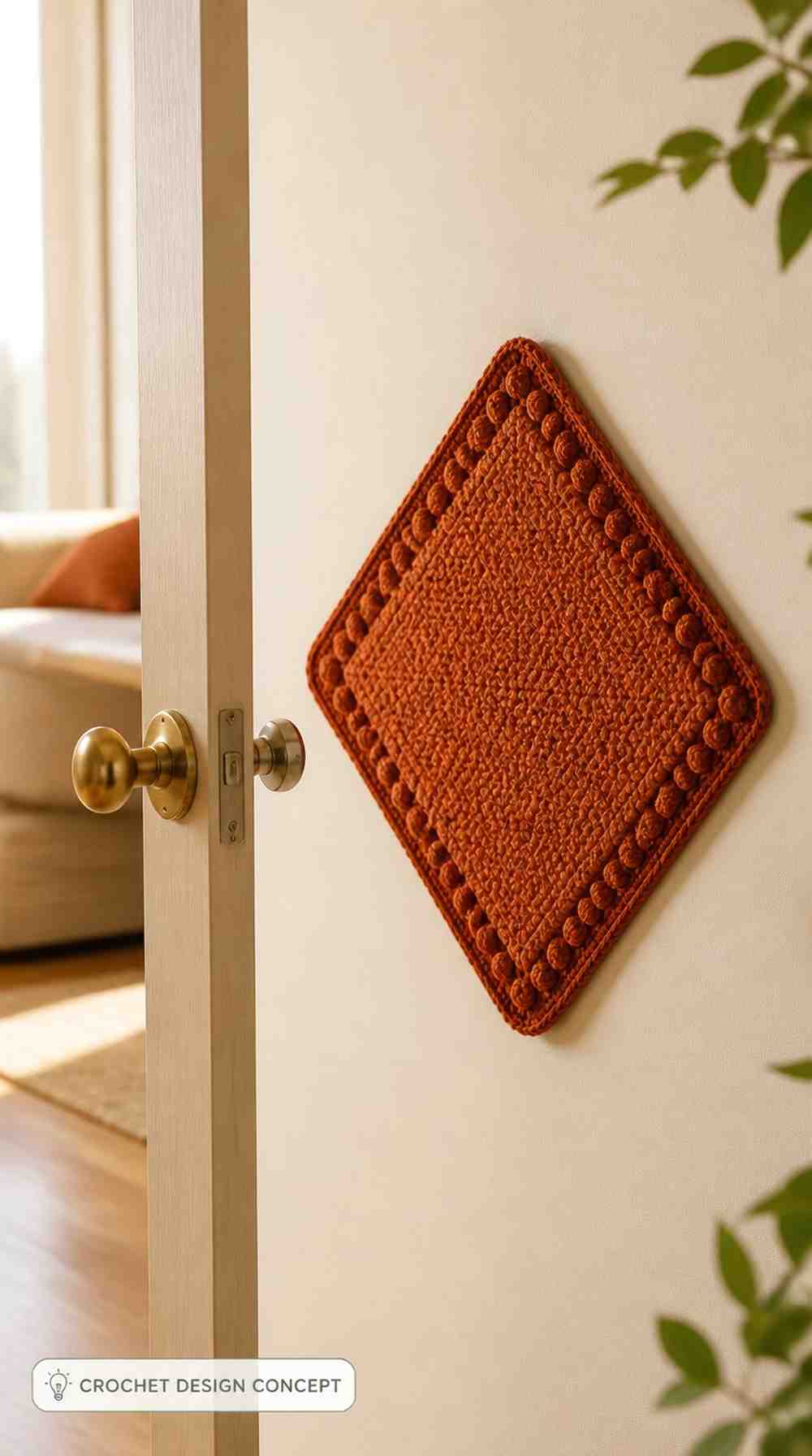
Rust-orange crochet creates a diamond-shaped wall cushion with one corner facing upward and another downward. A dense central face sits within a darker rust raised-stitch border, while modest padding and a fitted backing complete its geometric form.
The diamond outline offers an unusual decorative choice for a simple door-handle contact area. Its vertical points make the pad appear taller than an ordinary square, but the actual padded coverage remains concentrated in the middle. The corner orientation needs to be considered before positioning it.
- Diamond Orientation: Check that the broad central area aligns with the potential contact point instead of relying on either narrow tip.
- Raised Geometric Border: Keep the outer stitch detail low and outside the main padded center.
- Four Balanced Points: Maintain consistent shaping so the diamond stays symmetrical when mounted vertically.
- Rust Color Palette: The warm shade pairs naturally with brass hardware, cream walls and wooden doors.
15. Crochet Sand Pebble Wall Cushion
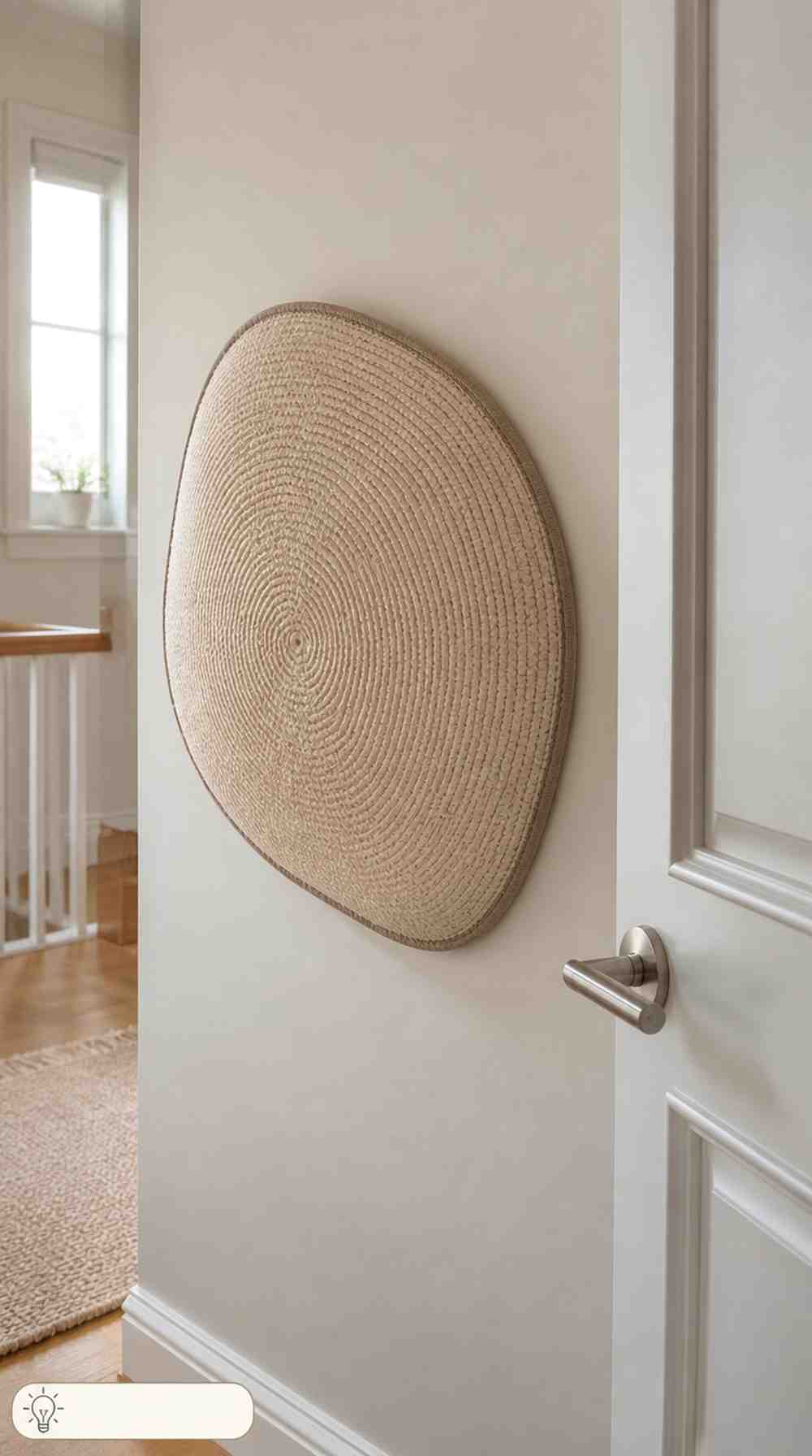
Sandstone-beige crochet completes the collection with an organic pebble-shaped cushion. Its outline is softly irregular, with closely worked spiral stitches, a mushroom-taupe border and a gently domed padded center. A detachable backing sleeve sits behind the front surface, keeping the perimeter comparatively flat.
The pebble shape has a softer appearance than a square or hexagon. Its curved outline could suit a neutral hallway where a small wall accessory should blend into the decor. The detachable structure may make maintenance easier, although the mounting method must remain dependable.
- Organic Pebble Outline: Shape the rounded edges carefully so the fabric lies flat instead of curling around irregular sections.
- Domed Center: Concentrate the modest padding beneath the broad center while keeping the outer border relatively low.
- Detachable Backing Sleeve: A removable construction may make cleaning easier if it can be separated without disturbing fixed wall hardware.
- Neutral Color Combination: Sandstone and taupe suit many wall finishes, but a pale cover may need more frequent cleaning where dust collects.
Practical Guide to Crochet Door Handle Wall Protectors
Identify the Actual Contact Point
Before planning a crochet wall protector, determine where the door handle approaches the wall during its normal swing. Round knobs and lever handles can have different shapes and contact positions.
Do not repeatedly strike the wall to find this location. Open the door slowly and measure the gap and movement carefully.
Use Proper Door-Stopping Hardware
A crochet cushion should not replace a properly installed door stop. It is best considered a decorative soft pad or removable cover, used only where the installation and hardware manufacturer permit it.
Wall-mounted door stops are designed specifically to intercept door handles and reduce wall damage. Hardware supplier McMaster-Carr lists purpose-built wall stops with rubber, vinyl and other suitable contact surfaces.
McMaster-Carr
A decorative crochet cover must not interfere with the tested stopper’s contact surface, attachment, clearance or performance. When in doubt, keep the crochet decoration separate from the functional door stop.
Compare the Main Shapes
| Design shape | Visual advantage | Practical consideration |
|---|---|---|
| Round cushion | Simple, compact appearance | Centering with a round knob |
| Horizontal oval | More extended coverage | Lever-handle path and clearance |
| Rectangle | Clean modern styling | Correct horizontal positioning |
| Hexagon or diamond | Strong geometric design | Decorative points outside central coverage |
| Flower or heart | Soft decorative appearance | Edges should remain flat and secure |
| L-shaped corner pad | Fits an unusual wall corner | Complex backing and mounting |
| Removable padded cover | Easier access for cleaning | Compatibility with fixed hardware |
Choose a Suitable Backing
Dense crochet alone does not create a reliable impact absorber. A pad may need a separate backing, suitable padding and secure attachment to maintain its shape.
Check any adhesive, hook-and-loop fastener or mounting plate against the wall finish. Some attachment methods can damage paint or wallpaper when removed.
Keep the Doorway Clear
The protector should not obstruct door latches, hinges, locks, handles, emergency exits or normal door movement. Avoid loose cords and small detachable decorations where children or pets can reach them.
Inspect the crochet regularly for stretching, frayed yarn, loose seams and displaced backing. Remove it if the door begins catching on the fabric.
Cleaning and Maintenance
Follow the selected yarn’s care instructions. If the cover contains removable padding, clean and dry each component separately as appropriate.
Keep the protector dry before reinstalling it, and inspect the wall for trapped moisture or changes to the surface finish.
Want to Make Something Similar?
These verified resources cover useful techniques for padded wall protection and crochet shaping. They are not exact patterns for the 15 AI-generated wall cushions above.
- Linda’s — No-More-Bang Door Knob Pads explains a small padded fabric wall protector using batting and interfacing. It is a sewing project, not crochet, but provides useful context for the difference between decorative fabric and a supported padded structure.
- Easy Crochet — How to Crochet a Flat Circle teaches a basic flat crochet circle that could help with the shape of the Oatmeal Round or Mustard Sunray concepts. It does not cover wall mounting or door-impact safety.
- Coastal Crochet — Crocheted Door Knob Covers by Eleonora Tully provides a free pattern resource for crochet covers fitted directly onto knobs. That is a different approach from the wall-mounted pads in this article.
Use these sources for their specific techniques, not as proof that a homemade crochet pad can safely replace a commercial door stop.
lindas.com+2
For another doorway-related crochet collection, Yarn Nest Studio’s 17 Crochet Burrowcore Door Draft Stopper Ideas for Cozy Winter Homes explores floor-level draft blockers. Those serve a different purpose: reducing drafts beneath doors rather than managing handle-to-wall contact.
Which Crochet Door Handle Wall Protector Should You Choose?
| Your priority | Designs to consider | Main trade-off |
|---|---|---|
| Simple round design | Oatmeal Round, Mustard Sunray | Correct central placement |
| Lever-handle styling | Sage Oval, Navy Rectangle | Horizontal size and clearance |
| Modern geometric decor | Terracotta Hexagon, Charcoal Waffle Square | Accurate shaping and flat edges |
| Decorative bedroom look | Blush Daisy, Lavender Heart | Petals and points are mainly decorative |
| Botanical styling | Olive Leaf, Sand Pebble | Irregular outlines and backing fit |
| Soft decorative edging | Dusty Blue Scalloped Square | Curling or catching at corners |
| Unusual wall corner | Coral Corner Wrap | More complicated mounting |
| Classic crochet texture | Cream Granny Square | Openwork requires suitable backing |
| Removable cover | Teal Concentric, Sand Pebble | Secure fit and cleaning access |
| Bold geometric accent | Rust Diamond | Narrow points offer limited contact area |
For a simple decorative wall pad, the Crochet Oatmeal Round Wall Cushion is an approachable starting concept. Its circular outline and dense crochet face make the visual construction easy to understand.
If a lever handle approaches the wall, the Crochet Sage Oval Lever Handle Wall Pad or Crochet Navy Ribbed Rectangle Wall Guard may offer a more suitable shape to explore, although the actual door swing must determine the placement.
For decorative styling, the Crochet Blush Daisy Wall Cushion and Crochet Lavender Heart Wall Protector bring softer outlines. The Crochet Terracotta Hexagon Wall Protector is a stronger choice for a modern geometric look.
If a removable outer cover is important, the Crochet Teal Concentric Removable Wall Cushion provides a useful concept for keeping the decorative crochet separate from its inner padding.
Conclusion
A crochet door handle wall protector can add a small handmade detail to an ordinary hallway or bedroom doorway. From round oatmeal cushions to floral shapes, geometric pads and botanical designs, these 15 concepts offer different approaches to decorating a potential handle-contact area.
The most important decision is how the door is safely stopped. Use appropriate door-stopping hardware, check the actual handle path and treat the crochet as an optional decorative component rather than guaranteed impact protection. With careful placement and suitable construction, these ideas can inspire coordinated crochet accents around your home.
Which design would you choose for your doorway: the oatmeal round cushion, sage oval pad or blush daisy wall protector? Share your favorite and whether your door uses a round knob or a lever handle.
Frequently Asked Questions
1. Can a crochet pad stop a door handle from damaging a wall?
A crochet pad may add a soft textile layer, but it has not been proven to absorb door impacts reliably. A properly selected and installed door stop is the safer way to control door movement and prevent wall damage. Only add crochet decoration when it does not interfere with that hardware.
2. What yarn is best for a crochet wall protector?
Smooth, washable cotton or another suitable firm yarn may work well for a decorative crochet cover. Dense stitches can create a continuous surface, while loosely worked lace may expose the backing. The yarn itself does not establish impact resistance or suitability for stopping a moving door.
3. Should the protector be round or rectangular?
A circular design may suit a compact round knob area, while a longer oval or rectangular shape may visually suit a lever handle. However, the best placement and dimensions depend on the actual door swing and the location of the wall contact point, not simply the handle’s appearance.
4. Will mounting a crochet protector damage my painted wall?
It depends on the fixing method, wall finish, backing material and how the attachment is removed. Adhesives and hook-and-loop products can affect some paints or wallpapers. Follow the manufacturer’s surface-compatibility instructions and avoid assuming a removable fastening is damage-free.
5. Are these 15 crochet door handle wall protector ideas actual patterns?
No. These are original AI-generated crochet design concepts intended for visual inspiration. They have not been physically tested for wall protection, impact absorption, structural durability or mounting safety. Use reliable crochet shaping techniques and proper door-stop hardware when planning a real installation.