A rolling pin is one of those kitchen tools that’s easy to leave loose in a crowded drawer or on an open shelf. A handmade crochet sleeve can offer a neat way to cover its surface while adding soft texture and color to your baking storage. These 15 crochet rolling pin protective sleeve ideas explore everything from simple barrel covers and buttoned wraps to lined pouches, lace-up closures, decorative granny stripes and tapered cases for French-style pins.
The right design depends on the type of rolling pin you own, its full length and barrel diameter, and how you normally store it. A washable sleeve may help separate a clean tool from ordinary shelf dust, but crochet alone isn’t a reliable barrier against moisture, contamination, scratches from sharp objects, or impact damage. This collection compares fit, closures, stitch density, lining and storage practicality so you can choose a design that makes sense for your kitchen.
These are AI-generated crochet design visualizations for inspiration, not photographs of tested handmade products or step-by-step patterns. The designs have not been physically tested for fit, durability, food-contact suitability or protective performance.
Quick Design Selection Guide
- For a simple handled rolling pin: Start with the Crochet Oatmeal Drawstring Barrel Sleeve or Crochet Terracotta Waffle Barrel Sleeve. Both cover the central barrel while leaving the handles exposed.
- For a removable wrap: Consider the Crochet Sage Buttoned Split Seam Pin Cover, Crochet Navy Lace Up Barrel Cover or Crochet Charcoal Checkerboard Foldover Sleeve.
- For full-length covered storage: The Crochet Dusty Blue Full Length Rolling Pin Pouch, Crochet Teal Zippered Pin Storage Case and Crochet Lavender Hanging Tab Storage Sleeve enclose more of the tool.
- For a smooth inner surface: Compare the Crochet Ivory Linen Lined Button Sleeve and Crochet Peach Soft Lined Rolling Pin Sleeve.
- For a French-style tapered pin: The Crochet Mustard Chevron Roll Up Pin Wrap and Crochet Rust Tapered French Pin Sock offer different ways to accommodate the shape.
- For decorative crochet: The Crochet Blush Scalloped Dust Sleeve, Crochet Cream Granny Stripe Pin Wrap and Crochet Olive Fine Eyelet Ventilated Sleeve bring more visible stitch details to kitchen storage.
1. Crochet Oatmeal Drawstring Barrel Sleeve
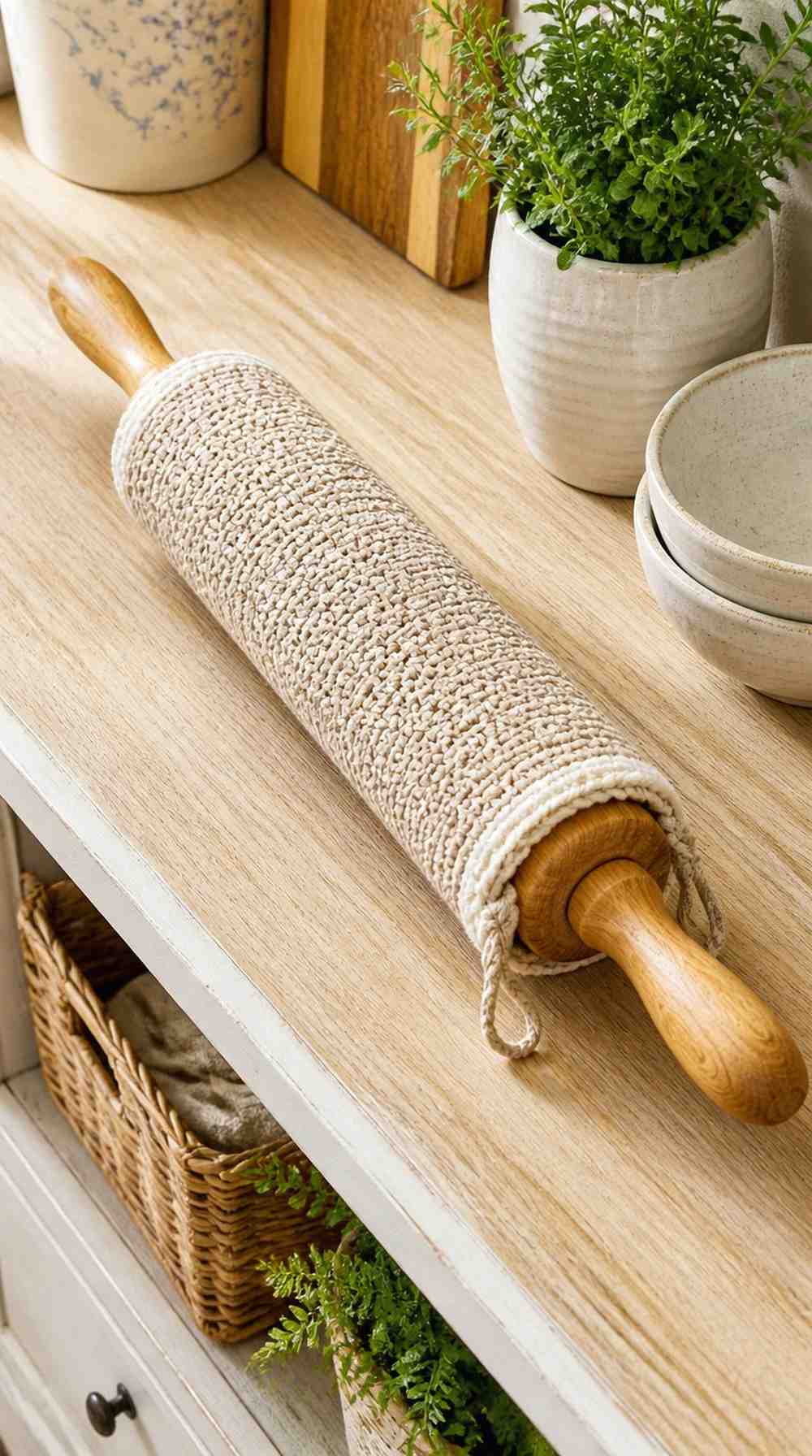
Warm oatmeal crochet gives this rolling pin cover a simple, natural appearance. Dense moss stitches form a straight tubular sleeve around the wooden barrel, with narrow ivory finishing bands and a small matching drawstring at one end. Both handles remain exposed, making the difference between the covered rolling surface and the uncovered ends easy to see.
This concept suits a handled rolling pin kept horizontally on a shelf. The sleeve should slip off without dragging tightly against the wood, especially if the barrel and handles have different diameters.
- Barrel-Only Coverage: Measure the working barrel separately from the handles so the sleeve covers the intended section without bunching around either end.
- Moss-Stitch Fabric: Close stitches may reduce ordinary dust reaching the covered area, but the textile is not a sealed or waterproof protective barrier.
- Small Drawstring: Gather the opening only enough to keep the sleeve positioned during storage; an unnecessarily tight cord can deform the fabric.
2. Crochet Sage Buttoned Split Seam Pin Cover
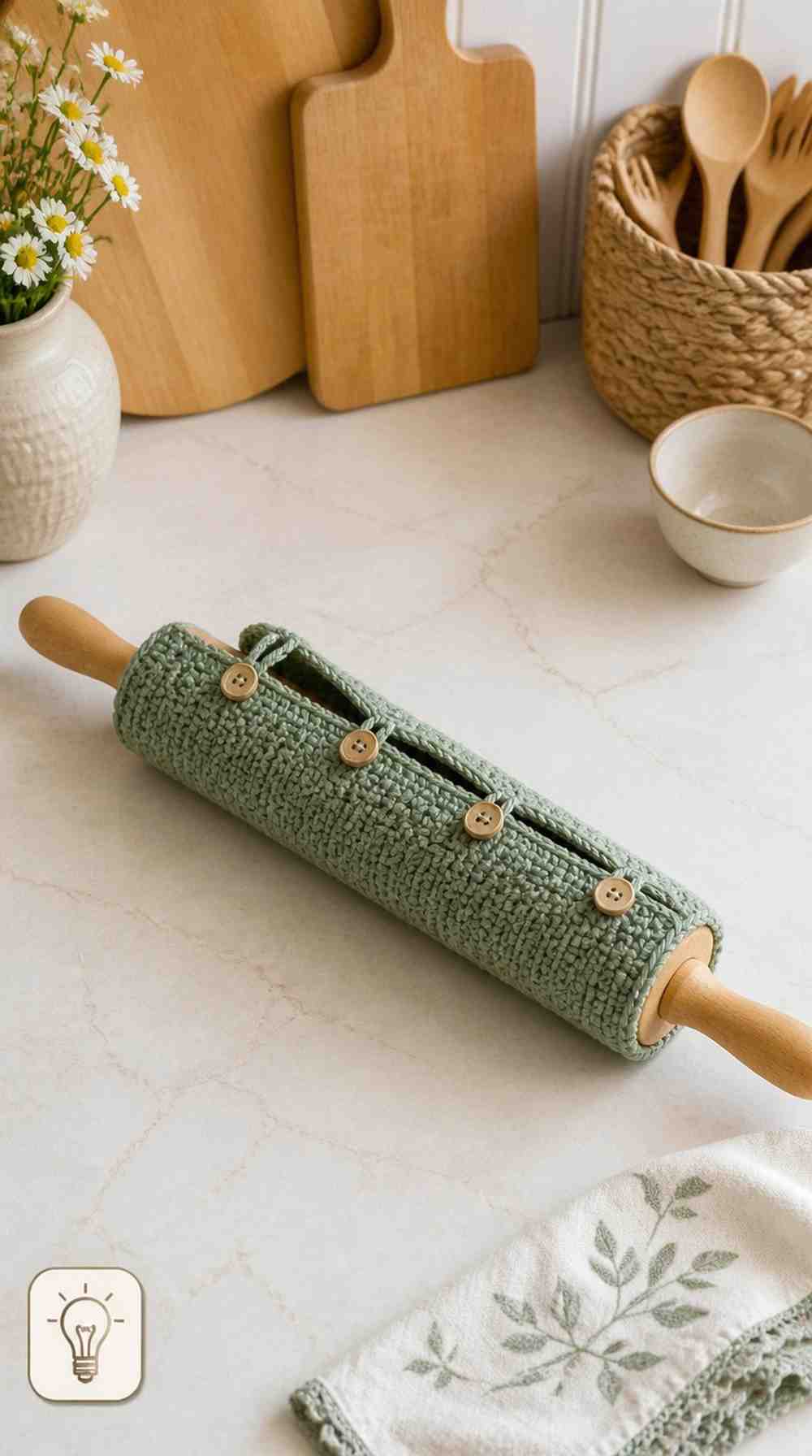
Sage-green crochet forms a long rectangular wrap around the rolling pin barrel, with a full-length split seam along the upper surface. Four small natural-wood buttons fasten through matching crochet loops, and one partly open button shows how the cover can be removed. Both wooden handles remain uncovered.
The split-seam construction is useful for rolling pins whose handles make a conventional tube difficult to slide on. Rather than forcing a narrow sleeve over the ends, the flat panel opens around the barrel and fastens along its length.
- Full-Length Opening: A split panel avoids requiring the fabric to pass over a wider handle, provided it wraps fully around the barrel.
- Four Button Positions: Space the buttons evenly so the closure does not pull into large gaps between fastening points.
- Natural-Wood Buttons: Keep the buttons on the outside and away from the stored rolling surface, with secure stitching for repeated opening.
3. Crochet Terracotta Waffle Barrel Sleeve
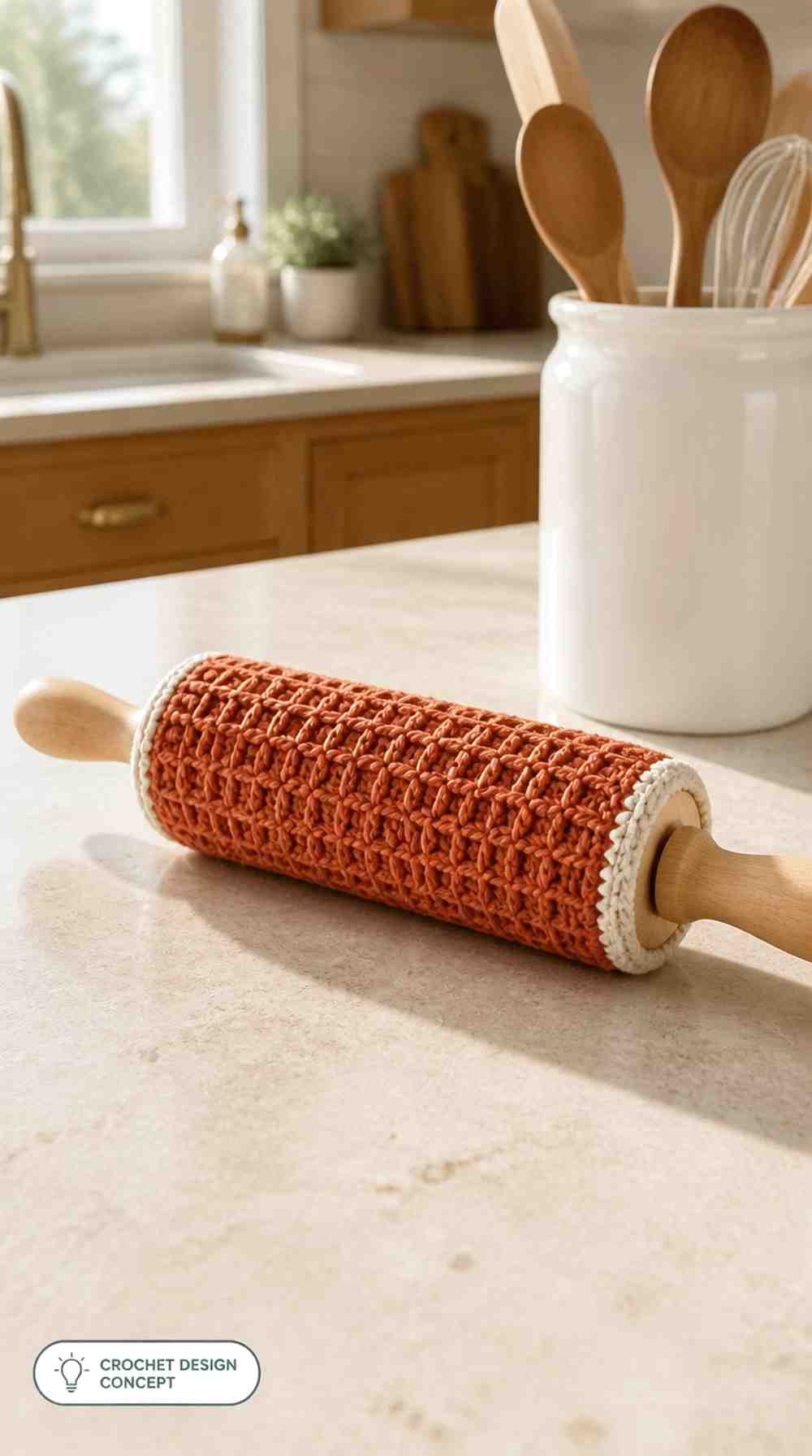
Terracotta-orange yarn gives this cylindrical cover a warm farmhouse appearance. Low waffle-texture squares cover the outer surface, while narrow cream bands define the two ends. The sleeve sits around the rolling pin’s central wooden barrel, leaving both handles visible.
The textured exterior gives this design more character than a smooth tube, but the raised squares also create additional places where flour dust or kitchen debris could collect. A real sleeve would benefit from a reasonably smooth inner surface and a yarn that can be cleaned according to its care instructions.
- Low Waffle Squares: Keep the textured rows shallow so the cover is not unnecessarily bulky in a crowded kitchen drawer.
- Cream End Bands: A closely worked border may help the openings retain their shape after repeated removal and washing.
- Underside Seam: A flat joining seam is preferable to a thick ridge that might press unevenly against the wooden barrel.
4. Crochet Dusty Blue Full Length Rolling Pin Pouch
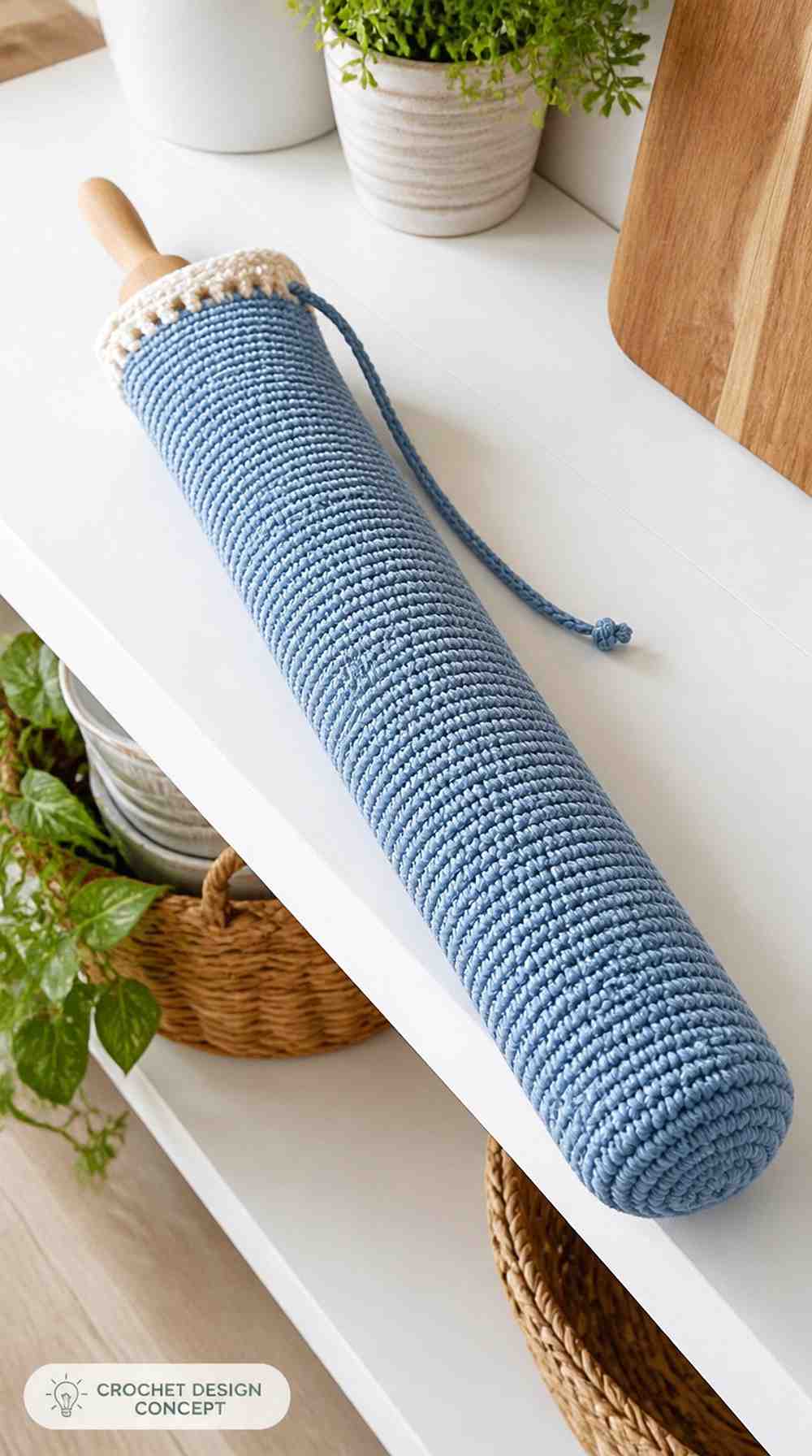
Dusty-blue crochet creates an elongated storage pouch with a rounded closed bottom and a cream drawstring channel. The pouch encloses almost the entire handled rolling pin, with just a small section of one wooden handle visible at the opening. Its smooth single-crochet fabric keeps the shape understated.
Unlike barrel-only covers, this design brings the handles into the same storage compartment. That can be convenient when a rolling pin is moved between shelves, although the pouch needs enough length and width to accommodate the complete tool without forcing the ends.
- Full Tool Length: Measure from the end of one handle to the other, not just the rolling barrel, before planning the pouch.
- Closed Rounded Base: Reinforce the lower end so a wooden handle cannot push into a weak seam when the tool is inserted.
- Drawstring Channel: Keep the opening roomy enough for removing the rolling pin easily; the cord is for gathering fabric, not carrying the tool.
5. Crochet Ivory Linen Lined Button Sleeve
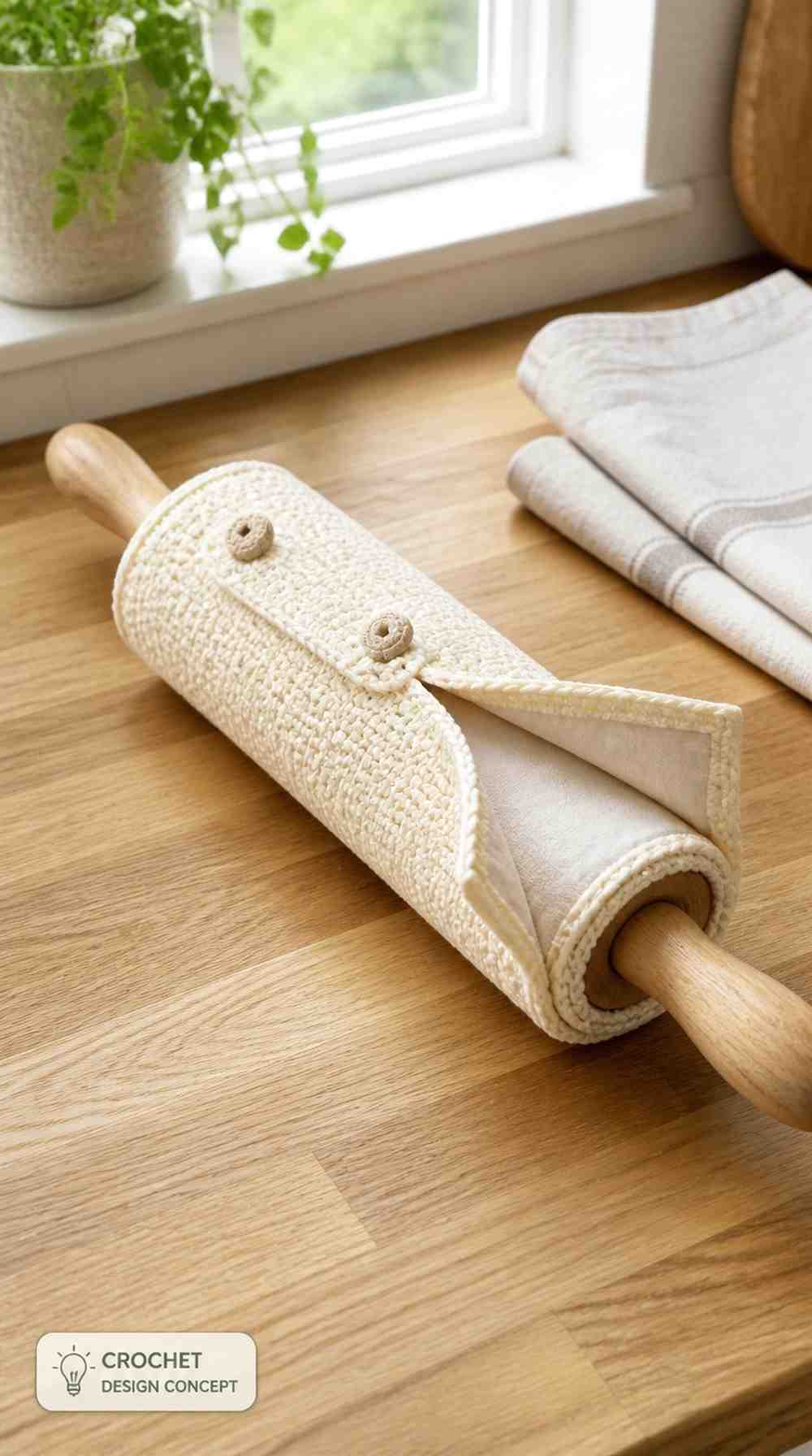
Warm-ivory crochet forms a wraparound barrel cover with a smooth cream linen lining. One broad side flap overlaps the outer panel, closing with three flat oatmeal-colored crochet buttons. The wooden rolling pin handles remain exposed, while a partly opened corner reveals the lining and its neat stitched attachment.
The lined construction offers a smoother surface against the clean rolling pin than a heavily textured crochet interior. However, the lining and outer fabric need to work together without forming puckers, and neither layer should be assumed to provide impact protection.
- Linen Inner Layer: Attach the lining smoothly, keeping folds and rough seam allowances away from the rolling surface.
- Overlapping Side Flap: Leave enough overlap to cover the barrel while preventing the buttoned section from becoming unnecessarily thick.
- Three Crochet Buttons: Soft buttons avoid bulky metal hardware, but they should still be securely fastened and easy to release.
6. Crochet Mustard Chevron Roll Up Pin Wrap
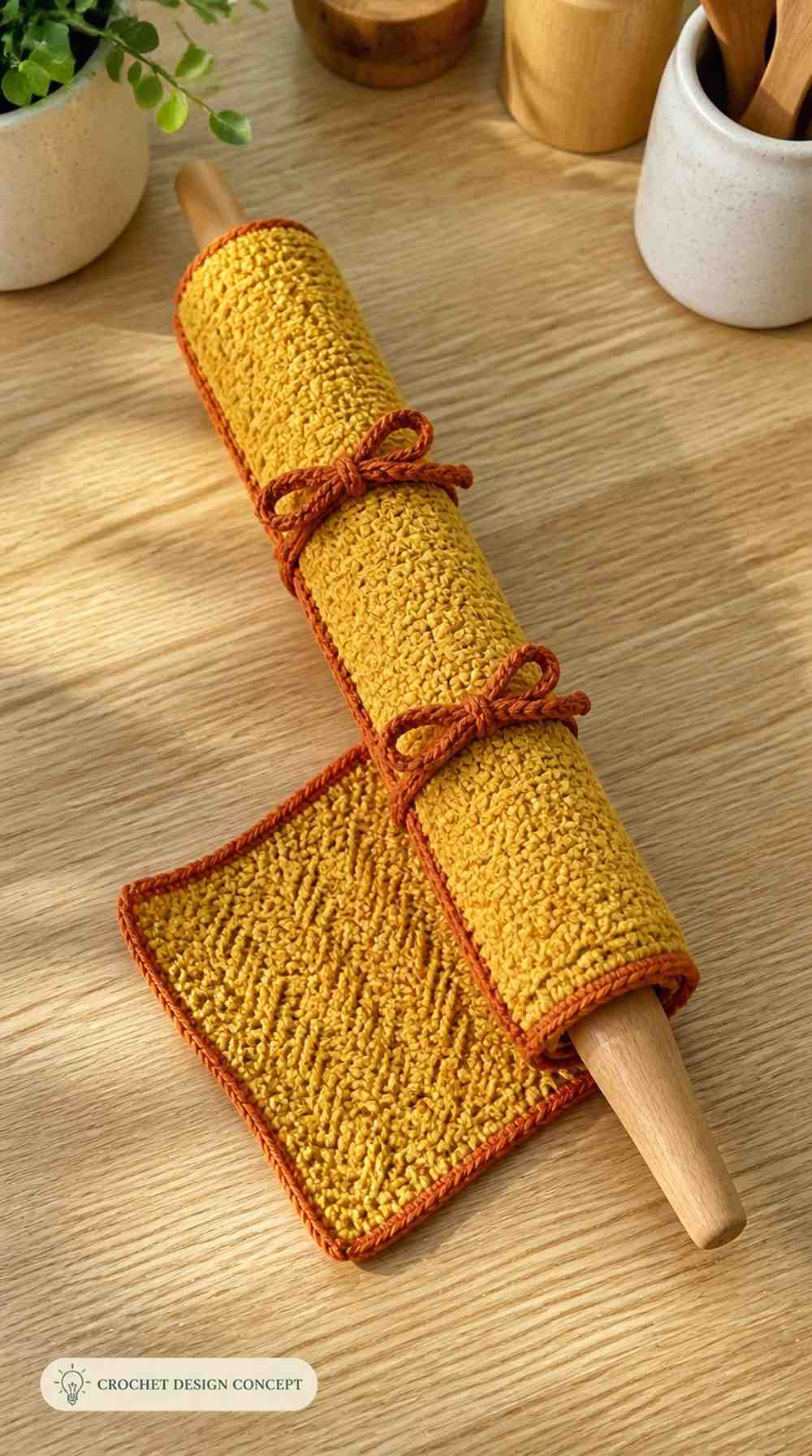
Mustard-yellow crochet brings a lively geometric pattern to this flexible rolling pin wrap. Close V-shaped chevron rows form the rectangular panel, with burnt-orange edging and two narrow ties. The wrap rolls around a French-style tapered wooden pin, leaving one narrow tip slightly exposed.
The flat construction can be easier to adapt to a changing barrel diameter than a strictly cylindrical sleeve. The fabric should overlap smoothly rather than bunching toward the tapered ends, while the two ties should remain loose enough to release without pulling against the wood.
- Chevron Stitch Direction: Keep the V-shaped rows even so the flat panel does not twist when wrapped around the pin.
- Two Outer Ties: Position both straps to hold the overlap without forcing the narrower portions of the rolling pin into tight bends or pressure points.
- Adjustable Wrap Shape: A flat rectangle offers flexibility, but its overall width must still accommodate the widest part of the French pin.
7. Crochet Blush Scalloped Dust Sleeve
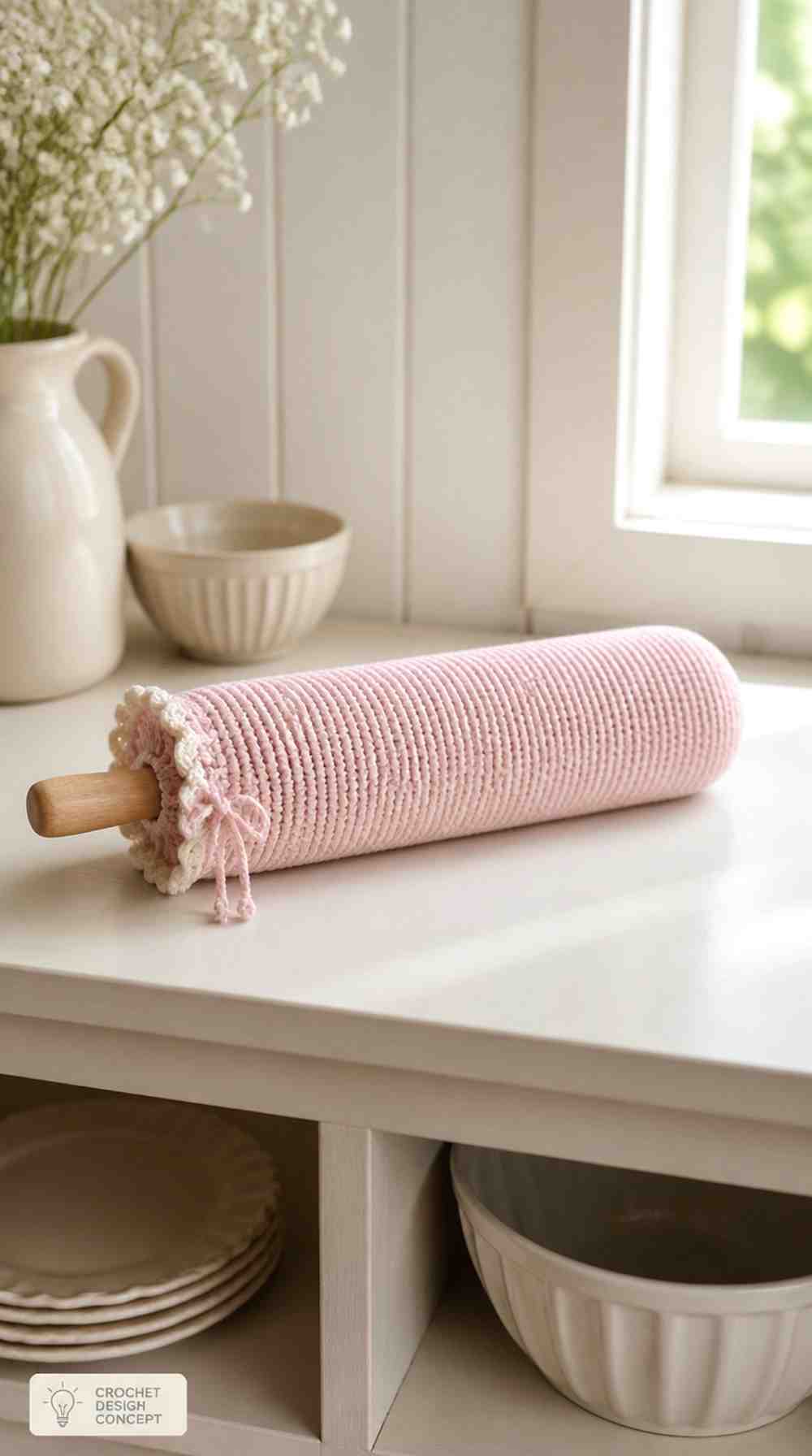
Blush-pink crochet gives this long storage sleeve a soft cottage-inspired look. The tubular body uses closely worked smooth stitches, ending in a rounded closed base. Six small scallops decorate the upper opening, framed by an ivory band and a blush drawstring gathered around the exposed tip of a French-style rolling pin.
The decorative edge makes the opening attractive without adding separate flowers or buttons. This concept is best used as a dry storage cover, since the enclosed wooden tool still needs adequate drying before insertion.
- Six Small Scallops: Keep the curved edge details compact so they do not fold into the opening or catch when removing the pin.
- Closed Rounded End: A smoothly shaped base helps the sleeve accommodate the tapered tip without creating a bulky corner.
- Gentle Drawstring Closure: Gather the mouth lightly; a closed textile sleeve is not airtight and should never be used to store damp wood.
8. Crochet Olive Fine Eyelet Ventilated Sleeve
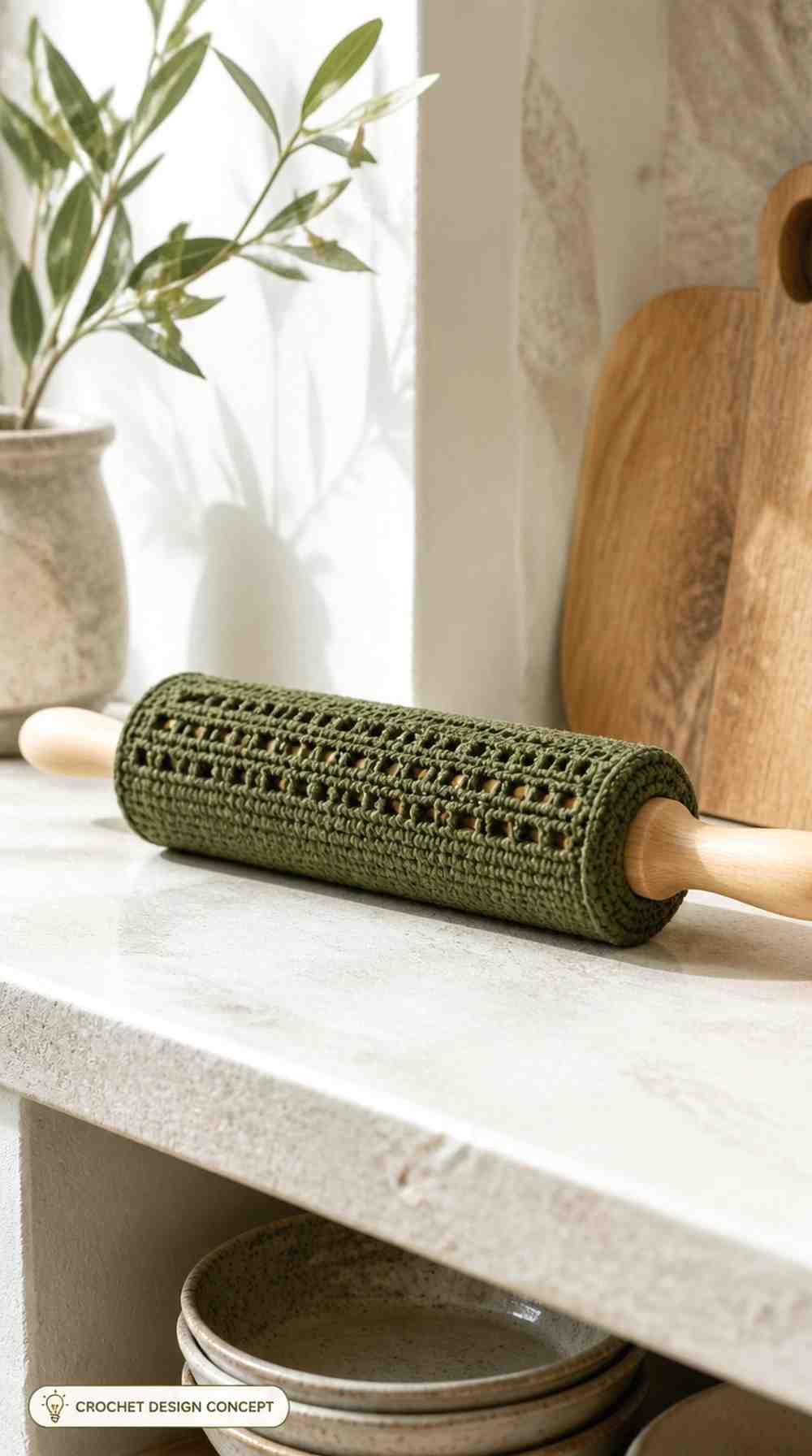
Olive-green crochet gives this barrel cover a quiet, practical appearance. A dense lower panel sits beneath narrow rows of small eyelet openings, while dark-olive end bands and flat side seams define the cylindrical shape. Both wooden handles remain exposed outside the sleeve.
The combination of solid fabric and fine eyelets makes this idea different from a fully dense cover. The openings allow some airflow and visibility, but they also mean the cover provides less of a dust barrier than a closely worked, lined pouch.
- Small Eyelet Rows: Keep the openings narrow enough to avoid large exposed sections of the barrel, while recognizing they cannot block fine dust completely.
- Dense Lower Panel: The solid section offers more continuous fabric where the rolling pin rests against its storage surface.
- Dark Olive Borders: End bands should sit flat without gripping the wood tightly or catching against the handles.
9. Crochet Navy Lace Up Barrel Cover
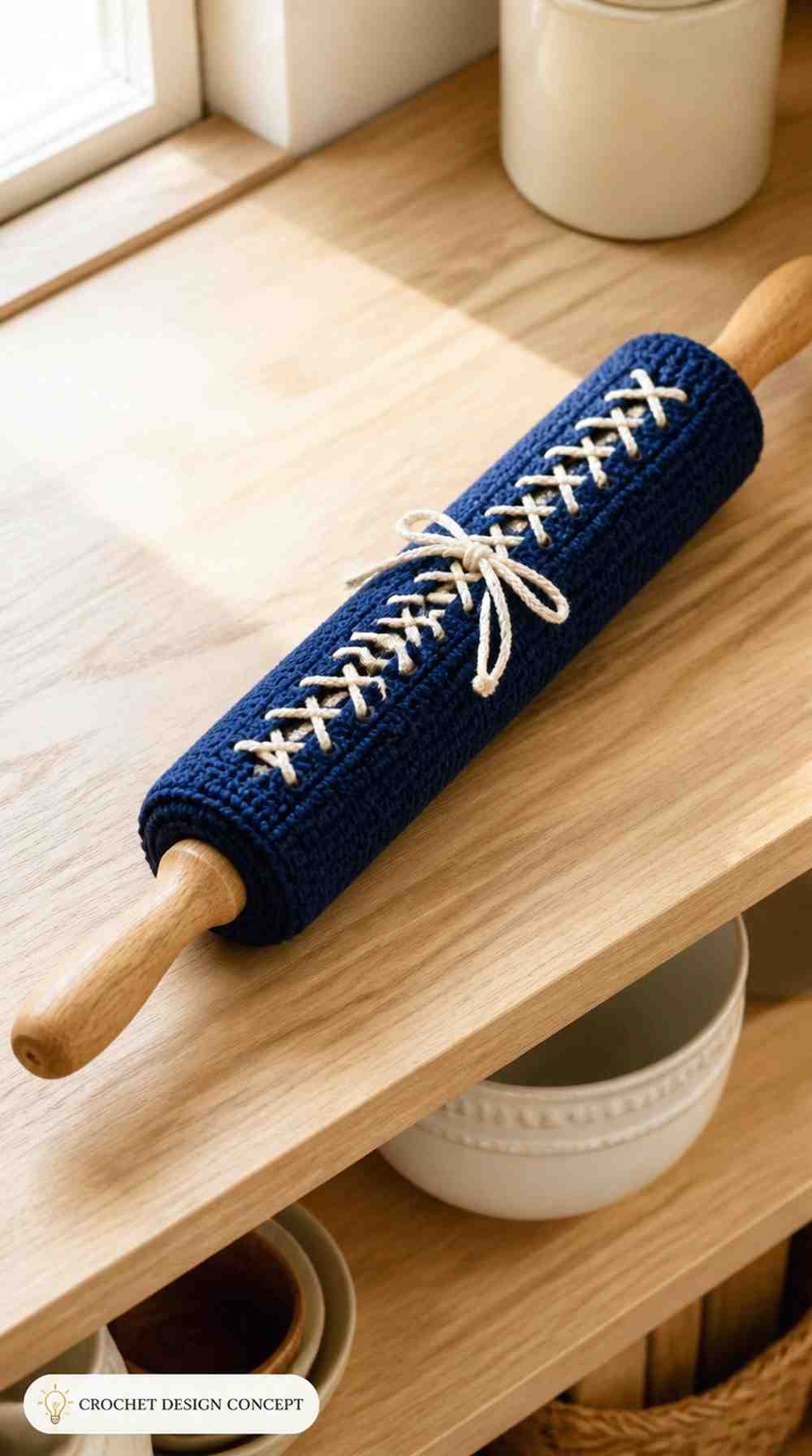
Deep navy-blue crochet creates a fitted barrel cover with dense horizontal ribs and a full-length opening along the top. Two rows of reinforced eyelets border the split seam, with an ivory crochet cord laced between them and tied into a flat bow. Both wooden handles remain visible beyond the cover.
The lace-up construction gives this idea more adjustability than a closed tube. It could suit modest differences in barrel circumference, although the cord should not be pulled so tightly that the cover forms ridges against the stored wood.
- Crisscross Lacing: Use evenly spaced reinforced eyelets to distribute the fastening along the barrel rather than concentrating pressure at one point.
- Horizontal Ribbing: Keep the ribs shallow and consistent so the cover looks textured without developing excessive bulk.
- Ivory Cord Position: Place the bow on the outside of the cover, away from the rolling surface, and keep it easy to untie.
10. Crochet Peach Soft Lined Rolling Pin Sleeve
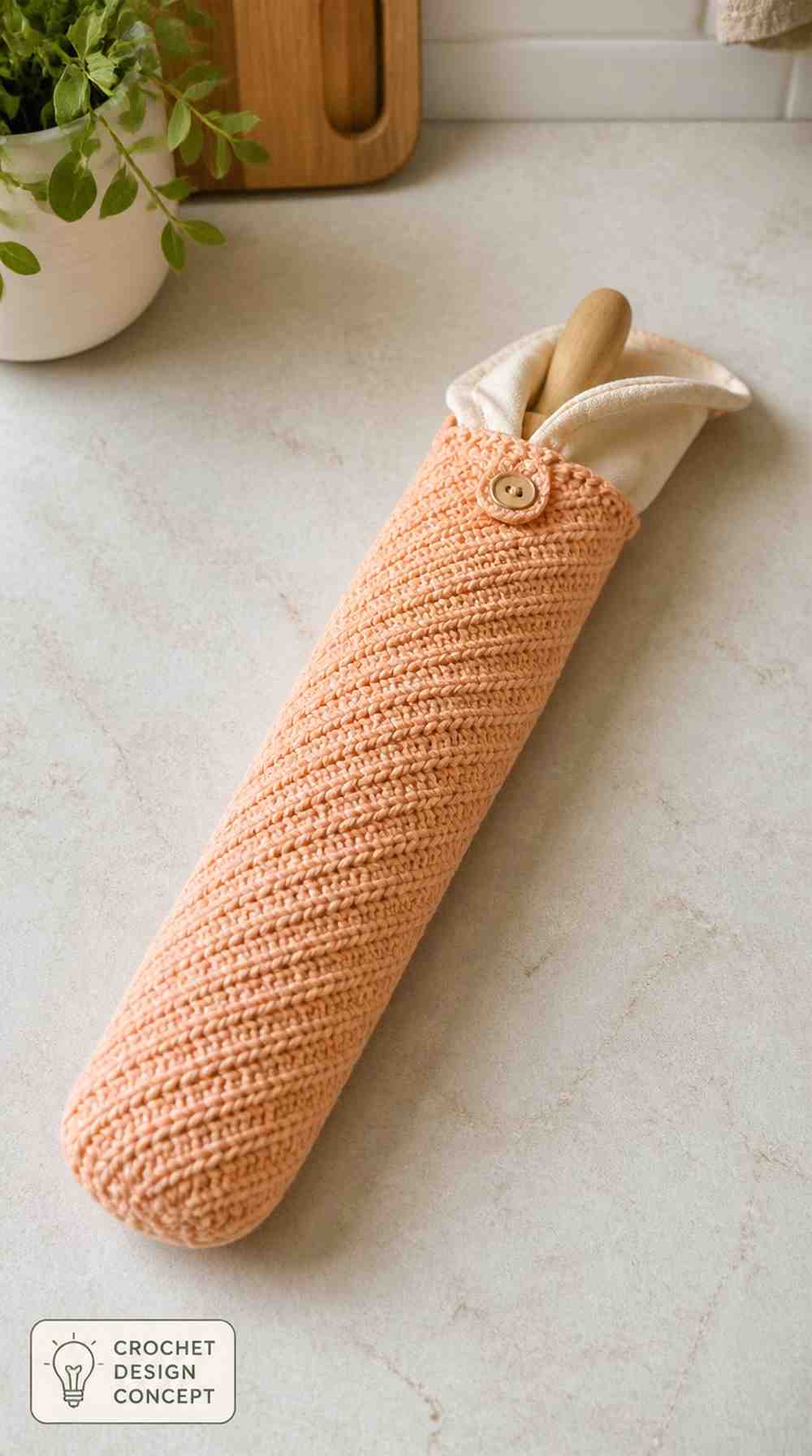
Peach-colored crochet forms a long storage pouch with shallow diagonal stitch ridges, a closed rounded base and a smooth ivory cotton lining. A short buttoned flap crosses the opening, while a narrow end of the dry wooden rolling pin remains visible near the top.
The lining is the main practical feature of this concept. It can create a smoother contact surface than exposed raised crochet, particularly for a rolling pin with a carefully finished wooden exterior. The lining and outer fabric should remain easy to clean and dry separately or together.
- Smooth Cotton Lining: Secure the lining without exposed rough seams or loose threads that could catch on the rolling pin.
- Diagonal Outer Ridges: Use shallow stitch texture for decoration rather than bulky raised rows that make the pouch difficult to store.
- Short Closure Flap: The buttoned flap helps organize the opening but shouldn’t press hard against the exposed wooden end.
11. Crochet Cream Granny Stripe Pin Wrap
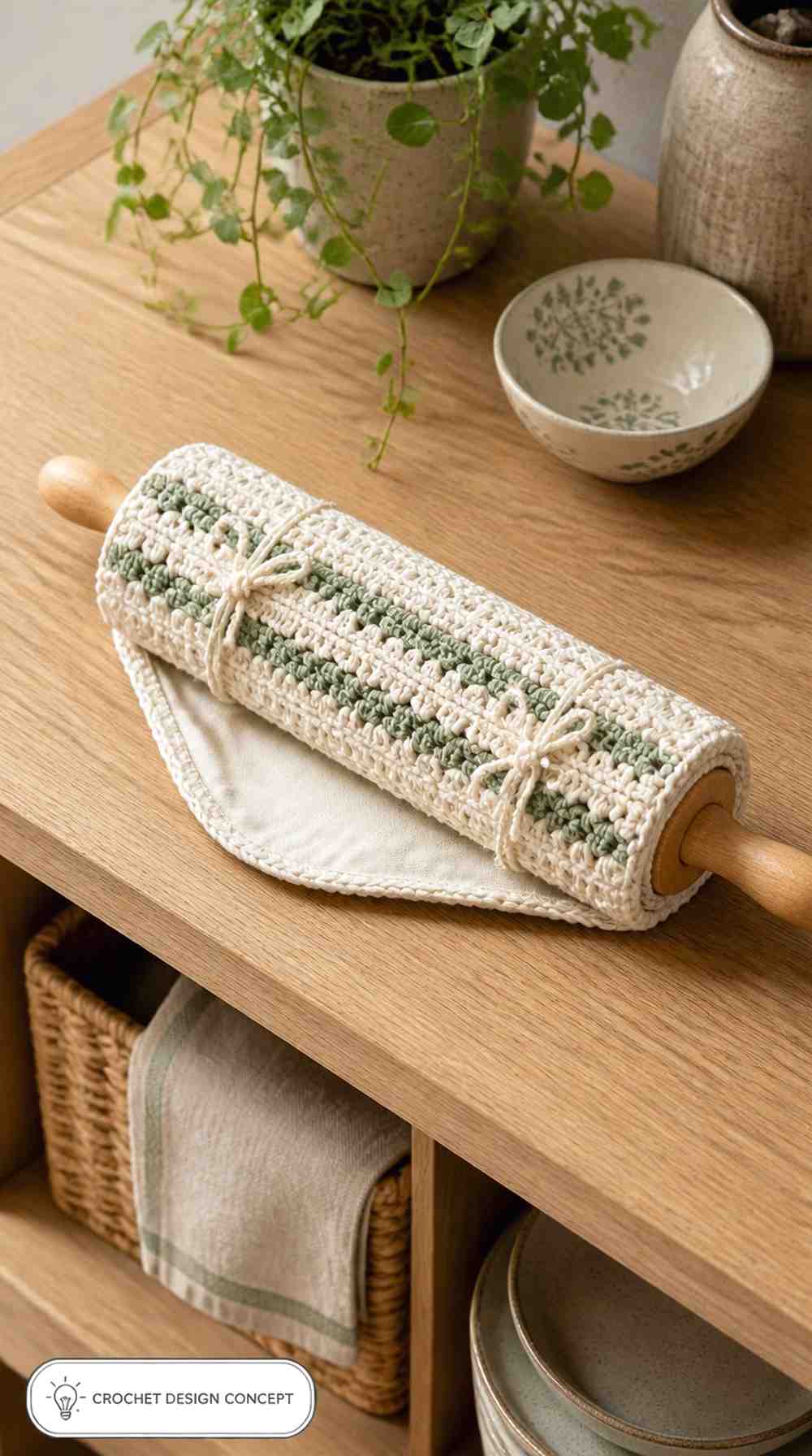
Cream crochet gives this wrap a soft traditional appearance, with narrow rows of sage-green granny-stripe clusters separated by densely worked bands. A smooth cotton lining sits against the wooden French rolling pin, while two short cream ties secure the overlapping panel.
The combination of decorative outer stitches and a plain interior makes this concept suitable for someone who wants classic crochet texture without placing the open cluster pattern directly against the tool. The finished wrap still needs to be shaped carefully around the tapered ends.
- Granny-Stripe Clusters: Keep the sage motifs neatly joined and supported by denser cream rows so the panel doesn’t stretch unevenly.
- Plain Inner Lining: A smooth interior prevents large decorative openings from contacting the rolling pin directly, though it does not make the wrap waterproof.
- Two Tie Closures: Position the ties along the overlap, leaving enough room for the tapered wooden ends to remain naturally shaped.
12. Crochet Teal Zippered Pin Storage Case
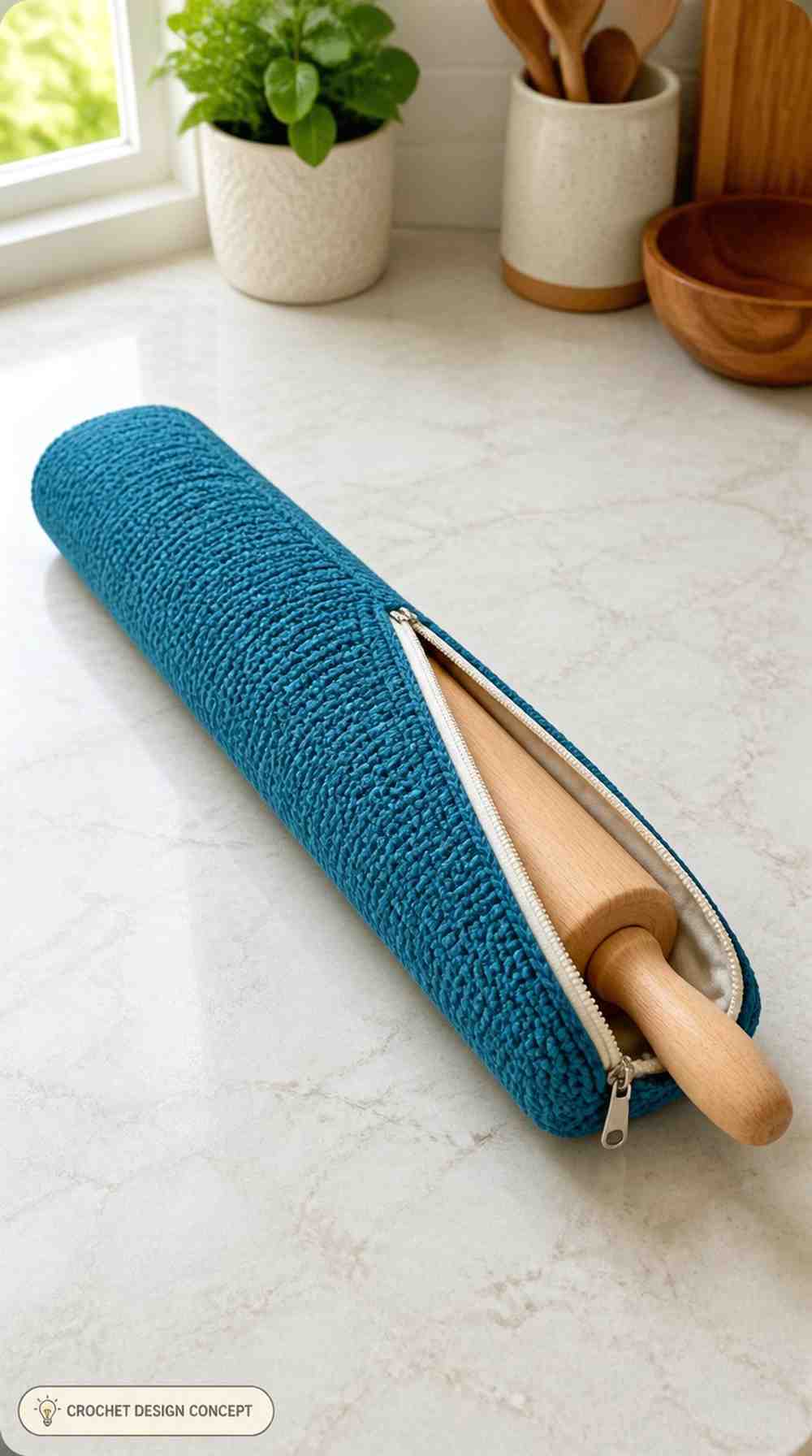
Teal-blue crochet gives this full-length rolling pin case a clean, contemporary look. Two dense panels form a softly rounded pouch, with a concealed ivory lining and a zipper running along one long upper edge. The zipper is partly open, revealing the wooden handle inside.
This design provides a more enclosed storage arrangement than a wraparound barrel cover. However, the zipper adds construction complexity and requires a protective lining so metal or plastic fastening components don’t rub directly against the wood.
- Long Zipper Opening: Provide enough opening length for the rolling pin to be inserted without forcing the handles past a narrow gap.
- Concealed Lining: Keep the zipper tape and any exposed fastening edges separated from the wooden tool.
- Two Joined Panels: Reinforce the side seams and rounded ends, especially where the full length of the tool rests within the pouch.
13. Crochet Rust Tapered French Pin Sock
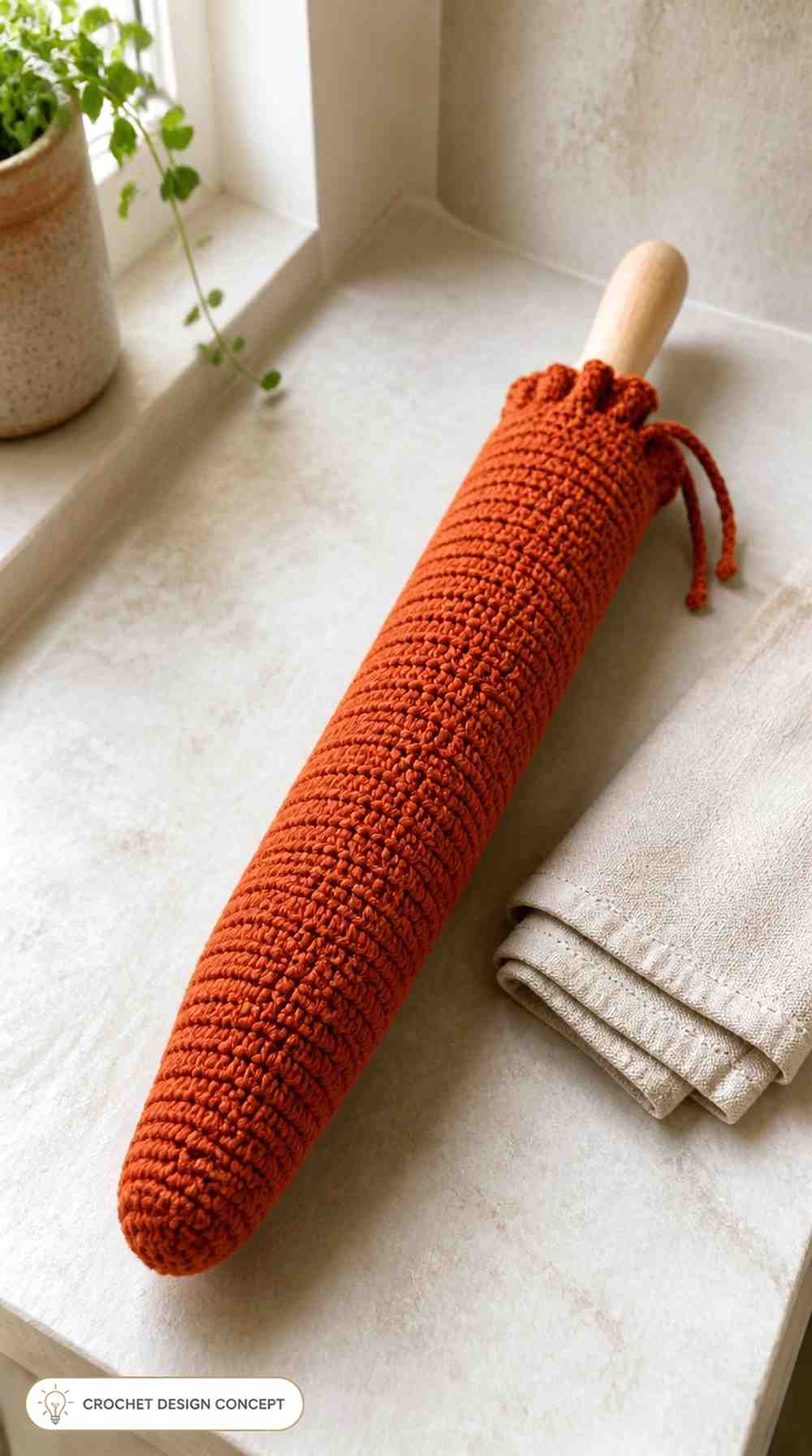
Rust-orange crochet forms an elongated sock with a gently tapered silhouette. A dense rounded lower tip and graduated side shaping follow the form of a French rolling pin, while shallow spiral ridges add surface texture. A burnt-orange upper band and braided drawstring finish the opening.
This concept is made for a pin that narrows toward its ends rather than one with separate rotating handles. Its tailored form may reduce excess fabric, but sizing is important because the finished sleeve must still slide off without dragging tightly along the wood.
- Tapered Side Shaping: Follow the pin’s changing circumference without making the narrow sections so tight that removal becomes difficult.
- Rounded Closed Tip: A smoothly worked lower end avoids a bulky seam at the most tapered part of the rolling pin.
- Spiral Texture: Keep the ridges low and continuous so they remain decorative rather than pulling the fabric into twists.
14. Crochet Lavender Hanging Tab Storage Sleeve
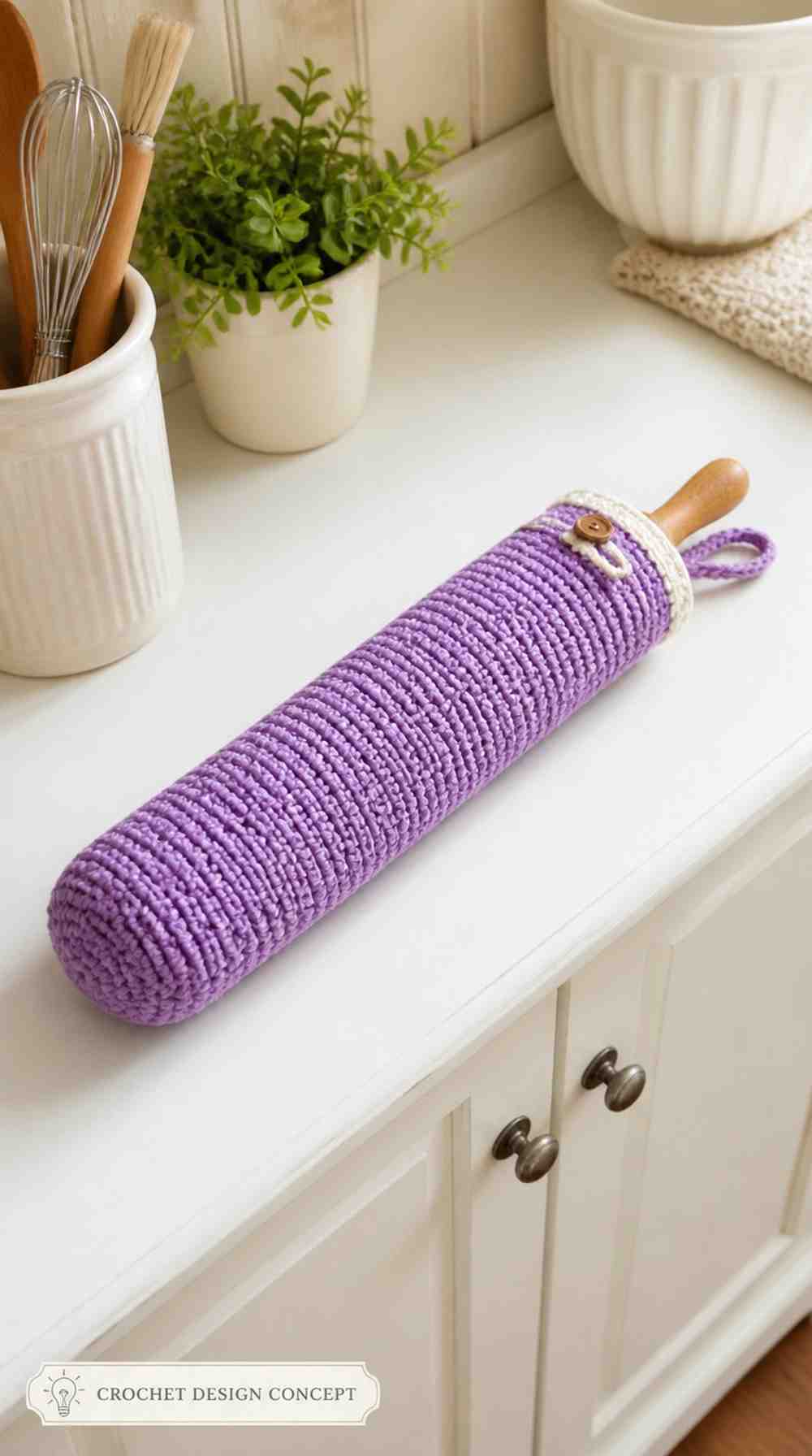
Lavender-purple crochet gives this full-length rolling pin pouch a soft, understated appearance. A closely worked rectangular body forms the long case, with a rounded closed bottom, cream upper band and small button-loop closure. A reinforced lavender hanging tab sits near the opening, while the filled sleeve rests horizontally on a white shelf.
The tab could be useful for hanging the empty pouch after washing, but it shouldn’t automatically be used to suspend the heavy rolling pin. The main purpose of this design is horizontal covered storage.
- Hanging Tab Placement: Attach the tab securely near the top seam, but reserve it for the empty pouch unless the complete assembly has been independently load-tested.
- Horizontal Storage: A shelf supports the rolling pin’s weight without relying on one small crochet loop.
- Button-Loop Opening: Keep the upper closure simple and accessible so the wooden tool can be removed without twisting the case.
15. Crochet Charcoal Checkerboard Foldover Sleeve
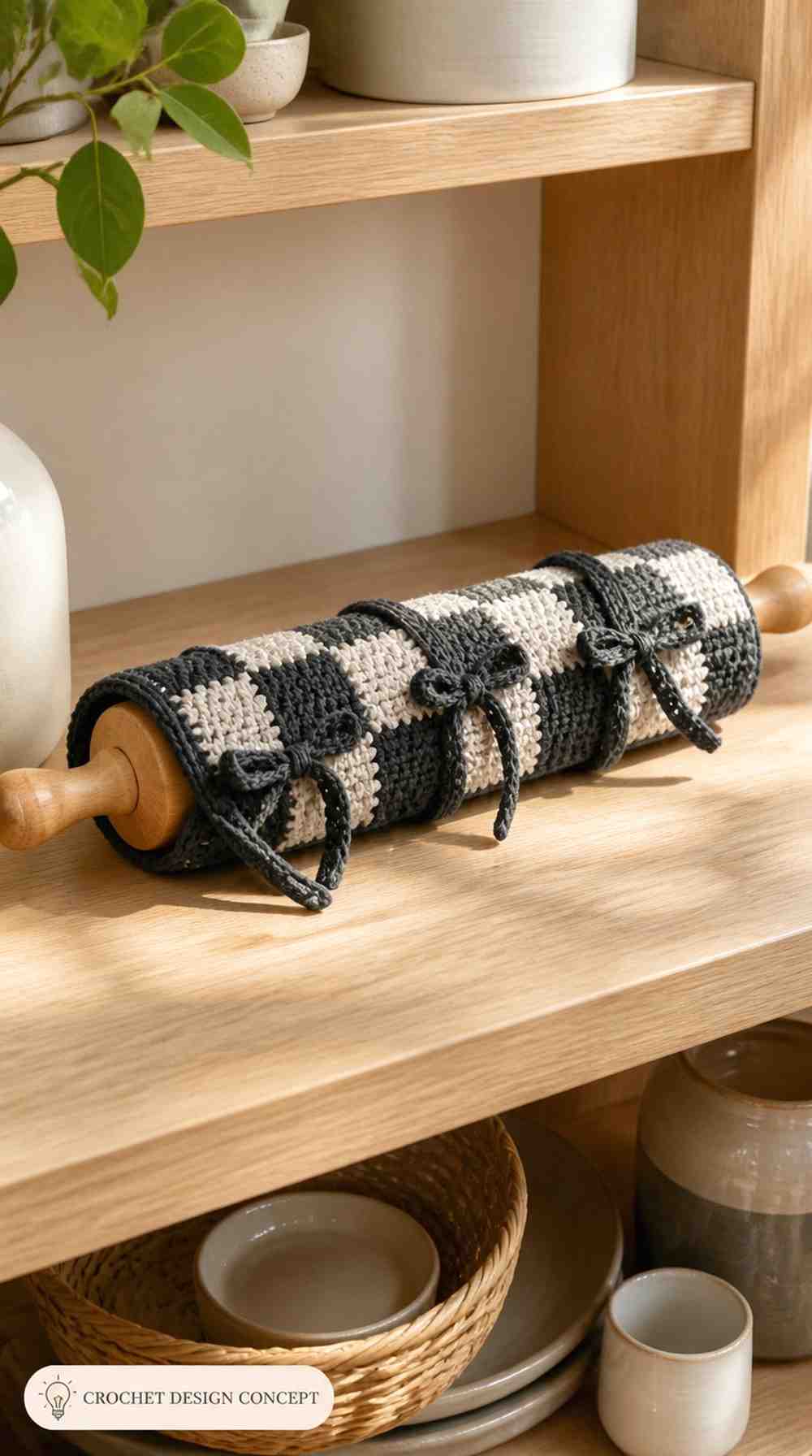
Charcoal-grey and oatmeal-cream crochet squares create a strong checkerboard appearance across this rolling pin wrap. A dark-grey border defines the rectangular panel, and three short charcoal ties secure it around the wooden barrel. Both handles remain exposed, with one corner loosened to show the flat wrap structure.
The checkerboard makes this a decorative alternative to plain fabric sleeves. Because the pattern involves repeated color changes, the joins should remain smooth and the yarn ends carefully secured. The main contact surface should not have knots or rough embellishments.
- Flat Checkerboard Colorwork: Keep the dark and light blocks even so the panel folds smoothly around the barrel without pulling out of shape.
- Three Closure Ties: Multiple ties can hold the long overlap in place, but each should close gently without compressing the tool.
- Dark Outer Border: A neatly worked edging defines the wrap while providing a clear attachment area for the ties.
Practical Guide to Crochet Rolling Pin Protective Sleeves
Measure the Rolling Pin Before Planning a Sleeve
Rolling pins come in different shapes, and a cover made for a handled pin may not work well on a tapered French pin. Measure the barrel length and circumference, the handle dimensions, and the overall tool length.
| Rolling pin type | Sleeve style to consider | Fit issue to check |
|---|---|---|
| Handled wooden rolling pin | Barrel-only tube or buttoned wrap | Handles may be wider than the tube opening |
| French tapered wooden pin | Tapered sock or roll-up wrap | Changing diameter along the tool |
| Embossed wooden rolling pin | Smooth-lined sleeve | Raised carved details can catch yarn |
| Full-length handled pin | Long pouch or zippered case | Total length including handles |
| Pin with unusual handles | Openable split-seam wrap | Fastening clearance around the barrel |
Choose a Smooth, Washable Fabric
Cotton yarn or another suitable washable yarn can be useful for crochet kitchen storage accessories. Dense stitches may create a more continuous dust cover, while open mesh offers less coverage.
For an embossed or delicately finished rolling pin, consider a smooth lining. The outer crochet is decorative storage fabric, not a guarantee against scratches or impact damage.
Clean and Dry the Rolling Pin First
Remove flour and dough residue using the rolling pin manufacturer’s care instructions. Never cover a wet or dirty wooden rolling pin. Moisture trapped against wood may cause problems during storage.
Wooden rolling pins are generally not suited to prolonged soaking or dishwashers. Allow the tool to dry completely before putting it into a sleeve.
BakeClub+1
Store the Covered Pin Carefully
Place the covered rolling pin horizontally on a dry, stable shelf or in a suitably sized drawer. Keep it away from ovens, burners, direct heat and damp areas.
Avoid storing heavy kitchen tools on top of a crochet sleeve. Even lined or textured designs should not be treated as protective cases against substantial weight or sharp objects.
Wash the Sleeve Separately
Remove the rolling pin before cleaning its cover. Follow the yarn and lining care instructions, and let every layer dry fully before reuse.
If the sleeve includes buttons, ties or a zipper, check the attachments periodically for looseness or wear.
Want to Make Something Similar?
These verified resources cover techniques that could help with planning a real crochet rolling pin sleeve. They are not exact patterns for the AI-generated designs above.
- VivCrochets — Basic Crochet Drawstring Pouch includes a free pattern and video tutorial showing how to make a crocheted pouch, form its opening and insert drawstrings. The construction would need significant length and width adjustments for a rolling pin.
- CyCrochet — Crochet Ruler Sleeve demonstrates a flat-panel sleeve with folded fabric, joined sides and a closing flap. It is useful for studying simple sleeve construction, but the published design is for a small ruler.
- Jocelyn Ng — Crochet Tool Roll is a made-to-measure tool roll pattern that combines crochet fabric with lining and attachments. Its construction can help explain the principles behind roll-up storage wraps. Free Pattern & Video Tutorial+2
For another kitchen-related crochet collection, Yarn Nest Studio’s 24 Crochet Kitchen Towel Topper Ideas for Cozy Cottage Kitchens explores ways to combine practical kitchen accessories with decorative crochet details.
Which Crochet Rolling Pin Sleeve Should You Choose?
| Your priority | Designs to consider | Main trade-off |
|---|---|---|
| Simple barrel coverage | Oatmeal Drawstring, Terracotta Waffle | Handles remain exposed |
| Easy removal without sliding | Sage Buttoned Split Seam, Navy Lace Up | More fasteners and joining work |
| Full-length storage | Dusty Blue Pouch, Teal Zippered Case | More fabric and careful fitting |
| Smoother inner surface | Ivory Linen Lined, Peach Soft Lined | Extra cleaning and construction |
| French tapered pin | Mustard Chevron Wrap, Rust Tapered Sock | Tapered shaping and sizing |
| Decorative cottage style | Blush Scalloped, Cream Granny Stripe | Extra finishing details |
| Light coverage with eyelets | Olive Fine Eyelet | Less complete dust coverage |
| Simple horizontal shelf storage | Lavender Hanging Tab | Tab isn't a tested loaded hanger |
| Bold colorwork | Charcoal Checkerboard | More color changes and yarn ends |
For a straightforward handled rolling pin, the Crochet Oatmeal Drawstring Barrel Sleeve is a sensible starting concept. Its smooth tubular shape keeps the design simple, provided it can slide over the relevant parts of the pin.
If you own a rolling pin with unusually wide handles, the Crochet Sage Buttoned Split Seam Pin Cover may be more practical because the cover opens along its length rather than slipping over an end.
For a French rolling pin, the Crochet Rust Tapered French Pin Sock offers a more tailored shape, while the Crochet Mustard Chevron Roll Up Pin Wrap provides an adjustable alternative.
The Crochet Ivory Linen Lined Button Sleeve and Crochet Peach Soft Lined Rolling Pin Sleeve may appeal when a smooth fabric interior matters more than an elaborate exterior stitch pattern.
Conclusion
A crochet rolling pin protective sleeve can make baking-tool storage more organized while adding handmade detail to a kitchen shelf or drawer. Some designs cover only the rolling barrel, while others enclose the complete tool or open flat for easier removal. Textured stitches, button closures, linings and colorwork offer plenty of ways to personalize a practical storage accessory.
The most important choices are fit, cleanliness and storage conditions. Measure your rolling pin, keep the fabric easy to remove and wash, and never cover the tool until it’s completely dry. A crochet sleeve can be a useful light storage cover, but it shouldn’t replace proper care of the rolling pin itself.
Which style would you choose for your kitchen: the oatmeal drawstring sleeve, sage buttoned wrap, or rust tapered French pin sock? Share your favorite and whether your rolling pin has handles or a tapered shape.
Frequently Asked Questions
1. What yarn is best for a crochet rolling pin sleeve?
Smooth, washable cotton yarn is a reasonable option for a rolling pin storage cover. It offers clear stitch definition and can be worked into dense panels or tubes. Choose a yarn that doesn’t shed excessively, and follow its washing instructions. If using a lining, make sure the inner fabric is also easy to clean and dry.
2. Can a crochet sleeve protect a wooden rolling pin from scratches?
A clean, smooth fabric sleeve may reduce casual contact with dust and nearby objects, but it doesn’t guarantee scratch protection. Rough seams, trapped debris, buttons or abrasive yarn can still mark the wood. A lined design may provide a smoother contact surface, but the rolling pin should still be stored away from sharp or heavy utensils.
3. Should I cover my rolling pin immediately after washing it?
No. Clean the rolling pin according to its manufacturer’s instructions, remove moisture and allow it to dry completely before covering it. This is particularly important for wooden pins. A crochet sleeve can trap moisture against the wood if the tool is stored while damp.
4. Is a barrel-only sleeve better than a full-length pouch?
It depends on how you store the rolling pin. A barrel-only sleeve uses less fabric and can leave handles visible, but it may be difficult to slide over certain handle shapes. A full-length pouch covers more of the tool but requires additional space and fabric. A split-seam wrap offers another option when the pin has wide or unusual handles.
5. Are these 15 crochet rolling pin sleeve ideas actual patterns?
No. These are original AI-generated crochet design concepts for inspiration. They have not been physically tested for dimensions, protective performance, durability or food-contact suitability. Use them to explore shapes, closures and finishing details, then follow suitable crochet construction guidance and test your own finished sleeve before regular use.