A crochet watering can handle grip can bring a handmade touch to an everyday gardening tool. These 15 inspiration ideas explore removable ribbed wraps, buttoned covers, padded-looking handholds, floral details, granny-square accents and simple colorblock designs. From muted sage and oatmeal to terracotta, denim and plum, each concept offers a different way to decorate the handle of a watering can while leaving the original metal structure visible.
The collection includes ideas for classic outdoor metal watering cans, slim indoor plant-watering cans and handles that already have a molded silicone grip. Every design concentrates on the hand-contact area rather than enclosing the whole handle. Since yarn can absorb moisture, stretch or slip when wet, these are decorative grip concepts, not tested non-slip attachments or replacements for the manufacturer’s original handle.
These are AI-generated crochet design visualizations for inspiration, not photographs of tested handmade products or complete crochet patterns. Their appearance does not establish secure wet-weather grip, load capacity or suitability for carrying a filled watering can.
Quick Design Selection Guide
| Your preferred style | Design to explore | Distinctive feature |
|---|---|---|
| Simple everyday crochet | Crochet Sage Ribbed Watering Can Handle Grip | Vertical ribs and oatmeal edging |
| Easy-to-open wrap | Crochet Oatmeal Buttoned Watering Can Grip Wrap | Two-button side fastening |
| Decorative raised texture | Crochet Terracotta Braided-Center Watering Can Handle Grip | One braided-looking center strip |
| Modern stripes | Crochet Navy Striped Watering Can Handle Cuff | Three pale-blue horizontal stripes |
| Soft cottage detail | Crochet Ivory Scalloped Watering Can Grip Sleeve | Six shallow scallops |
| Traditional crochet motifs | Crochet Denim Granny-Square Watering Can Handle Wrap | Two miniature granny squares |
| Smooth separate lining | Crochet Charcoal Waffle-Lined Watering Can Handle Cover | Waffle surface and woven backing |
| Wider-looking handhold | Crochet Dusty Blue Cushioned Watering Can Handle Pad | Removable inner pad |
| Slim indoor watering can | Crochet Lilac Slim-Arch Watering Can Grip Sleeve | Narrow curved sleeve |
| Decorate an existing grip | Crochet Plum Removable Silicone-Grip Jacket | Crochet over the original silicone handhold |
For a real watering can, start by checking its handle shape and whether there is enough room for a removable wrap without interfering with the natural hand position. An attractive crochet cover is not automatically safe or comfortable when the can is filled with water.
1. Crochet Sage Ribbed Watering Can Handle Grip
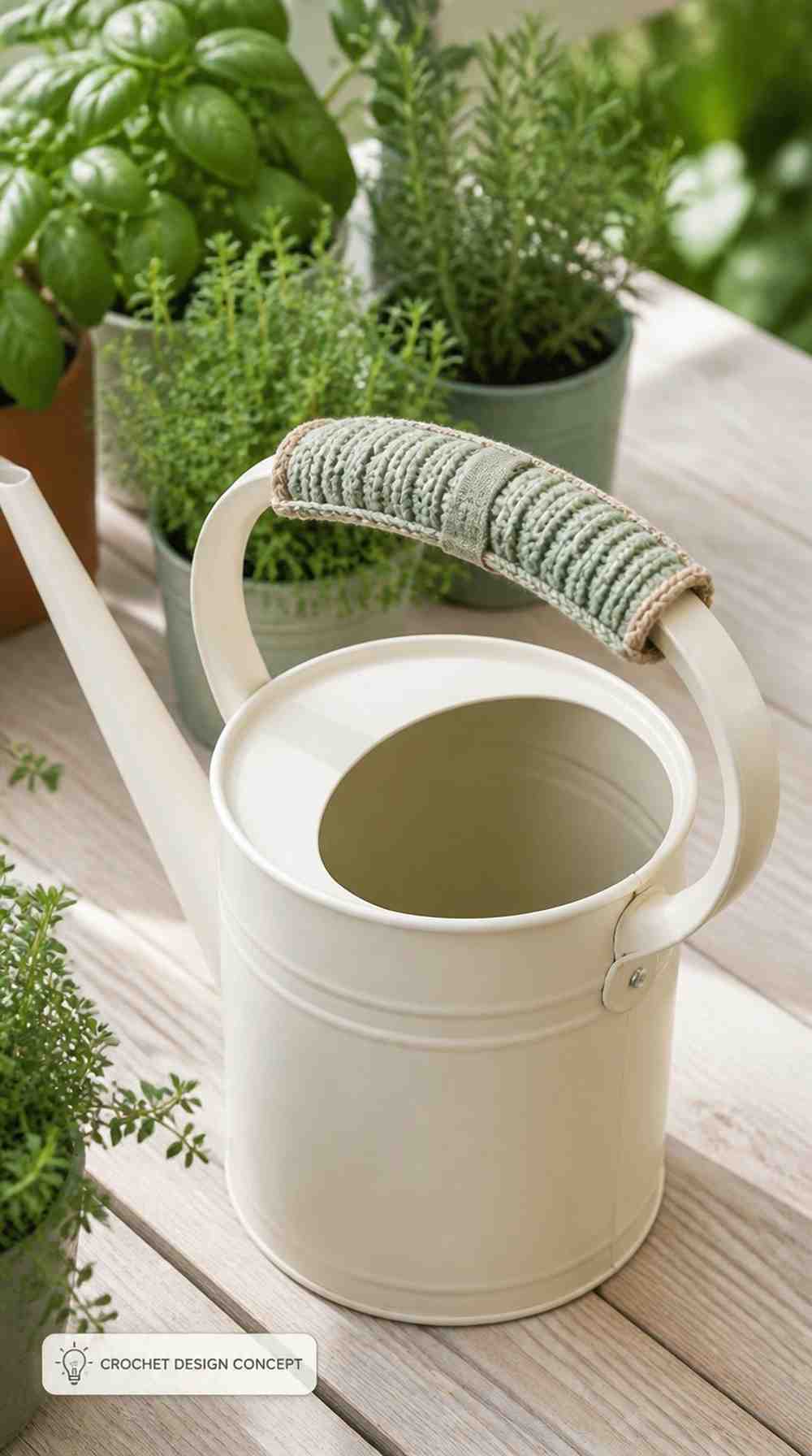
Sage-green crochet forms a compact removable grip with fine vertical ribs and narrow oatmeal edging. The wrap sits around the central section of the curved handle on a matte-cream metal watering can. A short concealed fabric tab secures the underside, while the original metal remains exposed near both attachment points.
The restrained color makes this design especially appealing beside pale wooden garden furniture and green herbs. Its simple ribbing provides visible texture without additional motifs, although the yarn’s stretch and contact with the handle would need checking.
- Vertical Ribbing: Back-loop stitches create raised rows, but their texture alone does not guarantee reliable grip when the fabric becomes wet.
- Central Handle Position: Keep the wrap centered where the hand naturally rests rather than extending it down to the watering can’s mounting joints.
- Concealed Fastening: The short fabric tab should remain secure without creating a bulky ridge beneath the hand.
- Removable Construction: The grip should be easy to take off and dry separately after any exposure to water.
2. Crochet Oatmeal Buttoned Watering Can Grip Wrap
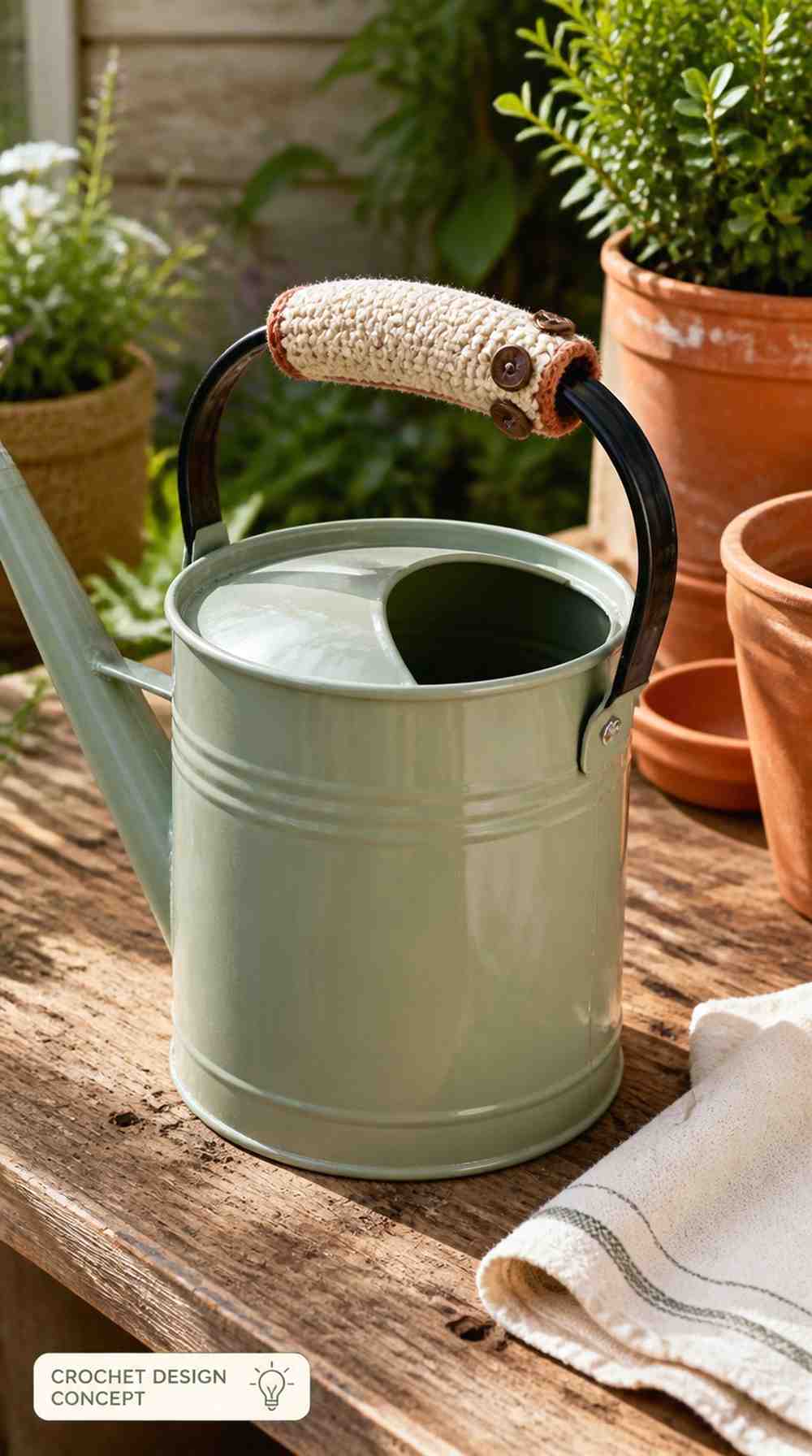
Warm oatmeal crochet creates a broad rectangular grip around the black-painted metal handle of a sage-green watering can. Two small dark wooden buttons fasten the overlapping side edge, while fine terracotta borders finish the upper and lower sides. Dense linen-like crochet stitches give the wrap a smooth, fabric-like appearance.
The buttons provide the main decorative detail. Unlike a permanently sewn handle cover, the wrap can be opened along its side. However, a buttoned closure introduces raised hardware that may affect hand comfort and must not be assumed secure under load.
- Two Wooden Buttons: Position both buttons away from the main gripping surface so they do not press uncomfortably against the hand.
- Linen-Like Texture: Close, flat stitches keep the wrap relatively smooth, although wet yarn may still shift against painted metal.
- Terracotta Borders: Thin edging provides a neat color contrast without thickening the entire grip.
- Closure Limitation: Decorative buttons are not a substitute for a tested fastening system on a heavily loaded watering can.
3. Crochet Terracotta Braided-Center Watering Can Handle Grip
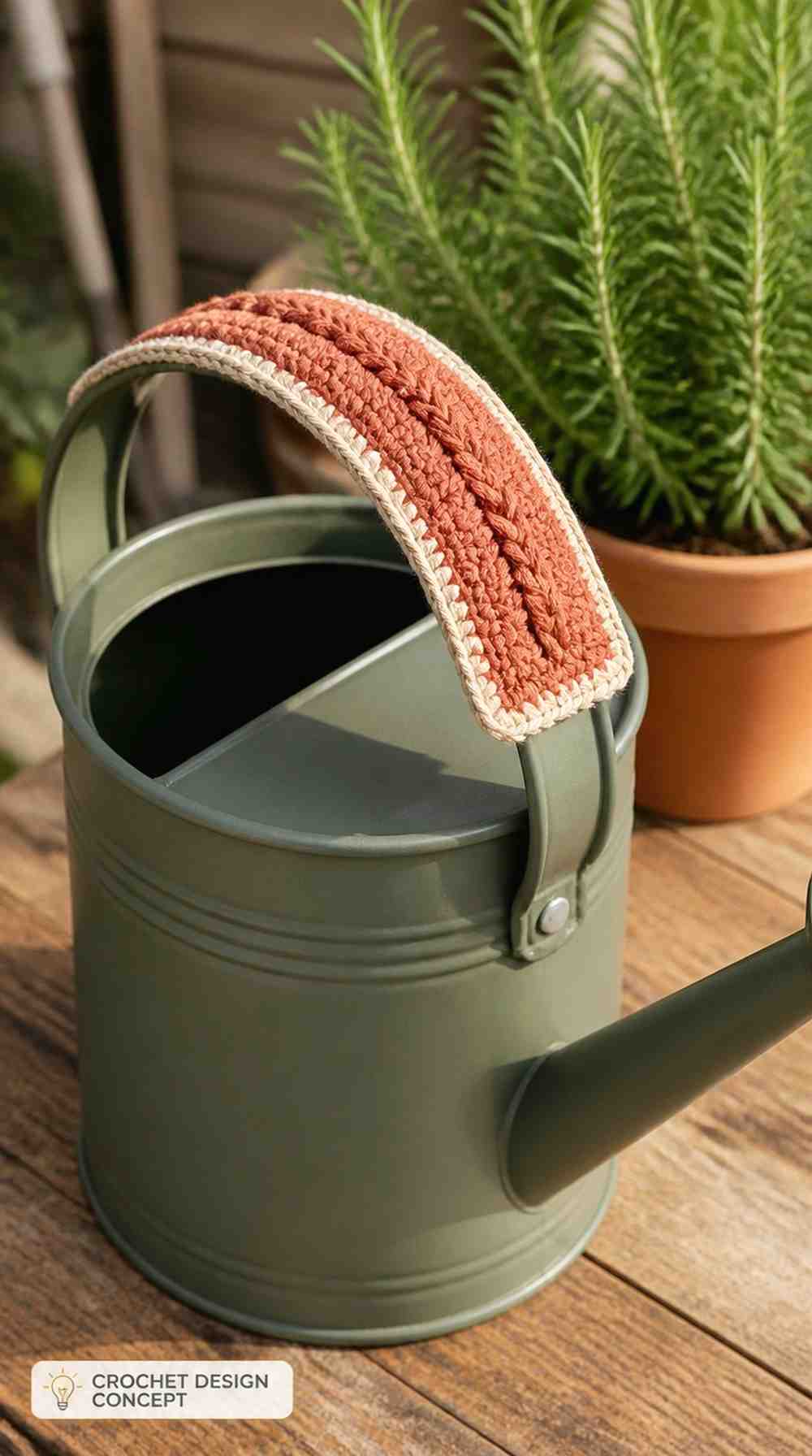
Terracotta crochet forms a broad removable wrap with one braided-looking strip running lengthwise along the outer center. The surrounding fabric uses closely worked stitches, while narrow cream rows define the edges. The grip fits the upper curved handle of a muted olive watering can, fastening underneath with a concealed cream tab.
The raised braided strip adds dimension without covering the entire handle in thick texture. Its placement creates a noticeable visual feature, although it should not sit directly beneath the most pressure-sensitive part of the hand if that makes holding the can uncomfortable.
- Braided Center Strip: Keep the raised detail compact so it does not make the grip unnecessarily bulky.
- Flat Surrounding Fabric: Smooth stitches beside the braid can help the wrap retain a balanced rectangular shape.
- Cream Under-Fastening: A short closure keeps the decorative front continuous while allowing the cover to be removed.
- Hand Comfort: The raised ridge needs to be evaluated for pressure and rubbing before considering practical use.
4. Crochet Navy Striped Watering Can Handle Cuff
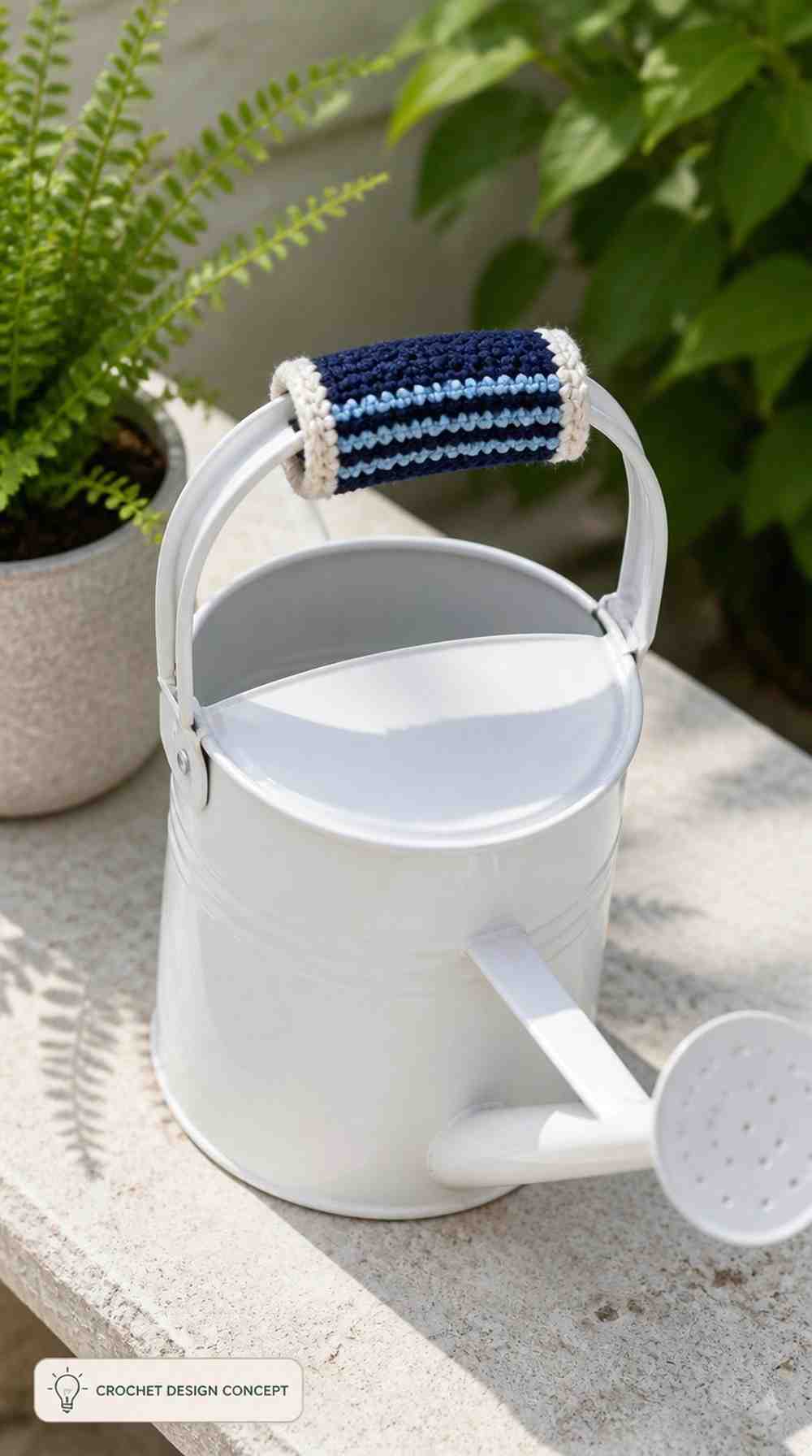
Deep navy crochet forms a compact rectangular cuff around the center of a white watering can’s curved handle. Three narrow faded-blue stripes cross the front, and ivory edging finishes the short sides. Two concealed fabric fastening points sit beneath the wrap.
The clean stripe pattern gives this design a modern appearance that contrasts with the white metal can. It does not use raised flowers, dangling cords or large decorative pieces, keeping the overall shape restrained.
- Three Horizontal Stripes: Keep the pale-blue rows evenly spaced to create a clear pattern across the narrow grip surface.
- Two Underneath Fasteners: Separate attachment points can help hold the wrap’s ends in place, but their security requires real-world testing.
- Ivory Side Borders: The light trim defines the short cuff without adding unnecessary length to the handle covering.
- White Metal Handle: Check that the crocheted cuff does not rub against delicate painted finishes or trap moisture against the metal.
5. Crochet Ivory Scalloped Watering Can Grip Sleeve
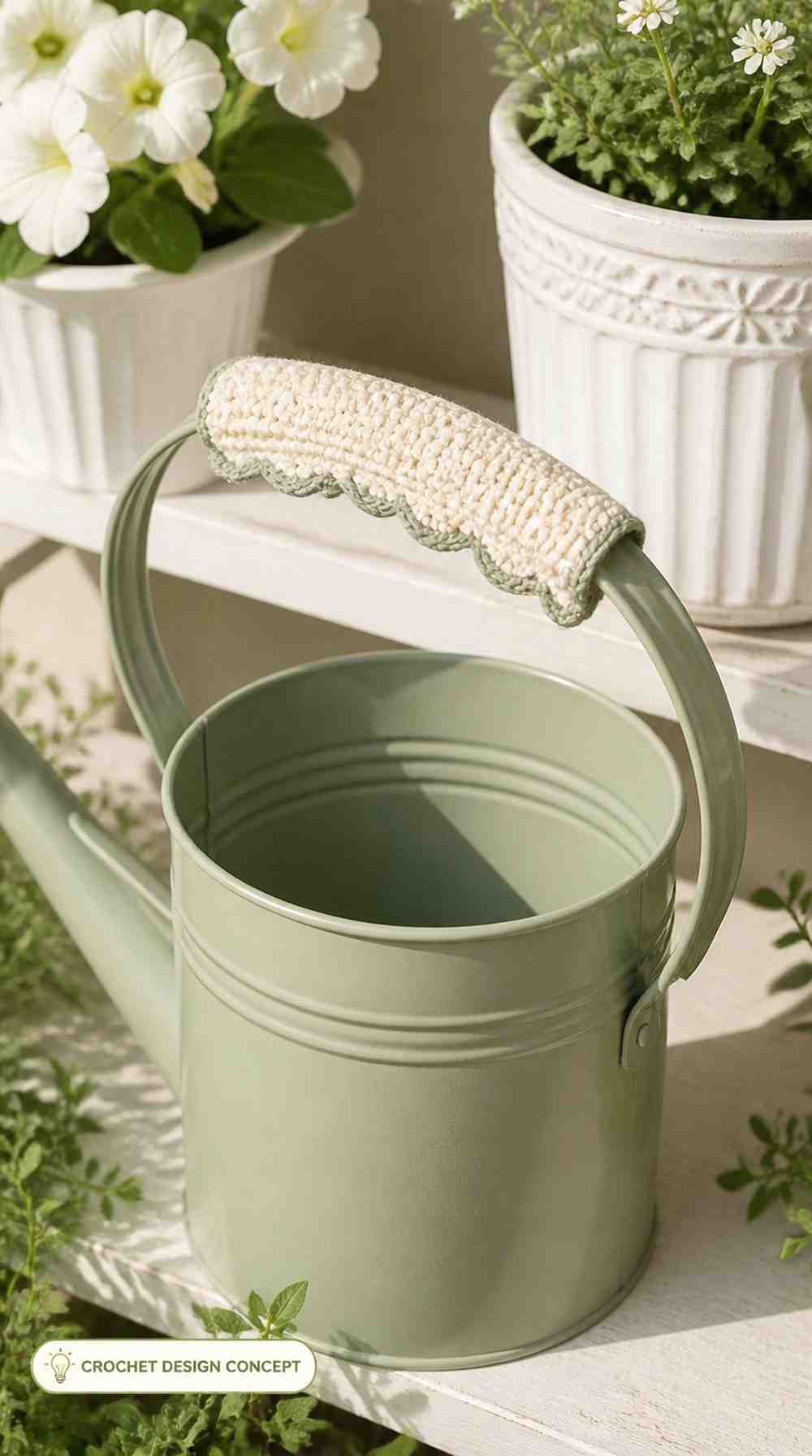
Ivory crochet forms a short handle sleeve with close horizontal rows and six small dusty-sage-edged scallops. The scallops run along the visible lower outer edge, while a concealed seam allows the sleeve to be removed from the upper handle of a pale-sage metal watering can.
The decorative curves give the grip a cottage-inspired character. Because the sleeve is fairly narrow, the scallops become the main feature without dominating the watering can’s shape. Their placement should remain clear of the gripping surface and handle joints.
- Six Shallow Scallops: Keep each curved section small enough to avoid catching on fingers, clothing or garden accessories.
- Ivory Yarn: The light fabric may show soil marks and water discoloration more readily than darker yarn.
- Concealed Side Seam: The closure should open easily without pulling against the watering can’s painted surface.
- Drying Needs: Decorative scallops create extra stitch edges where moisture may remain, so remove and dry the cover when necessary.
6. Crochet Denim Granny-Square Watering Can Handle Wrap
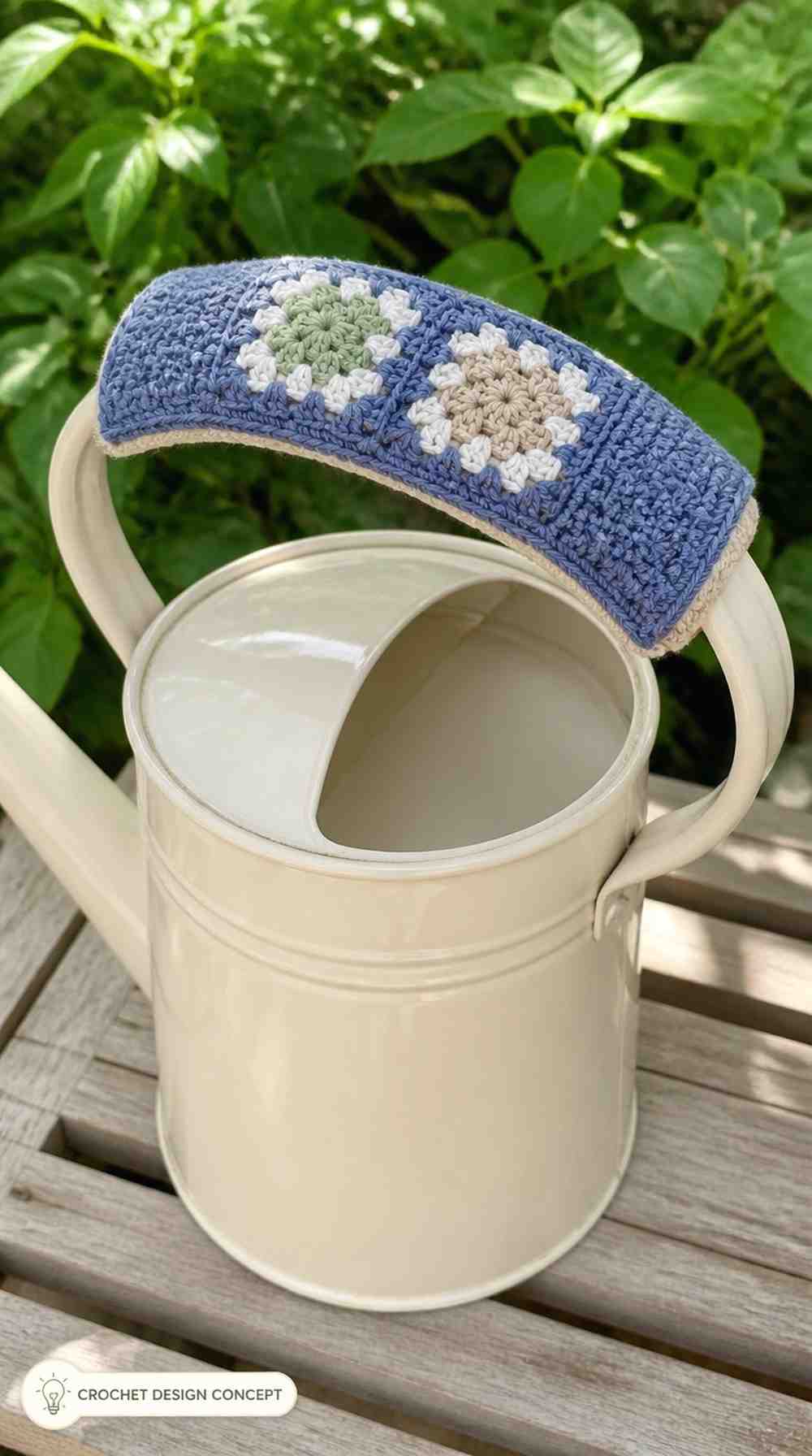
Denim-blue crochet forms a broad grip around the curved handle of a cream metal watering can. Two miniature granny squares decorate its upper outside surface, one with a muted sage center and the other with an oatmeal center. Solid denim stitching surrounds the motifs, while a cream woven lining appears beneath the wrap.
The granny-square detail brings a familiar handmade style to an ordinary gardening tool. Unlike an all-over motif cover, the solid crochet around the squares gives the wrap a more continuous shape.
- Two Granny Squares: Keep the motifs small and flat so their joins do not create excessive bulk.
- Solid Denim Background: Close stitching between the squares helps define the grip without relying entirely on openwork.
- Cream Fabric Lining: A separate woven layer may provide a smoother contact surface, although it does not guarantee that the wrap will stay in place.
- Open Motif Care: Check the granny-square holes and joins for dirt, trapped moisture and loose yarn after use.
7. Crochet Charcoal Waffle-Lined Watering Can Handle Cover
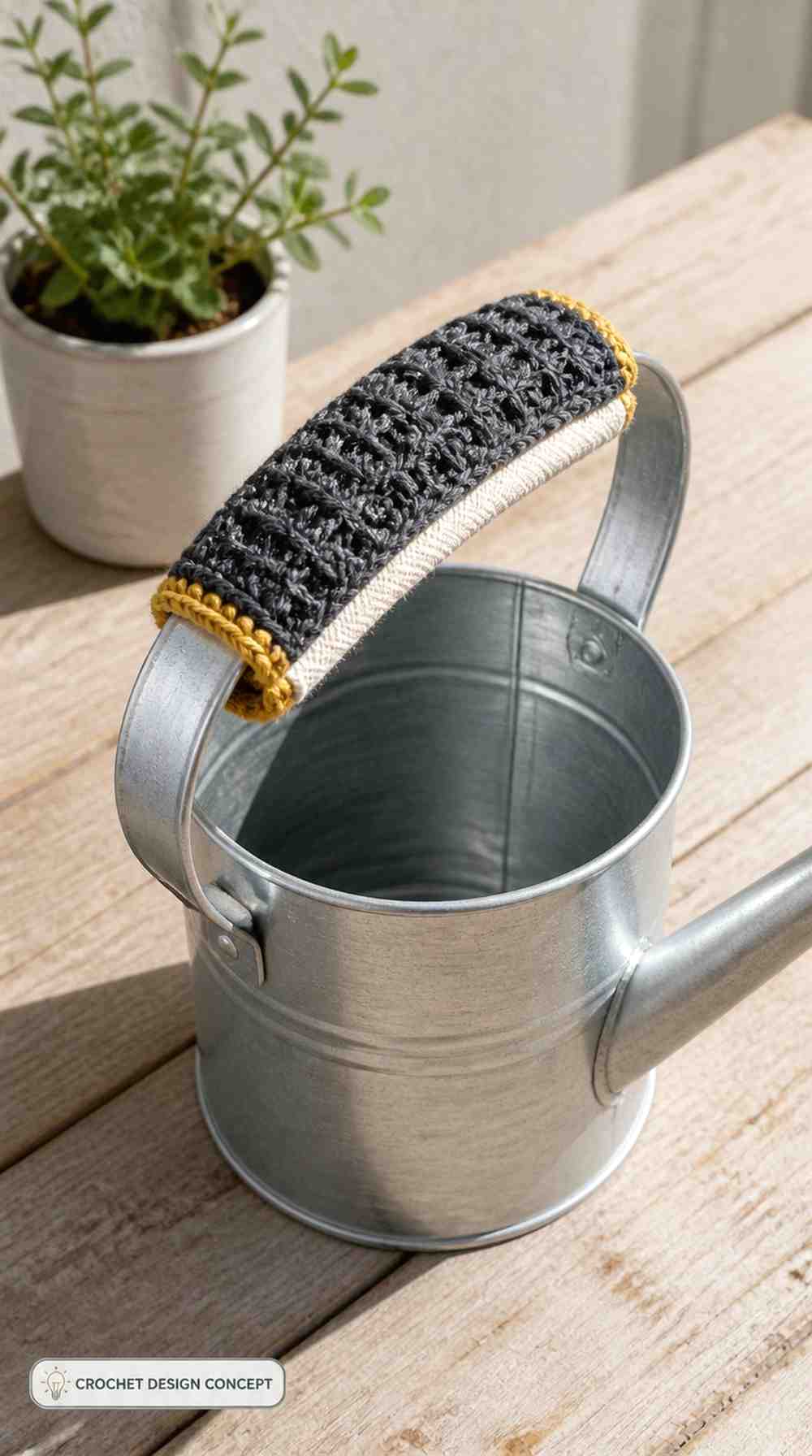
Charcoal-gray crochet forms a removable handle cover with closely packed waffle-square texture. A smooth cream woven cotton lining sits beneath the crochet, visible along the openable underside seam. Fine mustard edging finishes both short ends, while the exposed silver handle remains visible beyond the cover.
This concept focuses on layering rather than colorwork. The separate lining distinguishes it from plain crochet cuffs, although the waffle texture may collect more dirt or moisture than a smooth surface.
- Waffle-Square Texture: The raised pattern adds visual depth, but it should not be presented as a tested nonslip surface.
- Cream Woven Lining: Check that the fabric remains smooth and does not bunch between the crochet and metal handle.
- Mustard End Borders: Short contrast rows provide a neat finish without extending the cover unnecessarily.
- Cleaning and Drying: Textured crochet can retain moisture in recessed stitches, making regular removal and thorough drying important.
8. Crochet Mustard Chevron Watering Can Handle Grip
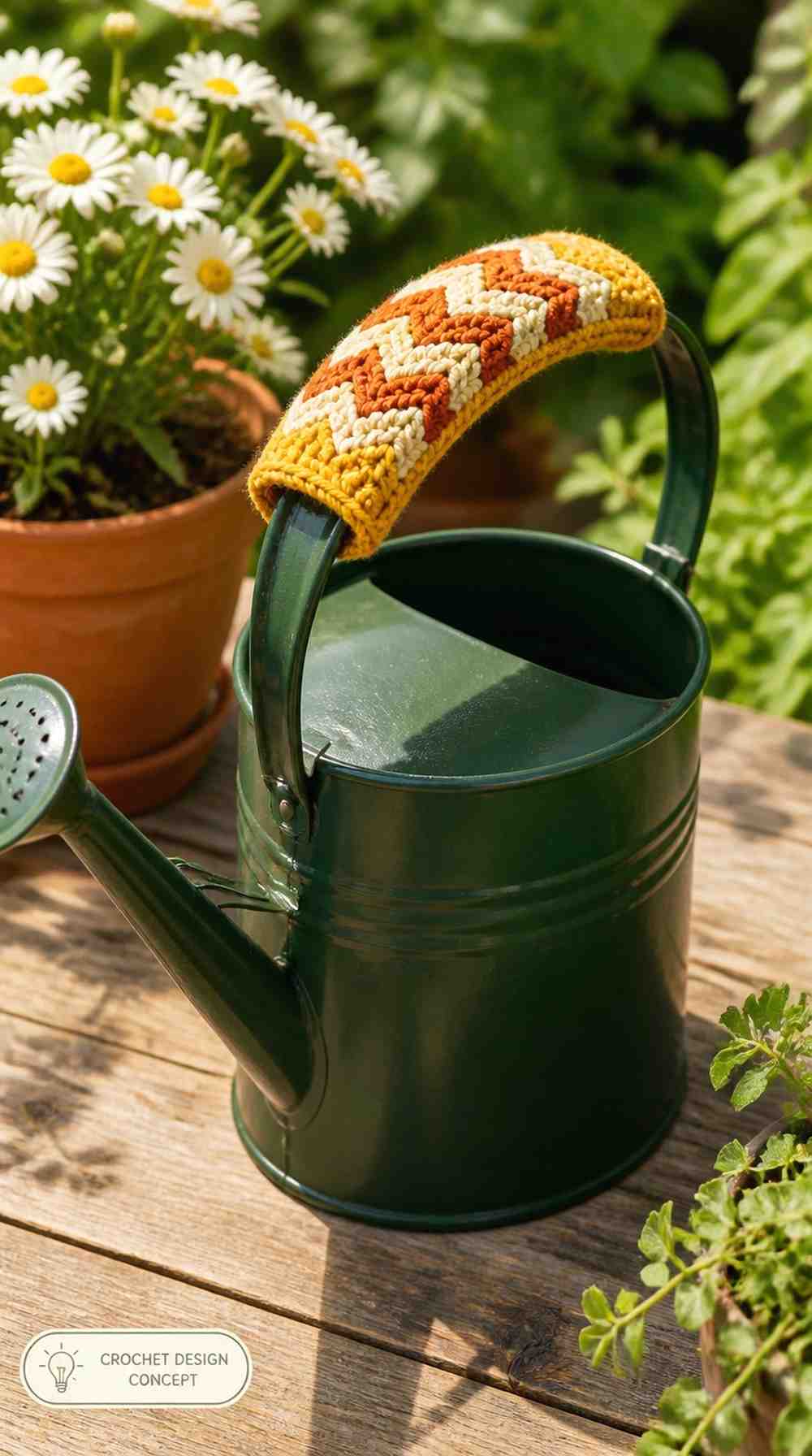
Mustard-gold crochet creates a colorful handle cuff with four cream-and-rust chevron stripes crossing its outer surface. Narrow rolled mustard edges frame the pattern, while a concealed fabric tab fastens the wrap beneath the upper handle of a forest-green watering can.
The angled stripes give this grip a cheerful retro appearance without relying on separate appliqués. Its closely joined crochet sections form a broad decorative panel, although the color changes should remain smooth so the wrap does not become uneven.
- Four Chevron Stripes: Keep the V-shaped rows evenly aligned so the pattern remains recognizable around the curved handle.
- Flat Color Joins: Smooth transitions between mustard, cream and rust help prevent bulky ridges.
- Rolled Outer Edges: The finishing rows should not create thick pressure points where fingers curl around the handle.
- Removable Fastening: The concealed tab should allow the cuff to be opened and dried separately after use.
9. Crochet Dusty Blue Cushioned Watering Can Handle Pad
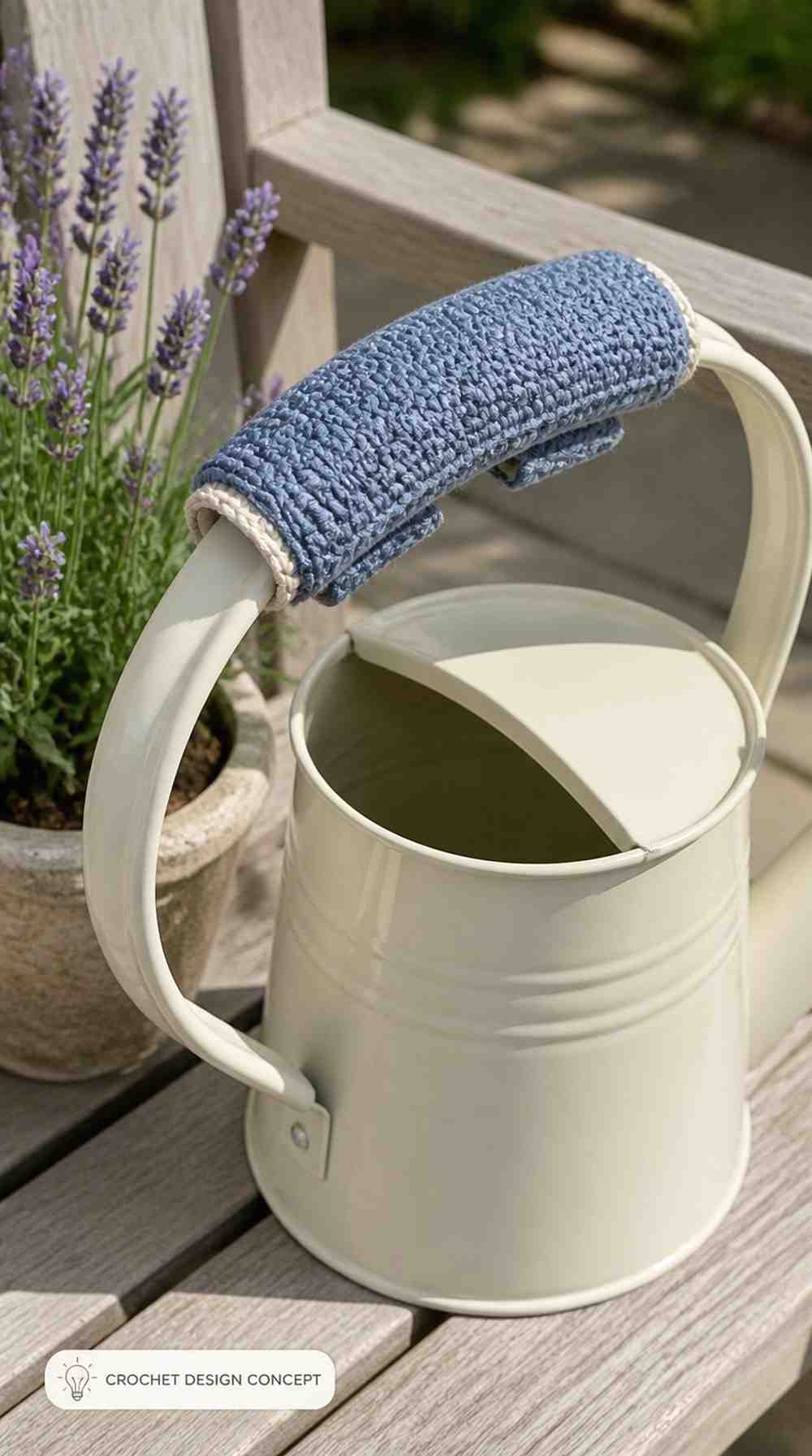
Dusty-blue crochet forms a broad handle pad with tight horizontal rows and gently tapered outer ends. A removable soft woven insert sits beneath its central section, while narrow cream edging frames the pad. Two short overlapping tabs secure it around the upper arch of a pale-cream watering can.
The padded-looking center distinguishes this design from simple flat wraps. It explores how a separate inner layer might change the feel of a narrow handle, although comfort and secure attachment cannot be determined from an illustration.
- Removable Inner Pad: The woven insert should fit smoothly without bunching or shifting beneath the crochet.
- Tapered Ends: Narrower outer sections may reduce bulk where the grip meets the exposed metal handle.
- Two Underneath Tabs: Separate fastenings should remain flat and accessible without interfering with the normal hand position.
- Padding Limitation: A soft insert does not guarantee comfort or grip security, especially when the watering can becomes heavy or wet.
10. Crochet Forest Eyelet-Edge Watering Can Grip
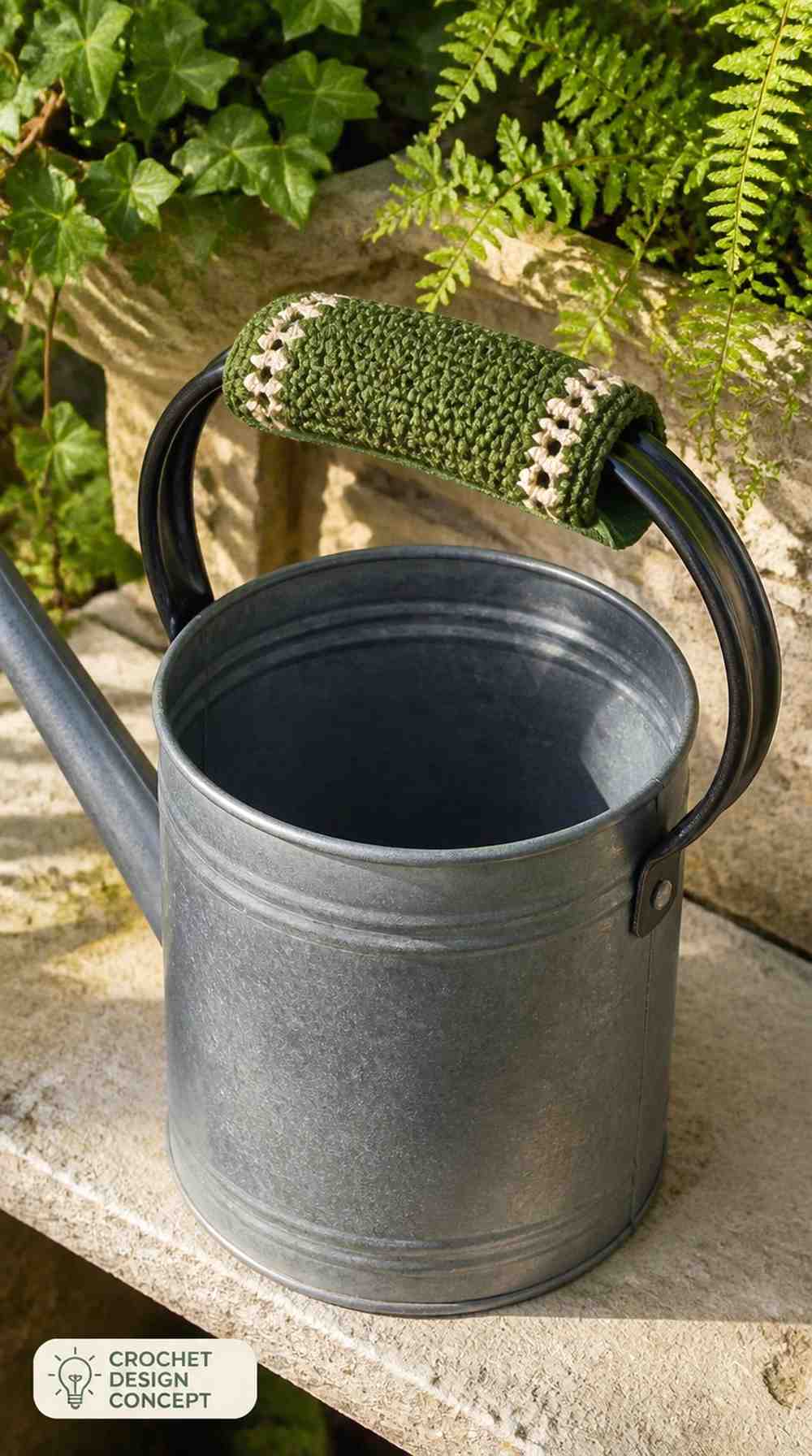
Forest-green crochet forms a broad removable grip with a solid central panel and two narrow decorative eyelet borders. Cream finishing stitches define the small openings, while an olive fabric-backed tab secures the wrap underneath the black handle of a zinc-gray watering can.
The eyelet edges give the design a lighter appearance than an entirely solid cuff. Their placement leaves the middle hand-contact area closely stitched, creating a clear distinction between the decorative borders and the main fabric.
- Solid Center Panel: Dense moss-like stitches provide a continuous central surface rather than open mesh directly beneath the hand.
- Small Eyelet Borders: Keep the openings away from the edges of the closure so they do not stretch or catch.
- Olive Fabric Backing: The short under-fastening should remain smooth against the original metal handle.
- Outdoor Cleaning: Openwork can collect soil and moisture, making removal and thorough drying particularly important.
11. Crochet Coral Daisy Watering Can Handle Wrap
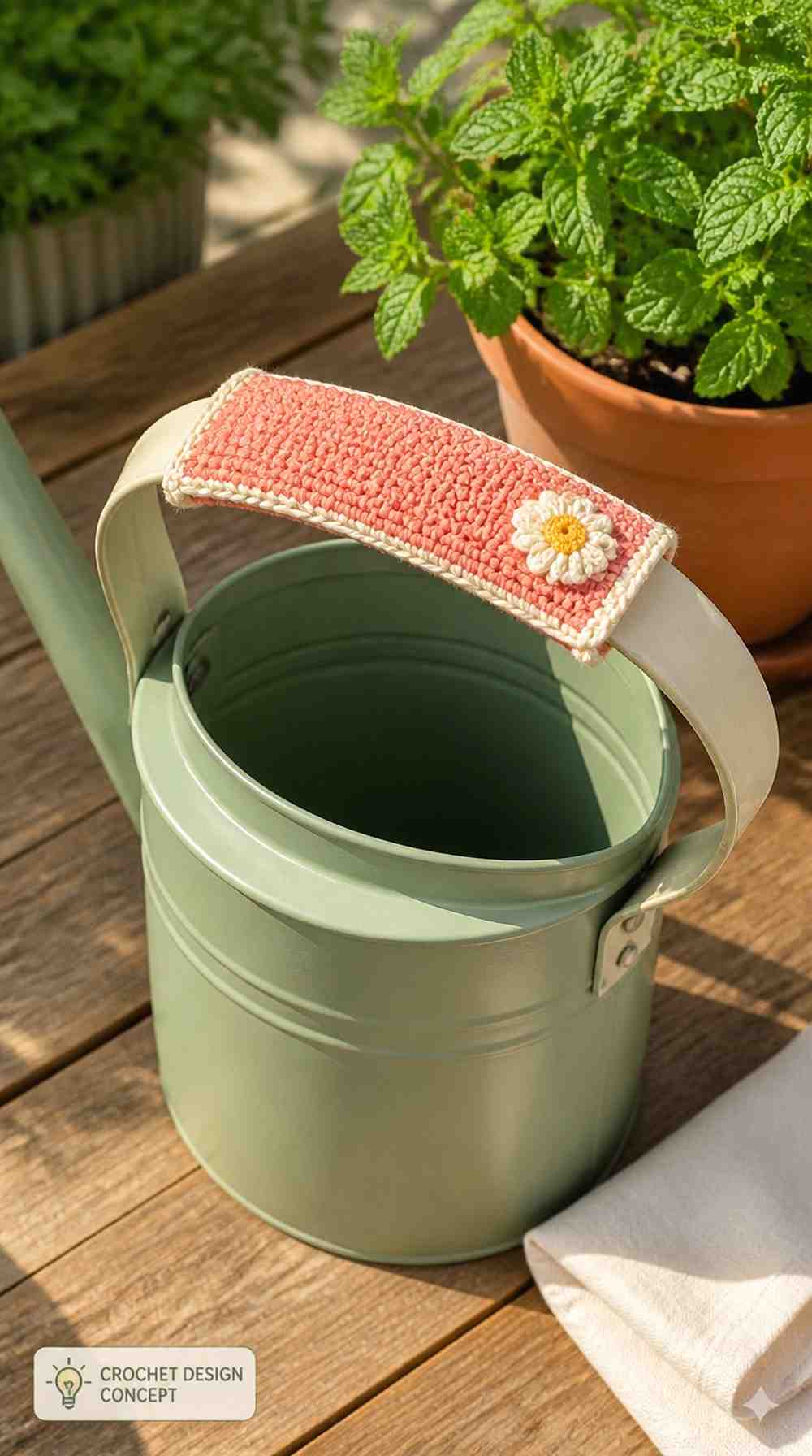
Coral-pink crochet forms a short rectangular handle wrap with compact stitches and thin ivory edging. One flat five-petal daisy decorates the outer right end, with an ivory flower shape and a mustard-yellow center. The grip fits around the upper handle of a sage-green watering can.
The single flower gives this design a gentle cottage-garden appearance without covering the complete handle in decoration. Its placement near one end leaves the central gripping area relatively plain.
- Flat Daisy Placement: Keep the flower near the right edge rather than beneath the center of the hand.
- Five-Petal Detail: Secure all petals directly to the coral fabric without beads or detachable embellishments.
- Ivory Outer Border: A narrow finishing line defines the wrap without adding bulk around the handle.
- Garden Dirt: Floral crochet details can trap fine soil, so remove and clean the cover when necessary.
12. Crochet Lilac Slim-Arch Watering Can Grip Sleeve
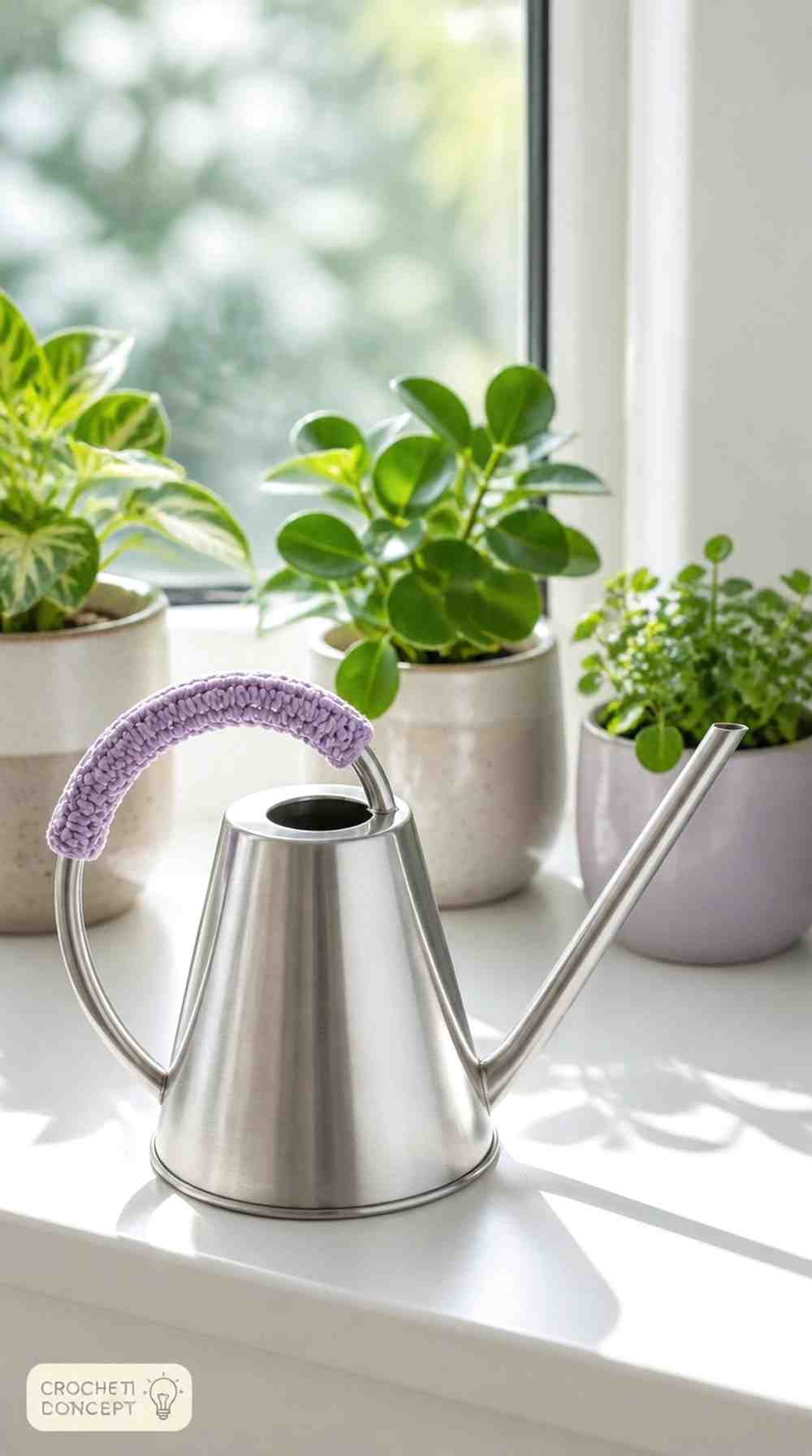
Lilac crochet forms a narrow grip following the short upper curve of a delicate silver indoor watering can. Tiny horizontal ribs cover the sleeve, while lavender edging and a subtle lengthwise seam keep the silhouette neat. Both original handle attachment points remain exposed.
This design is noticeably slimmer than the broad outdoor watering-can wraps. It suits the proportions of a small indoor watering can used around windowsill plants, although the handle’s curvature and thickness need accurate measuring.
- Slim Curved Fit: Measure the actual hand-contact section rather than assuming all indoor watering cans have similar handles.
- Fine Horizontal Ribs: Small crochet rows create texture without making the narrow sleeve excessively thick.
- Lengthwise Seam: Keep the joining line smooth and positioned away from the most comfortable hand-contact area.
- Indoor Use: The lighter watering-can style offers an appealing setting, but a filled can still requires a secure original handle.
13. Crochet Plum Removable Silicone-Grip Jacket
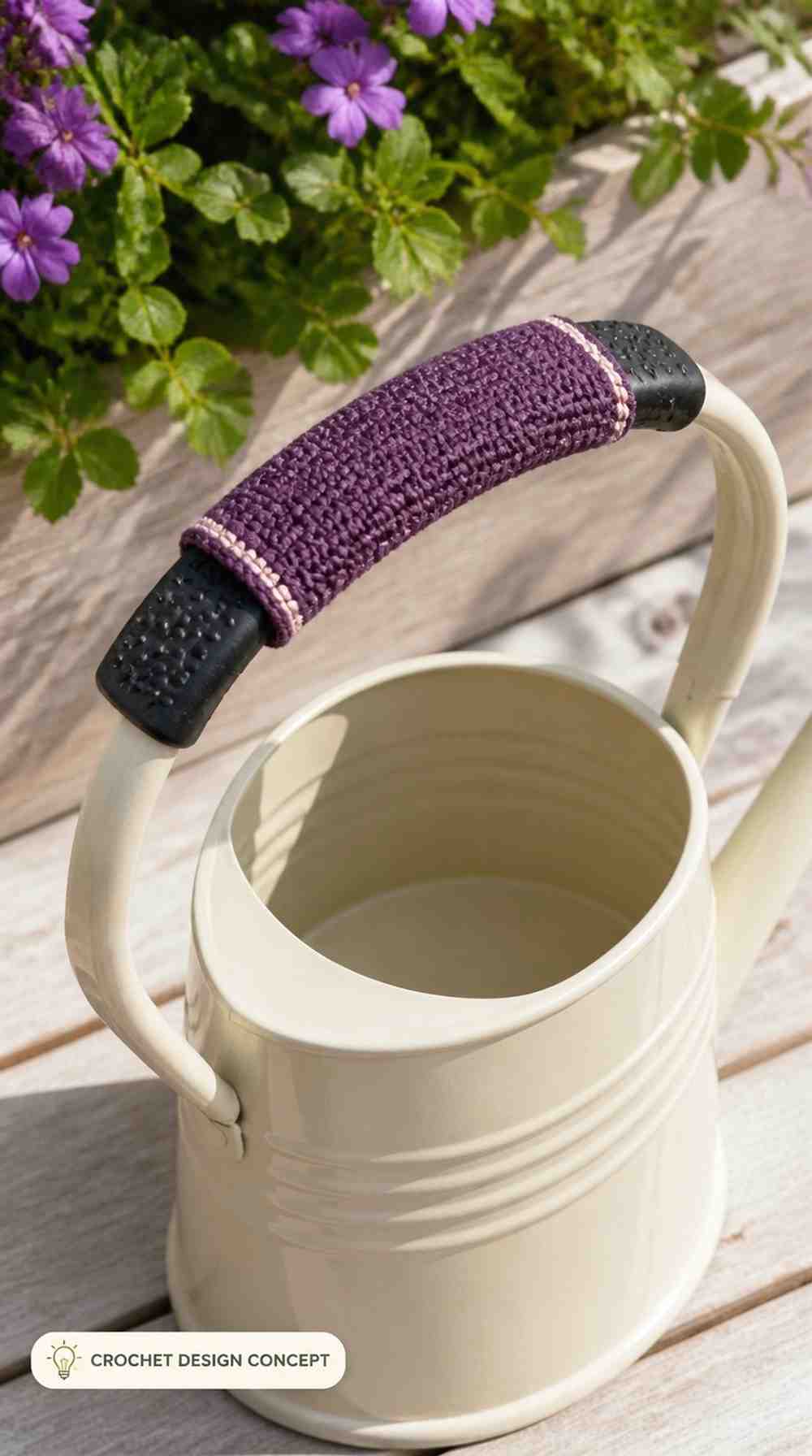
Plum-purple crochet forms a removable decorative jacket around the middle of an existing black silicone handle grip. Two dusty-rose lines finish its closely worked linen-like stitches. The watering can’s original molded silicone remains visible at both ends, with the crochet secured by a concealed underside fastening.
The separate original grip is the defining feature of this design. Instead of placing yarn directly against bare metal, the crochet decorates part of an existing handhold. However, the decorative jacket must not reduce the original grip’s reliability.
- Existing Silicone Grip: The manufactured grip remains part of the watering can and should not be replaced or modified by the crochet.
- Removable Plum Jacket: The outer fabric should fit without rolling, sliding or interfering with the original handhold.
- Dusty-Rose Stripes: Two narrow lines provide subtle color contrast without raised appliqués.
- Grip Safety: If the added crochet makes the handle less secure, remove it and use the manufacturer’s original grip.
14. Crochet Mint Three-Colorblock Watering Can Grip
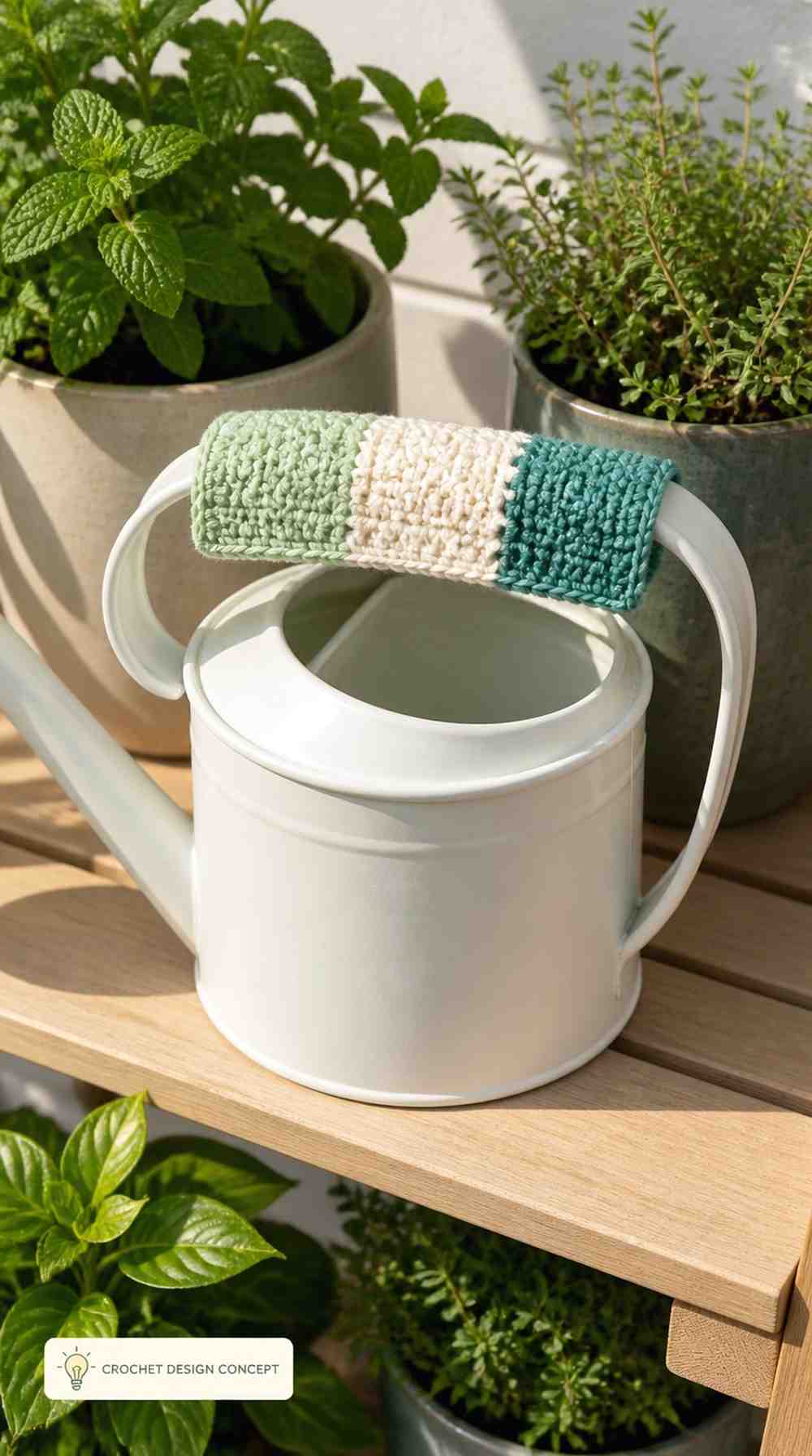
Mint-green, warm ivory and muted teal crochet form three broad sections across this rectangular handle wrap. Flat joining lines separate the colors, while narrow mint edging frames the complete cuff. The grip fastens beneath the upper arch of a white metal watering can.
The clean colorblock arrangement gives the design a modern appearance. Unlike the chevron cuff, its color transitions run straight across the panel, keeping the decorative effect simple and easy to recognize.
- Three Color Sections: Keep the mint, ivory and teal blocks balanced across the central handle area.
- Flat Joining Lines: Smooth joins help prevent uneven thickness where the color sections meet.
- Mint Outer Border: A narrow finishing row ties the three sections together without additional decoration.
- White Handle Finish: Check for rubbing or trapped moisture that could affect the watering can’s painted surface.
15. Crochet Rust Twin-Tab Watering Can Handle Wrap
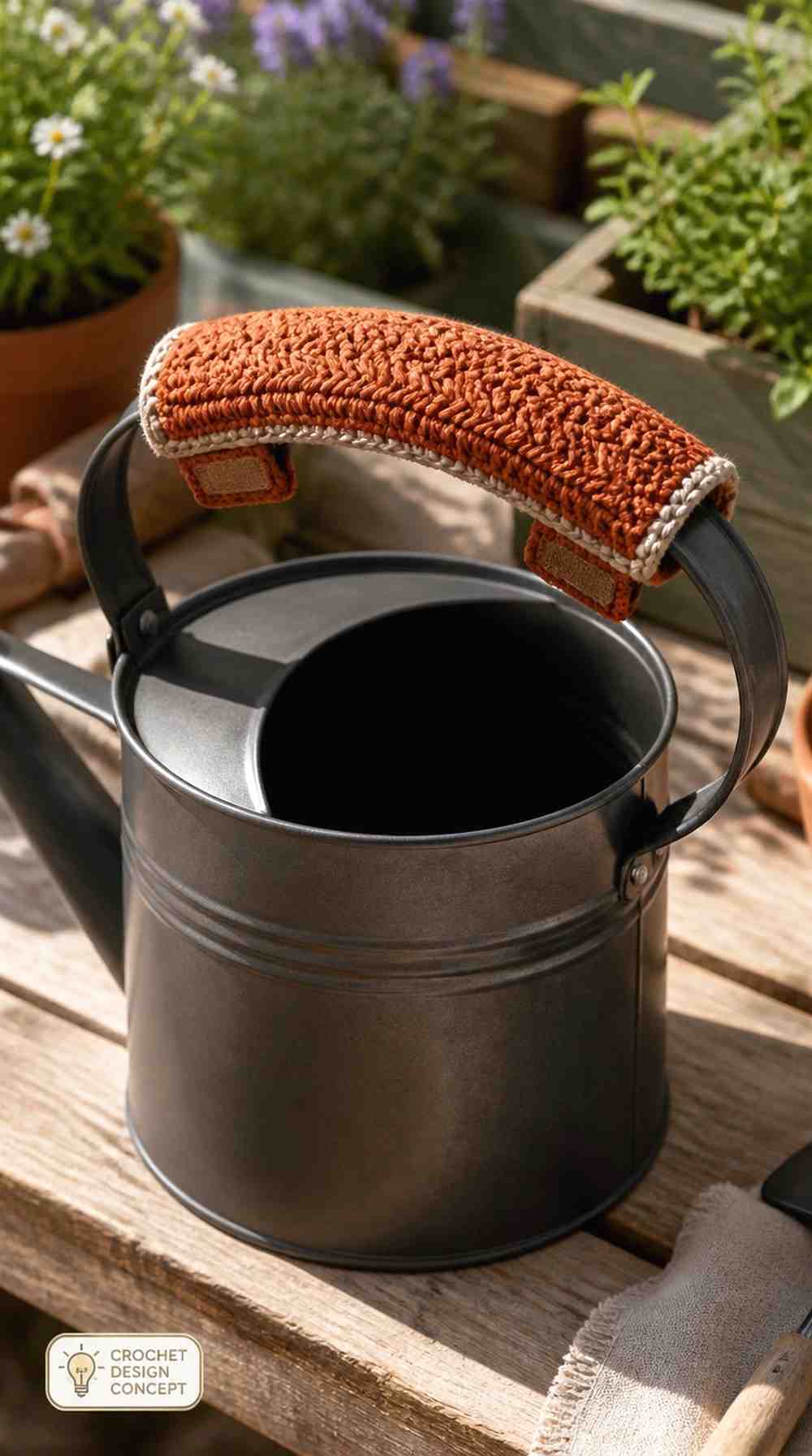
Rust-orange crochet forms a broad grip with fine diagonal herringbone-like texture and narrow oatmeal end borders. Two separate short fastening tabs secure the overlapping underside edges near opposite ends of the wrap. The original charcoal metal handle remains uncovered beside its attachment points.
The twin-tab arrangement distinguishes this concept from single-button and centrally fastened grips. Its two closure positions offer a way to explore a neatly fitted removable wrap, although both tabs need checking for comfort and secure attachment.
- Two Fastening Tabs: Position the tabs near opposite ends so the central underside remains relatively smooth.
- Diagonal Crochet Texture: The herringbone-like rows add visual movement without using thick raised motifs.
- Oatmeal End Borders: Narrow finishing lines define the grip while keeping the handle’s original joints clear.
- Closure Inspection: Both fabric fasteners need to stay flat and secure; an attractive fit is not proof that the wrap will remain in place.
Practical Guide to Crochet Watering Can Handle Grips
A crochet watering can handle grip should be considered a removable decorative accessory first. Its suitability for actual watering depends on the original handle, the added fabric’s fit and how it behaves when exposed to water.
Measure the hand-contact area. Check the handle’s width, circumference, curvature and available straight section. A wide outdoor watering-can handle and a slender indoor plant-watering handle may need very different sleeve shapes.
Keep the original handle intact. Do not remove a manufacturer’s grip or rely on crochet to repair a loose or damaged handle. A fabric wrap cannot provide the structural strength needed to support a filled watering can.
Consider moisture carefully. Cotton crochet can absorb water, and wet fabric may move against smooth painted metal or become difficult to grip. An illustration cannot establish slip resistance. Remove the cover if it shifts, twists or makes carrying less secure.
Choose removable construction. Buttons, concealed fabric fasteners and openable seams can make it easier to take the accessory off for cleaning. Hard closures should remain away from the hand-contact area.
Protect the watering can’s finish. Moisture held against metal can contribute to deterioration of vulnerable surfaces. Remove the cover after damp use and allow both the handle and crochet to dry fully.
Keep the grip clear of moving and functional parts. Do not cover handle attachment joints, fill openings, spouts or other parts needed to use the watering can safely.
Use appropriate yarn. Smooth, washable cotton or a suitable blend may be worth considering for decorative crochet. Avoid excessively fuzzy fibers, heavy raised appliqués and long dangling strands.
For other decorative sleeve ideas, explore 15 Crochet Ruffle-Edge Cup Sleeve Ideas on Yarn Nest Studio. Although the collection is about cups rather than watering cans, it offers related inspiration for compact crochet wraps, scalloped edges and decorative finishing.
Want to Make Something Similar?
The following verified resources explain related handle-cover techniques. They are not exact patterns for the 15 watering can grips above, and none establishes that crochet is safe or nonslip on a wet gardening tool.
- Crochet Luggage Handle Wrap — CyCrochet — A free written tutorial for a removable rectangular handle wrap with a buttonhole. It offers useful background on measuring a handle, shaping a flat crochet panel and planning a closure. CyCrochet
- Bag Handle Cover — Crocket Crochet — A free video-linked pattern listed on Ravelry for a removable bag-handle cover using a separating zipper. It offers another way to think about removable construction, though it is intended for a bag rather than a watering can. ravelry.com
Both are technique references. A watering can has different exposure to moisture and changes in carried weight, so finished decorative wraps require their own fit and handling checks.
Which Crochet Watering Can Handle Grip Should You Choose?
| Your main priority | Designs worth comparing | Important consideration |
|---|---|---|
| Simple everyday decoration | Sage Ribbed, Navy Striped | Fit and underside fastening |
| Removable buttoned closure | Oatmeal Buttoned | Raised hardware and comfort |
| Raised crochet texture | Terracotta Braided-Center, Charcoal Waffle-Lined | Bulk and moisture retention |
| Decorative lower edging | Ivory Scalloped | Snagging and cleaning |
| Traditional crochet motifs | Denim Granny-Square | Open stitches and joins |
| Bold colorwork | Mustard Chevron, Mint Three-Colorblock | Flat seams and even fabric thickness |
| Separate padding | Dusty Blue Cushioned | Pad movement and wet handling |
| Openwork accents | Forest Eyelet-Edge | Dirt collection in stitch openings |
| Floral decoration | Coral Daisy | Flower placement and secure stitching |
| Small indoor watering can | Lilac Slim-Arch | Slender handle measurements |
| Existing manufactured grip | Plum Silicone-Grip Jacket | Must preserve original grip function |
| Two removable fastenings | Rust Twin-Tab | Both closures need inspection |
If you want an understated design, the Crochet Sage Ribbed Watering Can Handle Grip offers a simple color palette and recognizable crochet texture.
For a decorative garden-tool look, the Crochet Coral Daisy Watering Can Handle Wrap and Crochet Denim Granny-Square Watering Can Handle Wrap introduce familiar handmade motifs.
If your watering can has a narrow indoor-style handle, the Crochet Lilac Slim-Arch Watering Can Grip Sleeve is the most specifically shaped concept.
For a watering can that already has a molded silicone handle grip, the Crochet Plum Removable Silicone-Grip Jacket offers a decorative direction without replacing the original part. The crochet should be removed whenever it interferes with safe handling.
Conclusion
These 15 crochet watering can handle grip inspiration ideas show how a small gardening accessory can be styled through different crochet stitches, colors, borders and removable closures. Ribbed wraps, braided details, granny squares, floral motifs and colorblock panels each offer a distinctive handmade appearance.
The most suitable design depends on the watering can’s handle size, finish and how often it becomes wet. Any finished crochet cover should be easy to remove, comfortable to handle and kept clean and dry. Its appearance should never be mistaken for tested grip performance.
Which design would you choose: the Sage Ribbed Grip, the Terracotta Braided-Center Wrap, the Coral Daisy Cover or the Plum Silicone-Grip Jacket? Share whether you use a large outdoor watering can or a small indoor plant-watering can.
Frequently Asked Questions
1. Can crochet make a watering can handle easier to grip?
Crochet may change how a handle feels, but it is not automatically nonslip. Yarn can absorb moisture, stretch or move against smooth surfaces. A handmade cover should only be considered for actual use after checking its fit and whether it interferes with safe handling. Remove it if it slips or twists.
2. What yarn is suitable for a crochet watering can handle grip?
Smooth, washable cotton or a suitable cotton blend may be worth exploring for a removable decorative wrap. Dense stitches can provide a defined shape, but yarn type alone does not establish wet-grip performance. Avoid materials that shed heavily or retain moisture for long periods without proper drying.
3. Should a crochet handle grip cover the entire watering can handle?
Not necessarily. Many of these concepts cover only the central area where the hand naturally rests. Leaving the handle’s attachment points uncovered can simplify inspection and removal. The correct size depends on the actual handle and must not interfere with its structural connections.
4. Can I leave a crochet grip on a watering can outdoors?
It is better to remove a decorative crochet grip when it becomes wet and allow it to dry completely. Prolonged moisture can affect yarn condition and may contribute to damage on vulnerable metal finishes. Crochet should not be assumed weatherproof, mildew-resistant or suitable for permanent outdoor exposure.
5. Are these 15 crochet watering can handle grip ideas complete patterns?
No. These are original AI-generated inspiration concepts showing possible crochet wrap shapes, stitches, colors, fasteners and decorative details. They do not include tested stitch counts, exact dimensions, yarn quantities, verified grip performance or safety ratings. The linked resources demonstrate related handle-cover construction techniques rather than exact patterns for these particular designs.