A crochet board game dice rolling tray can bring a handmade touch to family game nights, tabletop adventures and casual dice games. Rather than letting dice scatter across the table or bump into game pieces, a tray provides a designated place to roll. These 19 inspiration ideas explore square snap-corner trays, rounded bowls, hexagonal arenas, divided organizers, decorative rims and compact travel-friendly designs, each with different crochet textures and colors.
A useful dice tray needs more than attractive stitching. The rolling area should be broad and level, the sides should help contain dice, and the surface should not cause awkward or unclear resting positions. This collection helps you compare tray shapes, removable linings, reinforced walls, storage options, cleaning and tabletop space. The designs are crochet concepts, so their stability, rolling behavior and physical construction would need testing before everyday play.
These are AI-generated crochet design visualizations for inspiration, not photographs of tested handmade trays or step-by-step patterns.
Quick Design Selection Guide
- For a compact folding tray: Crochet Sage Snap Corner Dice Tray has a simple square shape with removable corner fastenings.
- For distinctive geometric designs: Crochet Terracotta Octagon Dice Bowl, Crochet Mustard Hexagon Dice Arena and Crochet Burgundy Velvet Pentagon Dice Tray offer different polygonal layouts.
- For classic board games: Crochet Navy Low Wall Game Tray and Crochet Charcoal Long Rectangle Dice Tray have straightforward rolling areas.
- For carrying spare dice: Crochet Teal Split Zone Dice Tray separates the rolling space from a small dice-storage section.
- For decorative family game nights: Crochet Coral Sunflower Dice Tray and Crochet Rainbow Stepped Square Dice Tray add colorful outer details.
- For tabletop RPGs: Crochet Forest Deep Wall Dice Arena has taller walls, while Crochet Plum Arch Window Dice Tray offers a distinctive shape.
- For travel organization: Crochet Sandstone Book Fold Dice Tray combines a rolling section and a separate dice-bag pocket.
The goal is a comfortable, clear rolling surface rather than simply a crochet basket. A fabric lining or removable flat support may help, but its actual performance should be checked with the dice used in your games.
1. Crochet Sage Snap Corner Dice Tray
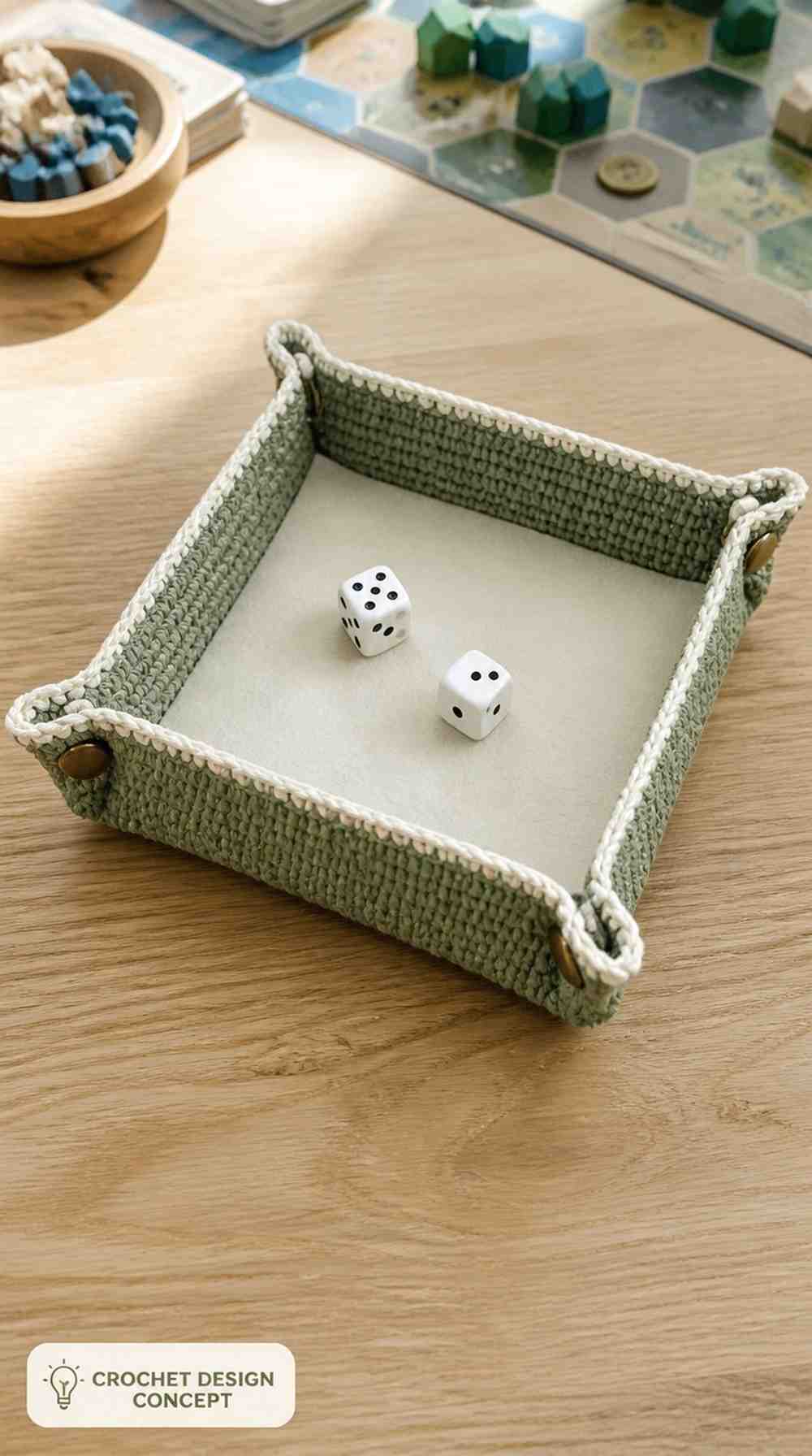
Soft sage-green crochet gives this square rolling tray a clean, understated appearance. Its moss-stitch base meets four short upright walls held together with antique-brass corner snaps. Ivory edging outlines the tray, while a removable cream felt insert provides a smoother central surface for the two dice.
This design is worth exploring for players who want a portable tray that can potentially fold flatter between games. However, the corner fastenings and base would need testing to ensure the sides stay upright during rolling.
- Snap Corners: Four detachable corners could allow flatter storage, but the snaps need secure installation and should not pull through the crochet fabric.
- Rolling Surface: The removable felt insert provides a smoother area than exposed moss stitches, although dice can still behave differently on soft fabric.
- Corner Stability: Test the tray with actual rolling motions to see whether the walls lean inward or the base shifts across the table.
- Portable Shape: A compact square may suit smaller tables, but the available rolling area becomes narrower once the walls are raised.
2. Crochet Terracotta Octagon Dice Bowl
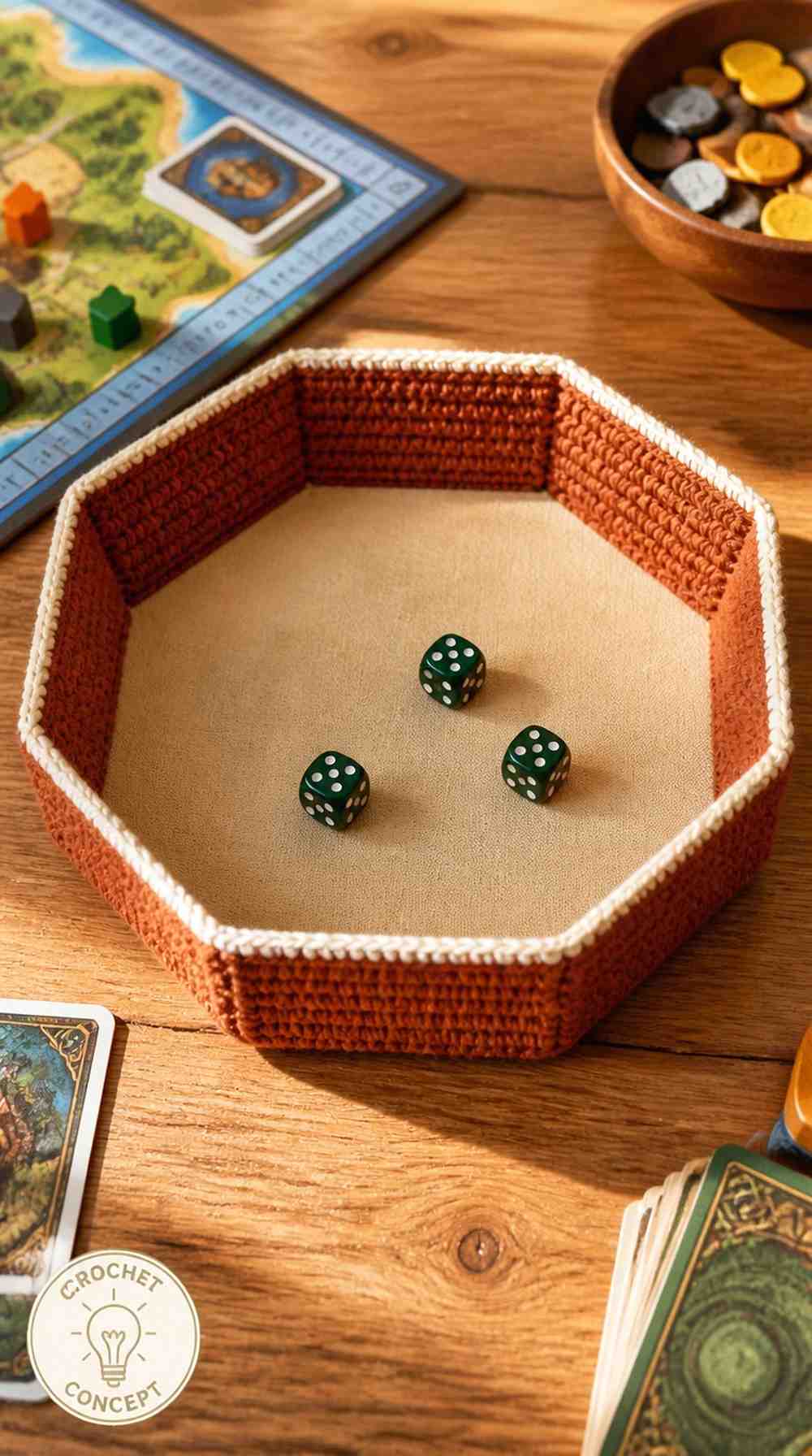
Rich terracotta crochet creates a distinctive eight-sided tray with neatly defined low walls. A warm-cream upper border highlights the octagonal shape, while a smooth sand-colored insert covers the flat center. Three dark-green dice provide a striking contrast against the earthy background.
The eight-sided construction gives the tray a decorative character without relying on flowers or appliqués. Because the walls meet at several angles, their joins need careful planning to prevent gaps or weak corners. The interior should remain level rather than becoming a rounded storage bowl.
- Eight-Sided Shape: The individual panels must meet evenly so the tray retains its intended octagonal outline.
- Wall Joining: Reinforced corners are important because soft crochet may fold or spread when dice strike the sides.
- Flat Center: A removable supported liner can help create a level rolling area without requiring the crocheted base itself to be rigid.
3. Crochet Charcoal Long Rectangle Dice Tray
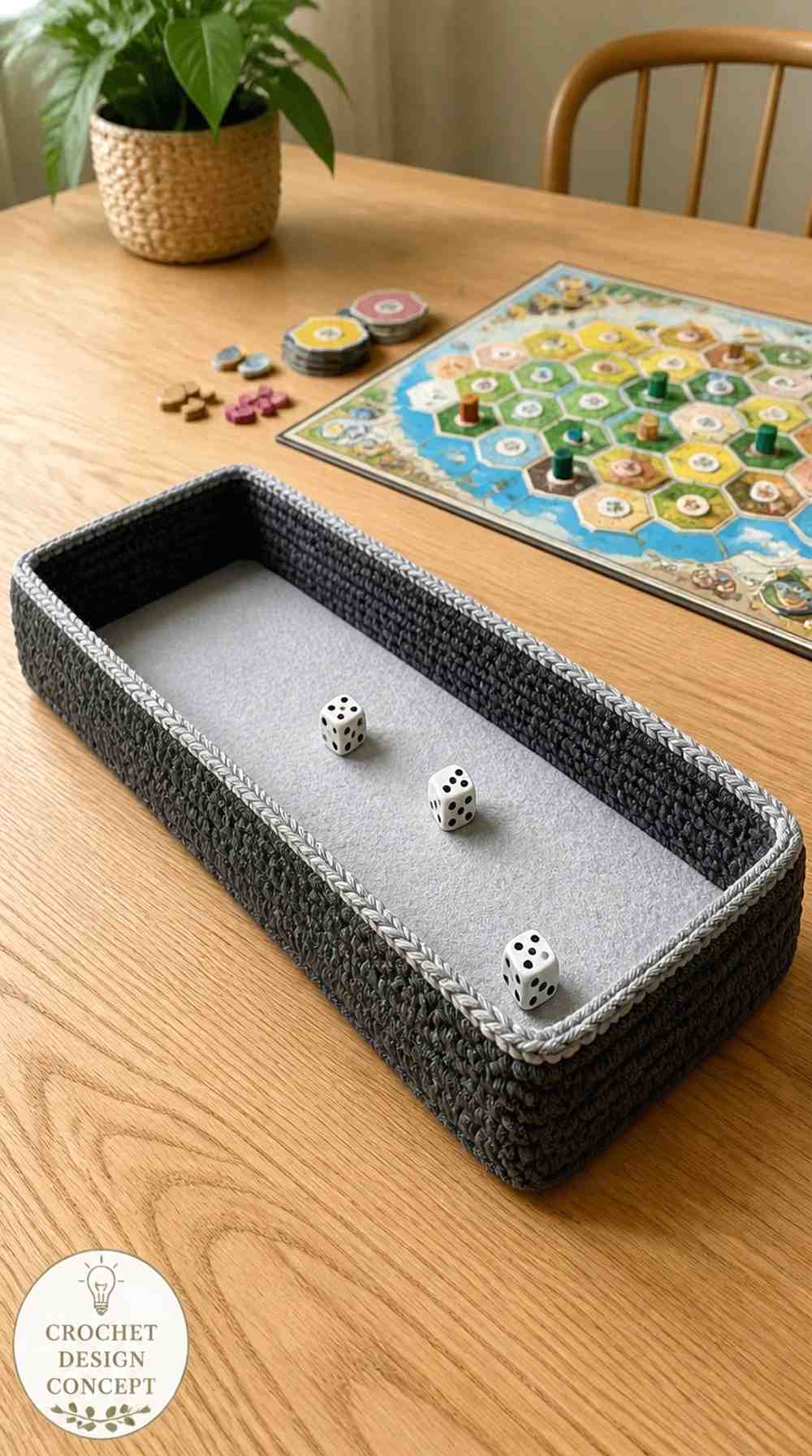
Deep charcoal crochet gives this elongated rectangular tray a modern board-game appearance. Raised horizontal stitches run along its straight walls, finished with a narrow silver-grey border. A pale-grey felt insert covers the broad center, with three white dice resting inside.
The longer shape is useful to consider when a board-game table has more width than depth available. It provides a defined rolling lane rather than a circular area. The sides should remain low enough for players to see the results clearly, while still helping contain ordinary rolls.
- Rectangular Footprint: Measure the available tabletop space, especially if the tray will sit beside a board containing other pieces.
- Rolling Lane: The elongated center may suit a few six-sided dice, but check that its width allows them to tumble naturally.
- Charcoal Texture: Bright lighting helps reveal the raised crochet rows, which could otherwise disappear against a dark table.
- Low Side Walls: Keep the walls proportionate to the dice; excessively low sides may allow rolls to escape.
4. Crochet Lavender Drawstring Dice Tray
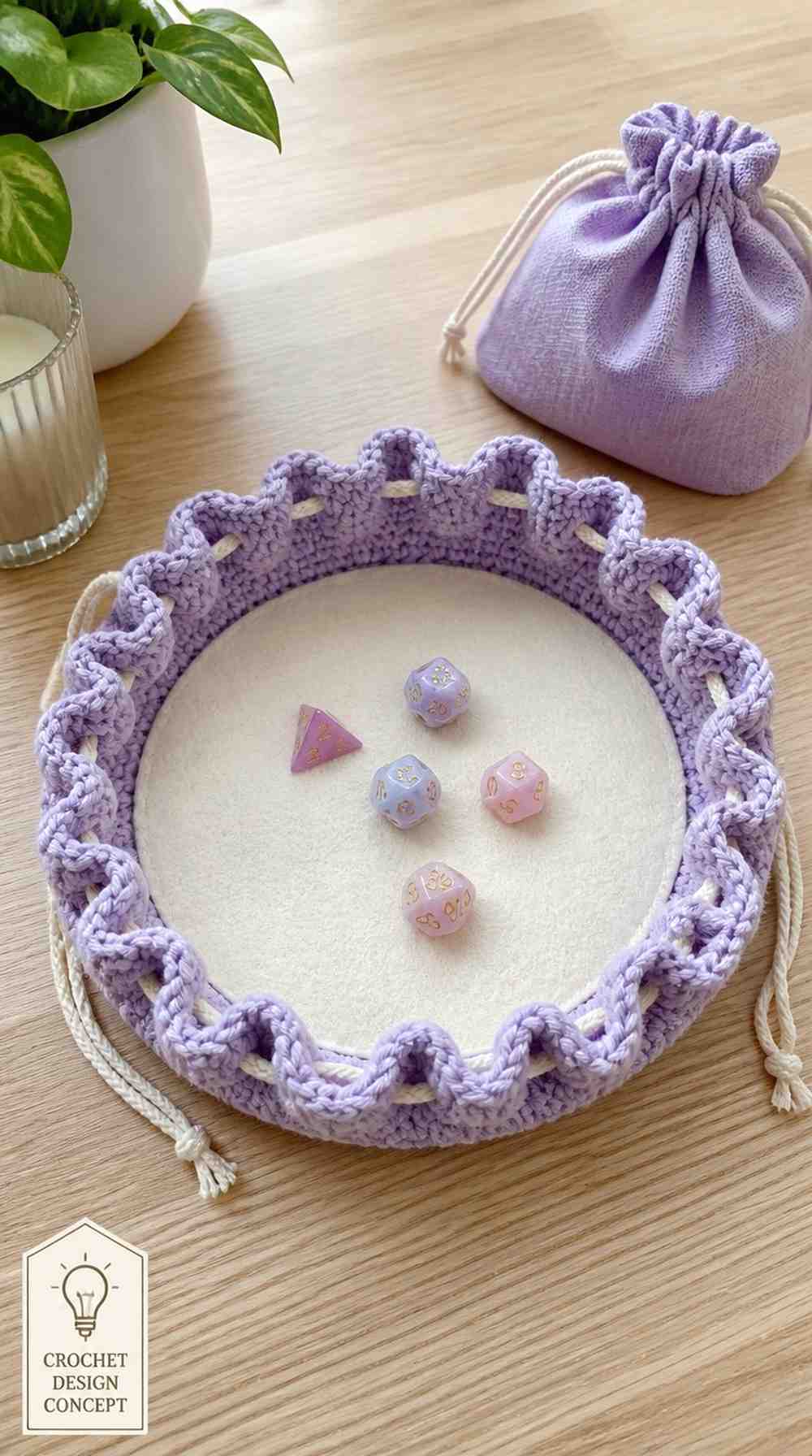
Lavender crochet creates a broad circular dice tray with gently gathered walls and an ivory drawcord threaded through the rim. The cord is loosened so the tray opens into a shallow round playing area. Five pastel polyhedral dice rest on a smooth cream felt center.
This concept explores the familiar combination of dice storage and rolling space. When the drawstring is pulled, the same construction might form a bag, provided the design is engineered to close correctly. A broad tray is not automatically able to cinch into a secure pouch.
- Drawstring Conversion: Test whether the opening closes sufficiently to contain dice; some wide circular bases resist gathering into a secure bag.
- Pleated Walls: Even gathering helps the rim hold its shape, while irregular folds may fall into the rolling area.
- Cord Ends: Keep the loose drawstring tails outside the tray during play so dice do not land against them.
5. Crochet Navy Low Wall Game Tray
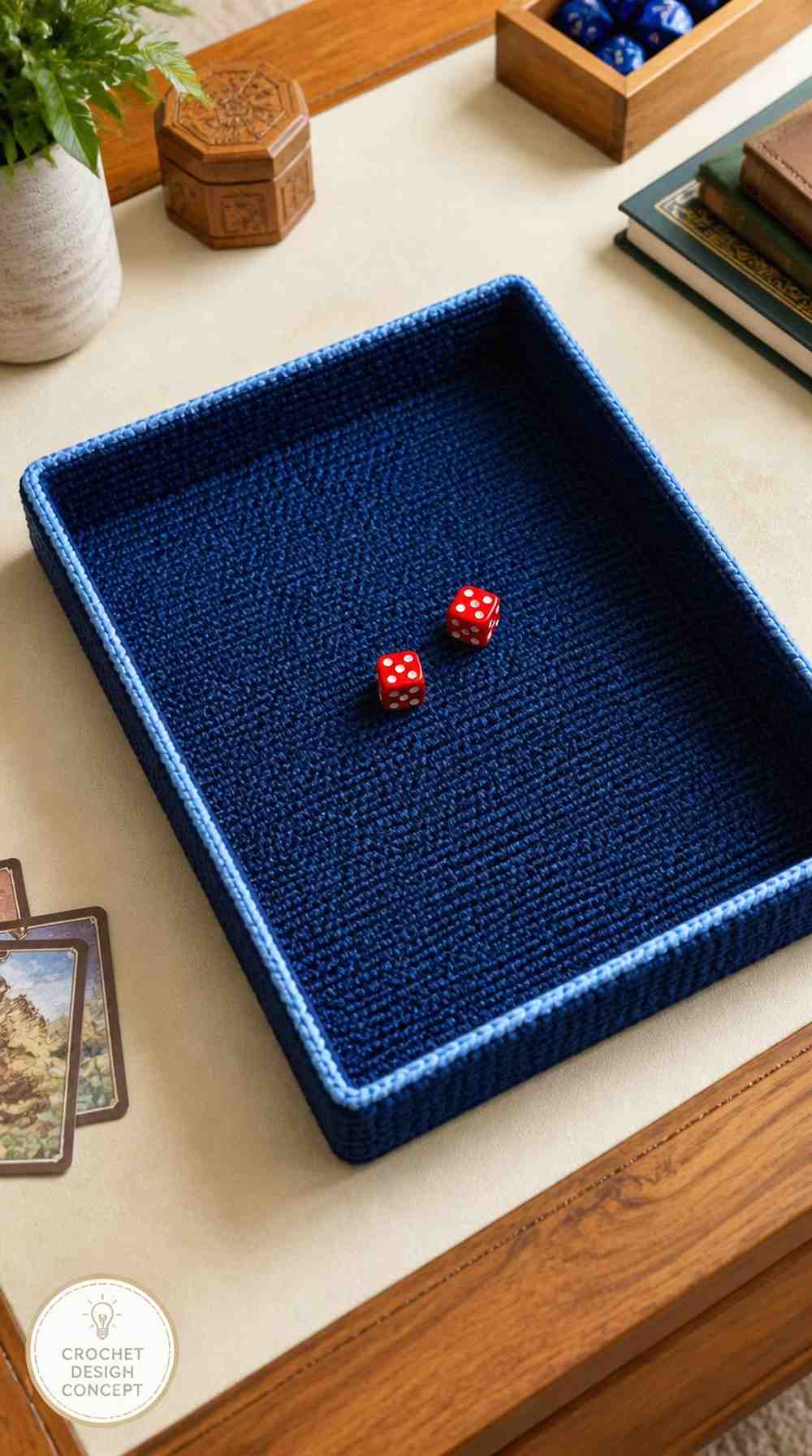
Navy-blue crochet gives this low rectangular tray a tidy appearance. Sky-blue edging runs around its shallow walls, while a removable ivory felt insert covers the flat supported base. Two red dice sit in the middle with plenty of empty space around them.
This design keeps decoration to a minimum and focuses on the rolling area. It may be especially suitable to explore for classic family board games using one or two ordinary dice. The low walls create a clear view, although they must still contain dice that bounce toward the edge.
- Open Visibility: Shallow walls make dice results easy to see without requiring players to reach into a deep container.
- Flat Support: A suitably sized removable insert beneath the felt can help prevent the center from wrinkling or sagging.
- Dice Containment: Test the wall height with the actual dice; a shallow tray may not retain forceful throws.
6. Crochet Ivory Spiral Oval Dice Tray
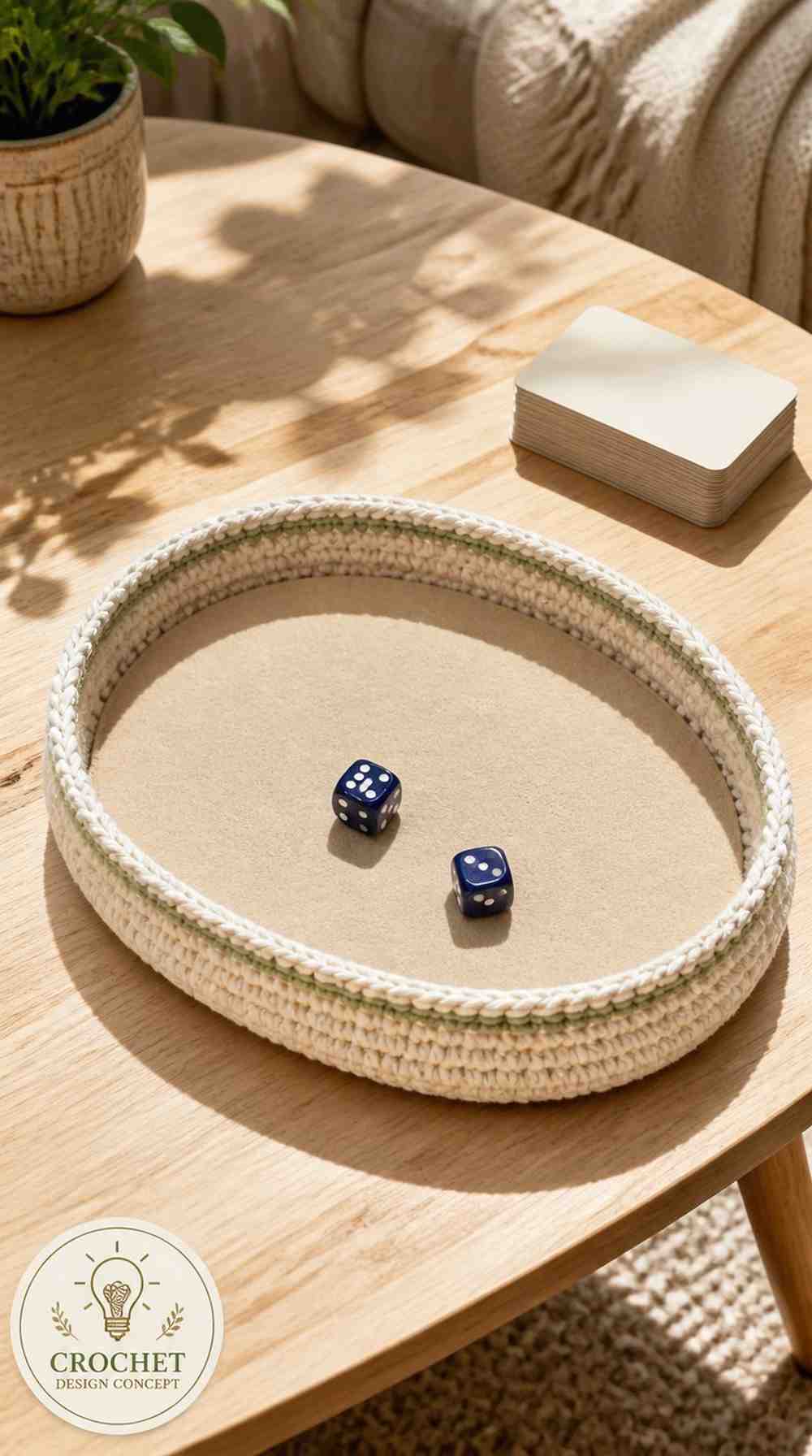
Warm-ivory crochet gives this oval tray a soft, traditional appearance. Concentric spiral rows spread across its broad base, rising into a low continuous border with a muted-sage stripe. A removable beige felt insert covers the central rolling area, where two dark-blue dice rest.
The oval shape offers an alternative to straight-sided trays. Its curves create a gentle silhouette that can look attractive on a coffee table. However, oval walls may need careful shaping and support to avoid collapsing inward, especially when worked with flexible yarn.
- Oval Proportion: Compare the usable interior length and width, not just the decorative outer dimensions.
- Spiral Construction: Even crochet increases help maintain a flat base; poor shaping can cause the center to cup or ripple.
- Removable Felt: The insert should follow the oval interior closely without bunching around the raised edge.
7. Crochet Mustard Hexagon Dice Arena
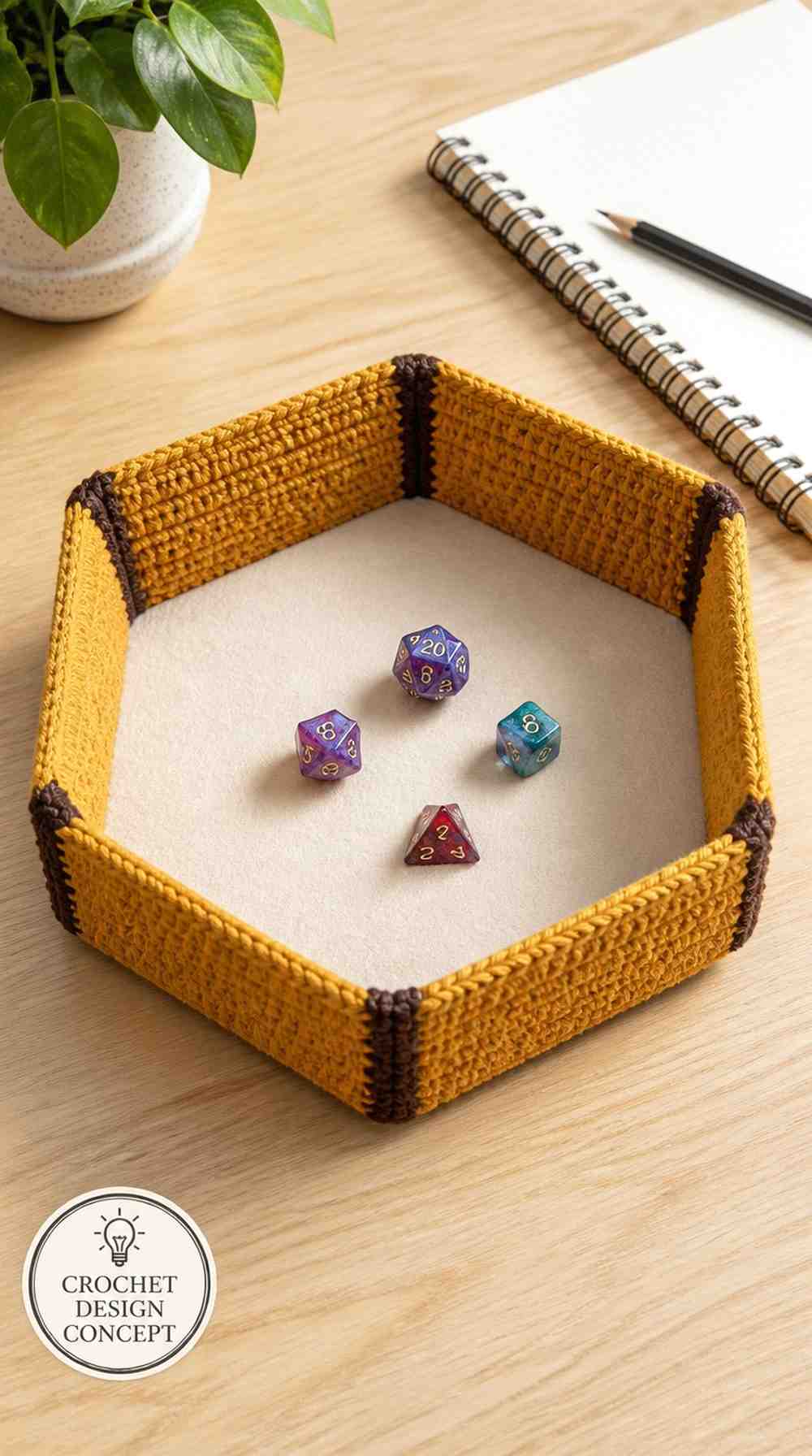
Golden mustard crochet makes this six-sided dice tray a colorful tabletop accent. Chocolate-brown joins define each corner, while a cream felt center provides a pale rolling surface. Four jewel-toned polyhedral dice rest within the low hexagonal walls.
The six-sided layout has a distinctive tabletop-game character. Unlike a round tray, the hexagon has straight sections that meet at clear angles. The individual wall panels must remain aligned so the tray looks balanced and provides a usable center rather than an uneven, twisted surface.
- Six Wall Panels: Equal shaping and consistent joins are important for maintaining the hexagonal outline.
- Polyhedral Dice: Test d4, d6, d8 and other dice shapes on the selected lining; pointed dice may behave differently from rounded-edge cubes.
- Corner Reinforcement: Brown corner joins provide visual definition, but structural strength depends on actual construction and support.
8. Crochet Rust Granny Mosaic Dice Tray
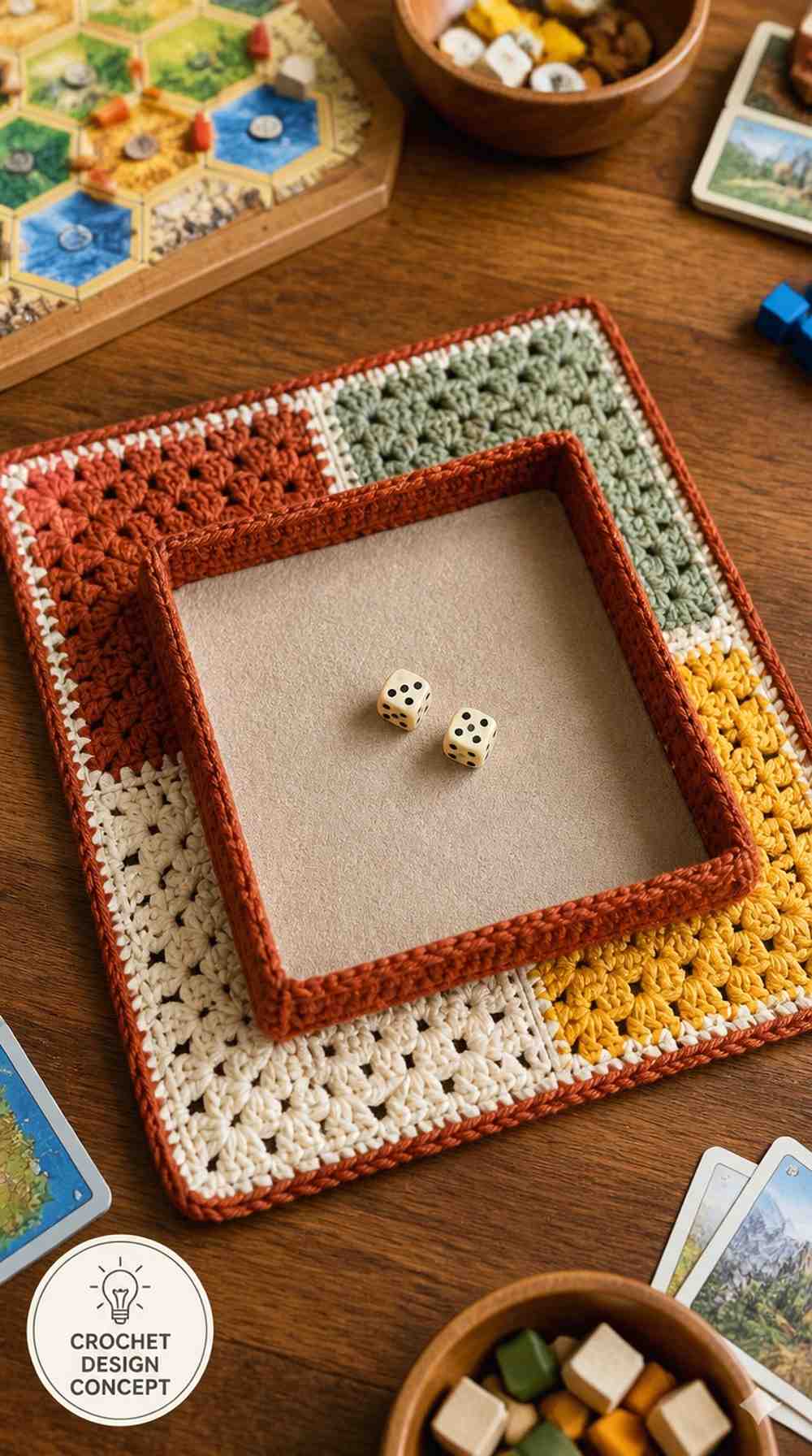
Four colorful granny-square motifs create the decorative foundation for this square dice tray. Rust, sage, mustard and ivory appear around the outer perimeter, joined by flat cream seams. Short rust-colored walls surround a removable beige felt insert covering the center.
This design combines traditional crochet motifs with a board-game accessory. The felt center matters because raised granny-square joins can produce uneven surfaces where dice may stop awkwardly. The surrounding motifs remain visible as decoration without needing to form the actual rolling floor.
- Granny-Square Joins: Keep the motifs connected with flat, secure seams so the base does not pull apart when handled.
- Felt Coverage: The central insert should hide the raised joining rows that could affect the dice resting position.
- Color Arrangement: Four distinct shades make the tray visually interesting without adding raised decorative pieces inside the rolling area.
For a related way to organize dice when they are not being rolled, explore Yarn Nest Studio’s 12 Crochet Checkerboard Dice Bag Ideas, which focuses on dice-storage bags rather than tabletop rolling trays.
9. Crochet Teal Split Zone Dice Tray
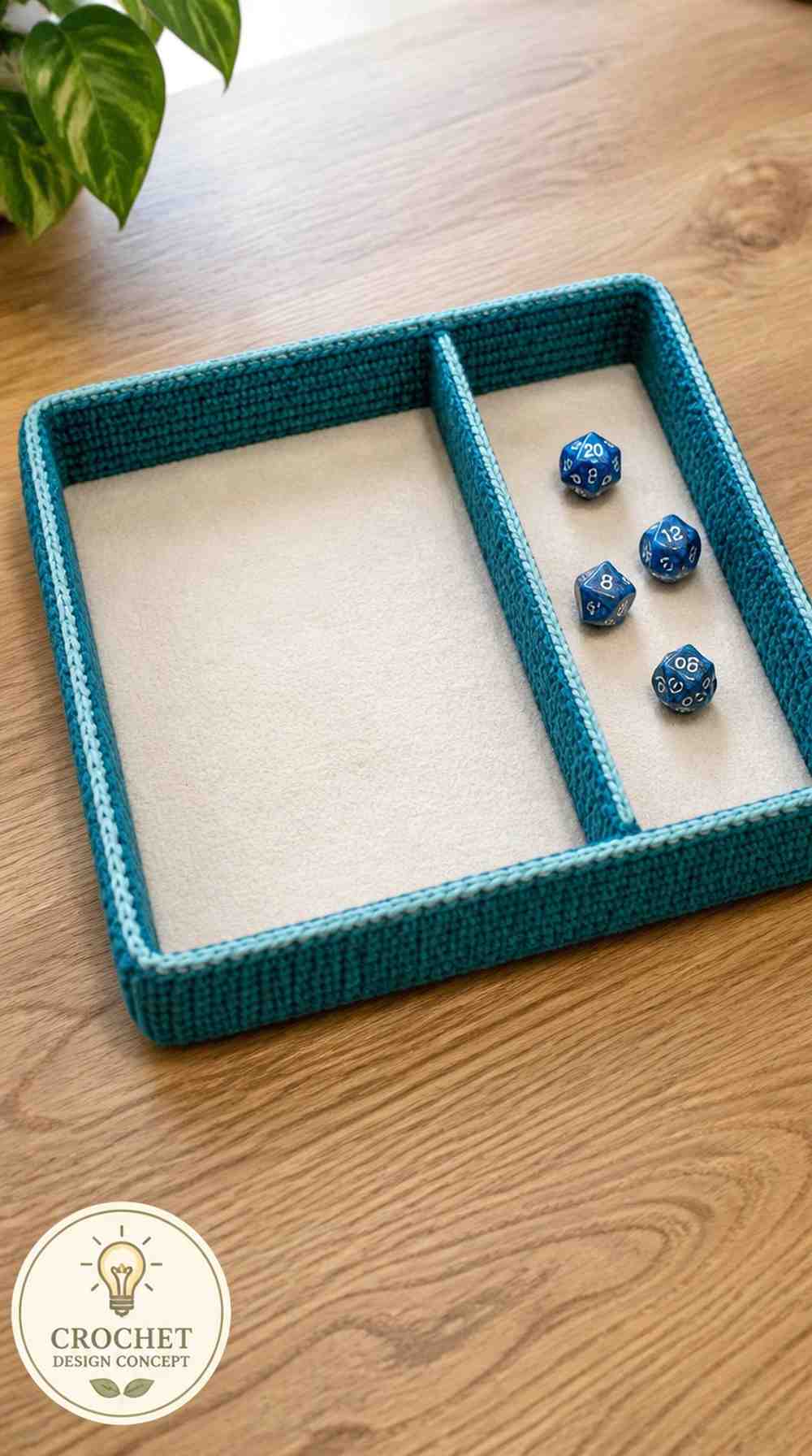
Bright teal crochet forms a rectangular tray with two separate areas. The larger left compartment has a smooth cream felt floor for rolling, while the smaller right compartment holds four spare blue polyhedral dice. A low teal divider keeps the two sections distinct.
This layout is particularly useful to consider for games involving several dice types. Instead of leaving unused dice scattered around the board, the smaller area gives them a designated place. The divider should not intrude so far into the rolling section that the usable space becomes cramped.
- Two-Zone Layout: Reserve the larger compartment for actual rolls and use the smaller section for spare dice rather than mixing everything together.
- Divider Height: The internal wall should remain low enough to access spare dice but high enough to distinguish the two areas.
- Usable Rolling Space: Measure the main compartment independently; the tray’s full exterior width does not represent available rolling room.
- Spare Dice Access: Leave enough clearance above the smaller section for players to pick up dice without disturbing the divider.
10. Crochet Burgundy Velvet Pentagon Dice Tray
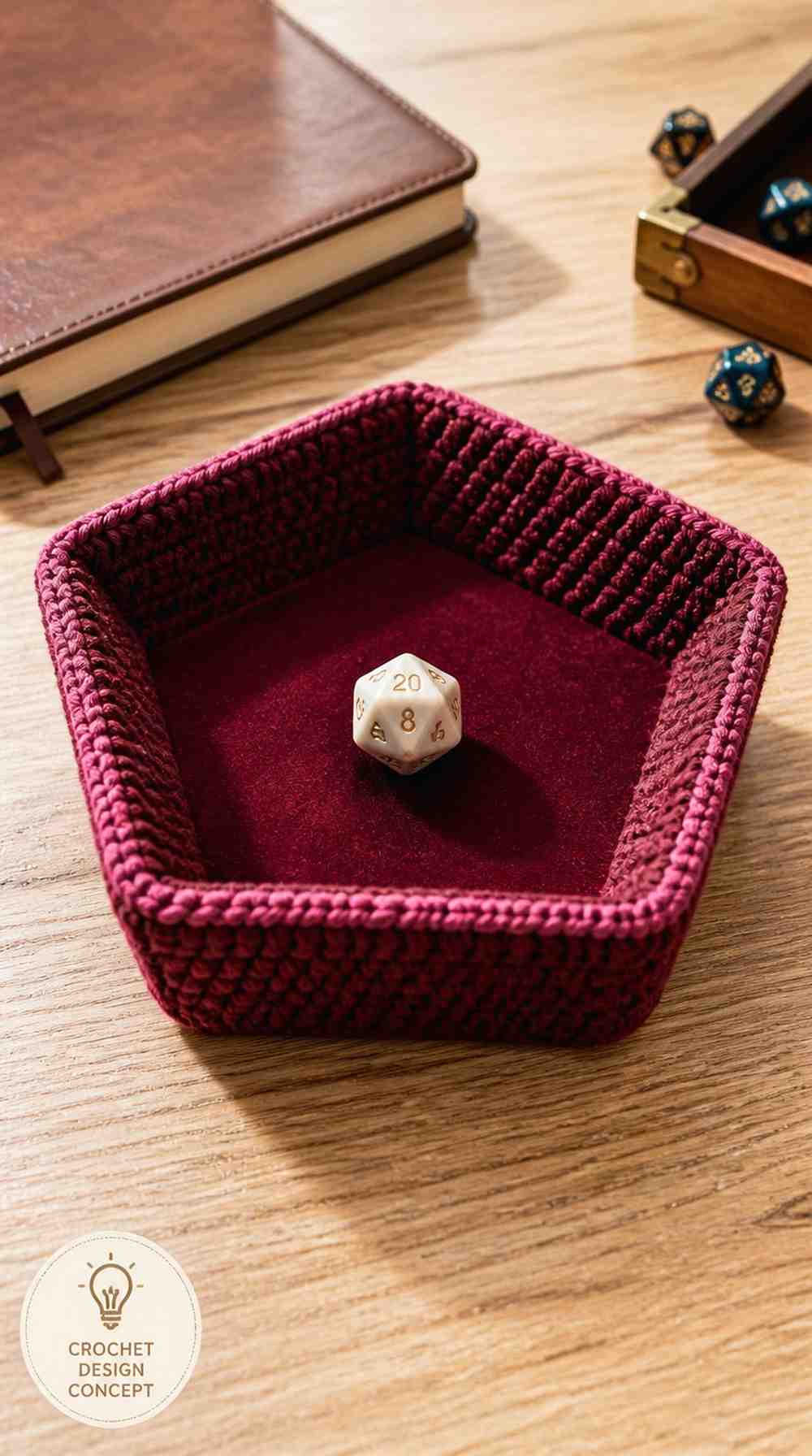
Deep burgundy crochet gives this five-sided tray an elegant appearance. Raised diagonal stitches decorate the outer walls, with dusty-rose trim along the rim. A smooth wine-red velvet-like lining covers the flat central floor, where one ivory twenty-sided die rests.
The pentagonal silhouette provides a different visual direction from the square, hexagon and octagon designs. Its soft lining may make rolling feel quieter, but that is not guaranteed, and highly cushioned fabrics can affect how dice tumble. The tray should be assessed with the dice and games actually played.
- Five-Sided Outline: Each wall section needs consistent shaping so the finished base remains level and the angles meet cleanly.
- Velvet-Like Interior: A smooth, closely fitted liner may reduce contact with crochet loops, but loose or plush fabric can still affect dice behavior.
- Single D20 Space: Check whether the center provides enough room for the die to tumble and settle without leaning against a wall.
11. Crochet Seafoam Wave Rim Dice Tray
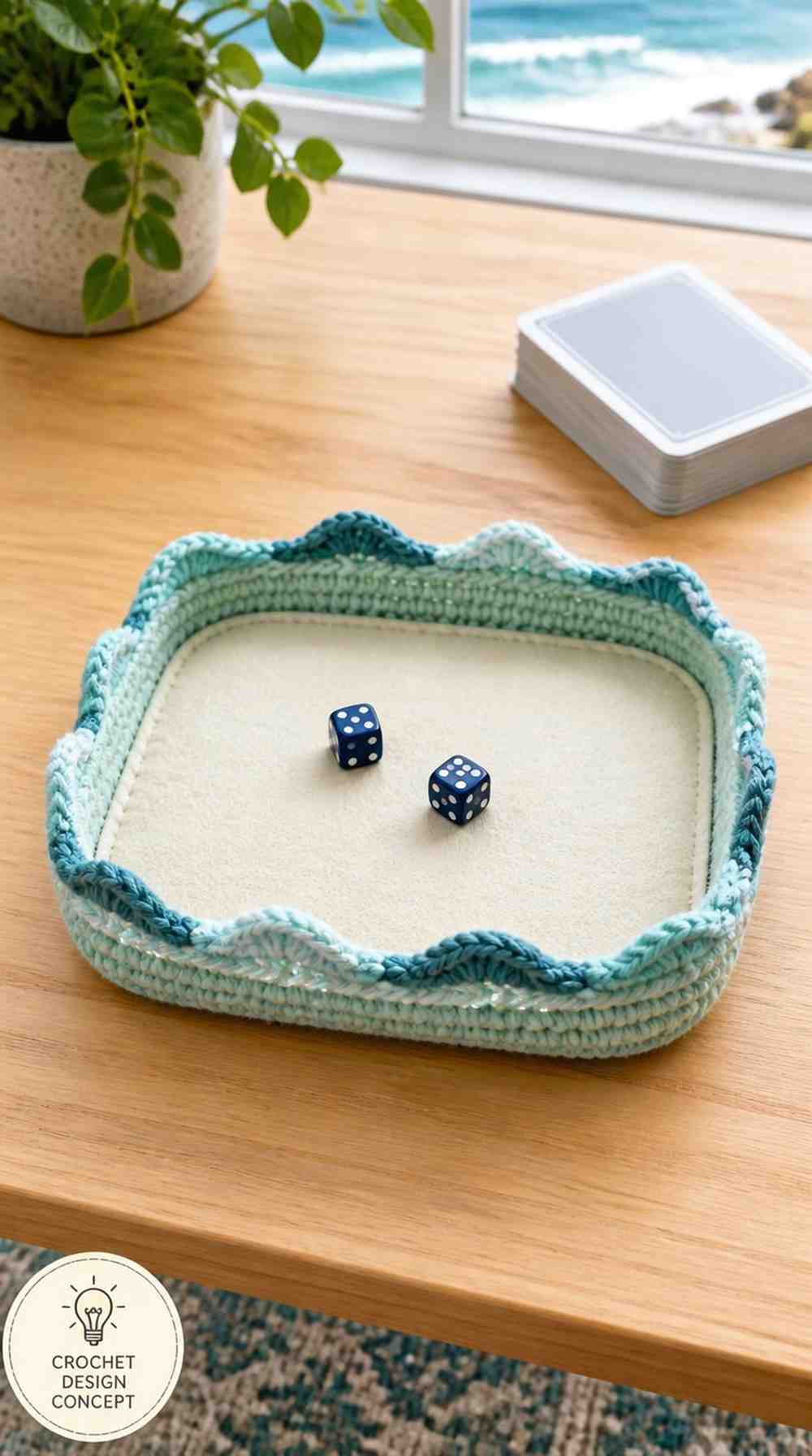
Seafoam-green crochet gives this rounded rectangular tray a fresh coastal appearance. Its smooth cream felt center is framed by low inner walls, while pale aqua and teal crochet form a softly undulating decorative edge around the outside. Two navy dice rest in the middle.
The wavy rim is the visual feature that sets this concept apart. Keeping the decoration outside the rolling surface is important, as raised waves inside the tray could interfere with dice. The inner walls should maintain a continuous boundary regardless of the decorative edge.
- Wave Placement: Keep the raised wave trim outside the functional rolling floor, where it will not interrupt dice movement.
- Inner Wall Height: The actual containment wall should remain consistent even where the outer decorative trim rises and falls.
- Rounded Corners: The felt insert must follow the softened rectangular shape without leaving loose fabric gathered in the corners.
12. Crochet Black Cream Reversible Dice Tray
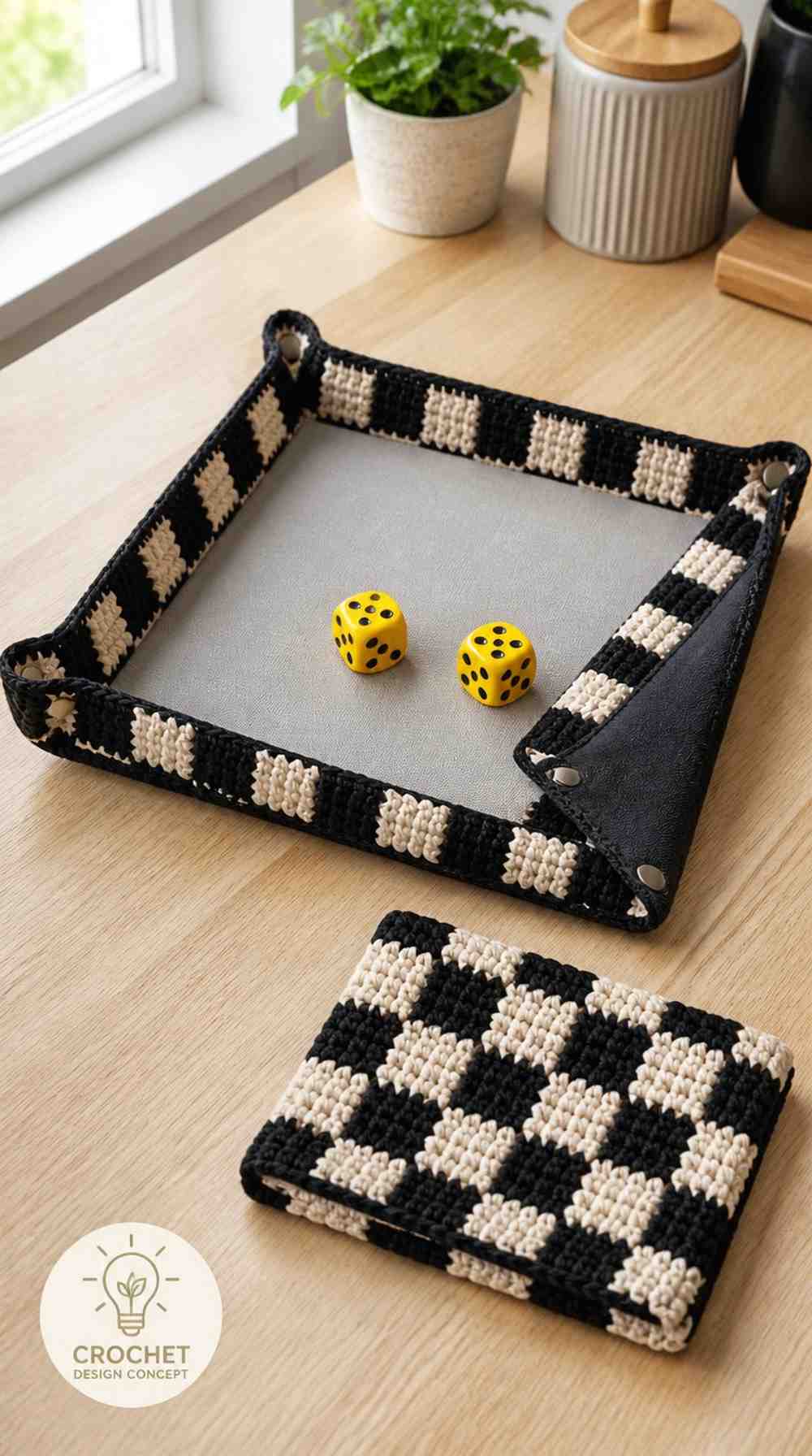
Black and warm-cream crochet squares create a bold checkerboard interior for this folding dice tray. Its reverse side is solid charcoal, visible at a slightly turned corner. Four silver snaps hold the walls upright, while a removable grey fabric liner covers most of the center.
The two-sided construction makes the tray especially interesting for different game-night color schemes. However, reversing the crochet fabric does not automatically mean the snaps, seams and lining will work equally well in both directions. A finished version needs testing in each intended configuration.
- Reversible Construction: Plan the snap orientation and seams so the tray can be assembled correctly with either fabric face showing.
- Checkerboard Center: Keep the squares and joining rows flat, especially if the insert is removed.
- Liner Fit: The removable grey liner should sit smoothly inside either configuration without folding over the corners.
- Black Yarn Visibility: Choose strong, balanced lighting when photographing the dark crochet so individual stitches remain clear.
13. Crochet Coral Sunflower Dice Tray
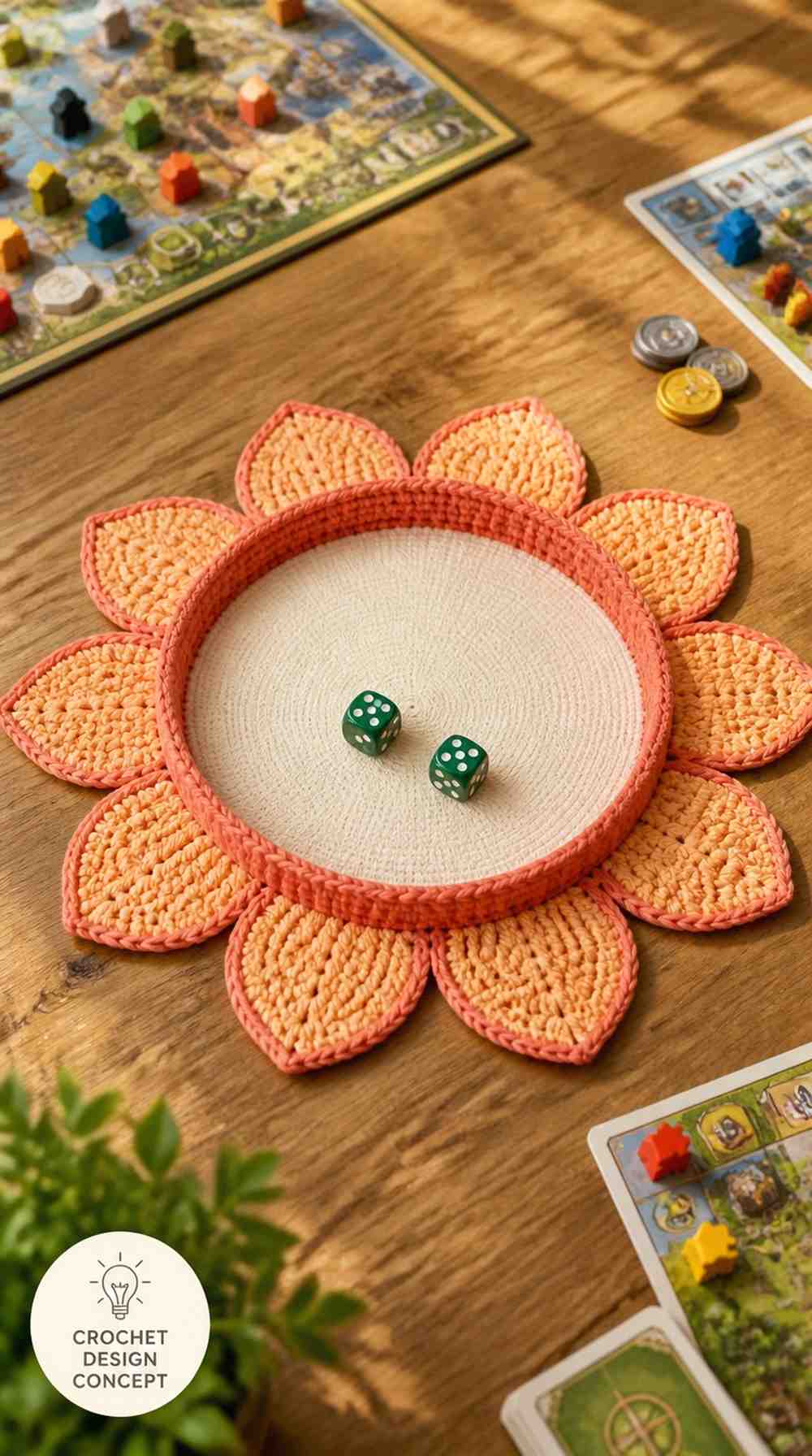
Coral crochet turns this round tray into a cheerful sunflower-inspired game accessory. Ten broad apricot petals extend outward from the circular rim, while a continuous coral inner wall surrounds the warm-cream felt rolling center. Two dark-green dice provide a contrasting accent.
The petal silhouette makes this one of the most decorative designs in the collection. Because the petals sit outside the inner wall, they can contribute to the appearance without taking over the rolling area. They should remain flat and securely attached.
- Petal Placement: Keep all ten petals outside the rolling boundary so dice do not stop against raised flower details.
- Round Interior: The usable rolling diameter should be measured inside the coral wall rather than across the decorative petals.
- Flat Decoration: Secure each petal to prevent loose edges from catching on other game pieces or accessories.
14. Crochet Forest Deep Wall Dice Arena
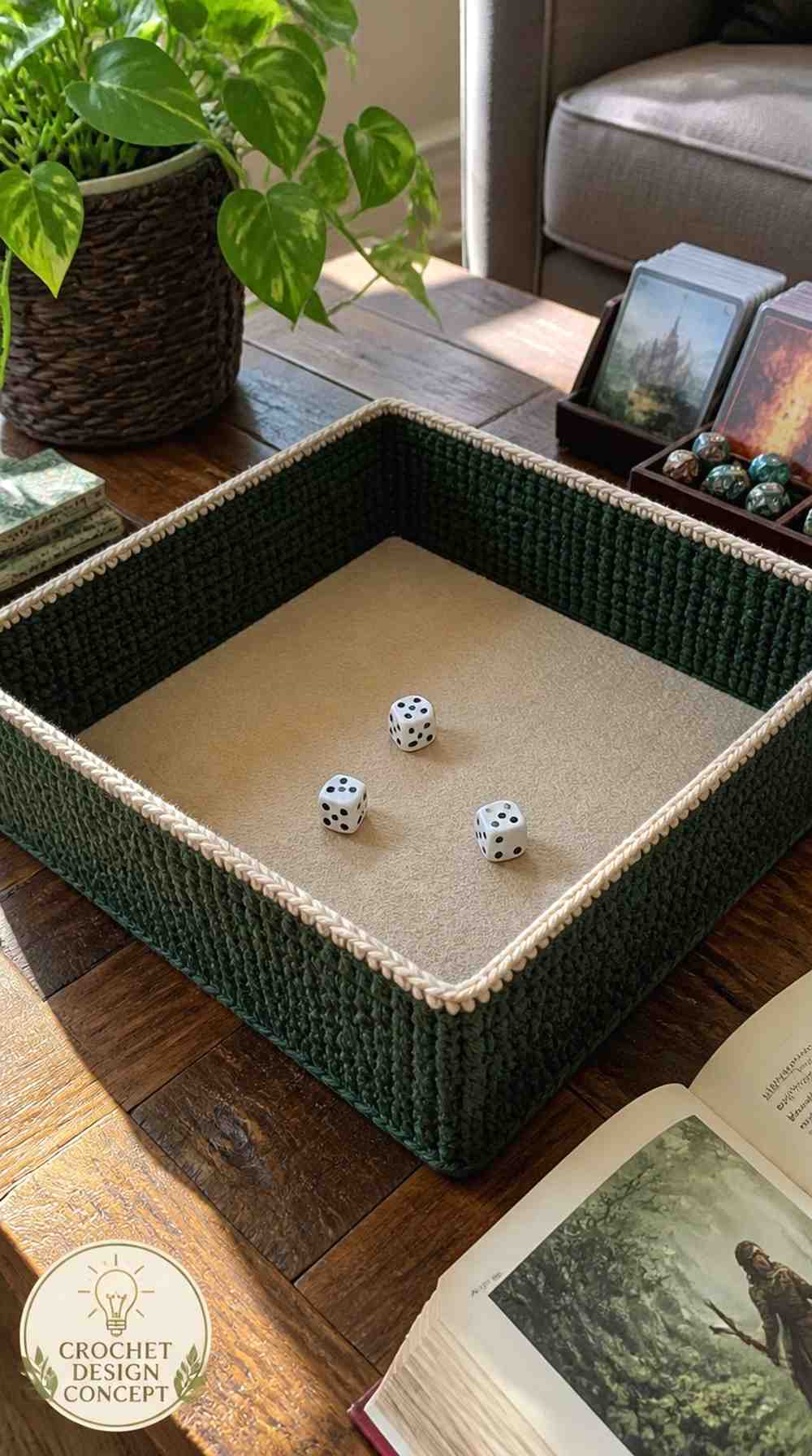
Forest-green crochet gives this square rolling arena a more substantial appearance. Its moderately tall straight walls are supported by removable reinforcement panels, while a beige border runs along the upper edges. Three white dice rest on a smooth sand-colored felt floor.
The taller sides are the defining feature. This concept may appeal to players who prefer a more enclosed rolling space, but the walls must not lean so far inward that they reduce the usable floor. Any removable support panels should also remain securely covered.
- Tall Wall Support: Crochet alone may not maintain straight upright walls, so suitable removable reinforcement is worth exploring.
- Interior Clearance: Taller sides can reduce access and visibility if the tray is too narrow for the intended dice.
- Supported Floor: The central felt area should remain flat and level, even when the side panels are installed.
15. Crochet Dusty Blue Padded Square Dice Tray
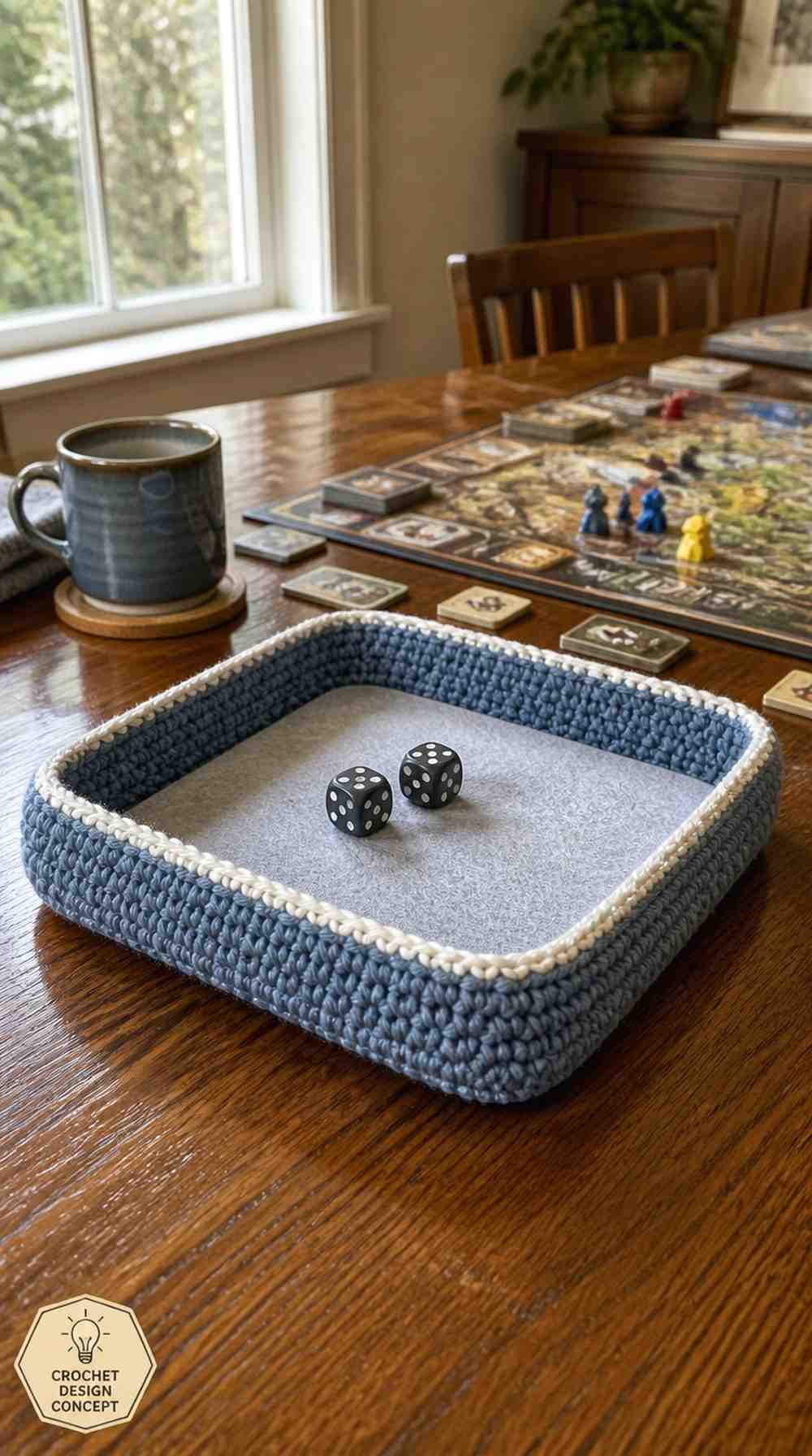
Dusty-blue crochet creates a softly structured square tray with a cushioned base and gently rounded walls. Ivory edging follows the upper rim, while a pale-grey felt insert covers the middle. Two charcoal dice sit within the broad central area.
The slightly padded profile distinguishes this design from trays with rigid-looking walls. It may be attractive for a comfortable tabletop gaming setup, although excessive padding can cause uneven dice movement. The base needs enough support to remain level rather than dipping under the weight of the dice.
- Base Padding: A thin removable foam layer may soften the surface, but too much cushioning can interfere with dice settling naturally.
- Rounded Walls: The softened corners create a different appearance from sharp square trays, while still requiring adequate side support.
- Level Center: Check that the felt and padding do not create slopes or raised areas where dice might rest at an angle.
16. Crochet Sandstone Book Fold Dice Tray
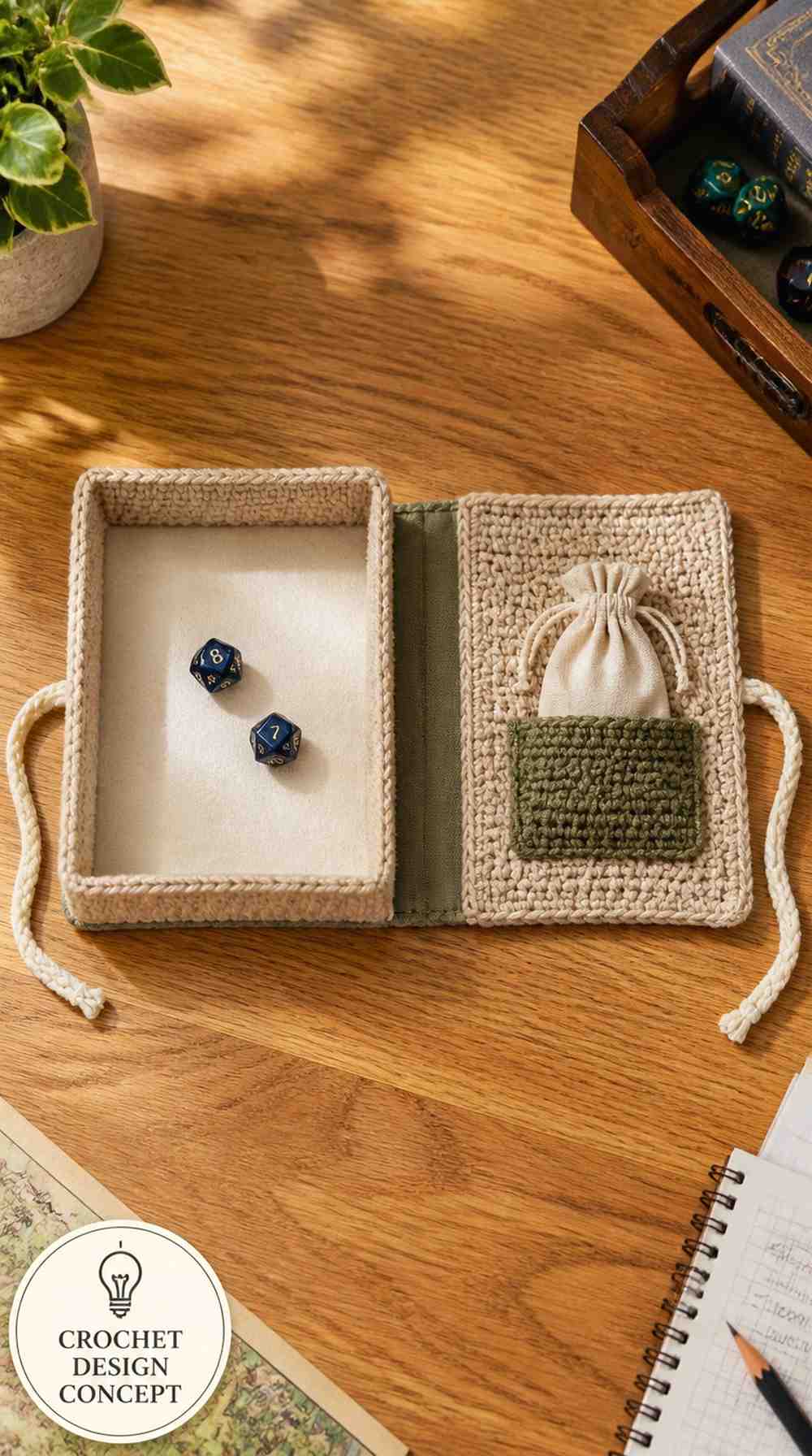
Sandstone-beige crochet creates an unusual book-style gaming organizer with two connected panels. The left section forms a shallow dice tray with a cream felt floor, while the right panel contains a narrow olive crochet pocket holding a small drawstring dice bag. A flat fabric hinge connects both sides.
This concept combines rolling space with storage. It could be useful for someone who regularly takes dice to a friend’s house, although the folded organizer must be sized around the contents. The hinge and closing ties should not press heavily against the stored dice.
- Two-Panel Layout: Keep the rolling section separate from the storage pocket so spare accessories do not interfere with active play.
- Fabric Hinge: The central connection needs enough flexibility for folding without pulling the tray walls out of shape.
- Closing Ties: Use the outer cream ties to secure the organizer gently, not to compress the dice bag against the opposite panel.
- Travel Arrangement: Check the finished folded thickness before assuming the organizer will fit easily into a small game bag.
17. Crochet Plum Arch Window Dice Tray
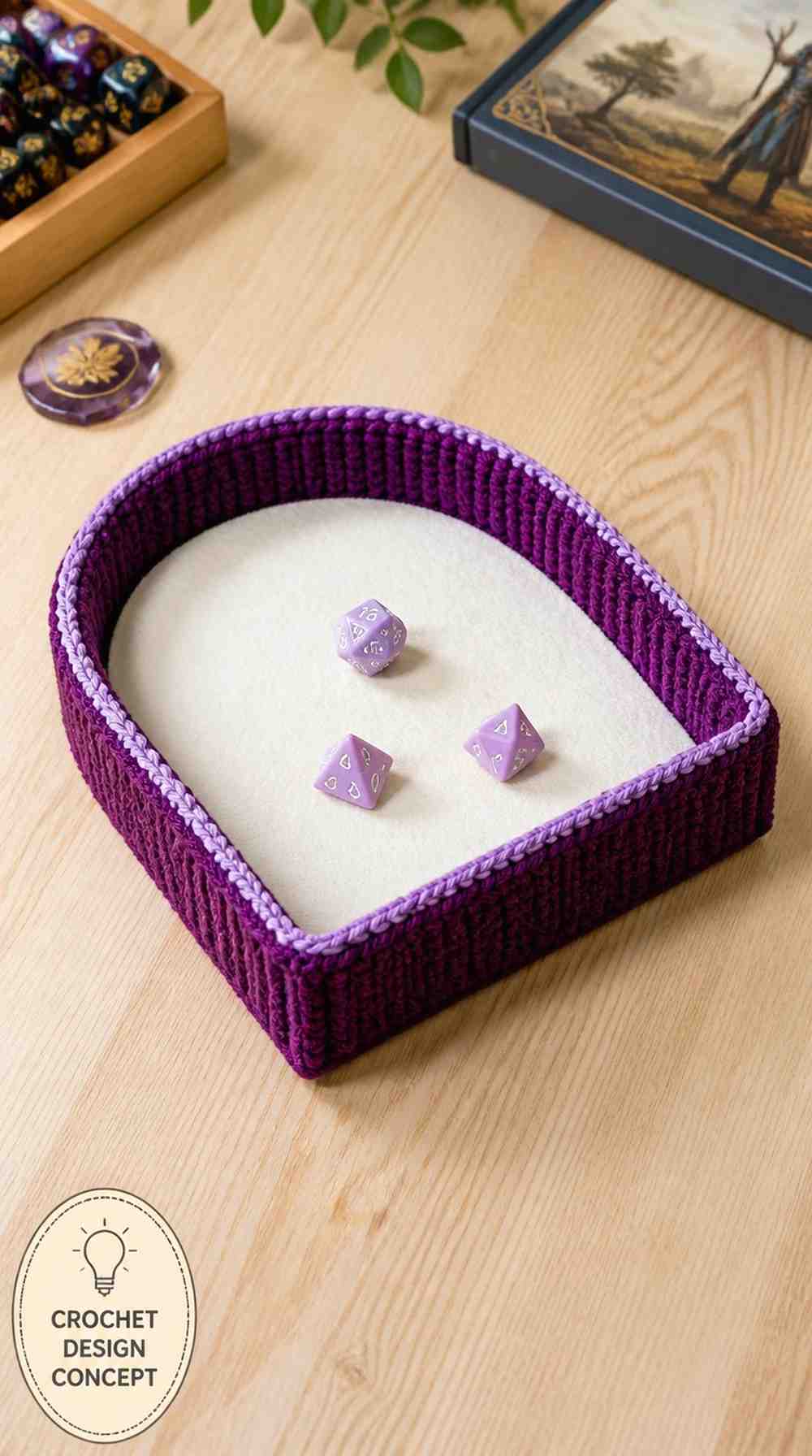
Deep plum crochet gives this tray an elegant architectural shape. A long straight lower wall, short sides and a curved upper wall form a rounded-arch rolling area. Raised vertical crochet ribs decorate the outer walls, while lilac edging and a cream felt floor soften the appearance.
The arch silhouette offers something different from ordinary round or square trays. Its mixed straight and curved edges require careful planning, particularly where the side walls meet the curved section. The rolling floor should remain smooth and open rather than becoming narrow near the arch.
- Arch Construction: The curved wall should meet the straight side sections without gaps or uneven height changes.
- Rolling Floor Shape: Check the actual usable area near the rounded end, especially when several polyhedral dice will be rolled together.
- Raised Plum Ribs: The exterior texture provides decoration without adding obstacles to the cream-lined center.
18. Crochet Olive Corner Wedge Dice Tray
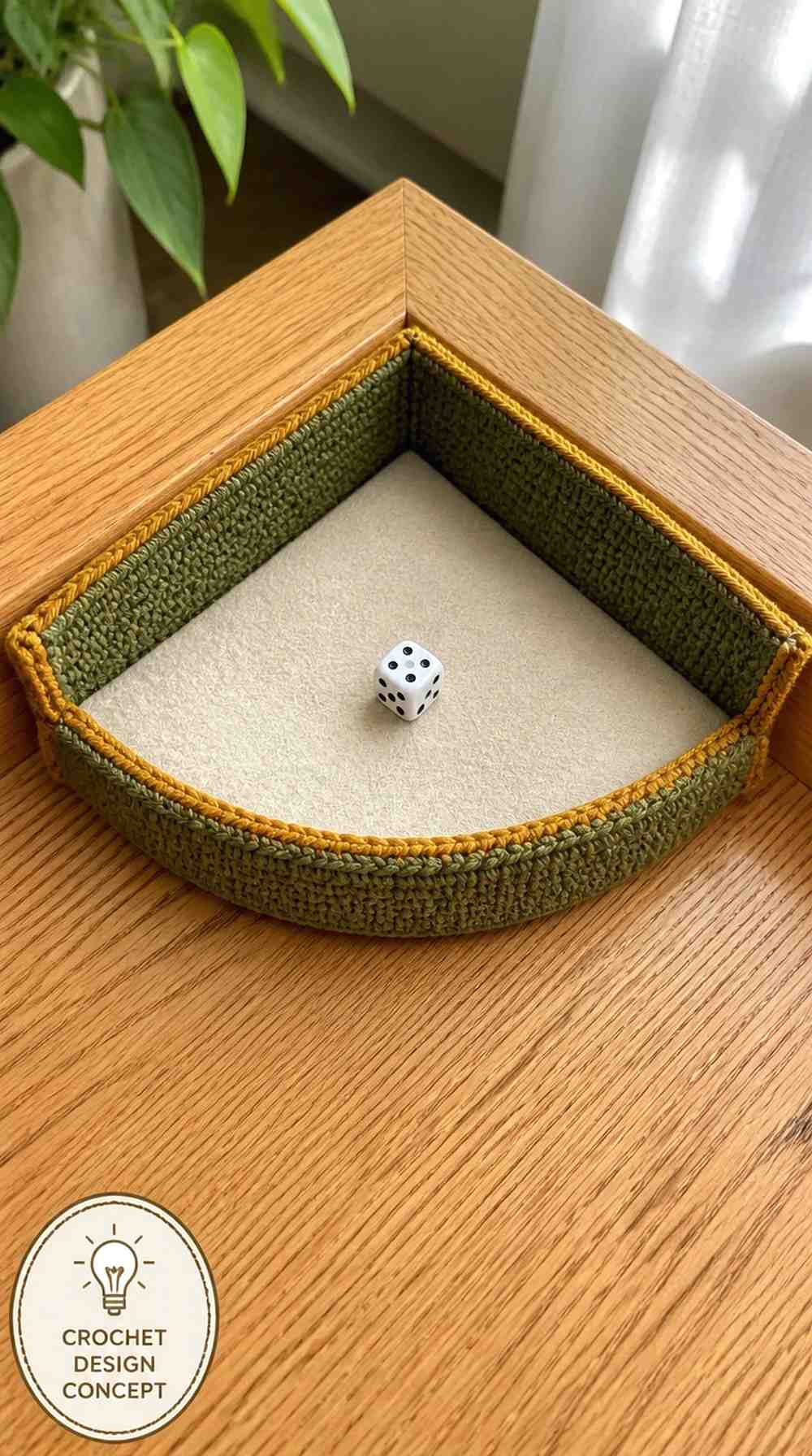
Olive-green crochet forms a compact triangular tray designed for the corner of a gaming table. Two straight rear walls meet at a right angle, while a gently curved front wall completes the wedge shape. A smooth beige felt insert covers the floor, with one white die resting inside.
This is a useful concept to explore when tabletop space is limited. Instead of occupying a broad rectangular area, the tray fits visually into a corner. However, the narrow triangular center may be unsuitable for rolling several dice at once.
- Corner Placement: The two straight sides should fit the intended table area without the tray hanging over the edge.
- Limited Rolling Space: A triangular footprint may work for one die but can become cramped when multiple dice are thrown together.
- Curved Front Wall: The front boundary must remain upright and continuous so dice cannot roll out through gaps.
19. Crochet Rainbow Stepped Square Dice Tray
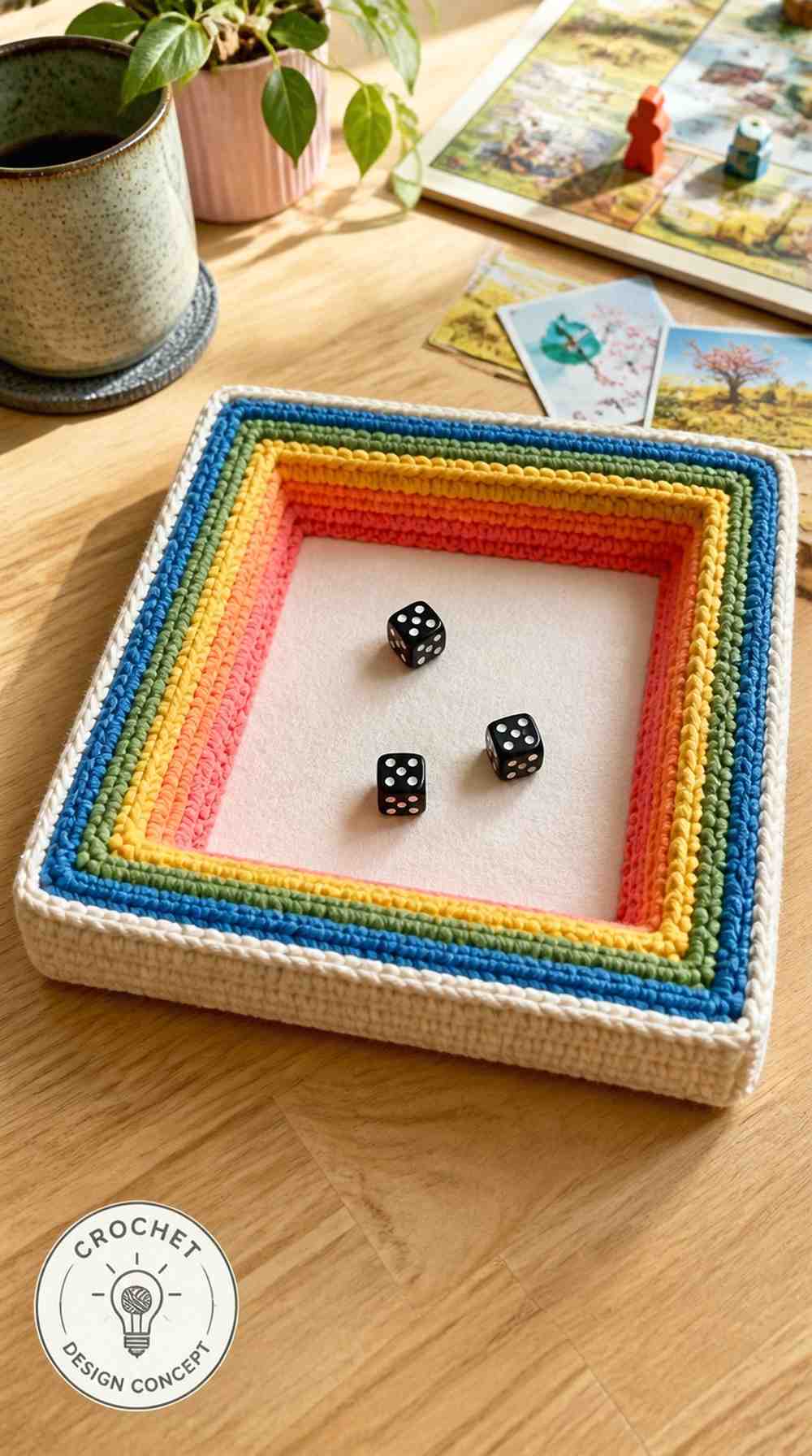
Muted rainbow crochet gives this square dice tray a colorful layered appearance. Coral and apricot rows form the lower inner step, while butter yellow, sage and dusty blue bands create a higher outer rim. A broad cream felt center provides a clear playing area for three black dice.
The stepped wall structure is what makes this idea different. Rather than having one uniform vertical border, the tray uses two levels to create depth and color. The lower inner step should remain outside the main rolling area so dice do not settle awkwardly against its edges.
- Two-Level Rim: Plan the lower and upper wall sections separately so both remain consistent around all four sides.
- Color Arrangement: The muted rainbow bands create decoration without requiring appliqués or lettering inside the tray.
- Inner Step Clearance: Keep the felt-covered rolling area large enough for dice to tumble without repeatedly striking the lower step.
- Corner Stability: The squared stepped walls need secure joins to prevent the layers from leaning or separating during use.
Practical Guide to Crochet Board Game Dice Rolling Trays
A dice rolling tray should provide a controlled, level place for dice to move and settle. Crochet offers interesting textures and flexible construction, but some design features require extra attention.
Start with the dice you use. Ordinary six-sided board-game dice and polyhedral tabletop gaming dice vary in shape and size. A tray that works for one or two cubes may not provide enough space for a handful of larger gaming dice.
Keep the rolling surface smooth. Raised crochet stitches, bulky joins and gaps can leave dice tilted or resting awkwardly. A removable smooth felt or tightly fitted fabric lining may help create a more even surface. Check that it does not wrinkle or bunch.
Consider the base support. A completely soft crochet base can sag or deform, particularly on an uneven table. A thin, appropriately sized removable support panel may help keep the rolling area level. Any hard insert needs smooth, covered edges.
Plan the wall height carefully. Short walls keep results visible and easy to reach, while taller walls may contain more energetic rolls. However, high or inward-leaning sides reduce usable rolling space. Test the finished tray rather than assuming one height suits every game.
Avoid obstacles inside the tray. Decorative petals, bobbles, raised motifs and large seams are better positioned outside the rolling area. The goal is to keep dice moving and settling without unwanted interference.
Check the dice results. If dice regularly stop leaning against a wall, get caught in the stitches or rest between two faces, the tray may need a smoother lining or a different shape. Follow the game’s agreed rules for rerolling unclear results.
Make storage practical. Snap-corner and drawstring designs may offer portable storage, but the actual folding or closing method must be tested. Do not assume every soft tray can convert into a secure dice bag.
Choose washable materials. Smooth cotton or a suitable cotton-blend yarn can be considered for an accessory that is handled frequently. Check the care instructions for felt, foam, support panels and metal fastenings, and remove inserts before washing when appropriate.
Want to Make Something Similar?
These verified crochet resources provide helpful starting points for dice tray construction and related techniques. They are not exact patterns for the 19 concepts shown above.
- DC Dice Bag and Tray by Lisa Fox of Green Fox Farms Designs — a free crochet pattern combining a drawstring dice bag with an open rolling tray. Useful for exploring circular bases, gathering and dual-purpose storage. Green Fox Farms Designs
- Crochet Dice Tray Pattern by Dear Little Dudley — provides written instructions for a small crochet tray. It is a helpful reference for building a shallow raised edge around a flat base. Dear Little Dudley
- Water-Themed Crochet Dice Bag and Tray by This Paper Cloud — demonstrates the idea of transforming a dice bag into an open rolling surface, with a related pattern available through the creator. This Paper Cloud
These resources teach related techniques and construction approaches. Any adapted tray should still be checked for its actual shape, wall support, lining and rolling behavior.
Which Crochet Dice Rolling Tray Should You Choose?
| Your main priority | Design to consider | Main trade-off |
|---|---|---|
| Compact folding tray | Sage Snap Corner | Snaps need secure attachment |
| Decorative eight-sided shape | Terracotta Octagon | Multiple angled wall joins |
| Long rolling area | Charcoal Rectangle | Requires more table width |
| Dice bag and tray concept | Lavender Drawstring | Must close securely |
| Classic board-game rolling | Navy Low Wall | Low sides may let dice escape |
| Soft oval styling | Ivory Spiral Oval | Curves need careful shaping |
| Hexagonal gaming design | Mustard Hexagon | Six corners require support |
| Traditional granny-square decoration | Rust Granny Mosaic | Raised joins need covering |
| Separate spare dice | Teal Split Zone | Divider reduces rolling space |
| Elegant single-die tray | Burgundy Pentagon | Velvet texture affects rolling |
| Decorative coastal rim | Seafoam Wave | Wave trim must stay outside |
| Reversible appearance | Black Cream Checker | Both faces need testing |
| Flower-inspired design | Coral Sunflower | Petals are decorative only |
| Taller rolling walls | Forest Deep Wall | Needs reinforcement |
| Cushioned rolling surface | Dusty Blue Padded | Excess padding may affect dice |
| Travel and storage together | Sandstone Book Fold | More complex folded shape |
| Architectural curved silhouette | Plum Arch | Mixed straight and curved joins |
| Small table corner | Olive Corner Wedge | Limited rolling room |
| Colorful two-level border | Rainbow Stepped Square | Less usable space within rim |
For a simple tabletop dice tray, Crochet Navy Low Wall Game Tray or Crochet Sage Snap Corner Dice Tray is a useful starting concept. Both have clear rolling areas without much decoration.
For tabletop RPG accessories, the mustard hexagon, burgundy pentagon or forest deep-wall tray may be more visually appealing. If organization matters as much as rolling, the teal split-zone and sandstone book-fold designs offer additional storage features.
Conclusion
A crochet board game dice rolling tray can make game night feel more personal while giving dice their own designated space on the table. These 19 ideas explore different shapes, stitch textures, decorative edges and storage arrangements, from simple square trays to colorful sunflower designs and foldable organizers.
The most suitable choice should balance appearance with a level rolling surface, secure sides and enough room for the dice used in your games. Treat the designs as inspiration, and test any real crochet tray to make sure dice can roll and settle clearly.
Which of these 19 crochet dice rolling trays would you choose for your game table? Would you prefer a simple square tray, a colorful hexagon, or a compact folding design? Share your favorite and the board games or tabletop games you enjoy playing.
Frequently Asked Questions
Can a crochet dice rolling tray actually hold dice during a game?
A properly constructed crochet tray may help keep dice within a designated rolling area, especially when it has secure raised walls. However, crochet fabric is flexible, so the sides may bend or move. A finished tray needs testing with the actual dice and rolling style before its containment can be relied upon.
What kind of crochet stitches are suitable for a dice tray?
Closely worked single crochet, moss stitch and other dense textures are worth exploring for the walls and base. Decorative stitches can also be used outside the rolling area. Inside the tray, a smooth removable fabric insert may be useful because raised yarn loops and seams can affect how dice move or settle.
Is a felt lining necessary for a crochet dice tray?
Not necessarily, but a smooth lining can be helpful when the crochet base has pronounced texture or joins. Felt and other soft fabrics also affect rolling behavior, so choose one that sits flat without wrinkling. Test dice on the finished surface to see whether they tumble and settle clearly.
Can I make a foldable crochet dice tray for travel?
Yes, fold-flat concepts using snap corners or suitable ties are possible to explore. A drawstring bag-and-tray combination is another option. However, the finished construction must fold or close without damaging its seams, and the dice need to remain securely contained during transport.
Are these crochet board game dice rolling trays available as patterns?
These 19 ideas are original visual inspiration concepts rather than tested crochet patterns. They illustrate possible shapes, colors, wall structures, liners and storage methods. The linked resources provide real instructions for related crochet dice accessories, but reproducing any concept requires your own measurements, construction planning and practical testing.