Small Allen keys have a habit of disappearing into tool drawers, mixing with other hardware or becoming separated from their original sets. A crochet tool organizer offers a handmade way to give these L-shaped hex keys their own storage space, combining protective pockets with useful labels and closures. These 18 crochet Allen key tool organizer inspiration ideas explore roll-up cases, folding wallets, lined pouches, graduated compartments, removable inserts and color-coded storage panels.
The right design depends on how many keys you own, their individual lengths and whether you use them mainly for furniture assembly, bicycle adjustments or general household repairs. Some concepts work around an existing rigid key holder, while others separate individual tools inside protective sleeves. Comparing the different layouts, materials, fastening methods and access points can help you decide what might work for your collection before planning a real crochet project.
These are AI-generated crochet design visualizations for inspiration, not photographs of tested handmade tool organizers or complete patterns. Their construction, retention and protective performance have not been tested.
Quick Design Selection Guide
- For a full set of separate keys: Crochet Copper Eight-Slot Allen Key Roll and Crochet Teal Graduated-Pocket Hex Key Holder offer clear individual slots.
- For metric and inch sets: Crochet Navy Dual-System Hex Key Folio keeps two different key groups apart.
- For a small household repair kit: Crochet Charcoal Four-Key Snap Wallet and Crochet Blush Tri-Fold Hex Key Case provide compact folding arrangements.
- For stronger travel containment: Crochet Ochre Zippered Allen Key Travel Case and Crochet Cocoa Original-Holder Utility Pouch offer enclosing zippered designs.
- For decorative storage: Crochet Burgundy Granny-Square Allen Key Wallet and Crochet Lavender Color-Tab Allen Key Organizer add patterned or colored details.
- For adaptable storage: Crochet Sand Hex Key Rack Protective Wrap, Crochet Olive Tip-Guard Allen Key Roll and Crochet Ivory Detachable-Panel Allen Key Kit offer different approaches to protecting or separating the tools.
1. Crochet Copper Eight-Slot Allen Key Roll
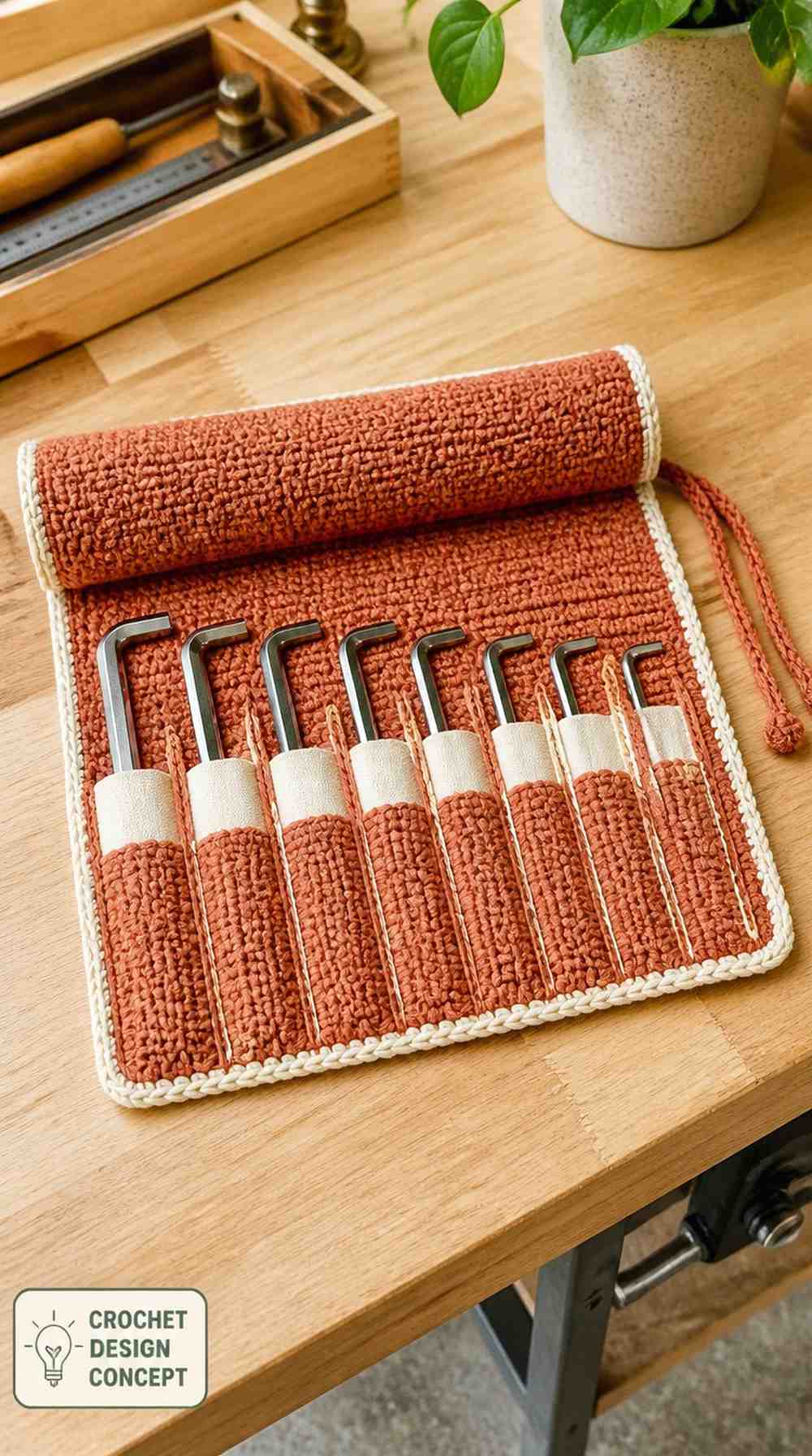
Warm copper-terracotta crochet forms a wide rectangular roll with eight separate cream canvas-lined pockets. The slots hold graduated steel Allen keys, leaving their short bent ends visible above the openings. Ivory edging, a broad upper flap and two short closing ties give the roll a tidy finish.
This design keeps a complete group of L-shaped tools in one visible row. The individual compartments make the different sizes easier to distinguish, although the pockets must be fitted carefully to stop the smallest keys slipping out.
- Eight graduated pockets: Arrange the keys by size and measure each long arm before deciding individual sleeve depth rather than making every compartment identical.
- Protective lining: Smooth canvas-lined sleeves separate the steel from the crochet loops, helping reduce snagging and direct pressure on the yarn.
- Upper flap: A broad foldover section may help retain exposed bent ends when closed, but the finished roll still needs a proper shake and closure check.
2. Crochet Navy Dual-System Hex Key Folio
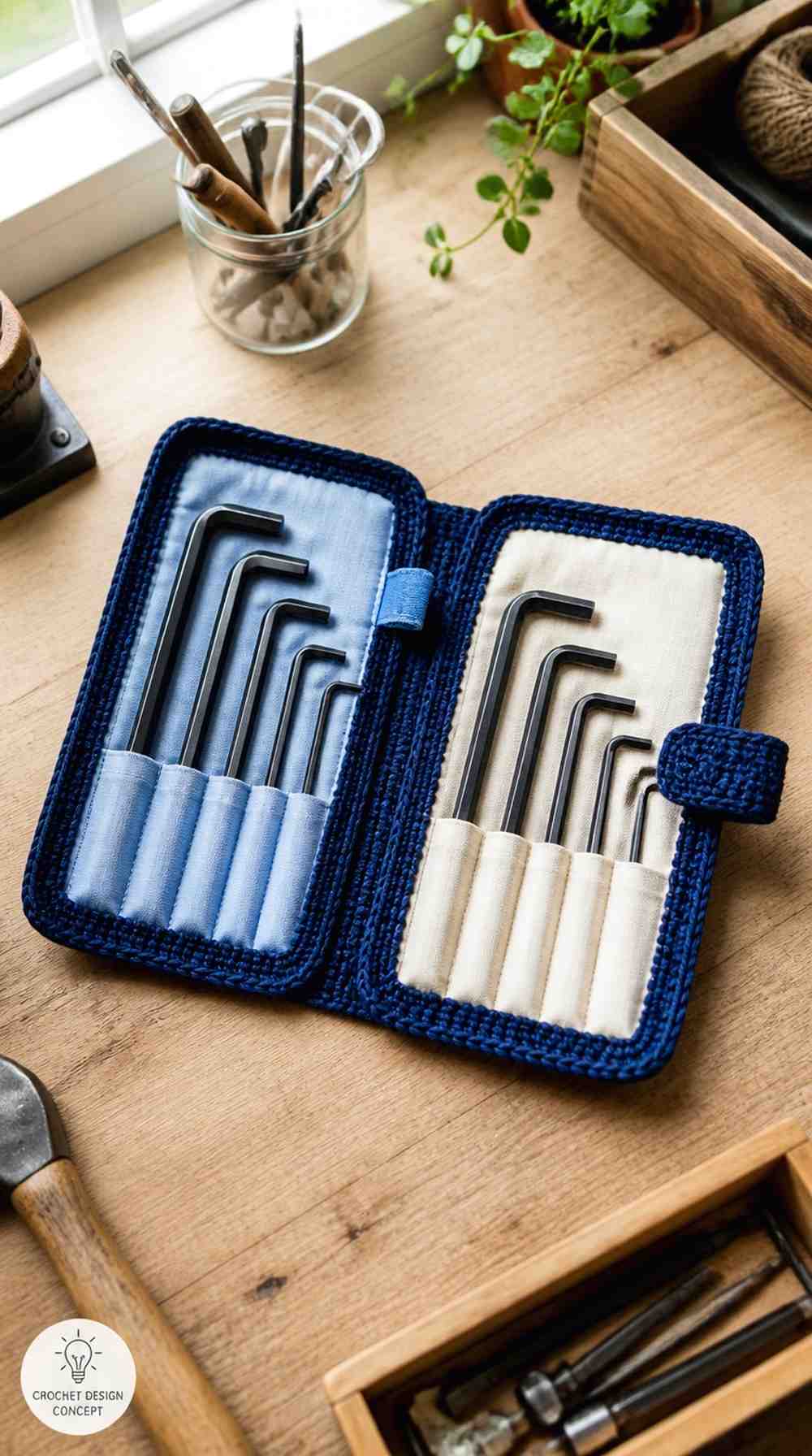
Midnight-navy crochet creates a book-style organizer with two distinct tool panels. Pale-blue-lined slots on the left hold one set of Allen keys, while ivory-lined slots on the right hold another. A flexible navy spine joins the panels, with small contrasting tabs indicating the separate groups.
The two-sided arrangement is particularly useful when metric and inch-size keys need to remain distinct. Similar-looking keys from different measurement systems can be easily confused, so the organizer should support clear identification rather than relying only on color.
- Separate key systems: Reserve one entire panel for metric sizes and the other for inch sizes, using accurate written identification in a real project.
- Flexible center spine: Leave enough room for both filled panels to close without pressing the tool bends against each other.
- Panel consistency: Keep the internal sleeves lined and properly sized so the larger group cannot push into the smaller tools when folded.
3. Crochet Ochre Zippered Allen Key Travel Case
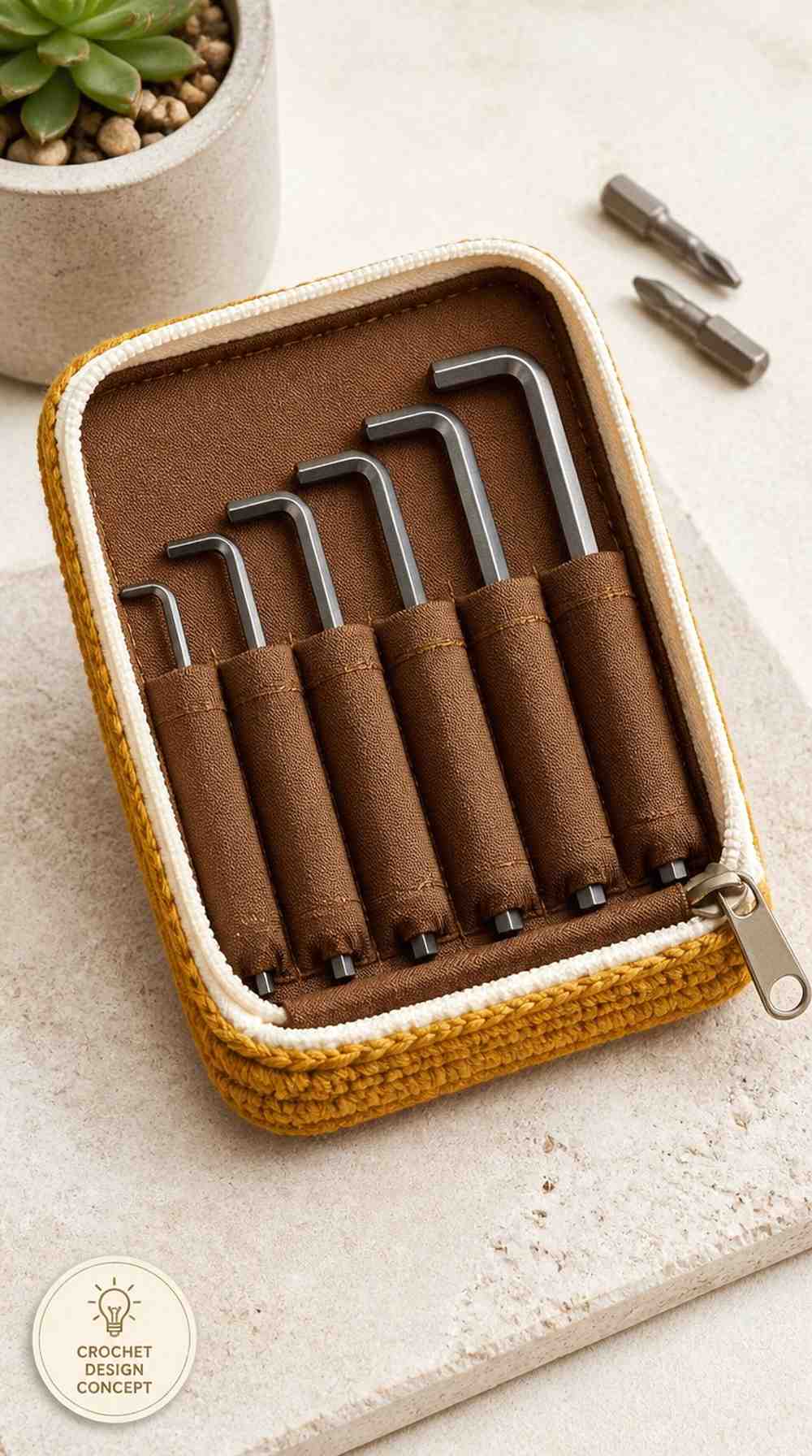
Golden-ochre crochet forms a compact rectangular travel case with an ivory zipper running around three sides. Inside, a dark-tan fabric lining supports six narrow sleeves, each containing a separate steel Allen key. The case has softly rounded corners and a simple close-textured outer surface.
The zippered construction provides a more enclosed format than an open tool roll. It may suit occasional repairs away from home, although the zipper, interior seams and individual tool channels all require careful construction to prevent hard metal ends from rubbing through the fabric.
- Three-sided zipper: A wide opening makes the individual keys easier to see and remove than a narrow zippered pouch with a single deep compartment.
- Inner sleeve fit: Give each steel key a protective lined channel, keeping its longer arm securely positioned within the case.
- Closure clearance: Test the case with every tool inserted so the bent ends do not obstruct the zipper or press against its teeth.
4. Crochet Teal Graduated-Pocket Hex Key Holder
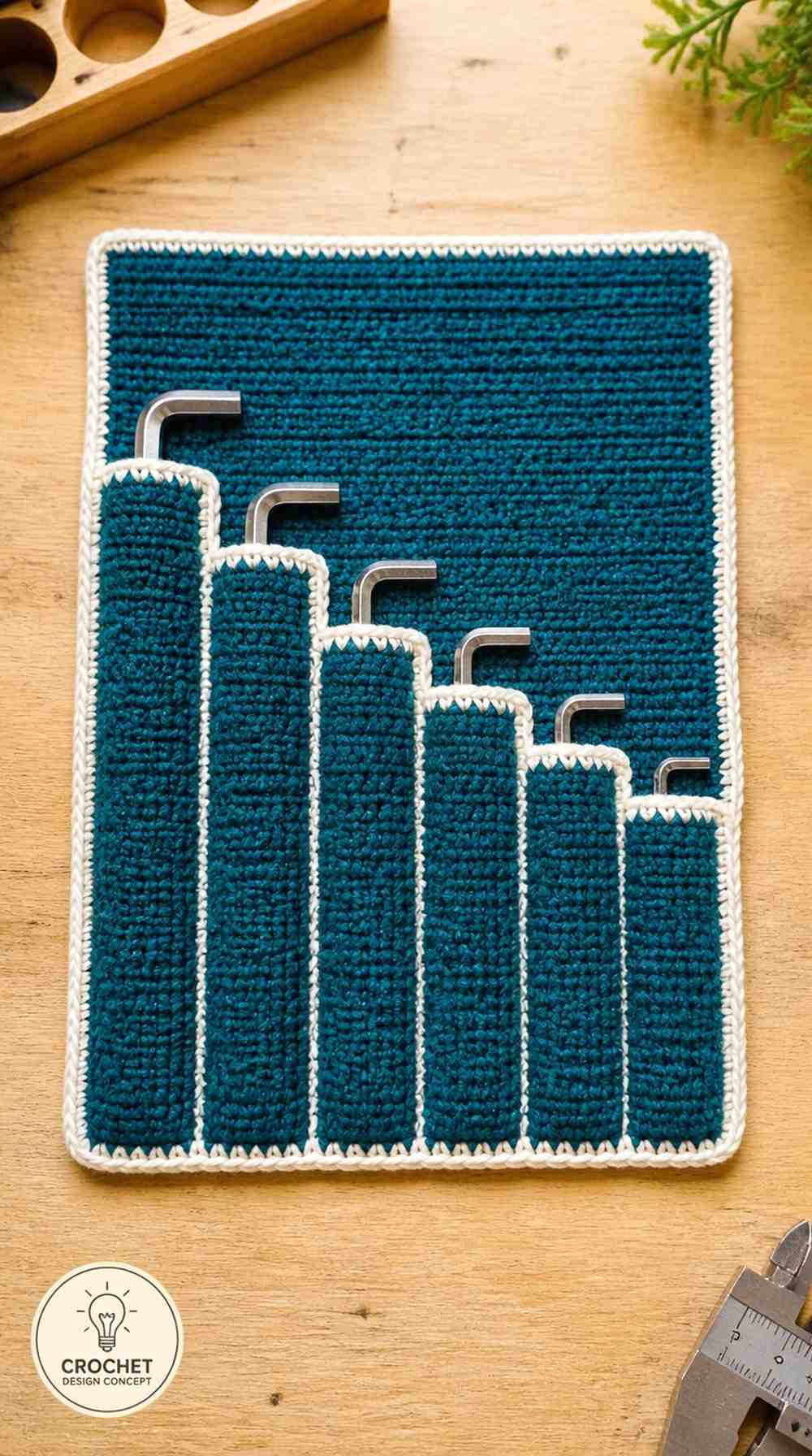
Deep-teal crochet provides a smooth rectangular backing for six protective pockets arranged at different heights. The ivory-trimmed compartments form a stepped line from the tallest on the left to the shortest on the right, matching the visible difference in Allen key lengths.
The graduated arrangement makes the tools easy to scan at a glance. Rather than hiding every key inside identical compartments, it uses pocket height to reflect the relative length of each tool. However, shorter pockets still need enough depth to retain their keys.
- Staggered pocket heights: Match each canvas-lined sleeve to the corresponding long arm, keeping the smaller tools accessible without leaving them unsupported.
- Ivory opening edges: Contrasting pocket borders help the different slot heights remain clearly visible against the dark-teal backing.
- Open-top limitation: This concept has no pictured closure flap, so a real version would need additional retention before being carried loosely in a toolbox.
5. Crochet Burgundy Granny-Square Allen Key Wallet
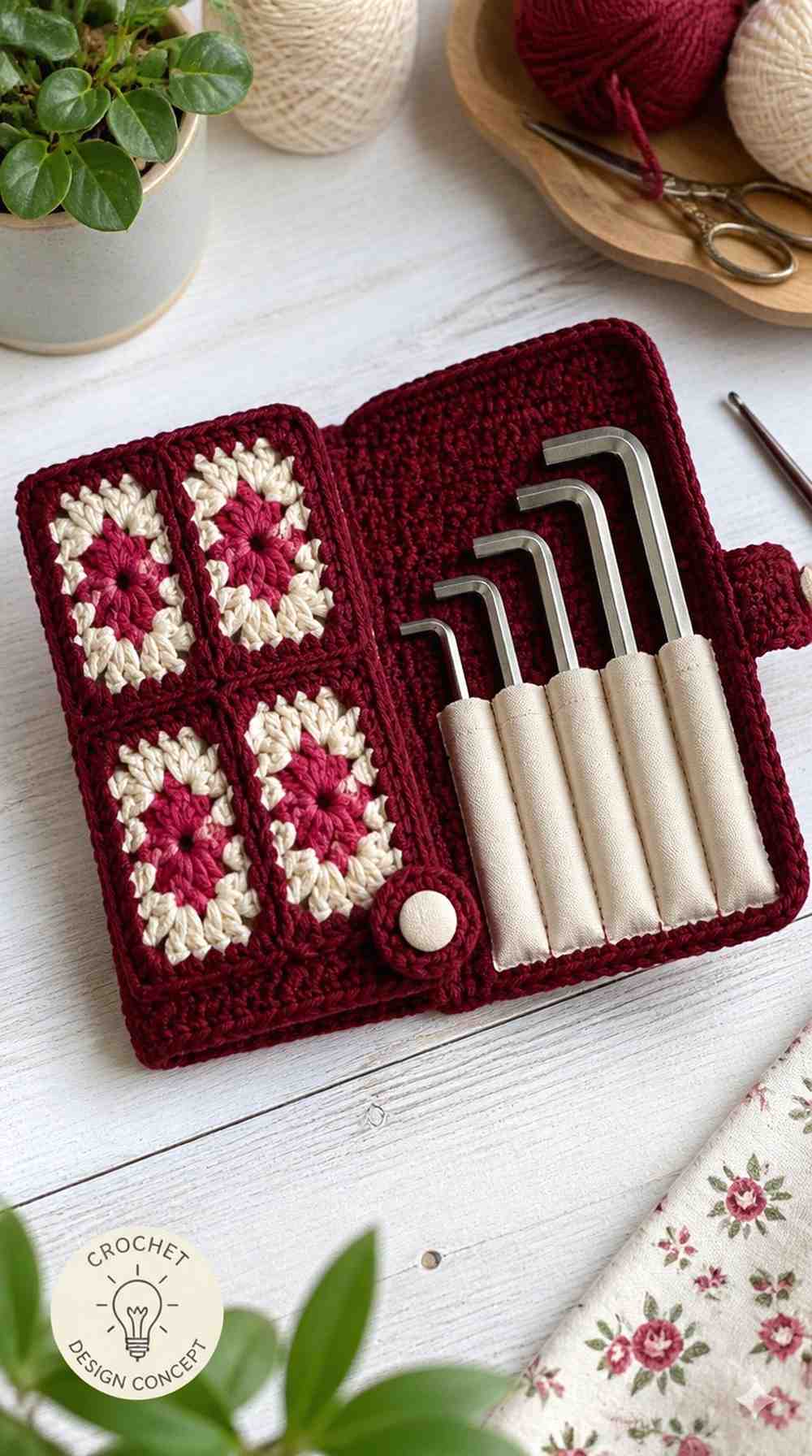
Deep-burgundy crochet gives this folding wallet a rich handmade appearance. Four small granny squares decorate its outer cover, with raspberry centers and ivory middle rounds. Inside, a solid burgundy panel supports five separate cream canvas-lined tool sleeves, while a short button tab closes the wallet.
The granny-square detail is entirely decorative. The actual tool protection comes from the smooth inner sleeves and solid backing, which keep the metal keys from catching directly in the motif openings.
- Four-square cover: Join the motifs neatly over a continuous backing so the decorative flap remains flexible and its open corners do not expose the stored tools.
- Five protective sleeves: Size the lined compartments around the individual L-shaped keys rather than the decorative granny-square dimensions.
- Button-tab closure: Check the button position with the wallet loaded, ensuring the flap closes without pulling against protruding metal bends.
6. Crochet Sage Wall-Hung Allen Key Organizer
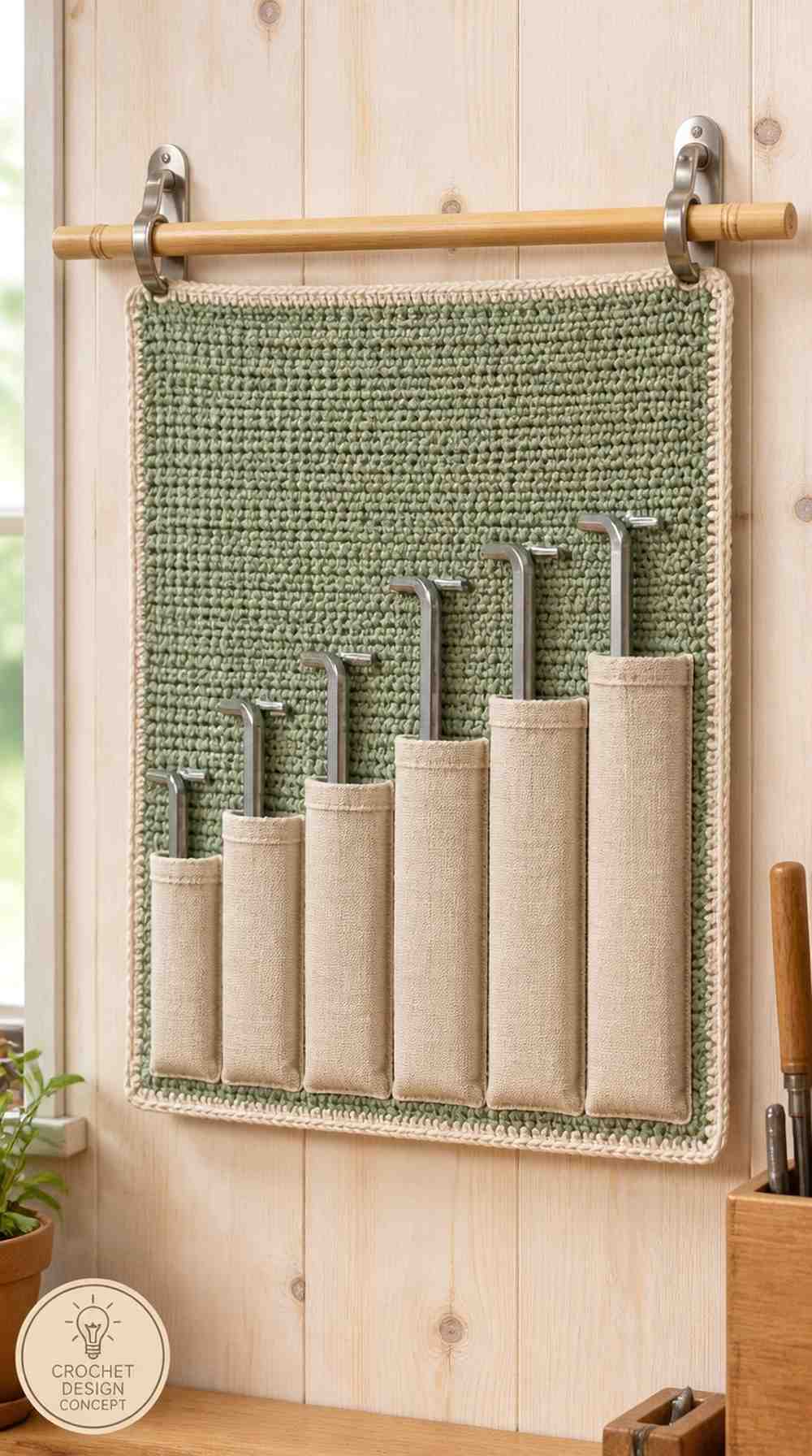
Muted-sage crochet forms a rectangular wall panel suspended from a natural-bamboo dowel. Six sand-colored protective pockets run along the lower section, with graduated steel Allen keys held upright inside. A narrow ivory border frames the backing, while a small lower support strip helps the panel keep its shape.
This design moves the keys away from crowded drawers and places them within view. It is intended for an appropriate workshop wall, with secure mounting hardware and tools kept out of children’s reach.
- Dowel mounting: Use properly installed wall supports rather than expecting the crochet fabric alone to hold the weight of the metal tools.
- Individual wall pockets: Keep each key in a smooth, lined sleeve so its end does not catch on the decorative crochet surface.
- Accessible height: Mount the panel where an adult can remove tools comfortably without placing sharp or pointed metal pieces within easy reach of children.
7. Crochet Charcoal Four-Key Snap Wallet
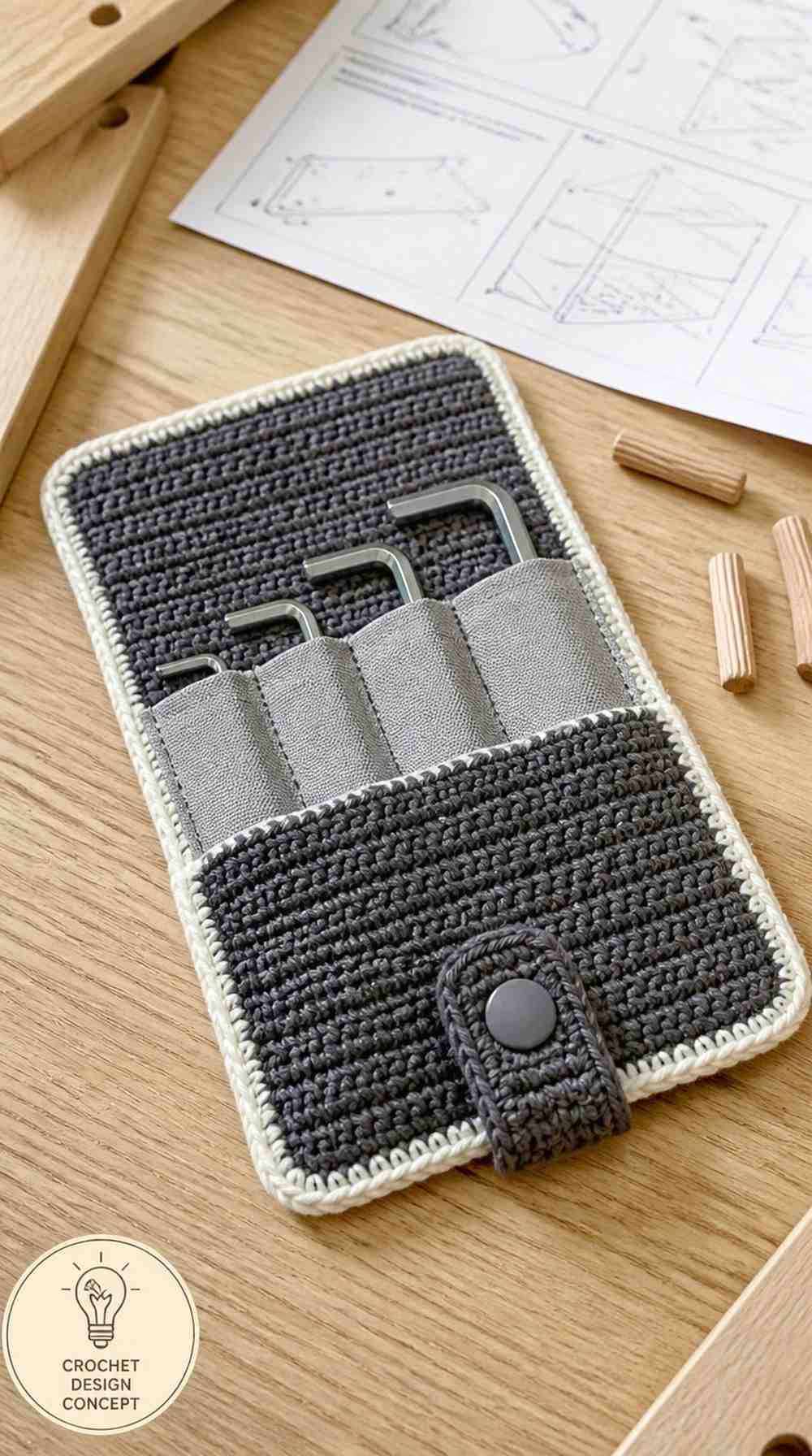
Charcoal-gray crochet creates a small foldover wallet with four close-fitting, pale-gray-lined tool sleeves. A short rounded tab and matte-gray snap secure the outer flap, while a thin ivory border defines the compact rectangular shape.
This design is intended for a limited Allen key selection rather than a complete large set. Its smaller footprint could suit a household furniture-assembly kit, where only a few frequently needed sizes are kept together.
- Four-key capacity: Choose the actual four tools before sizing the compartments, since the longest key determines much of the wallet’s final length.
- Snap placement: Position the snap away from the metal bends and reinforce its attachment to the crochet and any supporting fabric.
- Compact storage: A small wallet is easy to misplace, so consider storing it with the related furniture instructions or household repair tools.
8. Crochet Plum Accordion Hex Key Organizer
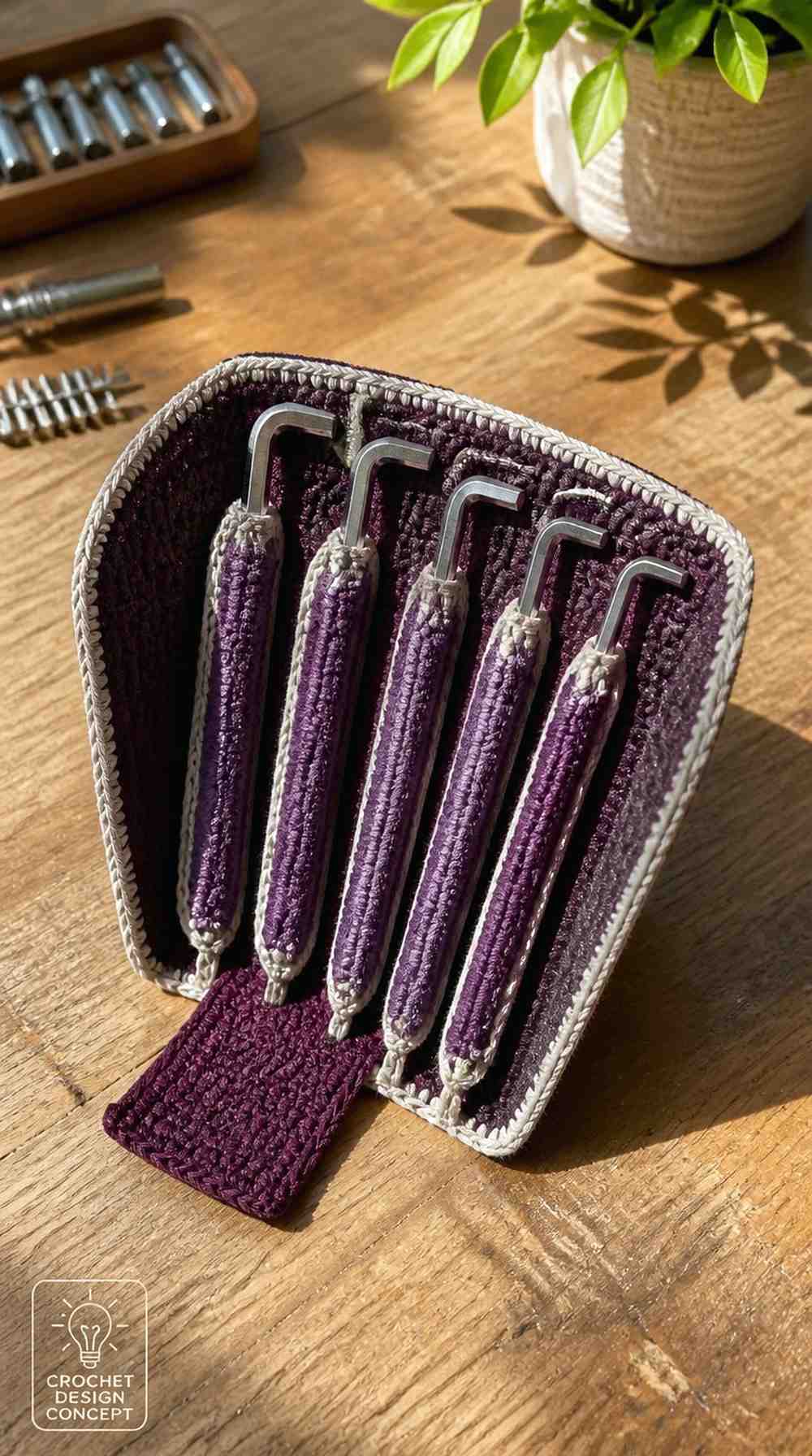
Deep-plum crochet creates a compact accordion pouch with five interior compartments. Pale-lavender partitions divide the sections, and ivory edging outlines each upper opening. Each compartment holds one L-shaped steel Allen key in its own protective sleeve.
The accordion structure separates keys in a more three-dimensional arrangement than a flat roll. Its folded sides may accommodate different tool lengths, although adding dividers also increases the thickness of the finished case.
- Five distinct sections: Keep the divider panels securely attached at the base so tools cannot move behind neighboring compartments.
- Accordion gussets: Allow the sides to expand and collapse without bending the long metal arms or pressing the short ends against the outer crochet.
- Standing stability: A flat bottom may help the pouch stand when open, but the actual loaded organizer needs testing before relying on that position.
9. Crochet Sand Hex Key Rack Protective Wrap
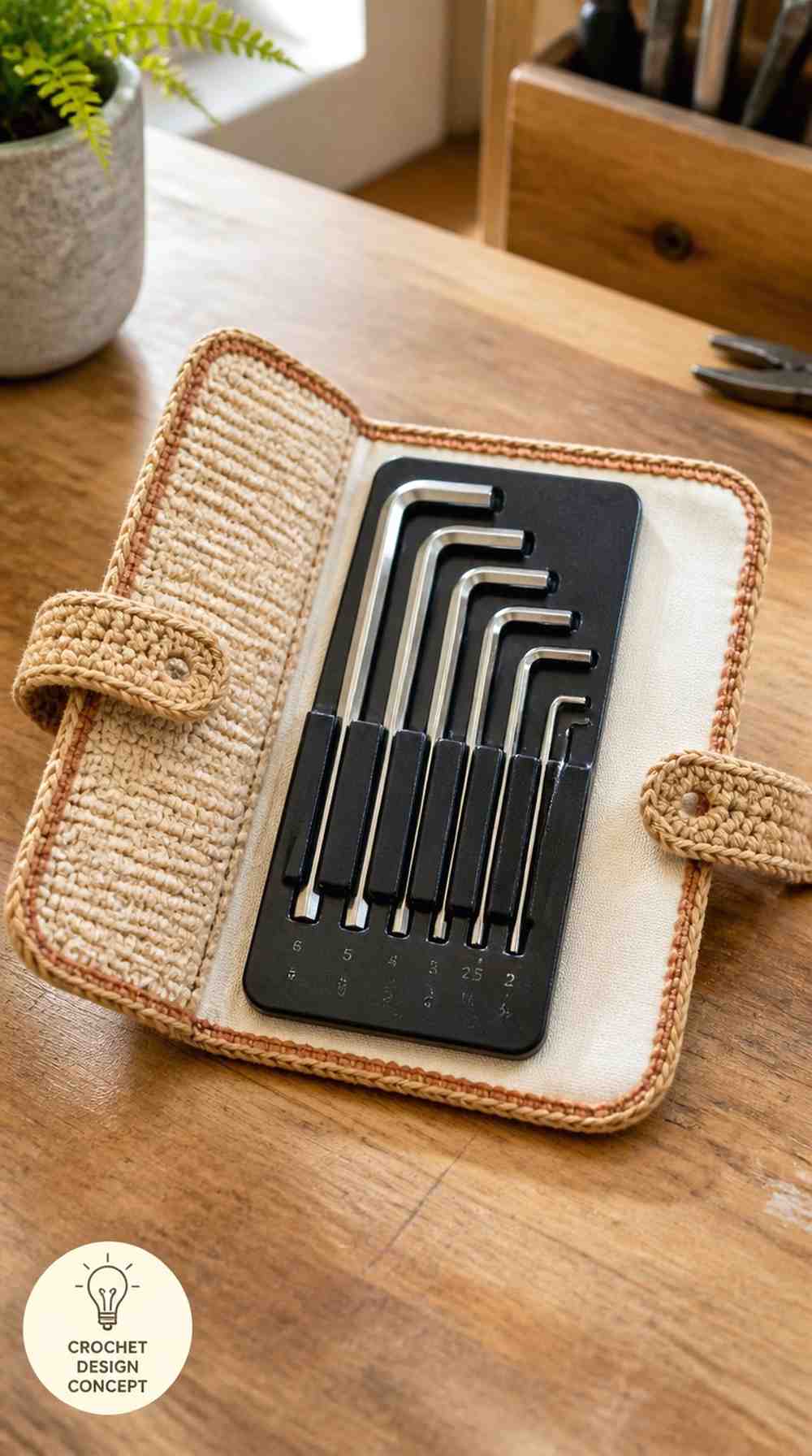
Warm-sand crochet forms a removable protective sleeve around an existing black rigid plastic Allen key rack. The rack holds six graduated L-shaped steel keys in molded slots, while the crochet outer panel adds a soft surface and caramel-colored edging. Two short straps fold back to reveal the holder.
This concept differs from individually crocheted compartments because the original rack remains responsible for retaining each tool. It may be the simpler approach when a matching key holder already works well.
- Original rack retention: Keep using the properly fitted molded slots to secure the Allen keys rather than replacing them with loose crochet loops.
- Protective fabric layer: A pale-cream lining can separate the rigid plastic from the yarn and reduce rubbing against the outer crochet wrap.
- Rack accessibility: Make the straps easy to release so the original holder can be removed without pulling or distorting the crochet sleeve.
10. Crochet Mustard Two-Tier Allen Key Panel
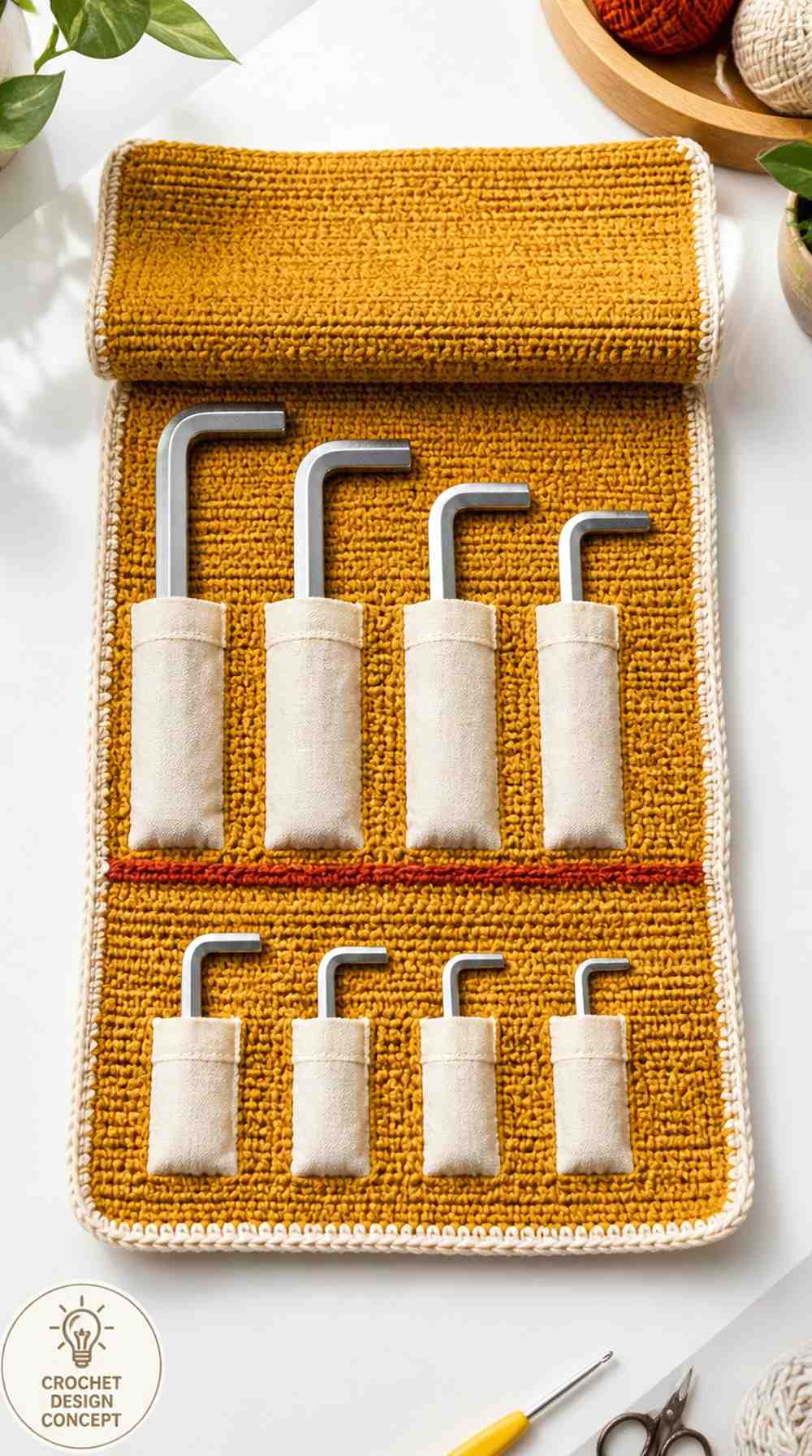
Mustard-yellow crochet creates a wide rectangular tool panel with two horizontal rows of lined pockets. Four longer Allen keys occupy the upper row, while four smaller keys sit in a shorter lower row. Terracotta crochet lines divide the levels, and an ivory border finishes the outside.
The two-tier arrangement uses the panel’s height instead of extending into one long row. It may be useful for fitting several sizes into a compact drawer, but the keys and their exposed bent ends need enough separation when the panel is folded.
- Separate length groups: Reserve the longer upper pockets for larger keys and shorter lower sleeves for the smaller group.
- Vertical separation: Leave sufficient space between both rows so the visible short arms do not press against tools stored above or below.
- Folded thickness: Check whether the loaded two-tier panel can fold comfortably without creating a thick central stack of metal.
11. Crochet Blush Tri-Fold Hex Key Case
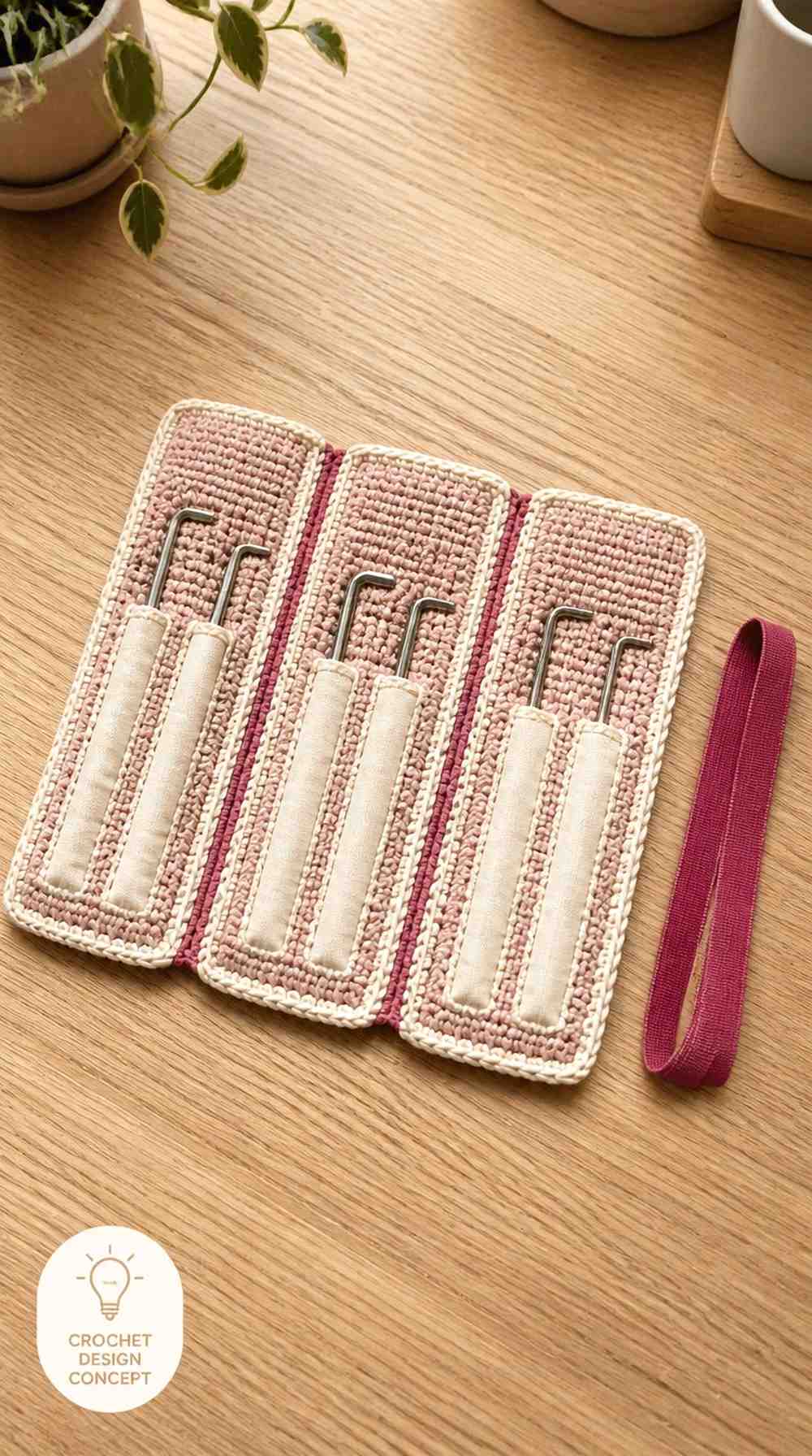
Dusty-blush crochet forms a three-panel folding organizer with two lined tool sleeves on each section. Raspberry crochet lines mark the two folds, while ivory edging follows the outer perimeter. A separate flat raspberry band lies beside the opened case for fastening when folded.
The tri-fold format spreads six Allen keys across three narrower sections. It can create a compact closed shape, provided the panels and bands are sized around the full tool lengths rather than just their straight arms.
- Three-panel layout: Place two lined pockets on each panel and keep the fold lines free from protruding metal.
- Outer closing band: Check the band fit after folding all three filled sections, rather than measuring only the empty crochet case.
- Ivory pocket edges: Reinforced borders help define the six openings and may reduce wear from repeatedly inserting and removing the keys.
12. Crochet Olive Tip-Guard Allen Key Roll
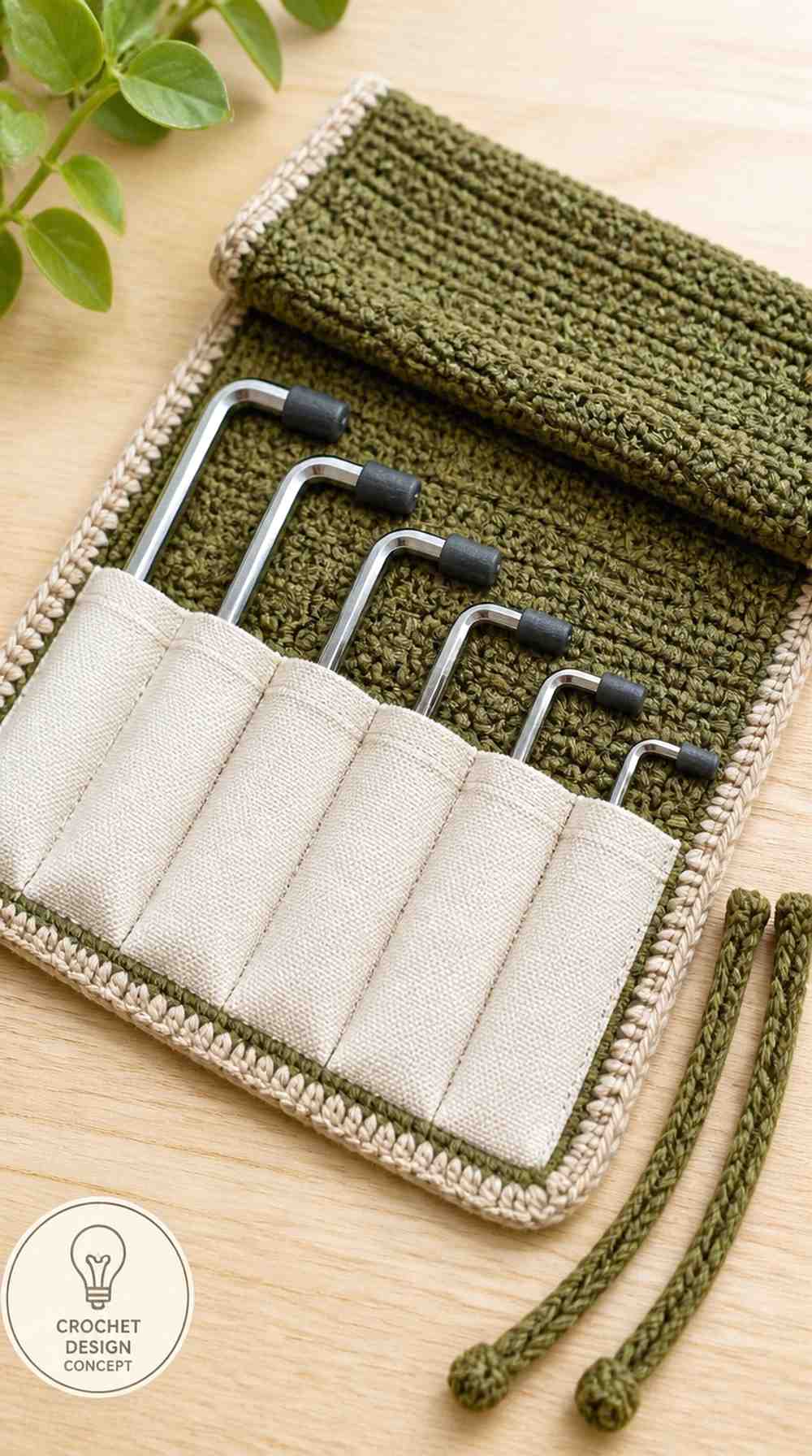
Muted-olive crochet creates a flat roll with six cream canvas-lined tool sleeves, oatmeal edging and a broad protective top flap. Each visible short arm of the stored steel Allen keys has a small, fitted dark-gray silicone guard.
The individual guards are the defining feature of this design. They add a separate layer between the metal ends and other surfaces, although any guard must fit securely and be appropriate for the actual key size.
- Correct guard fit: Use individual protective caps that match each Allen key end rather than assuming one size will fit every tool.
- Lined storage slots: Keep the long arms inside separate canvas sleeves even when protective guards are used on exposed short ends.
- Small-part inspection: Remove damaged or loose caps, and keep the entire kit out of reach of children because detached guards can be small objects.
13. Crochet Indigo Diagonal-Channel Tool Folio
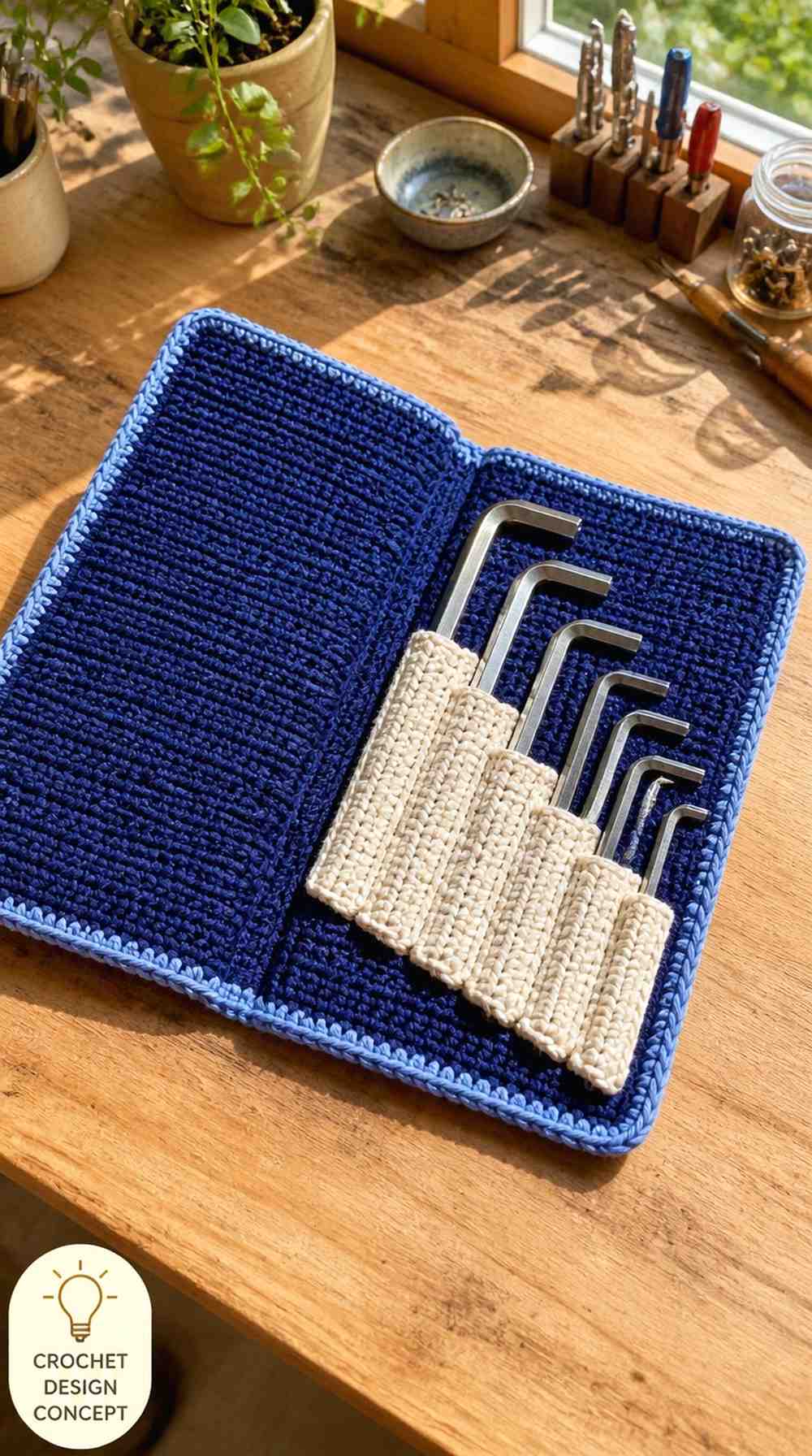
Deep-indigo crochet forms a fold-open folio with six cream canvas-lined tool channels placed diagonally across one interior panel. A pale-blue border defines the outer edges, while the opposite cover remains plain indigo. The L-shaped key bends follow the same organized diagonal direction.
The angled channels make this design visually different from straight vertical pockets. They could provide a useful layout for certain tool lengths, but the diagonal orientation should be planned around the real dimensions of the entire key.
- Diagonal channel spacing: Check the long and short arms of each tool so neighboring bent ends do not collide along the angled row.
- Smooth internal sleeves: A canvas lining can give each diagonal channel a defined pocket and prevent steel edges from contacting the crochet yarn directly.
- Plain opposite cover: Keeping the second panel undecorated reduces bulk and gives the angled key arrangement a smoother surface when the folio is closed.
14. Crochet Coral Paired-Width Hex Key Roll
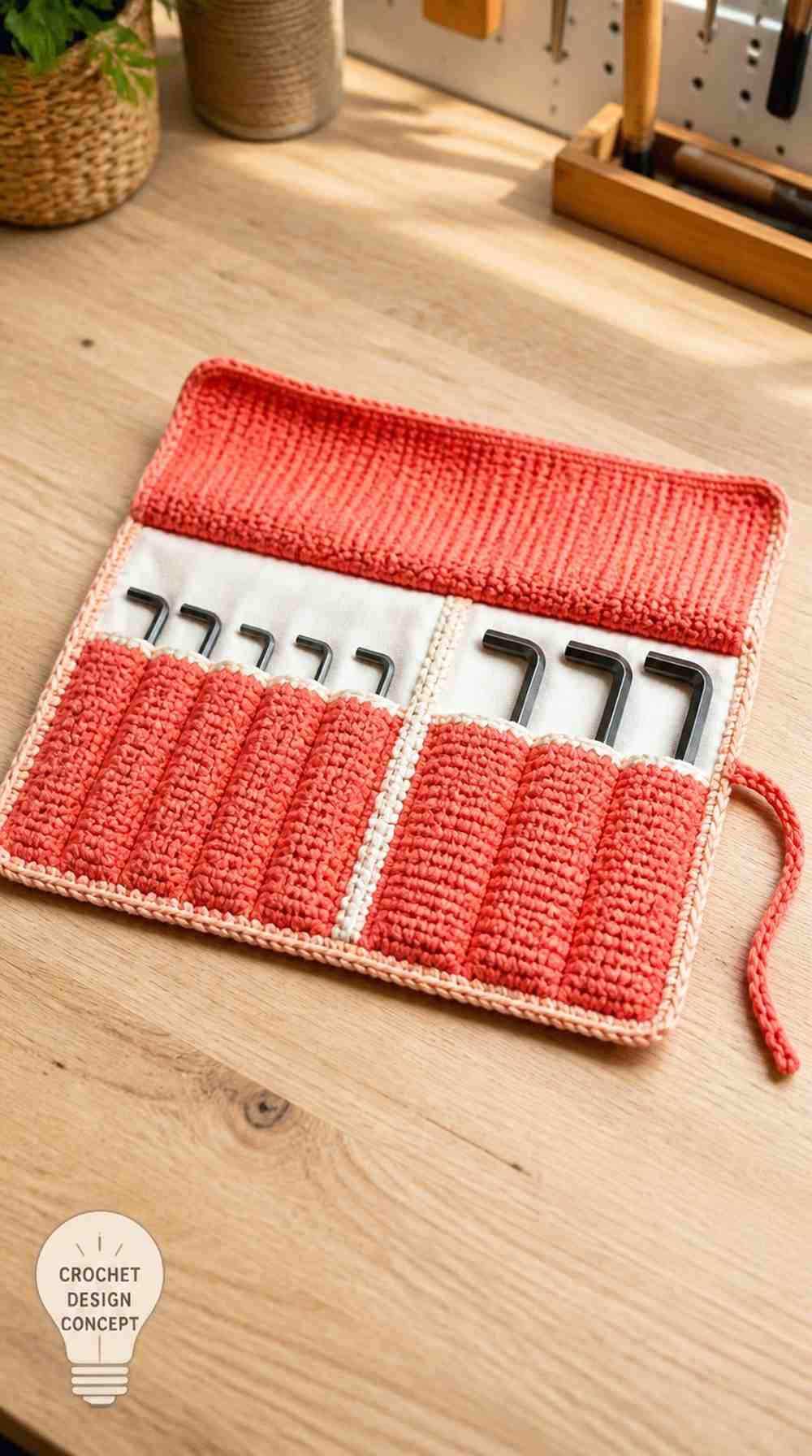
Warm-coral crochet forms an open rectangular tool roll with two different pocket groups. Five narrow ivory-lined slots hold small Allen keys on the left, while three wider compartments hold larger keys on the right. A vertical ivory separator and peach edging finish the design.
The mixed-width pockets make this organizer particularly relevant for a set containing a wide range of sizes. It avoids giving every key the same amount of space, but accurate measuring matters to prevent the smallest tools from slipping through oversized sleeves.
- Narrow small-key slots: Reduce unnecessary space around smaller Allen keys while leaving enough room to remove them without pulling the lining loose.
- Wider large-key sleeves: Allow the bigger L-shaped tools sufficient width at their bends, not only along their straight arms.
- Central size divider: The ivory line separates both groups visually, making it easier to restore keys to their assigned side after use.
15. Crochet Cocoa Original-Holder Utility Pouch
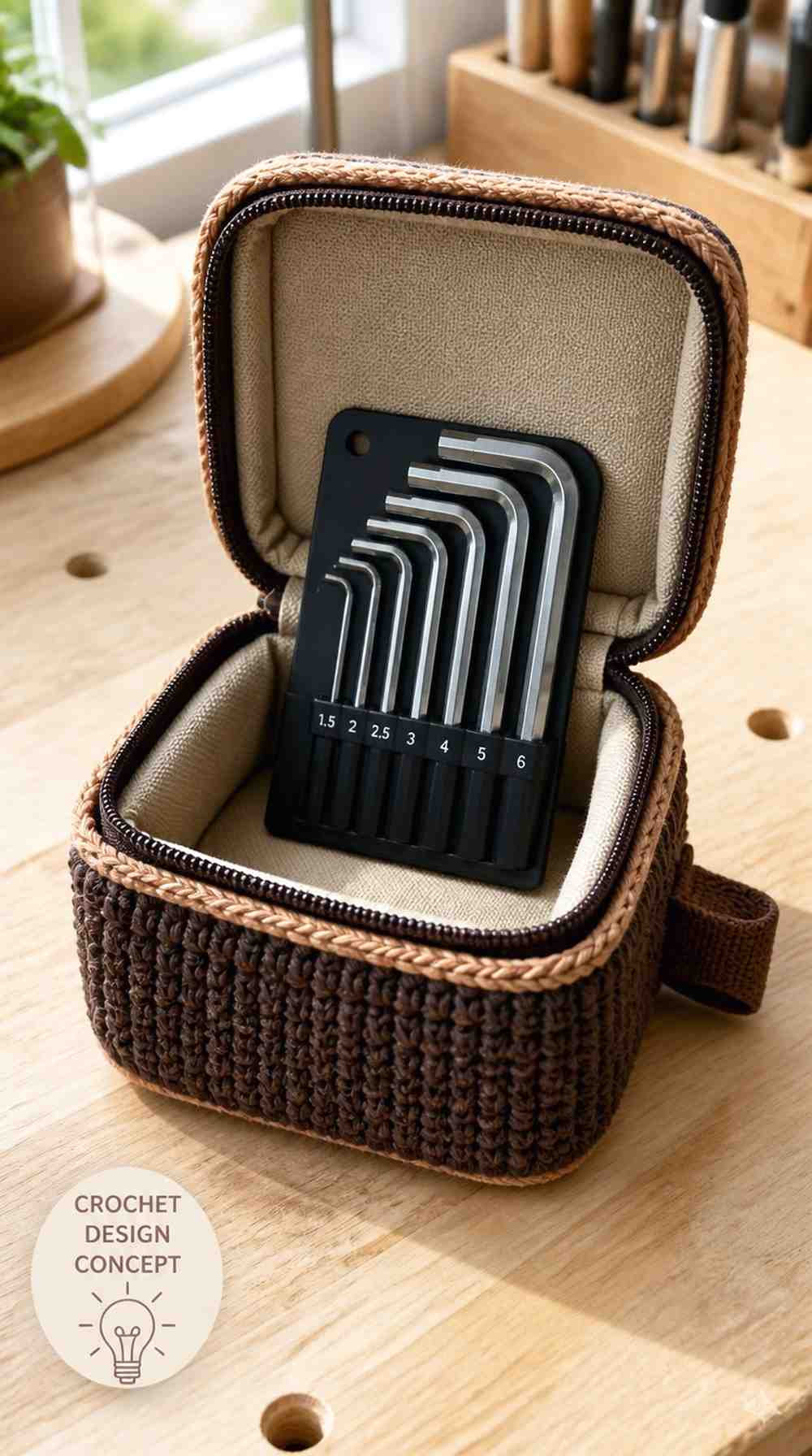
Cocoa-brown crochet forms a boxy zippered pouch with low basketweave texture across its exterior. Inside, a sand-colored fabric lining surrounds a rigid black plastic Allen key holder containing seven graduated steel keys. Caramel edging and softly shaped gussets complete the rectangular body.
This concept focuses on carrying a complete existing key rack rather than building individual sleeves. The rigid holder provides the tool spacing, while the crochet pouch adds an outer enclosure.
- Holder-first sizing: Measure the entire original rack with every key inserted before planning the pouch width, height and gusset depth.
- Boxy lined interior: Smooth fabric between the rigid rack and crochet exterior can reduce snagging and limit wear at the pouch corners.
- Zipper clearance: Leave enough room for the rack to slide out without forcing the zipper against protruding key bends.
16. Crochet Lavender Color-Tab Allen Key Organizer
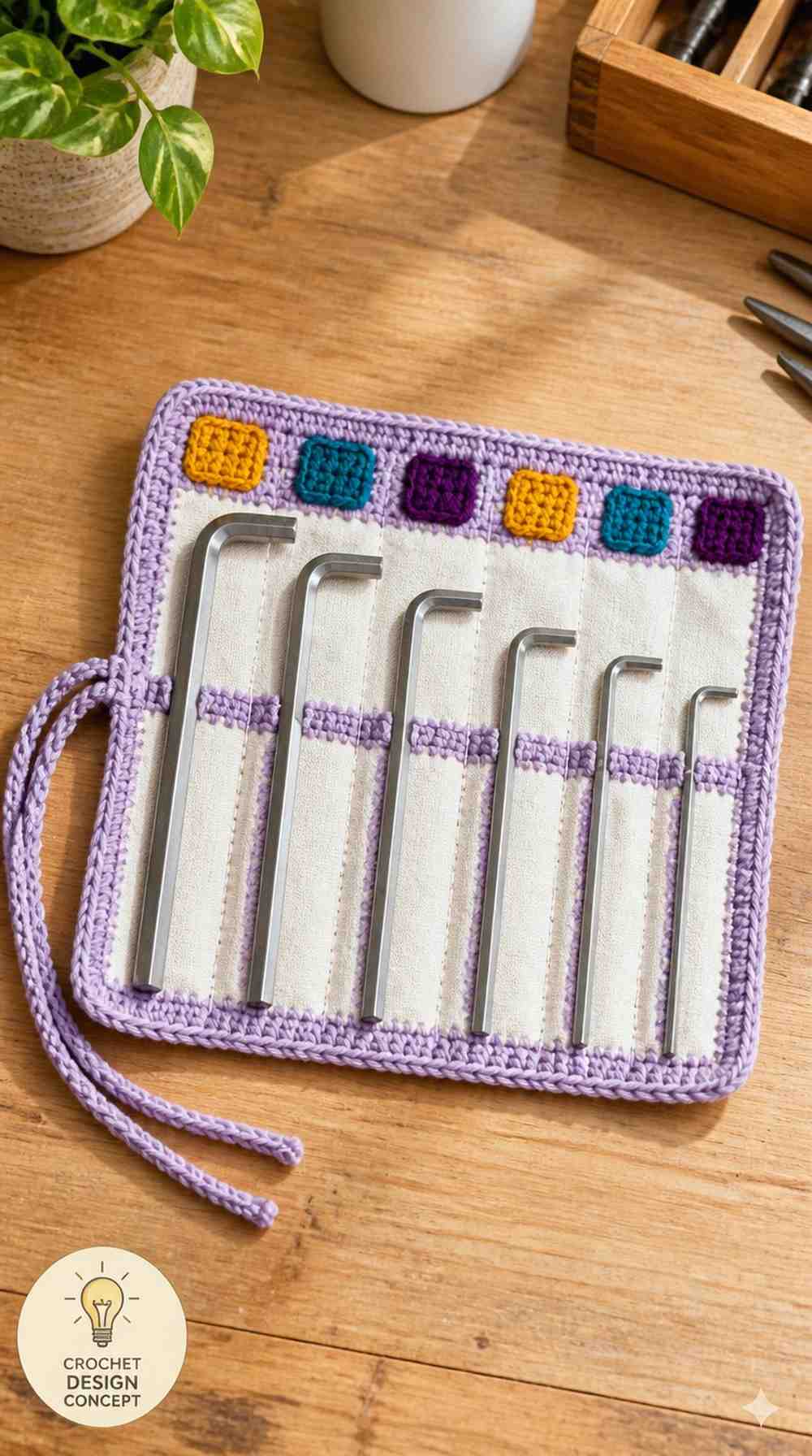
Pale-lavender crochet forms a rectangular roll holding six steel Allen keys in individual ivory-lined sleeves. Six small flat tabs sit above the openings in alternating mustard, teal and plum yarn, while a deeper-lavender border finishes the outer panel.
The colored tabs make it easy to create a personal identification system without stitching permanent numbers into the crochet. They are especially useful visually, but colors should supplement rather than replace accurate tool-size markings.
- Tab alignment: Position one flat marker above each sleeve so it is clear which key belongs to which slot.
- Readable size labels: For a real organizer, add accurate removable or durable size labels; color alone cannot reliably distinguish closely sized tools.
- Secure markers: Stitch the small tabs flat to the backing so they do not curl into the tool openings or become detached during handling.
17. Crochet Rust Hook-and-Loop Hex Key Wrap
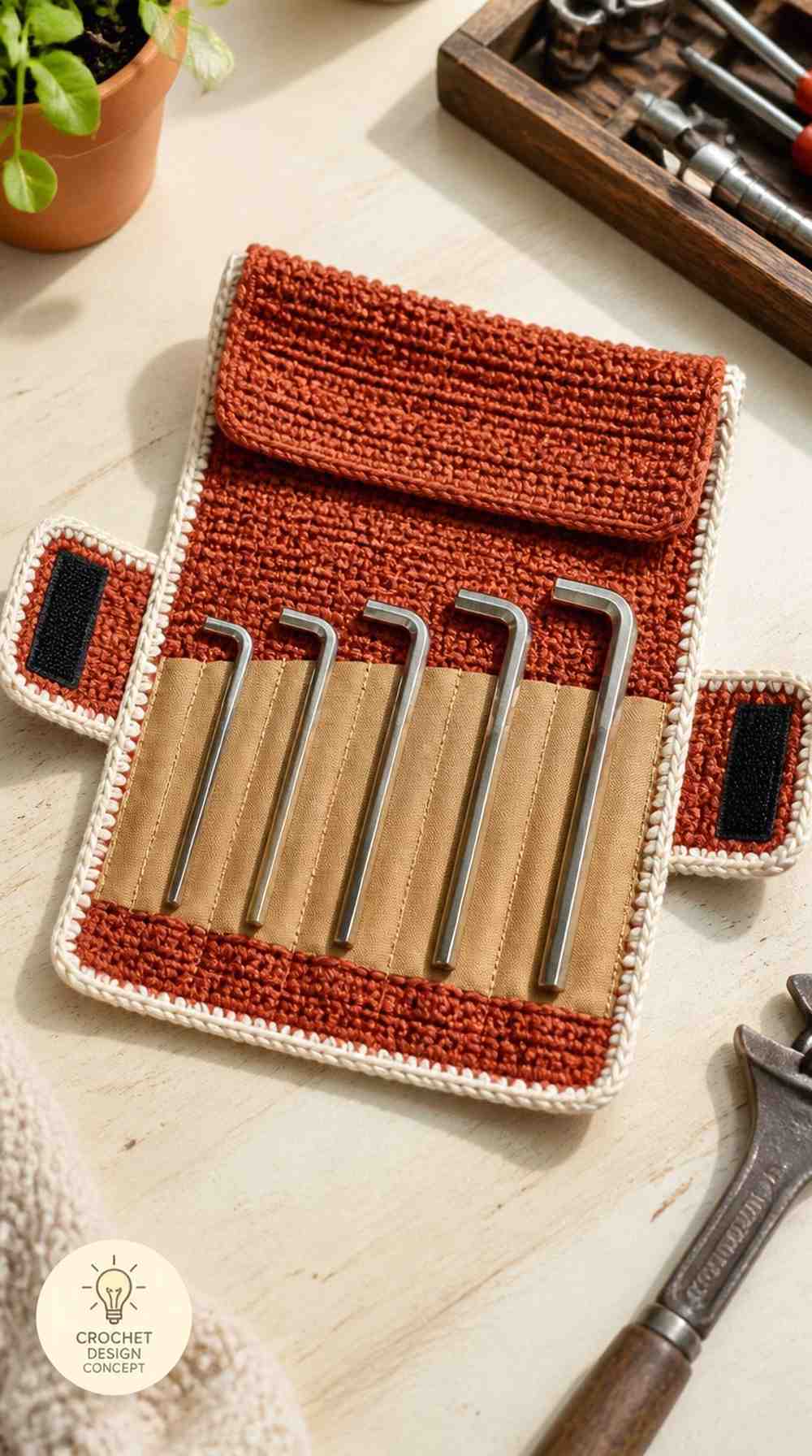
Rust-orange crochet forms a rectangular wrap with six tan canvas-lined channels and a broad protective upper flap. Ivory edging defines the panel, while two short side fastening tabs use black hook-and-loop strips to secure the folded organizer.
The wide flap is intended to cover the exposed short arms before the wrap is closed. Hook-and-loop fastening offers a different closure style from buttons or ties, although the rough fastening surface needs careful positioning.
- Protective upper flap: Keep the flap long enough to cover the visible short metal ends without forcing it tightly against the keys.
- Hook-and-loop orientation: Position the rough strips inside the fastening overlap and away from loose yarn or the tool sleeves.
- Closure wear: Inspect the strips for trapped fibers and loss of grip, since repeated use can affect the fastening.
18. Crochet Ivory Detachable-Panel Allen Key Kit
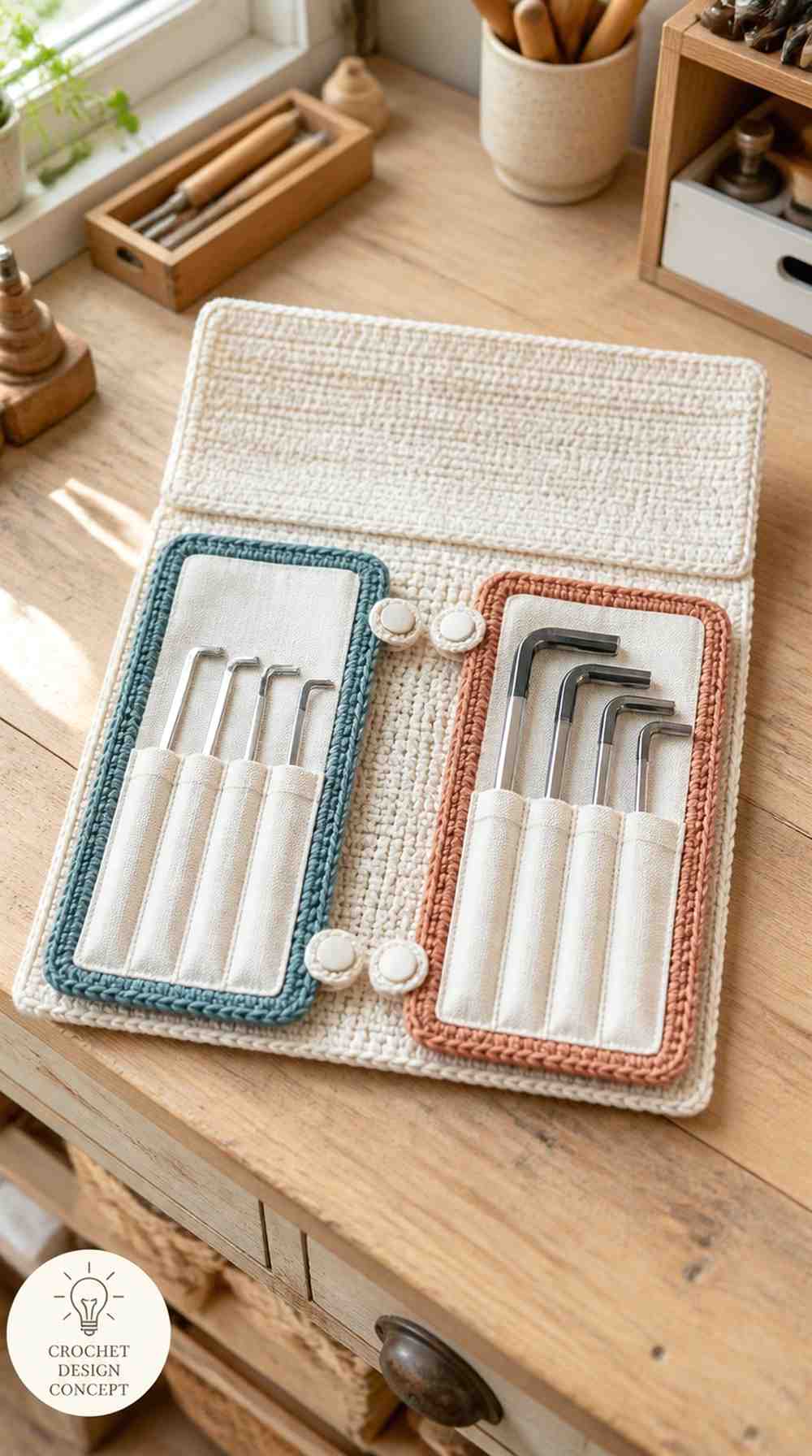
Warm-ivory crochet creates a book-style kit with two removable internal key panels. The teal-edged insert holds four smaller Allen keys, while the terracotta-edged panel holds four larger ones. Flat fabric-covered buttons attach both inserts to the central backing, and a smooth outer flap folds around the case.
The removable panels allow the storage layout to be rearranged without replacing the entire crochet cover. That flexibility is useful, but the button tabs and insert seams need secure construction to keep the metal tools properly separated.
- Two removable groups: Keep the teal and terracotta panels clearly differentiated so each tool can be returned to the correct set.
- Button-tab attachment: Reinforce the fastening points and check that the loaded panels remain seated when the outer wallet is lifted.
- Inner tool protection: Each removable section still requires individual lined sleeves; detachable panels do not replace secure tool retention.
Practical Guide to Crochet Allen Key Tool Organizers
Measure the actual Allen keys. Also called hex keys, these tools are usually L-shaped, with one long arm and one shorter bent arm. Their lengths and thicknesses vary by set. Measure both arms and the bend before choosing pocket sizes, not just the hexagonal cross-section.
Keep metric and inch sizes separate. Metric and inch hex keys can look similar, but using the wrong size may damage a fastener. Use clear identification and keep each key in its assigned slot. Crochet color tabs can support an existing marking system but should not replace accurate measurements.
Protect the yarn from metal ends. Smooth canvas or another suitable fabric lining can help keep the steel from catching on crochet loops. Consider properly fitted tip guards where needed. The tools should not protrude through open stitches or press sharply against the outer cover.
Plan for secure closure. A tool roll should close without compressing or crossing the key bends. Zippers, ties, snaps, hook-and-loop tabs and buttons each need a fit check with the case fully loaded. Do not assume an AI-rendered closure will perform as pictured.
Keep tools clean and dry. Moisture can contribute to corrosion on some steel tools. Wipe dirty or damp Allen keys according to their manufacturer’s instructions and allow them to dry before storing them in a textile holder. Keep the finished kit in a dry toolbox or cupboard.
Use suitable crochet materials. Smooth, densely worked cotton yarn is one option for the outer fabric. The lining, pocket seams, closures and any reinforcement are equally important. A soft crochet shell alone should not be expected to prevent punctures, protect against impacts or carry heavy tool loads.
Store tools responsibly. Keep the organizer away from young children, especially if it contains small keys, removable caps, buttons or other detachable components. Do not use a crocheted tool organizer to store powered, hot or contaminated equipment.
Want to Make Something Similar?
These verified resources teach related crochet tool-roll and pouch construction. They are not exact patterns for the 18 illustrated Allen key organizers, and any metal-tool adaptation would need suitable pocket protection and testing.
- Crochet Tool Roll by Jocelyn Ng — A free customizable pattern that combines a crochet panel with fabric lining and sewn tool attachments. Its original examples store crafting tools, so Allen keys would need appropriately protected and resized sleeves.
- Roll Up Hook Organizer by Amy Yarbrough — Crochet Spot — A free crochet pattern demonstrating a roll-up panel, fabric lining, compartment attachments and closing ties. Useful for studying how tool rows can be arranged before adapting them.
- Textured Notions Pouch by Amanda Saladin — Love.Life.Yarn — A crochet pouch pattern with a zipper and fabric lining, relevant to the zippered Allen key travel case and the original-holder utility pouch.
For a closely related home-repair storage collection, explore 19 Crochet Home Repair Screwdriver Roll Inspiration Ideas on Yarn Nest Studio. The screwdriver designs focus on different handle and shaft shapes, so their compartments should not be copied directly for L-shaped hex keys.
For organizing smaller repair hardware separately, see 14 Crochet Spare Screw Sorting Pouch Inspiration Ideas.
Which Crochet Allen Key Organizer Should You Choose?
| Your main need | Designs to consider | Important trade-off |
|---|---|---|
| A simple complete tool roll | Copper Eight-Slot, Teal Graduated-Pocket | Accurate pocket sizing required |
| Separate metric and inch sets | Navy Dual-System Folio | Two panels add folded thickness |
| Zippered travel storage | Ochre Zippered Travel Case | Zipper and lining need secure construction |
| Decorative crochet cover | Burgundy Granny-Square | Motifs need a solid backing |
| Wall-mounted access | Sage Wall-Hung Organizer | Requires reliable mounting |
| Small household repair kit | Charcoal Four-Key Snap Wallet | Limited number of slots |
| Compartmented pouch | Plum Accordion | Gussets and dividers add bulk |
| Existing rigid key rack | Sand Protective Wrap, Cocoa Utility Pouch | Must match the original holder |
| Long and short key groups | Mustard Two-Tier, Coral Paired-Width | Different slot dimensions needed |
| Compact folding shape | Blush Tri-Fold | Fold lines need tool clearance |
| Extra end protection | Olive Tip-Guard | Guards must fit securely |
| Diagonal tool layout | Indigo Diagonal-Channel | More complicated pocket spacing |
| Visible color identifiers | Lavender Color-Tab | Color cannot replace size labels |
| Adjustable outer closure | Rust Hook-and-Loop | Fasteners can collect fibers |
| Removable tool sections | Ivory Detachable-Panel | More attachments to inspect |
For an everyday home repair kit, the Copper Eight-Slot Roll or Teal Graduated-Pocket Holder is a good starting point because both show individual keys clearly.
If you already own a reliable molded plastic hex-key rack, the Sand Protective Wrap or Cocoa Utility Pouch may be the simpler concept. Those designs preserve the existing holder’s tool-retention function while adding a crocheted outer layer.
For someone who frequently changes the tools carried in a kit, the Ivory Detachable-Panel design is worth considering. If metric and inch keys both need organizing, the Navy Dual-System Folio provides a clearer separation.
Conclusion
Crochet Allen key tool organizers offer a creative way to bring structure and handmade color to a collection of small repair tools. From copper roll-up cases and navy dual-system folios to lined zipper pouches, granny-square covers and removable inserts, these 18 concepts explore different storage arrangements. The most useful choice is one that fits the actual L-shaped tools, keeps their metal ends safely separated and makes the correct size easy to find. With suitable lining, reliable closures and careful storage, a crocheted exterior can become part of a personalized household tool organization system.
Which design would you choose for your Allen keys? Would you prefer an eight-slot roll, a compact snap wallet, a zippered pouch around the original holder or a color-coded organizer with removable panels? Share your favorite and whether you mainly use hex keys for furniture assembly, bicycle work or household repairs.
Frequently Asked Questions
1. Can crochet be used to organize metal Allen keys?
Yes, crochet can form the outer panels and decorative parts of a tool organizer, but the metal keys should have suitable protective sleeves or an existing rigid holder. Closely worked crochet alone should not be assumed to prevent sharp ends from catching, slipping or damaging the yarn. These illustrated designs have not been physically tested.
2. What yarn is suitable for an Allen key organizer?
Smooth cotton yarn is one option for making dense outer panels with clear stitches. However, yarn type alone does not make a safe tool case. The lining, reinforced seams and closure system matter because metal tools can rub against or push through textile surfaces. Choose washable materials when appropriate and keep the organizer dry.
3. Should metric and inch-size Allen keys be stored separately?
Separating them is a useful way to avoid confusing similar-looking sizes. Metric and inch measurements are not interchangeable, and the wrong key can damage a fastener. Use the tool’s actual size markings or verified labels rather than identifying keys only by color, appearance or slot order.
4. Is a crochet tool roll better than a zipper pouch?
A roll-up design makes individual keys easier to see when the organizer is open, while a zippered pouch offers an enclosing outer case. Both can work as concepts if the keys remain in separate properly protected holders. The better choice depends on tool sizes, transport needs and whether the closure performs securely when loaded.
5. Are these 18 crochet Allen key organizers available as patterns?
No. These are original crochet design visualizations exploring different slots, layouts, materials, closures and decorative details. They are not tested finished products or complete patterns. The linked tutorials explain related crochet tool-roll and pouch techniques, but they do not reproduce these exact designs or guarantee secure metal-tool storage.