Pet litter mats can make cleaning around a litter box easier, but storing a spare mat neatly is another small challenge. A flexible mat may loosen after being rolled, especially when it is moved between shelves or storage bins. A removable crochet keeper band offers a handmade way to hold a clean, dry mat together between uses. These 13 crochet pet litter mat roll keeper band inspiration ideas explore buttoned wraps, ribbed cuffs, adjustable straps, granny squares and compact fastening details.
The right keeper depends on your mat’s material, thickness, rolled diameter and manufacturer’s storage instructions. Some designs slide over the rolled mat, while others wrap around it and close with buttons, ties, hook-and-loop tape or buckles. These ideas are intended for off-mat storage, not for use while a pet is walking on the litter mat. Comparing the designs can help you choose a manageable fastening method without damaging the mat or leaving loose yarn within a pet’s reach.
These are AI-generated crochet design visualizations for inspiration, not photographs of tested handmade products or step-by-step patterns.
Quick Design Selection Guide
- For a simple everyday wrap: Crochet Terracotta Buttoned Litter Mat Band and Crochet Navy Pull-Through Roll Keeper offer compact fastening arrangements.
- For a fixed roll diameter: Crochet Oatmeal Ribbed Roll Cuff and Crochet Cocoa Connected Twin-Ring Mat Keeper use continuous crochet loops.
- For decorative handmade style: Crochet Burgundy Granny-Stripe Mat Band and Crochet Lavender Scalloped Snap-Tab Band introduce recognizable crochet textures.
- For identifying stored mats: Crochet Butter Yellow Label-Window Mat Band includes a removable card window.
- For adjustable fitting: Crochet Moss Hook-and-Loop Keeper Band, Crochet Denim Adjustable Buttonhole Keeper and Crochet Plum Sliding-Buckle Mat Keeper Band provide different adjustment methods.
- For alternative wrapped closures: Crochet Teal Cross-Strap Litter Mat Keeper, Crochet Coral Short-Bow Mat Roll Wrap and Crochet Sand Envelope-Flap Roll Keeper explore more distinctive shapes.
1. Crochet Terracotta Buttoned Litter Mat Band
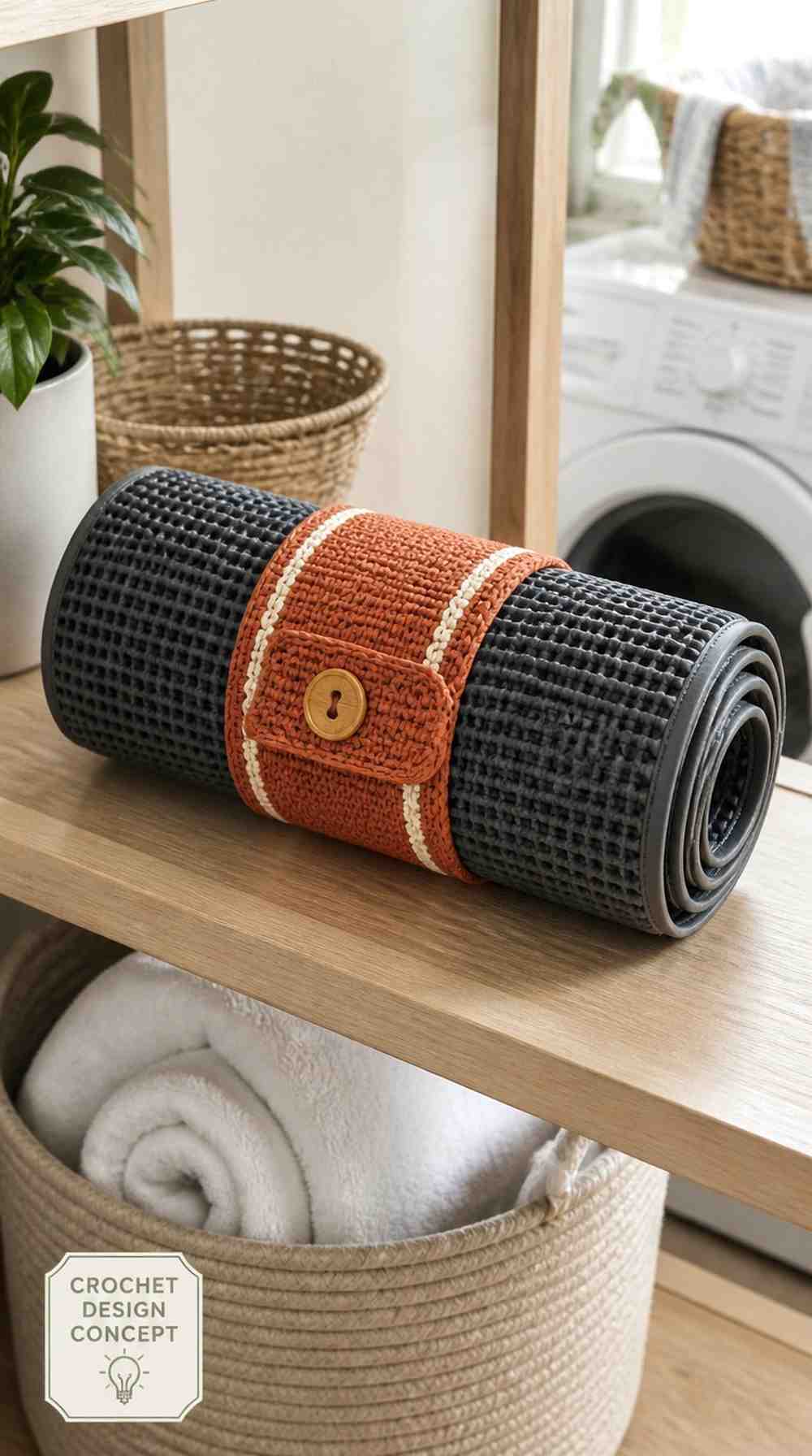
Warm terracotta crochet creates a broad rectangular band with two raised ivory ridges. A short overlapping tab fastens with one flat wooden button, keeping the design tidy around the middle of the rolled litter mat. Dense horizontal stitches and straight edges give the wrap a simple, structured appearance.
This concept is a practical starting point for a removable keeper because its fastening is easy to understand. The overlap should be sized around the actual rolled mat, however, rather than pulling the yarn tightly enough to compress its flexible backing.
- Button placement: Position the wooden button where the overlapping tab lies flat, without pressing a hard edge deeply into the mat’s surface.
- Band width: A moderately wide strap spreads contact over more of the roll than a thin cord, which may help reduce narrow pressure lines.
- Roll compatibility: Test the buttoned fit on the clean, loosely rolled mat and check for marks or distortion before using it for storage.
2. Crochet Navy Pull-Through Roll Keeper
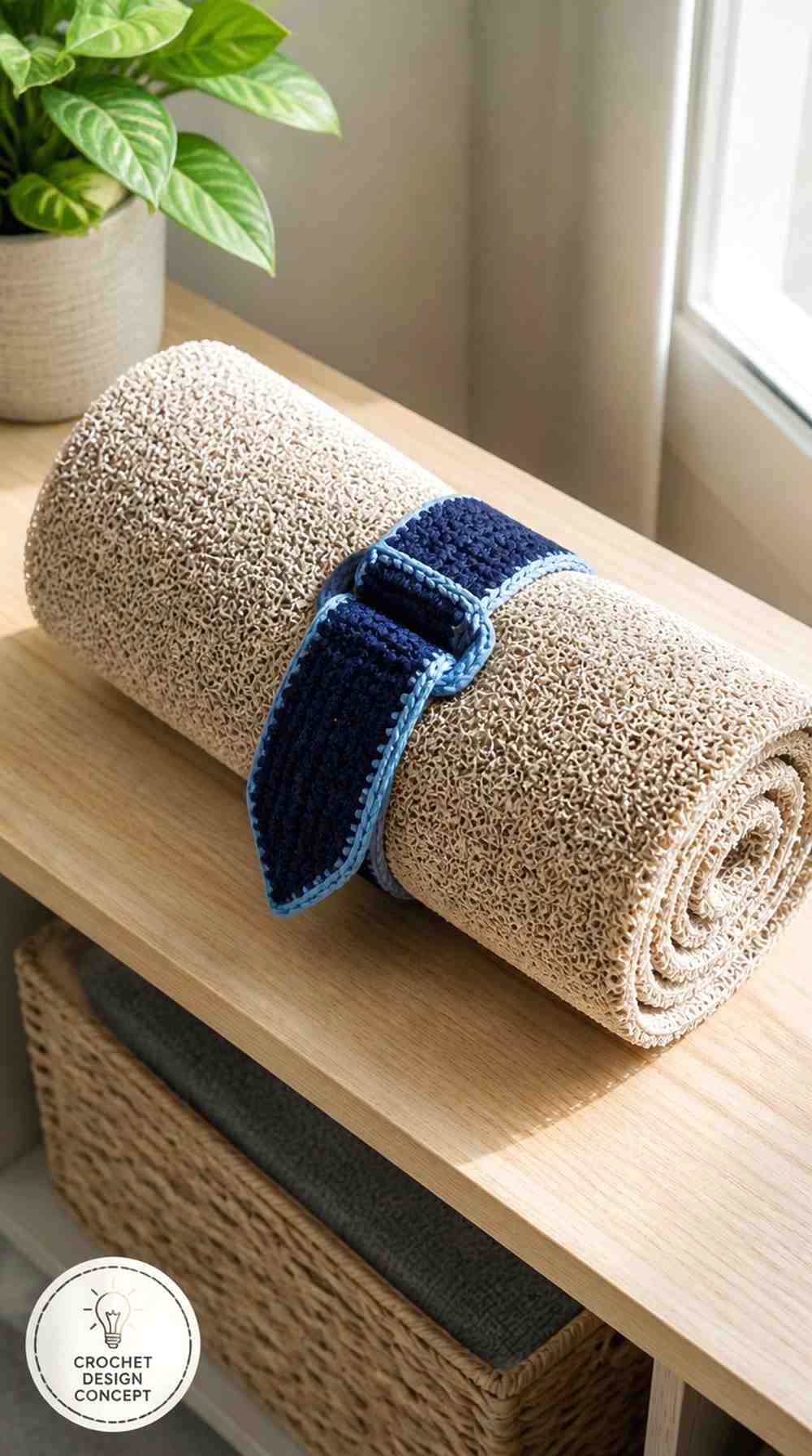
Deep-navy crochet forms a narrow flat strap with pale-blue edging. One end has a reinforced rectangular opening, while the tapered opposite end passes through it and folds back against the outside of the band. The design has no buttons or dangling ties.
The pull-through construction offers an alternative to separate fastening hardware. Its effectiveness depends on how securely the folded strap remains positioned, especially since crochet yarn can stretch and the rolled mat may expand slightly after being released.
- Reinforced slot: Work the rectangular opening with strong connected edging so repeated threading does not pull its corners out of shape.
- Tapered end: Keep the free end narrow enough to pass through the slot without forcing or bunching the crochet fabric.
- Holding limitation: A pull-through wrap may loosen on a smooth mat backing; do not assume the friction alone will secure every roll diameter.
3. Crochet Oatmeal Ribbed Roll Cuff
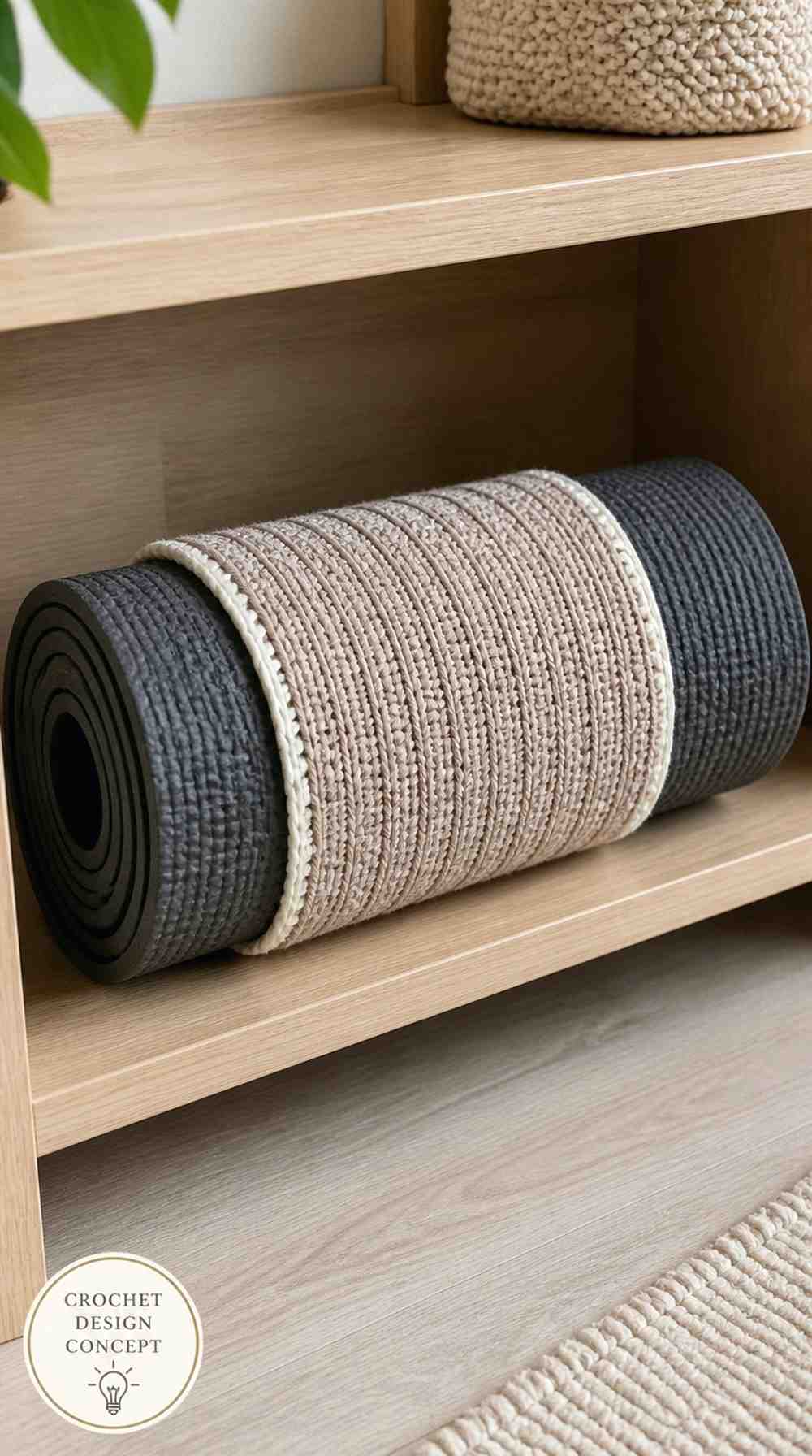
Warm oatmeal crochet forms a continuous cylindrical cuff with shallow vertical ribs and narrow cream borders. The ribbed fabric slides over the center of a neatly rolled slate-colored litter mat, leaving both ends visible.
This design has no fastening hardware, making its appearance especially clean. Because it is a closed loop, however, it offers much less adjustment than a buttoned or tied wrap. The finished circumference must suit the rolled mat without excessive squeezing.
- Fixed circumference: Measure the mat after rolling it loosely; the cuff needs enough room to slide on and off without damaging the backing.
- Ribbed structure: Shallow raised crochet stitches provide texture, but overly thick ribs could make the cuff unnecessarily bulky.
- Removal method: Slide the cuff off the end only when the mat can be handled without trapping or bending its edge.
4. Crochet Teal Cross-Strap Litter Mat Keeper
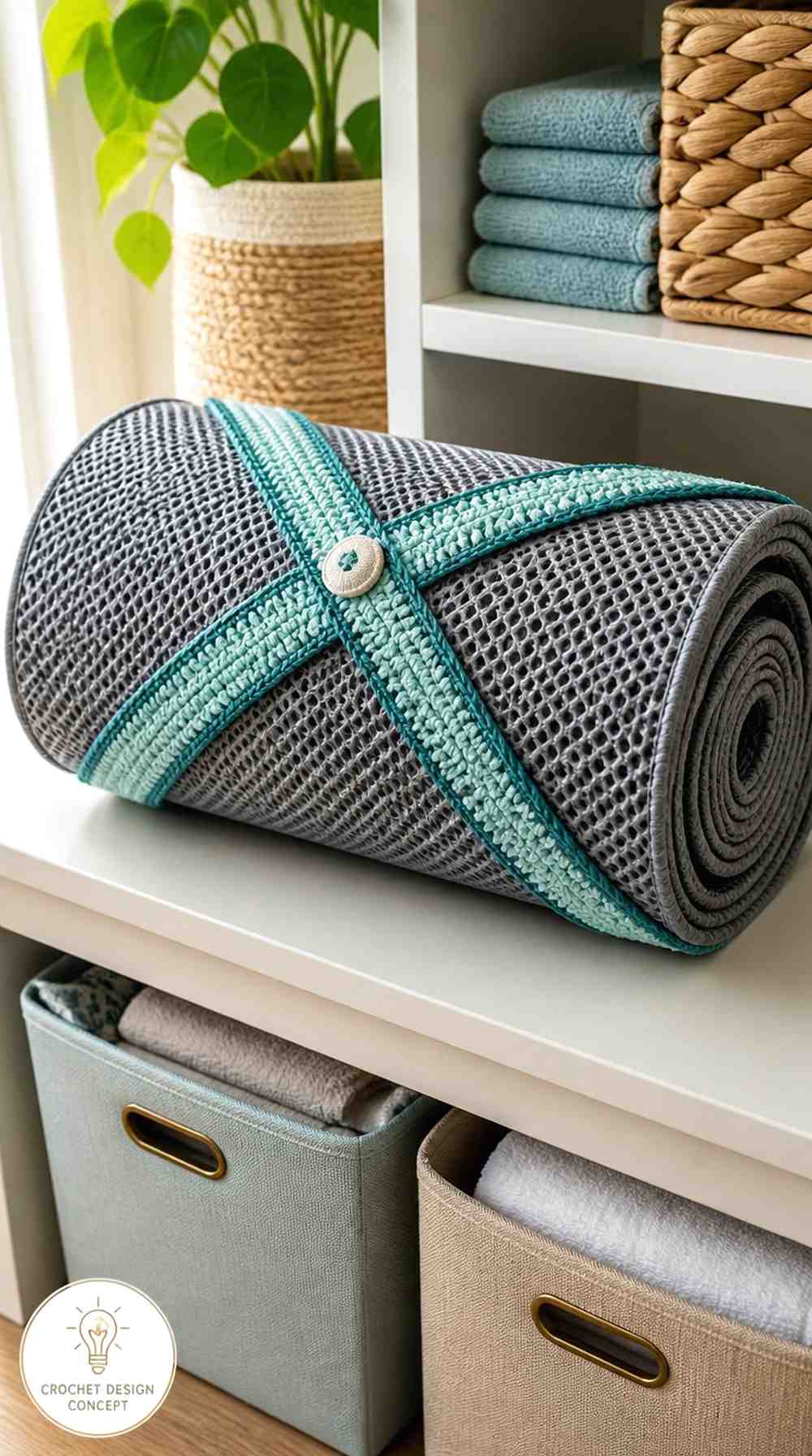
Sea-glass-teal crochet creates two slim straps crossing into a neat X shape over the outer curve of a rolled gray litter mat. Darker-teal edging defines the straps, and a small ivory-covered button secures the arrangement at the side.
The crossed structure makes this concept visually different from a simple circular band. It also introduces extra joining points, so both straps need to lie evenly without pulling the roll into an irregular shape.
- Crossed strap routing: Arrange the X over the outer surface without creating twisted sections underneath the mat.
- Buttoned connection: Reinforce the fastening point where the straps meet so it can withstand repeated opening and removal.
- Surface contact: Check that the diagonal straps do not leave deep pressure marks, especially on mats with soft foam or textured backing.
5. Crochet Butter Yellow Label-Window Mat Band
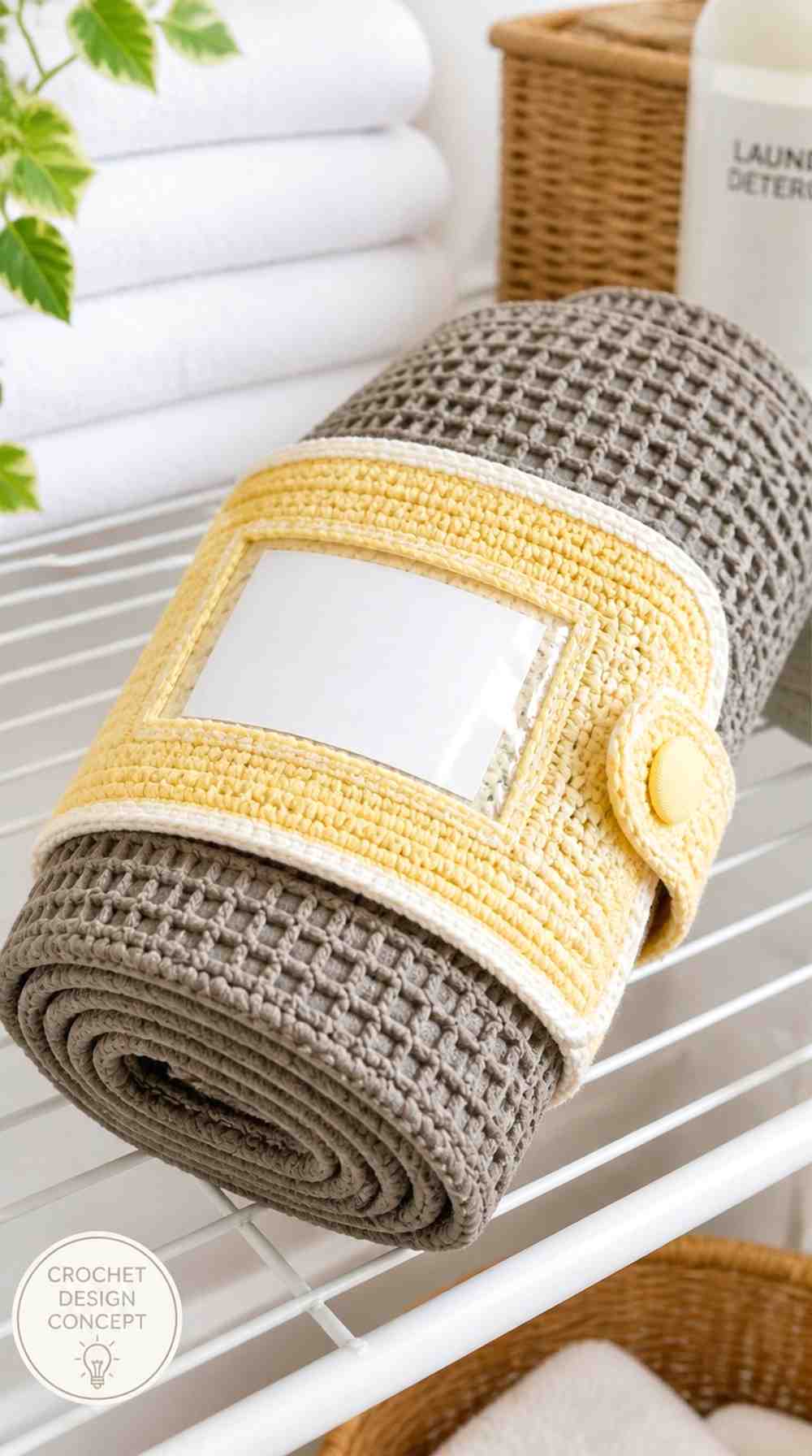
Butter-yellow crochet forms a wide keeper with ivory edging and a small clear identification window. A blank paper card sits behind the window, while a short side tab closes with a pale-yellow fabric-covered button.
The visible card compartment distinguishes this design from ordinary storage straps. It could help identify different spare mats or storage locations without writing directly on the textile. The transparent material and button add extra parts that need inspection.
- Removable identification: Use a simple card to identify the stored mat, keeping the paper behind the window rather than attaching labels to the mat itself.
- Window construction: Secure the transparent sheet around its edges so it does not peel away or create sharp corners against the roll.
- Moisture protection: Remove or replace damp paper, and clean the clear window and crochet separately according to their materials.
6. Crochet Burgundy Granny-Stripe Mat Band
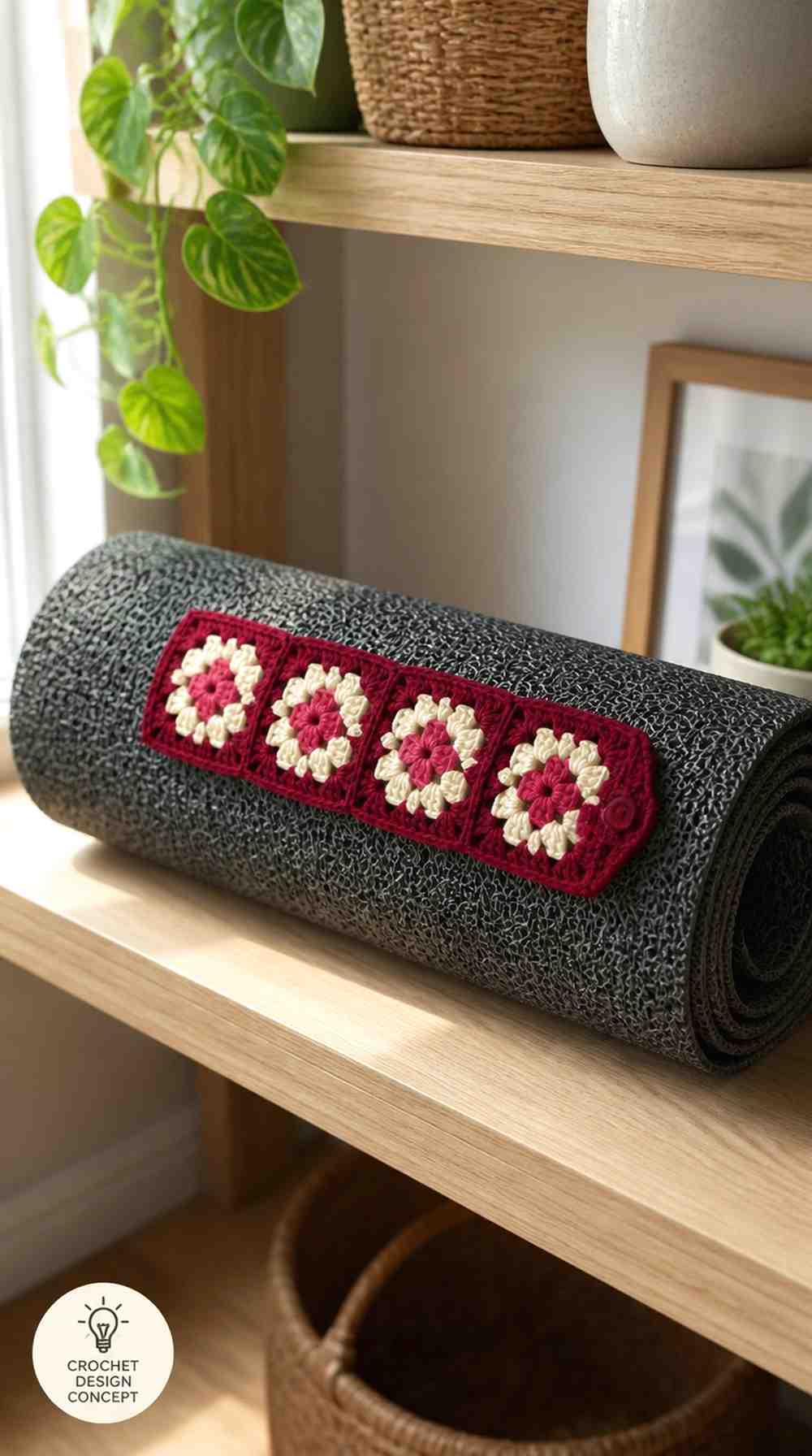
Four miniature granny squares form a decorative burgundy keeper band with raspberry centers and ivory middle rounds. A continuous solid burgundy backing supports the motifs, while a small fabric-covered button closes the overlapping ends.
The granny-square surface gives this band a traditional handmade appearance. Its solid backing is particularly relevant because open granny-square motifs alone may catch against the raised litter-trapping texture of some mats.
- Solid backing: Keep the decorative granny squares over a continuous crochet strip so open motif corners do not directly snag the mat.
- Flat motif joins: Connect the four squares with low-profile seams to prevent bulky ridges along the curved band.
- Decorative limitation: The granny-square motifs add visual interest, but the band still needs a properly fitted base and secure closure to remain positioned.
7. Crochet Moss Hook-and-Loop Keeper Band
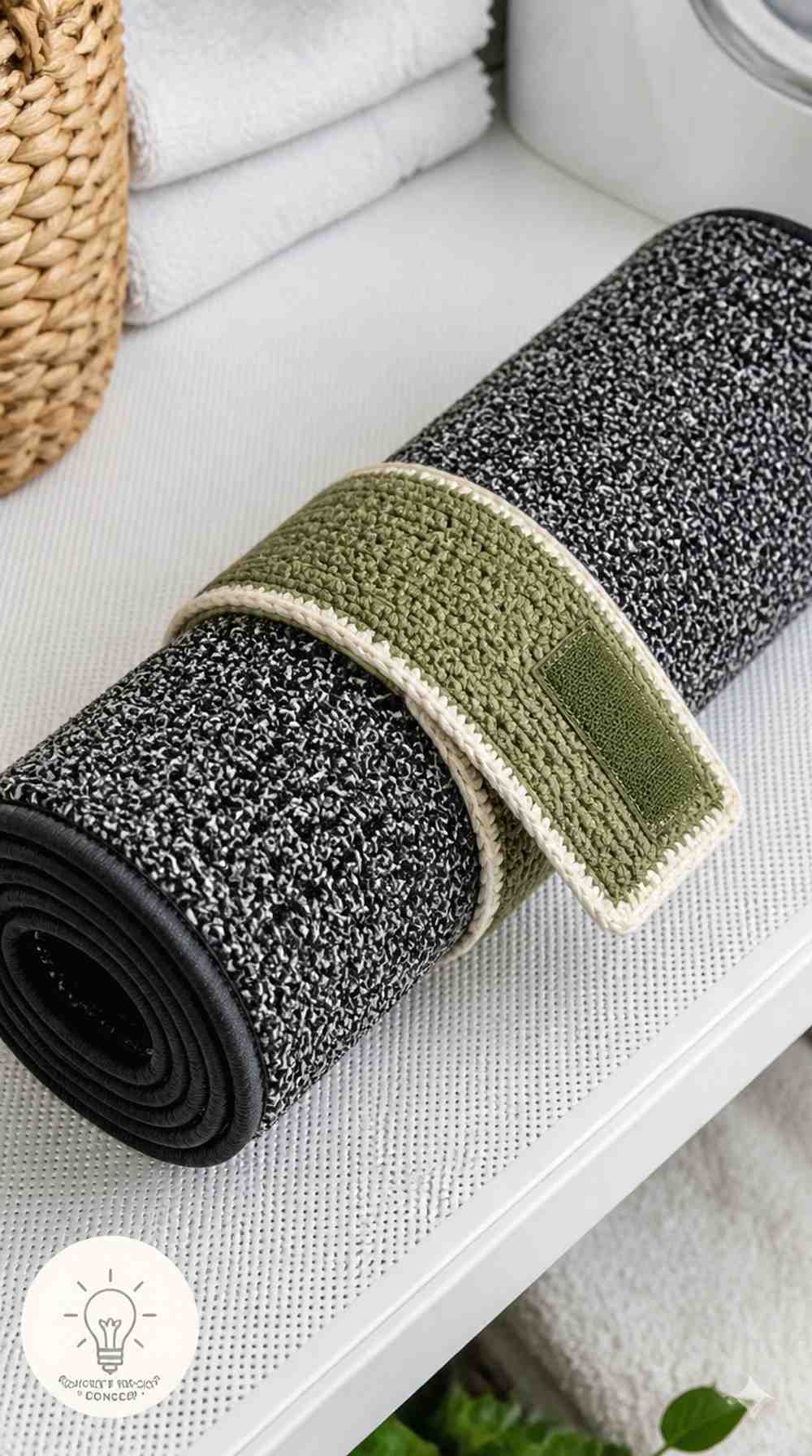
Muted-moss-green crochet creates a narrow rectangular band with ivory edging and a short overlapping fastening section. Matching hook-and-loop fabric strips are sewn to the inside of the overlap, allowing the keeper to close without buttons or knots.
This concept provides a relatively low-profile closure that can be opened and repositioned. However, rough hook-and-loop surfaces may catch yarn or damage some litter mat textures if exposed, so the fastening needs careful placement.
- Fastener orientation: Keep the rough hook section covered by the matching soft section when the band is closed, rather than allowing it to touch the mat.
- Adjustable overlap: Leave enough fastening length for small changes in rolled diameter without relying on excessive tension.
- Lint maintenance: Hook-and-loop tape can collect fibers and debris, so inspect and clean it before fastening the band around a stored mat.
8. Crochet Cocoa Connected Twin-Ring Mat Keeper
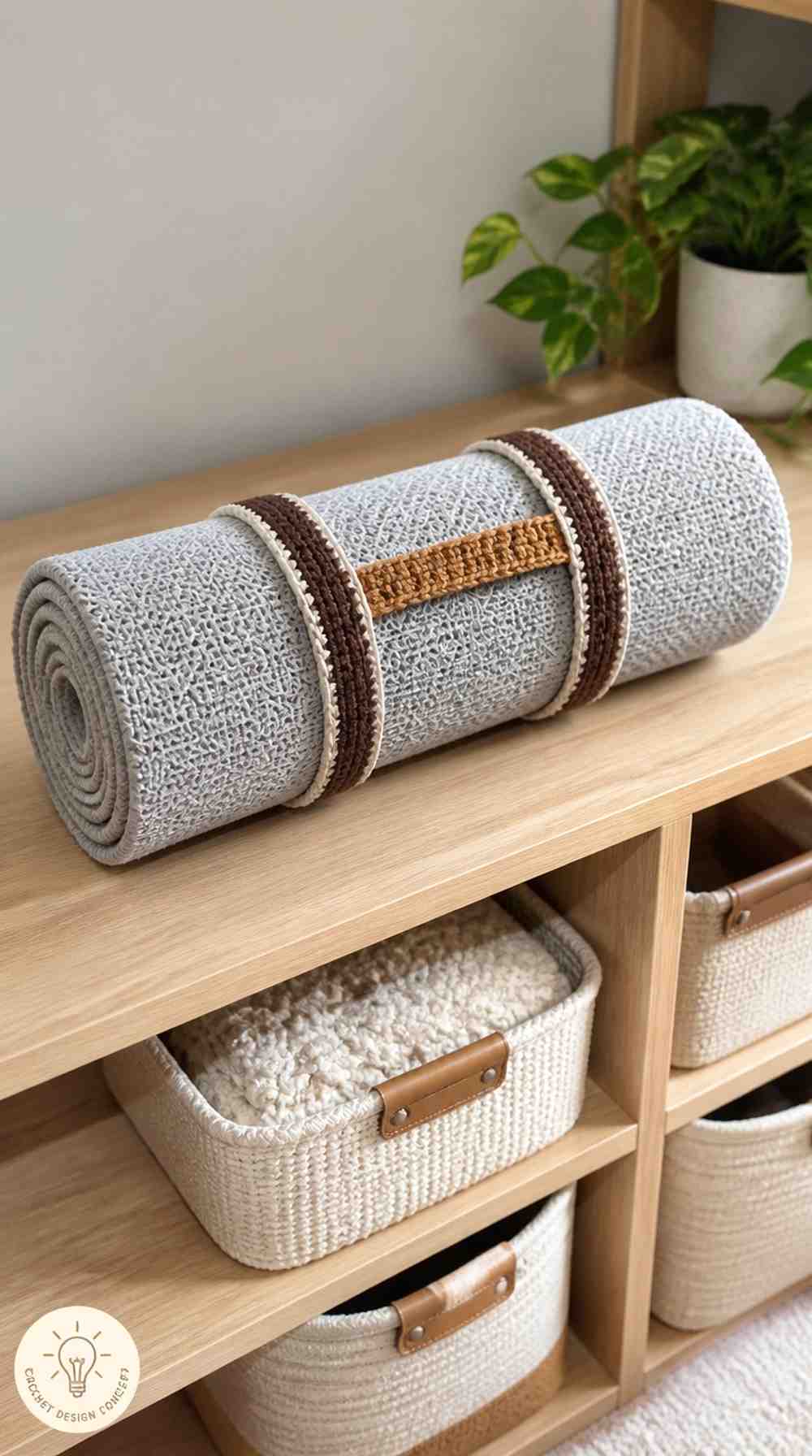
Two narrow cocoa-brown crochet rings sit a short distance apart around the same rolled litter mat. A flat caramel-colored crochet bridge joins them along the front, keeping their spacing consistent. Ivory borders finish both rings.
The connected twin-ring shape offers more distributed contact than a single narrow strap. It may suit longer rolls that tend to loosen unevenly, although each closed loop still needs to match the mat’s rolled circumference.
- Two contact bands: Position the rings apart without moving either one too close to the exposed spiral ends of the rolled mat.
- Connecting bridge: Keep the caramel section flat and securely joined so it holds the ring spacing without pulling one side out of alignment.
- Fixed-size limitation: Both rings must slide over the roll; they do not offer the quick adjustment of a buttoned or buckle-fastened design.
9. Crochet Coral Short-Bow Mat Roll Wrap
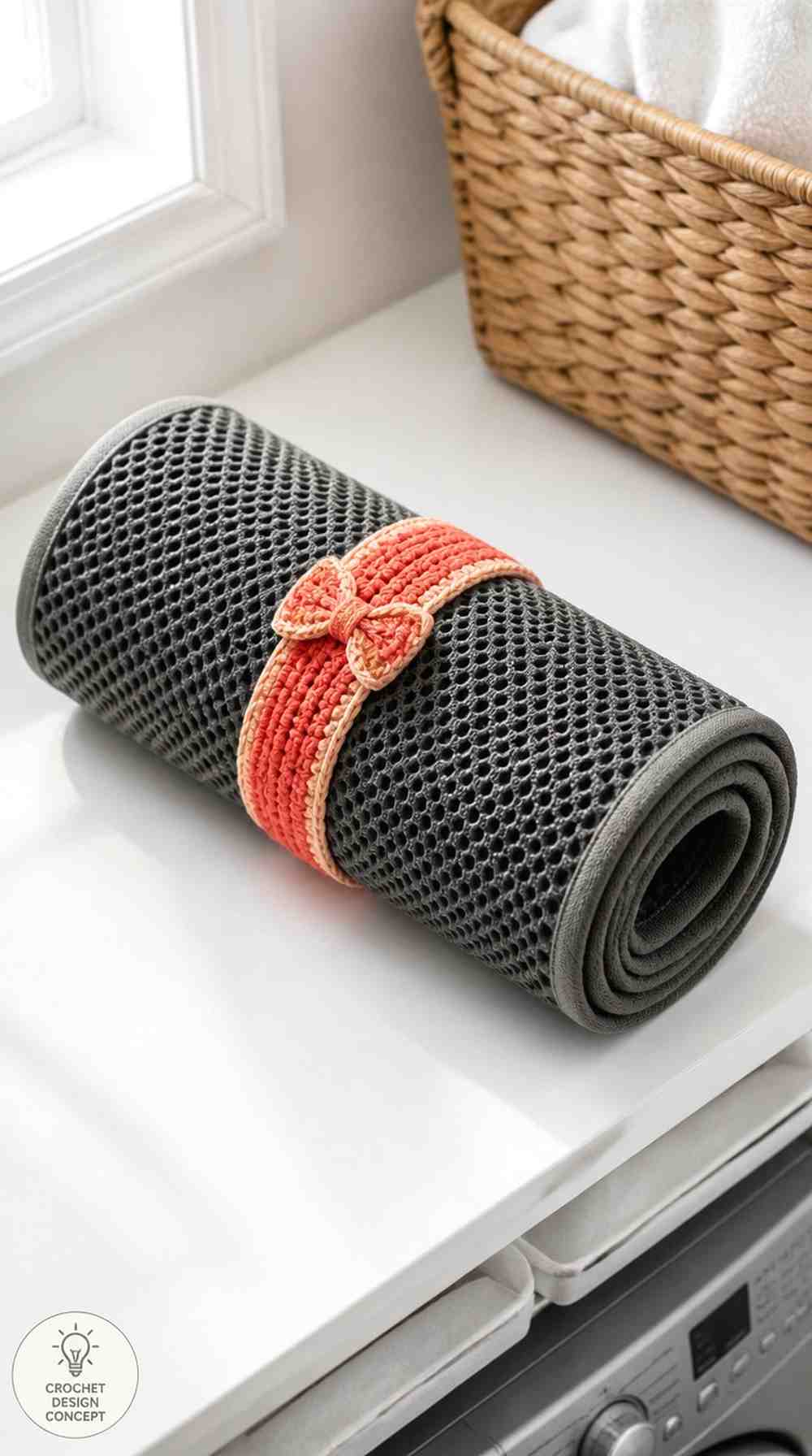
Warm-coral crochet creates a close-textured band with a peach border and two short tying ends. The ends meet in a compact, flat bow on the outer surface of the rolled litter mat, leaving no long dangling tails.
The tied arrangement has a softer decorative appearance than a buckle or buttoned strap. Its main concern is the presence of loose yarn ends, even when kept short. This makes it suitable only for inaccessible storage, not for leaving where pets can investigate or chew the bow.
- Short tie ends: Keep the bow loops and tails compact so they do not trail beyond the band or become easy for a pet to grab.
- Knot tension: Tie the wrap only firmly enough to stay positioned, avoiding deep compression of the rolled mat.
- Storage access: Put the secured roll inside a closed cupboard or another pet-inaccessible storage area, rather than leaving the bow exposed.
10. Crochet Lavender Scalloped Snap-Tab Band
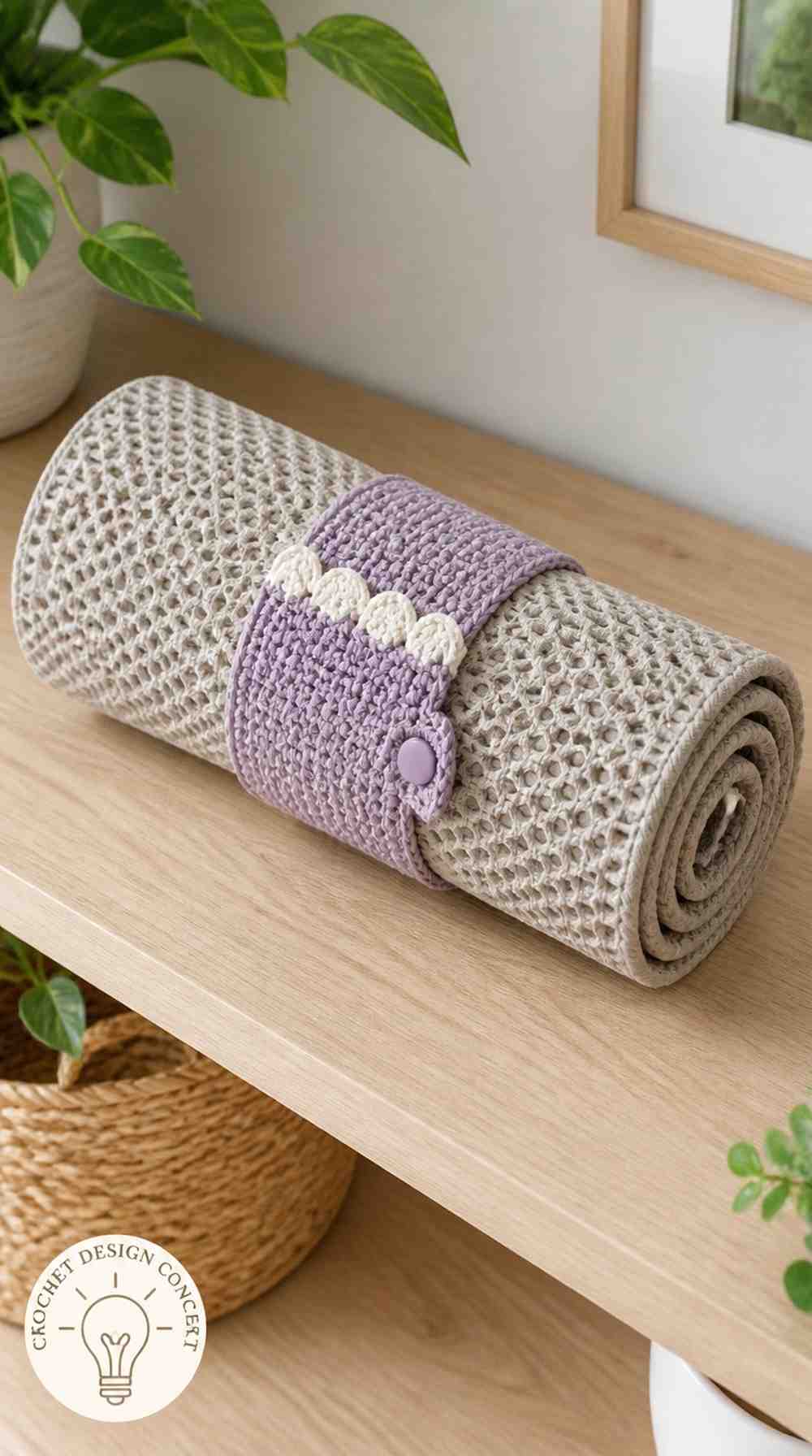
Dusty-lavender crochet forms a wide, smooth keeper with small ivory scallops along its front upper edge. A short overlapping side tab fastens with one matte-lavender plastic snap, while the remainder of the band stays closely stitched and flat.
The scalloped trim gives this design a gentle decorative finish without using separate flowers or large appliqués. The snap offers a compact closure, but it must be attached securely and inspected because detached small hardware can present a hazard around pets.
- Scallop depth: Keep the ivory shell stitches shallow so they lie flat rather than curling outward from the rolled mat.
- Snap attachment: Use a suitable secure fastening method and check that the plastic snap cannot pull free from the crochet fabric.
- Hardware placement: Position the snap on the outside of the overlap so it does not create a hard pressure point against the mat backing.
11. Crochet Denim Adjustable Buttonhole Keeper
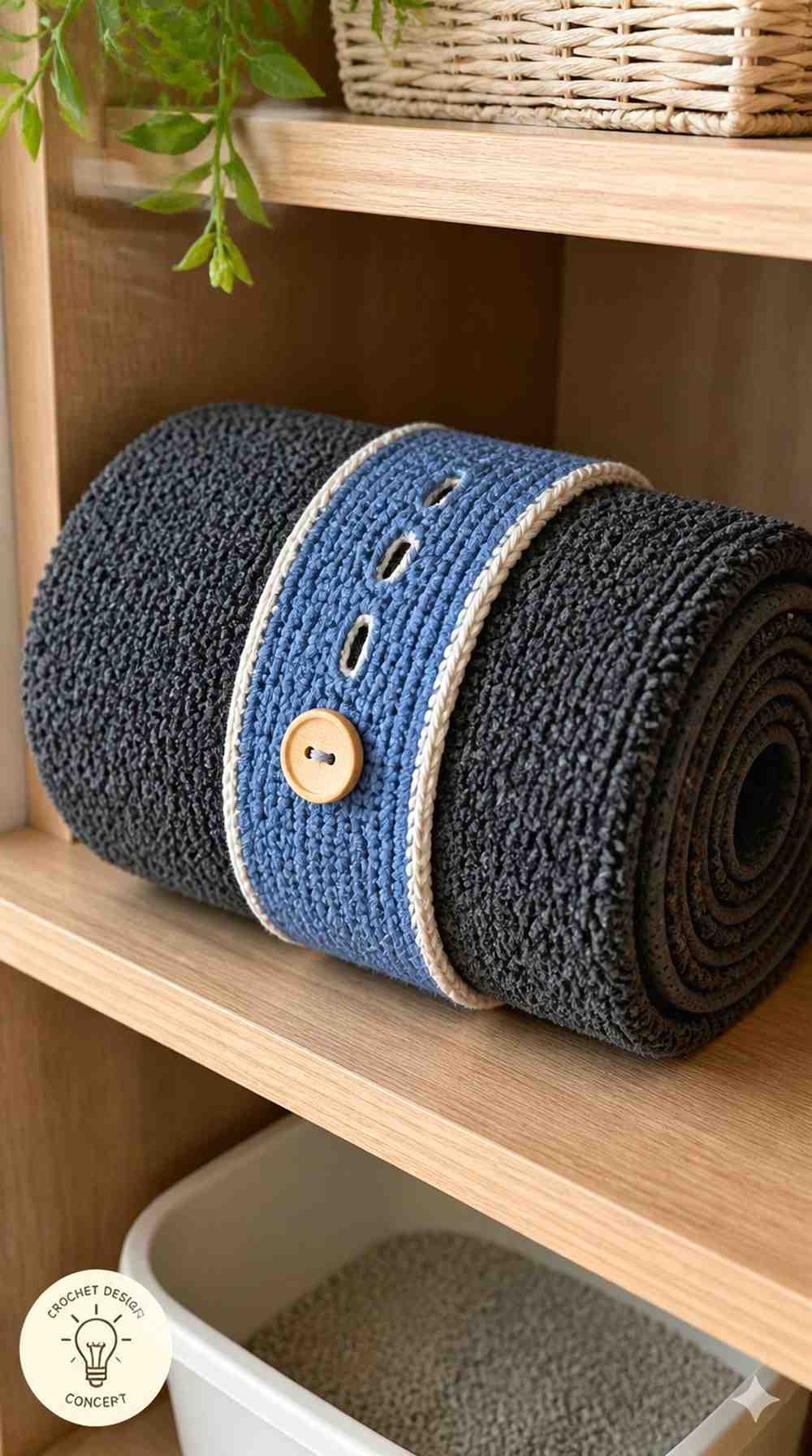
Dusty-denim-blue crochet creates a wide keeper with cream edging, one flat wooden button and three reinforced buttonholes along the overlapping end. The middle hole is fastened in the illustrated arrangement, leaving the other two visible.
This design is useful to explore when a household owns more than one flexible litter mat with slightly different rolled diameters. The adjustment range is limited, however, and the band should not be tightened simply to reach a particular buttonhole.
- Three fit positions: Test all buttonholes against the actual roll sizes and use only a position that closes comfortably without pulling the mat tightly.
- Reinforced openings: Stitch the buttonhole edges securely so the repeated movement of the wooden button does not stretch them out.
- Button clearance: Keep the hardware away from the roll’s exposed ends and check for pressure marks after removing the band.
12. Crochet Sand Envelope-Flap Roll Keeper
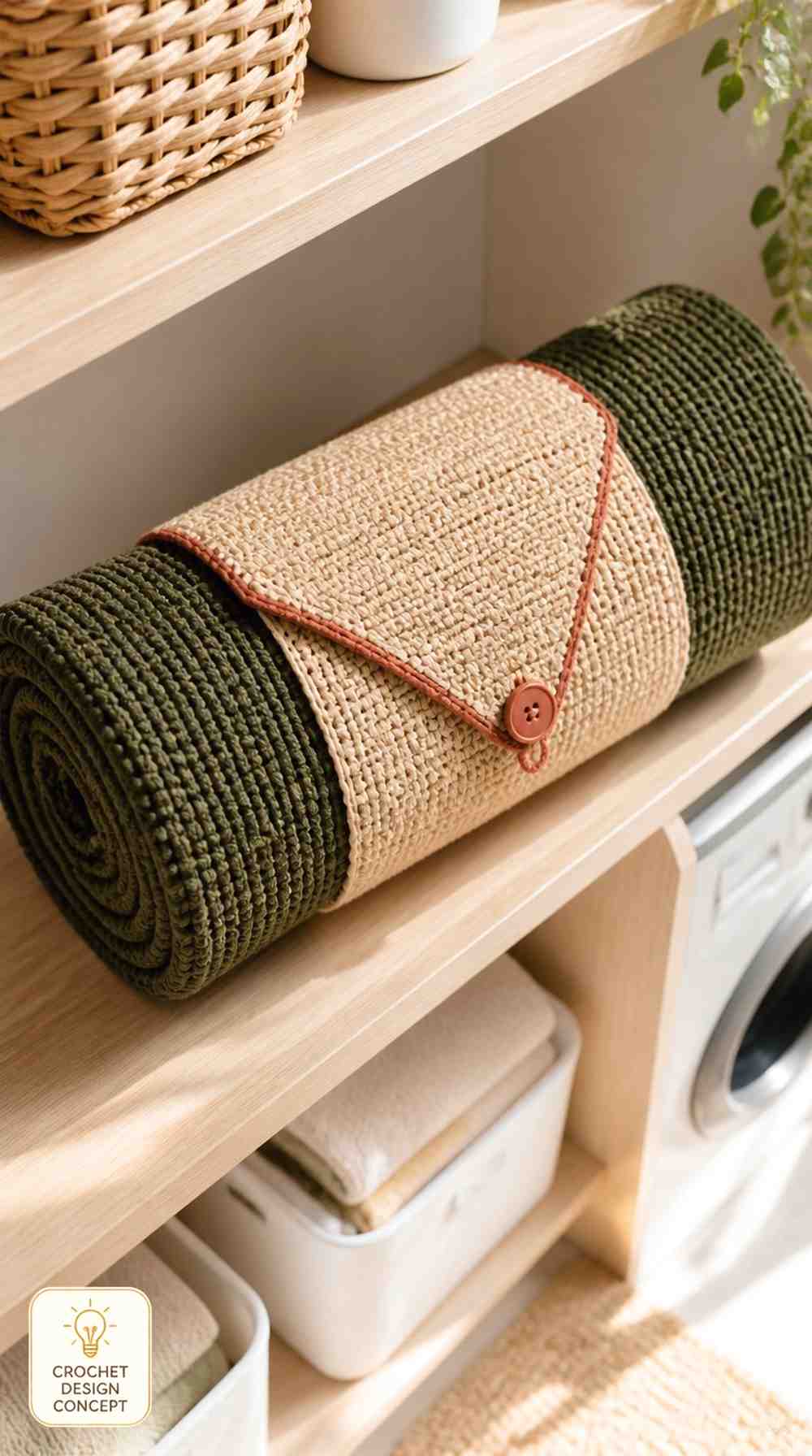
Warm-sand crochet forms a broad band with a pointed triangular flap. Terracotta edging follows the flap, which folds over the main rectangular section and closes with a small fabric-covered button and crochet loop.
The envelope shape gives this keeper a more tailored appearance than a plain strap. The broad overlap provides a clear fastening area, though the pointed flap needs to stay low-profile so it does not catch when the roll is moved into storage.
- Flap length: Allow the triangular point to reach its button without stretching the entire band around the rolled mat.
- Flat overlap: Keep the folded section smooth so its double thickness does not press sharply into the mat’s textured surface.
- Secure storage: Remove the keeper before unrolling the litter mat and store the small buttoned accessory away from pet access.
13. Crochet Plum Sliding-Buckle Mat Keeper Band
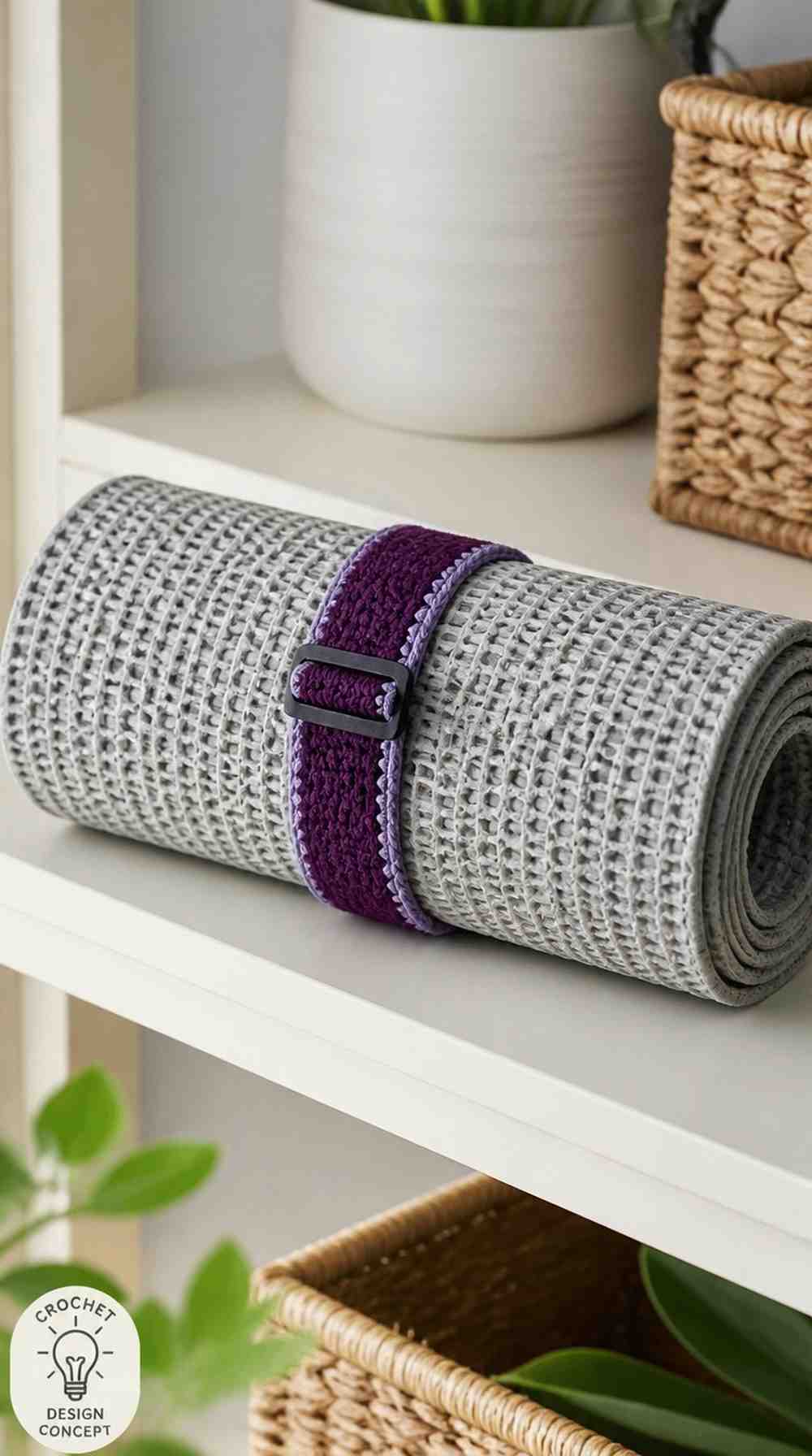
Deep-plum crochet creates a narrow strap finished with lavender edging and one small matte-charcoal ladder-lock buckle. The free end passes through the buckle and lies flat against the outside of the band, forming a clean, adjustable wrap.
The sliding buckle is the main feature of this concept. It offers another way to fit varying roll diameters without sewing several buttonholes, although crochet stretch and the buckle’s grip would need testing on an actual finished band.
- Buckle threading: Follow the hardware’s intended strap path so the adjustment holds rather than allowing the free end to slip out.
- Strap thickness: Match the crochet fabric thickness to the buckle opening; bulky stitches may bunch, while very thin fabric may slide unexpectedly.
- No carrying guarantee: The keeper is intended to retain a stored roll, not to serve as a lifting handle or carrying strap for the litter mat.
Practical Guide to Crochet Pet Litter Mat Roll Keeper Bands
Clean the mat before storage. Remove trapped litter according to the mat manufacturer’s instructions, which may involve shaking, vacuuming, washing or another approved cleaning method. Do not assume every litter mat is machine washable. If the mat has been exposed to urine or other contamination, follow the manufacturer’s specific cleaning guidance before storing it.
Let the mat dry completely. Trapped moisture between tightly rolled layers can lead to odors and may affect certain backing materials. Allow the mat to dry fully before rolling it and adding the crochet keeper.
Check whether rolling is allowed. Litter mats may have rubber, foam, PVC, silicone, textile or layered constructions. Some tolerate rolling better than others. Follow the manufacturer’s storage instructions and avoid folding or sharply bending a backing that could crack, crease or lose its shape.
Measure the rolled diameter. Roll the clean mat gently without excessive compression, then measure around the bundle at the intended band position. Crochet has some stretch, so test a swatch and allow enough room for the keeper to fasten without squeezing the roll.
Choose a practical yarn. Smooth cotton yarn may be suitable for a washable storage accessory, depending on the yarn’s care instructions. Dense crochet rows generally produce a more structured band than large openwork. Avoid loose fibers, long fringes or poorly secured decorations.
Keep the keeper away from pets. A crochet band is not a pet toy. Cats and dogs may chew yarn, pull loops, swallow detached pieces or become tangled in cords. Remove the keeper completely before placing the litter mat back in use, and store the band and rolled mat out of reach when not needed.
Avoid relying on the band for carrying. A keeper may help prevent a clean mat from unrolling during storage, but it is not a tested carrying handle. Lift and move the mat itself or use a suitable storage container.
Inspect the fastening. Buttons, snaps, hook-and-loop tape, buckles and joined crochet loops should be checked for wear. Replace a damaged keeper rather than leaving loose yarn or detachable parts in an area accessible to pets.
Manufacturer instructions can differ considerably. For example, <Link url=”https://pioneerpet.com/product/the-ultimate-litter-mat-new-item/” title=”Pioneer Pet’s Ultimate Litter Mat care instructions”/> describe rolling the mat to empty trapped litter, followed by washing and flat drying. <Link url=”https://drymate.com/shop/pets/cat/drymate-premium-litter-trapping-mat/” title=”Drymate’s litter mat care guidance”/> also gives product-specific cleaning and drying directions. These are examples for their own products, not universal instructions for every litter mat.
Want to Make Something Similar?
The following resources explain related crochet strap and roll-keeper construction. They are not exact patterns for the 13 illustrated pet litter mat bands.
- Free Crochet Yoga Mat Strap Pattern — Just Be Crafty — A beginner-friendly strap tutorial by Brittany, covering adjustable strap construction and crochet tension. A pet litter mat keeper would need different proportions and should not include an unnecessary shoulder-carrying section.
- Free Crochet Yoga Mat Strap Pattern — Made by Gootie — Agat Rottman’s photo and video tutorial demonstrates a textured crochet strap with adjustable width. It offers useful guidance on stitch choice and how fabric stretch affects a rolled-mat holder.
These tutorials concern yoga mats, which can have different thickness, weight, backing and storage requirements from pet litter mats. Use their crochet techniques as references rather than assuming their patterns fit litter mats directly.
For a related pet-care organization project, see 13 Crochet Pet Grooming Tool Roll Inspiration Ideas on Yarn Nest Studio. That collection focuses on organizing grooming tools, but its removable wraps and cleaning considerations offer another approach to pet-related storage.
Which Crochet Litter Mat Roll Keeper Should You Choose?
| Main priority | Designs to consider | Important trade-off |
|---|---|---|
| Simple buttoned fastening | Terracotta Buttoned, Sand Envelope-Flap | Requires secure buttons and suitable overlap |
| No separate hardware | Navy Pull-Through, Oatmeal Ribbed Cuff | Limited adjustment or possible loosening |
| Decorative crochet motifs | Burgundy Granny-Stripe, Lavender Scalloped | More seams and finishing work |
| Adjustable closure | Moss Hook-and-Loop, Denim Buttonhole, Plum Sliding-Buckle | Hardware and fit need inspection |
| Two contact points | Cocoa Connected Twin-Ring | Closed rings require matched roll diameter |
| Crossed strap design | Teal Cross-Strap | More complicated routing and joining |
| Compact tied closure | Coral Short-Bow | Loose yarn can attract pet chewing |
| Identifying stored mats | Butter Yellow Label-Window | Extra window and paper care |
If you have one mat that is always rolled to about the same size, the Oatmeal Ribbed Roll Cuff or Cocoa Connected Twin-Ring design is worth considering. Both avoid frequent adjustment, but the fixed circumference needs to be accurate.
For different roll diameters, the Denim Adjustable Buttonhole or Plum Sliding-Buckle design may offer more flexibility. The Moss Hook-and-Loop arrangement is another option, although the fastening surfaces need careful positioning.
For decorative storage, the Burgundy Granny-Stripe and Lavender Scalloped concepts bring more crochet texture. Their extra details should still remain firmly attached and inaccessible to pets during storage.
Conclusion
Crochet pet litter mat roll keeper bands bring a small handmade detail to a practical household storage problem. From simple terracotta buttoned wraps and oatmeal ribbed cuffs to colorful granny-square panels, adjustable buckles and compact pull-through straps, these 13 concepts explore different ways to keep a clean rolled mat together. The best choice is one that fits the mat without excessive pressure, can be removed easily and does not interfere with the backing or cleaning requirements. Always clean and dry the litter mat first, then keep the stored roll and removable crochet band safely away from pets.
Which keeper would you choose? Would you prefer the terracotta buttoned wrap, the oatmeal ribbed cuff, the burgundy granny-square band or the adjustable plum buckle design? Share your favorite and whether your litter mat has a soft fabric surface, a honeycomb texture or another kind of backing.
Frequently Asked Questions
1. Can a crochet band keep a pet litter mat rolled for storage?
A suitably fitted crochet band may help keep a flexible litter mat together when it is not being used. However, the result depends on the mat’s thickness, backing, rolled diameter and the keeper’s fastening. These illustrated designs have not been tested, so they should not be assumed to hold every mat securely or prevent all unrolling.
2. Should I clean and dry the litter mat before putting on the crochet keeper?
Yes. Remove trapped litter and clean the mat according to the manufacturer’s directions before storage. If washing is needed, let the mat dry completely before rolling it. Storing a damp mat tightly may trap moisture and odors, and some backing materials can be affected by unsuitable washing or drying methods.
3. What yarn is suitable for a crochet litter mat keeper band?
Smooth, washable cotton yarn is one option because it can produce closely worked stitches and a relatively neat strap. However, different yarns stretch and respond to washing differently. Choose materials according to their care labels, keep the design free from easily detached decorations and check the band for wear after repeated use.
4. Is it safe to leave the crochet keeper band on the litter mat while my cat uses it?
No. These bands are designed only for holding a rolled mat during storage. Remove the keeper completely before placing the litter mat beside the litter box. Loose yarn, buttons, snaps, ties and loops may become chewing, swallowing or entanglement hazards for pets. Store the removed band where animals cannot reach it.
5. Are these 13 crochet litter mat roll keeper bands available as patterns?
No. They are original crochet design visualizations intended to explore different fastenings, shapes, textures and storage arrangements. They are not tested finished products or complete crochet patterns. The linked tutorials demonstrate related strap-making techniques, but they do not reproduce the pictured designs exactly or guarantee that a keeper is suitable for a particular litter mat.