Stacking baking trays can save valuable cupboard space, but their metal rims and corners may rub against one another during storage. These 15 crochet baking tray corner separator inspiration ideas explore small handmade-style accessories designed to sit between or around the corners of stored trays. From simple oatmeal corner caps and triangular pads to ribbed sleeves, foldover guards and decorative scalloped separators, the collection brings together different shapes, textures and practical storage possibilities.
Some concepts focus on separating the corners of stacked trays, while others wrap around a raised rim to create a removable buffer. You’ll find neutral designs for a tidy baking cupboard, colorful options for cheerful kitchens and several adjustable arrangements for different tray shapes. The aim is to help you compare how a small crochet accessory might fit into your kitchen storage system without taking up the space of a full-size pan protector.
These are AI-generated crochet design visualizations for inspiration, not photographs of tested handmade pieces or step-by-step patterns. They are intended only for storage with completely cool, clean and dry baking trays, never for oven use or contact with hot bakeware.
Quick Design Selection Guide
- For simple corner coverage: Crochet Oatmeal Double-Layer Corner Cap provides a soft fitted shape around a raised tray corner.
- For flat separators: Crochet Terracotta Diagonal Triangle Pad and Crochet Charcoal Checkerboard Corner Cushion offer two different small-pad designs.
- For raised tray rims: Crochet Dusty Blue Scalloped Rim Pocket and Crochet Butter Yellow Ribbed Edge Sleeve explore fitted coverings.
- For decorative kitchens: Crochet Cream Fan-Shaped Corner Spacer and Crochet Olive Leaf-Appliqué Corner Cup add more visible crochet detail.
- For flexible storage: Crochet Navy Fold-Flat Double-Panel Protector and Crochet Coral Adjustable Button-Tab Guard explore different ways to position a removable corner covering.
- For matching sets: Crochet Mocha Four-Piece Corner Set provides a coordinated arrangement for the corners of a tray.
1. Crochet Oatmeal Double-Layer Corner Cap
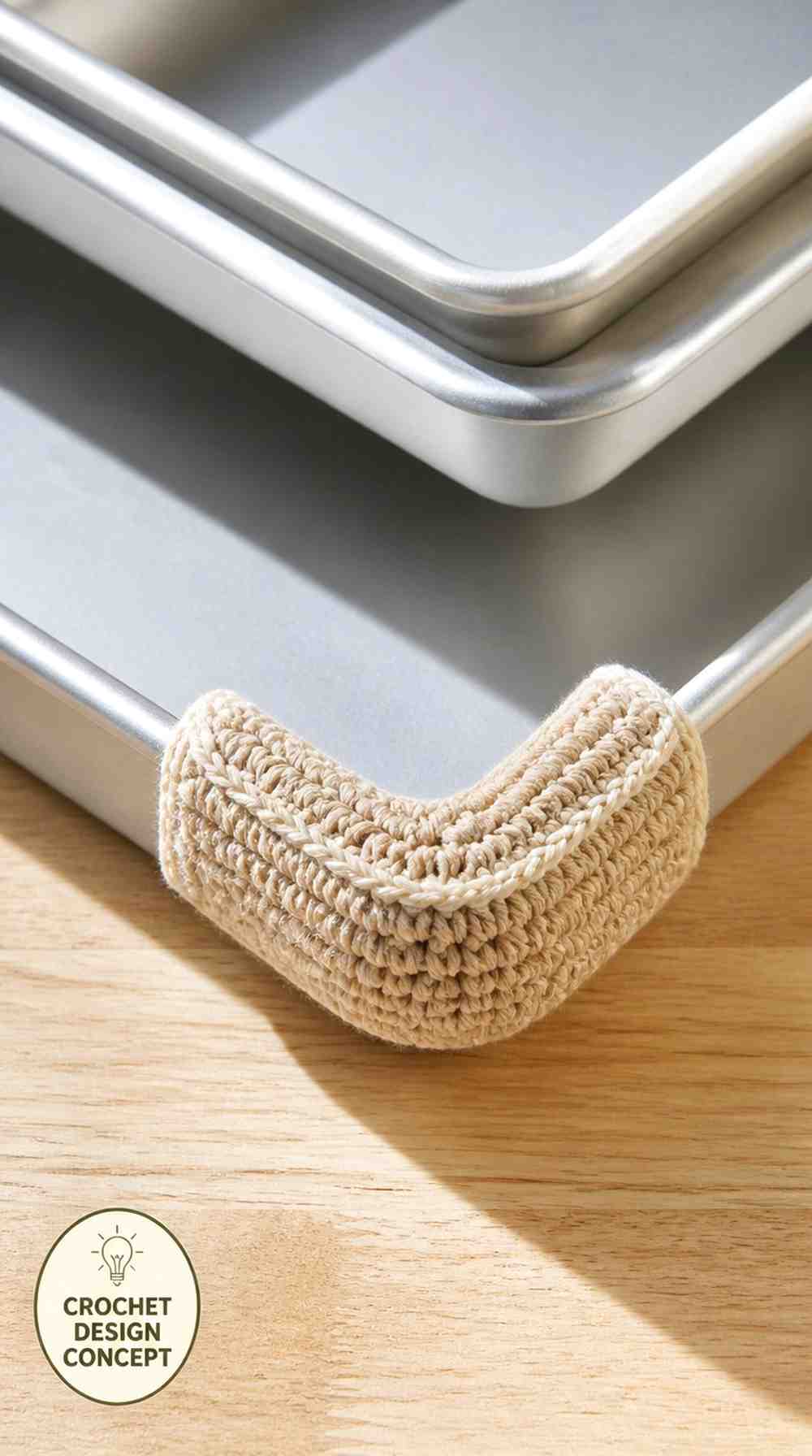
Warm oatmeal crochet gives this corner separator a soft, understated appearance. Its L-shaped construction wraps around the raised right-angle corner of a silver baking tray, with two closely stitched layers forming a shallow pocket. A cream joining seam finishes the rounded outer tip without making the design look bulky.
This concept is worth considering for trays with distinct raised corners, where a fitted covering may be easier to position than a loose flat pad. The pocket must follow the actual rim shape, and its thickness should not prevent trays from stacking in a stable arrangement.
- Corner fitting: Measure both adjoining rim sections and the depth of the corner before planning a fitted crochet cap, especially when the metal edge is rolled.
- Layer thickness: Two crochet layers add cushioning but also occupy more storage space. Check whether the tray stack remains level with the additional fabric.
- Opening shape: A shallow pocket should slip on and off without dragging tightly over the finish or catching on sharp metal seams.
2. Crochet Terracotta Diagonal Triangle Pad
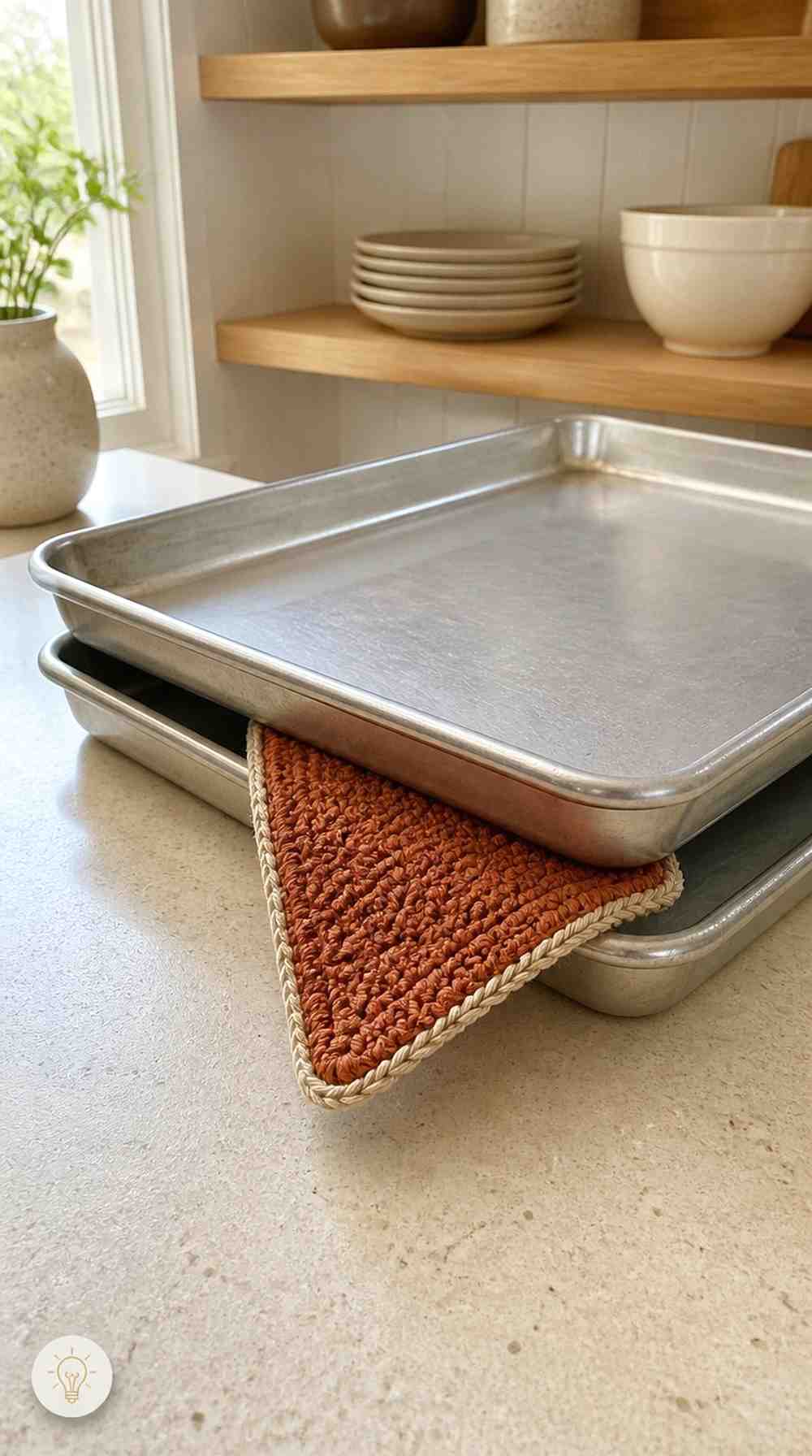
Terracotta crochet creates a simple triangular separator with a warm, earthy finish. The close diagonal stitch rows lead toward three softly finished corners, while a pale-clay border gives the pad a tidy outline. Its flat shape rests between two silver baking tray corners.
Unlike a fitted cap, this design does not need to follow the complete shape of the metal rim. It may be easier to move between trays with slightly different corner styles, although a loose pad could shift when the stack is lifted or rearranged.
- Pad coverage: The triangle should extend beneath the actual contact points between stored trays, rather than resting in an area where no metal surfaces meet.
- Stitch direction: Diagonal crochet rows create visual interest, but the finished pad should remain flat without curling toward one point.
- Moving the stack: Loose triangular pieces may slide out of position. Check placement whenever trays are removed or put back into storage.
3. Crochet Dusty Blue Scalloped Rim Pocket
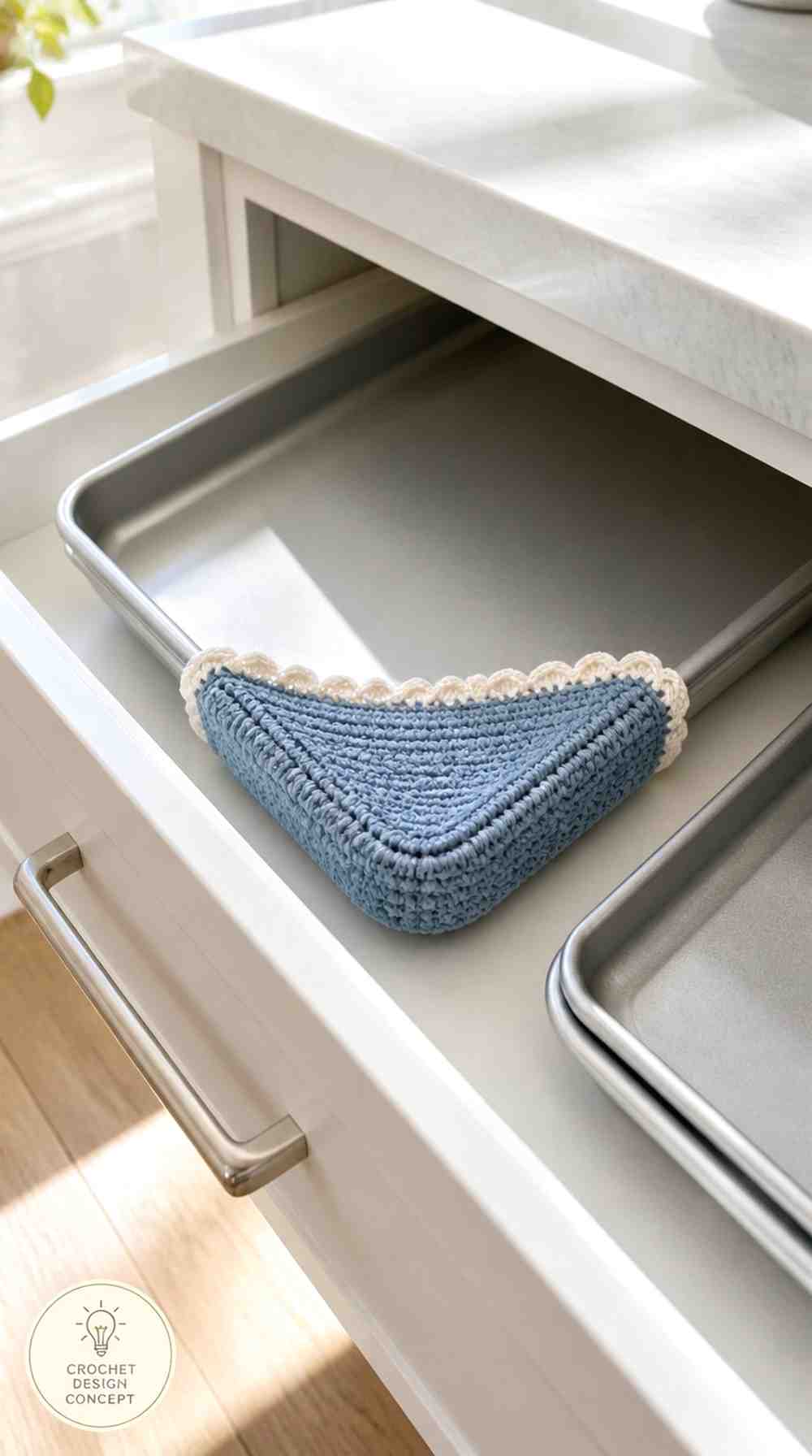
Dusty-blue crochet forms a compact pocket that slips over the raised corner of a baking tray. Its curved lower section follows the corner, while a pale ivory scalloped border decorates the outward-facing upper edge. Fine, evenly connected stitches keep the main pocket visually smooth.
The scalloped finish makes this design more decorative than a plain corner cap, but it also introduces small projections around the opening. For everyday cupboard storage, the border should stay clear of neighboring tray edges and any parts that might catch during removal.
- Scallop position: Keep the decorative edge on the outer visible side of the rim, away from surfaces where the stacked trays actually press together.
- Pocket depth: A deeper pocket may stay positioned more consistently, but it must not be so tight that removing it pulls against the tray’s coating.
- Snag prevention: Softly finished scallops are preferable to long dangling loops where multiple baking trays are moved in and out of a narrow drawer.
4. Crochet Charcoal Checkerboard Corner Cushion
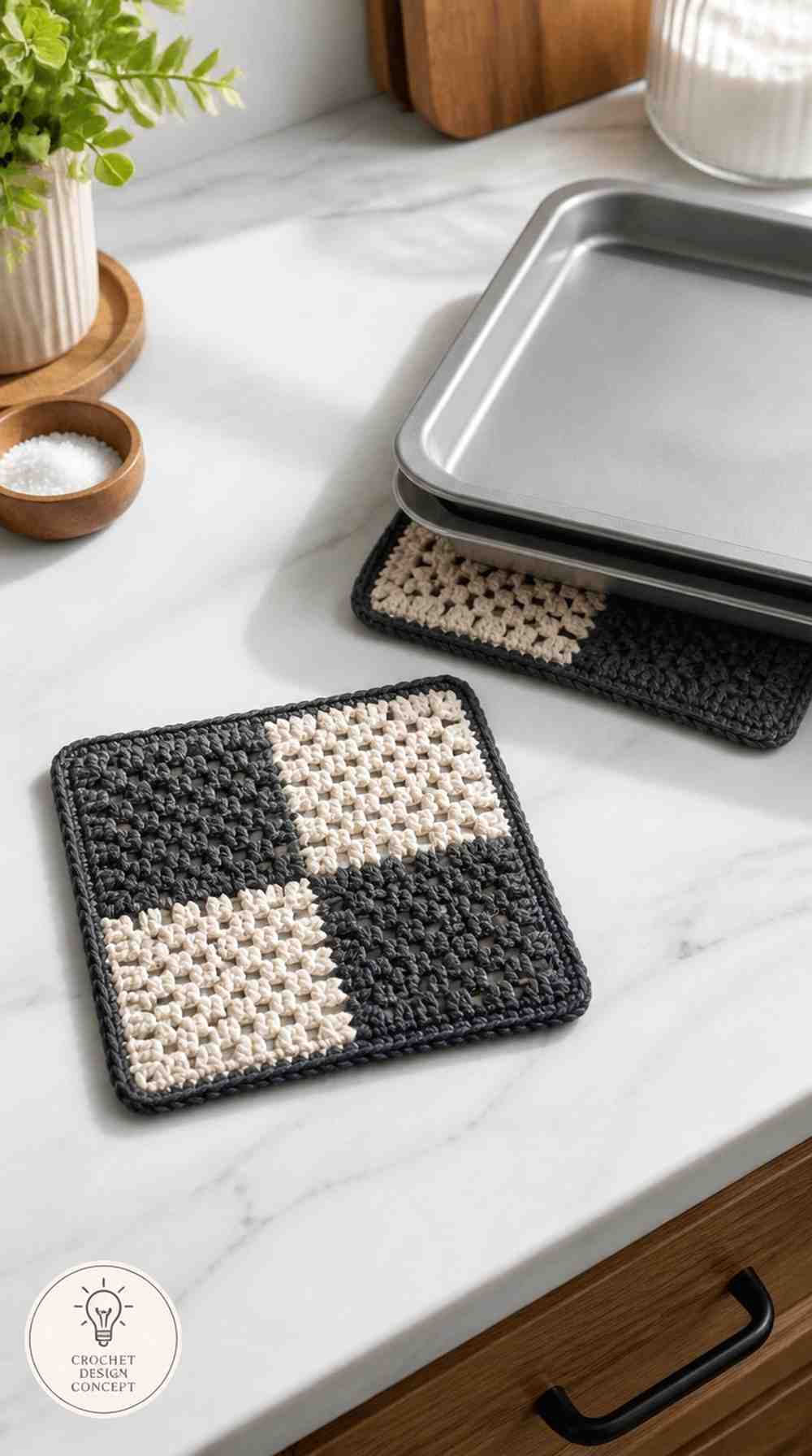
Charcoal and ivory crochet squares create a neat checkerboard corner cushion. Four small blocks join into a compact, flat square with visible seams and a narrow charcoal edge. The strong color contrast makes the crochet pattern easy to see against the smooth silver baking tray.
This concept uses a separate pad rather than a fitted sleeve. Its square outline allows the material to spread across a slightly wider area, although the joined seams may introduce uneven thickness if they are not kept smooth.
- Block joining: Keep the crochet joins as flat as possible. Raised knots or bulky seam allowances may concentrate pressure rather than distribute it.
- Surface positioning: Check that the pad covers the actual tray-to-tray contact area without extending into a place where it can bunch up.
- Set consistency: If making several matching cushions, aim for similar finished thickness so the stored tray does not lean toward one corner.
5. Crochet Butter Yellow Ribbed Edge Sleeve
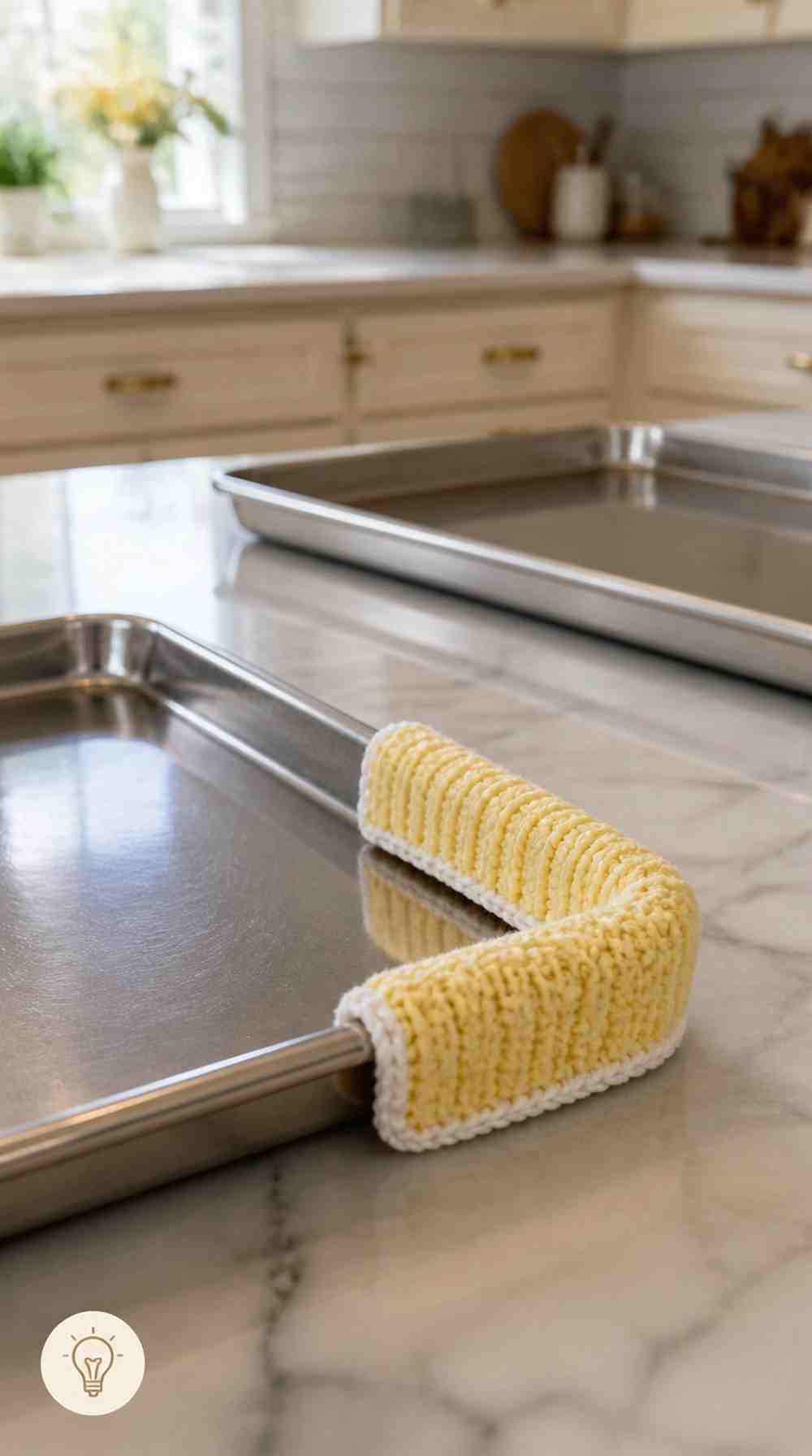
Butter-yellow crochet brings a cheerful touch to this fitted corner sleeve. Vertical ribbing covers two short sections of the tray’s adjoining rim, meeting at a softly rounded corner. A narrow white border gives the sleeve a crisp finish against the metal.
The ribbed construction is the main difference here. It may allow some flexibility around the edge, although crochet stretch varies with yarn, stitch pattern and tension. A sleeve that fits one tray rim may not fit another tray with a thicker rolled edge.
- Ribbing flexibility: The sleeve should stretch enough to slide onto the rim without squeezing the metal or leaving loose folds that can catch.
- Edge height: A shallow rim and a tall rolled lip need different sleeve proportions. Match the crochet channel to the tray actually being stored.
- Storage bulk: The ribbed texture adds thickness. Avoid using it where the extra height makes a stacked set of trays unstable.
6. Crochet Teal Linen-Backed Corner Wedge
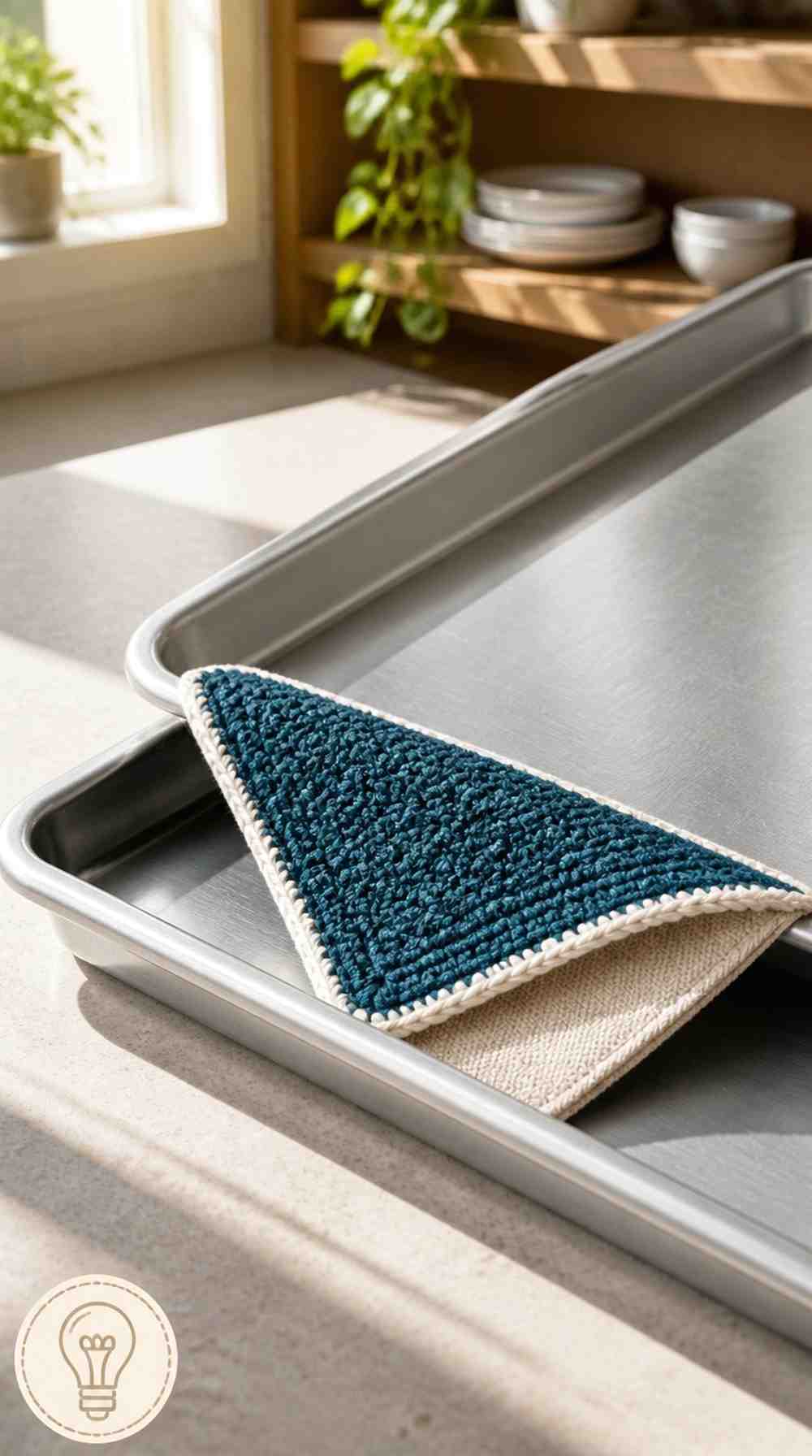
Deep teal crochet gives this triangular separator a clean, modern appearance. A pale cream edge frames its close-stitch surface, while a natural beige cotton-linen backing adds a second textile layer beneath the crochet. The separator sits flat between two cool baking trays.
This design introduces a smoother fabric surface against the metal instead of relying entirely on exposed crochet stitches. A backing may be useful where loose yarn texture could catch, provided the layers remain smooth and compatible with the tray’s finish.
- Backing material: Choose a soft, nonabrasive fabric and avoid rough interfacing or exposed hard seams on the side touching the baking tray.
- Layer alignment: The crochet and backing should lie evenly together without wrinkles that could become pressure points under the weight of another tray.
- Cleaning method: A removable backing may make washing easier, but both textiles must be completely dry before they are returned to storage.
7. Crochet Burgundy Tie-On Corner Wrap
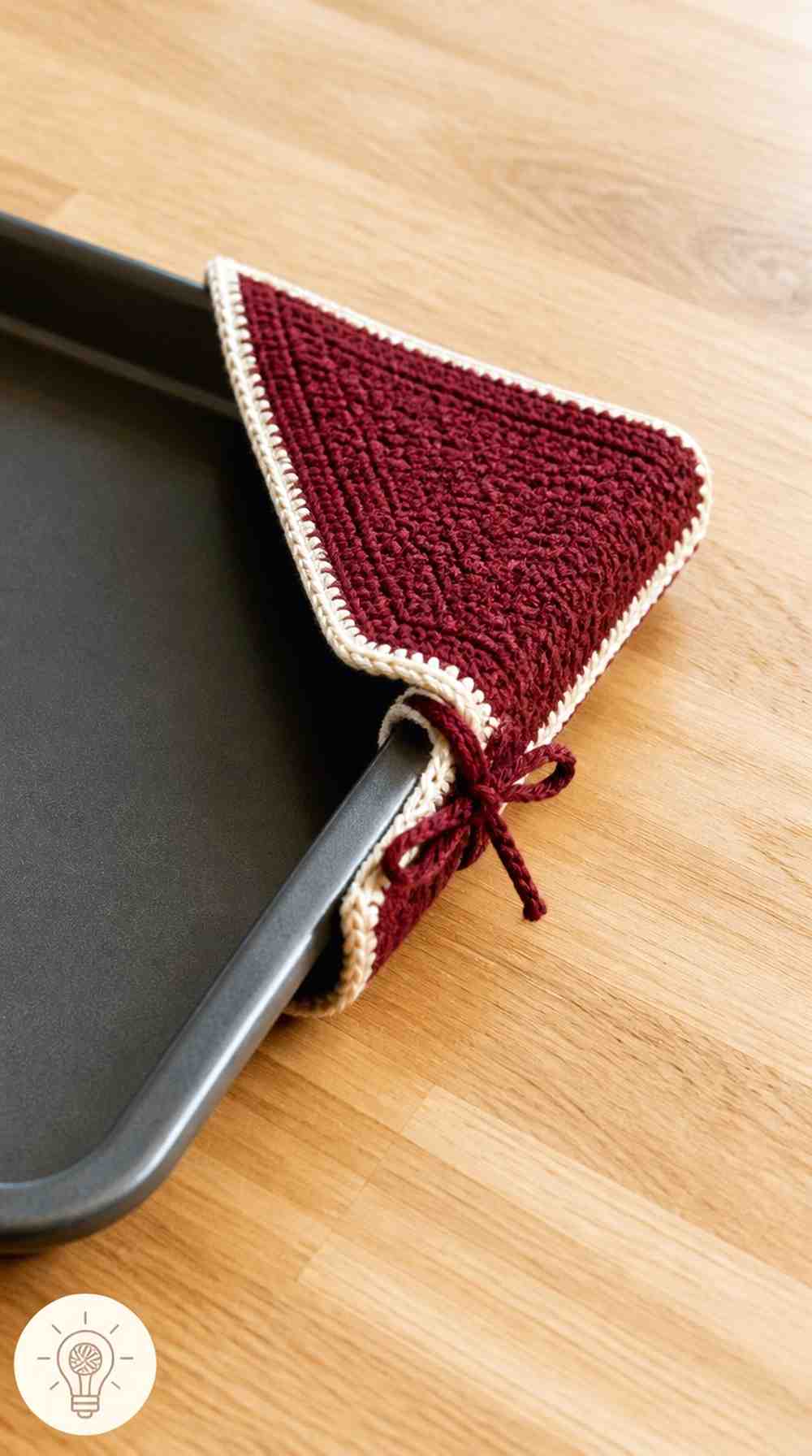
Rich burgundy crochet creates a small foldover corner wrap finished with cream edging. Two short crochet ties secure the outer section around the raised tray rim, forming a small bow away from the main contact area. The triangular flap gives the wrap its distinctive shape.
This arrangement allows the covering to open fully rather than being pushed over a metal corner. The ties offer adjustment, but they also need careful placement so that excess yarn does not become trapped between stacked trays or neighboring storage items.
- Tie placement: Keep the bow and loose ends outside the stacked contact surfaces, where knots could create uneven pressure against the bakeware.
- Secure but gentle: A tie-on protector should stay in place without being cinched so tightly that it bends or distorts the crochet fabric.
- Removal access: Short ties may be easier to manage in a crowded drawer than longer decorative cords that can catch under adjacent trays.
8. Crochet Cream Fan-Shaped Corner Spacer
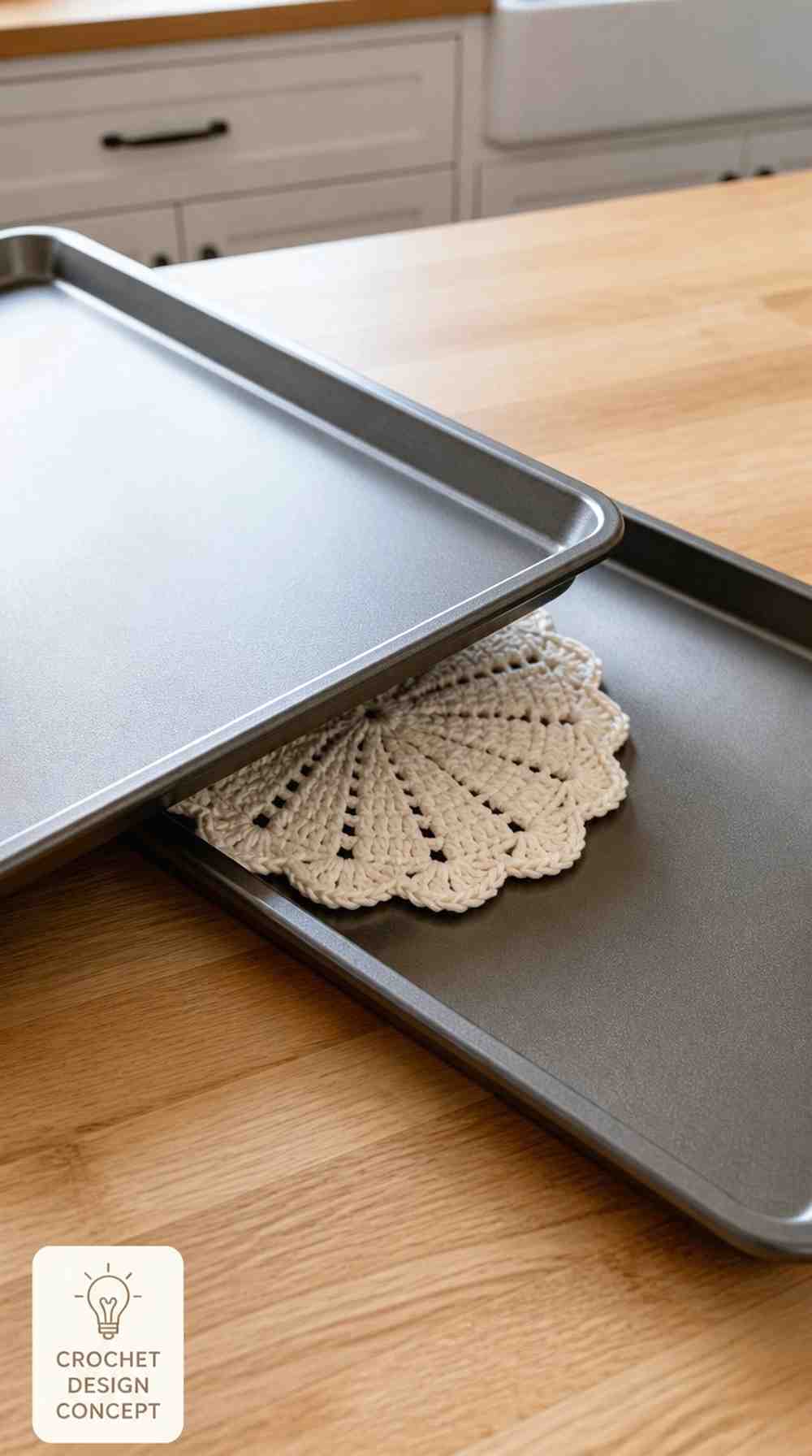
Cream-colored crochet opens into a shallow quarter-circle fan in this delicate corner separator. Neat radiating stitch sections lead toward a softly scalloped outer edge, creating a recognizable crochet motif while keeping the overall piece fairly flat.
The fan shape provides a different alternative to square and triangular pads. Its curved edge can spread beyond the corner of a baking tray, making the decorative stitching visible even when the separator is positioned beneath another tray. The actual contact area still needs to be checked before relying on the design.
- Fan shaping: The radiating crochet sections should sit flat rather than forming a raised dome, which could make the baking tray rest unevenly.
- Scalloped outline: Keep the outer scallops small and connected so individual loops do not get trapped beneath neighboring metal rims.
- Placement: The broad curved edge should be positioned where it provides useful separation rather than extending unnecessarily across an exposed tray surface.
9. Crochet Olive Leaf-Appliqué Corner Cup
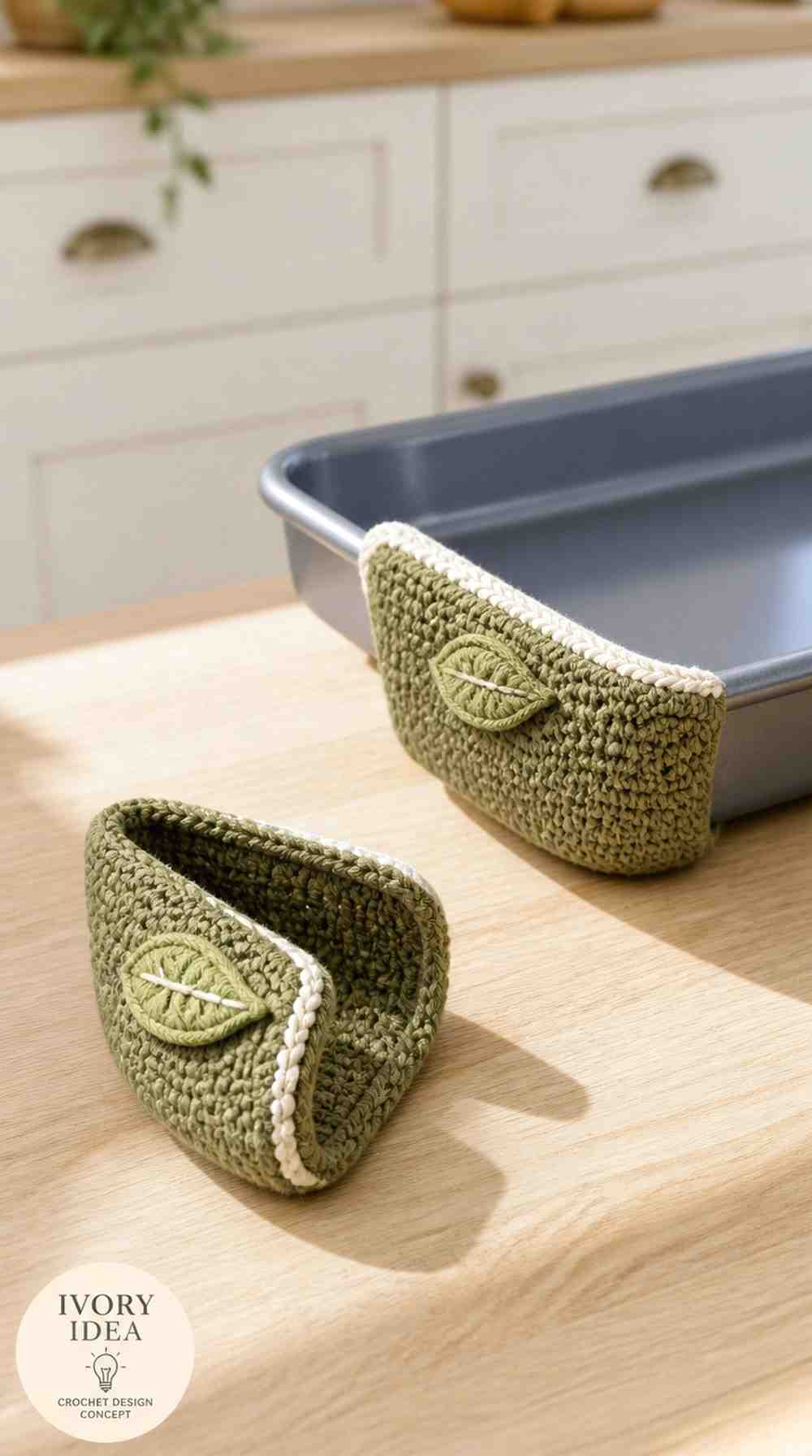
Olive-green crochet creates a fitted corner cup with a small leaf appliqué on its outer surface. The close-stitch pocket has a gently rounded corner and cream-trimmed opening, while the raised leaf adds a subtle decorative detail without changing the main silhouette.
This idea could appeal to someone who enjoys small botanical touches in kitchen accessories. The leaf is decorative rather than protective, so its position matters. It should remain outside the area where two metal trays press together.
- Leaf placement: Attach the motif to the outward-facing section of the protector so raised crochet details do not sit directly between stacked tray surfaces.
- Motif attachment: Secure the central vein and edges of the leaf so repeated handling does not pull loose yarn strands from the pocket.
- Corner clearance: Check the curved cup against the tray rim, especially where folded or rolled metal makes the corner thicker than the straight edges.
10. Crochet Navy Fold-Flat Double-Panel Protector
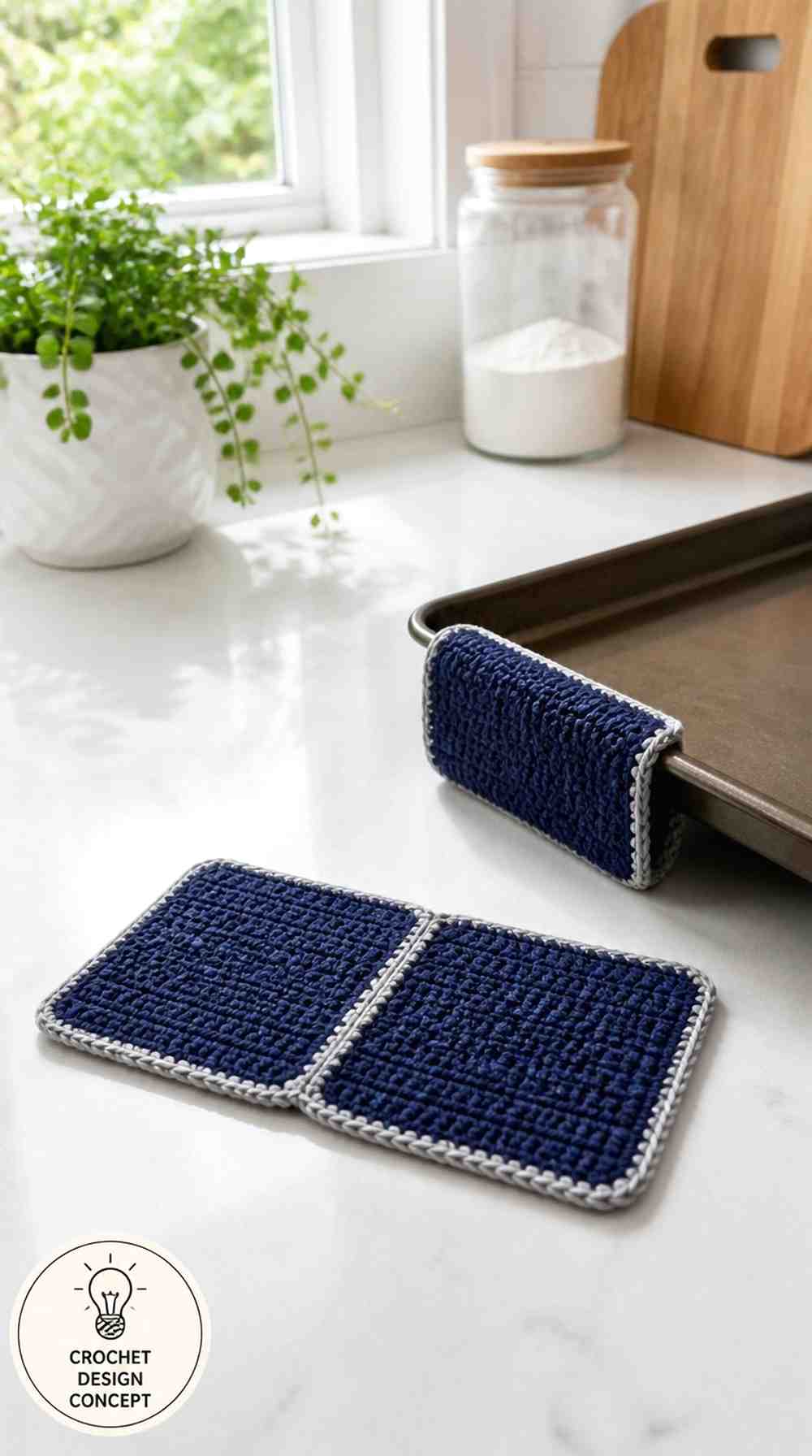
Navy-blue crochet gives this corner protector a simple, practical look. Two flat rectangular panels join along a reinforced central fold, allowing one panel to sit beneath the tray corner while the other rests over its raised edge. Fine silver-grey borders define the rectangular pieces.
The open-sided design is different from a closed pocket because it can be laid flat when not in use. That may be convenient for cleaning and organizing a small collection of protectors, although it may move more easily than a fitted sleeve.
- Fold flexibility: Keep the joining line flexible enough to follow the tray rim without producing a bulky ridge at the point of contact.
- Open-side movement: Because the panels do not form a closed cap, check whether they shift when a tray is lifted from the stack.
- Flat storage: The protector can be stored unfolded with other kitchen textiles, provided it is clean and dry and the panels are not stretched out of shape.
11. Crochet Peach Zigzag Right-Angle Pad
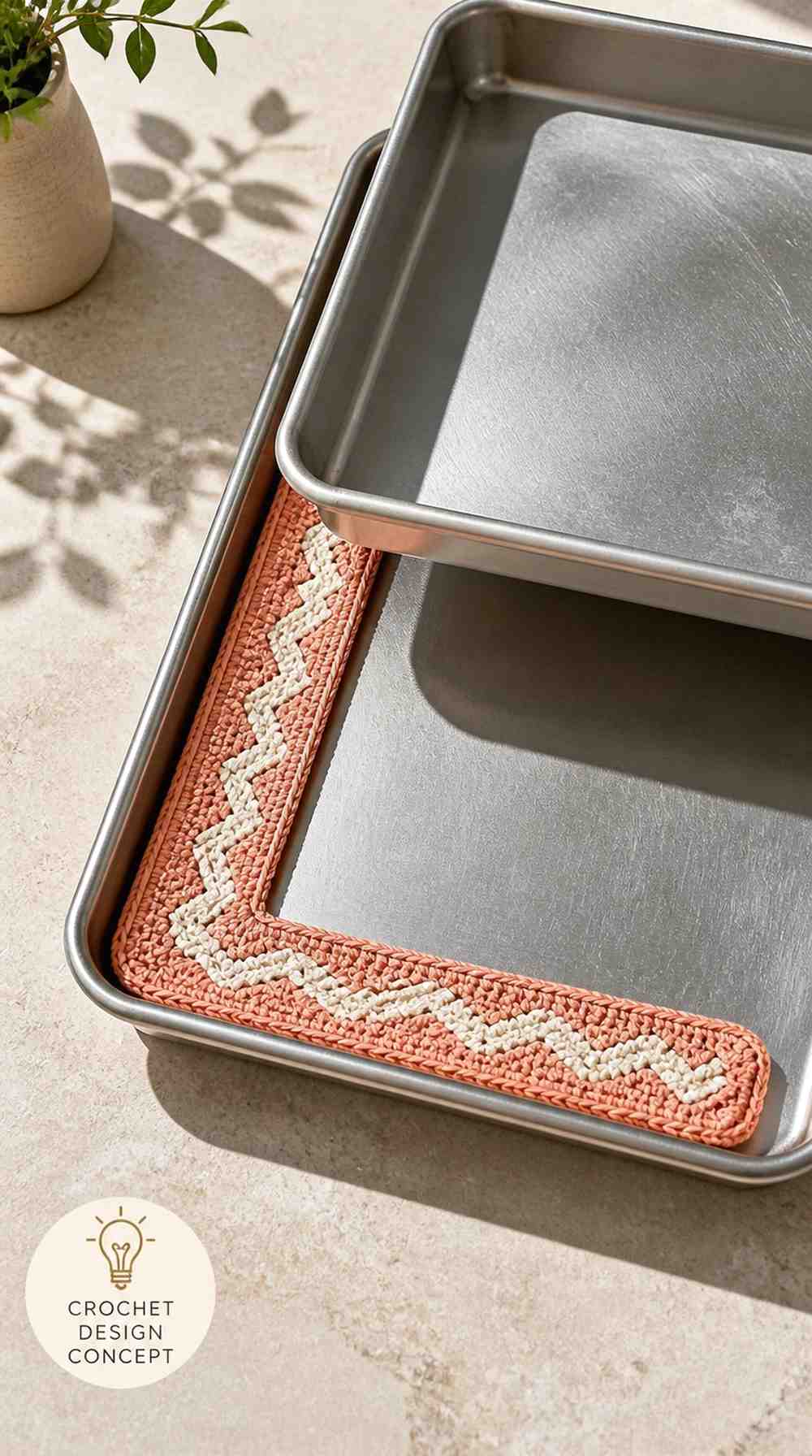
Soft peach crochet creates an elongated L-shaped pad that follows two adjoining edges of a baking tray. A cream zigzag stripe runs along both arms, framed by thin coral edging. The right-angle join gives the piece a clear corner-oriented shape.
Compared with a small triangular pad, this design extends farther along the tray’s side rails. It may offer more separation along those edges, but that added length also requires careful measuring to avoid unnecessary fabric bunching inside a tight tray stack.
- Arm length: The two arms should cover the actual areas where adjoining tray rims touch, rather than extending so far that they fold or overlap.
- Corner join: Keep the inner right-angle join neat and flat. Excess fabric at the bend may stop the pad from sitting evenly.
- Stripe construction: A smooth zigzag pattern should remain integrated into the crochet fabric instead of creating raised strands that catch on metal edges.
12. Crochet Mocha Four-Piece Corner Set
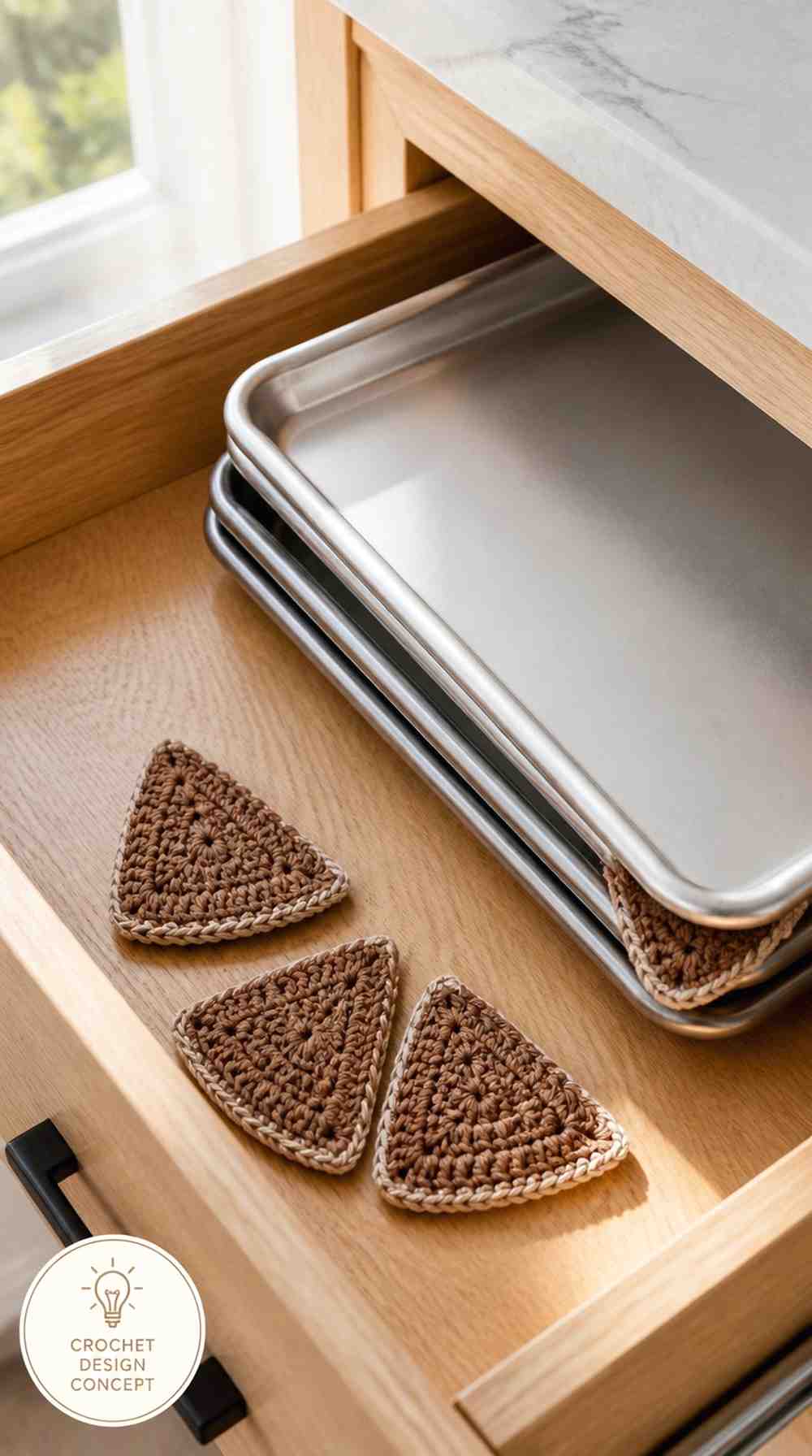
Mocha-brown crochet gives this coordinated set a warm, understated finish. Four matching triangular pads use close, consistent crochet rows, softly rounded edges and narrow oatmeal trim. Their individual shapes are simple enough to sit beneath different corners of the same tray.
This concept focuses on a complete set rather than one separator. Having matching pieces can make an organized stack look tidy, but each pad still needs to be positioned correctly. A set of four is not automatically suitable for every tray size or stacking arrangement.
- Matching thickness: Keep all four pads close in thickness so the supported baking tray does not tilt because one corner rests higher than another.
- Separate placement: Individual pieces can be moved to match the tray’s contact points, but they may also shift during drawer opening or tray removal.
- Set organization: Store the pads together when not in use so a missing piece does not leave one corner unsupported within the planned arrangement.
13. Crochet Lavender Arrowhead Corner Separator
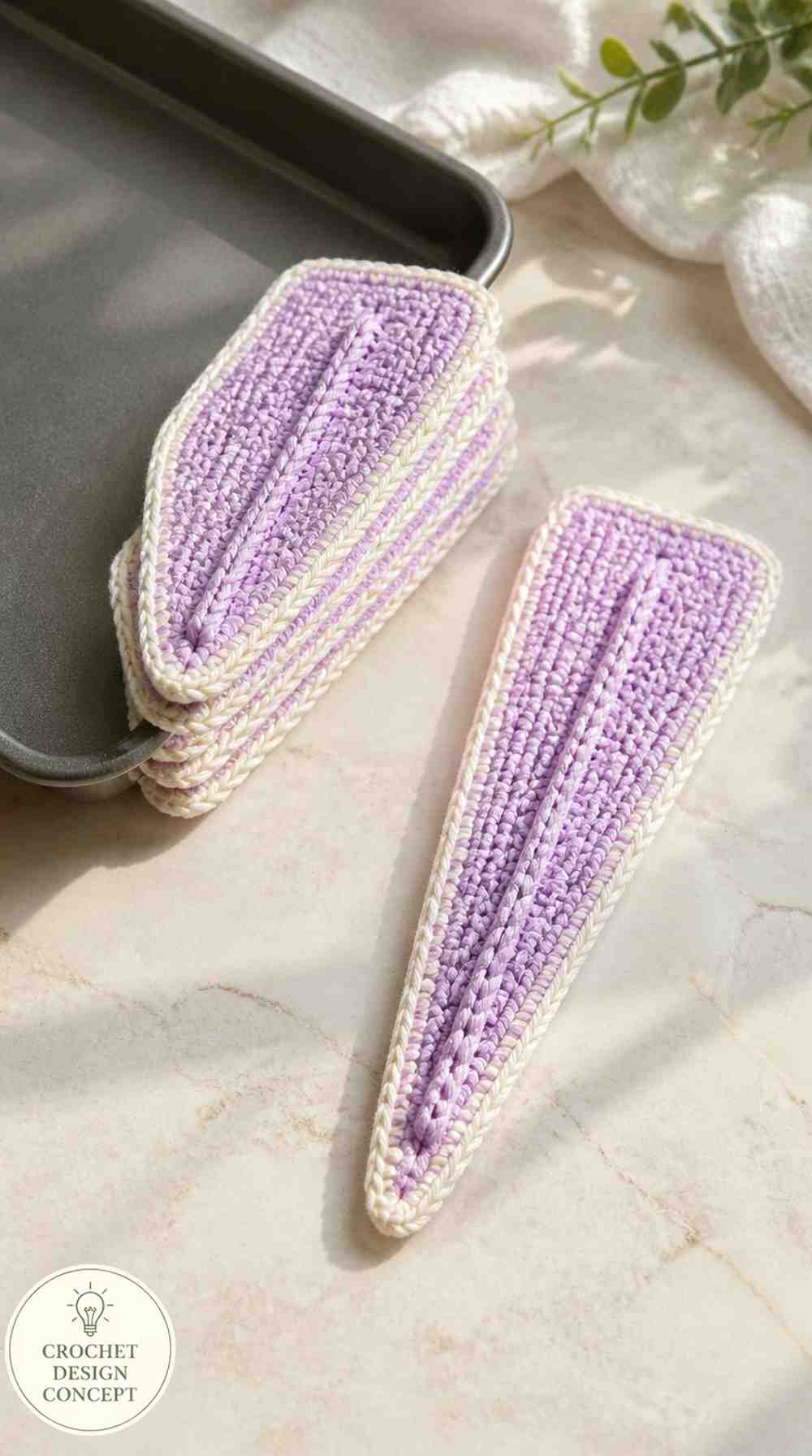
Lavender crochet forms an elongated arrowhead shape with a broad squared end and a narrower pointed tip. A raised center rib runs through its close-stitch body, while a pale ivory border finishes the outer edge. The pad extends inward from the corner of a cool baking tray.
The longer silhouette distinguishes this design from shorter triangular pads. It introduces a central decorative ridge, which should remain subtle enough not to create uneven pressure when trays are stacked over the separator.
- Taper placement: Position the broader end beneath the main contact area and check whether the narrower tip stays flat rather than curling.
- Raised center rib: Keep the rib low and flexible. A heavily raised line can become an unwanted pressure point under a stored tray.
- Surface length: A longer separator may suit certain tray shapes but should not extend beneath sharp or uneven metal features without checking the fit.
14. Crochet Coral Adjustable Button-Tab Guard
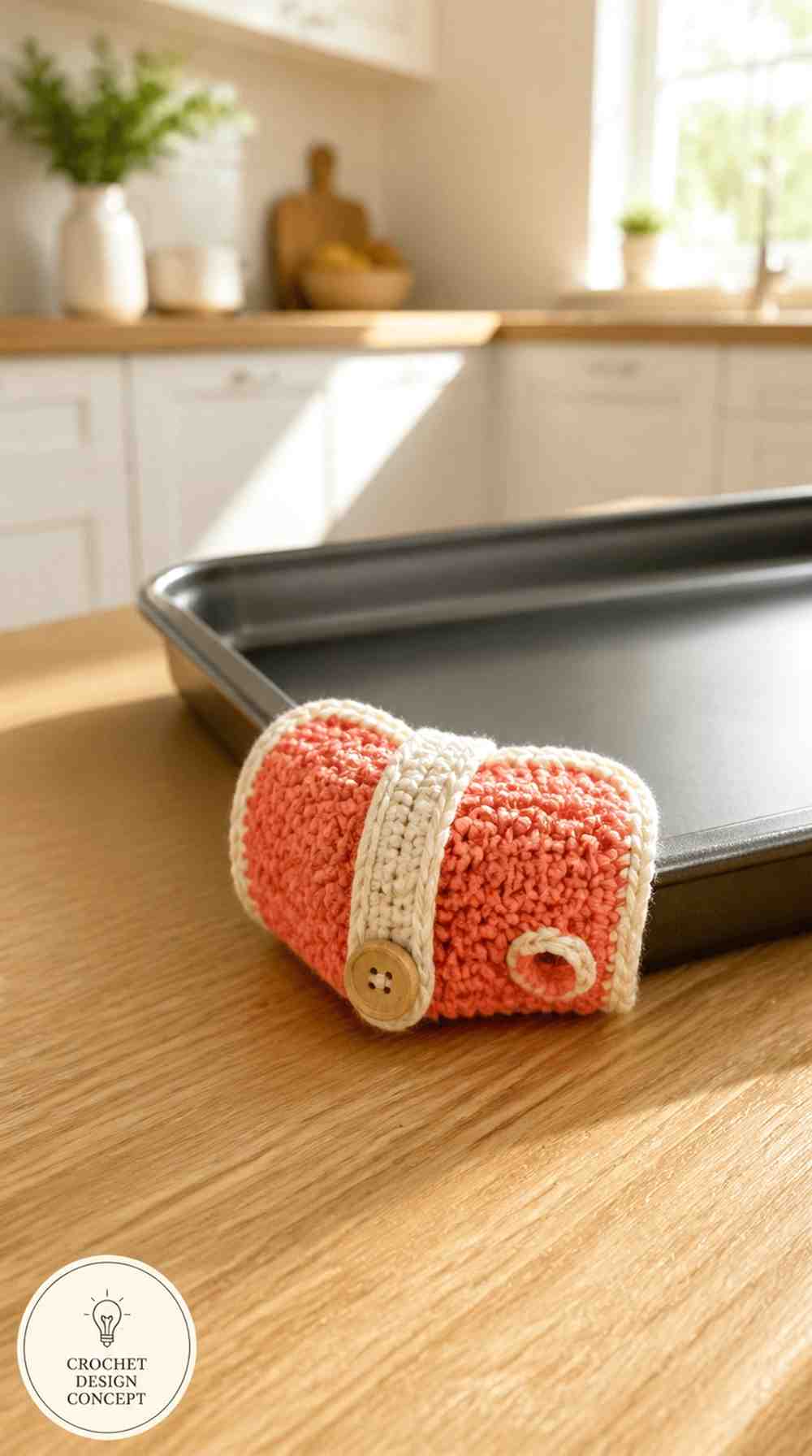
Coral crochet brings a bright finish to this adjustable corner guard. Its foldover body has close, even stitches and cream edging, while a narrow tab fastens over the outer rim using a small wooden button. Two available button-loop positions suggest different fitting options.
This design explores adjustment rather than a fixed pocket size. The tab may accommodate some differences between tray rims, but the wooden button must stay outside any area pressed by a second tray. The protector is intended only for storing cool bakeware.
- Button position: Place the wooden fastening on an exposed outer section, not beneath the weight of another tray or against a delicate nonstick coating.
- Adjustment range: Two loop positions offer limited variation. Check the actual rim thickness instead of assuming one guard will fit every tray.
- Tab strength: The fastening tab should be joined securely to the crochet body without excessive tension that may stretch or distort its edge.
15. Crochet Espresso Pull-Tab Corner Pocket
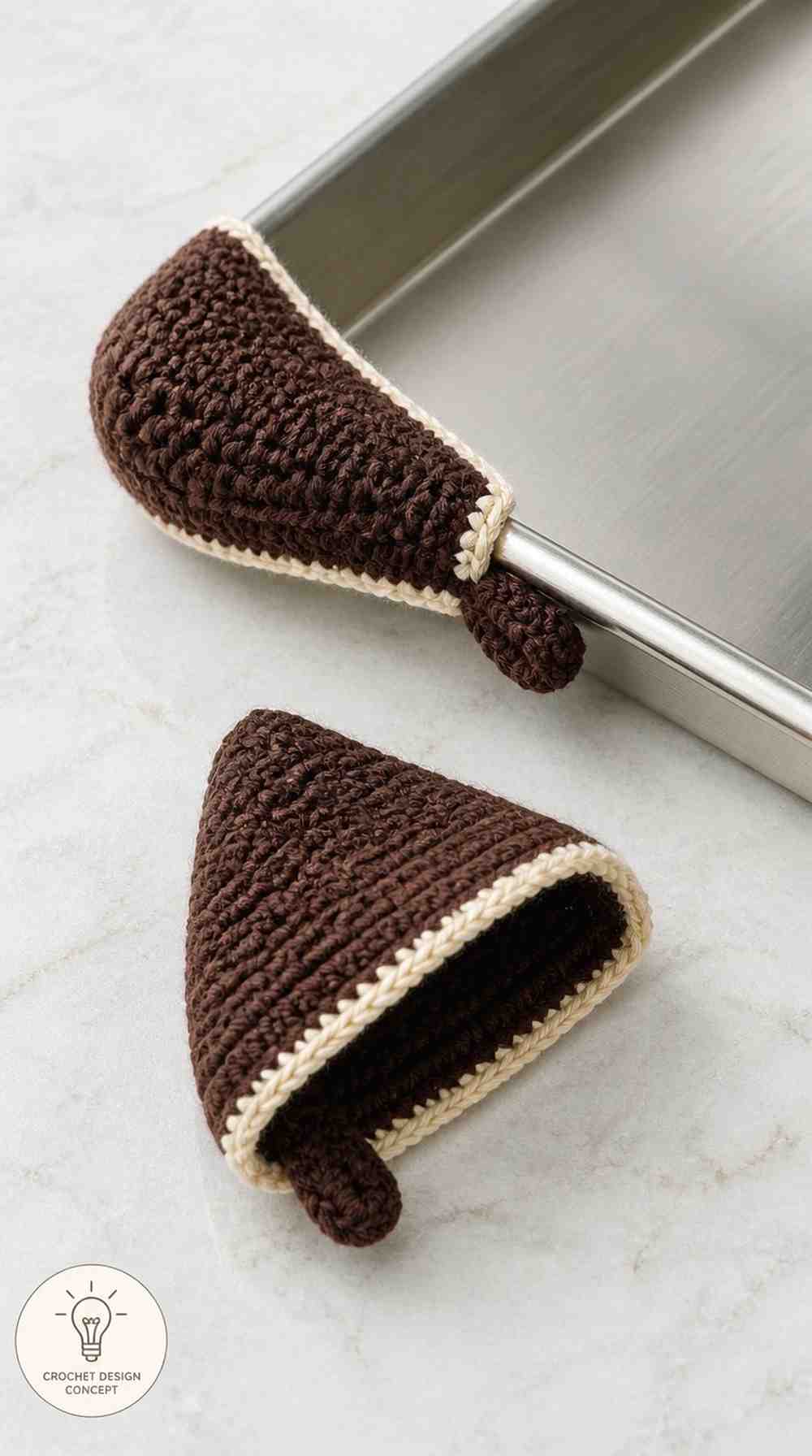
Espresso-brown crochet gives this compact corner pocket a clean, purposeful finish. Tightly worked stitches form a curved protective shape, with a narrow cream border at the opening. A short flat crochet pull tab extends beyond the outer corner for easier handling.
The pull tab is the main practical feature. Instead of gripping the fitted pocket directly against the metal rim, the user could lift it from the outer edge. The tab should remain short, however, so it does not catch when trays are moved into or out of storage.
- Pull-tab access: Keep the tab visible beyond the outer corner while preventing it from hanging into neighboring shelves or drawer runners.
- Secure joining: Reinforce the tab’s attachment to the pocket so repeated removal does not stretch or pull the corner stitches out of shape.
- Pocket fit: The opening should be loose enough to slide off without scratching or rubbing the tray finish, even when the tab is used.
Practical Guide to Crochet Baking Tray Corner Separators
Small crochet corner separators are intended to create a soft layer between baking trays during storage. Their usefulness depends on the tray’s shape, surface finish and stacking arrangement.
Start with completely cool and dry bakeware. Never put these crochet accessories inside an oven, under the broiler, on a stovetop or against hot trays. Cotton and other textile fibers can burn, and synthetic yarns may soften or melt. These concepts are not oven-safe pads or heat protection.
Identify the actual contact points. Some trays nest within one another, while others rest on their raised rims or wider corners. Before planning a separator, place two clean, cool trays together gently and look at where the surfaces would touch. A corner pad will not necessarily separate the entire base of a tray.
Choose smooth, low-profile materials. Close crochet stitches, flat seams and soft washable yarns are worth considering. Avoid exposed hard buttons, knots, beads or rough attachments where the metal trays touch. A smooth fabric backing may help with some shapes, but compatibility with nonstick finishes should still be checked.
Check stacking stability. Four matching pads may produce a more even arrangement than a single thick protector, but only if the contact points and thicknesses suit the trays. Do not balance heavy bakeware on unstable fabric corners.
Clean and store carefully. Wash textile separators according to their material instructions, remove loose lint and let them dry fully. Follow the bakeware manufacturer’s guidance, particularly for nonstick coatings. If a corner separator does not keep metal surfaces apart, use a suitable full-size pan protector or another recommended storage method.
Want to Make Something Similar?
These corner separators are original design visualizations rather than tested crochet patterns. However, a few established pan-protector projects can help you explore suitable crochet textures and construction methods.
- Tunisian crochet protector construction: Nicki’s Homemade Crafts offers a free Tunisian crochet pan protector pattern with guidance on making and joining triangular crochet sections. It may help with the flat triangular concepts, although the finished protector shown there is a different design.
- Different flat protector shapes: Raffamusa Designs has a free crochet pan protector pattern in three sizes. It provides a useful example of planning textile separators for cookware, rather than the exact corner pieces pictured here.
- Basic cookware protector construction: The Crochet Crowd’s basic cookware crochet protector pattern is another source for general pan-separator techniques and stitch construction.
These resources should be treated as related crochet lessons, not exact instructions for recreating any of the 15 concept images.
Which Crochet Baking Tray Corner Separator Should You Choose?
| Design | Main advantage | Consideration |
|---|---|---|
| Oatmeal Double-Layer Corner Cap | Fitted L-shaped coverage | Extra fabric thickness |
| Terracotta Diagonal Triangle Pad | Simple flat separator | Can move during stacking |
| Dusty Blue Scalloped Rim Pocket | Decorative fitted rim pocket | Scallops may snag |
| Charcoal Checkerboard Corner Cushion | Wider square surface | Joined seams should remain flat |
| Butter Yellow Ribbed Edge Sleeve | Flexible ribbed fit | Rim thickness varies |
| Teal Linen-Backed Corner Wedge | Smooth fabric-backed side | Two layers need cleaning |
| Burgundy Tie-On Corner Wrap | Adjustable tie fastening | Knots must stay outside contact areas |
| Cream Fan-Shaped Corner Spacer | Flat decorative fan shape | Scallops must stay controlled |
| Olive Leaf-Appliqué Corner Cup | Small botanical accent | Raised leaf must not sit under pressure |
| Navy Fold-Flat Double-Panel Protector | Opens completely flat | Open sides may shift |
| Peach Zigzag Right-Angle Pad | Extends along both tray edges | Requires careful arm lengths |
| Mocha Four-Piece Corner Set | Matching pads for multiple corners | Pieces can become separated |
| Lavender Arrowhead Corner Separator | Longer tapered coverage | Raised center rib needs care |
| Coral Adjustable Button-Tab Guard | Two fastening positions | Wooden button must remain outside contact points |
| Espresso Pull-Tab Corner Pocket | Convenient removal tab | Tab should not snag |
For a straightforward storage setup, the Oatmeal Double-Layer Corner Cap or Terracotta Diagonal Triangle Pad may be worth exploring first. If the baking trays have raised rims, the Butter Yellow Ribbed Edge Sleeve provides another shape to consider. For readers who want to organize several matching trays, the Mocha Four-Piece Corner Set gives a coordinated approach, provided the pieces actually separate the relevant contact surfaces.
Conclusion
A small crochet separator can be an attractive addition to an organized baking cupboard, particularly when storage space is limited and trays need to be stacked. These 15 ideas show how the same basic purpose can lead to very different designs, from fitted corner pockets to flat triangular pads and adjustable wraps. The most suitable option depends less on decoration and more on the shape of the trays, the way they rest together and the materials touching their surfaces. Always prioritize safe storage and follow the bakeware manufacturer’s care instructions.
Which corner separator would you choose for your baking trays? Do you prefer a fitted sleeve such as the Oatmeal Double-Layer Corner Cap, or would you rather use a removable flat pad like the Terracotta Diagonal Triangle Pad? Share which approach would make the most sense in your kitchen.
Frequently Asked Questions
1. Can crochet corner separators protect nonstick baking trays from scratches?
A suitable soft separator may help reduce direct contact between stored metal surfaces, but a crochet corner piece is not guaranteed to prevent scratches. It must cover the actual contact points without creating new pressure areas. Follow the nonstick bakeware manufacturer’s storage instructions, and use a full-size protector when needed.
2. What yarn is best for crochet baking tray corner separators?
Smooth cotton yarn may be worth considering because it can produce clear stitches and is available in many washable varieties. The final choice should depend on softness, lint, thickness and care instructions. Avoid hard decorations or rough seams against coated metal, and remember that cotton is not automatically safe for heat exposure.
3. Can crochet baking tray corner separators be used in the oven?
No. These concepts are strictly for storage after the baking trays have cooled completely. They are not oven liners, baking mats, oven mitts or tested hot pads. Remove all crochet separators before heating or using the trays, and keep them away from flames and hot appliances.
4. How many crochet corner separators are needed for a stack of baking trays?
There is no universal number. Four matching pieces may suit a tray whose corners form the main contact points, but some trays touch along their sides or across larger surface areas. Check the actual stacking arrangement first. A different separator shape or a full-size protector may be more appropriate.
5. Are these crochet baking tray corner separator designs available as patterns?
These 15 designs are inspiration concepts, not finished or tested crochet patterns. Their shapes and textures can help you plan an original project, but any real separator needs to be measured, constructed and checked against the baking trays it will be used with. The linked pan-protector tutorials provide general crochet guidance rather than exact reproductions.