Children’s puzzle boards are useful for playtime and learning, but moving and storing them can become awkward when several boards are kept together. These 16 crochet children’s puzzle board carry strap inspiration ideas explore different ways to wrap, support and organize lightweight puzzle boards. From simple crossed straps and fitted corner pockets to foldover carriers, padded hand grips and compact board totes, the collection features colorful crochet textures and different carrying arrangements.
Some designs focus on one small wooden puzzle board, while others offer wider support panels or space for two lightweight boards. You’ll find short-handled options for adult-assisted carrying, decorative granny-square details and adjustable wraps for different board shapes. Each concept helps you compare fit, stability, attachment points and storage convenience. The designs are intended for supervised organization and adult handling, not unsupervised play with straps.
These are AI-generated crochet design visualizations for inspiration, not photographs of tested handmade pieces or step-by-step patterns. They are not certified children’s carrying accessories.
Quick Design Selection Guide
- For a simple board wrap: Crochet Terracotta Cross-Wrap Puzzle Board Strap uses two crossing support bands and a short central hand handle.
- For an easy-to-understand carrier: Crochet Oatmeal Twin-Band Puzzle Carrier has two separate supporting bands and a connecting hand grip.
- For protecting board edges: Crochet Butter Yellow Four-Corner Puzzle Harness and Crochet Lavender Edge-Rail Puzzle Board Carrier cover different parts of the wooden frame.
- For a full supporting panel: Crochet Teal Fold-Flat Puzzle Board Sling and Crochet Coral Foldover Puzzle Board Saddle place crochet fabric beneath the board.
- For a comfortable short grip: Crochet Plum Padded-Grip Puzzle Carry Strap features a folded, double-layer handle.
- For storing more than one board: Crochet Mustard Twin-Board Carry Caddy gives two lightweight boards separate compartments.
1. Crochet Terracotta Cross-Wrap Puzzle Board Strap
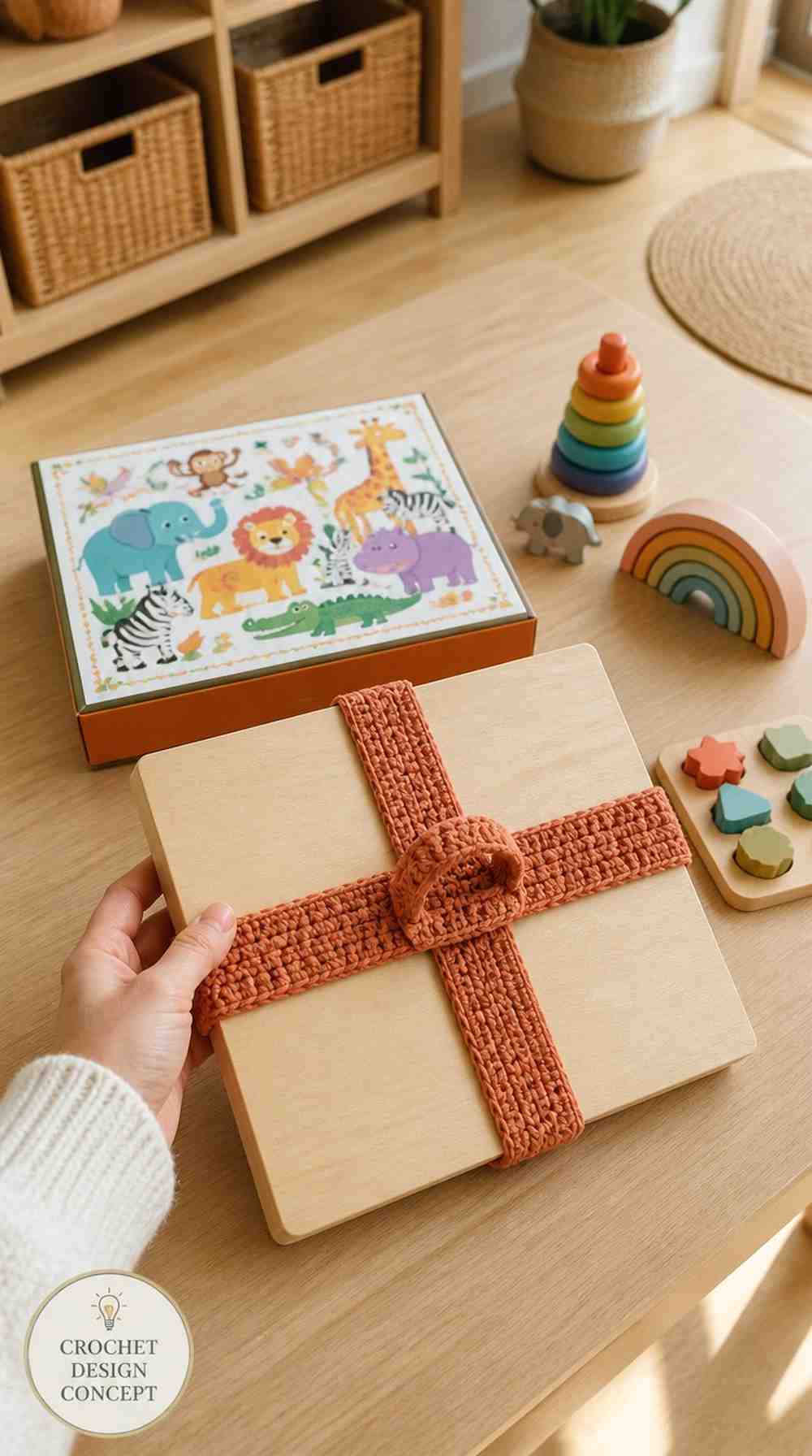
Warm terracotta crochet forms two broad support bands that cross around a small rectangular wooden puzzle board. The close-stitch fabric follows the board’s edges, while a short reinforced hand grip sits at the central intersection. The natural wood remains visible between the bands, giving the design a simple, practical appearance.
This concept is useful for exploring how two crossing straps could keep a lightweight board together during careful adult handling. The bands must surround the board securely rather than merely resting against its surface, and any loose puzzle pieces should be stored separately.
- Crossing position: Keep the two bands centered along the board’s dimensions so their intersection does not slide toward an unsupported corner.
- Handle attachment: The short hand grip should connect through reinforced crossing sections rather than relying on a small decorative join.
- Board compatibility: This arrangement suits a plain rectangular board better than one with large projecting knobs, drawers or delicate raised puzzle features.
2. Crochet Oatmeal Twin-Band Puzzle Carrier
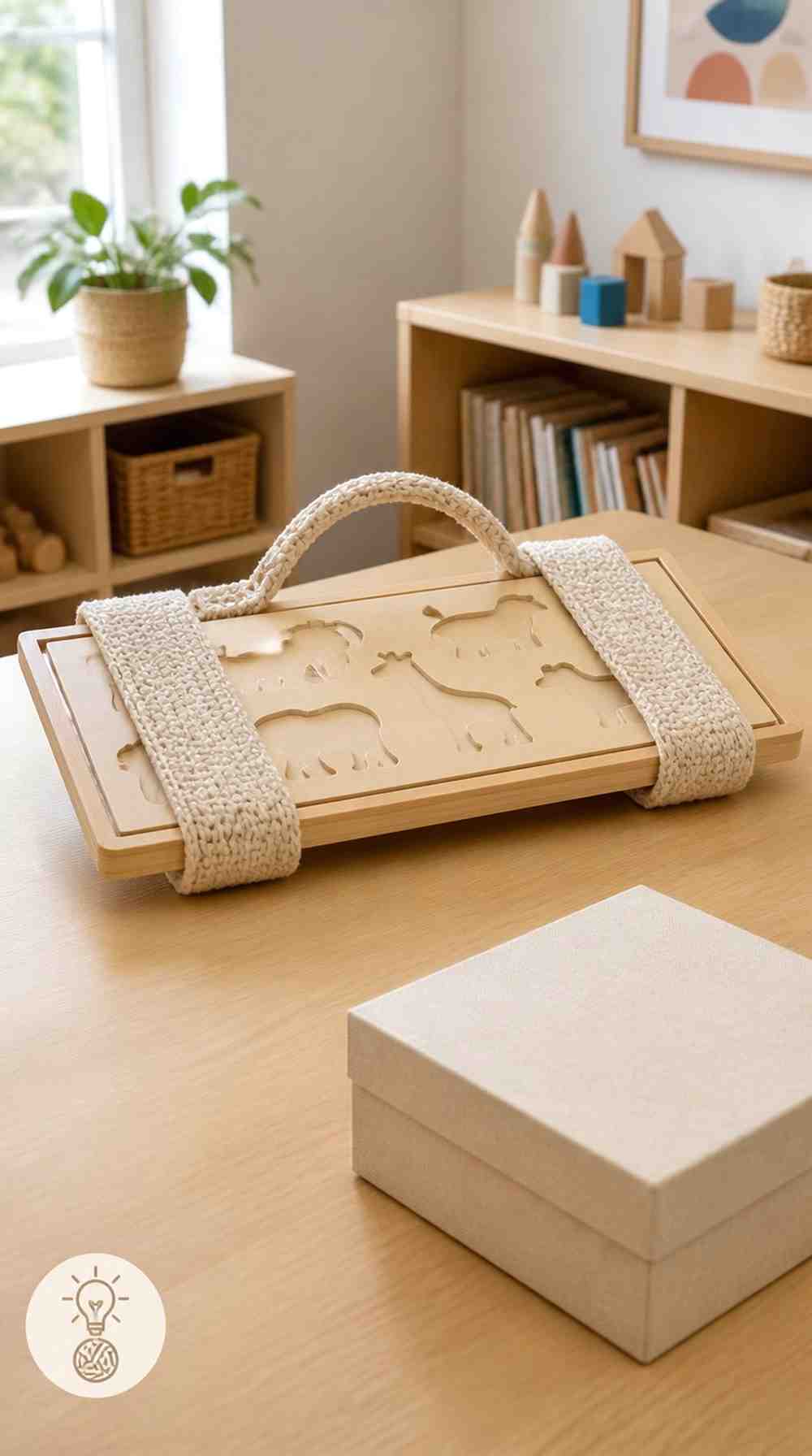
Soft oatmeal crochet creates two separate bands around the shorter ends of a lightweight wooden puzzle board. A broad cream bridge and short hand grip connect the bands above the center, while smooth beige fabric lines the sections touching the wood.
Compared with a crossed strap, this design keeps the support bands parallel. It may be easier to position around a straight-edged board, although the bands must remain evenly spaced and should not slide off when the board is handled.
- Band spacing: Place the two support bands far enough apart to distribute the board’s weight without allowing its center to sag or tilt.
- Smooth contact: The beige lining should lie flat against the wooden edges without bulky seams that could scrape the finish.
- Grip alignment: Position the short connecting grip centrally so the two bands share the load rather than pulling one end upward.
3. Crochet Navy Envelope Puzzle Board Carrier
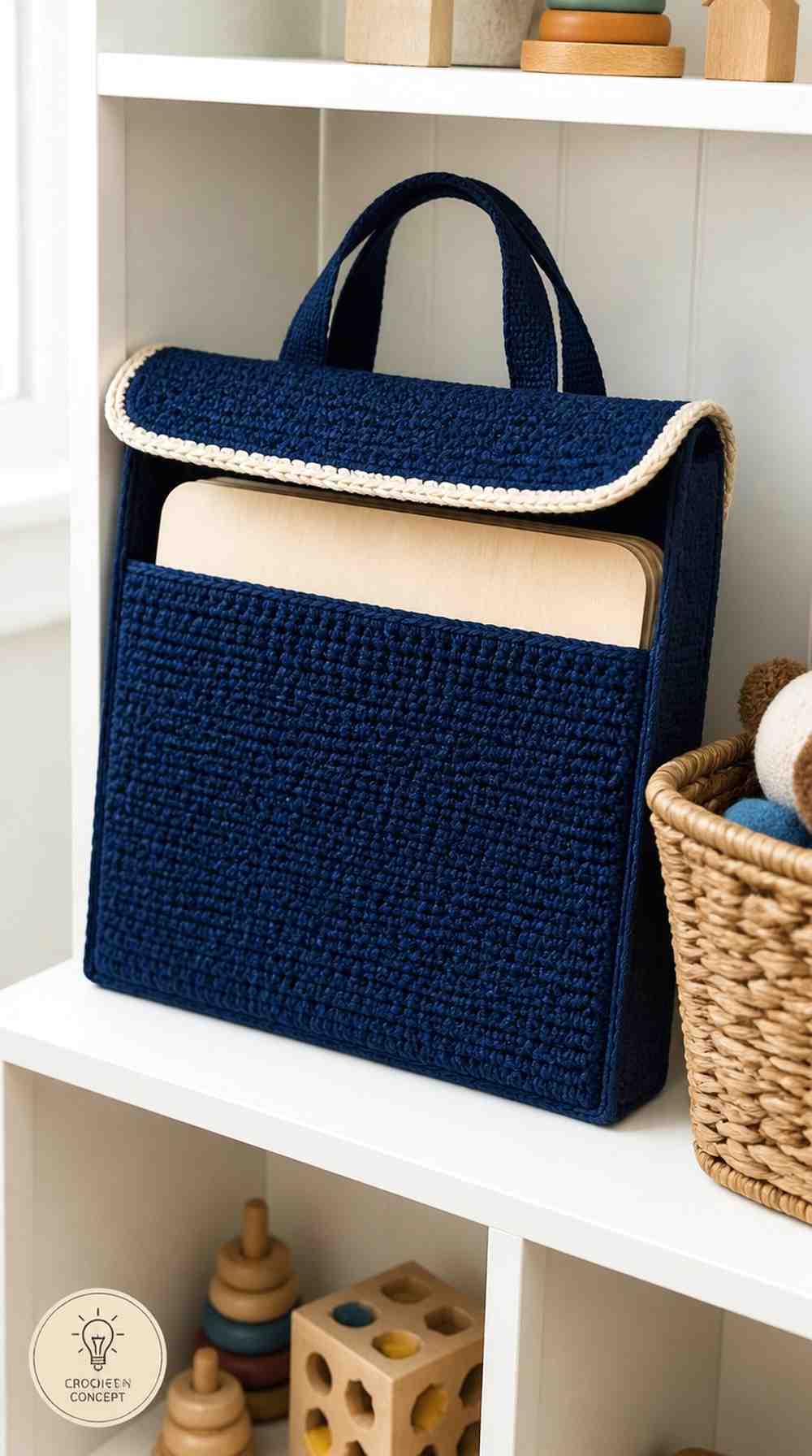
Midnight-navy crochet gives this rectangular carrier a neat, enclosed appearance. A cream-edged foldover flap sits above the close-stitch front, while a smooth lined back and closed lower base support the wooden puzzle board. Two short navy handles complete the compact carrying shape.
The envelope design provides more coverage than a simple strap harness. It could be useful for keeping an empty board organized on a playroom shelf, particularly when the board has a flat rectangular frame. Its main advantage is that the board rests inside a supporting compartment rather than depending only on narrow bands.
- Base support: The closed lower section should support the full board edge without bunching or folding inward beneath its weight.
- Flap allowance: The upper flap should close without pressing against protruding puzzle-board parts or distorting the wooden frame.
- Separate pieces: Store removable puzzle pieces in a suitable closed container; the envelope should not be assumed to retain loose pieces securely.
4. Crochet Butter Yellow Four-Corner Puzzle Harness
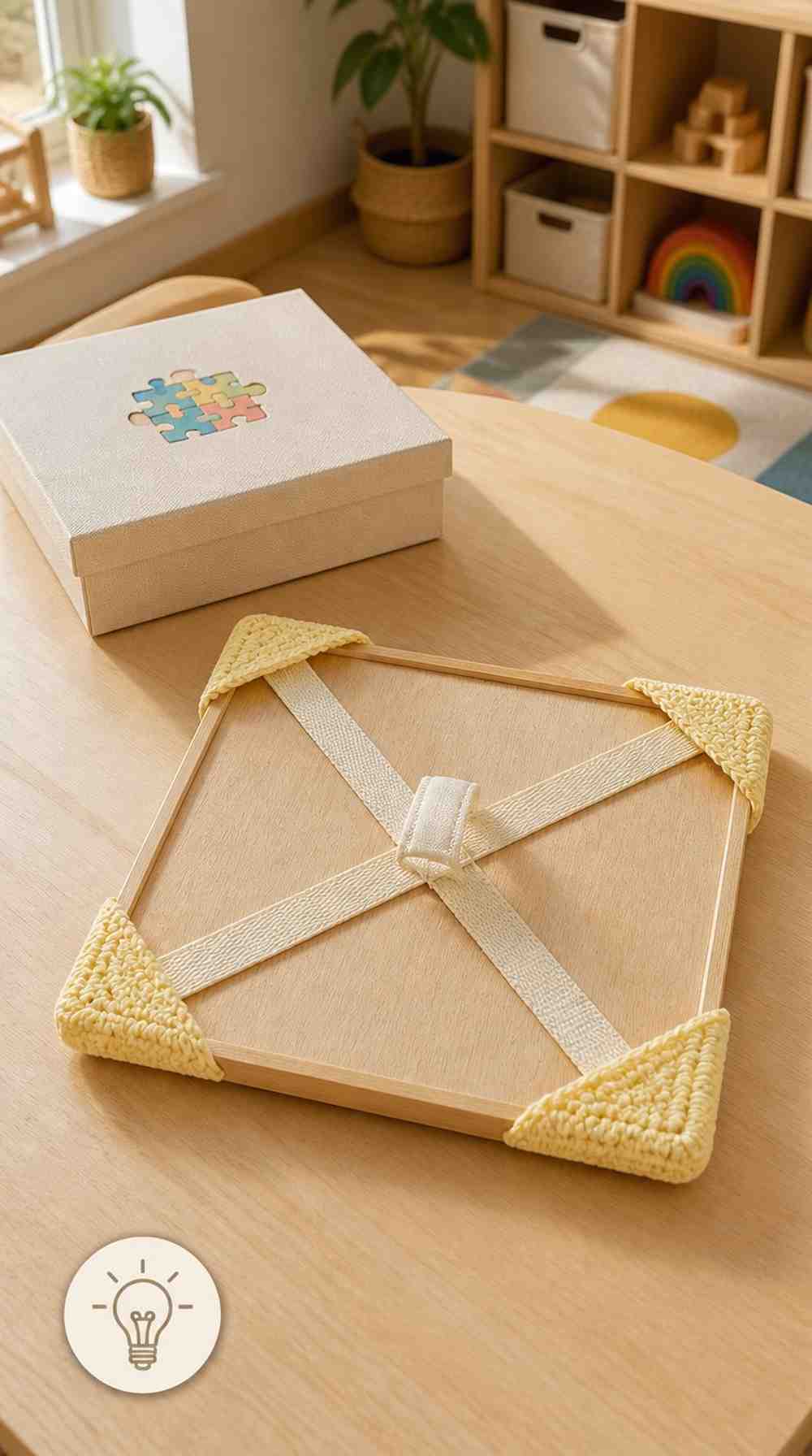
Butter-yellow crochet brings a cheerful finish to this four-corner board harness. Each corner of the square wooden puzzle board sits inside a triangular crochet pocket. Two flat bands cross behind the board, and a short cream handle connects at the central crossing point.
This design focuses on supporting the board at its corners rather than covering most of its surface. It could suit a lightweight square puzzle tray with smooth, consistent edges. However, the four pockets must stay correctly positioned, because a loose corner can allow the board to move unexpectedly.
- Corner pocket fit: Match each triangular pocket to the actual board thickness, leaving enough coverage without forcing the wood into an overly tight opening.
- Rear support bands: Keep the two crossing bands securely joined so the corner pockets cannot spread apart when the handle is lifted.
- Square-board limitation: A harness planned for a square board may not fit a long rectangular board without changing the pocket positions and support geometry.
5. Crochet Teal Fold-Flat Puzzle Board Sling
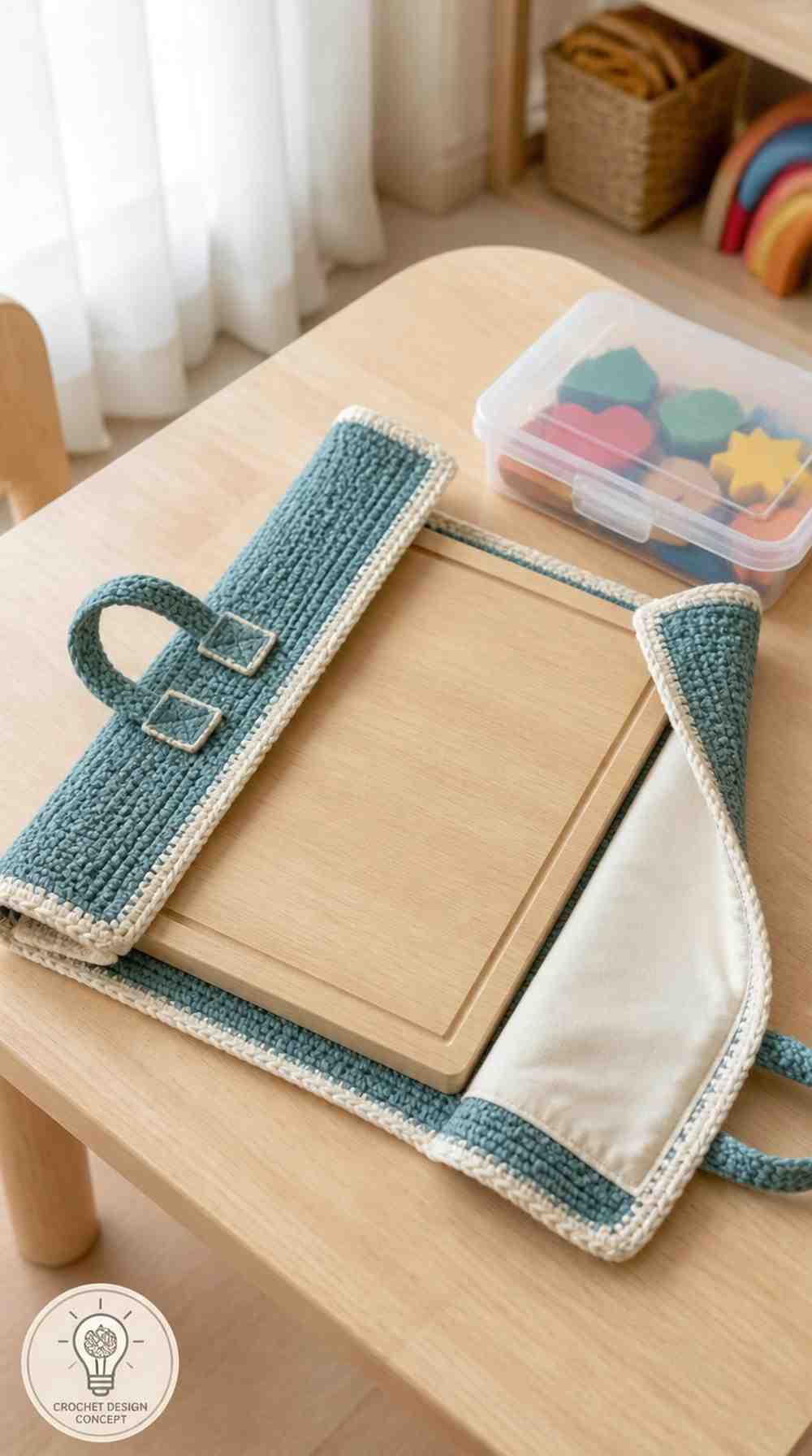
Teal crochet creates a broad supporting panel beneath this wooden puzzle board. Two cream-edged side sections fold upward around the longer edges, while short teal hand loops attach to the reinforced sides. An oatmeal lining sits between the crochet panel and the board.
The fold-flat design is different from an enclosed pouch because the entire carrier can open into a relatively simple rectangular shape. That may make it easier for an adult to position the board before folding up the side panels, although the supporting base needs to remain secure when moved.
- Full-width support: The lower panel should reach beneath the entire board instead of supporting only a narrow strip along the center.
- Folded sides: Both side panels should rise evenly around the wooden edges without bending the board or putting pressure on its playing surface.
- Storage convenience: A carrier that opens flat may be easier to clean and store when the puzzle board is not inside it.
6. Crochet Blush Buttoned Puzzle Board Wrap
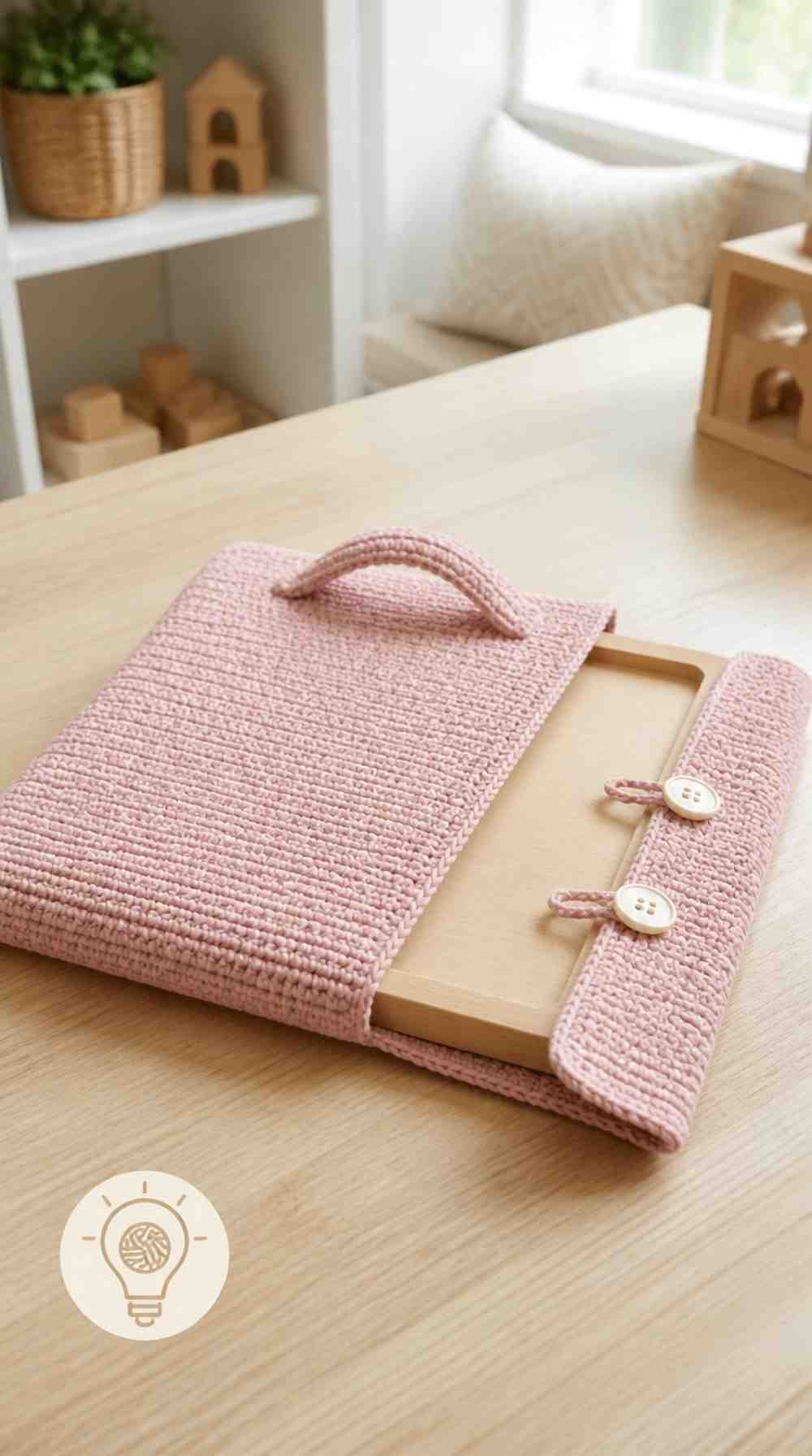
Blush-pink crochet gives this rectangular board wrap a gentle, decorative appearance. A smooth ivory backing panel rests against the wood, while a broad side flap overlaps the board and fastens with two cream buttons. A short, reinforced hand grip sits above the folded carrier.
The buttoned closure introduces a different way to open and adjust the wrap. It could be useful for adult-managed board storage, but hard buttons and detachable small parts deserve special care when the accessory is used around children.
- Button placement: Keep fasteners away from wooden corners that could receive pressure, and avoid any loose or detachable buttons accessible to young children.
- Side opening: The wrap should open widely enough for an adult to remove the board without dragging it against tight crochet edges.
- Age-related caution: This concept is for supervised storage and adult handling, not as an accessory for young children to carry or play with independently.
7. Crochet Olive Mesh-Panel Puzzle Board Harness
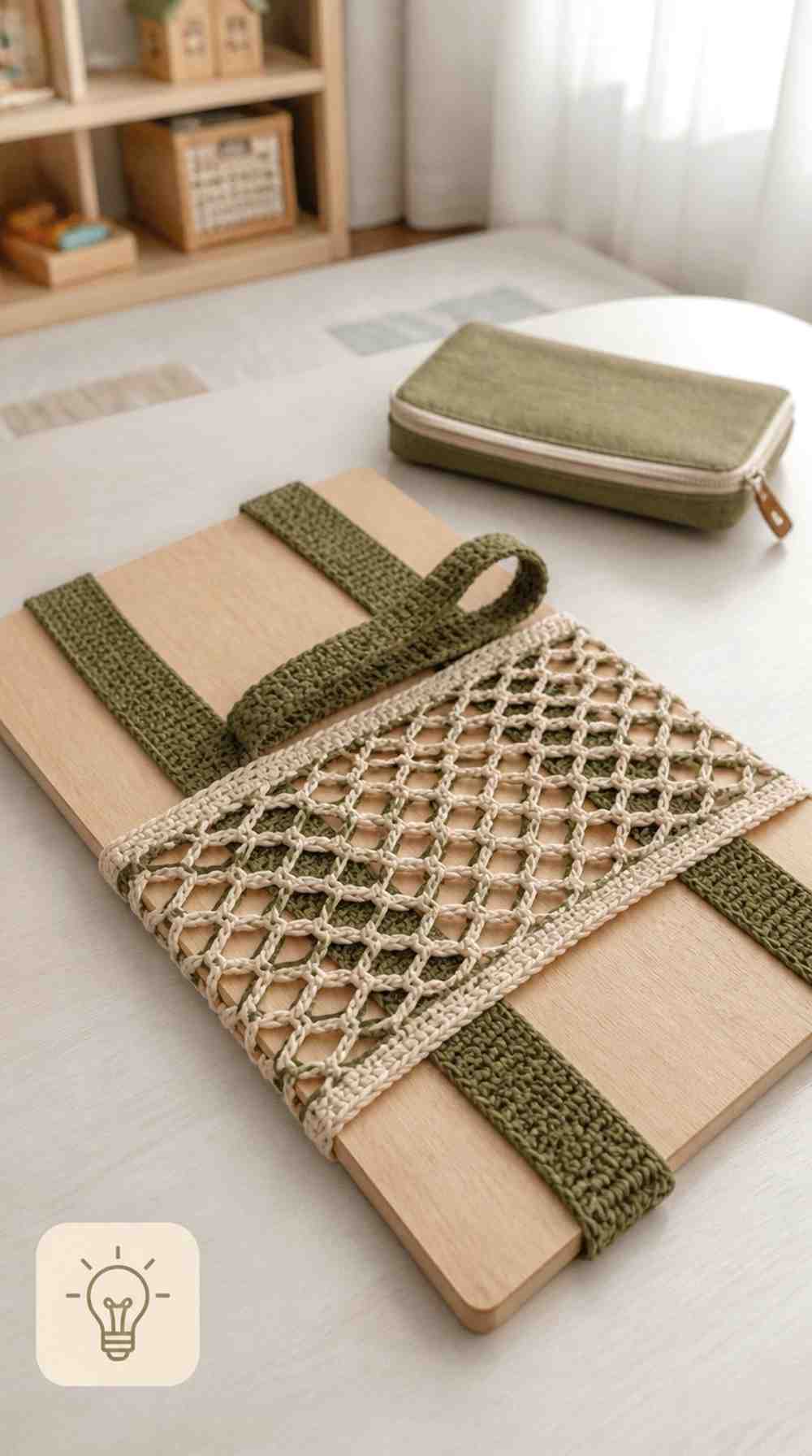
Olive-green crochet creates a distinctive harness with solid supporting bands and a decorative diamond-mesh panel across the board’s back. The two close-stitch bands cross beneath the wooden board, while a short reinforced handle provides a central gripping point.
The mesh gives the design a lighter appearance without covering the entire wooden surface. Its open structure should remain decorative, however, because wide crochet openings can stretch and are not a dependable substitute for continuous supporting bands.
- Solid support sections: The close-stitch bands should carry the board’s weight, while the decorative mesh remains connected without becoming the primary support.
- Mesh alignment: Keep the diamond openings consistent and clear of projecting wooden features that could snag the yarn.
- Handle positioning: The short hand grip needs secure connections to the supporting straps, not merely to the open mesh panel.
8. Crochet Plum Padded-Grip Puzzle Carry Strap
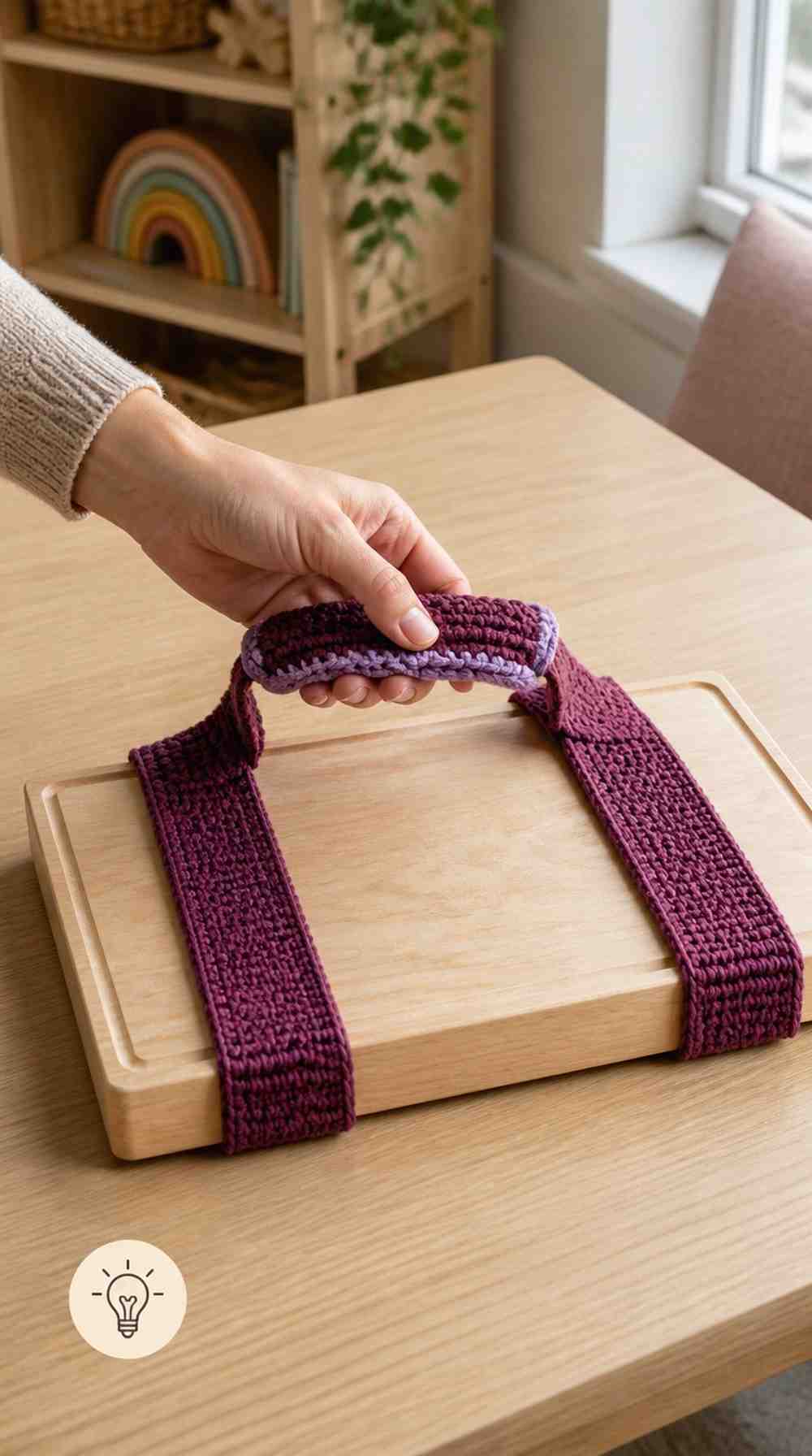
Deep-plum crochet gives this carrier a rich, simple appearance. Two wide bands pass beneath the wooden board, connecting to a short folded hand grip with pale-lilac edging. The double-layer handle provides a thicker, smoother area for an adult’s hand.
The padded-grip detail is the main feature. It explores comfort during short-distance handling without introducing a shoulder strap or long hanging loop. The handle still needs appropriate reinforcement, and a thicker grip alone cannot establish the carrier’s actual strength.
- Folded handle: The double-layer crochet should lie smoothly against itself, avoiding bulky folds that make the short grip uncomfortable.
- Band attachment: Both supporting bands should connect securely to the handle so the board remains reasonably level when carefully lifted.
- Adult handling: Keep the handle short and use it only after inspecting a finished carrier. The illustrated design has not been tested for carrying weight.
9. Crochet Copper Sliding-Band Puzzle Board Carrier
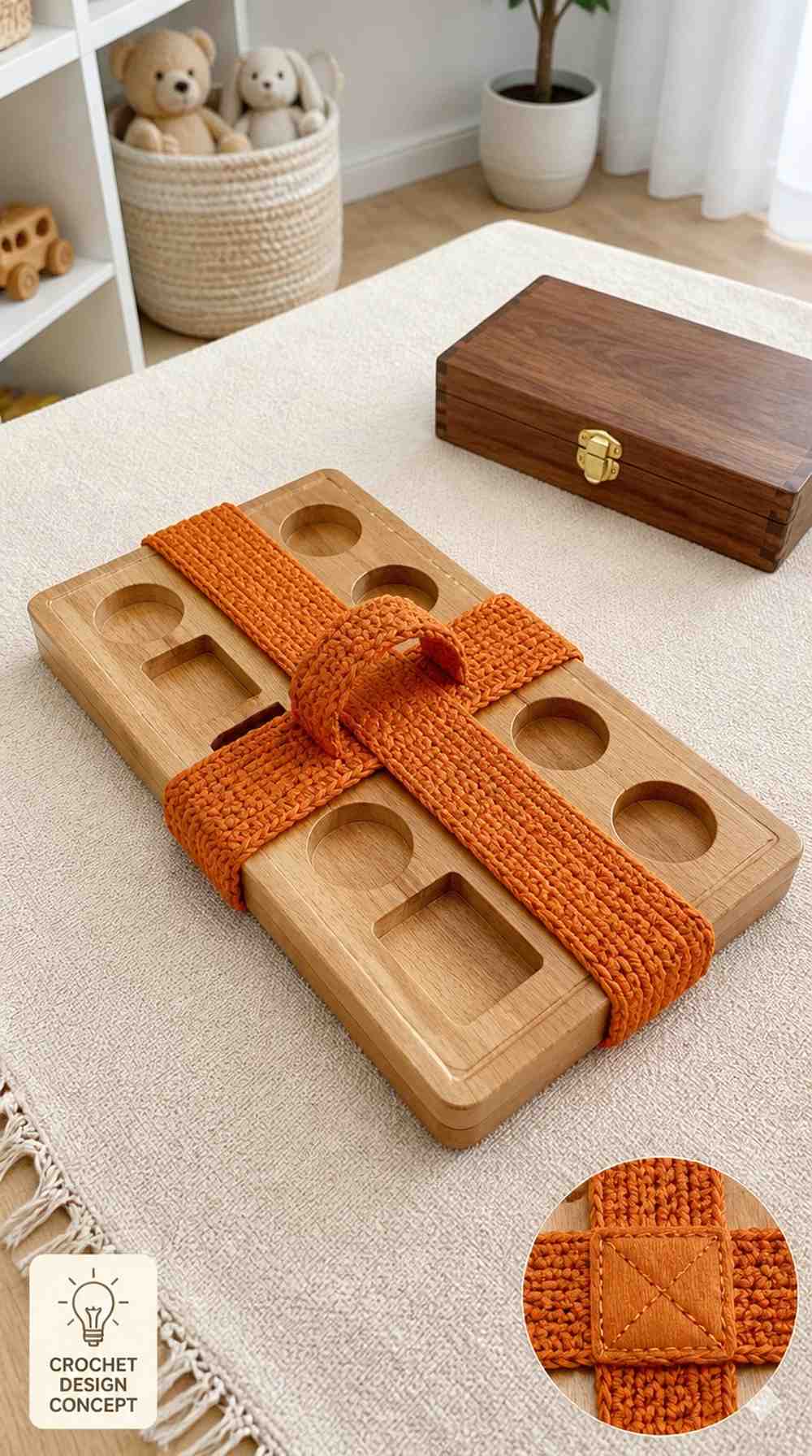
Copper-orange crochet creates a two-band carrying system with an adjustable-looking rear connection. One broad band wraps around the length of the board, while a second perpendicular band passes through a flat crochet keeper. A short handle connects above the intersection.
The sliding-band arrangement introduces flexibility when positioning the straps around a board. Unlike a fixed wrap, the crossing point can be adjusted before the board is secured, although the bands must not slide freely once the carrier is in use.
- Keeper construction: The flat crochet keeper should hold the perpendicular band in position without allowing it to loosen or shift suddenly.
- Fit adjustment: Position both bands around the actual board before use, checking that they stay clear of delicate hinges or raised puzzle features.
- Slip risk: A freely moving band can release an edge unexpectedly. A real design needs a dependable way to prevent unwanted movement.
10. Crochet Lavender Edge-Rail Puzzle Board Carrier
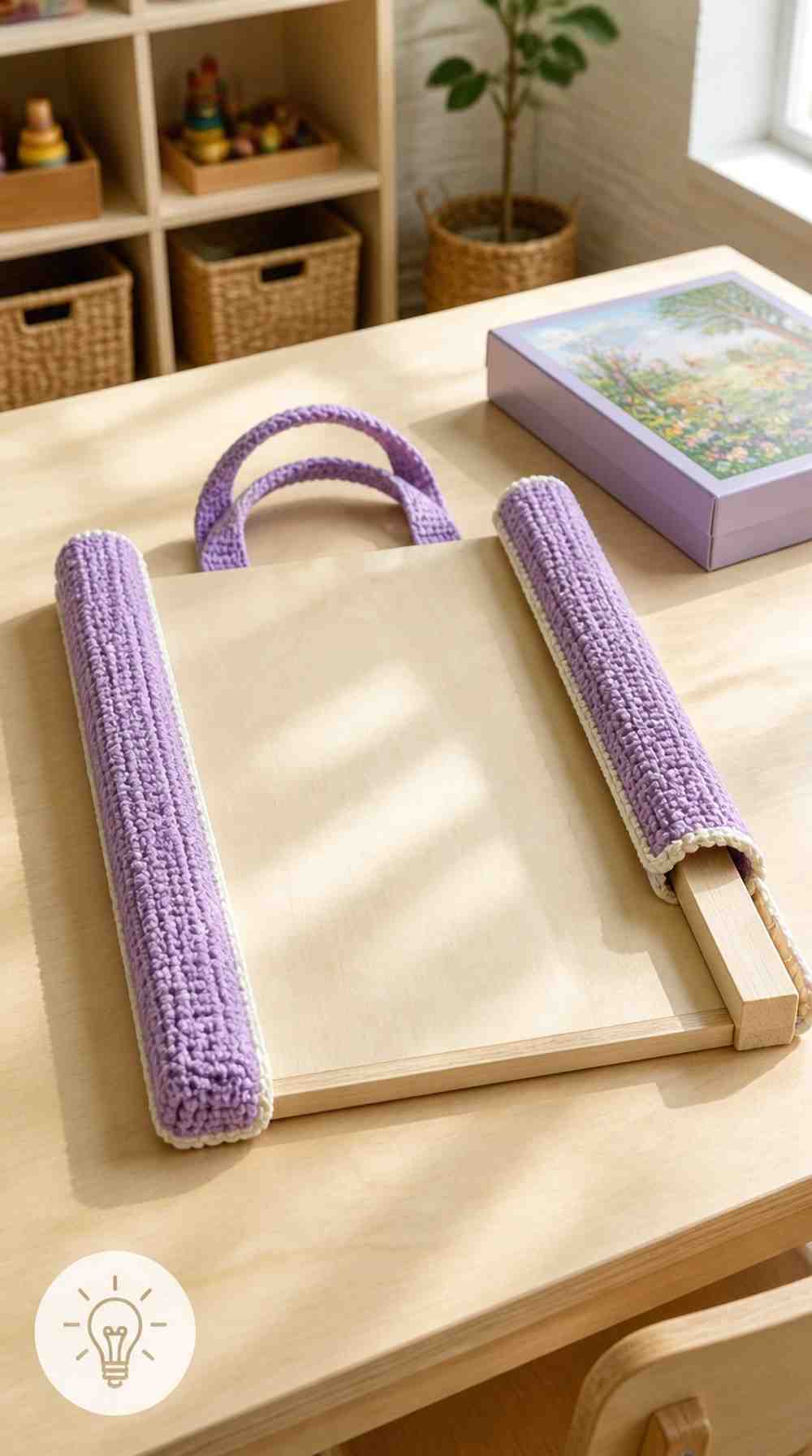
Lavender crochet forms two narrow, fitted channels along the opposite wooden side rails of this rectangular puzzle board. Each channel has a closed lower end and cream-edged opening. Broad support bands connect behind the board, while short lavender handle loops provide gripping points above.
This design focuses on the rigid outer rails rather than the puzzle surface itself. It could suit a framed wooden board with consistent side edges, but the channel openings need to fit the board closely without damaging the wood or sliding away from their intended positions.
- Rail measurement: Measure the actual wooden edge thickness and depth before planning narrow crochet channels.
- Channel support: The closed channel ends should be properly joined so the board’s edges cannot work through loose lower stitches.
- Surface clearance: Keep the crochet away from inset puzzle pieces and any protruding handles or knobs on the playing side.
11. Crochet Charcoal Lined Puzzle Board Tote
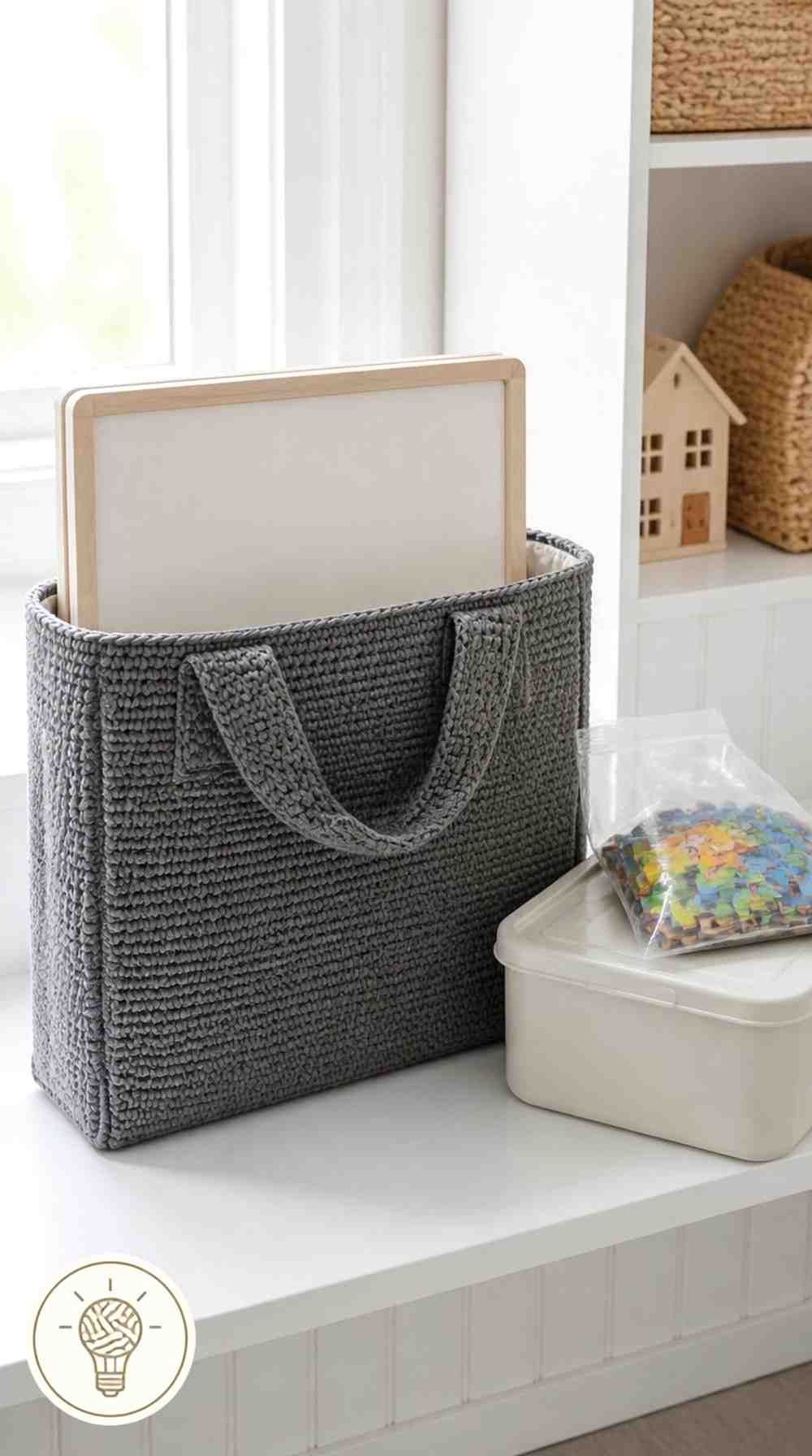
Charcoal-grey crochet creates a slim rectangular tote with a broad closed bottom, cream lining and two short reinforced handles. An empty wooden puzzle board stands upright inside the fabric-lined compartment, with its upper framed edge visible above the opening.
The tote format gives the board more continuous coverage than an open strap arrangement. It may also be easier to place on a shelf when not in use, although its structure needs to support the full lower edge of the board rather than allowing the wood to press into narrow seams.
- Bottom construction: A broad, securely joined base should support the wooden board across its lower edge without folding or pulling into a point.
- Fabric lining: Smooth cream fabric may reduce direct rubbing between the board’s corners and the crochet stitches.
- Handle reinforcement: The two short handles need suitable attachment areas and load checks before the tote is used to move a board.
12. Crochet Ivory Granny-Square Puzzle Grip Strap
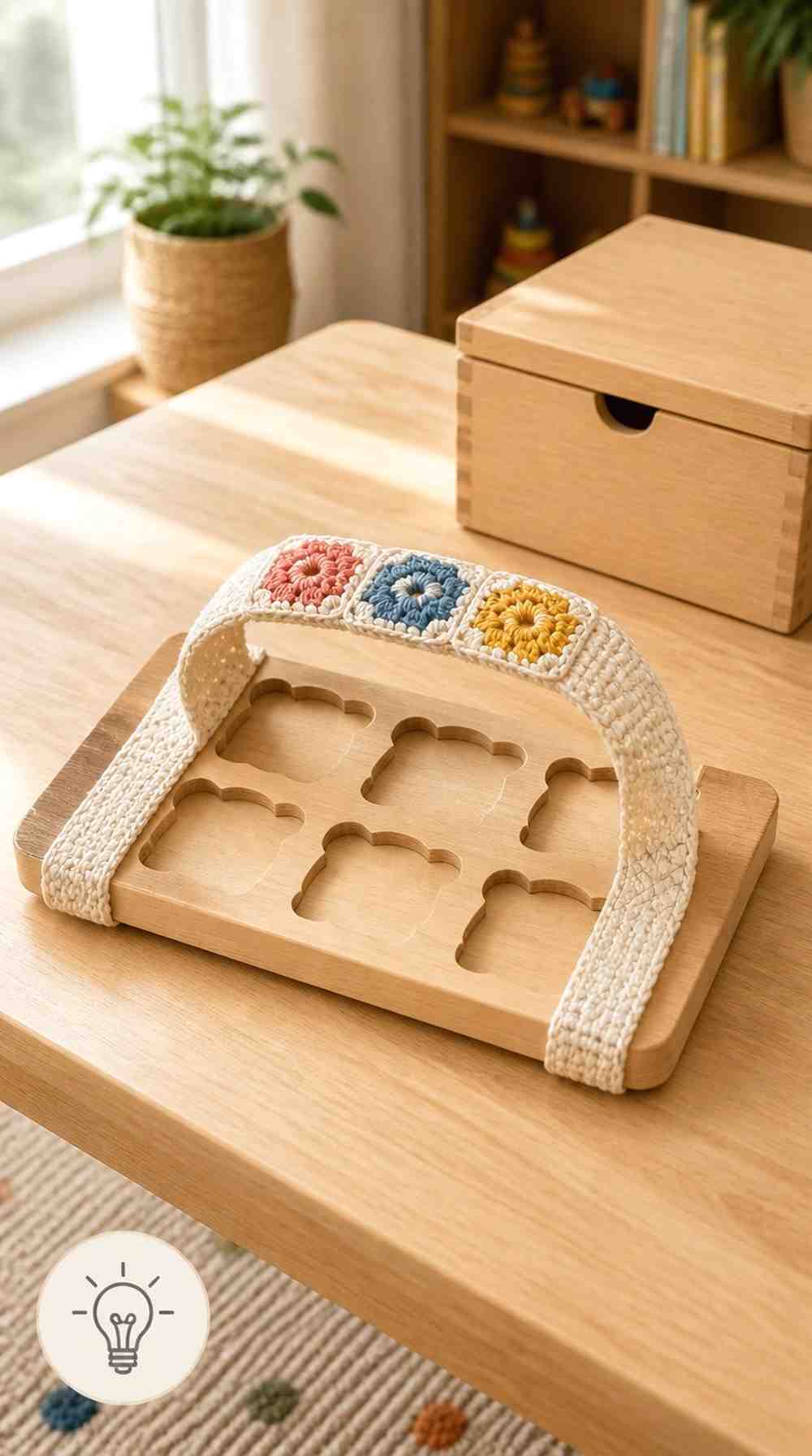
Warm-ivory crochet creates two broad supporting bands beneath a small wooden puzzle board. A short cream hand grip joins them above, decorated with three flat granny-square motifs in coral, denim-blue and mustard. The motifs add color without introducing hanging embellishments.
This concept gives a simple carrying strap a playful crochet finish. The decorative squares remain on the outside of the grip, while the smooth, close-stitch support bands provide the more practical structure. The motifs should not be treated as strengthening elements.
- Motif placement: Keep the granny squares flat against the grip so their corners do not catch on furniture or project into the user’s hand.
- Supporting fabric: The ivory bands should be worked densely enough to retain their intended shape without relying on the decorative motifs.
- Loose-end control: Secure yarn tails carefully and avoid beads or detachable ornaments, particularly because the item is intended to be stored around children’s toys.
13. Crochet Sky Blue Hook-and-Loop Puzzle Strap
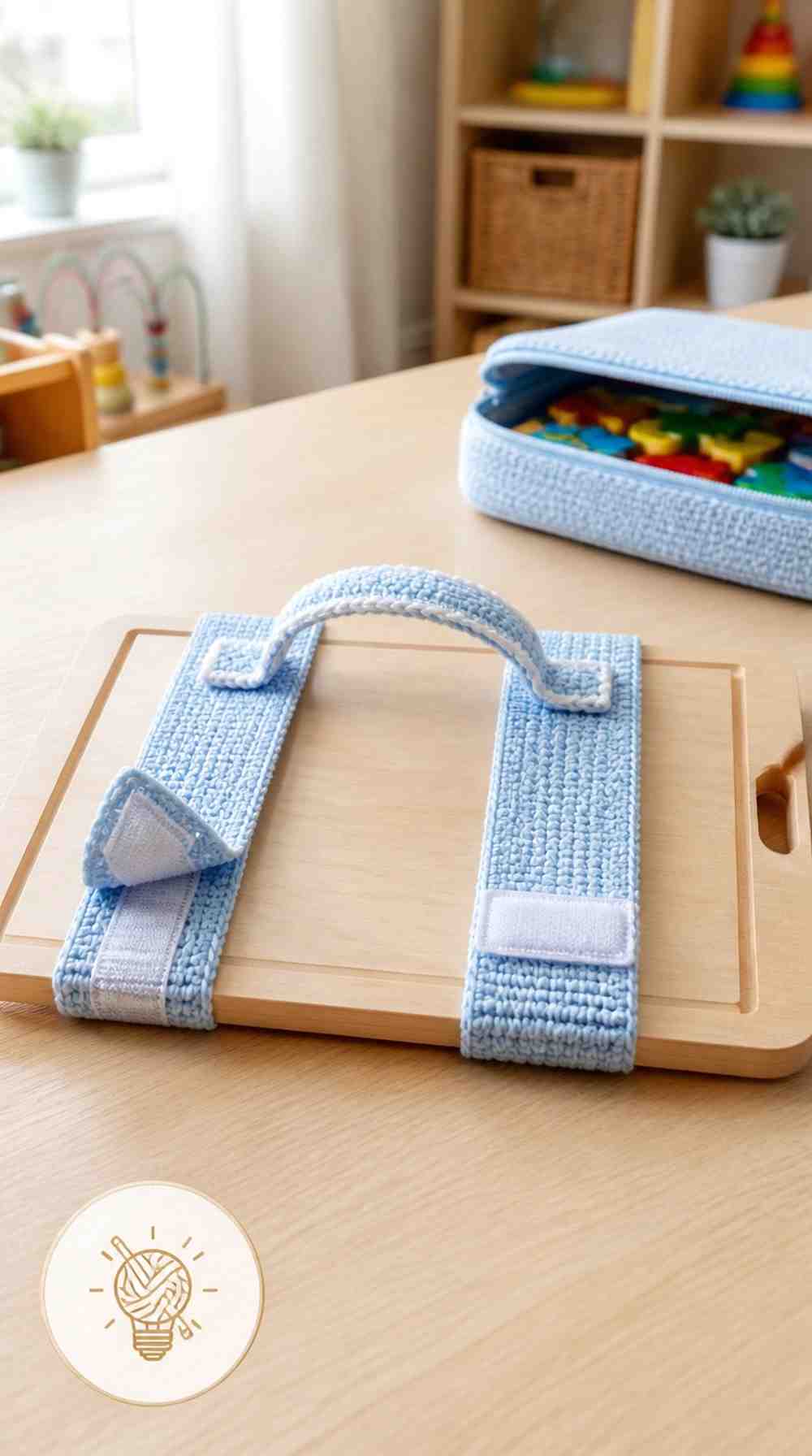
Sky-blue crochet creates a two-band puzzle board carrier with short white-edged hand handles. Each supporting band overlaps around the wooden board and fastens with a broad sewn-in hook-and-loop fabric closure. One partly opened fastening shows how the adjustable connection sits within the crochet.
This design avoids small decorative buttons while introducing an adjustable fit. The closure needs enough overlap to remain secure, and rough hook material should stay away from the wooden board and other textile surfaces that could snag.
- Closure positioning: Place the hook-and-loop material inside the overlap so exposed rough edges cannot scratch the board or catch neighboring fabric.
- Adjustment range: The bands may accommodate limited size variation, but the board must still fit securely without relying on excessive tension.
- Fastener inspection: Check the sewn attachment and closure grip regularly; a loose fastening can allow the board to slip from the carrier.
14. Crochet Mustard Twin-Board Carry Caddy
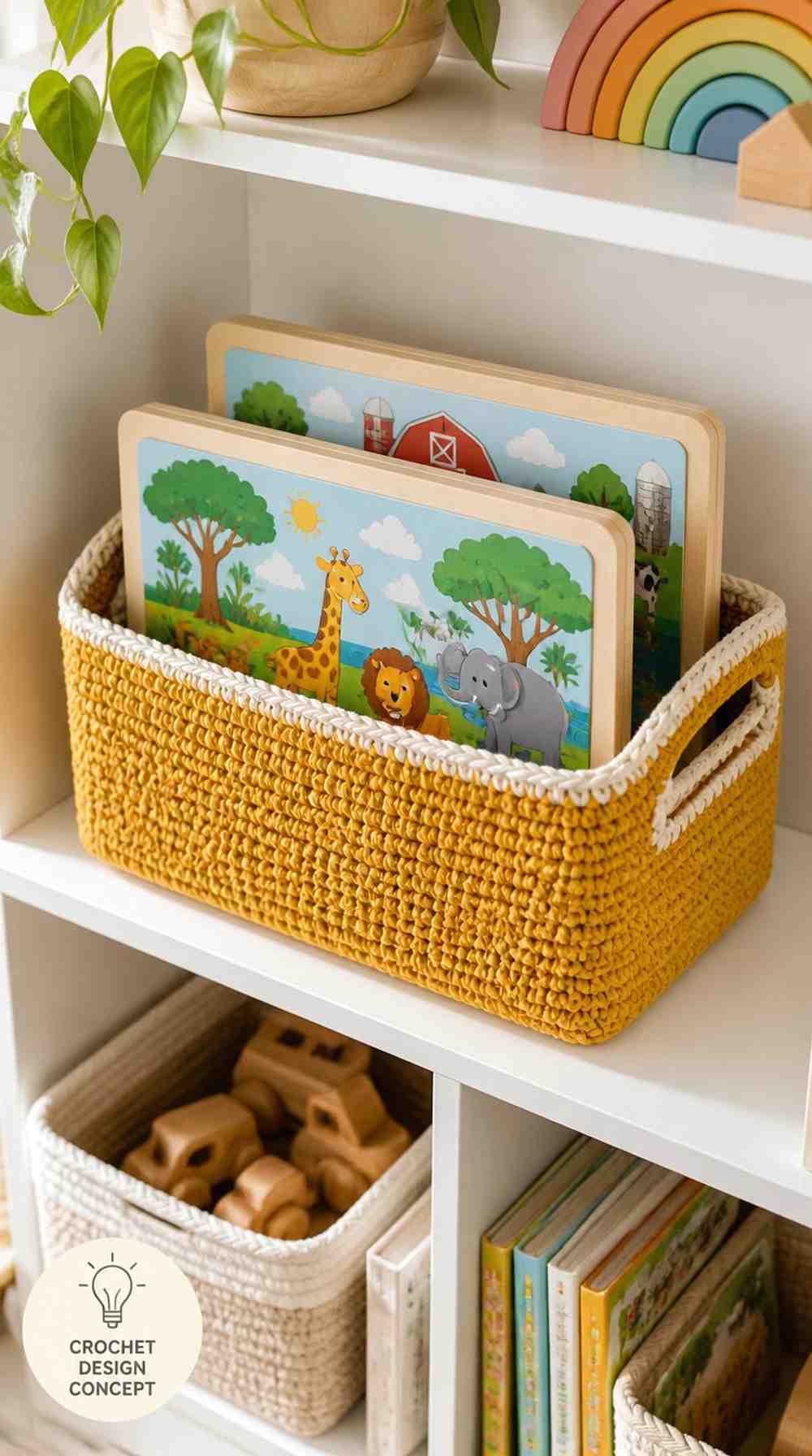
Mustard-yellow crochet gives this small caddy a cheerful playroom appearance. Two shallow parallel compartments sit on a broad rectangular lined base, separated by a low central divider. Two short handles attach to the outer sidewalls, while two lightweight wooden puzzle boards stand upright inside.
The divided design is intended for organizing more than one board rather than wrapping around a single piece. It could suit a shelf where several small puzzles are stored together, but carrying two boards introduces extra weight and balance considerations.
- Separate compartments: Each section should fit its board without forcing the wooden frames against the central divider.
- Combined weight: Two boards can place greater strain on the base and handles than one; actual strength must be checked before lifting.
- Shelf organization: This caddy may work best as a stationary storage basket, particularly when the boards are too heavy or awkward for a soft carrier.
15. Crochet Coral Foldover Puzzle Board Saddle
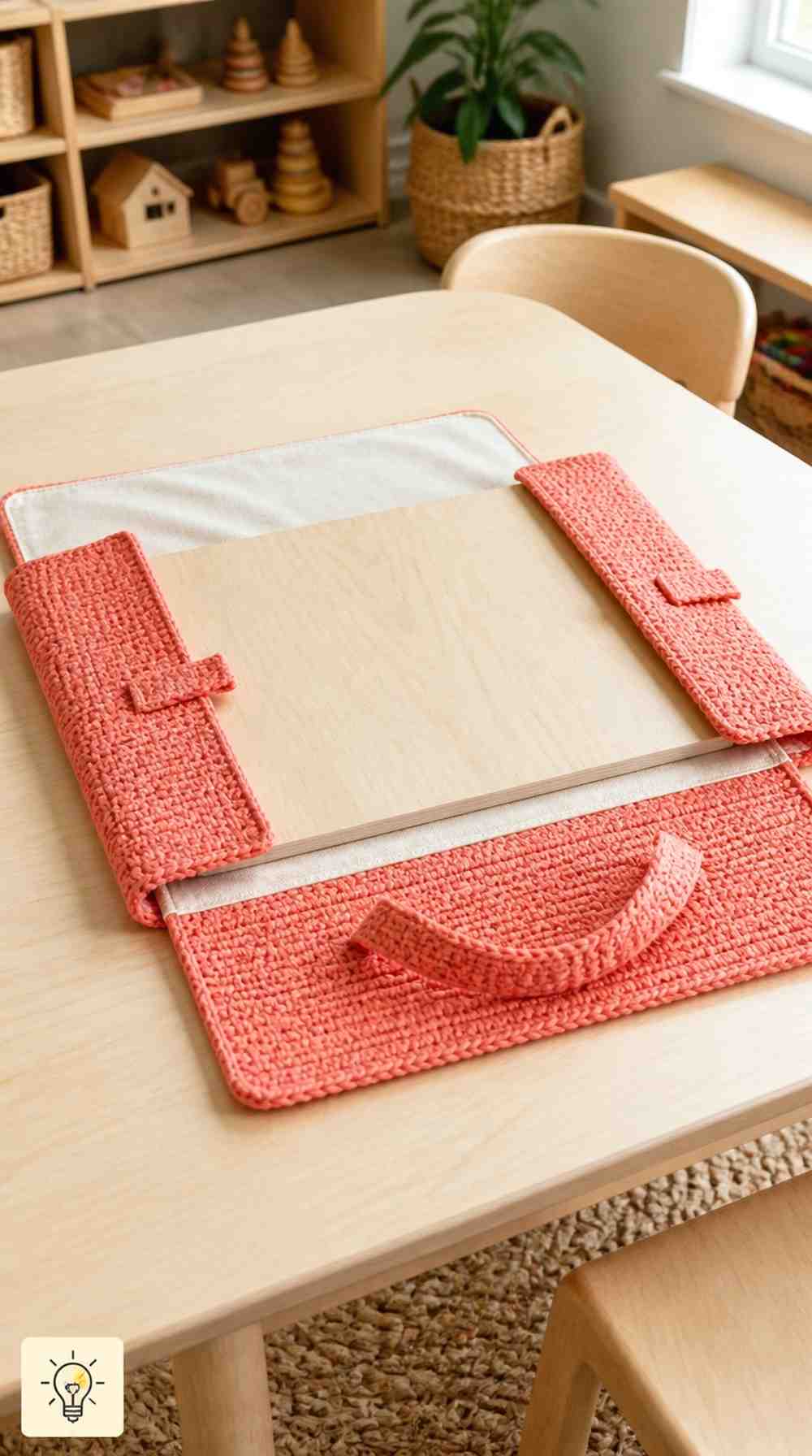
Coral crochet creates a broad flat saddle-style carrier with an oatmeal lining and two short folding side flaps. A rectangular wooden puzzle board rests on the main supporting panel, while flat fabric tabs secure the side sections around its edges. A short reinforced hand grip sits across the outer panel.
Unlike narrow bands, this design places a continuous crochet surface beneath the board. That can make the board easier to position while the carrier is open, but the folded sides still need to prevent sideways movement without pressing against the playing surface.
- Main support panel: The central fabric section should extend beneath the board’s full width rather than stopping short of its outer edges.
- Side-flap closure: Keep the securing tabs flat and away from any raised puzzle knobs, hinges or fragile frame details.
- Open-flat storage: The saddle can be unfolded for inspection and cleaning, allowing the lining and seams to dry thoroughly before reuse.
16. Crochet Burgundy Reversible Puzzle Carry Wrap
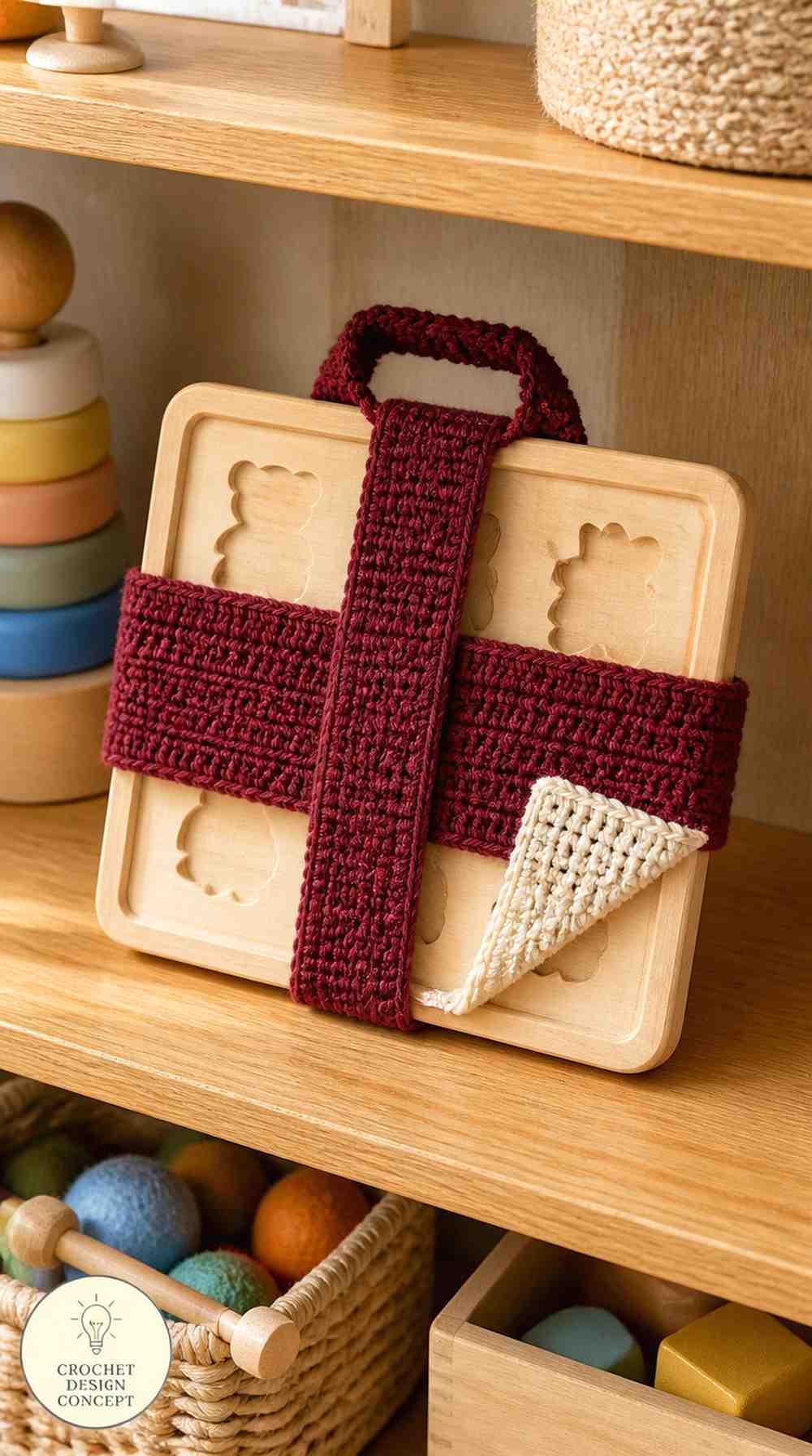
Burgundy crochet gives this compact puzzle wrap a rich outer finish, while a contrasting cream reverse face appears at one folded corner. A broad double-layer band passes around the board, with a narrower secured band crossing behind it. A short reinforced hand grip completes the design.
The reversible construction introduces two color options without changing the basic carrying shape. Its extra layer may also change the fabric’s thickness and flexibility, so both sides need to lie smoothly against the wooden board when the wrap is fitted.
- Reversible seams: Keep both crochet faces securely joined without bulky knots or ridges that could press against the wooden frame.
- Support-band overlap: The narrower rear band should remain attached and positioned correctly on either side of the reversible wrap.
- Cleaning and drying: Double-layer crochet can take longer to dry, so inspect both surfaces before storing it around a wooden puzzle board.
Practical Guide to Crochet Children’s Puzzle Board Carry Straps
A puzzle board carry strap should be planned around the actual board, its construction and the age of the people who will be using it. These designs are best approached as adult-managed storage and transport concepts.
Measure the board before choosing a design. Check its length, width, thickness and weight. Wooden inset puzzles, cardboard puzzle trays and folding activity boards have different edges and support needs. A strap that fits one style may slide off another.
Keep puzzle pieces secure. An open carrying strap does not prevent loose pieces from falling out. Remove them and place them in a suitable closed container, or follow the puzzle manufacturer’s instructions for any fitted lid or retention system. Do not assume a decorative crochet band can hold an unfinished puzzle together.
Choose stable strap construction. Close crochet stitches, broad support bands and reinforced joins may help limit unwanted stretching. However, crochet straps can change shape under load. Use a suitable rigid support where needed and inspect a completed carrier before lifting a board.
Take children’s safety seriously. Keep handles short and intended for adult hands. Avoid long shoulder straps, neck loops, loose cords, drawstrings and detachable small decorations. The U.S. Consumer Product Safety Commission warns that straps and cords on children’s toys can create strangulation hazards, particularly for young children. Do not leave strap-equipped accessories available for unsupervised play.
Check surfaces and fasteners. Wooden puzzle frames can have corners, knobs and small raised features. Smooth fabric linings may reduce rubbing, while hard buttons or fasteners should stay away from delicate board surfaces. Any closure must remain secure during handling.
Store the carrier separately during play. Remove the strap or carrying wrap before the child begins using the puzzle, and keep it out of reach when not needed. The crochet accessory is for organizing and moving the board, not for wearing or playing with.
For more ways to arrange puzzle accessories, explore 15 Crochet Jigsaw Puzzle Piece Sorting Mat Inspiration Ideas on Yarn Nest Studio. That collection focuses on sorting and organizing puzzle pieces, while this article explores support straps and carriers for the boards themselves.
Want to Make Something Similar?
These 16 designs are original visual concepts rather than tested carrying patterns. Existing crochet tutorials can help explain dense straps, reinforced handles and storage pouches, but they do not establish that a finished item is suitable for children’s use.
- For dense, structured crochet straps: Sandra Stitches – Crochet Bag Strap Tutorial: 3 Sturdy Straps That Don’t Stretch by Sandra Regev explores waistcoat-stitch, braided and double-thickness strap constructions. These techniques may help with the short handle concepts, although the finished straps still require proper testing.
- For thermal-stitch hand grips: Zamiguz – How to Make a No-Stretch Crochet Bag Strap by Maggie demonstrates a dense thermal crochet strap. Its construction is relevant to the Plum Padded-Grip design but is not an exact pattern for a board carrier.
- For storing separate puzzle pieces: Heart Hook Home – Board Game Pouch Crochet Pattern by Ashlea Schumaker teaches small game-accessory pouches. A suitable closed pouch could be used separately to organize loose pieces, subject to the puzzle’s age guidance.
These resources provide related crochet techniques, not instructions for reproducing the illustrated concepts or proof of safe load-bearing performance.
Which Crochet Children’s Puzzle Board Carry Strap Should You Choose?
| Design | Main feature | Important consideration |
|---|---|---|
| Terracotta Cross-Wrap Puzzle Board Strap | Two crossing support bands | Secure central intersection |
| Oatmeal Twin-Band Puzzle Carrier | Parallel bands with cream grip | Even band spacing |
| Navy Envelope Puzzle Board Carrier | Fabric-lined enclosed sleeve | Full lower-edge support |
| Butter Yellow Four-Corner Puzzle Harness | Four triangular corner pockets | Preventing corner slips |
| Teal Fold-Flat Puzzle Board Sling | Broad underlying support panel | Evenly secured side folds |
| Blush Buttoned Puzzle Board Wrap | Buttoned side flap | Small-part and closure caution |
| Olive Mesh-Panel Puzzle Board Harness | Decorative mesh and solid bands | Mesh is not the main support |
| Plum Padded-Grip Puzzle Carry Strap | Short double-layer grip | Reinforced handle joins |
| Copper Sliding-Band Puzzle Board Carrier | Adjustable crossing band | Preventing unwanted sliding |
| Lavender Edge-Rail Puzzle Board Carrier | Fitted side-rail channels | Matching wooden frame thickness |
| Charcoal Lined Puzzle Board Tote | Fabric-lined rectangular carrier | Secure bottom and handles |
| Ivory Granny-Square Puzzle Grip Strap | Colorful motifs on short grip | Secure decorations and yarn ends |
| Sky Blue Hook-and-Loop Puzzle Strap | Adjustable fabric closures | Fastener reliability |
| Mustard Twin-Board Carry Caddy | Two separate board compartments | Combined weight and balance |
| Coral Foldover Puzzle Board Saddle | Full support panel and side flaps | Secure flat closures |
| Burgundy Reversible Puzzle Carry Wrap | Double-layer reversible band | Smooth seams and proper fit |
For one small rectangular board, the Terracotta Cross-Wrap Strap or Oatmeal Twin-Band Carrier offers a relatively simple design direction. If you want more fabric beneath the board, the Teal Fold-Flat Sling or Coral Foldover Saddle may be worth exploring.
The Navy Envelope Carrier and Charcoal Lined Tote offer more enclosed storage shapes. For multiple small boards, the Mustard Twin-Board Caddy provides a coordinated arrangement, although its actual carrying ability would depend on the combined weight and construction.
Conclusion
Crochet children’s puzzle board carry straps can bring handmade character to playroom organization while exploring practical ways to wrap and store lightweight wooden boards. From simple crossing bands and fitted corner pockets to padded handles and fabric-lined carriers, these 16 ideas offer different approaches to board support and storage. The most important considerations are secure fit, reliable construction, properly contained puzzle pieces and safe adult handling. Choose a design based on the actual board rather than its appearance alone, and keep carrying straps separate from children’s play activities.
Which design would you choose for a puzzle collection? Do you prefer the simple terracotta cross-wrap, the butter-yellow four-corner harness or the coral foldover saddle? Share which style would suit your puzzle boards and playroom storage best.
Frequently Asked Questions
1. Can children safely carry puzzle boards using crochet straps?
A homemade crochet carrying accessory should not automatically be considered suitable for independent use by children. Long straps, loops and cords can create entanglement and strangulation hazards, while loose fasteners may present other risks. These concepts are intended for adult-managed storage and handling. Keep the straps away from young children during play.
2. What yarn should I consider for a crochet puzzle board carrying strap?
A smooth, firm cotton yarn may be worth considering for close-stitch support bands because it provides clear stitch definition. However, yarn choice alone does not establish strength. The finished strap’s construction, attachment points, stretch and actual load-bearing performance all need checking before use.
3. Will a crochet strap keep loose puzzle pieces in place?
No. A strap fitted around the outside of a puzzle board does not guarantee that individual pieces will remain secure. Store loose pieces in an appropriate closed container or use the puzzle manufacturer’s recommended storage arrangement. Never rely on open crochet bands to protect an unfinished puzzle during transport.
4. Is a shoulder strap a good idea for a children’s puzzle board?
For a child-focused accessory, a long shoulder or neck-length strap introduces avoidable entanglement risks. Short adult hand grips and supported storage carriers are better directions to explore. The carrying accessory should be removed before the board is given to a child for play.
5. Are these 16 crochet children’s puzzle board carry strap designs available as patterns?
These are visual inspiration concepts rather than tested crochet patterns or step-by-step instructions. Their colors, support bands, pocket shapes and handle arrangements can help with planning an original organizer. The linked tutorials teach related construction techniques, but a real carrier needs to be designed and checked for its intended board, weight and users.