A crochet clothing repair station hanging pouch can help keep small mending supplies together without taking up valuable drawer or table space. These 18 inspiration ideas explore stacked pockets, dowel-mounted organizers, covered needlebook compartments, thread-spool holders, and compact hanging buckets. Warm terracotta, oatmeal, navy, olive green, charcoal, and other soft colors give each design a different look, while the crochet details make ordinary sewing storage feel more personal.
Whether you repair loose buttons, mend small clothing tears, or keep fabric patches ready for occasional repairs, a well-planned hanging pouch can make your supplies easier to find. Some concepts separate tools into several compartments, while others use one deep pocket or a foldable panel. Compare the hanging arrangements, pocket sizes, fastenings, and access to sharp tools before choosing a design for your sewing corner.
These are AI-generated crochet design visualizations for inspiration, not photographs of tested handmade organizers or step-by-step patterns.
Quick Design Selection Guide
- For a complete small mending station: The Crochet Rust Three-Pocket Repair Station and Crochet Ivory Roll-Up Mending Station provide several separate storage areas.
- For sorting thread: The Crochet Denim Thread-Spool Ladder Pouch and Crochet Olive Two-Column Mending Organizer keep different supplies visible.
- For safer needle and scissor storage: Compare the Crochet Navy Needlebook Hanging Station and Crochet Mustard Scissor Holster Pouch, which show tools stored inside protective holders.
- For a compact wall space: The Crochet Apricot Rounded Repair Bucket and Crochet Cocoa Flat Wall Repair Pocket use simpler pocket arrangements.
- For adjustable organization: The Crochet Forest Green Removable-Pocket Panel lets separate compartments be rearranged, while the Crochet Plum Foldout Repair Wallet brings several small sections together.
1. Crochet Rust Three-Pocket Repair Station
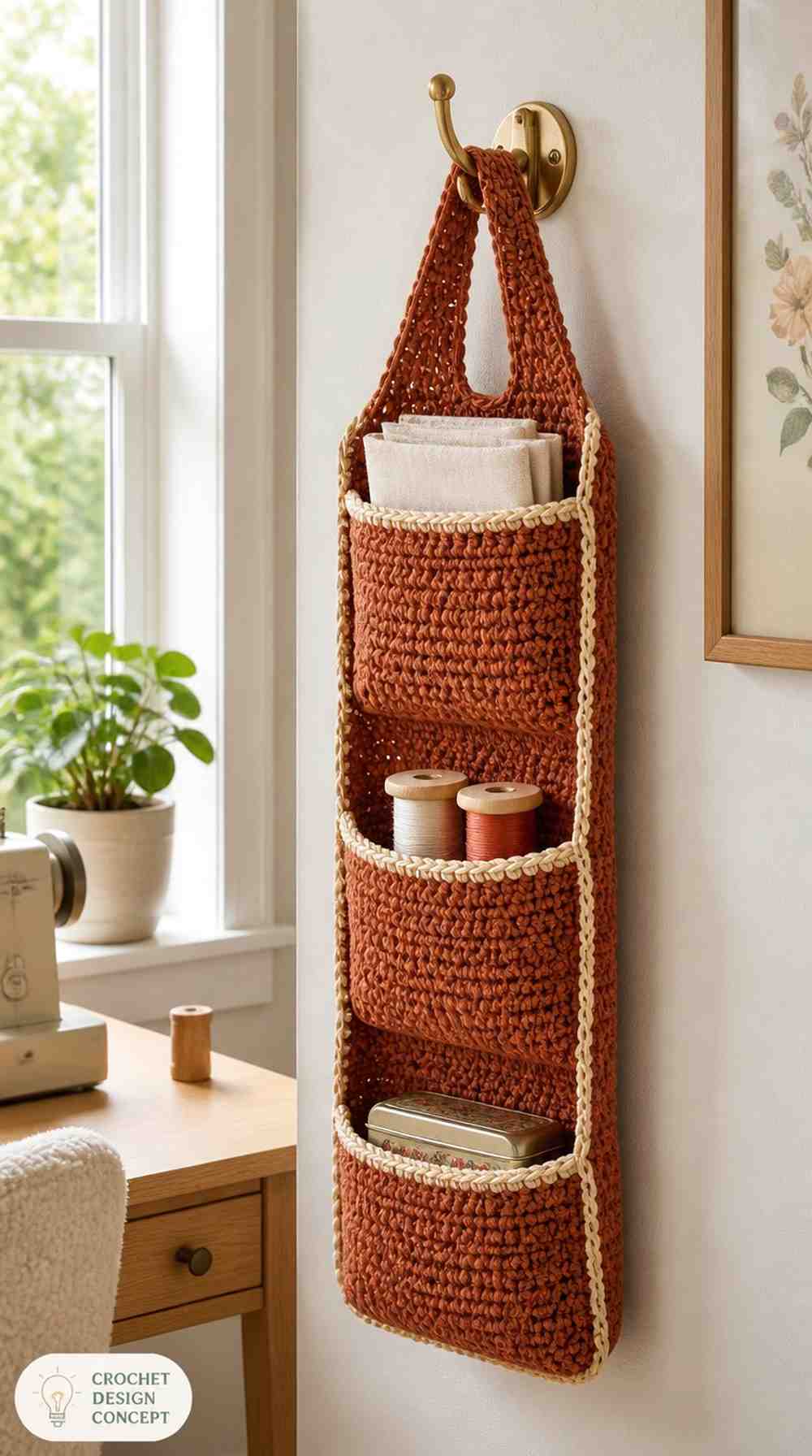
Warm rust-terracotta crochet forms a tall hanging panel with three rectangular pockets arranged vertically. Narrow ivory edges make each opening easy to distinguish. Folded cream fabric patches sit in the upper pocket, two small thread spools occupy the middle, and a closed sewing notions tin rests in the bottom compartment.
The organizer hangs from one broad reinforced loop on a wall hook. Its stacked arrangement could suit a narrow sewing corner where vertical storage is easier to accommodate than a wide organizer.
- Three Storage Levels: Keep frequently used fabric patches in the upper pocket, thread in the middle, and the closed notions tin in the lower section.
- Single Hanging Point: Check the strength of the reinforced loop and wall hook, since a tall loaded crochet panel may tilt or stretch.
- Pocket Bottoms: Reinforce the lower seams of all three compartments, particularly the one intended to hold a small metal notions tin.
2. Crochet Oatmeal Dowel Repair Caddy
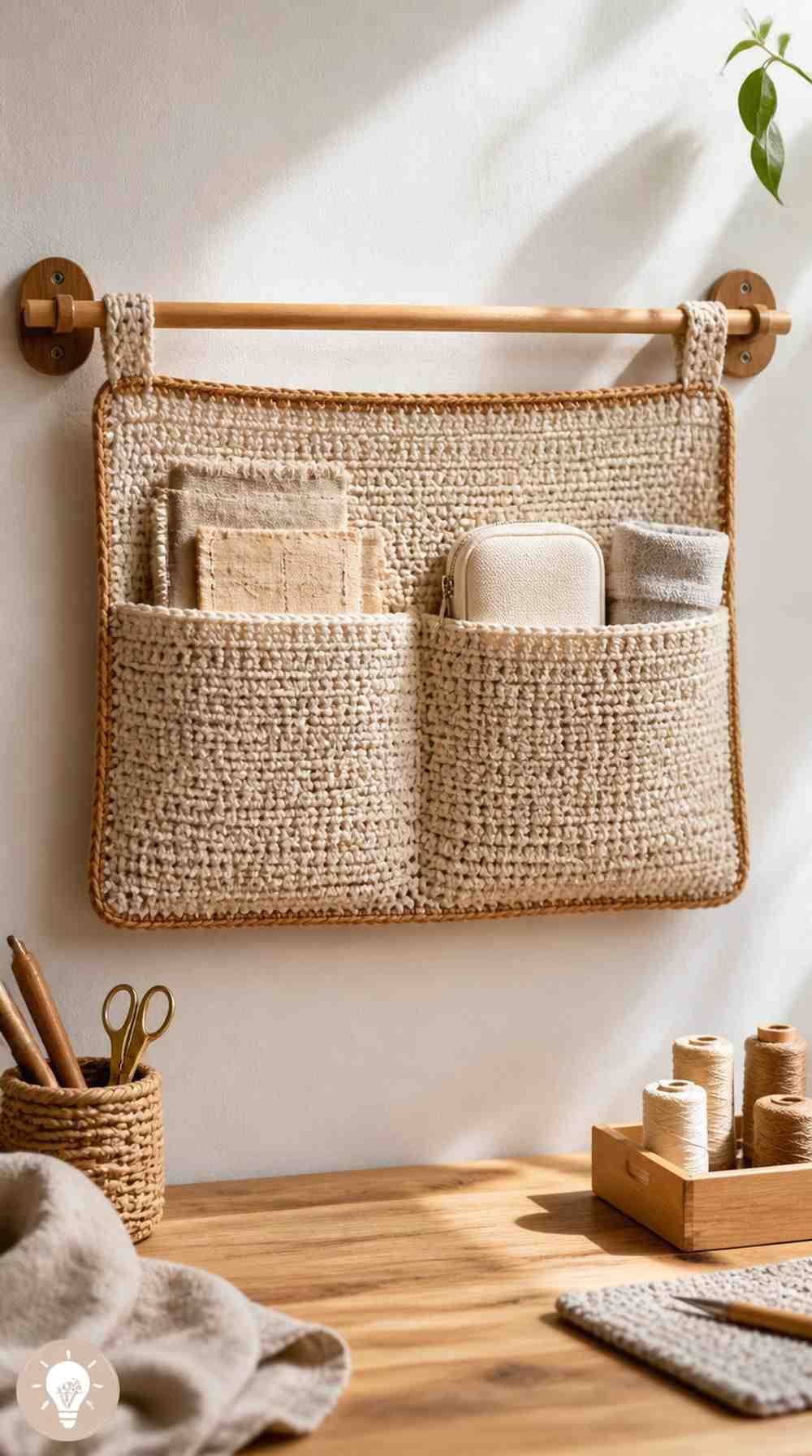
Natural oatmeal crochet creates a broad rectangular organizer with two deep pockets separated by a vertical seam. Caramel edging finishes the openings, while two reinforced loops attach the backing to a smooth wooden dowel. Folded mending patches occupy one side, and a closed sewing kit and cloth fill the other.
The two-column arrangement makes it easier to separate fabric pieces from small tools. Its wooden dowel also gives the upper edge a more structured appearance than a single-hook hanging pouch.
- Central Divider: Keep the vertical seam securely joined from the bottom to the pocket opening so stored supplies remain in separate compartments.
- Dowel Support: Use appropriately fitted wall supports and check that the wooden dowel stays level under the organizer’s intended contents.
- Pocket Width: Measure the folded fabric patches and closed sewing kit before selecting the size of each compartment.
3. Crochet Navy Needlebook Hanging Station
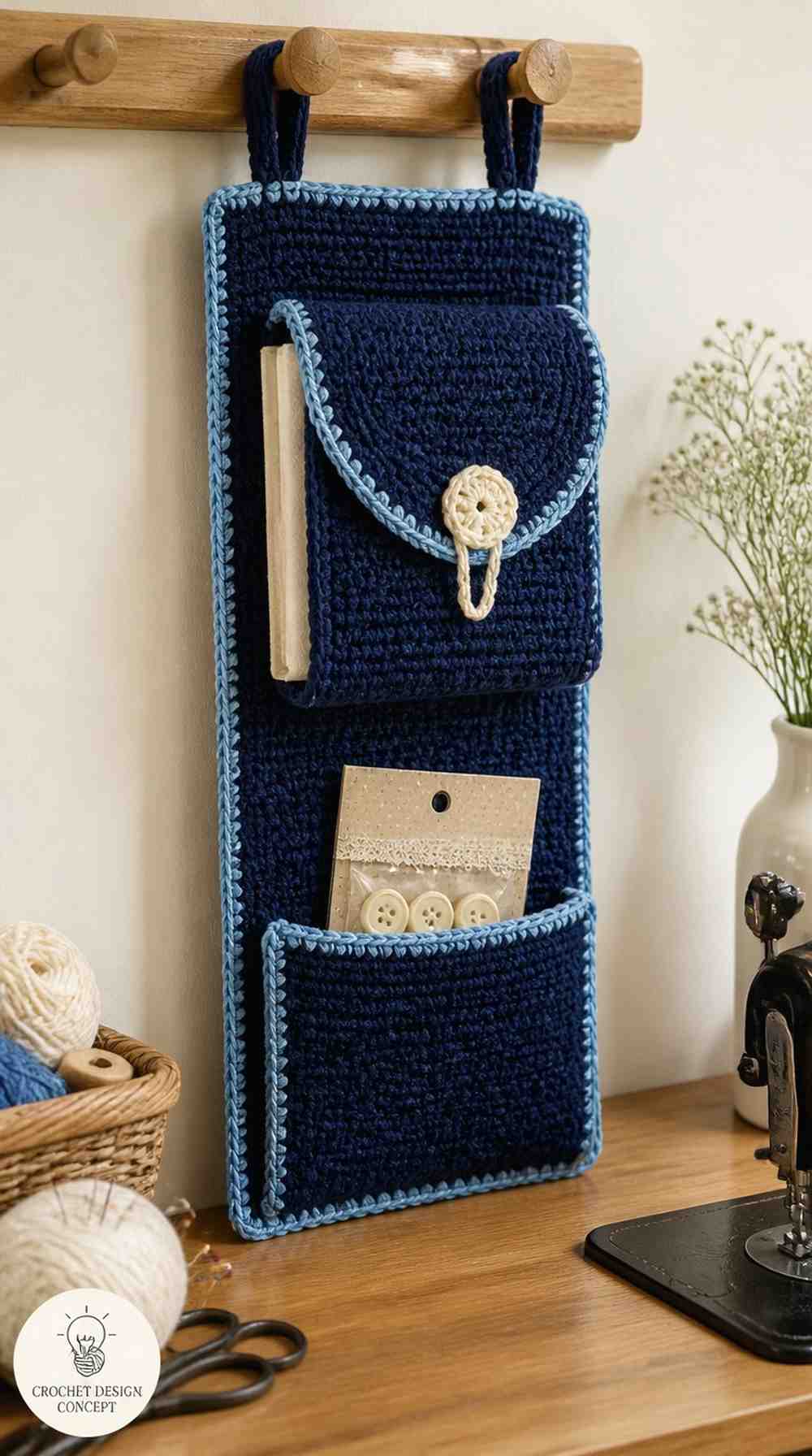
Deep navy crochet gives this narrow repair station a tidy, understated appearance. The upper compartment has a buttoned flap with ivory edging, while the lower pocket holds a sealed packet of spare buttons. A closed cream felt needlebook sits inside the upper section.
This design concentrates on keeping smaller sewing accessories together. The covered upper compartment is particularly useful as a visual reminder that needles should be stored in a dedicated needlebook rather than left loose in crochet pockets.
- Needlebook Compartment: Keep all needles secured inside the closed felt needlebook, with the navy flap providing an additional storage closure rather than replacing it.
- Crochet Button: Position the small ivory button where it can be opened comfortably without pulling excessively on the upper pocket.
- Narrow Wall Space: The vertical arrangement may suit a small wall area beside a sewing desk, provided both hanging tabs remain securely supported.
4. Crochet Mustard Scissor Holster Pouch
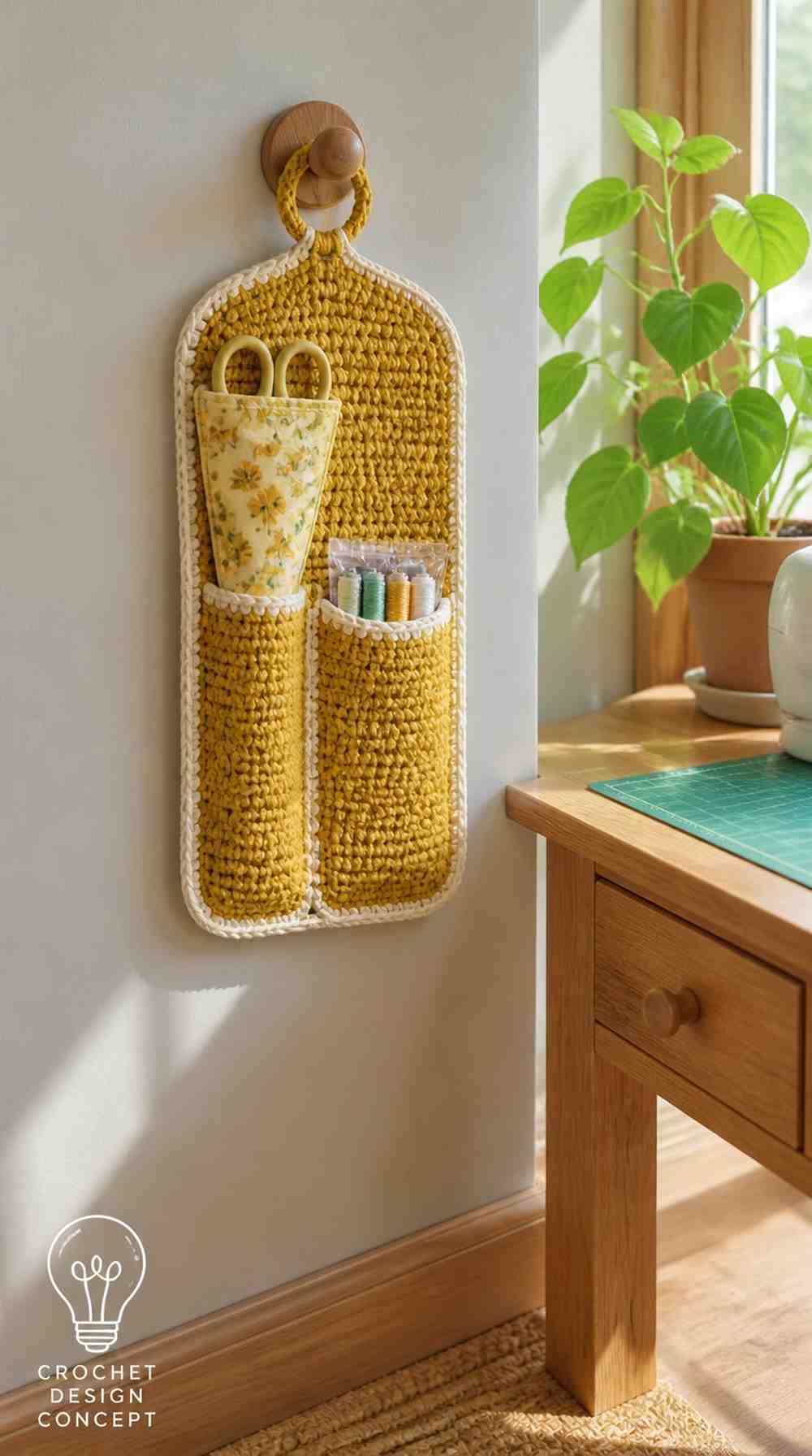
Mustard-yellow crochet creates a compact hanging panel with two unequal pockets. A tall, narrow holster holds small sewing scissors inside a protective fabric sheath, while the adjacent shorter pocket contains a sealed packet of thread. Thin cream borders give both openings definition.
The different pocket heights are the main feature. Rather than making every section identical, this organizer gives a longer tool its own space while leaving a smaller compartment for lightweight sewing supplies.
- Protected Scissors: Use a properly fitted protective sheath so the scissor blades cannot cut into the crochet or become exposed inside the pocket.
- Holster Depth: Keep the narrow compartment deep enough to retain the sheathed scissors without forcing them tightly against its stitched bottom.
- Hanging Ring: Check that the reinforced crochet ring remains securely attached when the pouch is accessed, especially while removing the scissors.
5. Crochet Denim Thread-Spool Ladder Pouch
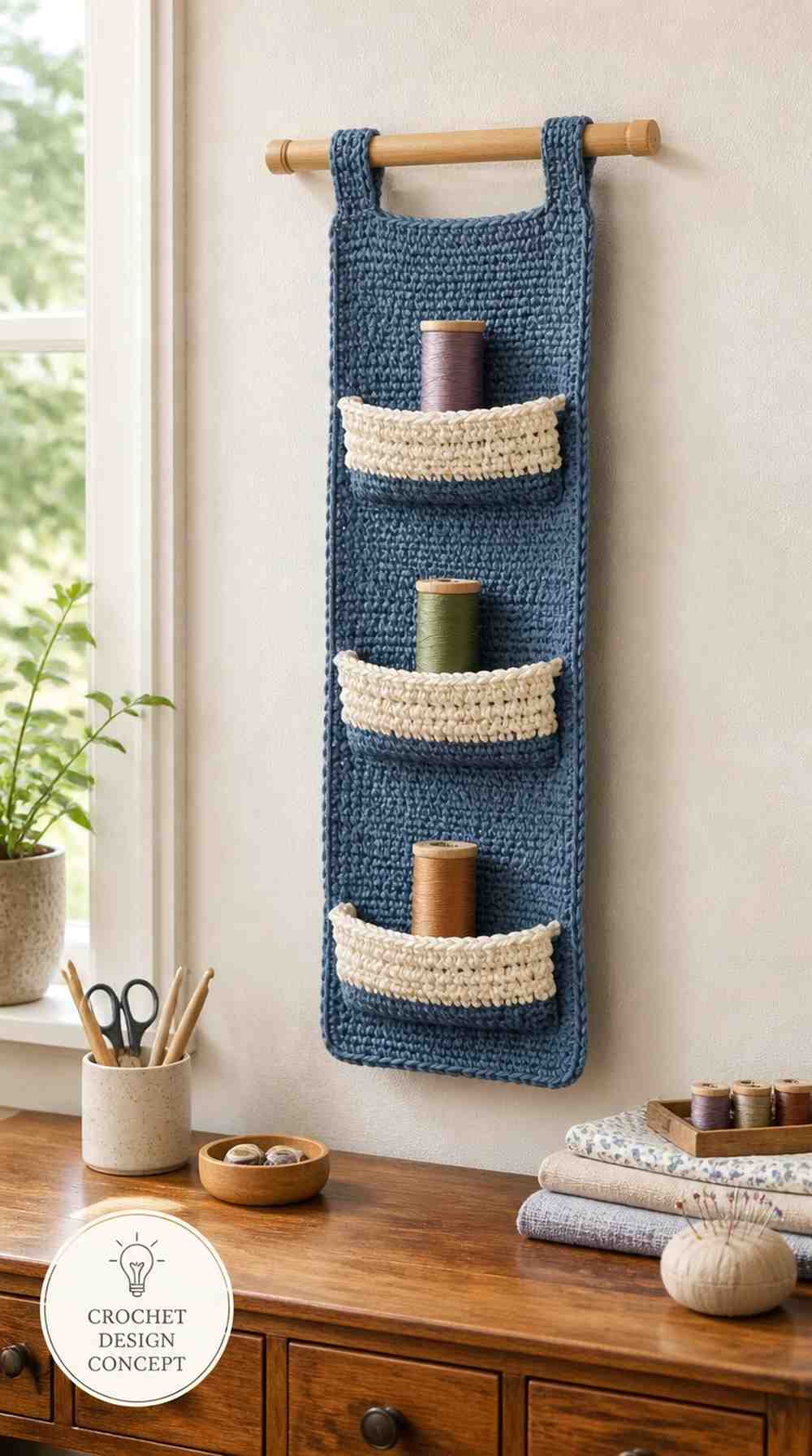
Dusty-denim-blue crochet forms a long, narrow hanging panel with three shallow spool pockets arranged in vertical steps. Each pocket has a firm cream lower band and holds one small upright sewing-thread spool. Two upper loops suspend the organizer from a wooden dowel.
This design makes thread storage the main attraction rather than providing several general-purpose compartments. The individual pockets make the three thread colors visible and may help prevent small spools from becoming mixed together.
- Individual Spool Pockets: Match each compartment to the intended spool diameter so the thread reel remains upright without being squeezed.
- Thread-End Control: Secure loose thread tails before placing the spools into crochet pockets, reducing tangling around nearby stitches.
- Vertical Clearance: Allow enough space between the three pocket openings for fingers to reach each spool without disturbing the one above it.
6. Crochet Olive Two-Column Mending Organizer
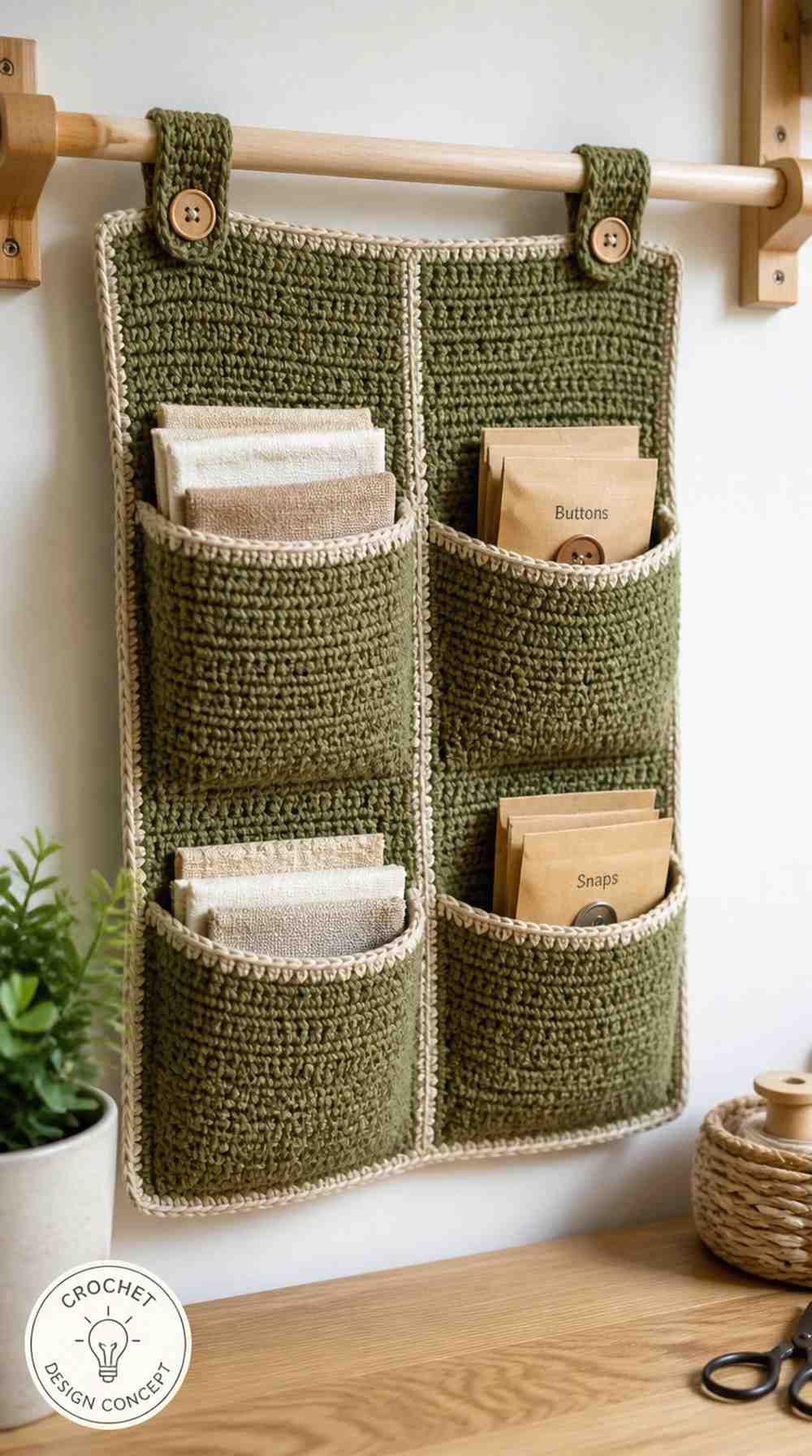
Muted olive-green crochet creates a broad hanging panel divided into four rectangular pockets, arranged in two vertical columns. Oatmeal borders outline the openings. Folded cream and tan repair patches occupy the left side, while closed envelopes of spare buttons and fasteners sit on the right.
The two-column arrangement provides a simple way to organize supplies by type. Its continuous backing also gives the individual pockets a shared hanging structure supported by two upper tabs and a wooden dowel.
- Separate Repair Categories: Keep fabric patches together on the left and small fasteners inside closed envelopes on the right to reduce mixing.
- Pocket Divider: The vertical center seam should remain secure so supplies cannot shift between neighboring compartments.
- Balanced Hanging: Distribute the contents across both columns rather than putting all the heavier items on one side of the dowel.
7. Crochet Plum Foldout Repair Wallet
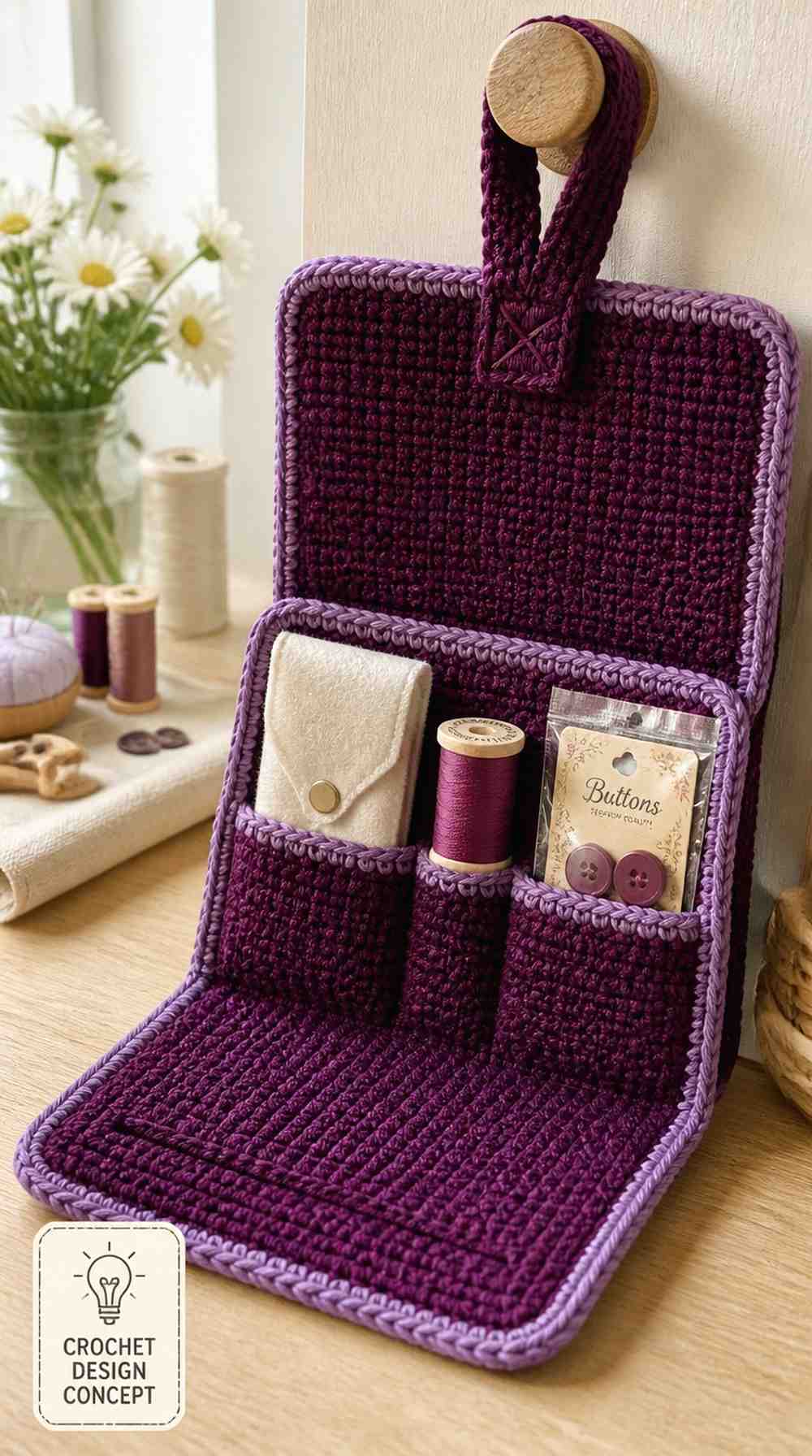
Deep-plum crochet forms a compact hanging wallet with a front flap that opens downward to reveal three small interior compartments. A closed felt needle case sits on the left, a thread spool occupies the middle, and a sealed button packet rests on the right. Dusty-lavender edging defines the individual sections.
The foldout structure makes this design different from an ordinary wall pocket. It could suit a compact repair kit that needs several separate spaces without remaining fully open all the time.
- Foldout Clearance: Leave enough free space below the hanging wallet for the front flap to open without hitting the worktable.
- Separated Contents: Keep the closed needle case in its own compartment rather than mixing it with thread spools or loose fasteners.
- Flap Support: Reinforce the connecting edge so repeated opening does not gradually loosen the crochet joins.
8. Crochet Coral Mesh-Side Patch Pouch
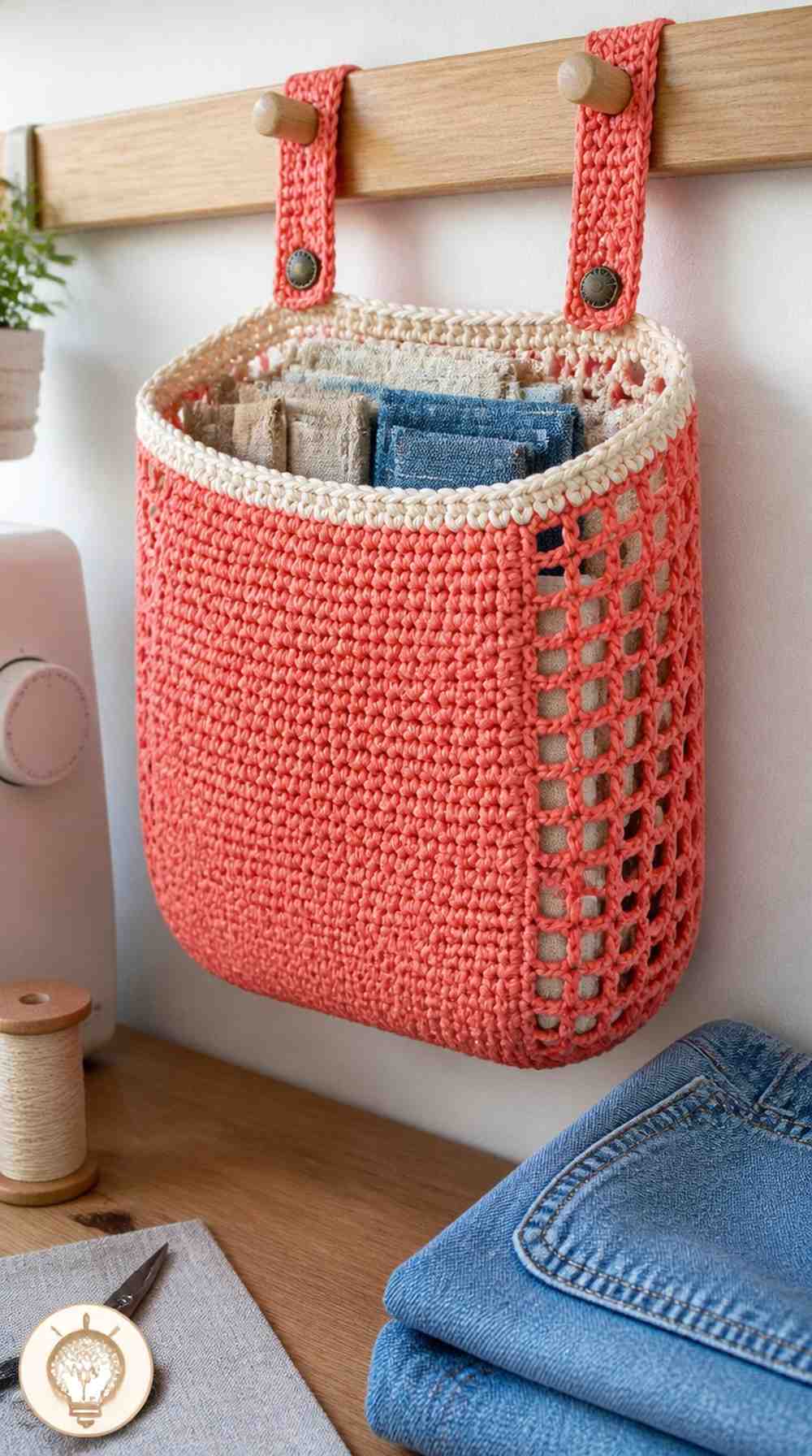
Soft coral crochet creates a rounded rectangular hanging pouch with a closely stitched front and two open-mesh side gussets. A cream upper border outlines the broad opening, while folded beige and blue clothing patches are stored inside. Two short straps attach it to a wooden wall rail.
The mesh sides give this pouch a lighter appearance than a fully solid organizer. They also make it possible to see the amount of fabric stored inside, although the openings are better suited to larger folded pieces than tiny sewing accessories.
- Mesh Side Gussets: Keep the lattice openings consistent and properly connected so the sidewalls can expand without distorting the pouch.
- Fabric Patch Storage: Use the broad compartment for folded repair fabric rather than loose needles or tiny buttons that could escape through the mesh.
- Shape Retention: Avoid overfilling the rounded pouch, since additional fabric weight may cause its soft crochet sides to sag.
9. Crochet Charcoal Zippered Repair Pouch
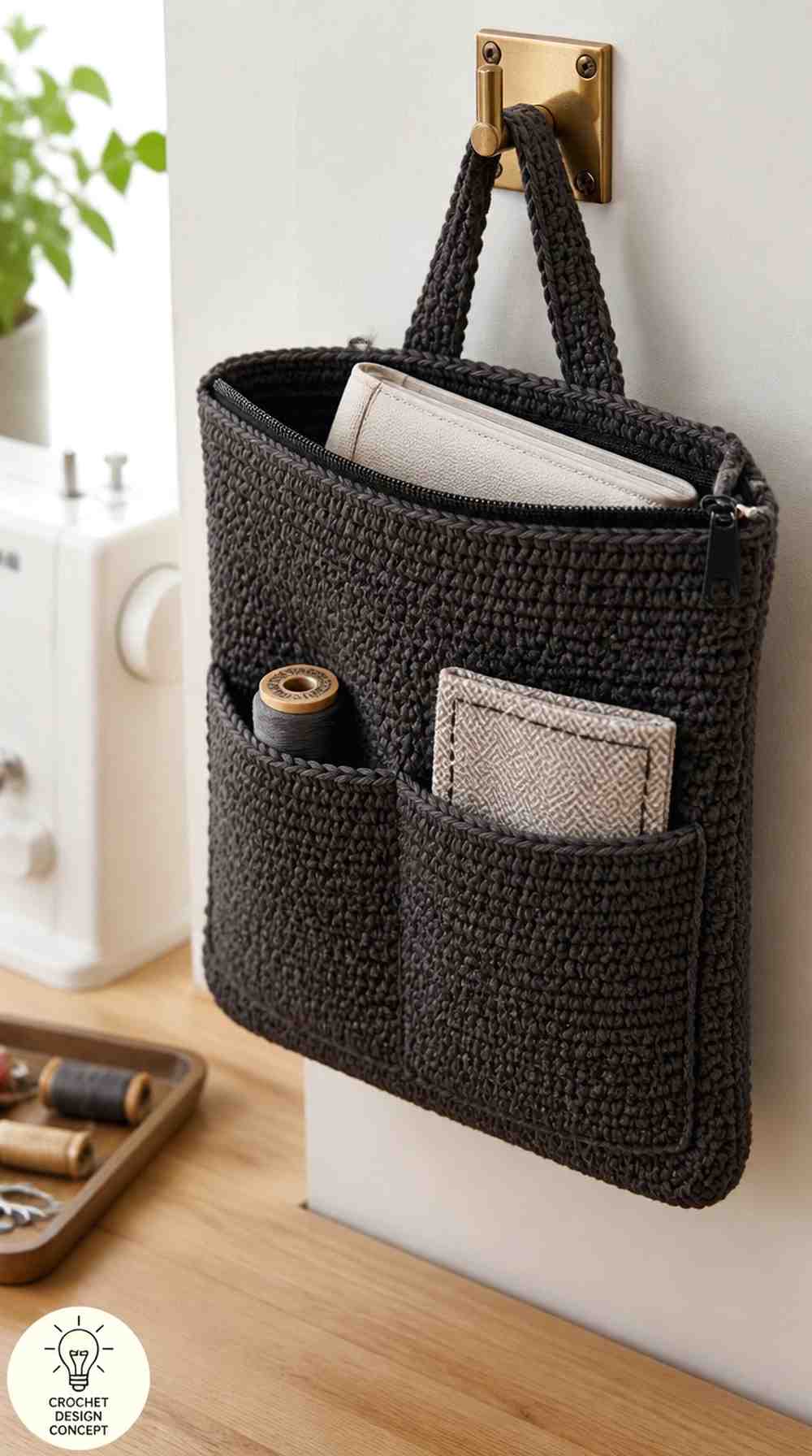
Charcoal-grey crochet gives this hanging pouch a modern, practical appearance. The main compartment has a black zipper along its upper edge, with a closed cream needlebook visible inside. Two smaller exterior pockets hold a thread spool and a folded fabric patch.
The zippered main section provides a different storage option from open pockets. It may help keep certain supplies contained, but it should not be treated as a child-resistant closure or a substitute for proper needle storage.
- Zipper Attachment: Secure the zipper to a suitably reinforced crochet opening so its teeth and fabric tape remain properly aligned.
- Main Compartment: Keep sharp needles inside a closed needlebook rather than placing them directly into the zippered crochet space.
- Exterior Pocket Depth: Make the two smaller pockets suitable for a light spool and folded patch without stretching the lower front of the organizer.
10. Crochet Butter Yellow Label-Pocket Station
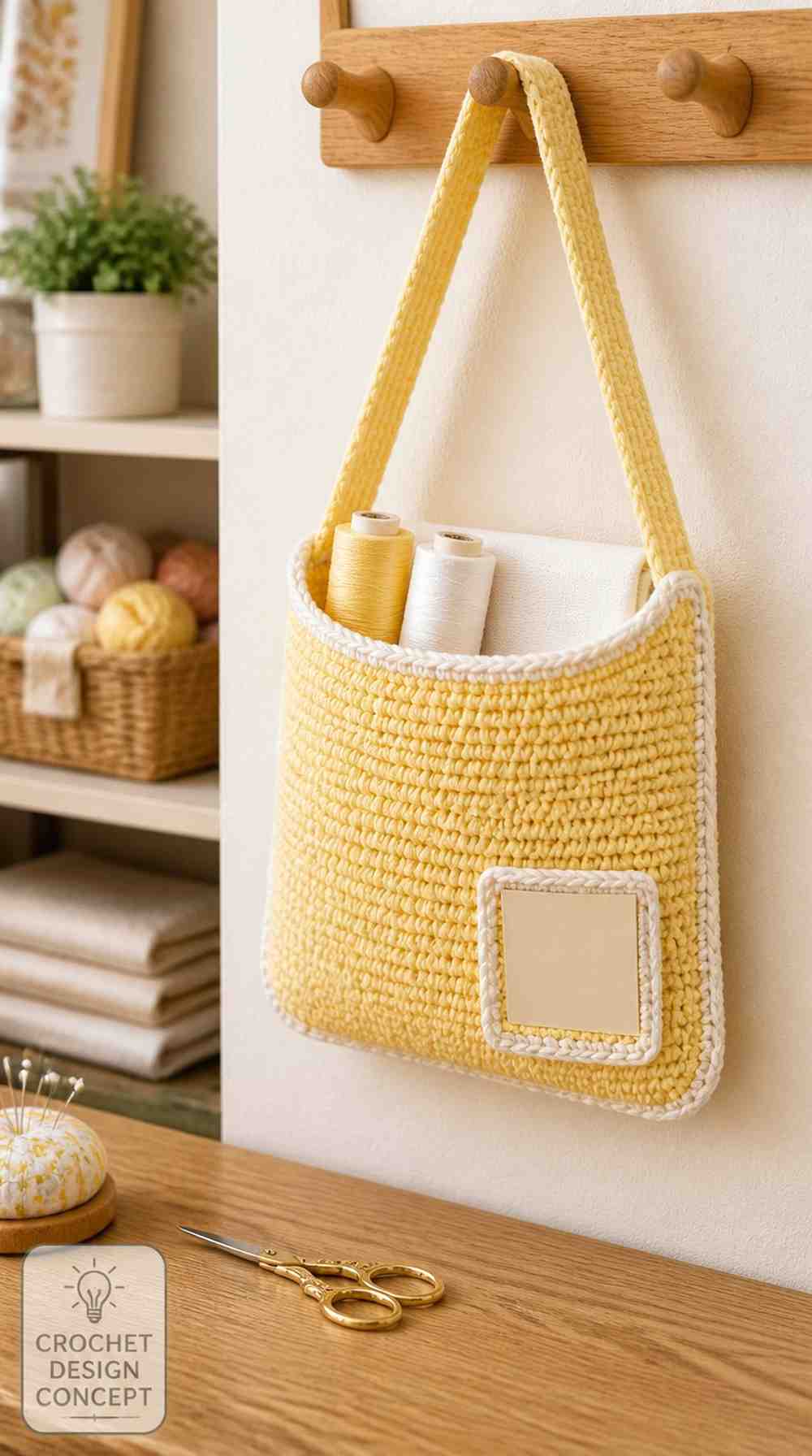
Butter-yellow crochet creates a cheerful hanging pouch with one large front compartment and a small cream-framed card pocket near its lower-right corner. Two thread spools and a folded white patch sit inside the main section, while the little label pocket contains a blank beige card.
The removable card is the defining feature. It could be used to identify the type of repair supplies kept inside, making the pouch easier to organize alongside other craft-storage accessories.
- Removable Label: Keep the small beige card accessible so its information can be changed without removing the entire crochet pouch.
- Pocket Placement: Position the cream-framed label pocket away from the main opening so it does not interfere with retrieving thread or patches.
- Hanging Strap: Reinforce the wide yellow strap and use a suitable hook, checking that the pouch remains stable when partially filled.
11. Crochet Burgundy Appliqué Patch Organizer
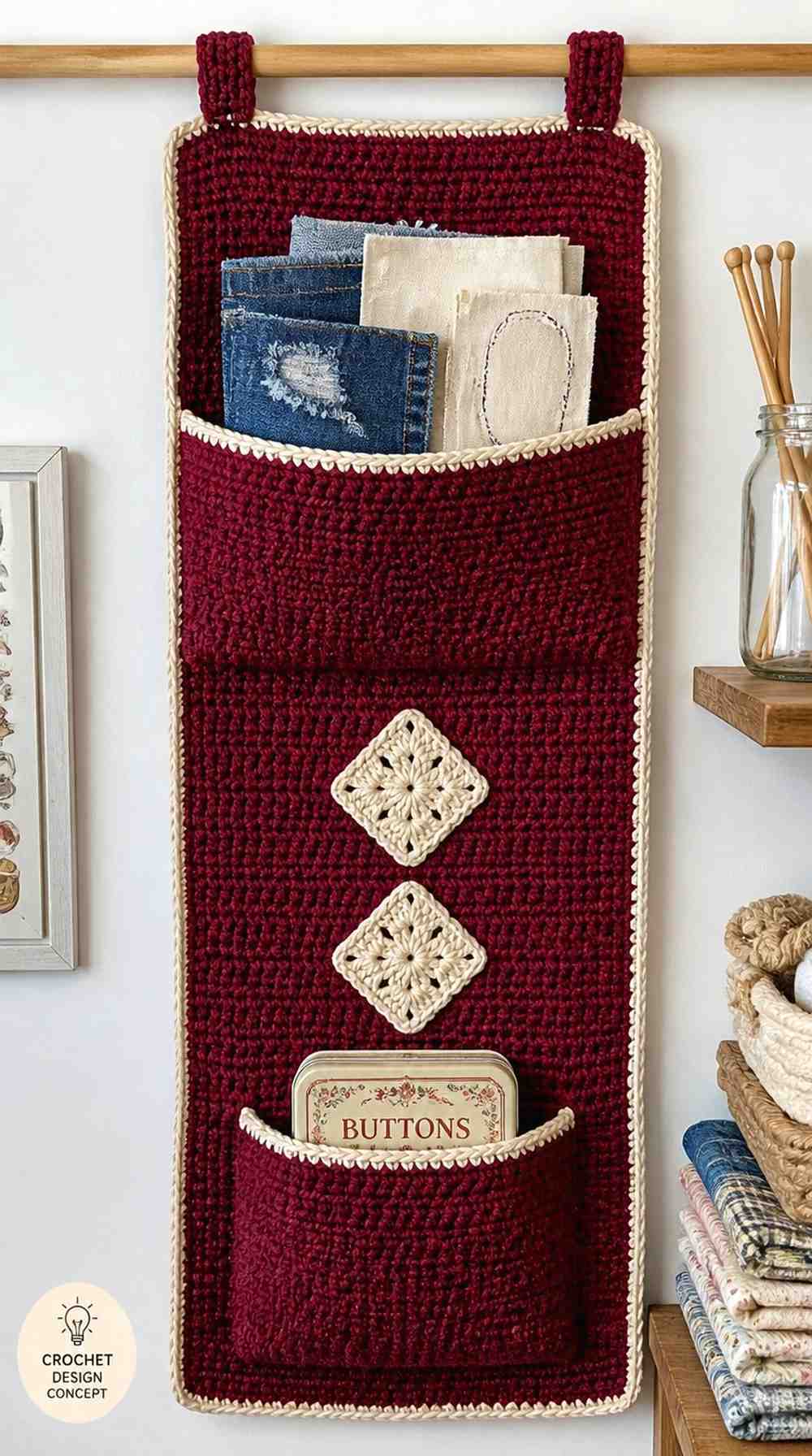
Rich burgundy crochet forms a tall wall panel with one broad upper pocket and a smaller lower pocket. Two cream diamond appliqués decorate the central backing between the openings. Folded denim and ivory repair patches sit above, while a closed button tin occupies the lower compartment.
This design combines practical storage with a small decorative crochet feature. The appliqués create visual interest without covering the pocket openings or introducing loose hanging ornaments.
- Appliqué Position: Keep the two cream crochet diamonds flat against the backing and clear of the storage openings.
- Upper Patch Pocket: Allow enough width for folded denim pieces so they can be removed without catching on the pocket edges.
- Lower Tin Storage: Check the lower seam and hanging support before placing a metal tin inside, even when the container is small.
12. Crochet Teal Measuring-Tape Caddy
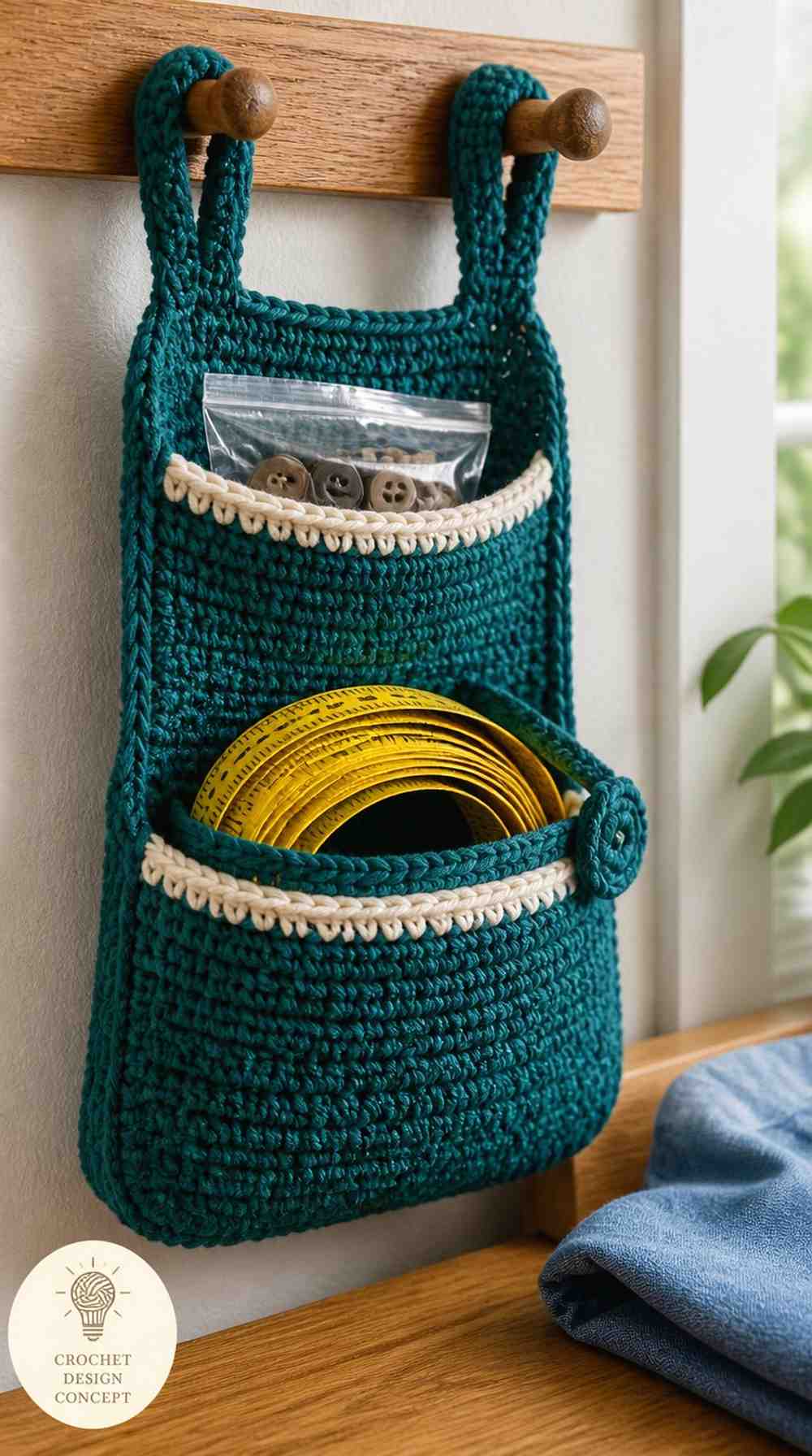
Deep-teal crochet creates a two-pocket hanging station with a broad lower compartment and a smaller upper section. A coiled yellow flexible measuring tape sits in the lower pocket, held near its opening by a matching crochet retaining loop. A sealed packet of repair buttons occupies the upper pocket.
This design gives the measuring tape a dedicated place instead of allowing it to become tangled with thread. The small retaining loop adds an additional organizational detail while leaving the tape easy to identify.
- Measuring-Tape Pocket: Make the lower compartment broad enough for the coiled flexible tape without forcing it into a tight bend.
- Retaining Loop: Position the crochet loop across the upper pocket edge so it helps keep the coil contained without hiding the tape completely.
- Separate Button Storage: Use the smaller upper pocket for closed button packets rather than loose pieces that could slip through crochet openings.
13. Crochet Cinnamon Three-Flap Button Sorter
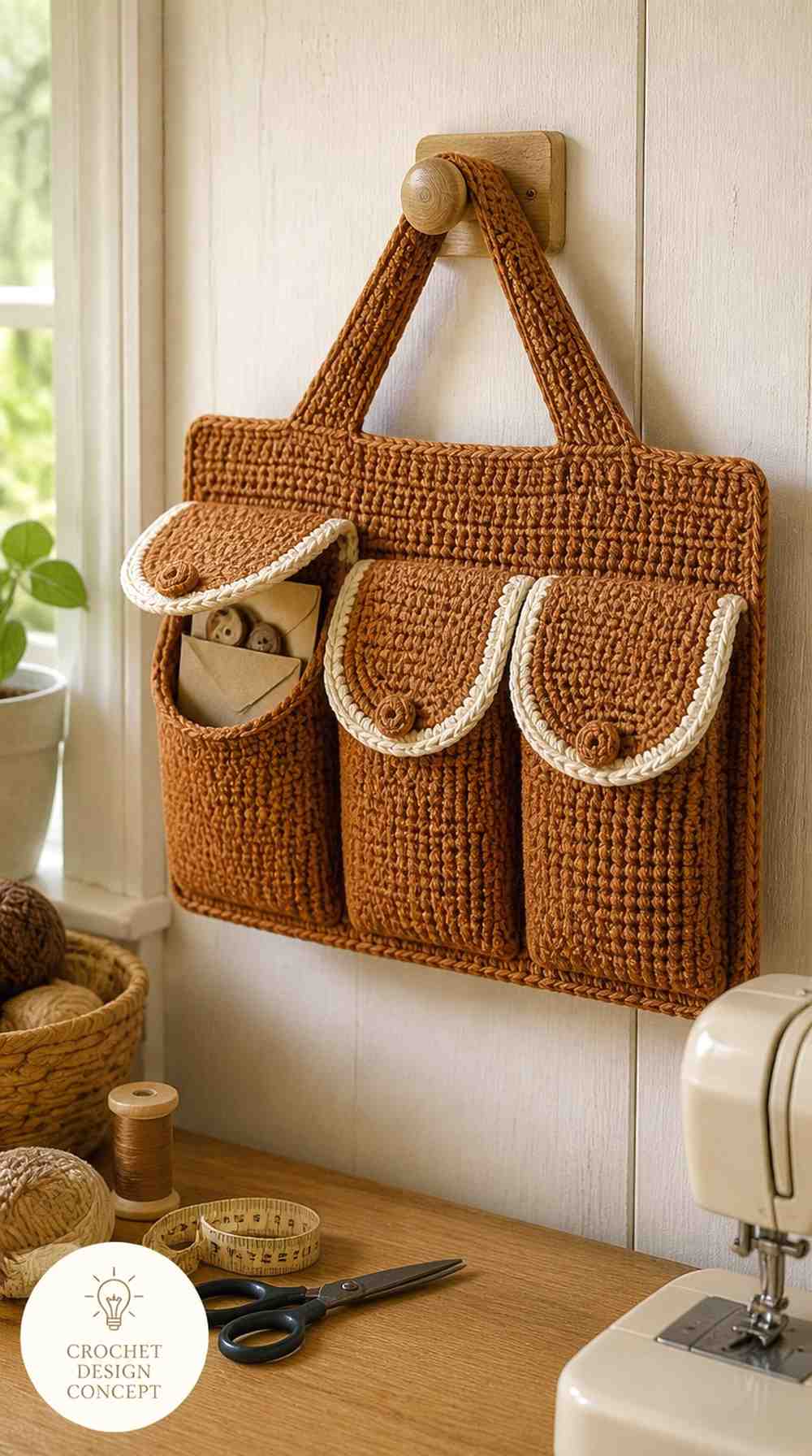
Cinnamon-brown crochet forms a compact wall organizer with three miniature pockets arranged side by side. Each compartment has a rounded cream-edged flap and a small crochet button. One flap is open, revealing a closed envelope of spare clothing buttons.
The three-compartment layout is well suited to sorting small repair supplies by type. Instead of leaving tiny buttons loose inside the crochet, individual paper envelopes can keep them together within their separate pockets.
- Three Small Compartments: Use the pockets for distinct button types or other small supplies, keeping tiny items inside closed packets.
- Flap Fastenings: Make each crochet button and loop easy to operate without stretching the neighboring pocket seams.
- Organizer Width: Leave enough space between the three flaps for fingers to open one compartment without pulling on the others.
14. Crochet Lavender Scalloped Ribbon Pouch
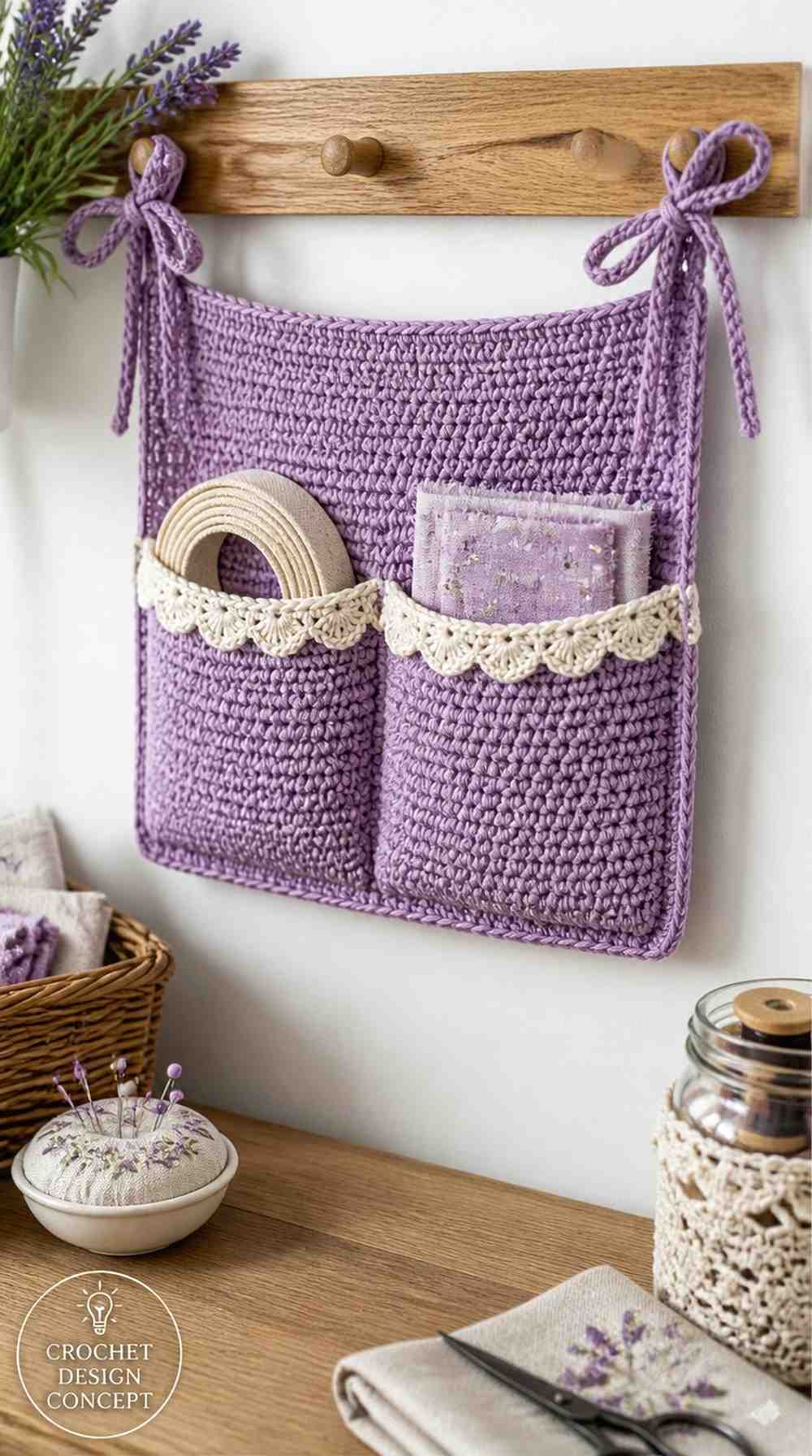
Lavender crochet creates a broad hanging panel with two side-by-side shallow pockets. Tiny ivory scallops finish the upper edge of each opening, while matching lavender ties secure the organizer to a wooden rail. One pocket contains cream cotton repair ribbon, and the other holds folded lilac fabric patches.
The scalloped borders give this design a softer, cottage-style appearance. Its open pockets are better suited to fabric and ribbon than sharp sewing tools, which require separate secure storage.
- Scalloped Openings: Keep the ivory decorative edging small enough that it does not catch on fabric patches during removal.
- Ribbon Storage: Coil the cream repair ribbon neatly to avoid tangling around the crochet stitches and hanging ties.
- Rail Ties: Secure both lavender ties properly and check that they cannot slip along the rail when a pocket is opened.
15. Crochet Forest Green Removable-Pocket Panel
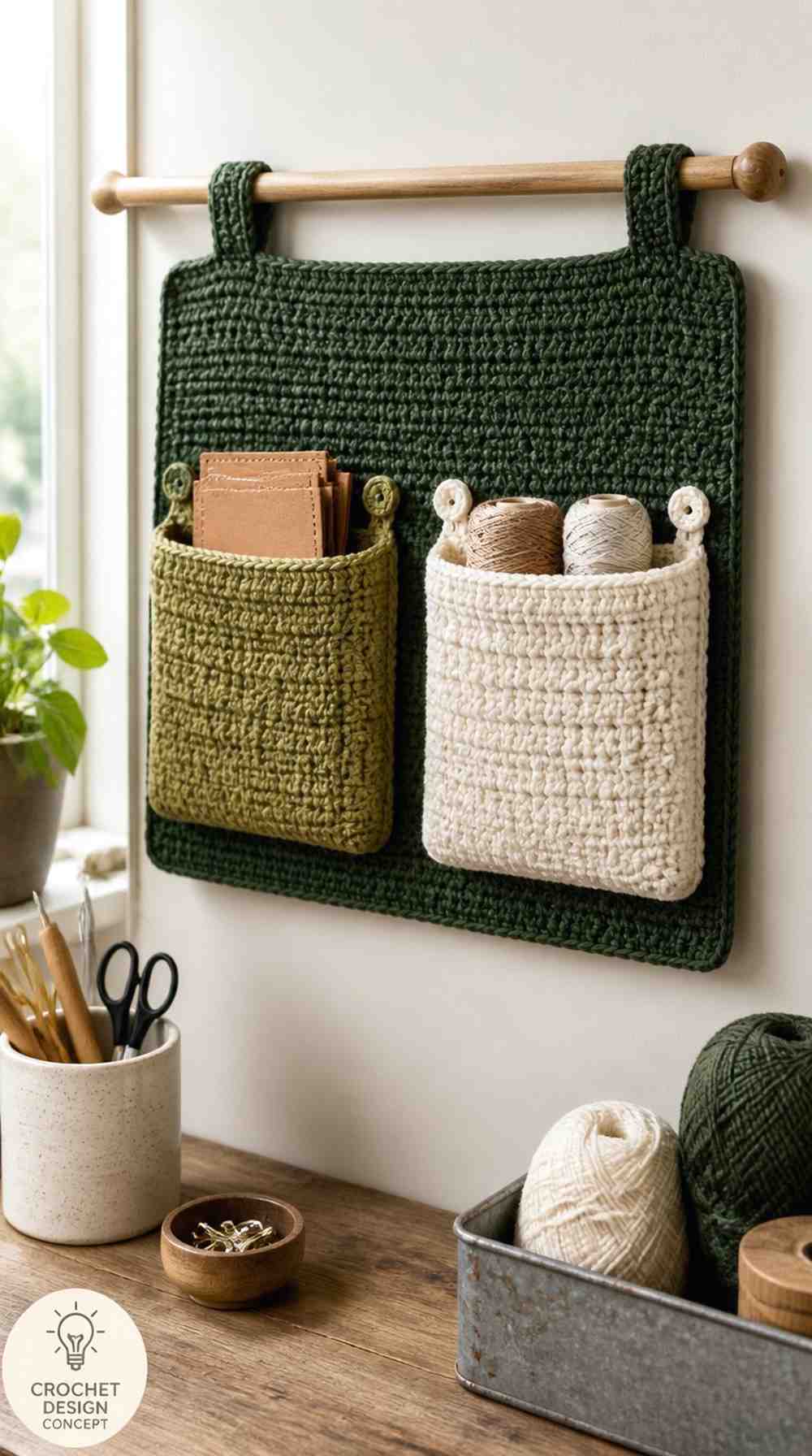
A deep forest-green crochet backing supports two separate pockets, one muted olive and the other cream. Small matching crochet buttons and loops attach the pockets near their upper corners. Folded tan fabric patches occupy the olive section, while two small thread spools sit in the cream pocket.
The modular arrangement is the main attraction. Unlike permanently sewn compartments, these pockets are shown as detachable pieces that could be repositioned or removed for cleaning, provided the fastening system is properly planned.
- Detachable Pockets: Use the small buttons and loops only with appropriately lightweight contents, checking that both pockets remain securely attached.
- Pocket Arrangement: Position the olive and cream sections where their contents can be reached without one blocking the other.
- Button Reinforcement: Strengthen the attachment areas on the green backing so repeated removal does not pull individual crochet stitches out of shape.
16. Crochet Apricot Rounded Repair Bucket
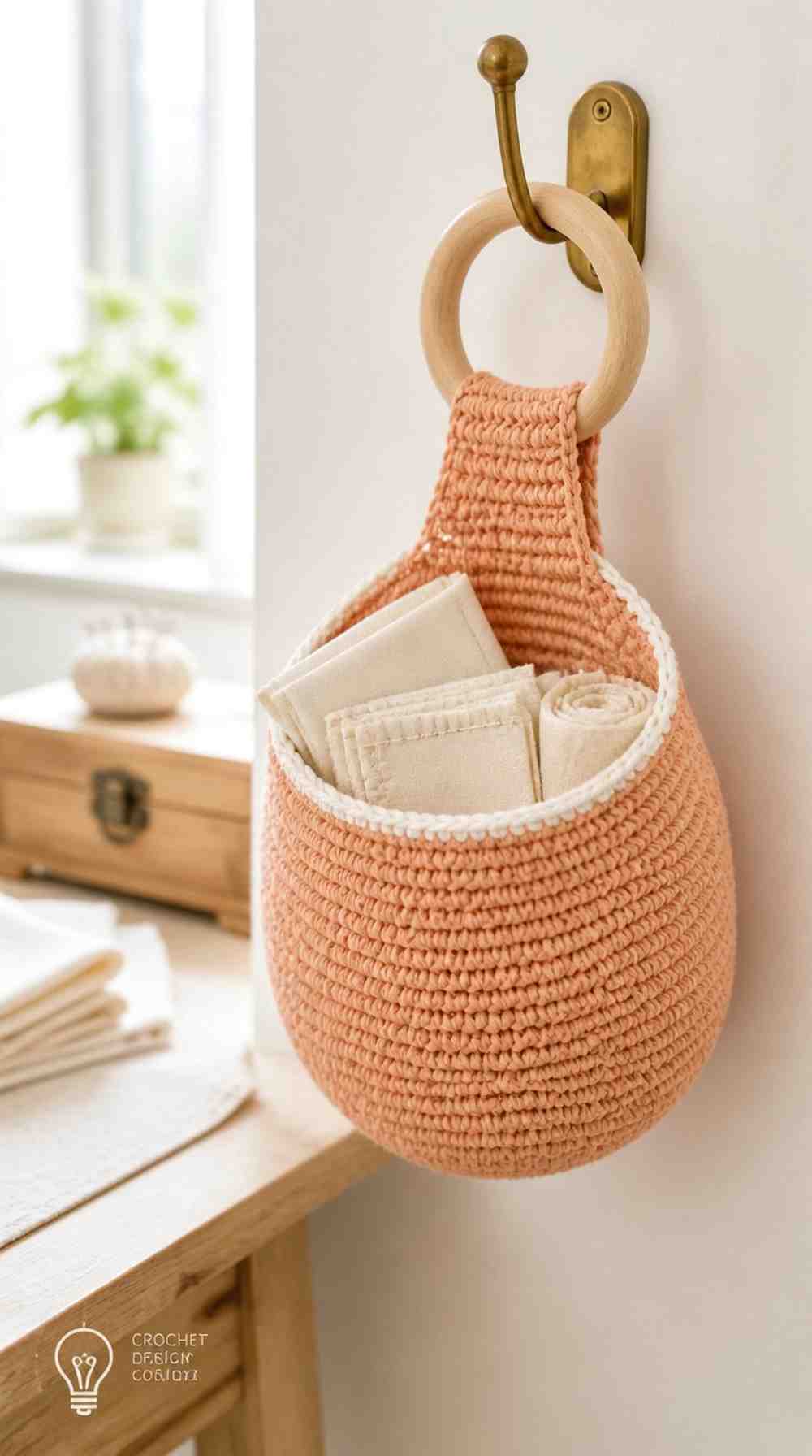
Soft apricot crochet forms a rounded hanging bucket pouch with a broad opening and a thin warm-white border. A reinforced strap connects the pouch to a smooth wooden ring on a brass wall hook. Folded cream mending patches and a small rolled cotton cloth fill the softly curved interior.
The single-bucket design offers a different approach from organizers filled with several narrow compartments. It provides one accessible space for larger fabric pieces, making it more suitable for soft repair materials than loose sharp tools.
- Rounded Bottom: Work the curved lower section evenly so the pouch hangs naturally without a pointed or distorted base.
- Wooden Ring Support: Choose a suitably strong ring and wall hook, checking the connection between the crochet strap and the hanging hardware.
- Soft Contents: Reserve the open bucket for folded fabrics and cloth rather than unprotected scissors, loose pins, or heavy metal tools.
17. Crochet Cocoa Flat Wall Repair Pocket
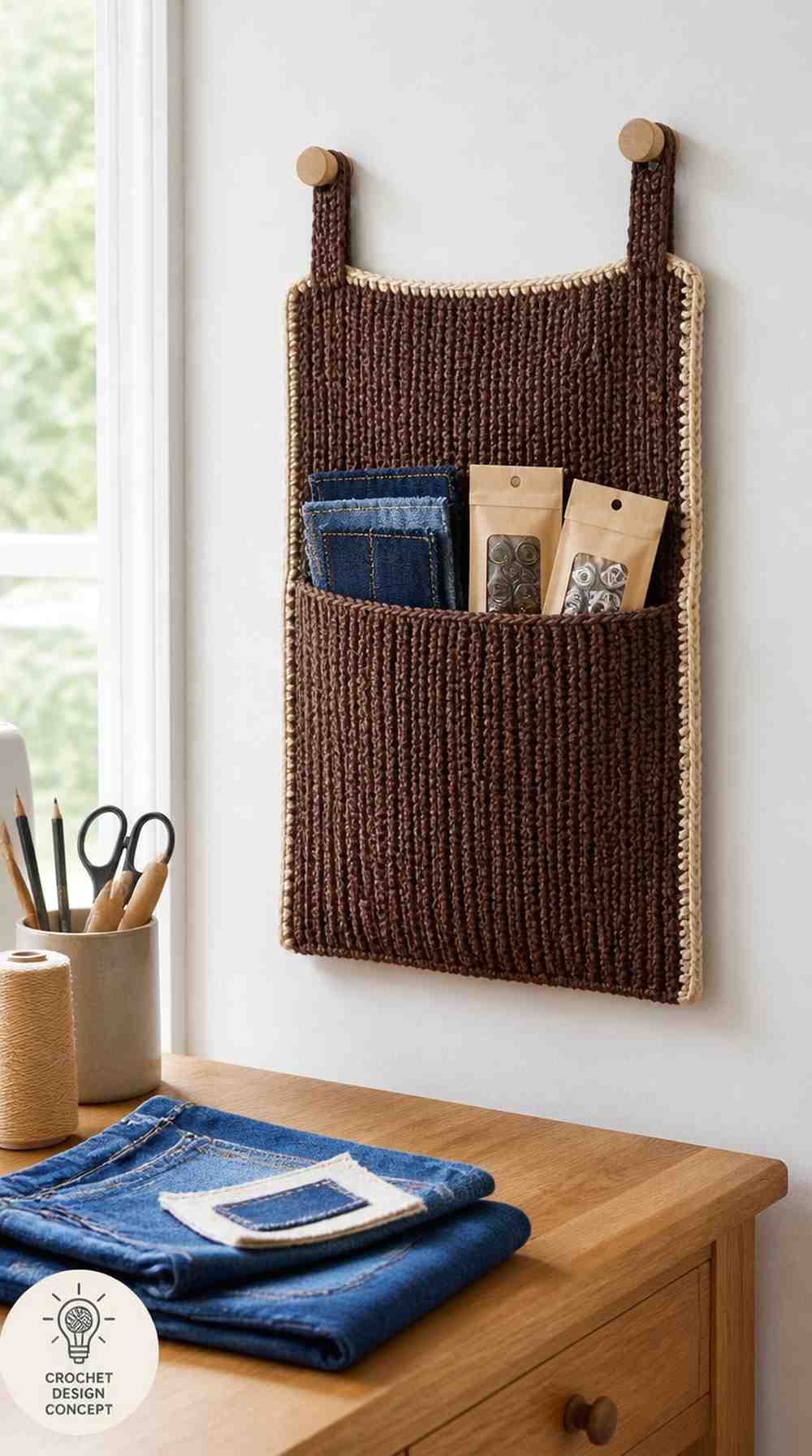
Cocoa-brown crochet creates a slim rectangular wall panel with one deep front pocket and narrow oatmeal borders. Two short hanging tabs connect the upper corners to separate wall pegs. Folded denim patches and closed envelopes of spare fasteners remain visible above the opening.
The simple single-pocket layout keeps this design understated and easy to understand. Its two-point hanging arrangement also provides a broad, flat backing that could suit a narrow wall beside a wardrobe or sewing table.
- Two Hanging Tabs: Keep both upper tabs evenly positioned so the cocoa panel hangs level rather than leaning toward one wall peg.
- Deep Pocket: Allow enough depth for folded denim patches while leaving the tops accessible for easy removal.
- Flat Backing: A closely worked panel can help the organizer lie against the wall, although the loaded pocket may still stretch outward.
18. Crochet Ivory Roll-Up Mending Station
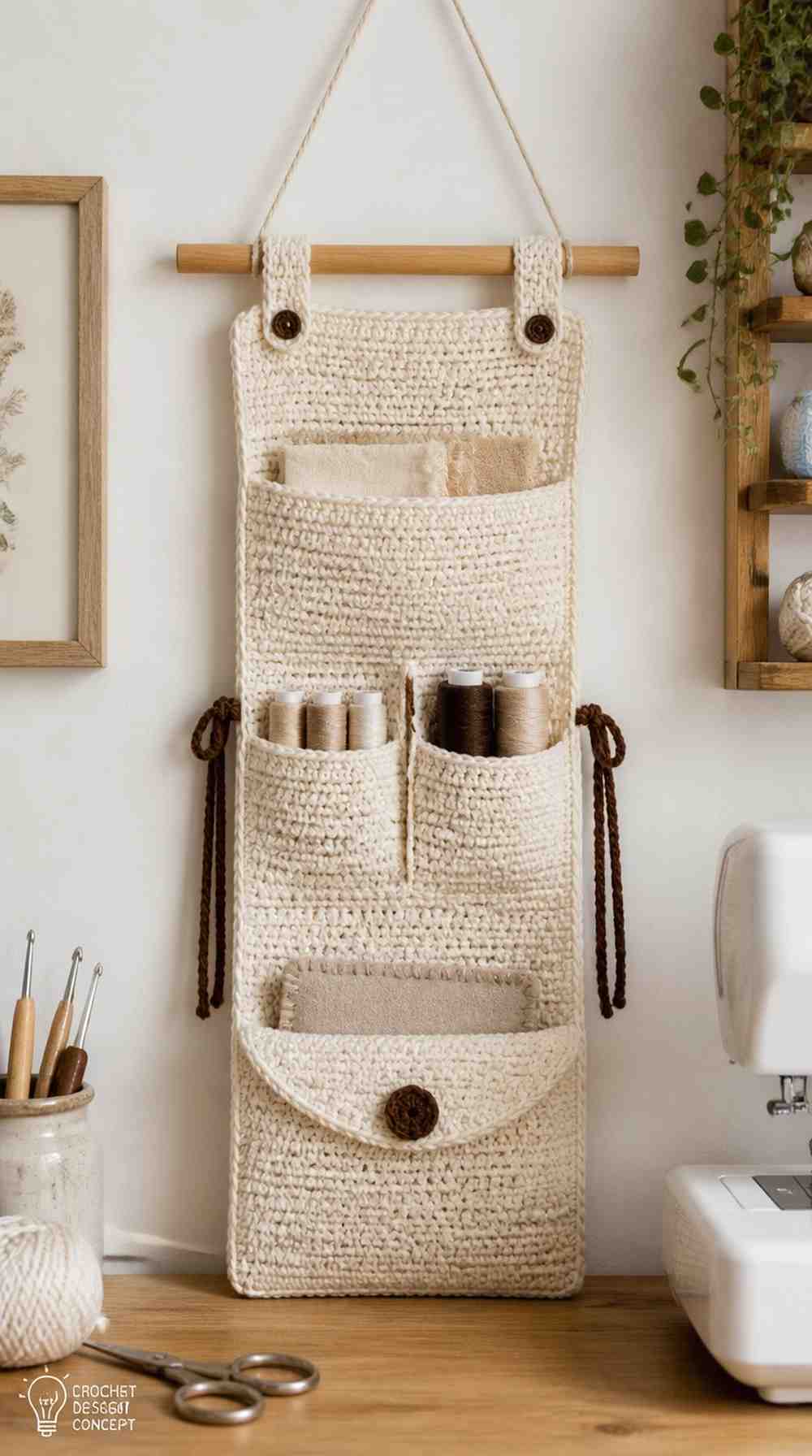
Warm-ivory crochet creates a long hanging organizer with three storage levels. A shallow upper pocket holds cream fabric patches, two small middle compartments contain thread spools, and a lower buttoned flap covers a closed beige needlebook. Thin cocoa ties sit along the sides.
The roll-up feature makes this concept different from a fixed wall organizer. Once emptied and removed from its dowel, the fabric panel could be rolled into a compact bundle and secured with the side ties.
- Three Storage Areas: Keep fabric patches, thread spools, and the closed needlebook in their separate compartments so they remain easy to locate.
- Roll-Up Storage: Empty the pockets before rolling the organizer to prevent hard items from pressing against the crochet or becoming trapped inside.
- Flap Closure: The cocoa crochet button should keep the lower compartment neatly covered, while the felt needlebook provides the actual needle storage.
Practical Guide to Crochet Clothing Repair Station Hanging Pouches
Choose the right hanging location
A clothing repair station works best near the place where you usually mend garments. That might be above a sewing table, beside a wardrobe, or on a dedicated craft-room wall.
Choose a location with enough space to reach all the compartments. Avoid hanging the pouch where it blocks drawers, doors, electrical outlets, or frequently used walking areas.
Plan the pockets around your supplies
Before choosing a design, gather the items you normally use for small clothing repairs. These may include:
- Thread spools and sewing thread
- Fabric repair patches
- Spare buttons in closed containers
- A flexible measuring tape
- Small scissors with a protective sheath
- Needles secured inside a closed needlebook
Arrange the supplies by size and frequency of use. A three-level organizer may be useful for different categories, while a single deep pouch could be sufficient for folded fabric pieces.
Keep sharp tools securely contained
Never leave sharp sewing needles or pins loose in crochet pockets. Open stitches can allow points to protrude or become caught in the yarn.
Use a securely closed needlebook, needle case, or suitable protective container. Scissors should also have properly covered blades.
Keep the organizer out of children’s and pets’ reach, especially when storing sharp tools, buttons, or other small objects.
Reinforce the hanging system
The weight of the contents affects the backing panel, hanging loops, and wall hardware. Crochet can stretch, especially when several pockets are filled.
Use suitable hardware for the wall and expected load. Check that dowels, hooks, loops, seams, and any button fastenings remain secure. Do not assume an attractive crochet organizer has a tested weight capacity.
Choose practical materials
Smooth cotton or an appropriate cotton blend may be worth considering because it can produce clear stitches and tidy pocket edges.
Dense crochet is generally better for smaller notions, while wider openings may suit fabric patches. Actual firmness, stretch, and cleaning requirements depend on the chosen yarn and construction.
For more specialized thread storage, explore the related 13 Crochet Sewing Thread Spool Organizer Inspiration Ideas on Yarn Nest Studio. That collection focuses on organizing thread reels rather than creating a complete repair station.
Want to Make Something Similar?
These 18 hanging pouch designs are original visual concepts, not exact tested crochet patterns. However, a few real crochet resources can help with backing panels, attached pockets, hanging methods, and lined compartments.
- Crochet Wall Hanging Organizer — Happy Heartsy explains how to make a wall organizer with a backing panel, attached pockets, and a wooden dowel. It is a useful starting point for understanding pocket placement and joining. Free Pattern
- Wall Hanging Bag Organizer — AamraGul on Ravelry provides a free pattern listing for a lined hanging organizer with pockets, with written and video guidance. It can help readers explore lined crochet storage. Ravelry
These resources teach related construction methods, not the exact designs pictured here. Any adaptation for sewing supplies needs separate measurements, appropriate hanging support, and secure storage for needles or scissors.
Which Crochet Clothing Repair Station Hanging Pouch Should You Choose?
| Your priority | Designs to compare | Main trade-off |
|---|---|---|
| General mending supplies | Rust Three-Pocket, Ivory Roll-Up | Several pockets require more joining |
| Wide wall storage | Oatmeal Dowel, Olive Two-Column | Needs enough horizontal space |
| Needle storage | Navy Needlebook, Plum Foldout | Closed needle cases still required |
| Scissor organization | Mustard Scissor Holster | Protective blade sheath essential |
| Thread-spool access | Denim Thread-Spool Ladder | More specialized storage |
| Small button organization | Cinnamon Three-Flap | Tiny fasteners need closed packets |
| Fabric patch storage | Coral Mesh-Side, Apricot Rounded Bucket | Not suitable for loose sharp tools |
| Zippered storage | Charcoal Zippered | Zipper attachment needs care |
| Easy identification | Butter Yellow Label-Pocket | Label card needs occasional replacement |
| Decorative wall display | Burgundy Appliqué, Lavender Scalloped | Decorative details add maintenance |
| Flexible compartments | Forest Green Removable-Pocket | Detachable fastenings require checking |
| Measuring-tape storage | Teal Measuring-Tape Caddy | Limited room for larger supplies |
| Simple wall pocket | Cocoa Flat Wall Repair Pocket | Fewer ways to separate contents |
For a small everyday mending kit, the Crochet Rust Three-Pocket Repair Station offers a straightforward way to keep several categories together.
If you have a dedicated sewing table and want a more flexible arrangement, the Crochet Forest Green Removable-Pocket Panel or Crochet Ivory Roll-Up Mending Station may be worth considering.
Conclusion
Crochet clothing repair station hanging pouch ideas show how a few carefully planned pockets can turn an unused section of wall into a small mending area. A rust three-pocket organizer provides simple storage, a navy needlebook station keeps a closed needle case separate, and a denim spool ladder makes thread easier to locate.
The most useful design will depend on your supplies, available wall space, and the support behind the organizer. Keep sharp items securely enclosed, reinforce the hanging points, and choose compartments that make everyday clothing repairs easier.
Which would you choose for your sewing corner: the rust three-pocket station, the plum foldout wallet, or the ivory roll-up organizer? Share your favorite design and the repair supplies you use most often.
Frequently Asked Questions
1. What should I keep in a crochet clothing repair station hanging pouch?
A small repair station can hold sewing-thread spools, folded fabric patches, spare buttons in closed containers, and a flexible measuring tape. Needles should be stored inside a closed needlebook or secure case, while scissors need protective blade covers. Choose the compartments based on the actual size and weight of your supplies.
2. What yarn is suitable for a hanging crochet repair organizer?
Smooth cotton or a suitable cotton blend may be worth considering because it can produce clear stitch definition and reasonably tidy pocket edges. Actual stretching and strength depend on the yarn, stitch density, joins, and hanging arrangement. Avoid relying on loose decorative crochet for heavy or sharp sewing equipment.
3. How can I prevent a hanging crochet pouch from sagging?
Use an appropriately dense backing, reinforced pocket seams, and a suitable hanging arrangement. A wooden dowel with two supported hanging points may help a broad panel remain level. Keep heavier contents in lower compartments where practical, avoid overfilling, and check for stretching during use.
4. Is it safe to store sewing needles directly in crochet pockets?
No. Sharp needles can work through crochet openings, catch in the yarn, or injure someone reaching into the pocket. Store them in a closed needlebook, needle case, or another suitable secure holder. Keep the entire repair station away from children and pets, and check that no sharp points are exposed.
5. Are these 18 crochet clothing repair station hanging pouches available as exact patterns?
No. These are original AI-generated design concepts for inspiration, not tested patterns or finished handmade organizers. The linked resources provide related guidance for crocheted pockets, backing panels, and hanging arrangements. Making any pictured concept would require your own measurements, construction choices, and checks for secure mounting and safe tool storage.