Planner tabs are useful for finding important pages, separating sections and keeping track of different projects, but small adhesive flags can easily disappear beneath notebooks and other desk supplies. These 17 crochet desk planner tab organizer inspiration ideas explore creative ways to keep tab sets neatly stored and easy to reach. The collection includes ribbed desktop pockets, colorful checkerboard holders, foldable card wallets, accordion compartments, transparent windows and compact display stands.
Whether you use a paper planner for work, study, meal planning or daily reminders, the best organizer depends on how many tab colors you keep and how often you reach for them. Some designs hold adhesive tabs on their original backing cards, while others arrange multiple sets in separate slots. You’ll also find different approaches to removable construction, desk-space efficiency, card visibility and keeping adhesive surfaces clean.
These are AI-generated crochet design visualizations for inspiration, not photographs of tested handmade pieces or step-by-step patterns.
Quick Design Selection Guide
| Your desk-planning need | Design to explore | Why it stands out |
|---|---|---|
| Three everyday tab sets | Crochet Terracotta Ribbed Planner Tab Stand | Upright divided pockets |
| Two grouped collections | Crochet Indigo Checkerboard Two Tier Tab Holder | Stacked card storage |
| Tabs kept with a planner | Crochet Butter Yellow Scalloped Planner Tab Pocket | Clip-on cover pocket |
| Five separate tab groups | Crochet Olive Accordion Five Section Tab Sorter | Individual folded compartments |
| Visible tabs behind a window | Crochet Blush Daisy Clear Window Tab Holder | Transparent front |
| A foldable tab collection | Crochet Coral Foldable Planner Tab Wallet | Two inner pockets and ties |
| An organized desktop display | Crochet Teal Four Pocket Desktop Tab Board | Four pockets on a small easel |
| Seven groups of planner tabs | Crochet Powder Blue Seven Slot Weekly Tab Organizer | Long horizontal seven-slot arrangement |
| Spare or archived tab sets | Crochet Plum Label Window Tab Archive | Covered pouch with card window |
1. Crochet Terracotta Ribbed Planner Tab Stand
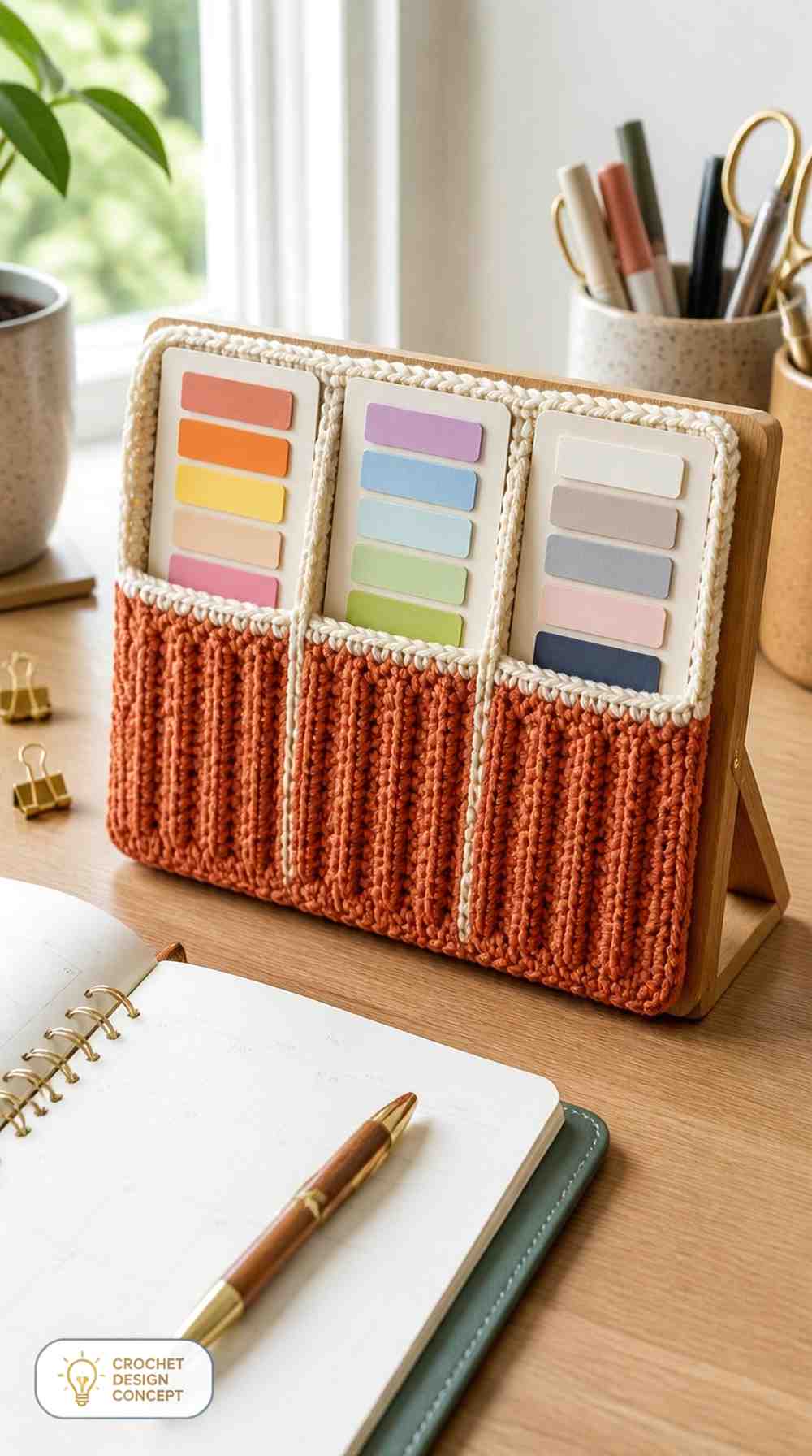
Warm terracotta crochet gives this compact desktop organizer a tidy, welcoming appearance. Raised vertical ribs cover its rectangular front, while an ivory upper border and rounded lower corners soften the shape. Three shallow pockets hold separate cream backing cards, each carrying a small collection of colorful adhesive planner tabs. A wooden stand supports the organizer behind the crochet.
This concept suits a desk where a few favorite tab colors are used regularly. Keeping the backing cards upright makes the adhesive flags easier to see without scattering individual tabs across the work surface.
- Three-Pocket Sorting: Keep frequently used tab sets in separate compartments so one backing card can be removed without disturbing the others.
- Rigid Stand: The wooden support prevents the soft crochet backing from collapsing when the organizer is standing on a desk.
- Card Height: Leave enough of each backing card above the pocket opening to grip it easily without pulling on the crochet ribs.
2. Crochet Indigo Checkerboard Two Tier Tab Holder
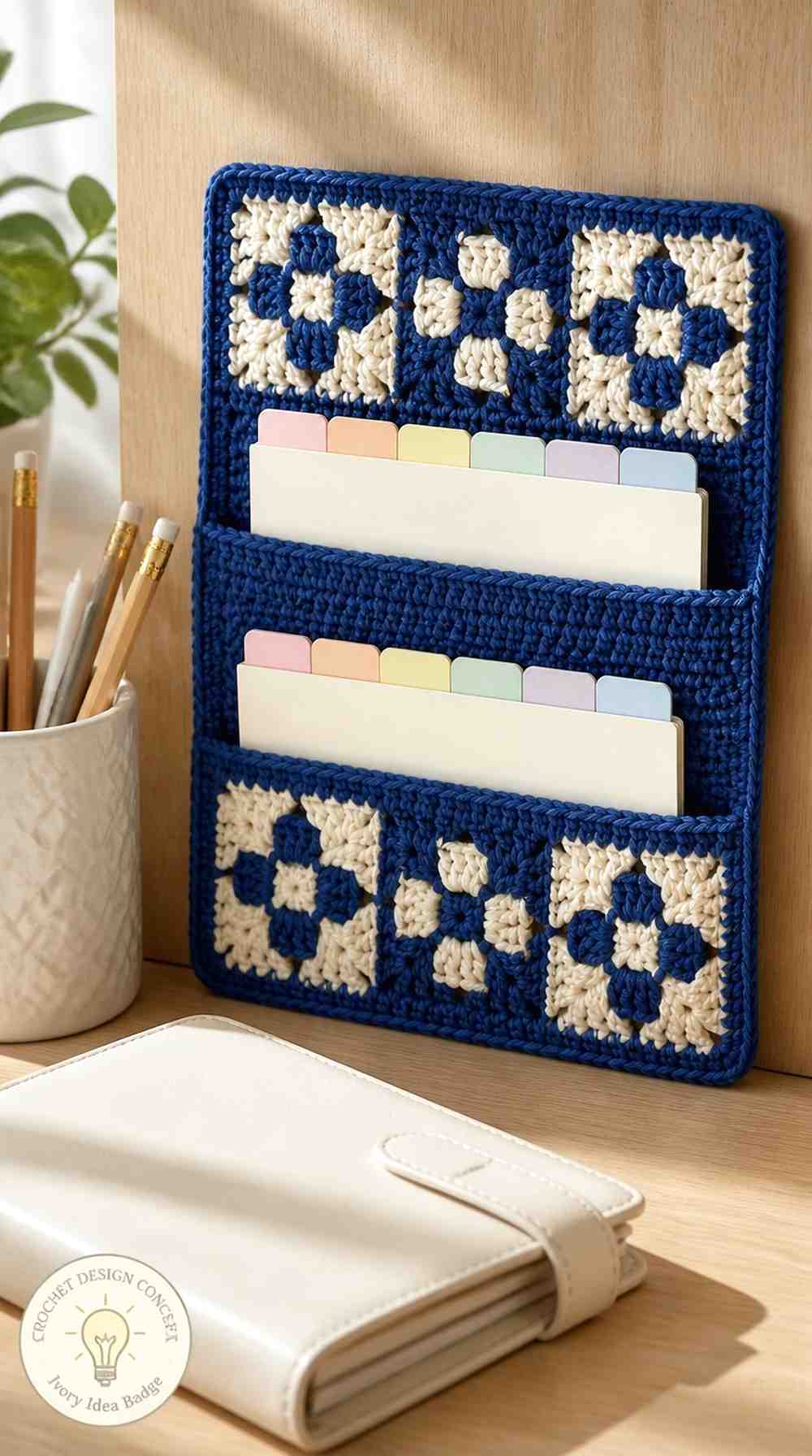
Indigo-blue and warm-cream crochet squares create a bold checkerboard frame around this two-tier desk organizer. Six neatly joined miniature granny squares surround the rectangular backing, while two shallow indigo pockets are stacked vertically. Each holds a blank cream card with a row of pastel adhesive tabs.
The organizer stands against a rigid pale wooden backing beside a planner. Its vertical arrangement keeps two groups of tabs together while using less horizontal desk space than two separate containers.
- Stacked Compartments: Leave enough clearance between the upper and lower pockets so the cards can be lifted independently.
- Granny Square Joins: Secure the six crochet motifs evenly to prevent the checkerboard frame from twisting around the wooden backing.
- Card Grouping: Consider separating frequently used page markers from spare decorative tabs rather than mixing both types in one pocket.
3. Crochet Butter Yellow Scalloped Planner Tab Pocket
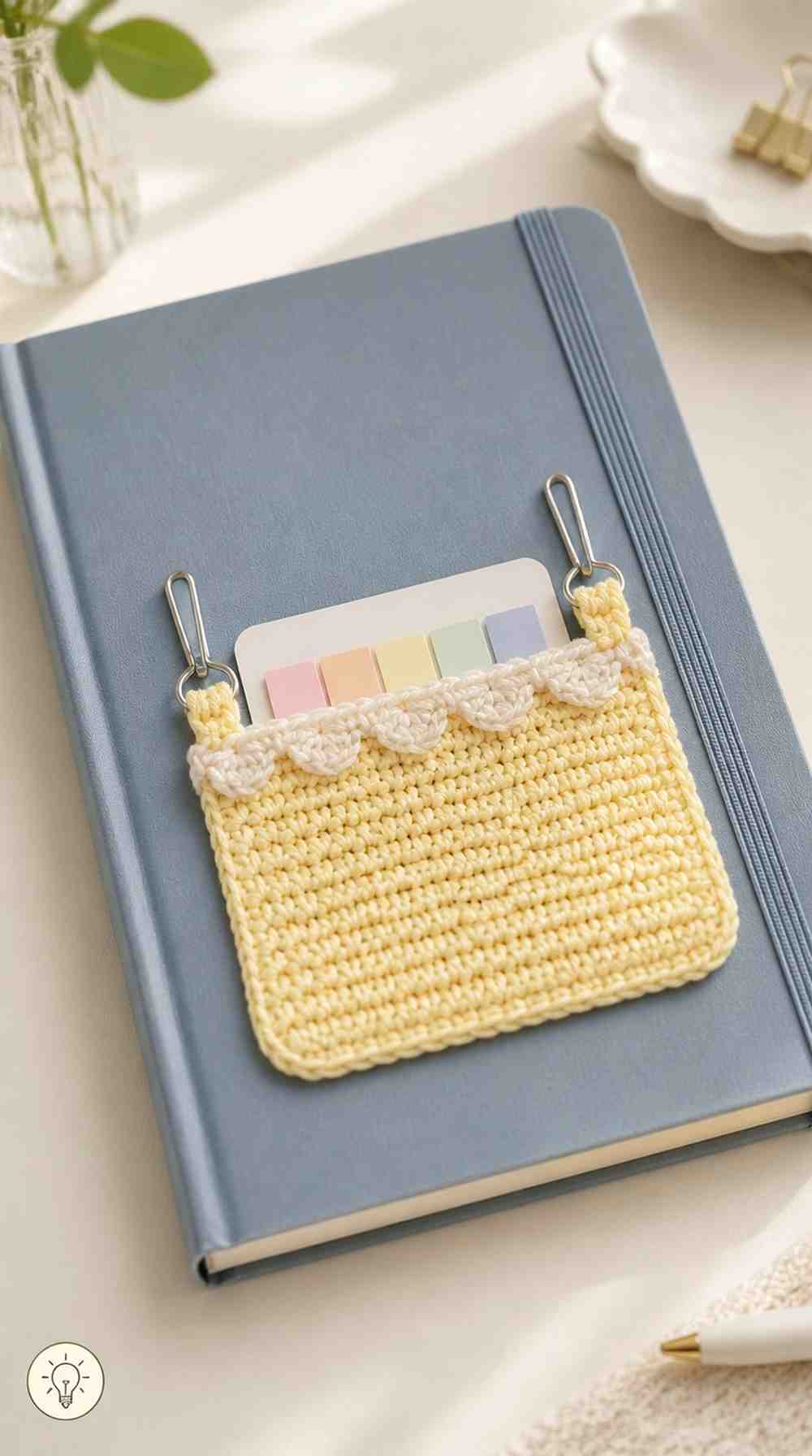
Soft butter-yellow crochet creates a shallow rectangular pocket with delicate ivory scallops along its upper edge. Two small reinforced yellow loops connect the holder to smooth removable stationery clips on the outside cover of a dusty-blue planner. One blank cream backing card with pastel index tabs remains visible above the opening.
Unlike a freestanding organizer, this little pocket keeps a tab collection directly beside the planner it belongs to. Its compact proportions are especially appealing for anyone who uses just one or two tab sets.
- Cover Compatibility: Check the planner cover’s thickness before choosing clips, particularly if the cover bends easily or has a delicate finish.
- Scalloped Opening: Keep the crochet curves shallow so they do not catch on adhesive tab edges when the backing card is removed.
- Page Protection: Place the clips on the outer cover where they will not dent pages or interfere with opening and closing the planner.
4. Crochet Olive Accordion Five Section Tab Sorter
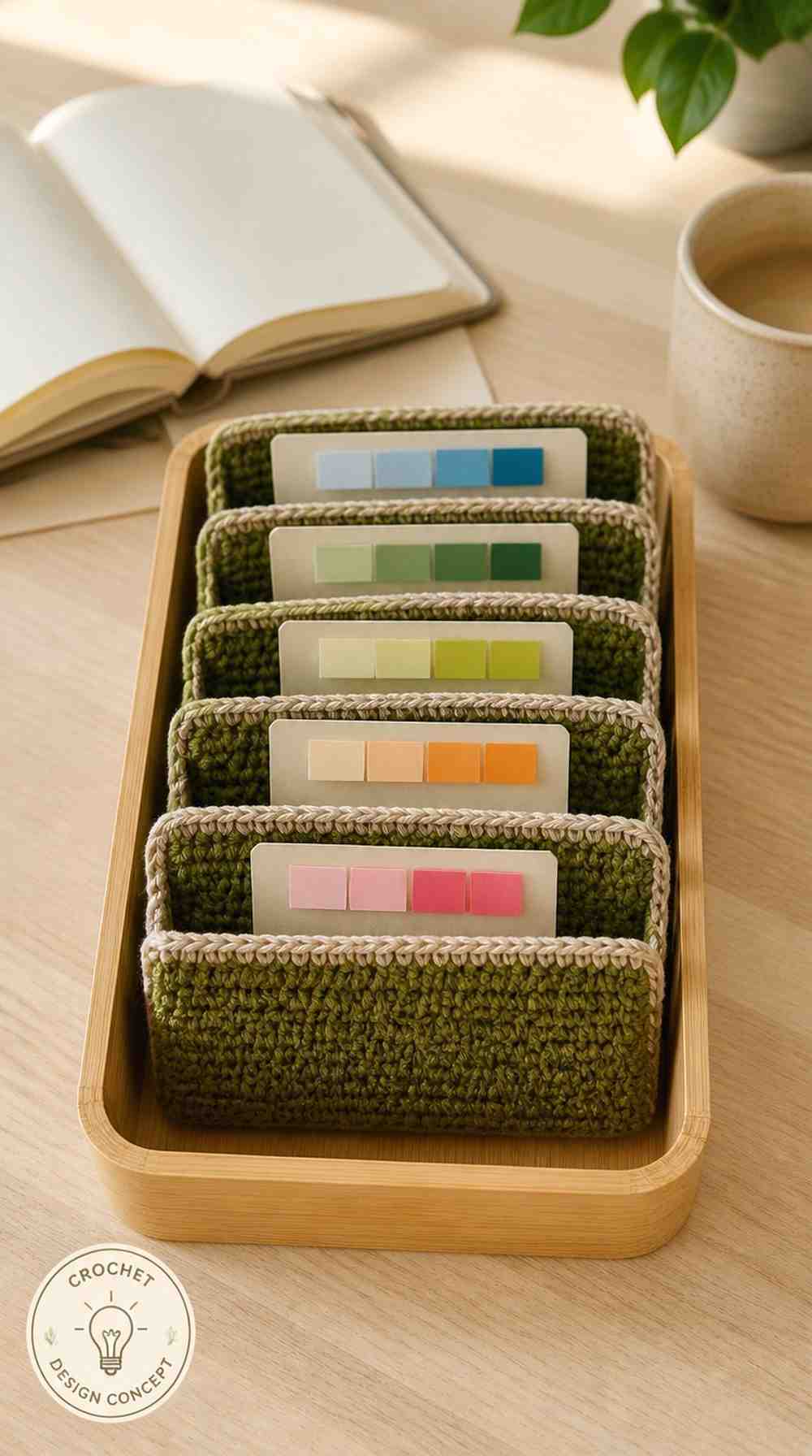
Olive-green crochet forms five small accordion compartments arranged side by side inside a low bamboo desktop tray. Each section holds a short cream backing card with a separate set of colored adhesive planner tabs. Folded crochet gussets create the dividing spaces, while an oatmeal border finishes the upper edge.
This organizer provides more separation than a simple card pocket. It could be useful when you use different tabs for several projects, planning categories or notebooks and want to keep them sorted without using multiple plastic containers.
- Accordion Gussets: Keep the folded side panels consistent so the compartments open evenly instead of pulling the whole organizer toward one side.
- Bamboo Tray Fit: The rigid tray should support the crochet base without compressing the five card spaces.
- Five-Way Organization: Assign the compartments to genuine planning needs, such as work, study, appointments, home and personal projects.
5. Crochet Blush Daisy Clear Window Tab Holder
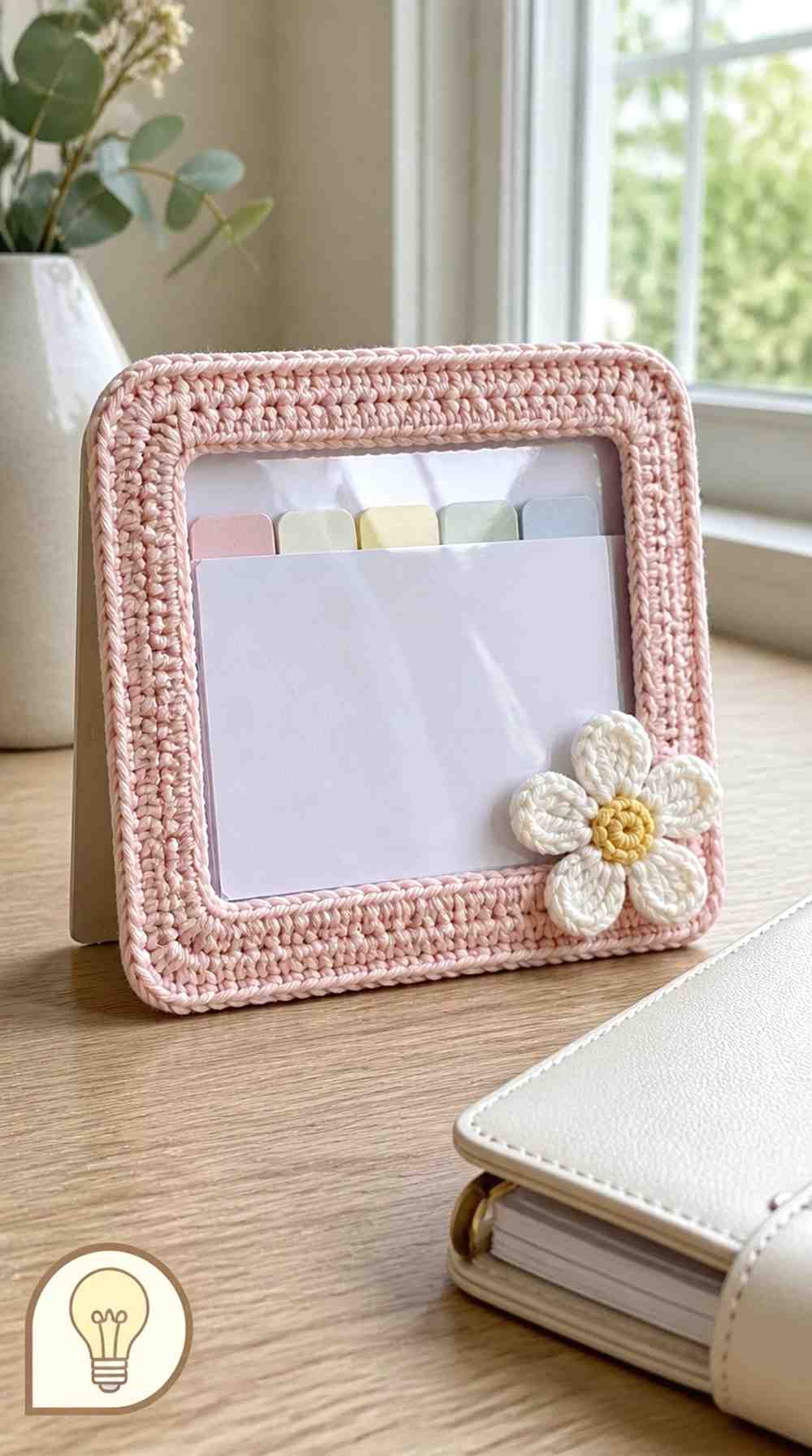
Blush-pink crochet forms a small rectangular holder with a transparent window across its front. A blank white backing card with pastel planner tabs sits behind the clear panel, framed by neatly connected crochet edging. One flat white daisy with a butter-yellow center decorates the lower-right corner without covering the card.
The holder stands on a discreet cream backing beside a closed planner. Its clear window makes the stored tab colors easy to inspect without removing the card, although the transparent material needs a suitable opening for replacements.
- Window Material: Use a smooth, suitable clear insert with tidy edges that will not catch on the tab backing card.
- Flower Placement: Keep the five-petal daisy flat and away from the accessible card opening.
- Card Replacement: Plan an opening that lets the backing card slide out without bending the adhesive tabs against the clear window.
6. Crochet Charcoal Waffle Planner Tab Dock
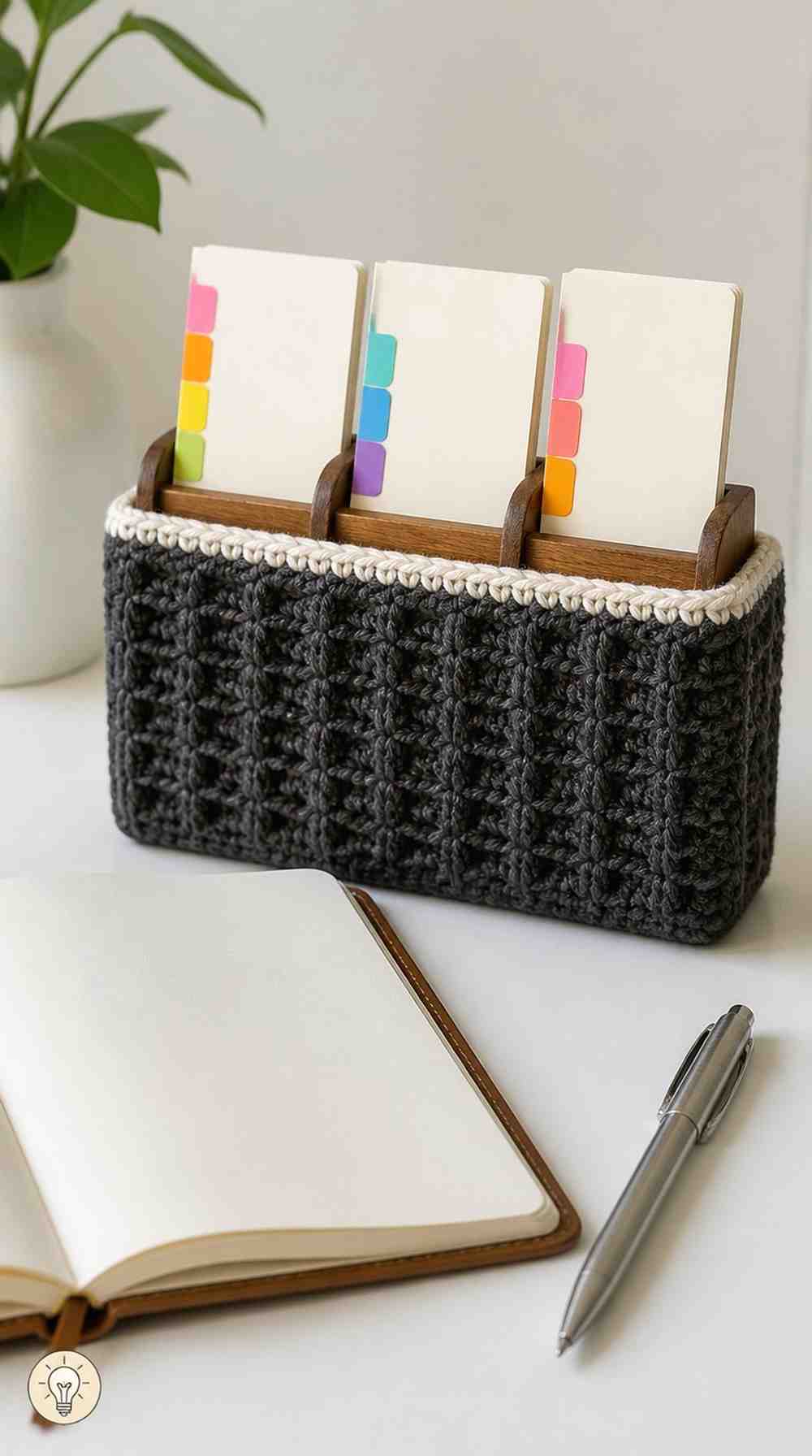
Deep-charcoal crochet gives this desktop tab dock a modern, textured appearance. Raised waffle-square stitches cover the outside of a compact wooden stand, while a narrow warm-white border frames the top. Three slim upright wooden slots hold cream cards carrying brightly colored adhesive planner tabs.
The rigid insert is the important structural feature here. It keeps the cards separated and upright, while the crochet acts as a decorative covering rather than trying to form narrow standing slots on its own.
- Wooden Slot Width: Each slot should suit the thickness of the chosen backing cards without bending them or trapping their adhesive flags.
- Waffle Texture: Raised crochet stitches provide a strong visual pattern, but their thickness should not interfere with the stand’s flat base.
- Desktop Position: Place the dock where its upright cards remain visible without blocking the notebook or workspace behind it.
7. Crochet Coral Foldable Planner Tab Wallet
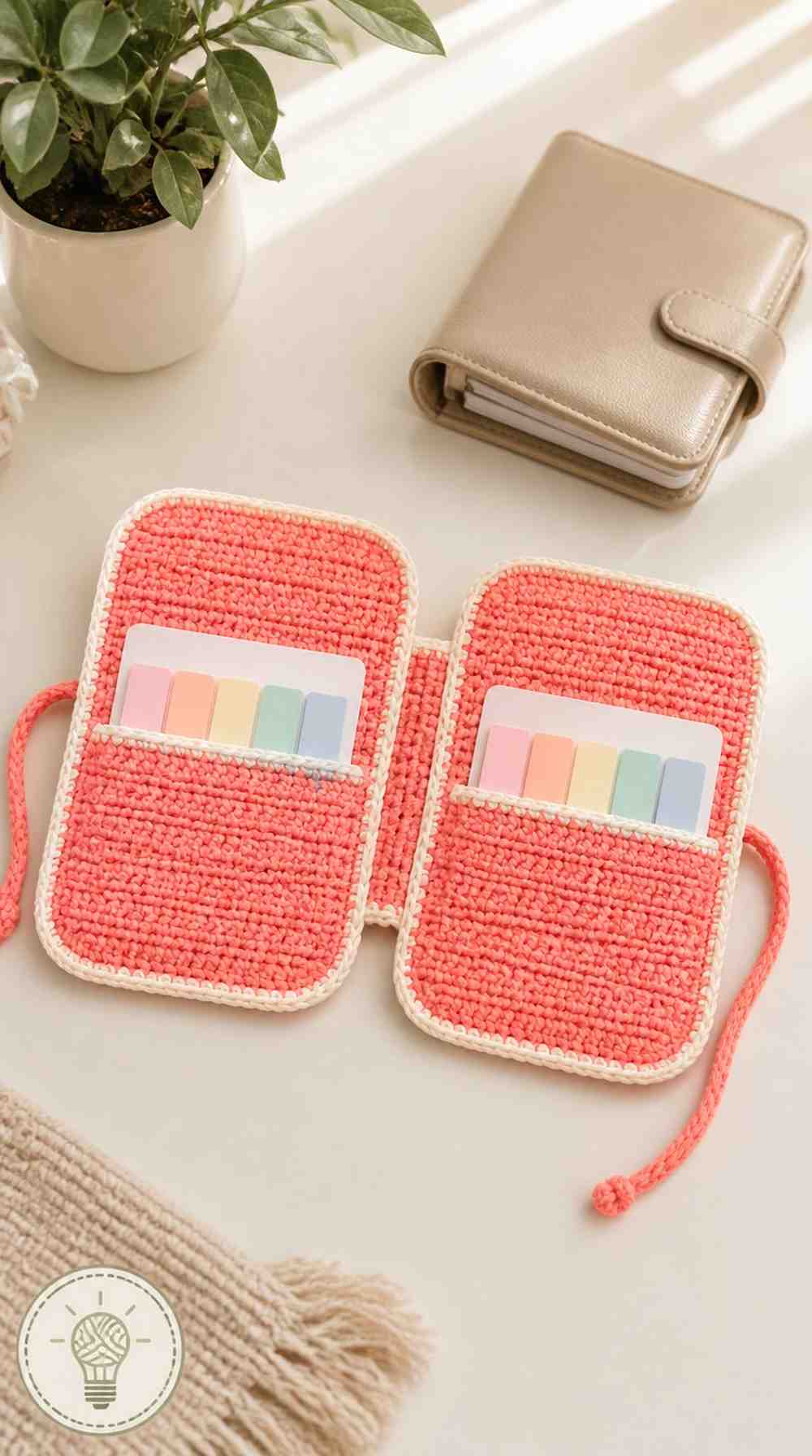
Coral-pink crochet creates a slim foldable wallet with two rectangular inner panels. A flexible central hinge connects the halves, and each side holds a cream-edged pocket containing a blank backing card with pastel page tabs. Two narrow coral ties extend from the outer edges, allowing the wallet to be fastened when folded.
This design is suited to keeping a small tab collection together rather than displaying every set on the desk. It could be useful for moving between a home workspace, classroom or office without carrying several loose tab packets.
- Flexible Hinge: The center fold should bend naturally without pushing against the stored cards or causing the pockets to buckle.
- Pocket Retention: Check that both cards remain inside when the wallet is folded and moved.
- Tie Length: Keep the coral ties long enough to fasten the wallet but short enough that they do not tangle with other stationery.
8. Crochet Teal Four Pocket Desktop Tab Board
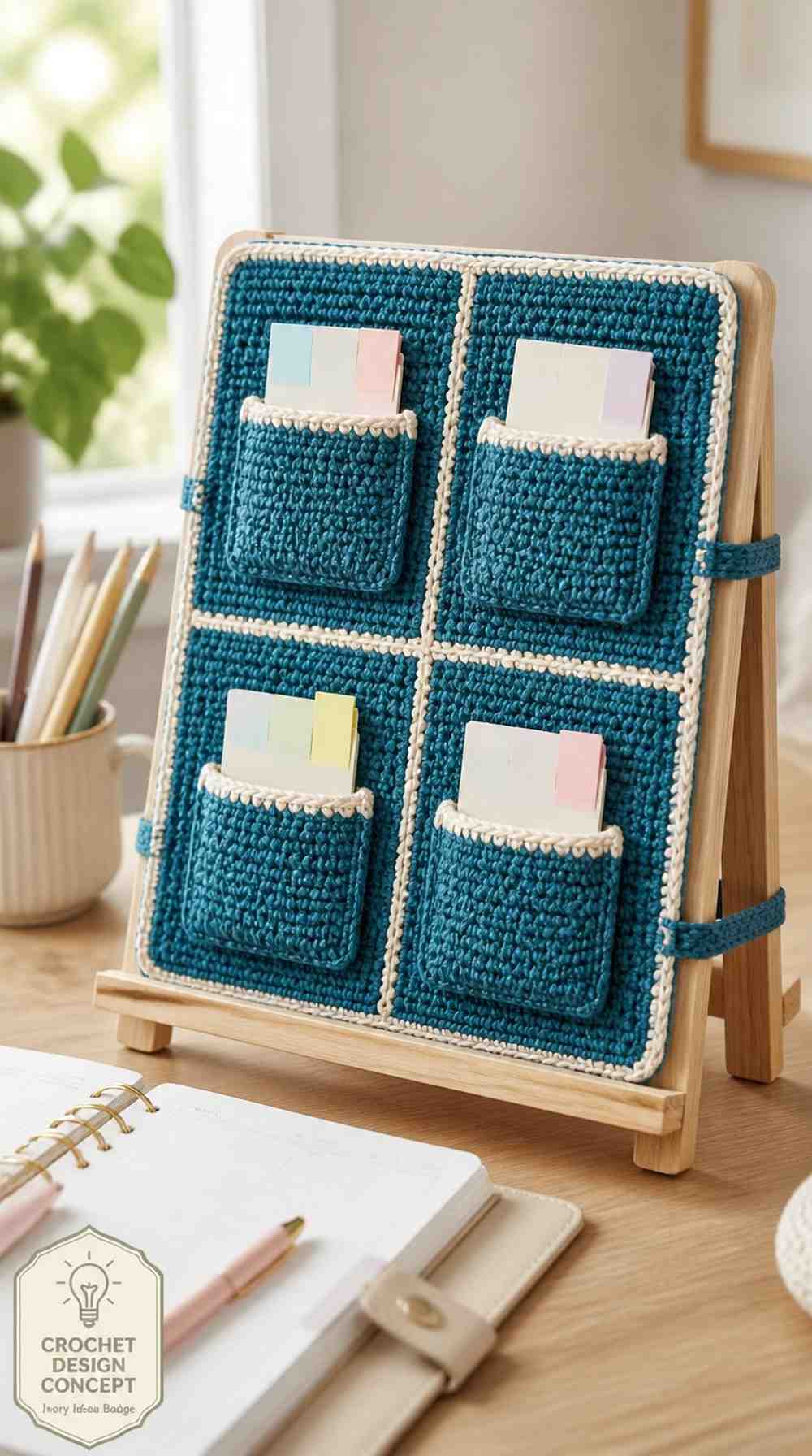
Teal-blue crochet forms a compact upright display panel with four small pockets arranged in a 2×2 grid. Each cream-bordered compartment holds a blank card with pastel adhesive planner tabs. The panel covers a rigid wooden easel, with two discreet teal straps securing it around the support.
The four-pocket arrangement provides a clear overview of several tab sets without requiring a broad tabletop organizer. Its upright position also makes it easy to see the colors at a glance while keeping the cards off the main writing surface.
- Four-Pocket Layout: Keep the two rows and two columns evenly spaced so cards do not overlap neighboring openings.
- Easel Stability: The wooden support should remain steady when a card is removed from an upper pocket.
- Strap Placement: Position the teal fastenings behind the panel without blocking the easel’s standing mechanism.
9. Crochet Lavender Lattice Lined Tab Tray
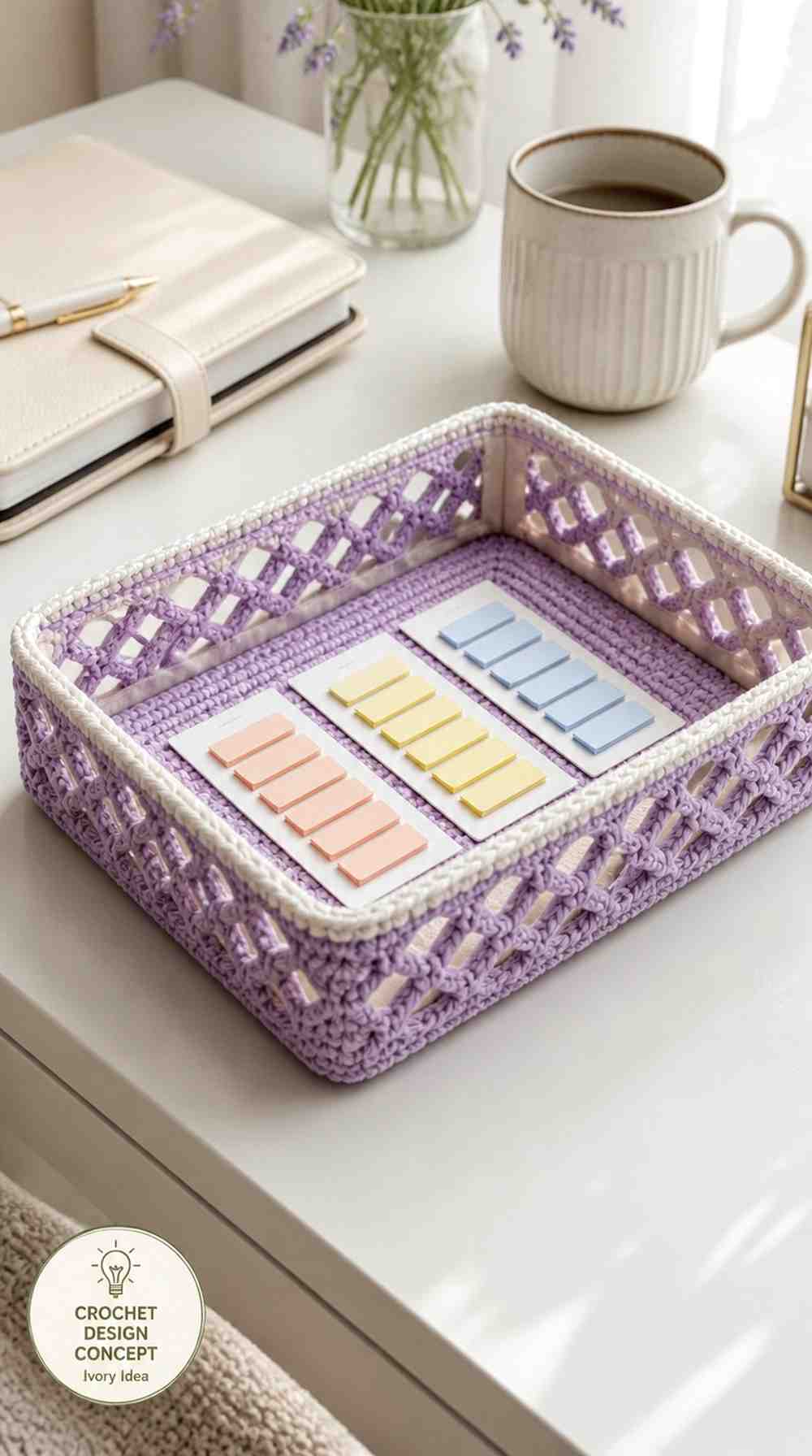
Pale-lavender crochet creates an airy rectangular desk tray with diamond-lattice sides and a solid lower base. A removable warm-cream cotton lining shows through the openwork, while a low bamboo insert supports the overall shape. Three blank backing cards carrying peach, yellow and blue planner tabs lie neatly inside.
This design is different from the upright card holders because the tab sets rest horizontally. The shallow tray may suit someone who prefers to see and select several backing cards at once, although open lattice alone would not provide sufficient structural support.
- Lattice Connections: Keep the diamond-shaped crochet openings evenly joined to the solid base and upper rim.
- Fabric Lining: The cream backing separates small paper corners from the openwork, reducing the chance of cards slipping into lattice spaces.
- Tray Depth: A shallow interior keeps the tab cards visible and easy to lift, while the bamboo insert provides a reliable flat base.
10. Crochet Navy Button Flap Tab Sleeve
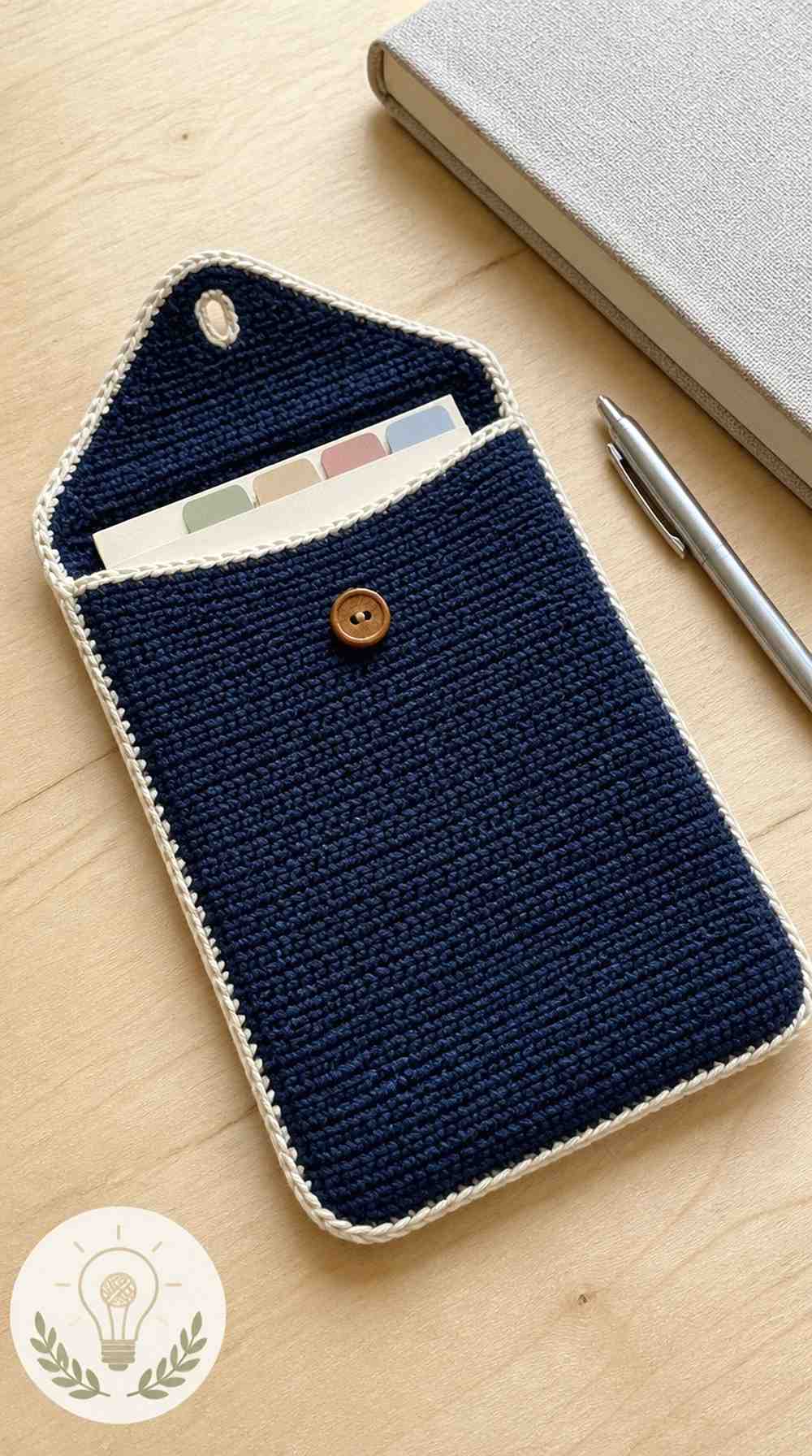
Deep-navy crochet gives this slim stationery sleeve a clean, understated appearance. Closely worked horizontal rows form its shallow rectangular body, with an ivory border outlining the edges. A short rounded flap fastens with a natural wooden button, and the partly opened pocket reveals a cream card carrying muted pastel planner tabs.
The buttoned enclosure is suited to keeping a small set of spare tabs together inside a desk drawer or stationery pouch. It is less convenient for constant one-handed access than an open holder, but the covered opening adds a useful layer of organization.
- Buttonhole Fit: Size the opening to match the wooden button so the flap closes without stretching its crochet stitches.
- Card Clearance: Leave enough interior room for the tab backing card without folding its adhesive flags against the pocket edges.
- Drawer Use: Keep the sleeve flat among smooth stationery items, away from sharp clips or tools that could snag the crochet.
11. Crochet Apricot Stair Step Planner Tab Organizer
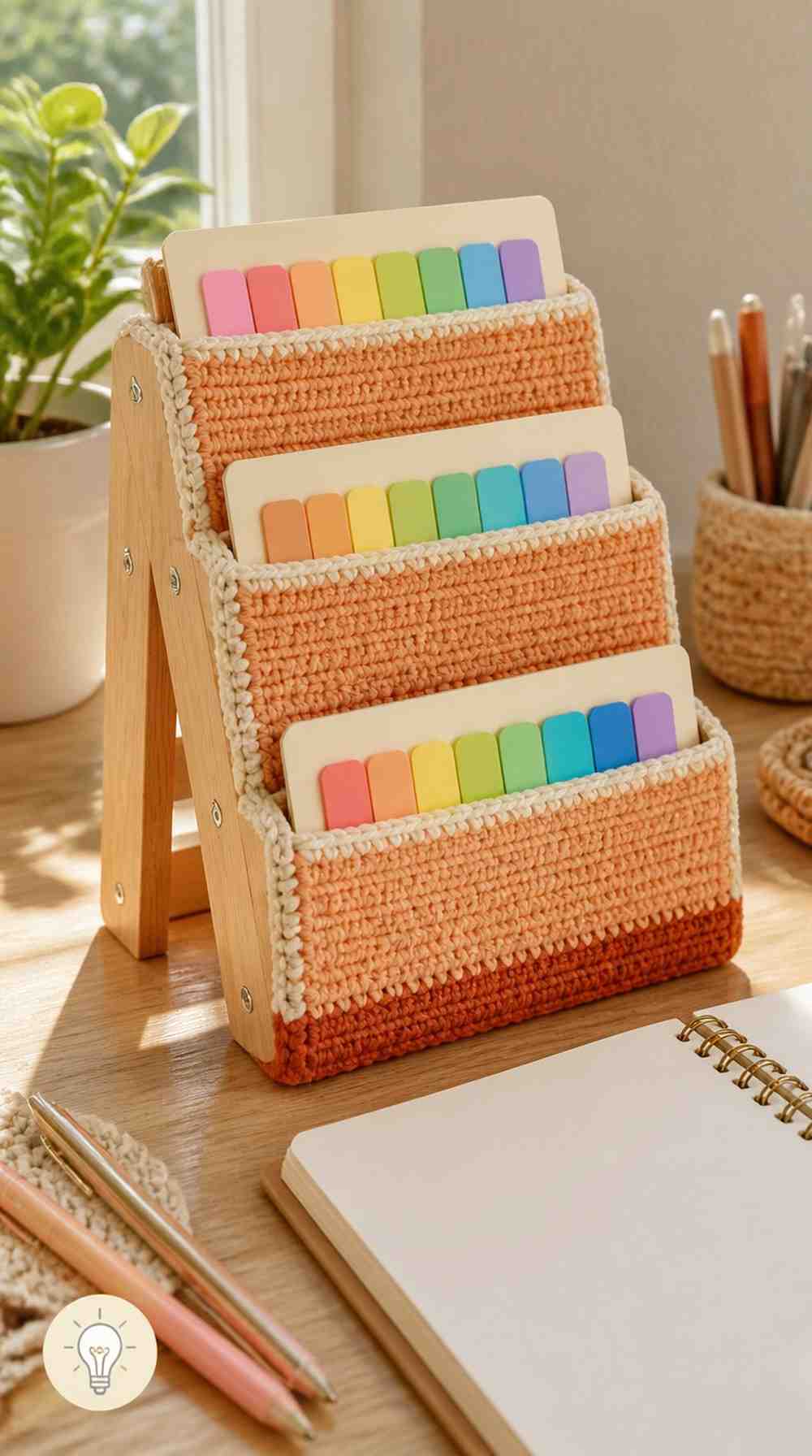
Apricot-orange crochet brings warmth to this three-tier desktop tab display. Each ascending wooden level has a shallow crochet-front pocket holding a blank cream card with colorful adhesive planner tabs. Narrow ivory borders define the tiers, while a terracotta lower trim gives the organizer a coordinated finish.
The staggered arrangement makes it easier to see cards that might otherwise hide behind one another. This concept could suit a desk where different tab types are used frequently and need to remain visible without being scattered across the writing area.
- Staggered Visibility: Make sure the rear cards rise sufficiently above the front tier so the colored tabs remain easy to distinguish.
- Rigid Stepped Base: The wooden rack supports the raised levels; crochet pockets alone should not be expected to maintain a staircase shape.
- Tiered Access: Leave enough space to lift a card from the back without dragging it across the tabs stored in front.
12. Crochet Forest Leaf Planner Spine Tab Pocket
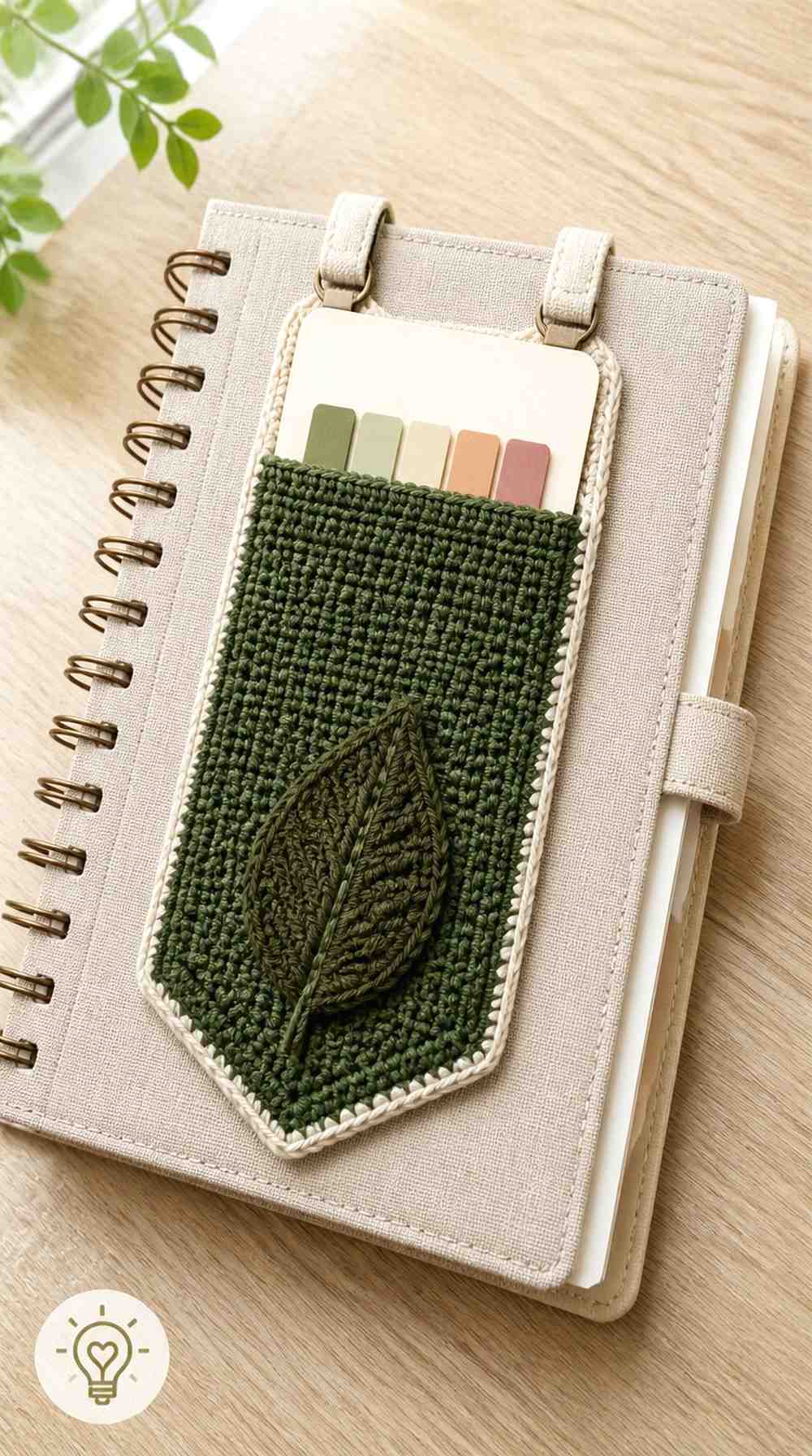
Forest-green crochet gives this slim planner pocket a quiet botanical appearance. Its softly pointed lower edge is outlined in cream, while a flat dark-olive leaf with a raised center vein decorates the front. A small cream backing card with colorful adhesive tabs sits inside the straight upper opening.
Two removable padded clips attach the pocket to the outside spine area of a closed ring-bound planner. This arrangement keeps the page tabs with the notebook without requiring a separate tabletop container, although its attachment needs careful positioning.
- Spine Clearance: Keep the clips clear of the ring mechanism and the planner’s moving cover sections.
- Leaf Attachment: Secure the dark-green appliqué flat against the pocket so the pointed tip does not catch on other stationery.
- Cover Protection: Use appropriate removable clips and check them against the actual cover material to avoid bending or marking it.
13. Crochet Mustard Triangle Planner Tab Cubby
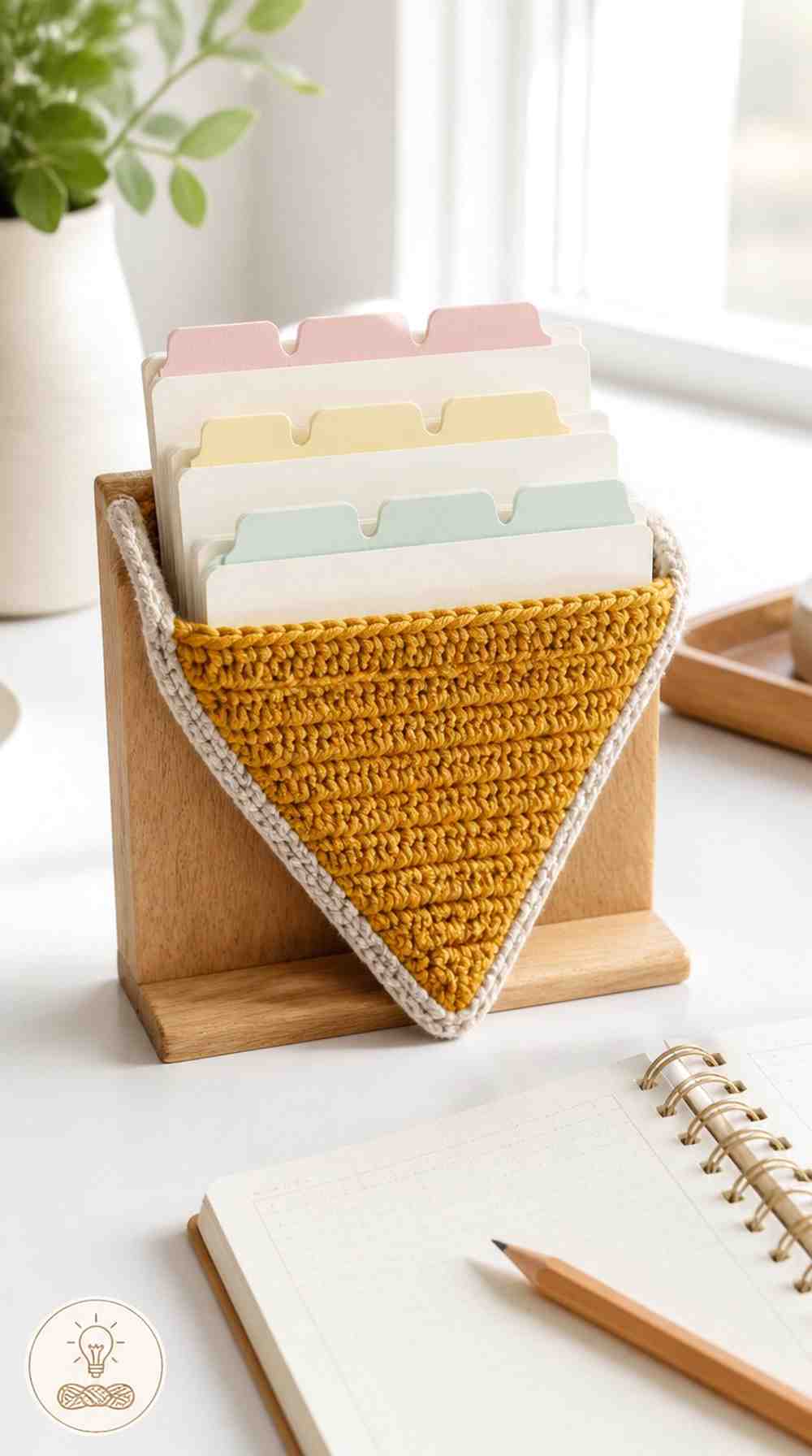
Mustard-yellow crochet creates a compact triangular desktop pocket with symmetrical sloping sides and a neatly pointed lower front. An oatmeal border follows the diagonal outline, while three cream backing cards with pastel tab sets stand upright behind the upper opening. A small rigid wooden support gives the crochet its stable shape.
The triangle offers an unusual alternative to a standard rectangular holder. Its narrow lower point and wider upper opening create a distinctive silhouette, although the internal card area must be shaped to provide enough support for the stored tab sets.
- Triangular Shaping: Keep both diagonal sides symmetrical so the pocket sits neatly against the wooden support.
- Card Support: Plan sufficient backing height behind the pointed front so the three tab cards do not lean forward or fall out.
- Small Desk Footprint: The compact shape may fit a narrow desk corner, but check the real wooden base rather than judging capacity from the illustrated front.
14. Crochet Powder Blue Seven Slot Weekly Tab Organizer
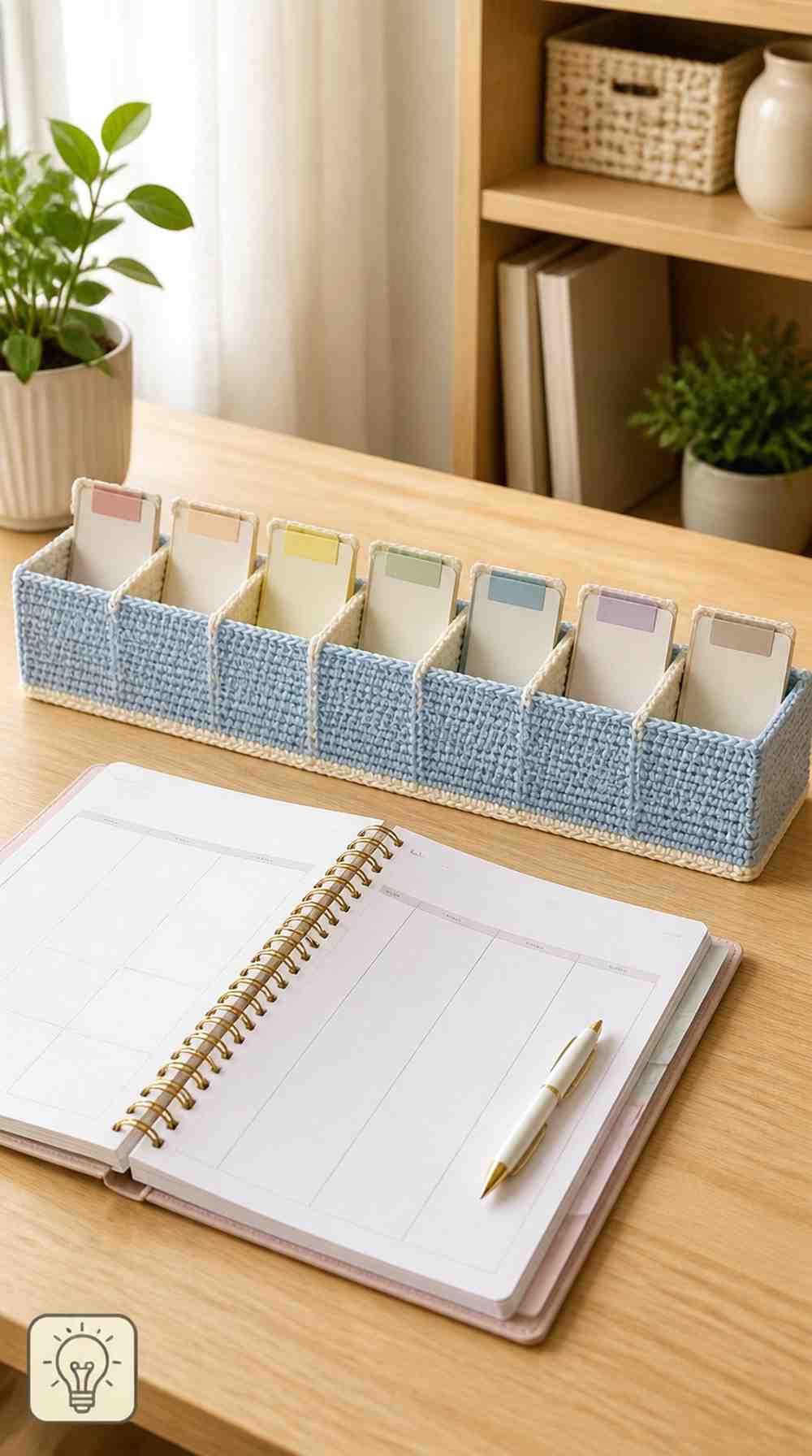
Powder-blue crochet forms a long, low desktop organizer with seven evenly spaced card compartments arranged in a single horizontal row. Each section contains a small cream backing card with a different muted pastel tab color. Fine ivory borders separate the pockets, while closely worked crochet rows cover the rigid wooden support.
This concept offers a seven-part sorting arrangement for people who use several kinds of planner tabs. The long shape can sit behind an open weekly planner, although it requires more horizontal desk space than a compact two- or three-pocket holder.
- Seven-Section Sorting: Each slot could hold a separate planning category or color group, rather than requiring every section to represent a weekday.
- Compartment Width: Check the width of the actual tab backing cards before planning the seven openings.
- Desk Placement: Position the organizer where its full length remains accessible without interfering with writing or moving the planner.
15. Crochet Plum Label Window Tab Archive
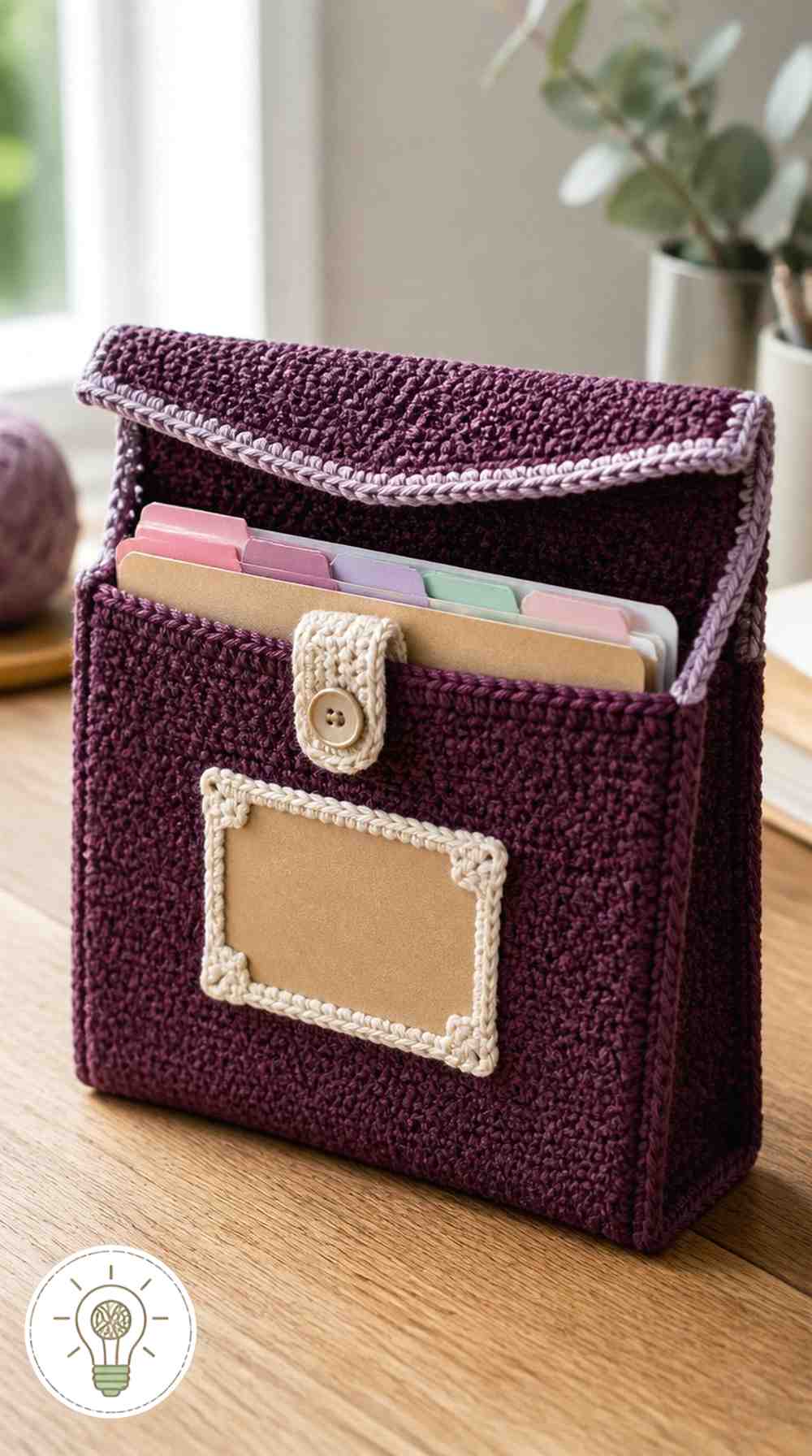
Deep-plum crochet creates a small rectangular archive pouch with narrow side gussets and a dusty-lilac border. A short oatmeal button strap closes the foldover flap, while an ivory frame on the front holds a blank removable kraft-paper label card. Inside are several unused pastel tab sets attached to their backing cards.
The archive-style design is useful for storing spare planner tabs that are not needed every day. Its enclosed shape keeps several backing cards together, while the front window could identify the collection once a written insert is added.
- Archive Capacity: Keep the pouch deep enough for the intended card stack without forcing the flap to close over a bulky collection.
- Label Window: The removable card can identify stored tabs, but it should remain accessible without disturbing the main pocket.
- Foldover Fastening: Check the button strap with the pouch filled so the closure does not pull the plum crochet out of shape.
16. Crochet Cinnamon Dowel Hanging Tab Pockets
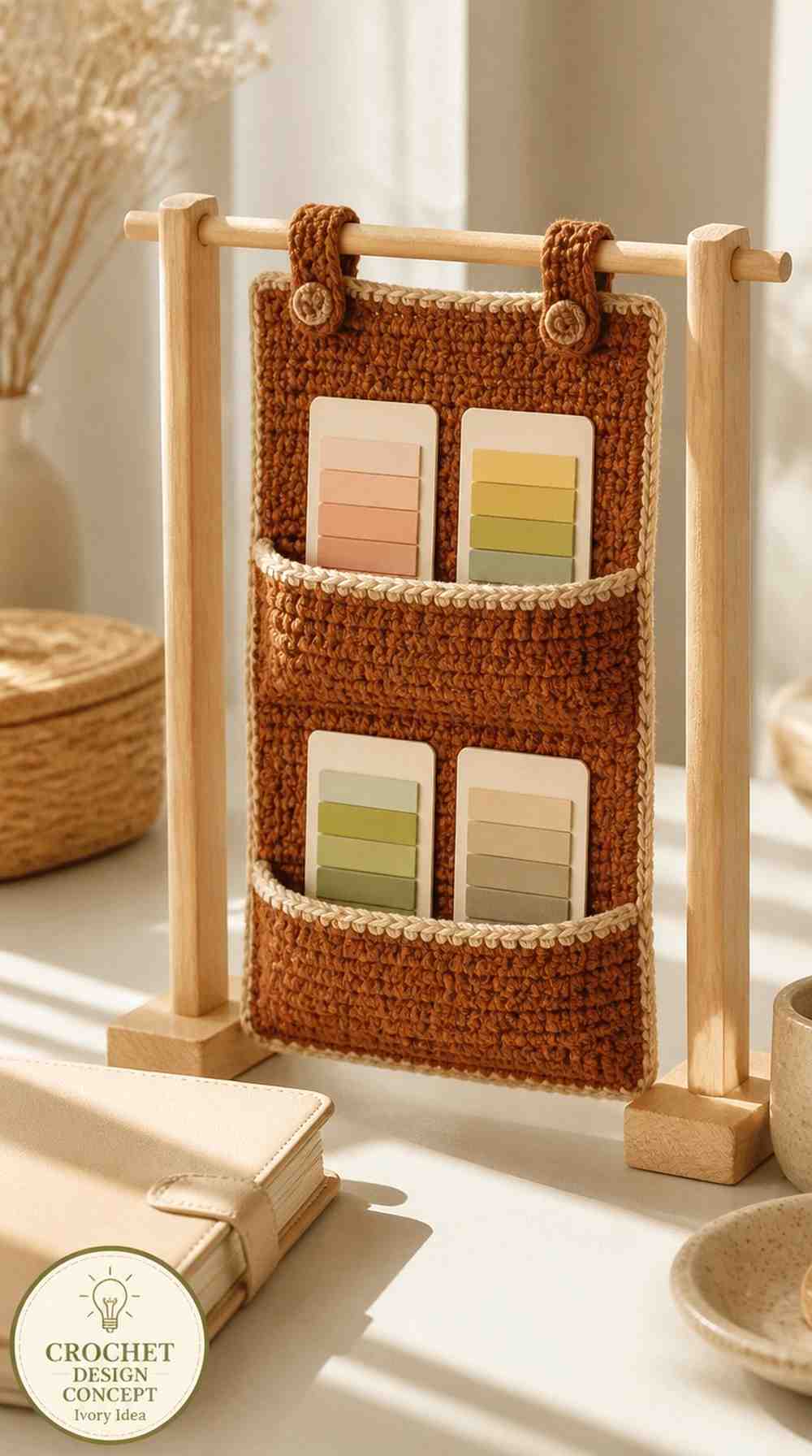
Cinnamon-brown crochet forms a small hanging panel with two shallow pockets stacked vertically. Oatmeal borders define the openings, and each compartment holds two blank cream cards carrying colorful adhesive tabs. Two reinforced cinnamon loops suspend the panel from a natural wooden dowel supported by freestanding wooden desktop stands.
The hanging arrangement keeps tab cards visible without needing a large rigid board behind every pocket. It could suit a craft or study desk where the organizer can remain in one dedicated spot beside a planner.
- Dowel Support: The two wooden stands should remain stable when cards are removed from the upper or lower pocket.
- Stacked Access: Keep enough separation between the pockets to reach the lower backing cards without lifting the upper ones.
- Balanced Hanging: Position the two crochet loops evenly so the panel does not lean when one pocket holds more cards than the other.
17. Crochet Ivory Teal Detachable Tab Panel
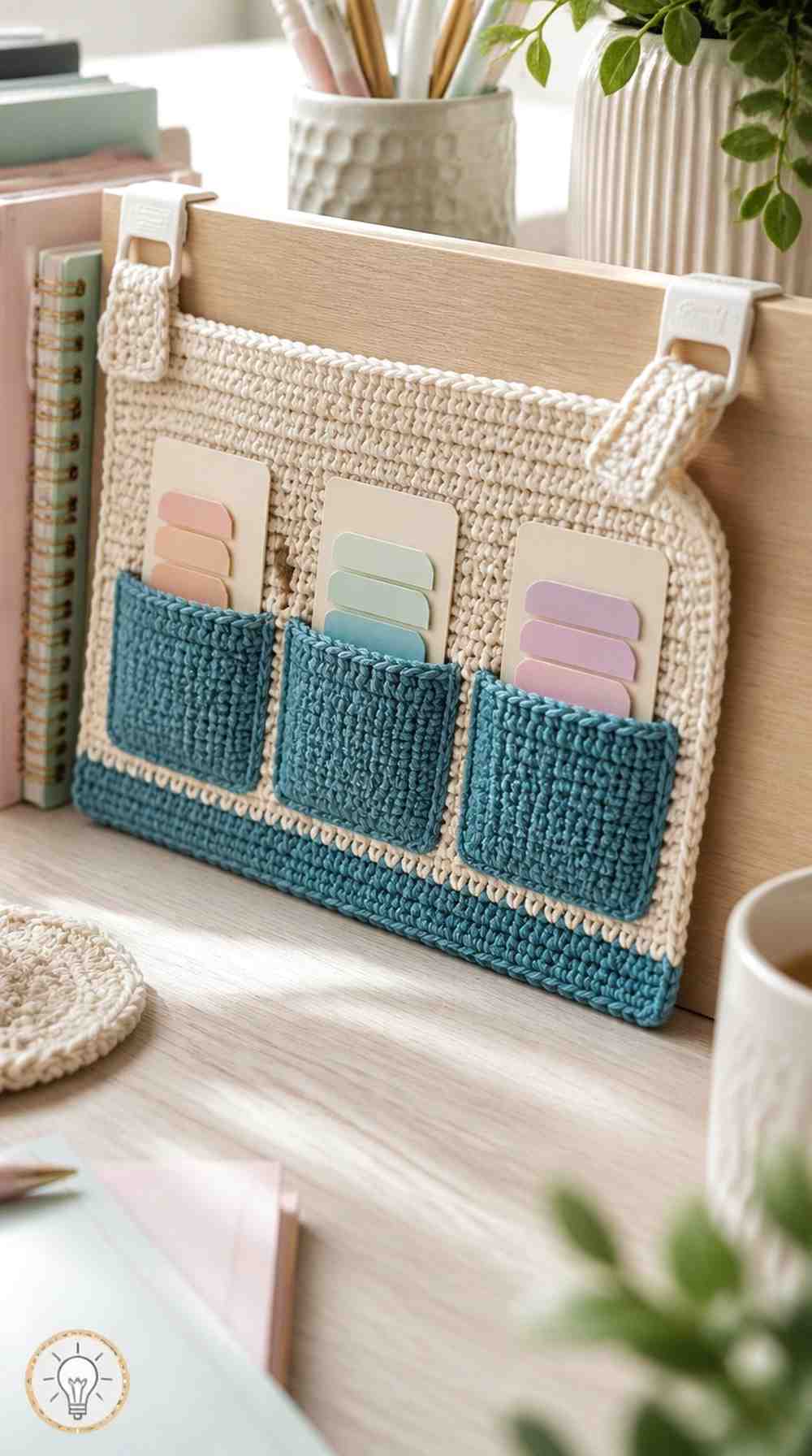
Warm-ivory crochet creates a compact rectangular panel with three teal-blue pockets arranged side by side. Each compartment holds one cream backing card with pastel planner tabs. A broad teal lower border contrasts with the closely worked ivory backing, while two short reinforced fastening tabs connect the organizer to removable clips on a wooden desktop board.
The detachable arrangement is the main advantage of this design. The entire three-pocket panel could be removed from its board for cleaning or rearranging, provided the clips and crochet tabs are suitable for repeated handling.
- Detachable Fastening: Both upper clips should grip the reinforced tabs securely without pulling the crochet backing out of alignment.
- Three-Pocket Layout: Keep the teal compartments equal in width so the backing cards remain individually accessible.
- Removable Maintenance: Being able to detach the panel may simplify cleaning, but remove the paper tab cards before washing the crochet.
Practical Guide to Crochet Desk Planner Tab Organizers
A crochet planner tab organizer works best when it keeps adhesive page markers easy to identify without damaging them. Because most tabs are small and often attached to paper or plastic backing strips, the organizer should be planned around those original cards.
Measure your tab backing cards. Different brands use different widths and lengths. Check the actual cards before choosing pocket sizes, especially for narrow accordion compartments or upright wooden slots.
Keep adhesive surfaces protected. Leave unused adhesive tabs attached to their original backing material until needed. Exposed adhesive can collect yarn fibers, dust and other debris.
Choose the right storage direction. Upright pockets make colored tabs easy to identify at a glance. Flat trays can be useful when comparing several colors, while buttoned sleeves and foldable wallets may suit spare sets.
Consider yarn and stitch density. Smooth cotton is worth exploring for small stationery pockets because its stitch definition is easy to see. Closely worked fabric may support paper cards more consistently than loose openwork, although soft crochet often benefits from a rigid backing.
Provide support where needed. Wooden stands, bamboo trays and small desktop easels can help an organizer remain upright. Crochet fabric alone should not be expected to maintain narrow slots or tall rigid compartments.
Keep labels simple. Use removable written cards to identify tab colors or planning categories. Avoid permanently attaching labels if your planning routine changes frequently.
Check your desk space. A seven-slot horizontal organizer needs more width than a compact three-pocket stand. Consider where your planner opens, where your writing hand rests and which accessories you reach for most often.
Clean the organizer separately. Remove all backing cards and adhesive tabs before washing crochet. Follow the yarn’s care directions and allow the holder to dry completely before returning stationery to its pockets.
For related desk organization ideas, explore Yarn Nest Studio’s 10 Crochet Desk Pen Cup Ideas. That collection looks at keeping pens, markers and other writing accessories organized, making it a useful companion to a dedicated planner tab holder.
Want to Make Something Similar?
These verified resources cover related crochet pockets and desktop organizers. They are not exact patterns for the 17 planner tab concepts shown here.
- Crochet Desk Organizer Free Pattern — Crochet Es Mi Pasión — Shows how a crochet pocket can be added to a rectangular desk mat and divided into sections, a useful technique for exploring small tab compartments. Crochet Es Mi Pasión
- Folded Desk Valet — CyCrochet — A free crochet project with a folded rectangular body, pocket, reinforced back and button flap. Its construction offers related ideas for covered tab storage. CyCrochet
The exact card sizes, openings and supports for these inspiration concepts would need to be planned separately.
Which Crochet Desk Planner Tab Organizer Should You Choose?
| Design | Main advantage | Practical consideration |
|---|---|---|
| Terracotta Ribbed | Three simple upright pockets | Wooden stand stability |
| Indigo Checkerboard | Two stacked tab groups | Granny-square joins |
| Butter Yellow Scalloped | Clips directly to a planner | Cover compatibility |
| Olive Accordion | Five separate categories | Gusset construction |
| Blush Daisy Clear Window | Tab colors visible through front | Window cleaning |
| Charcoal Waffle | Compact rigid card dock | Wooden slot widths |
| Coral Foldable Wallet | Portable two-pocket storage | Hinge and card security |
| Teal Four Pocket | Upright four-category display | Easel stability |
| Lavender Lattice | Shallow lined desktop tray | Backing and lining |
| Navy Button Flap | Enclosed tab-card sleeve | Button closure |
| Apricot Stair Step | Three visible display levels | Tier height and access |
| Forest Leaf | Attaches near planner spine | Binding clearance |
| Mustard Triangle | Small decorative cubby | Internal card support |
| Powder Blue Seven Slot | Seven separate tab groups | Horizontal desk space |
| Plum Label Window | Stores spare tab collections | Archive capacity |
| Cinnamon Dowel | Two suspended card pockets | Freestanding dowel balance |
| Ivory Teal Detachable | Removable three-pocket panel | Clip attachment |
For a small everyday desk setup, the Crochet Terracotta Ribbed Planner Tab Stand is an appealing starting point. Its three pockets provide separation without requiring a large organizer.
If you use many different tab colors or planning categories, the Crochet Olive Accordion Five Section Tab Sorter or Crochet Powder Blue Seven Slot Weekly Tab Organizer offers more compartments.
For carrying spare tab sets between workspaces, consider the Crochet Coral Foldable Planner Tab Wallet or Crochet Navy Button Flap Tab Sleeve. Both focus on enclosed storage rather than desktop display.
Conclusion
Crochet desk planner tab organizers can bring a little handmade-style character to an everyday planning routine. These 17 concepts explore different ways to store small adhesive index tabs, from simple ribbed pockets and checkerboard panels to accordion sorters, clear windows, foldable wallets and stepped desktop displays.
The best choice depends on the number of tab sets you use, how often you need them and how much room is available beside your planner. Keeping tabs on their backing cards, choosing suitable pocket sizes and using rigid supports where necessary will make any future handmade version more practical.
Which design would you choose for your desk? Do you prefer the terracotta three-pocket stand, the olive accordion sorter or the coral foldable tab wallet? Share your favorite style and how many planner tab colors you usually keep nearby.
Frequently Asked Questions
1. Can crochet pockets hold adhesive planner tabs without damaging them?
Crochet pockets can be used to store planner tabs, but it is best to keep adhesive flags attached to their original backing cards. This reduces direct contact between the adhesive and yarn fibers. Check that the pocket opening does not bend or catch the tabs when the backing card is removed.
2. What yarn is suitable for a crochet planner tab organizer?
Smooth cotton is a useful material to consider because it can produce clearly defined stitches and relatively tidy edges. However, different yarns vary in firmness, stretch and care requirements. Upright organizers may also need a wooden, cardboard or other rigid insert to maintain their shape.
3. Should I choose a flat tray or an upright planner tab organizer?
A flat tray may be more convenient when you like to spread out several tab sets and compare colors. Upright holders keep backing cards visible while using less desk depth. The better choice depends on your planning routine, available space and the number of tab collections you need to organize.
4. Can I attach a crochet tab pocket directly to my planner?
A small crochet pocket may be attached to a suitable planner cover with removable clips or another carefully designed fastening. Avoid attachments that bend pages, damage the cover or interfere with the binding. Check the actual planner’s construction before choosing a clip-on design.
5. Are these 17 crochet planner tab organizer ideas complete patterns?
No. These are original design visualizations for inspiration, not tested crochet patterns or step-by-step instructions. The linked resources demonstrate related pocket and organizer techniques, but they do not reproduce these exact designs. A real project would need measurements, appropriate stitching, suitable structural support and practical checks using the intended planner tabs.
Before publishing generated images, check the tab and pocket counts, realistic crochet stitches, attachment details and featured-image title. Image generation cannot guarantee that every construction detail or piece of text will appear correctly.