A harvest basket brings the garden’s best colors together, and a crochet liner can make an ordinary wicker basket or wooden crate look even more inviting. These 17 crochet garden harvest basket liner inspiration ideas explore fitted ribbed designs, adjustable corner ties, granny-square panels, chevron stripes, and floral edging for collecting fruit and vegetables. From sage apple baskets and oatmeal strawberry liners to colorful pepper baskets and rustic carrot crates, every idea has a distinct shape and use.
The designs are intended as removable decorative liners, not substitutes for clean food-contact surfaces or proper produce storage. Most include a separate washable cotton insert or produce tray between the crochet and harvested food, making it easier to deal with garden dirt and moisture. You’ll see round, oval, rectangular, square, and tapered basket shapes, along with different methods of keeping the crochet secured to the rim. Choosing the right fit and cleaning method matters as much as the stitch pattern.
These are AI-generated crochet design visualizations for inspiration, not photographs of tested handmade liners or step-by-step patterns. The pictured designs have not been tested for food-contact suitability, sanitation, weight-bearing capacity, or produce preservation.
Quick Design Selection Guide
| Your harvest basket or goal | Design to explore | What makes it useful |
|---|---|---|
| Round wicker apple basket | Crochet Sage Ribbed Apple Harvest Basket Liner | Fitted ribbed sides and ivory rim |
| Rectangular wooden tomato crate | Crochet Terracotta Rectangular Harvest Crate Liner | Folded corners and short rim ties |
| Shallow oval strawberry basket | Crochet Oatmeal Oval Strawberry Basket Liner | Concentric oval base and low sides |
| Deep round orchard basket | Crochet Mustard Basketweave Harvest Liner | Raised basketweave stitches |
| Long oval basket for beans | Crochet Navy Gingham Bean Basket Liner | Elongated shape and gingham colorwork |
| Decorative tomato basket | Crochet Blush Scalloped Tomato Basket Liner | Flat cream shell edging |
| Herb harvest presentation | Crochet Olive Lattice Herb Harvest Basket Liner | Openwork sides over smooth backing |
| Flexible crate lining | Crochet Charcoal Copper Fold-Flat Crate Liner | Soft panels with removable corner snaps |
| Colorful vegetable basket | Crochet Granny Square Vegetable Harvest Liner | Six joined motifs |
| Separating two light crops | Crochet Lavender Divided Pea Harvest Basket Liner | Soft internal cotton divider |
| Easy rim removal | Crochet Denim Snap-On Zucchini Basket Liner | Four snap tabs around an oval rim |
| Delicate peach collection | Crochet Coral Layered Peach Harvest Liner | Double removable fabric layers |
| Tapered round basket | Crochet Teal Tapered Pear Basket Liner | Shaped crochet sidewalls |
| Cottage-style pepper basket | Crochet Ivory Sunflower Pepper Basket Liner | Flat sunflower and scalloped border |
| Root vegetable harvest crate | Crochet Rust Chevron Root Vegetable Crate Liner | Flat chevron base and short sides |
| Lift-out greens tray | Crochet Plum Lift-Out Greens Basket Liner | Separate fabric handles inside the basket |
| Shallow square harvest crate | Crochet Seafoam Corner-Tie Harvest Crate Liner | Square rounds and four corner ties |
1. Crochet Sage Ribbed Apple Harvest Basket Liner
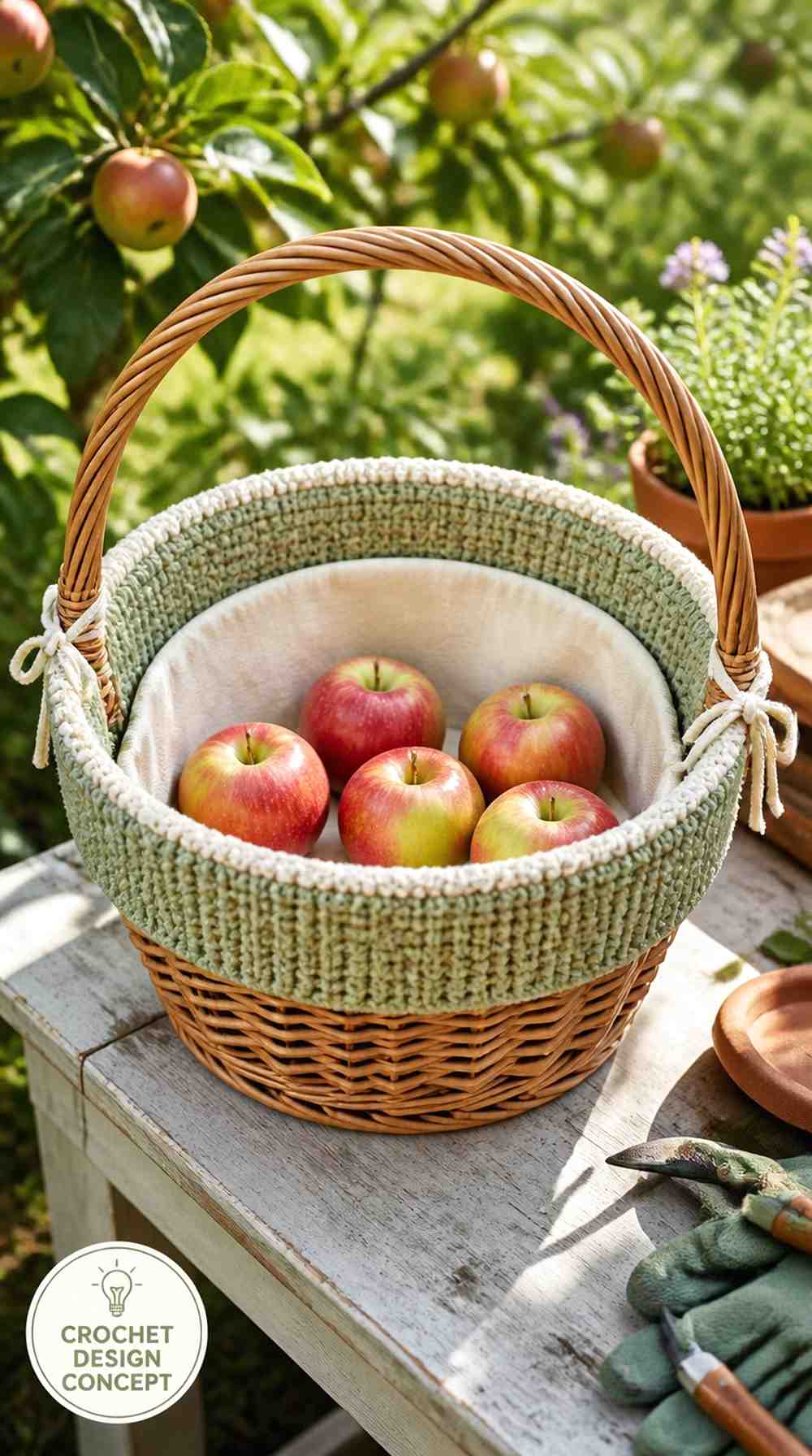
Muted sage-green crochet gives this round wicker harvest basket a fresh, natural appearance. Closely spaced vertical ribs follow the curved sidewalls, while warm-ivory edging folds neatly over the rim. Two short cream ties keep the decorative liner in position beneath the carrying handle.
Inside, a separate smooth cotton insert holds five clean, dry red-and-green apples. The soft cream layer keeps the fruit away from the textured crochet and can be removed for cleaning. This design is especially suited to a round basket used for collecting or displaying a modest orchard harvest.
- Round Basket Fit: Measure the interior bottom diameter, wall height, and opening circumference before planning the crochet.
- Vertical Ribbing: Keep the ribs evenly spaced so the fitted liner follows the wicker curve without unwanted folds.
- Ivory Rim Finish: Allow the narrow border to turn over the basket edge without bunching around the handle attachments.
- Apple Handling: Keep the fruit in a loose layer rather than piling heavy apples against an untested decorative lining.
2. Crochet Terracotta Rectangular Harvest Crate Liner
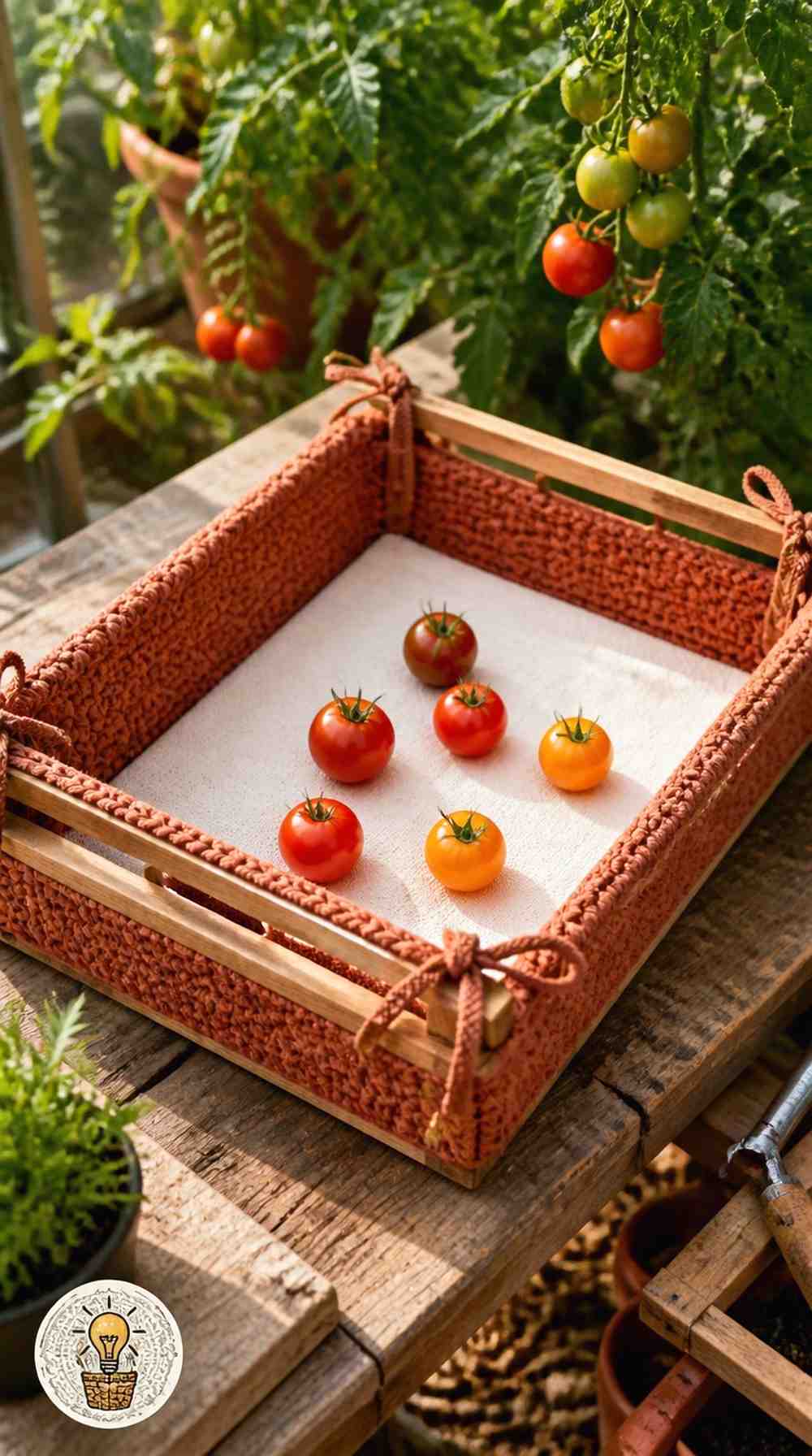
Warm terracotta crochet gives this shallow wooden crate a rustic garden appearance. Diagonal raised stitches cover the interior sidewalls, while dark-rust edging follows the crate’s rectangular shape. Four neatly formed corners and short fabric-backed ties complete the removable liner.
The smooth oatmeal cotton insert supports a small harvest of dry red and golden cherry tomatoes. The crochet stays visible along the crate’s upper edges, adding texture without becoming the direct food-contact layer. The arrangement suits a shallow harvesting crate that already has a sturdy base and carrying structure.
- Rectangular Corners: Measure the crate’s interior length, width, and corner angles rather than assuming all wooden crates have perfectly square corners.
- Dark-Rust Borders: Keep the piping smooth so it follows the wooden rim without forming thick folds.
- Corner Ties: Secure the liner to appropriate upper slats without covering the crate handles or fastening it permanently.
- Tomato Arrangement: Use a shallow layer to avoid unnecessary pressure and bruising during collection.
3. Crochet Oatmeal Oval Strawberry Basket Liner
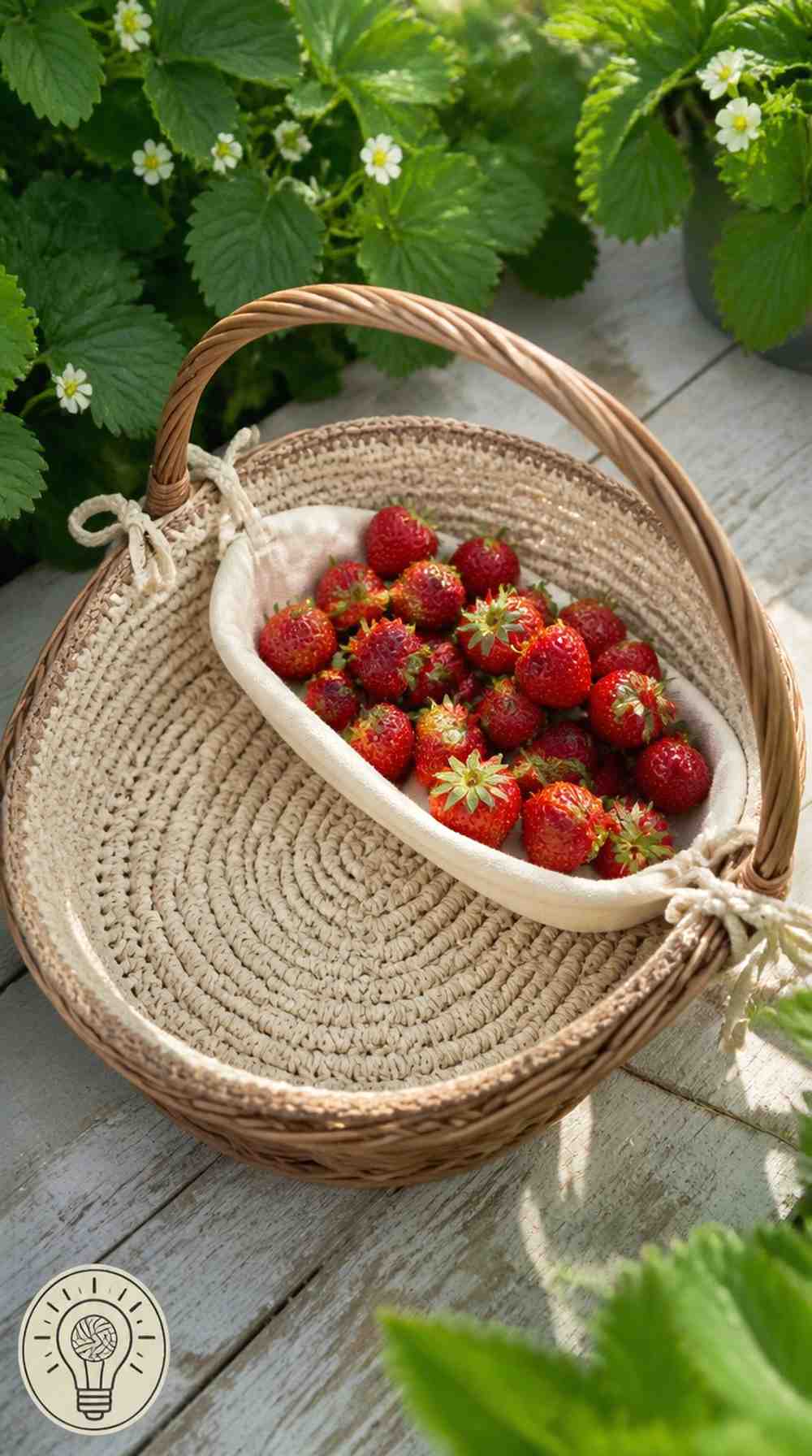
Natural oatmeal crochet creates a delicate liner for a low oval willow basket. Closely worked concentric rounds follow the basket’s elongated bottom, while a short solid sidewall and dark-tan border give the liner a tidy outline.
A separate washable ivory cotton insert supports a small loose layer of dry strawberries. The liner’s shallow shape lets the fruit remain visible without filling the basket too deeply. Strawberries are delicate and perishable, so this concept is best viewed as an attractive collecting or short-term presentation basket rather than a long-term storage solution.
- Oval Base Shaping: Measure the longest and widest parts of the basket floor, including the rounded ends.
- Low Sidewalls: Keep the crochet sides short enough that strawberries are easy to place without pressing against the rim.
- Smooth Fruit Layer: A clean removable fabric insert separates delicate fruit from raised stitches, though it does not prevent bruising.
- Prompt Cooling: Transfer perishable berries to appropriate refrigerated storage soon after harvesting rather than leaving them in a decorative basket.
4. Crochet Mustard Basketweave Harvest Liner
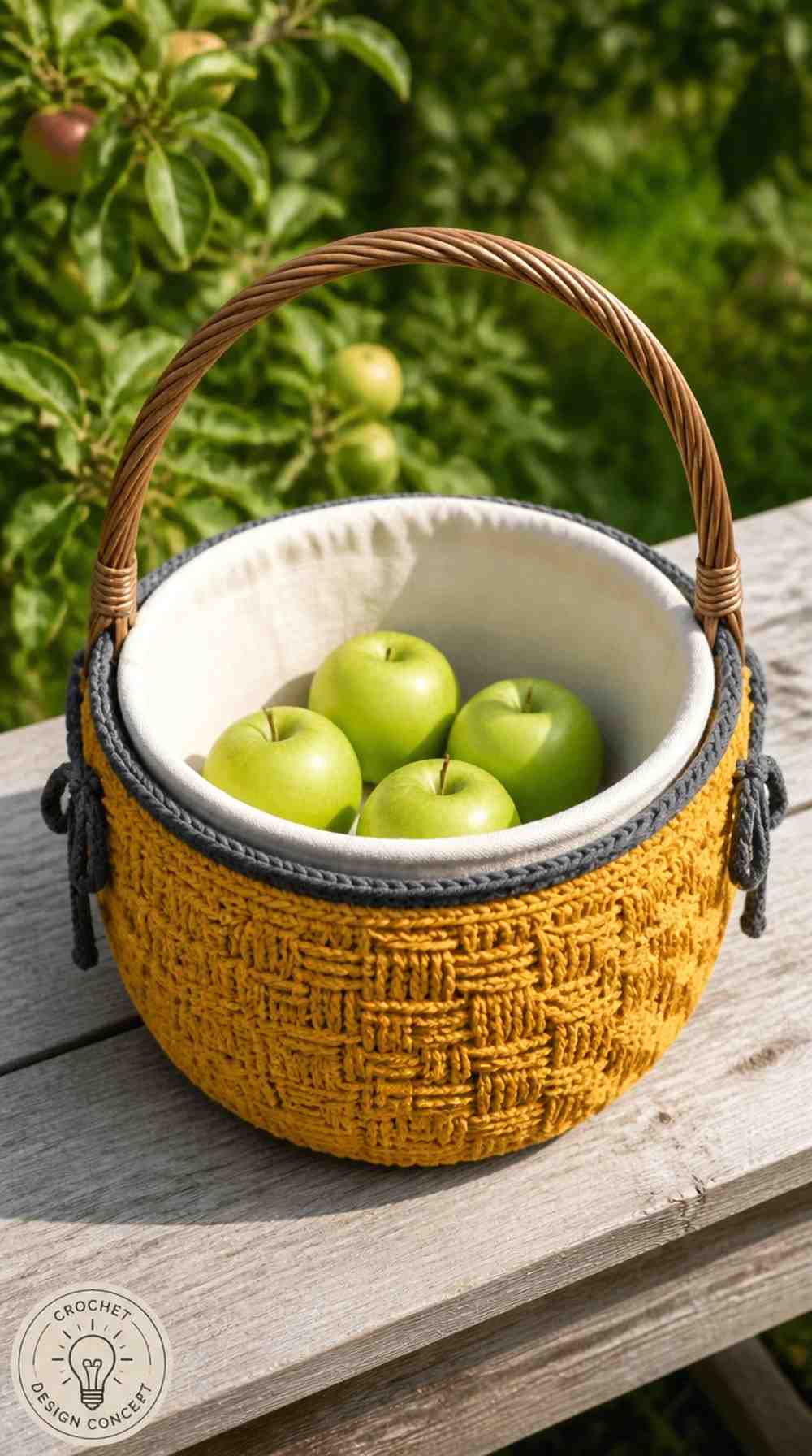
Mustard-yellow crochet creates a bold textured liner inside a deep round wicker basket. Raised basketweave stitch blocks cover the interior walls, while charcoal-grey trim outlines the upper rim. Two short fabric ties keep the crochet aligned beneath the basket handle.
The separate cream cotton insert holds four clean, dry green apples in a loose arrangement. The dark charcoal border contrasts with the yellow crochet and pale wicker, making the liner visually distinctive. Since the basket has more depth than a shallow tray, it is important not to assume that the decorative fabric can safely cushion a heavy pile of fruit.
- Basketweave Texture: Raised stitch blocks add visual thickness, so allow enough space for the cotton insert without making the fit tight.
- Deep Basket Measurements: Check both the base diameter and the wider upper opening if the wicker walls taper.
- Handle Clearance: Keep the mustard lining and its ties below the handle attachments.
- Harvest Weight: The original wicker basket provides the carrying structure; the crochet is not a tested load-bearing layer.
5. Crochet Navy Gingham Bean Basket Liner
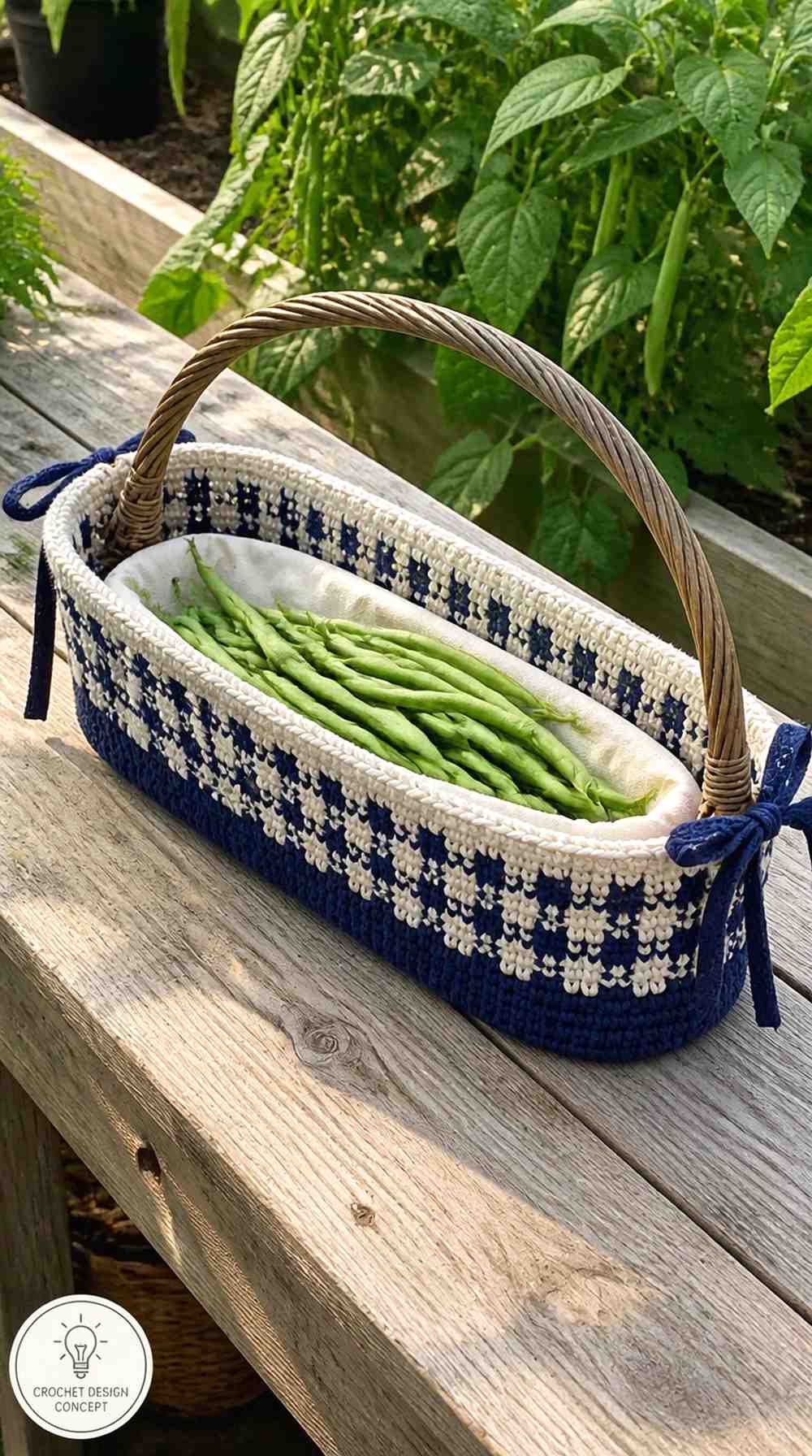
Navy-blue and warm-ivory crochet blocks create a gingham-style liner inside this long oval wicker basket. A solid navy base and narrow ivory upper border frame the pattern, while short navy ties hold the liner at opposite ends.
Dry green beans rest lengthwise on a separate smooth cream cotton layer, making their slender shapes easy to see. The elongated basket is more suitable for this arrangement than a narrow, deep container where pods might fold sharply or become tangled. The gingham colorwork gives an ordinary harvesting basket a classic farmhouse finish.
- Gingham Alignment: Keep the navy and ivory blocks arranged evenly around the long curved sidewalls.
- Long Oval Shape: Measure both basket length and width so the bottom liner lies flat rather than gathering near the ends.
- Bean Handling: Arrange the pods loosely to reduce unnecessary bending and pressure.
- Removable Cotton Layer: Take out and clean the insert after harvesting, especially if moisture or garden debris has collected.
6. Crochet Blush Scalloped Tomato Basket Liner
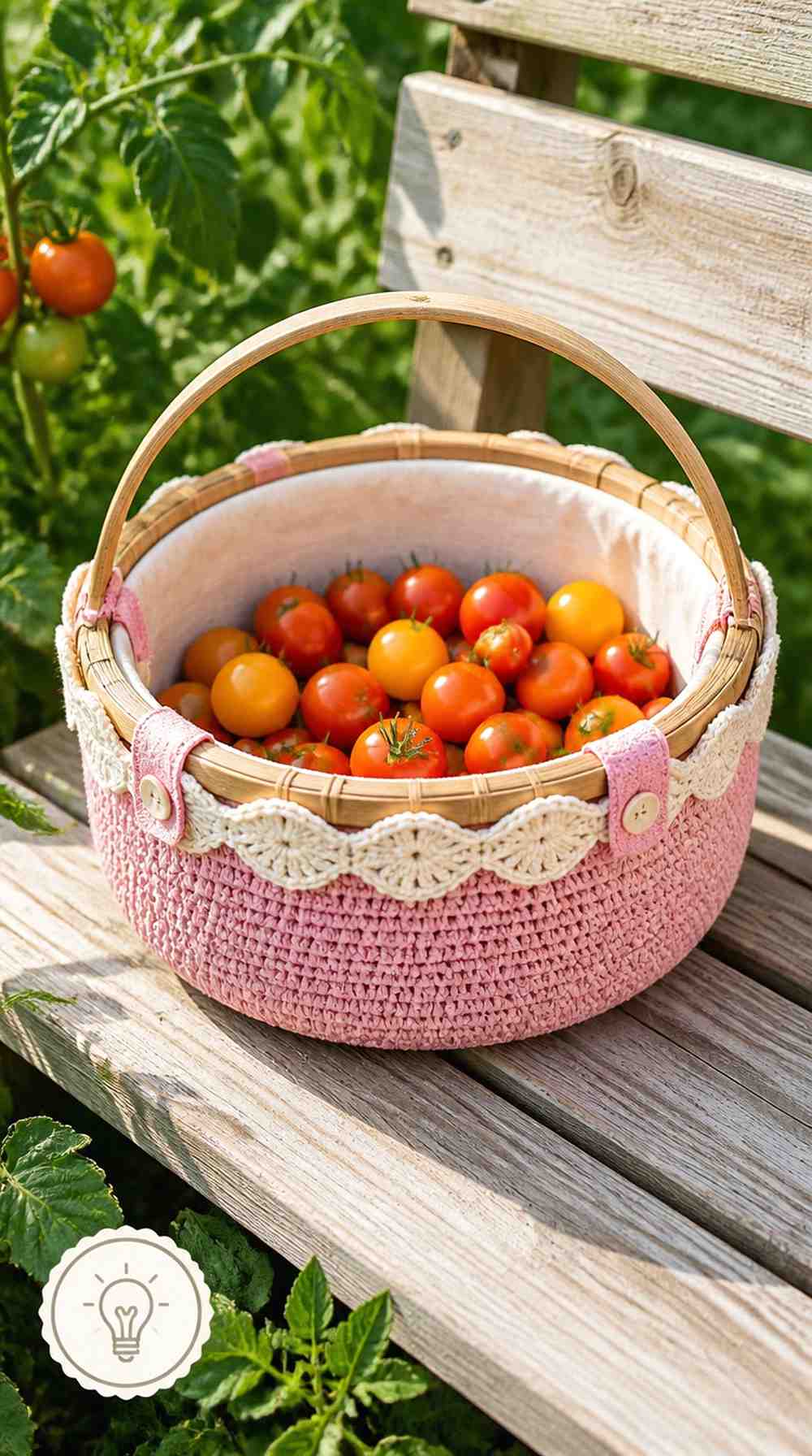
Dusty-blush crochet softens the appearance of this shallow bamboo basket. Closely worked horizontal rows form the liner, while small warm-cream scallops fold over the upper edge. Two short buttoned fabric tabs secure it beneath the rim.
The separate ivory cotton insert supports a loose layer of dry red and yellow cherry tomatoes. Their bright colors stand out against the pale crochet, giving the basket a cheerful cottage-garden look. The shallow sides and modest scallops help keep the opening clear so fruit can be placed gently inside.
- Scalloped Border: Keep the cream shell stitches shallow enough that they lie smoothly over the basket rim.
- Buttoned Tabs: Position the two closures away from the carrying handle and the main interior surface.
- Shallow Harvest Layer: Avoid stacking delicate tomatoes too deeply, as the weight of upper fruit can bruise those underneath.
- Pale Crochet Care: Clean the removable liner when it becomes marked by garden soil or tomato juice.
7. Crochet Olive Lattice Herb Harvest Basket Liner
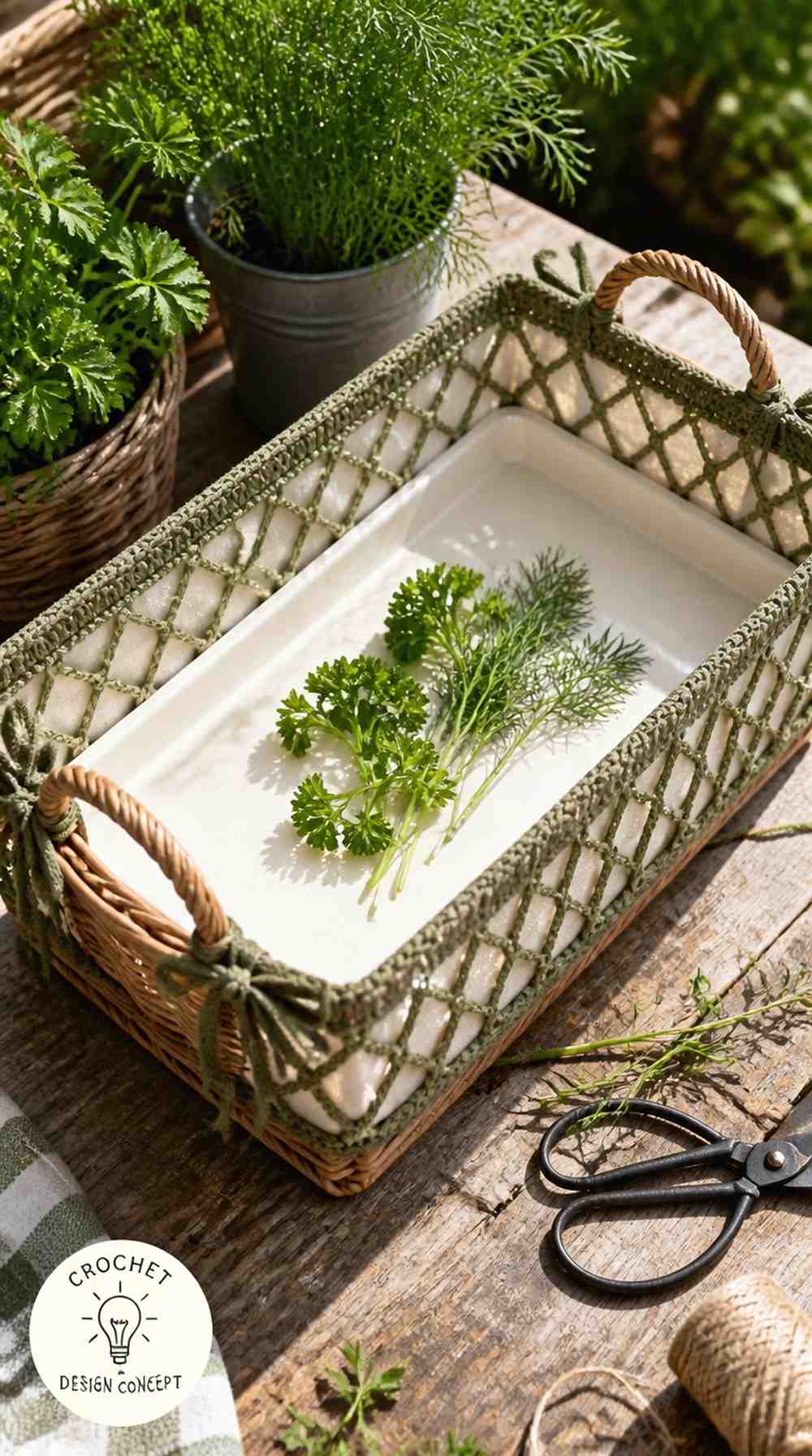
Deep olive-green crochet forms a decorative diamond lattice across the sidewalls of this shallow rectangular herb basket. A solid lower edge and dark-olive rim binding define the shape, while a continuous cream cotton backing shows through the openwork.
A separate clean produce tray sits inside, supporting small sprigs of parsley and dill without direct contact with the crochet. This concept highlights the difference between decoration and food handling: the attractive lattice dresses the basket, while a suitable removable tray supports the harvested herbs.
- Diamond-Lattice Openings: Keep the olive crochet diamonds evenly spaced so the decorative layer follows the rectangular sides neatly.
- Continuous Backing: A smooth cream fabric layer prevents herb stems from catching directly in the open stitches.
- Herb Tray: Use a clean, suitable removable produce-contact container rather than relying on bare crochet as a sanitary surface.
- Short-Term Collection: Move delicate harvested herbs to suitable storage promptly instead of leaving them exposed in a warm garden setting.
8. Crochet Charcoal Copper Fold-Flat Crate Liner
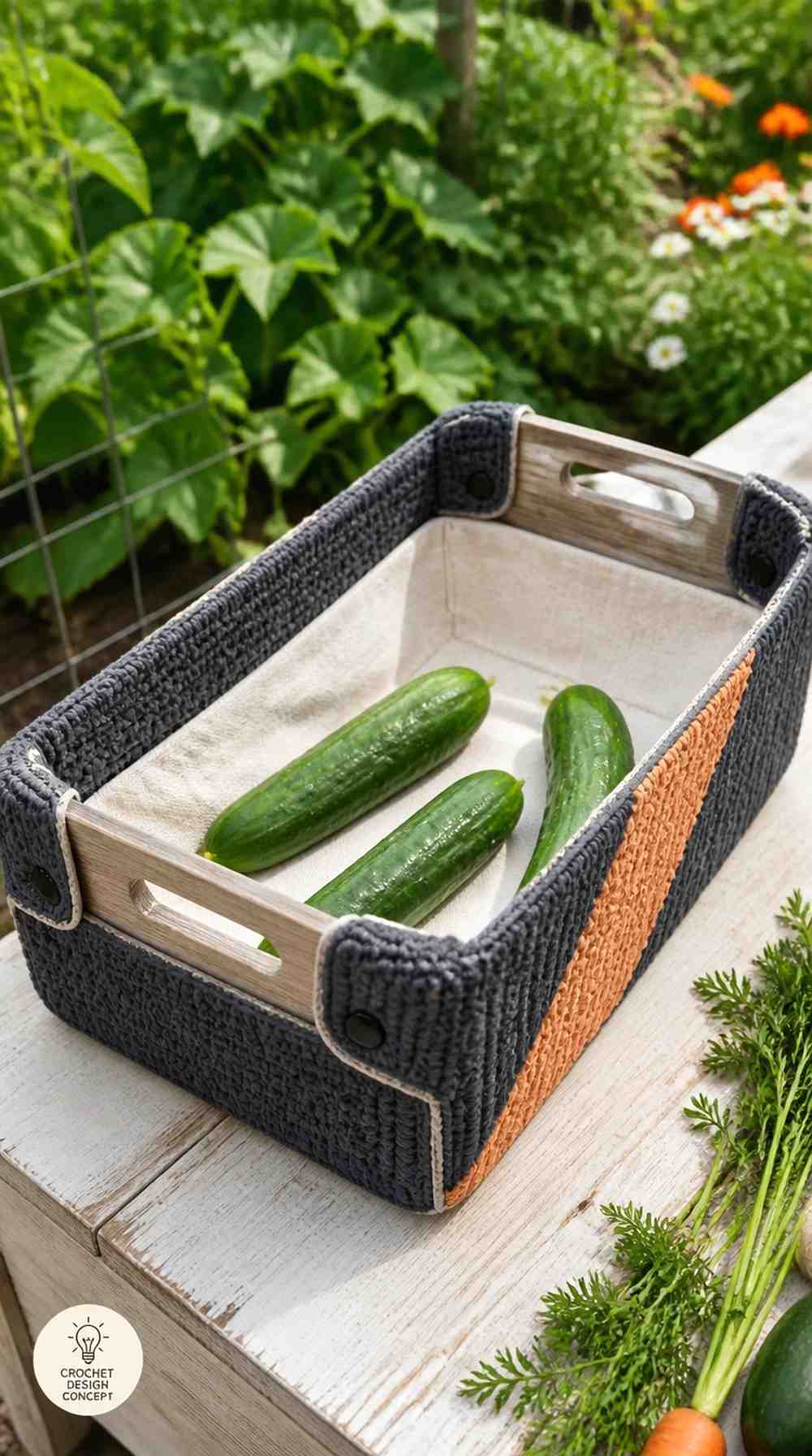
Charcoal-grey crochet gives this shallow wooden harvest crate a modern look. A copper-orange diagonal colorblock crosses one long side, while oatmeal piping frames the liner. Four soft corner tabs fasten with small black snaps, letting the flexible panels fold flat after removal.
A separate cream cotton insert supports three dry cucumbers in a loose row. The liner’s flexible construction is intended to make cleaning and empty storage easier. Unlike a rigid crate insert, it has no hard support boards, so the wooden crate itself continues to provide the shape and strength.
- Foldable Corners: Place the snap tabs where the charcoal panels meet so the liner can open without sharp creases.
- Copper Colorblock: Align the diagonal accent across the long side where it remains visible above the crate wall.
- Flat Storage: Remove the liner and allow it to dry completely before folding it away.
- Cucumber Fit: Choose a crate long enough to hold the vegetables without pressing their ends into the sidewalls.
9. Crochet Granny Square Vegetable Harvest Liner
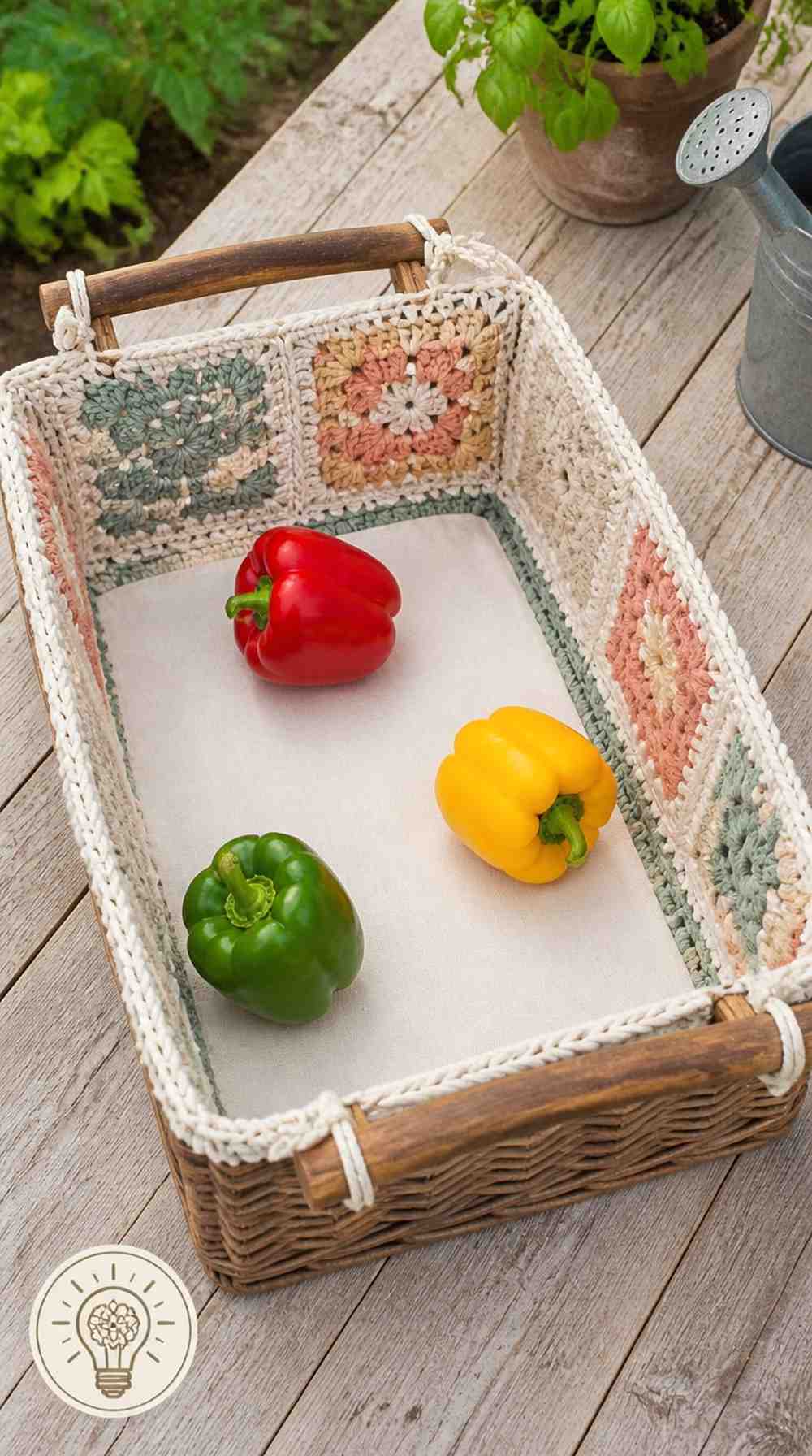
Six granny-square motifs bring oatmeal, dusty sage, muted peach, and warm cream into this rectangular wicker basket. Flat cream seams connect the motifs around the sides, while a solid sage crochet base and cream upper edging finish the liner.
A separate ivory cotton insert supports three clean, dry bell peppers in red, yellow, and green. Their colors complement the patchwork while keeping the practical harvest arrangement simple. The granny-square gaps are decorative, so the continuous inner fabric remains important for separating the peppers from loose yarn loops.
- Six-Motif Arrangement: Plan the granny-square dimensions around the interior wall measurements before joining the panels.
- Flat Joining Seams: Keep the cream joins smooth to reduce bulky ridges beneath the separate cotton insert.
- Four Corner Ties: Secure the liner without blocking the wicker basket’s wooden carrying handles.
- Mixed Pepper Harvest: Place the peppers loosely in one layer so their stems and surfaces do not snag against the basket or crochet.
10. Crochet Lavender Divided Pea Harvest Basket Liner
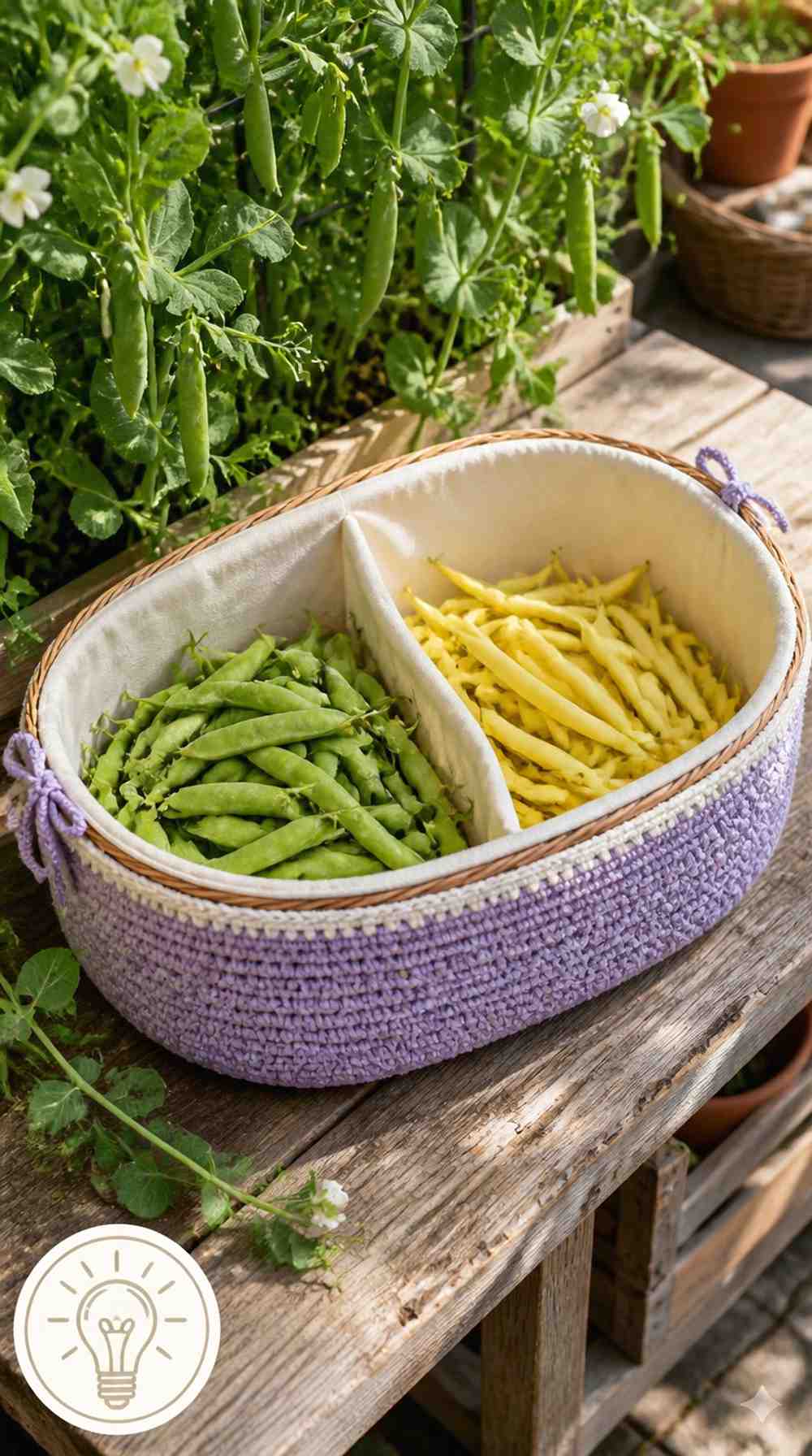
Soft lavender crochet creates a neatly fitted liner with dense horizontal rows and warm-cream upper edging. Two small lavender ties secure it inside a wide oval wicker basket, while a separate ivory cotton insert contains a gentle central partition.
Fresh dry pea pods sit loosely on one side, with yellow wax beans arranged in the other compartment. The soft divider makes it easier to collect two small crops without mixing them. It is an organizing feature rather than a special preservation system, so both harvests still need appropriate handling afterward.
- Two Harvest Sections: Divide the basket according to the actual amount of peas and beans instead of creating equal spaces automatically.
- Soft Cotton Divider: A flexible partition separates the crops without the hard edges of a rigid container.
- Lavender Crochet Rows: Keep the sidewall stitches even so the liner follows the oval basket without twisting.
- Post-Harvest Care: Transfer both crops to suitable storage promptly and clean the removable fabric after use.
11. Crochet Denim Snap-On Zucchini Basket Liner
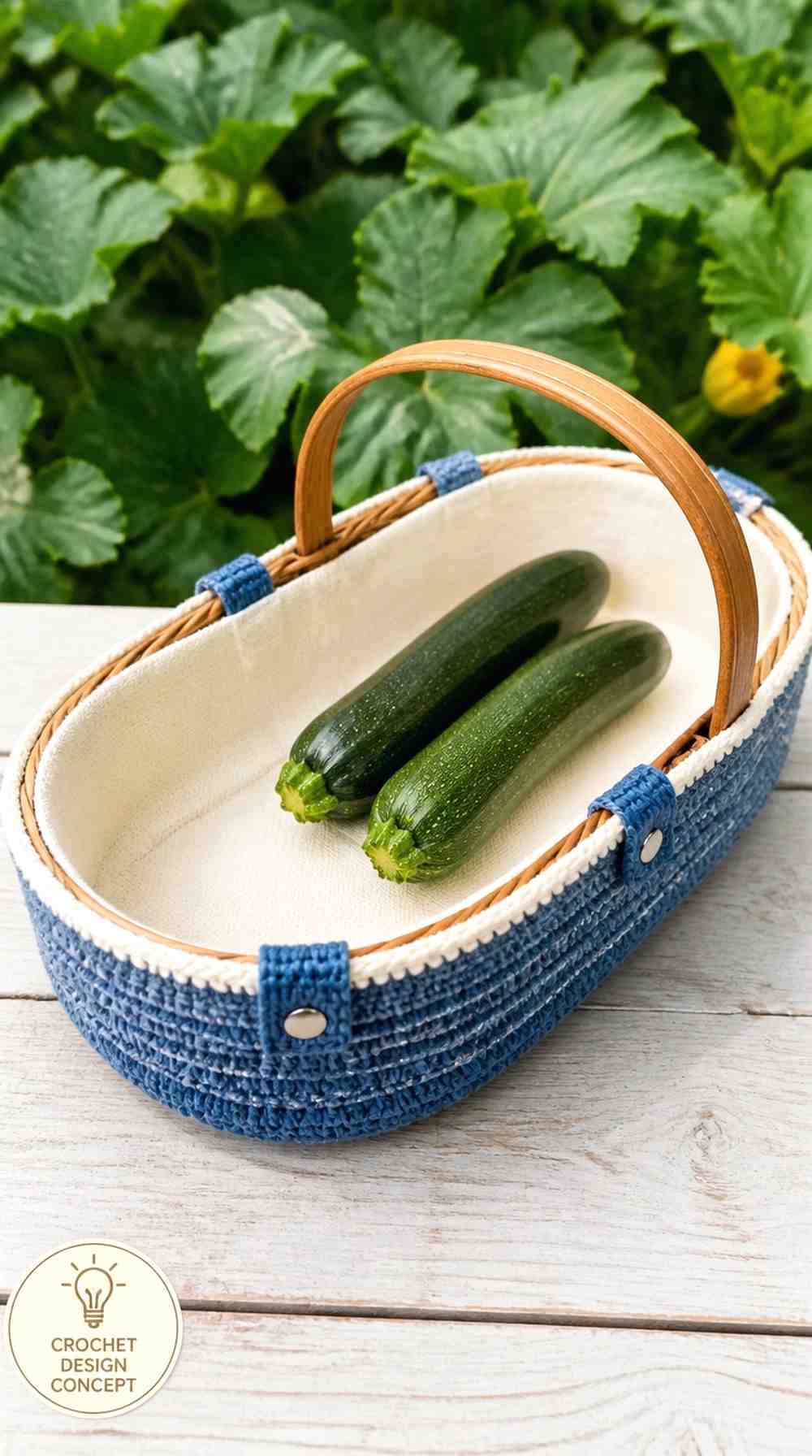
Denim-blue crochet gives this oval willow basket a practical, understated finish. Closely worked horizontal ridges cover the sides, while warm-ivory piping follows the rim. Four short denim snap tabs attach the liner at spaced points around the basket.
A smooth removable cream cotton layer supports two small dry zucchinis arranged lengthwise. The snap-on construction makes the crochet easy to remove from the wicker without undoing ties. Its main advantage is the clear separation between a decorative fitted liner and the basket’s existing carrying structure.
- Four Snap Tabs: Space the tabs evenly and check that their backing does not scratch the wicker or interfere with the handle.
- Oval Fitting: Measure the basket’s curved ends and wall height so the denim liner lies smoothly.
- Zucchini Placement: Arrange the vegetables lengthwise without pressing them into the rim or overloading the basket.
- Cleaning Access: Detach the crochet and cotton layer completely after harvesting to remove ordinary soil and moisture.
12. Crochet Coral Layered Peach Harvest Liner
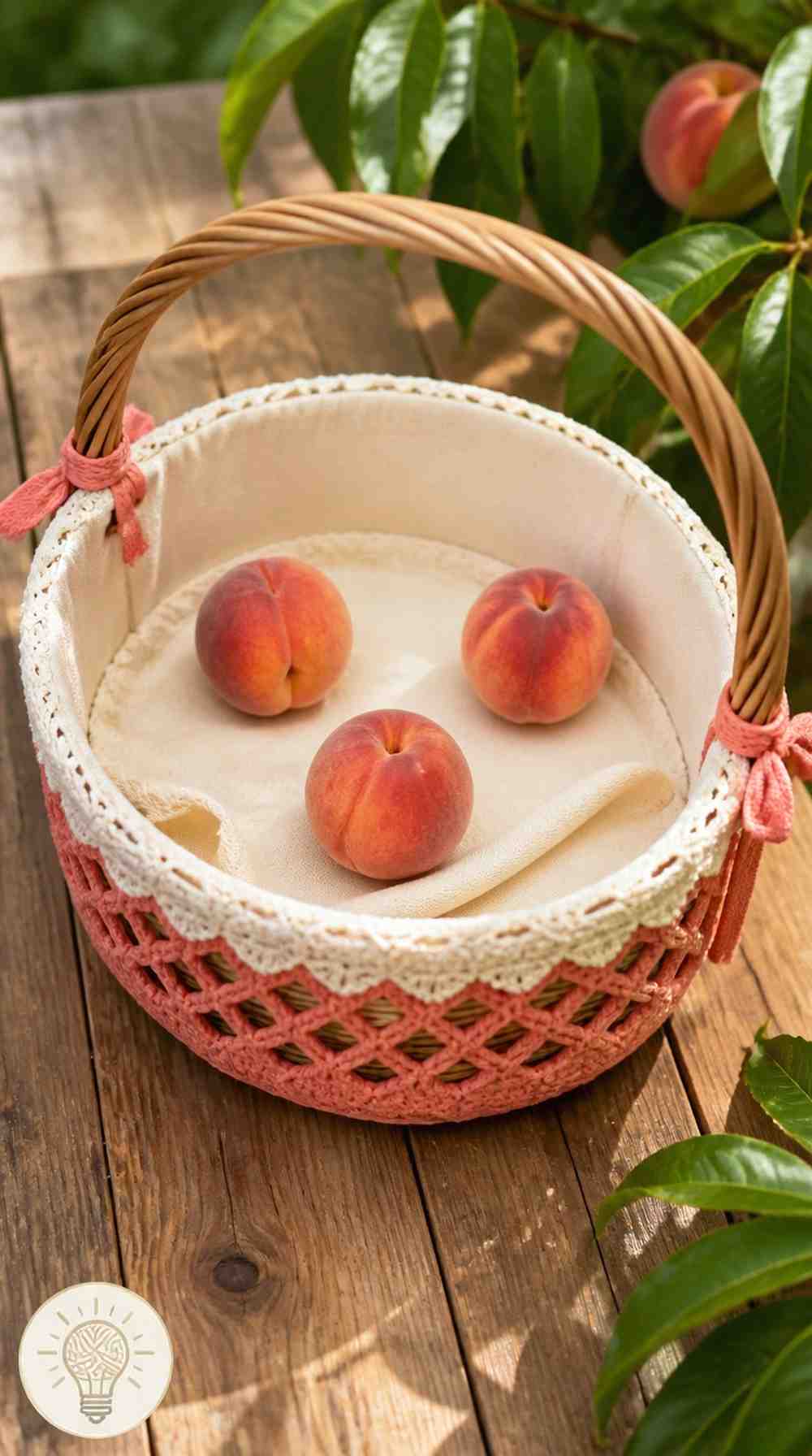
Coral-pink crochet forms an airy diamond-lattice liner around a shallow round wicker basket. Its solid lower base and cream upper border define the shape, while a continuous ivory cotton insert and a second smooth fabric layer cover the inner surface.
Three dry peaches rest apart from one another without being stacked. The layered design is attractive, especially with the cream fabric showing through the coral lattice, but even multiple soft layers cannot guarantee protection against bruising. Gentle handling and prompt appropriate storage remain essential.
- Coral Lattice: Keep the diamond openings even and securely joined to the solid lower section.
- Two Fabric Layers: Make both cream layers removable so trapped debris can be cleaned away after harvesting.
- Peach Spacing: Use a shallow single layer rather than pressing delicate fruit together.
- Practical Limitation: The decorative liner cannot substitute for careful harvesting or proper temperature and moisture management.
13. Crochet Teal Tapered Pear Basket Liner
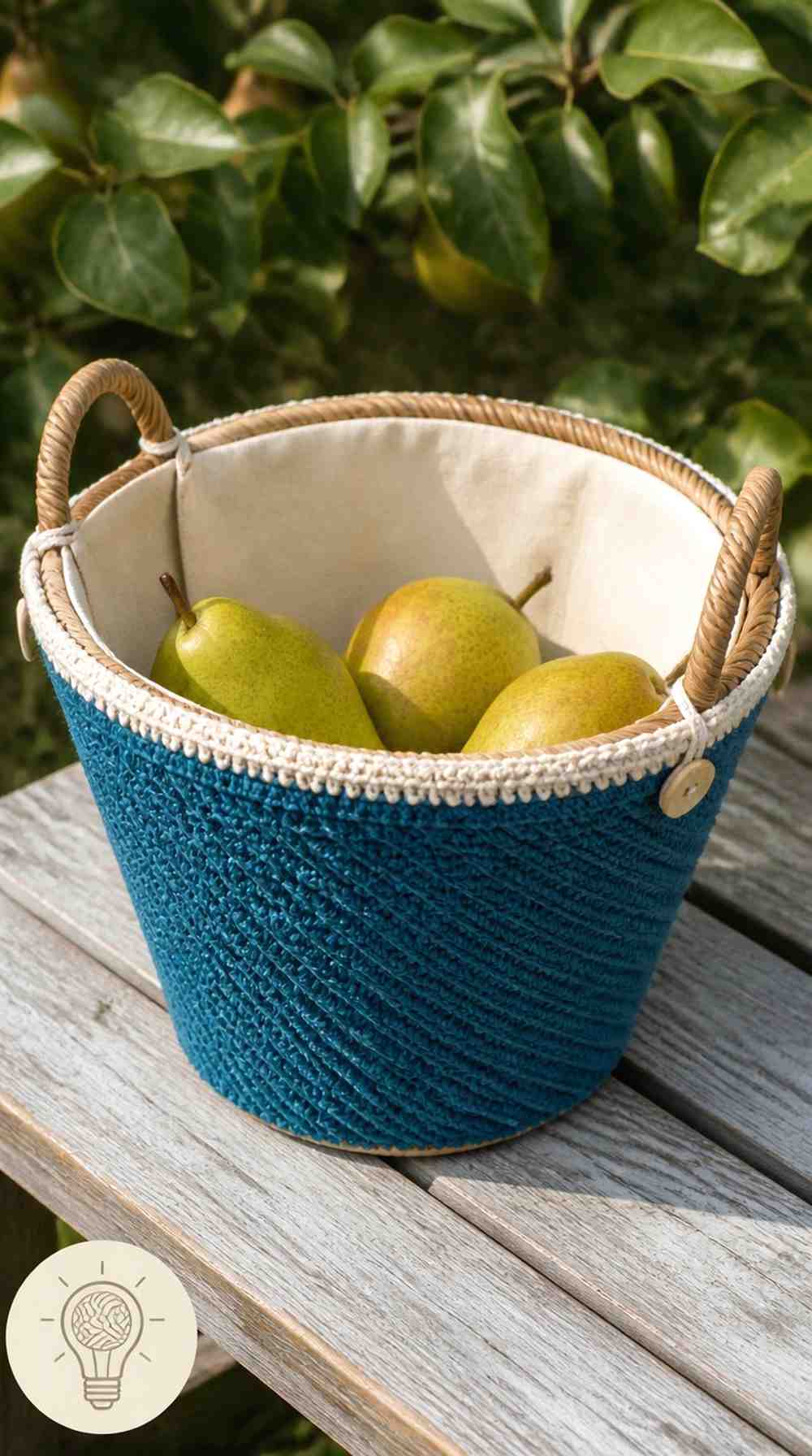
Teal-blue crochet brings a fresh color to this tapered round wicker basket. Closely worked diagonal ribs follow the sidewalls, which are wider at the rim and narrower toward the flat bottom. Warm-ivory edging and small cream button loops keep the liner neatly positioned.
A separate smooth cotton insert supports three firm, clean, dry pears lying loosely on their sides. The tailored crochet shape is the distinctive feature. Unlike a straight cylindrical liner, it follows the actual basket taper and avoids excess fabric collecting around the bottom.
- Tapered Measurements: Measure the bottom diameter, upper opening, and sidewall height to plan the changing width correctly.
- Diagonal Ribbing: Adjust the stitch layout so the ribs remain consistent as the liner widens toward the rim.
- Button Loops: Position the attachments beneath the handles without pulling the crochet tightly against the wicker.
- Pear Placement: Keep the fruit loosely arranged and avoid stacking it beneath heavier items.
14. Crochet Ivory Sunflower Pepper Basket Liner
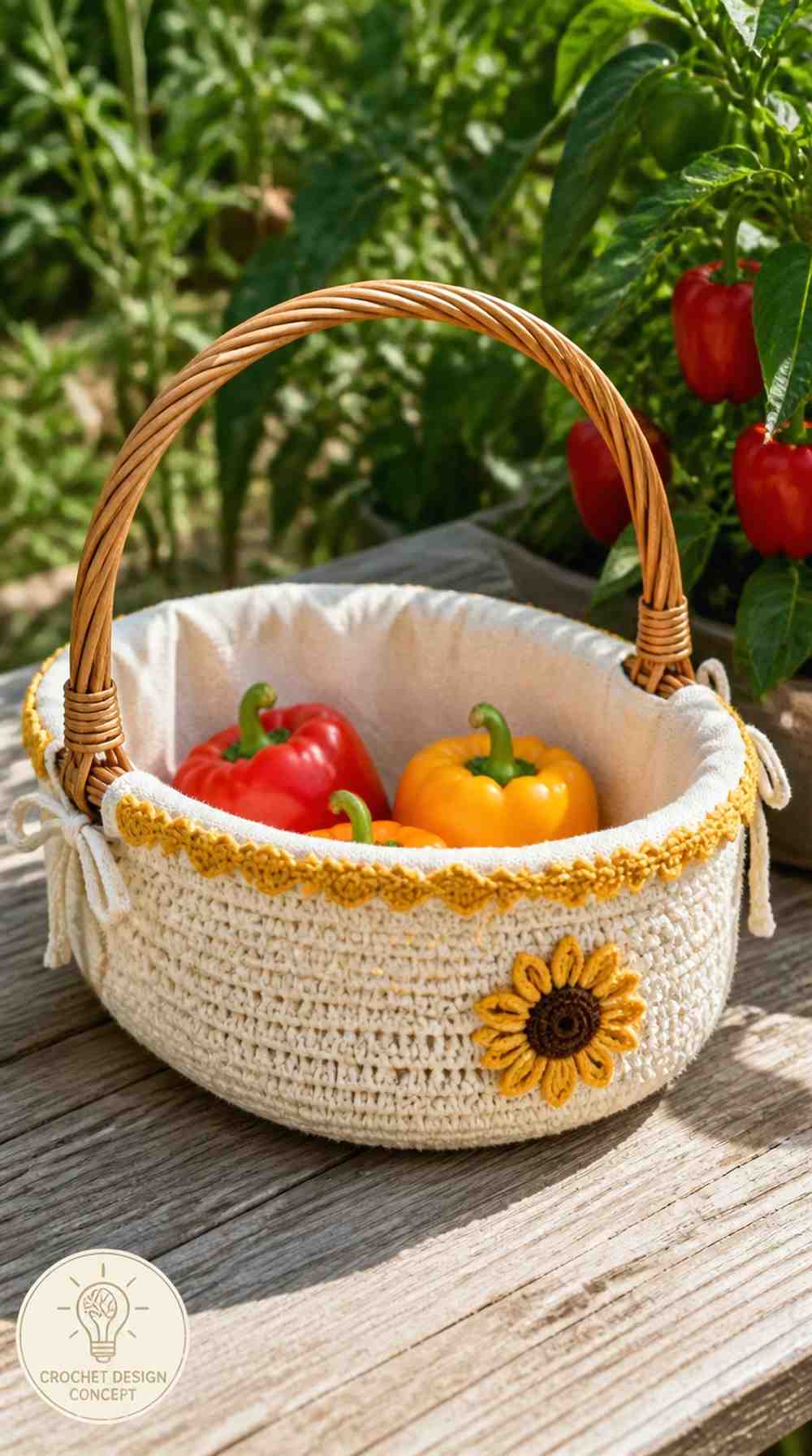
Warm-ivory crochet creates a soft cottage-inspired liner with dense textured rows and a muted-mustard scalloped edge. One small golden-yellow sunflower decorates the outer folded rim, complete with flat petals and a dark-brown stitched center.
Inside the shallow oval willow basket, a removable cream cotton insert holds red, orange, and yellow peppers. The sunflower faces outward, staying separate from the vegetables. This gives the harvest basket a cheerful decorative accent without introducing loose ornaments directly into the food-contact area.
- Sunflower Position: Keep the appliqué flat on the outside of the rim so it cannot catch on pepper stems.
- Mustard Scallops: Use small, closely spaced shells that stay neat around the basket’s oval opening.
- Cream Cotton Insert: A removable lining separates the peppers from textured stitches and makes cleaning easier.
- Pale Yarn Care: Ivory crochet may show staining quickly, so remove it promptly if produce juice or garden soil reaches the fabric.
15. Crochet Rust Chevron Root Vegetable Crate Liner
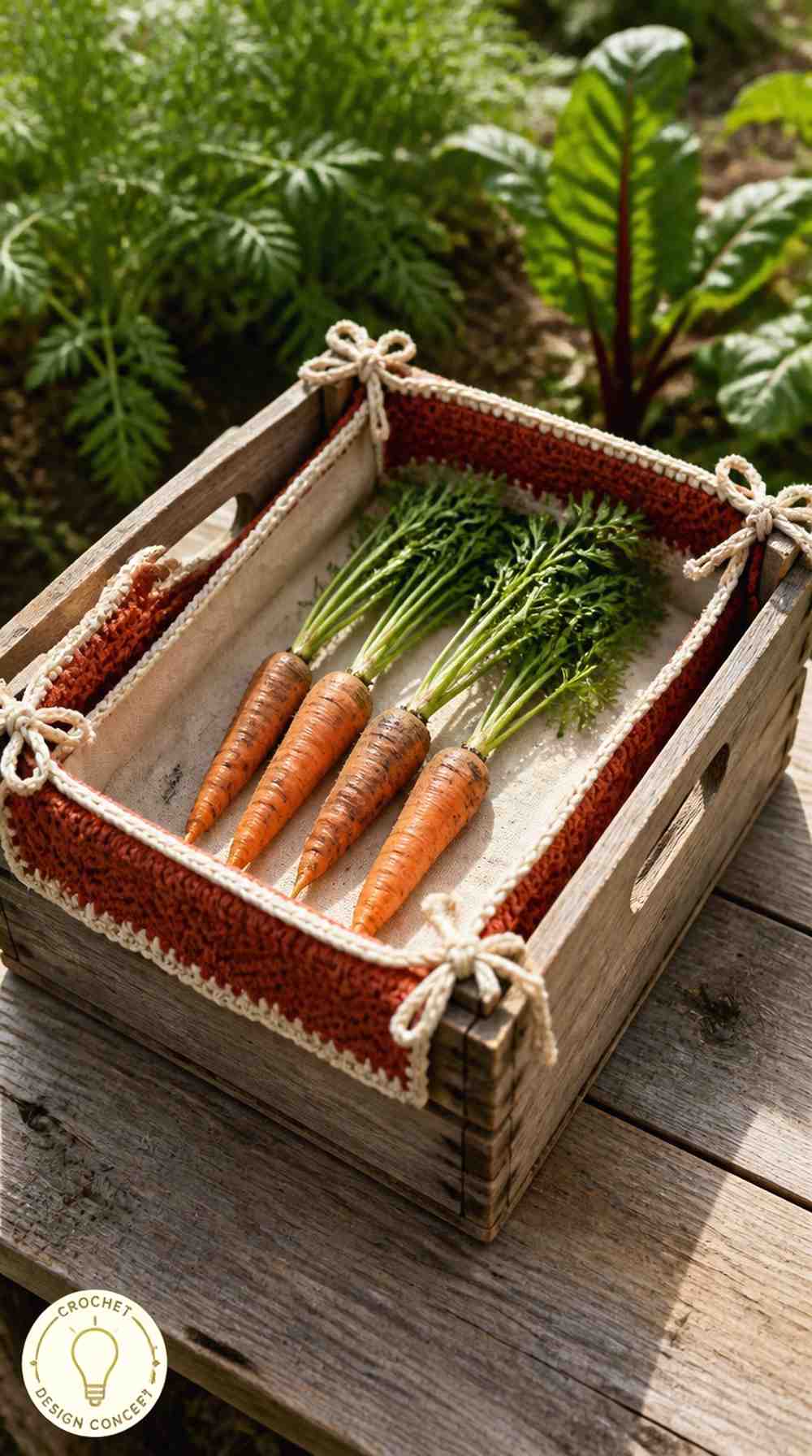
Copper-rust and oatmeal chevrons give this rectangular wooden crate a bold harvest-season appearance. A flat crocheted base meets short dark-rust sidewalls, with cream corner edging and four short removable ties securing the liner.
A separate beige cotton tray liner supports four freshly harvested carrots that have been carefully dry-brushed to remove loose soil. The crate’s slatted wooden sides remain visible above the crochet. The design explores the challenge of using a handmade liner for root vegetables, which often arrive with more soil and debris than orchard fruit.
- Chevron Alignment: Keep the rust-and-oatmeal zigzags even across the flat bottom so the pattern remains recognizable.
- Short Sidewalls: The lower crochet height suits a shallow crate without covering its carrying cutouts.
- Root Vegetable Debris: Brush off loose soil outdoors where appropriate, and keep muddy or wet roots away from decorative crochet.
- Separate Washable Tray: Remove the beige fabric insert after harvest and clean it according to its material and contamination.
16. Crochet Plum Lift-Out Greens Basket Liner
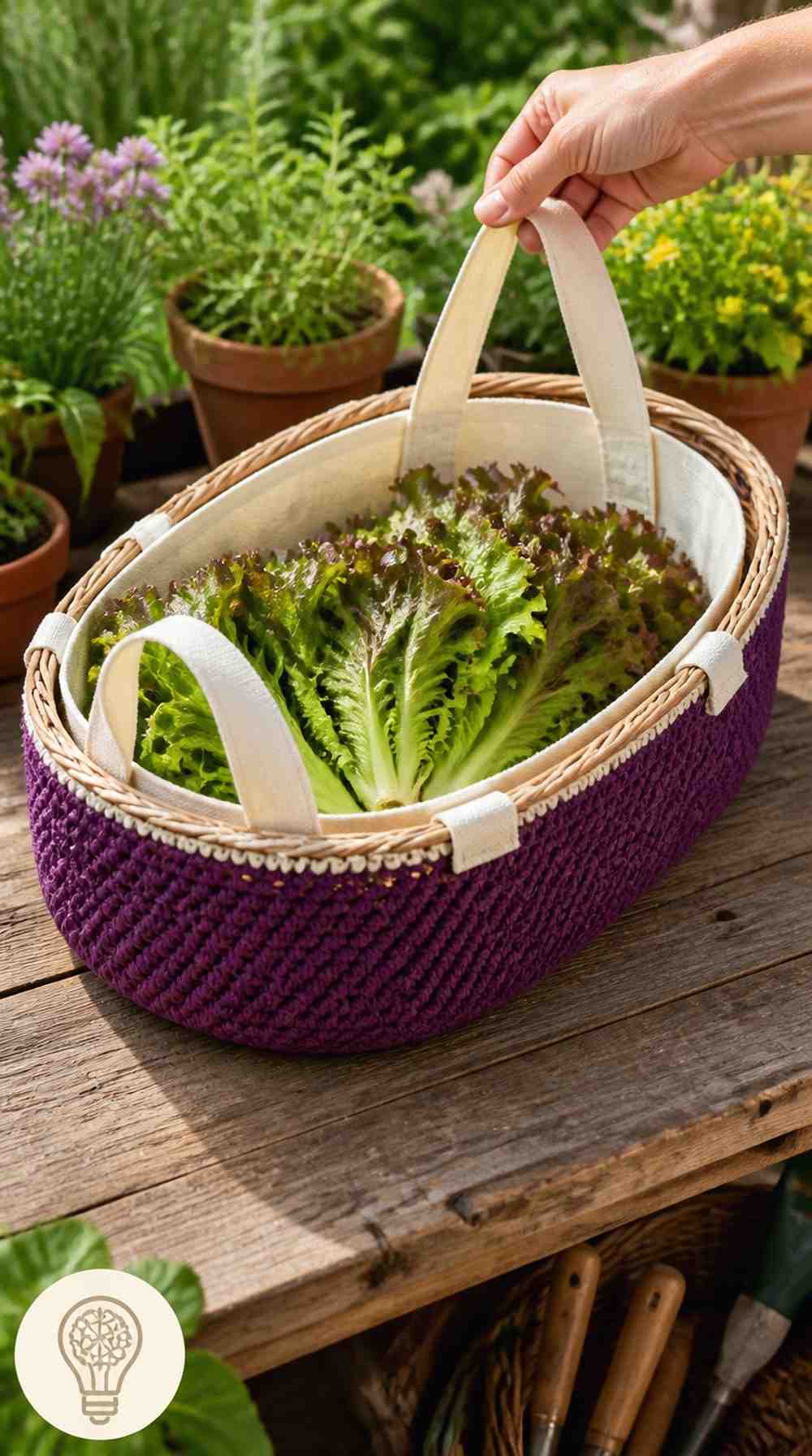
Deep plum-purple crochet creates a distinctive oval basket liner with fine diagonal ridges and oatmeal edging. Four cream fastening tabs secure it along the wicker rim, while a completely separate washable cotton produce tray sits inside.
The inner tray contains a small loose bundle of dry lettuce leaves, with broad fabric handles positioned for lifting. The illustrated lifting arrangement demonstrates separation between the decorative crochet and the produce-contact layer. Both the tray’s support and the weight being lifted would need testing before actual use, and leafy greens should be moved promptly to suitable refrigerated storage.
- Separate Inner Tray: Keep the cream cotton produce-contact component fully removable from the plum crochet.
- Fabric Lifting Handles: Reinforce the broad handles and avoid lifting heavy produce until the completed tray’s capacity has been checked.
- Diagonal Crochet Texture: Fine raised rows decorate the basket sides without interfering with the rim tabs.
- Leafy Green Handling: Harvest gently, avoid bruising the leaves, and refrigerate perishable greens promptly.
17. Crochet Seafoam Corner-Tie Harvest Crate Liner
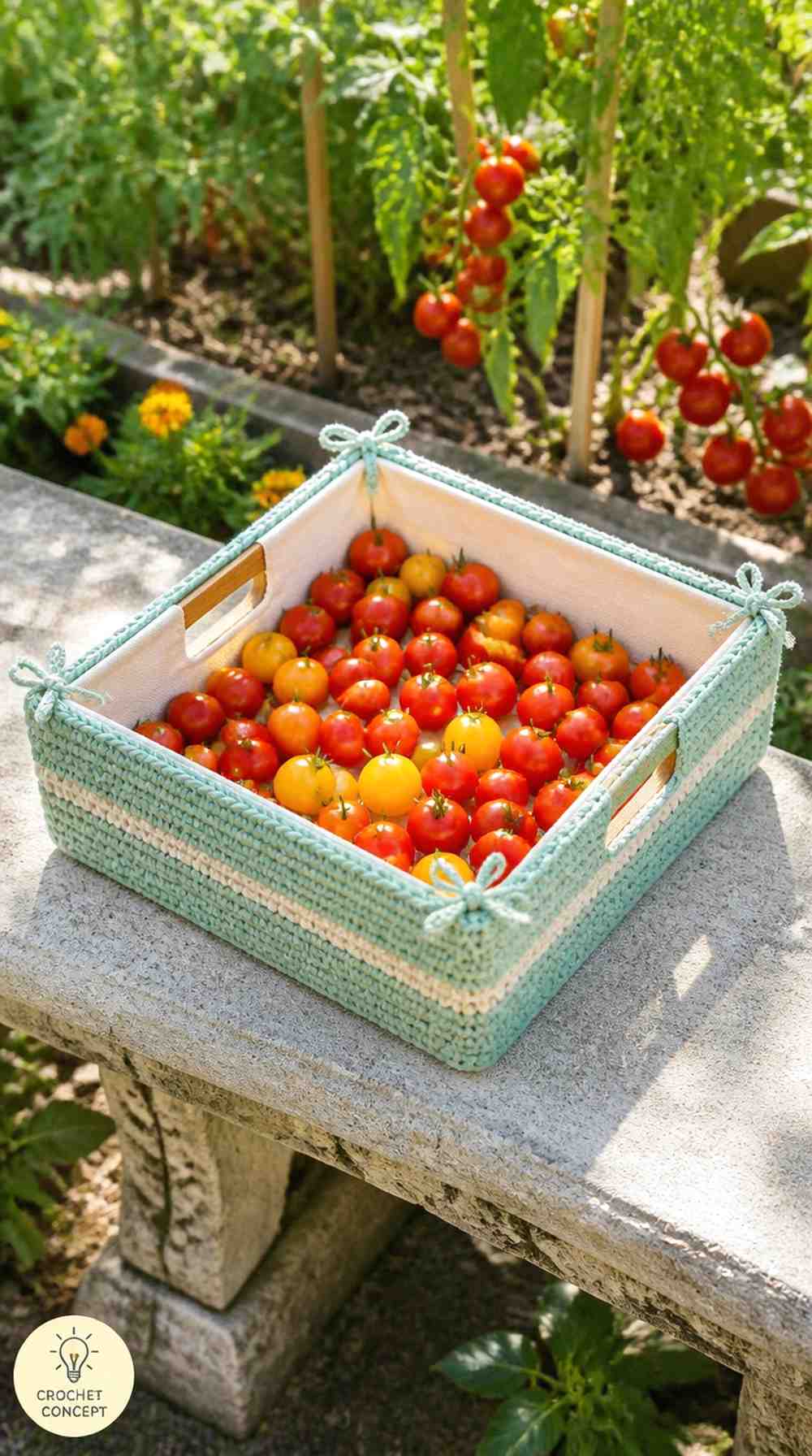
Seafoam-green crochet forms a fitted liner for a shallow square wooden crate. Concentric square rounds cover the bottom, while two thin ivory accent bands frame the outer area. Four short seafoam ties secure the corners.
A separate ivory cotton insert holds a loose single layer of clean, dry red and yellow cherry tomatoes. The crate’s side carrying cutouts remain unobstructed, and the neat square crochet construction is visible beneath the insert and along the sides. This is a useful concept for a small harvest crate that is more square than rectangular.
- Square Base Rounds: Work the crochet corners evenly so the panel lies flat instead of developing pointed or wavy edges.
- Ivory Accent Bands: Keep the cream rings consistent around all four sides for a balanced geometric finish.
- Four Corner Ties: Attach the liner without placing knots over the crate’s carrying cutouts.
- Tomato Storage: Keep the tomatoes in a loose layer and transfer them to suitable storage after collecting rather than leaving them in a hot garden crate.
Practical Guide to Crochet Garden Harvest Basket Liners
A crochet basket liner should fit the basket neatly, remain easy to remove, and allow the harvested produce to be handled appropriately. The decorative yarn can add texture and color, but a clean, washable inner fabric or suitable produce-contact container is a better choice where fruit and vegetables need support.
| What to check | Practical guidance |
|---|---|
| Basket shape | Identify whether the basket is round, oval, rectangular, square, or tapered. |
| Interior measurements | Measure the bottom dimensions, sidewall height, and upper rim before planning the crochet. |
| Crochet fit | The liner should follow the basket without bunching heavily around corners or pulling tightly against the rim. |
| Removable attachments | Short ties, button loops, and fabric tabs allow removal without permanently attaching crochet to the basket. |
| Direct food contact | Do not assume decorative yarn or handmade crochet is suitable for direct contact with fresh produce. Use a suitable clean removable inner layer. |
| Harvest weight | The original wicker basket or crate must provide the carrying strength; untested crochet should not support heavy produce. |
| Delicate crops | Keep berries, peaches, tomatoes, and leafy greens in shallow arrangements to limit unnecessary crushing. |
| Garden soil | Remove excess loose dirt where appropriate and prevent muddy or wet produce from soaking the decorative crochet. |
| Washing | Remove the crochet and cotton insert after use and clean them according to the selected materials and degree of soiling. |
| Storage | Dry the liner completely before putting it away, and keep harvest containers in a clean, dry location. |
How to choose the right liner shape
Start with the basket you already own. A round wicker basket needs a different base shape from a long oval bean basket or a square wooden crate.
For a round basket, concentric crochet rounds can help create a flat base. An oval basket needs gradual shaping at its curved ends. Rectangular crates benefit from clearly formed corners, while tapered baskets require sidewalls that widen gradually toward the rim.
Before crocheting, make a simple paper template of the basket bottom. Use that to check the size, then measure the wall height and any space needed for the folded upper edging.
Avoid placing thick knots or bulky fasteners where the carrying handle joins the basket.
Handle harvested produce safely
Freshly harvested fruits and vegetables may carry soil and microorganisms. Keep the basket and any inner produce-contact layer clean, and avoid transferring dirt from one harvest to another.
University of Maine Cooperative Extension advises removing excess garden soil from certain produce before storage and provides different handling recommendations for different crops. It also recommends promptly refrigerating perishable items such as berries and leafy greens.
University of Maine Cooperative Extension
The FDA recommends washing produce under running water before preparing or eating it, without using soap or detergent. Washed produce should be dried with a clean cloth or paper towel.
FDA
For a harvest basket liner, that means:
- Use it mainly for collecting, carrying, or short-term presentation rather than assuming it is appropriate for long-term storage.
- Keep a removable suitable fabric or produce tray between the food and decorative crochet.
- Clean the liner after muddy, damp, or messy harvests, and let it dry completely.
- Transfer perishable produce to suitable storage without unnecessary delay.
Remember that different crops need different post-harvest conditions. A decorative basket does not replace proper refrigeration, ventilation, humidity control, or produce sanitation.
For more decorative basket edging, explore 22 Crochet Scalloped Rattan Basket Liner Inspiration Ideas for Warm Boho Interiors on Yarn Nest Studio. That collection focuses on decorative indoor basket liners, while these garden concepts concentrate on removable layers, harvesting access, and crop-specific handling.
Want to Make Something Similar?
These 17 designs are original AI-generated inspiration concepts, not tested harvest-basket liner patterns. The following published crochet patterns demonstrate related basket-lining techniques.
- Free Easy Bernat Basket Lining Crochet Pattern by Yarnspirations — A free pattern for crocheting a liner to fit a round basket, using cotton yarn. It provides a useful construction reference for the sage, mustard, and seafoam round-liner concepts, although it is not intended as a tested food-contact harvest liner. Yarnspirations
- Free Bernat Gingham Bushel Basket Liner Pattern by Yarnspirations — A free decorative basket-liner pattern that may help with planning gingham colorwork for the navy bean-basket idea. The published pattern is for home decor, not a sanitary produce-handling system. Yarnspirations
Neither resource reproduces these exact visualized designs. A real garden version needs its own basket measurements, suitable inner fabric or tray, removable fastening method, and cleaning plan.
Which Crochet Garden Harvest Basket Liner Should You Choose?
For an everyday round basket, Crochet Sage Ribbed Apple Harvest Basket Liner offers a simple starting point. Its vertical ribs and narrow edging suit a traditional wicker shape. Crochet Mustard Basketweave Harvest Liner provides a more textured alternative for a deeper round basket.
For shallow delicate-fruit baskets, compare Crochet Oatmeal Oval Strawberry Basket Liner, Crochet Blush Scalloped Tomato Basket Liner, and Crochet Coral Layered Peach Harvest Liner. Each uses a low profile, but the oatmeal version emphasizes a fitted oval base, the blush design adds decorative shells, and the coral concept explores layered fabric separation.
If your harvest basket is rectangular, Crochet Terracotta Rectangular Harvest Crate Liner and Crochet Charcoal Copper Fold-Flat Crate Liner offer different construction ideas. The terracotta version has formed corners and ties, while the charcoal liner can fold flat when removed.
For long, slender crops, Crochet Navy Gingham Bean Basket Liner makes use of an elongated basket shape. Crochet Denim Snap-On Zucchini Basket Liner is another oval option, with removable tabs instead of ties.
If you prefer colorful crochet, Crochet Granny Square Vegetable Harvest Liner brings patchwork to a rectangular basket, while Crochet Ivory Sunflower Pepper Basket Liner adds one flat floral accent to a cream liner.
For smaller mixed harvests, Crochet Lavender Divided Pea Harvest Basket Liner offers two soft compartments. Crochet Olive Lattice Herb Harvest Basket Liner uses decorative openwork with a separate produce tray, making the fabric layers more obvious.
For baskets with unusual shapes, Crochet Teal Tapered Pear Basket Liner follows a gradually widening round sidewall, and Crochet Seafoam Corner-Tie Harvest Crate Liner suits a shallow square crate.
The Crochet Rust Chevron Root Vegetable Crate Liner is especially relevant to the challenge of collecting produce that may carry garden soil. Its removable tray is more important than the decorative zigzag surface.
Finally, Crochet Plum Lift-Out Greens Basket Liner explores a separate handled fabric tray for leafy vegetables. Its lifting function would need real-world testing, and the greens still require prompt suitable storage.
Conclusion
Crochet garden harvest basket liners can add beautiful handmade color and texture to everyday gardening. These 17 ideas explore different basket shapes, crochet stitches, rim attachments, washable inner layers, and decorative finishes, from sage ribbing and terracotta corners to granny squares and sunflower edging.
The most useful design should match the basket’s actual shape and stay easy to remove. Keep the decorative crochet separate from produce-contact surfaces, clean the liner after harvesting, and handle each crop according to its storage needs.
Which design would you choose for your garden? Would you prefer the sage apple basket liner, the colorful granny-square vegetable liner, or the ivory sunflower pepper basket? Share your favorite and what you usually harvest from your garden.
Frequently Asked Questions
1. Can I use a crochet liner directly against freshly harvested vegetables?
Do not assume ordinary crochet yarn is suitable for direct food contact. Yarn may retain dirt, shed fibers, or be difficult to clean thoroughly between harvests. A separate clean, washable, suitable produce-contact fabric or tray is a better approach. The crochet can remain a decorative layer around the basket.
2. What yarn should I consider for a crochet garden harvest basket liner?
Smooth cotton or an appropriate washable cotton blend may be worth considering because it can provide defined stitches and manageable cleaning. The actual choice depends on the basket shape, stitch density, washing instructions, and how the liner will be used. Decorative yarn is not automatically food-safe, waterproof, or resistant to garden contamination.
3. How do I make a crochet liner fit a wicker basket?
Measure the basket’s interior bottom, wall height, upper circumference, and any tapered or curved sections. A paper template can help with the base shape. Allow the crochet to follow the basket without pulling tightly, and plan removable ties or tabs that stay clear of handles. Wash and reshape the finished liner according to the selected yarn’s care instructions.
4. Can a crochet harvest basket liner be used for strawberries and peaches?
A shallow basket with a suitable smooth inner layer may be used for short-term collecting, provided the fruit is handled gently. Berries and peaches bruise easily, so avoid deep stacking and rough contact. Move perishable fruit to appropriate storage promptly; decorative crochet does not preserve freshness or replace refrigeration where required.
5. How should I clean a crochet garden harvest basket liner?
Remove the produce and separate any detachable cotton insert or tray. Clean each component according to its material and the contamination present. Crochet that has been in contact with soil, juice, or moisture should not be reused without appropriate cleaning. Dry everything completely before putting the liner back into the basket or storing it away.
6. Can I leave vegetables in a crochet-lined harvest basket overnight?
That depends on the crop and its proper storage requirements. Many perishable vegetables, berries, and leafy greens need prompt refrigeration. A decorative basket is not a substitute for appropriate storage temperature, airflow, and sanitation. Check the recommended post-harvest handling for each crop rather than assuming the liner will keep it fresh.
7. Are these 17 crochet garden harvest basket liner ideas available as patterns?
No. These are original AI-generated crochet design visualizations for inspiration, not photographs of completed or tested products and not ready-to-follow patterns. They illustrate possible crochet textures, shapes, rim attachments, decorative details, and removable inner layers. Any real version needs its own measurements, construction planning, appropriate materials, and food-handling checks before use.