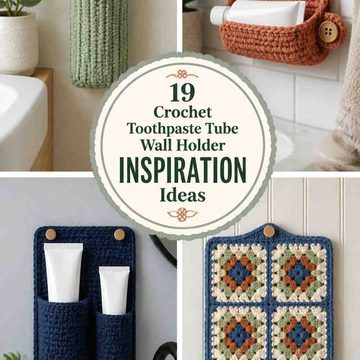
A crochet cabinet door dish brush hanger can add a small handmade detail to an everyday kitchen storage area. Rather than leaving a brush beside the sink, these designs explore different ways to hang or hold it using crochet pockets, mesh sleeves, buttoned loops, narrow straps and compact organizers. The collection brings together soft cottage colors, textured stitches and simple modern shapes.
These 19 crochet inspiration ideas are designed to help you compare different holder styles before choosing something suitable for your kitchen. Some suspend a brush by the hole in its handle, while others support the handle in an upright pocket or open cradle. You’ll also find ideas for storing two brushes together, with practical points about cabinet clearance, moisture, cleaning and keeping the bristle heads exposed.
These are AI-generated crochet design visualizations for inspiration, not photographs of tested handmade holders or step-by-step patterns.
Quick Design Selection Guide
| Your main preference | Design worth exploring | What makes it different |
|---|---|---|
| Airy storage | Crochet Sage Open Mesh Dish Brush Sleeve | Diamond-mesh construction around the handle |
| Minimal material | Crochet Oatmeal Buttoned Brush Hanging Loop | Suspends a brush through its handle hole |
| Cottage kitchen styling | Crochet Coral Daisy Brush Pocket Hanger | Compact pocket with a single floral detail |
| Two-brush storage | Crochet Navy Twin Brush Storage Pockets | Separate vertical compartments |
| Strong stitch texture | Crochet Charcoal Ribbed Hanging Brush Cradle | Raised vertical ribbing and U-shaped support |
| Modern color contrast | Crochet Black Cream Checkerboard Brush Pocket | Checkerboard upper section with an open mesh base |
For a brush with a hanging hole, a simple loop may be the easiest concept to explore. If the brush has no hole, an appropriately fitted pocket or cradle might offer a different approach. Always account for drainage, secure mounting and keeping moisture away from cabinet surfaces.
1. Crochet Sage Open Mesh Dish Brush Sleeve
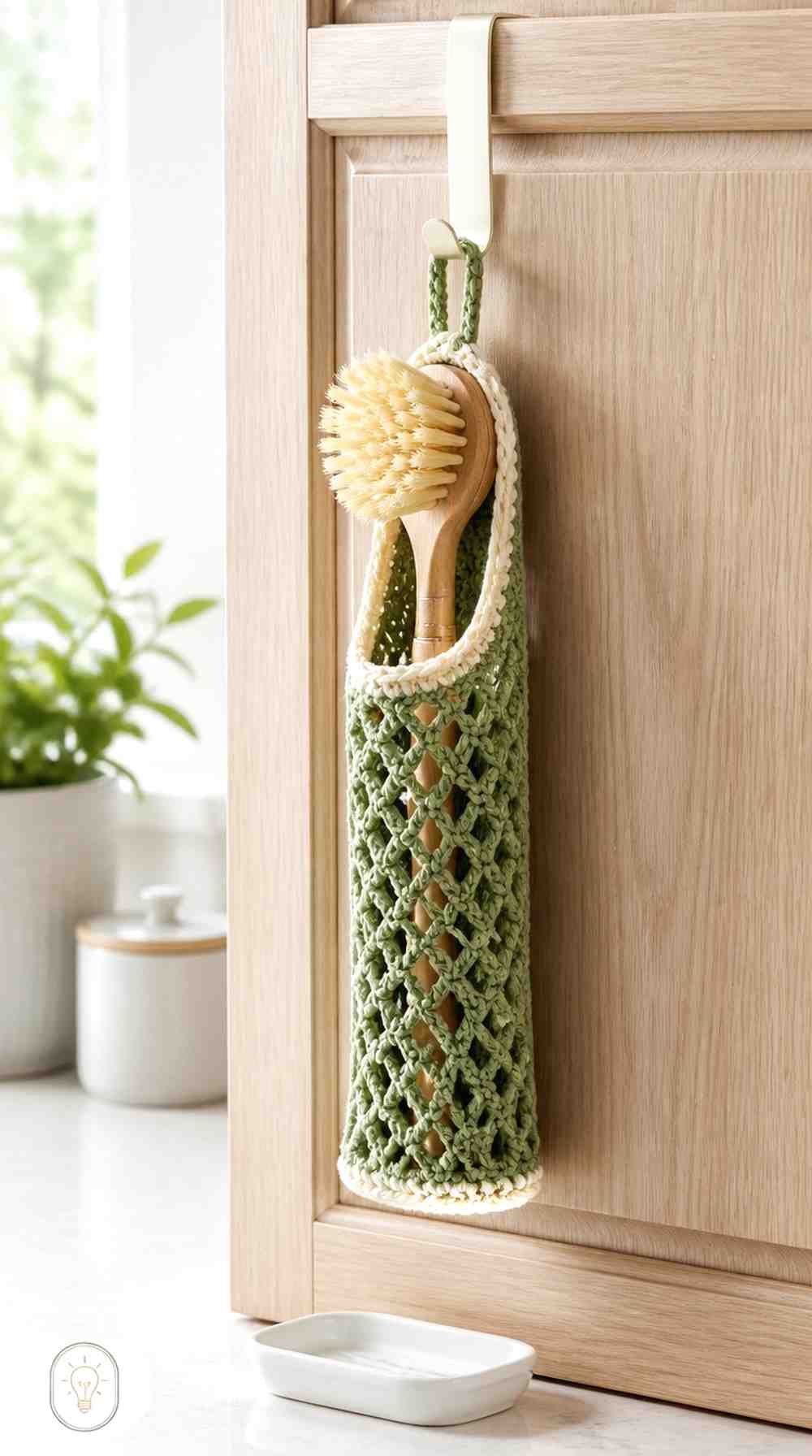
Soft sage crochet forms a narrow hanging sleeve with open diamond-shaped mesh and a neat cream border. A wooden-handled dish brush stands upright inside, with its bristle head clearly exposed above the rim. The holder hangs from a cream over-door hook on a pale oak kitchen cabinet, while a small white catch tray sits below.
The open construction gives this design a lighter appearance than a solid crochet pocket. It also makes the brush handle visible through the stitches. For a functional version, the mesh would need enough structure to support the handle without stretching or collapsing.
- Diamond-Mesh Structure: The open stitch arrangement reduces fabric coverage around the handle, but the openings should be sized to prevent the handle from slipping through.
- Brush Head Clearance: Keep the upper rim below the bristles so the brush head remains exposed rather than being pressed into damp crochet fabric.
- Hanging Loop Support: The reinforced sage loop must be checked for stretching where it meets the hook, particularly after repeated washing.
- Moisture Control: Open mesh may help airflow, but it cannot prevent dripping. Protect the cabinet and place any catch tray on a suitable washable surface.
2. Crochet Oatmeal Buttoned Brush Hanging Loop
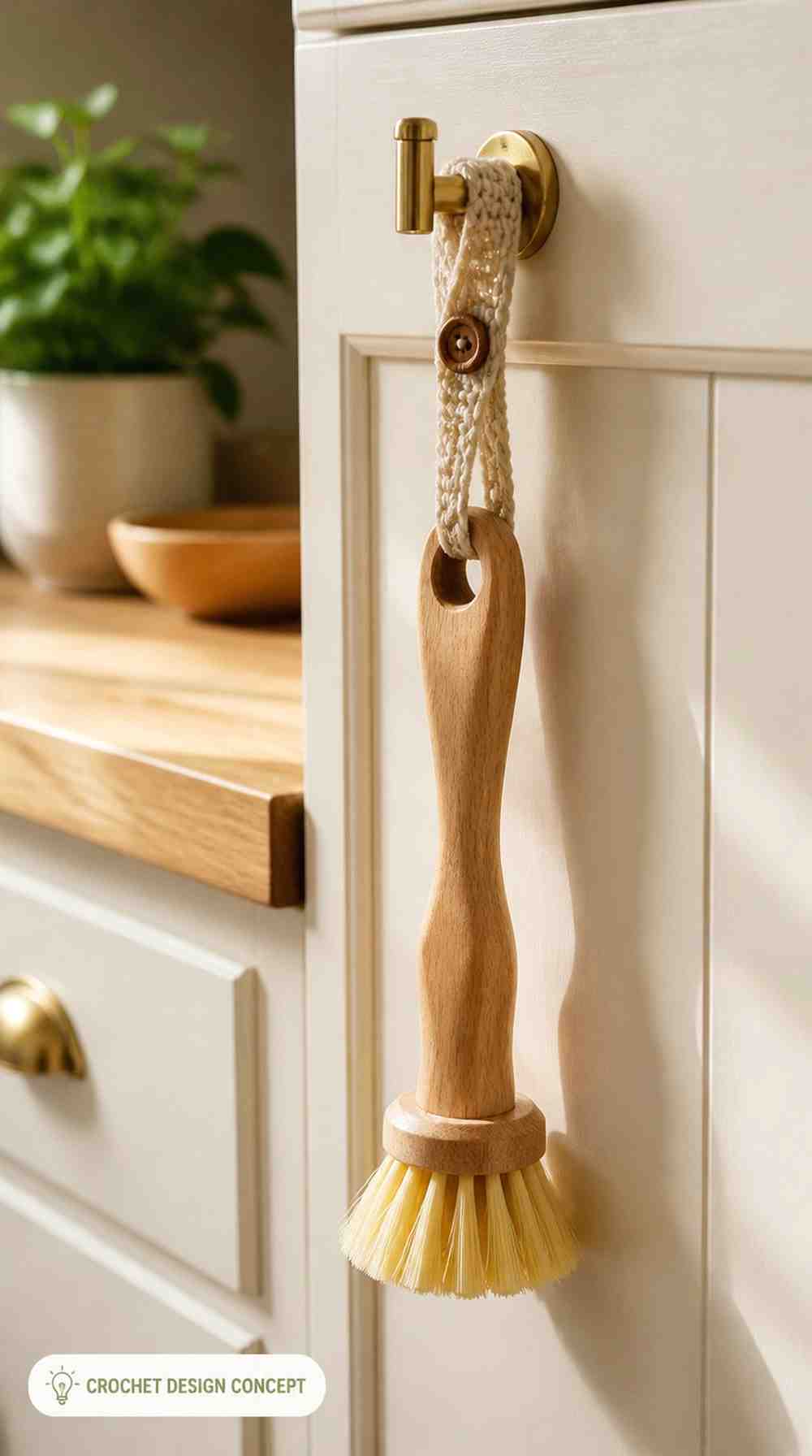
A narrow oatmeal-colored crochet strap creates a simple hanging arrangement for a wooden dish brush. The strap folds over a brushed-brass cabinet hook and fastens with a small walnut-brown button. At its lower end, a compact crochet loop passes through the hole in the brush handle, allowing the bristles to point downward.
The understated shape makes this one of the least bulky ideas in the collection. Because the brush hangs freely rather than resting inside a pocket, there is less fabric surrounding it. However, both the button closure and the connection through the handle hole must be secure.
- Handle-Hole Requirement: This design needs a brush with a suitable opening in the handle. A solid handle without a hole cannot use the illustrated suspension method.
- Button Fastening: Place the wooden button away from the main load point and check the strength of the overlap before hanging the brush.
- Free-Hanging Brush: Position the holder so the downward-facing bristles do not touch the cabinet door, floor or another stored item.
- Easy Cleaning: A narrow strap has less fabric than a storage pocket, although it still needs removal, washing and complete drying.
3. Crochet Terracotta V Pocket Brush Holder
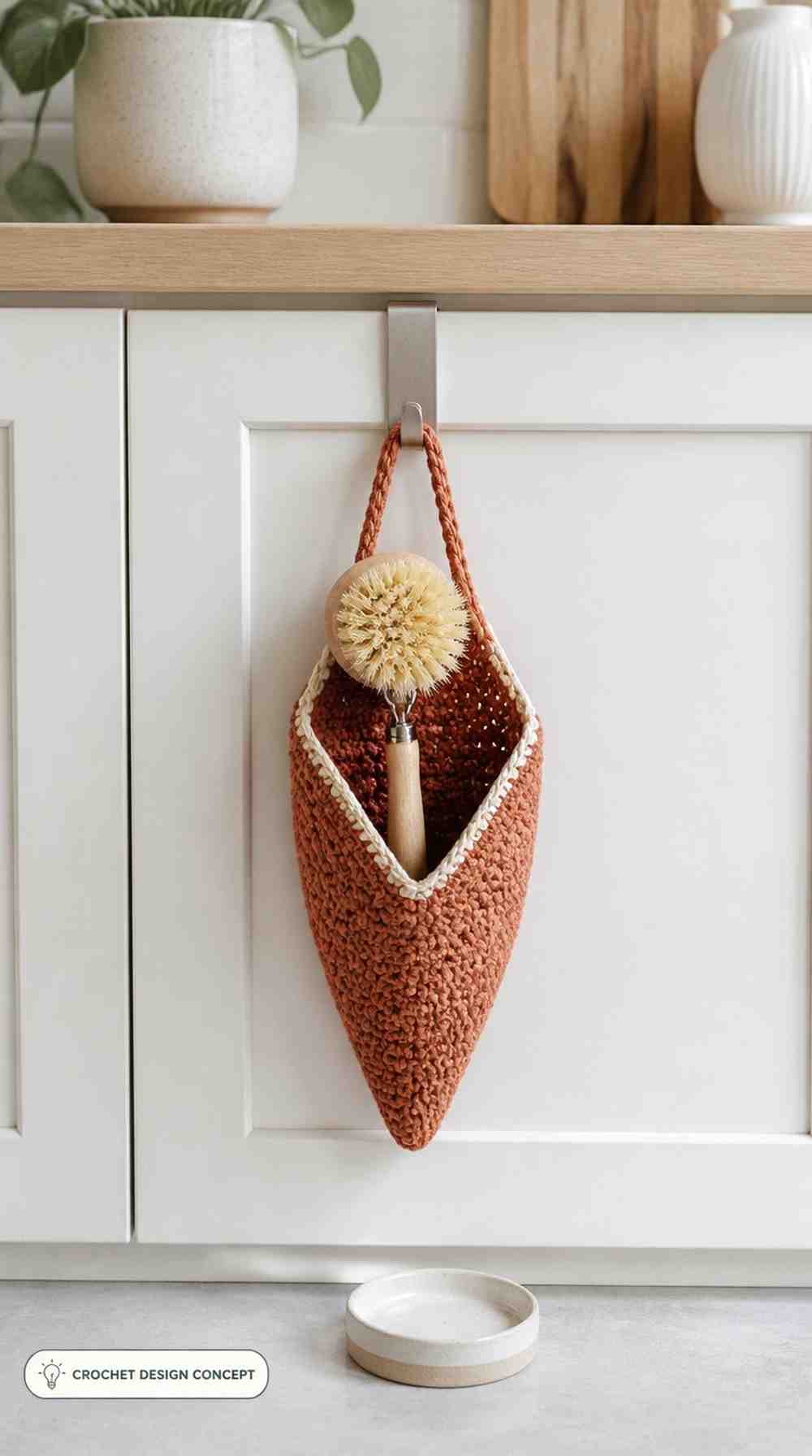
Warm terracotta crochet creates a triangular hanging pocket with a pointed lower section and a shallow V-shaped opening. Narrow ivory edging follows the upper notch, while two short terracotta straps join at a single over-door hook. The wooden dish brush stands handle-down, leaving its rounded beige bristles visible above the pocket.
This shape introduces a more decorative silhouette without relying on extra flowers or buttons. The pointed lower section makes the pocket visually distinctive, but it must be shaped carefully if used as an actual holder. A loose triangular base could allow the brush handle to shift.
- V-Shaped Opening: The shallow upper notch gives space around the brush handle, but it should not make the pocket so open that the brush falls sideways.
- Pointed Pocket Base: Consider a firm, closely stitched lower section to resist stretching where the brush handle rests.
- Two-Strap Balance: Both terracotta hanging straps should share the weight evenly, keeping the pocket upright against the cabinet.
- Cabinet Protection: The pictured catch tray suggests a way to manage drips, but its real position must work with the cabinet layout and avoid moisture damage.
4. Crochet Navy Twin Brush Storage Pockets
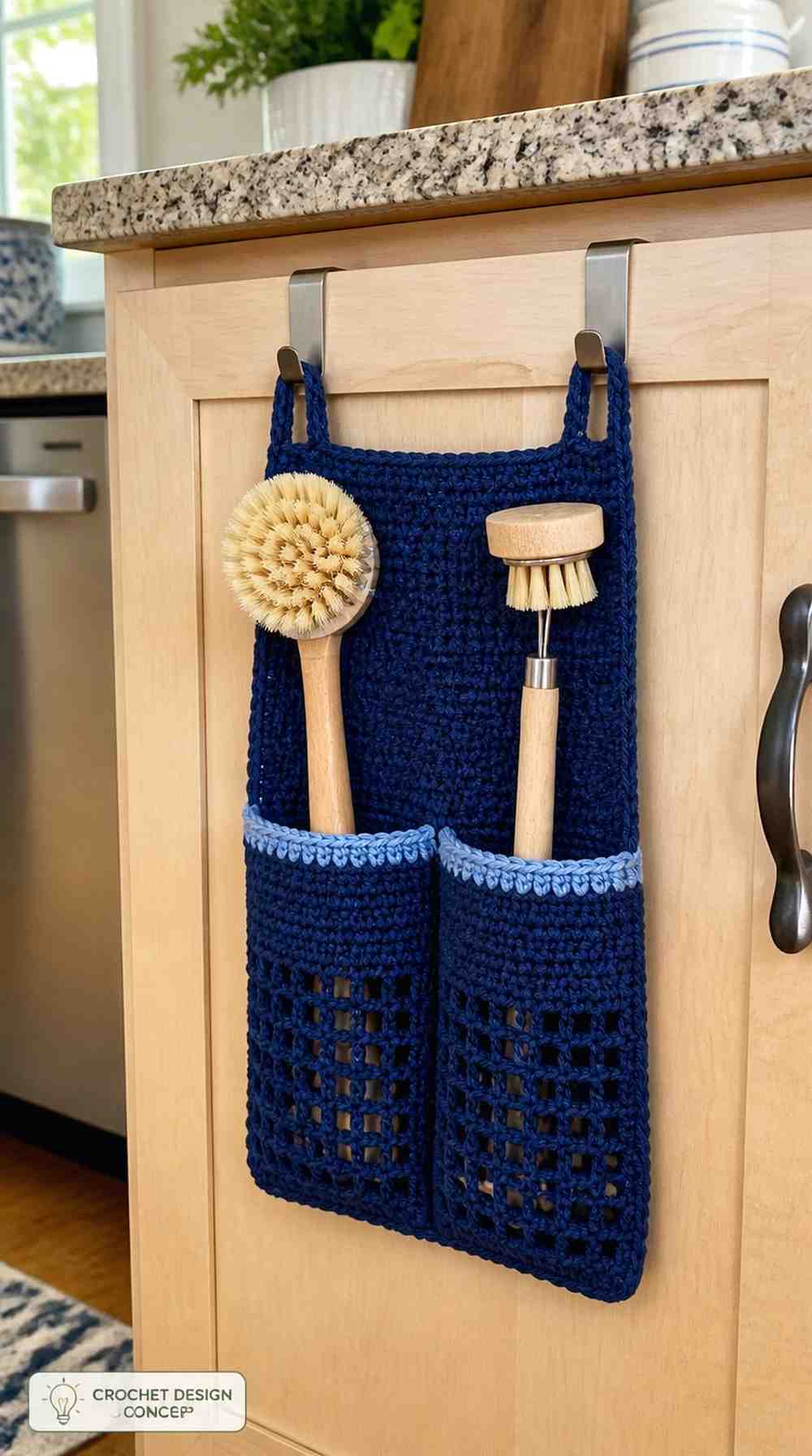
Deep navy crochet forms two slim vertical pockets joined by a central stitched divider. Pale-blue borders finish the openings, while open mesh panels cover the lower sections. A regular wooden dish brush occupies one compartment, and a slimmer vegetable brush sits in the other, both with their heads exposed.
The organizer hangs from two stainless-steel over-door hooks on a light maple cabinet. This double-pocket arrangement offers a different storage idea from the single-brush designs. Its usefulness depends on keeping the compartments appropriately sized and preventing one heavier brush from pulling the organizer sideways.
- Separate Compartments: The central seam keeps the two brush handles apart, but each pocket should match the width and length of its intended brush.
- Two-Point Hanging: Check that both cabinet hooks sit at the same height and that the top edge does not sag between them.
- Lower Mesh Panels: Openwork may improve ventilation around the handles, although the pockets must still be washed and dried regularly.
- Uneven Brush Weight: A larger dish brush and smaller vegetable brush may place different loads on the two sides. Check the hanging balance.
5. Crochet Ivory Scalloped Ring Brush Hanger
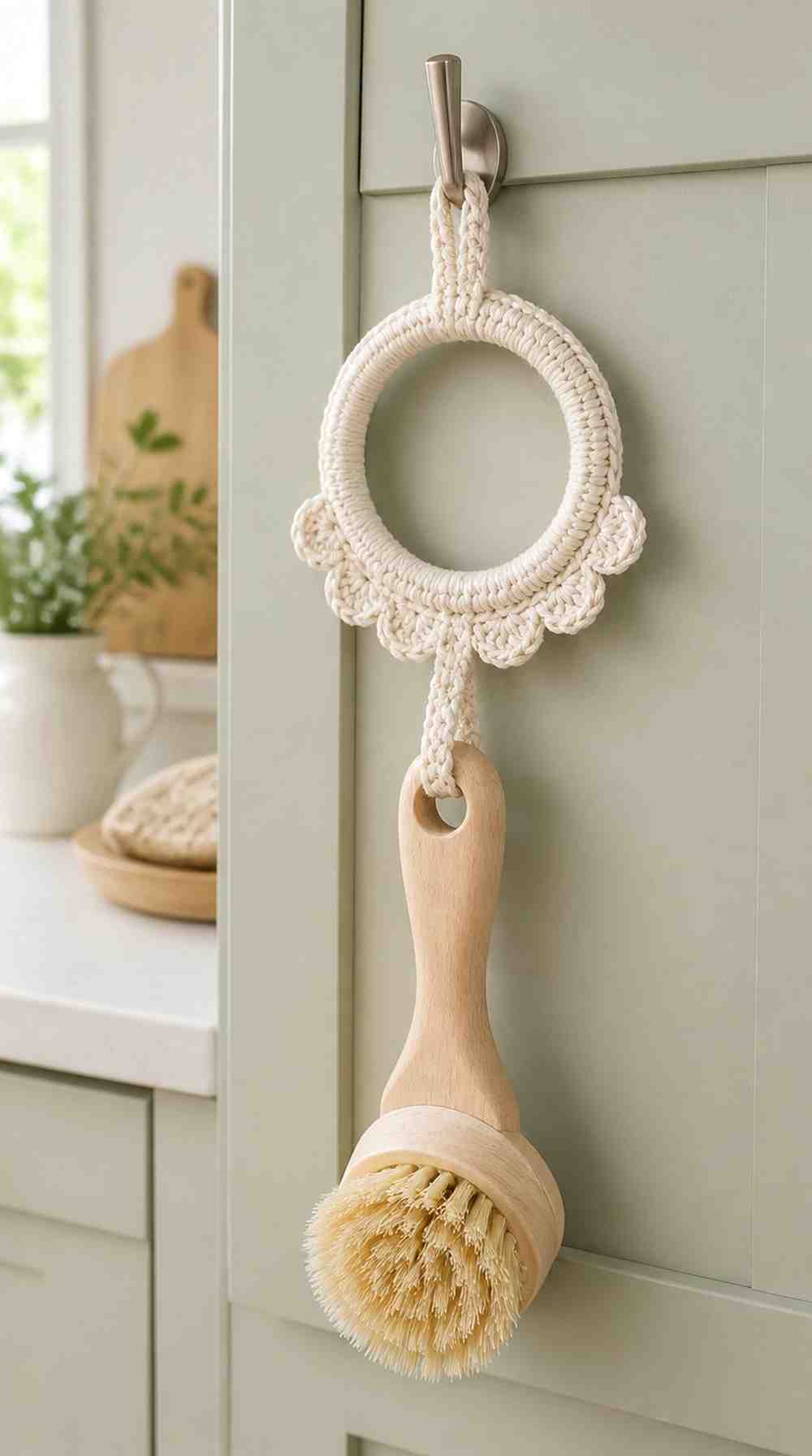
Fine ivory crochet covers a small wooden ring, with six delicate scallops following its lower outer curve. A short crochet loop attaches the ring to a metal cabinet hook, while another loop hangs beneath it and passes through the end hole of a wooden dish brush handle. The brush remains suspended vertically with its bristles pointing downward.
Unlike a traditional pocket, this design makes the decorated ring the main visual feature. Its soft ivory finish suits a pale sage cabinet, but the actual hanging arrangement needs careful attention to the connections between the ring, crochet loops and brush.
- Wooden Ring Support: The ring is a decorative structural component in the concept. Choose suitable hardware and check it for cracking, wear or deformation.
- Scallop Placement: Keep the six ivory scallops small enough that they do not catch on the brush handle or cabinet hardware.
- Lower Suspension Loop: The loop through the brush’s handle hole needs enough room to move without slipping out or opening under repeated use.
- Wood and Moisture: Wooden components can be affected by repeated wetting. Avoid allowing water to collect around the decorated ring.
6. Crochet Charcoal Ribbed Hanging Brush Cradle
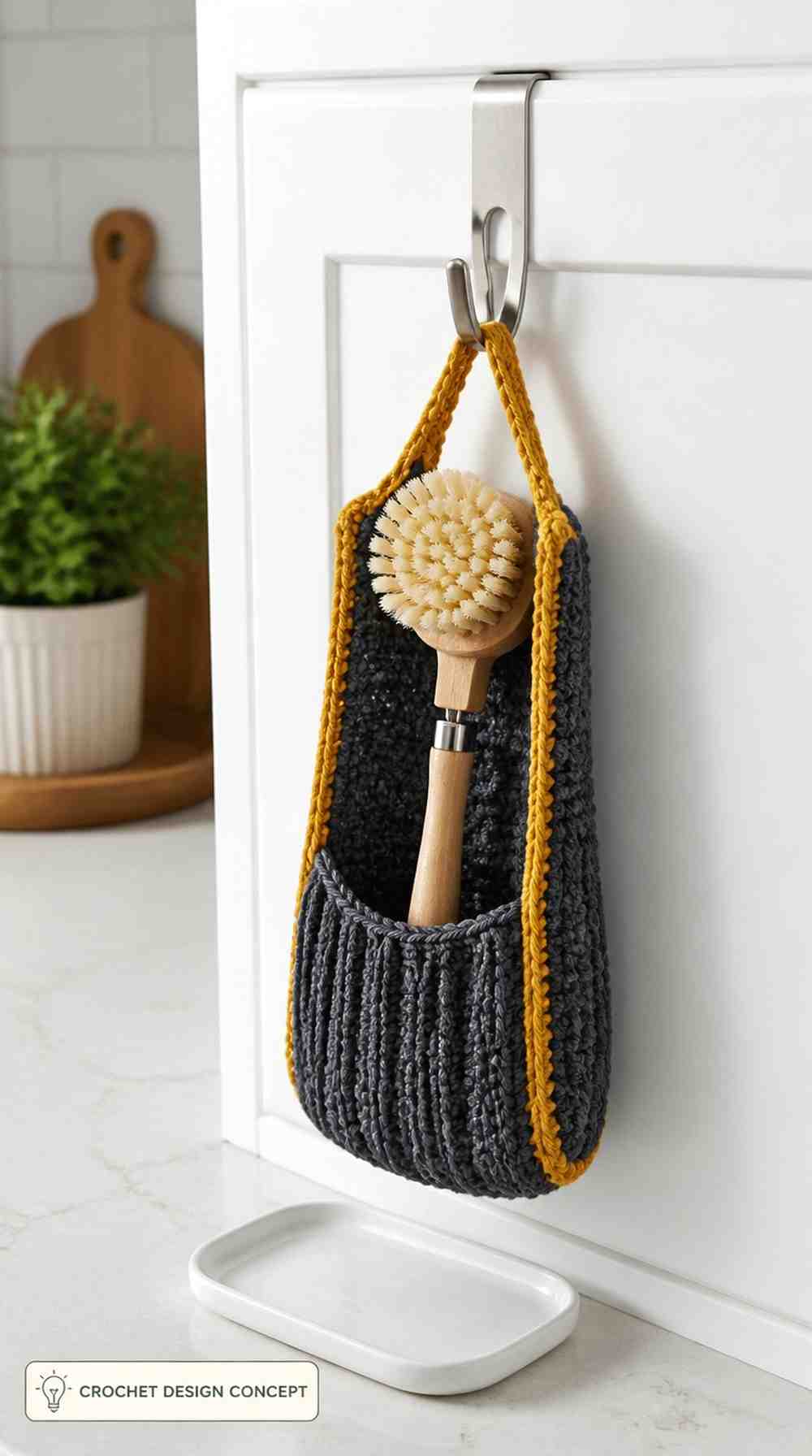
A short charcoal-gray crochet cradle curves into a deep U shape, supporting the lower handle of a wooden dish brush. Raised vertical ribs create a strong textured surface, while narrow mustard-yellow edges outline the sides. Two short straps rise from the cradle and meet at a stainless-steel hook above.
The dark crochet stands out against the white cabinet door, giving this holder a simple modern appearance. Because the brush rests inside the curved fabric rather than hanging through a handle hole, this style suggests an option for brushes without built-in hanging openings.
- U-Shaped Support: The cradle must remain deep enough to retain the brush handle without folding inward or letting it slide out.
- Raised Ribbing: Textured rows give the holder its appearance, but their thickness could increase moisture retention compared with a flatter stitch.
- Side-Strap Alignment: The two short suspension straps should keep the cradle centered so the brush does not lean toward one side.
- Brush Size: A wide handle may require a different cradle shape. The pictured proportions should not be treated as universal measurements.
7. Crochet Coral Daisy Brush Pocket Hanger
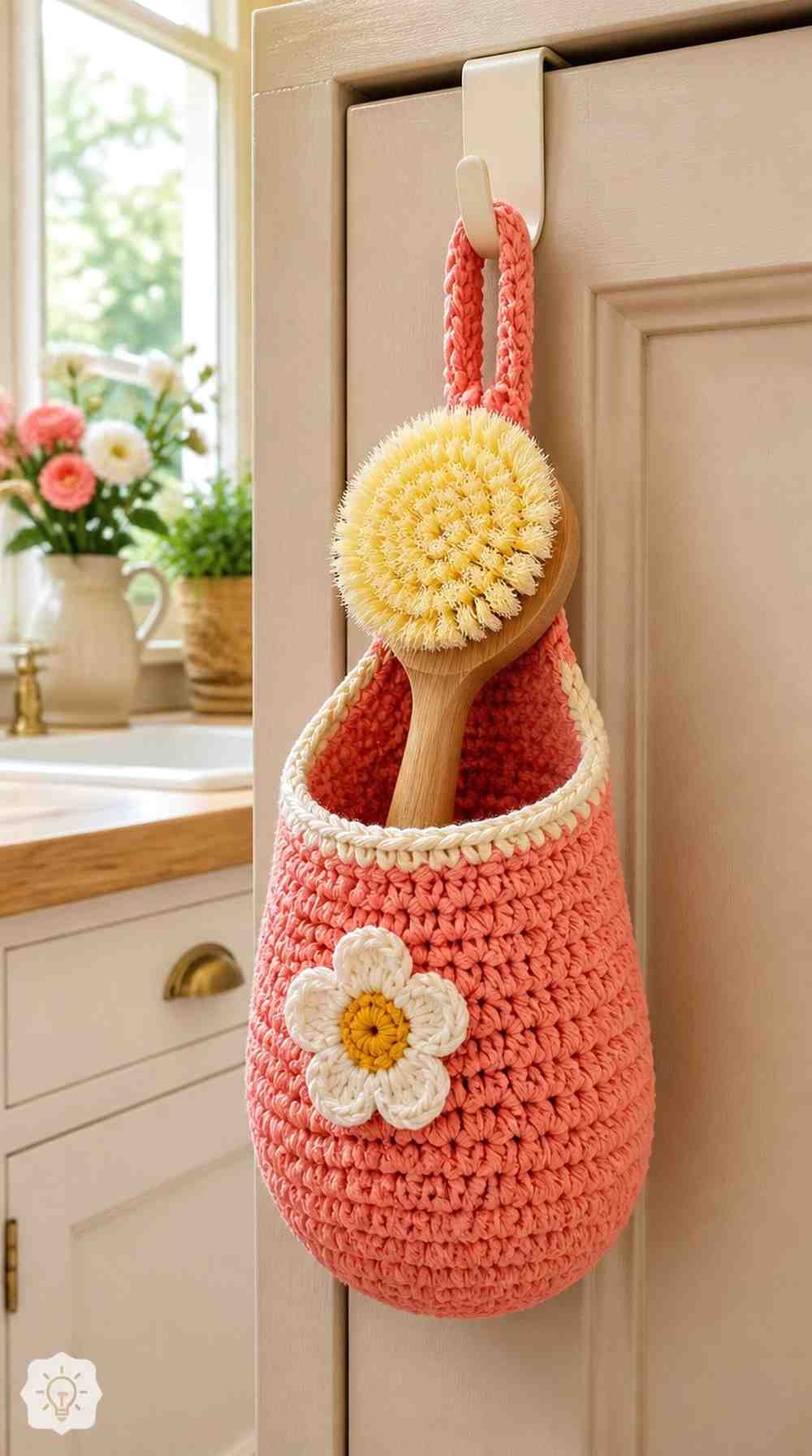
Coral-pink crochet gives this small hanging brush pocket a cheerful cottage-inspired appearance. The lower section has closely worked stitches, with a cream border around its rounded upper opening. One flat ivory daisy sits on the front, finished with five petals and a tiny golden-yellow center.
A matching coral hanging loop suspends the pocket from a cream over-door hook. The wooden brush remains upright with its pale bristles exposed above the fabric. The flower adds personality without changing the storage shape, making its attachment and cleaning the main decorative considerations.
- Daisy Position: Keep the floral appliqué below the rim so it does not rub against the brush head or interfere with removing the handle.
- Rounded Pocket Base: A shallow rounded base needs careful sizing to support the brush without making the fabric collapse around its lower end.
- Petal Attachment: Secure the five petals and center carefully. Loose decorative pieces are unsuitable for a frequently handled kitchen accessory.
- Cleaning Decorative Stitches: The flower creates extra stitch edges where residue can collect, so a plain coral pocket may be a simpler alternative.
8. Crochet Mustard Open Lattice Brush Caddy
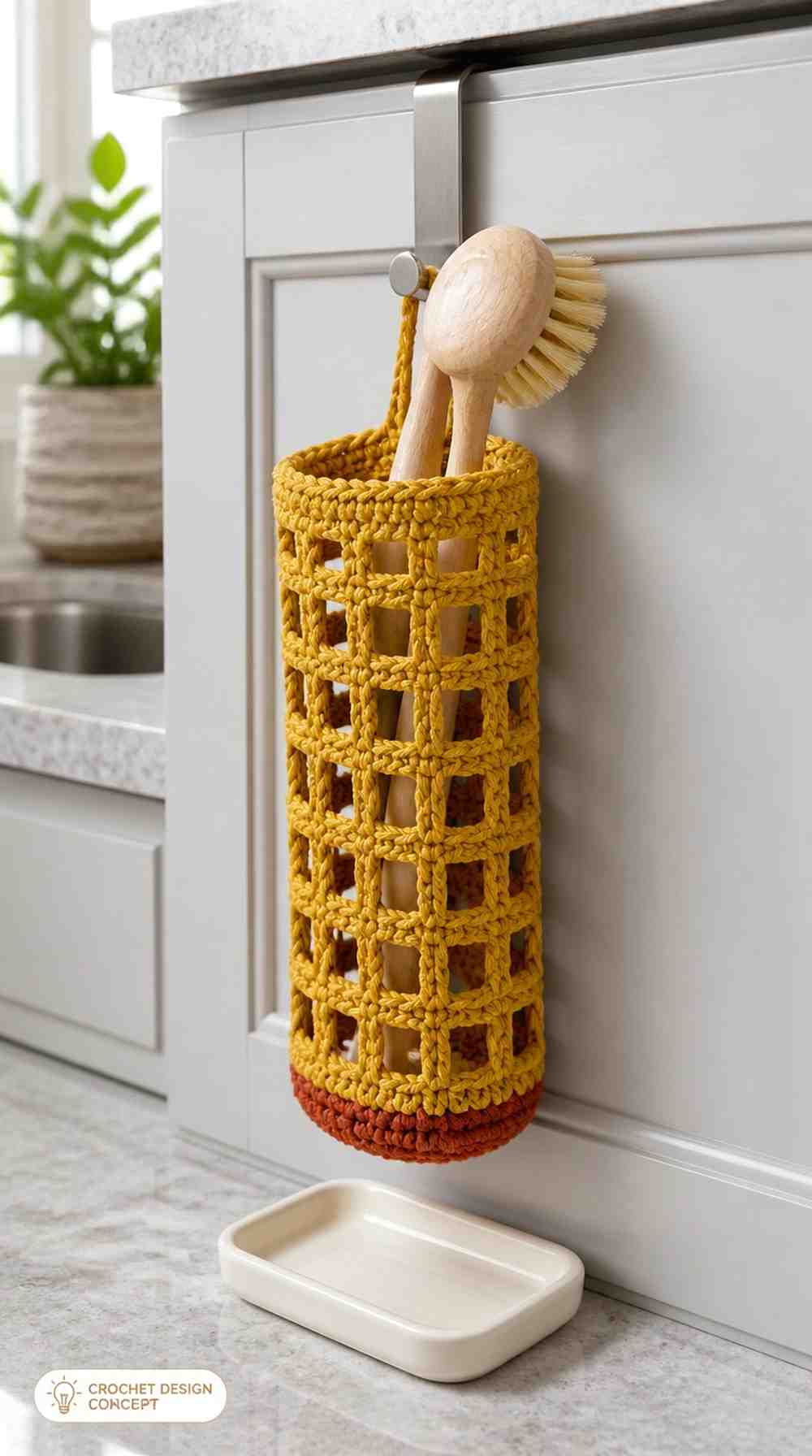
Mustard-gold crochet forms an elongated hanging caddy with large, clearly defined square openings. A closely stitched upper rim gives the design a finished edge, while a narrow rust-colored border runs along the bottom. The wooden brush handle remains visible through the open lattice, with the bristle head rising above the top.
This holder has a strong geometric look that suits a light-gray kitchen cabinet. The openwork is the main attraction, although large square holes also create a practical challenge: the lower section must still be able to retain the brush handle securely.
- Square Lattice Openings: Check that the handle cannot pass sideways through the mesh, especially near the narrower lower end.
- Upper Rim Stability: A firmer rim may help the caddy keep its shape, but an actual sample must be tested for stretching.
- Rust-Colored Lower Border: The narrow contrast edge defines the base without adding bulky appliqués or loose decoration.
- Airflow and Drainage: Large openings expose more of the handle to air, but they do not guarantee faster drying or prevent water from reaching the cabinet.
9. Crochet Denim Cabinet Knob Brush Strap
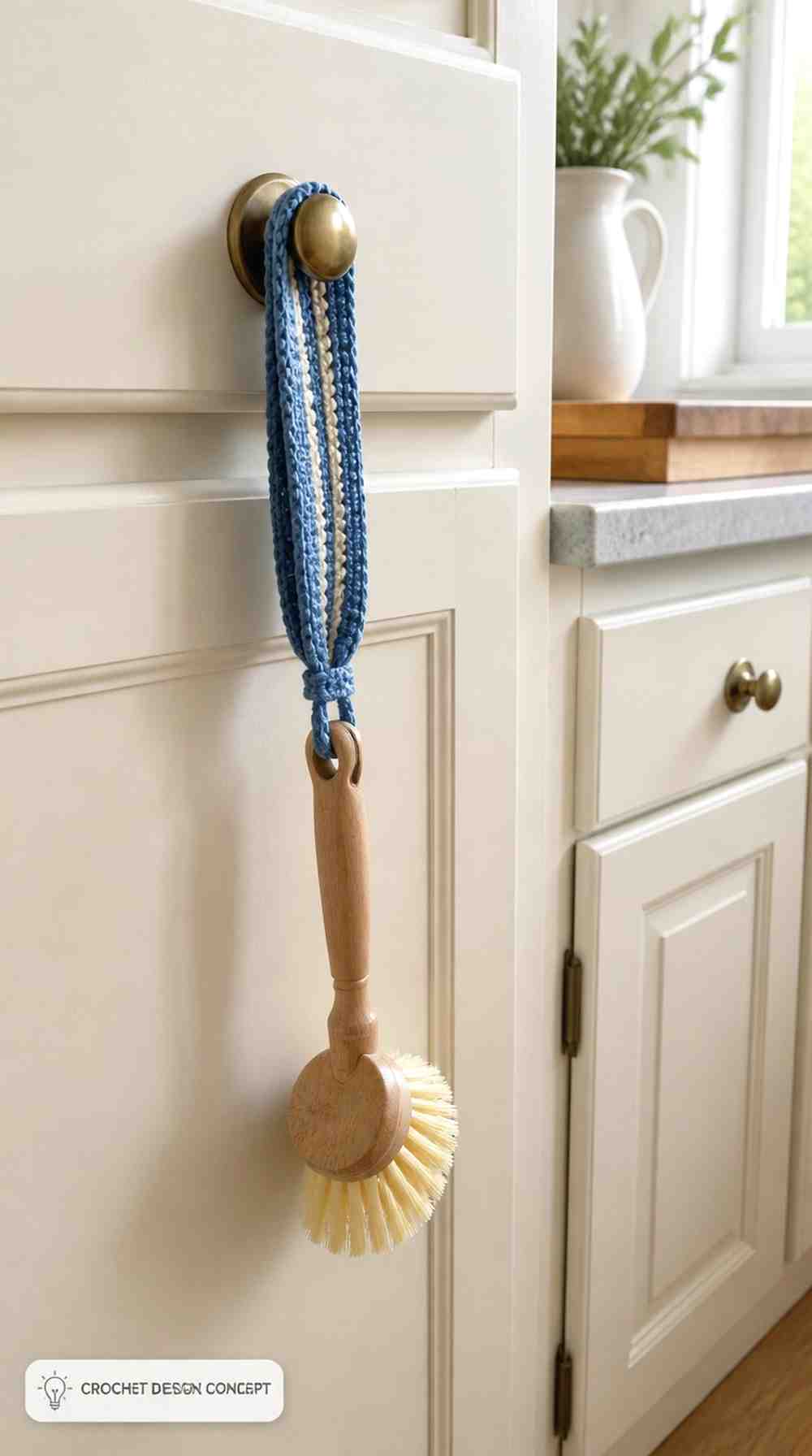
Faded denim-blue crochet creates a narrow hanging strap that folds around an antique-brass cabinet knob. Two thin ivory lines run lengthwise along the strap, adding just enough contrast to highlight its straight shape. A short loop at the lower end passes through the hole in a wooden dish brush handle.
This concept uses a cabinet knob rather than an over-door hook, making it useful inspiration for kitchens with suitable existing hardware. The brush hangs downward, leaving its pale bristles exposed. The important consideration is whether the cabinet knob and crochet strap can support the arrangement without interfering with opening the door.
- Knob Compatibility: The strap needs a secure position around a suitably shaped cabinet knob without sliding forward when the door moves.
- Ivory Stripe Placement: Two narrow lines add detail without changing the strap’s basic dimensions or creating raised decorative attachments.
- Brush Clearance: Allow enough space beneath the knob so the hanging brush does not strike nearby drawers, doors or stored kitchen items.
- Hardware Check: Do not assume a decorative cabinet knob is suitable for extra weight. Check its attachment and the resulting movement of the door.
10. Crochet Forest Green Draining Brush Basket
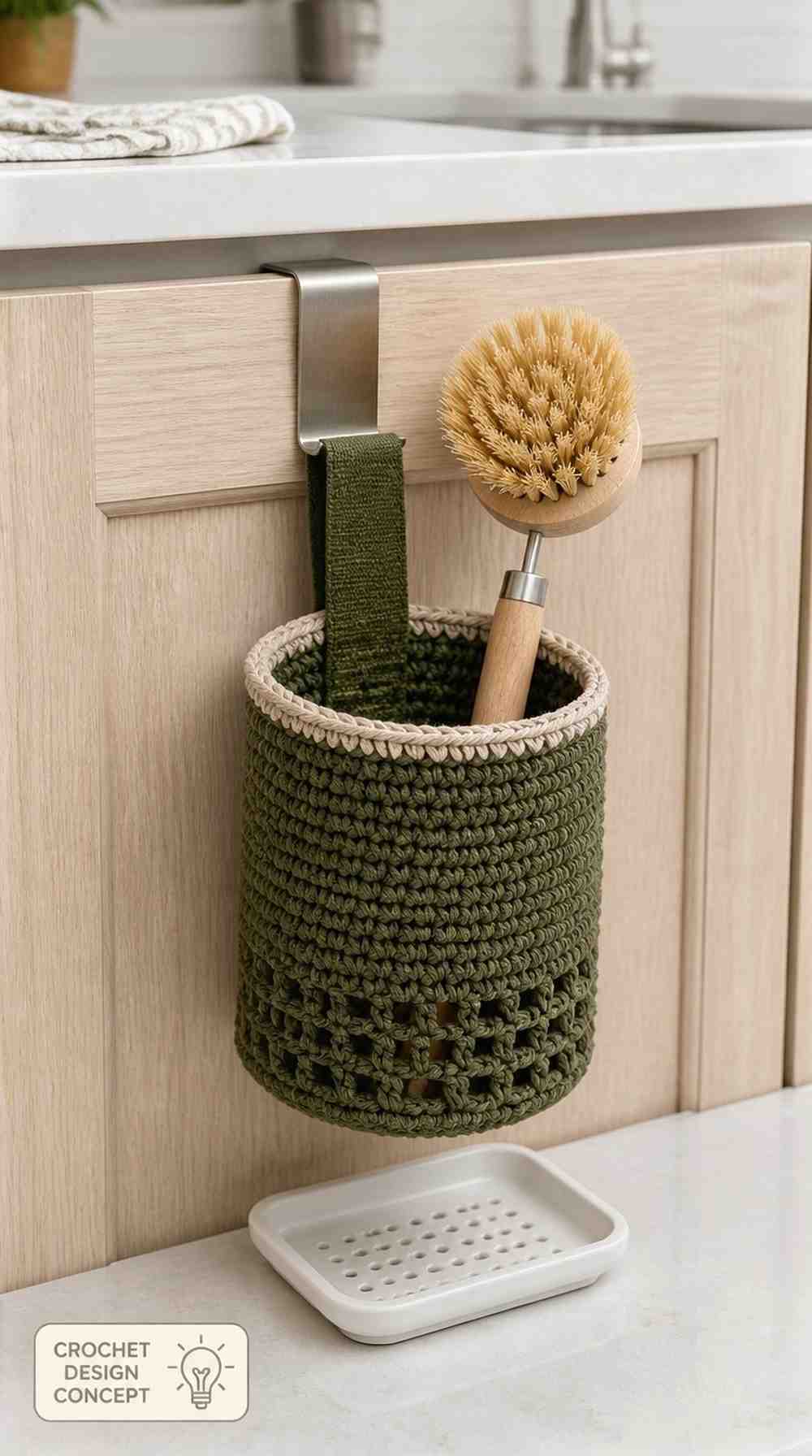
Forest-green crochet creates a miniature hanging basket with a cylindrical body and a neatly rolled oatmeal rim. The upper walls are closely stitched, while small openings appear across the lower base. A short olive-green strap hangs the basket from a stainless over-door hook on a pale wooden cabinet.
The upright wooden brush has its bristle head fully exposed above the basket, giving this design the appearance of a compact kitchen organizer. The perforated lower section is a useful visual detail, but drainage openings alone cannot keep the basket or cabinet dry.
- Perforated Base: The lower openings may allow water to escape rather than pool, but moisture still needs to be collected and kept away from wood surfaces.
- Cylindrical Shape: A rounded holder should accommodate the actual handle without excessive width that lets the brush lean or tip.
- Rolled Oatmeal Rim: The contrasting rim provides structure visually, but a real crochet basket may need additional shaping to maintain its circular opening.
- Removable Catch Tray: Use an appropriately placed washable tray beneath the hanger where the kitchen layout allows, rather than permitting water to run onto cabinetry.
11. Crochet Lilac Ladder Loop Brush Organizer
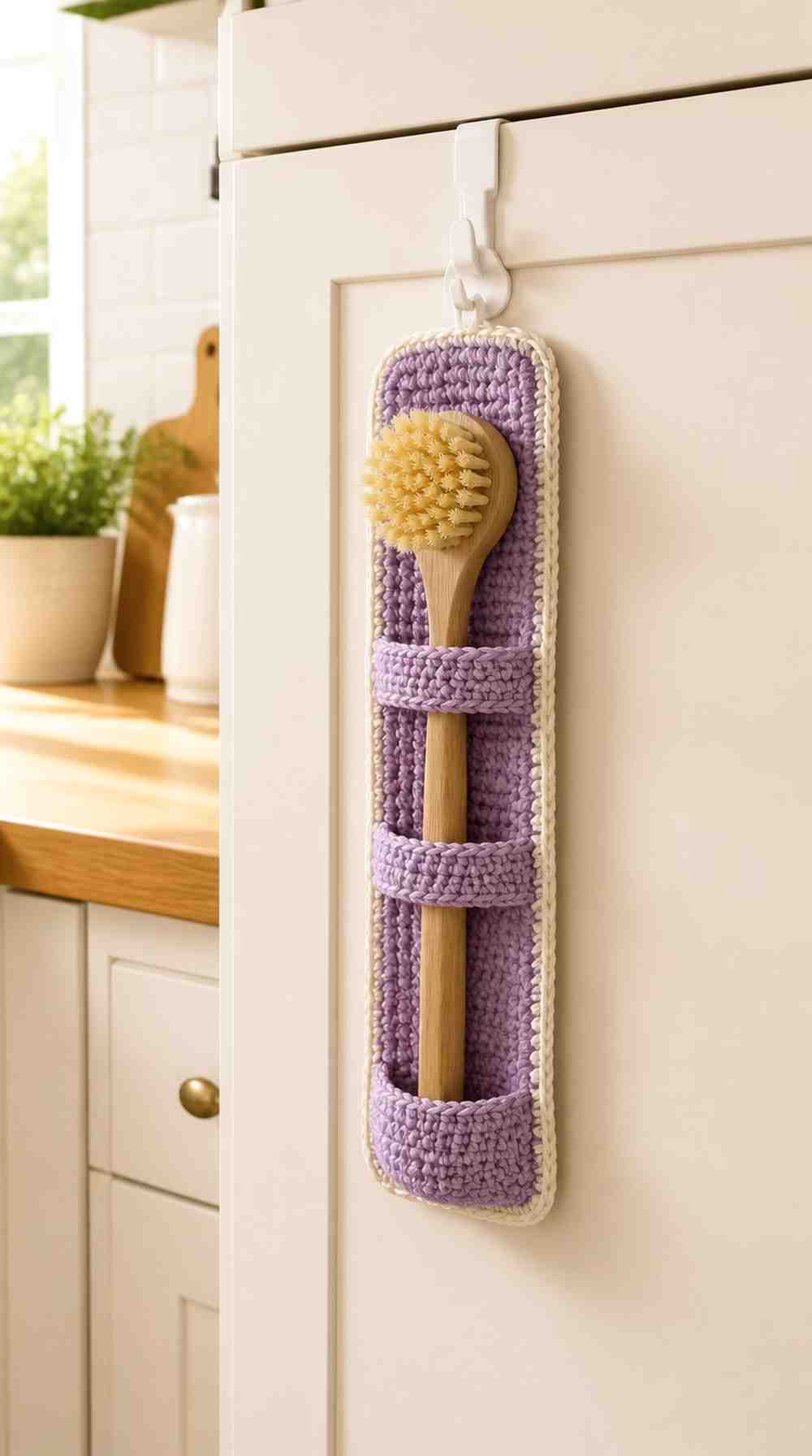
Lavender crochet forms a slim rectangular backing with a fine cream border. Three horizontal loops extend across the front like short ladder rungs, holding a wooden brush handle vertically. The upper two loops guide the handle, while a shallow matching base strap supports its lower end.
The simple arrangement hangs from a white over-door hook, making the structure easy to understand at a glance. Compared with a full crochet pocket, this design leaves more of the brush handle exposed. The spacing between the loops is particularly important for keeping the brush upright.
- Loop Spacing: The horizontal rungs should suit the actual handle length and taper, rather than being equally spaced purely for appearance.
- Lower Support Strap: The shallow base must prevent the handle from slipping down through the loops during ordinary use.
- Rectangular Backing: A narrow vertical panel helps keep the loops aligned, but it may bend if the brush is heavy or the yarn stretches.
- Brush Removal: Check that the handle can be lifted through the loops comfortably without pulling the entire organizer off its hook.
12. Crochet Black Cream Checkerboard Brush Pocket
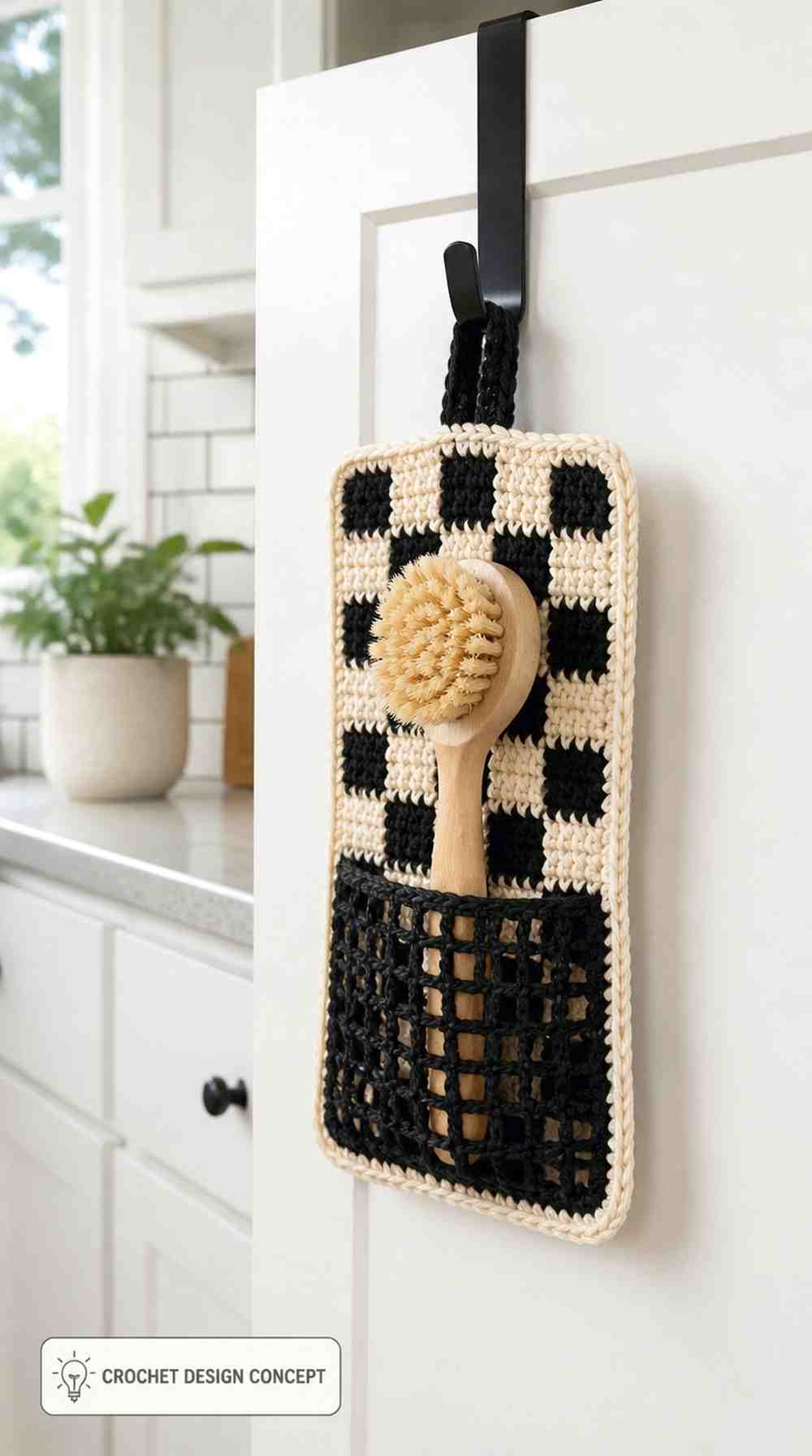
Black-and-cream crochet squares form the upper portion of this compact brush holder, creating a bold checkerboard surface. The lower third changes to an open black mesh, while a cream border outlines the straight sides and opening. A small black hanging tab attaches the pocket to an over-door hook.
The natural wooden brush stands handle-down inside, with its bristles fully exposed. The combination of a solid patterned upper section and airy lower panel gives this design more contrast than a single-texture holder. Joining the different sections neatly would be the main construction consideration.
- Checkerboard Alignment: The black and cream squares should remain straight along the upper section without distorting the pocket’s rectangular outline.
- Mesh Transition: The lower black openwork needs a stable connection to the denser upper fabric to avoid sagging under the brush handle.
- Color Changes: Multiple small blocks create yarn ends that require secure finishing, especially on a kitchen accessory that will be washed.
- Cleaning Contrast: The cream squares may show splashes, while black sections may show lint, so both colors need regular inspection.
13. Crochet Dusty Blue Double Loop Brush Harness
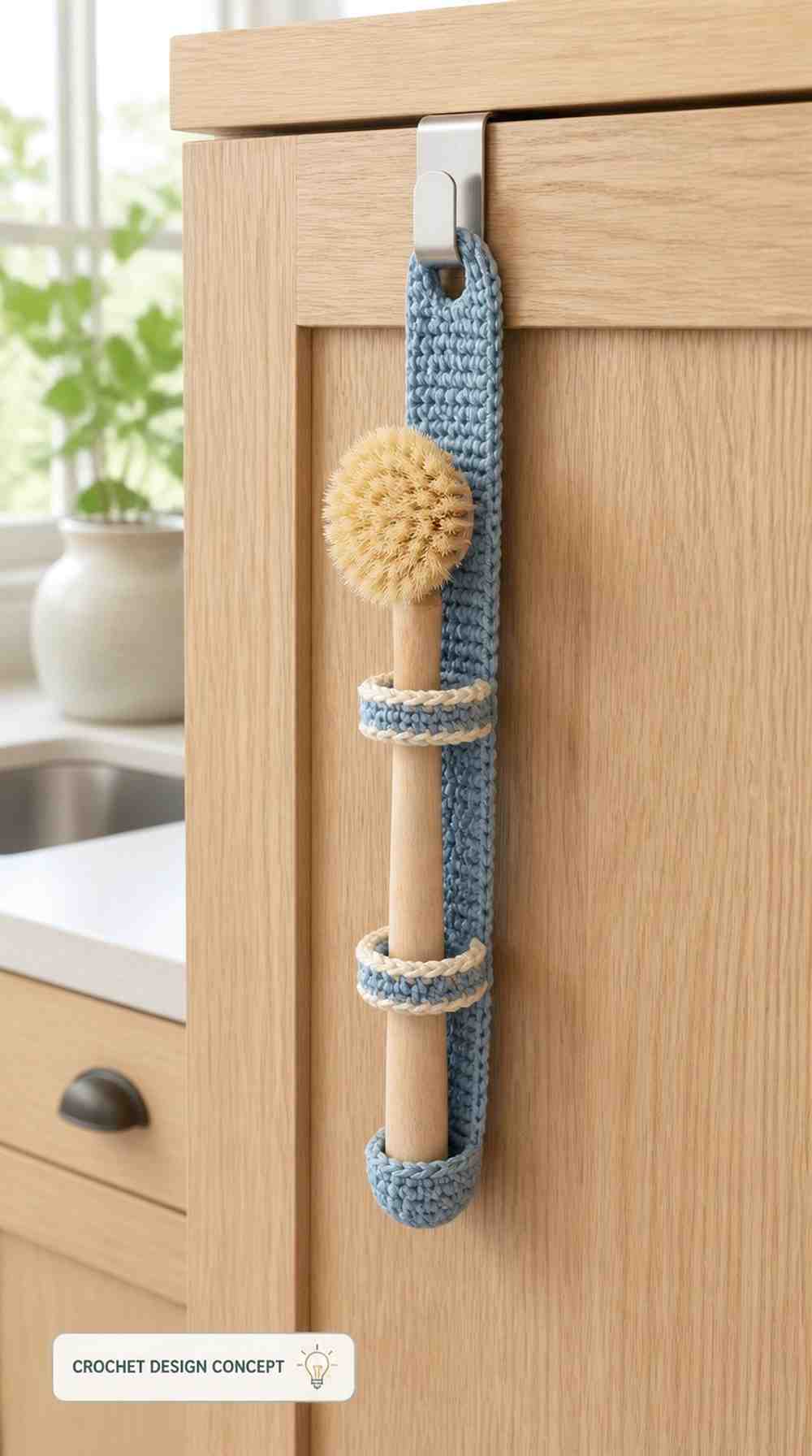
Dusty-blue crochet forms a narrow vertical support panel with two rounded loops extending from its front. The loops hold the lower handle of a wooden dish brush at separate heights, while a small closed fabric foot supports the bottom. Thin cream edging defines the loops against the blue backing.
This arrangement provides a more open alternative to a conventional brush pocket. The bristle head remains exposed, and most of the wooden handle is visible between the crochet supports. Its effectiveness depends on keeping the loops aligned and preventing the brush from tipping forward.
- Two-Level Support: The upper and lower loops should follow the handle’s shape closely enough to stop unnecessary sideways movement.
- Closed Base Foot: The small lower support is important because the two open loops alone may not prevent the handle from sliding downward.
- Loop Projection: Keep the loops shallow enough that the brush does not hang too far away from the cabinet door.
- Handle Taper: A sharply tapered brush handle may need differently sized loops to remain upright without wobbling.
14. Crochet Plum Buttoned Brush Hanging Tab
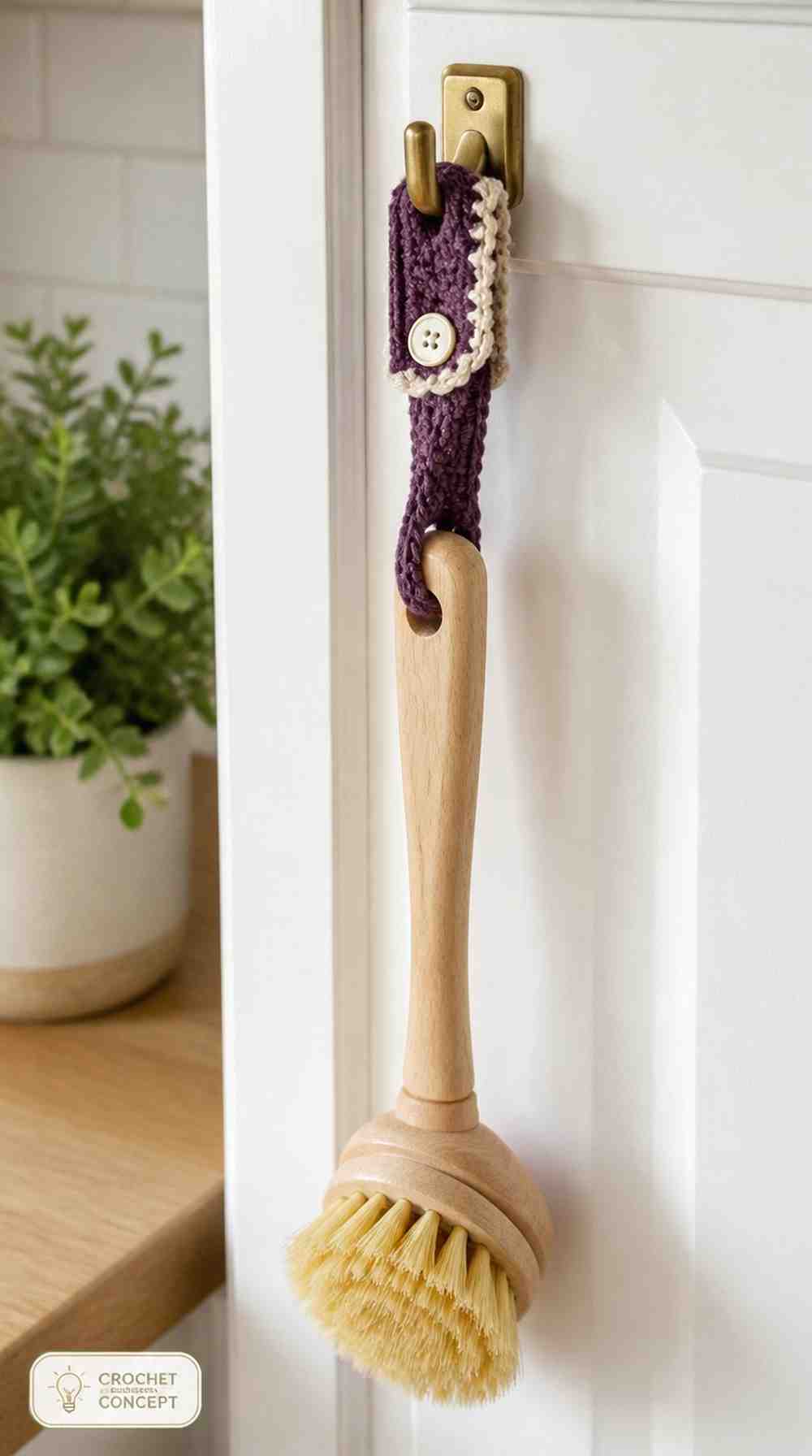
Deep plum crochet forms a slender hanging tab with a small folded fastening at the top. One cream button secures the upper section to a matte-brass cabinet hook, while a short loop below passes through the hanging hole of a wooden brush handle. Fine cream picot points decorate only the upper fold.
The brush hangs naturally with its bristles pointing down, making the narrow strap visually prominent. This idea offers a richer color and more delicate edging than the oatmeal buttoned loop. Its decorative picots need to remain clear of the hook and fastening area.
- Buttoned Upper Fold: The closure should be positioned so the brush’s weight does not pull directly against an insecure buttonhole.
- Cream Picot Edging: Small picots belong along the upper fold, away from the lower suspension loop where they could catch.
- Lower Loop Fit: Check that the loop passes properly through the brush handle’s hole without excessive twisting or friction.
- Cabinet-Hook Placement: A front-mounted hook should be compatible with the door material and must not interfere with normal cabinet use.
15. Crochet Mint Geometric Mesh Brush Pocket
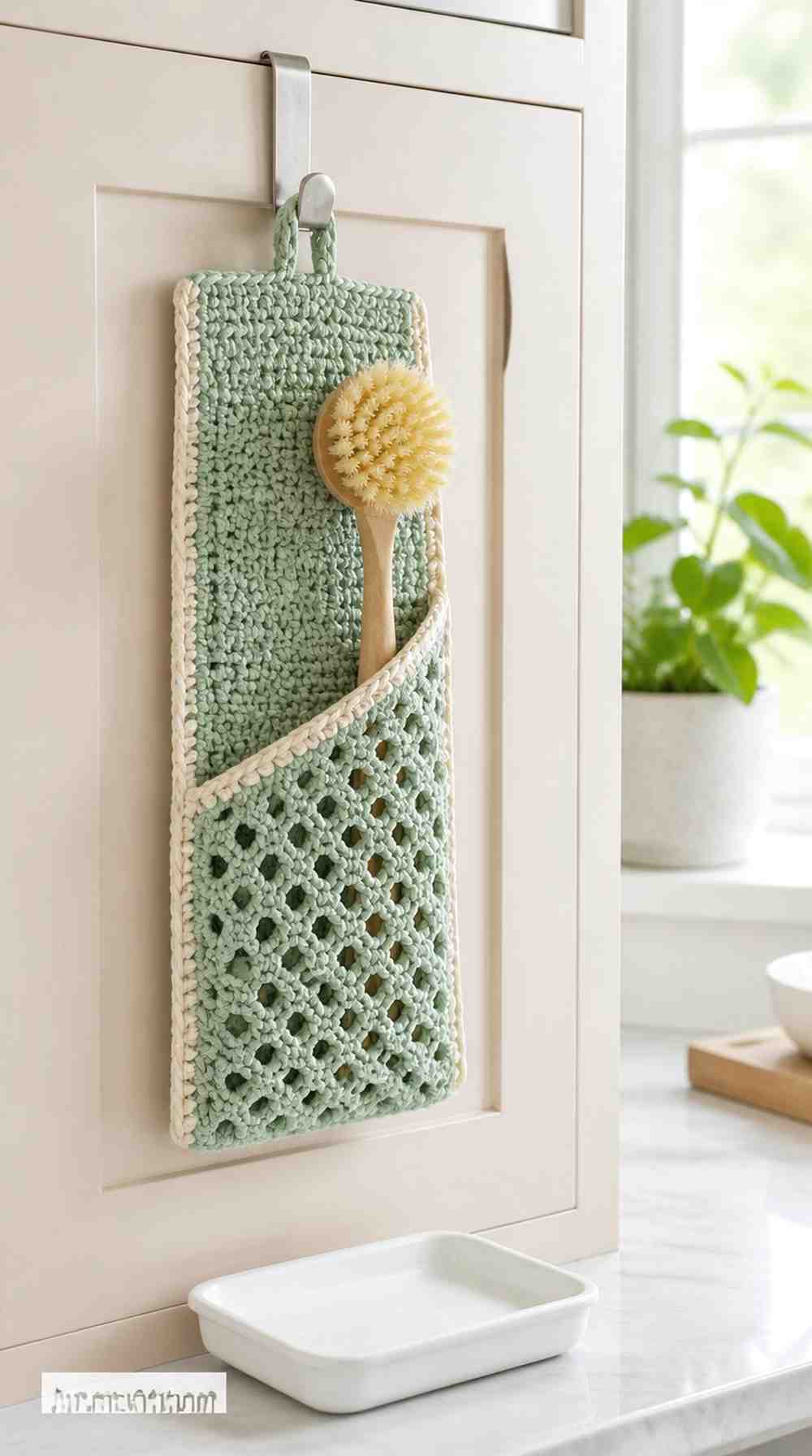
Mint-green crochet creates a modern hanging pocket with a tall rectangular backing and a shorter diagonal-cut front. Small diamond-shaped mesh openings fill the front section, while straight ivory borders outline the edges. A matching mint loop suspends the holder from a stainless hook on a light blush-white cabinet.
The wooden dish brush stands upright, with its bristle head fully exposed above the pocket. The slanted upper edge distinguishes this design from ordinary square pockets, giving the mesh more visual movement. Careful shaping would be needed to maintain the diagonal opening.
- Diagonal Front Edge: The slanted rim should remain low enough to expose the brush head while still supporting the handle securely.
- Diamond Mesh Size: Small openings may provide a more stable pocket surface than very large openwork, depending on the actual yarn and tension.
- Tall Back Panel: The rectangular backing helps define the pocket’s outline and separates its geometry from the front mesh.
- Drip Protection: Any water passing through the mesh needs a suitable washable collection surface away from moisture-sensitive cabinet materials.
16. Crochet Sand Folded Envelope Brush Cradle
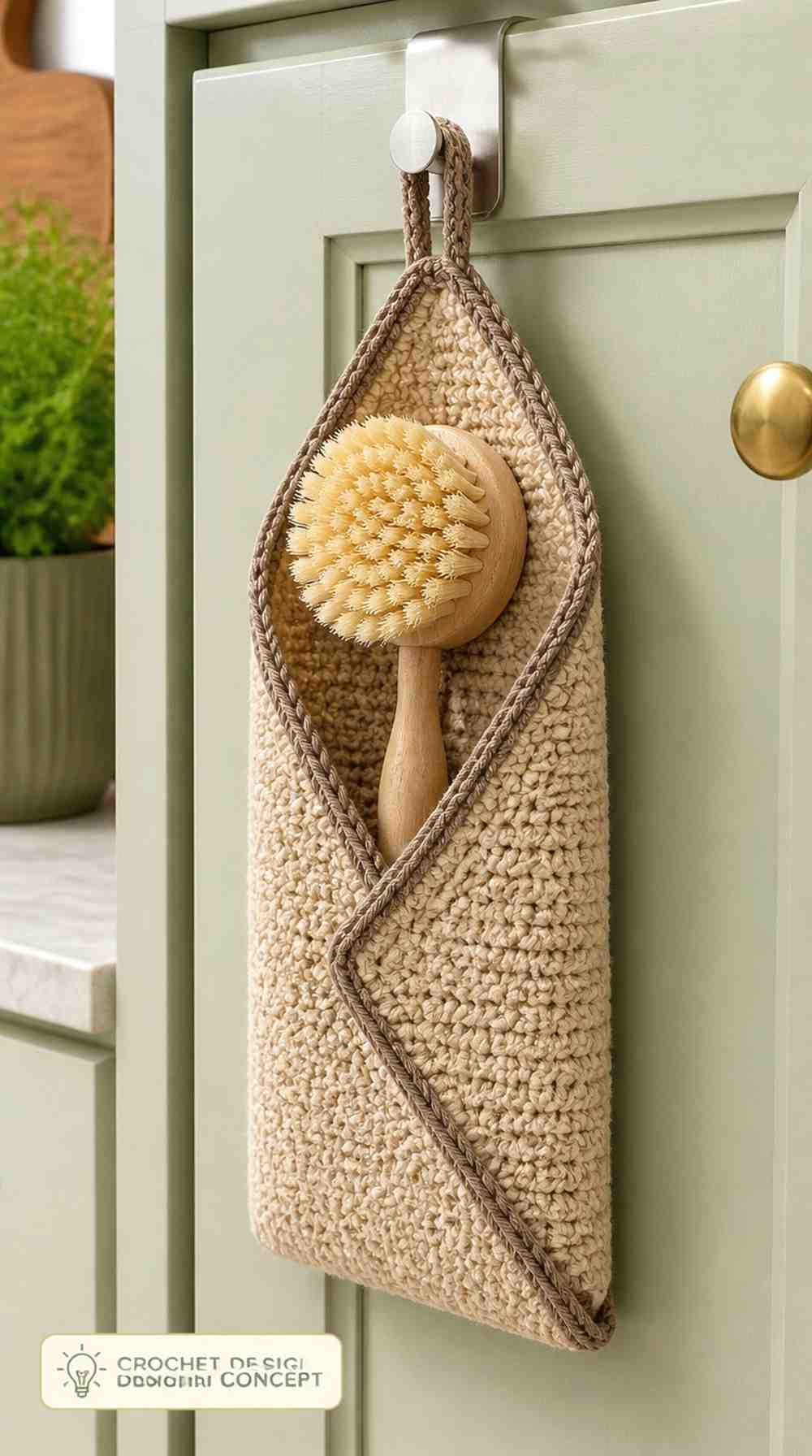
Sandy-beige crochet folds into a small vertical envelope shape with an angular front panel. The shallow V-shaped upper opening has dark-taupe edging, and a short matching hanging loop attaches the cradle to a brushed-metal hook. A compact wooden brush rests inside, with its rounded light-bristle head visible above the fold.
The envelope construction gives this holder a simple tailored appearance. Unlike an open mesh caddy, it uses relatively close stitching across the front. That creates a cleaner visual surface but also means moisture and trapped residue deserve additional attention if the design is made for everyday use.
- Folded Front Panel: The angular overlap should stay flat rather than forming a deep crease where water or dirt could collect.
- V-Shaped Opening: Keep the opening broad enough for easy brush removal without allowing the handle to lean sideways.
- Dark-Taupe Border: The narrow edging defines the folded structure and could be adjusted to match other cabinet hardware colors.
- Solid Fabric Limitation: Close crochet stitching surrounds more of the handle, making thorough cleaning and complete drying particularly important.
17. Crochet Rust Braided Brush Hanging Cord
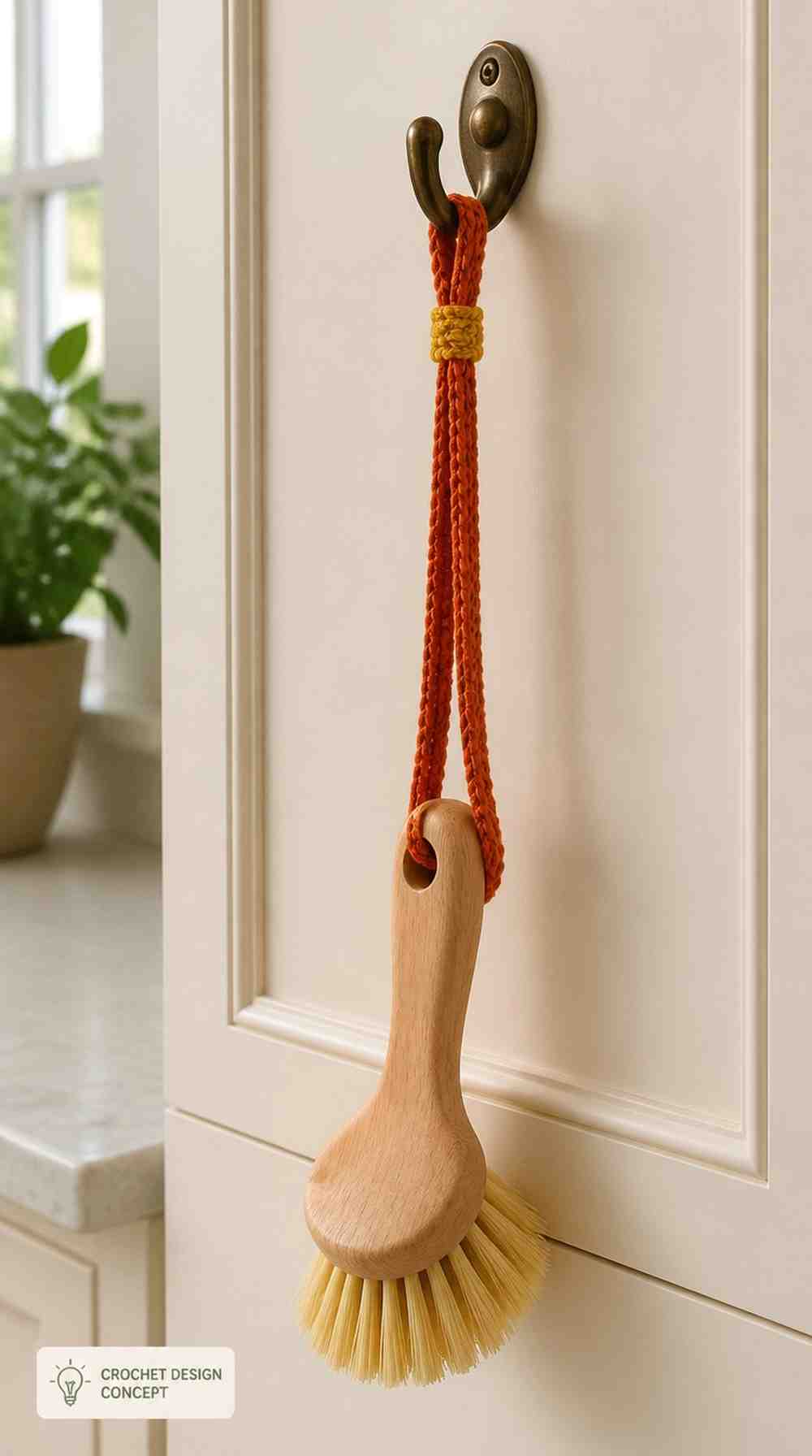
Two narrow rust-orange crochet cords create a braided-looking hanging strap, finished with a small mustard-gold binding near the upper junction. The strap attaches to a dark-brass cabinet hook, and its lower loop passes through the hole in a wooden dish brush handle. The brush hangs vertically with the bristles pointing down.
This is one of the most minimal designs in the collection. Rather than using a pocket or large backing panel, it concentrates the crochet detail into the hanging cord itself. A real version would need secure cord joins and a reliable connection to the brush handle.
- Braided Cord Structure: The two strands should be firmly connected so the strap does not separate or twist excessively under repeated movement.
- Mustard Binding: Keep the small upper band compact and securely joined, without loose yarn tails that could catch on cabinet hardware.
- Lower Brush Loop: The loop must suit the actual handle hole and should not stretch open when the brush is removed or replaced.
- Lightweight Use: A slender crochet cord is not automatically strong enough for every brush. Test the actual materials and attachments before use.
18. Crochet Rosewood Petal Brush Cup Hanger
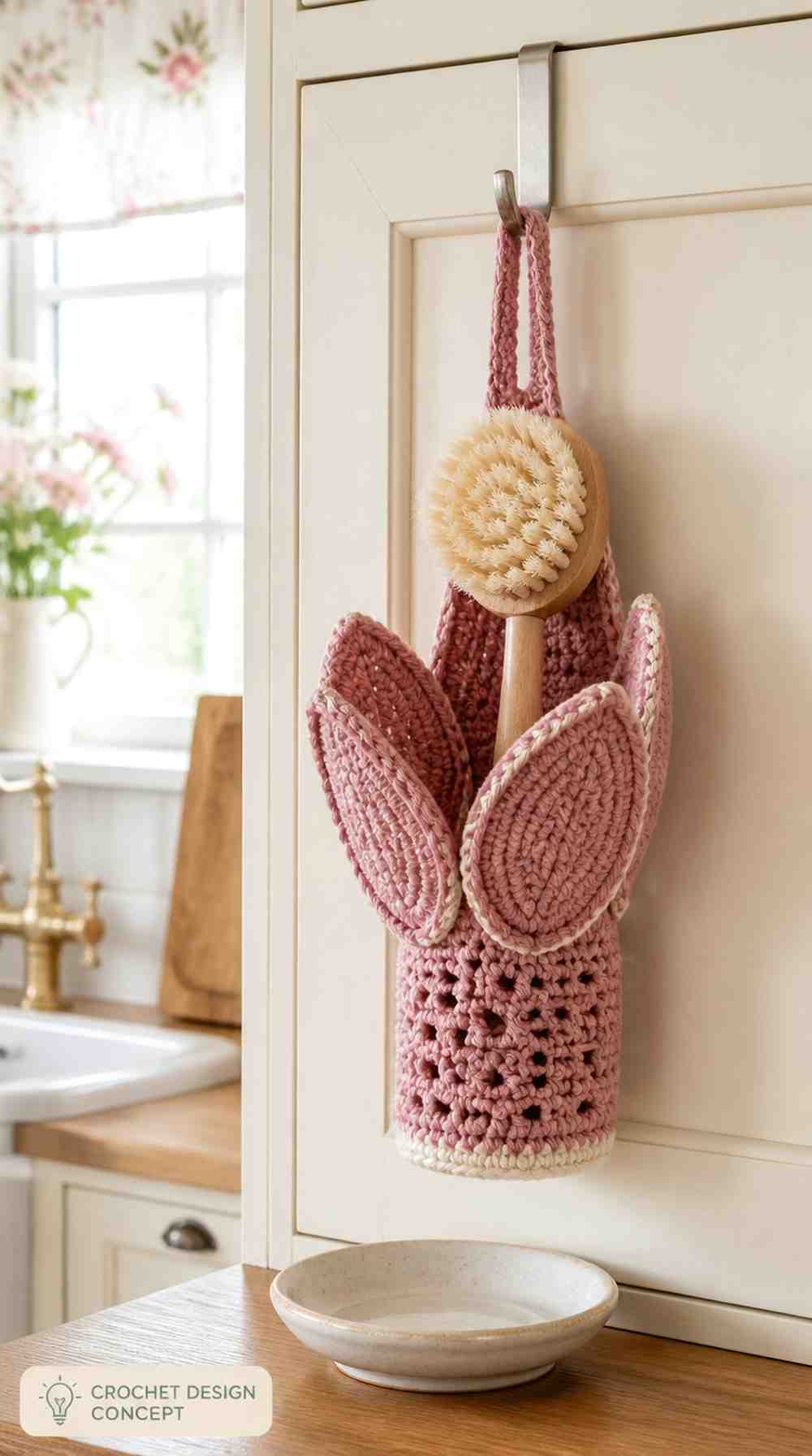
Rosewood-pink crochet gives this small brush holder a flower-inspired shape, with five gently overlapping petal-like panels around the upper rim. A narrow cylindrical lower section features small open drainage holes, while a fine ivory edge finishes the cup. One wooden dish brush stands upright with its bristle head exposed above the petals.
The hanging cup adds a decorative cottage feel without placing a separate flower appliqué on the front. Its curved petals create the silhouette themselves. This makes the shape interesting, although the overlapping crochet edges may require more care than a simple straight-sided pocket.
- Five-Petal Opening: Keep the upper panels shallow and evenly shaped so they frame the handle rather than pressing against the brush bristles.
- Narrow Cup Base: The cylindrical lower section should match the brush handle closely enough to keep it upright.
- Drainage Holes: Openings in the base allow potential drips to escape but do not replace proper cleaning or a safely positioned catch tray.
- Overlapping Edges: Where petals overlap, extra fabric can retain moisture. A simplified flat-rim version would be an optional easier-care variation.
19. Crochet Sage Cream Double Brush Station
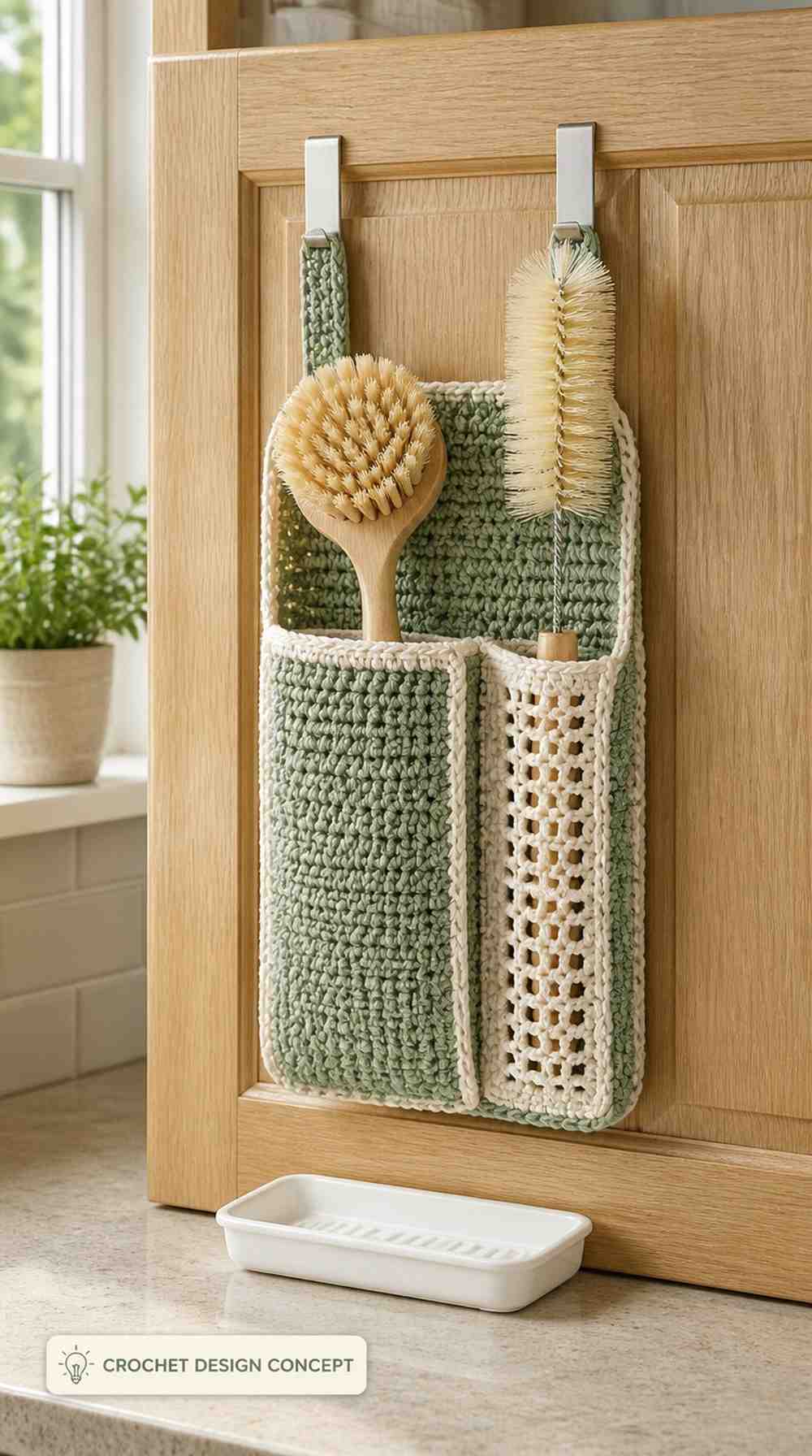
Sage-green crochet forms a compact rectangular organizer with two different vertical storage areas. The wider compartment has a closely stitched sage body for a wooden dish brush, while the narrower channel uses open cream mesh for a slender bottle brush. Straight cream borders separate the two sections, and both bristle heads remain exposed above the organizer.
Two short hanging straps connect the station to separate stainless over-door hooks. This is the most elaborate storage arrangement in the collection, making it suitable inspiration for a kitchen with more than one cleaning brush. The mixed pocket widths require careful sizing and balanced hanging.
- Different Brush Sizes: The wider sage pocket and narrower cream channel should be measured separately rather than made with matching dimensions.
- Two-Hook Alignment: Both over-door hooks need to sit evenly so the organizer remains level when one brush is removed.
- Mixed Stitch Coverage: The close-textured sage pocket and open cream mesh may stretch differently, so the joined organizer needs careful checking.
- Cleaning Two Compartments: Both brushes should be removable independently, and the complete holder must be easy to wash and dry between uses.
Practical Guide to Crochet Cabinet Door Dish Brush Hangers
Before choosing a crochet dish brush hanger, start with the brush itself, the available cabinet space and how you usually clean the sink area.
Check the brush handle. A wooden brush with a hole near the end may suit a hanging strap or loop. A solid handle without an opening may need a fitted pocket, cradle or two-loop organizer. Check the brush’s length, width and weight before planning the holder.
Choose the mounting position carefully. Over-door hooks need enough clearance for the cabinet to close properly. Front-mounted hooks need to suit the door material and finish. Avoid mounting anything where it could scrape the cabinet, catch on neighboring drawers or restrict access to storage.
Plan for wet brushes. Crochet is absorbent unless the chosen material has different properties. Open mesh can provide ventilation, but it does not guarantee hygiene or quick drying. Ideally, rinse the brush, shake off excess water and allow it to dry in a well-ventilated spot where the bristles and any drips stay clear of the cabinet.
Consider washable materials. Smooth cotton or an easy-care cotton blend is worth exploring for many kitchen crochet accessories. Check the yarn’s care label and how the finished stitches respond to washing. Avoid leaving a damp holder pressed against wooden cabinetry.
Keep the hanger removable. A simple attachment makes it easier to clean the crochet, inspect the brush and wipe down the cabinet. If a holder sags, smells musty, traps moisture or obstructs the door, stop using it until the issue is corrected.
For related kitchen organization inspiration, explore 16 Crochet Vintage Kitchen Wall Pocket Ideas for Cozy Cottage Homes and 24 Crochet Kitchen Towel Topper Ideas for Cozy Cottage Kitchens on Yarn Nest Studio.
Want to Make Something Similar?
These resources offer useful techniques for exploring crochet brush holders and hanging loops. They are not exact patterns for the AI-generated concepts pictured in this collection.
- Crochet Dish Brush Holder by CyCrochet — A practical folded-pocket holder with a hanging loop. It provides a helpful example of a crochet project designed specifically for storing a dish brush. CyCrochet
- How to Crochet a Hanging Loop on Your Dishcloth by Crystal Marin at ChristaCoDesign — Explains several ways to add a hanging loop to crochet fabric, useful background for the loop-based designs. ChristaCoDesign
Use these as independent learning resources, and check any finished holder’s fit, hanging security and suitability for use near a wet sink.
Which Crochet Cabinet Door Dish Brush Hanger Should You Choose?
| Design preference | Suggested ideas | Main trade-off |
|---|---|---|
| Fewest decorative elements | Oatmeal Buttoned Loop, Denim Knob Strap | Requires a brush with a hanging hole |
| Open, ventilated appearance | Sage Open Mesh Sleeve, Mustard Lattice Caddy | Open stitches still need secure handle support |
| Compact single-brush pocket | Terracotta V Pocket, Sand Envelope Cradle | More fabric surrounds the handle |
| Strong decorative detail | Coral Daisy Pocket, Rosewood Petal Cup | Extra edges need more cleaning |
| Minimal hanging cord | Rust Braided Brush Cord, Ivory Scalloped Ring | Suspension points need careful checking |
| Multiple cleaning brushes | Navy Twin Pockets, Sage Cream Double Station | Wider organizer and more mounting space |
| Modern kitchen styling | Checkerboard Pocket, Mint Geometric Mesh Pocket | More joins and shaping to consider |
For a brush with a hanging hole, the Crochet Oatmeal Buttoned Brush Hanging Loop offers one of the simplest visual approaches. For a solid wooden handle, the Crochet Sage Open Mesh Dish Brush Sleeve or Crochet Charcoal Ribbed Hanging Brush Cradle is worth exploring, provided the actual construction can support the brush reliably.
If you have two different brushes, the Crochet Sage Cream Double Brush Station offers the clearest way to compare separate storage compartments.
Conclusion
These 19 crochet cabinet door dish brush hanger inspiration ideas show how much variety can come from a small household accessory. Simple hanging loops, structured pockets, open mesh holders and decorative cup shapes each offer a different way to organize the space around a kitchen sink.
For everyday use, the best design is not necessarily the most decorative. A secure attachment, appropriate brush fit, easy removal and proper drying are more important than an elaborate stitch pattern. Use the collection to explore what looks good in your kitchen while keeping those practical needs in mind.
Which style would you choose for your kitchen cabinet: a simple hanging loop, an open mesh sleeve or a two-brush organizer? I’d love to know which one seems most useful for your setup.
Frequently Asked Questions
1. What is the best yarn for a crochet cabinet door dish brush hanger?
Smooth, washable cotton or a suitable cotton blend can be a reasonable starting point because these yarns are commonly used for kitchen crochet projects. However, fiber choice alone does not make a holder hygienic or moisture-resistant. Check the yarn’s washing instructions, consider whether the finished fabric will stretch and ensure the holder can dry completely.
2. Can a crochet dish brush hanger be attached without drilling into the cabinet?
Possibly. Some designs use removable over-door hooks, while others hang from an existing cabinet knob or suitable hook. Check that the chosen hardware fits the cabinet, supports the intended load and does not prevent the door from closing. Removable hooks can still scratch finishes or leave marks, so compatibility matters.
3. Should a dish brush hang with its bristles facing up or down?
Either orientation may work if the brush can drain and dry properly. Bristles-down hanging can let water drip away from the brush head, provided the bristles do not touch the cabinet or another surface. Upright storage should keep the bristles exposed and avoid trapping water around the head. Follow the brush manufacturer’s care guidance where available.
4. How do I prevent a crochet dish brush holder from becoming damp or dirty?
Remove and wash the holder regularly according to the yarn care instructions. Rinse the brush, shake off excess water and keep the holder away from surfaces that could suffer moisture damage. If the crochet develops an odor, remains damp or becomes visibly dirty, remove it for cleaning and thorough drying. The cabinet surface should also be cleaned separately.
5. Are these crochet dish brush hanger designs actual patterns?
No. These 19 designs are AI-generated inspiration concepts, not tested crochet patterns. They show possible pocket shapes, stitch textures, colors and mounting arrangements, but do not provide verified stitch counts, gauge or fastening methods. A real holder should be planned around the actual brush, cabinet hardware, cleaning requirements and safe use.