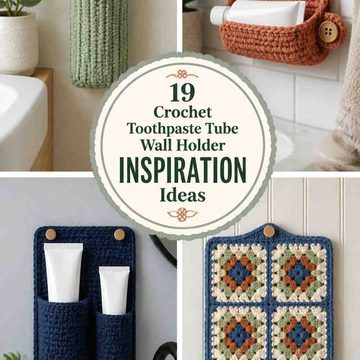
Small household details can be surprisingly interesting places to explore crochet design. Even a simple waste bin lid handle offers room for different textures, shapes, colors and decorative finishes. These 19 crochet household waste bin lid handle cover ideas range from narrow ribbed sleeves and textured grip wraps to scalloped knob caps, buttoned cuffs and colorful patchwork designs.
This collection is especially useful if you enjoy finding creative ways to coordinate everyday household accessories. You can compare covers for bar handles, raised arches, flat pull tabs and rounded knobs, while considering how easily each design could be fitted, removed and cleaned. Because a waste bin handle is frequently touched, practical fit and hygiene matter just as much as appearance.
These are AI-generated crochet design visualizations for inspiration, not photographs of tested handmade pieces or step-by-step patterns.
Quick Design Selection Guide
| What you're looking for | Design to explore | Why consider it |
|---|---|---|
| A simple everyday look | Crochet Sage Ribbed Bar Handle Cover | Narrow ribbing keeps the cover visually understated |
| A cottage-style detail | Crochet Ivory Scalloped Knob Cap | Scalloped edging adds decoration to a round knob |
| An adjustable wrap concept | Crochet Terracotta Buttoned Arch Wrap | A side fastening offers a possible removable arrangement |
| Noticeable grip texture | Crochet Charcoal Waffle Pull Sleeve | Raised squares create a textured surface |
| A colorful modern accent | Crochet Mint Diagonal Colorblock Sleeve | Diagonal blocks bring color without raised decoration |
| A creative handmade finish | Crochet Denim Patchwork Bar Wrap | Three joined sections create a distinctive patchwork appearance |
For frequently handled household bins, the simpler close-textured concepts are generally more sensible starting points than designs with loose ties or raised decorations. None should be assumed secure or hygienic without checking the actual finished piece.
1. Crochet Sage Ribbed Bar Handle Cover
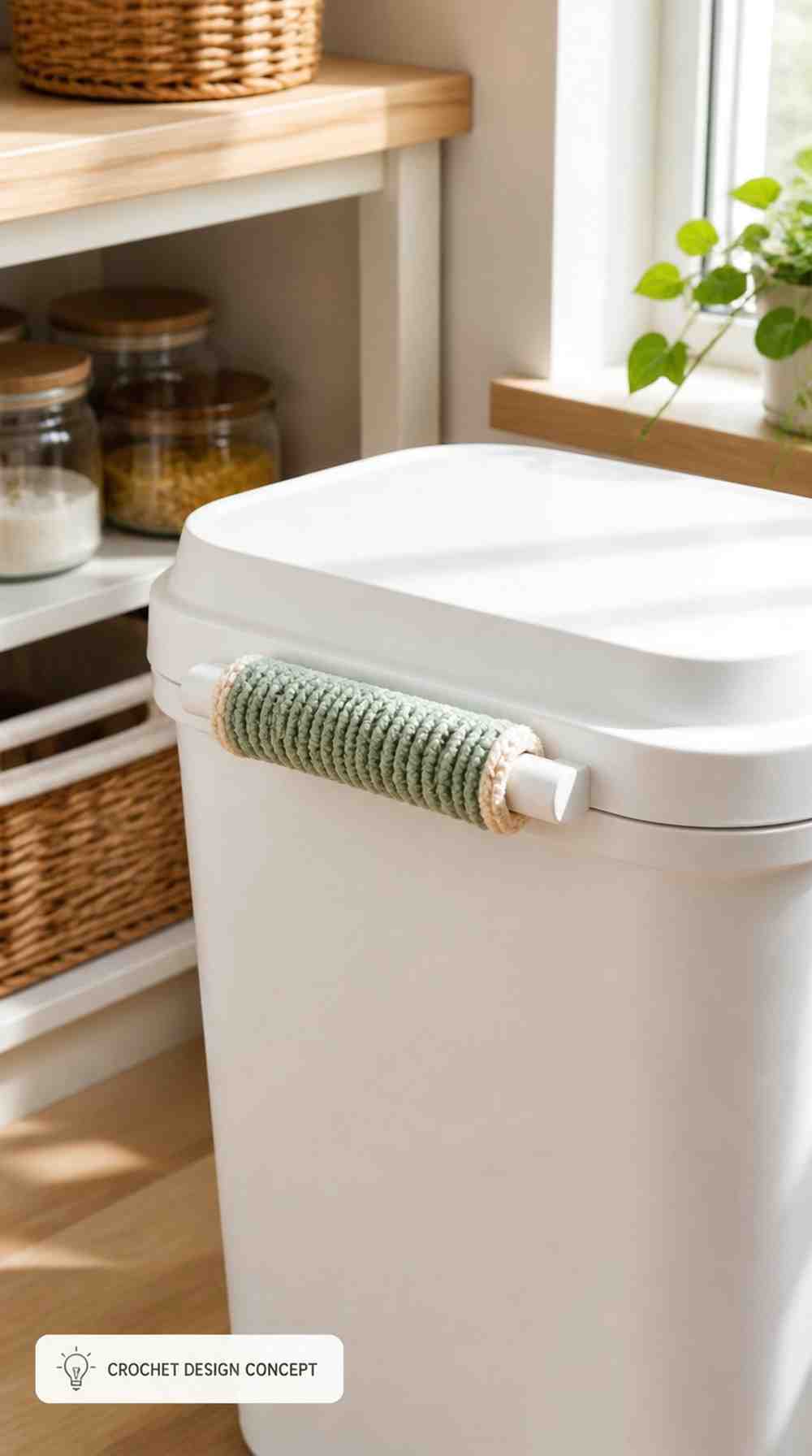
Soft sage green gives this compact crochet sleeve a calm, understated appearance. Narrow vertical ribbing runs across the short horizontal bar handle, while oatmeal-colored rolled edges finish both open ends. The cover sits neatly on a white waste bin lid, allowing its shape to remain clearly recognizable rather than hiding the original handle.
The restrained design suits a pantry or utility area with pale wooden shelving. Its main consideration is fit: a loose sleeve could rotate or slide when the lid is lifted, so the fabric needs to be assessed on the actual handle.
- Bar Handle Compatibility: This narrow tubular shape is intended for a short straight handle. Check its length, thickness and end clearance before considering a similar cover.
- Ribbing Direction: The vertical ridges create a distinct handmade surface. Test the actual stretch before relying on ribbing to hold the sleeve in place.
- Edge Proportions: Keep the oatmeal rolled ends relatively slim so they do not add unnecessary bulk or interfere with the handle supports.
- Cleaning Consideration: Select an easy-care yarn and make the sleeve removable. Its soft surface can collect dirt from repeated contact.
2. Crochet Ivory Scalloped Knob Cap
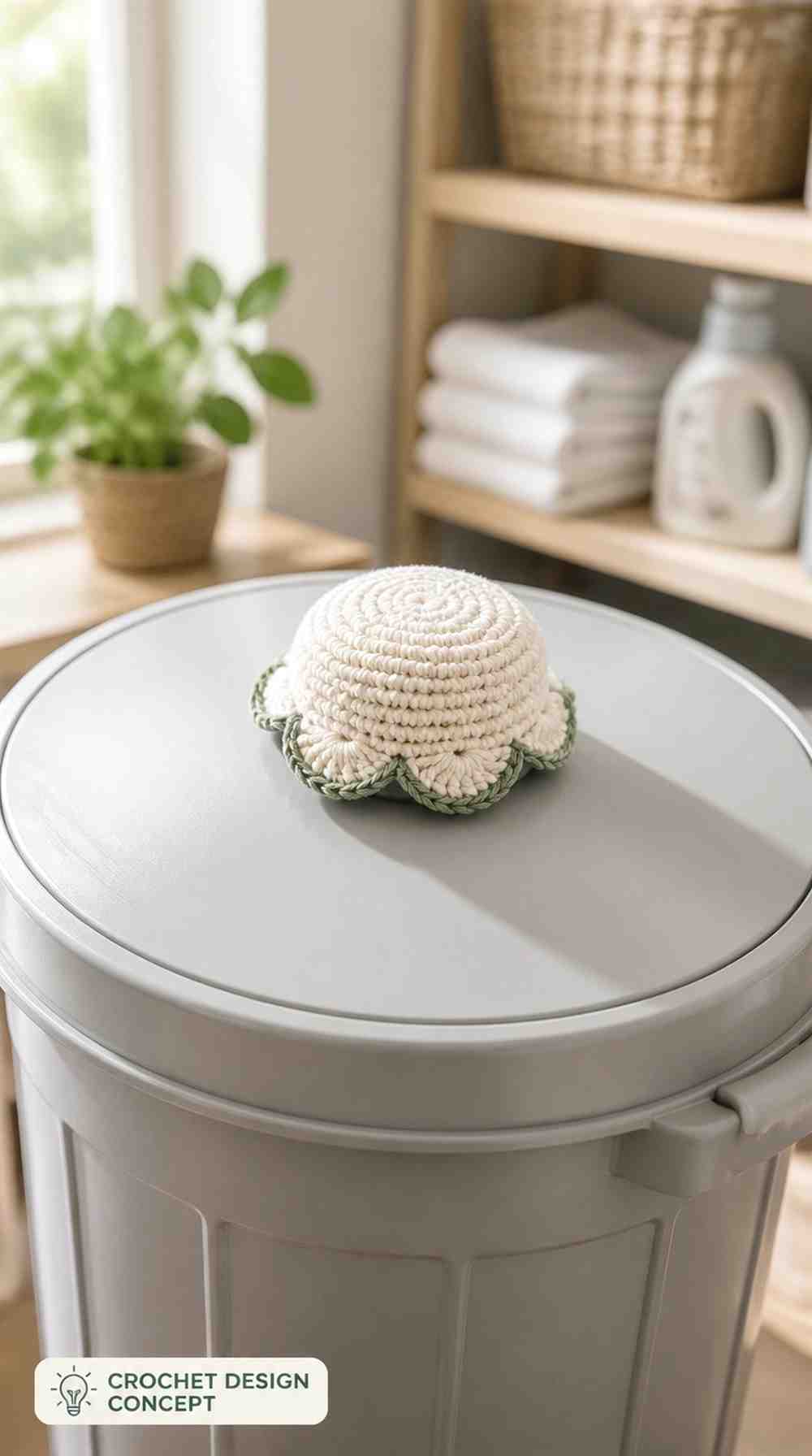
Six gentle scallops circle the lower edge of this ivory crochet knob cap, each outlined with a fine sage-green border. The closely stitched circular top follows the raised round knob of a pale-gray bin lid. Its combination of a smooth central surface and shaped decorative edge gives the small accessory a traditional cottage-inspired appearance.
This concept suits a light laundry room where soft neutral colors already dominate. The lower scallops are the main feature to consider because projecting edges may catch against fingers or neighboring lid details during regular use.
- Round Knob Shape: A cap like this needs to follow the knob’s top and curved sides closely. An overly shallow version may lift during handling.
- Scallop Clearance: Check that the six curved sections remain above the lid surface and do not catch when the handle moves.
- Border Definition: The sage edging helps distinguish the individual scallops without requiring additional appliqués or bulky attachments.
- Care of Light Yarn: Ivory may show marks quickly on a bin handle. Consider how easily the actual yarn can be washed and dried.
3. Crochet Terracotta Buttoned Arch Wrap
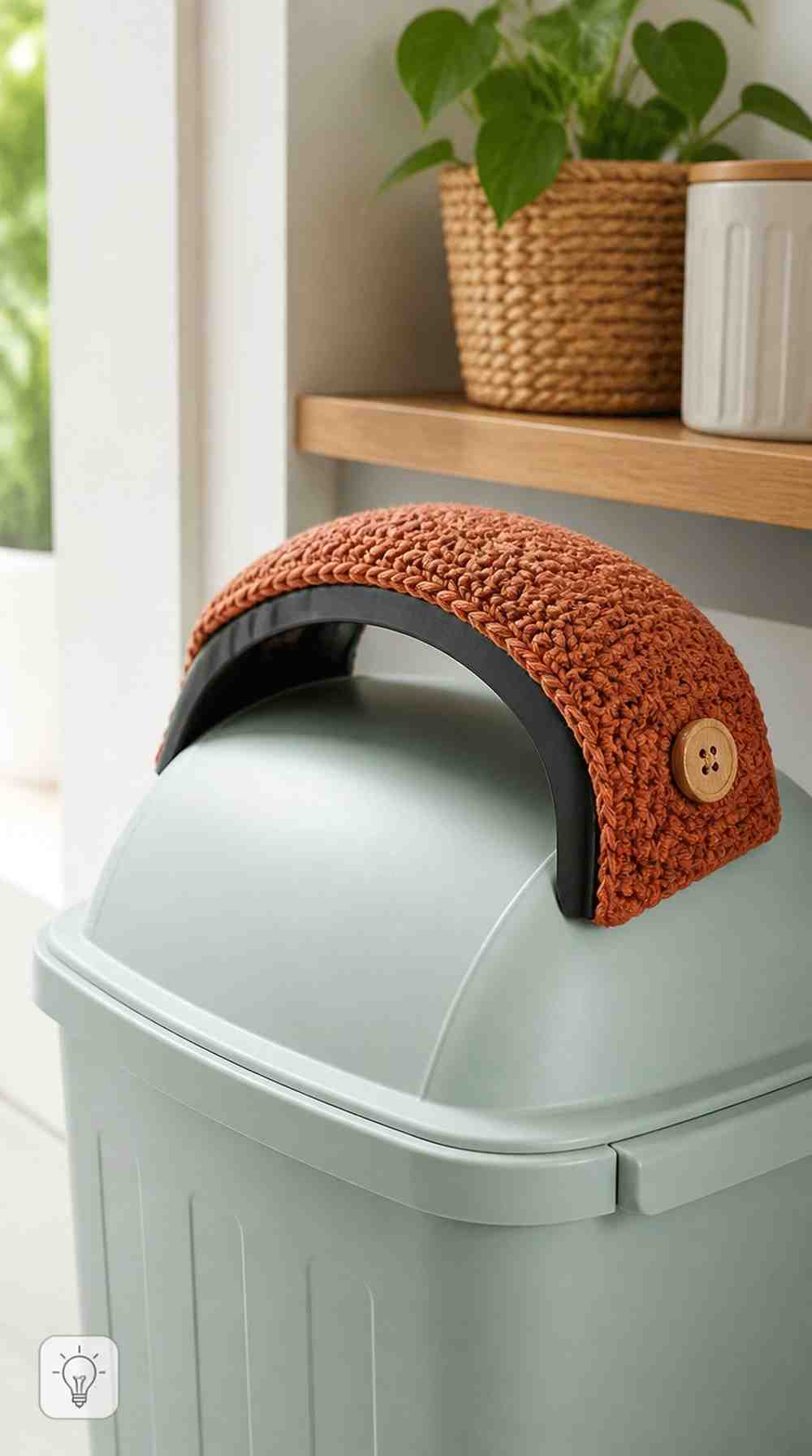
Terracotta crochet adds a warm earthy accent to the black arched handle of this dusty mint household bin. Fine, seed-like stitches create an even fabric, and a short overlapping side tab finishes with one small wooden button. The wrap follows the upper curve while keeping the opening underneath visible.
Unlike a closed tubular cover, this design suggests a removable fastening arrangement. Its practical appeal depends on whether the button and overlapping fabric can remain clear of the user’s fingers without becoming loose or catching on the handle.
- Curved Handle Fit: Measure along the actual arch rather than assuming that a straight rectangular strip will follow the same shape neatly.
- Button Placement: Keep the side fastening outside the main gripping area. Check that the button is securely attached before regular use.
- Fabric Density: Fine, closely spaced crochet stitches give the wrap a relatively smooth visual finish compared with heavily raised textures.
- Removal for Cleaning: A detachable arrangement may be easier to launder, but the finished button closure must be checked for fit and reliability.
4. Crochet Charcoal Waffle Pull Sleeve
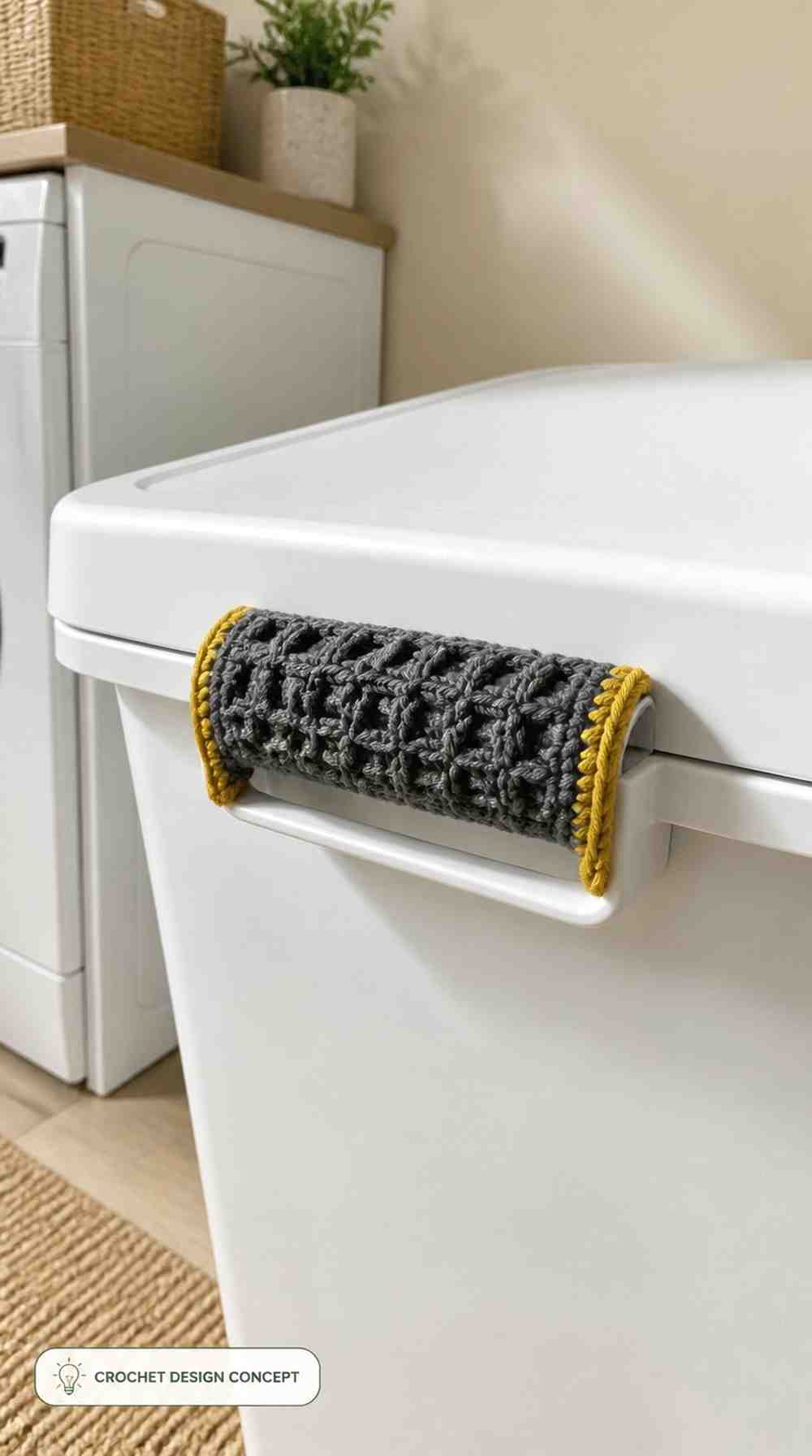
Deep charcoal-gray crochet gives this rectangular pull cover a strong textured finish. Repeated raised waffle squares cover the short, broad handle, while narrow mustard-yellow edging adds a crisp line around the ends. The white bin lid provides a clear contrast that makes the stitch pattern especially noticeable.
The squared surface feels visually substantial without needing flowers, buttons or long ties. However, the raised waffle pattern could retain more dirt than a flatter stitch, making regular removal and cleaning an important consideration for any working version.
- Flat Pull Shape: This concept is designed around a broad rectangular pull rather than a round knob. Allow sufficient space for fingers to reach underneath.
- Waffle Stitch Thickness: Raised crochet squares create depth. Check that added thickness does not make the pull awkward to grasp.
- Mustard Edge: The narrow contrasting border defines the sleeve without extending onto the surrounding lid.
- Cleaning the Texture: Recesses between raised squares may collect dust or residue. A flatter stitch would be an optional lower-maintenance alternative.
5. Crochet Dusty Blue Cross-Band Grip
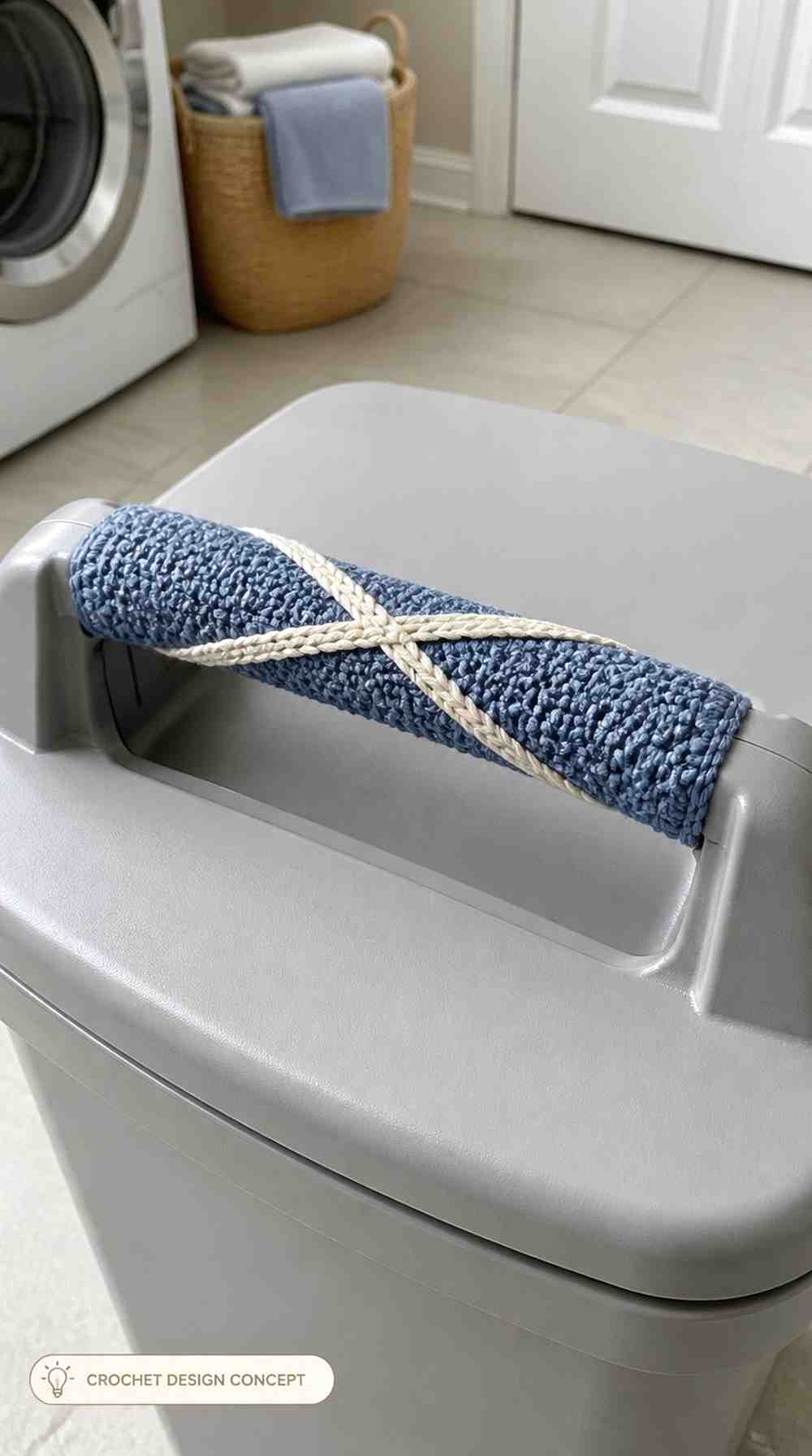
A dusty-blue crochet grip covers the central section of this wide bridge handle, with two narrow cream bands crossing diagonally to form a clear X. The combination of an evenly stitched background and raised crossing detail gives the otherwise simple handle a fresh, slightly tailored appearance.
The design works visually with a light-gray waste bin and clean laundry-room surroundings. The diagonal bands are decorative rather than proven reinforcement, so their placement needs care. They should remain flat and securely attached without creating loose edges that fingers could catch.
- Bridge Handle Coverage: Keep the center opening clear, as pictured, so the original handle remains accessible from underneath.
- Cross-Band Alignment: The cream diagonals should meet neatly at the center. Uneven tension could distort the blue base fabric.
- Decorative Limitations: Do not treat the X-shaped detailing as structural support for lifting the lid or carrying the bin.
- Optional Simpler Finish: For a frequently used handle, the blue base alone could provide a less bulky interpretation without the raised crossing bands.
6. Crochet Mustard Linen Stitch Knob Collar
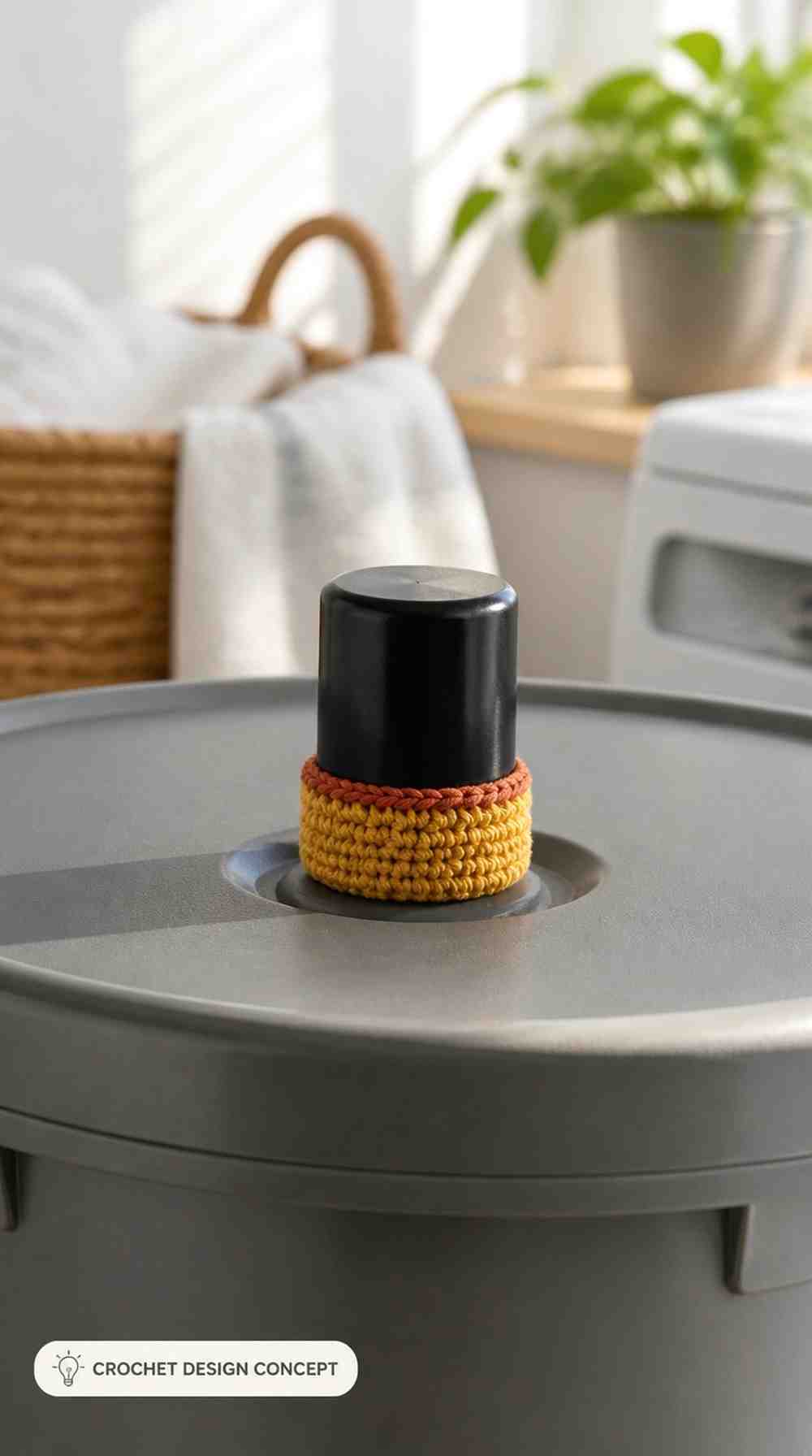
Rather than covering an entire knob, this mustard crochet design forms a narrow collar around its lower section. Small linen-stitch-like loops create a compact fabric, with a fine rust-colored line around the upper edge. The black cylindrical top remains fully exposed, making the contrasting colors easy to see.
This approach offers a subtler decorative accent for gray household bins. Because the original gripping surface is mostly uncovered, the collar is more of a visual detail than a full handle sleeve. Its lower placement also needs careful clearance from the lid.
- Partial Knob Coverage: The short collar changes the knob’s appearance without covering the top, making it different from a full cap.
- Lower-Rim Clearance: Leave enough space between the crochet and the lid to prevent friction, pinching or obstruction when the knob is used.
- Linen-Like Texture: Small interlocking stitches create a restrained surface pattern without the height of puff or waffle textures.
- Shape Retention: A narrow circular band can loosen with use. Check the finished circumference and washing behavior before relying on its fit.
7. Crochet Coral Daisy Arch Handle Cover
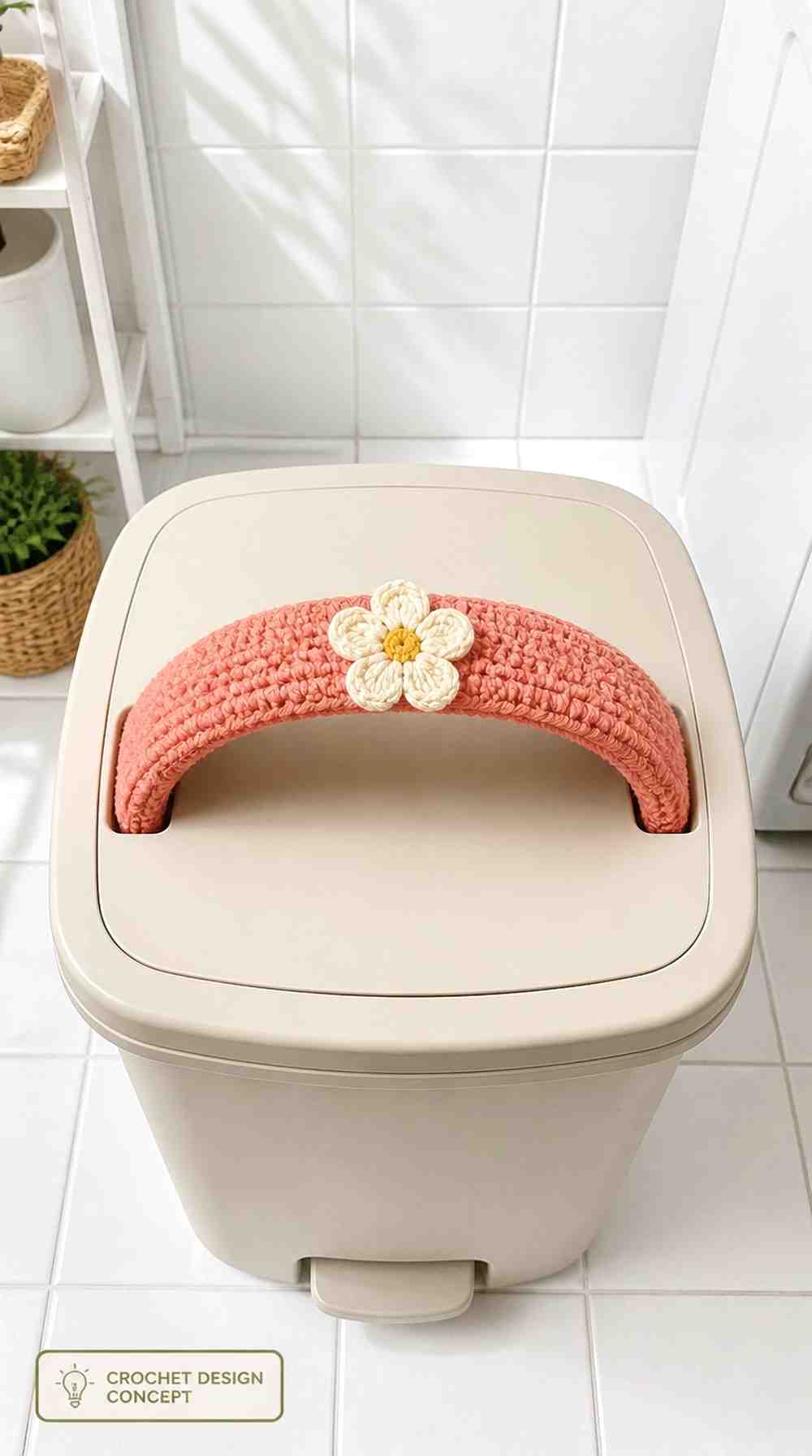
Coral-pink crochet brings a cheerful accent to the top of this beige waste bin’s arched handle. The closely worked band supports a single flat ivory daisy, finished with five rounded petals and a tiny golden-yellow center. Its simple floral arrangement keeps the decoration focused on one recognizable motif.
This concept has a playful cottage feel without covering the whole bin lid. The flower sits on a commonly touched surface, however, and even a relatively flat motif may collect dirt or snag during use. It makes more sense as a decorative concept for a lightly used bin.
- Flower Position: Keep the five-petal daisy centered on the upper band, away from the handle ends and surrounding lid mechanisms.
- Petal Attachment: Each part of the flower should be securely joined. Loose petals are unsuitable for a frequently handled household accessory.
- Arch Opening: Preserve the space beneath the original handle rather than extending the decorative band around the entire opening.
- Practical Alternative: Omitting the raised daisy would leave a simple coral cuff that may be easier to maintain.
8. Crochet Forest Drawstring Dome Cap
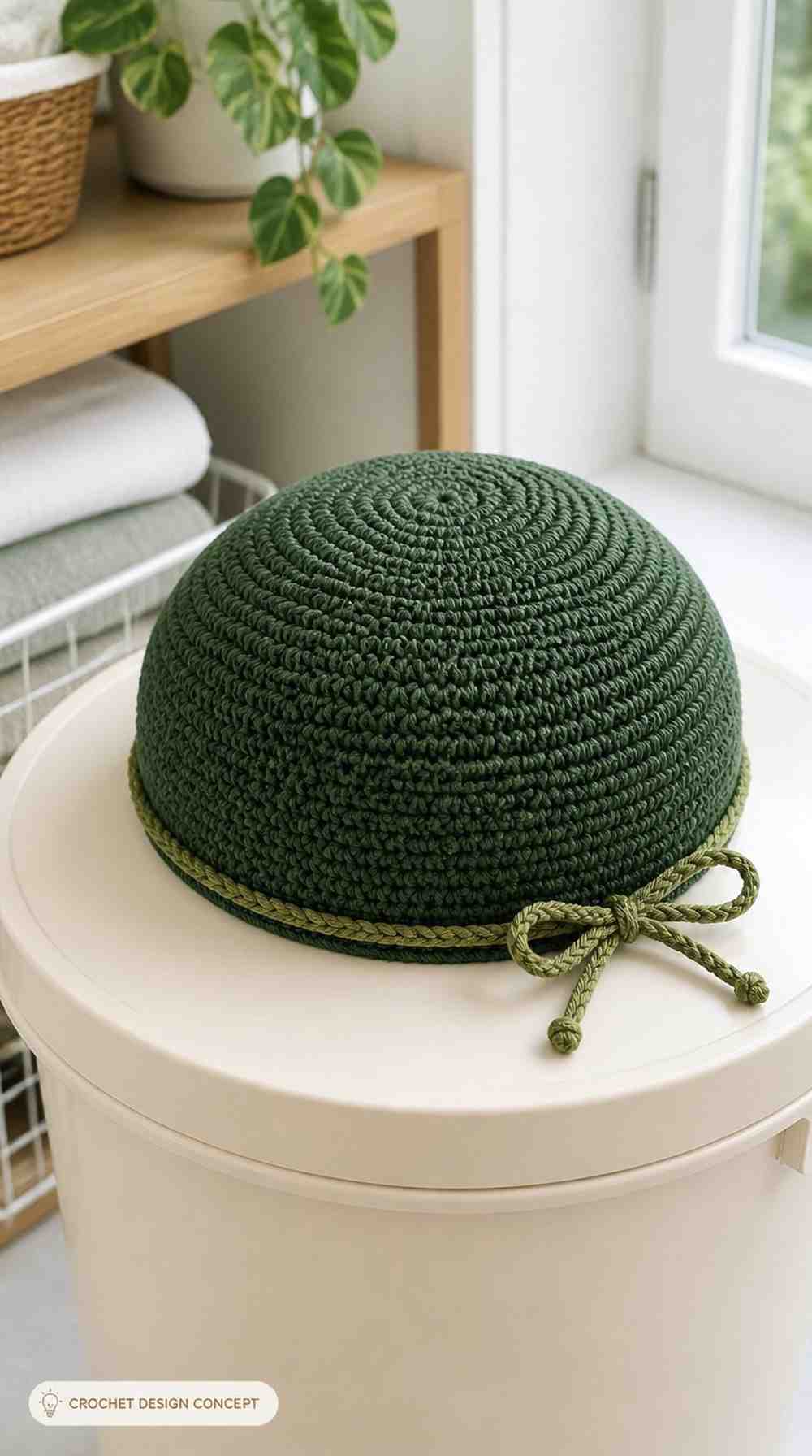
Forest-green crochet forms a rounded dome over the bulb-shaped knob of this cream waste bin lid. Concentric rows follow the curved top, while an olive-green drawcord runs around the lower edge. A small tied bow sits to one side, adding a neat finishing detail without dominating the shape.
The combination of a rounded cap and adjustable-looking cord gives this design a different silhouette from a fixed sleeve. Still, a drawstring is not automatically a secure fastening. Its ends, knot and lower edge must be checked carefully before using the covered knob.
- Dome Proportions: Match the cap to the actual knob’s rounded height and widest circumference rather than relying on its appearance in the illustration.
- Drawcord Placement: Position the cord below the main gripping area, where it cannot easily snag on fingers or the lid.
- Cord Length: Short, neatly secured ends are preferable to hanging ties, particularly in homes with children or pets.
- Removal and Drying: The gathered lower edge may hold moisture after washing. Open and dry the cap thoroughly before reinstalling it.
9. Crochet Black Cream Checkered Bar Cover
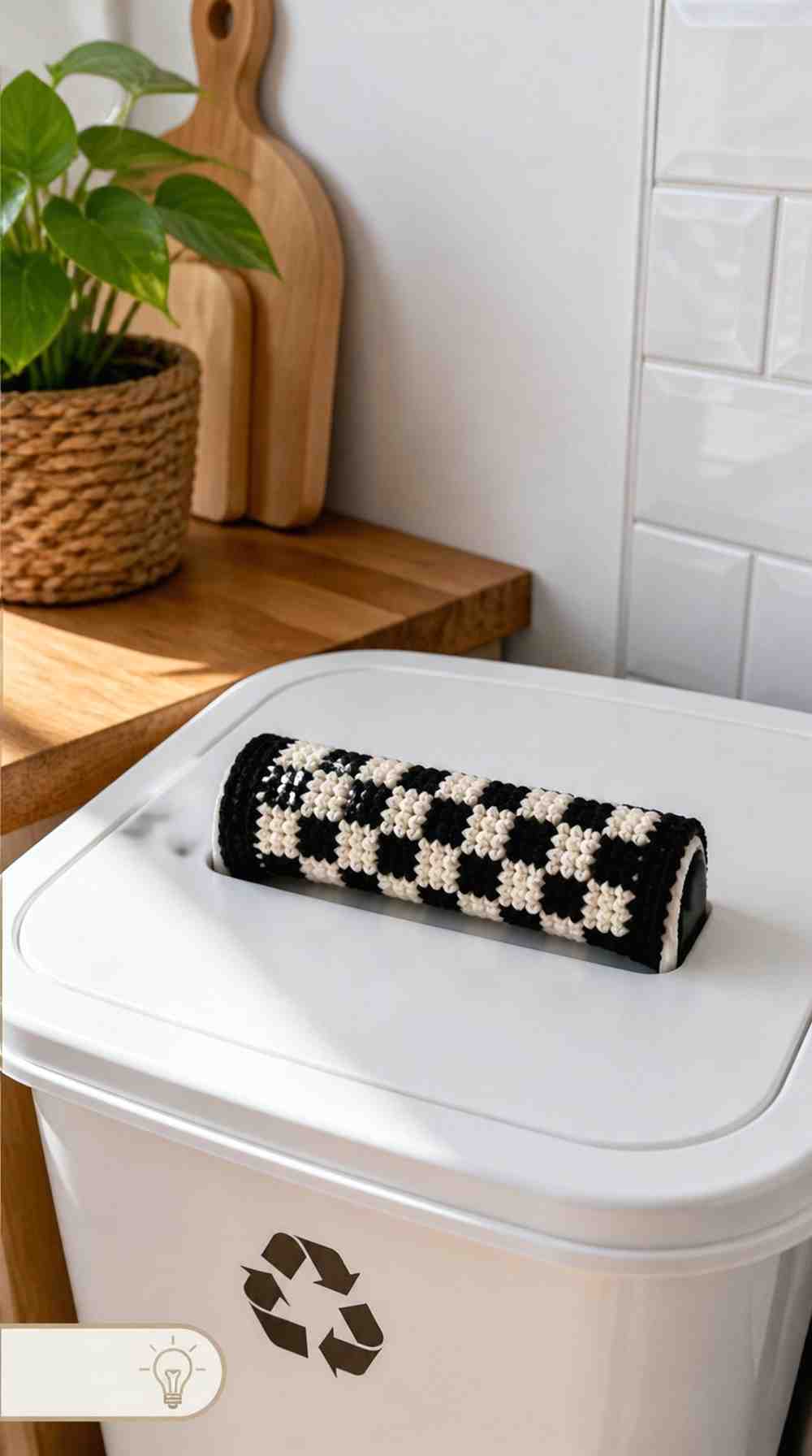
Small black-and-cream squares create a bold checkerboard surface around this straight bar handle. The crochet sleeve uses neatly repeated color blocks and narrow black finishing rows at both ends. Against the white bin lid, the familiar check pattern produces a clean graphic effect.
This design suits a modern kitchen recycling corner where black fixtures or light cabinetry provide a natural color connection. Although the visual treatment is playful, the structure remains simple. The main technical consideration is keeping the color joins even without producing bulky seams inside the sleeve.
- Checkerboard Scale: Small squares suit a narrow handle better than oversized blocks, which may lose their clear pattern around the curve.
- Color Transitions: Multiple color changes can create extra yarn ends. These should be finished securely so nothing loosens within the grip.
- Open Sleeve Ends: The black finishing rows should sit flush without interfering with the handle’s supports.
- Visible Marks: Cream sections can show dirt, while black may show lint. Consider the actual cleaning needs of the bin’s location.
10. Crochet Burgundy Envelope Pull Wrap
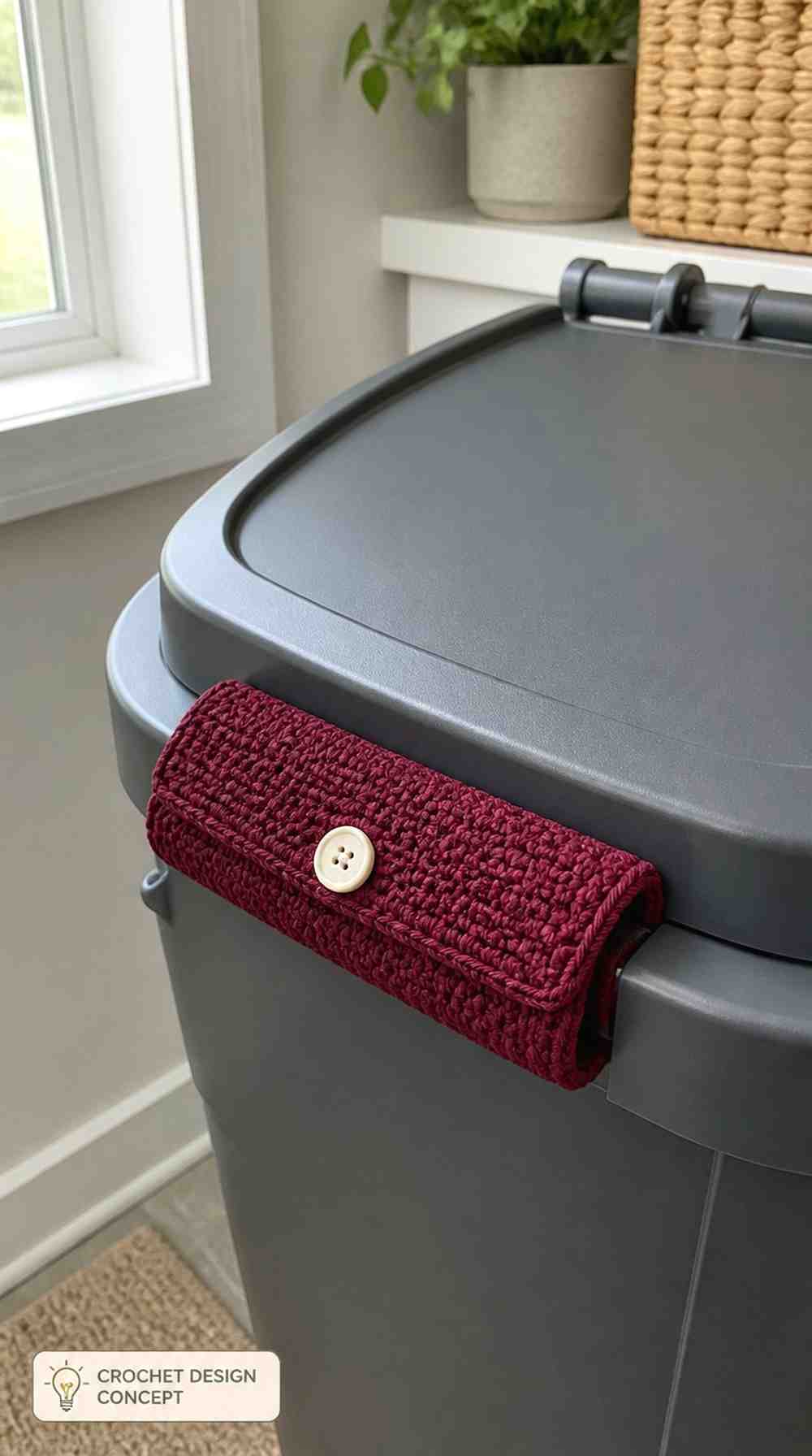
A rich burgundy crochet wrap gives this short flat pull tab a neat, envelope-like appearance. The rectangular folded flap lies over the close-textured body, and a small cream button secures one visible side. Its compact shape follows the slate-gray bin lid without extending over the hinge.
This design is especially suited to a narrow tab where a conventional tube may be difficult to fit. The fold and side fastening are interesting visual features, but they also introduce potential pressure points. Check whether the tab remains comfortable and straightforward to grip.
- Pull Tab Dimensions: Measure the width, thickness and usable gripping depth before adapting the envelope shape.
- Folded Flap: Keep the overlap shallow enough to avoid unnecessary thickness around the fingers.
- Button Access: The visible cream button belongs on the side rather than directly on the main contact area.
- Hinge Clearance: The wrap must remain away from the hinge and should never stop the lid from closing completely.
11. Crochet Navy Chevron Loop Grip
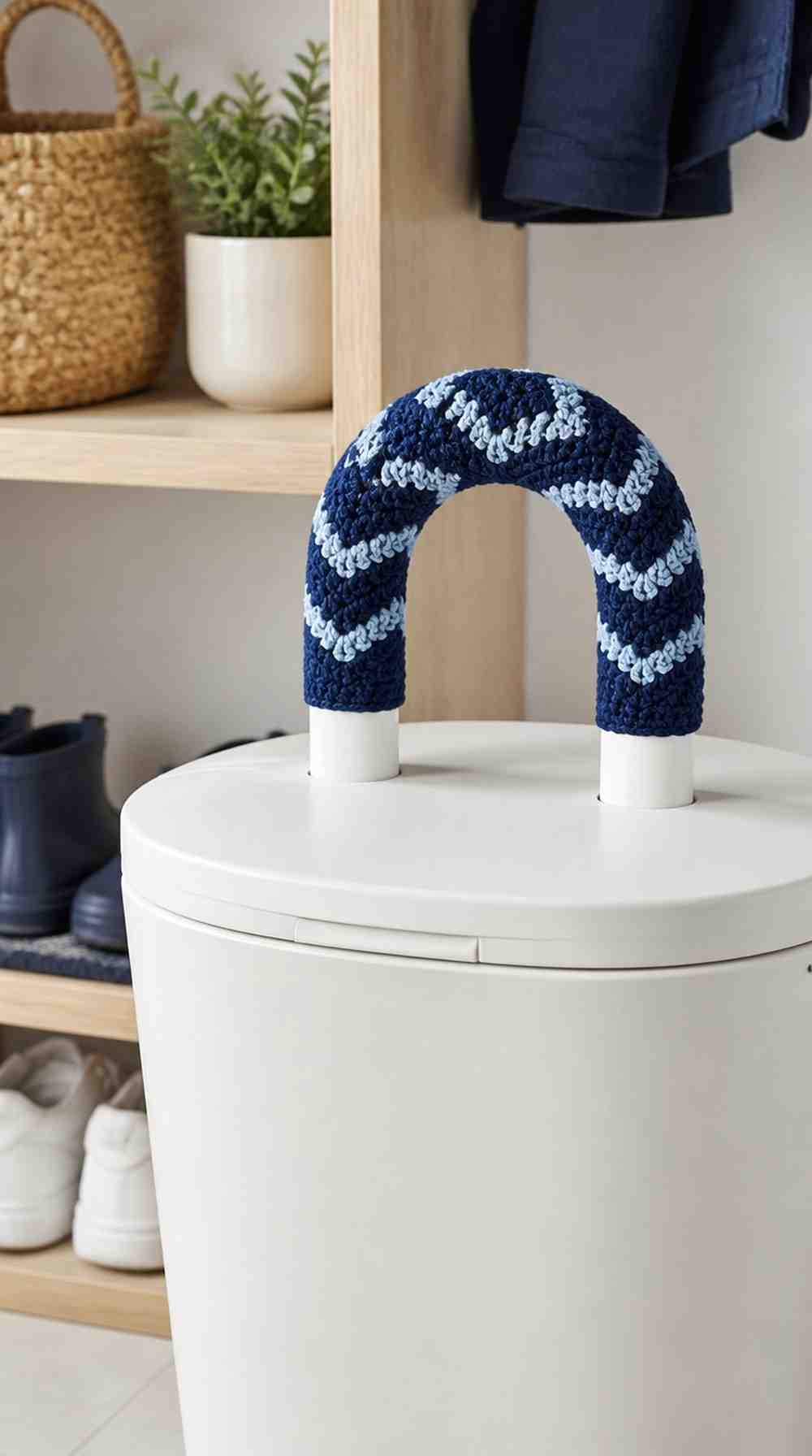
Deep navy crochet follows the upper curve of a standing oval loop handle, with pale-blue chevrons crossing the surface in repeated V shapes. The lower portions of the handle remain uncovered, allowing the oval opening to stay clearly visible. The pale-blue lines give the compact sleeve a strong directional pattern.
This design pairs neatly with white waste bins and simple mudroom surroundings. It is particularly dependent on the curve of the actual handle, because a poorly fitted tube may wrinkle along the inside edge or turn while being grasped.
- Oval Handle Shape: A curved sleeve may require different shaping from a straight bar cover to avoid bunching along the inner curve.
- Chevron Alignment: Keep the V-shaped rows centered across the top arc so the pattern reads clearly from the front.
- Partial Coverage: Leaving the lower sides exposed reduces fabric coverage and preserves the original loop opening.
- Tension Check: Uneven tension between navy and pale-blue sections can distort the chevrons or twist the finished sleeve.
12. Crochet Lilac Tie-Side Handle Cuff
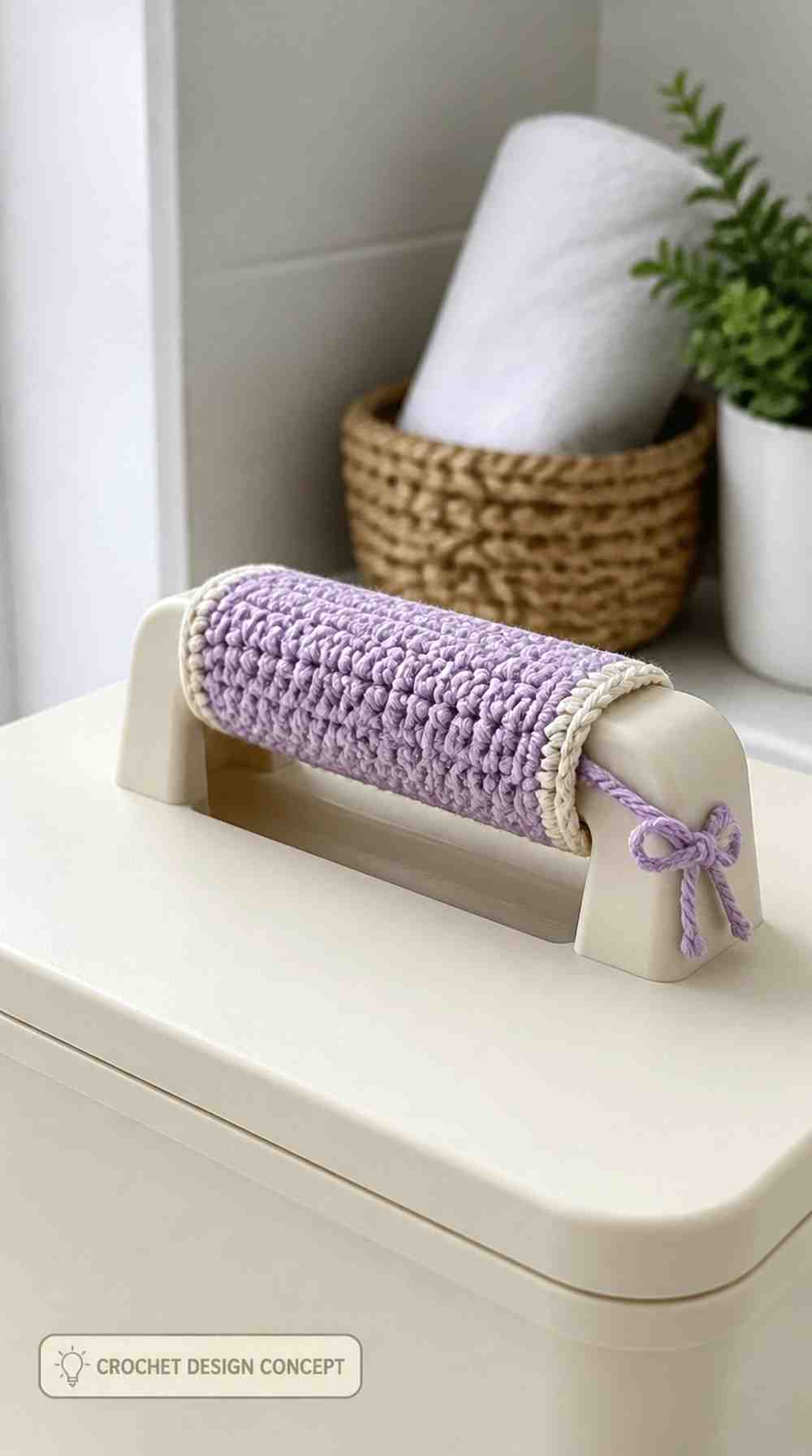
A soft lilac crochet cuff wraps the middle of this slim rectangular handle, using a finely textured moss-stitch surface. Two short lilac ties meet at one side in a small flat knot, while narrow ivory rows finish the outer edges. The cream bin beneath keeps the color combination delicate and uncluttered.
Unlike the buttoned concepts, this design relies on a simple visible tie arrangement. It could offer flexibility for slightly different handle shapes, but extra cord and knot placement must be considered carefully. A tie that loosens during use would make the cover impractical.
- Tie Location: Keep the knot at the side, clear of the gripping area and any moving lid parts.
- Short Cord Ends: Avoid long decorative tails that could catch on nearby objects or become accessible to children and pets.
- Moss-Stitch Surface: The small textured stitches create a relatively even appearance, helping the simple lilac color remain the main feature.
- Attachment Check: Test whether the real cover stays in position during normal lid operation. A decorative knot alone is not proof of a reliable fit.
13. Crochet Sand Basketweave Lid Grip
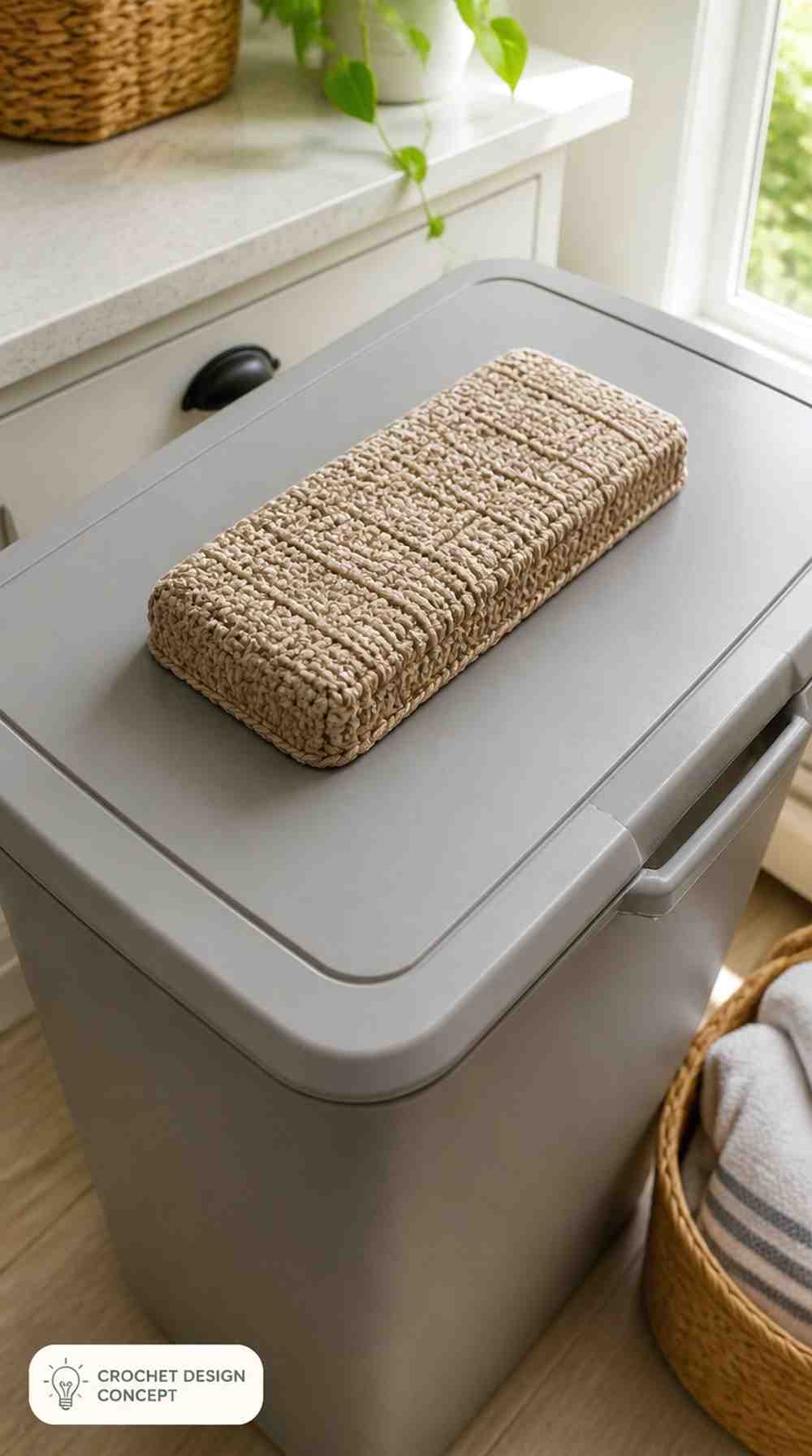
Sandy-beige crochet covers this square-edged rectangular lid grip with a pronounced basketweave-like arrangement. Alternating raised horizontal and vertical blocks give the small surface a substantial woven appearance, while the straight edges follow the original handle shape. The warm-gray bin provides a quiet background for the stitch relief.
This design is particularly interesting for people who enjoy textured crochet without contrasting yarn colors. Its appeal comes from the surface itself. Because basketweave-style textures can be thick, checking the handle’s available gripping space becomes more important than adding further decoration.
- Raised Stitch Structure: Consider how much depth the textured rows add, especially where fingers wrap around the lower corners.
- Rectangular Fit: Straight sides and square corners need consistent shaping to avoid rounded, bulky edges.
- Single-Color Detail: Sand-colored yarn allows light and shadow to reveal the stitch changes without additional stripes or appliqués.
- Material Choice: A smoother, firm yarn may define raised blocks more clearly; test its laundering and comfort before making a functional piece.
14. Crochet Rust Horizontal-Ridge Knob Ring
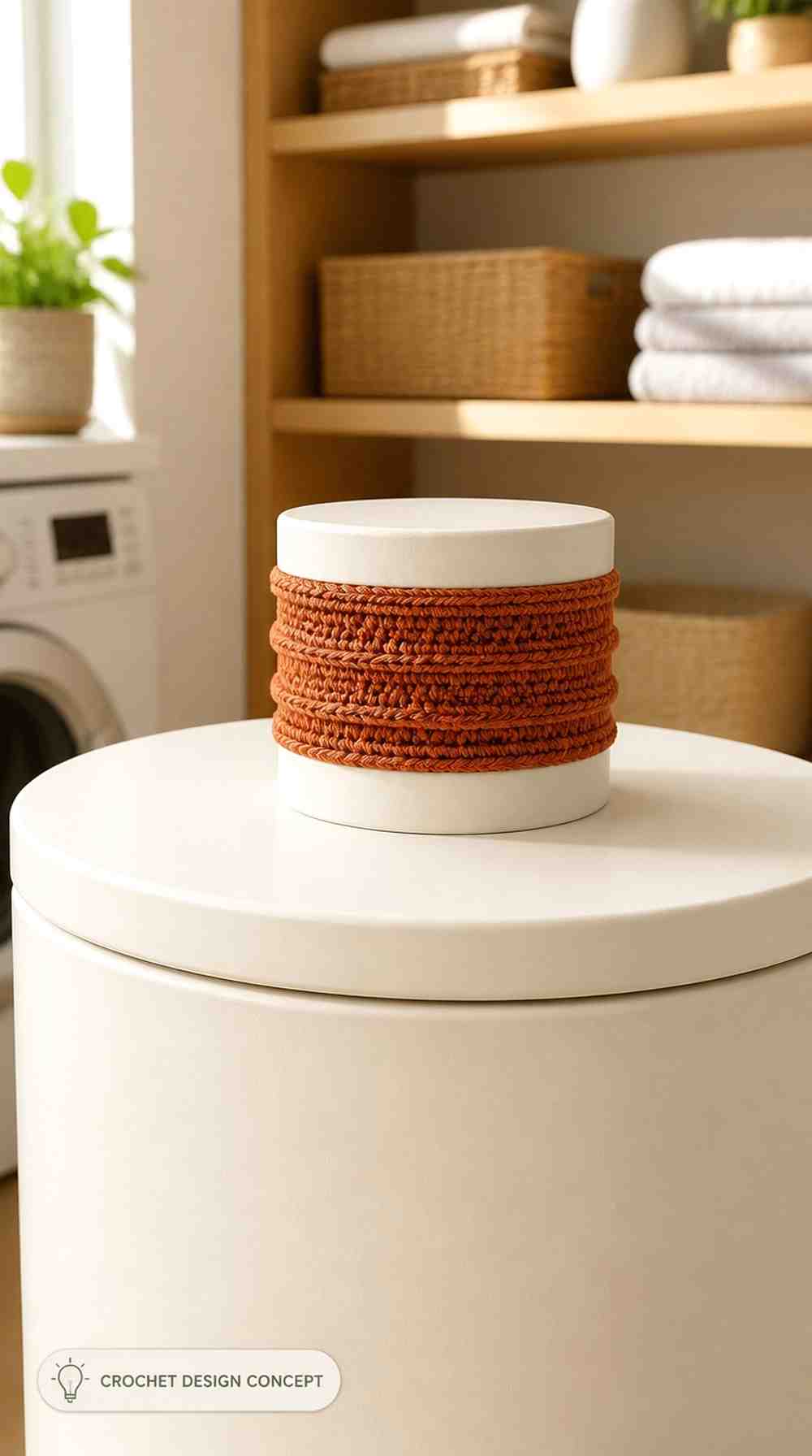
Warm rust-orange crochet forms a narrow band around the middle of this cylindrical waste bin knob. Closely spaced raised horizontal ridges circle the grip, separated by slimmer recessed rows. The top and base of the original knob remain exposed, producing a clear contrast between the soft yarn and hard lid hardware.
Its distinctive feature is the limited coverage. Instead of creating a cap or collar at the bottom, this design places a textured ring directly around the center of the knob. That makes stability especially important, as a loose circular band could turn during handling.
- Middle-Knob Position: Check that the knob has a suitable straight or gently curved section for a ring-shaped cover.
- Ridge Direction: Horizontal raised rows create texture around the circumference, but actual comfort depends on the stitch height and yarn.
- Uncovered Top: Keeping the top exposed preserves the original knob surface and avoids the added bulk of a full dome.
- Rotation Risk: The ring should not spin or slide during use. If it cannot be fitted securely, leaving the handle uncovered is safer.
15. Crochet Mint Diagonal Colorblock Sleeve
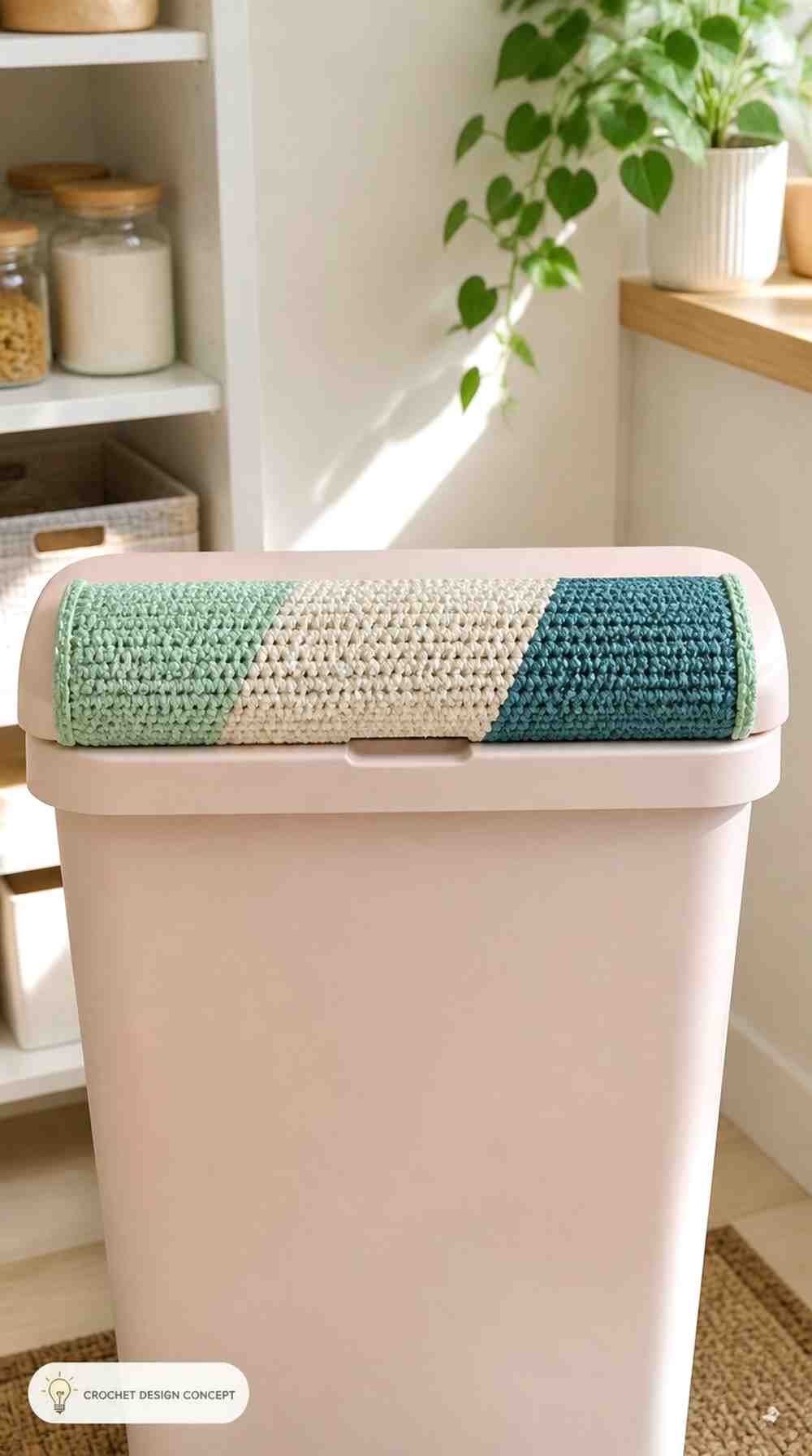
Three diagonal color sections give this narrow crochet handle sleeve a fresh modern appearance. Mint green begins at one end, ivory forms the central section, and muted teal completes the opposite side. Thin mint finishing bands frame both openings, while the slanted joins make the color changes feel more dynamic than ordinary stripes.
The sleeve sits across the long bar of a blush-pink waste bin lid. Its smooth overall surface makes color the main design feature rather than raised ornamentation. For a working version, attention should go toward the diagonal joining lines and overall fit.
- Slanted Color Joins: Keep the three diagonal sections consistent in width so the color blocks retain their intended clean geometry.
- Narrow Bar Fit: This elongated sleeve belongs on a relatively straight handle with enough clearance at both ends.
- Smooth Finish: Avoid unnecessarily thick joins underneath the grip, where extra yarn could create uncomfortable pressure.
- Color Customization: Optional combinations such as olive, cream and clay could provide the same diagonal arrangement in a more neutral room.
16. Crochet Plum Picot Oval Knob Cap
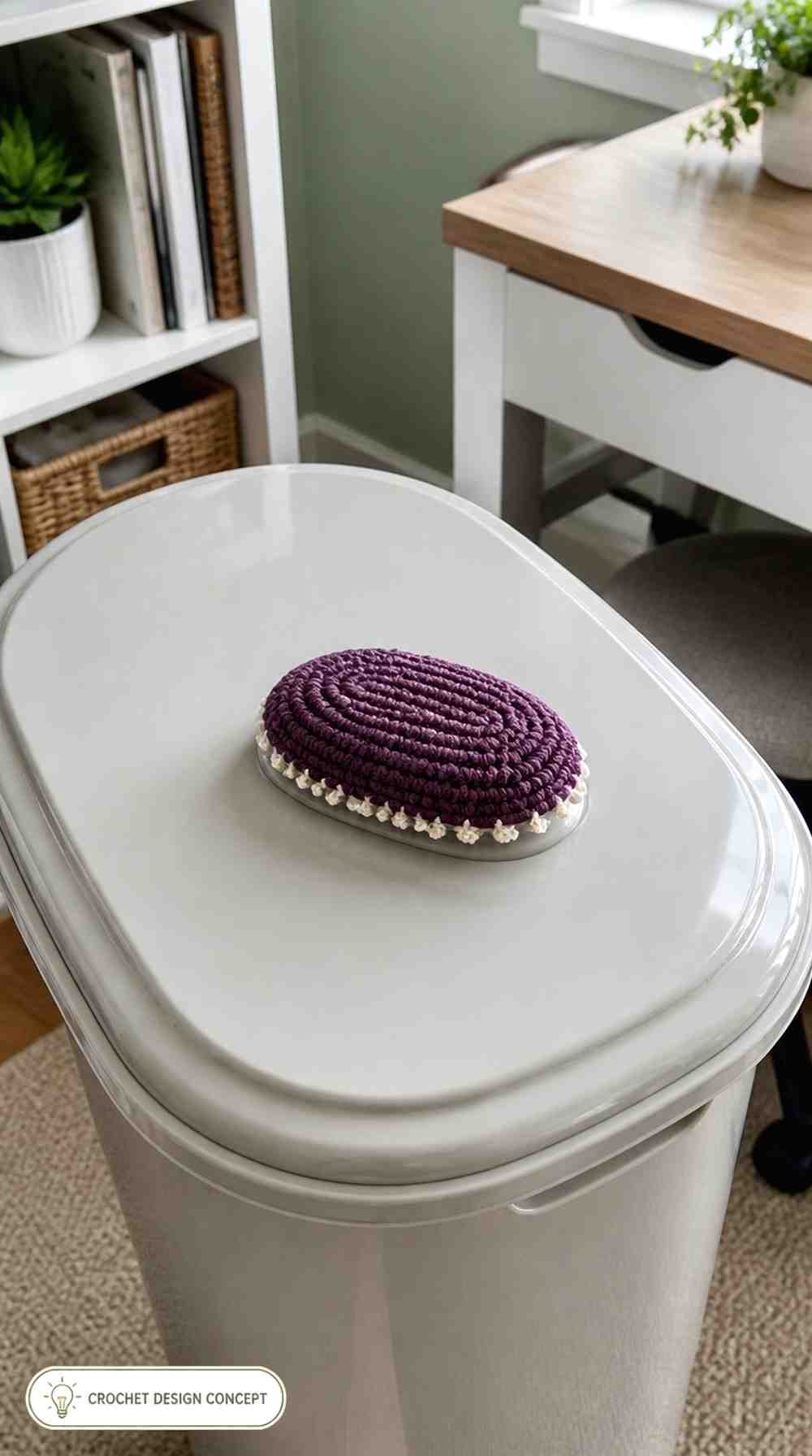
Plum-purple crochet wraps the flattened oval knob of this pale-gray bin lid, creating a smooth, closely stitched cap. Tiny cream picot points decorate the lower edge, giving it a delicate outline without the large scallops seen in the earlier ivory concept. The oval top remains the dominant shape.
This design brings a slightly vintage finish to a simple home-office waste bin. The picot edging is attractive at close range, but each small point needs to sit neatly against the knob. Loose or oversized points could snag during everyday handling.
- Oval Shaping: Account for the knob’s longer and shorter axes instead of shaping the cap as a regular circle.
- Picot Size: Small, evenly spaced points keep the decorative edge restrained and reduce unnecessary projection.
- Dense Top Fabric: Closely worked crochet can provide a cleaner appearance than open lace, although it still needs suitable laundering.
- Careful Edge Placement: Check that the cream border does not rest on the lid surface or interfere with the user’s fingers.
17. Crochet Denim Patchwork Bar Wrap
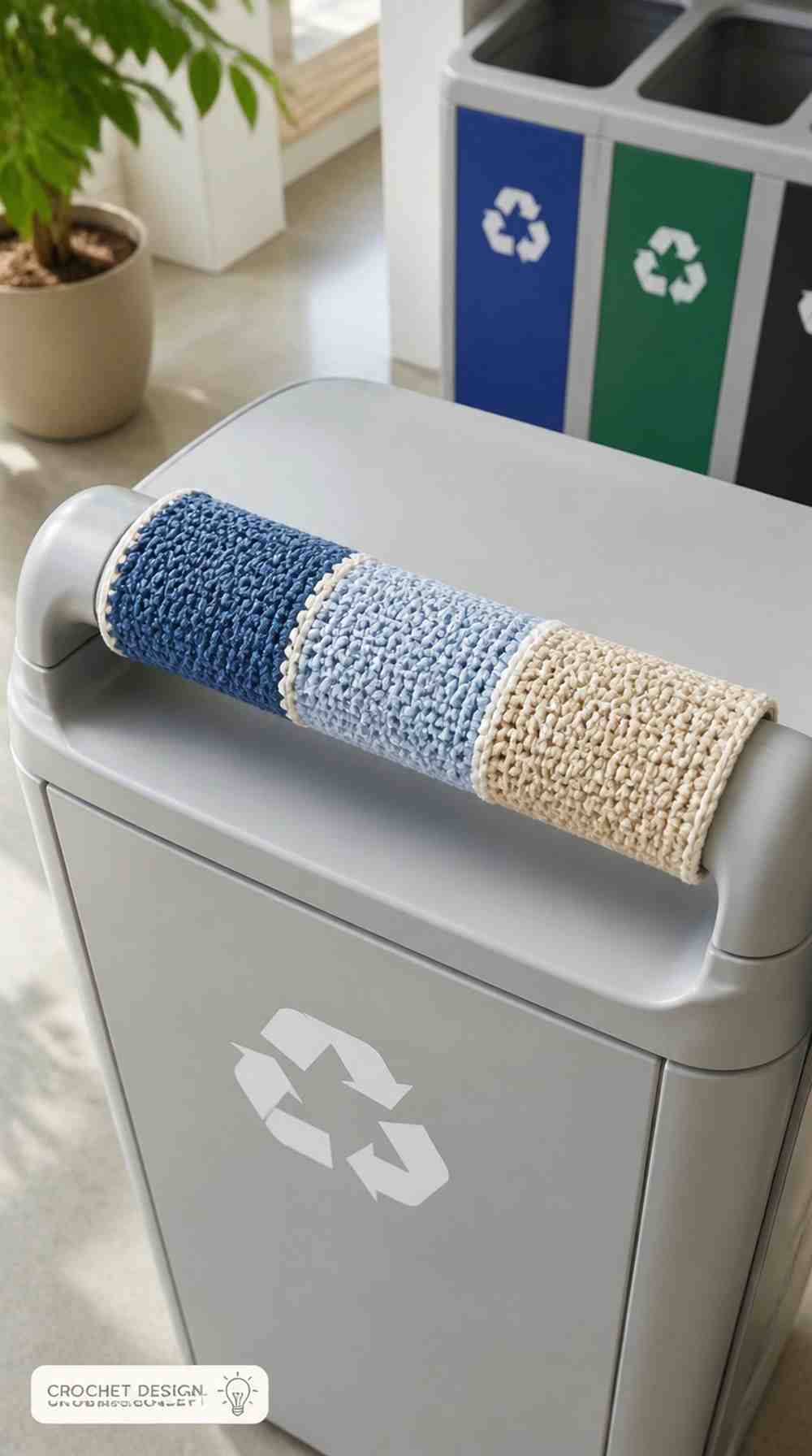
Three rectangular crochet patches form this elongated bar cover, combining denim blue, faded sky blue and warm oatmeal. Thin ivory seams separate the sections, while the short open ends have tidy finishing rows. The arrangement gives the handle a miniature patchwork appearance without creating a bulky hanging accessory.
This concept suits an indoor recycling station, where the blue tones can connect naturally with a simple household color scheme. Joined crochet pieces may behave differently from a single continuous sleeve, so their seams deserve particular attention before adapting the look for regular use.
- Patch Proportions: Divide the bar’s usable length thoughtfully so none of the three sections becomes too narrow or visually crowded.
- Joining Seams: Ivory joins should lie as flat as possible, particularly on the underside where fingers may press against them.
- Mixed-Yarn Behavior: If using different yarn colors or batches, check that their fiber content and washing requirements are compatible.
- Patchwork Limitation: Extra joins can create more places for wear or trapped dirt than a single-piece cover, so inspect them regularly.
18. Crochet Pebble Gray Braided Arch Grip
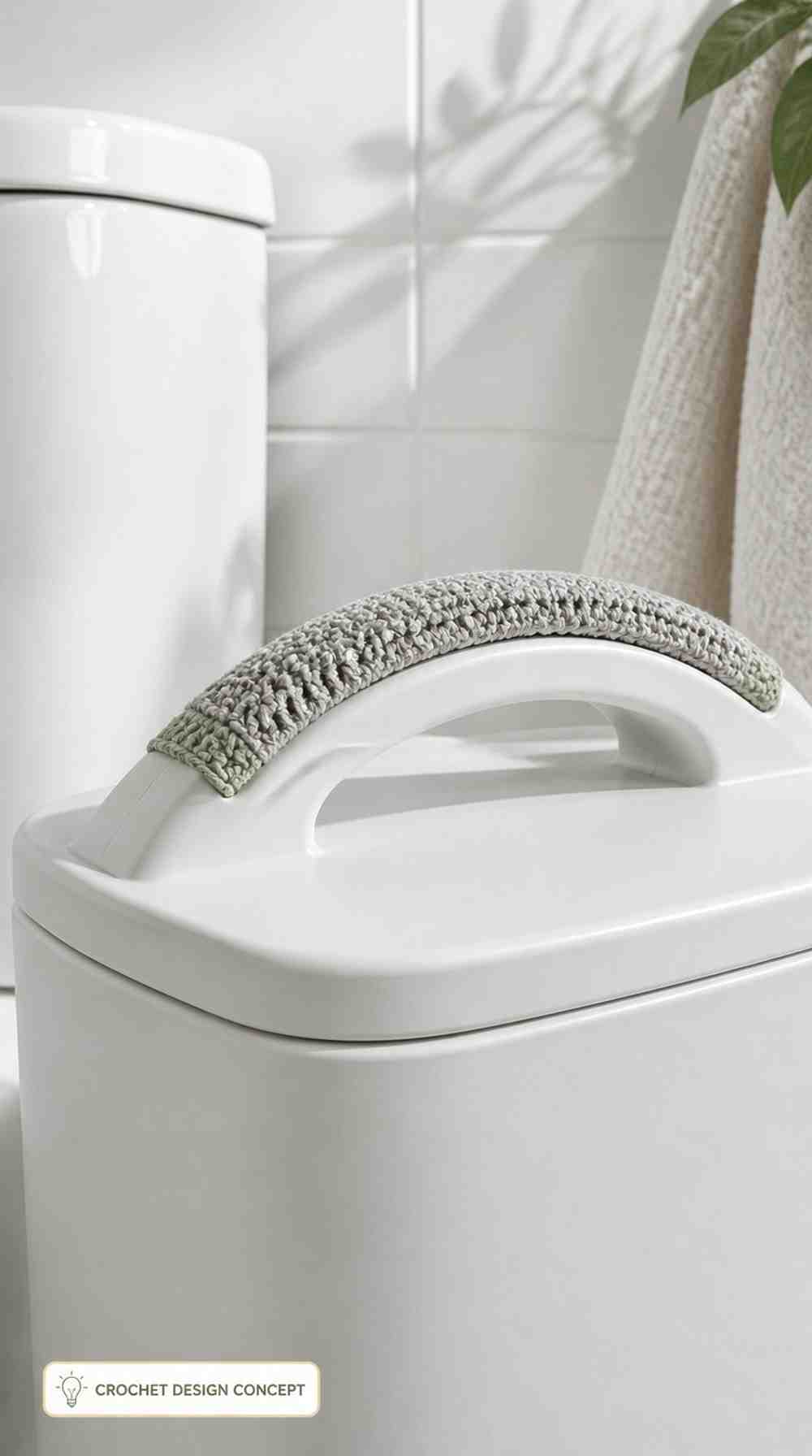
A narrow pebble-gray crochet strip follows the uppermost curve of this small bathroom bin handle. Raised braid-like ridges create subtle texture, while short sage-green bands finish both ends. The rest of the handle remains bare, leaving its curved shape and open underside clearly visible.
The restrained coverage gives this design a different character from full-width cuffs and decorative caps. It is useful inspiration for small handles where too much fabric could feel bulky. The challenge is making a narrow textured grip follow the arch without slipping sideways.
- Minimal Coverage: Limit the gray grip to the upper arc, preserving the original handle opening and lower sides.
- Braided Relief: Raised crochet ridges should be low enough not to become uncomfortable under fingertip pressure.
- End Stability: The sage bands provide visual boundaries, but their appearance does not guarantee that the grip will stay secure.
- Bathroom Moisture: A bathroom bin may be exposed to humidity or splashes. Choose materials and a cleaning routine accordingly, and avoid leaving the cover damp.
19. Crochet Rosewood Foldover Saddle Grip
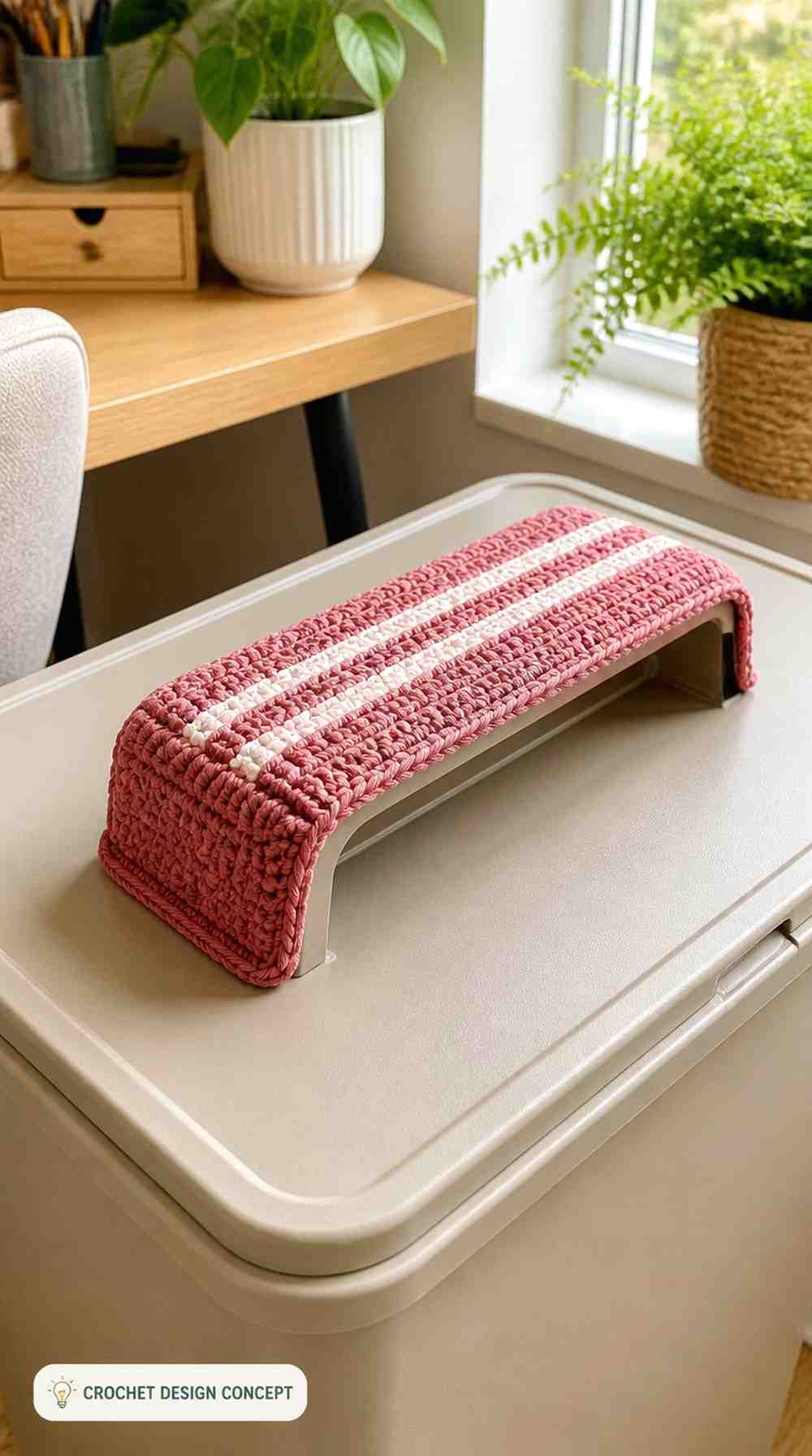
Rosewood-pink crochet forms a smooth saddle-shaped panel over the top and sides of this long rectangular waste bin handle. Two parallel cream raised lines run lengthwise across the upper surface, giving the simple design a clean tailored finish. The side edges remain neatly worked in rosewood, with the opening beneath the handle left clear.
Rather than enclosing the entire bar like a tube, this concept suggests a shaped foldover cover. That makes it visually distinctive, although the real attachment method would need careful planning. A loose saddle panel should not be used as a dependable gripping surface.
- Saddle Shape: The panel needs to follow the handle’s top and side contours without slipping into the open finger space underneath.
- Parallel Cream Lines: Keep the two raised details evenly spaced and low-profile so they do not create uncomfortable ridges.
- Attachment Planning: The visualized concept does not establish a secure fastening method. Any real version needs an independently checked attachment.
- Simplified Alternative: A plain rosewood foldover panel without the cream ridges could be easier to clean while keeping the same soft color.
Practical Guide to Crochet Household Waste Bin Lid Handle Covers
Before adapting any of these crochet concepts, consider how the waste bin is used. A handle covering may be more reasonable as a removable decorative accent on a clean, lightly used dry-recycling bin than on a kitchen food-waste bin, diaper bin or container holding potentially contaminated waste.
Check the handle before selecting a design. Bar handles need their usable length, circumference and clearance checked. Rounded knobs need both diameter and height considered, while arched handles require enough space underneath for fingers. Never cover hinges, locking features, vents, buttons or sensors.
Choose yarn with care. Smooth, washable cotton or an easy-care blend may be worth exploring, but the actual yarn’s label determines its cleaning requirements. Crochet fabric can absorb moisture and collect dirt; it does not disinfect or protect a bin handle.
Make removal straightforward. Covers should be easy to take off for cleaning and must not rotate, loosen, snag or block the lid. Wash according to the yarn care instructions, dry thoroughly and clean the underlying bin handle separately using an appropriate method for its material.
Know when to skip the cover. If the bin is frequently contaminated, the handle becomes slippery, or the cover interferes with opening and closing, an uncovered, easily cleaned handle is the more practical choice. Decorative details are not worth compromising normal bin operation.
Want to Make Something Similar?
There may not be an exact published pattern for these illustrated waste bin handle covers, but the following verified crochet lessons can help with related stitch techniques.
- Single Crochet Ribbing Photo Tutorial by crochetmelovely explains back-loop ribbing, useful when exploring the Sage Ribbed Bar Handle Cover. crochetmelovely
- Ribbed Crochet Stitches: How to Add Ribbing to Any Project by Make & Do Crew explains different ribbing methods and their stitch characteristics, helpful for experimenting with flexible edges. Make & Do Crew
These lessons teach general crochet techniques, not the specific pictured covers or a tested method of safely attaching fabric to a waste bin lid.
Which Crochet Waste Bin Handle Cover Should You Choose?
The strongest choice depends on the actual handle shape and how often the bin is used.
| Handle or design preference | Ideas worth comparing | Main consideration |
|---|---|---|
| Short straight bar | Sage Ribbed, Black Cream Checkered | Sleeve fit and unwanted rotation |
| Broad flat pull | Charcoal Waffle, Burgundy Envelope | Added thickness and finger clearance |
| Rounded or oval knob | Ivory Scalloped, Forest Drawstring, Plum Picot | Secure fit and projecting edges |
| Raised arched handle | Terracotta Buttoned, Navy Chevron, Pebble Gray Braided | Keeping the opening clear |
| Square-edged grip | Sand Basketweave | Raised surface thickness |
| Color-focused modern styling | Mint Diagonal Colorblock, Denim Patchwork | Flat joins and washing |
| Decorative accent | Coral Daisy, Dusty Blue Cross-Band | Snagging and extra surface detail |
For visual simplicity, the Sage Ribbed Bar Handle Cover and Mint Diagonal Colorblock Sleeve are appealing starting points. The Ivory Scalloped Knob Cap and Plum Picot Oval Knob Cap are better suited to decorative styling around rounded shapes. The buttoned, tied and raised-appliqué concepts require more caution because they introduce additional attachment or snagging points.
Conclusion
Crochet household waste bin lid handle covers offer an unusual way to explore small-scale household design. Ribbed sleeves, textured wraps, decorative knob caps and colorful joined panels each bring something different to the same everyday object.
The most useful idea is one that respects the original handle’s shape and operation while remaining simple to remove and clean. Use these 19 concepts as creative starting points, not as proof that every pictured cover will work safely on a real bin.
Which design would you adapt for a clean household recycling bin: the simple sage ribbed sleeve, the colorful patchwork wrap or one of the decorative knob caps? Share which handle shape you have and what you would change.
Frequently Asked Questions
1. What yarn is suitable for a crochet waste bin lid handle cover?
A smooth, washable cotton yarn or another easy-care fiber may be worth considering, depending on the bin’s location and intended use. Check the yarn label for washing instructions and test how the actual fabric behaves when wet and dry. Avoid materials that shed heavily, retain moisture or cannot be cleaned easily. For heavily used or contaminated bins, leaving the handle uncovered is usually more sensible.
2. Can crochet handle covers fit different waste bin lid shapes?
The designs can inspire different approaches, but there is no universal fit. Straight bars, raised arches, round knobs and rectangular pull tabs all have different proportions. Measure the actual handle, check the space needed for fingers and consider any moving parts before adapting a design. Do not assume that a cover suited to one bin will work on another.
3. How can a crochet handle cover be kept clean?
Choose a removable design and follow the yarn manufacturer’s washing instructions. Remove it whenever it becomes dirty, damp or contaminated, and allow it to dry thoroughly after cleaning. The underlying waste bin lid and handle still need separate cleaning. A crocheted covering should never be treated as a hygienic substitute for cleaning the hard surface.
4. Are crochet lid handle covers suitable for kitchen food-waste bins?
They are generally a poor practical choice for frequently used food-waste bins because fabric can collect moisture and contamination and may be difficult to disinfect properly. A plain, easily cleaned handle is preferable. If you want to explore these designs as decoration, a clean, lightly used dry-recycling bin offers a more appropriate setting, provided the cover does not interfere with operation.
5. Are these 19 crochet handle cover ideas complete patterns?
No. These are original AI-generated visual design concepts intended to help readers compare shapes, colors, stitch textures and finishing details. They do not include tested stitch counts, sizing instructions or verified construction methods. Anyone making a similar cover should check the handle dimensions, selected materials, attachment security and cleaning needs independently before putting it into use.