A crochet kitchen tongs wall holster is a creative way to give everyday cooking tools a dedicated storage spot while adding handmade texture to the kitchen. These 14 inspiration ideas range from slim hanging pockets and tapered ribbed sleeves to floral holders, wooden-framed designs, and multi-compartment organizers. With colors such as terracotta, mustard, blush pink, indigo, and charcoal, there are options for modern, farmhouse, and cottage-style spaces.
Good wall storage is about more than appearance. Kitchen tongs vary in length, handle shape, locking mechanism, and tip material, so the right arrangement needs room for the actual utensil. This collection explores different crochet silhouettes, hanging methods, and removable protective liners. The aim is to help you compare attractive storage ideas while keeping cleaning, wall mounting, heat clearance, and access firmly in mind.
These are AI-generated crochet design visualizations for inspiration, not photographs of tested handmade products or step-by-step patterns.
Quick Design Selection Guide
- For a narrow kitchen wall: Crochet Terracotta Dowel-Tab Tongs Holster and Crochet Olive Ribbed Tapered Tongs Holster have slim, upright silhouettes.
- For two cooking tongs: Crochet Mustard Double-Pocket Tongs Holster provides separate compartments.
- For decorative kitchen walls: Crochet Blush Hexagon Tongs Wall Dock and Crochet Butter-Yellow Daisy Tongs Holster introduce distinctive shapes and motifs.
- For a structured wall display: Crochet Chocolate Timber-Frame Tongs Holster pairs a wooden frame with a crochet pocket.
- For an unused kitchen corner: Crochet Rust Corner-Wedge Tongs Holder makes use of two adjoining walls.
- For a larger utensil collection: Crochet Charcoal Triple-Tongs Rail Holster offers three distinct storage spaces.
1. Crochet Terracotta Dowel-Tab Tongs Holster
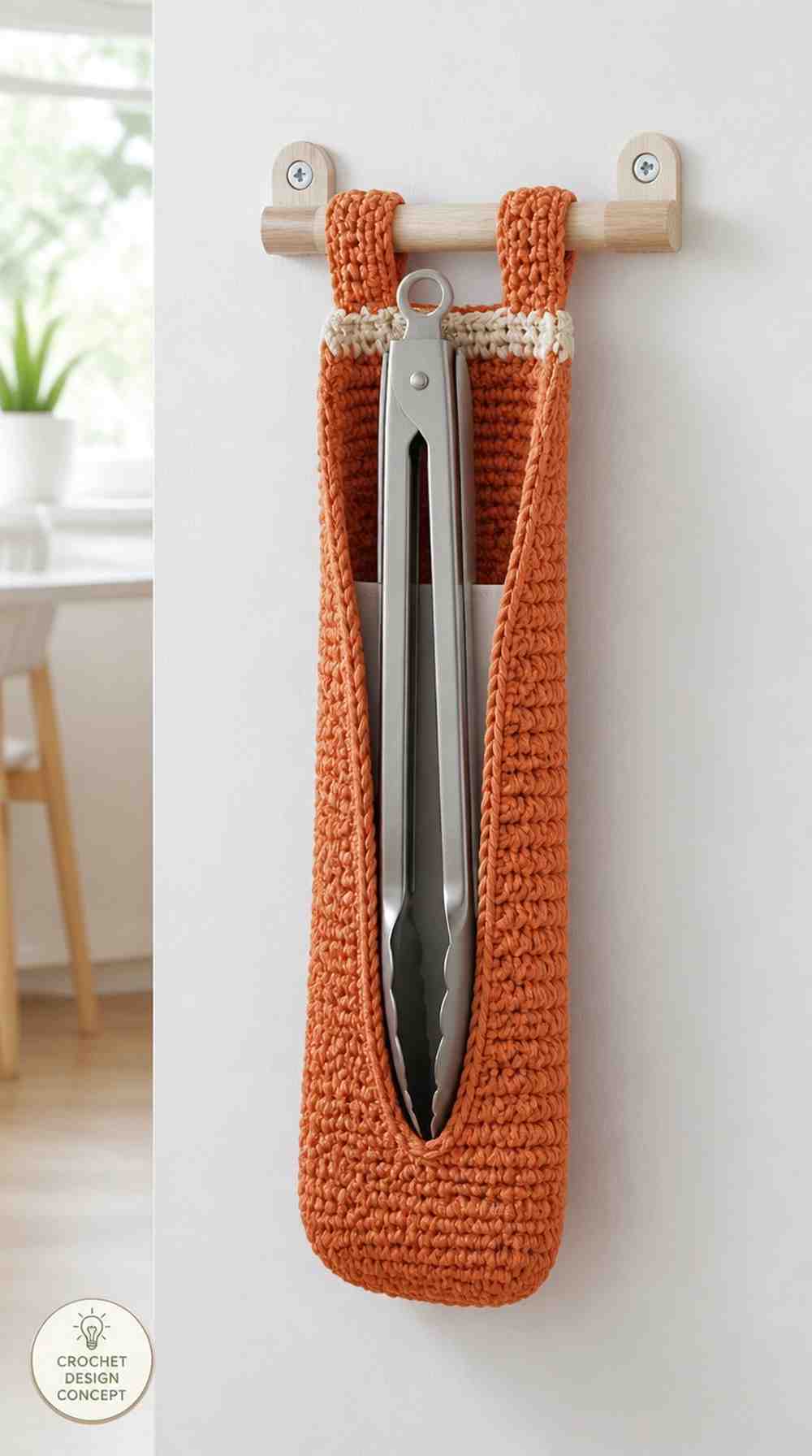
Terracotta crochet gives this narrow wall holster a warm, handmade appearance. Closely worked rows form a straight pocket with cream edging, while two short folded tabs connect the upper section to a pale ash dowel. A removable rigid liner sits inside the pocket, holding a closed stainless-steel tong with its handles visible above the opening.
The straightforward shape makes this concept especially attractive for small kitchens. Because the holder hangs from a dowel, the most important construction details are the upper tabs, the pocket seams, and the way the liner distributes weight.
- Dowel Support: Secure the wooden rail independently to the wall. The two crochet tabs should distribute the pocket’s weight without stretching unevenly.
- Pocket Opening: Allow enough width for the locked tong and its rigid liner, but avoid making the pocket so loose that it shifts sideways.
- Removable Liner: A washable insert keeps the tong’s gripping surfaces separate from yarn and makes everyday cleaning more manageable.
2. Crochet Indigo Diagonal Tongs Sling
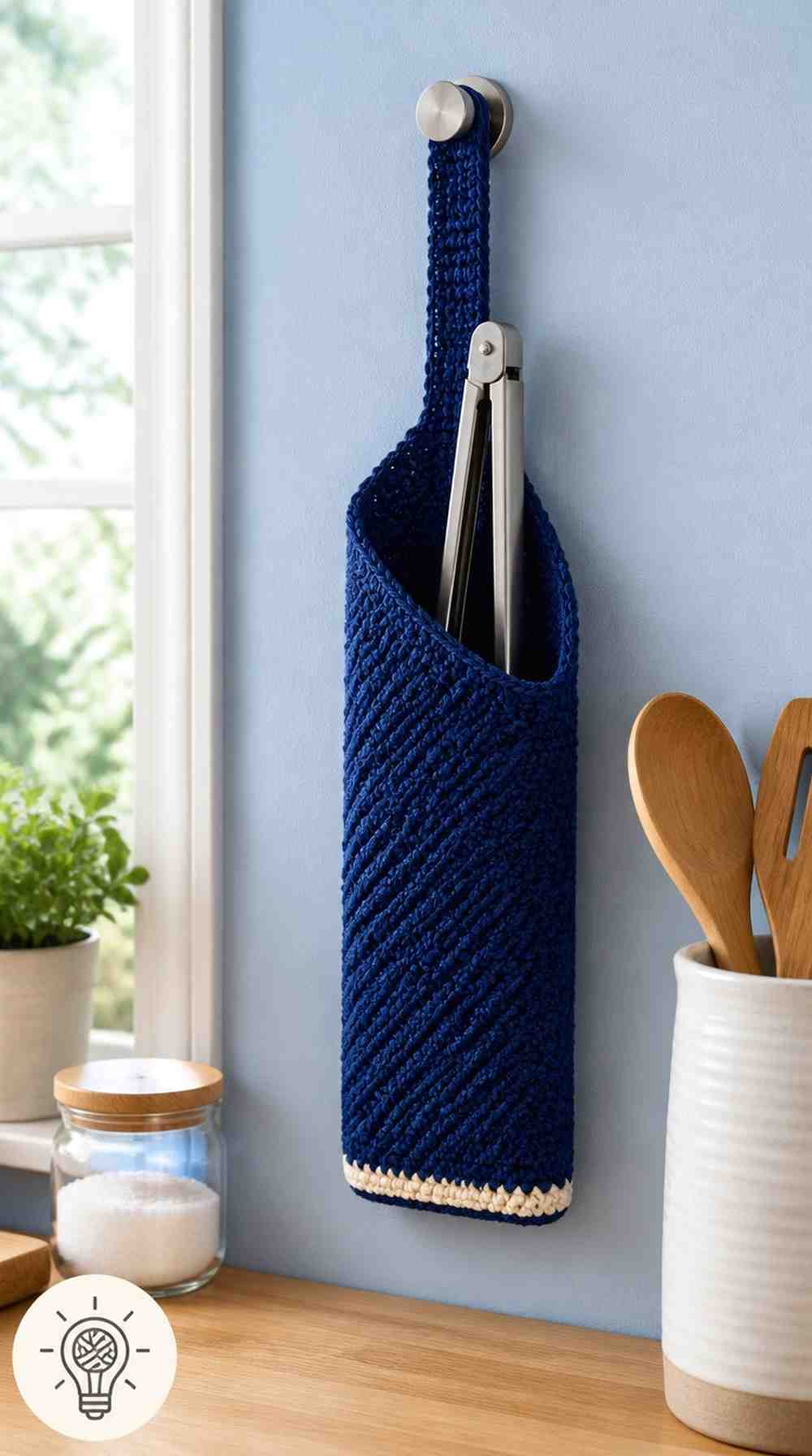
Deep indigo crochet creates a more contemporary alternative to the classic straight pocket. The diagonal upper opening gives the holder an asymmetric appearance, while raised ribbing and a cream lower border add definition. A broad crochet strap connects the upright body to a single metal wall hook.
Although the pocket opening is angled, the actual utensil remains vertically positioned inside its rigid insert. This distinction matters because a dramatic decorative cut should not make the tong lean awkwardly or become difficult to retrieve.
- Diagonal Opening: Keep the higher edge clear of the tong handles so the utensil can be lifted without catching the crochet.
- Single-Hook Balance: Position the hanging strap above the loaded center of the holster to reduce unwanted twisting against the wall.
- Stitch Definition: Diagonal ribbing provides visual character, but closely joined stitches are preferable around the pocket’s structural attachment points.
3. Crochet Mustard Double-Pocket Tongs Holster
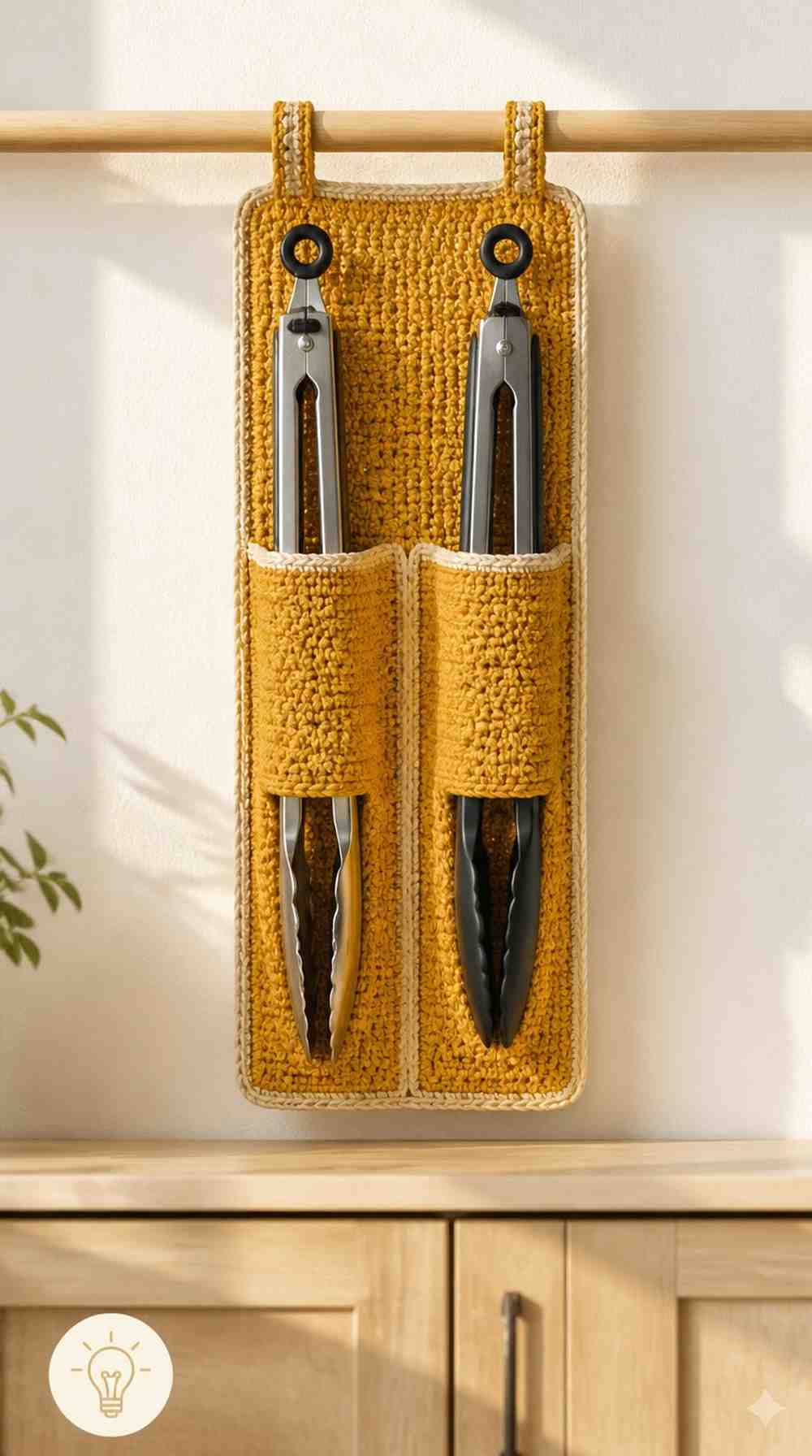
Mustard-yellow crochet gives this rectangular organizer a sunny finish, with two narrow compartments separated by a visible central seam. Cream edging defines the pocket openings, and short hanging loops attach the organizer to a wooden rail. Each compartment holds a separate rigid liner and its own closed kitchen tong.
The divided arrangement is the main attraction. Instead of placing two utensils together where they might overlap, the design gives each tong its own space. This could be useful for separating metal tongs from a silicone-tipped pair.
- Separate Compartments: Measure each tong individually, particularly if the silicone-tipped pair has a wider gripping head than the stainless-steel version.
- Central Divider: The divider needs a firm connection to the backing so the pockets do not collapse into one another.
- Weight Distribution: Keep both compartments reasonably balanced, and verify the complete wall mounting before trusting it with the utensils.
4. Crochet Blush Hexagon Tongs Wall Dock
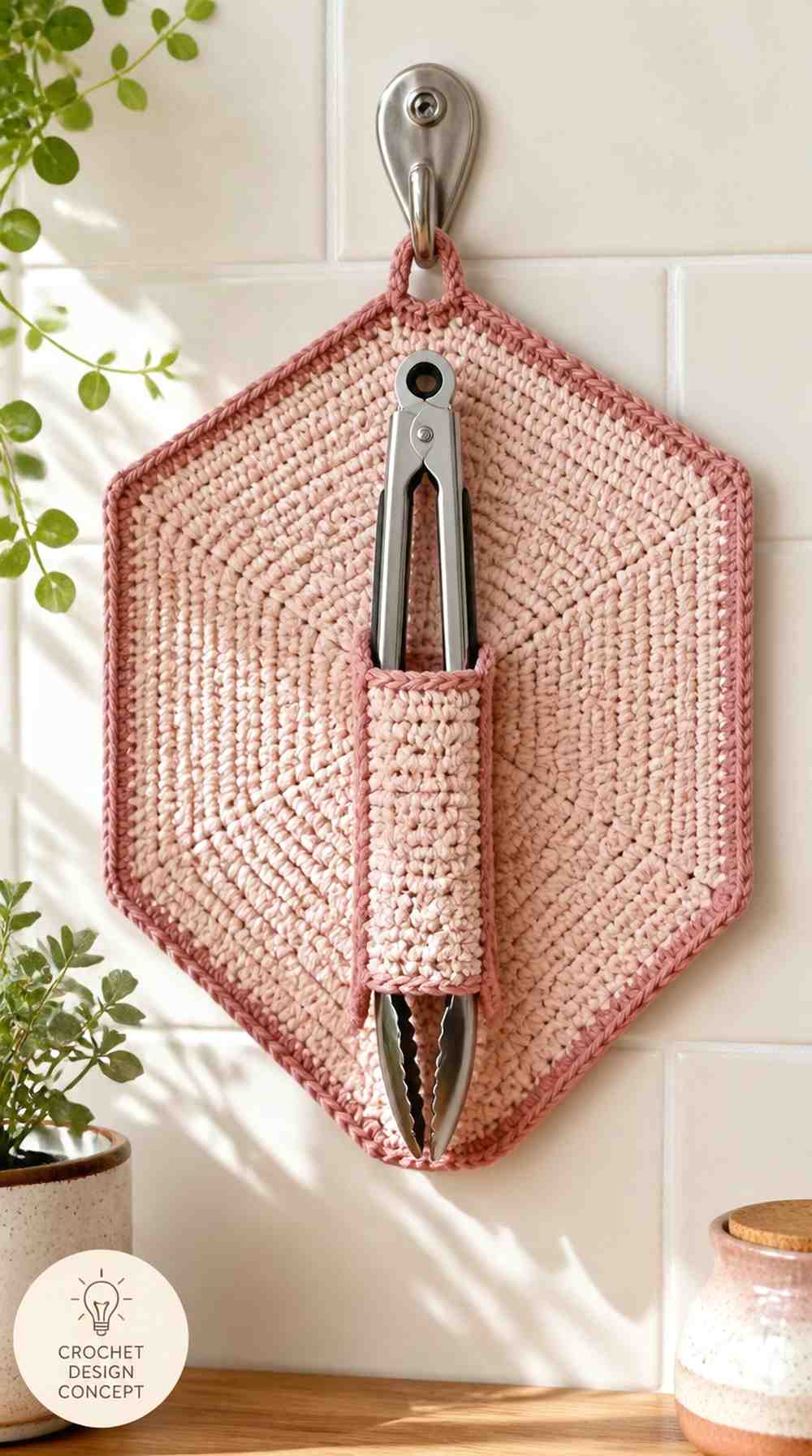
A blush-pink hexagonal crochet panel forms the decorative background for this single-tong wall holder. Dusty-rose edging highlights its six corners, while a slim central pocket with a removable liner keeps the closed stainless-steel tong upright.
The combination of a broad geometric backing and a narrow storage pocket creates an interesting contrast. Unlike a simple hanging sleeve, this idea gives the wall itself more decorative coverage, making it suitable for a visible kitchen storage area.
- Hexagon Shape: Keep the six corners evenly formed so the back panel lies flat rather than puckering around the central pocket.
- Pocket Attachment: Join the slim storage pocket firmly to the panel, accounting for the stress created when the tong is lifted.
- Wall Position: Choose a dry location with enough clearance above the holster for the utensil to be removed without obstruction.
5. Crochet Olive Ribbed Tapered Tongs Holster
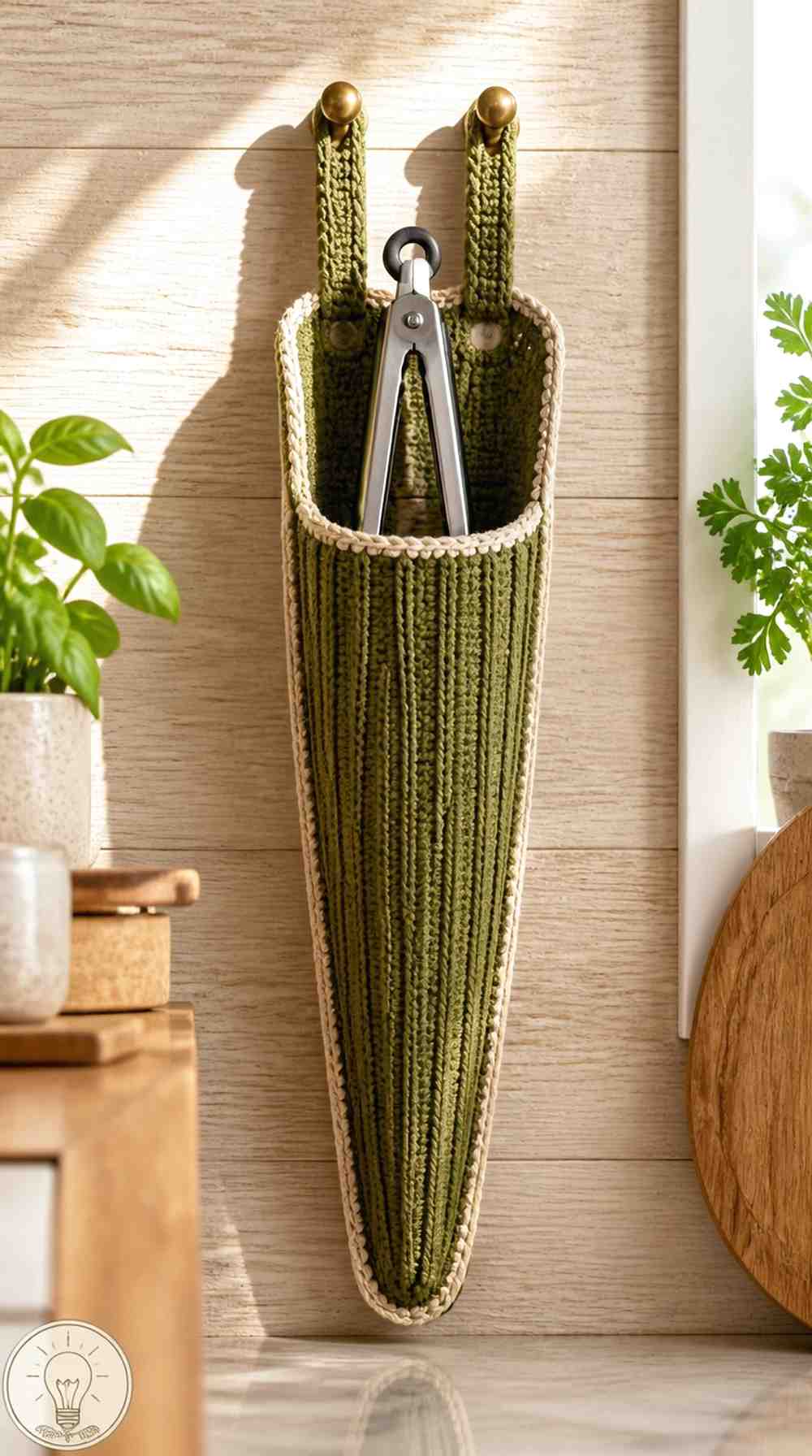
Olive-green crochet gives this tapered holster a calm, natural look. Its body begins with a wider opening, narrows toward the bottom, and features pronounced vertical ribs. Oatmeal edging softens the upper border, while two short loops hang from separate brass-finish wall pegs.
The tapered silhouette follows the general shape of many closed kitchen tongs. Its removable shaped liner provides the intended support, so the crochet ribs can remain primarily decorative rather than bearing the pressure of the utensil.
- Tapered Fit: Check both the widest handle section and the lower gripping-end dimensions before planning the inner sleeve.
- Ribbed Texture: Keep the ribs consistent through the narrowing section to avoid uneven bulges or pulled stitches.
- Two-Peg Mounting: Evenly spaced wall pegs can help control rotation, but the strength of the mounting must be checked independently.
6. Crochet Powder-Blue Wave-Rim Tongs Pocket
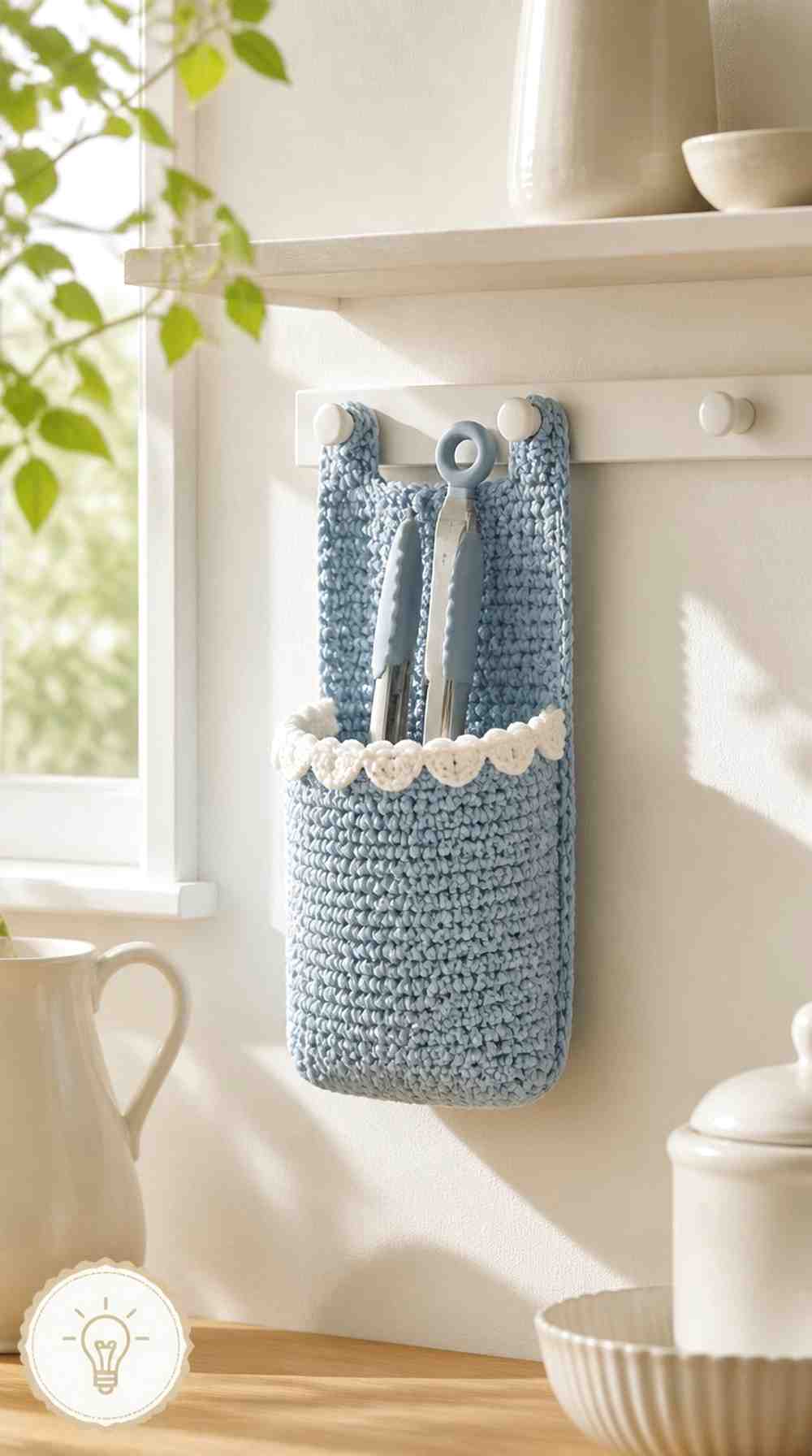
Powder-blue crochet forms a compact rectangular pocket with a gently curved front and a decorative white wave-shaped upper border. Two small tabs attach the back to a fixed wooden peg rail. A separate rigid cup-style liner holds one closed pair of silicone-tipped cooking tongs.
The curved front makes the holder feel softer than a rigid rectangular organizer. The wave edging also gives the piece a cottage-inspired appearance, provided the decorative scallops remain away from the utensil’s most frequently handled areas.
- Wave-Rim Clearance: Position the white scallops below the exposed tong handles so the upper edge does not snag during removal.
- Curved Pocket Shape: Shape the crochet around its rigid liner rather than relying on a soft outward curve to hold the tong securely.
- Cleaning Needs: Light-blue yarn may show cooking stains more readily, making a removable and appropriately washable construction particularly useful.
7. Crochet Butter-Yellow Daisy Tongs Holster
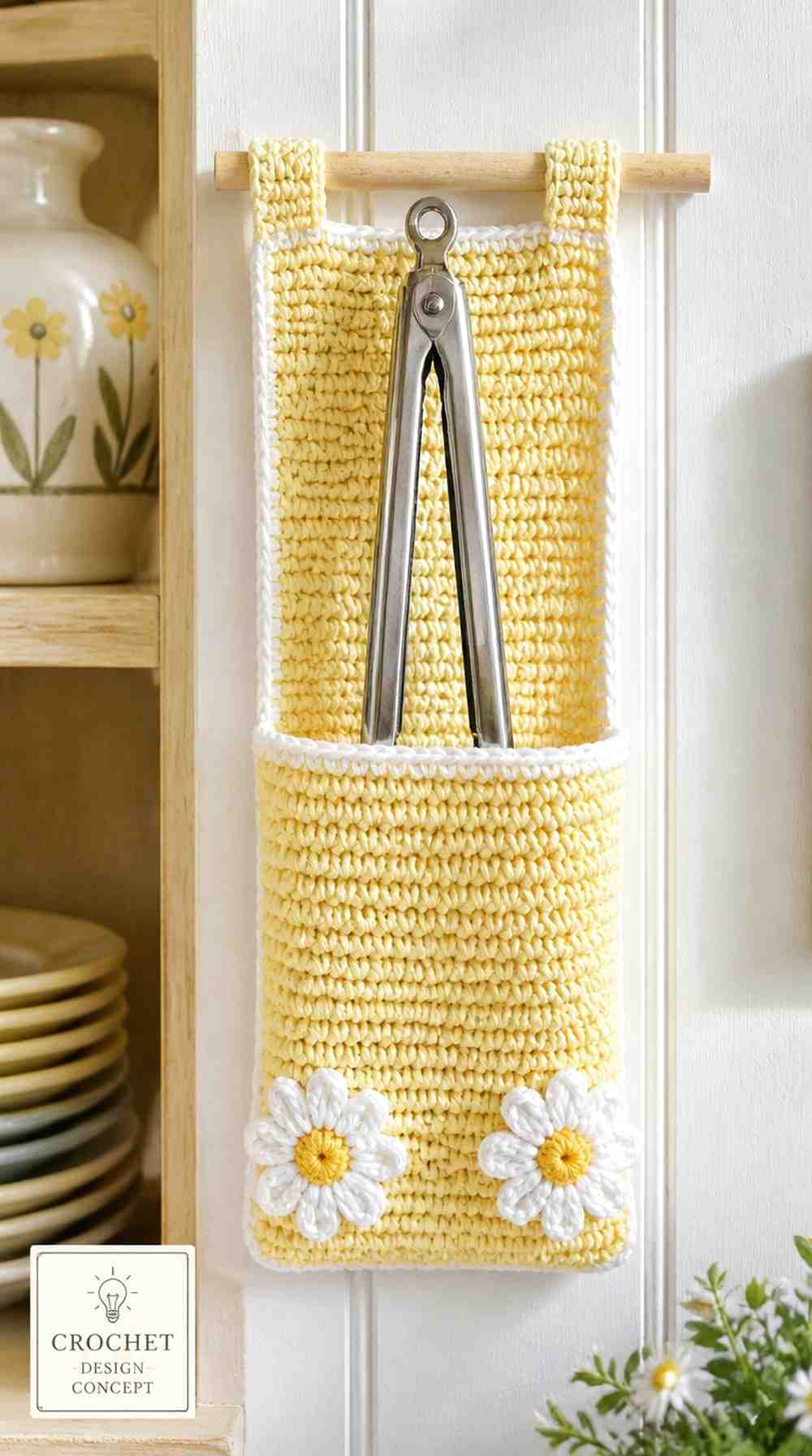
Butter-yellow crochet creates a cheerful narrow wall pocket, decorated with two small white daisies near its lower corners. Each flower has a golden center, while white edging and a light wooden dowel complete the design. The closed steel tong rests upright in a removable liner.
The flower motifs add character without covering the actual storage opening. Keeping them near the bottom also helps distinguish the decorative part of the holster from the section used to retrieve the utensil.
- Daisy Placement: Attach the small flowers flat against the outer pocket corners, where they are less likely to catch the tong handles.
- Motif Construction: Use clearly defined crochet petals and secure joins, avoiding loose decorative threads near the storage opening.
- Cottage Styling: This sunny yellow-and-white palette works especially well against cream walls and pale wooden shelves.
8. Crochet Chocolate Timber-Frame Tongs Holster
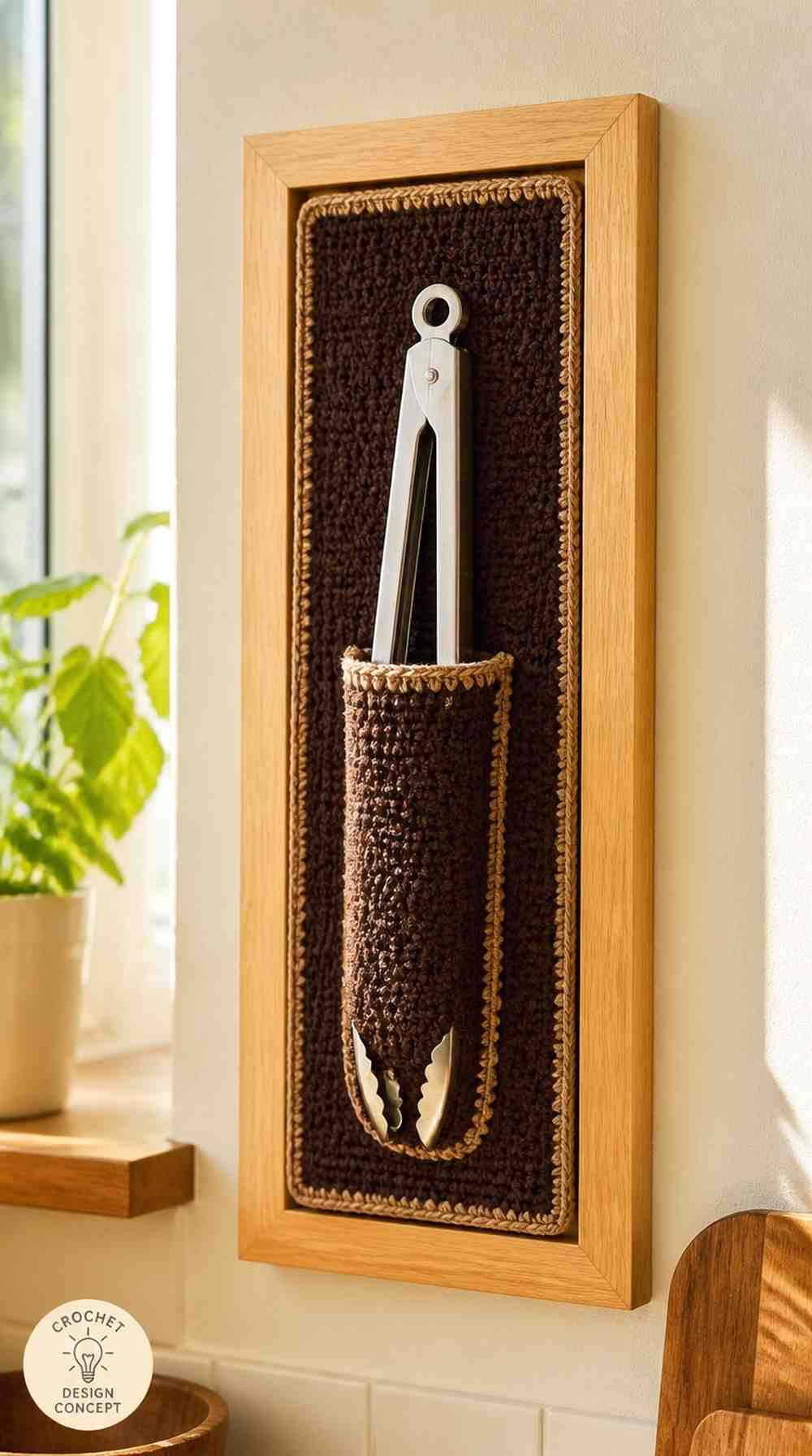
Chocolate-brown crochet sits within a pale-oak rectangular frame, creating a compact kitchen wall display. A tan border outlines the crochet panel, while a narrow central pocket surrounds a removable liner holding one brushed-steel tong. The wooden frame is mounted independently, giving the piece a more structured appearance.
This concept combines a framed decorative panel with practical vertical storage. The contrast between timber and crochet makes it especially suited to farmhouse kitchens or rooms with visible natural wood cabinetry.
- Independent Frame Support: The wooden frame should be securely mounted to the wall rather than depending on the crochet panel to support the entire arrangement.
- Inset Pocket: Keep the liner centered and accessible, with enough space to remove the tong without rubbing against the frame.
- Material Coordination: Chocolate yarn and pale oak create a warm contrast. A lighter tan edging could help the crochet stitches stand out.
9. Crochet Rust Corner-Wedge Tongs Holder
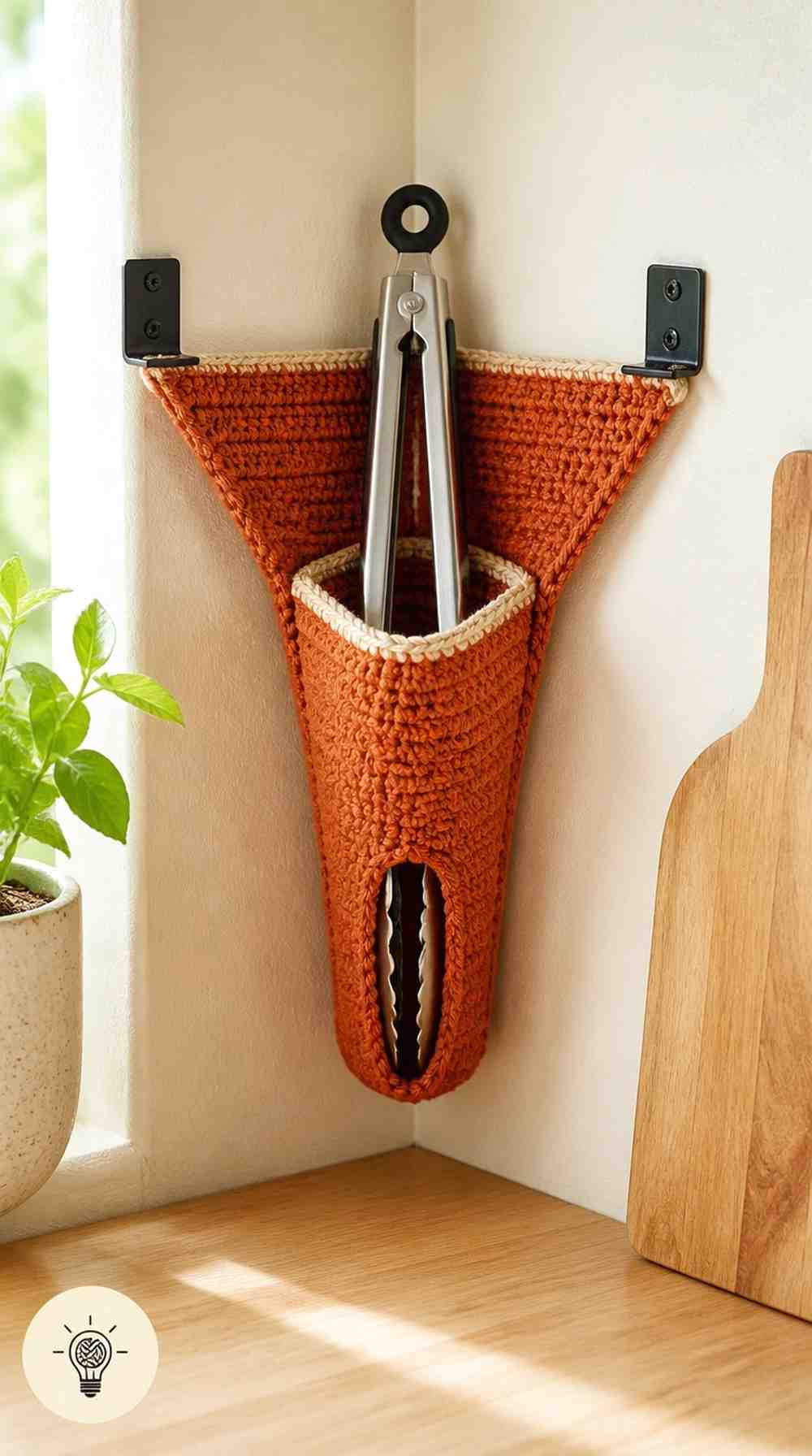
Rust-orange crochet forms a wedge-shaped holster designed for a kitchen corner. Two triangular backing wings extend toward adjoining walls, while a narrow central pocket projects outward. Sand-colored edging defines the top, and a removable rigid liner holds one closed tong upright.
The corner arrangement offers a different approach to wall organization. Instead of occupying the middle of a backsplash, it uses a meeting point between two walls, although the mounting arrangement requires more attention than a conventional flat holder.
- Corner Geometry: Check that the two walls meet at a suitable angle and provide enough space for the central pocket to remain accessible.
- Separate Brackets: Each backing wing needs appropriate support. Decorative crochet should not be expected to act as a structural wall anchor.
- Removal Clearance: Leave enough space above and in front of the holder to lift the tong without scraping the surrounding walls.
10. Crochet Burgundy Oval-Basket Tongs Holster
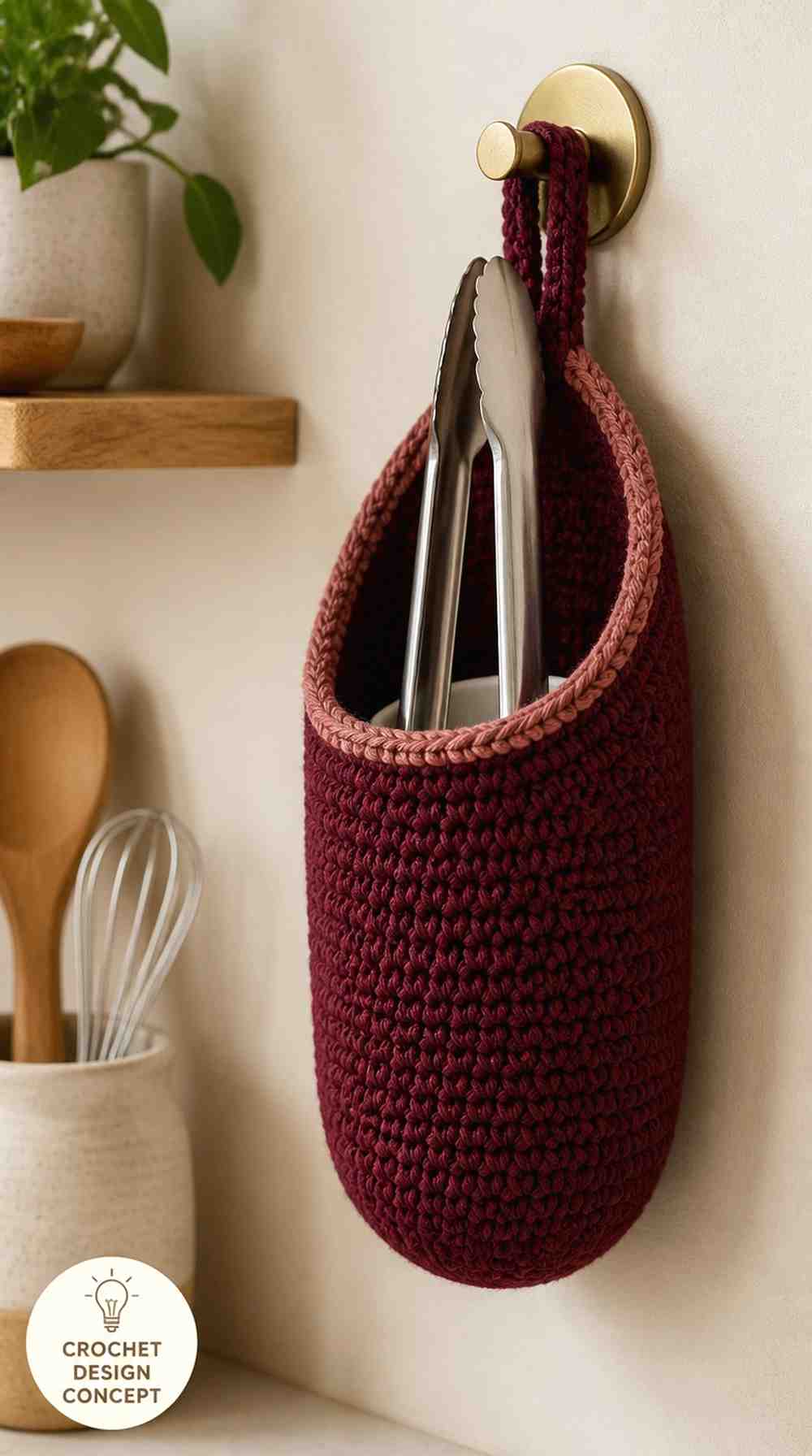
A narrow oval basket gives this burgundy crochet holster a rounded, gently structured silhouette. Dense rows form the body, a muted rose border finishes the opening, and a short hanging loop connects the basket to a matte-brass wall hook.
Inside the basket, a separate washable rigid cup supports a closed stainless-steel tong with its handles visible above the rim. The oval body creates more volume than a flat sleeve, making this a useful visual choice for someone who prefers basket-inspired crochet storage.
- Oval Opening: Keep the upper opening wide enough for the removable inner cup while avoiding excessive looseness around the utensil.
- Hanging Loop: The short loop should be securely joined to the basket body and checked for stretching during repeated use.
- Wall Clearance: A rounded basket projects farther from the wall than a flat pocket, so place it where it will not obstruct nearby movement.
11. Crochet Ivory Fan-Lace Tongs Sleeve
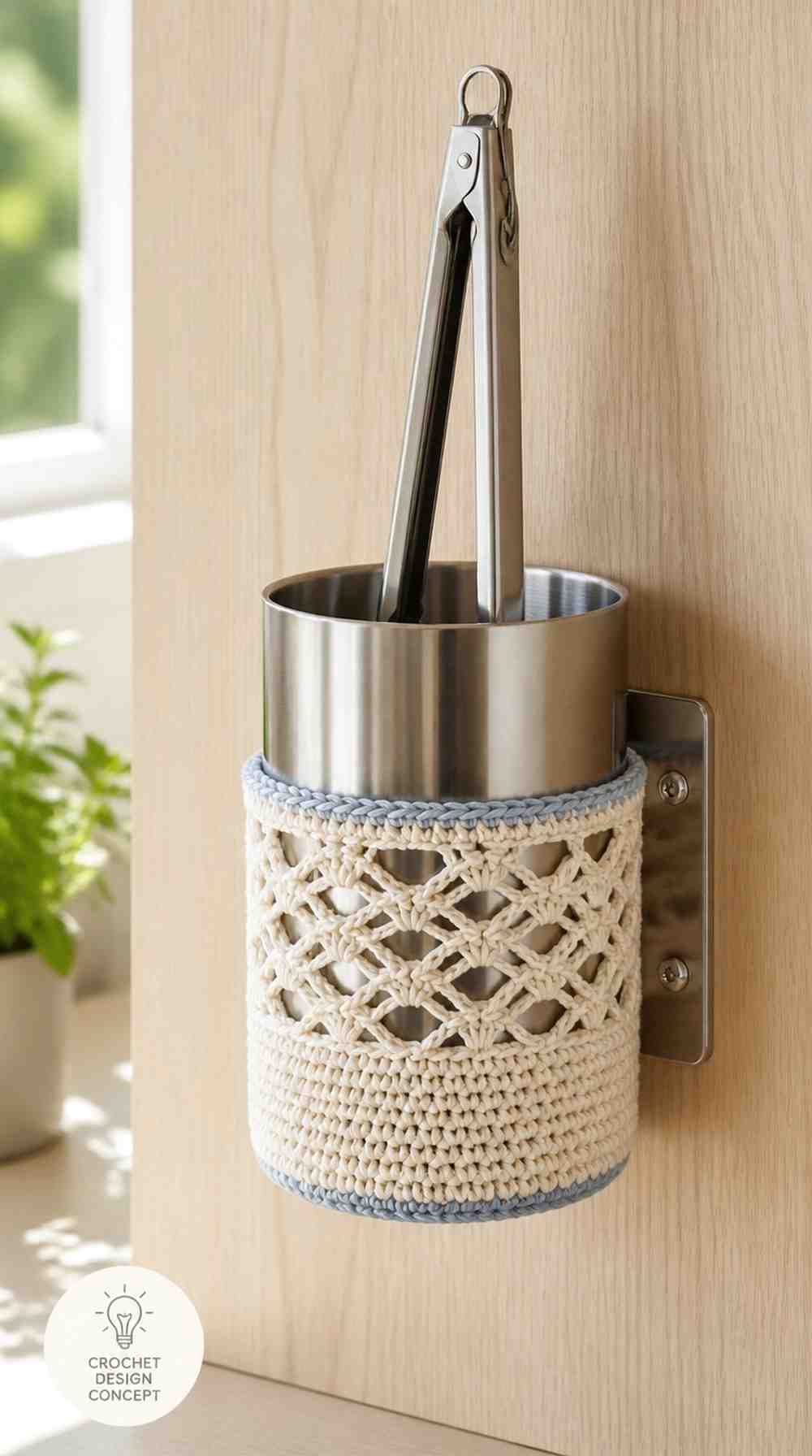
Ivory crochet brings a delicate vintage appearance to this wall-mounted utensil holder. A closely worked lower band transitions into a ring of connected fan-lace openings, finished with a thin dusty-blue border. The crochet fits around the lower outside portion of a stainless-steel wall-mounted utensil cup.
The metal cup remains the main storage structure, holding the closed tong upright without requiring its gripping ends to touch yarn. This arrangement keeps the decorative crochet separate from the utensil’s primary support.
- Metal Cup Support: Mount the cup independently and use the crochet only as a removable outer sleeve, not as the mechanism carrying its weight.
- Lace Placement: Keep the fan-lace section below the cup’s upper opening so the tong can be inserted without snagging delicate stitches.
- Cleaning Access: A sleeve that slides off the metal holder makes it easier to wash the crochet and clean the cup separately.
12. Crochet Teal Cross-Strap Tongs Dock
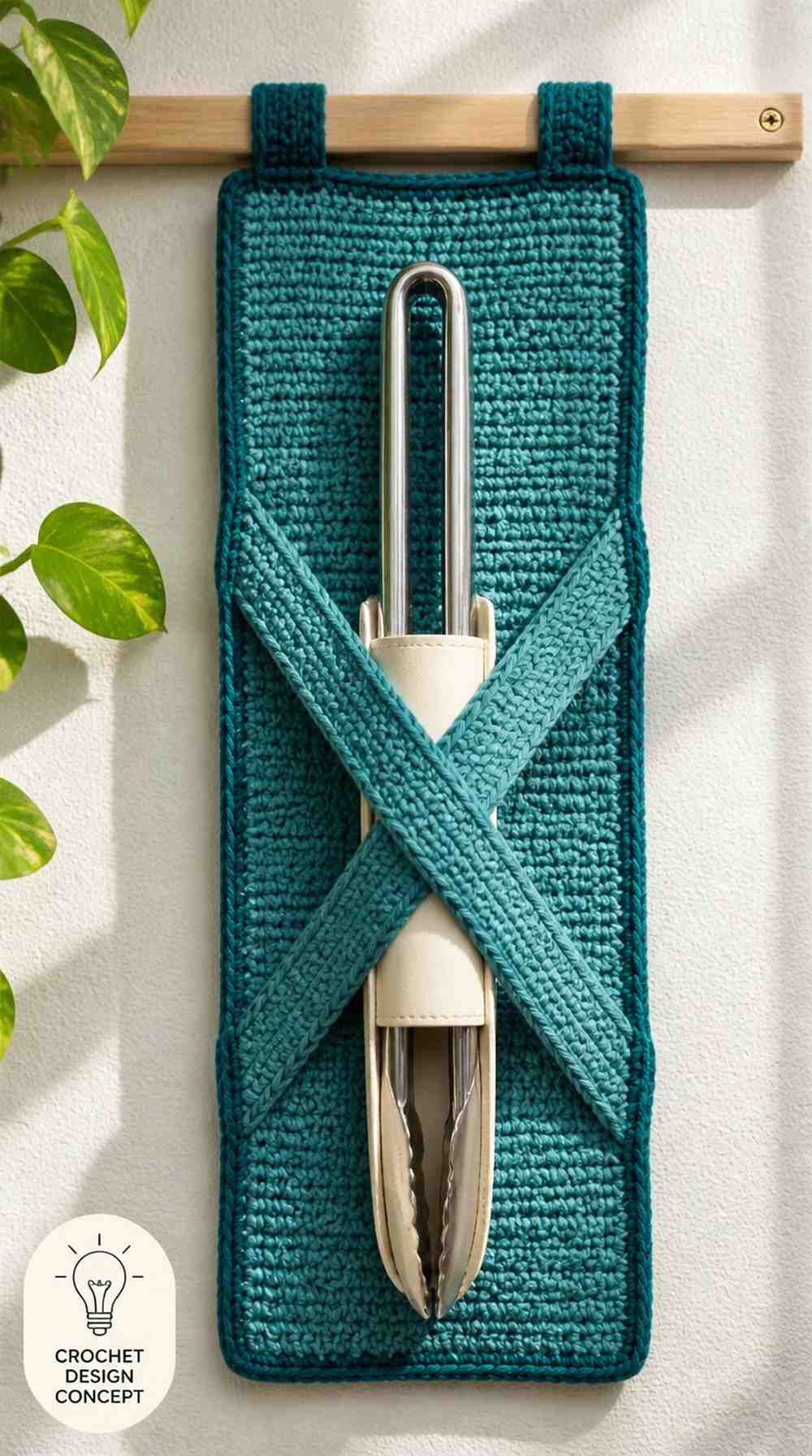
Teal crochet forms a flat rectangular wall panel with two broad straps crossing diagonally over a slim rigid inner holster. A darker teal edging defines the outside, and two upper hanging loops attach the panel to a pale wooden rail.
The crossed straps create a noticeable geometric detail while holding the separate holster against the backing. The closed stainless-steel tong remains inside the removable insert, with its handles pointing upward and gripping ends enclosed below.
- Cross-Strap Position: Arrange the diagonal straps around the liner’s exterior rather than directly over the tong’s food-contact surfaces.
- Strap Tension: The straps should hold the liner in place without bending its shape or making removal difficult.
- Backing Stability: A flat, densely worked crochet panel helps the crossing straps sit evenly, although the rail still needs secure wall fittings.
13. Crochet Peach Button-Flap Tongs Holster
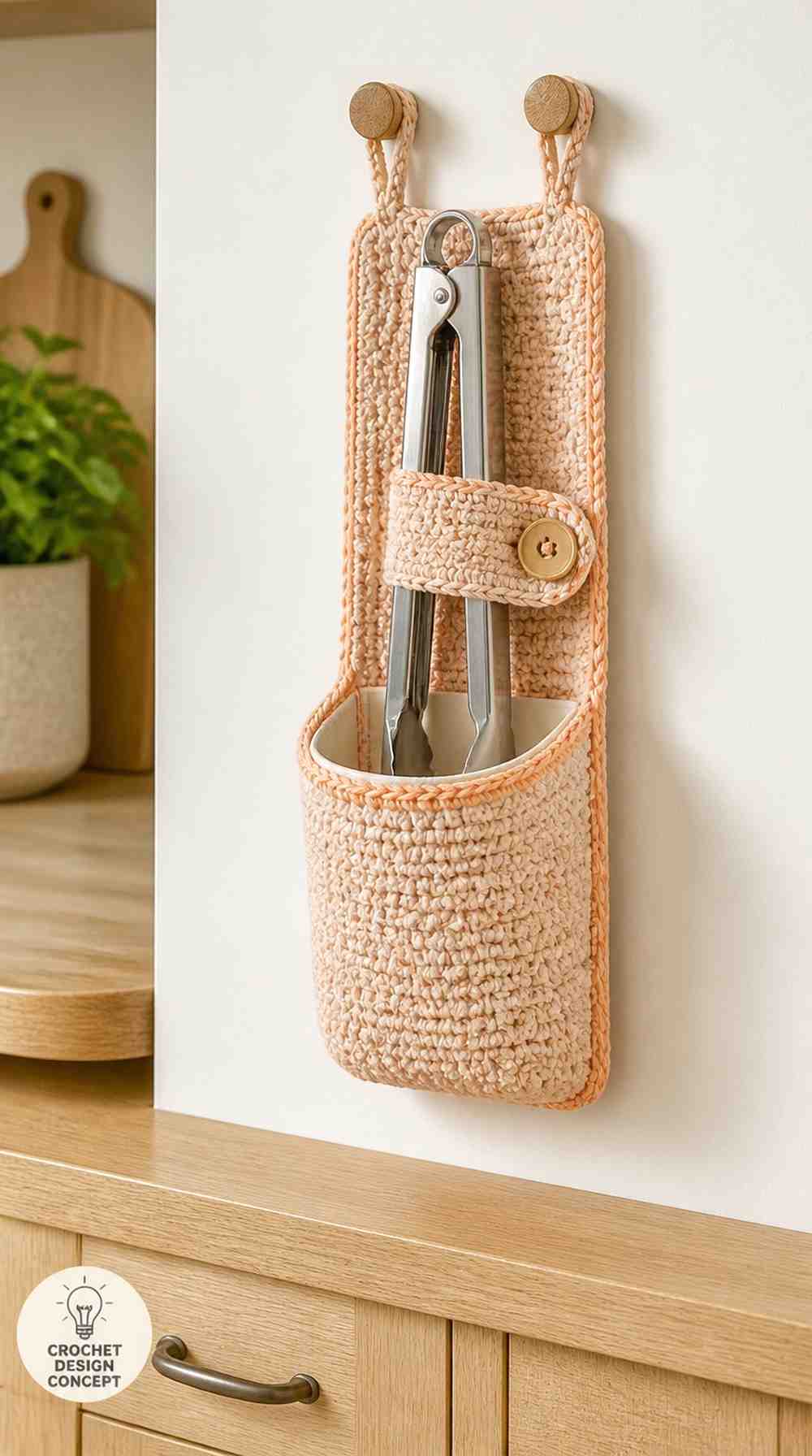
Pale-peach crochet gives this wall holder a soft, understated finish. The tall rectangular back supports an apricot-edged pocket, while a short retaining flap crosses the outside of its rigid liner and fastens with a natural wooden button.
The button detail adds a handmade clothing-inspired touch to a kitchen organizer. Because the flap sits below the exposed tong handles, the utensil can remain accessible while the removable liner receives additional support.
- Flap Function: Position the retaining flap to hold the liner’s outside rather than pinch the tong or cover its handles.
- Button Security: Check the button attachment regularly and avoid loosely attached decorative hardware that might fall into the kitchen work area.
- Pocket Depth: Keep the closed tong’s handles visibly above the opening, allowing an easy grip without tugging on the crochet fabric.
14. Crochet Charcoal Triple-Tongs Rail Holster
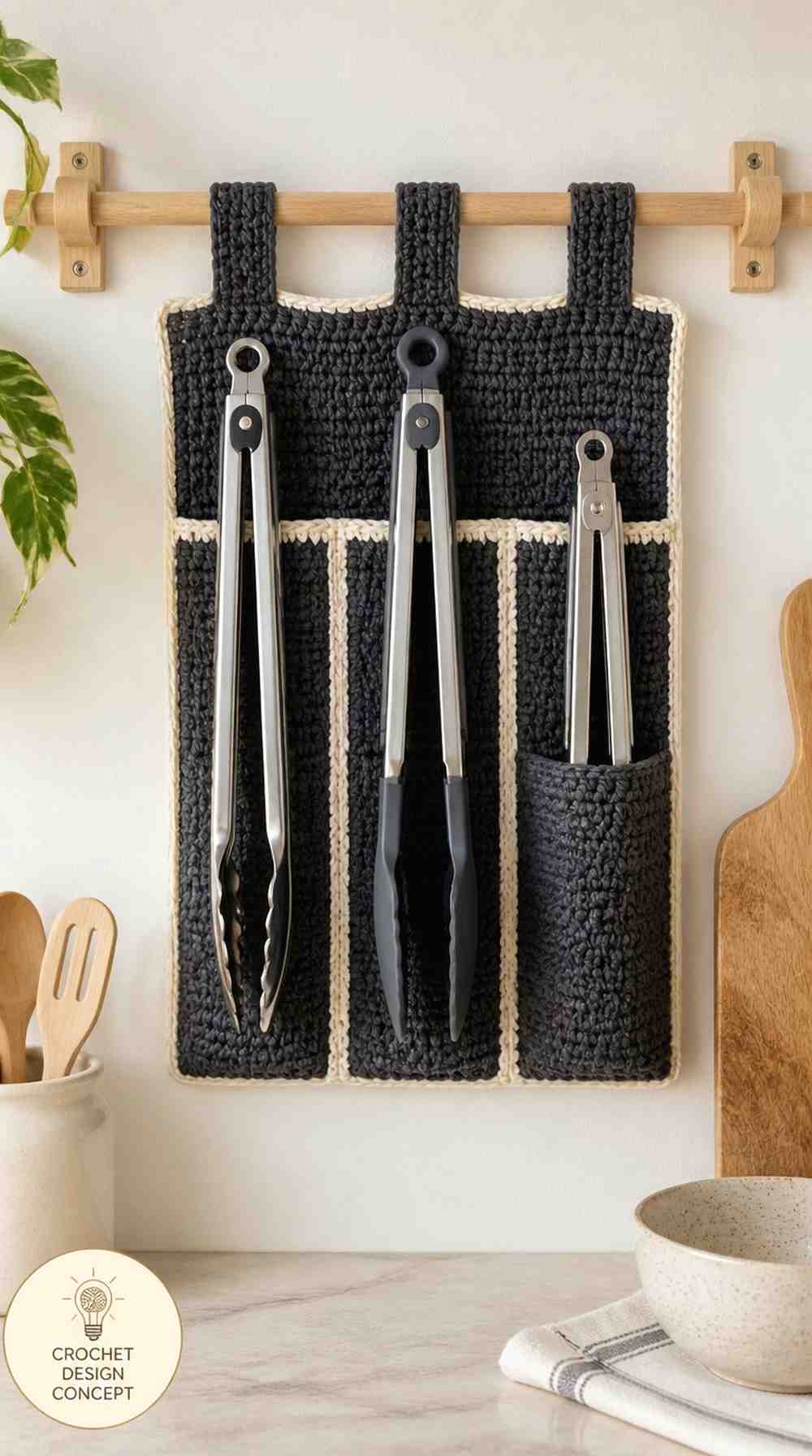
Charcoal-gray crochet creates a longer wall organizer with three narrow vertical pockets, separated by cream borders. A pale-oak rail supports the panel through three upper tabs, while each compartment contains a removable rigid liner.
The design accommodates three different closed utensils: a stainless-steel tong, a silicone-tipped tong, and a smaller serving tong. The darker palette gives the arrangement a modern appearance, particularly against a bright wall.
- Individual Pocket Sizing: Measure the three utensils separately, since serving tongs and silicone-tipped kitchen tongs may require different opening widths.
- Rail Mounting: Distribute the compartments along a securely fitted wooden rail and check the complete loaded arrangement before routine use.
- Easy Identification: Separate pockets help distinguish utensil types without stacking their gripping ends together.
- Practical Location: Choose a wall section away from cooking heat and splashes, with sufficient space to lift each tong straight upward.
Practical Guide to Crochet Kitchen Tongs Wall Holsters
Before turning one of these crochet concepts into an actual kitchen organizer, consider how the holder will work during everyday cooking.
1. Measure the closed tongs. Measure the full length, the widest handle area, and the gripping ends. Check whether the locking mechanism remains engaged when the utensil hangs vertically. Different tong designs may need different pocket shapes.
2. Keep the gripping ends clean. Removable, washable liners are worth considering because the gripping ends may contact food. Avoid relying on yarn as an easy-clean food-contact surface, especially where oil and food particles could become trapped between stitches.
3. Use sensible crochet materials. Smooth cotton yarn is a possible choice for the decorative structure. It provides recognizable stitch definition, but it can absorb moisture and still requires appropriate washing and drying.
4. Secure the mounting hardware. The wall, anchor, hook, dowel, and any rigid supports must suit the combined weight of the holder and utensils. Decorative crochet loops should not be assumed to have a tested load capacity.
5. Allow utensils to cool and dry. Never return hot tongs directly to a yarn holder. Keep crochet away from burners, heating elements, and other hot surfaces. Clean and dry the utensils before storage, and remove the holder for cleaning whenever needed.
6. Plan an easy removal path. A kitchen holster should let you lift the tong without catching its handles, disturbing nearby objects, or pulling hard against the wall fitting.
For additional kitchen storage styling, see 16 Crochet Vintage Kitchen Wall Pocket Ideas for Cozy Cottage Homes. That collection explores other types of wall-mounted crochet storage.
Want to Make Something Similar?
These resources provide useful guidance on related crochet wall-organizer construction. They are not exact patterns for the 14 holster concepts pictured here.
- Happy Heartsy — Crochet Wall Hanging Organizer: A free pattern with video instruction covering crochet pockets and a wooden dowel support. Free Pattern
- Made by Gootie — Easy Crochet Hanging Basket: A free pattern with written, photographic, and video guidance for a mesh-style hanging basket. Made by Gootie
For more wall-storage inspiration, explore 20 Crochet Hanging Wall Pocket Organizer Ideas on Yarn Nest Studio.
Which Crochet Kitchen Tongs Wall Holster Should You Choose?
| Design | Main benefit | Consideration |
|---|---|---|
| Terracotta Dowel-Tab | Simple, narrow shape | Needs a secure dowel |
| Indigo Diagonal Sling | Distinctive angled opening | Must hang straight |
| Mustard Double-Pocket | Separate storage for two tongs | Requires a wider wall area |
| Blush Hexagon | Decorative geometric backing | Larger panel footprint |
| Olive Tapered | Slim, fitted appearance | Requires careful sizing |
| Powder-Blue Wave-Rim | Soft cottage styling | Scallops need clearance |
| Butter-Yellow Daisy | Floral kitchen accent | Motifs require secure attachment |
| Chocolate Timber-Frame | Structured decorative display | Additional wooden frame |
| Rust Corner-Wedge | Uses an available corner | More complicated mounting |
| Burgundy Oval-Basket | Rounded basket appearance | Projects farther outward |
| Ivory Fan-Lace | Vintage lace decoration | Needs an independent metal cup |
| Teal Cross-Strap | Modern crossed-strap design | Liner must remain removable |
| Peach Button-Flap | Decorative retaining closure | Button needs checking |
| Charcoal Triple-Tongs | Storage for three utensils | Longer rail and more space |
For one everyday pair of kitchen tongs, the Terracotta Dowel-Tab or Olive Ribbed Tapered design would provide a straightforward starting point. The Mustard Double-Pocket suits two utensils, while the Charcoal Triple-Tongs Rail offers a broader storage arrangement.
If appearance is your main priority, the Blush Hexagon, Butter-Yellow Daisy, and Ivory Fan-Lace ideas make the strongest decorative statements. In every case, practical stability, cleaning, and sensible wall placement should guide the final choice.
Conclusion
A crochet kitchen tongs wall holster can bring together everyday organization and attractive handmade detail. Some designs use simple hanging pockets, while others combine crochet with wooden frames, metal cups, or removable liners.
The right choice depends on how many utensils you store, how much wall space is available, and how easily you can keep everything clean. Whether you prefer a neat single-tong holder or a larger three-compartment organizer, thoughtful placement and dependable support matter more than decoration alone.
Which of these 14 crochet kitchen tongs wall holster ideas would you choose for your kitchen? Would you prefer a compact hanging pocket, a floral design, or a larger organizer for several utensils? Share your favorite style in the comments.
Frequently Asked Questions
1. Can crochet safely hold metal kitchen tongs on a wall?
A properly constructed crochet organizer may be suitable for holding cool, clean utensils when it works with secure wall hardware and appropriate supporting materials. However, these illustrated concepts have not been physically tested. The pocket, hanging loops, liner, and mounting system would all need to be checked before use.
2. Which yarn is worth considering for a kitchen tongs holster?
Smooth cotton yarn is one option because it can produce clearly defined crochet stitches and is available in many kitchen-friendly colors. However, yarn suitability depends on its care instructions, stitch density, and the holder’s construction. It should not be assumed to resist heat, oil, or repeated moisture exposure.
3. Should kitchen tongs be stored with their handles facing upward?
For these illustrated holsters, the handles face upward so the utensils can be grasped without reaching into the pocket. The gripping ends point down into separate rigid liners. This arrangement should only be used if the particular tongs fit securely, remain locked when needed, and can be kept clean and dry.
4. Where should I hang a crochet kitchen tongs holder?
Choose a dry, accessible wall away from burners, hot appliances, steam, and frequent splashes. A kitchen preparation area or a nearby storage wall may be suitable if there is enough room to remove the utensil comfortably. Check that the wall fittings support the intended load.
5. Are these crochet wall holster ideas complete patterns?
No. These are original design visualizations intended to inspire different pocket shapes, color combinations, mounting arrangements, and storage layouts. The external tutorials offer related crochet techniques, but they do not reproduce the exact illustrated designs. An actual holster would need its own measurements, construction planning, and physical safety checks.