Keeping olive oil and vinegar bottles together can make a kitchen counter, dining table or pantry shelf feel more organized. These 15 crochet oil and vinegar bottle pair carrier inspiration ideas explore handmade-style holders designed to accommodate two bottles in one arrangement. From cinnamon-colored double compartments and oatmeal cylinder sleeves to open mesh totes, granny-square baskets and adjustable dividers, the collection features different structures, colors and crochet textures.
Some designs focus on presenting a matching bottle pair neatly beside the stove or on a dining table, while others explore small carrying handles and separate bottle compartments. You’ll find simple close-stitch baskets, decorative colorwork and flexible wrap-style concepts. Each idea offers something different to compare, especially when it comes to bottle sizing, stability, glass protection, handle placement and keeping pouring spouts accessible.
These are AI-generated crochet design visualizations for inspiration, not photographs of tested handmade pieces or step-by-step patterns.
Quick Design Selection Guide
- For simple countertop organization: Crochet Cinnamon Double-Well Bottle Basket has two distinct compartments and short carrying handles.
- For separately fitted bottles: Crochet Oatmeal Twin Cylinder Carrier provides individual cylindrical sleeves connected by a central bridge.
- For an open, decorative look: Crochet Navy Diamond-Mesh Pair Tote keeps both glass bottles visible through its crochet mesh.
- For a firmer base concept: Crochet Marigold Wooden-Base Pair Caddy incorporates a removable wooden insert.
- For decorative kitchen styling: Crochet Blush Granny-Square Twin Basket and Crochet Espresso Checkerboard Bottle Tote feature colorful joined crochet patterns.
- For bottles of different widths: Crochet Teal Adjustable-Divider Bottle Tote explores a repositionable internal partition.
1. Crochet Cinnamon Double-Well Bottle Basket
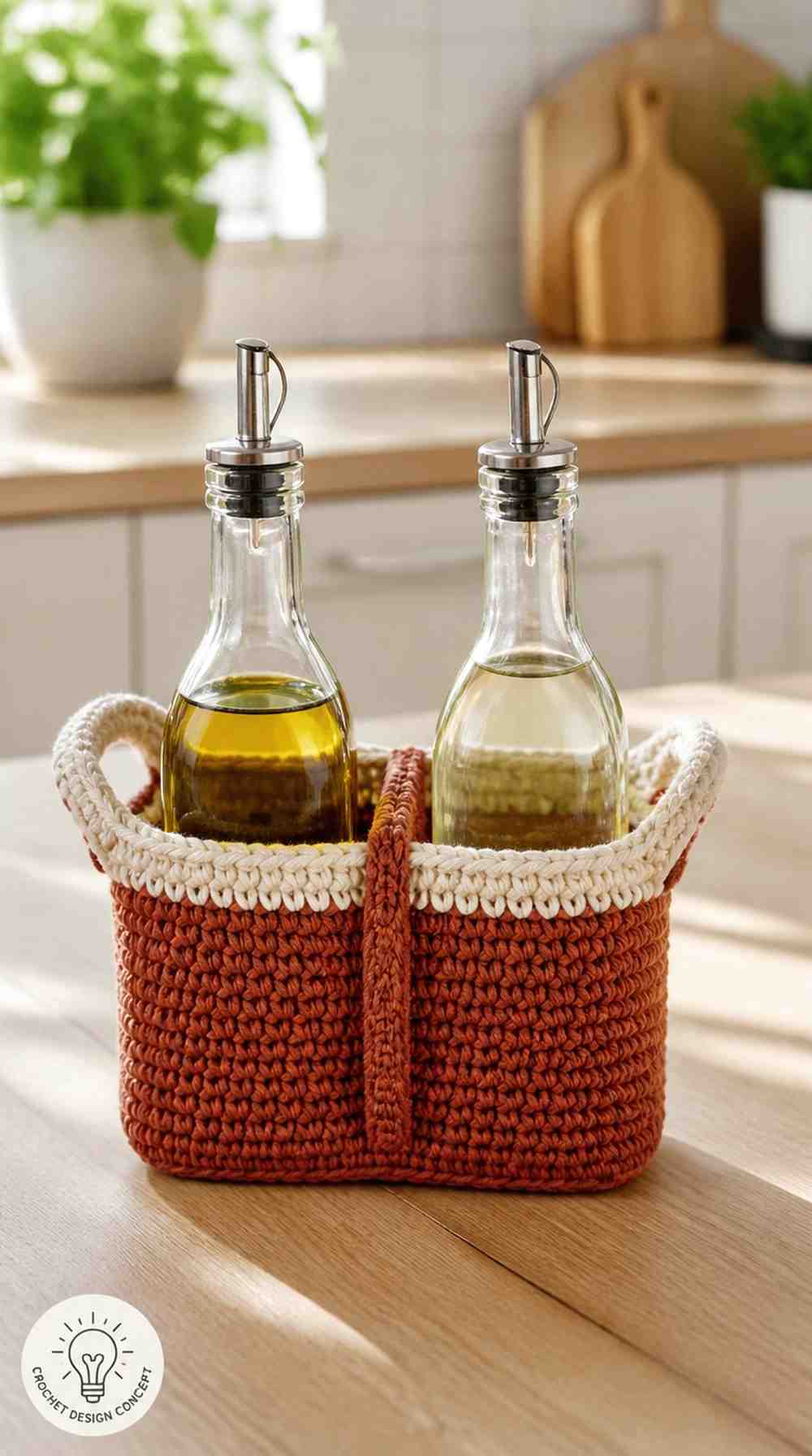
Warm cinnamon-rust crochet gives this compact bottle basket a welcoming, farmhouse-inspired appearance. Two upright compartments sit on a closely stitched oval base, divided by a central crochet wall. A narrow cream border finishes the upper edge, while two short handles extend from opposite sides. Matching oil and vinegar bottles stand neatly within the basket.
The separated design is especially appealing for a coordinated kitchen counter. Rather than allowing two glass bottles to lean directly against one another, it introduces a soft dividing section. Actual protection would still depend on the finished crochet structure and how closely the compartments fit.
- Compartment fit: Measure both bottles separately, including their widest lower sections, so each compartment holds its bottle without forcing the sides outward.
- Central separation: The divider should extend high enough to reduce direct bottle contact while remaining below the pouring spouts for easy access.
- Base stability: A flat oval base is important for this concept. Soft crochet alone should not be assumed to provide rigid support for heavy glass bottles.
2. Crochet Oatmeal Twin Cylinder Carrier
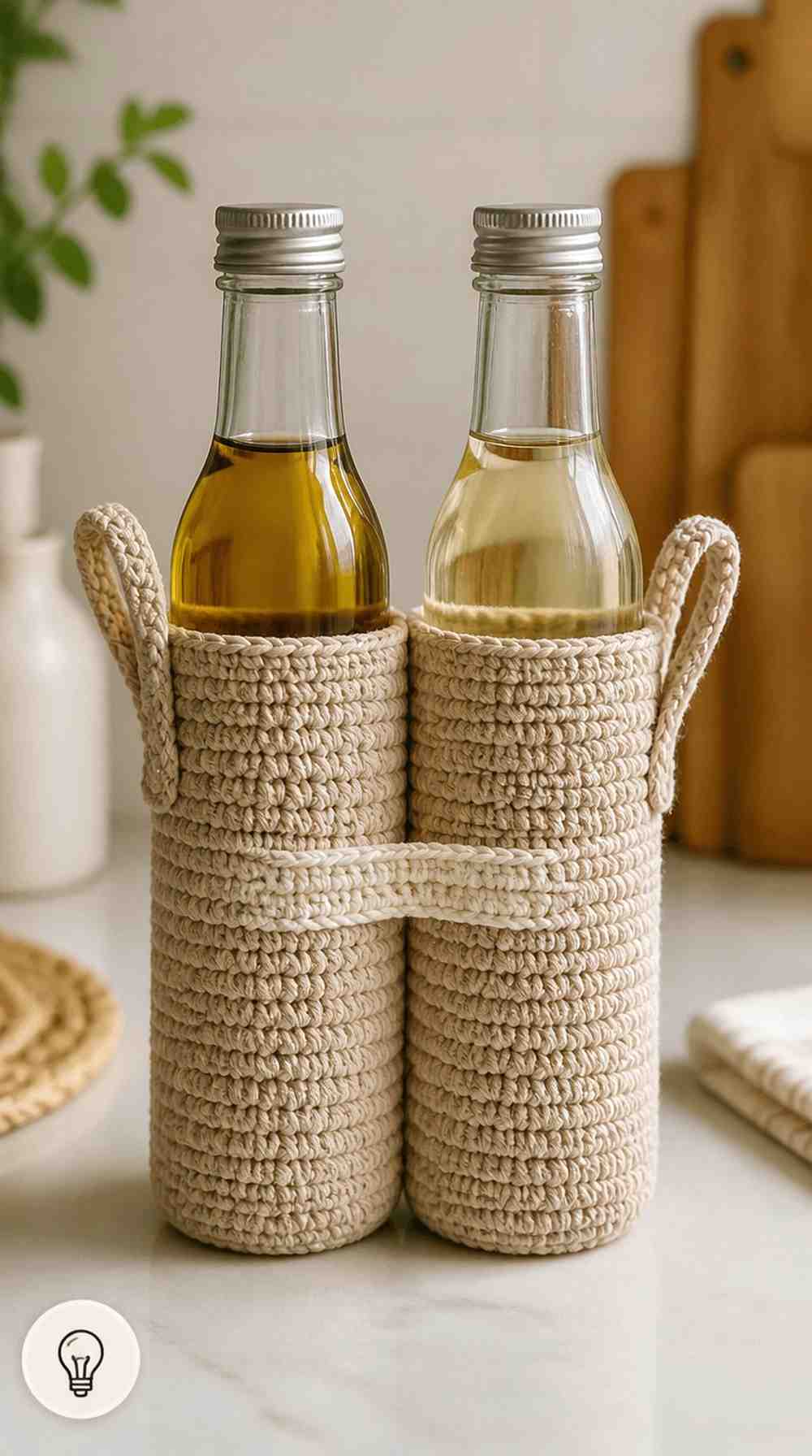
Oatmeal-colored crochet creates two slender bottle sleeves connected by a broad cream bridge. Each cylinder has its own closed circular base and a straight, close-stitch body. Two short carrying loops complete the design, while the olive oil and vinegar bottles remain visible above their individual sleeve openings.
This concept has a different structure from a single divided basket. Because each bottle sits inside its own cylindrical pocket, the sleeves can be shaped around their individual bases. The connecting bridge should be secure enough to keep the pair aligned without pulling either bottle sideways.
- Individual sizing: Each sleeve should follow its own bottle’s shape, especially if the oil and vinegar containers have slightly different diameters.
- Connecting bridge: The cream bridge needs firm attachment to both cylinders to prevent the bottles from spreading apart when the holder is moved.
- Carrying loops: Position the two outer loops evenly and test the finished construction carefully before attempting to lift filled glass bottles.
3. Crochet Navy Diamond-Mesh Pair Tote
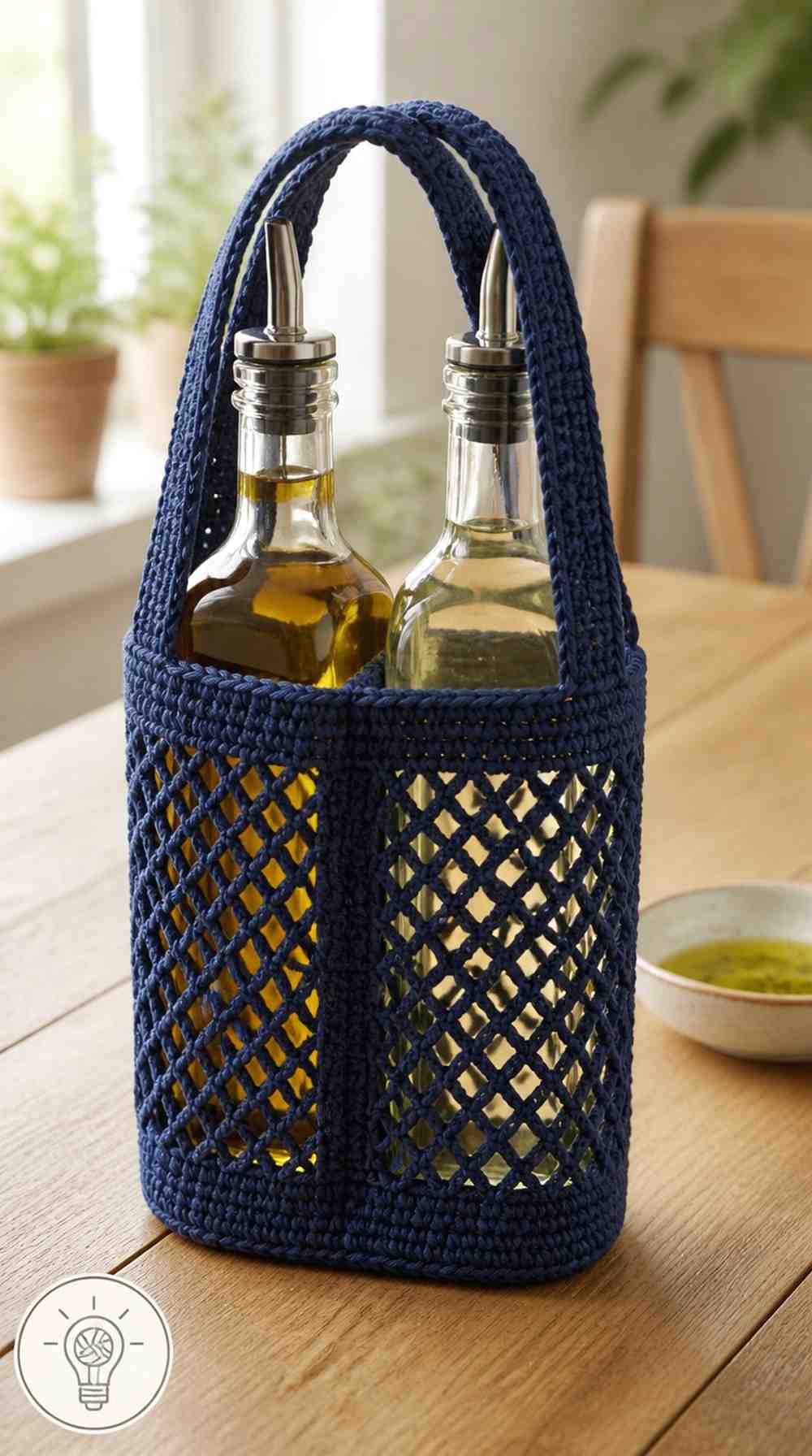
Deep navy crochet gives this double-bottle tote a clean, modern appearance. The elongated base and central divider are made from closer stitches, while diamond-shaped mesh openings cover the outer walls. A solid upper band and two flat handles complete the design, leaving the golden oil and pale vinegar visible through the crochet.
This carrier explores the contrast between open decorative stitches and more structured supporting sections. The mesh gives the holder a lighter visual appearance, but the bottom and divider are particularly important because two glass bottles create concentrated weight.
- Mesh stability: Open diamond stitches can stretch under pressure. The mesh should not be relied upon as the primary support for the bottles.
- Solid bottom: The closely stitched oval base needs sufficient strength and shape retention for the combined weight of the actual containers.
- Divider placement: Keep the center partition connected to the base and upper band so the glass bottles do not press directly against one another.
4. Crochet Marigold Wooden-Base Pair Caddy
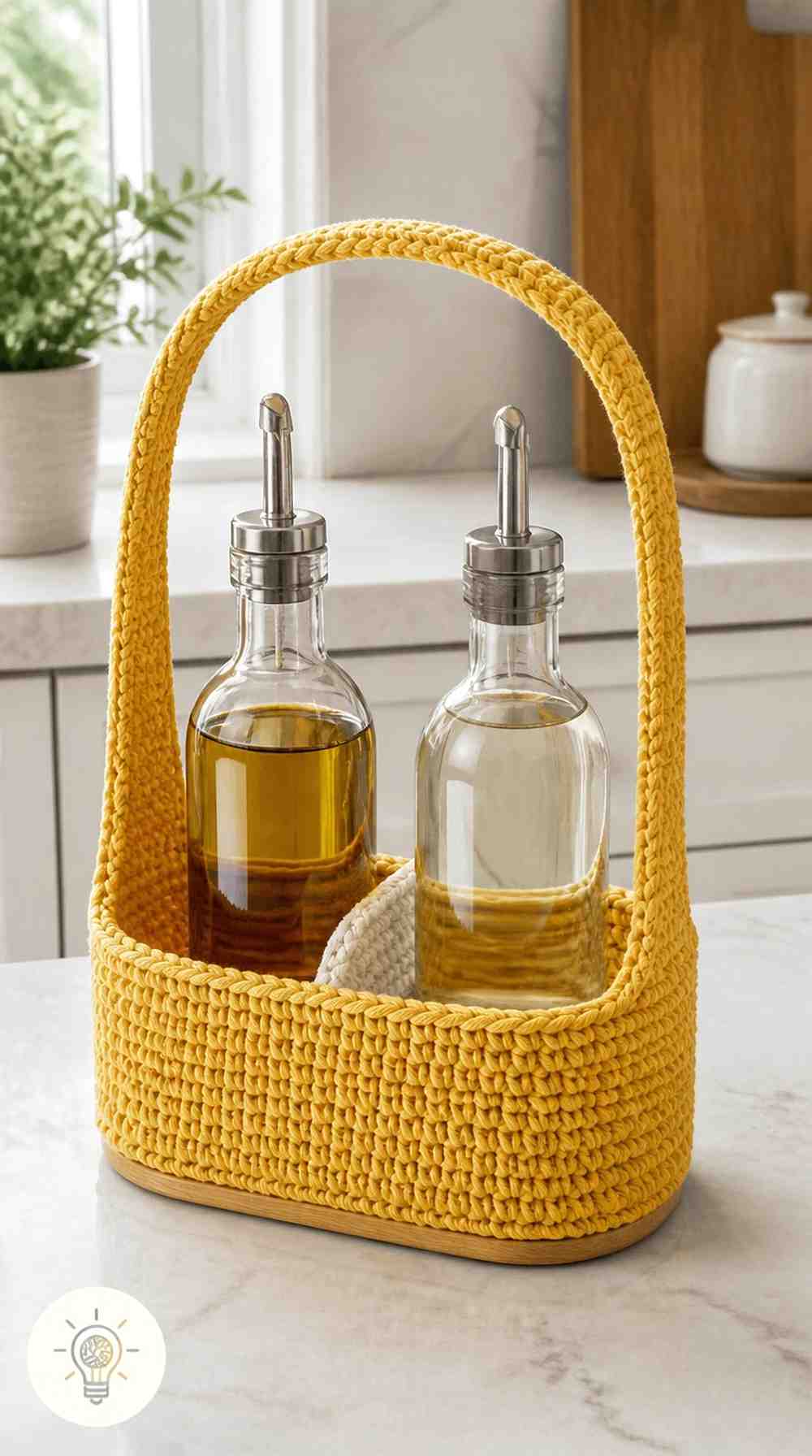
Marigold-yellow crochet adds a bright touch to this bottle caddy, which combines a closely stitched outer body with a removable pale-oak oval base insert. A short cream divider separates the two bottles, while a wide yellow handle arches over the center. The wooden insert is visible beneath the crochet walls.
The main feature is the combination of a textile exterior and a firmer internal base. This arrangement could help define the caddy’s shape, although a wooden insert alone does not make a crochet carrier safe for lifting heavy glass bottles.
- Wooden insert: Choose a smooth, appropriately finished base with rounded edges. It should sit securely without pushing through or damaging the crochet bottom.
- Handle connection: A high central handle needs a dependable load path to the supporting base, not merely attachment to flexible side stitches.
- Cleaning access: The removable wooden component should be easy to take out if oil or vinegar drips onto the crochet or into the bottom.
5. Crochet Dusty Blue Fold-Open Bottle Wrap
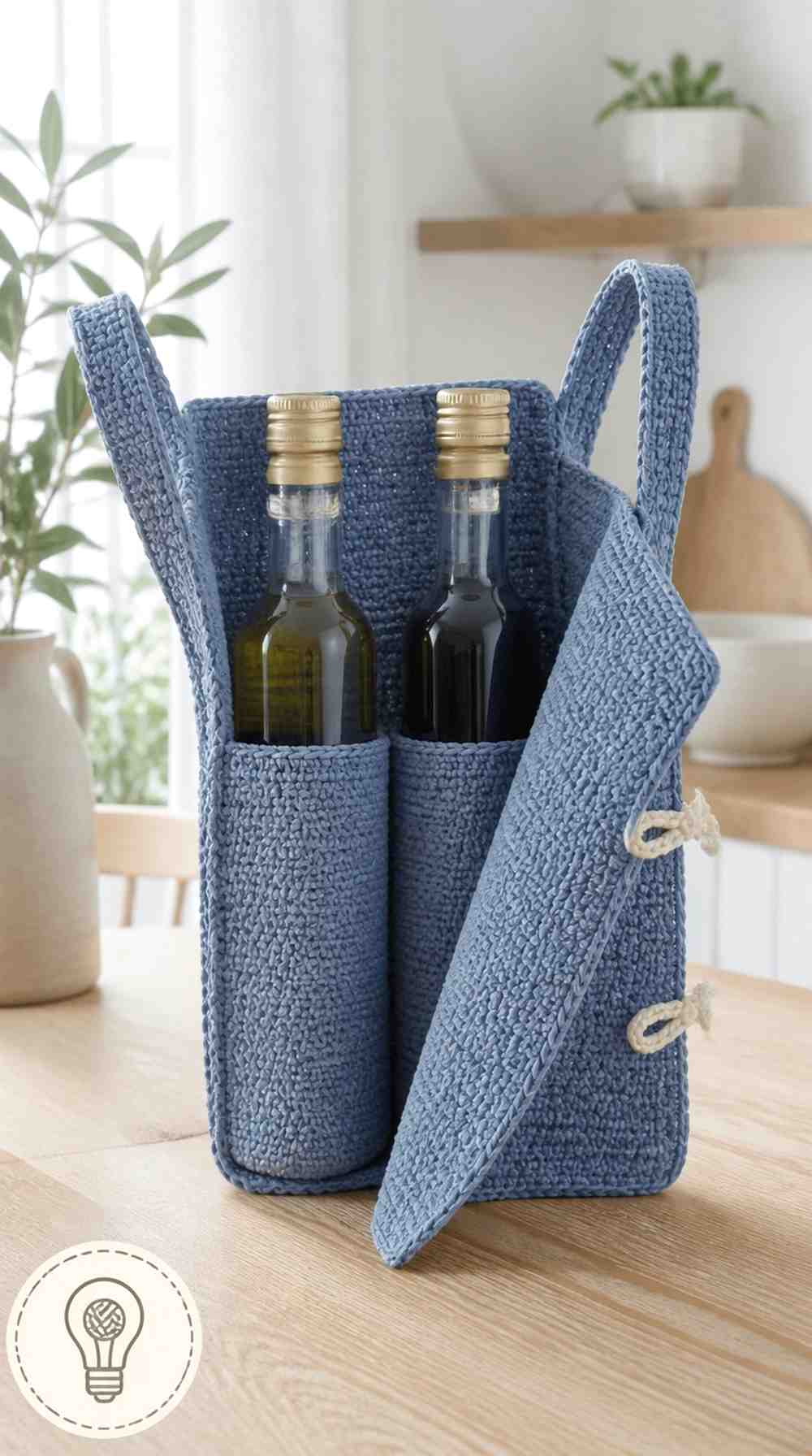
Dusty-blue crochet forms a flexible rectangular wrap with two upright bottle pockets and a wide outer flap. The pockets have closed bottoms, while cream ties fasten the wrap along one side. Two short flat handles emerge from the upper backing edges, giving the design the appearance of a soft folding bottle organizer.
Unlike a fixed basket, this concept opens more fully to reveal the bottles and their separate pockets. That may make the holder easier to inspect and clean, but the foldover fabric must not place pressure against the bottle necks or pouring mechanisms.
- Pocket support: Both bottle pockets require dependable bottom construction because the outer flap and side ties are not substitutes for supporting the glass.
- Foldover clearance: The backing panel should fold around the bottle pair without squeezing their shoulders or pushing the metal spouts together.
- Tie management: Short, neatly secured ties are preferable to long dangling cords that could become trapped beneath a bottle or neighboring kitchen item.
6. Crochet Olive Open-Strap Bottle Harness
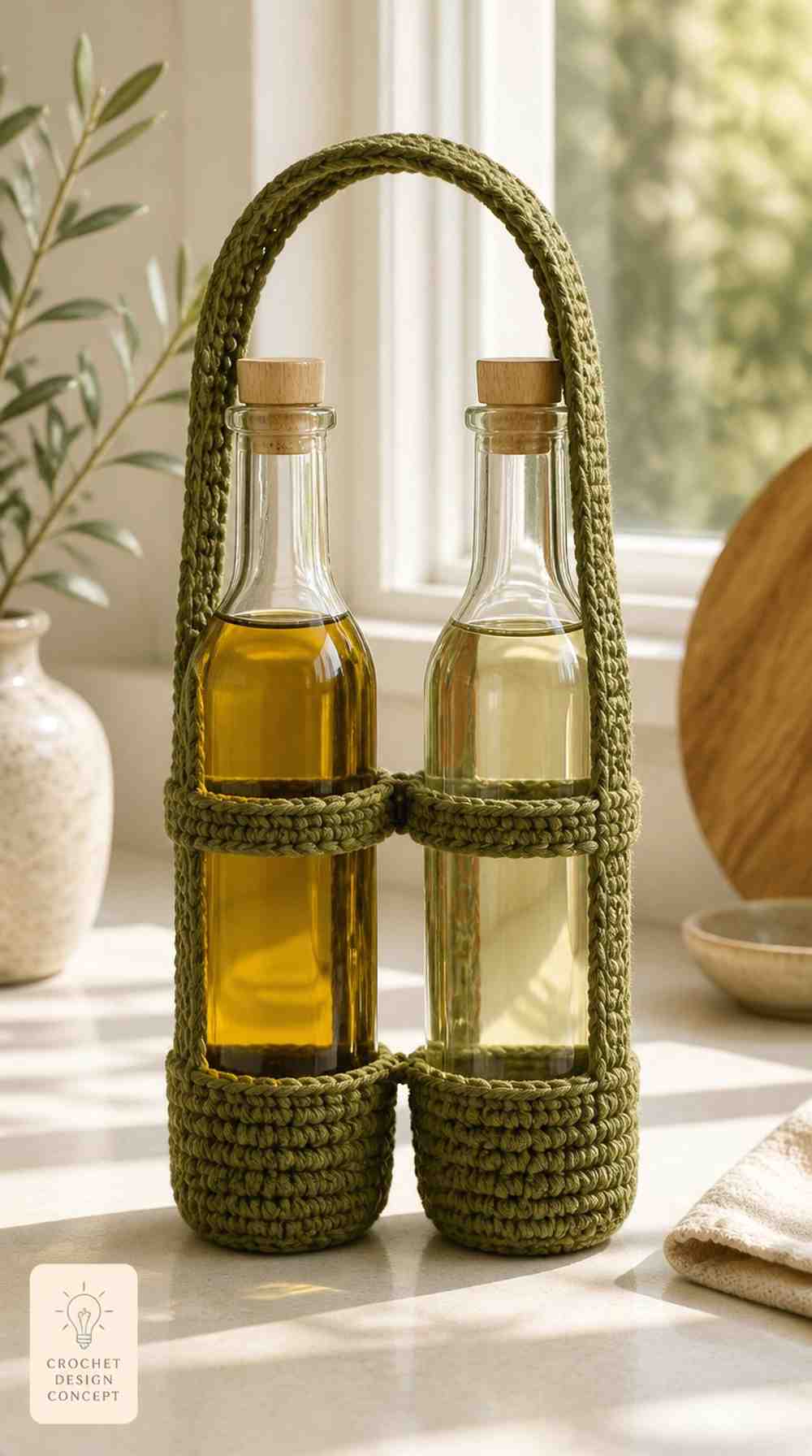
Olive-green crochet creates a minimal bottle harness with two separate circular bottom cups and narrow vertical straps running upward around the containers. Horizontal securing bands connect the sides, while a short central bridge and one arched handle bring the arrangement together.
The open structure leaves much of the glass visible, giving the carrier a lighter appearance than a closed basket. However, the individual straps and connecting points carry greater importance because there are fewer continuous crochet panels supporting the bottle pair.
- Vertical support: Every strap should connect securely to the lower bottle cups and upper bands rather than relying on decorative attachment points.
- Bottle retention: The securing bands must be positioned below the bottle shoulders without restricting access to the sealed pouring tops.
- Handling limitation: This open harness is a visual concept, not a tested load-bearing carrier. Use a supported basket for moving heavy glass unless the structure is independently proven suitable.
7. Crochet Blush Granny-Square Twin Basket
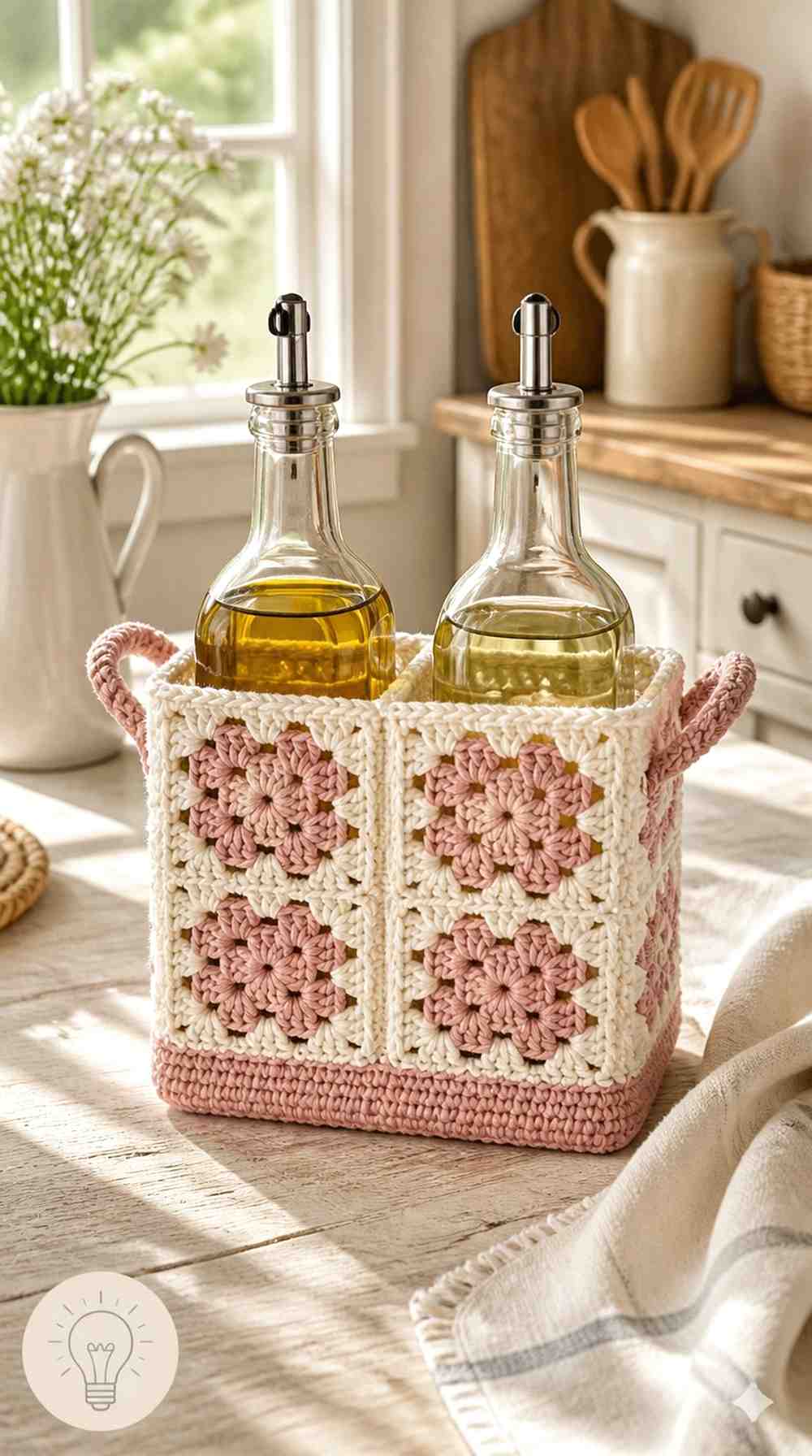
Blush-pink and ivory granny squares create a soft cottage-style basket with two bottle compartments. The small joined motifs form the outer walls, while a denser rectangular base provides a contrasting foundation. A central divider and two short handles keep the pair organized, with both glass bottle necks visible above the opening.
The joined granny-square panels give the design plenty of decorative character. Their open cluster structure also creates more seams and gaps than a close-stitch basket, so the supporting base and internal bottle separation become especially important.
- Granny-square joins: The panels need neatly connected seams that do not pull apart when the basket changes shape around the two bottles.
- Supporting foundation: The dense rectangular base should provide continuous support beneath each bottle rather than leaving their weight on open granny-square clusters.
- Decorative balance: Keep the cream joining lines consistent so the basket’s appearance stays tidy without adding unnecessary bulk along the internal divider.
8. Crochet Charcoal Ribbed Shoulder Bottle Tote
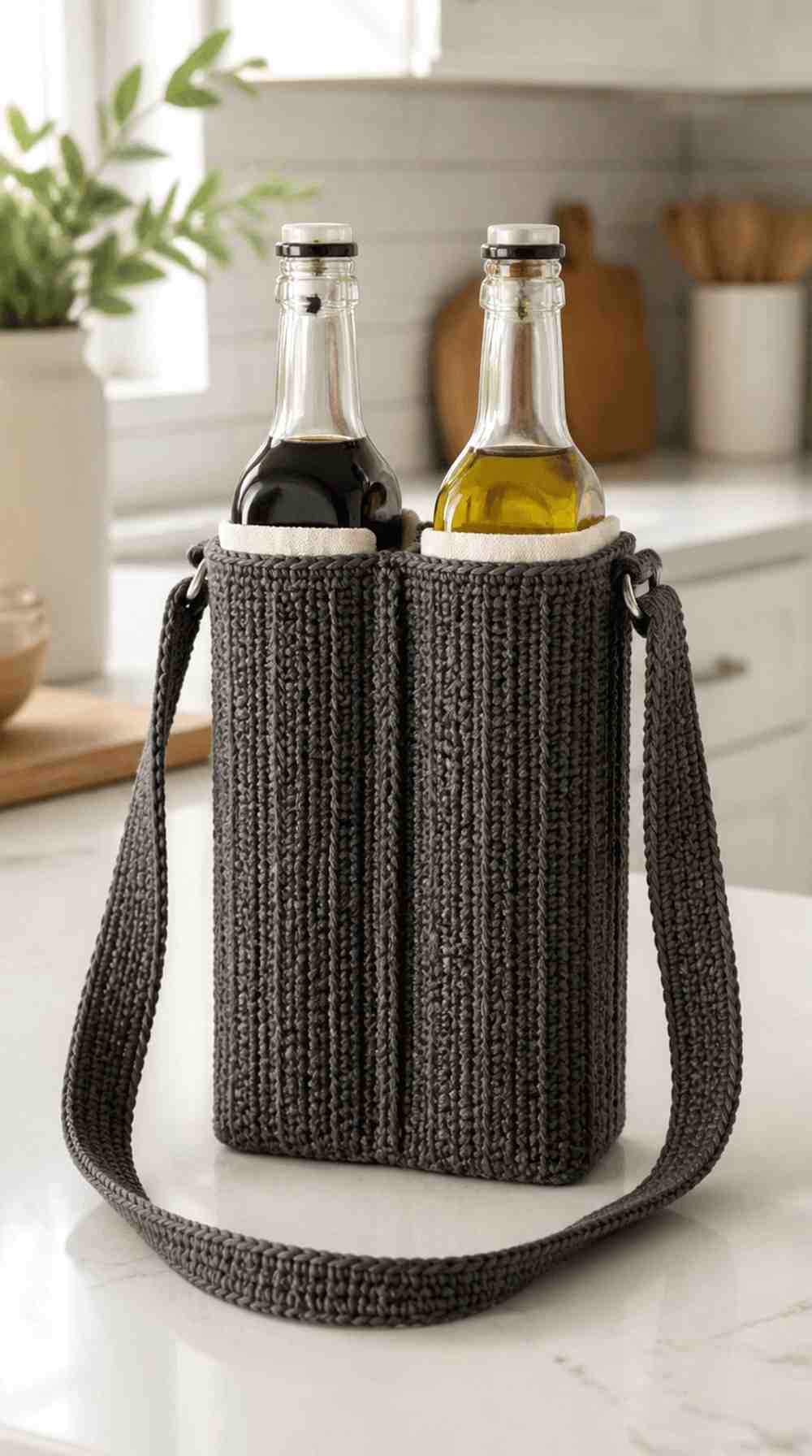
Charcoal-grey crochet gives this two-bottle tote a streamlined appearance. Vertical ribs run along the close-stitch exterior walls, while an elongated base, two internal bottle channels and a thin divider create its carrying shape. A wide shoulder strap attaches to the outer sides, and a pale ivory lining finishes the compartment openings.
This design is intended as inspiration for a larger carrying accessory rather than a small countertop basket. Two filled glass bottles can be heavy, so the shoulder strap and soft base would need particular attention before attempting real use.
- Shoulder strap: A wide strap may be more comfortable, but reinforcement and actual weight testing are essential before carrying filled bottles against the body.
- Ribbed sides: Vertical crochet ribs add texture and flexibility. The sides should not stretch so far that the bottles lean or become unstable.
- Lining purpose: The ivory fabric layer may provide a smoother inner contact surface, but it does not replace a rigid protective divider or impact-resistant case.
9. Crochet Terracotta Lace-Divider Bottle Carrier
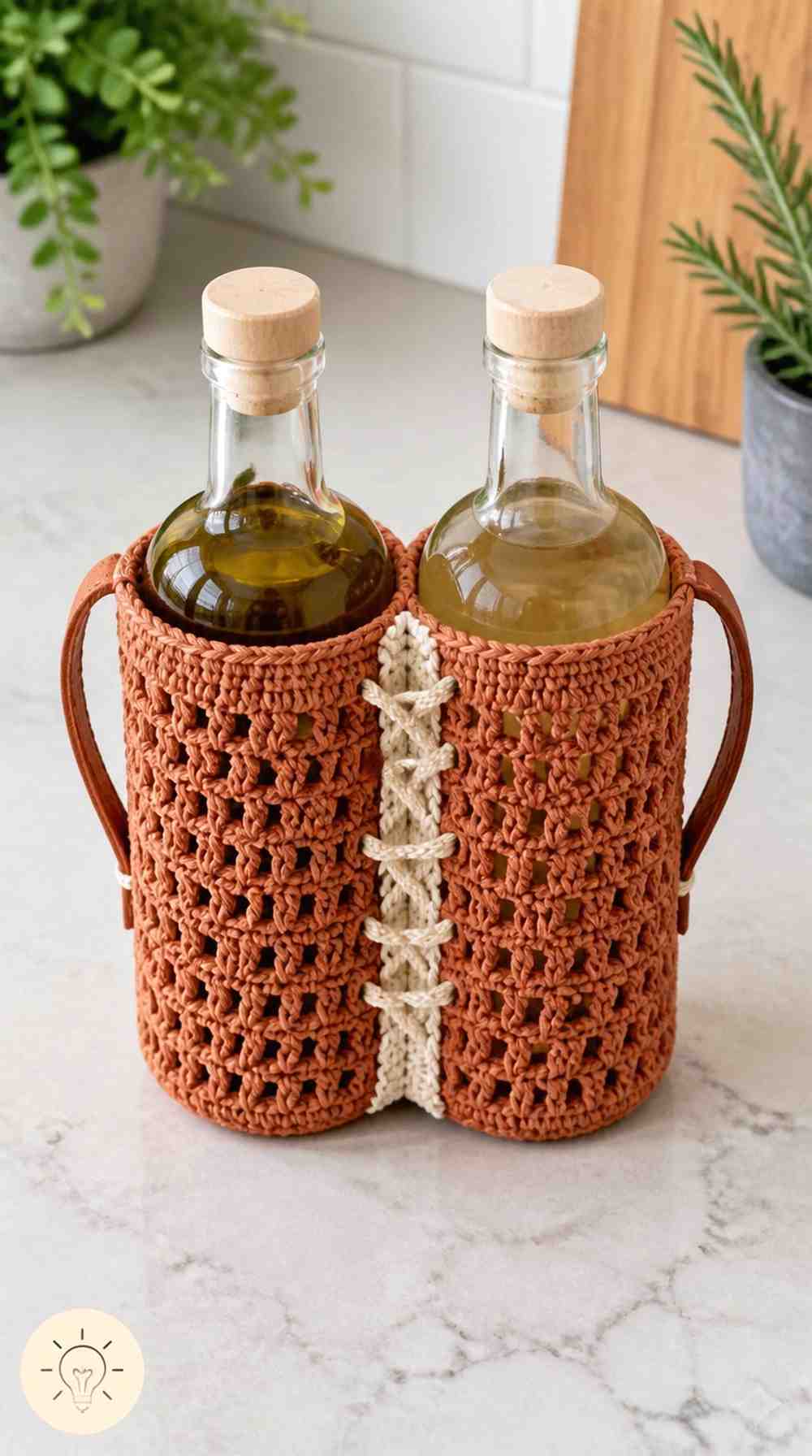
Terracotta crochet forms two separate cylindrical bottle pockets joined by a narrow cream divider. Decorative cream lacing crosses the exposed front of the central panel, while short flat handles finish the outer edges. Both bottles remain upright, with their slender necks and metal spouts clearly visible.
The contrasting laced divider is the defining feature. It introduces visual detail between the bottles without covering their glass bodies completely. The lacing should remain decorative, while the actual connecting seams and pocket bases provide structural support.
- Laced divider: The cream cords should be neatly secured so loose ends cannot catch on the glass bottles or neighboring utensils.
- Pocket separation: A properly joined center panel matters more than the decorative lacing when keeping the two containers aligned.
- Rounded bottoms: Each cylindrical base should be measured against its actual bottle rather than assuming the oil and vinegar containers share identical dimensions.
10. Crochet Burgundy Toggle-Flap Bottle Basket
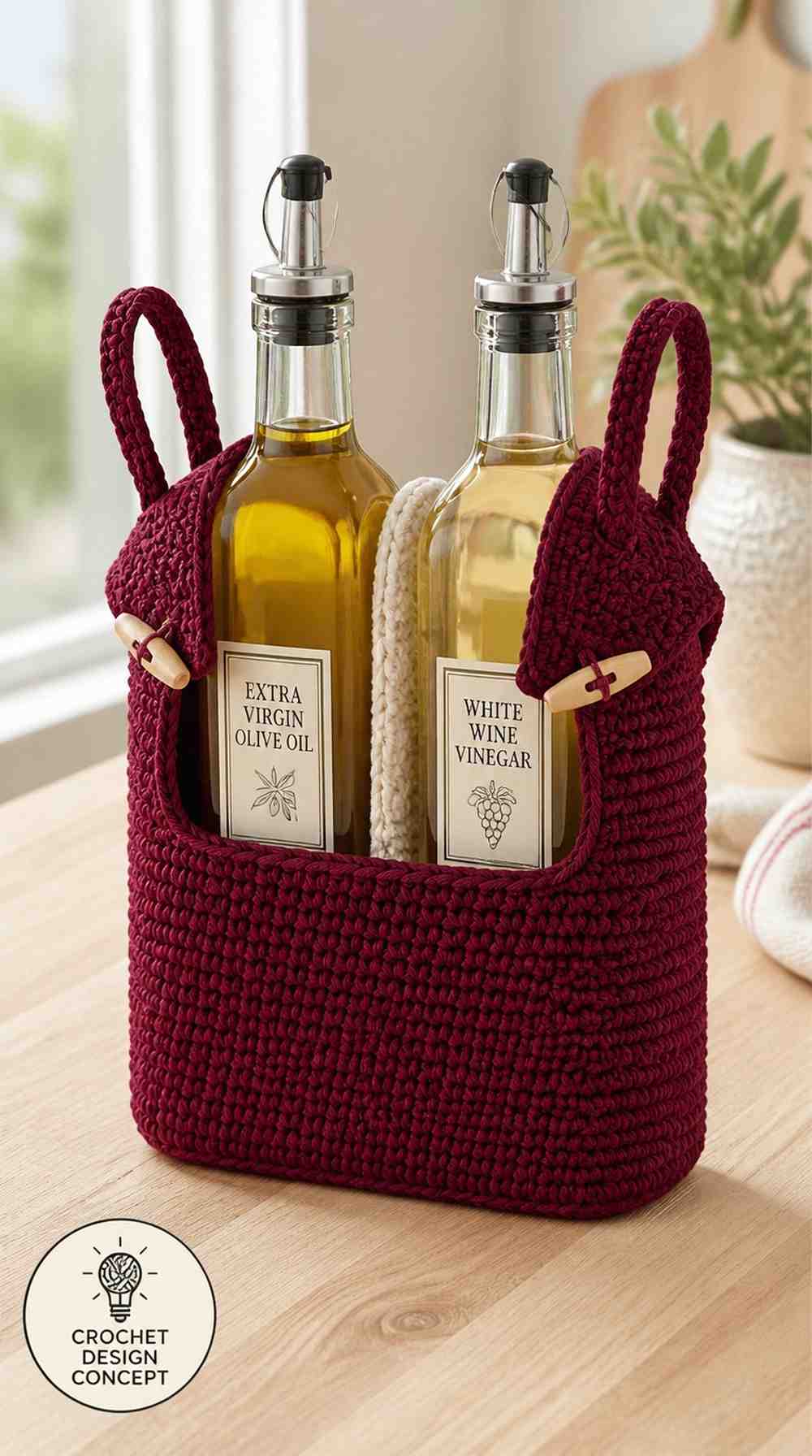
Deep burgundy crochet gives this carrier a rich, classic finish. The elongated basket has closely stitched sidewalls, a cream central separator and two short handles. Small outer flaps fold across the bottle shoulder areas and fasten to natural wooden toggles positioned on the exterior.
This design explores a partly secured opening rather than a completely open basket. The flaps add a distinct decorative feature, but they must remain below the pouring tops and should not pull the bottles toward one another when fastened.
- Flap positioning: The foldover sections should sit below the bottle necks without contacting or accidentally opening their dispensing mechanisms.
- Toggle hardware: Keep wooden toggles on the outer sidewalls, away from areas where hard pieces could press directly against glass.
- Easy removal: The flaps should open completely so each bottle can be lifted without catching its spout or pulling against the central divider.
11. Crochet Mint Built-In Grip Pair Caddy
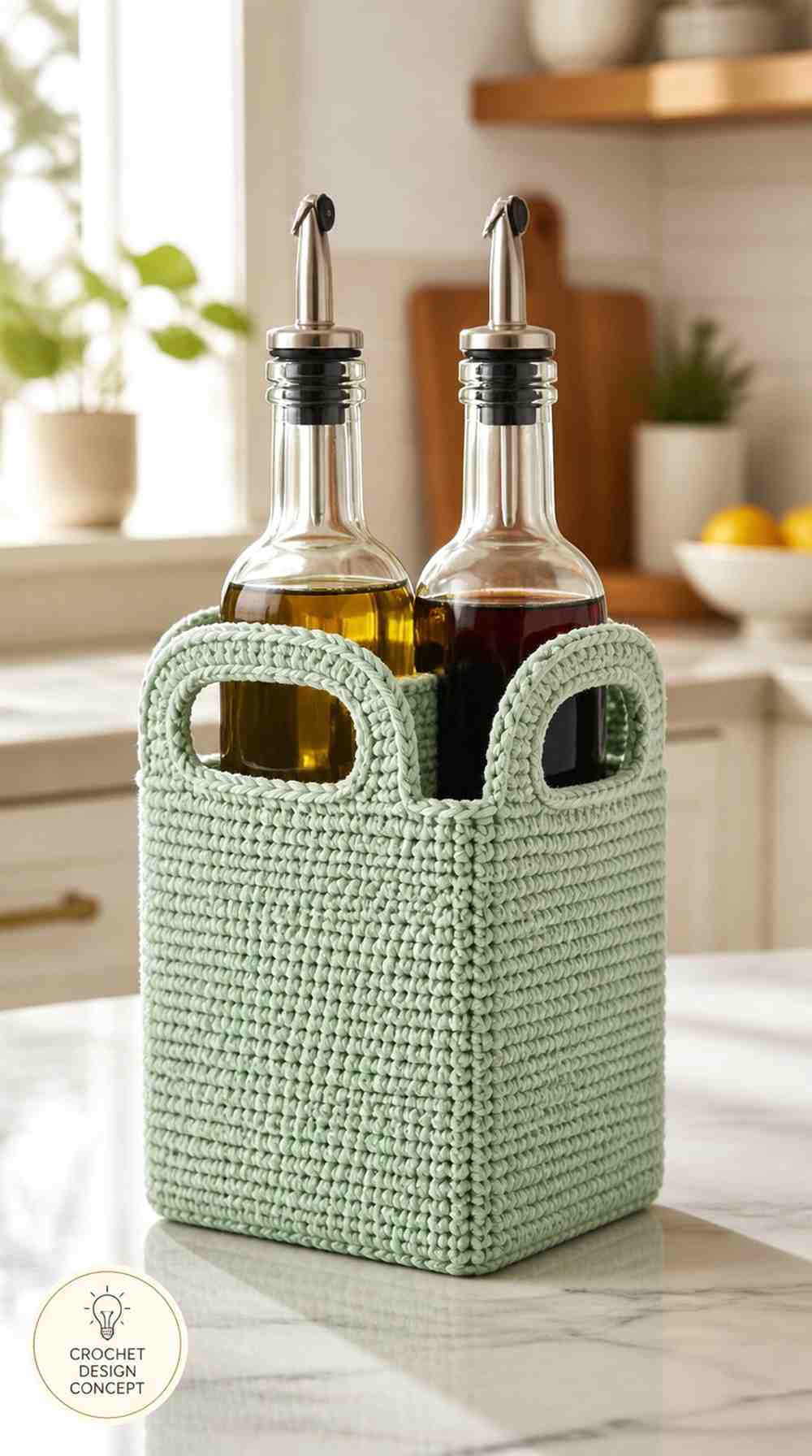
Pale mint crochet creates a tidy rectangular caddy with two bottle compartments and no separate carrying straps. Instead, oval hand openings are worked directly into the upper end panels. The close-stitch body, flat base and central divider give the design a simple, organized appearance.
The integrated hand grips are what distinguish this concept. They remove the need for attached loops, although the upper panels must be strong enough to withstand the pulling force created when someone grips the caddy.
- Grip openings: The oval holes should be large enough for a comfortable hand grip without weakening the surrounding upper panel.
- End-wall reinforcement: The crochet around the openings needs appropriate support and finishing because the handle force is concentrated in these areas.
- Countertop use: This design is best approached as an organizing caddy first; do not assume integrated fabric grips make it suitable for carrying filled glass bottles.
12. Crochet Espresso Checkerboard Bottle Tote
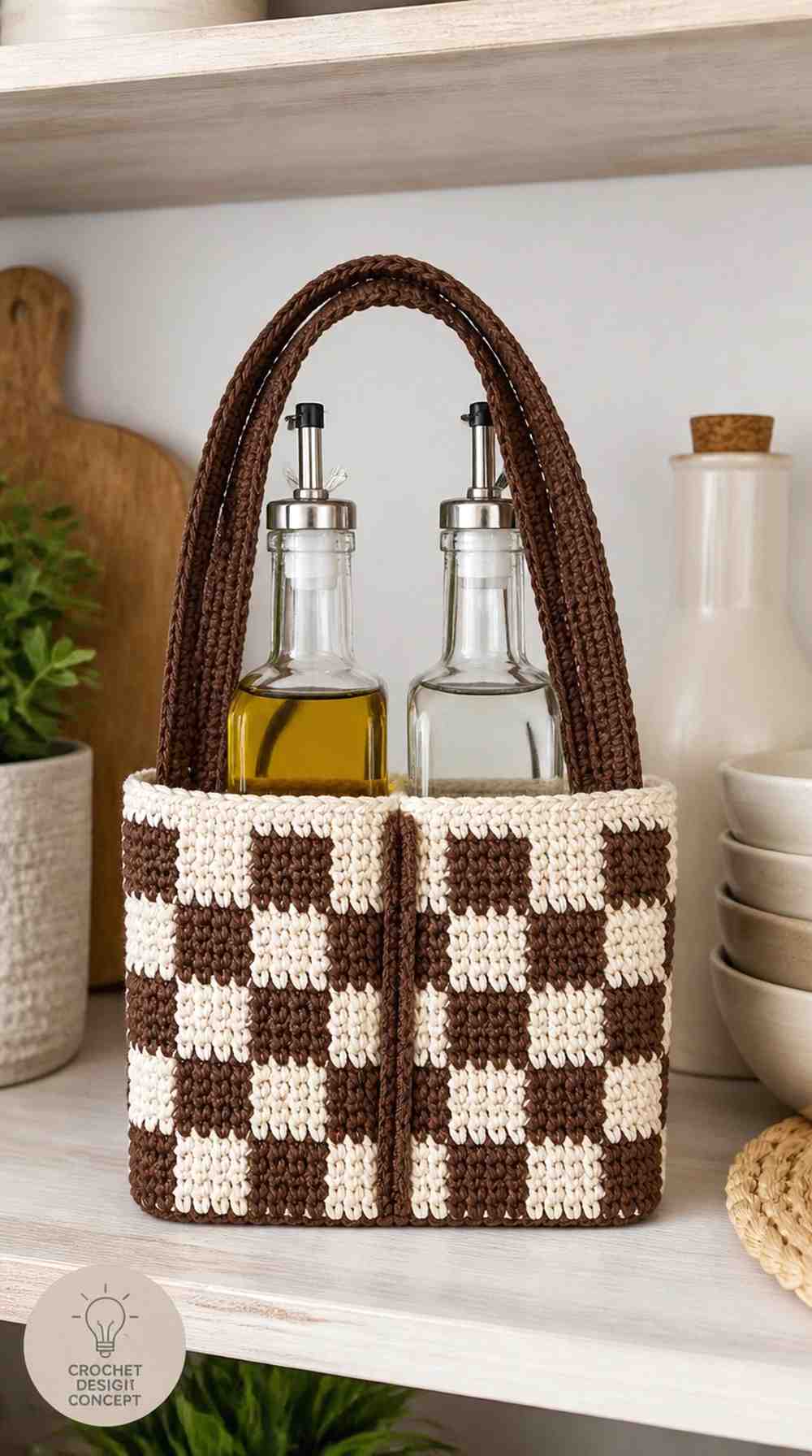
Espresso-brown and ivory checkerboard crochet gives this bottle tote a warm, coordinated look. Small colorwork blocks cover the outer walls, while a cream rectangular base supports two upright compartments. A central divider, beige fabric lining and two short wide handles complete the design.
The checkerboard arrangement makes this carrier particularly attractive for a neutral coffee or kitchen station. The decorative blocks should remain closely connected and reasonably flat, since bulky joins could make the outer walls uneven around the bottle pair.
- Colorwork structure: Keep the checkerboard stitch pattern consistent so the outer body does not pull inward or create uneven tension around the compartments.
- Lined upper edge: A smooth fabric lining can reduce contact with loose crochet fibers, but it still needs suitable attachment and cleaning access.
- Handle symmetry: Both wide handles should align with the supporting base so the pair does not tilt dramatically when gently moved.
13. Crochet Lilac Double-Drawcord Bottle Pouch
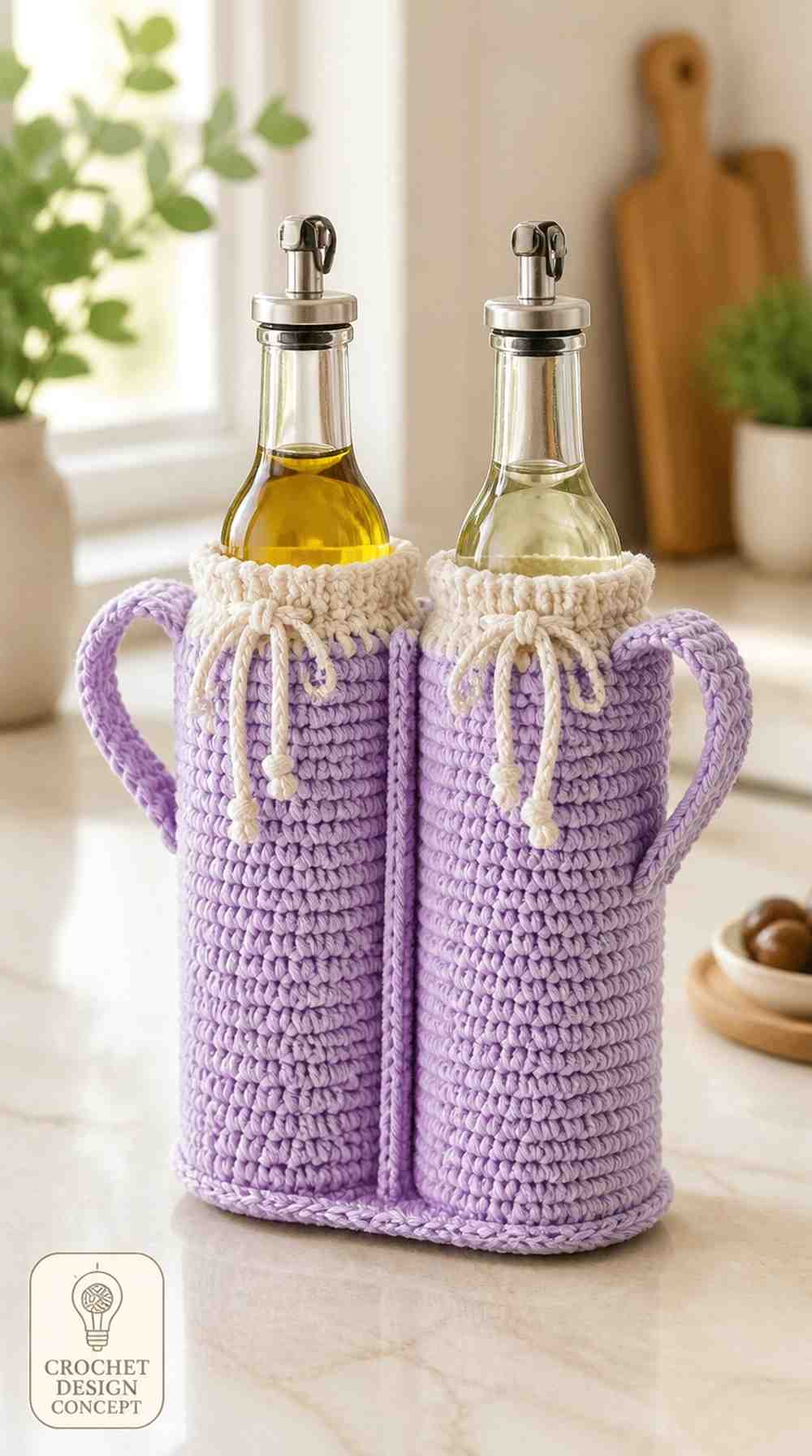
Lilac crochet creates two adjoining bottle pouches on a shared oval base, each with its own cream drawcord near the upper opening. A narrow central divider separates the two cylinders, while short flat handles attach to the outside. The bottle necks and metal spouts remain visible above the loosely gathered crochet.
The separate drawcords offer a way to adjust each pouch independently. That may be useful when the oil and vinegar bottles have slightly different body shapes, provided the cords stay below their necks and do not interfere with pouring.
- Separate adjustment: Each drawcord should gather the fabric gently rather than squeezing the glass or forcing the container upward from its base.
- Spout clearance: Position the drawcord channels below the bottle shoulders so ties cannot catch the metal pouring tops.
- Base connection: The shared bottom must support both bottles evenly, even if the drawcords create slightly different tensions around their sides.
14. Crochet Copper Accordion Pair Carrier
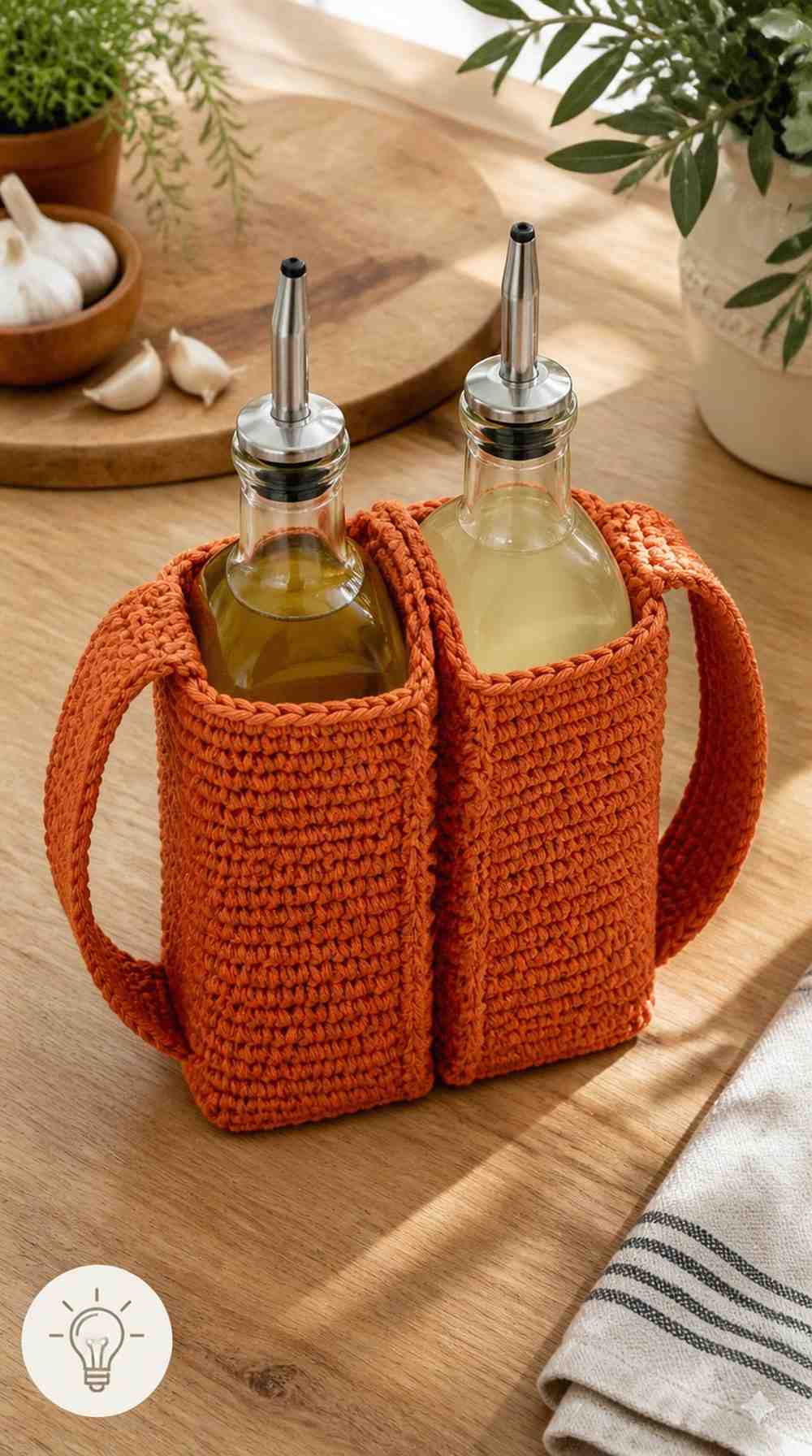
Copper-orange crochet forms a flexible two-bottle caddy with a flat elongated base and two upright pockets. Between them, a softly pleated central gusset creates an accordion-like detail. Wide flat handles connect to the opposite outer panels, leaving both glass bottle necks exposed.
The folded gusset provides a different approach to separating the bottles. It creates some visual flexibility between the compartments, but excessive movement would be undesirable when carrying glass. The pleats should help accommodate the pair without allowing them to strike against one another.
- Gusset depth: Keep the central folds controlled so they provide spacing without allowing the bottles to swing together.
- Base alignment: Both pockets should remain level along the elongated base rather than pulling upward when the handles are lifted.
- Fold maintenance: The pleated section may collect crumbs or kitchen residue, so its construction should allow easy inspection and cleaning.
15. Crochet Teal Adjustable-Divider Bottle Tote
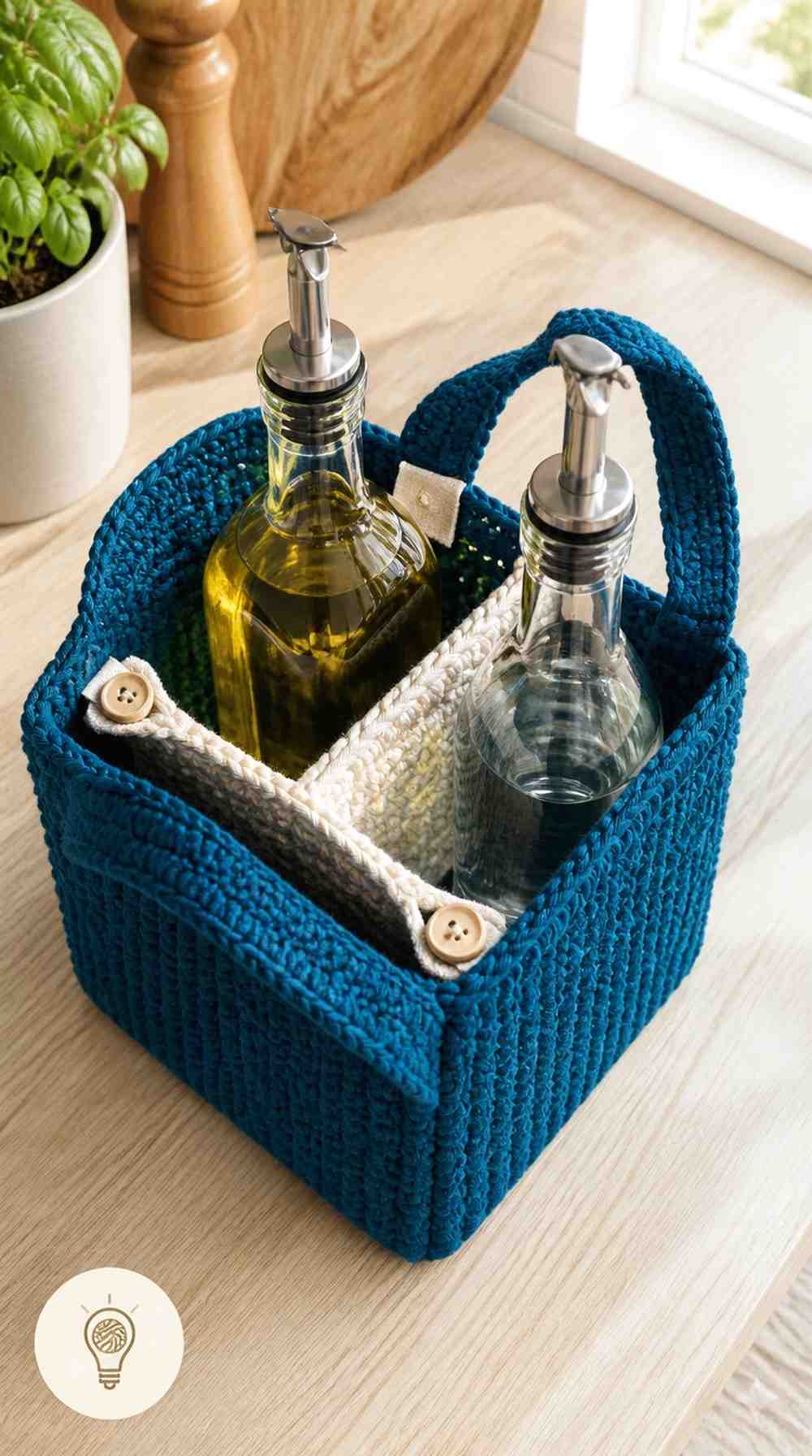
Deep teal crochet gives this rectangular carrier a clean, modern finish. Its broad flat base and close-stitch sides form a simple tote, while a cream crochet-covered divider separates a slightly wider olive oil bottle from a slimmer vinegar bottle. Small buttoned tabs connect the divider to interior loops.
The adjustable partition is the main feature, offering different compartment widths within one outer carrier. This could be useful for mismatched bottle pairs, although adjustment must not compromise the stability of the bottles or weaken the supporting structure.
- Divider positions: The interior attachment loops should allow the partition to move without leaving either bottle unsupported or pressing it tightly against the tote wall.
- Button security: Fasteners should stay away from delicate glass contact areas and be securely attached so they cannot loosen inside the compartments.
- Unequal bottle sizes: A wider oil bottle and narrower vinegar bottle may create uneven weight distribution. Check the balance rather than relying on the adjustable divider alone.
Practical Guide to Crochet Oil and Vinegar Bottle Pair Carriers
A crochet oil and vinegar bottle carrier can be an attractive way to organize two matching kitchen containers, but glass bottles introduce weight, breakage and spill risks that should shape the design.
Measure both bottles individually. Even matching oil and vinegar sets may differ slightly in body width or neck shape. Check the diameter or width, overall height, base footprint and location of any pouring spouts. Each compartment should support its bottle without restricting removal.
Choose a suitable base. Close, tightly worked crochet may provide shape, but it is still flexible fabric. For heavier glass bottles, a separately suitable rigid tray or supported caddy may be safer than relying on an all-crochet suspended base. Any insert should have smooth edges and remain stable inside the holder.
Pay attention to bottle separation. A divider helps organize the pair, but a soft crochet partition is not guaranteed to protect glass from impact. The bottles should not knock against one another when the carrier is moved. A supported countertop arrangement is generally preferable where load-bearing performance is unknown.
Consider yarn and cleaning. Smooth, washable cotton yarn may be worth considering for a removable decorative carrier. Oil spills can leave persistent marks, and vinegar moisture may remain in fabric. A removable lining or washable separate sleeve could make maintenance easier.
Keep pouring areas clear. Crochet fabric, straps and drawcords should remain below the spouts and caps. Remove the bottles for filling, cleaning and dispensing whenever the textile could become contaminated. Keep the holder away from stove burners, flames, hot cookware and other heat sources.
Test actual handling before use. Two filled glass bottles may be substantially heavier than the empty containers used for fitting. Do not carry them by an untested crochet handle, shoulder strap or soft harness. Check the real design’s load capacity and use a stable supported carrier when moving glass.
For related bottle-holder designs and construction considerations, browse these 12 Crochet Water Bottle Holder Ideas. The collection explores bases, mesh sides and straps, although those projects are not tested carriers for a pair of glass condiment bottles.
Want to Make Something Similar?
These 15 concepts are original visual inspiration ideas, not tested crochet patterns. Existing bottle-holder tutorials can still be helpful for learning how to create circular bases, mesh walls, straps and colorwork.
- For basic bottle sleeves: Oui Crochet’s Simple Large or Small Water Bottle Carrier is a free pattern featuring a circular base, net-style sides and a strap. It can help explain single-bottle construction, but it is not a pattern for a dual glass-bottle carrier.
- For checkerboard crochet: CAAB Crochet’s Checkered Bottle Holder Pattern explains colorwork and bottle-holder shaping. Its technique may be useful for exploring the Espresso Checkerboard Bottle Tote’s appearance, but the two-bottle structure would require separate design work.
Neither tutorial establishes that a crocheted carrier can safely support two filled glass bottles. Any practical version needs its own appropriate construction and load assessment.
Which Crochet Oil and Vinegar Bottle Pair Carrier Should You Choose?
| Design | Main feature | Important consideration |
|---|---|---|
| Cinnamon Double-Well Bottle Basket | Two compartments on an oval base | Stable, level support |
| Oatmeal Twin Cylinder Carrier | Two separately fitted sleeves | Secure connecting bridge |
| Navy Diamond-Mesh Pair Tote | Open mesh with solid divider | Mesh stretch under weight |
| Marigold Wooden-Base Pair Caddy | Removable wooden insert | Appropriate base and handle support |
| Dusty Blue Fold-Open Bottle Wrap | Two pockets and folding flap | Pocket bottoms and tie clearance |
| Olive Open-Strap Bottle Harness | Exposed glass with strap framework | Untested weight-bearing straps |
| Blush Granny-Square Twin Basket | Joined decorative motifs | Strong base and panel seams |
| Charcoal Ribbed Shoulder Bottle Tote | Wide shoulder strap and lining | Heavy glass carrying risk |
| Terracotta Lace-Divider Bottle Carrier | Decorative center lacing | Secure structural joins |
| Burgundy Toggle-Flap Bottle Basket | Shoulder flaps and toggles | Easy spout clearance |
| Mint Built-In Grip Pair Caddy | Integrated oval hand openings | Grip reinforcement |
| Espresso Checkerboard Bottle Tote | Close colorwork and lining | Smooth seams and even balance |
| Lilac Double-Drawcord Bottle Pouch | Two independently gathered openings | Gentle fit below bottle necks |
| Copper Accordion Pair Carrier | Flexible pleated center section | Controlled bottle movement |
| Teal Adjustable-Divider Bottle Tote | Repositionable center partition | Stability with unequal bottles |
For a decorative countertop set, the Cinnamon Double-Well Bottle Basket offers a straightforward concept with clearly separated bottle spaces. The Marigold Wooden-Base Caddy explores a firmer supporting element, while the Teal Adjustable-Divider Tote may be worth considering if your oil and vinegar bottles are different widths.
Open harnesses and shoulder totes are visually interesting, but they require much more careful construction and weight testing before being used to carry heavy glass.
Conclusion
Crochet oil and vinegar bottle pair carriers can bring handmade character to a kitchen while offering different ways to keep two everyday condiments together. Whether you prefer a simple divided basket, a fitted twin-cylinder arrangement or a colorful granny-square design, the most useful choice depends on bottle dimensions, access to the spouts, base stability and ease of cleaning. Use these 15 concepts to explore shapes and finishes, but prioritize a secure supporting structure over decoration whenever glass bottles are involved.
Which design would suit your kitchen best? Do you prefer the cinnamon double-well basket, the decorative blush granny squares or the adjustable teal divider? Share whether you’d use your chosen style on a kitchen counter, dining table or pantry shelf.
Frequently Asked Questions
1. Can a crochet carrier safely hold two full glass oil and vinegar bottles?
A crochet carrier should not automatically be considered safe for two filled glass bottles. Glass is heavy and breakable, and soft crochet can stretch under load. A real carrier needs a suitable base, dependable bottle separation, strong handle connections and appropriate load testing. A stable countertop caddy may be a safer choice than a suspended crochet tote.
2. What yarn is suitable for crochet oil and vinegar bottle holders?
A smooth, firm cotton yarn is one option worth considering for removable decorative sleeves and baskets because it can produce clear stitches and comes in many washable varieties. However, the actual yarn’s care instructions, flexibility and behavior around oil spills matter. Yarn choice alone does not guarantee that a carrier can bear the weight of glass bottles.
3. Should oil and vinegar bottles have separate compartments?
Separate compartments are often helpful for keeping two containers organized and reducing direct contact. However, soft crochet dividers do not guarantee protection against collision or breakage. Check that both bottles remain upright and do not strike one another, particularly if they have different sizes or weights.
4. Can a crochet bottle pair carrier be placed near the stove?
It should be kept away from direct heat, flames, hot cookware and burner areas. Crochet yarn can burn or become damaged by heat, and oil spills introduce additional mess and safety concerns. A dry, stable countertop or pantry shelf away from cooking heat is a more suitable location for a decorative textile bottle organizer.
5. Are these 15 crochet oil and vinegar bottle carrier ideas available as patterns?
These are visual inspiration concepts, not finished or tested crochet patterns. Their stitch textures, colors, compartments and carrying arrangements can help with planning an original project. Related bottle-holder tutorials teach general techniques, but a dual-bottle carrier must be designed around the actual containers and checked carefully for safe use.