Keeping kitchen utensils organized becomes easier when every spatula has its own place. A crochet silicone spatula drying pocket adds a handmade touch to that everyday storage need, especially in kitchens with limited counter space. From apricot ladder mesh and colorful granny squares to narrow open-sided sleeves and multi-slot hanging panels, these 13 crochet inspiration ideas explore different shapes, textures, colors, and wall-mounted arrangements.
The collection focuses on breathable pockets that leave silicone spatula heads exposed rather than enclosing them in thick fabric. You’ll find single-utensil holders, divided compartments, compact hanging baskets, and decorative designs suited to different kitchen styles. Although these concepts are called drying pockets, freshly washed spatulas should be properly drained and air-dried before being placed in crochet storage, particularly when moisture might collect inside the fabric.
These are AI-generated crochet design visualizations for inspiration, not photographs of tested handmade pieces or step-by-step patterns.
Quick Design Selection Guide
- For one everyday spatula: Crochet Apricot Ladder-Mesh Spatula Pocket keeps the shape slim and simple.
- For two utensils together: Crochet Navy Dual-Chamber Spatula Pocket provides separate compartments.
- For open airflow around the handle: Crochet Teal Side-Open Spatula Sleeve uses retaining bands instead of a full fabric pocket.
- For a cozy kitchen appearance: Crochet Mustard Half-Moon Spatula Pocket has a rounded front and warm colors.
- For decorative crochet details: Crochet Blush Granny-Mesh Spatula Pocket and Crochet Butter-Yellow Citrus Spatula Pocket offer distinct handcrafted accents.
- For several utensils: Crochet Cobalt Three-Slot Spatula Panel provides a wider hanging arrangement.
1. Crochet Apricot Ladder-Mesh Spatula Pocket
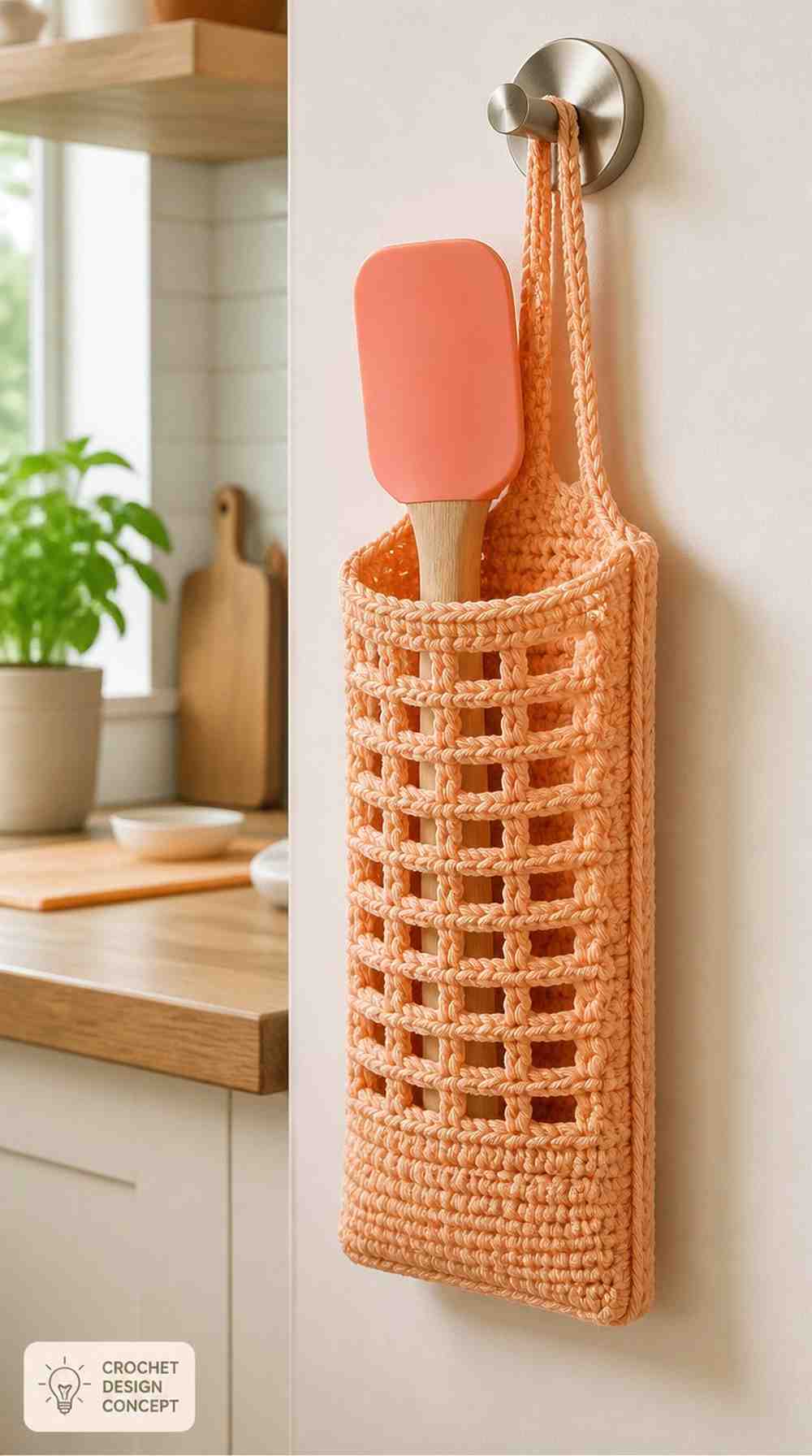
Soft apricot yarn gives this slim crochet spatula pocket a warm, cheerful appearance. The rectangular holder combines a dense lower band with open ladder-stitch rows across the front. Reinforced side seams keep the silhouette tidy, while a short hanging loop connects the pocket to a metal wall hook.
A coral silicone spatula sits upright with its wooden handle inside the crochet compartment and the head exposed above the rim. The open rows make this an appealing option for anyone who prefers a light-looking holder without a bulky basket shape.
- Ladder-stitch spacing: Keep the horizontal openings narrow enough to retain the wooden handle while still allowing parts of the pocket to remain visibly open.
- Lower band support: The denser bottom section should hold the handle without pulling the rectangular pocket noticeably out of shape.
- Wall-hook placement: Choose a secure hook in a clean, ventilated area away from direct sink splashes and cooking heat.
- Easy removal: The short hanging loop makes the concept suitable for removable storage, provided the crochet construction and hook are properly supported.
2. Crochet Navy Dual-Chamber Spatula Pocket
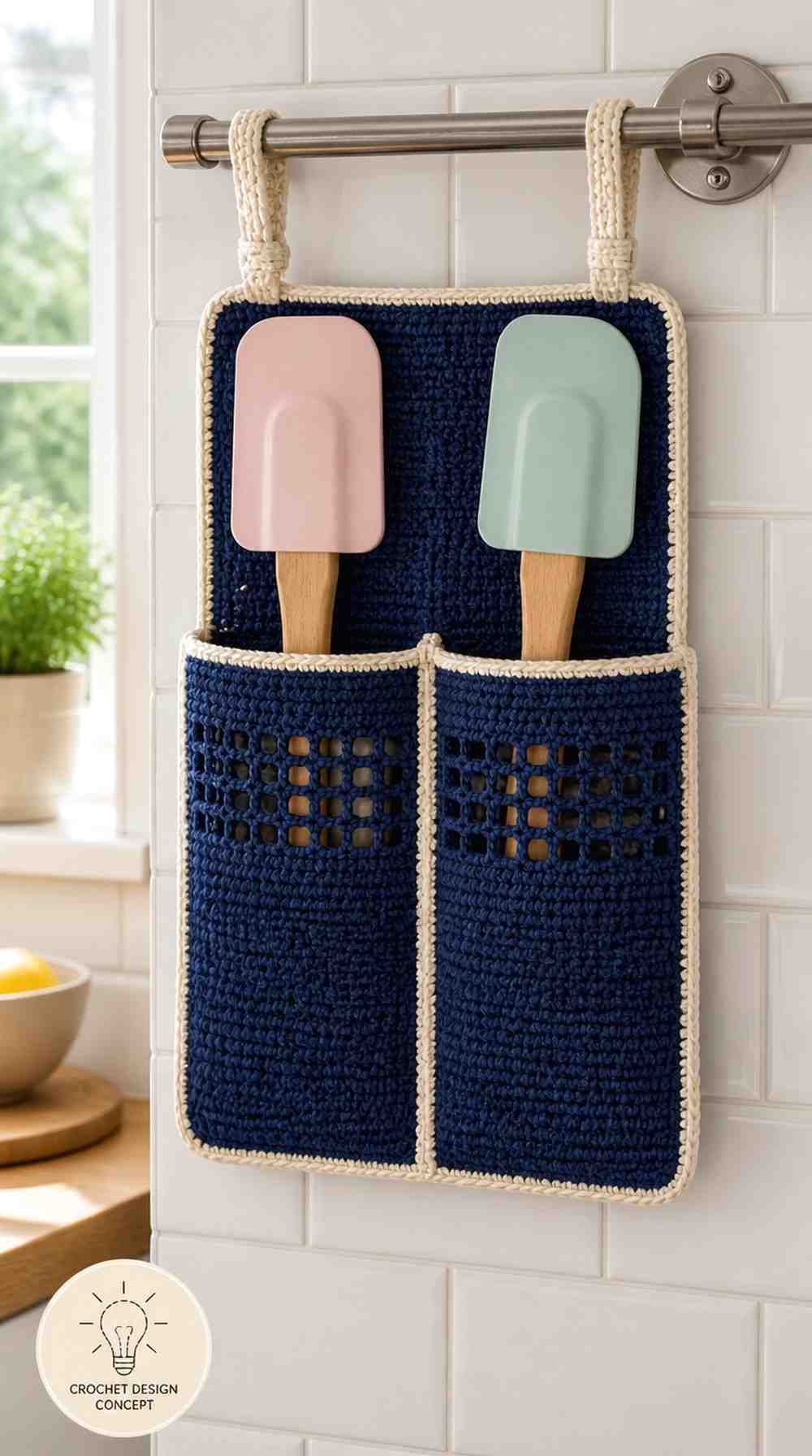
Navy blue and cream make this crochet spatula organizer look clean and coordinated. Two separate rectangular pockets sit side by side, divided by cream crochet seams. Each compartment has a closely stitched lower section and a small square-mesh band across the front.
The organizer hangs from a stainless-steel kitchen rail using two cream loops. A pink silicone spatula stands in one compartment, while a mint-green spatula occupies the other. Keeping them separate gives the holder a practical visual arrangement, although both utensils need enough room to be inserted and removed without pulling the fabric sideways.
- Separate compartments: Size each pocket around the actual handle rather than making both openings automatically identical.
- Central divider: The cream dividing seam should be securely joined so pulling one utensil out does not distort the neighboring compartment.
- Rail support: Two hanging loops distribute the organizer’s weight across the upper edge instead of concentrating it at one small point.
- Cleaning access: A two-pocket design provides more fabric surfaces where kitchen residue can collect, making removable mounting especially useful.
3. Crochet Cream Diamond-Window Spatula Holder
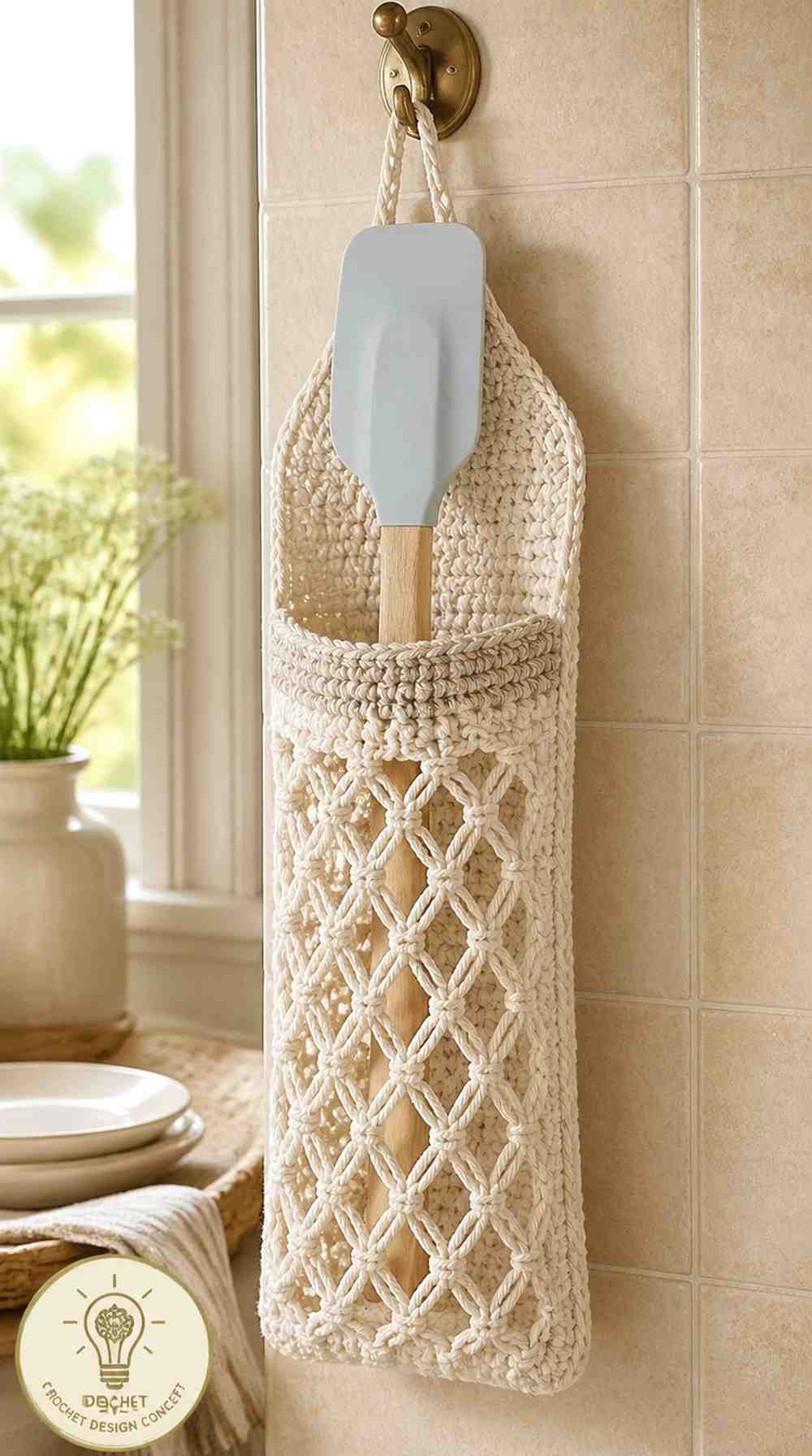
Warm cream crochet creates a soft cottage-style appearance in this diamond-window spatula holder. A closely stitched rectangular back supports a large open diamond-lattice section across the front. The oatmeal-colored upper edging gives the pocket a subtle contrast without making the design overly decorative.
The pale-blue silicone spatula remains visible above the pocket, while its wooden handle sits behind the open mesh. A small cream hanging loop completes the design. The diamond pattern is the main feature, but its open spaces would need careful planning around the size of the actual utensil handle.
- Diamond-lattice openings: Make sure the wooden handle cannot slip sideways through the front openings when the pocket is hanging vertically.
- Back-panel firmness: A denser crochet backing can help the holder retain a flatter shape against the kitchen wall.
- Cream yarn maintenance: Light-colored yarn may show cooking splashes more easily, so choose a removable design and follow the fiber’s washing instructions.
- Hook compatibility: The small top loop should fit the chosen wall hook without stretching or twisting excessively.
4. Crochet Mustard Half-Moon Spatula Pocket
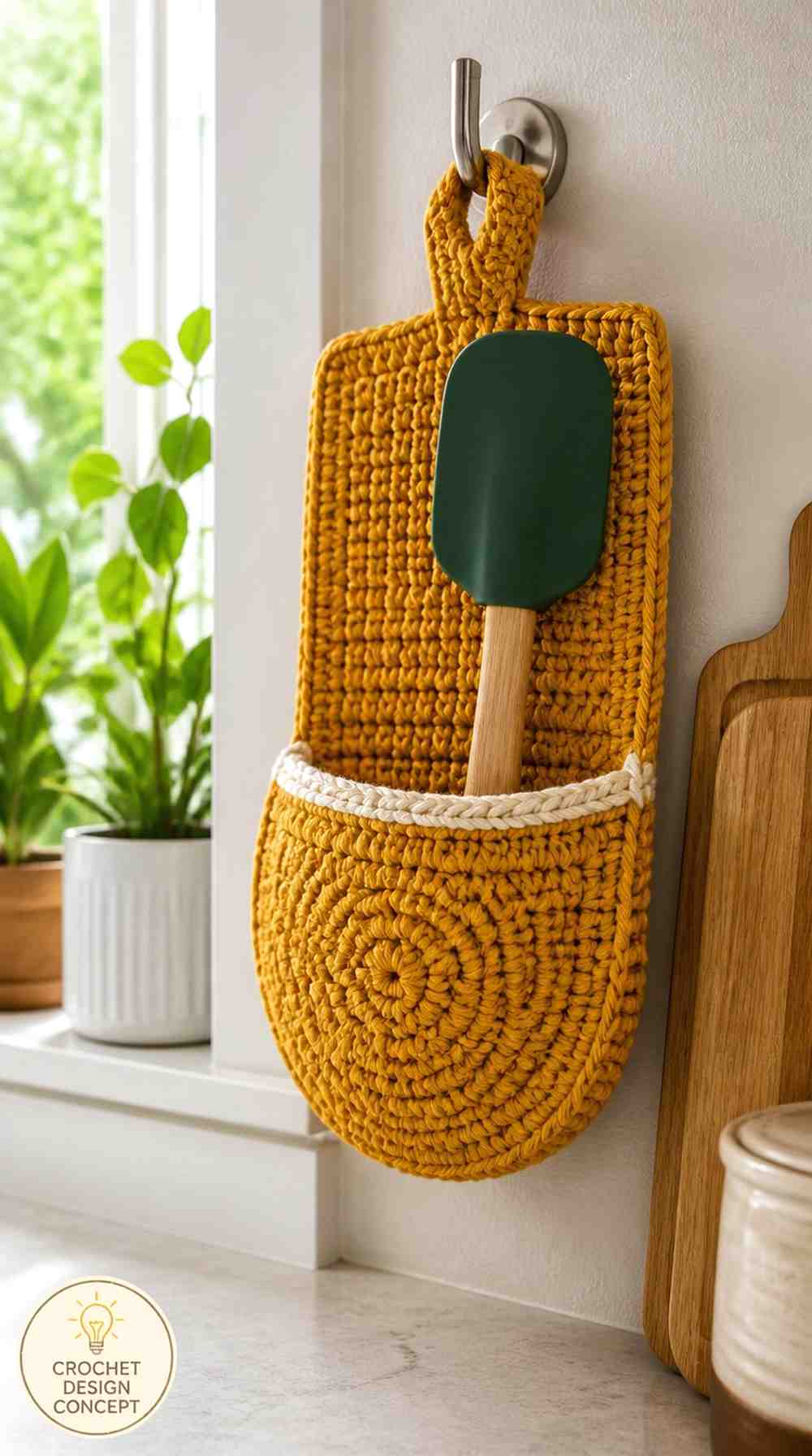
Golden-mustard crochet gives this spatula pocket a warm, slightly vintage character. Instead of a straight rectangular front, the holder uses a rounded half-moon compartment attached to a flat backing. Neat concentric crochet rows emphasize the curved shape, while a narrow cream upper edge keeps the opening clearly defined.
A dark forest-green silicone spatula stands upright inside the rounded pocket. Its wooden handle disappears into the curved compartment, leaving the entire silicone head exposed. This design combines decorative shaping with a compact hanging arrangement that does not require a wide wall panel.
- Curved pocket depth: The half-moon compartment should be deep enough to retain the handle without swallowing too much of the silicone head.
- Rounded construction: Consistent increases and neat edge connections would help the curved front maintain its intended shape.
- Hanging-loop position: Place the upper loop centrally so the rounded pocket does not lean noticeably toward one side.
- Color coordination: Forest green and mustard work together as warm kitchen accents. Cream edging adds a softer boundary around the opening.
5. Crochet Blush Granny-Mesh Spatula Pocket
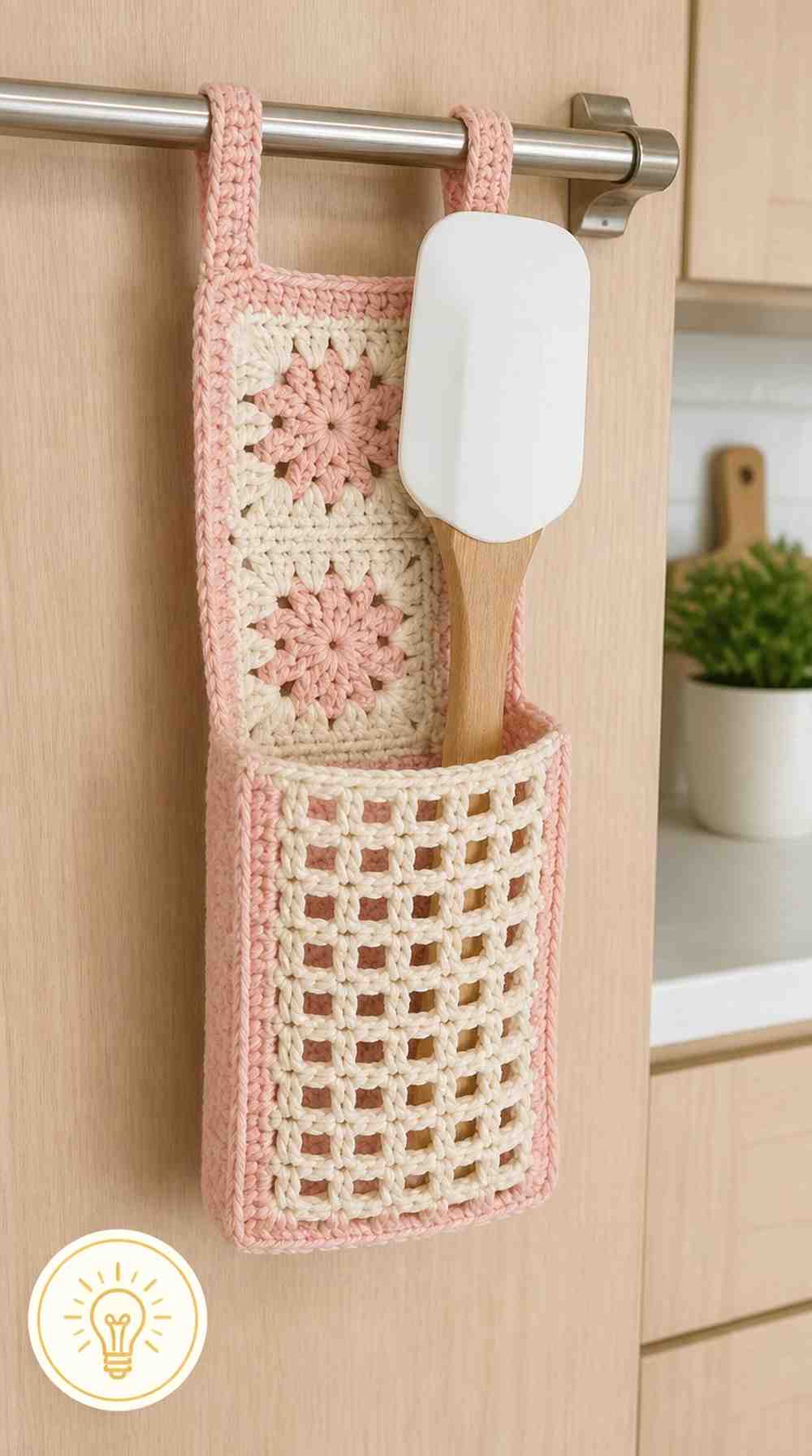
Pastel granny squares bring a playful handmade feel to this crochet spatula holder. Two small joined squares in blush pink, ivory, and soft peach form the flat backing. An ivory square-mesh panel creates the front compartment, finished with blush edging along the sides and two narrow hanging loops.
The white silicone spatula remains fully exposed above the mesh opening, with its wooden handle held inside. Unlike a solid granny-square pouch, this design pairs decorative motifs with openwork storage. The result is visually lighter while still showing recognizable crochet construction and carefully joined pieces.
- Granny-square alignment: Check that the joined backing squares form a balanced rectangular surface without an uneven seam pulling the pocket sideways.
- Front mesh attachment: The ivory openwork should connect securely to the blush borders, particularly at the lower corners supporting the handle.
- Rail arrangement: Two narrow loops suit a hanging rail, but their spacing should match the actual support rather than simply the decorative square layout.
- Pastel customization: Dusty blue or pale lilac could replace peach as an optional accent while retaining the original joined-square concept.
6. Crochet Teal Side-Open Spatula Sleeve
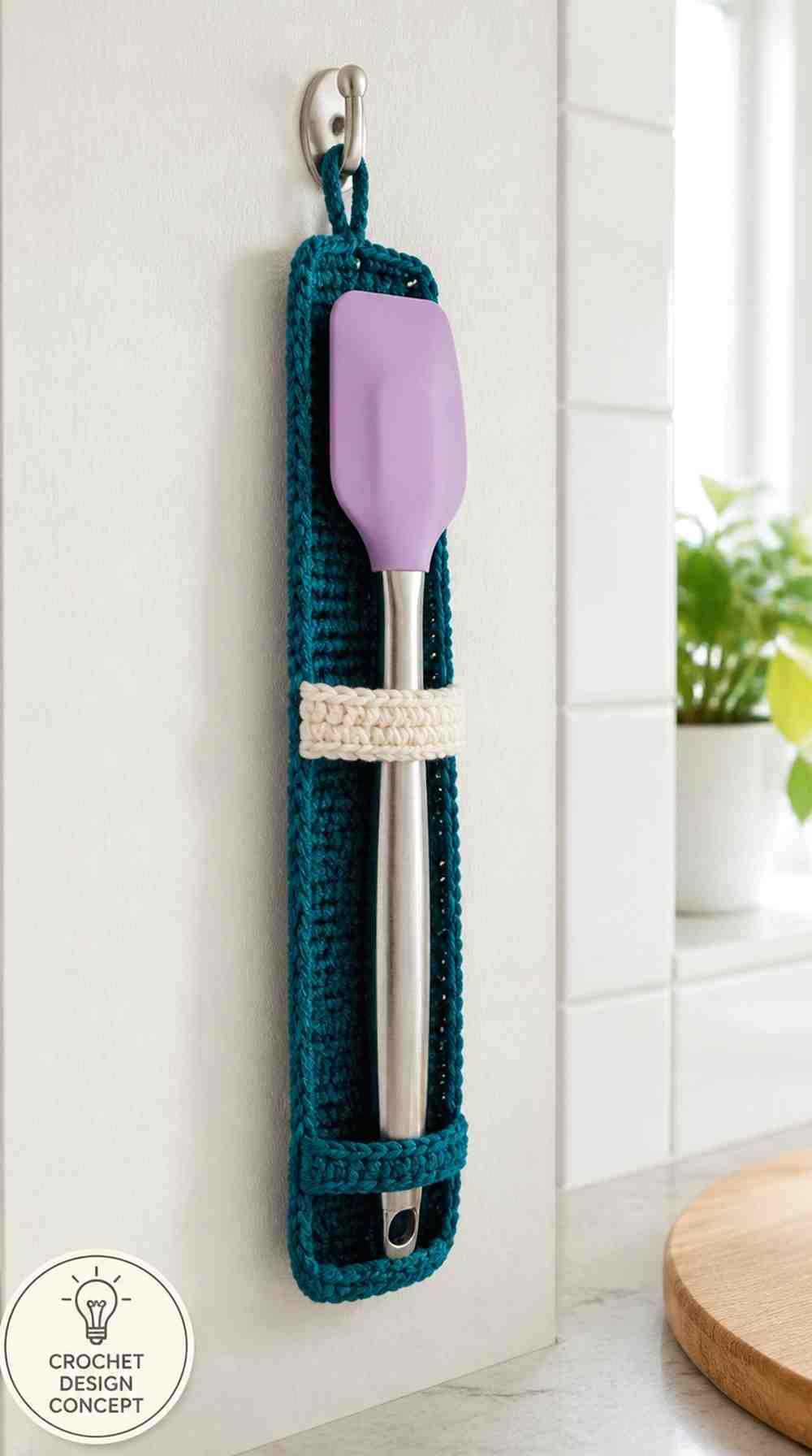
Deep teal crochet makes this unusual utensil sleeve look modern and uncluttered. Rather than enclosing the handle in a traditional pocket, it uses one narrow vertical back strip with two retaining bands positioned across the front. The cream middle band and lower teal band leave the sides almost entirely open.
A lavender silicone spatula with a stainless-steel handle passes through the bands, leaving its head exposed at the top. This concept is particularly interesting because the open sides minimize the amount of crochet fabric surrounding the utensil, though the bands would still need sufficient grip to keep the handle in position.
- Retaining-band tension: Both bands must fit the actual handle closely enough to stop it sliding through, without requiring excessive force for removal.
- Open-side exposure: This arrangement leaves more of the handle uncovered than a closed pouch, but airflow and drying still depend on the environment.
- Metal-handle compatibility: Smooth stainless-steel handles may slide more readily than textured wooden ones, so test retention carefully.
- Back-strip shape: A closely stitched vertical panel can reduce twisting, provided the hanging loop is centered and the bands are evenly attached.
7. Crochet Charcoal Chevron-Vent Spatula Pocket
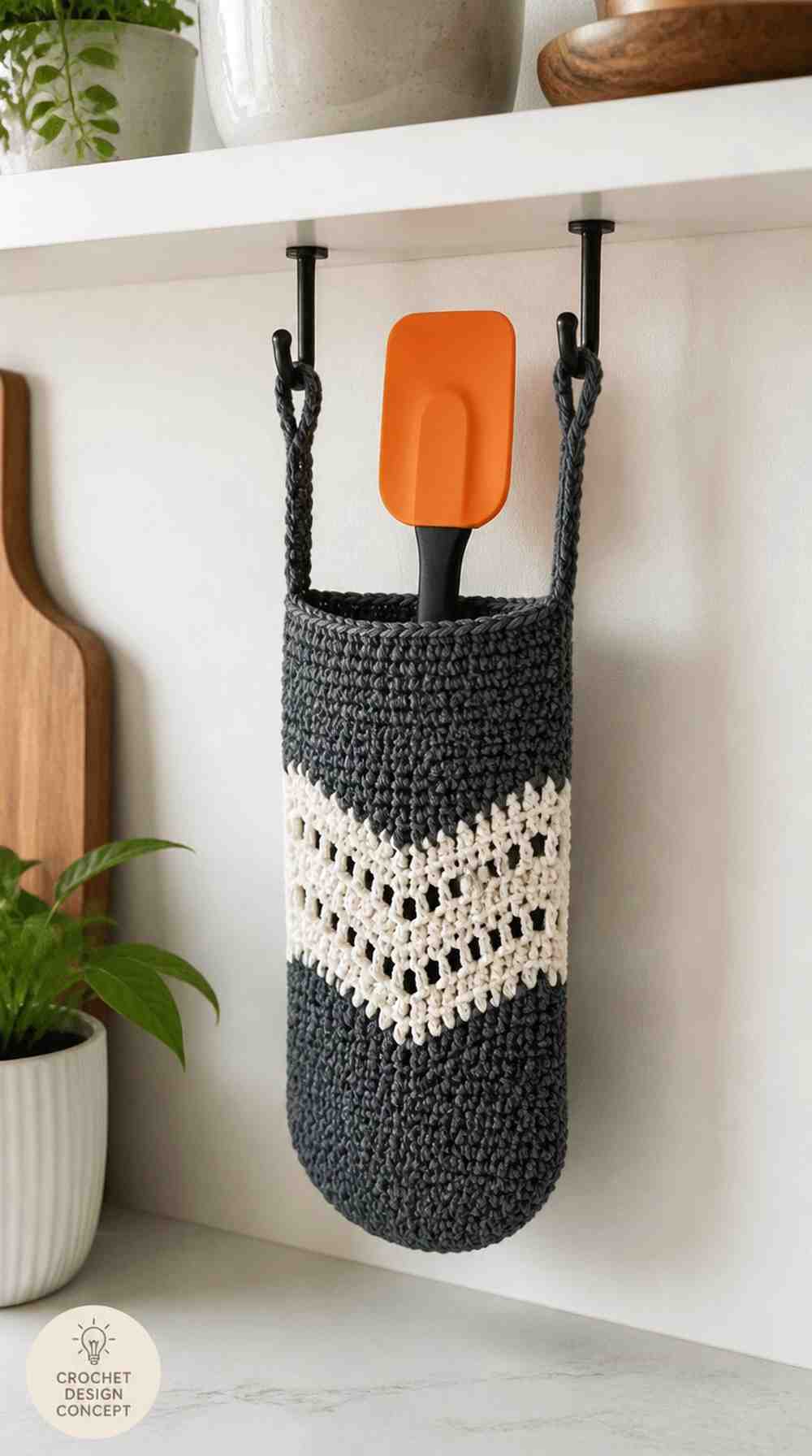
Charcoal-grey crochet provides a calm background for the cream chevron ventilation panel in this hanging spatula pocket. The rectangular holder has closely stitched lower corners and a straight upper rim, with the zigzag-shaped openwork running horizontally through the middle.
A burnt-orange silicone spatula adds a vivid contrast to the darker crochet. Two small hanging loops support the pocket beneath a shelf, and the spatula’s head remains fully exposed above the holder. The chevron detail makes this design distinctive without requiring separate appliqués or additional pockets.
- Chevron opening placement: Position the openwork above the lower support section so the handle remains retained as the pocket hangs.
- Two-point hanging: Both loops should bear the weight evenly to prevent the rectangular fabric from folding toward the center.
- Under-shelf clearance: Leave enough room to lift the spatula straight out without striking the shelf above.
- Dark-yarn visibility: Cream chevrons help reveal the design, while a bright kitchen location keeps the charcoal stitches from appearing visually flat.
8. Crochet Lilac Ring-Hung Ribbed Pocket
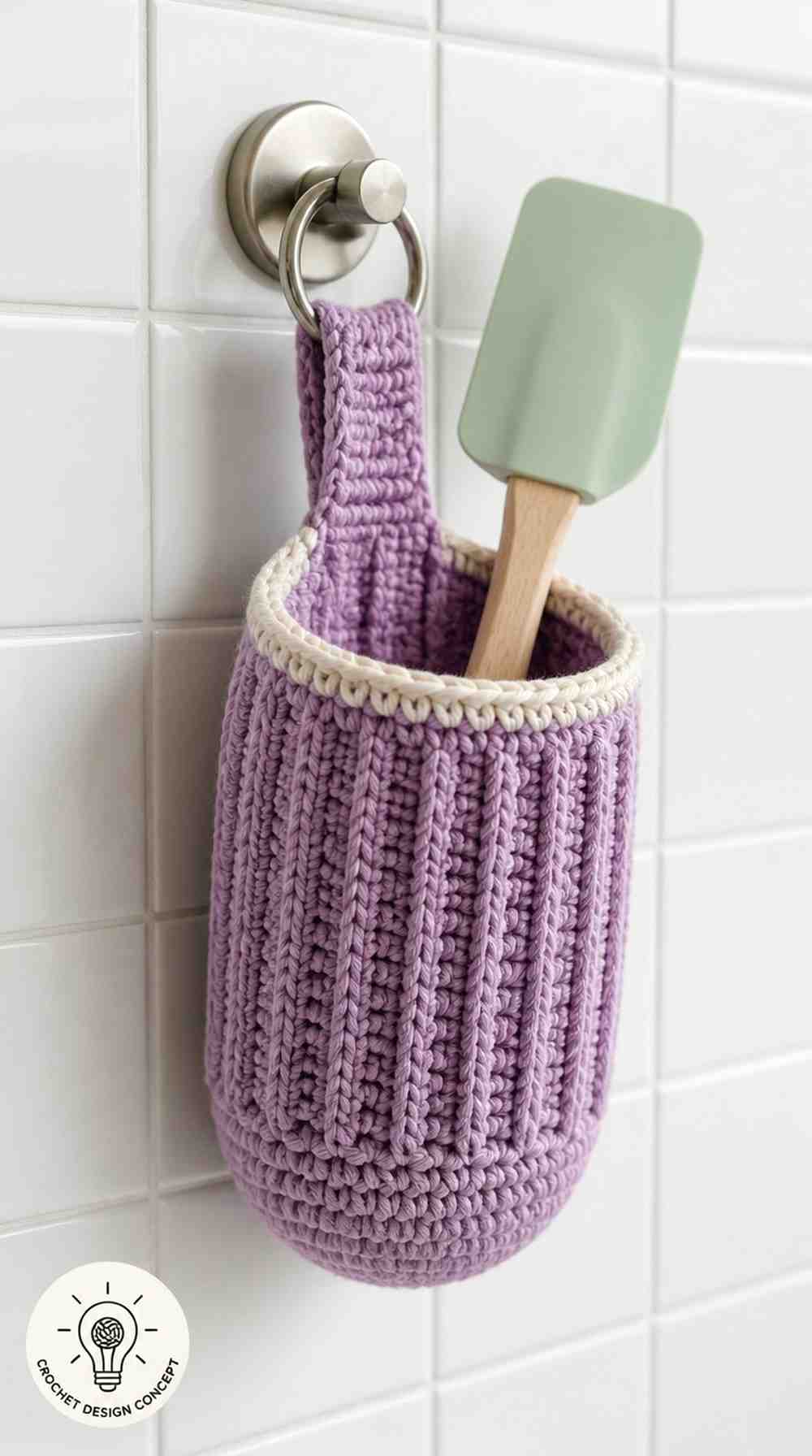
Gentle lilac crochet gives this hanging spatula holder a delicate, contemporary finish. Narrow vertical rib stitches run down the pocket, which ends in a softly rounded lower section. A cream border highlights the upper rim, while a broad lilac crochet tab connects to a small brushed-steel hanging ring.
The mint-green silicone spatula stands upright inside, with its wooden handle supported by the ribbed compartment. The ring attachment is the most distinctive feature because it changes the way the pocket hangs compared with an ordinary crochet loop. It also introduces a separate piece of hardware that needs appropriate support.
- Ring attachment: The folded crochet tab should be securely joined around the metal ring, leaving no loose opening that could slip free.
- Rounded lower section: Check that the curved base supports the handle without stretching into an excessively pointed shape.
- Ribbed fabric stretch: Raised vertical stitches can behave differently depending on yarn and tension, so test the pocket with the intended spatula.
- Hardware cleaning: A removable ring arrangement may make cleaning easier, although the metal finish should also be suitable for a kitchen environment.
9. Crochet Terracotta Tapered Triangle Pocket
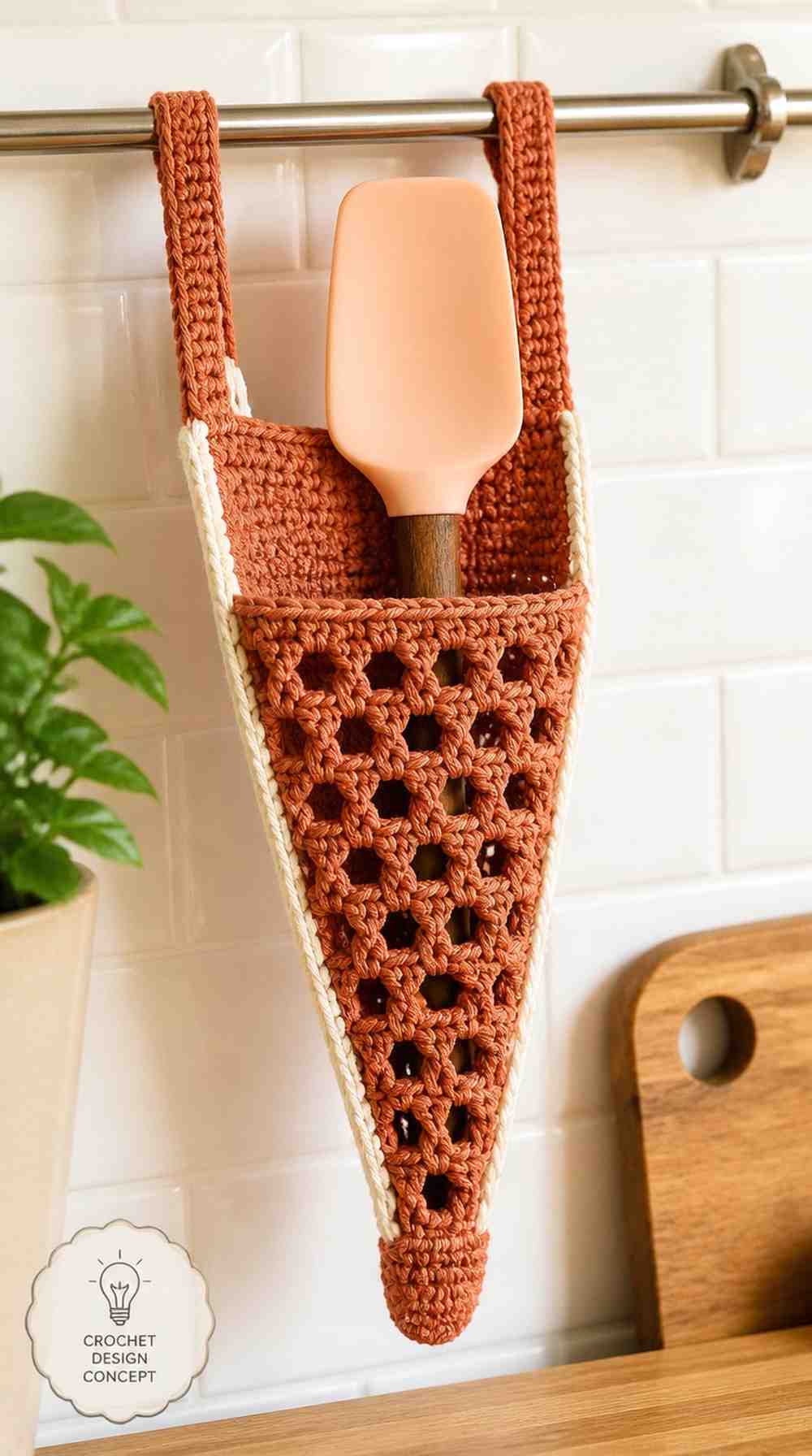
Warm terracotta gives this hanging spatula pocket a lovely rustic appearance. Its wide upper opening gradually narrows into a triangular mesh front, ending in a small, closely crocheted rounded tip. Cream edging defines the angled sides, while two flat terracotta straps attach the holder to a kitchen rail.
A pale-peach silicone spatula rises above the opening, with its wooden handle resting toward the narrow lower point. The tapering shape makes this concept look different from standard rectangular pockets, but the small lower section needs careful planning to keep the handle from pushing awkwardly against the fabric.
- Tapered proportions: The upper opening should accommodate the utensil comfortably, while the lower section must be narrow enough to retain its handle.
- Lower-tip support: Avoid leaving a large unsupported mesh gap at the bottom where the handle could push through.
- Two hanging straps: Keep both straps equal in length so the triangular pocket hangs upright rather than twisting around the rail.
- Cream side edging: The pale borders make the tapered silhouette clearer and provide an opportunity to reinforce the openwork edges.
10. Crochet Butter-Yellow Citrus Spatula Pocket
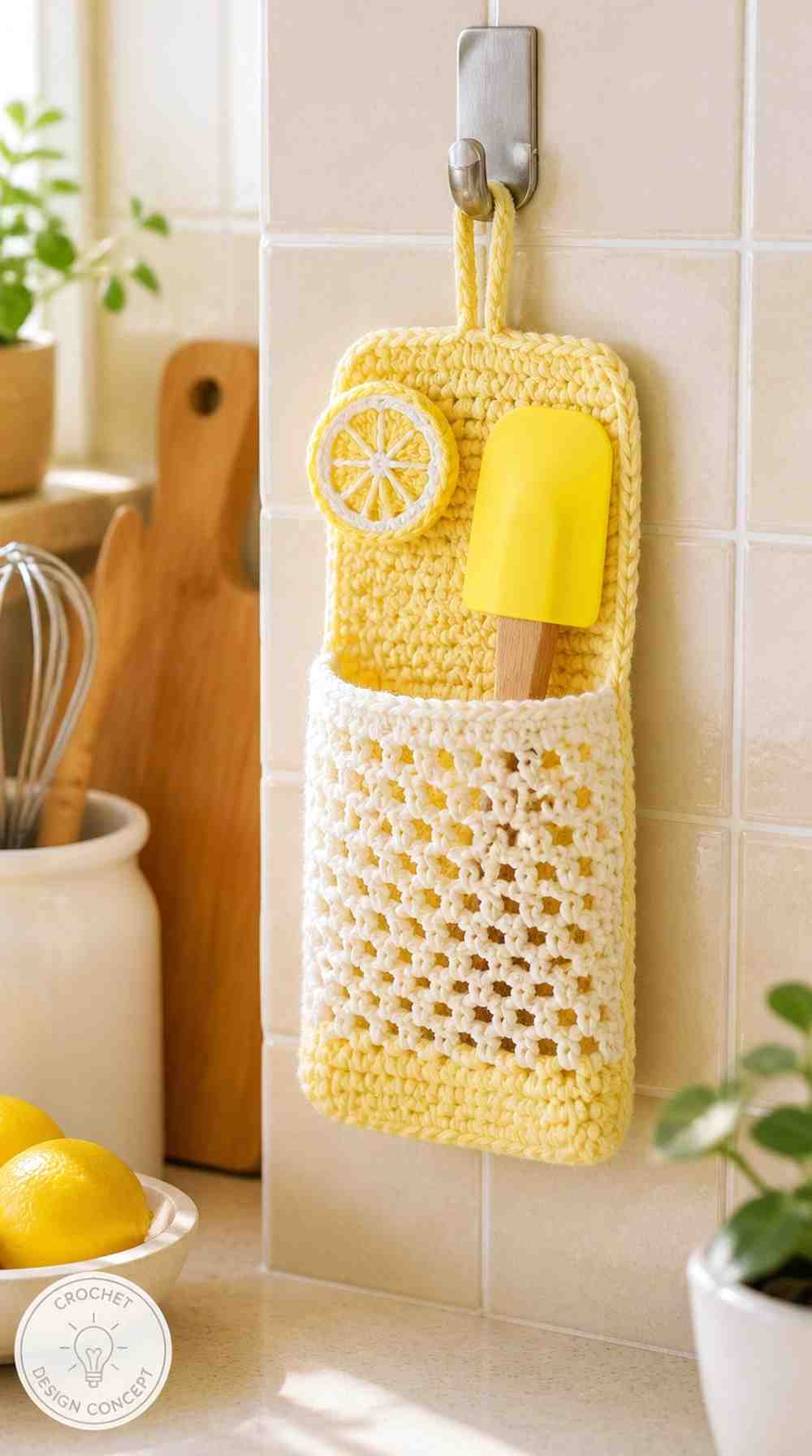
Butter-yellow crochet brings a cheerful touch to this compact kitchen holder. A solid rectangular backing supports a cream mesh front, finished with a neat yellow lower edge. One small crochet lemon-slice motif decorates the upper left corner without covering the main pocket opening.
The yellow silicone spatula complements the crochet colors, creating a coordinated appearance. Its wooden handle rests inside the mesh compartment while the silicone head remains exposed. The little citrus appliqué is the main decorative feature, giving this design a playful kitchen theme without changing the basic function of the holder.
- Lemon motif placement: Keep the small appliqué away from the pocket opening so it does not catch the spatula during removal.
- Mesh compartment: The cream openwork should hold the handle securely without becoming so loose that the utensil leans forward.
- Appliqué attachment: Sew the motif flat and secure its edges to avoid loose sections collecting kitchen residue.
- Yellow color care: Butter-yellow can brighten a neutral kitchen, but choose yarn that can be cleaned appropriately if splashes or stains develop.
11. Crochet Cobalt Three-Slot Spatula Panel
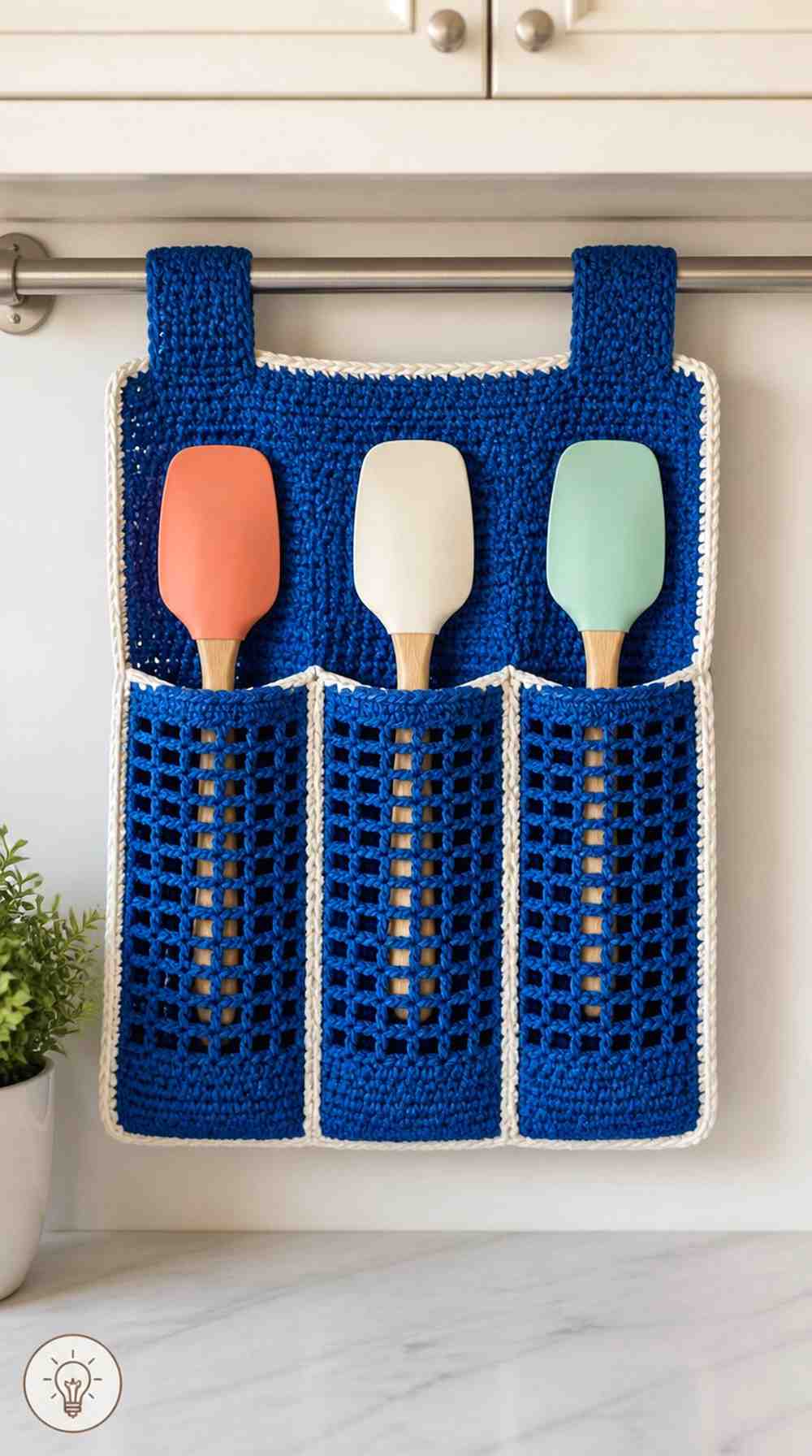
Bright cobalt blue gives this wider crochet organizer a lively, modern look. Three long vertical pockets sit across one hanging panel, separated by narrow ivory borders. Each pocket combines open square-mesh rows with a densely stitched cobalt lower section, while two broad upper loops secure the organizer to a metal rail.
Three different silicone spatulas stand upright with coral, cream, and mint heads clearly visible. Unlike the smaller single-pocket concepts, this design organizes several utensils in one place. It would require a wider mounting area and carefully balanced pocket dimensions to remain practical.
- Three-slot spacing: Allow enough room between utensils for individual removal without pulling adjacent handles out of their compartments.
- Rail width: Measure the available hanging space before planning a three-pocket panel, especially beneath cabinets or near other kitchen accessories.
- Lower support sections: Each compartment needs its own secure bottom rather than relying only on the wide outer panel.
- Weight distribution: A fully loaded organizer may pull on the outer hanging loops, so support points and stitching should be checked carefully.
12. Crochet Olive Open-Arch Spatula Basket
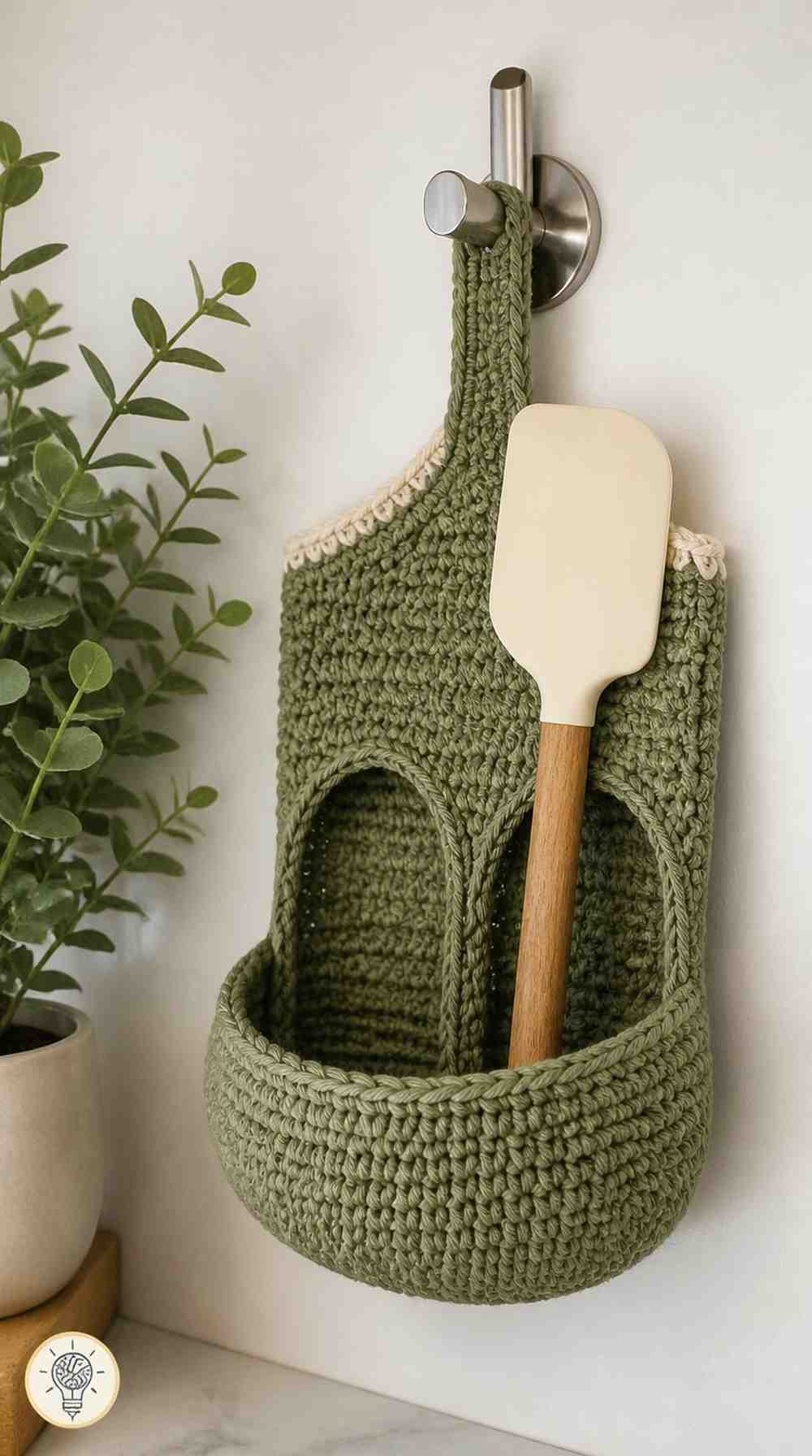
Muted olive-green crochet gives this little hanging basket a relaxed, botanical character. A shallow rounded compartment sits against a flat backing, with two large arch-shaped openings across the front. Cream edging frames the upper rim, and one broad olive hanging loop supports the basket.
A cream silicone spatula stands upright inside, its brown wooden handle partly visible through the arches. The open curved front provides a different appearance from square mesh or ladder stitches. It makes the holder feel decorative while keeping the utensil easy to identify.
- Arch spacing: Each opening should remain small enough to prevent the handle from moving through the front of the basket.
- Basket depth: A shallow rounded compartment can suit a slim handle, but may need adjustment for thicker or heavier utensils.
- Upper-border shape: The cream edging should keep a tidy opening without folding inward against the spatula.
- Single-loop balance: Position the hanging loop centrally and test the loaded basket for forward tilting before regular use.
13. Crochet Cranberry Scalloped Dowel Pocket
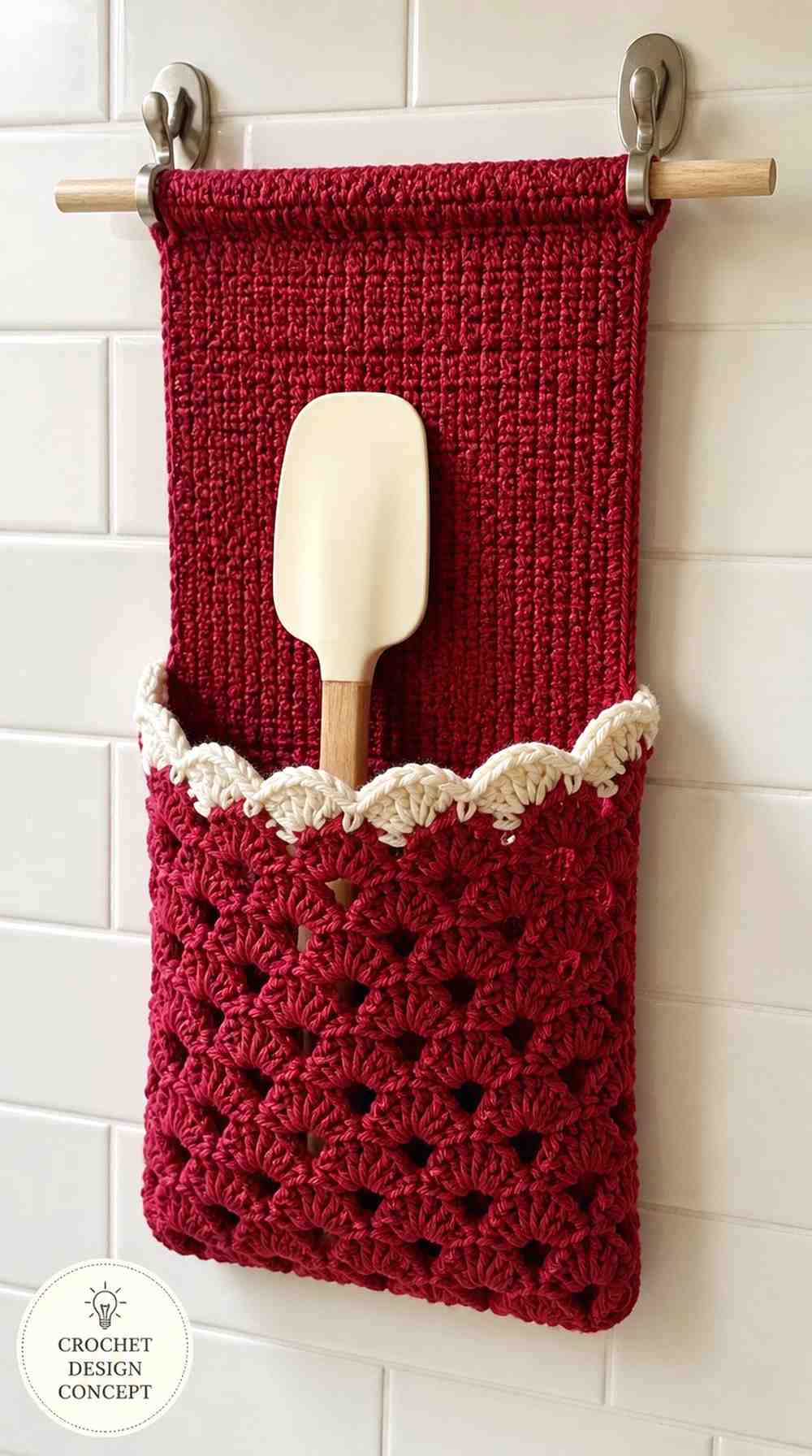
Deep cranberry crochet brings an elegant finish to this final kitchen pocket. A tall textured backing supports a lower front compartment made from small repeating open fan stitches. Narrow ivory scallops decorate the pocket’s upper edge, while a pale wooden dowel passes through a crochet channel across the top.
The cream silicone spatula stands upright behind the open fan-stitch panel, with its wooden handle inside and the silicone head fully exposed. The wooden dowel gives this concept a distinctive hanging arrangement, making the pocket look like a miniature textile wall organizer rather than a simple utensil pouch.
- Dowel support: Both ends of the wooden rod should sit securely on appropriate hooks, with enough space to remove the organizer for cleaning.
- Fan-stitch openness: Keep the decorative openings small enough to retain the utensil handle and prevent the front panel from sagging.
- Scalloped edge: A narrow ivory border adds character without covering the silicone head or interfering with utensil removal.
- Wood and moisture: Avoid exposing the dowel to repeated dripping water. Properly dry the spatula before storing it against the crochet panel.
Practical Guide to Crochet Silicone Spatula Drying Pockets
A crochet utensil pocket can be useful for organization, but it should not replace proper cleaning and drying. Silicone spatula heads can retain water around their edges or handle joints, and absorbent yarn may stay damp after contact with a wet utensil.
1. Let spatulas drain before placing them in crochet. Wash each utensil according to its manufacturer’s instructions and allow it to drain and air-dry properly on a clean drying rack. The FDA Food Code also emphasizes adequate draining and air-drying for cleaned and sanitized food-service utensils. This is a useful hygiene principle when planning kitchen storage.
U.S. Food and Drug Administration
2. Keep the silicone head exposed. All 13 concepts position the utensil handle inside the crochet holder while leaving the silicone head outside. This helps avoid enclosing the food-contact portion in absorbent fabric, although it does not guarantee complete drying.
3. Choose removable, cleanable materials. Smooth cotton or a suitable washable cotton blend may be worth considering for a real version. Always check the yarn label and allow the holder to dry thoroughly after washing.
4. Use reliable hanging hardware. A pocket should not hang from an uncertain adhesive hook or weak crochet loop. Match the support to the finished organizer and its contents.
5. Keep the holder away from cooking heat and contamination. Place it away from burners, hot appliances, grease splashes, and areas where dirty dishwater could reach the clean utensils. Silicone’s heat tolerance does not mean the crochet holder is heat-safe.
6. Check how easily utensils can be removed. A good pocket should hold the handle without gripping it so tightly that pulling the spatula out stretches the crochet or loosens the mount.
For more kitchen organization inspiration, explore 17 Crochet Dish Rack Side Organizer Inspiration Ideas and 16 Crochet Vintage Kitchen Wall Pocket Ideas for Cozy Cottage Homes on Yarn Nest Studio. Both collections offer related hanging-storage ideas, although they are not exact spatula-pocket patterns.
Want to Make Something Similar?
These designs are visual concepts rather than tested crochet patterns. The following resources cover related pocket construction and hanging techniques:
- Crochet Dish Brush Holder — CyCrochet — A free written pattern for a folded pocket with side seams and a hanging loop. It can help readers understand simple utensil-holder construction. CyCrochet
- Keep It Handy Organizer — Snappy Tots — A hanging pocket organizer pattern by Heidi that offers ideas for practical pocket arrangements and mounting. Snappy Tots
- Crochet Wall Hanging Organizer — Happy Heartsy — A free wall organizer pattern relevant to making a larger backing panel and attached storage pockets. Free Pattern
None of these instructions is an exact pattern for the 13 pictured concepts. A spatula-specific version would need appropriate measurements, practical testing, and attention to kitchen hygiene.
Which Crochet Spatula Drying Pocket Should You Choose?
| Design | Main advantage | Consideration |
|---|---|---|
| Apricot Ladder-Mesh | Slim, simple storage | Check handle fit |
| Navy Dual-Chamber | Separate space for two utensils | Requires wider mounting |
| Cream Diamond-Window | Decorative open lattice | Large openings need planning |
| Mustard Half-Moon | Compact rounded shape | Curved pocket depth matters |
| Blush Granny-Mesh | Colorful joined motifs | Additional joining seams |
| Teal Side-Open Sleeve | Very little fabric around handle | Retaining bands must grip securely |
| Charcoal Chevron-Vent | Attractive geometric openwork | Needs clearance below shelf |
| Lilac Ring-Hung Ribbed | Distinctive hanging hardware | Ring connection needs support |
| Terracotta Tapered Triangle | Narrow pointed silhouette | Lower tip needs reinforcement |
| Butter-Yellow Citrus | Small decorative accent | Motif must stay out of the way |
| Cobalt Three-Slot | Organizes three spatulas | More weight and wall space |
| Olive Open-Arch | Airy rounded basket front | Handle retention matters |
| Cranberry Scalloped Dowel | Elegant textile-wall look | Wood should be kept dry |
For a small kitchen, the Apricot Ladder-Mesh Pocket or Teal Side-Open Sleeve offers a compact visual approach. If several spatulas need organizing, the Navy Dual-Chamber or Cobalt Three-Slot design is worth considering.
For decorative kitchen styling, the Blush Granny-Mesh, Butter-Yellow Citrus, and Cranberry Scalloped Dowel concepts provide more distinctive crochet details.
Conclusion
A crochet silicone spatula drying pocket can bring a useful touch of handmade organization to a kitchen without taking up much counter space. These 13 concepts show how openwork stitches, divided compartments, decorative motifs, and different hanging arrangements can create noticeably different designs.
The most practical choice depends on how many spatulas you want to store, the available wall or rail space, and how easily the holder can be removed and cleaned. Above all, make sure utensils are properly dried and the crochet fabric stays clean before using the pocket for everyday storage.
Which design would you choose for your kitchen? Would you prefer a slim mesh pocket for one spatula, a bright three-slot organizer, or a decorative granny-square holder? Share your favorite concept and the feature you would find most useful.
Frequently Asked Questions
1. Can I put a wet silicone spatula directly into a crochet drying pocket?
It is better not to put a dripping spatula directly into an absorbent crochet pocket. Allow it to drain and air-dry properly on a suitable rack first. Wet yarn can hold moisture against the utensil, and open crochet stitches do not guarantee that the pocket will dry quickly.
2. What yarn is suitable for a crochet spatula holder?
Smooth cotton or an appropriate washable cotton blend is worth considering because these fibers can produce well-defined crochet stitches. The finished fabric should be firm enough to support the utensil handle, but not so dense that it becomes difficult to clean or dry. Always check the yarn’s care instructions.
3. Should the silicone head or handle go inside the crochet pocket?
For these concepts, the handle goes inside while the silicone head remains exposed above the opening. This avoids enclosing the food-contact head in crochet fabric. However, a properly cleaned and dried utensil is still essential, regardless of how the holder is arranged.
4. Can a crochet spatula pocket be hung near the stove?
Avoid positioning crochet storage close to burners, open flames, hot pans, or heating elements. Crochet yarn and hanging hardware may not tolerate the same temperatures as silicone kitchen utensils. A clean, well-ventilated preparation area away from direct heat is a more sensible location.
5. Are these 13 crochet spatula pocket designs actual patterns?
No. They are original crochet design visualizations intended to inspire colors, shapes, stitch arrangements, and storage ideas. The images do not establish that the pictured holders have been made or tested. Anyone creating a real version should develop suitable measurements and construction details for their own kitchen utensils.