A tall floor vase can make an empty corner feel complete, especially when it holds dried branches, decorative grasses or a simple seasonal arrangement. However, heavy ceramic bases can leave marks on certain floors if they are dragged or if grit becomes trapped underneath. A crochet base mat adds a soft handmade layer and a decorative border. These 17 crochet tall floor vase anti scratch base inspiration ideas explore round mats, octagonal shapes, granny-square panels, textured edges and modern colorwork.
The best design depends on the vase’s weight, the shape of its bottom and the type of flooring beneath it. Some crochet concepts use a dense, flat center with a decorative outer border, while others offer rectangular or oval shapes for different vase footprints. This collection helps you compare appearance, stability, floor compatibility and cleaning needs. A crochet mat may reduce direct contact between surfaces, but it cannot guarantee protection against scratches or prevent a tall vase from tipping.
These are AI-generated crochet design visualizations for inspiration, not photographs of tested handmade mats or step-by-step patterns.
Quick Design Selection Guide
- For a simple round base: Crochet Terracotta Double-Ring Floor Vase Mat and Crochet Charcoal Concentric Stripe Vase Mat offer flat circular surfaces with clear borders.
- For unusual vase footprints: Crochet Mustard Elongated Oval Vase Mat, Crochet Sea-Glass Octagonal Floor Vase Mat and Crochet Copper Embroidered Hexagon Vase Mat explore different shapes.
- For cottage-style decoration: Crochet Sage Petal-Edge Floor Vase Mat, Crochet Blush Rose-Corner Oval Vase Mat and Crochet Butter Yellow Scalloped Square Vase Mat add delicate decorative details.
- For traditional crochet character: Crochet Burgundy Granny-Tile Vase Base Mat and Crochet Mauve Solid-Center Lattice Vase Mat feature motifs or openwork outside the supporting area.
- For modern floor styling: Crochet Indigo Checkerboard Square Vase Mat, Crochet Apricot Diagonal Colorblock Vase Mat and Crochet Navy Pinwheel Circle Vase Mat use stronger geometric patterns.
- For experimenting with layers or texture: Crochet Cocoa Ribbed-Border Vase Mat, Crochet Slate Double-Layer Floor Vase Mat and Crochet Olive Braided-Border Oval Vase Mat offer different edge and construction details.
1. Crochet Terracotta Double-Ring Floor Vase Mat
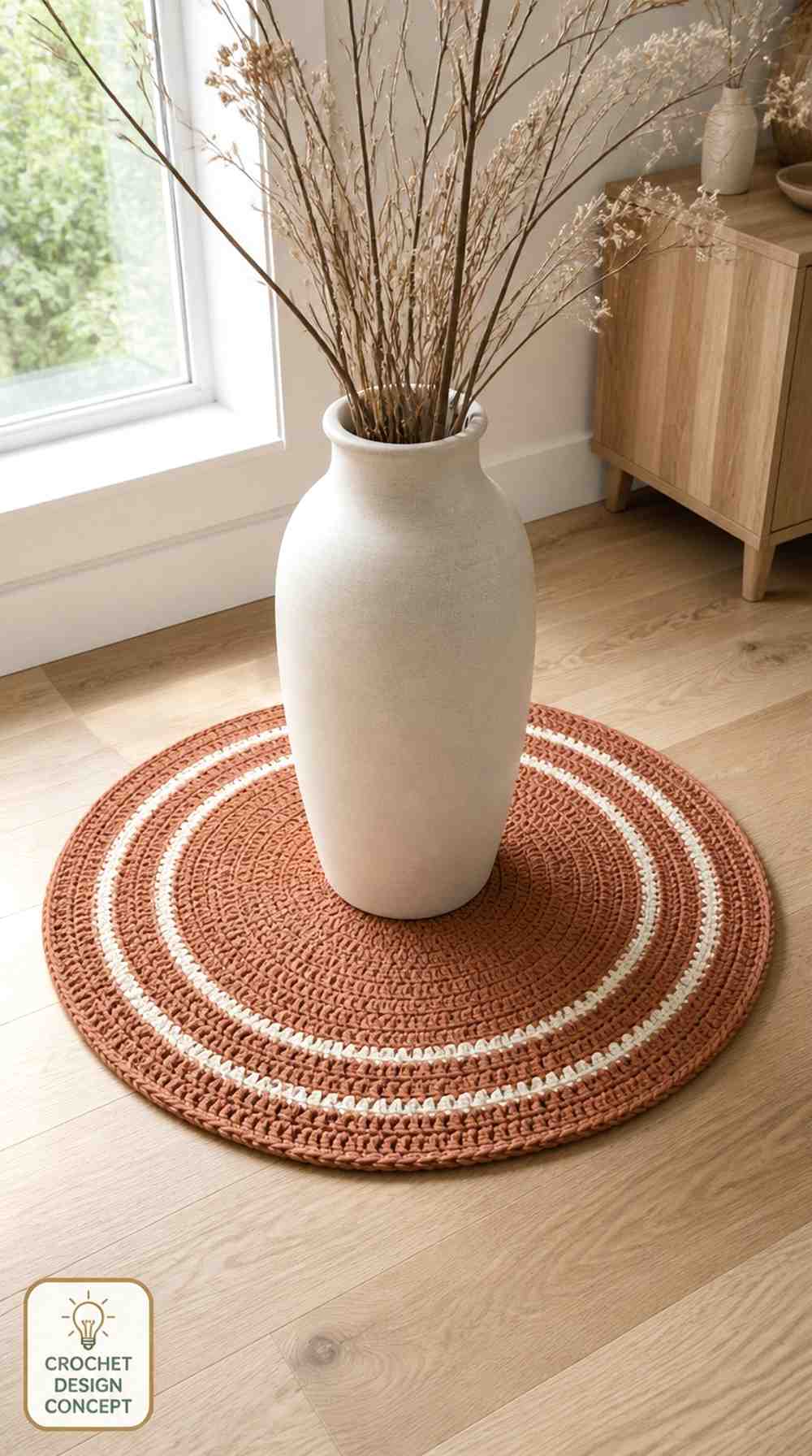
Warm terracotta crochet creates a simple circular mat with two narrow ivory rings near its outer edge. The center uses closely worked, flat crochet rows, giving the vase a plain contact surface. The ivory lines remain visible beyond the broad ceramic base and add just enough contrast to define the round shape.
This design suits a tall ivory floor vase where a warm color accent would complement the room. A real version needs to lie completely flat and stay clean underneath, since even soft yarn can trap abrasive grit.
- Flat central surface: Keep the middle smooth and free from raised decorations so the ceramic base rests evenly without rocking.
- Double-ring spacing: Position both ivory rings beyond the vase footprint, where they remain visible without affecting the contact area.
- Floor finish: Check your flooring manufacturer’s guidance before placing any textile beneath a heavy object, especially on delicate or recently finished wood.
2. Crochet Mustard Elongated Oval Vase Mat
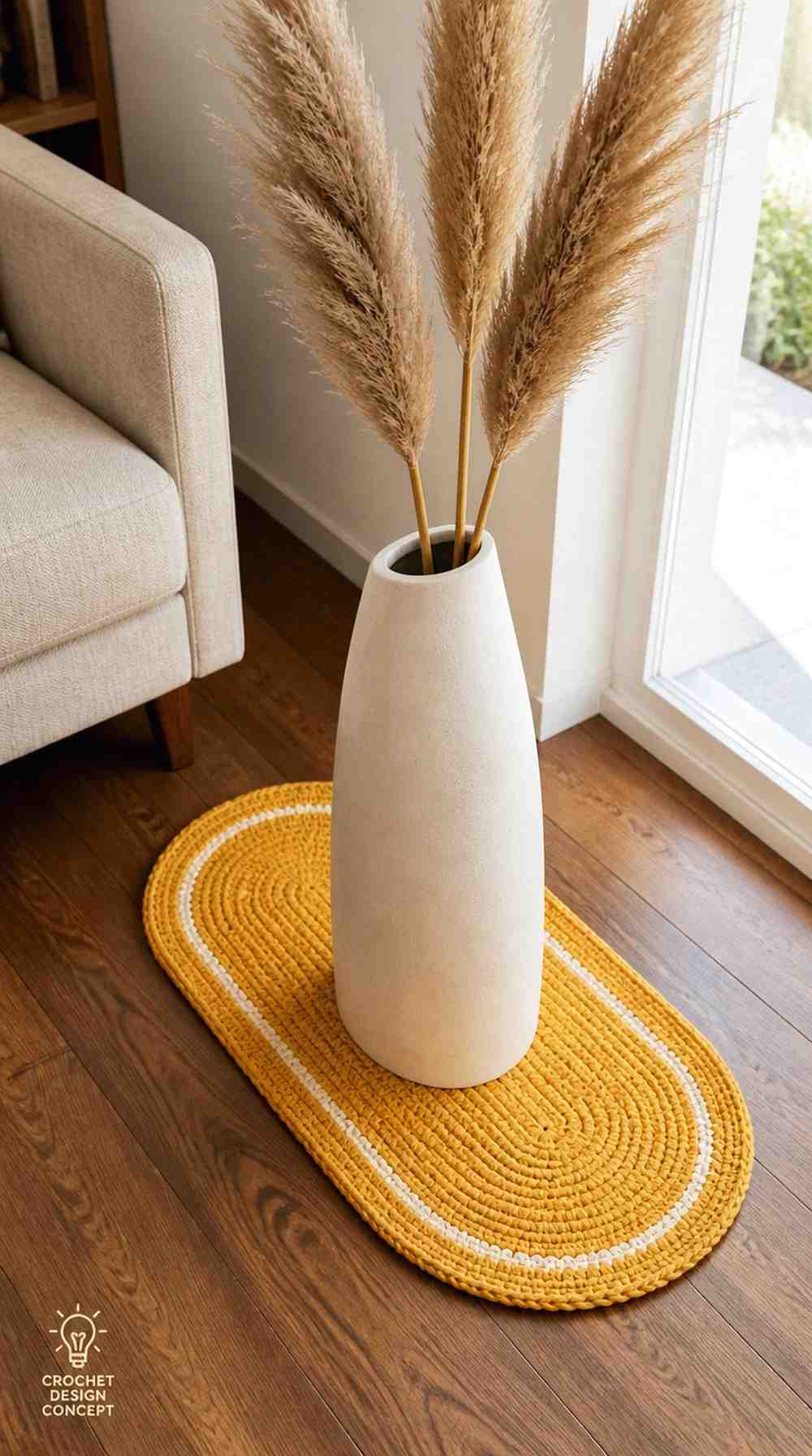
Mustard-yellow crochet forms a long oval mat with a narrow ivory accent row and a smooth central surface. Its gently rounded ends extend beyond the base of a tall cream ceramic vase, giving the floor arrangement a softer, lengthened silhouette.
The oval shape works particularly well when the vase itself has a broad elliptical footprint. It also creates a visible decorative margin at both ends. The important consideration is keeping the mat centered and completely level beneath the vase.
- Oval footprint: Compare the full contact area of the actual vase base with the mat’s solid center, rather than using the vase’s upper-body width.
- Even increases: Consistent crochet increases around the curved ends help the oval remain flat instead of forming ripples.
- End clearance: Avoid making the exposed oval ends so long that they extend into a walking route or become a tripping hazard.
3. Crochet Indigo Checkerboard Square Vase Mat
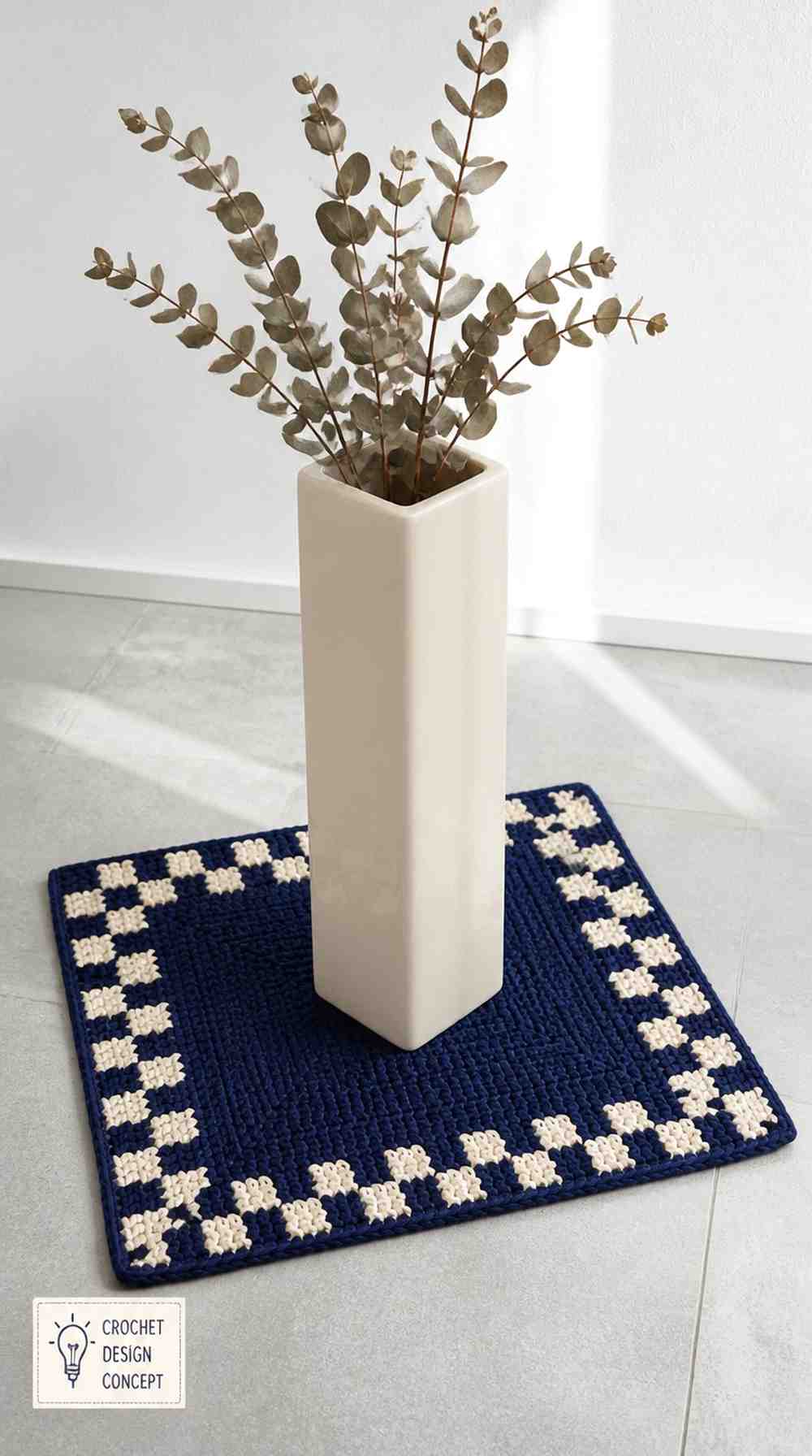
Midnight-indigo crochet gives this square mat a strong, modern appearance. A border of alternating ivory and indigo blocks surrounds the dense central section, while straight edges and neatly squared corners reinforce the geometric style.
The checkerboard border becomes especially noticeable around a plain cream rectangular vase. Because the center is smooth and the pattern stays outside the main contact area, the design balances decoration with a low-profile shape. Real-world stability would still need checking.
- Square alignment: Center a square-based vase so its entire bottom rests on the mat’s flat interior rather than overlapping an uneven edge.
- Color-change joins: Keep the checkerboard blocks consistent to avoid thick seams that could lift parts of the border.
- Room placement: The straight-edged silhouette suits corners with rectangular furniture, but its projecting corners should remain clear of foot traffic.
4. Crochet Sea-Glass Octagonal Floor Vase Mat
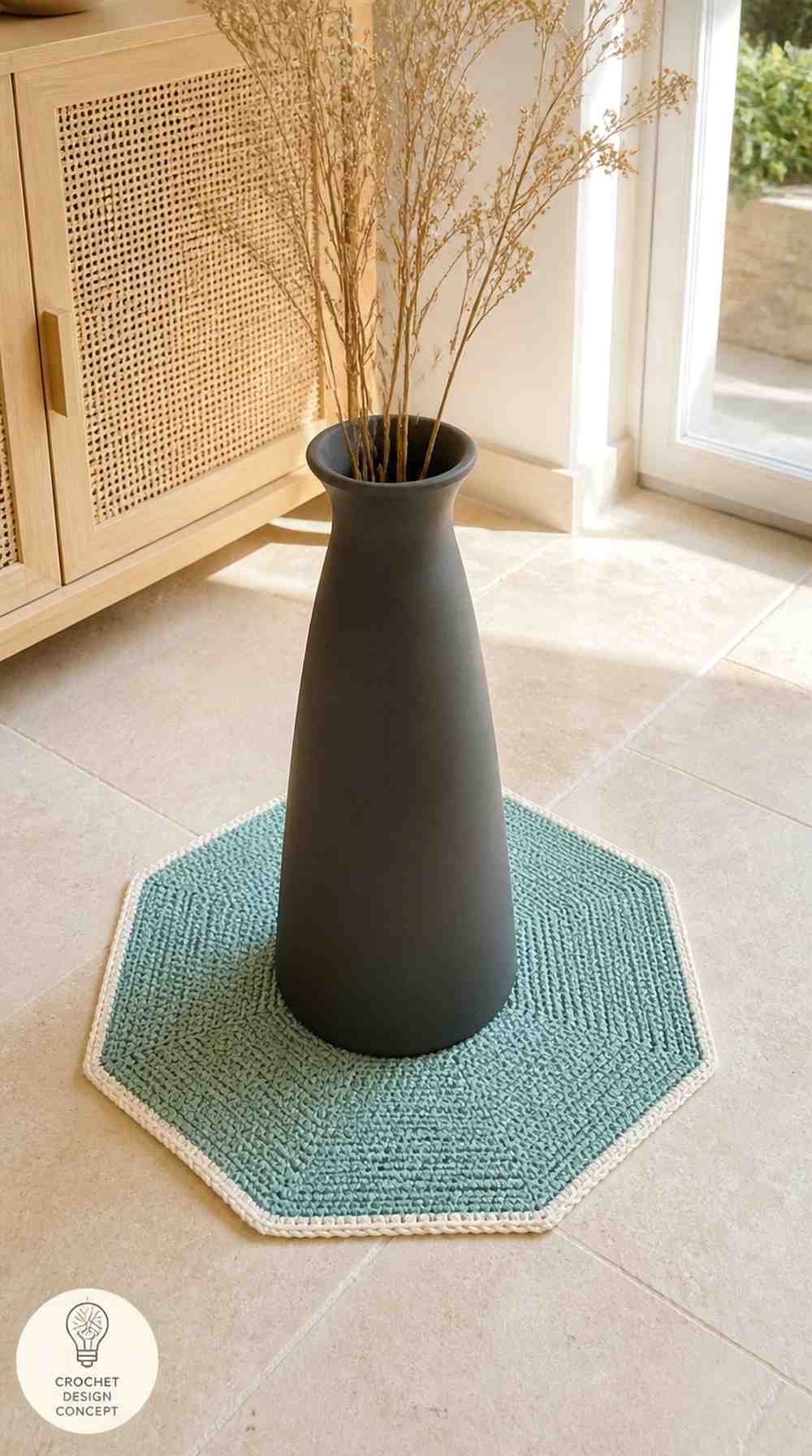
Sea-glass-teal crochet creates an eight-sided floor mat with a narrow ivory outline. The center remains closely stitched and flat, while the eight equal-looking sides give the design a more architectural appearance than a regular circle.
This concept can complement a tall charcoal vase, particularly on pale stone flooring where the teal color stands out. Its octagonal shape offers a decorative border without large scallops or fringe. Keeping all eight corners balanced is important to avoid an uneven finished edge.
- Eight-sided construction: Work consistent increases at each corner so the crochet lies flat and the octagonal shape remains symmetrical.
- Base coverage: Ensure the entire vase bottom fits within the smooth central area, not on a corner or slightly raised border.
- Surface cleaning: Remove the mat periodically and check underneath for sand or dirt, especially on floors where small abrasive particles may cause marks.
5. Crochet Burgundy Granny-Tile Vase Base Mat
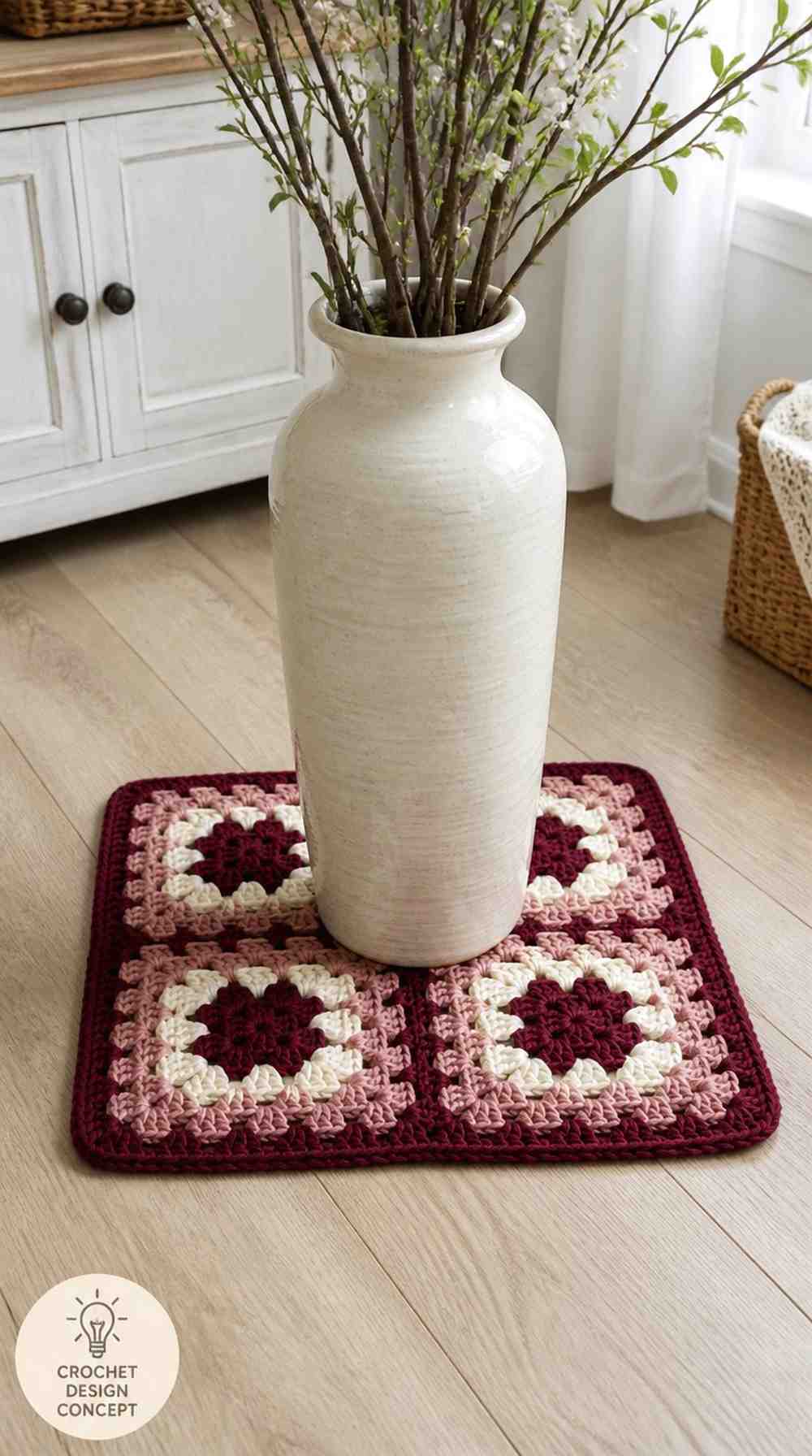
Four miniature granny squares create a richly colored mat in burgundy, dusty rose and ivory. The motifs are joined in a two-by-two arrangement over a solid burgundy crochet backing, producing a recognizable patchwork appearance.
This design brings traditional crochet character to a floor vase display. The solid backing matters because open granny-square corners alone would not create a continuous contact surface. The seams should remain as flat as possible where the vase stands.
- Solid backing layer: Keep a continuous lower panel beneath the motifs so the vase is not supported only by open granny-square connections.
- Flat motif joins: Low-profile seams reduce uneven ridges between the squares, especially across the central vase contact area.
- Decorative limitations: The colorful patchwork is mainly visual; it should not be assumed to distribute heavy weight or protect a floor from pressure marks.
6. Crochet Sage Petal-Edge Floor Vase Mat
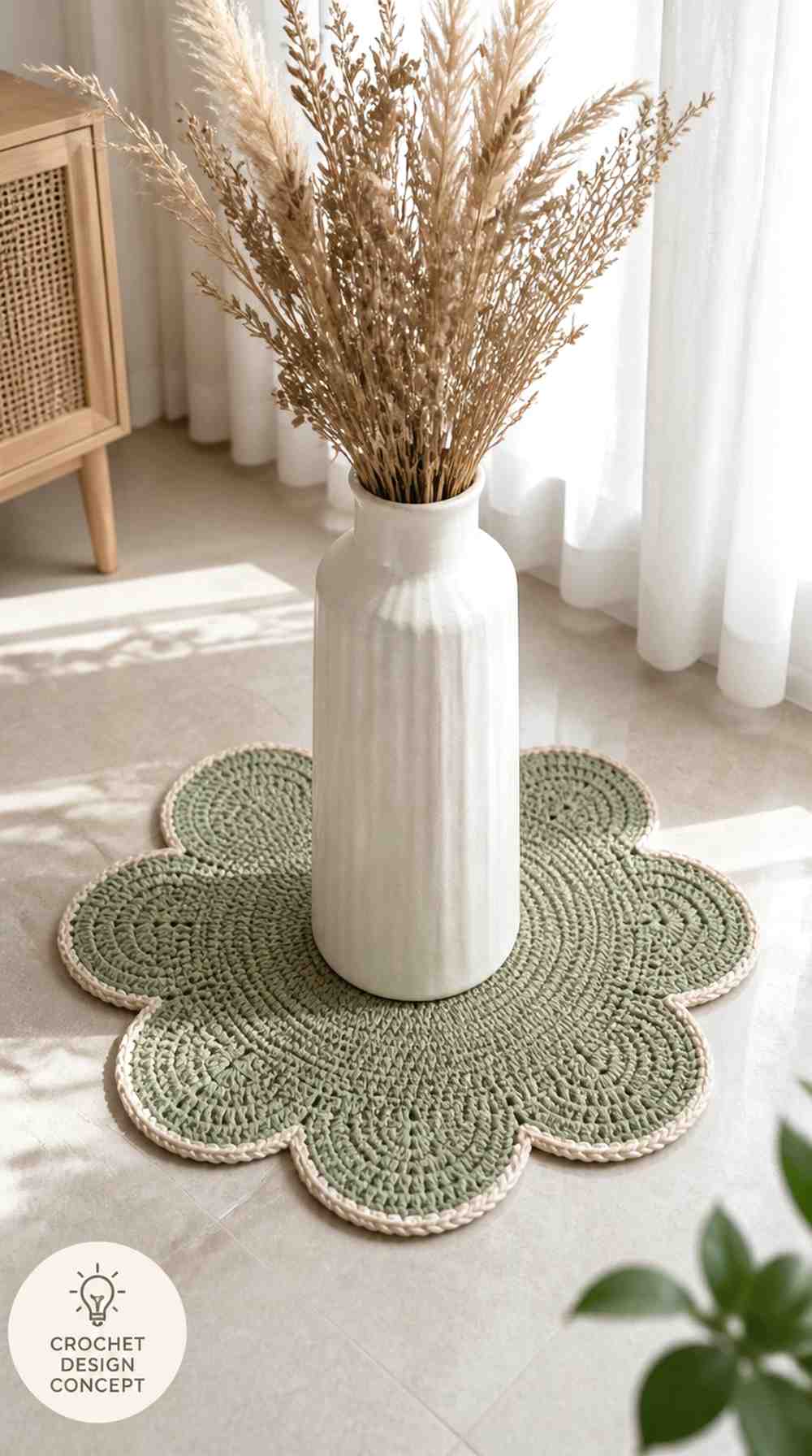
Muted-sage crochet forms a smooth circular center surrounded by eight shallow petal-shaped scallops. Thin ivory finishing rows outline the petals, creating a gentle floral border that appears around the base of a cream ceramic vase.
The decorative edge gives the design a cottage-inspired appearance without adding raised flowers beneath the vase. The petals are intended to remain flat against the floor, although their shape would need careful stitch planning to avoid curling.
- Petal placement: Keep all eight decorative scallops outside the vase’s supporting footprint so the base remains on a uniform flat surface.
- Rounded shaping: Even increases help the shallow petals maintain similar sizes and lie smoothly rather than forming uneven ruffles.
- Walking clearance: Avoid placing exposed petals where people regularly walk, since a loose or curling edge may catch underfoot.
7. Crochet Cocoa Ribbed-Border Vase Mat
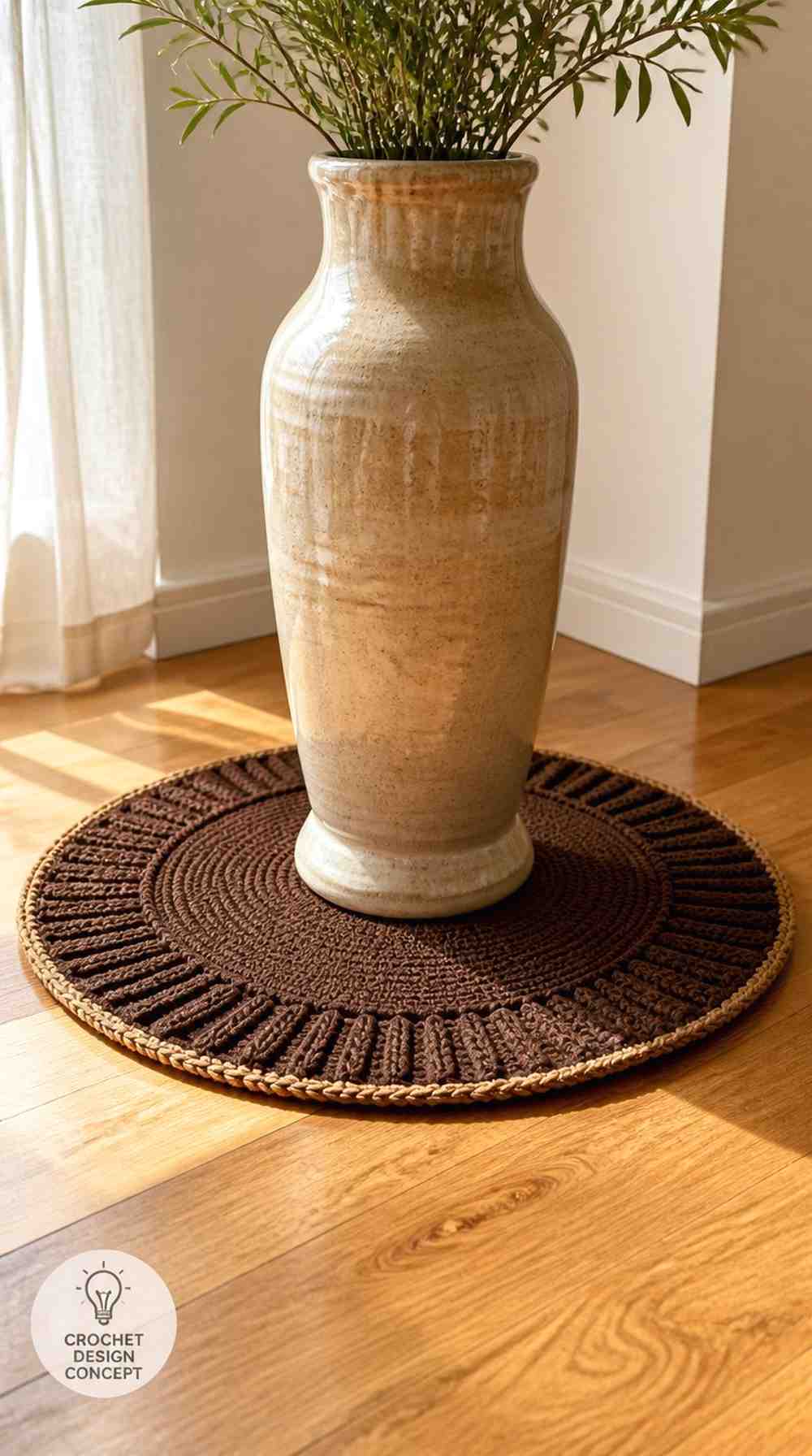
Rich cocoa-brown crochet gives this circular mat a warm, understated look. The central disk is smooth and dense, while the outer ring features low raised ribs finished with a thin caramel-colored edge.
The difference between the flat middle and textured border is the main feature. It allows the ribbed stitches to remain visible around the vase without placing bulky crochet directly beneath its base. The raised border may also collect dust more easily than a plain edge.
- Smooth support zone: Keep the raised ribs completely outside the vase footprint, where their texture cannot create uneven pressure beneath the ceramic base.
- Rib height: Subtle raised stitches provide decorative depth without making the outer edge overly thick or easy to snag.
- Cleaning frequency: Ribbed crochet can trap dirt in its grooves, so inspect and clean the mat before grit becomes embedded in the yarn.
8. Crochet Blush Rose-Corner Oval Vase Mat
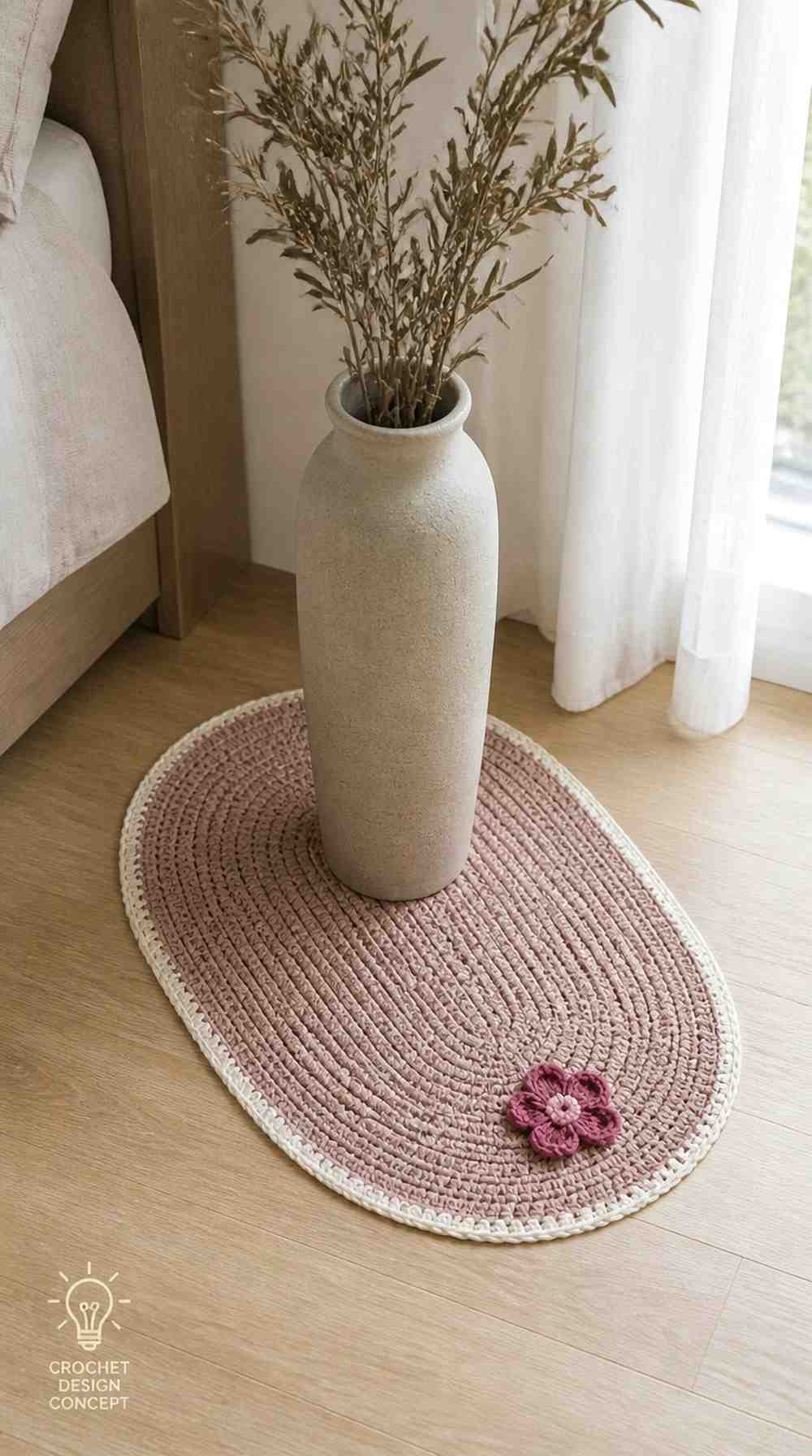
Dusty-blush crochet creates a narrow oval mat with an ivory border and one small raspberry-colored rose near its exposed front end. The rose has five flat petals and stays well away from the central contact area beneath the beige vase.
The single floral motif provides a gentle decorative accent without turning the entire mat into a raised flower design. Its placement matters because the vase needs to sit on an uninterrupted flat section while the rose remains visible.
- Rose positioning: Sew the small flower beyond the vase footprint rather than directly beneath the ceramic base.
- Flat attachment: Keep the appliqué low and securely stitched so it does not curl upward or catch on nearby objects.
- Oval alignment: Center the vase along the longest axis of the mat, checking that the complete base remains supported by the dense crochet section.
9. Crochet Charcoal Concentric Stripe Vase Mat
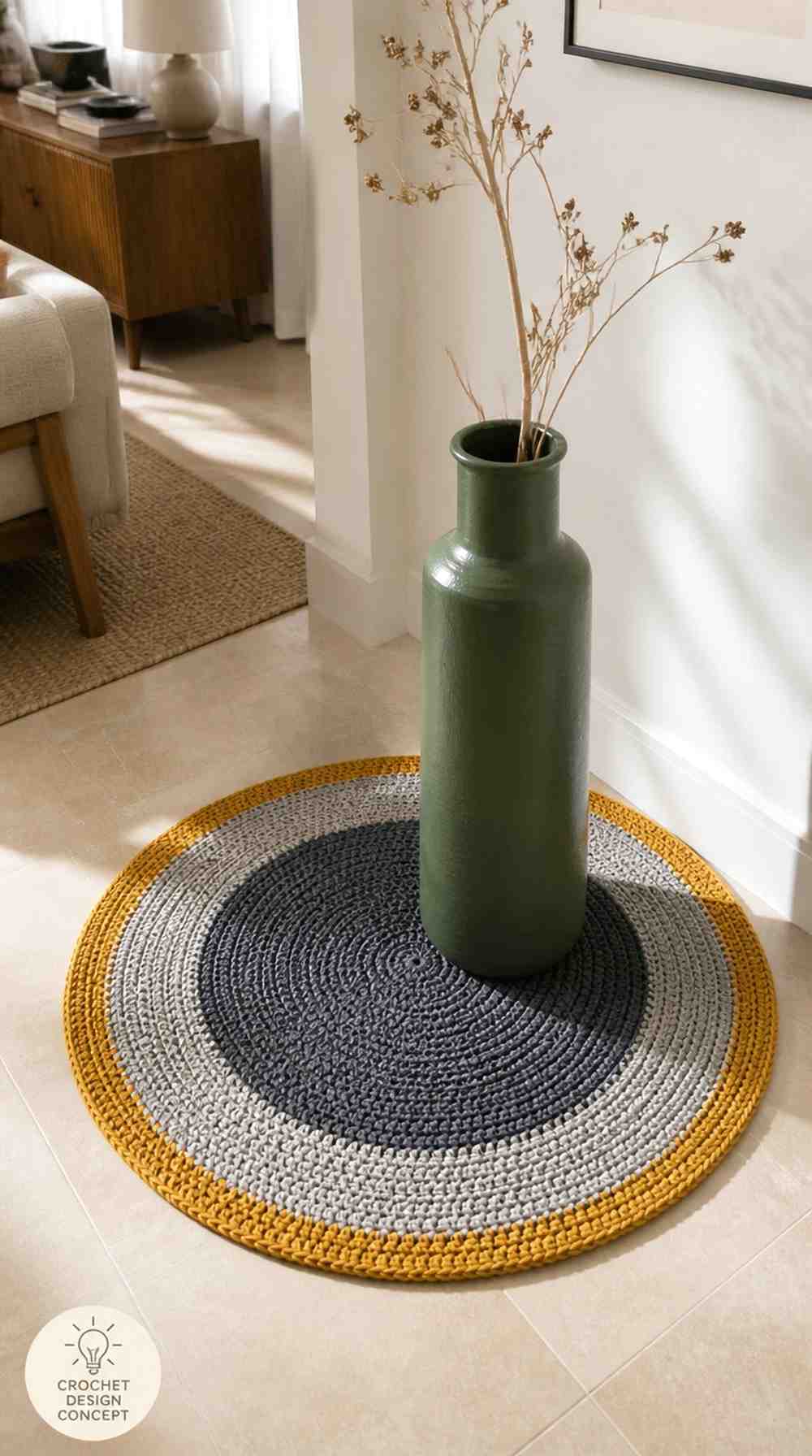
Charcoal, stone gray and ochre crochet form three clean concentric color bands. The darkest section creates a dense central disk, while the lighter and warmer borders remain visible around a tall forest-green ceramic vase.
The restrained palette makes this mat suitable for modern interiors where strong floral or lace details might feel too busy. Its shape is simple, but the circular color changes require careful stitch alignment to prevent the rows from becoming uneven.
- Color placement: Use the darkest section beneath the vase and keep the contrasting borders outside the footprint for a balanced visual effect.
- Circular tension: Consistent crochet increases help prevent the color bands from cupping or rippling as the mat grows.
- Floor compatibility: A dark mat on a light floor may show lint or dust, making regular cleaning important to preserve both appearance and surface cleanliness.
10. Crochet Butter Yellow Scalloped Square Vase Mat
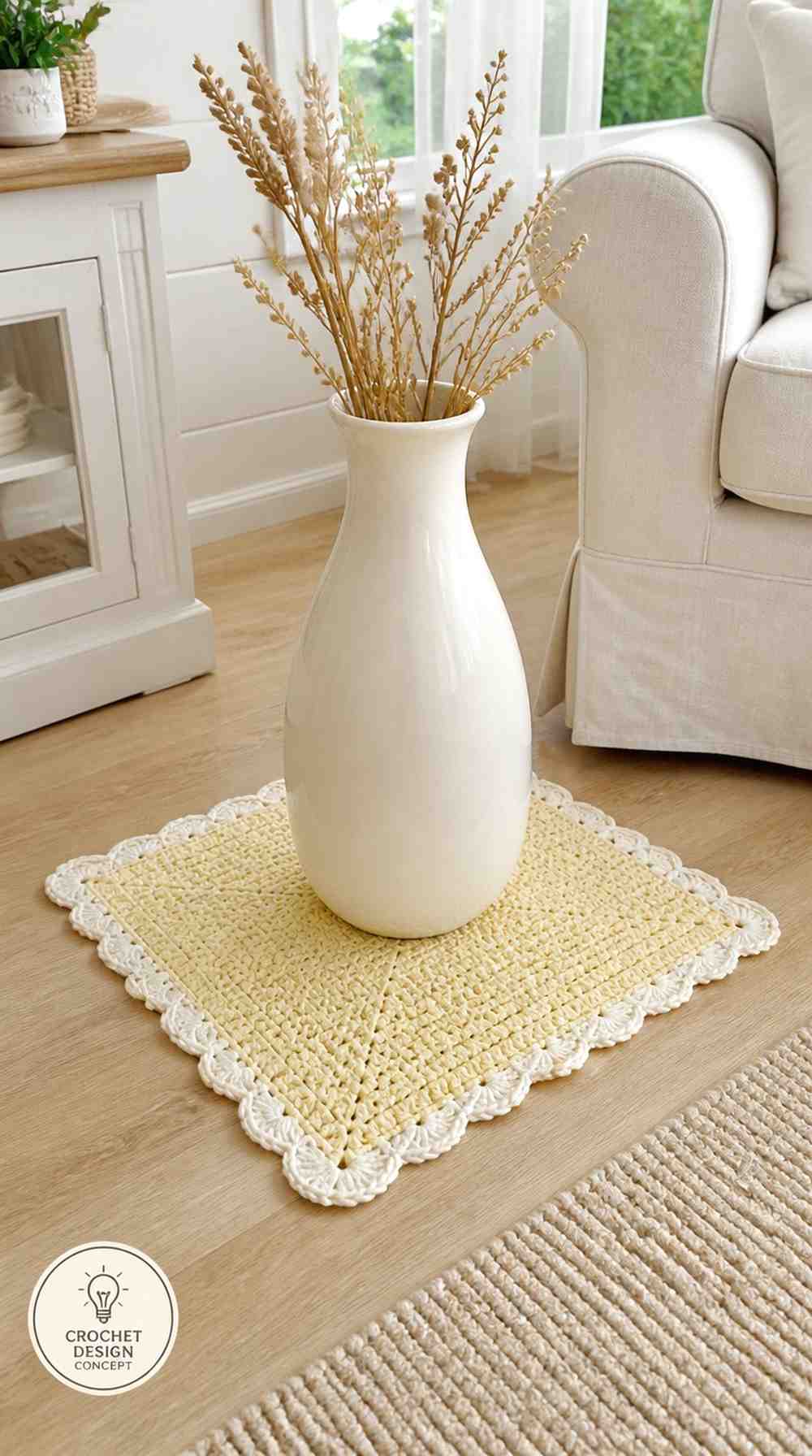
Pale butter-yellow crochet creates a bright square base with delicate ivory shell stitches around the perimeter. The middle is closely stitched and flat, while the small scallops soften the four straight sides.
This design blends a practical square silhouette with a cottage-style border. It is particularly attractive beneath a plain ivory ceramic vase, where the scalloped edge can remain visible. The decorative shells need to stay outside the weight-bearing area.
- Shell-stitch border: Keep the ivory shells shallow and evenly distributed so the outer edge does not rise into a thick ruffle.
- Square base coverage: Match the mat’s smooth central area to the actual footprint of the vase, leaving a modest visible margin.
- Edge maintenance: Check the scallops after washing, because curled or distorted edges should be reshaped and fully dried before the mat is reused.
11. Crochet Copper Embroidered Hexagon Vase Mat
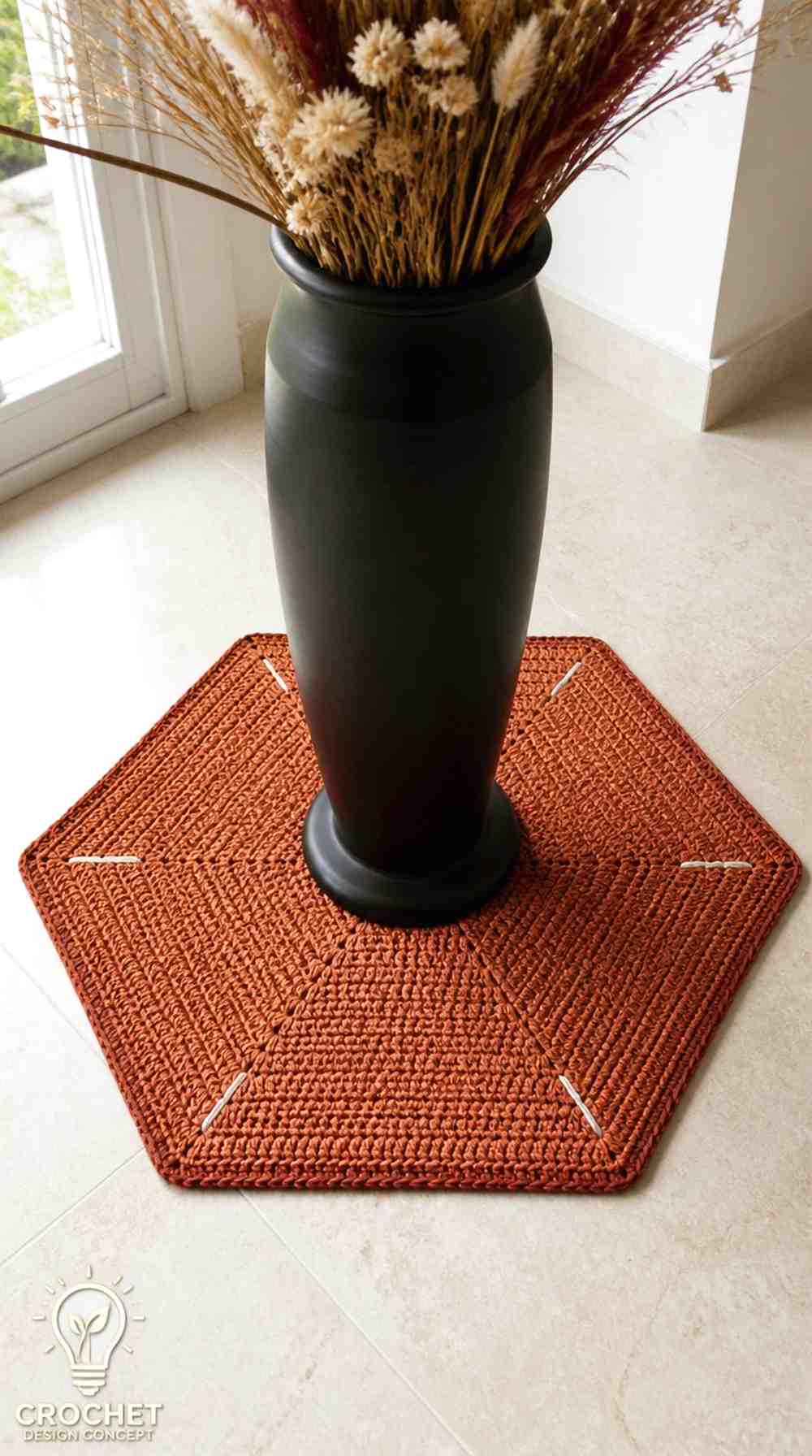
Copper-rust crochet forms a six-sided mat with a dense, flat center and a dark-terracotta border. Small ivory embroidered lines sit near the outer edge, creating subtle radial details around the base of a tall matte-black vase.
The hexagonal shape offers a different geometric direction from the square and octagonal designs. Its small embroidery marks remain flat, so they provide decoration without adding raised objects beneath the vase. Careful placement is important to keep each side visually balanced.
- Hexagonal increases: Plan the six corner sections evenly so the mat retains straight sides instead of becoming an irregular circle.
- Flat embroidery: Keep the ivory lines low-profile and positioned outside the vase contact area to avoid unnecessary surface bumps.
- Vase positioning: Center the broad base carefully within the six-sided outline, checking that the mat does not shift during placement.
12. Crochet Slate Double-Layer Floor Vase Mat
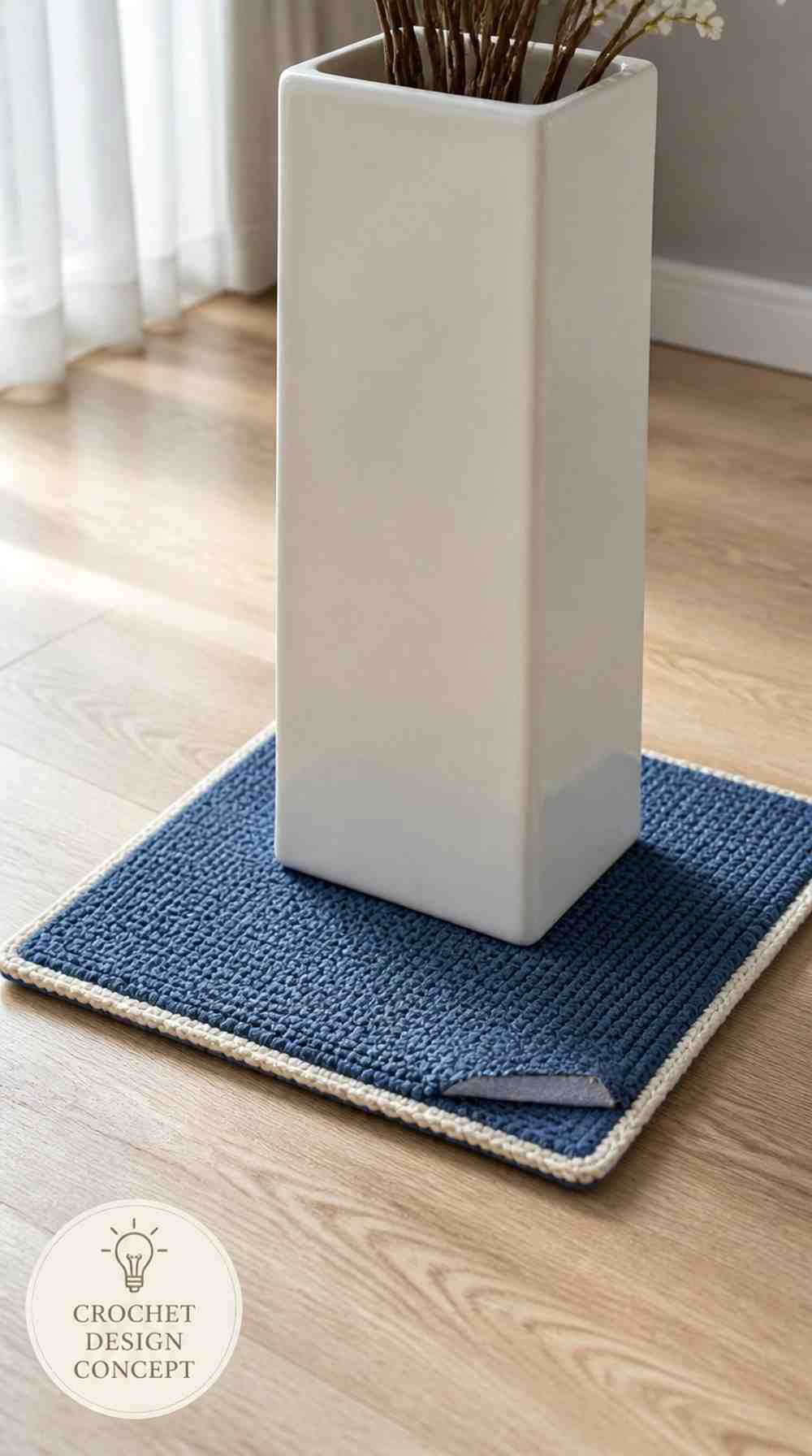
Slate-blue crochet creates a compact rectangular mat with two thin fabric layers and a narrow ivory border. A separate warm-gray felt insert sits between the layers, visible slightly at one exposed edge, while the upper surface remains flat.
This concept explores a layered construction rather than relying on crochet alone. The insert might provide a different contact surface, but its compatibility with the floor finish needs independent checking. Additional layers can also change the mat’s thickness and the vase’s stability.
- Layer thickness: Keep the construction low-profile so the vase does not rock or tilt on a soft, unevenly compressed pad.
- Felt compatibility: Choose an insert only if its material is approved for the specific flooring; some backings and finishes can interact or leave marks.
- Removable construction: An accessible insert makes it easier to inspect for dirt, moisture or wear and to clean the crochet layers separately.
13. Crochet Apricot Diagonal Colorblock Vase Mat
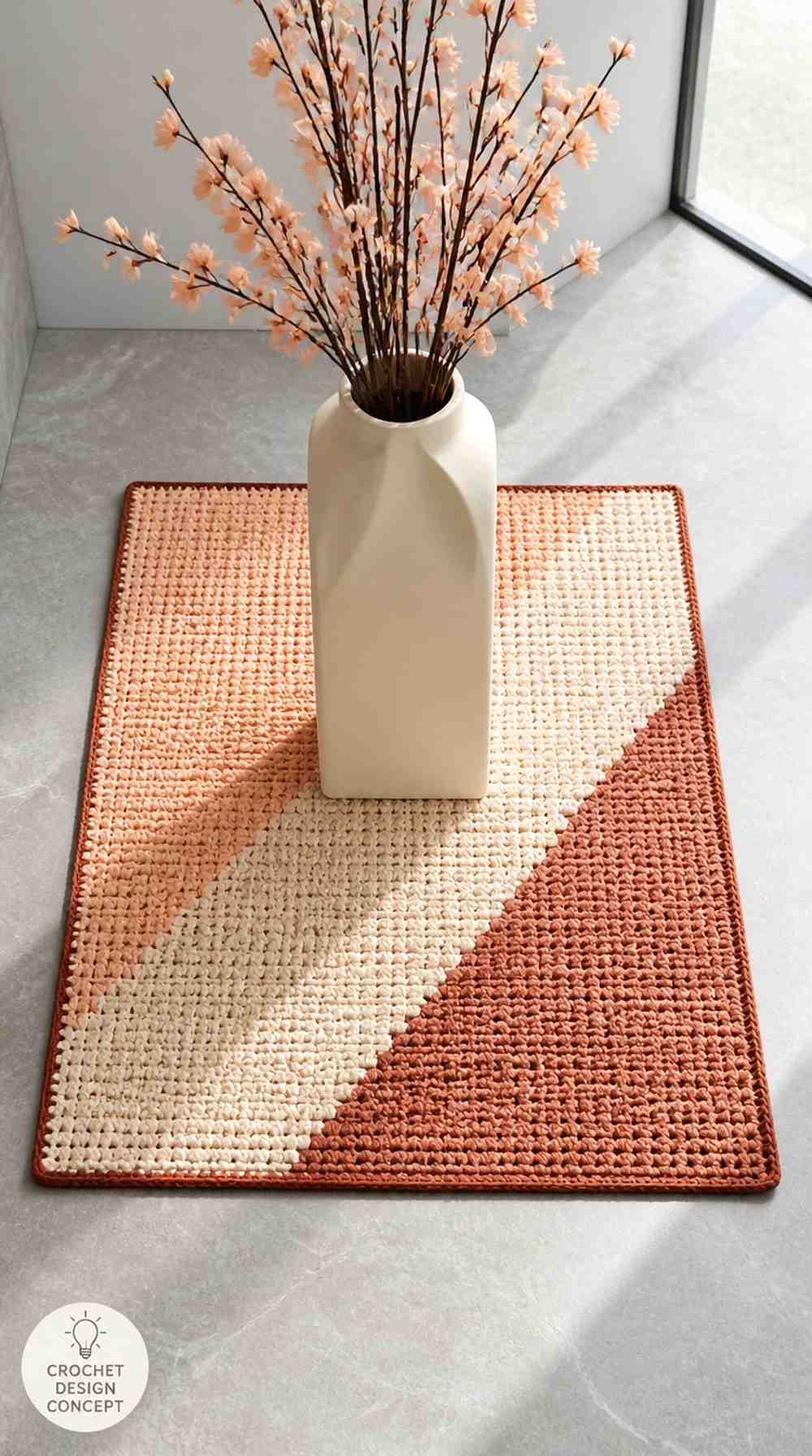
Warm apricot, pale ivory and muted terracotta create broad diagonal sections across this rectangular crochet mat. The color changes are built into the fabric, keeping the entire surface flat beneath a tall cream vase.
Its visual interest comes from color placement rather than added motifs or raised texture. This makes the design appealing for contemporary rooms with simple furniture and clean lines. A real version would require tidy color transitions to maintain the sharp diagonal arrangement.
- Diagonal joins: Keep yarn changes neatly integrated into the crochet rows so the color sections meet without bulky raised seams.
- Rectangular alignment: Position the vase’s broad flat base entirely within the mat, avoiding any unsupported edge.
- Visual proportion: A modest exposed border shows the colorblocking without making the floor mat look oversized relative to the vase.
14. Crochet Olive Braided-Border Oval Vase Mat
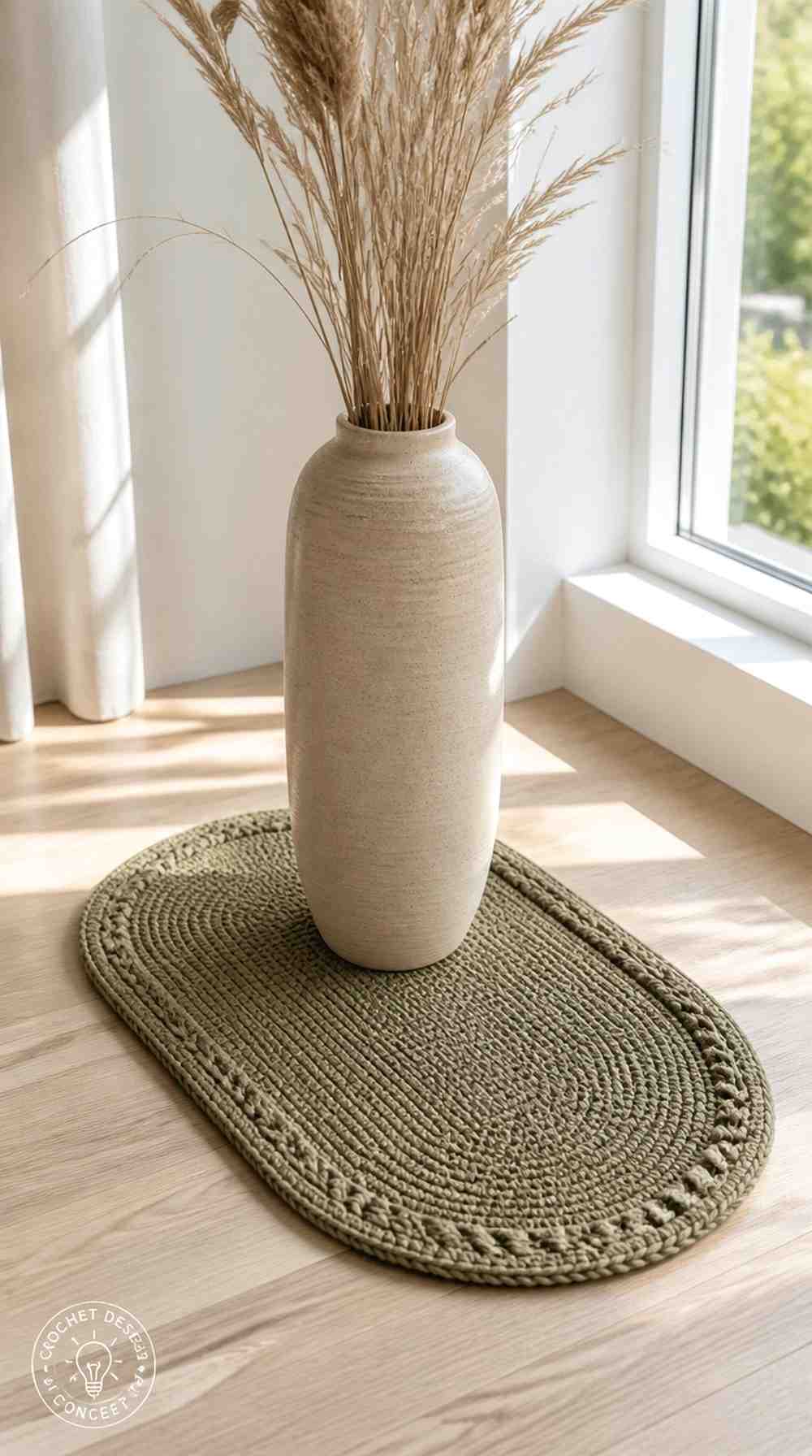
Muted-olive crochet forms an elongated oval mat with a smooth, densely worked center. A narrow raised braided-looking crochet border follows its outer edge, creating texture without placing thick stitches beneath the vase.
The olive color and restrained braided outline give this design a natural appearance. It works well with a warm sand-colored vase and dried grasses, especially in a light-filled room. The outer border should remain flat enough not to curl toward the center.
- Braided-edge position: Keep the decorative raised border beyond the vase footprint so it does not affect the level supporting surface.
- Oval shaping: Consistent increases around the ends help prevent the border from pulling the central fabric into a narrow ridge.
- Material behavior: Smooth crochet yarn may shift on some floors; choose placement and any separate approved underlay according to the flooring guidance.
15. Crochet Navy Pinwheel Circle Vase Mat
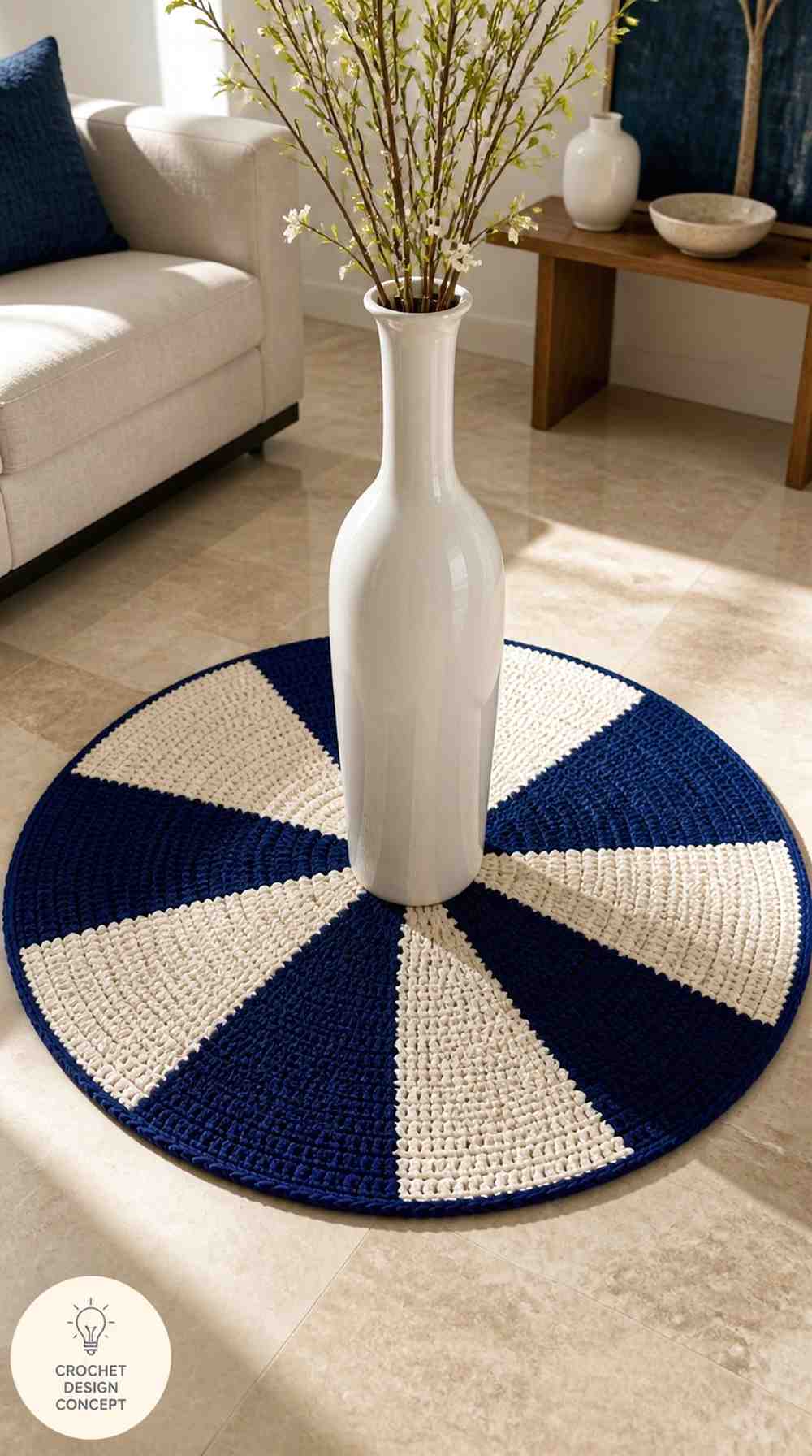
Navy and ivory crochet form eight alternating wedge-shaped sections around a central point. The complete mat is circular, with a thin navy border and flat, tidy joins between each color section.
The pinwheel arrangement creates a bold geometric pattern around a plain white floor vase. Since the vase covers the middle, the alternating wedges remain visible around the outer edge. Their joins need to stay even so the mat does not develop raised seams.
- Wedge consistency: Keep all eight color sections balanced and similar in width, especially where they meet near the center.
- Flat joins: Avoid bulky seams that could create high points beneath a broad ceramic vase base.
- Contrast choice: The navy-and-ivory palette provides strong pattern visibility without requiring raised flowers, buttons or other decorative attachments.
16. Crochet Mauve Solid-Center Lattice Vase Mat
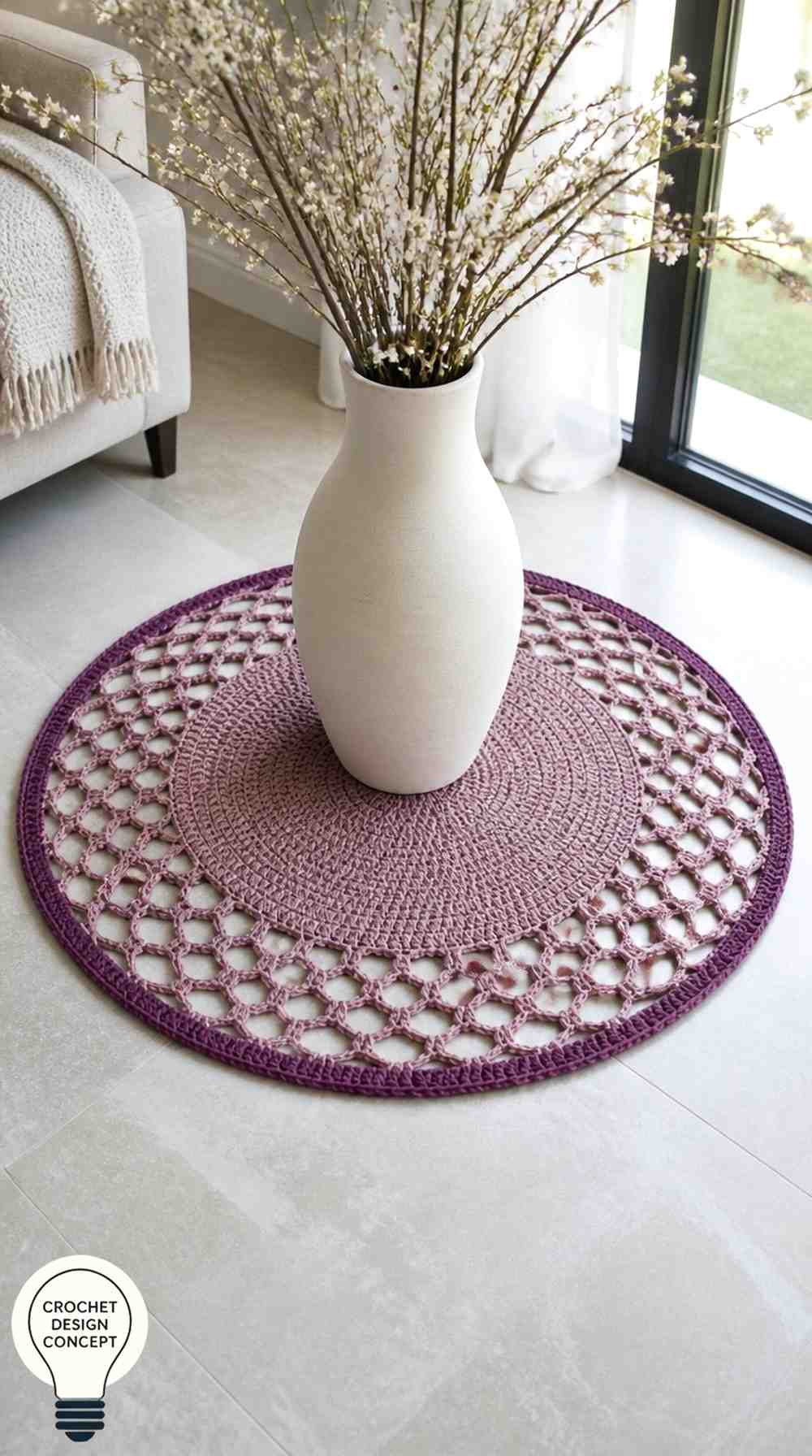
Muted-mauve crochet forms a large solid circular center with a surrounding ring of small diamond-shaped openwork. A narrow plum border defines the outer edge, keeping the delicate lattice visually contained.
The combination of dense crochet and open lace makes this design distinctive. The vase sits entirely on the solid center, while the openwork remains visible outside its contact area. It is mainly a decorative choice, since open loops provide no reliable barrier against dirt or moisture.
- Solid center size: Make the dense central disk large enough to support the full vase footprint without resting on the lattice openings.
- Diamond-loop connections: Keep the openwork evenly joined so the decorative ring retains its shape and does not pull inward.
- Dust awareness: Open crochet can trap debris and allow grit through, so the floor and underside should be inspected regularly.
17. Crochet Sand Terrazzo-Speckle Vase Base Mat
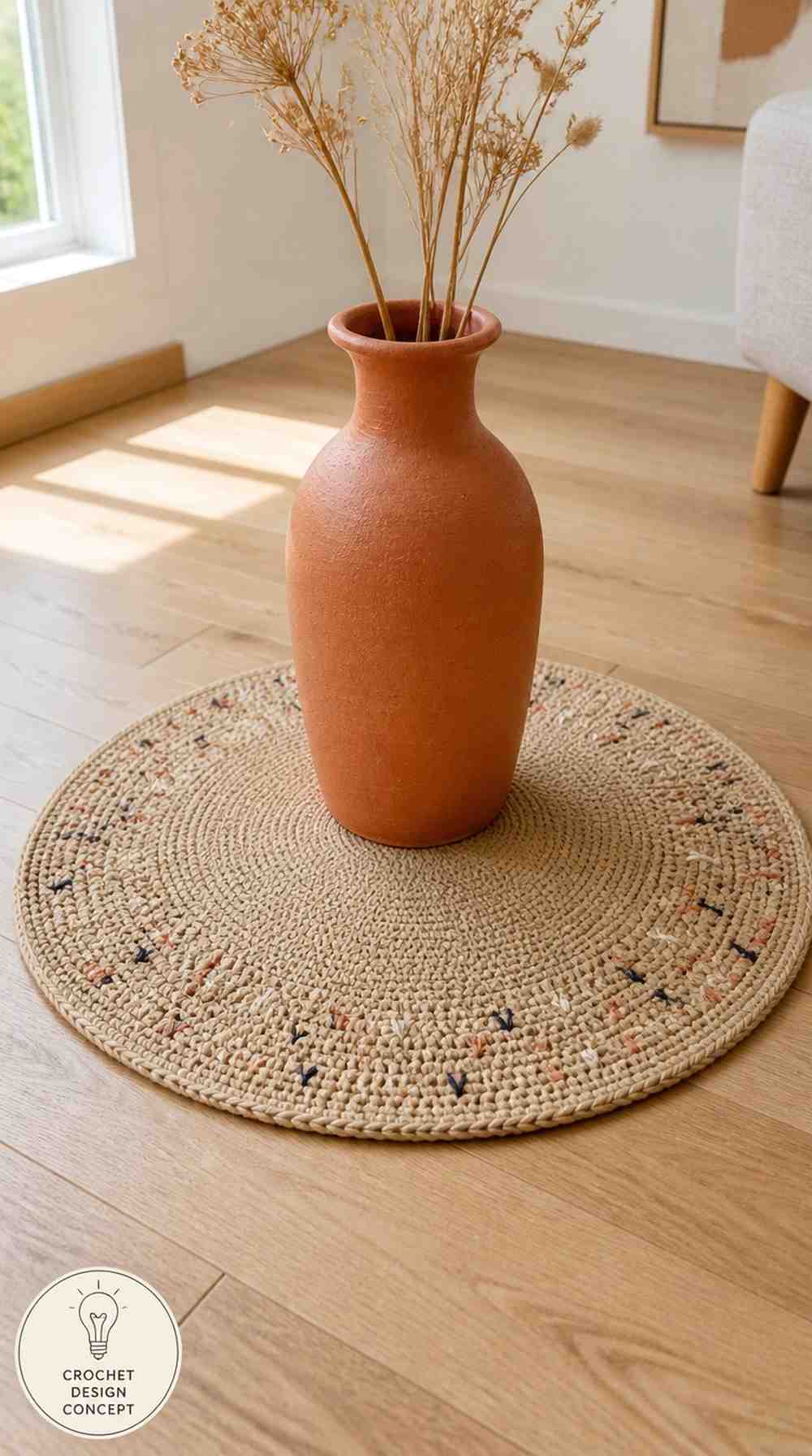
Warm-sand crochet creates a simple circular mat with tiny embroidered marks in coral, charcoal and cream. The scattered stitches resemble subtle terrazzo flecks, while the central section remains smooth beneath a tall terracotta ceramic vase.
The small color accents give the design a modern appearance without requiring actual stones, beads or hard decorative pieces. Because the flecks are made from yarn, they remain part of the textile. Their placement outside the vase footprint helps keep the supporting surface plain.
- Soft embroidered flecks: Use low-profile yarn stitches rather than beads or hard attachments, which could create pressure points beneath a heavy vase.
- Balanced pattern: Spread the colored marks naturally across the exposed outer area while keeping the central contact zone smooth.
- Cleaning the underside: Lift the vase carefully when necessary to check the mat and floor for grit, moisture or compressed fibers.
Practical Guide to Crochet Tall Floor Vase Base Mats
Start with the actual vase footprint. A tall vase may have a wide body but a much smaller bottom. Measure the entire flat contact area rather than estimating from the widest part of the vase. Choose a mat with enough continuous, level surface to support the complete base. Avoid thick raised stitches, uneven motif joins or soft padding beneath a top-heavy vessel.
Check the floor finish. Hardwood, laminate, vinyl, stone and tile may have different care requirements. A crocheted mat is not automatically an approved anti-scratch protector. Some floor finishes require particular felt or non-staining protective materials, and certain rubber or plastic backings can discolor floors. Follow the flooring manufacturer’s guidance before placing a mat underneath heavy ceramics.
Keep everything clean and dry. Fine sand or dust trapped between the vase, crochet and floor can act as an abrasive. Lift the vase carefully rather than sliding it, remove the textile and clean the contact surfaces regularly. If the vase holds water, make sure any spills are cleaned promptly and never leave damp crochet trapped against wood flooring.
Consider stability before decoration. Tall vases can have a high center of gravity. A thick, soft or uneven mat may make tipping more likely. Select a stable, broad-based vase, keep the crochet flat and avoid positioning large floor vases in busy walking routes or places where children or pets could knock them over.
Choose suitable crochet fabric. Smooth, closely worked cotton yarn can produce well-defined mats, but yarn thickness, tension and stretch affect the finished surface. Decorative scallops, ribs, flowers and lattice borders are best kept outside the vase’s contact area.
Use separate protective materials when appropriate. For valuable flooring or particularly heavy vases, a manufacturer-approved, floor-compatible pad or stable protective base may be preferable to relying on crochet alone. The decorative crochet should not reduce the vase’s stability or interfere with the protective product.
Want to Make Something Similar?
These verified resources teach related crochet mat construction. They are not exact patterns for the 17 illustrated concepts and do not establish that a crocheted mat is suitable for every heavy floor vase.
- Octagon Plant Pot/Vase Mat by Joanne Smith — A free pattern for a small octagonal mat. It is especially relevant to the eight-sided shaping in the Sea-Glass Octagonal Floor Vase Mat. Its original size and construction are not intended as a tested heavy-floor-vase support.
- Easy Round Crochet Rug Pattern and Video by Marching North — A free tutorial demonstrating flat circular crochet construction and evenly increased rounds. Useful for learning the basic shape used in several round designs here, although its rug materials and scale differ.
For more decorative mat inspiration, explore 14 Crochet Trinket Shelf Display Mat Ideas for Curated Vintage Rooms on Yarn Nest Studio. Those ideas involve smaller shelf displays, but they offer a useful comparison of mat shapes, borders and openwork.
Which Crochet Floor Vase Base Should You Choose?
| Your main preference | Designs to consider | Important trade-off |
|---|---|---|
| Simple round decoration | Terracotta Double-Ring, Charcoal Concentric Stripe | Requires a flat, correctly sized central area |
| Long or oval vase footprint | Mustard Elongated Oval, Olive Braided-Border Oval | Must match the base rather than just the vase's height |
| Geometric floor styling | Indigo Checkerboard, Sea-Glass Octagonal, Copper Hexagon | Corners and joins need careful shaping |
| Cottage-style decorative edges | Sage Petal-Edge, Butter Yellow Scalloped | Edges may curl or catch if poorly positioned |
| Traditional granny motifs | Burgundy Granny-Tile | Seams and open spaces need a flat backing |
| Subtle floral detail | Blush Rose-Corner | Appliqué must stay outside the vase footprint |
| Textured outer border | Cocoa Ribbed-Border, Olive Braided-Border | Raised texture can collect grit |
| Layered construction | Slate Double-Layer | Material compatibility and stability need extra checking |
| Modern colorwork | Apricot Colorblock, Navy Pinwheel | More demanding color joins |
| Decorative openwork | Mauve Solid-Center Lattice | Lattice is not a protective barrier |
| Minimal embroidered detail | Sand Terrazzo-Speckle | Embroidery should remain soft and low-profile |
For a round vase with a broad, stable bottom, the Terracotta Double-Ring or Charcoal Concentric Stripe concept gives a simple starting point. Their dense, flat centers avoid the extra complexity of decorative seams beneath the vase.
For an oval or rectangular vase, choose a mat whose central area follows the actual base shape. The Mustard Elongated Oval, Indigo Checkerboard and Apricot Colorblock designs offer different visual directions without relying on raised decoration underneath the ceramic.
If you prefer traditional crochet details, the Burgundy Granny-Tile and Mauve Solid-Center Lattice designs are attractive options, provided their backing and contact areas remain level.
Conclusion
Crochet tall floor vase base mats bring handmade color, shape and texture to an often-overlooked part of home decoration. From terracotta rings and mustard ovals to octagonal borders, granny-square panels and subtle embroidered details, these 17 concepts explore ways to frame a floor vase beautifully. The most suitable design is one that complements the vase while maintaining a flat, stable contact surface and respecting the floor’s care requirements. Crochet can be a decorative layer, but clean surfaces, appropriate protective materials and careful handling matter more when preventing scratches or floor damage.
Which design would you choose beneath a tall floor vase? Would you prefer the terracotta double-ring mat, the sage petal edge, a burgundy granny-square base or a modern geometric design? Share your favorite and whether your vase stands on wood, tile, stone or another type of flooring.
Frequently Asked Questions
1. Can a crochet mat prevent a heavy floor vase from scratching the floor?
A soft crochet layer may reduce direct contact between the vase and the floor, but it cannot guarantee scratch protection. Dirt trapped in the yarn can still damage a surface, and a heavy vase may cause pressure marks or indentations. Check your flooring manufacturer’s guidance and consider approved protective pads when needed.
2. What yarn is suitable for a crochet tall floor vase base mat?
Smooth cotton yarn is one possible choice for creating a dense, low-profile crochet surface with visible stitches. However, yarn alone does not guarantee stability, grip or floor compatibility. Avoid bulky raised stitches beneath the vase and choose materials that can be cleaned and dried according to their care instructions.
3. Should the crochet mat be larger than the base of the floor vase?
The mat should have enough continuous flat area to support the entire vase footprint. A modest visible outer border can make the design decorative, but an oversized mat may extend into walking areas and become a tripping hazard. The exact dimensions depend on the vase, floor space and intended location.
4. Can I use a rubber or non-slip backing under a crochet vase mat?
Only use a backing that is specifically compatible with your floor finish. Some rubber, latex, plastic or adhesive products can stain or damage certain flooring materials, including some finished hardwoods. Check the floor manufacturer’s care instructions before choosing a backing, and avoid any arrangement that makes a tall vase unstable.
5. Are these 17 crochet floor vase anti-scratch base designs available as patterns?
No. These are original crochet design visualizations intended to inspire different shapes, stitch textures, color combinations and decorative borders. They are not tested physical mats or complete patterns. The linked crochet tutorials teach related construction techniques, but they do not reproduce the pictured concepts exactly or guarantee floor protection.