Vintage Christmas textiles often tell their story through a single repeated image: a reindeer framed by simple borders, rows of evergreen trees, diamonds in faded holiday colors, snowflakes, candy stripes, or small geometric motifs that look as though they could have come from an old woven wall hanging.
Crochet can create that same feeling in several ways. True tapestry crochet carries colors through a dense fabric to form pictures. Intarsia separates larger blocks of color. Mosaic crochet builds crisp geometric designs through layered stitch placement. Granny squares, appliqués, bobbles, and other textured methods can produce a similar old-textile effect without technically being tapestry crochet.
That distinction matters in this collection. Several tutorials below are genuine Christmas colorwork cushions, including reindeer and evergreen designs. Others provide mosaic, harlequin, mandala, granny, or textured pillow constructions that can be reworked in a restrained Christmas palette. Those adaptation projects are identified clearly rather than being presented as original Christmas designs.
The result is a collection that ranges from literal holiday pictures to cushions that simply feel as though they belong in a room with vintage ornaments, old wrapping paper, brass candleholders, faded stockings, and inherited Christmas decorations.
Quick List
- Crochet Reindeer Tapestry Christmas Cushion
- Crochet Tricolor Evergreen Mosaic Cushion
- Crochet Three-Tree Charted Christmas Cushion
- Crochet Heritage Plaid Tapestry Cushion
- Crochet Harlequin Ornament-Color Cushion
- Crochet Snowflake Medallion Christmas Cushion
- Crochet Gift-Bow Vintage Christmas Cushion
- Crochet Santa-Suit Graphic Christmas Cushion
- Crochet Elf-Collar Vintage Christmas Cushion
- Crochet Peppermint Swirl Tapestry-Style Cushion
- Crochet Nordic Geometric Mosaic Cushion
- Crochet Stepped Mosaic Christmas Cushion
- Crochet Bobble-Sampler Vintage Christmas Cushion
- Crochet Ornament-Mandala Christmas Cushion
- Crochet Granny Tile Christmas Cushion
- Crochet Folk-Geometry Tapestry Cushion
Decide What “Tapestry” Means for Your Cushion Set
If you specifically want tapestry crochet, choose projects where the picture is created through color changes inside a relatively dense fabric. The reindeer cushion is the clearest example in this collection.
Mosaic crochet creates a different surface. It is particularly useful for Nordic trees, diamonds, stepped motifs, and other geometry because the pattern can remain crisp even with only two or three colors.
Plaid and harlequin designs create another kind of vintage textile reference. They do not need a central Christmas picture at all. Once the palette shifts toward cranberry, evergreen, cream, faded gold, or deep brown, the pattern itself can evoke old holiday upholstery and wrapping paper.
Raised snowflakes, bows, bobbles, and costume-inspired details are more dimensional. These work well when you want the cushion to look handmade from across the room rather than imitate the flatter surface of a woven tapestry exactly.
Build a Vintage Palette Around Value, Not Just Red and Green
A nostalgic Christmas cushion does not have to use bright primary red and emerald green.
Cranberry, brick red, bottle green, olive, tobacco brown, oatmeal, antique cream, muted gold, dusty blue, and charcoal can make crochet colorwork feel older and less commercial. A tiny amount of brighter red can then act as an accent rather than covering the entire cushion.
Contrast is still important. A reindeer, tree, or mosaic line needs enough difference from its background to remain readable. Two beautifully muted colors can disappear into one another when their lightness and darkness are too similar.
Make a small swatch and view it from across the room. A cushion is normally seen from several feet away, so a motif that is obvious while you are crocheting may be surprisingly difficult to recognize once it is on the sofa.
Plan the Cushion Back and Insert Before Finishing the Front
A beautiful picture panel still needs to become a usable cushion.
Some tutorials permanently close two crochet panels around an insert. Others produce removable covers, use buttons, or combine crochet with another backing material. Follow the construction actually taught in the source rather than assuming every pillow can use the same finishing method.
For charted colorwork, compare the finished front with the insert before assembly. Stretching a panel aggressively to make it fit can distort trees, lettering, reindeer antlers, plaid blocks, or other straight visual references.
Also think about storage. Removable Christmas covers can usually be stored much flatter than permanently stuffed seasonal cushions. That can matter if you plan to make several designs and rotate them every December.
1. Crochet Reindeer Tapestry Christmas Cushion

This is one of the strongest literal tapestry choices in the collection. HandmadebyRaine works the reindeer picture directly into a square cushion panel through tapestry crochet rather than sewing a separate animal onto the surface. The finished result stays comparatively flat while still giving the pillow a clear Christmas image.
For a more vintage look, consider a dark red reindeer against oatmeal, cream against bottle green, or another limited two-color combination rather than automatically using a large modern palette.
The Reindeer Outline Depends on Even Colorwork Tension
Large silhouettes reveal pulling quickly. If the carried color is held too tightly, the panel can narrow through the picture area and the reindeer can look compressed.
Lay the front flat periodically and compare the width above, through, and below the main motif. It is easier to correct tension while the picture is developing than after the cushion is assembled.
Give the Antlers Visual Breathing Room
The upper branches of the reindeer are one of the most detailed areas of the image.
Avoid adding another border motif, wording, or dense embellishment immediately around them. A quiet background helps the picture retain the clean, woven-panel feeling that makes tapestry cushions so effective.
Creator Credit: HandmadebyRaine
2. Crochet Tricolor Evergreen Mosaic Cushion

Natalia Gresz’s Christmas-tree cushion uses overlay mosaic crochet and a continuous tree pattern, with a dedicated YouTube cushion tutorial on the iNSZpiration Studio channel. This is an unusually close match for a vintage tapestry concept because the repeated evergreens resemble a woven border or old Scandinavian furnishing fabric rather than one oversized novelty tree.
The three-color structure also gives you more flexibility than a simple two-tone motif.
Repeated Trees Create the Wallpaper Effect
A row of similar evergreens feels more textile-like than one central illustration.
Preserve that repetition when choosing colors. Changing every tree independently can turn a controlled motif into patchwork; repeating a limited sequence creates the stronger vintage-fabric effect.
Use the Third Color Strategically
Three colors do not have to carry equal visual weight.
One can function as the background, another as the primary tree color, and the third as a quieter accent. That hierarchy can make the cushion easier to coordinate with plaid throws and other patterned Christmas decor.
Creator Credit: iNSZpiration Studio
3. Crochet Three-Tree Charted Christmas Cushion

Anna B. Crochet uses three evergreen motifs across a square cushion front, working from a chart so the trees are part of the fabric rather than separate stuffed shapes. The repeated arrangement is particularly useful for nostalgic decorating because it feels closer to a printed or woven holiday textile than a character pillow.
The source also shows optional small decorative details, but the tree composition can stand on its own when you want a flatter surface.
Three Motifs Make Spacing Easy to Compare
The eye immediately notices when the center tree is too close to one side or when the outer margins differ.
Keep checking the complete panel rather than concentrating on one tree at a time. Symmetry does not have to be mathematically perfect, but the spacing should look intentional.
Skip Extra Embellishment for a More Antique Textile Look
Small bells and other decorations can make the cushion more playful.
For a vintage tapestry interpretation, letting the trees remain primarily graphic can produce a quieter result that mixes more easily with antique-style ornaments, needlepoint cushions, and traditional plaids.
Creator Credit: Anna B. Crochet
4. Crochet Heritage Plaid Tapestry Cushion

Just Be Crafty’s holiday pillow focuses on crochet plaid rather than a central Christmas object. That gives this project a completely different role in a cushion collection: it behaves like traditional seasonal fabric and can sit behind pictorial reindeer, tree, or snowflake pillows without competing with them.
Plaid is also one of the easiest ways to create nostalgia without relying on literal vintage motifs.
Choose the Plaid Scale Before Choosing More Decoration
Large checks read boldly from across the room, while smaller checks have a denser woven effect.
Once the plaid is established, additional appliqués may not be necessary. The crossing color blocks already provide enough visual rhythm for a traditional holiday sofa arrangement.
Vintage Plaid Benefits From Softer Contrast
Bright red, green, and white create a crisp modern Christmas effect.
For an older textile mood, consider cream instead of stark white, brick or cranberry instead of bright red, and olive or bottle green instead of a highly saturated green. Keep the yarn behavior compatible with the original construction when making substitutions.
Creator Credit: Just Be Crafty
5. Crochet Harlequin Ornament-Color Cushion

Bag-O-Day Crochet’s vintage harlequin throw pillow is not originally a Christmas project, which is exactly why it adds useful variety here. The diamond-like graphic surface already has a deliberately retro character; shifting the palette toward faded ornament colors can turn it into a convincing holiday cushion without adding a Santa, tree, or snowman.
This is a strong choice for decorators who want Christmas atmosphere rather than literal imagery.
Harlequin Geometry Can Carry a Jewel-Tone Palette
Deep ruby, bottle green, antique cream, muted gold, and charcoal can recall boxes of old glass ornaments.
Use a controlled repeat instead of assigning every diamond a new color. Too many unrelated shades can push the design toward general scrap crochet rather than vintage holiday textile.
Pair It With Pictorial Cushions, Not More Busy Geometry
A harlequin pillow already contains frequent changes in direction and color.
Beside it, one calm reindeer or tree cushion can look richer than another equally complicated geometric pattern. Think about the full sofa arrangement rather than judging each pillow independently.
Creator Credit: Bag-O-Day Crochet
6. Crochet Snowflake Medallion Christmas Cushion
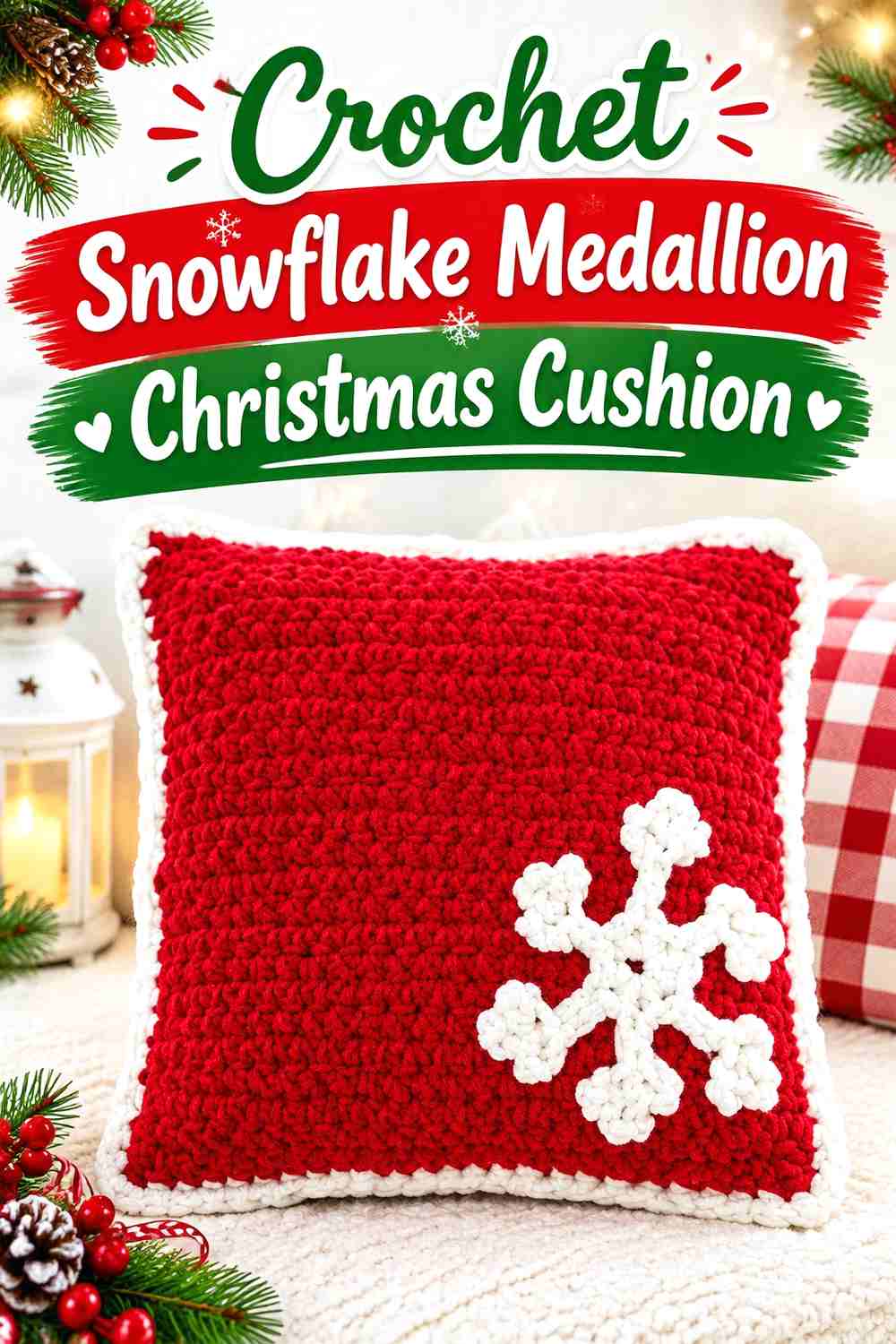
The Crochet Crowd’s snowflake pillow keeps a traditional square cushion format but adds a prominent raised snowflake as the central motif. It is not technically tapestry crochet, yet the single symmetrical medallion can create the same decorative-panel effect as an old woven or embroidered winter cushion.
This option also has a longer display season than overt Santa or elf designs.
A Symmetrical Motif Makes Background Rippling More Obvious
Snowflakes depend on balanced arms and a centered appearance.
Make sure the cushion surface is sitting evenly before deciding that the motif itself needs adjustment. A stretched or rippled background can make a correctly shaped snowflake appear crooked.
Two-Tone Styling Can Make It Feel More Traditional
A cream snowflake against cranberry, muted blue, forest green, or another dark background gives the motif enough contrast to read clearly.
If the raised texture is already strong, you do not need several additional colors around it.
Creator Credit: The Crochet Crowd
7. Crochet Gift-Bow Vintage Christmas Cushion

VivirTejiendo’s Christmas cushion uses a conventional cushion silhouette with a large bow as its main decorative feature. Rather than depicting a character, it resembles a wrapped present, which makes it useful in a vintage collection inspired by old Christmas parcels and ribboned boxes.
The bow introduces dimension while leaving the underlying pillow shape familiar.
Center One Large Motif Carefully
A single bow has nowhere to hide if it sits noticeably off-center.
Place the finished cushion upright and view it from normal room distance before permanently securing a prominent decorative section. The curve of a filled cushion can change how centered an embellishment appears.
Use Old-Paper Colors for a Less Glossy Gift Look
Instead of bright metallic-looking combinations, consider antique cream with burgundy, bottle green with faded gold, or deep red with oatmeal.
The goal is not to reproduce the creator’s exact palette but to use the gift-box construction as the basis for a softer nostalgic scheme.
Creator Credit: VivirTejiendo
8. Crochet Santa-Suit Graphic Christmas Cushion

Entrelanas Sala de Tejido uses a square cushion format with recognizable Santa-suit colors and graphic sections. The design avoids turning the cushion into a full stuffed Santa figure, so it remains closer to a decorative textile panel.
That makes it easy to mix with tartan, stripes, and tapestry cushions in a larger traditional collection.
Straight Costume Bands Need Clean Alignment
A belt or broad color band acts like a ruler across the cushion.
Small tension changes become more visible when a line is supposed to remain horizontal. Check the panel flat before assembly and correct distortion rather than hoping stuffing will disguise it.
Let the Costume Reference Replace a Character Face
The color blocks already communicate Santa.
Leaving the design graphic keeps it closer to vintage textile decor than a heavily embellished face pillow. This also makes it easier to pair with quieter heritage patterns.
Creator Credit: Entrelanas Sala de Tejido
9. Crochet Elf-Collar Vintage Christmas Cushion

Maria’s Blue Crayon’s elf pillow uses square front and back panels plus a collar and button details, turning an elf costume into a decorative cushion without constructing a full character. The source includes both written and video guidance for the pillow.
For a nostalgic interpretation, the costume can be recolored toward darker greens, cream, aged red, and subdued gold.
The Collar Establishes a Clear Top Edge
Unlike a reversible abstract cushion, this design has a definite orientation.
Keep the space immediately below the collar relatively uncluttered so the shape remains easy to recognize when the pillow is partly hidden behind another cushion.
Dimensional Buttons Change How the Pillow Is Used
Raised details add character but can be uncomfortable if somebody regularly leans against the decorated face.
For a display cushion, that may be unimportant. For high-contact seating, consider whether a flatter interpretation of the same color layout better suits the room.
Creator Credit: Maria’s Blue Crayon
10. Crochet Peppermint Swirl Tapestry-Style Cushion

Anita Louise Crochet’s peppermint pillow turns alternating holiday color into a complete circular graphic rather than placing a small candy motif on a square front. The project is stuffed rather than built around a conventional square insert, giving it a noticeably different silhouette from the other graphic cushions.
Although it is not tapestry crochet technically, the repeating spiral has the bold flat-pattern quality of vintage candy packaging and printed Christmas textiles.
A Limited Palette Makes the Spiral Stronger
Two colors are enough to establish the peppermint effect.
For a more antique look, use cream with cranberry or faded red rather than extremely bright white and scarlet, provided your yarn substitution remains compatible with the source project.
Round Cushions Need Even Volume
The graphic can be beautifully worked and still look irregular if the filling is concentrated in one area.
Check the outer circle from several directions while the cushion can still be adjusted. The spiral reads most clearly when the overall form remains balanced.
Creator Credit: Anita Louise Crochet
11. Crochet Nordic Geometric Mosaic Cushion

MOSAIC LOOP’s project is not Christmas-specific. It teaches mosaic crochet through actual pillow constructions, including geometric square designs, making it a strong adaptation base for a Nordic-style holiday cushion rather than an exact seasonal tutorial.
A cream-and-deep-red or oatmeal-and-forest version can provide the patterned background cushion in a vintage Christmas set.
Geometry Can Suggest Christmas Without Literal Motifs
Diamonds, stepped lines, crosses, and repeating blocks already appear at home beside Scandinavian holiday textiles.
This is useful if your room has plenty of figurative decorations and you want the cushions to add pattern without introducing another reindeer or tree.
Two Colors Put More Pressure on Contrast
A mosaic cushion often relies on the relationship between only a small number of shades.
Make sure the pattern remains visible in evening light. Dark red and dark green may both be festive, but against each other their graphic boundaries can become difficult to distinguish.
Creator Credit: MOSAIC LOOP
12. Crochet Stepped Mosaic Christmas Cushion

MJ’s Off The Hook Designs’ Surfside Mosaic Pillow is another non-Christmas source, but its mosaic front, separate back, and tassel finishing provide a useful framework for a more ornamental vintage holiday adaptation. The original project uses a defined geometric mosaic panel rather than pictorial Christmas imagery.
Recoloring the geometry can make it resemble an old woven cushion without altering the source construction itself.
Let the Mosaic Be the Main Christmas Reference
Once worked in burgundy and cream, deep green and oatmeal, or another heritage pairing, a strong geometric repeat often needs no separate appliqué.
Adding trees, bells, and wording over the mosaic would obscure the feature that makes this project distinct.
Decide Whether Tassels Suit Your Vintage Direction
Tassels can make the cushion feel softer and more decorative.
If you are aiming for a tailored needlepoint-like look, the clean mosaic surface may be stronger without additional edge movement. If the room leans toward folk or handmade decor, tassels can reinforce that character.
Creator Credit: MJ’s Off The Hook Designs
13. Crochet Bobble-Sampler Vintage Christmas Cushion
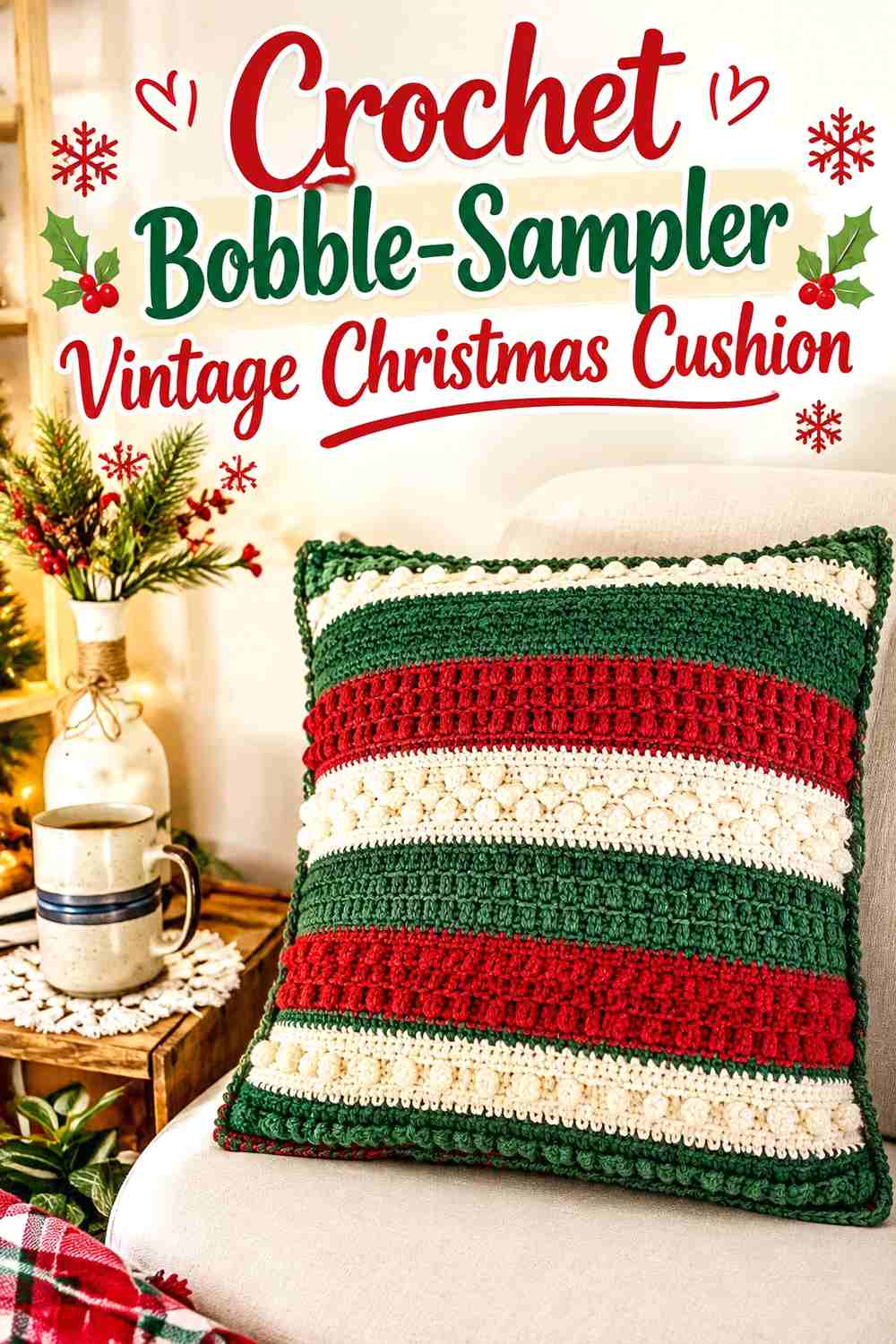
Stephanie Zed’s pillow combines several raised stitch textures—including bobble, puff, and other dimensional sections—rather than forming a picture through colorwork. The tutorial is not Christmas-specific, so this idea uses texture as the tapestry effect and introduces the holiday mood through palette.
A single cream cushion with deep-red accents can resemble an old raised woven textile even without an explicit Christmas image.
Use Texture When Your Sofa Already Has Strong Color
If nearby throws, ornaments, and stockings are already red, green, and patterned, another busy colorwork cushion can overwhelm the arrangement.
A mostly neutral textured pillow gives the eye somewhere quieter to rest while still looking distinctly handmade.
Raised Sections Increase Surface Bulk
Bobbles and puffs make a pillow less flat than conventional tapestry crochet.
That can be attractive on a display cushion, but think about which side people will lean against. A calmer back can make the cushion more comfortable without sacrificing the decorative front.
Creator Credit: Stephanie Zed
14. Crochet Ornament-Mandala Christmas Cushion

Marked Crafters’ round mandala pillow is not a Christmas design, but the radiating geometry offers a useful base for a vintage ornament-inspired adaptation. The tutorial covers the round pillow construction, inner support, and joining of the decorative crochet sections.
In restrained red, cream, green, or faded metallic-like tones, the finished circle can read like an enlarged old glass bauble or embroidered medallion.
Treat the Center Like an Ornament Focal Point
A mandala naturally draws the eye toward the middle.
Place the strongest accent there and allow subsequent rounds to repeat or soften those colors. Constantly introducing new shades can weaken the vintage-ornament effect.
Round Geometry Adds Variety to a Square Cushion Collection
A sofa filled entirely with square Christmas pillows can begin to look rigid.
One circular medallion provides contrast in silhouette while still participating in the same color story.
Creator Credit: Marked Crafters
15. Crochet Granny-Tile Christmas Cushion

Jewels and Jones demonstrates a full granny-square pillow rather than simply showing a loose motif. The project is not inherently Christmas-specific, which makes it a flexible base for a cushion inspired by vintage crocheted blankets and holiday textiles.
A controlled red, dark green, cream, and muted gold arrangement can make classic granny construction feel deliberately seasonal without requiring a pictorial motif.
Limit the Palette to Keep Granny Crochet From Becoming Scrap-Like
The vintage effect here comes from the motif structure, not from using every leftover color available.
Choose a small group of shades and repeat them according to a simple rule. Consistency makes the cushion easier to combine with true tapestry pieces elsewhere on the sofa.
Motif Scale Changes the Overall Character
Larger color areas create a bolder, simpler result, while frequent changes make the surface busier.
If the rest of your Christmas decor already includes detailed prints, keeping the granny arrangement relatively broad can prevent the cushion set from becoming visually crowded.
Creator Credit: Jewels and Jones
16. Crochet Folk-Geometry Tapestry Cushion

Red Heart Yarns’ tutorial teaches colorwork and tapestry crochet through a Southwest-inspired pillow and throw rather than a Christmas project. That makes it an adaptation source, but it is especially valuable here because the underlying technique and geometric cushion format are genuinely tapestry based.
Changing the palette to cranberry, evergreen, cream, brown, and muted gold can shift the same type of graphic construction toward a folk-style Christmas textile without pretending the source contains seasonal motifs.
Geometric Tapestry Can Outlast December
Unlike a Santa or peppermint image, a restrained folk pattern can remain useful through the rest of winter.
That makes it a good choice when you want handmade Christmas atmosphere without storing every decorative cushion immediately after the holidays.
Keep the Adaptation to Color Rather Than Rebuilding the Pattern
The source’s geometry is already the defining design.
Use holiday colors to change the mood instead of attempting to merge in unrelated Christmas charts or creator-specific motifs from another pattern. A single coherent construction usually looks more intentional and is easier to execute accurately.
Creator Credit: Red Heart Yarns
Which Vintage Christmas Tapestry Cushion Style Should You Choose?
| If you want… | Consider… |
|---|---|
| True pictorial tapestry crochet | #1 |
| Repeating Nordic evergreen imagery | #2 |
| A flatter charted tree composition | #3 |
| Traditional holiday fabric without a picture | #4 |
| Strong retro diamonds | #5 |
| A raised winter medallion | #6 |
| Vintage gift-box styling | #7 |
| Graphic Santa color blocking | #8 |
| Costume-inspired Christmas detail | #9 |
| A bold round candy graphic | #10 |
| Nordic-style abstract geometry | #11 |
| A structured mosaic plus optional tassels | #12 |
| Mostly neutral raised texture | #13 |
| A round ornament-like focal cushion | #14 |
| Classic handmade granny nostalgia | #15 |
| True tapestry technique without literal Christmas imagery | #16 |
For the closest match to a traditional Christmas tapestry cushion, start with the reindeer, tricolor evergreen, or three-tree projects. Their motifs are incorporated directly into the decorative fabric and remain relatively flat.
The plaid, harlequin, Nordic mosaic, stepped mosaic, and folk-geometry cushions suit rooms where you want Christmas color without another literal holiday character. These designs can also sit comfortably beside patterned quilts and vintage-style throws.
The snowflake, bow, elf, and textured sampler options introduce more dimension, while the peppermint and mandala projects change the cushion silhouette entirely. Granny tiles provide the loosest, most homespun interpretation of the nostalgic textile idea.
Conclusion
If your goal is a sofa that looks collected over many Christmases, avoid making all 16 cushions follow the same formula.
Use one or two strong pictorial pieces—such as the reindeer or evergreen trees—then surround them with plaid, harlequin, mosaic, granny, or textured cushions. That creates the visual rhythm of a room assembled gradually rather than a coordinated retail set.
For the most authentic tapestry emphasis, prioritize dense colorwork and geometric patterns. For a softer handmade look, introduce one raised snowflake, bow, bobble surface, or granny cushion. Round peppermint and mandala pieces can then break up a row of square pillows if you want a more playful arrangement.
Whichever source you choose, settle the cushion dimensions and fabric behavior before final assembly. Check colorwork tension, motif readability, insert fit, surface bulk, laundering requirements, and how much storage the finished cushion will need. Use the original creator’s tutorial for the exact crochet construction and treat vintage palette changes and styling adaptations as separate design decisions.
Frequently Asked Questions
Is tapestry crochet the same as mosaic crochet for Christmas cushions?
No. Tapestry crochet generally forms images by working with multiple colors within the fabric and carrying unused yarn as needed. Mosaic crochet creates patterns through a different stitch-placement system, often working one main color at a time. Both can produce strong graphic cushions, but their fabric and construction behave differently.
How do I keep a tapestry crochet cushion from narrowing around the motif?
Watch how tightly the unused color is carried and lay the panel flat regularly. If the colorwork section is visibly narrower than the plain fabric above or below it, address the tension before continuing. Follow the specific creator’s method because different colorwork techniques handle unused yarn differently.
Which vintage Christmas colors work well besides bright red and green?
Cranberry, brick, burgundy, bottle green, olive, antique cream, oatmeal, dusty blue, tobacco brown, charcoal, and muted gold can create a softer nostalgic palette. Make sure the motif and background still have enough contrast to remain readable.
Is a removable cushion cover better for Christmas decor?
It can be more convenient if storage space is limited because an empty cover takes up less room after the holidays. Permanently stuffed cushions are useful when their round or sculptural shape is essential to the design. Choose based on the project construction and how you intend to store it.
Can I use a fabric back with a crochet tapestry front?
Possibly, if the project and your sewing skills support that construction. A fabric back can reduce crochet work and create a thinner reverse side, but it introduces different stretch and finishing considerations. Do not assume a fabric-backed method from one designer can simply replace the assembly of another pattern.
Can I combine several Christmas charts from different designers on one cushion?
It is better to use one established project construction and make your own permissible color decisions rather than combining creator-specific charts, stitch sequences, or assembly methods. Separate motifs can also have different dimensions and edge structures even when they look compatible online.
Are bells, buttons, or other dimensional decorations suitable for every Christmas cushion?
No. They can snag, affect comfort, or become loose components. If young children or pets will have access to the cushion, consider whether small detachable embellishments are appropriate. A flat colorwork version is often more practical for high-contact seating.