A stack of cushions already belongs in a cozy reading corner, so giving those cushions the look of oversized books is a natural way to push the theme further. Think clothbound covers, contrasting “page” sections, raised vintage-style texture, library-inspired color blocks, or several differently sized cushions arranged like novels waiting beside your chair.
There is an important distinction to make before choosing a project. Strong public crochet tutorials for literal, large book-stack cushions are limited. Rather than pretending every source below is an exact book-shaped pattern, this collection combines genuinely bookish reading pillows with well-matched cushion constructions that can be adapted into book-inspired forms.
That means the original tutorial remains your source for construction, stitch work, closures, and finishing. The book-stack treatment comes from independent planning: choosing rectangular proportions where the construction allows adjustment, separating cover and page colors, positioning texture like a decorative book binding, or stacking several compatible cushions.
Quick List
- Crochet Book Lover Pocket Stack Cushion
- Crochet Minimal Hardcover Book Stack Cushion
- Crochet Embossed Vintage Book Stack Cushion
- Crochet Removable Dust-Jacket Book Cushion
- Crochet Mosaic Library Book Stack Cushion
- Crochet Patchwork Paperback Stack Cushion
- Crochet Cabled Heirloom Book Stack Cushion
- Crochet Gingham Clothbound Book Stack Cushion
- Crochet Christmas Plaid Book Stack Cushion
- Crochet Long Encyclopedia Book Cushion
- Crochet Striped Library Spine Stack Cushion
- Crochet Floral Storybook Stack Cushion
- Crochet Bobble-Diamond Book Stack Cushion
- Crochet Fabric-and-Crochet Hardcover Cushion
- Crochet Graphic Black-and-White Book Stack Cushion
- Crochet Boho Raised-Texture Book Stack Cushion
- Crochet Mixed-Binding Book Stack Cushion Set
- Crochet Oversized Granny Book Stack Cushion
- Crochet C2C Color-Block Book Stack Cushion
Plan the “Books” Before You Crochet the Cushions
A convincing book-stack cushion does not require complicated lettering or detailed appliqué. Shape and color placement often do more of the work.
A rectangular cushion naturally reads more like a closed book than a square one. A contrasting strip along three sides can suggest pages, while a darker band along one long edge can suggest the spine. If you are adapting a square tutorial, first determine whether its stitch repeat and construction can reasonably be resized rather than changing the proportions blindly.
A stack also looks more believable when the cushions are not identical. One can be longer, one slightly thicker, and another narrower. You can also turn alternate “books” so their spines face different directions.
Decide Whether You Want Separate Books or One Stack Illusion
There are two practical ways to approach this theme.
The first is to crochet several individual cushions and stack them. This creates the clearest three-dimensional book effect and lets each cushion have a removable cover, different texture, or different size.
The second is to make one conventional cushion and use horizontal color bands to create the illusion of several books. That takes up less room and is easier to move around, but it will look more graphic than sculptural.
For a reading nook that will actually be used for leaning or lounging, comfort should decide which method wins. Very raised bobbles, cables, buttons, and decorative joins may look convincing as bookbinding details but can be better placed toward the edges rather than directly behind the reader.
Choose Inserts Before Enlarging a Tutorial
When adapting a conventional pillow into a book-inspired cushion, decide on the finished dimensions before changing the crochet.
A purchased rectangular insert gives you a fixed target and makes removable covers particularly practical. Stuffed constructions allow more freedom, but the finished depth depends on both the crochet shell and the amount of filling.
Do not assume that changing hook size will automatically turn a square pillow into the rectangular “book” you want. Check the tutorial’s stitch repeat, crochet a sample where appropriate, and measure the developing panels against your intended insert.
1. Crochet Book Lover Pocket Stack Cushion
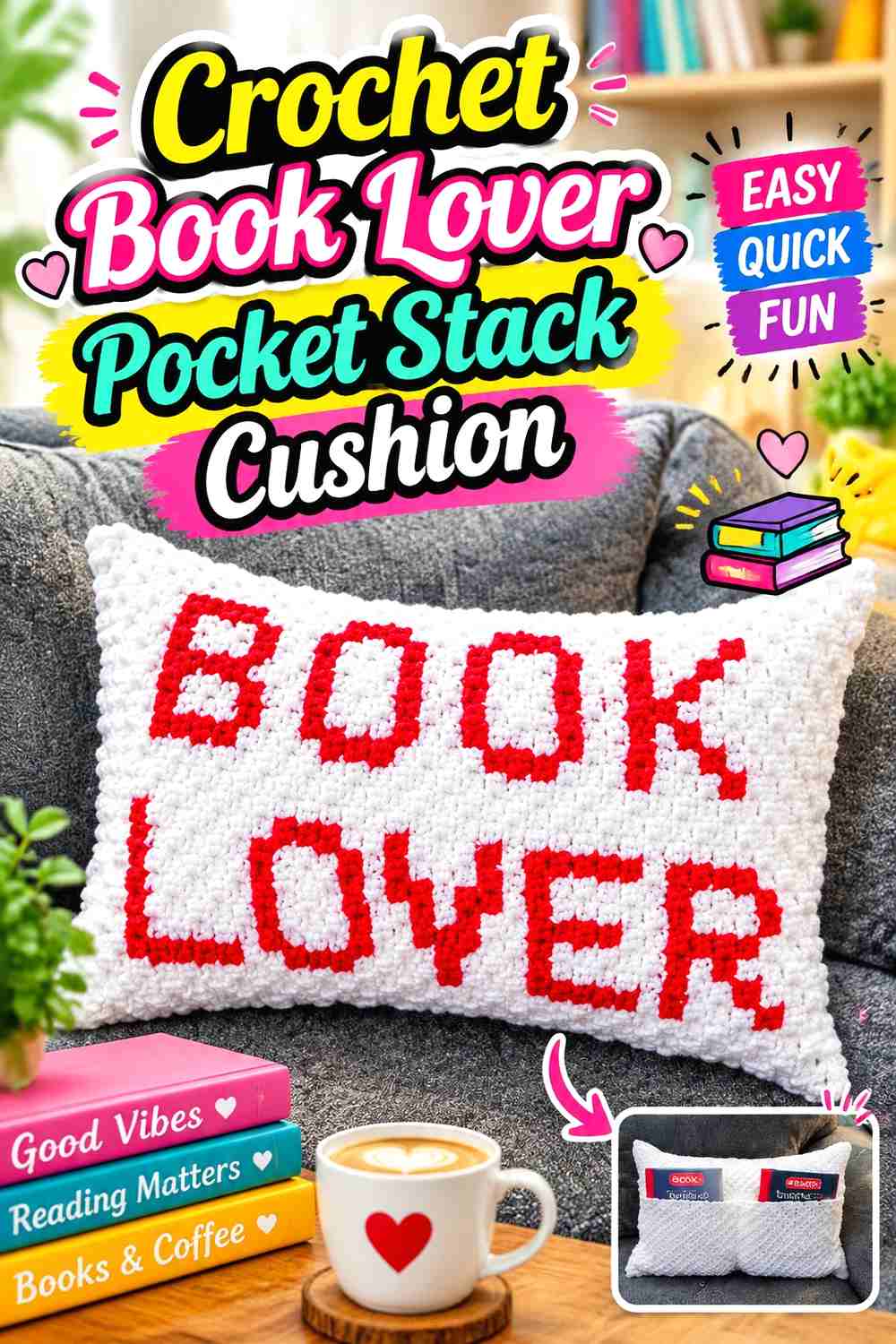
This is the most explicitly bookish starting point in the collection. Nicki’s Homemade Crafts has a C2C reading pillow designed around the words “book lover,” with pockets incorporated for storing books or notebooks. Its source design fits a rectangular pillow form, which already brings it closer to the proportions of a large book than many conventional square cushions.
For a book-stack nook, this could serve as the top “volume,” where an actual current read sits in the pocket while plainer book-inspired cushions form the stack below.
Let the Pocket Remain Functional
Do not let extra decorative book-spine details block the pocket opening. If this cushion is going to hold the reader’s current novel, notebook, or journal, easy access matters more than making every inch look like a literal book.
A simpler lower section can create the visual impression of a cover without interfering with the storage feature.
Use the Rectangular Shape to Your Advantage
Instead of forcing every cushion in the stack to match, let this longer form become the largest book. Place smaller square or rectangular cushions above it to create the slightly uneven silhouette of a real stack.
Before combining it with other designs, compare actual finished measurements rather than judging size from photographs.
Creator Credit: Nicki’s Homemade Crafts
2. Crochet Minimal Hardcover Book Stack Cushion
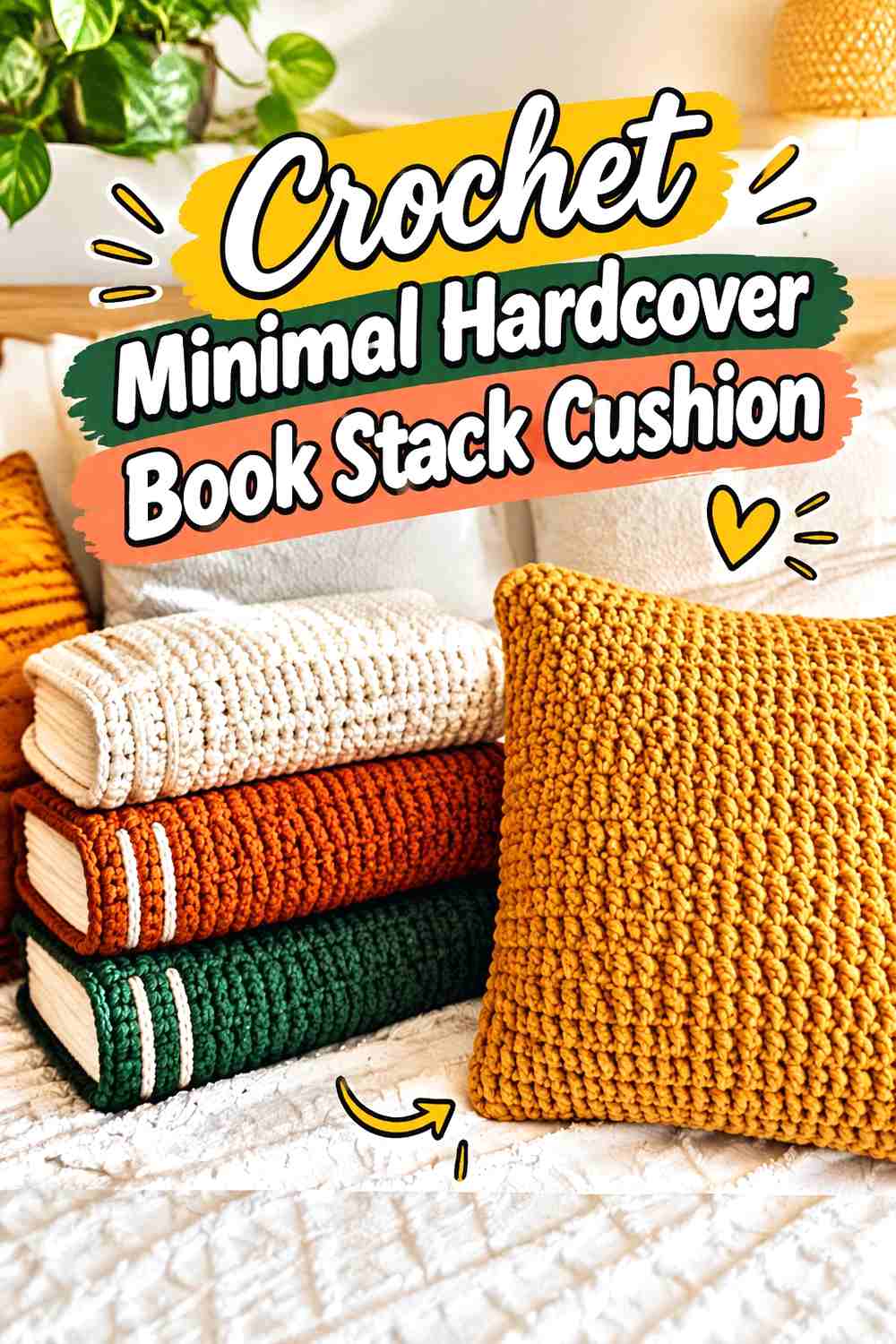
Danii’s Ways demonstrates a straightforward cushion made around a conventional insert. Its uncluttered construction makes it a useful base when you want the book illusion to come primarily from proportion and color instead of elaborate surface decoration.
For a winter nook, imagine several solid “hardcovers” in forest green, burgundy, navy, camel, or cream rather than one heavily decorated pillow.
Make the Cover and “Pages” Visually Different
A closed hardcover has a clear relationship between its cover and page block. You can evoke that without copying a real book by reserving one shade for the main outer surface and using a lighter neutral selectively where the pages would visually sit.
Do your color planning before altering the tutorial so seams and joins do not accidentally interrupt the effect.
Keep the Simplest Cushion in the Most-Used Position
If the stack doubles as real back support, a relatively flat surface is often more practical than raised embellishments.
Use heavily textured “books” as accent layers while keeping a smoother volume where the reader’s back, arm, or head will make the most contact.
Creator Credit: Danii’s Ways
3. Crochet Embossed Vintage Book Stack Cushion
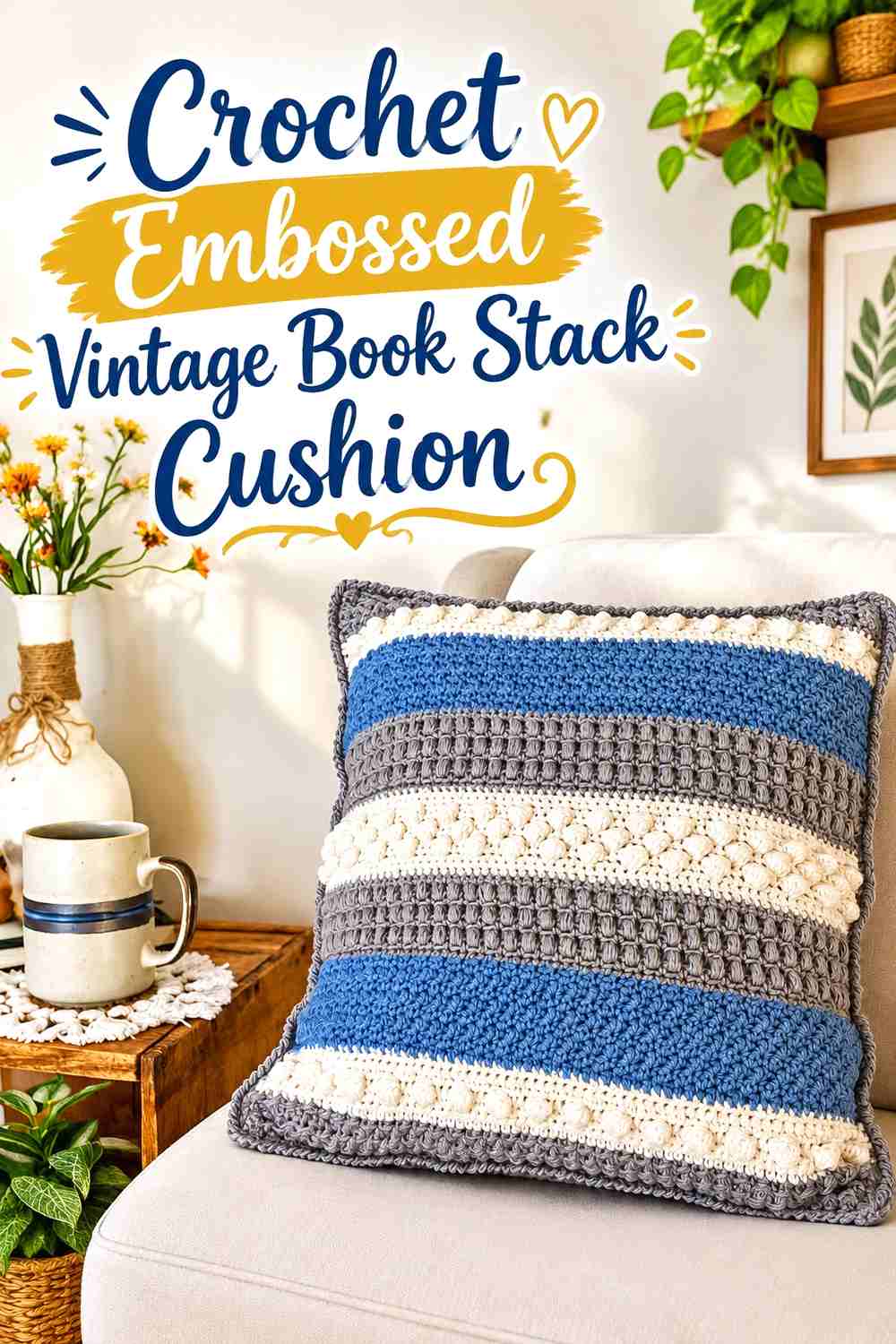
Stephanie Zed’s pillow brings several crochet textures into a single surface, including bobble, puff, and other raised sections. That variety provides a strong reference for a cushion inspired by embossed antique book covers.
Instead of treating every texture as a separate decorative stripe, you could visually organize the surface like the framed panels often seen on traditional bindings.
Raised Texture Works Better as “Binding” Than “Pages”
A book’s pages are visually repetitive and relatively smooth. Save the strongest texture for the cover or spine area and keep any page-colored portion quieter.
That contrast helps the book idea read more clearly and avoids making every surface equally busy.
Check Comfort Before Covering the Whole Front
Bobbles and puffs can be noticeable under pressure. If this cushion will be leaned against for hours, place the most pronounced texture toward the perimeter or make the reverse side smoother.
A reversible reading-nook cushion can give you decorative detail when displayed and a calmer side when in use.
Creator Credit: Stephanie Zed
4. Crochet Removable Dust-Jacket Book Cushion
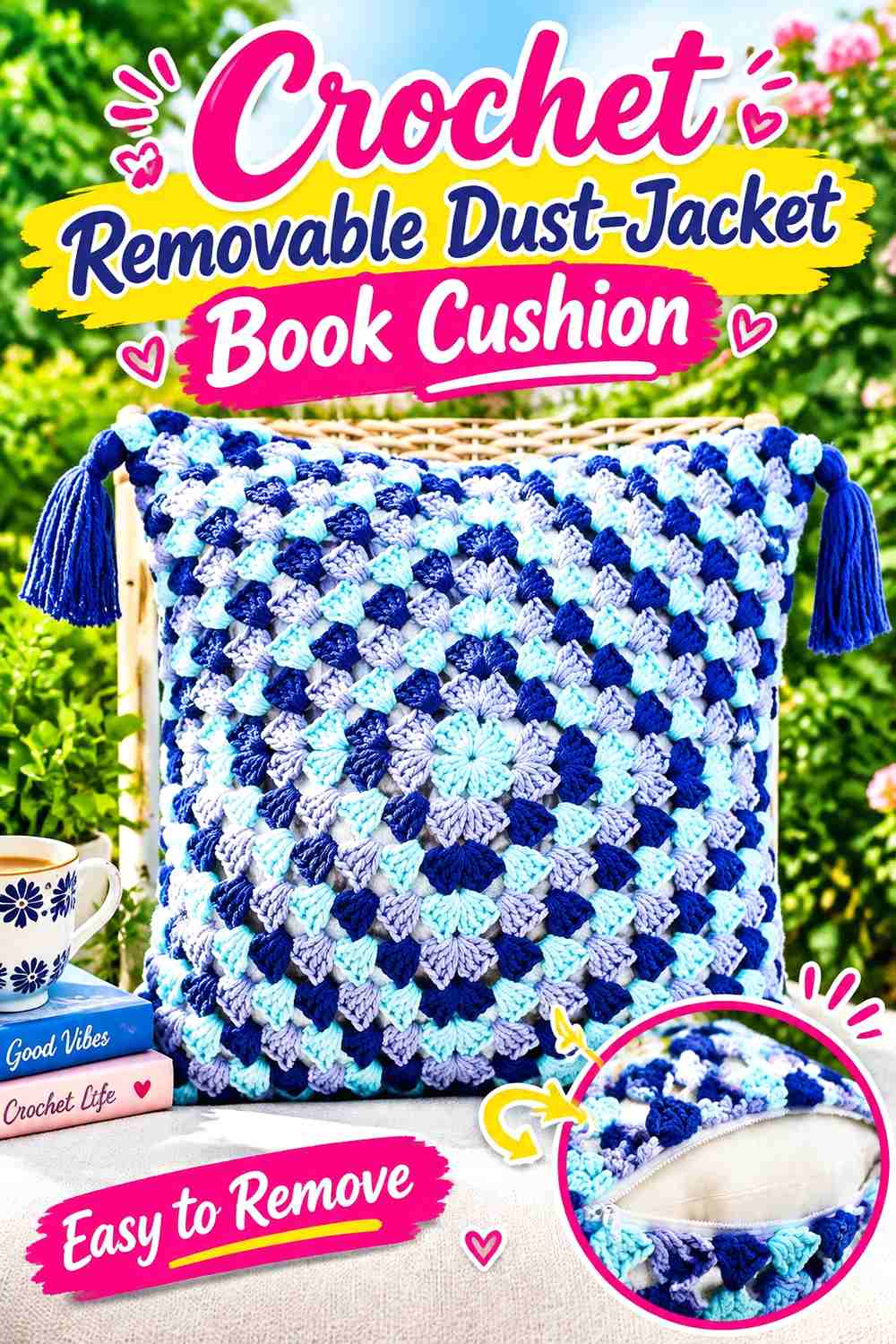
Professora Simone Eleotério demonstrates an envelope-style crochet cushion. The overlapping back provides a useful construction reference when you want the insert removable rather than permanently enclosed.
That makes this a strong candidate for a “dust-jacket” book cushion: the crochet exterior becomes a removable book cover surrounding the softer insert.
A Removable Cover Makes Seasonal Changes Easier
Winter may call for deep reds, greens, dark blues, or warm neutrals, but you may not want the same palette in spring.
An envelope-style opening lets you change the crochet exterior without buying another insert. That is particularly useful when the reading nook already contains several cushions.
Keep the Opening Away from the Main Display Edge
If the cushion is supposed to resemble a closed book, decide which edge represents the spine before positioning the piece in the nook.
The envelope opening can remain on the reverse side so it does not interrupt the book-cover illusion.
Creator Credit: Professora Simone Eleotério (Lifebaby Sapatinhos)
5. Crochet Mosaic Library Book Stack Cushion
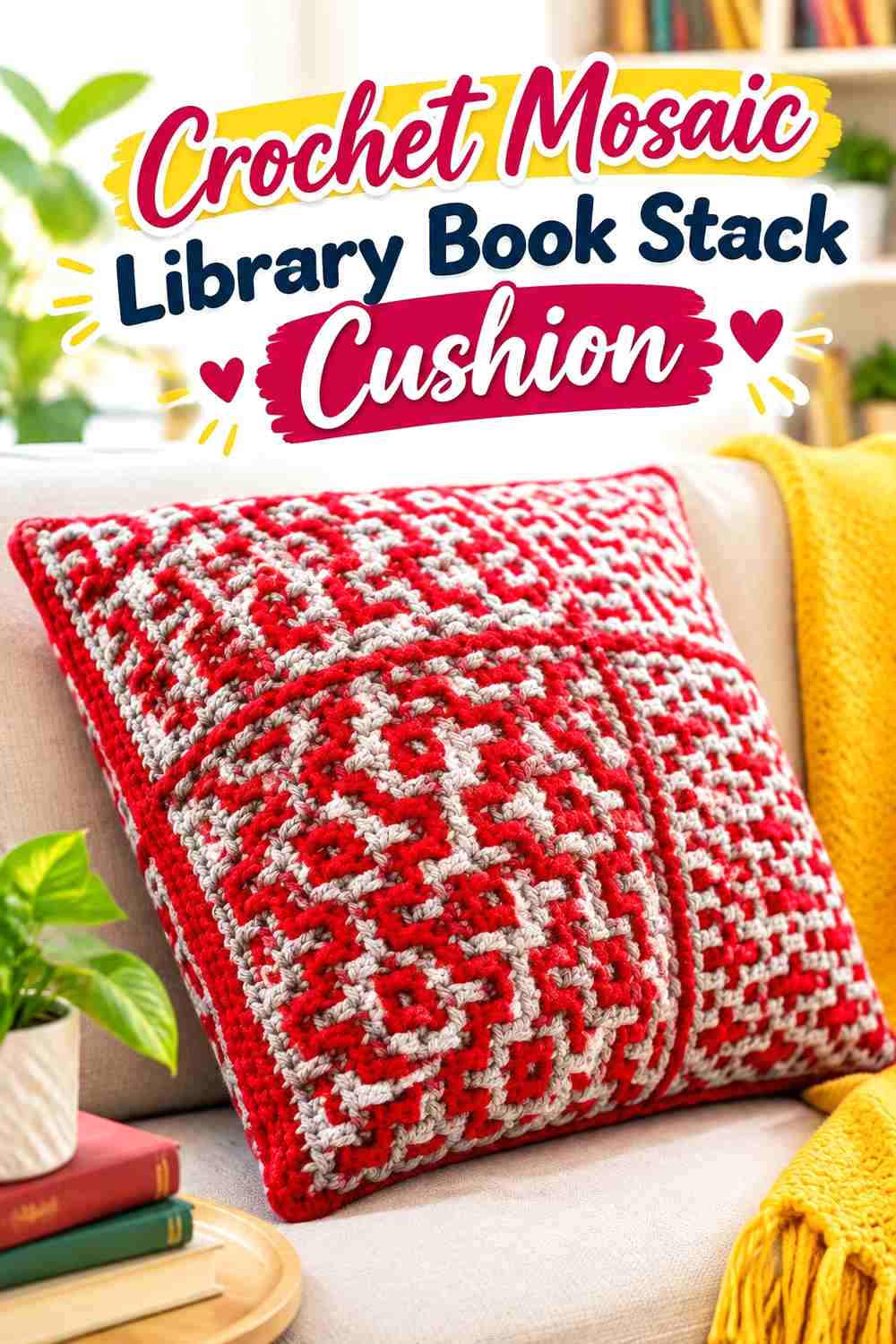
MOSAIC LOOP demonstrates both square and cylindrical pillow construction while showing how mosaic patterns change the surface. The square option is the more natural base for this book-stack adaptation because the geometric colorwork can become decorative “binding” across the cushion face.
This direction works especially well if you want the nook to look like a collection of ornate library editions rather than modern paperbacks.
Geometric Bands Can Suggest Decorative Spines
You do not need readable titles on every cushion. A repeating mosaic band placed where a spine label or decorative border might appear can communicate the old-library theme without literal text.
Keep enough plain area around the pattern so the design remains legible from across the room.
Do Not Resize a Mosaic Repeat Casually
Colorwork depends on its stitch repeat. If you need a longer book-shaped panel, check how the pattern repeat fits into the new dimensions before beginning.
A badly interrupted motif will be much more noticeable on a geometric design than on a plain pillow.
Creator Credit: MOSAIC LOOP
6. Crochet Patchwork Paperback Stack Cushion
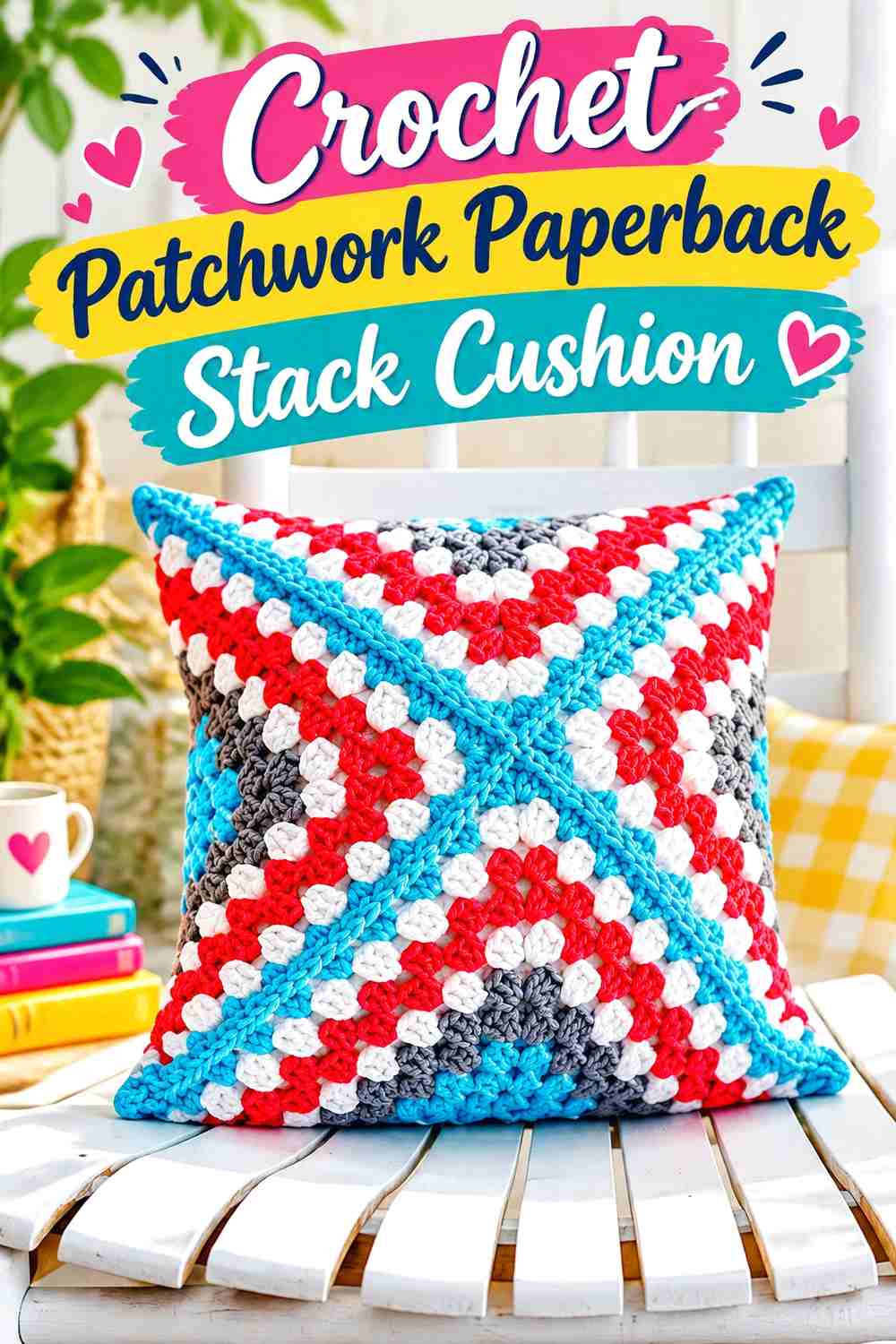
B.Hooked Crochet’s retro granny-square pillow uses joined motifs to build the cushion face. That construction creates an entirely different book-stack look: instead of one formal hardback, it can resemble a colorful pile of worn paperbacks or illustrated editions.
The joins themselves become part of the finished appearance, so this option suits a nook where visible handmade structure is a feature rather than something to hide.
Plan Motif Placement Before Joining
If several granny squares represent different book covers or spines, arrange the completed motifs on a flat surface first.
Look for accidental clusters of the same color and decide which edge will be viewed as the book spine before making the arrangement permanent.
Blocked Motif Size Controls the Final Cushion
A granny-square cushion depends on the motifs fitting together cleanly.
Measure them after blocking and correct obvious size differences before joining. Trying to force uneven motifs into a rigid book-like rectangle can distort the outer edges.
Creator Credit: B.Hooked Crochet
7. Crochet Cabled Heirloom Book Stack Cushion
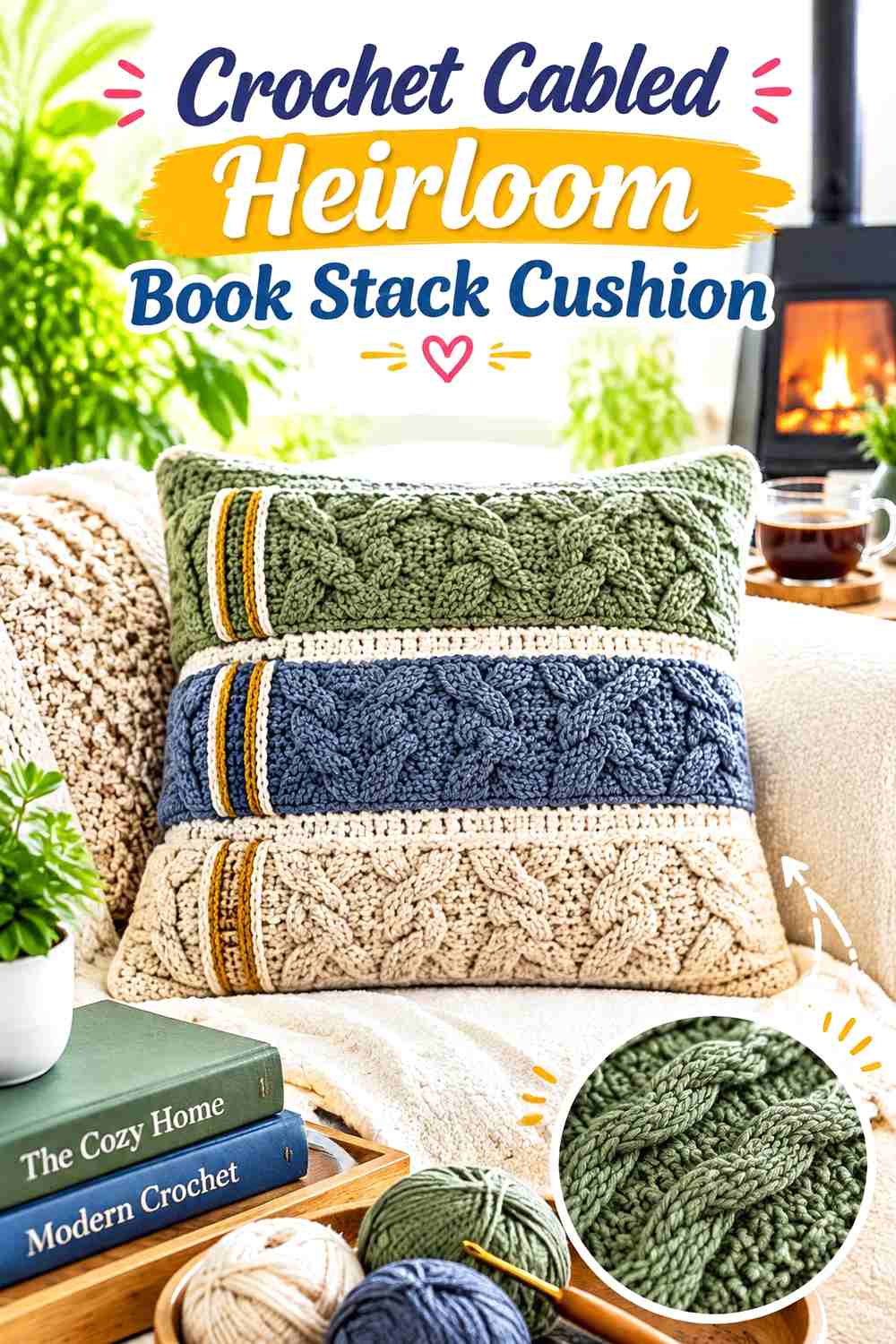
MJ’s Off The Hook Designs demonstrates a substantial cable-front pillow with overlapping back panels for the insert. The raised central cable provides a natural reference for an ornate leather-bound-book effect.
One richly textured “volume” can be enough to give an otherwise simple cushion stack a historic library feel.
Let One Cable Become the Statement Detail
If every book in the pile has elaborate cables, the stack can become visually heavy. Use the cabled cushion as the heirloom edition and surround it with flatter, quieter “books.”
A single vertical or central decorative area can function visually like embossed spine ornamentation.
Consider Which Side the Reader Will Lean Against
Deep cables create substantial relief. They may suit a displayed front or side better than the surface directly supporting a reader’s head.
The removable construction gives you more flexibility to rotate or reverse the cushion according to use.
Creator Credit: MJ’s Off The Hook Designs
8. Crochet Gingham Clothbound Book Stack Cushion
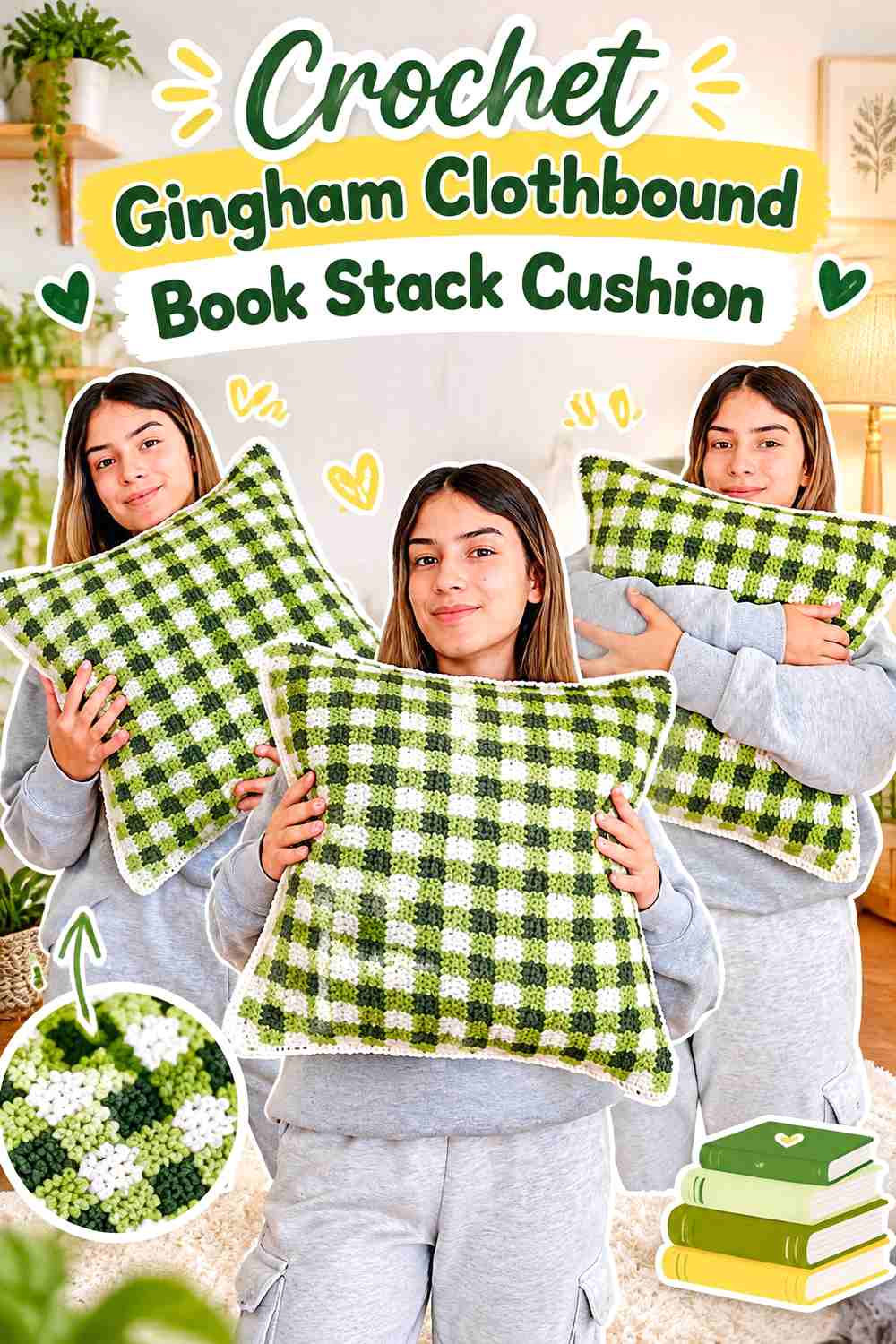
The gingham pillow from crochet daniela uses repeating color blocks to create a textile-like check. The demonstrated pillow is square, so a book-stack version should be treated as an adaptation rather than an exact reproduction.
Its main strength is the clothbound effect: gingham can make an oversized “book” feel softer and more cottage-inspired than a formal library volume.
Preserve the Check Proportions When Changing Shape
Turning a square cushion into a rectangle changes how many color blocks fit across the surface.
Sketch the intended grid before crocheting so the final design still looks intentionally checked rather than like a partial pattern cut off at the ends.
Use This Design to Break Up Solid-Color Books
In a stack of burgundy, green, navy, and cream cushions, one gingham volume adds pattern without relying on raised texture.
It works particularly well toward the top of the stack where the checks remain visible.
Creator Credit: crochet daniela
9. Crochet Christmas Plaid Book Stack Cushion
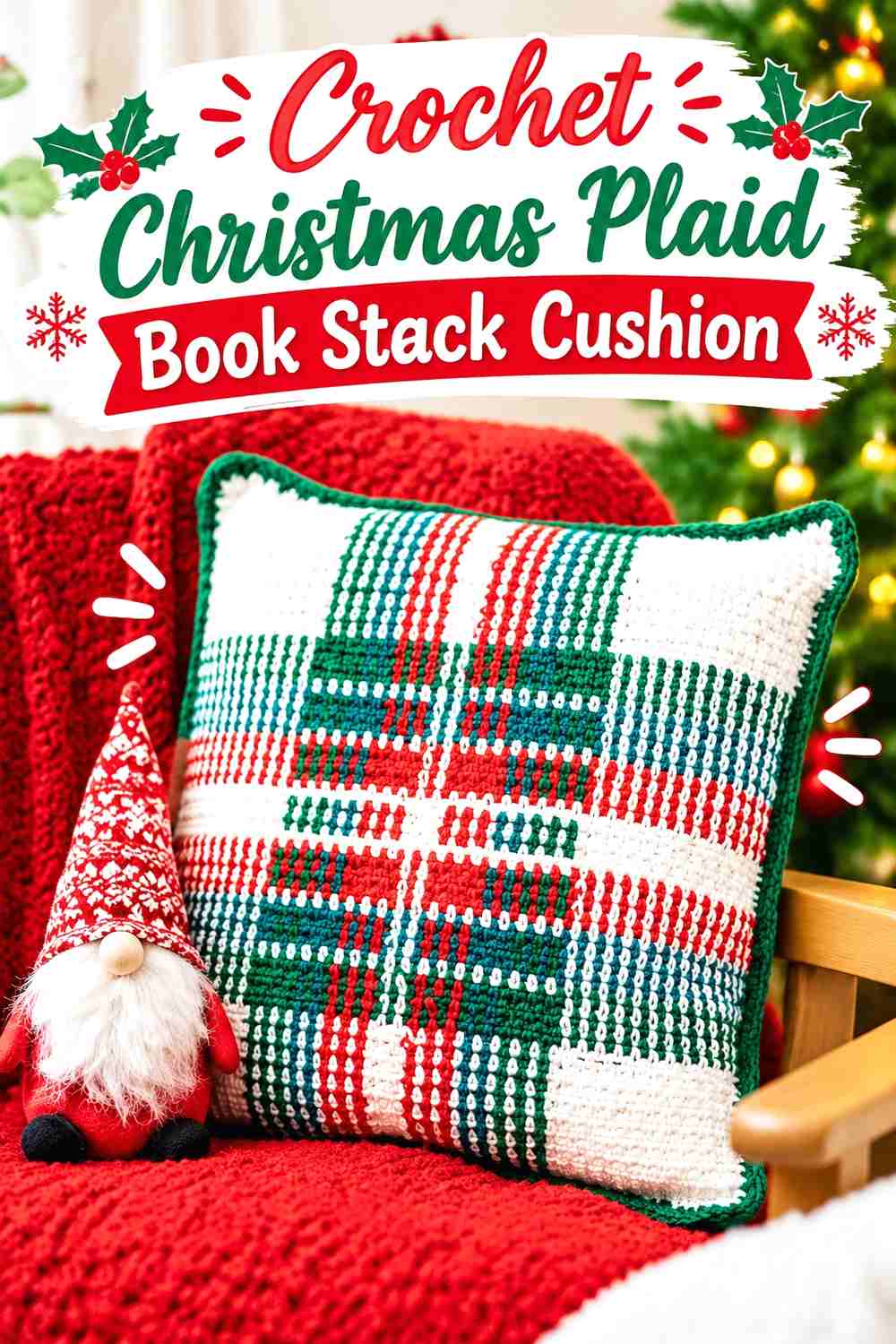
Just Be Crafty’s plaid pillow is especially suited to the winter part of this theme. The tutorial uses crochet color changes to create a holiday plaid surface, making it an obvious candidate for a Christmas-classics-inspired cushion.
You can keep it overtly festive or shift the colors toward muted tartan shades for a cushion that remains useful after December.
Plaid Needs Color Planning Before the First Row
Unlike a solid cushion, changing one shade can alter the entire relationship between stripes.
Choose the palette as a group and consider making a small sample before committing to a large rectangular adaptation.
One Plaid “Book” Is Usually Enough
Plaid is visually assertive. In a stack, use it as the holiday edition among quieter solid or textured cushions rather than repeating the same pattern on every volume.
That gives the reading nook a seasonal focal point without overwhelming the rest of the decor.
Creator Credit: Just Be Crafty
10. Crochet Long Encyclopedia Book Cushion
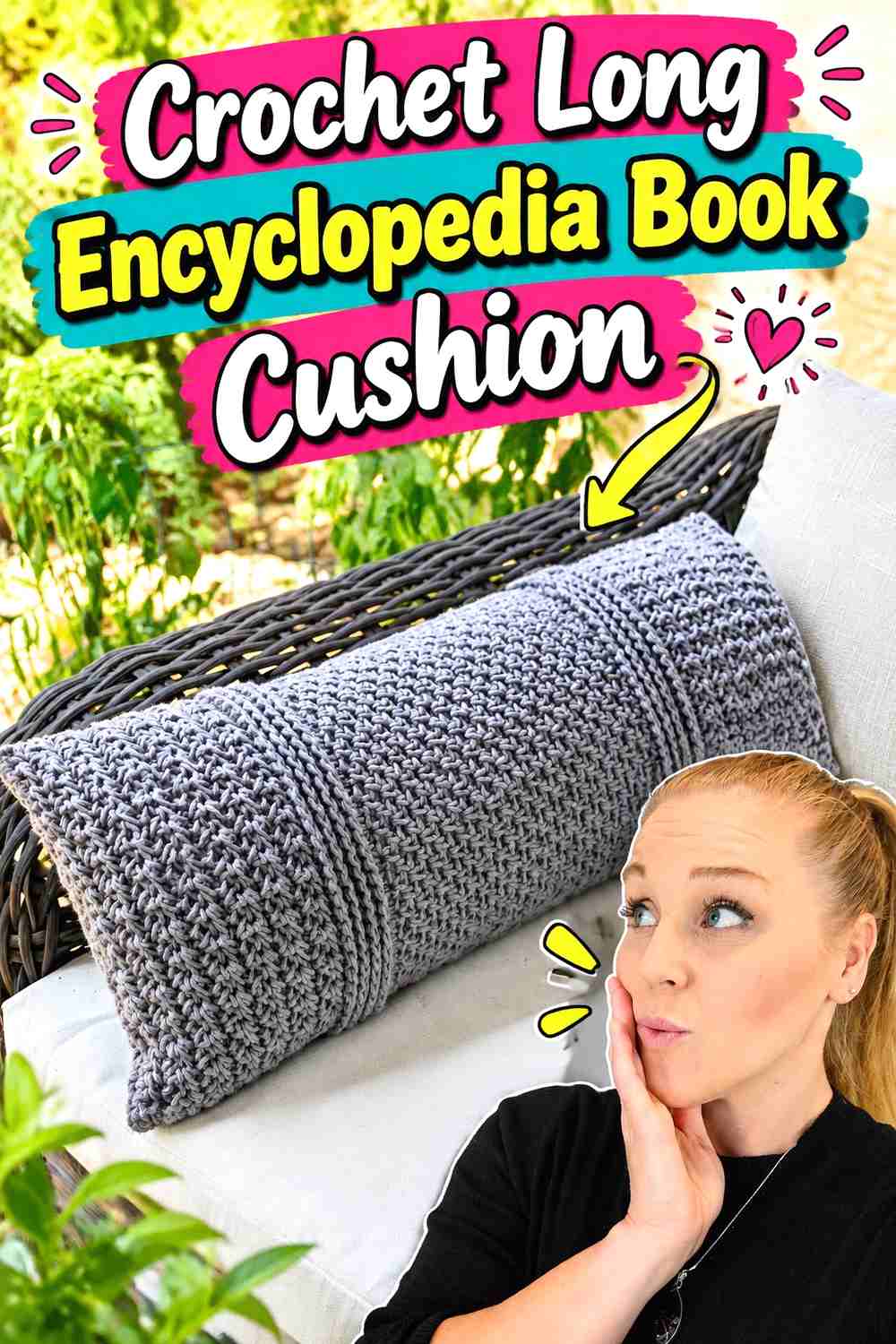
Crochet With Tiffany demonstrates a long rectangular pillow designed around a lumbar form, making this one of the easiest source shapes to reinterpret as an oversized horizontal book.
Because the proportions already resemble a wide volume, you can concentrate on styling rather than trying to convert a square construction into a rectangle.
Use the Longest Cushion as the Bottom Book
A convincing stack usually looks more stable when the widest volume sits low.
Place this cushion beneath shorter book-inspired pillows and let the ends extend beyond them slightly, just as a large reference book might beneath smaller novels.
Mixed Stitch Sections Can Become Binding Panels
The source uses more than one stitch texture, which can help divide the long surface visually.
Instead of adding arbitrary stripes, decide which section represents the spine decoration, main cover, or page area and keep that logic consistent across both sides.
Creator Credit: Crochet With Tiffany
11. Crochet Striped Library Spine Stack Cushion
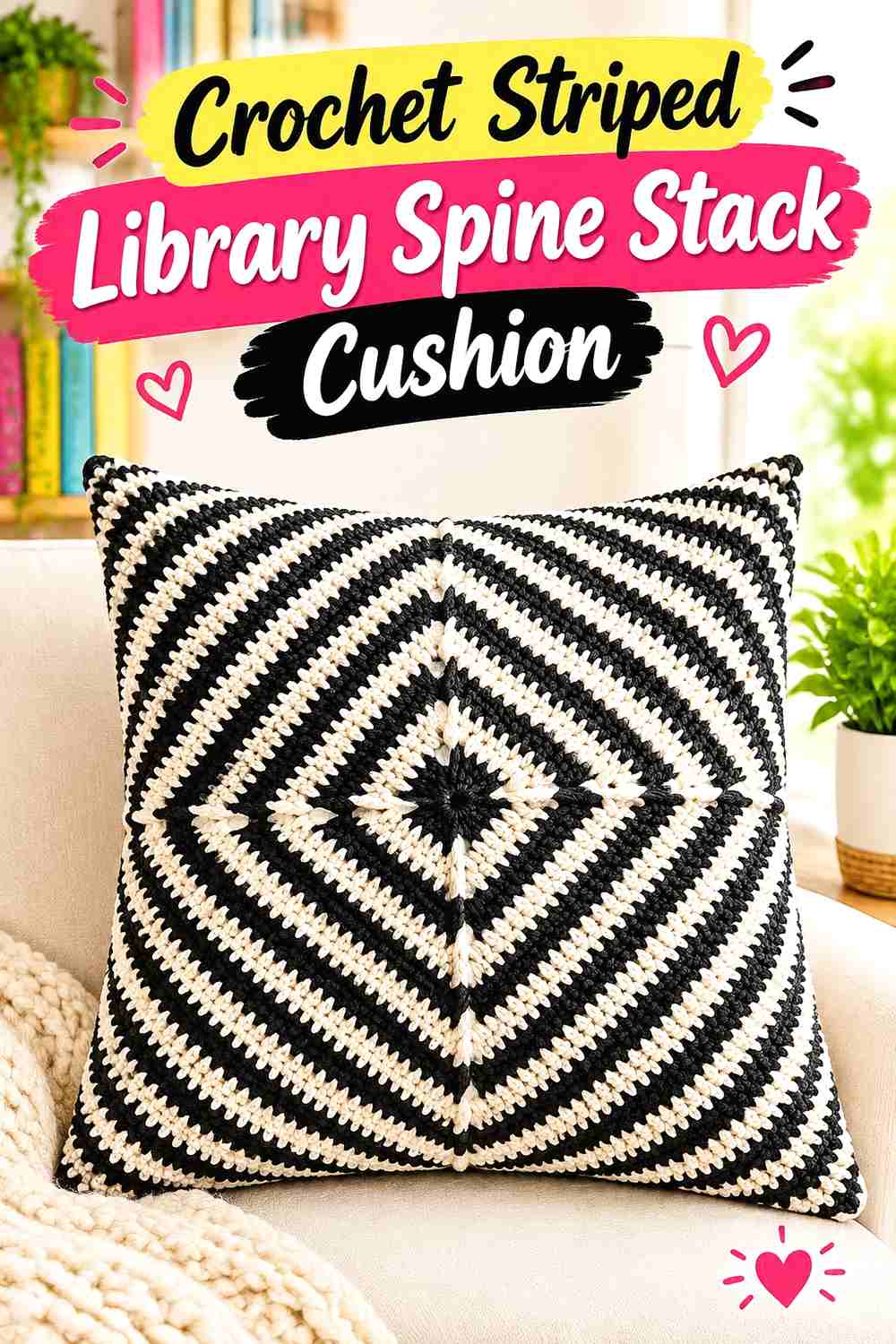
The Crochet Crowd demonstrates a pillow built around strong linear color changes. That directional look can be adapted into the illusion of several narrow book spines lined up across one cushion face.
This is a useful route when you want the appearance of multiple books but only have room for one pillow.
Change Stripe Widths to Avoid a Perfectly Uniform Shelf
Real book collections rarely contain volumes of identical thickness.
If the underlying stitch pattern permits your planned color changes, vary the visual width of the “spines” while keeping the cushion construction itself intact.
Repeat a Neutral Shade to Tie the Books Together
A shared cream, tan, gray, or dark border can make many colors feel like one intentional set.
That is particularly useful in a small reading nook where too many unrelated shades can make the corner look cluttered.
Creator Credit: The Crochet Crowd
12. Crochet Floral Storybook Stack Cushion
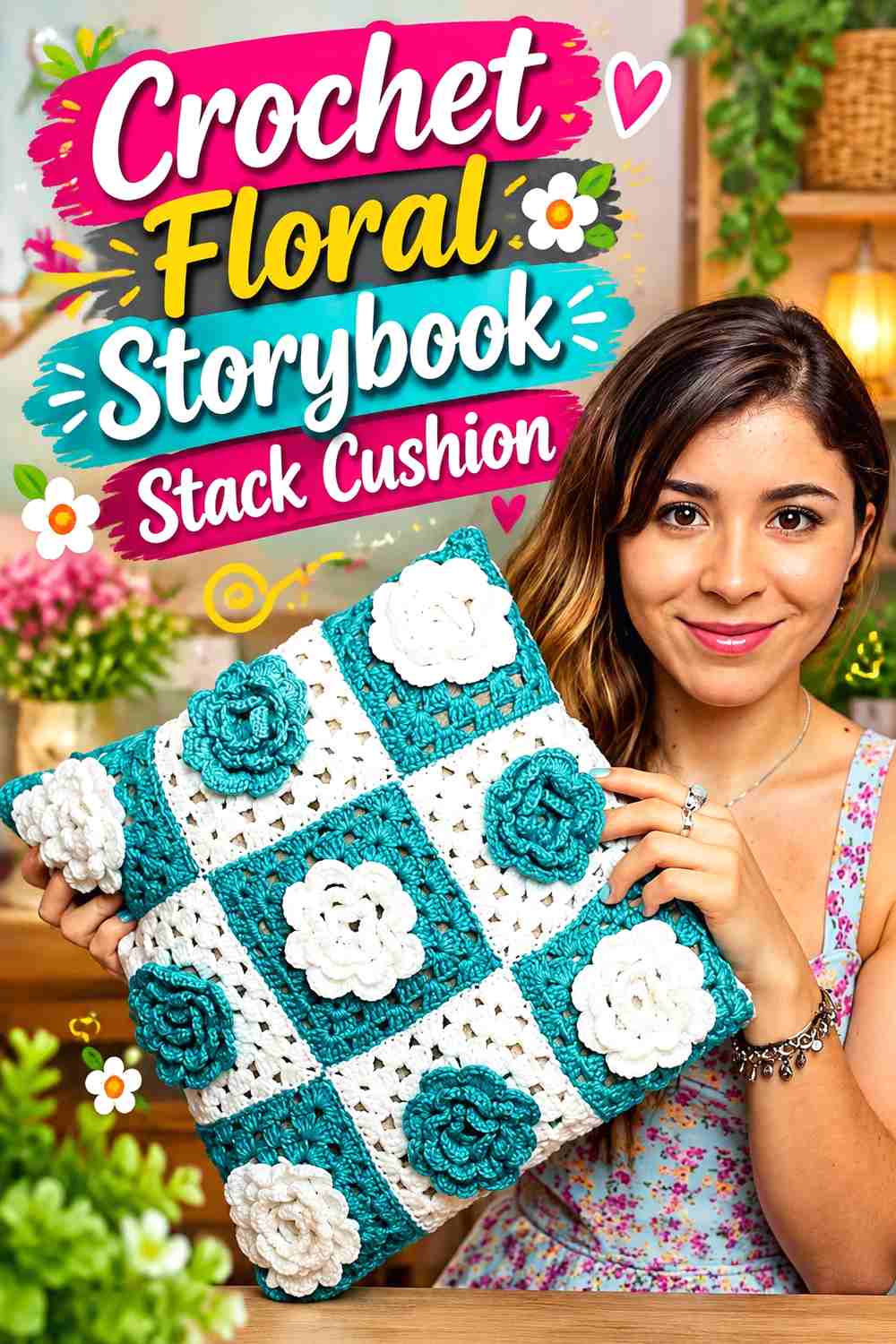
Brunaticality’s cushion cover incorporates crochet flowers, creating a softer decorative direction than the cable, plaid, or mosaic options. The floral elements can inspire a “storybook cover” cushion rather than a realistic library volume.
This type of book-inspired cushion works well at the top of a stack, where the decorative face remains visible rather than being hidden beneath other pillows.
Keep Dimensional Flowers Away from High-Pressure Areas
Raised floral pieces can flatten or feel bulky if the cushion is constantly leaned on.
Position the most decorative side outward when the cushion is displayed and use another volume for primary back support.
Use a Restrained Background to Keep the Book Shape Visible
If the flowers, background, borders, and page area all use strong competing colors, the rectangular book form can disappear.
A calmer main shade helps the floral decoration read as a cover embellishment rather than an all-over collage.
Creator Credit: Brunaticality
13. Crochet Bobble-Diamond Book Stack Cushion
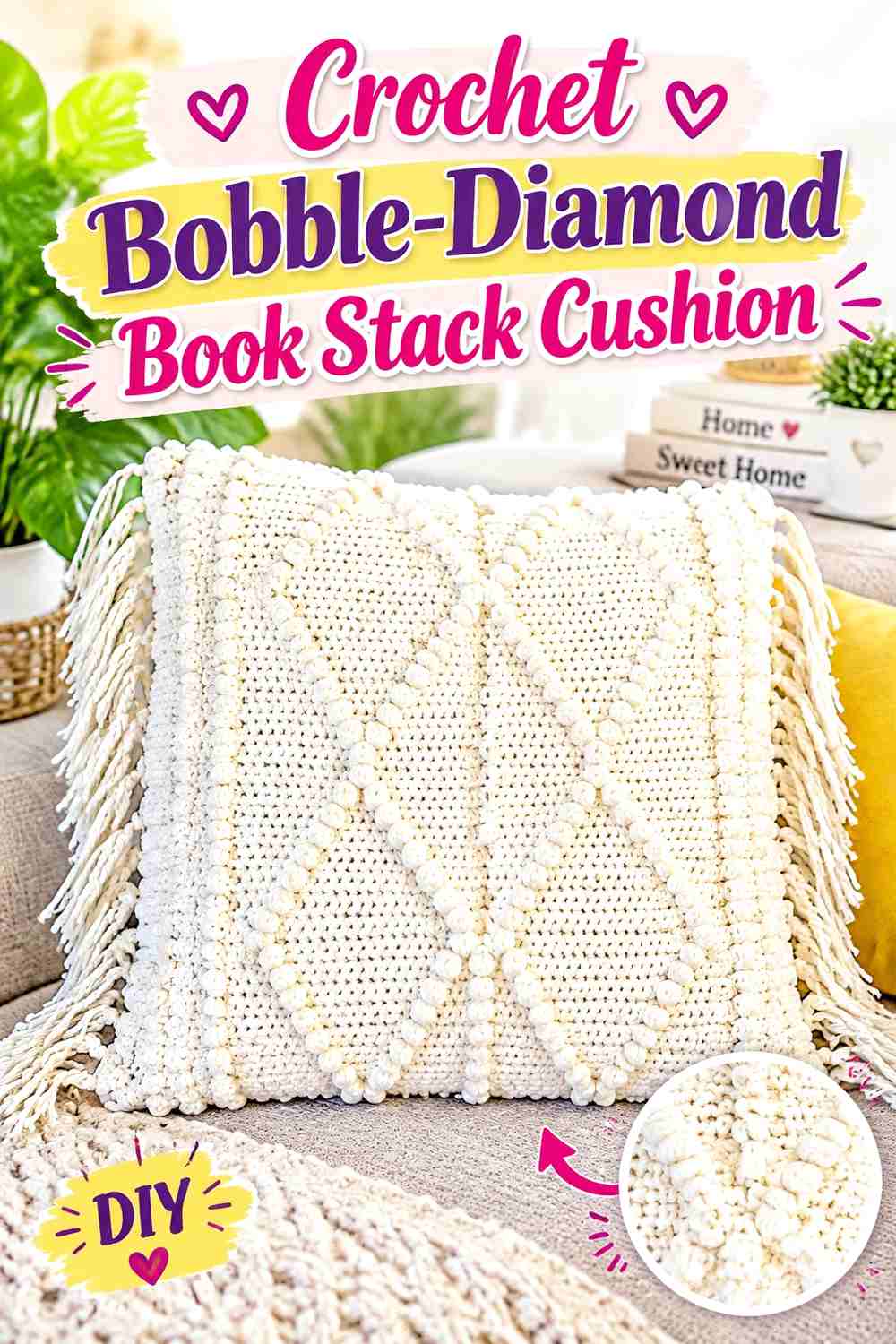
Crazy Cool Crochet’s bobble pillow uses a raised geometric design across a square cushion. That texture is a strong reference for an oversized book with an embossed central cover motif.
Unlike the cable option, bobbles produce a dotted relief that can feel more bohemian or handmade than formal.
Frame the Diamond Like a Book-Cover Panel
Rather than allowing the motif to run visually into every edge, give it breathing room where possible.
A quieter border can act like the frame around a decorative book cover and strengthen the illusion when the cushion is placed horizontally.
Avoid Putting the Most Raised Surface Under Your Head
Bobbles create concentrated points of texture. For a reading nook, that may be better against an arm, at the end of the stack, or facing outward.
If comfort is the priority, use a smoother cushion directly behind the reader.
Creator Credit: Crazy Cool Crochet
14. Crochet Fabric-and-Crochet Hardcover Cushion
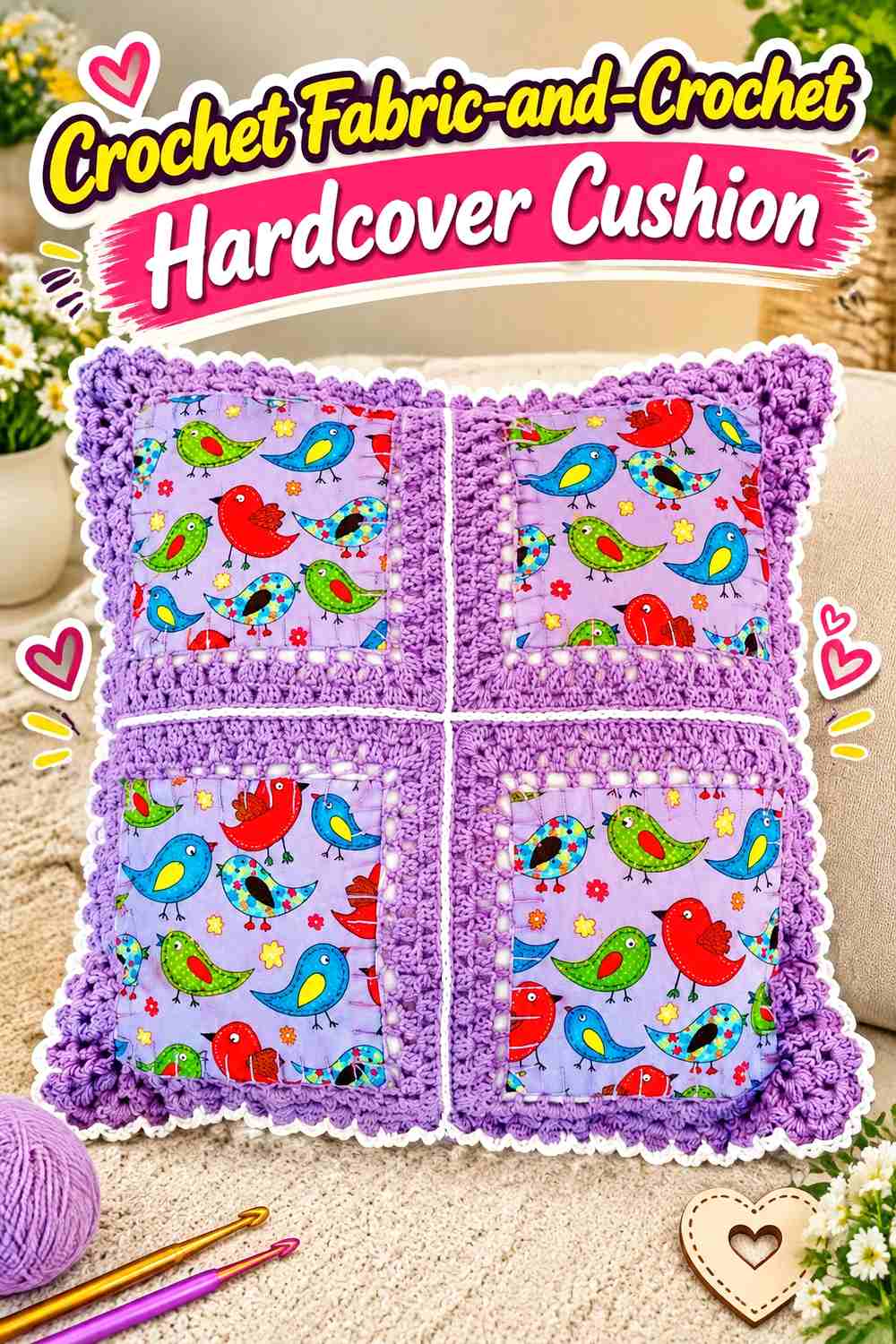
Pookie Doodle Crafts demonstrates fusion crochet, combining fabric with crochet in a cushion cover. That hybrid construction opens up a different interpretation of the theme: fabric can provide the broad “book cover,” while crochet forms the handmade edging and decorative framework.
This can work especially well when you want a firmer visual distinction between cover material and crocheted trim.
Fabric Changes the Structure as Well as the Look
Do not assume a hybrid cushion will stretch like an all-crochet one.
Measure carefully before combining components because the fabric section may have much less give than the crochet edging.
Choose Fabric for the Mood of the Imaginary Book
A tweed-like neutral can suggest an old clothbound volume, while a botanical print can create a storybook effect.
Keep the print scale in proportion to the cushion. Very tiny details can disappear from across the room.
Creator Credit: Pookie Doodle Crafts
15. Crochet Graphic Black-and-White Book Stack Cushion
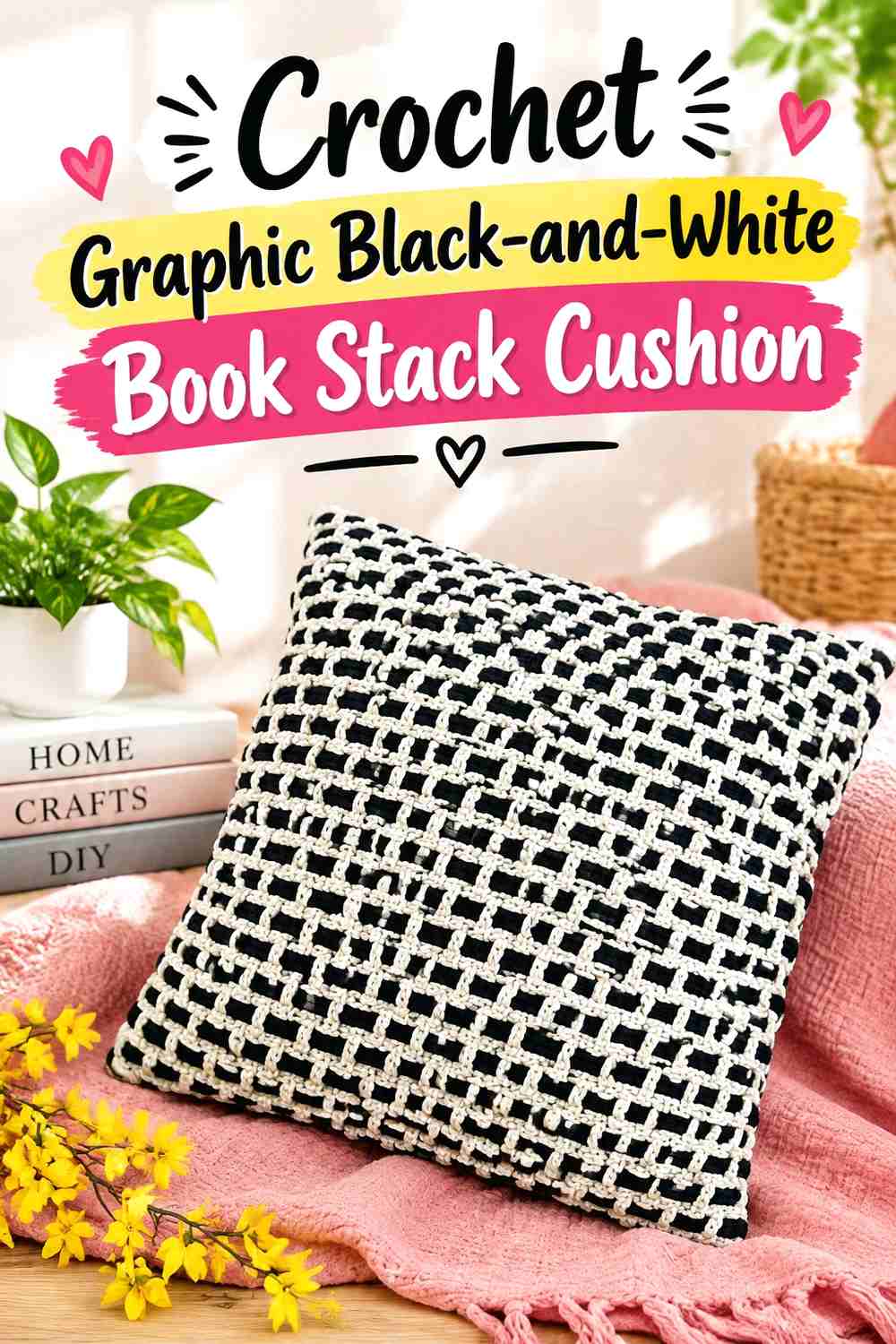
Ruanicraft’s cushion uses a crocheted mesh base with thicker yarn woven through it to create a graphic black-and-white surface. The resulting linear pattern makes an interesting reference for modern book-spine graphics.
This is the opposite of the vintage-library approach: clean contrast and bold lines give the reading nook a contemporary feel.
Woven Surface Details Can Suggest Spine Lettering Without Words
You do not need to reproduce book titles to make the concept readable.
Contrasting vertical and horizontal lines can suggest labels, typography, or modern cover design while avoiding tiny details that become hard to see in thick yarn.
High Contrast Needs a Deliberate Place in the Stack
Black and white can dominate softer winter colors.
Use this cushion as a visual divider between darker and lighter “books,” or repeat one of its colors elsewhere in the nook to connect it to the surrounding decor.
Creator Credit: Ruanicraft
16. Crochet Boho Raised-Texture Book Stack Cushion
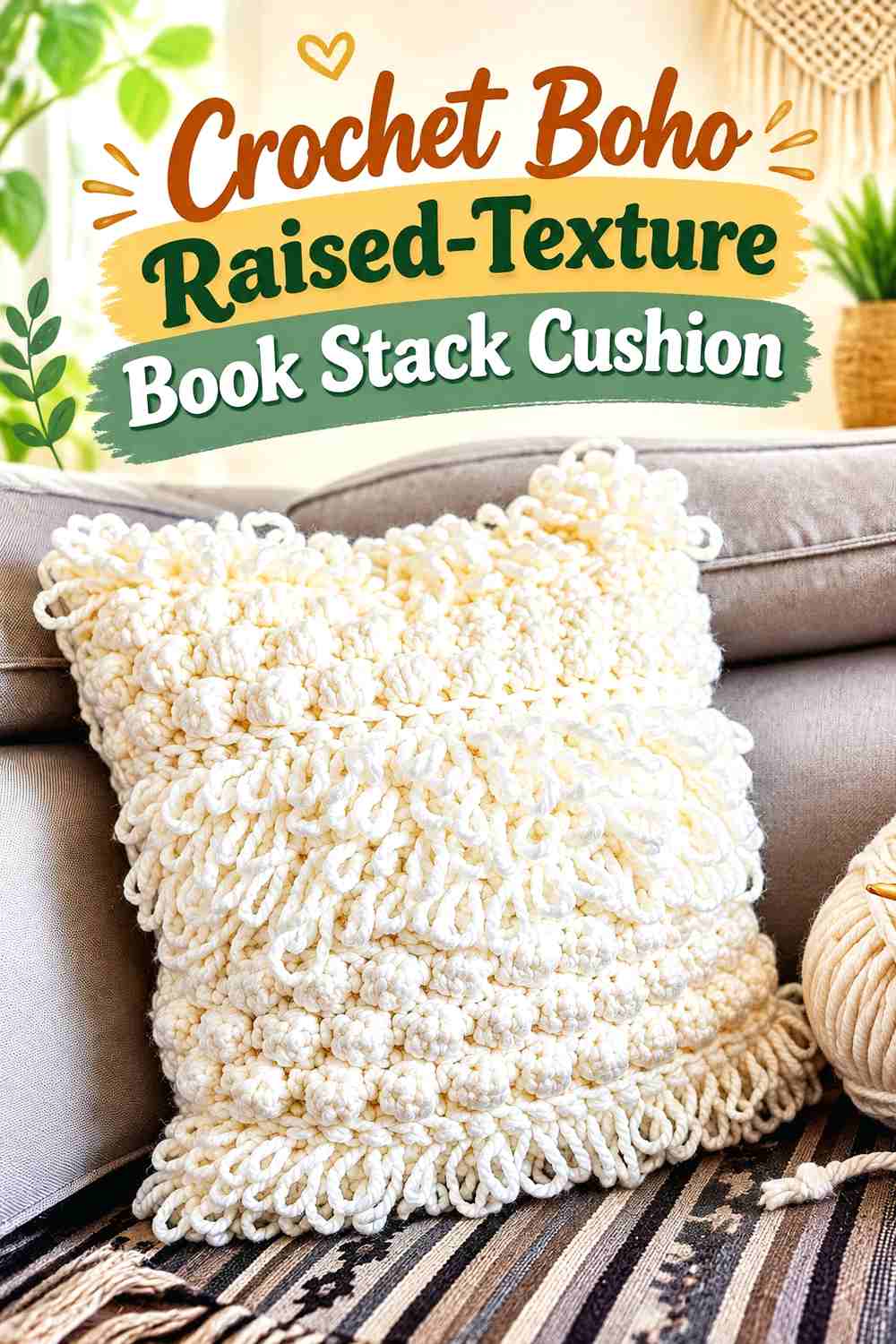
The Snugglery’s pillow combines multiple tactile crochet techniques, including loop and bobble textures, into one chunky cushion. It provides a useful construction reference for a highly tactile “special edition” book cushion.
This style works better as one standout volume than as the design for an entire matching stack.
Texture Can Separate the “Spine” from the “Cover”
A book-inspired adaptation does not need another color at every transition.
Changing texture between sections can create the impression of a spine panel, decorative band, and main cover while keeping the whole cushion within one restrained palette.
Chunkier Surfaces Need More Space
Thick yarn and looped textures create visual and physical volume.
Before adding this cushion to a narrow nook, compare its finished depth with the space available behind the reader. A cushion that looks balanced on a sofa can feel oversized in a small window seat.
Creator Credit: The Snugglery
17. Crochet Mixed-Binding Book Stack Cushion Set
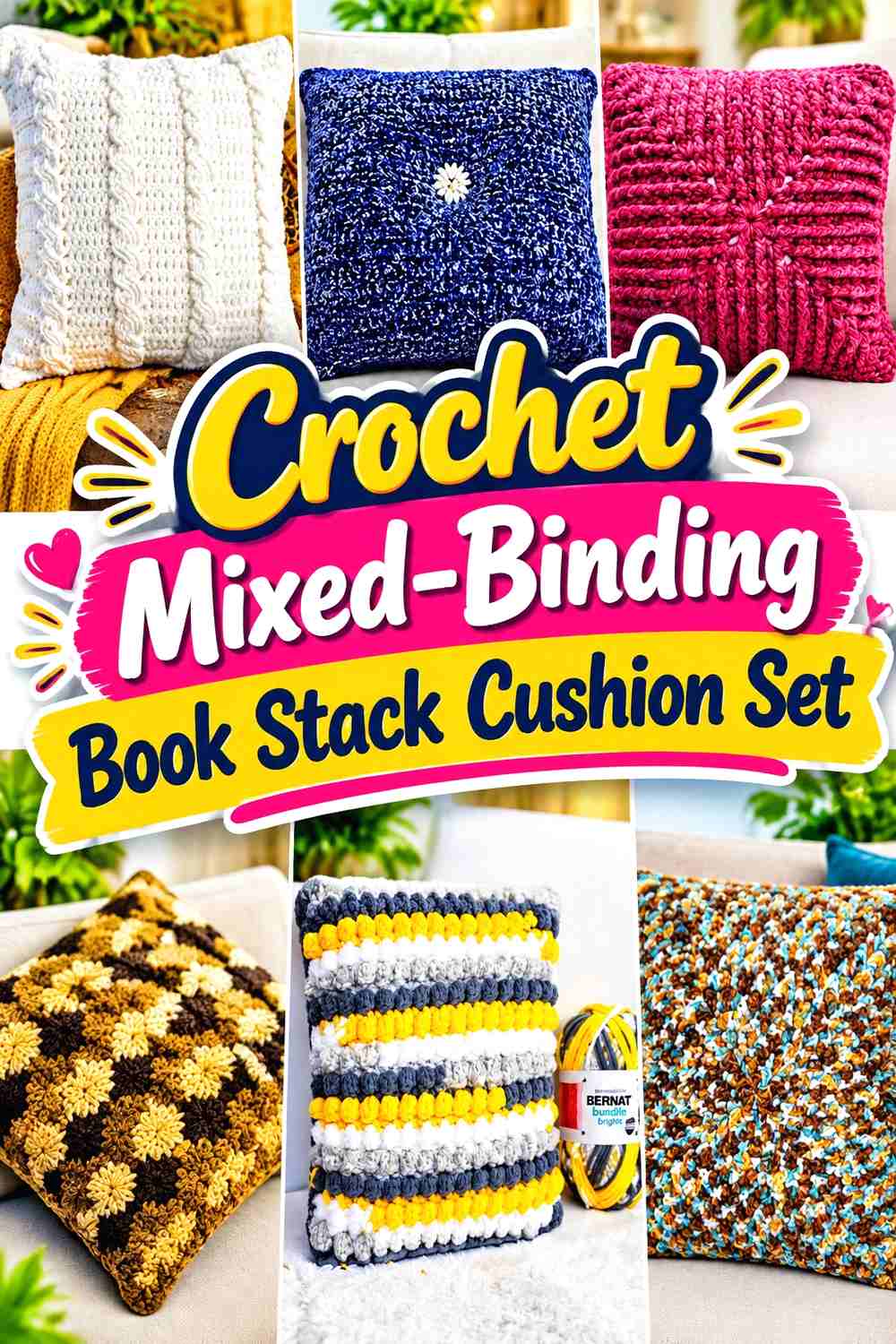
Bag-O-Day Crochet demonstrates several throw-pillow variations within one tutorial, making it a useful reference for a coordinated stack in which the “books” share a palette but not an identical surface.
Instead of making three matching covers, choose contrasting texture ideas and let each cushion represent a different style of binding.
Keep One Feature Consistent Across the Set
Variation looks intentional when something still connects the pieces.
That could be the same neutral page color, one repeated border shade, similar yarn weight, or a consistent general proportion. Without a shared element, the cushions may look like unrelated leftovers rather than one stack.
Let Texture Mark Different “Editions”
A smooth book, a ridged book, and a more decorative volume create more useful visual variety than three cushions that differ only in yarn color.
Before combining tutorials or variations, check that the finished dimensions can coexist comfortably in the same nook.
Creator Credit: Bag-O-Day Crochet
18. Crochet Oversized Granny Book Stack Cushion
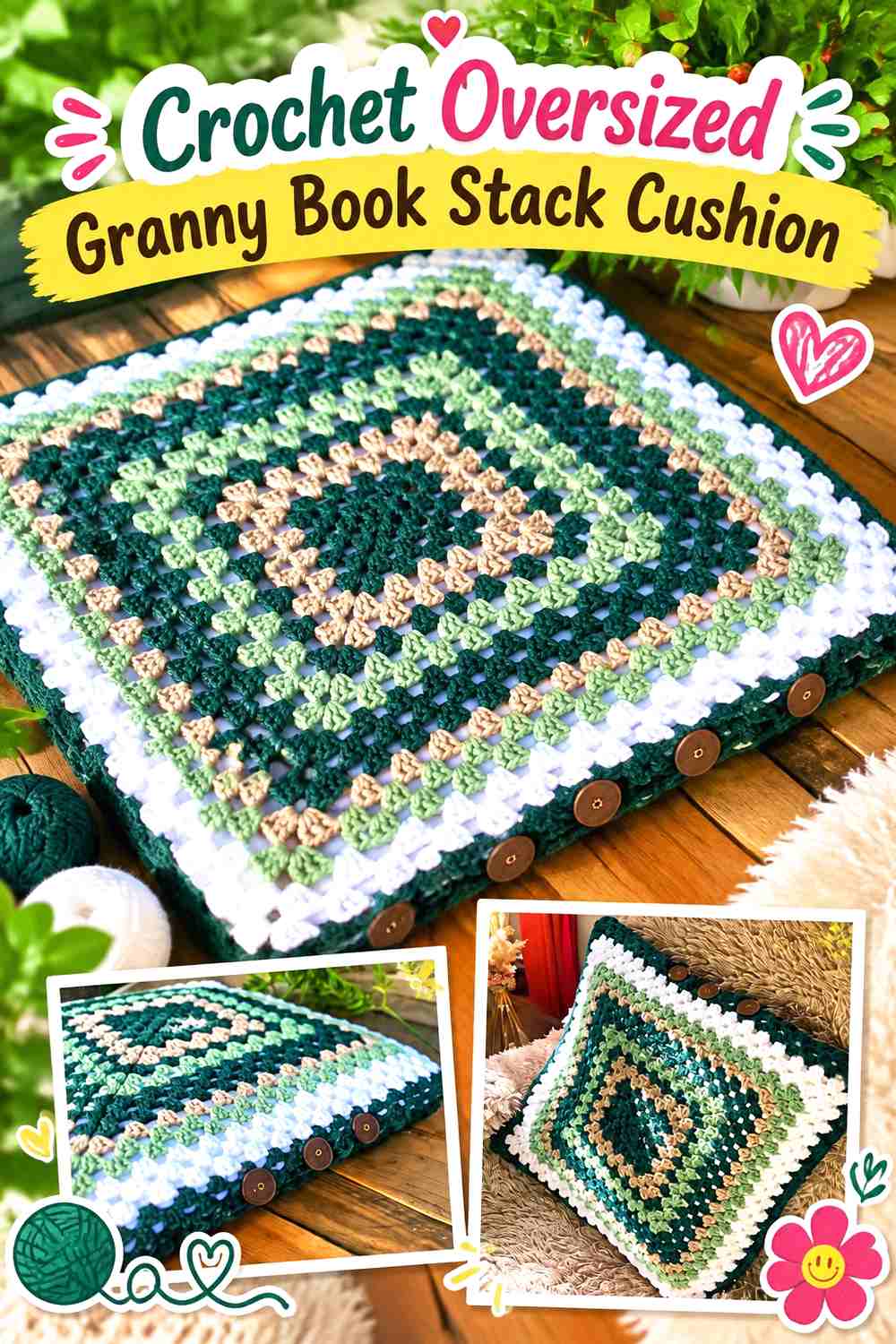
Linda Funky Crochet demonstrates a large granny-square cushion cover with a buttoned construction. The substantial scale makes it an interesting starting point for an oversized illustrated-book cushion in a roomy reading corner.
Instead of trying to make this look like a realistic leather-bound volume, embrace the colorful retro quality and treat it as the whimsical book in the stack.
Large Motifs Need Enough Viewing Distance
An oversized granny construction can look impressive in a spacious nook but visually crowded in a very tight corner.
Measure the available seat or wall width before choosing the insert, especially if several other cushions will be stacked nearby.
Buttons Should Stay on the Practical Side
If your adaptation keeps a buttoned opening, position that side where the hardware is not pressed directly against the reader.
The book illusion should never make the closure less functional or comfortable.
Creator Credit: Linda Funky Crochet
19. Crochet C2C Color-Block Book Stack Cushion
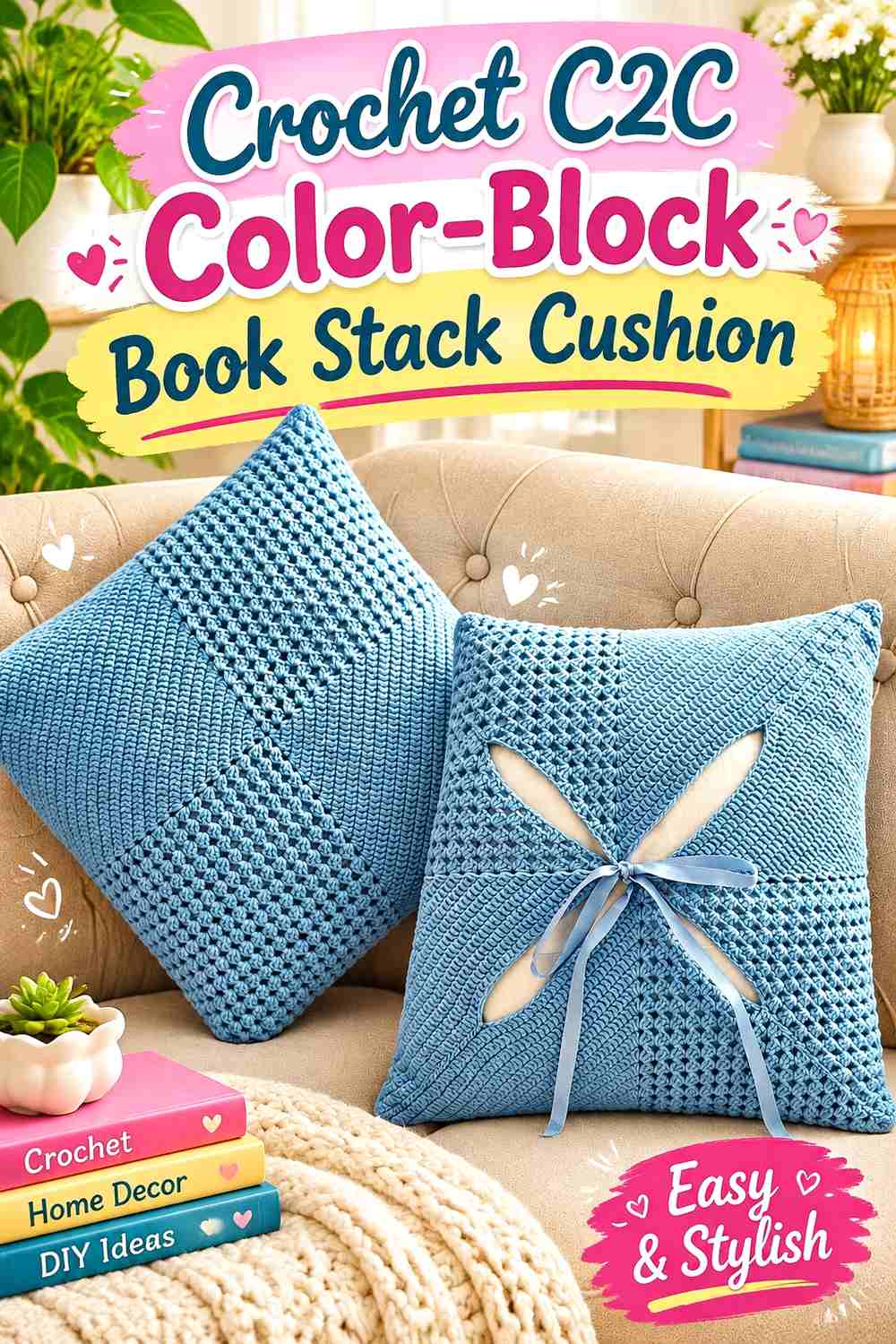
Tuba Crochet demonstrates a square cushion built from a growing crochet square. That construction can serve as a base for a graphic book-stack concept when the colors are planned as broad blocks rather than scattered randomly.
This final option suits a modern reading nook where the idea of books is suggested through strong geometry instead of literal appliqué.
Plan the Color Diagram Before Starting
Corner-to-corner-style construction changes the way color sections expand across the fabric.
Sketch the broad placement of your cover, page, and spine colors first rather than deciding where each “book” begins only after the panel is partly complete.
Use the Graphic Version When Space Is Limited
Several physically separate cushions create the strongest three-dimensional stack, but they also require more room.
A single color-block pillow can suggest the same idea while leaving more seating space for the reader, blanket, and actual books.
Creator Credit: Tuba Crochet
Which Crochet Book Stack Cushion Style Should You Choose?
For the most literal connection to reading, start with the Book Lover Pocket Stack Cushion. It already combines a pillow with practical book storage, so it does not need much extra decoration to belong in a reading nook.
For a convincing stack of separate oversized books, the Minimal Hardcover, Long Encyclopedia, Removable Dust-Jacket, and Striped Library options offer the cleanest shapes to build around.
If you want an old-library atmosphere, cables, mosaic work, bobbles, and mixed raised textures create the strongest decorative-binding effect. The gingham, granny, floral, plaid, and fusion-crochet options lean more toward cottage, whimsical, or illustrated storybook styling.
The most comfortable nook may combine several approaches: one smooth cushion for direct support, one longer “book” underneath, and one highly textured volume facing outward for decoration.
Conclusion
A crochet book stack does not have to reproduce a real novel stitch for stitch to make the theme clear. Rectangular proportions, contrasting page colors, defined spine areas, and a slightly uneven stack can communicate the idea before you add a single letter or appliqué.
For a practical everyday nook, start with a long or removable-cover cushion and build outward from there. Add cables or bobbles if you want vintage binding texture, gingham or granny squares for a softer cottage look, plaid for Christmas, or graphic colorwork for a more contemporary library corner.
Most importantly, treat the linked tutorials as the source for their actual crochet construction. When adapting a square pillow into a longer book shape or changing a colorwork layout, measure your intended insert and confirm that the source stitch repeat or construction can accommodate the change rather than assuming the original counts can simply be stretched.
Frequently Asked Questions
How can I make a crochet cushion look like a book without adding lettering?
Use shape and color first. A rectangular cushion with a darker outer “cover,” a light page-colored band, and a clearly defined spine edge will usually communicate the idea more effectively than small lettering. Cables, bobbles, mosaic patterns, or narrow borders can add the look of decorative binding.
Do all three cushions in a crochet book stack need to be the same size?
No. Slight differences can actually make the stack more convincing. A longer cushion works well at the bottom, with a medium and smaller “volume” above it. Measure the nook first, though, because several deep cushions can quickly take over the available sitting space.
Can I turn any square crochet pillow pattern into a rectangular book cushion?
Not automatically. Plain stitch patterns may be relatively straightforward to resize, while granny constructions, mosaics, cables, gingham, C2C designs, and other repeating patterns have structural or visual repeats that need to be respected. Check the creator’s sizing information and stitch multiple before changing proportions.
What filling works well for a crochet book cushion?
That depends on the construction. A ready-made rectangular insert gives you predictable dimensions and works particularly well with removable covers. A permanently closed cushion may use suitable stuffing instead. Follow the source tutorial for its intended construction and do not assume every pillow design uses the same filling method.
Should the “page” section be white?
Not necessarily. Cream, oatmeal, pale gray, parchment-like beige, or another quiet neutral can suggest pages while coordinating better with the room. Very bright white can create stronger contrast, while warmer neutrals can make vintage-inspired book cushions feel softer.
How do I keep stacked crochet cushions from looking too busy?
Limit the number of competing features. If one cushion has cables, let another be smooth. If one is plaid, consider solid colors above and below it. Repeating one neutral shade through several cushions can make different patterns feel like a coordinated collection.
Are heavily textured crochet book cushions comfortable for reading?
That depends on where the texture sits and how the cushion is used. Deep bobbles, loops, and cables can be noticeable under sustained pressure. They often work better on outward-facing surfaces or accent cushions, while smoother crochet is a practical choice directly behind the head or lower back.